โ–ท The world of Pets: Dogs, cats, birds, reptiles, amphibians

Norwich Terrier
Inglaterra FCI 72 . Small sized Terriers.

Norwich Terrier

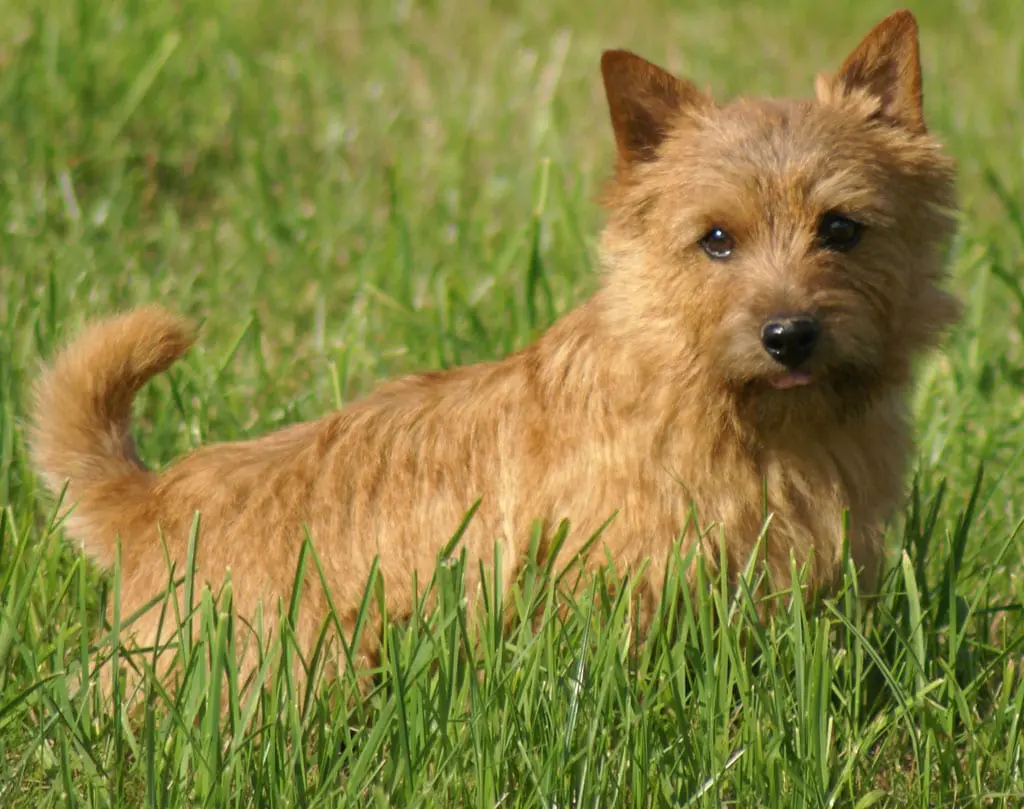
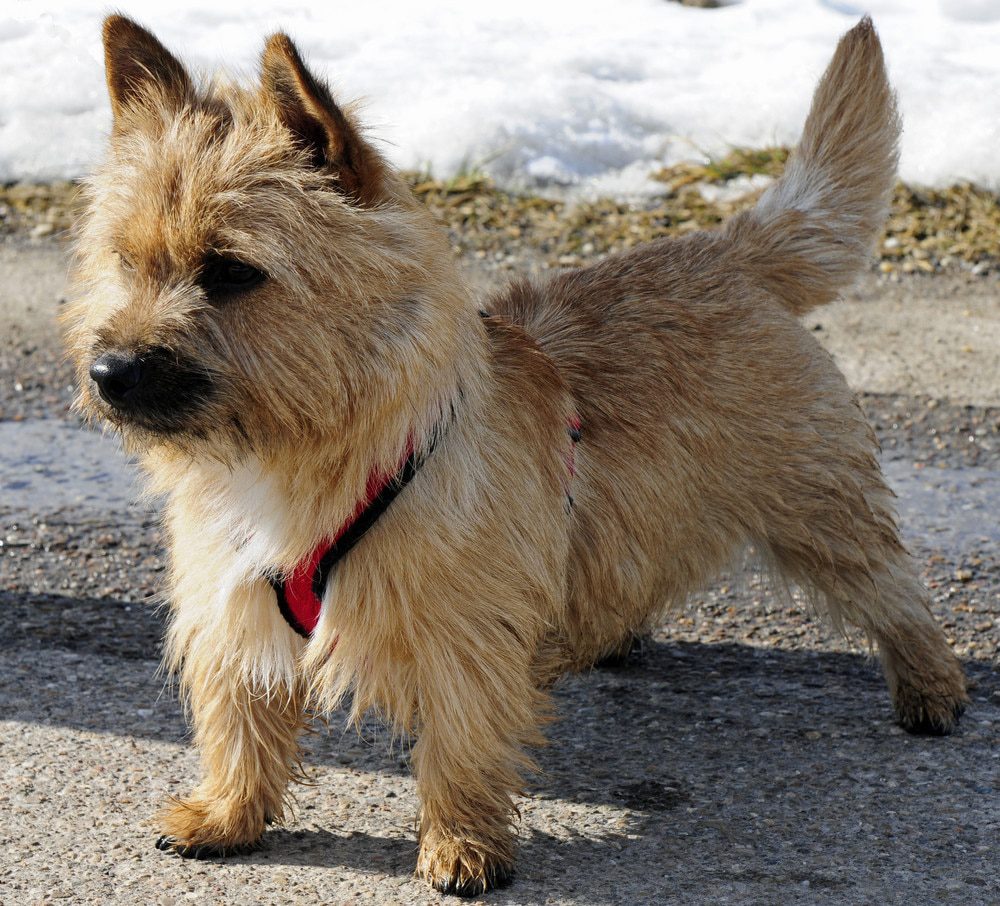
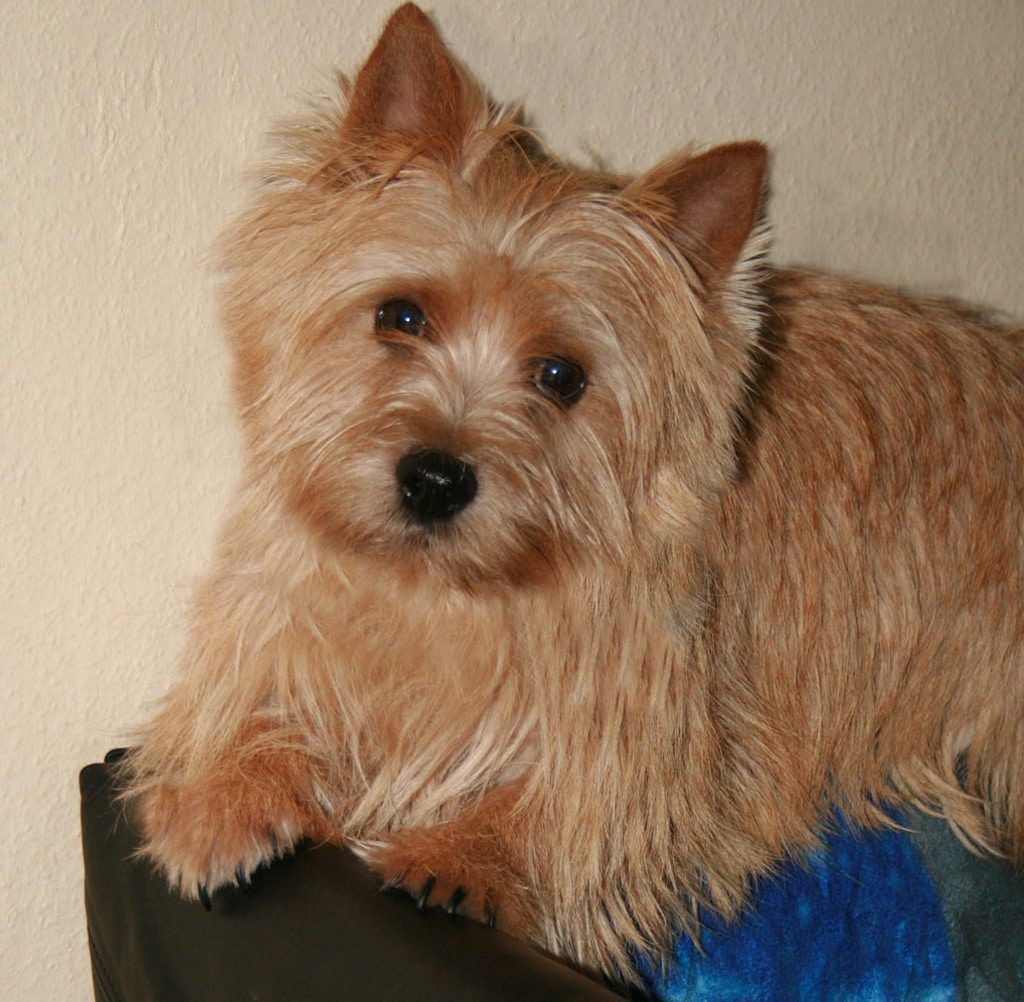
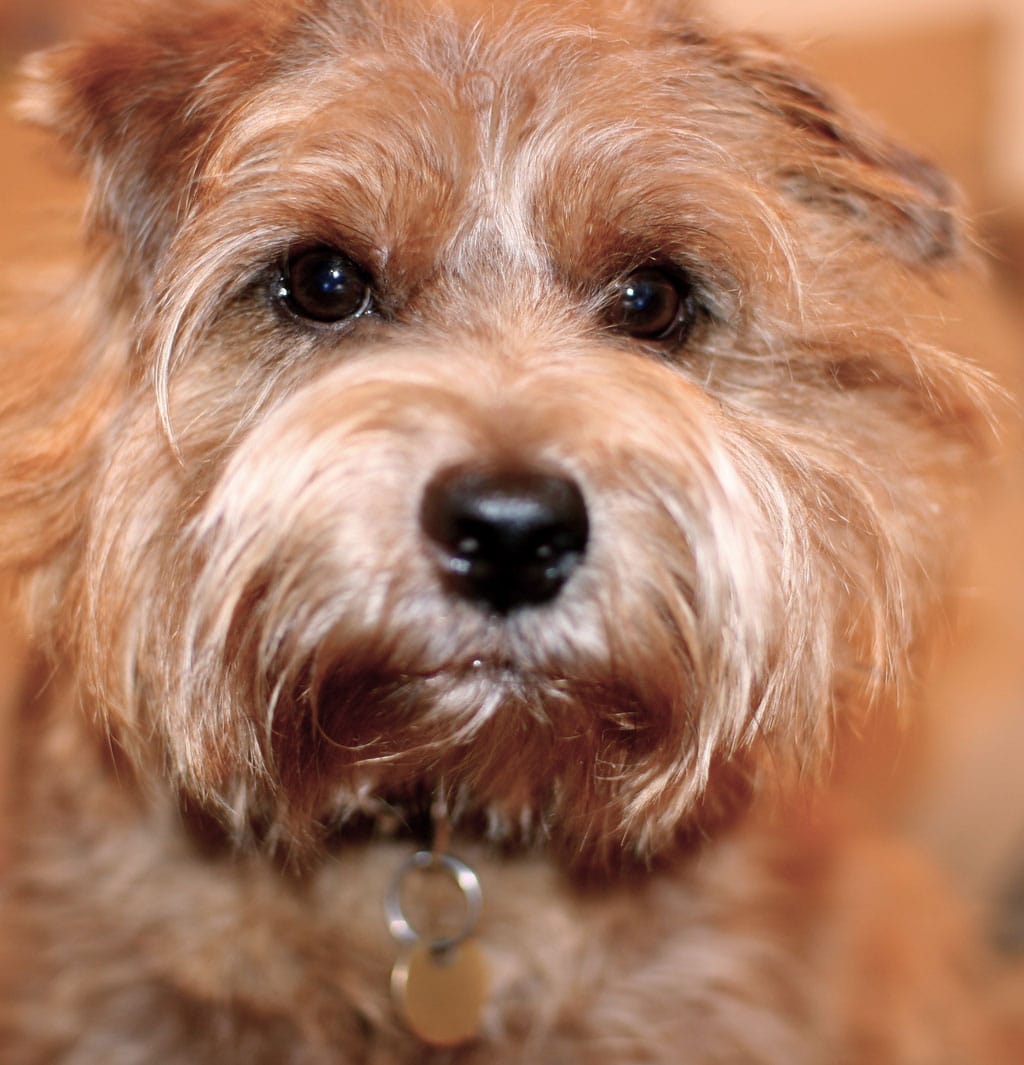
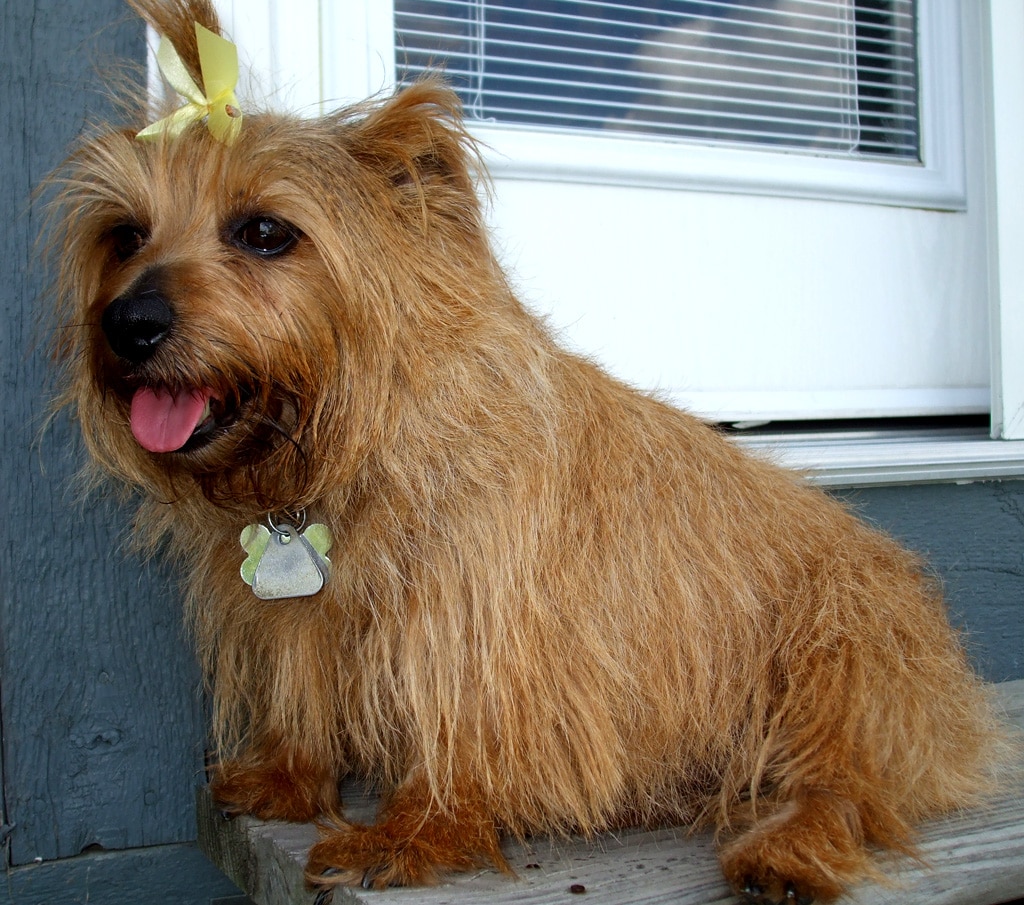
The Norwich Terrier, has lively character, joyful, affectionate and is curious by nature.

Content

History

One of the reasons there are so many Terrier breeds is because many were created to measure for a given area or population.. The Norwich comes from the East Anglia of England, Cambridge University Headquarters. Like college students of any age, Cambridge students of the decade 1880 they thought it was a lot of fun betting on sporting events, including your dogs' mouseing skills. Los terrier, including those in yorkshire and ireland, they were bred to develop small red or black and tan dogs with a spirit of play. They were known as Terriers Trumpington.

A Trumpington named Rags, he was a stable dog near the city of Norwich, He had such a reputation as a buzzard that he had a profound influence on what would become known as Norwich Terrier. Rags and their descendants were crossed with other Terriers, including a small Staffordshire Terrier, and became known for a new skill: get foxes out of their burrows.

Since the 19th century there are documented sources that confirm the breeding of the Norwich Terrier. But, At that time there was also Norfolk Terrier, which is closely related to the Norwich Terrier. Back then it was considered the same race, nowadays they differ in insignificant points. Since the decade of 1960 the two races have been handled differently.

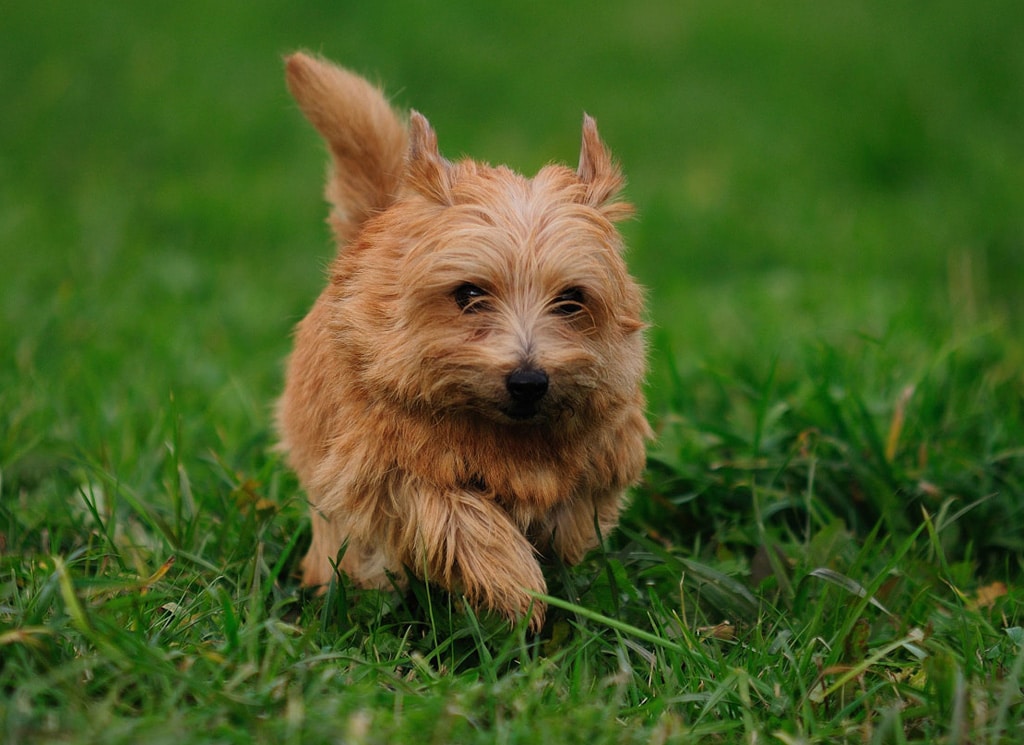
A particularly different trait is the ears, in the Norwich Terrier tend to be more upright, While in the Norfolk Terrier they are slightly bent. After many years of upbringing, you can see some character differences. The Norwich Terrier, for example, is considered more affectionate than the Norfolk Terrier. At that time animals were especially used as rat catchers and were often used on farms.

Physical characteristics

It is one the smaller Terrier its height is maximum 25 cm the cross and his weight is between 5 and 5.5 kg.

Recently on United States, There has been a great fraud with these dogs, they sold fake Norwich Terriers with pedigree, by Internet.

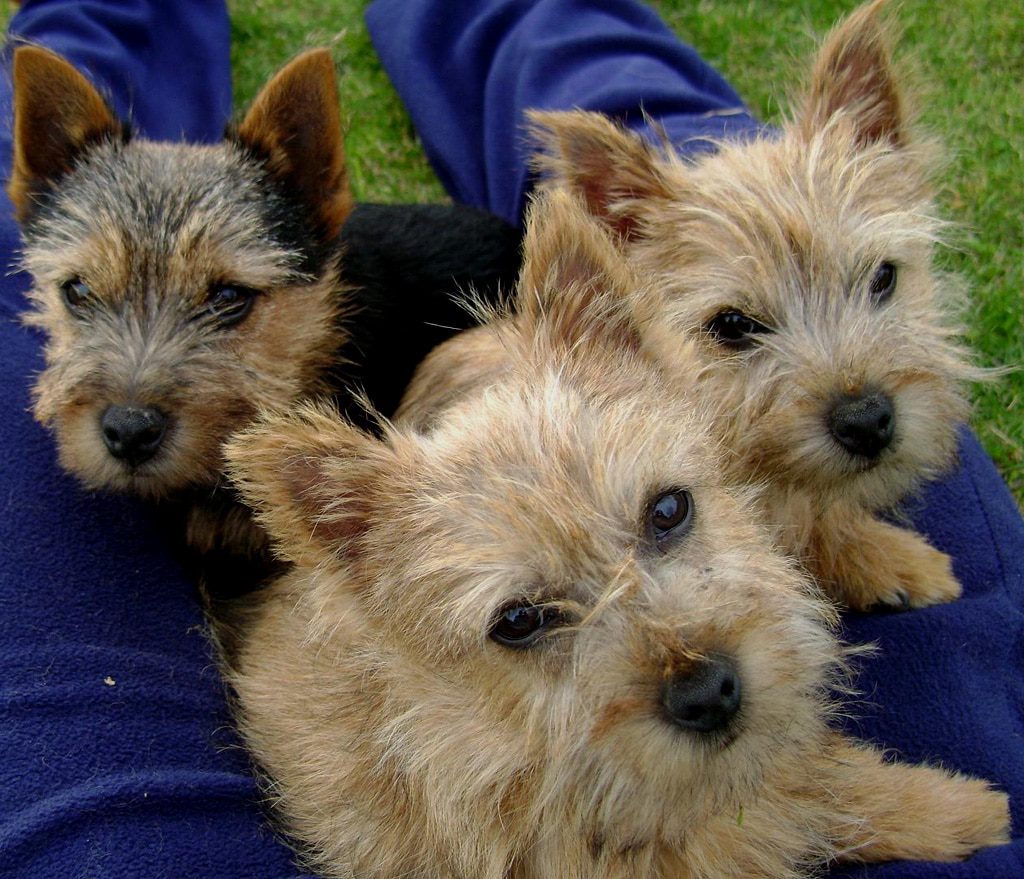
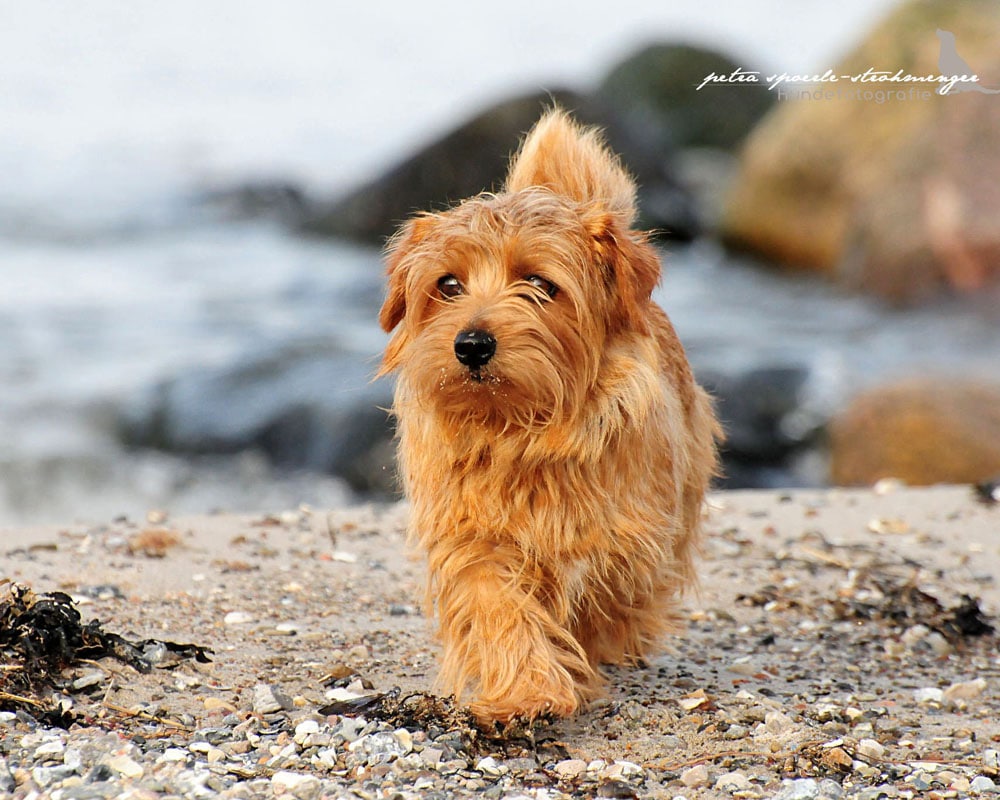
Son difficult to create because their births tend to be by caesarean section. His cloak is twofold and can be red, Red wheat, Black fire or salt and pepper (grey).

Norwich Terrier has a fur two layers, a foreign finish hard, rough and a warm and soft layer, attached to the skin.

Ideally, styling it once a week to remove the loose hairs killed.

As minimum, the hair should be stripped once in the fall and once in the spring.

Observations

The cut or Court it adversely affects the appearance of the natural colors of the layer and texture.

Character and skills

The Norwich Terrier, they have a character lively, joyful, loving and they are curious by nature.

One advantage is that they are not anti-social dogs or they tend to show aggressiveness.

They were originally bred to hunt burrowing animals but today they have become excellent companion animals..

These small but sturdy dog, brave, Smart and very loving. They were bred for chasing varmints and accompanied their owners farmers on horseback. A good daily walk is therefore, the minimum necessary to meet exercise requirements, and give a healthy lifestyle.

They are sensitive to the scolding, as the 100% Terrier. Much like family life, and very little loneliness. It is not meaningless ladrador, But if you notice something strange, It will be.

It is a dog that She loves children. They adapt perfectly to other pets.

The life expectancy the Norwich Terrier is 12 to 16 years.

Characteristics "Norwich Terrier"

Coexistence is important that you have with your new friend. Before considering the acquisition of a dog of the breed "Norwich Terrier" you know certain factors. Not all breeds of dogs are apt to live in an apartment, you must take into account his character, their need for exercise, their interaction with other pets, their care and if you have small children, their level of tolerance towards them.

Adaptation โ“˜

5,0 of 5 stars (based on 1 review)

friendly dog โ€‹โ€‹โ“˜

5,0 of 5 stars (based on 1 review)

hair loss โ“˜

2,0 of 5 stars (based on 1 review)

Affection level โ“˜

4,0 of 5 stars (based on 1 review)

Need for exercise โ“˜

4,0 of 5 stars (based on 1 review)

Social need โ“˜

3,0 of 5 stars (based on 1 review)

Home โ“˜

4,0 of 5 stars (based on 1 review)

Toilet โ“˜

3,0 of 5 stars (based on 1 review)

Friendly with strangers โ“˜

2,0 of 5 stars (based on 1 review)

barking โ“˜

4,0 of 5 stars (based on 1 review)

Health โ“˜

2,0 of 5 stars (based on 1 review)

Territorial โ“˜

3,0 of 5 stars (based on 1 review)

Cat friendly โ“˜

4,0 of 5 stars (based on 1 review)

Intelligence โ“˜

4,0 of 5 stars (based on 1 review)

Versatility โ“˜

2,0 of 5 stars (based on 1 review)

Child friendly โ“˜

4,0 of 5 stars (based on 1 review)

Surveillance โ“˜

4,0 of 5 stars (based on 1 review)

joy โ“˜

3,0 of 5 stars (based on 1 review)

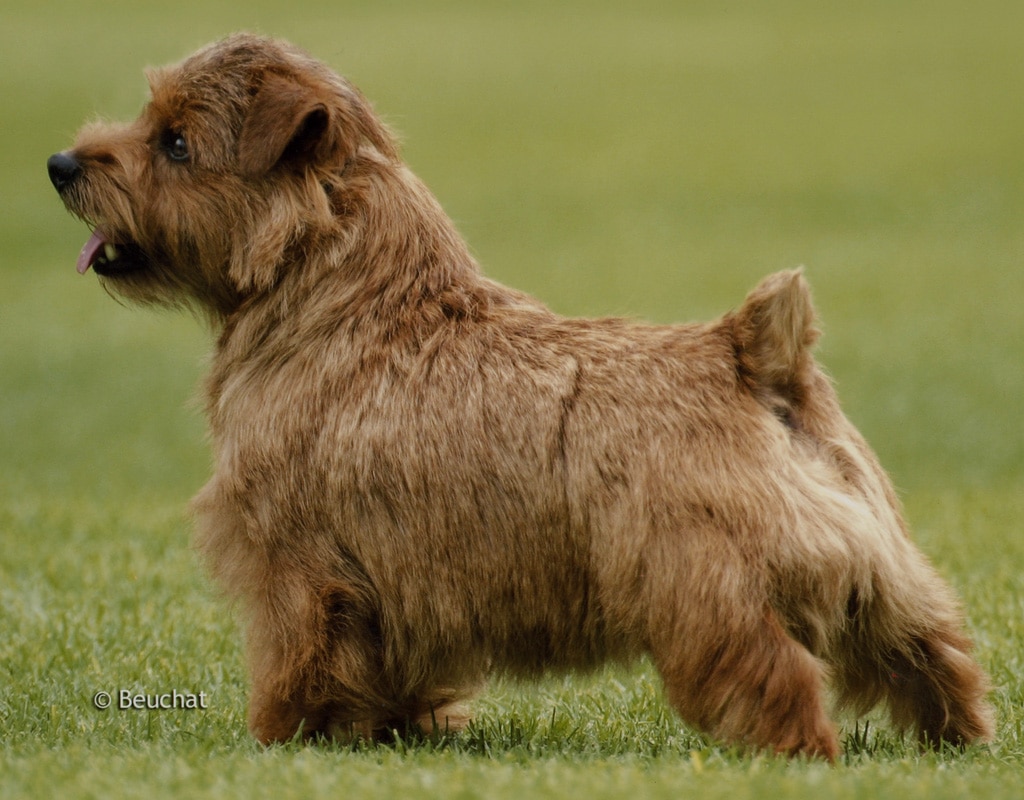
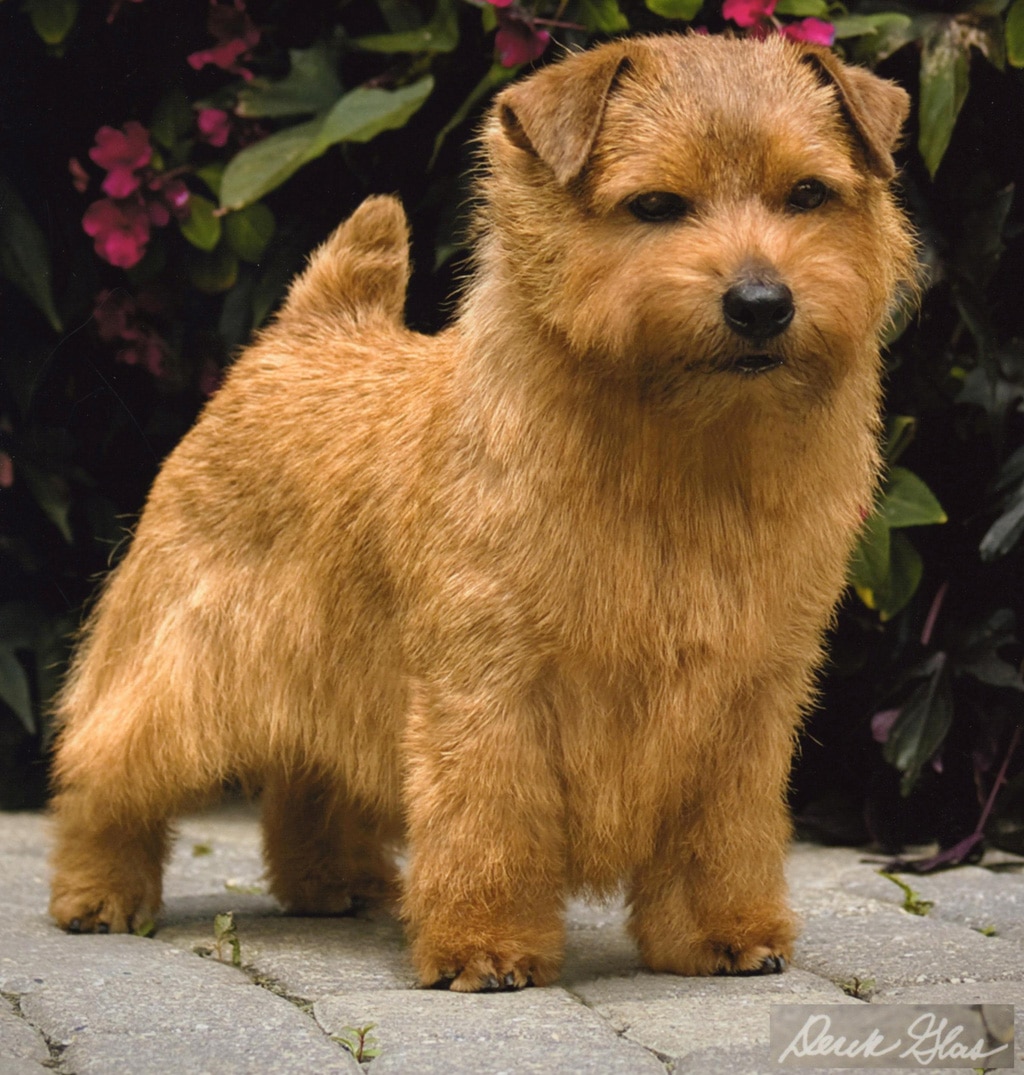
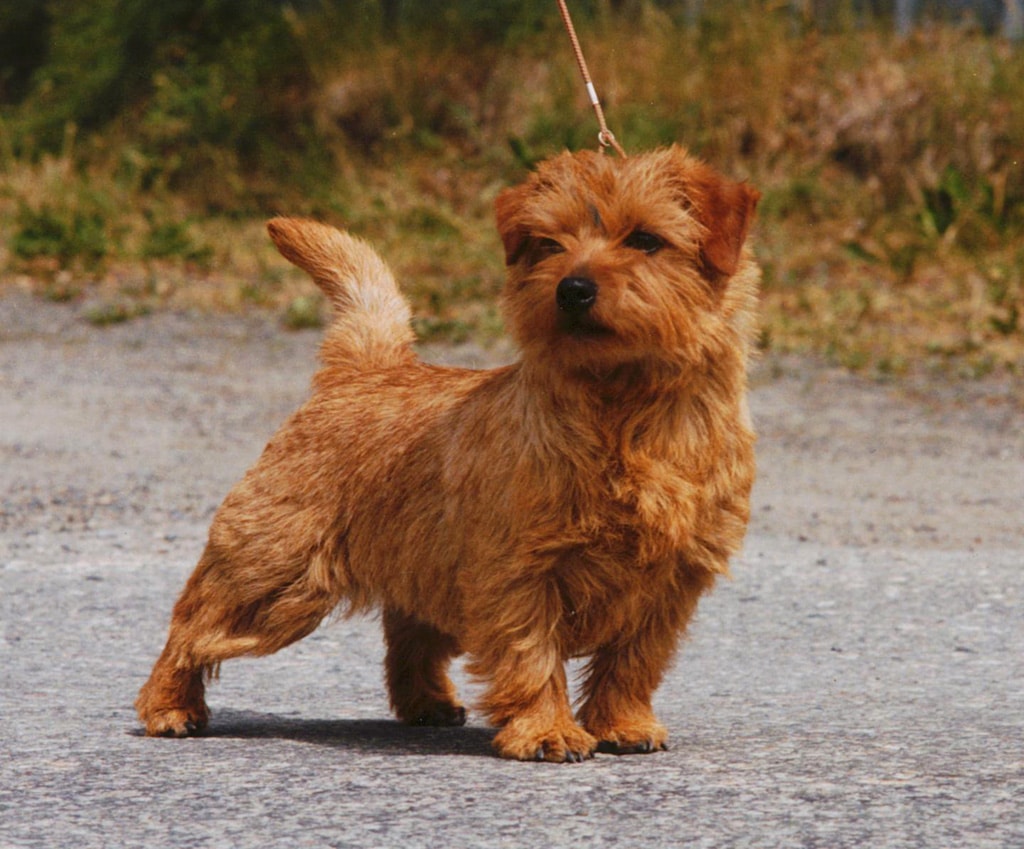
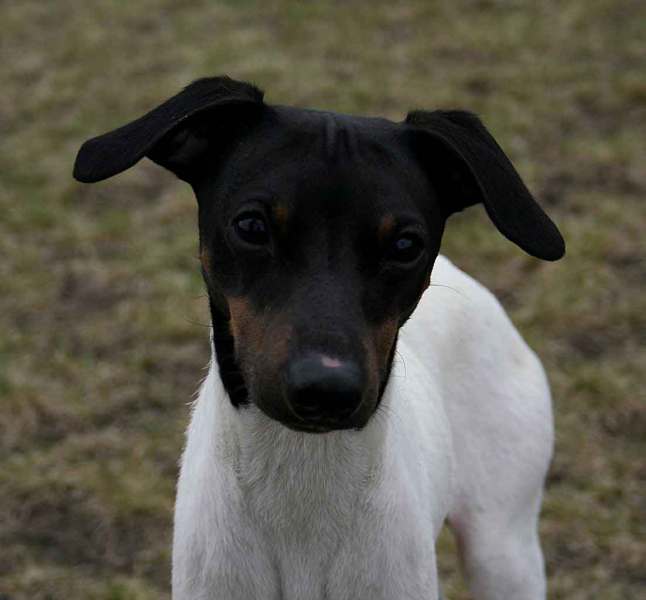
Norwich Terrier Images

Norwich Terrier Videos

Type and recognitions:

  • FCI CLASSIFICATION:
  • Group :
  • Section : . .

Federations:

  • FCI – Terriers 2 Small sized Terriers. โ“˜
  • AKC – Terriers โ“˜
  • ANKC – Terriers โ“˜
  • CKC – Terriers โ“˜
  • โ€‹KC – Terriers โ“˜
  • NZKC – Terriers โ“˜
  • UKC – Terriers โ“˜

FCI breed standard "Norwich Terrier"

Origin:
United Kingdom

Date of publication of the valid original standard:
13.10.2010.

Use:

Terrier


General appearance:

One of the smallest terriers. It's a cunning dog, short limb, compact and strong, with good structure and skeleton. Honorable scars resulting from deterioration and natural tears should not be unfairly penalized.


Behavior / temperament:

One of the smallest ground dogs. Loving but not quarrelsome, tremendously active and robustly built. Cheerful and brave.

Head:

---

Cranial region:
  • Skull: Wide and slightly rounded, with good width between the ears.
  • Depression links (Stop): Well defined.

facial region:

  • Snout: Strong and wedge-shaped (its length is less than a third of the distance measured from the occipital to the base of the naso-frontal depression).
  • Lips: Glued.
  • Jaws / Teeth: Strong and sharp jaws. Pretty big teeth, strong, with healthy teeth, complete and scissor bite, that is to say, that the inner face of the upper incisors is in close contact with the outer face of the lower incisors; the teeth should be set at right angles in the jaws.
  • Eyes: relativelysmall, oval-shaped, dark, full of expression, bright and lively.
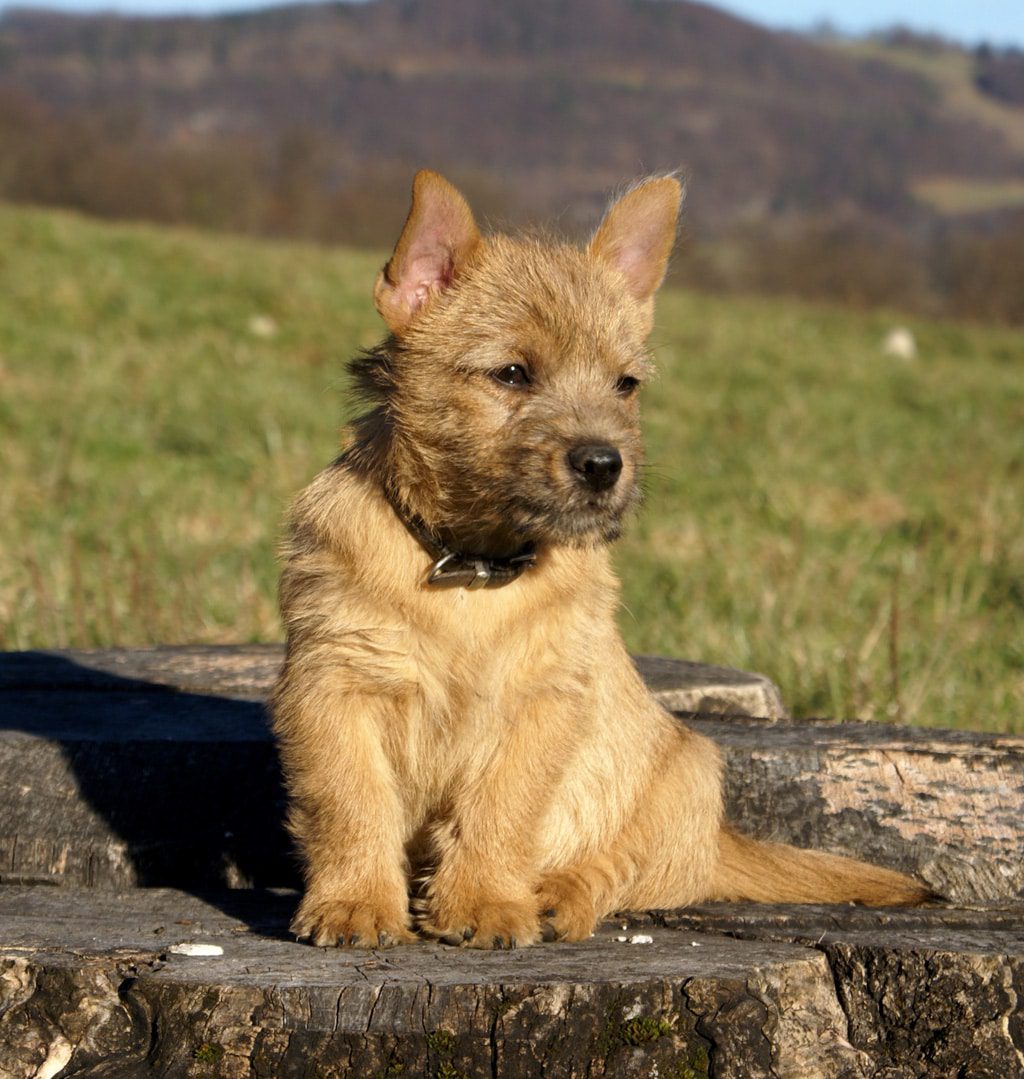
  • Ears: erect, placed well apart on the skull. Medium-sized and pointed. When the dog is excited he carries them perfectly erect and can throw them back when he is not attentive.

Neck:

Strong and of good length, in proportion to the overall balance of the dog, and it descends harmoniously towards the well inclined shoulders.

Body:

Compact

  • top line: Level.
  • Back: Short
  • Pork loin: Short.
  • Breast : Long, well-rounded chest. With good depth.

Tail:

Previously optional tail amputation.
  • Medium amputation: High implementation, completing a perfectly level dorsal line. Carried upright.
  • Without amputation: Tail of moderate length to give the dog a general balance, thick at the base and is tuned toward the tip, as straight as possible, live, but not too happy, completing a perfectly level dorsal line.


Tips

PREVIOUS MEMBERS:

  • Elbows: Glued to the body.
  • Forearm: Short limbs, powerful and straight.
  • Metacarpus: Firm and straight.
  • Previous feet: Round, with thick, cat-like foot pads. Headed straight forward when the dog moves or stands.

LATER MEMBERS:

  • General appearance: Widths, strong and muscular.
  • Knee : good angulation.
  • Metatarsus: Hockslowered with great pushing capacity.
  • Hind feet: Round, with thick, cat-like foot pads. Headed straight forward when the dog moves or stands.

Movement:

The forelimbs should move forward in a straight line when the dog is moving.; the hind limbs follow the tread of the forelimbs; hocks are parallel and flex to show pads.

Mantle

  • Fur: Lasted, rough texture, straight and close to the body, with a dense undercoat. Longer and rougher at the neck forming a collar that frames the face. The hair on the head and ears is short and straight, except for slight eyebrows and a mustache.
  • Color: All shades of red, wheat, black and Tan or grey. Stains or white markings are undesirable.


Size and weight:

The ideal height to cross is between 25 cm..


Fouls:

Any deviation from the aforementioned criteria is considered as a fault and the severity of this is considered to the degree of the deviation to the standard and its consequences on the health and well-being of the dog..

FALTAS DESCALIFICANTES:

  1. Aggressiveness or extreme shyness.
  2. Any dog โ€‹โ€‹showing clear signs of physical or behavioral abnormalities must be disqualified..


N.B.:
  1. Males should have two normal-appearing testicles fully descended into the scrotum..
  2. Only functionally and clinically healthy dogs, with the typical conformation of the breed, should be used for parenting.

The latest changes are in bold.

TRANSLATION: Brรญgida Nestler / Original version: (IN) Technical supervision: Miguel Angel Martinez

Source: F.C.I - International Cynological Federation

Alternative names:

1. Norwich (English).
2. Norwich (French).
3. Norwich (German).
4. Norwich (Portuguese).
5. Terrier de Norwich (espaรฑol).

โ–ท The world of Pets: Dogs, cats, birds, reptiles, amphibians

Irish Glenn of Imaal Terrier
Irlanda FCI 302 . Large and medium sized Terriers
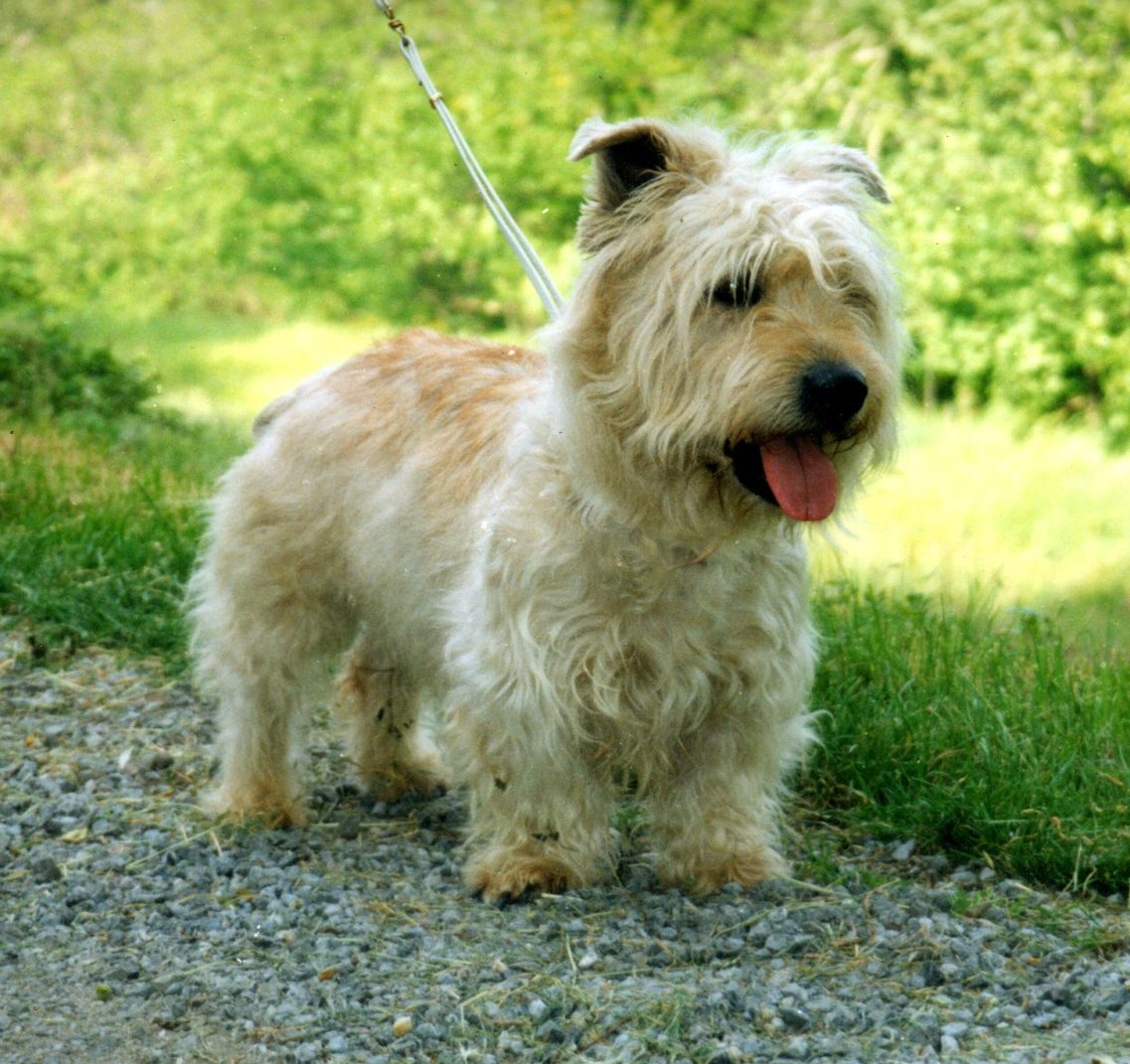
It is generally believed that Irish Glenn of Imaal Terrier is less excitable than other Terriers, although it takes action immediately when prompted.

Glen of Imaal Terrier

Content

History

The Irish Glenn of Imaal Terrier originates from the Irish east coast, in county wicklow, which is in the ravine (=Valle) the Imaal. From this rough and wild valley this very old breed got its name. It was first mentioned around 1575.

Like old farm dog, the Irish Glenn of Imaal Terrier he had a very busy life and worked hard for his master. His job was to catch rats and mice on farms and operate smaller work machines like churns and work grinders., where I had to run on leather straps. He also accompanied his master on the fox hunt, the Badger and Otter. He worked in silence and if necessary he fought to the death. Before it was banned in Ireland, the Irish Glenn of Imaal Terrier also used in questionable dogfights. Of course, he was also the most loyal friend and guarded the house and the yard, never shied away from facing a much bigger and stronger opponent.

For its owner, the Irish Glenn of Imaal Terrier it was as important as his daily bread, although undemanding, frugal and tough enough to share the barren life of farmers. This harsh life brought with it a ruthless selection. Only the toughest and most frugal Terriers survived, what characterizes the breed until today.

The pedigree of Irish Glenn of Imaal Terrier it's an irish secret to this day. In Ireland itself, this Terrier has never been numerous and did not leave his ancestral home until 1980, when the owners preserved him as a true child of nature, marked by great courage, skill and endurance. In 1933 the breed was officially recognized by the Irish Kennel Club ( I.K.C.). The international recognition of the F.C.I. continued on 1981.

Physical characteristics

The Irish Glenn of Imaal Terrier it is small but strong and robust and weighs up to 16 kilograms with a maximum height at the withers of 36 centimeters. Its relatively small forward leaning ears are notable.. Its coat is medium length and consists of a rough top layer and a smooth bottom layer. It can be wheat colored, tabby blue or in different shades of red and gold. In the case of a dark-colored coat, a black-blue mask is common., which can also show as stripes over the ears, along the back and tail, so these marks become clearly clearer with increasing age.

Character and skills

Today the Irish Glenn of Imaal Terrier it is a gentle and docile family dog. Its balanced and faithful nature, as well as his average temperament make life with him very pleasant. The Irish Glenn of Imaal Terrier is very affectionate, always cheerful and in a good mood and preferably "in the middle". Enjoy all the attention and care, but without demanding anything. Rather, follows her around with her alert gaze and once she has gained attention, shows his joy about it with strong tail swipes. If the joy is particularly great, his temperament can also run away with him.

Children are welcome as playmates, if they show him the respect that he shows. Pets are accepted by him without problems when they get used to each other. The Irish Glenn of Imaal Terrier she is always friendly with strangers, and with his contagious joy, His charm and his irresistible look quickly have all the sympathies on his side.. After all, it is a terrier that radiates a lot of personality. He is open-minded and not afraid to learn new things. He likes to be everywhere with his nose. In general, everything that is new – Weird people, new environments, an object that has not been there before – it is very interesting and has to be examined very carefully. The Irish Glen of Imaal Terrier is a particularly attentive observer. Along with her charming nature and her desire to do everything right, is very adaptable and develops a very close relationship with his family. He likes to accompany them whenever possible. Like a very people-oriented terrier, I would defend them in an emergency, even to death. Feel more comfortable in your proximity.

What characterizes him Irish Glenn of Imaal Terrier is his great courage, his self-confidence and intelligence above average. Sufficient workload and intellectual work are important to the intelligent four-legged friend. Enjoy almost all activities, be it sports with dogs, search games or learning tricks – is available for all kinds of fun.

Despite its short legs, it is very agile, due to his muscular physique, a small power. Its special characteristics are its slightly curved front legs with the legs turned outward., his big head and his pronounced chest. The Irish Glenn of Imaal Terrier it is a very balanced dog, that radiates great calm on the one hand, but on the other hand you are immediately ready for action and, if required, vigorously watches over and defends your home and family.

The Irish Glenn of Imaal Terrier – the little irish with a big heart

Like a silent working terrier it hardly barks. It is also less excitable than other terriers. Sometimes you can see the Irish stubbornness, but the Irish Glenn of Imaal Terrier not resentful. Due to its origin it does not tolerate heat very well, he likes harsh weather and when the wind blows around his nose. But if the chemistry ain't right, or if the other dog brazenly approaches him, you will receive the message – "Glen doesn't like your attitude.". So, it is important to socialize with other dogs from the beginning and to have contact with many dogs of different ages.

โ€œIrish Imaal Glen Terrierโ€ Care

Because the Irish Glenn of Imaal Terrier still very original and not over-bred, still a very healthy and robust breed. Its coat has a rough top coat with a smooth undercoat that needs to be trimmed. Otherwise, his self-cleaning coat is very easy to care for. Coat color is wheat or Brindle (Blue striped).

A consistent but loving upbringing makes the Irish Glenn of Imaal Terrier a faithful companion, nice and gentle, which is easy to handle.

Life expectancy ยซIrish Imaal Glen Terrierยป

The Irish Glenn of Imaal Terrier is considered an original dog breed, which is in good health and robustness due to the absence of hereditary diseases caused by breeding. If maintained in a species-appropriate manner, will live an average of twelve years.

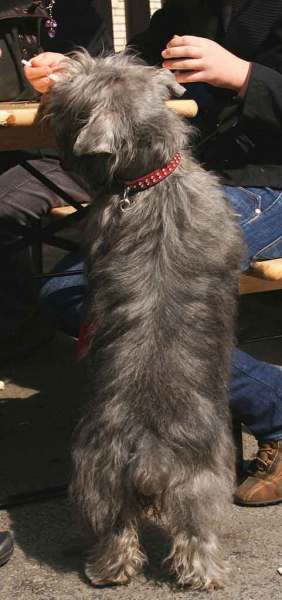
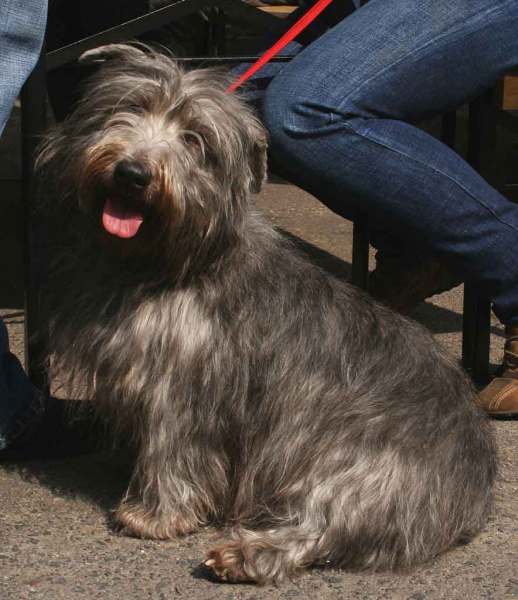
Images "Irish Glenn of Imaal Terrier"

Photos:

1 – Irish Glen of Imaal Terrier during International show of dogs in Katowice – Saucer, Poland. Breeder – Piotr Kuznik, http://www.irishglen.pl/ by Pleple2000 / CC BY-SA
2 – Irish Glen of Imaal Terrier during International show of dogs in Katowice – Saucer, Poland. Breeder – Piotr Kuznik, http://www.irishglen.pl/ by Pleple2000 / CC BY-SA
3 – Adult w:Glen of Imaal Terrier by photo by Scoo / CC BY-SA
4 – Irish Glen of Imaal Terrier during International show of dogs in Katowice – Saucer, Poland. Breeder – Piotr Kuznik, http://www.irishglen.pl/ by Pleple2000 / CC BY-SA
5 – Irish Glen of Imaal Terrier during International show of dogs in Katowice – Saucer, Poland. Breeder – Piotr Kuznik, http://www.irishglen.pl/ by Pleple2000 / CC BY-SA
6 – Glen of Imaalinterrieri by Sami Kronqvist / CC BY-SA

Videos "Irish Glenn of Imaal Terrier"

Type and recognitions:

  • FCI CLASSIFICATION:
  • Group :
  • Section : . .

Federations:

  • FCI – Terriers 1 Large and medium-sized terriers. โ“˜
  • AKC – Terriers โ“˜
  • ANKC – Terriers โ“˜
  • CKC – Terriers โ“˜
  • โ€‹KC – Terriers โ“˜
  • NZKC – Terriers โ“˜
  • UKC – Terriers โ“˜

FCI breed standard "Irish Glenn of Imaal Terrier"

Origin:
Ireland

Date of publication of the valid original standard:
27.01.2001

Use:

Like all other terriers, this stubborn little breed had to hunt badgers and foxes, as well as keeping the rat population to a minimum. In the news, he is a family dog, docile and sweet.


General appearance:

It is a medium-sized dog, with a medium length coat, very strong and gives the impression of maximum substance for its size.

IMPORTANT PROPORTIONS:

The body is longer than it is tall, close to the ground.


Behavior / temperament:

It is an active dog, agile and quiet when working. Courageous and gifted with courage when you need it, otherwise it is kind and docile, from which personality flows, his loyal and affective nature, makes him a very acceptable dog for the home and company. Irish Glen de Imaal is said to be less easily excitable than other terriers, although he is always ready to react if asked.

Head:

---

Cranial region:
  • Skull: Good width and reasonable length.
  • Depression links (Stop): Pronounced.

facial region:

  • Truffle: black.
  • Snout: Giving the impression of strength; narrowing towards the truffle.
  • Jaws: Strong.
  • Teeth: Healthy teeth, regular, strong and good size. Scissor bite.

Eyes: Brown, medium-sized, round and placed well apart. Light colored eyes should be penalized.

Ears: Small, When the dog is alert, it should be pink or semi-upright; when at rest they are carried backwards. Completely drooping or erect ears are undesirable..

Neck:

Very muscular and of moderate length.

Body:

Deep and long, longer than high.

  • top line: To level.
  • Pork loin: Strong.
  • Breast : Wide and strong, well sprung ribs.

Tail:

Cut. Firm at the root, well established and carried happily. Puppies' tails should be cut in half. A natural glue (not cut) It is allowed for countries where cutting them is prohibited by law.

Tips

PREVIOUS MEMBERS: Short, curved and with good bones.

  • Blades: Spacious, muscular and well leaning.
  • Anterior legs: Short, arching and good bone.
  • Pies: Compact and strong, with round foot pads. The front feet are slightly rotated out from the metacarpus.

LATER MEMBERS: Strong and well muscled.

  • Thighs: Well muscled.
  • Knee: Well angled.
  • Hocks: Without turning in or out.
  • Pies: Compact and strong with round foot pads.

Movement:

Free and without lifting the forelimbs too much. Effortlessly cover ground with good boost from hindquarters.

Mantle

Fur: Hair is medium in length and coarse in texture, with a soft undercoat. Hair can be groomed to make your figure look neat.

Color:

  • Blue tabby without the hue turning to black.
  • Wheat, from light wheat to a golden reddish hue
  • Puppies can be born blue, Wheat or Reddish Lighter-colored puppies generally have a bluish-colored mask, may have a blue stripe along the back, in the tail and in the ears. Darker marks will lighten with age.


Size and weight:

Height to the cross:

  • Males: 35,5 cm. (14 inches) is the maximum.
  • females: proportionally less.

Weight:

  • Males : 16 kg (35 English pounds).
  • females : proportionally less.


Fouls:

Any deviation from the aforementioned criteria is considered as a fault and the severity of this is considered to the degree of the deviation to the standard and its consequences on the health and well-being of the dog..

  • Hound ears.
  • With inferior or superior prognathism.
  • Body too short.
  • Straight front.

FALTAS DESCALIFICANTES:

  • Aggressiveness or extreme shyness.
  • Any dog โ€‹โ€‹showing clear signs of physical or behavioral abnormalities must be disqualified..
  • Black and fire color.
  • Narrow snout.


N.B.:

Males should have two normal-appearing testicles completely descended into the scrotum. Only functionally and clinically healthy dogs, with the typical conformation of the breed, should be used for parenting.

TRANSLATION: Lic. O. Valverde, reviewed by Dr. F. del Valle and updated by J. Nallem, Uruguayan Kennel Club.

Source: F.C.I - International Cynological Federation

Alternative names:

1. Irish Glenn of Imaal Terrier, Wicklow Terrier, Glen, Glennie (English).
2. Irish Glen of Imaal Terrier (French).
3. Irish Glen of Imaal Terrier (German).
4. Glen of imaal terrier (Portuguese).
5. Glen, Wicklow Terrier, Glen of Imaal Terrier, Irish Glen of Imaal Terrier (espaรฑol).

โ–ท The world of Pets: Dogs, cats, birds, reptiles, amphibians

Norfolk Terrier
Inglaterra FCI 272 . Small sized Terriers.

Norfolk Terrier

The Norfolk Terrier is lively, cheerful and adapts both the countryside and the city.

Content

History

The Norfolk Terrier he is a very small terrier, low rise. Until 1964 formed a dog breed along with the Norwich Terrier. Both differ only in the shape of their ears. While the Norfolk Terrier has slanted ears, the Norwich Terrier has standing ears. In the past these dogs were raised together and it was always a surprise that puppies had ears. Because the judges at the shows at least felt they preferred lop-eared dogs, wanted to have floppy or tilted ears in a class of their own. But, either standing or with ears hanging, they are wonderful terriers, vivacious little ones you can enjoy. They come from the Middle East of England. There these little terriers served the town for many years as watchdogs and hunters at home and at court..

Keeping rats and mice, driving away a marten or fox that wanted to feed on chickens or pigeons at night, they proved to be useful helpers at home and in court. But, the small Norfolk Terrier was not, like many other somewhat larger terriers, used for active fox hunting, the marten and the otter. Didn't have to go in pursuit of these predators. He would not have lacked courage and determination. The Terriers de Norwich and Norfolk they were useful as a cat, but much more defensive and effective, especially when it came to fighting rats. They also had the added value of being watchdogs and danger alarms and were better able to deal with harsh, wet and cold weather conditions of central England.

So these little terriers were already widespread in cities centuries ago.. Consequently, they were bred solely for their suitability for their tasks. Either with upturned or drooping ears, it did not matter. As their tasks drifted away from rats to accompany the human psyche, the subtleties of his outward appearance also came into play. One separated the terrier into two breeds. In 1954, both were officially recognized by the FCI under the name of Norwich Terrier. The tipped-ear variant was recognized as a separate breed in 1962.

Physical characteristics

It is a small dog, clever, short limb, compact and vigorous; It has short back and its structure and strong bones.

Norfolk Terrier has a hair double layer: a hard top layer, ribbed and a warm and soft layer.

Ideally, is due comb the hair once a week to remove the loose hairs, dead and prevent mat.

Itร‚ยดs one of the smaller Terrier dogs, a "demon" for its size. Affectionate but not quarrelsome, robust Constitution.

The tail amputation is optional. Medium amputation, set level with the dorsal line and carried erect. Tail of moderate size to give the dog an overall balance, thick at the base and is tuned toward the tip, as straight as possible, happily held, but not in an excessive manner.

Its movement is natural, low and high thrust. Previous members directed straight forward from the shoulders. A good angulation of the hindlimbs provides you with a great driving force.

The Member posterior move in line with the anterior, with free movements from the hips, and they must bend well at the knees and hocks. level top line.

The hair It hard, rough texture (wire), straight and well attached to the body. Long and rough in the neck and shoulders.

The hair is short and smooth on the head and ears, with the exception of a few light eyebrows and mustache.

With regard to the color, We find all the shades of reddish, wheat, black and Tan or grey. Stains or white markings are undesirable, but allowed.

The height ideal to the cross is between 25 and 26 cm..

Character and skills

Norfolk Terrier should not be aggressive despite being able to defend itself if necessary. Them, along with Norwich Terrier and the Border Terrier, has the softer temperament of the Terrier group.

Videos of the Norfolk Terrier
Two norfolk terriers playing
Norfolk TerrierLightbox for Video by VideoLightBox.com v1.11

Like fellow, they love people and children and they are good pets. His level of activity is generally a reflection that the pace of its environment.

This breed should not stay or live outside, that thrive with human contact. In general, Norfolk Terrier does not generally dig, but, like any dog, will dig out of boredom when left alone for too long a period.

Usually, living well with other pets when introduced as a dog. In the open air, they are natural hunters and have a strong instinct for prey to small bugs.

The Norfolk Terrier is a dog self-confident, they are elegant, they are erect tail and head. A Norfolk Terrier that is shy or tucks its tail between its legs is unusual..

The typical Norfolk Terrier temperament is happy, cheerful and self-confident. His greatest punishment would be to be ignored by the family..

Norfolk Terrier were bred as barn dogs to rid the stables of animal pests. Today, they are household companions and must have a pleasant willingness to live with the people.

The life expectancy of a Norfolk Terrier is of 12 to 15 years.

Observations

Today, the demand for Norfolk Terrier is much more to offer

They are dogs that tend to have small litters and responsible breeders developed the breed, they only breed healthy dogs that are of good temperament, lineage, good pedigree and those that best reflect the breed standard.

Norfolk Terrier Education

The education of this breed is an often underestimated chapter. Although the already little dog looks so cute, especially in his first months of life, he is a true terrier very sure of himself. And such a terrier wants to be educated and guided. So, the Norfolk Terrier requires consequences in education from puppy age. Although small, dreams like most terriers in some corner of his brain of assuming leadership of the pack. Deep down he feels loose like a mastiff or a great dane. So you just have to take your education seriously.. Otherwise, there is no problem. He wants and needs the guidance of his master or mistress and is a docile companion., friendly and sociable, that always brings a smile to our faces.

Norfolk Terrier Health and Care

The coat should be regularly groomed. The Norfolk does not know a change of coat. Two or three times a year dead hair should be trimmed, that is to say, ripped – but with moderation.

The small Norfolk Terrier it is a fairly robust breed of dog.

Nutrition / Food

Norfolk Terrier nutrition has no problems.

Norfolk Terrier life expectancy

The Norfolk Terrier they tend to have robust health and an average life expectancy of 15 years and more.

Buy a Norfolk Terrier

The best way to buy your puppy Norfolk is to buy it locally from an FCI member breeder or take a look at the shelter. A dog of this breed costs around 1.000 EUR.

Characteristics "Norfolk Terrier"

Coexistence is important that you have with your new friend. Before considering the acquisition of a dog of the breed "Norfolk Terrier" you know certain factors. Not all breeds of dogs are apt to live in an apartment, you must take into account his character, their need for exercise, their interaction with other pets, their care and if you have small children, their level of tolerance towards them.

Adaptation โ“˜

5,0 of 5 stars (based on 1 review)

friendly dog โ€‹โ€‹โ“˜

4,0 of 5 stars (based on 1 review)

hair loss โ“˜

4,0 of 5 stars (based on 1 review)

Affection level โ“˜

4,0 of 5 stars (based on 1 review)

Need for exercise โ“˜

4,0 of 5 stars (based on 1 review)

Social need โ“˜

3,0 of 5 stars (based on 1 review)

Home โ“˜

4,0 of 5 stars (based on 1 review)

Toilet โ“˜

1,0 of 5 stars (based on 1 review)

Friendly with strangers โ“˜

4,0 of 5 stars (based on 1 review)

barking โ“˜

4,0 of 5 stars (based on 1 review)

Health โ“˜

4,0 of 5 stars (based on 1 review)

Territorial โ“˜

3,0 of 5 stars (based on 1 review)

Cat friendly โ“˜

4,0 of 5 stars (based on 1 review)

Intelligence โ“˜

4,0 of 5 stars (based on 1 review)

Versatility โ“˜

5,0 of 5 stars (based on 1 review)

Child friendly โ“˜

4,0 of 5 stars (based on 1 review)

Surveillance โ“˜

4,0 of 5 stars (based on 1 review)

joy โ“˜

5,0 of 5 stars (based on 1 review)

Norfolk Terrier pictures

Norfolk Terrier Videos

Type and recognitions:

  • FCI CLASSIFICATION:
  • Group :
  • Section : . .

Federations:

  • FCI – Terriers 2 Small sized Terriers. โ“˜
  • AKC – Terriers โ“˜
  • ANKC – Terriers โ“˜
  • CKC – Terriers โ“˜
  • โ€‹KC – Terriers โ“˜
  • NZKC – Terriers โ“˜
  • UKC – Terriers โ“˜

FCI breed standard "Norfolk Terrier"

Origin:
United Kingdom

Date of publication of the valid original standard:
13.10.2010

Use:

Terriers


General appearance:

It is one of the smallest ground dogs. Crafty, short limb, compact and vigorous; It has short back and its structure and strong bones. Honorable scars resulting from deterioration are allowable.


Behavior / temperament:

He is a "demon" for his size. Affectionate but not quarrelsome, robust Constitution. Alert and brave.

Head:

---

Cranial region:
  • Skull: Width, just slightly rounded and wide between the ears.
  • Depression links (Stop): Well defined.

facial region:

  • Snout: Strong and wedge-shaped; its length is less than a third of the distance measured from the occipital to the frontal-nasal depression (Stop).
  • Lips: Attached.
  • Bite / Teeth : Robust jaws, strong and fairly large teeth, with healthy teeth, complete and scissor bite, that is to say that the internal face of the upper incisors is in contact with the external face of the lower incisors; teeth should be set at right angles in the jaws.
  • Eyes: Oval, dark brown or black, with an alert expression and a smart and lively look.
  • Ears: Medium-sized and V-shaped, slightly rounded at the tip, carried forward along the cheeks.


Neck:

Strong and medium length.

Body:

Compact, short, level back, well rounded ribs.

Tail:

Previously optional tail amputation.
  1. Medium amputation, tail set level with dorsal line and carried erect.
  2.  Tail of moderate size to give the dog an overall balance, thick at the base and is tuned toward the tip, as straight as possible, happily held, but not in an excessive manner.


Tips

PREVIOUS MEMBERS:

  • General appearance: Sharp.
  • Shoulder: Well leaning back and approximately arm length.
  • Forearm: Short forelimbs, powerful and upright.
  • Previous feet: Round and with thick pads.

LATER MEMBERS:

  • General appearance: Well muscled.
  • Knee: Well angulated.
  • Metatarsus: Hockswell descended and straight when viewed from behind, endowed with great driving force.
  • Hind feet: Round and with thick pads.

Movement:

Natural, low and high thrust. The forelimbs are directed straight forward from the shoulders. A good angulation of the hindlimbs provides you with a great driving force. The hind limbs move in line with the forelimbs., with free movements from the hips, and they must bend well at the knees and hocks. level top line.

Mantle

  • Fur: Lasted, rough texture (wire), straight and close to the body. Long and rough in the neck and shoulders. The hair is short and smooth on the head and ears, with the exception of a few light eyebrows and mustache. Excessive grooming is undesirable.
  • Color: All shades of red, wheat, black and Tan or grey. Stains or white markings are undesirable, but allowed.


Size and weight:

The ideal height at the withers is: 25 cm..


Fouls:

Any deviation from the aforementioned criteria is considered as a fault and the severity of this is considered to the degree of the deviation to the standard and its consequences on the health and well-being of the dog..

FALTAS DESCALIFICANTES:

  • Aggressiveness or extreme shyness.
  • Any dog โ€‹โ€‹showing clear signs of physical or behavioral abnormalities must be disqualified..


N.B.:
  • Males should have two normal-appearing testicles fully descended into the scrotum..
  • Only functionally and clinically healthy dogs, with the typical conformation of the breed, should be used for parenting.

The latest changes are in bold.

TRADUCCION: Brรญgida Nestler / Original version: (IN) Technical supervision: Miguel Angel Martinez

Source: F.C.I - International Cynological Federation

Alternative names:

1. Norfolk (English).
2. Norfolk (French).
3. Norfolk (German).
4. Norfolk (Portuguese).
5. Terrier de Norfolk (espaรฑol).

โ–ท The world of Pets: Dogs, cats, birds, reptiles, amphibians

Japanese Terrier
Japรณn FCI 259 . Small sized Terriers.

Japanese Terrier

The Japanese Terrier it hardly enjoys diffusion and is practically to discover.

Content

History

In the middle of the Edo era, about 1700, a small dog appeared in Japan that looked very much like the type of terrier. It was the result of a cross between small Japanese dogs with English Fox Terrier Smooth, which was brought to the port of Nagasaki by Dutch sailors. At that time the port of Nagasaki was the only port open to Western countries., especially the dutch. After several generations, some descendants of these dogs were bred as a type of Italian Greyhound.

About 1900, al final de la era Meiji, Some of the best of the mentioned dogs were seen in the Kobe district and called "Kobe Terriers". His type was something between modern Fox Terrier Smooth and the modern Japanese Terrier. They were the first terriers to be bred in Japan. This "Kobe Terrier" and some of its ancestors were also called "Oyuki Terrier" and "Mikado Terrier" and are said to be carefully cared for by the premises and also by foreigners.

About 1916 an ancestor of the Japanese Terrier in the Nada district, near Kobe, A dog called "Kuro" (born in 1913 in Kobe), which means "black" in Japanese. This dog was a cross between a English toy terrier and Bull Terrier miniature, both imported from western countries. These pups were bred with bitches of the aforementioned Kobe Terrier. The result was a very short haired dog, thin and small of the Terrier type and was called Japanese Terrier (NIHON) since then. in those days, major breeders in Osaka county engaged in inbreeding and line breeding to cement appearance. Thanks to your efforts, the breed was firmly established in 1930.

In 1932 NIHON TERIA CLUB was founded under the presidency of Tamara KIKUJIRO. The Japanese Terrier it was ideal for city dog รขโ‚ฌโ€นรขโ‚ฌโ€นbreeders and became fashionable.

In 1940, where cities were built everywhere and with these cities grew the demand for a smaller and more active dog than the large guard dogs, the Japanese Terrier became very popular. But, in all its history, this breed was twice threatened with extinction. The first time, during WWII and again, about 1948, due to loss of popularity among the Japanese, since other western races were more fashionable.

Although the Japanese Terrier was recognized by the F.C.I. (Federation Cynologique Internationale) in 1964, this breed was practically unknown outside of Japan.

According to the documents, three basic lines of Japanese Terrier: ยซLANDMARKยป (by Mr.. Nobuaki Shigematsu, Yamaguchi Prefecture), ยซTAIKOยป (by Mr.. Sumiko Amano, Hamamatsu City) and "Tama Takahara" (by Mr.. Jun Takahara, Such).

About 1985, there was less than 50 bitches available for breeding throughout Japan. After the great efforts of some volunteers, who were aware of the need for immediate protection of the race, the number of dogs had reached about 400 breeding dogs after seven years.

So, special mention must be made of the efforts of Mr.. Jun TAKAHARA, whose commitment made the Japanese Terrier was known beyond the borders of Japan.

The breed was not seen in European countries until 1991, when a couple of Japanese Terriers arrived in France at the request of Mrs.. Luisa Gonzรกlez de Castejรณn. Their dog names were "Kuroyuri Maru from Tama Takahara" (male) Y ยซKeshinome Brains De Tama Takaharaยป (female).

Another European breeder had also joined this adventure in the years 90: The Sr. Roberto Verde from Naples (Italy) he also owned three beautiful Japanese Terriers.

Time and time again there have been and still are some breeders who care for this breed, but unfortunately it was not possible to establish a stable population in Europe.

After 2 years of establishing contact with the Japanese breeder Mr.. Thoshihide OZAKI was able to import the FIRST Japanese Terrier the 4.11.2014 to AUSTRIA. ยซYodogimi de Ozaki Farm JPยป born 28.06.2014. This dog was registered with the Austrian Kennel Club (ร–HZB) con JAPT 1.

In order to create a breeding base, more dogs have been imported from Japan in recent years. In total 4 females were brought to Austria and two males (Ozaki Farm JPโ€™s HIBIKI Swiss / 2017 & Ozaki Farm JPโ€™s SHIN / 2018) were transferred to Switzerland. In 2017 the first Japanese Terrier.

Physical characteristics

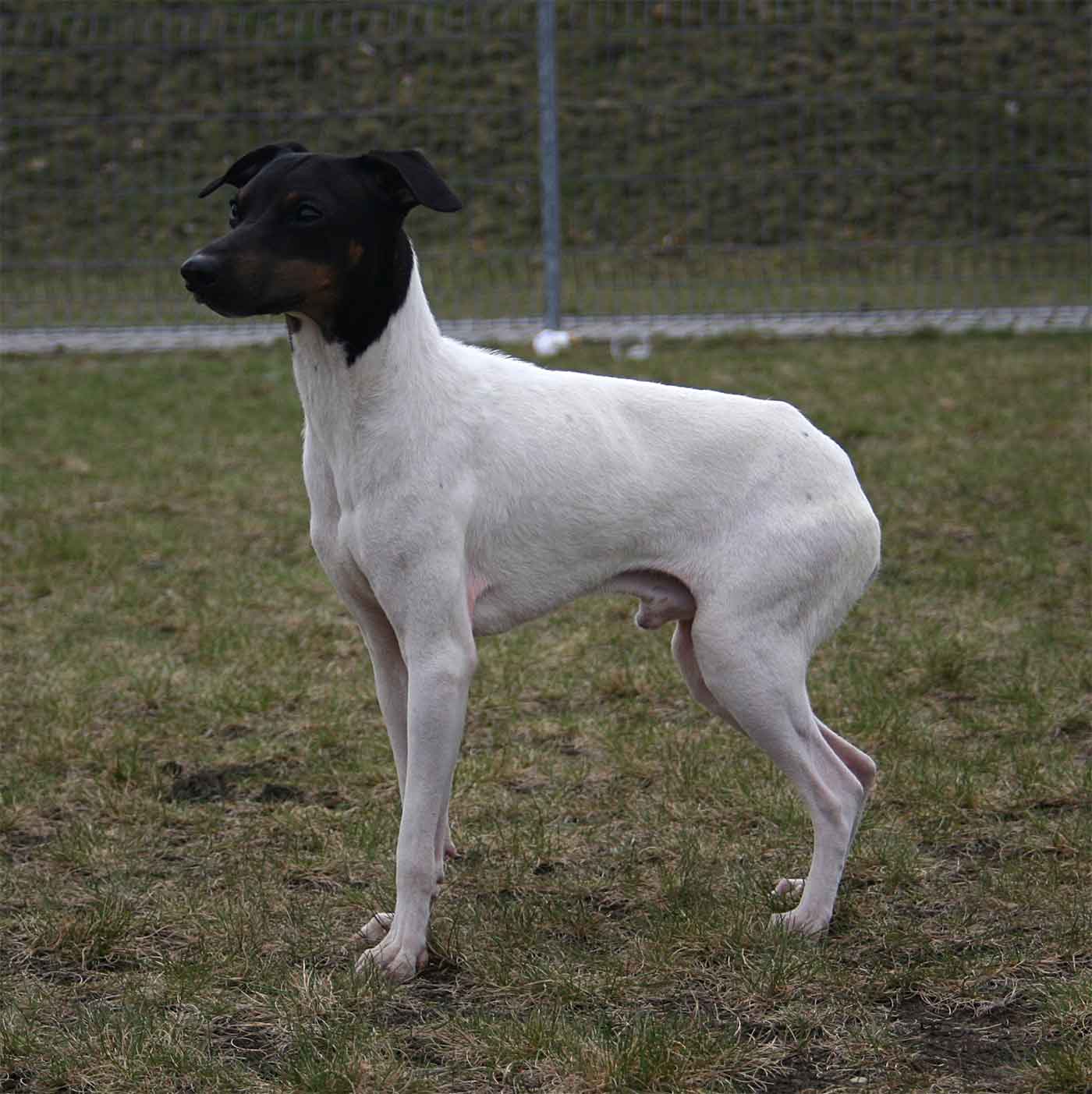
It is a small dog, elegant in appearance, and a defined and compact configuration.

Shoulder height: 30 cm. – 33 cm.; Weight: a few 5 kg

Fur: Short (2mm) smooth, dense and glossy; the coat does not need any additional care;

Color: Head: Tricolor (fire and white); Body: Basic color white with small black or tan spots.

The breeders of the Japanese Terrier they are very demanding in terms of appearance and color markings, that are sometimes considered more important than your sports skills. The ideal colors and markings in a Japanese Terrier are the black, chocolate brown and beige: The head, ears and nose bone should be dark in color, black or chocolate brown. The muzzle to the nose and on each cheek and above each eye should be light brown. The lower jaw will be white. A clear "V" is visible in the neck. Occasionally there are also dark gray heads with light brown markings. But, this is considered to be the worst of the color variations. This is different with the deep black heads. This black color is allowed, because it reminds one of the old kobe dogs.

Character and skills

The Japanese Terrier not only is he a very intelligent puppy, but also mischievous and full of terrier temperament. Knowing him means loving him for his great sensitivity. He has a cheerful character and will participate in games with pleasure and joy.. It is a one-man dog whose devotion flatters its owner. As an attentive house dog will warn of the approach of a stranger but without being aggressive. It is very easy to train and can learn all kinds of tricks. His greatest effort is to please his owner. As a sports partner he has great skills and innate instincts. Has an excellent sense of smell and good eyesight, but still has no hunting ambitions. It's never quarrelsome, She gets along well with other dogs, especially with his own race.

It is an independent puppy, whose characteristics make it a pleasant "partner". It is suitable for young people, for both athletes and the young at heart. And one thing is especially important for the little terrier: snuggling with its owner.

Fitness: The Japanese Terrier it's a small dog, but still needs enough activity. It is the ideal companion for active people. Likes to learn and is therefore also suitable for mind games or dog sports that are suitable for small breeds.

It is a "skirt dog" in the positive sense. But that's only if you are tired of the many races!!

With the kids:

The Japanese Terrier is very attached to his owners and enjoys a good snuggle. But, he is not a babysitter dog. As in all small dog breeds, small body size has advantages when traveling, but it becomes a disadvantage with – and I say it with affection – the clumsy hands of children. This means that when they have children, make sure children handle the dog with care. Offer the dog an area where he can retreat if he becomes too heavy for him. If this is observed, nothing stands in the way of positive cooperation.

Correct nutrition Japanese Terrier

Proper nutrition is extremely important to avoid diet-related diseases. It is important to have a balanced diet that suits your beloved. Due to its active nature, the Japanese Terrier has its own nutritional requirements. It is very agile, so you should pay attention to a sufficient power supply.

High-quality whole foods are precisely tailored to your dog's nutritional needs. This ensures a supply of all the nutrients your dog needs.. High-quality prepared foods have the advantage that no feed additives are needed.

Terriers are often susceptible to allergies based on gluten-containing grains. In this case, you must ensure that the food contains other sources of carbohydrates. Rice or potatoes are a good alternative here. Food intolerance can lead to skin rashes, inflammation and digestive problems.

It is recommended to feed your terrier several times a day in small portions.. After each feeding, a pause in digestion must be ensured. You should refrain from eating before planned sports activities.

Care Japanese Terrier

The coat of his Japanese Terrier it is extremely easy to care, since it only measures about 2 cm long. Don't lose much, but you will enjoy removing loose hairs with a silicone glove. Even dandruff can be removed and the blood circulation of the skin is stimulated.

Your terrier's hair doesn't grow too thick. So, it is recommended to wear a coat during the cold months. If you stay outdoors for a longer period of time, protect your stomach and nose with sun milk.

When caring for your terrier's teeth, you should make sure that you do not feed him any food that contains sugar. These damage teeth, which in turn can lead to serious digestive problems.

The Japanese Terrier has a highly developed musculature, but its bone structure is quite fine. So, the use of a dog harness is recommended instead of a collar. If you stay home alone for a while, chewing bones of an appropriate size can be used as a toy.

Characteristics "Japanese Terrier"

Coexistence is important that you have with your new friend. Before considering the acquisition of a dog of the breed "Japanese Terrier" you know certain factors. Not all breeds of dogs are apt to live in an apartment, you must take into account his character, their need for exercise, their interaction with other pets, their care and if you have small children, their level of tolerance towards them.

Adaptation โ“˜

2,0 of 5 stars (based on 1 review)

friendly dog โ€‹โ€‹โ“˜

3,0 of 5 stars (based on 1 review)

hair loss โ“˜

3,0 of 5 stars (based on 1 review)

Affection level โ“˜

5,0 of 5 stars (based on 1 review)

Need for exercise โ“˜

1,0 of 5 stars (based on 1 review)

Social need โ“˜

4,0 of 5 stars (based on 1 review)

Home โ“˜

3,0 of 5 stars (based on 1 review)

Toilet โ“˜

1,0 of 5 stars (based on 1 review)

Friendly with strangers โ“˜

3,0 of 5 stars (based on 1 review)

barking โ“˜

4,0 of 5 stars (based on 1 review)

Health โ“˜

4,0 of 5 stars (based on 1 review)

Territorial โ“˜

4,0 of 5 stars (based on 1 review)

Cat friendly โ“˜

3,0 of 5 stars (based on 1 review)

Intelligence โ“˜

4,0 of 5 stars (based on 1 review)

Versatility โ“˜

4,0 of 5 stars (based on 1 review)

Child friendly โ“˜

4,0 of 5 stars (based on 1 review)

Surveillance โ“˜

3,0 of 5 stars (based on 1 review)

joy โ“˜

5,0 of 5 stars (based on 1 review)

Images "Japanese Terrier"

Photos:

1 – At photo Amakakeru-Meiji White Oleander – Japanese Terrier on dogs show in Konopiska, Poland. The owner is Paweล‚ Gฤ…siorski by https://commons.wikimedia.org/wiki/User:Pleple2000
2 – At photo Amakakeru-Meiji White Oleander – Japanese Terrier on dogs show in Konopiska, Poland. The owner is Paweล‚ Gฤ…siorsk by Pleple2000 / CC BY-SA
3 – At photo Amakakeru-Meiji White Oleander – Japanese Terrier on dogs show in Konopiska, Poland. The owner is Paweล‚ Gฤ…siorski by Pleple2000 / CC BY-SA
4 – At photo Amakakeru-Meiji White Oleander – Japanese Terrier on dogs show in Konopiska, Poland. The owner is Paweล‚ Gฤ…siorski. by Pleple2000 / CC BY-SA
5 – A Japanese Terrier by Canarian / CC BY-SA
6 – Bernie Lindsey, my dog by Bernielindsey44 at en.wikipedia / Public domain
7 – At photo Amakakeru-Meiji White Oleander – Japanese Terrier. by Paweล‚ Gฤ…siorski / CC BY-SA

Videos "Japanese Terrier"

Type and recognitions:

  • FCI CLASSIFICATION:
  • Group :
  • Section : . .

Federations:

  • FCI – Terriers 2 Small sized Terriers. โ“˜
  • Japan Kennel Club – Terriers โ“˜

  • FCI breed standard "Japanese Terrier"

    Origin:
    Japan

    Date of publication of the valid original standard:
    04.04.2016.

    Use:

    Companion dog


    General appearance:

    It is a small dog, elegant in appearance, and a defined and compact configuration. Hair measuring approximately 2 mm is very short.

    PROPIMPORTANT ORTIONS: The ratio of the height at the withers to the length of the body is 1: 1. The muzzle and the skull are the same length.


    Behavior / temperament:

    The Japanese Terrier is agile and with a lively temperament.

    Head:

    ---

    Cranial region:
    • Craging: Flat and moderately narrow.
    • Dnaso-frontal depression (stop): Not very defined.

    facial region:

    • Nariz: Black. The nasal helm is straight.
    • Labios: They are thin and tight.
    • JawsTeeth: Strong white teeth. The joint is in the form of scissors.
    • Cheeks: Thin, not bulky.
    • Ojors: Medium-sized, oval shape and dark in color.
    • Obars: High implementation. They are rather small, thin, V-shaped, and fall forward. But, bent and raised on both sides of the skull are allowed.

    Neck:

    It is of moderate length, strong, and gradually widens towards the dewlap-free shoulder region.

    Body:

    • Cruz: High.
    • Dorrso: Short and firm.
    • Itmor: Slightly arched.
    • Glikeness: Powerful.
    • Pecho: Deep, although the pectoral region is not too wide. The ribs are well sprung.
    • Lรญnlower ea and bellyBellywell collected.

    Tail:

    Moderately thin; Traditionally, amputated in thecountry of origin. En the countries where the cut of tail is prohibited, the natural tail is slightly curved and tapers towards the tip. In motion it is moderately high.

    Tips

    PREVIOUS MEMBERS:

    • Hormbros: Slightly inclined.
    • Antarms: They are straight; the bones are not heavy.
    • Pinis previous: They are good together. The foot pads are elastic; nails are hard and preferably dark in color.

    LATER MEMBERS:

    • Thighs: Long.
    • Rodinllto: Moderately angled.
    • Ahock joint: Moderately angled.
    • Metatarsus: Vertical.
    • Pinis later: They are good together. The foot pads are elastic; nails are hard and preferably dark in color.

    Movement:

    It is light and agile.

    Mantle

    Plink: Short, smooth, dense and lustrous.

    Colorr: Tricolor, with a black head, fire and white. White with black spots, black marks or tan marks on the body.


    Size and weight:

    So much for males, as for females, height is about 30 to 33 cm..


    Fouls:

    Any deviation from the aforementioned criteria is considered as a fault and the severity of this is considered to the degree of the deviation to the standard and its consequences on the health and well-being of the dog..

    FALTAS DISQUALIFYING:

    • Aggressiveness or extreme shyness.
    • Any dog โ€‹โ€‹showing clear signs of physical or behavioral abnormalities must be disqualified..
    • Long hair.
    • Pronounced upper or lower prognathism.


    N.B.:
    • Males should have two normal-appearing testicles fully descended into the scrotum..
    • Only functionally and clinically healthy dogs, with the typical conformation of the breed, should be used for breeding

    Itlatest changes are in bold.

    TRaduCCiรณNMrs. Brรญgida Nestler.

    ItsPETechnical review: SR. Miguel Angel Martinez.

    Source: F.C.I - International Cynological Federation

    Alternative names:

    1. Nippon Terrier, Nihon Teria, Nihon Terrier, Kobe Terrier, Mikado Terrier, Oyuki (snowy) Terrier (English).
    2. Nihon teria (French).
    3. Nippon-Terrier, Nishon-Terrier (German).
    4. nihon, nippon terrier (Portuguese).
    5. Nihon teria, Terrier Nipรณn, Terrier Japonรฉs (espaรฑol).

โ–ท The world of Pets: Dogs, cats, birds, reptiles, amphibians

Parson Russell Terrier
Inglaterra Estados Unidos FCI 339 . Large and medium sized Terriers
Parson Russell Terrier

The Parson Russell Terrier is a fearless dog, very happy, energetic and friendly.

Content

History

The Parson Russell Terrier it is a small to medium sized terrier. It's a hunting dog.

Although this breed of dog is very young in modern dog breeding, the Parson Russell Terrier is very close to the old and classic type of a terrier in character and appearance. Terriers form a large group within dogs. Its name is derived from the Latin ยซTerraยป for the earth. So they were dogs for work on the land. The first evidence is given by the ancient Romans. Already in the Middle Ages terriers are described in detail. His homeland is in the British Isles. Terriers existed throughout the country. In the stables they kept small vermin at bay. Even the big rats were not a problem for them. The hens, pigeons and rabbits protected them from martens and foxes. To keep chasing foxes, the terriers were sent to the trench.

The Parson Russell Terrier of today are made exactly for this purpose. They should and could get the fox out of the hole. At the same time, they had to run with the fox hunts in the pack, that is to say, they had to be able to follow the gallop of the hunt. All of these tasks require enthusiastic commitment, special courage, independent thinking and the so-called sharpness of predators.

The Parson Russell Terrier turned into a versatile hunting dog, it's not only suitable for underground work. In the 19th century the English shepherd Jack Russell he was a successful hunter, rider and above all breeder of Fox Terriers. In his long life as a breeder he greatly increased the performance of the Fox Terrier. They were now fit for all individual hunting tasks, they could work in the pack and in the den at the same time.

In Australia, only with the help of their dogs could a plague of foxes be contained. To thank this, these dogs were finally named after their breeder, the Parson ยซJack Russellยป Terrier. They were and are physically and mentally raised for work, no show dogs. So breeders and lovers of this terrier for a long time refused to join the system of modern pedigree dog breeding., because they did not want to see dogs evaluated primarily on their appearance and feared the negative consequences of the show business on the fitness and health of dogs. This has done this breed of dog very well..

Seriously raised, these are dogs that were largely spared from hereditary diseases and extremes in breeding. He "Jack Russell Terrierยป had a wide range of sizes from the beginning, rather short-legged and rather tall. Since performance was decisive, such refinements had no role. Now two breeds of dog have been made from the ยซJack Russell Terrierยป and the two lines have separated in breeding. The little one is still called Jack Russell Terrier, It has a height at the withers of up to 30 cm and is provided a little longer. The Parson it is a little taller and with more legs and in its rather square shape. Parish is another word for "pastor" in English.. So two breeds of dog are named after one person, el pastor Jack Russell. Both dogs are a credit to the Shepherd. In 2001 the new race Parson Russell Terrier was officially recognized.

Physical characteristics

The Parson Russell Terrier It is suitable for the working dog, Active, agile, built for speed and endurance. It gives the impression of balance and flexibility as a whole.

You can have hair smooth or hard if it is thick and dense to protect it from the inclement weather, like cold and damp. Its color It can be entirely white or predominantly white with brown spots, lemon or black or any combination of these colors, preferably stains should be limited to the head or the birth of the tail.

It measures to the cross between 33 and 36 cm., their weight approximate is of 8 to 10 kilos to be slightly larger in proportions that the version of the Jack Russell Terrier, although it should be noted that taller specimens exist as "Jack Russell" in some work clubs in the United Kingdom and the United States., due to what these clubs do not form part of the FCI and therefore, handle different to the recognized standard registers and accepted worldwide by the 84 member countries.

Character and skills

Parson Russell a fearless and friendly Terrier.

This breed was bred to hunt, Chase and corner foxes in its burrow, therefore, they carry in their genes, and if this activity does not form part of the life of your puppy, We recommend that, they should be exercised daily intensely since they are dogs with a huge dose of contained energy.

Perhaps its character lively and friendly has caused it to be one of the dog breeds preferred by many people as a pet.

But in reality it is a true working dog and we should not forget that if a specimen of... becomes part of our family..

Leave running, ride a bike, launch frisbee or ball - and teach him to bring them back-, It will help to strengthen the bond between the Parson and his owner while it educates, enjoys and is exercised.

Images ยซParson Russell Terrierยป

Videos ยซParson Russell Terrierยป

Type and recognitions:

  • FCI CLASSIFICATION:
  • Group :
  • Section : . .

Federations:

  • FCI – Terriers 1 Large and medium-sized terriers. โ“˜
  • AKC – Terriers โ“˜
  • ANKC – Terriers (utility dogs) โ“˜
  • CKC – Terriers โ“˜
  • โ€‹KC – Terriers โ“˜
  • NZKC – Terriers โ“˜
  • UKC – Terriers โ“˜

FCI breed standard "Parson Russell Terrier"

Origin:
United States, United Kingdom

Date of publication of the valid original standard:
22.08.2017.

Use:

Working terrier with the ability to work underground.


General appearance:

Efficient, active and agile, without exaggerations. Built for strength and power with an overall appearance of balance and flexibility. Honorable scars are allowed.

IMPORTANT PROPORTIONS: Well balanced. The total length from the tip of the shoulders to the tip of the ischium slightly greater than the height at the withers to the floor. The length from the nose to the stop is somewhat shorter than from the stop to the occipital protuberance.


Behavior / temperament:

Originally a terrier bred to work with the fox. A confident dog, energetic and cheerful who has the ability and conformation to work on the ground. Bold and friendly.

Head:

Wedge shaped.

Cranial region:
  • Skull: Plano, moderately wide gradually tapering to the eyes.
  • Depression links (Stop): Bit strong.

facial region:

  • Truffle: black.
  • Jaws / Teeth: Powerful and well muscled jaws. Good sized teeth with a perfect, regular and complete scissor bite. I.e., The upper incisors cover the lower incisors in close contact and are set squarely in relation to the jaws..
  • Cheeks: Not prominent.

Eyes: dark, almond shape, never prominent. Lively and intelligent expression.

Ears: Size in proportion to the head. In the shape of a โ€œVโ€ falling forward. The tips of the ears should reach the level of the outer corner of the eyes. The fold should not be above the level of the skull. Canopy of moderate thickness.

Neck:

Cleansed, muscle, good length, gradually widening and well placed on the shoulders.

Body:

  • Back: Strong, straight and flexible.
  • Pork loin: Strong and slightly arched.
  • Breast : Moderately lowered, without extending beyond the elbows. Behind the shoulders should encompass the palm of an average hand. Ribs worn well back, not too arched or too flat.

Tail:

Previously the custom was to amputate the tail.
  • amputee: Long complementing the body but maintaining a good grip. Strong, straight, moderately high insertion, very tall in movement.
  • Without amputating: Moderately long and as straight as possible, giving a good balance to the dog, thick at the base tapering towards the tip. Moderately high insertion, very tall in movement.


Tips

PREVIOUS MEMBERS:

  • ApGeneral arience: Moderate width between forelimbs, well placed under the body.
  • Hormbros: Wide and sloping, well defined on the cross.
  • Brazo: As long as the shoulders and with such angulation that the extremities are placed well under the body, below the tip of the cross.
  • Antarm: Strong and straight without leaning in or out. Arm length should be slightly greater than body depth.
  • Elbows: Glued to the body working freely on the sides.
  • Metacarpus: Strong and flexible.
  • Pinis previous: Compact with firm pads, moderately arched fingers, never flat open, without leaning in or out.

LATER MEMBERS:

  • ApGeneral arience: Strong, muscle with good angulations.
  • Knee: Good angulation without exaggeration.
  • PinScheme: Well developed.
  • Ahock joint: Low placement.
  • Metatarsals: Parallels, giving a lot of propulsion.
  • Hind feet: Like the previous ones.

Movement:

Libre, movement covering the surface, without exaggeration. The steps must be of good length, never forced or high steps. Posterior provides a strong push. Well coordinated, right movement back and forth.

Mantle

SKIN: It should be thick and loose.

MANTLE

  • Fur: Rough, broken the naturally rough smooth, straight, smooth, tight and bushy with good undercoat. Weather resistant. Abdomen and lower line covered with hair. The prepared cloak (Trimming) it must seem natural, never cut.
  • Color: White or predominantly white with fire markings, lemon or black or any combination of these colors. The color is preferably limited to the head and / or base of the tail but slight marks are accepted on the body.


Size and weight:

Height to the cross:

  • Ideal in males: 36 cm.
  • Ideal in females: 33 cm.

It is more important to maintain correctness and balance taking into account that this terrier, bred to work with the fox, behind the shoulders should encompass the palm of an average hand.


Fouls:

Any deviation from the aforementioned criteria is considered a fault and its severity is considered to the degree of deviation from the standard and its consequences on the health and well-being of the dog and the dog's ability to perform its traditional task..

FALTAS DESCALIFICANTES:

  • Aggressiveness or extreme shyness.
  • Any dog โ€‹โ€‹showing clear signs of physical or behavioral abnormalities must be disqualified..


N.B.:
  • Males should have two normal-appearing testicles fully descended into the scrotum..
  • Only functionally and clinically healthy dogs, with the typical conformation of the breed, should be used for parenting.

TRANSLATION: Brรญgida Nestler / Original version: IN.

Technical supervision: Miguel Angel Martinez.

Source: F.C.I - International Cynological Federation

Alternative names:

1. Parson, Parson Jack Russell Terrier (English).
2. Parson Russell terrier (French).
3. Parson (German).
4. Parson (Portuguese).
5. Parson, Parson Jack Russell (espaรฑol).

โ–ท The world of Pets: Dogs, cats, birds, reptiles, amphibians

Staffordshire bull terrier
Gran Bretaรฑa FCI 76 . Bull type Terriers

The Staffordshire bull terrier is the smallest of the Bull type Terriers and also the most popular in England.

Staffordshire bull terrier

Content

Characteristics "Staffordshire bull terrier"

Coexistence is important that you have with your new friend. Before considering the acquisition of a dog of the breed "Staffordshire bull terrier" you know certain factors. Not all breeds of dogs are apt to live in an apartment, you must take into account his character, their need for exercise, their interaction with other pets, their care and if you have small children, their level of tolerance towards them.

Adaptation โ“˜

3,0 of 5 stars (based on 1 review)

friendly dog โ€‹โ€‹โ“˜

1,0 of 5 stars (based on 1 review)

hair loss โ“˜

3,0 of 5 stars (based on 1 review)

Affection level โ“˜

5,0 of 5 stars (based on 1 review)

Need for exercise โ“˜

4,0 of 5 stars (based on 1 review)

Social need โ“˜

4,0 of 5 stars (based on 1 review)

Home โ“˜

3,0 of 5 stars (based on 1 review)

Toilet โ“˜

1,0 of 5 stars (based on 1 review)

Friendly with strangers โ“˜

5,0 of 5 stars (based on 1 review)

barking โ“˜

2,0 of 5 stars (based on 1 review)

Health โ“˜

3,0 of 5 stars (based on 1 review)

Territorial โ“˜

3,0 of 5 stars (based on 1 review)

Cat friendly โ“˜

2,0 of 5 stars (based on 1 review)

Intelligence โ“˜

4,0 of 5 stars (based on 1 review)

Versatility โ“˜

2,0 of 5 stars (based on 1 review)

Child friendly โ“˜

3,0 of 5 stars (based on 1 review)

Surveillance โ“˜

3,0 of 5 stars (based on 1 review)

joy โ“˜

3,0 of 5 stars (based on 1 review)

History

As its name implies, the Staffordshire bull terrier comes from the English city of Stafford and is a cross between different terriers.

In the 18th century the Staffordshire Bullterrier they were popular with the workers, in particular the Staffordshire coal miners (England), who enjoyed pitting them against each other. That association with fighting meant that the recognition of the breed did not come quickly., even though dog fighting had been banned in 1835. It was not until a century later that the Kennel Club of England recognized race. The American Kennel Club recognized the Staffordshire Bull Terrier in 1975.

Unlike other countries, where the breed is considered a fighting dog, in Great Britain it is a very popular family dog. there the Staffordshire It is also called "Nanny Dog" or "Nurse Dog" for its friendliness with children and is one of the five most common dog breeds..

Physical characteristics

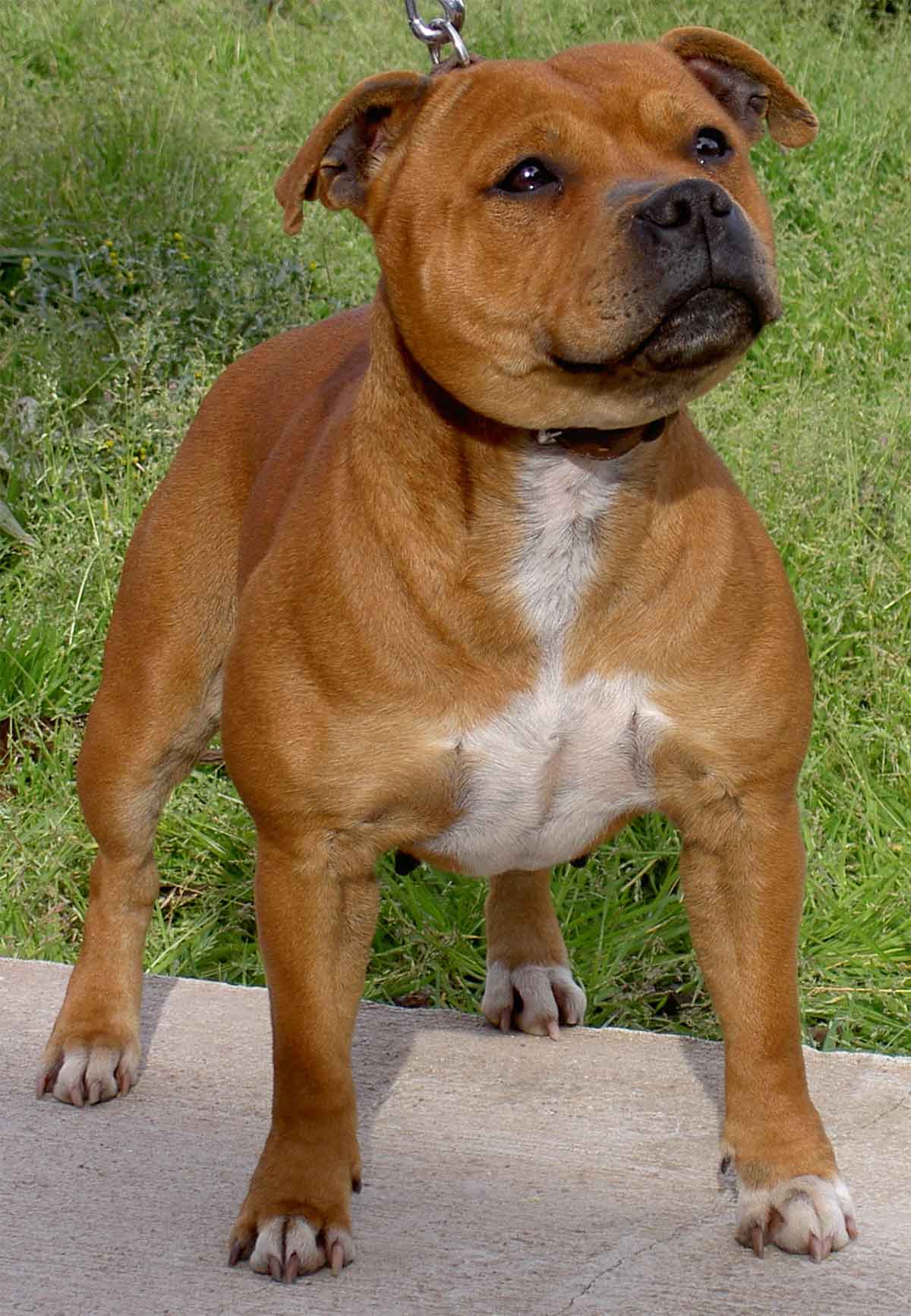
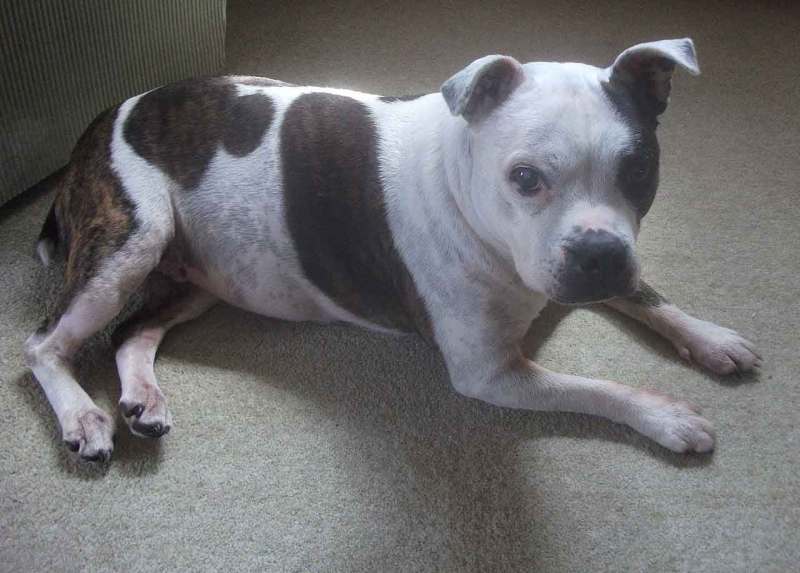
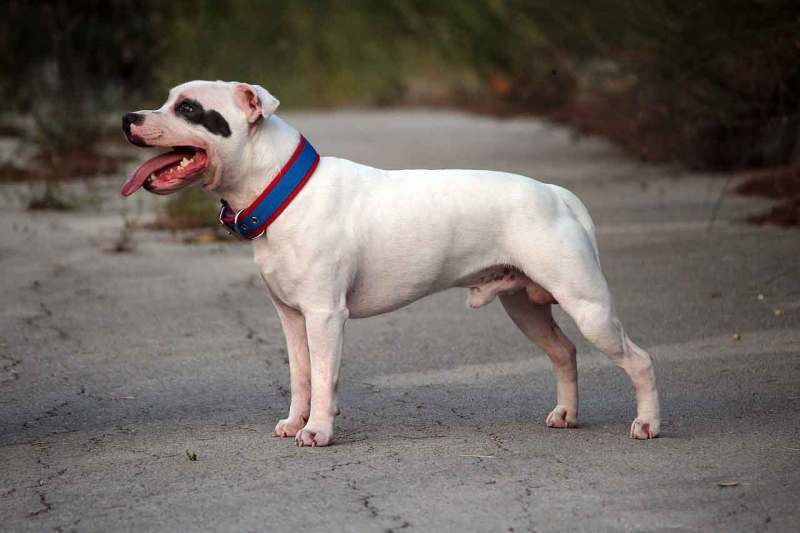
The Staffordshire Bullterrier he is medium in size and has a compact stature, muscular, almost bulky. The characteristic are his ears, that are up high and leaning slightly forward.

Height:

Height at the withers between 35,5 and 40,5 cm..

Weight:

Males should reach a weight of 12,7 – 17 kg, females weigh between 11 and 15,4 kg.

Coat colors and length

The coat of the Staffordshire bull terrier is short, smooth and simple. Can be the colors red, white, black, cervato, blue or tabby.

Character and skills

The character of Staffordshire Bull Terrier it depends a lot on your attitude. Has a fearless and courageous nature and is faithful and kind from the start. With a loving but strict attitude and a close family relationship, the Staffordshire can become a loving companion. It also, he is considered faithful, persistent and dominant. These characteristics are unfortunately exploited by many dog โ€‹โ€‹owners who rude the Staffordshire Bull Terrier and train it to be strong and aggressive..

Fitness with family connection

In many countries the Staffordshire Bullterrier is classified as a dangerous fighting dog. Its maintenance is strongly restricted and the importation of the breed to many countries is prohibited. Apart from that, the Staffordshire it is easy to maintain, because it is very adaptable. It can be kept in a house as well as in a city apartment.. Needs a family connection and proximity to his master. So, not suitable for a kennel. The Staffordshire has a great need to move and likes to play. Daily exercise in combination with extensive ball games is, therefore, a need.

Staffordshire Bullterrier Education

The Staffordshire Bullterrier it is by no means a beginner dog. In the education of this breed it is important to bring out the traits of good character with consistency and loving rigor. Traits such as tenacity, dominance and fearlessness must be kept in check. Harsh training should be avoided so that the dog does not become aggressive and stubborn. To get used to Staffordshire Bullterrier other dogs and socialize them very well, a visit to the dog school is advisable. Especially important in education is the hierarchy. Even as puppies, to the Staffordshire they like to test their limits and try to take command. But, as an owner you should never be intimidated by your dog and you should make it clear, but with love, that you are higher in the hierarchy.

Health and care of the Staffordshire Bullterrier

coat care

The coat of the Staffordshire Bull Terrier it is very easy to care for. An occasional brushing is enough to remove dirt and dust and stimulate blood circulation.

Typical diseases

Like typical diseases, the Staffordshire Bullterrier may suffer from poor hip development (Hip Dysplasia) and elbows (elbow dysplasia) and dislocation of the patella (dislocation of patella). Eye diseases such as cataracts are also typical of the breed. But, most diseases can be detected early and treated well with a regular visit to the vet.

Nutrition / Food

A healthy and balanced diet is the basis for a long life for dogs. feed the Staffordshire Bullterrier with high quality food and ingredients is, therefore, a need. The dog being fed dry food, wet or BARF is irrelevant. It is only important that the food is free of dyes, preservatives and sugar and has a high meat content.

The life expectancy of the Staffordshire Bullterrier

If he Staffordshire remains in good health and is well cared for, easily reaches an age between 12 and 14 years.

Buy a Staffordshire Bullterrier

The Staffordshire It is classified as an attack dog in many countries and its maintenance is subject to a series of conditions. Before buying, one must therefore inform oneself thoroughly about the breed and restrictions. If the purchase decision is made, one must first look at various breeders and animals. As a registered breeder's dog, a Staffordshire Terrier It costs around 1000 EUR. A shelter dog, or from an animal welfare organization is much cheaper. Especially older dogs should not be accepted by beginners, because they can be more difficult in their education than puppies.

Images "Staffordshire bull terrier"

photos:

1 – Staffordshire Bull Terrier by https://es.m.wikipedia.org/wiki/Archivo:Staffie.jpg
2 – Staffordshire Bull Terrier by https://www.pxfuel.com/es/free-photo-oegwc
3 – Staffordshire Bull Terrier by https://pxhere.com/es/photo/343556
4 – Profile shot of a white Staffordshire Bull Terrier by Public Domain – no attribution required / CC0
5 – Brindle & white Staffordshire Bull Terrier by Serial Number 54129 / CC BY-SA
6 – Staffordshire Bull Terrier, called ยซKingยป, in Melbourne, Victoria, Australia by Ashoornamrood / CC BY-SA
7 – Black Staffordshire Bull Terrier sitting on a green lawn by Public Domain – no attribution required / CC0

Videos "Staffordshire bull terrier"

Type and recognitions:

  • FCI CLASSIFICATION:
  • Group :
  • Section : . .

Federations:

  • FCI – Group 3 – Section 3 Bull type Terriers. โ“˜
  • AKC – Terriers โ“˜
  • ANKC – Terriers โ“˜
  • CKC – Terriers โ“˜
  • โ€‹KC – Terriers โ“˜
  • NZKC – Terriers โ“˜
  • UKC – Terriers โ“˜

FCI breed standard "Staffordshire bull terrier"

Origin:
United Kingdom

Date of publication of the valid original standard:
24.06.1987

Use:

Terrier


General appearance:

It is a smooth-haired dog, well balanced and strong for his size. Muscular, active and agile.


Behavior / temperament:

It is traditionally a dog of unsurpassed courage and tenacity. Very intelligent and loving, especially with the children. Brave, fearless and completely reliable.

Head:

Short

Cranial region:
  • Craging: deep and wide.
  • Dnaso-frontal depression (Stop): Marked.

facial region:

  • Trufa: Negra.
  • Snout: Short.
  • Jaws / Teeth: Powerful jaws, well developed teeth; regular and complete denture with scissor bite, that is to say, that the inner face of the upper incisors is in close contact with the outer face of the lower incisors, teeth being placed perpendicularly in the jaws.
  • Labios: Close and clear.
  • Cheeks: Very pronounced cheek muscles.
  • Ojors: Preferably dark in color although a color related to the color of the coat is allowed. Medium-sized, round and positioned so that they face straight ahead. The eye contour must be dark in color.
  • Obars: In the shape of a โ€œroseโ€ or semi-erect; they should not be large or heavy. Ears that are completely droopy or erect are very undesirable..

Neck:

Muscular, rather short, sharp in outline and gradually widening towards the shoulders.

Body:

Short lumbar region.

  • Lรญnand the top: Level.
  • Pecho: Front width; deep chest, muscular and well defined; well arched ribs.

Tail:

Medium length, low implantation, gradually tapers towards the tip and should be carried quite low. It should not be screwed in too much and should resemble the handle of an old water pump.

Tips

PREVIOUS MEMBERS: Straight forelimbs, for strong bones, placed quite far apart, without showing weakness in the metacarpals, from which the feet are turned slightly outward.

  • Hormbros: Well inclined backwards.
  • Elbows: No loosening.

LATER MEMBERS: Well muscled. Members viewed from behind must appear parallel.

  • Afemoro-tibio-patellar joints (knees): Well angulated.
  • PinItThey must have thick foot pads, be strong and of medium size. The nails must be black in those copies of a single color.

Movement:

Libre, vigorous and agile, Without much effort. Limbs move parallel whether viewed from the front or from behind. Its hind limbs provide a strong thrust.

Mantle

  • Plink: Smooth, short, and stuck.
  • Colorr: Red, leonado, white, black or blue, or any of these colors with white. Any shade of brindle or any shade of brindle with white. Black and tan and liver color are very undesirable.


Size and weight:

The desirable height (in the region of the cross) Must be from 14 to 16 inches (35,5 cm to 40,5 cm.), which is related to the weight of the specimens.

The weight of the males should be 28 to 38 English pounds (12,7 kg to 17 kg) and that of the females of 24 to 34 English pounds (11 to 15,4 kg).


Fouls:

Any deviation from the aforementioned criteria is considered as a fault and the severity of this is considered to the degree of the deviation to the standard and its consequences on the health and well-being of the dog..

FALTAS DISQUALIFYING:

  • Aggressiveness or extreme shyness.
  • Any dog โ€‹โ€‹showing clear signs of physical or behavioral abnormalities must be disqualified..


N.B.:
  • Males should have two normal-appearing testicles fully descended into the scrotum..
  • Only functionally and clinically healthy dogs, with the typical conformation of the breed, should be used for parenting.

TRANSLATION: Lic. Oscar Valverde Calvo (Costa Rica)

Itlatest changes are in bold.

Source: F.C.I - International Cynological Federation

Alternative names:

1. Stafford, Staffy, (English).
2. Stafford, SBT (French).
3. SBT, Stafford (German).
4. Staffbull, Staffie, SBT (Portuguese).
5. Staffy, Stafford Inglรฉs, Stafford (espaรฑol).

โ–ท The world of Pets: Dogs, cats, birds, reptiles, amphibians

Rottweiler
Alemania FCI 147 - Molosoids โ€“ Doge

Rottweiler

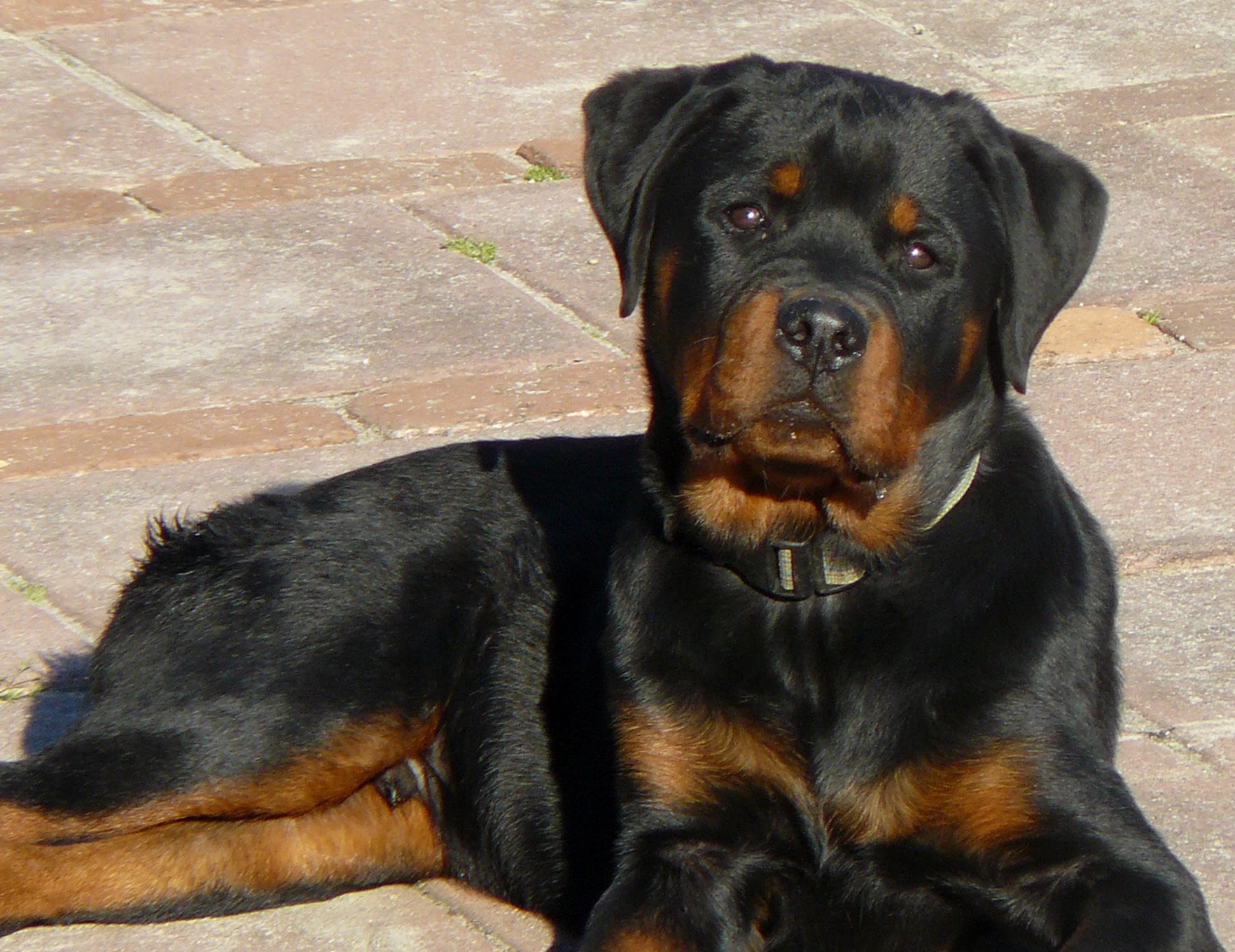
The Rottweiler is a quiet dog, docile and faithful family.

Content

History

The Rottweiler is one of the breeds of German origin that is recognized by the Federation Cynologique Internationale (FCI). The Rottweiler is a dog trotting type.

The history of the Rottweiler dates back to the 19th century. The city of Rottweil in present-day Baden-Wรผrttemberg was known for its cattle trade.. To keep animals under control on their way to pasture, farmers and butchers had to use intelligent and persistent companion dogs. At the beginning, these dogs were therefore called butcher dogs, later they were finally given the name Rottweiler due to its proximity to the city of Rottweil. Other theories about the history of the Rottweiler breed say that the canine breed was already used for cattle breeding in Rome and therefore came with the Romans through the Alps to the city of Rottweil. In the early 20th century, when people were looking for a suitable police dog, it soon became clear that the Rottweiler, with his strong, muscular stature and intrepid temperament, was particularly suitable. In 1910 the Rottweiler was officially recognized as a police dog.

those characteristics, they made it an indispensable both for farmers and butchers Assistant.

Physical characteristics

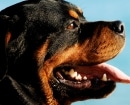
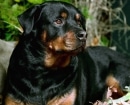
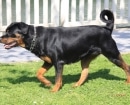
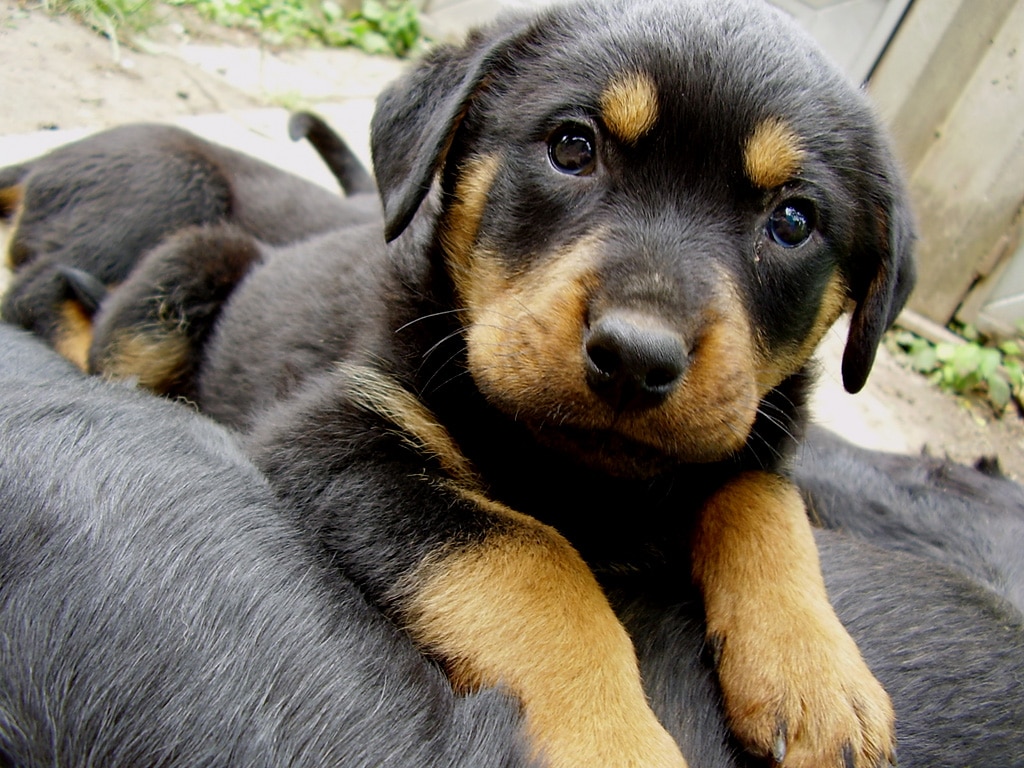
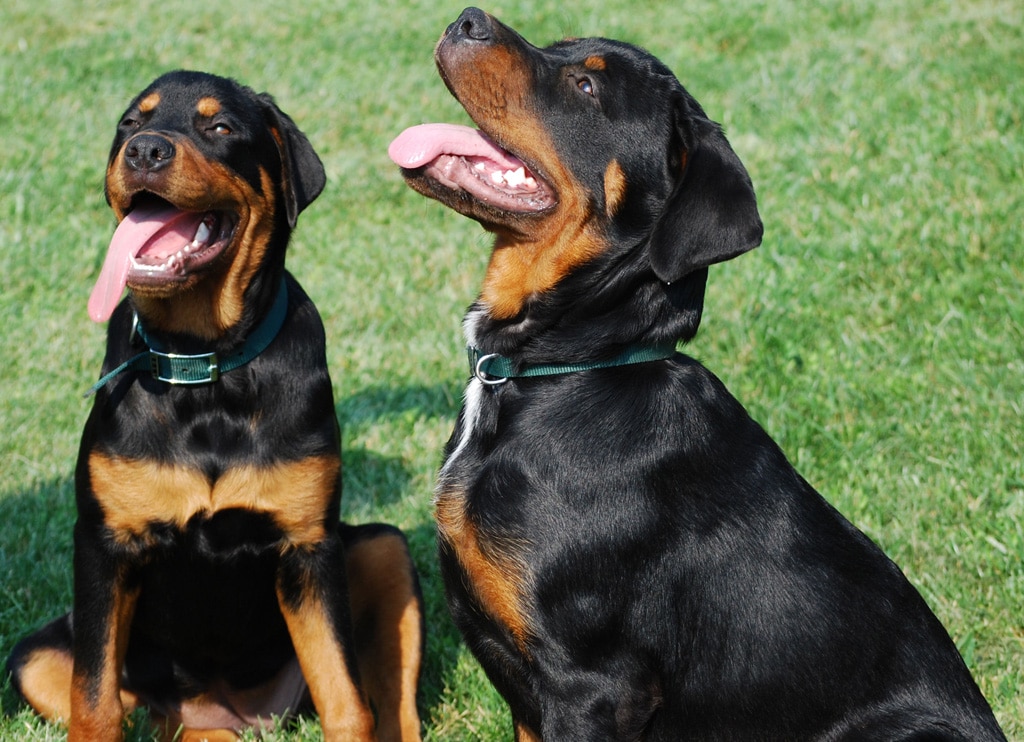
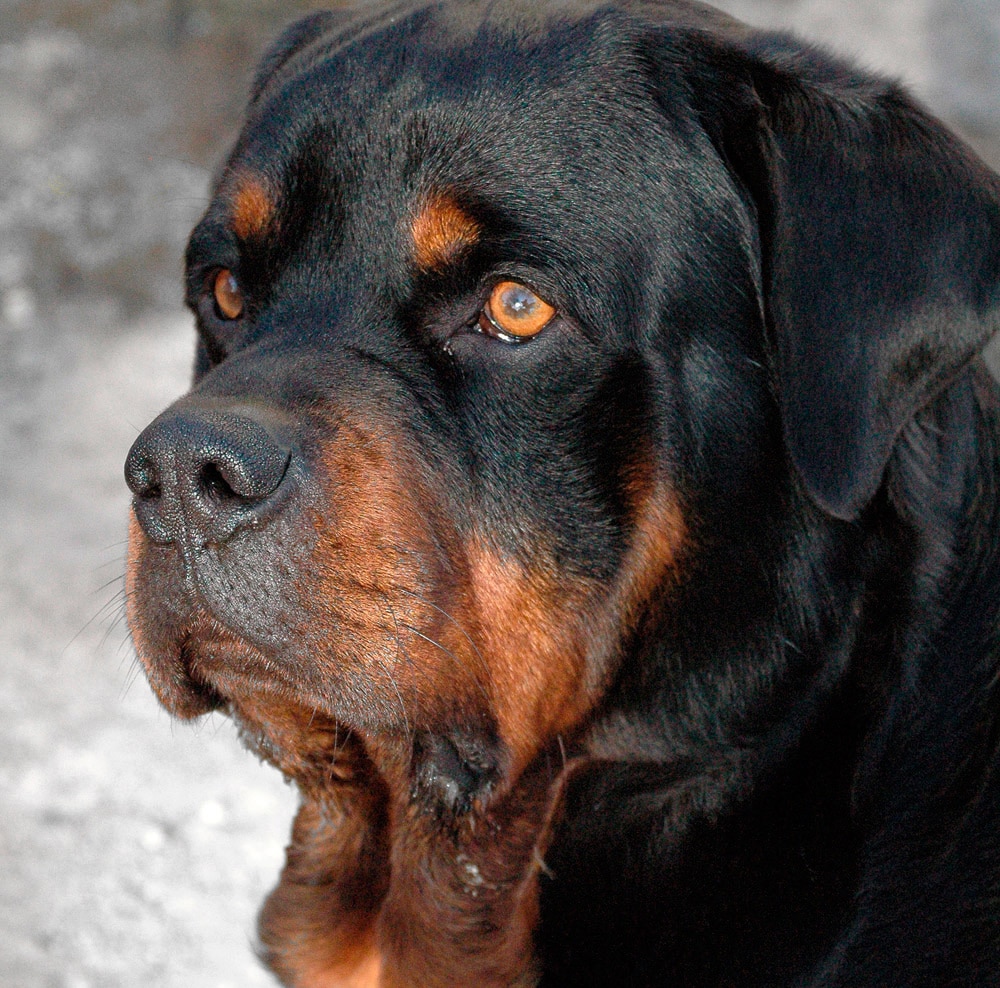
The Rottweiler is a medium to large dog, muscular, sturdy and strong with powerful teeth. Although its shape is quite robust, the Rottweiler has great resistance and is very agile. According to the breed standard, the height at the withers of a male dog is 68 cm., that of a female dog 63 cm.. The weight of a Rottweiler is between approx. 42 kg ( female) and approx. 50 kg (male). Rottweiler coat consists of a black top layer and bottom layer. The black top layer is described by the VDH (German Canine Federation) as "medium length", thick, dense and tight", while the bottom layer should not protrude from the top layer. The Rottweiler's coat is slightly longer on the hind legs. Characteristic for the Rottweiler is also the so-called blight, which means clearly defined brown-red markings on the lips, the snout, the eyebrows, under the root of the tail and on the chest.

Within this breed we can find two breeding lines, the European, considered the original and the American. The American line is characterized by taller specimens and more stylized bodies., on the other hand, European line dogs have a more compact and robust body with a shorter height.

Character and skills

Although the Rottweiler is a race that has been used for defence work, his work and typicity requires that they are described as friendly, happy talk, quiet, faithful, obedient and willingness to work. In the latest studies of aggressiveness in breeds, this was not among the top ten.

In addition the Rottweiler dog is located within the ten most intelligent dogs, they are dogs of great trust and kindness, You can be glad that it will meet the desired objective.

An important attribute that has the Rottweiler is his adiestrabilidad. It is a very intelligent and obedient dog, able to learn many tasks.

According to the classification made by Stanley Coren after analyzing the responses of more than 200 work of the AKC judges ("The Intelligence of Dogs", Stanley city, Ediciones B, 1995), the Rottweiler is the No. 9 from the list.

Its history as a shepherd, as military dog and care as well as dog obedience and exhibition, speaks highly of his versatility.

The Rottweilers are ideal as protectors of the family and property. You agree to all the members of the family and protect both the father and the son. The Rottweilers usually do not have Favorites, Although there are exceptions. They tend to be individualists, and this is due, Once again, are creatures with discernment and lists.

Their intelligence "affects" their trainability. Just like, frequently, It is said of the cats, they are too ready to wait for repetition of an order. Once they have executed her once or twice as you like, Surely they tired of the game and seek a better output. Why do humans insist on doing these things so many times?? I already got the idea the first time and it wasn't that excitingโ€ the Rottweiler seems to think.

In Spain the breed of dog Rottweiler It is classified as "Potentially Dangerous" by Royal Decree. This means that in the Spanish State, potentially dangerous breeds are regulated by the Law 50/1999, of the 23 from December and the Royal Decree 287/2002, of the 22 March.

So, for its possession you must obtain the license for possession of potentially dangerous dogs and register in the corresponding Municipal registration of potentially dangerous animals. One of the things that are required for this license is insurance of civil liability to third parties.

Some need more help than others, but patience is always required when you train a dog, regardless of what race.
Please understand that nothing wrong with owning a Rottweiler there is. They are amazing dogs and wonderful companion animals.. This is not an issue of race, but rather individuals who are involved with the canine behavior modification.

Rottweiler maintenance

Since the Rottweiler was bred as a persistent working dog and therefore needs a lot of leash in order to function properly, keeping him in the kennel is out of the question. But, due to its robustness, can stay out if there is a good family connection and corresponding workload. It is important to socialize the Rottweiler from the beginning through specific training and attendance at a dog school and accustom it to different situations and people.. Due to its character, the Rottweiler can be used very well as a service dog, guard dog, rescue dog or guide dog for the blind. Although it is not the classic family dog, living with children is usually not a problem. Due to its size and strength, wild games with children should be avoided, and children should not walk alone with the Rottweiler due to its enormous traction. Proper maintenance a Rottweiler includes not only a demanding occupation but also a good education.

The life expectancy of a Rottweiler

The life expectancy of a Rottweiler is with 8-10 years somewhat below average value. Unlike small dog breeds, the musculoskeletal system of larger dog breeds is already under great stress during the growth phase, causing signs of wear earlier.

Buy a Rottweiler

Before deciding on a Rottweiler, one must closely examine their attitude and character and carefully consider whether this breed is really suitable. The following questions must be answered affirmatively: Can I offer the Rottweiler enough space and exercise?? Do I have time to take care of the animal enough? Do all family members agree with the dog? Do I trust the education of a Rottweiler? Can I take my dog โ€‹โ€‹on vacation or what alternatives are there? If you finally decide to get a Rottweiler, doesn't necessarily have to come from a breeder. Why don't you visit the animal shelter?- Maybe you'll find a Rottweiler there that you can give a good home to.. Here the purchase is also much cheaper than with a breeder.

Rottweiler Education

The correct education is very important for a Rottweiler to promote its generally human and balanced character.. Your position in the family hierarchy should be clear to the dog from the start., so that he learns to obey and respect his master. Consistency is extremely important in Rottweiler education, and should be dominant, but without harshness. As a responsible dog owner, you must act with sovereignty, calm and especially with consideration when training a Rottweiler. The Rottweiler recognizes these positive leadership qualities, which ultimately makes him a loyal companion. As in the case of any other dog, training should begin at the puppy's age, where positive behavior is rewarded with praise, for example in the form of sweets. Caution: With insufficiently dominant leadership or erroneous and inconsistent education, Rottweiler can develop dangerous behavior – this shows the great role that the correct education of the Rottweilers plays.

Rottweiler Health and Care

Since the Rottweiler's coat is rather short to medium long, the toilet is not very complex. But, due to its agile nature, impurities can quickly accumulate on the coat, so grooming should not be neglected entirely. Occasional brushing is completely sufficient. For Rottweiler coat length, special brushes for dogs, but also cotton gloves have proven to be very effective. In addition to the toilet, foot care, as well as eye care, ears and nails should be considered to the usual extent.

Breed-specific diseases

As with many other large dogs, certain diseases occur more frequently in Rottweiler dogs. These include hip dysplasia and elbow dysplasia, both are poor development of the respective joints. Because this is due to a genetic disposition, an X-ray examination must be presented in a breed aptitude test. To prevent disease, care must be taken that the animal is not overweight and gets enough exercise. Leukoencephalomyelopathy is also a hereditary disease. It leads to progressive paralysis in young animals and is not curable., although it occurs quite infrequently. On the other hand, in recent years, heart disease has been reported more frequently in this breed. Constriction of the nerves of the heart, for example, is inherited and affects the reflux of blood from the heart, which ultimately leads to limited performance of the Rottweiler.

Rottweiler feed

Like any other dog, the Rottweiler needs a species-appropriate diet. To prevent overweight and resulting breed diseases, such as hip and elbow dysplasia, dog food should not be too fatty and above all low in protein. It is also important that the Rottweiler feeds in moderation and has limited access to the feeding bowl. Instead of being able to use a large portion of food, Dog owners must distribute food appropriately for their โ€œRottiโ€. Whether dry or wet food is better for the Rottweiler, the dog owner must decide for himself.

Rottweiler puppies prefer to eat what they are used to eating from their breeder. So, it makes sense to continue feeding this food for the time being and only change food when the dog is older and may have different needs than its food. It's best to just try what the Rottweiler likes best: in addition to dry and wet food, also a healthy alternative to barking at the dog.

Characteristics "Rottweiler"

Coexistence is important that you have with your new friend. Before considering the acquisition of a dog of the breed "Rottweiler" you know certain factors. Not all breeds of dogs are apt to live in an apartment, you must take into account his character, their need for exercise, their interaction with other pets, their care and if you have small children, their level of tolerance towards them.

Adaptation โ“˜

3,0 of 5 stars (based on 1 review)

friendly dog โ€‹โ€‹โ“˜

1,0 of 5 stars (based on 1 review)

hair loss โ“˜

3,0 of 5 stars (based on 1 review)

Affection level โ“˜

3,0 of 5 stars (based on 1 review)

Need for exercise โ“˜

3,0 of 5 stars (based on 1 review)

Social need โ“˜

5,0 of 5 stars (based on 1 review)

Home โ“˜

3,0 of 5 stars (based on 1 review)

Toilet โ“˜

1,0 of 5 stars (based on 1 review)

Friendly with strangers โ“˜

1,0 of 5 stars (based on 1 review)

barking โ“˜

2,0 of 5 stars (based on 1 review)

Health โ“˜

3,0 of 5 stars (based on 1 review)

Territorial โ“˜

5,0 of 5 stars (based on 1 review)

Cat friendly โ“˜

3,0 of 5 stars (based on 1 review)

Intelligence โ“˜

4,0 of 5 stars (based on 1 review)

Versatility โ“˜

3,0 of 5 stars (based on 1 review)

Child friendly โ“˜

2,0 of 5 stars (based on 1 review)

Surveillance โ“˜

3,0 of 5 stars (based on 1 review)

joy โ“˜

5,0 of 5 stars (based on 1 review)

Rottweiler Images

Rottweiler Videos

Type and recognitions:

  • FCI CLASSIFICATION:
  • Group :
  • Section : . .

Federations:

  • FCI – Pinscher and Schnauzer-Molossoid type dogs – Swiss Mountain Dogs and Cattledogs. Section 2.1 Molossoid, mastiff type. โ“˜
  • AKC – Working dogs โ“˜
  • ANKC – Group 6 (utility dogs) โ“˜
  • CKC – Group 3 (working dogs) โ“˜
  • โ€‹KC – Working dogs โ“˜
  • NZKC – Utility dog โ“˜
  • UKC – Watchdog โ“˜

FCI breed standard "Rottweiler"

Origin:
Germany

Date of publication of the valid original standard:
15.06.2018

Use:

Utility dog, service and company.


General appearance:

The Rottweiler is a medium to large sized dog, robust, neither heavy nor light, neither with limbs too high nor weak. Its correctly proportioned construction, Compact and powerful, Lets conclude that it is a very powerful dog, agile and resistant.

IMPORTANT PROPORTIONS: The length of the body, measured from the tip of the sternum (chest bone) to the ischial tuberosity, must not exceed the height at the withers by more than one 15%.


Behavior / temperament:

The rottweiler hasaffable tendency, placid in basic arrangement, very devoted, obedient, docile and willing to workIts appearance is natural and rustic, his behavior is self-confident, stable and fearless. Reacts to its surroundings with great attentionand at the same time in a temperate way.

Head:

---

Cranial region:
  • Skull: Medium length, relativelywidth between ears. Side view, the forehead is moderately arched; the occipital Protuberance is well developed, without being too noticeable.
  • Depression links (Stop)Relatively strongThe front grooves are not too deep.

facial region:

  • Truffle: Well developed, rather wide than rounded, with relatively large nostrils, always black.
  • Snout: In relation to the area of รขโ‚ฌโ€นรขโ‚ฌโ€นthe skull, it should not give the impression of being shortened or elongated.The relationship between the length of the muzzle and the length of the skull is approximately 1 to 1.5. Straight nose bridge, wide at its insertion, moderately decreases in width from back to front.
  • Lips: Blacks, well pasted. The corner of the mouth is tightly closed; gums as dark as possible.
  • Jaws / Teeth: Both the upper and lower jaws are very strong and wide.. Healthy teeth, strong and full (42 parts). With scissor bite, upper incisors overhang lower incisors tightly.
  • Cheeks: Pronounced zygomatic arches.

EYES: Medium-sized, almendrada form, dark brown; with well-adherent eyelids.
EARS: Medium-sized, pendants, triangular, very separated and set high. With the ears well glued and placed forward, which makes the skull area of รขโ‚ฌโ€นรขโ‚ฌโ€นthe impression to be wider.

Neck:

Strong, long, good muscular, slightly arched, clean, double chin freeorskinloose.

Body:

  • Back: Straight, strong and stiff.
  • Pork loin: The lumbar region is short, strong and deep.
  • Rump: Wide, medium length, slightly rounded, without being straight, not even with much fall.
  • Breast : Spacious, broad and deep (approx.. 50% the height of the cross), with a well-developed sill and bulky rib.
  • Abdomen: Not collected flanks.

Tail:

In natural condition, strong, at the level and in an extension of the upper line; in atention, when aroused or on the move can bring her up with a slight curve; in idle it can hang up.Bringing it down between the legs the tail reaches the hocks or is a little longer.

Tips

PREVIOUS MEMBERS:

  • As a whole: Seen from the front they are straight and not very together. The forearms, seen from side, they are straight. The inclination of the scapula in relation to the horizontal is 45ยฐ.
  • Shoulder: Well-placed.
  • Arms: Well glued to the trunk.
  • forearms: Strongly developed and muscular.
  • Metacarpus: Slightly elastic, strong, slightly oblique.
  • Front feet: Round; closed and swollen fingers. Hard pads; short nails, black and strong.

LATER MEMBERS:

  • As a whole: Seen from behind are straight, parallel and not very together. In the natural position, obtuse angles are formed between the thigh and the iliac bone., between the thigh and the leg (knee), and between the leg and the metatarsus (Hock).
  • Thigh: Moderately long, width and heavily muscled.
  • Leg: Long, strong, with many muscles, sinewy.
  • Hock: Powerful; well angled, not steep.
  • Rear feet: A little longer than the front; also closed fingers, bulky and heavy.

Movement:

The Rottweiler is a m, remaining your back strong and with little movement. The development of the movement is harmonious, insurance, with force and free, with wide steps.

Mantle

SKIN: Skin tight head throughout the area; form small wrinkles on the forehead when the dog is at attention.

HAIR: Composed of outer layer and internal NAP. The external layer hair is medium long, hard, thick and tight; internal NAP must not protrude beyond the external hair. In the hind, the hair is a little longer.

COLOR: Negro, with well-defined fire marks of a bright pardo-rojizo color on the cheeks, snout, throat, chest and members, as well as above the eyes and under the tail.


Size and weight:

Males:

  • Height to the cross: 61-68 cm..
  • Of 61 to 62 cm.: small; of 63-64 cm.: medium-.
  • Of 65-66 cm.: large (correct size); of 67-68 cm.: very large.
  • Weight: Approximate: 50 kg.

females:

  • Height to the cross: 56-63 cm..
  • Of 56 to 57 cm.: small; of 58 to 59 cm.: medium.
  • Of 60-61 cm.: large (correct size); of 62-63 cm.: very large.
  • Weight: Approximate: 42 kg.


Fouls:

Any deviation from the aforementioned criteria is considered as a fault and the severity of this is considered to the degree of the deviation to the standard and its consequences on the health and well-being of the dog..

General appearance: Lightweight overall appearance, fragile; too high limb; weak bones and muscles.

  • Head: Head of hounds, narrow, light; too short or too long, Tosca; Flat front; absent or little noticeable stop.
  • Snout: Pointed or long; split nose; borrego type nose cane (convex), or depressed (concave); drooping nasal bridge (eagle); Truffle stained or color clear.
  • Lips: Not together, pink or stained; Open the lips angle.
  • Jaws: Narrow jaw.
  • Teeth: Bite of iron.
  • Cheeks: Very prominent.
  • Eyes: clear, deep, bulging or round. Loose eyelids.
  • Ears: Too low, heavy, long, drooping, bent backwards, as well as separate the size of the uniform.
  • Neck: Too long, delgado, weak muscles, with loose skin or dewlap.
  • Body: Too long, too short, Strait.
  • Back: Too long, weak, past due or outstanding (convex).
  • Rump: Drop, too short, long or straight.
  • Breast : Chest with a flat rib, barrel or Strait, backwards.
  • Tail: Too high or too low implementation.
  • Former members: Close together, not straight; steep shoulder; elbows not quite clinging to the body or separated; too long forearms, short or steep; weak or steep Metacarpus; crushed feet; very flat fingers, destitute or very bulky; Nail Color clear.
  • Later members: Flat thighs; closed or cow type tips; the very acute or obtuse angles of the joints; Spurs.
  • Skin: The wrinkled facial skin.
  • Fur: Soft; too short or too long, wavy; absence of internal NAP.
  • Color: Wrong color marks, too big, or not clearly defined.

MISS PLAYOFFS

  • Behavior: Shy animals, shy, cowards, aggressive, overly suspicious, nervous and afraid of shots that show.
  • General appearance: Marked investment in the sexual nature (that the male presents female characteristics or vice versa).
  • Teeth: Upper or lower prognathism, incisor arcade deviated; absence of an incisor tooth, Tusk, a premolar or a molar.
  • Eyes: Entropion, ectropion, yellow eyes; anisochromia (eyes of different colour).
  • Tail: Quebrada, threaded, strongly diverted laterally.
  • Fur: Markedly long or wavy.
  • Color: Any discrepancy from the characteristic black color with reddish-brown spots; white spots.
  • Any dog โ€‹โ€‹showing clear signs of physical or behavioral abnormalities must be disqualified..


N.B.:
  • Males should have two normal-appearing testicles fully descended into the scrotum..
  • Only functionally and clinically healthy dogs, with the typical conformation of the breed, should be used for parenting.

TRANSLATION: Federation Canรณfila Mexicana a.c..

The latest changes are in bold.

Source: F.C.I - International Cynological Federation

Alternative names:

1. Rott, Rottie (English).
2. Rottweiler (French).
3. Rottweiler Metzgerhund (German).
4. Rottweiler Metzgerhund (Portuguese).
5. Rottie, Rott (espaรฑol).

โ–ท The world of Pets: Dogs, cats, birds, reptiles, amphibians

Greater Swiss Mountain Dog
Suiza FCI 58 - Swiss Cattle Dogs

Gran Boyero Suizo

Despite its impressive size and weight, The Greater Swiss Mountain Dog is strong and agile.

Content

History

The Greater Swiss Mountain Dog is an old Swiss farm dog. It is the largest of the family of mountain dogs. These served in the mountains and valleys of the Swiss Alps as a complete tool for farmers. They watched the house and the farm. If a herd of cows had to be moved from one meadow to another, they made sure everyone stayed on the road and no cow was left behind.

The great mountain dogs, from which the current one emerged Greater Swiss Mountain Dog, harnessed in front of larger wagons and served as all-terrain and mountain tractors, more or less like the old one Unimog. It was not unusual for them to be harnessed in pairs in front of a cart full of valuable cheese, so they could independently find their way from the alpine pasture to the village, to the merchant and back. Mountain Dogs and Swiss Cattle Dogs used to be a single family of dogs. What they have in common is a strong bond with family and their farm., a confident self-awareness, a widely lost hunting instinct, a high degree of vigilance, a loving attitude towards his own people and a reserved attitude towards strangers.

A few ago 100 years, mountain dogs were divided into four breeds: Entlebucher, Appenzeller, Berne, Greater Swiss Mountain Dog – in order of size. This and the artificial fixation in a tricolorism conceived by the breed have not been good for the health of these great dogs.. So the statistics of the British Kennel Club 2014 document a life expectancy of only 8 years for Mountain Dogs and Bovine Dogs. Healthy servants could easily live 4 more years. More about this in the portrait of the respective mountain and cattle dogs.

The Greater Swiss Mountain Dog became a valuable companion dog, but still has the skills of a working dog. In 1912 The "Club of Great Swiss Mountain and Cattle Dogs" was founded in Switzerland.

Physical characteristics

The Greater Swiss Mountain Dog is a big dog, robust, strong-boned and well-muscled. Radiates sovereign calm and self-confident composure, and that's how it is. The difference between the sexes should be quite large.
The males must have a height at the withers of 65 to 72 centimeters, the females of 60 to 68. The weight is between 35 and 50 kg.

The standard establishes numerous regulations on the details of coloring, texture and pattern of its coat. I should have brush hair and be tricolor. We see detailed regulations, where white marks are allowed and where they are not. In the interest of dogs, do not take these external characteristics so seriously, that are only devised by your breeder. Turning those details into breeding selection criteria is not in the interest of the welfare of the offspring. Greater Swiss Mountain Dog, they only have an extremely small gene pool anyway. What matters is the character and physical condition of the dogs. this last, Unfortunately, not too rare a problem. The Greater Swiss Mountain Dog it has better qualities than the color of its coat.

Character and skills

The Greater Swiss Mountain Dog feel more comfortable in the field. He wants to be moved and you can experience wonderful stress-free walks in nature with him. As it has little hunting instinct and usually has a good ear, you can enjoy relaxed and stress-free hours outdoors with it, even without a strap. But, It is not a companion dog for athletes..

One Greater Swiss Mountain Dog not suitable for life in the middle of the big city. You don't need a house with a big garden, what would be ideal. He likes to have a land or a yard where he can take care of things. Otherwise, does not have any special requirement regarding its maintenance. Most important is their close integration into the human family. For a permanent or even partial stay in a kennel these dogs are completely unsuitable.

Educating the Greater Swiss Mountain Dog

One Greater Swiss Mountain Dog can be trained very well. He likes to learn. It is strongly oriented towards its people, what you can use well. The Great swiss you can read the mood and wishes of your people on their faces. This in turn means that one must approach one's education with feeling and of course with consequence.. He has a pronounced sense of justice and, the other way, expect an equally fair deal. One must not only accept their occasional stubbornness, but you must like it. They challenge an intimate and mutually respectful relationship between dog and owner. The reward is a happy coexistence for both parties.

Care and health of the Greater Swiss Mountain Dog

The Greater Swiss Mountain Dog it is very easy to care for, just brush it occasionally.

Like many large dog breeds, tends to have hip problems (HD) or elbows (ED). La endogamia, unfortunately partly strong, has a negative effect on physical fitness and life expectancy.

Nutrition / Food

The Greater Swiss Mountain Dog has no special demands on their diet. Like many dogs of his size, tends to churn your stomach. Therefore you should not eat too fast and let it rest after eating.. Veterinarians often recommend an elevated feeding bowl, that can be purchased in specialized stores. During the breeding season, special attention must be paid to an adapted nutrition.

The life expectancy of the Greater Swiss Mountain Dog

One Greater Swiss Mountain Dog is relatively strongly affected by inbreeding and breeding selection that is one-sidedly oriented toward outward appearances, such as fur color details. So, their life expectancy has decreased in part enormously. It's between eight and -healthily- twelve years.

Buy a Greater Swiss Mountain Dog

When buying a puppy you must be careful that no ancestor appears twice in the pedigree. (endogamia). Otherwise, you should look for a breeder affiliated with the Swiss Mountain and Cattle Dog Club. You can also find the dog of your dreams at the animal shelter or in an emergency initiative.

Characteristics "Greater Swiss Mountain Dog"

Coexistence is important that you have with your new friend. Before considering the acquisition of a dog of the breed "Greater Swiss Mountain Dog" you know certain factors. Not all breeds of dogs are apt to live in an apartment, you must take into account his character, their need for exercise, their interaction with other pets, their care and if you have small children, their level of tolerance towards them.

Adaptation โ“˜

3,0 of 5 stars (based on 1 review)

friendly dog โ€‹โ€‹โ“˜

4,0 of 5 stars (based on 1 review)

hair loss โ“˜

3,0 of 5 stars (based on 1 review)

Affection level โ“˜

4,0 of 5 stars (based on 1 review)

Need for exercise โ“˜

3,0 of 5 stars (based on 1 review)

Social need โ“˜

4,0 of 5 stars (based on 1 review)

Home โ“˜

2,0 of 5 stars (based on 1 review)

Toilet โ“˜

1,0 of 5 stars (based on 1 review)

Friendly with strangers โ“˜

3,0 of 5 stars (based on 1 review)

barking โ“˜

4,0 of 5 stars (based on 1 review)

Health โ“˜

3,0 of 5 stars (based on 1 review)

Territorial โ“˜

5,0 of 5 stars (based on 1 review)

Cat friendly โ“˜

3,0 of 5 stars (based on 1 review)

Intelligence โ“˜

4,0 of 5 stars (based on 1 review)

Versatility โ“˜

4,0 of 5 stars (based on 1 review)

Child friendly โ“˜

4,0 of 5 stars (based on 1 review)

Surveillance โ“˜

3,0 of 5 stars (based on 1 review)

joy โ“˜

5,0 of 5 stars (based on 1 review)

Images "Greater Swiss Mountain Dog"

Photos:

1 – Greater Swiss Mountain Dog, tricolour by Canarian / CC BY-SA
2 – Greater Swiss Mountain Dog by jude / CC BY
3 – Big Swiss Mountain Dog and Entlebucher Mountain Dog during International show of dogs in Katowice – Saucer, Poland by Pleple2000 / CC BY-SA
4 – All Mountain Dogs: Greater Swiss Mountain Dog, the Bernese Mountain Dog, the Appenzeller Mountain Dog an the Entlebucher Mountain Dog by Shining dog / CC BY-SA

Videos "Greater Swiss Mountain Dog"

Type and recognitions:

  • FCI CLASSIFICATION:
  • Group :
  • Section : . .

Federations:

  • FCI – Pinscher and Schnauzer-Molossoid type dogs – Swiss Mountain Dogs and Cattledogs. Section 2.2 Molossoid, mountain type. โ“˜
  • AKC – Working dogs โ“˜
  • CKC – Working dogs โ“˜
  • โ€‹KC – Working dogs โ“˜
  • UKC – Watchdog โ“˜

FCI breed standard "Greater Swiss Mountain Dog"

Origin:
Switzerland

Date of publication of the valid original standard:
25.03.2003

Use:

Originally used as a guard and traction dog. He is currently used as a family dog., companionship and protection.


General appearance:

It is a tricolor dog, robust, strong bone and good musculature. Despite its size and weight, demonstrates agility and endurance. The sexual characteristics of the male and female are pronounced.

IMPORTANT PROPORTIONS:

  • body length (measured from the tip of the shoulder to the tip of the buttock: height of the cross: = 10 : 9.
  • Chest depth: height of the cross: = 1 : 2.
  • Length of the skull: nose length: = 1 : 1.
  • Skull width: muzzle width: = 2 : 1.


Behavior / temperament:

insurance, attentive, awake and fearless in everyday situations, kind and dependent with people he trusts and self-confident in relation to strangers; medium temperament.

Head:

In relation to the body, it's strong but not heavy. The head of the males is more powerful than that of the females.

Cranial region:
  • Skull: Flat and wide with a front groove that gradually heads and disappears upward.
  • Depression links (Stop): Notorious.

facial region:

  • Truffle: black.
  • Snout: Strong, longer than deep, without looking pointy from above or from the sides. Straight nose cane, no middle groove.
  • Lips: Poorly developed, tight; black pigmented; not hanging.
  • Jaw โ€“ Teeth: Strong jaws. Full scissor bite, strong and regular. Lack of 2 teeth (premolars 1 y/ o 2) is tolerated. The absence of the M3 is not taken into account.

Eyes: Medium, in the form of almond, not deep or bulging, hazelnut brown or chestnut, of happy and awake expression. Eyelids are well attached. The darkly pigmented edge of the eyelids.

Ears: Medium-sized, triangular and fairly high set. When the dog is calm, supported and flat; when you are attentive, directs them forward. With enough hair both on the outside and on the inside.

Neck:

Strong, muscular, chubby and no chin.

Body:

Slightly longer than the height at the withers.

  • Back: Moderately long, strong and straight.
  • Pork loin: Wide and well muscled.
  • Rump: Long and wide, with a gently rounded fall; neither too high nor abruptly dropped.
  • Breast : Strong, width, reaching to the elbows; round-oval rib diameter chest neither flat nor crowded. Well developed sill.
  • Abdomen and lower line: The abdomen and flanks are poorly gathered.


Tail:

Inserted in harmonic continuation with the rump. Pretty heavy, reaching the hock; if the dog is calm, the tail hangs; if you are at attention or on the move, wears it higher and slightly curved, but never ringed or on the back.

Tips

PREVIOUS MEMBERS:

  • As a whole: Seen from ahead straight and parallel placed rather apart.
  • Shoulder: The long shoulder blade, strong, inclined, glued and well muscled, forming a not very obtuse angle with the arm.
  • Forearm: Straight and strong bone.
  • Metacarpus: Strong, seen from the front, in straight extension of the forearm; seen from the sides almost perpendicular.

LATER MEMBERS:

  • En set: Seen from behind, straight and not too close. Metatarsals and feet must not be inclined inward or outward; dewclaws must be amputated, except in countries, in which amputation is not permitted by law.
  • Thigh: Rather long, width, strong and well muscled.
  • Knee: Claramente an obtuse angle.
  • PinScheme: Relatively long.Hock: Strong and well angled.

FEET: Strong, straight, closed, fingers well together, well arched and strong nails.

Movement:

Wide and uniform in all types of gears. Good forward reach and good momentum from hindlimbs. When jogging, limbs move in a straight line, seen both in front and behind.

Mantle

  • Fur: double hair, composed of dense outer layer of medium length, and inner fleece, equally dense, preferably dark gray to black. Short external hair is allowed, if the inner fleece is thick.
  • Color: Typically tricolor: Basic color is black with symmetrical reddish-brown fire markings and white markings. The reddish-brown fiery markings lie between black and white on the cheeks, above the eyes, on the inner side of the ears, at the sides of the chest, on all four limbs and at the bottom of the tail. White markings are located on the head (forehead and muzzle), from throat to chest (without interruption), on the feet and at the tip of the tail. Between the white mark on the forehead and the brown fire marks- reddish over the eyes should be a black streak. White spot on neck or white collar is tolerated.


Size and weight:

TAHAND:  
Alturto the cross In males: 65 โ€“ 72 cm.,
  In females: 60 โ€“ 68 cm..


Fouls:

Any deviation from the aforementioned criteria is considered as a fault and the severity of this is considered to the degree of the deviation to the standard and its consequences on the health and well-being of the dog..

  • Dubious behavior.
  • Lack of other teeth, maximum two premolars (PM1 and / or PM2). M3s are not taken into account caliper bite.
  • light eyes; insufficient eyelid occlusion
  • Mantle: Internal fleece of brownish-yellowish or light gray color visible. Dirty colors.
  • Lack of marking
    • Lack of white mark on the head; very wide list.
    • White mark of the muzzle visibly reaching beyond the corners of the lip
    • ยซWhite bootsยป (white color that reaches above the metacarpal or metatarsal joints.
  • Notoriously asymmetrical drawings

FALTAS DESCALIFICANTES:

  • Aggressiveness or extreme shyness.
  • Any dog โ€‹โ€‹showing clear signs of physical or behavioral abnormalities must be disqualified..
  • Upper or lower prognathism, arcade of the deviated incisors
  • Entropion, ectropion.
  • One eye or two blue eyes.
  • Short hair without undercoat.
  • Long hair.
  • Non tricolor dog.
  • Basic color other than black.


N.B.:
  • Males should have two normal-appearing testicles fully descended into the scrotum..
  • Only functionally and clinically healthy dogs, with the typical conformation of the breed, should be used for parenting.

TRANSLATION: Federation Canรณfila Mexicana a.c.

Source: F.C.I - International Cynological Federation