โ–ท The world of Pets: Dogs, cats, birds, reptiles, amphibians

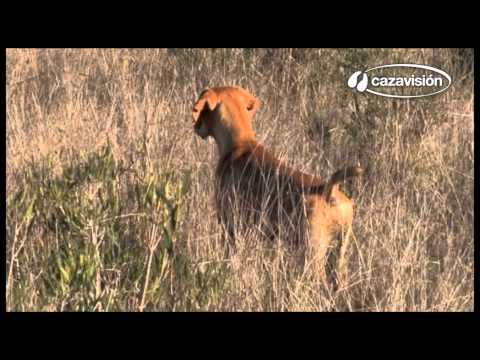
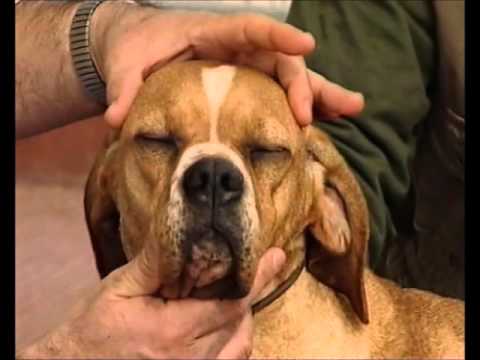
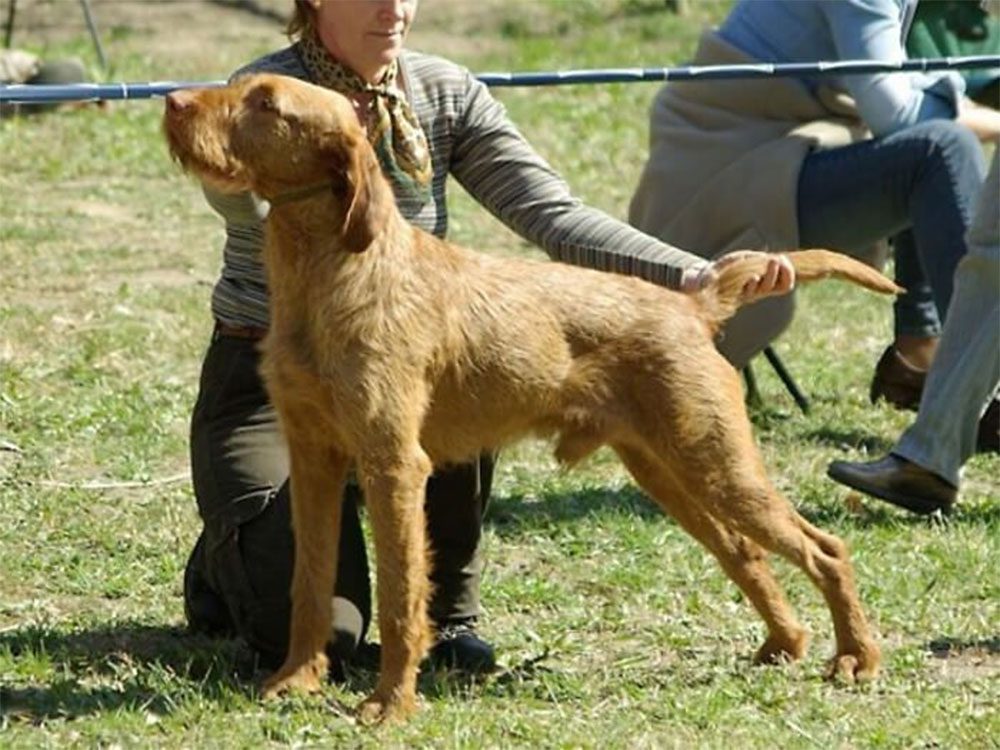
Portuguese Pointer
Portugal FCI 187 . Braque Type

Portuguese Pointer

The Portuguese Pointer He is extremely affectionate and very attached to children, it is also a very submissive dog.

Content

Characteristics "Portuguese Pointer"

Coexistence is important that you have with your new friend. Before considering the acquisition of a dog of the breed "Portuguese Pointer" you know certain factors. Not all breeds of dogs are apt to live in an apartment, you must take into account his character, their need for exercise, their interaction with other pets, their care and if you have small children, their level of tolerance towards them.

Adaptation โ“˜

4,0 of 5 stars (based on 1 review)

friendly dog โ€‹โ€‹โ“˜

2,0 of 5 stars (based on 1 review)

hair loss โ“˜

2,0 of 5 stars (based on 1 review)

Affection level โ“˜

5,0 of 5 stars (based on 1 review)

Need for exercise โ“˜

4,0 of 5 stars (based on 1 review)

Social need โ“˜

3,0 of 5 stars (based on 1 review)

Home โ“˜

4,0 of 5 stars (based on 1 review)

Toilet โ“˜

1,0 of 5 stars (based on 1 review)

Friendly with strangers โ“˜

2,0 of 5 stars (based on 1 review)

barking โ“˜

2,0 of 5 stars (based on 1 review)

Health โ“˜

2,0 of 5 stars (based on 1 review)

Territorial โ“˜

4,0 of 5 stars (based on 1 review)

Cat friendly โ“˜

2,0 of 5 stars (based on 1 review)

Intelligence โ“˜

3,0 of 5 stars (based on 1 review)

Versatility โ“˜

4,0 of 5 stars (based on 1 review)

Child friendly โ“˜

3,0 of 5 stars (based on 1 review)

Surveillance โ“˜

3,0 of 5 stars (based on 1 review)

joy โ“˜

2,0 of 5 stars (based on 1 review)

History

The Portuguese Pointer arose from Perdigueiro Peninsular, an ancient breed of Iberian dogs, its presence is documented since the 10th century, Its first appearance in art is on a Visigothic-Arab tombstone of the Church of San Juan Bautista de Tomar. Its evolution was the result of several factors such as adaptation to the climate, the type of hunting, the terrain and the selection introduced through the Portuguese cultural specificity.

In the fourteenth century, It was bred in the royal kennels and used for hunting Altaria, being known as ยซPodengo de mostraยป, showing already the possibility of stopping before the hunt. In the 16th century (reign of D. Sebastian) its use by the popular classes was common (although prohibited). The constant bleeding in the working arms caused by the discoveries, the abandonment of the fields, hunger and change of habits, led the population to resort more to hunting for food and, as a result, to the use of Pointing Dogs, that they were "prohibited" for causing, thanks to its excellent qualities, serious damage to the vested interests of the royal house and the nobility.

In the 18th century, Many English families established a presence in the Porto region in the business of wine production and came into contact with the breed being brought to England where it played an important role in the origin of the English Pointer.

At the end of the 19th century it suffered a certain decline, due to serious social upheavals and new tastes and contacts with the outside world, that gave projection to the foreign races that were then in fashion. But it is still represented in art objects (tinaja painted by D. Fernando II of Saxe-Coburg, Pena-Sintra), painting of King D.Luis and the princes in hunting clothes in the Palace of Ajuda, Lisbon), painting of a hunting trip of an Englishman in the Douro (Quinta de Gatรฃo, Duero) or in artistic ceramics by the Real Fรกbrica do Rato (Pimenta Palace, Lisbon).

Only in 1920 some breeders strove to save the breed, locating some of the dogs in the inaccessible north of Portugal. The Portuguese pedigree book was then established in 1932 and the breed standard in 1938. For at least a thousand years, this dog always had the same square head, triangular ears and compact look.

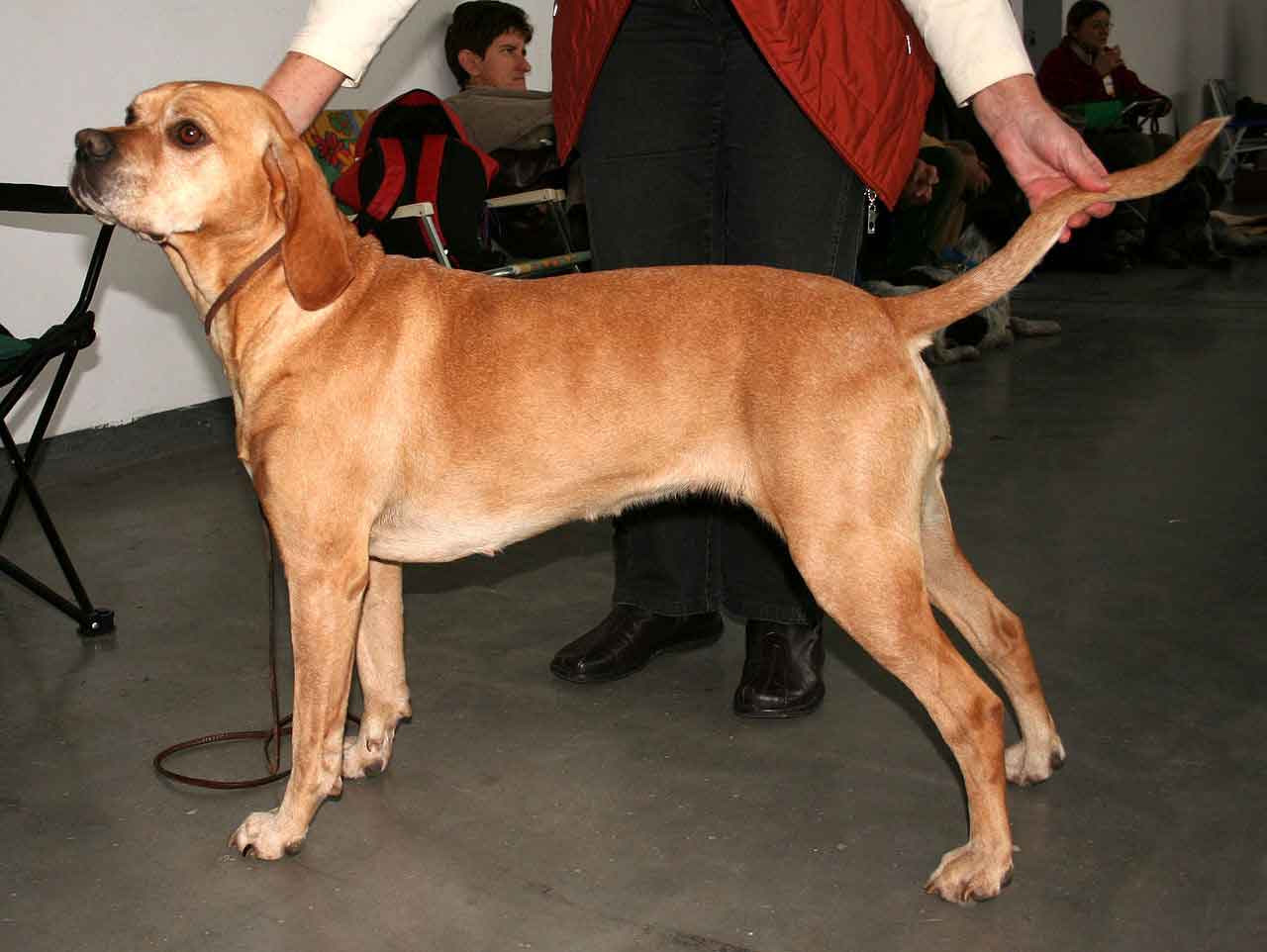
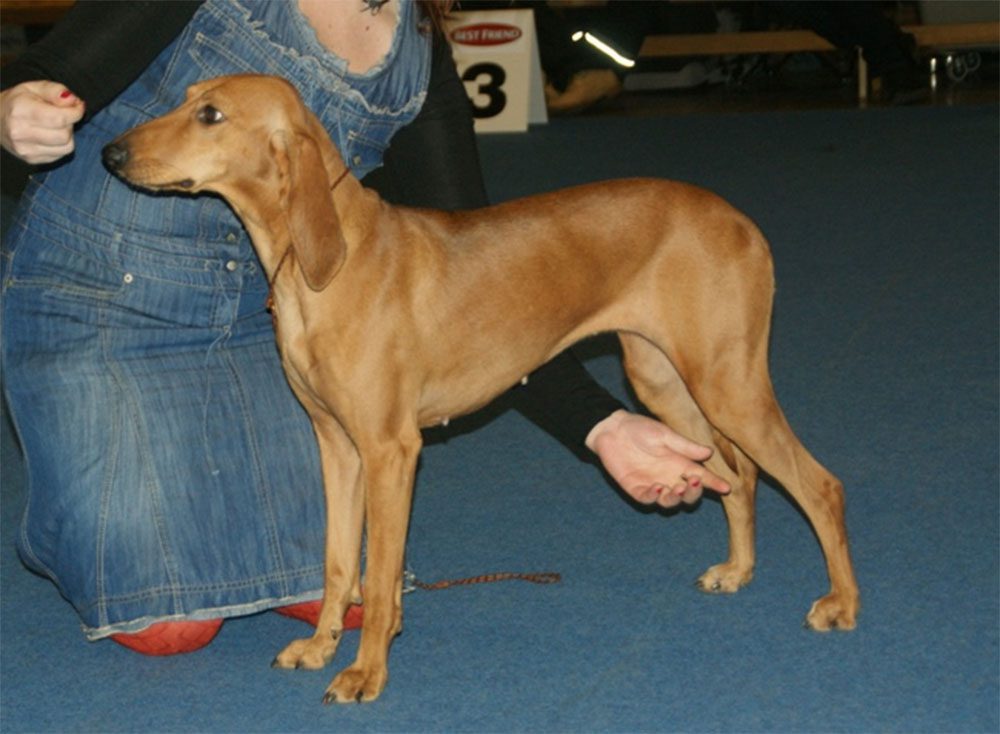
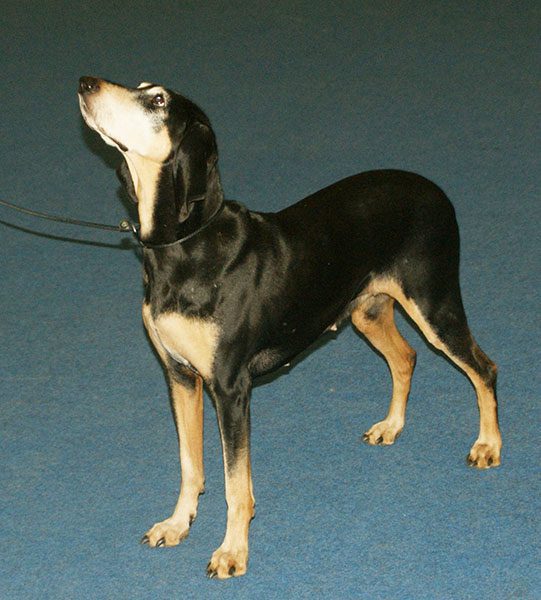
Photo: ยซPortuguese Retrieverยป during the Dog World Show in Poznaล„. by Pleple2000, CC BY-SA 3.0, via Wikimedia Commons

Physical characteristics
The Portuguese Pointer comes in average proportions, straight, good guy, robust but with a harmonic conformation allied to the manifest elasticity of the movements.

The head is proportionate in relation to the body, well shaped and harmonious; seems to be big on the set. A little thick, However, it is neither bony nor thick and has loose and thin skin.

The coat is short and thick in most dogs., with a velvety texture on the ears and face .

Yellow in light varieties, common and dark, solid or white spotted on the head, the neck, chest and footwear.

In males, the height at the withers is 52 to 60 centimeters, the weight is 20 to 27 kg. In females the height is 48 to 56 centimeters and the weight is 16 to 22 kg.

Character and skills

Portuguese Pointer
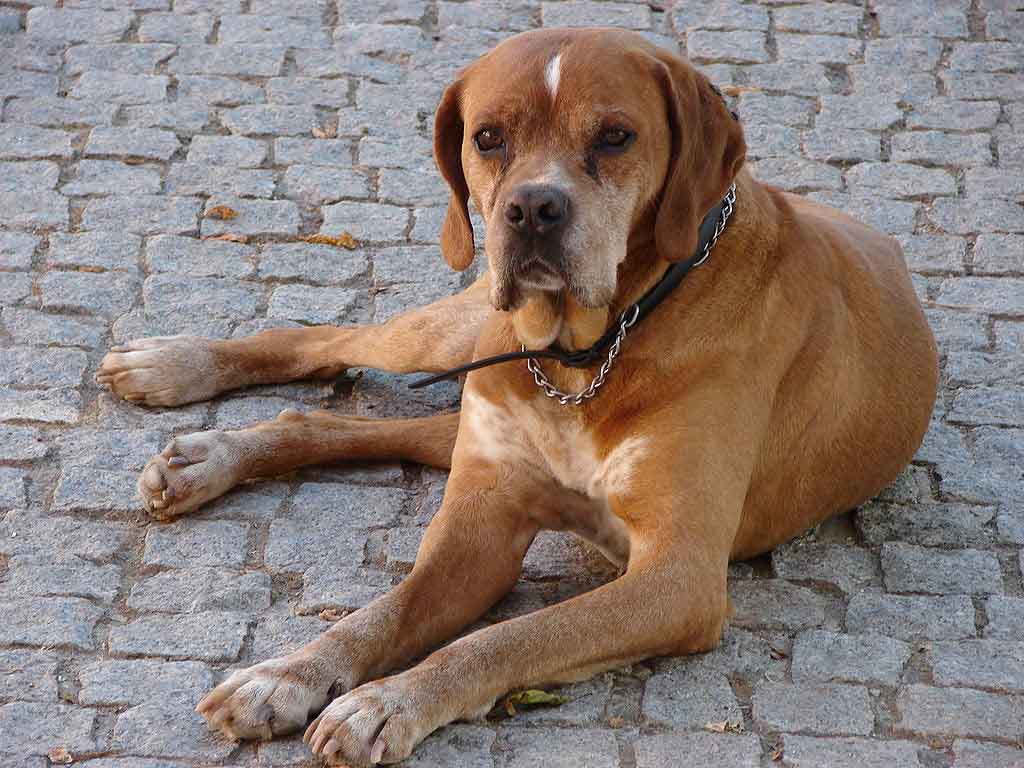
An image of a โ€œPortuguese Retrieverโ€, a Portuguese hunting dog breed. The animal in the photo had 11 years when it was photographed.

The Portuguese Pointer he is an extremely gentle and affectionate dog, with great delivery capacity and very resistant. It is quiet, very sociable and a bit petulant in relation to other dogs. Works with vivacity and persistence and is curious by nature. He always keeps in touch with his hunter.

He moves with an easy step and is graceful. It is versatile in its function and very adaptable to various terrains, climates and types of hunting.

Extremely affectionate and very attached to children, it is also a very submissive dog. Can, for lack of education, do not obey gestures or orders. But, it's easy to train.

Health

The Portuguese Pointer has an average life expectancy of 14 years. It is considered a hardy breed with no specific health problems.. But, hip dysplasia, lunation of the patella, cancer and autoimmune diseases are potential health problems for dogs of this size.

Videos "Portuguese Pointer"

The Portuguese partridge, a versatile dog.
O Perdigueiro portuguรชs, um cรฃo polivalente
Main characteristics of the Portuguese Perdigueiro
Main characteristics of the "Portuguese Perdiguero"

Type and recognitions:

  • FCI CLASSIFICATION:
  • Group :
  • Section : . .

Federations:

  • FCI – Group 7: Pointing Dogs. – Section 1: Continental Pointing Dogs. 1.1: Braque Type โ“˜
  • AKC – Bracco โ“˜

FCI breed standard "Portuguese Pointer"

Origin:
Portugal

Date of publication of the valid original standard:
04.11.2008

Use:

---


General appearance:

Extremely kind and affectionate, strong, of great resistance and devotion. Calm and very sociable but somewhat haughty towards other dogs. curious by nature, work with persistence and vivacity. Always an enthusiastic hunting dog, staying in close contact with the hunter.


Behavior / temperament:

Extremely kind and affectionate, strong, of great resistance and devotion. Calm and very sociable but somewhat haughty towards other dogs. curious by nature, work with persistence and vivacity. Always an enthusiastic hunting dog, staying in close contact with the hunter.

Head:

Proportionate to body size, well built and harmonious in its dimensions. It gives the impression of being bigger than it is. Something big never bony nor fleshy. Loose, thin skin cover without forming wrinkles. Straight in profile and square seen from the front. Converging superior longitudinal craniofacial axes.

Cranial region:
  • Skull : Square, almost flat in its top line seen from the front and slightly arched in its profile. With a length that should not exceed 6 / 10 of the total length of the head, Therefore it gives us a 60 % cephalic index.
    Seen from the front, the foreface is flat, high, wide and symmetrical, slightly arched in profile. Well-developed superciliary ridges. Wide but not deep front pleat. Barely visible occipital protuberance.
  • Depression links (Stop) : Well defined (90 โ€“ 100ยบ).

facial region:

  • Truffle : The angle between the bridge of the nose and the upper lip is 90ยบ.. Good conformation nose, well developed with large nostrils, moist and wide open. black.
  • Snout : Rectilinear and horizontal, appropriately wide with the same width throughout its length that is 4 / 10 the length of the head.
  • Lips : Pendulous upper lip, square in profile forming a right angle to the bridge of the nose, semicircular on the edge seen in profile; seen from the front it forms a sharp angle at the lower edge. Upper lip joint is loose, folded corners with drooping edges. Moderate mouth opening with irregular pigmentation of the membranes (Oris), normal occlusion allowing natural overlap of the upper lip.
  • Jaws / Teeth : Healthy, correct, full dentition, scissor bite.
  • Cheeks : Parallel. Barely noticeable retrocommissural fold with complete parotid area (Ej.: Well filled under the ears).

Eyes : Expressive, happy talk, brown, of a darker color than hair, oval shape tending to be round, big but too much, level insertion completely occupying the orbit. Thin, wide-open eyelids with black pigmentation.

Ears : Inserted above eye level at the back of the head, pendants, almost flat surface with one or two longitudinal folds when in attention. Triangular, wider at the base than at the tips in a proportion of 2.5 to 1 and with rounded tips. The length of the ears should be slightly longer than the length of the skull. Fine, soft, covered with fine hair, bushy and very short.

Neck:

It is straight, slightly arched at the top, not very thick, rather elongated and has a short dewlap along the underside. It should be attached to the head in an elegant way, following an inclination of approximately 90ยฐ; its union to the thorax must be without appreciable transition, so that it constitutes a harmonious and perfect whole.

Body:

  • top line : Rectilinear, rising slightly from the rump to the withers.
  • Cross : It is not very high.
  • Back : Short, wide, rectilinear and slightly inclined towards the lumbar region, to which it must join without appreciable transition.
  • Pork loin : Short, very wide, very muscular and slightly arched, in perfect union with the rump.
  • Rump : Its amplitude is proportional to the lumb region
  • ar. It has a harmonious conformation and a slightly oblique axis, so it is slightly fallen
  • Breast : It is tall and wide; the broad thoracic cavity should be more developed in depth and length than in width. Descends to the elbow. It is delimited by very wide and well-fitted ribs that draw a well-pronounced curve at the top., imparting to the thoracic cavity the shape and cross section of a front horseshoe, whose lateral faces join below.
  • Bottom line and belly : Slightly elevated from sternum to groin. The thin belly joins the hip forming a circumference; The distance that separates the hip from the last rib gives the flanks a short and well-united appearance.

Tail:

  • Natural: of medium length exceeding below the hock. Right, middle insertion, thick at the base tapering slightly towards the tip. Well inserted in perfect continuity with the line of the rump. At rest it hangs naturally but never between the thighs. In movement it rises horizontally or slightly above the top line but never vertically or in the shape of a sickle.. Side to side movement.
  • amputee: To cover the genitals without going over them.


Tips

PREVIOUS MEMBERS : Rights seen from the front and perfectly parallel to the line of the body. Profile view, plumb and giving a general appearance of great stability, support and easy, natural movement.

  • Shoulder : They're long, medium inclination. Well placed and with strong muscles. Scapula โ€“ humerus angle 120ยบ.
  • Arms : They appear attached to the chest. Its length must be in relation to the scapula and the angulation is proportional..
  • Elbows : Separated from the thorax by the armpit, the elbows should be well lowered and clearly outlined, but without convergence, nor divergence in relation to the chest. Radius โ€“ humerus angle 150ยบ.
  • forearms : They are separated from the trunk; they are long, straight and, from the static point of view, They appear clearly perpendicular to the ground, both seen from the front, as in profile.
  • Carpi : In perfect continuity with the forearm.
  • Metacarpus : Widths, slightly oblique and of appropriate length.
  • Previous feet : Proportional to the size of the members, tending to be more round than long but without resembling climbing shoes. Well-shaped fingers, tight, uniform and robust to provide good support. Strong, well-developed pads with a black skin, thick, hard and resistant. Strong nails, hard, preferably black.

LATER MEMBERS : Plumb seen from behind and perfectly parallel to the line of the body, normal poise seen in profile.
Thighs: Preferably long, widths, muscular. The gluteus forms a curve, but the least accentuated, long and with somewhat elastic muscles. Hip-femur angle: 95ยบ.

  • Knee : It is located a little below the abdomen, but not very separate from it. It is slightly protruding and somewhat deviated outwards..
  • Femur โ€“ tibia angle: 120ยบ.
  • Leg : Well aligned; Its length is proportional to the length of the thigh. Its obliquity should be in proportion to the inclination of the rump.
  • Hock : It is normally angled and in an appropriate position.. Must be well built, width, and strong. Tibia โ€“ tarsus angle 145ยบ.
  • Metatarsals : They are short, vertical, almost cylindrical, regular size and thin.
  • Rear foot : Identical to the previous one but a little longer.

Movement:

With normal steps, easy and elegant. Versatile in its work and adaptable to different terrains, time or sport. The movement is changing between a simple suspended gallop and an extended, rhythmic trot..

Mantle

HAIR : It must be short, strong, glued and dense. It's not very soft.
It is well distributed throughout the body and is almost uniform except in the armpit., in the region of the anus and near the genital parts, where it is sparse and softer. It is fine and flat on the head, especially in the ears, where it is very soft to the touch, as if it were velvet. There is no presence of an internal layer of hairs.

COLOR : Yellow in shades from light, medium to dark, solid or with white spots on the head, neck, chest, lower extremities of the limbs, under the elbows and hocks and on the tip of the tail if it is not docked.


Size and weight:

Height to the cross :

  • Males 56 cm..
  • females 52 cm..

With a tolerance of 4 cm more or less.

Weight :

  • Males : 20-27 Kg.
  • females : 16-22 Kg.


Fouls:

Any deviation from the above criteria is considered missing and the seriousness is considered to the extent of the deviation to the standard and their effect on the health and welfare of the dog.

โ€ข Behavior : Shyness
โ€ข Head : skull relationship / snout slightly different from 6/4. Strait. Pronounced occipital Protuberance. Very developed frontal sinus. Pronounced front crease. Presence of wrinkles.
โ€ข Nose: Any other color that is not black.
โ€ข muzzle: short or long.
โ€ข Lips: Non-square upper lip. Non-perceptible commissure. Incorrect pigmentation of mucous membranes.
โ€ข Jaws / Teeth: Bite in clamp.
โ€ข Eyes: Small, clear, expressionless, too round.
โ€ข Ears: Middle insertion, very big or very small, pointed edges.
โ€ข Neck: Too short. No double chin or too much double chin.
โ€ข Body: insufficient breast development.
โ€ข Cola: Too short if it is natural, insertion too low or with an atypical bearing. (vertical or sickle-shaped)-
โ€ข Limbs and Feet: Tilted in or out, open foot.
โ€ข For the: Soft.

SEVERE FAULTS

โ€ข Behavior : too shy.
โ€ข Head: skull relationship / very different snout 6 / 4. Stop visible only, Parallel upper facial skull axes.
โ€ข muzzle: Tilted.
โ€ข Eyes: Inclined. Squint. (look this / West, crossed)
โ€ข Ears: Fleshy, low insertion excessive folds.
โ€ข Body: Saddled or saddled top line. Croup too inclined. Leather too long, round chest. Agalgado.
โ€ข For the: White spots outside the limits described by the standard.
โ€ข Size: Below or above established limits.

MISS PLAYOFFS

โ€ข Behavior : Aggressive or fearful dog.
โ€ข Head : Atypical head with convex snout, too wide or too cut, very narrow skull. Divergent upper facial skull longitudinal axes.
โ€ข Nose : Total absence of pigmentation.
โ€ข Jaws : Upper or lower prognathism.
โ€ข Eyes : uneven eyes, both in the form, as in size. Eyes gazeos, congenital blindness...
โ€ข Deafness : Congenital or acquired.
โ€ข Body : Completely atypical showing signs of some crossbreeding with another breed.
โ€ข For the : Different from the characteristic of the breed.
โ€ข Color : albinism, any other color than described above.

Any dog โ€‹โ€‹showing clear signs of physical or behavioral abnormalities must be disqualified..


N.B.:

Males should have two normal-appearing testicles fully descended into the scrotum..

Source: F.C.I - International Cynological Federation

Alternative names:

1. Perdigueiro Portuguรชs, Portuguese Pointer Dog (English).
2. Perdigueiro Portugais (French).
3. Perdigueiro Portuguรชs, Portugiesisch (German).
4. Perdigueiro portuguรชs (Portuguese).
5. (Perdigueiro Portuguรชs en portuguรฉs) (espaรฑol).

โ–ท The world of Pets: Dogs, cats, birds, reptiles, amphibians

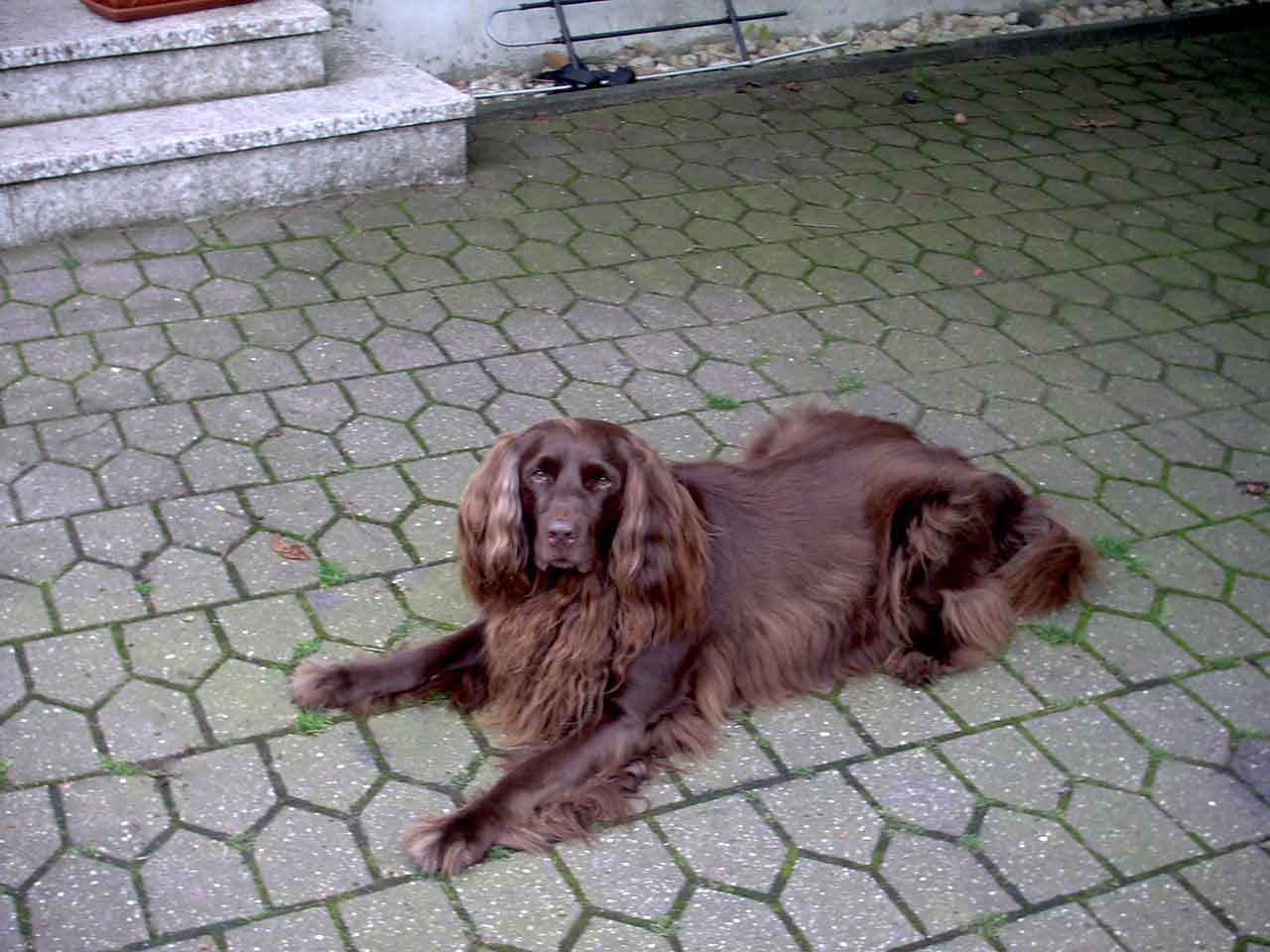
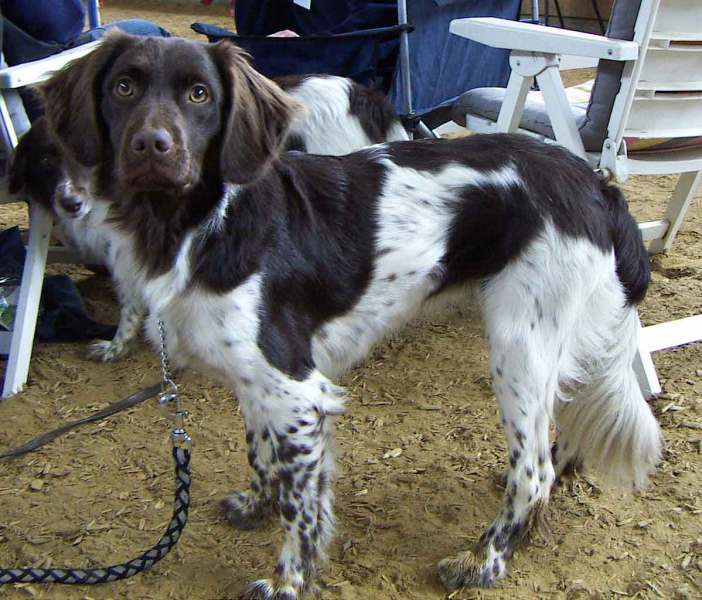
German Longhaired Pointer
Alemania FCI 117 . Spaniel type

German Longhaired Pointer

The first thing to keep in mind is that the German Longhaired Pointer is a head to toe hunting dog.

Content

History

The German Longhaired Pointer It is one of the oldest German pointing breeds. Long-haired hunting dogs can already be seen in ancient hunting paintings and tapestries from the Middle Ages, which are very similar to the current German "sample dogs". These dogs were used primarily as hunting dogs to stalk, but also for catching small game in nets.

It is purebred since 1879. On the occasion of an exhibition of the association for the refinement of dog breeds in Hannover, the characteristics of the breed were established, the breed standard. The breed was based on five different breeding lines, that bore the names of authorized stallions that already corresponded to the breed standard at that time.

The German Longhaired Pointer The name of "old forest dog" has been won in particular for his ability to do very good tracking jobs, to warn the hunter with loud barks when searching and to bring lost animals by following their blood trail. Working in the water is also one of its strengths, which is appreciated by hunters.

Photo: A German long hair called Falko by Wikimedia

Physical characteristics

The breed is bred in brown, Brown and white, and brown and white. The best known and most common is German Longhaired Pointer pure brown, which may also have white markings on the chest or legs. Taupe comes in gradations from light gray to dark gray and the rare trout gray color variant.

The German Longhaired Pointer it is usually a strong dog, muscular, low constitution and with harmonious body shapes. Males usually have a shoulder height of 63 – 66 cm., the females of 60 – 63 cm.. Has brown eyes, long, well-edged hocks and a tail with a beautiful flag. Your coat should be of medium length and not too lush.

Character and skills

The first thing to keep in mind is that the German Longhaired Pointer he's a hunting dog from head to toe. In the hands of a knowledgeable trainer, is a useful helper on the hunt and then on a second job, a very good family dog. The breed is very fond of children and family. But this should not be misunderstood at all. Because "familiarly friendly" does not mean "family dog". It is a fairly pronounced working dog. The German Longhaired Pointer has the strong drive and willingness to work, either on the hunt or, if required, your substitute in the form of dog sports of all kinds. So, It is not a dog for beginners nor a dog for people who do not want or cannot work intensively with it.

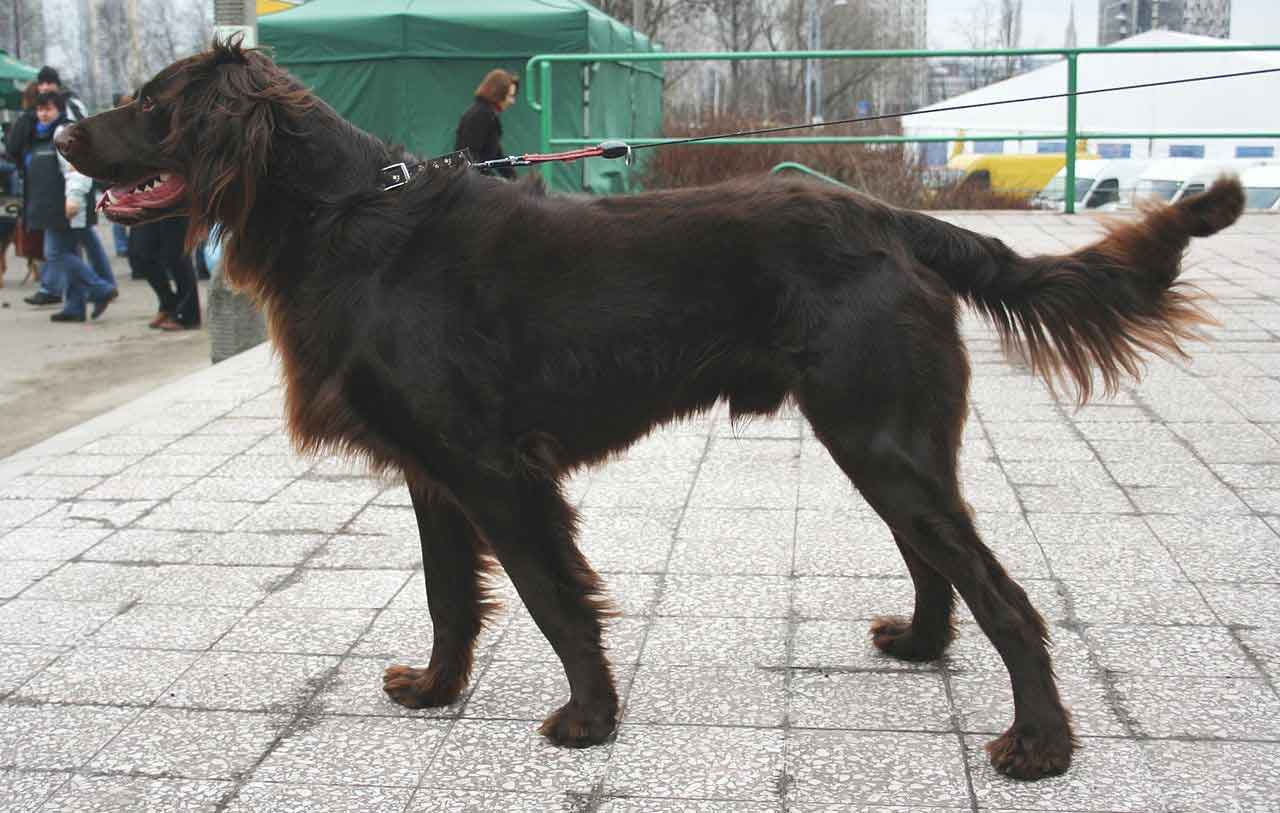
German Longhaired Pointer
ยซGerman hair showed dogยป during the international canine exposure in Katowice, Poland

In the practice of hunting, the German Longhaired Pointer is especially praised for its pronounced calm. He is a lead dog, resistant to nerves and of a calm and even-tempered nature. At the same time, he is a kind and peaceful friend with a high threshold for irritation.. But, the German Longhaired Pointer needs a consistent education, competent and sensitive to direct his high intelligence, alert senses and their pronounced willingness to act in the right channels. With such an appropriate atmosphere of character, this breed of dog is a great friend of children, a great family companion also outside of hunting or sports work and in any case a wonderful experience of the association of man and dog.

Aptitudes:

If occasionally offered simply as a family and apartment dog, one should approach such sellers with the utmost caution. Such offers certainly come from dubious sources. as a rule, a German Longhaired Pointer belongs to the hands of a hunter who works with him professionally. If you are not kept for the hunt, must be kept busy with long walks in nature or challenges in dog sports. It also, needs a personal connection with caregiver and family. If the hunting dog is not physically or mentally challenged, in the long run this will lead to serious behavior problems. It does not belong to a multi-story building and not to the big city. Otherwise, he has no problems and his attitude is undemanding.

Education

One German Longhaired Pointer should only be trained by an experienced owner. It must come absolutely from a recognized upbringing of the German association of "shows", where parents and puppies were already socialized for their tasks from the litter box onwards. It also, you need to train and work professionally for hunting or suitable sporting purposes. Only dogs that have successfully passed the demanding tests of autumn breeding of "Schorlemer" are admitted for breeding. You have to ask in the breeding clubs of the German Longhaired Pointer.

Health

The race German Longhaired Pointer is cared for in an exemplary manner by its breeding clubs organized in the Deutsch-Langhaar-Verband. Therefore, average dog health has no problem.

Grooming

Caring for a German Longhaired Pointer is undemanding. Regular brushing of the coat is sufficient.

Buy a "German hair dog"

If you are thinking of buying a German Longhaired Pointer, You should be wondering if you can meet the requirements for an attitude of character appropriate to this hunting dog.. And what during 12 years and more will be your companion on a daily basis. Then you must contact local breeders who are members of the ยซDeutsch-Langhaar-Verbandยซ. A puppy of this breed costs around 1000 EUR.

Characteristics "German Longhaired Pointer"

Coexistence is important that you have with your new friend. Before considering the acquisition of a dog of the breed "German Longhaired Pointer" you know certain factors. Not all breeds of dogs are apt to live in an apartment, you must take into account his character, their need for exercise, their interaction with other pets, their care and if you have small children, their level of tolerance towards them.

Adaptation โ“˜

3,0 of 5 stars (based on 1 review)

friendly dog โ€‹โ€‹โ“˜

3,0 of 5 stars (based on 1 review)

hair loss โ“˜

2,0 of 5 stars (based on 1 review)

Affection level โ“˜

5,0 of 5 stars (based on 1 review)

Need for exercise โ“˜

5,0 of 5 stars (based on 1 review)

Social need โ“˜

2,0 of 5 stars (based on 1 review)

Home โ“˜

2,0 of 5 stars (based on 1 review)

Toilet โ“˜

2,0 of 5 stars (based on 1 review)

Friendly with strangers โ“˜

3,0 of 5 stars (based on 1 review)

barking โ“˜

3,0 of 5 stars (based on 1 review)

Health โ“˜

3,0 of 5 stars (based on 1 review)

Territorial โ“˜

4,0 of 5 stars (based on 1 review)

Cat friendly โ“˜

2,0 of 5 stars (based on 1 review)

Intelligence โ“˜

3,0 of 5 stars (based on 1 review)

Versatility โ“˜

3,0 of 5 stars (based on 1 review)

Child friendly โ“˜

4,0 of 5 stars (based on 1 review)

Surveillance โ“˜

3,0 of 5 stars (based on 1 review)

joy โ“˜

4,0 of 5 stars (based on 1 review)

Videos "German Longhaired Pointer"

Obenstaat Kennels - German Langhaar Puppies 1st intro. to Water

Kennels Obenstaat – Puppies German Longhaired Pointer – Introduction to water

Apport impressions hunting dogs German long hair from Veybach
"German hair dog"

Type and recognitions:

  • FCI CLASSIFICATION:
  • Group :
  • Section : . .

Federations:

  • FCI – Group 7: Pointing Dogs. – Section 1: Continental Pointing Dogs. 1.2: Spaniel type โ“˜
  • CKCGrupo 1 – Sporting โ“˜
  • โ€‹KC – Hunting dog โ“˜
  • UKCGun Dog โ“˜

FCI breed standard "German Longhaired Pointer"

Origin:
Germany

Date of publication of the valid original standard:
25.10.2000

Use:

Variable utility dog in hunting.


General appearance:

It is strong, muscular, under, of flowing lines. In small dogs, much substance is required. Heavy and compact dogs are not desirable.

IMPORTANT PROPORTIONS :
The snout and the skull have the same length; In your posterior region it is not too high, Because the shoulders are somewhat higher than the rump.


Behavior / temperament:

It is well balanced, quiet, With a regular temperament, Kind, easy guide.

Head:

Special emphasis should be placed on the beautiful long hair covered. Is elongated and noble appearance.

Cranial region:
  • Skull : Slightly rounded.
  • Depression links (Stop) : Naso-fontal depression rises slightly, Without interrupting in an abrupt way.

facial region:

  • Truffle : Brown in color, a mild depigmentation is allowed.
  • Nose cane : Slightly arched, Not too narrow.
  • Lips : They don't overcome too much.
  • Mandible / teeth : Non -refined jaw. Well developed teeth. Complete bite (42 teeth) scissor -shaped, that is to say that the upper incisors closely cover the lower.
  • Dental formula : 3 1 4 2 x 2 = 423 1 4 3
  • Cheeks : The cheekbones do not stand out much.

Eyes : Brown in color, as dark as possible; eyelids closely attached to the eyeball, No visible red nicming membrane. Neither sunk nor jums.

Ears : Your insert is not very low; They are slightly folded forward.

Neck:

Strong and noble, without jowl; extends widening to the chest forming a beautiful line; It is not too short.

Body:

  • Back : Straight, firm, not too long.
  • Pork loin : Especially muscular.
  • Rump : Long, Descend moderately.
  • Breast : Well developed sill; The rib cage is wide and deep; Reach at least the elbow.

Tail:

It does not have it too steep. It must take it horizontal with the last slightly raised third upward.

Tips

PREVIOUS MEMBERS :

  • As a whole : The dog standing, The arm, The forearm and metacarpo must form a line close to the vertical when they are observed from the front.
  • Shoulder : Well glued. Seen sideways and at rest, The scapula and the arm should form an angle approaching as much as possible at a right angle.
  • Elbows : Well glued.
  • Articulation of the carpus : Slightly hunched.
  • Metacarpus : Not completely straight.

LATER MEMBERS :

  • As a whole : Seen from the back, The iliac bump, thigh, The leg and metatarsal form a vertical line.
  • Warm-foot joint : It is very important to form a good angulation.
  • Spurs : They must be removed immediately after birth.

FEET : Hard, durable pads.

Movement:

It covers the terrain with good impulse of the posterior members.

Mantle

HAIR :

The correct fur is very important which should not be excessive or too short. On the sides of the back and trunk the hair must be 3,5 cm long, good paste. In the lower region of the neck, In the chest and abdomen the hairs can be longer.

โ€ข Abdomen : Well -covered with hair.
โ€ข Ears : Wavy hair.
โ€ข Cola : With good pen, hair cover.
โ€ข Rear region of the previous members : Feathers cover.
โ€ข posterior region of the posterior members: Feathers cover(pants).
โ€ข Below the warm-tarsian joint : Hair is considerably shorter. Excess hair stripes is not desirable. The space between the fingers must have dense and short hair.
โ€ข Head : Hair is much shorter, although longer than that of the German hair dog. The formation of a lock in the cranial region is not desirable.
โ€ข In the body : Hair is firm, smooth, Recty The Flucky Farming, Very close. Dense with good amount of internal lanilla.

COLOR :

โ€ข Brown unicolor.
โ€ข Brown with white or splashed marks (especially in the chest and feet).
โ€ข Dark Roan (With more or less large or less small brown plates; brown head, eventually with a list, a small spot or a white star).
โ€ข Clear Roan (with more or less large or less small brown plates; brown head, eventually with a list, a small spot or a white star).
โ€ข Salpized (Many small brown spots on a white background. Brown head, eventually with a list, a small spot or a white star).
โ€ข Blanquecino brown, either totally whitish brown or, With very few small spots (Large brown plates, in a chair or coat; Brown head, eventually with a list, a small spot or a white star).
โ€ข In isolation the yellow fire color can be presented as an ancient heritage of the hound.


Size and weight:

Height to the cross :

  • Males : 60 โ€“ 70 cm., ideal measure 63 โ€“ 66 cm..
  • females : 58 โ€“ 66 cm., ideal measure 60 โ€“ 63 cm..

Weight : It is approximately 30 kg


Fouls:

Any deviation from the aforementioned criteria should be considered as lack and the severity of this is considered the degree of deviation to the standard and its consequences on the health and well -being of the dog.

โ€ข Clear hawk eyes, oblique placement.
โ€ข Uncoated ears, ends without hair (Leather).
โ€ข Convex or defeated back.
โ€ข Tonel -shaped thorax, Too close.
โ€ข Hook -shaped tail.
โ€ข Previous members : Scapulo-Humeral joint too open; Metacarpo too straight.
โ€ข Rear members in the form of a cow or barrel.
โ€ข Feet with separate fingers, cat or penal foot.
โ€ข Fur : Longer hairs in the beard, abundant eyebrows, curly hair.

MISS PLAYOFFS :

โ€ข Aggressive or fearful dog.
โ€ข General appearance: Dogs with Osamanta and weak muscles.
โ€ข Head : Dogs with different head shapes to the type.
โ€ข Eyes : Ectropiรณn (eyelids turned out), entropion (eyelids turned in), Corrected eyelids are also considered as missing.

Any dog โ€‹โ€‹showing clear signs of physical or behavioral abnormalities must be disqualified..


N.B.:

Males should have two normal-appearing testicles fully descended into the scrotum..

Source: F.C.I - International Cynological Federation

Alternative names:

1. GLP, Pointer (German Longhaired), Langhaar (English).
2. Langhaar (French).
3. Deutsch-Langhaar (German).
4. (em alemรฃo: Deutsch Langhaar Vorstehhund) (Portuguese).
5. Pointer de pelo largo (espaรฑol).

โ–ท The world of Pets: Dogs, cats, birds, reptiles, amphibians

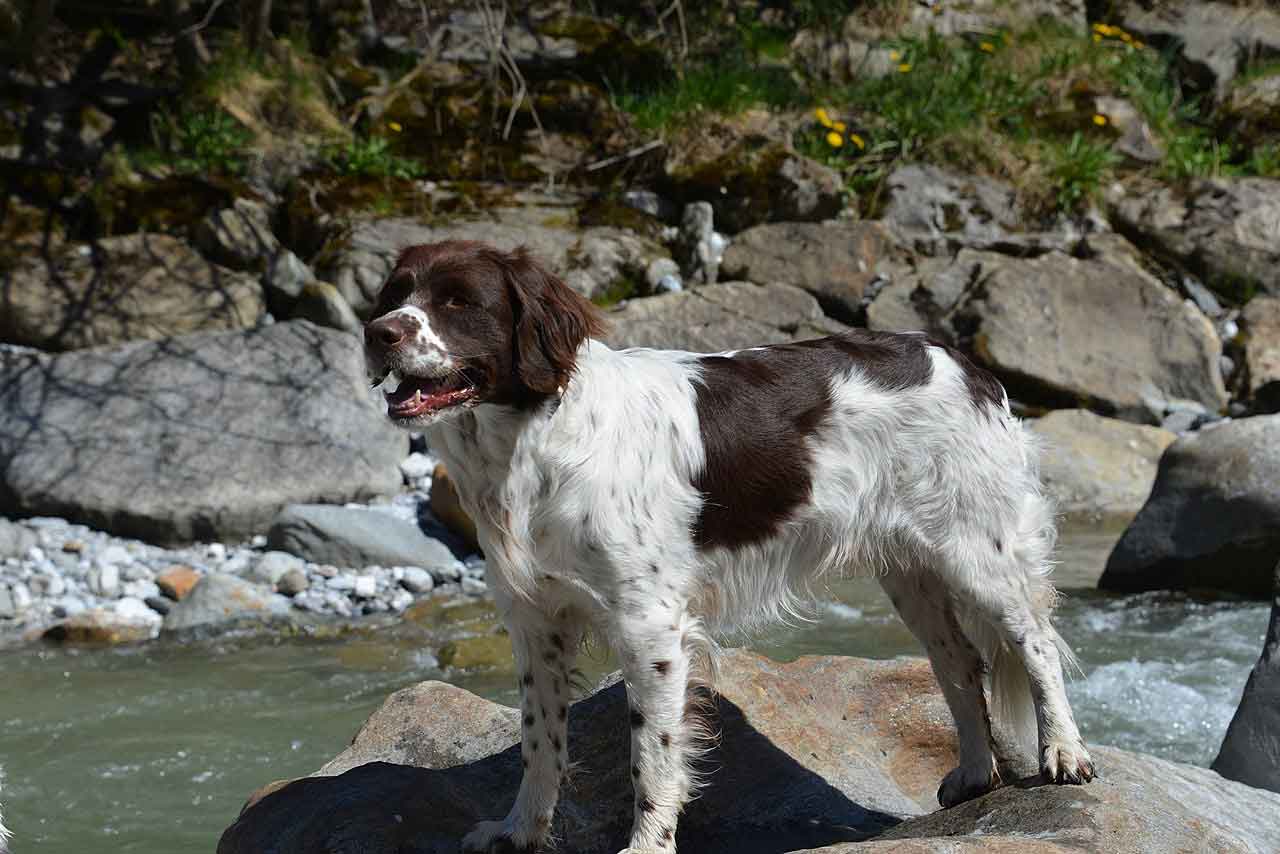
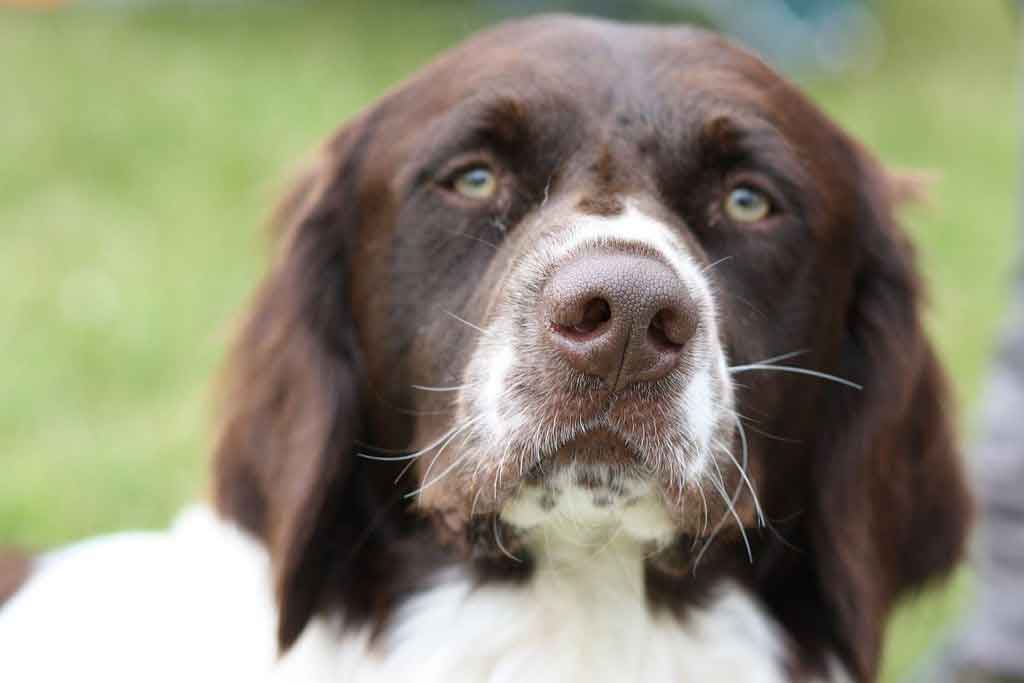
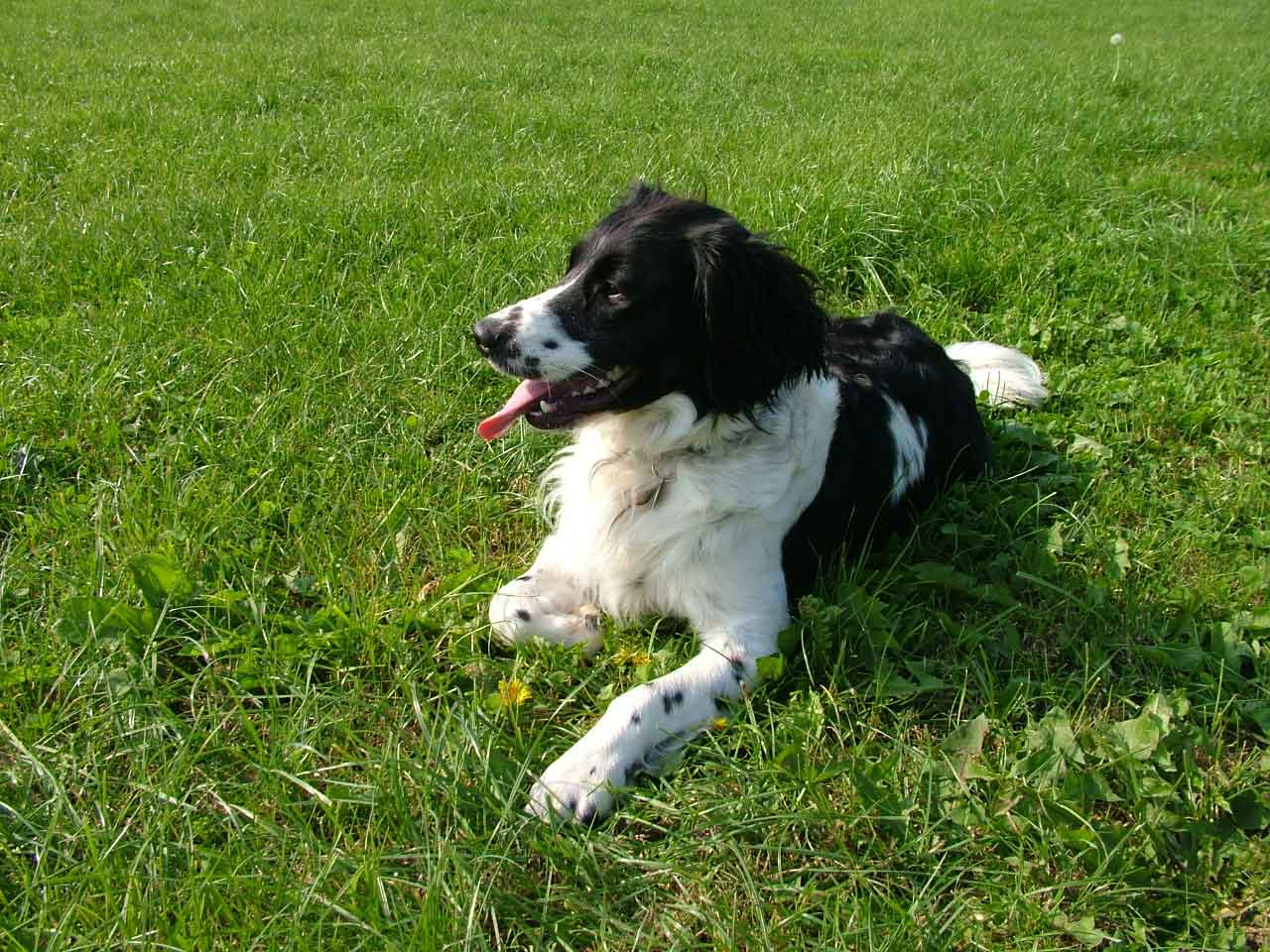
Dutch Partridge Dog
Holanda FCI 224 . Spaniel type

The Dutch Partridge Dog is ideal for hunting in a wide variety of terrain. They hunt with pistol shooting. Maintaining contact with the hunter is apparently an innate quality.

Dutch Partridge Dog

A peculiarity of Dutch Partridge Dog consists in the fact that during the search the tail performs a rotating movement faster and faster as the dog approaches the prey.

Content

Characteristics "Dutch Partridge Dog"

Coexistence is important that you have with your new friend. Before considering the acquisition of a dog of the breed "Dutch Partridge Dog" you know certain factors. Not all breeds of dogs are apt to live in an apartment, you must take into account his character, their need for exercise, their interaction with other pets, their care and if you have small children, their level of tolerance towards them.

Adaptation โ“˜

3,0 of 5 stars (based on 1 review)

friendly dog โ€‹โ€‹โ“˜

4,0 of 5 stars (based on 1 review)

hair loss โ“˜

5,0 of 5 stars (based on 1 review)

Affection level โ“˜

5,0 of 5 stars (based on 1 review)

Need for exercise โ“˜

4,0 of 5 stars (based on 1 review)

Social need โ“˜

3,0 of 5 stars (based on 1 review)

Home โ“˜

2,0 of 5 stars (based on 1 review)

Toilet โ“˜

2,0 of 5 stars (based on 1 review)

Friendly with strangers โ“˜

3,0 of 5 stars (based on 1 review)

barking โ“˜

4,0 of 5 stars (based on 1 review)

Health โ“˜

4,0 of 5 stars (based on 1 review)

Territorial โ“˜

2,0 of 5 stars (based on 1 review)

Cat friendly โ“˜

2,0 of 5 stars (based on 1 review)

Intelligence โ“˜

4,0 of 5 stars (based on 1 review)

Versatility โ“˜

4,0 of 5 stars (based on 1 review)

Child friendly โ“˜

4,0 of 5 stars (based on 1 review)

Surveillance โ“˜

2,0 of 5 stars (based on 1 review)

joy โ“˜

4,0 of 5 stars (based on 1 review)

History

The Dutch Partridge Dog it is an ancient canine breed, that can be found in paintings painted centuries ago.

Originaria de Drenthe, a dutch province, the breed was developed during the 16th century from dogs from Spain, what were called Spionenen or Spaniolen. In the Netherlands they were given the name of Patrijshond, what does retriever mean.

in the east of the country, especially in the province of Drenthe, these dogs were bred as pure breeds, without any mix with other foreign races, as it happened in other places. This isolation allowed the Perdiguero to remain unchanged during 3 or 4 centuries.

The 15 in May of 1943, was recognized by the Raad van Beheer op Kynologish Gebied from the Netherlands, a recognition strongly encouraged by Baroness van Hardenbroek and Messrs. van Heek junior and Quartero.

The responsible breed club was founded on 5 in June of 1948, with the name of Nederlandse Vereniging of Drentsche Patrijshond.

Related to him Small Munsterlander and the French Spaniel, the Dutch Partridge Dog is quite limited in number, and the breed is almost unknown outside its borders.

Photo: ยซDrentsche Partridge Dogยป macho by Stefanie Joksch, CC BY-SA 4.0, via Wikimedia Commons

Physical characteristics

The Dutch Partridge Dog he is a well proportioned dog, with dry muscles, pure in its lines. His body reveals power and also the ability to run at the speed that suits a hunting dog. Wedge-shaped muzzle is slightly shorter than skull. The lips are quite dry and are not hanging. Her body, slightly longer than the height of the withers, is slightly elongated. Although the fur is not really long on the body, gives the impression of being so because of the well-populated ears, more abundant hair on the neck and chest, the fringes on the front and back legs and on the bushy tail, abundantly populated on all sides.

They have a dense coat that covers the body well. Not curly. The hair is not really long, but as it is longer in some parts, the dog, as a whole, gives the impression of having long hair. On the neck and chest, the hair is longer. In the ears, the hair is long and preferably wavy. The ears, the back of the front and back legs and the back of the thighs are fringed. Hair preferably wavy on the upper part of the body and tail. Except for its base, the tail is abundantly provided with long hair on all sides. These hairs are gradually shortened towards the tip.

COLOR: White fur with brown spots, mottled or not. Coats with a mix of brown and white hairs, with or without marks, are less desirable, like the cloak coats. The ears are brown, like the hair around the eyes.

SIZE:

Males: 58 to 63 cm..
females: 55 to 60 cm..

Weight: Of 20 to 25 kg

Character and skills

They are ideal for hunting in a wide variety of terrain. They hunt with pistol shooting. Maintaining contact with the hunter is apparently an innate quality. A characteristic feature of many dogs of this breed is that, during the hunt, the tail describes a circular motion, especially when the dog is aware of the proximity of the prey. When he's close to hunting, the dog waits for the hunter to approach and when the hunter is late, turn your head to look for the game. Thanks to its adaptability, the dog is capable of hunting all kinds of animals on the plains and swamps. It is also a good retriever and excels at searching for lost game.. These characteristics are innate. Thus, does not require long training.

The Dutch Partridge Dog it is also a very good companion dog because it is faithful, friendly, attentive. Your education should be done smoothly, without aggressiveness or too much firmness.
This dog requires regular maintenance. It will be an accomplice of the children and it is possible to leave them together. under surveillance, of course. Apartment living will get you down, you need to have at least one garden for him. to let off steam and also for daily walks.

Health

The Dutch Partridge Dog he is a robust dog, but can be injured while hunting (fracture, sprain, tendinitis, wound…). His ears are down, poorly ventilated, prone to ear infections. Some dogs may be affected by hip-femoral dysplasia, a malformation of the hips that causes lameness and pain.

Grooming

The Dutch Partridge Dog should be brushed once a week to remove dead hairs and dirt. You can bathe once a month with a suitable shampoo.

Inspect and clean floppy ears once a week. When we come back from the hunt, we will check that he is not injured. Good antiparasitic and vacation coverage will be launched.

Images "Dutch Partridge Dog"

Dutch Partridge Dog
Drentsche Patrijshond Bowi the Gloucester during upland game hunt in Idaho by DutchID, CC BY-SA 3.0, via Wikimedia Commons
Dutch Partridge Dog
Dutch Partridge Dog by mjk23, CC BY 2.0, via Wikimedia Commons

Videos "Dutch Partridge Dog"

Nail - Partridge Dog (Spaniel) - 4 Week Residential Dog Training at Adolescent Dogs

Drentsche partridge dog Indy: adventure share 27
Drentsche patrijshond Indy: avonturen deel 27

Type and recognitions:

  • FCI CLASSIFICATION:
  • Group :
  • Section : . .

Federations:

  • FCI – Group 7: Pointing Dogs. – Section 1: Continental Pointing Dogs. 1.2: Spaniel type โ“˜
  • UKCGun Dog โ“˜

FCI breed standard "Dutch Partridge Dog"

Origin:
Netherlands

Date of publication of the valid original standard:
25.03.2003

Use:

Pointing Dogs.


General appearance:

Well proportioned dog, dryly muscled and with a well-defined cut structure, whose body shows power and also the ability to develop the speed necessary for a hunting dog.

It has a wedge-shaped snout which is a little shorter than the length of the skull and relatively dry., no hanging lips. His body is a little longer than his height at the withers , therefore slightly elongated. The mantle, although it is not really long in the body, It gives this appearance because the ears and tail are well covered with hair and because of the abundance of hair on the neck and chest., as well as the presence of fringes on the ears, front and hind limbs and especially in the tail.


Behavior / temperament:

It is the ideal hunting dog for various types of terrain. Hunt within shotgun range. Keeping in touch with the hunter seems to be an innate quality. A characteristic of several dogs of this breed is that while searching for prey, the tail has a circular movement, especially when you feel the trail. When approaching the prey, the dog waits for the hunter to arrive., when it is delayed, He looks back looking for his master.
It has the adaptability that makes it capable of hunting all types of prey on land or in water., Besides, he is a good collector and finder of lost prey.. These characteristics are innate therefore, needs very little training.
Due to his gentle nature, it is not okay to use force methods for his training..
He is loyal and intelligent, which does, along with good education and training, a very esteemed family dog, apart from a valuable hunter's companion.

Head:

---

Cranial region:
  • The skull It is quite wide and only slightly domed. In the midline it has a groove barely visible from the stop, which is mild, up to half the distance to the occipital protuberance, moderately developed.
  • Depression links (Stop) : Seen from the front and from the side, the skull gradually tilts towards the snout, the cheeks also gradually decrease towards the muzzle. Superciliary ridges are well developed.

facial region:

  • Truffle : Well developed and brown in color. Windows wide open.
  • Snout : Wedge-shaped and slightly shorter than the skull, truncated at the end, without any sign of cut under the eyes. The nasal cannula is wide, It is neither concave nor convex. A very slight upward curve behind the nose is permitted. Roman nose is a serious fault.
  • Lips : Quite thin and dry.
  • Jaws / Teeth : strong bite, well-fitting scissors bite.
  • Cheeks : Moderately developed.

Eyes : They are widely spaced and placed in such a way that they are well protected; They are neither prominent nor sunken, medium sized and oval shaped. Its expression shows the kind and intelligent character of this hunting dog.. It is desirable that the eye color be amber, that is to say, that are neither dark nor too light like the eyes of a bird of prey. The eyelids are well attached to the eyeball.

Ears : They are not heavy, They are high insertion; Since their insertion, they remain close to the cheeks without forming folds.; When they are pulled forward, three fingers are missing so that their length reaches the tip of the nose.. They are wide at the insertion and rounded at the tip.. The abundant hair that covers the ears is wavy and long; does not have curly hair. The hair is shorter at the tips of the ears, the inner edge also with abundant fringe. When attention is drawn, he puts his ears forward and raises them. Seen from the front, the ears form a triangle with the fold in the middle of the leather of the ears.. The ears are mobile showing different moods.

Neck:

Strong, medium long, rather short than long; forms a continuous, fluid line between the head and the trunk. A longer neck than desired, giving the impression of more elegant but lacking strength is undesirable. The dewlap and loose skin on the throat are atypical in the appearance of this dog with a dry build and well-defined lines and are therefore undesirable..

Body:

  • top line : A smooth line from the neck, of moderate length, with a straight back and loins, forms a fluid line that ends in a slightly descending rump.
  • Back : Strong, medium long, not very short; Together with the well-angled forelimbs and hindlimbs, it gives the impression that the body is elongated..
  • Pork loin : Strongly muscled.
  • Rump : Wide and long, slightly descending.
  • Breast : Deep that reaches up to the elbows; Seen from the front it is quite wide; the forelimbs should not be obstructed by overly arched ribs, narrow and shallow chest is considered fault. Elongated rib cage; well developed back ribs, arched, not flattened or barrel-shaped.
  • bottom line : Little withdrawn.

Tail:

Very high insertion, the length of the tail reaches the tibio-tarsal joint. The first half is hanging and the rest forms a slight upward curve.. In action, part of the tail is carried horizontally and the last part in a slight upward curve.. It never has its tail curled over its back.. With the exception of its root, the tail is covered with a lot of fringe, which decreases towards the tip.

Tips

PREVIOUS MEMBERS :

  • Shoulders and arms : Long scapulae, well inclined backwards positioned in such a way that the shoulder, the arm and forearm have good angulation. Also when seen from the front, The scapulae are very oblique, which keeps the body well united and harmoniously integrated..
  • Elbows : Tight to the chest, no deviations outwards or inwards, which could limit the dog's movement.
  • Forearm : Straight and well muscled.
  • Articulation of the carpus : Strong, with good bone.
  • Metacarpus : No outward or inward deviation, slightly tilted.
  • Front feet : Rounded or oval in shape with closely knit fingers, arched and strong, with solid foot pads.

LATER MEMBERS : well developed, wide and well muscled.

  • Thigh and leg : The set of bones of the pelvis, of the thigh and leg show good angulations relative to each other. Hind limbs, seen from the back, They are neither too close nor too far apart.; They are straight and in an absolutely vertical position.
  • Warm-foot joint : Placed low.
  • Metatarsus : Short, no deviations outwards or inwards.
  • Rear feet : Equal to the forwards.

Movement:

Energetic and harmonious movement, that covers a lot of ground; during trotting the limbs do not move too close together or too far apart; without wobbling or deviating the elbows or tibiotarsal joints outwards. As speed increases, it tends to look for the middle line..

Mantle

HAIR : Dense fur, that covers the body well, without being curly; the cloak is not really long, but because in some parts of the body it is longer, the dog gives the impression of being long-haired. On the neck and chest, the hair is longer. over the ears, the hair is long, preferably wavy. The ears, the back of the forelimbs and hindlimbs, the thighs and tail are covered with hair in the form of fringes.
Without being at the base, the tail, It is covered with long hair which gradually shortens towards the tip.

COLOR : White with brown markings, with or without mottling. Less desirable is a coat with a mix of white and brown hair with or without markings.. The mantle is less desirable. The ears are brown as is the hair around the eyes..


Size and weight:

Height to the cross :

  • Males: 58 to 63 cm..
  • females: 55 to 60 cm..

One or two more centimeters are acceptable if the dog is well proportioned.


Fouls:

FAULTS: Any deviation from the aforementioned criteria is considered a fault and its severity is considered to the degree
of the deviation from the standard and its consequences on the health and well-being of the dog.
The offenses listed must be in accordance with their severity..

โ€ข Dogs with a coat.
โ€ข Eyes that are too round.
โ€ข Lips that are too heavy or not accompanied by a double chin.
โ€ข Ears with open bearing.
โ€ข Long curly hair over the ears and back.

SERIOUS FAULTS:

โ€ข Convex or sunken nasal bridge.
โ€ข Roan all over the body.
โ€ข Narrow and shallow rib cage.
โ€ข Somehow too elegant appearance.
โ€ข Steep and very weak pastern.
โ€ข Short legs.

FALTAS DESCALIFICANTES:

โ€ข Aggressiveness or extreme shyness.
โ€ข Any dog โ€‹โ€‹showing clear signs of physical or behavioral abnormalities.
โ€ข White or partly white ears,
โ€ข White marks around one or both eyes
โ€ข Bite: Prognathic or enognathic
โ€ข Dogs that are clearly typical for the breed.


N.B.:

โ€ข Males must have two normal-appearing testicles fully descended into the scrotum..
โ€ข Only functionally and clinically healthy dogs, with the typical conformation of the breed, should be used for parenting.

Source: F.C.I - International Cynological Federation

Alternative names:

1. Drentse Patrijshond, Drent (English).
2. (en nรฉerlandais : Drentse Patrijshond), รฉpagneul ร  perdrix de Drente, รฉpagneul hollandais de Drente (French).
3. Drentscher Hรผhnerhund (German).
4. (em neerlandรชs: Drentsche patrijshond) (Portuguese).
5. Drentsche Patrijshond, Drent (espaรฑol).

โ–ท The world of Pets: Dogs, cats, birds, reptiles, amphibians

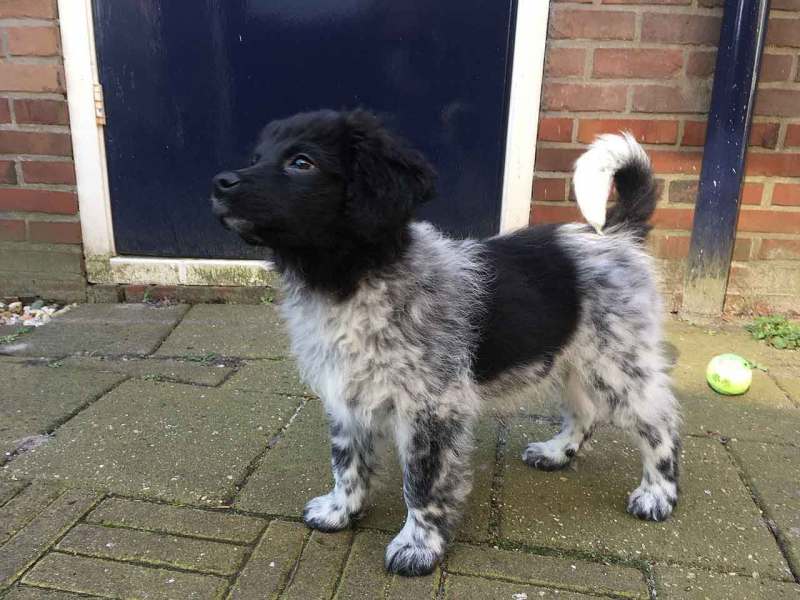
Stabyhoun
Holanda FCI 222 . Spaniel type

Stabyhoun

The Stabyhoun is very similar to the Dutch Partridge Dog, but smaller. It is virtually unknown outside of the Netherlands..

Content

History

The Stabyhoun, o Stabijhoun, it is one of the five rarest dog breeds in the world. Created in the 19th century, is recognized as the national treasure of the Netherlands. How could it be otherwise with just 1.000 live specimens? It comes from the forest lands of Friesland. Poor farmers, they couldn't afford more than one dog, they really needed a versatile worker. From hunting to livestock surveillance and protection, it was also able to eliminate rodents. In fact, could do almost anything.

It is possible that he is descended from Spaniels imported into the Netherlands by the Spanish and crossed with the Dutch Partridge Dog. He would also have family ties to the Small Munsterlander.

It is very little known outside of its country of origin..

Photo: "Perdiguero Frisรณn" by https://en.wikipedia.org/wiki/File:Stabyhounlayingingrass.jpg

Physical characteristics

The Stabyhoun has a robust complexion and beautiful black fur, brown or orange, sometimes with white markings. The straight hair is of medium length, smooth and silky to the touch. They are medium-sized dogs.

Height and weight

    Male size: Of 53 to 53 cm.

    female size: Of 50 to 50 cm.

    Male weight: Of 15 to 20 kg

    female weight: Of 14 to 20 kg

Character and skills

If you are lucky enough to meet a Stabyhoun, you will surely appreciate his docile character. Calm and patient, they are intelligent dogs that can sometimes be stubborn. Extremely patient with children and other animals, this breed is, with the proper education, both obedient and loyal to its owner. Although the Stabyhoun has a calm temperament on the inside, requires a lot of exercise and physical activity.

They are distrustful of strangers, but they are not aggressive by nature. His education is easy to work with because he is obedient in nature. But, it must be started from its first months with benevolent and consistent methods.

The Stabyhoun he is a dog very close to his master, so you find it hard to bear the loneliness. Periods of loneliness can cause anxiety and lead to behavioral disorders such as destruction or barking. He is also a loud dog that barks regularly., which can lead to neighborhood problems.

With his hunting instinct he can be a fugitive to follow a trail, if your property is not properly fenced.

Health

The Stabyhoun It is a strong and robust dog that is not affected by any particular pathology.. But, fear heat and should not stay in a shady spot during a heat wave, as you are at risk of severe heat stroke.

Grooming

The Stabyhoun it is a resistant dog that does not require much maintenance. Its coat should be brushed regularly to avoid knots.

As for your eyes and ears, they must be cleaned regularly, especially if it is a dog that lives abroad.

Characteristics "Stabyhoun"

Coexistence is important that you have with your new friend. Before considering the acquisition of a dog of the breed "Stabyhoun" you know certain factors. Not all breeds of dogs are apt to live in an apartment, you must take into account his character, their need for exercise, their interaction with other pets, their care and if you have small children, their level of tolerance towards them.

Adaptation โ“˜

3,0 of 5 stars (based on 1 review)

friendly dog โ€‹โ€‹โ“˜

3,0 of 5 stars (based on 1 review)

hair loss โ“˜

4,0 of 5 stars (based on 1 review)

Affection level โ“˜

5,0 of 5 stars (based on 1 review)

Need for exercise โ“˜

4,0 of 5 stars (based on 1 review)

Social need โ“˜

3,0 of 5 stars (based on 1 review)

Home โ“˜

3,0 of 5 stars (based on 1 review)

Toilet โ“˜

2,0 of 5 stars (based on 1 review)

Friendly with strangers โ“˜

2,0 of 5 stars (based on 1 review)

barking โ“˜

4,0 of 5 stars (based on 1 review)

Health โ“˜

4,0 of 5 stars (based on 1 review)

Territorial โ“˜

2,0 of 5 stars (based on 1 review)

Cat friendly โ“˜

2,0 of 5 stars (based on 1 review)

Intelligence โ“˜

4,0 of 5 stars (based on 1 review)

Versatility โ“˜

4,0 of 5 stars (based on 1 review)

Child friendly โ“˜

5,0 of 5 stars (based on 1 review)

Surveillance โ“˜

2,0 of 5 stars (based on 1 review)

joy โ“˜

5,0 of 5 stars (based on 1 review)

Images "Stabyhoun"

Photos:

1 – "Perdiguero Frisรณn" by https://commons.wikimedia.org/wiki/File:Stabyhoun.jpg
2 – 10 month old adolescent Stabij by Molliever, CC BY-SA 4.0, via Wikimedia Commons
3 – A picture of a stabyhoun wetterhoun pup for the stabyhoun wiki page by Daisai Gaming, CC BY-SA 4.0, via Wikimedia Commons
4 – Stabijs – world dog show 2010 by MJ Klaver
5 – "Perdiguero Frisรณn" by https://en.wikipedia.org/wiki/File:Binky_Stabyhoun.jpg
6 – "Perdiguero Frisรณn" by https://commons.wikimedia.org/wiki/File:Stabyhoun_with_11_puppies.jpg

Videos "Stabyhoun"

Stabyhoun puppy, mum and Welsh Springer Spaniel playing
Working Stabyhoun
Working Stabyhoun

Type and recognitions:

  • FCI CLASSIFICATION:
  • Group :
  • Section : . .

Federations:

  • FCI – Group 7: Pointing Dogs. – Section 1: Continental Pointing Dogs. 1.2: Spaniel type โ“˜
  • AKCHound โ“˜
  • FSSFoundation Stock Service โ“˜
  • UKCGun Dog โ“˜

FCI breed standard "Stabyhoun"

Origin:
Netherlands

Date of publication of the valid original standard:
30.05.1989

Use:

Pointing Dogs.


General appearance:

Pointer dog of normal proportions, long-haired with strong body structure and square shape; He is not clumsy or skinny; the skin does not have folds or double chin; lips are not hanging.

BEHAVIOR AND TEMPERAMENT: He is attached to his master, peaceful and friendly as a house dog; is intelligent, obedient and has the ability to learn; is quiet, alert, without showing falsehood or cunning.


Behavior / temperament:

He is attached to his master, peaceful and friendly as a house dog; is intelligent, obedient and has the ability to learn; is quiet, alert, without showing falsehood or cunning.

Head:

It is lean. Of size well proportioned to the body, it is longer than it is wide; The skull and muzzle have the same length.

Cranial region:
Skull: It is slightly domed; it is not narrow, but it doesn't give the impression of being wide either; its transition towards the cheeks shows a slight convexity.
Depression links (Stop): Bit strong.

facial region:

Truffle: Black in dogs whose basic color is black and brown in dogs whose basic color is orange-brown. The truffle is well developed, not cleft; the Windows are wide open.
Snout: Powerful, gradually thins towards the truffle, without being sharp. Straight and wide nasal cane; Its profile is neither convex nor concave.
Lips: Adherents, not hanging.
Bite / Teeth: Powerful teeth, scissor bite.
Cheeks: Poorly developed.
Eyes: Placed on the horizontal line, medium sized and round; eyelids well adjusted to the eyeball, conjunctiva not visible; They are neither protruding nor sunken. Its color is dark brown in black dogs and brown in dogs whose basic color is brown or orange.. The eyes of birds of prey are punished.
Ears: Quite low insertion. The pinna is so poorly developed that the ears hang flat on the sides of the head without forming a fold.. Ears with a strongly developed pinna are not acceptable., that do not fold directly at their insertion but rather lower and therefore do not hang flat on the sides of the head. The ears are of medium length and shaped like a bricklayer's trowel.. The hair covering the ears is typical of the breed; it is long at the base of the ear and gradually shortens downwards., so that in the lower third they are covered with short hair. Long hairs are straight; tolerates slightly wavy hair; curly hair is unacceptable.

Neck:

Short and rounded; the head being normally carried low, The neck forms an obtuse angle with the upper line of the back.. The neck is slightly arched, and does not have lax skin or double chin.

Body:

Strong.

Back: Straight, quite long.
Loins: Powerful.
Rump: Little inclined.
Breast : Seen from the front, it's quite wide. It's wider than it is deep, so that the front members are well separated from each other. The non-keel-shaped parapet reaches only to the elbows and no lower. Ribs well arched and well developed towards the back.
Belly: Only slightly retracted.

Tail:

Length reaches to hock joint. Not high insertion. The tail is usually down, although the last third of the tail can turn upward at rest or standing. During movement, the tail rises, but should never be placed above the back or in a spiral. The tail is round and covered to the tip with long, dense hair., without curls, waves or waves. On the other hand, the tail has a bushy structure, so the hair around is abundantly long and thick, giving a full and generous appearance

Tips

PREVIOUS MEMBERS
Shoulder: Scapulae very close to the trunk and oblique, with good angulation of the scapulohumeral joint.
Forearm: Strong and straight.
Metacarpus: Straight, is not inclined.
Previous feet: The fingers are well developed and arched; It doesn't have cat's or hare's feet; hard pads.
 
LATER MEMBERS: Strong, with good angulations in all joints.
Leg: not very long.
Hock: placed low.
Metatarsus: Short.
Hind feet: Round with well-developed pads.

Movement:

Powerful, harmonious, with good momentum and covering a lot of ground. Seen from the front, the friesian retriever moves a little open. During movement, head stays low. The tail is placed above the top line with a slight curve during movement.

Mantle

HAIR: The hair on the entire body is long and straight, although it may be slightly wavy in the rump region.
The hair that covers the head is short. On the back of the forelimbs and on the pants, the hair is abundant and dense, thicker than in the form of feathers. The hind limbs are covered with long hair.. The presence of wavy hair indicates a crossing: therefore, dogs with such a coat should not be recognized as Stabyhoun.

COLOR: Negro, brown or orange with white markings; Mottling or splashing may appear on the white part..


Size and weight:

  • Ideal size for males 53 cm.
  • Ideal size in females 50 cm.

It's allowed 2 cm above or below the ideal size. Racial type is more important than exact measurements.

Weight:

  • Males: 22-27 kg.
  • females: 18-23 kg.


Fouls:

Any deviation from the aforementioned criteria is considered a fault and the severity of this is considered with respect to the degree of deviation from the standard and its consequences on the health and well-being of the dog and the dog's ability to perform its traditional task..

โ€ข Level bite.
โ€ข Head too heavy, skull too wide or round.
โ€ข Weak back or feet.
โ€ข Lack of sexual dimorphism.
โ€ข Curled tail or tail carried over the back.
โ€ข Strongly inclined pelvis.

SERIOUS FAULTS:

โ€ข Spiral tail.
โ€ข Limbs too far below the body when standing or moving.
โ€ข Elegant or graceful appearance.
โ€ข Short legs.
โ€ข Narrow forehead and flat ribs.

FALTAS DESCALIFICANTES:

โ€ข Aggressiveness or extreme shyness.
โ€ข Any dog โ€‹โ€‹showing clear signs of physical or behavioral abnormalities.
โ€ข Atypical, without racial type.
โ€ข Poorly attached eyelids.
โ€ข Upper or lower prognathism or twisted mouth.
โ€ข Too many missing teeth.
โ€ข Twisted tail.
โ€ข Very curly hair (astracan).
โ€ข Any other color or the absence of white.


N.B.:

โ€ข Males must have two normal-appearing testicles fully descended into the scrotum..
โ€ข Only functionally and clinically healthy dogs, with the typical conformation of the breed, should be used for parenting.

Source: F.C.I - International Cynological Federation

Alternative names:

1. Stabij, Beike, Stabijhoun, Fryske Stabij (English).
2. Stabyhoun (French).
3. Stabijhoun (German).
4. (em alemรฃo: stabyhoun) (Portuguese).
5. Perro de muestra frisรณn, Perro de muestra de Frisia (espaรฑol).

โ–ท The world of Pets: Dogs, cats, birds, reptiles, amphibians

Old Danish Pointer
Dinamarca FCI 281 . Braque Type

Antiguo perro de muestra danรฉs

Given the hunting instinct of the Old Danish Pointer, it is necessary to socialize him as a child

Content

Characteristics "Old Danish Pointer"

Coexistence is important that you have with your new friend. Before considering the acquisition of a dog of the breed "Old Danish Pointer" you know certain factors. Not all breeds of dogs are apt to live in an apartment, you must take into account his character, their need for exercise, their interaction with other pets, their care and if you have small children, their level of tolerance towards them.

Adaptation โ“˜

3,0 of 5 stars (based on 1 review)

friendly dog โ€‹โ€‹โ“˜

3,0 of 5 stars (based on 1 review)

hair loss โ“˜

2,0 of 5 stars (based on 1 review)

Affection level โ“˜

5,0 of 5 stars (based on 1 review)

Need for exercise โ“˜

4,0 of 5 stars (based on 1 review)

Social need โ“˜

4,0 of 5 stars (based on 1 review)

Home โ“˜

1,0 of 5 stars (based on 1 review)

Toilet โ“˜

2,0 of 5 stars (based on 1 review)

Friendly with strangers โ“˜

4,0 of 5 stars (based on 1 review)

barking โ“˜

4,0 of 5 stars (based on 1 review)

Health โ“˜

4,0 of 5 stars (based on 1 review)

Territorial โ“˜

3,0 of 5 stars (based on 1 review)

Cat friendly โ“˜

3,0 of 5 stars (based on 1 review)

Intelligence โ“˜

4,0 of 5 stars (based on 1 review)

Versatility โ“˜

3,0 of 5 stars (based on 1 review)

Child friendly โ“˜

5,0 of 5 stars (based on 1 review)

Surveillance โ“˜

3,0 of 5 stars (based on 1 review)

joy โ“˜

4,0 of 5 stars (based on 1 review)

History

The Old Danish Pointer, is a medium sized breed of dog with brown markings, from Denmark.

Its Danish name is Gammel Dansk Hรธnsehund, It literally means bird hunting dog. It is in the Group 7, section 1.1 of the FCI.

Trace the origin of the race can be followed until the year 1710, When a man named Morten Bak, Glenstrup neighbor (adjacent to Randers and Hobro Denmark city), He crossed for eight generations strays dogs from local farmers, until he obtained a pure breed of black and white spotted dogs that he called "Bakhoundsโ€. The result was a popular hunting dog.

Race scholars agree that it is likely that these strays to the Lord Morten Bak, used in their breeding program, they were of Spanish origin, and is therefore considered as one of the direct ancestors of the race Old Danish Pointer.

The popularity of this breed faded unfortunately during the 19th century, the race disappeared almost altogether, only a dedicated breeder continued breeding with the integrated genetic information. After World War II there was only 10 dogs and intensive breeding work was started to prevent the extinction of the breed.

The race again won great popularity, above all thanks to Poul Thomsen (presenter of a recognized programs on animals in the Danish television).

Currently there is a considerable decline in Danish sample dogs, crossing often with the Braque Francais, quite similar.

Video

Physical characteristics

Its Constitution is strong, one of its clearest characteristics is the great difference between male and female. While the male is powerful and from, the female is lighter, spirit and capricious.
Height: Male 54-60 cm. (21-23.5 in), is preferred over 56 cm. . females 50-56 cm. (19.5-22 in), is preferred over 52 cm. .

Weight: Male: 30-35 kg . Female: 26-31 kg .

Character and skills

It gives the impression of being a silent dog and stable but showing determination and courage. It is a brave and determined dog. During the hunt act calmly, patience and slowness, always maintaining contact with the Hunter and doing its job of dog shows, discreetly, without disturbing the prey.

The Old Danish Pointer usually fits perfectly, both hunt small prey and large. His affable character allows him to hunt both in packs and alone with his master..

Home pet is a very familiar and quiet dog, provided you get sufficient exercise and have large enough space to run freely. However He Old Danish Pointer not an apartment dog. An active dog, is intended for people available enough to give you long daily walks and keep you from feeling lonely.

Given their hunting instinct, We need to socialize so small that it gets used to share a roof with small animals (cats, rabbits, etc.).

Images Old Danish Pointer

Type and recognitions:

  • FCI CLASSIFICATION:
  • Group :
  • Section : . .

Federations:

  • FCI – Group 7: Pointing Dogs. – Section 1: Continental Pointing Dogs. 1.1: Braque Type โ“˜

FCI breed standard "Old Danish Pointer"

Origin:
Denmark

Date of publication of the valid original standard:
08.01.1998

Use:

Versatile dog used for bird hunting.


General appearance:

It is a medium-sized dog, rectangular shape and strong build. One of the most charming characteristics of the breed is the great difference that exists between the male and the female..
While the male is powerful and substantial, the female is characterized by being lighter, capricious and have more spirit.

IMPORTANT PROPORTION :

The relationship between the height at the withers and the length of the body is approximately 8:9.


Behavior / temperament:

Gives the impression of being a calm and stable dog that shows determination and courage. during the hunt, progresses relatively slowly, always keeping in contact with the hunter. For his behavior in the hunting field, fulfills its task as a pointer without superfluous agitation. The breed is suitable for large and small hunting grounds.

Head:

Short and wide, without a pronounced stop. The occiput is prominent and clearly visible from any angle.

Cranial region:
  • Skull : Wide enough and distinctly rounded.
  • Depression links (Stop) : Is not pronounced.

facial region:

  • Truffle : Meaty and well defined; nostrils wide open. Dark to lighter liver color.
  • Snout : Wide muzzle.
  • Lips : Widely developed fluff from the nose and covering the lower jaw. The lips help give the head its characteristic importance.
  • Jaws / Teeth : Powerful jaws with regular scissor bite. A complete denture is desirable.
  • Cheeks : Well defined and developed, very muscular.

Eyes : Medium-sized, they are not sunken or prominent. Dark brown is desirable. Considering the origin of the breed, a slight drooping of the lower eyelids is tolerated, but should not be encouraged.

Ears : Relatively low set, wide and slightly rounded at the ends.
Its length is correct if the ear pulled towards the nose leaves a little more than the outer third of the muzzle uncovered. The front edge of the ear hangs nicely close to the cheek.

Neck:

Muscular and very hairy. The double chin should be considered a hallmark but should not be excessive.

Body:

  • Cross : Well defined. The highest point of the top line is located at the cross, and then descends slightly towards the rump.
  • Back : Firm and very muscular.
  • Pork loin : Short, broad and muscular, strongly together.
  • Rump : Wide, not too short, slightly inclined towards the insertion of the tail.
  • Breast : Deep and wide; a good width is desirable especially in males. The sternal region reaches up to the elbows. Well sprung ribs that reach well to the back of the body. The thorax is not flattened or crowded. A highly developed parapet is highly desirable.

Tail:

Insertion a little high than too low. Fairly wide at its base, slimming to tip. It is of medium length and reaches almost to the tibio-tarsal joints. The tail is carried hanging naturally. Amputation is not allowed

Tips

PREVIOUS MEMBERS : Viewed from the front, they are strong, straight and parallel.

  • Shoulder : Laid flat and close to the chest, covered with strong muscles that are clearly visible during movement or at rest.
  • Arm : Good length, very muscular.
  • Elbows : Closed to the body, but not too close to it, no deviations outwards or inwards, placed rather back. Good angulation between the arm and forearm.
  • Forearm : Straight, with powerful muscles and strong bones.
  • Articulation of the Carpus : Strong.
  • Metacarpus : Slightly oblique in relation to the forearm.
  • Previous feet : Strong and firm, well arched with hard pads.

LATER MEMBERS : Seen from the back, they are straight and parallel. With good angles and strong bones.

  • Thigh : Muscular, rather long and wide. Good angulation between the pelvis and the thigh.
  • Knee : Strong, well angled.
  • Leg : Quite long, muscular.
  • Warm-foot joint : Strong and powerful.
  • Metatarsus : Slightly oblique in relation to the leg.
  • Hind feet : Strong and firm, well arched, with hard pads.

Movement:

Space-spanning steps with good rear thrust and matching reach in front. The movement is straight and parallel in the fore and hind limbs. High head carriage.

Mantle

SKIN : Not too fine, it is rather tight on the body and extremities. On the head and neck the skin is looser, forming a double chin and presenting a crease at the corners of the lips.

HAIR : Short and dense, something hard to the touch. Hair must completely cover the body.

COLOR : White with brown markings, some large or many small speckled markings on the white background. The brown color can vary but is preferred from a brown to dark brown tone.


Size and weight:

Height to the cross :

  • Male : 54-60 cm., more than 56 cm.,
  • female : 50-56 cm., more than 52 cm..

Weight :

  • adult male : 30-35 kg,
  • female : 26-31 kg.


Fouls:

Any deviation from the aforementioned criteria is considered as a fault and the severity of this is considered to the degree of the deviation to the standard and its consequences on the health and well-being of the dog..

โ€ข Incorrect head posture.
โ€ข Flesh-colored nose with depigmented spots.
โ€ข Muzzle too short.
โ€ข Underdeveloped lips.
โ€ข Missing one or two premolars (PM1).
โ€ข Eyes too light.
โ€ข Slightly bowed back.
โ€ข Croup too short.
โ€ข Tail carried well above the top line.
โ€ข Light cow corvejones or slightly arched extremities.
โ€ข Hair too thin.
โ€ข Small variations in size (1-2 cm.) above or below the limits indicated in the standard.

SERIOUS FAULTS

โ€ข Bones too weak.
โ€ข Pronounced stop.
โ€ข Pointed snout.
โ€ข Pincer bite.
โ€ข Lack of another tooth besides the PM1.
โ€ข Pronounced carp back, slightly saddled back.
โ€ข Obvious deficiency in breast development. Thorax not sufficiently defined. Ribs too flat or crammed.
โ€ข Elbows turned very outward or inward.
โ€ข Cow-shaped or severely arched limbs.
โ€ข Sunken metacarpus.
โ€ข Flattened feet, fingers apart.
โ€ข Weak behavior, shy.

MISS PLAYOFFS

โ€ข Aggressive or fearful dog.
โ€ข Serious deviations in sexual characteristics.
โ€ข Teeth : Missing more than two PM1 and one other tooth. Teeth that are not visible will be considered missing unless their existence can be certified in previous exposure.
โ€ข Upper or lower underbite or any other defective bite.
โ€ข Cleft palate or cleft lip.
โ€ข Ectropion, entropion, distiquiasis (double lash line).
โ€ข Malformation of the chest or rib cage (for example, sternum too short, which causes a sudden elevation of the lower line behind the ribs).
โ€ข Size deviations of more than 2 cm above or below the limits indicated in the standard.
โ€ข Very shy and weak behavior.

Any dog โ€‹โ€‹showing clear signs of physical or behavioral abnormalities must be disqualified..


N.B.:

Males should have two normal-appearing testicles fully descended into the scrotum..

Source: F.C.I - International Cynological Federation

Alternative names:

1. Gammel Dansk Hรธnsehund, Old Danish Bird Dog, Old Danish Pointing Dog (English).
2. Pointer danois, Ancien chien d’arrรชt danois (French).
3. Gammel Dansk Honsehund, Altdรคnischer Hรผhnerhund (German).
4. (em dinamarquรชs: Gammel dansk hรธnsehund) (Portuguese).
5. Perro antiguo de muestra danรฉs (espaรฑol).

โ–ท The world of Pets: Dogs, cats, birds, reptiles, amphibians

Estonian Hound
Estonia FCI 366 - Medium-sized Hounds

Estonian Hound

The Estonian Hound they are extremely hardy hunting dogs accustomed to long days in the forest

Content

History

The history of Estonian Hound (or Eesti Hagijas in the language of your country of origin) begins at the beginning of the 20th century in Estonia, when the crossing of english hounds, Poles and Finns used by local hunters gave rise to a large dog unofficially considered regional and ancestor of the current Eesti Hagijas.

Given the sharp decline in the population of large game and in order to reestablish it, in 1937 A law was passed prohibiting hunting with dogs over 45 cm to the cross, which in fact caused a change of orientation towards smaller animals, like foxes and hares. Therefore, Estonian hunters and breeders had to breed smaller dogs than they had then, so they were introduced in the breeding program the Beagles, the Dachshund and Swiss Hounds.

This law was amended three years later, in 1940: the maximum size was increased to 55 cm., and breeders stopped their efforts to miniaturize local hunting dogs.

In 1947, when Estonia was part of the USSR, The Soviet Ministry of Agriculture decided that all the "republics" that made up Estonia should have a local breed of dog. The Estonian hunting dog population was then estimated at around 900, and intense selection helped stabilize the characteristics of the breed that would become the Estonian Hound.

In 1954, the Ministry of Agriculture sent a specialized commission to Estonia to study the 648 specimens submitted by local breeders, and were clearly convinced: the first breed standard was approved by the Ministry a few months later. This year marked the official introduction of the Estonian Hound like a race, whose stamina and formidable nose were immediately emphasized.

After the collapse of the Soviet regime, Estonia gained independence and in 1998 la Estonian Kennel Club, the main canine association in the country, recognized race. Being the only native of the country, it was not surprising that it was granted national dog status.

The organization set out to make the breed known and recognized internationally. His efforts were crowned with success in 2019, cuando the International Cynological Federation (FCI) provisionally accepted the breed and published a standard. Having said that, there is still a long way to go, since it is not recognized, for example, by the prestigious British Kennel Club, nor by American reference organizations such as the United Kennel Club (UKC) o el American Kennel Club (AKC).

The Estonian Hound is popular in an area encompassing Estonia and nearby Russian regions, and its population is estimated at about 1200 individuals. It is still used there as a hunting dog and has also made a place for itself in many homes as a pet.. But, hasn't conquered the rest of the world yet. Rare in europe, even in Estonia's neighboring countries, is practically absent from the North American continent.

Photo: Estonian Hound by Marcin Bล‚aszkowski, Public domain, via Wikimedia Commons

Physical characteristics

Estonian-hound
Estonian Hound

The Estonian Hound They are medium-sized hunting dogs that can easily be mistaken for the Beagle, one of the races that helped create them. But, they are bigger than the Beagle and they have a more pointed snout.

His powerful and muscular body is very long. Its solid bone legs are straight and almost half the size at the withers.. Saber-shaped tail flicks when in motion and remains fairly low, no higher than back level.

The head is quite wide at the level of the skull and the long muzzle ends in a very black nose. His slightly oblique eyes are more or less dark brown, while her long, thin ears fall along her cheeks.

The coat of the Estonian Hound is short, rough and shiny, with a moderately dense undercoat. Their fur is usually tricolor, with black spots with more or less wide red edges on a white background. But, the standard accepts bicolor individuals with completely red spots, without any trace of black. In all cases, the tips of the legs and tail should be white, as well as the throat and chest.

Sexual dimorphism is marked, the female being slightly longer than the male, which is taller in the legs and wider.

Physical characteristics

Estonian Hound
Estonian Hound

The Estonian Hound he is particularly devoted to his family, who likes to spend time with. They are a breed of dog especially recommended for children: they love to interact with them and are very patient with them, they even accept having their tails or ears pulled. But, you should remember that interactions between a young child and a dog of any breed must be under the supervision of an adult.

This strong attachment to his family makes him not like loneliness, which can lead to separation anxiety. If you are often left home alone for long periods of time, not surprisingly you may experience destructive behavior.

One solution for a caregiver who is regularly absent during the day may be to provide a playmate. Made to hunt in a pack, the Estonian Hound they enjoy the company of other dogs. If they are used to its presence from an early age, They can also make friends with any feline in the house. On the other hand, as they have a strong hunting instinct, should not live with rabbits or other rodents.

Rather shy and not fond of novelty, the Estonian Hound they tend to bark at strangers and then observe their master's behavior from a distance. If he invites the newcomer to the house, comes to greet you politely, but stay reserved.

Extremely hardy hunting dogs used to long days in the woods, they need a lot of exercise to expend their great energy: a daily walk of one hour is a minimum for them. It is recommended to always keep it tied during these outings, as your excellent sense of smell often allows you to find an interesting track that you are likely to want to follow for hours, ignoring withdrawal orders. A dog owner who still wants to let him walk freely right now should equip him with a GPS dog collar, so you can easily get your hands back on it if it disappears.

The Estonian Hound you can live in an apartment as long as you are outdoors often enough to satisfy your need for exercise, but he is much happier when he has a garden where he can patrol and play. But, this outdoor space must be well fenced to eliminate the risk of escape if you see potential prey to pursue.

A peculiarity of this dog is its need for routine and its aversion to novelty, which makes their behavior sometimes compared to that of domestic cats. This is not at all an appropriate choice for a master who wants to take their dog on vacation.: he is a poor traveler, you get stressed out when you get in the car and you don't like spending time in a place you don't know at all.

Last, it is a breed of dog that barks often and forcefully. For the peace of the neighborhood, it is necessary to teach him from a young age not to bark for any reason and to shut up when ordered to do so.

Education

Estonian Hound
Estonian Hound

Like all its fellow men, the Estonian Hound must be socialized from an early age. This requires spending as much time with him as possible so that he meets all kinds of people (neighbors, family, friends, strangers…) And animals, but also so that you get used to the situations that you may face later.

This need to become very quickly acquainted with the outside world is all the more pronounced as it is fearful by nature. In particular, to prevent future vet visits from becoming a nightmare to handle, it is recommended to get used to traveling by car as soon as possible.

Addressing the barking issue at an early age is also imperative, so that you understand that it is not necessary to bark for hours at every unfamiliar noise.

It is also important to teach your dog to remember to bark, as you will not hear any more commands once you have sniffed the trail of a game animal and go in pursuit. Hunting instinct is well established in this breed, so it does not require any specific training to be able to follow a trail for hours and be an excellent hunter.

Relatively independent and headstrong, the Estonian Hound require patience to be trained, but they like to please their master and usually end up listening to him. If necessary, be firm to assert your dominant position and show your dog who is the master, traditional training methods should be avoided, at the risk of damaging the relationship of trust. It is preferable to opt for a learning technique based on positive reinforcement.

Health

As the Estonian Hound it is a relatively new breed and not very widespread, there is still no real and in-depth study of their possible health problems. But, looks quite robust, no doubt thanks to a reasoned breeding program that has given priority to the personality and abilities of individuals rather than their appearance.

But, you have probably inherited from Beagle and the Foxhound a certain predisposition to the following diseases:

  • Progressive retinal atrophy, a breakdown of the eye tissue that can eventually lead to blindness;
  • entropion and ectropion, problems with the eyelids that cause itching and / or irritation of the eye, but can be surgically corrected;
  • dislocation of the patella, which affects the kneecap and causes walking difficulties. It can also be responsible for premature arthritis;
  • Elbow or hip dysplasia, that can cause lameness.
  • It also, the Estonian Hound is sensitive to allergies and sinusitis. These ailments are not serious in themselves, but they can cause a certain amount of stress to the dog, as this breed relies heavily on its sense of smell. So, a temporary loss of your sense of smell is likely disorienting you.

    Finally, like most hunting dogs, the Estonian Hound have a ferocious appetite that can lead to overweight or even obesity if they don't get enough exercise.

    Grooming

    Despite her short hair and sparse undercoat, the Estonian Hound require some maintenance. Brushing twice a week is recommended to remove dead hairs and avoid finding them all over the house. This also helps to distribute sebum on the skin to better protect it against infectious agents..

    During moulting periods, in autumn and spring, it is even necessary to opt for a daily frequency, to deal with the large amount of hair you lose during this period.

    On the other hand, it is only necessary to bathe your dog when it is particularly dirty, for example, if he has rolled in the mud.

    Besides keeping your coat, it is recommended to check your teeth once a week to make sure there are no cavities, and cleaning your eyes with a damp cloth to remove any dirt that could cause an infection.

    Weekly ear care is especially important: like any dog โ€‹โ€‹with floppy ears, the Estonian Hound have a higher risk of infections and ear infections.

    Buy an โ€œEstonian Houndโ€

    The price of a puppy Estonian Hound is of some 700-800 euros in your country of origin, and there is no price difference between male and female puppies.

    But, hard to find outside of Estonia, but the situation may change rapidly after the breed is recognized by the FCI in 2019.

    Characteristics "Estonian Hound"

    Coexistence is important that you have with your new friend. Before considering the acquisition of a dog of the breed "Estonian Hound" you know certain factors. Not all breeds of dogs are apt to live in an apartment, you must take into account his character, their need for exercise, their interaction with other pets, their care and if you have small children, their level of tolerance towards them.

    Adaptation โ“˜

    3,0 of 5 stars (based on 1 review)

    friendly dog โ€‹โ€‹โ“˜

    4,0 of 5 stars (based on 1 review)

    hair loss โ“˜

    3,0 of 5 stars (based on 1 review)

    Affection level โ“˜

    4,0 of 5 stars (based on 1 review)

    Need for exercise โ“˜

    4,0 of 5 stars (based on 1 review)

    Social need โ“˜

    4,0 of 5 stars (based on 1 review)

    Home โ“˜

    3,0 of 5 stars (based on 1 review)

    Toilet โ“˜

    2,0 of 5 stars (based on 1 review)

    Friendly with strangers โ“˜

    3,0 of 5 stars (based on 1 review)

    barking โ“˜

    3,0 of 5 stars (based on 1 review)

    Health โ“˜

    4,0 of 5 stars (based on 1 review)

    Territorial โ“˜

    3,0 of 5 stars (based on 1 review)

    Cat friendly โ“˜

    2,0 of 5 stars (based on 1 review)

    Intelligence โ“˜

    4,0 of 5 stars (based on 1 review)

    Versatility โ“˜

    3,0 of 5 stars (based on 1 review)

    Child friendly โ“˜

    3,0 of 5 stars (based on 1 review)

    Surveillance โ“˜

    3,0 of 5 stars (based on 1 review)

    joy โ“˜

    3,0 of 5 stars (based on 1 review)

    Videos "Estonian Hound"

    Estonian Hound / 99+1 Dog Breeds
    Estonian Hound / 99+1 Dog Breeds
    ESTONIAN HOUND PUPPIES
    ESTONIAN HOUND PUPPIES / ESTONIAN HUNDRED PUPPIES

    Type and recognitions:

    • FCI CLASSIFICATION:
    • Group :
    • Section : . .

    Federations:

    • FCI – Group 6: Scent hounds, and related breeds. – Section 1.2: Medium-sized Hounds. โ“˜

    FCI breed standard "Estonian Hound"

    Origin:
    Estonia

    Date of publication of the valid original standard:
    04/09/2019.

    Use:

    Hound used to hunt hares, foxes and lynxes.


    General appearance:

    Medium sized proportional hound, strong and dry constitution. Strong bones, well-developed feet and muscles. White markings are clearly visible and help to see the dog better when working in the field. Sexual dimorphism is well defined.

    important proportions

    • The length of the body clearly exceeds the height at the withers. Females may be slightly longer than males.
    • The length of the legs is approximately the 50% the height at the withers.


    Behavior / temperament:

    In good mood, flexible and user-friendly. Very well developed sense of smell and game detection and a pronounced passion for hunting guarantee good results in finding prey and tracking in difficult terrain. Resonant voice helps locate dog from long distance.

    Head:

    View from the top, forms a blunt wedge, wider at the back and slightly tapered towards the snout.

    Cranial region:
    • Head: Seen from above, forms a blunt wedge, wider at the back and tapering slightly towards the muzzle.
    • Skull: Moderate width, slightly curved. Superciliary arches well developed but not prominent.
    • Depression links (stop): Moderately pronounced, never prancing.

    facial region:

    • Truffle: Wide, totally black. Dogs with coat color that has golden or tan spots may have a lighter colored nose, never liver brown.
    • Snout: Long, straight and in proportion to the skull.
    • Belfos: Dried, tight, not outstanding, no flap at the corner of the mouth. Fully pigmented lip edges.
    • Jaws / Teeth: The teeth are white and large. The jaws normally develop with a complete set of 42 teeth and a full scissor bite, that is to say, the upper teeth closely overlap the lower teeth and fit the jaws. Bite level due to aging and wear of undesirable incisors.
    • Cheeks: Flat.

    Eyes: Slightly sloping, dark brown, dark edges.

    Ears: Thin, pendants, placed at a medium height, close to the cheeks, rounded edges and covered with short hair. When pulled towards the nose, reaches about half the length of the muzzle.

    Neck:

    Medium long and moderate high, round in cross section, muscular, dry skin without folds.

    Body:

    • Cross: Rising above the back line.
    • Back: level, broad and muscular.
    • Pork loin: Short, width, arched and muscular.
    • Rump: Wide, average length, muscular and slightly sloping. Height at the croup 1-1.5 cm less than at the withers.
    • Breast : Oval, long and spacious, that reaches up to the elbow. Well developed ribs.
    • bottom line: The sternum is long and the belly only slightly tucked.

    Tail:

    Saber shape, thick at the base, tapering slightly towards the end and reaching to the hocks. Active movement when moving, the base of the tail should never be raised above the line of the back.

    Tips

    Former members

    Generality   Dried, muscular with strong bone. Viewed from the front the front legs are straight and parallel. The length of the legs is approximately the 50% the height at the withers.
    Shoulder   The angulations in the shoulder joint are of 115-120 degrees.
    Elbow   Strong, tight, without turning in or out, but firmly relaxed.
    Forearm   Medium length oval bone. Robust in relation to the body, that is to say, neither thin nor too heavy and completely straight.
    Metacarpus   Large, flexible and almost straight.
    Front feet   Arcuate, oval and tight. Strong nails and turning down. Thick pads.

    Later members

    Generality   Dried, muscular with strong bone. Seen from the back, the legs are straight and parallel and, from the side, they are well angulated.
    Thigh   Approximately equal in length to the lower thigh.
    Leg   Approximately equal in length to the thigh.
    Knee   Strong, moderately bent and not turning either in or out when moved.
    Metatarsus   Of average length, very strong and vertical.
    Rear feet   Arcuate, oval and tight. Strong nails and turning down. Thick pads.

    Movement:

    With good handling, free, in a straight line, that is to say, one-way, fluid and smooth.

    Mantle

    Skin: Tight, but elastic and without folds.

    Fur: Short, uniform, rough and shiny. Moderate inner cover. The tail is covered with even dense hair along its entire length and, therefore, the tail looks thick. At the tip of the tail the hair is somewhat shorter.

    Color: Typical color is black patches with tan markings and vivid white markings (tricolor). The size of the patches is not limited. Lemon to golden tan patches without black are also allowed (bicolor). The patterns can be of various sizes and also form a saddle. Black patches, toasted or lemon, with or without rich tan rims, contrast well with white. White markings must be on the head, in the throat and chest extending to the belly. All feet and tip of tail should be white. All colors should be as bright as possible.


    Size and weight:

    Height to the cross

    • Males: 45 โ€“ 52 cm..
    • females: 42-49 cm..


    Fouls:

    โ€ข Any deviation from the aforementioned criteria is considered a fault, and the severity of this is considered the degree of deviation from the standard and its consequences on the health and well-being of the dog and the dog's ability to perform its traditional task.
    โ€ข The offenses listed must be in accordance with their severity..

    Serious misconduct:

    โ–ท Shy or too agitated.
    โ–ท Too light or too heavy in construction.
    โ–ท Too short or too long in the body, high in the back.
    โ–ท Thick head, flat or domed skull, rounded cheeks.
    โ–ท Nose, eyes or lips with insufficiently pigmented pigment.
    โ–ท Slightly overbite where the incisors are not in contact.
    โ–ท Ears that are too short or too thick, set too high, not lying close to the head or covered with long hair.
    โ–ท Narrow chest, flat rib cage.
    โ–ท Weak top line, steep group.
    โ–ท Queue too long (that reaches more than 3 cm below the hocks) or too short, carried up from the base.
    โ–ท Extended fingers or too long feet (hare foot).
    โ–ท Clearly wavy hair, lack of bottom cover.
    โ–ท Overmarked with white, obvious black or tan in white areas.

    disqualifying fouls

    โ–ท Aggressive or too shy dogs.
    โ–ท Absence of sexual dimorphism.
    โ–ท Size above the limits indicated by the standard.
    โ–ท Exceeding 3 mm and more, or bite below the shot.
    โ–ท Strange eyes or white eyes (blue).
    โ–ท Small ears, punctured or semi-punctured.
    โ–ท Dubbed, or tail defect.
    โ–ท Overmarked with black or tan color, that is to say, lack of white markings.
    โ–ท Brown or brown patches with pigmented nose on the liver.


    N.B.:

    โ€ข Any dog โ€‹โ€‹showing clear signs of physical or behavioral abnormalities should be disqualified..
    โ€ข The aforementioned fouls that are more pronounced or more marked are eliminatory..
    โ€ข Males must have two normal-appearing testicles fully descended into the scrotum..
    โ€ข Only functionally and clinically healthy dogs, with the typical conformation of the breed, should be used for parenting.

    Source: F.C.I - International Cynological Federation

    Alternative names:

    1. (Estonian: eesti hagijas) (English).
    2. eesti hagijas (French).
    3. (estnisch: Eesti hagijas), Estnische Bracke (German).
    4. Eesti hagijas (Portuguese).
    5. Cazador estonio (espaรฑol).

    โ–ท The world of Pets: Dogs, cats, birds, reptiles, amphibians

    Jura Hound (Bruno Jura Hound)
    SuizaFCI 59 . Medium-sized Hounds

    Sabueso del Jura

    The Jura Hound It is very distant with strangers and needs firm handling if kept as pets.

    Content

    History

    In the year of 1882 set a standard for each of the five existing varieties of the Swiss Hound. In 1909 reviewed these standards confirming the total disappearance of the Thurgau Hound.
    The 22 in January of 1933 established a uniform standard for the 4 varieties of the Swiss Hound. The original range of the Jura hound type St. Hubert has now disappeared.

    The Jura Hound It is a domestic dog developed in the middle ages for hunting in the Jura mountains, on the border between Switzerland and France.

    Already in Roman times these hounds were known in Switzerland.

    The Jura Hound He is known for his tracking abilities and like other hounds he has the ability to follow a perfume for miles through the rocky terrain of the border mountains between France and Switzerland.. It is mainly used for the hunting of the Hare.

    There are four varieties of Swiss Hound:

    Most kennel clubs and organizations treat these breeds as a single breed with multiple varieties..

    Physical characteristics

    These dogs have a large skull, so their heads seem to be much larger than its small robust bodies. Their ears are flexible and hang down around their muzzle and eyes, giving it a warm and friendly appearance. Your body has some wrinkles around the chest and neck area. Their bodies are elongated and thin and long tail. They are usually a color dark bronze or a reddish Fawn.

    Its size is similar to the Bernese Hound, but it differs in the width of your head, being associated with the St. Hubert Hound.

    Their life expectancy is of 12 to 13 years, and can weigh between 15 and 20 kg, with a height of 43 to 58 cm. up the cross.

    Character and skills

    These dogs can be known as little adventurers. They like to explore new and interesting terrain in which have never been before. Son, final ideal for anyone that loves to go on walks and exercise, Since in that environment be shown fully happy. As good Hound, anything, even if it is in its territory.

    It is used mainly for hunting hare and wild boar..

    They are very protectors and they lash out against anyone trying to do harm to their owners. They are very distant with strangers and need firm handling if kept as pets.

    Well trained is a loving, friendly dog with children.

    ยซJura Houndยป images

    ยซJura Houndยป Videos

    Type and recognitions:

    • FCI CLASSIFICATION:
    • Group :
    • Section : . .

    Federations:

    • FCI – Group 6: Scent hounds, and related breeds. – Section 1.2: Medium-sized Hounds. โ“˜
    • UKCScenthounds โ“˜

    FCI breed standard "Jura Hound (Bruno Jura Hound)"

    Origin:
    Switzerland, France

    Date of publication of the valid original standard:
    28.11.2001

    Use:

    It is a small game hound that hunts hares, deer, foxes and sometimes wild boars. He is an independent hunter by hunting with a bark. Searches and corners its prey with great safety even in difficult terrain.


    General appearance:

    It is a dog with medium height at the withers. Your body structure indicates strength and tenacity. Its slim head with long snout and long ears give it an expression of nobility.

    There are four varieties of Swiss Hound :

    • Bernese Hound
    • Jura Hound
    • Lucerne Hound
    • Schwyz Hound

    IMPORTANT PROPORTIONS :

    โ€ข Body length : Height at withers = approx. 1.15 : 1.
    โ€ข Height of the withers : chest depth = approx. 2 : 1.
    โ€ข Length of the nasal shank : skull length = approx. 1 : 1.


    Behavior / temperament:

    Lively and passionate about hunting. Sensitive, manageable and faithful.

    Head:

    ---

    Cranial region:
    • Skull : Long, narrow, delgado, noble. Bulging skull, visible occipital protrusion. The direction of the longitudinal axis of the skull and the muzzle shows a slight divergence. No frontal groove, no folds or wrinkles.
    • Depression links (Stop) : Not too developed.

    facial region:

    • Truffle : Completely black, well developed; nostrils wide open.
    • Snout : Nobly developed, narrow ; it is not square or pointed ; the muzzle is straight or very slightly convex.
    • Lips : Moderately developed, the upper lips perfectly cover the lower jaw ; slightly open corner.
    • Jaws / Teeth : Powerful jaw. Powerful scissor bite, regular and complete, that is, the upper incisors overlap the lower ones without leaving space between them and the teeth are implanted vertically in the maxilla. Pincer bite allowed. The lack of one or two PM1 or PM2 is acceptable (premolars 1 or 2) . M3 are not taken into account (molars).
    • Cheeks : Loose, non-protruding supraciliary arches.

    Eyes : They are more or less light or dark brown depending on the color of the coat ; they are medium in size and slightly oval. The edges of the eyelids are well pigmented. The eyelids are well adherent. The expression is sweet.

    Ears : Placed below the eye line, in the posterior part of the cranial region and never implanted in its maximum width. Its length must reach at least the tip of the nose. The pinna is not prominent. The ears are thin. He wears them down, bent and twisted ; they are rounded at the bottom and have a fine, soft coat.

    Neck:

    Long, elegant, with good musculature ; throat skin is loose without forming a noticeable dewlap.

    Body:

    • top line : The neck, the back, The rump and tail form a harmonious and noble line.
    • Cross : Bit strong, free and elegant neck insert.
    • Back : Firm and straight. : Muscular and slightly arched.
    • Rump : Elongated, extends the line of the back harmoniously and descends gently. It is not higher than the cross. The crest of the iliac bone is not too prominent.
    • Breast : Deeper than wide, well descended, reaches to the tips of the elbows. Elongated rib cage with slightly arched ribs.
    • Bottom line and belly : Belly slightly pulled back ; full flanks.

    Tail:

    Inserted in the extension of the croup. It is of medium length and tapers towards the tip ; at its end it has a slight incline up ; noble. In general, it remains hanging at rest and when walking calmly, without showing an important bend ; When he is attentive or in action he carries it along the line of his back , but never resting in it nor in a curled way. Is well covered with hair, but it doesn't have a spike shape.

    Tips

    PREVIOUS MEMBERS :

    • As a whole : They are well muscled, thin and not heavy in appearance. Seen from the front they are parallel and from the side they look vertical ; his bones are strong with his feet pointed forward.
    • Shoulder : Long oblique shoulder blades, closely linked to the rib cage. The ideal angulation of the scapulohumeral joint is approximately 100ยฐ.
    • Arm : A little longer than the shoulder blade, placed obliquely, closely attached to the chest. His musculature is fine.
    • Elbows : Naturally glued to the side.
    • Forearm : Straight, strong, delgado.
    • Carpo : Strong, wide metacarpus : Relatively short; Seen from the front it is located on the perpendicular line of the forearm; seen from the side it is slightly inclined.
    • Front feet : Rounded, with compact fingers ; hard and rough pads ; strong nails whose color depends on the color of the coat.

    LATER MEMBERS :

    • As a whole : They have strong muscles and are in a balanced relationship with the forelimbs ; seen from behind the hind legs are vertical and parallel.
    • Thigh : Long and oblique, powerful although his muscles are thin. The angulation of the coxofemoral joint is approximately 100ยฐ.
    • Knee : No inward or outward deviations. Angulation of the femoral-tibian joint approximately 120ยฐ.
    • Leg : Relatively long, thin, visible muscles and tendons under the skin.
    • Hock : Tibiotarsal joint angulation approximately 130ยฐ.
    • Metatarsus : Pretty short, placed vertically and parallel. Without spurs, except in countries, in which amputation is not allowed by law.
    • Rear feet : Rounded, with compact fingers, hard and rough pads ; strong nails whose color depends on the color of the coat.

    Movement:

    It is unfolded, regular, harmonious and with good scope. Has good impulse from the hindlimbs. Drive the limbs parallel and straight. The cross moves smoothly and regularly up and down, the back remains straight and the head and neck wobble slightly from side to side.

    Mantle

    SKIN : Fina, flexible, well adherent, whose color varies in each of the four varieties.

    โ€ข Bernese Hound : Skin is black under black hair and blackish-white marbling under white hair.
    โ€ข Jura Hound : She is black under black hair and lighter under tan hair..
    โ€ข Lucerne Hound : She is black under black hair and lighter under blue-flecked hair..
    โ€ข Schwyz Hound : It is dark gray under the orange hair and blackish-white marbling under the white hair..

    HAIR : Is short, smooth, thick, very fine on the head and ears.

    COLOR :

    โ€ข Bernese Hound : White with black spots or a black saddle-shaped spot. Tan color from pale to intense over the eyes, cheeks, on the inside of the ears and around the anus. Sometimes very lightly splattered (black splash).

    โ€ข Jura Hound : Tan with black cape, sometimes nuanced black or black with tan over the eyes, cheeks, around the anus and on the extremities ; sometimes with a small white spot on the chest ; this stain may be splattered (black or gray splashes).

    โ€ข Lucerne Hound : Called blue, with a mixture of black and white hairs, intensely splashed, with black spots or a saddle-shaped spot ; tan color from pale to intense over the eyes, cheeks, on the chest, around the anus and on the extremities ; a black cape is allowed.

    โ€ข Schwyz Hound : White with orange or orange "saddle" spots, sometimes with orange splashes ; an orange coat is allowed.


    Size and weight:

    Height to the cross :

    • Males : 49-59 cm..
    • females : 47-57 cm No tolerance.


    Fouls:

    Any deviation from the aforementioned criteria is considered as a fault and the severity of this is considered to the degree of the deviation to the standard and its consequences on the health and well-being of the dog..

    โ€ข Rough appearance, vulgar, weak body structure.
    โ€ข Discordant proportions between body length, the height of the withers and the height of the chest.
    โ€ข Skull too wide, too convex or too flat.
    โ€ข Stop too marked.
    โ€ข Very short or very long snout, too square or pointed.
    โ€ข Concave nasal bridge.
    โ€ข Lack of more than two premolars PM1 or PM2. Los M3 (molars 3) are not taken into account.
    โ€ข Thick lips.
    โ€ข Light eyes, acute expression, non-adherent eyelids.
    โ€ข Ears that are too short or flattened, thick or set very high.
    โ€ข Very short neck.
    โ€ข Double chin too marked.
    โ€ข Saddled or arched back (carp back).
    โ€ข Croup too inclined or too short.
    โ€ข Rib cage not deep enough, too flat or barrel-shaped.
    โ€ข Retracted belly, fallen flanks.
    โ€ข Tail with poor insertion, carried too high, very bent, stooped, very coarse or spike-shaped tail.
    โ€ข Extremities with bones that are too thin or in a bad position.
    โ€ข Very sloping shoulders, arm too short.
    โ€ข Weak carpal joints.
    โ€ข Insufficient angulations of the hind limbs ; cow or barrel shaped limbs.
    โ€ข Dewclaws on the hind limbs, except in countries in which amputation is not permitted by law.
    โ€ข Rough coat, not smooth.
    โ€ข Flaws in color and markings.

    1. Bernese Hound : Too many black splashes on the white. Tan or white on the outside of the ears.
    2. Jura Hound : Uniform color. Noticeable white patch or heavily speckled patch on the chest.
    3. Lucerne Hound : Lack of ยซ blue ยป splash. Tan on the outside of the ears.
    4. Schwyz Hound : Too many orange splashes on the white. Uniform color. White on the outside of the ears.

    โ€ข Slightly fearful or aggressive behavior.

    MISS PLAYOFFS

    โ€ข Excessively fearful or aggressive dog.
    โ€ข Atypical general appearance of the breed.
    โ€ข Completely depigmented nose.
    โ€ข Upper or lower prognathism, incisor arcade deviated.
    โ€ข Ectropion, entropion (even if it had been operated).
    โ€ข Horn tail, threaded, knotty the hook.
    โ€ข Size above or below tolerance.

    Any dog โ€‹โ€‹showing clear signs of physical or behavioral abnormalities must be disqualified..


    N.B.:

    Males should have two normal-appearing testicles fully descended into the scrotum..

    Source: F.C.I - International Cynological Federation

    Varieties of ยซSwiss Houndsยป

    The four varieties of Swiss hounds have their own specific hunting characteristics:

    – The Bernese Hound, with her beautiful throat ("the howler of the Jura"), demanding, mainly used for hares;
    – The Jura Hound, an excellent recuperator
    – The Lucerne Hound, reminiscent of Small Blue Gascony, he is an active and passionate dog that hunts deer very well;
    – The Schwyz Hound, less widespread outside of Switzerland, is reserved for rabbits and hares.

    Alternative names:

    1. Bruno Jura Hound (English).
    2. Bruno du Jura (French).
    3. (frz. Bruno du Jura) (German).
    4. Sabujo Bruno de Jura (Portuguese).
    5. Fernando del Jura, Bruno del Jura (espaรฑol).

    โ–ท The world of Pets: Dogs, cats, birds, reptiles, amphibians

    Halden Hound
    Noruega FCI 267 - Medium-sized Hounds

    Halden Hound

    The spread of Halden Hound limited to your country of origin, where it is also little known.

    Content

    History

    Originally from Norway, the Halden Hound takes its name from Halden, the city where it was created.

    Breed selection was initiated by Hans Larsen Bisseberg, an Ostfold County farmer, in 1860. The breed is believed to be the result of various crosses between local hounds and Swedish hounds, Germans and English. The official breed standard was established in the decade of 1950 and it is very rare outside of its country of origin. Most frequently used the Norwegian Hound and the Hygen Hound.

    Photo: A female Halden Hound. Colour: tricolor by Canarian, CC BY-SA 4.0, via Wikimedia Commons

    Physical characteristics ยซHalden Houndยป

    The Halden is similar to the American Foxhound ostensibly, although it is smaller.

    It is a dog whose body can fit in a rectangle, proud, strong but not heavy. The head is medium in size, well balanced. The eyes, dark brown, they are medium in size and have a calm expression. The ears, that are neither too high nor too low, they are turned forward and should reach the middle of the muzzle. The tail, that is neither too high nor too low, it is quite thick and is carried low.

    • Fur: rough, very tight and smooth, with thick undercoat.
    • Color: White with black spots, small, less dark spots on the head, limbs and sometimes between black and white. But, black should not dominate.
    • Size: 52 to 60 cm for the male and 50 to 58 cm for female.
    • Weight: 23 to 29 kg for the male and 20 to 25 kg for females.

    Character and abilities ยซHalden Houndยป

    Kind and caring, the Halden Hound He can make a great companion dog if you take the time to meet his many exercise needs.. It is a nice dog to live, but can be unsociable with children, strangers or even other animals if not well socialized. Very exclusive, he does not like to be surrounded, which makes him a very good watchdog. Excellent hunter, fast and resistant. If you are not hunting, it will be the perfect companion for a sports owner.

    Independent in nature, education should start very early to prevent this dog from developing too many bad habits. Firmness and consistency will be required to achieve results, but beware, no violence towards this sensitive dog will be tolerated.

    Characteristics "Halden Hound"

    Coexistence is important that you have with your new friend. Before considering the acquisition of a dog of the breed "Halden Hound" you know certain factors. Not all breeds of dogs are apt to live in an apartment, you must take into account his character, their need for exercise, their interaction with other pets, their care and if you have small children, their level of tolerance towards them.

    Adaptation โ“˜

    4,0 of 5 stars (based on 1 review)

    friendly dog โ€‹โ€‹โ“˜

    4,0 of 5 stars (based on 1 review)

    hair loss โ“˜

    3,0 of 5 stars (based on 1 review)

    Affection level โ“˜

    4,0 of 5 stars (based on 1 review)

    Need for exercise โ“˜

    4,0 of 5 stars (based on 1 review)

    Social need โ“˜

    3,0 of 5 stars (based on 1 review)

    Home โ“˜

    3,0 of 5 stars (based on 1 review)

    Toilet โ“˜

    2,0 of 5 stars (based on 1 review)

    Friendly with strangers โ“˜

    3,0 of 5 stars (based on 1 review)

    barking โ“˜

    4,0 of 5 stars (based on 1 review)

    Health โ“˜

    4,0 of 5 stars (based on 1 review)

    Territorial โ“˜

    3,0 of 5 stars (based on 1 review)

    Cat friendly โ“˜

    2,0 of 5 stars (based on 1 review)

    Intelligence โ“˜

    4,0 of 5 stars (based on 1 review)

    Versatility โ“˜

    3,0 of 5 stars (based on 1 review)

    Child friendly โ“˜

    2,0 of 5 stars (based on 1 review)

    Surveillance โ“˜

    4,0 of 5 stars (based on 1 review)

    joy โ“˜

    4,0 of 5 stars (based on 1 review)

    Videos "Halden Hound"

    Fox hunting with halden hound and fox terrier in Norway
    Fox hunting with halden hound and fox terrier in Norway
    Foxhunting with halden hound and fox terrier 07.11.20
    Foxhunting with halden hound and fox terrier 07.11.20

    Type and recognitions:

    • FCI CLASSIFICATION:
    • Group :
    • Section : . .

    Federations:

    • FCI – Group 6: Scent hounds, and related breeds. – Section 1.2: Medium-sized Hounds. โ“˜

    FCI breed standard "Halden Hound"

    Origin:
    Norway

    Date of publication of the valid original standard:
    09.08.1999

    Use:

    ---


    General appearance:

    Rectangular construction, noble, strong, but not heavy.


    Behavior / temperament:

    ---

    Head:

    Thin, medium sized and well proportioned.

    Cranial region:
    • Skull : Seen from the front and from the side slightly dome-shaped. The occipital protuberance is barely noticeable.
    • Depression links (Stop) : Not abrupt.

    facial region:

    • Truffle : black, open windows.
    • Snout : Not too short; straight muzzle.
    • Lips : Not very hanging.
    • Jaws/Teeth : Scissor bite; complete denture.
    • Cheeks : Relatively flat.

    Eyes : Dark brown in color, medium-sized; calm expression.

    Ears : Its insertion is neither too high nor too low; If they are placed forward they should reach up to the middle of the snout.

    Neck:

    Rather long, strong, thin and without any double chin.

    Body:

    • top line : Straight.
    • Back : Strong.
    • Pork loin : Wide and muscular.
    • Rump : Slightly oblique.
    • Breast : Deep with tight ribs, but not barrel-shaped. The last ribs must be particularly well developed.
    • Belly : Very little withdrawn.

    Tail:

    Insertion neither too high nor too low; rather thick; reaches almost to the hocks. Worn rather low.

    Tips

    PREVIOUS MEMBERS

    • As a whole : Straight, thin limbs with strong bones.
    • Shoulder : Long and oblique shoulder blade, muscular; the tips do not protrude from the back line.
    • Forearm : Straight and thin.
    • Metacarpus : Slightly inclined.
    • Front feet : Oval, well arched, preferably closed, well covered with hair between the fingers.

    LATER MEMBERS

    • Thigh : Broad and muscular.
    • Knee : Well angled.
    • Leg : Long.
    • Hocks : Thin and wide, turned neither in nor out. Well angled.
    • Rear feet : Like the front feet. Rams are allowed, but they are not desirable.

    Movement:

    Light, parallel, covers the ground well.

    Mantle

    HAIR : Rough, very dense and straight, with a dense undercoat of hairs.

    COLOR : White with black spots, shaded tan patches on head, limbs and sometimes between black and white. Black should not predominate. Small black or tan spots are considered a color defect..


    Size and weight:

    Height to the cross :

    • For males : 52-60 cm., ideal 56 cm..
    • for females : 50-58 cm., ideal 54 cm..


    Fouls:

    Any deviation from the aforementioned criteria is considered as a fault and the severity of this is considered to the degree of the deviation to the standard and its consequences on the health and well-being of the dog..

    ELIMINATORY FOULS

    โ€ข Aggressiveness.

    Any dog โ€‹โ€‹showing clear signs of physical or behavioral abnormalities must be disqualified..


    N.B.:

    Males should have two normal-appearing testicles fully descended into the scrotum..

    Source: F.C.I - International Cynological Federation

    Alternative names:

    1. (Norwegian: Haldenstรธver) (English).
    2. Halden (French).
    3. Haldenbracke, Haldenlaufhund, Halden-Stรถvare (German).
    4. (Norueguรชs: haldenstรธver) (Portuguese).
    5. (Noruego: Haldenstรธvare, Haldenstรธver) (espaรฑol).