โ–ท The world of Pets: Dogs, cats, birds, reptiles, amphibians

Dogo Canario
Espaรฑa FCI 346 - Molossoid . Dogo

Dogo Canario

The aggressiveness of Dogo Canario should not be overly stimulated. It is an optimal guardian and defender without the need for training.

Content

History

The Dogo Canario It is a classic moloso. It is the offspring of an ancient and in this ancient form is only rarely found in Central Europe today.. It has many names: Presa Canario, Perro de Presa, Perro de Toro, Alano o Presa Canario. Dogs of the current type Dogo Canario they existed still ago 200 years everywhere. They were the old saupackers, bear teethers, guard dogs, butcher dogs, the ancestors of the current great danes, bulldogs, boxers and mastiffs. They are extremely strong and bulky dogs, that even today are summarized as molossers. They were already bred in ancient times and have always been highly appreciated. They were used on large farms, with livestock herds or for example on merchant ships such as guard and protection dogs, served as herding dogs and as hunting dogs for wild boar or bear. They served rulers like Hammurabi as war dogs, they had them carved in stone in full recognition does 3700 years.

Due to its strength, courage and determination, have been used as fighting dogs in the arenas of animal fighting since Roman times. Molossians have a commanding head with a rather short snout and long lips.. The ears are usually worn hanging. According to the traditions of antiquity in words and images, the main characteristics of the molossian have remained essentially the same for thousands of years, but in recent centuries and especially due to modern dog breeding, the classic type of molosser has been lost to some extent. In extreme cases strange shapes have been bred with many extremely short folds or snouts such as bulldogs or giants like him Great Dane or the Mastiff. The Dog is still raised in his homeland only for his performance at work.

So, chances are that the Dogo Canario still personify the type Molosoide as was common in the old days. It is clearly recognized as trotting, but does not suffer from cultivated exaggerations of any bodily characteristics or traits. Can only hope it stays that way. Unfortunately, breeders are very much at odds with Dogo Canario. They haven't even managed to agree on a name and a registry office. Since 1991 It has been officially considered as "The Canarian Presa Dog" among the natural symbols of the Canary Islands.. Meanwhile in 2001 the Spanish Ministry of Agriculture recognized these dogs as a national breed also under the name of Dogo Canario, the same dogs were then provisionally recognized as Dogo Canario by the world federation FCI in 2001 and finally in 2011. Other names are Perro de Presa y Alano. Alano It is an old word that means Great Dane.

Physical characteristics

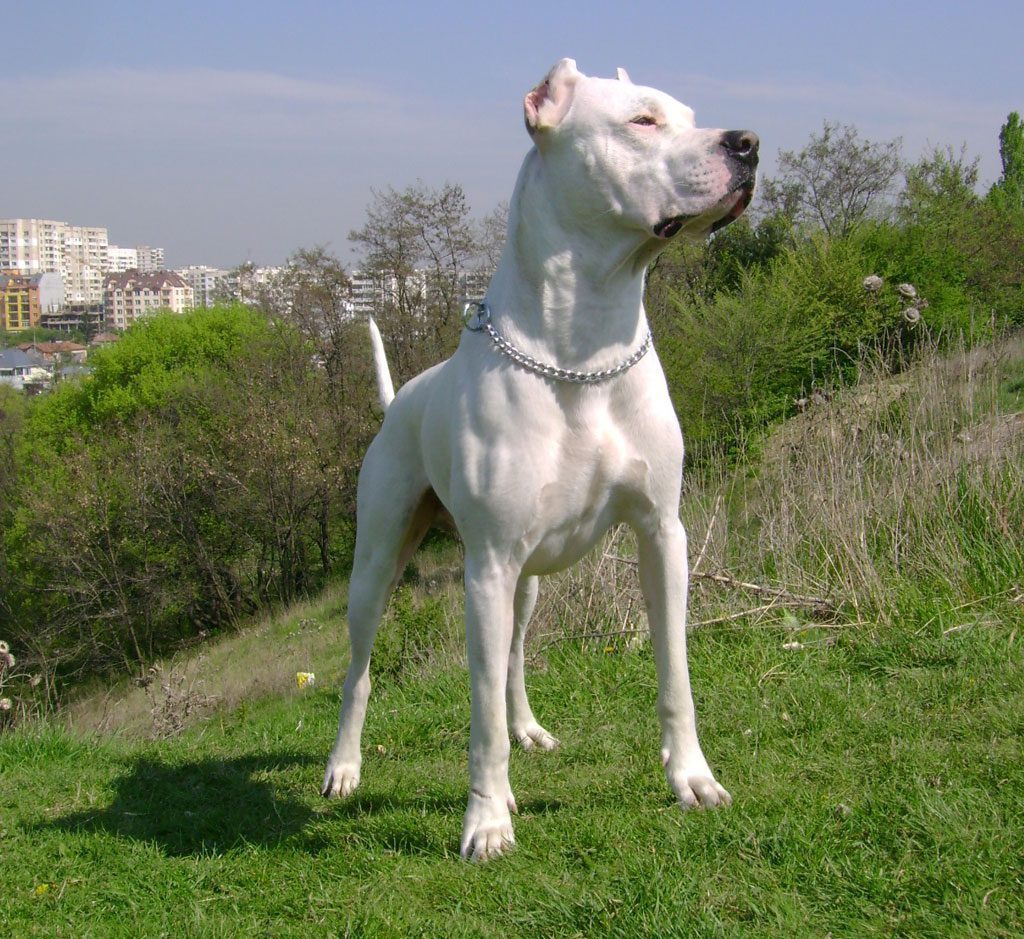
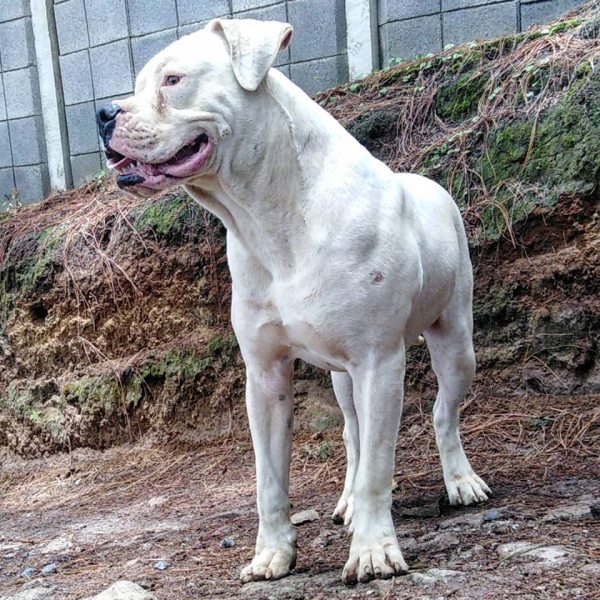
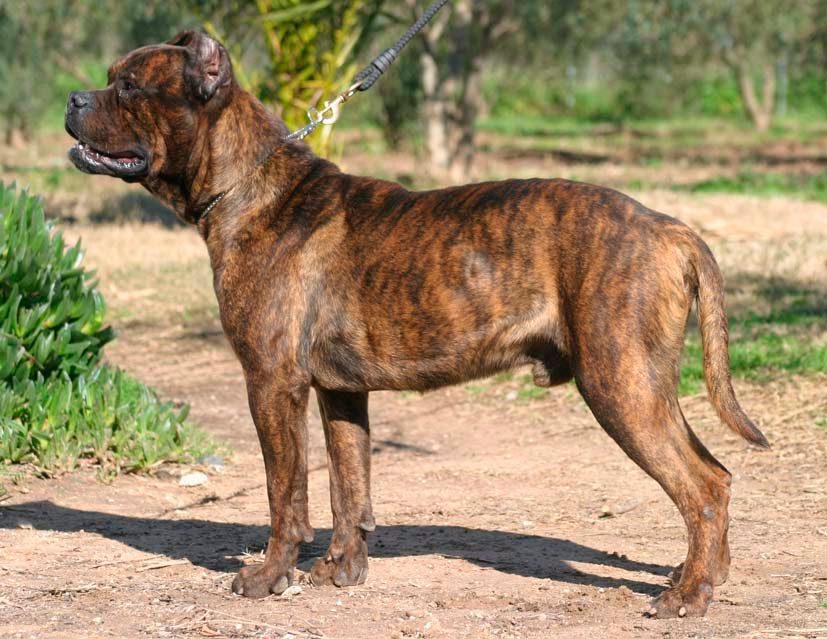
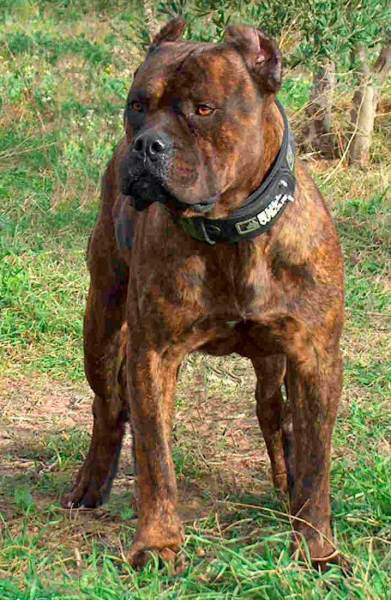
The Dogo Canario, Perro de Presa, Perro de Toro, Alano o Presa Canario – all designations for the same four-legged friend – he is an elegant dog that radiates athletic power. He is an athletic, muscular, elongated but nevertheless typical molosser.

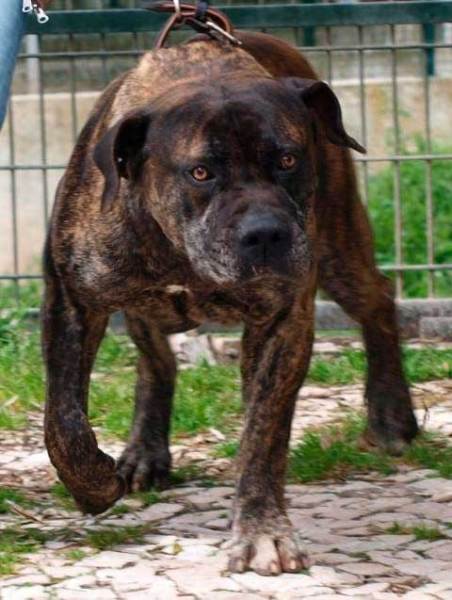
The skull-muzzle ratio is approximately 6:4. The upper lip rests a little flaccidly on the lower one. The eyes, medium-sized, they are oval and hazelnut, the ears, high, they are separated from each other and are shaped like a button; they are only amputated to remember their original function as a combat dog. The neck, long and muscular, shows a slight dewlap. The tail is implanted high: thick at the base, is tuned to the extreme. the belly is retracted, but the last ribs stand out only slightly, giving a harmonious harp shape. Limbs are sturdy, muscular and perfectly plumb; angulation of the hind limbs is not very marked.

The difference between male and female bulldogs desired by the FCI standard is therefore unnaturally large. In any case, desires of this standard for outward appearance should not be taken so seriously.

Because fortunately this originally preserved dog breed, robust and healthy has set its standard โ€œfor itselfโ€, more exactly for their performance at work, and has kept it in the practice of life until today. People, who now wants to put him in a standard of modern pedigreed dog breeding, don't even agree to the principle, as we can see in its history of the breed. Modern pedigreed dog breeding has done no breed of dog any good, both in terms of health and character. In old times, the Bulldog fitted with pleasure to the ears, so that they protruded upwards. This is now prohibited. Today they show large down-hanging ears..

  • Fur: short, without Undercoat, pretty hard.
  • Color: leonado or atigrado. The tabby specimens have a wide range of colors, from very dark to a light gray with a rather cold tone.
  • Size: males, of 61 to 66 cm.; females, of 57 to 62 cm..

Character

The Dogo Canario is a quiet dog, balanced and self-assured. He is a powerful and defensive athlete who can show his performance at any time. Like all molossi, he is extremely kind, has strong nerves and a high stimulus threshold. But, he is more eager to move and not as lethargic as most molossers today bred only as companions. One Dogo Canario well socialized is friendly to people who know and like children. It is very sociable. Towards strangers is at first a little distant without fear. He is an incorruptible guardian, fearless and protective of his family without being aggressive himself. The FCI standard describes the character desired by the breed:

Calm appearance; alert look. It is especially suitable as a watchdog… His temperament is even-tempered and he is very self-confident.. Deep barking. He is docile and kind to his family members and with strong ties to his master, but you may suspect strangers. Self-assured demeanor, elegant and somewhat distant. When you are alert, his attitude is confident and alert.

It must be added that the Dogo Canario rarely barks. But if it barks once, it's pretty awesome.

Fitness

The Dogo Canario is undemanding in terms of external conditions. Of course: a small apartment in the big city would not be optimal for your attitude. But other than that it's easy to maintain. It is also a working dog, a guard, a driver, a hunting dog for hunting wild boar. The Dogo Canario it is suitable as a family dog รขโ‚ฌโ€นรขโ‚ฌโ€นonly on the condition that it is well socialized, well educated and physically fit. You also have to take into account a fact: It is considered a "dangerous dog" in many countries.

Dogo Canario Education

The Dogo Canario can be trained well, but still not a beginner dog. It is intelligent, very sociable and eager to work. But at the same time he is very powerful and assertive. In case of doubt, always the strongest end of the strap. So, his master or caretaker should not leave doubts about his role as leader and this on the basis of natural authority. So this dog will gladly leave the leading role to his bipeds without reservation.. But it must be filled. The Dogo Canario it is even suitable for demanding tasks such as training as an assistance or protection dog. The basic requirement is that it comes from a serious breeder and that it has already been socialized there..

Dogo Canario health and care

The Dogo Canario has no special demands on your care.

Typical diseases

Breed-specific diseases are not known.. Due to his still short career as an official pedigree dog, it can be assumed that the population of the Dogo Canario, Presa Dog or Presa Canario – Whatever this ancient breed of dog is called – enjoys robust health.

Nutrition / Food

The Dogo Canario has no special demands on their diet.

Life expectancy Dogo Canario

There are no reliable figures on life expectancy. Seriously raised, the Dogo Canario should be able to live off 10 to 12 years.

Buy Dogo Canario

Before making a purchase, be aware that the restrictive attitude of the State can cause many problems in daily life and additional financial burdens. The Dogo Canario it is a large and powerful dog that belongs to the hands of an experienced teacher or lover. The cost of a Dogo Canario is of some 1200 EUR.

Characteristics "Dogo Canario"

Coexistence is important that you have with your new friend. Before considering the acquisition of a dog of the breed "Dogo Canario" you know certain factors. Not all breeds of dogs are apt to live in an apartment, you must take into account his character, their need for exercise, their interaction with other pets, their care and if you have small children, their level of tolerance towards them.

Adaptation โ“˜

4,0 of 5 stars (based on 1 review)

friendly dog โ€‹โ€‹โ“˜

1,0 of 5 stars (based on 1 review)

hair loss โ“˜

3,0 of 5 stars (based on 1 review)

Affection level โ“˜

4,0 of 5 stars (based on 1 review)

Need for exercise โ“˜

4,0 of 5 stars (based on 1 review)

Social need โ“˜

1,0 of 5 stars (based on 1 review)

Home โ“˜

3,0 of 5 stars (based on 1 review)

Toilet โ“˜

2,0 of 5 stars (based on 1 review)

Friendly with strangers โ“˜

2,0 of 5 stars (based on 1 review)

barking โ“˜

3,0 of 5 stars (based on 1 review)

Health โ“˜

4,0 of 5 stars (based on 1 review)

Territorial โ“˜

5,0 of 5 stars (based on 1 review)

Cat friendly โ“˜

2,0 of 5 stars (based on 1 review)

Intelligence โ“˜

4,0 of 5 stars (based on 1 review)

Versatility โ“˜

2,0 of 5 stars (based on 1 review)

Child friendly โ“˜

2,0 of 5 stars (based on 1 review)

Surveillance โ“˜

5,0 of 5 stars (based on 1 review)

joy โ“˜

3,0 of 5 stars (based on 1 review)

Images "Dogo Canario"

Photos:

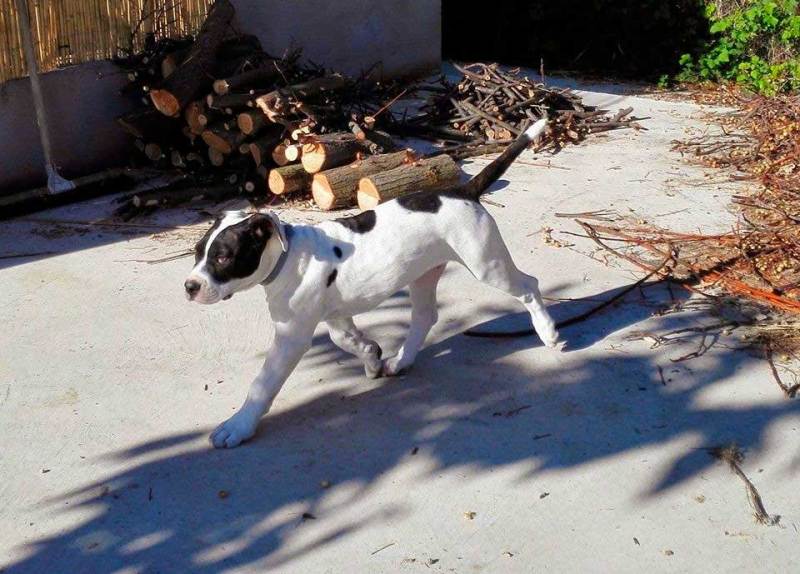
1 – Canarian Presa Dog – Canary Dog by Kamen Rider Snipe / CC BY-SA
2 – Presa Canario dog – Dogo Canario by Basil Dragon / CC BY-SA
3 – Presa Canario by https://pxhere.com/es/photo/732874
4 – Canary bulldog, edited by Canecorsodog (en.Wikipedia) edited by Caronna 12:25, 6 February 2008 (UTC) / CC BY-SA
5 – Zai-Kan de Irema Curtรณ. Canary prey perro byManuel Curtรณ Jr. / CC BY-SA
6 – Presa Canario by Wikipedia
7 – Presa canario dog by https://pxhere.com/es/photo/75916

Videos "Dogo Canario"

Type and recognitions:

  • FCI CLASSIFICATION:
  • Group :
  • Section : . .

Federations:

  • FCI – Pinscher and Schnauzer-Molossoid type dogs – Swiss Mountain Dogs and Cattledogs. Section 2.1 Molossoid, mastiff type. โ“˜
  • AKC – FSS โ“˜
  • UKC – Watchdog โ“˜

FCI breed standard "Dogo Canario"

Origin:
Spain

Date of publication of the valid original standard:
26.11.2018

Use:

Guard dog and caring for cattle.


General appearance:

Large Medium-sized Molossoid Dog, straight profile and black mask. Robust and well proportioned.

IMPORTANT PROPORTIONS: The body is longer than its height at the withers. This characteristic is more pronounced in females..

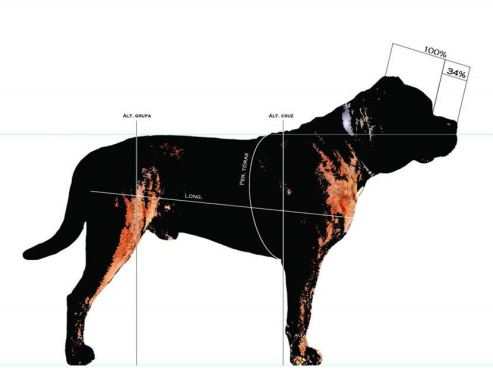
The ratio of the skull to the antecara is 60-40 %. The width of the skull is 3/5 the total length of the head. The distance from the elbow to the ground must be 50 % height at withers in males and somewhat less in females.


Behavior / temperament:

calm look, attentive expression. Especially suitable as a guard dog and traditionally used to care for livestock. Balanced temperament and very self-confident. Low and deep bark. Obedient and docile with family members, very devoted to his master but can be reserved with strangers. Confident fitness, noble and somewhat distant. When he is alert his posture is firm with an alert attitude.

Head:

Solid, brachycephalic and compact in appearance covered in thick skin. Its shape tends towards a slightly elongated cube. The skull lines- facials are parallel or slightly convergent.

Cranial region:
  • Skull: Somewhat convex in anteroposterior and transverse direction. The frontal bone tends to be flat. The width is almost identical to its length.
    Pronounced zygomatic arches with well-developed but not prominent cheek and jaw muscles, covered in loose fur. Occipital bump only slightly marked.
  • Stop: The stop is pronounced but not abrupt. The fold between the frontal lobes is well defined and approximately two thirds the size of the skull.

facial region:

  • Truffle: Wide, heavily pigmented black. In the same line of the muzzle. Large nostrils to facilitate breathing.
  • Snout: Shorter than the skull, usually about the 40 % of the total length of the head. Width is 2/3 the width of the skull. Its base is very wide, slightly tapering towards the nose. Flat, straight nose without grooves.
  • Lips: The upper lip is hanging but not excessively. Seen from the front, the upper and lower lip join forming an inverted V. The edges are slightly divergent. The inside of the lips is dark.
  • Jaws / Teeth: Scissor bite or slightly prognathic bite, max. 2 mm. Tweezer bite is accepted but not desired due to tooth wear. The canines have a wide transverse distance. Teeth are wide with strong implantation base. Large molars, small incisors and well-developed canines.

EYES: Slightly oval, medium to large. Placed well apart but never sagging or protruding. Tight black eyelids, never fallen. Color varies from dark to medium brown depending on coat color. They should never be clear.

EARS: Medium size, set well apart with short fine hair. Naturally fall on both sides of the head. If they are folded they are shaped like a rose. Its insertion is slightly above the level of the eyes. Ears with a very high insertion or close together are considered unusual. In countries where amputation is permitted, they must be erect..

Neck:

Shorter than the length of the head. Skin on the lower part loose forming a slight dewlap. Solid and straight, tends to be cylindrical and muscular.

Body:

Long, wide and deep.

  • top line: Straight, without deformations supported by well-developed but poorly visible muscles. Rising slightly from the cross to the rump. The height at the rump is 1 โ€“ 2 cm greater than the height at the withers.
  • Rump: Average length, wide and rounded. It should not be long because it would limit your movement.. Females are usually wider.
  • Breast : High capacity and well-defined pectoral muscles. Seen both from the front and in profile, it must be lowered, at least down to elbow level. Chest circumference is generally equal to the height at the withers plus 45 %. Well arched ribs.
  • Bottom line and belly: Slightly collected and never lowered. The flanks only slightly pronounced.

Tail:

Thick at the base tapering towards the tip, reaching no further than the height of the hock. Middle insertion. During movement it lifts it in the shape of a saber but without stooping or leaning on the back. At rest it hangs right with a slight curve towards the end.

Tips

PREVIOUS MEMBERS:

  • Shoulder: With good inclination.
  • Arms: Well angled, oblique.
  • Forearm: Well balanced, straight. Strong bones and good musculature.
  • Elbows: They must not be glued to the ribs or open outwards. Metacarpus: Very solid and slightly inclined.
  • Previous feet: Cat foot with rounded toes, not very close.
    The foot pads are highly developed and black. Nails are dark. White nails should be avoided although it can happen according to the coat color.

LATER MEMBERS:

  • General appearance: Seen from behind strong and parallel without deviations.
  • Thighs: Long and very muscular.
  • Knee: Angulation is not very pronounced but should not be insufficient.
  • Metatarsals: Always well descended.
  • Hind feet: Slightly longer than the front ones and with similar characteristics.

Movement:

During movement, the Presa Canario is agile and elastic, covering the terrain well. Long step. The tail is brought down and the head is only slightly raised above the level of the back. When you are alert, the tail and the head are carried high.

Mantle

SKIN: Thick and elastic. Looser over and around the neck. When alert, the skin over the head forms symmetrical folds that form from the fold between the frontal lobes..

  • Fur: Short, rough, smooth without undercoat (may appear on the neck and on the back of the thigh). Rather rough to the touch. Very short and thin on the ears, slightly longer on the withers and on the back of the thighs.
  • Color: All shades from fawn to sand, from dark brown to light gray or blonde. All shades from tabby to sand. White marks are accepted on the chest, at the base of the neck or throat, front feet and back toes but this should be minimal. The mask is always black and should not be spread above eye level.


Size and weight:

Height at the withers:

  • Males: 60 to 66 cm..
  • females: 56 to 62 cm..

In the case of very typical specimens, 2 cm tolerance above or below limits.

Minimum weight:

  • Males: 50 Kg.
  • females: 40 kg.

Maximum weight:

  • Males: 65 kg.
  • females: 55 kg.


Fouls:

Any deviation from the aforementioned criteria is considered as a fault and the severity of this is considered to the degree of the deviation to the standard and its consequences on the health and well-being of the dog..

Bite in clamp

SEVERE FAULTS:

Any fault is considered severe when it affects the expression and limits the type of dog..
Incorrect head proportions
Extremely convergent craniofacial lines (stop too steep)
Loin and cross at the same height
Incorrect limb position
Square profile.
Triangular head, close (not cube)
Fine tail, threaded. High insertion.
Sunken or soggy back.
light eyes (yellow), very close to each other or oblique, sunken or bulging
Excessively prognathic bite.
Insufficient mask.
Absence of teeth (Except P 1)

FALTAS DESCALIFICANTES:

Aggressiveness or extreme shyness.
Any dog โ€‹โ€‹showing clear signs of physical or behavioral abnormalities.
Totally nonpigmented nose.
White marks not accepted.
Bite: enognรกtica.
Croup lower than the cross. Sloped top line.
Blue eyes or with tonal difference.
amputated tail.


N.B.:
  • Males should have two normal-appearing testicles fully descended into the scrotum..
  • Only functionally and clinically healthy dogs, with the typical conformation of the breed, should be used for parenting.

    TRANSLATION: Brรญgida Nestler

Technical supervision: SR. Miguel Angel Martinez

Source: F.C.I - International Cynological Federation

Alternative names:

1. Canary Mastiff, Canary Catch Dog, Canarian Dogo, Presa Canario.Dogo Canario, Presa (English).
2. dogo Canario (French).
3. Presa Canario, Kanarische Dogge (German).
4. Perro de presa canรกrio, Dogo canรกrio (Portuguese).
5. Perro de presa canario (espaรฑol).

โ–ท The world of Pets: Dogs, cats, birds, reptiles, amphibians

Majorca Mastiff (Majorcan mastiff dog)
Espaรฑa FCI 249 - Molossoid - Dogo

The Majorca Mastiff is a gentle dog, extremely affectionate with their owners, faithful to his master

Ca de Bou

Content

Characteristics "Majorca Mastiff (Majorcan mastiff dog)"

Coexistence is important that you have with your new friend. Before considering the acquisition of a dog of the breed "Majorca Mastiff (Majorcan mastiff dog)" you know certain factors. Not all breeds of dogs are apt to live in an apartment, you must take into account his character, their need for exercise, their interaction with other pets, their care and if you have small children, their level of tolerance towards them.

Adaptation โ“˜

5,0 of 5 stars (based on 1 review)

friendly dog โ€‹โ€‹โ“˜

2,0 of 5 stars (based on 1 review)

hair loss โ“˜

3,0 of 5 stars (based on 1 review)

Affection level โ“˜

2,0 of 5 stars (based on 1 review)

Need for exercise โ“˜

4,0 of 5 stars (based on 1 review)

Social need โ“˜

2,0 of 5 stars (based on 1 review)

Home โ“˜

3,0 of 5 stars (based on 1 review)

Toilet โ“˜

2,0 of 5 stars (based on 1 review)

Friendly with strangers โ“˜

3,0 of 5 stars (based on 1 review)

barking โ“˜

3,0 of 5 stars (based on 1 review)

Health โ“˜

3,0 of 5 stars (based on 1 review)

Territorial โ“˜

5,0 of 5 stars (based on 1 review)

Cat friendly โ“˜

2,0 of 5 stars (based on 1 review)

Intelligence โ“˜

4,0 of 5 stars (based on 1 review)

Versatility โ“˜

3,0 of 5 stars (based on 1 review)

Child friendly โ“˜

4,0 of 5 stars (based on 1 review)

Surveillance โ“˜

5,0 of 5 stars (based on 1 review)

joy โ“˜

4,0 of 5 stars (based on 1 review)

History

The Majorcan mastiff dog, also known as Majorca Mastiff in Catalan or Perro de presa mallorquรญn in Spanish, is a fairly old dog whose history remains unclear.

It is believed to have originated from a number of races, especially the Spanish Mastiff and the Alano, that crossed over the centuries.

The result of these crosses came to Mallorca in the thirteenth century, specifically in 1229, during the conquest of the island by King James I of Aragon. Some of these dogs remained there and were bred with local dogs.. The resulting individuals turned out to be much less sensitive to heat and adapted very well to local conditions. They began to be used by the local population to monitor houses and livestock.

It was also in the thirteenth century when the butchers of the island found in the dog an assistant for his ability to control livestock, especially bulls, before and during their sacrifice. In fact, his powerful jaw made him able to keep them immobile by holding them firmly by the nose.

At the same time, it was also used by the Knights of Malta in battle and to guard the camps. It also, he was unrivaled in his ability to breach enemy camps, which greatly facilitated the assaults.

In 1713 the Treaties of Utrecht are ratified, which put the island of Mallorca under British rule. The English then introduced their own guard and fighting dogs in the Balearic Islands. Mallorcan dogs were bred with the Bulldog, and the result of these crossings was called "Ca de Bou", which is a translation of the English word ยซBulldogยป ("bull" means bull) in Catalan. This name reflects the main use given to it. In fact, at the beginning of the 18th century, the bull-baiting, show in which a pack of dogs had to kill a bull, it was widespread and very popular in England, and the English did not stop importing it to Mallorca.

The Majorca Mastiff they also began to hunt wild boar and deer. It was also used for many years as a watchdog on ships, especially in case of pirate attacks, and sometimes you ate when there was nothing to eat.

Following the ban on bull hunting in 1835, was limited to two main functions: watchdog and hunter.

An eventful twentieth century

In the early 20th century, the Majorcan mastiff dog became better known. The first written record of the breed dates from 1907.

In 1923, the first representative of the breed was inscribed in the Spanish studbook. One year later, in Barcelona, made his first appearance at a dog show.

But, its development was greatly hampered by the famines of the decades of 1920 and 1930. Then, like many other breeds, was affected by World War II. Its population declined considerably throughout the period.

However, in 1946 a breed standard was developed, but it was not recognized by the International Cynological Federation (FCI) until about twenty years later, in 1963. But, by then there were probably no more left Majorca Mastiff pure. It also, the interest of breeders and individuals had largely shifted to other breeds that were expanding rapidly at the time, as the Great Dane, the German Shepherd and the Rottweiler.

In the Decade of 1980, the Majorca Mastiff, as it was known after the war, actually ceased to exist, especially due to the numerous crosses with Mallorcan sheepdogs (Ca de Bestiar). The latter came from the same region as the Majorca Mastiff and they brought their brindle coat. But, these unions substantially modified the characteristics of the Majorca Mastiff, so that it gradually moved away from the description given in the official standard.

But, passionate and determined breeders tried to save the breed and ensure that it kept the characteristics as close as possible to the registered standard. They set out to find individuals as close as possible to their ancestors. Two specimens called Tito and Anastasia (father and daughter, respectively), who were the first individuals considered sufficiently similar to the Majorca Mastiff of yesteryear. Its union and crossing with other crossed dogs on the island helped to resurrect the breed from a solid base. But, the number of breeders is still very low and the breed remains confidential. The specimens obtained did not leave the island and were reserved for the national market., where they were highly coveted for dogfighting.

In 1992 dogfighting was banned in the Balearic Islands, and it was then that the breed began to be exported slowly. The opening to the international market also allowed the introduction of new breeders in the lines, in order to expand the genetic heritage of the breed; they were both subjects of unknown origin with physical traits similar to the race, as hybrids of Majorcan mastiff dog.

These exports gave rise to numerous hatcheries in a wide variety of countries., where the Majorca Mastiff It is used both as a companion dog and as a guard dog.. In fact, it can be said that it was the export of the breed that almost saved it, since in Mallorca itself it is now only present in very limited numbers.

The recognition and popularity of the โ€œMajorcan Bulldog Dogโ€

In the last decades, the reputation of the Majorcan mastiff dog has increased and their number has grown in many countries, but there is still a long way to go. In fact, its recognition by the main canine organizations in the world is still very partial, which obviously limits its visibility and dissemination.

In France, in the first decade of the twenty-first century, went from a handful of records a year to about fifty, and then the number skyrocketed in a few years, until exceeding 200 annual births in 2014. Since then, has hovered around this value.

Further east, countries such as Poland and Russia have welcomed a good number of representatives of the breed since the beginning of its international spread. Some even claim that over the years 90 there were more than 2.000 Majorca Mastiff only in the city of Moscow. This is likely to be unfounded, but the fact is that it was quickly appreciated there, and still appreciated.

It is also especially popular in Puerto Rico, where there is a prestigious locally developed lineage, which was created from the Spanish champion Chimo and other quality specimens that were sent there.

There are also several representatives of the breed in Holland, Denmark, Finland and Sweden. But, this is still quite embryonic, as evidenced by the low number of breedings in these countries.

In United States, the Majorcan mastiff dog It was recognized in 2006 by the United Kennel Club (UKC). But, the other reference organization in the country, the American Kennel Club (AKC), has not yet taken the step. Further north, the Canadian Kennel Club (CKC) he doesn't recognize it either. In fact, in North America, both the reputation of the breed and its diffusion are still very low.

In the United Kingdom, where it was introduced in 2001, it is also not recognized by the prestigious Kennel Club (KC).

In Spain, not only on the island of Mallorca the Majorca Mastiff is discreet. In fact, the Royal Canine Society of Spain (RSCE), the main canine organization in the country, received less than 50 enrollment requests per year to mid-year 2010, figure that was even reduced to less than 20 at the end of the decade.

Physical characteristics

He has a bulky head, solid and the skull is wide. The eyes are oval and somewhat oblique; in the color, the more dark best. The ears are short and played backwards. The body is a massif with included belly. The forelimbs are strong and the tail reaches to the Hock. The coat is short and rough.

The favorite colors in your order are: the striped, the Fawn and black. In the striped prefer the dark tones in the leonados the intense nuances. The white spots are admitted in the previous members, chest and tolerated up to a maximum of 30 % the surface of the body. The black mask is also supported.

The Ca de Bou or Majorcan Dogo, It is a dog reserved and suspicious with strangers. It has an extraordinary adaptation, but it is not a dog to place in any hand. Their education and socialization should be initiated as soon as possible because the breed is naturally dominant.

The care of the fur is a simple weekly brushing and a regular cleaning of the ears and eyes. It is a rustic dog that adapts well to changes in temperature and withstands inclement weather well..

Character and skills

Although the Majorca Mastiff it has been used in its history for quite violent tasks, like bull hunting, the slaughter of bulls or the fighting of dogs, he is surprisingly very affectionate and has an excellent temperament. In fact, tends to create a very strong bond with his family.

They will do anything to protect their family and are very good watchdogs.. In fact, has a strong protective instinct and is very suspicious of strangers. But, although it can be impressive and dissuasive when needed, he only shows aggression when he feels his family is in danger. On the other hand, when dealing with people you don't know, he is always cautious, but he refers to his teacher to determine whether or not they are to be trusted. If the landlord invites someone you don't know to the house, will normally keep distance, but will not intervene in an untimely or even aggressive way. However, good socialization is necessary from an early age to avoid excessive distrust of all strangers.

Fits well with children, with whom he is patient and kind. He is even-tempered and likes spending time playing with them as much as being quiet on the couch. But, as with any dog รขโ‚ฌโ€นรขโ‚ฌโ€นof any breed, should never be left alone with a young child without adult supervision. This is especially true because it is relatively heavy and can easily push or knock over a young child..

On the other hand, the Majorca Mastiff tends to get along very well with other dogs, both with those who share their home and with those who are on a walk. But, if the dog is a male and is in the presence of another male with a dominant temperament, a rivalry relationship may develop. So, it is better to avoid this type of coexistence and to take precautions to avoid any fight when you meet other dogs, in particular doing gradual introductions.

As they don't have a strong hunting instinct, his relationships with small animals, as cats, rodents or birds, they are usually quiet. If you have to live with them on a daily basis, the ideal is to present them as soon as possible, but his great sociability makes it possible to integrate newcomers into his house even if he has always been the only animal.

Perhaps because it has been used to being used in so many ways and in so many different environments throughout its history., the Majorcan mastiff dog is generally very adaptable, so much so that it is possible that he lives in a flat. But, for your well-being, it is better that I live in a house with a garden, since he likes to run and exercise a lot. To feel good on its legs and on its head, usually needs an hour of activity a day, which can consist of walks or games in the garden. In any case, long daily outings are essential if you don't have access to a garden. They are always happy to accompany their owners on walks, and are well suited to active and sporty families. An elderly or very sedentary person, on the other hand, may not satisfy your need for activity and would be better off with another breed.

In addition to participating in the activities of their owners, can, of course, distinguish yourself in various dog sports such as agility, el cane-cross, The tracking, the RCI or the ring. It can even be made to pull a light trolley that the children sit in..

In any case, considering his past as a working dog, to the Majorca Mastiff he likes to be assigned tasks. These may include, takes his role as guardian very seriously: although it is not necessarily obvious at first glance, always watch out for the slightest noise or movement, and shows great reactivity. In general, Giving him chores to do and keeping him busy is the best way to ensure he thrives..

Once you are in your right mind, the Majorcan mastiff dog it is quiet and very quiet. He is not one of those who annoys the neighbors, he just barks in his role as guardian, that is to say, when a stranger enters your territory and tries to show you that you better leave.

Nor is he one of those who let themselves be heard when their owners are not: although he especially likes to be in contact with them, knows how to stay alone without suffering separation anxiety.

In summary, as long as he is well socialized and educated, and as long as you have enough opportunities to exercise, the Majorcan mastiff dog it is a fairly easy dog รขโ‚ฌโ€นรขโ‚ฌโ€นto carry. It is even an ideal breed choice for those who wish to acquire their first Molossian type dog., since it does not constitute a danger for his family and he is also very sociable with other animals in general.

But, this is only possible if the dog's place in the family hierarchy is perfectly clear and, Therefore, if he has a master who knows from the beginning how to position himself as a leader and how to be strict when necessary. Although the Majorca Mastiff it is quite easy to train and handle compared to other similar breeds, still a giant, so it is better that it is in the hands of a person who already has some experience in dog training.

Education

The Majorcan mastiff dog is an independent and determined thinker. So, can be very overbearing if not confronted by an experienced dog training person, who knows how to show both firmness and consistency to behave as a leader and make his dog understand who is the master.

So, your education should start at an early age, when it is still more impressionable, to lay the foundations on which the coexistence will be based throughout his life. As such, you have to be firm, but also soft, at the risk of antagonizing him or damaging the quality of his relationship with his owners.

The latter must also show some coherence: the rules should not only be fixed in time, but also from one person to another, that is to say, everyone should be in phase on what the dog is or is not entitled to do. The dog did not understand why one person allowed him to get on the sofa when another had strictly prohibited it the previous time.

As long as these conditions are met throughout the education of the Majorcan mastiff dog, things are going well; it is easy to carry and learns quickly.

This is even more true if your teacher is in charge of organizing small training sessions and asking you to do various things.. In this way, stays focused all the time, instead of boring you and losing your attention with long and repetitive sessions.

Learning is also easier and more enjoyable for everyone when the owner opts for methods based on positive reinforcement., that is to say, rewarding (with a word of encouragement, a caress, a treat…) good behavior and ignoring bad. In fact, punishment-based techniques quickly frustrate the dog, and an operation based on the constraint, although it may work in the short term, usually limits the prospects for evolution, or even counterproductive - or even dangerous- long-term. The Majorca Mastiff he is not one of those who turn against his master, but if he is brutal with him and uses bad methods, You may end up responding to what you perceive as assault with an equally violent reaction.

Last, all dogs benefit from being socialized as soon as possible, but this is especially true for the Majorcan mastiff dog. In fact, his developed instinct for protection generally leads him to distrust strangers and, Therefore, to be especially reserved with them. Not the type to get unnecessarily aggressive towards them, but it is preferable to ensure that you do not show an excessive reserve every time a visitor arrives at your house. As such, nothing like making him meet a wide range of people in all kinds of situations from his first months, so that little by little you will better accept the confrontation with strangers. The same goes for exposure to other dogs and animals of all kinds, as well as to all kinds of environments and stimuli (noises, smells, etc.). The sooner and more intensely a dog is socialized, the easier it will be for you to move around in the human world, whatever the circumstances.

Health

The Majorcan mastiff dog generally in very good health and predisposed to few problems., it is a very resistant dog in general.

This also applies to temperatures., used to the quite hot climate of the island of Mallorca, it is very resistant to high temperatures., not very sensitive to cold either, although this is really not a common thing in his homeland.

Among the diseases to which you are particularly predisposed, we can mention: brachycephalic syndrome, which affects dog breeds with flattened nose and short nose. In effect, This anatomical peculiarity notably translates into narrow nostrils and an excessively narrow nasal cavity, which implies respiratory failure, manifested especially during physical exertion and / or in case of strong heat. It can also be the cause of various digestive problems (vomiting, etc.). If the most serious cases must be treated by means of a surgical act to increase the respiratory capacity of the animal, most of those affected live in a more or less normal way as soon as their owner saves them from too intense physical effort (above all, especially when it's hot or humid) and carefully monitor your diet to avoid being overweight (a problem the breed is not particularly prone to).French Bulldog or the Pug;

  • The Hip Dysplasia, joint malformation in which the femur is not correctly positioned in the pelvic cavity of the hip joint, causing pain and lameness, as well as osteoarthritis as we age. Is problem, whose appearance is often favored by a hereditary predisposition, can be treated or alleviated by surgical intervention;
  • The dilation-torsion of the stomach, a problem that particularly affects medium-large dogs. It can happen especially when the animal ingests large amounts of food too quickly. It consists of sudden and excessive swelling of the stomach, that folds on itself;this blocks the evacuation of gases and interrupts blood circulation. Without prompt medical intervention, dog death occurs quickly;
  • The entropion, where the lid of one eye turns inward in contact with the eyeball. This problem can be inherited and causes severe irritation to the eye.. It is quite possible to remedy this by surgery;
  • The ectropion, corresponding to a curl defect of the lower eyelid. Then, the eye is no longer adequately protected, causing more or less severe irritation and conjunctivitis. Once again, this condition can be inherited and can be cured with surgery.

Although the breed is not predisposed to a large number of diseases, it is important to go to a breeder of Majorcan mastiff dog serious and competent. In effect, this allows the adopted puppy to have benefited from a good living environment and good socialization from its first weeks, but also and above all to maximize the chances that you enjoy good health and the rest. In fact, a serious breeder avoids breeding a dog with a hereditary defect such as Hip Dysplasia., because there would be a significant risk of transmission to young people. If you do not present them spontaneously, as should be the case, you should be asked for the results of the corresponding tests carried out on the parents or the puppy.

You must also always be able to provide a certificate of good health of the puppy prepared by a veterinarian, as well as a health or vaccination record, that proves that the child has received all the necessary vaccines. Once the animal has returned to its new home, should never be forgotten, during the following months, that is still growing and, therefore, particularly fragile. Thus, until I am about a year and a half, it is important to avoid any physical exercise that is too intense or too long, otherwise your joints or bones could suffer seriously. Or even end up presenting developmental defects that can incapacitate him throughout his life. This is all the more true as Majorca Mastiff is predisposed to Hip Dysplasia.

Last, even once this growth period has passed and the animal has become an adult, it is important to always pay attention to your health. As such, nothing substitutes for a complete check-up at a vet at least once a year, to ensure that no problem appears that cannot be detected by an inexperienced person. These regular appointments also offer the opportunity to be reminded of your vaccinations., so you never stop being protected. It should also be used against internal and external parasites, so it is up to your teacher to renew your antiparasitic treatments whenever necessary, throughout the year.

Life expectancy

11 years

Grooming

The Majorca Mastiff it is an easy breed to care for, and this is especially true for their fur. A weekly brushing is more than enough to keep it in good condition. But, not so during moulting periods, in spring and autumn: much more must be done each day, to allow good removal of dead hairs.

It also, as it is not dirty or smells bad, rarely need a bath. Unless it was especially dirty during an outing or in contact with toxic material, do it 2 or 3 times a year is more than enough. It may also be wise to do this at the same time as your seasonal shedding to save time during these periods., since it removes a good amount of dead hair. In any case, always use a shampoo specially developed for dogs, since the pH of your skin is different from that of human skin.

It also, although their ears are not especially prone to infection, they should be checked and cleaned once a week to prevent dirt or moisture from accumulating that could cause infection.
Your eyes are also not immune to infection, so you also have to check and clean them weekly to prevent dirt from accumulating.

Brushing your dog's teeth is also a good habit that should be established at least once a week, making sure to use a dog-specific toothpaste each time. This helps prevent plaque formation., which can cause serious health problems when it turns into tartar. If possible, it is advisable to opt for an even higher frequency, even daily.

As for the claws, this adaptable dog wears them down to a greater or lesser extent, according to the activity level of your family and your living environment. A dog that walks and spends a lot of time a day does not need to have its nails trimmed manually, since they file themselves, especially if it is on a hard surface like asphalt. But, if the dog lives in a flat and is not very active, it needs to be trimmed regularly. Too long claws can be very annoying for the dog, especially when traveling. It also, if they break, they can hurt the dog. In fact, as soon as the friction with the hard ground is heard, they have become too long and have to be cut.

Whether the fur, the ears, the eyes, teeth or claws, grooming your dog requires a minimum of precision and vigilance. If you don't, not only can you fail in grooming your dog, but it can hurt you, or even injure it. So, the first time it is best to seek the advice of a veterinarian or professional dog groomer, and learn from him how to take care of his Majorca Mastiff.

The sooner you train your dog, the better it will be for the rest of your life.

Food

Feeding a Majorcan mastiff dog it is not an arduous task: is perfectly fine with a balanced, quality industrial diet. Homemade rations are another perfectly adequate option, as long as they are well composed and, Therefore, are able to meet your nutritional needs. As such, should consist mainly of meat, but they can also contain large bones, remains, vegetables and rice.

In any case, the amount given must be consistent with his age, your health and the amount of physical exercise you get on a daily basis.

It also, the fact that it is prone to dilation-torsion of the stomach means that some precautionary rules should be observed when feeding the Majorcan mastiff dog. So, it is essential to divide your daily ration into at least two meals, and that these be taken in stride. It also, should not be preceded or followed by any intense or prolonged activity for an hour.

Although this breed is not very prone to obesity, it is important to regularly monitor the dog's weight. In fact, no one is immune to sudden and significant weight gain, especially after sterilization. Weighing your dog about once a month will allow you to quickly spot any unexplained deviations, so that you can take your dog to the vet if the deviation is confirmed or even increased during the following measurements. In fact, only a health professional can make a reliable diagnosis and indicate how to remedy the problem, because diet and lack of activity are not the only possible causes of being overweight: it can also be caused by illness or a reaction to treatment.

Last, like all dogs, the Majorca Mastiff a bowl of clean, fresh water should always be available to you.

Price

The Majorcan mastiff dog can be found at various prices. In all cases, the latter depend, in particular, of the reputation of the kennel, from the line the pup came from, but also of its intrinsic qualities, in particular of their physical qualities, especially of its greater or lesser conformity and its color.

In fact, the brindle color is the most sought after in this breed, what can explain the price differences, sometimes substantial, even within the same litter.

In Spain, the average price of a companion puppy is around 700 EUR. Obviously, like in other places, can be much higher for the best subjects. Those sold with a confirmation guarantee, whose attributes will allow them to be exhibited in dog shows or used as breeders, can reach much higher sums, up to several thousand euros.

Majorca Mastiff Images

Videos Ca de Bou

Type and recognitions:

  • FCI CLASSIFICATION:
  • Group :
  • Section : . .

Federations:

FCI โ“˜, UKC โ“˜

FCI breed standard "Majorca Mastiff (Majorcan mastiff dog)"

Origin:
Spain

Date of publication of the valid original standard:
11.12.1996

Use:

Guard and defense dog


General appearance:

Race typically molosoid, slightly elongated, strong and powerful. Medium rise, with marked sexual differentiation in cranial volume, higher in the male than in the female.


Behavior / temperament:

Quiet nature, that demonstrates bravery and courage, being sociable to the humane treatment and faithful and grateful to its owner. In the work of guard and defense, acts as an unbeatable guardian. At rest he appears confident and self-assured.; being alert, his gaze is penetrating.

Head:

Strong, solid

Cranial region:
  • Skull: Grand, width, tending towards the square, with a larger perimeter than the size at the withers, essentially in males. Wide front and flat, with well-marked front Groove; front, skull shape belies the occipital. The upper line of the skull and the supranasal line are almost parallel, with slight convergence.
  • Depression links (Stop): Profile, well marked and outstanding. Head on, perceptible only by the superciliary arches that delimit a clear frontal furrow.

facial region:

Very strong and prominent jaw muscles, developed up to the average level of eyes, and although it has some wrinkles on the sides of the masseter, It can be said that, in general, of the head do not skin wrinkles.

  • Truffle: Black and wide. Between the Windows you have well defined filter.
  • Snout: Born from the inner corner of the eyes, wide, tapered, Recalling a truncated cone of base profile broadband; with straight and slightly ascending supranasal line. The length of the muzzle must be in relationship 1/3 with respect to the head.
  • Lips: Upper lips are superimposed on the lower half of the snout, where it appears the labial commissure. The top is rather picked, While the lower retracting at its Center, and no they highlight is the lips when the mouth is closed. Oral cavity with marked striae and black gum edges, the rest of your mouth Red.
  • Jaws / Teeth: Powerful JAWS with well aligned incisors, Canine something separate, White complete teeth and strong with bite prognata; without being excessive this lower prognathism, It should be a maximum of one centimeter. They shall never see teeth with mouth closed.
  • Eyes: Large, oval, with opening wide, steep and somewhat oblique, color as dark as possible relative to the layer, without let see the conjunctiva; seen from the front can't see white ; situated low and far apart.
  • Ears: High and lateral deployment, rather small and pitches back and curved, showing the ear ; the guy named rosa. At rest the end of the ear lies at a level below the eye.

Neck:

Strong, thickness and provided, at his birth he has a similar to the diameter of the head width ; well linked with the cross. Something loose skin, being a thin dewlap permitted.

Body:

  • Kidneys and flanks: Short, relatively narrow and forming an arch pronounced to the rump.
  • Rump: Approximately from 1 to 2 cm taller than the cross, inclined at about 30ยฐ from the horizontal, somewhat narrower than the thorax.
  • Chest: Rib something cylindrical, deep up to the height of the elbows, width to the height of the cross, due to the separation of the shoulder blades.
  • Lower profile: Parallel to the ground chest, Belly gently up and collected, never agalgado.

Tail:

Implemented low, thick at its root, it thins to its end that reaches the hock, and finished in tip; during rest falls naturally, while in action it arches slightly and is arranged at the level of the dorsal line.

Tips

PREVIOUS MEMBERS:

  • Shoulder: Moderately short, some prominent and slightly oblique.
  • Arms: Straight, plumb and separated from each other.
  • Elbows: Separated due to the breadth of chest, but never open.
  • forearms: Well muscled, straight and thick bones.
  • Previous feet: Strong, with fat fingers, slightly round and well United; lightly pigmented pads.

LATER MEMBERS: Muscled, longer than the previous ones.

  • Thighs: Long ; natural joints.
  • Hocks: Short, straight and strong. Undesirable Spurs.
  • Hind feet: Strong, with fat fingers longer than the previous toes, presenting its oval shaped joint; preferably pigmented pads.

Movement:

The typical gait of the breed is the trot.

Mantle

Rather thick, firmly attached to the body, except in the neck, It can form slight double chin.


COAT

  • HAIR: Short and rough to the touch.
  • COLOR: Striped, black & Fawn, desirable in this order. For the atigrados dark tones are preferable; tawny in intense colors.

white spots are allowed in forefeet, chest and muzzle, up to a maximum total of a 30%. Also supports the black mask.


Size and weight:

Height to the cross:

  • Males of 55 to 58 cm.
  • females of 52 to 55 cm..

Weight:

  • In males ranges from the 35 to 38 kg
  • In females ranges from the 30 to 34 kg.


Fouls:

Any deviation from the aforementioned criteria is considered as a fault and the severity of this is considered to the degree of the deviation to the standard and its consequences on the health and well-being of the dog..


SERIOUS FAULTS

  • Individuals whose height at the withers is higher than the rump.
  • Inferior prognathism that is greater than one centimeter.
  • Scissor bite, or clip.
  • Lack of two premolars.
  • Individuals who do not have ears in pink, This is glued together and flat ears to the face ; and with ears erect on its base, still being in pink in its final third.
  • Queue type bulldog.
  • Any other fault that its gravity apart from the standard.

MISS PLAYOFFS

  • Aggressive or fearful dog.
  • Upper prognathism.
  • Eyes clear and yellow.
  • Amputated ears or tail.
  • White color more of 30% in parts of the body that are not above feet, chest and muzzle.
  • Any other colouring stains.

INDICATIVE MEASUREMENTS IN A STANDARD DOG

  • Weight 36 kg
  • Height at Croup 58 cm.
  • Height in cross 56 cm.
  • Chest perimeter 78 cm.
  • Head circumference 59,5 cm.
  • Distance occipital to the birth of the tail 73 cm.
  • Distance of the occipital to snout 22 cm.
  • Distance from the muzzle to the frontal trough 8 cm.

Any dog โ€‹โ€‹showing clear signs of physical or behavioral abnormalities must be disqualified..


N.B.:

Males should have two normal-appearing testicles fully descended into the scrotum..

Source: F.C.I - International Cynological Federation

Alternative names:

1. Mallorquin Mastiff, Mallorquin Bulldog, Silverback (English).
2. Dogue de Majorque (French).
3. Ca de Bou (German).
4. Ca de bou, Dogo maiorquino (Portuguese).
5. Dogo mallorquรญn, perro de presa mallorquรญn, Presa mallorquรญn (espaรฑol).

โ–ท The world of Pets: Dogs, cats, birds, reptiles, amphibians

Dobermann
Germany FCI 143 . Pinscher and schnauzer type

Doberman

Although the Dobermann has a reputation for being a sharp and even sinister dog, his devoted fans consider him to be the most loving and loyal of his companions.

Content

History

The race Dobermann it is the only one in Germany to bear the name of its first known breeder: Friederich Louis Dobermann (2 of January 1834 – 9 of June 1894). according to history, he was a tax collector, trail manager, and also "dog dog", with the legal right to catch all free-roaming dogs. To create the smart and trustworthy watchdog he had in mind, crossed short haired sheepdogs with Rottweilers, black and tan terrier, and German Pinschers. Elegant dogs such as greyhounds and Weimaraners may also have been part of their "recipe". "Butcher dogs" played the most important role in the formation of the breed Dobermann, that in those times they were already seen as a race in itself. These dogs were of the type of the predecessors of the current Rottweiler, mixed with a type of Sheepdog black in color with rust-red markings that was common in the Thuringian region. With these mixtures, Dobermann started his hatchery in the years 70 of the century 19. In this way, he obtained "his breed" of utility dogs, home and ranches, they weren't just vigilantes, but also very attached to man.

It was used a lot as a protection dog and for the police. Its wide usefulness in the Police Service gave it the name "gendarme dog" at that time.. In hunting it was used mainly for the extermination of vermin. For all the above conditions, it was obvious that the FCI-St. Nยฐ 143 / 30.09.2016 3 Dobermann was officially recognized as a police dog at the beginning of the century 20. The upbringing of Dobermann resulted in a medium dog, strong and muscular, that despite all its substance allows to recognize elegance and nobility. It is ideal as a companion dog, protection and utility.

The race Dobermann it is the only one in Germany to bear the name of its first known breeder: Friederich Louis Dobermann (2 of January 1834 – 9 of June 1894). according to history, he was a tax collector, trail manager, and also "dog dog", with the legal right to catch all free-roaming dogs. For parenting, he mated especially biting dogs from the dog shelter. "Butcher dogs" played the most important role in the formation of the breed Dobermann, that in those times they were already seen as a race in itself. These dogs were of the type of the predecessors of the current Rottweiler, mixed with a type of Sheepdog black in color with rust-red markings that was common in the Thuringian region.

With these mixtures, Dobermann started his hatchery in the years 70 of the century 19. In this way, he obtained "his breed" of utility dogs, home and ranches, they weren't just vigilantes, but also very attached to man. It was used a lot as a protection dog and for the police. Its wide usefulness in the Police Service gave it the name "gendarme dog" at that time.. In hunting it was used mainly for the extermination of vermin. For all the above conditions, it was obvious that the FCI-St. Nยฐ 143 / 30.09.2016 3 Dobermann was officially recognized as a police dog at the beginning of the century 20. The upbringing of Dobermann resulted in a medium dog, strong and muscular, that despite all its substance allows to recognize elegance and nobility. It is ideal as a companion dog, protection and utility.

Physical characteristics

It is a medium-sized dog, robust and muscular, elegant lines and noble and haughty demeanor. The head is elongated cone shaped and bouquet. Craniofacial lines are parallel, the stop is light and the nose, deep. The eyes are medium and oval. The ears have a high insertion and the animal has them upright. If they are whole, fall to the sides of the head, with the edges well glued to the cheeks. The back is short and solid. The limbs are straight and plump. The tail is amputated leaving two vertebrae.

  • Fur: short, very sticky and smooth.
  • Color: black or brown with fire. Blue is no longer bred because it transmits serious genetic defects.
  • Size: in males, of 68 to 72 cm., for a weight of 40 to 45 kg. In females, of 63 to 68 cm., for a weight of 32 to 35 kg. The intermediate sizes are the most wanted.

Character and skills

It is one of the sweetest and most sensitive dogs in the world. He goes out of his way, with whom you should live in close contact. Leaving him alone in the garden would mean ruining his character. About him Dobermann a lot of gossip circulates, as for example that this dog "goes crazy" around the age of seven due to the lack of cranial capacity (one of the biggest absurdities, from the scientific point of view, never heard in cinofilia, and it is not that few are heard). Today, fortunately, there are rare cases in which there is talk of "mad" dogs or "irrepressible ferocity".

Very loving with family members and safe with children (provided they leave him alone), with strangers maintains the typical reserve of defense dogs. A balanced specimen, like all those from good hatcheries, will never behave aggressively for no reason, and it will show itself as a splendid companion dog delivered to its owner.

Start training your puppy the day you bring him home. Even at eight weeks old, He is able to absorb everything you can teach him. Don't wait until you have 6 months to start train or have to deal with more stubborn dog. If possible, Take it to a trainer when you have between 10 and 12 weeks, and socializes, socialice, socialice. But, Note that many kinds of training puppies require certain vaccinations (such as kennel cough) stay up to date, and many veterinarians recommend limited exposure to other dogs and public places until puppy vaccinations (including rabies, distemper and parvovirus) They are completed. Instead of formal training, You can start training your puppy to socialize at home and among family and friends until immunizations are completed in the puppy.

Talk to the breeder, Describe exactly what you want in a dog and ask for help choosing a puppy. Breeders see puppies daily and can make incredibly accurate recommendations once they know something about their lifestyle and personality. Regardless of what you want from a Dobermann, look for one whose parents have nice personalities and who has been well socialized since the puppy's first stage.

Observations and tips

Unselected dogs and the result of casual couplings are the only ones that can be nervous and in some cases bite. It is essential to buy the puppy in a good kennel that selects beauty and character.

Doberman health

All dogs have the potential to develop genetic health problems, just as all people have the potential to inherit a particular disease. Run, do not walk, from any breeder that does not offer a health guarantee on puppies, to tell you that the breed is 100 percent healthy and has no known problems, or tell you that your puppies are isolated from the main part of the home for health reasons. A reputable breeder will be honest and open about the breed's health problems and the incidence with which they occur in their lines..

One of the most serious breed-related health problems in the Doberman is cardiomyopathy., which causes an increase in the size of the heart. An annual heart exam is critical to detect this condition early., and no dog with cardiomyopathy should be bred. Neither should any Dobermann without a complete cardiac exam by a veterinary cardiologist in the past year. The sad reality, However, is that a dog that gets a good exam one day can develop heart disease the next, and the puppy of two parents without heart disease can still develop it.

Another race-related condition that affects the Dobermann is cervical vertebral instability (CVI), commonly called Wobbler syndrome. It is caused by a malformation of the vertebrae in the neck that causes pressure on the spinal cord and leads to weakness and lack of coordination in the hindquarters and sometimes to complete paralysis.. Symptoms can be managed to some extent in dogs that are not severely affected, and some dogs experience some relief with surgery, but the result is not certain. Although IVC is believed to be genetic, there is no disease screening test.

The Dobermans they are also prone to the bleeding disorder known as von Willebrand disease, as well as hypoadrenocorticism or Addison's disease.

Not all of these diseases are detectable in a growing puppy, and it is impossible to predict if an animal will be free of these diseases, so you need to find a reputable breeder who commit to raise healthier animals possible. Must be able to produce independent certification that the dog's parents (and grandparents, etc.) have been examined for common defects and considered healthy for breeding. That's where health records come in..

Breeders must accept that all test results, positive or negative, are published in the CHIC database. It is not necessary for a dog to perform well or even pass evaluations to obtain a CHIC number., so the CHIC record alone is not proof of robustness or absence of disease, but all test results are published on the CHIC website and can be accessed by anyone who wants to check the health of a puppy's parents. If the breeder tells you that you don't need to do those tests because they have never had problems with their lines and their dogs have been "vet checked", so you need to find a breeder who is more rigorous with genetic testing.

Careful breeders screen their breeding dogs for genetic diseases and breed only the healthiest, best-looking specimens., but sometimes mother nature has other ideas and a puppy develops one of these diseases despite good husbandry practices. Advances in veterinary medicine mean that in most cases dogs can still live a good life. If you are going to have a puppy, ask the breeder about the ages of the dogs in their lines and what they died of.

Not all visits by Dobermann to the vet they are due to a genetic problem. The Dobermans are one of the breeds with a deep chest and a tendency to swell, a condition in which the stomach expands with air. This can become the most serious condition, gastric torsion, if the stomach twists on itself, cutting off blood flow. gastric torsion, or gastric dilatation volvulus, suddenly attacks, and a dog that was fine a minute can die a few hours later. Watch for symptoms such as restlessness and gait, babeo, pale gums and lip licking, try to vomit but without bringing out anything, and signs of pain. Gastric torsion requires immediate veterinary surgery, and most dogs that have bloated once will bloat again. That means it's wise to opt for the procedure known as "gastric torsion.", which will prevent the stomach from twisting in the future. This procedure can also be done as a preventive measure..

Remember that after bringing a new puppy home, has the power to protect you from one of the most common health problems: the obesity. Keep a Dobermann with a proper weight is one of the easiest ways to prolong your life. Make the most of your preventive skills to help ensure a healthier dog for life.

Dobermann Grooming

The toilet is a piece of cake. Cepilla al Dobermann with a brush or hunting glove every week, or even run a wet towel over it. The days you need a bath, use a dog shampoo, not a human product. Rinse it well and let it stir to dry or towel dry.

The Dobermann comes off hair moderately. Regular brushing will help keep him and your house clean.. As with any dog, brushing before bathing helps remove more dead hair, leaving less hair to shed. Your vacuum cleaner will run longer if you brush your Dobermann regularly.

The rest is basic care. Trim nails as needed, usually every few weeks. Brush their teeth for general good health and fresh breath.

Characteristics "Dobermann"

Coexistence is important that you have with your new friend. Before considering the acquisition of a dog of the breed "Dobermann" you know certain factors. Not all breeds of dogs are apt to live in an apartment, you must take into account his character, their need for exercise, their interaction with other pets, their care and if you have small children, their level of tolerance towards them.

Adaptation โ“˜

5,0 of 5 stars (based on 1 review)

friendly dog โ€‹โ€‹โ“˜

2,0 of 5 stars (based on 1 review)

hair loss โ“˜

3,0 of 5 stars (based on 1 review)

Affection level โ“˜

5,0 of 5 stars (based on 1 review)

Need for exercise โ“˜

3,0 of 5 stars (based on 1 review)

Social need โ“˜

3,0 of 5 stars (based on 1 review)

Home โ“˜

5,0 of 5 stars (based on 1 review)

Toilet โ“˜

1,0 of 5 stars (based on 1 review)

Friendly with strangers โ“˜

1,0 of 5 stars (based on 1 review)

barking โ“˜

2,0 of 5 stars (based on 1 review)

Health โ“˜

4,0 of 5 stars (based on 1 review)

Territorial โ“˜

5,0 of 5 stars (based on 1 review)

Cat friendly โ“˜

3,0 of 5 stars (based on 1 review)

Intelligence โ“˜

5,0 of 5 stars (based on 1 review)

Versatility โ“˜

5,0 of 5 stars (based on 1 review)

Child friendly โ“˜

4,0 of 5 stars (based on 1 review)

Surveillance โ“˜

3,0 of 5 stars (based on 1 review)

joy โ“˜

5,0 of 5 stars (based on 1 review)

Images "Dobermann"

Videos "Dobermann"

Type and recognitions:

  • FCI CLASSIFICATION:
  • Group :
  • Section : . .

Federations:

  • FCI – Pinscher and Schanuezer dogs. Molossian type Dogs and Swiss Mountain and Cattle Dogs. , Section 1: Pinscher and Schnauzer. โ“˜
  • AKC – Dogs working โ“˜
  • ANKC – Group 6 (utility dogs) โ“˜
  • CKC – Group 3 – Working dogs โ“˜
  • โ€‹KC – Working dogs โ“˜
  • NZKC – Utility dog โ“˜
  • UKC – Watchdog โ“˜

FCI breed standard Dobermann

FCIFCI - Dobermann
Dobermann

Alternative names:

1. Doberman Pinscher, Dobie, Doberman (English).
2. Dobermann Pinscher (French).
3. Dobermann Pinscher (German).
4. Dobermann pinscher (Portuguese).
5. Dobermann, Dobermann pinscher (espaรฑol).

Photos:

1 – Doberman by https://www.pxfuel.com/es/free-photo-xqbqf
2 – Doberman by https://www.pexels.com/es-es/foto/36376/
3 – Jean Dark Snรถ of Sweden, dobermann by Felill / CC BY-SA
4 – Doberman by https://www.publicdomainpictures.net/es/view-image.php?image=232839&picture=doberman-dog-portrait
5 – Tallinn, Estonia, CACIB duo 2013 by Thomas / CC BY-SA
6 – Doberman by https://www.publicdomainpictures.net/es/view-image.php?image=158143&picture=doberman-pinscher-guard

โ–ท The world of Pets: Dogs, cats, birds, reptiles, amphibians

Guatemalan Dogo
Guatemala Not recognized by the FCI

The Guatemalan Dogo It is a variant of the Doge race, a native of Guatemala. It's a watchdog.

Dogo Guatemalteco

Content

History

From the age 1990, the Guatemalan Canophila Association began the study of this breed so that the Federation Cynologique Internationale (FCI) grant worldwide recognition for the breeding of pedigree dogs, the only one in this region. In charge of studying the race to set their standard, approval and international recognition through the FCI is the veterinarian and zootechnician Arturo Chavez.

The Guatemalan Dogo is the product of random crosses between races Bull Terrier English, Dalmatian and Boxer. Records of its existence date from 1890, Well there are images of a Guatemalan Dogo in a collection of 12 photos of the day, property of Arturo Gallusser. It is also known that the family Gerardi, in 1910, I had some copies of these dogs, but it is unknown the offspring of the same.

Physical characteristics

"Guatemalan Dogo"

Dogo Guatemalteco
Dogo/Bull Terrier Guatemalteco: Owner Owner Oscar E. Lorenzana Gallusser – Oscar E. Lorenzana Gallusser, Public domain, via Wikimedia Commons

It is a dog that stands out for being a good watchdog, It is medium sized and somewhat longer than high, so it does not have a completely square appearance. His head is quite square and his lips are slightly; His jaw is quite strong and he has a scissor bite..

The weight males will of 40 to 45 kg and females in 35 to 40 kg. The height in the males is of 54 to 60 cm and the females of 52 to 58 cm..

The life expectancy of the Guatemalan Dogo, is of, approximately, 11 to 12 years.

Its color predominant is very bright white with some black or brown spots. The fur is short, rough, thick and quite attached to the body.

Character and skills

It is good guardian it ladra to strangers, but believes it only when necessary. You can get along with others but it creates a bond with his master, thus making it an excellent companion dog.

A bath is recommended only when necessary or it can be cleaned with a damp tissue to remove hair that has fallen or when it has become dirty. Socialization at an early age will be required with the people. Will also be made if you have other pets to be in the future not to fight with them, and that's not a totally aggressive dog.

Daily activities such as walks next to its owner is needed to not bored, since it is an energetic dog and can become destructive and stressed by not using the energy it possesses.

โ–ท The world of Pets: Dogs, cats, birds, reptiles, amphibians

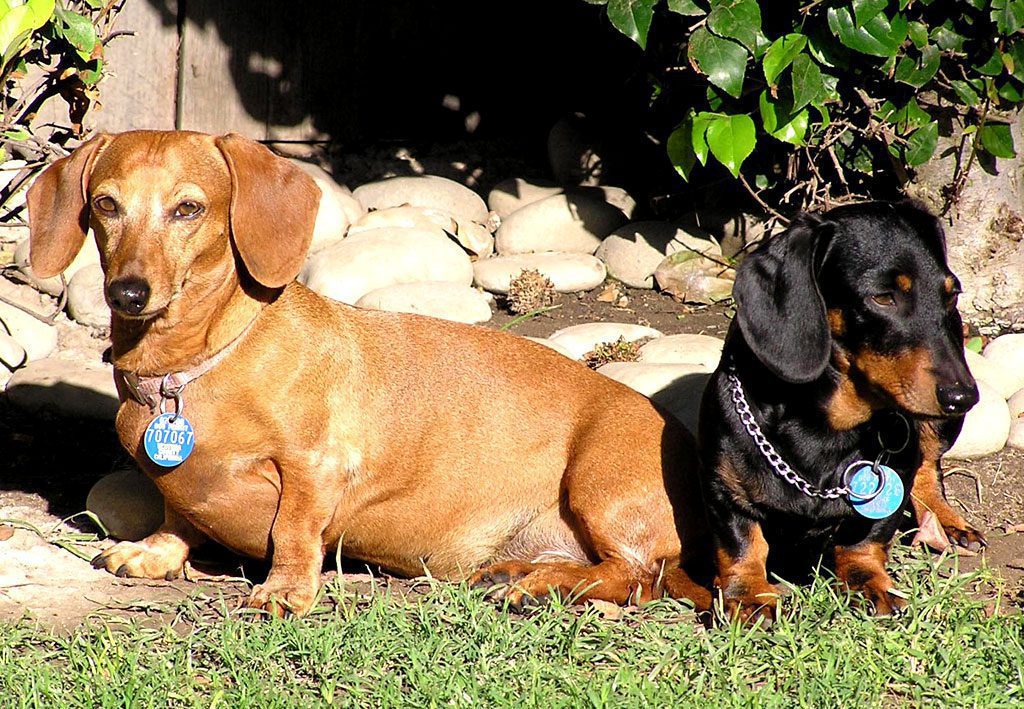
Sausage dog
Germany FCI 148 - Dachshund

Dachshund

The Sausage dog ("badger dog" in German), also called Dachshund, Dackel or Dog sausage, It is a breed of dog in German.

Its peculiar physiognomy is due to a genetic mutation known as bassetism, that is provided with copies of a few very short limbs relative to the size of the body.

There are engravings of old Egypt where are short-legged dogs. But, race as we know it comes from the selection of hounds affected Germans from bassetismo, very suitable for rabbit-hunting, Hare, Badger and other prey into Burrows. Is believed to be the oldest variety of short hair; varieties of hard and long hair then arose through the crossing with the Griffon and Epagneul races, respectively.

Sausage dog

  • Read all about the race, by clicking on: Dachshund.

โ–ท The world of Pets: Dogs, cats, birds, reptiles, amphibians

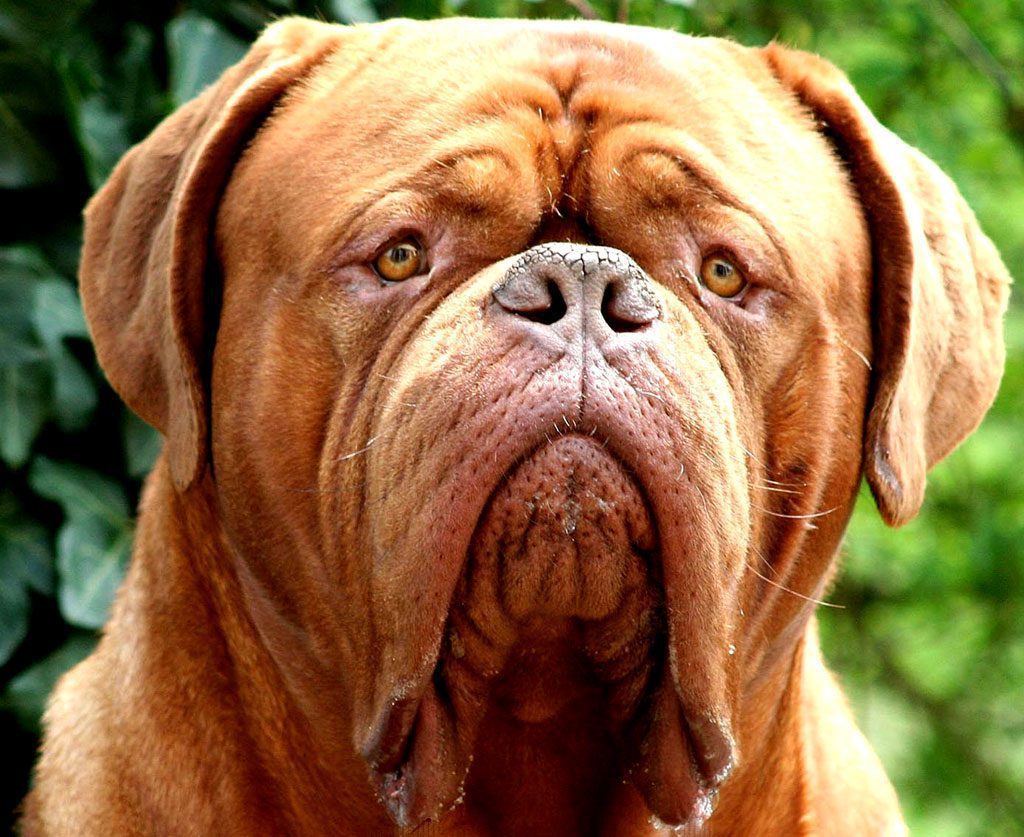
Bordeaux Mastiff
Francia FCI 116 - Molossoid - Dogo

The Bordeaux Mastiff It is very faithful to its owner and loving with children.

Mastรญn de de Burdeos

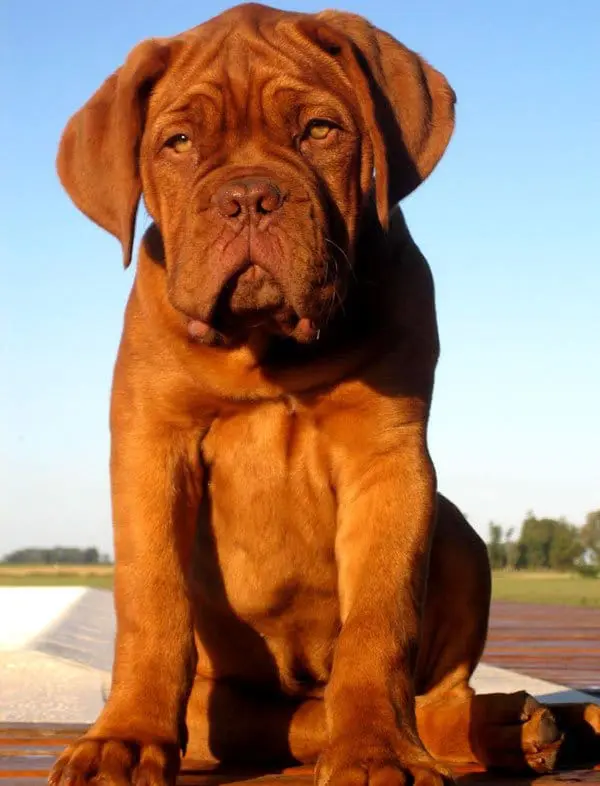
The Bordeaux Mastiff (Dogue de Bordeaux) is of French origin, is part of the large family of Mastiffs that even being of medium size turns out to be a dog of great strength and power, as a firm and determined to make it a great guard dog.

It is one of the most ancient French breeds, coming from the Eastern mastiffs arrived in Europe with the barbarian hordes. In more recent times, other races have contributed to the definition of this: the Mastiff, the English Bulldog, and the German Dogue.

The Bordeaux Mastiff is also called the "Doge of Bordeaux".

Otros nombres: Dogo de Burdeos / Dogue de Bordeaux / Bordeauxdogge

Crupo 2 / Section 2 – molosoids and mountain dogs.

Dogs breeds: Bordeaux Mastiff

Read all about the race by clicking on: Dogue de Bordeaux.

โ–ท The world of Pets: Dogs, cats, birds, reptiles, amphibians

Dogo cubano
Cuba Extinct

The Dogo cubano It was very notable and renowned for their ferocity. Extinct race.

Mastรญn Cubano

Content

History

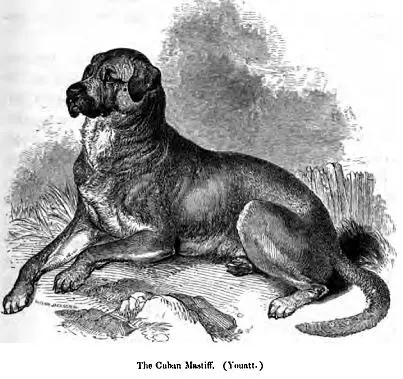
The Dogo cubano or Cuban dogge, It is a breed of dog of Cuba that has been terminated. It was very similar to the Bullmastiff. This breed of dog was used for dog fighting.

This breed of dog was introduced in Cuba to capture fugitive slaves (Maroons). After the abolition of slavery it became too expensive an animal to feed and it was so that, the race ceased to exist with the time.

Physical characteristics

They were among a Bulldog and Mastiff as far as size is concerned. Snout is short, bandwidth and abruptly truncated.

The head was broad and flat, and lips, pendants. The ears of medium-sized, and hanging also. Rather short tail, cylindrical, round upwards tipped forward.

They were described as a "rusty-colored wolf" with the face, the lips and black legs. The Cuban Mastiff is the largest breed of mastiff with an average weight of 136.5 Kg.

The Cuban Mastiff was very notable and recognized for his ferocity in the fight and for the skill in the persecution of slaves..

โ–ท The world of Pets: Dogs, cats, birds, reptiles, amphibians

Japanese Mastiff
Japรณn FCI 260 - Molossoid - Dogo

The Japanese Mastiff is quiet, serene, dignified and extraordinarily peaceful.

Mastรญn Japonรฉs

The Japanese Mastiff (Tosa) It is a breed of dog originating in Japan. Molosser imposing aspect, It is one of the favorite breeds for the lovers of dogs large size around the world. The breed emerged in the mid-19th century, When crossing various European breeds of large size (Great Dane, Mastiff, St. Bernard, Bulldog, German Shorthaired) with the native Shikoku Inu.

In Spain it is listed as a potentially dangerous breed of dog by Royal Decree, by which to his possession must obtain the licence for possession of dangerous dogs and register it in the corresponding Municipal registry of potentially dangerous animals. One of the things that are required for this license is insurance of civil liability to third parties.

Otros nombres: ๅœŸไฝ / Tosa Inu / Tosa Ken / Tosa Tลken / Japanese Fighting Dog / Japanese Mastiff / Tosa Fighting Dog

Crupo 2 / Section 2 – molosoids and mountain dogs.

Dogs breeds: Japanese Mastiff

Read all about the race by clicking on: Tosa.