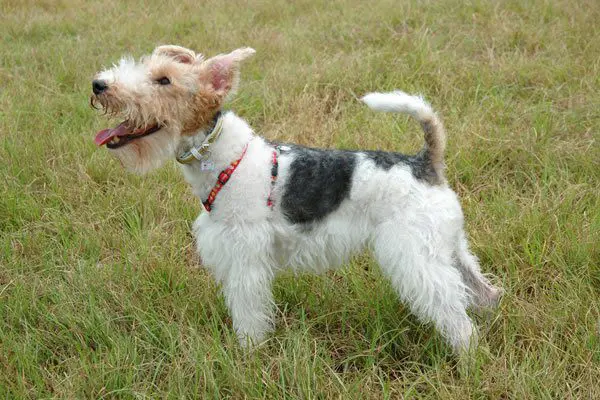
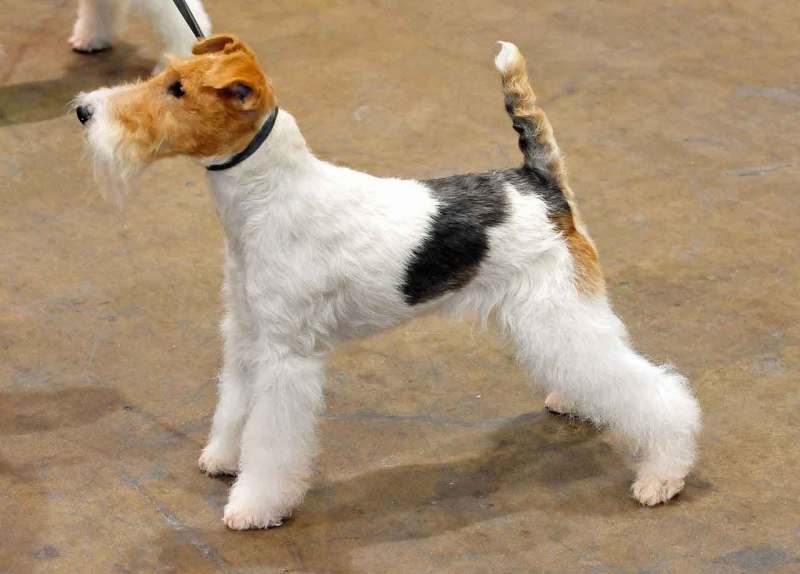
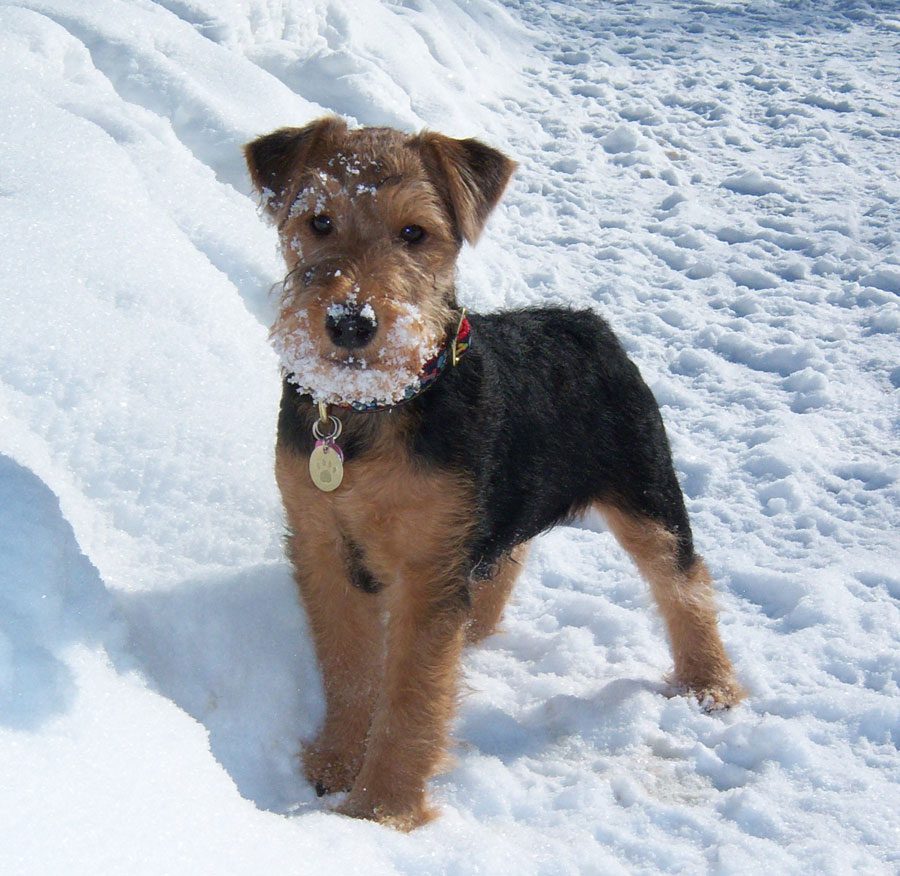
โ–ท The world of Pets: Dogs, cats, birds, reptiles, amphibians

Irish Soft Coated Wheaten Terrier
Irlanda FCI 40 . Large and medium sized Terriers

Irish Soft Coated Wheaten Terrier

Wheaten character is cheerful, open and balanced.

Content

History

The Irish Soft Coated Wheaten Terrier has been raised in Ireland for about 200 years in counties Kerry and Cork by the farmers who live there. How farm dogs fought rats and mice, as well as against predators such as foxes and martens, that threatened domestic animals. They also grazed sheep and were used for hunting.

The history of Irish Soft Coated Wheaten Terrier has been somewhat obscured due to its closeness to the other races of Irish terriers. The Wheaten probably the oldest of the four races. His existence, along the, at least 200 years, can be deduced from the textual references made to "soft-haired" dogs.. The relationship of Irish Terrier modern with the Wheaten, although less documented, appears to have been the result of deliberate crossing experiments. Consequently, the humble Wheaten probably has a fully mixed lineage. Despite the long history of Wheaten, it was not until 1937, which was officially recognized by the Irish Kennel Club. Since then this breed has grown steadily in popularity and is currently well known worldwide..

In 1943, the British Kennel Club He acknowledged the race in United Kingdom. The first Irish Soft Coated Wheaten Terrier were exported to the United States in the 1940, but the race gained greater interest ten years after his arrival. Last, in 1973, were recognized by the American Kennel Club.

The Irish Soft Coated Wheaten Terrier, unofficially, were crossed with the race Pudelhund standard, to create the mixed race, known as the Whoodle and with the race Beagle to create the race known as "Wheaglesโ€.

Today the Irish Soft Coated Wheaten Terrier It is a versatile companion dog that adapts well to its living conditions..

Physical characteristics

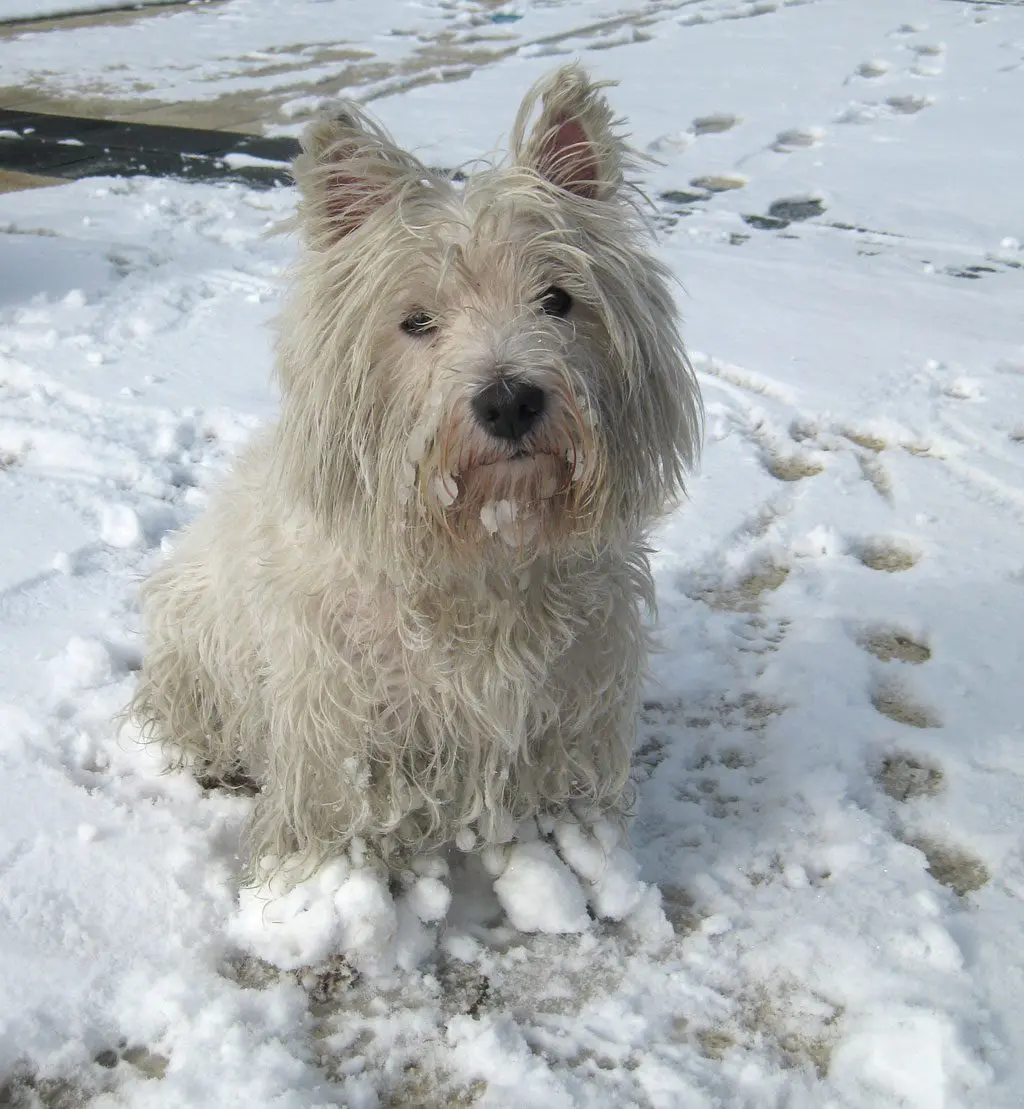
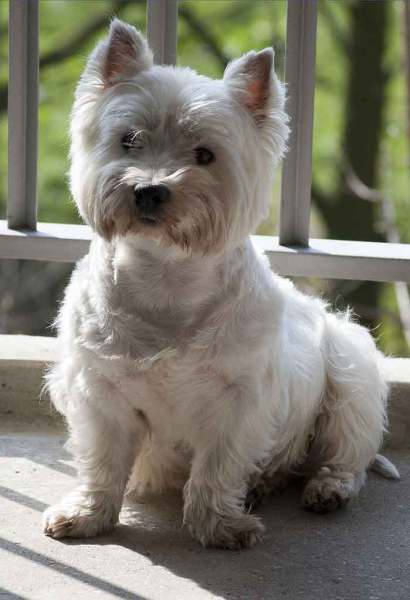
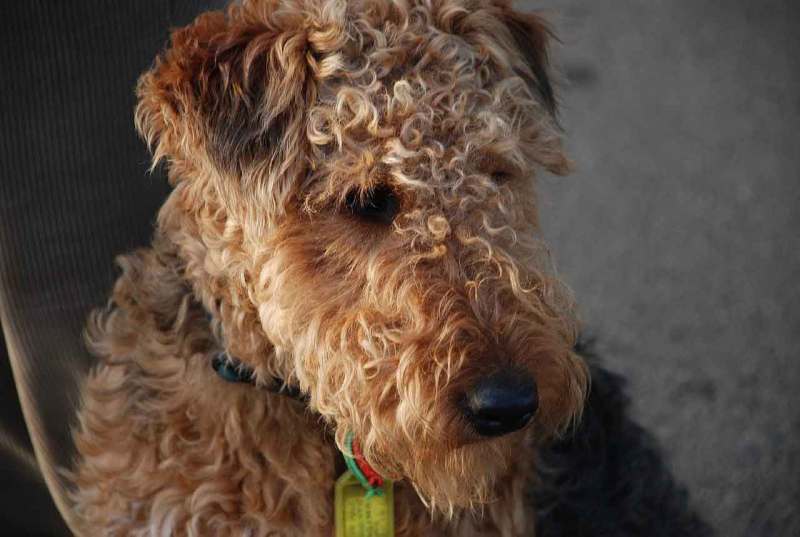
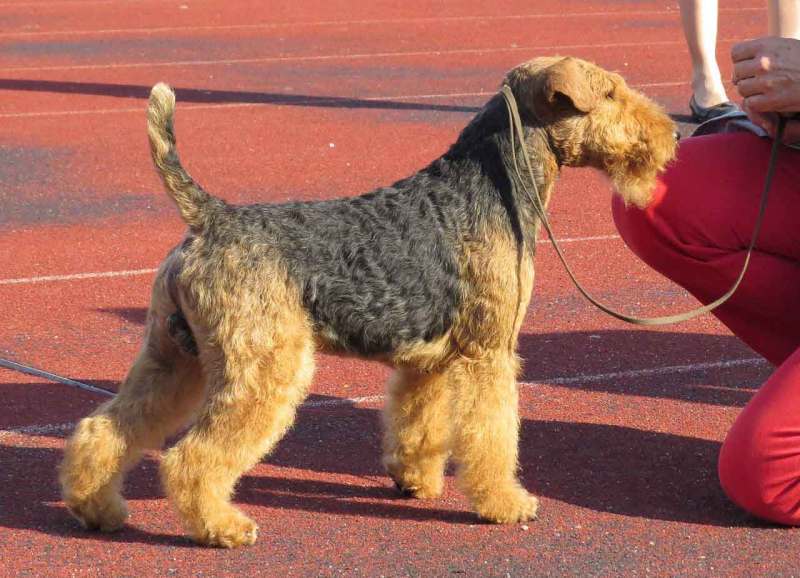
It is a strong dog, balanced, straight back and chest deep. It has a rectangular and well-proportioned head with a defined stop. Their eyes have a slightly almendrada way and the ears are small and bent slightly forward.

In countries where it is allowed, the Wheaten usually has a tail cut off. It has a smooth hair, silky and color wheat. These dogs have a unique coat of hair., so you can more easily tolerated by people who are allergic to other races, because they lost very little hair.

Puppies are reddish brown or gray. Many have a black mask. Only at the age of two and a half the coat has its final color, clear and its fine structure.

SIZE AND WEIGHT:

Height to the cross : Males 46-48 cm. (18 – 19 inches). females somewhat less.

Weight: Males between 18 – 20,5 kg (40 – 45 English pounds). The females somewhat less.

Character and skills

The character of the Wheaten is happy, open and balanced. As an SUV, these dogs are very docile. They enjoy participating in family life. Dog sports such as agility are a good substitute for the many different tasks these spirited terriers were originally bred for.. If they are left alone, without getting busy or moving enough, can become destructive and aggressive. Consistent breeding from the start makes them great family dogs that don't obey one person.. Due to the great care effort and the possible stubbornness of the terrier, only conditionally suitable for beginners.

Wheaten Terrier care

The coat of the Irish Soft Coated Wheaten Terrier requires a lot of cleaning and must be brushed daily to avoid entanglement. Hair must be cut regularly. Does not come off.

In regards to health, it is a very healthy breed, not showing any typical hereditary disease.

Wheaten Terrier Education

That dog learns fast. Unfortunately also things, that you have to avoid them later. So, and also because of the hunting instinct that the breed has, initially not recommended for beginners. It also, the breed tends to be stubborn under pressure, you also have to learn to deal with it. But, who masters the rules of dog training, you will be very pleased with this dog's willingness to learn and willingness to work.

Images "Irish Soft Coated Wheaten Terrier"

Photos:

1 – Soft Coated Wheaten Terrier by SusanSmithGSU / CC BY-SA
2 – Soft-coated_wheaten_terrier at the national show in Rybnik – Stone to Pleple2000 / CC BY-SA
3 – Soft-coated_wheaten_terrier at the national show in Rybnik – Stone to Pleple2000 / CC BY-SA
4 – Soft Coated Wheaten Terrier Irlandรฉs by RORLVR1 / CC BY-SA
5 – Soft Coated Wheaten Terrier Irlandรฉs by https://pxhere.com/en/photo/64565
6 – Soft Coated Wheaten Terrier Irlandรฉs by https://www.needpix.com/photo/834722/dog-jump-play-irish-soft-coated-wheaten-terrier-young-dog-jumps-happy-winter-snow

Videos "Irish Soft Coated Wheaten Terrier"

Type and recognitions:

  • FCI CLASSIFICATION:
  • Group :
  • Section : . .

Federations:

  • FCI – Terriers 1 Large and medium-sized terriers. โ“˜
  • AKC – Terriers โ“˜
  • ANKC – Terriers โ“˜
  • CKC – Terriers โ“˜
  • โ€‹KC – Terriers โ“˜
  • NZKC – Terriers โ“˜
  • UKC – Terriers โ“˜

FCI breed standard "Irish Soft Coated Wheaten Terrier"

Origin:
Ireland

Date of publication of the valid original standard:
27.01.2001.

Use:

Wheaten Terriers were always used by small farmers to kill vermin or help with farm work.. For a long time it was used in the difficult task of hunting badgers and otters..


General appearance:

It is a robust dog, active and compact, well built, giving the idea of รขโ‚ฌโ€นรขโ‚ฌโ€นstrength. Their limbs are not too long or too short.


Behavior / temperament:

Fiery and courageous. With good temperament. Very noble and loyal to his masters. Very intelligent. A faithful and trustworthy friend, defensive without being aggressive.

Head:

It must be strong as a whole, without being rough. Long, well proportioned to the body. Hair must be the same color as the body.

Cranial region:
  • Skull: Flat and crisp between the ears, not very wide.
  • Depression links (Stop): Defined.

facial region:

  • Trufa: Black and well developed.
  • Horcico: It should not be longer than the skull.Jaws: Strong, punishing jaws.
  • Dinentities: Big teeth, regular scissor or clamp bite, no upper or lower prognathism.
  • Cheeks: Non-prominent bones.
  • Ojors: dark, dark hazelnut, not very large or prominent, well placed.
  • Obars: Small to medium, taken to the front, level with the skull. Dark shading is allowed at the base of the ears, and it is common for it to have a light wheat reflection in the rest. This is the only area of โ€‹โ€‹the dog where undercoat is allowed.. โ€œPinkโ€ or โ€œflyingโ€ ears are objectionable.

Neck:

Moderately long and strong, but without presenting dewlap.

Body:

Not very long. The length from the withers to the base of the tail should be approximately the same as from the ground to the withers.

  • Dorrso: Strong and straight, with top line also at level.
  • Itmor: Short, strong.
  • Pecho: Deep, well arched ribs

Tail:

Well placed, not very thick. Carried cheerfully but never over the top line. amputee, remaining two thirds of its original length, assuming that this length is in proportion to the dog. Uncut glue is allowed.

Tips

PREVIOUS MEMBERS:

  • Hormbros: Thin Shoulders, well inclined. Muscled shoulders.
  • Antarms: Seen from any angle they must appear perfectly straight, good bone and muscular.

LATER MEMBERS: Well developed and with powerful musculature.

  • Thighs: Strong and muscular.
  • Rodinllas: Angled.
  • Corvejones: Well descended, without turning in or out. Dewclaws must be amputated.
  • PinIt: Small, not scattered. Nails should preferably be black, but several dark colors are allowed.

Movement:

In a straight line throughout its entire length, round trip. The elbows stuck. Side view: free movement, lightweight and coordinated.

Mantle

  • Plink: Single-haired mantle dog (no undercoat). The hair is soft and silky to the touch, does not last. Young dogs are excluded from the above. Hair preparation is allowed (Trimming).
  • Pmistakes with hair preparation: The hair should be short on the neck, chest and skull and should be left especially long over the eyes and under the jaw. It is advisable to leave the mustaches. With abundant fringes on the extremities. The body hair must be arranged in such a way that it follows the contour of the dog, without being sculpted. The tail hair should be cut short and gracefully tapering to the tip.
  • Pmistakes without preparation: Hair length at its longest point should not exceed five inches (12,7 cm.). Hair must be thick and soft, wavy or loose curls with the shine of silk. Under no circumstances should the coat be โ€œfluffyโ€ like that of the Poodle or the Old English Sheepdog.. Dogs exposed in this condition must be heavily penalized, since they give the wrong idea of รขโ‚ฌโ€นรขโ‚ฌโ€นtype and race. Special attention should be paid to the development of the coat of the puppies. Puppies are hardly born with the correct hair that they should have when adults., Care must be taken when evaluating this aspect. They undergo various color and texture changes before developing adult hair. This normally occurs between 18 months and 2 1/2 years.
  • Cachorros: Puppies are rarely born with the correct coat color and texture. Their fur may be reddish, grayish and sometimes light tawny. The masks are generally black. Sometimes there is a black streak in the center of the back or the tips of the body hair are black. These dark marks disappear during growth.
  • Colorr: A good and defined wheat color with variations ranging from light fawn to a reddish golden hue.


Size and weight:

Alturto the cross:

  • Males 46-48 cm. (18 โ€“ 19 inches).
  • females somewhat less.

Pthat:

  • Males between 18 โ€“ 20,5 kg (40 โ€“ 45 English pounds).
  • The females somewhat less.


Fouls:

Any deviation from the aforementioned criteria is considered as a fault and the severity of this is considered to the degree of the deviation to the standard and its consequences on the health and well-being of the dog..

  • Nervosity, aggressiveness.
  • Truffle in any color other than black.
  • Upper or lower prognathism.
  • Mature dog coat not clearly wheat colored.

FALTAS DISQUALIFYING:

  • Aggressiveness or extreme shyness.
  • Any dog โ€‹โ€‹showing clear signs of physical or behavioral abnormalities must be disqualified..
  • Yellow eyes.
  • Dull coat, thick, wool or cotton texture.
  • White fur. Brown fur.


N.B.:
  • Males should have two normal-appearing testicles fully descended into the scrotum..
  • Only functionally and clinically healthy dogs, with the typical conformation of the breed, should be used for parenting.

Itlatest changes are in bold.

TRANSLATION: Lic. O. Valverde, reviewed by Dr. F. del Valle and updated by J. Nallem, Uruguayan Kennel Club.

Source: F.C.I - International Cynological Federation

Alternative names:

1. Irish Soft-Coated Wheaten Terrier and variant spellings: ยซSoft Coatedยป and ยซSoftcoatedยป, Wheaten or Wheatie, Wheaten Terrier (English).
2. Irish Soft Coated Wheaten Terrier (French).
3. Wheaten Terrier (German).
4. Wheaten Terrier (Portuguese).
5. Wheaten Terrier (espaรฑol).

โ–ท The world of Pets: Dogs, cats, birds, reptiles, amphibians

Australian Silky Terrier
Australia FCI 236 . Toy Terriers

The Australian Silky Terrier not appropriate to live with other smaller pets.

Australian Silky Terrier

Content

History

The Australian Silky Terrier is a native of Australia dog, Although the types and ancestral breeds were of Great Britain. The ancestors of the Australian Silky Terrier include the Yorkshire Terrier (originating in England and Scotland before being considered) and the Aussie (descended from wire-haired Terriers brought from Britain to Australia in the 19th century 19), but the records do not indicate whether early dogs were simply Terrier Australian born with silky fur, or if there was an attempt to create a breed apart.

In accordance with the American Kennel Club, the race began at the end of the 19th century, being result of crosses between a Yorkshire Terrier and Aussie. At the beginning, the breed became known as โ€œthe sydney silkโ€, since it was located mainly in the city of Sydney, Australia. Although most Australian breeds are listed as working dogs, el Australian Silky Terrier, is considered to be, was raised โ€“mainly- to be an urban pet and companion of the family, but also It is a breed known for killing snakes in Australia.

Until 1929, the Terrier australiano, the Silky Terrier Australian and the Yorkshire Terrier they were not clearly defined, in the same litter, three dogs could be born of breeds that over time were considered, different. According to existing information, they were separated by the appearance in different types once they raised separately.

After 1932 in Australia, miscegenation was tweaking, and in 1955 the name of the race officially became Australian Silky Terrier. The breed was recognized by the national canine Council of Australia, in 1958 in the Toy group.

During and after World War II American soldiers who had been sent to Australia, return to United States, they brought with them several Australian Silky Terrier. Photographs in the newspapers of the time (1954), They show the soldiers, back to home wearing their pets Australian Silky Terrier, and this caused a rise in popularity to the race, and hundreds of Australian Silky Terrier were imported from Australia to the United States.

The American Kennel Club He acknowledged the race as the Silky Terrier in 1959, like the United Kennel Club ((UNITED STATES)UU.) in 1965, and the Canadian Kennel Club. The breed is recognized by all major canine clubs of the English speaking world, and internationally by the International Cynological Federation as breed number 236.

Physical characteristics

The Australian Silky Terrier is a Terrier, but is usually placed in the Group of dogs Toy type, instead of the Terrier group, due to its small size. The Federation Cynologique Internationale has a special section of the Terrier group that includes only the smaller dogs, While other canine clubs, place the breed in the Toy group, but universally everyone agrees that the breed type is Terrier.

His mantle's hair is grey, Griffon's soft texture and bluish, smooth and long. It requires constant maintenance and brushing. An Australian Silky Terrier should be about 23 to 25 cm to cross and weighs between 3.6 and 8 kg, Although the steps may vary between the different federations. It should be a little bit longer than that width (about one-fifth longer than the height at the cross).

El Australian Silky Terrier, small, almond-shaped eyes. according to the rules, the eyes are considered to lack. The ears are small and erect. It has a tail of high adjustment and small feet, almost like a cat. The hair should be long. The hair on the face and ears is usually cut.

This breed must have with a Barber every three weeks and their teeth should be brushed. Terriers are notorious for having tooth and gum problems..

The layer of Silky Terrier is very susceptible to tangles and mats and requires daily brushing and the hairstyle. This breed requires a deep commitment to the owners. To keep the shiny fur, regular washing is necessary. Using an avocado and oatmeal shampoo will help relieve itchy skin., characteristic dryness of this breed.

Character and skills

The Silky Terrier has a very lively character and will bark at any stranger immediately. He is smart and also an excellent watchdog, announcing unwanted intruders with a squeaky bark.

Due to its small size, also suitable for an apartment in the city, but also appreciates extensive exercise in nature. He makes a very nice roommate and an excellent pet for everyone who likes a small dog with a big heart.

The Silky Terrier can bring much joy to the sick or the elderly, that can even be tied to the house, at least if the dog still gets proper exercise from relatives or good neighbors.

Like most other terriers, the Silkies they are very alert and anxious. Hunting instinct is generally well developed, so the dog should always have enough opportunity to move.

Because despite his pretty appearance he Silky Terrier it is not a lap dog, but a typical terrier that needs movement and family connection. It is a happy and uncomplicated companion dog, with a lot of temperament and joy of movement, but fortunately it is easy to train.

As the Silky Terrier also has a distinctive personality, a consistent and loving education is essential.

ยซAustralian Silky Terrierยป Education

Although the Silky Terrier australiano it's a miniature terrier, still has the typical terrier stubbornness. That's why you should show him a firm upbringing. If this is practiced, he "Silkyยป will become a simple and obedient companion, but – can't get out of your skin – can also kill a rat or mouse from time to time. His intelligence can be promoted by brain work and he can also be taught little tricks.

Care and diseases ยซAustralien Silky Terrierยป

Although her hair doesn't shed much, the mantle of your Silky Terrier australiano needs a lot of care. Needs to be brushed daily to keep its long coat silky. But the straight and split hair makes brushing relatively easy, if you don't let it get tangled.

Common diseases:

Seasonal dermatitis (inflammation of the skin caused mainly by malassezias), drug intolerance (glucocorticoids), cataract, urinary tract diseases (cystine stones).

Images ยซAustralian Silky Terrierยป

ยซAustralian Silky Terrierยป Videos

Australian silky terrier playing - playing

Type and recognitions:

  • FCI CLASSIFICATION:
  • Group :
  • Section : . .

Federations:

  • FCI – Group 3 – Section 4 Toy Terriers. โ“˜
  • AKC – Terriers โ“˜
  • ANKC – Terriers โ“˜
  • CKC – Terriers โ“˜
  • โ€‹KC – Terriers โ“˜
  • NZKC – Terriers โ“˜
  • UKC – Terriers โ“˜

FCI breed standard "Australian Silky Terrier"

Origin:
Australia

Date of publication of the valid original standard:
08.10.2012

Use:

Toy Terrier / Service dog


General appearance:

It's compact, moderately low, moderately long, with a refined structure but with enough substance to suggest the ability to hunt and kill domestic rodents. The silky coat, smooth and parted in half for a neat appearance.


Behavior / temperament:

Must exhibit Terrier characteristics, manifesting a sharp vivacity, activity and healthy condition.A majestic and courageous small Terrier who has no rival as a companion dog..

Head:

The head is of moderate length, slightly shorter from the tip of the nose to the region between the eyes, that from the same position to the occiput. The head must be strong, with Terrier characteristics, being moderately wide between the ears.

Cranial region:
  • Craging: Flattened and no roundness between the eyes, it is provided with a tuft of fine and silky hair that does not cover the eyes (a long fall of hair on the front face or cheeks is objectionable).
  • Storp (naso-frontal depression)Definite but moderate.

facial region:

  • Trufa: It must be black.
  • Lips: Adherent and thin.
  • Jaws / Teeth: Strong jaws, even and not clenched teeth; upper incisors closely overlap lower incisors (scissor bite).
  • Ojors: They are small, oval, never round or prominent; its color should be as dark as possible with an expression of sharp intelligence.
  • Obars: They must be small, โ€œVโ€ shaped; the pavilion is fine; set high in the skull; he wears them upright and they are totally devoid of long hair.

Neck:

Medium length, refined and slightly arched, gracefully inserted on the shoulders. Well covered with long silky hair.

Body:

It should be moderately long in proportion to the height of the dog.

  • Lรญnand the top: Level at all times (both standing and moving.
  • Itmor: It must be strong.
  • Pecho: Of moderate depth and width. Well arched ribs, extended back to a strong loin.

Tail:

Napamputated, it is set high and carried erect, but not too high. It should not be provided with feathers. Without amputation, the first three vertebrae must be erect or slightly curved, but never curved on the top line. Must not be screwed. Its long, giving an appearance of balance sheet. According to the description of the docked tail, the non-docked tail should also be free of feathers.

Tips

PREVIOUS MEMBERS:

  • ApGeneral arience: They have finely delineated and rounded bones; are straight and well positioned under the body without showing weakness in the metacarpals.
  • Hormbros (Blades): Fine and well placed back, well adapted with well angulated arms and very close to the ribs.
  • Elbows: They do not deviate outward or inward.
  • Pinis previous: Small, with good pads, fingers well together; nails must be black or very dark.

LATER MEMBERS:

  • Thigh (Femur): Well developed.
  • Knees: They must be well angled.
  • Corvejones: Well angled, Seen from behind they should be well placed below and parallel to each other.
  • Pinis later: Small, with good pads, fingers well together; nails must be black or very dark.

Movement:

Must be free, straight, showing no loosening in the shoulders or elbows, no outward or inward deviations of the feet and pasterns. The hind limbs should give a thrust with ample flexibility in the knees and hocks.. Seen from the back, the movement should not be too narrow or too wide.

Mantle

Fur: Smooth, fine and shiny, silky texture. The length of the coat must not be such as to impede the movement of the dog and must allow light to see under the dog. Front and back feet must be free of long hair.

Color: All shades of blue and tan are acceptable, the more intense the colors and the more clearly defined the better. Silver and white are not accepted. In the tail the color should be blue to very dark. It is desirable that the head lock is blue or fawn in color. The blue and tan color distribution should be as follows: fire around the base of the ears, muzzle and sides of cheeks; blue from base of skull to tip of tail, in the forelimbs up to near the carpal joint and in the hindlimbs near the hock joint; A tan line is shown below the knees and the carpal and tibiotarsal joints to the fingers and around the anus. The blue color of the body must be free of tan or tan color. Fire marks must be free of smudges.

Black color is allowed in puppies, but the blue color must have set at the 18 months of age.


Size and weight:

Alturto the cross:

  • Males: 23 โ€“ 26 cm.
  • females: may be slightly lower

Pthat: Weight in proportion to size.


Fouls:

Any deviation from the aforementioned criteria is considered as a fault and the severity of this is considered to the degree of the deviation to the standard and its consequences on the health and well-being of the dog..

FALTAS SEVERAS:

  • Lรญnand the superior conquered the convex.

FALTAS DISQUALIFYING:

  • Agextreme shyness.
  • Any dog โ€‹โ€‹showing clear signs of physical or behavioral abnormalities must be disqualified..


N.B.:
  • Males should have two normal-appearing testicles fully descended into the scrotum..
  • Only functionally and clinically healthy dogs, with the typical conformation of the breed, should be used for parenting.

Itlatest changes are in bold.

TRANSLATION: Mexican Canophilic Federation A.C., updated

by J. Nallem (Uruguayan Kennel Club), technical review: M.A. Martรญnez (FCA).

Source: F.C.I - International Cynological Federation

Alternative names:

1. Silky Terrier (English).
2. Silky Terrier australien (French).
3. Sydney Silky, Australian Silky (German).
4. Silky terrier, silky terrier australiano (Portuguese).
5. Silky, Aussie, Terrier Sedoso Australiano (espaรฑol).

โ–ท The world of Pets: Dogs, cats, birds, reptiles, amphibians

Jack Russell Terrier
Gran Bretaรฑaa FCI 345 . Small sized Terriers.

Jack Russell Terrier

He has a bold and cheerful disposition and always appears full of self-confidence..

Content

History

The Jack Russel Terrier comes like most terrier breeds from England. It was first bred there more than 150 years by theologian John Russel. The future pastor had the nickname "Jack.", for which the dog breed was also named later. John Russel pursued the goal of creating a fox hunting terrier by crossing with other breeds. This should not only hunt foxes and other animals, but also chase them into their burrow and drive them out again.

Over the years, two types of Russel Terrier, a medium-sized variant, the Parson Russel Terrier, and another one of smaller size, the Jack Russel Terrier described here. The small-sized variant found its followers mainly in Australia, who used it mostly for hunting in rabbit holes. Due to crossbreeding with other breeds and exclusive breeding for hunting purposes, recognition as an independent race came relatively late.

So the dog was first listed by the Australian National Kennel Council in 1991 and in the year 2000 was recognized by the FCI.

Physical characteristics

The appearance of the Jack Russel Terrier it is relatively easy to recognize. So he has a coat covered mostly in white, that bears black or brown markings. A completely white coat is also theoretically possible, but quite rare. The hairs are short and can be straight or coarse.

The Jack Russel Terrier it has an almost rectangular body shape and a height at the withers of up to 30 cm.. So, is on average 5 cm smaller than its direct relative, the Parson Russel Terrier. The weight of a Jack Russel Terrier can vary between 7 and 10 kg. The head of the Jack Russel it is quite thin and flat built. The dog's eyes are almond shaped and are normally surrounded by black eyelid edges.

Variedades ยซJack Russel Terrierยป

Jack Russell Terrier smooth hair
Jack Russell Terrier by the fence
Jack Russell Terrier through the fence
jack russell terrier hard hair
  • Straight hair variety
  • Wired hair variety
  • Wire hair variety

Character and skills

The Jack Russel Terrier he is an agile and lively dog รขโ‚ฌโ€นรขโ‚ฌโ€นwho loves to run in nature. He has a healthy self-confidence and is very brave.. Although her legs seem relatively short, loves to take long walks in nature. The dog is charged with energy and needs his run. In addition to sports activities, the dog also wants to be challenged on a mental level. One can make this possible thanks to sports modalities such as "Agility.". There he is with total commitment and tirelessly pursues his goal.

At the same time, the Jack Russel Terrier also very suitable as a family dog. In a calm and familiar environment, the dog is child friendly and has a social mindset.

Keeping and feeding a Jack Russel Terrier

Although the Jack Russel Terrier it's a smaller dog, there is a lot of power in him. The hunting instinct remains firmly anchored in it. You need to exercise a lot outdoors in nature. The Jack Russel it is a dog that needs to be encouraged and challenged by its owner. To push the dog to its limits, dog sports like agility are ideal.
Keeping the dog in an apartment is usually not a problem. But, it is practical to have a large garden in which the terrier can let off steam in between. The Jack Russel he is also a super family dog, that with the right training you will become a loving family member.

The Jack Russel Terrier usually has no special food preferences. It is important that the dog is fed a balanced diet. This means that the diet is based on a combination of a high meat content plus the addition of vegetables, fruits and cereals. The choice between dry or wet food is left to each owner. The food ration should be adapted to the size and workload of the dog.

Education and care of the Jack Russel Terrier

The Jack Russel Terriers they need a loving and consistent education. Already with the puppy you must define the rules and limits of coexistence. This is how the foundations of a common future are laid. Early neglect will regret later. The Jack Russel Terrier is an intelligent dog that wants to be challenged. So, it is important that you have the reins clearly in hand when dealing with the dog.

Due to its origin as a hunting dog, wants the guidance of its owner. Clear instructions and a system of positive rewards will be the best to encourage the dog in his development. With adequate training and if the dog is sufficiently exercised, adapts very well as a family dog รขโ‚ฌโ€นรขโ‚ฌโ€นand integrates into it in an exemplary way.

Caring for a Jack Russel Terrier it is not usually complicated. In the rough-haired or hard-haired variety, the coat should be trimmed occasionally. Otherwise, brushing regularly is highly recommended. The dog can be cleaned with a damp cloth. The shampoo should not normally be used as it attacks the natural protection of the coat and skin.. In case of strong odors and a high level of dirt, a mild dog shampoo should be used.

Typical health and illnesses

The small quadrupeds are, Unfortunately, often very susceptible to disease. So, You should have a vet examine your dog as often as possible and parents undergo an examination for possible inherited diseases before purchasing. The possible clinical pictures with the Jack Russel Terrier are: Ataxia and myelopathy, atopia, dermatophytosis, cataract and catarrh, as well as other hereditary diseases.

Jack Russel Terrier life expectancy

The life expectancy of Terriers Jack Russel is of some 15-18 years.

Buy the Jack Russel Terrier breed

The Jack Russel Terriers can be purchased from numerous breeders. But, before buying, must ensure that the breeder is officially recognized. The Jack Russel Terrier responsible parenting can be obtained from a price of about 500 EUR.

Characteristics "Jack Russell Terrier"

Coexistence is important that you have with your new friend. Before considering the acquisition of a dog of the breed "Jack Russell Terrier" you know certain factors. Not all breeds of dogs are apt to live in an apartment, you must take into account his character, their need for exercise, their interaction with other pets, their care and if you have small children, their level of tolerance towards them.

Adaptation โ“˜

5,0 of 5 stars (based on 1 review)

friendly dog โ€‹โ€‹โ“˜

1,0 of 5 stars (based on 1 review)

hair loss โ“˜

3,0 of 5 stars (based on 1 review)

Affection level โ“˜

5,0 of 5 stars (based on 1 review)

Need for exercise โ“˜

5,0 of 5 stars (based on 1 review)

Social need โ“˜

3,0 of 5 stars (based on 1 review)

Home โ“˜

1,0 of 5 stars (based on 1 review)

Toilet โ“˜

2,0 of 5 stars (based on 1 review)

Friendly with strangers โ“˜

3,0 of 5 stars (based on 1 review)

barking โ“˜

5,0 of 5 stars (based on 1 review)

Health โ“˜

3,0 of 5 stars (based on 1 review)

Territorial โ“˜

5,0 of 5 stars (based on 1 review)

Cat friendly โ“˜

1,0 of 5 stars (based on 1 review)

Intelligence โ“˜

5,0 of 5 stars (based on 1 review)

Versatility โ“˜

5,0 of 5 stars (based on 1 review)

Child friendly โ“˜

3,0 of 5 stars (based on 1 review)

Surveillance โ“˜

5,0 of 5 stars (based on 1 review)

joy โ“˜

5,0 of 5 stars (based on 1 review)

Images "Jack Russell Terrier"

Photos:

1 – Rough coat Jack Russell terrier by Sellys / CC BY-SA
2 . Jack Russell Terrier by Plank / CC BY
3 – Jack Russell Terrier by Steve-65 / CC BY-SA
4 – Portrait of Jack Russell Terrier in a park by Ria / CC BY-SA
5 – Jack Russell Terrier by DuncanMcC / Public domain
6 – Jack Russell Terrier by Plank / CC BY

Videos "Jack Russell Terrier"

Type and recognitions:

  • FCI CLASSIFICATION:
  • Group :
  • Section : . .

Federations:

  • FCI – Terriers 2 Small sized Terriers. โ“˜
  • AKC – Terriers โ“˜
  • ANKC – Terriers โ“˜
  • โ€‹KC – Terriers โ“˜
  • NZKC – Terriers โ“˜
  • UKC – Terriers โ“˜

FCI breed standard "Jack Russell Terrier"

Origin:
United Kingdom

Date of publication of the valid original standard:
08.10.2012

Use:

A good working Terrier with the ability to go down to earth. An excellent companion dog


General appearance:

A strong working terrier, Active, of great character, with flexible body, long Middle. His deft movement matches his keen expression. The tail cut is optional and the coat can be short, hard or brittle.

PROPIMPORTANT ORTIONS: The dog as a whole is longer than tall, that is rectangular.

The depth of the body from the cross to the chest should be equal to the length of the front leg from the elbow to the ground. The circumference behind the elbows should be 40 to 43 cm..


Behavior / temperament:

Terrier vivaz, alert and active, with a sharp and intelligent expression. Bold and intrepid, friendly but quietly safe.

Head:

---

Cranial region:
  • Craging: The skull should be flat and of moderate width., gradually decreasing its width towards the eyes and thinning towards a wide muzzle.
  • Dfronto-nasal depression (Stop): Well defined but not pronounced.

facial region:

  • Trufa: black.
  • Horcico: The length from the stop to the truffle should be slightly shorter than the stop to the occiput.
  • Labios: Tight and pigmented in black.
  • Jaws / Teeth: Very strong, deep wide and powerful. Strong teeth closing in scissors.
  • Ojors: Small dark and with sharp expression. MUST NOT be prominent and must have well-attached eyelids. The edge of the eyelids must be pigmented in black. Almond biscuits.
  • Obars: Ears that are semi-droopy or fall forward, covering the external auditory canal, good texture and great mobility.
  • Cheeks: Cheek muscles should be well developed.

Neck:

Strong and clean allowing the head to be carried with balance.

Body:

  • Lรญnand the top: Level. The length from the withers to the tail insert is somewhat greater than the height from the withers.
  • Itmor: Kidney region should be short, strong and very muscular.
  • Pecho: Chest deeper than wide, with good clarity from the floor, allowing the chest to be halfway down the cross to the ground. Ribs must be well arched from the spine, flattening to the sides so that the periphery behind the elbows can be held by two hands โ€“ approx.. 40 to 43 cm.. Point of the sternum clearly in front of the point of the shoulder.

Tail:

You can lower it at rest. In movement it must be erect and if it is cut the tip must be at the same level as the ears.

Tips

PREVIOUS MEMBERS:

  • Hormbros (Blades): Well sloped and not heavily muscled.
  • Brazos (Humerus): Long and angled enough to ensure that the elbows are positioned under the body.
  • Antarms: Straight bone from elbow to foot, seen from the front or side.
  • Pinis previous: Round, strong, padded, not big, moderately arched fingers, without turning in or out.

LATER MEMBERS:

  • ApGeneral arience: Strong and muscular, balanced in proportion to the scapulae.
  • Rodinllto: Well angled.
  • Corvejรณn: Close to the ground.
  • Metatarsals: Parallel when seen from behind and the specimen is standing freely.
  • Pinis later: Round, strong, padded, not big, moderately arched fingers, without turning in or out.

Movement:

Cash, free and elastic.

Mantle

Plink: Can be short, brittle or hard. Must be water resistant. The mantles must not be altered (ripped) to appear short or brittle.

Colorr: White must predominate, with black markingsand/orfire (tan). Fire markings can range from the palest to the strongest (Brown).


Size and weight:

Alturto ideal to the cross:

25 cm to 30 cm..

Pthat: The equivalent to 1 kg of weight per 5 height cm.

Example: a dog of 25 cm should weigh approx. 5 kg and a dog 30 cm must weigh 6 kg.


Fouls:

Any deviation from the aforementioned criteria is considered as a fault and the severity of this is considered to the degree of the deviation to the standard and its consequences on the health and well-being of the dog.and the dog's ability to perform its traditional task.

  • Lack of true Terrier characteristics
  • Lack of balance, example: over angle of any point
  • Heavy or shaky motion.
  • Defective denture.

FALTAS DISQUALIFYING:

  • Agextreme shyness.
  • Any dog โ€‹โ€‹showing clear signs of physical or behavioral abnormalities must be disqualified..


N.B.:
  • Males should have two normal-appearing testicles fully descended into the scrotum..
  • Only functionally and clinically healthy dogs, with the typical conformation of the breed, should be used for parenting.

Itlatest changes are in bold.

TRADUCCION: J.Nallem (KCU) Suptechnical supervision: M.A. Martรญnez (FCA)

Source: F.C.I - International Cynological Federation

Alternative names:

1. JRT, Jack (English).
2. Jack Russell (French).
3. Jack Russell (German).
4. Jack Russell (Portuguese).
5. JRT, Jack (espaรฑol).

โ–ท The world of Pets: Dogs, cats, birds, reptiles, amphibians

Bull Terrier
Gran Bretaรฑa FCI 11 . Bull type Terriers

Bull Terrier

The Bull Terrier they are generally friendly, rarely aggressive.

Content

History

The original ancestor of Bull Terrier was bred in the early 19th century from a cross between the English Bulldog and terriers. The dog served as a biter for bulls and badgers and was also used in dogfighting. Although its use as a fighting dog was already banned in 1835, the breed still struggles with its fighting dog image today. Completely contrary to the omnipresent opinion the Bull Terrier developed in the course of the 19th century as a popular family dog รขโ‚ฌโ€นรขโ‚ฌโ€นof the English middle class. The nervous and friendly Bull Terrier lived with families in large areas and served as a guard dog and to hunt vermin.

In 1850 the animal trader James Hinks ensured official recognition of the breed. At the end of the 19th century, the Bull Terrier white in color were for a time the status symbol of the English nobility. For a more elegant appearance and a less fizzy character, they crossed paths with Dalmatians and Pointer. Only after the end of World War 2 did the British return to breeding Bull Terrier of different colors. From the beginning the breed was bred in different sizes and today the Standard and the Bull Terrier Miniature are distinguished as independent breeds. Recognized by the Fรฉdรฉration Cynologique Internationale, the Bull Terrier Belongs to the group 3 FCI, of the Terrier. Here it is assigned to the section 3 as Bull type Terriers.

Physical characteristics

It is a dog strong, muscular and short hair. The accepted colors are white (spots on head only allowed, in other parts of the body they are penalized in exhibitions). The colors black, white, striped, red, Griffon and tricolor are accepted. Trademarks of pigmentation in the skin are not taken into account, When not involved hair. The colors, blue and liver are highly undesirable in competitions, according to breed standard.

The standard of the Bull Terrier Club in England, the ancient breed and originated from the same, It says that the striped is the desired color, given the importance of that color at the time these first specimens were included, that helped to correct problems of deafness and refresh the gene pool of the race, Therefore this recommendation maintains even included in the standard of the breed.

Typical features are the oval shape of its head, that profile will curve downwards from the top of the skull to the end of the snout. The forehead is flat from ear to ear, front head is shaped like an egg. These dogs lack the fronto-nasal depression. And the eyes are triangular in shape, in fact, it is the only recognized breed with triangular eyes. Y, Another curiosity of this small is that, It is one of the few breeds that likes to eat the nails when not cut them.

There are no weight or height limits, but the copy should give an impression of maximum solidity in relation to their distinctive traits and sex, but You can reach the 35 kg. There is one miniature variety where yes, criminalizes overcome some stature.

The hair is easy to maintain, which is why frequent brushing can have it in almost perfect conditions. It can also help add oil in your food.

Character and skills

The Bull Terrier are generally friendly, rarely aggressive. His physical strength is comparable to his intelligence, and both your body and your mind must remain active. They need time to run and exercise. They are not very suitable for beginners in dog breeding, that they require much time to be trained. Dogs are very affectionate and love company, so it is not a good idea to leave them alone for a long time, given that with their powerful jaws together with the stress they get to have in solitude they can lead them to cause a lot of damage to the house. It is an excellent companion and attack dog..

Did you know??

Because of its fun and mischievous personality, The Bull Terrier is sometimes called "the boy in the dog suit.".

Itร‚ยดs extremely strong by which should not be left unattended with one child of 8 years, post tend to skip, play and by their muscle mass can topple unintentionally to the child, for this reason it is advisable to make a gradual socialisation between the child and the dog, so in this way, the dog understands the limits and the child learns to interact with the dog, that is to say, striking a balance.

They need to do enough exercise at young age, but without excess, This can cause muscle problems. It also, the breed is known for being very gluttonous, so it should be dosed food and exercise. Son excellent guard dogs and they have very sharp ears. They may also experience obsessive-compulsive behaviors as chasing the tail hanging around, self-mutilation is, Skip, biting his thigh, eat their feces and licking the leg; these animals like to be in company, generally children.

Curiosities

The Bull Terrier, normally, they are free of genetic diseases. They tend to live in 10 to 12 years, Although they may live longer. The oldest known dog is an Australian named "Puppa Trout.", who lived up the 25 years. The Bull Terrier albinos may be deaf.

The Bull Terrier is one of the breeds used for the creation of the Dogo Argentino (Hunting dog).

Although the name might lead to confusion, the Bull Terrier are not directly related to American Pit Bull Terrier. But, both races have the same ancestry. There is a version in miniature of this race, officially called Bull Terrier miniature.

Education of a Bull Terrier

The Bull terrier needs a consistent upbringing from the start and is definitely not a suitable dog for beginners. If your owner indicates insecurity, he will take advantage of it and try to become a pack leader himself. So, a strong hand and a lot of assertiveness is required for the upbringing of this breed. Since it can react suspiciously and quickly to unfamiliar dogs, must be well socialized from an early age.

Bull Terrier health and care

The coat of the Bull Terrier does not need any special care. But, should be brushed regularly to remove dead hairs.

There are no breed-typical diseases in the Bull Terrier.. Occasionally, joint problems and especially in the knees and skin irritations can occur.

Nutrition / Food

The feeding of the Bull Terrier is not complicated, because he is quite undemanding when it comes to food. However, your food must be of high quality, low in fat and easily digestible.

The life expectancy of a Bull Terrier

It can reach an average age of 10-14 years.

Characteristics "Bull Terrier"

Coexistence is important that you have with your new friend. Before considering the acquisition of a dog of the breed "Bull Terrier" you know certain factors. Not all breeds of dogs are apt to live in an apartment, you must take into account his character, their need for exercise, their interaction with other pets, their care and if you have small children, their level of tolerance towards them.

Adaptation โ“˜

4,0 of 5 stars (based on 1 review)

friendly dog โ€‹โ€‹โ“˜

2,0 of 5 stars (based on 1 review)

hair loss โ“˜

3,0 of 5 stars (based on 1 review)

Affection level โ“˜

4,0 of 5 stars (based on 1 review)

Need for exercise โ“˜

4,0 of 5 stars (based on 1 review)

Social need โ“˜

5,0 of 5 stars (based on 1 review)

Home โ“˜

3,0 of 5 stars (based on 1 review)

Toilet โ“˜

1,0 of 5 stars (based on 1 review)

Friendly with strangers โ“˜

5,0 of 5 stars (based on 1 review)

barking โ“˜

4,0 of 5 stars (based on 1 review)

Health โ“˜

5,0 of 5 stars (based on 1 review)

Territorial โ“˜

5,0 of 5 stars (based on 1 review)

Cat friendly โ“˜

2,0 of 5 stars (based on 1 review)

Intelligence โ“˜

4,0 of 5 stars (based on 1 review)

Versatility โ“˜

2,0 of 5 stars (based on 1 review)

Child friendly โ“˜

3,0 of 5 stars (based on 1 review)

Surveillance โ“˜

5,0 of 5 stars (based on 1 review)

joy โ“˜

5,0 of 5 stars (based on 1 review)

Buying a Bull Terrier

What do I have to pay attention to when I buy?

Before taking a Bull Terrier at home, you should know that the conditions of conservation of this breed have been highly regulated throughout Europe since the years 90. Due to its bad reputation, it is on the list of dangerous dog breeds in some countries.. The Bull Terrier can provoke fearful reactions in peers and will not be greeted with joy by everyone. If you still want to have a Bull Terrier, you should try to improve the image of the breed through good education and proper maintenance. According to the studies, the breed is no more aggressive than other dog breeds and resolves conflict situations peacefully.

Bull Terrier pictures

Bull Terrier Videos

Type and recognitions:

  • FCI CLASSIFICATION:
  • Group :
  • Section : . .

Federations:

  • Federations: FCI โ“˜, AKC โ“˜, ANKC โ“˜, CKC โ“˜, โ€‹KC โ“˜, NZKC โ“˜, UKC โ“˜

  • FCI breed standard "Bull Terrier"

    Origin:
    England, United Kingdom

    Date of publication of the valid original standard:
    05.07.2011.

    Use:

    Terrier


    General appearance:

    It is a dog with a vigorous constitution, muscular, well proportioned and active and with a lively expression, decisive and intelligent. A unique characteristic is that its head lacks a fronto-nasal depression. (stop) and it is shaped like an egg.
    Regardless of size, males should look masculine and females should look feminine.


    Behavior / temperament:

    Brave, full of spirit with a loving and fun attitude. Balanced and obedient temperament. Although stubborn, is particularly friendly.

    Head:

    Long, strong and deep to the tip of the snout, but not tosca. Front view must be in the form of an egg and filled; its surface free of depressions or indentations. Profile view, is it bend gently down from the height of the skull to the tip of the nose.

    Cranial region:

    Skull : The top of the skull should be almost flat between the ears.

    facial region:

    • Truffle : It should be black and curved down at the tip. The Windows are well developed.
    • Lips : Well-defined and glued.
    • Bite / Teeth : Solid and vigorous lower jaw. Healthy teeth, strong, clean, good size, perfectly regular with a bite of perfectly regular complete scissor, That is, the inner face of the upper incisors is in close contact with the outer face of the lower incisors, the teeth being placed perpendicularly in the jaws..
    • Eyes : They should be narrow and triangular, placed obliquely, black or so Brown dark as possible, so that they appear almost black, and with a shiny look. The distance from the tip of the nose to the eyes must be greater than there is from the eyes to the back of the head. Blue or partially bluish color eyes are undesirable.
    • Ears : Small, thin and placed very close together. The dog must be able to keep them erect and tips directly upwards.

    Neck:

    Very muscular, long, arched, tapering from shoulders to head and free from loose skin.

    Body:

    Well rounded, with well arched ribs, and deep from the cross to the chest region, in such a way that the last one reaches closer to the ground than the abdomen.

    • Back : Short, strong; the dorsal line behind the withers is horizontal and arches slightly towards the back.
    • Pork loin : Broad and well muscled.
    • Breast : Seen from the front, the chest is wide.
    • Bottom line and belly : From the chest to the abdomen should form an elegant ascending curve.

    Tail:

    Short, low-set and carried horizontally. Thick at the base and slimming to a fine point.

    Tips

    PREVIOUS MEMBERS :

    • General appearance: The dog must be perfectly parallel and good limbs. In adults, the length of the fore limbs should be approximately equal to the depth of the chest.
    • Shoulder : Strong and muscular, but not heavy. Spacious scapulae, flat and very attached to the chest and oblique well maintained from the bottom to the top, at almost a right angle with the forearm.
    • Elbows : Straight and strong.
    • Arms : The forelimbs of round and strong bone.
    • Metacarpus : Perpendicular.
    • Previous feet : Round and compact with well arched toes.

    HINDQUARTERS :

    • General appearance: Seen from the rear hind limbs are parallel.
    • Thigh : Muscular.
    • Knee : With good angle.
    • Leg : Well developed.
    • The Hock joint: Well angled.
    • Metatarsus : Short and strong bones to feet.
    • Hind feet : Round and compact with well arched toes.

    Movement:

    With well coordinated movements, covering ground evenly with easy steps and with a typically jovial air. When jogging, the movement should be parallel to the front and back, only converges towards a central point at a faster speed. You forelegs out well and hindlegs moving smoothly at the hips, flexing them well in the knees and hocks with drive.

    Mantle

    Attached to the body.

    Fur : Short, tight, rough to the touch and with a fine Sheen. In winter you can grow you a layer of soft textured undercoat.

    COLOR : White copies : Pure white. The pigmentation of the skin and the spots on the head are not penalizables. Color copies: is the predominant colour; other equal, you prefer the Brindle. The colors black, striped, red, Fawn and tricolor are acceptable. Stains on white fur interspersed are undesirable. The colors blue and liver highly undesirable.


    Size and weight:

    There are no weight or height limits, but the copy should give the impression of maximum strength consistent with their distinctive traits and sex.


    Fouls:

    Any deviation from the aforementioned criteria is considered a fault and the severity of this is considered to the degree of the deviation from the standard and its consequences on the health and well-being of the dog..

    FALTAS DESCALIFICANTES :

    โ€ข Aggressive or fearful dog.
    โ€ข Any dog โ€‹โ€‹showing clear signs of physical or behavioral abnormalities should be disqualified..


    N.B.:

    Male specimens should have two normal-appearing testicles., fully descended into the scrotum.

    SPANISH TRANSLATION: Brรญgida Nestler / Original version : (IN)
    Technical supervision : Miguel Angel Martinez

    Source: F.C.I - International Cynological Federation

    Alternative names:

    1. English Bull Terrier, Bully, Wedge Head, Varkhond (English).
    2. Bull Terrier (French).
    3. Bull Terrier (German).
    4. Bull terrier inglรชs (Portuguese).
    5. Bull Terrier inglรฉs (espaรฑol).

    โ–ท The world of Pets: Dogs, cats, birds, reptiles, amphibians

    Kerry Blue Terrier
    Irlanda FCI 3 . Large and medium sized Terriers

    Kerry Blue Terrier

    The Kerry Blue Terrier he is a thoroughbred terrier, brave, alert and with a penetrating expression.

    Content

    History

    The Kerry Blue Terrier it is one of the irish national dogs. Its existence is documented since the 18th century, but it is suspected that he was home in County Kerry long before that. Regarding the origin of the breed, Legend has it that this intelligent dog got its blue-black coloring by crossing bloodhounds with lines of Irish Terrier.

    In feudal times, Irish herdsmen and farmers were not allowed to hunt with wolfhounds. They solved the problem by crossbreeding which gave their terriers the characteristics of a Wolfdog..

    The Kerry Blue Terrier He was raised as a Pied Piper, guard dog and herding dog. An Irish proverb says that a Kerry Blue Terrier replaces four shepherds. The agile dog was also particularly useful for hunting otters and badgers..

    The appearance of the breed has undergone several changes over the centuries. Meanwhile in 1847 a Kerry Blue Terrier dark blue in color was still considered exemplary in 1847, Monochrome fur with dark markings was established in the 20th century. The FCI standard valid today dates from the year 2005.

    Physical characteristics

    The Kerry Blue Terrier has a majestic body, muscular and slightly elongated, that impresses with its balanced appearance. His back is even and fairly long, moderately broad and deep chest. With its soft, lush and curly fur, the Kerry Blue Terrier It is considered one of the most attractive terrier breeds.

    typical of the breed Kerry Blue Terrier it's his flat nose and long hair on his forehead and muzzle.

    Puppies are born with a black-brown or dark black coat. Only at the age of about three the Kerry Blue Terrier It has its typical coloration.. The coat has no undercoat. A blue coat color is allowed in any shade, black marks are allowed. Tan or pure black markings are only allowed until the age of 18 months.

    Other appearance features in the overview:

    • Head: Strong skull, rich fur, medium length front, black nose.
    • Ears: pointing forward or falling, underlining the typical terrier expression
    • Eyes: medium-sized, dark to brown with a piercing expression
    • neck: moderately long
    • lower limbs: straight with well-muscled thighs and strong hock
    • legs: compact with round pads and black claws

    Size and weight:

    Height to the cross:

    For males between 45,5 to 49,5 cm. (18 to 19,5 inches).
    For the females between 44,5 to 48 cm. (17,5 to 19 inches).

    Weight:

    For the males of 15 to 18 kg (33 to 40 English pounds).
    For females proportionally less.

    Character and skills

    The Kerry Blue Terrier he is a thoroughbred terrier, brave, alert and with a penetrating expression. The elegant looking animal does not tend to bark and is not brusque. The Kerry Blue Terrier They are happy, loyal, family and children.

    They are exceptionally open to strangers and need lots of petting at home. To the Kerry Blue Terrier loves to work. But, no need to keep the four-legged friend constantly busy at home.

    Animals are very intelligent and eager to learn, briosos, but in no way nervous or aggressive. Strong self-confidence and strong willpower are typical traits that characterize all terrier breeds and require constant firmness from the owner..

    Accommodation of the ยซKerry Blue Terrierยป

    Since the Kerry Blue Terrier builds a close relationship with the owner and his family, a kennel position is inappropriate. He likes to participate in domestic life and is a faithful family dog, watchful and child friendly.

    The four-legged friend is very active and needs two or three hours of exercise a day. Dog sports do justice to the momentum of the Kerry Blue Terrier to move and reinforce the bond with the owner.

    Obedience is also a great activity for this smart and particularly attentive breed of dog.. Obedience is the school of subordination, which is especially valuable in a terrier. In this dog sport it depends on the correct and fast execution of an exercise sequence. Perfect teamwork between dog and owner is required.

    The Kerry Blue Terrier they are wonderfully suited for difficult hunting tasks such as badger hunting or otter spearfishing. When objects are recovered from the water, most Kerry Blue Terriers they prove to be good swimmers and are in no way inferior to a Retriever.

    The four-legged friends of this breed reject the other dogs a bit and therefore should be better kept individually.. If you like peace and tranquility at home, you shouldn't have Kerry Blue Terrier along with a cat.

    Feeding the ยซKerry Blue Terrierยป

    Like any other breed of dog, the Kerry Blue Terrier you need a balanced diet appropriate for your species. Must consist of animal protein, remarkable muscle meat and vitamin-rich casings, carbohydrates, vitamins and minerals. Feeding fish occasionally provides the dog with essential omega fatty acids 3 and ensures that the coat stays shiny and smooth.

    The size of the daily ration depends on the age, condition and level of exercise of your four-legged friend and the quality of the food. It should be divided into two meals so as not to overload your stomach. It is better not to feed your dog before walks or canine sports. Then the food tastes much better.

    The choice of dry or wet food is at the discretion of the owner, but a mixture of both is highly recommended. Here's a decision aid.

    When high-quality dry food is given, the recommended daily amount for a Kerry Blue Terrier adult is on average 1,5 cups. It is important that the dog always has enough fresh water available. Once again, a small lazy dog รขโ‚ฌโ€นรขโ‚ฌโ€นneeds less food than an active animal.

    An especially appropriate form of feeding for the species, although somewhat more expensive, it's fresh food, in which the dog feeds on meat, raw fruit and vegetables. You can prepare food for your Kerry Blue Terrier yourself or you can use frozen prepared meals.

    Of course, Your quadruped doesn't just need chew products like bones made from cowhide, no wood root chips, for example of the coffee tree, horse tendons or cow ears for dental care. The popular pig ears are high in fat and therefore, they should only rarely come to the dog's table.

    Education and care of the ยซKerry Blue Terrierยป

    If you decide to buy one Kerry Blue Terrier, you must plan early enough to attend a dog school.

    After all, your new housemate is a true terrier with a very stubborn personality. But, is certified to be easier to handle and more compliant than representatives of other terrier breeds.

    Especially promising are training methods that don't punish, but they reward desirable behavior accordingly. A procedure that at the same time promotes the close relationship of your four-legged friend with you.

    One of these methods is the proven Clicker Training, which is described here in more detail.

    The training of a Kerry Blue Terrier includes intensive recovery training. After all, the four-legged friend has a clear hunting instinct and without consistent training will hunt down anything that comes his way.

    His stubborn willpower can only be achieved with uncompromising subordination.

    The very good intelligence of Kerry Blue Terrier requires variety in training. The constant repetitions quickly bore him and make the self-confident four-legged friend look for a more interesting occupation..

    Characteristics "Kerry Blue Terrier"

    Coexistence is important that you have with your new friend. Before considering the acquisition of a dog of the breed "Kerry Blue Terrier" you know certain factors. Not all breeds of dogs are apt to live in an apartment, you must take into account his character, their need for exercise, their interaction with other pets, their care and if you have small children, their level of tolerance towards them.

    Adaptation โ“˜

    5,0 of 5 stars (based on 1 review)

    friendly dog โ€‹โ€‹โ“˜

    2,0 of 5 stars (based on 1 review)

    hair loss โ“˜

    2,0 of 5 stars (based on 1 review)

    Affection level โ“˜

    4,0 of 5 stars (based on 1 review)

    Need for exercise โ“˜

    4,0 of 5 stars (based on 1 review)

    Social need โ“˜

    4,0 of 5 stars (based on 1 review)

    Home โ“˜

    5,0 of 5 stars (based on 1 review)

    Toilet โ“˜

    4,0 of 5 stars (based on 1 review)

    Friendly with strangers โ“˜

    3,0 of 5 stars (based on 1 review)

    barking โ“˜

    3,0 of 5 stars (based on 1 review)

    Health โ“˜

    3,0 of 5 stars (based on 1 review)

    Territorial โ“˜

    5,0 of 5 stars (based on 1 review)

    Cat friendly โ“˜

    2,0 of 5 stars (based on 1 review)

    Intelligence โ“˜

    4,0 of 5 stars (based on 1 review)

    Versatility โ“˜

    4,0 of 5 stars (based on 1 review)

    Child friendly โ“˜

    4,0 of 5 stars (based on 1 review)

    Surveillance โ“˜

    4,0 of 5 stars (based on 1 review)

    joy โ“˜

    5,0 of 5 stars (based on 1 review)

    Images "Kerry Blue Terrier"

    Photos:

    1 – Kerry Blue Terrier by https://commons.wikimedia.org/wiki/User:Alofok
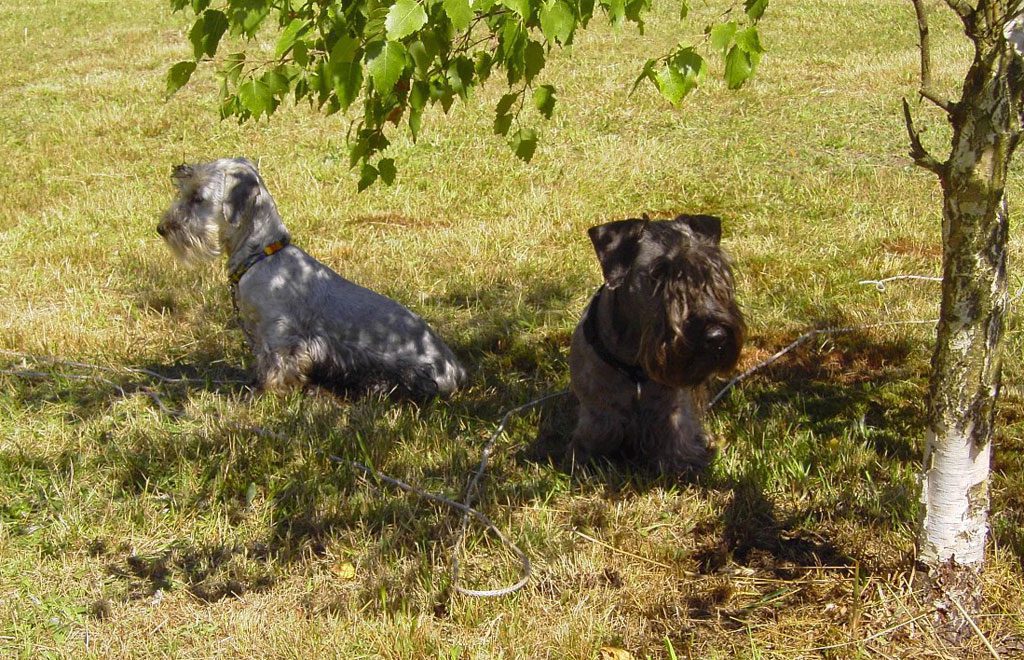
    2 – Two Kerry Blue Terrier, the left one, named Ceallach Blue Ivanhoe is on this photo about 14 years old and light grey. She have made the full color change. On the right is a about one year old Kerry Blue Terrier, called Edbrios Highlander. In this age the breed is just starting with changing the color of the coat. by ยฉ Hilarmont (Kempten) / CC BY-SA 3.0 OF
    3 – Kerry Blue Terrier dog by Eponym / CC BY-SA
    4 – Kerry Blue Terrier by Svenska Mรคssan from Sweden / CC BY
    5 – Kerry Blue Terrier during dogs show in Katowice, Poland by Pleple2000 / CC BY-SA
    6 – Kerry Blue Terrier, exhibition in Spodek, Katowice by Pleple2000 / CC BY-SA

    Videos "Kerry Blue Terrier"

    Type and recognitions:

    • FCI CLASSIFICATION:
    • Group :
    • Section : . .

    Federations:

    • FCI – Terriers 1 Large and medium-sized terriers. โ“˜
    • AKC – Terriers โ“˜
    • ANKC – Terriers โ“˜
    • CKC – Terriers โ“˜
    • โ€‹KC – Terriers โ“˜
    • NZKC – Terriers โ“˜
    • UKC – Terriers โ“˜

    FCI breed standard "Kerry Blue Terrier"

    Origin:
    Ireland

    Date of publication of the valid original standard:
    19.04.2005.

    Use:

    It is used in the hard work of hunting otters in deep water, in fighting badgers underground and hunting vermin. Good guard dog and loyal companion.


    General appearance:

    The typical Kerry Blue Terrier should be an upright dog, compact and well proportioned, featuring a well-developed muscular body, with a well defined terrier style.


    Behavior / temperament:

    Terrier character in all its meaning. The most important factor, The expression, must be insightful and alert.

    Head:

    With a lot hair. Males should have a stronger head and be more muscular than females..

    Cranial region:
    • Skull: Strong and well proportioned.
    • Depression links (Stop): Light.

    facial region:

    • Truffle: black, the large and wide nostrils. Snout: Must be of medium length.
    • Jaws: Strong and muscular jaws (scary calls). Teeth: Large white teeth; scissor bite (accepting bite on clamp).
    • Mouth: Dark gums and palate.
    • Eyes: Dark or dark hazelnut, medium in size and well placed, with expression of liveliness.
    • Ears: Thin and not big, carried forward or along the sides of the head towards the front, again to show the vivacious and sharp expression of the terrier.

    Neck:

    Well proportioned, good insertion on the shoulders and moderately long.

    Body:

    • top line: Of average length, straight. Pork loin: Moderate long.
    • Breast : Deep and moderate width. Well arched ribs.

    Tail:

    Thin, good insertion, carried erectly and cheerfully.

    Tips

    PREVIOUS MEMBERS:

    • Blades: Lightweight, leaning back and well glued.
    • forearms: Seen from the front, straight and with good bones.

    LATER MEMBERS: They must be well placed under the dog.

    • Thighs: Muscular, well developed.
    • Hocks: Strong.
    • Pies: compacts, strong round pads, black nails.

    Movement:

    With good coordination, parallel members. Forelimbs with good reach and hindlimbs with good thrust. When the dog is moving the line must be kept at level and head and tail bring them up.

    Mantle

    • Fur: Soft, abundant and wavy.
    • Color: Any shade of blue with or without black spots. Allow the color black, as well as a reddish hue, only until the age of 18 months.


    Size and weight:

    Height to the cross:

    • For males between 45,5 to 49,5 cm. (18 to 19,5 inches).
    • For the females between 44,5 to 48 cm. (17,5 to 19 inches).

    Weight:

    • For the males of 15 to 18 kg (33 to 40 English pounds).
    • For females proportionally less.


    Fouls:

    Any deviation from the above mentioned criteria is considered to lack, and the gravity of this refers to the degree of deviation to the standard and its impact on the health and well-being of the dog.

    • Flesh-colored gums.
    • Yellow eyes, the clear.
    • Convex or concave back.
    • Narrow sill.
    • Elbows sticking out.
    • Upper or lower prognathism.
    • White or ivory nails.
    • Spurs on the hind limbs or signs that they have been removed.
    • Closed or affected hind limb movement, with hocks together (cow).
    • Dogs whose head or tail are held by exhibitors or presenters should be penalized
    • Wire-haired, wire or piggy.
    • Any color other than blue, except the exceptions indicated above.

    FALTAS DESCALIFICANTES:

    • Aggressiveness or extreme shyness.
    • Any dog โ€‹โ€‹showing clear signs of physical or behavioral abnormalities must be disqualified..


    N.B.:
    • Males should have two normal-appearing testicles fully descended into the scrotum..
    • Only functionally and clinically healthy dogs, with the typical conformation of the breed, should be used for parenting.

    The latest changes are in bold.

    TRADUCCION: Lic. O. Valverde, reviewed by Dr. F. del Valle and updated by J. Nallem, Uruguayan Kennel Club.

    Source: F.C.I - International Cynological Federation

    Alternative names:

    1. Irish Blue Terrier, Kerry (English).
    2. Terrier Kerry Blue (French).
    3. Kerry (German).
    4. Irish Blue terrier (Portuguese).
    5. Kerry (espaรฑol).

    โ–ท The world of Pets: Dogs, cats, birds, reptiles, amphibians

    Border Terrier
    Gran Bretaรฑa FCI 10 -Large and medium-sized Terrier

    Border Terrier

    The Border Terrier they are intelligent, loving, quite independent and.

    Content

    History

    Border Terrier It is a breed of dog of the Terrier that group, It takes its name from its place of origin, the Scottish borders. Shares ancestors with the Dandie Dinmont Terrier and Bedlington Terrier.

    Originally bred as a Hunter of foxes and small varmints, they were used to hunt otters and Badgers, as well.
    Although the breed is very old, the Border Terrier was officially recognized by the Kennel Club of Great Britain in 1920, and by the American Kennel Club (AKC) in 1930.

    In 2006, the Border Terrier ranked 81, in number of AKC registrations and rank 10 th in the UK (in the 2088, ranked number 8).

    Read more

    โ–ท The world of Pets: Dogs, cats, birds, reptiles, amphibians

    Neapolitan mastiff
    Italia FCI 197 - Molosoids โ€“ Doge

    Mastรญn Napolitano

    Despite his fierce appearance, the Neapolitan mastiff It is a balanced dog and friend of children.

    Content

    History ยซMastin Napolitanoยป

    The Neapolitan mastiff, like all broadcast, most likely descends from the molossus Tibetan. According to historical data, Italy has been inhabited since very remote times, which could date back to the second millennium before Christ..

    This shows that this architect of Campania (South Italy region, on the coast of the Tyrrhenian Sea, whose capital is Naples) brings lot of history under its belt.

    All European mastiffs descend from the Tibetan Mastiff, the oldest representative of dog breeds.
    Probably the first Asian mastiffs were carried in the India Greece by Alexander the great, around the year 300 a.C.

    Some historians argue that it was the Greeks who were known to the Romans these dogs so spectacular, to see them is struck and (for a change) they used them in their famous circuses like fighting dogs. The Neapolitan mastiff fought with Lions, bears, Tigers, He was also a dog bred for war.

    According to the English cinofilia, on the other hand, the mastiff was taken to Britannia (term designated to the island of Great Britain before that occurred the Germanic invasions) by the Phoenicians in the year 500 to. C. from that moment the spread throughout Europe would have begun.

    Beyond disagreements as to the diffusion of the breed you can ensure, years. At that time, that the "Neapolitan Mastiff" has lived in Campania for at least two thousand years, Although its first official appearance in the cinophilia data of 1946 and its official standard was approved in the year 1949.

    During the course of World War II, the race was on the verge of extinction but was recovered by a writer and called cinรณlogo Piero Scanziani that between 1941 and 1980 published a dozen volumes of fiction and nonfiction, including various Cynology treatises. He was responsible for the reconstruction of the Neapolitan mastiff during the postwar period, and he did so on the basis of the few copies remaining.

    Physical characteristics

    ยซNeapolitan Mastiffยป Videos

    Neapolitan Mastin ALACRAN
    Neapolitan Mastin bruce dello stradone (Leonardo lopez)Lightbox for Video by VideoLightBox.com v1.11

    The Mastino Napoletano impresses even from a distance with its impressive physique. Especially the huge head stands out. It is a typical molossoid head, but he has particularly pronounced full lips. His facial expression is cool and relaxed, his overall impression is impressive. Its coat is short and smooth.

    Modern breeding has given the Mastino Napoletano an excess of loose skin, that borders on the torture of the brood. For animal welfare reasons only, one must make sure that the skin is taut and there are not too many wrinkles and folds. Only slight wrinkles should be allowed in the neck area and on the dewlap.. Especially the head has grown an overabundance of skin and wrinkles in recent decades, partly so extreme that dogs can barely see due to all the wrinkles. It also, severe wrinkles are a treasure for infections and itchiness.

    According to him standard official of the breed the males of Neapolitan mastiff They must be measured of 66 to 72 cm in the cross and his weight is of 70 kg, males can easily reach up 90 kg, females should be measured in 60 to 68 cm.. The weight of the males due of 60 to 70 Kg and females of 50 to 60 kg.

    The head is huge and short, the rounded and flattened skull between the ears. It has the straight snout, a great truffle and fat lips it fall heavily.

    It has the eyes well separated and the accumulation of skin seems they were oval shaped but in reality are round. The ears are triangular, medium and high insertion.

    The body, in general, It is longer than high with the neck well massif and the Pope and grupa broad. The tail is amputated two-thirds of its length.

    The favorite colors they are the lead, the grey and black (sometimes with small white markings on the chest and the tip of the fingers), the fawn, the mahogany, the Fawn and stag.

    All cloaks can be atigrados, but the possibility that a Neapolitan mastiff come out color "tabby" is one in a million.

    Observations

    Despite its large size, no need for large spaces to be happy, because it moves shortly. although yes, It is important to establish a relaxed routine of daily walks that help keep your muscles toned.

    Another issue to highlight is that they significantly drool-worthy.

    Character and skills

    Despite his surly and even fierce aspect, the Neapolitan mastiff he is a peaceful dog, balanced, sweet, fell, very affectionate with the master and friend of children.

    Never behaves aggressively without a real reason, But if he were to have the answer, could be terrible.

    Its temperament is peaceful, but it may become aggressive if its owner is not able to educate him with wisdom and responsibility.

    Due to its structure it solid, its movement is heavy and clumsy, but appearance because it is aware of its size and enough to see him interact with children to confirm (disarms in delicacy).

    Has been dog of war, combat in the circus, police assistant, dog sledge drag, companion and self-defense dog. Currently it is trained as a guardian of houses and farms and is increasingly appreciated as a companion dog..

    In fact, it is more a guard dog than a companion or exhibition dog. Of the molossians foster, It is the quietest character.

    One Neapolitan mastiff serious upbringing is, therefore, educated, an extremely simple dog. Here and there the fat man is a bit stubborn. Only if it is good to persuade and ask for help, then it will do everything for its owner or caretaker. As a family member, is extremely adorable. He seeks the proximity of his humans and is a reliable protector.

    In case of acute threat to your humans, will try to keep danger away from them by facing the attacker with his body, but it won't attack him anymore. Does all of this quietly. Barks very rarely. His calm and serene temperament makes him a loyal and child-friendly companion, who forgives everything. Towards strangers, However, is initially waiting and watching. The Neapolitan mastiff he's a cool guy and a fascinating dog.

    Not an easy dog รขโ‚ฌโ€นรขโ‚ฌโ€นto keep just because of his strength. By its nature it has very few demands. A daily walk, sometimes brushing the coat, that is all. Only the food is a certain challenge in terms of quantity and quality. You don't need a big garden, but a garden is already useful. A small apartment on the nth floor would not be suitable. The Neapolitan mastiff he's a great partner, but it is not a companion for runners, dog athletes or performance junkies.

    Education

    It must be remembered that in a Neapolitan mastiff adult, the line is just a symbolic control. Large dog easily has the power to maneuver the other end of the leash at will. But he doesn't want, at least if you have enjoyed the basics of a good education. The Neapolitan mastiff it is very easy to train. Only his stubbornness has to be broken here and there with consistent smoothness.. He wants to follow his master and mistress and he does it very reliably. It is an elementary duty of an owner of Neapolitan mastiff pay attention to a consistent education already in the puppy. Because only education and not the leash makes wonderful walks in nature possible, that together with this calm four-legged friend they become a balm for the soul of agitated people.

    Care and health ยซNeapolitan Mastiffยป

    Caring for a Neapolitan mastiff healthy breed is not problematic. Brushing the coat here and there is enough.

    Bad habit of extremely strong folding of the head and body often leads to chronic inflammation. They are usually a source of constant itching for dogs.. Sometimes it even makes vision difficult. Such dogs need expensive time and care.

    Nutrition ยซMastรญn Neapolitanยป

    You need a lot of high quality food. It is helpful to have an elevated feeding bowl to counteract the risk of stomach churning. Weight must always be carefully considered.

    Life expectancy ยซNeapolitan Mastiffยป

    Breeding mistakes have cost this dog, formerly robust, many years of his life expectancy. Before they were 12, today they are more likely to be 6 to 9 years. But, exact data not available.

    Buy a "Neapolitan Mastiff"

    The purchase of a Neapolitan mastiff it must be long-term and well considered. You should check carefully if you have all the requirements in order to spend many wonderful years together with this strong friend.. Also financially the attitude is a challenge. If you are looking for a puppy, you must make sure that the dogs are not too massive and wrinkled. You must ask about the ancestors, its appearance, their illnesses, your age. To get a Neapolitan mastiff solid character, you should just look directly at a serious breeder. For animal welfare reasons you should refrain from buying puppies from parents with severe wrinkles. A puppy Neapolitan mastiff from a good breeder costs about 2.500 EUR.

    Characteristics "Neapolitan mastiff"

    Coexistence is important that you have with your new friend. Before considering the acquisition of a dog of the breed "Neapolitan mastiff" you know certain factors. Not all breeds of dogs are apt to live in an apartment, you must take into account his character, their need for exercise, their interaction with other pets, their care and if you have small children, their level of tolerance towards them.

    Adaptation โ“˜

    2,0 of 5 stars (based on 1 review)

    friendly dog โ€‹โ€‹โ“˜

    1,0 of 5 stars (based on 1 review)

    hair loss โ“˜

    3,0 of 5 stars (based on 1 review)

    Affection level โ“˜

    3,0 of 5 stars (based on 1 review)

    Need for exercise โ“˜

    2,0 of 5 stars (based on 1 review)

    Social need โ“˜

    3,0 of 5 stars (based on 1 review)

    Home โ“˜

    2,0 of 5 stars (based on 1 review)

    Toilet โ“˜

    3,0 of 5 stars (based on 1 review)

    Friendly with strangers โ“˜

    1,0 of 5 stars (based on 1 review)

    barking โ“˜

    2,0 of 5 stars (based on 1 review)

    Health โ“˜

    5,0 of 5 stars (based on 1 review)

    Territorial โ“˜

    5,0 of 5 stars (based on 1 review)

    Cat friendly โ“˜

    3,0 of 5 stars (based on 1 review)

    Intelligence โ“˜

    3,0 of 5 stars (based on 1 review)

    Versatility โ“˜

    3,0 of 5 stars (based on 1 review)

    Child friendly โ“˜

    3,0 of 5 stars (based on 1 review)

    Surveillance โ“˜

    2,0 of 5 stars (based on 1 review)

    joy โ“˜

    5,0 of 5 stars (based on 1 review)

    Images ยซNeapolitan Mastiffยป

    ยซNeapolitan Mastiffยป Videos

    Type and recognitions:

    • FCI CLASSIFICATION:
    • Group :
    • Section : . .

    Federations:

    • FCI – Pinscher and Schnauzer-Molossoid type dogs – Swiss Mountain Dogs and Cattledogs. Section 2.1 Molossoid, mastiff type. โ“˜
    • AKC – Dogs working โ“˜
    • ANKC – Group 6 (utility dogs) โ“˜
    • CKC – Working dogs โ“˜
    • โ€‹KC – Working dogs โ“˜
    • NZKC – Utility dog โ“˜
    • UKC – Watchdog โ“˜

    FCI breed standard "Neapolitan mastiff"

    Origin:
    Italy

    Date of publication of the valid original standard:
    13.11.2015

    Use:

    Protection and watchdog.


    General appearance:

    Big dog, heavy and solid with high volume appearance. The length of the trunk exceeds its height at the withers.

    IMPORTANT PROPORTIONS: Body length is a 15% more than the height at the withers.

  • The skull-snout ratio is 2 to 1.
  • The length of the head is approximately 3,8 / 10 the height at the withers.
  • Neck is rather short.
  • Chest circumference is wide.


  • Behavior / temperament:

    Steady and loyal, is not aggressive. Guard dog of the property and its inhabitants, always vigilant, Intelligent, noble and majestic.

    Head:

    Short and massive, with the skull wide at the level of the zygomatic arches. The skin is abundant and has wrinkles and folds, of which the most accentuated and characteristic part of the external palpebral angle to descend to the labial angle. The superior longitudinal axes of the skull and muzzle are parallel.

    Cranial region:
    • Skull: The skull is wide and flat, particularly between the ears, seen from the front, it is slightly convex at the front. The zygomatic arches are very prominent, but with flat muscles. The protrusions of the frontal bones are well developed; the front groove is marked; occipital ridge is barely visible.
    • Stop: Well defined.

    facial region:

    • Truffle: Located in the prolongation of the nasal cavity, should not protrude from the anterior vertical line of the lips; it should be bulky and the large nostrils should be wide open. The color is according to the color of the fur: black for black specimens, dark gray in dogs of other colors, and the chestnut for brown dogs.
    • Snout: Very broad and deep; its width is approximately equal to the length. The length should be equal to one third of the length of the head. The sides are parallel so that, seen from the front, the shape of the muzzle is practically square. The depth of the muzzle is approximately twice its length.
    • Lips: fleshy, thick and full. The upper lip, seen from the front, forms an inverted "V" at its junction point. The lower lateral profile of the muzzle is determined by the upper lips, its lower part is the corner of the lips, with visible mucosa, located vertically from the outer corner of the eye.
    • Jaws / Teeth: Powerful with strong jaws and dental arches that fit together perfectly. The lower jaw should be well developed in width. Well developed white teeth, regularly aligned and complete in number. Scissor bite, that is, the upper incisors overlap the lower incisors in close contact, implanted in the vertical of the jaws; or pincer bite, that is, the upper incisors are joined edge to edge with the lower incisors. The outer edge of the upper incisors should be in close contact with the inner edge of the lower incisors.. An inverted scissor bite is tolerated.

    EYES: well separated on the same front level; rather round shape, but never protruding or too deep. Iris color is generally darker than coat color, except in shades of diluted shades where the color of the eyes is lighter. The skin never folds to interfere with the eyes.

    EARS: Small, in relation to the size of the dog, form triangular, located above the zygomatic arch, flat and glued to the cheeks. Ears are natural.

    Neck:

    The upper profile is slightly convex. Trunk rather short and conical, good muscular. The lower neck profile is well covered in loose fur that forms a well-separated double dewlap, but not exaggerated. Double chin begins at the level of the lower jaw and does not reach below the middle of the neck.

    Body:

    The length of the trunk exceeds by 15% the height at the withers.

    • top line: The upper line of the back is straight. Cross: It is wide, long and not very prominent.
    • Back: Width and length approximately 1/3 the height at the withers. The muscular and well developed lumbar region in its width should be harmoniously connected with the back.
    • Pork loin: Width, strong and muscular. The hip bones are prominent as they reach the upper lumbar line.. Breast : Large, with well-developed pectoral muscles. The rib cage is wide, with long, well-arched ribs. Chest circumference is wide. The tip of the sternum is at the level of the tip of the shoulder.

    Tail:

    It is wide and thick at the root; strong, slightly tapering towards the tip. Its length reaches the hock joint. At rest it carries it hanging and curved in the shape of a saber, in action raised horizontally or only slightly above the top line.

    Tips

    PREVIOUS MEMBERS:

    • General appearance: Previous members, from the floor to the tip of the elbow, seen in profile and from the front, they are vertical with a strong bone structure in proportion to the size of the dog.
    • Shoulder: Long and well sloped, muscles are well developed, long and well defined.
    • Arms: Well angled to the shoulder blade and with significant musculature.
    • Elbows: They must be parallel to the median plane of the body, that is to say, neither turn inward nor outward.
    • Forearm: Its length is almost equal to the length of the arm. Placed in a perfect upright position. Strong bone structure with lean, well-developed muscles.
    • Carpo: Width, slim and knotless, follows the vertical line of the forearm.
    • Metacarpus: Continue the vertical line of the forearm. Angulation and moderate length.
    • Previous feet: Round shape, large, fingers well arched and well joined. The pads are hard and well pigmented. The nails are strong, curved and dark colored.

    LATER MEMBERS:

    • General appearance: They must be powerful and robust, in proportion to the size of the dog and capable of giving the required propulsion during movement.
    • Thigh: Its length is 1/3 from the height to the cross and its obliqueness is about 60 ยฐ. Broad with thick muscles, prominent and clearly marked. Thigh bone and hip bone (femur and coxal) they form an angle of 90 ยฐ.
    • Knee: The femoro-tibial angle is about 110 ยฐ -115 ยฐ.
    • Leg: The length is slightly less than that of the thigh and of an obliqueness of 50 ยฐ -55 ยฐ, with a strong bone structure and well visible muscles.
    • Hock: The tibio-tarsal joint forms an angle of 140 ยฐ โ€“ 145 ยฐ.
    • Metatarsus: Strong and slim, almost cylindrical in shape, perfectly straight and parallel and quite low.
    • Hind feet: Smaller than the previous ones, round with well-joined fingers. Dry pads, hard and pigmented. The nails are strong, curved and dark colored.

    Movement:

    It is a typical characteristic of the breed. Movement is feline type, like the steps of a lion. It is slow and also resembles that of a bear. The jog is characterized by a strong push from the rear and a good extension of the front. The dog rarely gallops; the usual gait is walking and jogging. Ambition is tolerated.

    Mantle

    SKIN: Thick, abundant and loose throughout the body, especially on the head, where it forms numerous folds and wrinkles, and at the bottom of the neck where it forms a double dewlap. Never in abundance to interfere with the health and well-being of dogs.

    Fur: short, hard and bushy, the same length everywhere. Uniform length of 1,5 maximum cm. Must not show any trace of long hair.

    Color: Gray colors are preferred, leaden gray and black, although also brown, reddish and reddish rose, that sometimes have small white spots on the sill and on the fingertips. All colors can be brindle. Hazelnut tones accepted, soft gray and isabella.


    Size and weight:

    Height to the cross:

    • Males: 65-75 cm..
    • females: 60-68 cm..

    Weight:

    • Males: 60-70 kg.
    • females: 50-60 kg.


    Fouls:

    Any deviation from the aforementioned criteria is considered as a fault and the severity of this is considered to the degree of the deviation to the standard and its consequences on the health and well-being of the dog..

    SERIOUS FAULTS:

  • Pronounced undershot.
  • Tail size too high.
  • Size greater or less than the allowed limits.
  • FALTAS DESCALIFICANTES:

  • Aggressiveness or extreme shyness.
  • Any dog โ€‹โ€‹showing clear signs of physical or behavioral abnormalities.
  • Accentuated convergence or divergence of the cranial-facial axes.
  • Upper line of the snout concave or convex or very aquiline (roman nose).
  • Total depigmentation of the trua.
  • Upper prognathism.
  • Entropion / ectropion.
  • Eyes gazeos, total depigmentation of both edges of the eyelids; strabismus.
  • Absence of wrinkles, creases and double chin.
  • Absence of congenital or artificial glue.
  • Extensive white spots; white marks on the head.


  • N.B.:
  • Males should have two normal-appearing testicles fully descended into the scrotum..
  • Only functionally and clinically healthy dogs, with the typical conformation of the breed, should be used for breeding
  • TRANSLATION: Mrs. Brรญgida Nestler. Official language: IN.

    Technical direction: SR. Miguel Angel Martinez.

    Source: F.C.I - International Cynological Federation

    Alternative names:

    1. Mastino Napoletano Italian (English).
    2. Mรขtin de Naples, Napolitain (French).
    3. Neapolitanischer Mastiff (German).
    4. Mastino napoletano, Neapolitan mastiff (Portuguese).
    5. Mastรญn napolitano (espaรฑol).

    โ–ท The world of Pets: Dogs, cats, birds, reptiles, amphibians

    Bulldog
    Gran Bretaรฑa FCI 149 - Molossoid - Dogo

    Bulldog

    The Bulldog Currently he is a dog known for having a good humor.

    Content

    History

    The race Bulldog or English Bulldog, It was initially used for betting in dog fights, during the 17TH century (in 1835 This practice was banned in England). In the news, this dog is one of the symbols of England.

    Its origin is in the "ancient Greek dog", Kelb Thal Bulldog, or bulls Maltese dog: an imported breed to England, with ancient mastiffs crossed gave rise to the Old English Bulldog.

    The Bulldog of yesteryear was lighter and similar to the Boxer than the chubby current Bulldog; was a purely sporting animal. It was used in the creation of other races as: Bullmastiff, Boxer, Bull Terrier, and some hounds like him Beagle old type. As a fighting dog, it was an animal that only accepted the challenge of larger animals such as bears., bulls and even Lions.

    The origin of the name is due to the fact of being a dog butchers, that is to say, its function was to run the bulls, for believing that his meat was softer that way. Although it is probably a deformation of the name Band Dog or "Hardened Dog".
    It must be borne in mind that the old Bulldog have nothing to do with the current, they were only modified with crosses with other races like the Pug or Dutch bulldog; race of which Bulldog inherited its flattened snout as well as its plump muscles.

    Former Bulldogs were dogs of varied appearance, sometimes dogs elongated snout and all colors. It has to be taken into account that the former Bulldog was a working animal by which attached great importance to the character.

    Physical characteristics

    The Bulldog is a breed that is characterized by thick shoulders and a head large in proportion to their body. Generally thick folds of skin on his forehead, followed by a few black, large, round eyes. It has a short snout with folds above the nose, with a pendant Chin under neck, along with sagging lips and pointed teeth. The big legs give an idea, how strong is the dog that you have to deal with. Even a well-trained bulldog with an ideal weight seems to the uninitiated observer that it is a dog with excess pounds. He's really loaded with muscle and shouldn't have any fat on his ribs. All this translates into a very powerful and imposing appearance.

    Its pelage is short, smooth and elegant red color, beige, white, striped (color mixing, sometimes in irregular stripes) and various colors of these.

    Weight and height standard varies by country, but in general terms and averages, These dogs are usually measured in 30 to 40 cm. and weigh in 18 to 25 Kg. Some dog breeds need them they cut off the tail or her call after birth, the bulldogs are the few races that have naturally short and curly tail. A long, upright tail it is flaw in a Bulldog.

    Character and skills

    The Bulldog is friendly and courteous. There is hardly a quadruped that is so wholeheartedly devoted to humans. He greets his family and all the people he has held close to his heart at some point in his life with exuberant warmth.. Itร‚ยดs, mostly, a cool guy who can't be bothered by anything so quickly, not by a barking dog or by the vacuum cleaner running through its muzzle. But it can literally explode in an instant when it seems necessary. Then shoot like a rocket towards the front door and pile up with a dark bass in front of the alleged troublemaker.. In this situation, literally goes through the wall. The direct path is then his creed.

    But do not worry, the Bulldog can be controlled and bite accidents are practically impossible. When you realize you've scared a friend, almost embarrassed. Once the "danger" has been avoided, he lies down comfortably on his couch again seconds later and growls like nothing happened. At these extremes his mental heritage comes out once again. The Bulldog has a sovereign character, making it the ideal companion even in hectic big cities and a balm for our often stressed psyche.

    โ€œBulldogโ€ care

    The Bulldog has no special demands on your posture. It is a frugal and low maintenance companion, as long as you are healthy. The most important thing is that you feel the love of your humans. It can be easily kept in a small apartment as long as it has its place on the sofa with a cushion. This is sacred to him. But there shouldn't be too many stairs to climb. He loves his daily walks, you also need to stay fit, and is a smooth companion when traveling or in the restaurant. The Bulldog behaves perfectly and can also be left in the room for a few hours.

    But, when is hot, you have to let her rest. You have to be careful that you are neither physically nor mentally stressed. You should avoid long car trips even with air conditioning. Otherwise, it is perfectly suitable for traveling. to most of the Bulldogs they love to travel by car. Since he doesn't have a strong hunting instinct, you can walk with him relaxedly through the landscape, what he also likes Bulldog. You have to control yourself with food. Most of the Bulldogs they are voracious eaters, who empty their bowl in no time and then look at us with an innocent expression: "That, Thats not all, I'm supposed to starve here?ยป Being overweight is bad for your health, even in the Bulldogs.

    No special coat care necessary; occasional brushing is good for fur and psyche.
    Regular cleaning is necessary in case of exaggerated wrinkles.

    Nutrition / Food

    The Bulldog he's a greedy dog. He hurriedly empties the bowl and then asks with a disapproving look if that was it.. In the interest of your health and your tendency to be overweight, must keep short and always watch the total ration of sweets included. It is advisable to feed the English Bulldog with high quality food with a high meat content.

    Life expectancy

    Due to over-exploitation and exaggeration in its appearance, the Bulldog has a life expectancy of only 6,3 years according to the standard leading Kennel Club static. A typical Bulldog of serious breeding without exaggeration can easily reach the 10-12 years.

    Health "Bulldog"

    There is probably no dog, nor any animal, that was so deeply shaped and unfortunately deformed by us humans. This caused considerable health problems. In 2009 the Kennel Club of London, who is responsible for him, revised the standard of Bulldog in the sense of a healthier upbringing. Among other things, nose wrinkles are expressly prohibited. Unfortunately, these regulations are ignored in much of the breeding. Natural births are a rarity and mating is increasingly being replaced by artificial insemination by the vet. The Bulldog healthy is very easy to care.

    Many Bulldogs suffer from a deformation of the respiratory tract, it doesn't allow them to breathe freely. As a result, the heart is occasionally overloaded. It also, inflamed wrinkles, entropion (eyelid turned inward) and narrow ear canals are common clinical pictures of the Bulldog. It also tends to cause allergies..

    Education

    The basis of your education is a relationship of love and trust with your master and caregiver. Humans must take their stubbornness and occasional stubbornness with humor.. Otherwise, we have a problem. Not a receiver of orders. But, needs clear boundaries and rules that must be strictly adhered to. Because when you want something, can be very stubborn. The Bulldog wants to please his people, but check the meaning of each order. If you don't want something, there is no way to enter. The only way to get in is by asking.. But then he will do what he is asked. A relationship of trust, a good understanding of your individual personality and respect for him can be the basis of an extremely harmonious team, where the Bulldog follows its caregiver with only facial expressions and eye movements.

    Ideal family dogs

    The Bulldogs they are ideal family dogs. Social integration in the human family and participation in his life is the greatest for him. Also for us, the humans, your warm affection is always a cause for joy, smile and good mood. Does not have an innate behavior, like the herding or protective instinct, that could turn into trouble. It is an ideal playmate for children. Although at first glance it seems a bit awkward, he is surprisingly kind even to young children. He also gets along well with other pets..

    Buy a "Bulldog"

    Find a Bulldog healthy is not easy
    Buy a puppy from Bulldog it's not easy. Although there is a wide range of offers on the relevant Internet portals, these are mostly doubtful. Many of the Bulldogs offered there come from Eastern European or even German multipliers. Breeding dogs lead a miserable life and puppies often show their illnesses days after purchase. This can become a very expensive matter, not to mention suffering. The Bulldog seriously bred is an expensive dog to buy, precisely because their upbringing requires a lot of effort. Please, buy your Bulldog only from the local breeder from long ago, preferably breeders with all certifications. Take a close look at the breeder: Serious breeders like to show you their breeding dogs and document the health and age of their ancestors. But it is also recommended to take a look at the refuge – there may be an opportunity to offer a Bulldog a new home. The puppies of a serious breeder cost from 2500 EUR. No special maintenance costs are necessary, but the Bulldog has a high risk of disease and therefore a high risk of cost.

    Characteristics "Bulldog"

    Coexistence is important that you have with your new friend. Before considering the acquisition of a dog of the breed "Bulldog" you know certain factors. Not all breeds of dogs are apt to live in an apartment, you must take into account his character, their need for exercise, their interaction with other pets, their care and if you have small children, their level of tolerance towards them.

    Adaptation โ“˜

    5,0 of 5 stars (based on 1 review)

    friendly dog โ€‹โ€‹โ“˜

    5,0 of 5 stars (based on 1 review)

    hair loss โ“˜

    3,0 of 5 stars (based on 1 review)

    Affection level โ“˜

    5,0 of 5 stars (based on 1 review)

    Need for exercise โ“˜

    1,0 of 5 stars (based on 1 review)

    Social need โ“˜

    4,0 of 5 stars (based on 1 review)

    Home โ“˜

    5,0 of 5 stars (based on 1 review)

    Toilet โ“˜

    3,0 of 5 stars (based on 1 review)

    Friendly with strangers โ“˜

    5,0 of 5 stars (based on 1 review)

    barking โ“˜

    1,0 of 5 stars (based on 1 review)

    Health โ“˜

    5,0 of 5 stars (based on 1 review)

    Territorial โ“˜

    2,0 of 5 stars (based on 1 review)

    Cat friendly โ“˜

    5,0 of 5 stars (based on 1 review)

    Intelligence โ“˜

    3,0 of 5 stars (based on 1 review)

    Versatility โ“˜

    3,0 of 5 stars (based on 1 review)

    Child friendly โ“˜

    5,0 of 5 stars (based on 1 review)

    Surveillance โ“˜

    1,0 of 5 stars (based on 1 review)

    joy โ“˜

    5,0 of 5 stars (based on 1 review)

    ยซBulldogยป images

    ยซBulldogยป Videos

    Type and recognitions:

    • FCI CLASSIFICATION:
    • Group :
    • Section : . .

    Federations:

    FCI โ“˜, AKC โ“˜, ANKC โ“˜, CKC โ“˜, โ€‹KC โ“˜, NZKC โ“˜, UKC โ“˜

    FCI breed standard "Bulldog"

    Origin:
    England, United Kingdom

    Date of publication of the valid original standard:
    13.10.2010

    Use:

    Companion and deterrent dog.


    General appearance:

    It is a short haired dog, somethingheavy, rather short in stature, width, powerful and compact. Rather large head in proportion to its size, but no part of your body should be excessively large in relation to the others., thus breaking the general symmetry, making the dog look deformed or interfering with its ability to move. Cararelativelyshort, wide snout, blunt and inclined slightly upward, although not very excessive. Dogs showing respiratory problems are highly undesirable. Bodysomething short, of good structure. Strong Member, well muscled and robustno tendency to obesity. Tall and strong rear. females not so developed as males.


    Behavior / temperament:

    You must give the impression of determination, strength and activity. Alert, brave, fair, dependent, courageous, fierce in appearance, but holder of an emotional nature.

    Head:

    Side view, the head is very high and moderately cuts from the back up to the tip of the nose. Flat front with skin on and around the head, slightly loose and subtly wrinkledwithout excess never prominent or protruding from the face. The face, from cheek to nose bones, relatively short, with skinIt may be slightly  wrinkled. The distance from the interior of the eye angle (or the center of the depression slightly between the eyes) at the end of the tip of the nose, notshould be less than the distance the tip of the nose at the edge of the lower lip.

    Cranial region:
    • Skull: Skullrelatively large in circumference. Seen from the front it appears high from the angle of the lower jaw to the top of the skull, also wide and square. From the stop, a Groove extends to the middle of the skull, may continued his stroke to the vertex.
    • Depression links (Stop) : Defined.

    facial region:

    Seen from the front, several properties of the face,  must be equally balanced to both sides of an imaginary center line.

    Nose: Nose and large nostrils, wide, black, under no circumstances liver colored, Red or brown. Large nostrils wide and open, with a well defined line, vertical and straight in between I.

    Snout:  Short snout, width, downturned, deep from the corner of the eye to corner of mouth.

    The wrinkle on the nose, If it is present, full or broken, It should never negatively affect or obscure the eyes or nose.

    Narrow nostrils and heavy wrinkles over the nose are unacceptable and should be severely penalized.

    • Lips: Thick belfos, large, and deep, covering the sides of the lower jaw, but joining the lower lip in front. Teethnon-visible.
    • jaws and teeth: Wide jaws, strong, square, lower jaw projectingslightly towards front topwith a moderate slope upward. Wide, square jaws with six small front teeth between the canines, in an even row. Canines well separated from each other, large, strong teeth that should not be seen when the mouth is closed. When seen from the front, the lower jaw is seen exactly below the upper jaw and parallel to it..
    • Cheeks: Well rounded cheeks and extends laterally beyond the eyes.
    • Eyes: Seen from the front, located low in the skull, well separated from the ears. The eyes and the naso-frontal depression are in the same straight line, at right angles to the front furrow. Separate, however the external angles within the outer line of the cheeks. Round, moderate size, or sunk or prominent, very dark, almost black, not showing the white when they look directly in front. Free of obvious problems of eyes.
    • Ears: High insertion, that is the front edge of each ear (seen from the front) touch the edge of the skull in its top margin, so that they are as far apart as possible from each other, separated from the eyes as possible and high. Small, thin โ€œrose-shaped earsโ€ is correct, It is said that internal wrinkles fall back, the top edge, front internal, curving outward and backward, showing part of the inside of the ear canal.

    Neck:

    Moderate long, very thick, deep and strong. Well arched at the top, with somethingloose skin, thick and wrinkled around the throat forming one mild dewlap on each side.

    Body:

    • top line: It falls slightly to the back behind the tip of the blades (This is the lowest part) where thorn goes to the back (higher than the cross point) curving again more suddenly towards the tail, forming amild  bow a distinctive feature of the breed.
    • Back: Short back, strong, wide at the height of the scapulae. Chest: Chest width, prominent and deep. Body with well-defined ribs backwards. Chest deep and rounded. Well lowered between the front legs.Ribs not being flat at the sides, well rounded
    • Bottom line and belly: Abdomen retracted and not hanging.

    Tail:

    Low insertion, rather right out and then turning down. Rounded, smooth and devoid of fringe or wire-haired. Moderate long, short rather than long, thick at the base, fine tuning quickly towards a tip. You must take it down (without a clear upward curve at the tip) and never carried above the level of the top line. Absence of tail, reversed or too tight queue are undesirable.

    Tips

    FRONT MEMBER:

    • General appearance: Short front legs in proportion to the rear, but not so short as to make the back look like long or as to hinder the activity of the dog.
    • Shoulder: Wide shoulders with steep and deep scapulae, very powerful and muscular giving the appearance of being glued to the body.
    • Elbows: Elbows low and well away from the ribs.
    • Arm: Very Beefy front legs and strong, well developed, inserted separate good, thick, muscular and straight, the bones of the legs are large and straight, not bent or curved.
    • Metacarpus: Short metacarpals, straight and strong.
    • Previous feet: Straight and returned very slightly outward, moderately rounded and medium sized. Compact and thick fingers, well separated up, making knuckles prominent and high.

    LATER MEMBERS:

    • General appearance: Great legs and Forelegs, in proportionslightly longer than the front ones. Long legs and Forelegs from the spine to the Hock.
    • Knees: Knee wrapsvery slightly away from the body.
    • Metatarsus: Slightly sloping and well descended metatarsals.
    • Hind feet: Round and compact. Compact and thick fingers, well separated up, making knuckles prominent and high.

    Movement:

    Walking with short, quick steps on the tip of your fingers, the rear feet not lifted high, resembling the floor rozan, running with one or another shoulder relatively moving. The strength of the movement is of the utmost importance.

    Mantle

    • Fur: Texture fine, short, pasted and smooth (hard only small and paste, rather than wire)
    • COLOR : Solid or sooty, (is a single color with black mask or muzzle). Unicolores (It must be bright and pure of his type) how striped, Red in its various shades, trode, Griffon etc., White and parties (is the combination of white with any of the above colors) Flesh-colored, black and black and Tan are highly undesirable.


    Size and weight:

    • Males: 25  kgs.
    • females: 23  kgs


    Fouls:

    Any deviation from the above mentioned points should be considered as missing and the seriousness with which this is to be taken must be in exact proportion to its degree and its effect on the health and welfare of the dog.


    FALTAS DESCALIFICANTES :

    • Aggressive or fearful dog.
    • Any dog โ€‹โ€‹showing physical or behavioral abnormalities must be disqualified..


    N.B.:

    Males should have two apparently normal testicles, fully descended into the scrotum.


    TRANSLATION : Brรญgida Nestler / Original version : (IN)
    Technical supervision : Miguel Angel Martinez

    Source: F.C.I - International Cynological Federation

    Alternative names:

    1. British Bulldog, English Bulldog (English).
    2. Bulldog (French).
    3. Bulldog (German).
    4. Bulldog-inglรชs (Portuguese).
    5. Bulldog inglรฉs (espaรฑol).