โ–ท The world of Pets: Dogs, cats, birds, reptiles, amphibians

Saint Miguel Cattle Dog
Portugal FCI 340 - Molossoid - Dogo

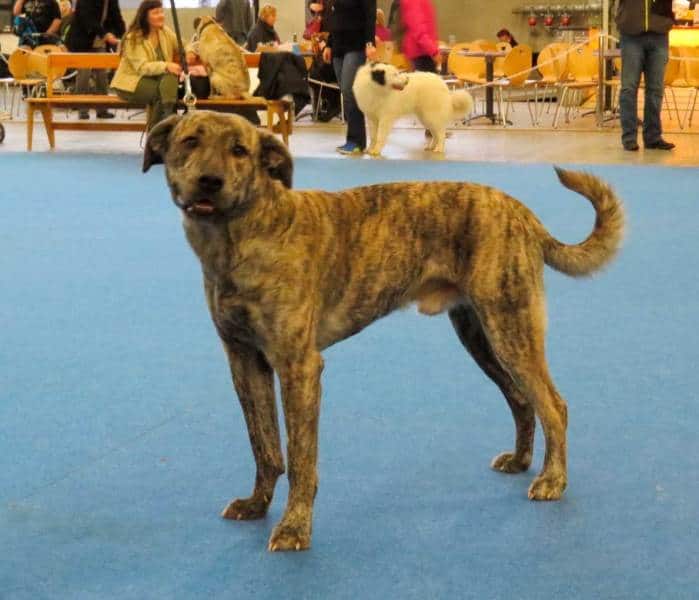
The dog's Saint Miguel Cattle Dog It is a breed of dog Portugal, specifically the Azores Islands.

Fila de San Miguel

Content

History

With the settlement of the Azores archipelago and the beginning of the exploration of the optimal conditions of the islands for raising cattle, the need for dogs on the islands to help drive and defend livestock soon became apparent, dating from the sixteenth century the first reference to its presence, in particular on the island of Sรฃo Miguel. These animals are recognized as the precursors of Saint Miguel Cattle Dog.

Although the existence of Saint Miguel Cattle Dog, as an individual race, has been recorded since the early 19th century, only in 1982 began to be registered by Antรณnio Josรฉ Amaral with the collaboration of Maria de Fรกtima Machado Mendes Cabral, veterinarian, in order to create a census of your herds. The first officially registered dog of the breed was the ยซCoriscaยป, a perfect representative of your breed.

It is also on the initiative of these same two people that, in 1984, two years after the beginning of the registration of persons the first official standard is published. In 1995 was proposed to the FCI (International Cynological Federation) and the breed was finally recognized in 2008.

Origin:

The breed known today as Saint Miguel Cattle Dog descended from mastiffs and alano initially brought to the islands of the Azores by the first settlers on the continent. Later, and through contact with other people who came and settled in the Azores, the genetic heritage of the breed was enriched by crosses made with English mastiffs, bulldogs and Dogue de Bordeaux, until the culmination of the appearance of the new race, with fully defined morphological and temperamental characteristics.

In addition to those mentioned, other races may form part of the Fila de San Miguel ancestry, as the St. Humberto's Dog, also known as Bloodhound, and the Dogo Canario, a Spanish breed from the Canary Islands, but the real link – yes there is – between these races and the Sao Miguel queue not yet proven.

Video "Saint Miguel Cattle Dog"

Playing around 1

Physical characteristics

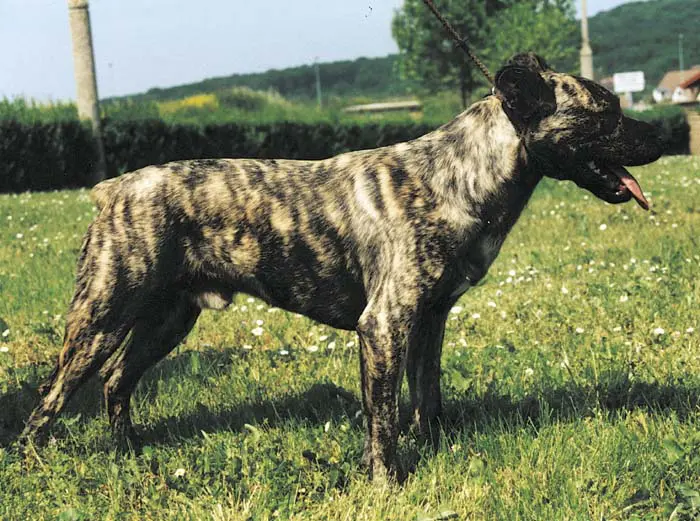
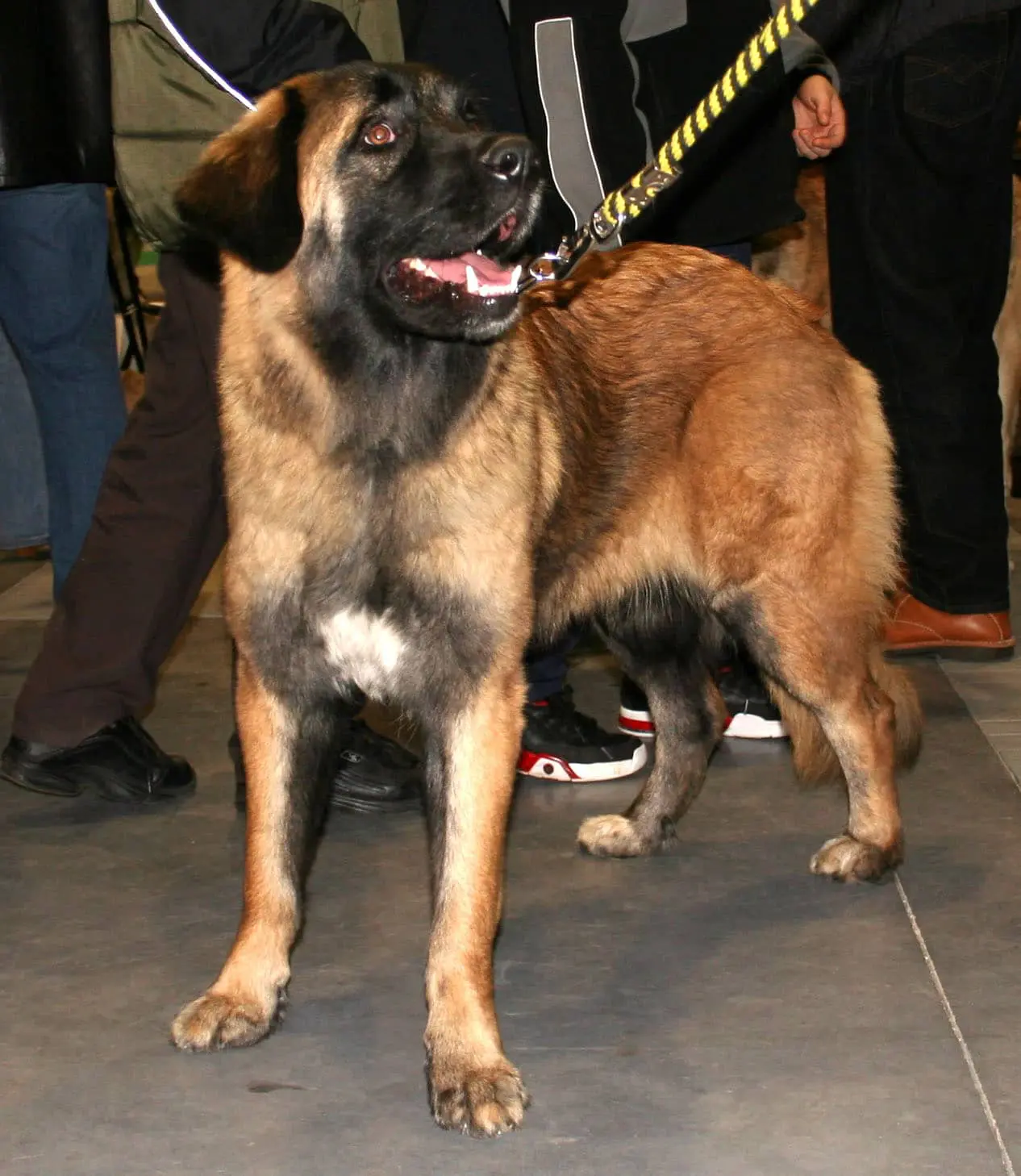
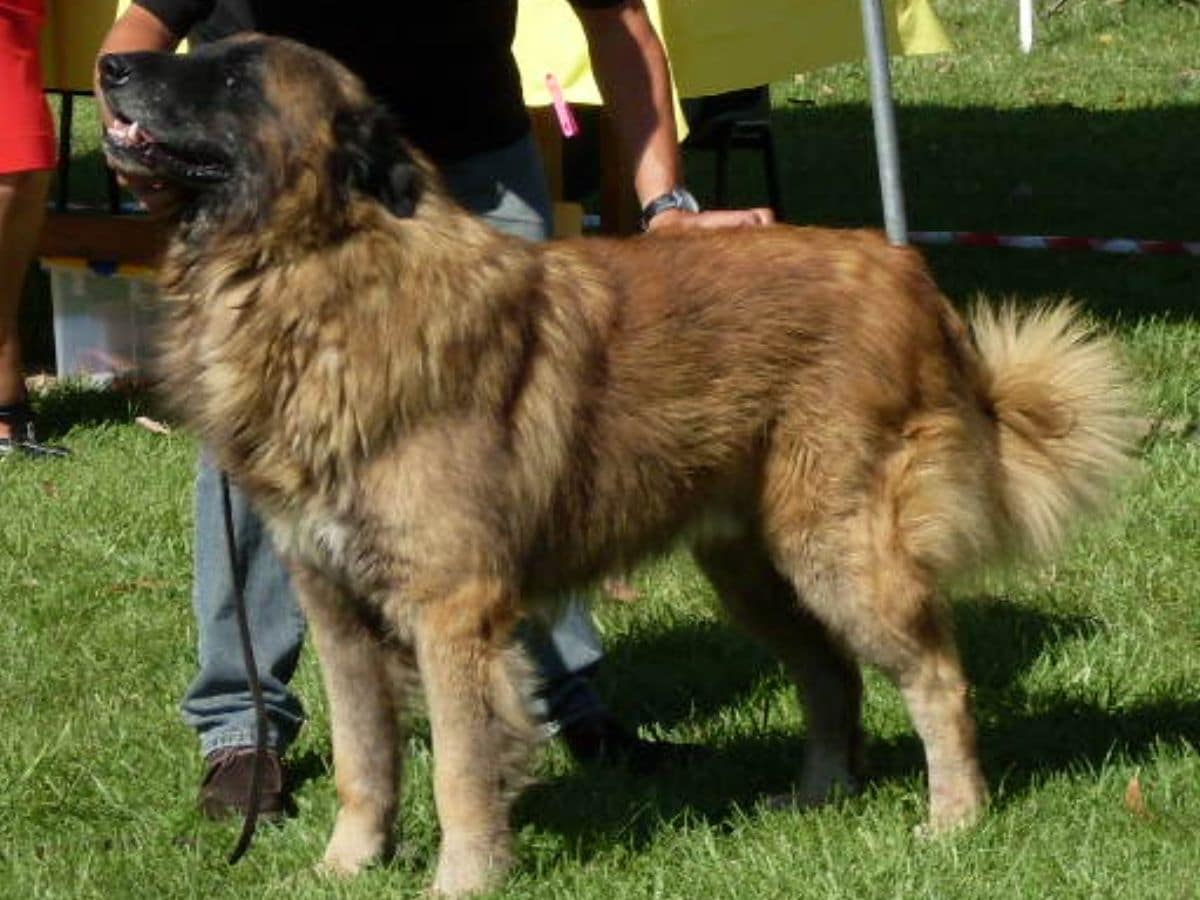
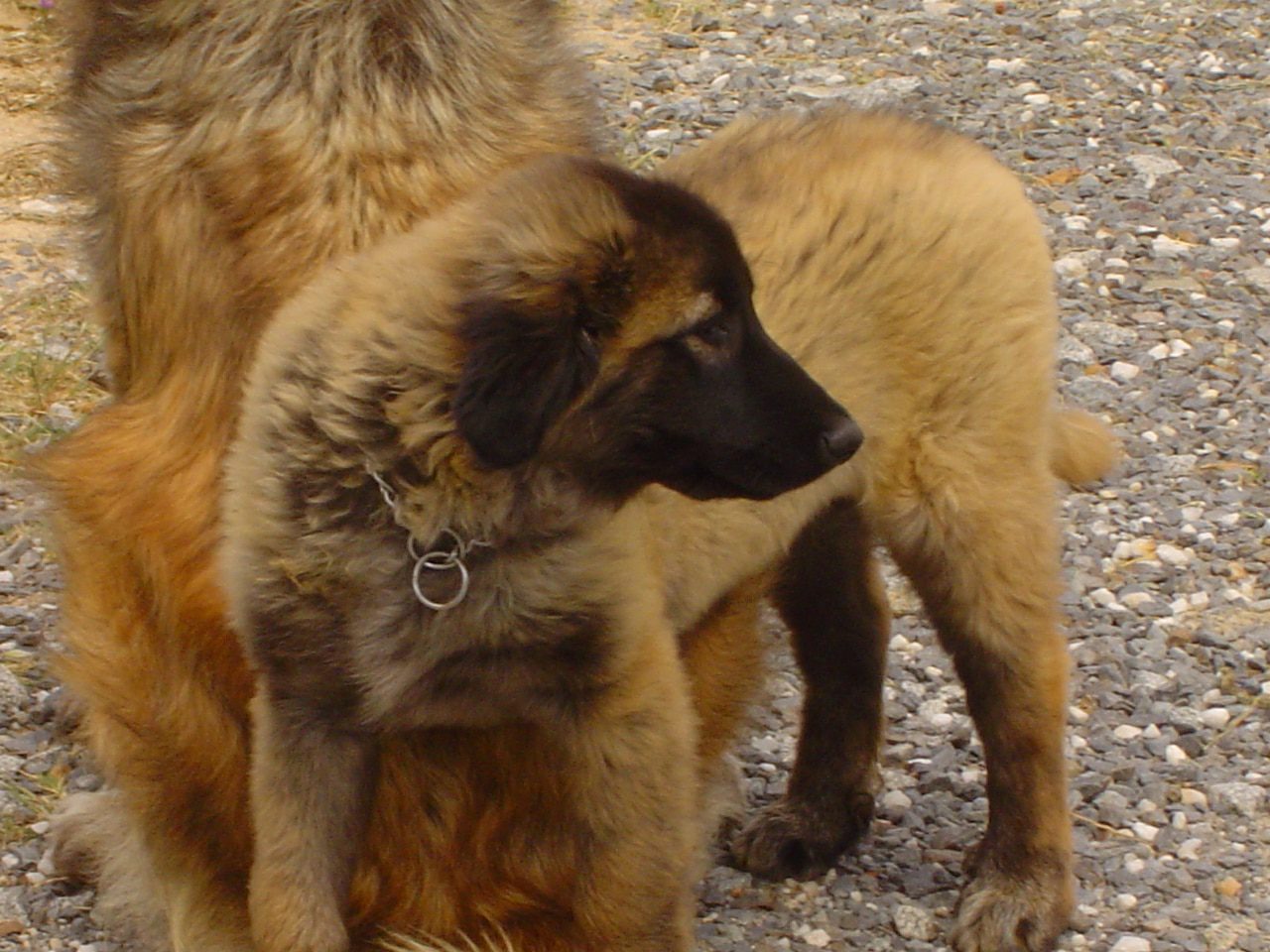
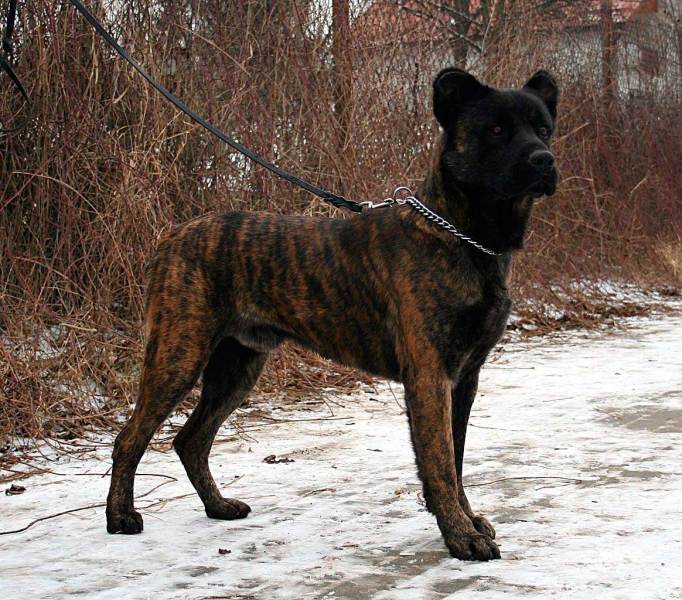
The Saint Miguel Cattle Dog it is characterized by being an animal of size and rustic features and characteristically longer than tall. The breed is medium in size, muscular, but without the heavy appearance of others.

The muzzle is well proportioned, apparently short, but it hides a wide mouth, with a full denture, capable of a powerful bite. The head has a solid appearance, wide and with the ears well placed on top, implanted in a strong neck that starts from a solid trunk, with a wide and deep chest. The legs are proportional to the body, being the front, as a rule, slightly separated.

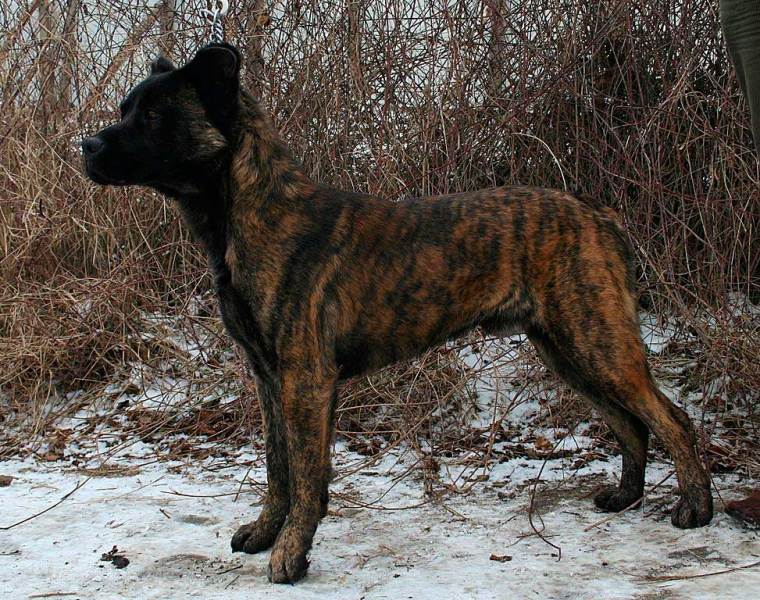
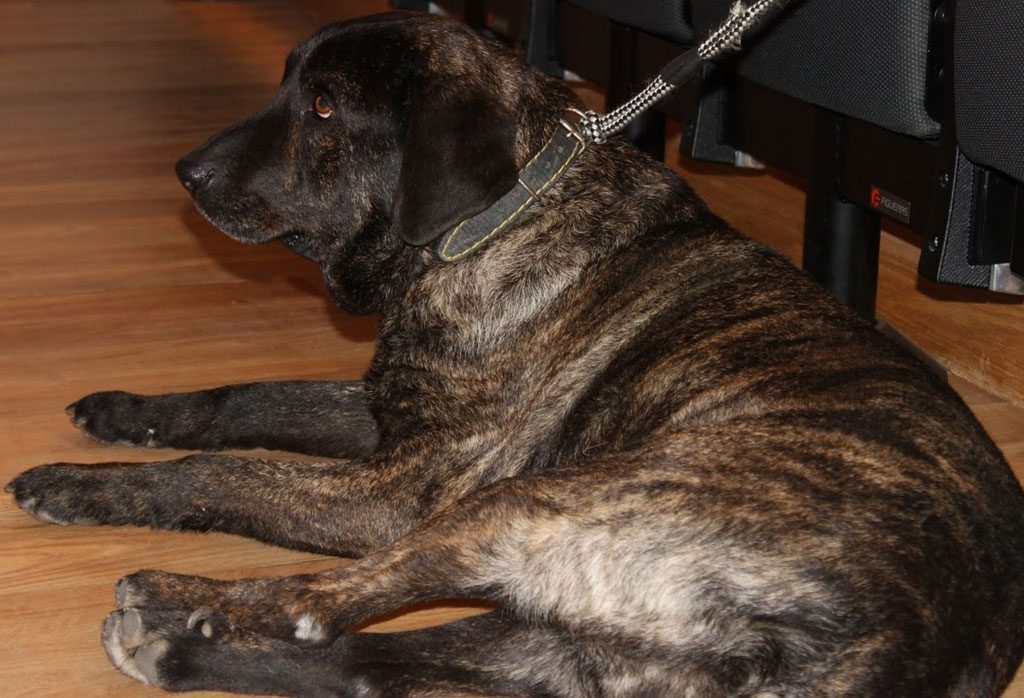
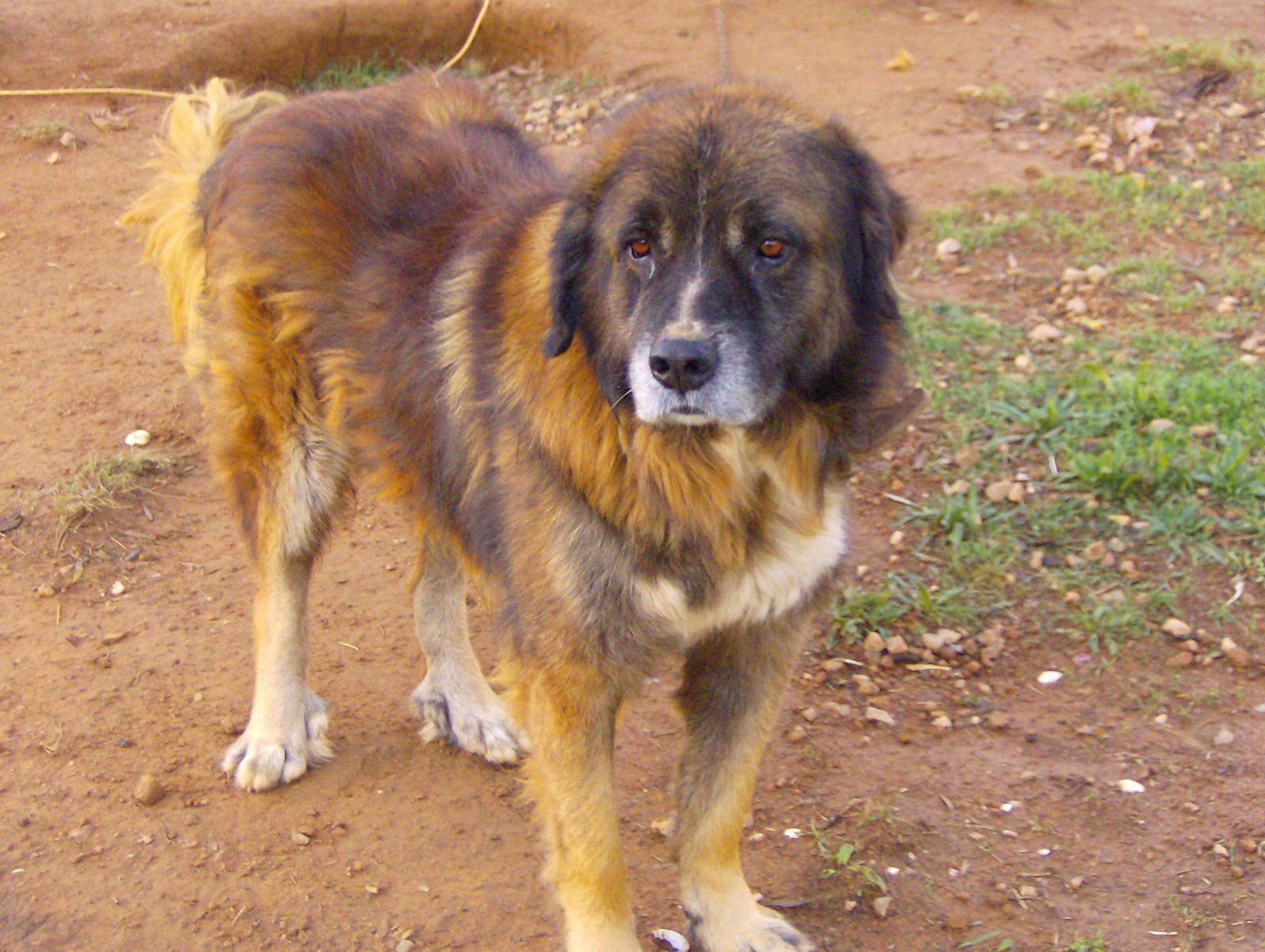
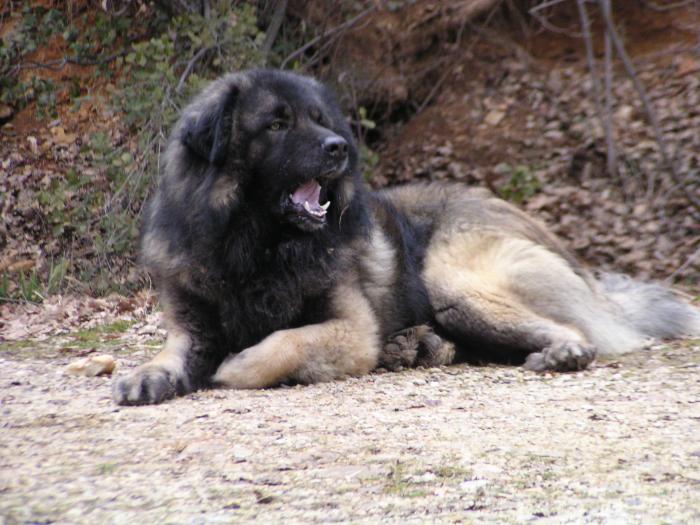
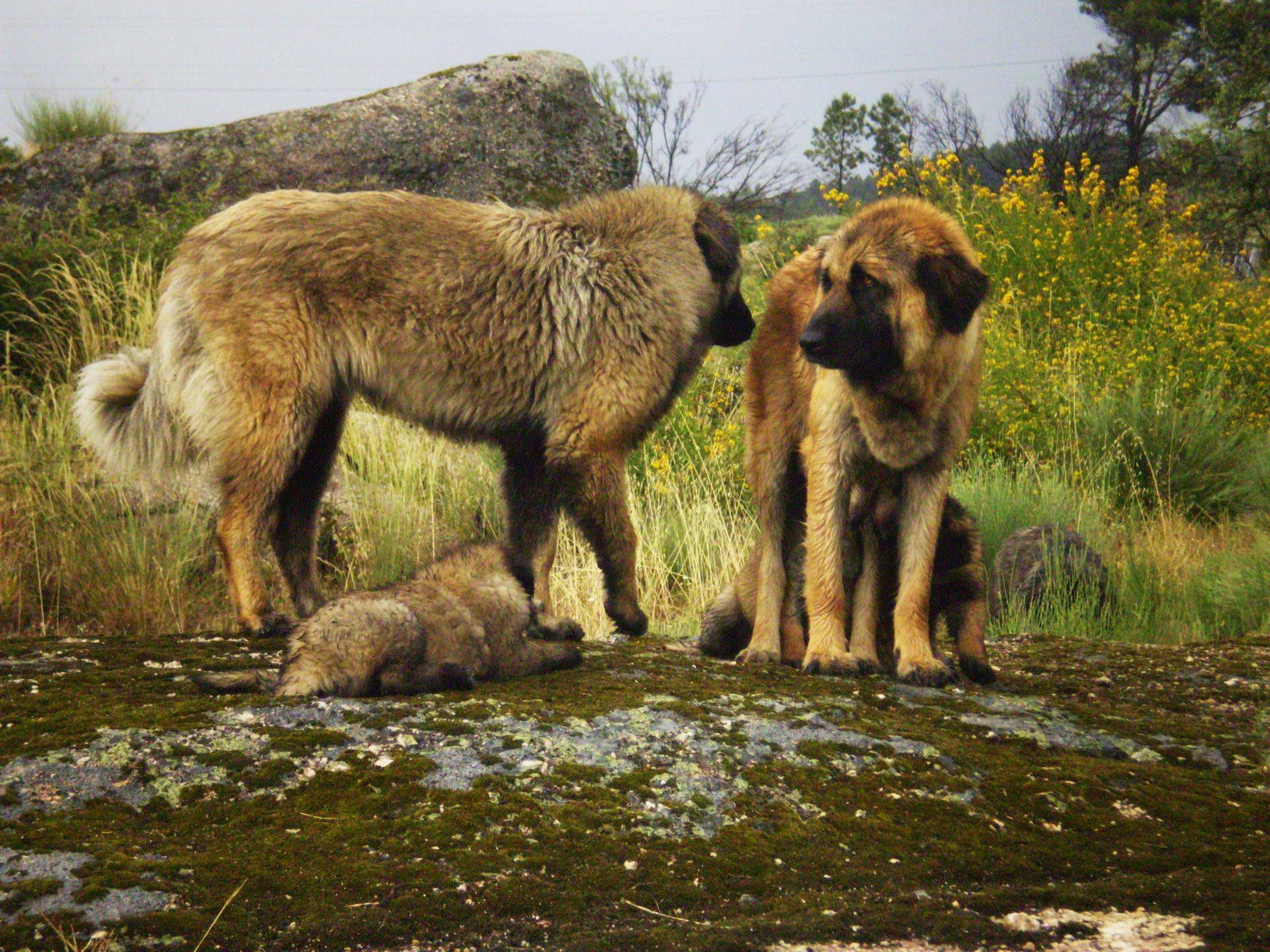
The coat is strong, smooth and dense, and always striped, and it can be tawny, gray or yellow, with white mesh on the chest. Legs can also be white. The tail is implanted high, it's thick, medium length and slightly curved. It is amputated at the height of the second or third vertebra, or is it naturally short.

  • Fur: short, smooth, dense, with hard textured hair.
  • Color: gray hair, carbonated sand (grey), yellow with all fades from light to fawn; always striated. May show white spot on forehead or from chin to chest, and white spots on the forefoot, in the later or in all four.
  • Size: males, of 50 to 60 cm.; females, of 48 to 58 cm..

Character and skills

Race of a lively and sharp intelligence, with great ease of learning, the strength of character of the Saint Miguel Cattle Dog, coupled with a distrust of the strange instincts of all guardians by vocation, can easily be mistaken for aggressiveness, but it hides a gentle nature towards those with whom it deals closely, while remaining a tenacious and courageous guardian of those who treat him. His loyalty to his human family is extreme.

With even greater emphasis, given the dominant nature of the breed, the education and sociability of puppies must be done from birth, gradually exposing the animals to new situations and stimuli, in order to improve the development of balanced individuals capable of living with humans and other animals.

Not a suitable breed for beginners, given its dominant nature, further enhanced by his physical strength and his strongly independent and autonomous character.

Even as a pet, a Saint Miguel Cattle Dog must have the opportunity to have a task to perform. Thorough training is always a simple and effective means of strengthening the relationship between the human family and the animal, while providing the physical and mental exercise necessary for the training and development of a well-balanced animal.

But, given the intrinsic characteristics of the breed, training a copy of the Saint Miguel Cattle Dog it is a task that can be quite difficult for someone who has little experience with dogs. Being a very intelligent and dominant breed, will not respond well to the use of force. Full socialization recommended.

The sheepdog for tradition and excellence, their natural fitness for livestock can, with the right training, can be channeled into the care of horses and other small ruminants such as sheep and goats. When not channeled to grazing, the Saint Miguel Cattle Dog has already demonstrated its aptitude for big game hunting, like the boar and the deer.

Its strong and protective temperament is also valued as a self-defense dog..

Health ยซSt. Michael's Rowยป

Being a rustic breed, is in robust health and there are no records to date to suggest that there is any pathology to which the breed is specifically prone to for genetic reasons. The average life expectancy of this breed is calculated in 12 years.

St. Michael's Row Toilet

The same hardiness that gives vigor to the breed also makes it a poorly maintained breed in a strict sense. Short, hard hair can be brushed occasionally and baths will be sporadic.. Adequate and balanced feeding will give developing puppies what they need to become healthy adults, and the same regimen will suffice to ensure adult health..

Images "Saint Miguel Cattle Dog"
Type and recognitions:

  • FCI CLASSIFICATION:
  • Group :
  • Section : . .

Federations:

  • FCI – Group 2: Pinscher and Schnauzer - Molossoid and Swiss Mountain and Cattledogs. Section 2: Molossoid. 2.1 Dogue type. โ“˜

FCI breed standard "Saint Miguel Cattle Dog"

Origin:
Portugal

Date of publication of the valid original standard:
21.05.2007

Use:

cattle dog


General appearance:

Robust and resistant.


IMPORTANT PROPORTIONS:

  • Slightly longer than high.


Behavior / temperament:

Cattle dog par excellence, it is equally a good guard dog of property and people. He has a very determined character with strangers but docile with his owner.
Very clever and very responsive. In the exercise of his duties, lead dairy herds, he bites low so as not to damage the udders of the cows.. But, when it comes to stray cattle it can bite higher

Head:

Strong, square-looking. Cranio-facial superior longitudinal parallel axes.

Cranial region:
  • Skull: Large, slightly bulky, little apparent occipital protuberance.
  • Nasal bevel (Stop): Is pronounced.

facial region:

  • Truffle: Wide and black.
  • Snout: Straight, slightly curved, slightly shorter than the length of the skull.
  • Lips: Well pigmented, overlapping, torn, firm, slightly curved on the lower profile.
  • Jaws: Very strong, well developed. With good opposition.
  • The teeth: Complete dentition with scissors or tweezers.
  • Eyes: Oval, expressive, slightly sunken, dark brown, horizontal, medium-sized.
  • Ears: Above average insertion. When not cut they are medium triangular and pendulous but slightly separated from the face. Normally cut in the round.

Neck:

With good connection, straight, strong and medium length. There is no double chin.

Body:

  • Trunk: Strong, muscular, with a broad chest.
  • Breast : Wide and lowered.
  • Back: Straight.
  • Pork loin: Of average length, wide and well muscled.
  • Rump: Of medium length in relation to the body, slightly predominant in relation to the cross.
  • bottom line: Bottom-up profile, ventricles and flanks proportional to the body.

Tail:

High insertion, thick.

Tips

Former members: Strong.

  • Shoulder: Scapulo-umeral angle slightly open.
  • Arms: Strong of medium length, good muscular.
  • Forearm: Thick and well muscled.
  • Carpo: Thick.
  • Metacarpus (Pastern): Thick, average length.
  • Hands: Oval, with strong fingers and nails.

Later members: Strong, moderately separated.

  • Thighs: Long, muscular, with an open lame / femoral angle.
  • Legs: Of average length, muscular.
  • Metatarsus: Of average length. May have presumptions.
  • Pies: Of average length: Oval, with strong fingers not very curled. Strong nails.

Movement:

Easy and loose. On the move, the back wobbles slightly.

Mantle

  • Skin: Thick and pigmented.
  • Shelter: Short, smooth, dense, with a strong texture, slightly bordered on the tail, the anal and posterior region.
  • Colorations: Fawn, charred and gray sand, in light and dark tones and should always be tiger. The presence of a white male is allowed in the frontal region and the menthol chest, as well as the white coloring on the hands (white male), the feet (pedal) or on all legs simultaneously (white square).


Size and weight:

Males

  • Height to the cross: 50 to 60 cm.
  • Weight: 25 to 35 kg

females

  • Height to the cross: 48 to 58 cm.
  • Weight: 20 to 30 kg


Fouls:

Any deviation from the above points must be considered a fault and the seriousness with which the fault should be considered must be in exact proportion to its degree and its effect on the health and well-being of the dog..


SERIOUS FAULTS:

  • Head: converging axes of skull and muzzle.
  • Jaws: Mouth slightly above or below.

MISS PLAYOFFS

  • Aggressive or too shy.
  • Any dog โ€‹โ€‹that clearly shows physical or behavioral abnormalities.
  • Divergent axes of skull and muzzle.
  • Severely over or under the mouth.


N.B.:
  • Males should have two normal-appearing testicles fully descended into the scrotum..
  • Only functionally and clinically healthy dogs should be used for breeding., with the typical conformation of the breed.

Source: F.C.I - International Cynological Federation

Alternative names:

1. Cรฃo de fila de Sรฃo Miguel, Sรฃo Miguel cattle dog, Sรฃo Miguel catch dog, Azores cattle dog, Azores cow dog (English).
2. fila de Saint Miguel (French).
3. Cรฃo Fila de Sรฃo Miguel (German).
4. Fila de Sรฃo Miguel, Cรฃo das Vacas (Portuguese).
5. (espaรฑol).

Source:

Wikipedia

Photos:

1 – Fila de Sรฃo Miguel during International dog show in Rzeszรณw, Poland by Pleple2000 / CC BY-SA
2 – Fila de Sรฃo Miguel during International dog show in Rzeszรณw, Poland. by Pleple2000 / CC BY-SA
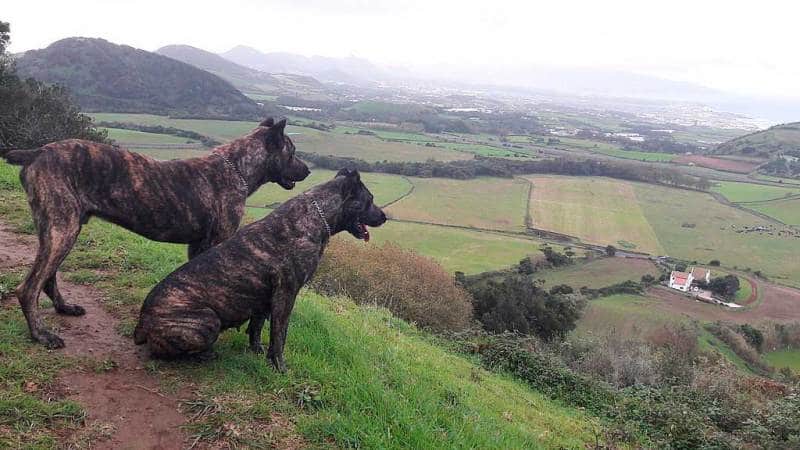
3 – At the Burnt Peak of Ribeira Grande, Son and Mother by TheLife / CC BY-SA
4 – Helsinki, el Finnish Winner Show 2015. by Thomas / CC BY-SA

โ–ท The world of Pets: Dogs, cats, birds, reptiles, amphibians

Giant Schnauzer
Alemania FCI 181 . Pinscher and Schnauzer type

Schnauzer Gigante

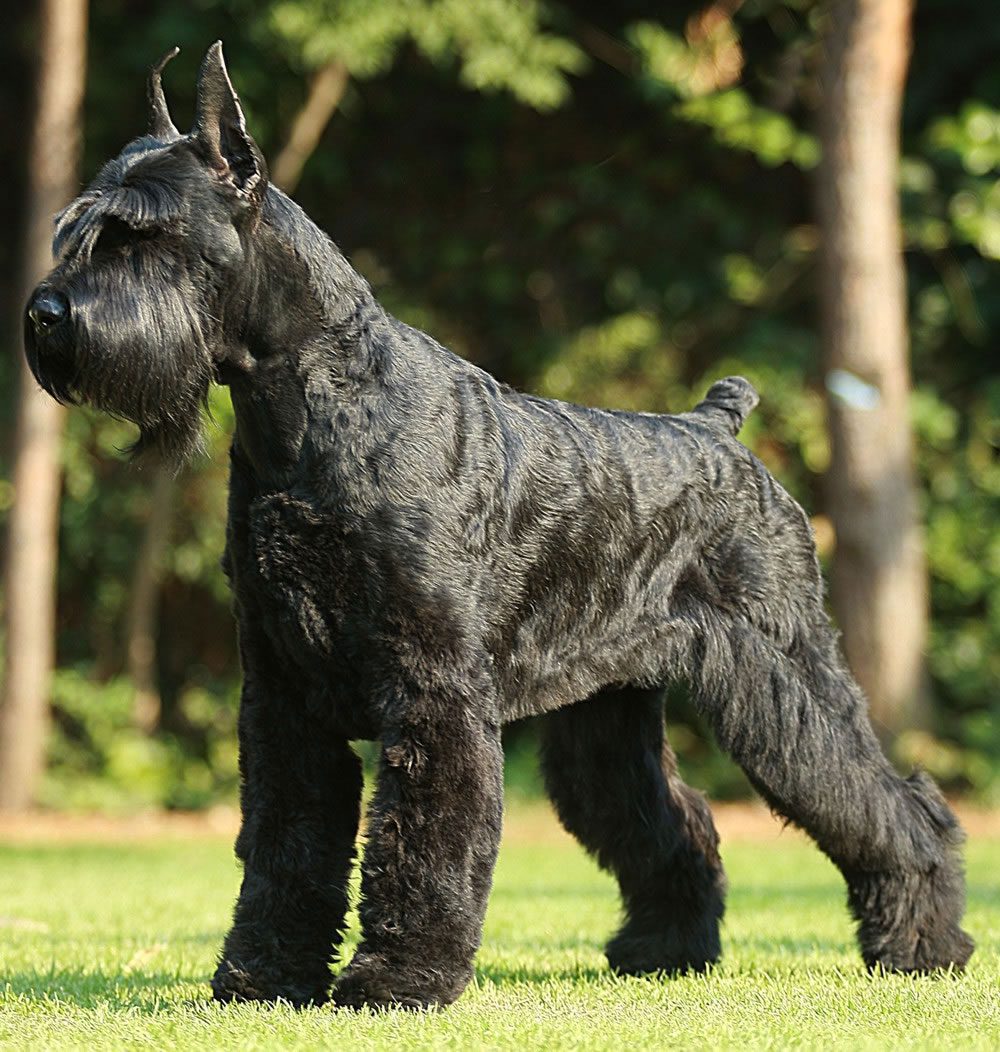
The Giant Schnauzer is a balanced dog, sweet with children and distrustful with strangers.

Content

History

The Giant Schnauzer It is a large and compact dog breed, a native of Germany. Oldest, lover of water and active, It is one of the three varieties of Schnauzer.

The Schnauzer breed in its three varieties, It has very ancient and common origins to those of the Terrier. (of those who descend).

Y, Although the aires were very Terrier, then the breeding and selection of the Schnauzer breed focused especially on guarding and defense.

Read more

โ–ท The world of Pets: Dogs, cats, birds, reptiles, amphibians

Castro Laboreiro Dog
Portugal FCI 170 - Molossoid . Mountain

Perro de Castro Laboreiro

The Castro Laboreiro Dog It is an excellent guard dog and companion

Content

History

The Castro Laboreiro Dog (Cรฃo de Castro Laboreiro) It is a breed of Portuguese dog of large size. Originating in the parish of Castro Laboreiro, Melgaรงo, is a dog type Lupoid amastinado is lighter than other breeds of cattle dogs.

The Castro Laboreiro Dog it has its origin in the region that gave it its name, the people of Castro Laboreiro, in the municipality of Melgaรงo. It is a rugged mountainous region that stretches from the Miรฑo river to the Peneda and Soajo mountains between the Trancoso rivers, Laboreiro and moro, until around 1400 m above sea level.

Like the dog, Castro Laboreiro is one of the oldest regions of the land of Portugal. The prehistoric remains such as dolmens and rock paintings, They demonstrate the presence of man in the region for thousands of years. The strengths are evidence of the strong presence of Celtic culture in the region. Also the Celts and the Romans came here, the roman roads and the construction of bridges with their landmarks. The castrejas communities have always lived of hunting, fishing, grazing and agriculture.

Read more

โ–ท The world of Pets: Dogs, cats, birds, reptiles, amphibians

Hovawart
Alemania FCI 190 - Molossoid . Mountain

Hovawart

The term Hovawart derived from medieval german, in which -hova- meant "cut" and -wart-, "guardian".

Content

History

The dog as guardian of the house and the courtyard has an ancient tradition in the history of humanity. Maybe thousands of years ago, private ownership of the house and yard, goods and workshops could only be established with the help of the protective role of dogs. The four-legged court guards were already highly regarded by the Teutons, which is reflected in the various laws of the last Teutonic. Of the 24 articles of the Law of Baiuvariorum, an entire article is dedicated only to dogs. Here, plus a dozen other dog breeds, the court dog is explicitly mentioned as "Houvavart". The Houvavart was valued at 3 shillings. It was a huge amount, considering that in the same body of law a "mediocre" horse was valued at only half a shilling. The Hovawarts are also mentioned in various writings from the Middle Ages.

The Hovawart Today is in the intellectual and functional tradition of these old court dogs. Regarding their genetic offspring, will not be more or less related to them than the other breeds of guard dogs and native dogs. Building a direct line of descent to the old Hovavart would not be permissible, especially since it is not known at all what these dogs looked like.

After 1910 the Hovawart but without a description of the appearance. Over the years 20 established itself as a breed of dog.

In the FCI breed standard of 1998 It is said that:

"From 1912 the reproduction of this breed has been using similar type dogs that are still in farms to restore the breed. apart from this, at the beginning of the crossing, you cross them with German shepherds, Newfoundland, Leonberger and other races were admitted. In addition to the strict measures taken in the breeders, the type of job was obtained again.โ€

It also, crossed the hungarian watchdog Kuvasz, what is important to understand the nature of Hovawart. After having almost died out, after the first world war, the breed was recovered by the kinophile K. F. Kรถnig. In a span of time, what had been done very successfully thousands of years before was rebuilt here. Like, but mostly of the nature the right dogs were mated. The decisive criterion was performance for the intended purpose, so to speak, the work championship. It is quite possible that the Hovawart current look like the old ones Hovawart of our ancestors by this procedure of appearance and nature, but that is speculation. Only in 1944 breeding book closed. So a vast gene pool was created as the basis for this breed of dog., which is still very useful for your health and fitness today.

Physical characteristics

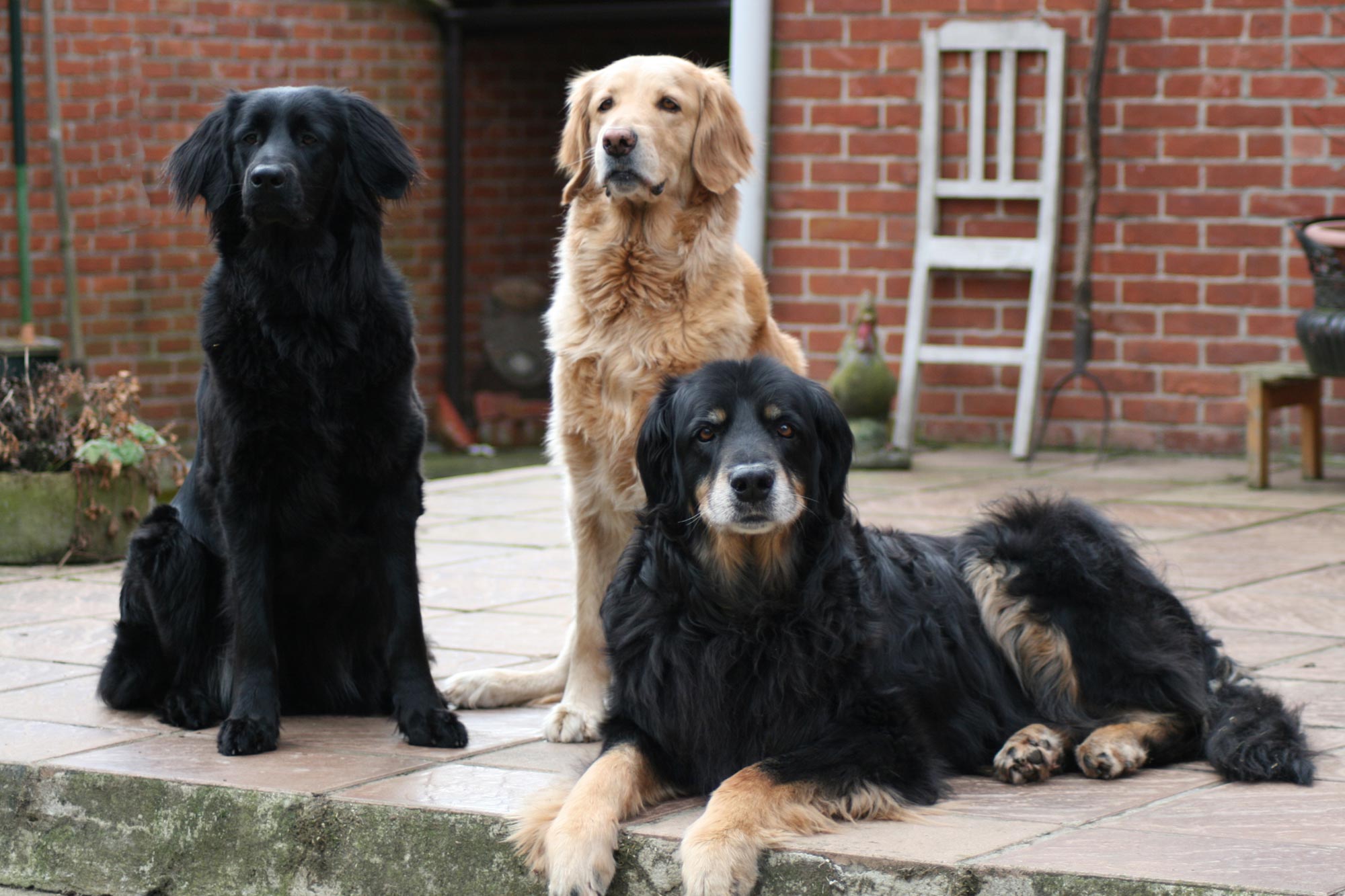
The Hovawart is a big dog, strong and at the same time quite thin. With the Hovi nowadays three strokes of color are allowed: Rubio, black marks (black with gold brown markings) black and white. Males have a height to the cross of 63 to 70 cm.. Considering its type and size, the Hovawart is thinner than it appears underneath its medium long wavy coat. So, a weight of 30 to 45 kg is considered normal for males. Despite this not so high weight, it is a very powerful and strong dog. Only for its strength and size it belongs to a hand with experience in dogs. The Hovawart he's a working dog, Guard and protection.

Character and skills

The character of Hovawart demands a person with a strong dog mind. He has a strong will, a head of its own and is very independent. Probably an heir to the pack guard dog, Kuvasz, who is one of his ancestors. He is self-assured and self-assured at the same time. The โ€œdesire to pleaseโ€ is not as strong in him as in many other working dog breeds.. Your master or caretaker still has to work and earn it. then a Hovawart well educated he is an extremely efficient off-roader and a lovely friend. Master the role of companion dog suitable for everyday life, as well as your challenges in dog sports or even as a rescue and tracking dog. He has a very good nose. Yes, and the Hovawart it is also an excellent watchdog and protection dog.

He is a defensive protector of his family and diligently protects his territory. He moves silently on the ground and faces an intruder suddenly but persistently. With built-in yard dog, the Hovawart not fully occupied, especially since today you have to monitor hardly a large enough area. He is intelligent and seeks true association with his caregiver. At the same time it is affectionate and sensitive and at the same time it radiates something primitive, archaic.

Wants and seeks connection with family. Like a well-behaved and demanded working dog, the Hovawart it is also an excellent family dog. Often rejoices with petting and hitting like a little lapdog. He is very friendly and gentle with the people he has taken to his heart. Once you meet them, will never forget them. When he is young he shows his affection sometimes very stormy.

The Hovawart it is a low maintenance dog. Apart from the change of coat, it does not need to be brushed every day., because her coat doesn't tend to tangle due to the small amount of undercoat. Well educated and managed he is an excellent companion. But, cannot be recommended as a family dog รขโ‚ฌโ€นรขโ‚ฌโ€นwithout further ado. If you are thinking of having a puppy Hovawart for the first time, must first consider practical challenges, they are only related to their strength and size. Not a beginner dog.

Hovawart Education

The Hovawart develops creativity and perseverance to realize his ideas about the world and its order. Here the owner of the dog is challenged with all the consequences, but paired with patience and empathy. And this already with the puppy. Hardness alone does not help the Hovawart at all. It is important to create and maintain trust, that the Hovawart wants to show his pack leader. By the way, pack leader: One Hovawart usually test thoroughly, who will take this position. Here its owner must assert himself with the consequent insouciance, then he will follow faithfully and with good behavior and accept the leadership of his humans without problems.

One must bring with him time and knowledge for an intensive education and, the best of all, training. If one loses the basic elements of education, you will hardly be able to go for a walk with him without stress. Then your self-confidence could even become a leadership statement.. Otherwise, the Hovawart it's the ideal companion dog image. He wants his humans to guide him, but without ever being submissive. The Hovawart maintains its own head and its own will. For some people this is perhaps too much of their own personality. But only this profile of the Hovawart can be an excellent basis for a respectful and intense human-dog relationship.

Hovawart Health and Care

The Hovawart it is a low maintenance dog. Except in times of coat change, twice a year, needs to be brushed regularly but not every day, because his coat does not tend to tangle due to the low amount of undercoat.

The Hovawart it is considered a completely healthy breed. Hereditary diseases are systematically fought, such as knee joint cartilage disease (OCD), which is more common in Hovawarts. Dysplasia of the hip joint (HD) "often a problem especially with large dogs" has been under control for a long time.

Nutrition / Food

The Hovawart they don't make any special demands. He is consistently straightforward. For a dog of its size and strength it needs little food.

Hovawart life expectancy

The Hovawarts can reach 12 years and not rarely even more with a good physical condition. It is a good life expectancy for such a large dog.

Buy a Hovawart

Puppies should only be purchased from an FCI registered breeder. For a puppy you should plan to 800 to 1000 EUR. The adult dogs of Hovawart they can also be taken out of shelter or emergency aid and offered a loving home..

Images "Hovawart"

Photos:

1 – Hovawart by https://pixabay.com/es/photos/hovawart-perro-perro-de-raza-pura-2611448/
2 – Hovawart black and tan by Faigl.ladislav / CC BY-SA
3 – Hovawart by https://pixabay.com/es/photos/perro-hovawart-negro-marrรณn-1194081/
4 – The three permitted colours of the Hovawart by Oxborrow / Public domain
5 – Blond Hovawart female (10 months) by Faigl.ladislav / CC BY-SA
6 – Hovawart by https://www.pxfuel.com/es/free-photo-xxpba

Videos "Hovawart"

Type and recognitions:

  • FCI CLASSIFICATION:
  • Group :
  • Section : . .

Federations:

  • FCI – Pinscher and Schnauzer-Molossoid type dogs – Swiss Mountain Dogs and Cattledogs. Section 2.2 Molossoid, mountain type. โ“˜
  • AKC – FSS โ“˜
  • CKC – Group 3 – Working dogs โ“˜
  • โ€‹KC – Working dogs โ“˜
  • UKC – Watchdog โ“˜

FCI breed standard "Hovawart"

Origin:
Germany

Date of publication of the valid original standard:
12.01.1998

Use:

Utility dog


General appearance:

It's a working dog, powerful, medium-sized, slightly elongated and long-haired. The difference between the sexes is clearly recognizable, especially in the head shape and body structure.


PROPIMPORTANT ORTIONSS: The length of the body comprises at least one 110 yet 115% the height at the withers.


Behavior / temperament:

It is a recognized versatile working dog, friendly and balanced disposition. Has protective instincts, He has a lot of self-confidence and has the ability to withstand stress.; is of medium temperament, combined with an excellent sense of smell. The proportions of his balanced body and special devotion to his family make him an excellent companion., guardian, defender, savior and tracker.

Head:

The nasal cavity is straight and parallel to the skull. The muzzle and skull are approximately the same length. The skin of the head is tight.

Cranial region:
  • Craging: The powerful head has a broad, rounded forehead.
  • Depression links (Stop): Well visible.

facial region:

  • Trufa: The nostrils are well developed. In black and black dogs with fire the pigmentation is black; in blond dogs the pigmentation is black, although the ยซ snow nose ยป is allowed (loss of temporary pigmentation).
  • Horcico: Strong, Slimming down slightly when viewed from above and in profile.
  • Belves: Tight.
  • Jaws / Teeth: Strong scissor bite complete with 42 teeth, according to the teething formula. The teeth are at right angles to the jaw. Caliper bite is accepted.
  • Ojors: Oval, nor protruding, or sunk. Dark to medium brown color. Tight eyelids.
  • Obars: Triangles and falls; loose along the cheeks; tall and widely spaced, giving the optical illusion of skull widening. They reach in length at least the lip corners; the tip is slightly rounded. When the dog is at rest it keeps them hanging; when the dog is on alert carry them by directing them slightly towards the forehead. Its front edges are located approximately half the distance between the eye and the muzzle..

Neck:

Strong, long Middle. The skin is tight.

Body:

  • Espalda: Straight and firm.
  • Itmor: Strong, somewhat longer than the rump.
  • Rump: Medium long, leaning slightly.
  • Breast : Width, deep and strong.

Tail:

With abundant hair, reaching below the hocks, but not even to the ground. depending on the mood, worn high above the back or low.

Tips

PREVIOUS MEMBERS: Strong, straight and vertical, viewed from the front and from the sides.

  • Hormbros: Very well muscled. The scapula is long and well oblique to the back.
  • Brazo: Long, well glued to the body.
  • Elbows: Glued to the chest.
  • Articulation of the carpus: Strong.
  • Metacarpus: Moderately inclined.

LATER MEMBERS: Strong and, seen from the back, vertical. Well angled.

  • Thighs and legs: Very well muscled.
  • Hock: Strong, descended.
  • PIIS: Rounded, strong and compact. Fingers are arched and together. Dewclaws must be removed except in those countries where it is prohibited by law.. Nails on black dogs with fire and black should have black pigmentation; in blonde dogs less pigmentation is allowed.

Movement:

In all walks, the hovawart movement, seen from the front or from behind, It's in a straight line, covering the ground well. The trot is very extended, with a powerful boost from the hindquarters.

Mantle

PIEL: In total, the skin is well glued. In black and tan or black dogs the skin presents a bluish glimpse, in blonde dogs generally a pink glimpse.


Plink: Long, strong hair is slightly wavy and glued; the inner layer of hair is poorly developed. The hair is longer on the chest, in the womb, on the tail and on the backs of the forelimbs and thighs. It is short on the head and in the anterior region of the front and rear limbs. The pelage is dense.


Colorr: There are three varieties of color: Black fire, black and blond.

  • Negro with fire: The coat is black and shiny, the color of the fire marks is medium blonde. In the head, the markings start below the nose and extend around the lip commissure to the marks on the gargant. Dot-shaped markings above the eyes are clearly visible.. The chest marks consist of two adjacent patches that can be attached. On the forelimbs, the marks seen from the side, extend from the fingers approximately to the metacarpus, Thinning at the back at the elbow level. In the hind, the marks, side view, they look under the hock in the form of a broadband, above the hock in the form of a narrow band extending from the front of the hindquarters to the height of the belly. A mark is also presented below the tail insert. Brands are well defined everywhere. Small white spots on the chest, as well as some white hairs on the fingers and on the tip of the tail are allowed. Pigmentation of the eyelids, lips and pads must be black.
  • Negro: The coat is shiny black A few small white spots on the chest, as well as some white hairs on the fingers and on the tip of the tail are allowed. Pigmentation of the eyelids, lips and pads must be black.
  • Rubinor: The coat is medium blonde, shiny and becomes lighter towards the belly and limbs Small white spots on the chest, as well as some white hairs on the fingers and on the tip of the tail are allowed. Pigmentation of the eyelids, lips and pads must be black.


Size and weight:

  • Males: of 63 to 70 cm.,
  • females: of 58 to 65 cm.


Fouls:

Any deviation from the aforementioned criteria is considered as a fault and the severity of this is considered to the degree of the deviation to the standard and its consequences on the health and well-being of the dog..


FALTAS DESCALIFICANTES:

  • Aggressiveness or extreme shyness.
  • Any dog โ€‹โ€‹showing clear signs of physical or behavioral abnormalities must be disqualified..

Apgeneral arience

  • Dogs that do not correspond to the general type of the breed
  • Females with male appearance.
  • Males with female appearance

Pbearings

  • Body proportions very different from those indicated in the standard

Comportamiento / Temperament

  • Aggressive dogs, fearful, apathetic, afraid of the shot.

Cthey are not coming

  • Absence of naso-frontal depression (Stop).
  • Blue eyes, gazeo eyes
  • Erect ears, semi-erected, rose-shaped or separated from the cheeks
  • Upper or lower prognathism, incisor arcade deviated.
  • Absence of more than 2 of the four PM1 (premolars 1) or of the two M3 (molars 3); absence of any other teeth.

CUit

  • Presence of a marked double chin or a lot of loose skin.

CUerpo

  • Back very beaten or pronounced carp.
  • Narrow or barrel-shaped chest.
  • Abnormal glue, heavily cropped or heavily coiled.

Formertremedies

  • Hindquarters too high.

Plink

  • Mostly curly hair (ring shaped curls)

Colorr

En set:

  • All non-standard colors, blue/grey, ciervuno, brown, white, spotted, smutty blonde or with mostly streaked hair
  • White patches White hairs on the inside of the thigh is not an elimination foul.

Perros black and fire

  • Gray or brown patches outside the spots.
  • Undercoat of hairs mostly a color other than black.
  • Predominant gray or white spots.

Pblack mistakes

  • Brown or gray patches
  • Undercoat of hairs mostly a color other than black.

Pblond mistakes

  • Some white hairs on the bridge of the nose do not constitute an eliminatory foul.
  • Continuous reddish-blond color without becoming slightly lighter.
  • Blonde-off-white color, even in the ears.
  • Distinctively white markings.
  • Dark patches or mask

Tby hand

  • Size smaller than that indicated in the standard
  • Size greater than 3 cm of that indicated in the standard


N.B.:
  • Males should have two normal-appearing testicles fully descended into the scrotum..
  • Only functionally and clinically healthy dogs, with the typical conformation of the breed, should be used for parenting.

Itlatest changes are in bold.

TRANSLATION: Mauricio Martinez, Federation Canรณfila Mexicana, A.C.; y Dr. J-M Paschoud.

Source: F.C.I - International Cynological Federation

Alternative names:

1. Hovie (English).
2. Hovawart (French).
3. Hovawart (German).
4. Hovawart (Portuguese).
5. Hovie (espaรฑol).

โ–ท The world of Pets: Dogs, cats, birds, reptiles, amphibians

Miniature Schnauzer
Alemania FCI 183 . Pinscher and Schnauzer type

Schnauzer Miniatura

The Miniature Schnauzer it is exclusively a balanced and affectionate companion dog.

Content

History

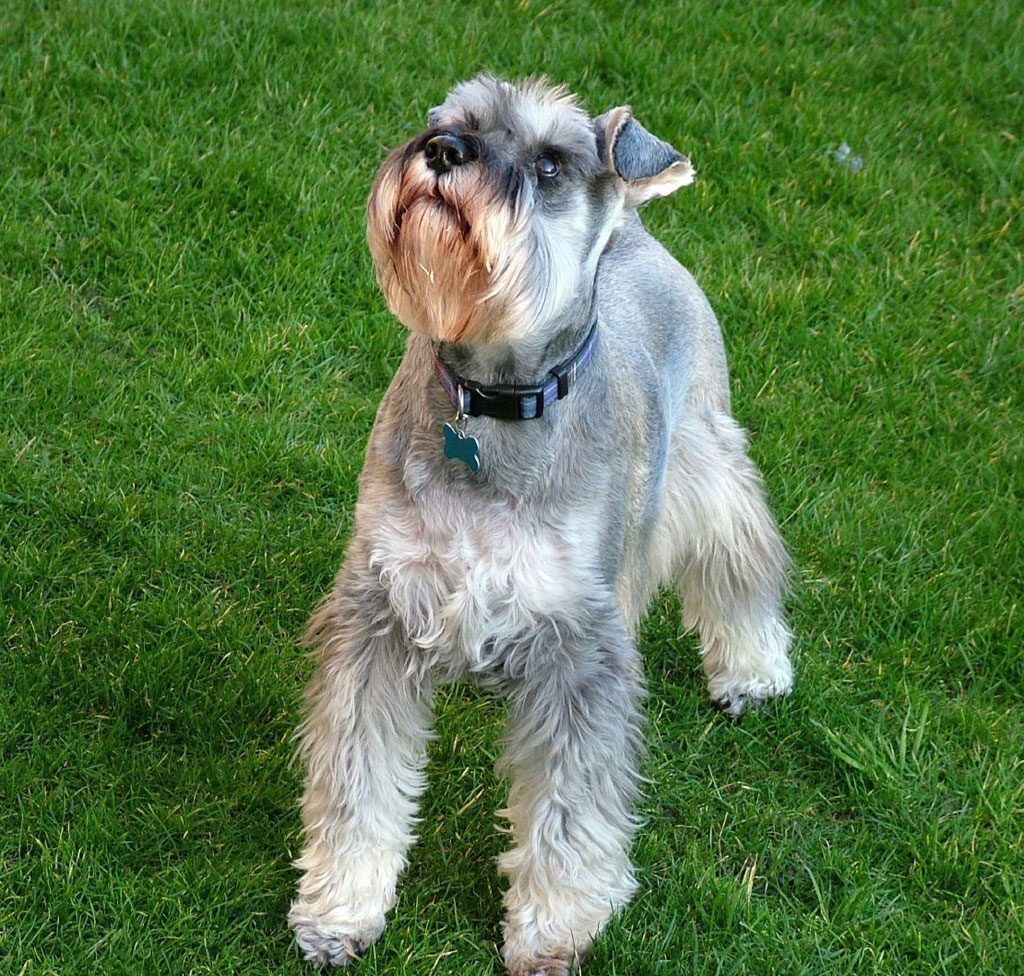
The Miniature Schnauzer It is derived from the Standard Schnauzer, emerged in Germany in the second half of the 19th century. This race is, probably, result of crosses a medium Schnauzer with some of the smaller races, as the Poodle, the Miniature Pinscher or the Affenpinsche.

The Schnauzer originated in the late 1880's on German farms to combat rodents., as a company of mares and horses, thus to be an alert and intelligent company of the families. The fur on both the beards and the legs has a function from its origins since it serves as camouflage to mislead rodents that bite the fur assuming that it is the skin of the animal.. The cutting of ears and tail also shared this same purpose, since the rats could easily bite the Schnauzer on these extremities.

Physical characteristics

The Miniature Schnauzer is very unique in its appearance. compacts and muscular, they have a square complexion (its width and length are almost the same). They have Beard long, populated eyebrows and hair length in feet. The ears and tail, Commonly, cut them. In some countries, the cutting of these parts has been prohibited because it is considered that dogs use the movement of these parts to express moods and other complicated interactions within the pack..

Read more

โ–ท The world of Pets: Dogs, cats, birds, reptiles, amphibians

Estrela Mountain Dog
Portugal FCI 173 - Molossoid . Mountain

Estrela Mountain Dog

The Estrela Mountain Dog is a big dog, rough lines and powerful appearance

Content

History

The Dog of the Sierra de la Estrela (Cรฃo da Serra da Estrela) It is a breed of dog native of Portugal, in the mountainous region that bears the same name. It has all the qualities required in this wild region, is intelligent, loyal and brave.

There are those who hold the theory that they were introduced to Portugal by the Visigoths and slowly to various parts of Europe.. The Estrela Mountain Dog was used mainly- in mountainous areas to accompany shepherds and flocks on their annual migrations, defending the wolves and thieves.

It is believed that the two varieties of existing hair: short hair and Longhair, they are due to regional variations. Contrary to what might be expected, the warmest region, the region of Manteigas, is where you could find the long-haired dogs, While short hair varieties were most frequent in the North, in Gouveia e Seia. Crosses between these two varieties were frequent.

In 1934 the standard of the breed was drafted, which was established according to its two varieties of layer. From this point, the cross between two varieties became undesirable. The publication of the rule in 1966 and the recognition of the breed by the FCI, have not brought more popularity to the breed. Over the years 60 and 70, the Portuguese emigrated looking for escape from the regime of poverty. The population of dogs Serra da Estrela declined drastically in that period, but the dedication of some breeders allowed the continuity of the breed.

Today, the Estrela Mountain Dog is highly requested, especially the variety of long hair. While the variety of short hair was more numerous at the beginning of the last century, is the variety of long hair that stands out, especially for being more eye-catching, stylish, with a larger. This made the breeders will focus primarily on the variety of long hair. Today the short-haired variety is particularly vulnerable and rare..

Physical characteristics

The Estrela Mountain Dog is a big dog, rough lines and powerful appearance. The head is huge, rounded and with a stunning skull. It has oval eyes, very expressive, Smart and serene.
The ears they are small and pendants, covered with a soft skin.

mastiff-type molosoid, the Estrela Mountain Dog has a broad chest and a slightly drooping rump. The members are strong and muscular. The tail is long, thick and slightly droopy.

There are two varieties of Estrela Mountain Dog: long hair and short hair. The hair is strong, thick, but not too rough. In some regions it is longer than others, especially in the queue, around the neck and back.

Only allowed the tawny colors, Lupine and yellow, monochrome or marbled.

Observations

Estrela Mountain Dog is a healthy dog, due to the strong natural selection which was exposed. But, There are some diseases of large animals with a higher incidence in this breed. The Dysplasia is one of them, especially that of hip. Due to this trend, owners must use quality diets, not exercise too your dog when he is young, avoid the steep stairs, breaks and slippery floors.

The variety of long hair they require more maintenance: brushed daily to untangle hair.
The variety of short hair only needs weekly brushings. Bathing should only be administered, only, When cannot be avoided,Since the protective greasiness of the skin can be damaged by cleaning products.

Character and skills

The Estrela Mountain Dog has always been kept with the sheep, While pastor was away from his flock the dog developed an independent organization and this led to his character of excellent guard dog.

It is also used for self defense and as a dog shot.

The Estrela Mountain Dog, due to its isolation and difficult access, It has become the home of this breed of dog. His hard hair helps you survive the harsh winters of the region. Each race has its specific character developed throughout its existence, of their own history.

This more or less independent nature makes this breed adapts well to modern times, where instead of caring won, waits for their owners to return from work at the end of the day. They have a lot of patience.

The beauty of this dog, his intelligence and strength, are the characteristics that allow him to be in addition to an excellent guard, a good family dog and very tolerant with children.

Habitat Estrela Mountain Dog

The Estrela Mountain Dog it's a big dog with a big boost. So, an apartment in the city is not ideal for him. Fluctuations of time and temperature do not bother him much, so you prefer to spend the day outdoors. So, the ideal is a house with a large patio or garden where you can move freely. It also, does not want to do without his long walks. For many other canine sports, requiring reliable obedience, is however hardly suitable due to its obstinacy.

Nutrition Estrela Mountain Dog

The Estrela Mountain Dog requires a correspondingly large serving of food, which should also be considered when buying it. Proper dog feeding helps keep it healthy for a long time. Whether one wants to use dry or wet food is a matter of personal preference.. In particular, nutrition during growth, especially in large dogs, sets the course for later life.

While puppies and adult dogs need enough energy, young dogs need an adapted diet, protein rich, to ensure that your muscles and skeleton grow evenly. If the young dog grows too fast on food that is too high in energy, there is a risk of permanent joint problems and malpositions. It also, It should be noted that all large breeds of dogs are at risk of stomach upset if the daily ration is administered at one time.. So, it is better and healthier to divide the food into at least two servings in the morning and at night and then give the animal a break for digestion.

Education and care

Due to the close connection of the Estrela Mountain Dog with humans and their good understanding, good conditions are created for purposeful education. But, the race's own head should not be underestimated. The Hound of the Sierra de la Estrela dog stubbornly reacts to too much hardness in training and the orders he considers meaningless. Therefore, the right key to a successful workout is patience, empathy and a consistent hand. During training special attention should be paid to the tendency to dominate, especially in males.

Although this is rarely directed against humans, but mainly against other big dogs, can disturb harmonious interaction and, above all, The walking. Ideally, great importance should be given to socialization already in the breeder. You should also practice meeting other dogs as soon as possible after your dog has moved in.. You can learn that other dogs are an enrichment and not a danger and that dominant behavior is not tolerated. In a good dog school you will receive many tips when in doubt, which will facilitate the management of your Dog from the Sierra de la Estrela.

A lot brushed in the change of coat

The Estrela Mountain Dog has a dense coat with a lot of undercoat, that adapts to weather conditions. The change of coat is therefore strong in this breed. To facilitate this process for the animal and reduce the amount of dog hair at home, should be brushed sufficiently and correctly, especially during the period. Ideal for this purpose are the special brushes, they can comb the bottom layer. Outside the change of coat phase, brush once a week.. The rest of the preparation is limited to a minimum. Especially if the dog is outside and a lot in the meadows and forests, should be checked regularly for parasites. If required, claws must be shortened with claw pliers.

Typical health and illnesses

The Estrela Mountain Dog it is a very robust animal that does not have to fight with the typical diseases of the breed. But, being a very large breed, you may suffer from dysplasia of the hip joint. Breeders recognized by the FCI only use parents that are not affected by this disease for breeding purposes., which also greatly reduces the risk to offspring.

Estrela Mountain Dog life expectancy

As a healthy race, the Estrela Mountain Dog reaches an age of 10 to 12 years without difficulty and generally without many visits to the vet. Proper nutrition and parenting are the prerequisites for a long and healthy life.

Photos Estrela Mountain Dog

Videos Estrela Mountain Dog

Type and recognitions:

  • FCI CLASSIFICATION:
  • Group :
  • Section : . .

Federations:

FCI โ“˜, AKC โ“˜, ANKC โ“˜, โ€‹KC โ“˜, NZKC โ“˜, UKC โ“˜ – The AKC does not have its own standard and instead is linked to the FCI

FCI breed standard "Estrela Mountain Dog"

Origin:
Portugal

Date of publication of the valid original standard:
04.11.2008

Use:

Herd guard dog, surveillance and companion dog also used in shooting work.


General appearance:

The Sierra de la Estrela Dog is a mastiff type. There are two varieties of hair: long and short. Rustic, of much substance with a strong movement and stunning attitudes.

The breed has a cheerful look, calm and expressive. Well proportioned, morphologically perfect, compact and rustic; The harmony of the whole is remarkable and demonstrates an ethnic purity of ancient races of the past.

IMPORTANT PROPORTIONS :

Medium long (long sub) tending to the middle line. Depth of chest is less than half of its height at the withers. The muzzle and the skull should be approximately the same length, If that is not the case, the skull should be slightly longer.


Behavior / temperament:

Inseparable companion of the pastor and faithful guardian of the herd protect against predators and thieves. Excellent dog guard farms and households, distrustful of strangers and typically docile towards its master.

Head:

Strong, voluminous. It is elongated and slightly convex profile view. Well positioned and provided to the body, the same as the relationship that keep the skull and facial, accentuate the harmony of the whole. Smooth skin over the skull and cheeks.

Cranial region:
  • Skull: Well developed, rounded skull facial longitudinal top spindles slightly divergent. Convex profile, superciliary arches slightly developed with a slightly apparent frontal fold. No prominent occipital protrusion.
  • Depression links (Stop) : Slightly pronounced, located at a more or less equal distance between the end of the nose and the occipital Protuberance.

facial region:

  • Truffle: Straight and aligned with the nasal bridge, well open Windows, big and black.
  • Snout: Elongate, slimming progressively towards the tip of the nose, but do not be sharpened. Almost straight nose cane, Although slightly hooked at the end.
  • Lips: Well developed but not thick, well bonded without tilting.  The mucous membranes of the mouth and palate, as well as the very pigmented black edge of the lips.
  • Jaws / Teeth: Well-defined mouth with well-developed jaws, full dentition with strong teeth, White and well implemented and good occlusion. Preferably bite in scissors, accepting bite on clamp.

Eyes: Horizontal, oval-shaped, at the level of the head; are medium-sized, aimed at small, symmetrical and wide open, with a calm and alert expression; Dark amber in colour preference. The eyelids are well bonded and pigmented black edges. A little marked eyebrows.

Ears: Small relative to the rest of the skull, form triangular, thin, rounded at their lower edge, pendants; inserted at a medium height, is tilted back slightly and hang to the sides of the head near the cheeks, revealing a part of your inner side in the base (called Pink ear).

Neck:

Straight, short and thick, correctly inserted on the shoulders and with a slight dewlap but not exaggerated.

Body:

  • top line: Straight. Level.
  • Back: Short preferably, well muscled.
  • Pork loin: Lumbar region wide, short, muscular and properly inserted to the rump.
  • Rump: Slightly inclined, short, broad and muscled. The height at the Croup should be equal to or slightly greater than the height at the withers.
  • Breast : Rounded, without being cylindrical, broad, long and well descended.
  • bottom line: The bottom line should gradually and gently rise from the sternum to the groin, not too wide belly, in proportion to the substance of the animal and harmoniously connected with the body.

Tail:

Robust, long, whose tip reaches the tibio-tarsal joint when the dog is standing or at rest. It is thick in the shape of a ยซ scimitar ยป, inserted at a medium height, well covered with stripes on the variety of long hair and hair ; is a hook at the end. The tail is carried below the horizontal line and falls naturally between the thighs when the dog is at rest. ; When stimulated or in action, it is carried higher than the horizontal line, forming an upward curvature., Go ahead, to the sides or down.

Tips

PREVIOUS MEMBERS: Plumb, with bones and joints strong, fairly open with unrestricted movement angles.

  • Forearm:  Straight, parallel, long, with strong bone and always cylindrical in shape.
  • Previous foot: Provided, never too round or too long, I in between a Jack's foot and a foot of Hare (not open), thick, fingers tightened with abundant hair between fingers, dark nails, preferably black, well developed, pads thick and hard.

LATER MEMBERS : Plumb, with bones and joints strong, fairly open with unrestricted movement angles.

  • Hock: Somewhat low, average opening, never leaning in or out.
  • Metatarsus: Vertical, always cylindrical in shape. Possible presence of single or double spur.
  • Rear foot: Identical to the previous foot.

Movement:

Normal and light.

Mantle

HAIR: Fur: Strong, very abundant, slightly thick, without excessive hardness with texture similar to the goat hair. The subhair is composed of a thin hair, short, abundant and matted. Usually lighter than outer hair color.

  • Long hair variety: Exterior smooth or slightly wavy hair, I uneven and some areas. In the Member, Below the elbows and legs it is shorter and thicker, as well as above the head., ears is gradually shorter from base to tip, being more thin and more soft. It is longest on the queue, where is well thick, thick and long hair. Around the neck and throat and on the thighs abundant long hair as well as on the sides of the forearm.
  • Variety short hair: Short hair, evenly distributed over the body, somewhat shorter on the head and members without having hair longer.

COLOR

The following colors are accepted and considered typical:

  •  Solid: yellow, Fawn and grey in all ranges of intensity of color;
  •  Wolf Gray: leonado, yellow and grey tones, usually with shaders more light and dark.
  • Striped: leonado, yellow or gray as a base with a black Brindle color.

In the craniofacial area a dark mask is typical.

White spots are allowed only on the limbs or feet before and after and a very small extension on the lower region of the neck and chest.


Size and weight:

  • Males : 65 to 73 cm..
  • females : 62 to 69 cm..

Tolerance + 2 cm..

WEIGHT :

  • Males: 45 โ€“ 60 Kg.
  • females: 35 โ€“ 45 Kg.


Fouls:

Any deviation from the aforementioned criteria is considered as a fault and the severity of this is considered to the degree of the deviation to the standard and its consequences on the health and well-being of the dog..

  • Appearance: Poor overall appearance, thinness or obesity.
  • Height: Outside the limits of the standard but with a tolerance of 2 cm.. of the upper limit.
  • Very narrow head, long and pointed.
  • Eyes: color clear.
  • Ears: incorrectly inserted, very long fleshy or round. Hanging completely flat.
  • Tail: Port on the back. Absence of hook.
  • Color: Absence of dark mask.

 SEVERE FAULTS

  • Behavior: Animals that show signs of shyness or nervousness.
  • Tail: Amputated or rudimentary.
  • Truffle: Pale nostrils, Truffle partially nonpigmented.
  • Ears: Amputee.
  • Fur: Other than described above.
  • Height:
  • Males :  Below the 65 cm.. or above 75 cm..
  • females: Below the 62 cm.. or above 71 cm..

MISS PLAYOFFS

  • Behavior:  Aggressive or too shy.
  • Typicity: Atypical.
  • Head: Too narrow, very long and very sharp, total absence of molosser type.
  • Jaws: Prognathism or enognatismo.
  • Eyes: Eyes of different colour or different size.
  • Tail: Anurismo.
  • Fur: Completely different hair than typical.
  • Color:  Any other color not mentioned in the standard. albinism.

Any dog โ€‹โ€‹showing clear signs of physical or behavioral abnormalities must be disqualified.


N.B.:

โ€ข Males must have two normal-appearing testicles fully descended into the scrotum..
โ€ข Only functionally and clinically healthy dogs, with the typical conformation of the breed, should be used for parenting.

Source: F.C.I - International Cynological Federation

Alternative names:

1. Portuguese Shepherd (English).
2. Chien de montagne portugais (French).
3. Serra da Estrela Berghund (German).
4. Perro de la sierra de la Estrela (Portuguese).
5. Perro de la Sierra de la Estrela (espaรฑol).

โ–ท The world of Pets: Dogs, cats, birds, reptiles, amphibians

Landseer
Alemania Suiza CanadรกFCI 226 - Molossoid . Mountain

Landseer

The nature of Landseer and Newfoundland is very similar, considering the first one as something more agile.

Content

History

The Landseer was created together with Newfoundland on the east coast of Canada. The great island of Newfoundland, located off the coast of Canada, gave his ancestors his name. Just 100 years the ways of Landseer they separated from those of Newfoundland. The reason was that they wanted to keep their skin color black and white.. More on this later. Who descended from the dogs of the Vikings of pre-Columbian times, from Spain or from the dogs of the Indians, are legends that remain untested. But, according to the current genetic map of canine breeds prepared in 2017 by an international group of researchers led by Heidi G. Parker, there is a close relationship with the recuperators, What, like the Labrador, come from the same area. Probably the ancestors of the Landseer or Newfoundland arrived in North America with the first European settlers.

The big dogs proved to be important helpers for fishermen and sealers in the cold waters of the North Atlantic., and were also occasionally useful in hunting bears and big game. It also, landowners or Landseers they carried loads and even as a draft dog they are said to provide exceptional services. Working with fishermen in extremely harsh weather was very demanding. The Landseer had to think, had to do heavy work on the networks, saved the lives of the castaways over and over again. In this way he developed the peculiarities of his being and his physique.. He accomplished amazing things in the service of humanity. The Landseers or landowners came to England over and over again with cod ships as early as the 18th and early 19th centuries. Here he became famous very early for his impressive achievements.

The famous poet Lord Byron put in 1808 your dear boatswain Landseer an impressive monument. He had the words engraved on his tombstone: ยซHere rest the bones of one who possessed beauty without vanity, strength without exuberance, courage without savagery, and all the virtues of man without his vices". Here the greatness of character of these dogs is expressed, that can still be experienced today. The painter Sir Edwin Landseer immortalized his Newfoundlands black and white in oil several times around 1830. There is some evidence that dogs documented as Newfoundland Oh ya en Canis Earth News 1700 were predominantly black and white and that it was only later that the pure black or brown dogs that are typical of Newfoundland today. The black and white guy went out of style in England. But, Swiss and German cynologists and breeders brought the last good dogs from England and built a continental European breed.

To save these black and white dogs from Newfoundland, they were declared their own race around 1900, named after their famous painter ยซLandseerยซ. So this ancient type of dog with a great history was preserved for the world of dogs.. Since then, the Newfoundland and Landseers are raised separately. Later it is said that Kuvasz and Pyrenean Mountain Dogs were crossed to stabilize the white color of the soil.

In 1960 the Landseer (continental-european type) was officially recognized by the Fรฉdรฉration Cynologique Internationale.

Physical characteristics

According to the breed standard of the Landseer, You must give the impression of being a but powerful and well balanced. The legs are relatively longer than the black Newfoundland. The back is straight and strong. The hind legs and shoulders are muscular.

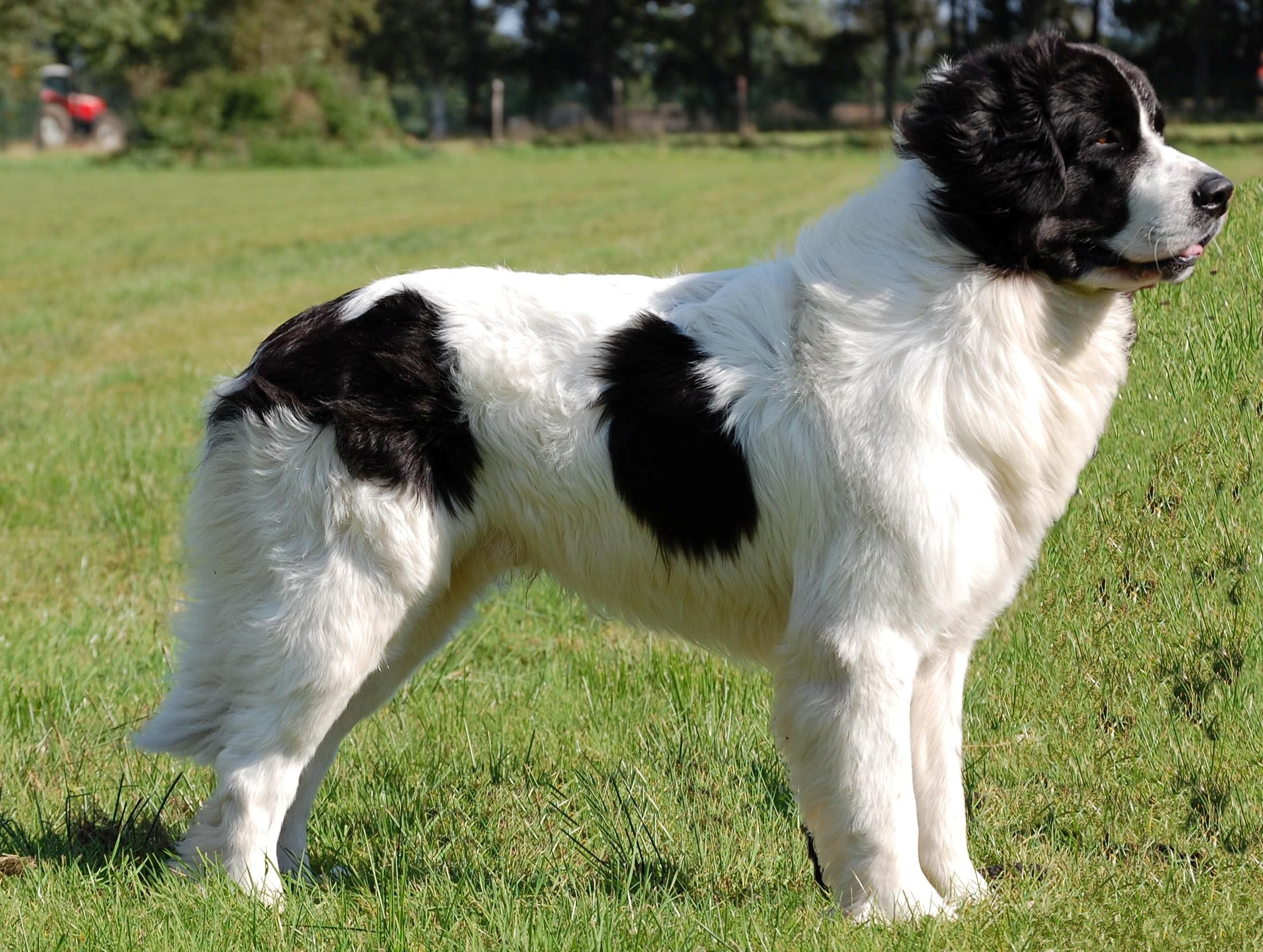
The upper layer must be long and as straight as possible, very dense and soft to the touch. The main color of the layer is white with various patches black in the rump, the neck, backsplash, belly, legs and the tail should be white.

The head should be black with the white snout and symmetric white extends from the snout to the head, ending with the white collar. It has a distinctive shape with a noble facial expression. The ears are medium-sized and eyes should be dark brown. the size of the Landseer will of 67 to 80 cm., and at birth weigh between 500 to 750 grams and at the age of 1 year can be reached despite 50 to 60 kg.

Like all mastiff-type breeds, the Landseer It is also grown very fast during its first year. Therefore one must be careful with the exercise, because if it becomes sedentary can suffer from overweight.

Character and skills

Throughout its development, and even at maturity (that is not until the dog is of 3 or 4 years of age), the Landseer is a very active dog who likes to do all kinds of activities. Swimming, for example, is your favorite activity. So when a Landseer smells and sees the water, already no boundaries, jump to the water.

The Landseer he is a very accommodating dog with his master. It is active, has good temperament, but it is not a nervous dog. It is a very confident dog, Intelligent, loyal to their own people, fairly mild in nature and, When they are given sufficient exercise outdoors, it attaches very well to home life. In general terms, most of Landseer they are very independent and have a mind of its own. The Landseer is very easy to train, much love and patience will be rewarded with a partner for life.

As we said in previous lines to most of the Landseer, they love water and walks, It is therefore necessary to fulfill these wishes to the dog. Being on the water takes it as a job, reason why can take advantage of these time to play to find objects, launch toy water to make it look, It can be one excellent training both for the owner and as for the dog. It is a good diver and with appropriate training, they are able to find objects in the bottom of any Lake. In this regard, It is good to note that if you want to go swimming with your Landseer you should keep in mind that, the dog will try to rescue and towed back to land. So, no doubt have to be careful to do this the first time. Basic training is required so that the dog knows when you are playing, and when not. Any other activity with the family is also something that the Landseer always wants to do.

When it comes to behaviour towards other dogs, children and people there is no problem. Especially the Landseer, they love to children.

It is good to socialize with other dogs puppies, because if he is male, It can be very dominant. But with a proper education, There will not be any problem.

Landseer Education

The Landseer can be educated very well. It is intelligent, interested and quickly understand what you are allowed to do and what you are not. Sometimes he takes it easy, but a little motivated he is very cooperative and tries to make his lord and master happy. The puppy should already show itself clearly and without exception where the hammer hangs. There should be no doubt about the orientation of your humans, as well as on the intimate relationship with.

Always keep in mind that this dog is the strongest and that orientation only works through unquestionable recognition. But with praise and consequences you can basically accomplish everything with it. On the basis of a good education you can even train very well at Landseer. Many Landseer are used as rescue dogs in the water, but also on earth. For this you can pass the work tests with water in the clubs.

Landseer Health and Care

The maintenance and care of the Landseer they are complex as with all big dogs. The dense and weather resistant layer should be brushed regularly with a special brush. Should not be sheared or trimmed.

The dogs of the breed Landseer like all large dogs they tend to hip joint dysplasia, twisting of the stomach. Due to their constitution and their dense fur they do not tolerate heat well.

Nutrition / Food

Like all large dogs, the Landseer needs a lot of good food. Especially in the growth phase you need professional nutritional planning. A high positioned food bowl is useful to counteract the risk of stomach twisting. You should always pay close attention to your weight.

Landseer's life expectancy

Life expectancy is between 10 and 12 years.

For sale Landseer

You should only purchase a puppy locally from a breeder who is affiliated with the FCI. Puppies of this breed cost between 1.500 and 2.000 EUR.

Images "Landseer"

Photos:

1 – Puppy landseer – 3 months old by OdinetPietra / CC BY-SA
2 – Landseer by https://pxhere.com/es/photo/548945
3 – Landseer by https://pxhere.com/es/photo/550456
4 – Cleo 11 months by Per Jensen – Flickr
5 – Landseer at PhotoEmotions (pixabay.com)
6 – Landseer by Katrina_S (pixabay.com)

Videos "Landseer"

Type and recognitions:

  • FCI CLASSIFICATION:
  • Group :
  • Section : . .

Federations:

  • FCI – Pinscher and Schnauzer-Molossoid type dogs – Swiss Mountain Dogs and Cattledogs. Section 2.2 Molossoid, mountain type. โ“˜

FCI breed standard "Landseer"

Origin:
Germany, Canada, Switzerland

Date of publication of the valid original standard:
24.08.1960

Use:

Guard and companion dog.


General appearance:

The Landseer must give the impression of a large dog, strong and harmonious. Your limbs, especially in males, they are proportionally longer than in the black Newfoundland.


Behavior / temperament:

---

Head:

The skin of the head, short hair cover, it is wrinkle free. The head profile is marked, but it has an expression of nobility.

Cranial region:
  • Craging: Wide and bulky, with a well developed occipital protuberance.
  • Dfronto-nasal depression: Marked, but not as noticeable and abrupt as in St. Bernard's dogs.

facial region:

  • Trufa: black.
  • Horcico: The length of the muzzle is equal to its height measured against the frontal-nasal depression.
  • Labios: Thin and pigmented in black; the superiors, which are as stiff as possible and do not drool, slightly cover the lower ones.
  • Jaws/Teeth: Scissor bite.
  • Cheeks: Moderately developed, gradually melting into the muzzle.
  • Ojors: Medium-sized, moderately sunken, brown or dark brown, although light chestnut is tolerated. friendly expression; almond-shaped eyelids; the palpebral conjunctiva is not visible. Overly clear eyes (sulfur or yellowish gray color) are considered as fouls, as well as eyes implanted too close to each other.
  • Obars: Medium-sized, reach the inner corner of the eye when placed towards the eyes; form triangular, a little rounded on its bottom edge, implanted high in the skull, but not too far back. Flat and glued to the sides of the head, they are covered with short and fine hair and have stripes of longer hair only at the back of the insert.

Neck:

The neck in its cross section is not completely round, but slightly oval; he's muscular, and it rises wide from the region of shoulders and thorax towards the head. In symmetrical construction, the length of the neck, from the occipital protuberance to the withers, is approximately 3/4 to 4/5 the length of the head, measured from the occipital protuberance to the tip of the nose. The presence of dewlap is not desirable (throat and neck) notable.

Body:

It is very broad and powerful from the cross to the rump. The length from the withers to the tail insert should be approximately twice the length of the head.

  • Espalda: Stiff and straight.
  • Pork loin: Muscular.
  • Glikeness: Wide, well rounded on the sides and back thanks to the powerful muscles that cover it.
  • Pecho: In the middle of the very muscular shoulders, the chest is broad and deep with strongly arched ribs forming a corresponding rib cage.
  • Vinbetween: Slightly retracted; between the belly and the back, a flat sag in the flank region must be visible.

A weak back is considered a fault, expired, loose backs, and the last ribs very short and an excessively retracted belly.

Tail:

Strong, reaches a little below the tibial-tarsal joint at most, covered in dense, leafy hair, but without forming feathers. When the dog is calm on its feet or at rest it carries it hanging down, eventually with a slight curve at the tip. During movement you can carry it straight with a slight upward bend at the tip. Tails bent or curled over the back are not tolerable.

Tips

PREVIOUS MEMBERS: A robust muscle mass from the shoulders surrounds the strong humerus and forms a correct angulation at the junction with the powerful bones of the completely straight and muscular limbs.. The forelimb has some stripes of hair that reach the tibial-tarsal joint.

  • Elbows: Well attached to the lower part of the thorax in a fairly high position and completely directed backwards.

LATER MEMBERS: The rear limb is powerful. The hind limbs must have free movement and have strong bones surrounded by powerful muscles., so that the thigh region mainly shows extensive development.

  • Thighs: They have a particularly broad development.
  • Espolones: Are unacceptable, They must be amputated from the first days of birth.
  • PIIS: Big and well formed (cat feet). Crushed or deviated feet are reprehensible. The fingers must be joined by strong interdigital membranes to the proximity of the tip of the fingers.

Movement:

The movement of the muscular limbs must be free and wide.

Mantle

  • Plink: Except for the head, the coat must be long, where possible, smooth and bushy, soft to the touch and intermixed with inner fleece which should not be as dense as in Newfoundland. The presence of an outer layer of slightly wavy hair on the back and thighs is not penalized. When brushing hair in the opposite direction to the natural position, it must return by itself to the correct position.
  • Colorr: The basic coat color is pure white with sharp, broken black plates distributed over the trunk and rump region.. The neck, the sill, the belly, limbs and tail must be white. The head is black. The presence of a white mark on the muzzle is typical of the breed, attached with a whitelist, symmetrical and not very wide. Smoke colored spots on the white background are not considered as faults, but they must be eliminated in breeding through selection.


Size and weight:

Alturto the cross: Height at withers in Landseer may fluctuate: in males an average between 72 and 80 cm and in females an average between 67 and 72 cm.. Small variations in size larger or smaller are tolerated.


Fouls:

Any deviation from the aforementioned criteria is considered as a fault and the severity of this is considered to the degree of the deviation to the standard and its consequences on the health and well-being of the dog..


FALTAS DISQUALIFYING:

  • Aggressiveness or extreme shyness.
  • Any dog โ€‹โ€‹showing clear signs of physical or behavioral abnormalities must be disqualified..


N.B.:
  • Males should have two normal-appearing testicles fully descended into the scrotum..
  • Only functionally and clinically healthy dogs, with the typical conformation of the breed, should be used for parenting.

Source: F.C.I - International Cynological Federation

Alternative names:

1. LANDSEER (EUROPEAN CONTINENTAL TYPE) (English).
2. LANDSEER (TYPE CONTINENTAL-EUROPEEN) (French).
3. LANDSEER (EUROPร„ISCH-KONTINENTALER TYP) (German).
4. LANDSEER (TIPO EUROPEU CONTINENTAL) (Portuguese).
5. LANDSEER (TIPO EUROPEO CONTINENTAL) (espaรฑol).

โ–ท The world of Pets: Dogs, cats, birds, reptiles, amphibians

Black Russian Terrier
Rusia FCI 327 . Pinscher and Schnauzer type

Terrier Ruso Negro

The Black Russian Terrier, need plenty of exercise, and it can be hyperactive and destructive

Content

History

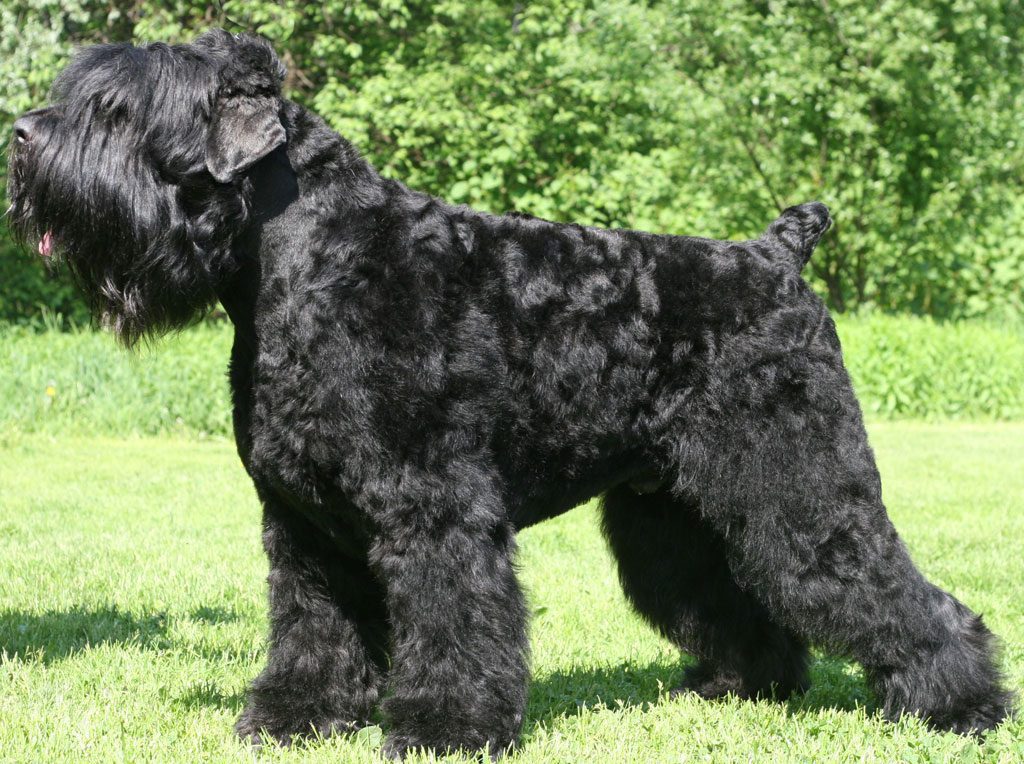
The Black Russian Terrier, (in Russian: ะงั‘ั€ะฝั‹ะน ั‚ะตั€ัŒะตั€), abbreviated as BRT, known, also as dog of Stalin (Sobaka Stalina), It is a breed of dog developed to serve as a guard dog and police dog..

The breed was recognized as such in July of 2004, by the American Kennel Club.

despite its name, the Black Russian Terrier, is not a pure Terrier: It is believed that they were used around twenty races in its development, including (among others) to the Airedale Terrier, the Giant Schnauzer, the Rottweiler, the Newfoundland, the Kavkazskaรฏa Ovtcharka and the Moscow Water Dog, now extinct.

Physical characteristics

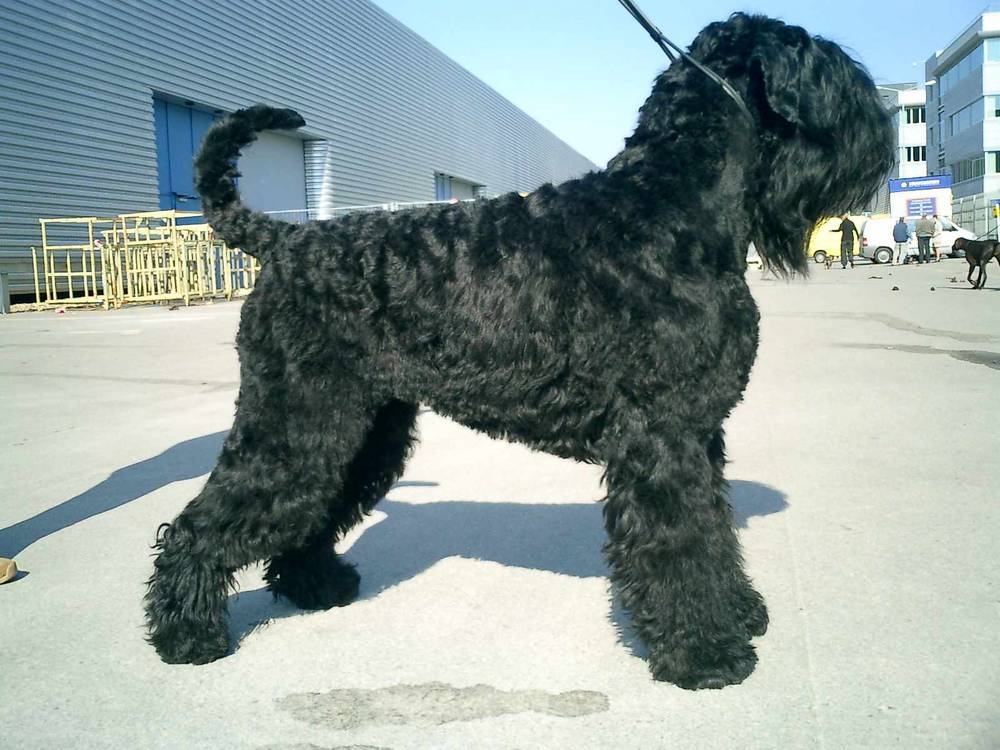
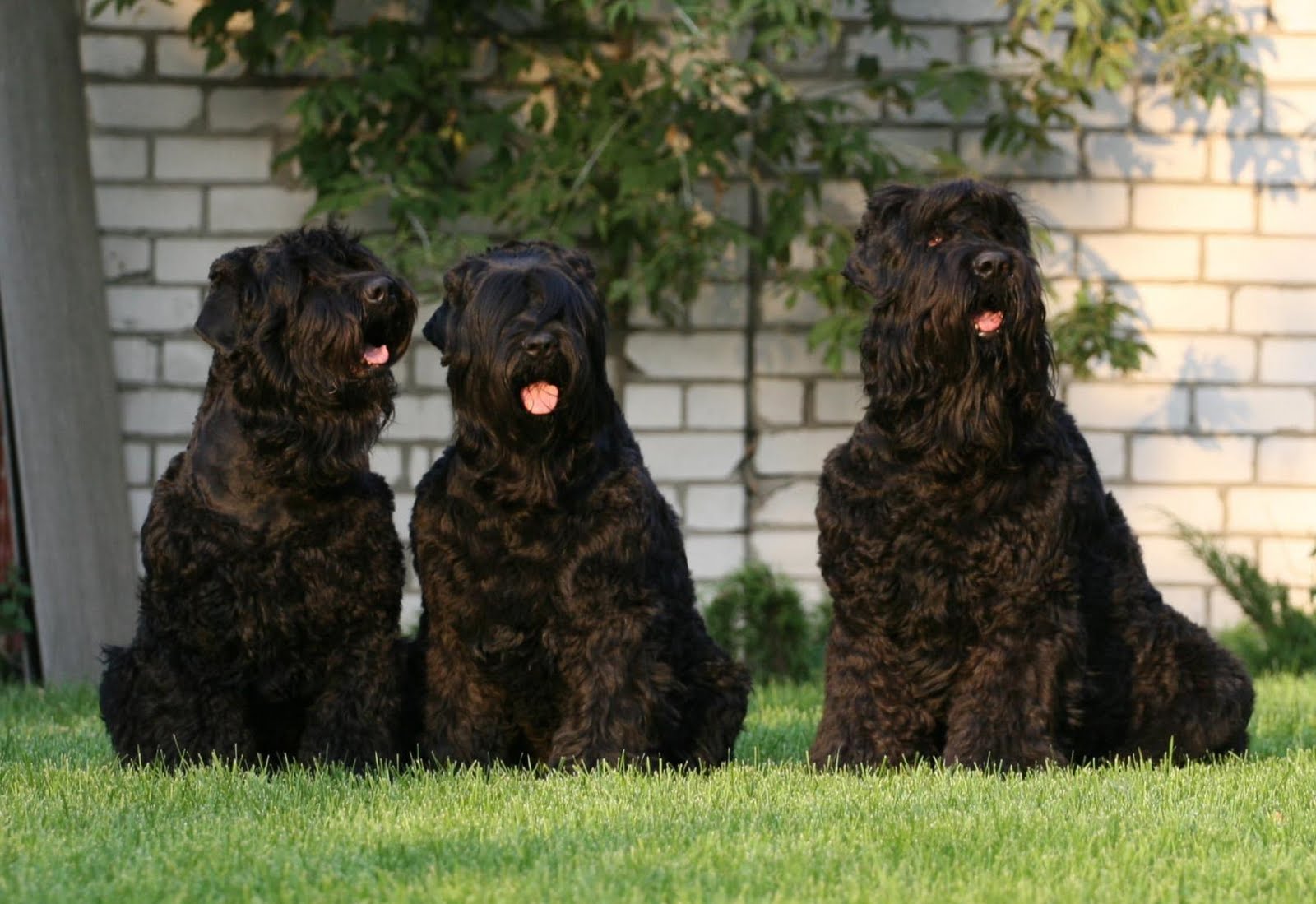
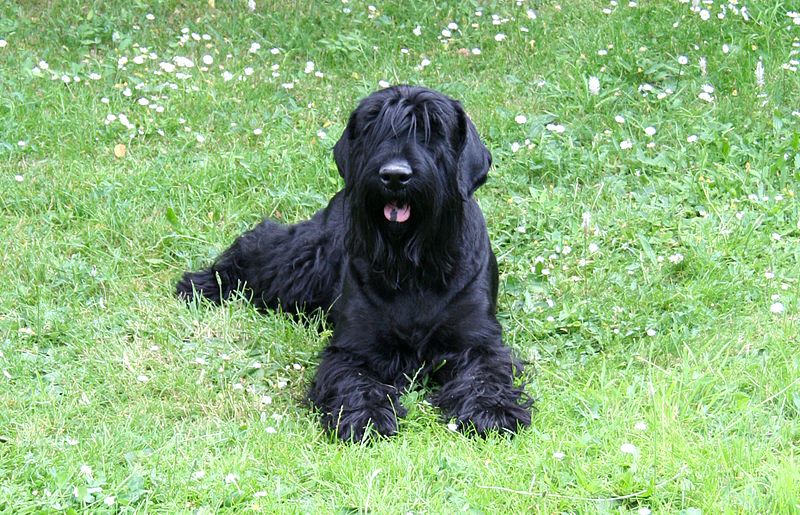
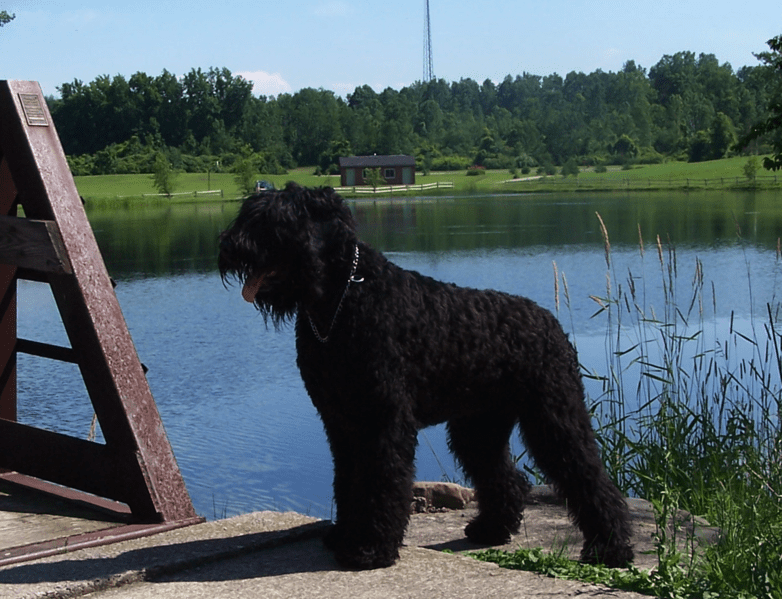
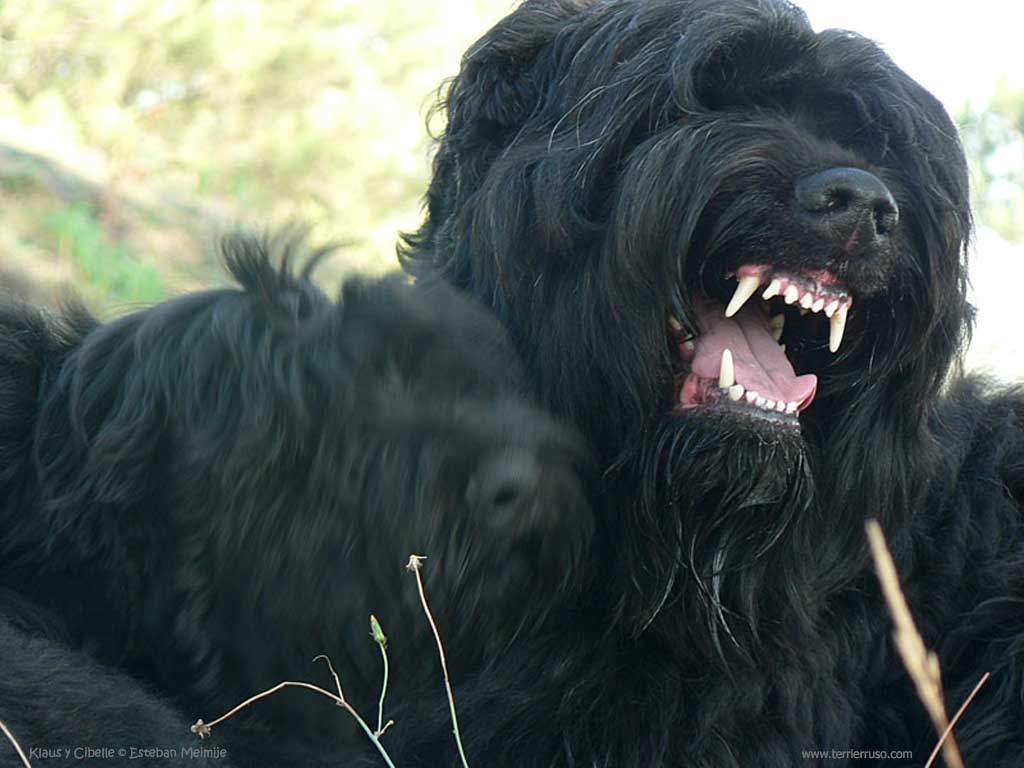
The Russian black terrier much more resemble a Schnauzer that to a Terrier. The head is long, with flat front. The strong muzzle. The eyes are small and dark. The trunk is solid. The limbs are straight and muscular.

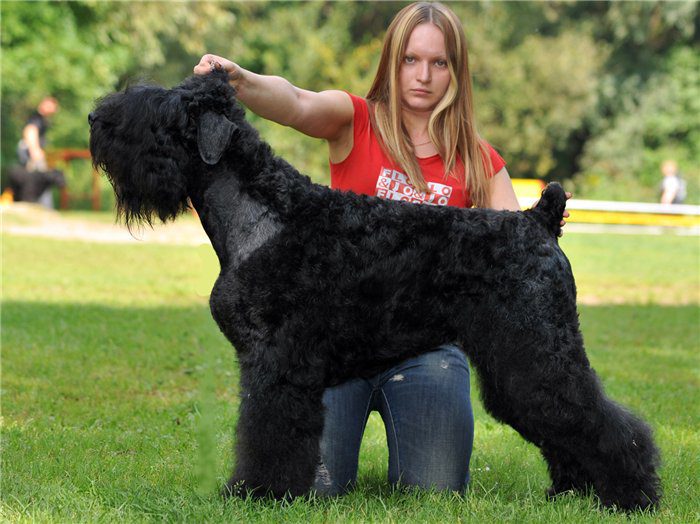
The Black Russian Terrier, gives the impression of great strength, agility and value. It is a robust dog, rustic in appearance (but not fat), and it must not appear as if his hair was sculpted or trimmed, must see bright in nature, and slightly curly.

The coat is hard and dense, is not very smooth to the touch, It is as curly and the length of the hair will be of 4 to 10 cm.. The longest hair found in the beard and eyebrows, with a mane (not very dense but longer than the rest of the body) What, extends, slightly, the cross and the neck, more pronounced feature in males. The coat is low detachment and the color is black with some gray hair.

According to the FCI standard (1983), the male must have a height of 66 to 72 cm to the cross and the female of 64 to 70 cm., with a tolerance of +/- 2 cm.. They must weigh between 35-70 kg.

Did you know??

Although the word Terrier on their behalf, the Black Russian Terrier is a member of the American Kennel Club Task Force.

Character and skills

ยซBlack Russian Terrierยป Videos
Black Russian TerriersBlack Russian Terriers
Dogs 101 - Black Russian TerrierDogs 101 – Black Russian Terrier
The Black Russian Terrier, is a safe dog, quiet, very intelligent, brave and loyal. you should never be shy. It may seem distant, or perhaps independent, but in their basic needs, is the human company and the love of his family.

It is a healthy dog in general and their life expectancy is around the 14 years.

Because of his upbringing as a working dog, has a very strong instinct worker ("work ethic"), and that is why it is good to provide the animal some games to understand work roles, so you will be happy.

Initial training is a necessity, that you will take advantage of any owner who has not been able to establish a domain course. They are very sensitive to education and often Excel at obedience competitions. As well, they are very good in various dog sports, such as agility.

The Black Russian Terrier, need plenty of exercise, and can be hyperactive and destructive if not given the opportunity to burn off his energy.

Characteristics "Black Russian Terrier"

Coexistence is important that you have with your new friend. Before considering the acquisition of a dog of the breed "Black Russian Terrier" you know certain factors. Not all breeds of dogs are apt to live in an apartment, you must take into account his character, their need for exercise, their interaction with other pets, their care and if you have small children, their level of tolerance towards them.

Adaptation โ“˜

3,0 of 5 stars (based on 1 review)

friendly dog โ€‹โ€‹โ“˜

3,0 of 5 stars (based on 1 review)

hair loss โ“˜

3,0 of 5 stars (based on 1 review)

Affection level โ“˜

4,0 of 5 stars (based on 1 review)

Need for exercise โ“˜

4,0 of 5 stars (based on 1 review)

Social need โ“˜

3,0 of 5 stars (based on 1 review)

Home โ“˜

3,0 of 5 stars (based on 1 review)

Toilet โ“˜

4,0 of 5 stars (based on 1 review)

Friendly with strangers โ“˜

1,0 of 5 stars (based on 1 review)

barking โ“˜

4,0 of 5 stars (based on 1 review)

Health โ“˜

3,0 of 5 stars (based on 1 review)

Territorial โ“˜

5,0 of 5 stars (based on 1 review)

Cat friendly โ“˜

3,0 of 5 stars (based on 1 review)

Intelligence โ“˜

4,0 of 5 stars (based on 1 review)

Versatility โ“˜

4,0 of 5 stars (based on 1 review)

Child friendly โ“˜

3,0 of 5 stars (based on 1 review)

Surveillance โ“˜

3,0 of 5 stars (based on 1 review)

joy โ“˜

5,0 of 5 stars (based on 1 review)

Images ยซBlack Russian Terrierยป

ยซBlack Russian Terrierยป Videos

Type and recognitions:

  • FCI CLASSIFICATION:
  • Group :
  • Section : . .

Federations:

FCI โ“˜, AKC โ“˜, ANKC โ“˜, CKC โ“˜, โ€‹KC โ“˜, NZKC โ“˜, UKC โ“˜

FCI breed standard Black Russian Terrier

FCIFCI - Black Russian Terrier
Terrier

Alternative names:

1. Chornyi, Russian Bear Schnauzer, Russian Black Terrier, Chornyi Terrier (English).
2. Terrier noir russe, errier noir (French).
3. Russischer Schwarzer Terrier, Russischer Schwarzer Terrier (German).
4. Terrier preto da Rรบssia, Cรฃo de Stalin, chiorny Terrier (Portuguese).
5. Perro de Stalin (espaรฑol).