โ–ท The world of Pets: Dogs, cats, birds, reptiles, amphibians

Slovakian Hound
Eslovaquia FCI 244 - Medium-sized Hounds

Slovakian Hound

The Slovakian Hound stands out for its extraordinary sense of direction, which is considered the best among the canine breeds.

Content

History

It has remote and completely unknown origins.: its official recognition dates back to after World War II, but the breed already existed for centuries.

While there are no historical records, the Slovenskรฝ Kopov is widely believed to have existed in central Europe for many hundreds of years and to have descended from other local breeds, including the Austrian Black and Tan Hound and the Polish Hound.

Not widely kept for any purpose other than hunting, the Slovakian Hound He has honed his hunting skills over the centuries and is respected within Slovakia for his tracking ability and endurance. Despite its proven track record in the field, rarely seen internationally. curiously, when seen internationally, It is sometimes called the "Black Forest Dog.", a completely wrong name, since the Slovakian Hound it's not now, and has never been, native to the Black Forest region.

Like many other breeds of dogs of the time, the population of the Slovakian Hound decreased dramatically during the period of the World Wars. It is attributed to a Slovak named Koloman Snail having brought the race from the brink of extinction at this time, by establishing successful breeding programs nationwide.

Officially accepted as a breed in the decade of 1870, the first club of the breed Slovakian Hound was recently formed in 1988, in the capital of Bratislava. The Slovakian Hound it is so popular in its birthplace that it has been named the national breed of Slovakia.

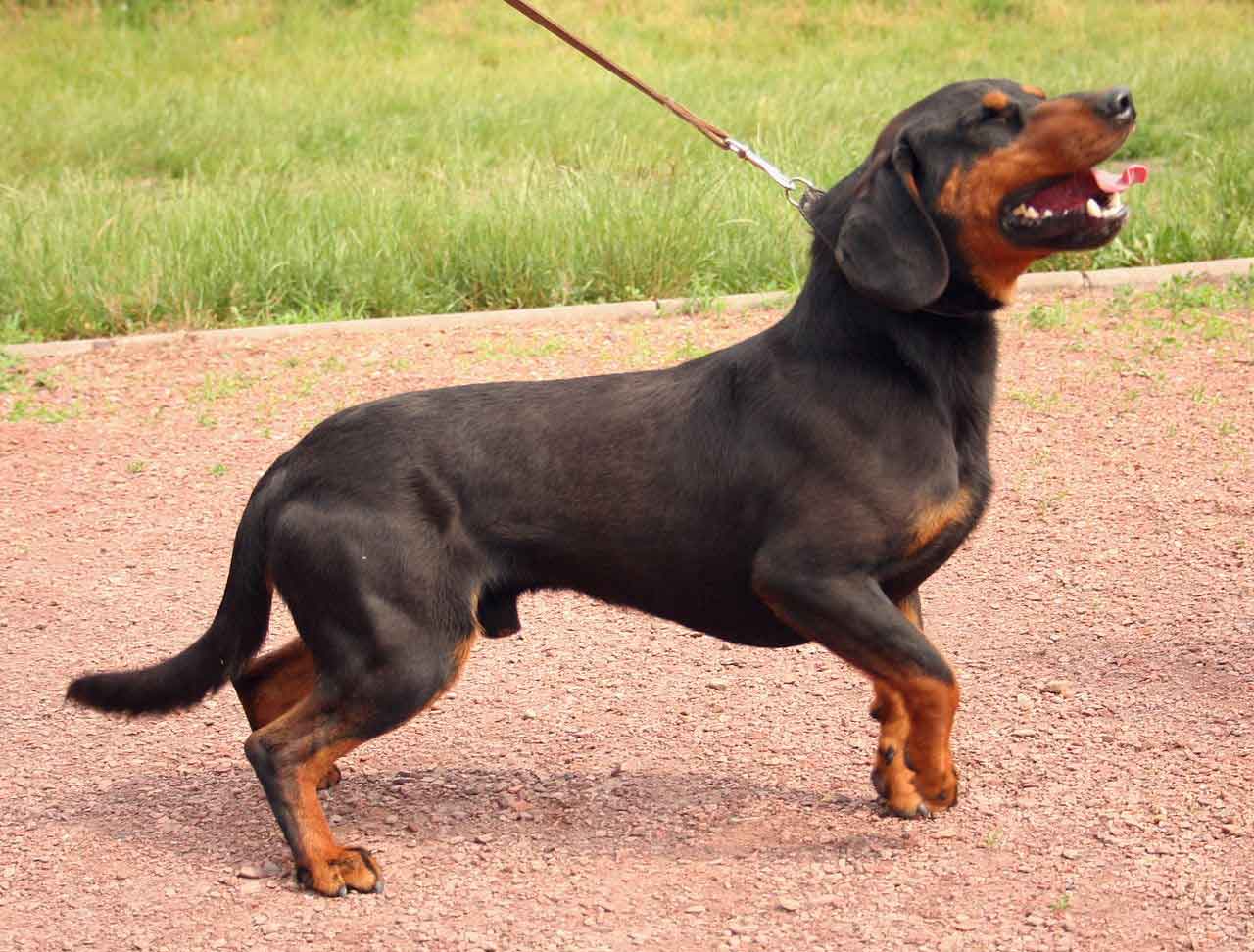
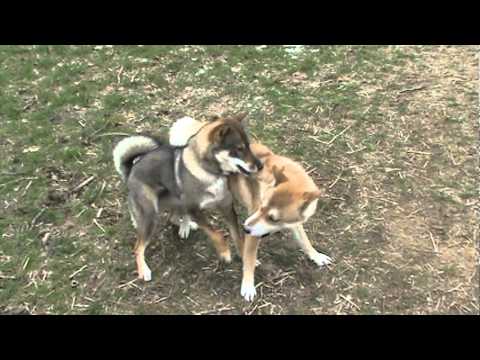
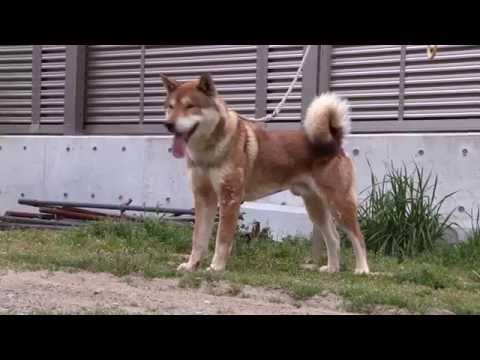
Photo: Slovakian Hound during dog’s show in Racibรณrz,Poland by Pleple2000, CC BY-SA 3.0, via Wikimedia Commons

Physical characteristics

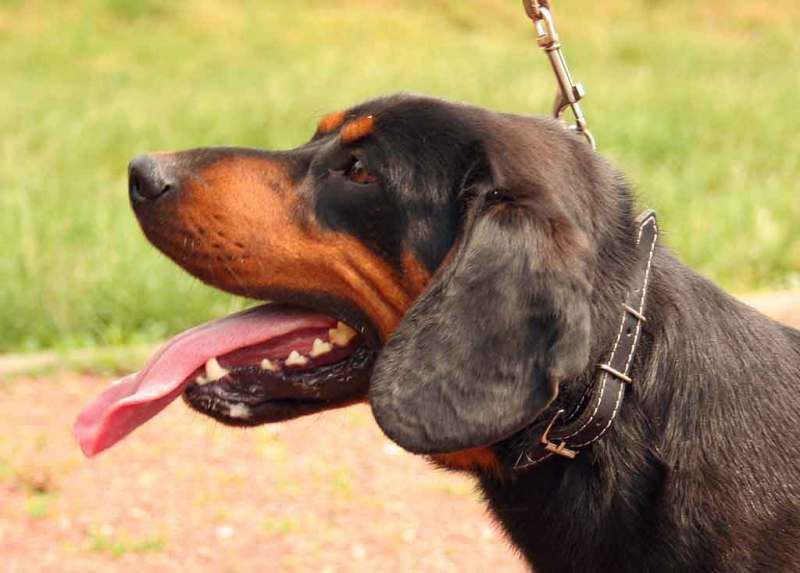
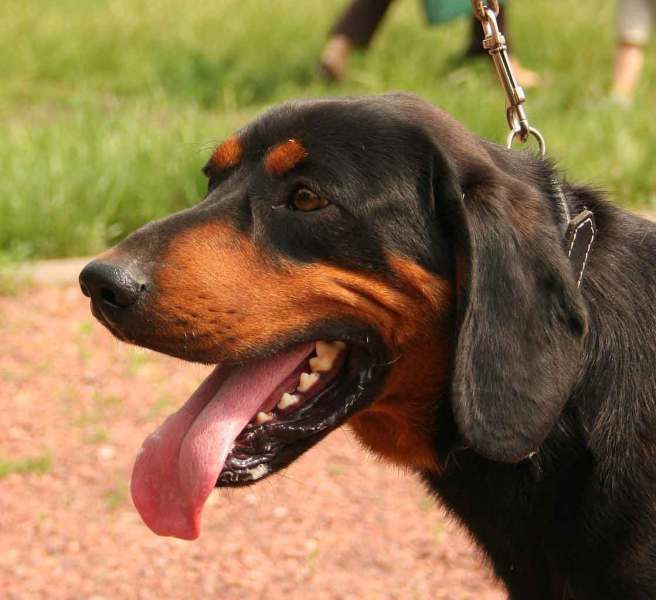
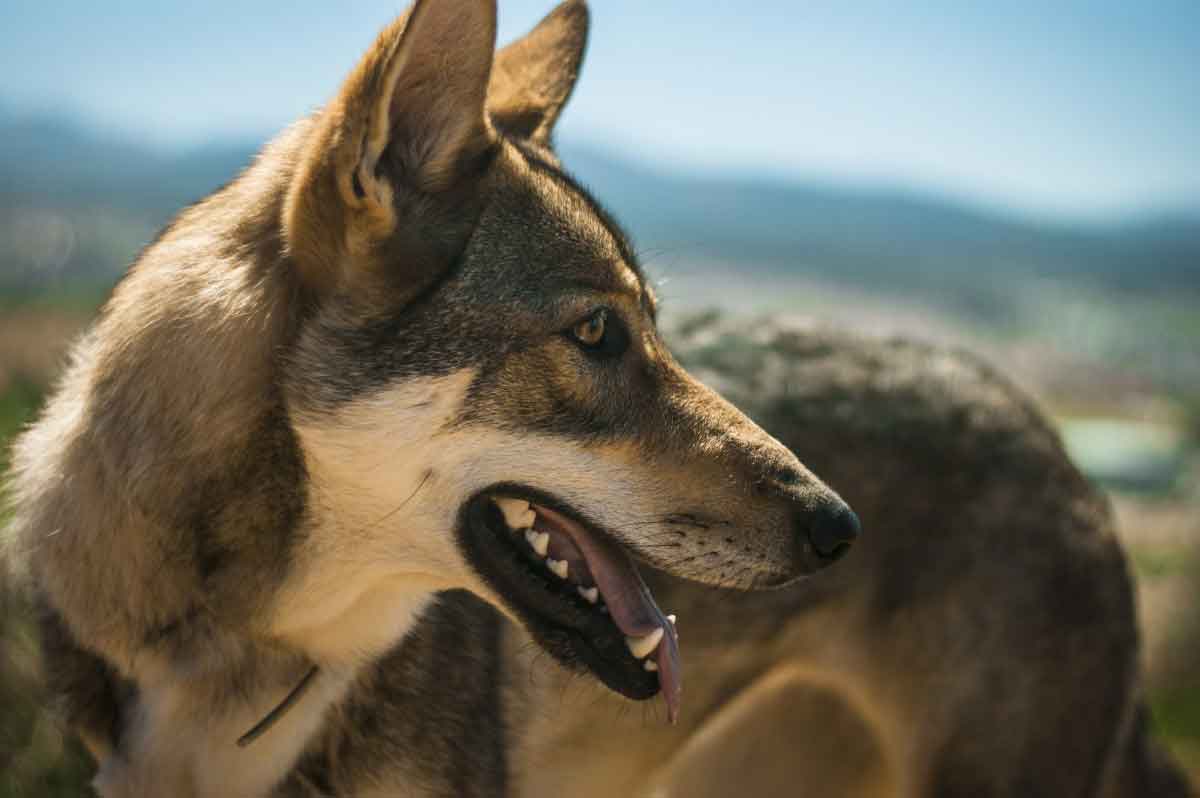
Always black with fire marks, the Slovakian Hound have solid bones despite their fairly slight stature. The body is in the shape of an elongated rectangle. His eyes reflect vivacity and courage. They are dark and almond-shaped. The ears are of medium length, rounded at the tip and falls flat against the head. This dog is notable for its constancy in following a cool trail or trail for hours, giving the voice without hesitation. They are also distinguished by their bite, so they are used in their native country to hunt wild boars and other carnivores.

He is endowed with a lively temperament. Your sense of direction is extraordinarily well developed.

Hair is 2-5 cm long, medium thick, well lying, dense. Longer in the back, neck and tail. The undercoat is dense, especially during the winter months; However, it should not be absent in summer either.

SIZE AND WEIGHT :

Males 45-50 cm.

females 40-45 cm.

Weight: 15-20 kg

Character and skills

This determined hunter must be tenacious when on the road and courageous when facing the animals he hunts., like the boar and the deer. They have excellent olfactory abilities and will painstakingly trace a scent back to the source. An independent animal that is happy to work with a minimum of human interaction, the Slovakian Hound need little direction. Despite this, they are obedient, and they will happily follow their master's plans when necessary.

The Slovakian Hound it's a good watchdog, as he is continuously alert and observant. This, along with the fact that they become devoted to their owners, means they are often protective, and can be used successfully as watchdogs, becoming potentially aggressive if the situation calls for it. Barking can be a problem and is a common complaint of many owners.. Excessive barking can be prevented by ensuring that the Slovakian Hound you are not under-exercised and have plenty of activities and jobs to fill your day.

Health

The Slovakian Hound it is a very resistant dog. In the country of origin the owner has a dog, rarely from, who does not live in a kennel but in contact with the master from morning to night, often used as a general purpose dog, taking care of the house as well as the cattle, and of course hunting. It is adapted to outdoor life and has an iron constitution.

Care and maintenance

The Slovakian Hound it is a very resistant dog, no particular grooming problems. Short hair, when he comes back from hunting he will be the happiest in the world if you give him the necessary brushstroke for a superficial cleaning at the level of the spikes, caught between the pads, ticks possibly not yet attached.

He will quickly get used to coming to you for this cleaning because he is looking for contact with his master.

Qualities

It's a farm dog, the quintessential farm dog. Bad guys just do that. The good ones are able to give the voice, to take the lead by yelling or barking directly at any stranger before coming into view. A good Slovakian Hound should give voice instantly. Not after ten minutes (although, depending on the conditions…). The smell of Slovakian Hound it's excellent, as fine as that of the best Hounds, but his hunting style leads him to voice only in the moment, and of course staring.

The Slovakian Hound is a search engine, a hunting finder. Hunting instinct is among the best hounds, really very developed, off the beaten path as in some Warren hound and some representatives of primitive races.

Farm dog, you don't need to see the animal, the wild boar to bark after, like some pointing dogs that only bark at sight, or to the noise. With experience, depending on origins, will start barking after turning around to make sure the animal is ten meters away, or more. Once you have fired the bark it will zoom in pretty quickly, but always with care, always staying safe. The Slovakian Hound is not a brave and daring specialist like some races of German Hunting Terrier or pointing dogs, who are inevitably injured frequently. With the, used in its specificity, theoretically, no need for a boar vest, because he knows how to handle attacks. Some are never hurt, if used properly, alone or as a couple.

The Slovakian Hound is a dog that is easy to start with the boar. Because it's in their nature, to bark, and the only animal that does not automatically flee but goes to meet is the wild boar. If you are accustomed to hunting on hunts where wild boar are rare but deer are numerous, you will enjoy easily guiding your animals for half an hour or more, but as soon as he perceives that there is a wild boar in the area, will leave this animal too elusive to go and do what it was designed to do.

A good Slovakian Hound, alone or as a couple, it is rarely caught by a wild boar. Otherwise, in dog teams he becomes a vulnerable dog like any other because his passion is terrible, and there, better equip it with a vest…

Characteristics "Slovakian Hound"

Coexistence is important that you have with your new friend. Before considering the acquisition of a dog of the breed "Slovakian Hound" you know certain factors. Not all breeds of dogs are apt to live in an apartment, you must take into account his character, their need for exercise, their interaction with other pets, their care and if you have small children, their level of tolerance towards them.

Adaptation โ“˜

4,0 of 5 stars (based on 1 review)

friendly dog โ€‹โ€‹โ“˜

3,0 of 5 stars (based on 1 review)

hair loss โ“˜

3,0 of 5 stars (based on 1 review)

Affection level โ“˜

4,0 of 5 stars (based on 1 review)

Need for exercise โ“˜

4,0 of 5 stars (based on 1 review)

Social need โ“˜

4,0 of 5 stars (based on 1 review)

Home โ“˜

4,0 of 5 stars (based on 1 review)

Toilet โ“˜

2,0 of 5 stars (based on 1 review)

Friendly with strangers โ“˜

2,0 of 5 stars (based on 1 review)

barking โ“˜

5,0 of 5 stars (based on 1 review)

Health โ“˜

4,0 of 5 stars (based on 1 review)

Territorial โ“˜

5,0 of 5 stars (based on 1 review)

Cat friendly โ“˜

2,0 of 5 stars (based on 1 review)

Intelligence โ“˜

4,0 of 5 stars (based on 1 review)

Versatility โ“˜

4,0 of 5 stars (based on 1 review)

Child friendly โ“˜

4,0 of 5 stars (based on 1 review)

Surveillance โ“˜

4,0 of 5 stars (based on 1 review)

joy โ“˜

4,0 of 5 stars (based on 1 review)

Images "Slovakian Hound"

Photos:

1 – SLOVENSKร KOPOV Rantafejs Cezary Av Fileddy MyDOG, Nordens stรถrsta hundevenemang: www.mydog.se by Svenska Mรคssan from Sweden, CC BY 2.0, via Wikimedia Commons
2 – A female Slovakian Hound. by Canarian, CC BY-SA 3.0, via Wikimedia Commons
3 – Slovakian Hound during dog’s show in Racibรณrz,Poland by Pleple2000, CC BY-SA 3.0, via Wikimedia Commons
4 – Slovakian Hound during dog’s show in Racibรณrz,Poland by Pleple2000, CC BY-SA 3.0, via Wikimedia Commons
5 – Slovakian Hound during dogs show in Katowice, Poland by Lilly M, CC BY-SA 2.5, via Wikimedia Commons
6 – Chien courant slovaque sur fond blanc by Desaix83, d'aprรจs le travail de Canarian, CC BY-SA 3.0, via Wikimedia Commons

Videos "Slovakian Hound"

Type and recognitions:

  • FCI CLASSIFICATION:
  • Group :
  • Section : . .

Federations:

  • FCI – Group 6: Scent hounds, and related breeds. – Section 1.2: Medium-sized Hounds. โ“˜
  • UKCScenthounds โ“˜

FCI breed standard "Slovakian Hound"

Origin:
Slovakia

Date of publication of the valid original standard:
16.04.1963

Use:

Hound. This breed is characterized by continuing to bark a warm track (recent) or a trail steadily for hours. It is also characterized by its bite and that is why it is used in its place of origin especially for hunting wild boar and animals of prey..


General appearance:

They are always one color : black with โ€œfireโ€ markings. Rather light body structure; However, has strong bones. Elongated rectangular body shape.


Behavior / temperament:

It is of a spirited nature. Exceptionally developed sense of orientation.

Head:

---

Cranial region:
  • Skull : Bulging at the top; its shape is square and elongated; superciliary arches and frontal sulcus are notable; occipital protuberance is poorly marked. The longitudinal axes of the muzzle and skull are parallel.
  • Depression links (Stop) : About 45ยฐ.

facial region:

  • Truffle : Always black, relatively large, moderately pointed; moderately open windows.
  • Snout : Straight nose cane, corresponding to the long and not very wide skull.
  • Lips : They are not hanging; they are together, skinny, with a visibly open corner.
  • Jaws / Teeth : on regular basis, firm; well developed full bite.

Eyes : dark, a little deep. His expression denotes vivacity and animosity. Eyelids are always black; almond-shaped eye opening.

Ears : Inserted a little above the eye line, laid flat on the sides of the head, rounded at their ends, medium long.

Neck:

Well inserted, carried at an angle of approximately 135ยฐ, rather short, muscular and no loose skin.

Body:

  • Back : Straight, medium long.
  • Pork loin : Not too long, very wide, firm and muscular.
  • Rump : Not too long, average width, rounded.
  • Breast : Wide and well filled windowsill. Medium deep, of a suitable width and relatively long.
  • Chest : Rounded ribs, placed obliquely.
  • Belly and flanks : Moderately withdrawn.

Tail:

Rather low set, a little below the line of the back; of adequate strength; slimming to tip; reaches up to the tibio-tarsal joint; at rest it is carried hanging; When excited, it is curved upwards in the shape of a sickle up to an angle of 150ยฐ..

Tips

PREVIOUS MEMBERS :

  • Scapula and Arm : Rather short, well-developed and muscular. Shoulder angle approximately 110ยฐ.
  • Forearm : Vertically placed, delgado.
  • Articulation of the carpus : Short.
  • Metacarpus : Not very long, a little inclined.
  • Previous feet: Oval, well arched fingers; nails always black and strong; dark pads, well developed.

LATER MEMBERS :

  • Thigh : Moderately wide and long, muscular.
  • Leg : Wide, of a suitable length and with good muscles.
  • Warm-foot joint : Located approximately at a height of 15 cm.; moderately wide. The angle of the tibiotarsal joint is approximately 150ยฐ.
  • Metatarsus : Approximately from 8 cm long; moderately leaning forward; No Spurs.
  • Hind feet : Oval, fingers close together and well arched; well developed pads, black.

Movement:

Lively and balanced.

Mantle

SKIN : From dark brown to black, footprint, no loose skin folds.

HAIR : Of 2 โ€“ 5 cm long, moderately hard, glued and dense. It is longer on the back, neck and tail. Dense internal fluff especially in the winter months, although his presence should not be lacking during the summer.

COLOR : Black with tan to mahogany markings on limbs.


Size and weight:

Height to the cross :

  • In males : 45 โ€“ 50 cm..
  • In females : 40 โ€“ 45 cm..

Weight : 15 โ€“ 20 kg.


Fouls:

Any deviation from the aforementioned criteria is considered as a fault and the severity of this is considered to the degree of the deviation to the standard and its consequences on the health and well-being of the dog..

โ€ข Rough figure, plump or chubby.
โ€ข Head too heavy.
โ€ข Hanging lips.
โ€ข Incomplete bite.
โ€ข Superior or inferior progantism.
โ€ข Light eyes, loose eyelids, eyelids too tight.
โ€ข Ears too light, pointy.
โ€ข Loose skin on the neck.
โ€ข Back too weak.
โ€ข Flattened chest (severe deficiency).
โ€ข Visibly long tail, also carried at rest above the line of the back.
โ€ข Defective position of the extremities.
โ€ข Weak feet.
โ€ข Coat too short, that's lanilla interna; hair too long, wavy.
โ€ข Another color other than black, white markings, unclear delimitation of โ€œtanโ€ colored spots.
โ€ข Excessive size.

IMPORTANT PROPORTIONS (IDEAL TYPE)

  • Weight 16 kg
  • Height at the withers in males 46 cm.
  • Height at the withers in females 43 cm.
  • Total length of the head 22 cm.
  • Length of the muzzle 9 cm.
  • Length of the skull 13 cm.
  • Skull width 10,5 cm.
  • Width of chest 16,5 cm.
  • Chest height 22 cm.
  • Chest depth 31,5 cm.
  • body length 55 cm.
  • Chest circumference behind the last free rib 54 cm.
  • Limb angulations : Angle between the scapula and the arm 110ยฐ
  • Angle between the arm and forearm 140ยฐ
  • Angle between hip and thigh 130ยฐ
  • Angle between thigh and leg 130ยฐ
  • Tibio-tarsian joint angle 145ยฐ

Any dog โ€‹โ€‹showing clear signs of physical or behavioral abnormalities must be disqualified..


N.B.:

Males should have two normal-appearing testicles fully descended into the scrotum..

Source: F.C.I - International Cynological Federation

Alternative names:

1. Black Forest Hound, Slovak Hound (English).
2. (slovenskรฝ kopov en slovaque) (French).
3. Slowakische Schwarzwildbracke (German).
4. Cรฃo da floresta (Portuguese).
5. Cazador eslovaco (espaรฑol).

โ–ท The world of Pets: Dogs, cats, birds, reptiles, amphibians

German Spitz
Alemania FCI 97 - European Spitz

German Spitz

The hair German Spitz requires certain care, especially for exhibitions.

Content

History

The Spitz it is one of the oldest German domestic dog breeds, although its origins are not entirely clear. There is evidence that dogs Spitz lived together with humans ago 4.000 years. Due to its wide diffusion as a watchdog on farms and in the homes of the petty bourgeoisie, it also found its way into literature and painting..

Especially in rural areas, a German Spitz was ubiquitous in the old days as a house and garden dog. Smaller Spitz were popular as lap dogs with ladies.

The popularity of the Spitz decreased so much in the recent past that it was declared an endangered breed of pet in 2003.

Physical characteristics

All the German Spitz, regardless of size or color, they form a family and should have similar features and a typical lace look.

The Spitz impresses with his beautiful coat. The abundant undercoat and long top coat, straight and outstanding give them their unmistakable appearance. Particularly striking is the strongly mane-like collar around the neck and the bushy, furry tail., that is carried boldly on the back. The fox-like head with quick eyes and small, narrow, pointy ears give the Spitz its characteristic disturbing expression.. The body of the Spitz is square.

Measurements:

to) Wolfspitz / Keeshond : 49 cm ยฑ 6 cm..
b) Grossespitz (Giant or Large Spitz) : 46 cm ยฑ 4 cm..
c) Mittelspitz (Standard or Medium Spitz) : 34 cm ยฑ 4 cm..
d) Kleinspitz (Miniature or Small Spitz) : 26 cm ยฑ 3 cm..
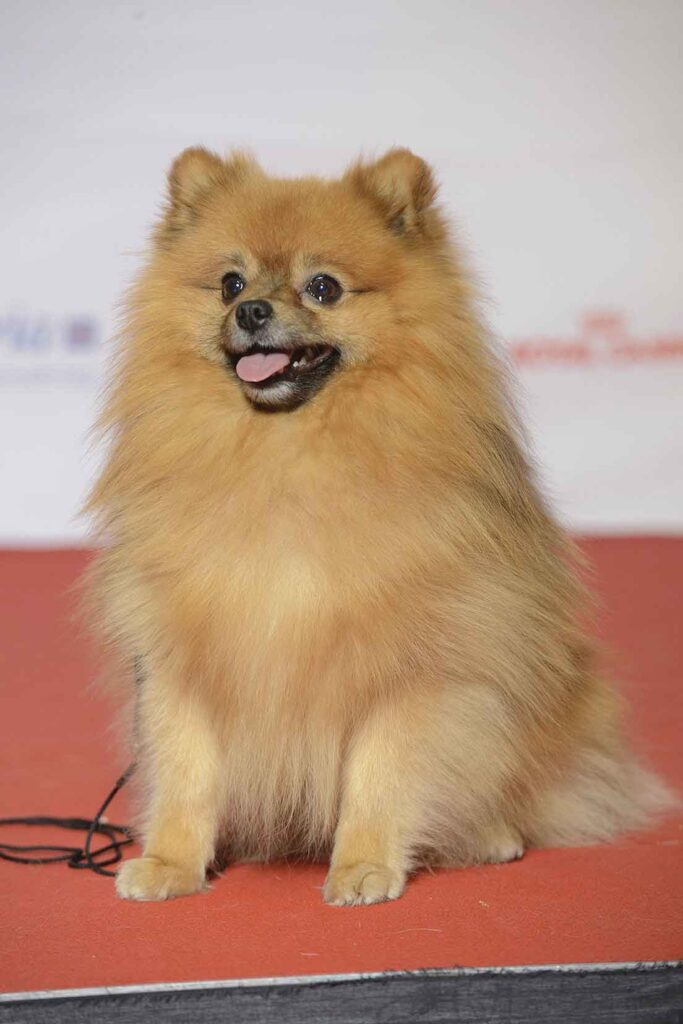
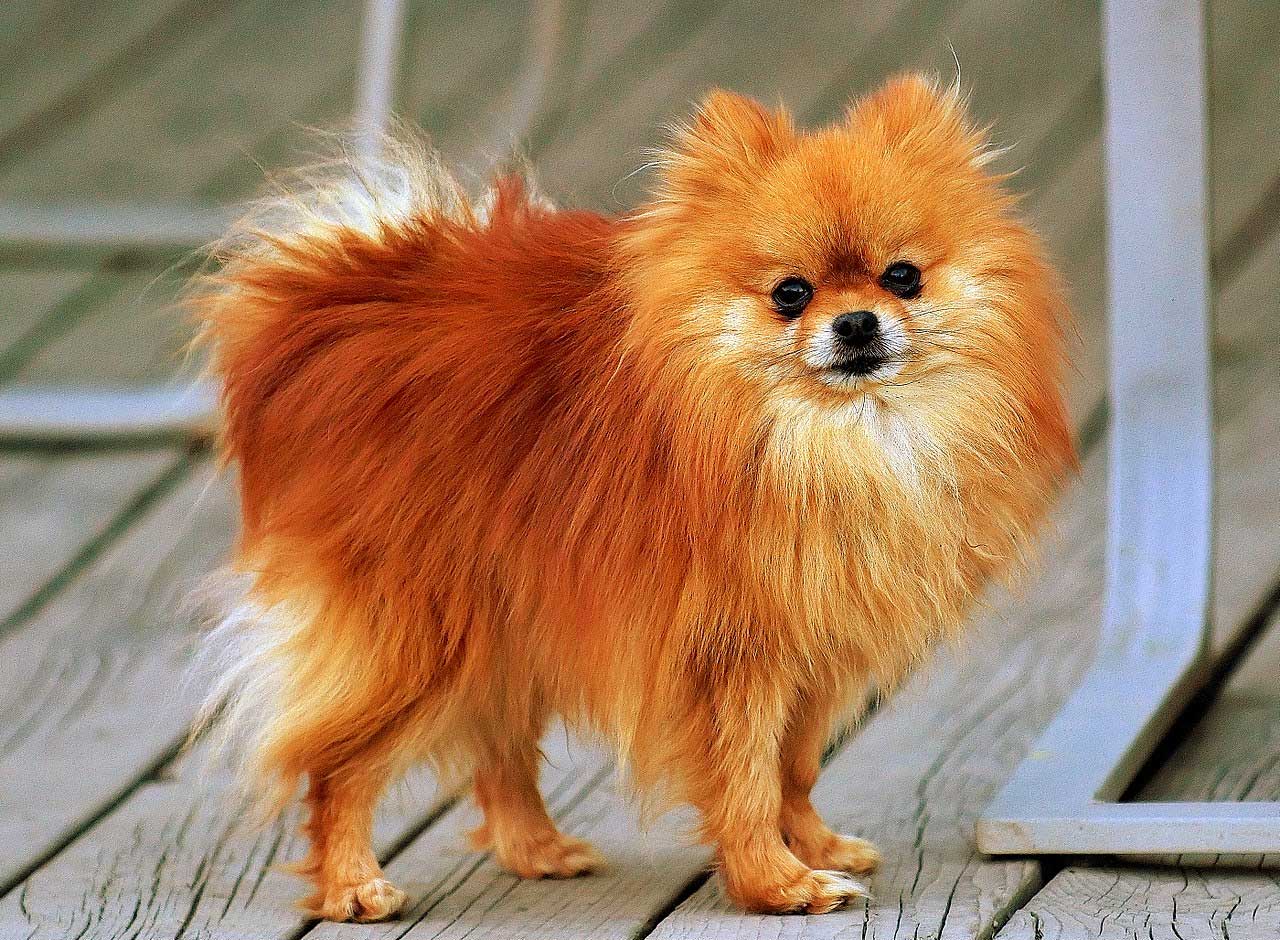
and) Zwergspitz (Toy or Dwarf Spitz) / Pomeranian : 20 cm ยฑ 2 cm..
(are undesirable specimens measuring less than 18 cm.).

Weight

Any variation in the size of the German Spitz should have a corresponding variation in weight.

Character and skills

One German Spitz has a reputation for being a chatterbox. In fact, the dogs bark a lot; for a guard dog, making a sound is a desirable characteristic, that today cannot be reconciled with all the neighbors.

A natural distrust, along with incorruptibility and loyalty, is inherent to German Spitz. This makes it predestined to be a watchdog that patrols its territory and reports suspicious incidents.. One German Spitz reliably defends the things entrusted to him. When not on guard, a is a very friendly and affectionate dog, sometimes a little possessive, who follows his humans closely and enjoys being petted. One German Spitz is generally regarded as a child.

The education and attitude of the German Spitz

With cheerful romp and docility, a German Spitzn is a dog that absolutely needs a task. Find your place as a working watchdog, but also as a companion and family dog. With lots of positive encouragement and loving consistency, breeding is not problematic and can also be managed if you have little experience with dogs.

for a German Spitz be respectful of animals, must be weather resistant: The Spitz it just feels really comfortable outdoors, either with sun, rain or snow. It is an ideal companion for runners, riders and cyclists. He is also an agility sports enthusiast. As the Spitz only has a weakly developed hunting instinct, does not tend to go its own way when outdoors and is easy to recover. It is less suitable for intensive accommodation, especially because he likes to bark a lot. Similar to the Poodle, the spitz is available in different sizes, from the Zwergspitz (Toy or Dwarf Spitz) / Pomeranian to Wolfspitz / Keeshond. The best known variant is the Mittelspitz (Standard or Medium Spitz) with a shoulder height of 34-38 cm and weighing up to 10 kg. Apart from its format, the types do not differ visually.

Caring for the German Spitz

Surprisingly, the fluffy coat of the Spitz does not require much grooming. The hair is dirt repellent, so an occasional brushing is enough. It also, a German Spitz it is very clean and cleans itself. Also in terms of health, the Spitz they are quite robust dogs.

Type and recognitions:

  • FCI CLASSIFICATION:
  • Group :
  • Section : . .

Federations:

  • FCI – Group 5 – Section 4 European Spitz. โ“˜

FCI breed standard "German Spitz"

Origin:
Germany

Date of publication of the valid original standard:
04.09.2019.

Use:

Guard and companion dog.


General appearance:

TheSpitzThey attract attention for their beautiful separated fur with the presence of a very dense undercoat.. The neck surrounded by an abundant mane and the tail covered with long hair is striking., turned up and spread boldly on the back. The head is similar to that of the fox with diligent eyes and small pointed ears. The ears, placed very close to each other, confer toSpitzhis characteristic relaxed appearance.

important proportions

Proportion of 1:1 between the height at the withers and the length of the dog.


Behavior / temperament:

TheGerman Spitz is constantly attentive, is active and exceptionally dependent on his master. Learn quickly and can be trained easily. His distrust of strangers and his lack of interest in hunting allow him to be considered the ideal watchman for the house and farm.. Its most notable characteristics are its resistance to weathering., its robustness and longevity.

Head:

---

Cranial region:
  • Skull: The skull ofSpitzis medium-sized; viewed from above seems to swell back becoming more narrow wedge shaped to the tip of the nose.
  • Depression links (Stop): Little steep until marked, but never abrupt.

facial region:

  • Truffle: Round, small, black; in all theSpitzbrown in color is dark brown in color.
  • Snout: Not very long, Neither coarse nor pointed; It presents a good proportion in relation to the skull (in the Spitz type Keeshond/Wolf, in the large Spitz and medium Spitz the ratio snout/skull is approximately 2/3, in the small Spitz and in theSpitz enano/Pomerania is approximately 2/4).
  • Lips: They are not hanging; they are well bonded and do not form folds in the corners. They are black in all colours, in theSpitzbrown in color are brown in color.
  • Jaws/Teeth: The jaws are normally developed and show a complete scissors bite with 42 teeth, That is, the upper incisors fall closely in front of the lower incisors., teeth being implanted perpendicular to the jaws. InSmall and dwarf spitz/Pomeranian the loss of a few promolars is tolerable. A pincer bite is allowed in all varieties ofSpitz.
  • Cheeks: The cheeks are slightly round and are not prominent.
  • Eyes: The eyes are medium-sized, elongated, a little oblique, dark colored. The eyelids have black pigmentation in all color varieties and are only dark brown in theSpitzof brown variety.
  • Ears: The pointed ears in the shape of a pointed triangle are small and rather closely placed together.. Its inclusion is high. They always remain erect with a rigid tip.

Neck:

The neck is moderately long and presents a broad inclusion with shoulders; the neck is slightly convex, without dewlap and covered with a mane shaped collar.

Body:

  • top line: The top line begins at the tip of the erect ears and passes in a gentle arc over the short, straight back.. The deployed and with abundant fur tail partially covers the back and rounded silhouette.
  • Cross/Back: The high cross falls imperceptibly on the short back, straight and strong.
  • Pork loin: Short, wide and strong.
  • Rump: The rump is short and wide, unexpired.
  • Breast : Deep chest, well arched; the apron is well developed.
  • Bottom line and belly: The chest is expanded as much as possible back; the abdomen is moderately retracted.

Tail:

The tail has a high insertion and a medium length; bends upward from the root and rolls over the back, spreading firmly. Well covered with thick hair. A double loop in the tip of the tail is acceptable.

Tips

Former members

  • As a whole: Straight, large on the front.
  • Shoulder: The scapula is long, placed backwards at an angle. The arm, showing almost the same length, with the scapula forms an angle of approximately 90 degrees. Shoulders with good musculature are closely linked with the chest.
  • Arm: Medium length, robust and fully straight on the trunk, covered with long hair in the form of pen in the posterior region.
  • Elbows: The elbow joint is strong, close to the chest without bending inward or outward.
  • Metacarpus: The Metacarpus strong and medium length, forms an angle of approximately 20ยฐ in relation to the perpendicular line.
  • Front feet: The front feet are as small as possible, round, compact, as cat with well arched toes feet. Pads and nails are black in all varieties of Spitz, and they are only dark brown on brown dogs.

Later members

  • As a whole: The hindquarters are very muscular, covered with very long hair up to the Hock joint. The hind limbs are straight and parallel to each other..
  • Thigh and leg: They have approximately the same length.
  • Knee: The knee joint is strong, slightly angled and, during the movement, It does not twist outward or inward.
  • Metatarsus: Medium length, very strong, maintains a position perpendicular to the ground.
  • Rear feet: The hind feet are as small as possible, round, with toes well arched and together, as cat feet. Pads are hard. The color of nails, pads is much darker.

Movement:

TheSpitzmoves with enough coordination, with a good push and almost floating in light trot.

Mantle

Skin

The skin should be well attached to the body, without kinking.

Fur

TheSpitzThey have a double coat covered with hair: the outer layer is long-haired, straight and separate and the inner layer is short-haired, dense and woolly. The head, ears, anterior surface of the forelimbs and hindlimbs and feet are covered by short, dense hair (velvety). The rest of the body is long and abundant hair. The hair should not be wavy, chino, or form hair, You must not present a stripe on the back. A thick mane covers the neck and shoulders. The rear face of the forelimbs has hair in the form of feathers. The hindquarters should be covered with long hair from the rump to the Hock joint. The queue must be covered with hair is long and abundant.

Color

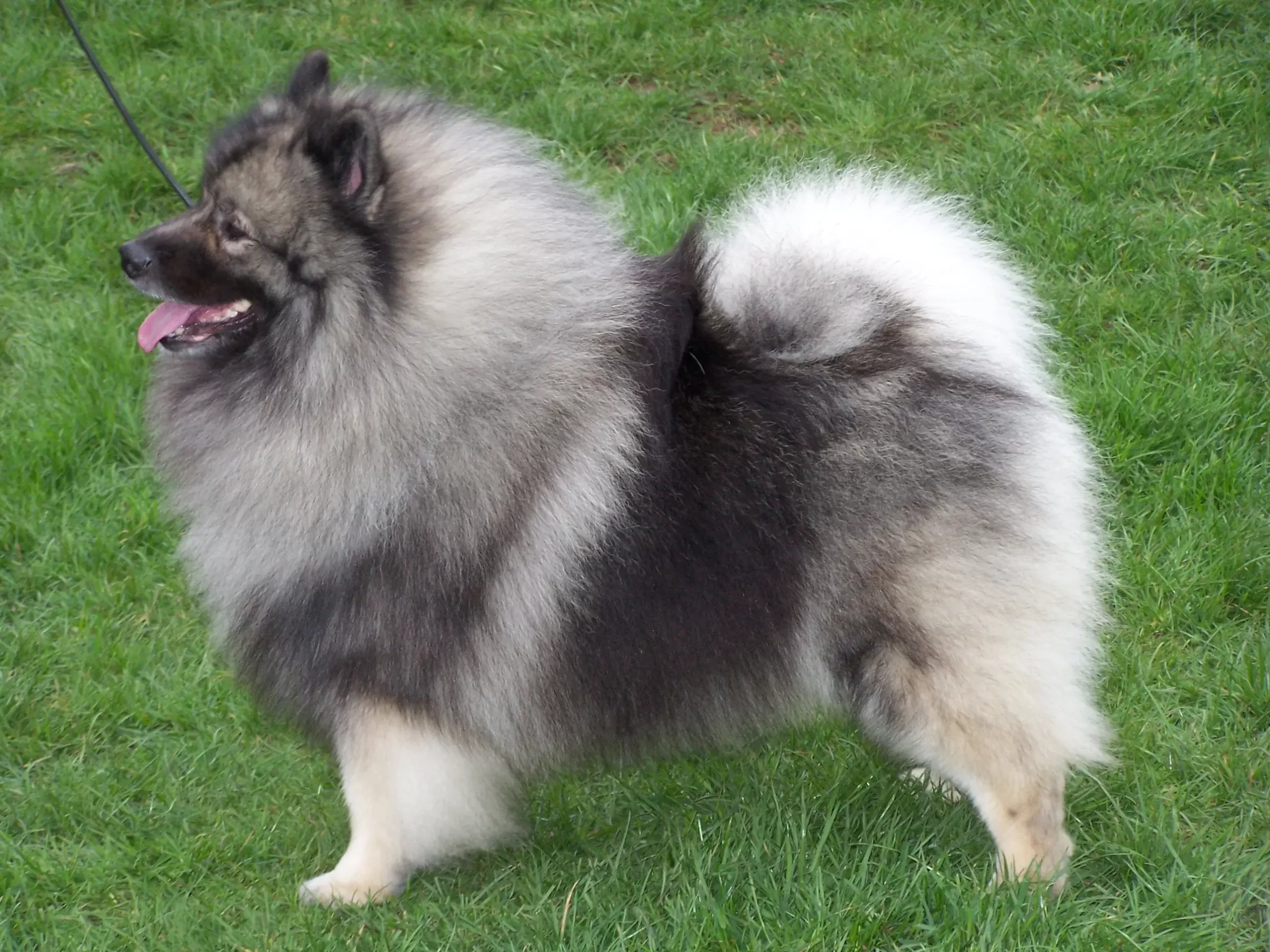
  • Wolf Spitz/Keeshond: Grayish.
  • Grossespitz (Giant or Large Spitz) Negro, brown, white.
  • Mittelspitz (Standard or Medium Spitz): Negro, brown, white, orange, grey, other colors.
  • Kleinspitz (Miniature or Small Spitz): Negro, brown, White Orange, grey, other colors.
  • Spitz enano/Pomerania: Negro, brown, white, orange, grey, other colors.
  • Black Spitz: The fur of the black Spitz should be dark in the skin as well as internal NAP and the color of the outer layer should be jet black color without any white spot.
  • Brown Spitz: The Brown Spitz should have a uniform dark brown color.
  • White Spitz: The hair should be pure white, no yellowish tones that can often occur in the ears.
  • Spitz anaranjando: The Orange Spitz should have a single uniform colour in the average range of the RAL (Registration International of the color scale).
  • Greyish Spitz/Keeshond: Gray is understood as grey silver with black hair tips. Snout and ears are dark. Around the eyes there is a drawing in the shape of glasses consisting of a delicate black line. (It extends from the outer corner of the eye to the lower part of the inclusion of the ear) or in broken lines and shading that draw short eyebrows, but expressive. Mane and ring shoulders are a tone clear. The anterior and posterior members are grey silver unmarked black below the elbows and knees, except delicate stripes on your fingers (pencilling). The tip of the tail is black. The lower part of the tail and the buttocks are grey Silver clear.
  • Spitz other colours: Under this description all tones are included as: cream-coloured, cream-saber, anaranjado-Sable, black with tan and stained. The spotted must have a white background color. Black stains, brown, gray or orange should be distributed throughout the body.


Size and weight:

Height to the cross

  • Wolf Spitz/Keeshond: 49 cm ยฑ 6 cm..
  • Grossespitz (Giant or Large Spitz) : 46 cm ยฑ 4 cm..
  • Mittelspitz (Standard or Medium Spitz): 34 cm ยฑ 4 cm..
  • Kleinspitz (Miniature or Small Spitz): 26 cm ยฑ 3 cm..
  • Spitz enano/Pomerania: 20 cm ยฑ 2 cm. (are undesirable specimens measuring less than 18 cm.).

Weight

Any variation in the size of theGerman Spitz must have a corresponding variation in its weight.


Fouls:

Any deviation from the above criteria is considered missing and the seriousness is considered to the extent of the deviation to the standard.

Serious misconduct

  • Defects in the Constitution.
  • Head too flat or sharp Apple-shaped.
  • Truffle, eyelids and lips of flesh-colored.
  • Defects in the premolars in Wolf Spitz/Keeshond, Medium and large Spitz.
  • Eyes too big or clear or very outgoing.
  • Defects in the movement.
  • Absence of classic drawing of the face inSpitzgrey.

ELIMINATING fAULTS

  • Aggressive or fearful dog.
  • Open fontanel.
  • Upper or lower prognathism.
  • Entropion or ectropion.
  • Floppy ears.
  • White spots visible on allSpitznon white.

Any dog โ€‹โ€‹showing clear signs of physical or behavioral abnormalities should be disqualified..


N.B.:

Males should have two normal-appearing testicles fully descended into the scrotum..

Source: F.C.I - International Cynological Federation

Alternative names:

1. Deutscher Spitz (English).
2. Spitz allemand (French).
3. Deutsche Spitze (German).
4. Deutsche Spitze (Portuguese).
5. Spitz alemรกn (espaรฑol).

Photos

1- Szpic_miniatura at the national show in Rybnik – Stone to Pleple2000 / CC BY-SA

German Spitz varieties

to) Wolfspitz / Keeshond.
b) Grossespitz (Giant or Large Spitz) .
c) Mittelspitz (Standard or Medium Spitz).
d) Kleinspitz (Miniature or Small Spitz).
and) Zwergspitz (Toy or Dwarf Spitz) / Pomeranian.

European Spitz

1 Keeshond

Keeshond

Even today the Keeshond is a breed known for its faithfulness and loyalty.

Are ยซWolfsspitzยป and ยซKeeshondยป identical?

This question repeatedly leads to confusion among experts and laymen alike.. Although the

... Read more

2 Pomeranian

Pomeranian

The Pomeranian very active, independent, Intelligent, brave and loyal.

The Pomeranian (Deutscher Spitz;, Pomeranian Lulu or Deutscher Zwergspitz) It is a dog of the Spitz family, named for the ... Read more

3 Grossespitz (Giant or Large Spitz)

Grossespitz (Giant or Large Spitz)

Although I do not necessarily suspect it at first glance, the Grossespitz (Giant or Large Spitz) it is also extremely robust and weather resistant.

While the small and medium varieties of the German Spitz (Pomeranian,

... Read more

4 Mittelspitz (Standard or Medium Spitz)

Mittelspitz (Standard or Medium Spitz)

The Mittelspitz (Standard or Medium Spitz) is by nature a bit like the old guard dog.

The Spitz, officially called ยซGerman Spitzยซ, It is a classic breed of dog in Germany and Central Europe.

... Read more

5 Kleinspitz (Miniature or Small Spitz)

Kleinspitz (Miniature or Small Spitz)

The Kleinspitz (Miniature or Small Spitz) he is a loving and attentive dog, that is very people-oriented.

The little Spitz (Kleinspitz) is a variety of German Spitz, which today is

... Read more

โ–ท The world of Pets: Dogs, cats, birds, reptiles, amphibians

Shiba Inu
Japรณn FCI 257 . Asian Spitz and related breeds
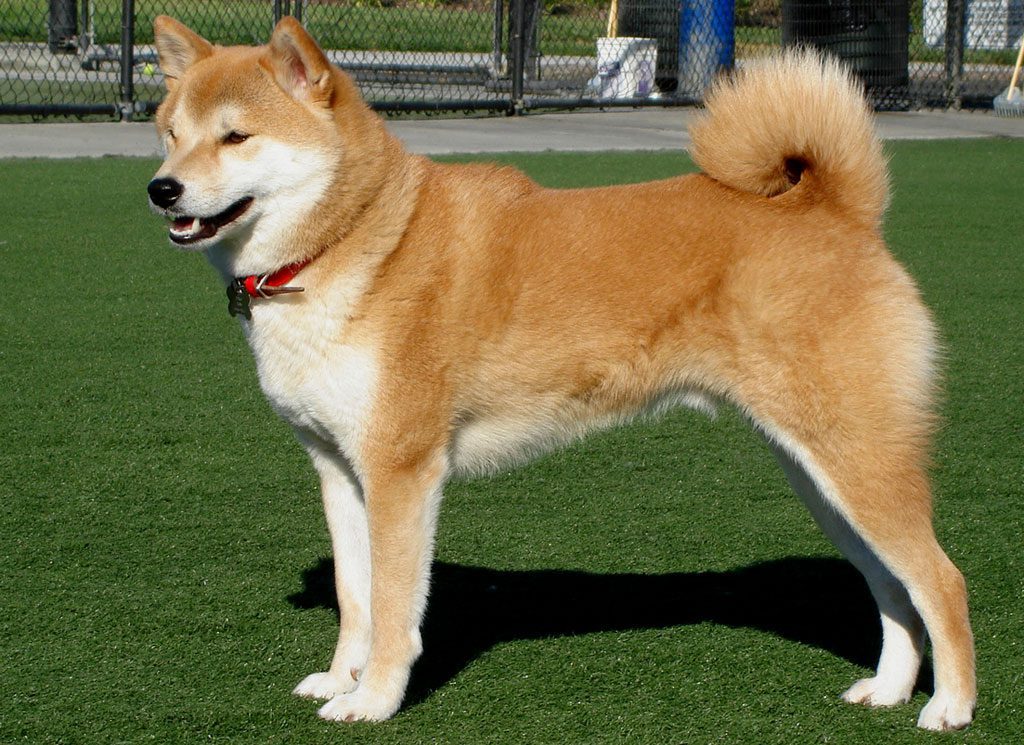
Shiba Inu

The Shiba Inu It is the smallest of the six original and distinct breeds of dog Japan.

Content

History

The Shiba Inu It is an ancient breed of Japanese dog. It is also known as Shiba or Shiba Ken. Shiba means "small" and "Inuยป or ยซKenยป means ยซdogยป in Japanese.

The Shiba It is the smallest of the six recognized Japanese dog breeds.

Historical representatives of the breed were much smaller and short-legged than current specimens. Mountain farmers kept them as farm dogs and to hunt small game and birds.. They could develop independently of other races and changed little. Towards the end of the 19th century the British brought their English Setters and Pointer. As a result, the Shiba Purebred became a rarity within a few decades. Almost a hundred years ago the breed was almost extinct. Around the year 1928 early breeders began to revive the breed and in 1934 established an official standard. Internationally, the FCI tells it in the Group 5 ยซSpitz-type and primitive type dogsยป in Section 5 "Asian Spitz and related breeds".

Physical Characteristics Shiba Inu

Translated ยซShiba Inuยป simply means ยซlittle dogยป. In fact, the Shiba Inu, weighing up to 13 kg, is the smallest representative of the six breeds of Japanese dogs recognized by the FCI.

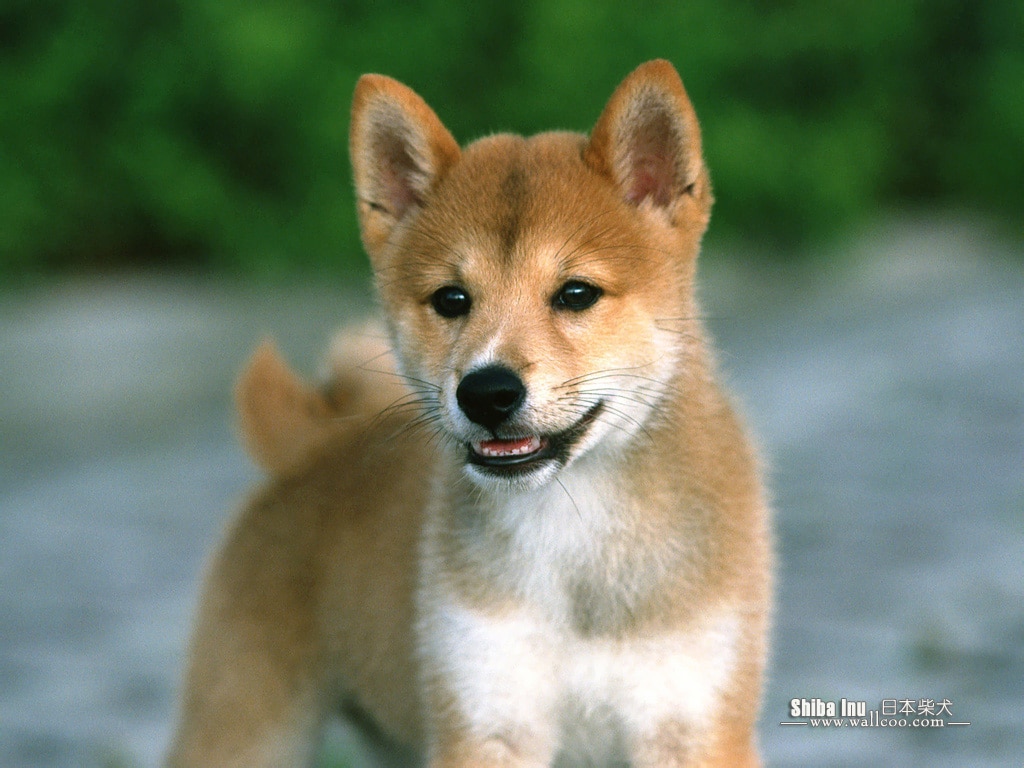
The Shiba Inu is an original dog and a close relative of the wolf. Its appearance is reminiscent of a fox, especially with reddish specimens. Triangular standing ears stand out, the small slightly triangular eyes, as well as the curly tail, which is very close to the back. The hard and straight top coat can have the colors red, black tan, Sesame, as well as black or red sesame. "Sesame" in Japanese dogs means a mixture of red and black hairs. All colors must have the so-called ยซUrajiroยซ. They are whitish hairs on the muzzle, the chest, cheeks, as well as in the lower part of the body and inside the extremities.

Shiba Inu character and skills

The Shiba Inu is a perceptive and independent dog that never fully submits. In general, is lively, entrepreneur, affectionate and brave. He doesn't like to share his "properties" like baskets, food or toys with other dogs. But, with good socialization, living with other pets is possible. Relatively little thief, but can communicate with other sounds in complex ways. He is reserved and very reserved with strangers. You have a strong will and can convince your caregiver of your qualities. With his strong self-confidence you will have to compete with him at first, what can be a big challenge. But, the dog remains calm and collected and is never aggressive. If you acquire some authority, the Shiba is an affectionate and faithful four-legged companion.

Shiba Inu puppy education

The Shiba Inu he is a demanding dog that is difficult for beginners to understand. You need an owner who can cope with your complex and stubborn character. He never gives up his independence and needs a consistent and loving education. Punishment is not appropriate for sensitive dogs, because they are not only sensitive but also resentful. Even for experienced dog owners, stubborn dog can be a challenge. So, it will be a while before he accepts you as a higher ranking dog. For essential socialization, it is recommended to attend a dog school.

Activities with the Shiba Inu

Depending on how you are, the Shiba Inu can be very agile. Likes to decide for himself when he feels like moving, but he needs his daily walks. Depending on your character, some representatives of the breed are suitable for dog sports. If they make sense of it, Japanese dogs can be convinced of agility. Dogs can also be great companions when jogging or cycling. The strong hunting instinct coupled with the dog's stubbornness allows it to run freely without a leash only in rare cases. Preferred activities vary greatly from dog to dog. The owner's motivation to convince the dog of the benefits of an activity is also decisive. Silly recovery games or tricks are not very attractive to these serious dogs. This intelligent breed wants to understand the meaning of a task.

Shiba Inu health and care

The Shiba he is a robust and easy-care dog. But, you should brush their fur regularly. Loses its dense undercoat twice a year during coat change. If you don't want to fight with large amounts of hair at this time, you should regularly brush the dog to remove loose hair. Overall Shiba it is a clean and odorless dog, who is said to be clean as a cat.

With regard to health, the breed is one of the most robust breeds, but you should avoid great efforts in hot weather. Dogs feel more comfortable in the cold and snow. When it comes to nutrition, you should opt for a high-protein, high-meat diet.

Does the Shiba Inu suit me?

If you are looking for a demanding dog with a strong charisma, the Shiba Inu It will make you happy. It is a very clean dog, whose fur has little inherent odor. In general, the Asian dog breed is suitable for self-confident people who want to deal seriously and intensively with their dog. Beginners should refrain from buying this dog, despite his beautiful appearance. If you are sure of the breed, it is better to look for a breeder that belongs to an approved club. For a purebred puppy with papers you can calculate between 800 and 1500 EUR. Representatives of this breed are occasionally found in the shelter looking for a new home..

Shiba Inu curiosities

in his native country, Japan, the Shiba It is not only a "National Natural Monument", but together with the Akita Inu is the most popular companion dog. Due to its unique appearance, these dogs are also very popular in social media today. The Shiba most popular is probably the male Maru Taro (@marutaro) from the Japanese city of Nezu with more than 2,5 million subscribers on Instagram. Among Internet friends since 2013, the call Doge Meme has become particularly well known. It consists of a photo of a Shiba and a rudimentary text in English. The most used photo shows the male Kabosu, a dog adopted by the kindergarten teacher Atsuko Sato.

Breeders list "Shiba Inu"

REGISTER KENNEL

Creators of Shiba Inu

Offer your puppies for free. Sign up here.

  • This field is a validation field and should be left unchanged.
  • Enter an image of your kennel.


Characteristics "Shiba Inu"

Coexistence is important that you have with your new friend. Before considering the acquisition of a dog of the breed "Shiba Inu" you know certain factors. Not all breeds of dogs are apt to live in an apartment, you must take into account his character, their need for exercise, their interaction with other pets, their care and if you have small children, their level of tolerance towards them.

Training ?

2,0 of 5 stars (based on 1 review)

Suitability of the apartment ?

3,0 of 5 stars (based on 1 review)

Can be alone all day ?

3,0 of 5 stars (based on 1 review)

Suitable as a first dog ?

1,0 of 5 stars (based on 1 review)

Weight gain ?

3,0 of 5 stars (based on 1 review)

Health ?

4,0 of 5 stars (based on 1 review)

Intelligence ?

4,0 of 5 stars (based on 1 review)

Kindness with child ?

3,0 of 5 stars (based on 1 review)

Tendency to bite ?

3,0 of 5 stars (based on 1 review)

Tendency to bark ?

3,0 of 5 stars (based on 1 review)

Tendency to flee ?

5,0 of 5 stars (based on 1 review)

hair loss strength ?

4,0 of 5 stars (based on 1 review)

Suitable as a guard dog ?

5,0 of 5 stars (based on 1 review)

Joy ?

3,0 of 5 stars (based on 1 review)

Cat friendliness ?

2,0 of 5 stars (based on 1 review)

Power level ?

4,0 of 5 stars (based on 1 review)

Shiba Inu pictures

Videos of Shiba Inu

Type and recognitions:

  • FCI CLASSIFICATION:
  • Group :
  • Section : . .

Federations:

  • FCI – Group 5: Spitz-type dogs and primitive type – Section 5: Asian Spitz and related breeds. โ“˜
  • AKCNon-sporting โ“˜
  • ANKCGroup 6 (Utility) โ“˜
  • CKCGroup 6 – Non-Sporting โ“˜
  • โ€‹KCUtility โ“˜
  • NZKCUtility โ“˜
  • UKCNorthern Breeds โ“˜

FCI breed standard "Shiba Inu"

Origin:
Japan

Date of publication of the valid original standard:
30.10.2016.

Use:

Hunting dog for birds and small animals. Companion dog.


General appearance:

It is a small dog, well balanced, of good bones, with well developed muscles. Of strong Constitution. Quick, agile and beautiful.

important proportions: The relationship between the height at the withers and the length of the body is 10:11.


Behavior / temperament:

It is a dog of loyal temperament, keenly felt and very lively.

Head:

---

Cranial region:

Wide forehead.

  • Fronto-nasal depression (Stop): Defined, with a slight groove.

facial region:

  • Truffle: Preferably black. Straight nose cane.
  • Snout: Moderately thick; thins to the tip.
  • Lips: Closed.
  • Jaws / Teeth: Strong teeth; scissor bite.
  • Cheeks: Well developed.

Eyes: Relatively small, triangular and dark brown; the corner of the eyes turned up.

Ears: Relatively small, triangular, slightly bent forward and firmly erect.

Neck:

Thick, strong and well balanced with head and body.

Body:

  • Back: Straight and steady.
  • Pork loin: Broad and muscular.
  • Breast : Deep, ribs moderately arched.
  • Belly: Well collected.

Tail:

High implementation, thick and carried vigorously coiled or curved like a sickle; the tip of the tail almost reaches the hocks when hanging down.

Tips

Former members: Seen from the front, straight forelimbs.

  • Shoulder pads: Moderately oblique.
  • Elbows: They must be well attached to the body.

Later members:

  • Thigh: Long.
  • Legs: Short, but well developed.
  • Hocks: Thick and strong.

Pies: Fingers should be close together and well arched. The pads must be strong and elastic. Strong and desirably dark colored nails.

Movement:

The movement must be light and agile.

Mantle

Fur: The outer layer should be smooth-haired, with a hard texture, the undercoat should be of fine and abundant hair; the hair on the tail should be slightly long and kept parted.

Color: Red, Black with fire, sesame, sesame black, red sesame.

Sesam color definition:

ยท Sesame: Proportionate mix of black and white hairs.
ยท Sesame negro: More black hairs than white.
ยท Sesam brook: Coat color red, mixed with black hairs.

All above mentioned colors, except for the White, They must have ยซ URAJIRO ยป.

URAJIRO: Whitish hair on the sides of the muzzle and on the cheeks, under the jaw, neck and abdomen, under the tail, and on the inside of the legs.


Size and weight:

Height to the cross:

  • Males: 40 cm..
  • females: 37 cm..

A difference of more or less is tolerated 1,5 cm..


Fouls:

Any deviation from the aforementioned criteria is considered a fault and its seriousness is considered to the degree of the deviation to the standard and its consequences on health and
the welfare of the dog.

ยท Female males / male female.
ยท Defective occlusion (upper or lower prognathism).
ยท Absence of a large number of teeth.
ยท Shyness.

disqualifying fouls:

ยท Aggressiveness or extreme shyness.
ยท Any dog โ€‹โ€‹showing clear signs of physical or behavioral abnormalities should be disqualified.
ยท Ears not erect.
ยท Hanging or short tail.


N.B.:

ยท Males must have two normal-appearing testicles completely descended into the scrotum.
ยท Only functionally and clinically healthy dogs, with the typical conformation of the breed, should be used for parenting.

Source: F.C.I - International Cynological Federation

Alternative names:

1. Japanese Shiba Inu, Japanese Small Size Dog, Japanese Brushwood Dog, Japanese Turf Dog, Shiba Ken (English).
2. shiba inu (French).
3. Shiba-ken, Shiba Inu (German).
4. Shiba (Portuguese).
5. Japanese Shiba Inu, Japanese Small Size Dog, Shiba Ken (espaรฑol).

โ–ท The world of Pets: Dogs, cats, birds, reptiles, amphibians

Grossespitz (Giant or Large Spitz)
Alemania FCI 97 . European Spitz

Grossespitz (Giant or Large Spitz)

Although I do not necessarily suspect it at first glance, the Grossespitz (Giant or Large Spitz) it is also extremely robust and weather resistant.

Content

History

While the small and medium varieties of the German Spitz (Pomeranian, Kleinspitz (Miniature or Small Spitz) and Mittelspitz (Standard or Medium Spitz), Keeshond) were more common among common people in the Middle Ages, the Grossespitz (Giant or Large Spitz) , with its impressive and elegant shape, found its way into the homes of the noble and middle classes. The Grossespitz (Giant or Large Spitz) white enjoyed great popularity even among representatives of the English nobility. He "German Spitzยป was also able to make a name for itself in America and was supported primarily by German immigrants. In the course of the negative image of Germany after the 1st World War, the Grossespitz (Giant or Large Spitz) was renamed "American Eskimoยป

The Grossespitz (Giant or Large Spitz) black, on the other hand, used to be more common in the vineyards of Baden Wรผrttemberg. His excellent wakefulness instinct was a great help to the winegrowers in keeping off the grape thieves, both animals and humans, away from the valuable vines.

According to Gesellschaft zur Erhaltung alter und gefรคhrdeter Haustierrassen e. V. (Society for the Conservation of Ancient and Endangered Breeds of Domestic Animals), to the Grossespitz (Giant or Large Spitz) Today it is considered endangered. Over the years 2000 to 2002, for example, there was only 11 Grossespitz (Giant or Large Spitz) blacks in Germany and 38 white dogs. To preserve this breed of enterprising and cheerful dogs, there are initiatives to mate the Grossespitz (Giant or Large Spitz) whites and blacks among themselves and to cross them with the Mittelspitz (Standard or Medium Spitz) and the Keeshond.

Physical characteristics

The Grossespitz (Giant or Large Spitz) is characterized by its special double layer. The long straight top layer looks very bushy due to the thick, padded undercoat and stays away from the body. Particularly striking is the strong horsehair fur collar and the bushy tail that curls over the back. The fox head with the agile eyes and the pointed ears, small and narrow give this Spitz its characteristic appearance.

With a shoulder height of up to 50 cm and a weight of 15-20 kg, the Grossespitz (Giant or Large Spitz) is the second largest representative of the German Spitz after the Keeshond. It breeds in the colors black, White and Brown.

The males and females of the category ยซGrossespitz (Giant or Large Spitz) ยป They are very similar in weight and size. But, the male representatives of the breed mostly appear heavier and larger. This is due to the fact that their coat is slightly longer and therefore appears more voluminous than that of female dogs..

Character and skills

The Grossespitz (Giant or Large Spitz) needs a lot of movement and exercise. So, long walks and running games and slides should always be on the agenda. It also, dog sports such as agility, obedience or tracking can bring additional variety to the dog's life and make optimal use of the breed.

Breed-specific character traits

The Grossespitz (Giant or Large Spitz) He is very affectionate by nature and would like to accompany his family everywhere.. Staying home alone does not suit them at all and can make dogs experience their grief intensely. As a rule, the more attention and affection a Grossespitz (Giant or Large Spitz) , more comfortable feels. That's why they like to be with the family, since they also get along very well with children. But, of course, every four legged friend, no matter how sociable I am, he also needs his rest. It is important that all members of the family respect these phases, which are usually quite rare with the Grossespitz (Giant or Large Spitz) . Thanks to his kind and loving character, many representatives of this breed of dog are also suitable as therapy dogs.

Although I do not necessarily suspect it at first glance, the Grossespitz (Giant or Large Spitz) it is also extremely robust and weather resistant. Due to its distinctive protective instinct, they are also considered ideal guardians for the house and yard. But, without proper training, can become a very barking dog. Through an appropriate workload for each species, good socialization and a consistent but loving upbringing, desirable behavior can be encouraged, that is to say, "don't bark".

Grossespitz training

Get enough attention and feel well integrated into family life. As they have almost no hunting instinct, they are usually relatively easy to train and can be recommended for beginners. But, it is important to inform yourself widely about the breed and its requirements beforehand.

Like all the other spitz, to the Grossespitz (Giant or Large Spitz) likes to be in contact with children and loves to play with and protect them. So, fits well in a lively little family, in which there is always something to do and much to discover.

So that the Grossespitz (Giant or Large Spitz) can exercise your favorite activity as a watchdog, The ideal would be to keep it in a house with a patio and garden. If the four-legged friend moves regularly and has mental problems, you can also consider keeping it in a city apartment, as long as there are enough opportunities for exercise nearby.

Videos of the Greater Spitz

Great Spitz Bella+Bruno feeding predators.2012
GroรŸspitz Jacko + Schnappi

Type and recognitions:

  • FCI CLASSIFICATION:
  • Group :
  • Section : . .

FCI breed standard "Grossespitz (Giant or Large Spitz) "

Origin:
Germany

Date of publication of the valid original standard:
04.09.2019.

Use:

Guard and companion dog.


General appearance:

TheSpitzThey attract attention for their beautiful separated fur with the presence of a very dense undercoat.. The neck surrounded by an abundant mane and the tail covered with long hair is striking., turned up and spread boldly on the back. The head is similar to that of the fox with diligent eyes and small pointed ears. The ears, placed very close to each other, confer toSpitzhis characteristic relaxed appearance.

important proportions

Proportion of 1:1 between the height at the withers and the length of the dog.


Behavior / temperament:

TheGerman Spitz is constantly attentive, is active and exceptionally dependent on his master. Learn quickly and can be trained easily. His distrust of strangers and his lack of interest in hunting allow him to be considered the ideal watchman for the house and farm.. Its most notable characteristics are its resistance to weathering., its robustness and longevity.

Head:

----

Cranial region:
  • Skull: The skull ofSpitzis medium-sized; viewed from above seems to swell back becoming more narrow wedge shaped to the tip of the nose.
  • Depression links (Stop): Little steep until marked, but never abrupt.

facial region:

  • Truffle: Round, small, black; in all theSpitzbrown in color is dark brown in color.
  • Snout: Not very long, Neither coarse nor pointed; It presents a good proportion in relation to the skull (in the Spitz type Keeshond/Wolf, in the large Spitz and medium Spitz the ratio snout/skull is approximately 2/3, in the small Spitz and in theSpitz enano/Pomerania is approximately 2/4).
  • Lips: They are not hanging; they are well bonded and do not form folds in the corners. They are black in all colours, in theSpitzbrown in color are brown in color.
  • Jaws/Teeth: The jaws are normally developed and show a complete scissors bite with 42 teeth, That is, the upper incisors fall closely in front of the lower incisors., teeth being implanted perpendicular to the jaws. InSmall and dwarf spitz/Pomeranian the loss of a few promolars is tolerable. A pincer bite is allowed in all varieties ofSpitz.
  • Cheeks: The cheeks are slightly round and are not prominent.
  • Eyes: The eyes are medium-sized, elongated, a little oblique, dark colored. The eyelids have black pigmentation in all color varieties and are only dark brown in theSpitzof brown variety.
  • Ears: The pointed ears in the shape of a pointed triangle are small and rather closely placed together.. Its inclusion is high. They always remain erect with a rigid tip.

Neck:

The neck is moderately long and presents a broad inclusion with shoulders; the neck is slightly convex, without dewlap and covered with a mane shaped collar.

Body:

  • top line: The top line begins at the tip of the erect ears and passes in a gentle arc over the short, straight back.. The deployed and with abundant fur tail partially covers the back and rounded silhouette.
  • Cross/Back: The high cross falls imperceptibly on the short back, straight and strong.
  • Pork loin: Short, wide and strong.
  • Rump: The rump is short and wide, unexpired.
  • Breast : Deep chest, well arched; the apron is well developed.
  • Bottom line and belly: The chest is expanded as much as possible back; the abdomen is moderately retracted.

in the

Tail:

The tail has a high insertion and a medium length; bends upward from the root and rolls over the back, spreading firmly. Well covered with thick hair. A double loop in the tip of the tail is acceptable.

Tips

Former members

  • As a whole: Straight, large on the front.
  • Shoulder: The scapula is long, placed backwards at an angle. The arm, showing almost the same length, with the scapula forms an angle of approximately 90 degrees. Shoulders with good musculature are closely linked with the chest.
  • Arm: Medium length, robust and fully straight on the trunk, covered with long hair in the form of pen in the posterior region.
  • Elbows: The elbow joint is strong, close to the chest without bending inward or outward.
  • Metacarpus: The Metacarpus strong and medium length, forms an angle of approximately 20ยฐ in relation to the perpendicular line.
  • Front feet: The front feet are as small as possible, round, compact, as cat with well arched toes feet. Pads and nails are black in all varieties of Spitz, and they are only dark brown on brown dogs.

Later members

  • As a whole: The hindquarters are very muscular, covered with very long hair up to the Hock joint. The hind limbs are straight and parallel to each other..
  • Thigh and leg: They have approximately the same length.
  • Knee: The knee joint is strong, slightly angled and, during the movement, It does not twist outward or inward.
  • Metatarsus: Medium length, very strong, maintains a position perpendicular to the ground.
  • Rear feet: The hind feet are as small as possible, round, with toes well arched and together, as cat feet. Pads are hard. The color of nails, pads is much darker.

Movement:

TheSpitzmoves with enough coordination, with a good push and almost floating in light trot.

Mantle

Skin

The skin should be well attached to the body, without kinking.

Fur

TheSpitzThey have a double coat covered with hair: the outer layer is long-haired, straight and separate and the inner layer is short-haired, dense and woolly. The head, ears, anterior surface of the forelimbs and hindlimbs and feet are covered by short, dense hair (velvety). The rest of the body is long and abundant hair. The hair should not be wavy, chino, or form hair, You must not present a stripe on the back. A thick mane covers the neck and shoulders. The rear face of the forelimbs has hair in the form of feathers. The hindquarters should be covered with long hair from the rump to the Hock joint. The queue must be covered with hair is long and abundant.

Color

  • Wolf Spitz/Keeshond: Grayish.
  • Grossespitz (Giant or Large Spitz) Negro, brown, white.
  • Mittelspitz (Standard or Medium Spitz): Negro, brown, white, orange, grey, other colors.
  • Kleinspitz (Miniature or Small Spitz): Negro, brown, White Orange, grey, other colors.
  • Spitz enano/Pomerania: Negro, brown, white, orange, grey, other colors.
  • Black Spitz: The fur of the black Spitz should be dark in the skin as well as internal NAP and the color of the outer layer should be jet black color without any white spot.
  • Brown Spitz: The Brown Spitz should have a uniform dark brown color.
  • White Spitz: The hair should be pure white, no yellowish tones that can often occur in the ears.
  • Spitz anaranjando: The Orange Spitz should have a single uniform colour in the average range of the RAL (Registration International of the color scale).
  • Greyish Spitz/Keeshond: Gray is understood as grey silver with black hair tips. Snout and ears are dark. Around the eyes there is a drawing in the shape of glasses consisting of a delicate black line. (It extends from the outer corner of the eye to the lower part of the inclusion of the ear) or in broken lines and shading that draw short eyebrows, but expressive. Mane and ring shoulders are a tone clear. The anterior and posterior members are grey silver unmarked black below the elbows and knees, except delicate stripes on your fingers (pencilling). The tip of the tail is black. The lower part of the tail and the buttocks are grey Silver clear.
  • Spitz other colours: Under this description all tones are included as: cream-coloured, cream-saber, anaranjado-Sable, black with tan and stained. The spotted must have a white background color. Black stains, brown, gray or orange should be distributed throughout the body.


Size and weight:

Height to the cross

  • Wolf Spitz/Keeshond: 49 cm ยฑ 6 cm..
  • Grossespitz (Giant or Large Spitz) : 46 cm ยฑ 4 cm..
  • Mittelspitz (Standard or Medium Spitz): 34 cm ยฑ 4 cm..
  • Kleinspitz (Miniature or Small Spitz): 26 cm ยฑ 3 cm..
  • Spitz enano/Pomerania: 20 cm ยฑ 2 cm. (are undesirable specimens measuring less than 18 cm.).

Weight

Any variation in the size of theGerman Spitz must have a corresponding variation in its weight.


Fouls:

Any deviation from the above criteria is considered missing and the seriousness is considered to the extent of the deviation to the standard.

Serious misconduct

  • Defects in the Constitution.
  • Head too flat or sharp Apple-shaped.
  • Truffle, eyelids and lips of flesh-colored.
  • Defects in the premolars in Wolf Spitz/Keeshond, Medium and large Spitz.
  • Eyes too big or clear or very outgoing.
  • Defects in the movement.
  • Absence of classic drawing of the face inSpitzgrey.

ELIMINATING fAULTS

  • Aggressive or fearful dog.
  • Open fontanel.
  • Upper or lower prognathism.
  • Entropion or ectropion.
  • Floppy ears.
  • White spots visible on allSpitznon white.

Any dog โ€‹โ€‹showing clear signs of physical or behavioral abnormalities should be disqualified..


N.B.:

Males should have two normal-appearing testicles fully descended into the scrotum..

Source: F.C.I - International Cynological Federation

โ–ท The world of Pets: Dogs, cats, birds, reptiles, amphibians

Mittelspitz (Standard or Medium Spitz)
Alemania FCI 97 - European Spitz

Mittelspitz (Standard or Medium Spitz)

The Mittelspitz (Standard or Medium Spitz) is by nature a bit like the old guard dog.

Content

History

The Spitz, officially called ยซGerman Spitzยซ, It is a classic breed of dog in Germany and Central Europe. The Spitz used to be found everywhere. They belonged to all the properties, guarded warehouses and transport carts. Its standard variant is also called ยซMittelspitz (Standard or Medium Spitz)ยซ. This breed of dog has an ancient tradition, which is closely related to our history at least since the Middle Ages. Although this variant is the type of its breed bred from primitive times, the Mittelspitz (Standard or Medium Spitz) did not receive an official place in the standard of the German Spitz until 1969.

The Mittelspitz (Standard or Medium Spitz), on the other hand, only has 100 puppies per year in the VDH (German Canine Federation), the Grossespitz (Giant or Large Spitz) has even less. Thus, from 2003, the Grossespitz (Giant or Large Spitz) and the Mittelspitz (Standard or Medium Spitz) They have been declared an endangered pet breed by the "Society for the Conservation of Ancient and Endangered Pet Breeds". The Grossespitz (Giant or Large Spitz) is classified as extremely endangered, the Mittelspitz (Standard or Medium Spitz) as highly endangered.

Physical characteristics

The Mittelspitz (Standard or Medium Spitz) breeds in the colors black, brown, white, orange, gray cloud and other colors. Other colors include shades like cream, cream- March, orange- March, black-brown and pinto. Like all Spitz has a double layer: a long top coat, straight and protruding and a short undercoat, thick and padded.

With a shoulder height of between 30 and 38 centimeters, the Mittelspitz (Standard or Medium Spitz) is the representative of the breed with the classic tip size.

Character and skills

The Mittelspitz (Standard or Medium Spitz) is by nature a bit like the old guard dog. She is an incorruptible guard, fell, resistant and persevering. He is very smart, curious and energetic. The standard describes its nature:

This German Spitz is always alert, lively and extraordinarily affectionate with his owner. It is very docile and easy to train. His distrust of strangers and his lack of hunting instinct make him the ideal guardian for the house and yard.. It is neither fearful nor aggressive. Insensitivity to the weather, robustness and longevity are its most outstanding characteristics.

The Mittelspitz (Standard or Medium Spitz) it is suitable for dog sports, as the agility. Has a fairly low stimulus threshold and can become a barker under certain circumstances, especially when bored. At the same time you want to please your caregiver and bond with him closely. If the emotional relationship is correct, the Spitz He will do his best not to do anything that his owner does not like., and for example, at least largely, dispense with his barking. But, intelligent breed of dog hates boredom. Combined with your intelligence, wit and docility, it's just fun to practice tricks or agility with him. He will then do everything to please humans. Is very playful, friendly and is very closely related to people, especially with the children.

How long can a Medium Spitz live??

The Mittelspitz (Standard or Medium Spitz) It is robust and durable and can reach a very high age of 15 years and more.

Mittelspitz care

the care of Mittelspitz (Standard or Medium Spitz) it is extremely easy and undemanding. To keep the long coat healthy it is enough to brush it from time to time. Only when the coat is changed should it be additionally cleaned.

Regarding their salus, the Medium Spitz is also a robust breed without any breeding-related diseases.

Nutrition of the Mittelspitz

The Mittelspitz (Standard or Medium Spitz) has no special dietary requirements. For centuries, has become used to using human food scraps. But, this does not mean that we should not give him high quality food today, either dry or wet, and regularly fresh meat.

Education Mittelspitz

The Mittelspitz (Standard or Medium Spitz) easily adapts to the lifestyle of its people. You can live in the country or in the big city. You also feel comfortable in a small apartment in the city. You don't need a strong hand on the other end of the strap, because he willingly follows and does not show any dominance or even aggressiveness towards other dogs. Remain sovereign and neutral, if he is ever bothered. Your attitude is not problematic in all respects due to external circumstances. But, here he hardly demands anything in terms of the relationship and common activities with his caregiver. She is not a couch dog and always wants to experience something new. Want the mental challenge, that can be offered for example with sports for dogs.

Is willing and able to learn and adapt to the habits of their caregivers. Well mannered, it is a very practical companion when visiting a restaurant, when traveling and when on vacation. It is a good and reliable companion for children. He is playful and above all good-natured. He is insensitive to the weather and wants to go on his daily walk in any weather. Either a single person or a family with or without children, young or old: the Spitz is an ideal companion.

The Mittelspitz (Standard or Medium Spitz) must be trained like a great dog in all seriousness from puppyhood. One is always tempted to underestimate these little dogs., especially like dogs. The Spitz needs clear announcements and rules, In summary: guidance from the teacher. He gladly accepts this. The Spitz immediately notices carelessness and inconsistency. With a little responsibility in their upbringing, that every owner should assume from the beginning, the Spitz will easily become a well-trained adult companion dog. After training, a Spitz can be trained very well in various dog sports. It is also very suitable for beginners.

Buy Mittelspitz

If you want to buy a puppy Mittelspitz (Standard or Medium Spitz), you should visit a breeder affiliated with the VDH (German Canine Federation). You can also find your Spitz or one of the mixes in the shelters.

Mittelspitz Videos

Mittelspitz Wolfi
Mittelspitz, agility

Type and recognitions:

  • FCI CLASSIFICATION:
  • Group :
  • Section : . .

FCI breed standard "Mittelspitz (Standard or Medium Spitz)"

Origin:
Germany

Date of publication of the valid original standard:
04.09.2019.

Use:

Guard and companion dog.


General appearance:

TheSpitzThey attract attention for their beautiful separated fur with the presence of a very dense undercoat.. The neck surrounded by an abundant mane and the tail covered with long hair is striking., turned up and spread boldly on the back. The head is similar to that of the fox with diligent eyes and small pointed ears. The ears, placed very close to each other, confer toSpitzhis characteristic relaxed appearance.

important proportions

Proportion of 1:1 between the height at the withers and the length of the dog.


Behavior / temperament:

TheGerman Spitz is constantly attentive, is active and exceptionally dependent on his master. Learn quickly and can be trained easily. His distrust of strangers and his lack of interest in hunting allow him to be considered the ideal watchman for the house and farm.. Its most notable characteristics are its resistance to weathering., its robustness and longevity.

Head:

---

Cranial region:
  • Skull: The skull ofSpitzis medium-sized; viewed from above seems to swell back becoming more narrow wedge shaped to the tip of the nose.
  • Depression links (Stop): Little steep until marked, but never abrupt.

facial region:

  • Truffle: Round, small, black; in all theSpitzbrown in color is dark brown in color.
  • Snout: Not very long, Neither coarse nor pointed; It presents a good proportion in relation to the skull (in the Spitz type Keeshond/Wolf, in the large Spitz and medium Spitz the ratio snout/skull is approximately 2/3, in the small Spitz and in theSpitz enano/Pomerania is approximately 2/4).
  • Lips: They are not hanging; they are well bonded and do not form folds in the corners. They are black in all colours, in theSpitzbrown in color are brown in color.
  • Jaws/Teeth: The jaws are normally developed and show a complete scissors bite with 42 teeth, That is, the upper incisors fall closely in front of the lower incisors., teeth being implanted perpendicular to the jaws. InSmall and dwarf spitz/Pomeranian the loss of a few promolars is tolerable. A pincer bite is allowed in all varieties ofSpitz.
  • Cheeks: The cheeks are slightly round and are not prominent.
  • Eyes: The eyes are medium-sized, elongated, a little oblique, dark colored. The eyelids have black pigmentation in all color varieties and are only dark brown in theSpitzof brown variety.
  • Ears: The pointed ears in the shape of a pointed triangle are small and rather closely placed together.. Its inclusion is high. They always remain erect with a rigid tip.

Neck:

The neck is moderately long and presents a broad inclusion with shoulders; the neck is slightly convex, without dewlap and covered with a mane shaped collar.

Body:

  • top line: The top line begins at the tip of the erect ears and passes in a gentle arc over the short, straight back.. The deployed and with abundant fur tail partially covers the back and rounded silhouette.
  • Cross/Back: The high cross falls imperceptibly on the short back, straight and strong.
  • Pork loin: Short, wide and strong.
  • Rump: The rump is short and wide, unexpired.
  • Breast : Deep chest, well arched; the apron is well developed.
  • Bottom line and belly: The chest is expanded as much as possible back; the abdomen is moderately retracted.

Tail:

The tail has a high insertion and a medium length; bends upward from the root and rolls over the back, spreading firmly. Well covered with thick hair. A double loop in the tip of the tail is acceptable.

Tips

Former members

  • As a whole: Straight, large on the front.
  • Shoulder: The scapula is long, placed backwards at an angle. The arm, showing almost the same length, with the scapula forms an angle of approximately 90 degrees. Shoulders with good musculature are closely linked with the chest.
  • Arm: Medium length, robust and fully straight on the trunk, covered with long hair in the form of pen in the posterior region.
  • Elbows: The elbow joint is strong, close to the chest without bending inward or outward.
  • Metacarpus: The Metacarpus strong and medium length, forms an angle of approximately 20ยฐ in relation to the perpendicular line.
  • Front feet: The front feet are as small as possible, round, compact, as cat with well arched toes feet. Pads and nails are black in all varieties of Spitz, and they are only dark brown on brown dogs.

Later members

  • As a whole: The hindquarters are very muscular, covered with very long hair up to the Hock joint. The hind limbs are straight and parallel to each other..
  • Thigh and leg: They have approximately the same length.
  • Knee: The knee joint is strong, slightly angled and, during the movement, It does not twist outward or inward.
  • Metatarsus: Medium length, very strong, maintains a position perpendicular to the ground.
  • Rear feet: The hind feet are as small as possible, round, with toes well arched and together, as cat feet. Pads are hard. The color of nails, pads is much darker.

Former members

  • As a whole: Straight, large on the front.
  • Shoulder: The scapula is long, placed backwards at an angle. The arm, showing almost the same length, with the scapula forms an angle of approximately 90 degrees. Shoulders with good musculature are closely linked with the chest.
  • Arm: Medium length, robust and fully straight on the trunk, covered with long hair in the form of pen in the posterior region.
  • Elbows: The elbow joint is strong, close to the chest without bending inward or outward.
  • Metacarpus: The Metacarpus strong and medium length, forms an angle of approximately 20ยฐ in relation to the perpendicular line.
  • Front feet: The front feet are as small as possible, round, compact, as cat with well arched toes feet. Pads and nails are black in all varieties of Spitz, and they are only dark brown on brown dogs.

Later members

  • As a whole: The hindquarters are very muscular, covered with very long hair up to the Hock joint. The hind limbs are straight and parallel to each other..
  • Thigh and leg: They have approximately the same length.
  • Knee: The knee joint is strong, slightly angled and, during the movement, It does not twist outward or inward.
  • Metatarsus: Medium length, very strong, maintains a position perpendicular to the ground.
  • Rear feet: The hind feet are as small as possible, round, with toes well arched and together, as cat feet. Pads are hard. The color of nails, pads is much darker.

Movement:

TheSpitzmoves with enough coordination, with a good push and almost floating in light trot.

Mantle

Skin

The skin should be well attached to the body, without kinking.

Fur

TheSpitzThey have a double coat covered with hair: the outer layer is long-haired, straight and separate and the inner layer is short-haired, dense and woolly. The head, ears, anterior surface of the forelimbs and hindlimbs and feet are covered by short, dense hair (velvety). The rest of the body is long and abundant hair. The hair should not be wavy, chino, or form hair, You must not present a stripe on the back. A thick mane covers the neck and shoulders. The rear face of the forelimbs has hair in the form of feathers. The hindquarters should be covered with long hair from the rump to the Hock joint. The queue must be covered with hair is long and abundant.

Color

  • Wolf Spitz/Keeshond: Grayish.
  • Grossespitz (Giant or Large Spitz) Negro, brown, white.
  • Mittelspitz (Standard or Medium Spitz): Negro, brown, white, orange, grey, other colors.
  • Kleinspitz (Miniature or Small Spitz): Negro, brown, White Orange, grey, other colors.
  • Spitz enano/Pomerania: Negro, brown, white, orange, grey, other colors.
  • Black Spitz: The fur of the black Spitz should be dark in the skin as well as internal NAP and the color of the outer layer should be jet black color without any white spot.
  • Brown Spitz: The Brown Spitz should have a uniform dark brown color.
  • White Spitz: The hair should be pure white, no yellowish tones that can often occur in the ears.
  • Spitz anaranjando: The Orange Spitz should have a single uniform colour in the average range of the RAL (Registration International of the color scale).
  • Greyish Spitz/Keeshond: Gray is understood as grey silver with black hair tips. Snout and ears are dark. Around the eyes there is a drawing in the shape of glasses consisting of a delicate black line. (It extends from the outer corner of the eye to the lower part of the inclusion of the ear) or in broken lines and shading that draw short eyebrows, but expressive. Mane and ring shoulders are a tone clear. The anterior and posterior members are grey silver unmarked black below the elbows and knees, except delicate stripes on your fingers (pencilling). The tip of the tail is black. The lower part of the tail and the buttocks are grey Silver clear.
  • Spitz other colours: Under this description all tones are included as: cream-coloured, cream-saber, anaranjado-Sable, black with tan and stained. The spotted must have a white background color. Black stains, brown, gray or orange should be distributed throughout the body.


Size and weight:

Height to the cross

  • Wolf Spitz/Keeshond: 49 cm ยฑ 6 cm..
  • Grossespitz (Giant or Large Spitz) : 46 cm ยฑ 4 cm..
  • Mittelspitz (Standard or Medium Spitz): 34 cm ยฑ 4 cm..
  • Kleinspitz (Miniature or Small Spitz): 26 cm ยฑ 3 cm..
  • Spitz enano/Pomerania: 20 cm ยฑ 2 cm. (are undesirable specimens measuring less than 18 cm.).

Weight

Any variation in the size of theGerman Spitz must have a corresponding variation in its weight. Any deviation from the aforementioned criteria is considered a fault and the severity of this is considered to be the degree of deviation from the standard..

Serious misconduct

  • Defects in the Constitution.
  • Head too flat or sharp Apple-shaped.
  • Truffle, eyelids and lips of flesh-colored.
  • Defects in the premolars in Wolf Spitz/Keeshond, Medium and large Spitz.
  • Eyes too big or clear or very outgoing.
  • Defects in the movement.
  • Absence of classic drawing of the face inSpitzgrey.

ELIMINATING fAULTS

  • Aggressive or fearful dog.
  • Open fontanel.
  • Upper or lower prognathism.
  • Entropion or ectropion.
  • Floppy ears.
  • White spots visible on allSpitznon white.

Any dog โ€‹โ€‹showing clear signs of physical or behavioral abnormalities should be disqualified..


Fouls:

Any deviation from the above criteria is considered missing and the seriousness is considered to the extent of the deviation to the standard.

Serious misconduct

  • Defects in the Constitution.
  • Head too flat or sharp Apple-shaped.
  • Truffle, eyelids and lips of flesh-colored.
  • Defects in the premolars in Wolf Spitz/Keeshond, Medium and large Spitz.
  • Eyes too big or clear or very outgoing.
  • Defects in the movement.
  • Absence of classic drawing of the face inSpitzgrey.

ELIMINATING fAULTS

  • Aggressive or fearful dog.
  • Open fontanel.
  • Upper or lower prognathism.
  • Entropion or ectropion.
  • Floppy ears.
  • White spots visible on allSpitznon white.

Any dog โ€‹โ€‹showing clear signs of physical or behavioral abnormalities should be disqualified..


N.B.:

Males should have two normal-appearing testicles fully descended into the scrotum..

Source: F.C.I - International Cynological Federation

โ–ท The world of Pets: Dogs, cats, birds, reptiles, amphibians

Japanese Spitz
Japรณn FCI 262 - Asian Spitz and related breeds
Japanese Spitz

The Japanese Spitz he is a very people-oriented dog.

Content

History

The strong similarity to the Mittelspitz (Standard or Medium Spitz) German allows us to suppose that the Japanese spitz descends from this same race. Other cynologists assume that the Spitz descends from the Nordic Spitz. One thing is for sure: the origin of Japanese spitz not in japan, but in Europe. From there he arrived in Japan at the beginning of the 20th century along with travelers.

The attractive white dog with the charming character quickly gained popularity among the Japanese population. With more caps from China, Canada and the US, own breeding was established in Japan in the years 20. While in Europe an attempt was made to increase the size of the lace, thus creating the German Spitz, the Japanese tended to opt for the more original compact form. In 1948 the Japanese Kennel Club established a first breed standard for the first time. As country of origin, Japan was indicated in the standard. The FCI, that has officially recognized the Japanese spitz from 1964, includes it today in the Group 5 (Spitz and dogs of the original type), as well as in the Subsection 5 (Asian Spitz and related breeds), under Standard No. 262.

In his native Japan, the Japanese spitz it was very popular for a long time, especially in the years 50 the last century. Although it is still more common there in terms of numbers than in Europe, the demand of the little companion is gradually changing. While in Japan the number of recently registered puppies is declining, is increasing in North America and Europe.

Physical characteristics ยซJapanese Spitzยป

This breed is distinguished by the fact that it is exclusively pure white.. Thanks to his straight and dense hair, the Japanese Spitz seems strong. What is no less important, it is also caused by the swollen inner layer. The beautiful ruffle on the shoulder, neck and sill contributes to attractive appearance. Typical of the tail is a long and voluminous flag.

Despite her short legs, the Japanese Spitz is sporty and extremely agile. Due to its balanced proportions, the appearance of this compact pedigree dog is both striking and harmonious.

The height at the cross – the elevated transition from neck to back – tends to be of 30 to 38 cm in adult males. Females reach a somewhat smaller size. The Japanese Spitz weighs between 4,5 and 11 kg.

Character and abilities ยซJapanese Spitzยป

The well balanced nature of the Japanese Spitz fits the very harmonious appearance. He is an attentive guard. Anyone who approaches him is not immediately signaled with a savage bark. Only when the Japanese pedigree dog feels a serious threat, gets loud and fights back vehemently.

At home, the Japanese Spitz behaves quite calmly. Abroad, on the other hand, he likes to show the energy he has inside him. To enjoy the Japanese Spitz, you must like a little dog who likes to play. You should also have fun on long trips with your four-legged friend.

The Japanese Spitz he is a very people-oriented dog. Whether it belongs to one person or has a master or caregiver at the same time, he does not care. He also likes to live with the family. The company of people is the priority. Pets or other pets are not enough. Although the Japanese spitz usually get along with them. So if you're short on time for a dog, a Japanese Spitz probably not the right thing for you.

The white puppy enjoys the company of people and would like to be with them always and everywhere.. He is very receptive and eager to learn. Which makes education in combination with devotion quite easy even for untrained dog owners.

An apartment in the city is suitable for him, as long as you are well occupied with extensive walks and activities.

ยซJapanese Spitzยป Care

Despite the hereditary predisposition to many diseases, Many of the ailments can be avoided by taking proper care of your Spitz. Dental problems in particular can be prevented through regular dental care, that is to say, brush your teeth at least once a week, or better daily. Diseases or inflammations of the eyes, nose, ears and claws can also be detected and treated at an early stage through proper care and regular check-ups. Another important aspect of grooming is the care of the coat of the Japanese spitz. Despite the impressive and luxurious fur, This is not very elaborate and therefore it is usually sufficient if the hair is combed or brushed thoroughly twice a week. Only in the coat change phase (twice a year) grooming effort increases until daily styling.

Japanese Spitz health

An indication of good and serious parenting is the presentation of genetic test results.. The breeding animals used must have an impeccable genetic makeup to exclude genetic diseases from the start. Dogs in which hereditary diseases typical of the breed have occurred should be excluded from breeding for the sake of the health of the breed. This also includes the tendency to dislocate the patella (slipping of the patella out of its guide), which can also be inherited in many dogs, especially in small dog breeds. Also eye problems, such as distichiasis or narrowing of the tear ducts, as well as dental problems can occur with the Japanese spitz. No other diseases typical of the breed are known..

The correct nutrition of the ยซJapanese Spitzยป

In a special way, correct nutrition contributes to the health and well-being of the Japanese spitz. Small dogs with a very compact constitution have a strong tendency to be overweight. Too many pounds can easily lead to joint disease and heart and circulation problems.. Overweight dogs are also at higher risk for diabetes.

As the owner of a Japanese spitz, you should always keep the amounts recommended by food manufacturers. It also, the dog should not be given too many treats between meals.

It is not only the quantity but also the quality of the food that is important. Besides vegetables or rice, good dog food consists largely of high-quality meat. Poor quality food often contains an excessive amount of cereals. Under no circumstances should it contain flavor enhancers or sweeteners.

Before buying, you should find out the exact composition of the dog food in the manufacturer's instructions. Several vendors offer good and safe dog food, both dry and wet.

It is not unusual for dog owners to prefer homemade dog food. This can also be an alternative to the ready-to-eat food available in stores for the Japanese spitz. But, it is essential that you acquire the necessary knowledge to cook balanced dog food for yourself.

The diet BARF it is also a good way to feed Japanese spitz with a healthy diet. BARF means ยซBone And Raw Foodยป (Bones and raw foods). All food components, like meat, fish, vegetables or fruit, they are only given raw. Various vendors and specialty stores facilitate BARF to the dog owner. Like cooking food, this feeding method requires a certain amount of knowledge about the correct use of raw ingredients.

You must feed a puppy of 3 to 5 times a day, an adult raw food and bones 2 times a day.

Buying a "Japanese Spitz"

Despite the growing popularity and demand in the European and American continent, the Japanese spitz still belongs to the rare dog breeds. The waiting period for a new litter at a breeder can be very long. Who doesn't necessarily care about a purebred puppy, but also consider buying a Spitz adult, should – parallel to the search for a breeder – also look around the animal shelter, where over and over again Spitz or the crosses of Spitz they are waiting for a new and loving home. A puppy, on the other hand, should only be purchased from a serious and certified breeder.

How do I recognize a serious breeder?

When choosing a suitable breeder, various factors play a role. It's not just the "formalities" that must be correct, that is to say, the papers, the pedigree and the contract of sale, but also the personal reasons that ultimately decide the purchase. The breeder must, first, be understanding with you, and this cannot be found out with a short email or a short phone call. One or better several meetings are necessary to get a complete picture of the breeder and his dogs.. Does the breeder invite you to his house? Do you willingly show your "kennel" and do the animals live in close contact with the breeder's family? The first weeks are very important for the socialization of the puppies and therefore the environment must correspond absolutely to the affectionate nature of the puppies. Japanese spitz. It also, a serious breeder will be able to tell you a lot about the breed and its characteristics. They will also ask you about your life circumstances to make sure your puppy has fun with you..

Characteristics "Japanese Spitz"

Coexistence is important that you have with your new friend. Before considering the acquisition of a dog of the breed "Japanese Spitz" you know certain factors. Not all breeds of dogs are apt to live in an apartment, you must take into account his character, their need for exercise, their interaction with other pets, their care and if you have small children, their level of tolerance towards them.

Training ?

5,0 of 5 stars (based on 1 review)

Suitability of the apartment ?

4,0 of 5 stars (based on 1 review)

Can be alone all day ?

2,0 of 5 stars (based on 1 review)

Suitable as a first dog ?

5,0 of 5 stars (based on 1 review)

Weight gain ?

5,0 of 5 stars (based on 1 review)

Health ?

4,0 of 5 stars (based on 1 review)

Intelligence ?

4,0 of 5 stars (based on 1 review)

Kindness with child ?

5,0 of 5 stars (based on 1 review)

Tendency to bite ?

2,0 of 5 stars (based on 1 review)

Tendency to bark ?

2,0 of 5 stars (based on 1 review)

Tendency to flee ?

2,0 of 5 stars (based on 1 review)

hair loss strength ?

5,0 of 5 stars (based on 1 review)

Suitable as a guard dog ?

3,0 of 5 stars (based on 1 review)

Joy ?

4,0 of 5 stars (based on 1 review)

Cat friendliness ?

4,0 of 5 stars (based on 1 review)

Power level ?

4,0 of 5 stars (based on 1 review)

Images "Japanese Spitz"

Photos:

1 – Japanese spitz by https://pxhere.com/es/photo/1273902
2 – Japanese Spitz Siberia by 0894Leanne, CC BY-SA 3.0, via Wikimedia Commons
3 – Japanese Spitz Puppy by mostlegendary@gmail.com, CC BY-SA 3.0, via Wikimedia Commons
4 – Japanese spitz by https://www.pikist.com/free-photo-sixhn
5 – Japanese spitz by https://www.pxfuel.com/en/free-photo-xghfb
6 – Japanese Spitz by Trev Grant, CC BY 2.0, via Wikimedia Commons
7 – Japanese Spitz by https://www.pikrepo.com/fflza/japanese-spitz-near-wall

Videos "Japanese Spitz"

Kubo - Japanese Spitz Puppy - 2 Weeks Residential Dog Training
Kubo – Japanese Spitz Puppy – 2 Weeks Residential Dog Training
Japanese Spitz / Breed of dog
"Japanese Spitz" / Breed of dog

Type and recognitions:

  • FCI CLASSIFICATION:
  • Group :
  • Section : . .

Federations:

  • FCI – Group 5: Spitz-type dogs and primitive type – Section 5: Asian Spitz and related breeds. โ“˜
  • ANKC – Group 7 (Non-Sporting) โ“˜
  • CKC – Group 6 – Non-Sporting โ“˜
  • โ€‹KC – Utility โ“˜
  • NZKC – Non-Sporting โ“˜
  • UKC – Northern Breed Group โ“˜

FCI breed standard "Japanese Spitz"

Origin:
Japan

Date of publication of the valid original standard:
16.06.1999

Use:

Companion dog.


General appearance:

Its body is covered with abundant white fur., the snout is sharp, triangular and erect ears, The tail is covered with long feather-shaped hair and curls over the back.. Robust and well balanced constitution, Its harmonious beauty gives it a lively appearance and dignity characteristic of this breed., that at the same time denotes elegance.

IMPORTANT PROPORTION : The relationship between the height at the withers and the length of the body is 10 : 11.


Behavior / temperament:

It is an intelligent dog, joyful, with keenness of senses. Boisterous nature is not allowed.

Head:

The size of the head should be in harmony with the body and should be moderately wide and rounded.

Cranial region:
  • Skull : The forehead is moderately developed. The back of the skull is very wide.
  • Depression links (Stop) : Defined.

facial region:

  • Nose : Small, rounded and black.
  • Snout : Pointed, the tip slightly rounded and well balanced. Lips adherent and preferably black.
  • Jaws / Teeth : Strong white teeth with scissor bite.

Eyes : Moderately large, almendrada form, placed slightly oblique, dark colored. The edges of the eyelids black.

Ears : High insertion, small, triangular, upright, directed forward and placed not too far apart.

Neck:

Moderately long and very muscular.

Body:

  • Cross : High.
  • Back : Straight and short.
  • Kidney region : Wide.
  • Chest : Wide and deep, well arched ribs.
  • Abdomen : Well collected.

Tail:

High insertion, moderately long and carried on the back.

Tips

PREVIOUS MEMBERS : Well inclined shoulders, forearms straight and elbows close to the body.

LATER MEMBERS : Muscular, the femoro-tibio-patellar joints (knees) and tibio-tarsals (hocks) moderately angled.

FEET : Cat feet. Thick and desirably black pads, the same as nails.

Movement:

Fast and active.

Mantle

HAIR : The hair of the outer coat is straight and remains separated. The hair of the undercoat is short, dense and soft texture. The face, the ears, the front part of the limbs and under the hocks are covered with short hair; the rest of the body is covered with long, abundant hair, especially from neck to shoulders, and the parapet that has a beautiful ruff of hair. The tail also has abundant long feather-shaped hair..

COLOR : Pure white.


Size and weight:

Height to the cross :

  • Males : 30 โ€“ 38 cm..
  • females : slightly smaller than males.


Fouls:

Any deviation from the aforementioned criteria is considered as a fault and the severity of this is considered to the degree of the deviation to the standard and its consequences on the health and well-being of the dog..

โ€ข Upper or lower prognathism.
โ€ข Firmly coiled tail.
โ€ข Shyness, noisy dog.

MISS PLAYOFFS

โ€ข Aggressive or fearful dog.
โ€ข Floppy ears.
โ€ข Tail not carried over the back.

Any dog โ€‹โ€‹showing clear signs of physical or behavioral abnormalities must be disqualified..


N.B.:

Males should have two normal-appearing testicles fully descended into the scrotum..

Source: F.C.I - International Cynological Federation

Alternative names:

1. Nihon Supittsu (English).
2. Nihon Supittsu (French).
3. Nihon Supittsu (Japan-Spitz), Japanischer Spitz (German).
4. Nihon Supittsu (Portuguese).
5. Nihon Supittsu (espaรฑol).

โ–ท The world of Pets: Dogs, cats, birds, reptiles, amphibians

Shikoku
Japรณn FCI 319 - Asian Spitz and related breeds

Shikoku

Less stubborn than the other Spitz breeds, the Shikoku, he is very little known outside his native land, Japan

Content

History

Ceramic figures from Japan that show representations of dogs have been preserved since ancient times., that look like this Japanese breed. The current breed dates back to crosses with the now extinct inu Japanese. The original field of application of these dogs was hunting, more precisely hunting in the prefecture of Kochi on isla de Shikoku – That is why the race is sometimes called ยซperro Kochiยซ. But, name Tosa-Inu, which is used in part in Japan, it's misleading, Because under the name ยซTosaยปThere is also another Japanese race. It also, three varieties of Shikoku, which were named after the respective region in which they live: pity, Hongawa and Hata. As the Hongawa region was the most difficult to access in the past, This variety is considered to be the least modified by other influences and the closest to the ideal of Shikoku. Today, the Shikoku It is considered the national dog of Japan along with the Akita.

Photos:

1 – ยซShikoku Inuยป by https://pxhere.com/en/photo/1589477

Shikoku Physical Characteristics

the typical silhouette Spitz characterizes the Shikoku: It has relatively small, erect ears and a compact body. The tail is well placed and curled over the back. This medium-sized breed with a height at the withers of about 53 cm is located between the Akita bigger and the Shiba Inu smallest within the Japanese family Spitz. For many laymen in Europe this four-legged friend is also reminiscent of a dog which is seen much more often here, the Siberian Husky. The Shikoku coat can be black sesame or white sesame. The dense coat consists, as is typical in dogs of the type Spitz, on a long, hard top coat over a soft, dense undercoat.

Shikoku character and abilities

Shikoku

The loyalty, intelligence and a certain stubbornness form the character of this dog with an agile nature. He is vigilant and behaves in a neutral manner to the point of distancing himself from strangers. When they meet conspecifics, conflicts can occur, particularly with males, because the Shikoku tend to dominate. As a hunting dog it is characterized by its corresponding sharpness.

His original behavior can also be seen in his dealings with people – he likes to lick his reference people and looks for physical contact. Sometimes shows a conspicuous preference for unpleasant odors from the human point of view. The Shikoku He is very agile and likes to be outdoors – however impetuous it may be on the move here, a Shikoku busy behaves calmly and pleasantly indoors, where he appreciates quiet hours and pampering. Although he is a stubborn dog, not as strong as the other races of Spitz from Japan. But: The special character of Spitz not suitable for all dog lovers.

Photo:

2 – Shikoku, female. Colour: sesame by https://commons.m.wikimedia.org/wiki/File:Shikokusesame1.jpg

Shikoku Care

The coat of this Japanese hunting dog is robust and easy to care for, but it must be brushed regularly, especially during coat change twice a year. advice: If you brush your dog every day during this time, It will greatly reduce hair loss at home and also shorten the "hairy phase" in a few days. Outside these few weeks of the year, grooming every few days is enough. Check your ears right now too, so you can clean them with dog ear cleaner if needed. You must bathe your dog very rarely, at most every few months, and then use a mild dog shampoo. But, it makes sense to get the puppy used to bathing. But, it is usually sufficient to simply remove the dried dirt from the coat. Check the length of the claws – especially with older dogs – to shorten claws that are too long with special pliers. This is how injuries are prevented.

Shikoku Education

If he Shikoku respects his two-legged pack leader as a wise and just leader, will gladly follow your instructions. But, first you need to earn the respect of this dog. Be consistent and bring some tolerance to the small, thick skull of this four-legged friend, that will never be completely subordinate.

Screaming or harshness will not help you and will destroy your relationship with this loyal companion.. A thorough knowledge of dog training is needed to direct the dominance and hunting instinct of dogs. Shikoku in regular courses. Please, keep in mind that only a well-trained breed of dog can make a well-behaved friend, otherwise you will look for another job.

Attending classes with dog trainers in general can be of great benefit, so that the Shikoku that tends to dominate, get stronger in social affairs and learn to get along with other dogs. Male dogs in particular can face challenges that need to be countered from puppyhood. So do not underestimate the importance of the socialization phase, because any omission can only be corrected with difficulty.

Shikoku Health

These robust dogs are considered tough and persistent. They hardly have a genetic disposition for disease, if the breeding is done responsibly. It goes without saying that you should only buy puppies from a reputable breeder who belongs to a club.. The breeder will give you competent information about the care of your animal and show you the corresponding tests. In good health, Shikoku reaches an average age of about 13 years.

Where can I find my Shikoku?

The breed is one of the very rare breeds outside of Japan. Consequently, find a puppy of Shikoku can be difficult if you have decided to have one as a new member of the family. But don't despair, because there are a handful of serious breeders in Europe who are dedicated to this breed. The first official litter outside of Japan was in 2000 in the Netherlands, where the breeders of Shikoku continue to regularly deliver litters to responsible hands. But, you may have to accept a longer trip before you can give your puppy a hug from Shikoku. No matter how rare the breed is, don't reduce the demands you can and should make on serious parenting. Learn about puppy care, of your health, ask the breeders and ask them to show you the appropriate tests, for example, in connection with exams for hip dysplasia. Of course, the breeder must also belong to a club. Will be happy to give you some good advice, but in return you will also have some questions to see if you can offer a good home to one of your protรฉgรฉs.

If you are looking for a Shikoku adult, you will need a lot of luck in europe. It is more promising to look for crosses of type Spitz in animal shelters and also get an impression of the breeds of Nordic Spitz.

Characteristics "Shikoku"

Coexistence is important that you have with your new friend. Before considering the acquisition of a dog of the breed "Shikoku" you know certain factors. Not all breeds of dogs are apt to live in an apartment, you must take into account his character, their need for exercise, their interaction with other pets, their care and if you have small children, their level of tolerance towards them.

Training ?

2,0 of 5 stars (based on 1 review)

Suitability of the apartment ?

2,0 of 5 stars (based on 1 review)

Can be alone all day ?

2,0 of 5 stars (based on 1 review)

Suitable as a first dog ?

2,0 of 5 stars (based on 1 review)

Weight gain ?

3,0 of 5 stars (based on 1 review)

Health ?

5,0 of 5 stars (based on 1 review)

Intelligence ?

4,0 of 5 stars (based on 1 review)

Kindness with child ?

4,0 of 5 stars (based on 1 review)

Tendency to bite ?

3,0 of 5 stars (based on 1 review)

Tendency to bark ?

4,0 of 5 stars (based on 1 review)

Tendency to flee ?

5,0 of 5 stars (based on 1 review)

hair loss strength ?

4,0 of 5 stars (based on 1 review)

Suitable as a guard dog ?

4,0 of 5 stars (based on 1 review)

Joy ?

4,0 of 5 stars (based on 1 review)

Cat friendliness ?

2,0 of 5 stars (based on 1 review)

Power level ?

4,0 of 5 stars (based on 1 review)

Videos "Shikoku"

Shikoku Ken / Shikoku Inu play
Shikoku ken in Japan Spring 2014 Shikoku dog
Shikoku ken in Japan Spring 2014 ๅ››ๅ›ฝ็Šฌ

Type and recognitions:

  • FCI CLASSIFICATION:
  • Group :
  • Section : . .

Federations:

  • FCI – Group 5: Spitz-type dogs and primitive type – Section 5: Asian Spitz and related breeds. โ“˜
  • CKC – [Without Miscellaneous] โ“˜

FCI breed standard "Shikoku"

Origin:
Japan

Date of publication of the valid original standard:
16.06.1999

Use:

Hunting and companion dog.


General appearance:

It is a medium-sized dog; And his musculature is well balanced, well developed and well defined. The ears are erect and the tail is curled or in the form of a hoz. Its structure is strong, Compact and solid bones.

IMPORTANT PROPORTION : The ratio of the height at the withers to the length of the body is 10 : 11.


Behavior / temperament:

It is a great resistance dog, vivacious with a sense of smell and acute ear. Is energetic and very alert, In addition to an enthusiastic hunter. With his master he is docile.

Head:

---

Cranial region:
  • Skull : Wide forehead.
  • Depression links (Stop) : shallow, although defined.

facial region:

  • Nose : Black.
  • Snout : Rather long and wedge -shaped. The nasal helm is straight.
  • Lips : Tight.
  • Jaws / Teeth : Strong teeth. The joint is in the form of scissors.
  • Cheeks : Well developed.
  • Eyes : Relatively small, triangular and well separated. Its color is dark brown.
  • Ears : They are small, triangularly and slightly inclined to the front. They appear well erect.

Neck:

Thick and strong.

Body:

  • Cross : High and well developed.
  • Back : Straight and strong.
  • Pork loin : Wide and muscled.
  • Breast : Deep. The ribs are well sprung.
  • Belly : Well collected.

Tail:

High implementation, It is thick and carried on the back firmly curved or curved like a hoose. The tip almost reaches the corvejรณn when the tail is down.

Tips

PREVIOUS MEMBERS :

  • Shoulder : Moderately inclined and developed muscles.
  • Elbows : They are well attached to the body.
  • forearms : Straight and well defined.
  • Metacarpus : Slightly inclined.

LATER MEMBERS : They're strong, well-developed muscles.

Hock : Moderately angular and very firm.

FEET : Well together; The fingers are well arched. The pads are hard and elastic. The nails are hard and black, or a dark color.

Movement:

Elastic, of small strides, Although light. The movement is fast, And it is possible to observe a quick rotation.

Mantle

HAIR : The outer hair of hairs is rough and straight. The undercoat of hairs is soft and dense. The tail hair is rather long.

COLOR : Sesame, Black Sesam and Sesam Red.

Sesam color definition :

โ€ข Sesame : Proportionate mix of black and white hairs.
โ€ข Black Sesam : More black hairs than white.
โ€ข Sesam rojo : Coat color red, mixed with black hairs.


Size and weight:

Height to the cross :

  • In males : 52 cm..
  • In females : 46 cm..

A tolerance of +/- 3 cm..


Fouls:

Any deviation from the aforementioned criteria is considered as a fault and the severity of this is considered to the degree of the deviation to the standard and its consequences on the health and well-being of the dog..

โ€ข Inverted sexual characteristics.
โ€ข Lightweight lower prognathism.
โ€ข Wide.
โ€ข Shyness.

MISS PLAYOFFS

โ€ข Aggressive or fearful dog.
โ€ข Pronounced upper or lower prognathism.
โ€ข Ears that do not appear upright.
โ€ข Hanging tail, short tail.

Any dog โ€‹โ€‹showing clear signs of physical or behavioral abnormalities must be disqualified..


N.B.:

Males should have two normal-appearing testicles fully descended into the scrotum..

Source: F.C.I - International Cynological Federation

Alternative names:

1. Kochi-ken, Shikoku-ken, Shikoku inu (English).
2. chien de Kลchi, shikoku-inu, kochi-ken, Shikoku inu (French).
3. Shikoku inu, Kochi-Ken, Shikoku-ken (German).
4. Shikoku inu, kochi-ken, Mikawa Inu, Shikoku-ken, cรฃo-lobo japonรชs (Portuguese).
5. Kochi-ken, Shikoku-ken, Shikoku (espaรฑol).

โ–ท The world of Pets: Dogs, cats, birds, reptiles, amphibians

Samoyed
Rusia FCI 212 . Nordic Sledge Dogs
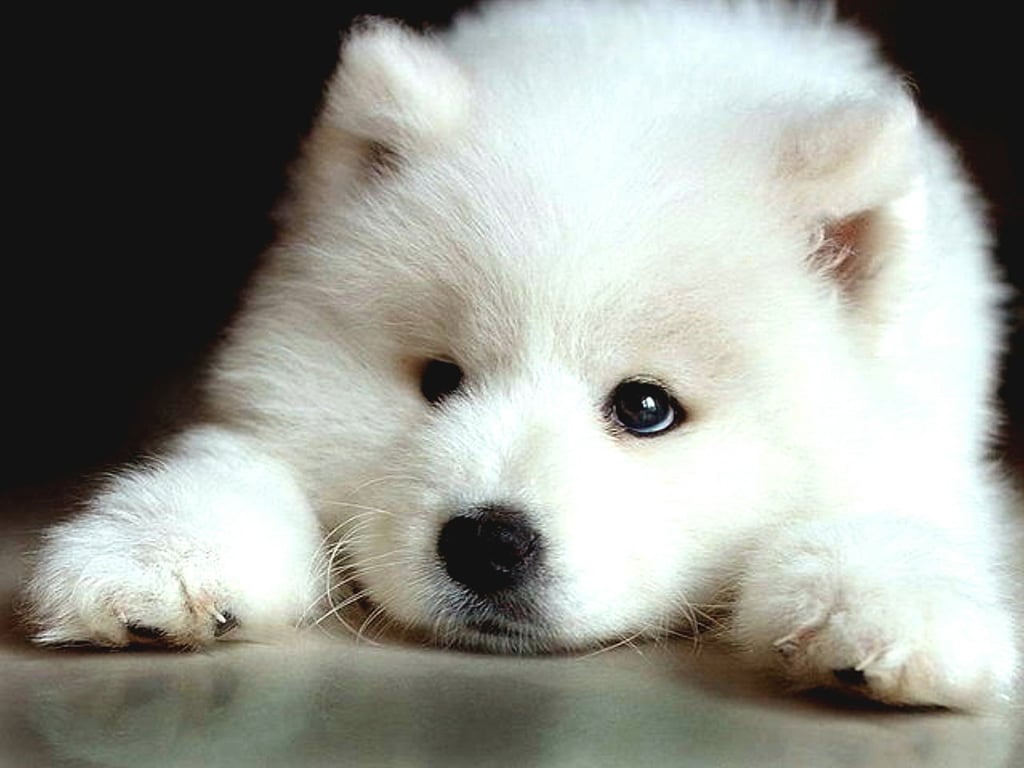
Samoyedo

The Samoyed, Although it may seem a teddy, It is a true athlete who needs exercise daily.

Content

History

Where does he come from Samoyed originally?

The Samoyed is the archetype of a dog from the far north. It belongs to the archetypes of the dog in general. The Samoyed it is one of the oldest dog breeds. Type dogs Samoyed have accompanied the peoples of Siberia for thousands of years. The Samoyeds (or nenets) are various indigenous peoples who have lived for thousands of years throughout Siberia to the Arctic Ocean. Most live as nomads and follow herds of wild or semi-wild reindeer.. Their dogs have different tasks. They pull the sleds with the household goods or with the hunters for the hunt. They pull the boats over the snow into open water. They help with the reindeer herds. They guard and protect people as if they were herds.

They defied death even when facing the polar bear, the world's largest land predator. The Samoyeds provide an excellent navigation system that makes its way through icy deserts even in fog or snow storms, avoiding cracks and ice holes. They often sleep in the tents of the Samoyedos. They keep each other warm. So it is not surprising that the peoples Samoyeds have an extremely intimate relationship with their dogs, and not only because their existence in the far north depends on these dogs.

The Countess Aga von Hagen reports in his book on dog breeds from 1933 that he "Samoyed Spitz" was treated as a sacred dog in his homeland and no family Samoyed voluntarily separated from his dogs. On the other hand, the Countess explains that the Samoyed Spitz, through this close connection, shows a "high development of mental characteristics despite its ferocity". Was not up 2017 that a report by Russian archaeologists was published, that they had found remains of 9000 ten years old dogs in Siberia. In the permafrost these were so well preserved that they could be closely examined and classified as sled dogs..

Only in 1889 English Ernest Kilburn-Scott managed to import the first Samoyeds from Siberia. So these dogs entered modern pedigree dog breeding.. Immediately one turned to their outer appearances. White color rose as a feature of a Samoyed basically arbitrarily to standard. At that moment, like today, se and take Samoyed original in many colors, only rarely in pure white. To impose the pure white color, inbreeding was carried out according to this dubious criterion and thus much of the real character and extreme robustness of the Samoyed. It also, the breeding base was already very small anyway, because the Siberian peoples were reluctant to give up their dogs for breeding in England.

Finally, in the decade of 1950 they also crossed the original line, these being very different in character and, if you look closely, also in appearance. Although the Samoyed current European breeding has lost much of the original character of the true Siberian dog, still an original breed. The most exciting thing about him is that he shows at the same time a close connection with humans. Not without reason, the Samoyed is one of the founders of other breeds of dogs such as the Eurasian. The first standard for Samoyed it was created in 1909, in 1913 was recognized in England. The FCI, Fรฉdรฉration Cynologique Internationale recognized her in 1959.

Physical characteristics

Males tend to have more size females usually weigh between 20 and 32,5 kg, while females usually weigh between 17 and 25 kg.

The eyes of the Samoyed they are usually black or brown, and slanting. The nose or truffle must be well developed and preferably black. At some times of the year it can clear up, giving rise to what is commonly called "winter nose.". Some other factors such as age or climate can clarify it, but it is important to always keep the edges of black. Otherwise it would mean a mandatory veterinary visit.

The ears they should be thick and completely covered with hair, form triangular, and upright. In most cases they are white, but occasionally they can be Brown clear (known as "cookie" color).

The tail of the Samoyed it is one of the most distinctive features of this breed. As the Mally, the tail hanging hook-shaped on his back; However, and unlike the Malamute, the tail of Samoyed touches back and leans over, slightly, on one of the sides and it should not be a very closed hook or in the shape of a "flag".

in cold climates, some Samoyed sleep with their tails over their noses to provide additional protection. Most of the Samoyed, They allow the tail to fall when they are relaxed, but they back to its original position when they are alert.

The Samoyed, they have a dense double coat of hair. The top layer has a dense, straight and thick hair, It seems the white but it has some dyes of silver. This top layer keeps the Undercoat relatively clean and free of debris. The bottom layer is a soft, dense and short hair that keeps the dog warm.

The bottom layer is changed from one to two times a year, process known as shedding of hair. This in no way means that they move hair only on these occasions, year-round fine hair it is moved and replaced, which โ€“usually- sticking it on your clothes or simply air fleet.

The Samoyed standard can have a mix of color White and biscuit, Although dogs completely white or completely color cookie are not rare. Males are generally longer than females fur.

The Samoyed, they are good at grooming themselves, not too many baths still needed. Dirt usually falls easily from the outer layers of hair, making the dog show clean.

The hair of the puppies is more porous, so it is easier to you manche with the grass and mud if they are long time outdoors. The aspect of brushing is more difficult, that by their thick fur in some areas like the back of the ears tend to tangle is if not brushes weekly.

The Samoyed will require that, cut the hair that grows between their feet bearing, but with this exception the rest can stay that way, course.

Except for reasons medical or hair is extremely entangled, it is not recommended that the Samoyed be shaved, since their hair acts as an insulator from both cold and moderate heat, in addition to protecting fair skin from Samoyed before burns by the rays of the sun.

An important characteristic of this breed is that they almost do not have the characteristic dog smell., making them good dogs live indoors. The lack of dander, as well, makes them hypoallergenic.

The thick layer of hair can make you feel uncomfortable in the summer in locations where the climate is warm, where they prefer indoors because the air is colder. Their hair also acts as a natural repellent against lice and ticks..

When moving the hair, most of the outer layer falls off and is replaced, the old man can fall into large bundles, leaving hollow spaces in extreme cases. You can brush the hair, with a metal comb, with which we can speed up the process of moving and help the Samoyed to regain your appearance more quickly. Brushing frequently help him is not enrede.

Give a bath to Samoyed it's a long process, because the hair is almost โ€œwaterproofโ€, so it will take time for it to be fully wet and then fully wet. The hair Samoyed must be dried with cold forced air (using a hair dryer), as water can be trapped in the thick undercoat making it difficult for it to evaporate.

It is important that you rinse well, as leftover shampoo or soap can lead to a fungal infection, difficult to remove without having to shave the affected area. To keep the hair from Samoyed Radiant, brushing and a healthy diet may not be disparaged.

How big is a "Samoyed"?

The samoyed have a height at the withers of about 57 centimeters in males and 53 centimeters in females. Weight is not prescribed by the standard, but it is usually between 18 and 30 kg.

How long can a "Samoyed" live??

One Samoyed healthy can reach the 12 years and more, and this with a good physical condition.

Character and skills

The provision of play of the Samoyed makes it a dog not recommended as a guardian; a Samoyed aggressive is very rare. But, with their tendency to bark they can be diligent watchdogs, barking when something or someone approaches their territory.

The Samoyed, they are one Excelent company, especially for small children or even other dogs, remaining also playful until advanced age. The Samoyed, as well, they are known to be somewhat fools sometimes and difficult to train due to lack of diligence and not due to lack of intelligence, so it must be persuaded obey orders which are given.

His inheritance by pulling sleds, the Samoyed, has no problems to pull objects, and Samoyed who has not been trained has no problem with dragging his owner on the leash when they take him out for a walk instead of walking beside him.

Running is a special passion of the samoyed, more precisely: pull sleds. If you are interested in a Samoyed, you should definitely visit the sled dog races in winter. It is deeply impressive and fascinating.

You can feel the extreme tension of the dogs much earlier in the field of โ“˜ Musher. When you go to the exit, there is hardly a stop. Like in an explosion, this tension of these rather heavy looking dogs dissolves in the acceleration of the sled. The strength of Samoyed it's not your speed, but its unusual resistance.

They instinctively act like herding dogs., so when playing, especially with children, they tend to try to guide them.

This breed is characterized by its expression alert and smiling, which has earned him the nickname "Samoyed smileยป o ยซsmiling dogยซ. They have great vitality, which is why, well cared for they retain their youth and that jovial spirit until their old age. Their average lifespan is of 12 to 18 years, Although some can live a little longer.

As a working breed, they have an excellent resistance and without daily exercise, they become bored and/or depressed they, that can lead to it barking excessively, destroyed or have a worthy of a master of escape behavior. While they are healthy dogs they have tendency to certain diseases.

Caution, health and diseases

The Samoyed for show breeding is affected by numerous hereditary diseases due to one-sided breeding in outward appearance and the very small breeding base today. You should avoid parenting, that values รขโ‚ฌโ€นรขโ‚ฌโ€นthe exhibition championships.

How much care does a "Samoyed" need??

The lush double coat of the Samoyed needs regular care. Especially during the coat change in spring and summer, his house, his car and his clothes will be full of his long hair even though our Samoyed brush daily.

What food is best for a "Samoyed"?
The Samoyed you have no special requirements in your diet. Like most dogs it likes a meaty beef bone and fresh meat. The Samoyed it is very suitable for barbecues.

Activities with your โ€œSamoyedโ€

How much exercise does a Samoyed?

With a Samoyed you can do winter sports very well, ideally as a sled dog. The Samoyed needs an appropriate workload for each species.

Considerations before purchase

Where can you buy a "Samoyed"?

If you are interested in a Samoyed, the first thing you should do is visit some sled dog races. Here you can experience the heart of these dogs live. Then you should get information from a local breeder who does not breed Samoyed plush for exhibition. The breeder should have tested his dogs for special risks of hereditary diseases. This is a natural in serious parenting.. It also, there should be no inbreeding, which can be estimated by looking at the pedigree, if no name appears there twice. The breeder must have his litter well documented by photo. You should be able to see the litter along with the mother bitch, after the fix, in the place. Please, Do not buy Samoyedos by Internet, because there is a high risk that the puppy comes from a seller or breeder of dogs, normally well camouflaged.

The education and maintenance of a "Samoyed"

The Samoyed easy to train and guide, but it is not a dog for beginners. You have high demands on your attitude, derived from its destiny as an original working and sled dog. So you need a lot of occupation and activities, ideally in the sport of sledding.

If you don't exercise and are even left alone without a deep connection to your family, can become a nervous and upset dog, that can even destroy the apartment or the garden.

The Samoyed not a dog for a flat or the big city. The ideal would be a house with a garden. To the Samoyed they like to sleep outside and roll their head under their tail even in the biggest snowstorm. The garden, where do these dogs stay, should not be an ornamental garden.

The luxurious coat of the Samoyed needs regular care. Especially during the change of layer in spring and summer an intensive grooming is indicated. Then the house, the car and clothes will be full of her long hair even if you brush it daily. Here you don't have to be fussy. In the car, it is best to transport it in a box from a specialized store.

The Samoyed can be trained very well by an experienced owner. You have to accept the challenge, It even has to motivate you to fight mentally with this original and confident race. They will gladly accept their masters or caregivers, will be loyal to them, but they have to demonstrate leadership qualities combined with a lot of knowledge of the breed. You have to be fully involved in the experience with these typical Nordic dogs, rustic.

Through a gentle but disciplined upbringing, a Samoyed must be aware of its position in the ranking as early as puppy age. There should be no question who determines the rules of the house.

Characteristics "Samoyed"

Coexistence is important that you have with your new friend. Before considering the acquisition of a dog of the breed "Samoyed" you know certain factors. Not all breeds of dogs are apt to live in an apartment, you must take into account his character, their need for exercise, their interaction with other pets, their care and if you have small children, their level of tolerance towards them.

Adaptation โ“˜

4,0 of 5 stars (based on 1 review)

friendly dog โ€‹โ€‹โ“˜

4,0 of 5 stars (based on 1 review)

hair loss โ“˜

5,0 of 5 stars (based on 1 review)

Affection level โ“˜

5,0 of 5 stars (based on 1 review)

Need for exercise โ“˜

4,0 of 5 stars (based on 1 review)

Social need โ“˜

4,0 of 5 stars (based on 1 review)

Home โ“˜

3,0 of 5 stars (based on 1 review)

Toilet โ“˜

4,0 of 5 stars (based on 1 review)

Friendly with strangers โ“˜

3,0 of 5 stars (based on 1 review)

barking โ“˜

4,0 of 5 stars (based on 1 review)

Health โ“˜

3,0 of 5 stars (based on 1 review)

Territorial โ“˜

5,0 of 5 stars (based on 1 review)

Cat friendly โ“˜

3,0 of 5 stars (based on 1 review)

Intelligence โ“˜

3,0 of 5 stars (based on 1 review)

Versatility โ“˜

3,0 of 5 stars (based on 1 review)

Child friendly โ“˜

5,0 of 5 stars (based on 1 review)

Surveillance โ“˜

3,0 of 5 stars (based on 1 review)

joy โ“˜

5,0 of 5 stars (based on 1 review)

Frequently asked questions about the Samoyed dog breed

in this post, we will answer the most frequently asked questions about Samoyeds.

1 – How is the fur Samoyedor and how it should be cared for?: The coat of the Samoyed it is white and fluffy, with a cotton-like texture. To care for the coat of a Samoyed, regular brushing is necessary to prevent knots and tangles. It also, it is recommended to bathe them approximately every three months to keep their fur clean and soft.

2 – Are the Samoyedos good companion dogs?: Yes, Samoyeds make excellent companion dogs due to their affectionate and loyal nature.. These dogs enjoy human company and can adapt to different lifestyles., as long as they get enough attention and exercise.

3 – What is the personality of the Samoyed?: The Samoyed is a friendly dog, Intelligent, playful and loyal. These dogs have a sociable personality and get along well with children and other animals if properly socialized from puppies..

4 – How is the health of the Samoyed?: In general, the Samoyedos they are a healthy breed, but like all dogs, may have certain health problems. Some common conditions in this breed include hip dysplasia, cataracts and thyroid problems. It is important to carry out regular check-ups with the vet and carry out a proper diet and exercise to keep them healthy.

5 – How do you train a Samoyed?: The Samoyedos They are intelligent dogs and respond well to training.. It is important to use positive training methods and reward good behavior.. Socialization from puppies is key for the Samoyed to become a balanced and well-behaved dog.

Conclusion: If you are interested in adopting a Samoyed dog, We hope we have answered your questions and have helped you to get to know this breed better.. Remember that adopting a dog is a responsibility and that you must dedicate adequate time and resources to ensure that it has a happy and healthy life..

Where can I buy Samoyed dogs??

If you are interested in buying a dog of the breed Samoyed, there are several options you can consider.

One option is to search in directories of dog breeders, as the International Cynological Federation (FCI) or the Royal Canine Society of Spain (RSCE). Both organizations have lists of registered dog breeders and can provide you with information about Samoyed breeders in Spain..

Another option is to search online at websites specializing in the sale and adoption of pets.. You can search on dog breeder websites or on forums and social media groups dedicated to the Samoyed breed.. Be sure to carefully research any potential breeders before making a purchase, and consider visiting the puppies in person before making your decision..

You may also consider adopting a Samoyed dog from a shelter or dog rescue organization.. There are many organizations dedicated to rescuing and rehoming dogs of all breeds., including Samoyeds. Adopting a dog from a shelter or rescue organization can be a great way to give a dog in need a loving and caring home..

Remember that it is important to choose a reputable and ethical breeder or rescue organization., that breeds or rescues healthy and socialized dogs. Don't buy a puppy or adopt a dog from a source that can't provide you with information about the dog's health and breeding or rescue history.

ยซSamoyedยป images

Videos "Samoyedo"

Type and recognitions:

  • FCI CLASSIFICATION:
  • Group :
  • Section : . .

Federations:

  • FCI – Group 5 – Section 1 Nordic Sledge Dogs. โ“˜
  • AKC – Nordic Sledge Dogs โ“˜
  • ANKC – Nordic Sledge Dogs โ“˜
  • CKC – Nordic Sledge Dogs โ“˜
  • โ€‹KC – Nordic Sledge Dogs โ“˜
  • NZKC – Nordic Sledge Dogs โ“˜
  • UKC – Nordic Sledge Dogs โ“˜

FCI breed standard "Samoyed"

Origin:
Russia

Date of publication of the valid original standard:
22/07/1997

Use:

Sled dog and company.


General appearance:

It is a medium-sized and elegant-looking Arctic Spitz.. Gives the impression of strength, resistance, flexibility, Grace, dignity and self-confidence. Her expression, Commonly called the "Samoyed smile," it results from the combination of the shape and position of the eyes with the slightly upward curved corners of the mouth.. Your sexual characteristics must be well defined.

IMPORTANT PROPORTIONS: Body length is approximately 5% greater than the height of the cross. The depth of the body is slightly less than half the height at the withers. The muzzle is almost as long as the skull.


Behavior / temperament:

He is friendly, franco, alert and lively. His instinct to hunt is very slight. He is never shy or aggressive. It is very sociable and cannot be used as a guard dog.

Head:

Powerful and wedge.

Cranial region:
  • Skull: Seen from the front and only slightly convex profile. It is wider between the ears. The furrow between the eyes is slightly marked.
  • Stop: Clearly defined, but not too pronounced.

facial region:

  • Truffle: Well developed, Black preferred. During some periods of the year can clarify the pigment on the nose, giving rise to the commonly called "winter nose"; However, There should always be pigment at the edges of the nose.
  • Snout: Strong and deep, about as long as the skull, slimming gradually towards the truffle; It is not sharp or heavy or square.
  • Nose cane: Straight.
  • Lips: Tight, black and packed. The corner of the mouth is slightly curved upwards, forming the characteristic ยซSamoyed smileยป.
  • Jaws / Teeth: Regular and complete scissor bite. Teeth and jaws are strong. Normal teeth.
  • Eyes: Dark brown in color, rather than separate and properly positioned in orbits, slightly oblique and almond way. The expression is "smiling", friendly, alert and intelligent. The eyelids are black.
  • Ears: erected, relatively small, thick, triangular, slightly rounded at the tips. They should be moving, Insert well separated because the skull is broad and high.

Neck:

Strong and medium length, arrogant postage.

Body:

Slightly longer than the height of the cross, deep and compact, but flexible.

  • Cross: Well marked.
  • Back: Of average length, muscular and straight; the female is slightly longer in males.
  • Pork loin: Short, very strong and defined.
  • Rump: Full, strong, muscular and slightly sloping.
  • Breast : Large, deep and long, reaching almost to the elbows. Well arched ribs.
  • bottom line: Moderately withdrawn.

Tail:

Relatively high insertion. When is the dog alert or moving, the tail is carried bent from its root forward on the back or to the side; When it is at rest performs hanging it and reaches up to the joint warm-foot.

Tips

PREVIOUS MEMBERS:

  • As a whole: Well placed and muscular, with strong bones. Seen from the front are straight and parallel.
  • Shoulder: Long, firm and oblique.
  • Arm: Oblique and glued to the body. About as long as the shoulder.
  • Elbow: Attached to the body.
  • Carpo: Strong but flexible.
  • Metacarpus: Slightly inclined.
  • Previous feet: Oval, with long toes, flexible and straight forward facing. Fingers are arched and are not too United. Elastic pads.

LATER MEMBERS:

  • As a whole: Seen from the back, They are straight and parallel with very strong muscles.
  • Thigh: Medium length, relatively wide and muscular.
  • Knee: Well angled.
  • Warm-foot joint: Positioned relatively low and well angled.
  • Metatarsus: Short, strong, vertical and parallel.
  • Hind feet: Similar to the previous. The Spurs should be removed.

Movement:

You must give the impression of being powerful, free and tireless with long steps. Good range in the forelimbs and good momentum in the hind.

Mantle

HAIR: Polar hair, thick, dense and flexible. The Samoyed has a double layer of hair; the inner layer is made up of short hair, smooth and dense, the outer layer for longer hair, straight and rough. The coat should form a collar around the neck and shoulders, surrounding the head, especially in males. On the head and the front part of the members, the hair is short and smooth; on the outside of the ears, the hair is short, soft and separate. The inside of the ears should be well covered with hair. In the back of the thighs, hair forms trousers. Must have protective hair between fingers. The queue must be extensively covered hair. The coat of the females is often shorter and softer than the male texture. The correct coat should always have a special brightness.

COLOR: Pure white, cream or white with color cake (the basic color should be white, with some brands color sponge cake). Never give the impression of being pale brown.


Size and weight:

Height of the cross (Ideal height):

  • Males 57 cm., with a tolerance of ยฑ 3 cm..
  • females 53 cm., with a tolerance of ยฑ 3 cm..


Fouls:

Any deviation from the aforementioned criteria is considered as a fault and the severity of this is considered to the degree of the deviation to the standard and its consequences on the health and well-being of the dog..

  • Notable failures of body structure.
  • Light bone.
  • Males who are not male and females that are not feminine.
  • Bitefork clamp.
  • Yellow eyes.
  • Soft ears.
  • Ribs abarriladas.
  • Double hook tail.
  • Short members.
  • In Coop or cow hocks.
  • Wavy or short coat on the entire body, Longhair, soft and droopy.
  • Quiet dog.

SERIOUS FAULTS:

  • Noticeably depigmented areas on the eyelids and lips.

MISS PLAYOFFS:

  • Aggressive or fearful dog.
  • Eyes blue or different colors.
  • Upper or lower prognathism.
  • Not erect ears.
  • Color of the fur other than as described in the standard.
  • Any dog โ€‹โ€‹showing clear signs of physical or behavioral abnormalities must be disqualified..


N.B.:

Males should have two normal-appearing testicles fully descended into the scrotum..

TRANSLATION: Federation Canรณfila Mexicana, A.C.

The latest changes are in bold

Source: F.C.I - International Cynological Federation

Alternative names:

1. Bjelkier, Samoiedskaya, Sobaka, Smiley, Sammy (English).
2. SAMOYEDE (French).
3. Samojedenhund, Samojedenspitz (German).
4. Samoieda, Samoiedo (Portuguese).
5. Samoiedskaya Sobaka, Nenetskaya Laika, Samoiedskaรฏa Sabaka (espaรฑol).