โ–ท The world of Pets: Dogs, cats, birds, reptiles, amphibians

Ariรจge Pointer
Francia FCI 177 . Braque Type

Ariรจge Pointer

The Ariรจge Pointer it is a quiet breed of dog, although sometimes stubborn, which is common among hunting dogs.

Content

History

The Ariรจge Pointer is a French dog breed that comes from, as its name implies, from the department of Ariรจge, located on the Franco-Spanish border.

There are different theories about its origins.. But, the most common theory is that it descends from the ancient French Pointer, that was crossed in the 19th century with Braques of southern stock, with white and orange coats to give it more lightness and activity.

It also, looks a lot like the white and orange dogs painted in Jean-Baptiste Oudry's paintings (1686-1755), famous for his paintings of hunting scenes. So, It does not seem illogical that cynologists have attributed this dog to him as an ancestor.

Despite its official recognition by the F.C.I. (International Cynological Federation) in 1955, the second half of the twentieth century was almost fatal for the Ariรจge Pointer. But, some Ariรจge hunters continued to use it, which prevented the breed from completely disappearing.

In 1989, a team of fans of the breed decided to dedicate themselves to its survival, after having noticed that there was no more Ariรจge Pointer registered in the LOF (French Origins Book) from 1964.

The Club du Braque de lโ€™Ariรจge was thus created the following year, with the mission of contributing to the safeguarding and promotion of this breed, but also to centralize all the information that makes it possible to identify the specimens that would be found in France in the breeders, hunters or other fans of this dog.

The operation was generally a success. Like this, the increase in births meant that in 1999, less than 10 years later, the symbolic milestone of the 50 Ariรจge Pointer listed in TFO. The trend has continued, since today there are more than 350 specimens in the LOF, many of whom have won prizes in beauty or hunting contests.

However, the breed has spread relatively little outside its homeland, since most breeders and owners of the Ariรจge Pointer are located in the south-west of France, although there are also some scattered throughout the rest of the country.

Internationally, the Ariรจge Pointer was officially recognized in 2006 by the UKC (United Kennel Club), one of the leading canine organizations in the United States. But, the UKC is an exception, since the other large national canine organizations do not yet recognize the breed. It's still very difficult, yes not impossible, acquire a Ariรจge Pointer outside france.

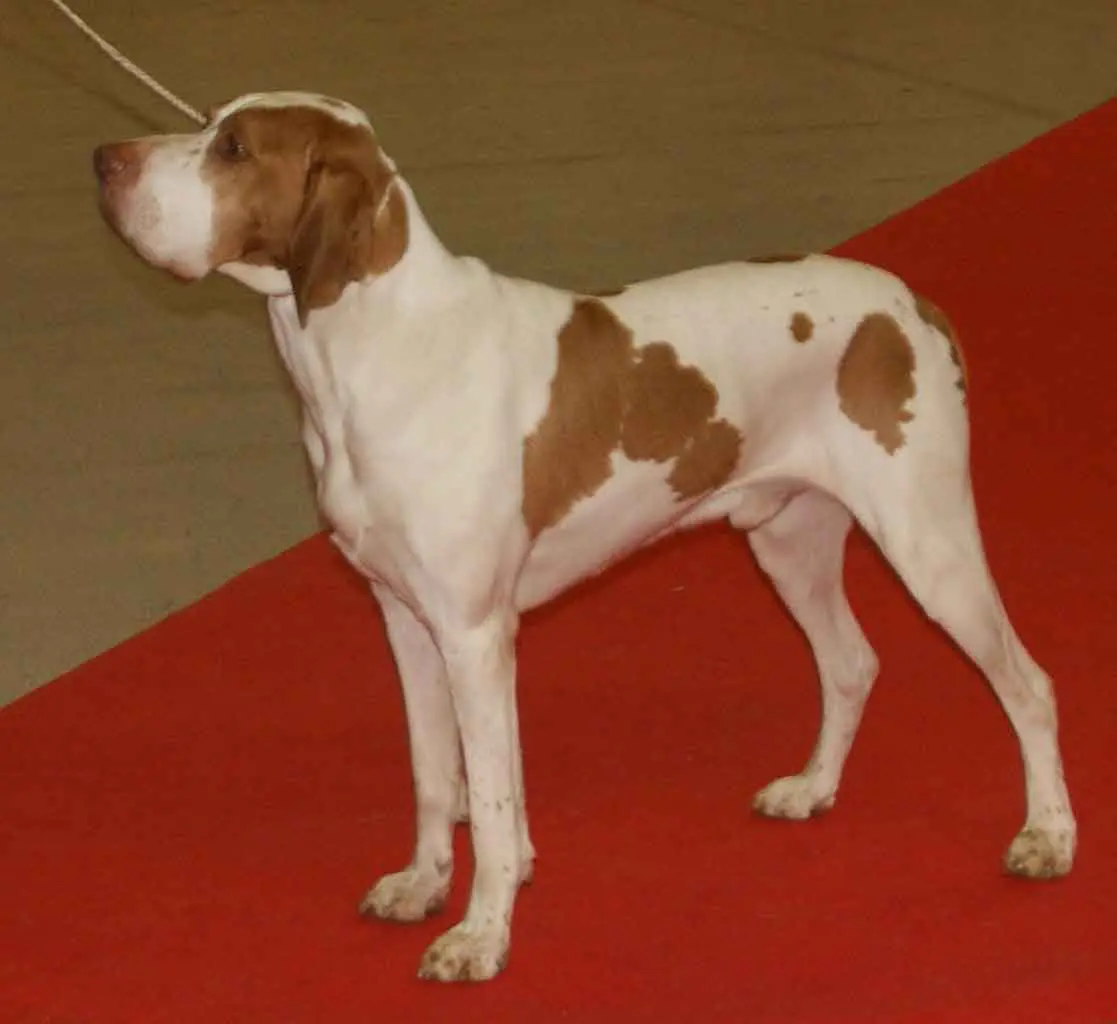
Photo: Ariege Pointer, male. Colour: orange & white by Canarian, CC BY-SA 4.0, via Wikimedia Commons

Physical characteristics

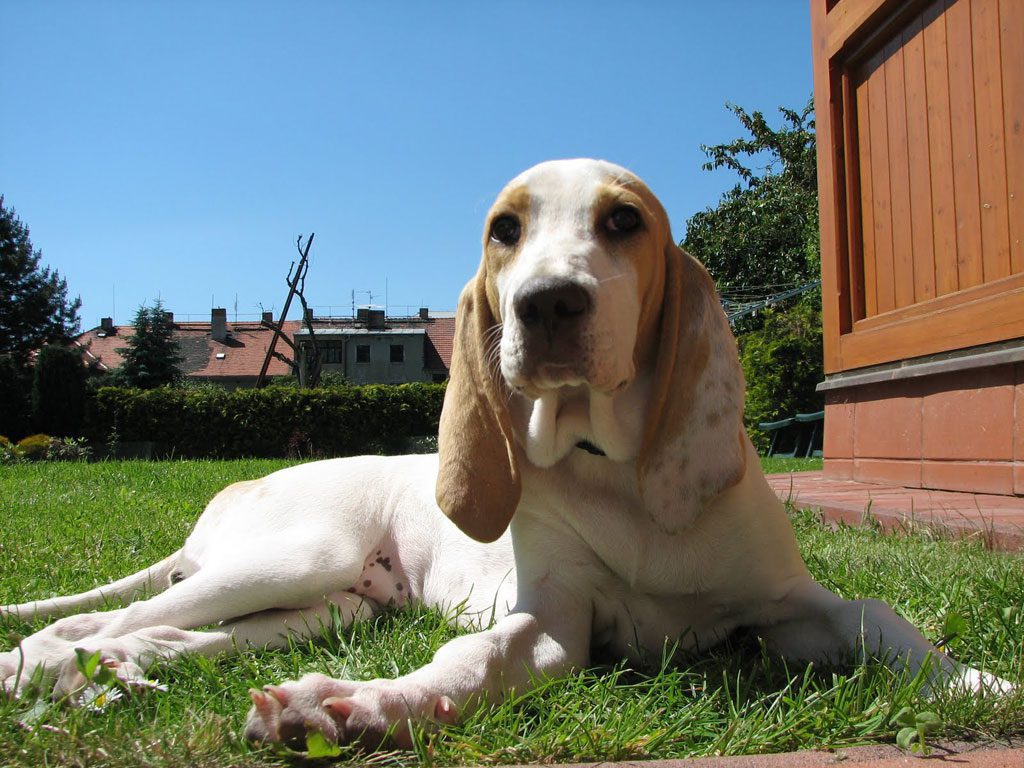
Vigorous and powerful, the Ariรจge Pointer has a certain elegance. His musculature is prominent and harmonious, and its well drawn lines.

Usually pale orange or brown fawn in color, there are also speckled white and trout. His great characteristic is that the color of his nose is more often in harmony with that of his fur..

His hair is short and shiny and his head is long, angulosa, without a very pronounced stop.

His tail is low and long, in contrast to his ears, that are thin and well placed above the eye line.

Finally, the eyes of the Ariรจge Pointer they are oval shaped, dark amber or brown. Her frank and gentle eyes will easily seduce humans who cross her path.

Character and skills

The Ariรจge Pointer it is a quiet breed of dog, although sometimes stubborn, which is common among hunting dogs. He is also a very intelligent dog.

Adapted to all types of hunting and considered one of the best hunting dogs that exist, thanks in particular to his excellent sense of smell, his great stamina and unerring determination, it is effective in all types of hunting and on all terrains.

The Ariรจge Pointer it is also very resistant and adapts easily to all weather situations, though still more at home in the cold than in the tropics.

Very sensitive and affectionate with his master and his relatives, is docile, Gentile, easy to train, and therefore it is an excellent pet.

May be in contact with other animals, in any case congeners or other species of the same size, especially if you've gotten used to them from a young age as part of puppy socialization. On the other hand, its innate hunting instinct could lead it to attack small potential prey. So, it is better to avoid sharing your daily life with a rabbit, a rat or other game that awakens their deep stalker nature.

It is also for this reason that it is recommended to keep it on a leash when in town. On the other hand, if your education is not lacking, it's conceivable – and even desirable – let it go when in the field, so it can be spent, as this is necessary for their physical and psychological well-being.

In effect, the Ariรจge Pointer remains a lively, independent dog who needs daily exercise and is happy to take part in long walks or bike rides. It is a recommended breed of dog for an athletic owner, since you can't settle for a few relatively short outings to relieve yourself.

They can live in the city, but only if they have a garden. The latter does not make it less necessary to offer him long walks, all days, ideally in the middle of nature. It also, if you live in the city, it is advisable to accustom it from a young age to crowds and traffic, for example to avoid encountering a dog that runs behind cars.

Education

The Ariรจge Pointer has an innate aptitude for hunting, but he still deserves to be educated as soon as possible to consolidate his knowledge and teach him the fundamental commands of hunting (stop, stand up, report…).

Whether it is intended to be used as a working dog or simply as a companion dog, it is recommended to train it with patience and delicacy, since it is endowed with great sensitivity. If you don't, you risk getting upset and discouraged, and restoring trust between the owner and his animal is then a long and arduous task.

In any case, either during your education or at any time after, the owner must be calm, attentive and balanced to curb the very dynamic burning of your partner.

Health

The Ariรจge Pointer he is a robust dog with an iron constitution and no particular pathology.

Grooming

A weekly brushing of the dog's coat is sufficient, since the Ariรจge Pointer does not need much maintenance.

Having said that, like any hunting dog, the dog's ears should be systematically cleaned when he returns home, in order to remove any leaves or dirt that may have lodged there.

This special attention to its ears is also valid if it is only used as a companion dog., since dog breeds with floppy ears are at higher risk of ear problems.

Buy a ยซBraco del Ariรจgeยป

The price of a puppy Ariรจge Pointer in a hatchery is between 600 and 800 EUR. There is generally no price difference between a male and a female.

Characteristics "Ariรจge Pointer"

Coexistence is important that you have with your new friend. Before considering the acquisition of a dog of the breed "Ariรจge Pointer" you know certain factors. Not all breeds of dogs are apt to live in an apartment, you must take into account his character, their need for exercise, their interaction with other pets, their care and if you have small children, their level of tolerance towards them.

Adaptation โ“˜

3,0 of 5 stars (based on 1 review)

friendly dog โ€‹โ€‹โ“˜

3,0 of 5 stars (based on 1 review)

hair loss โ“˜

2,0 of 5 stars (based on 1 review)

Affection level โ“˜

4,0 of 5 stars (based on 1 review)

Need for exercise โ“˜

4,0 of 5 stars (based on 1 review)

Social need โ“˜

3,0 of 5 stars (based on 1 review)

Home โ“˜

2,0 of 5 stars (based on 1 review)

Toilet โ“˜

1,0 of 5 stars (based on 1 review)

Friendly with strangers โ“˜

3,0 of 5 stars (based on 1 review)

barking โ“˜

3,0 of 5 stars (based on 1 review)

Health โ“˜

4,0 of 5 stars (based on 1 review)

Territorial โ“˜

4,0 of 5 stars (based on 1 review)

Cat friendly โ“˜

2,0 of 5 stars (based on 1 review)

Intelligence โ“˜

5,0 of 5 stars (based on 1 review)

Versatility โ“˜

4,0 of 5 stars (based on 1 review)

Child friendly โ“˜

2,0 of 5 stars (based on 1 review)

Surveillance โ“˜

2,0 of 5 stars (based on 1 review)

joy โ“˜

4,0 of 5 stars (based on 1 review)

Videos "Ariรจge Pointer"

Braque de l'Ariรจge
Braque de l’Ariรจge
Braque de l'Ariรจge
Braque de l’Ariรจge

Type and recognitions:

  • FCI CLASSIFICATION:
  • Group :
  • Section : . .

Federations:

  • FCI – Group 7: Pointing Dogs. – Section 1: Continental Pointing Dogs. 1.1: Braque Type โ“˜
  • UKCGun Dog โ“˜

FCI breed standard "Ariรจge Pointer"

Origin:
France

Date of publication of the valid original standard:
24.01.1996

Use:

Pointing Dogs.


General appearance:

Of type ยซ Braco ยป, He is robust and powerfully built., although without the appearance of excessive heaviness. His appearance is vigorous. The most appreciated specimens are those with thin limbs, prominent muscles and well-defined lines. Its white fur, preferably splashed with pale orange or sometimes speckled with chestnut, Together with its size, it makes it an elegant and distinguished dog..

IMPORTANT PROPORTIONS :

Of medium proportions; the length of the body is slightly greater than the height at the withers. The skull is slightly longer than the nasal shank.


Behavior / temperament:

Adapts to all types of hunting; it is resistant, docile and easy to educate.

Head:

It must be long, angular and narrow in the region of the zygomatic arches.

Cranial region:
  • Skull : It is slightly domed; the frontal furrow is not very pronounced. The upper lines of the skull and the nasal cannula are slightly divergent forward.. The superciliary arches are moderately accentuated. The occipital protuberance is quite pronounced.
  • Depression links (stop) : Little pointed.

facial region:

  • Truffle : It's pink, flesh-colored or more or less pale brown, according to fur color; never black. The Windows are wide open.
  • Snout : Long, straight nose cane, sometimes very slightly convex. Front views, the lateral faces of the snout converge slightly forward.
  • Lips : They are quite thin and well descended; the commissure is quite folded without falling down.
  • Jaws / Teeth : The dental arches are well adapted. The articulation of the incisors is scissor-shaped; dental is accepted- hard clamp-shaped (the incisors on top of each other).

Eyes : The look is sweet, frank and intelligent. Wide open, The eyes are slightly oval and well set in the orbits.. The iris is a dark amber or chestnut color, according to coat color.

Ears : They are quite thin, long and crooked. They are inserted at or below the eye line.; They are not attached to the head. Their length allows them to reach the birth of the nose without having to stretch them.

Neck:

It's not very long, but quite thick and has a slight dewlap.

Body:

  • top line : The anterior part is almost rectilinear and descends from the withers to the eleventh dorsal vertebra. The second part, slightly convex, join the group.
  • Cross : It is well marked without being protruding.
  • Back : a little long, muscular, solid and straight.
  • Pork loin : Slightly convex.
  • Rump : Slightly oblique in relation to the top line.
  • Breast : It is broad, high and deep to the plane of the elbows. The ribs are rounded, but without exaggeration.
  • bottom line : Slightly oblique and somewhat raised in the abdominal part.

Tail:

Its insertion is located in the extension of the line of the rump. It is thick at the base and gradually tapers. They are usually cut 4/10. Long tail accepted. When raised it should not exceed the top line.

Tips

PREVIOUS MEMBERS : They are straight, for strong bones, wide and muscular.

  • Shoulder : Muscular, robust and moderately oblique.
  • Arms : Strong, well muscled and close to the chest.
  • Elbows : They are located in the plane of the sternum.
  • forearms : Vigorous and well poised.
  • Metacarpus : Seen in profile, they are slightly inclined.
  • Front feet : Together, well arched, forming a compact set, almost round. The nails are strong and the pads are very fleshy..

LATER MEMBERS : They are well poised.

  • Thighs : Well muscled and lowered.
  • Knee : Well parallel to the median plane of the body.
  • Leg : Robust.
  • Hock : Well layered.
  • Metatarsus : Pretty short, almost vertical.
  • Rear feet : They have the same characteristics as the front feet.

Movement:

Tireless and agile trot, interrupted by periods of gallop. Movements are loose and light.

Mantle

SKIN : It is not very thick and is quite elastic. It is thinner on the head. The external mucous membranes must be of a color that corresponds to the color of the coat; They should never have black spots.

HAIR : It's tight, bright, short, thinner and satin over the head and ears.

COLOR : Pale orange fawn, or sometimes brown. Has many mottled or speckled white patches. Some dogs are even white with spots.


Size and weight:

Height to the cross : In males it is 60 to 67 cm., and in females is of 56 to 65 cm..


Fouls:

Any deviation from the aforementioned criteria is considered as a fault and the severity of this is considered to the degree of the deviation to the standard and its consequences on the health and well-being of the dog..

MISS PLAYOFFS : Taking into account the reduced heritage of this breed, the purpose is not to show too much severity, but discard from reproduction the specimens that do not correspond to the type and those that have serious faults.

โ€ข Aggressive dogs, biting or too fearful.
โ€ข Total absence of the typical characteristics of the breed.
โ€ข Double nose (dogs whose windows are separated by a deep groove).
โ€ข Nose of a color that does not correspond to what is established by the standard.
โ€ข Black nose.
โ€ข Inferior or superior prognathism.
โ€ข Eyes : excessively light or different color.
โ€ข Entropion or ectropion, or any trace of surgical intervention to correct this defect.
โ€ข Excess depigmentation on the eyelids.
โ€ข Black nails.
โ€ข Dewclaws.
โ€ข Hind limbs: clearly observable difficulty in movements.
โ€ข Color that does not correspond to what is established by the standard.
โ€ข Size that deviates from the limits of the standard, with a tolerance of 1 cm more or less.
โ€ข Serious morphological anomalies.
โ€ข Defects that cause disability.

Any dog โ€‹โ€‹showing clear signs of physical or behavioral abnormalities must be disqualified..


N.B.:

Males should have two normal-appearing testicles fully descended into the scrotum..

Source: F.C.I - International Cynological Federation

Alternative names:

1. Ariรจge Pointer, Ariege Pointing Dog (English).
2. Braque de l’Ariรจge, braque de Toulouse, braque du Midi (French).
3. Ariรจge-Vorstehhund, Braque de lโ€™Ariรจge (German).
4. (em francรชs: Braque de l’Ariรจge) (Portuguese).
5. Braco de Ariรจge (espaรฑol).

โ–ท The world of Pets: Dogs, cats, birds, reptiles, amphibians

Jura Hound (Bruno Jura Hound)
SuizaFCI 59 . Medium-sized Hounds

Sabueso del Jura

The Jura Hound It is very distant with strangers and needs firm handling if kept as pets.

Content

History

In the year of 1882 set a standard for each of the five existing varieties of the Swiss Hound. In 1909 reviewed these standards confirming the total disappearance of the Thurgau Hound.
The 22 in January of 1933 established a uniform standard for the 4 varieties of the Swiss Hound. The original range of the Jura hound type St. Hubert has now disappeared.

The Jura Hound It is a domestic dog developed in the middle ages for hunting in the Jura mountains, on the border between Switzerland and France.

Already in Roman times these hounds were known in Switzerland.

The Jura Hound He is known for his tracking abilities and like other hounds he has the ability to follow a perfume for miles through the rocky terrain of the border mountains between France and Switzerland.. It is mainly used for the hunting of the Hare.

There are four varieties of Swiss Hound:

Most kennel clubs and organizations treat these breeds as a single breed with multiple varieties..

Physical characteristics

These dogs have a large skull, so their heads seem to be much larger than its small robust bodies. Their ears are flexible and hang down around their muzzle and eyes, giving it a warm and friendly appearance. Your body has some wrinkles around the chest and neck area. Their bodies are elongated and thin and long tail. They are usually a color dark bronze or a reddish Fawn.

Its size is similar to the Bernese Hound, but it differs in the width of your head, being associated with the St. Hubert Hound.

Their life expectancy is of 12 to 13 years, and can weigh between 15 and 20 kg, with a height of 43 to 58 cm. up the cross.

Character and skills

These dogs can be known as little adventurers. They like to explore new and interesting terrain in which have never been before. Son, final ideal for anyone that loves to go on walks and exercise, Since in that environment be shown fully happy. As good Hound, anything, even if it is in its territory.

It is used mainly for hunting hare and wild boar..

They are very protectors and they lash out against anyone trying to do harm to their owners. They are very distant with strangers and need firm handling if kept as pets.

Well trained is a loving, friendly dog with children.

ยซJura Houndยป images

ยซJura Houndยป Videos

Type and recognitions:

  • FCI CLASSIFICATION:
  • Group :
  • Section : . .

Federations:

  • FCI – Group 6: Scent hounds, and related breeds. – Section 1.2: Medium-sized Hounds. โ“˜
  • UKCScenthounds โ“˜

FCI breed standard "Jura Hound (Bruno Jura Hound)"

Origin:
Switzerland, France

Date of publication of the valid original standard:
28.11.2001

Use:

It is a small game hound that hunts hares, deer, foxes and sometimes wild boars. He is an independent hunter by hunting with a bark. Searches and corners its prey with great safety even in difficult terrain.


General appearance:

It is a dog with medium height at the withers. Your body structure indicates strength and tenacity. Its slim head with long snout and long ears give it an expression of nobility.

There are four varieties of Swiss Hound :

  • Bernese Hound
  • Jura Hound
  • Lucerne Hound
  • Schwyz Hound

IMPORTANT PROPORTIONS :

โ€ข Body length : Height at withers = approx. 1.15 : 1.
โ€ข Height of the withers : chest depth = approx. 2 : 1.
โ€ข Length of the nasal shank : skull length = approx. 1 : 1.


Behavior / temperament:

Lively and passionate about hunting. Sensitive, manageable and faithful.

Head:

---

Cranial region:
  • Skull : Long, narrow, delgado, noble. Bulging skull, visible occipital protrusion. The direction of the longitudinal axis of the skull and the muzzle shows a slight divergence. No frontal groove, no folds or wrinkles.
  • Depression links (Stop) : Not too developed.

facial region:

  • Truffle : Completely black, well developed; nostrils wide open.
  • Snout : Nobly developed, narrow ; it is not square or pointed ; the muzzle is straight or very slightly convex.
  • Lips : Moderately developed, the upper lips perfectly cover the lower jaw ; slightly open corner.
  • Jaws / Teeth : Powerful jaw. Powerful scissor bite, regular and complete, that is, the upper incisors overlap the lower ones without leaving space between them and the teeth are implanted vertically in the maxilla. Pincer bite allowed. The lack of one or two PM1 or PM2 is acceptable (premolars 1 or 2) . M3 are not taken into account (molars).
  • Cheeks : Loose, non-protruding supraciliary arches.

Eyes : They are more or less light or dark brown depending on the color of the coat ; they are medium in size and slightly oval. The edges of the eyelids are well pigmented. The eyelids are well adherent. The expression is sweet.

Ears : Placed below the eye line, in the posterior part of the cranial region and never implanted in its maximum width. Its length must reach at least the tip of the nose. The pinna is not prominent. The ears are thin. He wears them down, bent and twisted ; they are rounded at the bottom and have a fine, soft coat.

Neck:

Long, elegant, with good musculature ; throat skin is loose without forming a noticeable dewlap.

Body:

  • top line : The neck, the back, The rump and tail form a harmonious and noble line.
  • Cross : Bit strong, free and elegant neck insert.
  • Back : Firm and straight. : Muscular and slightly arched.
  • Rump : Elongated, extends the line of the back harmoniously and descends gently. It is not higher than the cross. The crest of the iliac bone is not too prominent.
  • Breast : Deeper than wide, well descended, reaches to the tips of the elbows. Elongated rib cage with slightly arched ribs.
  • Bottom line and belly : Belly slightly pulled back ; full flanks.

Tail:

Inserted in the extension of the croup. It is of medium length and tapers towards the tip ; at its end it has a slight incline up ; noble. In general, it remains hanging at rest and when walking calmly, without showing an important bend ; When he is attentive or in action he carries it along the line of his back , but never resting in it nor in a curled way. Is well covered with hair, but it doesn't have a spike shape.

Tips

PREVIOUS MEMBERS :

  • As a whole : They are well muscled, thin and not heavy in appearance. Seen from the front they are parallel and from the side they look vertical ; his bones are strong with his feet pointed forward.
  • Shoulder : Long oblique shoulder blades, closely linked to the rib cage. The ideal angulation of the scapulohumeral joint is approximately 100ยฐ.
  • Arm : A little longer than the shoulder blade, placed obliquely, closely attached to the chest. His musculature is fine.
  • Elbows : Naturally glued to the side.
  • Forearm : Straight, strong, delgado.
  • Carpo : Strong, wide metacarpus : Relatively short; Seen from the front it is located on the perpendicular line of the forearm; seen from the side it is slightly inclined.
  • Front feet : Rounded, with compact fingers ; hard and rough pads ; strong nails whose color depends on the color of the coat.

LATER MEMBERS :

  • As a whole : They have strong muscles and are in a balanced relationship with the forelimbs ; seen from behind the hind legs are vertical and parallel.
  • Thigh : Long and oblique, powerful although his muscles are thin. The angulation of the coxofemoral joint is approximately 100ยฐ.
  • Knee : No inward or outward deviations. Angulation of the femoral-tibian joint approximately 120ยฐ.
  • Leg : Relatively long, thin, visible muscles and tendons under the skin.
  • Hock : Tibiotarsal joint angulation approximately 130ยฐ.
  • Metatarsus : Pretty short, placed vertically and parallel. Without spurs, except in countries, in which amputation is not allowed by law.
  • Rear feet : Rounded, with compact fingers, hard and rough pads ; strong nails whose color depends on the color of the coat.

Movement:

It is unfolded, regular, harmonious and with good scope. Has good impulse from the hindlimbs. Drive the limbs parallel and straight. The cross moves smoothly and regularly up and down, the back remains straight and the head and neck wobble slightly from side to side.

Mantle

SKIN : Fina, flexible, well adherent, whose color varies in each of the four varieties.

โ€ข Bernese Hound : Skin is black under black hair and blackish-white marbling under white hair.
โ€ข Jura Hound : She is black under black hair and lighter under tan hair..
โ€ข Lucerne Hound : She is black under black hair and lighter under blue-flecked hair..
โ€ข Schwyz Hound : It is dark gray under the orange hair and blackish-white marbling under the white hair..

HAIR : Is short, smooth, thick, very fine on the head and ears.

COLOR :

โ€ข Bernese Hound : White with black spots or a black saddle-shaped spot. Tan color from pale to intense over the eyes, cheeks, on the inside of the ears and around the anus. Sometimes very lightly splattered (black splash).

โ€ข Jura Hound : Tan with black cape, sometimes nuanced black or black with tan over the eyes, cheeks, around the anus and on the extremities ; sometimes with a small white spot on the chest ; this stain may be splattered (black or gray splashes).

โ€ข Lucerne Hound : Called blue, with a mixture of black and white hairs, intensely splashed, with black spots or a saddle-shaped spot ; tan color from pale to intense over the eyes, cheeks, on the chest, around the anus and on the extremities ; a black cape is allowed.

โ€ข Schwyz Hound : White with orange or orange "saddle" spots, sometimes with orange splashes ; an orange coat is allowed.


Size and weight:

Height to the cross :

  • Males : 49-59 cm..
  • females : 47-57 cm No tolerance.


Fouls:

Any deviation from the aforementioned criteria is considered as a fault and the severity of this is considered to the degree of the deviation to the standard and its consequences on the health and well-being of the dog..

โ€ข Rough appearance, vulgar, weak body structure.
โ€ข Discordant proportions between body length, the height of the withers and the height of the chest.
โ€ข Skull too wide, too convex or too flat.
โ€ข Stop too marked.
โ€ข Very short or very long snout, too square or pointed.
โ€ข Concave nasal bridge.
โ€ข Lack of more than two premolars PM1 or PM2. Los M3 (molars 3) are not taken into account.
โ€ข Thick lips.
โ€ข Light eyes, acute expression, non-adherent eyelids.
โ€ข Ears that are too short or flattened, thick or set very high.
โ€ข Very short neck.
โ€ข Double chin too marked.
โ€ข Saddled or arched back (carp back).
โ€ข Croup too inclined or too short.
โ€ข Rib cage not deep enough, too flat or barrel-shaped.
โ€ข Retracted belly, fallen flanks.
โ€ข Tail with poor insertion, carried too high, very bent, stooped, very coarse or spike-shaped tail.
โ€ข Extremities with bones that are too thin or in a bad position.
โ€ข Very sloping shoulders, arm too short.
โ€ข Weak carpal joints.
โ€ข Insufficient angulations of the hind limbs ; cow or barrel shaped limbs.
โ€ข Dewclaws on the hind limbs, except in countries in which amputation is not permitted by law.
โ€ข Rough coat, not smooth.
โ€ข Flaws in color and markings.

  1. Bernese Hound : Too many black splashes on the white. Tan or white on the outside of the ears.
  2. Jura Hound : Uniform color. Noticeable white patch or heavily speckled patch on the chest.
  3. Lucerne Hound : Lack of ยซ blue ยป splash. Tan on the outside of the ears.
  4. Schwyz Hound : Too many orange splashes on the white. Uniform color. White on the outside of the ears.

โ€ข Slightly fearful or aggressive behavior.

MISS PLAYOFFS

โ€ข Excessively fearful or aggressive dog.
โ€ข Atypical general appearance of the breed.
โ€ข Completely depigmented nose.
โ€ข Upper or lower prognathism, incisor arcade deviated.
โ€ข Ectropion, entropion (even if it had been operated).
โ€ข Horn tail, threaded, knotty the hook.
โ€ข Size above or below tolerance.

Any dog โ€‹โ€‹showing clear signs of physical or behavioral abnormalities must be disqualified..


N.B.:

Males should have two normal-appearing testicles fully descended into the scrotum..

Source: F.C.I - International Cynological Federation

Varieties of ยซSwiss Houndsยป

The four varieties of Swiss hounds have their own specific hunting characteristics:

– The Bernese Hound, with her beautiful throat ("the howler of the Jura"), demanding, mainly used for hares;
– The Jura Hound, an excellent recuperator
– The Lucerne Hound, reminiscent of Small Blue Gascony, he is an active and passionate dog that hunts deer very well;
– The Schwyz Hound, less widespread outside of Switzerland, is reserved for rabbits and hares.

Alternative names:

1. Bruno Jura Hound (English).
2. Bruno du Jura (French).
3. (frz. Bruno du Jura) (German).
4. Sabujo Bruno de Jura (Portuguese).
5. Fernando del Jura, Bruno del Jura (espaรฑol).

โ–ท The world of Pets: Dogs, cats, birds, reptiles, amphibians

Artois Hound
Francia FCI 28 . Medium-sized Hounds

Sabueso Artesiano

The Artois Hound it is a good companion dog but with an independent character.

Content

History

The Artois Hound It is a smaller version of the "Great Artesian Hound", which is now extinct and was used in France in the 17th century for wild boar hunting, deer and small game. As hare hunting grew in popularity, the need for smaller dog breeds increased. Known in his land as "Briquetโ€ (What does "little braco" mean?) and also how Picard.

It is true that it is a dog of ancient lineage like few others has enjoyed the admiration and the royalty protection (King Henry IV and Louis XIII), being considered a distinguished Hunter of Hare.

He played with devotion to his duties in the most varied scenarios (plain, forest or in the densest bushes) and used to be easily identified by his master due to his original bark.

Some authors have that in 1609 Prince Alexander Gray has sent some specimens of this breed to the King of England, which have subsequently been used for the creation of the Beagle.

The development of Artois Hound, However, It has not been stable or linear. According to a French hunting manual, dating of 1890, It is known that at the end of the 19th century it used to be difficult to find pure specimens of this lineage..

The apparent arbitrariness to the development of the race and their successive crosses with other species (mostly of English origin) they will disperse the original purity of this lineage.

In this stage a so-called breeder Ernest Levoir tries to restore this lineage to the region Picardie. There are other names that were associated with these recovery attempts during the 20th century, as Mallard (at the time of World War I), Audrรฉchy, among others.

With everything, Some authors consider that it has been Mme. Great Pyla who has won the most positive results, managing to re-establish the breeding of this strain.

Currently, This dog It remains a rare breed and there are quite a few clubs that protect their development.

Physical characteristics "Artesian hound"

Very agile, It adapts to various types of terrain and shown extremely persistent in the performance of their duties. It also, has an excellent sense of direction, a developed sense of smell and speed of movement.

This robust dog has a fur short, dense, soft and well attached to the body.

The color the coat is dark Fawn tri-color, It is a color similar to the Hare or the Badger. It has large spots. Y, the head tends to be carbonated, or charcoal grey and sometimes presents black reflections.

It has wide and rounded skull and pronounced chamfer. It has the square snout, the black truffle and its round eyes give it a gentle air.

The ears they are wide, long and inserted at eye level.

The neck and chest are vigorous and long. The rump and the spine are also robust and Member muscular. In the long run tail stays in the form of sickle.

Character and skills "artisian hound"

Currently, this dog is still used more as a hunting dog than as a companion dog. Like the large spaces, It does not conform to the sedentary life in the city.

You can live in a home but if given a daily dose of exercise physical and games.

The Artois Hound he is a brave and intelligent dog, very independent and quite energetic.

It is an animal very resistant, possessing a special bark that can be heard at a great distance. It is a dog that is used primarily for hunting.

Hunters usually go hunting with six or eight specimens of Artois Hound.

It is not usually seen much as a companion dog, but in this case it is a good companion, It is not a Mongrel dog thanks to its strong independence, but will be loving in their own way, without empalagar.

Care and maintenance of a "artisian hound"

The Artois Hound not suitable as a family dog. Needs a meaningful task that demands your doggy stamina and intelligence. His most popular task is still hunting. So, this dog should be left in the hands of an experienced hunter.

To the Artois Hound would not like the position in a city apartment, no matter how comfortable the apartment is. You need freedom of movement, What can you get in the country?. As the Artois Hound He is a pack dog and feels very happy among his peers., second position or multi-dog position is recommended. The care of this breed of dog is not intensive. Ear care can be a bit more complex, but the coat is very easy.

Where to buy a "artisian hound"

The Artois Hound It is a rare breed of dog that was on the verge of extinction after World War 2.. If you are interested in this dog, should have a lot of patience and time. Contact the breeders in advance and ask if they are expecting a litter and if there are any still available. Puppies are often reserved in advance. But it's better not to buy from breeders when you have a bad feeling!! If possible, you should take a look at the kennel. Don't be afraid to ask the breeder too many questions!! A good breeder, for whom the welfare of puppies is the first priority, will be happy to answer your questions and give you some valuable tips on maintenance, training and feeding the dogs.

Images of the "Artesian hound"

Videos of the "Artesian hound"

Type and recognitions:

  • FCI CLASSIFICATION:
  • Group :
  • Section : . .

Federations:

  • FCI – Group 6: Scent hounds, and related breeds. – Section 1.2: Medium-sized Hounds. โ“˜
  • Central Canine Society โ“˜

FCI breed standard "Artois Hound"

Origin:
France

Date of publication of the valid original standard:
24.07.1996

Use:

The artisian hound is used mainly today for hunting with shotguns. As a scout he works with application to resume the lost trail; Your speed is moderate, But sustained. Since it has an excellent smell, is capable of failing the hare tricks during hunting in the plain.

With its indisputable hunter qualities, He knows how to lead the roe, both in the forest, as in the Altos Montes, Easy to penetrate. For its intrepidity and courage, Makes the most recalcitrant boar out of the weed. It also, This is a rustic animal, endowed with a wonderful bark, animated, Sound and tall that is allowed to be heard in the distance. A uniform group of six to eight tricolor craftsmen constitutes a hunting team that would please the most demanding hunter.


General appearance:

This is a well constituted dog, muscular and not very long. Imparts an impression of strength and energy.

IMPORTANT PROPORTIONS:

โ€ข Cross height/body length between 10:10 and 10:11
โ€ข Chest height/height at approximately 1:2
โ€ข Heads/head length amplitude 5:9
โ€ข Nasal cane length/skull length 8:10


Behavior / temperament:

This is a vigorous and rustic dog. It has a very good smell and joins the Hae. Is balanced and affectionate.

Head:

-

Cranial region:
  • Skull: It is bulky, wide and very short. It is flat and rounded at the top, but the occipital Protuberance is not pronounced.
  • Depression links (Stop): It is accentuated.

facial region:

  • Truffle: Grand, black. The Windows are wide open.
  • Lips: The upper lip covers in large part to the bottom and must be sufficiently marked for that, in profile, the snout has a square shape.
  • Snout: Straight nose cane, in profile, the snout is moderately elongated.
  • Jaws/Teeth: The joint is in the form of scissors. The upper incisors cover the lower ones in narrow contact and are implanted at right angles in relation to the jaw.
  • Cheeks: They are thin.
  • Eyes: With regard to the width of the forehead, the eyes are not very together. They are round, melancholy eyes and sweet. Its color is dark brown. The mucous membranes of the lower eyelids may not be apparent.
  • Ears: They are placed at the height of the eye line. They are somewhat thick, wide and their limbs are rounded. They are almost flat and quite long; they arrive until the birth of the truffle.

Neck:

It is powerful and moderately long. It presents very little double chin.

Body:

  • Back: It is well marked and wide.
  • Pork loin: Slightly arched.
  • Rump: The legs providing a slight incline to the rump, It is well muscled.
  • Breast : It is wide, long and deep enough for the sternum line to reach the elbows level. Snugly ribs.
  • Belly: The flanks are round

Tail:

Thick, quite long and carried in a sickle-shaped. You must never fall forward. The hair is headed (taper, around the tail, long and thick hairs slightly separated in the form of stem).

Tips

PREVIOUS MEMBERS: Seen in conjunction, they are powerful and Plumb.

  • Shoulder: They are oblique and muscular.
  • Elbows: They are well located on the axis of the body.
  • Metacarpus: It is slightly oblique.

LATER MEMBERS: Seen as a whole and from the back, The tip of the buttock, the middle part of the leg, the Hock, The metatarsal and foot are on the same vertical line.

  • Thighs: They are descended and well muscled.
  • Hock: Thick, moderately bent.
  • Metatarsals: They are short and thick.

FEET: Slightly elongated. They are large, but compact. The pads are black, durable and compact.

Movement:

Agile and uniform.

Mantle

SKIN: Thick enough.

HAIR: Short, dense and fairly smooth.

COLOR: Tri-color dark Fawn, Hare or badger hair pulling, with blanket or large stains. Usually, the head is Fawn color, and sometimes carbonated.


Size and weight:

  • Height to the cross: Both males and females, is of 53 to 58 cm.. With a tolerance of 1 cm..
  • Weight: The average weight is of 28 to 30 kg.


Fouls:

Any deviation from the aforementioned criteria is considered as a fault and the severity of this is considered to the degree of the deviation to the standard and its consequences on the health and well-being of the dog..

Head:

  • Narrow skull, vaulted.
  • Too pointed snout.
  • Upper lip tight, not enough descended.
  • Eye slightly clear, apparent conjunctiva.
  • Ears placed below the eye line, short or not low enough.

Neck:

  • Long, Lightweight.

Body:

  • Very long dorsal region, loose top line, sunken.
  • Flat ribs.
  • Agalgados flanks.

Tail:

  • Too long or too skewed to one side.

Forelimbs:

  • Short shoulders.
  • Elbows that deviate out.
  • Straight metacarpals.
  • crushed feet.
  • Separate fingers, too long.

Hind limbs:

  • Flat thighs.
  • Straight hocks, closed or far apart.

Color:

  • Presence of mottled spots.

Behavior:

  • shy dog.

MISS PLAYOFFS

  • Fearful or aggressive dog.
  • Lack of type (animal, in general terms, does not present the same characteristics as its peers of the same race).
  • Anatomical anomaly.
  • Visible hereditary defect causing invalidity.
  • Upper or lower prognathism.
  • Eyes too light.
  • Weak limbs.
  • Any other color which is not established by the standard.
  • Speckled spots that extend throughout the body.
  • Withers height different from that laid down by the standard.
  • Any dog โ€‹โ€‹showing clear signs of physical or behavioral abnormalities must be disqualified..


N.B.:

Males should have two normal-appearing testicles fully descended into the scrotum..

TRANSLATION: IRIS Carrillo (Puerto Rico Kennel Federation).

Source: F.C.I - International Cynological Federation

Alternative names:

1. Chien dโ€™Artois, Picard, Briquet (English).
2. Grand chien d’Artois, Briquet, Picard (French).
3. Artois Hound (German).
4. (em francรชs: Chien d’Artois (Portuguese).
5. Chien dโ€™Artois, Picard, Briquet, Sabueso de Artois, Perro de Artois(espaรฑol).

โ–ท The world of Pets: Dogs, cats, birds, reptiles, amphibians

Porcelaine
Francia FCI 30 . Medium-sized Hounds

Porcelana

The Porcelaine It is a dog living in the family, is extremely friendly and affectionate.

Content

History

The origin of the breed is unknown Porcelaine, although it is probably the oldest dog breed in โ€œFranche-Comtรฉโ€. It is said to descend from the great "white dogs of Saint-Hubert de Lorraine", themselves descendants of the "royal white dogs" used in royal packs in the time of Francis I. Before the French Revolution, the white and orange hounds were present on the lands of the abbeys of Luxeuil and Cluny.

After the revolution, the breed was close to extinction, breeding resumed in the mid-19th century with the help of Swiss breeders. In 1844, Similar dogs were called ยซbriquets francs-comtoisยซ. The porcelain name is said to have been given by the Marquis Thรฉodore de Foudras.

Already in 1898 his race was consolidated. As of this year he could be found in exhibitions.

The slim build and the noble head are also witnesses to this tradition. In times past the breed was used especially for hunting. This happened especially in Switzerland, France and Italy. There these tracking dogs have been found for centuries.

Physical characteristics ยซPorcelainยป

It's a dog very striking within the French dogs, its own structure gives us the pattern that is the great race.

As shown in the canine group for which they are registered by the Federation Cynologique Internationale, is a Hound of median sizeto. Males have one height the cross of 56 to 58,5 cm and the females of between 53,5 and 56 cm., weighing between 25 and 28 kg.

Videos ยซPorcelainยป

Porcelaine puppiesPorcelaine puppies

The name Porcelaine He was born in allusion to his bright clothes, It seems made of porcelain. Its skin is white, sometimes with orange spots, most common in ears.

The eyes are dark and have a loving gaze and intelligent. The ears they are fine and well retracted, they often end in a tip and reach the end of the snout.

The nose is black with large nasal Windows, It has black eyes and ears that fall, similar to the Labrador.

The neck It is long and the tail starts thick and just fine, It is quite long and the dog carries slightly curved.

The hair thick fine is glossy and satin, There must not be any part of the body hairless.

The color the fur is white. You can submit Orange stains of rounded shape that we extend never forming a mantle, these spots appear many times overlapping other dark spots on the skin.

Character and skills ยซPorcelainยป

The Porcelaine It is a bloodhound, that is to say, dogs that search for prey and due to its characteristics it is valid to search for any type of wild animal.

It has a strong character, energetic, very willful and obstinate when he is hunting. But, When it is at rest is a very be quiet.

If you live within the family, is extremely friendly and loving. He is patient and well tolerated in children.

They have a very high level of activity, so he needs a lot of exercise, reason why is not recommended for sedentary people.

Although they are fierce hunters, they are gentle and relatively easy to educate.

Care of the ยซPorcelainยป

the care of him Porcelaine not related to their fur so much. The short-haired breed requires little effort in grooming. But you should pay close attention to your surroundings. A small flat doesn't always do it justice. There your needs are not met.

But it is not necessary to have a country house to maintain this beautiful breed.. Several walks a day can also keep dogs busy.. This shows that dogs need variety and tasks. Also the game should be in the task list.

Finding the right โ€œPorcelainโ€ breeder

If you are interested in this breed of dog and want to find the breeder of Porcelaine suitable, you may have to search for a long time. This breed of dog is rarely found. It also, cubs are often only given to hunters.

Images of โ€œPorcelainโ€

Type and recognitions:

  • FCI CLASSIFICATION:
  • Group :
  • Section : . .

Federations:

  • FCI – Group 6: Scent hounds, and related breeds. – Section 1.2: Medium-sized Hounds. โ“˜
  • Central Canine Society โ“˜

FCI breed standard "Porcelaine"

Origin:
France

Date of publication of the valid original standard:
19.10.1964

Use:

Hound


General appearance:

Dog used for hunting small game, very distinguished, absolutely french. All the details of its structure underline the nobility of its breed.


Behavior / temperament:

---

Head:

It must be very typical of the breed, thin and delicately sculpted. As a whole is rather long.

Cranial region:
  • Skull: It is wide at its height, between the ears; the occipital Protuberance is rounded. The forehead is flat; the median furrow must be marked, but without exaggeration.
  • Depression links (Stop): Marked, but without excess.

facial region:

  • Truffle: Well developed and very black. The Windows are wide open.
  • Snout: Long appropriate, Neither square nor pointed. The nasal helm is straight, but its end is slightly arched.
  • Lips: The upper lip covers the lower lip without being heavy or pendant. The mucosa of the lips is black.
  • Eyes: Normally developed, They must be looking dark and well protected under the cigomatica arch. The look is intelligent and sweet.
  • Ears: They are thin and well bent. They end up more on tip and reaches to the end of the snout. Its narrow insertion should not be above the eye line.

Neck:

It is quite long and lightweight. It may be some dewlap which must be thin and tight appearance.

Body:

  • Cross: Well outgoing.
  • Back: Wide and straight.
  • Pork loin: Width, well muscled, well together as a whole and not too long.
  • Rump: Somewhat oblique. The tips of the legs are wide apart and slightly protruding.
  • Breast : Amplitude medium, also rather deep. The ribs, in accordance with the chest, they are rather elongated, without being flat.
  • Flanks: Something raised, but full.

Tail:

It is well attached to the body. It is quite thick at the root and pointed at the end. Is never thin and medium length (without presenting to tip around the tail long and thick hairs slightly distant in the form of stem). It is carried slightly stooped.

Tips

PREVIOUS MEMBERS: They are quite long and thin, Although not too thin; tendons are well connected; the limbs are regular.

  • Shoulder: Shoulders of Jockey, long, well muscled and well inclined, though not too thick.

LATER MEMBERS:

  • Thighs: Well descended, very visible and thin muscles, moderately developed.
  • Hock: Fort and close to the ground. Usually angled.

FEET: Typically for a French dog rather elongated toes, thin but well together; hard and resistant pads.

Movement:

Executed with vitality and agility; easy and indefatigable Gallop.

Mantle

SKIN: Thin and elastic. She is grainy with numerous black spots.

HAIR: Satin, fine, tight and shiny; spotless alopecia.

COLOR: Very white, stained rounded Orange never extends in the form of blanket. These spots are usually overlapping other black spots of pigmentation of the skin. The orange splashes on the ears are very characteristic of this breed..


Size and weight:

You can vary:

  • for males between 55 and 58 cm.,
  • for females between 53 and 56 cm..


Fouls:

Any deviation from the aforementioned criteria is considered as a fault and the severity of this is considered to the degree of the deviation to the standard and its consequences on the health and well-being of the dog..

MISS PLAYOFFS:

  • Cowardice, aggression toward owner.
  • Lack of type.
  • In general all the defects that prevent the use of the dog, such as rickets, defective limbs in excess, insufficient movement range and push.
  • Eyes and nose color clear, excess of depigmented spots.
  • Tail iguanas.
  • Coarse or thick hair.
  • Presence of an orange blanket.
  • A very raised orange spots, pulling to mahogany, grey or mixed with black hairs. The light orange color, but pale and the same lack of spots are not desirable, but they can not be considered eliminatory faults.
  • Size that exceed or that does not reach the above measures. But, You can make an exception with a male that does not exceed a maximum 60 cm., Therefore, it presents excellent general characteristics and can be used as a player..
  • Any dog โ€‹โ€‹showing clear signs of physical or behavioral abnormalities should be disqualified..


N.B.:

Males should have two normal-appearing testicles fully descended into the scrotum..

Source: F.C.I - International Cynological Federation

Alternative names:

1. Chien de Franche-Comtรฉ (English).
2. Chien de Franche-Comtรฉ, briquets francs-comtois (French).
3. Chien de Franche-Comtรฉ (German).
4. Porcelaine (Portuguese).
5. Perro del Franco Condado (espaรฑol).

โ–ท The world of Pets: Dogs, cats, birds, reptiles, amphibians

Ariรฉgeois
Francia FCI 20 . Medium-sized Hounds

Photo by danseaveclesloups.chiens-in-france.com
Sabueso del Ariรจge

The Ariรฉgeois He is a smart dog that accepts well orders

Content

History

The Ariรฉgeois It is a dog of French origin, a native of the city of Ariege What, bordering Spain.

The Ariรฉgeois It was recorded, obtaining the original valid standard, the twenty-fourth day of January of 1996 (Classification: Group 6 – Section 1.2).

Several theories agree that it was born from the cross between a bloodhound type dog with a lighter complexion in the country (We cannot say exactly what), a Old Pays Briquet and Great Gascony Blue or a Gascon Saintongeois.

The truth is that this cross maintained the typical physical characteristics of these last two dogs., but you can highlight a more docile nature, along with the size and lighter weight.

Physical characteristics of the "Sabor of the Ariรจge"

The Ariรฉgeois, is a dog used for small game. Medium-size and light weight make it a wonder, either alone or in groups, can easily grow and develop on difficult terrain, It is a dog that tolerate heat well.

His favorite is the hunting of the Hare, but it is also used โ€“sometimes- for hunting deer or wild boar.

Read more

โ–ท The world of Pets: Dogs, cats, birds, reptiles, amphibians

Pyrenean Mountain Dog
Francia Espaรฑa FCI 137 - Molossoid . Mountain

Pyrenean Mountain Dog

The Pyrenean Mountain Dog is a guardian and protector with territorial claims.

Content

History

The Pyrenean Mountain Dog is an ancient watchdog of the mountainous world of the Pyrenees. There it is officially called Chien de Montagne des Pyrรฉnรฉes. The people of the Pyrenees call him the cute little one Patou. The pyrenees, like a vast, deserted and rugged, previously inaccessible mountain range, form the natural border between France and Spain. Here there were and there are wolves and bears, with the consequent problem for ranchers. It also, sheep used to be one of the few livelihoods of the people here. While in Germany and other Central European countries people lament the return of the wolf and complain about the damage caused to game and sheep herds, in the Pyrenees dogs such as the Patou from time immemorial. And there are no complaints. Guard dogs are an integral part of every flock of sheep in the Pyrenees mountains.

On the French side, they are officially called Chien de Montagne des Pyrรฉnรฉes or Pyrenรคenberghund, on the Spanish side Perro de montaรฑa de los Pirineos or Gran Pirineo. In addition to protecting herds against thieves, wolves and bears, also protected large estates. His powerful figure, his determination and ability to attack in an emergency were not without effect. The impression must have been so lasting that his work was already documented in writings from antiquity and the Middle Ages.. It is reported that the dogs would have recognized people from afar by their clothes. In 1391 it is said that the Count of Foix did a test. If he came disguised as a tramp, the dogs attacked him from afar without hesitation. If he came dressed as a count, he wasn't bothered.

The Patou was not a uniform race in the past. In very remote valleys there were often local breeds, genetically isolated, optimized for your job task naturally, but in the end the same dogs came out with a very similar appearance and character, though they might have been genetically separated for generations. Extremely harsh living conditions obviously outweighed the disadvantages of inbreeding. Modern pedigree dog breeding took an interest in these impressive dogs very early on. Already at the first dog show in France, in 1863, a separate class was established for the Pyrenean Mountain Dog.

An attempt was made to establish the Patou also outside the Pyrenees as a watchdog and protection. In 1907 the first standard was established in France. But, due to the two world wars and the associated famine period, the population of Patou outside the mountains suffered serious setbacks. In 1955 obtained the official recognition of the FCI – International Cynological Federation.

Physical characteristics

The Pyrenean Mountain Dog is a big dog, imposing, powerful and at the same time athletic and agile. Doesn't seem clumsy or massive, but rather elegant piecework. It has a medium length coat, very dense and flexible, which can be slightly wavy. The bottom layer is also very dense. To the colors that the official standard says:

White or white with gray spots (badger gray or wolf gray), pale yellow or orange (rusty) in the head, ears and base of tail, sometimes also in the body.

The Pyrenean Mountain Dog it has a majestic height at the withers 70 and 80 centimeters in males and 65 to 75 in females. The weight must be between 60 and 70 kg. The measurements are quite similar to those taken by the Conde de Bylandt when he first described the breed in 1897, when he simply called the dogs "Chien des Pyrรฉneรฉsยซ. The head of the Patou remember the contours of a molosser. Shows a very alert and attentive facial expression. It is a dog that rests in itself, who first of all observes everything, seemingly listless. This is underlined by his eyes, they're supposed to be sweet and dreamy, with its dark amber color.

Character and skills

The Pyrenean Mountain Dog is a guardian and protector with territorial claims. He looks cute and calm looking, sublime and imposing almost like a blank teddy bear, but you must not be wrong. It has a strong character combined with a very own but clear idea of รขโ‚ฌโ€นรขโ‚ฌโ€นhow it should behave – and the others in their domain. This idea is naturally shaped by its use throughout the centuries, where he had to defend his flock to life or death as a guard without the presence of the shepherd and, therefore, had to make decisions independently. The official standard classifies his character qualities as follows:

Since the dog was used exclusively to protect herds against attacks by predators, its selection for breeding was based on its suitability as a guardian, their respectable appearance and also their relationship with the herd. The resulting characteristics are strength and agility., as well as the sweetness and attachment to his protรฉgรฉs. This watchdog has a tendency to independence and initiative, which requires some authority from his master.

One Pyrenean Mountain Dog should only be held by an experienced and mentally strong person. First of all, not a family dog. But, it can become so if it has extremely competent guidance from its master or caretaker and if the external conditions are right. Only then can he be a good family dog รขโ‚ฌโ€นรขโ‚ฌโ€นand lovingly protect all members of the family., including other four-legged friends. It also, is a good guardian and extremely reliable protector of the house and all those who, in your opinion -which should be clarified-, belong to it. Towards strangers he is suspicious.

Fitness

The Pyrenean Mountain Dog it is extremely undemanding in its maintenance – if one ignores the aforementioned restrictions due to its nature as a watchdog. It is undemanding in its nutrition as well as in its accommodation. You can spend the whole year outside without problems – As long as you have a suitable and "adequate" hiding place, it does not mean either a kennel or a chain., because he must be able to move in his territory. This large, self-confident dog is quite sensitive and places great importance on a close emotional bond with his human family.. You need a trusting relationship with your master or caregiver.

Thanks to modern pedigree dog breeding, the Patou is better prepared for a big city life than other herd protection dog breeds like the Kangal or the Central Asian Shepherd Dog. So if you have a large, well-fenced property in the country, if you have joy, fun, experience and the possibility of getting involved with these dogs, you can experience a particularly impressive and beautiful facet of the human-dog association.

Pyrenean Mountain Dog Education

The education of Pyrenean Mountain Dog belongs to the hands of a teacher or lover with deep experience and canine knowledge. Like any other race, Pyrenean mountain dogs must be well socialized and educated since they are puppies. It would be irresponsible to want to keep such a dog as a beginner.

Care and health of the Pyrenean Mountain Dog

Absolutely easy to care for and undemanding. The Pyrenean Mountain Dog generally enjoys very robust health. Some health problems may include hip dysplasia; heart problems such as tricuspid valve dysplasia; cancers like osteosarcoma (bone cancer); eye problems such as persistent pupil membranes, progressive retinal atrophy and cataracts; dissecting osteochondritis (an orthopedic problem), patellar dislocation (dislocation of the patella) and swelling.

Nutrition / Food

The Pyrenean Mountain Dog he has no problem with his diet.

Life expectancy of the Pyrenean Mountain Dog

The Pyrenean Mountain Dog have a very high life expectancy of 12 and sometimes more years relative to its size.

Characteristics "Pyrenean Mountain Dog"

Coexistence is important that you have with your new friend. Before considering the acquisition of a dog of the breed"Pyrenean Mountain Dog" you know certain factors. Not all breeds of dogs are apt to live in an apartment, you must take into account his character, their need for exercise, their interaction with other pets, their care and if you have small children, their level of tolerance towards them.

Adaptation โ“˜

4,0 of 5 stars (based on 1 review)

friendly dog โ€‹โ€‹โ“˜

3,0 of 5 stars (based on 1 review)

hair loss โ“˜

5,0 of 5 stars (based on 1 review)

Affection level โ“˜

3,0 of 5 stars (based on 1 review)

Need for exercise โ“˜

2,0 of 5 stars (based on 1 review)

Social need โ“˜

4,0 of 5 stars (based on 1 review)

Home โ“˜

2,0 of 5 stars (based on 1 review)

Toilet โ“˜

3,0 of 5 stars (based on 1 review)

Friendly with strangers โ“˜

2,0 of 5 stars (based on 1 review)

barking โ“˜

4,0 of 5 stars (based on 1 review)

Health โ“˜

5,0 of 5 stars (based on 1 review)

Territorial โ“˜

2,0 of 5 stars (based on 1 review)

Cat friendly โ“˜

4,0 of 5 stars (based on 1 review)

Intelligence โ“˜

4,0 of 5 stars (based on 1 review)

Versatility โ“˜

2,0 of 5 stars (based on 1 review)

Child friendly โ“˜

4,0 of 5 stars (based on 1 review)

Surveillance โ“˜

2,0 of 5 stars (based on 1 review)

joy โ“˜

5,0 of 5 stars (based on 1 review)

Images "Pyrenean Mountain Dog"

Photos:

1 – Pyrenean Mountain Dog by https://pxhere.com/es/photo/774692
2 – Pyrenees Mountain Dog, XI International Dog Show in Krakรณw by I, Lilly M / CC BY-SA
3 – Great Pyrenees Mountain Dog by HeartSpoon / CC BY-SA
4 – Pyrenees mountain dog by Arnaud 25 / CC BY-SA
5 – Pasture of Anterne, Sixt-Fer-a-Cheval, Pyrenean Mountain Dog among the sheeps by Jerome Bon from Paris, France / CC BY
6 – Pyrenean Mountain Dog by Emma.Martinet / CC0
7 – Pyrenees mountain dog by I, Beninho / CC BY-SA

Videos "Pyrenean Mountain Dog"

Type and recognitions:

  • FCI CLASSIFICATION:
  • Group :
  • Section : . .

Federations:

  • FCI – Pinscher and Schnauzer-Molossoid type dogs – Swiss Mountain Dogs and Cattledogs. Section 2.2 Molossoid, mountain type. โ“˜
  • AKC – Working dogs โ“˜
  • ANKC – Group 6 (utility dogs) โ“˜
  • CKC – Group 3 – Working dogs โ“˜
  • โ€‹KC – Sheepdogs โ“˜
  • NZKC – Utility dog โ“˜
  • UKC – Watchdog โ“˜

  • FCI breed standard "Pyrenean Mountain Dog"

    Origin:
    Spain, France

    Date of publication of the valid original standard:
    13.03.2001

    Use:

    Herd guard dog in mountain.


    General appearance:

    This is a large dog, imposing and very well proportioned, although without lacking a certain elegance.

    PROPIMPORTANT ORTIONS:

    • The maximum width of the skull is equal to its length.
    • The muzzle is slightly shorter than the skull.
    • The length of the body, from the tip of the shoulder, to the tip of the gluteus, is slightly higher than the height at the withers.
    • Chest height is equal to half the height at the withers or slightly less


    Behavior / temperament:

    Used to protect flocks alone from predator attacks, his selection was based on both his vigilance and deterrence skills, as in their attachment to the flock. As a result of this, its main qualities are strength and agility, as well as the sweetness and devotion towards those who protect him. This watchdog has a propensity for independence and a sense of initiative that require some authority from its master..

    Head:

    Is not very big, compared to the size of the dog. The side faces are quite flat.

    Cranial region:
    • Skull: The maximum width of the skull is equal to its length. It is slightly arched, because the sagittal crest is noticeable to the touch. Since the occipital protuberance is apparent, the cranium, on its back, It has an ogival shape. Superciliary arches are not marked, the middle groove is barely perceptible to the touch between the eyes.
    • Depression links (Stop): It has a slight inclination.

    facial region:

    • Truffle: It is completely black.
    • Snout: It is wide; somewhat shorter than the skull and progressively decreases towards its extremity. Seen from above, is V-shaped with a truncated tip. It is very solid under the eyes.
    • Lips: They are slightly hanging and cover just the lower jaw. Are black or well marked black, as well as the palate.
    • Jaws / Teeth: The denture must be complete and the teeth must be white and healthy. The joint is in the form of scissors (the upper incisors cover the lower ones without loss of contact). Articulation in the form of pliers is supported, as well as the two lower clips that fall towards the front.

    Eyes: They are rather small, almendrada form, slightly oblique, of intelligent and contemplative expression. Its color is amber brown. The eyelids are never loose and are lined with black. The look is sweet and dreamy.

    Ears: Present at eye level. They are quite small, triangular in shape and rounded at the extremity. They fall close to the head and appear a little higher when the dog is in action.

    Neck:

    It is strong, pretty short; the double chin is poorly developed.

    Body:

    The length of the body, from the tip of the shoulder, to the tip of the gluteus, is slightly higher than the height at the withers. The height of the sternum to the ground is almost equal to half the height at the withers, but never inferior.

    • top line: It is very firm.
    • Cross: It is wide.
    • Back: Good length, solid.
    • Pork loin: Medium length.
    • Rump: Slightly oblique; the haunches are quite outgoing.
    • Flank: It is little inclined.
    • Breast : It is not very inclined, but wide and deep. Descends to elbow level, no further down. Its altitude is equal to or slightly less than the height at the withers. Ribs are slightly rounded.

    Tail:

    Descend at least to the tip of the hock. It is bushy and forms a pompadour. Low, during rest, preferably with the hooked end. When is the dog in action, it rises on the back taking a well-rounded shape and only the limb touches the back (The mountain people call it the "arroundera" wheel.).

    Tips

    PREVIOUS MEMBERS: They are strong and plumb.

    • Shoulder: They are fairly oblique.
    • Arms: Muscular, medium length.
    • forearms: Straight, strong and well covered with fringe hairs.
    • Carpi: The wrist is in the extension of the forearm.
    • Metacarpus: Slightly oblique.
    • Previous feet: They are not very long and compact, with slightly arched fingers.

    LATER MEMBERS: They have hairs that form longer and busier fringes than the forelimbs. Seen from behind, are perpendicular to the ground.

    • Thighs: They are well muscled, not very long and fairly oblique; ยซwell trainedยป.
    • Knees: They are moderately angled and lie on the axis of the body.
    • Legs: Strong, medium length.
    • Hock: Width, thin and medium layered.
    • Pies: They are little elongated, compact, with slightly arched fingers.
    • Spurs: The hindquarters have double, well-formed spurs. The forelimbs sometimes have single or double dewclaws.

    Movement:

    The movement of the Pyrenean Mountain Dog is powerful and loose, never weighed; it is broader than fast and it does not lack a certain elasticity and elegance. This dog's angulations allow for a steady gait.

    Mantle

    SKIN: Thick and flexible. Often shows pigmentation spots all over the body.

    Fur: It is very bushy, smooth, quite long and loose, pretty rough on the shoulders and back. Longer at the tail and around the neck, where it can be slightly wavy. Trouser hair, finer and woolier, it's very bushy. The inner face of hairs is also thick.

    Color: White or white with gray appearance spots (badger hair or dark bay), pale yellow or orange, in the head, the ears and the tail. Badger hair spots are the most appreciated.


    Size and weight:

    Height to the cross:

    • Males: 70 to 80 cm.,
    • females: 65 to 75 cm..

    A tolerance of 2 cm in of the set size, in copies that correspond perfectly to the type.


    Fouls:

    Any deviation from the aforementioned criteria is considered as a fault and the severity of this is considered to the degree of the deviation to the standard and its consequences on the health and well-being of the dog..

    General aspect: General appearance that gives the impression of heaviness, aspect without distinction. Thick dog, not very energetic, lymphatic.

    Head:

    • Too heavy, rectangular
    • Very wide skull, forehead bulge
    • Very marked or non-existent naso-frontal depression
    • Very drooping lips that form belfo
    • Insufficient truffle pigmentation, the edge of the eyelids and lips

    Eyes: Round, sunken or bulging. Too big or too small, close together or far apart. Third visible eyelid. Hard expression.

    Ears: Wide, long, bent, forming folds. They come back; set high.

    Neck: Delgado, a little long or otherwise very short, giving the impression that the head is sunk on the shoulders. Chin very pronounced.

    Body: Sunken or convex top line, inclined, swollen or sagging belly.

    Breast : Very broad or narrow front part of the chest. Flat ribs, or on the contrary, barrel shape.

    Tail: With little hair or incorrect implantation. Very short or very long, without pompadour, does not take the form of a wheel when in action or does it continuously, even during rest.

    Former members:

    • They deviate inward or outward.
    • Very open scapulo-humeral angle.

    Later members:

    • They deviate inward or outward.
    • Straight or excessively angled hock.
    • Pies: Long, plans.
    • Fur: Short or curled, silky, soft. Absence of an inner layer of hairs.

    FALTAS DESCALIFICANTES:

    • Aggressiveness or extreme shyness.
    • Any dog โ€‹โ€‹showing clear signs of physical or behavioral abnormalities must be disqualified..
    • Color: Colors other than those indicated in the standard.
    • Truffle: In another color that is not absolutely black.
    • Jaws: Upper or lower prognathism, or any malformation of the jaws.
    • Eyes: Different colored spots on the eyelids, raptor eyes.
    • Spurs: Absence of dewclaws, single or double spur atrophy in hindquarters.
    • Size: Outside the limits of the standard.


    N.B.:

    โ€ข Males must have two normal-appearing testicles fully descended into the scrotum..
    โ€ข Only functionally and clinically healthy dogs, with the typical conformation of the breed, should be used for parenting.

    Source: F.C.I - International Cynological Federation

    Alternative names:

    1. Great Pyrenees, Patou, Montaรฑรฉs del Pirineo, Perro de Montaรฑa de los Pirineos, Can de Montaรฑa de os Perinรฉs, Chien des Pyrรฉnรฉes, Chien de Montagne des Pyrรฉnรฉes, Pyr, GP, PMD, Gentle Giant (English).
    2. montagne des Pyrรฉnรฉes, pastou, patou (French).
    3. Chien de Montagne des Pyrรฉnรฉes, Patou (German).
    4. Chien de Montagne des Pirรฉnรฉes (Portuguese).
    5. Gran Pirineo, Chien des Pyrรฉnรฉes, Chien de Montagne des Pyrรฉnรฉes, Gigante de los Pirineos, Gran Pirineu, Muntanya dels Pirineus, Patou (espaรฑol).

    โ–ท The world of Pets: Dogs, cats, birds, reptiles, amphibians

    Dogue de Bordeaux
    Francia FCI 116 - Molossoid - Dogo

    Dogo de Burdeos

    The Dogue de Bordeaux It is very faithful to its owner and loving with children.

    Content

    History

    The Dogue de Bordeaux, it is a medium to large size molossian from France. The Molossoid type has been known since ancient times and played a considerable role in various cultures of the ancient world.. The Babylonians carved their molosser out of granite. They served rulers like Hammurabi as war dogs. Molosses are strong and heavy dogs. They have a commanding head with a short snout and long lips.. The ears are usually worn hanging. According to the traditions of antiquity in words and images, the main characteristics of the molossian have remained essentially the same for thousands of years.

    The range of their tasks in the service of man has also remained constant for a long time. The ancestors of the Dogue de Bordeaux served as a hunting dog for large, well-fortified game, especially as a saupacker. They had to catch and corral the dangerous boar until the hunter could kill it with the boar feather, a special spear. This required speed, resistance, much courage and strength. The Dogue de Bordeaux served and continues to serve today as a guard and protection dog. In the Middle Ages it was used for the arenas of animal fighting. Large and small mollusks have always been scattered across Europe. The Dogue de Bordeaux was created as an independent breed with the emergence of modern dog breeding as a separate breed of dog. In 1863 The first French dog show was held at the Paris Acclimatization Garden.

    The Dogue de Bordeaux it was already shown there under its current name. The name must be derived from the fact that these dogs were most often seen in the butcher shops of the city of Bordeaux.. At that time the Dogue de Bordeaux they were not so big however, heavy and as wrinkled as today. The monochromaticity required today was also missing. The award-winning male in Paris in 1883, ยซBatailleยป, he had a wrinkle-free head with a black mask. The Dogue de Bordeaux often had to suffer the political turmoil of mankind. During the French Revolution in 1789 was almost exterminated, because he was considered the dog of the rich. During the two world wars, the dogs had to suffer so much that their breed was endangered after the wars. Since the decade of 1960 has been experiencing a new boom. To revive the race, it is said that they were crossed with the St. Bernard shorthair.

    Physical characteristics

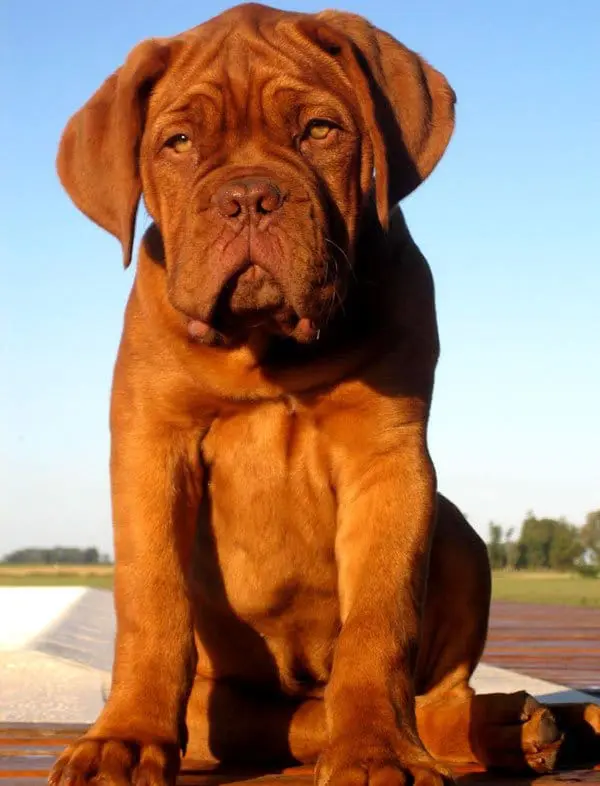
    The Dogue de Bordeaux It has an impressive appearance, despite or perhaps because it is not as big and heavy as a Mastiff or Saint Bernard. But, you can see the power it presents in majestic serenity. The standard establishes a height at the withers of 60 to 68 cm for males and 58 to 66 cm for females. The weight of the males is "at least 50 kg" and that of females of "at least 45 kgยป. Unfortunately, the standard does not provide an upper weight limit. So today we see specimens with 70 kg and more.

    Especially such gigantism is at the expense of dogs' fitness and health.. Belgian Earl Bylandt gives 1894 as weight for the male 54 – 60 kg. German cynologist Richard Strebel reports in 1905 of 54 – 55 kg as the best weight for a male and 45 – 46 kg for a female. Such a weight would also do the current Dogue de Bordeaux very well.. The coat of the Dogue de Bordeaux must be thin, short and soft to the touch. It should be "solid in all shades of fawn from mahogany to Elizabethan". White spots on the chest and extremities of the limbs are allowed when they are not very extensive. This color restriction is also not very beneficial for the gene pool of the Dogue de Bordeaux. All this leads to the fact that today the Dogue de Bordeaux is one of the most ephemeral dogs..

    Character

    serious and sure of himself, but with an underlying sense of humor, the Dogue de Bordeaux is a vigilant and brave companion. It has several personalities: distant, outgoing, funny, sweet, wrestler, quick to learn, each one belongs to a different dog.

    In the best case, the Bulldog is calm and gentle, but it can also be stubborn. When a dog this size is stubborn and wants to get away with it, can be difficult to treat. The Dogue de Bordeaux Must have early and extensive socialization combined with strong leadership from its owner, or it can become aggressive towards other dogs, smaller animals or even people. If you want to live with a Dogue de Bordeaux, you must be willing to learn to work with him, to control it and earn its respect.

    A Bulldog who has an owner whom he respects is a wonderful family dog. Enjoy spending time with them, even in bed and sofa. It is not an active dog and is content to be in the house, making sure everyone is safe. Short walks and game moments are just your speed. But don't be fooled. If someone approaches the door, the Dogue de Bordeaux is there to protect you from harm.

    With young children, is loving, Protector, gentle and tolerant. Unlike many large breeds, they can be too rowdy with young children, the Bulldog is usually careful with them. But, large dogs are not appropriate for childcare, and all interaction between the two must be supervised.

    The perfect Dogue de Bordeaux not prepared by the breeder. any dog, no matter how pleasant it, detestable levels can develop barking, excavation, counter-browsing and other undesirable behaviors if you are bored, is not trained or is not supervised. And any dog รขโ‚ฌโ€นรขโ‚ฌโ€นcan be a test that live during adolescence.

    Start training your puppy the day you bring him home. Even at eight weeks old, He is able to absorb everything you can teach him. Don't wait until you have 6 months to start train or have to deal with more stubborn dog. If possible, Take it to a trainer when you have between 10 and 12 weeks, and socializes, socialice, socialice. But, Note that many kinds of training puppies require certain vaccinations (such as kennel cough) stay up to date, and many veterinarians recommend limited exposure to other dogs and public places until puppy vaccinations (including rabies, distemper and parvovirus) They are completed. Instead of formal training, You can start training your puppy to socialize at home and among family and friends until immunizations are completed in the puppy.

    Talk to the breeder, Describe exactly what you want in a dog and ask for help choosing a puppy. Breeders see puppies daily and can make incredibly accurate recommendations once they know something about their lifestyle and personality. Regardless of what you want from a Dogue de Bordeaux, look for one whose parents have nice personalities and who has been well socialized since the puppy's first stage.

    Dogue de Bordeaux fitness

    The Dogue de Bordeaux it is somewhat more demanding in its maintenance. Not suitable for an apartment. Although it is not a very agitated dog, he really likes having a little freedom of movement, for example in a garden. Here he likes to spend several hours sleeping and watching. You need a lot of space, because he wants to be able to move freely. Appreciate long walks and short bike rides. You need your daily exercise, but she is not an athlete. Physical and mental exertion should be avoided in hot weather. Also keep in mind that dogs as large and strong as the Dogue de Bordeaux in our current society, supposedly animal friendly, often meet with great rejection, sometimes aggressive. Some people simply fear him out of ignorance. This is one of the reasons why it is not advisable to keep it in the big city.. One must have a sufficient budget to be able to pay a lot of good food and, in case of doubt, also the vet bills.

    Dogue de Bordeaux Education

    The Dogue de Bordeaux can be trained very well, in regards to the basic rules of behavior. He must also be well educated from the age of a puppy to be able to always run this center of power.. She does not like to learn tricks whose meaning is not clear to her. Even more than with most other dogs, an intimate relationship of trust with your master or lover is the basis for a successful education. There are also consequences, because the Dogue de Bordeaux is intelligent, he notices every little discrepancy and knows how to use it for his own purposes. The Dogue de Bordeaux it is also very sensitive. Do not forget the injustices. Always keep in mind that the leash of these dogs is only a symbolic control. The Dogue de Bordeaux he would easily have the power to maneuver the other end of the leash at will, If I wanted. But it doesn't.

    Health Dogue de Bordeaux

    Like any giant breed with a short snout, the Dogue de Bordeaux have health problems. The breed's limited gene pool creates a dog susceptible to extreme temperatures, to heart diseases such as dilated cardiomyopathy and aortic stenosis, and ectropion, a condition in which the eyelid fades out. Dogue de Bordeaux is also prone to foot pad hyperkeratosis.

    Not all of these conditions are detectable on a growing puppy, and it is impossible to predict if an animal will be free of these diseases, so you need to find a reputable breeder who commit to raise healthier animals possible. Must be able to produce independent certification that the dog's parents (and grandparents, etc.) have been examined for common defects and considered healthy for breeding. That's where health records come in..

    Remember that after you have welcomed a new puppy into your home, has the power to protect you from one of the most common health problems: the obesity. Keeping a Dogue de Bordeaux at the right weight is one of the easiest ways to extend its life.. Make the most of your preventive skills to help ensure a healthier dog for life.

    Dogue de Bordeaux grooming

    The short coat of the Dogue de Bordeaux it is easy to care. Brush it once a week with a rubber brush to remove dead hair..

    But there is more to grooming than caring for the coat. The Dogue de Bordeaux you have wrinkles and need special care to avoid becoming infected. Clean them with a damp cloth or baby wipe, and then dry the folds thoroughly to avoid skin infections.

    Bring a hand towel to clean your wrinkled face after every meal or drink of water. When he shakes that big head, throw chunks of slime everywhere. It also comes off a lot, so you will spend a lot of time sweeping and vacuuming.

    The rest is basic care. Check ears weekly and clean if necessary, brush your teeth as often as possible, and cut your nails regularly, usually every few weeks.

    Nutrition / Food

    As with all these heavy dogs, especially in the growth phase, diet and composition must be carefully considered. Later this is not problematic. The risk of stomach torsion must be taken into account.

    The life expectancy of the Dogue de Bordeaux

    The average life expectancy of Dogue de Bordeaux It, Unfortunately, extremely low, of 6 to 8 years. It would be good for the race to do everything humanly possible to correct this.

    Buy a Dogue de Bordeaux

    A puppy should only be purchased personally from a reputable breeder.. This can be planned for a few 1.500 – 2.500 EUR. You should look closely at the litter and parents, as well as obtain information about the ancestors. You must pay attention to the age of the ancestors, and that they are not too heavy or too wrinkled.

    Characteristics "Dogue de Bordeaux"

    Coexistence is important that you have with your new friend. Before considering the acquisition of a dog of the breed "Dogue de Bordeaux" you know certain factors. Not all breeds of dogs are apt to live in an apartment, you must take into account his character, their need for exercise, their interaction with other pets, their care and if you have small children, their level of tolerance towards them.

    Adaptation โ“˜

    3,0 of 5 stars (based on 1 review)

    friendly dog โ€‹โ€‹โ“˜

    2,0 of 5 stars (based on 1 review)

    hair loss โ“˜

    3,0 of 5 stars (based on 1 review)

    Affection level โ“˜

    5,0 of 5 stars (based on 1 review)

    Need for exercise โ“˜

    2,0 of 5 stars (based on 1 review)

    Social need โ“˜

    3,0 of 5 stars (based on 1 review)

    Home โ“˜

    1,0 of 5 stars (based on 1 review)

    Toilet โ“˜

    4,0 of 5 stars (based on 1 review)

    Friendly with strangers โ“˜

    1,0 of 5 stars (based on 1 review)

    barking โ“˜

    2,0 of 5 stars (based on 1 review)

    Health โ“˜

    5,0 of 5 stars (based on 1 review)

    Territorial โ“˜

    5,0 of 5 stars (based on 1 review)

    Cat friendly โ“˜

    3,0 of 5 stars (based on 1 review)

    Intelligence โ“˜

    3,0 of 5 stars (based on 1 review)

    Versatility โ“˜

    3,0 of 5 stars (based on 1 review)

    Child friendly โ“˜

    3,0 of 5 stars (based on 1 review)

    Surveillance โ“˜

    2,0 of 5 stars (based on 1 review)

    joy โ“˜

    5,0 of 5 stars (based on 1 review)

    Images "Dogue de Bordeaux"

    Photos:

    1 – Dogue de Bordeaux puppy 10 weeks old by publicdomainpictures.net
    2 – Dogue de Bordeaux Harley by publicdomainpictures.net
    3 – Bordeaux is comfortably in the garden by publicdomainpictures.net
    4 – Portrait of a Dogue de Bordeaux by publicdomainpictures.net
    5 – A portrait of a Dogue de Bordeaux (French Mastiff) by spaceodissey from Parma, Italy / CC BY
    6 – Harley and Doutzen – Dogue de Bordeaux and bulldog playing together by publicdomainpictures.net

    Videos "Dogue de Bordeaux"


    Type and recognitions:

    • FCI CLASSIFICATION:
    • Group :
    • Section : . .

    Federations:

  • FCI – Pinscher and Schnauzer-Molossoid type dogs – Swiss Mountain Dogs and Cattledogs. Section 2.1 Molossoid, mastiff type. โ“˜
  • AKC – Dogs working โ“˜
  • ANKC – Group 6 (utility dogs) โ“˜
  • โ€‹KC – Working dogs โ“˜
  • NZKC – Utility dog โ“˜
  • UKC – Watchdog โ“˜

  • FCI breed standard "Dogue de Bordeaux"

    Origin:
    France

    Date of publication of the valid original standard:
    04.11.2008

    Use:

    Watchdog, defense and deterrence


    General appearance:

    Typical brachycephalic molossus with concave lines. The Dogue de Bordeaux is a very strong dog with a very muscular body but maintaining a harmonious general line.. Its structure is rather close to the ground, The sternum-floor distance is somewhat less than the depth of the chest.. Well-built, athletic and imposing, his appearance is very dissuasive.


    IMPORTANT PROPORTIONS:

    • The length of the body measured from the tip of the shoulder to the tip of the ischium is greater than the height at the withers in a proportion of 11 / 10.
    • Chest depth is greater than half the height at the withers.
    • The maximum length of the muzzle is equal to one third of the length of the head.
    • The minimum length of the snout is equal to one quarter of the length of the head..
    • In males, The perimeter of the skull corresponds more or less to the height at the withers.


    Behavior / temperament:

    An old fighting dog, the Dogue de Bordeaux is suitable as a guardian,
    what he assumes with attention and great courage but without aggressiveness.
    A good companion, very attached to his master and very affectionate. Calm, balanced with a high stimulus. The male usually has a dominant character.

    Head:

    Voluminous, angular, wide, rather short, trapezoid top and front view. The longitudinal axes of the skull and the nasal bridge are convergent (forward). The head is covered in wrinkles, on both sides of the central groove. These deep wrinkle cords are mobile depending on whether the dog is vigilant or not. The fold that goes from the internal angle of the eye to the angle of the mouth is typical. If present, the crease from the outer corner of the eye to the corner of the mouth or double chin must be inconspicuous.

    Cranial region:
    • In the male: The perimeter of the skull measured at the maximum width level corresponds approximately to its height to the cross.
    • In females: may be less.
    • Its volume and shape are the consequence of a very important development of the storms, supra orbital arches, zygomatic arches and lower jaw spaces. The upper region of the skull is slightly convex from one side to the other. The frontal groove is deep, decreasing towards the posterior end of the head.. The foreface dominates the head, but it does not exceed it. Anyway, it is wider than it is tall.
    • Stop: Very pronounced, almost forming a right angle with the muzzle. (95ยบ - 100ยบ)

    facial region:

    • Truffle: Wide, nostrils wide open, well pigmented according to the color of the mask. An upturned truffle is allowed but not if it is backwards, directed towards the eyes.
    • Snout: Strong, width, thick, but not fleshy under the eyes, rather short, upper profile somewhat concave with pleats moderately visible. Its width decreases slightly towards the tip; top view has a general square appearance. In relation to the upper part of the skull the snout line forms an ascending very obtuse angle.

    When the head is held horizontally, the tip of the snout, truncated and thick at the base, is opposite a vertical tangent to the front of the truffle.

    Its perimeter is usually two thirds to the head. Its length varies between a third and minimum a quarter of the total length of the head, from the truffle to the occipital crest. The established limits (maximum one third and minimum a quarter of the total length of the head) are allowed, but not wanted, the ideal muzzle length should be between these two ends.

    • Jaws: Strong and wide jaws. Prognathism (Prognathism is a characteristic of race). The back of the lower incisors are anterior and not in contact with the anterior aspect of the upper incisors.

    The lower jaw is curved up. The chin is well marked and must never be excessively covered or covered by the upper lip.

    • Teeth: Strong, particularly the canines. Lower canines positioned well apart and slightly curved. Incisors ok aligned especially in the lower jaw where they form a seemingly straight line.
    • Lips: Thick upper lip, moderately pendulum, retractable. Viewed profile shows a rounded lower line. Covers the lower jaw than the sides. In front the edge of the lip upper lip is in contact with the lower lip, then it falls to both sides which forms a wide and inverted V.
    • Cheeks: Prominent due to the very strong development of the muscles.


    • EYES: Oval shaped placed well apart. The space between the two inner angles of the eyelids is equal to twice the length of the eye (eye opening). Frank expression. The third eyelid must not be visible.

    Color: hazelnut to dark brown for a dog with a black mask, lighter color tolerated, but it is not sought after in dogs with a brown mask or without a mask.

    • EARS: Relatively small in color somewhat darker than the mantle. In its insertion, the front of the base of the ear is slightly raised. They must be falls, but don't hang up; the front edge stuck to the cheeks when the dog is attentive. The edge of the ears slightly rounded; should not go below the eye. High enough insertion, at the top line of the skull which further accentuates its wide.

    Neck:

    Very strong and muscular, almost cylindrical. The skin is thin, flexible, abundant and loose. The average of its circumference almost equal to that of the head. It is separated from the head by a slightly accentuated transverse fold, slightly curved. The upper edge is slightly convex. The well defined double chin begins at throat level forming folds towards the chest, without hanging excessively. The neck, very wide at its base smoothly fuses with the shoulders.

    Body:

    • top line: Well held. Cross: Well marked.
    • Back: Wide and muscular.
    • Pork loin: Width. Rather short and solid.
    • Rump: Moderately descending towards the base of the tail.
    • Breast : Strong, long, deep, width, descending below the level of the elbows. Wide and strong sneak whose lower line (inter armpit) it is convex towards the end. Ribs well lowered and well arched but not barrel-shaped. The chest circumference should be between 25 to 35 cm.. more than the height at the withers.
    • Bottom line and abdomen: Curved from the deep chest to a somewhat retracted and firm abdomen. It should never be pendular or too withdrawn.

    Tail:

    Very thick at the base. The tip preferably reaching the height of the hock and not below. Low bearing, never broken or curved but flexible. Pendant when the dog is calm, generally rising from 90ยบ to 120ยบ from that position when the dog is in action without curlying on the back or curling.

    Tips

    PREVIOUS MEMBERS: Strong bone structure, very muscular limbs.

    • Shoulder: Strong, prominent muscles. The inclination of the middle scapula (approx.. 45ยบ of the horizontal), angle of the scapulo-humeral joint somewhat greater than 90ยบ.
    • Arm: Very muscular.
    • Elbows: On the axis of the body, never too close to the chest or leaning out.
    • Forearm: Seen from the front, straight or slightly inclined towards inside approaching the median plane, especially in dogs with a very broad chest. Seen from vertical profile.
    • Metacarpus: Strong. Seen in profile somewhat inclined. Seen from the front, sometimes slightly outward compensating for slight inward tilt of the forearm.
    • Previous feet: Strong. Closed fingers, strong curved nails, well developed and elastic pads: the Dogue de Bordeaux stands well on its fingers despite its weight.

    LATER MEMBERS: Robust limbs with strong bone structure. Well angulated. Seen from behind, the posterior ones are parallel and vertical which gives the impression of strength., even though the back is not as wide as the front.

    • Thigh: Highly developed, thick with visible musculature.Knee: In a plane parallel to the median plane or slightly outwards.Leg: Relatively short, musculada, descendant.
    • Hock: Short, tendinoso, its moderately open angle.Metatarsus: Robust, No Spurs.
    • Hind feet: Somewhat longer than the previous ones, tight fingers.

    Movement:

    Elastic for a moloso. When walking the movement is free and elastic, glued to the ground. Good push from the rear, good extension of the forelimbs especially during jogging which is the preferred movement.When jogging is accelerated the head tends to drop, la lรญnea superior se inclina hacia el frente y los pies anteriores se juntas mรกs hacia el plano medio dando pasos hacia fuera con un movimiento de largo alcance de los miembros anteriores. The gallop with quite a vertical movement. Capable of high speed over short distances glued to the ground.

    Mantle

    • SKIN: Thick, loose enough, without excessive folds.
    • Fur: Up, short and soft to the touch.
    • Color: All shades of leonado from mahogany to isabella. Good pigmentation is desired. Delimited white spots on the forehead and limbs are allowed.

    Mask:

    • Black mask: The mask is usually only slightly extended and should not invade the cranial region. There may be a slight black shading on the skull, ears, neck and upper body. The truffle is black.

    • Brown mask: (Usually called red or bistre). The truffle is brown, pigmentation of the eyelids and the edge of the brown lips. May have non-invasive brown shading; each hair must have a tawny or sand-colored area and a brown area. In this case the inclined parts of the body are of a lighter color.

    • Without mask: The hair is tawny: the skin appears red (Previously called "Red Mask"). The nose may be reddish.


    Size and weight:

    The height must correspond to the perimeter of the skull or less.

    • Height to the cross:
    • Males: 60 โ€“ 68 cm..

    females: 58 โ€“ 66 cm.. Tolerated 1 cm.. below or 2 cm.. above these limits.

    Weight:

    • Males: Minimum 50 Kg.
    • females: Minimum 45 Kg.

    females: Identical characteristics, but less accentuated.


    Fouls:

    • Any deviation from the aforementioned criteria is considered as a fault and the severity of this is considered to the degree of the deviation to the standard and its consequences on the health and well-being of the dog..


      SERIOUS FAULTS

    • Males should have two normal-appearing testicles fully descended into the scrotum..
    • Only functionally and clinically healthy dogs, with the typical conformation of the breed, should be used for parenting.
  • Disproportionate head (too small or excessively bulky).
  • Hypertipo Bulldog: (flat skull, snout less than a quarter of the total length of the head, bulging folds (scrolls) behind the truffle). Important folds around the head.
  • Significant lateral deviation of the lower jaw.
  • Permanently visible incisors when the mouth is closed. Very small incisors, uneven placement. Arched back (Convex).
  • Fused tail vertebrae, but not deviated.
  • Front feet tilted inward (even slightly).
  • Front feet leaning too far out.
  • Flat thighs.
  • Corvejรณn angle too open (Straight angulation).
  • Corvejรณn angle too closed, The dog standing under himself in the posterior.
  • Cow hock or crowded.
  • Forced or severe undulating movement of the posterior.
  • Excessively short breath, cleared my throat.
  • White at the tip of the tail or in the front area of รขโ‚ฌโ€นรขโ‚ฌโ€นthe forelimbs, over the carpus (wrist) and tarsus (Hock) or white without interruption in the front of the body from the chest to the throat.


    FALTAS DESCALIFICANTES

  • Aggressiveness or extreme shyness.
  • Any dog โ€‹โ€‹showing clear signs of physical or behavioral abnormalities.
  • Long narrow head with insufficiently pronounced stop, with a muzzle measuring more than a third of the total length of the head (absence of typicality of the head).
  • Spine parallel to the upper line of the skull or convex.
  • Twisted jaw.
  • Non-prognostic mouth.
  • Canine constantly visible when the mouth is closed.
  • Tongue constantly visible when the mouth is closed.
  • Blue eyes. Protruding eyes.
  • Tail knotted and deflected to the sides, twisted. (curled tail, ravine).
  • Stunted tail.
  • Violin front and short tarsi.
  • Hock angle open backwards (inverted hock).
  • White on the head or body, any other color of the mantle than tawny (shaded or not) and in a particular brindle or solid brown called โ€œchocolate.โ€ (every hair totally brown).
  • Identifiable disability defects.


  • N.B.:
    • Males should have two normal-appearing testicles fully descended into the scrotum..
    • Only functionally and clinically healthy dogs, with the typical conformation of the breed, should be used for parenting.

    Source: F.C.I - International Cynological Federation

    Alternative names:

    1. Bordeaux Mastiff, French Mastiff, Bordeauxdog (English).
    2. Dogue de Bordeaux (French).
    3. Dogue de Bordeaux (German).
    4. Mastim francรชs (Portuguese).
    5. Dogo de Burdeos (espaรฑol).

    โ–ท The world of Pets: Dogs, cats, birds, reptiles, amphibians

    Beauceron
    Francia FCI 44 . Sheepdogs

    Pastor de Beauce

    The Beauceron It is one of the best job in the world dogs.

    Content

    History

    The Beauceron, It is a breed of dog originating in the French Brie region; This race is quite old and well known in France.

    True that the canine world, the history of this beautiful dog is not of the noveladas. The Beauceron, It was presented for the first time in a dogshow in the year 1897, but the race is actually quite old.

    The specimens of Beauceron older, the first to set foot on our land, they had hard and coarse hair, but the characteristic that stood out the most was his marked aggressiveness.

    With the passage of time, Select mediantes, breeders have succeeded in lowering the level of aggressiveness, but even so, it is not an easy dog โ€‹โ€‹to train, it retains certain ferocious traits.

    At first the Beauceron It was used to hunt wild boar but later developed the ability to guide herds, being able to defend it from any attack by a predator; is a great guardian.

    Physical characteristics

    The Beauceron, often confused with the Dobermann due to the combination of color bronze and fire of his cloak. This coincides with the fact that the most widespread variety of the Beauceron.

    Despite the similarity in the colors of the coat, it has many differences with him Dobermann, the Beauceron It is a dog with a more rustic and robust structure, the hair is also different and the tail does not cut.

    Another differential characteristic, It is that the hind legs should stand double spur. This is one distinctive feature of the race.

    The height males will of 65 to 70 cm and the females of 61 to 68 cm.. The approximate weight is between 40 and 50 kg. Females tend to be lighter.

    It has a aspect rustic, Wolf. Long head and flat, the muzzle and skull have the same length, dark eyes to harmonize with the fur, their ears hang naturally if they have not been cut.

    They have the long neck, the elongated body and deep chest. Their limbs are strong.

    The Beauceron has two layers of hair, the exterior is strong, thick, thick and smooth (Although they tend to present ripples around the neck). Internal hair layer is more dense and velvety, color grey mouse and must not be seen through the upper layer.

    The colors supported are the black and tan and the Harlequin.

    Character and skills

    According to experts, It one of the best job in the world dogs, and all dogs of pastor is one who is more prepared for the defense.

    Then, his character allows you to carry out defense, foster, useful but it is good to take into account that it is not a dog to be in the hands of inexperienced or too permissive.

    He has a very independent character and a strong instinct for responsibility that allows him to make his own decisions. If he notices the slightest insecurity in his master, he will not take long and seconds to make the decisions himself..

    With the strangers will be very suspicious, for this reason it is very important that the owner of the dog can control it because if it feels minimally intimidated it can be very biting.

    If you receive adequate training and education will be an excellent companion.

    Observations

    Before purchasing a copy of Beauceron, We must take into account that it is not an easy dog. The person who decides to have a copy of this breed as a pet should be able to train him and raise him with full security.

    The dog needs to know who is charge, It is also important to understand that all members of the family are heads of the herd, because if you can not pass it only obey one person whom he recognizes as head of the herd and the rest of the family will ignore or or them even try to impose.

    Images of the "Beauce Pastor"

    Videos del "Pastor de Beauce"

    Characteristics "Beauceron"

    Coexistence is important that you have with your new friend. Before considering the acquisition of a dog of the breed "Beauceron" you know certain factors. Not all breeds of dogs are apt to live in an apartment, you must take into account his character, their need for exercise, their interaction with other pets, their care and if you have small children, their level of tolerance towards them.

    Adaptation โ“˜

    3,0 of 5 stars (based on 1 review)

    friendly dog โ€‹โ€‹โ“˜

    2,0 of 5 stars (based on 1 review)

    hair loss โ“˜

    3,0 of 5 stars (based on 1 review)

    Affection level โ“˜

    4,0 of 5 stars (based on 1 review)

    Need for exercise โ“˜

    5,0 of 5 stars (based on 1 review)

    Social need โ“˜

    4,0 of 5 stars (based on 1 review)

    Home โ“˜

    2,0 of 5 stars (based on 1 review)

    Toilet โ“˜

    2,0 of 5 stars (based on 1 review)

    Friendly with strangers โ“˜

    2,0 of 5 stars (based on 1 review)

    barking โ“˜

    4,0 of 5 stars (based on 1 review)

    Health โ“˜

    2,0 of 5 stars (based on 1 review)

    Territorial โ“˜

    5,0 of 5 stars (based on 1 review)

    Cat friendly โ“˜

    2,0 of 5 stars (based on 1 review)

    Intelligence โ“˜

    5,0 of 5 stars (based on 1 review)

    Versatility โ“˜

    5,0 of 5 stars (based on 1 review)

    Child friendly โ“˜

    3,0 of 5 stars (based on 1 review)

    Surveillance โ“˜

    4,0 of 5 stars (based on 1 review)

    joy โ“˜

    5,0 of 5 stars (based on 1 review)

    Type and recognitions:

    • FCI CLASSIFICATION:
    • Group :
    • Section : . .

    Federations:

    • FCI โ“˜
    • AKC โ“˜
    • โ€‹KC โ“˜
    • UKC โ“˜

    FCI breed standard Beauceron

    FCIFCI - Beauceron
    Pastor

    Alternative names:

    • Alternative names: French Shorthaired Shepherd / Beauce Shepherd / Berger de Beauce / Bas Rouge (Red Stocking)