Approximately from 33 cm.. length, and a weight of 140 g.
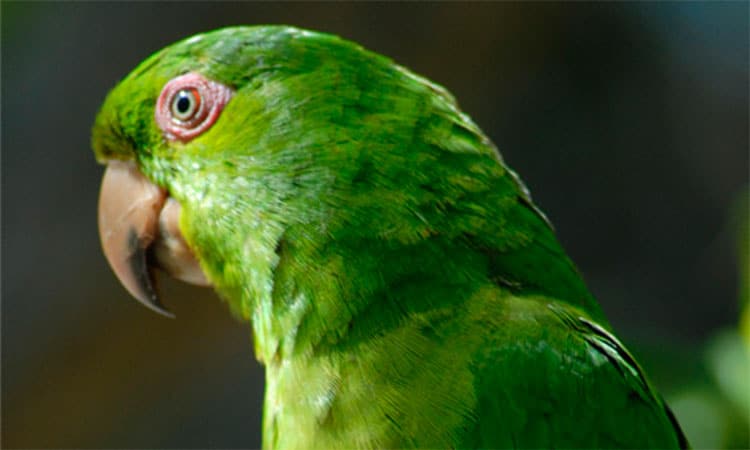
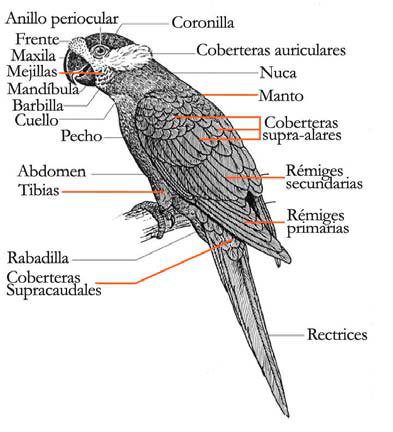
The Socorro Parakeet(Psittacara brevipes) is a medium Parrot with the plumage bright dark green, with the crown, the forecrown and lores grass-green, the sides of neck slightly brighter, the head and the neck, sometimes with one or more scattered feathers of orange-red. The upperparts are green grass, slightly brighter in the area of the rump. Upperwing-coverts herb with bluish green in the outside greater coverts. Primaries and secondaries Green in the part superior with tint blue in them vane outer; olive Oliva-Amarillo down. Underwing-coverts green. Underparts grass-green. Above, the tail dark green, by down color yellowish olive.
The bill color horn; eye ring pale beige; irises orange yellow or orange; legs yellowish brown.
Gender-related differences are unknown although the immature has irises Brown color.
NOTE:
The Socorro Parakeet It is often considered a subspecies of the Green Parakeet. But, Howell and Webb They presented evidence that supports the separation of the species from the other subspecies of Aratinga holochlora. They found that the bill of the Socorro Parakeet is larger than, and noticed differences in the color of the skin of the eye ring, also has a Wing formula different, the tenth primary feather It is shorter than the seventh and Green Parakeet is the reverse. Both species also differ in the vocalization, calls of the Green Parakeet they are richer in harmonics that the of the Socorro Parakeet.
Most commonly observed in forests of species such as Bumelia socorrense, Guettarda insularis, Ilex socorroensis, with trees of at least 8 metres in height. Usually, above 500 m (especially on the South side of Socorro island), because in most of the rest of its distribution area, in the lower elevations, It has lost its vegetation preferred because of the sheep pasture.
Registered at low altitudes, 4 m, where the native forest (in canyons), near the sea level, especially in tall trees of Croton masonii, Conocarpus erecta and Ficus.
Usually, in flocks of up to 40 birds, rarely come to the 100 specimens. They gather in numerous flocks on the branches of the guayabillo, in smaller flocks (until 6) or only in pairs during the breeding season.
Son social, even there is care collective nests, They show strong fidelity to nesting sites, based on observations of re-use of nests.
Reproduction:
They nest in tree cavities, especially of the species Bumelia socorrense. the size of the clutch It is unknown, but the breeding It is thought that it can begin in the month of November. The young are altricial.
They aim to feed in the tips of the trees or the highest branches, Although also has observed them are home on the floor
Distribution:
Endemic, It is only in the Socorro island in the The Revillagigedo Islands archipelago off the West coast of Mexico. Estimated population in 400-500 birds in 1992 (approximately nine birds per km² of suitable habitat). considered common, but recent decreasepossible n due to loss of preferred habitat (still present in about 22% of the island) and the resulting erosion of the sheep that graze in excess. Predation by feral cats can also be a threat.
Conservation:
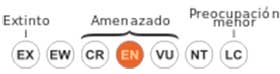
State of conservation ⓘ
Endangered ⓘ(UICN)ⓘ
• Red List category of the UICN current: In danger of extinction
• Population trend: Decreasing
Threatened in the Mexican official standard NOM- 059-ECOL-2001, but in Danger of extinction in the NOM-O59-SEMARNAT-2006 that is not yet published. CITES Appendix II
The Socorro Parakeet (in danger of extinction; It is only in the Socorro island and this species the habitat destruction threatens, as well as the introduction of cats, sheep and rodents.
Estimated population in 400-500 birds in 1992.
"Socorro Parakeet" in captivity:
The species, unlike most continental psittacines, does not face problems of extracting pups for the pet market.
Alternative names:
– Socorro Parakeet, Green Parakeet (Socorro), Socorro Conure (English).
– Conure de Socorro, Perruche de Socorro (French).
– Socorrosittich, Socorro-Grünsittich (German).
– Periquito-de-socorro (Portuguese).
– Aratinga de Socorro, Perico de Socorro, Perico mexicano (español).
– Perico de Socorro (Mexico).
In flight notorious is the armpit red with yellow line at the end; Red patch in the belly. The tail is opaque red.
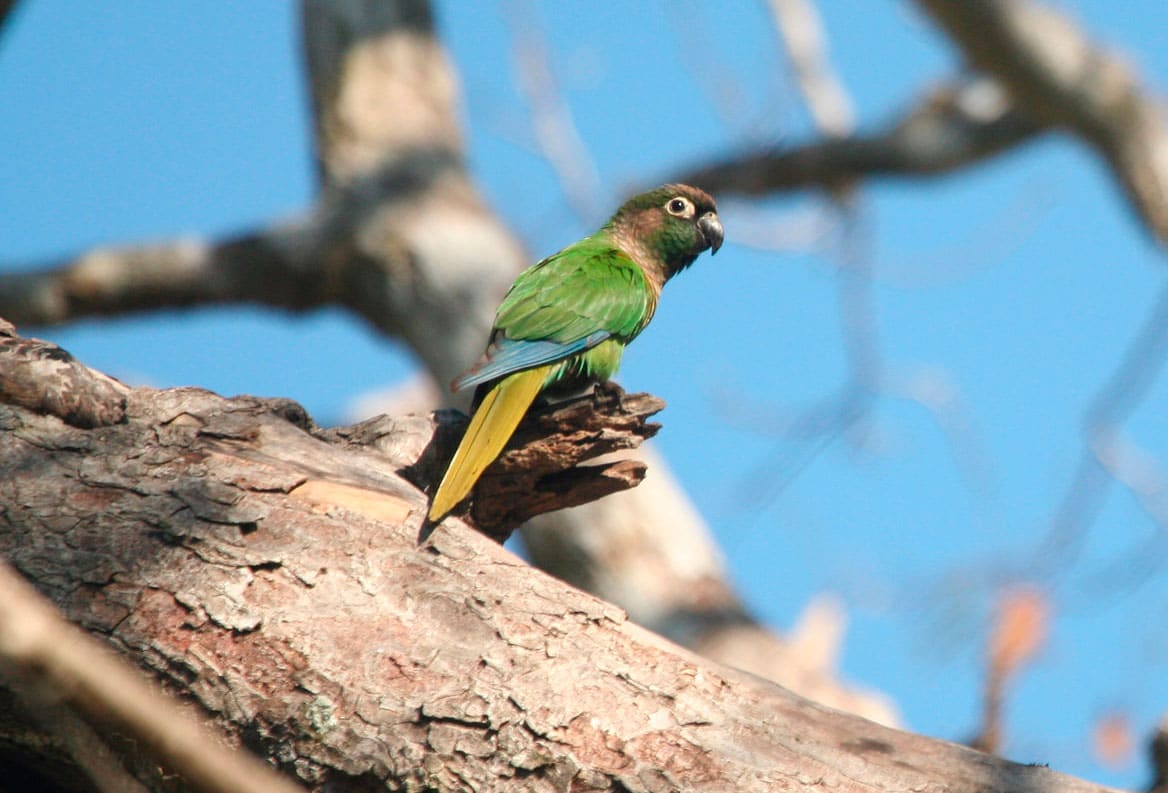
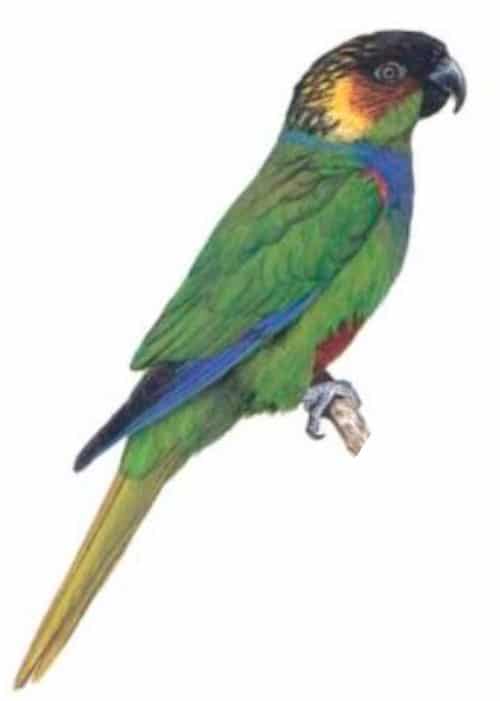
Was formerly considered as a subspecies of the Maroon-bellied Parakeet(Pyrrhura frontalis), of crown brown, darker underparts, and underwing-coverts especially red and yellow.
Bill black; eye ring naked white; irises brown. Tail long.
In Brazil only it is known in Mato Grosso from the South, where is limited to the mountain ranges of Bodoquena and Maracayu, in the Ecotone between the Planalto and the lowlands of the Pantanal, and along the taboco river in the municipality of Aquidauana. It has a very limited range in the Paraguay, from where records of the latter are confined to gallery forests along the apa river.
Conservation:
• Red List category of the UICN current: Near-threatened
• Population trend: Stable
The size of the world population Blaze-winged Parakeet It has not been quantified, but this species has been described as «rare«.
State of conservation ⓘ
Near Threatened ⓘ(UICN)ⓘ
This species is suspected that they have experienced a moderately rapid decline due to the extensive loss and degradation of its habitat range within. Now survive in a highly fragmented landscape. Its area of distribution in Brazil has suffered extensive forest loss and degradation through agricultural expansion and charcoal production. The forests of the North of Conception and those who are in Chaco, in the easternmost area of Paraguay, are coming under increasing pressure and have seen considerable deforestation in recent 10 years (R. Clay in litt., 2009).
There is one hybridization apparent with the Maroon-bellied Parakeet(Pyrrhura frontalis) observed in the apa river (R. Clay in litt., 2009).
The trade is apparently minimal (pit et to the., 1997).
"Blaze-winged Parakeet" in captivity:
These small parrots are very rare in captivity, Although its potential for pets is excellent. Are birds animated and soon procured confidence with its owner. They often enjoy bath and are not hard chewing. are mostly calm and they shall only be loud when they are excited. They can be aggressive toward other birds. Playful and curious and generally resistant.
Alternative names:
– Black-winged Parakeet, Black-winged Conure, Blaze winged Parakeet, Blaze-winged Conure, Blaze-winged Parakeet, Deville’s Conure (English).
– Conure de Deville, Perriche de Deville, Perruche de Deville (French).
– Devillesittich, Deville Sittich, Deville-Sittich (German).
– tiriba-fogo (Portuguese).
– Chiripepé ala anaranjada, Cotorra de Deville, Perico de Alas Naranjas, Periquito alianaranjado (español).
– Periquito alianaranjado (Bolivia).
– Chiripepé ala anaranjada (Paraguay).
30 cm.. length and an approximate weight of 370 g..
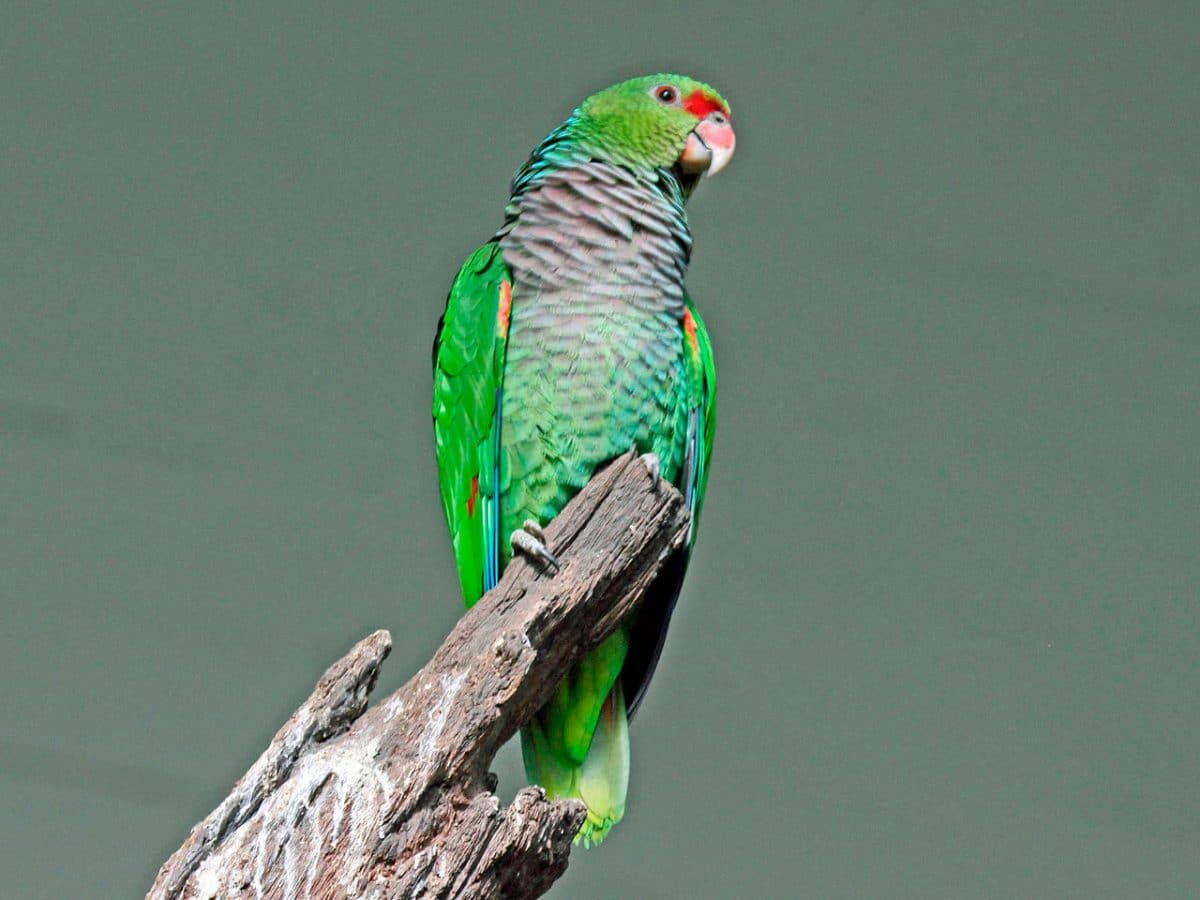
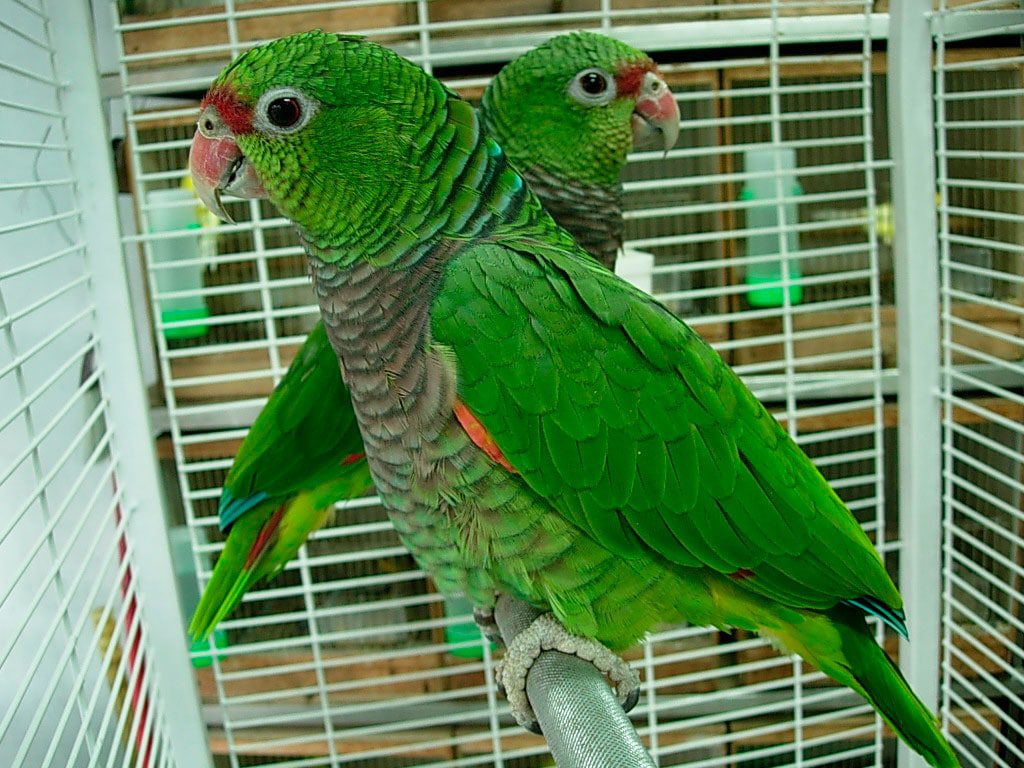
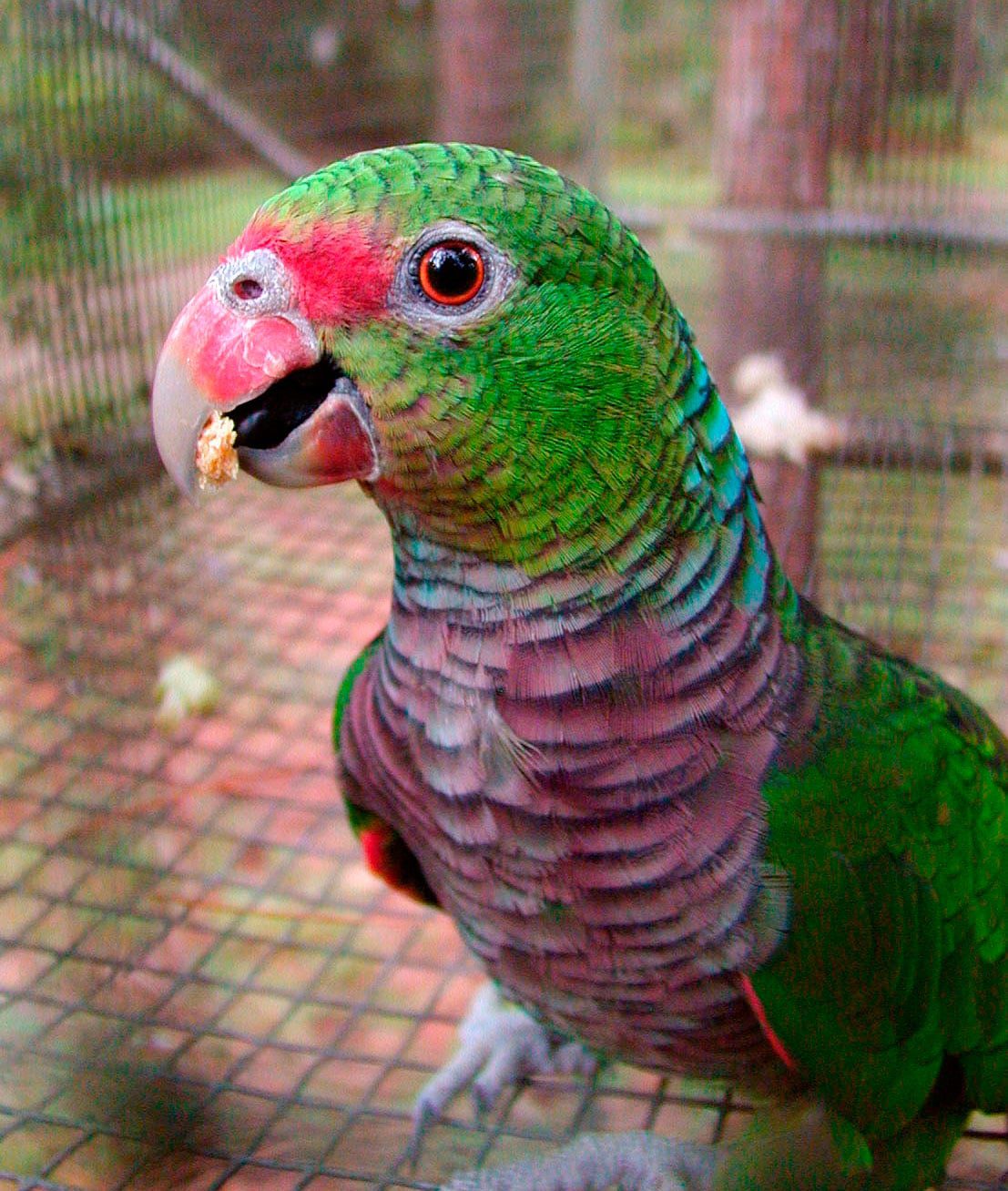
The Vinaceous Parrot(Amazona vinacea) has the lores and forecrown bright red; cheeks and crown green with black tips to some feathers head; elongated feathers on the sides of neck, the nape and the upper mantle, green at the base, subterminally light blue and black tip. The rest of the the mantle, back and scapulars, green with some feathers showing indistinct black tips; uppertail-coverts pale green.
Wing coverts green with red variable and / or yellow in leading edge of wing and the carpal area. Primaries pale bluish-green; Secondary green with blue tips, the base outerweb of the three outer secondaries, red, forming a small looking-glass. Under the wings, green. Throat and chest with shades that vary from strong wine brown to pale blue with a strong vinous diffusion; subterminal dark band at the tips of the feathers gives scalloping pattern; Belly green or yellowish green sometimes with vinous dissemination; undertail-coverts brighter yellowish green. Tail green with yellow green tip; the base lateral feathers in red innerwebs, in purple outerweb. The upper jaw It is red at the base with pale tip, horn-colored lower, reddish at the base; irises orange to reddish brown; legs grey.
Both sexes are similar. The immature It has the green suffusion in chest and the less extensive red on the head (confined to the base upper jaw).
Sound of the Vinaceous Parrot.
Habitat:
Video – "Vinaceous Parrot"
Purple-breasted Parrot in Itamonte - Minas Gerais, Brazil
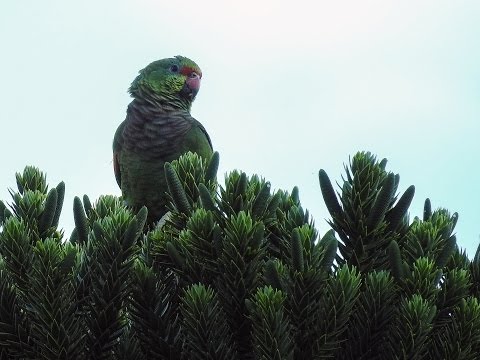
The Vinaceous Parrotinhabit in tropical and subtropical evergreen mixed forests; in the Brazil in humid coastal forests, in the East of Paraguay They can be found in forests Araucaria angustifolia and Euterpe edulis. The extent of the ecological dependence of this species on coniferous trees (Araucaria and Podocorpus) It is not clear, but the Araucaria angustifolia It is clearly important in Missions, Rio Grande do Sul and Santa Catarinaand possibly it was related to the previous distribution further north in southeast Brazil.
Mainly observed in the lowlands, but there are reports of birds seen in hills 1.500-2.000 meters in the southeast of Brazil, where the best forest remnants persist. Usually in pairs or small groups with larger meetings (up to approximately 30) in July-August. In pairs during breeding (usually around September).
Reproduction:
The Vinaceous Parrotnidifica in holes in large trees with obvious preference for the Araucaria angustifolia, including rarely cracks in the cliffs. With reproduce the May in loose colonies. breeding season during the months of September to January. Clutch 2-4 eggs.
After the breeding season (February to July), the species congregate in large groups and community shelters.
Food:
The specific foods of the Vinaceous Parrot include flowers and fruits of Euterpe edulis (which apparently it is important seasonally in East Paraguay), seeds of Araucaria angustifolia, fruits of cocoons of Achatocarpus and new leaves Eucalyptus and seeds of Pilocarpus. It has been reported damagor cause in crops of oranges, but with the current low density of this species, It is unlikely to produce a serious economic impact.
Distribution and status:
Size of its range (player / resident ): 1.230.000 km2
The Vinaceous Parrot It is endemic in Southeast South America.
There are some seasonal movements and post-breeding dispersal, possibly in relation to the food supply (for example, seed availability coniferous trees), with invasions scale reported in Paraguay in the past. Declines in the number of birds occur in Rio Grande do Sul January, with all its people disappeared by March and return in April for the rest of the year.
Formerly abundant and widespread but now there has been a contraction dramatic of its range and population, mainly due to the habitat destruction scale, the expansion of agriculture and floods caused by large hydroelectric dams. also trapped for a long time for bird trade.
Are distributed in several protected areas, but none is large enough to maintain a viable population. The former strongholds in eastern Paraguay They are subject to rapid deforestation, with a recent reduction in its scope and numbers and now probably confined only in Alto Paraná and Ganindeyu.
A census 2007 yielded a minimum of 253 copies in Argentina.
It is perhaps the Amazona more common in populations of Rio Grande do Sul, Santa Catarina and Paraná (several populations of more than 100 birds), in the South of Brazil, and the low number persists in Minas Gerais, Brazil and Sao Paulo, within an estimated total of 1.500-2.000 birds.
Conservation:
State of conservation ⓘ
Endangered ⓘ(UICN)ⓘ
• Current category of the Red List of the UICN: In danger of extinction.
• Population trend: Decreasing.
• Population size: 600-1700.
Rationale for the Red List category
This species is classified as endangered due to recent population estimates Brazil They indicate that the world population is very small and has suffered a rapid decline due to loss and fragmentation of habitat, aggravated by the trade. It is necessary to clarify whether Brazilian subpopulations exceed 250 specimens.
Justification of the population
Based on estimates 1.500 to 2.000 individuals in Brazil (G. Bencke in some. 2009), 220-400 in Paraguay and 253 in Argentina (K. Cockle in some. 2009), it is estimated that the total population is within the range of 1.970 -2.650 individuals and is probably positioned within the band 1,000-2,499. This is equivalent to 667-1.666 mature individuals, rounded here to 600-1.700 mature individuals.
Justification of trend
rapid and continuous population decline is suspected because of the Poaching of nests, the habitat destruction and persecution as a pest Of crops.
Conservation Actions Underway
• CITES Appendix I and II and protected by the Brazilian legislation.
• Nationally considered Vulnerable in Brazil (Urben-Filho et al . 2008, MMA 2014), and Critically Endangered in Argentina and Paraguay.
• Small populations are found in numerous protected areas (Wege and Long 1995, F. Olmos in some ., 1999).
• In the Argentina, two young provincial parks are used by the species, but they offer only partial protection because parrots use habitat outside the park for most of its life cycle, including, critically, the reproduction.
• In the Argentine stronghold of the species between San Pedro and Saint Rose, environmental education is underway to reduce the capture of chicks, and the population has been monitored since 2005 (Selva de Pino Paraná in litt project., 2007).
• It has been achieved successful captive breeding.
Conservation Actions Proposed
• Monitor large populations (in March Argentina).
• Study reproductive biology and demography throughout the species' range and develop structured captive breeding programs to counter the high level of poaching of wild populations..
• Protect the general Carneiro (Santa Catarina), Itaipu (Alto Paraná), RNP Itabó Rivas (Canindeyú), Estancia Golondrina (Caaguazu) and forests outside reserves Rio de Janeiro (Snyder et to the ., 2000) and between San Pedro and Saint Rose in Missions.
• Invest in permanently trained park rangers and resolve land tenure problems in Brazilian and Paraguayan reserves. (F. Olmos in some ., 1999, Cockle et al. 2007).
• Apply laws against the trafficking of species on the roads that connect the Monte Pascoal National Park with South Brazil (Snyder et to the ., 2000), in places where the species is captured and at borders and ports Paraguay and Argentina.
• Increase local public awareness to reduce nest theft and promote conservation of nesting sites..
• In Argentina, provide technical support to promote soil conservation, to avoid clearing forests for crops on small farms.
The Vinaceous Parrot in captivity:
The Vinaceous Parrot noted for its easy to imitate the human voice, better and clearer than the Amazona aestiva. Small easily they learn to speak.
Two decades ago, before placement in the Appendix 1 CITES Convention, this species was available in aviculture. It never was imported to Europe in a large number, but nevertheless often it offered for sale. Its price was higher than other species of Amazona available at that time, because of its amazing looks and his talent as an imitator. As the trade in wild birds was coming to an end, the captive population decreased markedly. While this species has been willing to breed for those that provide adequate breeding and have enough individuals to allow natural selection of the mate., captive breeding has been very disappointing, considering the number of birds that were previously available.
In the current avicultura, it seems that there are still a significant number of birds kept in Europe. A survey of amazon parrots in the European zoos, made in 1993 and published in 1994 by the EAZA, he listed in 59 species Vinaceous Parrot conserved in 11 zoological collections: of this, only three, Loro Parque (Spain), Walsrode Bird Park (Germany) and Beauval (France), had recorded breeding successes. It's known, However, that a significant number of Vinaceous Parrot They are held by private poultry farmers Europe and if these owners are willing to work in cooperation with EEP plan that can be started for this species, then the known captive population Europe could be big, enough to be considered as a viable.
The population of this species in captivity is similar to that of other species of the genus Amazona. In Loro Parque a couple is kept in an aviary in the exhibition area of ​​the park, and several more couples are kept in breeding cages suspended in their breeding outside exhibition. Suspended breeding cages are approximately 300 cm long x 95 cm width and height. Each cage has the nest-box placed against the outer rear panel, and there is a cut in the wire hole to allow birds to enter the nest-box. With the nest located outside of the cage, this eliminates the need to enter the service or inspect the nest-box.
The feeding of these birds is done twice a day. To the 7 Morning receive their main dish containing a mixed salad prepared with the following elements: – Apple, pear, tomato, beet, Carrot, alfalfa, lettuce, Peppers, papaya and other fruits and vegetables seasonally available; In addition, They are also used, when available, various fruits that are grown in the park, as nopal cactus plants and berries palmera pindó (Syagrus romanzoffiana). A second smaller dish meal in the morning provides birds commercial pellets dietary, and during the breeding season each pair is also given segments of their own supplement "pie" that is made fresh every day. The evening meal is given to 3:00 pm, with a mixture of nuts, seeds and beans cooked.
The Vinaceous Parrot It was raised for the first time Loro Parque in 1990, when one pigeon was raised hand. The couple proved to be very unreliable when it came to the incubation their eggs, why he has always resorted to artificial incubation or host and breeding. This couple Vinaceous Parrot He received on subsequent occasions eggs more common species to give them the opportunity to prove that they are good parents, but so far they remain unreliable.
No offspring were produced in 1991, but the couple tried again in 1992, when he carried out another manually raising and other raised squab. In 1993, when the same pair joined again, the clutch of eggs was transferred to a pair of Red-crowned Parrot(Amazona viridigenalis), which they proved to be excellent foster parents and raised chicks born. The same technique was used in 1994, but only one egg clutch proved to be fertile and the chick was raised successfully by Red-crowned Parrot.
– Avibase
– Parrots of the World – Forshaw Joseph M
– Parrots A Guide to the Parrots of the World – Tony Juniper & Mike Parr
– Birdlife
– THE VINACEOUS AMAZON Amazona vinacea AT LORO PARQUE – First Published in The Avicultural Magazine Vol. 103 No. 2
– Photos:
(1) – Vinaceous-breasted Amazon (Amazona vinacea) – San Francisco Zoo, California By Dick Daniels (http://carolinabirds.org /) (Own work) [CC BY-SA 3.0 or GFDL], via Wikimedia Commons
(2) – Vinaceous Amazon in captivity at the Rare Species Foundation Programme, Florida, USA By derivative work: Snowmanradio (talk)Amazona_vinacea_-RSFP-8a.jpg: Ruth Rogers [CC BY 2.0 or CC BY 2.0], via Wikimedia Commons
(3) – Vinaceous Amazon at the Walsrode Bird Park, Germany By Quartl (Own work) [CC BY-SA 3.0], via Wikimedia Commons
(4) – Vinaceous Amazon; two in a cage By TJ Lin (originally posted to Flickr as Copy of DSCN3375) [CC BY-SA 2.0], via Wikimedia Commons
(5) – flying. Picture taken in Morretes By Leandro Govoni Lacerda (Own work) [CC BY-SA 4.0], via Wikimedia Commons
(6) – A Vinaceous-breasted Amazon at Parque das Aves, Foz do Iguaçu, Brazil By Kee Yip from Union City, California, USA (IMG_4509_P1040019) [CC BY 2.0], via Wikimedia Commons
(7) – Pigeons neck Amazone (Amazona vinacea) Shot in Palmitospark Gran Canaria By Martingloor (Own work) [CC BY-SA 4.0], via Wikimedia Commons
(8) – Vinaceous-breasted Amazon (Amazona vinacea) – San Francisco Zoo, California By Dick Daniels (http://carolinabirds.org /) (Own work) [CC BY-SA 3.0 or GFDL], via Wikimedia Commons
(9) – Amazone vineuse, Bioparc Doue-la-Fontaine By Melvin TOULLEC (Own work) [CC BY-SA 4.0], via Wikimedia Commons
– Sounds: (Xeno-canto)
▷ The world of Pets: Dogs, cats, birds, reptiles, amphibians
The Blue-throated Parakeet(Pyrrhura cruentata) It is a very colorful bird; has the forecrown, crown and rear of the neck, dark brown with pale orange sides and with some feathers (especially posteriorly) giving speckled appearance; lores, cheeks top, supercilii area and ear-coverts, dull red, merging on sides of neck with yellowish patch bordered behind by blue band running across nape; bottom of the cheeks, green.
Mantle, back and scapulars, green; broad crimson patch on lower back and rump; uppertail-coverts green. Bend of wing bright red; upperwing-coverts green. Outerwebs of the primaries, blue, green on the innerwebs; secondaries green on outerweb, Gray on innerwebs; flight feather with dark tips; infra-wing coverts minor, olive green, the gray greater coverts; underside of flight feather, olive gray wash. Chin green; the throat and the top chest, blue with some dark tips; underparts green with a patch of variable size of crimson color on the belly. Upper, the tail It is golden in color with green tint; brown below. Bill grey; bare periophthalmic grey; irises yellow orange; legs grey.
Both sexes similar, but the irises perhaps brighter in the male. Immature more off, with less red at bend of wing.
Sound of the Blue-throated Parakeet.
Habitat:
The Blue-throated Parakeet inhabit, mainly, in primary forests of the Atlantic forest or on the edges of forests and, sometimes, in slightly modified natural forests, penetrate into agricultural areas where tall forest trees shade cocoa crops. Unknown seasonal and dry forests. (Usually in lowlands below 400 m, but 960 metres in Minas Gerais, Brazil, usually in flocks of 6-20 birds(mainly 8-12), at least where they are locally common.
Reproduction:
Nests in tree hollows. The breeding, apparently, It occurs in the austral spring, from June to October. Clutch 2-4.
Size of its range (breeding/resident): 281.000 km2
endemic to eastern Brazil, from Bahia until Rio de Janeiro. They were formerly known from Jequié and islanders, Bay, but the latest reports are North Jequitinhonha River, south of which, reports come from remaining patches of forest (including the Monte Pascoal National Park) to the border Holy Spirit.
The birds continue in the few wooded areas of eastern Minas Gerais, Brazil as the Rio Doce State Park, the Book Caratinga (about Raúl Soares) and about Mantena and several locations in northern Espirito Santo, including Biological reservesGreat stream and Sooretama and neighboring Linhares Sooretama reserve. It is apparently absent from the southern state but survives near Desengano State Park in the State of Rio de Janeiro, the southernmost site which have been observed recently.
Resident. Common and widespread at the end of the 19th century, but decreased dramatically with massive deforestation within its range due to agriculture, speak, mining, roads and urban development. The final bastion (the only place where birds remain common) It is complex reserve Sooretama / Linhares; much smaller numbers exist in other forest remnants (protected but widely separated). Habitat loss continues in Bay with some sites (for example Monte Pascoal) under intense pressure.
Rare in captivity, but trapping for illegal trade is an additional threat. Listed in Appendix I of the CITES and protected by Brazilian law.
Conservation:
State of conservation ⓘ
Vulnerable ⓘ(UICN)ⓘ
• Current category of the Red List of the UICN: Vulnerable.
• Population trend: Decreasing.
• Population size : 2500-9999 individuals.
Rationale for the Red List category
This species survives in scattered fragments of Atlantic Forest, where the extent of suitable habitat continues to decline rapidly. The remaining populations are small, severely fragmented into isolated reserves, where protection is largely inadequate and are suspected to be declining rapidly. So, qualifies as Vulnerable.
Justification of the population
The population is calculated in the number 2.500-9.999 mature individuals based on an evaluation of known records, descriptions of abundance and size range. This is consistent with estimates of population density recorded for congeners or close relatives with similar body size, and the fact that only a proportion of its distribution area is occupied. This estimate is equivalent to 3.750-14.999 individuals, rounded here to 3.500-15.000 individuals.
Justification of trend
continued rapid population decline is suspected because rates loss of habitat.
Threats
The extensive and continuous clearing of the forest You are responsible for its current fragmented distribution. Their apparent tolerance to shade cocoa plantations provides little hope because shading techniques since the early 1980 They have involved the use of banana trees and Erythrina, rather than stand, and unstable prices have led to conversion to pasture. Many remaining populations are affected by site-specific threats, as conflicts between habitat conservation and the rights of local communities in the Monte Pascoal National Park. The capture for the cage bird trade It is a relatively new phenomenon, Although the species is rare in domestic and international markets.
Survey to locate additional populations and protect undetected (Snyder et to the., 2000), especially in southern Bay and northeast of Minas Gerais, Brazil. Ensure protection de facto key reserves, especially Sooretama, Linhares and Vera Cruz Station. Confiscation of birds of trade and well-planned release of these birds in areas of the previous range of species to improve recovery and connectivity of disjunct populations (J. Gilardi in little).
"Blue-throated Parakeet" in captivity:
Protected by CITES Appendix I.
Rara in national and international markets. Each captive specimen of this species which is capable of reproducing, must be placed in a well-managed captive breeding program and not sold as a pet, in order to ensure its long-term survival.
– Avibase
– Parrots of the World – Forshaw Joseph M
– Parrots A Guide to the Parrots of the World – Tony Juniper & Mike Parr
– Birdlife
– Photos:
(1) – Ochre-marked Parakeet (also known as Blue-chested Parakeet, Blue-throated Parakeet, or Blue-throated Conure) at Palmitos Park, Gran Canaria, one of the Canary islands, Spain By ipfreaks (originally posted to Flickr as Papagei) [CC BY-SA 2.0], via Wikimedia Commons
(2) – Blue-chested Parakeet, (Pyrrhura cruentata) also known as Blue-throated Parakeet or Blue-throated Conure. Pet parrot By ➨ Redvers (originally posted to Flickr as Hector and toy 8) [CC BY 2.0], via Wikimedia Commons
(3) – Blue-chested Parakeet (Pyrrhura cruentata) also known as Blue-throated Parakeet or Blue-throated Conure at Central Park Zoo, New York, USA By Claire Houck [CC BY-SA 2.0], via Wikimedia Commons
(4) – Blue-chested Parakeet (Pyrrhura cruentata) also known as Blue-throated Parakeet or Blue-throated Conure. Pet with yellow toy By ➨ Redvers (originally posted to Flickr as Hector and toy 4) [CC BY 2.0], via Wikimedia Commons
(5) – Blue-chested Parakeet (also known as Blue-throated Parakeet or Blue-throated Conure); two on a perch By TJ Lin [CC BY-SA 2.0], via Wikimedia Commons
(6) – Parrots A Guide to the Parrots of the World – Tony Juniper & Mike Parr
30 cm. length and 110 g. of weight.
The Sulphur-breasted parakeet(Aratinga maculata) is pale orange, with the head and back of the neck pale yellow
. The throat and the chest are pale yellow, the the thighs are greenish; flanks pale orange, undertail-coverts greenish, the mantle pale greenish yellow; rump pale yellow orange, tail blue-green, wings green-yellow, underwing-coverts pale yellow. Close orange stripe on the front of the crown, in the lores and around eyes. Orbital ring pale grey. Iris dark gray / brown. Bill almost black.
The immature presumably as of adults, but with cheeks and top of the chest Yellow olive. (Observed one specimen).
Sound of the Sulphur-breasted parakeet.
taxonomy:
described in 2005 under the name of Aratinga pintoi, but later it was shown that the current name, It considered invalid for a long time, indeed it applies to this form, and therefore takes precedence; of holotype of Aratinga pintoi It has now been designated as neotype of Psittacus maculatus, which formally stabilizes synonymity. The species was misidentified as a juvenile of the Sun Parakeet(Aratinga solstitialis) or a hybrid between the latter and the Jandaya Parakeet(Aratinga jandaya); now generally recognized as a separate taxon, differing greatly reduced due to the orange-red in the face (where it forms an irregular mask), Breast and belly.
Habitat and behavior:
The species inhabits areas with large tracts of forest and Savannah adjacent (O’ Shea 2005, Mittermeier et to the. 2010). performs movements nomads.
It is similar in behavior and general ecology to the species of the group of the Aratinga solstitialis. Are in groups of 2-10 birds and they are relatively Meek, feeding along roads and orchards.
Reproduction:
Not much is known about their breeding habits. One nest observed with an egg of unknown size.
Extending its range (breeding/resident): 159.000 km2
The Sulphur-breasted parakeet (Aratinga maculata) (formerly pintoi; see Nemésio y Rasmussen 2009) It has a fragmented range in For and Amapá in Brazil, and at the southern end of Suriname(p. e.g.. Silveira et al. 2005, Mittermeier et to the. 2010, Vieira da Costa et al. 2011). After a three-day survey conducted in 2003, Silveira et al. (2005) They claim that Sulphur-breasted parakeet was quite common in Monte Alegre, For. in addition, in Suriname the species has been characterized as uncommon to fairly common (O’ Shea 2005, Mittermeier et to the. 2010).
Conservation:
• Current category of the Red List of the UICN: Least concern.
• Population trend: Growing.
• Population size : unknown.
Rationale for the Red List category
The trend of the population It seems to be increase, and therefore the species does not approach the thresholds for Vulnerable under the criteria of population trend (> 30% decrease in ten years or three generations). The population size has not been quantified, but it is not believed to approach the thresholds for Vulnerable under the criterion of population size (<10.000 individuos maduros con un descenso continuo estimado en >10% in ten years or three generations, or with a specific population structure). For these reasons, the species is evaluated as Least concern
Threats
The distribution area this species is affected by the deforestation, mainly driven by the expansion of agriculture as they build new roads; However, deforestation Brazil You may be benefiting this species and facilitating their spread to new areas (Vieira da Costa et al. 2011). Long-term, deforestation may become so rapid and extensive that the balance of extensive forest tracts and savannas required by the species will be exceeded and the species may begin to decline. Silveira et al. (2005) They claim that Monte Alegre, For, no obvious signs of a strong pressure entrapment. in addition, Mittermeier et to the. (2010) state that no hunting or capture of the species by Amerindians in the savannah was reported Sipaliwini of Suriname meridional.
"Sulphur-breasted parakeet" in captivity:
virtually unknown; maintained by local people and zoos Brazil. It can live up 30 years in captivity.
– Avibase
– Parrots of the World – Forshaw Joseph M
– Parrots A Guide to the Parrots of the World – Tony Juniper & Mike Parr
– Birdlife
– World Parrot Trust
Origin: Venezuela, Guyana, Suriname, French Guiana, Trinidad and Tobago
Character: Quiet and intelligent
Life expectancy: 25 to 30 years
Height: 14 cm..
Content
Description:
The Lilac-tailed Parrotlet (Touit batavicus) has 14 cm.. height. Usually black in it upperparts (back and wings) and green in it lower. With the crown and nape yellowish-green with black border (What gives a suspiciously aspect). The forecrown, cheeks and chin Yellow Gold, chest Azure Blue, Yellow patch in the wing
, tail ends reddish purple and black subterminal edge.
It inhabits in forest dry and jungles cloudy between 400 and 1700 m (in Colombia).
Considered powerful flying, the sharp profile of its wings, They quickly fly over the forest canopy, in groups of 10 to 50 and they are gregarious except in the time reproductive.
It is of a forest Ave, but it can be seen near the shore of the sea in the areas where the edge of the forest close to the coast.
The calls during the flight they are soft and nasal, reaching a high tone, Buzz.
Reproduction:
It nests in hollows in trees or in arboreal termite holes, between the months of February and March. It is thought that it has migratory movements.
Food:
Its diet is composed of flowers, nectar, fruit, outbreaks, berries and seeds.
Distribution:
Size of the area of distribution (reproduction / resident): 330.000 km2
Can be found from the North of Venezuela According to the East up to Guyana, Suriname, French Guiana and in Trinidad and Tobago.
Conservation:
State of conservation ⓘ
Minor Concern ⓘ(UICN)ⓘ
• Current category of the Red List of the UICN: Least concern.
• Population trend: Decreasing.
Justification of the population
The size of the world population It has not been quantified, but this species is described as «quite common» (Stotz et to the., 1996).
Justification of trend
They suspect that this species has lost a 8,2-8,4% of habitat suitable within their distribution during three generations (15 years) based on a model of Amazon deforestation (Soares-Filho et to the., 2006, Bird et to the., 2011). Given the susceptibility of the species to the hunting or the capture, It is suspected that will decrease in <25% during three generations.
"Lilac-tailed Parrotlet " in captivity:
It's hard to keep alive captivity, refuses food during the acclimatization period. Deaths occur for this reason and the unbalanced diet.
46 to 51 cm.. height and between 400 and 500 g. of weight.
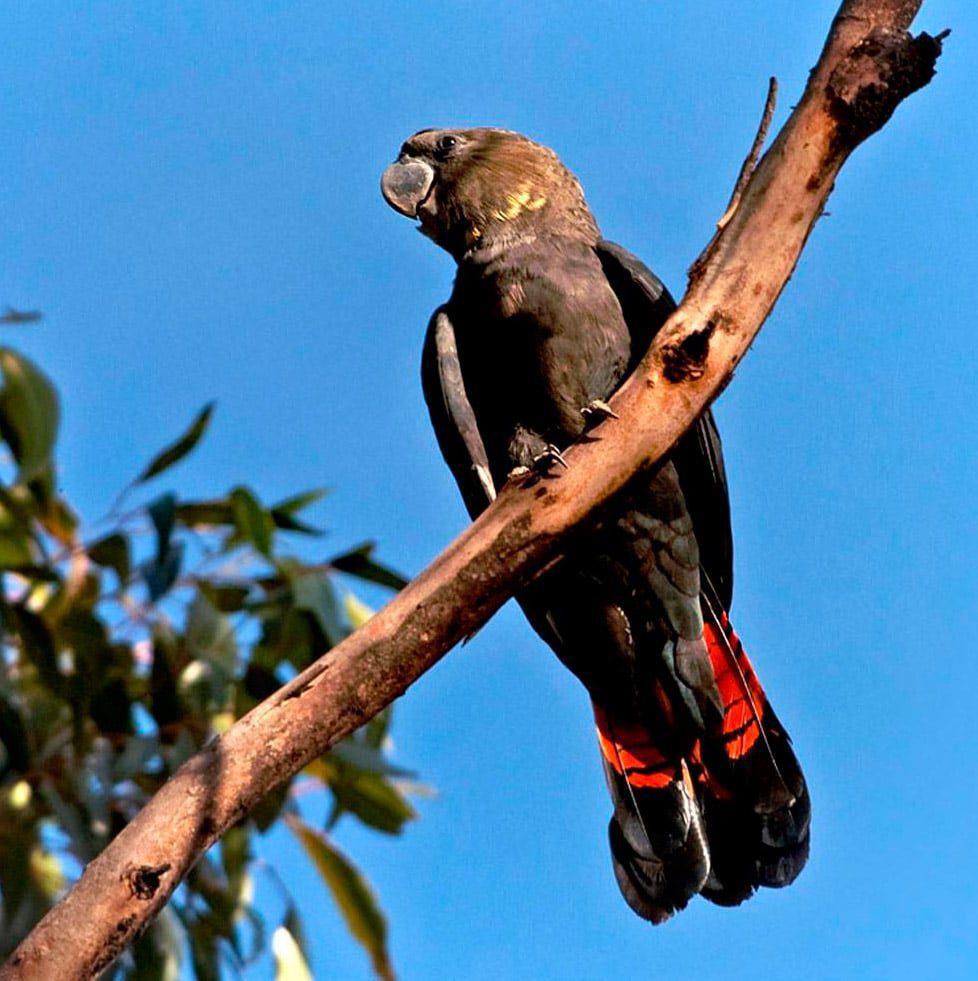
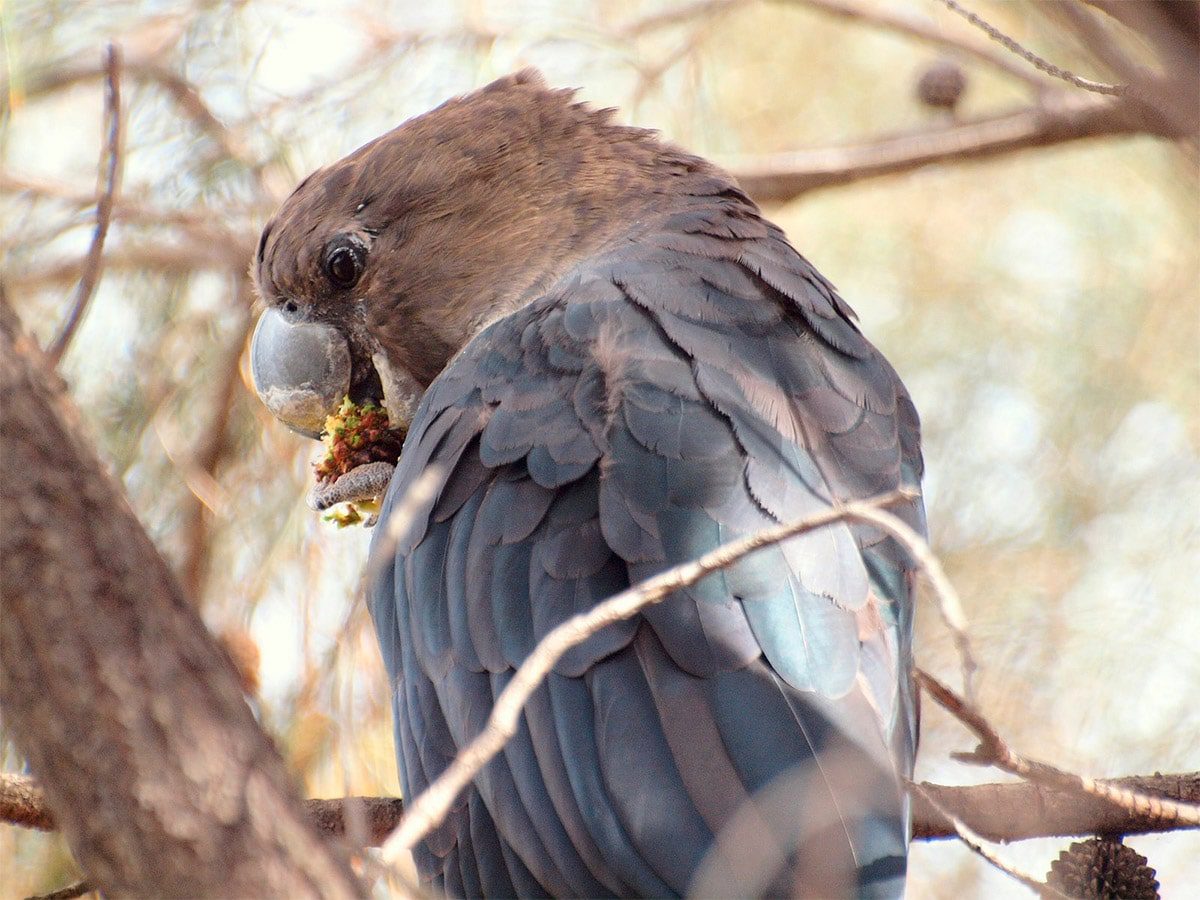
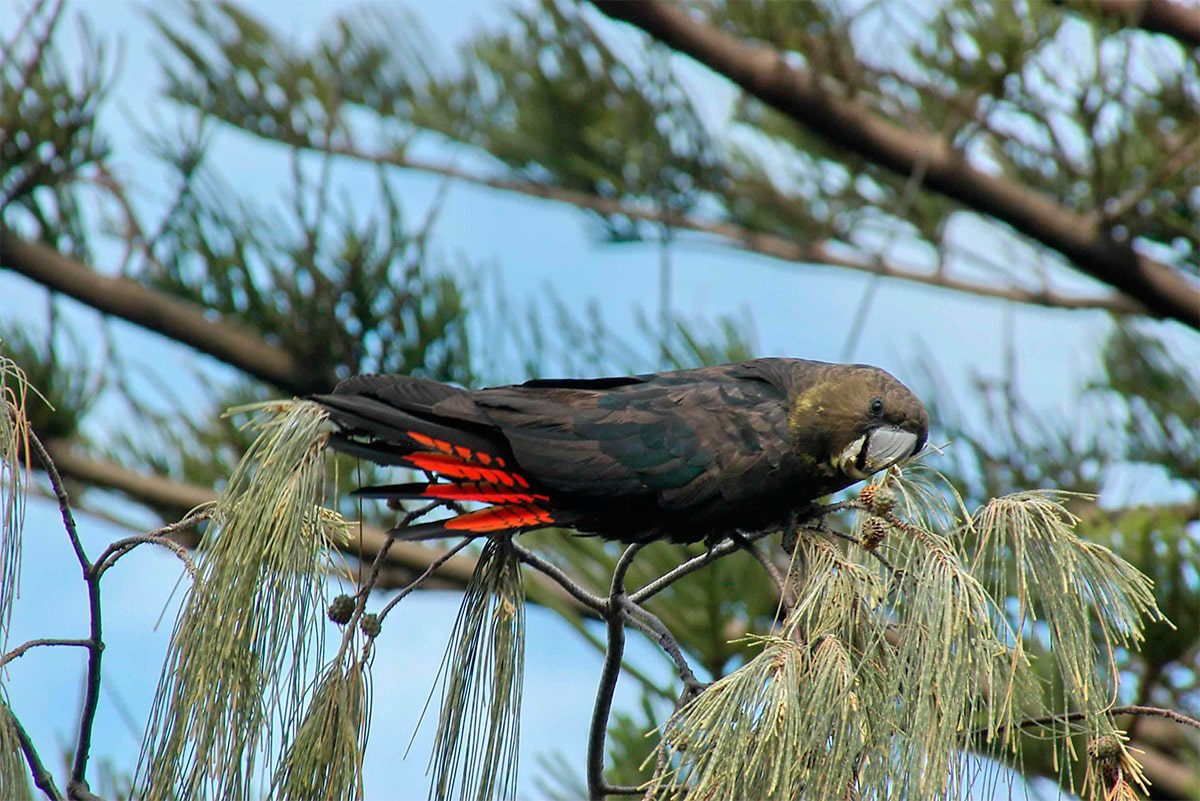
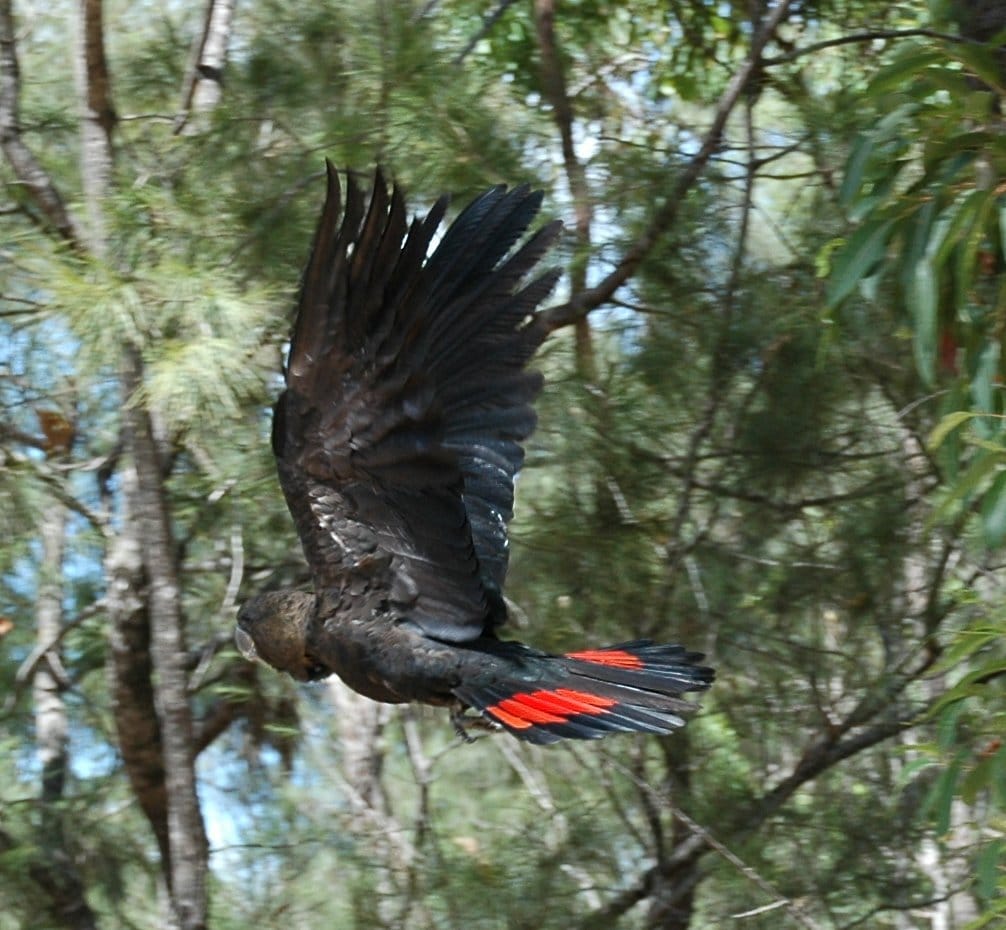
The Glossy black cockatoo(Calyptorhynchus lathami) is the smallest of the 5 black cockatoos and is restricted to the East coast of Australia (a population isolated also is reproduced in the Islands Kangaroo).
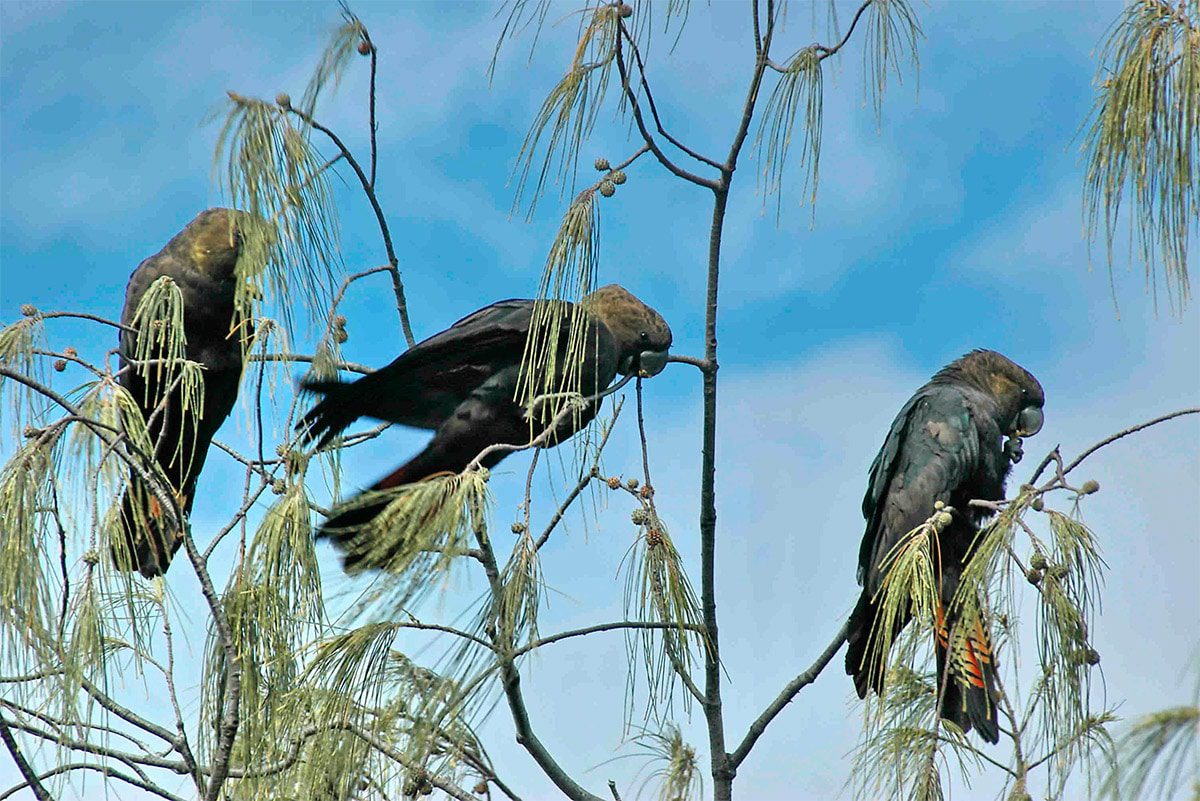
The male is brown-black color with a small crest rounded and bright Scarlet spots in the tail. The female shows spots irregular in color yellow in it head, The Scarlet patches in the tail they are permeated by narrow black bars and edges of pale yellow on the underparts of the wings.
The immature they are similar to the females, but they lack the yellow markings on the head and show different yellowish tones in the feathers, the chest and in the belly.
(Mathews, 1912) – Medium-size ones 48 cm. length and 510 to 515 weight g, with a wing
of approximately 90 cm.. The of adults they are mainly black, dark brown in the head, the neck and the bottom of the body, and Red panels (in males) or orange-red with bars Black (in females) on tail. The female adult is also conspicuous in the head. These patches are absent from most males., Although they can be expressed faintly in a few individuals (Higgins 1999).
The immature are similar in appearance to the male adult, but have small stains yellow in it head; spots or bars yellow in the chest, belly and flanks; yellow or orange spots on the wing
(mainly on the bottom); Red or orange-yellow panels with black bars at the tail; One bill pale grey (instead of dark); And a ring of skin around the eye pale grey (instead of grey dark) (Higgins 1999, L. Pedler 2007, com. Pers.).
Calyptorhynchus lathami erebus
(Schodde & Mason,IJ, 1993) – The only difference with the nominal species resides in that has the bill shorter.
Habitat:
Video – "Glossy black cockatoo" (Calyptorhynchus lathami)
Glossy-black Cockatoo (Calyptorhynchus lathami ) HD Video clip 1/3
Areas forested frequently dominated by casuarinas of which are highly dependent for its food. These are small shrubs commonly known as the Sheoaks, wood for beef (Beefwood) or Australian pine. These shrubs are widespread in tropical and subtropical regions.
They are also distributed in open humid forests, difficult terrain where deforestation has not been too great. They have an imperative for natural tree cavities to nest.
Reproduction:
Forman couple during all the life. The couple has relationships throughout the year. This type of family of them parrots prefers to nest in cavities natural of the eucalyptus, whether dead or in full vitality. The nest usually placed at an altitude that ranges between the 3 and 30 meters above the ground. The cavity is filled with leaves and branches. Sometimes, together with other breeding pairs, they share the same tree year after year.
In New South Wales the season extends from March to August. The spawning It consists of a single egg white. It is the female that takes charge of most of the tasks.: It prepares the nest and incubates herself. Never leave the nest until the small is reached the age of one week. In most cases, the male provides the female with food and assistance until the young can fend for itself, normally four months which remains with them until the next breeding season.
Food:
It feeds almost exclusively on the seeds several species of She-oak (Casuarina and Allocasuarina). You can also sometimes eat larvae of wood-boring. They feed in threes, less frequently in pairs, small groups or flocks of up to 60 birds. They can be detected by the snapping of their beaks and the remains of the casuarina cones and twigs that fall.
Distribution:
Size distribution (reproduction / resident): 770.000 km2
The species is Rare Although widespread in suitable forests of the central coast and forest habitats of Queensland and in the interior of the southern plateaus and Plains of the Midwest's New South Wales, with a small population in the Riverina. There is an isolated population in the Kangaroo Island, South of Australia.
(Schodde & Mason,IJ, 1993) – It is from Australia (the central eastern coastal area of Queensland)
Conservation:
State of conservation ⓘ
Minor Concern ⓘ(UICN)ⓘ
• Current category of the Red List of the UICN: Least concern.
• Population trend: Decreasing.
Like most parrot species, the Glossy black cockatoo is protected by the Convention on international trade in endangered species of Fauna and Flora Silvestres ( CITES ), with its inclusion in the list of the Appendix II of vulnerable species, What makes the import, the export and trade of animals captured in the wild is illegal.
Justification of the population
Garnett and Crowley (2000) estimated the size of the population in the following way: 12.000 individuals of the subspecies lathami, 70 breeding pairs of the subspecies halmaturinus (equivalent to 140 individuals) and 5.000 individuals of the subspecies erebus giving a total of 17.140 individuals.
Justification of trend
They suspected that the population is declining in general Since the largest subpopulation, lathami, It is slowly decreasing throughout its range. However it is believed that the subspecies Erebus is increasing and the subspecies halmaturinus It is increasing as a result of conservation efforts in the Island Ganguro (Garnett and Crowley 2000).
"Glossy black cockatoo" in captivity:
Like the other black cockatoos, the Glossy black cockatoo(Calyptorhynchus lathami) is extremely rare in the poultry. In Australia It has attained breed in captivity.
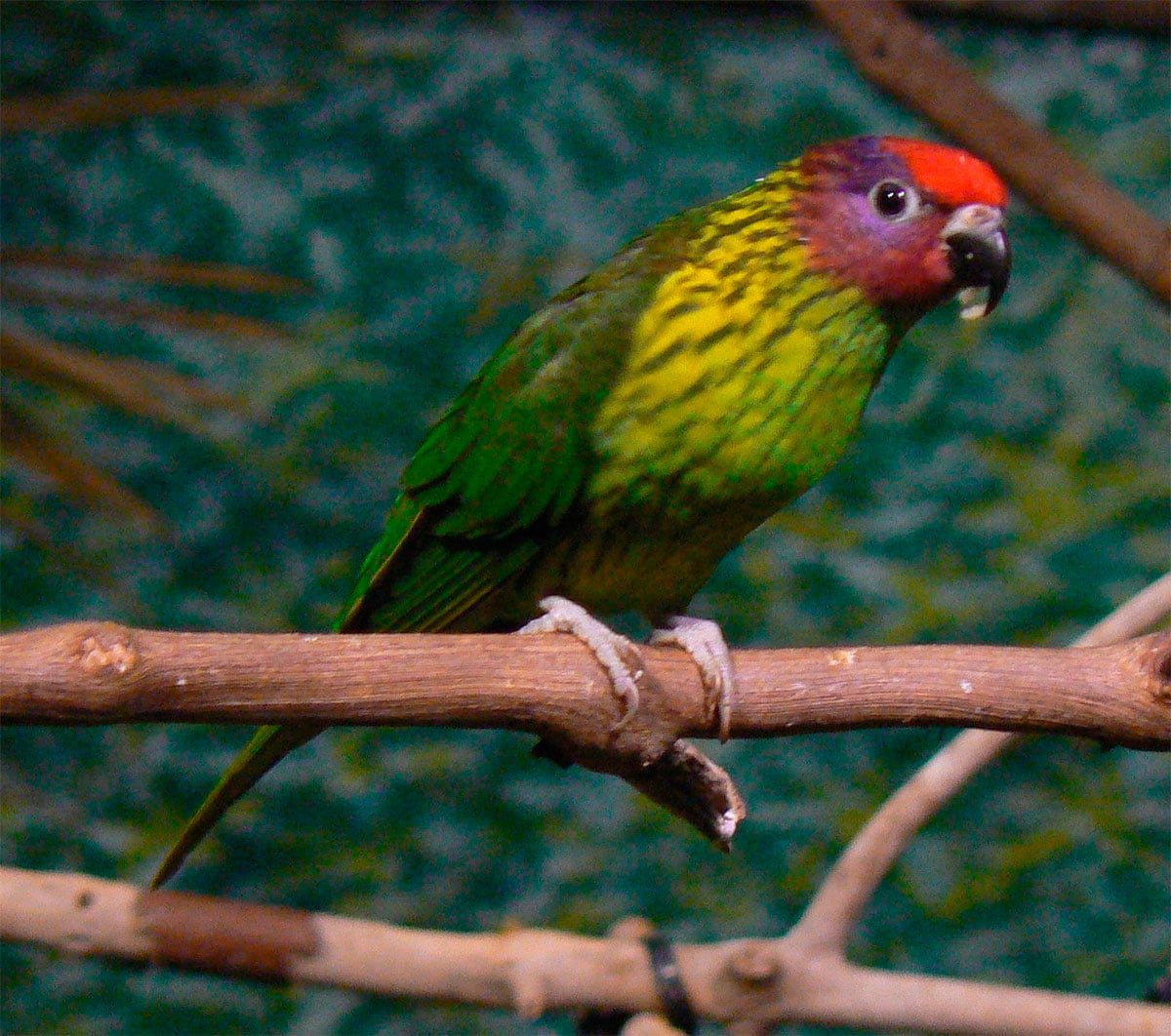
The Goldie's Lorikeet(Psitteuteles goldiei) has the top red. Its neck is surrounded by a strip blue opaque that it extends to the edge of the eye.
The mumps and their cheeks They are pink with multiple dark blue veins.. The upperparts of color green dark streaked of black in the part inferior of the neck and of color yellow greenish mottling on the sides of the layer.
The feathers that cover the wing
are dark green, as well as the top of the tail.
The feathers they have a green color with black internal wires and a fine yellow edge.
The underparts are yellowish green with many streaks of dark green, more concentrated in the area of the chest. The bottom of the tail is of color yellow grey.
The bill is black, brown the iris. The legs son grises.
The females adult, they have the top more opaque and less developed.
In the immature, the top is reddish with dark blue spots. The upper mantle is spotted of yellow.
There are no geographic variations. The species is considered monotype.
The Goldie's Lorikeet It is distributed mainly by primary forests, mountain forests and eucalyptus between 1.000 and 2.200 meters above sea level. But, These birds are very Mobile and their habitat may vary from sea level to the 2.800 m.
At higher altitudes, sometimes be parked in the forests of beech and false Podocarpus. They are also set fairly regularly in the areas where the trees are in bloom and around small mountain villages. They have been , occasionally, in small groups of trees isolated in the middle of open spaces.
The Goldie's Lorikeet they are very sociebles. They are often associated with other Charmosyna type Loris: Fairy Lorikeet (Charmosyna pulchella) and Lori Flanquirrojo (Charmosyna placentis).
Most of the time they live in large groups of 30 or more individuals. These birds make long flights daily, often in the company of Pygmy Lorikeet (Charmosyna wilhelminae). Move from their places of rest to its feeding sites found at the middle level, or at the top of the tall trees in flower.
They probably make seasonal migrations to meet their specific feeding needs.. Between mid June and early January, the Goldie's Lorikeet they are common in the forests of the lowlands around Port Moresby.
Reproduction:
We really know very little about free-range breeding.. Apparently, the nest is well hidden inside a tree in thick foliage dry, mostly big pandanus. The female lays two white eggs.
In captivity, the incubation period ranges between 23 and 24 days. Young are altricial, and leave the nest after 8 to 9 weeks.
Food:
The Goldie's Lorikeet they have a scheme rather similar to all the lori, that is to say, they are almost exclusively vegetarian. Its menu consists mainly of pollen, nectar, flowers and fruits than that found in the trees of the genus Casuarina in shrubs of the genus honey Grevillea and of the eucalyptus.
Distribution:
Size of the area of distribution (reproduction / resident): 307.000 km2
This species is endemic of New Guinea. Lives exclusively in the mountains in the center of the island and stretches to the mountains of the Huon Peninsula and Owen Stanley.
Conservation:
– Current IUCN Red List category: Least concern
– The population trend: Stable
The population suspected to be stable in the absence of evidence of any reduction or substantial threats.
The world population It has not been quantified, It is estimated above 100.000 specimens, but the species is reported to be locally common depending on food availability.
"Goldie's Lorikeet" in captivity:
The Goldie's Lorikeet is a bird prized as a pet. His character is not aggressive, or destructive and is quite silent for a parrot. They can be taken in pairs or in large communities. Some of them come to imitate the human voice.
Alternative names:
– Goldie’s Lorikeet, Red-capped Streaked Lorikeet, Red-capped Streaked Lory (ingles).
– Loriquet de Goldie (French).
– Veilchenlori (German).
– Lóris-de-goldie (Portuguese).
– Lori de Goldie, Tricogloso de Goldie (español).
– Avibase
– Parrots of the World – Forshaw Joseph M
– Parrots A Guide to the Parrots of the World – Tony Juniper & Mike Parr
– BirdLife.org
– Wikipedia

 Endangered ⓘ (UICN)ⓘ














.JPG)


