▷ The world of Pets: Dogs, cats, birds, reptiles, amphibians

Sloughi (Arabian Greyhound)
MarruecosArgeliaTunezLibia FCI 188 . Short-haired Sighthounds

Sloughi

It is said that the Sloughi (Arabian Greyhound), is the most intelligent hound.

Content

History

Native to North Africa and probably descended from the ancient "Egyptian Greyhound", it is said that the Sloughi took its name from the town of Sloughito in Tunisia. Its exact origins are unclear., but it is known that it was used for centuries by the Berber people and the Bedouin tribes to hunt gazelles, jackals, foxes and hares. In fact, thanks to its speed and resistance, could chase game across vast expanses of wilderness, which explains why it was the favorite dog of nomads. His sense of observation and his highly developed instinct also made him - and make him- an excellent herding dog. Last, it was also a domestic animal for them, since he was allowed to sleep with them in the tent at night. They even covered him with a blanket to protect him from the cold..

The first Sloughis arrived in Europe in the mid-nineteenth century, after the conquest of Algeria by France. The breed was recognized by the Federation Cynologique Internationale (FCI) in 1934. World War II halted its development, since many breeders had to euthanize their animals due to lack of food or export them to countries that were saved from the conflict. The Sloughi it then became extremely rare until the end of the Algerian war (1954-1962), when the French soldiers brought to their country some specimens of the breed, which relaunched its expansion into European territory.

Tagiurie el Sian it was the first Sloughi that arrived in the United States in 1973. Originally from Tunisia, crossed the Atlantic with his owners Kaethe y Carl Rodarty. Unfortunately, due to his age and lack of females, could not have offspring. In fact, the breed was not really established in the country until 1979, When Carole Cioce imported two Sloughis from Germany to California.

Most representatives of the breed in North America today are descended from individuals imported from European countries. (France, Netherlands, Germany, etc.), although some come directly from North Africa, especially from Algeria, Libya and Tunisia.

The breed was recognized by the United Kennel Club (UKC) in 1995, and the other reference body of the country, the American Kennel Club (AKC), did the same in 2016. El Canadian Kennel Club (CKC), on the other hand, has not yet taken the step.
The popularity of the CKC in the neighboring country is certainly not a reason for it to do so.. The Sloughi It is one of the rarest dog breeds in the United States, being last in 2018 in the ranking established by the AKC based on the number of annual births registered in the organization.

In fact, the Sloughi It is now one of the rarest breeds of sighthounds in the world. In France, occur between 30 and 50 registrations per year in the Livre des Origines Français (LOF). The figure has been relatively stable since the middle of the years 80, while at the beginning of that decade it was rather twice. Compared, every year they are born around 1.400 hounds Whippet. In Great Britain, race is even confidential, since some years no birth is registered in the prestigious Kennel Club, the canine body of reference in the country.

The Sloughi it is also in danger of extinction in the Maghreb countries. Their number continues to decrease., mainly due to the scarcity and protection of certain species it hunts and the sedentarization of the Bedouin tribes, who need your help less and less to protect their herds.

In the news, Morocco has the largest number of Sloughis of the world. It's hard to know the exact number, but specialists estimate that the population is about 600 individuals.

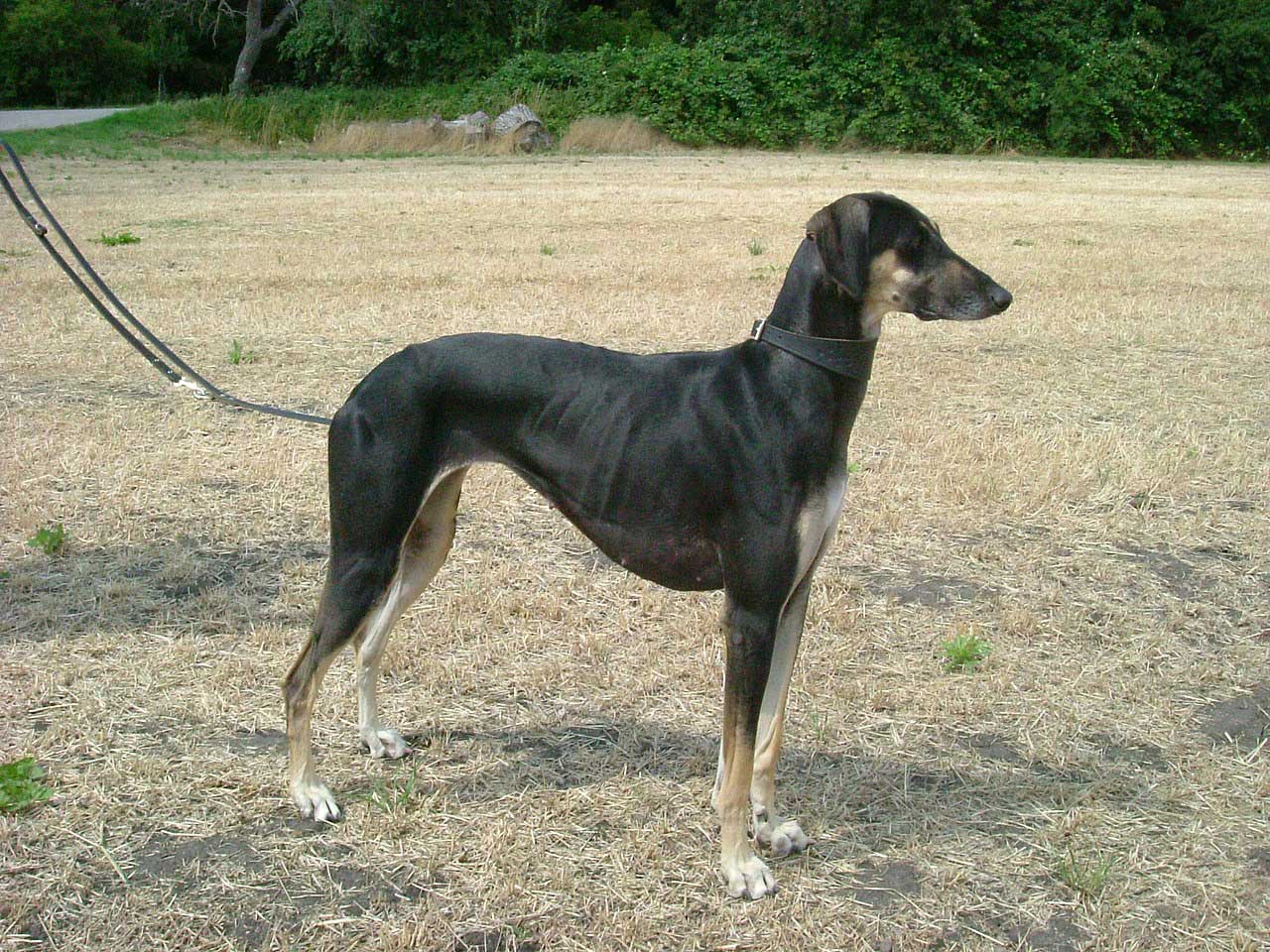
Photo: by Benutzer:Claggi, CC BY-SA 3.0, via Wikimedia Commons

Physical characteristics

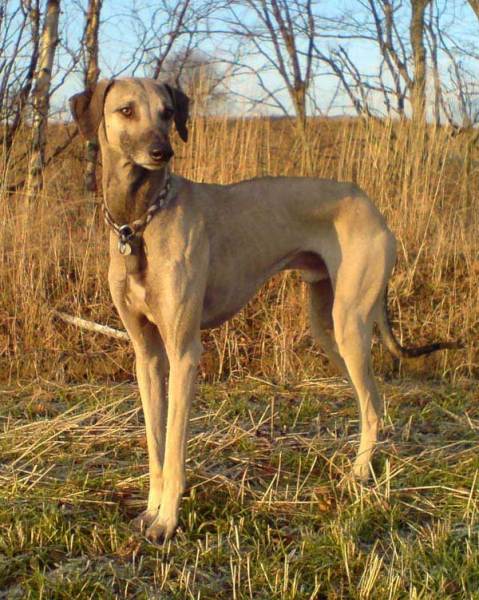
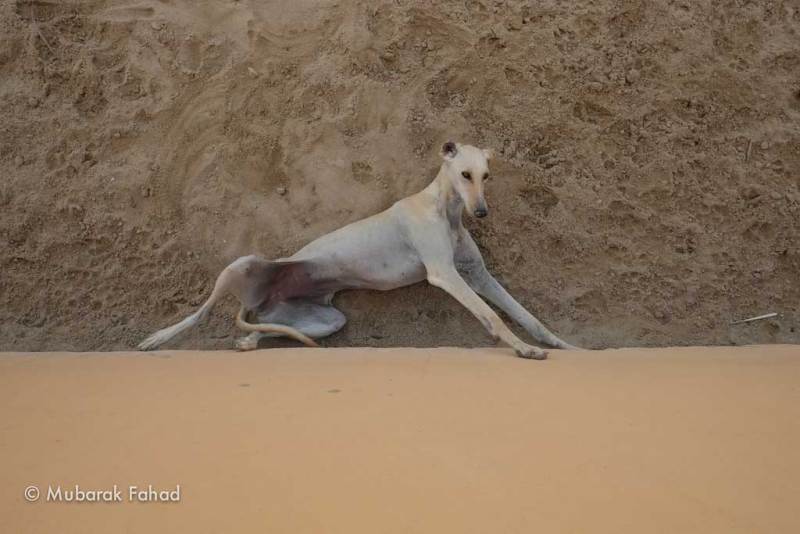
The Sloughi it is one of the largest dog breeds. Like the other races of Sighthounds, looks slim and athletic. This is due to their thin and tight skin, to his short coat, fine and closed, to his lean musculature and his very pronounced bone structure. Its general appearance is that of a noble dog, very elegant and stylish, but specially built for speed.

His chest is wide, encased by flat ribs, long and slightly curved on the back third of the chest. The belly is tight and the back is short, almost horizontal between the withers and the hips. Straight legs, Bony and muscular are an important part of the dog's formidable speed.

Profile, the head is long and thin. Seen from above, the skull is wide. Tapers to the end formed by the nose, reminiscent of the shape of a valley. The nose is black and slightly descending, and the nostrils are wide open.

The eyes are large and dark, with a soft and melancholy look. The edge of the eyelids is pigmented. The ears are droopy, triangular in shape and slightly rounded at the tips. The jaw is strong and regular.

Coat colors vary from light sandy to reddish, with or without black mask or cape. The most common are the black sand mask and the brindle sand.

Last, sexual dimorphism is not very pronounced, since the males are usually not more than 10 cm taller than females, which is modest compared to the size of the animal.

Size and weight

▷ Male size: 66 to 72 cm.
▷ female size: 64 to 69 cm.
▷ Male weight: 20-25 kg
▷ female weight: 19-22 kg

Character and skills

Although it is not very demonstrative, the Sloughi he is devoted and loyal, and tends to be a single owner dog. When they join their owner, is for all the life, so it is very difficult for them to join another family if their owner is abandoned or dies.

They get along well with children, but it is better if they are of a certain age and have learned to interact with an animal. In fact, given its size, could unintentionally push a smaller one, or forcefully push away an older one who disrespects you. In any case, whatever the race and the degree of proximity, a small child should never be left alone with a dog.

Their sociability with humans is often limited to family members. With strangers, they are much more reserved, and will bravely defend their own if they feel threatened in any way.

In more general terms, can easily become anxious when faced with new situations. Thus, it is essential to socialize him as soon as possible to prevent him from becoming a fearful and / or unnecessarily aggressive dog.

You can also live with animals of other species (cats, rodents, etc.), as long as they grew up together and you consider them part of your family. On the other hand, as his hunting instinct is highly developed, the subsequent introduction of another animal into the home where you live can be problematic.

As for living under the same roof as a partner, this coexistence does not usually pose problems if you have grown up with him. Otherwise, it all depends on the size of the newcomer. Yes it's small, is likely to be regarded as prey. From his past as a hunter and rancher, preserves the need for space and exercise. So, you need at least one hour of physical exercise a day to get rid of your excess energy and stay balanced. So, they are ideal candidates for dog sports, starting, of course, for the tests intended for sighthounds (racing in cinodromes, decoy chase…). It is also an ideal breed of dog for an athlete, who likes to accompany on their outings; canicross and cani-VTT are activities perfectly adapted to it, and certainly more recommendable than sighthound races. On the other hand, having a strong hunting instinct, he can chase any small animals he meets at any time, especially cats. So, it is essential that you obey the call, and in any case it is better to carry him on a leash during walks, to avoid any risk of leakage. In fact, once a Sloughi olido has a hold, no longer really responsive to his master's instructions, so it is extremely difficult to make him return.

This is all the more true since, even with a lot of training, is often far from being the most obedient dog in the world. It also, cannot be trusted to keep a low profile if reprimanded: given his strong character, it would be the opposite. So, it is up to the owner to be firm from an early age, so as not to be dominated by his imposing companion.

The great need for exercise of the Arabian Greyhound and its size make, although I rarely bark (even in the presence of strangers), not really adapted to living in a flat. But, can live in an apartment, as long as he is taken out several times a day and can satisfy his need for exercise. A house is still preferable. But, it is important to ensure that the garden is well fenced, since the Sloughi is naturally elusive. Using an underground electric fence would not be a viable solution with such a dog., since the annoyance of the electrical impulses would be less strong than his determination to flee and follow who knows what trail. On the other hand, although I tolerate loneliness relatively well, it is not convenient that I live outside. In fact, its short and fine fur makes it very sensitive to cold, and he needs to bond with his humans anyway, to whom he is more attached than sometimes is thought.

Education

The Sloughi He is a shy dog ​​and is easily frightened by what he does not know. So, their socialization should take place from a very young age, when it is most malleable, so that you face the maximum number of people and situations and learn to adopt the appropriate behaviors in all circumstances, to become a perfectly balanced adult.

You should also put him in contact with other animals, especially with cats, rodents and other small animals, to try to prevent him from seeing them as prey when he later crosses paths with them.

With his great intelligence and keen sense of observation, learns quickly… if you want. In fact, obedience is not his strong point: It is not a dog that strives to satisfy or even anticipate the requests of its master. So, you need to be firm in your education, but also show patience, to respect his character. Trying to break in could only be detrimental to the future, since it is a proud and sensitive animal, who does not appreciate reprimands. His temperament makes him an ideal client for the positive reinforcement dog training method, and sweets are usually the key to success.

Last, teaching your dog to remember is especially important to be able to enjoy walks outdoors with peace of mind, since the Sloughi retains a strong predatory instinct and, therefore, can launch itself at any time in pursuit of an animal that it considers prey. This is even more true because, given its maximum speed, it is very difficult to reach it.

Health

The Sloughi it is a healthy breed of dog. Has a low risk of inherited diseases and a longer life expectancy than other dogs of the same size.

But, are prone to injury while running and are more prone to certain ailments.

This is the case, in particular, of the progressive retinal atrophy of APR-RCD type (rod and cone dysplasia), an inherited disease that causes a malformation of the retina: the puppy's eyesight deteriorates from 6 months old and, usually, goes completely blind before the year. There is a blood test that can determine whether or not an individual is a carrier of the gene responsible for this disease. So, before adopting a representative of this breed, it is recommended to do the test, to avoid any risk at this level. Of course, knowing that it is a hereditary disease, a good breeder does not breed an individual carrying the gene.

Like all large dog breeds, it is also more prone to stomach dilation-torsion syndrome. This condition is an absolute emergency, as it is likely to die if not treated by a vet very quickly.

It also, like most breeds of "Sighthounds", the Sloughi is especially sensitive to anesthesia and medications. Thus, it is advisable to turn to a veterinarian who knows the specificities of these dogs in this regard.

Another peculiarity of this dog is its very high pain tolerance., so sometimes it is difficult to detect that you are suffering. So, be especially attentive to any change in behavior that may betray a health problem.

Last, due to its origins and its fur, the Sloughi not a cold weather breed. Thus, when temperatures are low, it is important to avoid spending too much time outside and to cover it with a suitable coat for dogs.

Life expectancy

12 years

Grooming

The Sloughi is the archetype of easy-care dog.

Brushing his short coat once or twice a week with a soft brush or brushing glove is perfectly sufficient to remove dead hairs and keep his coat clean.. Their molt is even more limited since, unlike many other breeds, does not suffer seasonal molts.

It also, the coat is self-cleaning, so it does not give off bad odors and it is not necessary to wash it regularly. Under normal circumstances, two or three times a year is more than enough, but, of course, you should not hesitate to bathe your dog if he has become very dirty and / or if harmful substances have spread through his coat.

As in any race, oral hygiene is very important and should not be neglected. The toothbrush is the most effective accessory to prevent the accumulation of tartar, strengthen gums and prevent bad breath.

It also, although your dog is not at particular risk of ear infections, despite the dangling shape of his ears, it is necessary to inspect and clean your ears at least once a week. This weekly session is also an opportunity to review - and if necessary clean- the eyes.

Last, natural wear and tear is usually enough to trim your claws. But, when you get older and / or less active, they can be too long, and then they can annoy or even hurt you. In this case, it is advisable to trim them with a special file or with a claw trimmer.

As in the case of any dog, the sooner you get used to the different manipulations that your care entails, the less likely you are to have problems later.

Food

The diet of the Sloughi should consist primarily of lean meat, rice and vegetables. It is preferable to choose a quality food, either in the form of industrial croquettes, pate or homemade food. The amount to be given varies according to the size, the age and physical activity of the animal. By the way, don't be fooled by its slim look and slightly visible ribs: this is part of his physical characteristics and is not at all a sign that he is malnourished. No need to worry about it, but the abnormal would be the opposite.

In general, the more effort and activity your dog makes, more food will be needed to make up for the loss of energy. It is advisable to divide it into at least two meals, one in the morning and one at night, to reduce the likelihood of digestive problems such as stomach bloating or distention.

To avoid the latter, meals should be taken in a quiet place and one hour away from walks or any strenuous physical activity.

Last, as in the case of all dogs, it is essential to guarantee the availability of fresh water throughout the day.

Use

Known as the "lord of the dogs" in Moroccan culture, the Sloughi has long been appreciated for its hunting skills, agility, endurance and speed. It can reach a speed of up to 55 km / h along 300 m, to the point that there is an Arabic saying that says that "when a Sloughi see a gazelle pluck a blade of grass, "It will be at his level before he finishes chewing it.".

In the north of Africa, where is he from, It was mainly used as a guard dog to protect herds, as well as to hunt hares, foxes, jackals or gazelles.

But, in 1844, a French law prohibited hunting with Sighthounds and it was applied in the Maghreb territories that became part of France in the 19th century.

Since 2004, hunting with greyhounds is again allowed in some Maghreb countries, but under certain conditions. But, is still banned in Europe, except for Spain.

In United States, has sometimes been used to hunt coyotes.

In their homelands, the Sloughi It is still used by nomads as a guard dog for their herds, although this practice tends to disappear as tribes settle.

Their loyalty and unwavering devotion to their master also make them very good companion dogs., as long as their families are able to meet their great need for exercise.

Last, his lean and athletic nature makes him a good competitor in racing and sight pursuit events, although it is not as fast as an "English Greyhound".

Precio «Sloughi (Arabian Greyhound)»

The price of a puppy Sloughi ranges between 900 and 1300 EUR. The price of a copy depends on its conformity with the standard, of the reputation of his lineage, of the prestige of the kennel and also of its sex: females are considerably more expensive than males.

It is also possible to import a Arabian Greyhound straight from north africa. The purchase price is more affordable (between 500 and 750 EUR), but you must respect the regulations regarding the importation of a dog from abroad, and transport costs and administrative fees are added to the purchase price.

Adopting a Sloughi It can also be done through specialized retired greyhound associations. Many owners decide to part with their Sloughi when they can no longer compete. Sometimes they are also abandoned by owners who are not sufficiently informed of their needs. (especially in terms of physical activity) and they are not able to take proper care of them. Thus, these associations try to offer a second life to the greyhounds they host, allowing them to find a new family.

Characteristics "Sloughi (Arabian Greyhound)"

Coexistence is important that you have with your new friend. Before considering the acquisition of a dog of the breed "Sloughi (Arabian Greyhound)" you know certain factors. Not all breeds of dogs are apt to live in an apartment, you must take into account his character, their need for exercise, their interaction with other pets, their care and if you have small children, their level of tolerance towards them.

Adaptation ⓘ

3,0 of 5 stars (based on 1 review)

friendly dog ​​ⓘ

2,0 of 5 stars (based on 1 review)

hair loss ⓘ

2,0 of 5 stars (based on 1 review)

Affection level ⓘ

3,0 of 5 stars (based on 1 review)

Need for exercise ⓘ

5,0 of 5 stars (based on 1 review)

Social need ⓘ

2,0 of 5 stars (based on 1 review)

Home ⓘ

3,0 of 5 stars (based on 1 review)

Toilet ⓘ

1,0 of 5 stars (based on 1 review)

Friendly with strangers ⓘ

2,0 of 5 stars (based on 1 review)

barking ⓘ

1,0 of 5 stars (based on 1 review)

Health ⓘ

4,0 of 5 stars (based on 1 review)

Territorial ⓘ

4,0 of 5 stars (based on 1 review)

Cat friendly ⓘ

2,0 of 5 stars (based on 1 review)

Intelligence ⓘ

4,0 of 5 stars (based on 1 review)

Versatility ⓘ

3,0 of 5 stars (based on 1 review)

Child friendly ⓘ

4,0 of 5 stars (based on 1 review)

Surveillance ⓘ

4,0 of 5 stars (based on 1 review)

joy ⓘ

3,0 of 5 stars (based on 1 review)

Images "Sloughi (Arabian Greyhound)"

Photos:

1 – Sloughi male in the sunset by Denhulde, CC BY-SA 3.0, via Wikimedia Commons
2 – Sloughi by Tom´s photo gallery
3 – Sloughi 2013 Helsinki by Thomas, CC BY-SA 3.0, via Wikimedia Commons
4 – Sloughi by Mubarak Fahad
5 – Sloughi by http://www.sloughi-balkan.com/characteristics-2/
6 – Sloughi by https://www.akc.org/dog-breeds/sloughi/

Videos "Sloughi (Arabian Greyhound)"

Type and recognitions:

  • FCI CLASSIFICATION:
  • Group :
  • Section : . .

Federations:

  • FCI – Group 10: Section 3: Short-haired Sighthounds ⓘ
  • Standard KC (The Kennel Club) – Hound ⓘ
  • El American Kennel Club (AKC) – Hounds ⓘ

FCI breed standard "Sloughi (Arabian Greyhound)"

Origin:
Morocco, Algeria, Tunisia, Libya

Date of publication of the valid original standard:
08.01.1998

Use:

Hunting in sight.


General appearance:

For its size, Due to the fineness of its tissues and its thin musculature, its general appearance is that of a distinguished and graceful dog.


IMPORTANT PROPORTIONS:

  • For a male of ideal height of 70 cm., the long scapulo-ischidia of the body should measure 67-68 cm..
  • For a female of ideal height at the withers of 65 cm., the long scapuloischidiaco of the body should measure 62-63 cm..
  • The relationship between the scapular-ischiadic length of the body and the height at the withers is 9,6 : 10 (0,96).
  • The relationship between the depth of the chest and the height at the withers is 4:10 (0,4).
  • The relationship between the length of the muzzle and the length of the head is 1:2 (0,5).


Behavior / temperament:

Though noble and proud, He is very attached to his owner and defends him in case of need. Has a hunting instinct and is capable of any sustained effort; he also likes the sweet comfort of a home.

Head:

Profile view, the head is elongated, elegant and fine, but quite important. From above, looks like a very elongated wedge, the skull forming the widest part, which progressively decreases as it approaches the tip of the nose.

Cranial region:
  • Skull: Seen in profile it is quite flat, the length between the ears measures 12 to 14 cm.. It is well rounded on the back forming a harmonious curve to the sides.. Supraorbital arches are barely visible. The frontal sulcus is barely marked. Occipital ridge and protuberance are barely visible.
  • Stop (naso-frontal depression) : Slightly marked.

facial region:

  • Truffle: Black, important enough to not seem pinched. Windows wide open. Not being supported by a bony structure, descends very slightly
  • Snout: Cuneiform, elongated without exaggeration, sensibly the same length as the skull. The muzzle is straight from its junction with the skull.
  • Lips : Thin and flexible, just cover the lower lip; the commissure should be visible as little as possible.
  • Jaws / teeth: Normal teeth; strong jaws and
    regular; scissor bite.
  • Eyes: big and dark, well lodged in orbital cavities, sometimes a little covered due to a slight skew of the eyelids. Sweet and a little sad expression, with a look like nostalgic. In light-coated dogs, eyes may be amber. The edges of the eyes are pigmented.
  • Ears: High insertion, slightly above the eye line. They fall well attached to the sides of the head, Not very large, form triangular, slightly rounded at the tip.

Neck:

Long, well delineated, with its slightly arched upper profile. Its length is sensibly equal to that of the head. The skin is thin, tight, without jowl. The hair is short.

Body:

  • top line: Gently and harmoniously bent with well protruding haunches that are at the same height or slightly higher than that of the withers.
  • Cross: Well outgoing.
  • Back: Short, almost horizontal
  • Pork loin: Short, clean, wide and slightly arched.
  • Rump: Huesuda, wide inclined without falling.
  • Breast : Not too wide, drops just down to elbow level. Well developed in length. Flat ribs.
  • Bottom line and belly: Long, elevated sternum. Belly and flanks well retracted. The bottom line draws a regular curve, neither interrupted nor very arched.

Tail:

Thin, skinny, inserted in the extension of the rump and carried below the line of the back. In its length, must reach at least the tip of the hock. At rest, the tip has a marked upward curvature

Tips

PREVIOUS MEMBERS: Perfect legs.

  • Shoulder: Long and oblique.
  • Arm: Strong.
  • Forearm: Bony and muscular.
  • Carpus and metacarpus: Flexible and strong.
  • Previous feet: Thin, oval and elongated; featured in many light Sloughi the hare's foot shape. The two middle fingers are clearly longer than the others. Nails are black or colored.

LATER MEMBERS: Seen from behind, perfect poise; flat muscles; protruding tendons.

  • Thigh: Flat and muscular.
  • Leg: Long and muscular.
  • Warm-foot joint (Hock): Strong and well angled.
  • Metatarsus: Strong, No Spurs.
  • Hind feet: Thin, oval and elongated; featured in many light Sloughi the hare's foot shape. The two middle fingers are clearly longer than the others. Nails are black or colored.

Movement:

Paso, trot, gallop. Agile and light ride with good reach in movements. Must cover a lot of ground.

Mantle

  • SKIN: Very fine, attached to the body, no wrinkles or double chin.
  • HAIR: Very short, thick and fine.
  • COLOR: All shades from light sand to red sand; with or without black mask, with or without black cloak; tabby or not; shaded or not.


Size and weight:

HEIGHT AT THE WITHERS

  • For males: 66 - 72 cm.
  • For females: 61 - 68 cm.


Fouls:

Any deviation from the aforementioned criteria is considered as a fault and the severity of this is considered to the degree of the deviation to the standard and its consequences on the health and well-being of the dog..

  • Poor relationship between height at the withers and scapuloischiadic length.
  • Head and body a bit heavy.
  • Stop too much or too little marked.
  • light eyes.
  • Non-horizontal back line.
  • Narrow rump, too much or too little inclined.
  • Little retracted belly.
  • Rounded ribs
  • Chest not long enough, seen in profile interrupted lower line.
  • Very short tail, too hairy or badly worn.
  • Round and protruding muscles.
  • Hard and thick hair.
  • Small spot on the chest.


  • FALTAS DESCALIFICANTES:

  • Aggressiveness or extreme shyness.
  • Any dog ​​showing clear signs of physical or behavioral abnormalities.
  • Body clearly longer than tall, haunches lower than the withers
  • Depigmentation of the mucous membranes in the form of small white spots.
  • Upper or lower prognathism.
  • Ears erect or semi-erect with the tip pointing forward, ears too long, ears thrown back (ear in pink).
  • Semi-long hair.
  • Fringed limbs and tail.
  • White metacarpals or metatarsals (jumps), widespread white spots on the coat
  • Color not conforming to standard.


  • N.B.:
  • Males should have two normal-appearing testicles fully descended into the scrotum..
  • Only functionally and clinically healthy dogs, with the typical conformation of the breed, should be used for parenting.
  • Source: F.C.I - International Cynological Federation

    Alternative names:

    1. Uskay (Oska), Arabian Greyhound, Sloughi Moghrebi (English).
    2. Lévrier arabe, Lévrier berbère (French).
    3. Arabischer, Nordafrikanischer, Berber Windhund (German).
    4. Galgo árabe (Portuguese).
    5. Lebrel bereber, Lebrel árabe (español).

    ▷ The world of Pets: Dogs, cats, birds, reptiles, amphibians

    Japanese Chin
    FCI 206 . Japan Chin and Pekingese

    It's a very special race, they have very feline attitudes, is more, It is said to have the character of a cat, and you will see why...

    Content

    Characteristics "Japanese Chin"

    Coexistence is important that you have with your new friend. Before considering the acquisition of a dog of the breed "Japanese Chin" you know certain factors. Not all breeds of dogs are apt to live in an apartment, you must take into account his character, their need for exercise, their interaction with other pets, their care and if you have small children, their level of tolerance towards them.

    Adaptation ⓘ

    5,0 of 5 stars (based on 1 review)

    friendly dog ​​ⓘ

    3,0 of 5 stars (based on 1 review)

    hair loss ⓘ

    3,0 of 5 stars (based on 1 review)

    Affection level ⓘ

    5,0 of 5 stars (based on 1 review)

    Need for exercise ⓘ

    1,0 of 5 stars (based on 1 review)

    Social need ⓘ

    5,0 of 5 stars (based on 1 review)

    Home ⓘ

    5,0 of 5 stars (based on 1 review)

    Toilet ⓘ

    2,0 of 5 stars (based on 1 review)

    Friendly with strangers ⓘ

    5,0 of 5 stars (based on 1 review)

    barking ⓘ

    2,0 of 5 stars (based on 1 review)

    Health ⓘ

    3,0 of 5 stars (based on 1 review)

    Territorial ⓘ

    4,0 of 5 stars (based on 1 review)

    Cat friendly ⓘ

    5,0 of 5 stars (based on 1 review)

    Intelligence ⓘ

    3,0 of 5 stars (based on 1 review)

    Versatility ⓘ

    3,0 of 5 stars (based on 1 review)

    Child friendly ⓘ

    2,0 of 5 stars (based on 1 review)

    Surveillance ⓘ

    3,0 of 5 stars (based on 1 review)

    joy ⓘ

    4,0 of 5 stars (based on 1 review)

    History

    The true origin of the Japanese Chin It is still controversial, Although a general consensus, concludes that originated in Spaniela.

    These dogs were brought to Japan around year 732. Some maintain the ancestors of these dogs first arrived to Japan around the year 732, as a gift from royalty Korea, while others argue that Japanese Chin copies were offered as a gift to the Empress of Japan in the middle of the sixth century, other theories assure that they arrived in Japan in the year 1000.

    But beyond all the controversy regarding the origin, all agree on one thing, the Japanese Chin, He is a real "Japanese", because it reflects the Japanese sensitivity to detail.

    The Japanese established various breeds of dogs, with a defined purpose that was work, that Japan considered something different, different from a «dog«, He was considered a work on farm animal, for hunting, to care for cattle, etc., but the Japanese Spaniel, it was something very special because it was strictly considered a companion dog.

    His appearance and distinctive personality was quickly captured the hearts of the Japanese and that led to ownership of these dogs to be limited to persons of Royal and noble blood.

    Due, every noble House was raising its own standard, why there are many variations of the Japanese Spaniel, in terms of size, the density of the layer, the eyes, the personality…

    Once the race was introduced in the West, a strong desire of the people by the smaller copies (those who weighed a maximum 4,5 Kg.), He carried that size was the most popular and became the official standard of various canine clubs around the world.

    Professor Von Ludvic Schulmuth studied canine origins from a discovery of skeletal remains of dogs found in human settlements dating back to the eighth millennium BC., in the Gobi desert. On the basis of the information collected, he created a genealogical tree of Tibetan dogs which gathered very interesting information concerning the origin of certain breeds that are today very popular.

    The Gobi Desert is a large desert region between Spaniela northern and southern Mongolia. Can be one of the deserts, or desert areas largest and most important worldwide. Around it the Altai Mountains and the steppes of Mongolia in the North, the Tibetan plateau and the northern Spaniela plain to the southwest. The word gobi means "desert".’ in Mongolian. The Gobi is composed of different geographic and ecological regions, based on its variations of climate and topography.

    Historically, the Gobi desert He is noted for being part of the Mongol Empire and the location of several important cities along the Silk Road.

    Occupying the 30% of the national territory, great Gobi Mongolia covers capricious montes, sandy dunes, vast plateaus, steppes with its aromatic herbs and, Since then, a varied animal world, within the canine ancestors found Professor Ludvic Von Schulmuth.

    Ludvic von Schulmuth defined as origin of certain dog breeds a former denizen dog of the Gobi desert, whose remains were found in places where stored manure or litter, and called them "Gobi Desert Kitchen Midden Dog", Several lines arose from this animal that gave rise to various breeds.. These may include, a small dog with soft hair and floppy ears that was the ancestor of Tibetan Spaniel, the Japanese Chin and Pekingese. Another branch that descends from the "Gobi Desert Kitchen Midden Dog" gave rise to the Continental Toy Spaniel and to the Chihuahua longhair. Y, another branch of the same dog of the Gobi desert, gave rise to the emergence of the Pug and Shih Tzu.

    There is also some documentation that indicates Portuguese sailors introduced the breed to Europe in the century 17 through the gift of some to Catherine of Braganza, Queen Consort of King Charles II of England, but there is more evidence that the first Japanese Spaniel which opened steps behind borders, It was a gift of the Emperor of Japan offered a U.S. Navy officer, Matthew C. Perry, When he visited East in 1853 to open bilateral trade. The naval officer, a litter seven Japanese took Spaniel, and to reach their land only survived two, and to whom he gave them is something that is still not known for sure.

    What we do have full certainty of is that the Japanese Spaniel, also known as the Spaniel Japanese has been the dog of Japanese royalty.

    Physical characteristics

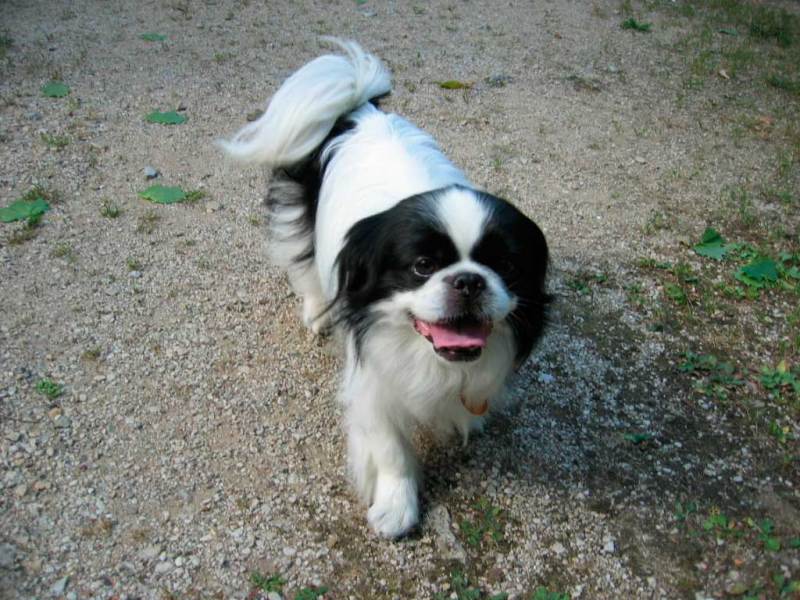
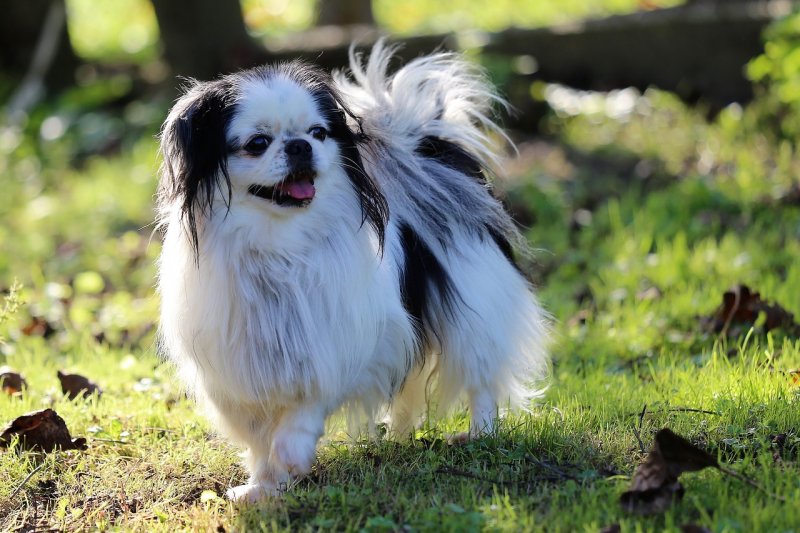
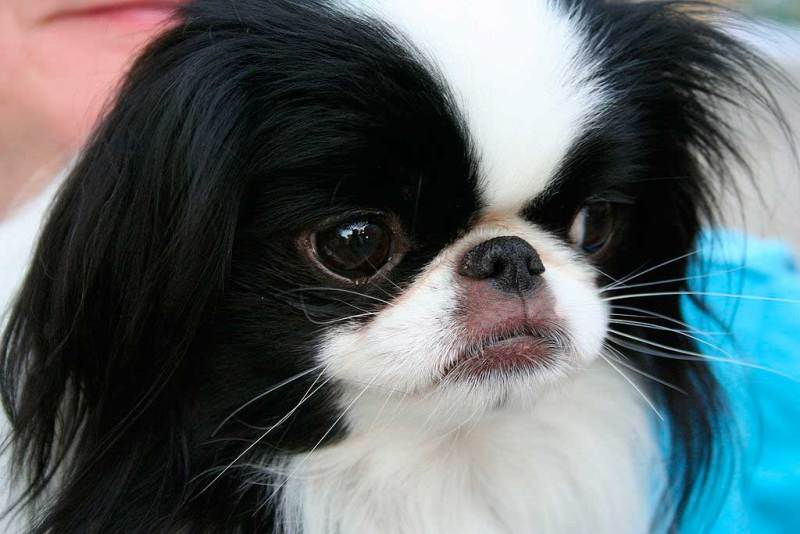
    This small dog of friendly aspect, It has a very similar appearance to that of the Pekingese, But unlike, its legs are longer, and the color of the fur is different; It may be black and white or red and white. The fur is soft and long; the large, dark eyes, well separated from each other; the tail, well endowed with hair, relies on the back; the ears are triangular in shape and small size; the snout is short and flattened, and large heads relative to their body.

    Character and skills

    According to the classification made by Stanley Coren after analyzing the responses of more than 200 the AKC judges ("The Intelligence of Dogs", Stanley city, Ediciones B, 1995), the Japanese Spaniel is No. 62 from the list.

    The Japanese Spaniel barks only when necessary in order to alert the family of the arrival of a visitor or something out of the ordinary, then is a quiet breed.

    It's a very special race, they have very feline attitudes, is more, is said to have the character of a cat, and you will see why...

    The Japanese Chin is always alert, He is intelligent and independent, and it uses its feet to wash and dry your face. Other feline features are your preferences for the rest in elevated surfaces, as the backups of the sofa and chairs. He has a spectacular ability to walk across a tea table without knocking over any objects., If that doesn't make it a cat total!!!

    These dogs were bred and trained for the purpose of loving his people. Although it is usually a quiet dog, He also known for the amount of mischief that make, Welcome to all, like the so-called "Spin Chin", they go around quickly in a circle as if they were dancing but resting only on their hind legs, While with their Forelegs dejan them interwoven and shaking them up top down at full speed, they are very funny.

    The Japanese Spaniel is an excellent companion dog., It is affectionate and loyal to his owner and, normally, happy to see other people, though some mistrust strangers. It is a dog who prefers the family environment, but they adapt very well in new situations and are often used as therapy dogs due to this trait and their love of people.. Socialization at an early age contributes to his temperament of develop optimally, is an emotionally balanced dog, by nature, but it is important to contribute.

    Some usually "sing", They produce a noise that can range from a minimal trill to a high pitch and quite low-pitched for their size., almost operatic quality that sounds like “booooooo”. On race Basenji in the right column you can see a video of the dog singing, it is very similar to what the Japanese Chin.

    Health

    The orbits of the eyes of large contribute to moisture in the face and the folds of skin around the crushed nose and facial area, You can trap moisture and cause fungus problems. The face should be cleaned from time to time with a damp cloth and the folds, with a cotton swab.

    Diet is an important factor in the health and condition of the Japanese Chin, many specimens may be allergic to corn, for example.

    Due to their small size they don't need too much exercise, although yes, requires frequent walks, because they are active and love to be outdoors. They adapt well to life in an apartment or small homes. On the other hand, their fur should brush your daily, as it is often about getting caught.

    Japanese Chin has a long life, to round the 15 years, but in many cases can be extended to more or less the 18 years of age.

    They weigh between 1,8 and 3,3 kand and measured at the cross, of 21 to 25 cm.. The litter is usually fairly small, of between 3 and 4 Puppies.

    Images "Japanese Chin"

    credits:

    1. Japanese Chin, young male by Pointer8 / CC BY-SA
    2. A Japanese Chin by LostinTexas (Alex Archambault) – Flickr
    3. A red Japanese Chin by LostinTexas (Alex Archambault) – Flickr
    4. Japanese Chin with tongue hanging out over crooked teeth by OliviaCC / Public domain
    5. A Japanese Chin puppy. By Rachel Harris (RLH) from Scottsdale, THE, U.S.A. / CC BY
    6. One of our neighbours has this small Japanese Chin. By Mark Hillary
    7. Japanese Chin by https://www.needpix.com/photo/download/1697007/dog-japanese-chin-animal-pet-sweet-white-black-nature-sunset
    8. Japanese Chin by Tingflorance / CC BY-SA
    9. Japanese Chin by Arnaud 25 / Public domain

    Videos "Japanese Chin"

    Type and recognitions:

    • FCI CLASSIFICATION:
    • Group :
    • Section : . .

    Federations:

    FCI ⓘ, AKC ⓘ, ANKC ⓘ, CKC ⓘ, ​KC ⓘ, NZKC ⓘ, UKC ⓘ

    FCI breed standard Japanese Chin

    FCIFCI - Japanese Chin
    Spaniel

    Alternative names:

    1. Japanese Spaniel, Chin (English).
    2. Épagneul japonais ou chin (French).
    3. Chin (German).
    4. Chin (Portuguese).
    5. Chin Japonés, Chin (español).

    ▷ The world of Pets: Dogs, cats, birds, reptiles, amphibians

    Tibetan spaniel
    Tíbet FCI 231 . Tibetan breeds.

    Tibetan spaniel

    The Tibetan spaniel it is an awake and very active dog that is very close to its owner.

    Content

    History

    The Tibetan spaniel is a breed native to the mountainous regions of Tibet, as the name reflects. The ancestors of the Tibetan Spaniel are believed to have appeared two millennia ago, along with the Lhasa Apso, the Shih Tzu and the Pekingese, among others. This dog has long accompanied Buddhist monks in their temples, warning their masters and their companions (mainly to Tibetan Mastiff – Do-Khy) from the slightest intrusion.

    Even though it's called spaniel, has neither the qualities nor the heritage of a hunting dog. It has always been used as a companion and alert dog.. The first representatives of the breed to be brought to England arrived there at the end of the 19th century.. In United States, the Tibetan spaniel began to be adopted during the decade of 1960 and the national club dedicated to the breed was founded in 1971. 13 years later, earned recognition from the American Kennel Club. In the meantime, the 22 in August of 1961, the Fédération Cynologique Internationale (FCI) granted the breed its own ultimate status.

    Photo: Tibetan spaniel by gomagoti – Flickr

    Physical characteristics

    ▷ Fur: silky, glued, smooth, average length, shorter on the face and in the front of the legs. The fringes are present on the back of the front legs. Hair and mane are less dense in females.
    ▷ Color: all colors are allowed, shades and combinations.
    ▷ Head: Small in relation to the body, proud port. The skull is slightly domed, medium width and length. The stop is light but it's marked.
    ▷ Ears: Medium-sized, high insertion, well feathered and hanging.
    ▷ Eyes: oval, dark brown, medium-sized, placed far apart, forward facing, showing an expressive and lively look.
    ▷ Body: rectangular, slightly longer than the height of the withers. The neck is moderately short, strong, covered with a mane (more pronounced in males than females). The loin is straight and the ribs are well sprung.
    ▷ The tail it is high insertion, happily held, forming a loop on the back when the dog is in action and provided with abundant hair.

    Size and weight

    ▷ Male size: 25 – 26 cm.
    ▷ female size: 22 – 24 cm.
    ▷ Male weight: 4 – 7 kg
    ▷ female weight: 4 – 7 kg

    Character and skills

    The Tibetan spaniel is an alert and active little dog that shows great intelligence. Your education is very easy. Loyal to his family and close to his masters, it is a dog that nevertheless needs independence.

    Accumulate many qualities such as affection, the softness, the sensibility. It is a dog very devoted to his family and that adapts as well to a family with children as to a single person or older. It is not an aggressive dog, but be wary of people you don't know, which makes him a very good alert and guard dog because he is full of security.

    The Tibetan spaniel is an indoor dog that fits perfectly into an urban lifestyle, In an apartment. The possibility of enjoying a fenced garden also suits you, but you should always be able to benefit from a shelter from bad weather.

    Education

    The Tibetan spaniel it is a social race that needs regular contact with its humans. They do not respond well when left alone for long periods of time. Having been developed as a companion dog by Tibetan monks, are emotional and empathic with the needs of their owners.

    It is important to socialize him Tibetan spaniel at a young age with a variety of people and situations. They are protectors of their family. Even after socializing, they tend to be distant with strangers. If you are scared or uncomfortable, a Tibetan spaniel will express mistrust with loud alarm barks.

    Although it is not a particularly athletic dog, he needs daily walks for his physical balance, psychological and emotional.

    Health

    The Tibetan spaniel it is a strong and healthy dog. But, the breed is prone to a number of diseases, such as the risk of patella luxation, generalized retinal atrophy, urinary stones and persistent pupillary membrane.

    Grooming

    The Tibetan spaniel It is subject to 2 seasonal moults per year. During these, you are likely to lose hair extensively. Apart from the changes, its maintenance is still undemanding, but it should be done regularly.

    It is recommended to brush the dog once a week outside the shedding periods and daily during them.. Special attention must be paid to the hygiene of the inside of their hanging ears to avoid possible infections. You can give it a bath every 3 or 4 months approximately, but it is not necessary to shear it.

    Food

    The Tibetan spaniel does not need a special diet. Not a very greedy dog. Like all dogs, a good quality diet is advised, adapted to his age, to your state of health and your physical exercise to keep you in good health.

    Price of Tibetan spaniel

    The price of a puppy Tibetan spaniel it will depend on the sex, the pedigree of the parents, compliance with breed standards, etc.

    ▷ Price of a Tibetan spaniel male: of 550 to 1200 EUR.
    ▷ Price of a female Tibetan spaniel : 600 to 1200 EUR.

    breeders of the Tibetan spaniel

    Characteristics "Tibetan spaniel"

    Coexistence is important that you have with your new friend. Before considering the acquisition of a dog of the breed "Tibetan spaniel" you know certain factors. Not all breeds of dogs are apt to live in an apartment, you must take into account his character, their need for exercise, their interaction with other pets, their care and if you have small children, their level of tolerance towards them.

    Adaptation ⓘ

    2,0 of 5 stars (based on 1 review)

    friendly dog ​​ⓘ

    4,0 of 5 stars (based on 1 review)

    hair loss ⓘ

    4,0 of 5 stars (based on 1 review)

    Affection level ⓘ

    3,0 of 5 stars (based on 1 review)

    Need for exercise ⓘ

    3,0 of 5 stars (based on 1 review)

    Social need ⓘ

    1,0 of 5 stars (based on 1 review)

    Home ⓘ

    3,0 of 5 stars (based on 1 review)

    Toilet ⓘ

    3,0 of 5 stars (based on 1 review)

    Friendly with strangers ⓘ

    2,0 of 5 stars (based on 1 review)

    barking ⓘ

    3,0 of 5 stars (based on 1 review)

    Health ⓘ

    3,0 of 5 stars (based on 1 review)

    Territorial ⓘ

    4,0 of 5 stars (based on 1 review)

    Cat friendly ⓘ

    4,0 of 5 stars (based on 1 review)

    Intelligence ⓘ

    4,0 of 5 stars (based on 1 review)

    Versatility ⓘ

    2,0 of 5 stars (based on 1 review)

    Child friendly ⓘ

    4,0 of 5 stars (based on 1 review)

    Surveillance ⓘ

    3,0 of 5 stars (based on 1 review)

    joy ⓘ

    3,0 of 5 stars (based on 1 review)

    Images "Tibetan spaniel"

    Photos:

    1 – Tibetan spaniel by Angelica, CC BY 2.0, via Wikimedia Commons
    2 – Close up view of a Tibetan spaniel by Docter Nick, CC BY-SA 4.0, via Wikimedia Commons
    3 – Buddy, Tibetan spaniel particolor of two years by Ladykransteer, CC0, via Wikimedia Commons
    4 – Tibetan spaniel by https://pixabay.com/es/photos/tibetano-spaniel-cachorro-perro-5214218/
    5 – Tibetan spaniel by Daimen.Richards, CC BY 2.0, via Wikimedia Commons
    6 – Tibetan spaniel relajado by DillyFan503, CC BY-SA 4.0, via Wikimedia Commons

    Videos "Tibetan spaniel"

    Type and recognitions:

    • FCI CLASSIFICATION:
    • Group :
    • Section : . .

    Federations:

    • – FCI – Group 9: Section 5: Tibetan breeds ⓘ
    • – AKC – Toy ⓘ
    • – ANKC – (Toy) ⓘ
    • – CKC – Group 5 – (Toy) ⓘ
    • – ​KC – Toy ⓘ
    • – NZKC – Toy ⓘ
    • – UKC – Group 8 – Companion dog ⓘ

    FCI breed standard "Tibetan spaniel"

    Origin:
    Tibet, China

    Date of publication of the valid original standard:
    18.03.2015

    Use:

    Companion dog


    General appearance:

    It is small, active and vigilant. Well balanced in its overall profile; the body is slightly longer than its height measured at the withers.


    Behavior / temperament:

    It is joyful, very intelligent and behaves with determination. It is reserved with strangers, vigilant, fair, but independent.

    Head:

    It is small in proportion to the body; wears it proudly. His expression is masculine, but without showing coarseness.

    Cranial region:
    • Skull : It is slightly domed, of moderate length and width.
    • Stop : Slightly marked, but defined.

    facial region:

    • Truffle : Preferably black.
    • Snout : Of average length, romo, padded, but without wrinkles. The chin shows some depth and width.
    • Jaws / Teeth : Shows a mild undershot. Regularly arranged teeth; and the lower jaw is wide between the canines. Full dentition is desirable. The teeth and tongue should not be visible while the mouth is closed.
    • Eyes : dark brown, oval, bright and expressive. Medium-sized, rather separated, but with the gaze directed towards the front. Black pigmented eyelid edges.
    • Ears : Medium-sized, pendants, with good pen in adults; quite high insertion. It is desirable that they are slightly separated from the head, but not floating. Large ears are atypical, heavy and low insertion.

    Neck:

    Medium short, strong and well set on the shoulders. Covered with a mane o "chal" (scarf) longer hair, which is more noticeable in males than in females.

    Body:

    Slightly longer from withers to root of tail, that the height measured up to the withers.

    • Back : Straight.
    • Ribs : Well arched.

    Tail:

    High insertion, covered with abundant hair in the shape of feathers and carried happily curled on the back during movement. (It should not be penalized if the tail hangs down while the dog is at rest.).

    Tips

    Former members

    Medium structure bone. Slightly curved forelimbs, but firm on the shoulders.

    • Shoulder : Well oblique.

    Later members

    Strong and well formed.

    • Knee : Moderate angulation.
    • Hocks : Placed well down; viewed from behind should be straight.

    Pies

    Feet shape "hare". Small and well-formed with fringes of hair between the toes that often extend over the feet. Round feet are undesirable, like cat.

    Movement:

    Fast movement, straight, free and energetic.

    Mantle

    Fur

    The outer layer is silky in texture, cuts on the face and on the front of the limbs, of moderate length on the body, rather tight and smooth. The undercoat is thin and dense. The ears and the back of the forelimbs have good stripes; the tail and thighs are well adorned with longer hair. The coat should not be overly developed. Females have less developed coat and mane than males.

    Color

    All colors and their combinations are admitted.


    Size and weight:

    Height to the cross

    Approximate size of 25,4 cm. (10 inches).

    Weight

    Ideal weight of 4,1 to 6,8 kg (9 – 15 English pounds).


    Fouls:

    Any deviation from the aforementioned criteria is considered a fault and the severity of it is considered to the extent of the deviation from the standard and its consequences on the health and well-being of the dog..
    Any dog ​​showing clear signs of physical or behavioral abnormalities should be disqualified..

    disqualifying fouls:

    • Aggressiveness or extreme shyness.
    • Any dog ​​showing clear signs of physical or behavioral abnormalities.


    N.B.:

    Males should have two normal-appearing testicles fully descended into the scrotum..

    Source: F.C.I - International Cynological Federation

    Alternative names:

    1. Tibbie (English).
    2. Du Tibet, Epagneul du Tibet (French).
    3. Tibetan Spaniel (German).
    4. Tibbie (Portuguese).
    5. Tibbie (español).

    ▷ The world of Pets: Dogs, cats, birds, reptiles, amphibians

    Chihuahua
    México FCI 263 . Chihuahueno

    Chihuahua

    This little dog has a personality sassy large.

    Content

    History

    The Chihuahua It is considered the smallest breed in the world; receives the name of the largest state of the Mexican Republic (Chihuahua), where it is assumed that he lived in the wild and was captured and domesticated by the indigenous people during the time of the "Toltec" civilization.; figures of a pygmy dog ​​called "Techichi", who lived in Tula, They were included in the decoration of its architecture which were very similar to the current Chihuahua.

    There is a belief in some countries that the dog gave the name to the state of Chihuahua since the word “Chihuahua” means “arid and sandy place” in Rarámuri, language of the Tarahumara people. Although it is known as Chihuahua, the official name of the race is Chihuahueño, Chihuahua is the name adopted in United States for the race.

    Some experts say dogs were among the first native dogs of the Americas, others that were brought to the New World after the Spanish conquest of Mexico. Others believe that small dogs may have originated as miniaturized versions of pariah dogs, the vague brown dogs with pointed ears that result when dogs are left to breed on their own without color selection or other specific characteristics. In any case, race takes its name from the state of Chihuahua, where American tourists at the end of the nineteenth century first found tiny canines.

    Chihuahuas were brought to United States by American visitors who visited the North of Mexico and, later, presented at trade fairs Canófilas where they became known to worldwide.

    The Chihuahua we know today was developed by American breeders. The first Chihuahua recorded by the American Kennel Club, in 1904, It was called Midget. Chihuahua Club of America was formed in 1923. Today, The Chihuahua ranks 13th among the breeds registered by the AKC.

    Physical characteristics

    The AKC (American Kennel Club) It recognizes two varieties of Chihuahua: long hair and short hair. Many short-haired Chihuahua have very fine hair, but others have a very dense and thick hair. Standards of breeding this dog not generally specify a height, only a weight and a description of its overall proportions. As a result, height varies more than within any other race.

    Usually, the height range is between 15 and 25 cm to the cross. However, some dogs grow up the 30 to 38 cm.. AKC show dogs should weigh no more than 2,7 kg; the FCI standards mark dogs must weigh between 1,5 and 3 kg, Although most small dogs are acceptable in the show.

    But, the quality pet Chihuahua (that is, those bred or purchased as companions rather than show dogs) can, and they achieve greater weight, until 4,5 kg or more if they have a skeletal structure that allows them to being overweight. This does not mean they are not purebred Chihuahuas, It only means that the requirements do not have to enter a display. Larger sized chihuahuas are seen equally in the best and worst bloodlines..

    Usually their teeth are double, This demonstrates the purity of the breed.

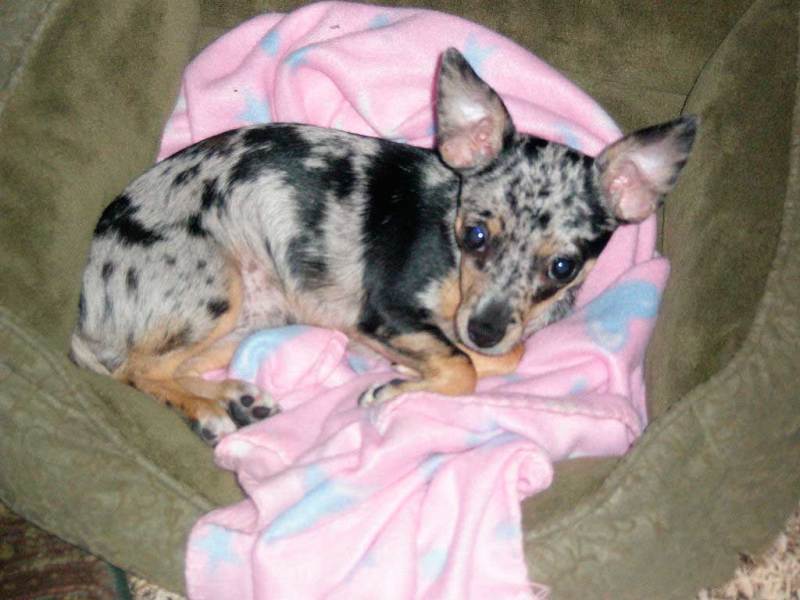
    Chihuahuas can have many colors, from solid black to white solid, spotted, or in a range of colors including Fawn (coffee), chocolate, blue (grey), Silver, tricolor (chocolate, blue, black or white with Brown and white markings), with lines, and speckled. Each of these colors varies in shades and intensities, coffee may be a term to describe a dog from a cream very pale to dark brown (almost Red), or any key within this range of colours.

    Character and skills

    The Chihuahua They are prized for their devotion and personality. Its state of alert, intelligence and size make them adaptable to a variety of environments, including the city and small departments, and usually live fifteen years or more. While often it considered the chihuahua as weak and fragile, correct training and socialization can result in an excellent companion animal.

    The Chihuahua also have a reputation for being spoiled and impregnable, but that is often because people no effort to train. Chihuahuas are like any other dog I: They need consistent rules and structure if they will learn effectively.

    Many chihuahua focus their devotion on one person, putting too jealous of human relationships of this person, This can be mitigated through proper socialization. The Chihuahua tend to have a nature of clans, preferring the company of other Chihuahuas over other dogs.

    As well, important to take into account, These toddlers, They seem to have no concept of its size, and they may face other larger animals, which can cause damage and injury to our pet...

    Health

    Many Chihuahuas are sensitive to cold due to their small body size.. Chihuahua owners often dress their dogs in coats in cold weather, but for this, There is to get them, because if you do not, do not leave place fabrics above.

    This breed requires a veterinary expert in areas such as development and care dental care. Chihuahuas tend to have genetic abnormalities, usually neurological, as epilepsy, strokes. Like other Toy breeds, They also tend to have dislocation of knee.

    Another genetic abnormality in Chihuahuas and other Toy breeds is hydrocephalus, or water on the brain. This condition appears in young puppies and usually results in the death of the puppy, as much, six months of age. It is thought that this disease is diagnosed because the puppy has an abnormally large head during the first months of life, but other symptoms are more noticeable (because "a big head" is a very vague description). Chihuahua puppies showing hydrocephalus They have patched skulls plates rather than solid bone, and are typically lethargic and do not grow at the same rate as their siblings. A true case of Hydrocephalus can be diagnosed by a veterinarian, Although the prognosis is grim.

    However some chihuahua may have what is called 'molera or fontanelle', and it is completely natural and accepted for race, which is a small hole in the head where they do not have bone, only skin and hair. The Chihuahua is the only breed of dog that is born with an incomplete skull.. The fontanelle It closes with age, but it requires great care during the first six months until the skull is fully formed.

    Chihuahua tend to ocular infections, due to its large, round, protruding eyes and their relative proximity to the ground.

    Chihuahuas can also be born with a liver defect known as portosystemic shunt, in which blood is diverted from the liver. This can cause a buildup of toxins in the body of the dog, stunted growth and can be fatal if not corrected with surgery.

    The speckled chihuahua coloring, or parents with such coloration descendants tend to a number of additional complications of health. The mottled coloration is a carrier of other possible and severe ocular conditions and blindness, deafness, Hemophilia, sterility, and other medical conditions. Buyers who own or want to buy a speckled chihuahua should do some research on possible health conditions of this coloration.

    The pregnancy of a Chihuahua, hard 2 months and the offspring measure between 3 cm to 5 cm..

    Chihuahuas are omnivores, and you must be careful in providing an adequate and balanced nutrition. At the same time, be careful in not supercharge this small breed. Chihuahua overweight tend to have problems with ligaments, tracheal collapse, chronic bronchitis, and shortening of life expectancy.

    Some potential buyers looking for extremely small animals; very small dogs, in any way, are false. You can be sick, or malnourished, or, If you are healthy, may suffer from short lifespans and health problems due to extreme dwarfism. They are not normally used for breeding, and may require special care. Some breeders chihuahua, they try to intentionally raise very small animals, and they increase the prices of smaller dogs, or specifically advertise very small animals. Most reputable breeders disapprove such practices, noting that it is difficult to predict the adult size of a puppy, and citing other problems discussed earlier.

    In practice there has been an increase in people wanting to have a Chihuahua Pocket rejecting common size, This has changed the traditional pattern of raising this breed start doing that through the selection of specimens to breed chihuahua focusing on the size and eliminate the problems of a puppy that was born visibly smaller than others, many breeders reject this practice but it is a fact that the popularity of the “Pocket Chihuahua” has come to stay...

    The tiny mouths often mean that there is no room for proper development of teeth. It is essential that a veterinary chihuahua receive regular dental care, and you may need to draw him some teeth to make room for proper development of the rest of the teeth in the mouth.

    The Chihuahua “deer head” is the original Mexican Chihuahua, He was abroad where changed his appearance through crossing with other breeds, That is when its general appearance begins to change, now with a more prominent head and a more robust body, and it is precisely abroad where, when establishing the racial norm of the breed, this type of modified Chihuahua is established as the "standard" when the original It is the "deer" type and the damage to the original breed went even further by disqualifying the "deer" type and describing it as an "abnormality.".

    This "abnormality" is more popular than any Canophile Federation would like to accept..

    "Deer" or "deer head" These are terms that are sometimes used to describe Chihuahuas that do not have the standard "apple head" appearance of the breed.. These terms are not official.

    The Deer heads They are not admitted for competition, they are disqualified, they are not for sale.

    The «Nano Chihuahua» term used in the United States are chihuahua that are described with head up, and a very long nose, is not something natural, they are like this because they suffered a deformation in the bones due to malnutrition, These terms are not official, and the sale of the “Nano Chihuahua” is prohibited. Those that are accepted are “Apple Head” Chihuahua

    The life of the chihuahua usually up to 15 years of age. The more small are dogs more life they have. Their life expectancy depends first of all of their food (It is necessary, good quality and which have no obesity). Example: Not offer cookies, fat, chocolates, sweet, bread, pork and, much less, chicken bones to chew it becomes small needles, and they stuck in its body until his death. Not to give anything of great food, simply their respective croquettes or latitas for small breeds.

    Reproduction

    The sexual cycle of the dog is, in comparison with the rest of the domestic animals, is unique in many ways, now that the time lag between periods of estrus (5-7 months) It is very long in proportion to the time of gestation (62 days), and ovulation occurs only once (but in several days) by zeal.

    The sexual cycle is divided in 4 stages:

    PROESTRO: have an average duration of 3-15 days. External manifestations are increasing the volume of the vulva, Vulvar blood loss and male attraction. At this stage the dog does not support mounting of the male.

    ESTRO: popularly known as period of ZEAL. It has a duration of 3 to 10 days. The vulva is enlarged, There is a reduction of losses vulvar and attraction of male: It is at this time when ovulation occurs, mounting of the male and gestation.

    DIESTRO: (of 110 to 140 days): This period includes the gestation, childbirth and lactation if occurred fertilization and the regression to normal tissues if not occurred.

    ANESTRO (of 150 to 250 days): now there are no external signs and is the ideal for all kinds of interventions (ovary hysterectomy).

    So that, ovulation takes place during the mating season and it's a spontaneous ovulation. Most often it is between the day 10 and 14 the beginning of zeal, Although in less of 1 minute can be confirmed with a vaginal smear performed by a veterinarian.

    Pregnancy in the bitch has a duration of 58 to 63 days. The normal delivery period ranges from 5 and 24 hours, and alghourscasos, mainly if they are first-time, the time may be extended until 36 hours.

    The delivery mechanism is divided into three phases:

    • The first phase corresponds to the opening and relaxation of the cervix for the exit of the puppies.. The female trembles, Pant and may vomit. The vulvar lips thicken and a yellowish-white viscous liquid escapes from the lower corner.. You can see uterine contractions, but always of weak intensity. go in circles, recuesta in soil, and does not want to eat or drink (Although some females show a voracious appetite).
    • The dog chooses a quiet, dark place, and he prepares his paridera breaking rags and materials; It is desirable to provide elements so that you can make this work, more usual is the role of journal. Nothing should bother to her around.

    • The second phase is the expulsion of the puppies. The female is lying in position on one side, with the face directed towards your abdomen and contractions begin each 2 or 3 minutes, with great effort.

    Grooming

    Chihuahuas have two types of hair:

    • smooth and long. The Chihuahuas smooth They carry a velvety coat, bright and tight and have a collar – an area hair thicker and longer – around the neck. Coverage have little hair on the head and ears. The tail should be hairy, not naked. Brush them weekly with a rubber glove or soft bristle brush to remove dead hair and keep their skin and coat healthy.
    • The Long haired chihuahua It is the product of a recessive gene, which means that a puppy must have the gene from both parents to express long hair, so it is not seen in litters as often as smooth. The long, soft fur is flat or slightly curly, and the dog has a collar around the neck, fringed ears, feathers on the legs and a tail plumed. Hair from the rest of the body is almost as soft as soft straight hair Chihuahua. The long-haired Chihuahua are beautiful, and they are easy to comb, but the hair falls are seasonal.

    Long robe brushing with soft bristle brush once or twice a week. Use a stainless steel comb to remove tangles of hair ears, legs and tail.

    If brush to the faithful chihuahua, should not need frequent baths. But, If you spend much time on your couch or in bed, there is nothing wrong with bathing as often as twice a week. Use a mild shampoo made for dogs and dry it well so it doesn't get cold. Never let it sit and dry to the outdoors.

    Keep clean your big ears chihuahua with a solution recommended by your veterinarian. Do not use cotton swabs within the ear; They can push dirt deeper. Laa orejaa clean with a cotton ball, I never deeper than the first knuckle of your finger.

    Cut off nails regularly, usually every two weeks. They should never be so long that hear smacking on the floor.

    Characteristics "Chihuahua"

    Coexistence is important that you have with your new friend. Before considering the acquisition of a dog of the breed "Chihuahua" you know certain factors. Not all breeds of dogs are apt to live in an apartment, you must take into account his character, their need for exercise, their interaction with other pets, their care and if you have small children, their level of tolerance towards them.

    Adaptation ⓘ

    5,0 of 5 stars (based on 1 review)

    friendly dog ​​ⓘ

    3,0 of 5 stars (based on 1 review)

    hair loss ⓘ

    1,0 of 5 stars (based on 1 review)

    Affection level ⓘ

    5,0 of 5 stars (based on 1 review)

    Need for exercise ⓘ

    1,0 of 5 stars (based on 1 review)

    Social need ⓘ

    5,0 of 5 stars (based on 1 review)

    Home ⓘ

    5,0 of 5 stars (based on 1 review)

    Toilet ⓘ

    1,0 of 5 stars (based on 1 review)

    Friendly with strangers ⓘ

    3,0 of 5 stars (based on 1 review)

    barking ⓘ

    5,0 of 5 stars (based on 1 review)

    Health ⓘ

    4,0 of 5 stars (based on 1 review)

    Territorial ⓘ

    4,0 of 5 stars (based on 1 review)

    Cat friendly ⓘ

    5,0 of 5 stars (based on 1 review)

    Intelligence ⓘ

    5,0 of 5 stars (based on 1 review)

    Versatility ⓘ

    3,0 of 5 stars (based on 1 review)

    Child friendly ⓘ

    1,0 of 5 stars (based on 1 review)

    Surveillance ⓘ

    3,0 of 5 stars (based on 1 review)

    joy ⓘ

    4,0 of 5 stars (based on 1 review)

    «Chihuahua» images

    credits:

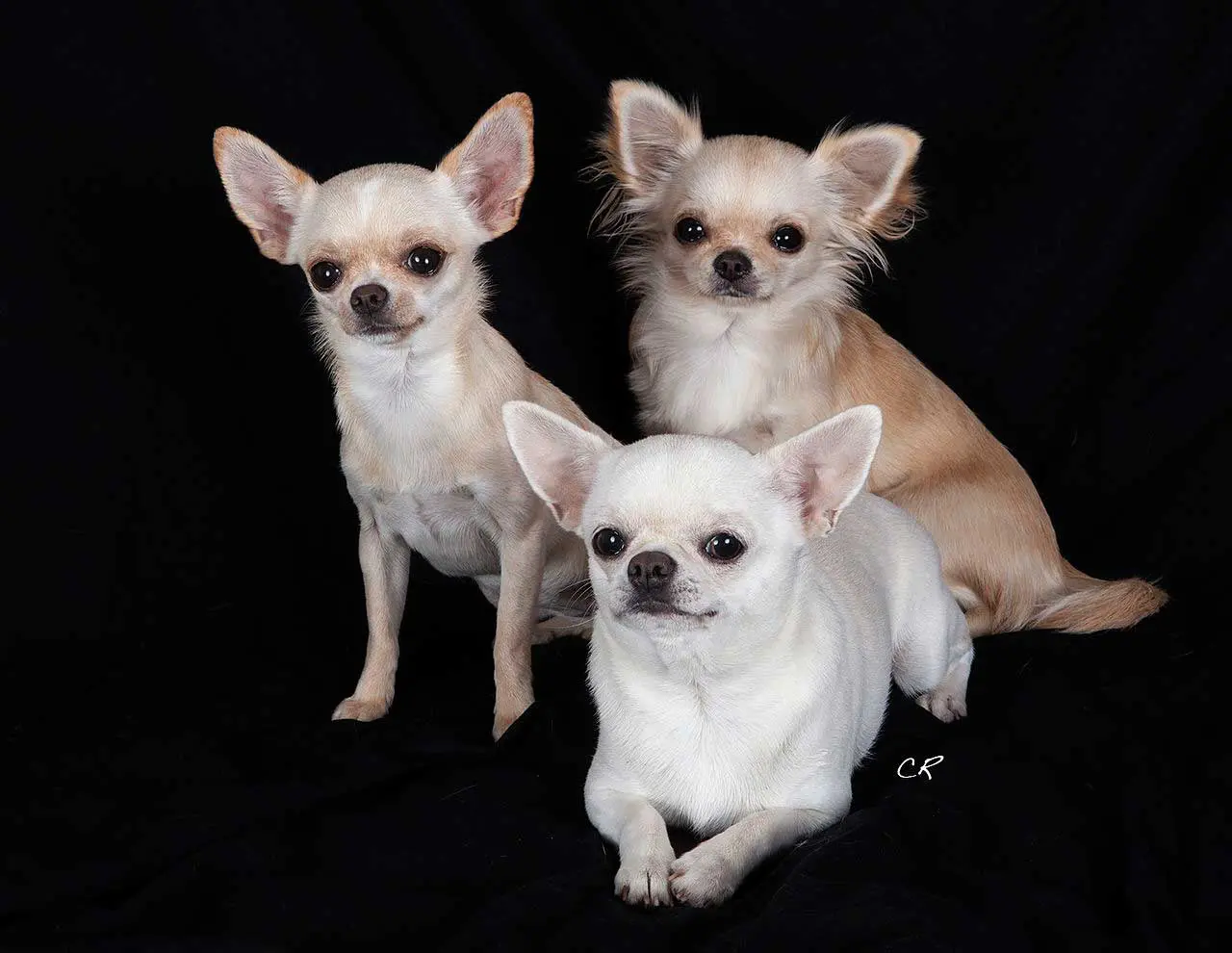
    1. triplet chihuahua by Caterinarufo / Public domain
    2. Chihuahua by https://www.pexels.com/es-es/foto/animal-chihuahua-mascota-ojos-50718/
    3. Chihuahua by https://pxhere.com/es/photo/60641
    4. Blue merle chihuahua by Nuclearblitz12 / CC BY-SA
    5. Chihuahua by https://www.pexels.com/photo/photo-of-tan-chihuahua-1048236/
    6. A Chihuahua protecting its bone by David Shankbone / CC BY
    7. standard chihuahua by Caterinarufo / Public domain
    8. Buddy the Chihuahua by Jean G – HTTPS://www.flickr.com/photos/whatjeanlikes/
    9. Chihuahua by https://www.pxfuel.com/es/free-photo-xzmeb

    «Chihuahua» Videos

    Type and recognitions:

    • FCI CLASSIFICATION:
    • Group :
    • Section : . .

    Federations:

    • – FCI – Group 9: Section 6: Chihuahueno ⓘ
    • – AKC – Toy ⓘ
    • – ANKC – Group 1 (Toy) ⓘ
    • – CKC – Group 5 – (Toy) ⓘ
    • – ​KC – Toy ⓘ
    • – NZKC – Toy ⓘ
    • – UKC – Group 8 – Companion dog ⓘ

    FCI breed standard "Chihuahua"

    Origin:
    Mexico

    Date of publication of the valid original standard:
    04.09.2019

    Use:

    Companion dog.


    General appearance:

    It is a dog with a compact body, It is of primary importance to note that its head is apple-shaped and its tail is moderately long, carried high, arched or semicircle., with the point directed towards the spine.

    important proportions: The length is slightly greater than the height at the withers, wishing for an almost square body, especially in males and allowing a little longer in females for reproductive function.


    Behavior / temperament:

    Lively, alert, restless and very brave.

    Head:


    Cranial region:
    • Skull: Well rounded, tamed (special feature of this breed).    
    • Depression nasal fronto (Stop): Well marked, sunken and wide, as a result of the bulging forehead on the insertion of the muzzle.

    facial region:

    • Truffle: Moderately short and slightly upturned; any color is allowed.
    • Snout: Short; seen in profile maintains a straight line, being wider at its base and tapering towards the tip.
    • Lips: Clean and tight.
    • Cheeks: Little developed and very clean.
    • Jaws / Teeth: With scissor or level bite (clip-shaped); higher or lower prognathism are seriously penalized, as well as any maxillary or mandibular deformation.
    • Eyes: They are big and round, very expressive, never protruding, perfectly dark. Light eyes are allowed but not desired.
    • Ears: Large, erect and unfolded and widely open; wide at its base, taper gradually until slightly rounded at the tip. When at rest they form an angle of 45° to the sides.

    Neck:

    • Top profile: Slightly arched.
    • Length: Medium.
    • Form: Thicker in males than females.
    • Skin: No double chin; the long-haired variety features a highly desirable longer-haired mane.


    Body:

    Compact and well structured.

    • top line : Straight.
    • Cross: Bit strong.
    • Back: Short and firm.
    • Pork loin: Strongly muscular.
    • Rump: Wide and strong, almost flat or slightly sloping.
    • Breast : With wide and deep thorax and well arched ribs; seen from the front it will have good amplitude, without excess; seen in profile descends to the elbow; never barred.
    • Lower profile: Determined by a ventral retraction, which should be well delineated. Loose belly is allowed, but not wanted.

    Tail:

    Moderately long, set high, wide at the base gradually tapering towards the tip, it is flat in appearance. The bearing is an outstanding trait of the breed, in motion is elevated, arched or semicircular with the tip directed towards the spine, giving balance to the body, it never appears tucked between the limbs or curled below the upper line of the back. Hair cover in harmony with the rest of the body depending on the variety. In the long-haired variety it is covered with feather-shaped hair; at rest it is hanging with a light hook.

    Tips

    Former members

    • General appearance:  Seen from the front they appear in a straight line with the elbows; seen in profile they are well poised.
    • Shoulder: Cleansed, moderately muscular.
    • Arms (Humerus) : With good angulation in the scapular joint?humeral.
    • Elbow: Firm and close to the body, allowing freedom of movement.
    • forearms :  Strong with good length.
    • Metacarpus: Slightly inclined, strong and flexible.
    • Front feet : The feet are very small and oval, with fingers spread,  but not extended(they are neither hare nor cat); nails are particularly curved and moderately long, with well developed and highly elastic ear pads.  Dewclaws are undesirable.

    Later members

    • General appearance :  Well muscled, long-boned, well plumb and parallel to each other with good angulation in the coxofemoral joints, femoro-tibial-patellar and tibio-tarsal according to the forelimbs.
    • Metatarsals:  Short hocks, with well developed tendons; seen from behind they are separated, straight and vertical.
    • Rear feet : The feet are very small and oval, with fingers spread,  but not extended(they are neither hare nor cat); nails are particularly curved and moderately long, with well developed and highly elastic ear pads.  Dewclaws are undesirable.

    Movement:

    Features a long and flexible stride, firm and active, with good anterior reach and a lot of posterior thrust. Seen from behind, the posterior ones should remain almost parallel to each other, placing the feet of the hind limbs in the footprints of the forelimbs. The members tend to converge in the direction of a central line of gravity, as speed increases. They show great elasticity and freedom, without any effort, with your head always high and your back steady.

    Mantle

    Skin: Smooth and elastic over the entire body surface.


    Fur

    There are two varieties in this breed.

    • Short Hair Variety: It is short and stuck all over the body,  slightly longer when undercoat (entrepelo); tight throat and abdomen allowed. It is slightly longer on the neck and tail, short on face and ears; it is shiny and its texture smooth. Hairless specimens are not accepted.
    • Long Hair Variety: Hair must be fine and silky, straight or slightly wavy; inner layer is desired (entrepelo) not very dense. It has very long hair in the shape of a feather in the ears, neck, posterior aspect of the forelimbs and hindquarters, foot and tail. Dogs with long and fluffy hair are not accepted.

    Color

    All colors are accepted in all their shades and combinations, except the blackbird.


    Size and weight:

    The size should not be taken into account in this breed, just the weight.

    • Weight : Ideal weight between 1,5 kg and 3 kg.  Dogs are tolerated between 500 gr y 1,5 kg.

    The horses with less than 500 gr and with more than 3 kg.


    Fouls:

    Any deviation from the aforementioned criteria must be considered a fault and its seriousness is considered to the degree of the deviation to the standard and its consequences on the health and well-being of the dog.

    • Missing teeth
    • Double denture (retention of temporary teeth)
    • Pointy ears
    • Short neck
    • Long body
    • Bowed or bowed back (lordosis o xifosis)
    • fallen group
    • Narrow chest; flat rack
    • Badly implanted tail, twist it cuts it
    • Short members
    • Elbows detached
    • Joined hindquarters.

    Serious misconduct:

    • Narrow skull
    • Small eyes, sunken or protruding
    • Long snout
    • Upper or lower prognathism
    • Unstable knee.

    disqualifying fouls:

    • Aggressive or fearful dog
    • Any dog ​​showing clear signs of physical or behavioral abnormalities must be disqualified.
    • Deer type dogs (dogs with an atypical or highly stylized structure : refined head, long neck, slender body, long limbs)
    • Specimens with open head
    • Droopy or short ears
    • Deformed bite
    • Extremely long-bodied dogs
    • Absence of tail
    • Dogs with very long hair, fine and fluffy in the long-haired variety
    • No hair (alopecia) in the short-haired variety
    • Blackbird colored specimens
    • Weight less than 500 gr or greater than 3 kg


    N.B.:

    Males should have two normal-appearing testicles fully descended into the scrotum..

    Source: F.C.I - International Cynological Federation

    Alternative names:

    1. Chi, Chi-chi, Hua-Hua, Chihuahueño (English).
    2. Chihuahueño, aussi chihuahua (French).
    3. Chihuahua (German).
    4. Chihuahueño (Portuguese).
    5. Chihuahua, chihuahua mejicano (español).

    ▷ The world of Pets: Dogs, cats, birds, reptiles, amphibians

    Little Lion Dog (Löwchen)
    Francia FCI 233 . Little Lion Dog

    The Little Lion Dog It is little known, so much that in 1960 was defined as the rarest dog in the world.

    Little Lion Dog

    Content

    Characteristics "Little Lion Dog (Löwchen)"

    Coexistence is important that you have with your new friend. Before considering the acquisition of a dog of the breed "Little Lion Dog (Löwchen)" you know certain factors. Not all breeds of dogs are apt to live in an apartment, you must take into account his character, their need for exercise, their interaction with other pets, their care and if you have small children, their level of tolerance towards them.

    Adaptation ⓘ

    2,0 of 5 stars (based on 1 review)

    friendly dog ​​ⓘ

    4,0 of 5 stars (based on 1 review)

    hair loss ⓘ

    3,0 of 5 stars (based on 1 review)

    Affection level ⓘ

    5,0 of 5 stars (based on 1 review)

    Need for exercise ⓘ

    3,0 of 5 stars (based on 1 review)

    Social need ⓘ

    4,0 of 5 stars (based on 1 review)

    Home ⓘ

    3,0 of 5 stars (based on 1 review)

    Toilet ⓘ

    3,0 of 5 stars (based on 1 review)

    Friendly with strangers ⓘ

    2,0 of 5 stars (based on 1 review)

    barking ⓘ

    4,0 of 5 stars (based on 1 review)

    Health ⓘ

    5,0 of 5 stars (based on 1 review)

    Territorial ⓘ

    4,0 of 5 stars (based on 1 review)

    Cat friendly ⓘ

    4,0 of 5 stars (based on 1 review)

    Intelligence ⓘ

    5,0 of 5 stars (based on 1 review)

    Versatility ⓘ

    3,0 of 5 stars (based on 1 review)

    Child friendly ⓘ

    5,0 of 5 stars (based on 1 review)

    Surveillance ⓘ

    3,0 of 5 stars (based on 1 review)

    joy ⓘ

    4,0 of 5 stars (based on 1 review)

    History

    The origins of Little Lion Dog, also called Löwchen they are old and controversial. The most widespread theory places its origins in northern Europe (Germany, Belgium and France) and claims that it is related to the Miniature Poodle breed., while another theory places its origins in the Mediterranean regions of Spain and France and states that it is closer to the Bichon.

    Some give it a much more exotic origin, claiming that it descends from dogs that came from Tibet via Russia: However, this theory seems unlikely and is most certainly due to a mispronunciation, since his name is sometimes pronounced "Low Chen» in the Anglo-Saxon world, what gives it Asian sounds. Another hypothesis based on linguistics claims that his name is not a reference to the king of animals, but to the city of Lyon, from which it would originate.

    Although its origins are unclear, the truth is that the Little Lion Dog It was already a highly sought-after companion dog in the Middle Ages.. This animal with its characteristic fur appears in numerous paintings, engravings and tapestries from the 15th centuries, 16Th and 17TH. One of the first representations of the breed can be seen in France, in the cathedral of Amiens, built in the 13th century, where two little lion dogs are carved in stone, perfectly representative of the breed.

    Its famous lion's mane shearing is linked to the values ​​of the aristocracy during the Renaissance. As the lion represents strength and courage, the men used the Little Lion Dog as a status symbol. As for women, they appreciated being able to warm their feet against their little companion's bare skin and spend time grooming him this way.

    So that, it is this peculiarity relative to the animal's fur that is at the origin of its name, even if it is not natural.

    In the 18th century, both the Earl of Buffon (1707-1788) in his famous Natural History as the Swedish naturalist Carl Linnaeus (1707-1778), known as Carl von Linné for his ennoblement and author of Systema Naturae, they described the Löwchen and highlighted its rarity.

    The breed gradually declined during the 19th century, and it was rare in 1897, when Mr.. by Coninick, a breeder of Dieghem (Belgium), sold a bitch of Little Lion Dog white to young Madelaine Bennert (1876-1972), also from Belgium, who fell in love with this nice dog.

    The two world wars were about to suppose the death of this race. But, in 1944, Madelaine Bennert vowed to save the Löwchen starting a breeding program. Found two females, respectively in Lille and in the Dieghem region, and then a male named Ulan. The first litter was born in 1948. Later, a new female named Sirginia joined the program, and Hans Rickert, a german vet, teamed up with Mrs. Bennert to relaunch the breed. The dogs they used and gave birth to are the origin of the Löwchen what we know today.

    His efforts paid off in 1961 When the Fédération Cynologique Internationale (FCI) officially recognized the breed, designating France as your country of origin.

    But, It was from Germany that the first specimens were exported to Great Britain in 1967 and then to the United States in 1971, which undoubtedly explains why this dog is now much better known with its Germanic name than with the French. But, at that time it was still a very rare breed: with less than 50 registered copies (half of them in Germany), It was even designated “the rarest dog breed in the world” by the Guinness Book of Records..

    While the British Kennel Club quickly recognized the Little Lion Dog (already in 1971), the Canadian Kennel Club (CKC), the American Kennel Club (AKC) and the United Kennel Club (UKC) they waited until 1994, 1995 and 1999, respectively, to give you full breed status.

    Today, although it is still rare, the Little Lion Dog It is no longer an endangered breed and can count on a loyal fan base. The Löwchen is at the bottom of the popularity ranking in the United States (around the stall 170 of 190), but it enjoys a certain popularity in Britain, where some are registered 80 births per year. But, this figure tends to erode, since around 2010 I was well above 100. In France, the Livre des Origines Français (LOF) records an average of 70 new Löwchen per year, and the trend has been stable since the early 1990s. 2000.

    Photo: Lowchen by Jappitoo, CC BY-SA 3.0, via Wikimedia Commons

    Physical characteristics

    The Little Lion Dog it is a small dog breed with a robust appearance and solid bones. His body is square in shape, as high as long, and her back is straight, like its front legs. The tail, placed just below the line of the back, it is carried high and curved.

    The head of the Löwchen it is relatively wide and short, with a wide muzzle ending in a black nose. The big eyes, dark and round should be well positioned forward and express drive and intelligence. The ears are low set, at the height of the eyes, and they fall quite low.

    The coat is long and silky, and consists solely of a dense, wavy top layer. It is important to know that the "lion's mane" appearance so typical of the breed is not natural., but it is due to the cutting of part of its fur. Although this is mandatory for individuals participating in dog shows, a Löwchen confined to the role of companion dog can perfectly keep its long hair on the whole body.

    The breed standard allows all colors and color combinations, but the white, cream and black are the most popular.

    Last, there is little sexual dimorphism in this breed.

    Size and weight

    ▷ Male size: Of 25 – 33 cm.
    ▷ female size: 25 – 33 cm.
    ▷ Male weight: 5 – 7 kg
    ▷ female weight: 5 – 7 kg

    Character and skills

    The Löwchen has been used as a pet for many centuries, and is extremely loving and attached to his family. They love spending time with their owners, either playing with them or just lying next to them. This attachment makes it a breed of dog that does not tolerate loneliness well.: if left alone frequently for several hours at a time, you are likely to suffer from separation anxiety. This can lead to excessive barking., scratches on the door or even destructive behavior.

    Rather distrustful, the Little Lion Dog not very sociable with strangers, those he greets with barks. But, They accept them quickly once they realize that they are friends of the family and that they too get their share of attention.

    Playful dog, he likes to have fun with the children he knows, but he is less receptive to those he does not know. As with all dogs of any size, should not be left alone with young children, especially if one or more of them are unknown.

    Used to getting all the attention from your family, to the Little Lion Dog does not particularly like to share his home with other animals, whether they are companions or representatives of other species. On the other hand, accepts perfectly those with whom he has grown up and whom, Therefore, consider part of the family, although there is a risk that rodents will one day awaken their hunting instincts.

    Regardless of its small size, not afraid to provoke other dogs much bigger than him, without being aware of the danger. So, a certain vigilance is necessary during walks, and particularly during encounters with unfamiliar dogs.

    Despite the tendency to bark when he hears or sees something out of the ordinary, what can cause neighborhood problems, fits very well in apartment living, as long as you walk at least 20 minutes a day. But, to prevent something bad from happening to you, it is better that this walk be done on a leash. It also, if you have access to a garden, make sure that the latter is perfectly closed, since wandering the big world alone is quite risky for him, in particular because of its small size and its tendency to attack those bigger and stronger than it.

    Intelligent, affectionate and endearing, the Löwchen it does not take long to win the hearts of his family, that you may even end up realizing that you have adapted your lifestyle to that of this new member, reserving your favorite spot on the couch or matching your bedtime and waking time with theirs. Many owners admit that they "belong" to their Little Lion Dog… but they are absolutely delighted with him.

    Curious and sometimes stubborn, this little bundle of joy is sure to delight singles and large families alike. He knows how to make himself loved and fills the lives of those who have time to dedicate to him, but his place is as close to his master as possible: does not about, for example, to make him spend the nights in another place that is not inside the home.

    In short, although their barking and possible difficulty learning grooming can cause difficulties, his affectionate character, His obedient nature and unlimited attachment make him an ideal companion dog - as long as you have time to dedicate to him., and this even without experience. It is undoubtedly a good option for a first dog to adopt.

    Education

    The socialization of Löwchen should be started at an early age, so that it is perfectly balanced in adulthood. In addition to meeting all the members of his family (including other animals in the house), you must get used to all the stimuli and situations that you may encounter later: other people and animals, vehicles, city ​​noises, etc.

    Cleaning training should also be undertaken as soon as you arrive at your new home., at the risk of never being able to correct the bad habits acquired. It is important to take him out as often as possible to relieve himself outside and be vigilant when he is inside, to identify the places you have chosen as toilets.

    Another aspect that must be worked on as soon as possible is that of barking, since the Little Lion Dog tends to bark more than it should. Good socialization and work at this level as part of your education can quickly solve this problem.. As such, an inexperienced owner may need the help of a professional dog trainer.

    But, this dog is smart and learns quickly. His desire to please his owner makes him an easy dog ​​to train, even without much experience. With a little patience, a beginning owner can teach you all the basic commands, like "sit" and "down", and even go further in his education teaching him more advanced tricks.

    It also, if he can have the vocation to participate one day in a dog show and then he will have to raise a lion's mane skin, it is necessary to accustom your partner to shearing when he is still a puppy, so that from then on you will not be afraid of these grooming sessions.

    Being a very emotional dog, the Löwchen can be traumatized by traditional dog training methods. It is advisable to use the positive reinforcement method, rewarding good behavior with lots of caresses, affection and treats.

    Health

    Thanks to the rigorous breeding program carried out in the years 70, the Löwchen it is a very robust breed of dog, who is normally immune to serious inherited diseases, as long as, of course, a breeder of Löwchen responsible.

    The most common health problems of this dog are:

    • Canine eye diseases, like the falls, progressive retinal atrophy or distichiasis, a condition that causes hair to grow on the inside of the eyelids and can be surgically corrected;
    • Hip Dysplasia;
    • Patellar dislocation;
    • congenital deafness, a relatively rare problem outside certain lines.
    Life expectancy

    12 to 14 years

    Grooming

    The Little Lion Dog requires some maintenance effort. In fact, although she changes very little, if it does (which often makes it a recommended dog breed for allergy sufferers), it is recommended to brush it every two or three days to keep its beautiful coat in good condition and avoid knots, that are as unsightly for their owner as they are uncomfortable for him. It is also useful to bathe him about once a month, taking care to use a specific shampoo for dogs.

    When brushing your dog's hair, check your eyes and ears to make sure they are clean and not at risk of infection.

    It also, how he usually spends most of his time indoors, natural wear and tear on the nails is seldom enough, so it is necessary to trim them regularly to avoid embarrassment or even injury.

    Any owner who wants their dog to participate in dog shows should plan to take their companion to the groomer every two months or so, so that you can show off the beautiful mane so typical of the breed. But, it must be remembered here that the dog's coat allows him to conserve heat: if you live in a cold region, shaving it in winter is not necessarily ideal…

    Utility

    The Little Lion Dog has always been a companion dog, and this is still its main function today: be with your family and bring them love and happiness.

    But, can also be useful as an alert dog, barking at the approach of a stranger. Brave, does not hesitate to defend his family, but its size does not allow it to play the role of watchdog.

    They can also be trained to be admirable athletes in obedience and agility competitions..

    He is also a regular at dog shows, where fans can admire the most beautiful specimens of the breed.

    Last, his cheerful and optimistic demeanor allows him to be used as a therapy dog.

    Images "Little Lion Dog (Löwchen)"

    Photos:

    1 – Little Lion Dog by https://pixabay.com/es/photos/perro-lowchen-löwchen-paja-1330537/
    2 – Basil Smile (un perro de Löwchen, Ch Taywill Brillant Roman Basilia) mostrando su rostro by John M. P. Knox from Austin, USA, CC BY-SA 2.0, via Wikimedia Commons
    3 – Lowchen by Jappitoo, CC BY-SA 3.0, via Wikimedia Commons
    4 – Adult Lowchen Gaiting by Jk9dat, CC BY-SA 4.0, via Wikimedia Commons
    5 – This is a 9 month old Lowchen puppy by Jk9dat, CC BY-SA 4.0, via Wikimedia Commons
    6 – Lowchen-10-Ch-Boondock Musicbox Don’t Roll Those Eyes At Me! 02 by Petful

    Videos "Little Lion Dog (Löwchen)"

    Type and recognitions:

    • FCI CLASSIFICATION:
    • Group :
    • Section : . .

    Federations:

    • – FCI – Group 9: Companion and Toy Dogs – Section 1.3: Little Lion Dog ⓘ
    • – AKC – Non-Sporting ⓘ
    • – ANKC – Group 1(Toys) ⓘ
    • – CKC – Group 6 (Non-Sporting) ⓘ
    • – ​KC – Toys ⓘ
    • – NZKC – Toys ⓘ
    • – UKC – Companion Breeds ⓘ

    FCI breed standard "Little Lion Dog (Löwchen)"

    Origin:
    France

    Date of publication of the valid original standard:
    24.03.2004

    Use:

    Companion dog.


    General appearance:

    He is a smart little dog full of enthusiasm, with an expression of liveliness and alertness. The set is robust, with good bone structure, short and well proportioned body, the head is high and the silhouette is plump. His step is haughty and determined, accented by the floating mane of the lion arrangement; unshaven parts must be totally natural, in no case should they be sculpted. You must have the lion arrangement for the exhibition.

    important proportions:

    The Little Lion Dog has a square shape. The length of the body (scapular-ischial) is equal to the height at the withers. The length of the muzzle visibly represents the 2/3 the length of the skull.


    Behavior / temperament:

    He is very affectionate and obedient to his masters, is attentive and responsive. He is comfortable in any circumstance and knows how to remain calm and discreet when asked. His frank and tender gaze seeks to understand what is expected of him.

    Head:

    Relatively short and fairly wide from top of skull to muzzle. The head is high.

    Cranial region:
    • Skull: Rather flat, of the same length and breadth.
    • Depression links (Stop): Moderately arched.

    facial region:

    • Truffle: Black (mandatory full pigmentation), except for brown coats and their derivatives: in this case the truffle is dark brown (mandatory full pigmentation). The truffle is found in the prolongation of the nasal canal.
    • Snout: Rather wide, straight.
    • Lips: Well together and blacks, except for brown coats and their derivatives: in this case the lips are dark brown.
    • Jaws/Teeth: Strong and complete teeth, features a scissor-shaped joint. The absence of PM1 is accepted.
    • Eyes: Well positioned in front. They are large, very dark, round, well separated, the gaze should be directed to the front. The eyelids are fully pigmented.
    • Ears: Low insertion ligament (at eye level). They are medium long; if stretched they can reach about half the length of the muzzle. They are dangling and he has thick bangs. The fringes can reach at least to the tip of the nose.

    Neck:

    Good length. It is slightly arched and blends harmoniously with the shoulders and withers.

    Body:

    • top line: It is straight.
    • Pork loin: Short, wide and muscular.
    • Breast : Well developed, descends to the elbows.
    • Belly: Well up

    Tail:

    Insertion very slightly below the back line. She appears gracefully hunched over her back, although without touching her, only the plume touches it, both when the dog is perched, like when in motion.

    Tips

    Former members:

    They are well poised.

    • Shoulder : well laid, well mobile, well musculosome omoplatos.
    • Elbows : Well applied to the body.
    • Metacarpus : Seen from the front, they are short and straight. Seen in profile, they are very slightly bent.
    • Pies : Small and round. Fingers are tightly knit and well arched.
    Later members:

    They are well poised.

    • Thighs and legs : Well muscled. The length of the tibia is equal to that of the femur. The tip of the gluteus is slightly protruding.
    • Hock : Pretty strong. The tip is located approximately ¼ of the height at the withers. Angulation is normal.
    • Metatarsals : Robust, well perpendicular to the ground.
    • Pies : Small and round, the fingers are arched and together.

    Movement:

    It is agile, energetic and spacious. The limbs are well parallel when the dog is in action. The bearing of the head is haughty.

    Mantle

    • Fur: Pretty silky, long, wavy, dense; there is no presence of an undercoat of hair.
    • Color: All colors or color combination are accepted.


    Size and weight:

    • Size: 26 to 32 cm to the cross, with a tolerance of 1 cm more or less.
    • Weight: Some 6 kg.


    Fouls:

    Any deviation from the aforementioned criteria is considered a fault and its seriousness is considered to the degree of the deviation to the standard and its consequences on the health and well-being of the dog..

    disqualifying fouls:
    • Aggressiveness or extreme shyness.
    • Any dog ​​showing clear signs of physical or behavioral abnormalities.
    • Total or partial depigmentation of the nose, from the edge of the lips and eyelids or any color other than black, or another color other than dark brown in brown coats and its derivatives.
    • Splattered nose.
    • Absence of one or more incisors or a canine.
    • Non-consecutive absence of two teeth (PM2, PM3, Lower PM4).
    • Consecutive absence of two teeth (PM2, PM3, Lower PM4. • Absence of a carnivore (PM4 superior, Lower M1) or any other molar, except an M3.
    • Upper or lower prognathism.
    • Eyes: small, macaroons, globular, too light or different in color.
    • Entropion, ectropion.
    • Ears that are not long enough or no bangs.
    • Ring-shaped curled tail.
    • Fur: curly, too short, no waviness.
    • Severe anatomical deformation.


    N.B.:
    • Males should have two normal-appearing testicles fully descended into the scrotum..
    • Only functionally and clinically healthy dogs, with the typical conformation of the breed, should be used for parenting.

    Source: F.C.I - International Cynological Federation

    Alternative names:

    1. Löwchen (English).
    2. Löwchen (French).
    3. Petit chien lion (German).
    4. Löwchen (Portuguese).
    5. Löwchen (español).

    ▷ The world of Pets: Dogs, cats, birds, reptiles, amphibians

    Petit Brabançon
    Bélgica FCI 82 . Petit Brabançon

    Petit Brabançon

    The Petit Brabançon It is the least known of the "Small Belgian Dogs".

    Content

    History

    The Petit Brabançon has common origins with the Griffon Bruxellois and the Griffon belge. All three breeds are descended from a small wire-haired dog, the Smousje, originally from Brussels.

    In the 19th century, crosses with him Cavalier King Charles spaniel (Ruby) and the Pug they brought the black and short fur and fixed the type.

    These alert little dogs were bred to guard carriages and keep rodents out of stables..

    Photo: Petit Brabançon by Ger Dekker, CC BY-SA 2.0, via Wikimedia Commons

    Physical characteristics

    The Petit Brabançon is a small companion dog, Intelligent, balanced, alert, proud and robust, practically square in shape, with good bone, but also elegant in his gait and complexion, drawing attention with his almost human expression.

    Shelter:

    The Petit Brabançon has a short coat. The coat is rough, closed and bright, and does not exceed 2 cm..

    The same colors as in the Griffon belge and Griffon Bruxellois (red, black, black and tan). Has a dark mask. The gray in the mask of older dogs will not be penalized.

    Some white hair on the chest is tolerated in all three breeds, but it is not sought.

    Weight:

    of 3,5 to 6 kg.

    Character and skills

    The Petit Brabançon he is a balanced puppy, alert, proud, very attached to his master and very vigilant. neither shy nor aggressive.

    Characteristics "Petit Brabançon"

    Coexistence is important that you have with your new friend. Before considering the acquisition of a dog of the breed "Petit Brabançon" you know certain factors. Not all breeds of dogs are apt to live in an apartment, you must take into account his character, their need for exercise, their interaction with other pets, their care and if you have small children, their level of tolerance towards them.

    Adaptation ⓘ

    3,0 of 5 stars (based on 1 review)

    friendly dog ​​ⓘ

    5,0 of 5 stars (based on 1 review)

    hair loss ⓘ

    1,0 of 5 stars (based on 1 review)

    Affection level ⓘ

    5,0 of 5 stars (based on 1 review)

    Need for exercise ⓘ

    2,0 of 5 stars (based on 1 review)

    Social need ⓘ

    4,0 of 5 stars (based on 1 review)

    Home ⓘ

    3,0 of 5 stars (based on 1 review)

    Toilet ⓘ

    2,0 of 5 stars (based on 1 review)

    Friendly with strangers ⓘ

    3,0 of 5 stars (based on 1 review)

    barking ⓘ

    3,0 of 5 stars (based on 1 review)

    Health ⓘ

    3,0 of 5 stars (based on 1 review)

    Territorial ⓘ

    4,0 of 5 stars (based on 1 review)

    Cat friendly ⓘ

    3,0 of 5 stars (based on 1 review)

    Intelligence ⓘ

    3,0 of 5 stars (based on 1 review)

    Versatility ⓘ

    3,0 of 5 stars (based on 1 review)

    Child friendly ⓘ

    1,0 of 5 stars (based on 1 review)

    Surveillance ⓘ

    3,0 of 5 stars (based on 1 review)

    joy ⓘ

    4,0 of 5 stars (based on 1 review)

    Images "Petit Brabançon"

    Photos:

    1 – PePetit Brabançon: BEL, NED, GER, INT Champion «Gaystock Le Pas De Tout». Photo: Hans Bleeker by Hans Bleeker, CC BY-SA 3.0, via Wikimedia Commons
    2 – PETIT BRABANCON, Flor de Canelas Head Over Heals MyDOG, nordens största hundevenemang by Svenska Mässan from Sweden, CC BY 2.0, via Wikimedia Commons
    3 – Petit Brabancon; Robbins Uranos – Gucci by Maria Michaelsson, CC BY-SA 3.0, via Wikimedia Commons
    4 – “Little Brabanzon” by Ger Dekker
    5 – “Little Brabanzon” by Lusadi, CC BY 3.0, via Wikimedia Commons
    6 – “Little Brabanzon” by Pleple2000, CC BY-SA 3.0, via Wikimedia Commons

    Videos "Petit Brabançon"

    Beatrice and Hugo Petit Brabancon 2
    Sitting comfortably on the bedroom rug, a family of Petit Brabançon play together with great complicity.
    Petit Brabançon:Flamby. 3 month

    Petit Brabançon de 3 meses

    Type and recognitions:

    • FCI CLASSIFICATION:
    • Group :
    • Section : . .

    Federations:

    • – FCI – Group 9: Section 3.2 Petit Brabançon ⓘ
    • – AKC – Toy ⓘ
    • – ANKC – Group 1 – (Toy) ⓘ
    • – CKC – Group 5 – (Toy) ⓘ
    • – ​KC – Toy ⓘ
    • – NZKC – Toy ⓘ
    • – UKC – Group 8 – Companion dog ⓘ

    FCI breed standard "Petit Brabançon"

    Origin:
    Belgium

    Date of publication of the valid original standard:
    25.03.2003

    Use:

    Small guard and companion dog


    General appearance:

    small pet dog ; Intelligent, balanced, alert, haughty, robust, nearly square bodied ; with a good bone constitution, but at the same time elegant in its movements and in its construction. It draws attention for its almost human expression.
    The two Griffons have hard hair and differ in color., while the Petit Brabançon has short hair.


    important proportions

    The length of the body, from the tip of the shoulder to the tip of the buttock, should be as much as possible, equal to the height at the withers.


    Behavior / temperament:

    Balanced little dog, alert, haughty, well attached to his master, very vigilant. It is neither fearful, nor aggressive.

    Head:

    It is the most characteristic part of the body and the one that attracts the most attention.. The head is quite large compared to the body and has an almost human expression. At the Griffon the hair is hard, up and shaggy ; is longer over the eyes, over the nostril, cheeks and chin, thus forming the decoration of the head.

    Cranial region:

    Wide and round. The forehead is well bulging.

    • Depression links (Stop) : Well marked.

    facial region:

    • Truffle : black. It is at the same level of the eyes. It's wide and the windows are wide open. The tip of the nose is raised back, which seen in profile places the chin, nose and forehead on the same margin.
    • Snout : The nasal canal, including truffle, it's very short ; will not exceed 1,5 cm long. In the Petit Brabançon a correct nasal passage appears longer, since there is no ornament. A nostril that is not upturned, as well as a truffle whose upper part is located below the lower eye line, give a bad impression and constitute serious misconduct.
    • Belfos : Upper and lower lips are in close contact and tight. The upper one does not form flews and does not cover the lower one. Too loose spoils the desired expression.
    • Jaws / Teeth : The lower jaw is well curved upwards, is wide, not pointed and extends beyond the upper jaw ; the breed has lower prognathism. The six incisors of each jaw are preferably planted evenly and in a straight line, those above and below are very parallel. The mouth should be tightly closed and not even the teeth should be visible, nor the tongue. The width and protrusion of the chin are very important. Care should be taken that incisors are not missing.
    • Eyes : They are well separated, they are big and round, never prominent. Brown in color, as dark as possible. They will be bordered with black and preferably should not show the white of the eyeball. A small or oval eye, or light color, constitutes a fault.
    • Ears : Small, they are high, far enough apart. The uncut ears are semi-erect and fall to the front. Very large ears are not desirable, as well as ears that hang over the side of the head. Cropped ears are pointed and erect. Cropped ears are both accepted, like the uncut ones.

    Neck:

    Medium length ; blends harmoniously with the shoulders.

    Body:

    The length of the body is almost equal to the height at the withers. From the set it is a small square and stout dog.

    • Cross : Slightly prominent. Back : Straight, short and strong.
    • Pork loin : Short and muscular, very little raised.
    • Rump : Wide, flat, or at most very slightly inclined.
    • Breast : Large, reaches up to the elbows. The tip of the sternum is marked, which seen in profile, imparts a slightly prominent sill. The ribs are very elastic, but not barrel-shaped, not too flat.
    • Lower margin : The belly is slightly raised ; the flanks are well marked.

    Tail:

    She is tall and the dog wears her high. The docked tail is trimmed 2/3 its length. The tail that has not been cut is presented raised, with the tip towards the back, although without touching it or being curled up. A naturally short or split tail, or curled up on the back, constitutes a serious offense.

    Tips

    Former members

    Seen together they are parallel, with a good bone structure and sufficiently separated.

    • Shoulder : Angulation is normal.
    • Elbows : Well attached to the body.
    • Carpi : Strong.
    • Pies : Small, round, they do not deviate even inwards, nor out. Fingers are good together; fingers sticking together constitutes a fault. Plantar pads are thick and as dark as possible. Nails are preferably black, as pigmented as possible.
    Later members

    Seen as a whole they have a good bone structure and are well parallel. The angulations are in harmony with the forelimbs.

    • Babillas : Angled enough.
    • Hocks : well laid. Seen from the back, not closed, not open.
    • Pies : See previous members. Dewclaws are not a sought after characteristic.

    Movement:

    Powerful, parallel movement of the limbs, with a good boost from the posteriors.

    Mantle

    Fur

    Hair quality : The Griffon Bruxellois and the Griffon Belge both have a hard coat and an undercoat. Hair is naturally hard, slightly wavy, not curly, but trimmed and arranged for display. It should be long enough to allow the structure to be appreciated. Too long hair spoils the silhouette and is not what you are looking for. Silky or woolly hair is a serious offense. The Petit Brabançon he has short hair. Hair is rough, smooth and shiny ; has at most 2 cm long.

    • Head ornament : At the griffon, the ornament (beard and mustache) It starts under the nose-eye line and runs from one ear to the other., covering well the muzzle and cheeks with a very abundant hair and longer than on the rest of the body. Above the eyes, the hair should be longer than on the rest of the skull and form the eyebrows.
    Color
    • Griffon Bruxellois : Red, reddish ; a little black is tolerated on the headdress.
    • Griffon Belge : Negro, black and tan. Tan markings must be pure and uniform in color. They are presented, in the previous members, from foot to carpus, and in the hindquarters from the foot to the hock. These colors go up the inside of the limbs. They are also seen in the anterior part of the chest, cheeks, chin, on top of the eyes, on the inside of the ears, below the tail and around the anus. Black can be mixed with red-brown, which is accepted although pure black and black and tan are preferred.
    • Petit Brabançon : The same colors as the two Griffons. Has a dark mask. The gray in the mask of older dogs will not be penalized.

    In all three breeds some white hairs on the front of the chest are accepted, although this feature is not sought.


    Size and weight:

    Weight: It varies between 3,5 to 6 kg.


    Fouls:

    Any deviation from the aforementioned criteria is considered as a fault and the severity of this is considered to the degree of the deviation to the standard and its consequences on the health and well-being of the dog..


    disqualifying fouls:
    • Aggressiveness or extreme shyness.
    • Any dog ​​showing clear signs of physical or behavioral abnormalities.
    • Nose depigmented or other than black.
    • Constantly visible tongue, being the mouth closed.
    • Twisting of the lower jaw.
    • Upper jaw that extends beyond the lower jaw.
    • Other colors other than those provided by the standard, such as gray, blue and fire, the brown and tan and the liver color (brown).
    • Any white stain.


    N.B.:

    Males should have two normal-appearing testicles fully descended into the scrotum..

    Source: F.C.I - International Cynological Federation

    Alternative names:

    1. Petit Brabançon, Small Brabant Griffon (English).
    2. Petit brabançon (French).
    3. Petit brabançon (German).
    4. (em francês: petit brabançon) (Portuguese).
    5. Petit brabançon (español).

    ▷ The world of Pets: Dogs, cats, birds, reptiles, amphibians

    Russkiy Toy
    Rusia FCI 352 . Continental Toy Spaniel and others
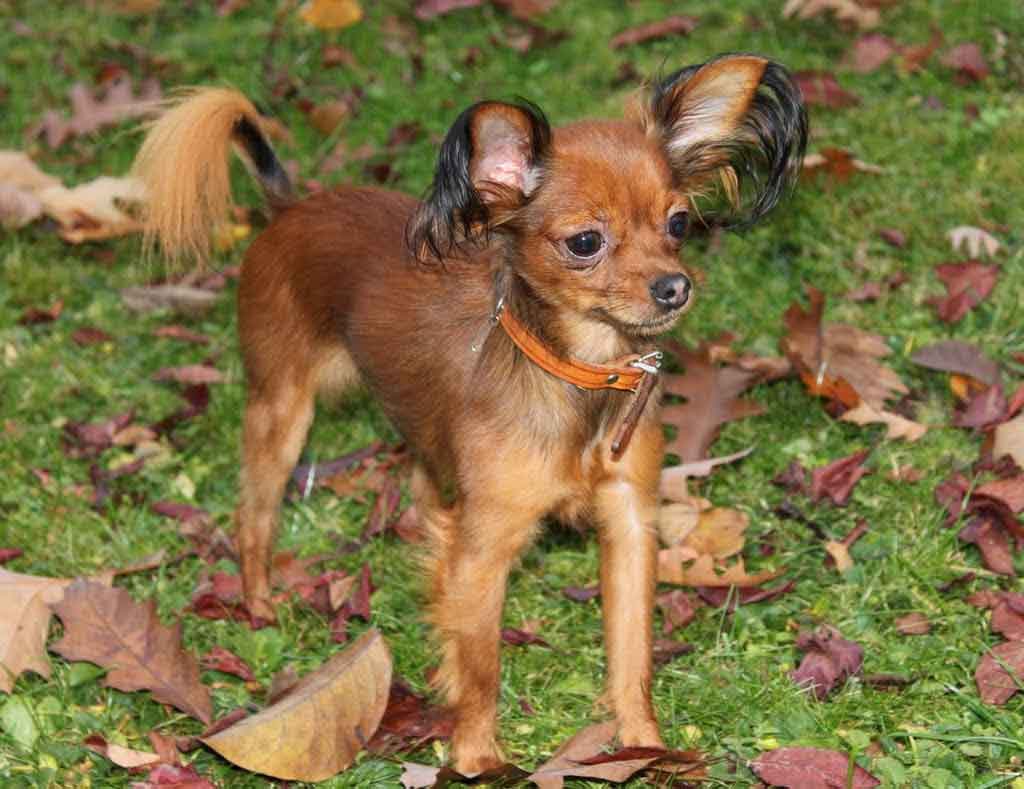
    Russkiy Toy

    The Russkiy Toy he is incredibly loving and close to his family, with which you want to spend as much time as possible.

    Content

    History

    The "Little Russian Dog" is a recent dog breed, but its history began in the 18th century, in Russia, with the importation of many English Toy Terrier. One of them was even adopted by Emperor Peter I the Great (1672-1725), during the last years of his life and his reign.

    During the 18th and 19th centuries, the popularity of Toy Terrier rose among the Russian aristocracy. They became an essential element, and by the early 20th century they had clearly become a status symbol. Participating in cultural events and social gatherings with a well-behaved little dog became the norm of the good society of the time.

    Although many of these dogs were imported from Great Britain, most were born in Russia, and a loose breeding program had already begun to gradually differentiate them from their ancestors. Present at Russian dog shows for some time, they began to officially call each other Russian toy terriers at an exhibition held in St. Petersburg in 1907, where they were exposed 11 specimens.

    The revolution of 1917 I was going to change things: associated with the aristocracy, the Russian Toy Terrier experienced a sudden and brutal decline, that left him on the brink of extinction. A few breeders tried to preserve the breed, but they faced many difficulties at a time when dog breeding was run by the regime, which instead encouraged the development of dogs that could be used by the military.

    The death of Josef Stalin in 1953 eased restrictions and some Moscow breeders, St. Petersburg, Svendlosk and Irkutsk were able to revive the breed. But after 40 years, there were no more specimens with perfectly known ancestry and pure characteristics, so they had to start from scratch, from individuals with characteristics similar to those previously known.

    The year 1958 marked a turning point for the breed, when a guy named Chicky was born with long hair and fringed ears and tail. Until then, all representatives of the breed had a smooth and short coat. The breeder Yevghenina Zharova wanted to preserve these characteristics and crossed him with a female with a longer than average coat and started a specific breeding program.. His initiative was crowned with success: starting at 1966 and the creation of a specific standard, these dogs were considered as belonging to a breed other than the Russian Toy Terrier and they were called Moscow Longhaired Toy Terrier.

    The year 1988 marked another turning point, because the Russian Cynological Federation (RKF), the reference organization in Russia, then decided to unify short hair and long hair again under the same standard, considering them as two varieties of the same breed.

    In the following years, after the fall of the iron curtain in 1989, the first copies of Russian Toy Terrier They were able to go out to conquer Europe and the breed began to develop, in particular in Finland and in the Eastern countries.

    But, the opening of the borders also brought about the entry of new breeds into Russia, who replaced local dogs in the hearts of dog lovers. As a result, in the decade of 1990, this dog was again on the brink of extinction in Russia. But, on the one hand, had already been imposed abroad and, for another, Russian breeders managed to maintain enough gene pool in their country to keep the breed healthy.

    In the first decade of 2000, things sped up. In 2006, the Fédération Cynologique Internationale (FCI) recognized the breed provisionally and gave it the official name of Russkiy Toy, removing the name of Terrier. Two years later, in 2008, a breed club was founded in the United States (Russian Toy Club of America), and that same year the United Kennel Club (UKC) American also accepted the breed. El American Kennel Club (AKC) did the same in 2010 by including it in your Foundation Stock Service (FSS), a step prior to full recognition.

    In 2017, the Russkiy Toy obtained the definitive recognition of the FCI, as well as the famous Kennel Club (KC) British. In fact, today it is recognized by most of the large national canine organizations – is the case, in particular, del Canadian Kennel Club (CKC), for example.

    Today, the AKC is present in almost all of Europe, but it is still rare in the United States, which explains why the final recognition of the AKC is still pending.

    In Great Britain, annual records around the KC have been around 50 since the acceptance of the breed in 2017.

    This figure is higher in France, where they were registered between 100 and 150 births in the French Stud Book (LOF) in 2010, which shows that this dog, although it remains relatively discreet in the country, has managed to find its audience.

    Photo: One Russkiy Toy of 20 meses by Skest at German Wikipedia, CC BY-SA 3.0, via Wikimedia Commons

    Physical characteristics

    The Russkiy Toy bears his name well, as it belongs to the smallest dog breeds in the world on the particular sides of the Chihuahua, of which it shares several characteristics.

    Its square body with a raised belly is higher at the neck than the rump. The extremities, fine boned and lean muscled, they are quite long, giving the impression that they are high on the legs. The tail is relatively short, carried in the shape of a sickle or saber, and fringed in the case of long-haired dogs. In areas where tail docking is permitted, docked tail is accepted, as long as a stump is left with 2 to 4 vertebrae.

    The head is small in proportion to the body, with a clearly marked stop. The muzzle is pointed and ends in a preferably black nose. The eyes are large, round and very expressive. your colour must be as darkest as possible. The ears, which are a distinctive feature of the breed, They are set high and sustained. Big and thin, they form two isosceles triangles in the skull. The long-haired variety is covered with long, thick hair that falls in a plume shape.

    This dog has no undercoat. But, upper hair differs from dog to dog, to the point that there are two varieties of the breed: the one with straight hair is short, smooth and shiny, while the one with long hair has a medium length (of 3 to 5 cm.). The latter also have fringes on their ears and tail., that cover the entire outside of the ear when mature.

    Multiple coat colors are allowed: black and tan, Brown and fire, Blue and fire, lilac and fire, and red with blue, brown or black. There are also some smooth dogs: his fur is red, leonado or cream. The most common color is black and tan.

    Last, there is no real sexual dimorphism in this breed: males and females are roughly the same size and appearance.

    Size and weight

    Size: 20 – 28 cm.
    Weight: 1 – 3 kg

    Varieties

    National and international canine associations usually distinguish between two varieties of Russkiy Toy: the of smooth hair, sometimes called shorthair, and the of Longhair. Although it is not usual, since the breeders of Russkiy Toy they usually specialize in one or the other, these varieties can be crossed: then mixed litters are obtained, composed of both short-haired and long-haired individuals.

    The long-haired variety, with its specific fringes on the ears, is the most sought after by fans, and also the most common. It has a semi-long coat (between 3 and 5 cm.) in the body, while the tail and ears are covered with long, thick fur that forms characteristic fringes.

    The straight hair variety, on the other hand, has a short smooth shiny looking top coat. Historically, the first representatives of the breed were all short-haired.

    None of the varieties of Russkiy Toy has undercoat. In general, apart from its fur, are perfectly identical in character and physical characteristics.

    Character and skills

    The Russkiy Toy he is incredibly loving and close to his family, with which you want to spend as much time as possible. Your attachment can even turn into possessiveness and, if i wasn't well socialized, can be overtly threatening (insofar as your size allows) towards those who get too close to their master. He also tends to distrust strangers, at least at the beginning: if you see that they are invited to the house, quickly curious to know more about them.

    If you are able to stay alone for a few hours, will quickly become anxious if absent for a long time (especially if this happens almost every day) and can then behave destructively. The presence of a small companion in the home can be a pertinent solution to help you not see time pass when your master is at work and reduce the risk of separation anxiety.. Usually, your pet will get along with other animals, already be partners, cats, rodents or reptiles, and this is usually the case even with those who do not live in your house. But, be careful not to be disturbed or scared by this barking and hyperactive puppy. And don't forget that a cat is usually much bigger, quick and better armed in case of discussion…

    In any case, lives perfectly in an apartment, as long as your need for exercise is met. The latter is also relatively consistent due to its size., since it is necessary to travel it at least half an hour a day. In other words, carry you in a bag, in a dog stroller or even in the arms of its owner is not the best gift that can be given, since you need to stretch your legs. But, if you live in a house with a garden in the country, it can be dangerous to leave it alone in the garden, because its size makes it a potential prey for many wild animals: birds Raptors, foxes, weasels…

    Like other miniature dog breeds, not really aware of the latter, so it is able to put itself in dangerous situations. No doubt, for example, to provoke a dog that weighs more than 20 times its weight, without worrying about the possible consequences. So, it is better to lead him on a leash when he goes out and teach him to curb his burning.

    To the smart Russkiy Toy he likes to be stimulated intellectually. Dog games and puzzles can be a great way to keep him busy while his owners are out and about., and loves to learn new tricks. You can also participate in dog sports such as obedience and agility, but its small size makes it difficult to compete.

    On the other hand, not recommended for families with young children. In effect, its small size and its fragility mean that it can be easily mistreated by the little ones, and the accident risks are very real – for the two protagonists, In addition. You can be seriously injured by a small car thrown at you in a moment of anger, just as he can respond by biting if his tail or ears are pulled. It also, a dog should never be left alone unsupervised with a young child, and that is valid whatever your race.

    Last, the Russkiy Toy barks often. Its high-pitched voice is an excellent alarm in case of threat, but it is also likely to quickly anger the neighbors.

    Education

    Like all its fellow men, the Russkiy Toy needs to be socialized from the first weeks. This is all the more important as you tend to be cautious: only successful socialization can allow you to become a sociable and balanced adult. So, need to meet many people (family, friends…) but also other animals, be it dogs, cats or rodents.

    The fact that he is intelligent and likes to be liked greatly facilitates his education. Learning to clean and remember orders is usually not a problem. If the family is patient and firm, it is possible to go much further, since they can also learn many tricks.

    Positive reinforcement is the best method to reach and educate the best possible Russkiy Toy. The moods, caresses and treats are real motivations for him, and quickly learns to do everything possible to satisfy his Master.

    In fact, the Russkiy Toy It is a breed of dog adapted for a beginner, but his master must never forget that a dog needs a leader to direct him. This leadership role, it is he who must exercise it. Your partner needs limits, which must be immutable, taxes from a very young age and consistent over time, as well as from one family member to another. If he is allowed to do what he wants when he is little, or if the rules are different depending on the day of the week or the person, you don't know what to expect and your behavior is affected.

    This is the famous "small dog syndrome", common to all miniature breeds: little by little adopts unacceptable attitudes (do not leave space on the sofa, growl at his master, steal food…) but ignored by their master, who remains as if hypnotized by his small and "cute" companion. As nothing stops you, this laxity encourages him to push the limits further and further, to the point of gradually taking control of the house. The longer the owner waits to take control of the situation and allow bad habits to take root, the more difficult it will be for him to put his partner back in order. To avoid this, rules should be clear and instilled from the start, and then apply in all circumstances, without exception. In the same logic, it is not advisable to hold him in your arms too often, especially if it is about moving with him when he could just as well walk next to his master, because not only does it not help him to live his dog life and spend, but it can also provoke a tendency to dominate.

    Health

    The Russkiy Toy is particularly robust and poses little risk of disease.

    But, it is sensitive to extreme temperatures and must be protected from both heat and cold. When the thermometer is rising, you should limit your activities to the coolest hours and not let it stay too long in the sun, while adog coatnot too much when you have to go out in cold weather. In any case, has no vocation to spend most of his time outdoors: its natural place is inside the house.

    Among the conditions that can affect the breed, the most commons are:

    • impacted tooth, when a milk tooth does not fall out and therefore does not give way to a growing adult tooth. This is a fairly common problem, which is solved without great difficulty by a veterinarian;
    • the patellar dislocation, a kneecap problem: leaves its position and forces the dog to limp to move. This problem is relatively common in all small dogs and, sometimes, requires surgery;
    • the progressive retinal atrophy, degeneration of eye tissues leading to total blindness It is an inherited disease and carriers are normally excluded from reproduction, so it's still pretty rare;
    • the Legg-Calvé-Perthes disease, which attacks the hip and causes necrosis that causes stiffness and pain., this disease is very rare and can be operated to relieve the pain caused.

    But, the main risk to the health of the Russkiy Toy comes from its small size and fiery character, which can be the cause of many fractures. The fall of a book on its paws, A career that ends in a collision with a chair or an agitated argument with a larger fellow can end in the emergency room., your family must be constantly vigilant.

    Another risk you are particularly exposed to is obesity, and once again only your master can help you.You need to monitor your weight regularly and act at the first signs of overweight, adjusting both your portion sizes and your activity level.

    As with any race, the adoption of a creator of Russkiy Toy serious and responsible greatly increases the probability of obtaining a healthy puppy The professional must provide a certificate of good health issued by a veterinarian, Submit medical history or vaccination record, in which the vaccines administered to the animal are recorded, and make available the results of genetic tests performed to parents. a small one.

    Of course, this does not guarantee that you will stay healthy for your entire life To maximize the chances of this being the case, prevention is essential: it is advisable to wear regularly (At least once a year) take your dog to the vet for a routine checkup.This not only identifies the beginning of a possible problem, it also ensures that you don't miss your shot reminders.

    Life expectancy

    12 to 13 years

    Grooming

    Either for the straight-haired variety or for the long-haired variety, the maintenance of the coat of the Russkiy Toy is simple. In effect, a weekly brushing is enough to avoid knots and remove possible dirt. Muda little, but it may be helpful to increase the frequency of brushing to 2 or 3 times a week when applicable, in spring and autumn.

    How he tolerates the bathroom well, clean it every 1 or 2 months to rid it of all impurities and make sure it doesn't mess up the house is usually not a problem either. You just have to make sure you use a specific shampoo for dogs, and in no case a product made for humans.

    The rest is a matter of course. These may include, their weekly grooming session should also be an opportunity to check and clean their eyes and ears with a damp cloth. This will prevent debris and dirt from accumulating, thereby reducing the risk of infection.

    You should also take the opportunity to brush your dog's teeth with a special toothpaste for dogs, although twice a week (or even daily) it's even better. This will help prevent tartar buildup., that can cause bad breath, cavities and other problems.

    Last, although it has gone out enough, their claws tend to grow faster than they wear out. Thus, it is necessary to trim them with a simple nail clipper when they have become too long, to prevent them from getting in the way or even breaking. A monthly cut is usually sufficient. The first time, you can learn how to do it with a vet or a groomer, to avoid doing it wrong.

    Food

    The Russkiy Toy perfectly fits commercially available industrial dog foods. You just have to be careful to choose a product adapted to dogs of this size, especially if you eat kibble. You also have to choose food of sufficient quality and establish an adapted daily ration to provide it with all the nutrients it needs., especially considering your activity level and your age.

    In any case, cat food, although it certainly is the perfect size for its size, not at all adequate. Too rich, are likely to cause rapid and dangerous weight gain.

    This is especially true since obesity is a very real problem for this breed whose needs are often much lower than their family thinks.. It is necessary to scrupulously follow the daily rations recommended by the manufacturers or the veterinarian, and regularly weigh your dog to quickly detect too large a variation. A weight gain of 200g is negligible for a human, but for a Russkiy Toy this is around the 10% of their normal weight.

    In case of unjustified weight gain, it is advisable to react without delay, adjusting both the dog's daily ration and activity level. If this doesn't help, a visit to the vet is necessary to explore the possibility of a disease and to develop a more appropriate diet if this is not the problem.

    Last, like all dogs, the Russkiy Toy you should always have access to a bowl of fresh water, so you can quench your thirst whenever you want.

    Use

    The Russkiy Toy is above all – and also always – a companion dog, made to spend most of his time with his family. Playful and affectionate, perfectly capable of apartment living, represents an ideal option for those who have little space to offer their dog, but on the other hand they may be available to dedicate time.

    His affectionate character also makes him a very good therapy dog, able to spend hours by his master's side if he needs it, and to help you with your mere presence.

    His natural distrust of the unknown and his propensity to bark make him an excellent alert dog., but its size prevents it from being a true watchdog, although his bravery is not questionable.

    Last, it is common to find it at dog shows, where your success is not denied. They can also participate in dog sports competitions, like obedience, but its small size is definitely a disadvantage.

    How much does a "Russkiy Toy"?

    The price of a puppy Russkiy Toy is of some 1500 EUR, but this average hides great disparities. In effect, depending on the reputation of the kennel, of the prestige of their ancestors but also and above all of their intrinsic physical characteristics, can go from 800 euros for the copies with some small defects up to almost 4000 euros for those intended for breeding and/or exhibitions. On the other hand, there are no big price differences according to gender.

    Characteristics "Russkiy Toy"

    Coexistence is important that you have with your new friend. Before considering the acquisition of a dog of the breed "Russkiy Toy" you know certain factors. Not all breeds of dogs are apt to live in an apartment, you must take into account his character, their need for exercise, their interaction with other pets, their care and if you have small children, their level of tolerance towards them.

    Adaptation ⓘ

    2,0 of 5 stars (based on 1 review)

    friendly dog ​​ⓘ

    5,0 of 5 stars (based on 1 review)

    hair loss ⓘ

    1,0 of 5 stars (based on 1 review)

    Affection level ⓘ

    5,0 of 5 stars (based on 1 review)

    Need for exercise ⓘ

    3,0 of 5 stars (based on 1 review)

    Social need ⓘ

    5,0 of 5 stars (based on 1 review)

    Home ⓘ

    3,0 of 5 stars (based on 1 review)

    Toilet ⓘ

    1,0 of 5 stars (based on 1 review)

    Friendly with strangers ⓘ

    3,0 of 5 stars (based on 1 review)

    barking ⓘ

    4,0 of 5 stars (based on 1 review)

    Health ⓘ

    4,0 of 5 stars (based on 1 review)

    Territorial ⓘ

    3,0 of 5 stars (based on 1 review)

    Cat friendly ⓘ

    3,0 of 5 stars (based on 1 review)

    Intelligence ⓘ

    4,0 of 5 stars (based on 1 review)

    Versatility ⓘ

    2,0 of 5 stars (based on 1 review)

    Child friendly ⓘ

    5,0 of 5 stars (based on 1 review)

    Surveillance ⓘ

    3,0 of 5 stars (based on 1 review)

    joy ⓘ

    4,0 of 5 stars (based on 1 review)

    Images "Russkiy Toy"

    Photos:

    1 – «Little Russian dog» by Ernst Vikne, CC BY-SA 2.0, via Wikimedia Commons
    2 – «Little Russian dog» puppy, 4 months old by Shamanofthistown, CC BY-SA 3.0, via Wikimedia Commons
    3 – «Little Russian dog» short hair, smooth coat, brown and tan by NiaNike, CC BY-SA 4.0, via Wikimedia Commons
    4 – A short haired «Little Russian dog» by Ernst Vikne, CC BY-SA 2.0, via Wikimedia Commons
    5 – Two «Little Russian Dog», one with short hair and one with long hair by Ernst Vikne, CC BY-SA 2.0, via Wikimedia Commons
    6 – «Little Russian dog» Daniel, Rostov del Don by Sofiya357, CC BY-SA 3.0, via Wikimedia Commons

    Videos "Russkiy Toy"

    Type and recognitions:

    • FCI CLASSIFICATION:
    • Group :
    • Section : . .

    Federations:

    • – FCI – Group 9: Section 9: Continental Toy Spaniel and others ⓘ
    • – AKC – Toy ⓘ
    • – CKC – Group 5 – (Toy) ⓘ
    • – ​KC – Toy ⓘ
    • – UKC – Group 8 – Companion dog ⓘ

    FCI breed standard "Russkiy Toy"

    Origin:
    Russia

    Date of publication of the valid original standard:
    21.02.2006.

    Use:

    Toy dog.


    General appearance:

    A fancy little dog, lively, high legged, with thin bone and dry muscles. Only somewhat definite sexual dimorphism.

    important proportions: Square construction. The height at the elbows is only slightly higher than half the height at the withers.. The chest is deep enough.


    Behavior / temperament:

    Active, very happy, neither cowardly nor aggressive. Behavior is significantly different between males and females.

    Head:

    Small compared to the body.

    Cranial region:
    • Skull: Tall but not wide (the width at the level of the zygomatic arches does not exceed the depth of the skull).
    • Stop (Naso-frontal depression): Clearly pronounced.

    facial region:

    • Nose: Small, black or according to the color of the coat.
    • Snout: Clean and sharp, slightly shorter than the skull.
    • Lips: Fine, dry, tight and dark or according to the color of the coat.
    • Jaws / Teeth: Small and white. Scissor bite. Lack of 2 incisors is allowed on each jaw.
    • Cheeks: Only somewhat pronounced.
    • Eyes: So big, round, slightly prominent, inserted well apart and facing straight forward. Dark eyelids or according to the color of the coat, tight.
    • Ears: Large, fine, high insertion, upright.

    Neck:

    Long, clean. Carried high, slightly arched.

    Body:

    • top line: Gradual fall from withers to insertion of tail.
    • Cross: Slightly pronounced.
    • Back: Strong and straight.
    • Pork loin: Short and slightly arched.
    • Rump: The rump is somewhat rounded and slightly sloping..
    • Breast : The chest is oval and deep enough and not too wide.
    • Bottom line and abdomen: Retracted abdomen and stretched flanks, forming a curved line from the chest to the flanks.

    Tail:

    amputee: (only two or three vertebrae are left), carried high. In countries where tail docking is prohibited by law, it is left natural. Without amputating: sickle-shaped, It should not be lower than the top line level..

    Tips

    Fine, clean. Seen from the front the limbs are straight and parallel.

    Former members

    • Blades: The scapulae are moderately long and not very sloping.
    • Humerus: Forms an angle of 105 degrees with the scapula. The length of the humerus is approximately the same as that of the scapula.
    • Elbow: In line with the body.
    • Forearm: Long and straight.
    • Carpo: Cleansed.
    • Metacarpus: Almost vertical.
    • Previous feet: Small, oval neither in nor out, fingers together and arched. Nails and pads black or according to the color of the coat.

    Later members

    Seen from behind the hindlimbs are straight and parallel, but a little more separated than the previous members. The knee and hock with sufficient angulation.

    • Thighs: Clean and developed muscles.
    • Leg: The femur and leg are the same length.
    • Hock: Sufficiently angled.
    • Metatarsus: Vertical.
    • Hind feet: Arched, a little narrower than the front feet. Nails and pads black or according to the color of the coat.

    Movement:

    Easy, straight ahead and fast. No change should be noticed in the top line when in motion.

    Mantle

    Fur

     Exist 2 guys for the breed, short hair and long hair.

    • Short hair: short, glued, bright, no under-hair or peeling patches.
    • Long hair: the body is covered with moderately long hair (3 – 5 cm.) straight or slightly wavy, glued, that does not hide the natural figure of the body. Hair on the head and front of the limbs is short and close together. Notable fringes on the back of the limbs. The feet have long hair, silky that completely hides the nails. The ears are covered with thick hair forming fringes. Dogs over 3 years present these fringes, with which they completely cover the edge and tip of the ears. Body hair should not look messy or be too short (less than 2 cm.).

    Color

    black and tan, Brown and fire, Blue and fire. Also red in any shade with or without black or brown carbon. Stronger hues are preferable for all colors.


    Size and weight:

    • Height to the cross: Males and females: 20 – 28 cm. (tolerance +/-1 cm.)
    • Weight: Males and females: until 3 kg.


    Fouls:

    Any deviation from the aforementioned criteria is considered as a fault and the severity of this is considered to the degree of the deviation to the standard and its consequences on the health and well-being of the dog..

    • Shy behavior.
    • Pincer bite or incisors tilted forward.
    • Semi-erguidas ears. This condition in long-haired dogs with heavy fringes is allowed but not desired..
    • Low tail insert.
    • Presence of bald patches in short-haired dogs.
    • Too long or too short hair in long-haired dogs.
    • Small white spots on the chest or fingers.
    • Negro, solid brown or blue. Burnt marks too large or with dark shading.

    disqualifying fouls:

    • Aggressiveness or extreme shyness.
    • Enognathism or pronounced prognathism. Absence of 1 canine; absence of more than 2 incisors on each jaw.
    • hanging ears.
    • Short members.
    • Many bald patches on short-haired dogs.
    • Long-haired dogs: absence of fringes on the ears and presence of curly hair.
    • White cloak, white spots on the head, abdomen and above the metacarpals; large white patches on the chest or throat, presence of brindle markings.
    • Size greater than 30 cm.. the smallest to 18 cm..
    • Weight less than 1 kg.

    Any dog ​​showing clear signs of physical or behavioral abnormalities must be disqualified..


    N.B.:

    Males should have two normal-appearing testicles fully descended into the scrotum..
    Only functionally and clinically healthy dogs, with the typical conformation of the breed, should be used for parenting.

    Source: F.C.I - International Cynological Federation

    Alternative names:

    1. Russian Toy Terrier, Russian Terrier, Moscow Toy Terrier, Moscovian Miniature Terrier, Toychik (English).
    2. Toychik, Toy-chic (French).
    3. Russischer Zwergspaniel, Moskauer Langhaariger Toy Terrier (московский длинношерстный той-терьер) (German).
    4. (em russo: Русский той-терьер) (Portuguese).
    5. Miniatura ruso, Toy Terrier ruso (español).

    ▷ The world of Pets: Dogs, cats, birds, reptiles, amphibians

    Chesapeake Bay Retriever
    USA FCI 263 . Retrievers

    The Chesapeake is a hunting dog, pure and simple.

    Chesapeake Bay Retriever

    Content

    Characteristics "Chesapeake Bay Retriever"

    Coexistence is important that you have with your new friend. Before considering the acquisition of a dog of the breed "Chesapeake Bay Retriever" you know certain factors. Not all breeds of dogs are apt to live in an apartment, you must take into account his character, their need for exercise, their interaction with other pets, their care and if you have small children, their level of tolerance towards them.

    Adaptation ⓘ

    3,0 of 5 stars (based on 1 review)

    friendly dog ​​ⓘ

    2,0 of 5 stars (based on 1 review)

    hair loss ⓘ

    3,0 of 5 stars (based on 1 review)

    Affection level ⓘ

    3,0 of 5 stars (based on 1 review)

    Need for exercise ⓘ

    5,0 of 5 stars (based on 1 review)

    Social need ⓘ

    3,0 of 5 stars (based on 1 review)

    Home ⓘ

    1,0 of 5 stars (based on 1 review)

    Toilet ⓘ

    2,0 of 5 stars (based on 1 review)

    Friendly with strangers ⓘ

    2,0 of 5 stars (based on 1 review)

    barking ⓘ

    3,0 of 5 stars (based on 1 review)

    Health ⓘ

    3,0 of 5 stars (based on 1 review)

    Territorial ⓘ

    3,0 of 5 stars (based on 1 review)

    Cat friendly ⓘ

    3,0 of 5 stars (based on 1 review)

    Intelligence ⓘ

    5,0 of 5 stars (based on 1 review)

    Versatility ⓘ

    5,0 of 5 stars (based on 1 review)

    Child friendly ⓘ

    3,0 of 5 stars (based on 1 review)

    Surveillance ⓘ

    4,0 of 5 stars (based on 1 review)

    joy ⓘ

    3,0 of 5 stars (based on 1 review)

    History

    When a British brig was wrecked off the coast of Maryland in 1807, part of the cargo that was rescued included two Newfoundland dogs. Called Sailor and Canton, they were found to have excellent retrieval skills. The locals raised them with local dogs, and became the ancestors of the "Chesapeake Retriever". Other races that may have contributed to the composition of the Chesapeake were the «Flat-coated Retriever" and the "Curly-coated Retriever«.

    The result was a hard Retriever that he was ready and willing to endure the harsh and icy Chesapeake Bay being able to recover from 100 to 200 ducks a day. The first dogs came only in dark brown, but now any shade of brown, sedge or dead grass is acceptable.

    The American Kennel Club registered your first Chessie, called Sunday, in 1878. The Chesapeake is ranked 48 breeds registered by the AKC, under the 41 a decade.

    Physical characteristics

    Distinctive features include eyes very clear, yellow or amber, rear quarters as high or slightly higher than the shoulders, and a double layer which tends to wave on shoulders, the neck, back and loins.

    The Raincoats feels slightly oily and often is associated with a slight musky odor. three basic colors are usually seen on race: the brown, which it includes all shades from light brown to a deep dark brown; sedge, ranging from reddish yellow to bright red and brown tones; and dead grass in all shades, ranging from a faded tan to a muted straw color.

    The breed standard states that the target may also appear, but it should be limited to the chest, the belly, the toes or back of feet. The head is round and wide with an average stop and muzzle. The lips are thin, and ears are small and medium leather. The Forelegs should be straight with good bone. The hindquarters are especially strong and the toes webbed as excellent swimming ability is important to the Chesapeake.

    This breed is also known for its large and powerful chest, used to break ice when submerged in cold water while duck hunting.

    Character and skills

    The "Chesapeake Retriever" is highly appreciated for its alert and cheerful disposition., his intelligence, his calm demeanor and his affectionate nature and protective. The value, the willingness to work, vivacity, good sense of smell, the intelligence, The enjoyment of the water and especially the general quality and dispositions must take priority when selecting and breeding the "Chesapeake Retriever.". Extreme shyness or aggression are not desirable in this breed, whether the animal is used as a hunting dog or pet.

    In the countryside, the Chesapeake he is a serious worker and has even been called neurotic in his eagerness to find fallen birds. It's not out there to play. The Chesapeake They are known for their excellent vision and memories when it comes to seeing where birds fall and remembering where to go to collect them.. His favorite activity is hunting for ducks.

    When you train, respects their learning ability. Don't continue training him long after it's clear he knows what to do. The perfect Chesapeake is not prepared by the breeder. any dog, no matter how pleasant it, detestable levels can develop barking, excavation and other undesirable behavior if you are bored, untrained or unsupervised.

    Did you know??

    The Chessie not designed to be a companion, is a hunting dog, pure and simple. And not just any old hunting dog… He is a waterfowl dog and lives to get wet in pursuit of his feathered prey..

    The health of the Chesapeake Retriever

    According to a survey conducted in 2005 by the American Chesapeake Club, the most common health problems seen in the breed are hip dysplasia, progressive retinal atrophy and other eye problems, cancer, degenerative myelopathy and hypothyroidism. This breed can also be prone to a bleeding disorder called von Willebrand disease.

    Find a breeder who uses the newly available genetic test for degenerative myelopathy, a form of progressive weakness and paralysis of the limbs. Although DM is rare, It is incurable and crippling. Not all dogs that test positive in the test of DM develop the disease, but farmers who try their race for this condition are probably the most conscientious.

    The test can be used to determine whether a puppy's parents are clean, they are carriers or are at risk; a puppy whose parents are clean – neither carriers nor at risk – also will be. A puppy two carrier parents will be at risk, and a puppy parent with a carrier may be at risk. Even dogs tested for having two copies of the gene never show symptoms of the disease., but the status of the parents of your puppy, and his own dog, It can help you be aware of the early warning signs.

    Careful breeders test their breeding dogs for genetic diseases and only breed the healthiest and best looking dogs., but sometimes mother nature has other ideas and a puppy develops one of these diseases despite good husbandry practices. Advances in veterinary medicine mean that in most cases dogs can still live a good life. If you're going to have a puppy, ask the breeder about the ages of the dogs in their lines and what they died of.

    Remember that after hosting a new puppy home ut, has the power to protect you from one of the most common health problems: the obesity. Keeping a Chesapeake Retriever at an appropriate weight is one of the easiest ways to prolong its life.. Make the most of your preventative abilities to help ensure a healthier dog for life.

    Chesapeake Retriever Grooming

    The Chesapeake has a tough, oily outer coat over a dense undercoat, fine and wooly. The dirt and debris are easily removed with a rubber brush. The undercoat is very clear in spring, so be prepared to brush the dog more frequently during this time to prevent loose hair from collecting on clothing and furniture..

    Give the Chessie Fresh water rinse after it has been in salt water or has swum in the mud of a pond or lake, but to keep the resistance of the coat to water, avoid bathing unless absolutely necessary. That can be as little as twice a year.

    The rest is basic care. Keep your ears clean and dry so they don't get infected, and trim nails as needed, usually every two weeks. Brush your teeth for general good health and fresh breath.

    «Chesapeake Retriever» Images

    credits:

    1. A Chesapeake Bay Retriever by Keith Rousseau at en.wikipedia / CC BY-SA
    2. Chesapeaker Bay retriever by Nevilley / CC BY-SA
    3. Male, Chesapeake Bay Retriever competing in the conformation ring by George Makatura / Public domain
    4. Chesapeaker Bay retriever by https://pxhere.com/es/photo/1407301
    5. Chesapeaker Bay retriever by https://pixabay.com/es/photos/perros-mascotas-el-agua-1582148/
    6. Chesapeake Bay Retriever by Diane – HTTPS://flic.kr/p/6k1uFQ
    7. chesapeake bay retriever by https://www.peakpx.com/611264/chesapeake-bay-retriever
    8. Brown Chesapeake Bay Retriever in the snow, carrying a plant part in its snout by Will Thomas / CC BY

    Videos «Chesapeake Retriever»

    Type and recognitions:

    • FCI CLASSIFICATION:
    • Group :
    • Section : . .

    Federations:

    FCI ⓘ, AKC ⓘ, ANKC ⓘ, CKC ⓘ, ​KC ⓘ, NZKC ⓘ, UKC ⓘ

    FCI breed standard Chesapeake Bay Retriever

    FCIFCI - Chesapeake Bay Retriever
    Retriever

    Alternative names:

    1. Chessie, CBR, Chesapeake (English).
    2. Chesapeake Bay Retriever, Chesapeake (French).
    3. Chesapeake Bay Retriever (German).
    4. Chesapeake bay retriever (Portuguese).
    5. Chessie, CBR, Chesapeake (español).