โ–ท The world of Pets: Dogs, cats, birds, reptiles, amphibians

White-eyed Parakeet
Psittacara leucophthalmus

Aratinga Ojiblanca

Content

Description:


Anatomy-parrots

Of 32 cm. length and a weight between 140 and 170 g..
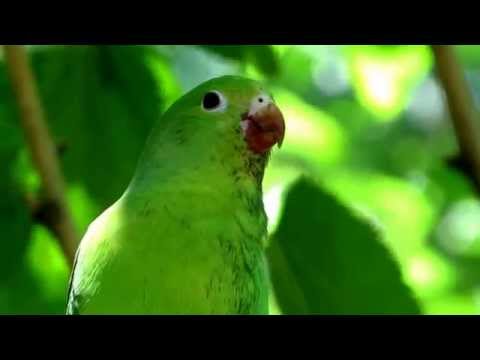
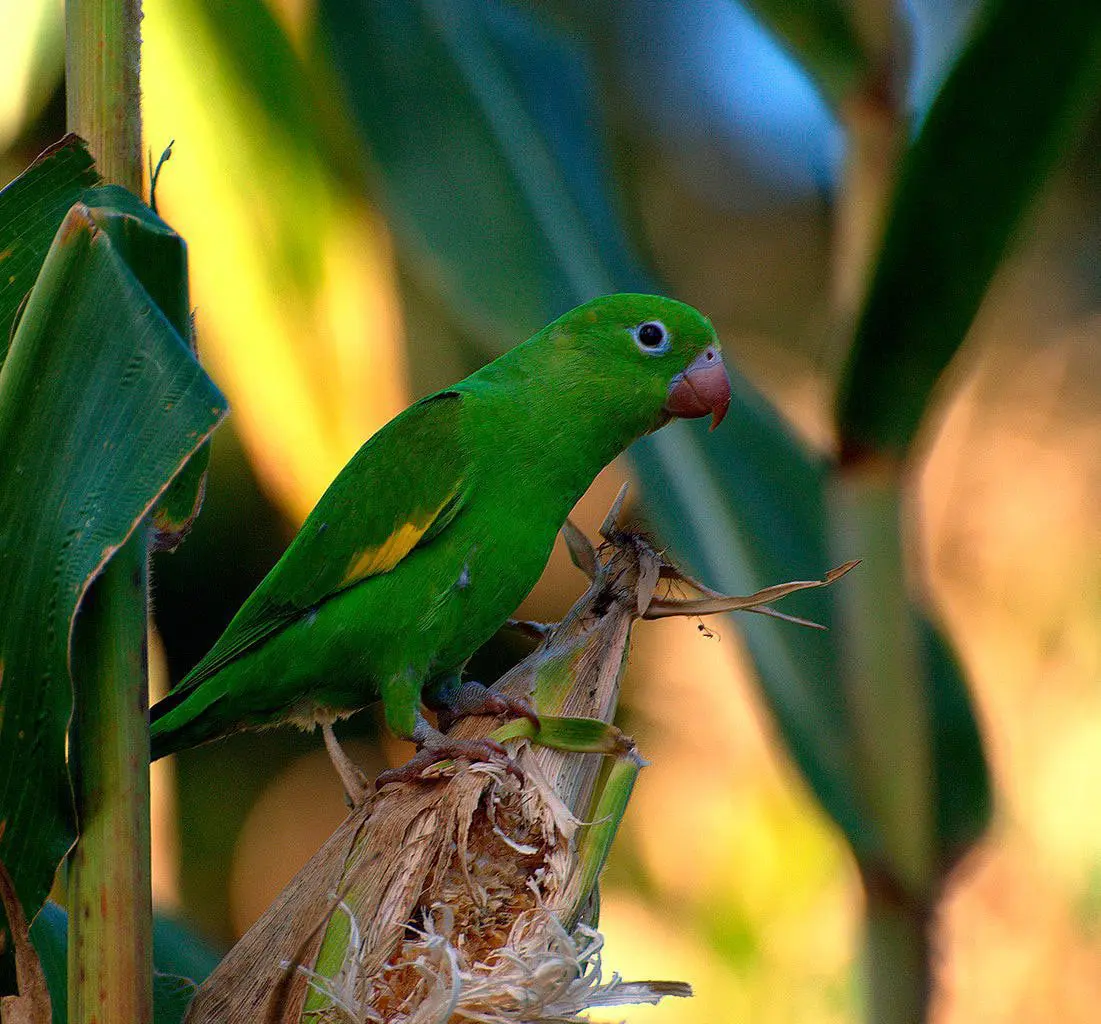
The White-eyed Parakeet (Psittacara leucophthalmus) has the head dark green with small scattered red feathers, especially in the area of the lores, cheeks, sides neck and throat. The head and nape Some birds are almost entirely green, others have solid red spots in the cheeks, with numerous scattered red feathers elsewhere.

The upperparts are dark green, with one or two scattered red feathers. Upper, the wings dark green, with a little red in the curve; undertail, with golden brown flight feathers, the outer red and green small coverts inner; Yellow large coverts external and green internal.

The underparts Green with scattered red feathers on the throat and the chest, sometimes forming irregular patches. Upper, the tail dark green; Brown down.

The bill hooked is color Horn and its gray tip; bare periophthalmic grayish white; irises yellow-orange; legs grey.

The plumage of the male and the female, they are identical.

The immature they have more muted colors; some feathers Red in the head, No red in the bend of wing and olive in the underwing-coverts outermost.

Subspecies description:

  • Psittacara leucophthalmus callogenys

    (Salvadori, 1891) – They have head, neck and throat, green grass dark with small feathers red color above the cheeks. The the mantle, the wing-coverts, the tail and primary feathers of the tail are dark green. The lower part of the chest and flanks of the body are green clear. The feathers largest of the wings and secondaries are dark green with a grey reflection at the ends. Smaller feathers of the wings and the area of the wing curvature are bright red; small coverts feathers are red; the feathers of the greater coverts are yellow. The top of the large feathers of the tail are dark green, the underparts is olive green.

    The eyes are black with the irises orange-brown. The bare periophthalmic is grayish white. Bill color horn, the sides and the tip of the upper part are dark gray. Legs brownish grey, black nails.

    On average largest the species nominal with the bill more robust. Birds in the West have a green dark.


  • Psittacara leucophthalmus leucophthalmus

    (Statius Mรผller, 1776) – The species nominal.


  • Psittacara leucophthalmus nicefori

    (Meyer de Schauensee, 1946) – Similar to the species nominal, except for having a red frontal band.

Habitat:

Video – "White-eyed Parakeet" (Psittacara leucophthalmus)

Calacante de Ala Roja Psittacara leucophthalmus.

The White-eyed Parakeet It is in a great range of forest habitats and forests, mainly in lowlands, even if they manage to reach altitudes of 1.700 meters in the Ecuador and 2.500 meters in Bolivia.

In the Amazon, they are in tropical rainforests, mostly along the rivers (including the forests and marshes), in scattered areas of woodland and in land grown in wetlands, mangroves, sheets and the forests of Palms in the Guianas, chaco types of forests in the South of its range, gallery forests and alluvial forests in Bolivia.

The White-eyed Parakeet they are highly gregarious, they form flocks, usually, hundreds of birds (usually up to 90), covering large expanses between the roosts and feeding areas.

In the Amazon, in general, birds travel along the banks of rivers, crossing also large tracts of forest to reach the meanders and hidden Marsh.

They form large community groups to sleep in trees, sugar cane fields and caves.

Associated with the Blue-crowned Conure (Psittacara acuticaudatus), the Blue-headed Parrot (Pionus menstruus), the Chestnut-fronted Macaw (Ara severus) and
Crimson-bellied Parakeet (Pyrrhura perlata), in mixed flocks, especially while they forage.

Reproduction:

The nest It consists of a natural cavity in a tree, often a palma, but also in limestone caves in Mato Grosso, Brazil. The female usually deposits there 3 white eggs, What incubates alone during 24 or 25 days. During this time, It is fed by the male. At birth the chicks are completely naked, a gray marker appears at the end of the first week. Son fed by parents for approximately 6 weeks, those that leave the nest and get together with the family group. are still dependent parents during 2 to 3 months.

The breeding season It has been reported in the months of November-December, in Argentina; July-August, in the East of Peru; From January to April, Mato Grosso; in Guianas during the month of February.

Food:

The diet of this species depends on the habitat, including a variety of dried fruits, seeds, fruit, berries, flowers and insects.

In general, they feed in the canopy, Although also feed on of grass seeds. Other reported foods include fruits of Palms and Goupia glabra, Tetragastris altissima and Allantoma lineata, as well as flowers Erythrina and ficus.

Distribution:

Size of its range (reproduction / resident): 13200000 km2

The White-eyed Parakeet are widespread in much of the North of South America, to the East of the Andes, to the North of Argentina.

Are distributed from the West of the Guianas (absent from Guyana), through Venezuela, from Anzoรกtegui and Monagas through the Delta Amacuro, until Bolรญvar and amazon, and up to the Colombian Amazon, to the North of the Department of the Goal. They live in much of Ecuador and Peru.

Extend through the entire interior of Brazil and possibly reach the coast of Sรฃo Paulo and Rio Grande do Sul (absent in the arid zones of the Northeast, mountainous areas of the northern basin of the amazon in Brazil and Venezuela, and the basin of the Black river in Brazil and Colombia).

Are also distributed to the East of Bolivia through Paraguay until Argentina, to the South of Santa Fe and Between rivers (possibly in the North of Buenos Aires), including Tucumรกn and Catamarca (There are no recent reports in Catamarca or Santa Fe, While reports of Santiago del Estero, Cรณrdoba and San Luis they are probably incorrect).

  • Narosky and Di Giacomo (1993) they consider that the population in the city of Buenos Aires and its surroundings possibly originated from specimens escaped from captivity, i.e. released or escaped pet, owners or traffickers of fauna.

Observed in the highest parts of Uruguay.

In general resident, Although some seasonal movements seem to occur in some areas. The most numerous in the center of the range, the least, at the edges. Locally abundant in the Amazon central and Mato Grosso, Brazil, as well as in the east of Peru. common in Colombia. Quite common in the forests of the coast of Suriname and in the gallery forests of Santa Cruz in Bolivia. Unevenly distributed in the North of Bolivia, where it is described as common to rare. common in Argentina, especially in the North.

The Aratinga Ojiblanca It adapts easily to the degradation and urban areas, long as no sources of food and nesting places (ceilings and other cavities) and this occurs in several cities.

Large captive population with high volume of international trade, in particular from Argentina, where the species, Perhaps, is being threatened due to the capture.

Subspecies distribution:

  • Psittacara leucophthalmus callogenys

    (Salvadori, 1891) – It is from Ecuador, Northeast of Peru and Northwest of Brazil.


  • Psittacara leucophthalmus leucophthalmus

    (Statius Mรผller, 1776) – The species nominal.


  • Psittacara leucophthalmus nicefori

    (Meyer de Schauensee, 1946) – Its validity is based on a single specimen found in an area around Guaicaramo in the guavio river, Department of the Goal, Colombia.

Conservation:

โ€ข Red List category of the UICN current: Least concern

โ€ข Population trend: Decreasing

The size of the world population White-eyed Parakeet It has not been quantified, but this species is described as ยซcommonยป (Stotz et to the., 1996).

The species has undergone intense trade: from 1981, When it was included in the Appendix II, 60.207 individuals have been captured in the wild, registered for the international trade (UNEP-WCMC trade database CITES, January 2005).

"White-eyed Parakeet" in captivity:

The White-eyed Parakeet they are among the best talkers within the family Aratinga. Well socialized they can become a good companions. Rarely are destructive and usually they are not pijas, they often take the choice to imitate human speech in place. Personality always varies from bird to bird, but they are generally known to be very playful and curious.

Imported birds are, mostly, shy and take time to gain confidence with their caregiver.

Alternative names:

White-eyed Parakeet, White-eyed Conure, Green Conure, White eyed Parakeet (English).
Conure pavouane, Perriche pavouane, Perruche pavouane (French).
Pavuasittich (German).
Aratinga-de-bando, araguaรญ, araguari, aratinga, arauรก-i, aruaรญ, guira-juba, maracanรฃ, maracanรฃ-malhada, maricatรฃ, periquitรฃo-maracanรฃ (Portuguese).
Aratinga Ojiblanca, Calacante ala roja, Calancate Ala Roja, Loro Barranquero, Loro de ala roja, Loro Maracanรก, Maracanรก ala roja, Perico Ojiblanco, Periquito Verde (espaรฑol).
Calacante ala roja, Calancate Ala Roja, Loro de ala roja (Argentina).
Loro ojiblanco, Perico Ojiblanco (Colombia).
Cotorra de Ojo Blanco (Peru).
Maracanรก ala roja (Paraguay).
Loro Barranquero, Loro Maracanรก (Uruguay).
Perico Ojo Blanco (Venezuela).

scientific classification:

Order: Psittaciformes
Family: Psittacidae
Genus: Psittacara
Scientific name: Psittacara leucophthalmus
Citation: (Statius Mรผller, 1776)
Protonimo: Psittacus leucophthalmus

White-eyed Parakeet images:


Species of the genus Psittacara

Sources:

Avibase
Parrots of the World โ€“ Forshaw Joseph M
Parrots A Guide to the Parrots of the World – Tony Juniper & Mike Parr
Birdlife

Photos:

(1) – White-eyed Parakeet (also known as the White-eyed Conure) in Piraju, Sao Paulo, Brazil By Dario Sanches [CC BY-SA 2.0], via Wikimedia Commons
(2) – White-eyed Parakeet at the aviary at the Mayaguez Zoo in Mayaguez, Puerto Rico By Kati Fleming (Own work) [CC BY-SA 3.0], via Wikimedia Commons
(3) – A White-eyed Parakeet in Reserva Guainumbi, Sao Luis do Paraitinga, Sao Paulo, Brazil By Dario Sanches from Sao Paulo, Brazil [CC BY-SA 2.0], via Wikimedia Commons
(4) – Barao do Rio Branco square, Serra Negra-SP By Dario Sanches [CC BY-SA 2.0], via Wikimedia Commons
(5) – White-eyed Parakeet (also known as White-eyed Conure) in Goiania, Goiรกs, Brazil By Wagner Machado Carlos Lemes [CC BY 2.0], via Wikimedia Commons
(6) – White-eyed Conure (Aratinga leucophthalmus) – upper body, neck and face. In captivity in the Parrotโ€™s Garden (Jardim dos Louros), in the Botanical Garden of Funchal, Madeira island, Portugal By jmaximo [CC BY 2.0], via Wikimedia Commons
(7) – White-eyed From The Crossley ID Guide Eastern Birds By Richard Crossley (Richard Crossley) [CC BY-SA 3.0], via Wikimedia Commons
(8) – White-eyed Conure, also called White-eyed Parakeet, in Brazil By Dario Sanches [CC BY-SA 2.0], via Wikimedia Commons
(9) – Couple of white-eyed parakeets (Aratinga elucophthalma). Spotted in Sao Carlos, Brazil By Leoadec (Own work) [CC BY-SA 3.0 or GFDL], via Wikimedia Commons

Sounds: (Xeno-canto)

โ–ท The world of Pets: Dogs, cats, birds, reptiles, amphibians

White-naped Lory
Lorius albidinucha

Content

Description

The White-naped Lory (Lorius albidinucha) has a length of 26 cm.. and a weight between 152 and 164 g..

White-naped Lory

Similar to the Purple-bellied Lory with which sympathy between 500 and 750 meters in the South of New Ireland.

The White-naped Lory It has a distinctive patch white in nape. The underparts They are entirely red except yellow markings on the sides of chest. It lacks dark violet broadcast belly and of the undertail-coverts, If shown by the Purple-bellied Lory. Seen at close quarters, the cere Dark also separates this species from the Purple-bellied Lory, what does he have cere white.

Lori Nuquiblanco illustration

The White-naped Lory It is also less Beefy that the Purple-bellied Lory and has a whistle call which differs considerably with the distinctive snore nasal call of the Purple-bellied Lory.
Has the crown black, violet slightly marked by the white patch nape; rest of head bright red. The upperparts red. The wings They are green with a yellow band on the lower part and violet with white spots on the curvature. The upperparts They are red with yellow markings on the sides of the chest and blue marks on the the thighs. Tail red on the outside and yellow on the inside part. Bill orange with dark base in the upper jaw; cere black; irises yellow to reddish brown; legs greyish black.

Habitat:

Known only in the mountains south of New Ireland between 500 and 2.000 m, mainly on 1.000 m.
Normally found in pairs while feed on fruits or wild flowers "oil palm". Been seen feeding on the same tree as the Purple-bellied Lory without harming it.

Reproduction:

No data reproduction in its natural habitat.

Food:

Feeds of fruit and flowers of the oil palm plantations.

Distribution:

Distinctive species, little known and restricted to the forests of the hills of New Ireland in the Bismarck Archipelago (Papua New Guinea).

Conservation:


Near-threatened


โ€ข Current IUCN Red List category: Near-threatened.

โ€ข Population trend: Decreasing.

Quite common at all limits within its altitude range. The world population probably it is lower to the 10.000 specimens.
No information on population trends; But, the species is suspected falling slowly, as a result of logging.

The conservation actions proposals:

โ€ข Effectively protect hill forests.
โ€ข Determine the tolerance of forests exploited at different altitudes.
โ€ข Monitor populations at key sites.

"White-naped Lory" in captivity:

None known.

Alternative names:

White-naped Lory, White naped Lory (ingles).
Lori ร  nuque blanche (French).
WeiรŸnackenlori (German).
Lorius albidinucha (Portuguese).
Lori Nuquiblanco, Tricogloso de Nuca Blanca (espaรฑol).

scientific classification:

Order: Psittaciformes
Family: Psittaculidae
Genus: Lorius
Scientific name: Lorius albidinucha
Citation: (Rothschild & Hartert, 1924)
Protonimo: Domicella albidinucha

————————————————————————————————

ยซLori Nuquiblancoยป (Lorius albidinucha)


Sources:

Avibase
– Parrots of the World โ€“ Forshaw Joseph M
– Parrots A Guide to the Parrots of the World – Tony Juniper & Mike Parr
– Birdlife

Photos:

1 – lorihaven.dk – link
2 – Illustration: HBW.com

โ–ท The world of Pets: Dogs, cats, birds, reptiles, amphibians

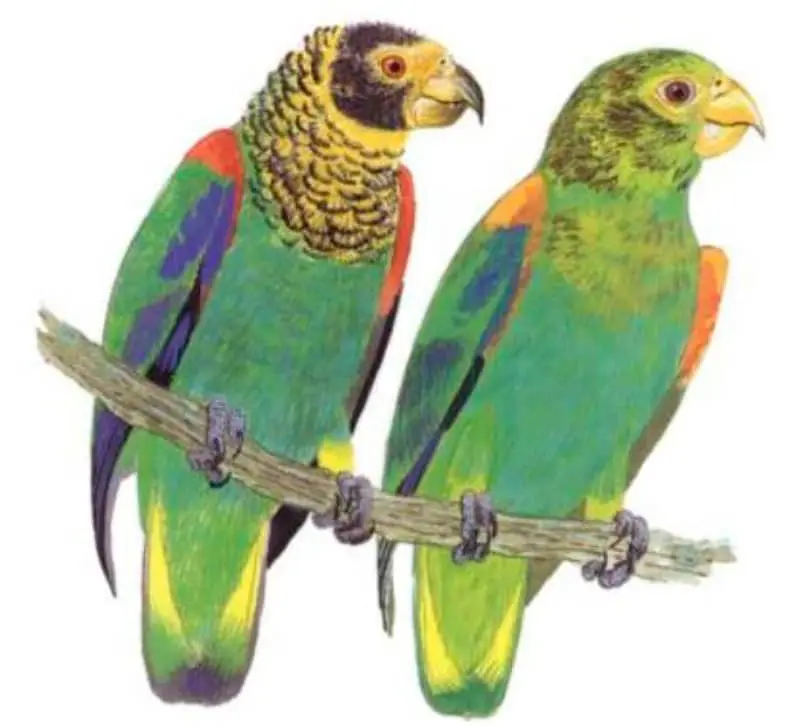
White-capped Parrot
Pionus seniloides

White-capped Parrot

Content


Anatomy-parrots

Description:

28 to 30 cm.. high and about 229 g. of weight.

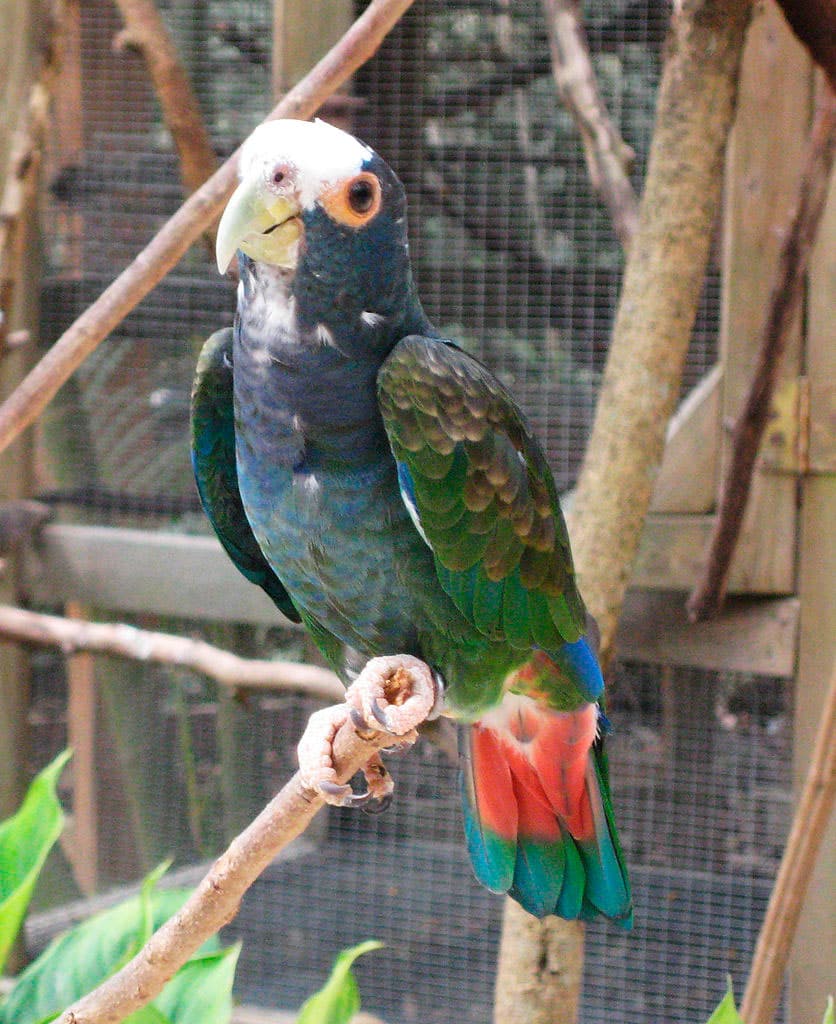
The White-capped Parrot (Pionus seniloides) It is easily identifiable by the "peak" yellow, head usually white, with the crown with reddish speckles, feathers of the nape and sides of the head with dark blue edges and red dyes which gives the appearance of flake.

Breast with greenish blue edges, under belly and internal base tail red.

Iris of color Brown and legs gray-green.

The youth have crown and chest green, and green spots on the sides of the head and neck.

Note:

Previously he was treated as a subspecies of the species Pionus tumultuosus, that is to say, Pionus tumultuosus seniloides. A midyear 2014 it is considered as own species.

Habitat and behavior:

White-capped Parrot

It is a kind Rare.
It inhabits in humid jungle and edges, from the 1900 to 3000 m. It is mainly a species of temperate zone, but you can descend to lower elevations.

Like most highland parrots, the White-capped Parrot are rather nomads, widely wandering in search of fruits and seeds (now perhaps more as a result of extensive deforestation). Usually observed in flocks 3-25 birds, sometimes more. More active with grey weather, overcast skies. Difficult to see while feeding or resting in the upper canopy. Its silhouette in flight resembles a Amazona but with the beating of wings deepest.

Reproduction:

It nests in tree hollows.

Food:

Feeds of seeds, fruit of Turpinia paniculata and plants of the family Clusiaceae; sometimes in cornfields, causing damage to their crops.

Distribution:

Size of its range (reproduction / resident): 1.020.000 km2

Live west of Venezuela (from the border TrujilloLara) through the East of the Andes of Colombia (rare in the western Andes), and on both sides of the Andes in Ecuador and Northwest of Peru (west to Cajamarca and this, at least until Freedom)

Conservation:


minor concern


โ€ข Current category of the Red List of the UICN: Least concern.

โ€ข Population trend: Decreasing.

Justification of the population

The size of the world population It has not been quantified, but this species is described as ยซquite commonยซ, but irregular distribution (Stotz et to the., 1996).

Justification of trend

They suspected that the population is declining due to the continuous habitat destruction.

"White-capped Parrot" in captivity:

Rare in captivity. In Europe they arrived first at the beginning of the century 20 and then the early 70. In captivity, However, They were raised for the first time in the second half of the 80.

Alternative names:

White-capped Parrot, Speckle-faced Parrot (White-capped), White-headed Parrot (English).
Pione givrรฉe (French).
Greisenkopfpapagei, Glatzenkopfpapagei, Greisenkopf-Papagei (German).
White-capped Parrot (Portuguese).
Loro de Cabeza Blanca, Loro seniloide, Loro gorriblanco (espaรฑol).
Cotorra Cabeciblanca (Venezuela).

scientific classification:

Order: Psittaciformes
Family: Psittacidae
Genus: Pionus
Scientific name: Pionus seniloides
Citation: (Massena & Souancรฉ, 1854)
Protonimo: Psittacus seniloides

Images "Seniloid parrot":

Videos "White-capped Parrot"

————————————————————————————————

White-capped Parrot (Pionus seniloides)


Sources:

Avibase
– Parrots of the World โ€“ Forshaw Joseph M
– Parrots A Guide to the Parrots of the World – Tony Juniper & Mike Parr
Birdlife
– Parrot Book, Parrots and macaws Neotropical
parrots.org

Photos:

(1) – By Francesco Veronesi [CC BY-SA 2.0], via Wikimedia Commons White-capped Parrot (Pionus seniloides), Ecuador by
(2) – Iconographie des perroquets :Paris :P. Bertrand,1857 by Biodiversity Heritage LibraryFlickr

Sounds: Andrew Spencer

โ–ท The world of Pets: Dogs, cats, birds, reptiles, amphibians

Yellow-bibbed Lory
Lorius chlorocercus

Yellow-bibbed Lory

Content

Description

28 cm.. length and an approximate weight of 200 g..

The Yellow-bibbed Lory (Lorius chlorocercus) is the only member of the genus Lorius It found in the Solomon Islands Orientales. In flight it has a robust construction, with a distinctive tail short.

It has a hood black running from the top of the bill up to the nape; the rest of the head is bright red with a prominent patch black, Crescent-shaped, on one side of neck. The upperparts They are red; center of the mantle, dark red. The wings green with yellow light bronze glow, in particular coverts and tertiary.

internals flight feather and greater coverts, black; bend of wing with a white spot and sometimes showing blue below wing-coverts; the coverts are blue, black tip, with a reddish pink broadband in the Central, on the undersides of the primaries. axillary purple blue.

The underparts They are red with a prominent yellow necklace; the thighs blue. Top, of the tail, red with green tips; lower tail, red with yellow opaque tip.

The bill It is orange with dark base to lower jaw; Orange the irises; legs dark gray.

The immature They have yellow band chest and marks on the sides and virtually absent bill is brown.

The cap black, wings green and underparts red with a band in the chest yellow, you are distinguished from other sympatric species of similar size as the Cardinal Lory and the Coconut Lorikeet.

Habitat:

Found in the canopy of the forest and secondary growth at all altitudes up to 1.000 m. In Guadalcanal it is more common in foothills than in lowlands and more common in low cloud forest. Other islands also occasionally observed around coconut plantations. Usually moves individually, in pairs or in groups of up to ten birds. Ecology generally little known although presumably typical of the genus.

Reproduction:

Little is known of its reproduction in the wild.

In captive, the setting is two eggs and incubation lasts and 25 days. The young remain in the nest during 8 to 10 weeks.

Food:

Its diet pollen compose, nectar, flowers and seeds.

Distribution:

Size of its range (reproduction / resident): 78.200 km2

endemic to the Solomon Islands Eastern on Savo, Guadalcanal, Malaita, Suavanao, Uki, San Cristรณbal and Rennell. Quite common. World population 10.000 – 50, 000 specimens.

Conservation:


minor concern

โ€ข Current IUCN Red List category: Least concern.

โ€ข Population trend: Stable.

Least concern – in the news quite common in the natural and abundant across most of its range.

Many species of birds in the Solomon Islands are vulnerable simply because of their small natural ranges, and the felling of forests for agriculture is a constant threat.

"Yellow-bibbed Lory" in captivity:

Before the Decade of 1990, the Yellow-bibbed Lory (Lorius chlorocercus) it was almost unknown in the United States and poultry farming, even then, a handful of birds were imported from the Solomon Islands. In 1998, a captive breeding consortium, call Solomon Island Parrot Consortium (SIPC), It was formed and received permission from the Government of the Solomon Islands and permissions of USFWS to import 30 pairs of each of the six species of parrots that are found in the Solomon Islands.

These 60 Yellow-bibbed Lory they were the first species imported under this permit. From these original 60 birds, now there are enough birds that are starting to appear as pets from time to time. They were first bred in United States in 1989, in the aviaries of Seattle by Jan van Oosteen, who is considered the force behind the obtaining of this group of 30 couples.

More information on –> birdchannel

Alternative names:

Yellow-bibbed Lory, Yellow bibbed Lory (ingles).
Lori ร  collier jaune (French).
Grรผnschwanzlori (German).
Lรณris-de-colar-amarelo (Portuguese).
Lori Acollarado, Tricogloso de Collar (espaรฑol).

John Gould
John Gould

scientific classification:


Order: Psittaciformes
Family: Psittaculidae
Scientific name: Lorius chlorocercus
Genus: Lorius
Citation: Gould, 1856
Protonimo: Lorius chlorocercus


Images ยซCollared Loriยป:

Videos "Yellow-bibbed Lory"

————————————————————————————————

ยซLori Acollaradoยป (Lorius chlorocercus)


Sources:

Avibase
– Parrots of the World โ€“ Forshaw Joseph M
– Parrots A Guide to the Parrots of the World – Tony Juniper & Mike Parr
– Birdlife

Photos:

1 – By Benjamint444 (Own work) [GFDL 1.2], via Wikimedia Commons
2 – Birds-pet-wallpapers – link
3 – By Benjamint444 (Own work) [GFDL 1.2], via Wikimedia Commons
4 – Young Yellow-bibbed lory feeding from spoon – kcbbs.gen.nz
5 – Singapore Jurong Bird Park – jaxstumpes

Sounds: Niels Krabbe (Xeno-canto)

โ–ท The world of Pets: Dogs, cats, birds, reptiles, amphibians

Yellow-shouldered Parrot
Amazona barbadensis

Yellow-shouldered Parrot

Content

Description:

33 to 36 cm.. height and an average weight of 270 g.

The Yellow-shouldered Parrot (Amazona barbadensis) It has a short tail, head yellow, some with forecrown white.

Its body is usually green, with black feathers edge neck, chest and back; greenish yellow in underparts.

Chin yellow with bluish tint in lower cheeks and around the chin. Shoulder and the thighs yellow.

Speculum red. dark blue tips to the flight feathers. The black edge of their feathers give them a look scaled.


Yellow-shouldered Parrot


Anatomy-parrots

The irises are red or orange and bill whitish.

The young birds are similar to adults but may distinguish by their irises and the absence darker blue hue in the lower body.

In the most notorious flight apart from the head, is the wing with shoulder yellow, Red patch and blue end.

Habitat:

They live in areas xerophytic vegetation, frequenting desert scrub dominated by cactus, cardรณn and shrubs or small trees; also frcuentan cultivated areas, until the 450 m. They move in pairs or flocks of up 100 individuals, especially at the time of feed.

Reproduction:

The nesting takes place in tree cavities, cactus or cliffs, in general, between March and August (Sanz and Rodriguez-Ferraro 2006). The average size of clutch is of 3,38 eggs per nest, and most of the eggs survive until the hatching. The incubation lasts a few 26 days and leave the nest 60 days after hatch.

It tends to rest communally in tall trees, with groups of up 700 birds recorded (Juniper and Parr 1998).

Food:

Their diet is composed of Cactus and other fruits. They have been reported in their diet fruits 22 genders. rich flowers nectar, cardรณn and the urero, which eats fruits, flowers and trunk, fruits and seeds Stenocereus, seeds and flowers guatacaro (Boarreria Sumnensis) and yaque.

Distribution:

Size of its range (reproduction / resident): 11,000 km2

The Yellow-shouldered Parrot It has a disjoint range with seven genetically isolated populations in northern Venezuela (Lara (Cerro Saroche National Park, which)), Falcon (Dabajuro, Casigua), Anzoรกtegui (about Piritu and Barcelona) and Sucre (Araya Peninsula), as well as the Margarita Islands, the blanquilla, Curacao and Bonaire (Rodriguez-Ferraro 2009).

He is currently extinct on Paraguana Peninsula (Briceรฑo-Linares et. To the. 2011). References to the presence of a population of wild parrots in Curacao They are based on a historical source of the century 18 (AO Debrot in some 1999, 2007.); there have been reports from modern 1988 (The farmer 2008, A. Rodriguez-Ferraro in litt. 2012), although it has been suggested that these birds can be released or escaped cages. (Williams 2012).

It became extinct in Aruba towards 1950 (Rojas-Suarez & Rodrรญguez 2015).

The numbers on the islands seem to fluctuate, but they have increased in Margarita of 750 birds in 1989 (Sanz y Grajal 1998) until around 2000 in 2015 (Rojas-Suarez & Rodrรญguez 2015).

The population in Bonaire It was estimated in 400 individuals in 2006 (Williams and Martin 2006) and 650-800 individuals in 2012 (Department of Resources and Planning, Bonaire by R. Martin y S. Williams a slightly. 2012).

The continent's population was considered in decline 2003 (Hilty 2003).

Their habitat continues to be lost in the eastern part of the continental mountain range (V. Sanz in some. 2016) and the population of together (is of Venezuela) it is believed that are declining due to poaching and habitat conversion for agriculture (V. Sanz n bit. 2016), so it is likely that the continental population continues to decline.

Conservation:

State of conservation โ“˜


Vulnerable Vulnerable โ“˜ (UICN)โ“˜

โ€ข Current category of the Red List of the UICN: Vulnerable.

โ€ข Population trend: Unknown.

The population size: 1700-5600 specimens.

It is classified as a endangered specie, It is the main threats capture their young for pet trade, and habitat destruction of nesting and feeding by the extraction of sand for the construction industry.

The recovery of the population of this bird has been the spearhead of Provita's work in Macanao, since its conservation benefits a large part of the biodiversity of the peninsula, as their habitat covers large areas, it is also a charismatic species, that easily attracts the public to conservation efforts.

Source: PROVITA

"Yellow-shouldered Parrot" in captivity:

Rare but increasing due to the successes of captive breeding.
have a participatory personality, inquisitivas and curious to the point of being "nosy" and her gentle nature only adds to her charm. Mild to moderate its ability to speak.
Always playful, enable They require a cage equipped with toys. They worship a bathroom and displayed chatty while bathing under running warm water.

Alternative names:

Yellow-shouldered Parrot, Yellow shouldered Parrot, Yellow-shouldered Amazon (English).
Amazone ร  รฉpaulettes jaunes (French).
Gelbflรผgelamazone, Kleine Gelbkopfamazone (German).
Papagaio-de-cabeรงa-branca (Portuguese).
Amazona de Cabeza Amarilla, Amazona de hombro gualda, Amazona Hombrogualda, Cotorra margariteรฑa (espaรฑol).
Cotorra Cabeciamarilla (Venezuela).

Gmelin Johann Friedrich

scientific classification:


Order: Psittaciformes
Family: Psittacidae
Genus: Amazona
Scientific name: Amazona barbadensis
Citation: (Gmelin, JF, 1788)
Protonimo: Psittacus barbadensis


Images "Yellow-shouldered Parrot":


Species of the genus Amazona


Sources:

  • Avibase
  • Parrots of the World โ€“ Forshaw Joseph M
  • Parrots A Guide to the Parrots of the World – Tony Juniper & Mike Parr
  • Birdlife

  • Photos:

(1) – Yellow-shouldered Amazon (Amazona barbadensis) also known as Yellow-shouldered Parrot. Pet in Venezuela perching on the top of a wooden frame. By John Bรคckstrand (originally posted to Flickr as IMG_2721) [CC BY 2.0], via Wikimedia Commons
(2) – Yellow-shouldered Amazon in the Walsrode Bird Park, Germany By Quartl (Own work) [CC BY-SA 3.0], via Wikimedia Commons By Quartl (Own work) [CC BY-SA 3.0], via Wikimedia Commons
(3) – Yellow-shouldered Amazon (also known as Yellow-shouldered Parrot). Two in the foreground in a cage By TJ Lin [CC BY-SA 2.0], via Wikimedia Commons
(4) – Yellow-shouldered Amazon (Amazona barbadensis) also known as Yellow-shouldered Parrot. Pet in Venezuela perching on a hand. Shows crown By John Bรคckstrand (originally posted to Flickr as IMG_2469) [CC BY 2.0], via Wikimedia Commons
(5) – Yellow-shouldered Amazon (Amazona barbadensis) also known as Yellow-shouldered Parrot. Pet in Venezuela By John Bรคckstrand (originally posted to Flickr as IMG_2468) [CC BY 2.0], via Wikimedia Commons
(6) – Amazona barbadensis in the Loro Parque zoo of Tenerife, Spain By Bjoertvedt (Own work) [CC BY-SA 4.0], via Wikimedia Commons
(7) – Amazona barbadensis in the Loro Parque zoo of Tenerife, Spain By Bjoertvedt (Own work) [CC BY-SA 4.0], via Wikimedia Commons
(8) – Yellow-shouldered Amazon (Amazona barbadensis) also known as Yellow-shouldered Parrot. Pet in Venezuela – side view – a little red and blue seen at edge of wing By John Bรคckstrand (originally posted to Flickr as IMG_3117) [CC BY 2.0], via Wikimedia Commons
(9) – Yellow-shouldered Amazon (Amazona barbadensis) also known as Yellow-shouldered Parrot. Pet in Venezuela on the top of a wooden climbing frame. Mainly showing its upper body By John Bรคckstrand (originally posted to Flickr as IMG_2723) [CC BY 2.0], via Wikimedia Commons
(10) – Original illustration of the ยซGreen & Yellow Parrot from Barbadosยป, currently known as Amazona barbadensis – Wikipedia

  • Sounds: ยฉ 2014 Cornell University

โ–ท The world of Pets: Dogs, cats, birds, reptiles, amphibians

White-necked Parakeet
Pyrrhura albipectus

Cotorra cuelliblanca

Content

Description:

White-necked Parakeet

24 to 25,5 cm.. height.

The most notorious of the White-necked Parakeet (Pyrrhura albipectus) It is the yellowish-white or white that goes from the cheeks to chest.

Crown dark stripes pale gray on the back; frontal band reddish thin; cheeks escalations of yellow and green and ear-coverts Orange; collar full white and chest yellow; belly and remaining upperparts green. Wings Greens with primary coverts red and carpal area, and primaries Bluish; tail long and pointy green, red opaque at the bottom.

The immature lacks the frontal band and has paler the ear-coverts.

Habitat:

Lives mainly in humid primary forest, foraging on fruit trees, preferably along rivers, Although he tolerates areas open and intercepted, from 900 to 2000 m (usually between 1400 and 1800 m).
Make altitudinal movements following the fruiting. Flies in flocks of 12 to 50 individuals. It bathes in pools or between rocks covered with MOSS.

Reproduction:

There is little evidence about its reproduction, possibly from May to July. A young clerk was seen in September (Snyder et to the., 2000).

Food:

The diet includes fruit, seeds and flowers Vine, mainly taken in the canopy.

Distribution:

Size of its range (reproduction / resident): 19.600 km2

Confined to three areas in southeast Ecuador and recently also it has been found in northern Peru.

In Ecuador It is known from the Podocarpus national park, the Cordillera de Cutucรบ and Cordillera del Condor. Although their numbers seem relatively low, possibly with a total population of only a few thousand individuals, is apparently common in the Podocarpus national park. There are also confirmed records as far south as the Pangui in Zamora-Chinchipe. Also recently it observed in adjacent parts of the Cordillera del Condor, Peru, with a sighting released from Condor Mirador on Morona-Santiago Province (Navarrete 2003). These range extensions suggest that it is not as severely threatened as previously feared. (Balchin y Toyne 1998).

Conservation:

State of conservation โ“˜


Vulnerable Vulnerable โ“˜ (UICN)โ“˜

โ€ข Current category of the Red List of the UICN: Vulnerable.

โ€ข Population trend: Decreasing.

Rationale for the Red List category

This species is classified as Vulnerable because it dwells in a few places and has a small range in which the habitat (and presumably the population) it is decreasing.

Justification of the population

The total population it may be only a few thousand birds, by what is placed in the band 2.500-9.999 individuals. This is equivalent to 1.667-6.666 mature individuals, rounded here to 1.500-7.000 mature individuals.

Justification of trend

It is suspected that the species is falling slowly, on the basis of continuous habitat destruction.

Conservation Actions Underway

โ€ข CITES Appendix II.
โ€ข The Podocarpus national park It is an important site for the conservation of the species. A revised management plan has been designed for the area and a public awareness campaign highlights the importance of the park (Snyder et to the. 2000).
โ€ข The White-necked Parakeet It is also found in the reserve Tapichalaca of 3.500 acres of the Fundaciรณn Jocotoco, where they are used successfully artificial nesting boxes (Waugh 2009).
โ€ข It is also located in the Ichigkat Muja- Condor Range National Park (F. Angulo 2012 a bit.).

Conservation Actions Proposed

โ€ข Conduct surveys to assess species distribution and total population size.
โ€ข Monitor rates of habitat loss and degradation within its range.
โ€ข Manage the Podocarpus national park so that endangered species are better protected.

"White-necked Parakeet" in captivity:

It is not easy to find it in captivity.

Alternative names:

White-necked Parakeet, White necked Parakeet, White-breasted Conure, White-breasted Parakeet, White-necked Conure (English).
Conure ร  col blanc, Perriche ร  col blanc, Perruche ร  col blanc (French).
WeiรŸhalssittich, Weisshals-Sittich (German).
Tiriba-do-pescoรงo-branco (Portuguese).
Cotorra Cuelliblanca, Perico de Pecho Blanco (espaรฑol).
Perico de Cuello Blanco (Peru).


scientific classification:

Frank Chapman
Frank Chapman

Order: Psittaciformes
Family: Psittacidae
Genus: Pyrrhura
Scientific name: Pyrrhura albipectus
Citation: Chapman, 1914
Protonimo: Pyrrhura albipectus


Images White-necked Parakeet:

Videos "White-necked Parakeet"

White Breasted Parakeet

White-necked Parakeet (Pyrrhura albipectus)


Especies del gรฉnero Pyrrhura

Sources:

Avibase
– Parrots of the World โ€“ Forshaw Joseph M
– Parrots A Guide to the Parrots of the World – Tony Juniper & Mike Parr
Birdlife
– Parrot Book, Parrots and macaws Neotropical

Photos:

(1) – Ingrid Grunwald, IBC943789. Photo of White-necked Parakeet Pyrrhura albipectus at Zamora-Chinchipe Province, Ecuador. Accessible at hbw.com/ibc/943789.

Sounds: (Xeno-canto)

โ–ท The world of Pets: Dogs, cats, birds, reptiles, amphibians

Yellow-billed Lorikeet
Neopsittacus musschenbroekii

Yellow-billed Lorikeet

Content

Yellow-billed Lorikeet

Description

23 cm.. length and a weight between 43 and 55 g..

The head of the Yellow-billed Lorikeet (Neopsittacus musschenbroekii) is green, strongly impregnated with olive brown, veined in ear-coverts and showing a shaft of yellow stripes on the crown; darker line in the lores, above the bill; forecrown green.

Upperparts green intermediate. The wings green above with vane blackish internal to the coverts and black on the tips of the flight feather. Rojas the Underwing coverts. Flight feathers blackish with wide red central band. Throat greenish yellow yielding to red chest to the top of the the thighs. Flanks yellowish green to the sides of chest, with a central area in the bottom area chest and belly, red; coverts more yellowish than the rest of the underparts.

Cover top of queue, green, yellow tips, Brown shafts with red bases on the side of the feathers; undertail yellow-orange, showing red bases in lateral feathers when they deployed.

Bill pale yellow; irises red; gray of the legs.

Sexes alike.

Immature duller than adults with brands head less clear and red on the underparts restricted to spots in the center of belly and in the chest. Bill brownish-orange, irises yellow brown or orange. Young birds also show feathers tail pointy, which they are rounded as adults.

Description 2 subspecies

  • Neopsittacus musschenbroekii musschmbrorkii

    (Schlegel, 1871) – The nominal.


  • Neopsittacus musschenbroekii mayor

    (Neumann, 1924) – Slightly larger than the nominal and paler in upperparts.

Habitat:

It inhabits in montane forests, edges of forests, partially cleared areas of secondary growth, mainly between 1.400 and 2.500 m, even if you are also registered at altitudes as low as 1.100 meters and as high as 3,000 m. It is also common in altered areas or in groves of Casuarina or eucalyptus in garden areas.

It seems that they have adapted well to the impacts of the man. But it is absent from the places where the forest has been removed completely over large areas.

Visible and noisy, they are in pairs, small flocks and in larger congregations of up to 50 birds in flowering trees. Over most of New Guinea, This species is replaced at higher altitudes by the smaller Orange-billed Lorikeet, commonly found in the company with the latter in the upper band of its altitudinal range (except Vogelkop).

Most frequently found in flowering trees, often in the company of other species such as the Papuan Lorikeet, also in the fructification of the Schefflera and feeding is sometimes lower levels even on the weeds at ground level.

Reproduction:

Observed to be moving like a rodent along branches. The laying It is two eggs in a hole in the trunk of a tree. Period unknown but an immature nesting was observed in the Province of West Papua in late August and a fledgling in the same area in the middle of November.

Food:

Feeds of pollen, nectar, small fruits and berries. It is also thought that feed on seeds as part regular your diet, while the Orange-billed Lorikeet is limited to nectar only. As other parrots can eat insects and their larvae, deliberately or accidentally.

Distribution:

Size of its range (reproduction / resident): 587.000 km2

New Guinea in Irian Java (Indonesian) and Papua New Guineto. Is distributed from East of Vogelkop up to the Huon Peninsula and scattered areas in the Southeast. In Vogelkop, Despite the absence of the Orange-billed Lorikeet, the population of the Yellow-billed Lorikeet is relatively low. A small amount in captivity.

Distribution 2 subspecies

  • Neopsittacus musschenbroekii musschmbrorkii

    (Schlegel, 1871) – The nominal.


  • Neopsittacus musschenbroekii mayor

    (Neumann, 1924) – Live from the East of the region of Sepik to the Huon Peninsula and areas southeast.

Conservation:


minor concern


โ€ข Current IUCN Red List category: Least concern.

โ€ข Population trend: Growing.

The world population It has not been quantified, Although it is probably superior to the 300.000 specimens.

The species according to information is usually common.

The population is suspected can be increased. As the degradation of the habitat is permanent, new suitable habitat areas are being created.

"Yellow-billed Lorikeet" in captivity:

Rare in aviculture.

More distant other parrots. Average noise level. Shy.

Alternative names:

Yellow-billed Lorikeet, Musschenbroek’s Lorikeet, Yellow billed Lorikeet, Yellow-billed Mountain Lory (ingles).
Lori de Musschenbroek (French).
Gelbschnabel-Berglori, Gelbschnabelberglori (German).
Lori Montano Grande, Lori Moteado Grande (espaรฑol).

Hermann Schlegel

scientific classification:

Order: Psittaciformes
Family: Psittaculidae
Scientific name: Neopsittacus musschenbroekii
Genus: Neopsittacus
Citation: (Schlegel, 1871)
Protonimo: Nanodes Musschenbroekii


โ€œLori Montano Grandeโ€ images:

Video

————————————————————————————————

ยซLori Montano Grandeยป (Neopsittacus musschenbroekii)


Sources:

Avibase
– Parrots of the World โ€“ Forshaw Joseph M
– Parrots A Guide to the Parrots of the World – Tony Juniper & Mike Parr
– Birdlife

Photos:

(1) – Animal Photos – link
(2) – ยซNeopsittacus musschenbroekii-two captive-8aยป by TJ Lin – originally posted to Flickr as Dscn8852. Licensed under CC BY-SA 2.0 via Wikimedia Commons.
(3) – papageien.org – link
(4) – Animal Photos – link
(5) – neopsittacus musschenbroekii, male By iggino – lynx
(6) – Illustration

Sounds: Frank Lambert (Xeno-canto)

โ–ท The world of Pets: Dogs, cats, birds, reptiles, amphibians

Yellow-chevroned parakeet
Brotogeris chiriri

Yellow-chevroned parakeet

Content

Description:

20-25 cm.. length and 72 g. of weight.
The Yellow-chevroned parakeet (Brotogeris chiriri) has a plumage, in general, bright green; the underparts They are of a paler green and lower coverts are yellowish-green.

The wings They are of a slightly darker green, with the yellow border, visible when wings remain bent or when the bird is in flight. Their bill, hook-shaped, is orange-brown and legs and feet, pinkish gray. The eye rings They are creamy white and eyes dark browns.
It is intimately related to the Canary-winged Parakeet (Brotogeris versicolurus). In fact, it was considered conspรฉcifica (owned or belonging to the same species) until 1997.

The females sexually dimorphic and are not to be sexed, either surgically or by DNA.

The immature are similar to adults but have the tail shorter and the bill It is a darker brown.

Taxonomic note:

      Until 1997, some taxonomists considered the Canary-winged Parakeet and Yellow-chevroned parakeet belonging to the same species. Even though the Yellow-chevroned parakeet It has the same secondary covert yellow feathers that can be seen in the Canary-winged Parakeet – no white in the primary wing feathers.

Description 2 subspecies:

  • Brotogeris chiriri behni

    (Neumann, 1931) – Similar to the nominal species, except that they are slightly larger; the body green lacks the yellow dye.


  • Brotogeris chiriri chiriri

    (Vieillot, 1818) – Nominal.

Habitat:

Video – "Yellow-chevroned parakeet" (Brotogeris chiriri)

Catita is still alive ( Brotogeris chiriri) : food and voice.

They are mainly below 1000 m, locally up 2500 meters in a variety of habitats including humid forests, seasonal and coastal, Pantanal, savannah and city parks. reported to 2500 meters in arid areas.

Usually, traveling in flocks; in such small groups as 2 to 4 birds, but they have been observed to 20. They are described as small parrots assets, entertaining to watch.

Reproduction:

Nest usually in the cavities of trees or in tree termite nests. They also form nesting tunnels in dead palm fronds..

Once a nest It has been located and correctly "prepared" by the couple, It is performed the laying, between 4 and 5 eggs. after breeding, the Yellow-chevroned parakeet they form large communal huts until the next breeding season.

Food:

In their natural habitats, feed of seeds (including outbreaks), fruit as berries and figs and flowers. Also consume nectar, insects and their larvae. Often they are seen visiting barreiros (areas where there is soil rich in minerals) and the banks of the rivers to feed on the soil.

Distribution:

Size of its range (breeding/resident ): 5,670,000 km2

Distributed inside East Brazil to the East of Bolivia, Paraguay and North of Argentina, in Formosa, Chaco, Missions and North of Currents. Introduced populations in Miami, Florida and California.

Distribution 2 subspecies:

  • Brotogeris chiriri behni

    (Neumann, 1931) – Center of Bolivia to the Northwest of Argentina, in Salta.


  • Brotogeris chiriri chiriri

    (Vieillot, 1818) – Nominal.

Conservation:

State of conservation โ“˜


minor concern Minor Concern โ“˜ (UICN)โ“˜

โ€ข Current category of the Red List of the UICN: Least concern.

โ€ข Population trend: Stable.

Rationale for the Red List category

This species has a extremely large range and, therefore, it does not approach the thresholds of vulnerability under the criteria of size range (Extension <20,000 km2 combinada con un tamaรฑo de rango decreciente o fluctuante, extensiรณn / calidad de hรกbitat o tamaรฑo de poblaciรณn y un pequeรฑo nรบmero De lugares o fragmentaciรณn severa). La demographic trend appears to be stable and, therefore, the species does not approach the thresholds Vulnerable under the criteria of population trend (> 30% decline over ten years or three generations). The population size has not been quantified, but it is not believed to be close to the thresholds for Vulnerable under the criterion of population size (<10.000 individuos maduros con un descenso continuo estimado> 10% in ten years or three generations or a population structure). For these reasons the species is evaluated as the least concern.

Justification of the population

The size of the world's population has not been quantified, but this species is described as ยซquite commonยป (Stotz et to the., 1996).

Justification of trend

They suspected that the population is stable in absence of evidence of any decline or threatens substantial.

"Yellow-chevroned parakeet" in captivity:

Today is Rare.

Since the late sixties to mid-seventies, more than 260.000 these were parakeets imported from South America for the pet trade. At that moment, the Yellow-chevroned parakeet It was the most imported parrot. They settled in California (Los Angeles, San Francisco) self-sustaining populations Yellow-chevroned parakeet released or escapes; populations also in Florida (Miami), as well as Connecticut and New York City.

The Chirirรญ Kitten appears to be better suited to its adopted habitat than its closely related cousin., the the Canary-winged Parakeet (Brotogeris versicolurus).

The Canary-winged Parakeet It has declined considerably since the early 80, while the Yellow-chevroned parakeet It has established itself in different habitats.

In 2002, the population of Yellow-chevroned parakeet in the area of Los Angeles, California It was estimated at 400 individuals. In the Florida, They have prospered more than any other place in the United States – there have been huge flocks, several hundred of them. The species is also quite established in the city center Rio de Janeiro, Brazil, which he was also introduced.

Alternative names:

Yellow-chevroned Parakeet, Chiriri Parakeet, Yellow chevroned Parakeet (English).
Toui ร  ailes jaunes, Conure ร  ailes jaunes, Perruche ou, Toui ร  miroir jaune, Toui chiriri (French).
Gelbflรผgelsittich, Kanarienflรผgelsittich (German).
periquito-de-encontro-amarelo, periquio-de-encontro-amarelo, periquito-de-asa-amarela, tuรญ-chiriri (Portuguese).
Catita chiriri, Catita Chirirรญ, Catita chรญriri (espaรฑol).
Catita chirirรญ (Argentina).
Catita chiriri, Catita chรญriri (Paraguay).
Tu’รฎ Chyryry (Guarani).

scientific classification:

Order: Psittaciformes
Family: Psittacidae
Genus: Brotogeris
Scientific name: Brotogeris chiriri
Citation: (Vieillot, 1818)
Protonimo: Psittacus chiriri

Images Catita Chiriri:


Species of the genus Brotogeris

Sources:

Avibase
– Parrots of the World โ€“ Forshaw Joseph M
– Parrots A Guide to the Parrots of the World – Tony Juniper & Mike Parr
– Birdlife

Photos:

(1) – A Yellow-chevroned Parakeet in Sarutaiรก, Sao Paulo, Brazil By Dario Sanches [CC BY-SA 2.0], via Wikimedia Commons
(2) – A pet Yellow-chevroned Parakeet By Wagner Machado Carlos Lemes from Goiรขnia, Brazil [CC BY 2.0], via Wikimedia Commons
(3) – A Yellow-chevroned Parakeet perching in a tree By Paulo Barradas (Brotogeris chiririUploaded by Sno whom You nradio) [CC BY 2.0], via Wikimedia Commons
(4) – A Yellow-chevroned Parakeet in Goiรขnia, Goiรกs, Brazil By Delcio Gonรงalves from Goiรขnia, Brazil (A corn diferenteUploaded by Snowmanradio) [CC BY 2.0], via Wikimedia Commons
(5) – Parakeet yellow meeting. Photo taken in the hinterlands of the Sucuriรบ River By Deusdedith de Souza Alves Filho DehAlves (Own work) [CC BY-SA 4.0], via Wikimedia Commons
(6) – Yellow-chevroned Parakeet (Brotogeris chiriri)(Left) and Peach-fronted Parakeet (Aratinga aurea)(Right) on Combretum flowers By Bernard DUPONT from FRANCE [CC BY-SA 2.0], via Wikimedia Commons
(7) – A Yellow-chevroned Parakeet in Brazil By Alastair Rae (Flickr: Yellow-chevroned Parakeet) [CC BY-SA 2.0], via Wikimedia Commons
(8) – A Yellow-chevroned Parakeet in Bonito, Mato Grosso do Sul, Brazil. It is perching on the stem of a mango, which it has been eating By Alexandre Pereira [CC BY-SA 2.0], via Wikimedia Commons
(9) – A Yellow-chevroned Parakeet on Erythrina velutina By Derek Keats from Johannesburg, South Africa (… on Erythrina velutina) [CC BY 2.0], via Wikimedia Commons

Sounds: Fernando Igor de Godoy (Xeno-canto)