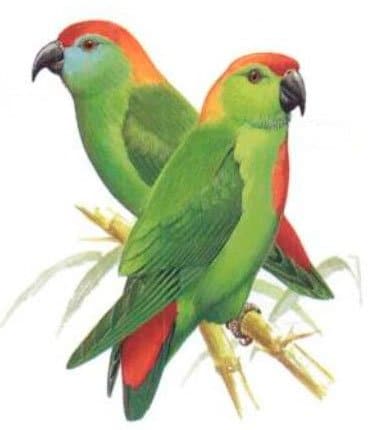
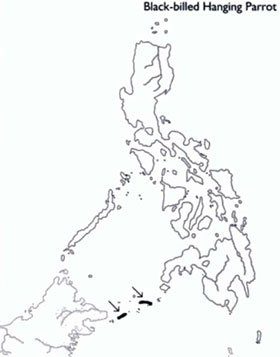
The Black-billed Hanging Parrot (2) is a subspecies of the Colasisi (Loriculus philippensis) being the only member of the genus, in the Sulu archipelago. The combination of the Red Crown on front, merging Orange gold neckband, and the black Bill are the brand identity of the Black-billed Hanging Parrot for both sexes. Aside from lacking these features, the most similar species within the subspecies of Loriculus philippensis, the L. p. apicalis and L. p. dohertyi, they have the necks much more of orange-red color and a strong orange color shawl in broadcast.
The female of the Ceylon Hanging-Parrot has the Red Crown, reddish diffusion in the mantle, peak red and a whitish iris (males do not have the Red bib of birds of Sulu).
The front of the Crown of the Black-billed Hanging Parrot is red, shading back in Orange and yellow in the back of the Crown, with a clear line of demarcation of the green mantle; bright green cheeks and Lores. Orange robe loosely washed in the Center; rump and tail coverts bright crimson (Blue Suffusion on sides of rump). Wings green brilliant with vane internal to blackish flight feathers. Feathers of the wings of Turquoise Green: below, the wings of blue. The Chin and throat bright Scarlet; rest of the underparts of bright green. Upper, the Green tail; Blue below. the black beak; Brown irises; Orange to greyish legs.
Habitat:
The species is little known, but their habits and ecology are presumably similar to those of the Colasisi. Commonly found in front of coconut groves on the coast, inside you have registered in forests, as well as in partially cleared areas. Observed feeding on flowers of Palm and flying between the trees.
Reproduction:
The breeding season starts around February and may continue until may. An average clutch can coasts of 2 to 4 eggs. Parents make their nests on top of the cavities of the trees.
Food:
Their natural diet consists of nectar, seeds, red fruits (especially wild figs), berries and flowers
Of 31 to 38 cm.. length and a weight between 219 and 275 g.
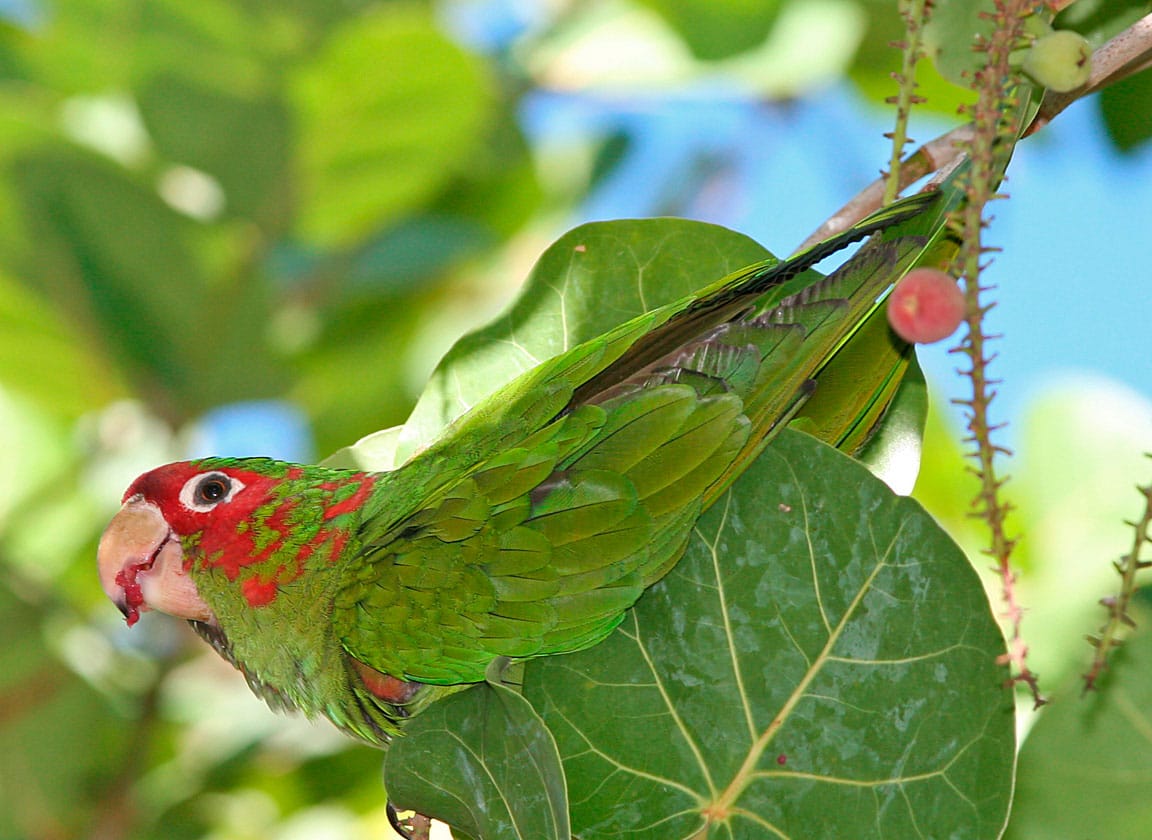
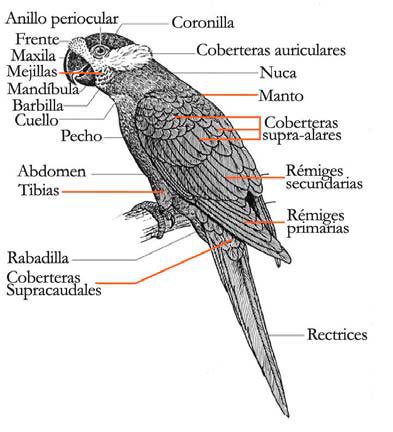
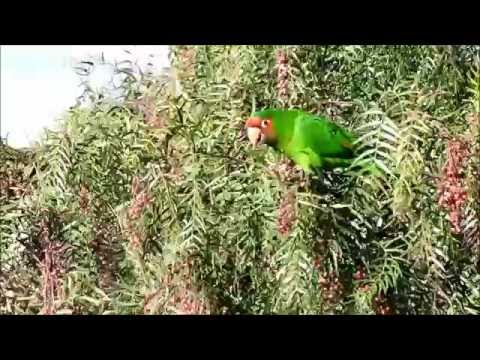
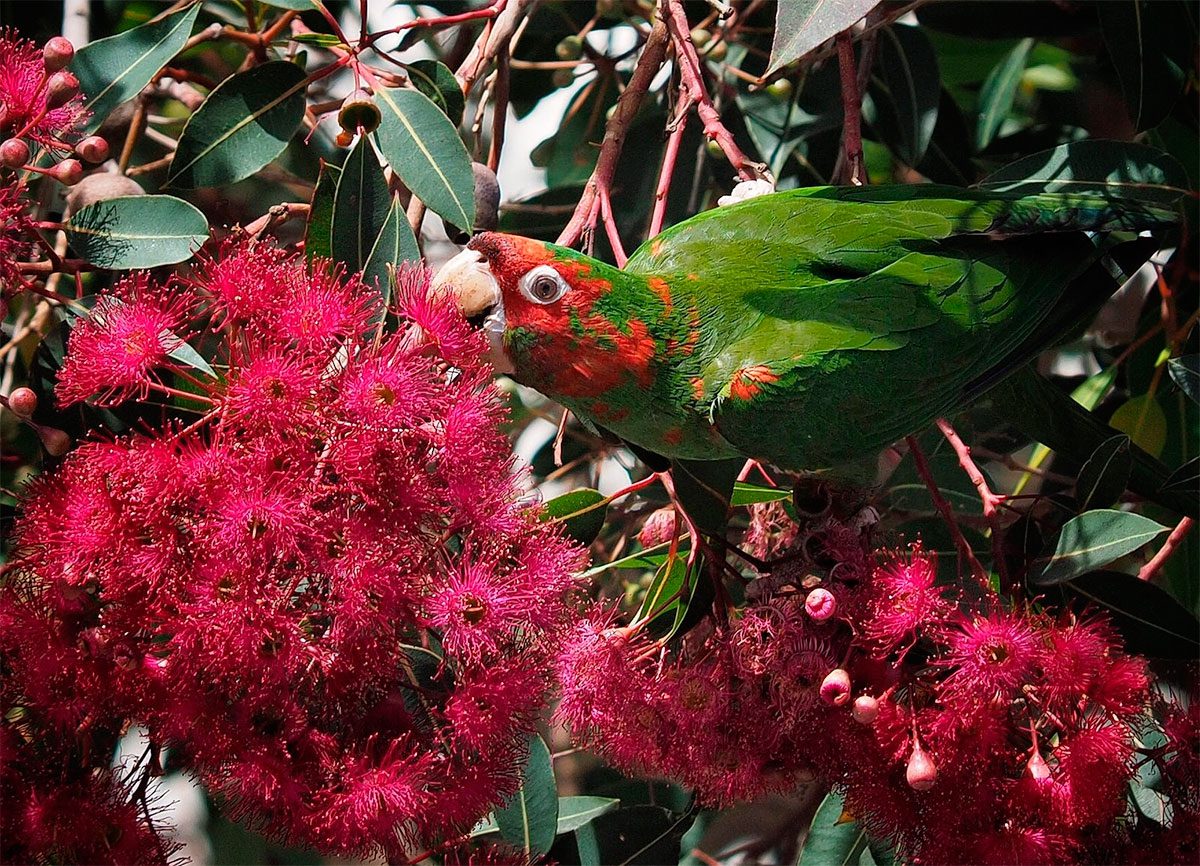
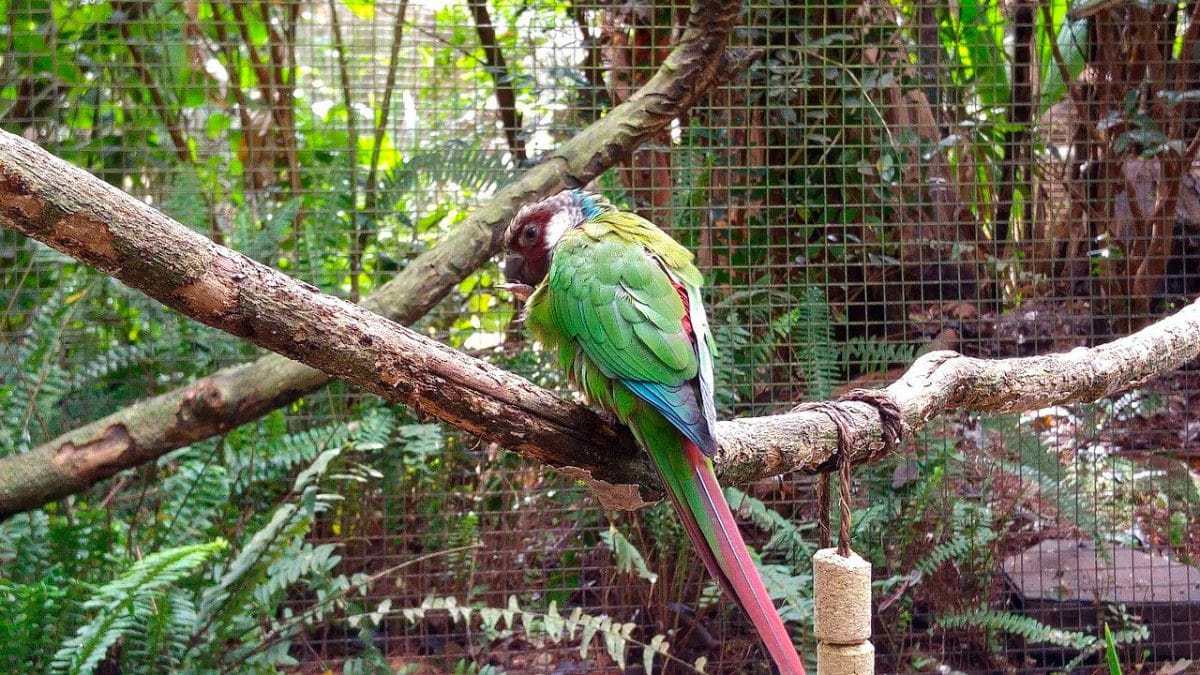
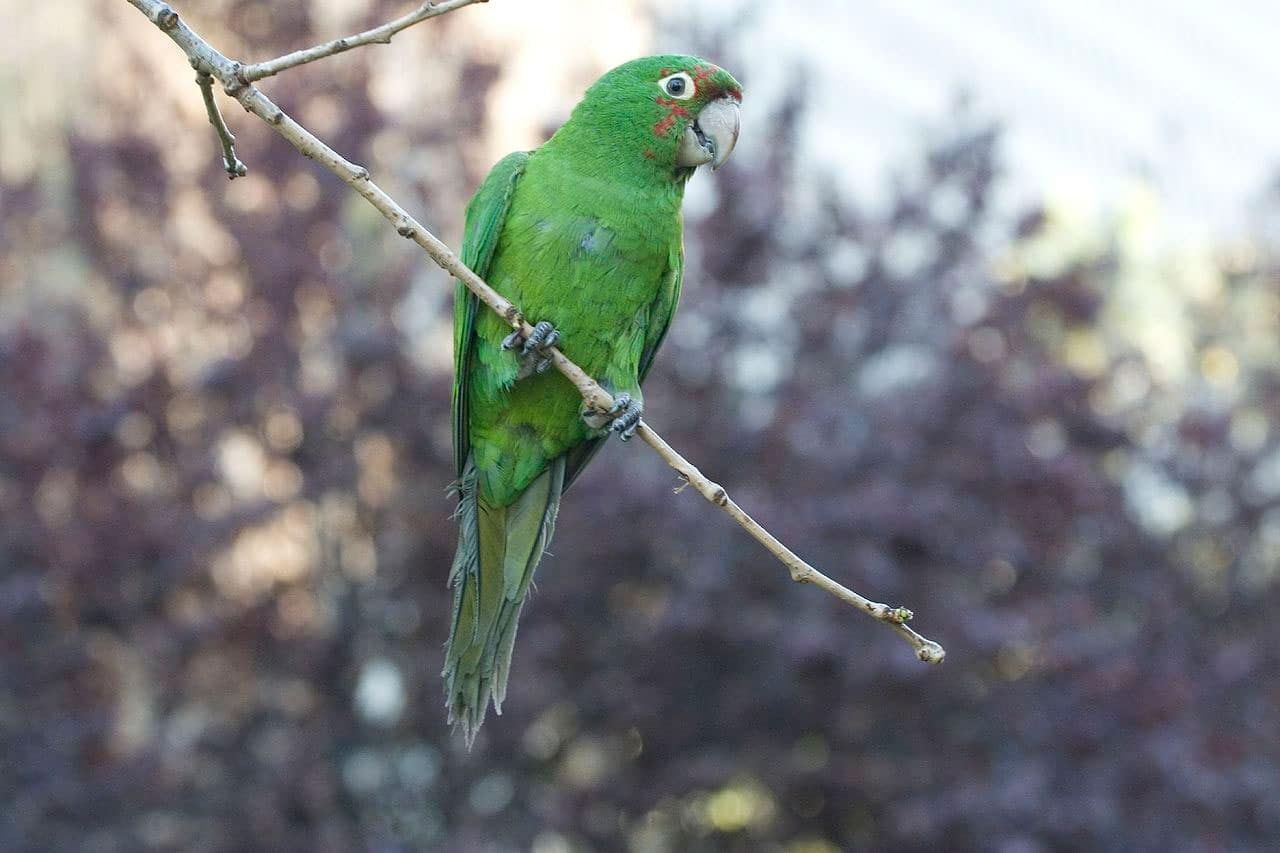
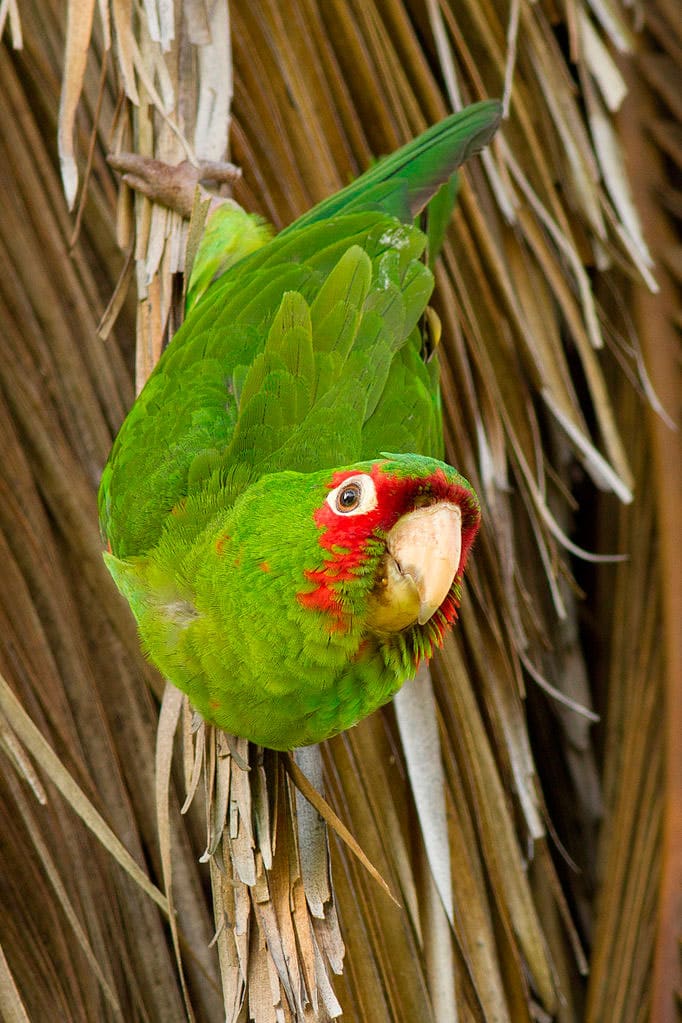
The Mitred Parakeet(Psittacara mitratus) It has a reddish-brown forehead with a bright red fusion on the front of the crown; the lores and cheeks to the rear of the eyes, bright red; the sides of neck dark green with scattered red feathers. The upperparts from the back of the crown up to the uppertail-coverts, dark green with some scattered red feathers (especially in the nape).
Upperwing-coverts and flight feather, at the top, green, sometimes with one or two dark red feathers on the bend of wing; flight feather color marron-oliva below. Underwing-coverts opaque green. The underparts, dull, Green pale with dye olive, usually with scattered red marks, especially in the the thighs. Upper, the tail dark green with Brown tips; Brown down.
The bill off-white; bare periophthalmic creamy white; irises beige color; legs distant.
Both sexes similar.
The Immature with fewer red feathers on the head, in special, in the cheeks and Brown, not Orange, the irises.
(Arndt, 2006) – Front band Red that extends to the lores and Strait, e incomplete bare periophthalmic; upper zone of the cheeks and ear-coverts, green.
They usually inhabit in areas of dry subtropical vegetation, There are also records in temperate zones: montane deciduous forest, cloud forests drier, cultivated areas, hills covered with tall grass, areas populated with scattered trees and fields, as well as sheets of legumes dry grasslands with patches of forests of Prosopis.
Often can be seen near high and steep rock walls. Usually, at altitudes of 1.000 to 2.500 Metros in Argentina, Although there are records to 4.000 metres in the Peru. Rarely, or never, descends to the lowlands. Commonly seen in groups of 2 to 3 birds, but until 100 individuals outside the breeding period.
Reproduction:
They nest in cliffs or hollow trees. There has been a egg laying in Oran, Argentina. Probably the clutch is between 2 and 3 eggs.
Food:
It usually feeds in areas of Virgin forest, but also full of grain crops in populated areas. This and other parrots migrate to the Lerma Valley in the Northwest of Argentina for feeding of the berries in maturity during the month of October.
Distribution:
The Mitred Parakeet are distributed in the southwest of South America, from the South of Peru through the Center-West of Bolivia, to the North of Argentina. Observed in the great valleys of the center of the Peru, from Huanuco until Cuzco. Disintegrated in the valleys of the Eastern Andes in the Centre-West of Bolivia, where there are records in Peace, Santa Cruz, Cochabamba, Oruro, Padilla and South of Sucre, to the Northwest of Argentina in Jujuy, Salta, Tucumán and South of Catamarca, until La Rioja and Córdoba.
In general residents, Although some with seasonal movements in the North of Argentina and Bolivia.
Locally distributed within its range, Although most widespread in the South of Cochabamba, Bolivia. In Argentina, generally common, abundant in some locations (apparently more numerous in Catamarca and Salta), but perhaps decreasing.
Maintained in captivity and sold in large quantities at the international level (mainly from Bolivia) at the end of 1980.
Subspecies distribution:
Psittacara mitratus chlorogenys
(Arndt, 2006) – Its habitat ranges from the North and centre of Peru, in the Valley of the Utcubamba River and surrounding Highlands in amazon and North of Cajamarca, as well as in the eastern valleys of the Andes, in Huanuco and Junin..
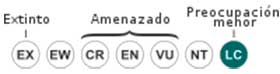
• Red List category of the UICN current: Least concern
• Population trend: Stable
The size of the world population Mitred Parakeet It has not been quantified, but this species is described as «common» but of irregular distribution (Stotz et to the., 1996).
The population suspected to be stable in the absence of evidence of any reduction or substantial threats, Although it has been the subject of intense trade: from 1981 When it was included in the Appendix II, 158,149 individuals were captured in the wild and reported in the international trade (UNEP-WCMC trade database CITES, January 2005).
"Mitred Parakeet" in captivity:
This bird is usually available in pet stores or breeders.
They are known to be very attached to their owners. Very playful, they can also become good conversadoras and are considered the more strong and lively group of Aratinga parrots. The Mitred Parakeet It is good for owners who want a large bird and is easy to care for and handle. Can entertain herself if you give it a lot of toys, but they also enjoy interacting and playing with his human flock.
Parrots A Guide to the Parrots of the World – Tony Juniper & Mike Parr
Birdlife
Photos:
(1) – A feral Mitred Parakeet in Fort Lauderdale, Florida By http://www.birdphotos.com (Own work) [CC BY 3.0], via Wikimedia Commons
(2) – Mitred Parakeet (Aratinga mitrata), Inka Trail to Machu Picchu, Peru By D. Gordon E. Robertson (Own work) [CC BY-SA 3.0 or GFDL], via Wikimedia Commons
(3) – Mitred Parakeet by vil.sandi – Flickr
(4) – Mitred Parakeet (Psittacara mitrata) by Gregory "Slobirdr" Smith – Flickr
(5) – Member of an escaped flock roughly 35-50 strong in Sunnyvale, CA By Shravans14 (Own work) [CC BY-SA 4.0], via Wikimedia Commons
(6) – A pair of parakeets in the escaped flock in Sunnyvale, AU. This flock has been around for at least 20 years By Shravans14 (Own work) [CC BY-SA 4.0], via Wikimedia Commons
(7) – Wild parrot (Mitred Parakeet) in Redondo Beach. (Aratinga mitrata) by Ingrid Taylar – Flickr
(8) – A pet Mitred Parakeet (also known as the Mitred Conure) By Lee (originally posted to Flickr as Gaspar4) [CC BY-SA 2.0], via Wikimedia Commons
(9) – A wild SoCal parrot (Mitred Parakeet) eating Bottlebrush in Redondo Beach. This bird is part of a local flock that frequents the neighborhood by Ingrid Taylar – Flickr
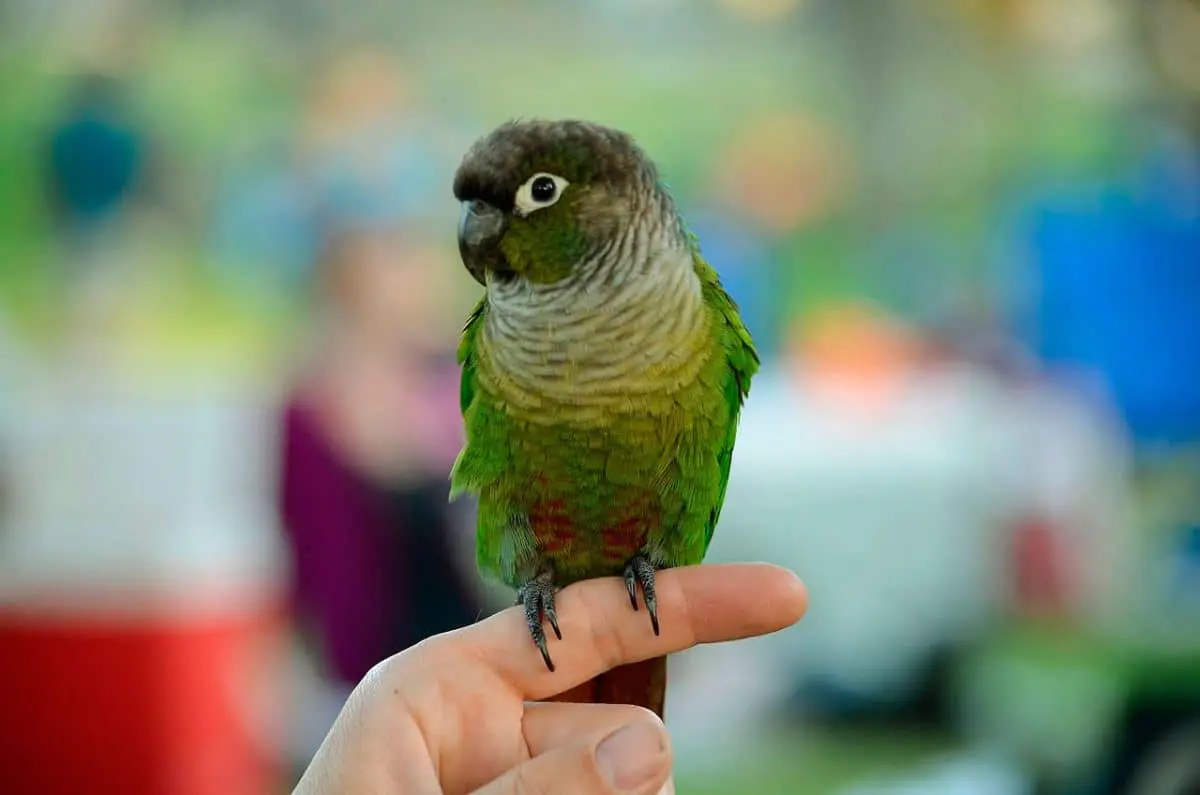
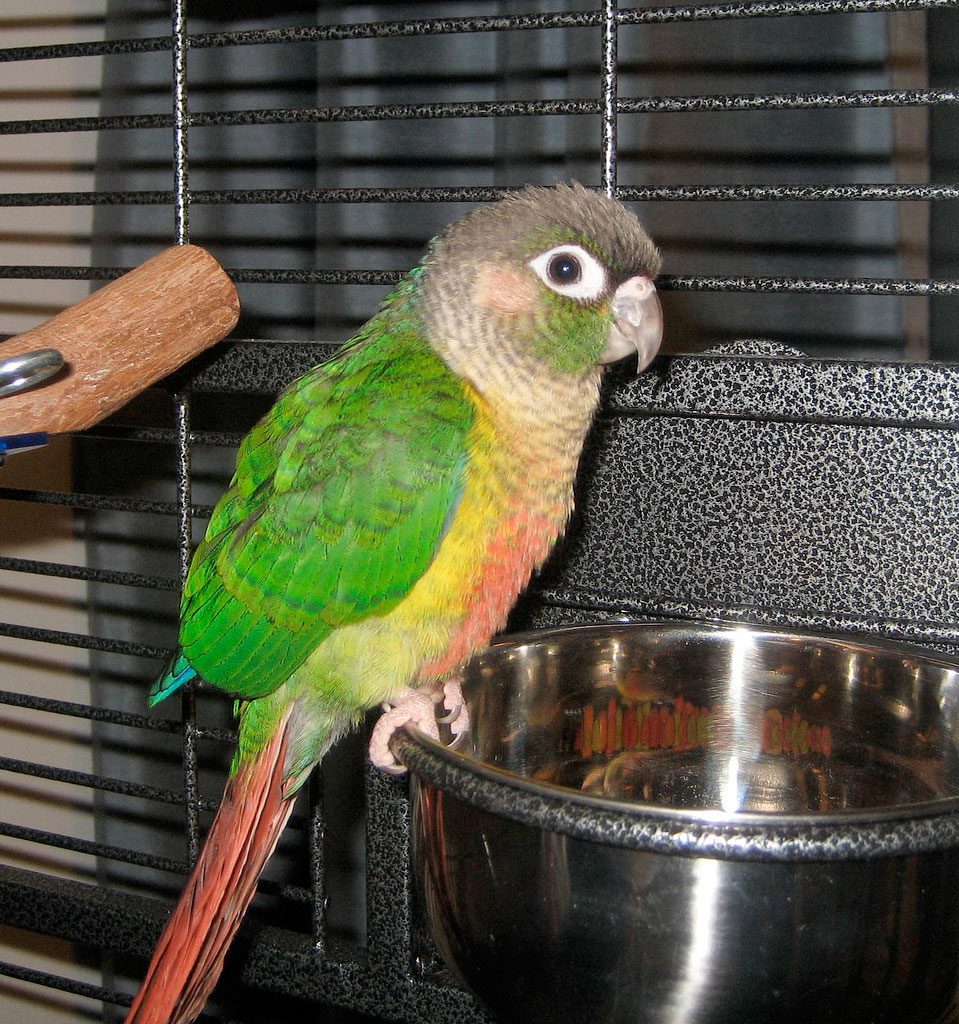
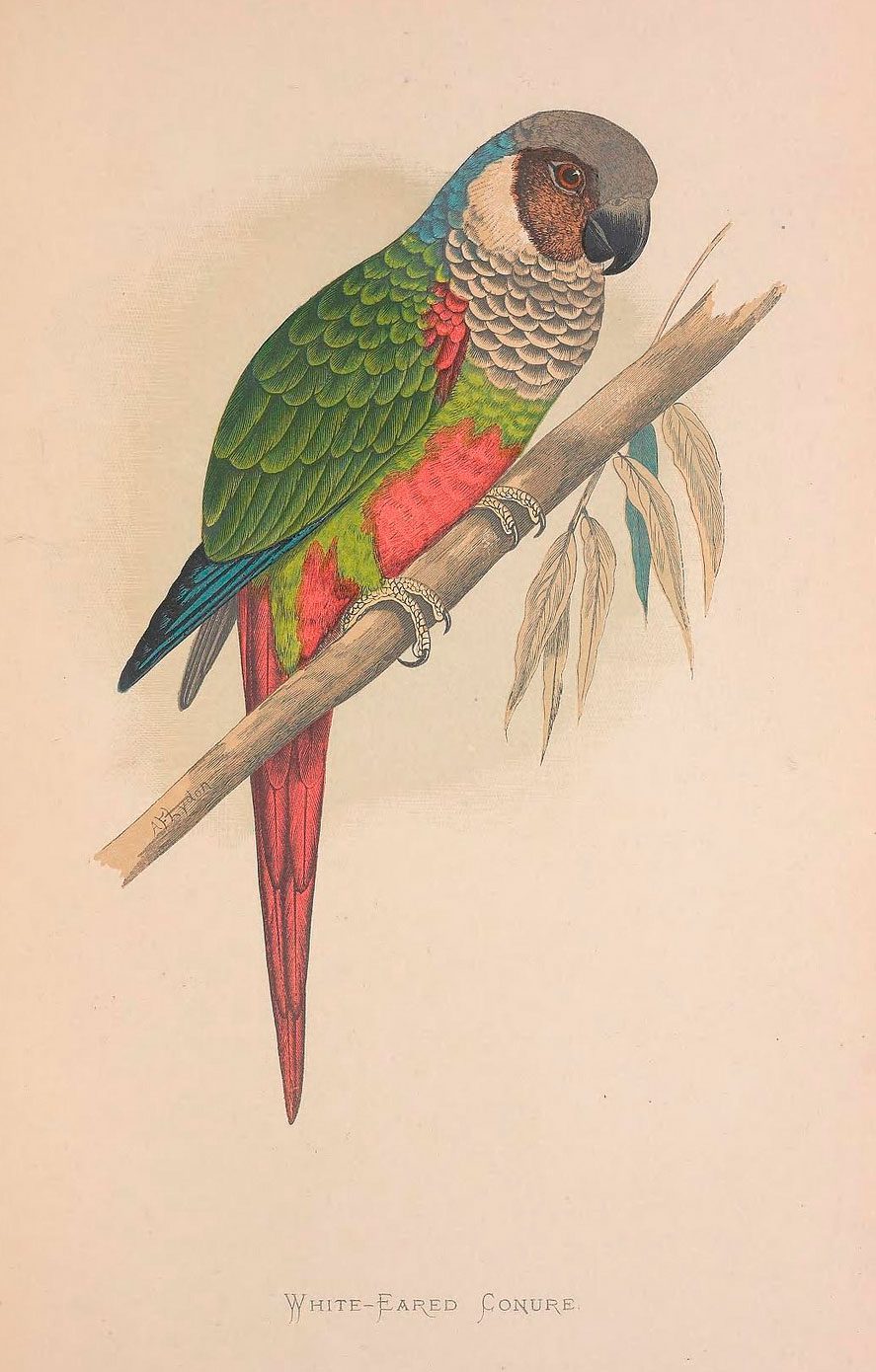
The Green-cheeked Parakeet(Pyrrhura molinae) has a close frontal band and lores, you are reddish brown to blackish; crown, of color brown or brown grayish marked laterally in shades blue and green; rear area of the crown and nape with blue tips; cheeks and sometimes the supercilii area (area of the front), of color green with dye olive; ear-coverts of color grey clear to pale.
Upperparts green. The primary coverts are bluish green and the remaining are mainly green, except for some feathers scattered of color blue, yellow or orange in the leading edge of wing. Primaries blue, secondaries Green with blue near the axis; both grey below. Underwing-coverts green. feathers in the chest, the throat and the sides of the neck, brownish at base with pale purple, light grey, or yellowish opaque in the tips, giving effect squamous; central belly with brown patches of varying size (only scattered feathers some birds); sides of the belly, the thighs and bottom of the chest, green; undertail-coverts bluish green.
Upper, the tail brown, with green at the base of the center of the tail feathers (hidden under the coverts); below, the tail brown.
The bill, grey; the cere white; bare periophthalmic whitish; irises brown; legs grey.
Both sexes are similar.
Immature paler. with the irises darker and less a defendant patch brown of the belly.
(Todd, 1915) – Slightly smaller the species nominal, pale margin to the throat and to the close down of the chest; Brown-colored area in the chest more extensive; less blue in the undertail-coverts.
Pyrrhura molinae flavoptera
(Maijer, Herzog, Kessler, Friggens & Fjeldsa, 1998) – Similar to the nominal species, but with the bend of wing and the carpal edge, orange-red; Alula with feather blue and yellow / white mixed.
Pyrrhura molinae hypoxantha
(Salvadori & Festa, 1899) – Previously listed as Pyrrhura molinae sordida. The cheeks more pale that the of the nominal species; the color red in the belly less prominent and the skirting of feathers in the throat and the chest less distinctive.
(Schlegel, 1864) – It differs from the species nominal and of the subspecies Pyrrhura molinae australis, by having the basal half of feathers of the Centre of the tail, green. Some birds are yellow in the leading edge of wing.
Pyrrhura molinae restricta
(Todd, 1947) – More blue that other subspecies, with stain blue in them lower cheeks and strong blue subfusion in the undertail-coverts. The blue tips on the feathers of the nape and zone back in the neck they form a most distinctive collar which in the nominal species.
Habitat:
The species Green-cheeked Parakeet inhabits dense forests, often low and forests with clear primary and secondary , including stripes of chaco, Savannah, deciduous forest and pantanal gallery, as well as rainforests MOSS-covered in the Eastern Andes where is reported to 2.900 meters above sea level.
In Brazil the subspecies Pyrrhura molinae hypoxantha are located mainly in deciduous forest above the 500 m.
Gregaria (at least outside the breeding season), usually in flocks of 10-20, sometimes many more.
Very often seen in rapid flight, under, fairly erratic and slightly wavy. Difficult to detect while feeding calmly in the treetops.
Reproduction:
It nests in hollow natural of trees. The laying is of 4 to 6 eggs during the month of February in the northeast of Argentina. Period of incubation: 20-24 days.
Food:
There is no information about the diet of the Green-cheeked Parakeet, but probably similar to nearby conspecifics; Forages in the treetops.
Distribution:
Size of the area of distribution (reproduction / resident): 675.000 km2
Its distribution runs from the southwest of Brazil and Northwest of Argentina to the East of Bolivia and probably South of Peru.
Apparently absent from the land low of the pantanal and restricted in the basin of the Paraguay River isolated plots of forests of chaco in highlands on the right bank of the river.
In the Northwest of Argentina is distributed in Salta, Jujuy and with less frequency in Tucumán (a record in Catamarca is probably wrong).
They can live on the fringes of the Northwest of Paraguay but not is tested. Some local seasonal movements they can occur, birds in the higher elevations down to altitudes lower in winter (Mar-Aug).
Usually common (very common in Salta and Jujuy); Highest densities in deciduous forest; It is the most common parrot in the wooded valleys of Bolivia eastern but probably declining there due to rapid habitat clearance.
Is sold during those years eighty and was extended in captive outside of its area of distribution.
• Current category of the Red List of the UICN: Least concern.
• Population trend: Stable.
Justification of the population
The size of the world population It has not been quantified, but this species is described as «common» (Stotz et to the., 1996).
Justification of trend
Suspected that the population is stable in absence of evidence of any decline or threatens substantial.
"Green-cheeked Parakeet" in captivity:
Unknown in those birds up to the Decade of 1970, nowadays it is quite common. They have become one of the favorite birds in the pet trade, due to his sweet personality and at your disposal for fun. Son playful, loving and Smart.
They are not considered the best talkers. But, some Green-cheeked Parakeet, especially smart, they learned to speak very well, according to their owners. Even so, most say only a couple of things, And there's no guarantee that they'll ever learn to speak. They also have low and serious voice, so even if managed to talk, it would not be easy for them to say something understandable.
Price per couple (ancestral): 120-200 EUR. Hypoxantha: 150-300 EUR.
– Avibase
– Parrots of the World – Forshaw Joseph M
– Parrots A Guide to the Parrots of the World – Tony Juniper & Mike Parr
– Birdlife
– Book Parrots, Parrots and macaws
– avianweb
– Photos:
(1) – A Green-cheeked Parakeet perching on the index finger of a left hand By Eric Sonstroem from California, USA (Green-Cheeked ConureUploaded by snowmanradio) [CC BY 2.0], via Wikimedia Commons
(2) – Green-cheeked Conure perching in an aviary at Kuala Lumpur Bird Park, Malaysia By Brandon Lim (Rainbow LorakeetUploaded by Snowmanradio) [CC BY 2.0], via Wikimedia Commons
(3) – Green-cheeked Conure perching in an aviary By Brandon Lim (Rainbow LorakeetUploaded by Snowmanradio) [CC BY 2.0], via Wikimedia Commons
(4) – A juvenile pet Yellow-sided Green-cheeked Conure (also Sordid Conure and the Yellow-sided Conure). It is a naturally occurring subspecies of the Green-cheeked Conure. The photograph shows a wing-clipped pet parrot in a bird cage. By therouxdown (Reese closeupUploaded by Snowmanradio) [CC BY-SA 2.0], via Wikimedia Commons
(5) – A juvenile pet Yellow-sided Green-cheeked Conure (also Sordid Conure and the Yellow-sided Conure). It is a naturally occurring subspecies of the Green-cheeked Conure. The photograph shows a wing-clipped pet parrot perching on a food bowel By therouxdown (originally posted to Flickr as Reese profile) [CC BY-SA 2.0], via Wikimedia Commons
(6) – Molina’s Parrot from Philip Lutley Sclater and W. H. Hudson, Argentine Ornithology: A Descriptive Catalogue of the Birds of the Argentine Republic (1888-89) in Wikimedia
The Maroon-faced Parakeet(Pyrrhura leucotis) measured 21 centimeters length and 50-53 g. of weight, It is the smallest species long-tailed parakeets.
Their cheeks and forecrown, They are brown brown mostly, blue above eyes and on lower cheeks; crown and nape, dark brown, dotted with orange-brown from the ends of pens; ear-coverts white to pale brown; nape with bluish green tones.
Mantle and top of the back, green with scattered dark margins on some feathers; lower back, rump and uppertail-coverts, brown. Wing coverts except green primary coverts which they are blue and patch Red in the bend of wing.
Primaries blue. Under, the wings with the lesser coverts green, the greater coverts dark gray; the flight feathers grey. Feathers of the throat and sides neck, blue base with a yellowish subterminal band and black tips; feathers of the chest with little blue tones and instead to brown in bases; the underparts They are green with a large patch brown in the center of belly. maroon brown with green edges at the base of the outerweb of the lateral feathers; undertail, the tail It is reddish brown opaque.
Bill black; cere black; bare periophthalmic grey; irises dark orange-brown; legs dark grey.
The plumage of both sexes are similar.
Taxonomic status:
Regarded as a subspecies Pyrrhura [leucotis or emma] by some authors
Sound of the Maroon-faced Parakeet.
Habitat:
The Maroon-faced Parakeet inhabits forests, clear edges and adjacent with scattered trees including cocoa plantations shaded Bay, sometimes visiting parks and residential areas. They can be observed, mainly, in lowlands (for example, to 600 meters in east Brazil) and in forests at higher elevations in Northeast Brazil. gregarious, generally close to flocks 15-20 birds.
Reproduction:
No information about your reproduction in the wild. Clutch 5-9 eggs in captivity.
Food:
Probably you have a diet comparable to his close relatives in the wild, where is recorded the Miconia hypoleuca as one of their food. There are reports of birds feeding in cornfields.
Distribution:
Size of its range (players / residents): 352.000 km2
– This species appears as Near-threatened on the basis that it is suspected that there has been a decrease in moderately rapid population due to the habitat loss and capture.
Justification of the population
• Current category of the Red List of the UICN: Near-threatened..
• Population trend: Decreasing.
• Population size : 10000-19999 individuals.
– The Maroon-faced Parakeet is believed to have a small town; However, Marsden et al .(2000) It estimated that there is a combined population of about 19,300 individuals on Biological Federal Reserve Sooretama the Nature Reserve Linhares in the State of Espirito Santo, based on surveys 1998, It is suggesting that the population has been previously underestimated.
– Until an updated estimate available, the population was provisionally placed in the band 10,000-19,999 mature individuals, representing a population of about 15,000-30,000 individuals in total, although the structure of the subpopulation not known.
Justification trend
State of conservation ⓘ
Near Threatened ⓘ(UICN)ⓘ
– It is suspected that the species is in a moderate to rapid decline due to the habitat loss and capture. The rate of decline is not thought to be as rapid because the tolerance of this species to modified habitats buffers the impacts of deforestation to some extent..
– Most of the original forest cover in which the Maroon-faced Parakeet It was eliminated more than a century ago; in the news, are being eliminated very quickly the remaining patches (pit et to the ., 1997).
– This bird often seized in captivity, suggesting that there is a major catch birds for trade. (J. Gilardi in little ., 2010).
Conservation Actions Underway
– protected in parts of Bay (Private Reserve Station Veracruz, and national parks Discovery, Pau Brazil and Monte Pascoal) (Lamb 2002).
– Monte Pascoal It faces an uncertain future, as it has been invaded by Indians Pataxó they have largely eliminated neighboring area.
– Elsewhere the species is known from reserves Linhares-Sooretama(Espirito Santo), Rio Doce State Park(Minas Gerais, Brazil) and Ting Biological Reserveeructate (Rio de Janeiro).
Conservation Actions Proposed
– continue monitoring of this species in the field and in trade.
– Strengthen the network of protected areas within the Atlantic Forest of Brazil conservation of key sites.
"Maroon-faced Parakeet" in captivity:
Very rare.
Its diet in captivity it is similar to that of their peers.
Its population in the wild is small and decreasing whereby each captive specimen of this species that is capable of reproducing, must be placed in a well-managed captive breeding program and not sold as a pet, in order to ensure its long-term survival.
(2) – Several White-eared Parakeets (Pyrrhura leucotis) at Palmitos Park, Gran Canaria, Spain By Bjoertvedt (Own work) [CC BY-SA 3.0 or GFDL], via Wikimedia Commons
(3) – A White-eared Parakeet in Parque das Aves, Foz do Iguaçu, Brazil By Kee Yip from Union City, California, USA (IMG_4336_P1030859Uploaded by snowmanradio) [CC BY 2.0], via Wikimedia Commons
(4) – White-eared Parakeet (Pyrrhura leucotis), Vale Reserve, Holy Spirit, Brazil by Brendan Ryan – Flickr
54 to 56 cm.. height and a weight between 520 and 790 g.
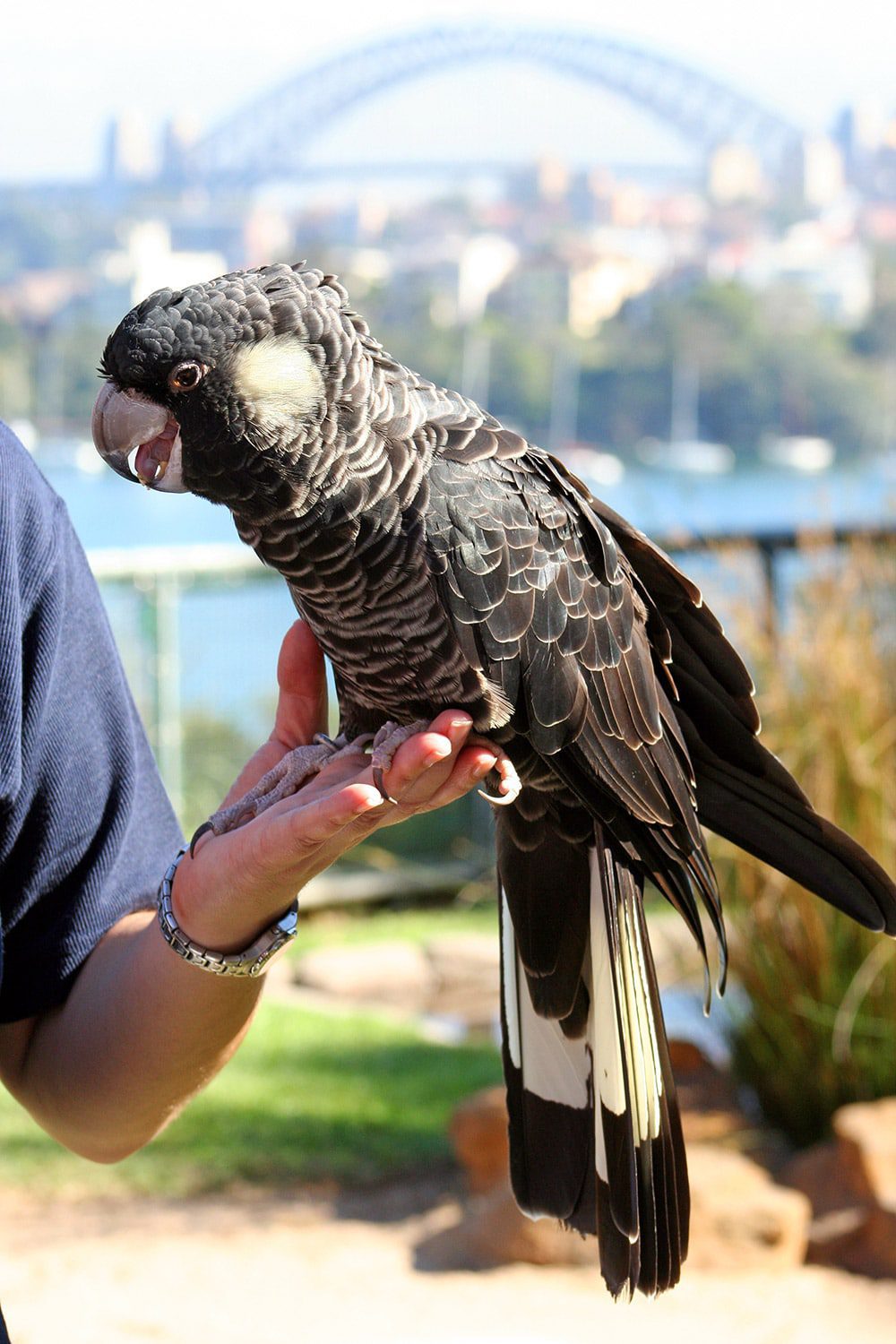
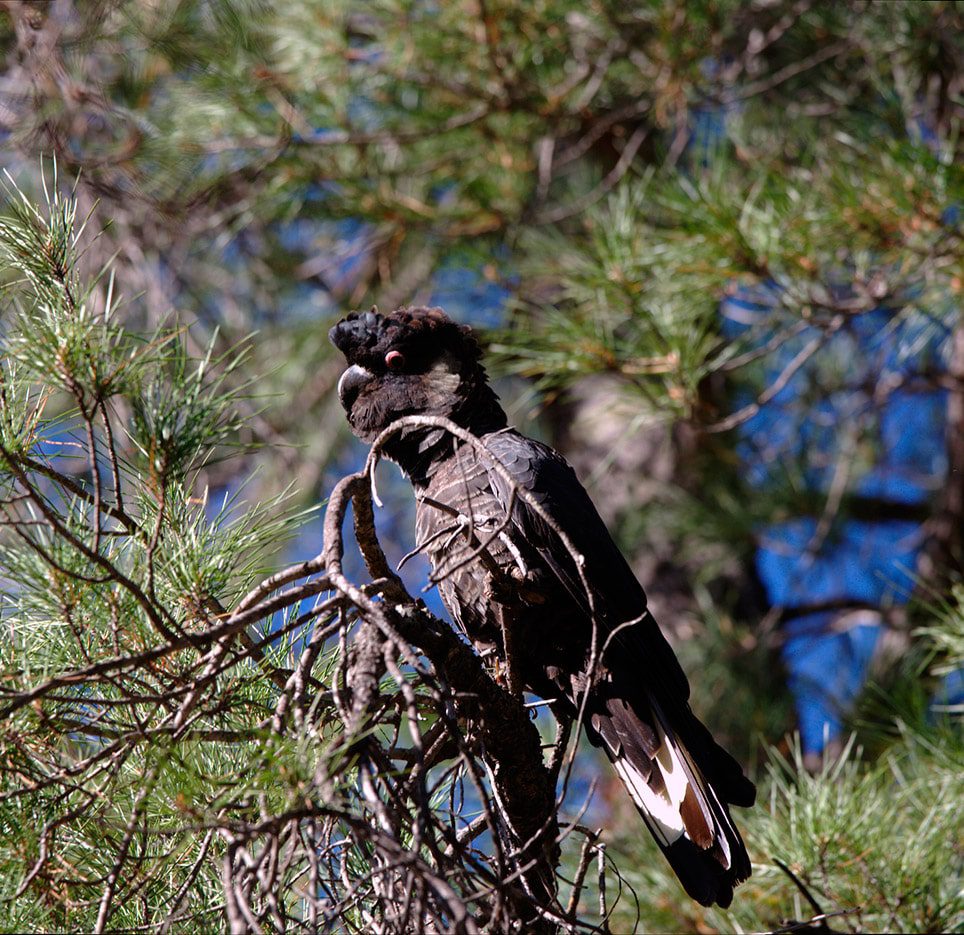
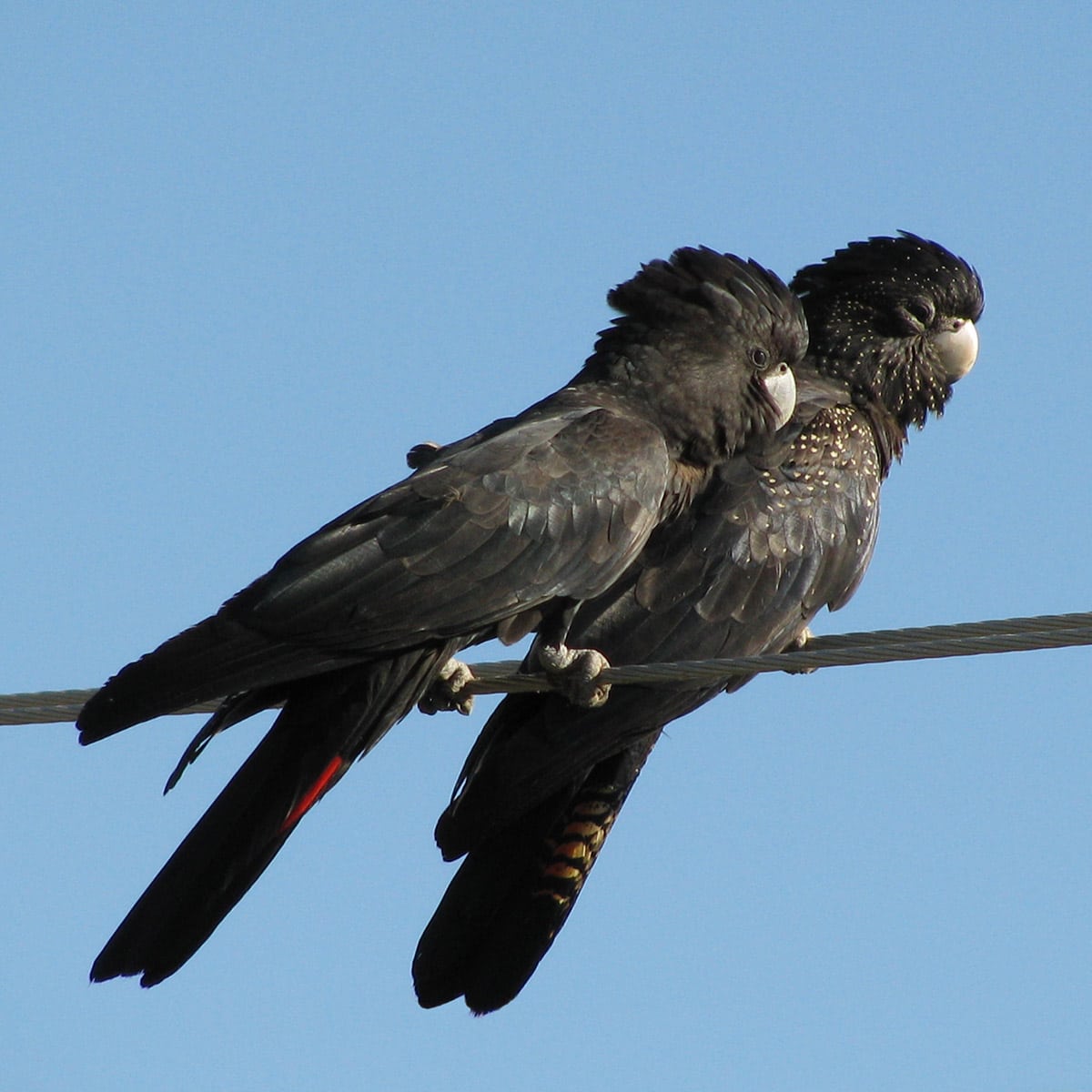
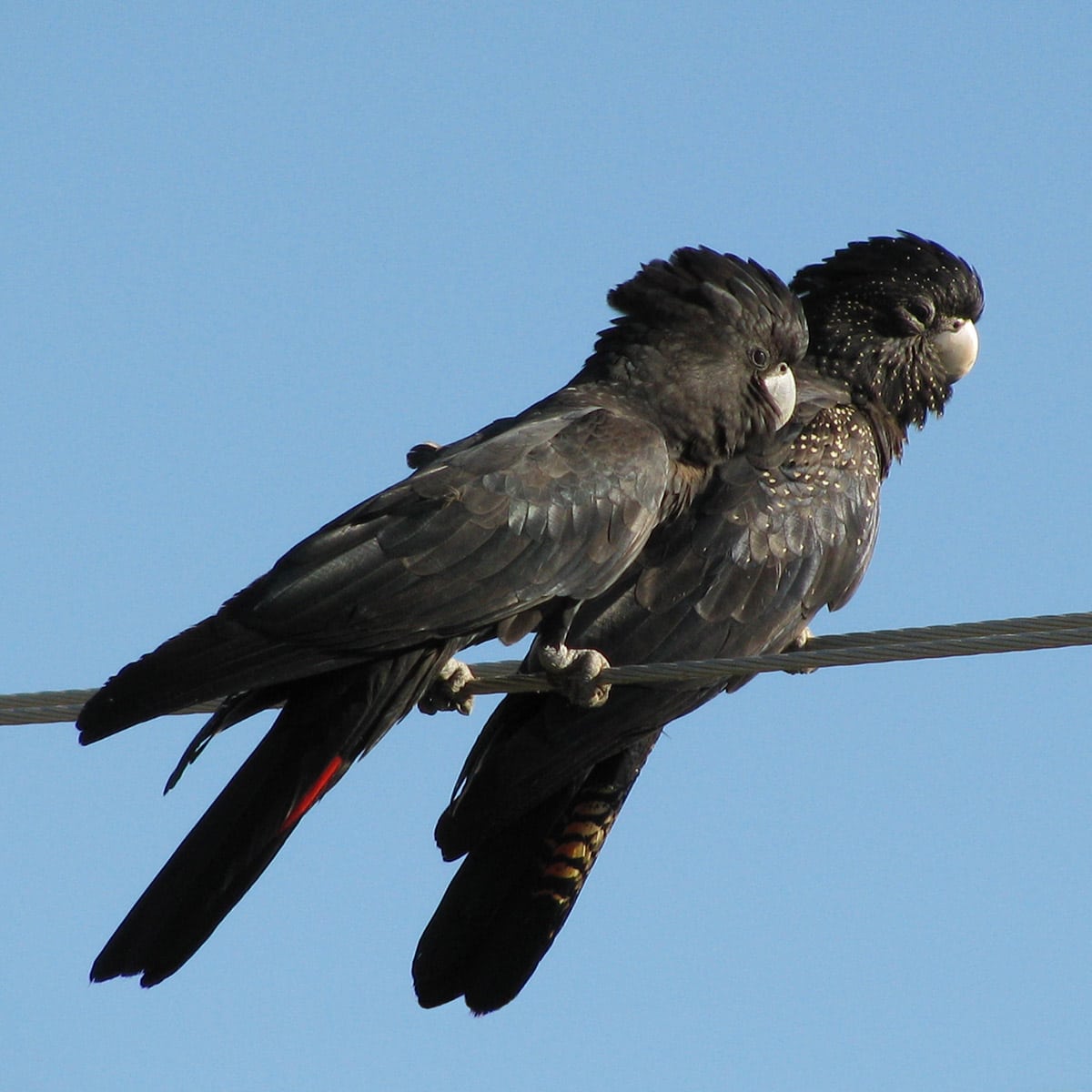
The Short-billed black cockatoo(Zanda latirostris) It is a large black cockatoo..
It has great bill black, crest erectile, white spot in the area ear and white panels on the tail. The female It is similar except patch area ear large and slightly yellowish white.
The immature Similar to adult female.
Closely related to Baudin's black cockatoo(Zanda baudinii). They were formerly treated as a single species.
Mainly inhabits in native forests eucalyptus and shrubland or heathland. Visit temporarily plantations exotic pines.
Sometimes you see them in cities or at the edges of roads. It is also a visible visitor to the gardens containing native plants with hard fruits around Perth.
Usually they see them in groups of three or in small flocks, but occasionally gather in large flocks composed of hundreds or, exceptionally, thousands of birds. Sometimes it is associated with Baudin's black cockatoo(Zanda baudinii) wave Red-tailed black cockatoo(Zanda Banksia) in places where food is plentiful.
The species is said to be Residents in areas of high rainfall They are retaining much native vegetation and are emigrants of the driest regions and places where most of the native vegetation has been removed.
Reproduction:
They do not breed until they are at least four years old..
Adult birds They mate for life, and stay together throughout the year.
Reproduction occurs mainly in the region Wheatbelt, northwest of the Stirling Range about Three Springs, but it has also recorded on the coastal plain in the South West, about Bunbury.
The reproductive activity It is limited to eucalyptus forests. They make their nests in large holes in the top of the eucalyptus.
The eggs They are white or cream, and they have no marks. Son incubated by female only, for a period of 28 to 29 days. The nestlings are fed by both parents, Although during the first 10 to 14 days after hatching they are fed exclusively by the female.
Adults return to the same breeding area each year.
Food:
It feeds mainly from seeds and occasionally nectar, fruit and insect larvae.
Distribution:
Size of the area of distribution (reproduction / resident): 196.000 km2
Endemic southwest Australia.
Conservation:
State of conservation ⓘ
Endangered ⓘ(UICN)ⓘ
• Current category of the Red List of the UICN: In danger of extinction.
• Population trend: Decreasing.
On the basis of the distribution of birds during the breeding season, the total population of the Short-billed black cockatoo it has been estimated that is between the 11 000 and 60 000 birds, although there are those who affirm that its population could count on less than 10 000 birds.
The decline of this species It is mainly due to the loss and fragmentation of habitat. This has been caused by the clearing of native vegetation, mainly for agricultural purposes, Since the mid-20th century.
No specific information available on future changes in population size. But, the range of the species is thought to continue to contract for some time, which leads to a concomitant decrease in population size.
"Short-billed black cockatoo" in captivity:
A program captive breeding It was established in 1996 by the Department of Conservation and Land Management (CALM), in association with poultry farmers and licensed Zoo of Perth.
The genetic diversity of the captive population is enhanced by an 'abandoned' program’ that rehabilitates injured birds in the wild and then incorporates them into captive breeding.
Some eggs and chicks are caught illegally for sale in the markets of poultry. Although the demand for the species is said to have declined over the past decade, high market prices (approximately 3.000 dollars per bird and 5,000 $ couple) together with the scarce success of breeding captive birds, They suggest that Illegal take of this cockatoo will continue to be a continuing threat to the survival of this species..
It measures 31 cm. and weighs around 300 g..
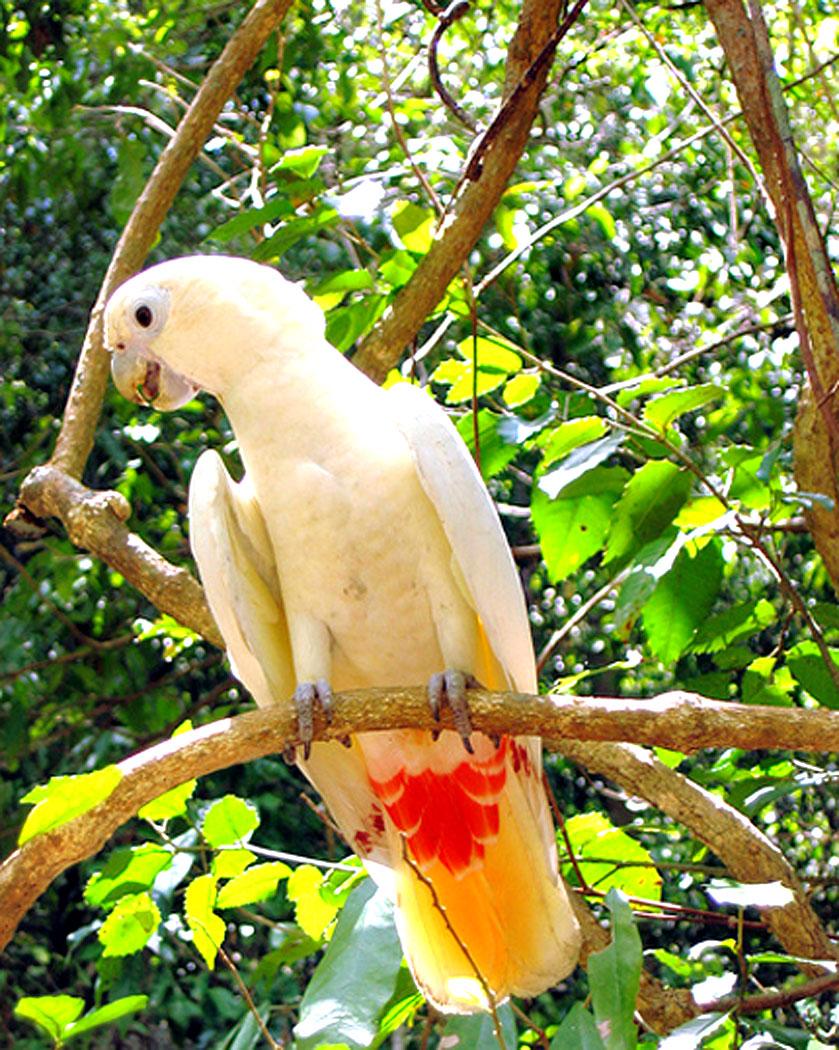
To the Philippine cockatoo(Cacatua haematuropygia) It is called locally Katala.
Its plumage is of a beautiful white color except for the feathers of the crest they are yellow or pink on its base and the bottom of the tail and wings they are yellow and Red.
The bill is a grayish-white color, and males has irises dark brown, While the of the female are brown-red color.
Is restricted to lowland not more than 50 meters above the sea level, in or adjacent to rivers, and in coastal mangrove areas.
outside the breeding season (March to June, and, times, from February to August), frequents corn and rice crops. This depends on the station where foods are grown and have the available resources, being partially nomadic.
These birds can fly from their island to the adjacent if they are not more than a few 8 km. distance.
Reproduction:
breeding season between February and June. Of one to three eggs they are placed on a nest on a tree branch. The eggs are hatch for a few 28 days, and the chicks remain in the nest for nine to ten weeks after the hatching.
Food:
They feed on seeds, vegetables, fruits and berries.
They are known to attack corn crops in agricultural areas.
Distribution:
Size of the area of distribution (reproduction / resident): 22.700 km2
This cockatoo is endemic in Philippines, and the only representative of the cockatoos that we will find there; This has become a treasure of these islands.
Conservation:
State of conservation ⓘ
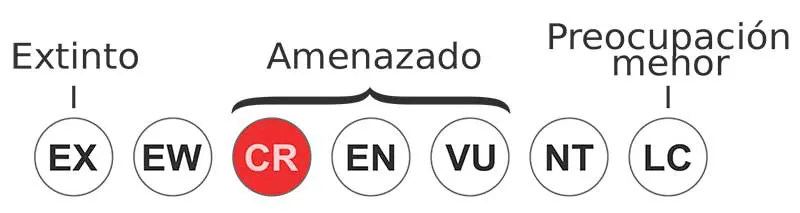
critically endangered ⓘ(UICN)ⓘ
• Current IUCN Red List category: Critical Hazard.
• Population trend: Decreasing.
• Population size: 370-770 mature individuals.
In Palawan the capture of the cockatoos for the international illegal trade is particularly serious, something which is reflected in the high price of these birds ($ 160 Americans in Manila in 1997); to have been looted all the visible nests each time the price is higher because it costs more to catch them.
The deforestation and the destruction of mangroves have been extensive in their range of occupancy and have contributed significantly to their decline.
It is also hunted and hunted for consumption as food.
The release of captive birds can introduce diseases into wild populations.
Conservation Actions Proposed:
• Conduct surveys on all range islands to assess species population size and distribution.
• Monitor population trends.
• Monitor rates of habitat loss and degradation.
• Quantify catch levels, persecution and trade.
• Designate more protected areas (for example Tawi-Tawi and towns in or near Palawan).
• Support the proposal to expand the Puerto Princesa Subterranean River National Park.
• Prevent destruction of mangroves.
• Promote economically viable alternatives to avoid the capture of this cockatoo.
• Continue with education programs and captive breeding programs.
• Establish staff at airports and ferry terminals to control the departure of specimens.
• Translocate animals to suitable areas such as lowland forests or mangroves..
Loro Parque Foundation It has warned of the risk of extinction that runs the Philippine cockatoo by the construction of a power plant in Palawan, an island province of Philippines in the region of Western Visayas.
This Spanish NGO has invested 1,3 millions of dollars and more than 14 years of work in the recovery project of this cockatoo, and fears that with the construction of this station, the less than 1.000 remaining specimens in the world could be electrocuted by high-voltage lines, In addition to being blocked their migration in search of food.
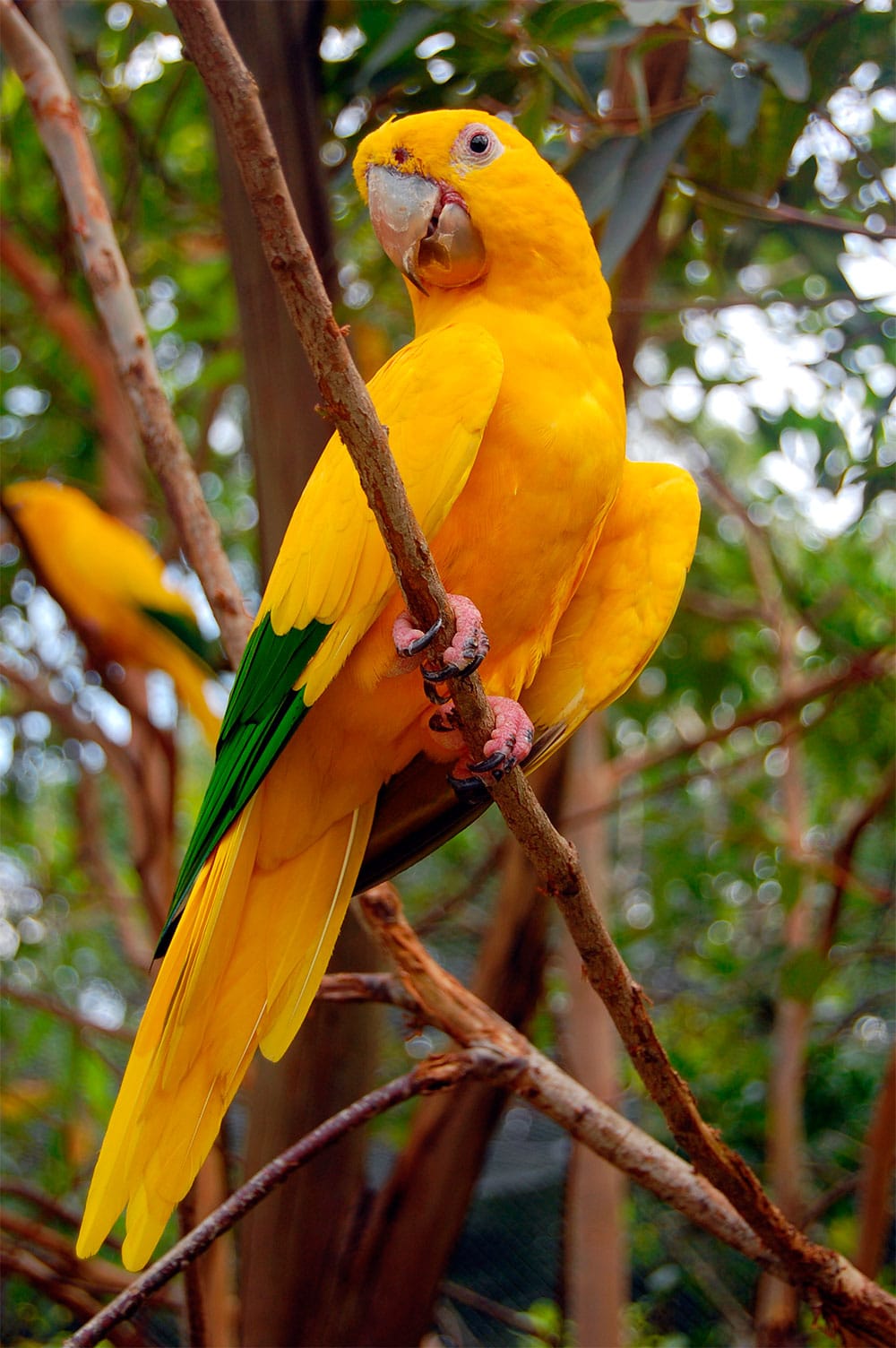
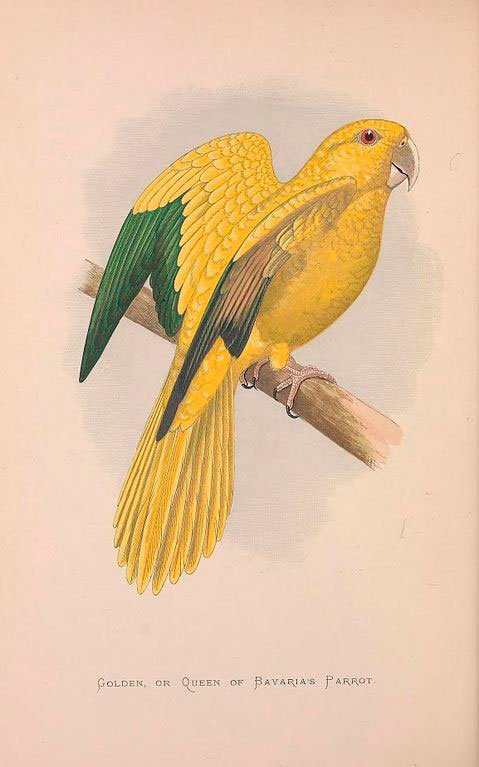
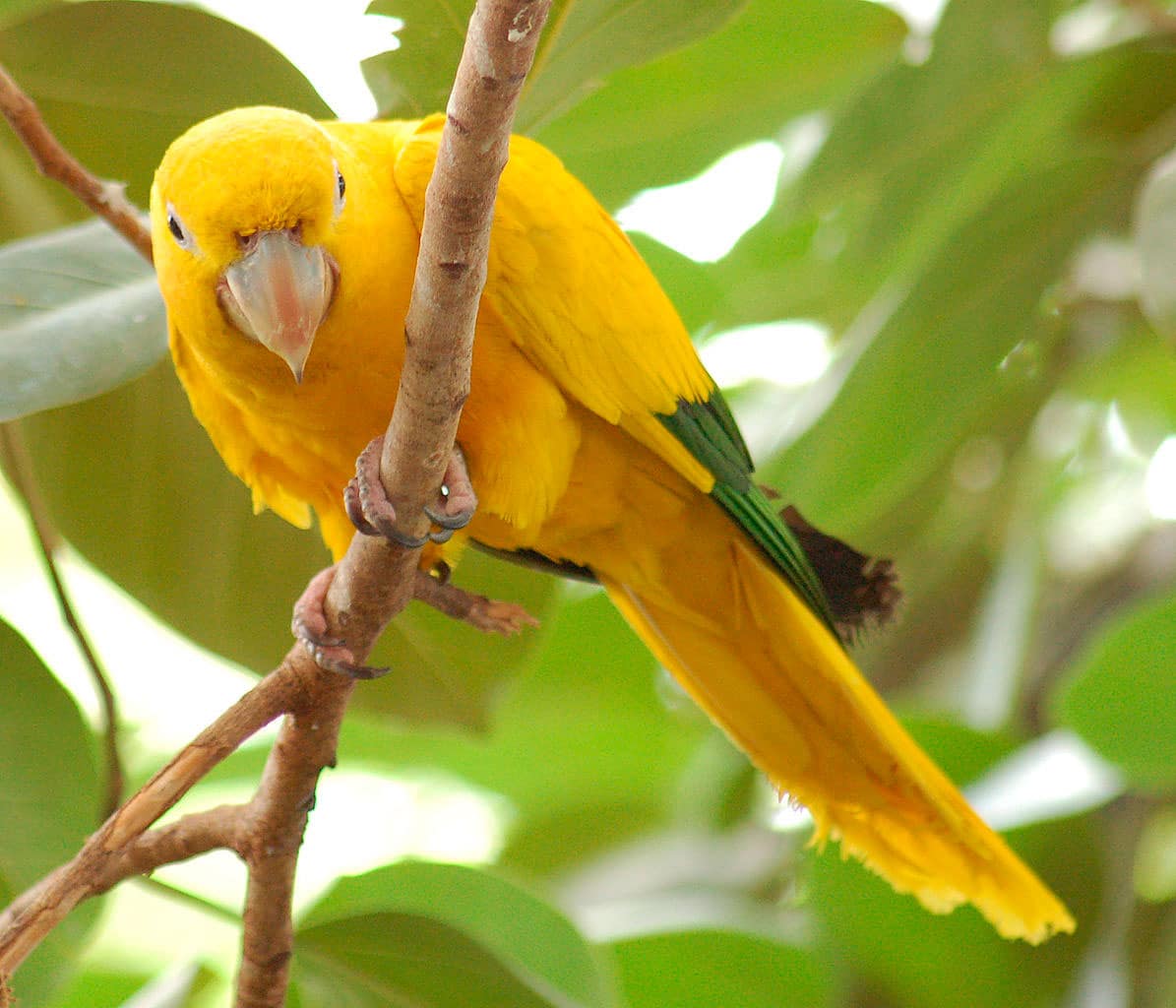
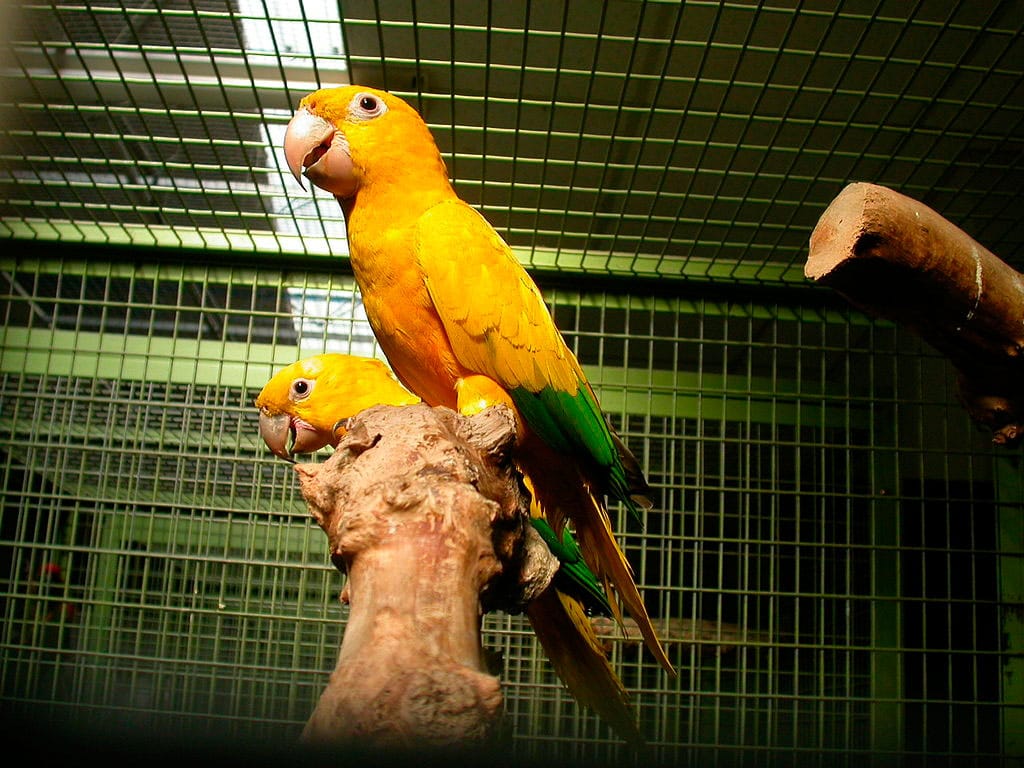
The Golden Parakeet(Guaruba guarouba) has all the head, upperparts, lower andtail , a bright yellow. The greater coverts, primaries and secondaries are dark green (one or two feathers yellow in some birds flying). Underwing-coverts yellow, the bottom of the flight feather dark yellow. Feather shafts of the tail are white.
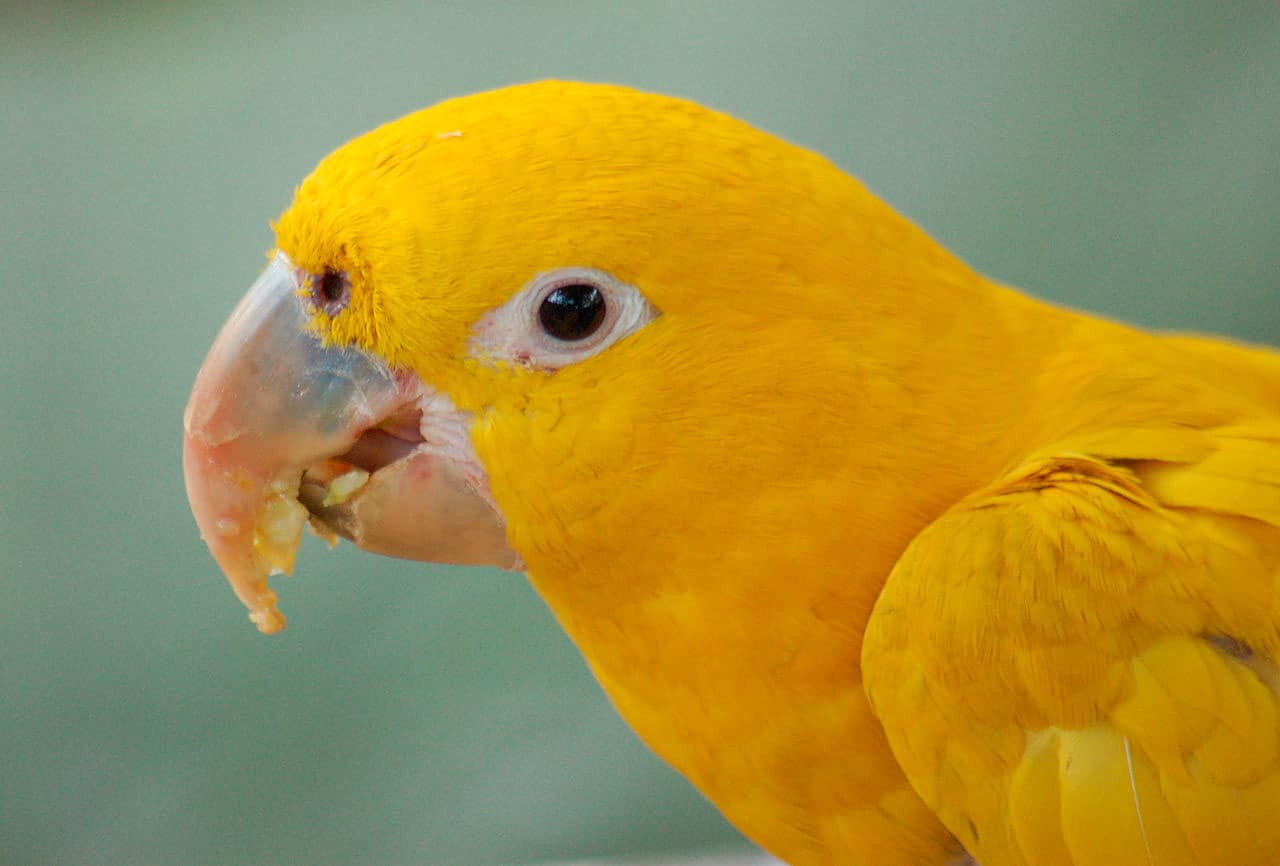
The bill pale pink, more Brown on the basis of the upper jaw; bare periophthalmic naked whitish; Iris Orange to brownish Orange; legs Rosaceae.
Both sexes similar.
Immature colour olive brown opaque dark green streak. In the transition to adulthood, the head, top of the tail and back They are the last to acquire the bright yellow color of the adult plumage.
inhabits the humid tropical forests, avoiding the forests and marshes (seasonally flooded), Although in the immediate breeding period, You can wander through these habitats from the adjacent dry forests.
When is the breeding season, the Golden Parakeet they occupy the forests next to the clear. Gregarious in all the seasons of the year. Observed in flocks of 3 to 30 birds, Although on a regular basis in groups between 6 and 10.
Forman communal roosts in tree cavities during the non-breeding season, using the holes in the area, alternately in successive nights. The usual and regular use of resting and feeding areas, is suspected to be due to the predictable daily routines. Sometimes seen feeding with other species of parrots.
Reproduction:
Nest at the top of the trunk or main branch of a hollow tree, a height between 15 and 30 m. Nesting tree is usually isolated, but near virgin forests. The old nest of other species It can be used by the Golden Parakeet, expanding its cavity as necessary.
The sexual behavior This species is unusual, and this is one of the most interesting aspects of their biology. With reproduce communally, with several females contributing to the work of the clutch, Although there are also reports of individual couples. Young people at different stages of development sometimes share a same nest.
On the other hand, at breeding sites during the reproductive period, the Golden Parakeet they react defensively to the presence of flocks of the same species, other species of parrots, especially the Scarlet Macaw (Ara macao), and before the approach of birds of prey.
The normal clutch female is of 2 to 4 eggs (perhaps up to six); 14 reported in a single nest chicks in captive, where the six adults helped in the breeding work. The breeding season, usually, takes place from December to April, and it corresponds to the rainy season
endemic to the Amazonia, to the South of amazon in Brazil, from the west shore of the Tapajos River, to the East through the basins of the Xingu River and North of Tocantins to 5 ° N, For, and up to the eastern shore of the Turiacu River in West Maranhão.
Are not observed in the Marajó island and prevents the forests and marshes (for example, immediately to the South of the Amazonia).
Recent records in Rondà´nia and Mato Grosso, far from their known range, They suggest a little-known distribution. Apparently, they are distributed in large areas, but it is not known whether the movements are predictable or related with, for example, the seasonal availability of food.
Rare range-wide and no doubt in decline due to the very wide, fast and continuous deforestation and fragmentation of forests, both in the Amazonia occidental as in the Eastern.
The capture illegal for national and international live bird markets and the hunting for food and sport they pose a serious additional pressures. Protected areas in the range are insufficient and are being violated regularly, for example, with the illegal logging of Mahogany Swietenia macrophylla.
Listed in Appendix 1. In danger of extinction.
Conservation:
• Red List category of the UICN current: Vulnerable
• Population trend: Decreasing
The threat most obvious for the survival of the Golden Parakeet is deforestation? The construction of the tucuruí dam, which was completed in 1984, displaced 35.000 settlers from their House to adjoining territories and brought rapid deforestation. Prior to the dam construcicón, Wildlife in the lower basin of Tocantins It was considered among the richest and most diverse in the world. It is estimated that you a 117 species of mammals and 294 species of birds were displaced. So what 120 species of amphibians and reptiles were affected.
The population of the Golden Parakeet was initially in a range between 1,000-2,499 individuals, based on an assessment of the known records, descriptions of the abundance and range size. But, recent information suggests that the population may be greater. The species has been recorded in several additional places. (Laranjeiras and Cohn-Haft 2009), and a recent survey along of the Tapajos River by Laranjeiras (2011) indicated that it was as common in the study area as other Psittacidae, not threatened.
On the basis of this information, the population is placed on the band's 10,000-19,999 individuals, that means include c.6,600-13,400 mature individuals.
– CITES Appendix I and II, managed under the Association of Zoos and Aquariums Parrot Taxon Advisory Group and protected by the Brazilian legislation (being proposal as the national bird of Brazil).
– A campaign attacking trade of birds in Bolivia It can help to reduce international trade (AB Hennessey in litt., 2009).
– A population is relatively well protected in the Tapajos National Park, and a remnant population can survive in the Gurupi biological reserve.
– Floresta Nacional do Jamari It is poorly protected and suffer the constant pressure of illegal occupants, loggers and poachers (F. Olmos in litt., 1999).
– The conservation of this species in the reserves is problematic because of its apparent nomadism.
Conservation Actions Proposed:
– Conduct studies to find the populations so far unknown, especially in the South and West of its range.
– Maintain the integrity of the Tapajos National Park.
– Protect and manage the land between the existing protected areas to facilitate the movements of nomadic.
– To enforce the legal restrictions on trade, especially in domestic markets.
– Further develop the program captive breeding.
"Golden Parakeet" in captivity:
Date back to the first reproductive outcomes of this kind of 1939 in Sri Lanka.
The Golden Parakeet It is probably the most coveted among all the parrots, being the prices demanded by her extremely high. It is very rare and endangered in its natural habitat, and are therefore protected from import.
Birds reserved for breeding are happier in the presence of members of their species. This is due to the nature of the Golden Parakeet, sociable and cheerful, with an intense need for interaction with their peers.
With regard to its longevity, according to sources, a specimen lived 23,2 years in captivity. It has been reported that these animals can live up to the 60,9 years in captivity, but this has not been verified; the same study reported that these animals can reproduced from the 3 years age in captivity.
(1) – Avibase
(2) – Parrots of the World – Forshaw Joseph M
(3) – Parrots A Guide to the Parrots of the World – Tony Juniper & Mike Parr
(4) – Birdlife
(5) – WAZA
Photos:
(1) – Golden Parakeet (also known or Golden Conure) at Gramado Zoo, in south Brazil By Ironman br (Own work) [CC BY-SA 3.0], via Wikimedia Commons
(2) – Golden Parakeet or the Queen of Bavaria Conure in Burgers Zoo, Arnhem By frank wouters (originally posted to Flickr as goudparkiet) [CC BY 2.0], via Wikimedia Commons
(3) – Two Golden Parakeets at Gramado Zoo, Rio Grande do Sul, Brazil By diegodobelo (Zoo de GramadoUploaded by Snowmanradio) [CC BY-SA 2.0], via Wikimedia Commons
(4) – Golden Parakeet or the Queen of Bavaria Conure). Two captive By TJ Lin (originally posted to Flickr as Golden Conure) [CC BY-SA 2.0], via Wikimedia Commons
(5) – Photo taken at the National Aviary By Photo by and (C)2007 Derek Ramsey (Ram-Man) (Self-photographed) [GFDL 1.2 or CC BY-SA 2.5], via Wikimedia Commons
(6) – Photo taken at the National Aviary By Photo by and (C)2007 Derek Ramsey (Ram-Man) (Self-photographed) [GFDL 1.2 or CC BY-SA 2.5], via Wikimedia Commons
(7) – Golden Conure at the Parque das Aves, Foz do Iguaçu, Brazil By Bruno Girin from London, United Kingdom (06680018Uploaded by Snowmanradio) [CC BY-SA 2.0], via Wikimedia Commons
(8) – Photo taken at the National Aviary By Photo by and (C)2007 Derek Ramsey (Ram-Man) (Self-photographed) [GFDL 1.2 or CC BY-SA 2.5], via Wikimedia Commons
(9) – Golden Conure by Jean – Flickr
(10) – Illustration Guaruba guarouba By Dutton, F. G.; Fawcett, Benjamin; Greene, W. T.; Lydon, A. F.; Lydon, A. F. [CC BY 2.0 or Public domain], via Wikimedia Commons
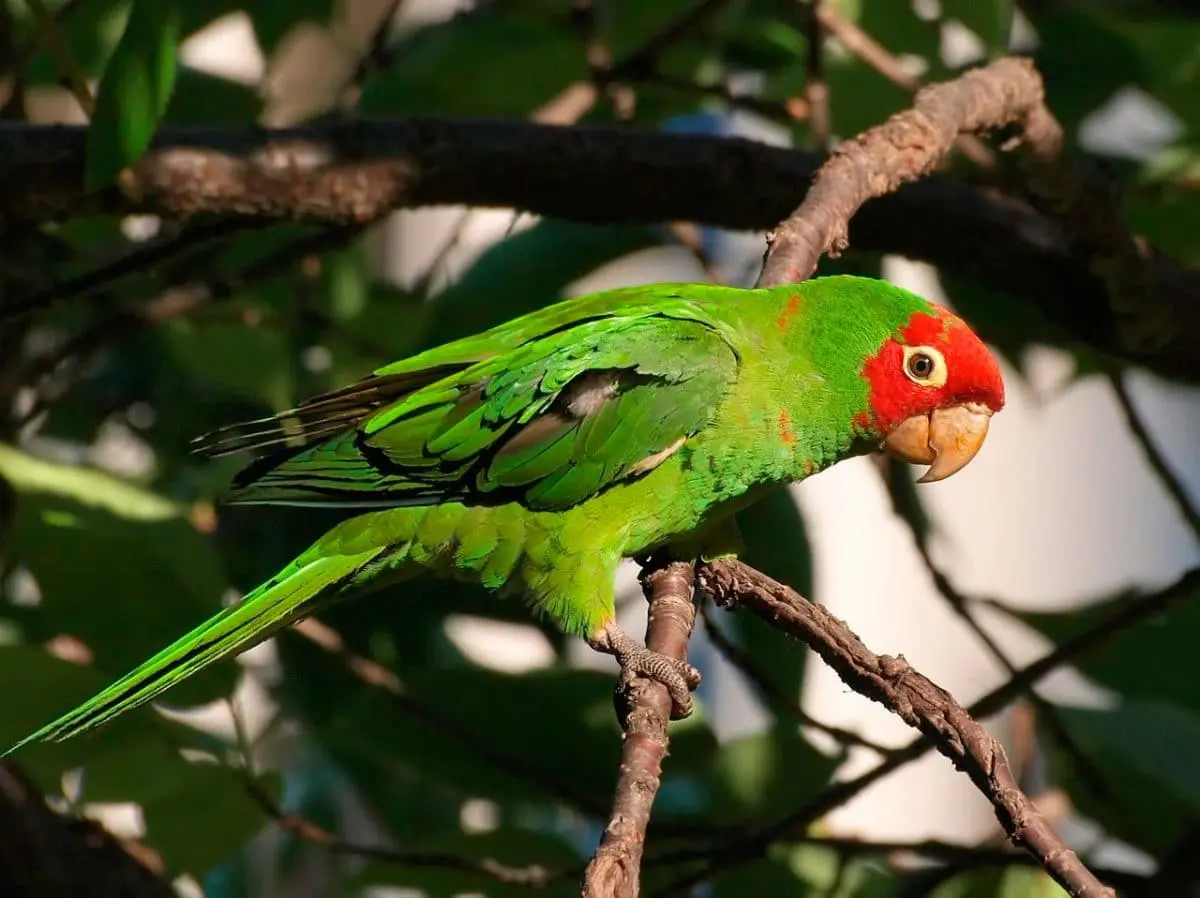
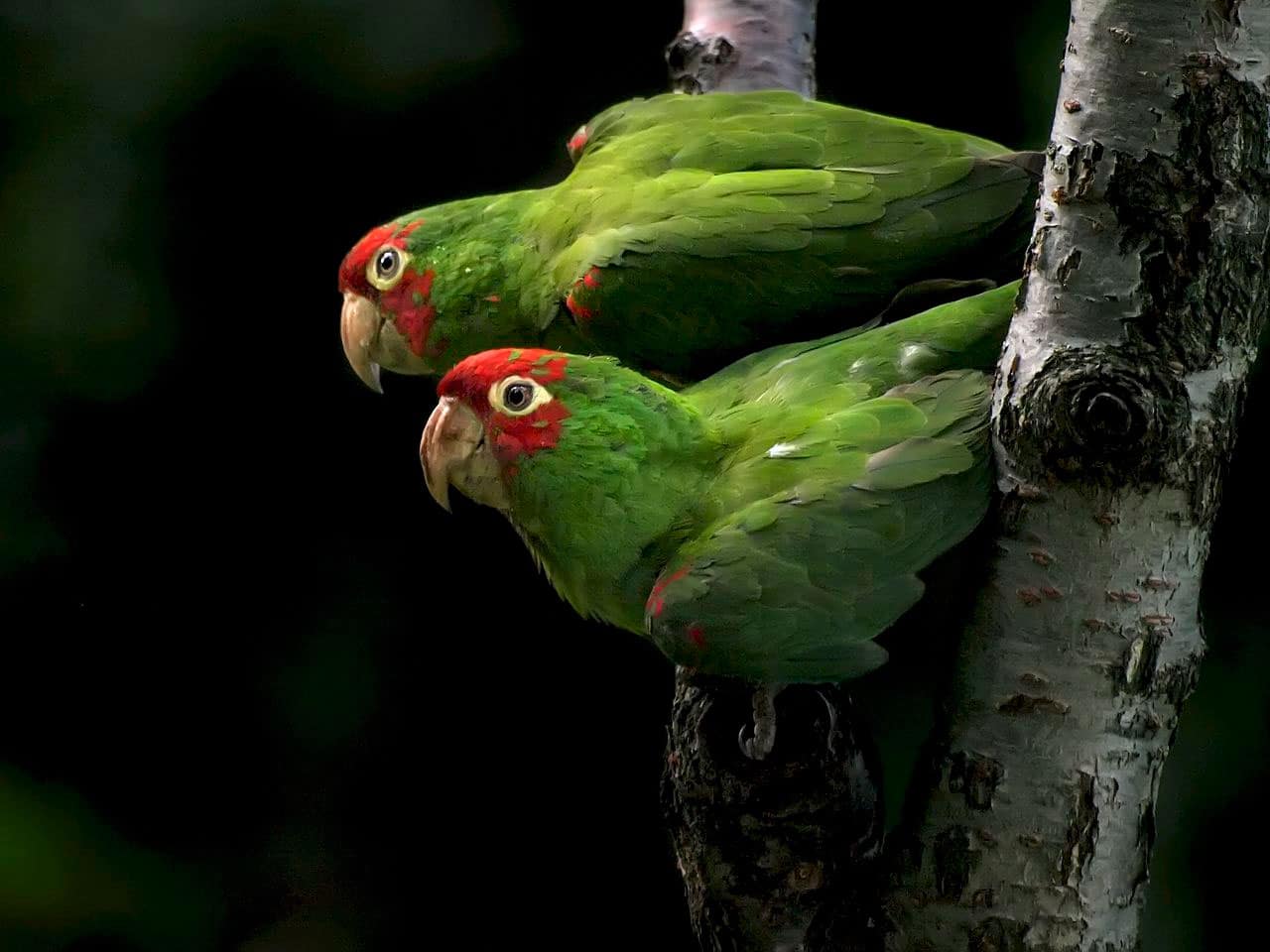
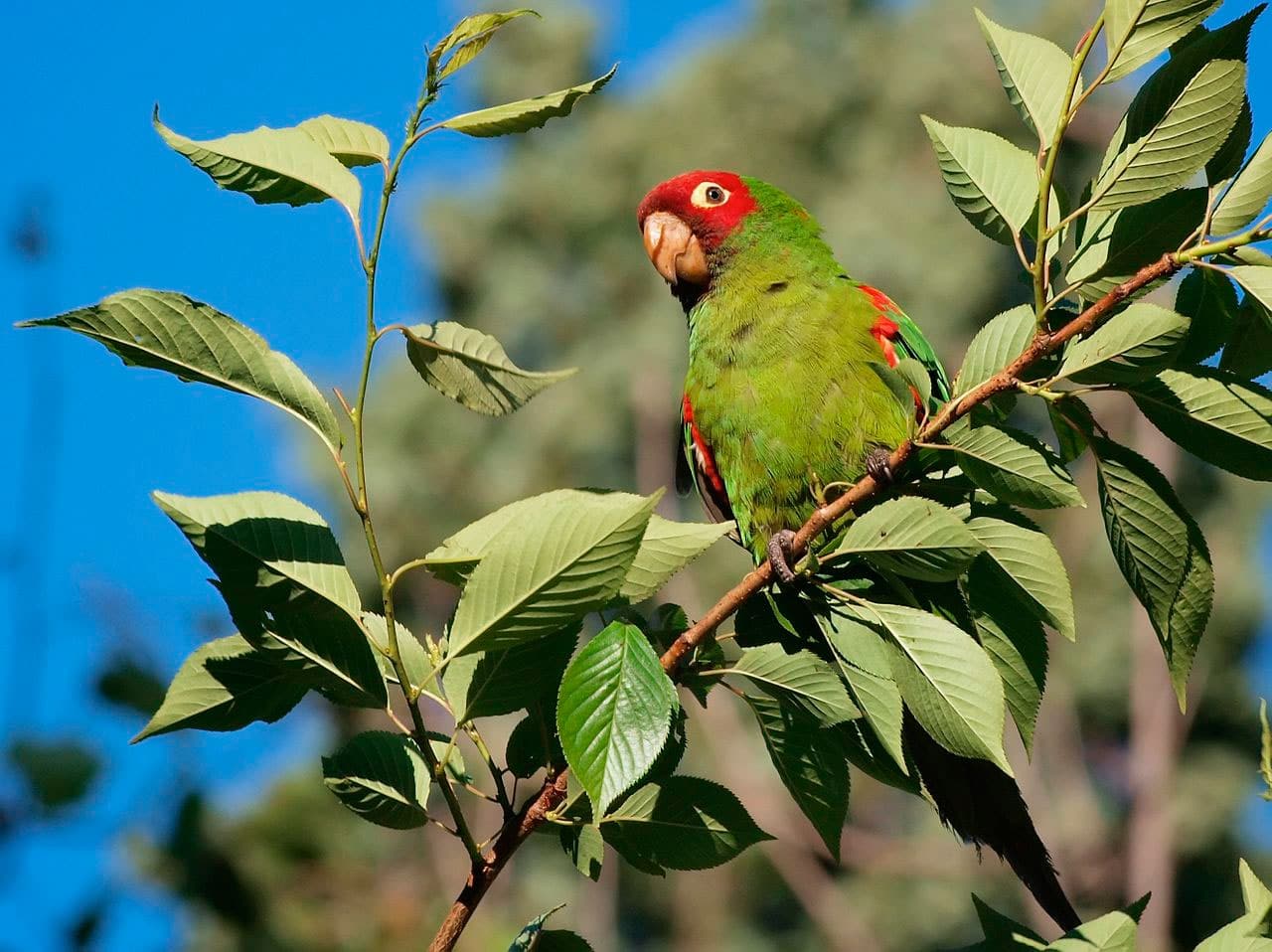
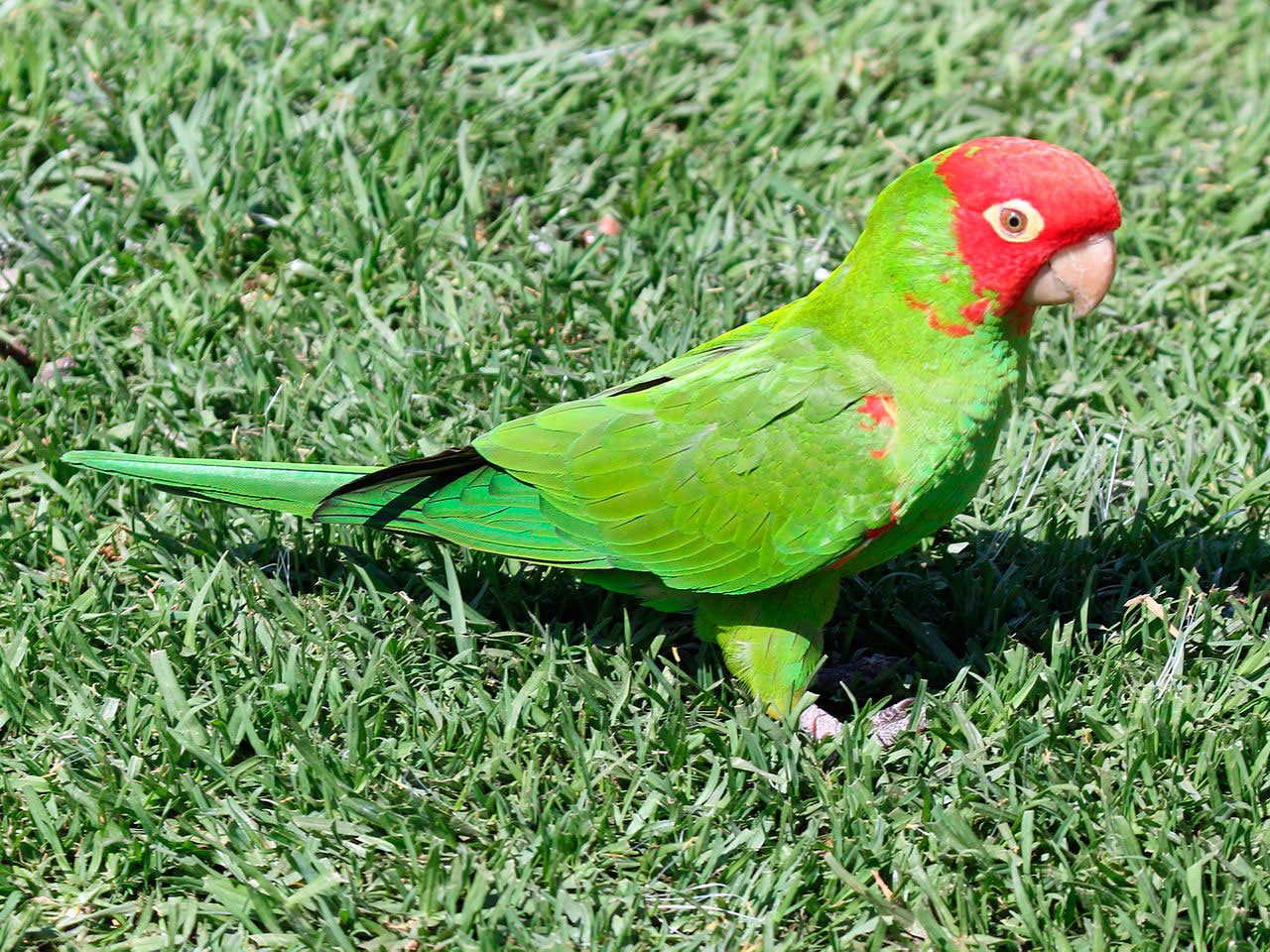
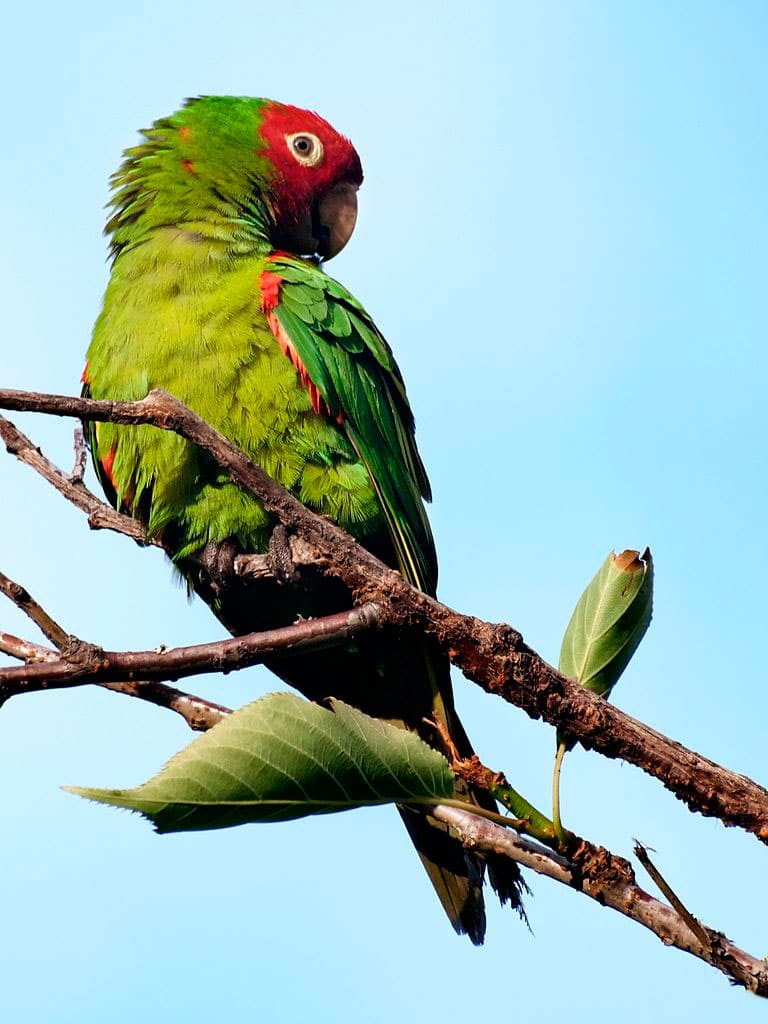
The Red-masked Parakeet(Psittacara erythrogenys) It is very similar to birds Scarlet-fronted Parakeet and to the Mitred Parakeet, but smaller and with more red area in the face, extending continuously up to the throat and nape.
Has the forecrown, crown, lores, the cheeks and the area around the eyes, bright red, generally forming a complete red mask to join to the chin (Sometimes the mask extends up to the throat). Since the nape up to the uppertail-coverts dark green, sometimes with scattered red feathers. The upperwing-coverts children with some feathers of red and the bend of wing red; remaining upperwing-coverts dark green, with dye Emerald to them vane outer the primary. The flight feather Brown Gold below; underwing-covertsminors, bright red, the greater coverts yellowish brown. The underparts brighter yellowish green, sometimes with mottled red and almost always with the the thighs red. Upper, the tail dark green; by below grayish brown.
The bill color pale horn; bare periophthalmic off-white; irises yellow; legs distant.
The Red-masked Parakeet It occupies a wide range of vegetation types, from arid zones to rainforests, Since the sea level to altitudes 2.500 m, Although its usual habitat is below of the 1.000 m, in humid forests, deciduous forests, areas of dry thorny scrub and arid with cactus; They also live in degraded forest, areas cultivated with scattered trees, and around the urban areas. They tend to prefer arid and semi-arid habitats, not avoiding moist forest habitats.
Outside the breeding season, is a bird gregarious; in general, observed in pairs or in groups of up to 12 individuals, forming groups of up to 200 birds in the places where their communal roosts are. Formerly registered flocks of thousands of birds in Guayaquil, Ecuador.
Often associated in mixed flocks with the Grey-cheeked Parakeet(Brotogeris pyrrhoptera) and also observed in mixed flocks with the Bronze winged Parrot(Pionus chalcopterus).
Reproduction Red-masked Parakeet:
Nests in holes of mature trees, for example of Ceiba trichistandra or Cochlospermun vitifolium, There are also records of nests in termite mounds, with a report in a nest on a cliff. The breeding season in the southwest of Ecuador recorded during the rainy season (January-March). The laying, between 2 and 4 eggs. The female the incubated eggs during 23 to 24 days. The pups they are born very little developed, blind and naked. They are fed with food previously digested by their mothers.
Food Aratinga of Guayaquil:
Few details exist about food preferences of the Red-masked Parakeet, Although seasonal movements from the more arid areas are probably related to food supply.
In Ecuador, the distribution of the Red-masked Parakeet is limited to the lowlands of the peaceful, Western slope of the Andes and valleys, Although it is apparently absent from the eastern slope; similar pattern in the Peru most Eastern records in the basin of the amazon (Valley of the Utcubamba River) to 77° 54’W.
The seasonal movements to and from the more arid areas, otherwise, residents.
Usually considered to be common (described as the most common parrot in various locations in the province of Gold, Ecuador), but numbers fluctuate widely in some locations due to irregular seasonal movements. In some areas there has been a very drastic decrease of copies, reflecting the combined effects of the loss of habitat and your capture for the trade in live birds, for example, in Guayas, Ecuador.
There are at least eight protected areas, of which seven are in Ecuador.
There are leaks in Spain; so also in EE. UU., with breeding populations in the California cities of San Diego, Los Angeles, San Gabriel, Sunnyvale and San Francisco, You can see them eating fruits of cultivated tropical plants, and nesting in Palm trees.
Maintained in captivity at the local level (where is the most common Parrot kept in captivity) and commercialized in large quantities at the international level, especially since Peru.
Conservation:
State of conservation ⓘ
Near Threatened ⓘ(UICN)ⓘ
• Red List category of the UICN current: Near-threatened
• Population trend: Decreasing
The size of the population This species has not been estimated officially, but, in the absence of sufficient data, It is suspected that it may be in around the 10.000 specimens, more or less equivalent to 6.700 mature individuals.
The population of the species is suspected that it may be subjected to a moderately rapid decrease, due to its capture for him pet trade together with the loss of habitat and fragmentation. Further research is required.
Conservation Actions Underway:
Appendix II of CITES.
Conservation Actions Proposed:
Carry out surveys to get an estimate of the population.
The current threat of trade research.
Enforcing trade restrictions.
Census of population and monitoring.
Monitor the rates of loss and fragmentation of habitat.
Study its ability to persist in altered and fragmented habitats.
The Red-masked Parakeet in captivity:
Shy and distrustful. Little common in captivity outside its area of distribution.
They may live until 25 years, Although the average tends to be between 10 and 15 years.
Their diet: fruit as, Apple, pear, orange, bananas, grenades, Kiwi, papaya, cactus fruits, they form a 30 percent of the diet. Vegetables, such as: Carrot, celery, green beans and peas in the pod, sweet corn on the cob, green leavess, such as: chard, lettuce , Kale, healer, Dandelion, Aviary grass, spray millet, mixture of small seeds, such as: Millet and small amounts of oats, buckwheat, safflower and hemp.
This species is found threatened from the wild bird trade local in Peru and Ecuador, where are rates of mortality due to mismanagement and stress high.
Never buy these birds in the illegal trade, Since these tend to come from its natural environment and it must be remembered that the Red-masked Parakeet is one endangered species.
Alternative names:
– Red-masked Parakeet, Red Masked Conure, Red masked Parakeet, Red-headed Conure, Red-headed Parakeet, Red-masked Conure (English).
– Conure à tête rouge, Conure à tête cerise, Conure à tête écarlate, Perriche à tête rouge, Perruche à tête rouge (French).
– Guayaquilsittich (German).
– Periquito-de-cabeça-vermelha (Portuguese).
– Aratinga de Guayaquil, Loro de cara roja, Periquito de Cabeza Roja, Perico Cara Roja (español).
– Loro de cara roja (Chile).
– Cotorra de Cabeza Roja (Peru).
– Perico caretirrojo (Ecuador).
– Avibase
– Parrots of the World – Forshaw Joseph M
– Parrots A Guide to the Parrots of the World – Tony Juniper & Mike Parr
– Birdlife
– Feather wind
– Photos:
(1) – A feral Red-masked Parakeet (also known as the Red-masked Conure and Cherry-headed Conure) in San Francisco, USA By Ingrid Taylar [CC BY 2.0], via Wikimedia Commons
(2) – Red-masked parakeet, Aratinga erythrogenys. Two birds in a tree in San Francisco, California By Jef Poskanzer (Flickr) [CC BY 2.0], via Wikimedia Commons
(3) – Red-masked Parakeet (Psittacara erythrogenys) at the Presidio, San Francisco, California By Frank Schulenburg (Own work) [CC BY-SA 4.0], via Wikimedia Commons
(4) – Red-masked parakeet (Aratinga erythrogenys). A juvenile parrot which is mostly green and just starting to get some red feathers on its head By Eliya Selhub (Flickr) [CC BY 2.0], via Wikimedia Commons
(5) – Red-masked Parakeet preening on a branch in San Francisco, USA By Ingrid Taylar from San Francisco Bay Area – California, USA [CC BY 2.0], via Wikimedia Commons
(6) – Red-masked Conure at Birds of Eden, South Africa By Dick Daniels (http://carolinabirds.org /) (Own work) [CC BY-SA 3.0 or GFDL], via Wikimedia Commons
(7) – A feral Red-masked Parakeet (also known as the Red-masked Conure and Cherry-headed Conure) in San Francisco, USA By Ingrid Taylar [CC BY 2.0], via Wikimedia Commons
(8) – Two feral Red-masked Parakeets in San Francisco, USA By Ingrid Taylar from San Francisco Bay Area – California, USA (Wild in SFUploaded by Snowmanradio) [CC BY 2.0], via Wikimedia Commons
(9) – Several Red-masked Parakeets eating a discarded apple in San Francisco, USA By Ingrid Taylar from San Francisco Bay Area – California, USA (A Big Find for ParrotsUploaded by Snowmanradio) [CC BY 2.0], via Wikimedia Commons