 FCI 349 - Sheepdogs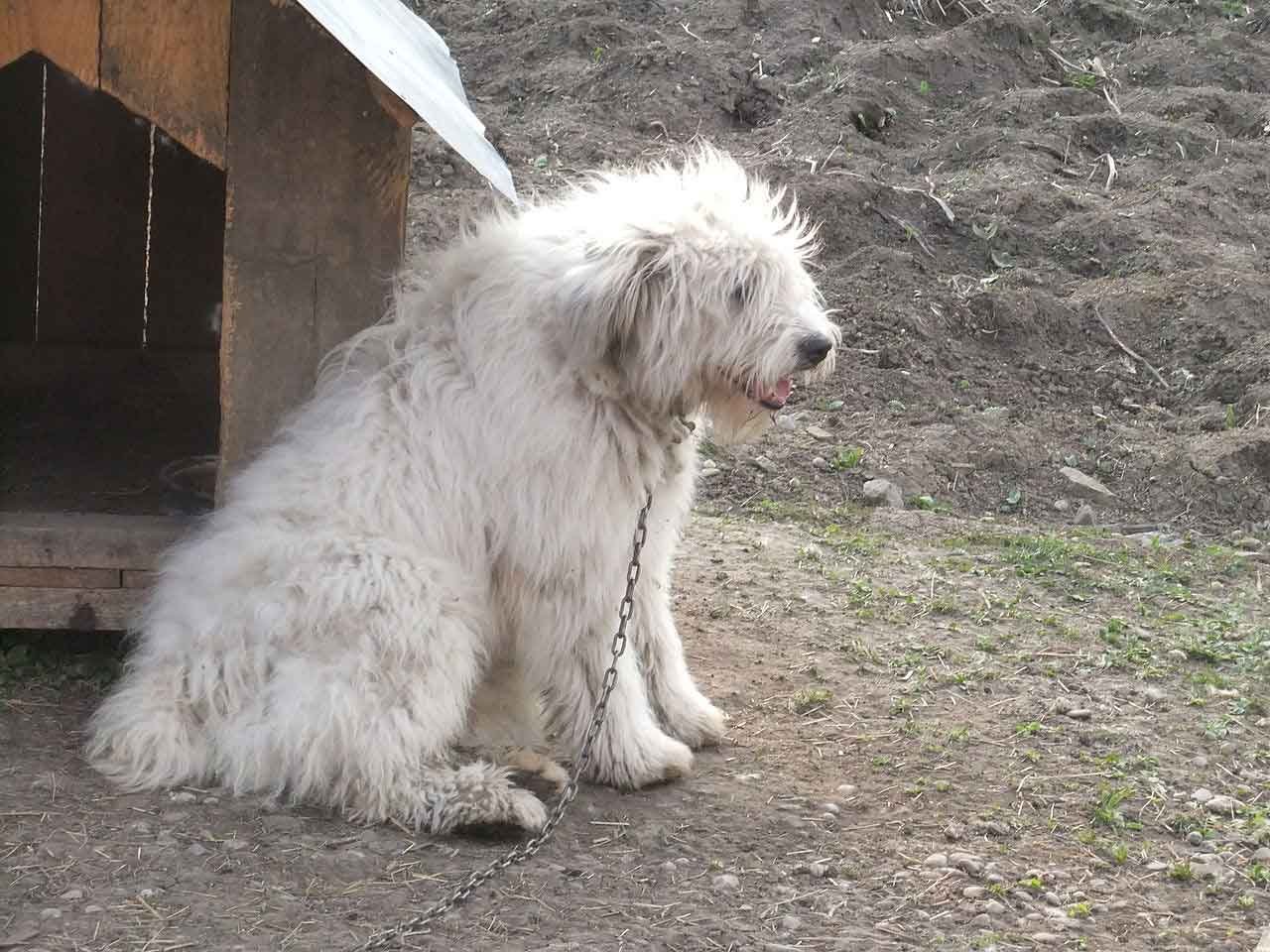
Content |
|---|
History
The «Romanian Shepherd of Mioritza», or Ciobanesc Romanesc Mioritic in romanian, it is a natural breed that has been present for centuries in the Carpathians, especially in southern Transylvania, in the mountainous regions near Sibiu and Brasov. Its exact origins are unknown., but it seems that their ancestors came to Romania around the 13th century with the Tatars who came to settle in the Danube Delta region and along the Black Sea coast.
In the middle ages, some local rulers used these powerful dogs to accompany their armies. This fueled the legend that the dogs often seen in ancient engravings depicting the battles between the Roman Empire and the Dacians, a native people of the Carpathians, they are the shepherds of Mioritza. But, since these battles took place over 1000 years before the arrival of the dog's ancestors to the region, it is in fact unlikely that he can claim to have any connection to these feats of arms.
In fact, the Mioritza Shepherd Dog he was above all the faithful companion of the illiterate peasants and shepherds isolated in the mountains. Stunning, mighty and brave, protected, and still protects today, herds against the many predators that live in the Carpathians: Lynx, Wolf, bear…
His name is also a reference to his qualities as a pastor, since the word «mioara» means "sheep" in Romanian, precisely the animal that it has been protecting for several centuries.
Even today, many shepherds claim that only one of these dogs can scare away a bear, and popular belief says that it is the only breed in the world capable of facing a bear and coming out alive.
The first written references to Mioritic go back to 1930, when Professor Gheorghe Moldoveanu, studying the Romanian Carpathian Shepherd Dog, made a first distinction between the different romanian sheepdogs. In 1934, the National Zootechnical Institute published a description of the dog Romanian Mioritic Shepherd Dog, but it wasn't until 1981 that a first breed standard was defined, prepared by the Romanian Cynological Association (ACR).
This standard was revised in 2002 to meet the requirements of the Fédération Cynologique Internationale (FCI), who accepted the dog Romanian Mioritic Shepherd Dog provisionally in 2005, before finally recognizing it in 2015. In the meantime, had taken off across the Atlantic, as recognized by the American United Kennel Club (UKC) in 2006. The other reference body in the country, the American Kennel Club (AKC), did the same in 2018. But, neither the British nor the Canadian Kennel Club have followed suit.
It is estimated that the population of Romanian Mioritic Shepherd Dog is of 10.000 individuals in Romania, but the vast majority are dogs with pedigree and unregistered. In fact, although the breeding of dogs without pedigrees has been prohibited in the country since 2015, ancient habits are slowly changing. So that, There is often a "country" dog left, of which a puppy is given to the villager when a litter is born., instead of a pedigree dog that is purchased from a professional breeder.
On the other hand, although they are still relatively popular in the Romanian mountains, the Romanian Mioritic Shepherd Dog remain largely unknown outside of their home country, despite the efforts of Barbara Fallent, an Austrian-based breeder dedicated to popularizing them in Europe.
Photo: Ciobanesc Mioritic by DorinRodina, CC BY-SA 3.0, via Wikimedia Commons
Physical characteristics
Sometimes nicknamed "wool bear", the Romanian Mioritic Shepherd Dog is tall, powerful and furry. It is often confused with the Old English Sheepdog (or Bobtail), with whom he has many physical similarities.
They are big and massive, but harmonious and very agile for a dog of this size, while its legs are muscular and erect. Tail stands tall and is carried drooping when at rest, but it rises horizontally when in the gazebo.
The neck is of medium length but broad and powerful, and bears a massive head of large size in relation to the rest of the body. The skull is slightly domed and ends in a rather short muzzle, tapering towards the nose. The latter should be black and well developed. The powerful jaws are scissor bite. Triangular ears with rounded tips fall along the cheeks and "disappear" into the fur.
The eyes are medium in size, often hazel or dark brown in color, but they can also be lighter in color, except yellow, which is not accepted by the standard of Romanian Mioritic Shepherd Dog. They express calm and intelligence.
The coat of the mioritic it is very long, measure at least 10 cm.. Covers the whole body, from head to tip of tail, going through the legs, where however it is a little shorter. The top coat is rough, while the lower layer is more flexible and dense, which makes the coat perfectly adapted to harsh weather conditions.
The coat can be uniform, white or gray, but most often it is variegated, with distinctive black or gray spots protruding from the white fur.
Sexual dimorphism is moderately marked, the female being only slightly smaller than the male.
Character and skills
The Romanian Mioritic Shepherd Dog he is a calm and balanced dog that has an extraordinarily strong bond with his master and his family, bond that forms naturally during the growth period. It is known that it is "a master's dog" – the person who adopted and raised him – which makes it very difficult to adopt an adult dog from Mioritic Shepherd Dog.
He is incredibly devoted and loyal to his family, at least the family he grew up with. Adults, children, pets or farm animals…: everyone he lives with is part of his family, and once he is an adult he will stop at nothing to protect them. Quiet and affectionate, gets along very well with children, without being an ideal playmate, especially for the little ones and / or restless, since he prefers quieter activities. It also, given its size, could unintentionally push a small one.
A typical sheepdog, who mistrusts strangers. Although tolerate close friends who come often, barks vigorously when a stranger approaches, and only allows him to enter his territory with the agreement of his master. So, a lot of work on socialization and obedience is necessary from an early age to prevent this dog's power from, able to scare away wolves and bears, be misdirected, with dramatic consequences.
The Romanian Mioritic Shepherd Dog need space, and it is not at all a breed of dog adapted to apartment living. Its territorial and protective character makes it not an ideal option for people who live in a residential area., even with a large garden. Rather, they adapt better to the field or the mountains, where they have space and where they encounter fewer potential “threats”, especially since they can easily spend their days and nights outdoors.
Having said that, if you need space, the mioritic neither is it a dog that needs a lot of exercise, at least not as an adult. It is true that the puppies of this breed are hyperactive and need to exercise daily, either in the form of games or walks. But the adult is much calmer, as are most sheepdogs, who prefer to stay close to their herd and not stray too far from it: patrolling in the garden and taking an occasional walk with his master is more than enough for him.
But, It is important to know that the "territory" that the Romanian Mioritic Shepherd Dog not limited to your garden: protect the place where your family is, establishing a kind of security perimeter around it in all circumstances. Like this, if your flock grazes in the mountains, don't let anyone get close, and if your family walks in a park, does the same.
But, the Mioritic Shepherd Dog not spontaneously aggressive, and never attacks for no reason. Barks to warn the intruder that they are not welcome, and leave the one who understands the message alone. On the other hand, anyone who risks ignoring the warning without his master's consent risks finding out why this dog has been the best friend of Romanian shepherds and protector of their flocks for centuries.
Finally, used to accompany them alone, have learned to make decisions on their own. Although loyal and obedient, his independent character and power make him a dog that is not suitable as a first dog.
Education «Romanian Shepherd of Mioritza»
If socializing the puppy from an early age is necessary for all breeds, is even more essential in the case of Romanian Mioritic Shepherd Dog. You must meet the people you may meet as an adult as soon as possible and get used to the situations that will be part of your life: walks in a crowded place, visits to the vet, hairdressing sessions… The latter should also allow him to get used to being handled without hesitation., which is absolutely essential to avoid any problems once adult, given its size and power.
In the same way, learning obedience should begin as soon as the dog is adopted. Smart and devoted, the Romanian Mioritic Shepherd Dog it is relatively easy to train if your master has the necessary experience and knows how to remind your dog who the master is if necessary. On the other hand, Inconsistent or hesitant orders can lead you to take matters into your own hands and choose the attitude that seems most appropriate. Unfortunately, in such cases, unlikely to make the desired decision.
In any case, although professional help can be useful to support, education must be provided by the teacher himself. You are the only person whose authority you recognize and trust.
It also, traditional training methods should be banned, as they risk damaging the strong bond between student and teacher. Positive reinforcement-based dog training is a much better option.
Regarding your role as guardian, does not require any special training. In fact, their instinct for protection is innate, so it does not need any specific training to become an excellent guard dog. In the same way, learn to become a good herding watchdog by observing adults, and just reproduce this behavior when it grows. Once again, no specific training required.
Health «Romanian Shepherd of Mioritza»
The Romanian Mioritic Shepherd Dog he is a very healthy dog: is not subject to hereditary diseases, it is only slightly sensitive to common diseases and is resistant to harsh weather conditions. In fact, many individuals reach the age of 14 years or more, which is unusual for a dog of this size.
But, like all large dog breeds, may suffer from ..:
▷ Hip Dysplasia;
▷ elbow dysplasia;
▷ gastric dilation-torsion.
It also, its long and dense coat can become a refuge for many parasites, especially if you spend most of your time outdoors. So, it is essential to regularly ensure that all your deworming treatments are up to date.
Grooming «Romanian Shepherd of Mioritza»
The Romanian Mioritic Shepherd Dog It is an easy-care breed of dog: a weekly brushing of his coat is enough to get rid of his dead hairs and ensure that he has no injuries that can be hidden by his long hair.
But, during the move, the dog should be brushed more frequently to avoid accumulation of dead hair, that could create knots and become true "parasite nests".
Bathing the dog is unnecessary, since the Romanian Mioritic Shepherd Dog has a self-cleaning coat. Even if he rolled in the mud before he came home, leaving it outside in a dry place should be enough to get rid of any dirt. "And Mioritic dry is a Mioritic clean", as the shepherds say.
On the other hand, it is essential to check every 2 or 3 days that your eyes and ears are not dirty and do not show any signs of infection. Their teeth and claws may be checked less regularly, but special attention should be paid to the dog's paw pads to make sure there is no accumulated dirt.
It is a good idea to get used to Romanian Mioritic Shepherd Dog to these grooming sessions from an early age, to avoid any problems later, given its size and power. If the teacher knows how to do it, they can become beautiful moments of complicity between him and his partner.
On the other hand, if it has to be prepared by a professional, the presence of your caregiver is necessary to calm you down and ensure that you do not have any aggressive reaction towards the stranger who is manipulating you.
Price «Romanian Mioritza Shepherd»
a puppy of Romanian Mioritic Shepherd Dog costs between 1000 and 1200 EUR. A male is more expensive than a female, because males are more sought after by shepherds.
In any case, It is necessary to be well informed about the origin of the puppy and to check its documents with the Romanian Canine Association (ACR). In fact, from 2015, the breeding of dogs without a pedigree or not registered in the Romanian Stud Book is prohibited in Romania, and the marketing of these puppies is illegal.
Characteristics "Romanian Mioritic Shepherd Dog"
Coexistence is important that you have with your new friend. Before considering the acquisition of a dog of the breed "Romanian Mioritic Shepherd Dog" you know certain factors. Not all breeds of dogs are apt to live in an apartment, you must take into account his character, their need for exercise, their interaction with other pets, their care and if you have small children, their level of tolerance towards them.
Adaptation ⓘ2,0 of 5 stars (based on 1 review)
|
friendly dog ⓘ3,0 of 5 stars (based on 1 review)
|
hair loss ⓘ4,0 of 5 stars (based on 1 review)
|
|---|---|---|
Affection level ⓘ4,0 of 5 stars (based on 1 review)
|
Need for exercise ⓘ3,0 of 5 stars (based on 1 review)
|
Social need ⓘ1,0 of 5 stars (based on 1 review)
|
Home ⓘ2,0 of 5 stars (based on 1 review)
|
Toilet ⓘ2,0 of 5 stars (based on 1 review)
|
Friendly with strangers ⓘ2,0 of 5 stars (based on 1 review)
|
barking ⓘ3,0 of 5 stars (based on 1 review)
|
Health ⓘ4,0 of 5 stars (based on 1 review)
|
Territorial ⓘ5,0 of 5 stars (based on 1 review)
|
Cat friendly ⓘ4,0 of 5 stars (based on 1 review)
|
Intelligence ⓘ3,0 of 5 stars (based on 1 review)
|
Versatility ⓘ3,0 of 5 stars (based on 1 review)
|
Child friendly ⓘ4,0 of 5 stars (based on 1 review)
|
Surveillance ⓘ4,0 of 5 stars (based on 1 review)
|
joy ⓘ3,0 of 5 stars (based on 1 review)
|
Images "Romanian Mioritic Shepherd Dog"
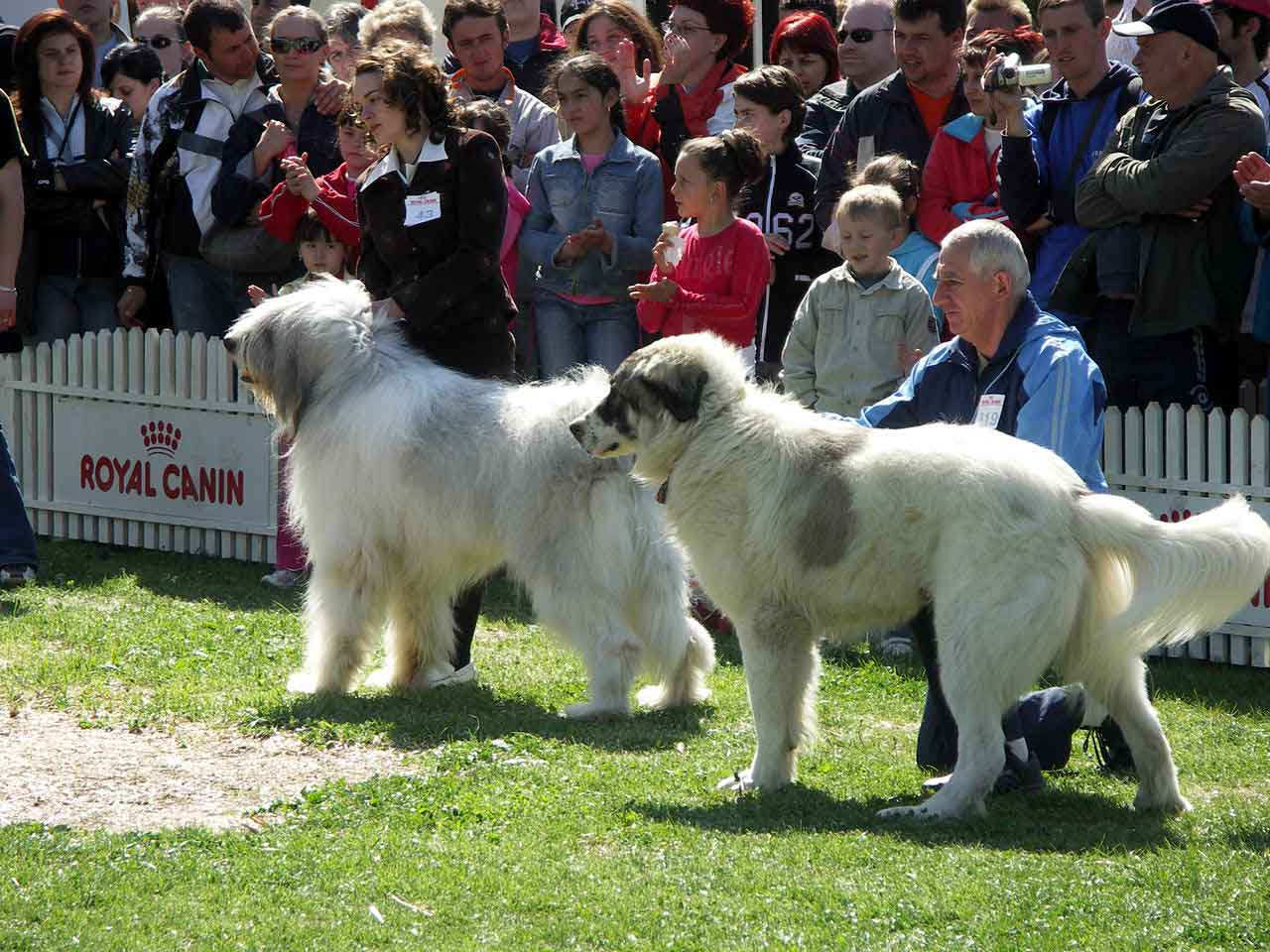
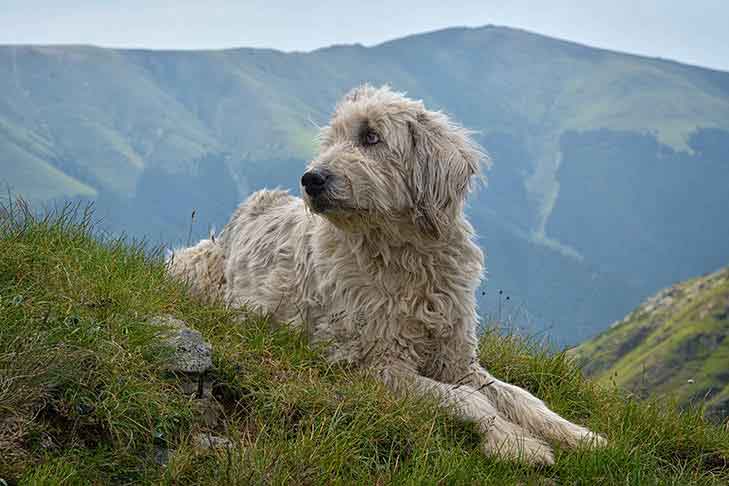
Videos "Romanian Mioritic Shepherd Dog"
|
Romanian Mioritic Shepherd – Facts and Information
|
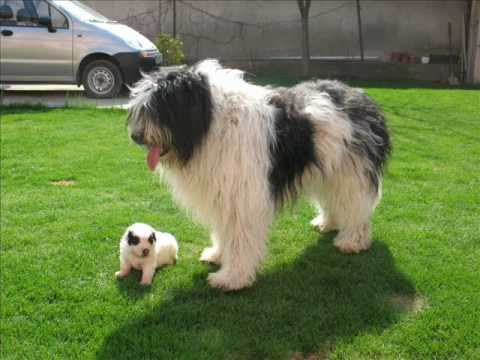
The Miracle of Life – Romanian Mioritic shepherd dog babies
|
|---|



Type and recognitions:
- FCI CLASSIFICATION: 349
- Group 1: Sheepdogs and Cattle Dogs (except Swiss Cattle Dogs)
- Section 1: Sheepdogs. Without working trial..
Federations:
- – FCI – Group 1 Herding dogs, Section 1 Sheepdogs ⓘ
- – AKC – Foundation Stock Service ⓘ
- – UKC – Herding dogs ⓘ
FCI breed standard "Romanian Mioritic Shepherd Dog"
Use:
Excellent herd dog, incorruptible guardian and extraordinary companion.
General appearance:
Large, but never heavy. It is vigorous and spectacular. The hair is long and thick on the head., entire body and extremities. Males are taller and larger than females.
IMPORTANT PROPORTIONS:
- Body length/height at withers, 11 : 10.
- The chest height must correspond to a 50% the height at the withers.
- The snout is slightly shorter than the skull.
This is a balanced and calm dog. He is a very good herd dog, very brave and effective combatant against possible predators (bears, Wolves, Lynx). Be wary of strangers. He loves children very much.
Head:
Powerful, solid. Grand, in relation to the body.- Skull: Amplitude medium, slightly bulky. The upper profiles of the skull and snout are more or less parallel. Seen from the front, the upper profile is slightly bulging. The zygomatic arches are not very marked. The occipital protuberance is well marked.
- Depression links: It is not very marked.
facial region:
- Truffle:Wide, well developed, black.
- Snout:Slightly shorter than skull; well developed, progressively decreases towards the truffle, never pointed; the jaw is strong.
- Lips:Thick, fine pendants, well pigmented.
- Jaws / Teeth:Powerful jaws; complete denture, strong, very much, with white teeth, well implanted. The joint is in the form of scissors.
- Cheeks:They are not protruding.
- Eyes:Medium-sized, oblique. Its color is hazelnut, dark brown or slightly lighter, never yellow. Eyelids are well pigmented. The expression is calm and intelligent.
- Ears:They appear relatively high, "V" shaped, with slightly rounded end. Its length is 10-15 cm., They are hanging and are well attached to the cheeks. Amputation is prohibited.
Neck:
Medium length, wide and powerful. There is no presence of dewlap.Body:
Well developed.
- Top margin: Straight, well pronounced.
- Height to the cross: Moderately marked.
- Back: Horizontal, strong and muscular.
- Pork loin: Moderately long, wide and well muscled.
- Rump: Muscular and moderately inclined towards the base of the tail.
- Breast : It's not too long. It is wide and its height corresponds approximately to half the height at the withers.. The ribs are well curved.
- Lower margin: slightly upward, without being overwhelmed.
Tail:
Is presented high. During rest, presented pendant, reaching the hock or slightly exceeding it. When the dog is attentive or in action, appears up, somewhat bent, being able to exceed the level of the back, but never coiled on it. Caudectomy is prohibited.Tips
PREVIOUS MEMBERS:
- In general: Front or profile views, they are plumb.
- Shoulder: Medium length, oblique, very muscular and close to the body. Scapulo-humeral angulation of 100-105 degrees approximately.
- Arm: Medium length, well muscled.
- Elbows: Well attached to the body, they do not deviate even inwards, nor out.
- Forearm: long enough, powerful and muscular.
- Carpo: companies.
- Metacarpus: Slightly inclined, in profile.
- Previous foot:Oval, compact and solid. The fingers are together and arched, nails are ash gray.
LATER MEMBERS:
- In general: Well muscled and powerful. Views from behind, they are straight and parallel. Little open angles.
- Thigh: Long, broad and well muscled.
- Babilla: In femoro-tibial angle it is 100-105 degrees approximately.
- Legs: long enough, muscular, good bone structure.
- Hock: Medium altitude; strong, well angled, does not deviate even inwards, nor out.
- Metatarsus: It's not too long. In profile, It is robust and almost vertical. The presence of dewclaws should not be penalized.
- Rear foot: A little longer than the previous one.
Movement:
Harmonious, loose, well coordinated, powerful and easy. Preferred movement is the trot. The gallop is uniform and balanced.Mantle
- SKIN: Thick, well stretched, well Pigmented.
- Fur: The hair is abundant on the head and body, its texture is rough. It is stretched and its length is 10 cm., As minimum. The inner layer is denser and softer, color clear. In the extremities, the hair is shorter. The tail is very thick.
- Color:Coats with patches of different colors: The background should be white with well-defined black or gray spots.. Uniform colours: Dogs of uniform white or gray color.
Size and weight:
Height to the cross:
- Males: minimal 70 cm., ideal 75 cm..
- females: minimal 65 cm., ideal 70 cm..
Weight: In proportion to the size.
Fouls:
Any deviation from the aforementioned criteria is considered as a fault and its seriousness is considered to the degree of the deviation to the standard and its consequences on the health and well-being of the dog.
- Obese or weak dog.
- Bent or ring-shaped tail.
- Lack of teeth other than PM1.
- Heavy movement.
SERIOUS FAULTS:
- Insufficiently marked sexual characteristics.
- atypical expression.
- Round and bulging eyes.
- ocular heterochromia (different colored eyes).
- straight ears.
- Too short hair (less than 8 cm.).
- Curly hair or hair of another texture than that indicated in the standard.
- Sunken top margin, convex or deep.
- Open feet, that deviate inward or outward (partizambo).
- Very open angulations in the hind limbs.
- cow hock.
- Presence of mottled spots.
FALTAS DESCALIFICANTES:
- Aggressiveness or extreme shyness.
- Any dog showing clear signs of physical or behavioral abnormalities must be disqualified..
- atypical dog.
- Lack of incisors or canines.
- Upper or lower prognathism.
- albinism.
- Absence of tail or very short tail.
- amputated tail.
- Height at withers of less than 68 cm in males.
- Height at withers of less than 63 cm in females.
- Males should have two normal-appearing testicles fully descended into the scrotum..
- Only functionally and clinically healthy dogs, with the typical conformation of the breed, should be used for parenting.
Alternative names:
1. Romanian Mioritic, Mioritic Shepherd Dog, Ciobănesc Românesc Mioritic (English).
2. Mioritic (French).
3. Mioritic, Mocano, Barac (German).
4. (em romeno: Ciobănesc românesc mioritic) ciobanesc romanesc mioritic (Portuguese).
5. Mioritic (español).