โ–ท The world of Pets: Dogs, cats, birds, reptiles, amphibians

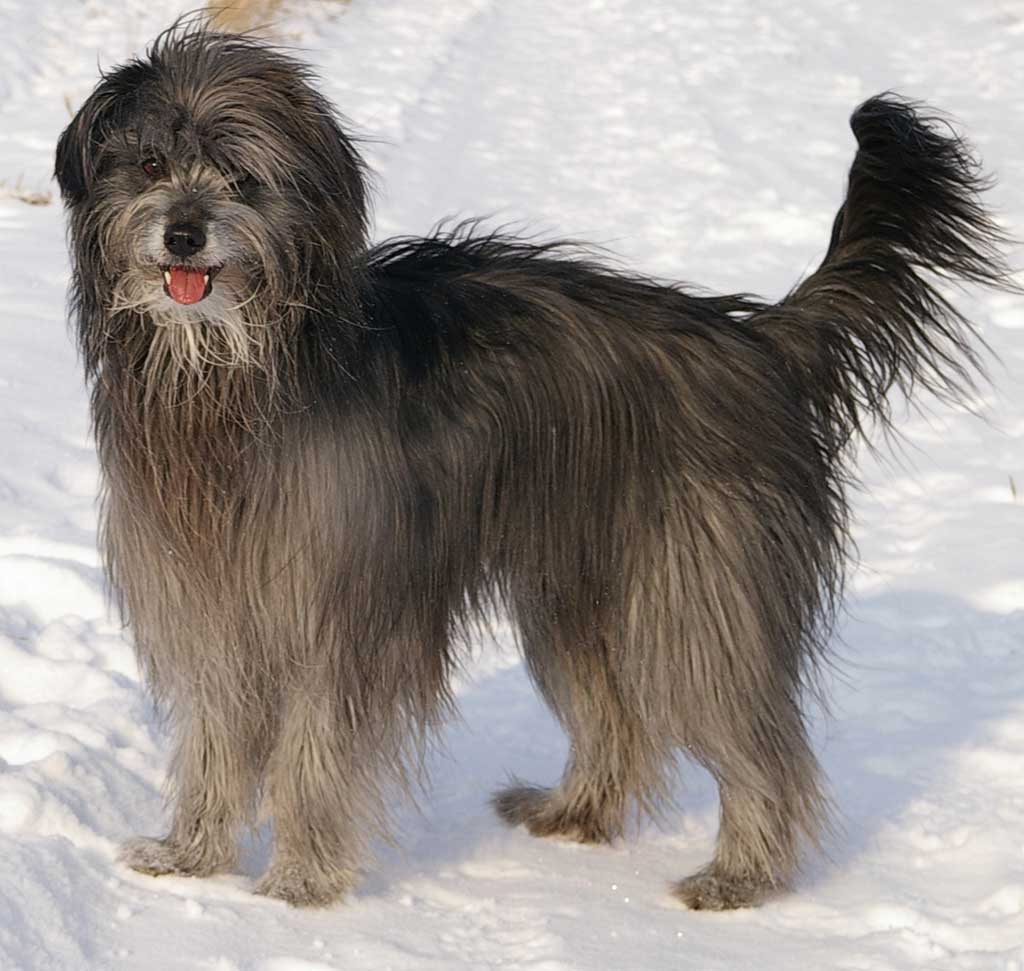
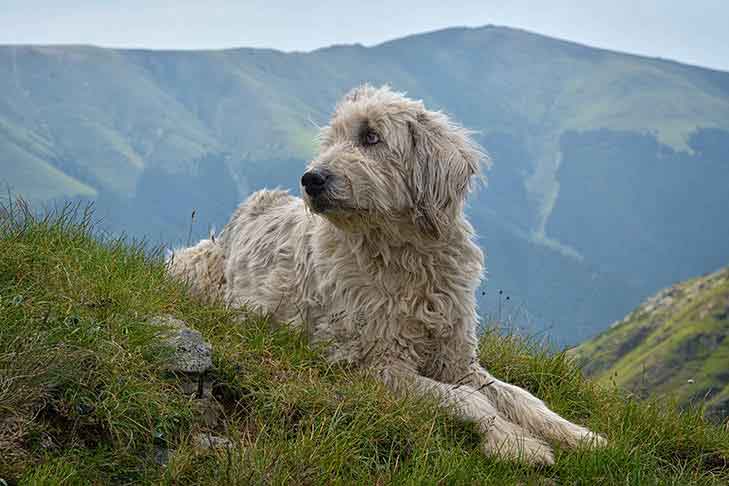
Portuguese Sheepdog (Cรฃo da Serra de Aires)
Portugal FCI 93 . Sheepdogs

Perro de pastor portuguรฉs

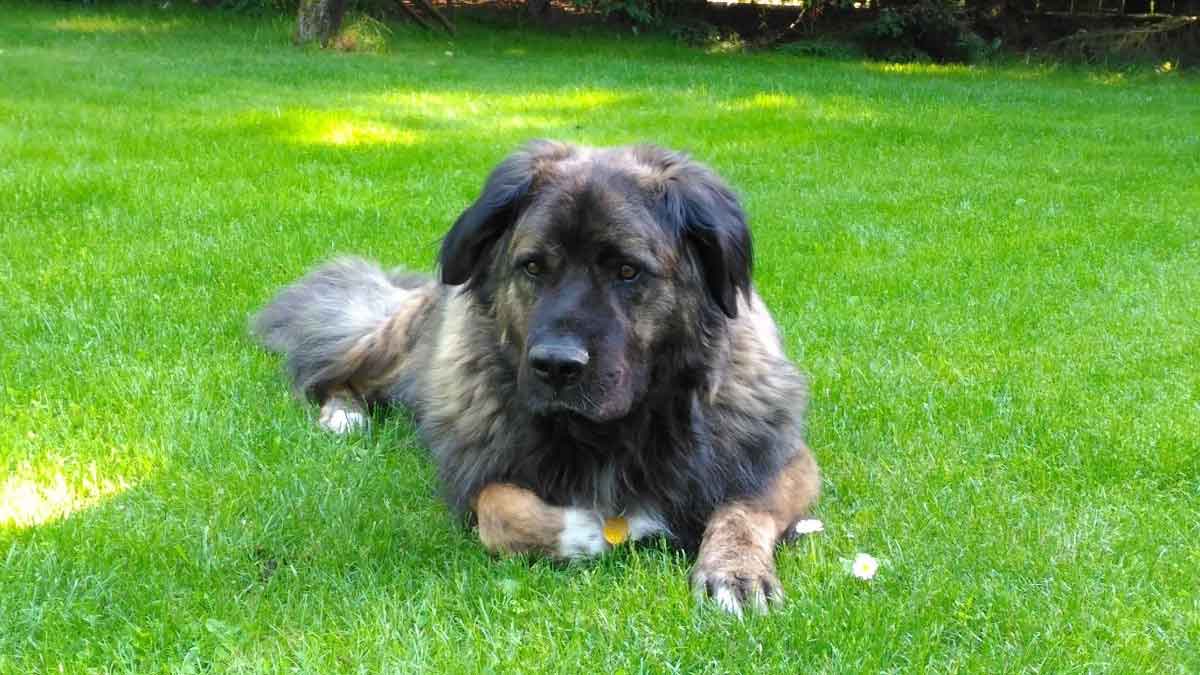
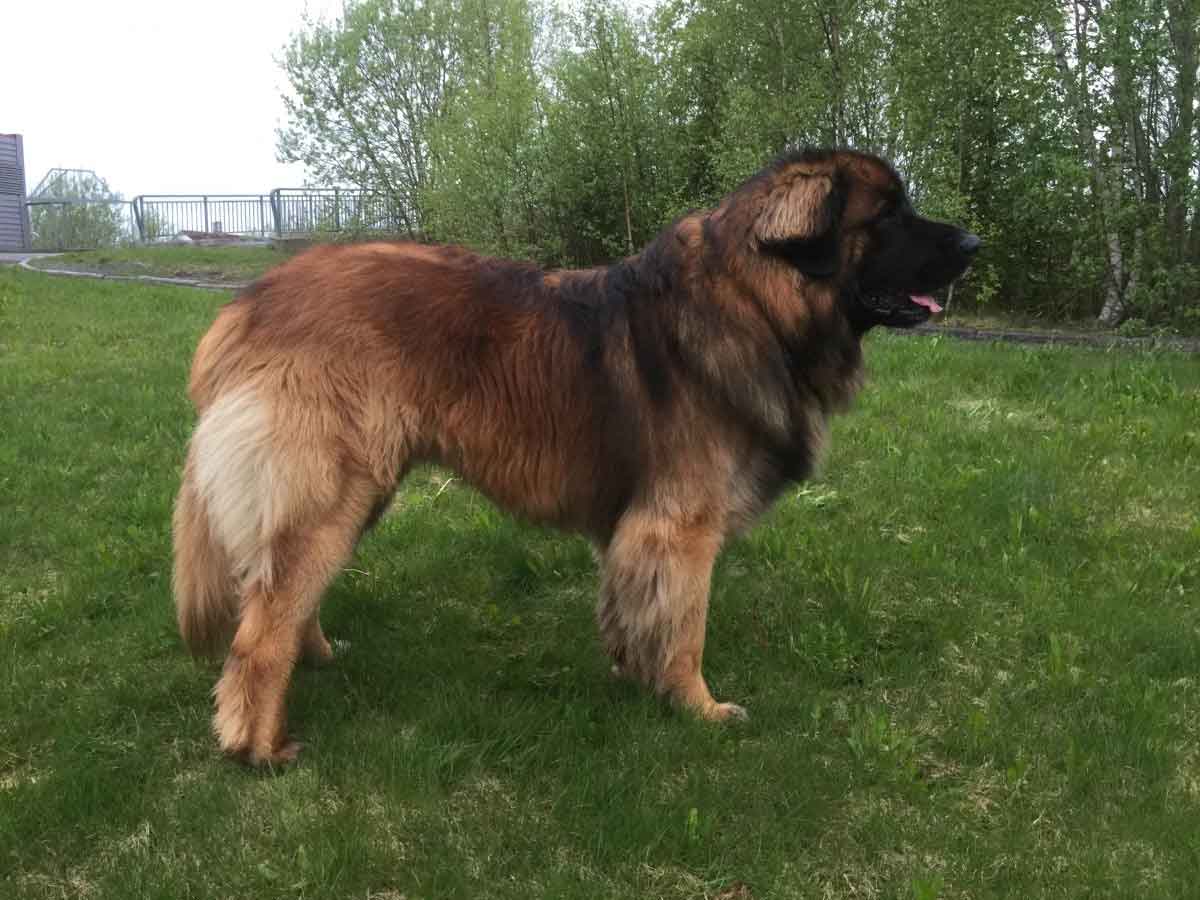
The Portuguese Sheepdog has an excellent herd instinct, always ready to take care of the goats

Content

History

The Portuguese Sheepdog has nearly 100 years.

This hairy, use livestock and guardian of the plains of the Portugal South may descend from the Berger de Brie, imported by the conde de Castro Guimarรฃes and which in turn bred with local mountain dogs.

Despite the similarities with the Berger de Brie and the Catalan Sheepdog, there is no reliable evidence to suggest a direct line of descent.

During the greater part of the last century, the Portuguese Sheepdog was the companion of the shepherds in southern Portugal, but in the Decade of 1970 was almost extinct.

Fortunately, the beauty of your fur and your docile predisposition came to knowledge of the breeders. Today, many owners in Portugal are owners of this breed and their future is assured..

Although he is practically unknown outside his native country, This dog of woolly appearance is a class dog, worthy of greater international recognition.
Owners say these โ€œcuteโ€ little dogs, nicknamed for their peculiar appearance and picturesque expression, have been part of farming and family life for a very long time. As with many working breeds, the ability to work was more important than the appearance, and the standard was not set up to 1930.

Recognition: CKC, FCI, NKC, APRI, ACR, DRA

Physical characteristics

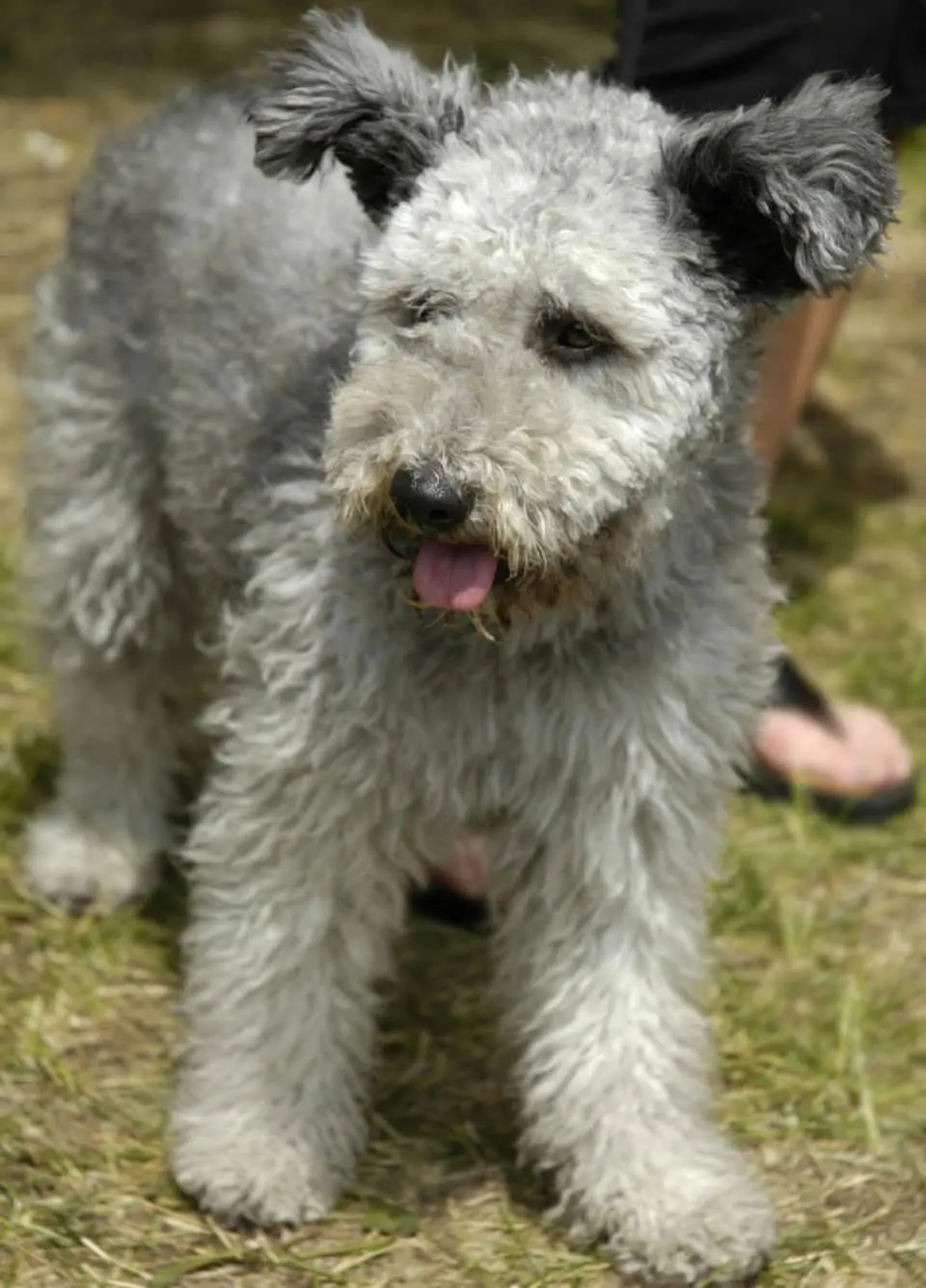
The fur of the < is long and smooth, with a light ripple. Do not have a background layer.

The colors We accept yellow, the brown, the fawn to red and more or less stained gray with red fire. There may be greater or lesser amount of white hairs scattered around the mantle, but never forming stains, except in the chest.

The previous tips they are symmetrically covered with long hair.
It has a beard that gives a mature look. The eyes they are round and dark, with a friendly expression. The ears moderate size usually hang on the sides of the cheeks, Although sometimes clipped. Clipping is prohibited in some European countries. Their feet are particularly adaptable to difficult terrain. Their legs they are strong and their chest deep.

Males can measure of 45 to 55 cm., while females measure of 42 to 52 cm.. The weight must be between 12 and 18 kg.

The hair is longer on the head giving these dogs a curious and messy bangs.
It has a head wide and robust, with a prominent nose and strong jaw. The tail, very close from the base, the high boot, it reaches the Hock and tapered.

Their life expectancy is of 12-13 years.

Character and skills

The Portuguese Sheepdog It is one of the smartest Sheepdogs. This is a great dog, joyful, happy and always ready to work. Very loyal, and paired with their own town.

The Portuguese Sheepdog needs a well-balanced training. It has a above average intelligence and learns quickly and easily, but he can be stubborn and dominant if they feel that their owners do not have the same mentality. So, It has always been a challenge for pastors. Trained once, This is the dog more reliable an owner may have. It requires educators safe and strong. These dogs can live with other animals, Although some males may try to dominate other males. They can live happily with other pets, provided that they have been properly socialized.

The Portuguese Sheepdog is usually patient with children, but the males, in particular, they can be very possessive within its territory. This race is reserved with strangers and they do a good job as a watchdog.

It is very good Shepherd with cattle, that will tirelessly defend. These dogs are known for their fast attitude, intelligent and are particularly good to bringing back stray dogs. They love its owner above all on Earth. Not usually bite unless cause you.

Characteristics "Portuguese Sheepdog (Cรฃo da Serra de Aires)"

Coexistence is important that you have with your new friend. Before considering the acquisition of a dog of the breed "Portuguese Sheepdog (Cรฃo da Serra de Aires)" you know certain factors. Not all breeds of dogs are apt to live in an apartment, you must take into account his character, their need for exercise, their interaction with other pets, their care and if you have small children, their level of tolerance towards them.

Adaptation โ“˜

3,0 of 5 stars (based on 1 review)

friendly dog โ€‹โ€‹โ“˜

2,0 of 5 stars (based on 1 review)

hair loss โ“˜

2,0 of 5 stars (based on 1 review)

Affection level โ“˜

3,0 of 5 stars (based on 1 review)

Need for exercise โ“˜

5,0 of 5 stars (based on 1 review)

Social need โ“˜

3,0 of 5 stars (based on 1 review)

Home โ“˜

3,0 of 5 stars (based on 1 review)

Toilet โ“˜

4,0 of 5 stars (based on 1 review)

Friendly with strangers โ“˜

3,0 of 5 stars (based on 1 review)

barking โ“˜

2,0 of 5 stars (based on 1 review)

Health โ“˜

4,0 of 5 stars (based on 1 review)

Territorial โ“˜

5,0 of 5 stars (based on 1 review)

Cat friendly โ“˜

2,0 of 5 stars (based on 1 review)

Intelligence โ“˜

4,0 of 5 stars (based on 30 reviews)

Versatility โ“˜

3,0 of 5 stars (based on 1 review)

Child friendly โ“˜

3,0 of 5 stars (based on 1 review)

Surveillance โ“˜

4,0 of 5 stars (based on 1 review)

joy โ“˜

5,0 of 5 stars (based on 1 review)

Images ยซPortuguese Shepherd Dogยป

Videos ยซPortuguese Shepherd Dogยป

Type and recognitions:

  • FCI CLASSIFICATION:
  • Group :
  • Section : . .

Federations:

  • – FCI โ“˜,
  • – AKC โ“˜,
  • – ANKC โ“˜,
  • – UKC โ“˜

FCI breed standard "Portuguese Sheepdog (Cรฃo da Serra de Aires)"

Origin:
Portugal

Date of publication of the valid original standard:
04.11.2008

Use:

Guard and herding dog on ranches.


General appearance:

It is a medium-sized dog, sublongilinear. Appreciable rusticity and sobriety, extremely agile and fast with a wide and suspended movement. Long hair with goat-like texture without undercoat. It has the appearance and attitudes of an ape, which is why it is known in this region as the โ€œmonkey dog.โ€.


IMPORTANT PROPORTIONS: The length of the body is approximately 10% greater than his height at the withers. Chest depth is less than 50 % the height at the withers. The length of the muzzle is 2/3 the length of the skull, the width of the skull is slightly less than its length.


Behavior / temperament:

Exceptionally intelligent and very affectionate. He is very dedicated to the shepherd and the cattle he cares for; stay away from strangers and keep watch at night. Nowadays he is also an excellent companion dog., sport and guard. It is highly prized for its ability to keep herds on pasture and to search for escaped animals.. It is alert and vigilant in the presence of predators. The breed is very devoted to its shepherd and his cattle. His work is done with pleasure and pleasure.

Head:

Medium-sized (mesocefรกlica), strong, wide; is not long, or large.

Cranial region:
  • Skull: With a tendency to be square, slightly longer that wide, divergent longitudinal axes of the skull and the muzzle, convex on both axles but more laterally. Supercilii arc is not prominent. Front Groove pronounced stretching towards the middle of the antecara, the areas between the ears are flat with an apparent occipital Protuberance.
  • Depression links: Well defined.

facial region:

  • Truffle : Well defined, slightly elevated ; the Windows are wide. It is rounded, cylindrical and truncated almost vertically. Preferably black, It can be liver color in yellow or brown animals but it should always be a darker color than the coat..
  • Nose cane: It is short; measured around 2/3 the length of the skull. Almost cylindrical ; the width should be proportional to its length and form. Rectilinear profile, or slightly concave.
  • Lips: Together, non-overlapping. They are thin, firm, almost straight cut. The edges of the same color of the truffle. 
  • Jaws: They have a normal development. Both jaws are in perfect opposition. Complete dentition of 42 teeth white and solid. Scissor bite, accepted a bite in Clip.
  • Eyes: Medium-sized, rounded, preferably color dark but can be Hazel or brown amber color in yellow animals, level without being prominent placement. friendly expression, Intelligent but docile, horizontal, eyelids black or always darker than the hair color and according to the colour of the nose.
  • Ears: High implementation; they are falls, and not bent, When not have been cut off; they are straight when they have been cut off. They have a triangular shape. Thin and soft skin. Medium-sized from the same long than broad (About 10 cm.).

Neck:

It joins harmoniously the head and trunk. It is straight and slightly ascending ; supplied thickness. It is not a double chin.

Body:

  • The top line : Straight or slightly inclined.
  • Cross : Strong, harmoniously combined with the neck and back.
  • Back : Straight or slightly sloping and long. Well muscled, usually twice the length of the spine.
  • Pork loin : Short and arched seen profile; wide and curved, seen from the front, strong muscles and well attached to the back and rump.
  • Rump : Some prominent and slightly inclined, soft, long and half-width, strong muscles.
  • Breast : Up to the height of the elbows, bandwidth and average depth, ribs slightly arched with an oval to leaning back rib cage. The sill is prominent, wide well back and wide.
  • Belly and flanks : Uniformly and slightly ascending.

Tail:

High insertion, sharp, arriving at the height of the paw, tapering from the base. Long and covered with abundant hair. When the dog is in motion it is the extension of the top line or it may curve slightly on the top line but never curve on the back.

Tips

PREVIOUS MEMBERS: Strong, well aplomados seen from front and profile, and separate, the distance from the cross to the elbows is slightly smaller than the elbow to the ground.

  • Shoulder: Medium length with a 45ยบ inclination, good muscular, scapula and humerus placed at a 90ยบ angle.
  • Arm: Strong and medium length placed at a 45ยบ angle, good muscular.
  • Elbows: Parallels, close to the chest and with a humerus angle โ€“ radius of 135ยบ.
  • Forearm: Long, vertical and well muscled with bones of medium thickness.
  • Carpo: Delgado. It is not prominent.
  • Metacarpus: Normal size and medium length. From top to bottom, and back forward, is not very inclined.
  • Pies: Rounded, not crushed. The fingers are long and together, with a curve. The nails are long, black and strong, or darker than the coat. The pads are thick and tough.

LATER MEMBERS: Medium width, aplomados seen from front or back, strong giving a perfect impression of strength and agility.

  • Thighs: Medium length and amplitude; good muscular. Hip-femur angle of approximately 105ยบ.
  • Knee joint: Straight view back without leaning neither in nor out. Femur โ€“ tibia angle approximately 130ยบ.
  • Leg: Little inclined; long and well muscled. Strong bones.
  • Tarsus(Hock) : medium width, low placement, strong and slim. Tibia โ€“ tarsus angle approximately 120ยบ.
  • Metatarsus: Normal size, although strong; medium length. It is not very inclined top down, and from front to back. There may be single and double Spurs.
  • Pies: Identical to previous feet in all its aspects.

Movement:

Predominantly moves in a lightweight and suspended trot with powerful. The Gallop, When the work required, is energetic.

Mantle

  • SKIN: Thick, flexible, not too tightThe mucous internal and external are preferably Pigmented.
  • COAT : Smooth or slightly wavy, the goat hair forming a long beard longer with a somewhat rough texture preferably type, whiskers and eyebrows but not covering eyes, thick and evenly distributed on the body including the interdigital spaces. Thickness means without Undercoat or fluff hair. Very long hair on his head, body and members, including the interdigital spaces.
  • HAIR COLOR: The colors are yellow, brown, grey, reddish and Grey Wolf; with light and dark varieties, and more or less marked fire black, with or without white hairs mixed, but never show white spots, except for a small spot in the pectoral region.
  • Skin : The mucous internal and external are preferably Pigmented; the skin is not too stretched.


Size and weight:

  • In males : of 45 to 55 cm..
  • In females : of 42 to 52 cm..

WEIGHT :

  • Males and females: 17 to 27 kg.


Fouls:

Any deviation from the aforementioned criteria is considered a fault and the severity of this is considered to the degree of the deviation from the standard and its effect on the health and well-being of the dog..

SEVERE FAULTS

  • Behavior: Specimens showing nervousness or unbalanced temperament.
  • Jaws: Incorrect implantation of teeth, absence of two premolars (Except PM1)
  • Little marked links depression.
  • Nose is pointed.
  • Overlapping lips, or pendulums.
  • light eyes, small, or non-round, u oblique.
  • Bent or rose-shaped ears.
  • Too narrow banister.
  • Breast : shallow, flat rib cage.
  • Concave upper trunk line, or too steep.
  • Horizontal Croup, or too much fall.
  • Bottom line too thin.
  • Tips: anterior or posterior foot inclined, Garron of cow. Not too straight hind legs.
  • Very low insertion queue, short, or curled over the back when the dog is at rest.
  • White nails.
  • Little wire-haired, or not long enough.
  • Large white patch on the chest region. Fire-coloured stains not defined.
  • Movement: not wide enough, not suspended, elbows out, Paw too together.

MISS PLAYOFFS

  • Behavior: Aggressiveness or excessive shyness.
  • General appearance: Lymphatic, Lightweight bones. Severe deviations from the important proportions
  • Narrow and long head.
  • flat skull, round, Strait
  • Low-set ears, too separate, erect semi erect or.
  • Nasal helm that presents a convex profile.
  • Jaws: prognathism or inferior, absence of more than two premolars (except PM1).
  • Pigmentation: Total absence of pigmentation in truffle, eyelids, lips (albinism).
  • Amputated tail, or lack thereof of birth.
  • Short hair, curly or with presence of Undercoat.
  • Color: White at the ends of the members. Absence of stain color fire in Brown adult, grey or black.
  • Movement: Too rengueo or heavy, with severe deviations in previous members, weakness.
  • Size: Above or below established limits.

Any dog โ€‹โ€‹showing clear signs of physical or behavioral abnormalities should be disqualified..


N.B.:
  • Males should have two normal-appearing testicles fully descended into the scrotum..

TRANSLATION : IRIS Carrillo (Federation Canรณfila de Puerto). 

Technical review: Miguel Angel Martinez (Federation Cynologique Argentina).

Source: F.C.I - International Cynological Federation

Alternative names:

1. Monkey dog, Cรฃo da Serra de Aires (English).
2. Berger de la Serra de Aires, CHIEN DE BERGER DE LA SERRA DE AIRES (French).
3. PORTUGIESISCHER SCHร„FERHUND (German).
4. Serra-d’aires (Portuguese).
5. Perro de pastor portuguรฉs (espaรฑol).

โ–ท The world of Pets: Dogs, cats, birds, reptiles, amphibians

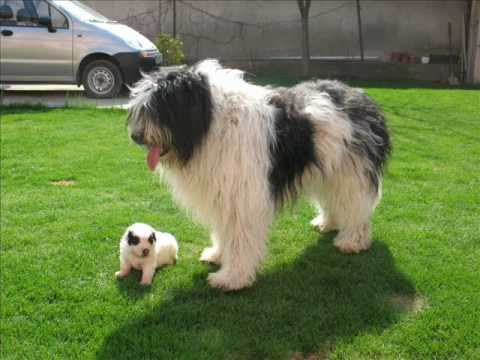
Croatian Sheepdog
Croacia FCI 277 . Sheepdogs

Croatian Sheepdog

With a great instinct for working with the herd.

Content

History

The Croatian Sheepdog It was described for the first time in 1374 by the Croatian bishop Peter Bichof. According to some sources, the breed was created in the eastern part of Slavonia, the vast agricultural plain of Croatia, to act as a guard and herding dog. Peter Bichof stated that the Croatian Sheepdog It was imported from the East by the Croats around the 7th century.

It was the vet Stjepan Romic, considered the father of the race, who initiated the systematic breeding of the Croatian Sheepdog in 1935 en Djakovo (Croatia). His role was all the more important since he had previously carried out various investigations on the dog and had managed to unearth writings dating from various periods of the 18th century.. These documents describe the Croatian Sheepdog as it is known today.

The breed was officially presented at 1949 in Zagreb (Croatia), and the first standard of the Croatian Sheepdog was written by Otto Rohr in 1951. He was recognized by the International Cynological Federation (FCI) in 1967, later for him United Kennel Kingdom (UKC) in 2006 and, finally, by the American Kennel Club (AKC) and Central Canine Society (SCC).

Despite this recognition by the main canine organizations in the world, the Croatian Sheepdog has not really spread internationally: it is hardly seen outside of its home country and remains unknown to the general public. These may include, the Central Canine Society (Kennel Club inglรฉs) just signed up 38 Croatian shepherds at the LOF (French Origin Book) between 2010 and 2016, an average of just 5 dogs a year.

Physical characteristics

The Croatian Sheepdog is a dog at the lower limit of medium size. Short hair on the head and limbs is the characteristic sign of the breed.. The head is quite light with a cone shape. The stop is poorly marked. The eyes are medium in size, macaroons, with a lively expression; the color goes from brown to black. The ears are triangular, raised or semi-raised, medium length and set slightly to the side. Straight ears are referable and cutting is not allowed. The tail is implanted a little high, with long thick hair. It is cut so that it does not have a length greater than 4 cm in adult error.

  • Fur: hair length is 7 to 14 cm on the spine. The face is always covered with short hairs. The ears have short hair on the outer face and long on the inner. The hair is relatively soft, wavy and even curly. The undercoat must be dense.
  • Color: predominantly black although some white spots on the throat or chest are admitted.
  • Size: of 40 to 50 cm..

Character and skills

The Croatian Sheepdog is lively and alert, without being nervous. They are also smart, brave and loyal.

Very obedient, they are also exclusive: they only have one master, to which they remain very attached and whose attention they demand. In fact, it is necessary for its balance.

Sheepdogs par excellence, has an innate sense of herding and is a very hardy dog. Some ranchers claim that you can knock down all the cattle just by saying their name, no need for further instructions. His approach to the herd is a bit tighter and harsher than that of other sheepdogs, but still very effective. It can bite the animals in its charge, but does not cause injury. This aggressive tendency can be easily worked on during training. It also has the defect of barking easily, especially if his master is absent, hence the importance of training him from a young age.

The dog lives very well with children. Energetic and playful, the Croatian shepherd gets along wonderfully with them and lavishes affection on them. His extraordinary attachment predisposes him to protect them, even to overprotect them. Not just anyone can get close to them. On the other hand, being a dominant dog by nature, can generally only live with other animals (dogs, cats, etc.) if he is used to their company from a young age.

Last, are among the dogs adapted to life in a flat, whenever they carry out intense daily activity. In fact, like all sheepdogs, the Croatian shepherd needs to learn and be stimulated mentally and physically. They have been bred to work with humans and, Therefore, have developed the ability to interact with them, making them a learning breed. If they lack activity, can become noisy and even destructive.

Education

The intelligence of Croatian Sheepdog, its desire to please its owner and its predisposition to work make it an easy breed to train. This workout should be both gentle and firm.

Health

The Croatian Sheepdog has robust health and is very resistant to disease, especially if you spend the nights in the shelter of aboxofdog.In fact, most of his health problems are due to injuries related towork.

But, may be subject to certain canine diseases that more generally affectactive and energetic dogs:

  • Theknee patella luxation: the joint swells and becomes painful, with early appearance of acanine arthritis.Treatment can range from the occasional use of pain relievers to knee surgery. It is a common disorder inshepherds dogs, they are very active.
  • Thetorsion of the stomach: all dogs can be affected by this disease, but croatian shepherds, they areBig Dogsand they exercise a lot, they are particularly vulnerable.
  • Last, females may have difficulty giving birth. If so, this implies endangering not only the dog, but also to unborn puppies, it is usually necessary to perform a cesarean section under general anesthesia., an owner who wantsraise your bitchYou should think carefully before consulting themating offers.This is a decision that should not be taken lightly., for both financial and safety reasons.

Life expectancy

12 to 14 years

Grooming

All owners of a Croatian Sheepdog they should brush their dogs regularly to remove dead hair and detangle pups. During the moulting season (Spring and autumn), this brushing should be done even once a day.

If your dog has gotten too dirty due to the weather and / or his activity, it is necessary to give him a bath. But, this should not be done at regular intervals, since the bath irritates the skin of the animal and removes the oil layer that protects its fur. So, the rule is to avoid bathing the dog, except when really necessary.

It may also be necessary to trim the dog's nails. But, if your pet does his daily exercise, this should not be the case, because dirt or harder surfaces will naturally erode them.

It also, do not forget to deworm and vaccinate your dog regularly. How your dog is often outdoors for long periods of time, and is in frequent contact with other dogs and animals, are more likely to come into contact with many bacteria and viruses.

Price

The price of a puppy Croatian Sheepdog is usually between 800 and 1000 EUR.

Characteristics "Croatian Sheepdog"

Coexistence is important that you have with your new friend. Before considering the acquisition of a dog of the breed "Croatian Sheepdog" you know certain factors. Not all breeds of dogs are apt to live in an apartment, you must take into account his character, their need for exercise, their interaction with other pets, their care and if you have small children, their level of tolerance towards them.

Adaptation โ“˜

4,0 of 5 stars (based on 1 review)

friendly dog โ€‹โ€‹โ“˜

4,0 of 5 stars (based on 1 review)

hair loss โ“˜

3,0 of 5 stars (based on 1 review)

Affection level โ“˜

4,0 of 5 stars (based on 1 review)

Need for exercise โ“˜

2,0 of 5 stars (based on 1 review)

Social need โ“˜

3,0 of 5 stars (based on 1 review)

Home โ“˜

3,0 of 5 stars (based on 1 review)

Toilet โ“˜

1,0 of 5 stars (based on 1 review)

Friendly with strangers โ“˜

4,0 of 5 stars (based on 1 review)

barking โ“˜

4,0 of 5 stars (based on 1 review)

Health โ“˜

3,0 of 5 stars (based on 1 review)

Territorial โ“˜

5,0 of 5 stars (based on 1 review)

Cat friendly โ“˜

3,0 of 5 stars (based on 1 review)

Intelligence โ“˜

4,0 of 5 stars (based on 1 review)

Versatility โ“˜

4,0 of 5 stars (based on 1 review)

Child friendly โ“˜

4,0 of 5 stars (based on 1 review)

Surveillance โ“˜

4,0 of 5 stars (based on 1 review)

joy โ“˜

4,0 of 5 stars (based on 1 review)

Type and recognitions:

  • FCI CLASSIFICATION:
  • Group :
  • Section : . .

Federations:

  • FCI โ“˜
  • UKC โ“˜
  • AKC โ“˜

FCI breed standard Croatian Sheepdog

FCIFCI - Croatian Sheepdog
Pastor

Alternative names:

1. Hrvatski ovฤar, Kroatischer Schรคferhund (English).
2. Berger de Croatie (French).
3. Kroatischer Schรคferhund (German).
4. Hrvatski Ovฤar (Portuguese).
5. Perro de pastor croata (espaรฑol).

Photo:

croatian sheepdog Mawlch Gera by Michala Mraฤkovรก / Public domain

โ–ท The world of Pets: Dogs, cats, birds, reptiles, amphibians

Majorca Shepherd Dog
Espaรฑa FCI 321 . Sheepdogs

Ca de Bestiar

The Majorca Shepherd Dog or "Cattle", It is a breed of dog originating in Mallorca.

Content

History

Also known as โ€œCa de Bestiarโ€, this breed is believed to have existed since ancient times. Through the years, this dog would have been bred with a variety of local Mallorcan dogs, as well as with other European Shepherd dogs, and it was not until 1970 which he puts any restrictions on their upbringing. In fact, its breed standard was written as recently as 1980. It was in 2006 the UKC โ“˜ recognized the breed within his Group of Sheepdogs.

Appreciated through the centuries by the Spaniards for their ability to be a versatile farm dog, the Majorca Shepherd Dog It was used both to herd flocks and to monitor property and animals. It has also been reported that the Majorca Shepherd Dog was widely used in dogfighting, a practice that is now illegal. Although it is still used on farms today, and is also often kept as a companion animal, this rare breed once seen internationally and is considered a rare breed.

Physical characteristics

The Majorca Shepherd Dog is a large size dog, average weight, well proportioned, rustic, strong and large muscles, flexible and robust.

There are two varieties: long hair and most widespread short-haired. The head is well modeled, large and provided with the body, but not so much as to look like a molosser. Craniofacial shafts are slightly convergent; the relationship between the skull and the muzzle is of 1:1.

The color eyes goes from amber to dark brown, and his expression is intelligent and enigmatic.

The ears, small in relation to the head, they are triangular, inserted at the top and are normally bent, with dropped tips.

The tail Start horizontally, is horizontal section, It has thick base and it tapers towards the tip.

Fur: the short hair variety has quite thin Undercoat. In the variety of long hair, hair coverage can reach a length of 7 cm and it is slightly wavy. In both varieties should be soft and fine.

Color: the only one admitted is black, optionally with white spots on chest and feet.

Size: males, of 66 to 73 cm.; females, of 62 to 68 cm.. The weight is usually of 40 kg approximately.

Character and skills

He is a shepherd dog with skills for the job of guard and defense. Itร‚ยดs Intelligent, docile and affectionate, although as a puppy he is usually shy and reserved. For this reason it is important to socialize it to the maximum to avoid that it closes in on itself.

The adult is very suspicious of strangers and he is united by a very strong bond with his master. Her enigmatic gaze not glimpse of his thoughts. It has an extraordinary courage and willing to everything in order to defend their loved. It's a little known breed outside the Balearic Islands, so to acquire a good puppy should address to breeders of the Islands.

Images ยซMajorcan shepherd dogยป

โ€œMajorcan Shepherd Dogโ€ videos

Type and recognitions:

  • FCI CLASSIFICATION:
  • Group :
  • Section : . .

Federations:

  • – FCI โ“˜

FCI breed standard "Majorca Shepherd Dog"

Origin:
Spain

Date of publication of the valid original standard:
26.05.1982

Use:

Herding dog, guardian and defense


General appearance:

Sub-convex profile dog, large without being exaggerated and medium-weight size. It is totally black or black with white spot on chest, well proportioned, rustic, strong, muscular, robust and agile. There are two varieties of hair:

  • Short hair, the most common variety.
  • Long hair.

IMPORTANT PROPORTIONS:

Dog subhipermetrico, midline and subconvex.

  • The female accepts a longitudinal diameter of up to a 3% greater than the height of the cross.
  • Length of the muzzle is equal to the length of the skull.
  • The length of the head must be equal to the length of the neck.
  • In adult males the thoracic perimeter, taken together the cross behind the elbows, It is about a cms rather than its height at the withers.


Behavior / temperament:

Dog of great nobility, only an owner that accepts loads of strangers with difficulty.
Intelligent, docile, loving, shy on end and reserved in his youth ; his sentimentality comes to unsuspected. Faithful to his master until death. If we explore in his eyes it will give us the feeling thinks. It is courageous and quarrelsome.

Head:

Slightly triangular profile; view dorsally is wider at the top than at the bottom; solid, but not heavy; large enough to accommodate a good intelligence; well molded and proportionate to the body; It must be rather large, but never a trotting type. The supranasal line is parallel to the cranial line. Slightly divergent skull-facial axes.

Cranial region:
  • Skull: Sub-convex profile. The width of the head, taken between the storms, It should be slightly higher ( approximately 1,2 %) to the length between the supraorbital line and the occipital crest. A slight groove can be seen in the first third of the frontal midline. Marked occipital Crest.
  • Depression links (Stop): Marked, but never sudden, in mild decline.

facial region:

  • Truffle: Wet, fresh, black, large, with broad nostrils; No split. It despuntuarรก significantly if you have stains of barks or lighter.
  • Snout: Width, rather strong ; It should not be in tip, but its height and width should be accentuated as it approaches the orbits. In the variety ยซ Ca cabrer ยป (Longhair) more pointed. The dorsal profile of the nasal helm is sub-convex. The profile of the branches of the lower jaw is straight. Black color palate.
  • Lips: Black ; the high not seen to the bottom while your mouth closed ; the labial commissure is little noticeable and they go unnoticed because they are well proportioned to the head.
  • Jaws / Teeth: Very white teeth, well developed and well placed, closed scissors, making the incisors true upper ends prey with the lower canines. The molars developed.
  • Eyes: Rather small, slightly almond ; are not prominent nor sunken in orbits ; not far apart from each other, centered, slightly oblique, lively. Color between the Rosemary honey (something clear) and of the honey, carob (dark). Enigmatic expression, with look smart and sad at the same time, where denotes even distrust. The eyelids are thin, black and oblique, close to the eye.
  • Ears: Broken, small size in relation to the head, triangular, reaching the tear in the eye of its corresponding side tip, or is approximately equal to the length of your skull. Without amputating, slightly thick, high insertion, separating your tip slightly skull, with a longitudinal fold and another cross around the first third.
  • Position of the ears: usually bent and dropped, something separate from the muzzle. Played back in standby ; in State care by the transverse fold levantadolas, separating them from the snout than usual.

Neck:

Massif, muscular, strong and proportionate to the head and body. Thick, with very little double chin, cylindrical, its diameter accentuating more at the base. The skin is tough and elastic, or fine or thick, firmly attached to the neck at its top and sides, more detached on the bottom.

Body:

  • As a whole: Robust, very well proportioned, giving the impression of strength and agility while.
  • Cross: Marked and at least at the same height as the top of the rump ; the large area between the scapulae and strong.
  • Dorso-lumbar line: Straight, horizontal, never built.
  • Pork loin: Wide and powerful.
  • Rump: Medium, slightly rounded, wide, powerful and muscular; never prominent or fallen. The top should be at the same height as the cross. Its interiliac width must be equal to the iliac-ischial length .
  • Breast : Wide and high, maximum reaching the elbow; a width approximately equal to the length of the neck; quite deep, not prominent, with slightly pronounced sternum. Arched ribs (non-flat or in barrel).
  • Belly and flanks: Fairly bulky flanks. Slightly gathered belly, never agalgado, nor descended to be confused with continued chest. Something stylish, You must give the impression of agility.

Tail:

Horizontal insertion and circular section, rather thick at its birth. Some 8 cm base flattens slightly at its lower profile, in a few 10 length cm, to continue then the tapered circular to its end. Without amputating. Of a length that must reach at least the hock, without touching the ground. No tuft or fringe, Although it is authorised, If this is light, copies of older. In the variety of long hair you must have abundant and long fringe. Size of the queue : at rest naturally drooping or slightly curved outward, slightly touching the hocks, default is considered serious if your tip should touch the ground. Undulating and raised more than the horizontal sickle-shaped, without screwing it, When in action.

Tips

PREVIOUS MEMBERS:

  • As a whole: Strong Member ; correct limbs ; seen from the front and in profile parallel to each other and perpendicular to the ground.
  • Shoulder: Oblique and strong.
  • Scapulo-humeral angle: 115ยฐ.
  • Arms: Of equal length to the scapula.
  • Elbows: Without deviations, glued to the chest. Radial-humerus angle : 130ยฐ.
  • Forearm: Strong, well angled, perpendicular. Vertical bones, strong, long and right.
  • Metacarpus: Short and slightly tilted.
  • Previous feet: Almost of Hare (something shorter and wider than they), finger semialtos, semiarqueados, together, and with the very hard and black pad. Without acute interdigital membrane.

LATER MEMBERS:

  • As a whole: Muscular, strong ; correct limbs. Dimmed and hard muscle relief.
  • Coxo-femoral angle: 115ยฐ, peer-to-scapulo-humeral.
  • Thigh: Strong and muscular.
  • Stifle-tibial angle: 130ยฐ, same as the humerus-radial
  • Leg: Long and powerful.
  • Hock: Little pronounced, very open 135ยฐ angulation. The height of the Hock is about somewhat lower than the one-third of its height at the withers.
  • Metatarsus: Well marked.
  • Hind feet: Almost of Hare, crushed, with fingers together and semiarqueados. Pad hard and black. Arched nails, black and hard. Without acute interdigital membrane. May be born with or without Spurs, in the first case they must amputate.

Movement:

His way of walking must be firm and elegant. The trot on diagonal bipeds, Tip slightly posterior third, respect to the previous. The Gallop will be franco, fast rustic, the rear legs wide apart at its base with soil, placing them outside of the hands, as if it were jumping. The preferred step and the work is the Gallop.

Mantle

SKIN: Elastic, without folds, hard and light grey.

  • HAIR: Short and glued to the skin, its length ranging about 1,5 cm to 3 cm on the spine ; very fine Undercoat, low thickness and very attached to the skin. In the long-haired variety may be slightly wavy on the spine, approximate length of more of 7 cm according to the time of year, with the largest winter. Well distributed and thin Undercoat, grow hair in their normal length in the fringe of the queue, Tip of the ears and back of the limbs. In both varieties should be smooth, hard and quite thin.
  • COLOR: The only color supported is black, varieties of Jet, regular and peceno. The target is supported only in the chest, in the form of thin tie under neck and anterior and posterior foot, highlighting according to its easy visibility on nails and tips of the toes. The Jet Black landmark is the most appreciated, nature of the ordinary black and the peceno.


Size and weight:

  • Height to the cross: Among 66 and 73 cm for males. Among 62 and 68 cm for females.
    Specimens with heights of one cm or so are allowed at the limits indicated ; in this case you must subtract score.
  • Weight: Environment to 40 kg.


Fouls:

Any deviation from the aforementioned criteria is considered as a fault and the severity of this is considered to the degree of the deviation to the standard and its consequences on the health and well-being of the dog..

SERIOUS FAULTS

  •  Dogs that drool-worthy.
  •  Cut fangs.
  •  Very raised ears rest, very large very separated from the face or completely glued to it.
  •  Very collected belly (whippety).
  •  Threaded queue; white tail tip.
  •  White spot of chest of more of 1 dmยฒ.
  •  All fingers of a foot white.

MISS PLAYOFFS

  •  Aggressive or fearful dog.
  •  Mastiff head, very wide and heavy or Hound, long and narrow with just pronounced stop.
  • Truffle pink or white.
  •  Upper or lower prognathism more of 3 mm.
  • โ€ข Eyes of different colors from each other ; eye that is not of the color that goes from the Rosemary honey (something clear) the carob-honey (dark) ; very clear eye.
  • Amputated ears, stiff in action or almost stiff at rest.
  •  Double chin neck, more thickly along the skull than at its base, longer that a 10% length ranging from truffles to the occipital Crest.
  •  Body too long or too short ; height of the top of the rump in a 3% greater than the height at the cross.
  •  Very thick tail, or of equal thickness at the base and tip ; excessively long to touch the ground ; amputated or missing you each 2 cm to reach the Hock ; with abundant fringe in the variety of short hair, with or without bangs in long hair variety.
  •  Other color than black, or, in dogs being black, an anterior or posterior foot white or another color ; members shod in white on any number of limbs ; not totally black body (with the exception of the chest, very few hairs on the belly, perpucio or tip of the tail), stains, without disqualify, they notably despuntuarรกn. They despuntuarรกn not consequential white hairs of bites, trauma or other similar injuries, or the white hairs from the face own age. White fingers not disqualify, unless the animal is more than six, despuntuando notably each ; a single finger white or another color in the previous feet disqualifies the dog.
  •  Height of the cross over of 74 cm in males and more of 70 cm in females. The cross of less height of 66 cm in males and less of 60 cm in females.
  •  Under weight of 30 kg and over 50 kg in males, under weight 25 kg and over 45 kg in females ; even being within the aforementioned limits, very skinny dogs, visibly obese or very saddled (having tolerance in pregnant females).

SCALE OF POINTS

  • General appearance and temperament โ€“ 21 points
  • Presentation (cleaning and porte) โ€“ 4 points
  • Fur (length and hardness) โ€“ 4 points
  • Layer (color and brightness, 7+2) โ€“ 9 points
  • Temperament/Behavior โ€“ 4 points
  • Head โ€“ 21 points
  • Skull and stop โ€“ 4 points
  • Snout, nose and lips โ€“ 5 points
  • Teeth and palate (2+1) โ€“ 3 points
  • Eyes โ€“ 5 points
  • Color โ€“ 2 points
  • Form, size and separation โ€“ 2 points
  • Eyelids โ€“ 1 point
  • Ears (form, thickness, inclusion, size) โ€“ 4 points
  • Neck โ€“ 4 points
  • Trunk โ€“ 21 points
  • Cross โ€“ 1 point
  • Back and back โ€“ 5 points
  • Rump โ€“ 3 points
  • Belly โ€“ 2 points
  • Breast , chest, Ribeye, size โ€“ 10 points
  • Tail (form, length and fringes) โ€“ 2 points
  • Limbs โ€“ 19 points
  • Previous aplombs โ€“ 6 points
  • Later aplombs โ€“ 8 points
  • Feet ant. and post., fingers, nails hardness of the pads โ€“ 5 points
  • Movement โ€“ 12 points
  • Ear bearing โ€“ 3 points
  • Tail bearing โ€“ 3 points
  • Jogging โ€“ 2 points
  • Gallop โ€“ 4 points

Total : 100 points


Proportional measurements (ideal for the male)

  • Weight โ€“ 41 kg
  • Height at the withers โ€“ 71 cm.
  • Height to the rump โ€“ 71 cm.
  • Chest height โ€“ 39 cm.
  • Longitudinal diameter โ€“ 71 cm.

Head

  • Muzzle length โ€“ 13 cm.
  • Skull length โ€“ 13 cm.
  • Total head length โ€“ 26 cm.
  • Neck length โ€“ 26 cm.
  • Ear Longiud โ€“ 13 cm.
  • Tail length โ€“ 52 cm.
  • Raised to hock โ€“ 23 cm.

Length of the hair on the back

  • Short hair variety โ€“ 2 cm.
  • Long hair variety (between seasons) โ€“ 7 cm.
  • Head width โ€“ 15 cm.
  • Thoracic perimeter โ€“ 81/83 cm.
  • Chest width โ€“ 26 cm.
  • Neck circumference โ€“ 49 cm.

Any dog โ€‹โ€‹showing clear signs of physical or behavioral abnormalities must be disqualified..


N.B.:

Males should have two normal-appearing testicles fully descended into the scrotum..

Source: F.C.I - International Cynological Federation

Alternative names:

1. Majorca Shepherd Dog, Ca de bestia, Pastor mallorquรญn (English).
2. Berger de Majorque (French).
3. Ca de Bestiar (German).
4. Ca de Bestiar (Portuguese).
5. Pastor-maiorquino, Ca de Bestiar, Pastor mallorquรญn (espaรฑol).

โ–ท The world of Pets: Dogs, cats, birds, reptiles, amphibians

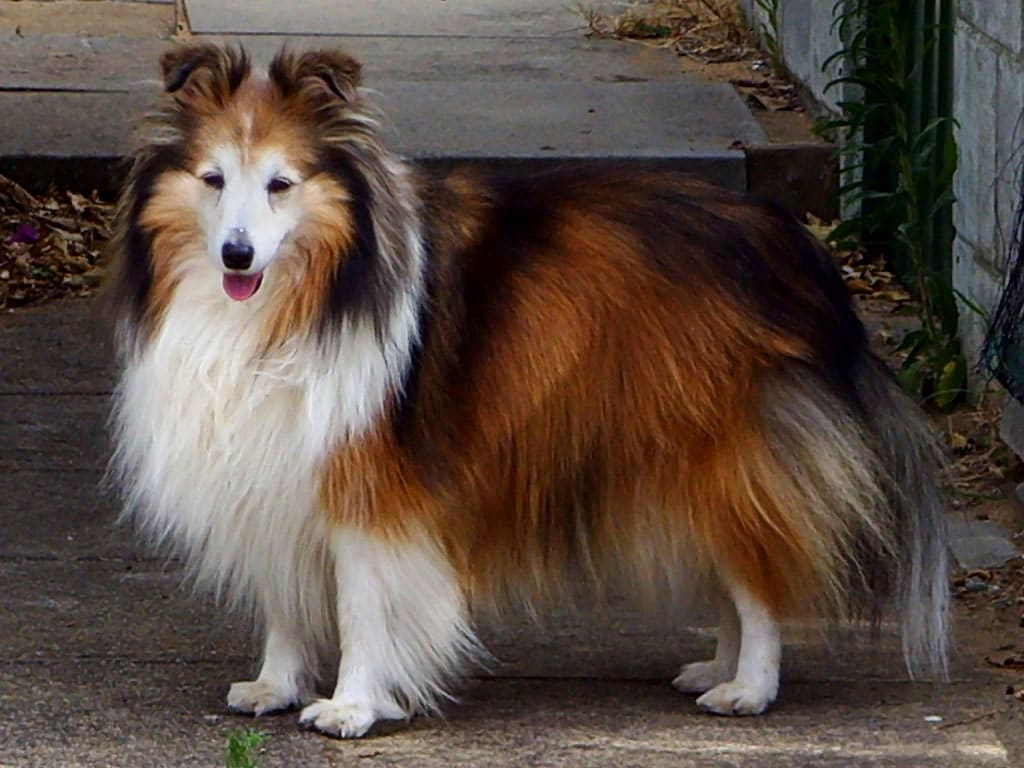
Shetland Sheepdog
Escocia FCI 88 . Sheepdogs

The Shetland Sheepdog is very familiero, lovely with children, intelligent and loyal.

Pastor de las Islas Shetland

Content

History

The Shetland Sheepdog comes from the Shetland Islands (Scotland, United Kingdom), intentionally was raised in small size. At first sight, seems to be a copy of Rough Collie miniaturized, However, are 2 different races with a similar look.

The "father" race Shetland Sheepdog o โ€œSheltieโ€ as they are often nicknamed, they are the Border Collie.

Physical characteristics

The Sheltie they have a double mantle, What makes this breed peleche much more than other dogs. Long hair covering the thick and soft layer base, is repellent to water, while the base layer provides relief from hot and cold.

There are three main colors: Sable, It ranges from the Golden to mahogany; Tri-color, formed by the black, White and Tan, and blue mirlo, composite grayscale, white, black and Tan.

black and white: it is less common but still acceptable.

Sand: the best-known color, dominates over other colors. The shadow Sabre, or mahogany can sometimes be confused with the Sheltie tricolor because of the large amount of dark shading in their coats. Another name for him Sheltie "shading", is trifactorado sable and white. This name comes from the mixture of a tricolor and a sable and white. Another acceptable but less common color is Sable merle, that it can sometimes be difficult to distinguish between the regular sable after puppyhood. The Sable merle has patches of dark brown on a light brown background compared to the black and grey blue Merle.

There are other two colors that are a bit rare, which are unacceptable in the ring. The White Color-headed (majority of white with the head "normally" marked), It is the product of two dogs crossed white facotrados. Double Merle, the product of the crossing of two Shetland Sheepdog blue merle, they can be crossed but have a high incidence of deafness or blindness than other colors.

The ideal height at the cross, in males 37,5 cm.. The females. 35,5 cm.. One greater diversion of 2,5 cm above or below these measures is regarded as highly undesirable.

Character and skills

It is an excellent companion dog, highly loyal. It is joyful, intelligent and always ready to obey. The Shetland Sheepdog they are loving, loyal and affectionate with the family and of course, on the sidelines, with strangers; for this reason the Sheltie They must be socialized. Some may be very reserved. This breed gets along very well with children if they are raised with them from a young age.; However, its small size makes it easy for a child to accidentally harm them, This monitoring is necessary. Consider well bringing a Sheltie adult to a house with small children, may not be compatible.

Some Shetland Sheepdog tend to display a personality similar to that of a Terrier who tends to be hyperactive, and always ready, However this temperament is not sanctioned in the breed standard. Some may be shy, but this temperament is specifically discouraged by the standard. The trend towards shyness, It can be reduced with proper socialization. The Sheltie average is an excellent watchdog, giving alarm barks when a person is at the door or pass a car on the street.

The herding instinct is strong in many Shetland Sheepdog. Love to chase and pasture including, squirrels, ducks, pigeons and children. To the Shetland Sheepdog they like to run in large open areas.

They usually enjoy playing. They are better with a sensitive owner, but firm. The Sheltie It, first and foremost, a smart pastor and love to keep them busy, Although his level of activity, usually, It coincides with the level of its owner. As they are very intelligent, they are highly trainable. Lack of exercise and intellectual stimulation, It can lead to undesirable behaviors, including excessive barking, phobias and nervousness. Fortunately the annoying behaviors may decrease largely by an hour of exercise to make the dog with its owner.

in your category, this breed dominates in the competitions of Agility. They also look at obedience competition, Flyball, Grazing, Tracking and proof of talent.

It is a very intelligent dog, according to him Dr. Stanley city, expert on animal intelligence. The Sheltie is one of the brightest dogs occupying the position number 6 in the Ranking of 132 evaluated races. His research determined that an average Sheltie could understand a new command in less than 5 repetitions and would obey the command the first time the 95% of the times or more.

Health

Similar to the Rough Collie, There is a tendency to inherit malformations and diseases in the eye. Each puppy should have his eyes examined by a qualified eye veterinarian. Some lines may be susceptible to hypothyroidism, epilepsy, Hip Dysplasia, or skin allergies. The life expectancy of Shetland Sheepdog is between 10 and 15 years, Although some in some it may be more, and in others may be less.

The disease of Von Willebrand is an inherited bleeding disorder. On race Sheltie, affected dogs, as a general rule, they do not live long. The Shetland Sheepdog carry type III of Von Willebrand, which, It is the most severe of the three levels. There are DNA tests that were developed to find this disease in dogs Sheltie. It can be done at any age and will showcase one of the following results: affected, carrier or affected not. The Shetland Sheepdog they can also suffer from Hypothyroidism, It is the low functioning of the thyroid gland. Clinical symptoms include, loss of hair, on low weight and faintness.

Although small breed dogs are not usually affected by the Hip Dysplasia, has been identified in some specimens of Sheltie. It occurs when the head of the femur and the acetabulum they don't fit properly, This causes pain and/or lameness. Hip Dysplasia is thought to be genetic; Many breeders sent to test their dogs to certify that they are free from this.

  • Otros nombres: Pastor de las Islas Shetland / Shetland Collie / Dwarf Scotch Shepherd / Toonie dog / Apartment Collie / Miniature Collie / Sheltie / Berger des Shetland.
  • Group 1 / Section 1 – Sheepdogs.

โ–ท The world of Pets: Dogs, cats, birds, reptiles, amphibians

Berger Picard
Francia FCI 176 . Sheepdogs

Berger Picard

The picardy shepherd dog it is a little-known breed despite all its qualities

Content

History

The origins of the Picardy Sheepdog are ancient (is represented in a painting from the 8th century) and, However, there is no certain news of race before the year 1899, when he first appeared at an exhibition (where she was not judged because nobody knew her). The first French club for the protection of the breed did not appear until the year 1955.

Physical characteristics

It is a dog of medium to large dimensions, well proportioned, rustic looking yet elegant, characterized by its primitive shapes and rough hair. The head is provided with the size; the stop is very light and the forehead, slightly convex. The nose is strong and not too long, It should not end in a point. The nasal spout is straight. He has fine mustaches and a nice beard.

Ears are inserted high, they are wide at the base and their bearing is upright, with the tip forward. The eyes are more or less dark, depending on the color of the coat. The neck is strong and muscular. The thorax, alto. The total length of the trunk is slightly greater than the height at the withers. The tail reaches to the hock. At rest the dog carries it low, and on the move, highest; forms a slight curve at the tip.

Fur: hard, rough, of 5 to 6 cm length.

Color: grey, dark grey, grey blue, gray red, dark or light leonado, light dark, no white markings to stand out.

Size: males, of 60 to 65 cm.; females, of 55 to 60 cm..

Character and skills

The picardy shepherd dog He is very happy and playful as a family, especially with the children, while he is rather reserved with strangers. It is very faithful to its owner, whom you would like to be constantly next to and to whom you show your affection in every possible way.

It is much less nervous than other sheepdogs. It is equipped for all guard functions, defense and utility. It is very versatile, which means it is suitable for any task, either as a pastor, either guardian, and able to adapt to being a simple companion dog.
It is a pity that it does not stand out from the aesthetic point of view, which does not favor its diffusion, because it has one of the safest and most balanced characters known, provided it is in the hands of a firm and determined owner.

Type and recognitions:

  • FCI CLASSIFICATION:
  • Group :
  • Section : . .

Federations:

  • FCI โ“˜,
  • AKC โ“˜,
  • CKC โ“˜,
  • UKC โ“˜

FCI breed standard Berger Picard

FCIFCI - Berger Picard
Pastor

Alternative names:

1. Berger picard, Picard, Picardy Shepherd, Picardy Sheepdog (English).
2. Berger picard, Picard (French).
3. Berger de Picardie, PICARDIE-SCHร„FERHUND (German).
4. Pastor-da-picardia, Berger Picard (Portuguese).
5. Berger Picard, Berger de Picardie (espaรฑol).

Photo:

Berger Picard, charcoal fawn (fawn) by I follow / Public domain

โ–ท The world of Pets: Dogs, cats, birds, reptiles, amphibians

Komondor
Hungria FCI 53 - Sheepdogs

The Komondor It is a breed of guard dog and pastor, originally from Hungary. Its main characteristic is the peculiar appearance of its fur., that falls in tufts like dreadlocks.

Komondor

Content

Characteristics "Komondor"

Coexistence is important that you have with your new friend. Before considering the acquisition of a dog of the breed "Komondor" you know certain factors. Not all breeds of dogs are apt to live in an apartment, you must take into account his character, their need for exercise, their interaction with other pets, their care and if you have small children, their level of tolerance towards them.

Adaptation โ“˜

3,0 of 5 stars (based on 1 review)

friendly dog โ€‹โ€‹โ“˜

2,0 of 5 stars (based on 1 review)

hair loss โ“˜

1,0 of 5 stars (based on 1 review)

Affection level โ“˜

3,0 of 5 stars (based on 1 review)

Need for exercise โ“˜

3,0 of 5 stars (based on 1 review)

Social need โ“˜

3,0 of 5 stars (based on 1 review)

Home โ“˜

2,0 of 5 stars (based on 1 review)

Toilet โ“˜

5,0 of 5 stars (based on 1 review)

Friendly with strangers โ“˜

1,0 of 5 stars (based on 1 review)

barking โ“˜

4,0 of 5 stars (based on 1 review)

Health โ“˜

3,0 of 5 stars (based on 1 review)

Territorial โ“˜

5,0 of 5 stars (based on 1 review)

Cat friendly โ“˜

4,0 of 5 stars (based on 1 review)

Intelligence โ“˜

4,0 of 5 stars (based on 1 review)

Versatility โ“˜

4,0 of 5 stars (based on 1 review)

Child friendly โ“˜

3,0 of 5 stars (based on 1 review)

Surveillance โ“˜

3,0 of 5 stars (based on 1 review)

joy โ“˜

5,0 of 5 stars (based on 1 review)

History

The Komondor is a breed of dog originating from Hungary, where it has been fulfilling its mission as a herding dog for more than 1000 years. Its long white fur allows it to blend in with the flocks of sheep it cares for and which it especially resembles.. So you can take threatening predators by surprise, including impressive opponents such as bears or wolves.

It probably originated from the dogs that came to Hungary with the Magyars, nomads who came from Central Asia around the year 900 d.C. and they took their dogs to tend their flocks of cattle and sheep. Other experts argue that the ancestors of Komondor they arrived with the cumans, another Turkish nomadic people who, after the Mongol invasion of 1237, took refuge in present-day Hungary.

It is this last hypothesis that we find in the name of the race, since the term "Komondor" comes from "Quman-durยซ, which means "Dog of the Cumans". Although researchers have found the remains of these dogs in Cuman cemeteries dating back to the 13th century, the oldest written description dates from the 16th century.

At the end of the 17th century it was very popular in Hungary, and has remained so ever since. Raised and selected for their courage and strength, It was used mainly in the field to monitor farms, and in the mountains to protect the flocks of sheep. Hungarians are very proud of this dog, to which is attributed the considerable decrease in the number of wolves in his country, and that it was not crossed or modified until the middle of the 20th century.

Komondor entered the United States between the wars, and the American Kennel Club (AKC) recognized the breed in 1937. But, World War II and then the Cold War ended imports from Hungary.

In more general terms, the breed suffered greatly during these difficult times, seeing that their number decreased considerably. During World War II, many of their representatives were assassinated by the German military, since it was impossible for them to access the farms and houses of the country while this imposing guard dog protected them. Obviously, conflicts also limited its export to other countries.

In the Decade of 1960, Hungarian and American breeders were able to renew their ties, so the import of the Komondor to the United States. While the race was on the brink of extinction (even in your country of origin, mostly due to the consequences of the war), saw their numbers grow considerably and their notoriety do the same, both in Hungary and abroad.

In the United States, attempts in the west of the country to use it as a grazing show promise, and its use throughout the country has been increasing considerably. Logically, el United Kennel Club (UKC), another canine organization of reference in the country, recognized it as an official breed in 1983.

In Europe, over the years 50, the Komondor was crossed with him South Russian Ovcharka, to get new bloodlines. It is also at this time - and more precisely in 1954- When the Komondor was recognized by the Fรฉdรฉration Cynologique Internationale (FCI).

Finally, at the end of the 20th century, there was a new crossing with other breeds of sheepdogs such as the Catalan Sheepdog, the Pyrenean Shepherd, the Bergamasco Shepherd or the Cรฃo da Serra de Aires.

But, this is a rare breed of dog, regardless of the country. In fact, even in the country where a large proportion of the population is, the United States, it is not very common. These may include, just occupy around the place 160 (of 190) in the ranking of the most popular dogs in the United States, based on number of annual AKC registrations.

In France, it is also discreet, since the average number of annual registrations in the Livre des Origines Franรงais (LOF) it's around of 15 since the beginning of the 21st century. It has even experienced a certain decline, since this number was more or less in the thirties around the nineties. Not much better, for example, en el Reino Unido, where the number of registrations per year with The Kennel Club rarely exceeds ten.

Physical characteristics

The Komondor it is a large and strongly built dog. Your outward appearance, that of a winner and his majestic posture arouse respect in the observer and eventually also fear. Not flattering by nature. The robust body is covered by long hair, always bushy without exception, matted, tufted. Seen in profile, the body is a rectangle lying, almost a square. Protruding above the body, the head appears very densely hairy. The tail is carried hanging with the tip bent almost reaching the horizontal.

Fur: thick and bushy, holding to be felted or strung (in the latter case it is not felted). Presence of sunpelo.

Color: White, white profile.

Size: males, of 65 – 80 cm., for a weight of 50 – 60 kg; females, of 55 -70 cm., for a weight of 40 – 50 cm..

Observations and tips.

The coat may seem difficult to care for, but it doesn't really need any care. It should not even be brushed because its hardiness must be kept intact. For hygiene reasons, must bathe regularly.

Character and skills

Unwavering courage in the defense and care of the herds in his charge, also from his territory and his master's house. Attack silently and boldly. Consider your district as if it belonged to you, in that it does not admit any strange being. Is distrustful. Your day is happy when you can spend it controlling your territory. During the night it remains in permanent movement.

With good training and in expert hands it can be a good defense dog, although quite conflicting with other dogs, and can bite a man if he is not socialized from the earliest age. Fortunately, it is very docile and a signal from its owner is enough to stop it when it decides to attack.

Komondor toilet

Komondor's coat begins to lace up when he is eight months to one year old. The coat does not come off much, but the laces must be separated regularly to maintain their appearance, and the coat attracts the dirt. Once a Komondor passes the puppy stage, its fur will probably never have its former pristine whiteness. The coat should never be dirty, tangled or foul-smelling.

To avoid problems, ask the breeder to show you how to care for the coat. Trimming the hair around the mouth and cleaning the dog's face after meals is one way to help reduce odor..

The rest is basic care. Trim nails as needed, usually every week or two. Keep your ears clean and dry. Brush teeth frequently with a vet-approved pet toothpaste for overall good health and fresh breath.

Komondor Health

The Komondor they are generally healthy, but the conditions that are sometimes seen in the breed include hip dysplasia, eye problems like entropion (a deformity of the eyelid), and juvenile falls, and swelling, also known as gastric torsion or gastric dilatation volvulus.

Do not buy a puppy from a breeder who cannot provide you with written documentation showing that the parents were exempted from health problems affecting the breed. Having dogs undergo a "vet check" is not a substitute for genetic health testing.

Remember that after bringing a new puppy home, has the power to protect you from one of the most common health problems: the obesity. Keep a KomondorA proper weight is one of the easiest ways to extend your life. Make the most of your preventive skills to help ensure a healthier dog for life.

Images "Komondor"

Videos "Komondor"

Type and recognitions:

  • FCI CLASSIFICATION:
  • Group :
  • Section : . .

Federations:

  • FCI – Group 1 Herding dogs, Section 1 Sheepdogs โ“˜
  • AKC – PASTORAGE โ“˜
  • ANKC – Group 5 (working dogs) โ“˜
  • CKC – Group 7 – Herding dogs โ“˜
  • โ€‹KC – Pastoral โ“˜
  • NZKC – Working dog โ“˜
  • UKC – Herding dogs โ“˜

FCI breed standard "Komondor"

Origin:
Hungary

Date of publication of the valid original standard:
06.04.2000

Use:

Shepherd dog.


General appearance:

The Komondor is a large, heavily built dog. Your outward appearance, that of a winner and his majestic posture arouse respect in the observer and eventually also fear. Not flattering by nature. The robust body is covered by long hair, always bushy without exception, matted, tufted.
Seen in profile, the body is a rectangle lying, almost a square. Protruding above the body, the head appears very densely hairy.

The tail is carried hanging with the tip bent almost reaching the horizontal. The coat is ivory in color.


IMPORTANT PROPORTIONS

  • The length of the body is slightly greater than the height at the withers.
  • The depth of the chest corresponds to almost half the height at the withers.
  • The muzzle is slightly shorter than half the length of the head.


  • Behavior / temperament:

    Unwavering courage in the defense and care of the herds in his charge, also from his territory and his master's house. Attack silently and boldly. Consider your district as if it belonged to you, in that it does not admit any strange being. Is distrustful. Your day is happy when you can spend it controlling your territory. During the night it remains in permanent movement.

    Head:

    Wide and well proportioned to the body. Even the thick fur that covers her like an umbrella doesn't make her look disproportionate either..

    Cranial region:
    • Skull: Arcuate. Supraciliary arches are well developed.
    • Depression links (Stop): Well marked, Although not abrupt.

    facial region:

    • Truffle: It is right, of abrupt and black cut.Snout: Not pointed. The nasal helm is straight.
    • Lips: Blacks. The maxillas and bite are firm.
    • Flecuda lips commissure.
    • Jaws / Teeth: Very muscular maxillas, strong and powerful. Scissor bite, regular and complete according to the dog's dental formula.

    EYES: Placed in horizontal position, They are dark brown. The edges of the eyelids are black and support firm on the eyeball.


    EARS: Of medium height insert in the arched skull. They are directly and clearly pendant and present a form of "V" or "U". The ears do not rise during attention or when the dog goes to the offensive.

    Neck:

    Very well muscular. Forms an angle of 35ยบ in relation to the horizontal. Calmly and in a friendly situation is carried out almost after the back line. Is shorter than long long. Without Powile and Golilla.

    Body:

    top line: The parts of the body that make up the upper line are wide and richly muscular.

  • Cross: Long enough, marked in front.Back: Short.
  • Pork loin: Long Middle.
  • Rump: Wide, long Middle. Gently descendant.
  • Breast : Broad and strongly muscular. rib cage: moderately deep, wide, long.
  • Belly: Slightly collected.


    Tail:

    Low insert, Clearly pendant; The distal sector of the tail presents a soft curvature close to the horizontal. It is desired that the tail reaches the corvejรณn. Being the excited dog, Raise the tail to the height of the dorsal line.

    Tips

    PREVIOUS MEMBERS: The judgment of the limbs is largely harmed through the long and tangled fur that covers them. The previous members are like columns and seen both in front and profile, They are rights, parallel and perpendicular to the ground. The chest is wide and is located between the limbs quite separate one from another, robust and free movement. The limbs are firmly linked to the body. The bone structure is strong and powerful. Members are bulky.

    • Shoulder: The scapulas are slightly oblique. The upper tips of the scapulas are located in a vertical with the deepest point of the chest.
    • Previous feet: Large, firm and fingers together. The pads are gray slate, full and well padded. The nails are gray.

    LATER MEMBERS: The posterior members hold the body from moderate angles. In continuation of the medium length rump, wide and strongly muscular posterior limbs.

    • Thigh: powerfully muscled, bulky.
    • Hind feet: The rear feet are longer than the strikers or equal. The spurs will be removed.

    Movement:

    Soft displacement, free and moderate. The step is broad and with good land coverage.

    Mantle

    Fur: The body is covered by long hair in its entirety. The fur is composed of an outer layer of rustic hair and a finer internal wool.

    • The character of the fur is given by the relationship between the outer layer of hair and the internal wool. The fur in tufts and with a tendency to entangle is a basic requirement. A similarly dense fur, wavy and cordoned is also admitted. Small strands are few or not tangled. The fur reaches its maximum length on the rump, In the spine region and on the back of the thighs (minimal 20-27 cm.) ; In the back, to the sides of the chest and in the area of the scapulae, It is middle long (minimum 15-22cm.) ; cheeks, The supraciliary arcades, In the upper region of the skull, in the ears, in the neck and extremities, It is shorter (10-18 cm.). The shortest hair (9-11 cm.) They are found in the Belfos and under the limbs. They are not desirable hairstyles or maintenance hairs.
    • Color: Ivory.


    Size and weight:

    Height to the cross

    • Males: minimal 70 cm.. females: minimal 65 cm..

    Weight

    • Males: 50 โ€“ 60 kg.
    • females: 40 โ€“ 50 kg.

    The breed presents few types of type and is largely homogeneous, since he has always raised following the same goal.


    Fouls:

    • Any deviation from the aforementioned criteria is considered as a fault and the severity of this is considered to the degree of the deviation to the standard and its consequences on the health and well-being of the dog.. Specifically:
    • Lack of pigmentation in the truffle, Eyes and edges of the eyelids.
    • Loose eyelids.
    • Ringed tail.


      FALTAS DESCALIFICANTES:

      Aggressiveness or extreme shyness.

    • Any dog โ€‹โ€‹showing clear signs of physical or behavioral abnormalities.
    • Flacid structure of the body with insufficient musculature.
    • Upper or lower prognathism, incisor arcade deviated.
    • Entropion and ectropion
    • Light and erect ears.
    • Short tail (3 cm.. above the corvejรณn)
    • Heavy limbs and lack of movement.
    • Colors other than admitted, Various colored furs.
    • Height to the cross below the minimums required by the standard.


    N.B.:
    • Males should have two normal-appearing testicles fully descended into the scrotum..
    • Only functionally and clinically healthy dogs, with the typical conformation of the breed, should be used for parenting.

    Source: F.C.I - International Cynological Federation

    Alternative names:

    1. Hungarian Commonmop, Hungarian Sheepdog, Mop Dog (English).
    2. Komondor (French).
    3. Komondor (German).
    4. Komondor (Portuguese).
    5. Komondor Hรบngaro, Ovejero Hรบngaro / Perro Guardiรกn (espaรฑol).

    Photos:

    1 – A Komondor lying down by David Blaine from Spokane, USA / CC BY
    2 – Komondor Halfhegtarens Warlock (Flea by Kari / CC BY-SA
    3 – Ch. Gillianโ€™s Quintessential Quincy (born April 17, 2007), a male Komondor at the working group judging in the 2007 Westminster Kennel Club Dog Show by https://commons.wikimedia.org/wiki/File:Komondor_Westminster_Dog_Show.jpg
    4 – www.petsadviser.com, rather than Flickr if you use this photo. Thanks for your cooperation. 2015 Westminster Kennel Club Dog Show, New York City.

  • โ–ท The world of Pets: Dogs, cats, birds, reptiles, amphibians

    Kuvasz
    Hungrรญa FCI 54 - Sheepdogs.

    The Kuvasz (PL. Kuvaszok) is an old Hungarian breed of cattle dog.

    Kuvasz

    Content

    Characteristics "Kuvasz"

    Coexistence is important that you have with your new friend. Before considering the acquisition of a dog of the breed "Kuvasz" you know certain factors. Not all breeds of dogs are apt to live in an apartment, you must take into account his character, their need for exercise, their interaction with other pets, their care and if you have small children, their level of tolerance towards them.

    Adaptation โ“˜

    3,0 of 5 stars (based on 1 review)

    friendly dog โ€‹โ€‹โ“˜

    2,0 of 5 stars (based on 1 review)

    hair loss โ“˜

    5,0 of 5 stars (based on 1 review)

    Affection level โ“˜

    3,0 of 5 stars (based on 1 review)

    Need for exercise โ“˜

    3,0 of 5 stars (based on 1 review)

    Social need โ“˜

    3,0 of 5 stars (based on 1 review)

    Home โ“˜

    1,0 of 5 stars (based on 1 review)

    Toilet โ“˜

    5,0 of 5 stars (based on 1 review)

    Friendly with strangers โ“˜

    2,0 of 5 stars (based on 1 review)

    barking โ“˜

    4,0 of 5 stars (based on 1 review)

    Health โ“˜

    4,0 of 5 stars (based on 1 review)

    Territorial โ“˜

    5,0 of 5 stars (based on 1 review)

    Cat friendly โ“˜

    3,0 of 5 stars (based on 1 review)

    Intelligence โ“˜

    3,0 of 5 stars (based on 1 review)

    Versatility โ“˜

    3,0 of 5 stars (based on 1 review)

    Child friendly โ“˜

    3,0 of 5 stars (based on 1 review)

    Surveillance โ“˜

    3,0 of 5 stars (based on 1 review)

    joy โ“˜

    5,0 of 5 stars (based on 1 review)

    History

    The Kuvasz is an ancient herd guardian breed that originated in Hungary, although their distant ancestors were probably type dogs Tibetan Mastiff.

    While the Komondor was used on the grounds lower with drier climates, the Kuvasz was used on the wet pastures of the highest mountains and the two were an integral part of the Hungarian economy. Later, during the century 15, the Kuvasz became a prized animal, the dog belonged to the Royal Court of the King Matthias Corvino. Y, from the kingdom Kuvasz puppies were offered to visiting dignitaries as a royal gift, Legend has it that the King was more confident their dogs than in their own Councillors. After the death of the King, the popularity of the breed among the nobles decreased, but even so the dog continued to have its traditional role in the protection of livestock.

    At the end of World War II, almost all Kuvasz in Hungary had been killed. The dogs were used for the protection of their families, reason why were actively sought and killed by German and Soviet soldiers, while at the same time, some German soldiers were a large number of copies to their homes. After the Soviet invasion and the end of the war, the breed was nearly extinct in Hungary.

    The word Kuvasz, probably, comes from the Turkish "kavas" which means guard, soldier or a protector. A related theory postulates that the word may have originated from ancient Russian farmers., the Chuvash, who has contributed many words to the Hungarian language.

    For a long time, the property of the Kuvasz was restricted, but they were finally used by the shepherds as guardians of the flock. That's the job they're known for today.. The dog's white fur allowed the shepherd to easily distinguish it from a wolf as it blended in with the flock..

    Physical characteristics

    The Kuvasz should be of good size, solidly built and with a dignified air. The skull should be slightly arched and not too long, wedge-shaped snout. Leads the small ears hanging in the form of V. The body is rather long, with the slightly outgoing ribs. The legs are strong and not too long. The tail is long, slightly curved at the tip, which wears a beautiful plume. The coat is long, rough and undulating. The color has to be pure white, Although the white ivory can be accepted.

    Although the skin is white, the pigmentation of the skin of Kuvasz should be dark and the nose should be black. The eyes must have an almendrada form. The females usually weigh between 35 and 50 kg, While males weigh in 50 to 70 kg, tieneto a bone structure medium. The height at the cross in the males is of 71 to 76 cm and the females of 66 to 70 cm..

    For a casual observer, the Kuvasz may be similar to a Pyrenean Shepherd, to the Akbash, a โ€œMaremma Shepherdโ€ dog, a Samoyed, a Pudelhund white mixed with a Labrador Retriever, or some Slovakian dog like him Polish Tatra Sheepdog.

    As with many livestock guardian dogs, the color of the layer of the Kuvasz serves a functional purpose and is an essential breed criterion. To develop the breed a purpose clear in the Kuvasz was to realise a mantle of color, to provide pastors distinguish the dog of wolves attacking animals at night. The Komondor, a close relative of the Kuvasz, It has a white coat for the same reason.

    The Kuvasz lose a lot of hair from time to time. The rest of care are complicated. We must bear in mind that it is a dog of strong personality, which is why their education must be early and can be put to the test the patience of the educator. You need a suitable space of movement and exercise.

    Fur: short, smooth, closed and thick on the head and on the front of the extremities. in the trunk, brazos, tie and tail is long and wavy, and often forms ridges and locks. it's pretty rough, a little stiff and in no case felted. the undercoat is fine and woolly.

    Color: white.

    Size: males of 71 to 75 cm.; females of 66 to 70 cm..

    Character and skills

    The Kuvasz he is a tireless keeper of flocks, defending the predators. Previously it had also been used as a hunting dog to chase wolves, boars and bears. It is also a great guardian. In his country the police and the army use him as an auxiliary. In recent decades it has also become a companion dog..

    Good working dog, reliable watchdog, Pleasant Home Companion, that's the Kuvasz.

    It has been used as a livestock guardian, but in recent years it can be found in homes as a pet.

    The Kuvasz he is a smart dog and is generally said to have a clown sense of humor, that can last throughout adolescence and adulthood. They are very loyal but patients animals who appreciate human attention, but it also needs its space, they are very independent animals.

    According to the classification made by Stanley Coren after analyzing the responses of more than 200 work of the AKC judges ("The Intelligence of Dogs", Stanley city, Ediciones B, 1995), the Kuvasz and el Nยบ 42 from the list.

    Despite his intelligence, It should not be perceived as easy to train. His independent personality can make training a difficult task that, You can exhaust the patience, even for experienced owners. As a result, It is not recommended for beginners and those who do not have time to train and socialize in a manner appropriate to their Kuvasz.

    On the other hand, many of these qualities make the Kuvasz excellent guardians for sheep or large farms. The Kuvasz has a very special and close relationship with his owner.

    It is a sober and suffered dog, It resists weathering in the toughest conditions, Frequent brushing is therefore, necessary to keep their fur clean. A Kuvasz should not smell bad, This is usually a sign of illness or poor nutrition.

    Homemade dog is friendly, affectionate and intelligent, and above all an excellent guardian, brave and quiet, suspicious and even reserved with strangers. Under its dignified appearance hides a playful temperament which makes him a loyal friend of children.

    It is generally a healthy and robust breed whose life expectancy is about 12 or 14 years.

    Kuvasz Health

    In the Kuvaszok, more serious health problems include hip dysplasia, osteocondrosis (a joint disorder that damages cartilage and bone) and a propensity for cruciate ligament injury. An eye disease called progressive retinal atrophy (ARP) is a potential concern, just like hypothyroidism (a common hormonal disease in dogs in which the thyroid gland does not produce enough thyroxine) and vonWillebrand's disease (a disorder of blood clotting).

    Not all of these diseases are detectable in a growing puppy, and it can be difficult to predict whether an animal will be free of these diseases, so you need to find a reputable breeder who commit to raise healthier animals possible. Must be able to produce an independent certification that the parents of the dog (and grandparents, etc.) have been screened for these defects and considered healthy for breeding. That's where health records come in..

    Do not buy a puppy from a breeder who cannot provide you with written documentation showing that the parents were exempt from health problems affecting the breed.. If the breeder tells you that the tests are not necessary because they have never had problems in their lines, that the dogs have been โ€œvet checkedโ€, or offers you any other excuse to skimp on genetic testing of your dogs, leave immediately.

    Careful breeders screen their breeding dogs for genetic diseases and breed only the healthiest and best looking dogs, but sometimes Mother Nature has other ideas. A puppy can develop one of these diseases despite good husbandry practices. Advances in veterinary medicine mean that in most cases dogs can still live a good life. If you are going to have a puppy, ask the breeder about the ages of the dogs in their lines and what are the most common causes of death.

    Remember that after you have welcomed a new puppy into your home, has the power to protect you from one of the most common health problems: the obesity. Keeping a Kuvasz at the right weight is one of the easiest ways to extend its life.. Make the most of diet and exercise to help ensure a healthier dog for life.

    observations and advice

    not a very well-known dog and, therefore, it is difficult to find a puppy of this breed. However, it is more widely used than Komondor, whose cloak scares many potential buyers. In fact, the coat of the Kuvasz is more difficult to care for, Since it must be brushed periodically to avoid the formation of knots, although it should be washed as little as possible.

    Kuvasz toilet

    The Kuvasz has a beautiful white double coat that loosens dirt but also loosens hair. Brush weekly with a pin brush to remove dead hair and keep the skin and coat healthy. Trim the hair between the toes to keep your feet looking good. Its coat repels water and removes dirt easily with brushing, so a bath is rarely necessary.

    When summer comes, don't think your Kuvasz has suddenly developed a disease causing hair loss. It is normal for the Kuvasz to lose most of its long coat in hot weather.

    The rest is basic care. Trim nails as needed, normally each week the. Brush your teeth frequently with a veterinarian-approved pet toothpaste for overall good health and fresh breath.

    Images "Kuvasz"

    Videos "Kuvasz"

    Type and recognitions:

    • FCI CLASSIFICATION:
    • Group :
    • Section : . .

    Federations:

    • FCI – Group 1 Herding dogs, Section 1 Sheepdogs โ“˜
    • AKC – PASTORAGE โ“˜
    • ANKC – Group 5 (working dogs) โ“˜
    • CKC – Group 7 – Herding dogs โ“˜
    • โ€‹KC – Pastoral โ“˜
    • NZKC – Working dog โ“˜
    • UKC – Herding dogs โ“˜

    FCI breed standard "Kuvasz"

    Origin:
    Hungary

    Date of publication of the valid original standard:
    06.04.2000

    Use:

    Shepherd dog


    General appearance:

    Dogs of this breed are strong, large in size and show a dense coat, wavy and white. Its pleasant image radiates nobility and strength. All parts are in harmony and the limbs are neither too short nor too long.
    The skeleton is powerful but not crude. The muscles are strong and dry and the joints are sharply outlined..

    Seen from the side the body forms a rectangle lying, almost square. Well muscled. Powerful figure, lively temperament and great agility. Its exterior gives the impression of tireless and efficient power.


    IMPORTANT PROPORTIONS:

    • The length of the body slightly exceeds the height at the withers.
    • The depth of the chest corresponds to approximately half the height at the withers.
    • The muzzle is slightly shorter than half the length of the head.


    Behavior / temperament:

    The Kuvasz is brave and not at all fearful. He will defend, even at the risk of his own life, those people and properties whose defense and custody have been entrusted to him.. He is aware of his own value and incorrect treatment can make him aggressive..

    Is loyal, reliable, loves its owner and its territory. He needs to exercise a lot and be busy. It is not demanding at all, its maintenance is simple and it is even capable of withstanding very bad weather conditions. He is grateful for the love and concern expressed to him.

    Head:

    The head of the Kuvasz has a characteristic wedge shape in harmony with the body, it is nice, noble and radiates considerable strength. The head is characteristically lean and dry. The Kuvasz can be differentiated from similar breeds, essentially because of the shape of his head. The head of the male is somewhat more robust than that of the female.

    Cranial region:
    • Skull: The skull is broad and the forehead slightly marked. Along the middle of the forehead runs a marked furrow.
    • Stop (naso-frontal depression): Bit strong.

    facial region:

    Wide, long and well muscled.Truffle: The truffle is black and flat cut.

    • Snout: The nasal helm is straight. The muzzle becomes progressively narrower although it is never pointed.
    • Lips: Blacks, firmly glued. The edge of the corner of the mouth is serrated.
    • Jaws / teeth: well developed, strong, regular teeth, scissor bite, complete, according to the dog's dental formula.
    • EYES: Placed somewhat obliquely, macaroons, dark brown. The edge of the eyelids is black and is firmly resting on the eyeball.
    • EARS: Insertion at mid-height; from its insertion to a third of its length, they are curved and separated and then they fall well next to the head. The ears are โ€œVโ€ shaped with rounded tips.. In atention, the dog raises them a little, never fully erect or crooked.

    Neck:

    He is rather short than of medium length and is heavily muscled. Provides an angle of 25-30 degrees. The nape is short. Firm throat skin, without jowl. In males the ruff and the mane are very expressive.

    Body:

    Seen in profile it forms a horizontal rectangle, almost square.

    • Cross: Long, marked upward on the surface of the back.Back: Long Middle, right, wide, well muscled and firm.Pork loin: Short, firm continuity of the back.
    • Rump: Slightly descending, richly muscled, wide, the coat is very dense, what gives the rump a somewhat high appearance.
    • Sill: Given the strongly developed musculature, the sill appears rounded, the tip of the breastbone.
    • Breast : Deep, long and slightly arched.
    • Bottom line and belly: Continuing the lower chest line, the belly is slightly pulled back.

    Tail:

    Low insert, in direct continuity of the gently descending rump. The tail falls straight and has a slight upward curvature at the tip, without being bent. Its length reaches the tarsus. In attention or being excited, is allowed to raise it to the level of the top line.

    Tips

    PREVIOUS MEMBERS: The forelimbs support the body being straight up to the carpals, are parallel and located at a moderate distance from each other. Seen from the front, The position of the anteriors is correct when a vertical line drawn from the tip of the shoulder coincides with the axis of the limb and falls between the third and fourth toes of the foot.. In profile, is correct when a vertical line drawn from the elbow joint falls towards the ground passing through the carpus and through the middle of the limb.

    • Shoulder: Long oblique scapula, musculada, joint and firm to rib cage, although with good mobility.
    • Arm: Long Middle, good muscular. The arm and scapula they form an angle of 100 to 110 degrees.
    • Elbow: Dried, rests next to the rib cage, not turned in or out. The arm and forearm form an angle of 120 to 130 degrees.
    • Forearm: Proportionally long, straight, compact, with lean musculature, strong tendons are inserted into it that are directed
    • to the carpus.
    • Carpo: Well developed, firm, the tendons are made of steel.Metacarpus: Proportionally short, enjuto, slightly tilted
    • (angle with the vertical of 10 to 15 degrees).
    • Previous feet: Round or somewhat oval, firm. Fingers are short, so arched up that in the middle they do not touch the floor, elastic and well together. Elastic and black pads. Nails are hard, strong, black or slate gray.

    LATER MEMBERS: The posture seen in profile is correct when the knee is under the tip of the buttock and the foot is under the hip joint.. The vertical that falls from the tip of the ischium touches the heel bone. The posture of the hindquarters seen from behind is correct when the vertical that falls from the tip of the ischium runs along the axis of the limb, it is parallel on both sides and is on the ground separated by a medium distance from the other.Thigh: It is closely linked to the pelvis by its musculature which is long, wide and solid. The pelvis and thigh form an angle of 100 to 110 degrees.

    • Knee: Voluminous. The angle between the thigh and the leg reaches 110 until 120 degrees.
    • Leg: Its musculature, which is long and solid, is attached by strong tendons in the hock.. Viewed from behind they are vertical both sides and parallel to the axis of the body.
    • Hock: Width, bulky, dry, tendinoso. The angle of the tarsus is 130 to 140 degrees.
    • Metatarsus: Long, perpendicular to the ground.
    • Hind feet: Ovals, otherwise like the previous ones.

    Movement:

    Slow and wide step. In the trot the movement is fluid, elastic, with good ground cover, dynamic, regular and persistent. Elbows do not turn in or out.

    Mantle

    SKIN: Very well pigmented; is slate gray and firm.

    • Fur: Moderately hard, wavy, something rigid, no tendency to tangle. Under fairly thick outer coat, softer downy undercoat found. The head, the ears and feet are covered by a short hair of 1-2 cm long, bushy and straight.

    The anterior and lateral faces of the anterior and posterior extremities, in the region from the knee down, are also covered by a short, straight hair of 1-2 cm long. On the posterior sides of the limbs are feathers of 5-8 cm long, reaching in the hindquarters up to the height of the hock. Around the neck, there is a gola, that continues up to the chest in the form of a mane. This mane is especially noticeable in males. In the body, arm and thigh, the hair is of a medium length (4-12 cm.), richly wavy and frequently ridged, hair trimmings and tufts. The tail is covered in its entire length by bushy and wavy hair. At the tip, the length of the hairs can reach 10 to 15 centimeters.

    Color:

    • White. Ivory colors are authorized.
    • Truffle, edges of the eyelids and black lips; pads are black or slate gray. For the palate, a dark color shade is desired; pink spots taken in.


    Size and weight:

    Height to the cross:

    • Males 71-76 cm..
    • females 66-70 cm..

    Weight:

    • Males 48-62 kg.
    • females 37-50 kg


    Fouls:

    • Any deviation from the aforementioned criteria is considered as a fault and the severity of this is considered to the degree of the deviation to the standard and its consequences on the health and well-being of the dog..


      FALTAS DESCALIFICANTES:
    • Aggressiveness or extreme shyness.
    • Any dog โ€‹โ€‹showing clear signs of physical or behavioral abnormalities.
    • Depression links (stop) pronounced.
    • Lack of pigmentation in truffle, flews and edges of the eyelids.
    • Missing one or more incisor teeth, of the fangs, of the premolars 2-4 and molar 1-2. Missing more than two PM 1; go M 3 will not be taken into consideration.
    • Upper or lower prognathism, incisor arcade deviated, lack of contact of more than 2 mm. between the upper and lower incisors.
    • Entropion and ectropion.
    • Erect ears.
    • Tail elevated above the level of the back line when the specimen is calm; tail curled back.
    • Hair with a tendency to mat, kinked or not wavy, wire hair.
    • Limbs covered with long hair.
    • Colors deviating from those indicated in the standard.


    N.B.:
    • Males should have two normal-appearing testicles fully descended into the scrotum..
    • Only functionally and clinically healthy dogs, with the typical conformation of the breed, should be used for parenting.

    Source: F.C.I - International Cynological Federation

    Alternative names:

    1. Hungarian Kuvasz (English).
    2. Kuvasz (French).
    3. Kuvasz (German).
    4. Pastor Hรบngaro (Portuguese).
    5. Kuvaszok (espaรฑol).

    Photos:

    1 – kuvasz by Vkoves / Public domain
    2 – KUVASZ by Svenska Mรคssan from Sweden / CC BY
    3 – Kuvasz Prince of The Dogs Kennel by Kuvaszprince / CC BY-SA
    4 – 7.5 months old kuvasz bitch by Sprays / Public domain
    5 – Female kuvasz in ร“pusztaszer, Hungary by DenesFeri / CC BY-SA
    6 – Nine-week-old Kuvasz dog by Vkovesz / Public domain

    โ–ท The world of Pets: Dogs, cats, birds, reptiles, amphibians

    Puli
    Hungrรญa FCI 55 - Sheepdogs

    Puli

    With its black lace cape, gray or white, the Puli, a herding breed of sheep originating from Hungary

    Content

    Adaptation โ“˜

    3,0 of 5 stars (based on 1 review)

    friendly dog โ€‹โ€‹โ“˜

    3,0 of 5 stars (based on 1 review)

    hair loss โ“˜

    3,0 of 5 stars (based on 1 review)

    Affection level โ“˜

    4,0 of 5 stars (based on 1 review)

    Need for exercise โ“˜

    4,0 of 5 stars (based on 1 review)

    Social need โ“˜

    3,0 of 5 stars (based on 1 review)

    Home โ“˜

    4,0 of 5 stars (based on 1 review)

    Toilet โ“˜

    5,0 of 5 stars (based on 1 review)

    Friendly with strangers โ“˜

    2,0 of 5 stars (based on 1 review)

    barking โ“˜

    4,0 of 5 stars (based on 1 review)

    Health โ“˜

    3,0 of 5 stars (based on 1 review)

    Territorial โ“˜

    5,0 of 5 stars (based on 1 review)

    Cat friendly โ“˜

    3,0 of 5 stars (based on 1 review)

    Intelligence โ“˜

    5,0 of 5 stars (based on 1 review)

    Versatility โ“˜

    3,0 of 5 stars (based on 1 review)

    Child friendly โ“˜

    4,0 of 5 stars (based on 1 review)

    Surveillance โ“˜

    4,0 of 5 stars (based on 1 review)

    joy โ“˜

    5,0 of 5 stars (based on 1 review)

    History

    The Puli has been known in Hungary for at least 1.000 years. Dogs like the Puli were brought to Hungary by the Magyar invaders. Dogs look like Tibetan Terrier, and it is possible that this race is one of its ancestors.

    The type of work dogs did depended on their size and color. Light-colored dogs were most useful at night so they could be easily seen, while those of dark color worked during the day. Among the white flocks, were easier to see by the pastor.

    During the 17th century, the Puli almost lost as a breed due to crossbreeding with sheepdogs from France and Germany. In 1912, a program was started to revive the breed. In 1915 A breed standard was drafted and approved by the (FCI) International Cynological Federation in 1924. The dogs had made their first appearance at a Budapest dog show a year earlier and were divided into three classes.: of work, exposure and dwarf. In 1934 breed standard was revised and dogs were divided by height: large, medium and dwarf. An inscription of 1935 in the Hungarian herd book it notes four sizes: large (policeman), medium- (work), small and dwarf. Medium size was the most popular.

    Physical characteristics

    It's a solid dog, lean but muscular. The head is small and thin; front view looks round and in profile, elliptical. The skull is rounded; the nasal canal straight and shorter than the skull, with the stop well marked. The eyes are brown; the gaze is attentive and lively.

    has droopy ears; V-shaped. The body gives an impression of great solidity: the height at the withers is somewhat greater than the length of the trunk.

    The limbs are straight and muscular. The size of the tail is curved and on the kidneys.

    Observations and tips:

    Puli's hair is not easy to keep clean. You must avoid getting dirty because you cannot brush or wash.

    • Fur: it is so dense that it makes it difficult to examine the different parts of the body. The head appears round due to the hair that falls over the eyes, that hides them. The coat is made of thick textured hair and a fine undercoat: the right proportion between thick and fine hair determines the โ€œnarrowโ€ felting, what is the desired. If there is too much thick hair, the coat is thin. On the other hand, if there is too much fine hair, the cloak will be too pressed. The stringy cloak is made up of uniform hairs that form wavy highlights. Curls are less prone to felting and form long strings. The hair is long on the rump, kidneys and thighs (of 8 to 18 cm.), so that in certain cases, while the dog is standing, hair almost touches the ground. On the other hand, it is moderately short on the head and on the feet.
    • Color: depending on the variety, black, black with reddish highlights, different shades of gray, and white.
    • Size: males, of 40 to 44 cm.; females, of 7 to 41 cm..

    Character and skills

    Dreadlocks usually attract the attention of those unfamiliar with the Puli. But for those who know him and love him, it is his personality that shines.

    The Puli is an affectionate and loving dog that enjoys being with his family. It is intelligent, agile and has a strong work ethic. He is wary of strangers and takes care of his family, but should not be too shy or aggressive.

    Like most herding breeds, the Puli is independent and strong-willed. You need a nice hand, but firm, to achieve their best behavior. The Puli has a tendency to bark, another trait of grazing, so any training program must include a "Quiet" command.

    The Puli is a capable athlete, known for being able to climb a fence 180 cm.. Fenced yard and lots of supervision required.

    Training should begin immediately for the Puli puppy. Even at 8 weeks of age, is capable of learning good manners. Never wait until i have 6 months to start training, or you will have a more stubborn dog to handle. If possible, take it to a puppy trainer when you have 10 to 12 weeks of age, and socializes, socialice, socialice. But, Note that many kinds of training puppies require certain vaccinations (such as kennel cough) stay up to date, and many veterinarians recommend limited exposure to other dogs and public places until puppy vaccinations (including rabies, distemper and parvovirus) They are completed. Instead of formal training, You can start training your puppy to socialize at home and among family and friends until immunizations are completed in the puppy. You can also invite people to your home, to get used to receiving visitors. These experiences as a young dog will help you become a sensible and calm adult dog..

    Talk to a reputable and experienced Puli breeder. Describe exactly what you are looking for in a canine companion, and ask for help selecting a puppy. Breeders see puppies daily and can make incredibly accurate recommendations once they know something about their lifestyle and personality. Choose a puppy whose parents have pleasant personalities and who has been well socialized by the breeder since birth.

    Puli dog health

    The Puli are generally healthy, but the conditions that are sometimes seen in the breed include hip dysplasia, eye problems such as progressive retinal atrophy and deafness.

    Don't buy a puppy from a breeder who can't provide you with written documentation that the parents were cleared of health issues affecting the breed. Getting dogs "vet checked" is not a substitute for genetic health testing.

    Careful breeders screen their breeding dogs for genetic diseases and breed only the healthiest, best-looking specimens., but sometimes mother nature has other ideas and a puppy develops one of these diseases despite good husbandry practices. Advances in veterinary medicine mean that in most cases dogs can still live a good life. If you are going to have a puppy, ask the breeder about the ages of the dogs in their lines and what they died of.

    Remember that after you have welcomed a new puppy into your home, has the power to protect you from one of the most common health problems: the obesity. Keeping a Puli at the right weight is one of the easiest ways to extend his life.. Make the most of your preventive skills to help ensure a healthier dog for life.

    Puli dog grooming

    The Puli has a dense, weather resistant coat that can be wavy or curly but never silky. The undercoat is soft, woolly and dense. The hair clumps together easily and if left alone it will form shaggy cords as the dog matures, a partir de los 9 months of age. Depending on the coat texture and the amount of undercoat and outer coat, laces can be flat or round. It takes four to five years to fully grow and can reach the ground.

    The Puli coat can be brushed or left as a drawstring. If you plan to brush the coat instead of leaving it twine, start early and expect to brush every day or two.

    The coat doesn't fall off much, but the laces must be separated regularly to maintain their appearance, and they attract dirt and debris. The Puli's coat should never be dirty, tangled or foul-smelling. To avoid problems, ask the breeder to show you how to care for the coat. Trimming the hair around the mouth and cleaning the dog's face after meals is one way to help reduce odor.. Bathing and drying a Puli can take hours. Make sure it's dry to the skin, or it will smell musty. If you don't plan to display it, you can choose to keep your coat short for easy maintenance.

    The rest is basic care. Trim nails as needed and brush teeth frequently with a vet-approved pet toothpaste for overall good health and fresh breath. Check ears weekly for dirt, redness or odor that may indicate an infection. If the ears look dirty, clean them with a cotton swab moistened with a gentle, pH-balanced ear cleaner recommended by your veterinarian. Start brushing the Puli while you are young so that you get used to it and accept it willingly.

    Characteristics "Puli"

    Coexistence is important that you have with your new friend. Before considering the acquisition of a dog of the breed "Puli" you know certain factors. Not all breeds of dogs are apt to live in an apartment, you must take into account his character, their need for exercise, their interaction with other pets, their care and if you have small children, their level of tolerance towards them.

    Images "Puli"

    Videos "Puli"

    Type and recognitions:

    • FCI CLASSIFICATION:
    • Group :
    • Section : . .

    Federations:

    • FCI – Group 1 Herding dogs, Section 1 Sheepdogs โ“˜
    • AKC – PASTORAGE โ“˜
    • ANKC – Group 5 (working dogs) โ“˜
    • CKC – Group 7 – Herding dogs โ“˜
    • โ€‹KC – Pastoral โ“˜
    • NZKC – Working dog โ“˜
    • UKC – Herding dogs โ“˜

    FCI breed standard Puli

    FCIFCI - Puli
    Puli

    Alternative names:

    1. Hungarian Puli (English).
    2. Puli hongrois (French).
    3. Puli (German).
    4. Puli (Portuguese).
    5. Puli hรบngaro, Pulik (espaรฑol).

    Photos:

    1 – Picture of a white Puli by http://www.rabakozi-nemes.hu / CC BY-SA
    2 – Pulik by No machine-readable author provided. Pleple2000 assumed (based on copyright claims). / CC BY-SA
    3 – Puli at the World Dog Show in Poznaล„ by Wikipedia
    4 – White puli, sheared by age by Benutzer:Cryptodirum / Public domain
    5 – Puli would Haplochromis / CC BY-SA
    6 – Puli (Hungarian Shepherd), female, 2 years and a half by Wikipedia
    7 – Puli would https://pxhere.com/es/photo/1362559

    + More