โ–ท The world of Pets: Dogs, cats, birds, reptiles, amphibians

Kakapo
Strigops habroptila


Kakapo

Content

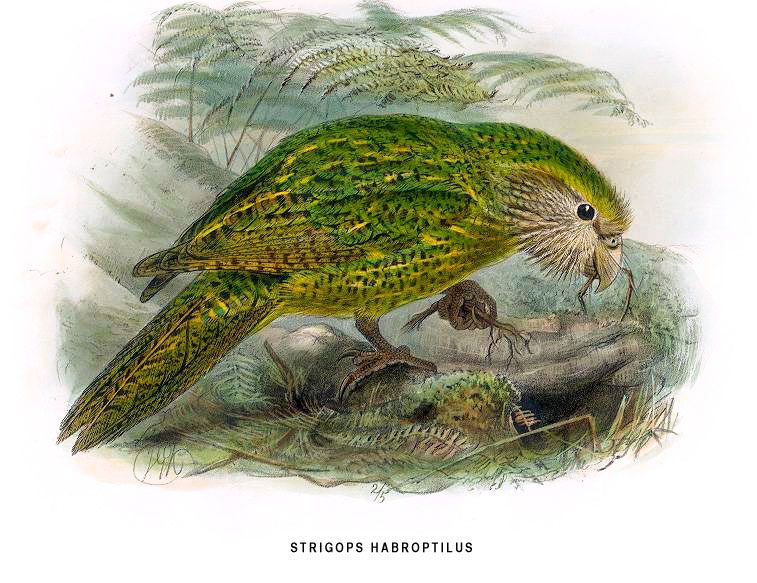
Illustration Kakapo

Description

Males can reach up to 60 cm. and weigh between 3 and 4 kg.

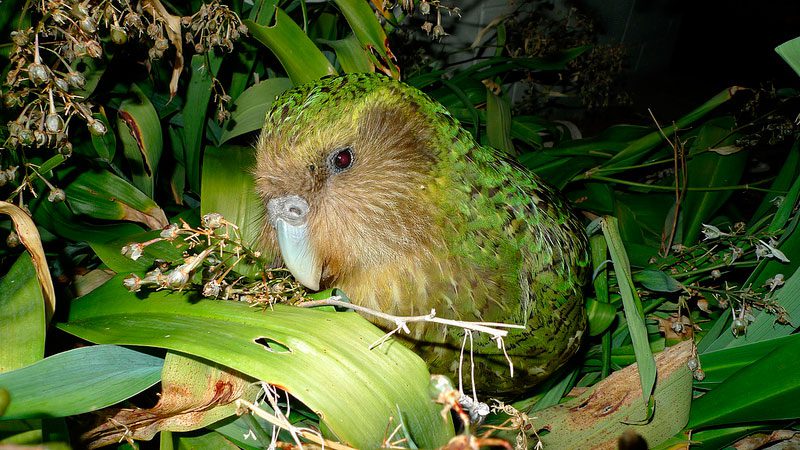
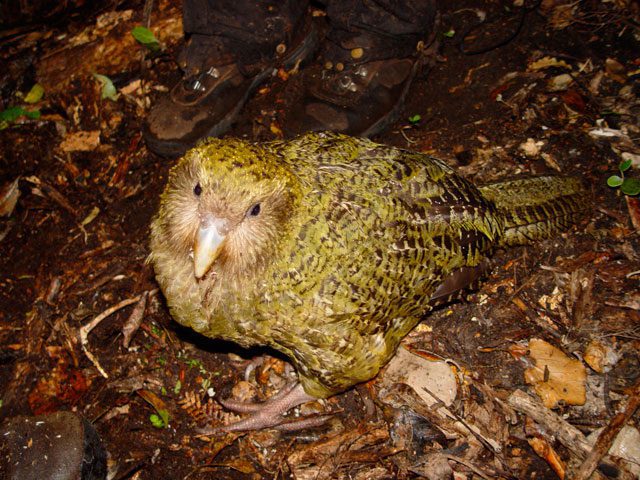
The Kakapo (Strigops habroptila) It is a robust and stocky bird with wings short in relation to the rest of the body.

grown ups, on upperpartsr, are MOSS Green, pulling a beige. All his upperparts they are spotted black and brownish gray, What gives them an excellent camouflage in its environment. The chest and flanks are yellowish green with streaks of yellow. The abdomen, under the tail, the neck and face are yellow, mostly streaked with pale green and imperceptible gray-brown spots.

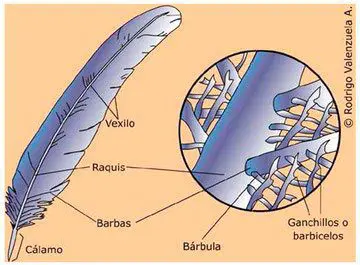
Their feathers they are surprisingly soft, since they do not need the strength and the necessary stiffness for flying birds.

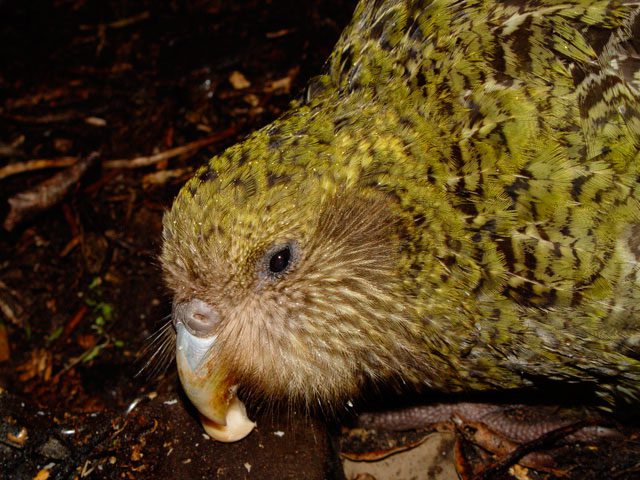
The Kakapo shows a composite facial disc of feathers fine, giving it the appearance of an owl.

Its bill it is surrounded by fine whiskers that are very useful for testing the ground when moving through the undergrowth.

The mandible it is mostly ivory color, but with a bit of blue-gray in the upper jaw.

Their eyes are dark brown. Their long and scaly legs they have long claws which serve to climb.

The end of the feathers of the tail It tends to end up worn down by the continuous friction with the ground.

The females they are very different from your partner. Its head is narrow and has a crown less rounded. Their peaks they are narrow and elongated. Less muscular legs, a grayish pink. Its tail is more elongated. Though their plumage is hardly different from males, appears less mottled beige.

The nesting females they are also distinguished by the cushion of bare skin that develops on the abdomen during the incubation period.

Habitat:

Before the humans arrived to New Zealand, the Kakapo lived in a wide variety of habitats, pastures with clumps of grass, scrub and coastal regions.

They were also the primary forests, including those who were dominated by lush podocarp and false have the gender Nothofagus. In the region of Fiordland, to the southwest of South Island, the Kakapo they frequented areas of avalanches and landslides, small regenerated trees or vegetation with abundant fruit.

These regions contained among other plants, Japanese raspberry wine (Rubus phoenicolasius), Shrubby Veronica (genus Scrophulariaceae) and Coprosmas. It was known as "kakapo gardensยป

Given its inability to fly, the Kakapo It, mainly, a terrestrial bird. This is also a excellent climber able to reach the tops of the tallest trees. They leave the foliage practicing a "parachute" descent, spreading their wings in all their amplitude.

When the Kakapo is threatened, simply is still trying to pass unnoticed in the vegetation, with which is camouflaged. This was a great strategy to avoid his great enemy, the gigantic Haast's Eagle, but does not protect against introduced mammals.

Son nocturnal birds. They sit during the day and roam their territory during the night period.. Having lost the ability to fly, the Kakapo they have developed remarkable skills for their long haul. His powerful legs allow them to make long distances at night to feed or during the time of nesting that it takes place from October to January.

During courtship, the males they abandon their traditional territories and walk many kilometers to reach the top of the hills or a crest to establish their mating area, competing in the place to try to conquer the location that appears most advantageous to them. Conflicts often lead to serious injury and are sometimes fatal for the belligerents.

To appeal to the females, the males they emit a kind of explosions that produce dilating a bag in the area of the chest. After a series of 20 explosions, is right and take a break. Then lower the head again to issue a new series of explosions. Inside its cavity, move to make sounds in all directions. on clear days, These explosions can be heard more than one kilometre away. The males get involved in this type of sample for nearly eight hours at night. Each male produces thousands of explosions during 3 or 4 months. During this time, males sometimes lost half of their body mass.

Reproduction:

During the time of reproduction, the Kakapo They use a system ofLekยซ. He "Lekยป is the space dedicated to the parade within which males gather in loose groups in an attempt to attract and seduce females. Females are very attentive spectator and choose your partner according to the quality of your display. Females are not persecuted openly by males.

It is not set no marital bond. He "Lekยป is just a meeting place that serves only for mating. The space for processions They consist of one or more small depressions of 10 cm of depth and 50 cm in diameter dug into the soil. The holes are usually do about faces of rocks, banks, or tree trunks, to help the sound bounce. The holes of each male are connected. The various depressions are interconnected by a network of small roads that cleaned thoroughly of all plant debris.

As soon as the male's cry is heard, the female embarks on a long journey to reach the area Lek. As soon as it enters the lek mating area, the male begins its rituals. It sways from side to side emitting clicks with the peak. He turns his back on his future partner, It spreads its wings and walk back towards her. Once mating has occurred, The female returns to her area of โ€‹โ€‹origin to lay her eggs and raise her young.. The male stays in place of courtship for try to seduce a new female.

The Kakapo they usually put 3 eggs per season. The nest placed on the ground under vegetation cover or in a hollow of a tree. The female incubated during 30 days, but you must leave the nest at night to feed, leaving the door open to many predators. After the eggs have hatched, She It feeds the chicks for three months, these will still remain in the company of their mother for a few more months. Since they have a life relatively long, the Kakapo have a fairly prolonged adolescence. Males do not begin courting until the age of 5 years and females do not respond to the calls of the males until they have reached the age of 9 or 11 years.

Food:

The peak of the Kakapo It is especially suitable for grinding food finely. For this reason, they have a gizzard less developed than most birds of its size.

The Kakapo they have a menu that is mostly herbivore. They used native plants, seeds, fruit, pollen and even the SAP flowing from the trees.

In a study of 1984, 25 different types of plants have been identified as part of your diet. Is particularly fond of the fruit of the rimu tree, and they feed on it exclusively during seasons when it is abundant. The Kakapo He has a habit of distinctive grab a leaf or frond with a foot and stripping the nutritious parts of the plant with its beak, leaving a non-digestible fiber ball. These small groups of vegetable fibers are a distinctive sign of the presence of the bird.

Distribution:

In the past, the Kakapo they were in the Islands North Island and South Island of New Zealand.

The species has suffered a sharp decline since the European colonization, and now it is one of the rarest birds in the world.

map-kakapo

Despite the fact that it disappeared from most of its original range following human colonization, the species remained abundant in Fiordland and some other places of great rainfall was scarce in the inhabited areas of South Island until the beginning of the 20th century. In 1976, However, the known population had been reduced to 18 birds, all males, all in Fiordland.

In 1977, found to be a rapid decline in the population of birds, about 150, on Stewart Island. Among 1980 and 1992, the 61 other birds of the Stewart Island they were transferred to the islands of the coast, and are currently in Codfish and Anchor island. The last accepted records were in North Island in 1927, three males reported in South Island, in Fiordland in 1987, and the last record in the Stewart Island of a female found and transferred to the Codfish Island in 1997.

In 2009, a male of the transferred four of Stewart Island to Isla Codfish in 1987, It was rediscovered after having been missing for 21 years.

It is likely that it is extinct in its natural distribution area, but, from November of 2005, birds are still present on four islands: Isla Codfish, Chalky, Anchor and Maud island.

In 1999, 26 females and 36 males survived, which includes 50 individuals in reproductive age, six subadults and six juveniles.

The population was stabilized, and has started to increase slowly following the application of intensive management. In the 2005, the population of the Kakapo stood in 86 specimens, of which 52 they were of reproductive age (21 females and 31 males) and 34 they were underage; a productive breeding year in the 2009 He saw the increase of the population up to 124 specimens, and it was known of the existence of 126 birds at the beginning of 2012, including 78 adult players.

Conservation:
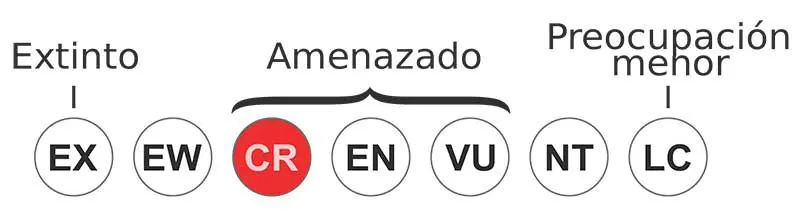

critical hazard

โ€ข Current Red List of UICN: critically endangered

โ€ข Population trend: Increasing

In the Stewart Island, more than the 50% of adults monitored died, each year, attacked by cats (CLOUT and Merton 1998).

An abnormal low fertility and low natural rates of reproduction and mating are the main concerns.

In 2004, three young people died of septicaemia caused by bacteria Erysipelothrix rhusiopathiae (erysipelas), a disease that had not been previously reported in this species (P. Jansen in litt. 2004)

They are subject to a plan of support by the authorities of New Zealand. Their number is currently estimated at little more than one hundred of copies, increases slowly with the plan.

At the beginning of 2012 there was 126 specimens, among them 78 adult players (RJ Moorhouse in litt. 2012).

"Kakapo" in captivity:

The only birds in captivity are those bred in the Recovery program of the Kakapo.

In terms of their longevity, debido a su largo ciclo de vida y la ausencia de depredadores naturales, es posible que el Kakapo viva mรกs de 60 years.

Alternative names:

– Kakapo, Owl Parrot (English).
– Strigops kakapo, Kakapo, Perroquet hibou (French).
– Kakapo, Eulenpapagei (German).
– Kakapo (Portuguese).
– Kakapo (espaรฑol).

scientific classification:

– Order: Psittaciformes
– Family: Strigopidae
– Genus: Habroptilus
– Scientific name: Strigops habroptila
– Citation: Gray, GR, 1845
– Protonimo: Strigops habroptilus

Images "Kakapo":

Videos "Kakapo"

————————————————————————————————

"Kakapo" (Strigops habroptila)


Sources:

– Avibase
– Parrots of the World โ€“ Forshaw Joseph M
– Parrots A Guide to the Parrots of the World – Tony Juniper & Mike Parr
– Birdlife
– Wikipedia

– Photos:

(1) – Pura, a 1-year-old Kakapo (Strigops habroptila) on Codfish Island By Mnolf [GFDL, CC-BY-SA-3.0 or CC BY-SA 2.0], via Wikimedia Commons
(2) – Kakapo Pura on Codfish Island By Mnolf [GFDL, CC-BY-SA-3.0 or CC BY-SA 2.0], via Wikimedia Commons
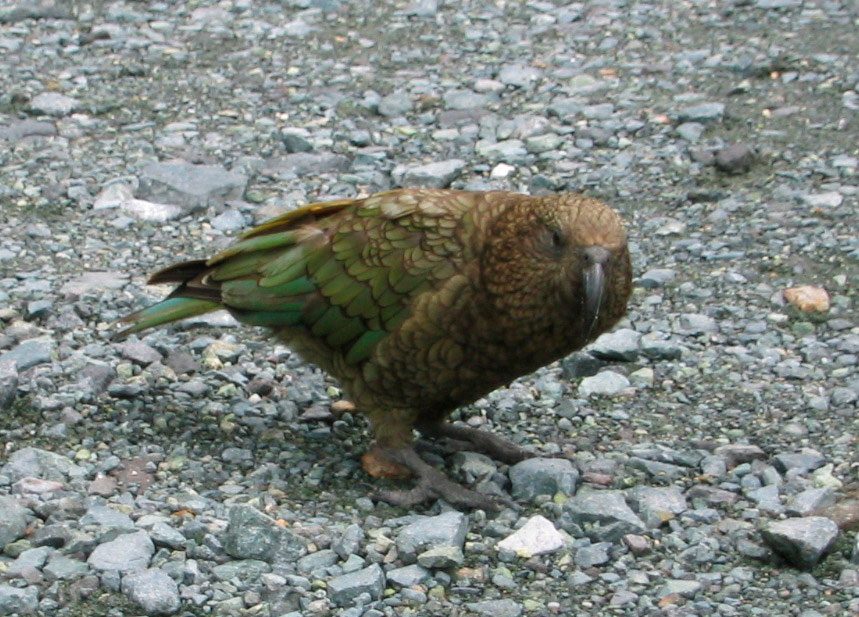
(3) – Kea, on the road to Milford Sound Uploaded by The Rambling Man – Wikipedia
(4) – Kakapo Sirocco amongst the renga renga lillies. Maud Island. Photo: Chris Birmingham, 2012 – Flickr
(5) – Kakapo by jidanchaomian – Flickr
(6) – Birds of New Zealand 1st edition, by Walter Lawry Buller, published in 1873 By John G. Keulemans. Minor edits have been made to the original by User:Msikma; I release these changes into the public domain as well. [Public domain], via Wikimedia Commons

โ–ท The world of Pets: Dogs, cats, birds, reptiles, amphibians

Black-winged Lovebird
Agapornis taranta


Inseparable Abisinio

Content

Description Inseparable Abyssinian:

Inseparable Abisinio

Of 16 cm in length and a weight between 49 and 66 g..

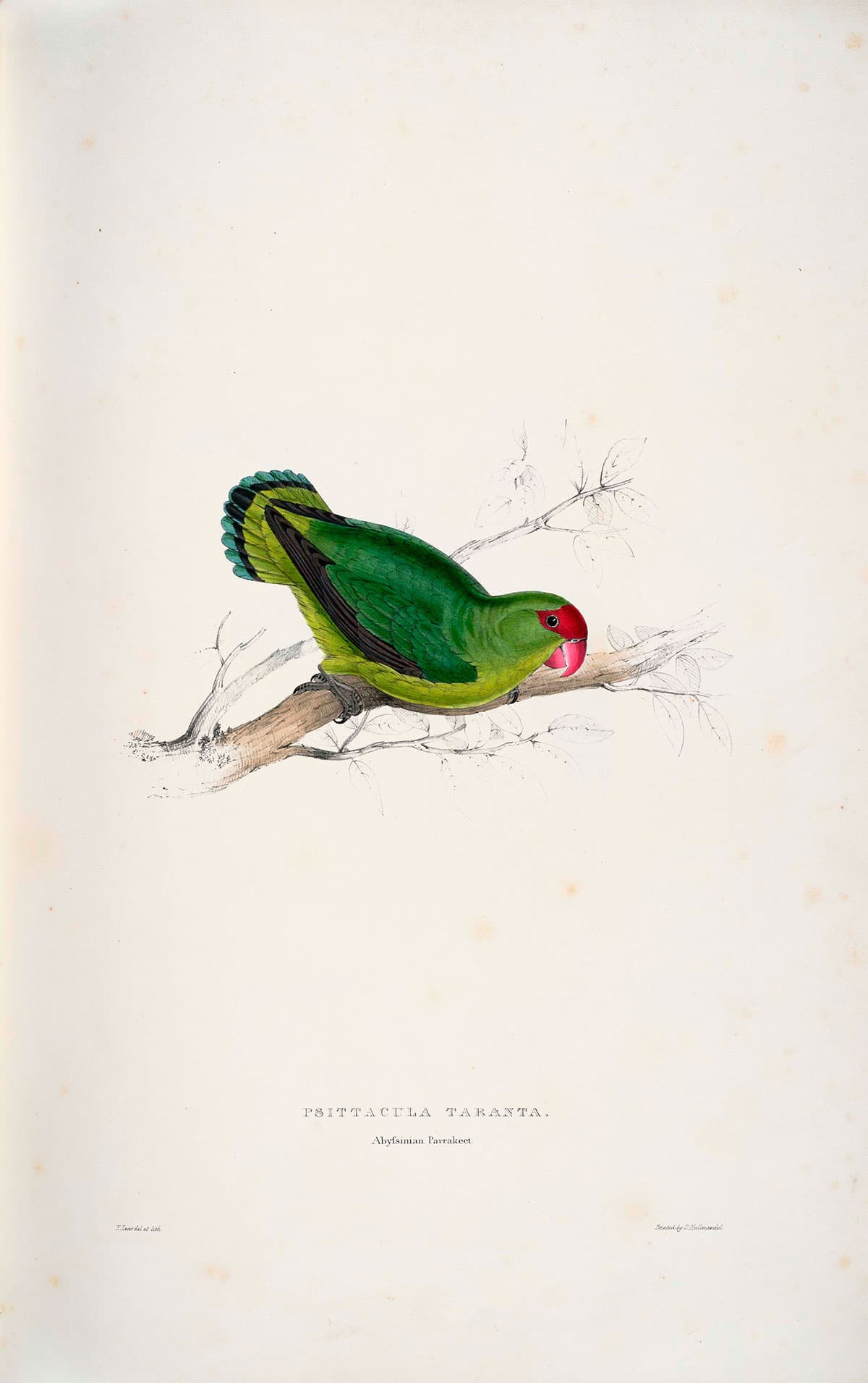
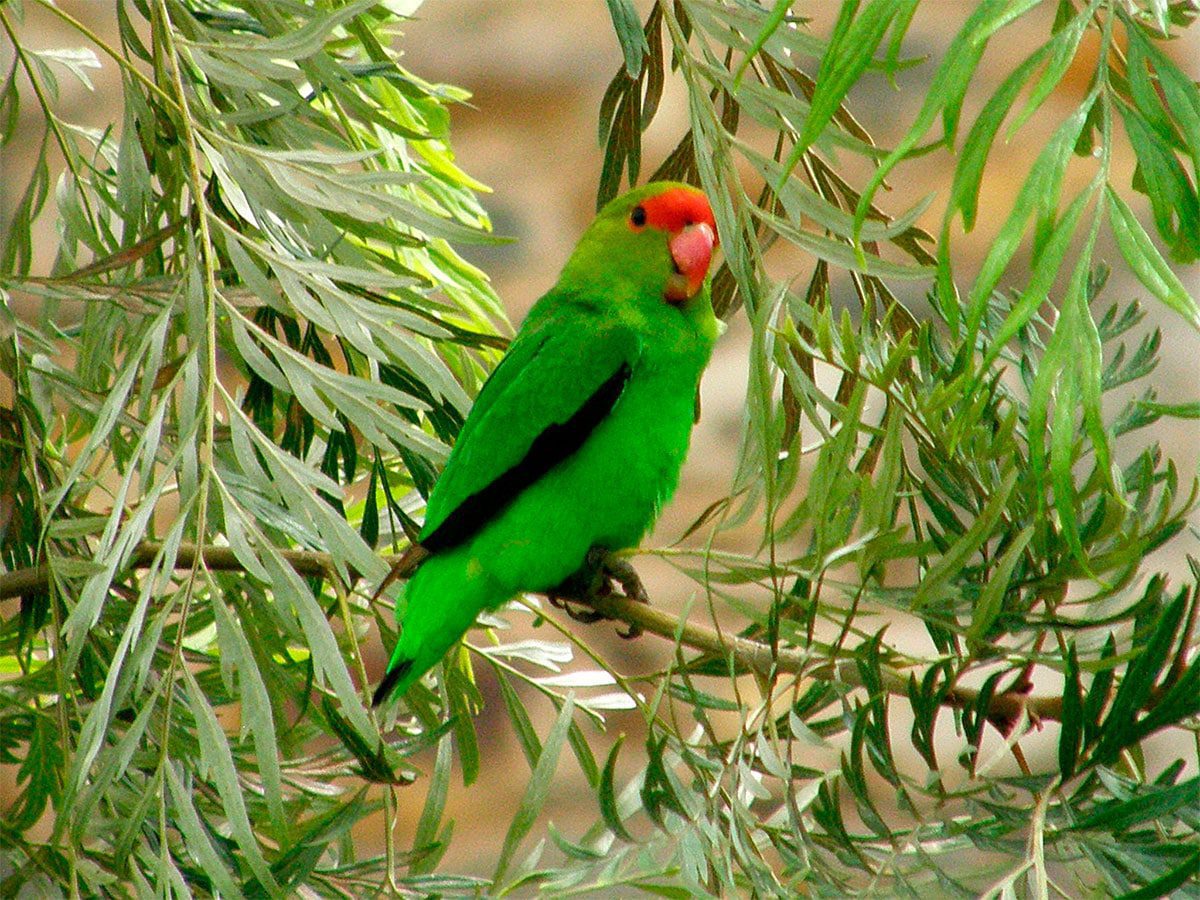
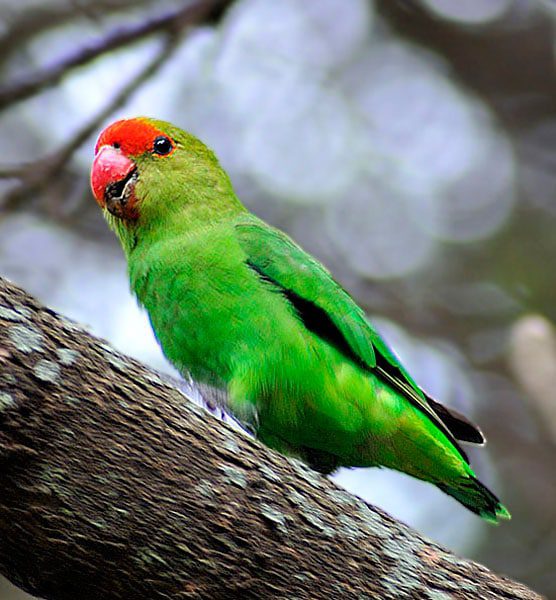
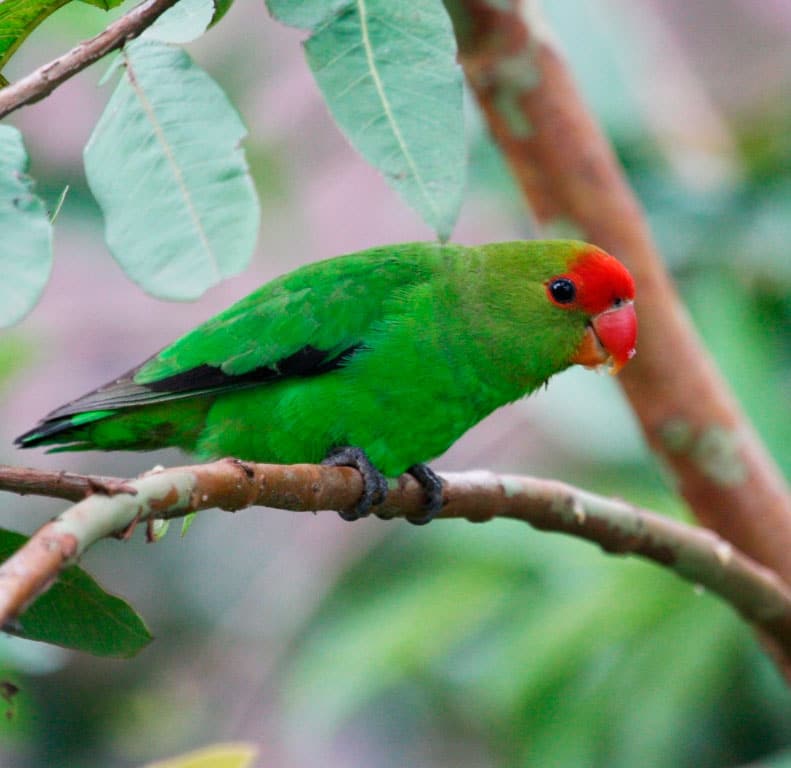
The Black-winged Lovebird (Agapornis taranta) has the forecrown, lores and feathers eye ring, red; rest of the head and nape green dyed brown. Mantle and green scapulars, rump and uppertail-coverts brighter green. Upper, the wing-coverts green with the exception of coverts outer primaries that they are black. Primaries blackish brown with a narrow green margin towards the vane outer; secondaries black. Under, the wing-coverts black. Chin and throat pale green tinged brown; rest of the underparts pale green. Central feathers of the tail green with toes in black, the green side with yellow in vane inner, subterminal black bar with green tips.

Bill red; irises dark brown; legs grey.

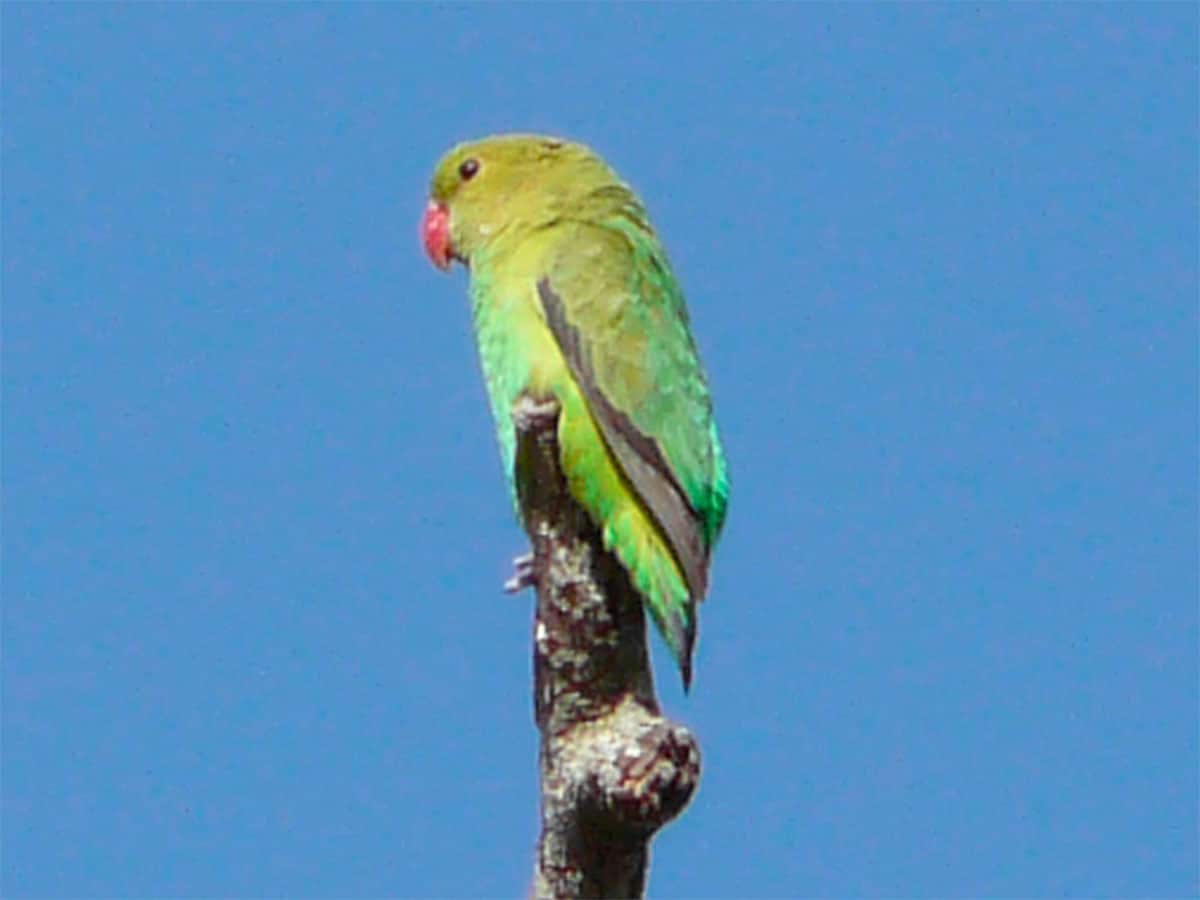
The female no red in the head, and feathers sometimes under the wings marked in green.

The immature are like females, with the bill yellowish. The Immature males show the color black feathers under the wings with red feathers scattered on the forehead.

Partially sympatric and very similar to Red-headed Lovebird (Agapornis pullarius) with which it has an throat red or orange (no verde) and rump blue (no verde). Usually found in small flocks on the tops of tall trees, where the plumage It blends well with the foliage. Its flight It is fast and direct.

Proposal subspecies Agapornis Taranta nanus (Southwest of Ethiopia) supposedly in bill smaller and wings shorter, but generally not accepted. Birds at higher altitudes are larger, but not subspecifically recognized. monotypic.

Inseparable habitat Abyssinian:

The Black-winged Lovebird, at high altitudes (1.800-3.800 m), They are linked, normally, mountain forests dominated Podocarpus, Juniperus, Hagenia and Hypericum; below , on the 1.400 m, They found in grassy savannas and forests Acacia, Combretum and Euphorbia; also frequent cultivated areas and peripheries of urban areas Addis Ababa.

gregarious, at least out of breeding season, when usually they found in small flocks (8-20) on the tops of the tallest trees, gathering in greater numbers when food is locally plentiful.

Used communal roosts in tree cavities (often old nests woodpeckers or bearded ethiopian).

Sometimes it associated with Yellow-fronted Parrot.

Occasionally they lie face down on captivity.

Playing black-winged lovebird:

The Black-winged Lovebird nest in tree cavities, in holes in walls and even in nests of some Baglafecht Weaver.

In captivity, female leads Nesting material (small pieces of branches, leaves and grass) put in almost any part of their plumage.

The Black-winged Lovebird it's the only one Lovebirds using their own pens to build nest.

The breeding season, according to sources, It between March and November. It is not clear if the egg laying is synchronized with the rainy season. Normally, starting up five eggs, but they can reach eight captive.

Inseparable Power Abyssinian:

The diet release of the Black-winged Lovebird It consists mainly fruit, including Ficus figs and berries juniper.

Perform seasonal movements in relation to food availability.

Distribution:

The Black-winged Lovebird They are endemic to the highlands of Ethiopia from the South of Eritrea through the Harari Region and Addis Ababa including Great Rift Valley.

Frequently in montane forests: relatively uncommon at low altitudes in savanna areas.

Conservation:


minor concern

โ€ข Current Red List of UICN: Least concern

โ€ข Population trend: Increasing

The Black-winged Lovebird It is not globally threatened, although it is included in Appendix II (Anexo B) of the CITES Convention.

It has a very small distribution area, so you have a greater risk of extinction because if their habitat is destroyed or uncontrolled catches are made can lead to extinction.

considered as crop pest in some areas, though not of great importance, they can become the object of chemical fumigations to avoid their attacks.

However they are more frequent since 1989, perhaps due to reduced sales of this species for the pet trade.

In the news they are not considered endangered, but we must not fail to protect them and avoid both habitat destruction and illegal capture.

The Inseparable Abyssinian in captivity:

Although not as common as other species of Lovebirds (Rosy-faced Lovebird or the Yellow-collared Lovebird), this handsome Lovebirds It has a very pleasant disposition.

They are more tolerant with others Lovebirds, provided they have enough space, and they are one of the least noisy species.

Dwelling, on freedom, high mountain areas, It is not surprising that the Black-winged Lovebird I can tolerate ambient outdoor aviary, as long as they stay out of drafts and temperatures are not too extreme.

birds are relatively resistant, similar to Fischer's Lovebird or the Yellow-collared Lovebird, although they are not as much as Rosy-faced Lovebird.

typical in all Lovebirds, the Black-winged Lovebird is very sociable and loves the companionship. Their natural behavior is to live closely with a partner / a.

Despite being a very sociable pet and tender, they will need a lot of attention if kept separate. The majority They are kept in pairs to satisfy his great need for constant companionship, acicalamiento mortgage, and socialization.

For reproduce in captivity You need tranquility and a spacious and equipped cage at least two nest boxes.

With regard to its longevity, according to sources, a living specimen 14,6 years in captivity. In captivity, these animals are known to breed, approximately, to the 2 years of age.

Alternative names:

– Black-winged Lovebird, Abyssinian Lovebird, Black winged Lovebird (English).
– Insรฉparable d’Abyssinie, Insรฉparable ร  ailes noires, Insรฉparable taranta (French).
– Tarantapapagei (German).
– Inseparรกvel-de-asa-preta (Portuguese).
– Inseparable Abisinio, Inseparable de Frente Roja, Agapornis Taranta (espaรฑol).


scientific classification:

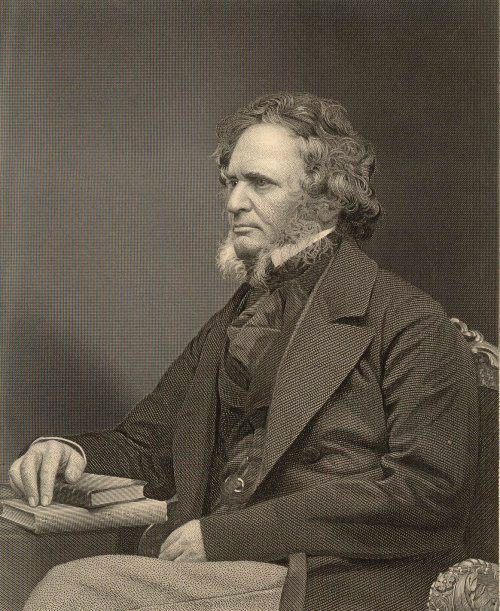
Edward Smith-Stanley

– Order: Psittaciformes
– Family: Psittaculidae
– Genus: Lovebirds
– Scientific name: Agapornis taranta
– Citation: (Stanley, 1814)
– Protonimo: Psittacus taranta


Images Black-winged Lovebird:

Videos "Black-winged Lovebird"


Species of the genus Agapornis


"Inseparable Abyssinian" (Agapornis taranta)


Sources:

– Avibase
– Parrots of the World โ€“ Forshaw Joseph M
– Parrots A Guide to the Parrots of the World – Tony Juniper & Mike Parr
– Birdlife

– Photos:

(1) – Agapornis taranta – Black-winged Lovebird in the San Diego Wild Animal Park, California By Carlos Urdiales [CC BY-SA 2.0], via Wikimedia Commons
(2) – A male Black-winged Lovebird in a guava tree (eating semiripe) guavas, in Bahir Dar, Ethiopia By Veli Pohjonen (Own photographing in Bahir Dar, Ethiopia) [Public domain], via Wikimedia Commons
(3) – A female Black-winged Lovebird in Ethiopia By Alastair Rae from London, United Kingdom (Black-winged Lovebird) [CC BY-SA 2.0], via Wikimedia Commons
(4) – Inseparable from Abyssinia by avicue
(5) – Black-winged lovebird by mundoexotics
(6) – A painting of a male Black-winged Lovebird (also known as Abyssinian Lovebird) (originally captioned ยซPsittacula taranta. Abyssinian parrakeetยป) by Edward Lear 1812-1888 [Public domain], via Wikimedia Commons
– Sounds: Andrew Spencer (Xeno-canto)

โ–ท The world of Pets: Dogs, cats, birds, reptiles, amphibians

Nicobar Parakeet
Psittacula caniceps


Cotorra de Nicobar

Content

Description:

Among 55 and 61 cm.. of length and a weight of 224 g..

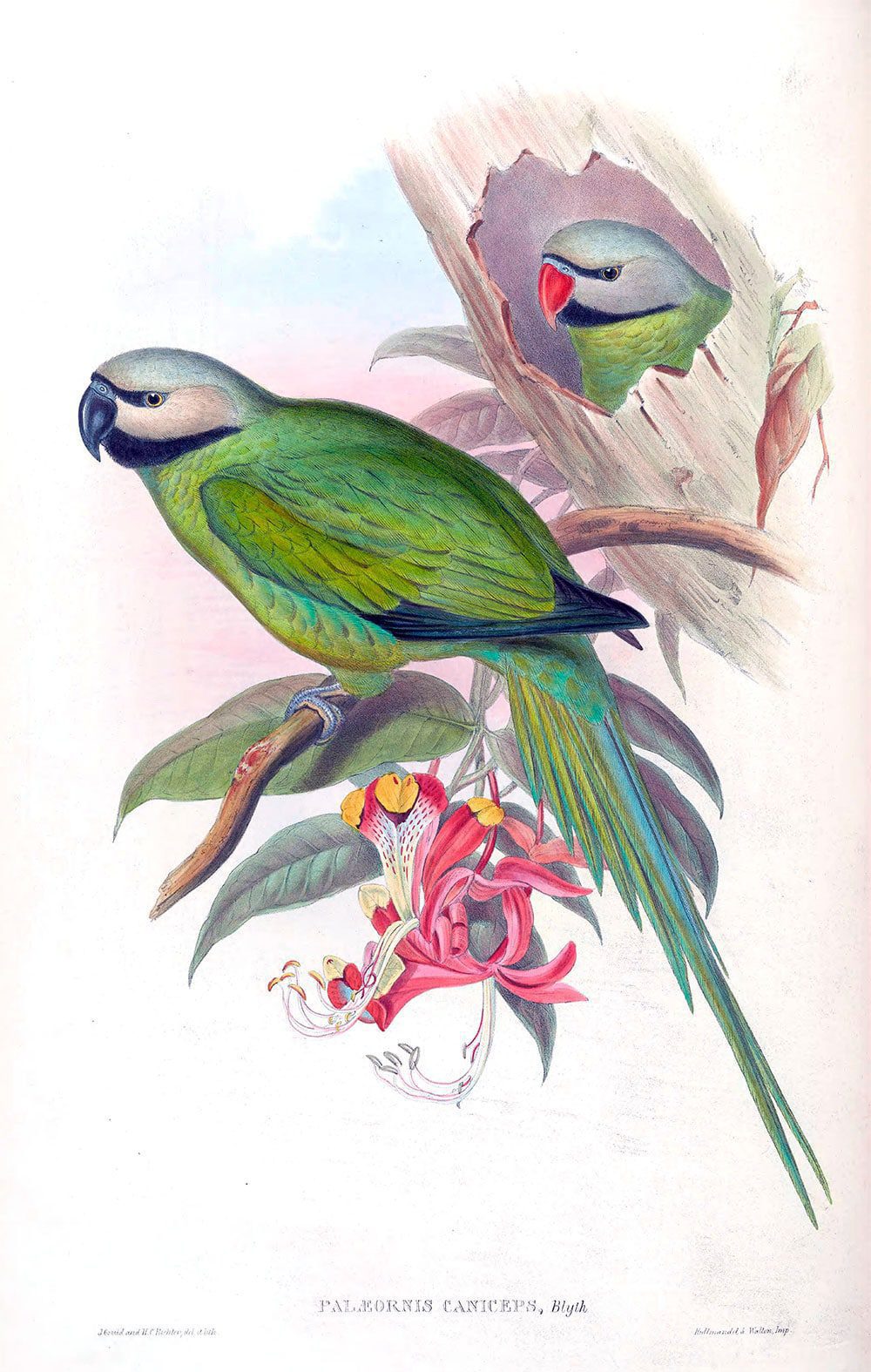
The Nicobar Parakeet (Psittacula caniceps) has the crown, upper cheeks and ear-coverts pale grey; stripe black in the region perioftalmica through the lores up to the forecrown; the lower cheeks and the chin are black. Nape and upper mantle pale gray bathed in blue; rest of the upper region green grass pale.

Upperwing-coverts green; primaries and secondaries Green with dark tips. Underwing-coverts green. Underparts green, slightly paler than upper parts. The elongated feathers central tail green with grey tinge, outer green.

upper jaw coral red, the lower black; cere dark grey; irises orange-red; legs dark gray.

The female has the bill black, the grey of the head and nape more strongly impregnated with blue, and tail slightly shorter.

The immature similar to females.

Habitat:

The Nicobar Parakeet it is difficult to locate visually among the dense foliage, Although its presence is revealed by their distinctive calls. Their flight is fast and direct.

They inhabit in the high rainforest. Generally held among the dense foliage on canopy, about everything when not fully.
They are perhaps most abundant in the coastal forests than inside.
Has also been recorded in areas with plants of Areca catechu and coconut plantations, which suggests a considerable tolerance of the species in habitats modified.
Usually, observed in pairs or in small groups.

Reproduction:

Unknown breeding habits.

Food:

Unknown diet except for the fruits of Pandanus, abundant in the inhabited islands of the Nicobar archipelago.

Distribution:

Size of the area of distribution (reproduction / resident): 1,100 km2

endemic to the Nicobar Islands, located in the Indian Ocean and belonging to the India. Registered since Great Nicobar, Montschall and Kondul. Resident. His status is unknown but they are potentially at risk due to habitat loss due to the expansion of rice cultivation; also affected its population because of the bird trade, Although there is little local use of these birds as pets and there are no known international traffic.

Conservation:

State of conservation โ“˜


Near-threatened Near Threatened โ“˜ (UICN)โ“˜

โ€ข Current Red List of UICN: Near threatened

โ€ข Population trend: Decreasing

The population of the Nicobar Parakeet It is suspected that It may be waning as a result of the destruction of habitat due to the tsunami of the 2004 (K. Sivakumar in litt. 2007), due to the development of the island, and because the capture for the wild bird trade. But, more research is needed to establish with precision the trends.

Probably between 10,000 – 15,000 specimens on freedom.

The main threats to the Nicobar Parakeet They come because of the large number of birds that are trapped for the cage bird trade.. On the other hand, the increase of settlements on the Islands It has led to increased pressure on natural resources and the planned development projects may seriously affect the habitat of this species. The tsunami of 2004 It destroyed large tracts of coastal forest that may have caused a further decline in the population. But, the data remains scarce, and the rate of regeneration of these forests is unknown (K. Sivakumar in litt., 2007).

Conservation Actions Proposed:

    – Determine the impact of the trade in the species.
    – Calculate the rates of forest loss.
    – Protect remaining habitat areas.
    – Assess the impact of the tsunami of 2004.

"Nicobar Parakeet" in captivity:

There is not much information available; probably brought for the London Zoo at the beginning of 20th century; kept as pets, at an unknown number, by the local population of the Nicobar Islands

Since the Nicobar Parakeet is a species so rare, It is not recommended to keep them captive, it is preferable to place them in a breeding program well managed by expert hands.

Alternative names:

– Nicobar Parakeet, Blyth’s Parakeet (English).
– Perruche des Nicobar, Perruche de Blyth (French).
– Graukopfsittich (German).
– Periquito-de-nicobar (Portuguese).
– Cotorra de Nicobar (espaรฑol).


scientific classification:

Edward Blyth
Edward Blyth

– Order: Psittaciformes
– Family: Psittaculidae
– Genus: Psittacula
– Scientific name: Psittacula caniceps
– Citation: (Blyth, 1846)
– Protonimo: Palaeornis caniceps

Images "Nicobar Parakeet"


Especies del gรฉnero Psittacula

Nicobar Parakeet (Psittacula caniceps)


Sources:

– Avibase
– Parrots of the World โ€“ Forshaw Joseph M
– Parrots A Guide to the Parrots of the World – Tony Juniper & Mike Parr
– Birdlife

– Photos:

(1) – John Gould [Public domain], via Wikimedia Commons
โ–ท The world of Pets: Dogs, cats, birds, reptiles, amphibians

Yellow-collared Macaw
Primolius auricollis


Guacamayo Acollarado

Content

Description:

Ilustraciรณn Guacamayo Acollarado

Of 37 to 45 cm. length and a weight between 240 and 250 g..

The Yellow-collared Macaw (Primolius auricollis) already it was described by American ornithologist John Cassin in 1853.

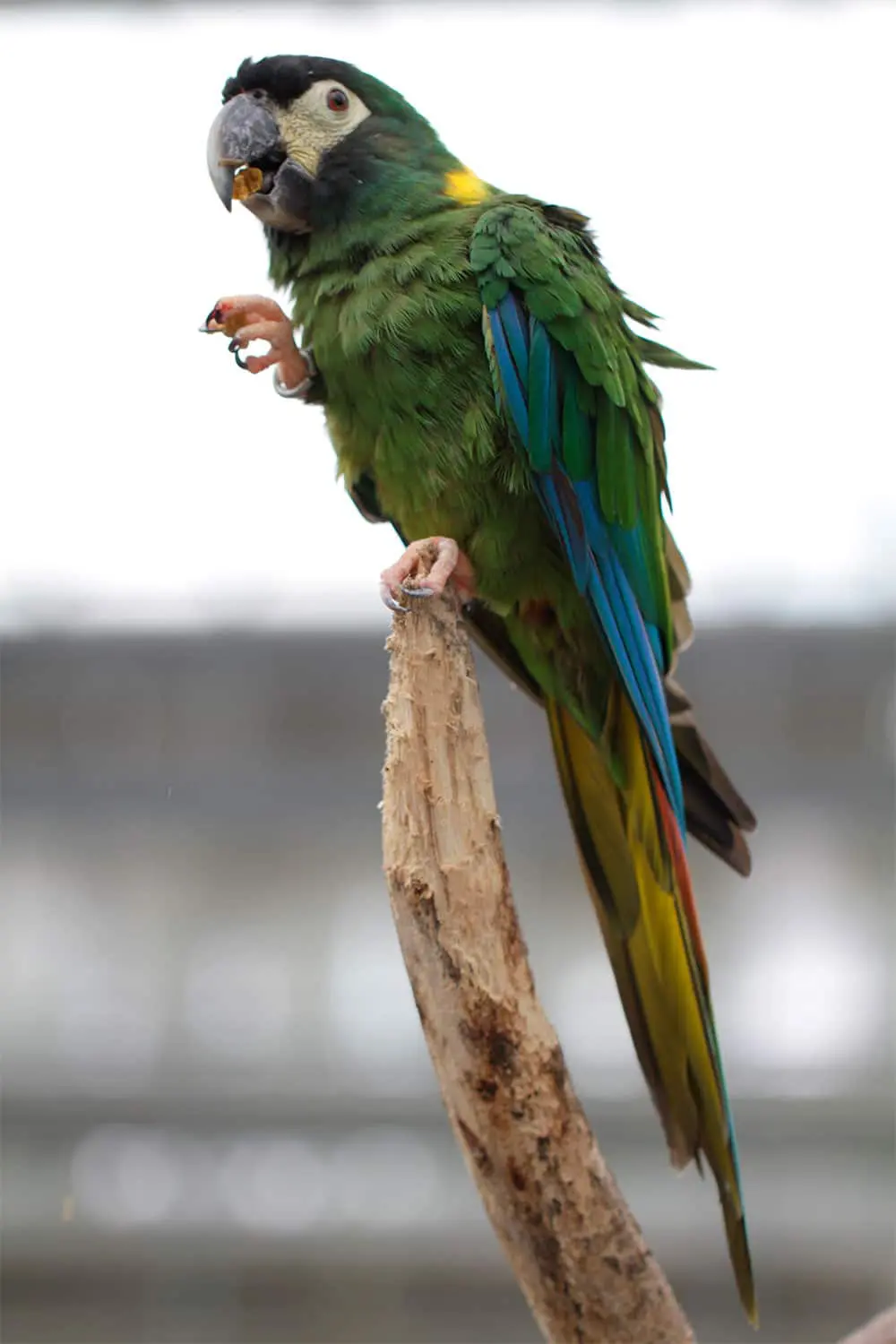
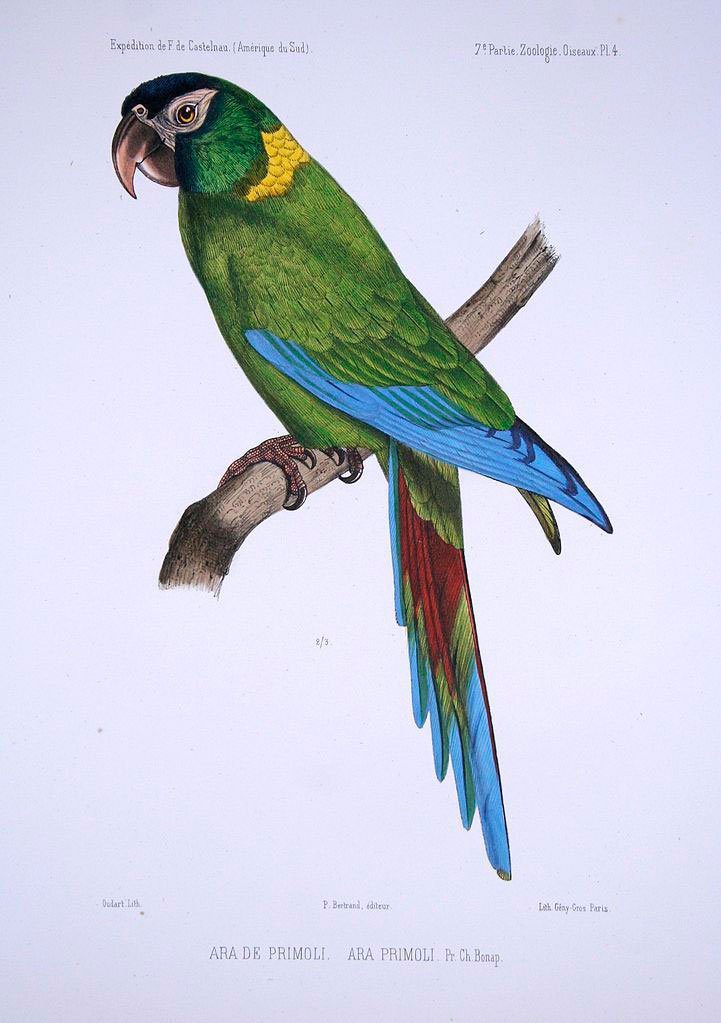
Similar to the Blue-headed Macaw, differs by a characteristic Yellow collar dorado, most notable in the area of the nape. This thin yellow line of feathers surrounding the back of the neck, It is that gives this species its name.

Previously it was considered within the genre ยซARAยป for having a face bare of feathers and was also known scientifically as ยซpropyrrhura Macawยป

It is a small Macaw; has the forecrown, the feathered portion of the cheeks and the front of the crown dull blackish-brown color, becoming a blue-green shade at the rear of the crown and both sides of the neck. The neck is covered with a large golden yellow necklace. All upperparts are green with blue markings in some feathers.

The small and medium-sized coverts are green. The alula and primary coverts they are completely blue. The primaries are blue, the secondaries are green with a strong blue tint in the vane outer. The underwing-coverts are, in its entirety, olive yellow, with the exception of the lower part of the flight feather It is yellowish.

The underparts are green. Upper, the central tail feathers are reddish brown at the base, in the middle of green and blue at the tip. The outer tail feathers they are mostly blue. The bottom of the tail is opaque yellow.

The bill is blackish with a tone slate finish. The bare skin about lores and cheeks It is white with a straw tone clear. The irises are orange, legs pink meat.

Both sexes similar.

The youth they resemble their parents. But, they have a bill grey with a white Peak; irises grayscale and the legs pale grey. The immature you have the collar area of the nape reddish.

Habitat:

The Yellow-collared Macaw they attend a wide variety of habitats from forests. They are found in the humid tropical forests that cover the foothills of the Andes, but also in dry areas of deciduous and grasslands with scattered trees. They are also present in the tree edges and savannas.

Unlike most parrot species, the Yellow-collared Macaw support very well the profound changes occurring in their habitat.

They are relatively common in the waste groves situated in the middle of farmland and around major urban centres.

Mainly noted below 600 m, to 1.700 metres above sea level in the Northwest of Argentina.

Usually they live in pairs or in small groups, even outside the breeding season. Larger meetings may have place when food is abundant or when gather in the dormitories at night. Within these large herds, the matched pairs are less visible than other species of macaws.

They feed on trees and shrubs, Although they occasionally do on land

Reproduction:

The season of nesting is in December in Argentina. The nest It tends to be located in the cavity of a tree, sometimes up to 20 meters above the ground. The spawning usually included in 2 to 4 eggs.

In captivity, the incubation lasts a few 23 days. The reproductive cycle is particularly long, since the young leave the nest at 7 weeks, after the hatching.

Food:

The Yellow-collared Macaw they have a vegetarian regimen that includes fruits Byrsonima, flowers Erythrina, Ficus, corn and seeds Tomentosa Guazuma, Spondias lutea, Adelia mesembinifolia, Astronium Badi and A. urundeuva.

Distribution:

Size of its range (breeding/resident ): 1.950.000 km2

Endemic to the center of South America. The distribution of the Yellow-collared Macaw includes the Northwest of Argentina, in the East of Jujuy and North of Salta (reports of Missions and Formosa they are not correct) going northward through the East and North of Bolivia, in the departments of Santa Cruz, Beni and Tarija, is also distributed by the North of Paraguay, mainly to the West of the Paraguay River, but largely absent in the drier areas of the Chaco.

Extend across the southwest of Mato Grosso and Mato Grosso from the South, in Brazil, where its northern and eastern limits are unclear; They are also distributed (possibly different) in West Goiรกs, Northeast of Mato Grosso and Southeast end of For, where there are reports of birds in and around the The Bananal island.

Mostly residents, Although apparently, seasonal movements in some areas.

In general is a common macaw and he persists in areas where significant habitat modification has taken place. Scarcer at the edge of its range in Paraguay.

They have been the subject of international trade, but its population does not seem to be affected by the capture.

Conservation:

State of conservation โ“˜


minor concern Minor Concern โ“˜ (UICN)โ“˜

โ€ข Red List category of the UICN current: Least concern
โ€ข Population trend: Growing

The species is not threatened at the global level. Global population size has not been quantified, but this species is described as ยซquite commonยป

At the beginning of the Decade of 1980, in Bolivia, the capture of birds for aviaries reached the alarming figure of over of 3.200 birds per year. Fortunately, the traffic is prohibited from 1984.

It is considered rather low, the population of this species in Paraguay and North of Argentina, But in recent years the trend has reversed., and the species has colonized new areas.

"Yellow-collared Macaw" in captivity:

Quite common, above all in the EE.UU, less frequent in other parts.

Charming, clever, and comedian, These small macaws offer all the personality of a great green Macaw in a smaller size, being more affordable and easier to take care of. It is an extremely Intelligent and easy to train.

Many Yellow-collared Macaw are gifted talkers, and they are able to say several words and phrases. Some owners have pointed out that this little Macaw is able to speak more clearly than other larger species. Even so, our Macaw should not be purchased only by his ability to speak; that ability is never a guarantee.

Reproduce well in captivity. The breeding season It is usually in the spring and early summer, Although some couples are played almost throughout the year. The implementation size It is usually of two to four eggs, but sometimes more. The incubation period is of 23 to 27 days. Some additional high fat seeds, as the Sunflower seed, should be added to the diet during the breeding season to stimulate reproduction.

Marriage bonds are strong, but not necessarily for life.

Alternative names:

– Yellow-collared Macaw, Cassin’s Macaw, Golden-collared Macaw, Golden-naped Macaw, Yellow collared Macaw, Yellow-naped Macaw (English).
– Ara ร  collier jaune, Ara ร  nuque d’or (French).
– Halsbandara (German).
– ararinha, Maracanรฃ-de-colar (Portuguese).
– G. Acollarado, Guacamayo Acollarado, Maracanรก cuello dorado, Maracanรก de Cuello Dorado (espaรฑol).
– Parabachi de cuello amarillo, Maracanรก de cuello dorado (Bolivia).
– Marakana (Guarani).
– Maracanรก cuello dorado (Paraguay).


scientific classification:

John Cassin
John Cassin

– Order: Psittaciformes
– Family: Psittacidae
– Genus: Primolius
– Scientific name: Primolius auricollis
– Citation: (Cassin, 1853)
– Protonimo: Ara auricollis


Images Yellow-collared Macaw:

Videos "Yellow-collared Macaw"

Yellow-collared Macaw (Primolius auricollis)


Sources:

– Avibase
– Parrots of the World โ€“ Forshaw Joseph M
– Parrots A Guide to the Parrots of the World – Tony Juniper & Mike Parr
– Birdlife

– Photos:

(1) – A Golden-collared Macaw at Kakegawa Kacho-en, Kakegawa, Shizuoka, Japan By Takashi Hososhima from Tokyo, Japan (A bird of dexterityUploaded by snowmanradio) [CC BY-SA 2.0], via Wikimedia Commons
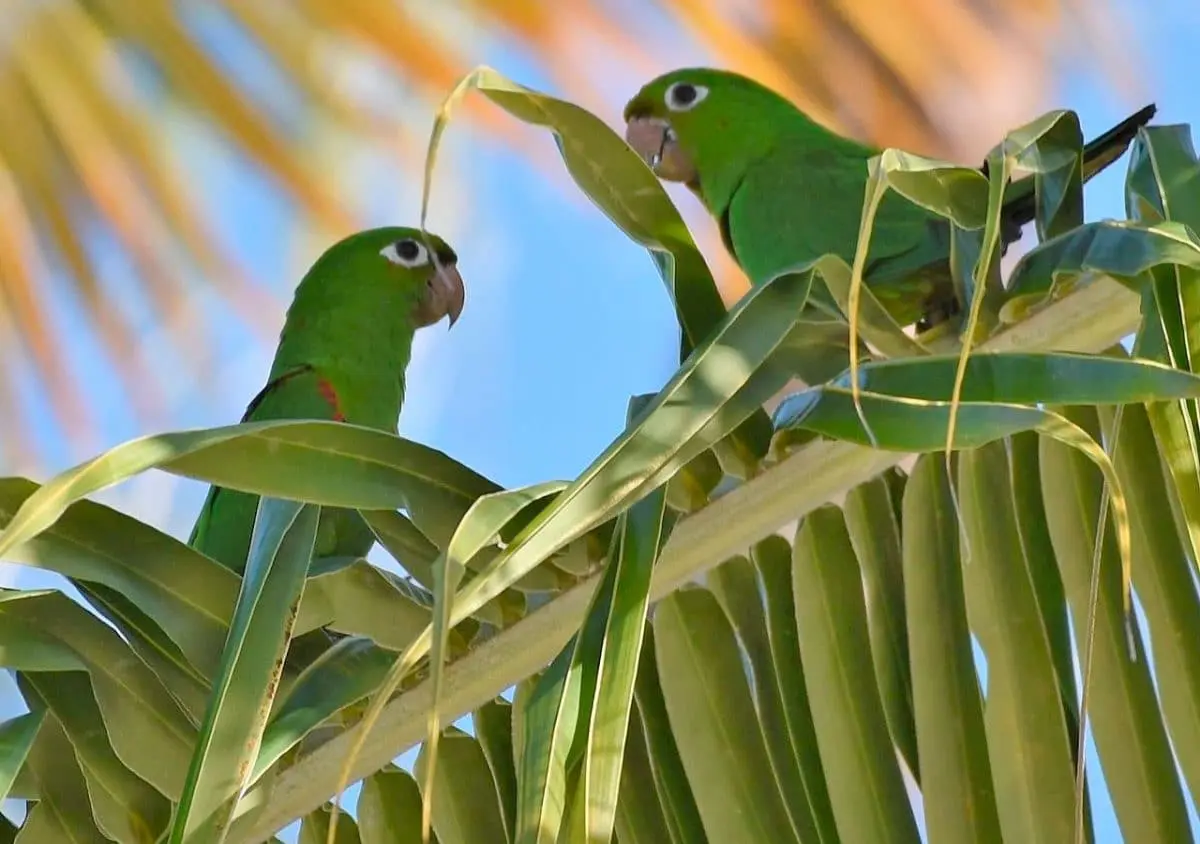
(2) – Two Golden-collared Macaws (also known as Yellow-collared Macaws) at the Panaโ€™ewa Rainforest Zoo, Hawaii, USA By Pat McGrath from Lihue, U.S.A. [CC BY-SA 2.0], via Wikimedia Commons
(3) – Golden-collared Macaw (also known as the Yellow-collared Macaw). A pet parrot By rebeccakoconnor [CC BY 2.0], via Wikimedia Commons
(4) – Golden-collared Macaw (also called Yellow-collared Macaw) parents with a juvenile By Benutzer:Robert01 on German wiki (Bild:Goldnackenaras on German wiki.) [CC BY-SA 3.0 of], via Wikimedia Commons
(5) – Golden-collared Macaw (also known as the Yellow-collared Macaw); two captive By TJ Lin [CC BY-SA 2.0], via Wikimedia Commons
(6) – Ara primoli = Primolius auricollis (copy of Gray's Heritage Library (France) by Francis de Laporte de Castelnau [Public domain], via Wikimedia Commons
– Sounds: (Xeno-canto)

โ–ท The world of Pets: Dogs, cats, birds, reptiles, amphibians

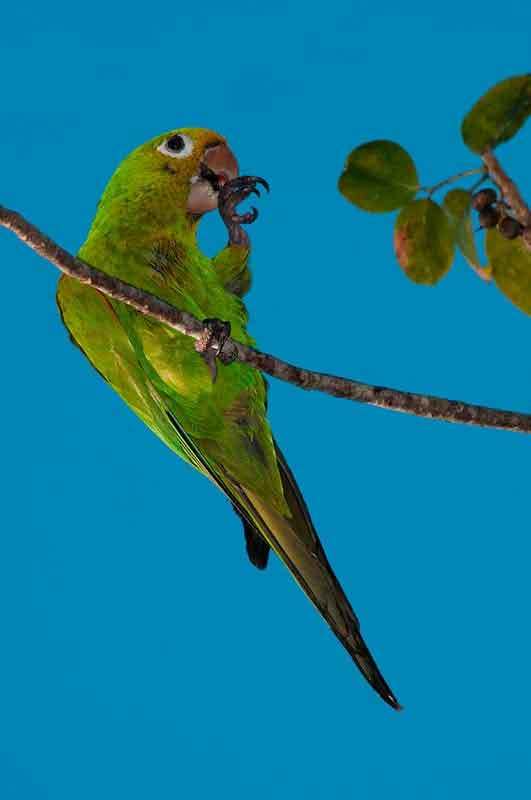
Hispaniolan Parakeet
Psittacara chloropterus

Aratinga de la Espaรฑola

Content

Description:


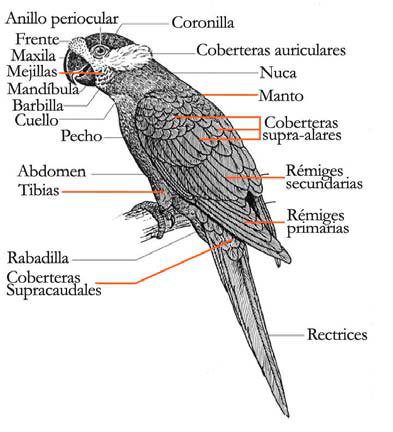
Anatomy-parrots

32 cm. of length and a weight of 150 g..

The Hispaniolan Parakeet (Psittacara chloropterus) has the head whole and both sides of the neck green grass with some scattered red feathers; the upperparts and upperwing-coverts Green with external ends of the Middle coverts red. Primary and secondary dark green with bluish-green tips on margins vane inner. The underwing-coverts yellowish brown in the flight feather, more grayish towards the tip; coverts Green except smaller and medium-sized external coverts, they are red and the primarys which are green and Red.

The underparts brighter yellowish green, usually with scattered red feathers.
Upper, the tail dark green and below, grayish brown.
The bill color horn; bare periophthalmic whitish: irises yellowish; legs grayish brown.

Ilustraciรณn de Psittacara euops y Psittacara chloropterus

Both sexes similar.

The immature has less red and more green in underwing-coverts, No red on the upper surface of the bend of wing and grey at the base of the bill and on the cutting edge.

  • Sound of the Hispaniolan Parakeet .

Subspecies description:

Psittacara chloropterus maugei
  • Psittacara chloropterus chloropterus
  • (Souance, 1856) – The species nominal.

  • Psittacara chloropterus maugei โ€ 
  • (Souance, 1856) – Similar to the species nominal, but with a duller green in the underparts; more red in the large underwing-coverts.

Habitat:

Video – "Hispaniolan Parakeet" (Psittacara chloropterus)

Wild baby Hispaniolan Parakeet (Aratinga chloroptera) at nest hole. AVI

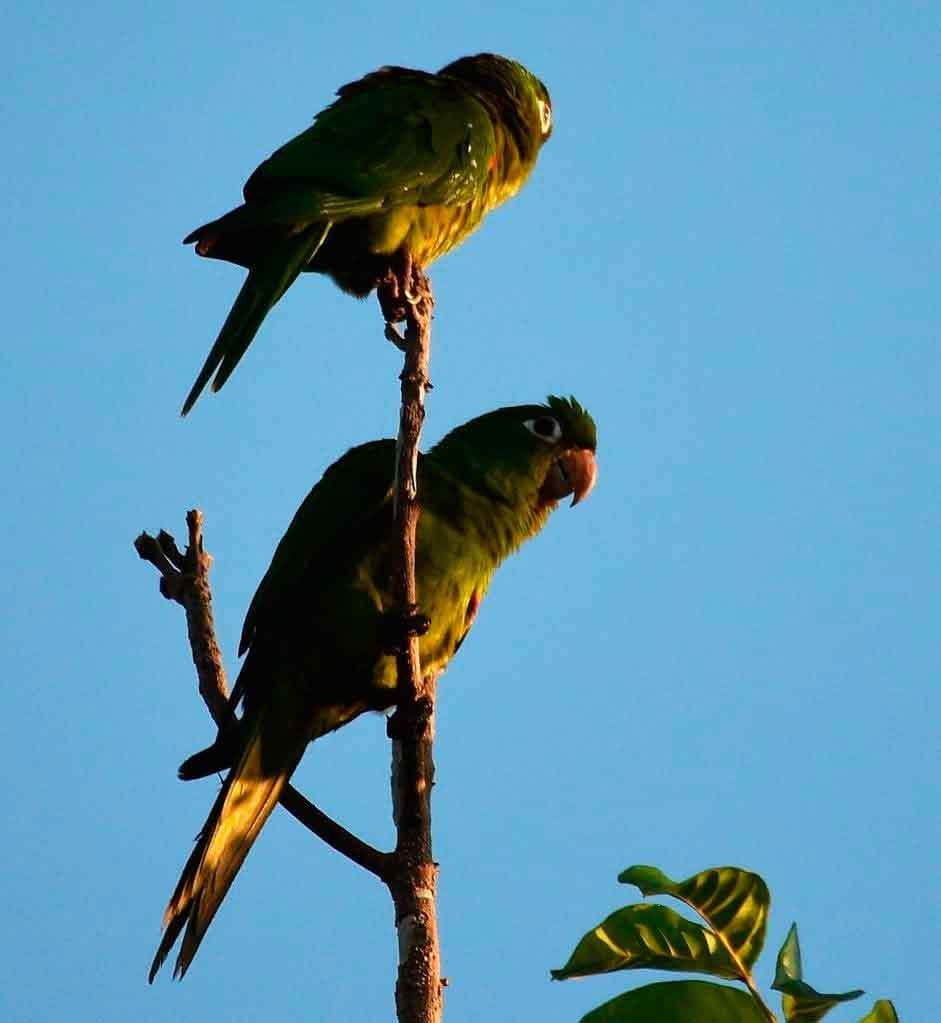
This species covers all types of natural habitats from arid lowland forests, to sheets of palmas, but obviously prefers upland forest (including the dominated by Pinus), to 3.000 meters above sea level, scarce, Perhaps because of the persecution, in the adjacent cultivated areas.

In general, observed in pairs or in small flocks, but sometimes in meetings of more than one hundred, at least in the past, When were most abundant. Discernible couples even within large flocks.

Reproduction:

They build their nests in tree cavities, including old holes made by woodpeckers, as well as in arboreal termite mounds.

The laying compose it between 3 and 5 eggs, exceptionally 7.

Food:

There are few details about the diet of the Hispaniolan Parakeet, but it is apparently similar to the fellow and and depends on local availability of fruits, seeds, nuts, outbreaks, flowers and beads; Some reported foods include Ficus figs and corn.

Distribution:

confined in Haiti and Dominican Republic, la Espaรฑola, Greater Antilles. Previously in the Mona Island (Psittacara chloropterus maugei), extinct between 1892 and 1901, probably as a result of the pressure due to the hunting and, possibly, the perturbations by the explosions in the guano mine; possibly, also distributed in Puerto Rico, and its, probably, at the end of the century 19, due to loss of habitat and hunting.

In Hispaniola It is subject to a significant and continuous decrease, due to destruction of habitat, trade and persecution, especially in Haiti, where possibly is extinct.

In Dominican Republic still distributed in a few upland areas, for example, Cordillera Central.

Possibly small wild populations in Puerto Rico and Florida. A small number in captivity; the international trade small volume, probably, keep going.

Subspecies distribution:

  • Psittacara chloropterus chloropterus
  • (Souance, 1856) – The species nominal.

  • Psittacara chloropterus maugei โ€ 
  • (Souance, 1856) – Formerly distributed by the Mona Island and, possibly, Puerto Rico, but the last recorded specimen was in 1892. Currently extinct.

Conservation:

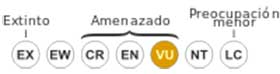
State of conservation โ“˜


Vulnerable Vulnerable โ“˜ (UICN)โ“˜

โ€ข Red List category of the UICN current: Vulnerable

โ€ข Population trend: Decreasing

There is no new data on the evolution of the population; But, the species is suspected that it may be in decline, slow to moderate due to the hunting, capture and habitat loss.

Habitat loss and persecution as crop pest they are the greatest threats to this species. Is exploited for the local and international trade, Although only reported 12 individuals for international trade between 1991 and 1995 (Snyder et to the., 2000).

The number of copies of Hispaniolan Parakeet ranges between 1500 and 7000.

Conservation Actions Underway

โ€ข Appendix II of CITES.

โ€ข In the Dominican Republic, is legally protected against the hunt, but this legislation is not applied properly (Snyder et to the., 2000).

โ€ข A education strategy with community participation has been launched for the protection of this species (Vasquez et to the., 1995).

โ€ข Las interactions between this species and the Olive-throated Parakeet (Eupsittula nana), due to the recent increase in the number of the latter in the Sierra de Bahoruco [S. Latta in litt., 1998] ), they are being investigated (Anon. 2007).

โ€ข A group of volunteers for the protection of the parrot will work reforming the damaged nests. (Anon. 2007)

Conservation Actions Proposed.

โ€ข Clarify the status of the species in Haiti.

โ€ข Study ecology and reproductive success to determine the natural limiting factors.

โ€ข Comply with current legislation in the Dominican Republic.

The Hispaniolan Parakeet in captivity:

Rare in captivity and legally protected in Dominican Republic against the hunt and capture.

Alternative names:

– Hispaniolan Parakeet, Haitian Paroquet, Hispaniolan Conure, San Domingo Conure (inglรฉs).
– Conure maรฎtresse, Perruche maรฎtresse (francรฉs).
– Haitisittich (alemรกn).
– Periquito-de-hispaniola (portuguรฉs).
– Aratinga de la Espaรฑola, Perico , Periquito Antillano, Periquito de la Espaรฑola (espaรฑol).
– Perico, Xaxavi (Repรบblica Dominicana).

scientific classification:

– Order: Psittaciformes
– Family: Psittacidae
– Genus: Psittacara
– Scientific name: Psittacara chloropterus
– Citation: (Souancรฉ, 1856)
– Protonimo: Psittacara chloroptera

Images Hispaniolan Parakeet:


Species of the genus Psittacara

Sources:

Avibase
Parrots of the World โ€“ Forshaw Joseph M
Parrots A Guide to the Parrots of the World – Tony Juniper & Mike Parr
Birdlife

Photos:

(1) – Haitisittich Psittacara chloropterus Aufnahme in La Romana By Martingloor (Own work) [CC BY-SA 4.0], via Wikimedia Commons
(2) – Haitisittich Psittacara chloropterus By Martingloor (Own work) [CC BY-SA 4.0], via Wikimedia Commons
(3) – Haitisittich Psittacara chloropterus Aufnahme in La Romana By Martingloor (Own work) [CC BY-SA 4.0], via Wikimedia Commons
(4) – Perico de la Hispaniola / Aratinga chloroptera by Carlos De Soto Molinari – Flickr
(5) – Perico de la Hispaniola / Aratinga chloroptera by Carlos De Soto Molinari – Flickr
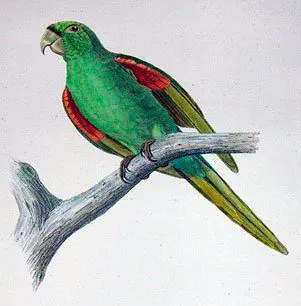
(6) – Evopsitta maugei. Illustrations from Iconographie des perroquets non figurs dans les publications de Levaillante et de M. Bourjot Evopsitta maugei = Aratinga chloroptera maugei == Psittacara chloropterus maugei By 48 hand-coloured lithographic plates by E. Blanchard and J. Daverne (pl. I-XV) or Juliot of Tours (XVI-XLVII, 79). [Public domain], via Wikimedia Commons
(7) – Psittacara euops Syn: Evopsitta euops & Psittacara chloropterus Syn: Psittacara chloropter bzw. Psittacara euops St. Domingue By Charles Emile Blanchard (1819โ€“1900) (biodiversitylibrary.org) [Public domain], via Wikimedia Commons
Sounds: Lance A. M. Benner (Xeno-canto)

โ–ท The world of Pets: Dogs, cats, birds, reptiles, amphibians

Deville's Parakeet
Pyrrhura lucianii


Deville's Parakeet

Content

Description:

21-23 cm.. height.

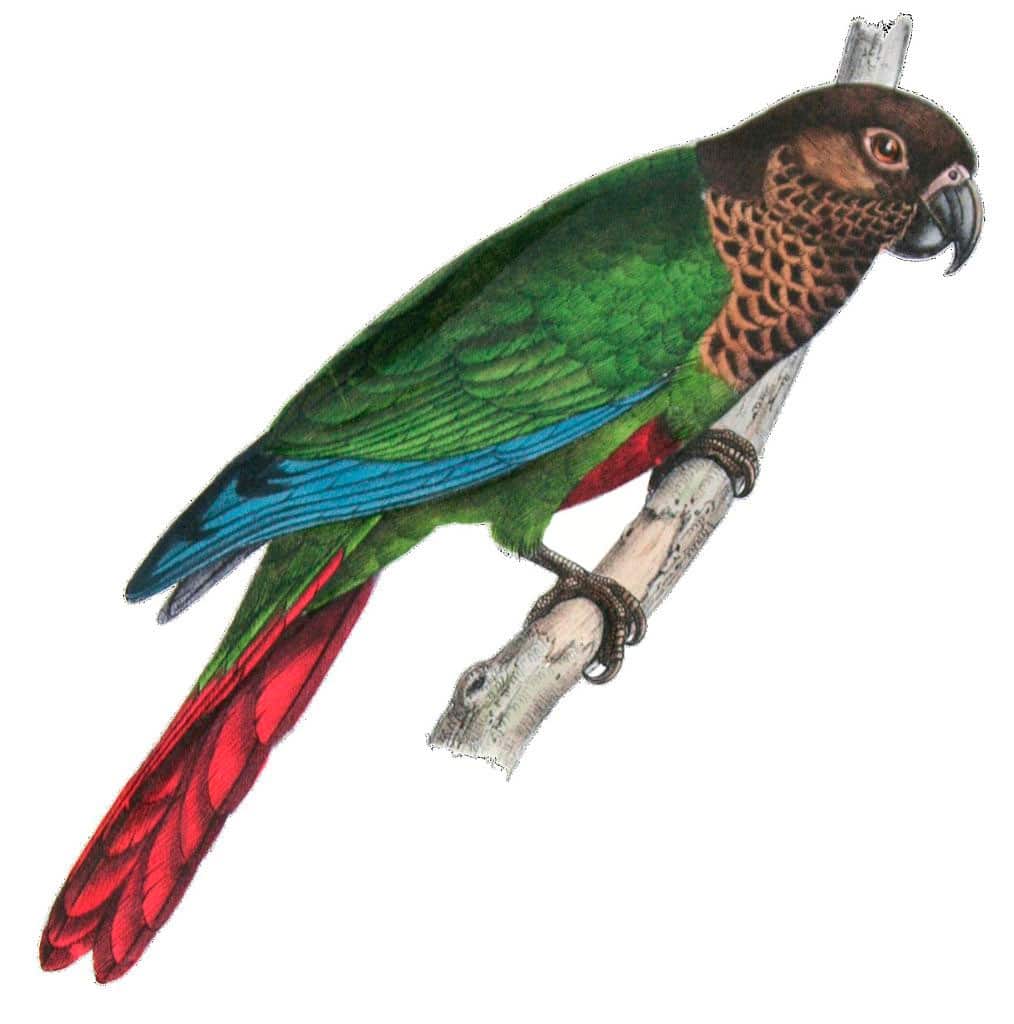
the showy plumage of the Deville's Parakeet (Pyrrhura lucianii) is generally Green, darker in the lower parts, the crown is dark brown, the forecrown and face is brownish red in colour; cheeks brick red, faded of blue, ear-coverts brownish yellow, neck and chest with the typical scales very visible due to the black and yellow contrast of the feathers. The ventral coat of arms, reddish, is well defined; in flight the dark red spot is notorious for the abdomen. Well defined are the reddish marks on the rump and in his long tail; the flight feather they are blue.

It has periocular ring Of course, irises brown, bill blackish and legs grey pink.

Note:

Until recently this species was included along with the Pyrrhura subandina, Pyrrhura caeruliceps, Pyrrhura pantchenkoi within the species Pyrrhura picta.

Habitat:

Found in altitudes of 800 m, in forests Terra firm and vรกrzea, including forest margins and near clearings with tall trees. In forests low semi humid, up close 100 m.

Seen in pairs, groups of three or flocks of up to 20 individuals.

Reproduction:

Little is known about the reproductive cycle of this species, probably nesting in large trees, in cavities or in nest of woodpeckers abandoned, with one laying estimated in 5-7 eggs.

Food:

With feeds a wide variety of fruits, flowers, seeds and algae, possibly.

Distribution:

Size of the distribution (breeding/resident): 47,200 km2

Restricted to the State of amazon in the Northwest Amazon of Brazil.

This species is supposed fairly common within its range, However, This can not be confirmed since this time rare remote region is visited by researchers.

Conservation:

โ€ข Red List Category: Least concern

โ€ข Population trend: Decrease

State of conservation โ“˜


minor concern Minor Concern โ“˜ (UICN)โ“˜

The status of their populations is unknown, but for the good condition of the habitat, it can be assumed that they are in good state of conservation.

While the trend of the population seems to be decreasing, do not believe that the decline is fast enough for approaching the threshold of vulnerable under the criterion of population trend

"Deville's Parakeet" in captivity:

Although he is a parrot rare in captivity, its potential as a domestic fowl is excellent, provided there are hand raised and socialized from an early age. The newly imported birds are usually shy and nervous and often they remain reserved.

It is usually inquisitive and active, enjoy flying and requires plenty of exercise and a spacious cage. Usually, It is not too noisy unless it is excited (as it is usually the case of all species Pyrrhura).

Once acclimatized, These parrots are quite robust. Enjoy with the bath by what are them must provide a dish of water little deep to daily. Also the love chew branches fresh.

Alternative names:

– Deville’s Parakeet, Bonaparte’s Parakeet (English).
– Conure de Bonaparte, Conure de Luciani (French).
– Bonapartesittich, Prinz Luzians Rotschwanzsittich (German).
– Tiriba-de-deville (Portuguese).
– Cotorra de Bonaparte, ร‘รกngaro de Deville, Perico de Deville, Cotorrita barriguiroja (espaรฑol).
– Perico de Bonaparte (Peru).

scientific classification:

– Order: Psittaciformes
– Family: Psittacidae
– Genus: Pyrrhura
– Scientific name: Pyrrhura lucianii
– Citation: (Deville, 1851)
– Protonimo: Conurus Lucianii

Images Deville's Parakeet:


Especies del gรฉnero Pyrrhura

Deville's Parakeet (Pyrrhura lucianii)


Sources:

– Avibase
– Parrots of the World โ€“ Forshaw Joseph M
– Parrots A Guide to the Parrots of the World – Tony Juniper & Mike Parr
– Birdlife

– Photos:

(1) – Maracana luciani Dev. & Cast. Pyrrhura lucianii = (Deville, 1851) by Francis de Laporte de Castelnau [Public domain], via Wikimedia Commons
– Sounds: Daniel Lane (Xeno-canto)

โ–ท The world of Pets: Dogs, cats, birds, reptiles, amphibians

Yellow-shouldered Parrot
Amazona barbadensis

Yellow-shouldered Parrot

Content

Description:

33 to 36 cm.. height and an average weight of 270 g.

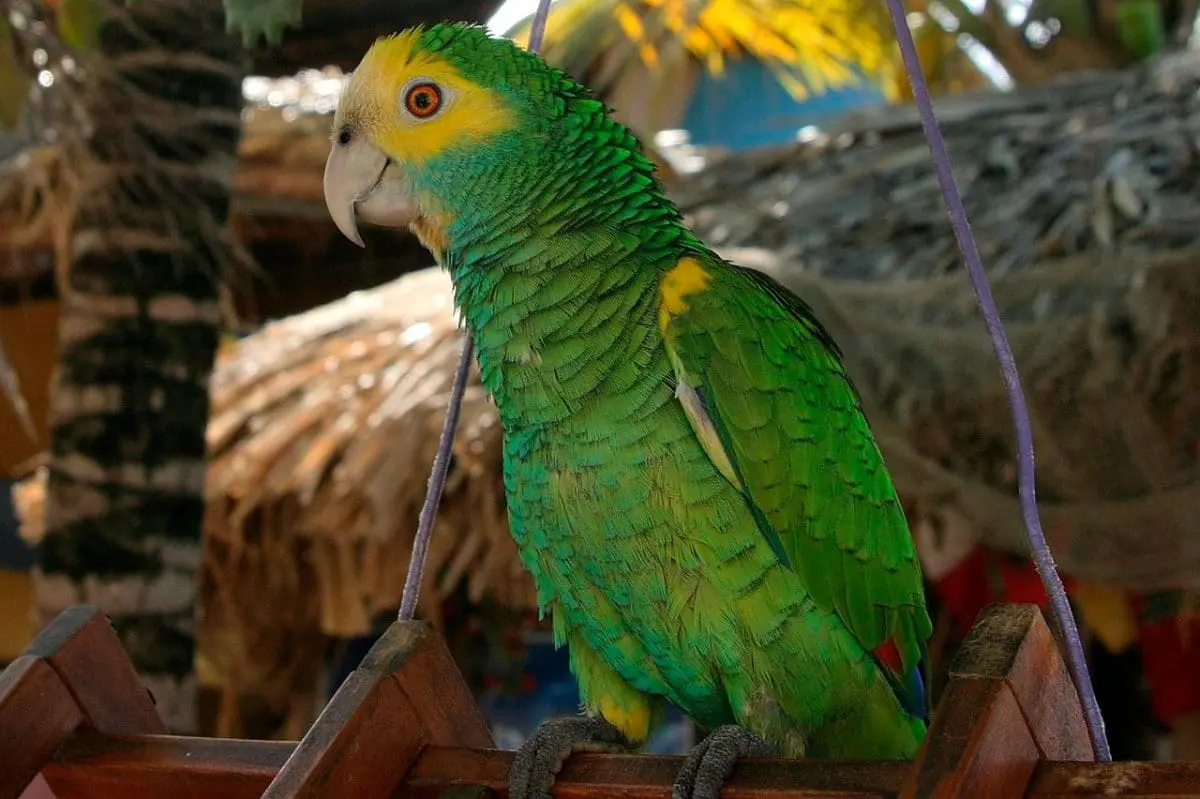
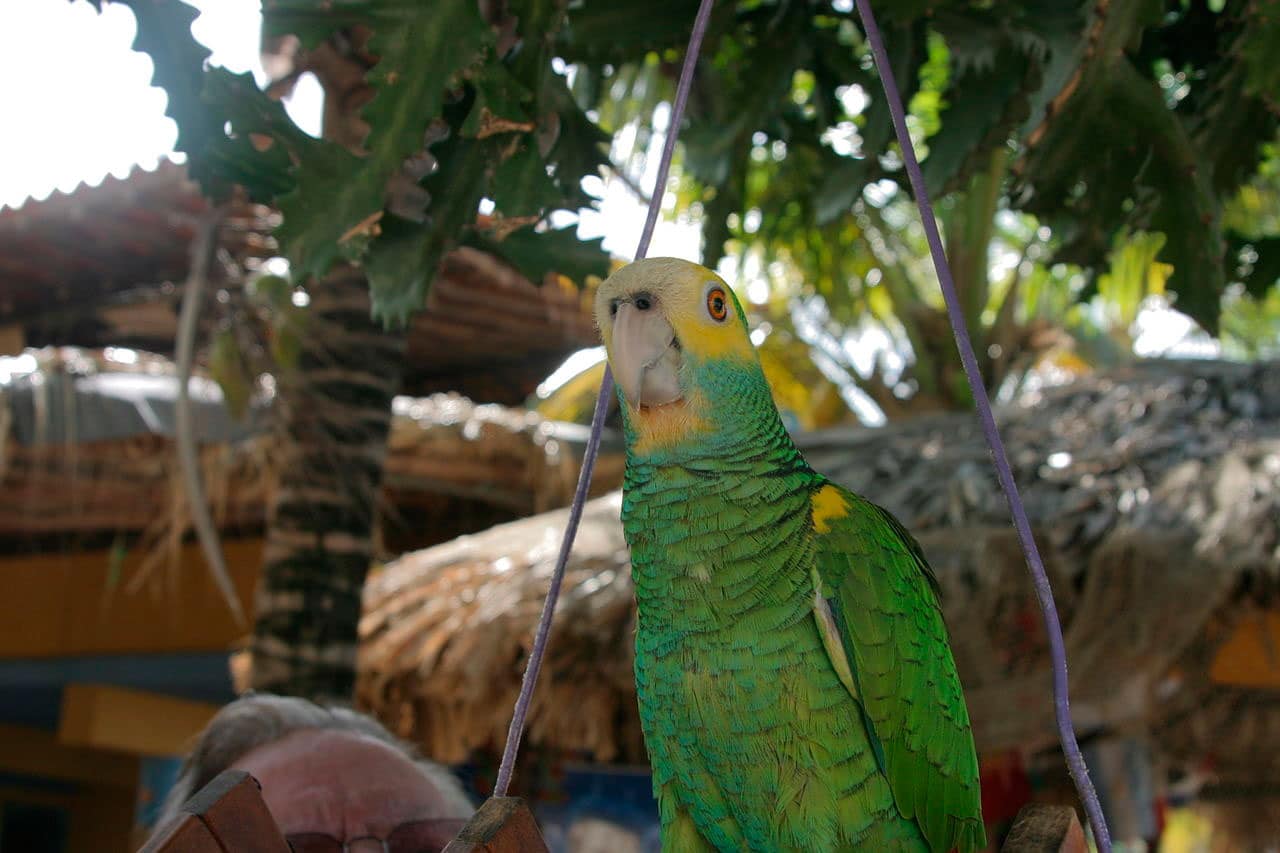
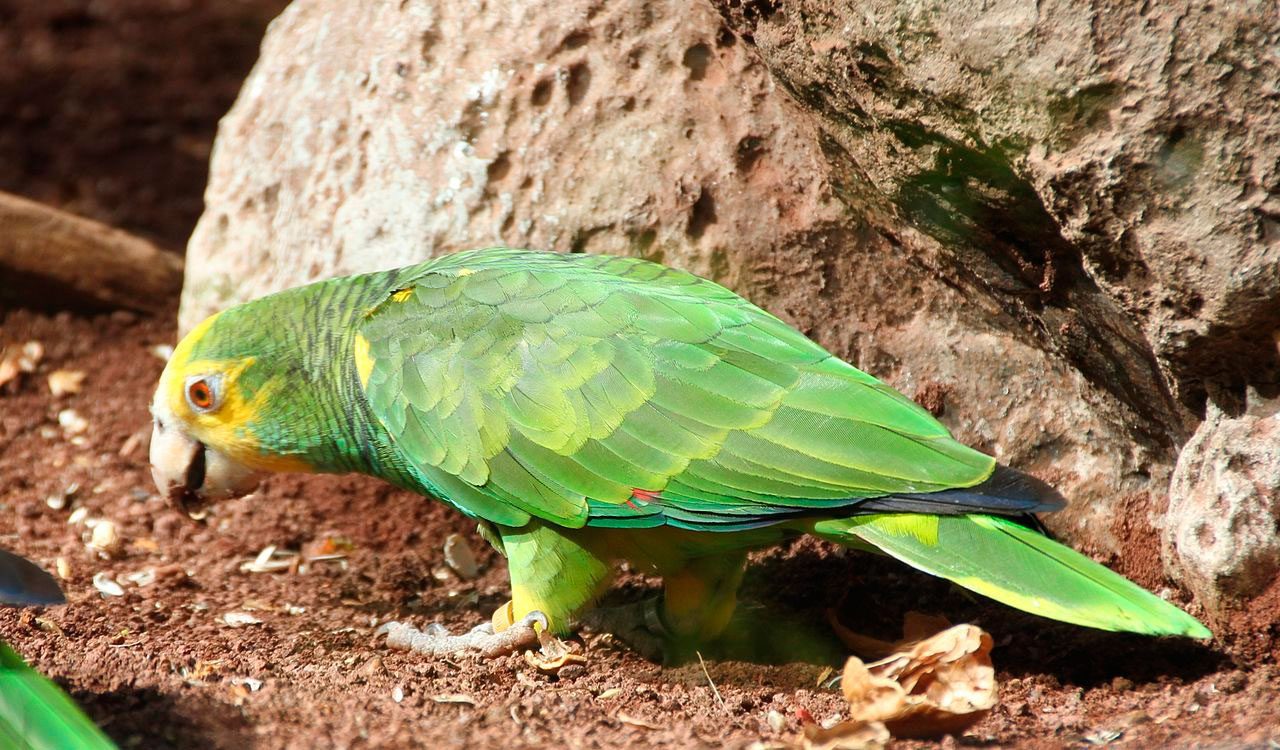
The Yellow-shouldered Parrot (Amazona barbadensis) It has a short tail, head yellow, some with forecrown white.

Its body is usually green, with black feathers edge neck, chest and back; greenish yellow in underparts.

Chin yellow with bluish tint in lower cheeks and around the chin. Shoulder and the thighs yellow.

Speculum red. dark blue tips to the flight feathers. The black edge of their feathers give them a look scaled.


Yellow-shouldered Parrot


Anatomy-parrots

The irises are red or orange and bill whitish.

The young birds are similar to adults but may distinguish by their irises and the absence darker blue hue in the lower body.

In the most notorious flight apart from the head, is the wing with shoulder yellow, Red patch and blue end.

Habitat:

They live in areas xerophytic vegetation, frequenting desert scrub dominated by cactus, cardรณn and shrubs or small trees; also frcuentan cultivated areas, until the 450 m. They move in pairs or flocks of up 100 individuals, especially at the time of feed.

Reproduction:

The nesting takes place in tree cavities, cactus or cliffs, in general, between March and August (Sanz and Rodriguez-Ferraro 2006). The average size of clutch is of 3,38 eggs per nest, and most of the eggs survive until the hatching. The incubation lasts a few 26 days and leave the nest 60 days after hatch.

It tends to rest communally in tall trees, with groups of up 700 birds recorded (Juniper and Parr 1998).

Food:

Their diet is composed of Cactus and other fruits. They have been reported in their diet fruits 22 genders. rich flowers nectar, cardรณn and the urero, which eats fruits, flowers and trunk, fruits and seeds Stenocereus, seeds and flowers guatacaro (Boarreria Sumnensis) and yaque.

Distribution:

Size of its range (reproduction / resident): 11,000 km2

The Yellow-shouldered Parrot It has a disjoint range with seven genetically isolated populations in northern Venezuela (Lara (Cerro Saroche National Park, which)), Falcon (Dabajuro, Casigua), Anzoรกtegui (about Piritu and Barcelona) and Sucre (Araya Peninsula), as well as the Margarita Islands, the blanquilla, Curacao and Bonaire (Rodriguez-Ferraro 2009).

He is currently extinct on Paraguana Peninsula (Briceรฑo-Linares et. To the. 2011). References to the presence of a population of wild parrots in Curacao They are based on a historical source of the century 18 (AO Debrot in some 1999, 2007.); there have been reports from modern 1988 (The farmer 2008, A. Rodriguez-Ferraro in litt. 2012), although it has been suggested that these birds can be released or escaped cages. (Williams 2012).

It became extinct in Aruba towards 1950 (Rojas-Suarez & Rodrรญguez 2015).

The numbers on the islands seem to fluctuate, but they have increased in Margarita of 750 birds in 1989 (Sanz y Grajal 1998) until around 2000 in 2015 (Rojas-Suarez & Rodrรญguez 2015).

The population in Bonaire It was estimated in 400 individuals in 2006 (Williams and Martin 2006) and 650-800 individuals in 2012 (Department of Resources and Planning, Bonaire by R. Martin y S. Williams a slightly. 2012).

The continent's population was considered in decline 2003 (Hilty 2003).

Their habitat continues to be lost in the eastern part of the continental mountain range (V. Sanz in some. 2016) and the population of together (is of Venezuela) it is believed that are declining due to poaching and habitat conversion for agriculture (V. Sanz n bit. 2016), so it is likely that the continental population continues to decline.

Conservation:

State of conservation โ“˜


Vulnerable Vulnerable โ“˜ (UICN)โ“˜

โ€ข Current category of the Red List of the UICN: Vulnerable.

โ€ข Population trend: Unknown.

The population size: 1700-5600 specimens.

It is classified as a endangered specie, It is the main threats capture their young for pet trade, and habitat destruction of nesting and feeding by the extraction of sand for the construction industry.

The recovery of the population of this bird has been the spearhead of Provita's work in Macanao, since its conservation benefits a large part of the biodiversity of the peninsula, as their habitat covers large areas, it is also a charismatic species, that easily attracts the public to conservation efforts.

Source: PROVITA

"Yellow-shouldered Parrot" in captivity:

Rare but increasing due to the successes of captive breeding.
have a participatory personality, inquisitivas and curious to the point of being "nosy" and her gentle nature only adds to her charm. Mild to moderate its ability to speak.
Always playful, enable They require a cage equipped with toys. They worship a bathroom and displayed chatty while bathing under running warm water.

Alternative names:

– Yellow-shouldered Parrot, Yellow shouldered Parrot, Yellow-shouldered Amazon (English).
– Amazone ร  รฉpaulettes jaunes (French).
– Gelbflรผgelamazone, Kleine Gelbkopfamazone (German).
– Papagaio-de-cabeรงa-branca (Portuguese).
– Amazona de Cabeza Amarilla, Amazona de hombro gualda, Amazona Hombrogualda, Cotorra margariteรฑa (espaรฑol).
– Cotorra Cabeciamarilla (Venezuela).

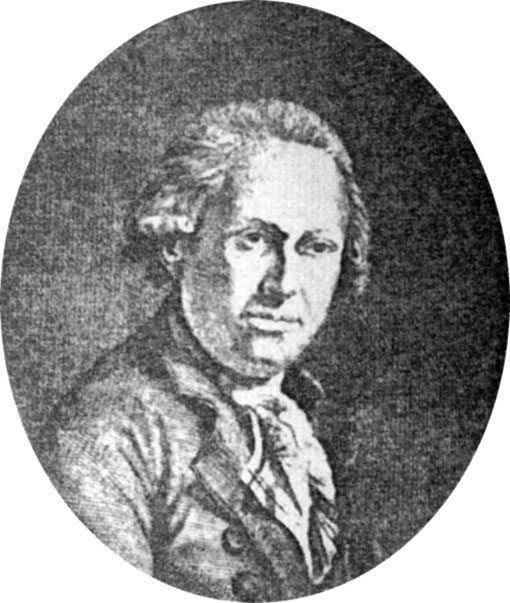
Gmelin Johann Friedrich

scientific classification:


– Order: Psittaciformes
– Family: Psittacidae
– Genus: Amazona
– Scientific name: Amazona barbadensis
– Citation: (Gmelin, JF, 1788)
– Protonimo: Psittacus barbadensis


Images "Yellow-shouldered Parrot":


Species of the genus Amazona


Sources:

  • Avibase
  • Parrots of the World โ€“ Forshaw Joseph M
  • Parrots A Guide to the Parrots of the World – Tony Juniper & Mike Parr
  • Birdlife

  • Photos:

(1) – Yellow-shouldered Amazon (Amazona barbadensis) also known as Yellow-shouldered Parrot. Pet in Venezuela perching on the top of a wooden frame. By John Bรคckstrand (originally posted to Flickr as IMG_2721) [CC BY 2.0], via Wikimedia Commons
(2) – Yellow-shouldered Amazon in the Walsrode Bird Park, Germany By Quartl (Own work) [CC BY-SA 3.0], via Wikimedia Commons By Quartl (Own work) [CC BY-SA 3.0], via Wikimedia Commons
(3) – Yellow-shouldered Amazon (also known as Yellow-shouldered Parrot). Two in the foreground in a cage By TJ Lin [CC BY-SA 2.0], via Wikimedia Commons
(4) – Yellow-shouldered Amazon (Amazona barbadensis) also known as Yellow-shouldered Parrot. Pet in Venezuela perching on a hand. Shows crown By John Bรคckstrand (originally posted to Flickr as IMG_2469) [CC BY 2.0], via Wikimedia Commons
(5) – Yellow-shouldered Amazon (Amazona barbadensis) also known as Yellow-shouldered Parrot. Pet in Venezuela By John Bรคckstrand (originally posted to Flickr as IMG_2468) [CC BY 2.0], via Wikimedia Commons
(6) – Amazona barbadensis in the Loro Parque zoo of Tenerife, Spain By Bjoertvedt (Own work) [CC BY-SA 4.0], via Wikimedia Commons
(7) – Amazona barbadensis in the Loro Parque zoo of Tenerife, Spain By Bjoertvedt (Own work) [CC BY-SA 4.0], via Wikimedia Commons
(8) – Yellow-shouldered Amazon (Amazona barbadensis) also known as Yellow-shouldered Parrot. Pet in Venezuela – side view – a little red and blue seen at edge of wing By John Bรคckstrand (originally posted to Flickr as IMG_3117) [CC BY 2.0], via Wikimedia Commons
(9) – Yellow-shouldered Amazon (Amazona barbadensis) also known as Yellow-shouldered Parrot. Pet in Venezuela on the top of a wooden climbing frame. Mainly showing its upper body By John Bรคckstrand (originally posted to Flickr as IMG_2723) [CC BY 2.0], via Wikimedia Commons
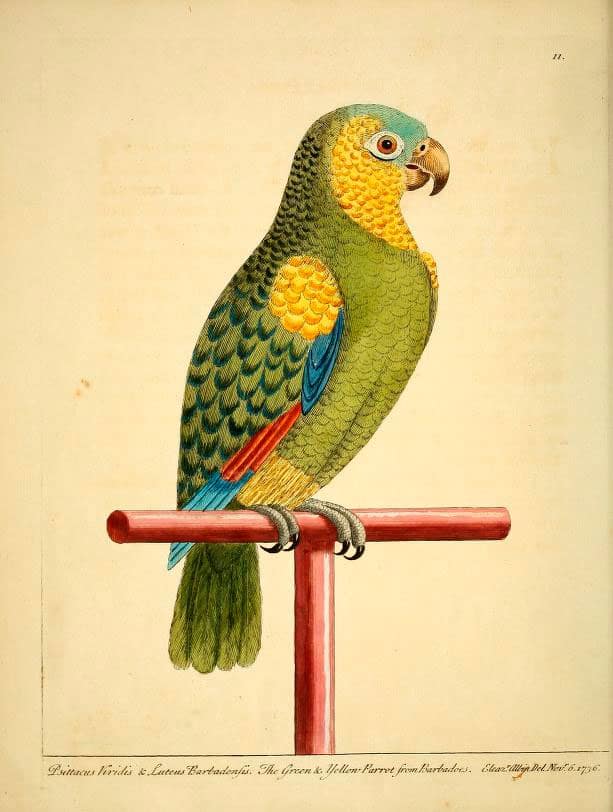
(10) – Original illustration of the ยซGreen & Yellow Parrot from Barbadosยป, currently known as Amazona barbadensis – Wikipedia

  • Sounds: ยฉ 2014 Cornell University

โ–ท The world of Pets: Dogs, cats, birds, reptiles, amphibians

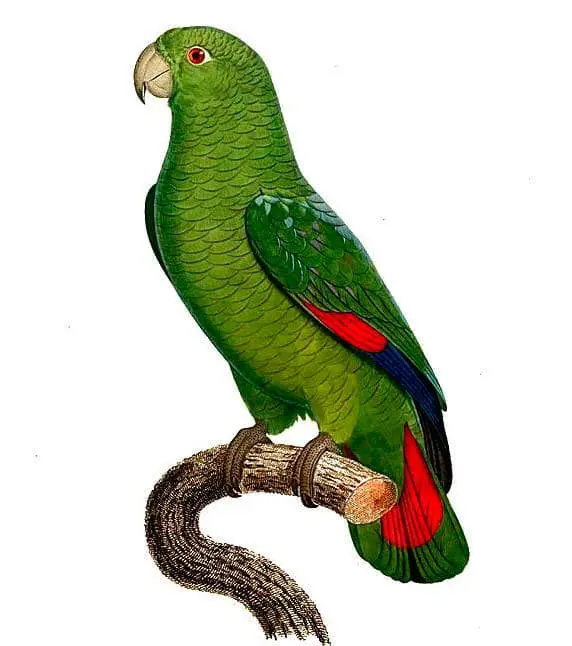
Black-billed Parrot
Amazona agilis

Black-billed Parrot

Content

Description:


Anatomy-parrots

25 cm.. length and 178 g. of weight.

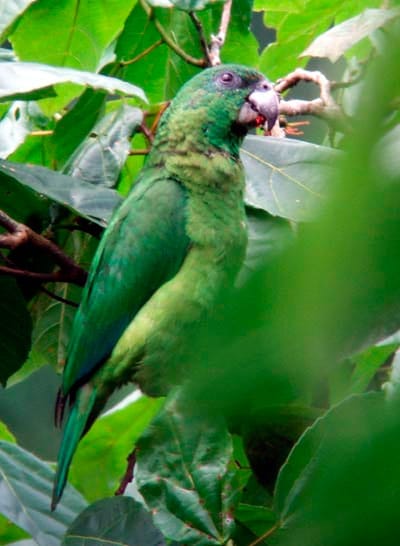
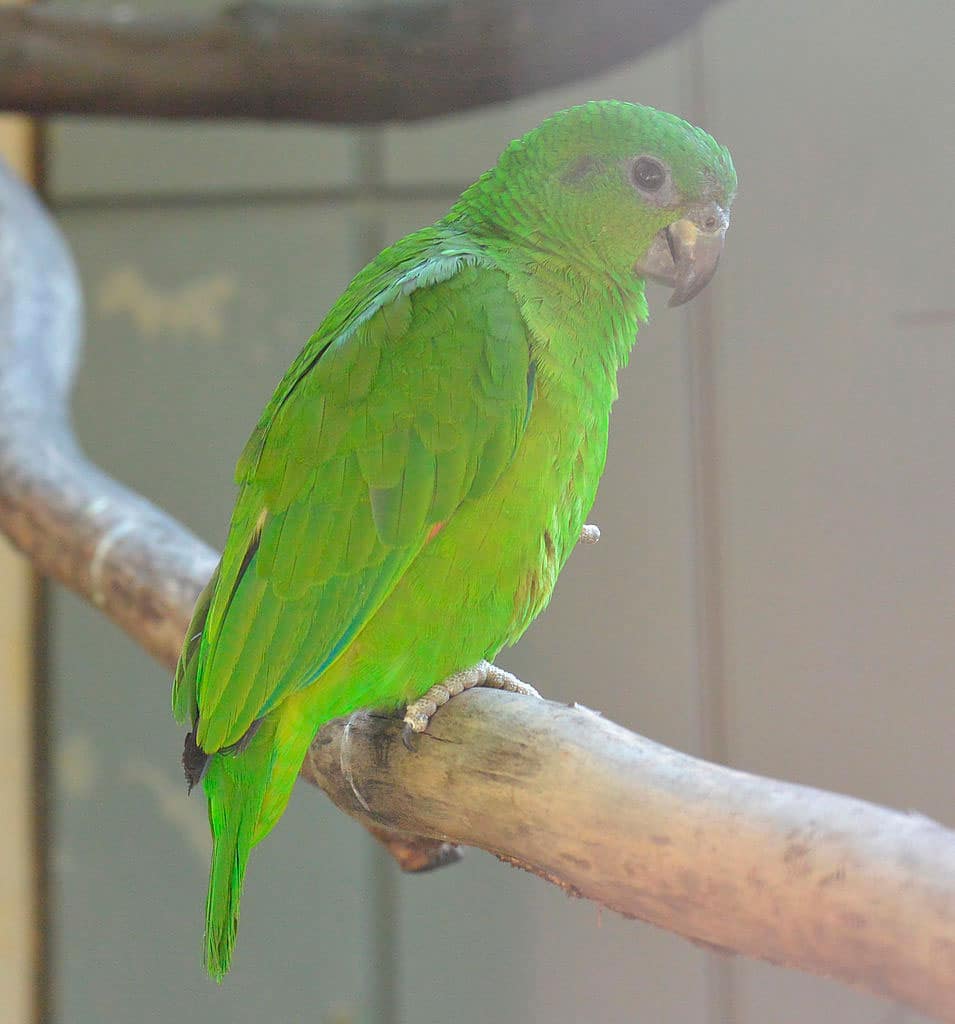
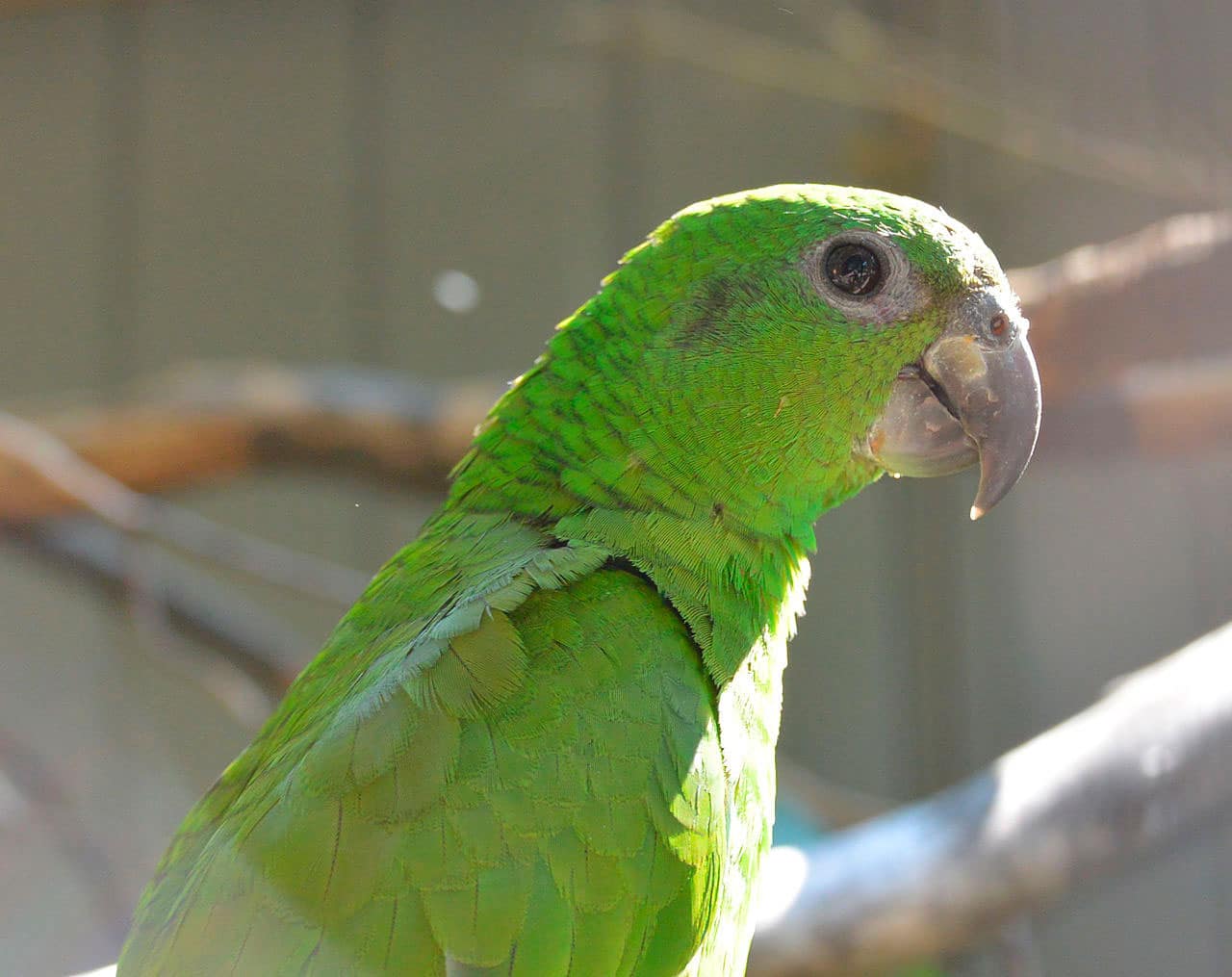
The Black-billed Parrot (Amazona agilis) It is the smallest of the Amazon parrots, and is one of only two species of Amazona endemics Jamaica.

This species, brightly colored, has a plumage, mostly, of color green with them underparts lighter, green or yellow.

The slightly darker edges in feathers of the back of the neck, one dan scalloped effect. Flight feathers darker at the tip; feathers of the tail blue in the margins with red bases to outer feathers. Their eyes They are surrounded by a dark brown ring dark grey, and the bill is black.

Black-billed Parrot

The adult male they have the coverts red on the outer of the wings, While these feathers They are usually green in females and in the immature.

  • Sound of the Black-billed Parrot.

Habitat:

Video "Black-billed Parrot"

Parrots in the world

It is in the humid limestone forests to elevations of 1.600 m. They can be seen in the upper canopy, and they can also be found foraging in cultivated land and plantations near the edge of the forest.

Form groups 6 to 30 individuals.

Reproduction:

The Black-billed Parrot used for nest the tree holes are formed from or related to weathering processes and pathogen attacks insects, at least a 18 meters above the ground. It has reported the use of cavity left by the Jamaican Woodpecker (Melanerpes radiolatus).
Like other species of parrots, the vigorous vocalizations among couples announce nesting territories.

The breeding season It is from March to August. The laying is of 2-4 eggs, with a range of about 48 hours between successive eggs. Eggs are incubated only by the female during 24 days. During this time the male will feed and exchange food with female. The incubation It begins after the first egg is placed, so hatching occurs at intervals, with up to seven days between the first and last hatching. Chicks this amazon They spend up to eight weeks in the nest.

Most nest failures do so in the early mating period., as a result of predation by Jamaican Boa (Epicrates subflavus) (Gruber 1980) and to a lesser extent Jamaican Crow (Corvus jamaicensis).

Food:

The Black-billed Parrot It feeds on fruit, seeds, dried fruits, berries and flowers in the forest canopy. The populations of this species will move in response to the location of food sources. This species also feed on crops and can cause considerable damage to fruit ripening.

Distribution and status:

Size of its range (breeding/resident): 5.100 km2

Its distribution area it is restricted to mid-level moist limestone forests, which have been drastically reduced in recent 40 years. Locally common by all the Cockpit Country, particularly in disturbed edge habitat where it is more common than the Yellow-billed Parrot (Amazona collaria), with which occasionally is associated.

The populations of the Black-billed Parrot also they found in Mount Diablo, in the center of the island. Historical reports also placed at the eastern end of the island, although recent sightings in that area are rare. But, small flocks have been recently in the John Crow Mountains. Preliminary surveys indicate population estimates much higher than those described above, and possibly more than 10.000 individuals in the region of Cockpit Country (C. Levy in some 1999).

Conservation:

State of conservation โ“˜


Vulnerable Vulnerable โ“˜ (UICN)โ“˜

โ€ข Current category of the Red List of the UICN: Vulnerable.

โ€ข Population trend: Decreasing.

โ€ข Population size : 6000-15000

Rationale for the Red List category

This species has a range very small within which its habitat is declining in extent, area and quality; and additional reductions of the population are being caused by the trampeo and predation, qualifying the species as Vulnerable. Currently it does not qualify as endangered because the habitat is severely fragmented and is known in more than five places. But, the species can requalify for inclusion in a top list in the future due to population decline likely if the three proposed mining concessions Cockpit Country They are awarded.

Justification of the population

Preliminary population estimates are those that best place the world population in the band between 10.000 and 19.999 individuals (S. Koenig in a bit., 2008). This is equivalent to 6,667-13,333 mature individuals, rounded here to 6,000-15,000 mature individuals. Further studies are needed to get an accurate figure.

Justification of trend

The data suggest that decrease of at least 50% of the population of this species could occur in the next 40-50 years as a result of habitat destruction due to three proposed mining concessions, two of which have recently been granted (Koenig, 2008). But, It is not sure if the third concession is granted (S. Koenig in some. 2010), and as such it is projected to suffer a decrease of species 30-49% over the next 37 years (three generations).

Conservation Actions Underway

โ€ข CITES Appendix II. protected under the Protection Act Wildlife Jamaica and Endangered Species Act of 2000, which together prohibit keeping the species as a domestic animal and local and international trade.

โ€ข Since 1995 He has worked to delineate its distribution, estimate the size of the population, identify long-term factors limiting reproductive performance and train local people in research methods and techniques for monitoring (Davis 1997, BirdLife Jamaica in little 1998).

โ€ข Habitat in the Blue Mountains National Park and John Crow, but the implementation and management of the park are weak (BirdLife Jamaica in little 1998).

โ€ข There is a permanent campaign of public awareness high-profile to prevent bauxite mining in Cockpit Country, by having the area declared closed to mining by the Minister's Discretion (S. Koenig in some. 2007, 2009).

โ€ข Proponents remain optimistic that, while losing a large area of รขโ‚ฌโ€นรขโ‚ฌโ€นhabitat, a large area of โ€‹โ€‹mining habitat will be declared closed (S. Koenig in some. 2007, 2009).

โ€ข Discussions have started that may lead to the ban the importation of psittacine to Jamaica to reduce the risk of leakage and hybridisation (S. Koenig in some. 2007, 2009).

โ€ข There are populations of captive breeding.

Conservation Actions Proposed

โ€ข Survey to delineate the range and evaluate the numbers (BirdLife Jamaica in little 1998).

โ€ข To establish a monitoring program long-term.

โ€ข Designate a Cockpit Country closed to mining.

โ€ข Ensure the de facto protection of the Blue Mountains National Park and John Crow (BirdLife Jamaica in little 1998).

โ€ข Design and implement Educational programs in the area occupied by the species and adjacent areas (BirdLife Jamaica in little 1998) and develop a structured captive breeding program.

โ€ข Improve the application of the legislation against poaching.

The Black-billed Parrot in captivity:

CITES Appendix II. protected under the Protection Act Wildlife Jamaica and Endangered Species Act of 2000, which together prohibit keeping the species as a domestic animal and local and international trade.

Populations of captive breeding.

Alternative names:

– Black-billed Parrot, Active Amazon, Active Parrot, All-green Amazon, All-green Parrot, Black billed Parrot, Black-billed Amazon (English).
– Amazone verte (French).
– Rotspiegelamazone (German).
– Papagaio-de-bico-preto (Portuguese).
– Amazona de Pico Negro, Amazona Jamaicana Piquioscura (espaรฑol).


scientific classification:

Carl Linnaeus

– Order: Psittaciformes
– Family: Psittacidae
– Genus: Amazona
– scientific numberor: Amazona agilis
– Citation: (Linnaeus, 1758)
– Protonimo: Psittacus agilis


Images Black-billed Parrot:


Species of the genus Amazona


Sources:

Avibase
Parrots of the World โ€“ Forshaw Joseph M
Parrots A Guide to the Parrots of the World – Tony Juniper & Mike Parr
Birdlife

Photos:

(1) – A Black-billed Parrot in Jamaica By Ron Knight from Seaford, East Sussex, United Kingdom (Black-billed Parrot) [CC BY 2.0], via Wikimedia Commons
(2) – Amazona agilis in Wuppertal zoo By Simon J. Tonge [CC BY 3.0], via Wikimedia Commons
(3) – A Black-billed Amazon at Vienna Zoo, Schonbrunn Palace, Vienna, Austria By Alois Staudacher (Rotspiegelamazone) [CC BY 2.0], via Wikimedia Commons
(4) – A Black-billed Amazon at Vienna Zoo, Schonbrunn Palace, Vienna, Austria By Alois Staudacher (Rotspiegelamazone) [CC BY 2.0], via Wikimedia Commons
(5) – A Black-billed Parrot in Jamaica By Ron Knight from Seaford, East Sussex, United Kingdom (Black-billed Parrot) [CC BY 2.0], via Wikimedia Commons
(6) – A Black-billed Amazon at Vienna Zoo, Schonbrunn Palace, Vienna, Austria By Alois Staudacher (Rotspiegelamazone) [CC BY 2.0], via Wikimedia Commons
(7) – Black-billed Amazon in the John Crow Mountains, Portland, Jamaica By Brennan Mulrooney (originally posted to Flickr as Black-billed Parrot) [CC BY 2.0], via Wikimedia Commons
(8) – A Black-billed Parrot in Jamaica By Ron Knight from Seaford, East Sussex, United Kingdom (Black-billed Parrot) [CC BY 2.0], via Wikimedia Commons
(9) – Psittacus agilis By Barraband, Jacques; Bouquet; Le Vaillant, Franรงois [CC BY 2.0 or Public domain], via Wikimedia Commons
(10) – [Little green parrot (Black-billed Amazon [Amazona agilis])] From Natural History of Parrots (by Francois Levaillant, 1801-1805) by Jacques Barraband – Wikimedia

Sounds: Ross Gallardy, XC308430. accessible www.xeno-canto.org/308430