▷ The world of Pets: Dogs, cats, birds, reptiles, amphibians

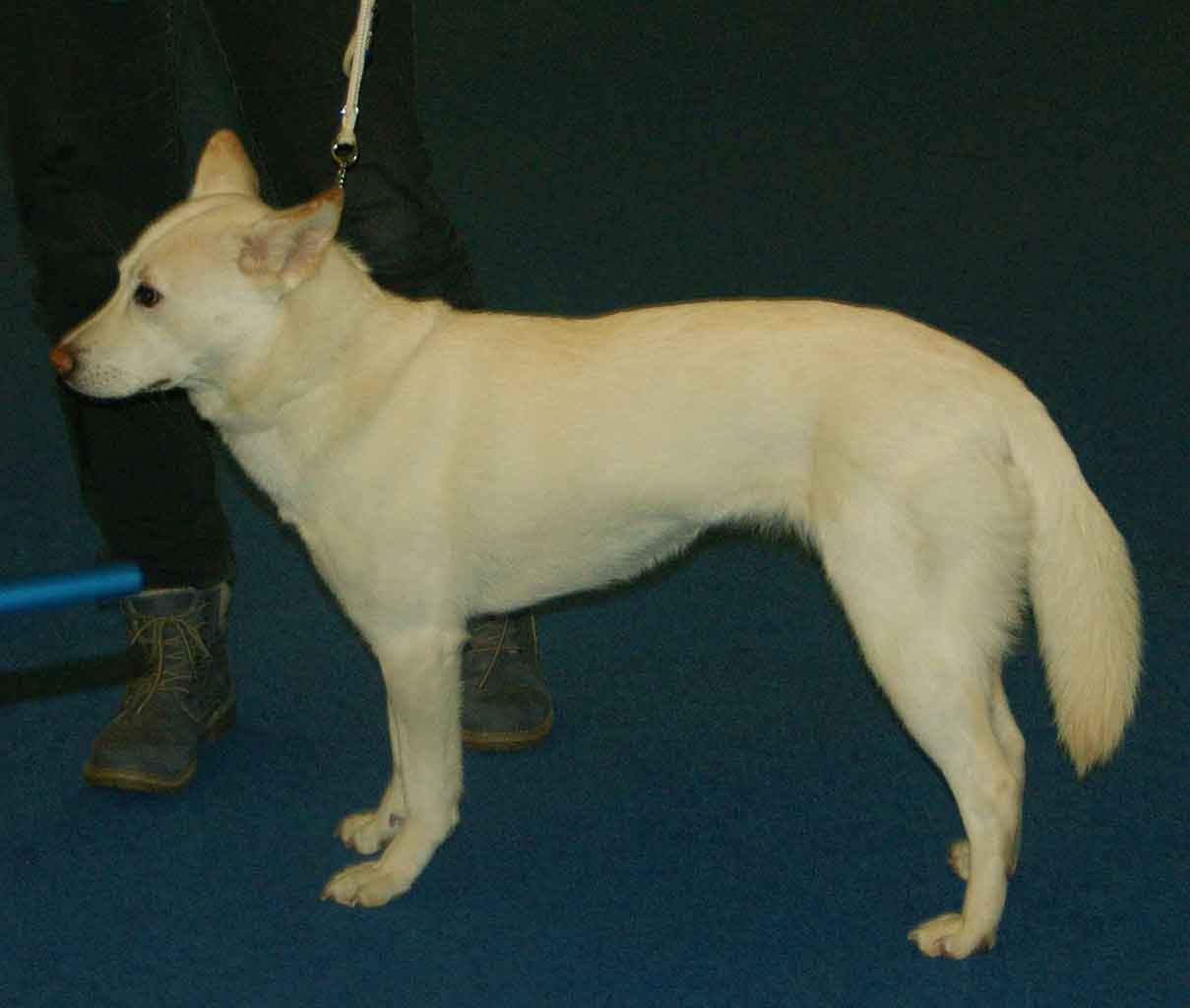
Taiwan Dog
Taiwán FCI 348 . Primitive type - Hunting Dogs

Taiwan Dog

The Taiwan Dog is sponsored by Japan.

Content

History «Dog of Taiwan»

In 1980 the breed was the subject of a study by the University of Taiwan, Gifu University of Japan and Nagoya University. The aim of the study was to find out the origins of the Taiwan Dog. As such, the students examined 29 indigenous dog breeds and concluded that the Taiwan Dog current is a native breed that actually descends from Southeast Asian hunting dogs. This Asian dog breed is now popular throughout the island as a guard and companion dog.. In 2004 was officially recognized by the FCI.

Physical characteristics «Taiwan dog»

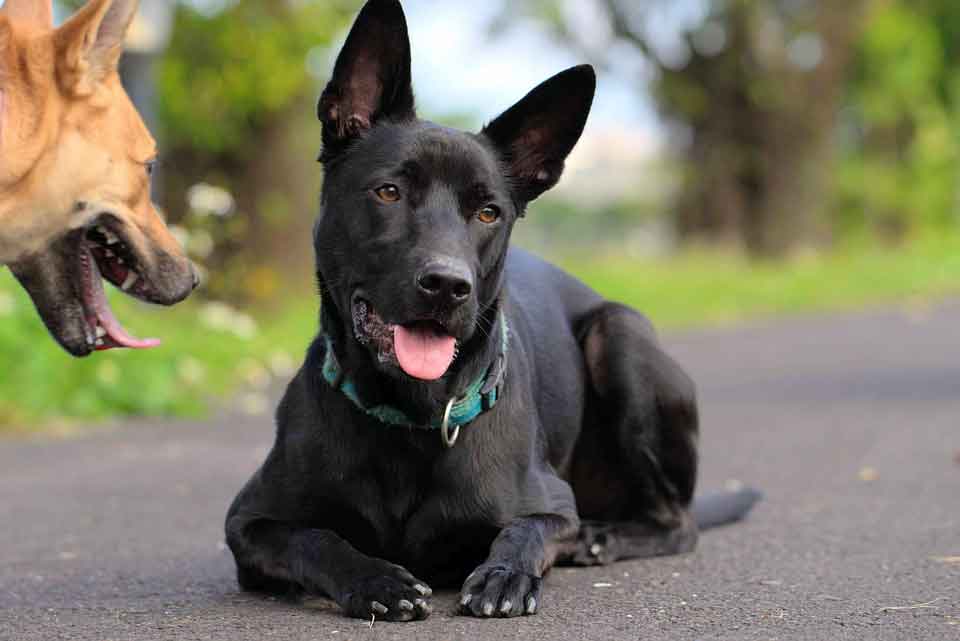
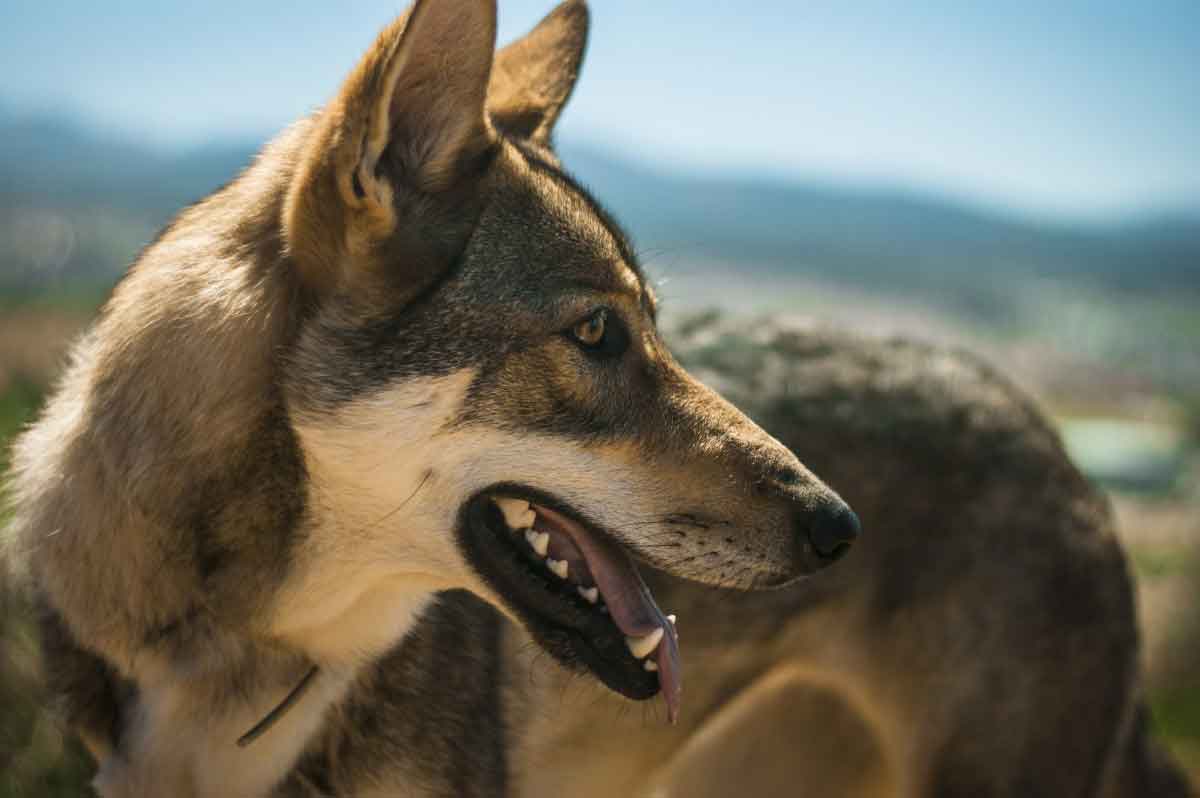
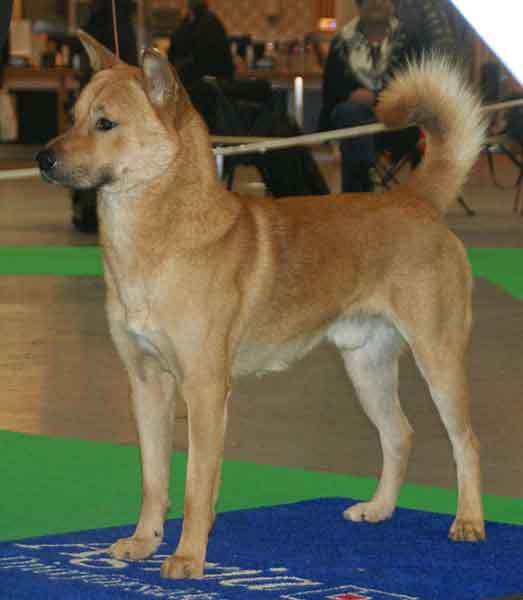
The males of Taiwan Dog reach a withers height of up to 52 cm.. When fully grown they weigh 18 kg, while the females are about 5 cm smaller and 2 kg lighter. Muscular animals characteristically move with very wide strides., but they are fast and agile due to their pronounced musculature. The Taiwan Dog has a very tight coat of about 1,5 to 3 cm length. A variety of colors is allowed, including black, striped, yellow, white, black and white or white and brindle. Sponsorship of the breed was taken over by Japan.

Character and skills “Taiwan Dog”

Sociable and loyal hunting companion.
His brave and intrepid character serves the Taiwan Dog in his role as hunting dog. Animals are known for their quick perception and the fact that they are faithful and loyal to their master.. They are also suitable as guard and dressage dogs and are considered extremely sociable.

TAIWAN DOG

They adapt very well to the environment and that is why they were able to live so incredibly well with primitive peoples in the past.. It also, these dogs can survive in the desert in the middle of the mountains, they can stand out excellently and can cope with almost all situations. All these strong qualities can be traced back to his previous harsh life with the prehistoric peoples of the mountains.. Your skills are also improved by working together with people. This builds trust between the dog and the man., friendships and shared experiences. The Taiwan Dog they are big and simple family dogs. Because of life in the desert, do not have a great demand for food. The Taiwan dogs they can even be used as protection dogs and as police dogs, because they have this unmistakable good sense of smell and are ready to defend themselves.

Until today these dogs are known mainly in the Asian region. In Europe they have not been able to arouse comparable popularity so far.

Health «Taiwan Dog»

The Taiwan Dog are extremely resistant to disease.

Videos "Taiwan Dog"

HTTPS://youtube.com/watch?v=HhLEIjw4N-4
Taiwan Dog
HTTPS://youtube.com/watch?v=am_kkgYKXR4
Perro de montaña de Formosa / Perro de Taiwan / Taiwan Dog – Raza de Perro / Dog Breed

Photos:

1 – Dog of Taiwan by https://pixabay.com/zh/photos/taiwan-dogs-dog-the-black-dog-4890098/

Type and recognitions:

  • FCI CLASSIFICATION:
  • Group :
  • Section : . .

Federations:

  • – FCI – Group 5: Spitz-type dogs and primitive type – Section 7: Primitive type - Hunting Dogs. ⓘ

FCI breed standard "Taiwan Dog"

Origin:
Taiwan

Date of publication of the valid original standard:
09.11.2004

Use:

Hunting dog, on guard and company.


General appearance:

Medium size dog, triangular head, almond-shaped eyes, fine, erect ears and sickle-shaped tail. Dried, muscular, well balanced.

IMPORTANT PROPORTIONS:

  • chest depth : height at the withers = 4.5 – 4.7 : 10
  • Height to the cross: body length = 10 : 10.5 Females may be slightly longer.
  • Muzzle length : length of skull = 4.5 : 5.5


Behavior / temperament:

Extremely loyal to his master, acute senses, moving alert, brave and fearless.

Head:

---

Cranial region:
  • Forehead: wide, rounded, without wrinkles.
  • Skull: The skull is slightly longer than the muzzle.
  • Stop (Fronto-nasal depression): Well defined, with a slight groove.

facial region:

  • Nose: Moderate size. Large nostrils. Color black, may be slightly lighter in all colors except blacks.
  • Snout: Flat nasal bridge. Tight lips, no pendulosos. The muzzle tapers slightly from the base towards the nose, but it is not pointed.
  • Jaws / Teeth: Strong jaws. Scissor bite, teeth are inserted at right angles into the jaws.
  • Cheeks: Well developed and slightly prominent.

Eyes: Almond-shaped. dark brown color. Brown is also accepted, yellow or light eyes should be avoided.

Ears: erect, inserted on both sides of the skull at an angle of 45º. The inside of the outline is straight while the outside of the outline is slightly rounded.

Neck:

Muscular, strong, long, slightly arched. No double chin.

Body:

  • General: Fibrous and muscular, almost square in shape.
  • Back: Straight, short. Well developed cross.
  • Pork loin: Tightly muscled.
  • Rump: Wide. Flat or very slightly sloping and short.
  • Breast : Quite deep but not reaching the elbows. Slightly marked forefinger. Well arched ribs.
  • Belly: Well withdrawn.

Tail:

Sickle shaped, high insertion, carried erect, active, with the tip curved forward.

Tips

PREVIOUS MEMBERS:

  • Shoulder: Well muscled. Scapulae sloping back. They should meet the humerus at an angle of 105 to 110 degrees.
  • Elbows: Close to the body.
  • Arms: Straight and parallel to each other.
  • Metacarpus: Firms.

LATER MEMBERS:

Hind legs should be thin, with good bone, well muscled and parallel to each other. The posterior angulation must be in balance with the anterior.

  • Thigh: Large, inclined and well angled with the knee.
  • Legs: It should be in balance with the thigh.
  • Metatarsus: Perpendicular to the ground.
  • Pads: Thick.

FEET: No deviations in or out. Firm and thick pads. Black nails but lighter colors are accepted in all colors except black.

Movement:

Powerful step, with scope. Agile enough to be able to turn 180º quickly.

Mantle

Fur:Short and hard, glued to the body. Long between 1,5 and 3 cm..

Color:Negro, striped, Bayo, white, black and white, white and bay, white and brindle.


Size and weight:

Height:

  • Males: 48 cm.. – 52 cm..
  • females: 43 cm.. – 47 cm..

Weight:

  • Males: 14 kg. – 18 kg.
  • females: 12 kg. – 16 kg.


Fouls:

Any deviation from the aforementioned criteria is considered as a fault and the severity of this is considered to the degree of the deviation to the standard and its consequences on the health and well-being of the dog..

  • Shyness
  • Bite in clamp.
  • Missing teeth must be penalized but the lack of less than 3 PM1 is acceptable.
  • Protruding eyes.
  • Very straight front and rear angles.
  • Past or under marked size.

FALTAS DESCALIFICANTES:

  • Aggressiveness or extreme shyness.
  • Any dog ​​showing clear signs of physical or behavioral abnormalities must be disqualified..
  • Prognathism.
  • Overshot.
  • Ears not erect.
  • Extremely long hair (exceeding 4,5 cm.).
  • Lack of any canine.
  • Threaded queue.


N.B.:
  • Males should have two normal-appearing testicles fully descended into the scrotum..
  • Only functionally and clinically healthy dogs, with the typical conformation of the breed, should be used for parenting.

Source: F.C.I - International Cynological Federation

Alternative names:

1. Formosan Mountain Dog, Takasago Dog, Taiwan Canis, Taiwanese Dog, Taiwanse Canis (English).
2. Chien de Taïwan (French).
3. Taiwan Dog (German).
4. Cão de taiwan (Portuguese).
5. Perro de montaña de Formosa (español).

▷ The world of Pets: Dogs, cats, birds, reptiles, amphibians

Peruvian Hairless Dog
Perú FCI 310 . Primitive type

Peruvian Hairless Dog

The Peruvian Hairless Dog is a friendly and adaptable companion.

Content

History

The exact origin of the Peruvian Hairless Dog. But, their ancestors seem to be deeply rooted in Peru: Illustrations on the vessels of Moche culture, show hairless dogs already in the 750 AC. Later, these funny animals were reserved for the rich Incas, who took care not to mate them with other native dogs. It was also the Incas who prohibited the consumption of dog meat in the northern regions of Peru..

When the Spanish conquered the country, they found many naked dogs among the orchids of the Incas, so the Europeans called them «perros de las flores«. During the period of conquest, the breed was almost extinct, but some specimens survived in remote villages where the inhabitants valued them for the partly mythical qualities attributed to them: Because of its special appearance, four-legged creatures were said to have a healing effect on certain diseases, for example, bone and joint diseases.

In 1985, the world's largest dog breeding organization, the Federation Cynologique Internationale (FCI), recognized the Peruvian Hairless Dog as an independent race. So Today There Are Officially Three Naked Dog Breeds. Besides of Peruvian Hairless Dog, these are the Mexican Naked Dog, also known by the beautiful name of «Xoloitzcuintle«, and the Chinese Crested Dog. The three races are closely related to each other.

Physical characteristics

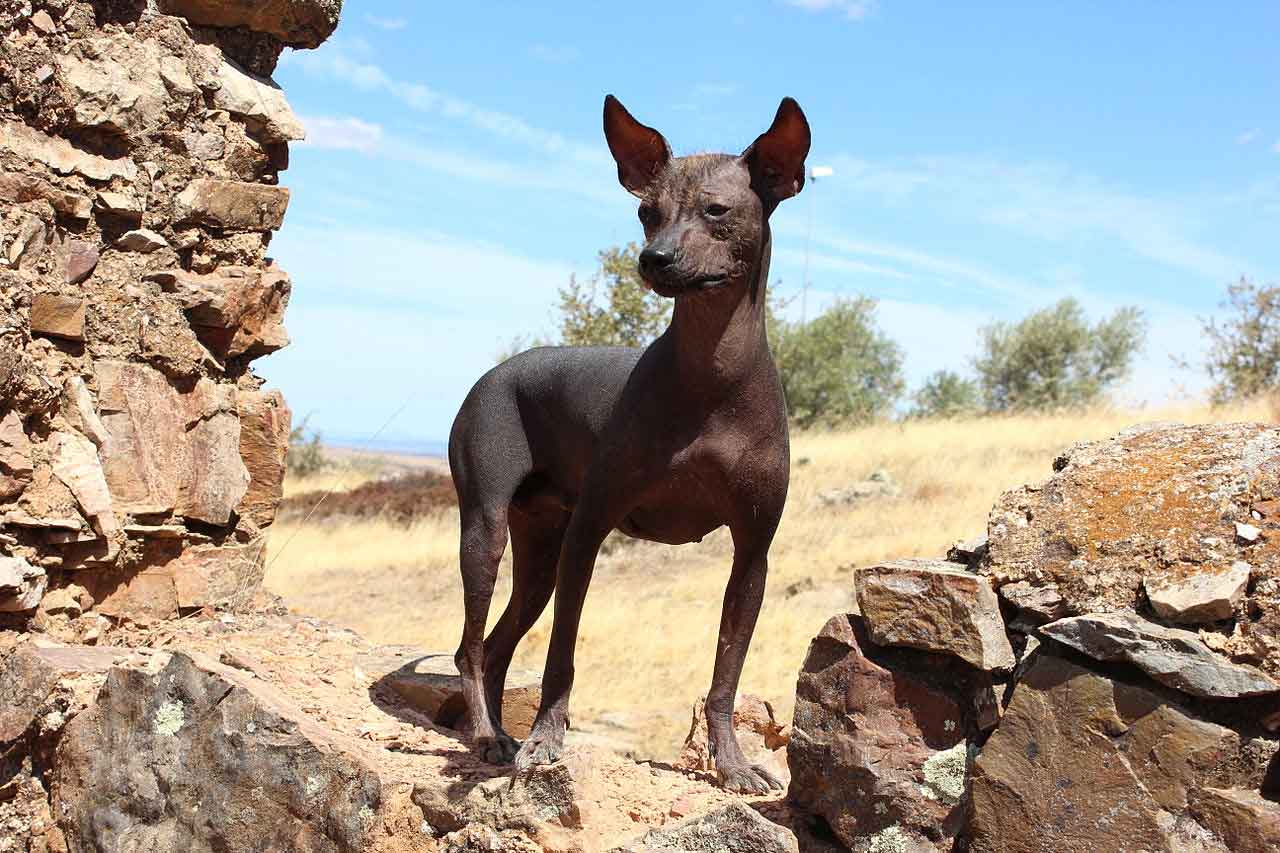
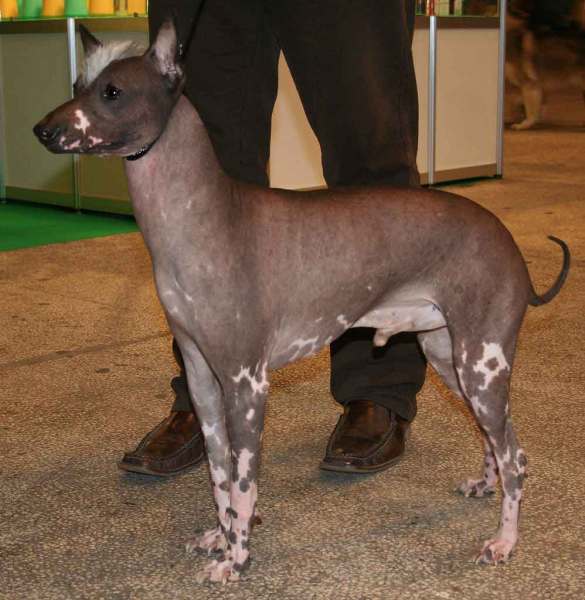
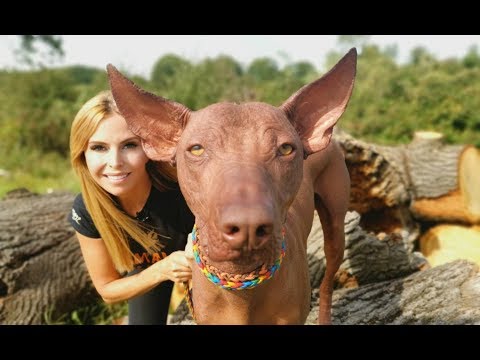
The name says it all: The most striking of the most Peruvian Hairless Dogs that's what's missing: the coat. But, the standard allows for some locks on the head and tail even in naked dogs without hair. Skin can be light or dark in different shades of color, smooth or white-spotted. But, not all naked dogs are naked, because there's a variant with hair: the so-called "hairy", which are essential for breeding for health reasons. About a third of naked dogs belong to this group.

Since 2013 hairy variants can also be seen in canine exhibitions, since they have been added to the standard. Your hair should be short and soft, all colors are allowed. The Peruvian Hairless Dog reminiscent of greyhounds in their physique. This slender breed of dog has large erect ears that can rest back, an elegantly curved and hanging tail and an athletic complexion.

Naked dog lovers can enjoy three size variations:

– The small version has a shoulder height of 25 to 40 cm..
– The median 40 to 50 cm..
– The Greats Peruvian Hairless Dogs have between 50 and 65 height cm.

The weight varies according to 4 to 25 kg. Only a few Peruvian Hairless Dogs have a full denture, but these usually include all representatives of the furry variant.

Character and skills

The Peruvian Hairless Dog is a friendly and adaptable companion. He prefers to be with his human with the one who has a close relationship. It belongs to very sociable dogs. He likes to integrate into a family and quickly befriends other pets and children. It is said that many Peruvian Hairless Dogs protect fervently, especially the women and children of the herd. Here it is important to be careful when visiting children that the Peruvian interprets offensive situations for his protégé and rushes to help his little two-legged friend unnecessarily..

Vivacious and curious, is a wonderful companion for outdoor activities, but behaves calmly and relaxed inside. He especially likes to get comfortable on his owner's lap and enjoys closeness and warmth.. To strangers he is often distant and alert, but not aggressive.

Education

Like a dog of the original type, the Peruvian Hairless Dog it also provides original behavior in the man-animal relationship. That's why it makes sense in educational matters if you already have any experience with dogs. But, even ambitious beginners can successfully train a Peruvian Hairless Dog. Clear rules and consistency are, as in most dogs, the key to success.

The Peruvian Hairless Dog is a sensitive four-legged friend – hard you'll only get the opposite with it – will retire. Some Peruvian Hairless Dogs tend to get scared or fear new situations. So, it is especially important to train this dog extensively and at the right pace to different situations without overloading it.

Your breeder will be able to give you some advice when you buy a puppy. Whether on a train journey, on a trip to the city center or on a visit home, introduce your partner into these everyday situations since you're a puppy. Regular training at a canine school, preferably already with the young puppy in the form of playgroups for puppies, is highly recommended and also reinforces the social side of the Peruvian Hairless Dog.

Breeding of the “Peruvian Hairless Dog”

As already mentioned, during mating a special health feature should be taken into account: during breeding, the furry ones, that is to say, hairy representatives of the breed, should be crossed regularly. The reason for this is that the dominant allele of hairlessness can only lead to viable embryos in combination with a hair allele, that is to say, Heterozygosity. Homozygous hairless embryos are already reabsorbed in the uterus. As pure breeding for hairlessness is therefore not possible, hairless naked dogs also occur over and over again.

The Peruvian Hairless Dogs they usually have an incomplete denture, what doesn't usually restrict them. With the light-skinned specimens, especially at the beginning of summer, it's important to make sure they get used slowly in the sunlight, then tanning. Sun protection also makes sense, because otherwise dogs can develop severe sunburn, especially when they like to go to sunny places. Also in winter some specimens need protection from the weather in the form of a dog coat., because if they can't run, cool down quickly during normal ride. Smaller variants of the breed are more sensitive to this than larger ones.

One Peruvian Hairless Dog can reach an age of up to 15 years.

Care

With the naked representatives of the breed you can leave the comb with confidence. It also, has the great advantage that it can normally detect parasites in the skin of the Peruvian Hairless Dog immediately and apply appropriate antidotes – from tick tweezers to flea repellent. But, even the Peruvian Hairless Dog needs regular care. If required – some owners recommend once a week – wash it with a sponge and a mild dog shampoo. Some Peruvian Hairless Dogs tend to have dry skin, which can be remedied with soft moisturizers for fragrance-free babies or with olive or coconut oil. In summer, sunscreen is an indispensable tool for light-colored dogs. Cut the claws of your Peruvian Hairless Dog if they get too long and clean your four-legged friend's ears with a dog ear cleaner if necessary.

Buy a “Peruvian Hairless Dog”

The Peruvian Hairless Dog are rare in Europe and therefore breeders are rare. Find the appropriate umbrella organizations in your country, that can help you in your search. In Germany, for example, el Club for Exotic Breed Dogs e.V. has a list of breeders, In Switzerland there is a "Swiss Naked Dog Club of Latin America", which is dedicated to the promotion of the two breeds of dogs: the Xoloitzcuintle and the Peruvian Hairless Dog. In these clubs and similar ones you can find information and contacts of ambitious breeders. Considering possible adoptions across national borders, consider what to consider when adopting puppies from abroad.

As a fan of naked dogs, you probably know the closely related races, the Xoloitzcuintle and the Chinese Crested Dog – perhaps one of these dogs could also be an option for you and is more likely to be found in your region. It also, openness to the other two races, as well as the crossings, it's usually a good idea if you want to give a home to a naked older dog. This usually requires some research. But in the meantime, Keywords like “naked dogs in distress” on the Internet promise successes that lead adult naked dogs to look for a new place to live. Try to find out as much as possible about the story of your potential new fourth-legged partner.

Characteristics "Peruvian Hairless Dog"

Coexistence is important that you have with your new friend. Before considering the acquisition of a dog of the breed "Peruvian Hairless Dog" you know certain factors. Not all breeds of dogs are apt to live in an apartment, you must take into account his character, their need for exercise, their interaction with other pets, their care and if you have small children, their level of tolerance towards them.

Training ?

4,0
4,0 of 5 stars (based on 30 reviews)
Great
Very good
Media
Mala
Very bad

Suitability of the apartment ?

3,0 of 5 stars (based on 1 review)

Can be alone all day ?

2,0 of 5 stars (based on 1 review)

Suitable as a first dog ?

3,0 of 5 stars (based on 1 review)

Weight gain ?

3,0 of 5 stars (based on 1 review)

Health ?

3,0 of 5 stars (based on 1 review)

Intelligence ?

3,0 of 5 stars (based on 1 review)

Kindness with child ?

3,0 of 5 stars (based on 1 review)

Tendency to bite ?

2,0 of 5 stars (based on 1 review)

Tendency to bark ?

3,0 of 5 stars (based on 1 review)

Tendency to flee ?

2,0 of 5 stars (based on 1 review)

hair loss strength ?

1,0 of 5 stars (based on 1 review)

Suitable as a guard dog ?

3,0 of 5 stars (based on 1 review)

Joy ?

3,0 of 5 stars (based on 1 review)

Cat friendliness ?

3,0 of 5 stars (based on 1 review)

Power level ?

3,0 of 5 stars (based on 1 review)

Images "Peruvian Hairless Dog"

Photos:

1 – «Hairless dog of Peru» by Paradais Sphynx, CC BY-SA 3.0, via Wikimedia Commons
2 – «Hairless dog of Peru» by No machine-readable author provided. Manuel González Olaechea assumed (based on copyright claims)., CC BY-SA 3.0, via Wikimedia Commons
3 – «Hairless dog of Peru» by Carlos Adampol Galindo from DF, Mexico, CC BY-SA 2.0, via Wikimedia Commons
4 – «Hairless dog of Peru» by Marina Alonso Esparré, CC BY-SA 4.0, via Wikimedia Commons
5 – «Hairless dog of Peru» by Carlos Adampol Galindo from DF, Mexico, CC BY-SA 2.0, via Wikimedia Commons
6 – «Hairless dog of Peru» by Carlos Adampol Galindo from DF, Mexico, CC BY-SA 2.0, via Wikimedia Commons
7 – «Hairless dog of Peru» by Pleple2000, CC BY-SA 3.0, via Wikimedia Commons

Videos "Peruvian Hairless Dog"

PERUVIAN DOG : The story of the VIRINGO dog, the mascot of ancient Peru

THE PERUVIAN HAIRLESS DOG - STRANGE OR CUTE?

Type and recognitions:

  • FCI CLASSIFICATION:
  • Group :
  • Section : . .

Federations:

  • – FCI – Group 5: Spitz-type dogs and primitive type – Section 6: Primitive type. ⓘ

FCI breed standard "Peruvian Hairless Dog"

Origin:
Peru

Date of publication of the valid original standard:
08.10.2012

Use:

Companion dog


General appearance:

According to its general confirmation, it is a slender and elegant specimen., whose aspect expresses speed, strength and harmony without appearing crude.
This breed's fundamental characteristic is the absence of hair on the body.. Another of its peculiarities is that its teeth, almost always, is incomplete. Of noble and affectionate character with those at home; reserved with strangers; awake, alert and guardian.

important proportions:

The relationship between the height at the withers and the length of the body is 1:1, allowing the body of the females slightly longer than that of the males.


Behavior / temperament:

Noble and affectionate with those at home while remaining awake and alert. In the presence of strangers, becomes suspicious and guardian.

Head:

Lupoid conformation.

Cranial region:
  • Skull:Mesocephalus. Ortoide (the direction of the superior cranio-facial axes is parallel), accepting slight divergence. The skull seen from the top is wide, tapering towards the nose.. Superciliary arches are moderately developed. The occipital crest is poorly marked.
  • Depression links (Stop): Bit strong (approximately 140°).

facial region:

  • Truffle:The color of the nose should harmonize with the color of the skin, in its various shades.
  • Snout:In profile, maintains a straight line.
  • Lips:The lips should be as tight as possible and adhere to the gums..
  • Jaws/Teeth:The incisors should fit for a scissor bite and the canines are normally developed. The absence of one or all pre-molars or molars is allowed. The jaw is poorly developed.
  • Cheeks:Normally developed.

Eyes:Of attentive and intelligent expression. They should be medium in size, slightly almond shaped, or sunk or bulging, with a normal and regular location, that is to say, neither too close nor too far. Color may vary from black, going through dark brown and in descending tones to yellow, harmonizing with skin color. In all cases both eyes must be the same color. The color of the eyelids may be from black to pink for specimens whose facial area is light, allowing those of light or pink colors but not being the most recommended.

Ears:The ears should be erect in attention, while at rest they are glued back. The ears are medium long, wide at the base and gradually tapering to an almost pointed end. Its insertion begins on the top of the skull, ending laterally and obliquely. The axes of the ears in the erect position can vary their angle relative to each other, approaching 90°.

Neck:

  • Top profile:Arcuate (convex).
  • Length:About the same length as the head.
  • Form:Looks like a truncated cone. Flexible and well-muscled.
  • Skin:Fina, smooth and elastic. Intimately adhered to the subcutaneous tissue. No double chin.


Body:

Mesomorfo.

  • top line:Rectilinear, although certain specimens mark a dorso-lumbar convexity, getting lost with the rump.
  • Cross:Little pointed.
  • Back: Rectilinear top profile, with well-developed back muscles, forming in many cases a muscular biconvexity along the entire dorsal region, extending to the lower back.
  • Pork loin:Must be strong and muscular. Its length is approximately 1/5 the height at the withers.
  • Rump:The upper profile is slightly convex. Its inclination with respect to the horizontal, makes an angle of approximately 40°. Solid and muscular in shape, ensuring a good push.
  • Breast :The chest seen from the front will have good width without being excessively, descending almost to the elbow. The ribs should be slightly arched and never flat. The perimeter of the chest measured behind the elbows should be approximately 18% greater than the height at the withers.
  • Lower profile / Belly:The lower profile is formed by a well-marked elegant line, starting at the lower part of the chest and determining in the ventral retraction, which should be well delineated without being excessive.

Tail:

The tail is set low. Good thickness at the start, tapering to the tip. In a state of action, the tail may rise forming a curve without actually curling over the back.. At rest he wears it hanging with a light hook with the tip up. Sometimes it is tucked into the belly. Its length will come close to the hock. The queue must be full.

Tips

Former members

Well attached to the trunk; viewed from the front will be perfectly plumb, not sticking out elbows. Your scapulo-humeral angle will range between 100° and 120°.
Side views, the resulting angle between the pasterns and the vertical is between 15° to 20°.

  • Front feet:Semi-lengths approaching the hare's foot. The pads are strong and heat resistant. The interdigital membranes are well developed. Preferably, the nails are black in the black specimens and clear in the lighter specimens.

Later members

The muscles are round and elastic. The curvatures of the buttocks are evident. The coxofemoral angle should be between 120° to 130°. The femoral-tibial angle should be 140°. The limbs seen from behind are well plummeted. The dewclaws must be removed.

  • Rear feet:Equal to the forwards.

Movement:

Due to the angulations already described in the structures of its members, these specimens move with a shorter but faster pace and at the same time quite cushioned and flexible.

Mantle

Skin: The skin will be smooth and elastic over its entire body surface, being able to form certain surrounding and almost concentric lines on the head, around the eyes and cheeks. It is proven that the internal and external or dermal temperature, is exactly the same as the other races. The absence of fur results in a totally direct emanation of heat unlike the specimens with hair, in which heat is dissipated through them by natural ventilation.

Fur: For being a naked race, will be missing cover, admitting vestiges of hair on the head, at the tip of the limbs, the tip of the tail and sometimes some very thin hairs on the back.

Color: The color of the hairs may vary from black to black specimens., black slate, black elephant, bluish-black, full range of gray, gradient dark brown to light blonde. All these colors can be uniform or with pink spots anywhere on the body.


Size and weight:

Height to the cross

There are three types of sizes for males and females.

  • Petit:Of 25 to 40 cm..
  • Medium-:Of 40 to 50 cm..
  • Grand:Of 50 to 65 cm..

Weight

The weight is in relation to the three sizes for males and females..

  • Petit:Of 4 to 8 kg.
  • Medium-:Of 8 to 12 kg.
  • Grand:Of 12 to 25 kg.


Fouls:

Any deviation from the above criteria is considered missing and the seriousness is considered to the extent of the deviation to the standard.

  • Semi-erect ears.
  • Presence of dewclaws on the hind limbs.

ELIMINATING fAULTS

  • Aggressive or fearful dog.
  • Upper or lower prognathism.
  • Deviation of the lower jaw.
  • Hanging or cropped ears.
  • Anurismo. Braqui Tourism. amputated tail.
  • Excess hair described in the standard.
  • Presence of hairs in other parts of the body where it is not indicated.
  • albinism.

Any dog ​​showing clear signs of physical or behavioral abnormalities must be disqualified..


N.B.:

Males should have two normal-appearing testicles., fully descended into the scrotum.

Source: F.C.I - International Cynological Federation

Alternative names:

1. Perro Sin Pelo de Perú, Inca Hairless Dog, Viringo, Peruvian Inca, Orchid, Calato, Peruvian Walking Dead dog, Dielmatian (English).
2. Chien nu Inca (French).
3. Peruanischen Nackthund (German).
4. Perro Sin Pelo del Perú, viram (Portuguese).
5. Perro calato, Perro chimo, Perro chimoc, Perro chimú, Perro de , orquídea peruano, Perro inca, Perro peruano, Perro peruano sin pelo, Perro pila, Perro sin pelo del Perú, Perro sin pelo peruano
Viringo
(español).

▷ The world of Pets: Dogs, cats, birds, reptiles, amphibians

Shikoku
Japón FCI 319 - Asian Spitz and related breeds

Shikoku

Less stubborn than the other Spitz breeds, the Shikoku, he is very little known outside his native land, Japan

Content

History

Ceramic figures from Japan that show representations of dogs have been preserved since ancient times., that look like this Japanese breed. The current breed dates back to crosses with the now extinct inu Japanese. The original field of application of these dogs was hunting, more precisely hunting in the prefecture of Kochi on isla de Shikoku – That is why the race is sometimes called «perro Kochi«. But, name Tosa-Inu, which is used in part in Japan, it's misleading, Because under the name «Tosa»There is also another Japanese race. It also, three varieties of Shikoku, which were named after the respective region in which they live: pity, Hongawa and Hata. As the Hongawa region was the most difficult to access in the past, This variety is considered to be the least modified by other influences and the closest to the ideal of Shikoku. Today, the Shikoku It is considered the national dog of Japan along with the Akita.

Photos:

1 – «Shikoku Inu» by https://pxhere.com/en/photo/1589477

Shikoku Physical Characteristics

the typical silhouette Spitz characterizes the Shikoku: It has relatively small, erect ears and a compact body. The tail is well placed and curled over the back. This medium-sized breed with a height at the withers of about 53 cm is located between the Akita bigger and the Shiba Inu smallest within the Japanese family Spitz. For many laymen in Europe this four-legged friend is also reminiscent of a dog which is seen much more often here, the Siberian Husky. The Shikoku coat can be black sesame or white sesame. The dense coat consists, as is typical in dogs of the type Spitz, on a long, hard top coat over a soft, dense undercoat.

Shikoku character and abilities

Shikoku

The loyalty, intelligence and a certain stubbornness form the character of this dog with an agile nature. He is vigilant and behaves in a neutral manner to the point of distancing himself from strangers. When they meet conspecifics, conflicts can occur, particularly with males, because the Shikoku tend to dominate. As a hunting dog it is characterized by its corresponding sharpness.

His original behavior can also be seen in his dealings with people – he likes to lick his reference people and looks for physical contact. Sometimes shows a conspicuous preference for unpleasant odors from the human point of view. The Shikoku He is very agile and likes to be outdoors – however impetuous it may be on the move here, a Shikoku busy behaves calmly and pleasantly indoors, where he appreciates quiet hours and pampering. Although he is a stubborn dog, not as strong as the other races of Spitz from Japan. But: The special character of Spitz not suitable for all dog lovers.

Photo:

2 – Shikoku, female. Colour: sesame by https://commons.m.wikimedia.org/wiki/File:Shikokusesame1.jpg

Shikoku Care

The coat of this Japanese hunting dog is robust and easy to care for, but it must be brushed regularly, especially during coat change twice a year. advice: If you brush your dog every day during this time, It will greatly reduce hair loss at home and also shorten the "hairy phase" in a few days. Outside these few weeks of the year, grooming every few days is enough. Check your ears right now too, so you can clean them with dog ear cleaner if needed. You must bathe your dog very rarely, at most every few months, and then use a mild dog shampoo. But, it makes sense to get the puppy used to bathing. But, it is usually sufficient to simply remove the dried dirt from the coat. Check the length of the claws – especially with older dogs – to shorten claws that are too long with special pliers. This is how injuries are prevented.

Shikoku Education

If he Shikoku respects his two-legged pack leader as a wise and just leader, will gladly follow your instructions. But, first you need to earn the respect of this dog. Be consistent and bring some tolerance to the small, thick skull of this four-legged friend, that will never be completely subordinate.

Screaming or harshness will not help you and will destroy your relationship with this loyal companion.. A thorough knowledge of dog training is needed to direct the dominance and hunting instinct of dogs. Shikoku in regular courses. Please, keep in mind that only a well-trained breed of dog can make a well-behaved friend, otherwise you will look for another job.

Attending classes with dog trainers in general can be of great benefit, so that the Shikoku that tends to dominate, get stronger in social affairs and learn to get along with other dogs. Male dogs in particular can face challenges that need to be countered from puppyhood. So do not underestimate the importance of the socialization phase, because any omission can only be corrected with difficulty.

Shikoku Health

These robust dogs are considered tough and persistent. They hardly have a genetic disposition for disease, if the breeding is done responsibly. It goes without saying that you should only buy puppies from a reputable breeder who belongs to a club.. The breeder will give you competent information about the care of your animal and show you the corresponding tests. In good health, Shikoku reaches an average age of about 13 years.

Where can I find my Shikoku?

The breed is one of the very rare breeds outside of Japan. Consequently, find a puppy of Shikoku can be difficult if you have decided to have one as a new member of the family. But don't despair, because there are a handful of serious breeders in Europe who are dedicated to this breed. The first official litter outside of Japan was in 2000 in the Netherlands, where the breeders of Shikoku continue to regularly deliver litters to responsible hands. But, you may have to accept a longer trip before you can give your puppy a hug from Shikoku. No matter how rare the breed is, don't reduce the demands you can and should make on serious parenting. Learn about puppy care, of your health, ask the breeders and ask them to show you the appropriate tests, for example, in connection with exams for hip dysplasia. Of course, the breeder must also belong to a club. Will be happy to give you some good advice, but in return you will also have some questions to see if you can offer a good home to one of your protégés.

If you are looking for a Shikoku adult, you will need a lot of luck in europe. It is more promising to look for crosses of type Spitz in animal shelters and also get an impression of the breeds of Nordic Spitz.

Characteristics "Shikoku"

Coexistence is important that you have with your new friend. Before considering the acquisition of a dog of the breed "Shikoku" you know certain factors. Not all breeds of dogs are apt to live in an apartment, you must take into account his character, their need for exercise, their interaction with other pets, their care and if you have small children, their level of tolerance towards them.

Training ?

2,0 of 5 stars (based on 1 review)

Suitability of the apartment ?

2,0 of 5 stars (based on 1 review)

Can be alone all day ?

2,0 of 5 stars (based on 1 review)

Suitable as a first dog ?

2,0 of 5 stars (based on 1 review)

Weight gain ?

3,0 of 5 stars (based on 1 review)

Health ?

5,0 of 5 stars (based on 1 review)

Intelligence ?

4,0 of 5 stars (based on 1 review)

Kindness with child ?

4,0 of 5 stars (based on 1 review)

Tendency to bite ?

3,0 of 5 stars (based on 1 review)

Tendency to bark ?

4,0 of 5 stars (based on 1 review)

Tendency to flee ?

5,0 of 5 stars (based on 1 review)

hair loss strength ?

4,0 of 5 stars (based on 1 review)

Suitable as a guard dog ?

4,0 of 5 stars (based on 1 review)

Joy ?

4,0 of 5 stars (based on 1 review)

Cat friendliness ?

2,0 of 5 stars (based on 1 review)

Power level ?

4,0 of 5 stars (based on 1 review)

Videos "Shikoku"

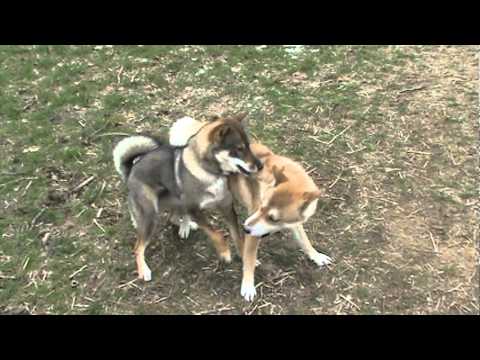
Shikoku Ken / Shikoku Inu play
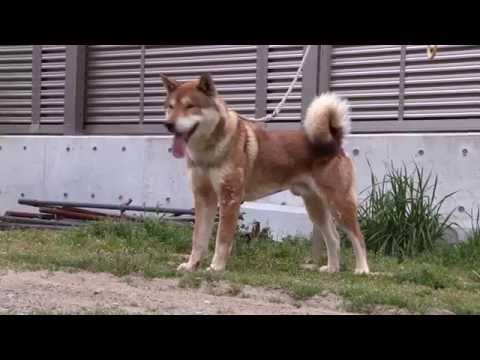
Shikoku ken in Japan Spring 2014 Shikoku dog
Shikoku ken in Japan Spring 2014 四国犬

Type and recognitions:

  • FCI CLASSIFICATION:
  • Group :
  • Section : . .

Federations:

  • – FCI – Group 5: Spitz-type dogs and primitive type – Section 5: Asian Spitz and related breeds. ⓘ
  • – CKC – [Without Miscellaneous] ⓘ

FCI breed standard "Shikoku"

Origin:
Japan

Date of publication of the valid original standard:
16.06.1999

Use:

Hunting and companion dog.


General appearance:

It is a medium-sized dog; And his musculature is well balanced, well developed and well defined. The ears are erect and the tail is curled or in the form of a hoz. Its structure is strong, Compact and solid bones.

IMPORTANT PROPORTION : The ratio of the height at the withers to the length of the body is 10 : 11.


Behavior / temperament:

It is a great resistance dog, vivacious with a sense of smell and acute ear. Is energetic and very alert, In addition to an enthusiastic hunter. With his master he is docile.

Head:

---

Cranial region:
  • Skull : Wide forehead.
  • Depression links (Stop) : shallow, although defined.

facial region:

  • Nose : Black.
  • Snout : Rather long and wedge -shaped. The nasal helm is straight.
  • Lips : Tight.
  • Jaws / Teeth : Strong teeth. The joint is in the form of scissors.
  • Cheeks : Well developed.
  • Eyes : Relatively small, triangular and well separated. Its color is dark brown.
  • Ears : They are small, triangularly and slightly inclined to the front. They appear well erect.

Neck:

Thick and strong.

Body:

  • Cross : High and well developed.
  • Back : Straight and strong.
  • Pork loin : Wide and muscled.
  • Breast : Deep. The ribs are well sprung.
  • Belly : Well collected.

Tail:

High implementation, It is thick and carried on the back firmly curved or curved like a hoose. The tip almost reaches the corvejón when the tail is down.

Tips

PREVIOUS MEMBERS :

  • Shoulder : Moderately inclined and developed muscles.
  • Elbows : They are well attached to the body.
  • forearms : Straight and well defined.
  • Metacarpus : Slightly inclined.

LATER MEMBERS : They're strong, well-developed muscles.

Hock : Moderately angular and very firm.

FEET : Well together; The fingers are well arched. The pads are hard and elastic. The nails are hard and black, or a dark color.

Movement:

Elastic, of small strides, Although light. The movement is fast, And it is possible to observe a quick rotation.

Mantle

HAIR : The outer hair of hairs is rough and straight. The undercoat of hairs is soft and dense. The tail hair is rather long.

COLOR : Sesame, Black Sesam and Sesam Red.

Sesam color definition :

• Sesame : Proportionate mix of black and white hairs.
• Black Sesam : More black hairs than white.
• Sesam rojo : Coat color red, mixed with black hairs.


Size and weight:

Height to the cross :

  • In males : 52 cm..
  • In females : 46 cm..

A tolerance of +/- 3 cm..


Fouls:

Any deviation from the aforementioned criteria is considered as a fault and the severity of this is considered to the degree of the deviation to the standard and its consequences on the health and well-being of the dog..

• Inverted sexual characteristics.
• Lightweight lower prognathism.
• Wide.
• Shyness.

MISS PLAYOFFS

• Aggressive or fearful dog.
• Pronounced upper or lower prognathism.
• Ears that do not appear upright.
• Hanging tail, short tail.

Any dog ​​showing clear signs of physical or behavioral abnormalities must be disqualified..


N.B.:

Males should have two normal-appearing testicles fully descended into the scrotum..

Source: F.C.I - International Cynological Federation

Alternative names:

1. Kochi-ken, Shikoku-ken, Shikoku inu (English).
2. chien de Kōchi, shikoku-inu, kochi-ken, Shikoku inu (French).
3. Shikoku inu, Kochi-Ken, Shikoku-ken (German).
4. Shikoku inu, kochi-ken, Mikawa Inu, Shikoku-ken, cão-lobo japonês (Portuguese).
5. Kochi-ken, Shikoku-ken, Shikoku (español).

▷ The world of Pets: Dogs, cats, birds, reptiles, amphibians

Japanese Spitz
Japón FCI 262 - Asian Spitz and related breeds

Japanese Spitz

The Japanese Spitz he is a very people-oriented dog.

Content

History

The strong similarity to the Mittelspitz (Standard or Medium Spitz) German allows us to suppose that the Japanese spitz descends from this same race. Other cynologists assume that the Spitz descends from the Nordic Spitz. One thing is for sure: the origin of Japanese spitz not in japan, but in Europe. From there he arrived in Japan at the beginning of the 20th century along with travelers.

The attractive white dog with the charming character quickly gained popularity among the Japanese population. With more caps from China, Canada and the US, own breeding was established in Japan in the years 20. While in Europe an attempt was made to increase the size of the lace, thus creating the German Spitz, the Japanese tended to opt for the more original compact form. In 1948 the Japanese Kennel Club established a first breed standard for the first time. As country of origin, Japan was indicated in the standard. The FCI, that has officially recognized the Japanese spitz from 1964, includes it today in the Group 5 (Spitz and dogs of the original type), as well as in the Subsection 5 (Asian Spitz and related breeds), under Standard No. 262.

In his native Japan, the Japanese spitz it was very popular for a long time, especially in the years 50 the last century. Although it is still more common there in terms of numbers than in Europe, the demand of the little companion is gradually changing. While in Japan the number of recently registered puppies is declining, is increasing in North America and Europe.

Physical characteristics «Japanese Spitz»

This breed is distinguished by the fact that it is exclusively pure white.. Thanks to his straight and dense hair, the Japanese Spitz seems strong. What is no less important, it is also caused by the swollen inner layer. The beautiful ruffle on the shoulder, neck and sill contributes to attractive appearance. Typical of the tail is a long and voluminous flag.

Despite her short legs, the Japanese Spitz is sporty and extremely agile. Due to its balanced proportions, the appearance of this compact pedigree dog is both striking and harmonious.

The height at the cross – the elevated transition from neck to back – tends to be of 30 to 38 cm in adult males. Females reach a somewhat smaller size. The Japanese Spitz weighs between 4,5 and 11 kg.

Character and abilities «Japanese Spitz»

The well balanced nature of the Japanese Spitz fits the very harmonious appearance. He is an attentive guard. Anyone who approaches him is not immediately signaled with a savage bark. Only when the Japanese pedigree dog feels a serious threat, gets loud and fights back vehemently.

At home, the Japanese Spitz behaves quite calmly. Abroad, on the other hand, he likes to show the energy he has inside him. To enjoy the Japanese Spitz, you must like a little dog who likes to play. You should also have fun on long trips with your four-legged friend.

The Japanese Spitz he is a very people-oriented dog. Whether it belongs to one person or has a master or caregiver at the same time, he does not care. He also likes to live with the family. The company of people is the priority. Pets or other pets are not enough. Although the Japanese spitz usually get along with them. So if you're short on time for a dog, a Japanese Spitz probably not the right thing for you.

The white puppy enjoys the company of people and would like to be with them always and everywhere.. He is very receptive and eager to learn. Which makes education in combination with devotion quite easy even for untrained dog owners.

An apartment in the city is suitable for him, as long as you are well occupied with extensive walks and activities.

«Japanese Spitz» Care

Despite the hereditary predisposition to many diseases, Many of the ailments can be avoided by taking proper care of your Spitz. Dental problems in particular can be prevented through regular dental care, that is to say, brush your teeth at least once a week, or better daily. Diseases or inflammations of the eyes, nose, ears and claws can also be detected and treated at an early stage through proper care and regular check-ups. Another important aspect of grooming is the care of the coat of the Japanese spitz. Despite the impressive and luxurious fur, This is not very elaborate and therefore it is usually sufficient if the hair is combed or brushed thoroughly twice a week. Only in the coat change phase (twice a year) grooming effort increases until daily styling.

Japanese Spitz health

An indication of good and serious parenting is the presentation of genetic test results.. The breeding animals used must have an impeccable genetic makeup to exclude genetic diseases from the start. Dogs in which hereditary diseases typical of the breed have occurred should be excluded from breeding for the sake of the health of the breed. This also includes the tendency to dislocate the patella (slipping of the patella out of its guide), which can also be inherited in many dogs, especially in small dog breeds. Also eye problems, such as distichiasis or narrowing of the tear ducts, as well as dental problems can occur with the Japanese spitz. No other diseases typical of the breed are known..

The correct nutrition of the «Japanese Spitz»

In a special way, correct nutrition contributes to the health and well-being of the Japanese spitz. Small dogs with a very compact constitution have a strong tendency to be overweight. Too many pounds can easily lead to joint disease and heart and circulation problems.. Overweight dogs are also at higher risk for diabetes.

As the owner of a Japanese spitz, you should always keep the amounts recommended by food manufacturers. It also, the dog should not be given too many treats between meals.

It is not only the quantity but also the quality of the food that is important. Besides vegetables or rice, good dog food consists largely of high-quality meat. Poor quality food often contains an excessive amount of cereals. Under no circumstances should it contain flavor enhancers or sweeteners.

Before buying, you should find out the exact composition of the dog food in the manufacturer's instructions. Several vendors offer good and safe dog food, both dry and wet.

It is not unusual for dog owners to prefer homemade dog food. This can also be an alternative to the ready-to-eat food available in stores for the Japanese spitz. But, it is essential that you acquire the necessary knowledge to cook balanced dog food for yourself.

The diet BARF it is also a good way to feed Japanese spitz with a healthy diet. BARF means «Bone And Raw Food» (Bones and raw foods). All food components, like meat, fish, vegetables or fruit, they are only given raw. Various vendors and specialty stores facilitate BARF to the dog owner. Like cooking food, this feeding method requires a certain amount of knowledge about the correct use of raw ingredients.

You must feed a puppy of 3 to 5 times a day, an adult raw food and bones 2 times a day.

Buying a "Japanese Spitz"

Despite the growing popularity and demand in the European and American continent, the Japanese spitz still belongs to the rare dog breeds. The waiting period for a new litter at a breeder can be very long. Who doesn't necessarily care about a purebred puppy, but also consider buying a Spitz adult, should – parallel to the search for a breeder – also look around the animal shelter, where over and over again Spitz or the crosses of Spitz they are waiting for a new and loving home. A puppy, on the other hand, should only be purchased from a serious and certified breeder.

How do I recognize a serious breeder?

When choosing a suitable breeder, various factors play a role. It's not just the "formalities" that must be correct, that is to say, the papers, the pedigree and the contract of sale, but also the personal reasons that ultimately decide the purchase. The breeder must, first, be understanding with you, and this cannot be found out with a short email or a short phone call. One or better several meetings are necessary to get a complete picture of the breeder and his dogs.. Does the breeder invite you to his house? Do you willingly show your "kennel" and do the animals live in close contact with the breeder's family? The first weeks are very important for the socialization of the puppies and therefore the environment must correspond absolutely to the affectionate nature of the puppies. Japanese spitz. It also, a serious breeder will be able to tell you a lot about the breed and its characteristics. They will also ask you about your life circumstances to make sure your puppy has fun with you..

Characteristics "Japanese Spitz"

Coexistence is important that you have with your new friend. Before considering the acquisition of a dog of the breed "Japanese Spitz" you know certain factors. Not all breeds of dogs are apt to live in an apartment, you must take into account his character, their need for exercise, their interaction with other pets, their care and if you have small children, their level of tolerance towards them.

Training ?

5,0 of 5 stars (based on 1 review)

Suitability of the apartment ?

4,0 of 5 stars (based on 1 review)

Can be alone all day ?

2,0 of 5 stars (based on 1 review)

Suitable as a first dog ?

5,0 of 5 stars (based on 1 review)

Weight gain ?

5,0 of 5 stars (based on 1 review)

Health ?

4,0 of 5 stars (based on 1 review)

Intelligence ?

4,0 of 5 stars (based on 1 review)

Kindness with child ?

5,0 of 5 stars (based on 1 review)

Tendency to bite ?

2,0 of 5 stars (based on 1 review)

Tendency to bark ?

2,0 of 5 stars (based on 1 review)

Tendency to flee ?

2,0 of 5 stars (based on 1 review)

hair loss strength ?

5,0 of 5 stars (based on 1 review)

Suitable as a guard dog ?

3,0 of 5 stars (based on 1 review)

Joy ?

4,0 of 5 stars (based on 1 review)

Cat friendliness ?

4,0 of 5 stars (based on 1 review)

Power level ?

4,0 of 5 stars (based on 1 review)

Images "Japanese Spitz"

Photos:

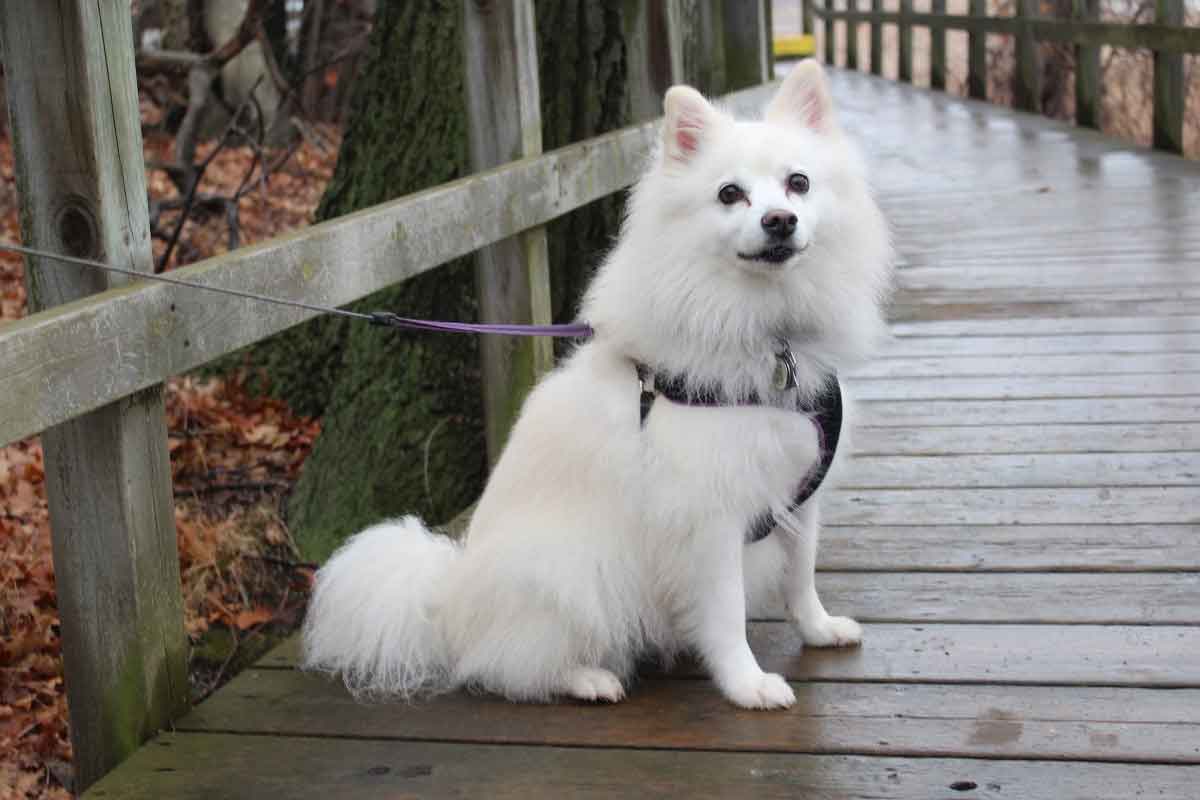
1 – Japanese spitz by https://pxhere.com/es/photo/1273902
2 – Japanese Spitz Siberia by 0894Leanne, CC BY-SA 3.0, via Wikimedia Commons
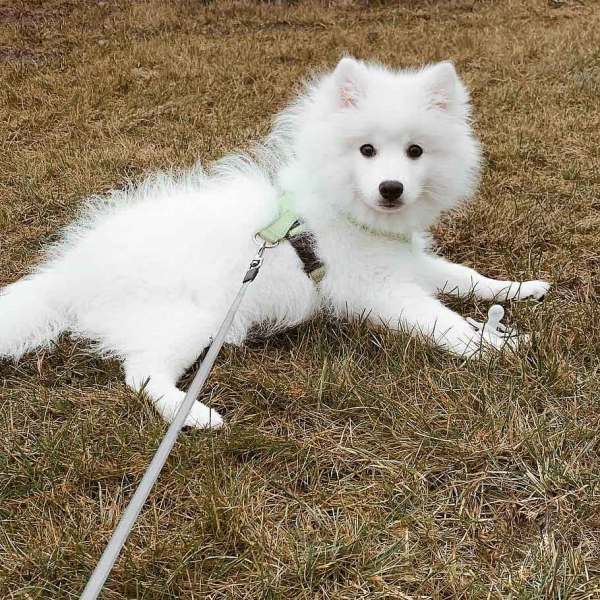
3 – Japanese Spitz Puppy by mostlegendary@gmail.com, CC BY-SA 3.0, via Wikimedia Commons
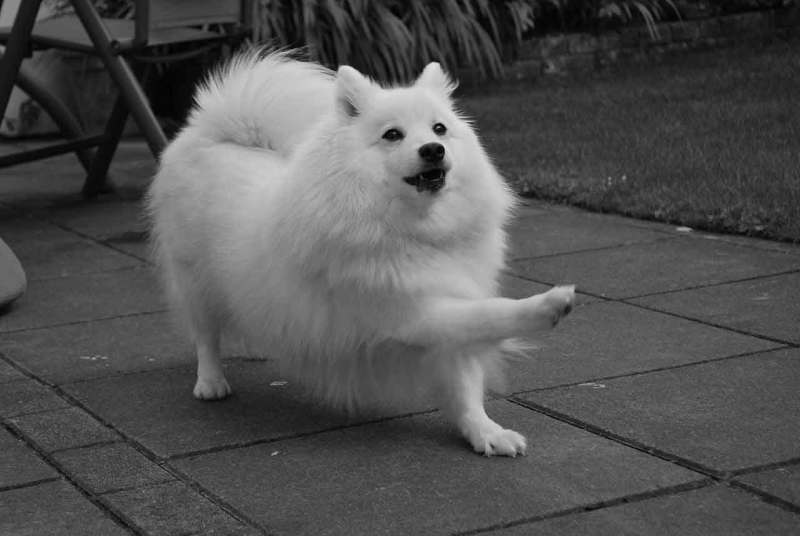
4 – Japanese spitz by https://www.pikist.com/free-photo-sixhn
5 – Japanese spitz by https://www.pxfuel.com/en/free-photo-xghfb
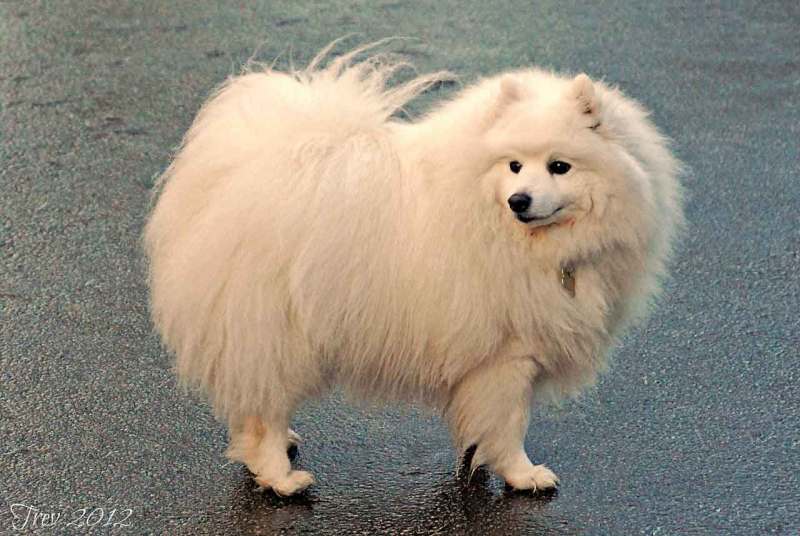
6 – Japanese Spitz by Trev Grant, CC BY 2.0, via Wikimedia Commons
7 – Japanese Spitz by https://www.pikrepo.com/fflza/japanese-spitz-near-wall

Videos "Japanese Spitz"

Kubo - Japanese Spitz Puppy - 2 Weeks Residential Dog Training
Kubo – Japanese Spitz Puppy – 2 Weeks Residential Dog Training
Japanese Spitz / Breed of dog
"Japanese Spitz" / Breed of dog

Type and recognitions:

  • FCI CLASSIFICATION:
  • Group :
  • Section : . .

Federations:

  • – FCI – Group 5: Spitz-type dogs and primitive type – Section 5: Asian Spitz and related breeds. ⓘ
  • – ANKC – Group 7 (Non-Sporting) ⓘ
  • – CKC – Group 6 – Non-Sporting ⓘ
  • – ​KC – Utility ⓘ
  • – NZKC – Non-Sporting ⓘ
  • – UKC – Northern Breed Group ⓘ

FCI breed standard "Japanese Spitz"

Origin:
Japan

Date of publication of the valid original standard:
16.06.1999

Use:

Companion dog.


General appearance:

Its body is covered with abundant white fur., the snout is sharp, triangular and erect ears, The tail is covered with long feather-shaped hair and curls over the back.. Robust and well balanced constitution, Its harmonious beauty gives it a lively appearance and dignity characteristic of this breed., that at the same time denotes elegance.

IMPORTANT PROPORTION : The relationship between the height at the withers and the length of the body is 10 : 11.


Behavior / temperament:

It is an intelligent dog, joyful, with keenness of senses. Boisterous nature is not allowed.

Head:

The size of the head should be in harmony with the body and should be moderately wide and rounded.

Cranial region:
  • Skull : The forehead is moderately developed. The back of the skull is very wide.
  • Depression links (Stop) : Defined.

facial region:

  • Nose : Small, rounded and black.
  • Snout : Pointed, the tip slightly rounded and well balanced. Lips adherent and preferably black.
  • Jaws / Teeth : Strong white teeth with scissor bite.

Eyes : Moderately large, almendrada form, placed slightly oblique, dark colored. The edges of the eyelids black.

Ears : High insertion, small, triangular, upright, directed forward and placed not too far apart.

Neck:

Moderately long and very muscular.

Body:

  • Cross : High.
  • Back : Straight and short.
  • Kidney region : Wide.
  • Chest : Wide and deep, well arched ribs.
  • Abdomen : Well collected.

Tail:

High insertion, moderately long and carried on the back.

Tips

PREVIOUS MEMBERS : Well inclined shoulders, forearms straight and elbows close to the body.

LATER MEMBERS : Muscular, the femoro-tibio-patellar joints (knees) and tibio-tarsals (hocks) moderately angled.

FEET : Cat feet. Thick and desirably black pads, the same as nails.

Movement:

Fast and active.

Mantle

HAIR : The hair of the outer coat is straight and remains separated. The hair of the undercoat is short, dense and soft texture. The face, the ears, the front part of the limbs and under the hocks are covered with short hair; the rest of the body is covered with long, abundant hair, especially from neck to shoulders, and the parapet that has a beautiful ruff of hair. The tail also has abundant long feather-shaped hair..

COLOR : Pure white.


Size and weight:

Height to the cross :

  • Males : 30 – 38 cm..
  • females : slightly smaller than males.


Fouls:

Any deviation from the aforementioned criteria is considered as a fault and the severity of this is considered to the degree of the deviation to the standard and its consequences on the health and well-being of the dog..

• Upper or lower prognathism.
• Firmly coiled tail.
• Shyness, noisy dog.

MISS PLAYOFFS

• Aggressive or fearful dog.
• Floppy ears.
• Tail not carried over the back.

Any dog ​​showing clear signs of physical or behavioral abnormalities must be disqualified..


N.B.:

Males should have two normal-appearing testicles fully descended into the scrotum..

Source: F.C.I - International Cynological Federation

Alternative names:

1. Nihon Supittsu (English).
2. Nihon Supittsu (French).
3. Nihon Supittsu (Japan-Spitz), Japanischer Spitz (German).
4. Nihon Supittsu (Portuguese).
5. Nihon Supittsu (español).

▷ The world of Pets: Dogs, cats, birds, reptiles, amphibians

Korea Jindo Dog
Corea del Sur FCI 334 . Asian Spitz and related breeds

The Korea Jindo Dog It is the classic single master dog.

Korean Jindo

Content

Characteristics "Korea Jindo Dog"

Coexistence is important that you have with your new friend. Before considering the acquisition of a dog of the breed "Korea Jindo Dog" you know certain factors. Not all breeds of dogs are apt to live in an apartment, you must take into account his character, their need for exercise, their interaction with other pets, their care and if you have small children, their level of tolerance towards them.

Training ?

2,0 of 5 stars (based on 1 review)

Suitability of the apartment ?

2,0 of 5 stars (based on 1 review)

Can be alone all day ?

1,0 of 5 stars (based on 1 review)

Suitable as a first dog ?

1,0 of 5 stars (based on 1 review)

Weight gain ?

3,0 of 5 stars (based on 1 review)

Health ?

4,0 of 5 stars (based on 1 review)

Intelligence ?

4,0 of 5 stars (based on 1 review)

Kindness with child ?

3,0 of 5 stars (based on 1 review)

Tendency to bite ?

3,0 of 5 stars (based on 1 review)

Tendency to bark ?

4,0 of 5 stars (based on 1 review)

Tendency to flee ?

5,0 of 5 stars (based on 1 review)

hair loss strength ?

4,0 of 5 stars (based on 1 review)

Suitable as a guard dog ?

5,0 of 5 stars (based on 1 review)

Joy ?

4,0 of 5 stars (based on 1 review)

Cat friendliness ?

2,0 of 5 stars (based on 1 review)

Power level ?

4,0 of 5 stars (based on 1 review)

History

Korea Jindo Dog

The exact origins of this dog breed are lost in the dark of history.. With a probability that borders on certainty, it can be assumed that the breed is actually of Korean origin, more precisely from the island of Jindo in southwestern Korea. Due to the isolated geographic location, this type of dog was only found here. Finally, an export ban on the breed was imposed, which is still valid today.

In his homeland., the Korea Jindo Dog is under the protection of nature and species. In 1938 the breed was declared the national animal of Korea. But, some quadrupeds have crossed the borders: In the Decade of 1980, local people smuggled specimens into the US. In 2003 took place in Great Britain the first official exhibition of a Korea Jindo Dog outside asia. In the USA., the Korean Association of Jindo of America" ​​is now working to preserve this breed.

Physical characteristics

This four-legged Korean friend is one of the best in Asia. With a weight of about 14 to 21 kilograms and a height of 34 to 47 cm to the cross, the Korea Jindo Dog belongs to medium-sized dogs. Carries its tail curled or sickle-shaped on its back. The relatively small, upright ears are also typical of the point..

While in Korean standardized breeding only white and red coat colors are recognized, depending on the frame organization the following other coat colors are allowed: kitsch, black and tan, grey, black and Brindle.

Character and skills

The Korea Jindo Dog shows the corresponding original features. It is considered to be independent, territorial and has a strong hunting instinct, what can make living with other pets impossible, but it doesn't have to be that way with good socialization.

The breed is not easily disturbed and is characterized by great loyalty to its keeper.

It is reserved with strangers: When used as a watchdog, the Korea Jindo Dog indicate in a way the defense of your home your home. Many representatives of the breed do not accept food from strangers. These dogs are playful and intelligent, sometimes even "too smart", because they can learn to open doors, for example.

When looking for a Jindo, always look for responsible breeders – unfortunately there are also alleged breeders who have bred the Jindo for backyard dogfighting or otherwise have disproportionately promoted the aggressive side of this dog.

Education of the “Korean Jindo Dog”

Consistent and clear communication, as well as some experience with dogs are necessary for the education of a Korea Jindo Dog. The docile dog is not only characterized by its intelligence, but also for its primitive behavior and great independence, that you must direct in a controlled way.

As the leader of the pack it is your task to make it clear to him that you know for sure and with confidence where to go.. The Korea Jindo Dog quickly use uncertainties and exceptions to take the helm himself. But, never confuse strong and confident leadership with toughness, as this could destabilize the Korea Jindo Dog and not just destroy educational successes, but also lastingly disturb the bond between you and your partner.

A dog school is a recommended opportunity to introduce the Korea Jindo Dog to other dogs of the same species and to further socialize them.

Health of the “Korean Jindo Dog”

Robust Spitz

It is considered that Korea Jindo Dog it is a robust breed of dog, that he hardly has a predisposition to genetic diseases. Healthy animals can reach an average age of 13 years. The most important health precautions are already taken before birth, thanks to the experience of experienced breeders, that minimize the risk of disease by selecting suitable parent animals, including appropriate preventive exams. Accumulation of the autoimmune disease discoid lupus erythematosus has occasionally been reported (DLE). This skin disease is usually treated for life.

It also, there are some cases of hypothyroidism, what is the lack of thyroid hormone supply to the body. In the Korea Jindo Dog this disease is usually manifested through aggression or apathy and changes in the coat. Otherwise, The same as us, two legged friends, sufficient exercise and healthy nutrition are other important pillars of health. Increased risk of food intolerance in some Jindos can also be counteracted with a balanced diet.

Nutrition of the “Korean Jindo Dog”

A high-quality, grain-free, meaty diet is, fortunately, not just appropriate for the species, but also tasty. Both are important criteria, since it is considered that the Korea Jindo Dog is relatively selective. It is best to accustom him to several varieties of the same quality from the age of the puppy. This way you won't find yourself in a situation where, due to prescription changes or delivery issues, suddenly there is no more pet food and you have no alternative. It also, you can usually change different known foods of the same quality without your dog having digestive problems.

Regarding the amount of daily feeding, manufacturers' information can only give approximate values. If you notice that your Jindo is gaining too much weight, adjust your diet accordingly. You should also include treats in your daily ration. It's best to stick to healthy treats, like dental care snacks or dog treats that are 100% meat. Sugar has no place in reward food or snacks. With dry chews such as special dog bones or cow's ears, which are much less greasy than pig's ears, you can satisfy your friend's chewing needs from your Korea Jindo Dog.

Make sure he always has enough water around him to quench his thirst at any time.

Care of the “Korean Jindo Dog”

The coat of this breed consists of a soft undercoat, depending on the season, and a hard coat. Especially during the coat change twice a year, the Korea Jindo Dog lose a lot of hair. You can limit hair loss on the floor accordingly, combing daily. Outside of coat change time, a weekly hairstyle is enough. At this time you can also check their ears and eyes for dirt and if they need to be cleaned with special ear and eye cleaners for dogs..

The dirt on the coat is better to let it dry and then comb it out. A bath is not normally necessary, but it may be a good idea to gently accustom the Korea Jindo Dog, to a bathroom when he's still a puppy, so it can be cleaned every few months. Be sure to use a mild dog shampoo to avoid damaging the dog's own skin.. Take a regular look at the claws, especially with older dogs. If they are too long, shorten them with claw scissors. This will prevent your dog from getting painfully stuck with them and possibly injuring himself.

Activities with the “Korean Jindo Dog”

give to you Korea Jindo Dog plenty of room to run, also as a jogging partner, but always on a leash. Also for free rescue and search dog work not suitable due to strong hunting instinct. Some Jindos like to learn tricks and play with various toys with great pleasure., that are available in stores. By the way, the Korea Jindo Dog normally stays away from water, so the common splash in the lake should not be included in the list of possible destinations. Many Korea Jindo Dog they even avoid small streams or puddles, refuse to cross a bridge or do not want to go outside in the rain. To enjoy travel without restrictions, should show the young dog that the water on the trail is not a cause for concern and casually, and possibly supported with treats, get used to the unwanted item. Don't force your Jindo to jump into a pond or something similar – will probably never turn into a water rat.

Before Buying a “Korean Jindo Dog”

Few dog lovers in Europe are likely to ask this question, since the Korea Jindo Dog It's very weird. It also, you must be a nature lover and have a house or apartment at ground level in the countryside, because this four-legged friend must have a fenced-in property at his disposal, who can monitor. The fence must be generously planned, because the breed has a clear talent for jumping. So, The minimum height of a fence should be 1,80 m. But still keep an eye on your four-legged friend: Many young Jindo, if you have been alone for too long, the urge to discover has taken hold of him: The cunning dogs have quickly learned that a path can be prepared by digging even under fences.

In any case, the intelligence of Jindo can be too much for quite comfortable dog owners who are supposed to keep you physically and mentally busy. This active and above average dog will take up a lot of time on your trips together, because you need to go out, what should normally be done on a leash due to his hunting instinct.
Can be well kept in a family, also with children. Sociable four-legged friend doesn't like to be alone, so he must either be left alone for a very short time or you keep him together with another dog. In Korea it is common for dogs to live outside the house.

The breed is excellent as a guard dog and often recognizes family acquaintances and friends from a distance. You can also befriend the postman if you make it clear that you are one of the "good guys.".

Where can I find a “Korean Jindo Dog?”?»

In Europe it is not easy to find a Korea Jindo Dog; for example, in Germany not a single litter has been registered in recent years and there are no active breeders. Here it is necessary to investigate to find the nearest breeder. Of course, some breeders also export from abroad, for example from the United States, but this is time consuming and should only be considered for absolute connoisseurs and lovers of the breed. But, might be worth taking a look at asian races Shiba Inu and Akita, which are much more common in Europe and have some similarities to the Korea Jindo Dog. When adopting a puppy from abroad, please consider the relevant entry requirements and especially the necessary vaccinations.

If you are looking for a Korea Jindo Dog adult, you must be on a real winning streak to find one in Europe. It is true that dog owners sometimes underestimate the time and knowledge required for education and harmonious coexistence with a Korea Jindo Dog and, therefore, they give up their four-legged friend. But, this is extremely rare in Europe due to the very small number of Korea Jindo Dog.

Images "Korea Jindo Dog"

Photos:

1 – Korea Jindo Dog by https://pixabay.com/es/photos/perro-feliz-sol-perro-feliz-1792601/
2 – Korea Jindo Dog by https://pixabay.com/es/photos/progreso-perro-jindo-coreano-perro-1138824/
3 – Korea Jindo Dog by https://pixabay.com/es/photos/cachorro-perro-el-progreso-del-perro-1874281/
4 – A male Korea Jindo Dog. Colour: red by Canarian / CC BY-SA
5 – Korea Jindo Dog by https://flic.kr/p/dYtSF9
6 – A male Korea Jindo Dog. Colour: red. by Canarian / CC BY-SA

Videos "Korea Jindo Dog"

HTTPS://youtube.com/watch?v=KFZg8QknBB8
Korean Jindo – TOP 10 Interesting Facts
HTTPS://youtube.com/watch?v=GvesVZwyuCc
Jindo or Chindo Dog – Breed of dog

Type and recognitions:

  • FCI CLASSIFICATION:
  • Group :
  • Section : . .

Federations:

  • – FCI – Group 5: Spitz-type dogs and primitive type – Section 5: Asian Spitz and related breeds. ⓘ

FCI breed standard "Korea Jindo Dog"

Origin:
South Korea

Date of publication of the valid original standard:
13.07.2005

Use:

Without working trial.


General appearance:

The Korea Jindo Dog is a medium-sized dog, well proportioned, used for hunting and as a guard. Its pricked ears and coiled or sickle-shaped tail give it a vivid expression of agility., Fortress, vigilance and dignity.

IMPORTANT PROPORTIONS : Relationship between the height of the cross : body length = 10:10,5.


Behavior / temperament:

The Korea Jindo Dog has a very strong hunting instinct.; In addition to being bold, bravo, alert and careful, not allowed to tempt easily and is hot-headed. First and foremost, is extremely faithful to its owner. It is reserved with strangers. In general, is not affectionate with other animals, especially if male. It also has a good sense of orientation. It is a dog of a single owner; He quickly agree to a new owner but it never forgets its ties with the previous owner who raised him since that was puppy. Stays clean and eat little.

Head:

In general, The head forms an obtuse triangle when viewed from above and should not make the dog appear clumsy or clumsy..

Cranial region:

The skull is medium in size in proportion to the body.. The top is slightly rounded, and gradually thins to the eyes. The width between the ears is moderate in relation to the size of the head.

  • Stop : Well defined, but not too abrupt. It has a slight furrow that extends to the forehead.

facial region:

  • Nose : black. In case of white dogs, flesh colored nose is allowed.
  • Snout : The muzzle should not be bulging or raised.
  • Lips : Blacks; well closed, They are thin and not pendulous; the upper lip slightly covers the lower lip.
  • Bite / Teeth : Very strong, scissor bite.
  • Cheeks : Well developed, thin and moderately round when viewed from the front or side; narrowing to the tip of the nose.
  • Eyes : dark brown color, somewhat small in proportion to head size, almond-shaped and very expressive. The outer corners of both eyes are slanted towards the ears.
  • Ears : Medium-sized, form triangular, thick and perfectly erect; insertion ears neither high nor low, directed slightly forward in line with the back of the neck. The presence of fine, dense hair on the inside of the ears is desirable..

Neck:

Something balanced and thick, without jowl, strong, with good musculature. The Korea Jindo Dog wears its neck proudly and arched well when excited..

Body:

  • Back : Strong and straight.
  • Pork loin : With good muscles, stiff, thin and narrower than the rib cage.
  • Breast : Strong and moderately deep, but not too wide. The deepest point of the chest reaches just above the elbow, but it is also acceptable for it to reach elbow level. Well arched ribs. Fairly developed chest.
  • Belly : Withdrawn.

Tail:

When it hangs up, the tip of the tail should reach the tibiotarsal joint. Rather tall insertion root; is straight and firm and should not sway when the dog moves. Whether sickle-shaped or rolled, the tip of the tail touches the back or flank. It should not be too twisted. The tail has abundant feathers.

Tips

PREVIOUS MEMBERS : Seen from the front, they are straight and parallel.

  • Shoulder : Strong and powerful and well inclined.
  • Elbows : Glued to the body, no outward or inward deviation.
  • Metacarpus : Slightly bent forward, when viewed from the side.
  • Pies : Cat feet. Rather short fingers, rounded, compact and firm. Strong nails, preferably black. Thick, well-cushioned ear pads.

LATER MEMBERS : Viewed from the side, They are moderately angled; seen from the back, they are straight, parallel and not too far apart or too close to each other. Dewclaws must be removed except in countries where their excision is prohibited..

  • Thighs : well developed.
  • Legs : Moderately angled.
  • Tibio-tarsal and metatarsal joints : Placed very low; they are not straight but moderately angled.
  • Hind feet : Identical to the previous ones.

Movement:

The movement of the Korea Jindo Dog is powerful and firm. The back should remain firm and level, and the hind limbs should not oscillate. When jogging, keep your head high, but as the speed increases, the head is carried low, almost at shoulder level. The upper part of the tail moves slightly according to the change of direction the dog makes..

Mantle

HAIR : The Korea Jindo Dog has a double coat of hair. The inner layer is smooth, dense, pale, But enough to sustain the outer layer. The outer layer is stiff and somewhat separated from the body. Compared with the hair covering the body, the hair of the head, members and ears is shorter, and neck, cross, back and trunk is longer. The hair of the tail and rear of the thighs is longer than the rest of the body.

COLOR : The colors of the Korea Jindo Dog are reddish bay, white, black, black and tan, wolf gray and brindle.


Size and weight:

Height to withers :

  • Males : 50-55 cm., ideal 53-54 cm..
  • females : 45-50 cm., ideal 48-49 cm..

WEIGHT :

  • Males : 18-23 kg.
  • females : 15-19 kg.


Fouls:

Any deviation from the aforementioned criteria is considered a fault and the severity of it is considered to the extent of the deviation from the standard and its consequences on the health and well-being of the dog..

• Insufficient musculature.
• Bones that are too thick or thin.
• Pincer bite.
• Ears not erect.
• Hanging tail, short tail.
• Exaggerated angulations.
• Straight tibio-tarsal joints, cow or barrel.
• Long or short hair.
• Irregular step, stiff step.

MISS PLAYOFFS :

• Aggressive or fearful dog.
• Size too big or too small.
• Prognathism or enognathism.
• Female-looking male, female with masculine appearance.
• Lack of more than 3 teeth.
• Lack of pigmentation, albinism.
Any dog ​​showing clear physical or behavioral abnormalities should be disqualified..


N.B.:

Males should have two normal-appearing testicles fully descended into the scrotum..

Source: F.C.I - International Cynological Federation

Alternative names:

1. Jindo, Chindo, Jindo Gae, JindoGae (English).
2. spitz coréen de Jindo (French).
3. Jindot-gae, KOREANISCHER JINDO (German).
4. Jindo (Portuguese).
5. Perro de Chindo, Jindo, Yindo (español).

▷ The world of Pets: Dogs, cats, birds, reptiles, amphibians

Kleinspitz (Miniature or Small Spitz)
Alemania FCI 97 . European Spitz

Kleinspitz (Miniature or Small Spitz)

The Kleinspitz (Miniature or Small Spitz) he is a loving and attentive dog, that is very people-oriented.

Content

History

The Kleinspitz (Miniature or Small Spitz) (Kleinspitz) is a variety of German Spitz, which today is available in five different sizes and in numerous colors. The exact origin of dogs spitz it is difficult to determine. In many regions there are indications of an early appearance of the breed. These may include, in the terracotta pieces Mycenaean or in the Greek vases you can already find illustrations of similar dogs. From the Middle Ages, the Spitz guard and court dogs were popular, especially among the rural population. The obedient dogs took their duties as court protectors so seriously that they pinched the "intruders" on their calves.. For this reason, Spitz was formerly considered a loved one.

At the beginning of directed breeding, all representatives of the breed with a height at the withers less than 29 centimeters were summarized under the term Kleinspitz (Miniature or Small Spitz). As it was mainly in the area of Mannheim, It was also known as "Mannheimer Spitz«. Only later did the Dwarf Spitz (Pomeranian) with a height at the withers of up to 22 centimeters was developed as a separate variety. Internationally the breed belongs to the group 5 of the FCI “Spitz and dogs of the original type” in the section 4 «European Spitz«.

Physical characteristics

With a height at the cross of 23 to 29 centimeters, the Kleinspitz (Miniature or Small Spitz) is the second smallest of the five varieties of German Spitz. Just the Pomeranian (Zwergspitz) is smaller. His pointed ears and mischievous eyes resemble those of a fox and give him a cheerful and mischievous appearance.. It has a dense and protruding coat, consisting of two layers. The top layer is soft and long, while the undercoat is soft and dense. Around the neck the fur forms a mane like that of a lion and the bushy tail is carried over the back. Most of the coat color is black, brown, white, orange and cloudy gray. But some tips are cream too, cream-saber, orange-saber, black and tan.

Character and skills

The Kleinspitz (Miniature or Small Spitz) he is a loving and attentive dog, that is very people-oriented. Like all German Spitz, does not like to be alone and is glad of the full attention of their owners. They are quite reserved and wary of strangers. Puppies defend their territory with force and tend to bark when they are not trained. But, due to its charming nature and lack of hunting instinct, the little ones spitz they are also easy to train for beginners. With proper training you can take your dog off leash without any problem.. Although he can sometimes be a bit rebellious and cheeky, the four-legged friend gets along with other dogs.

Kleinspitz Education

Despite its small size, the Kleinspitz (Miniature or Small Spitz) he is a dog to be taken seriously and needs constant training. So, show the puppy from day one the basic rules and do not allow him to do anything that he is not allowed to do as an adult dog. Don't let her charm and cuteness bewitch you. In the young years, dogs learn better and want to please their owner. When training the puppy, you should not rush anything and allow time for new orders. Success is best achieved with consistency and praise. Early socialization is very important, especially for the cheeky ones Spitz. In this way he learns to deal with other dogs and remains more relaxed in everyday life.. It is recommended to attend a puppy school or a trainer.

Activities with the little Spitz

The Kleinspitz (Miniature or Small Spitz) he is a lively and attentive dog that loves to be by your side at all times. Daily walks are the order of the day with him in any weather. Dog sports such as agility are also suitable for sports workload. For the mental load you can provide with the intelligence toy. Smart tops are also known for their love of learning tricks and tricks. The loving Spitz is with a good education a nice companion dog. You can easily take it with you on vacation or on small trips.

Health and care Kleinspitz

Despite its long fur, the Kleinspitz (Miniature or Small Spitz) it is not a breed that requires much care. Protruding hairs give it a natural firmness, that hardly tangles. So, just comb the coat from time to time and remove any dirt. Your dog will be pleased with the extra care. But, during the coat change, the small spitz also need your help to get rid of superfluous hair. The Spitz it is also one of the least susceptible breeds in terms of health. Some members of the breed are susceptible to tartar, but it can be prevented by using chewing bone or a dog toothbrush.

Buy a Kleinspitz

Due to its size, the Kleinspitz (Miniature or Small Spitz) it is also suitable for smaller homes and will be happy both in a city apartment and in a house. The most important thing is to give him enough exercise and not treat him like a lap dog. The cheerful and affectionate dog is well suited to singles or pensioners, but also fits in a family without problems. The puppy needs one or more caregivers who take care of it daily. So you should think carefully about buying a puppy from Kleinspitz (Miniature or Small Spitz) and not rush anything.

If you are sure that the breed suits you, you have to find a serious breeder. For a purebred puppy with papers and vaccines, many breeders charge up to 1.500 EUR. A laudable alternative is, therefore, a shelter dog. Like the German Spitz they only differ in size, you will also be happy with a Pomeranian or a Mittelspitz (Standard or Medium Spitz).

Kleinspitz Videos

Puppies Spitz Aleman. Kleinspitz

youtube.com/watch?v=gd617m1XHCo

Our kennel of Kleinspitz

youtube.com/watch?v=1-Mssh1KaZc

Type and recognitions:

  • FCI CLASSIFICATION:
  • Group :
  • Section : . .

FCI breed standard "Kleinspitz (Miniature or Small Spitz)"

Origin:


Date of publication of the valid original standard:
04.09.2019.

Use:

Guard and companion dog.


General appearance:

TheSpitzThey attract attention for their beautiful separated fur with the presence of a very dense undercoat.. The neck surrounded by an abundant mane and the tail covered with long hair is striking., turned up and spread boldly on the back. The head is similar to that of the fox with diligent eyes and small pointed ears. The ears, placed very close to each other, confer toSpitzhis characteristic relaxed appearance.

important proportions

Proportion of 1:1 between the height at the withers and the length of the dog.


Behavior / temperament:

TheGerman Spitz is constantly attentive, is active and exceptionally dependent on his master. Learn quickly and can be trained easily. His distrust of strangers and his lack of interest in hunting allow him to be considered the ideal watchman for the house and farm.. Its most notable characteristics are its resistance to weathering., its robustness and longevity.

Head:

---

Cranial region:
  • Skull: The skull ofSpitzis medium-sized; viewed from above seems to swell back becoming more narrow wedge shaped to the tip of the nose.
  • Depression links (Stop): Little steep until marked, but never abrupt.

facial region:

  • Truffle: Round, small, black; in all theSpitzbrown in color is dark brown in color.
  • Snout: Not very long, Neither coarse nor pointed; It presents a good proportion in relation to the skull (in the Spitz type Keeshond/Wolf, in the large Spitz and medium Spitz the ratio snout/skull is approximately 2/3, in the small Spitz and in theSpitz enano/Pomerania is approximately 2/4).
  • Lips: They are not hanging; they are well bonded and do not form folds in the corners. They are black in all colours, in theSpitzbrown in color are brown in color.
  • Jaws/Teeth: The jaws are normally developed and show a complete scissors bite with 42 teeth, That is, the upper incisors fall closely in front of the lower incisors., teeth being implanted perpendicular to the jaws. InSmall and dwarf spitz/Pomeranian the loss of a few promolars is tolerable. A pincer bite is allowed in all varieties ofSpitz.
  • Cheeks: The cheeks are slightly round and are not prominent.
  • Eyes: The eyes are medium-sized, elongated, a little oblique, dark colored. The eyelids have black pigmentation in all color varieties and are only dark brown in theSpitzof brown variety.
  • Ears: The pointed ears in the shape of a pointed triangle are small and rather closely placed together.. Its inclusion is high. They always remain erect with a rigid tip.

Neck:

The neck is moderately long and presents a broad inclusion with shoulders; the neck is slightly convex, without dewlap and covered with a mane shaped collar.

Body:

  • top line: The top line begins at the tip of the erect ears and passes in a gentle arc over the short, straight back.. The deployed and with abundant fur tail partially covers the back and rounded silhouette.
  • Cross/Back: The high cross falls imperceptibly on the short back, straight and strong.
  • Pork loin: Short, wide and strong.
  • Rump: The rump is short and wide, unexpired.
  • Breast : Deep chest, well arched; the apron is well developed.
  • Bottom line and belly: The chest is expanded as much as possible back; the abdomen is moderately retracted.

Tail:

The tail has a high insertion and a medium length; bends upward from the root and rolls over the back, spreading firmly. Well covered with thick hair. A double loop in the tip of the tail is acceptable.

Tips

Former members

  • As a whole: Straight, large on the front.
  • Shoulder: The scapula is long, placed backwards at an angle. The arm, showing almost the same length, with the scapula forms an angle of approximately 90 degrees. Shoulders with good musculature are closely linked with the chest.
  • Arm: Medium length, robust and fully straight on the trunk, covered with long hair in the form of pen in the posterior region.
  • Elbows: The elbow joint is strong, close to the chest without bending inward or outward.
  • Metacarpus: The Metacarpus strong and medium length, forms an angle of approximately 20° in relation to the perpendicular line.
  • Front feet: The front feet are as small as possible, round, compact, as cat with well arched toes feet. Pads and nails are black in all varieties of Spitz, and they are only dark brown on brown dogs.

Later members

  • As a whole: The hindquarters are very muscular, covered with very long hair up to the Hock joint. The hind limbs are straight and parallel to each other..
  • Thigh and leg: They have approximately the same length.
  • Knee: The knee joint is strong, slightly angled and, during the movement, It does not twist outward or inward.
  • Metatarsus: Medium length, very strong, maintains a position perpendicular to the ground.
  • Rear feet: The hind feet are as small as possible, round, with toes well arched and together, as cat feet. Pads are hard. The color of nails, pads is much darker.

Movement:

TheSpitzmoves with enough coordination, with a good push and almost floating in light trot.

Mantle

Skin

The skin should be well attached to the body, without kinking.

Fur

TheSpitzThey have a double coat covered with hair: the outer layer is long-haired, straight and separate and the inner layer is short-haired, dense and woolly. The head, ears, anterior surface of the forelimbs and hindlimbs and feet are covered by short, dense hair (velvety). The rest of the body is long and abundant hair. The hair should not be wavy, chino, or form hair, You must not present a stripe on the back. A thick mane covers the neck and shoulders. The rear face of the forelimbs has hair in the form of feathers. The hindquarters should be covered with long hair from the rump to the Hock joint. The queue must be covered with hair is long and abundant.

Color

  • Wolf Spitz/Keeshond: Grayish.
  • Grossespitz (Giant or Large Spitz) : Negro, brown, white.
  • Mittelspitz (Standard or Medium Spitz): Negro, brown, white, orange, grey, other colors.
  • Kleinspitz (Miniature or Small Spitz): Negro, brown, White Orange, grey, other colors.
  • Spitz enano/Pomerania: Negro, brown, white, orange, grey, other colors.
  • Black Spitz: The fur of the black Spitz should be dark in the skin as well as internal NAP and the color of the outer layer should be jet black color without any white spot.
  • Brown Spitz: The Brown Spitz should have a uniform dark brown color.
  • White Spitz: The hair should be pure white, no yellowish tones that can often occur in the ears.
  • Spitz anaranjando: The Orange Spitz should have a single uniform colour in the average range of the RAL (Registration International of the color scale).
  • Greyish Spitz/Keeshond: Gray is understood as grey silver with black hair tips. Snout and ears are dark. Around the eyes there is a drawing in the shape of glasses consisting of a delicate black line. (It extends from the outer corner of the eye to the lower part of the inclusion of the ear) or in broken lines and shading that draw short eyebrows, but expressive. Mane and ring shoulders are a tone clear. The anterior and posterior members are grey silver unmarked black below the elbows and knees, except delicate stripes on your fingers (pencilling). The tip of the tail is black. The lower part of the tail and the buttocks are grey Silver clear.
  • Spitz other colours: Under this description all tones are included as: cream-coloured, cream-saber, anaranjado-Sable, black with tan and stained. The spotted must have a white background color. Black stains, brown, gray or orange should be distributed throughout the body.


Size and weight:

Height to the cross

  • Wolf Spitz/Keeshond: 49 cm ± 6 cm..
  • Grossespitz (Giant or Large Spitz) : 46 cm ± 4 cm..
  • Mittelspitz (Standard or Medium Spitz): 34 cm ± 4 cm..
  • Kleinspitz (Miniature or Small Spitz): 26 cm ± 3 cm..
  • Spitz enano/Pomerania: 20 cm ± 2 cm. (are undesirable specimens measuring less than 18 cm.).

Weight

Any variation in the size of theGerman Spitz must have a corresponding variation in its weight.


Fouls:

Any deviation from the above criteria is considered missing and the seriousness is considered to the extent of the deviation to the standard.

Serious misconduct

  • Defects in the Constitution.
  • Head too flat or sharp Apple-shaped.
  • Truffle, eyelids and lips of flesh-colored.
  • Defects in the premolars in Wolf Spitz/Keeshond, Medium and large Spitz.
  • Eyes too big or clear or very outgoing.
  • Defects in the movement.
  • Absence of classic drawing of the face inSpitzgrey.

ELIMINATING fAULTS

  • Aggressive or fearful dog.
  • Open fontanel.
  • Upper or lower prognathism.
  • Entropion or ectropion.
  • Floppy ears.
  • White spots visible on allSpitznon white.

Any dog ​​showing clear signs of physical or behavioral abnormalities should be disqualified..


N.B.:

Males should have two normal-appearing testicles fully descended into the scrotum..

Source: F.C.I - International Cynological Federation

▷ The world of Pets: Dogs, cats, birds, reptiles, amphibians

Grossespitz (Giant or Large Spitz)
Alemania FCI 97 . European Spitz

Grossespitz (Giant or Large Spitz)

Although I do not necessarily suspect it at first glance, the Grossespitz (Giant or Large Spitz) it is also extremely robust and weather resistant.

Content

History

While the small and medium varieties of the German Spitz (Pomeranian, Kleinspitz (Miniature or Small Spitz) and Mittelspitz (Standard or Medium Spitz), Keeshond) were more common among common people in the Middle Ages, the Grossespitz (Giant or Large Spitz) , with its impressive and elegant shape, found its way into the homes of the noble and middle classes. The Grossespitz (Giant or Large Spitz) white enjoyed great popularity even among representatives of the English nobility. He "German Spitz» was also able to make a name for itself in America and was supported primarily by German immigrants. In the course of the negative image of Germany after the 1st World War, the Grossespitz (Giant or Large Spitz) was renamed "American Eskimo»

The Grossespitz (Giant or Large Spitz) black, on the other hand, used to be more common in the vineyards of Baden Württemberg. His excellent wakefulness instinct was a great help to the winegrowers in keeping off the grape thieves, both animals and humans, away from the valuable vines.

According to Gesellschaft zur Erhaltung alter und gefährdeter Haustierrassen e. V. (Society for the Conservation of Ancient and Endangered Breeds of Domestic Animals), to the Grossespitz (Giant or Large Spitz) Today it is considered endangered. Over the years 2000 to 2002, for example, there was only 11 Grossespitz (Giant or Large Spitz) blacks in Germany and 38 white dogs. To preserve this breed of enterprising and cheerful dogs, there are initiatives to mate the Grossespitz (Giant or Large Spitz) whites and blacks among themselves and to cross them with the Mittelspitz (Standard or Medium Spitz) and the Keeshond.

Physical characteristics

The Grossespitz (Giant or Large Spitz) is characterized by its special double layer. The long straight top layer looks very bushy due to the thick, padded undercoat and stays away from the body. Particularly striking is the strong horsehair fur collar and the bushy tail that curls over the back. The fox head with the agile eyes and the pointed ears, small and narrow give this Spitz its characteristic appearance.

With a shoulder height of up to 50 cm and a weight of 15-20 kg, the Grossespitz (Giant or Large Spitz) is the second largest representative of the German Spitz after the Keeshond. It breeds in the colors black, White and Brown.

The males and females of the category «Grossespitz (Giant or Large Spitz) » They are very similar in weight and size. But, the male representatives of the breed mostly appear heavier and larger. This is due to the fact that their coat is slightly longer and therefore appears more voluminous than that of female dogs..

Character and skills

The Grossespitz (Giant or Large Spitz) needs a lot of movement and exercise. So, long walks and running games and slides should always be on the agenda. It also, dog sports such as agility, obedience or tracking can bring additional variety to the dog's life and make optimal use of the breed.

Breed-specific character traits

The Grossespitz (Giant or Large Spitz) He is very affectionate by nature and would like to accompany his family everywhere.. Staying home alone does not suit them at all and can make dogs experience their grief intensely. As a rule, the more attention and affection a Grossespitz (Giant or Large Spitz) , more comfortable feels. That's why they like to be with the family, since they also get along very well with children. But, of course, every four legged friend, no matter how sociable I am, he also needs his rest. It is important that all members of the family respect these phases, which are usually quite rare with the Grossespitz (Giant or Large Spitz) . Thanks to his kind and loving character, many representatives of this breed of dog are also suitable as therapy dogs.

Although I do not necessarily suspect it at first glance, the Grossespitz (Giant or Large Spitz) it is also extremely robust and weather resistant. Due to its distinctive protective instinct, they are also considered ideal guardians for the house and yard. But, without proper training, can become a very barking dog. Through an appropriate workload for each species, good socialization and a consistent but loving upbringing, desirable behavior can be encouraged, that is to say, "don't bark".

Grossespitz training

Get enough attention and feel well integrated into family life. As they have almost no hunting instinct, they are usually relatively easy to train and can be recommended for beginners. But, it is important to inform yourself widely about the breed and its requirements beforehand.

Like all the other spitz, to the Grossespitz (Giant or Large Spitz) likes to be in contact with children and loves to play with and protect them. So, fits well in a lively little family, in which there is always something to do and much to discover.

So that the Grossespitz (Giant or Large Spitz) can exercise your favorite activity as a watchdog, The ideal would be to keep it in a house with a patio and garden. If the four-legged friend moves regularly and has mental problems, you can also consider keeping it in a city apartment, as long as there are enough opportunities for exercise nearby.

Videos of the Greater Spitz

Great Spitz Bella+Bruno feeding predators.2012
Großspitz Jacko + Schnappi

Type and recognitions:

  • FCI CLASSIFICATION:
  • Group :
  • Section : . .

FCI breed standard "Grossespitz (Giant or Large Spitz) "

Origin:
Germany

Date of publication of the valid original standard:
04.09.2019.

Use:

Guard and companion dog.


General appearance:

TheSpitzThey attract attention for their beautiful separated fur with the presence of a very dense undercoat.. The neck surrounded by an abundant mane and the tail covered with long hair is striking., turned up and spread boldly on the back. The head is similar to that of the fox with diligent eyes and small pointed ears. The ears, placed very close to each other, confer toSpitzhis characteristic relaxed appearance.

important proportions

Proportion of 1:1 between the height at the withers and the length of the dog.


Behavior / temperament:

TheGerman Spitz is constantly attentive, is active and exceptionally dependent on his master. Learn quickly and can be trained easily. His distrust of strangers and his lack of interest in hunting allow him to be considered the ideal watchman for the house and farm.. Its most notable characteristics are its resistance to weathering., its robustness and longevity.

Head:

----

Cranial region:
  • Skull: The skull ofSpitzis medium-sized; viewed from above seems to swell back becoming more narrow wedge shaped to the tip of the nose.
  • Depression links (Stop): Little steep until marked, but never abrupt.

facial region:

  • Truffle: Round, small, black; in all theSpitzbrown in color is dark brown in color.
  • Snout: Not very long, Neither coarse nor pointed; It presents a good proportion in relation to the skull (in the Spitz type Keeshond/Wolf, in the large Spitz and medium Spitz the ratio snout/skull is approximately 2/3, in the small Spitz and in theSpitz enano/Pomerania is approximately 2/4).
  • Lips: They are not hanging; they are well bonded and do not form folds in the corners. They are black in all colours, in theSpitzbrown in color are brown in color.
  • Jaws/Teeth: The jaws are normally developed and show a complete scissors bite with 42 teeth, That is, the upper incisors fall closely in front of the lower incisors., teeth being implanted perpendicular to the jaws. InSmall and dwarf spitz/Pomeranian the loss of a few promolars is tolerable. A pincer bite is allowed in all varieties ofSpitz.
  • Cheeks: The cheeks are slightly round and are not prominent.
  • Eyes: The eyes are medium-sized, elongated, a little oblique, dark colored. The eyelids have black pigmentation in all color varieties and are only dark brown in theSpitzof brown variety.
  • Ears: The pointed ears in the shape of a pointed triangle are small and rather closely placed together.. Its inclusion is high. They always remain erect with a rigid tip.

Neck:

The neck is moderately long and presents a broad inclusion with shoulders; the neck is slightly convex, without dewlap and covered with a mane shaped collar.

Body:

  • top line: The top line begins at the tip of the erect ears and passes in a gentle arc over the short, straight back.. The deployed and with abundant fur tail partially covers the back and rounded silhouette.
  • Cross/Back: The high cross falls imperceptibly on the short back, straight and strong.
  • Pork loin: Short, wide and strong.
  • Rump: The rump is short and wide, unexpired.
  • Breast : Deep chest, well arched; the apron is well developed.
  • Bottom line and belly: The chest is expanded as much as possible back; the abdomen is moderately retracted.

in the

Tail:

The tail has a high insertion and a medium length; bends upward from the root and rolls over the back, spreading firmly. Well covered with thick hair. A double loop in the tip of the tail is acceptable.

Tips

Former members

  • As a whole: Straight, large on the front.
  • Shoulder: The scapula is long, placed backwards at an angle. The arm, showing almost the same length, with the scapula forms an angle of approximately 90 degrees. Shoulders with good musculature are closely linked with the chest.
  • Arm: Medium length, robust and fully straight on the trunk, covered with long hair in the form of pen in the posterior region.
  • Elbows: The elbow joint is strong, close to the chest without bending inward or outward.
  • Metacarpus: The Metacarpus strong and medium length, forms an angle of approximately 20° in relation to the perpendicular line.
  • Front feet: The front feet are as small as possible, round, compact, as cat with well arched toes feet. Pads and nails are black in all varieties of Spitz, and they are only dark brown on brown dogs.

Later members

  • As a whole: The hindquarters are very muscular, covered with very long hair up to the Hock joint. The hind limbs are straight and parallel to each other..
  • Thigh and leg: They have approximately the same length.
  • Knee: The knee joint is strong, slightly angled and, during the movement, It does not twist outward or inward.
  • Metatarsus: Medium length, very strong, maintains a position perpendicular to the ground.
  • Rear feet: The hind feet are as small as possible, round, with toes well arched and together, as cat feet. Pads are hard. The color of nails, pads is much darker.

Movement:

TheSpitzmoves with enough coordination, with a good push and almost floating in light trot.

Mantle

Skin

The skin should be well attached to the body, without kinking.

Fur

TheSpitzThey have a double coat covered with hair: the outer layer is long-haired, straight and separate and the inner layer is short-haired, dense and woolly. The head, ears, anterior surface of the forelimbs and hindlimbs and feet are covered by short, dense hair (velvety). The rest of the body is long and abundant hair. The hair should not be wavy, chino, or form hair, You must not present a stripe on the back. A thick mane covers the neck and shoulders. The rear face of the forelimbs has hair in the form of feathers. The hindquarters should be covered with long hair from the rump to the Hock joint. The queue must be covered with hair is long and abundant.

Color

  • Wolf Spitz/Keeshond: Grayish.
  • Grossespitz (Giant or Large Spitz) : Negro, brown, white.
  • Mittelspitz (Standard or Medium Spitz): Negro, brown, white, orange, grey, other colors.
  • Kleinspitz (Miniature or Small Spitz): Negro, brown, White Orange, grey, other colors.
  • Spitz enano/Pomerania: Negro, brown, white, orange, grey, other colors.
  • Black Spitz: The fur of the black Spitz should be dark in the skin as well as internal NAP and the color of the outer layer should be jet black color without any white spot.
  • Brown Spitz: The Brown Spitz should have a uniform dark brown color.
  • White Spitz: The hair should be pure white, no yellowish tones that can often occur in the ears.
  • Spitz anaranjando: The Orange Spitz should have a single uniform colour in the average range of the RAL (Registration International of the color scale).
  • Greyish Spitz/Keeshond: Gray is understood as grey silver with black hair tips. Snout and ears are dark. Around the eyes there is a drawing in the shape of glasses consisting of a delicate black line. (It extends from the outer corner of the eye to the lower part of the inclusion of the ear) or in broken lines and shading that draw short eyebrows, but expressive. Mane and ring shoulders are a tone clear. The anterior and posterior members are grey silver unmarked black below the elbows and knees, except delicate stripes on your fingers (pencilling). The tip of the tail is black. The lower part of the tail and the buttocks are grey Silver clear.
  • Spitz other colours: Under this description all tones are included as: cream-coloured, cream-saber, anaranjado-Sable, black with tan and stained. The spotted must have a white background color. Black stains, brown, gray or orange should be distributed throughout the body.


Size and weight:

Height to the cross

  • Wolf Spitz/Keeshond: 49 cm ± 6 cm..
  • Grossespitz (Giant or Large Spitz) : 46 cm ± 4 cm..
  • Mittelspitz (Standard or Medium Spitz): 34 cm ± 4 cm..
  • Kleinspitz (Miniature or Small Spitz): 26 cm ± 3 cm..
  • Spitz enano/Pomerania: 20 cm ± 2 cm. (are undesirable specimens measuring less than 18 cm.).

Weight

Any variation in the size of theGerman Spitz must have a corresponding variation in its weight.


Fouls:

Any deviation from the above criteria is considered missing and the seriousness is considered to the extent of the deviation to the standard.

Serious misconduct

  • Defects in the Constitution.
  • Head too flat or sharp Apple-shaped.
  • Truffle, eyelids and lips of flesh-colored.
  • Defects in the premolars in Wolf Spitz/Keeshond, Medium and large Spitz.
  • Eyes too big or clear or very outgoing.
  • Defects in the movement.
  • Absence of classic drawing of the face inSpitzgrey.

ELIMINATING fAULTS

  • Aggressive or fearful dog.
  • Open fontanel.
  • Upper or lower prognathism.
  • Entropion or ectropion.
  • Floppy ears.
  • White spots visible on allSpitznon white.

Any dog ​​showing clear signs of physical or behavioral abnormalities should be disqualified..


N.B.:

Males should have two normal-appearing testicles fully descended into the scrotum..

Source: F.C.I - International Cynological Federation

▷ The world of Pets: Dogs, cats, birds, reptiles, amphibians

German Spitz
Alemania FCI 97 - European Spitz

German Spitz

The hair German Spitz requires certain care, especially for exhibitions.

Content

History

The Spitz it is one of the oldest German domestic dog breeds, although its origins are not entirely clear. There is evidence that dogs Spitz lived together with humans ago 4.000 years. Due to its wide diffusion as a watchdog on farms and in the homes of the petty bourgeoisie, it also found its way into literature and painting..

Especially in rural areas, a German Spitz was ubiquitous in the old days as a house and garden dog. Smaller Spitz were popular as lap dogs with ladies.

The popularity of the Spitz decreased so much in the recent past that it was declared an endangered breed of pet in 2003.

Physical characteristics

All the German Spitz, regardless of size or color, they form a family and should have similar features and a typical lace look.

The Spitz impresses with his beautiful coat. The abundant undercoat and long top coat, straight and outstanding give them their unmistakable appearance. Particularly striking is the strongly mane-like collar around the neck and the bushy, furry tail., that is carried boldly on the back. The fox-like head with quick eyes and small, narrow, pointy ears give the Spitz its characteristic disturbing expression.. The body of the Spitz is square.

Measurements:

to) Wolfspitz / Keeshond : 49 cm ± 6 cm..
b) Grossespitz (Giant or Large Spitz) : 46 cm ± 4 cm..
c) Mittelspitz (Standard or Medium Spitz) : 34 cm ± 4 cm..
d) Kleinspitz (Miniature or Small Spitz) : 26 cm ± 3 cm..
and) Zwergspitz (Toy or Dwarf Spitz) / Pomeranian : 20 cm ± 2 cm..
(are undesirable specimens measuring less than 18 cm.).

Weight

Any variation in the size of the German Spitz should have a corresponding variation in weight.

Character and skills

One German Spitz has a reputation for being a chatterbox. In fact, the dogs bark a lot; for a guard dog, making a sound is a desirable characteristic, that today cannot be reconciled with all the neighbors.

A natural distrust, along with incorruptibility and loyalty, is inherent to German Spitz. This makes it predestined to be a watchdog that patrols its territory and reports suspicious incidents.. One German Spitz reliably defends the things entrusted to him. When not on guard, a is a very friendly and affectionate dog, sometimes a little possessive, who follows his humans closely and enjoys being petted. One German Spitz is generally regarded as a child.

The education and attitude of the German Spitz

With cheerful romp and docility, a German Spitzn is a dog that absolutely needs a task. Find your place as a working watchdog, but also as a companion and family dog. With lots of positive encouragement and loving consistency, breeding is not problematic and can also be managed if you have little experience with dogs.

for a German Spitz be respectful of animals, must be weather resistant: The Spitz it just feels really comfortable outdoors, either with sun, rain or snow. It is an ideal companion for runners, riders and cyclists. He is also an agility sports enthusiast. As the Spitz only has a weakly developed hunting instinct, does not tend to go its own way when outdoors and is easy to recover. It is less suitable for intensive accommodation, especially because he likes to bark a lot. Similar to the Poodle, the spitz is available in different sizes, from the Zwergspitz (Toy or Dwarf Spitz) / Pomeranian to Wolfspitz / Keeshond. The best known variant is the Mittelspitz (Standard or Medium Spitz) with a shoulder height of 34-38 cm and weighing up to 10 kg. Apart from its format, the types do not differ visually.

Caring for the German Spitz

Surprisingly, the fluffy coat of the Spitz does not require much grooming. The hair is dirt repellent, so an occasional brushing is enough. It also, a German Spitz it is very clean and cleans itself. Also in terms of health, the Spitz they are quite robust dogs.

Type and recognitions:

  • FCI CLASSIFICATION:
  • Group :
  • Section : . .

Federations:

  • – FCI – Group 5 – Section 4 European Spitz. ⓘ

FCI breed standard "German Spitz"

Origin:
Germany

Date of publication of the valid original standard:
04.09.2019.

Use:

Guard and companion dog.


General appearance:

TheSpitzThey attract attention for their beautiful separated fur with the presence of a very dense undercoat.. The neck surrounded by an abundant mane and the tail covered with long hair is striking., turned up and spread boldly on the back. The head is similar to that of the fox with diligent eyes and small pointed ears. The ears, placed very close to each other, confer toSpitzhis characteristic relaxed appearance.

important proportions

Proportion of 1:1 between the height at the withers and the length of the dog.


Behavior / temperament:

TheGerman Spitz is constantly attentive, is active and exceptionally dependent on his master. Learn quickly and can be trained easily. His distrust of strangers and his lack of interest in hunting allow him to be considered the ideal watchman for the house and farm.. Its most notable characteristics are its resistance to weathering., its robustness and longevity.

Head:

---

Cranial region:
  • Skull: The skull ofSpitzis medium-sized; viewed from above seems to swell back becoming more narrow wedge shaped to the tip of the nose.
  • Depression links (Stop): Little steep until marked, but never abrupt.

facial region:

  • Truffle: Round, small, black; in all theSpitzbrown in color is dark brown in color.
  • Snout: Not very long, Neither coarse nor pointed; It presents a good proportion in relation to the skull (in the Spitz type Keeshond/Wolf, in the large Spitz and medium Spitz the ratio snout/skull is approximately 2/3, in the small Spitz and in theSpitz enano/Pomerania is approximately 2/4).
  • Lips: They are not hanging; they are well bonded and do not form folds in the corners. They are black in all colours, in theSpitzbrown in color are brown in color.
  • Jaws/Teeth: The jaws are normally developed and show a complete scissors bite with 42 teeth, That is, the upper incisors fall closely in front of the lower incisors., teeth being implanted perpendicular to the jaws. InSmall and dwarf spitz/Pomeranian the loss of a few promolars is tolerable. A pincer bite is allowed in all varieties ofSpitz.
  • Cheeks: The cheeks are slightly round and are not prominent.
  • Eyes: The eyes are medium-sized, elongated, a little oblique, dark colored. The eyelids have black pigmentation in all color varieties and are only dark brown in theSpitzof brown variety.
  • Ears: The pointed ears in the shape of a pointed triangle are small and rather closely placed together.. Its inclusion is high. They always remain erect with a rigid tip.

Neck:

The neck is moderately long and presents a broad inclusion with shoulders; the neck is slightly convex, without dewlap and covered with a mane shaped collar.

Body:

  • top line: The top line begins at the tip of the erect ears and passes in a gentle arc over the short, straight back.. The deployed and with abundant fur tail partially covers the back and rounded silhouette.
  • Cross/Back: The high cross falls imperceptibly on the short back, straight and strong.
  • Pork loin: Short, wide and strong.
  • Rump: The rump is short and wide, unexpired.
  • Breast : Deep chest, well arched; the apron is well developed.
  • Bottom line and belly: The chest is expanded as much as possible back; the abdomen is moderately retracted.

Tail:

The tail has a high insertion and a medium length; bends upward from the root and rolls over the back, spreading firmly. Well covered with thick hair. A double loop in the tip of the tail is acceptable.

Tips

Former members

  • As a whole: Straight, large on the front.
  • Shoulder: The scapula is long, placed backwards at an angle. The arm, showing almost the same length, with the scapula forms an angle of approximately 90 degrees. Shoulders with good musculature are closely linked with the chest.
  • Arm: Medium length, robust and fully straight on the trunk, covered with long hair in the form of pen in the posterior region.
  • Elbows: The elbow joint is strong, close to the chest without bending inward or outward.
  • Metacarpus: The Metacarpus strong and medium length, forms an angle of approximately 20° in relation to the perpendicular line.
  • Front feet: The front feet are as small as possible, round, compact, as cat with well arched toes feet. Pads and nails are black in all varieties of Spitz, and they are only dark brown on brown dogs.

Later members

  • As a whole: The hindquarters are very muscular, covered with very long hair up to the Hock joint. The hind limbs are straight and parallel to each other..
  • Thigh and leg: They have approximately the same length.
  • Knee: The knee joint is strong, slightly angled and, during the movement, It does not twist outward or inward.
  • Metatarsus: Medium length, very strong, maintains a position perpendicular to the ground.
  • Rear feet: The hind feet are as small as possible, round, with toes well arched and together, as cat feet. Pads are hard. The color of nails, pads is much darker.

Movement:

TheSpitzmoves with enough coordination, with a good push and almost floating in light trot.

Mantle

Skin

The skin should be well attached to the body, without kinking.

Fur

TheSpitzThey have a double coat covered with hair: the outer layer is long-haired, straight and separate and the inner layer is short-haired, dense and woolly. The head, ears, anterior surface of the forelimbs and hindlimbs and feet are covered by short, dense hair (velvety). The rest of the body is long and abundant hair. The hair should not be wavy, chino, or form hair, You must not present a stripe on the back. A thick mane covers the neck and shoulders. The rear face of the forelimbs has hair in the form of feathers. The hindquarters should be covered with long hair from the rump to the Hock joint. The queue must be covered with hair is long and abundant.

Color

  • Wolf Spitz/Keeshond: Grayish.
  • Grossespitz (Giant or Large Spitz) : Negro, brown, white.
  • Mittelspitz (Standard or Medium Spitz): Negro, brown, white, orange, grey, other colors.
  • Kleinspitz (Miniature or Small Spitz): Negro, brown, White Orange, grey, other colors.
  • Spitz enano/Pomerania: Negro, brown, white, orange, grey, other colors.
  • Black Spitz: The fur of the black Spitz should be dark in the skin as well as internal NAP and the color of the outer layer should be jet black color without any white spot.
  • Brown Spitz: The Brown Spitz should have a uniform dark brown color.
  • White Spitz: The hair should be pure white, no yellowish tones that can often occur in the ears.
  • Spitz anaranjando: The Orange Spitz should have a single uniform colour in the average range of the RAL (Registration International of the color scale).
  • Greyish Spitz/Keeshond: Gray is understood as grey silver with black hair tips. Snout and ears are dark. Around the eyes there is a drawing in the shape of glasses consisting of a delicate black line. (It extends from the outer corner of the eye to the lower part of the inclusion of the ear) or in broken lines and shading that draw short eyebrows, but expressive. Mane and ring shoulders are a tone clear. The anterior and posterior members are grey silver unmarked black below the elbows and knees, except delicate stripes on your fingers (pencilling). The tip of the tail is black. The lower part of the tail and the buttocks are grey Silver clear.
  • Spitz other colours: Under this description all tones are included as: cream-coloured, cream-saber, anaranjado-Sable, black with tan and stained. The spotted must have a white background color. Black stains, brown, gray or orange should be distributed throughout the body.


Size and weight:

Height to the cross

  • Wolf Spitz/Keeshond: 49 cm ± 6 cm..
  • Grossespitz (Giant or Large Spitz) : 46 cm ± 4 cm..
  • Mittelspitz (Standard or Medium Spitz): 34 cm ± 4 cm..
  • Kleinspitz (Miniature or Small Spitz): 26 cm ± 3 cm..
  • Spitz enano/Pomerania: 20 cm ± 2 cm. (are undesirable specimens measuring less than 18 cm.).

Weight

Any variation in the size of theGerman Spitz must have a corresponding variation in its weight.


Fouls:

Any deviation from the above criteria is considered missing and the seriousness is considered to the extent of the deviation to the standard.

Serious misconduct

  • Defects in the Constitution.
  • Head too flat or sharp Apple-shaped.
  • Truffle, eyelids and lips of flesh-colored.
  • Defects in the premolars in Wolf Spitz/Keeshond, Medium and large Spitz.
  • Eyes too big or clear or very outgoing.
  • Defects in the movement.
  • Absence of classic drawing of the face inSpitzgrey.

ELIMINATING fAULTS

  • Aggressive or fearful dog.
  • Open fontanel.
  • Upper or lower prognathism.
  • Entropion or ectropion.
  • Floppy ears.
  • White spots visible on allSpitznon white.

Any dog ​​showing clear signs of physical or behavioral abnormalities should be disqualified..


N.B.:

Males should have two normal-appearing testicles fully descended into the scrotum..

Source: F.C.I - International Cynological Federation

Alternative names:

1. Deutscher Spitz (English).
2. Spitz allemand (French).
3. Deutsche Spitze (German).
4. Deutsche Spitze (Portuguese).
5. Spitz alemán (español).

Photos

1- Szpic_miniatura at the national show in Rybnik – Stone to Pleple2000 / CC BY-SA

German Spitz varieties

to) Wolfspitz / Keeshond.
b) Grossespitz (Giant or Large Spitz) .
c) Mittelspitz (Standard or Medium Spitz).
d) Kleinspitz (Miniature or Small Spitz).
and) Zwergspitz (Toy or Dwarf Spitz) / Pomeranian.

European Spitz

1 Keeshond

Keeshond

Even today the Keeshond is a breed known for its faithfulness and loyalty.

Are «Wolfsspitz» and «Keeshond» identical?

This question repeatedly leads to

... Read more

2 Pomeranian

Pomeranian

The Pomeranian very active, independent, Intelligent, brave and loyal.

The Pomeranian (Deutscher Spitz;, Pomeranian Lulu or Deutscher Zwergspitz) is a

... Read more

3 Grossespitz (Giant or Large Spitz)

Grossespitz (Giant or Large Spitz)

Although I do not necessarily suspect it at first glance, the Grossespitz (Giant or Large Spitz) it is also extremely robust and weather resistant.

While the

... Read more

4 Mittelspitz (Standard or Medium Spitz)

Mittelspitz (Standard or Medium Spitz)

The Mittelspitz (Standard or Medium Spitz) is by nature a bit like the old guard dog.

The Spitz, officially called «Spitz

... Read more

5 Kleinspitz (Miniature or Small Spitz)

Kleinspitz (Miniature or Small Spitz)

The Kleinspitz (Miniature or Small Spitz) he is a loving and attentive dog, that is very people-oriented.

The little Spitz (Kleinspitz) It is a variety

... Read more