โ–ท The world of Pets: Dogs, cats, birds, reptiles, amphibians

Griffon Bruxellois
Bรฉlgica FCI 80 . Griffons

Grifรณn de Bruselas

The Griffon Bruxellois is known to have a big heart, and a strong desire to snuggle and spend long hours with their caregiver.

Content

History

The Griffon Bruxellois, semi-long hair variety, It is the oldest of the Belgian Griffons. It is said to descend from Smousje, a small rough-haired Brussels dog that was used to hunt rats.. Was before 1880 when the selection and improvement of this breed began in Brussels. Crosses were made between the Barbet, the Stable griffon, the Affenpinscher, el Yorkshire Terrier, the Pug and the Cavalier King Charles spaniel (ruby fur; solid red). Presented for the first time in Brussels at 1880, three years later a first standard of the Griffon Bruxellois, which was modified in 1904 to lead to the final version. A first breed club was then created in Great Britain in 1887, and then in the United States in 1945. The breed is recognized by the FCI since 1954.

Like all Grifones belgas, the Griffon Bruxellois was especially popular in the early 20th century, thanks above all to the interest shown by Queen Marie Henriette of Belgium. But, the two world wars brought the breed to the brink of extinction. It only owes its survival to the efforts of enthusiasts., especially the british. In fact, hardly any left Griffon Bruxellois in Belgium at the end of WWII.

Today, is a dog that is still relatively rare.

It is in Great Britain where Griffons are more widespread, while in the rest of Europe, the population is still very low.

The AKC registered its first Griffon Bruxellois in 1910. If not for the dedication of the American and British enthusiasts, the race might not have survived.

The Griffon Bruxellois gained millions of new fans in 1997, when a rogue Griffon Bruxellois named Jill upstaged Jack Nicholson in the hit movie ยซAs Good As It Getsยซ.

Physical characteristics

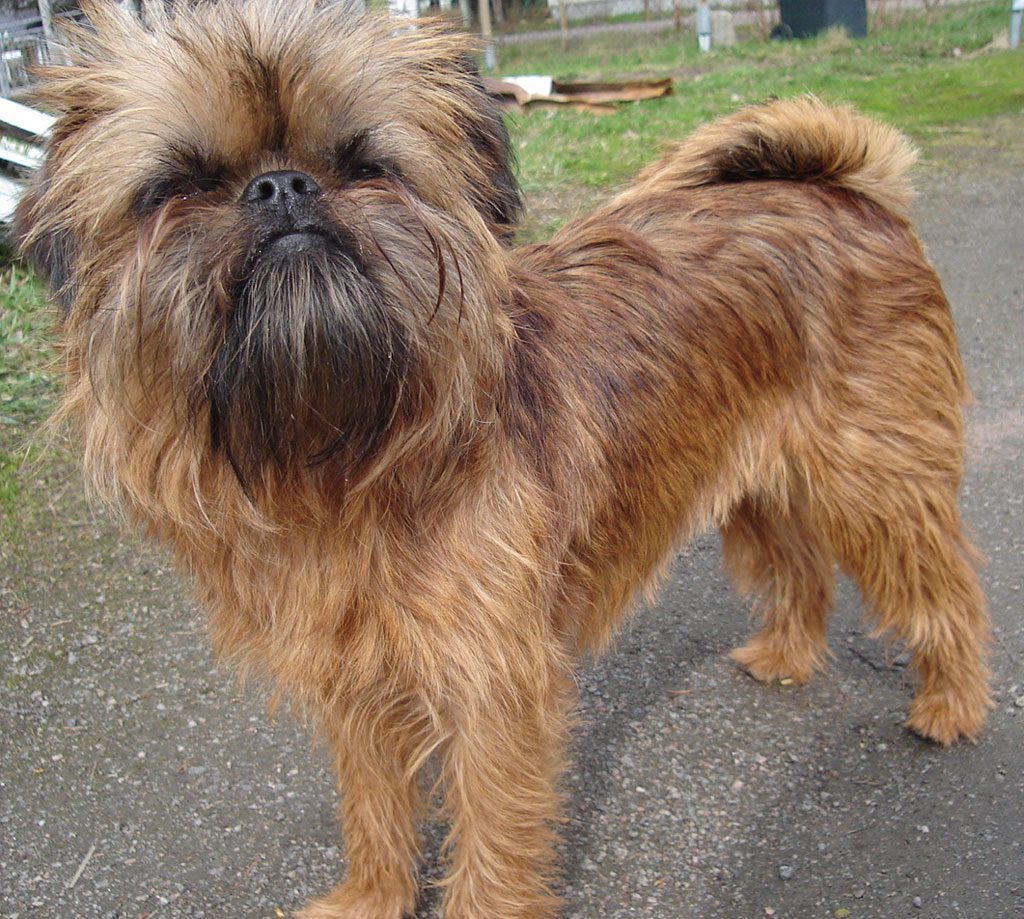
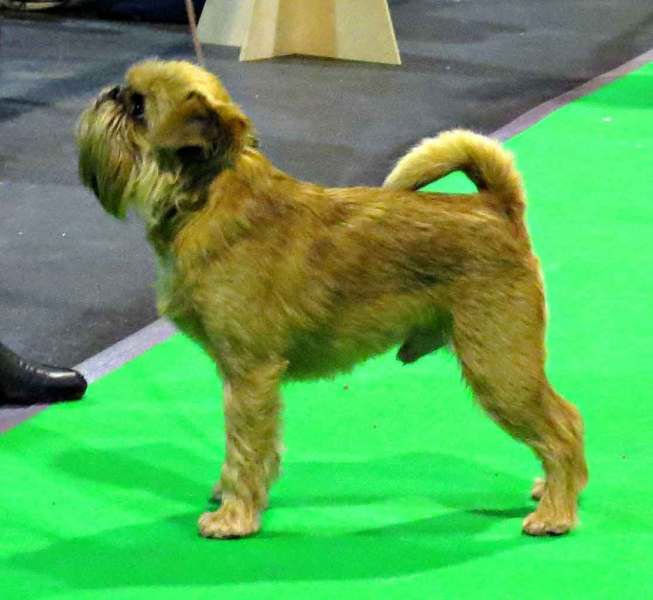
The Griffon Bruxellois is a small companion dog, Intelligent, balanced, alert, proud and robust, almost square in constitution, with good bone, but also elegant in his gait and complexion, drawing attention with his almost human expression.

Fur:

The Griffon Bruxellois has a hard coat with undercoat. The coat is naturally rough, slightly wavy, not curly, but yes skinny. The coat should be long enough to allow the structure to be seen. A coat that is too long damages the silhouette and is not sought after. A silky or woolly coat is a serious fault. The Petit Brabanรงon has a short coat. The coat is rough, closed and bright, and does not exceed 2 cm..

Color: Red, reddish; a little black is tolerated in head decoration.

In the three races (Griffon belge, Griffon Bruxellois and Petit Brabanรงon) some white hair is tolerated on the chest, but it is not sought.

Weight:

Of 3,5 to 6 kg.

Character and skills

The Griffon Bruxellois is balanced, alert and proud. With an assertive character and a certain ego, not necessarily suitable in the presence of very young children. In fact, will not appreciate being abused. On the other hand, it will be a very good companion for slightly older children. It also, gets along very well with other animals.

neither shy nor aggressive, the Griffon Bruxellois he is very vigilant and attached to his master. Above all, he needs to be close to his family, and is perfectly suited to apartment living. It also, have a moderate need for exercise: a daily walk is enough for him. This also makes him a suitable dog for an older person, if it is willing to provide the necessary maintenance. With more reason, by not supporting loneliness, will certainly prefer a very available master, with whom you can share games and emotions.

Last, it is a very funny and expressive animal, what will the happiness of home do. Some say that their mimicry is similar to that of a human or a monkey.

Education

In general, they seem to pick up tricks quickly and love to practice them when their attention is drawn to them. to him Griffon Bruxellois loves agility tests, in which they stand out. With his "mad king" look in his fur coat, they can be fun and upbeat if given enough love. As it is a breed that tends to become more attached to a single member of the family, he will have to be accustomed to meeting as many people as possible from a young age so that he does not become excessively protective.

They are not troublemakers, but problems can arise if they become too dependent. They do not like to be alone for a long time because they immediately miss their master. Your love of the game makes it easy to bond. They love to play fetch and seem to be inexhaustible when it comes to having fun.. Once they have tired, they snuggle in your lap and take a well-deserved nap. They need a short leash walk every day, or just the chance to frolic outside, but they don't need a lot of exercise. Recovery usually works very well.

Health

Although the Griffon Bruxellois it is a generally healthy dog, with an estimated life of fourteen years, is nevertheless predisposed to certain hereditary genetic diseases such as displasia coxofemoral, the medial patella dislocation and the respiratory obstruction syndrome. It is also subject to hydrocephalus, "aberrant cilia" (distichiasis and trichiasis) and skin allergies.

Grooming

For your maintenance, daily brushing is necessary. It is also advisable to groom him regularly and monitor the condition of his eyes and the folds of his face.

His tough fur must be plucked, that is to say, dead hairs must be removed by hand. It is advisable to entrust this removal to a dog groomer.


Breeders of the breed "Griffon Bruxellois"
  • Tajinastes Kennel | Zoo nucleus B2501363 | Affix Royal Canine Society of Spain 1968 y FCI 55/84 Since the year 1984 – Tajinastes is a hatchery, with the authorized zoological nucleus B2501363, which had its beginnings in the year 1984 in Tenerife and we are currently also in Barcelona where most of our specimens are found. It is born in a family way and because of the love we have always had for this species. We feel privileged to be able to dedicate ourselves to what we like and we cannot conceive of life without having a dog by our side.
  • PerrosDSalas – Canine kennel – Address: Urb. Miracampos no.. 1 20.160 Lasarte - Oria Guipuzcoa

Characteristics "Griffon Bruxellois"

Coexistence is important that you have with your new friend. Before considering the acquisition of a dog of the breed "Griffon Bruxellois" you know certain factors. Not all breeds of dogs are apt to live in an apartment, you must take into account his character, their need for exercise, their interaction with other pets, their care and if you have small children, their level of tolerance towards them.

Adaptation โ“˜

2,0 of 5 stars (based on 1 review)

friendly dog โ€‹โ€‹โ“˜

3,0 of 5 stars (based on 1 review)

hair loss โ“˜

1,0 of 5 stars (based on 1 review)

Affection level โ“˜

4,0 of 5 stars (based on 1 review)

Need for exercise โ“˜

2,0 of 5 stars (based on 1 review)

Social need โ“˜

2,0 of 5 stars (based on 1 review)

Home โ“˜

3,0 of 5 stars (based on 1 review)

Toilet โ“˜

2,0 of 5 stars (based on 1 review)

Friendly with strangers โ“˜

2,0 of 5 stars (based on 1 review)

barking โ“˜

3,0 of 5 stars (based on 1 review)

Health โ“˜

3,0 of 5 stars (based on 1 review)

Territorial โ“˜

4,0 of 5 stars (based on 1 review)

Cat friendly โ“˜

4,0 of 5 stars (based on 1 review)

Intelligence โ“˜

3,0 of 5 stars (based on 1 review)

Versatility โ“˜

3,0 of 5 stars (based on 1 review)

Child friendly โ“˜

1,0 of 5 stars (based on 1 review)

Surveillance โ“˜

3,0 of 5 stars (based on 1 review)

joy โ“˜

4,0 of 5 stars (based on 1 review)

Images "Griffon Bruxellois"

Photos:

1 – ยซGrifรณn de Bruselasยป by The original uploader was Dan9186 at English Wikipedia., CC BY-SA 3.0, via Wikimedia Commons
2 – "Griffon of Brussels" – Riga, Baltic Winner -2013, 9-10 Nov by Thomas, CC BY-SA 3.0, via Wikimedia Commons
3 – ยซGrifรณn de Bruselasยป by Canarian, CC BY-SA 4.0, via Wikimedia Commons
4 – ยซGrifรณn de Bruselasยป by Galawebdesign, CC BY-SA 3.0, via Wikimedia Commons
5 – One-year-old ยซBrussels Griffonยป by Galawebdesign, CC BY-SA 3.0, via Wikimedia Commons
6 – European Dog Champion ยซBrussels Griffonยป 2010 by Ger Dekker

Videos "Griffon Bruxellois"
Type and recognitions:

  • FCI CLASSIFICATION:
  • Group :
  • Section : . .

Federations:

  • FCI – Groupo 9 – Section 3.1 ยซGrifonesยป โ“˜
  • AKCSporting โ“˜

FCI breed standard "Griffon Bruxellois"

Origin:
Belgium

Date of publication of the valid original standard:
25.03.2003

Use:

Small guard and companion dog.


General appearance:

small pet dog; Intelligent, balanced, alert, haughty, robust, nearly square bodied; with a good bone constitution, but at the same time elegant in its movements and in its construction. It draws attention for its almost human expression.

The two Griffons have hard hair and differ in color., while the Petit Brabanรงon has short hair.


important proportions:

The length of the body, from the tip of the shoulder to the tip of the buttock, should be as much as possible, equal to the height at the withers.


Behavior / temperament:

Balanced little dog, alert, haughty, well attached to his master, very vigilant. It is neither fearful, nor aggressive.

Head:

It is the most characteristic part of the body and the one that draws the most attention. The head is quite large compared to the body and has an almost human expression. At the Griffon the hair is hard, up and shaggy ; is longer over the eyes, over the nostril, cheeks and chin, thus forming the decoration of the head.

Cranial region:

Wide and round. The forehead is well bulging.

  • Depression links (Stop) : Well marked.

facial region:

  • Truffle : black. It is at the same level of the eyes. It's wide and the windows are wide open. The tip of the nose is raised back, which seen in profile places the chin, nose and forehead on the same margin.
  • Snout : The nasal canal, including truffle, it's very short ; will not exceed 1,5 cm long. In the Petit Brabanรงon a correct nasal passage appears longer, since there is no ornament. A nostril that is not upturned, as well as a truffle whose upper part is located below the lower eye line, give a bad impression and constitute serious misconduct.
  • Belfos : Blacks. Upper and lower lips are in close contact and tight. The upper one does not form flews and does not cover the lower one. Too loose spoils the desired expression.
  • Jaws / Teeth : The lower jaw is well curved upwards, is wide, not pointed and extends beyond the upper jaw ; the breed has lower prognathism. The six incisors of each jaw are preferably planted evenly and in a straight line, those above and below are very parallel. The mouth should be tightly closed and not even the teeth should be visible, nor the tongue. The width and protrusion of the chin are very important. Care should be taken that incisors are not missing.
  • Eyes : They are well separated, they are big and round, never prominent. Brown in color, as dark as possible. They will be bordered with black and preferably should not show the white of the eyeball. A small or oval eye, or light color, constitutes a fault.
  • Ears : Small, they are high, far enough apart. The uncut ears are semi-erect and fall to the front. Very large ears are not desirable, as well as ears that hang over the side of the head. Cropped ears are pointed and erect. Cropped ears are both accepted, like the uncut ones.

Neck:

Medium length ; blends harmoniously with the shoulders.

Body:

The length of the body is almost equal to the height at the withers. From the set it is a small square and stout dog.

  • Cross : Slightly prominent.
  • Back : Straight, short and strong.
  • Pork loin : Short and muscular, very little raised.
  • Rump : Wide, flat, or at most very slightly inclined.
  • Breast : Large, reaches up to the elbows. The tip of the sternum is marked, which seen in profile, imparts a slightly prominent sill. The ribs are very elastic, but not barrel-shaped, not too flat.
  • Lower margin : The belly is slightly raised ; the flanks are well marked.

Tail:

She is tall and the dog wears her high. The docked tail is trimmed 2/3 its length. The tail that has not been cut is presented raised, with the tip towards the back, although without touching it or being curled up. A naturally short or split tail, or curled up on the back, constitutes a serious offense.

Tips

Former members

Seen together they are parallel, with a good bone structure and sufficiently separated.

  • Shoulder : Angulation is normal.
  • Elbows : Well attached to the body.
  • Carpi : Strong.
  • Pies : Small, round, they do not deviate even inwards, nor out. Fingers are good together; fingers sticking together constitutes a fault. Plantar pads are thick and as dark as possible. Nails are preferably black, as pigmented as possible.
Later members

Seen as a whole they have a good bone structure and are well parallel. The angulations are in harmony with the forelimbs.

  • Babillas : Angled enough.
  • Hocks : well laid. Seen from the back, not closed, not open.
  • Pies : See previous members. Dewclaws are not a sought after characteristic.

Movement:

Powerful, parallel movement of the limbs, with a good boost from the posteriors.

Mantle

Fur

Hair quality : The Griffon Bruxellois and the Griffon Belge both have a hard coat and an undercoat. Hair is naturally hard, slightly wavy, not curly, but trimmed and arranged for display. It should be long enough to allow the structure to be appreciated. Too long hair spoils the silhouette and is not what you are looking for. Silky or woolly hair is a serious offense. The Petit Brabanรงon he has short hair. Hair is rough, smooth and shiny ; has at most 2 cm long.

  • Head ornament : At the griffon, the ornament (beard and mustache) It starts under the nose-eye line and runs from one ear to the other., covering well the muzzle and cheeks with a very abundant hair and longer than on the rest of the body. Above the eyes, the hair should be longer than on the rest of the skull and form the eyebrows.
Color
  • Griffon Bruxellois : Red, reddish ; a little black is tolerated on the headdress.
  • Griffon Belge : Negro, black and tan. Tan markings must be pure and uniform in color. They are presented, in the previous members, from foot to carpus, and in the hindquarters from the foot to the hock. These colors go up the inside of the limbs. They are also seen in the anterior part of the chest, cheeks, chin, on top of the eyes, on the inside of the ears, below the tail and around the anus. Black can be mixed with red-brown, which is accepted although pure black and black and tan are preferred.
  • Petit Brabanรงon : The same colors as the two Griffons. Has a dark mask. The gray in the mask of older dogs will not be penalized.

In all three breeds some white hairs on the front of the chest are accepted, although this feature is not sought.


Size and weight:

Weight: It varies between 3,5 to 6 kg.


Fouls:

Any deviation from the aforementioned criteria is considered as a fault and the severity of this is considered to the degree of the deviation to the standard and its consequences on the health and well-being of the dog..


disqualifying fouls:
  • Aggressiveness or extreme shyness.
  • Any dog โ€‹โ€‹showing clear signs of physical or behavioral abnormalities.
  • Nose depigmented or other than black.
  • Constantly visible tongue, being the mouth closed.
  • Twisting of the lower jaw.
  • Upper jaw that extends beyond the lower jaw.
  • Other colors other than those provided by the standard, such as gray, blue and fire, the brown and tan and the liver color (brown).
  • Any white stain.


N.B.:

Males should have two normal-appearing testicles fully descended into the scrotum..

Source: F.C.I - International Cynological Federation

Alternative names:

1. Griffon, Griff, Bruss (English).
2. Griffon bruxellois (French).
3. Griffon bruxellois (German).
4. (Portuguese).
5. Griffon bruxellois (espaรฑol).

โ–ท The world of Pets: Dogs, cats, birds, reptiles, amphibians

Golden Retriever
Escocia FCI 111 . Retrievers

Golden Retriever

The development of Golden Retriever it's quite slow. He does not physically become an adult until 18 months of age.

Content

History

The origin of the ยซGolden Retrieverยป, a specialized hunter in charge of returning the hunted game, it is quite discussed.

It may have originated in the Caucasus Mountains, where he was raised from a group of dogs related to him Leonberger, and then brought to Britain in the 19th century, or that it descends from a couple of dogs bought in 1858 to a Russian circus for a future English lord, Sir Dudley Marjoribanks.

Wavy Coated Terrier
Wavy Coated Terrier (We)

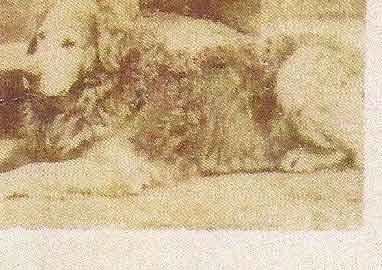
Behind the myth, we know that this man, also known as Lord Tweedmouth, I raised dogs since 1835. It is said that he made a decisive crossing between two subjects destined to become the great ancestors of the Golden Retriever. In fact, had a Wavy Coated Terrier yellow, called Nous, as well as a female Tweed Water Spaniel, called belle. In a photograph in which Nous poses, we discovered a curly dog, whose size, bone structure and head appear powerful.

In 1868, Lord Tweedmouth apareรณ a Nous y Belle. The historic litter is born. It is made up of a male, called crocus, and three females, There is, Primrose y Cowslip. The breeder then continues a patient work of inbreeding selection with two yellow females and another Tweed Water, a male named Tweed. In this lineage there are two black Retrievers, Sambo and Tracer, a Irish Setter, Sampson, as well as a Bloodhound sand-colored. This selection work was recorded in his breeding book, preserved today by the English Kennel Club.

The Lord's goal was to create a race that met the requirements of a "gentleman farmerยซ, that is to say, a dog with an impeccable nose for hunting waterfowl, but also with excellent skills in fields as varied as rescue or assistance to people with disabilities. He had to be an intelligent and loyal companion, be patient with children and calm at home.

In 1903, the English Kennel Club accepted the registration of the first Goldens, registered as Flat-coated Retriever variety Golden.

English Winifired Charlesworth, which contributed greatly to the recognition of the Flat-coated Retriever like a different race, wrote the first standard for the breed Golden Retriever in 1910.

In 1911 created the Golden Retriever Club of England and the English Kennel Club recognized the Golden Retriever as a race in its own right.

In France, the Retrievers most common were Labradors, and only in the decade of 1930, through breeding, the first appeared Golden Retriever in the territory. A first French litter was officially registered with the English Kennel Club in 1934, produced by the Conde Jules de Bonvouloir (with the affix ยซof Saint-Jean-du-Boisยซ). The latter became president of the Retriever Club de France in the years 40.

The popularity of the Golden Retriever grew dramatically from the end of the years 80, becoming one of the favorite dogs of the French for its friendly nature, franco, playful and helpful.

Physical characteristics

The Golden Retriever is similar in appearance to Labrador Retriever. It is a harmonious dog, powerful and robust, but with a soft expression. His head is wide, his nose is black and his eyes, very separate, are dark brown. His ears are medium in size and hanging, placed at eye level. The tail is carried over the back, does not curl and reaches the hock.

The coat of the Golden it's thick and silky. Hair is straight or wavy, fringed. The undercoat is thick and the exudate (a kind of fat secreted by the skin) makes it very waterproof and protects it from the cold, so the Golden it can stay a long time in streams and rivers without any problem, even in winter.

The webbed shape of its legs also makes it easy to retrieve waterfowl.

The coat colors accepted by the standard are creamy white to dark gold. Snow white colors are not supported, Mahogany, chocolate or black.

Size and weight

    ▷ Male size: Of 56 to 61 cm.
    ▷ female size: Of 51 to 56 cm.
    ▷ Male weight: Of 29 to 31 kg
    ▷ female weight: Of 25 to 27 kg

Character and skills

The Golden Retriever he is naturally meek, friendly and devoted to his caretaker. If as a puppy it can be exuberant, as an adult it is a calm and serene dog, who feels true passion for his family, of which he is considered a full member, to the point of overflowing with love for children. For its gentle character, suits young families and older people alike.

He is a tireless playmate, a dog full of life, who cannot stand loneliness and needs a presence by his side. So, will be unhappy if separated too often from their masters. Sometimes it has a "sticky" side, he likes to please his master by bringing slippers or mail, for example. To put it plainly, pleasing his owner also pleases himself.

The Golden Retriever do not have a natural guardian instinct and come into contact with strangers, both humans and animals, quite easily.

The Golden Retriever it is one of the most intelligent dog breeds, since he understands everything that happens around him.

Although they prefer the countryside, the Golden Retriever they also adapt very well to living in an apartment, provided they are given long walks several times a day. In fact, whether it rains or it is windy, you need to do exercise.

Education

Despite her soft mischievous eyes, the Golden Retriever needs a gentle and firm education at the same time. In effect, he is a real comedian, and before her charming eyes, one soon lets oneself be overwhelmed by a love that grows every day, but what can make one go blind.

As the Golden Retriever he's a bit stubborn when he's young, their education must be done through encouragement and not coercion. Otherwise, his stubborn and somewhat independent character will resurface, making it difficult to re-establish trust between the owner and the dog.

Last, the Golden Retriever usually have a very good relationship with others Golden Retriever, but it is important to socialize it as soon as possible.

Health

The development of Golden Retriever it's quite slow. He does not physically become an adult until 18 months of age, and your character will stabilize around the 4 years, or even more in some individuals. Its growth must be closely monitored, especially in the skeleton. As with all large dog breeds, it is preferable to avoid jumping and stairs while he is a puppy so as not to risk damaging the cartilage of his joints.

The Golden Retriever is also predisposed:

  • Patella dislocation and torn cruciate ligaments;
  • certain diseases of the musculoskeletal system (Hip Dysplasia, elbow dysplasia);
  • Certain eye diseases (congenital and hereditary cataracts, progressive retinal atrophy…);
  • Certain skin diseases (atopia, dermatitis piotraumรกtica, ictiosis…);
  • Piometrio, a severe uterine infection affecting older, unspayed females.

It also, the Golden Retriever is especially prone to Hip Dysplasia. It is advisable to ensure that the parents are free of these conditions when buying a puppy, requesting the creator of Golden Retriever x-rays and screening tests of the parents.

Last, in regards to the atopia, there is a racial component and not only a family. So, this condition can be triggered even if the parents are free of it.

Life expectancy

Of 10 to 12 years

Grooming

The Golden Retriever have moderate hair loss, even during its annual molt.

But, it is advisable to brush it weekly to detect possible parasites and spikelets, and even daily during the shedding period.

On the other hand, it is preferable not to wash the dog too often, as there is a risk of damaging the natural protection formed by its rough undercoat and oozing.

Last, like the ears of the Golden Retriever they are down, they are fragile. Thus, it is recommended to clean them regularly with suitable products to avoid ear infections.

Use

The Golden Retriever, a race created for this purpose, is primarily a hunting dog, who likes to return game pieces to his master, preferably dead, and often falls into the water. It also, naturally gifted for work, swimming is his favorite sport.

But the Golden Retriever it is also one of the most popular companion dogs.

It also, It is often used for its qualities as a support dog for patients, disabled assistance dog, guide dog for the blind, but also as a rubble dog, drug or bomb search.

Last, the Golden Retriever they are also in high demand today as show dogs.

Price

The purchase price of a Golden Retriever ranges between โ‚ฌ500 and โ‚ฌ1000 and its maintenance ranges between 1400 and 1500 EUR.

Characteristics "Golden Retriever"

Coexistence is important that you have with your new friend. Before considering the acquisition of a dog of the breed "Golden Retriever" you know certain factors. Not all breeds of dogs are apt to live in an apartment, you must take into account his character, their need for exercise, their interaction with other pets, their care and if you have small children, their level of tolerance towards them.

Adaptation โ“˜

2,0 of 5 stars (based on 1 review)

friendly dog โ€‹โ€‹โ“˜

5,0 of 5 stars (based on 1 review)

hair loss โ“˜

3,0 of 5 stars (based on 1 review)

Affection level โ“˜

5,0 of 5 stars (based on 1 review)

Need for exercise โ“˜

3,0 of 5 stars (based on 1 review)

Social need โ“˜

5,0 of 5 stars (based on 1 review)

Home โ“˜

4,0 of 5 stars (based on 1 review)

Toilet โ“˜

3,0 of 5 stars (based on 1 review)

Friendly with strangers โ“˜

5,0 of 5 stars (based on 1 review)

barking โ“˜

3,0 of 5 stars (based on 1 review)

Health โ“˜

3,0 of 5 stars (based on 1 review)

Territorial โ“˜

2,0 of 5 stars (based on 1 review)

Cat friendly โ“˜

4,0 of 5 stars (based on 1 review)

Intelligence โ“˜

5,0 of 5 stars (based on 1 review)

Versatility โ“˜

4,0 of 5 stars (based on 1 review)

Child friendly โ“˜

5,0 of 5 stars (based on 1 review)

Surveillance โ“˜

2,0 of 5 stars (based on 1 review)

joy โ“˜

5,0 of 5 stars (based on 1 review)

Images "Golden Retriever"

Photos:

1 – One Golden Retriever male with a tennis ball by Scott Beckner, CC BY 2.0, via Wikimedia Commons
2 – Golden Retriever by https://commons.wikimedia.org/wiki/File:Golden_retriever.jpg
3 – Golden Retriever by https://es.m.wikiquote.org/wiki/Archivo:Callie_the_golden_retriever_puppy.jpg
4 – Golden Retriever by I, Willybu, CC BY-SA 3.0, via Wikimedia Commons
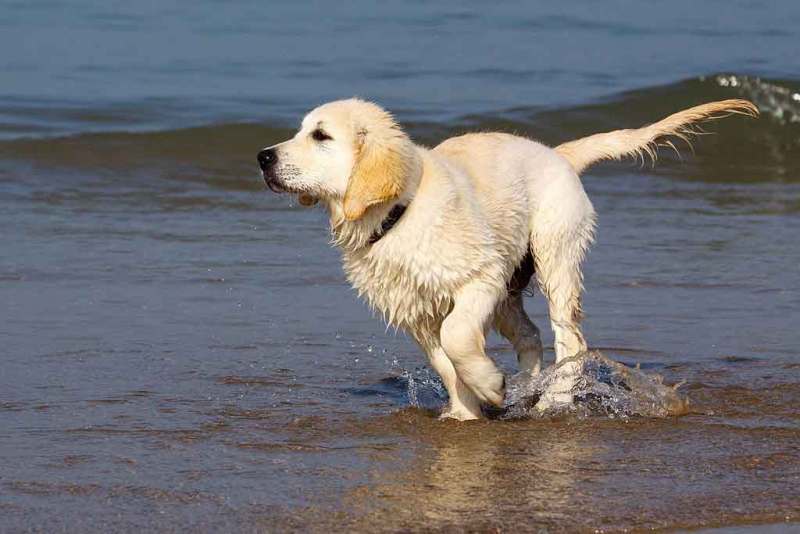
5 – Puppy Golden Retriever / young dog in the North Sea (Scheveningen, Hague, Netherlands) by Dirk Vorderstrasse, CC BY 3.0, via Wikimedia Commons
6 – Portrait of male Golden Retriever of 3 years by Johan Spaedtke, CC0, via Wikimedia Commons

Videos "Golden Retriever"

Type and recognitions:

  • FCI CLASSIFICATION:
  • Group :
  • Section : . .

Federations:

  • FCI – Group 8: Retrievers - Flushing Dogs - Water Dogs – Section 1: Retrievers โ“˜
  • AKCSporting โ“˜
  • ANKC Group 3 (Gundogs) โ“˜
  • CKCSporting Dogs โ“˜
  • โ€‹KC – Gundog โ“˜
  • NZKCGundog โ“˜
  • UKCGun Dogs โ“˜

FCI breed standard "Golden Retriever"

Origin:
United Kingdom, Scotland

Date of publication of the valid original standard:
24.06.1987

Use:

Retriever hunting and shooting.


General appearance:

Harmonious, provided, Active, powerful, with gathered movements; well built and with a caring expression.


Behavior / temperament:

Docile, intelligent and possessing an innate ability for work. Kind, friendly and confident.

Head:

Proportionate and well molded.

Cranial region:
  • Skull: Spacious without being clumsy, well inserted into the neck.
  • Depression links (Stop): Well defined.

facial region:

  • Truffle: Preferably black.
  • Snout: Powerful, wide and deep. The length of the muzzle should be approximately equal to the distance between the stop and the occipital bone.
  • Jaws / Teeth: Strong JAWS, with a perfect, regular and complete scissor bite, that is to say, that the internal face of the upper incisors is in contact with the external face of the lower incisors, the teeth being placed at right angles to the jaws.

Eyes: Dark brown, well separated; The eye rims must be dark.

Ears: Medium-sized, implanted approximately at eye level.

Neck:

Good length, net and muscular.

Body:

Balanced.

  • Back: Horizontal top line.
  • Pork loin: Strong and muscular, short.
  • Breast : Well descended in the sternal region. Deep well sprung ribs.

Tail:

Implanted and carried at the level of the back, reaching the Hock; without curling at the tip.

Tips

PREVIOUS MEMBERS:Straight and of good bones.

Shoulder: Well oblique, with long scapulae.

Arms: The same length as the scapulae, which makes the front limbs are well placed under the body.

Elbows: Glued to the body.

LATER MEMBERS:Strong and muscular.

Knee: Well angulated femoro-tibio-patellar joint.

Leg: Long.

Hocks: Well descended; seen from behind they must appear parallel, not turned neither in nor out. Cow hocks are very undesirable.

Movement:

Powerful, with a lot of push. The fore and hind limbs move in planes parallel to the axis of the body. Long and free step, without any tendency to lift the above.

Mantle

HAIR: smooth or wavy, with good fringes and with a dense and waterproof undercoat.

COLOR: Any shade of gold or cream, neither red nor mahogany. Only the presence of a few white hairs on the parapet is allowed..


Size and weight:

Height to the cross:

  • The males between 56 and 61 cm. (22-24 inches).
  • The females among 51 and 56 cm. (20-22 inches).


Fouls:

Any deviation from the aforementioned criteria is considered as a fault and the severity of this is considered to the degree of the deviation to the standard and its consequences on the health and well-being of the dog., and the ability of the dog to carry out their traditional work.

FALTAS DESCALIFICANTES:

โ€ข Aggressiveness or extreme shyness.
โ€ข Any dog โ€‹โ€‹showing clear signs of physical or behavioral abnormalities.


N.B.:

โ€ข Males must have two normal-appearing testicles fully descended into the scrotum..
โ€ข Only functionally and clinically healthy dogs, with the typical conformation of the breed, should be used for parenting.

Source: F.C.I - International Cynological Federation

Alternative names:

1. Golden (English).
2. Retriever Golden (French).
3. Golden (German).
4. Golden (Portuguese).
5. Cobrador dorado (espaรฑol).

โ–ท The world of Pets: Dogs, cats, birds, reptiles, amphibians

Large Mรผnsterlรคnder
Alemania FCI 118 . Spaniel type

Mรผnsterlรคnder Grande

Nature Large Mรผnsterlรคnder is lively but not express nervousness.

Content

History

Historically, the Large Mรผnsterlรคnder, It was a dog used to hunt birds and hawks in the middle ages, its origins are located in the trackers and retrievers, as well as sample of 19th century dogs.

The Large Mรผnsterlรคnder is considered to be, similar to the Small Munsterlander and the German Longhaired Pointer as part of the family of Pointing Dogs germans, whose professional parenting was beginning around the end of the 19th century.

After the ยซDeutscher-Langhaar-Vereinยป definitively excluded the black dog in 1909, the "Association for the Pure Breeding of the Long-Haired Black-White Mรผnsterlรคnder Pointing Dog", founded in 1919, assumed the raising of the black and white Longhair. Once the remaining, still extant dogs of this long-haired native breed were documented in an original list, mostly from the eastern Mรผnster region and Lower Saxony, the Association began in 1922 planned parenting Large Mรผnsterlรคnder.

The founding list comprised 83 dogs. Descendants of the dogs on the original list were entered into the record book for the Large Mรผnsterlรคnder. The club that kept the record book was the โ€œAssociation of Large Munsterlandersโ€, to date organized eight independent regional groups. The Club of the Large Mรผnsterlรคnder is a member of the VDH and the Federation of Working Gundogs (JGHV)

Physical characteristics

It is a dog with strong and muscular body structure, with a stylized picture; expression of intelligence and nobility.

Has a step and trot elastic, covers the ground, with a wide range. Elastic Gallop, with great momentum and thrust of the later members, and broad jump.

Video of โ€œMรผnsterlรคnder Grandeโ€
Large Munsterlander Wilson Hunting duck retrieve

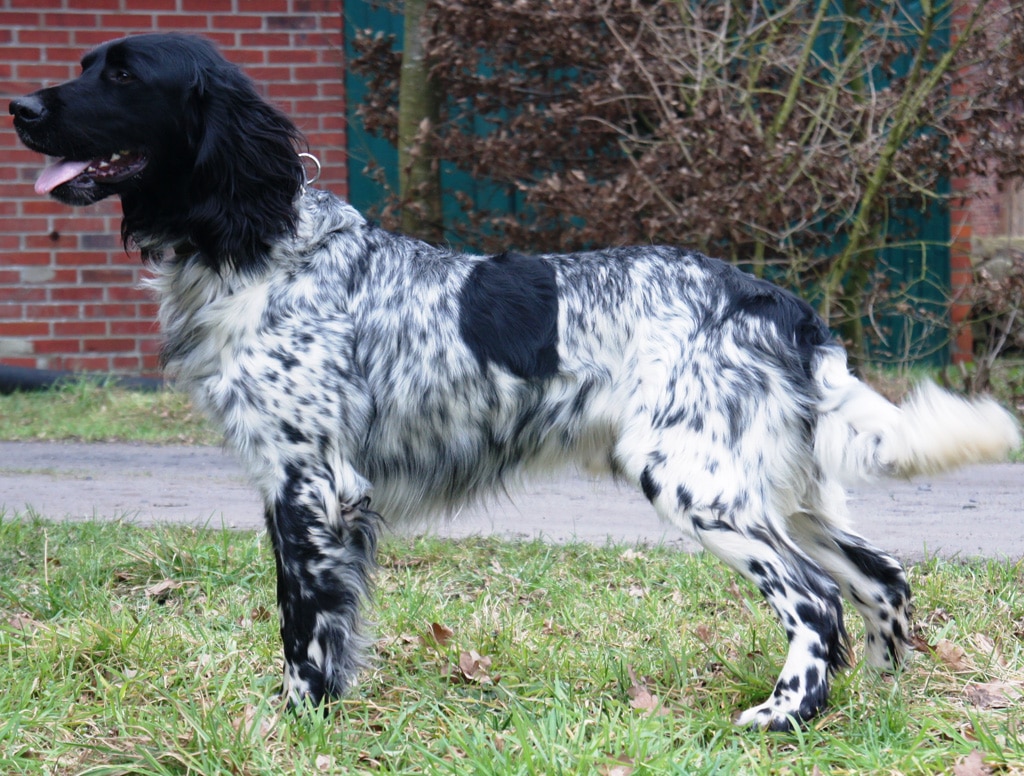
The skin is adherent. Her hair is long and dense, Although smooth; It is not wavy or separated, because this could be an impediment to perform its function in the hunt. typical broad hair.

The hair, both the male and the female, It must be especially long and dense in the posterior region of members before and after (with good feather). Also on the tail the hair must be especially long. The longest boom in the queue must be half the length of this.

The hair of the ears It should be long (with good formation of stripes) and it must be so long that it symmetrically exceeds the lower edge of the ears (never leather ears). In the rest of the head hair should be short and adherent.

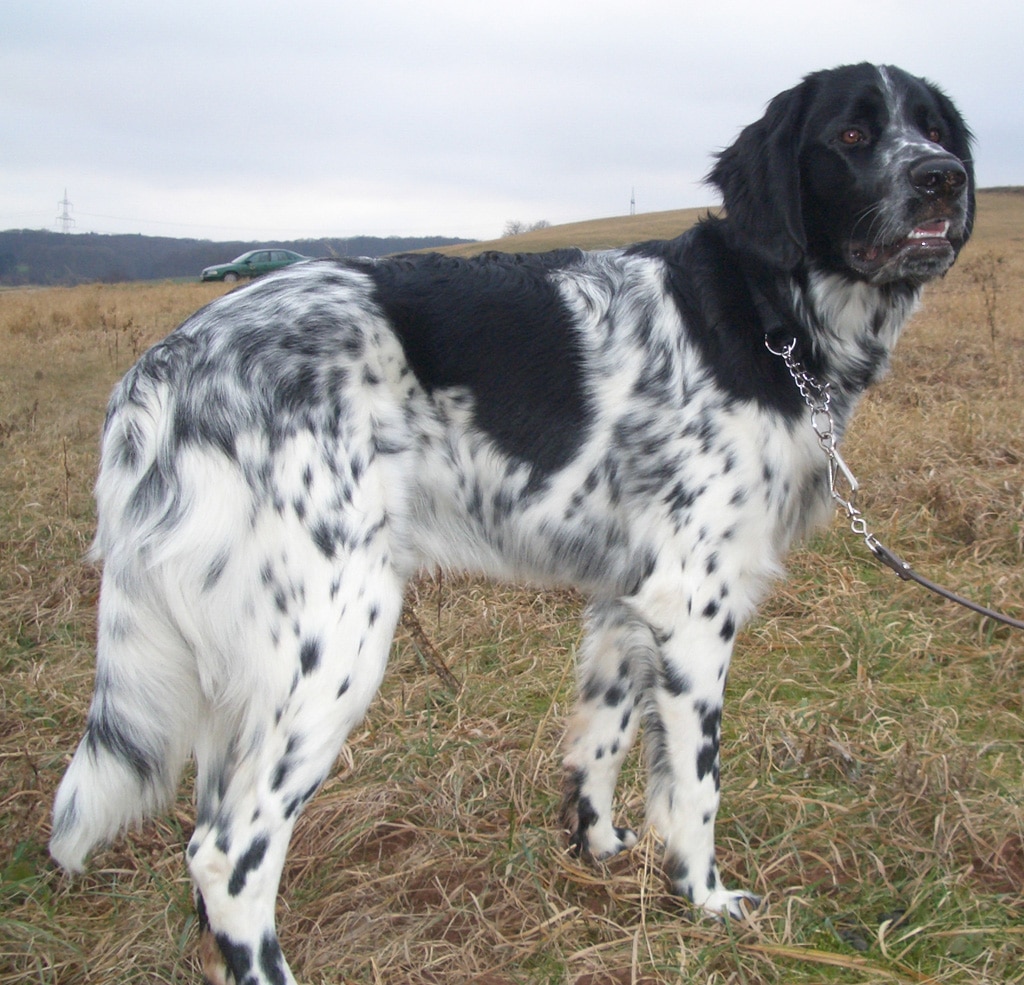
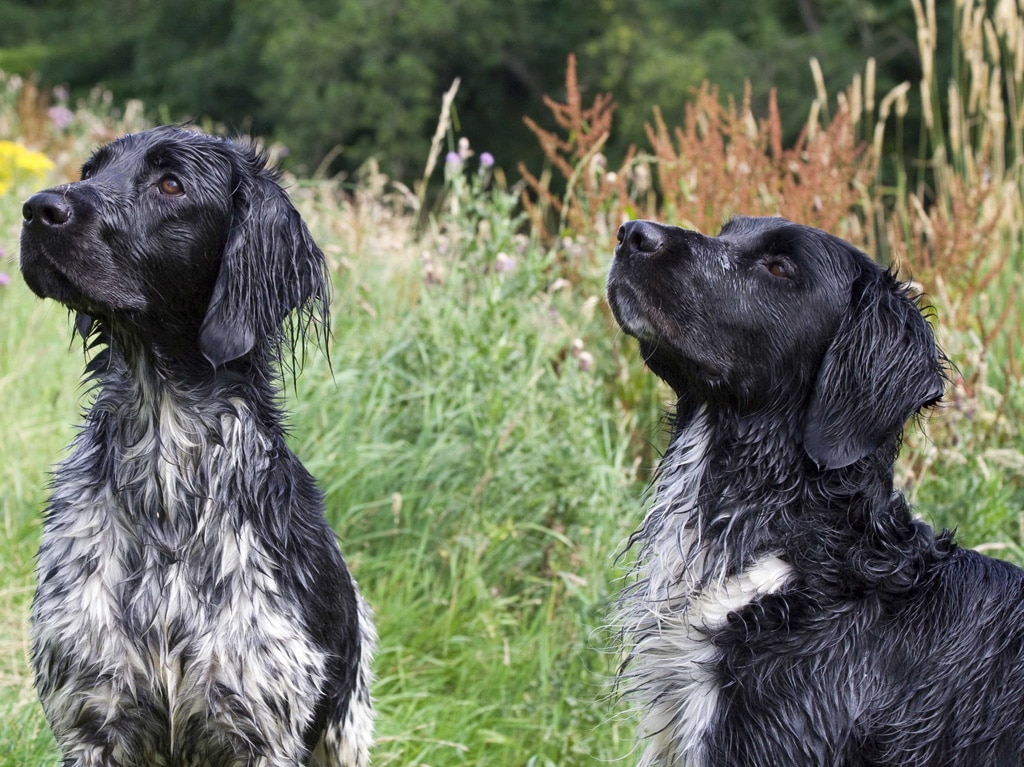
It is of color White with plates and black spots, or a black splash. Black head, eventually with a spot or a whitelist.

Character and skills

El Munsterlander Grande, is a versatile hunting dog, his greatest skill is at work to perform after the firing of the Hunter.

Its main characteristics are docility, ability to learn and reliable utility for hunting. Its nature is lively but not obvious nervousness.

It can be perfectly adapted to the home life, from which you will greatly enjoy the warmth of your family, but you also need to run in the field to feel completely happy moments.

Observations

You need to do plenty of exercise, It is an ideal companion to go out running.

Use

Due to its versatility, it is necessary that the Large Mรผnsterlรคnder be placed regularly in the most varied fields. His medium head size has made him a specialist in the search for injured game animals, on the plains and in the woods. His main job is to, after the shot, avoids unnecessary suffering of the injured animal to some extent. The goal is to have a very good all-terrain dog; therefore, it is necessary to maintain in him these natural qualities.

Health

The Large Mรผnsterlรคnder he is a robust dog, living a long time and generally in very good health.
This dog is not predisposed to being overweight. Their activities should be oriented to humid environments (swamps) in hot weather. It is not afraid of the cold and can even live outside in a kennel..

Comprar a โ€œMรผnsterlรคnder Grandeโ€

The price of a Large Mรผnsterlรคnder varies according to their origins, age and gender. The limited diffusion of the breed on French soil does not allow knowing the average price of a puppy of Large Mรผnsterlรคnder registered in the LOF (Sociรฉtรฉ Centrale Canine).

Characteristics "Large Mรผnsterlรคnder"

Coexistence is important that you have with your new friend. Before considering the acquisition of a dog of the breed "Large Mรผnsterlรคnder" you know certain factors. Not all breeds of dogs are apt to live in an apartment, you must take into account his character, their need for exercise, their interaction with other pets, their care and if you have small children, their level of tolerance towards them.

Adaptation โ“˜

4,0 of 5 stars (based on 1 review)

friendly dog โ€‹โ€‹โ“˜

4,0 of 5 stars (based on 1 review)

hair loss โ“˜

3,0 of 5 stars (based on 1 review)

Affection level โ“˜

5,0 of 5 stars (based on 1 review)

Need for exercise โ“˜

4,0 of 5 stars (based on 1 review)

Social need โ“˜

3,0 of 5 stars (based on 1 review)

Home โ“˜

2,0 of 5 stars (based on 1 review)

Toilet โ“˜

3,0 of 5 stars (based on 1 review)

Friendly with strangers โ“˜

3,0 of 5 stars (based on 1 review)

barking โ“˜

3,0 of 5 stars (based on 1 review)

Health โ“˜

3,0 of 5 stars (based on 1 review)

Territorial โ“˜

3,0 of 5 stars (based on 1 review)

Cat friendly โ“˜

2,0 of 5 stars (based on 1 review)

Intelligence โ“˜

5,0 of 5 stars (based on 1 review)

Versatility โ“˜

4,0 of 5 stars (based on 1 review)

Child friendly โ“˜

5,0 of 5 stars (based on 1 review)

Surveillance โ“˜

3,0 of 5 stars (based on 1 review)

joy โ“˜

5,0 of 5 stars (based on 1 review)

Images of the โ€œLarge Mรผnsterlรคnderโ€

Videos of โ€œMรผnsterlรคnder Grandeโ€

Type and recognitions:

  • FCI CLASSIFICATION:
  • Group :
  • Section : . .

Federations:

  • FCI – Group 7: Pointing Dogs. – Section 1: Continental Pointing Dogs. 1.2: Spaniel type โ“˜
  • ANKC Group 3 (Gundogs) โ“˜
  • โ€‹KC – Gundogs โ“˜
  • NZKC – Hunting dogs โ“˜
  • UKCGun Dog โ“˜

FCI breed standard "Large Mรผnsterlรคnder"

Origin:
Germany

Date of publication of the valid original standard:
29.10.2013

Use:

According to its hunting needs as a versatile dog, the Great Munsterlander must meet all the necessary challenges and must be able to work in the field., forest and water before and after shooting.


General appearance:

Strong and muscular body, bold overall impression. Expression of intelligence and nobility. Clean exterior lines.

IMPORTANT PROPORTIONS:

The height at the withers and the length of the body must be as equal as possible. The length of the body may exceed the height at the withers by 2 cm..


Behavior / temperament:

The most important qualities are: be manageable and easy to teach, reliable for use as a hunting dog particularly after shooting. Loving temperament without being nervous.

Head:

Noble and elongated with intelligent expression. Defined chin with good muscles.

Cranial region:
  • Stop: moderate.

facial region:

  • Nose: Pronounced black nose.
  • Snout: Strong, long and well developed for use. Right nasal bridge.
  • Lips: not hanging.
  • Jaws/Teeth: Strong bite and full dentition (42 teeth) with well-formed canines and a perfect scissor bite.

Eyes: The darker the better, tight-fitting eyelids. Ears: Wide, medium high insertion, rounded tips, adjusted

Ears: Wide, medium high insertion, rounded tips, adjusted.

Neck:

Strong and well muscled with a noble curve.

Body:

  • Cross: moderately high, long, good musculature.
  • Back: Short, firm, straight. Pork loin: Pronounced, protected by tight muscles.
  • Rump: Long, wide, only slightly inclined, good musculature.
  • Breast : Width seen from the front, deep viewed from the side with a marked parapet. Bottom line and belly: slightly ascending, tight, slender. Short flanks and set high.

Tail:

Carriage horizontally or slightly higher. Side view in continuation with the upper line without break.

Tips

PREVIOUS MEMBERS:

  • Right limbs, strong and well muscled. Correct angulations.
  • Shoulder: Scapulae tightly fitting to ribs.
  • Arm: Must be strong and well muscled.
  • Forearm: Right limbs, strong and well muscled.
  • Metacarpus: elastic.
  • Previous feet: Moderately long and rounded, tight fingers, No Spurs.

LATER MEMBERS:

  • General appearance: Strong, tight muscles, vertical position.
  • Knee: correctal angulation.
  • The Hock joint: correct angulation.
  • Hind feet: Moderately long and rounded, tight fingers, No Spurs.

Movement:

Elastic in the walk and trot, covering the surface with long strides. Gallop: elastic, animated with the necessary push and long reach.

Mantle

SKIN: tight.

Fur: Long and bushy, straight and not wavy or standing as it hampers hunting ability. typical broad hair. The hair must be especially long and dense on the back of the forelimbs and hindquarters.. (Well covered in feathers) both males and females. In the tail the hair must be particularly long. The area most heavily feathered should be in the middle of its length. The hair in the ears must be long (good fringes) and arrive clearly and evenly on the tips of the ears (leather at the end of the ears is not desirable). The hair on the head is short and soft.

Color: The three varieties of color are:

  • White with black patches and spots,
  • roan blue,
  • pure black.

The head is always black, a cutout or white star is possible.


Size and weight:

Height to the cross (average):

  • Males 60 โ€“ 65 cm.
  • females 58 โ€“ 63 cm.

Tolerated 2 cm above specified size.

Weight: About 30 kg.


Fouls:

Any deviation from the aforementioned criteria is considered a fault and its severity is considered to the degree of deviation from the standard and its consequences on the health and well-being of the dog and the dog's ability to perform its traditional task..

โ€ข Skull too wide. Too much stop, snout
too short.
โ€ข Roman nose or plate face, complete absence of
pigmentation or just spots.
โ€ข Swollen or pendulous lips.
โ€ข Slight missing teeth and bite; bite clamp, double PM 1, absence of 1-2 premolars (PM1) or 3 molar (M3) (Maximum 2 teeth)
โ€ข Eyes too light. Visible red membrane. Loose eyelids.
โ€ข Low set ears, separated from the head. Ears that are too short or folded back showing cartilage.
โ€ข Neck too short, too long, very thick, very thin, Spada.
โ€ข Cross too low, very short.
โ€ข Back too long, sunken or hooded.
โ€ข Loin with loose muscles. Non-harmonious transition of the croup; over built.
โ€ข Short croup, close, with abrupt fall.
โ€ข Barrel-shaped chest, Strait, not deep enough, lack of sill,
โ€ข Abdomen too ascending or too low
โ€ข Carrying the tail to one side, rolled up, broken or ring-shaped tail.
โ€ข Forelimbs: too steep angles, protruding or crooked elbows. Stupid Carpos. Forehead too narrow or too wide.
โ€ข Hind limbs: too steep angles, cow hock or bow legs as well as a rear that is too open or closed.
โ€ข Round cat foot, long hare, flatfoot. Pigeon fingers or violin forehead.
โ€ข Walk and short trot, rigid or remilded. Gallop: hard heels, little push.

FALTAS DESCALIFICANTES:

โ€ข Aggressiveness or extreme shyness.
โ€ข Any dog โ€‹โ€‹showing clear signs of physical or behavioral abnormalities.
โ€ข Pale nose.
โ€ข Entropion, ectropion.
โ€ข Prognathic or enognathic mouth, mouth crossed, absence of incisors or canines, absence of molars or premolars (except 2 PM1 the 1 M3)
โ€ข Colors not in accordance with the breed standard.
โ€ข Dogs above or below the indicated height.
โ€ข Fearful or sensitive to triggering to any degree. Fear of prey, teether out of fear, fearful of strangers.


N.B.:

โ€ข Males must have two normal-appearing testicles fully descended into the scrotum..
โ€ข Only functionally and clinically healthy dogs, with the typical conformation of the breed, should be used for parenting.

Source: F.C.I - International Cynological Federation

Alternative names:

1. GroรŸer Mรผnsterlรคnder (English).
2. Grand mรผnsterlรคnder (French).
3. GroรŸer Mรผnsterlรคnder Vorstehhund (German).
4. (em alemรฃo: Grosser mรผnsterlรคnder) (Portuguese).
5. (en alemรกn GroรŸer Mรผnsterlรคnder), Gran Munsterlander (espaรฑol).

โ–ท The world of Pets: Dogs, cats, birds, reptiles, amphibians

Gordon Setter
Escocia Reino Unido FCI 6 - Setter

Gordon Setter

The name Gordon Setter is due to the Dukes of Richmond-Gordon, creators of the breed

Content

History

Scottish native, the Gordon Setter was called for almost a century Black and Tan Setter, in reference to the color of their fur. Was not up 1924 when its name was changed to The Kennel Club, in memory of the Scottish Duke Alexander Gordon (1743-1827).

The latter played an important role in the development of the breed, creating at the end of the 18th century a hatchery in one of its castles, entirely dedicated to him, which allowed its standardization. Some believe other races also came into play (starting with the Saint Hubert Hound), but at least it is proven that the Gordon Setter is the result of the crossing between English Setter and Colleys. The resulting dogs had various coat colors ranging from black and white to red.. But, the Duke chose to favor black and tan subjects, excluding others from the brood; this explains why all representatives of the breed today wear this coat color.

Like this, the Gordon Setter became popular throughout Scotland and the rest of the UK in the early 19th century, to the point that it was one of the dogs exhibited in the first dog show in modern history, that was held in 1859 en Newcastle. In fact, its ability to adapt to any terrain, even the most rugged, makes you a perfect co-worker for hunting game birds.

Nor did he wait to leave his homeland. Like this, the first import of a Gordon Setter in France it dates back to 1840. Logically, the hunters would have been in charge of taking it to France. Just two years later, in 1842, Rake and Rachel were the first two representatives of the breed to cross the Atlantic and be imported to the United States. Your buyers, George Blunt y Daniel Webster, they acquired the breed directly from the kennel of the 5th Duke of Gordon, son and successor of Alexander Gordon.

The Gordon Setter was one of the first breeds recognized by the Kennel Club, the British organization of reference, since its creation in 1873. It was also one of the first nine breeds recognized by the American Kennel Club (AKC) when it was founded in 1884. But, the other reference organization in the country, the United Kennel Club (UKC), waited until 1949 to do the same. The Fรฉdรฉration Cynologique Internationale (FCI) it took even longer, since it was not until 1963 when he had to do the same.

But, although it is recognized around the world, the Gordon Setter is still a relatively rare breed. In United States, the Gordon Setter ranks 110 (of something less than 200) in the AKC breed classification, based on the number of births registered with the AKC each year, and the trend is for a slight decrease. In France, the number of new annual registrations in the Livre des Origines Franรงais (LOF) has not stopped declining since the 1990s, having reached a peak in the late eighties. At that time there were more than 1.000, but today there are only a few 600, what to compare, for example, with the more than 5.000 of the English Setter.

In the United Kingdom, the Gordon Setter is considered by the Kennel Club as a vulnerable native breed. But, the number of births registered in the organization each year remains relatively stable around 250.

Physical characteristics

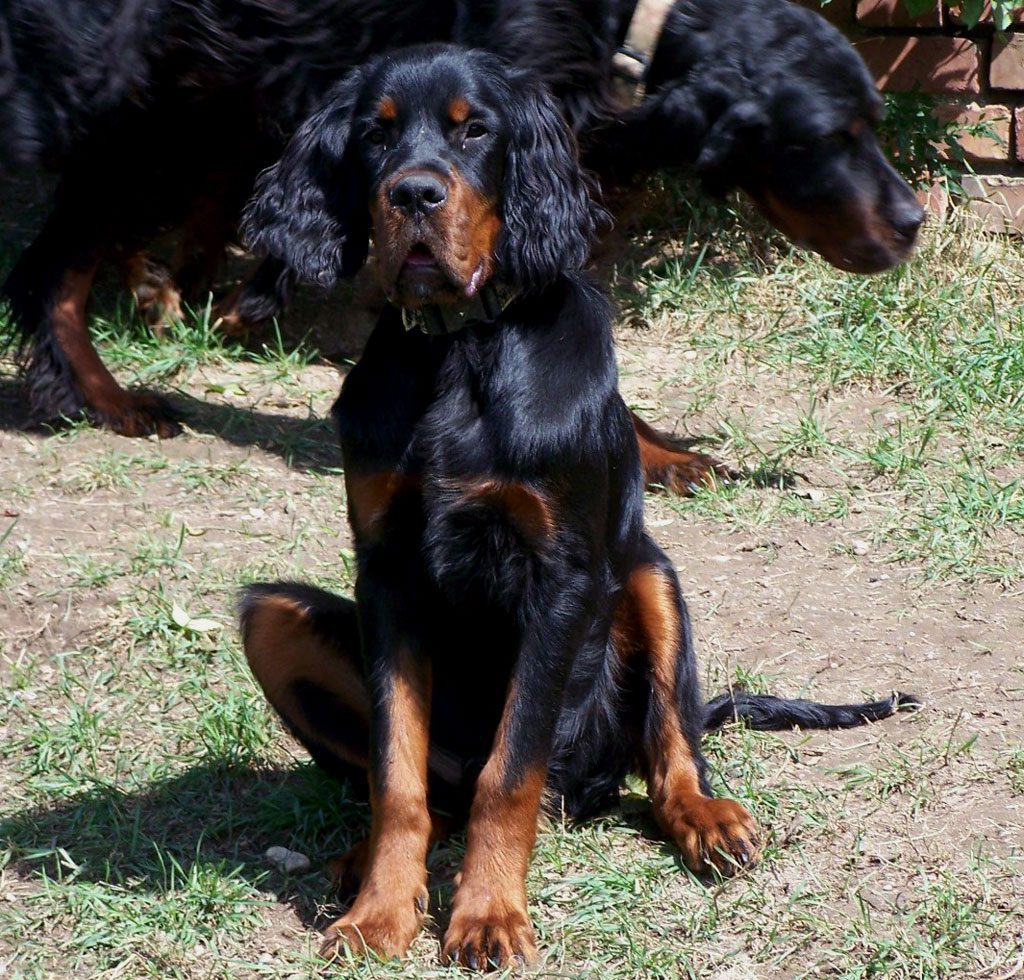
The Gordon Setter is a big dog, robust and well muscled. But, there are differences in size between individuals belonging to display lines and those belonging to hunting lines, the latter being significantly smaller.

The general appearance of the Gordon Setter conveys an impression of nobility and dignity. His chest is not very wide in front and his back is strong, rather short, with well arched ribs. His body is of medium length, short from shoulder to hips. Its tail is rather short and can be straight or slightly curved.

The head is taller than it is wide, with a well developed skull. The upper part of the skull is slightly rounded and the stop is well marked. Located at the end of a long snout, his nose is black and wide, with wide open nostrils. Master a strong and regular jaw.

The eyes of the Gordon Setter they are a good size, not too deep not too bulging. Dark brown and shiny, give it a lively look. Looking at your ears, they are falls, medium size and fine. They are set low and worn close to the head.

Like others Setters, the coat is soft and shiny, smooth or slightly wavy, but it should not be curly. It is of medium length over most of the body. But, is short on the top of the head and on the front of the legs, long and silky at the top of the ears, long and thin on the back of the hind legs. Last, on the belly forms a strip that can extend across the chest and throat.

Its fur is bicolor, mixing deep charcoal black and shiny chestnut. The border between black and brown must be clearly defined.

It also, chestnut-red markings can be seen in different places on the body. This is the case, in particular, above the eyes, with two spots that do not exceed 2 cm each. They are also found in the throat and on each side of the muzzle. They should not exceed the base of the nose; look like a band around the end of the muzzle. There are also two large chestnut-red spots on the chest.

Tan markings are also present on the inside of the hind legs, spreading out from the paws to the toes. They are also present on or slightly above the front legs and around the anus.

Some individuals also have a white patch on the chest and/or black spots on the toes and under the jaw..

Last, sexual dimorphism is not very pronounced, since males are not normally taller than 4 cm more at the withers than females.

Height and weight

    ▷ Male size: Of 66 to 66 cm.

    ▷ female size: Of 62 to 62 cm.

    ▷ Male weight: 29 kg

    ▷ female weight: 25 kg

Character and skills

The Gordon Setter He is a kind and very affectionate companion with his master. He is quite energetic in his youth, but it becomes much calmer as an adult.

It is an ideal dog especially with children, with whom he is tolerant and protective, and with whom he enjoys playing. But, given its size, it is better if they are already a certain age, as you will soon be able to involuntarily push them. In any case, regardless of race, a dog should never be left alone with a small child, that is to say, without adult supervision. In fact, An accident can happen at any time if you misinterpret a child's behavior and think that they are attacking. The risk of unfortunate consequences - even very serious ones- is even greater with an animal of that size, that could unintentionally upset a young child.

The close bond with the family can become problematic and can be counterproductive if the family has to be away from home often and/or for long periods of time. The dog is very likely to develop separation anxiety, what can lead to destructive behavior, escape attempts or excessive moaning.

You're also likely to be upset if you can't exercise for at least an hour a day. Although it is not at all suitable for an elderly and / or very sedentary person, it is an ideal companion for the owner of a dog who dreams, for example, with jogging with your dog, ride a bike with him or take him for long walks. But, it is essential that the rappelling process is mastered so that the dog can run without a leash, as his hunting instinct can take over at any time. He also likes games and loves to swim and play in the water.

If he is walked several times a day and his important need for exercise is satisfied, the Gordon Setter it is quiet and peaceful inside the home, able to live both in the city and in the country, and easily adapts to apartment living. If you live in a house with a garden, we must ensure that it is well fenced, since he is a fugitive by nature. Using an underground electric fence would not be an effective solution, since your determination is much stronger than the discomfort caused by electrical impulses, especially when it has sniffed a prey. In any case, it cannot be a question of making him live outside. In fact, to be happy and balanced, needs to be surrounded and interact with their masters, to feel like he is a full member of the family pack.

Although at Gordon Setter he likes to be surrounded, you greatly prefer to be around people you know or, at least, of other animals that you are used to seeing. On the other hand, he is quite suspicious, reserved and impassive with strangers, not hesitating to bark if it perceives the slightest danger. So, can be a good watchdog. They are also sometimes aggressive towards other dogs they meet for the first time.. In fact, is often a dog with a dominant temperament, who therefore wishes to seize his companions. A thorough socialization started at a very young age is de rigueur so that you learn to respect them.

But, coexistence with other animals in the home is not impossible, and having a playmate is a good way to avoid boredom in the absence of their masters. In fact, if they have grown up together, everything usually goes very well. On the other hand, the arrival of a new animal at home is only possible if it is used to living with other animals since childhood. If that is not the case, your hunting instinct is likely to lead you to regard the newcomer as prey. The same goes for the animals you see outside, especially those who venture into your garden.

His dominant character, independent and determined can also be a source of problems in the relationship with his master, if he does not know how to impose himself and make his dog respect him. A firm education is essential to prevent him from becoming difficult to handle., doing what he pleases.

Education

The socialization of Gordon Setter should be done at a young age, period when learning is easier, since it is more malleable and adaptable. Thus, it is necessary to get used as often as possible to meet new people and to face all kinds of situations and external stimuli (noises, smells, vehicles…). On the other hand, it is just as essential to teach them to tolerate loneliness, so your teacher's absences don't become a problem later. These two aspects are essential requirements to achieve a balanced and serene companion.

Given its size and its significant need for maintenance, it is convenient to get used to being handled without flinching from an early age, otherwise he will have problems when he is an adult. In view of his strong hunting instinct, learning to remember your dog is at least as important as basic commands ("Sit down", "walk", "stay", etc.). This allows the dog to shed without having to worry too much, which makes it easier for him to exercise by himself and, Therefore, make you feel comfortable. Of course, this is especially important if it is used as a hunting dog. As long as I don't obey this order, must be carried on a leash when walking.

It also, the Gordon Setter it is an intelligent breed of dog and learns quickly. But, as is often the case with intelligent dogs, They are not the kind that take for granted: with a strong character, can quickly become very stubborn. This means that, to be obedient, You have to give him a firm education to prevent his intelligence from turning against his master and getting the best of him as soon as he gets home. But, do not punish your dog in any way when he does something wrong: as the Gordon Setter not really receptive to reprimands, it is better to opt for the positive reinforcement method, with the help of treats in particular.

Last, if it is intended to be used for hunting, the report and the notion of resignation are added to the reminder as indispensable teachings. In effect, must be able at all times to return when his master calls him, to catch a prey without biting it and to give it up if its owner asks.

Health

The Gordon Setter is generally in good health.

But, may be exposed to various pathologies of varying severity, as :

  • The stomach dilation-torsion syndrome, common to most large breeds of dogs and can lead to rapid death of the animal if not attended to quickly;
  • The hip and elbow dysplasia, also common in large dogs. Produces pain and lameness caused by inflammation of the joints, which can lead to osteoarthritis.
  • The progressive retinal atrophy, an inherited disease that causes retinal degeneration and can lead to total loss of vision;
  • The Hypothyroidism, a hormonal disorder responsible for many symptoms that vary from person to person;
    ear infections, due to the drooping shape of their ears;
  • The abiotrofia cortical cerebelosa, a severe inherited neurological disease due to premature degeneration of cerebellar cells. If adopted from a breeder Gordon Setter, DNA test results should be requested to establish that the puppy does not have the gene responsible for this disease. In any case, a worthy breeder does not breed an individual with a genetic disease. In the case of adoption by another route, DNA testing can be done before taking the plunge, in order to rule out this risk.

It also, as with all large breeds, It is strongly recommended to avoid subjecting a puppy to Gordon Setter to excessive physical exertion. In effect, it is very fragile during its growth, especially at the level of your bones and joints. The utmost care must be taken during this period.

Life expectancy

13 years

Grooming

The coat of the Gordon Setter requires special care and maintenance. Brushing two to three times a week with a brush or glove is essential for the sebum to be well distributed throughout the coat., removing dead hairs and preventing them from tangling. Although hair loss is moderate, brushing should be daily, during the seasonal moult in spring and fall. It is also necessary to wash the dog once every one or two months to avoid bad smells and clean its coat: due to hair length, tends to collect dirt easily. But, you must be careful not to wet the inside of their ears, as it is easily prone to ear infections.

It also, the hair between the pads and inside the ears should be trimmed once a month to reduce the risk of infections caused by small plants or spikelets that could get stuck in the pads.

It also, pay special attention to your ears. Like any dog โ€‹โ€‹with floppy ears, are at increased risk of infections (otitis, etc.). So, should be inspected and cleaned at least once a week, and ideally every time the dog comes into contact with water, for example during a hunting trip or after bathing. This is also an opportunity to check your eyes and clean them if necessary..

Looking at your teeth, cleaning is necessary at least once a week, as for all other dogs. Regular use of a dog toothbrush or finger pad will help limit tartar and bad breath..

Last, given your level of activity, natural wear and tear is usually enough to trim the claws of the Gordon Setter. But, as you get older or don't walk enough, claws can become too long and become a nuisance or even injury. If this happens, must be trimmed with a special file or nail clippers. If the owner is not very comfortable with this maintenance task, you can ask your vet to do it or, at least, teach him how to do it so he can do it himself.

Use

Born hunter, the Gordon Setter has long been used as a hunting dog and as a pointing and collecting dog. Although they are not very fast compared to others Setter, their stamina and keen sense of smell make them excellent woodcock hunters, partridges and retrievers.

Today, although they are still used primarily as bird hunting dogs, they are also increasingly found as companion and show dogs. His calm character, gentle and affectionate makes them very endearing pets, as long as their owners are able to satisfy their need for exercise.

Their loyalty to their owners and their distrust of strangers also make them excellent watchdogs.. So, it is also a good companion for canicross, canine mountain biking or any other sporting activity, thanks above all to its resistance and its robust character.

Last, its elegance, as well as his noble attitude, also make him a competitor of choice in canine beauty contests.

Price

The price of a puppy Gordon Setter varies between the 700 and 1200 euros in Europe .

Regardless of location, price differences from one individual to another are explained by their greater or lesser conformity with the norm, as well as by their sex: males are significantly more expensive than females.

Characteristics "Gordon Setter"

Coexistence is important that you have with your new friend. Before considering the acquisition of a dog of the breed "Gordon Setter" you know certain factors. Not all breeds of dogs are apt to live in an apartment, you must take into account his character, their need for exercise, their interaction with other pets, their care and if you have small children, their level of tolerance towards them.

Adaptation โ“˜

2,0 of 5 stars (based on 1 review)

friendly dog โ€‹โ€‹โ“˜

4,0 of 5 stars (based on 1 review)

hair loss โ“˜

3,0 of 5 stars (based on 1 review)

Affection level โ“˜

5,0 of 5 stars (based on 1 review)

Need for exercise โ“˜

5,0 of 5 stars (based on 1 review)

Social need โ“˜

3,0 of 5 stars (based on 1 review)

Home โ“˜

3,0 of 5 stars (based on 1 review)

Toilet โ“˜

3,0 of 5 stars (based on 1 review)

Friendly with strangers โ“˜

2,0 of 5 stars (based on 1 review)

barking โ“˜

3,0 of 5 stars (based on 1 review)

Health โ“˜

3,0 of 5 stars (based on 1 review)

Territorial โ“˜

2,0 of 5 stars (based on 1 review)

Cat friendly โ“˜

2,0 of 5 stars (based on 1 review)

Intelligence โ“˜

3,0 of 5 stars (based on 1 review)

Versatility โ“˜

3,0 of 5 stars (based on 1 review)

Child friendly โ“˜

4,0 of 5 stars (based on 1 review)

Surveillance โ“˜

2,0 of 5 stars (based on 1 review)

joy โ“˜

5,0 of 5 stars (based on 1 review)

Images "Gordon Setter"

Photos:

1 – The picture shows a Gordon Setter in the typical work of the race in the field. by Nordic-Gordon-Hunters, CC BY-SA 3.0, via Wikimedia Commons
2 – Gordon Setter by richkidsunite
3 – Gordon Setter at a dog show in Konopiska, Poland. by Pleple2000, CC BY-SA 3.0, via Wikimedia Commons
4 – Gordon Setter at a dog show in Konopiska, Polonia by Pleple2000, CC BY-SA 3.0, via Wikimedia Commons
5 – Gordon Setter by https://pixabay.com/photos/dog-setter-gordon-animal-pet-4320937/
6 – Gordon Setter by https://pixabay.com/photos/dog-setter-gordon-animal-pet-4320945/

Videos "Gordon Setter"

Type and recognitions:

  • FCI CLASSIFICATION:
  • Group :
  • Section : . .

Federations:

  • FCI – Group 7: Pointing Dogs. – Section 2: British and Irish Pointers and Setters. 2.2: Setter โ“˜
  • AKCSporting โ“˜
  • โ€‹KC – Gundog โ“˜
  • UKCGun Dogs โ“˜

FCI breed standard "Gordon Setter"

Origin:
United Kingdom

Date of publication of the valid original standard:
14.06.1987

Use:

Pointing Dogs.


General appearance:

It is an elegant dog with features that denote speed. It has a harmonious constitution that can be compared to that of an efficient hunting horse.. In symmetrical ways in all respects.


Behavior / temperament:

Intelligent, skillful and noble. Intrepid, bold and affable and stable character.

Head:

The head is rather deep than wide. The distance between the occiput and the stop is greater than that between the stop and the nose. The area around the eyes should be thin.

Cranial region:
  • Skull: Slightly round, being the widest point between the ears. Wider than the muzzle, with good cranial cavity.
  • Depression links (Stop): Clearly defined.

facial region:

  • Truffle: Grand, wide, black; with open nostrils.
  • Snout: long, of almost parallel lines; it is not pointed or sharp. Not so deep how long.
  • Lips: The lips should not hang down and the lips should be clearly defined.
  • Jaws / Teeth : Strong jaws with healthy teeth, complete and scissor bite, that is to say, that the internal face of the upper incisors is in contact with the external face of the lower incisors, the teeth being placed perpendicular to the jaws.
  • Cheeks: The cheekbones are as narrow as the thinness of the head allows.

Eyes: Dark brown and bright. They must not be protruding or sunken; well positioned under the brow ridges, with a cunning and intelligent expression.

Ears: Ears should be medium in size and thin. Their implantation is low and they must be worn next to the head.

Neck:

Long, delgado, arched and without dewlap.

Body:

Moderate long.

  • Pork loin: Wide and slightly arched.
  • Breast : deep and not very wide. The ribs are well arched and well developed backwards.

Tail:

Straight or slightly scimitar-shaped, without exceeding the hocks and carried horizontally or below the dorsal line. It is thick at the base and gradually decreases in thickness to the tip. It has long, straight hair in the shape of a fringe or flag near the base, which decreases in size as it reaches the tip.

Tips

PREVIOUS MEMBERS: Front limbs are flat bone, straight and strong.

  • Shoulder: The scapulae are long and well sloped back, flat and broad bone, together in the region of the cross without being loaded.
  • Elbows: Well lowered and close to the body.
  • Metacarpus: Vertical.

LATER MEMBERS: They must be long, wide and muscular from hips to hocks, short and strong from hock to foot and straight from tibio-tarsal joint to floor. The pelvis tends to be horizontal.

  • Knees: Well angulated.

FEET: Oval, tight, with well arched fingers well provided with hair between them. Well-developed finger and foot pads.

Movement:

Firm movement, free and natural, with powerful impulse in the hind limbs.

Mantle

HAIR: The hair of the head, the front edge of the limbs and the tips of the ears is short and fine; in the rest of the body it has a moderate length, it is smooth and without waves or curls. The fringed hair at the top of the ears is long and silky; on the back of the hind limbs the fringe hair is long, fine, smooth and straight. The belly bangs can be extended to the chest and throat, and if possible they should not be curly or wavy.

COLOR: Deep shiny black, no reddish tones oxides, with brownish-red spots, that is to say, bright tan color. Fine black spots are allowed on the fingers and black streaks under the jawbone.

Tan stains: Two distinct spots on the superciliary areas with a diameter of no more than three-quarters of an inch. (2 mm.). On the sides of the muzzle tan spots no higher than the base of the nose, and resemble a band that surrounds the well-defined end of the muzzle.

On the throat and on the chest two large and defined spots; on the inside of the hind limbs, as well as in the thigh, can extend to the knee and extend to the outside of the hindquarters from the hocks to the toes; in the forelimbs up to the elbow on the inside and slightly above the carpus in front; fire spot around ear. A small white spot on the chest is allowed. Other colors are not allowed.


Size and weight:

Height of the cross: In males it should be 66 cm.. (26 inches) and in females 62 cm.. (24 ยฝ inch).

Weight: In males it should be 29,5 kg (65 English pounds) and in females 25,5 kg (56 English pounds).


Fouls:

Any deviation from the aforementioned criteria is considered as a fault and the severity of this is considered to the degree of the deviation to the standard and its consequences on the health and well-being of the dog., and the dog's ability to perform its traditional task.

FALTAS DESCALIFICANTES:

โ€ข Aggressiveness or extreme shyness.
โ€ข Any dog โ€‹โ€‹showing clear signs of physical or behavioral abnormalities.


N.B.:

โ€ข Males must have two normal-appearing testicles fully descended into the scrotum..
โ€ข Only functionally and clinically healthy dogs, with the typical conformation of the breed, should be used for parenting.

Source: F.C.I - International Cynological Federation

Alternative names:

1. Black and tans (English).
2. Setter Gordon (French).
3. Gordon Setter (German).
4. Setter gordon (Portuguese).
5. Setter escocรฉs (espaรฑol).

โ–ท The world of Pets: Dogs, cats, birds, reptiles, amphibians

Wirehaired Pointing Griffon
Holanda Alemania Francia FCI 107 . Griffon type

Grifรณn Korthals

Vigorous, fiery and proud, the Wirehaired Pointing Griffon he is very attached to his master and his territory, who watches.

Content

History

The Wirehaired Pointing Griffon It is a breed of dog of French origin. Their ancestors are Dutch, but shown as a French race, It was in France where he developed.

This breed is still relatively rare today in the Americas as well as in the UK., Although it is recognized by their respective Kennel Clubs, as well as by the International Cynological Federation (CRF not. 107).

Grifรณn de muestra Korthals de pelo duro

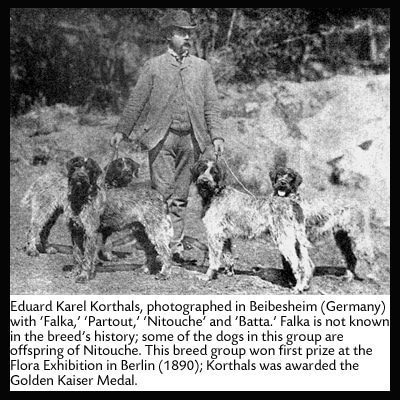
The culprit of the existence of Korthals Griffon was a man named Eduard Karel Korthals, born the 16 in November of 1851 in Amsterdam that, he was the son of a wealthy shipbuilder who had a keen interest in breeding hunting dogs, to the extent that his son inherited that passion and as a result and the ability for business, the beautiful was born Griffon, protagonist of this post.

His dream was to create the ideal hunting dog, versatile, with extreme resistance, force and devotion to his master. The dog, as well, he would have to know how to work close to his master, be docile and very capable of learning. In 1873 to the 22 years of age and with the financial support of his father, He settled near some friends in Hesse (Germany) a region known for its great fondness for hunting with dogs and was dedicated to the breeding of purebred dogs Griffon.

four years later, one of his friends, the prince of Solms-Braunfels, I entrust him with the management of his kennel โ€œBibesheimโ€ (was then, the most famous of Germany) which was dedicated especially to the breeding of purebred dogs English Pointer, that change in his life did not prevent him at all, continue with the development of their race Griffon.

Soon Eduard Korthals became one of the largest breeders nationwide, very proud and sure of his work of selection, breeding began with seven specimens of Griffon of different kinds, hard hair, woolly hair, barbets, a mestizo German short hair, etc. He called them "The Seven Patriarchs" and their names were: Bank, Hector, Janus, Satan, Donna, Junon and Mouche. Thus begins the story that after twenty years, resulted in the birth of a specific breed of Griffon with wire hair, leonado, with ยซPointerยป blood (Although not pure, then we have) and beautiful dog, it must be said...

We must also tell which, Eduard Korthals carried out ruthless work in its breeding program, with very close consanguinity coupling and many deaths on the road, you are rightโ€ฆ, the history has beautiful parts and others less so. Y, here comes the bomb! Out of a total of 600 dogs, only kept alive to 62 and he made them work in the Woods, in swamps, in Plains, in different seasons, to see how they worked in different situations and hunting tasks.

In creating your Wirehaired Pointing, Korthals did not use all the blood purity of the English Pointer, because after having tried, realized that the mixture led to his Griffon lose some of its most important features.

With his method of consanguinity, exhaustive selection and unit, the Wirehaired Pointing Griffon It was of such quality that many specialists in the canine world in Germany, in Belgium, in the Netherlands, in France and several parts of Europe, they were stunned, Given the Korthals he had created a dog like no other, a dog with an essential width, great search speed, a well-developed sense of smell and, In short, its versatility.

The 15 in November of 1887, supported by the contributions of a Commission formed by 16 renowned breeders and presided over by the Prince of Solm-Braunfels (who had entrusted Eduar Korthals -years before- the management of its hatchery โ€œBibesheimโ€), Eduar Korthals wrote the standard of Korthals Griffon, that curiously never amended since then. The following year, He created a Club specialized in his breed whose objective was to bring together all the lovers of his Griffon fawn with wire hair from various countries and until his death in 1896, He devoted himself to the improvement and dissemination of their race. He died of laryngeal cancer 4 in July of 1896 in the hatchery Bibeishem.

But despite his death, his ideas continued living, then many followers and friends as Baron Gingins (Switzerland), Charles Prudommeaux (France) and the Sr. Leliman (Netherlands) they continued their valuable work, turning to improving your Wirehaired Pointing Griffon, and the diffusion of the breed throughout Europe and even in United States and Canada. It was the 8 in June of 1951, on the occasion of the fiftieth anniversary of the death of Eduar Korthals What, The "French Wirehaired Griffon Club" decided to associate the name of Korthals the race, to perpetuate the memory of its creator, and in honor of all his achievements and life dedicated to the task of breeding. Hence the name "Korthals Griffonโ€.

The first specimen registered in the Book of Origins of the American Kennel Club was a Korthals Griffon called "Zolette", in the year 1887. But, the Griffon was still relatively- unknown, was registered as โ€œRussian Setter (Griffon)โ€, by its supposed Russian heritage. It was not until 1916, Twenty-nine years later, the breed was officially recognized in United States.

In the same year, sixteen copies of Korthals Griffon participated in the "Westminster Kennel Club Dog Showโ€, one of United States most prestigious dog shows. Since then, the race was growing in popularity, not only as a show and companion dog, but also a versatile hunting dog (that was the original intention of Korthals when he created the breed). for the most part, the breed continues to maintain its original characteristics: medium-sized, layer hard, good degree of training capacity and resistant in the field and in the ring.

Physical characteristics

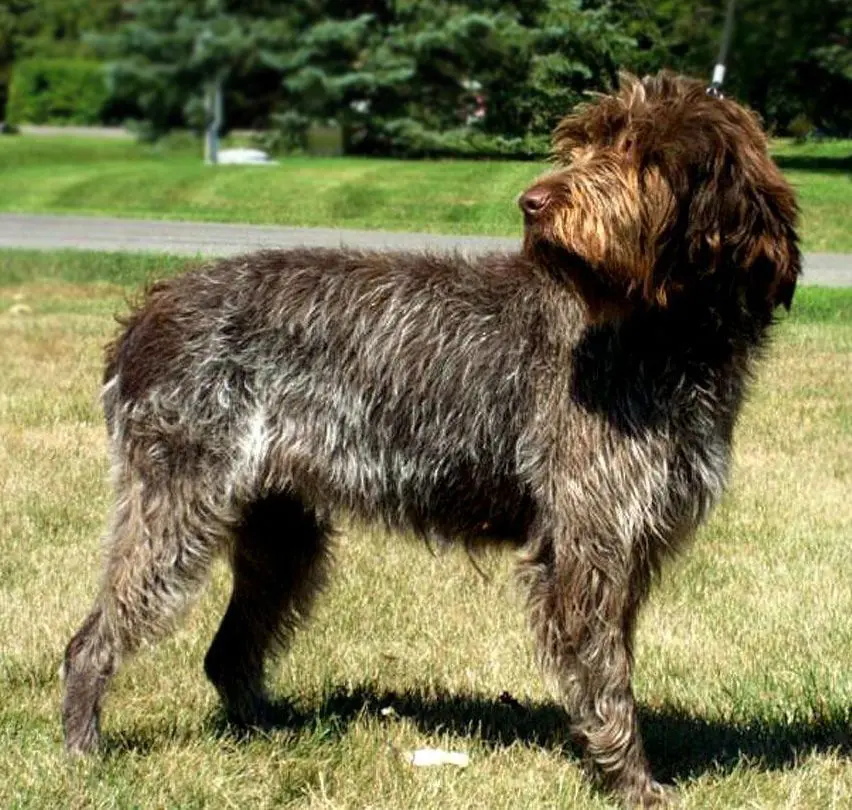
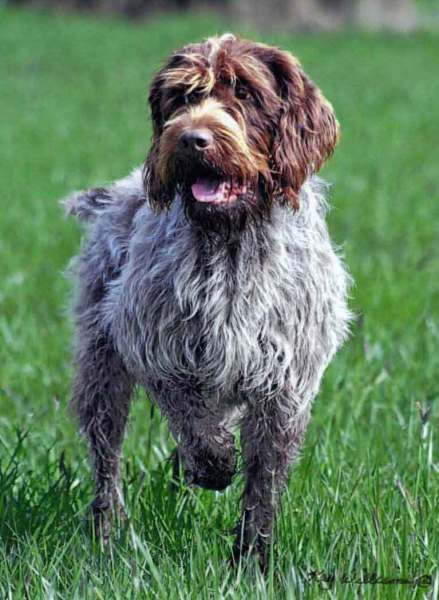
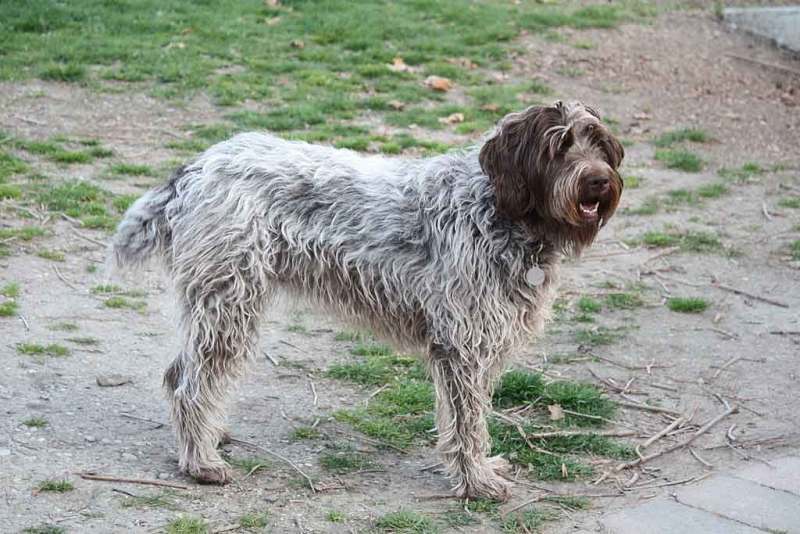
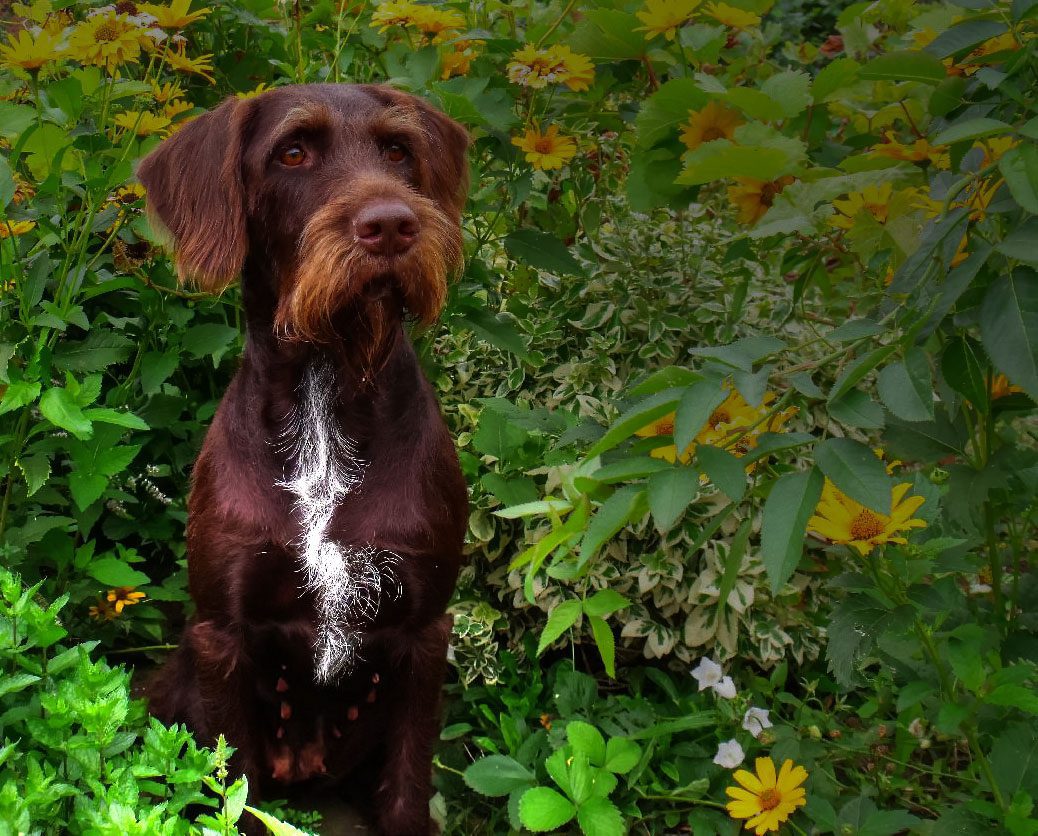
The Korthals Griffon is a medium-sized dog with a hard and rough coat. The males measure of 55 to 60 cm de altura a la cruz y las hembras de 53 a 66 cm.. The weight should be proportional to the size and bone structure. In general, the weight varies from 20,5 a 31,75 kg. Males are usually larger and heavier than females bones. 50 to 55 cm.. Regarding weight, the males are located in 25-30 kg and females in 20-25 kg. According to the AKC standard, the hair must be color steel (grey) with brown spots. Other acceptable colors are chestnut, White and Brown, Ruano and, Orange and white. It has ears falls and well attached to the head, his eyes are yellow or Brown and the nose should always be Brown. Contrary to some publications that say that the Griffon does not lose or shed its hair, it should be clarified that yes it does, but to a lesser extent than other breeds.

There are dogs very similar to the Griffon Korthal in other countries, both in appearance and temperament:

Character and skills

The Wirehaired Pointing Griffon is defined as an intelligent dog, extremely friendly and eager to please its owner. They tend to maintain their typical playful puppy character well into adulthood.. They are also known for their Adaptive temperament.

The Korthals Griffon it is above all a hunting dog, resistant, powerful and brave. He's an outdoor dog who needs a garden to keep his instincts sharp.. Not a suitable breed of dog for apartment living, since it is very likely that confinement will cause anxiety attacks or greater nervousness that leads you to destroy everything. They need a lot of exercise to thrive, and they are tireless sporting dogs and very good swimmers. So, their owners must be able to offer them long walks and games, beyond simple daily outings for your needs: this is necessary to keep you in good physical and psychological health. In fact, the Wirehaired Pointing Griffon is an ideal candidate for canicross, el cani-VTT, the oberta or even the treasure hunt, that will fully satisfy your hunter instinct.

most of Korthals Griffon usually live long and healthy lives, and that is due to the seriousness of all the organizations and breeders dedicated to this breed that have a strong commitment to the health of the breed and carry out breeding programs that are mostly very selective, As a result, if we look at the OFA statistics, the cases of congenital diseases are โ€“relatively- low.

education

The Korthals Griffon he is an intelligent and cunning dog. These qualities make hunters happy… but the misfortune of inexperienced teachers, whose defects he takes advantage of. This dog can be undocile if it does not benefit from a firm education, consistent and not brutal. As much as saying that it is not an adapted breed as a first dog.

It also, it is important to socialize the puppies as soon as possible so that they get used to the presence of different people and other animals. In effect, although they are not fearful in nature, the Wirehaired Pointing Griffon Too isolated or too "protected" from the outside world can be particularly nervous and difficult to adapt to everyday life.

Health

Robustness is a fundamental characteristic of the Grifรณn Korthal: It is a breed of dog that does not fear cold or bad weather.

But, like all medium-sized dogs and large dogs, have a risk of hip dysplasia. Prostate disorders may also occur in some individuals.

Last, it is recommended to monitor the coat and skin of individuals who do not live outdoors, to prevent the development of skin diseases in dogs due to allergies to industrial product residues present in the home (solvents, Cleaning products…).

Life expectancy

13 years

Grooming

Although it is considered a "hypoallergenic" dog due to its low hair loss., the Grifรณn Korthal requires weekly brushing to keep its coat shiny. During the molting period (twice a year), more frequent brushing may be necessary.

It is also advised to clean the dog's ears regularly., especially after walks or bathing, to prevent the development of infections due to excess water inside the ear canal, or to the presence of residues or dirt. In case of redness or suspicious odors, consulting a vet is recommended.

Price

Adopt a Wirehaired Pointing Griffon costs between 600 and 1000 EUR.

The price of a puppy Khortals varies according to your lineage, but also according to their gender: females tend to be more expensive than males.

Characteristics "Wirehaired Pointing Griffon"

Coexistence is important that you have with your new friend. Before considering the acquisition of a dog of the breed "Wirehaired Pointing Griffon" you know certain factors. Not all breeds of dogs are apt to live in an apartment, you must take into account his character, their need for exercise, their interaction with other pets, their care and if you have small children, their level of tolerance towards them.

Adaptation โ“˜

3,0 of 5 stars (based on 1 review)

friendly dog โ€‹โ€‹โ“˜

3,0 of 5 stars (based on 1 review)

hair loss โ“˜

2,0 of 5 stars (based on 1 review)

Affection level โ“˜

4,0 of 5 stars (based on 1 review)

Need for exercise โ“˜

5,0 of 5 stars (based on 1 review)

Social need โ“˜

4,0 of 5 stars (based on 1 review)

Home โ“˜

3,0 of 5 stars (based on 1 review)

Toilet โ“˜

2,0 of 5 stars (based on 1 review)

Friendly with strangers โ“˜

3,0 of 5 stars (based on 1 review)

barking โ“˜

3,0 of 5 stars (based on 1 review)

Health โ“˜

4,0 of 5 stars (based on 1 review)

Territorial โ“˜

3,0 of 5 stars (based on 1 review)

Cat friendly โ“˜

2,0 of 5 stars (based on 1 review)

Intelligence โ“˜

4,0 of 5 stars (based on 1 review)

Versatility โ“˜

4,0 of 5 stars (based on 1 review)

Child friendly โ“˜

4,0 of 5 stars (based on 1 review)

Surveillance โ“˜

3,0 of 5 stars (based on 1 review)

joy โ“˜

4,0 of 5 stars (based on 1 review)

Images "Wirehaired Pointing Griffon"

Photos:

1 – the first genuine Korthals Griffon in the USA to earn both a Grand Championship and the Advanced Master Hunter title by CarolPtak, CC BY-SA 4.0, via Wikimedia Commons
2 – Adult Griffon dog standing by Liv klesta, CC BY-SA 3.0, via Wikimedia Commons
3 – Griffon d’arrรชt ร  poil dur Korthals by Pierre Andrรฉ, CC BY-SA 4.0, via Wikimedia Commons
4 – running Korthals Griffon by CarolPtak, CC BY-SA 4.0, via Wikimedia Commons
5 – Wirehaired Pointing Griffon by Pets Adviser from Brooklyn, USA, CC BY 2.0, via Wikimedia Commons
6 – Wirehaired Pointing Griffon by Canarian, CC BY-SA 4.0, via Wikimedia Commons

Videos "Wirehaired Pointing Griffon"

Type and recognitions:

  • FCI CLASSIFICATION:
  • Group :
  • Section : . .

Federations:

  • FCI – Group 7: Pointing Dogs. – Section 1: Continental Pointing Dogs. 1.3: Griffon type โ“˜
  • AKCSporting group โ“˜
  • ANKCSporting Group, Gundog โ“˜
  • CKCSporting Group, Gundog โ“˜
  • โ€‹KC – Sporting Group, Gundog โ“˜
  • NZKCSporting Group, Gundog โ“˜
  • UKCGun Dog โ“˜

FCI breed standard "Wirehaired Pointing Griffon"

Origin:
Germany, France, Netherlands

Date of publication of the valid original standard:
06.05.1964

Use:

This is essentially a versatile pointing dog. It is also used to look for the trace of wounded big game.


General appearance:

It is a vigorous dog, rustic, medium-sized. It is longer than high. The skull is not very wide, the muzzle is long and square. Dark yellow or brown eyes, there are tangled eyebrows that do not cover them completely. The whiskers and beard are well developed and give the animal a characteristic expression that denotes firmness and security..


Behavior / temperament:

Manso, haughty, excellent Hunter. He is very attached to his master and his territory, who cares diligently. He is very friendly with children.

Head:

It's big and long. It is covered with coarse and abundant hair, although not very long. The whiskers, the beard and eyebrows are well pronounced.

Cranial region:
  • Skull: Not very wide. The lines of the skull and the nasal cannula are parallel.
  • Depression links (Stop): Not very pronounced.

facial region:

  • Truffle: It is always brown.
  • Snout: Long and square. The muzzle is slightly arched and is the same length as the skull.
  • Eyes: Dark yellow or brown in color. They are big and round, the eyebrows are abundant, but they don't cover them. His expression is smart.
  • Ears: Medium-sized, they are not bent. They are flat and contiguous to the face; Its insertion is at the level of the eye line; the short hair that covers them is mixed with longer hairs.

Neck:

Medium long. There is no presence of dewlap.

Body:

Its length is visibly greater than that of the height of the withers.

(Of 1/20 to 1/10).
  • Back: Strong.
  • Pork loin: Well development.
  • Breast : Large, not very wide. The ribs are slightly arched.

Tail:

Presents horizontally or with the limb slightly raised. Hair is abundant, but without plume. The tail should usually be trimmed by a third or a quarter. If it's not cropped, must be presented horizontally, with the limb slightly raised.

Tips

PREVIOUS MEMBERS: Straight, powerful and thick hair. When the dog is in action there are parallels.
  • Shoulder: Well applied to the body. They are rather long and very oblique.
LATER MEMBERS: Covered with abundant hair.
  • Thighs: Long and well muscled.
  • Hocks: Well bent.
FEET: Round, firm. Fingers are well together and arched.

Movement:

The pace during the hunt is the gallop, which is interrupted by periods of jogging. The trot is elongated. The dog glides to the feline.

Mantle

HAIR: It's tough and rough. To the touch, looks like boar hair. Never curly, ni lanudo. Fine and tight hair is observed under the tough hair of the outer layer.

COLOR: Preferably steel gray with brown spots or uniform brown color. It is often rubican or roan brown. White and brown and white and orange coats are also accepted.


Size and weight:

  • In males: 55 to 60 cm.;
  • In females: 50 to 55 cm..


Fouls:

Any deviation from the aforementioned criteria is considered as a fault and the severity of this is considered to the degree of the deviation to the standard and its consequences on the health and well-being of the dog..

FALTAS DESCALIFICANTES:

โ€ข Aggressiveness or extreme shyness.
โ€ข Any dog โ€‹โ€‹showing clear signs of physical or behavioral abnormalities.


N.B.:

โ€ข Males must have two normal-appearing testicles fully descended into the scrotum..
โ€ข Only functionally and clinically healthy dogs, with the typical conformation of the breed, should be used for parenting.

Source: F.C.I - International Cynological Federation

Alternative names:

1. Korthals Griffon (English).
2. Korthals, Griffon Korthals (French).
3. Griffon ร  Poil Dur, Griffon Korthals (German).
4. Korthals (Portuguese).
5. Grifรณn Korthals, Korthals (espaรฑol).

โ–ท The world of Pets: Dogs, cats, birds, reptiles, amphibians

Cesky Fousek
Repรบblica Checa FCI 245 . Griffon type

Cesky Fousek

The Cesky Fousek It is a dog of Czech origin, defined as a breed of versatile.

Content

History

Before the First World War, The "Bohemian Wirehaired Pointing Griffon" was the most important wirehaired pointing dog in the region of present-day Czechoslovakia.. Because of the First World War and its consequences, This race was on the verge of extinction in the mid-twenties. Hereafter, a regeneration of this breed was proposed from some original typical dogs; By means of planned selection the modern type of ยซCesky Fousekยซ, which currently ranks second in number among hunting dog breeds used in the Czech and Slovak Republics.

Physical characteristics

He "Cesky Fousekยป is a noble pointer dog of medium size and rough hair that has innate qualities for work in the field, in the water and in the woods, so that its usefulness is multiple. Despite being a hunter bitterest, let easily guide and has developed attachment to man.

Did you know??

The name was given to this breed according to the "beard", It located on the chin and characterizes him.

Height to the cross: Males: 60-66 cm., females: 58-62 cm..
Weight: In males at least 28 kg, maximum 34 kg. In females minimum 22 kg, maximum 28 kg.

Character and skills

The Cesky Fousek It is a loyal dog, nice and very agile and active, very fond of hunting. It is a good retriever on land and water, but is used more frequently for exhibition games. Males are more stubborn, females are fairly quiet. It is friendly and playful with his family and acquaintances, it is customary to strangers more time. It may be too dominant during puberty, but it will fade over time. Very intelligent and insightful.

It works well with other animals , but supports the hunting instinct, chasing fast-moving objects, including pets or cyclists. It is advisable to breed in the herd, because socializes with other dogs perfection.

He is affectionate with children and has a perfect relationship with them..

It has a high bark to alert all passers-by and unwanted visitors. It's a good guard, and if you think something is wrong, You may intervene against thieves.

Care of the โ€œBohemian Wirehaired Pointing Griffonโ€

The hair Cesky Fousek It does not require a lot of care, I is sufficient occasionally comb with a brush with hard bristles. In case of heavy soiling, it is good to wash it with quality water and shampoo, as this type of hair could lose shine after an incorrect shampoo.

It is a very active and playful breed that likes to play and show hunting. He likes to do exactly that, but if it is sufficiently occupied by another type of movement, it will not lose. Every movement is suitable for him. It has an almost inexhaustible power supply, so it is particularly suitable for sports-minded people and provide them with enough exercise. Without moving, The โ€œBohemian Wirehaired Pointing Griffonโ€ could get bored and entertain itself by destroying your garden or house.

Training and education are necessary, without them it can become completely unmanageable and too dominant. You need a driver to raise him better without violence. It can be dominant, not nervous.

Characteristics "Cesky Fousek"

Coexistence is important that you have with your new friend. Before considering the acquisition of a dog of the breed "Cesky Fousek" you know certain factors. Not all breeds of dogs are apt to live in an apartment, you must take into account his character, their need for exercise, their interaction with other pets, their care and if you have small children, their level of tolerance towards them.

Adaptation โ“˜

4,0 of 5 stars (based on 1 review)

friendly dog โ€‹โ€‹โ“˜

3,0 of 5 stars (based on 1 review)

hair loss โ“˜

3,0 of 5 stars (based on 1 review)

Affection level โ“˜

3,0 of 5 stars (based on 1 review)

Need for exercise โ“˜

4,0 of 5 stars (based on 1 review)

Social need โ“˜

3,0 of 5 stars (based on 1 review)

Home โ“˜

3,0 of 5 stars (based on 1 review)

Toilet โ“˜

2,0 of 5 stars (based on 1 review)

Friendly with strangers โ“˜

2,0 of 5 stars (based on 1 review)

barking โ“˜

3,0 of 5 stars (based on 1 review)

Health โ“˜

3,0 of 5 stars (based on 1 review)

Territorial โ“˜

3,0 of 5 stars (based on 1 review)

Cat friendly โ“˜

2,0 of 5 stars (based on 1 review)

Intelligence โ“˜

4,0 of 5 stars (based on 1 review)

Versatility โ“˜

4,0 of 5 stars (based on 1 review)

Child friendly โ“˜

4,0 of 5 stars (based on 1 review)

Surveillance โ“˜

3,0 of 5 stars (based on 1 review)

joy โ“˜

4,0 of 5 stars (based on 1 review)

Images ยซHard-haired bohemian sample gryphonยป

credits:

1. https://commons.wikimedia.org/wiki/File:Cesky_Fousek_Betty.jpg When reusing, please credit me asauthor: Adam Kliczek, http://zatrzymujeczas.pl (CC-BY-SA-3.0)If you use my image on your website, please send me an email with webpage adress. If you use my image in your book, please send me an email.Contact me at: adam.kliczekgmail.complen+/โˆ’plen+/โˆ’ https://creativecommons.org/licenses/by-sa/4.0 CC BY-SA
2. Cesky Fousek by https://pxhere.com/es/photo/789408
3. Cesky Fousek by https://pxhere.com/es/photo/680392
4. Czech_fousek at the World Expo in Poznan by Pleple2000 / CC BY-SA
5. Czech_fousek at the World Expo in Poznan by Pleple2000 / CC BY-SA
6. Czech_fousek at the World Expo in Poznan by Pleple2000 / CC BY-SA
7. Czech_fousek at the World Expo in Poznan by Pleple2000 / CC BY-SA
8. Cesky Fousek by https://pxhere.com/es/photo/845285

Videos ยซBohemian Wirehaired Pointing Griffonยป

Type and recognitions:

  • FCI CLASSIFICATION:
  • Group :
  • Section : . .

Federations:

    FCI โ“˜, NZKC โ“˜, UKC โ“˜

FCI breed standard Cesky Fousek

FCIFCI - Cesky Fousek
Griffon

Alternative names:

1. Bohemian Wire-haired Pointing Griffon, Rough-coated Bohemian Pointer, Barbu tchรจque (English).
2. Ceskรฝ Fousek (French).
3. ฤŒeskรฝ fousek, Bรถhmisch Rauhbart (German).
4. Czeski fousek (Portuguese).
5. Terrier Checo (espaรฑol).

โ–ท The world of Pets: Dogs, cats, birds, reptiles, amphibians

Grand Griffon Vendรฉen
Francia FCI 282 - Large-sized Hounds

Grand Griffon Vendรฉen

The Grand Griffon Vendรฉen he is a dog of great character, beautiful cloak and dreamy look. It is a pity its little diffusion.

Content

History Grand Griffon Vendรฉen

In the beginning, there was only the Greater Vendean. This one belonged to a variety of short-coated Vendean dogs., descendants of the โ€ณscribesโ€ณ (so named because one of the original kennels was the king's clerk) or of the king's white dogs. Regarding its origin, neither can we fail to point out the Basset Fauve de Bretagne, since these are an essential part of the lineage of the โ€ณscribe dogโ€ณ. The missing gray of Saint-Louis and Bresse grifones (descendants of Segussian ancestors) also contributed to the creation of Grand Griffon Vendรฉen.

There are also several other breeds of griffons from the Vendรฉe, all of them smaller: the Briquet Griffon Vendรฉen, y el Grand y Petit Basset Griffon Vendรฉen. Related breeds of Griffon include the Griffon Fauve de Bretagne, the Griffon Bleu de Gascogne and the Griffon Nivernais.

Physical Characteristics Gran Griffon Vendeano

This is an ancient breed animal, French type, receptive and determined, distinguished in its forms and movements. It is of well proportioned construction, robust, no appearance of heaviness.

SIZE: Height to the cross: In males, of 62 – 68 cm., In females, of 60 – 65 cm..

Character and abilities Grand Griffon Vendรฉen

It is docile, though willful and passionate. Must be well trained.
It is an energetic dog with a passion for hunting that needs space and a lot of physical exercise.: you are strongly discouraged from living in the city. Character is balanced, However, training should be carried out from a very early age as it is considered difficult due to its very firm character: booster must be purchased very soon.

It has a very good nose and a beautiful bark. Applied to follow the footstep, does not refuse to enter the undergrowth and prefers large territories.
Before it was used to hunt wolves and now it is used to hunt wild boars.

Grand Griffon Vendรฉen Care

The mantle of Grand Griffon Vendรฉen requires daily attention because it can easily become tangled.

Videos of the Great Basset Griffon Vendean

Great Basset Griffon Vendeano

Grand Basset Griffon Vendeen / Breed of dog

Type and recognitions:

  • FCI CLASSIFICATION:
  • Group :
  • Section : . .

Federations:

  • FCI – Group 6: Scent hounds, and related breeds. – Section 1.1: Large-sized Hounds. โ“˜
  • Central Canine Society โ“˜

FCI breed standard "Grand Griffon Vendรฉen"

Origin:
France

Date of publication of the valid original standard:
09.01.1999

Use:

This is the perfect assistant for the shotgun hunter in medium-sized territories.; the fastest of all bassets. It's tenacious, courageous, a little stubborn. It is necessary to train him from an early age to obey the call; Their training involves will and sanctions that the animal does not resent..


General appearance:

Slightly elongated construction, straight limbs, basset setup; Its appearance should not be that of a small briquet. Its shapes are harmonious and elegant.


Behavior / temperament:
  • Temperament : He is fast and brave; has a good bark; He is passionate about hunting and likes to be in the undergrowth and brambles..
  • Character : Although somewhat stubborn, has good character. It is up to the master to know how to control it.

Head:

---

Cranial region:
  • Skull : No appearance of heaviness; convex. It is long and not very wide. It appears well chiseled under the eyes. The occipital bone is well developed.
  • Depression links (stop) : Well marked.

facial region:

It is very prominent. The Windows are wide open. It is black, except for dogs with white and orange fur, in which the brown color is accepted.

  • Snout : The end is square. Its length significantly exceeds the length of the skull. It is very slightly arched.
  • Lips : They are quite pendulous and cover the lower jaw well., giving the end of the snout a square profile. They are covered with big mustaches.

Eyes : Oval, large, dark; there is no presence of the white of the eye. His expression is confident and intelligent. The conjunctiva should not be apparent.

Ears : flexible, narrow and thin. They are covered with long hairs and their end is shaped like an elongated oval.; they are well turned inwards. Low insertion, below the eye line. They must be able to extend beyond the tip of the nose..

Neck:

Long, robust, well muscled and strong insertion. It presents no Chin.

Body:

Typical Basset body, although not excessively long.

  • Back : Long, wide and very straight; never sunk. It begins to arch in the region where it joins the spine. The cross is very little protruding.
  • Pork loin : Solid, well muscled and slightly arched.
  • Breast : Quite wide and well descended to the elbows.
  • Ribs : Rounded, never flat, nor cylindrical. The chest is a little less wide at the elbow to facilitate movement.
  • Flanks : rather full. The belly is never picked up.

Tail:

It is thick at the base and gradually tapers until it reaches the tip.. Set quite high, It is carried in the shape of a saber or slightly bent, but never bent over, doesn't even touch the back. It's rather long.

Tips

Overall views, the bones are well developed, although they are thin. It goes without saying that quality is not a question of volume, but of density.

PREVIOUS MEMBERS

  • As a whole : They must be straight; the forearm is thick and the carpus is very little marked, although it is very solid.
  • Shoulder : Long, thin and oblique.
  • Elbows : They should not be too close to the body., nor too far apart from it.
  • Forearm : Thick; the carpals should never be touched.

LATER MEMBERS

  • As a whole : The hind limbs are solid and well aligned on the axis of the body..
  • Hip : Visible.
  • Thigh : Well muscled, but not very rounded. Bones and joints are solid.
  • Hock : It is wide and angled; never straight. Seen from the back, it should not deviate even inwards, nor out.

FEET : Strong and compact. The pads are hard and the nails are solid. The appropriate pigmentation of the pads and nails is sought.

Movement:

When the dog is in action it must give the impression of resistance and lightness. Movement should be loose and harmonious.

Mantle

SKIN : Thick enough. It often appears streaked in dogs with tricolor coats.. There is no presence of dewlap.

HAIR : Hard to the touch, not too long. It's stretched, never silky, ni lanudo. The fringes should not be very abundant. The belly and inner thighs should not be hairless.. The eyebrows are well pronounced, but they don't cover the eyes.

COLOR :

  • Black with white patches (black and white).
  • Black with reddish markings (black and tan).
  • Black with sand-colored markings.
  • Fawn with white patches (Orange and white).
  • Fawn with black blanket and white patches (tricolor).
  • carbon fawn.
  • Carbon sand color with white patches.
  • Color arena carbonado.

Traditional denominations : hare hair, wolf fur, badger hair or boar hair.


Size and weight:

Height to the cross :

  • In males : of 40 to 44 cm.
  • In females : of 39 to 43 cm..

With a tolerance of 1 cm more or less.


Fouls:

Any deviation from the aforementioned criteria is considered a fault and the severity of it is considered to the extent of the deviation from the standard and its consequences on the health and well-being of the dog..

Head

โ€ข Too short.
โ€ข Flat skull.
โ€ข Short snout.
โ€ข Depigmentation of the truffle, lips or eyelids.
โ€ข Pincer-shaped joint.
โ€ข Light eyes.
โ€ข High set ears, short, not crooked enough or not hairy enough.

Body

โ€ข Too long or too short in construction.
โ€ข Lack of harmony.
โ€ข Loose back.
โ€ข Sunken croup.

Tail

โ€ข Diverted tail.

Tips

โ€ข Weak bones.
โ€ข Angles that are too straight.
โ€ข Hocks too closed.
โ€ข Crushed feet.

Fur

โ€ข Until, little abundant.

Behavior

โ€ข Shy dog.

MISS PLAYOFFS

โ€ข Fearful or aggressive dog.
โ€ข Lack of type.
โ€ข Prognathism.
โ€ข Gaze eyes. heterochromia.
โ€ข Narrow sternum; narrow ribs at the bottom.
โ€ข Knotted tail.
โ€ข Twisted or semi-twisted ends.
โ€ข Woolly fur.
โ€ข Solid black or white coat.
โ€ข Important depigmentation.
โ€ข Size that deviates from the norms of the standard.
โ€ข Visible disability. anatomical deformation.

Any dog โ€‹โ€‹showing clear signs of physical or behavioral abnormalities must be disqualified..


N.B.:

Males should have two normal-appearing testicles fully descended into the scrotum..

Source: F.C.I - International Cynological Federation

Alternative names:

1. Large Vendรฉen Griffon (English).
2. grand griffon vendรฉen (French).
3. GROSSER GRIFFON VENDEEN (German).
4. Grand griffon Vendรฉen (Portuguese).
5. Grifรณn vandeano grande (espaรฑol).

source: fci
Photos: A large Vendรฉe griffon by Canarian, CC BY-SA 4.0, via Wikimedia Commons

โ–ท The world of Pets: Dogs, cats, birds, reptiles, amphibians

Blue Gascony Griffon
Francia FCI 32 - Medium-sized Hounds

Blue Gascony Griffon

Originally bred for their tracking qualities, the Blue Gascony Griffon they are also affectionate companion dogs

Content

History

As its name implies, the roots of Blue Gascony Griffon are closely linked to the former French region of Gascony, which includes the lands between Bordeaux, Toulouse and Pyrenees. Some 14th-century writings recount the existence of a blue-haired hunting dog that was effective at tracking wild boar and deer., which is probably his ancestor.

Although we know with some accuracy where the race originated, it is more difficult to trace your family tree exactly before the decade of 1920.

But, it is believed to be a cross between the Great Gascony Blue, which in turn is the product of several crosses of old hounds (including the Bloodhound), and a french griffon: or the Griffon Nivernais or the Grand Griffon Vendรฉen. It is not possible to establish precisely which of the two is, because the available descriptions are too imprecise, but at least it is acquired that it is a French griffon.

In 1920, a special normalization commission of the club Great Gascony Blue, of the Small Blue Gascony and of the Blue Gascony Griffon first established a standard for the latter, what allowed the Livre des Origines Franรงais (LOF) officially differentiate him from his cousins. In fact, Until then it was considered a simple variety of the Great Gascony Blue. But, was not up 1963 which was officially recognized by the FCI (Fรฉdรฉration Cynologique Internationale).

This did not prevent the gradual decline of the breed, in particular due to its geographic isolation and confidentiality. In fact, was close to extinction, so that in 1977 only 10 individuals of 3 distinct lines were listed in the LOF. But, the situation improved considerably in the following years, since the number exceeded 100 in 1981.

At the beginning of the decade of 1990, the breed even saw a major revival in popularity with hunting enthusiasts, both in France and abroad (dog exports to Italy, Switzerland, Mauritius, Canada, Netherlands…), which led to an increase in the number of births. So that, the number of annual registrations LOF increased less than 80 prior to 1990 to more than 500 in 1994, and even more than 800 in 1996, before stabilizing between 700 and 800 in the following years.

This madness in France and abroad led to United Kennel Club, one of the leading organizations in the United States, to recognize the race in 1991. But, didn't actually make emulators: for example, neither him American Kennel Club (AKC), neither him Canadian Kennel Club (CKC), nor the prestigious British Kennel Club took the step.

Aware of the danger that this sudden interest could represent for the health of the few remaining specimens, with the risk, in particular, of health abuses caused by an intensive breeding program to meet a high demand, the Club of Small Blue Gascony, of the Gascon Saintongeois and Ariรฉgeois, in charge of the improvement of the race and affiliated with the Sociรฉtรฉ Centrale Canine (SCC), proposed to the Conservatory of Regional Biological Heritage the elaboration of a safeguarding and improvement plan. This approach (and the strict breeding practices that followed) contributed to the preservation of the good health of the breed, without hindering its development. So, in the first decade of the century, about 850 births were counted each year by the LOF. Since then, the figure has decreased slightly, but there is still an average of 600 to 700 by year.

Photo: French Blue Gascony Griffon: Griffon Bleu de Gascogne by Alephalpha, CC BY-SA 3.0, via Wikimedia Commons

Physical characteristics ยซGrifรณn Blue Gascuรฑaยป

The Blue Gascony Griffon it is rustic and solidly built. Very athletic, has a well-developed chest and a short, straight back that extends into a rather shaggy tail carried like a saber blade.

The head is ogival shaped, slightly vaulted, with a full forehead and a snout with a slight stop, sometimes slightly arched. The nose is black and wide. The eyes are oval, and its color varies between dark brown and brown. It also, despite his wide eyebrows, his look is very expressive. Located just below the eye line, the ears are flexible, curly and not very pointed, and reach the tip of the nose.

The mark of this dog is its hard and rough coat, giving it a slightly shaggy look. The coat is completely black and white, giving it the slate blue glow that gave it its name. Your body may also have a few more or less extensive black spots. In the head, there are usually two black spots on each side of the skull, covering ears, wrapping the eyes and stopping at the cheeks. These spots are separated in the upper part of the skull by a white hole, in the middle of which there is usually a small oval black spot, typical of the breed. More or less bright brown marks also color the upper part of the eyebrow, cheeks, whisker pads, the inside of the ear, as well as the extremities and the lower part of the tail.

Last, sexual dimorphism is only slightly pronounced in this breed: the female is usually only a few centimeters smaller than the male.

Size:

  • Males of 50 to 57 cm.
  • females of 48 to 55 cm..
  • Weight: 18 to 20 kg

Character and skills "Gascuรฑa Azul Giffon"

Originally bred for their tracking qualities, the Blue Gascony Griffon They are also affectionate companion dogs that adapt well to family life., as long as the family is active. Loyal and very attached to their teachers, as shown through various displays of affection, accompany them in all their activities with great enthusiasm and energy, without the need for undue attention.

He is a dog that loves children, with whom he is very patient and gentle. Generally well returned, representing excellent playmates for him, also bursting with energy. It is much less suitable for the elderly, they will soon find it exhausting.

Used to living in a group, can be alone during the day, but it only prospers if it has company at all times. Adopting an extra dog can be a solution to help you cope with the absence of its owner.

People and animals who are strangers to the dog generally receive a reserved but not aggressive welcome. Take the time to observe them before deciding what attitude to adopt.

This relative distance does not make it a good guardian, especially because it is not very territorial. In fact, if he barks when he sees a newcomer, it is more to announce your presence than to prevent you from passing and dissuade you from moving on.

Coexistence with other dogs in the house is perfectly possible and usually does not pose any particular problem.. Even when you don't know them yet, the Blue Gascony Griffon he is very sociable with his companions, and is both curious and peaceful once introduced. They don't try to dominate other dogs, and they will only attack if they are repeatedly and aggressively confronted by them.

On the other hand, it is not a good idea to try to get him to live in a house that also has a cat or small pet (like a rodent or a bird). Being a hunter at heart, would tend to relentlessly chase him around the house, even if you receive a strict education on the subject.

True electric battery and always with the truffle glued to the ground, the Blue Gascony Griffon only really flourishes in large spaces and houses with gardens. Although he likes to gasp for hours at his family's feet, not a city dweller, and is very likely to attract the ire of the neighborhood with his inopportune howls. By the way, can live perfectly well in an outdoor dog house, as long as you have enough to stimulate your intelligence and abilities – especially through play sessions with his teacher.

He particularly likes to snoop, sniff out clues and follow them to their source without being distracted by anything. This trait is very popular with hunting dogs., but it is more problematic for companion dogs, as it can lead them to run away or stubbornly go in one direction while walking. A high fence should be provided at home, and a strong strap should be used to keep its paws – if you are not paying attention – To walk. A connected GPS collar can also be a good investment to make sure you know when he's out for a walk at all times.

In addition to hunting, this hardworking and hardy dog รขโ‚ฌโ€นรขโ‚ฌโ€นhas a taste for many other activities. Enjoy throwing games (to be played in moderation, as they reinforce their chasing instinct), object search games (that challenge your exceptional sense of smell), the long walks, the race, swimming or even canicross, in which it excels. Almost everything can be found thanks to your eyes, as long as it comes to exercising and / or pleasing your master.

In any case, if your significant need for exercise is not met, it is likely to attack objects and plants in the house to evacuate its excess energy, or even your stress.

Educaciรณn ยซGrifรณn Blue de Gascuรฑaยป

The kindness of the Blue Gascony Griffon and his loyalty make him an obedient and diligent student. But, do not forget that he is an intelligent dog, which means he learns the commands just as fast as the nonsense.

It also, it is important to socialize him from an early age to limit his shyness and natural distrust of people and dogs he does not know. This is especially true if you are intended for hunting, since then it is more likely that you will meet other dogs that you do not know.

Having said that, they are quite docile companions, easy to train and educate: an ideal breed of dog for a novice master. But, be aware that obedience is achieved more through cooperation than coercion. So, it is just as important to congratulate and/or reward him whenever a command has been well executed as it is to reprimand him in a firm voice when he does something stupid. By the way, being firm does not mean being aggressive: yelling or being aggressive will only make them run away, or it will even make them suspicious and stressed.

Hunting training can begin as soon as 6 months after learning the basic commands. Treasure hunting is recommended to help you develop your sense of smell and intelligence, while the presence of more experienced dogs can help you get used to the noise of guns and the company of strange dogs.

Health and care "Blue Gascuรฑa Giffon"

Sturdy and durable, the Blue Gascony Griffon it is made for outdoor living and can withstand both heat and cold.

The main health problems observed in this breed are related to outdoor life and, in particular, with hunting: fractures, wounds, bites, as well as diseases transmitted by parasites (piroplasmosis, leptospirosis, etc.).

You also have a predisposition to stomach inversion (stomach dilatation-torsion syndrome).

It also, the hanging shape of their ears carries an increased risk of ear infections.

Last, your voracity makes you prone to obesity, especially if your activity level is still limited. This can facilitate the appearance and aggravate the impact of various ailments and constitutes a true vicious circle., since an overweight dog tends to be less active and therefore… fatter.

Go through a serious breeder of Blue Gascony Griffon allows you to put all the possibilities on your part to adopt a puppy in good health (and that is still the case). The professional must be able to present a certificate issued by a veterinarian certifying that he is indeed healthy, as well as details of the vaccinations administered to the animal, recorded in your health book (or vaccination book).

It also, as with any dog, excessive activity should be avoided until you reach adulthood. In fact, the bones and joints of a growing puppy are particularly fragile, and problems at this level could have lifelong consequences (malformations, etc.).

Finally, but the Blue Gascony Griffon is generally in good health, this does not mean that you should not wear it regularly (At least once a year) to the vet for a complete health check, that allows you to detect any problems as soon as possible. It is also the occasion to carry out your vaccination reminders, that are especially important to a dog like him, who usually spends a lot of time outdoors. Your antiparasitic treatments are at least as important; your landlord should make sure to renew them whenever necessary.

The price of a "blue gas tap"

The price of a puppy Blue Gascony Griffon in France it is between 900 and 1400 EUR, depending on the prestige of the kennel, the lineage from which it comes and its intrinsic characteristics (more or less conformity to the breed standard, physical qualities, etc.).

Outside france, it is very difficult to find a breeder Blue Gascony Griffon. The most likely option is then to import one from its country of origin.. If required, transportation and administrative costs are added to the purchase price of the animal and, of course, it is advisable to know and respect the regulations regarding the importation of a dog from abroad.

Characteristics "Blue Gascony Griffon"

Coexistence is important that you have with your new friend. Before considering the acquisition of a dog of the breed "Blue Gascony Griffon" you know certain factors. Not all breeds of dogs are apt to live in an apartment, you must take into account his character, their need for exercise, their interaction with other pets, their care and if you have small children, their level of tolerance towards them.

Adaptation โ“˜

2,0 of 5 stars (based on 1 review)

friendly dog โ€‹โ€‹โ“˜

3,0 of 5 stars (based on 1 review)

hair loss โ“˜

3,0 of 5 stars (based on 1 review)

Affection level โ“˜

4,0 of 5 stars (based on 1 review)

Need for exercise โ“˜

5,0 of 5 stars (based on 1 review)

Social need โ“˜

3,0 of 5 stars (based on 1 review)

Home โ“˜

4,0 of 5 stars (based on 1 review)

Toilet โ“˜

3,0 of 5 stars (based on 1 review)

Friendly with strangers โ“˜

2,0 of 5 stars (based on 1 review)

barking โ“˜

4,0 of 5 stars (based on 1 review)

Health โ“˜

4,0 of 5 stars (based on 1 review)

Territorial โ“˜

4,0 of 5 stars (based on 1 review)

Cat friendly โ“˜

2,0 of 5 stars (based on 1 review)

Intelligence โ“˜

4,0 of 5 stars (based on 1 review)

Versatility โ“˜

3,0 of 5 stars (based on 1 review)

Child friendly โ“˜

3,0 of 5 stars (based on 1 review)

Surveillance โ“˜

4,0 of 5 stars (based on 1 review)

joy โ“˜

4,0 of 5 stars (based on 1 review)

Images "Blue Gascony Griffon"

Photos:

1 – A Blue Gascony Griffon female by Canarian, CC BY-SA 3.0, via Wikimedia Commons
2 – Blue griffin from Gascony by https://pxhere.com/es/photo/1331479
3 – Blue griffin from Gascony by https://pxhere.com/en/photo/1089317
4 – Blue griffin from Gascony by http://www.adopt-a-griffon.eu/en/breeds/griffon-bleu-de-gascogne/

Videos "Blue Gascony Griffon"

HTTPS://youtube.com/watch?v=AfvDdR1bX2s
Griffons bleus au Concours de meutes ร  Pranles
HTTPS://youtube.com/watch?v=YZWGz2C0DnY
Segugi Griffon Bleu de Gascogne – speciale cinofilia Game Fair 2015

Type and recognitions:

  • FCI CLASSIFICATION:
  • Group :
  • Section : . .

Federations:

  • FCI – Group 6: Scent hounds, and related breeds. – Section 1.2: Medium-sized Hounds. โ“˜
  • UKCScenthounds โ“˜
  • Central Canine Society โ“˜

FCI breed standard "Blue Gascony Griffon"

Origin:
France

Date of publication of the valid original standard:
24.01.1996

Use:

This is a multi-use dog. It is used for hunting with hare shotgun. His ardor and his good smell make him a very value assistant to follow the trail of the wild boar.


General appearance:

It is a rustic appearance tap, of solid constitution. Save the just medium between the two races from which it originates.


Behavior / temperament:

He has a good smell and his bark is sound. Is applied in hunting, that conducts con enthusiasm and initiative. It is unbelievable, But affectionate.

Head:

---

Cranial region:
  • Skull : Seen from the front, It is slightly bulging, but not too wide. The occipital protuberance is slightly marked.
    Seen from above, the back is ogival shaped. Forehead is bulging.
  • Depression links (Stop) : Little pointed.

facial region:

  • Truffle : It is black, wide. The Windows are wide open.
  • Lips : They are poorly developed, But they cover the lower jaw.
  • Snout : Straight nose cane, the lightly arched. Its length is almost equal to that of the skull.
  • Jaws / Teeth : The joint is in the form of scissors. The incisors are set at right angles to the jaws..
  • Cheeks : Thin.

Eyes : They have an oval shape. They are dark brown color; very expressive and living.

Ears : They are flexible, twisted, but not too much. They end on a slight tip and must reach the birth of the nose without exceeding their limb. Implanted just below the eye line.

Neck:

It is rather thin and presents some of the sock.

Body:

  • Back : Well pronounced, short.
  • Pork loin : Muscular and slightly arched.
  • Rump : Very slightly oblique.
  • Breast : Well developed. Rounded ribs, although not in excess.
  • Flanks : Bulky. The lower line is slightly raised backwards.

Tail:

It is quite hairy. It reaches precisely to the tip of the corvejรณn; The root is strong. It is brought happily in the form of saber.

Tips

PREVIOUS MEMBERS : Seen in conjunction, They are strong and well approved. They do not give an appearance of heaviness.

  • Shoulder : Quite oblique and muscular.
  • Elbows : Glued to the body.
  • forearms : Strong.

LATER MEMBERS : Seen in conjunction, the limbs are regular. The rear members are well developed.

  • Thighs : Well muscled.
  • Hock : Close to the ground.

FEET : They have oval shape and the fingers are thin and well together. The pads and nails are black.

Movement:

Is loose and alive.

Mantle

SKIN : It is quite thick and elastic. Black, or strongly streaked with black spots. It's never completely white. The mucous membranes are black.

HAIR : It's hard, harshly. It is a little shorter on the head, where the eyebrows, quite dense, They do not cover their eyes. It is much shorter and stuck on the ears.

COLOR : Completely speckled with black and white, imparting a slate blue reflection. It may or may not be marked with more or less extended black spots. Usually, there are two black spots on each side of the head, that cover the ears, circle the eyes and stop at the cheeks. These do not join over the top of the head, but they leave a white space in the center of which there is often a small oval black spot., typical of the breed. Above the eyes are two more or less uploaded fire marks located on the zygomatic arcades simulating four eyes. Traces of tan can also be found on the cheeks, the lips, the inside of the ears, the limbs and under the tail.


Size and weight:

Height to the cross :

  • In males it is 50 to 57 cm.,
  • in females it is 48 to 55 cm..


Fouls:

Any deviation from the above mentioned criteria is considered as missing and the gravity of this is considered in proportion to the degree of deviation to the standard and its consequences on the health and well-being of the dog.

Head :
โ€ข Head too short.
โ€ข Skull too wide.
โ€ข Pointed snout.
โ€ข Clear brown eyes.
โ€ข Apparent conjunctive.
โ€ข Too long ears, or very hairy.

Body :
โ€ข Largo; loose top line.
โ€ข Croup sagging.

Tail :
โ€ข Deviad or too short.

Tips :
โ€ข Hock closed, seen from behind.
โ€ข Crushed feet.

Behavior :
โ€ข Shy dog.

MISS PLAYOFFS

โ€ข Fearful or aggressive dog.
โ€ข Lack of characteristic type.
โ€ข It would be anatomic deformation.
โ€ข Notable lack that causes any impediment.
โ€ข Upper or lower prognathism.
โ€ข Light eyes.
โ€ข By the threaten the laugh.
โ€ข Any other color that is not established by the standard.

Any dog โ€‹โ€‹showing clear signs of physical or behavioral abnormalities should be disqualified..


N.B.:

Males should have two normal-appearing testicles fully descended into the scrotum..

Source: F.C.I - International Cynological Federation

Alternative names:

1. Griffon Bleu de Gascogne (English).
2. Griffon Bleu de Gascogne (French).
3. Griffon bleu de Gascogne (German).
4. Griffon bleu de Gascogne (Portuguese).
5. Griffon Bleu de Gascogne (espaรฑol).