โ–ท The world of Pets: Dogs, cats, birds, reptiles, amphibians

Greater Swiss Mountain Dog
Suiza FCI 58 - Swiss Cattle Dogs

Gran Boyero Suizo

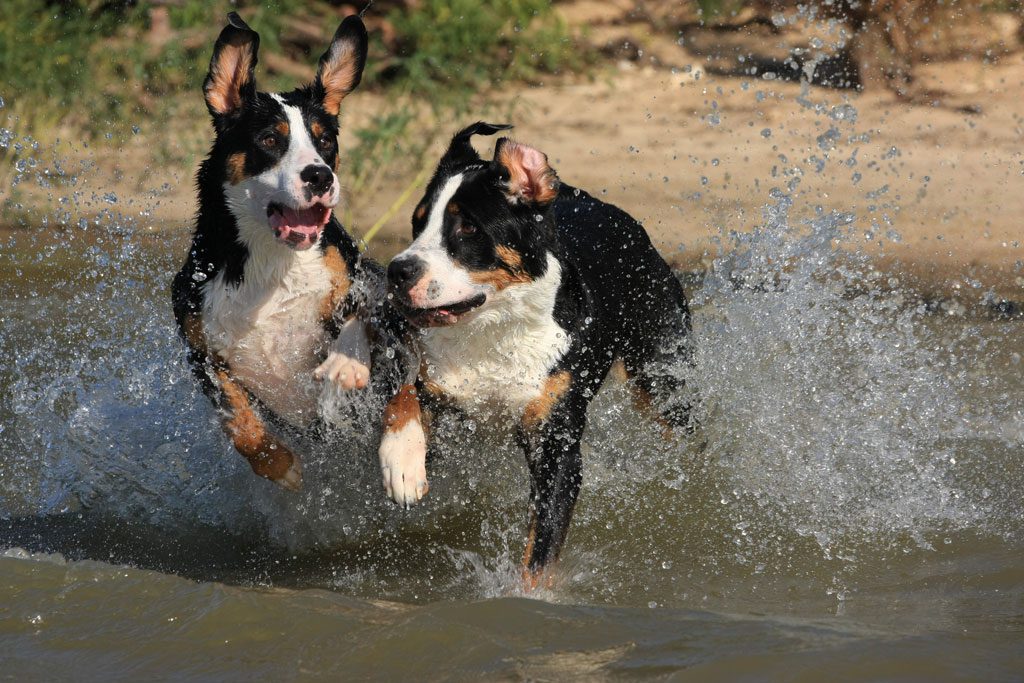
Despite its impressive size and weight, The Greater Swiss Mountain Dog is strong and agile.

Content

History

The Greater Swiss Mountain Dog is an old Swiss farm dog. It is the largest of the family of mountain dogs. These served in the mountains and valleys of the Swiss Alps as a complete tool for farmers. They watched the house and the farm. If a herd of cows had to be moved from one meadow to another, they made sure everyone stayed on the road and no cow was left behind.

The great mountain dogs, from which the current one emerged Greater Swiss Mountain Dog, harnessed in front of larger wagons and served as all-terrain and mountain tractors, more or less like the old one Unimog. It was not unusual for them to be harnessed in pairs in front of a cart full of valuable cheese, so they could independently find their way from the alpine pasture to the village, to the merchant and back. Mountain Dogs and Swiss Cattle Dogs used to be a single family of dogs. What they have in common is a strong bond with family and their farm., a confident self-awareness, a widely lost hunting instinct, a high degree of vigilance, a loving attitude towards his own people and a reserved attitude towards strangers.

A few ago 100 years, mountain dogs were divided into four breeds: Entlebucher, Appenzeller, Berne, Greater Swiss Mountain Dog – in order of size. This and the artificial fixation in a tricolorism conceived by the breed have not been good for the health of these great dogs.. So the statistics of the British Kennel Club 2014 document a life expectancy of only 8 years for Mountain Dogs and Bovine Dogs. Healthy servants could easily live 4 more years. More about this in the portrait of the respective mountain and cattle dogs.

The Greater Swiss Mountain Dog became a valuable companion dog, but still has the skills of a working dog. In 1912 The "Club of Great Swiss Mountain and Cattle Dogs" was founded in Switzerland.

Physical characteristics

The Greater Swiss Mountain Dog is a big dog, robust, strong-boned and well-muscled. Radiates sovereign calm and self-confident composure, and that's how it is. The difference between the sexes should be quite large.
The males must have a height at the withers of 65 to 72 centimeters, the females of 60 to 68. The weight is between 35 and 50 kg.

The standard establishes numerous regulations on the details of coloring, texture and pattern of its coat. I should have brush hair and be tricolor. We see detailed regulations, where white marks are allowed and where they are not. In the interest of dogs, do not take these external characteristics so seriously, that are only devised by your breeder. Turning those details into breeding selection criteria is not in the interest of the welfare of the offspring. Greater Swiss Mountain Dog, they only have an extremely small gene pool anyway. What matters is the character and physical condition of the dogs. this last, Unfortunately, not too rare a problem. The Greater Swiss Mountain Dog it has better qualities than the color of its coat.

Character and skills

The Greater Swiss Mountain Dog feel more comfortable in the field. He wants to be moved and you can experience wonderful stress-free walks in nature with him. As it has little hunting instinct and usually has a good ear, you can enjoy relaxed and stress-free hours outdoors with it, even without a strap. But, It is not a companion dog for athletes..

One Greater Swiss Mountain Dog not suitable for life in the middle of the big city. You don't need a house with a big garden, what would be ideal. He likes to have a land or a yard where he can take care of things. Otherwise, does not have any special requirement regarding its maintenance. Most important is their close integration into the human family. For a permanent or even partial stay in a kennel these dogs are completely unsuitable.

Educating the Greater Swiss Mountain Dog

One Greater Swiss Mountain Dog can be trained very well. He likes to learn. It is strongly oriented towards its people, what you can use well. The Great swiss you can read the mood and wishes of your people on their faces. This in turn means that one must approach one's education with feeling and of course with consequence.. He has a pronounced sense of justice and, the other way, expect an equally fair deal. One must not only accept their occasional stubbornness, but you must like it. They challenge an intimate and mutually respectful relationship between dog and owner. The reward is a happy coexistence for both parties.

Care and health of the Greater Swiss Mountain Dog

The Greater Swiss Mountain Dog it is very easy to care for, just brush it occasionally.

Like many large dog breeds, tends to have hip problems (HD) or elbows (ED). La endogamia, unfortunately partly strong, has a negative effect on physical fitness and life expectancy.

Nutrition / Food

The Greater Swiss Mountain Dog has no special demands on their diet. Like many dogs of his size, tends to churn your stomach. Therefore you should not eat too fast and let it rest after eating.. Veterinarians often recommend an elevated feeding bowl, that can be purchased in specialized stores. During the breeding season, special attention must be paid to an adapted nutrition.

The life expectancy of the Greater Swiss Mountain Dog

One Greater Swiss Mountain Dog is relatively strongly affected by inbreeding and breeding selection that is one-sidedly oriented toward outward appearances, such as fur color details. So, their life expectancy has decreased in part enormously. It's between eight and -healthily- twelve years.

Buy a Greater Swiss Mountain Dog

When buying a puppy you must be careful that no ancestor appears twice in the pedigree. (endogamia). Otherwise, you should look for a breeder affiliated with the Swiss Mountain and Cattle Dog Club. You can also find the dog of your dreams at the animal shelter or in an emergency initiative.

Characteristics "Greater Swiss Mountain Dog"

Coexistence is important that you have with your new friend. Before considering the acquisition of a dog of the breed "Greater Swiss Mountain Dog" you know certain factors. Not all breeds of dogs are apt to live in an apartment, you must take into account his character, their need for exercise, their interaction with other pets, their care and if you have small children, their level of tolerance towards them.

Adaptation โ“˜

3,0 of 5 stars (based on 1 review)

friendly dog โ€‹โ€‹โ“˜

4,0 of 5 stars (based on 1 review)

hair loss โ“˜

3,0 of 5 stars (based on 1 review)

Affection level โ“˜

4,0 of 5 stars (based on 1 review)

Need for exercise โ“˜

3,0 of 5 stars (based on 1 review)

Social need โ“˜

4,0 of 5 stars (based on 1 review)

Home โ“˜

2,0 of 5 stars (based on 1 review)

Toilet โ“˜

1,0 of 5 stars (based on 1 review)

Friendly with strangers โ“˜

3,0 of 5 stars (based on 1 review)

barking โ“˜

4,0 of 5 stars (based on 1 review)

Health โ“˜

3,0 of 5 stars (based on 1 review)

Territorial โ“˜

5,0 of 5 stars (based on 1 review)

Cat friendly โ“˜

3,0 of 5 stars (based on 1 review)

Intelligence โ“˜

4,0 of 5 stars (based on 1 review)

Versatility โ“˜

4,0 of 5 stars (based on 1 review)

Child friendly โ“˜

4,0 of 5 stars (based on 1 review)

Surveillance โ“˜

3,0 of 5 stars (based on 1 review)

joy โ“˜

5,0 of 5 stars (based on 1 review)

Images "Greater Swiss Mountain Dog"

Photos:

1 – Greater Swiss Mountain Dog, tricolour by Canarian / CC BY-SA
2 – Greater Swiss Mountain Dog by jude / CC BY
3 – Big Swiss Mountain Dog and Entlebucher Mountain Dog during International show of dogs in Katowice – Saucer, Poland by Pleple2000 / CC BY-SA
4 – All Mountain Dogs: Greater Swiss Mountain Dog, the Bernese Mountain Dog, the Appenzeller Mountain Dog an the Entlebucher Mountain Dog by Shining dog / CC BY-SA

Videos "Greater Swiss Mountain Dog"
Type and recognitions:

  • FCI CLASSIFICATION:
  • Group :
  • Section : . .

Federations:

  • FCI – Pinscher and Schnauzer-Molossoid type dogs – Swiss Mountain Dogs and Cattledogs. Section 2.2 Molossoid, mountain type. โ“˜
  • AKC – Working dogs โ“˜
  • CKC – Working dogs โ“˜
  • โ€‹KC – Working dogs โ“˜
  • UKC – Watchdog โ“˜

FCI breed standard "Greater Swiss Mountain Dog"

Origin:
Switzerland

Date of publication of the valid original standard:
25.03.2003

Use:

Originally used as a guard and traction dog. He is currently used as a family dog., companionship and protection.


General appearance:

It is a tricolor dog, robust, strong bone and good musculature. Despite its size and weight, demonstrates agility and endurance. The sexual characteristics of the male and female are pronounced.

IMPORTANT PROPORTIONS:

  • body length (measured from the tip of the shoulder to the tip of the buttock: height of the cross: = 10 : 9.
  • Chest depth: height of the cross: = 1 : 2.
  • Length of the skull: nose length: = 1 : 1.
  • Skull width: muzzle width: = 2 : 1.


Behavior / temperament:

insurance, attentive, awake and fearless in everyday situations, kind and dependent with people he trusts and self-confident in relation to strangers; medium temperament.

Head:

In relation to the body, it's strong but not heavy. The head of the males is more powerful than that of the females.

Cranial region:
  • Skull: Flat and wide with a front groove that gradually heads and disappears upward.
  • Depression links (Stop): Notorious.

facial region:

  • Truffle: black.
  • Snout: Strong, longer than deep, without looking pointy from above or from the sides. Straight nose cane, no middle groove.
  • Lips: Poorly developed, tight; black pigmented; not hanging.
  • Jaw โ€“ Teeth: Strong jaws. Full scissor bite, strong and regular. Lack of 2 teeth (premolars 1 y/ o 2) is tolerated. The absence of the M3 is not taken into account.

Eyes: Medium, in the form of almond, not deep or bulging, hazelnut brown or chestnut, of happy and awake expression. Eyelids are well attached. The darkly pigmented edge of the eyelids.

Ears: Medium-sized, triangular and fairly high set. When the dog is calm, supported and flat; when you are attentive, directs them forward. With enough hair both on the outside and on the inside.

Neck:

Strong, muscular, chubby and no chin.

Body:

Slightly longer than the height at the withers.

  • Back: Moderately long, strong and straight.
  • Pork loin: Wide and well muscled.
  • Rump: Long and wide, with a gently rounded fall; neither too high nor abruptly dropped.
  • Breast : Strong, width, reaching to the elbows; round-oval rib diameter chest neither flat nor crowded. Well developed sill.
  • Abdomen and lower line: The abdomen and flanks are poorly gathered.


Tail:

Inserted in harmonic continuation with the rump. Pretty heavy, reaching the hock; if the dog is calm, the tail hangs; if you are at attention or on the move, wears it higher and slightly curved, but never ringed or on the back.

Tips

PREVIOUS MEMBERS:

  • As a whole: Seen from ahead straight and parallel placed rather apart.
  • Shoulder: The long shoulder blade, strong, inclined, glued and well muscled, forming a not very obtuse angle with the arm.
  • Forearm: Straight and strong bone.
  • Metacarpus: Strong, seen from the front, in straight extension of the forearm; seen from the sides almost perpendicular.

LATER MEMBERS:

  • En set: Seen from behind, straight and not too close. Metatarsals and feet must not be inclined inward or outward; dewclaws must be amputated, except in countries, in which amputation is not permitted by law.
  • Thigh: Rather long, width, strong and well muscled.
  • Knee: Claramente an obtuse angle.
  • PinScheme: Relatively long.Hock: Strong and well angled.

FEET: Strong, straight, closed, fingers well together, well arched and strong nails.

Movement:

Wide and uniform in all types of gears. Good forward reach and good momentum from hindlimbs. When jogging, limbs move in a straight line, seen both in front and behind.

Mantle

  • Fur: double hair, composed of dense outer layer of medium length, and inner fleece, equally dense, preferably dark gray to black. Short external hair is allowed, if the inner fleece is thick.
  • Color: Typically tricolor: Basic color is black with symmetrical reddish-brown fire markings and white markings. The reddish-brown fiery markings lie between black and white on the cheeks, above the eyes, on the inner side of the ears, at the sides of the chest, on all four limbs and at the bottom of the tail. White markings are located on the head (forehead and muzzle), from throat to chest (without interruption), on the feet and at the tip of the tail. Between the white mark on the forehead and the brown fire marks- reddish over the eyes should be a black streak. White spot on neck or white collar is tolerated.


Size and weight:

TAHAND:  
Alturto the cross In males: 65 โ€“ 72 cm.,
  In females: 60 โ€“ 68 cm..


Fouls:

Any deviation from the aforementioned criteria is considered as a fault and the severity of this is considered to the degree of the deviation to the standard and its consequences on the health and well-being of the dog..

  • Dubious behavior.
  • Lack of other teeth, maximum two premolars (PM1 and / or PM2). M3s are not taken into account caliper bite.
  • light eyes; insufficient eyelid occlusion
  • Mantle: Internal fleece of brownish-yellowish or light gray color visible. Dirty colors.
  • Lack of marking
    • Lack of white mark on the head; very wide list.
    • White mark of the muzzle visibly reaching beyond the corners of the lip
    • ยซWhite bootsยป (white color that reaches above the metacarpal or metatarsal joints.
  • Notoriously asymmetrical drawings

FALTAS DESCALIFICANTES:

  • Aggressiveness or extreme shyness.
  • Any dog โ€‹โ€‹showing clear signs of physical or behavioral abnormalities must be disqualified..
  • Upper or lower prognathism, arcade of the deviated incisors
  • Entropion, ectropion.
  • One eye or two blue eyes.
  • Short hair without undercoat.
  • Long hair.
  • Non tricolor dog.
  • Basic color other than black.


N.B.:
  • Males should have two normal-appearing testicles fully descended into the scrotum..
  • Only functionally and clinically healthy dogs, with the typical conformation of the breed, should be used for parenting.

TRANSLATION: Federation Canรณfila Mexicana a.c.

Source: F.C.I - International Cynological Federation

โ–ท The world of Pets: Dogs, cats, birds, reptiles, amphibians

German Mastiff
Alemania FCI 235 - Molossoid - Dogo

Dogo Alemรกn

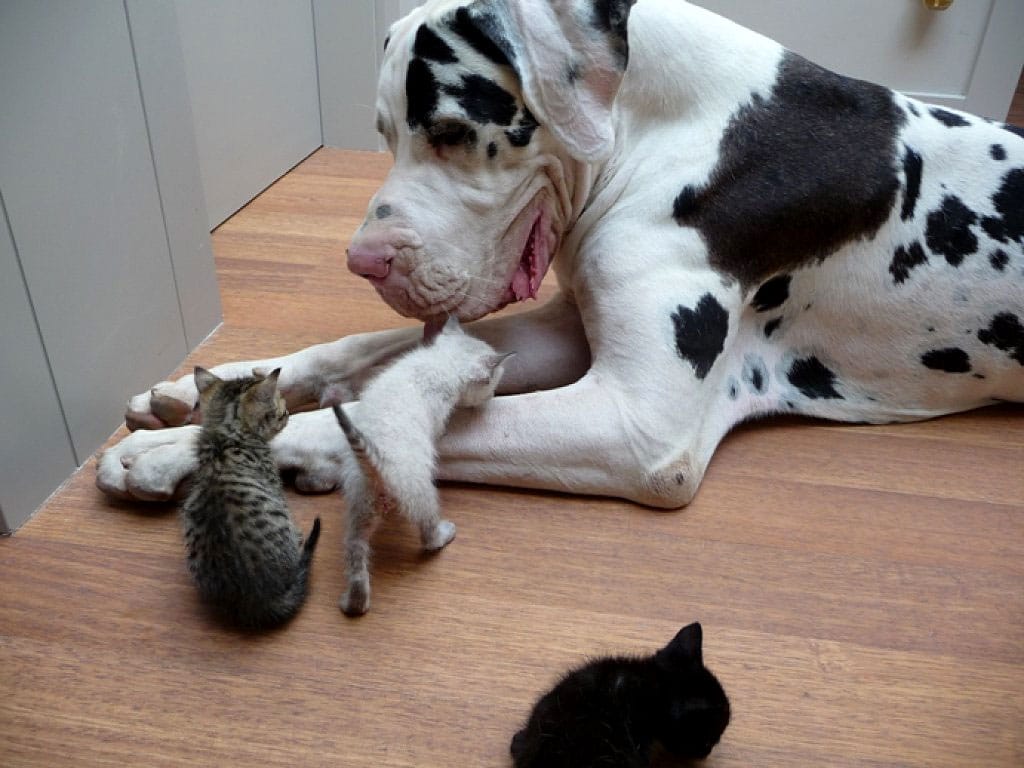
The German Mastiff, Great Dane or German Boarhound It is a breed of dog known for its large size and delicate personality, considered to be the "Apollo among all races" by the International Cynological Federation.

The great Dane, even being a giant race, should not be clumsy in his walk and movements. Your character should be friendly and never shy. Males should be stronger than the females Constitution.

Read more about the race by clicking on: Great Dane.

German Mastiff

โ–ท The world of Pets: Dogs, cats, birds, reptiles, amphibians

Sighthounds
types of sighthounds

Lebrel

The Sighthound responds to a group of dogs that make up a breed whose physical constitution makes them very well equipped for the race, which can reach a high speed. They are mostly taller than long, they have long, narrow head and ears in pink or semierectas. And detail to highlight mode, they possess a great sense of sight unlike most dog breeds. They are usually used for hunting big game in packs and for rabbit and hare hunting..

In Spain they are also known as Greyhounds since that is the name given to the National Greyhound and by extension all those breeds that have similar characteristics., are referred to as Greyhound.

The Federation Cynologique Internationale It classifies the different varieties of the breed hound in Group X, and at the same time, This group is divided in:

  • Section 1: where the dogs are included Long-haired or fringed Sighthounds.
  • Section 2: where the dogs are included Rough-haired Sighthounds.
  • Section 3: where are included Short-haired Sighthounds.

Here we offer each section of the X group, with its respective members, and brief overview that may extend to following the link to each of the races.

Section 1: Long-haired or fringed Sighthounds.

  • Afghan hound: also known as Afghan greyhound, Afghan Hound, Balkh Hound, Baluchi Hound, Barutzy Hound, Shalgar Hound, Kabul Hound o Galanday Hound It is a dog from Afghanistan. It has a characteristic coat, very long, fine and silky, It needs continuous care that he entangled, arriving at losing their gloss.
  • Saluki: known as the Royal Egypt dog, It is perhaps the oldest known breed of domesticated dog and the oldest in the venรกtici, It is believed descended from wolves in the wilderness of Ara. The Bedouins hold them in high esteem and use them for hunting gazelles and as pets..
  • Russian Wolfhound: or Borzoi, It is a breed of dog developed in Russia. It descends from the Arabian Greyhound being similar to a Russian sheepdog. Formerly known as Russian Wolfhound, It was originally bred to hunt wolves and hares. It is graceful, strong and fast.

Section 2: Rough-haired Sighthounds.

  • Irish wolfhound: or Irish Wolfhound is the largest breed of dog that exists; adults reach an average height of between 95 and 100 cm to the cross. Known since the year 395, descended from the hounds used by the Celts of Ireland to hunt the wolf, deer, and other large dams.
  • Deerhound: or Deerhound, It is a traditional dog belonging to the Scottish Highlands, It also appears in the old portraits, sleeping at the foot of great lords. When became fashionable with shotgun deer hunting, This race was on the verge of extinction.

Section 3: Short-haired Sighthounds.

  • Spanish greyhound: The Greyhound is a breed of dog indigenous Spain, so it is also known as Spanish Greyhound. According to the Royal Academy of the Spanish Language, the word derives from Latin Gallฤญcus Canis, dog of the Gaul.
  • english greyhound: It is a breed of dog that is used mainly as a companion and competition animal.. It is the ancestor of most sighthounds. They are skilled to run, but not to carry out extensive exercise.
  • Whippet: It is a breed of dog of British origin, slender and elegant porte. They are active and playful dogs, physically similar to the English Greyhound. Its popularity has led to the use of the name Whippet in a large number of things, from cars to cookies.
  • Italian Lebrel: or Italian Greyhound is perfectly adapted to small households. However you need to walk. He can keep company in short runs but prefers walks and playing with other dogs (better if they are not great).
  • Azawakh: o African Greyhound is a breed of Greyhound type dog, native to africa. It is also known by other names: Hanshee, Oska, Rawondu, Bareeru, Wulo, Tuareg Sloughi.
  • Sloughi: Arabian Greyhound, Berber Greyhound or Sloughi Moghrebi is native to North Africa. It is in Morocco, Algeria, Tunisia and Libya. The Sloughi is closely related to the Azawakh.
  • Polish Greyhound: It is a breed of dog lebrel of Polish origin, as the name reflects. It originated in Poland, and among their ancestors we find some Asiatic Greyhound, a dog type Saluki. According to current theories, they do not have the english greyhound.

And remembering, Digest, not to forget and act: Spain is the only country in the European Union where hunting with greyhounds is still allowed and hunters kill around 50.000 Greyhounds or Sighthound per year, with bleach injections, hanging or burned alive, as economic methods of murder.

Dog breeds: Sighthound

โ–ท The world of Pets: Dogs, cats, birds, reptiles, amphibians

Russian Hunting Sighthound
Rusia FCI 193 . Long-haired or fringed Sighthounds.
Galgo Ruso

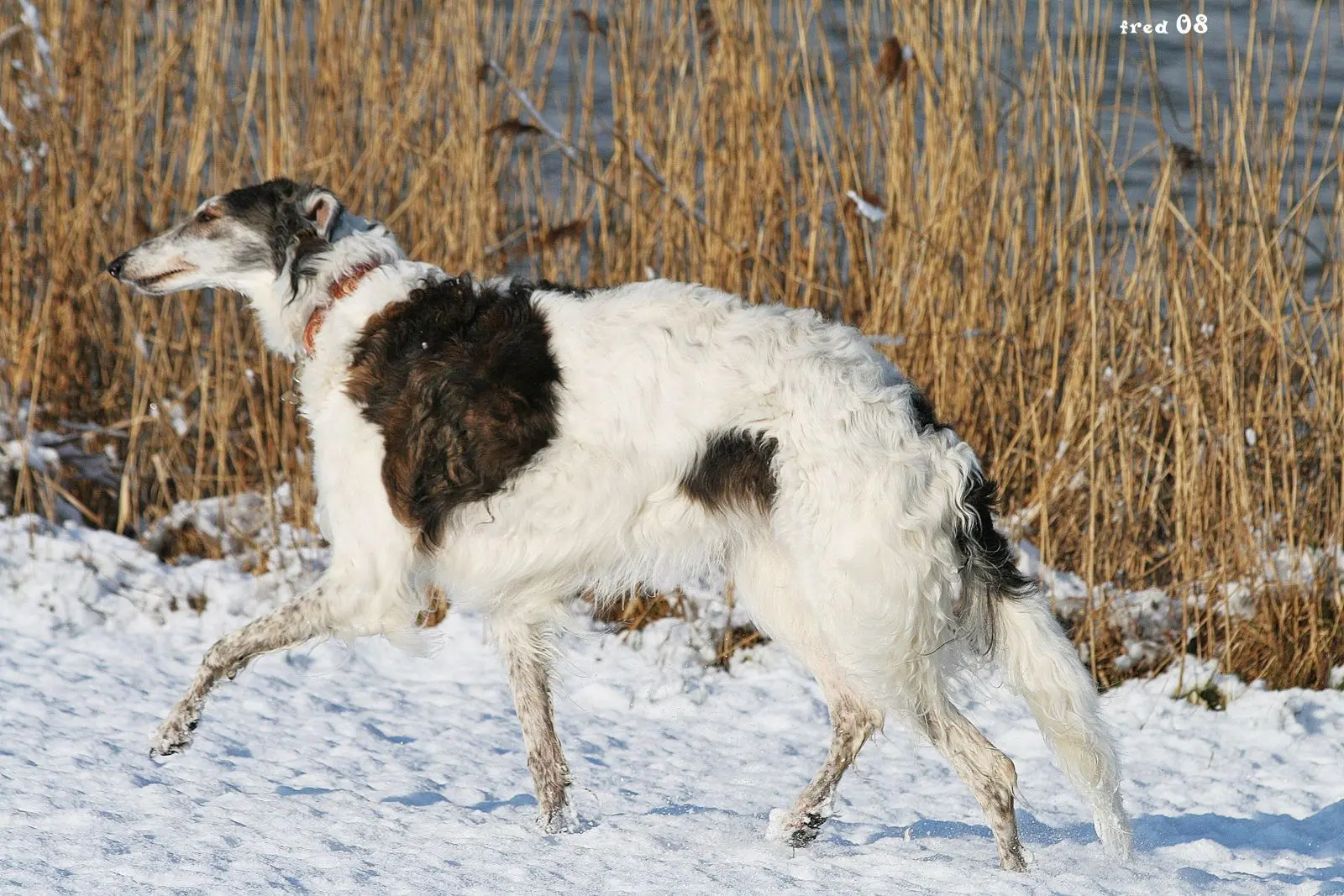
The Russian Hunting Sighthound or Borzoi, It is a breed of dog developed in Russia.
It descends from the Arabian greyhound being similar to a Russian sheepdog. Formerly known as the Russian Greyhound, It was originally bred to hunt wolves and hares. It is graceful, strong and fast, reaching a height of between 66 and 79 cm and a weight from 25 until 48 kg.

It has a long and narrow head, small ears. Its tail is long and stooped and his coat is silky and it can be smooth or slightly curly. It is almost always white with dark spots. It is notorious for its elegant appearance. The Russian Greyhound or Borzoi had its moment of greatest glory in the Court of the Tsars where it was bred with great mastery to be used in hunting the Siberian wolf..

It is a good Hunter of small animals, It is an affectionate and obedient dog with the master but, very distrustful with strangers, to the extent of showing aggression and even bite.

As all greyhounds, It also adapts to live in the House on condition of having large spaces where to move with great freedom.

Among all the Greyhound, The Borzoi is certainly the most "noble" both for its characteristics and its gait.

It presumably descended from the Egyptian hound and there are no accurate data on its occurrence in Russia.

But he knows, by writings dated to the year 1200, It was already used for hunting Hare and other larger animals.

For centuries it has been the dog of the families of the nobility and of the tsars. You can say without a doubt, that the Grand Duke Nicholas he was the largest breeder of this breed and used to kennel around a hundred of these magnificent dogs.

The fall of the Tsars and the Russian nobility, was the cause of the almost total disappearance of this breed from its country of origin, However, It is quite widespread in Europe and America.

His first appearance in England took place about a century ago, when Tsar Alexander II gave him a pair of Borzoi to Queen Victoria.

Exists in all colors but the most appreciated are the white uniform, White with grey spots, Red and atigradas. Unlike other races, the white spots should not have very defined limits, but window gradually with the other colors. The hair is long, with silky reflections, corrugated and big curls. Smooth on the head, in the ears and in front of the extremities. You can be absolutely white, or white with yellow spots, Orange, red, atigradas, grey.

The appeal of the males is of 70 to 82 cm., in females it decreases approximately 5 cm..

  • Alternative names: Borzoi / Russian Wolfhound / Russkaya Psovaya Borzaya / Psovoi / Russischer wondhund
  • Group 10 / Section 1 – Long-haired or fringed Sighthounds

Dogs breeds: Russian Wolfhound


โ–ท The world of Pets: Dogs, cats, birds, reptiles, amphibians

Armenian Gampr
Armenia Not recognized by the FCI

Gampr Armenio

Content

History

Armenian Gampr (Armenian Wolfhound Gampr) is the name of a breed of guard dog of cattle that originated in the Armenian mountains (including the territories known today as Eastern Anatolia of Turkey).

The Armenian Gampr was bred by the local population starting from the primitive dogs of the area that, It was on par with the evolution of societies domesticated.

Not even being recognized by several important canine clubs as a breed of dog and undergoing an intensive genetic research, in April of 2011 the International Canine Union officially recognized the Armenian Gampr as the national dog breed of Armenia.

The Gampr has been living for a long time in the prehistoric Armenian mountains, This is demonstrated by thousands of petroglyphs (that symbolic motifs are stones or rocks which have been carved, belonging to very ancient cultures) found throughout the territory. The teacher Oktay Belli from the University of Istanbul has studied petroglyphs found near the modern city of Kars and according to data from his research, various domestic breeds from the area have lived there since the Neolithic period.

It is not known for sure when the Gampr, and while there is a great diversity among endemic species, back to tens of thousands of years, the Gampr modern is believed to have existed for at least 3.000 years. Petroglyphs found in the plateau of Armenia, show a large number and variety of dogs similar to the Gampr, What has given rise to generate a comprehensive record of development.

Of the hundreds of petroglyphs found in Ughtasar and the Geghama mountain range, up a 20% of the carved motifs resemble modern ones Gampr, while others show a remarkable diversity of dogs that do not already exist.

The results of an excavation carried out in 1954 in Lake Sevan, site dating from 800 or 1000 years before Christ, they found the skeleton of a dog perfectly preserved in a tomb. When comparing the skull found with that of a Armenian Gampr and other indigenous dogs, They concluded that he was an ancestor of the race, Although it presented some differences from the modern form in the face, her you estreches of the skull and powerful teeth, counting on these data and adding the changes that caused the selection and breeding process of the last 3.000 years that inevitably, affect the general appearance of the dogs, could affirm that the Armenian Gampr was already established and formed as a race in the first millennium BC.

The issue is that, the Armenian Gampr modern has changed little through the history of its existence in the highlands of Armenia. It is one of the few natural breeds that exist, โ€œnaturalโ€ because they were not subjected to the harsh selection of phenotypes by the human hand. So they keep intact the genetic diversity they had initially, While they have crossed with other locatarios dogs. But that genetic variation has been something natural and spontaneous.

Physical characteristics

The Gampr it is a mountain dog that has a large head, body well delineated and developed, without prominent cheekbones. The back is wide, straight, muscular and strong. To the cross, the height in the males is of 65 centimeters or more, and in females is of 62 centimeters or more. The weight is proportional to the size of the dog, and generally varies between 45 and 60 kg.

The Armenian Gampr has a highly developed double-layer coat of hair in order to protect it from the extreme temperatures and harsh weather conditions of the area where it was born. The outer layer is long and thick hair, and the hair is short and dense internal.

Varieties

There are two varieties of Gampr, guardian and the of Pastor. Pastor tends to be smaller in size, tireless, and a little lighter. The Gampr the guardian type is, generally, higher, more square, and loving and very protective. They have a tendency to be more sedentary, and stay in one place.

The geographical and cultural coexistence of the Caucasian Shepherd Dog and the Central Asian Shepherd Dog, and its use on farms over time has caused a problem since the survival of the creole breed Armenian Gampr has been threatened…

The Club of the Armenian Gampr of the United States tries to make it clear -given the similarity between the dogs- that the Armenian Gampr IT IS NOT: a Caucasian Shepherd Dog, a Kangal Shepherd Dog, a Kangal Shepherd Dog, a Akbash, a Karakachan, a Alabai (Central Asian Shepherd Dog), a Koochee, a Tornjak, a Sharplaninac, Although it has some similarities it is good to be able to differentiate between these breeds.

Character and skills

The Gampr is distinguished by its vitality, its independence, intelligence and instinct of self-preservation, capacity in the defence and protection of livestock, the exclusive kindness to humans.

The Armenian Gampr it is a guard dog by nature, Unlike other dogs, This has developed this ability naturally, without previous training. In Armenian the word "Gampr" means "guard dogโ€, but it is also known by other names, like for example "Gelkhehtโ€ (which is derived from the word Wolf), if it is usually used for hunting bears it is known as โ€œArchashoonโ€ (โ€œdog-bearโ€) and if it performs typical functions of a shepherd dog, it is called "Chobanishoonโ€.

One of the main features of Gampr, It is his innate ability to adjust independently to different situations and reach a decision appropriate to the circumstances. If he Gampr he sees that his master needs his help, will protect it, but if not, pass it… They are affectionate but not corporate.

Images "Armenian Gampr"

Photos:

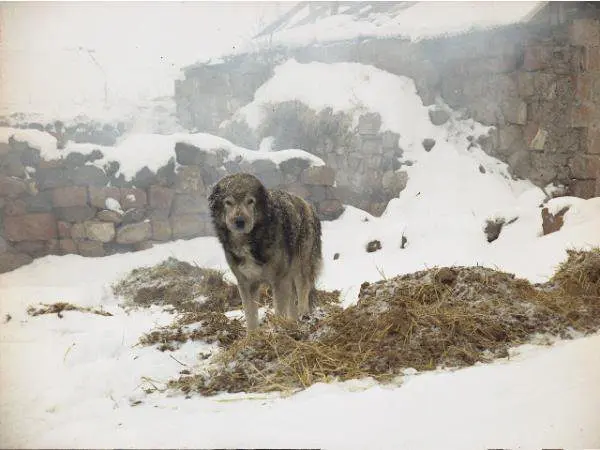
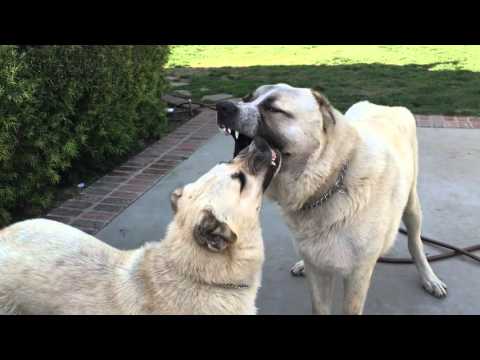
1 – Armenian Gampr dog by hy.wikipedia user Zara-arush, GFDL, via Wikimedia Commons
2 – Armenian Gampr by Gampr1, CC BY-SA 3.0, via Wikimedia Commons
3 – Armenian Gampr by Safi-iren, CC BY-SA 4.0, via Wikimedia Commons
4 – Sheepdog, Gampr dog in Azerbaijan by Elkhan Ganiyev, CC BY-SA 4.0, via Wikimedia Commons

Videos "Armenian Gampr"

Armenian Gampr

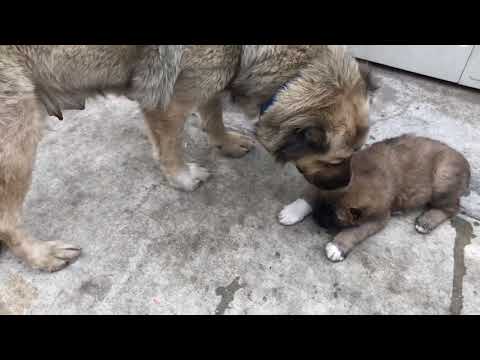
Gampr puppies

Photo: gampr.org

โ–ท The world of Pets: Dogs, cats, birds, reptiles, amphibians

Wicklow Terrier
Irlanda FCI 302 . Large and medium sized Terriers
Glen of Imaal Terrier

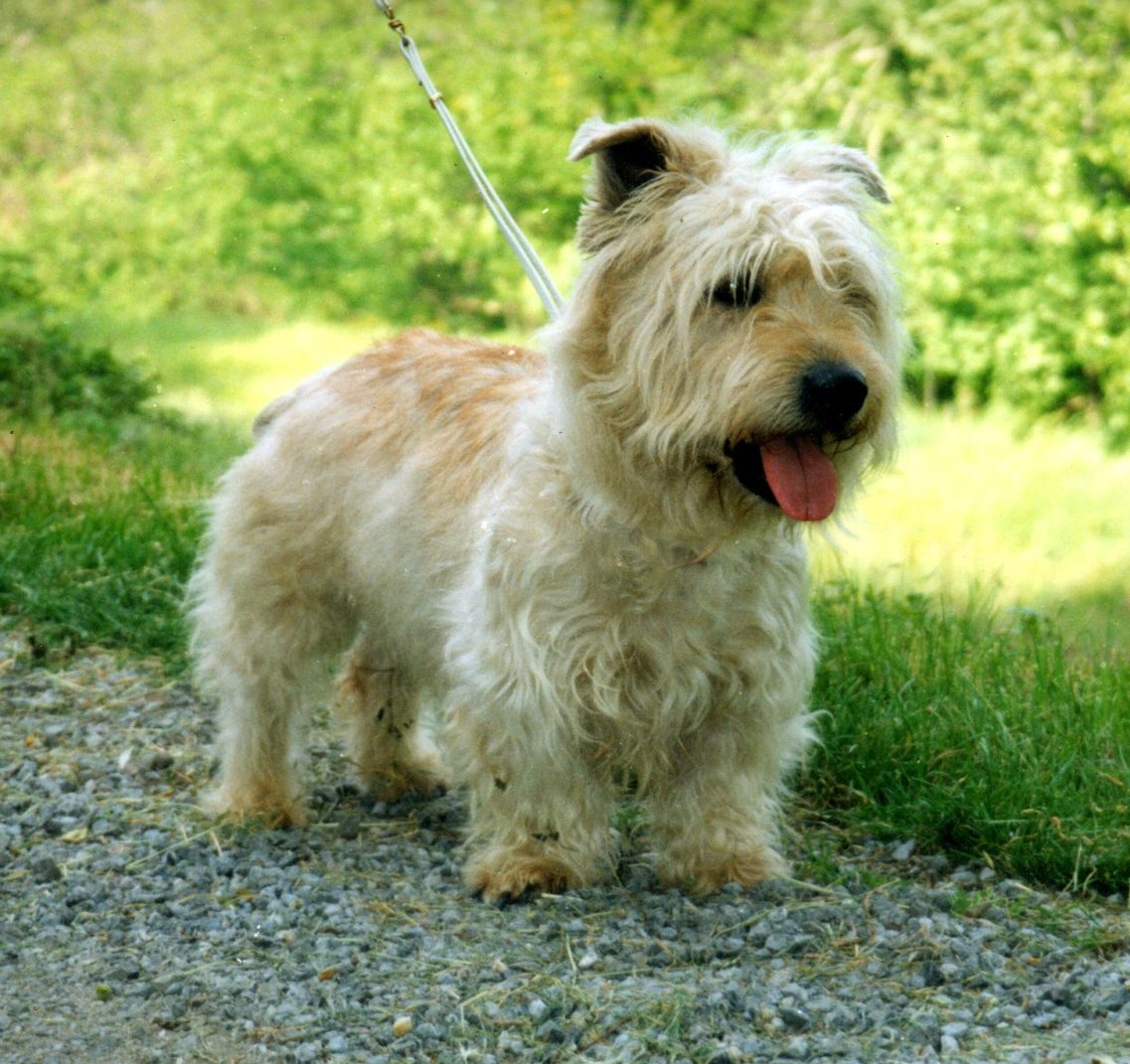
The Wicklow Terrier It is a breed of dog of Terrier type and one of the four Irish varieties of Terrier. It is also known as the Irish Glen of Imaal Terrier or Wicklow Terrier and it is a rare breed.

Its origin is in the Glen of Imaal in the county wicklow, Ireland, the breed was recognized in 1934 by the Irish Kennel Club and the American Kennel Club in 2004.

The race took place during the reign of Elizabeth I, who hired French and mercenaries to end the civil unrest in Ireland. After the conflict, many of these soldiers settled in the area of Wicklow, bringing with them their dogs, He met with the Terrier of the area, giving rise to the Glen of Imaal Terrier.

At first they were dogs used for grazing and the eradication of animal, understood โ€“then- as pests, the Fox, the Badger and Otter. It is a great Tracker.

The Glen of Imaal Terrier, nowadays it is a rare breed. It is a very intelligent and energetic dog who need a responsible master, firm and much discipline. It is a very confident dog, not afraid of anything, they are very loyal to their masters, but they may become aggressive if they do not receive adequate training. They tend to be docile and calm, If not causes them. But calm!! There is no record of damage caused by these dogs.

It is a very intelligent dog, learn quickly if you receive an adequate education, and if so, the aggressiveness, disappears.
Their coat is double layer, a gentle to the skin, and another one takes out is which protects it from the inclement weather. An outstanding feature of this breed is that, they do not move the fur.

The color is type wheat, It may be striped with a bluish-black (from puppy), but as the dog moves in age the hair is ineffectual all, color wheat.

In general, Glen of Imaal Terrier is a very strong and healthy dog. They may live 15 years or more.

Wicklow Terrier