â–· The world of Pets: Dogs, cats, birds, reptiles, amphibians

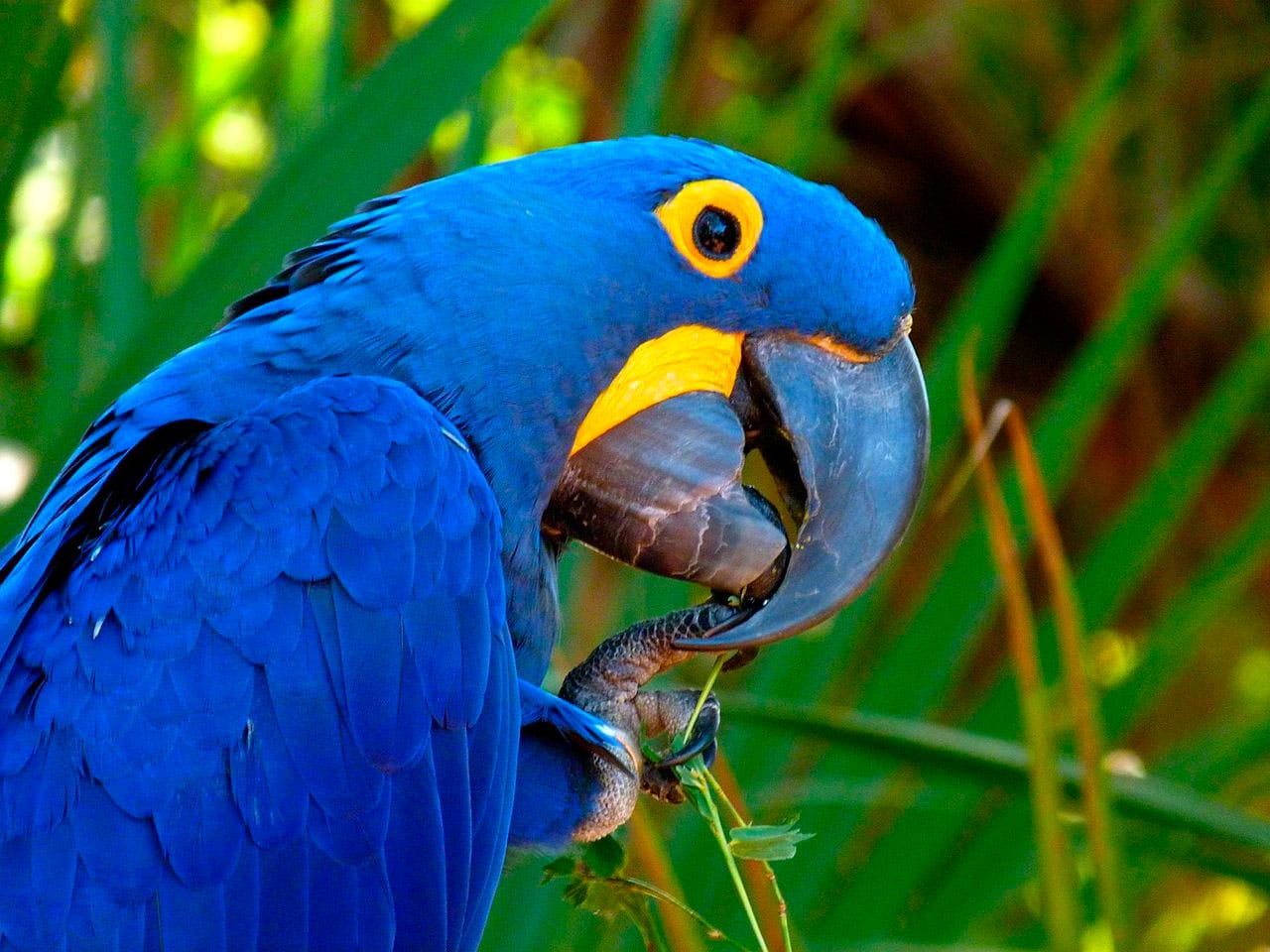
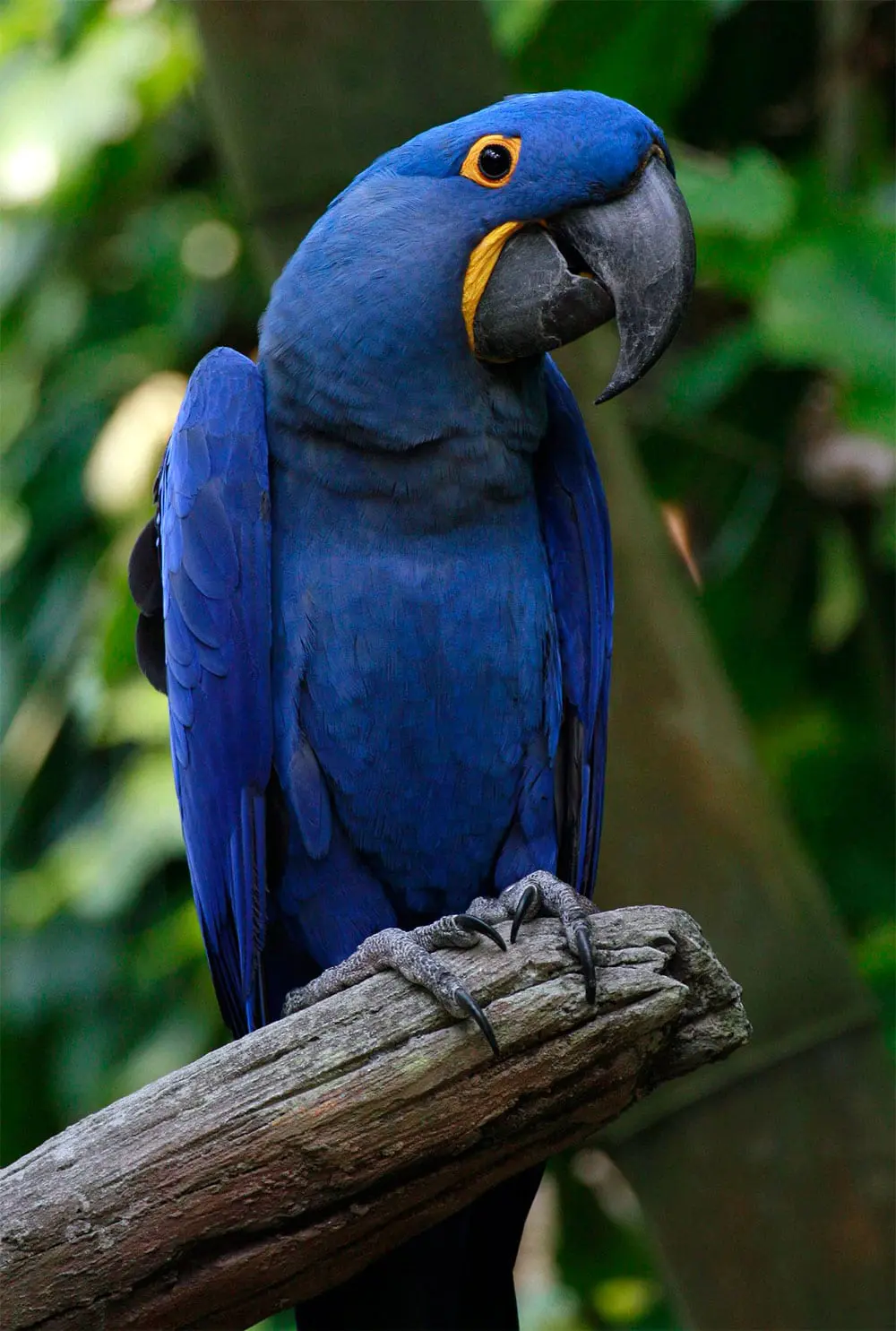
Hyacinth Macaw
Anodorhynchus hyacinthinus


Hyacinth Macaw

Content

Description:

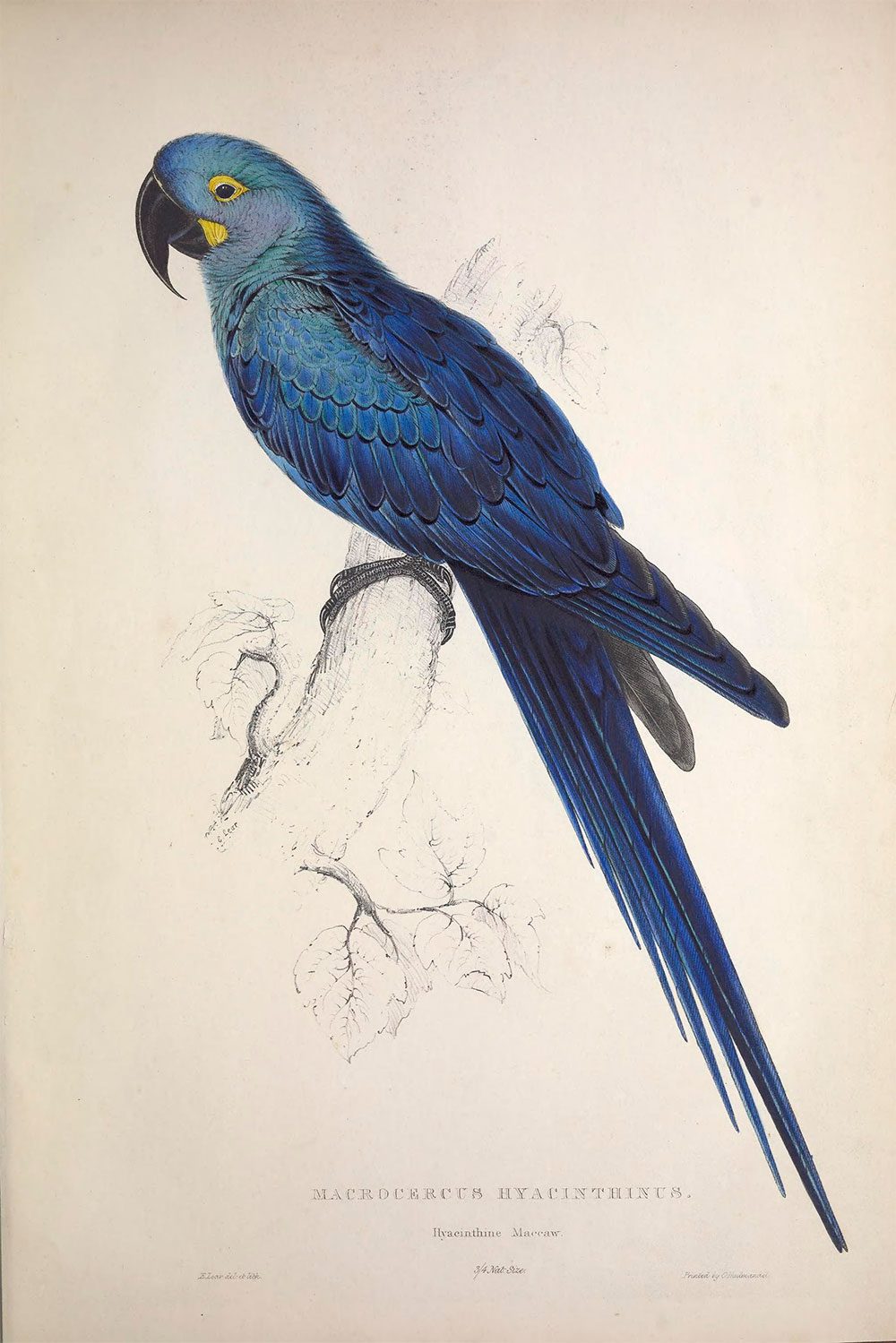
Hyacinth Macaw illustration

90 to 100 cm.. of length and a weight of 1,5 to 1,7 kg.

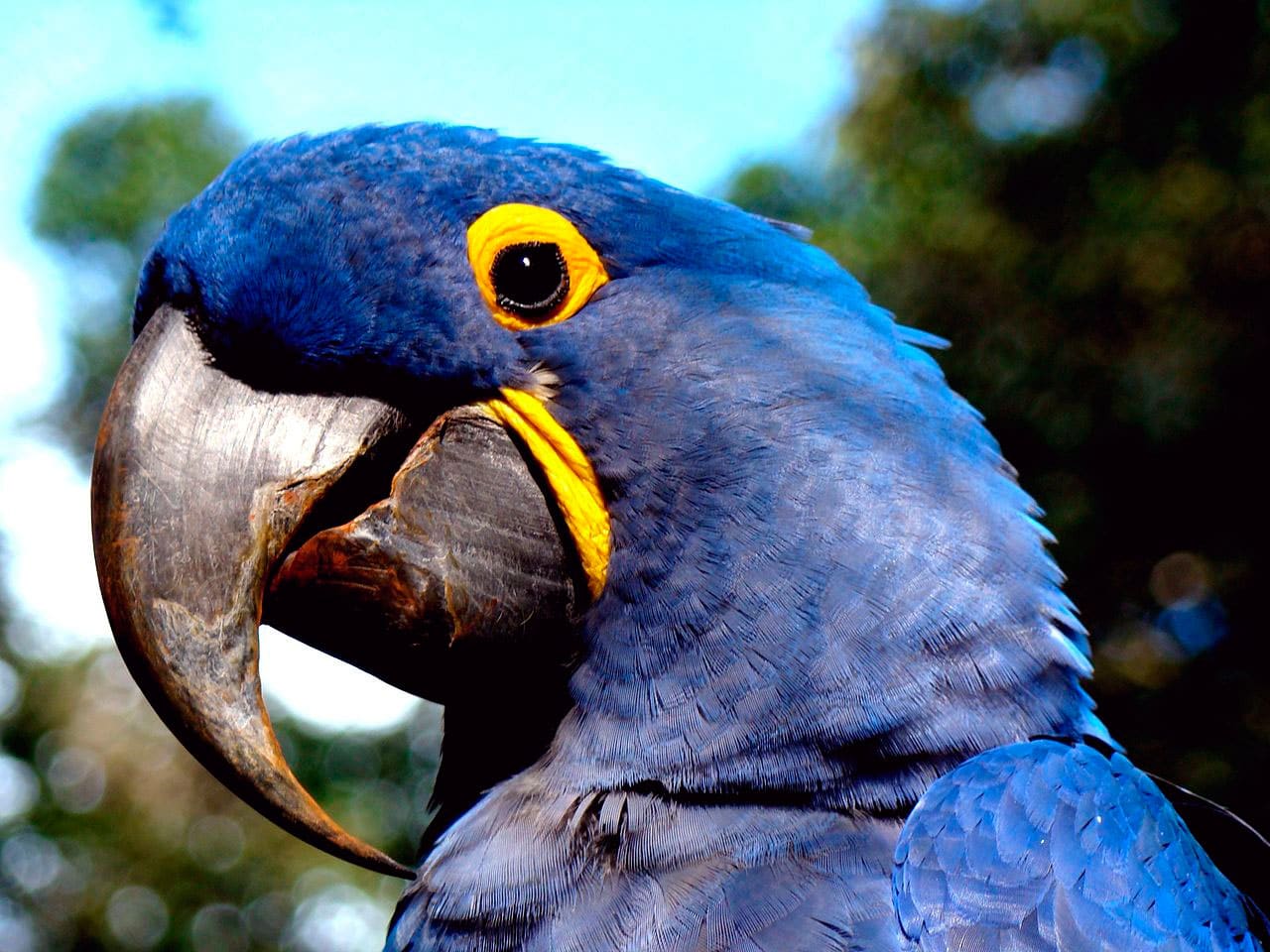
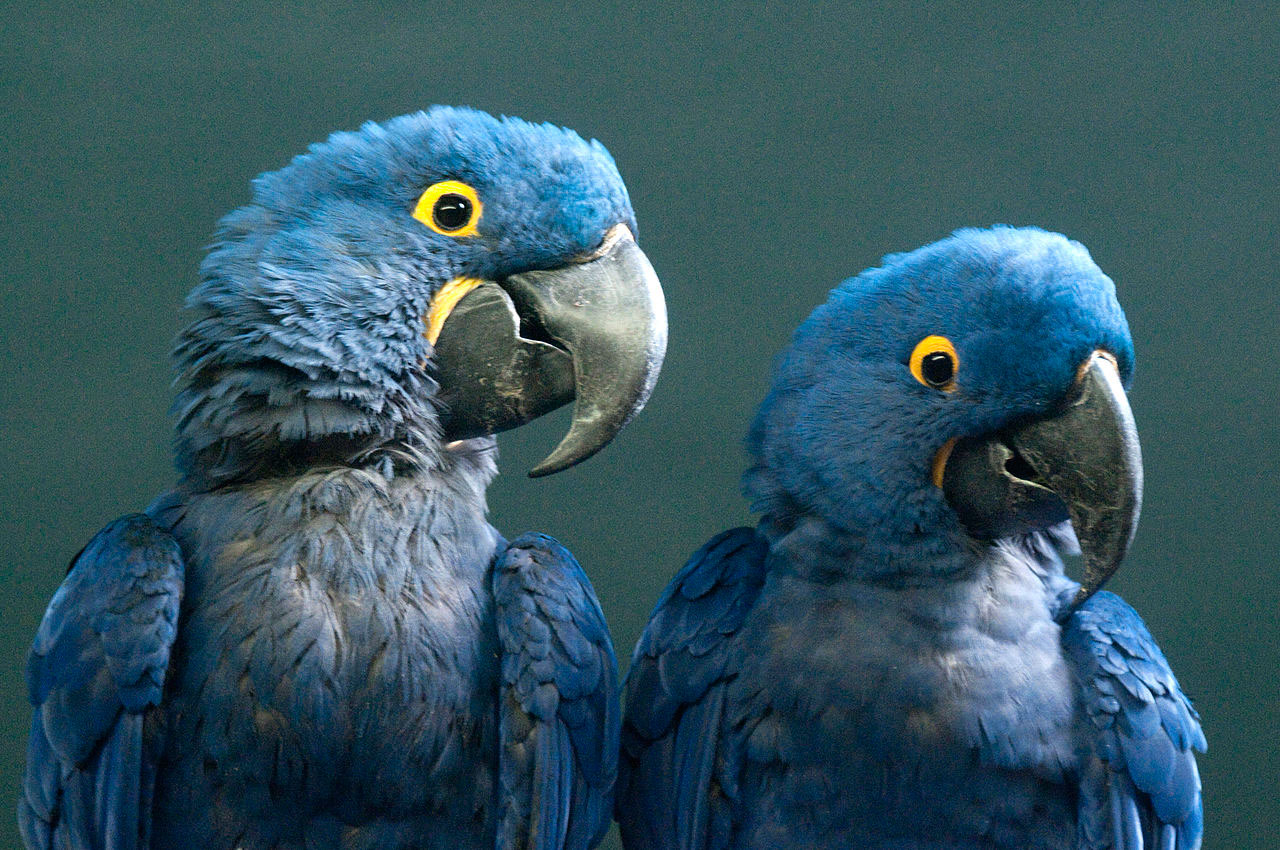
The Hyacinth Macaw (Anodorhynchus hyacinthinus) is the largest parrot; has a distinctive coloration, mostly blue intense, with different colors. Wings and tail below black. The basis of the bill and periocular ring, naked and yellow. The tail is very long, and its powerful bill Black is deeply curved and pointed.

The species Anodorhynchus glaucus, similar but smaller, extinct in the early 20th century, It may have been present in Bolivia.

Habitat:

The Hyacinth Macaw take advantage of a great diversity of habitats rich in various species of Palm trees with large seeds, of which feeds.

In the Brazilian Amazon avoid areas of more moisture, preferring lowland forests and seasonally wet formations with clear zones. In the drier parts of the northeast of Brazil inhabits areas of Plateau cut by Rocky valleys, steep with closed deciduous woodland, gallery forest and swamps with Mauritia flexuosa.

In the the Pantanal region birds frequent gallery forest with palm trees in areas covered with wet grass.

Apparently performs migratory movements.

Usually seen in pairs, family groups or small flocks (usually up to 10); much larger flocks reported before the decline.

Reproduction:

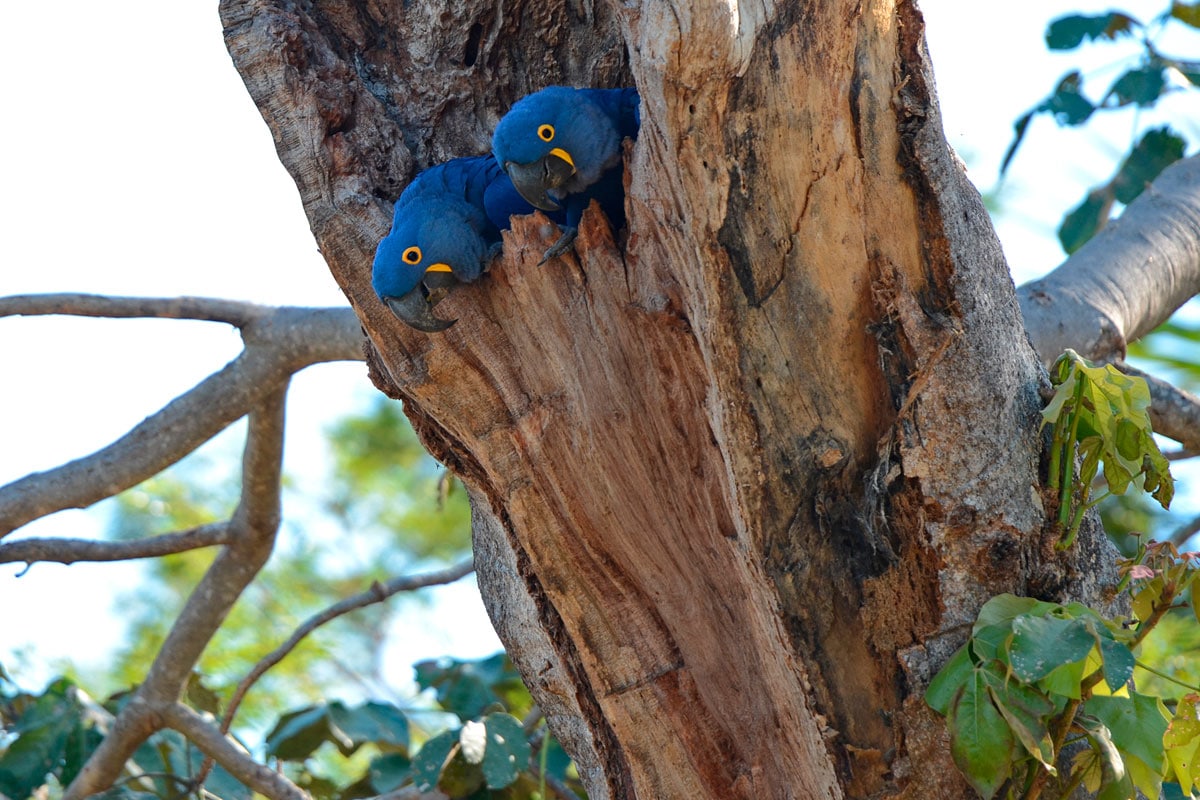
They nest in large tree hollows, in cracks in rocks from cliffs in the northeast of Brazil or in moriche or aguaje (Mauritia).

The favorite for nesting trees in the Mato Grosso, Brazil, include Enterolobium and Sterculia striata. In Northeast Brazil, the nest is located in Palms Mauritia dead or on cliffs.

They usually put one or two eggs, although only one young usually survives if the second egg hatches a few days after the first, since the smaller calf cannot compete with the larger for food.

The incubation period lasts about a month, and the male will assist his partner while she incubates the eggs.

Young people remain with their parents up to three months of age. They reach maturity and begin to play on the seven years.

The breeding season is from August to December, Maybe a little later in areas of pantanal.

Food:

The diet Hyacinth Macaw consists mainly of nuts, locally available of various Palms, including (on Amazonia) Maximiliana regia, Orbignya martiana and Astrocaryum, in the northeast of Brazil, of the Syagrus coronata and Orbignya eicherir, in areas of wetlands of Bone collectors and Acrocomia.

The palm nuts they take them from the own soil or plant (especially after a fire or when available as undigested remains in livestock droppings).

Other fruits that have information are the from the Ficus sp., as well as aquatic molluscs Pomacea.

Birds drink liquid from green palm fruits.

Distribution:

Its distribution includes the Centre of South America, Perhaps in several spacious separate areas.

In the Amazonia in For from the Tapajos River, to the East of the basin of the Tocantins River, extending to the South, possibly to the Northwestern area of Tocantins. At least before present North of the Amazon River (in Amapá, amazon and Roraima, Brazil) and perhaps some specimens can still inhabit, Although there is no known recent records.

Distributed, as well, through the Northeast interior of Brazil, more or less centered on the Microregion of the Chapadas das Mangabeiras in the union between Maranhão, Piauí, Goiás and Bay, Brazil (the region Gerais).

A third important population focuses on habitats wetlands of the upper basin of the Paraguay River in the southwest of Mato Grosso, Mato Grosso do Sul, Brazil, and extending into the adjacent area of the East of Bolivia and North end of Paraguay.

Reported as probable for the Mapori River to the South-East of Colombia (Vaupés).

Movements General residents but perhaps seasonal in the Amazon in relation to the ecology of the plants on which they feed.

The territory between the three current major distributions, can still be busy even though recent trends given, They seem to indicate that this seems unlikely.

Formerly common in some areas (for example, Mato Grosso). Now they are rather unevenly distributed, with the recent and likely declines continuous in its population due mainly to the illegal trade internal and to the smaller, but significant, international market of live birds. Also hunted for its feathers (especially Pari) and as food. Declining in some areas (for example Eastern Amazonia), because of the alteration or loss of habitat.

Total estimated wild population in 3000 (1.992). CITES Appendix I.

VULNERABLE.

Conservation:
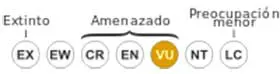

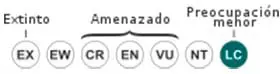
Vulnerable

• Current Red List of UICN: Vulnerable

• Population trend: Decreasing

The Hyacinth Macaw It has been subjected to a massive illegal trade. At least 10.000 birds were captured in the wild, in the decade of 1980, with a 50% destined to the Brazilian market (Mittermeier et to the. 1990).

Among 1983-1984, more than 2.500 birds were moved out of Black Bay, Paraguay, with others 600 extra at the end of 1980 (J. Pryor in litt., 1998). Although these numbers are now much smaller, illegal trade continues (for example 10 bird went through a pet market in Santa Cruz, Bolivia, in August 2004 until July 2005, where the birds were changing hands for 1.000 $ US and went to Peru [Herrera and Hennessey 2007]). More recently it has been noted that there appears to be almost no illegal trade in this species in Bolivia (B. Hennessey in litt. 2012).

Through its area of distribution, There is something of the local game for use as food and for its feathers.

In the Amazon, habitat loss has occurred for cattle ranching and hydroelectric power systems in the rivers Tocantins and Xingu.

In the Pantanal, only the 5% trees S. apetala have suitable cavities (Guedes 1993, Johnson 1996). Young trees are used as food for livestock and burned by frequent fires (Newton 1994).

The Gerais is it being quickly transformed by mechanized agriculture, ranching and plantations of exotic trees (Conservation International 1999).

In Paraguay, the preferred habitats of the Hyacinth Macaw are considered seriously threatened (N. Kochalka Lopez in litt. 2013) and the Paso Bravo National Park suffering from illegal logging.

Conservation Actions Underway:

    – CITES Appendix I and II, protected under Brazilian and Bolivian law and prohibition of exports from all countries of origin.

    – Many landowners in the Pantanal (more and more in the Gerais) they do not allow hunters on their property.

    – There are several studies long-term and conservation initiatives (for example. Anon 2004).

    – In the Refuge Caiman ecological in the Pantanal, the Hyacinth Macaw Project has used artificial nests and hatchling management techniques and raised awareness among farmers (Anonymous 2004).

Conservation Actions Proposed:

    – Study of the range, the current status of the population and the scope of the negotiation of the different parts of its area of distribution (Snyder et to the., 2000).

    – Assess the effectiveness of artificial nesting boxes (Snyder et to the., 2000).

    – To enforce the legal measures that hinder trade.

    – Experiment with ecotourism in one or two sites to encourage donors (Snyder et to the., 2000).

"Hyacinth Macaw" in captivity:

Rare up to 1970; then, starting at 1980, increased considerably in number of captive birds due to increased breeding.

Despite the prohibitions, many of these Macaws they are still trading at high prices (10.000 euros or more), due to its beauty and ease to mimic human language.

Rearing this species can be difficult and, Unfortunately, many chicks die each year in inexperienced hands.

From this page we strongly preserve these beautiful birds in their natural environment, sincerely not us seems reasonable to his tenure as a pet.

Alternative names:

– Hyacinth Macaw, Blue Macaw, Black Macaw (English).
– Ara hyacinthe (French).
– Hyazinthara, Hyathinzara (German).
– Arara-azul-grande, arara-azul, arara-hiacinta, arara-preta, arara-roxa, arara-una, canindé (Portuguese).
– arara-azul, Arara-azul-grande, arara-hiacinta, arara-preta, arara-roxa, Ararauna, arara-una, canindé (Portuguese (Brazil)).
– Guacamayo Azul, Guacamayo Jacinto, Papagayo azul (español).
– Jacinta azul, Paraba azul (Bolivia).
– Vihina (Desana).
– Kaheta (Carijona).
– Guaía-hovy (Guarani).
– Arara-úna (Tupi Guaraní).
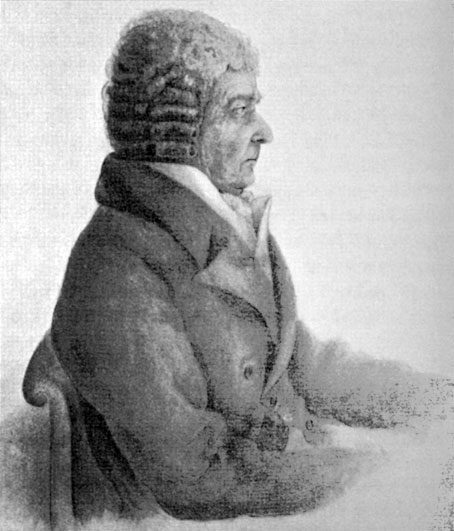
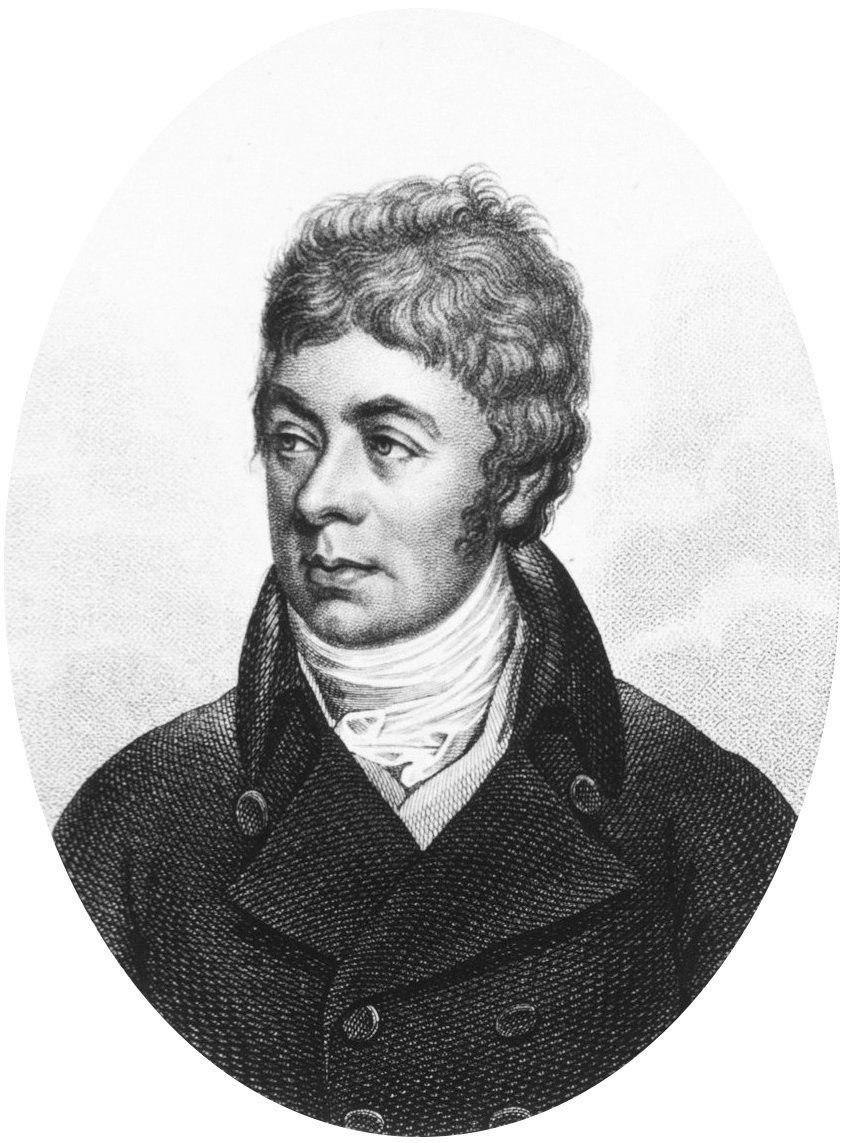
John Latham
John Latham

scientific classification:


– Order: Psittaciformes
– Family: Psittacidae
– Genus: Anodorhynchus
– Scientific name: Anodorhynchus hyacinthinus
– Citation: (Latham, 1790)
– Protonimo: Psittacus hyacinthinus


Images Hyacinth Macaw:

Videos "Hyacinth Macaw"


Species of the genus Anodorhynchus

«Guacamayo Jacinto» (Anodorhynchus hyacinthinus)


Sources:

– Avibase
– Parrots of the World – Forshaw Joseph M
– Parrots A Guide to the Parrots of the World – Tony Juniper & Mike Parr
– Birdlife
– Parrots, Parrots and macaws (Neotropical)

– Photos:

(1) – Hyacinth Macaw also known as Hyacinthine Macaw at Disney’s Animal Kingdom Park by Hank Gillette [CC BY-SA 3.0 or GFDL], via Wikimedia Commons
(2) – A Hyacinth Macaw at Brevard Zoo, Florida, USA By Rusty Clark from merritt usland FLA (Brevard Zoo Hyacinth Macaw) [CC BY 2.0], via Wikimedia Commons
(3) – Hyacinthine Macaw at Melbourne Zoo, Australia By derivative work: Snowmanradio (talk)Anodorhynchus_hyacinthinus_-Australia_Zoo_-8.jpg: Erik (HASH) Hersman [CC BY 2.0], via Wikimedia Commons
(4) – Hyacinth Macaws at Stone Zoo, Stoneham, Massachusetts, USA By Eric Kilby (originally posted to Flickr as Squawking Heads) [CC BY-SA 2.0], via Wikimedia Commons
(5) – Hyacinthine Macaw (Anodorhynchus hyacinthinus) By Ana_Cotta (originally posted to Flickr as ARARA) [CC BY 2.0], via Wikimedia Commons
(6) – Hyacinth Macaws, Anodorhynchus hyacinthinus at the Aquarium of the Americas in New Orleans, Louisiana By Derek Jensen [CC BY 2.0], via Wikimedia Commons
(7) – A pair of Hyacinth Macaws and thier nest in Mato Grosso do Sul, Brazil By Geoff Gallice from Gainesville, FL, USA (Hyacinth macaws) [CC BY 2.0], via Wikimedia Commons
(8) – A Hyacinth Macaw preening at the Aquarium of the Americas, New Orleans, USA By Quinn Dombrowski (originally posted to Flickr as Dainty) [CC BY-SA 2.0], via Wikimedia Commons
(9) – Anodorhynchus hyacinthinus by Hans – Pixabay
(10) – Illustration Guacamayo Jacinto By Lear, Edward [CC BY 2.0 or Public domain], via Wikimedia Commons

– Sounds: Niels Poul Dreyer (Xeno-canto)

â–· The world of Pets: Dogs, cats, birds, reptiles, amphibians

Budgerigar
Melopsittacus undulatus


Common Budgie

Content

Description

18 cm. length and a weight between 22 and 32 g..

Periquito-Comun

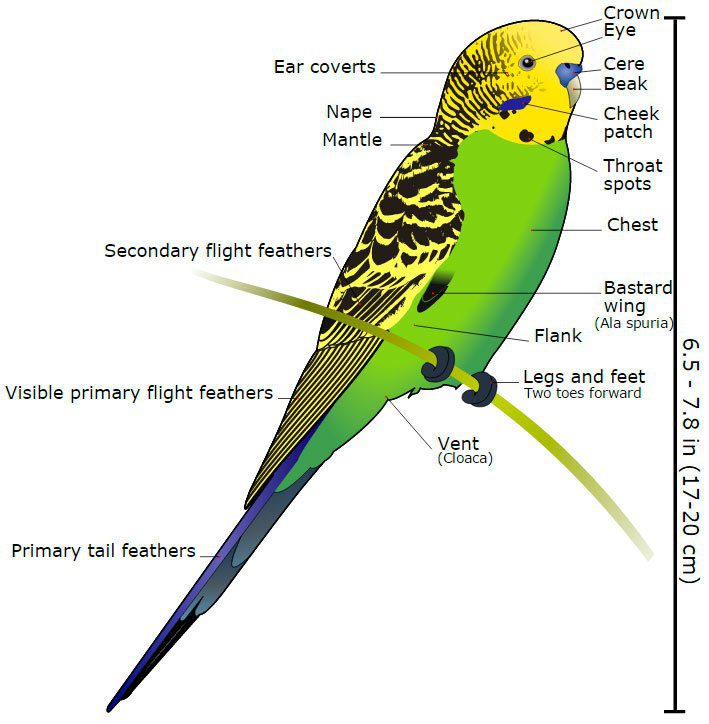
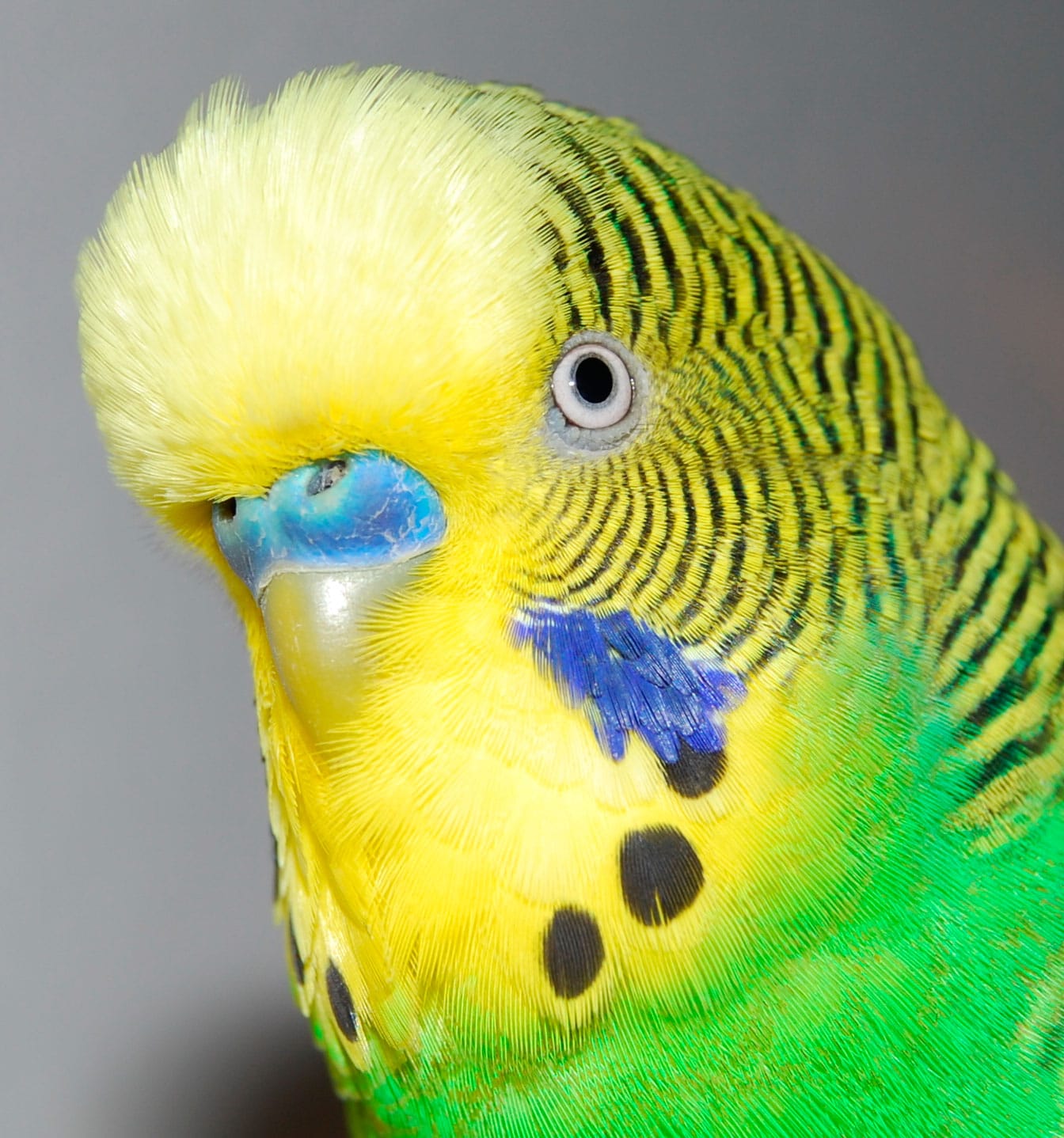
In the Budgerigar (Melopsittacus undulatus) of adults, the cere Blue contrasts with the frontal zone; the front of the face and throat are pale yellow. The latter is covered by a line of black dots. The area which is located below the cheeks it's purple.

The central part of the pileum extending from the rear of the eyes to neck It is covered with alternating thin black bands and bands of pale yellow. These bars are expanded on the the mantle and wing-coverts, forming a scaly effect.

The underparts, the area beneath the wings, the lower part of the back and rump create a beautiful pale green together. The tail is opaque blue tones with a central yellow stripe on the side feathers.

The female has a Brown wax.

The immature they are more turned off with bars on the front. The black spots on the throat they are absent.

Habitat:

The Budgerigar they are distributed by a wide variety of open habitats, including open forests, lightly wooded grasslands and savannas. Also appreciate the areas of Mallee, farmland, vegetation that grows along rivers, drought-adapted scrub and open plains. They come fitted with desert areas of Mulga (Acacia aneura). Although they are able to survive several days without water, These birds are never far from a water source.

In areas where fruit production is constant and in others where it is stable for very long periods, the movements of the Budgerigar they are easily predictable.

In the South end, Pilgrimages exist only in cases of prolonged drought and wandering parakeets return to their territory with the first rains and recolonize when river levels return to normal.

Reproduction:

The Budgerigar they build their nests of June to September in the North its area of distribution. They reproduce between August and January in the South. Nests can be installed at any time of the year after the rains fall. They establish a second brood as soon as conditions are favorable.

These parakeets usually nest in colonial way. The nest is located in a natural cavity in a tree, in a strain, an any fence post, or on a big fallen branch.

The female lays from 4 to 6 eggs and incubation lasts a few 18 days. The chicks remain in place of birth during 30 days before flying.

Food:

The Budgerigar It vegetarian, they eat herbs and seeds of quenopodios. Plants vary in categories and in proportions, according to which regions and times.

The East inside of Australia, These birds feed exclusively on seeds that are on the ground, While in the middle of the continent, There is more variety of plants to select. In the first case, grain size barely exceeds the 2 mm diameter and the second, more than 40 plant varieties make up the diet of these parakeets.

From time to time, the Budgerigar, they come in growing areas and take advantage of the ripe fruits.

Distribution:

The Budgerigar are distributed widely throughout the Interior of Australia, Although they are rare in the coastal districts of the This and the end South-West (absent of Tasmania, Arnhem Land and Cape York Peninsula).

The species may be of common to very abundant, but they are nomadic, and may change from year to year areas.

These parakeets, frequently, they burst from the arid zones to the more humid zones and there are temporary movements towards the south during the summer, but these changes may be affected by annual rainfall patterns.

We have introduced, without success, in a number of places around the world (or they have escaped from captivity and could not be) including South Africa, United Kingdom, Japan, Hong Kong, Puerto Rico, Brazil, Switzerland, Colombia, the Society Islands, New Zealand and Oman.

In the EE.UU. the species has managed to colonize Hawai and California (leaks also occur regularly in the city of New York City). In Florida a population was originally registered in the area of St. Petersburg, in the decade of 1950 and now has more of 3.000 individuals; These birds are mobile and have been recorded along the coast This of all the South from Jacksonville to Miami, and in the West everything Hudson to South of Fort Myers, from time to time go towards the North in Gainsville.

Parakeets, occasionally escaped, they may appear in Tasmania.

The world population is estimated at around 5.000,000 copies.

Conservation:


minor concern


• Current category of the Red List of the UICN: Least concern

• Population Trend: Growing

This species is not threatened at all, even they are abundant, and in some places where resources are good, countless flocks darken the sky, to cause branches to break from 4 centimeters in diameter, When large number of birds used them as support for their breaks.

Populations fluctuate widely depending on weather conditions.

Livestock living on farms in central Australia have caused Budgerigar they will benefit from new water supplies. Like this, the number of parakeets are constantly increasing.

These parakeets are the most well known psittacidas in the world.

"Budgerigar" in captivity:

This parakeet was discovered in 1805 and since then it has become the most popular captive bird in the world. While it is considered as domestic fowl, However, is a gregarious and instinctive animal, with the same needs that the parrots who freely roam the lands of Australia.

The Budgerigar It dynamic, curious, melodious and because of its small size, the beauty of their plumage and their entertaining behaviour, truly charming. This is what makes it a coveted bird. But, It is still a bird that needs to fly, play and socialize with their peers. Like any bird, It is sensitive to the social and environmental context. In fact, their real needs are too often overlooked, many parakeets suffer neglect or even abuse.

In captivity, the Budgerigar It is larger than its counterpart in nature. Measures of 20 to 25 cm. from head to tail and weighs between 30 and 45 g.. In addition to the colour of your coat, wild type, There are numerous mutations (other coat colors) associated with the increase in crossings and selections in certain genes, that translates into more spontaneous mutations.

The Budgerigar has two silent by year average, and the first moult occurs between the fourth and sixth month. The molt is complete renovation of the plumage of the bird. Pens fall to others push, includes your tube of keratin that parakeets will open with their beaks to release pen and relieve the irritation that engenders the same thrust. It can be more or less painful and intense. Some plucking is so fast that the bird may experience some difficulties during the flight.

Check the intensity of the change of the parakeet through black head tubes, tiredness and especially the number of feathers on the ground.

The feeding of the Budgerigar is based on the millet and the birdseed, Although it must be complemented with other seeds or vegetables (as the lettuce, Spinach, pepper, Carrot, corn). The fruits are also a good dietary supplement for these birds. Occasionally it can provide a little bread or biscuit, but always with caution that not give them anything very sweet. The avocado, the chocolate and the parsley they are deadly toxic for the Australian parakeets.

The the parakeet cage must be protected from the cold, a temperature between the 20-25 C. It must be of one sufficient size so you have freedom of movement and can exercise. The balusters must be arranged horizontally so that they can climb up them. The cage must be washed at least once a month with a disinfectant, change the water daily and clean the shells of the food. A cat litter tray can be placed to make their needs.
It is also important to let the parakeet out occasionally and fly freely around the room. Windows must be closed and curtains, because you can hit them.
Son very sociable birds and it is better to live with other parakeet. The best couple is formed by a male and a female. This will try to kill its companion if it is of the same gender.

With regard to its longevity, according to sources, these animals can come to live until 21 years in captivity. The same sources indicate that these parakeets suffer from a high incidence with respect to ovarian cancer.

Alternative names:

– Budgerigar, Budgerygah, Budgie, Canary Parrot, Grass-Parakeet, Lovebird, Scalloped Parrot, Shell Parakeet, Shell Parrot, Undulated Parrot, Warbling Grass-Parrot, Zebra Parrot (ingles).
– Perruche ondulée (French).
– Wellensittich (German).
– Periquito-australiano (Portuguese).
– Periquito Australiano, Periquito Común, Cotorra Australiana, Cata Australiana (español).

scientific classification:

George Shaw


– Order: Psittaciformes
– Family: Psittaculidae
– Genus: Budgerigar
– Scientific name: Melopsittacus undulatus
– Citation: (Shaw, 1805)
– Protonimo: Psittacus undulatus

«Common Parakeet» Images:

Videos "Budgerigar"

————————————————————————————————

«Common Parakeet» (Melopsittacus undulatus)


Sources:

– Avibase
– Parrots of the World – Forshaw Joseph M
– Parrots A Guide to the Parrots of the World – Tony Juniper & Mike Parr
– Birdlife

– Photos:

(1) – Budgerigar at Zoo Atlanta, USA By TheSussman (Mike) (originally posted to Flickr as Parakeet) [CC BY 2.0], via Wikimedia Commons
(2) – Two budgerigar at Henry Doorly Zoo, USA By Jeff Coffman (originally posted to Flickr as DSC_1265) [CC BY 2.0], via Wikimedia Commons
(3) – male budgerigar. taken near Cameron’s Corner, Qld By Benjamint444 (Own work) [GFDL 1.2], via Wikimedia Commons
(4) – Detail shot of budgerigars head By Kirk (Own work) [CC BY-SA 3.0 or GFDL], via Wikimedia Commons
(5) – Melopsittacus undulatus flock, Karratha, Pilbara region, Western Australia By Jim Bendon from Karratha, Australia (budgies_4) [CC BY-SA 2.0], via Wikimedia Commons
(6) – By User Magnus Manske on en.wikipedia [Public domain], via Wikimedia Commons
(7) – Exterior diagram of a green budgerigar By ZooFari [CC BY-SA 3.0], via Wikimedia Commons

– Sounds: Marc Anderson (Xeno-canto)
â–· The world of Pets: Dogs, cats, birds, reptiles, amphibians

Spectacled Parrotlet
Forpus conspicillatus

Spectacled Parrotlet

Content

Description:

Spectacled Parrotlet

12,7 to 13,9 cm.. height.

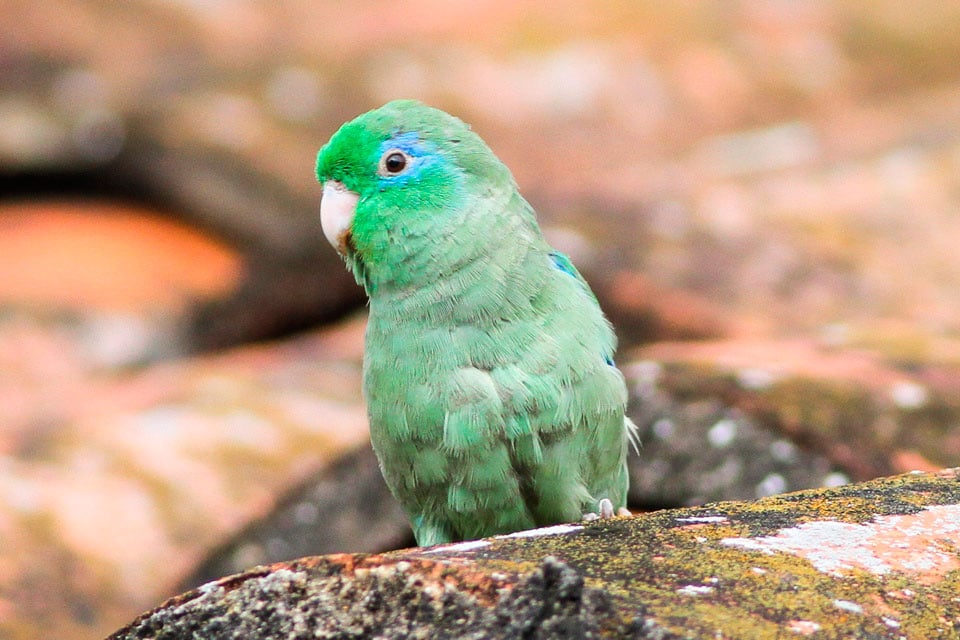
The male of the Spectacled Parrotlet (Forpus conspicillatus) has a yellowish green forehead extending the cheeks and to the throat.

The underparts They are slightly off in colouration, with a bluish gray suffusion in chest. The area surrounding the eyes It is cobalt blue. The wings and upperparts is dark green, with the back and rump blue-violet color, with a darker shade on own rear.

The bill Pink is white. The legs They are pink. The irises is dark brown.

the colors of the female they are duller in terms of the general coloring. Their upperparts They are brighter, with the area around the eyes, emerald green. The underparts They are more yellowish green.

Description 3 subspecies:

  • Forpus conspicillatus caucae

    (Chapman, 1915) – It is paler and blue around the eyes is lighter and is just behind these.


  • Forpus conspicillatus conspicillatus

    (Lafresnaye, 1848) – Nominal.


  • Forpus conspicillatus metae

    (Borrero & Hernandez-Camacho, 1961) – Blue around eyes It is very small.

Habitat:

It is very common. It is found in varied ecosystems, patches of forest, clear with scattered trees, cultivated areas, from 200 m to 1800 m (migrate attitudinally up 2600 metres in Bogotá). They are noisy flocks of more of 120 individuals.

Reproduction:

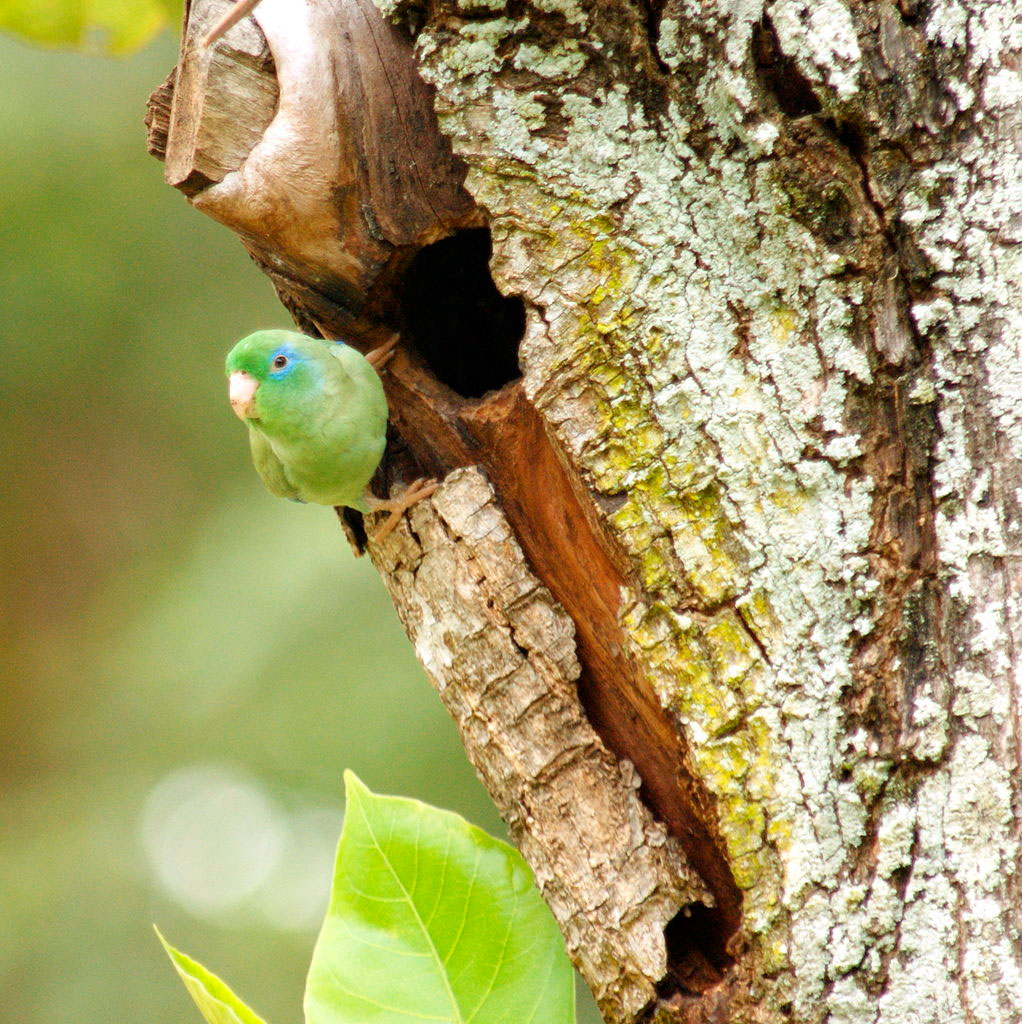
Nest in postholes and termiteros.

Food:

Feeds on grass and weed seeds, fruit, berries, flowers and buds.

Distribution:

Size of the area of distribution (reproduction / resident): 822.000 km2

Patchy and discontinuous distribution. east of Panama, Colombia and West of Venezuela.

Distribution 3 subspecies:

  • Forpus conspicillatus caucae

    (Chapman, 1915) – Southwest of Colombia, to the West of the Andes (Cauca and Nariño); possibly west of Ecuador.


  • Forpus conspicillatus conspicillatus

    (Lafresnaye, 1848) – Nominal. From the tropical eastern Panama north central Colombia.


  • Forpus conspicillatus metae

    (Borrero & Hernandez-Camacho, 1961) – Slope of the Andes of Colombia to the west end of Venezuela.

Conservation:

State of conservation ⓘ


minor concern Minor Concern ⓘ (UICN)ⓘ

• Current category of the Red List of the UICN: Least concern.

• Population trend: In increased.

Justification of the population

The size of the world population It has not been quantified, but this species is described as «common» (Stotz et to the., 1996).

Justification of trend

It is suspected that the population is increasing as habitat degradation is creating new areas of suitable habitat.

"Spectacled Parrotlet" in captivity:

In captivity is common in some European countries, rare elsewhere. It is a bird lively, Intelligent and with attitude. They are highly valued for being quiet; they can learn many words and whistle very well. Son loving and they love spending time with their owners, However, they are happy and independent enough to happily play with their toys while the owner is absent. Need much space as it is a bird very active, as well as different toys.

Alternative names:

– Spectacled Parrotlet (English).
– Toui à lunettes, Perruche-moineau à lunettes (French).
– Brillensperlingspapagei, Augenring-Sperlingspapagei, Brillenpapagei (German).
– Tuim-da-colômbia (Portuguese).
– Catita Enana Pálida, Cotorrita de Anteojos, Periquito de Anteojos (español).
– Periquito Ojiazul (Venezuela).

scientific classification:

– Order: Psittaciformes
– Family: Psittacidae
– Genus: Forpus
– Scientific name: Forpus conspicillatus
– Citation: (Lafresnaye, 1848)
– Protonimo: Psittacula conspicillata

Images Spectacled Parrotlet:

Videos of the "Spectacled Parrotlet"


Species of the genus Forpus

Spectacled Parrotlet (Forpus conspicillatus)


    Sources:

    – Avibase
    – Parrots of the World – Forshaw Joseph M
    – Parrots A Guide to the Parrots of the World – Tony Juniper & Mike Parr
    – Birdlife
    – parrots book, parrots and macaws Neotropical.

    – Photos:

    (1) – A female Spectacled Parrotlet in Manizales, Caldas, By Julian Londono from Colombia Manizales, Colombia [CC BY-SA 2.0], via Wikimedia Commons
    (2) – A male Spectacled Parrotlet in Manizales, Caldas, By Julian Londono from Colombia Manizales, Colombia [CC BY-SA 2.0], via Wikimedia Commons
    (3) – A pair of Spectacled Parrotlets in Manizales, Caldas, By Julian Londono from Colombia Manizales, Colombia [CC BY-SA 2.0], via Wikimedia Commons
    (4) – A male Spectacled Parrotlet in Colombia just outside the entrance of its nest By Rogier Klappe [CC BY 2.0], via Wikimedia Commons
    (5) – Spectacled Parrotlet (Forpus conspicillatus) by Ron Knight – Flickr
    (6) – PSITTACULA CONSPICILLATA By Internet Archive Book Images [No restrictions], via Wikimedia Commons

    – Sounds:

â–· The world of Pets: Dogs, cats, birds, reptiles, amphibians

Red-billed leiothrix
Leiothrix lutea

Ruiseñor del Japón
Gaj album-cc

Content

Distribution

The Red-billed leiothrix It is in Japan, from China. They live in the wild in the mountainous regions of Southeast Asia, to the South of the range of the Himalayas in the North and the South of Indochina. It has a preference for wooded areas.

Some populations have been introduced in Japan and Hawaii where only live from the years 80 of the 20th century,There are also several colonies in Europe of birds breaks present in Portugal, France and Spain where it is recognized as an invasive species due to its establishment in the Collserola mountain range, next to the urban center of Barcelona.
The invasive nature of this species has led to the prohibition of importation, sale, reared and released into the environment in Japan

Physical characteristics

The japanese nightingale measured between 13 and 15 cm.. Your body is robust, the upper part is gray-green. The very round head of the same color. His eyes are black and round. The throat is bright yellow, becoming orange on the chest. The legs are short and strong an amarillo-pardo color, the Orange beak, thin, rugged.

These birds are very curious. Love to see the person who feeds them. They live to almost 1200 meters above the level of the sea in its natural habitat,

The wings are short and strong, with the rounded edges and small feathers of red and grey color, Black at the tip of the tail.
Very resistant to harsh weather conditions.

The sexual dimorphism it is not obvious, It is known with certainty by the song and the color of the chest in the female which is usually less intense. Another small difference is the width at the end of the queue, in the male it is of 1,5 cm in black, in the female this width is of 0,5 cm.. The female does not sing, emits small sharp noises.

Character and skills

The Red-billed leiothrix has many qualities, has a beautiful singing, mellow and pleasant without despising their plumage colorful.
In an Aviary it coexists with ease with other species that live in your House such as the Canaries, exotic small and finches. You will never see any aggression between them.

He is passionate about bathing and washing several times a day with joy.

Individually they can pleasantly live in a cage of 60 cm in length by 30 cm of width by 40 height cm. A couple of isolated re-sell without difficulty in a crate outside of 1 m in length by 1 m wide by 1,5 height m, situated ‘hanging’ under the canopy of a leafy tree and with an internal equipment of branches where able to weave the nest. An outdoor-indoor aviary is much more suitable for the breeding of these animals, but it will not be overcrowded and the other inhabitants should have protected nesting corners.

Food

This so-called Mockingbird has a very varied diet. It is mainly an insectivore, and it has a preference for insects, molluscs and snails. She loves the tender shoots and ant eggs. He is also fond of the fruit (sweet), citrus, apples, Pears, strawberries …. It also feeds on seeds, birdseed, oats, Niger, not to mention the pasta for insectivores and mealworms.

Nesting

Its nesting extends from May to July. The eggs (3 or 4 accounted for by the) be incubarán during 14 days. The young leave the nest quickly (13 days), Although parents continue feeding them for a while.

Images "Red-billed leiothrix"

Videos "Red-billed leiothrix"

â–· The world of Pets: Dogs, cats, birds, reptiles, amphibians

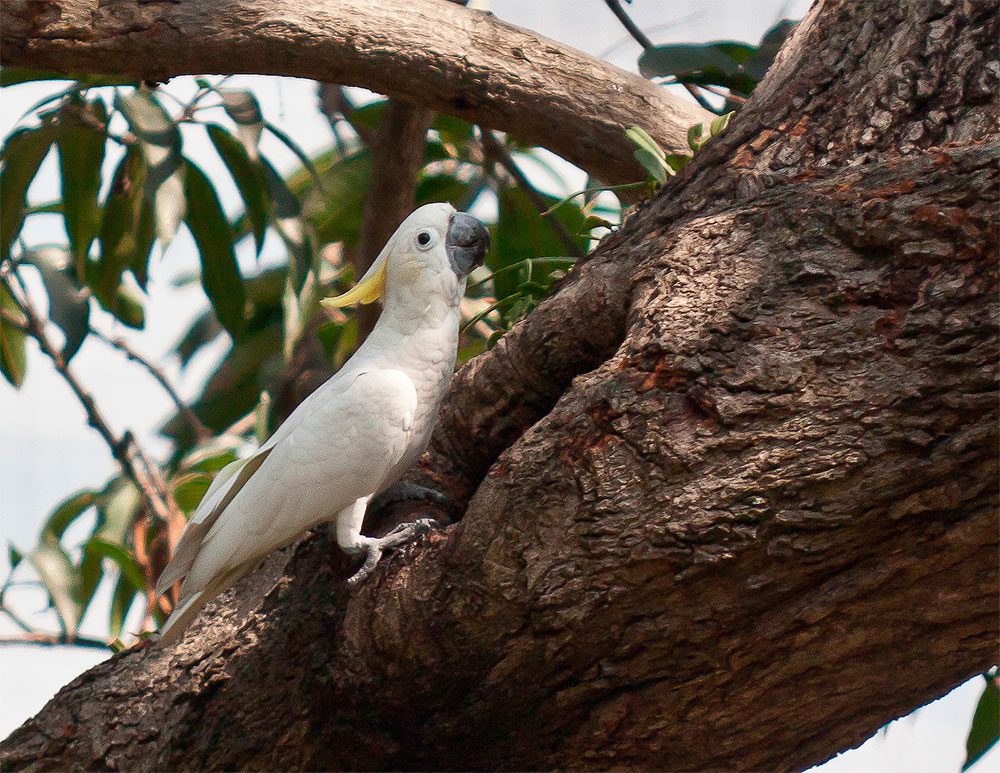
Yellow-crested cockatoo
Cacatua sulphurea

Yellow-crested cockatoo

Content

Description

Medium-sized, 35 cm.. long.

Yellow-crested cockatoo

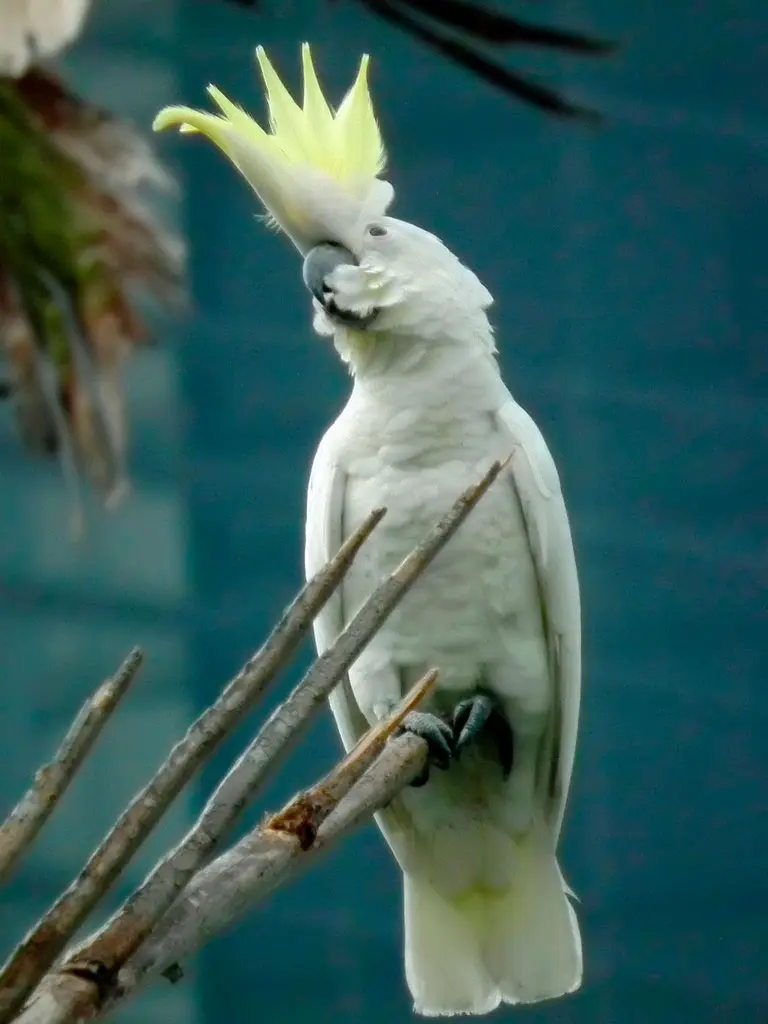
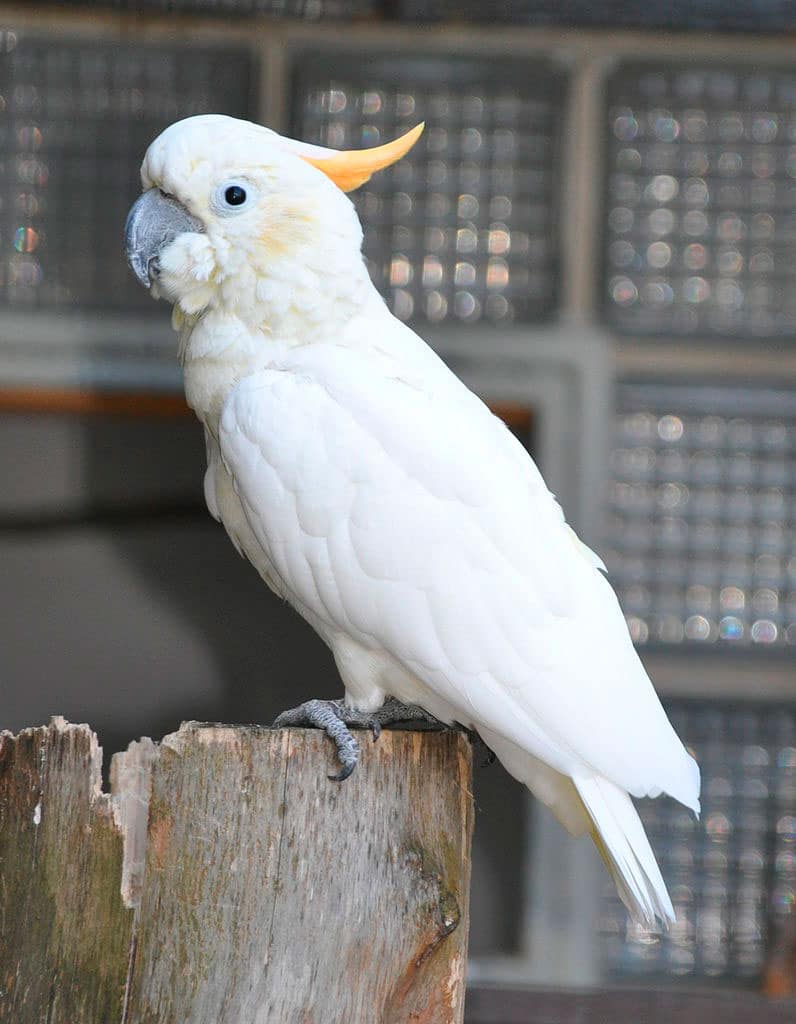
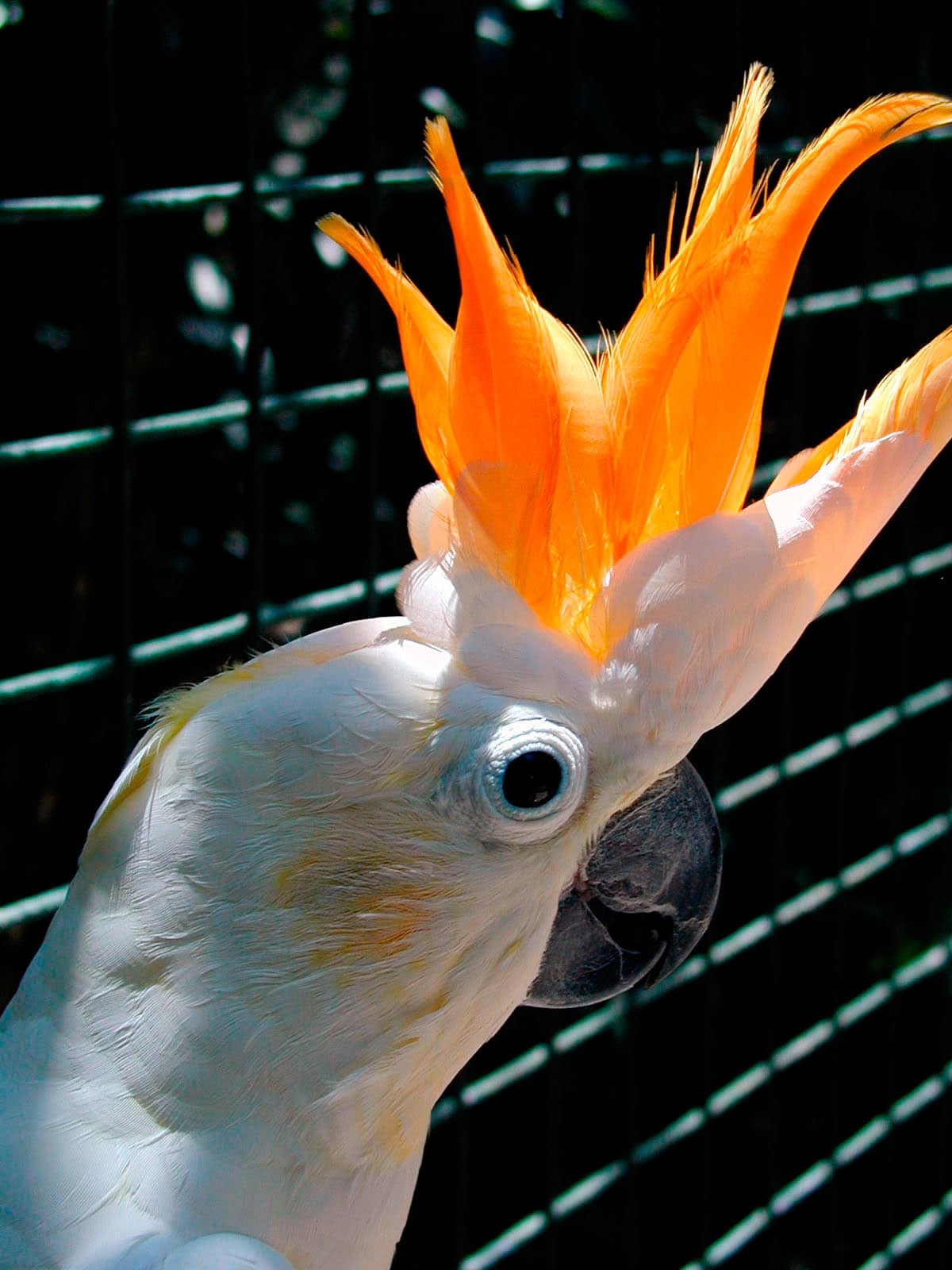
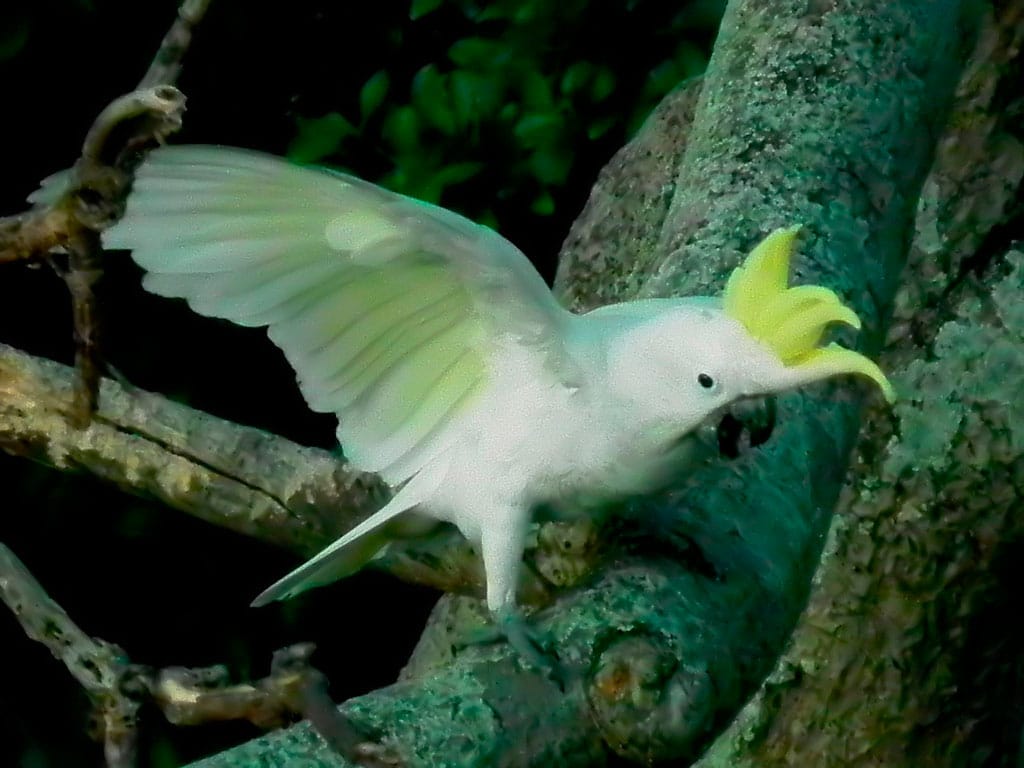
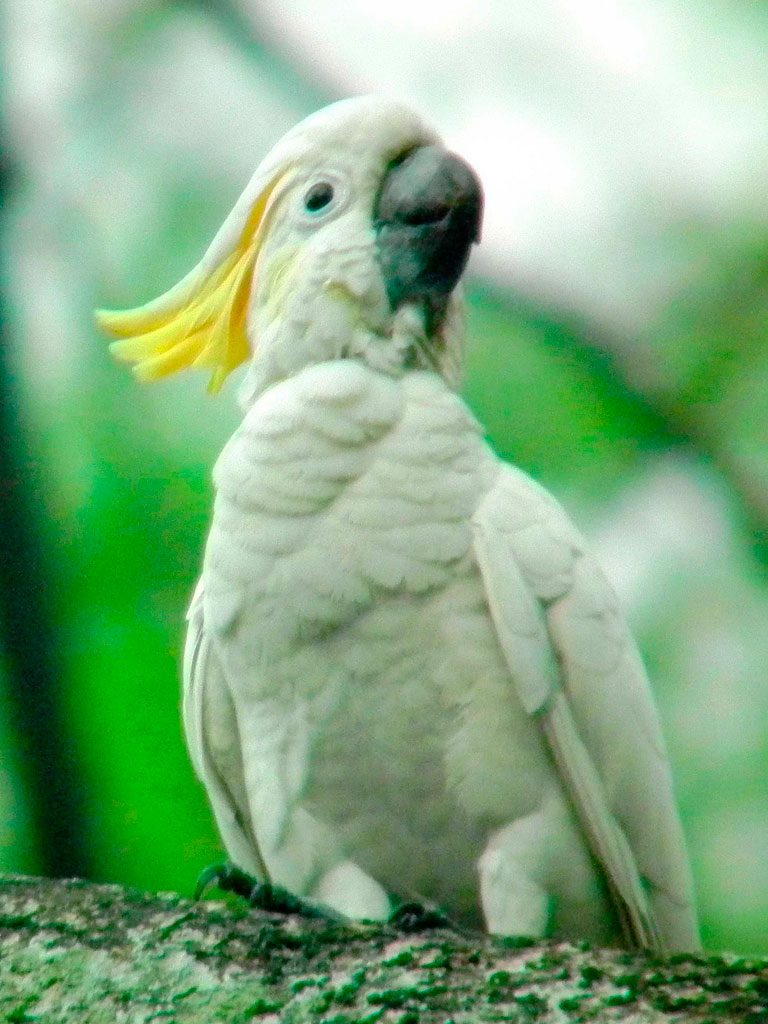
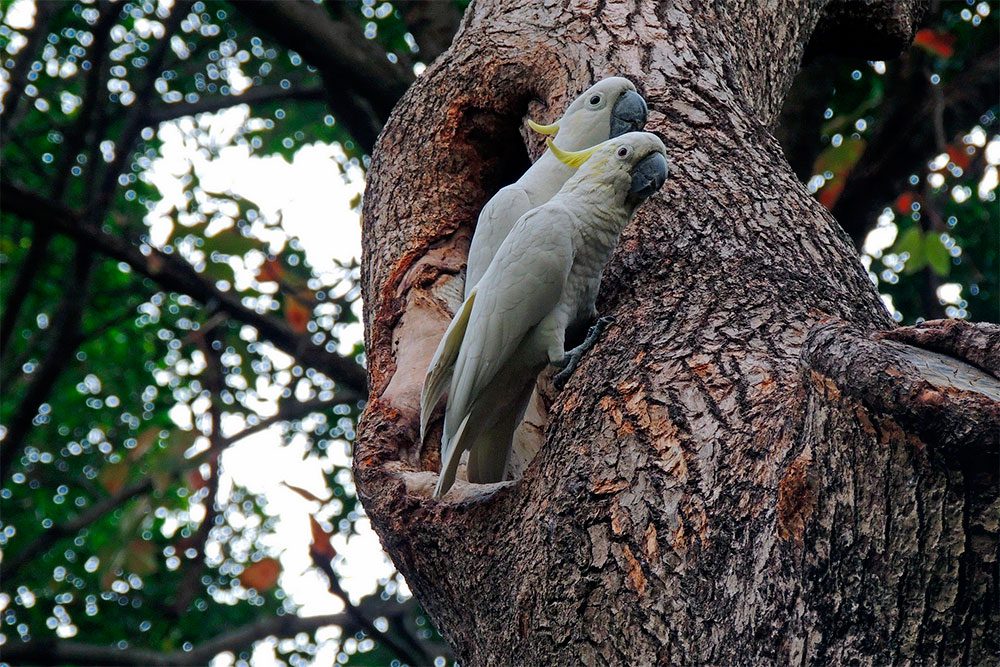
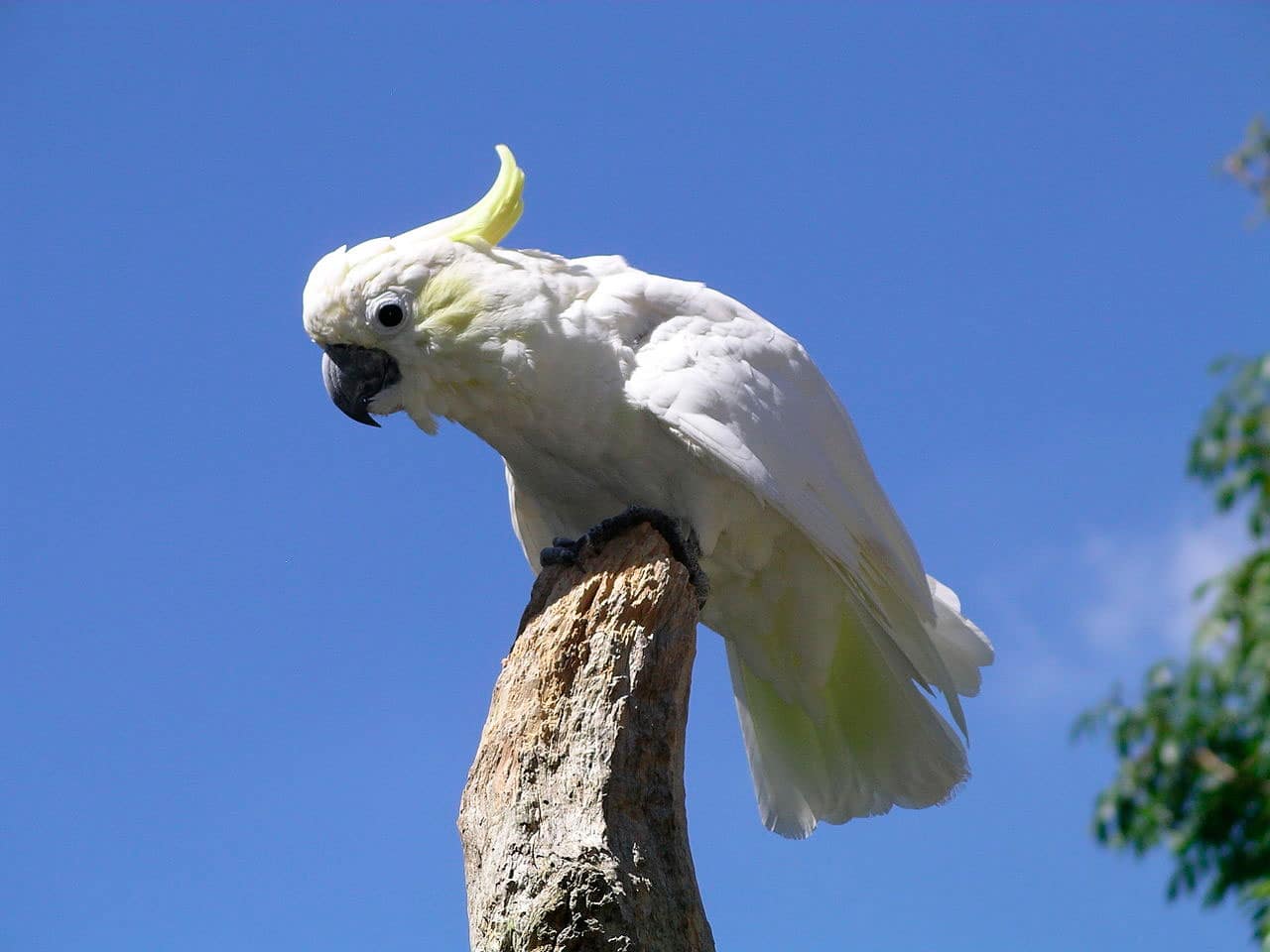
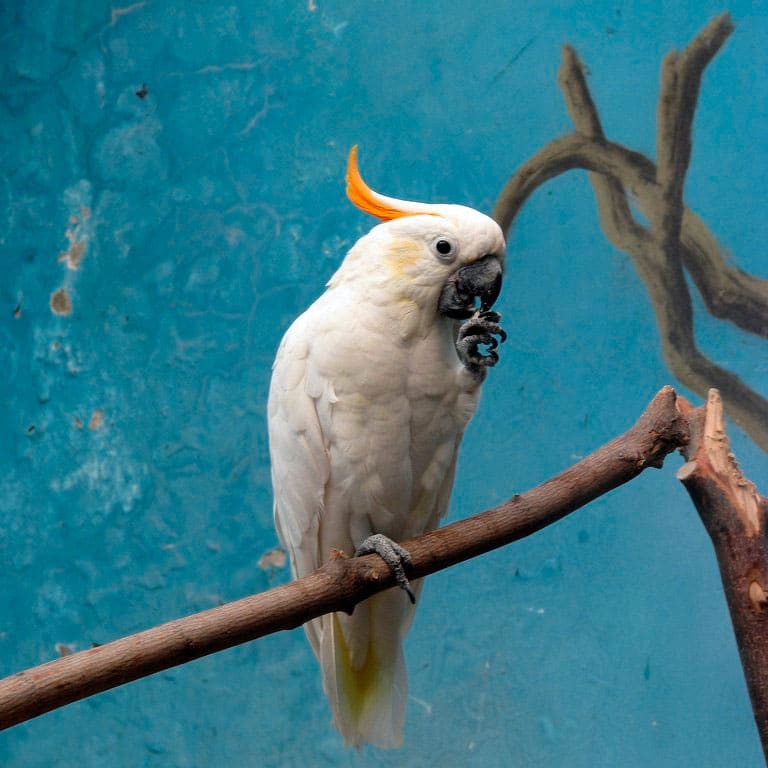
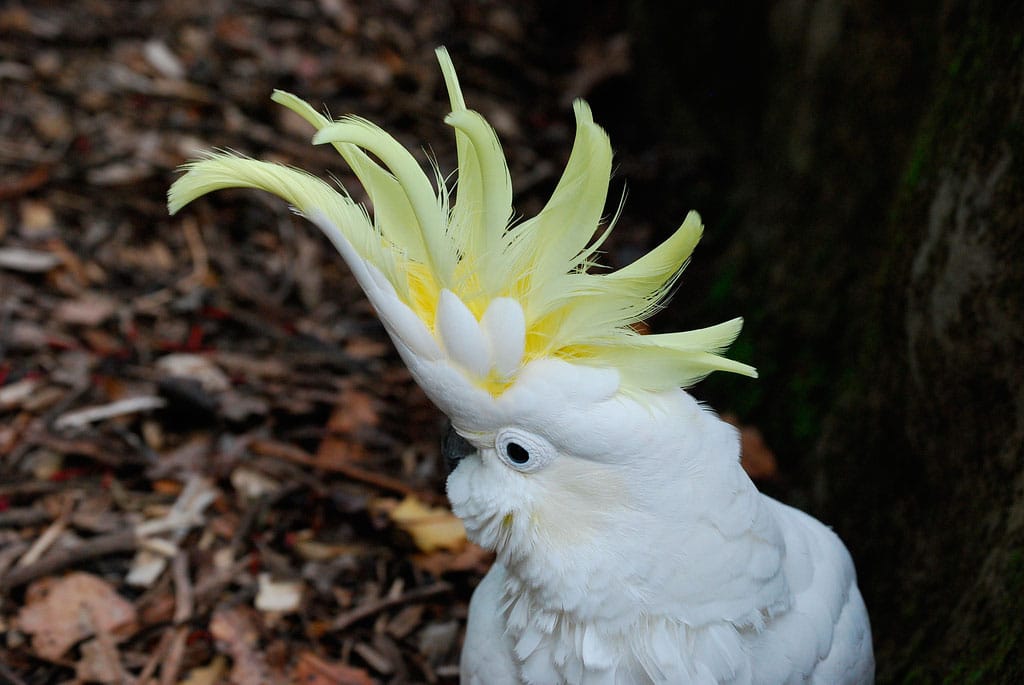
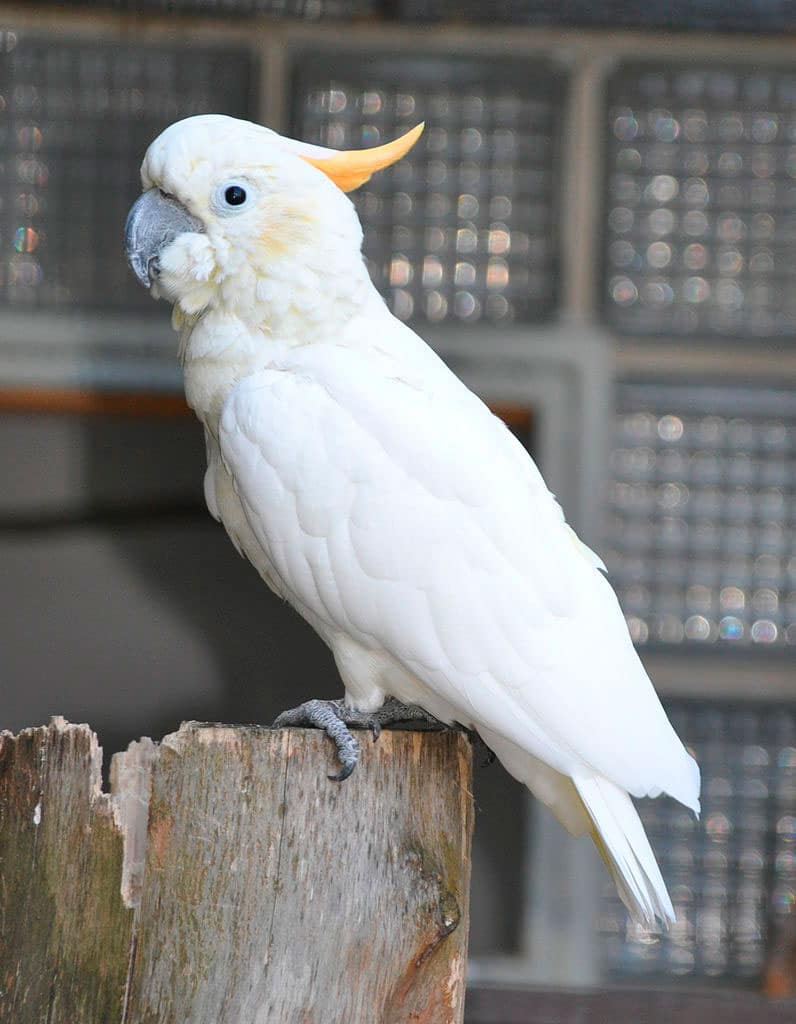
The Yellow-crested cockatoo (Cacatua sulphurea) It is distinguished by its long, thin yellow erectile crest, that curves forward, and extending upward, above the nape, when it folded. The front of his crown and main feathers crest, are white. The rest of your plumage It is also white, except in yellow suffusion ear-coverts, under the wings and in the innerwebs of the undertail-coverts. The bases of the hackles and underparts, They are yellowed; some birds show a slight yellow tone, particularly on chest and the belly. The bill It is black; eye ring pale bluish; irises dark brown; legs grey. The female is similar to the male but with the irises reddish and slightly smaller.

The young birds They show both sexes irises dark taupe, although females They begin to acquire the red coloration in the first year. The bill and legs immature are also lighter.

Description 4 subspecies
  • Cacatua sulphurea abbotti

    (Oberholser, 1917) – Similar to the parvula, but largest.

  • Cacatua sulphurea citrinocristata
  • Cacatua sulphurea citrinocristata

    (Fraser, 1844) – Slightly larger than the nominal, with one crest orange & ear-coverts orange yellow. Additional research may provide a basis for improving this subspecies to a specific status..

  • Cacatua sulphurea parvula

    (Bonaparte, 1850) – Similar to the nominal species, but with the ear-coverts paler and less yellow on yellow feathers underparts. the size of the bill in this subspecies it increases clinically towards the west.

  • Cacatua sulphurea sulphurea

    (Gmelin, 1788) – Nominal.

Habitat:

Video – "Yellow-crested cockatoo" (Cacatua sulphurea)

SULPHURE COCKATUA

They inhabit at the edges of the forest, wooded areas, farmland, cocoteros, semi-arid areas and forests until the 800 m (locally 1.200 m).

The Yellow-crested cockatoo usually they found in pairs or small groups of up to ten individuals, although they may meet in larger flocks to feed on fruit trees. They can form flocks with Eclectus Parrot (Eclectus roratus).

They tend to be noisy and visible, but can be difficult to spot when moving silently in the canopy, and they are more often in flight. The groups who leave their resting places in the montane forest areas frequently displace forage at lower altitudes including cultivated fields. Pairs may hover conspicuously above the forest canopy searching for fruitful trees, allowing a reasonably close approach when resting on a branch.

The crest It is generally stands when landing, or when an individual is making calls from a perch. Like most of the Cockatoos They enjoy a bath in the rain.

Reproduction:

Specimens of Yellow-crested cockatoo on the island of button in State reproductive during the months of September and October, although Nusa Tenggara the breeding It occurs in the months of April and May. The female It lays two or three white eggs in the hollow of a tree, and incubation lasts around 28 days with both parents participating. Chicks they leave the nest to 10 weeks and are dependent parent for about two months.

Food:

They feed in trees and soil. Its diet It includes seeds, corn (Zea mays) of cultivated fields, fruit, berries, egg yolks, flowers and nuts (including large coconuts (cocos nucifera)).

Distribution and status:

Size of its range (breeding/resident ): 1.360.000 km2

The Yellow-crested cockatoo They are confined Indonesian, where they can be seen in the lowlands Isla Celebes (virtually extinct in the north), islands in the Flores sea, in Nusa Tenggara and isolated islands Masalembu in the Java Sea.

introduced in Singapore and Hong Kong. The species is found in both wooded areas and cultivated and is scarce throughout its range. It is estimated that the world population total is less than 40.000 birds and is decreasing. Although populations of the nominal subspecies and of the subspecies parvula may still be close to 10.000 specimens, the citrinocristata subspecies It has an estimated population between 800 and 7.200 only individuals, having declined by 80% between the years 1986 and 1989, while the distinctive subspecies abbotti It is now represented by only nine individuals in nature.

Although habitat loss is clearly a factor in Sumba, where distribution appears to be linked to the extent of primary forest (is only about 15% the original forest), trade is the main threat to the species as a whole. Trade data show that exported almost 100.000 birds in years 1980-1992. The export citrinocristata subspecies It was banned in 1992 by local authorities, and 26 birds were confiscated in September of that year. There are probably at least 50 individuals of each subspecies in public collections and more than 2.000 in private aviculture, although the numbers for the subspecies abbotti They are unknown.

Distribution 4 subspecies

Conservation:

State of conservation ⓘ


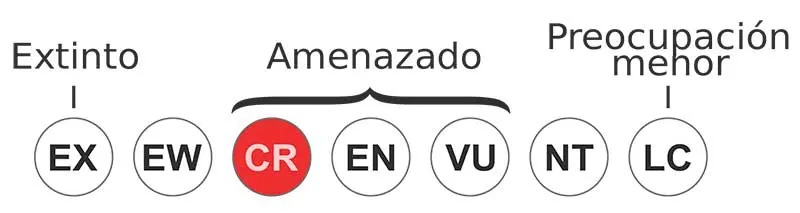
critical hazard critically endangered ⓘ (UICN)ⓘ

• Current category of the Red List of the UICN: critically endangered.

• Population trend: Decreasing.

Its crashing fall It is almost entirely attributable to the unsustainable exploitation for domestic and international trade. Logging to the conversion of forests for agriculture as well as the use of pesticides for land and large-scale.

Justification of the population

Based on recent surveys in various parts of the range of the species, C. Trainor in some (2007) It has been estimated the world population in less than 7.000 individuals: 3.200-5.000 en Sumba (though perhaps only 562 in 2012, Burung Indonesia en preparación), 500 en Komodo, 200-300 en Timor Leste, 200-300 en Sulawesi, 20-50 in West Timor, 40-70 Flores, 50-100 en Sumbawa, 100 in Rinca and other 700 birds in total. The best data is located in the band 2.500-9.999 individuals, equivalent to 1.667-6.666 mature individuals, rounded here to 1.500-7.000 mature individuals.

Conservation actions and research in progress

CITES Appendix I (2005). It has developed and adopted a recovery plan cooperative and has prepared an update 2012 (D. Mulyawati in some. 2012). The populations are found in various protected areas, It is the most important Rawa Aopa Watumohai (55 copies in 2011 [Waugh 2013]) and National Parks Caraente (en Sulawesi), supporting up 100 individuals (transgressed 2006) , Reserva Natural de Wildlife en Pulau Moyo, Komodo National Park and two national parks in Sumba: Manupeu-Tanadaru y Laiwangi-Wanggameti. Nini Konis Santana National Park declared in Timor has a 100 estimated birds (Trainor et al., Without date) . In Rawa Aopa Watumohai nests they have been protected from predators by removing vegetation pendant necklaces and installation of plastic around the tree trunks nesting (Waugh 2013). Moratoriums on international trade are in effect, although it is likely that a large proportion of trade is a national. Several subpopulations of Sulphur-crested Cockatoo have increased in Sumba between 1992 and 2002, due to conservation efforts (including local education, ecotourism and law enforcement), although densities remained below those typical for other cockatoo species (Cahill et al ., 2006) . Capture for trade has declined dramatically in Sumba through a variety of awareness and protection measures of the community (D. Mulyawati in some. 2012).

Following the surveys of 2008 and 2009, the Indonesia Parrot Project and Konservasi Kakatua Indonesia have started meetings with community leaders and villagers in Masakambing and Masalembu, as well as with the military and local police, to raise awareness and gain support for Sulphur-crested Cockatoo conservation (Metz et al. Al., 2009) . A conservation program-awareness-pride has also begun to involve adults and school Archipelago Masalembu (Metz et al. , 2009, Translating et al., 2009) And in Southeast Sulawesi (Anon., 2012). A "village regulation" was written to catch, possess or transport the species and initiate measures to reduce habitat destruction and employ a former village chief to guard and protect nests and study Sulphur-crested Cockatoos (Translating et al., 2009) . Moronone community in Rawa Aopa Watumohai NP, where four members of the village have been hired as Forest Wardens (Anon., 2012), have established similar community-based regulations. The guards protect the species against poachers and perform monitoring activities (Waugh 2013). The pest status of the species can be addressed by planting crops to compensate for losses and to act as a "sacrifice culture", for example, sunflower fields are used to attract the species out of other crops (Waugh 2013). Mangrove restoration is also being used to increase nesting habitat available (Waugh 2013). a repeat of the population census is planned abbotti , together with studies on its biological history and ecology (Metz et al., 2009) .

Proposed Research and Conservation Actions

Carry out further studies (including Roti, but also more studies on Alor and Pantar) to identify the most appropriate action for conservation areas and to periodically monitor key population surveys repeating ago 8-10 years. Provide relevant support for protected areas and conservation initiatives within its range and protect nests when possible. Strengthen the protection of forest Poronumbu, Sumba, declaring Nature Reserve (Translating y Agustina 2012). Strengthen control, the enforcement and monitoring of trade and establishing greater management of captive populations. Improve law enforcement in designated protected areas and other key areas for trade, including ports, markets, etc. Promote widespread community conservation initiatives. These may include, en la isla de Pasoso, Sulawesi Central, work to protect the Sulphur-crested Cockatoo should involve all five families living on the island and introduce community involvement programs for children and adults on several other islands where the species occurs (Translating y Agustina 2012). The recommendations formulated specifically for the protection of the species in the Komodo National Park consisted of carrying out an annual monitoring, maintain regular patrols, sensitize local communities and studying human activities and impacts within the park (Imansyah et al ., 2005, Benstead 2006) . Conduct ecological research to clarify options for management and conservation. Other objectives should be to study the abundance and distribution of nest holes and water sources.. The provision of artificial sources of water near the nesting sites, that is to say, water ponds, It is essential for the species on the island of Komodo and may also be necessary to protect the nests of young Komodo dragons in Komodo (Translating y Agustina, 2012).

"Yellow-crested cockatoo" in captivity:

The male Yellow-crested cockatoo It is especially aggressive with the female, sometimes to kill her. This phenomenon is known in many cockatoo species..

among the white cockatoos, this is somewhat difficult to breed in captivity. As a pet can be a formidable partner provided it has been raised for that purpose and to provide much attention.

It is very difficult for them to disconnect in the presence of their owners and entertain themselves without seeking continuous interaction.
Great ability to imitate human sound within the world of cockatoos.

Note: Because of its status, CRITICALLY ENDANGERED, only controlled captive breeding is recommended in an attempt to recover this species in the wild.

Alternative names:

– Yellow-crested Cockatoo, Lesser sulphur-crested cackatoo, Sulphur-crested Cockatoo (ingles).
– Cacatoès soufré, Petit Cacatoès à huppe jaune (French).
– Gelbwangenkakadu, Orangehaubenkakadu (German).
– Cacatua-de-crista-amarela (Portuguese).
– Cacatúa de Moño Naranja, Cacatúa Sulfúrea (español).

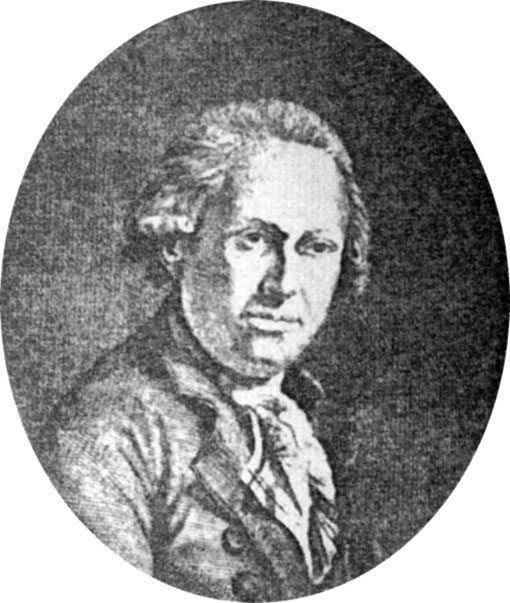
Gmelin Johann Friedrich

scientific classification:


– Order: Psittaciformes
– Family: Cacatuidae
– Genus: Cockatoo
– Scientific name: Cacatua sulphurea
– Citation: (Gmelin, JF, 1788)
– Protonimo: Psittacus sulphureus


Images Sulphur-crested Cockatoo:


Species of the genus Cacatua
  • Cacatua tenuirostris
  • Cacatua pastinator
  • —- Cacatua pastinator derbyi
  • —- Cacatua pastinator pastinator
  • Cacatua sanguinea
  • —- Cacatua sanguinea gymnopis
  • —- Cacatua sanguinea normantoni
  • —- Cacatua sanguinea sanguinea
  • —- Cacatua sanguinea transfreta
  • —- Cacatua sanguinea westralensis
  • Cacatua goffiniana
  • Cacatua ducorpsii
  • Cacatua haematuropygia
  • Cacatua galerita
  • —- Cacatua galerita eleonora
  • —- Cacatua galerita fitzroyi
  • —- Cacatua galerita galerita
  • —- Cacatua galerita triton
  • Cacatua ophthalmica
  • Cacatua sulphurea
  • —- Cacatua sulphurea abbotti
  • —- Cacatua sulphurea citrinocristata
  • —- Cacatua sulphurea parvula
  • —- Cacatua sulphurea sulphurea
  • Cacatua moluccensis
  • Cacatua alba

  • Sources:

    – Avibase
    – Parrots of the World – Forshaw Joseph M
    – Parrots A Guide to the Parrots of the World – Tony Juniper & Mike Parr
    – Birdlife

    – Photos:

    (1) – Cacatua sulphurea by Charles Lam – Flickr
    (2) – Citron-crested Cockatoo(Cacatua sulphurea citrinocristata) in the Walsrode Bird Park, Germany By Quartl (Own work) [CC BY-SA 3.0], via Wikimedia Commons
    (3) – A Yellow-crested Cockatoo at Auckland Zoo, New Zealand By Ashleigh Thompson (originally posted to Flickr as Captain) [CC BY 2.0], via Wikimedia Commons
    (4) – Cacatua sulphurea citrinocristata, Citron-crested Cockatoo. Photograph of upper body and crest By Ruth Rogers (originally posted to Flickr as Citron Cockatoo) [CC BY 2.0], via Wikimedia Commons
    (5) – Citron-crested Cockatoo (Cacatua sulphurea citrinocristata). The glass between the camera and this parrot makes the picture just a little bit blurry By Alexander Tundakov (originally posted to Flickr as White Parrot) [CC BY 2.0], via Wikimedia Commons
    (6) – Photo of Lesser Sulphur-crested Cockatoo (wings clipped) By Snowmanradio, with permission from Tropical Birdland, Leicestershire, England. (Own work) [GFDL or CC BY-SA 3.0], via Wikimedia Commons
    (7) – Yellow-crested Cockatoo (Cacatua sulphurea) at the KOBE Oji Zoo by opencage.info
    (8) – Lesser Sulphur-crested Cockatoo (wings clipped) By Snowmanradio, with permission from Tropical Birdland, Leicestershire, England. (Own work) [GFDL or CC BY-SA 3.0], via Wikimedia Commons
    (9) – Yellow-crested Cockatoo (Cacatua sulphurea) by Darren – Flickr
    (10) – Yellow-Crested Cockatoo, Cacatua sulphurea by Sek Keung Lo – Flickr
    (11) – Cacatua sulphurea by Charles Lam – Flickr
    (12) – Cacatua sulphurea by Charles Lam – Flickr
    (13) – Cacatua sulphurea by Pichon Charles Lam – Flickr
    (14) – A painting of a Yellow-crested Cockatoo, also known as the Lesser Sulphur-crested Cockatoo, (originally captioned «Plyctolophus sulphureus. Lesser Sulphur-crested Cockatoo») by Edward Lear 1812-1888. [Public domain], via Wikimedia Commons

    – Sounds: (Xeno-canto)

    â–· The world of Pets: Dogs, cats, birds, reptiles, amphibians

    Sinú parakeet (sub)
    Pyrrhura subandina

    Cotorrita del Sinú

    Content

    Description:

    21 to 23 cm.. height.

    The Sinú parakeet (Pyrrhura subandina) It, in general, green, with the forecrown and areas around eyes dark red.

    In flight It is very evident dark red stain abdomen, the wings below greyish. The cheeks They have a greenish blue tone, the area surrounding the ear It is yellowish-brown and the breast feathers with design marginalized gray escamado.

    Lives or lived in humid jungle, semi-humid, deciduous and gallery forests,low. It nests on trees of considerable size in hollow nests woodpeckers.

    endemic to Colombia, in the lower valley of sinu river, Jaraquiel, Murrucucú hill, Córdoba.

    Expeditions carried out in recent years have failed to sight it.

    Estimated population: 0-100; The population trend: possibly extinct

    We recommend that you devote to Sinú parakeet immediate attention to the conservation of this unique endemic species of the plain Sinu River.

    Habitats in the jungle and near the Sinú river valley have been extensively altered and lost.

    History:

    The Sinú parakeet It was described by Todd 1917 as a distinctive bird endemic Valley Sinu River, Córdoba Department, Northwest of Colombia. Peters (1937), without evidence or any basis placed the Pyrrhura subandina within the species Pyrrhura picta, and the species immediately fell into obscurity as subspecies. However, Joseph and Stockwell (2002) they restored the status to Pyrrhura subandina as a species, based on a detailed assessment and phylogenetic analyses recent (com. pers. 2003).

    DNA analysis has shown that the population of the Sinú parakeet (Pyrrhura subandina) It is probably different (monotype) (Joseph & Stockwell 2002), although at present it remains a subspecies of the Pyrrhura picta pending further studies (SACC 2007).

    There is no information on the ecology of the Sinú parakeet or current status. The species has never been reported alive and its range has been extensively deforested (Salaman obs. pers.)

    At the beginning of 2004 Paul Salman He visited the four sites type; two are entirely deforested, While Quimari and the Cerro Murrucucú still have some fragmented forests. No evidence of any Pyrrhura It was obtained by observations and interviews with the local community. In May of 2004, a researcher at ProAves spent three months exploring in search of this species throughout the Murrucucú hill but their results were not favorable. The lack of recent records of this species and its restricted and unprotected range give reasons for concern about their survival and current status.

      Reference: Joseph, L. and Stockwell, D. 2002. Climatic modeling of the distribution of some Pyrrhura parakeets of northwestern South America with notes on their systematics and special reference to Pyrrhura caeruleiceps Todd, 1947. Ornitologia Neotropical 13: 1-8.

    The Sinú parakeet (Pyrrhura subandina) was last reliably recorded in 1949. Almost nothing was recorded about their habits. Not found during searches on 2004 and 2006 (ProAves Colombia 2008). He may be extinct, but if it still survives, this bird will be seriously threatened by habitat loss and hunting associated with the armed conflict in the region; The future of this Pyrrhura It looks bleak.

    * Subspecies included within the species Pyrrhura picta.

    Sinú parakeet (Pyrrhura subandina)


    Especies del género Pyrrhura

    Sources:

    – Parrot Book, Parrots and macaws.
    – eLibrary
    – proaves
    – Extinct Birds by Julian P. Hume, Michael Walters.

    Photo: Parrots, Parrots and macaws Neotropical

    â–· The world of Pets: Dogs, cats, birds, reptiles, amphibians

    Brown-breasted Parakeet
    Pyrrhura calliptera


    Brown-breasted Parakeet

    Content

    Description:

    Brown-breasted Parakeet

    22-23 cm.. height.

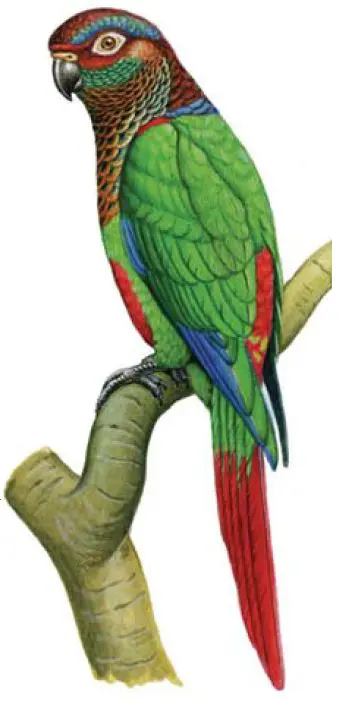
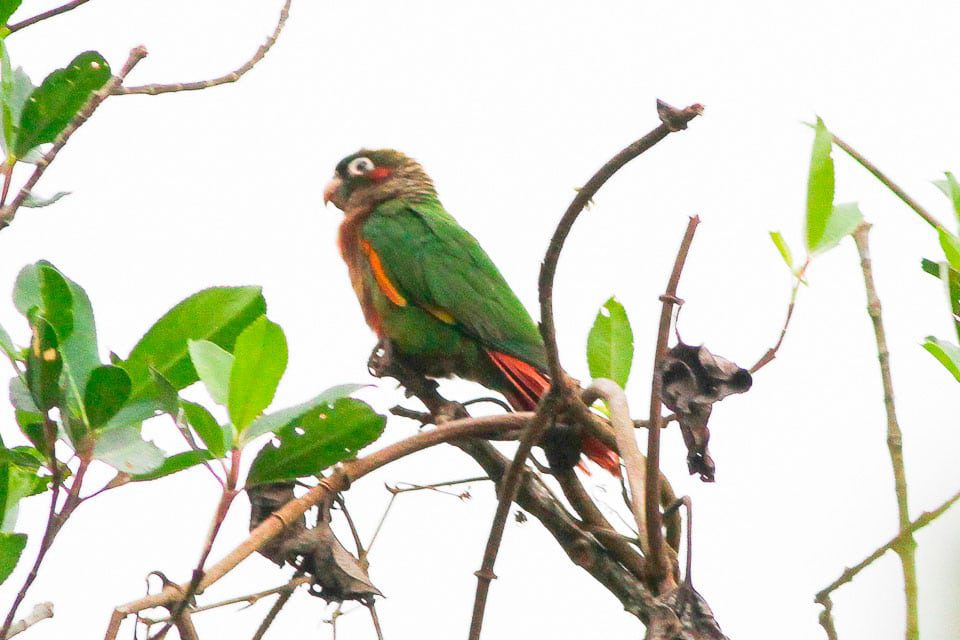
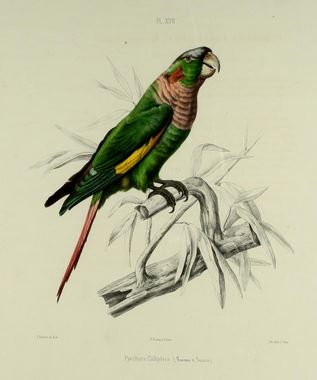
    The Brown-breasted Parakeet (Pyrrhura calliptera) is easily recognized by the Wing mirror yellow in flight. In general it is green, with a red spot on the ear; chest brown reddish and sides of the neck characteristic dark brown.

    Shoulder mostly yellow up to half of the wing and the end of the same pardo-olivaceo.
    The primary feathers are blue and their covert wing external and internal yellow, usually with orange blend.
    The tail reddish brown. Its bill pale yellowish; irises yellow; eye ring white.

    The immature lack of yellow in the wings.

    Habitat:

    It inhabits in Misty jungles Andean and sub-andinas with canopy 15 to 25 m, secondary forests and Paramo, from 1700 to 3400 m. They fly at dawn and at dusk flocks, usually small of 6 to 12 individuals on the canopy of the forest.

    Reproduction:

    It nests in, generally, in cavities of trees located in wooded pastures or pasture surrounded by secondary forest fragments, bedrooms for both nests.
    breeding conditions they have been observed in August and October, as well as between November and January in Fusagasugá, Farallon de Medina and Soatá (Cortes-Herrera et to the., 2007) and from September to February in the Chingaza National Park (Arenas-Mosquera 2011).

    The size average of the laying is of 5-6 eggs of color whitish. The chicks take of 60 to 70 days to complete its development.

    Food:

    Diet Brown-breasted Parakeet consists in fruit (including plants of the Ericaceae, Lauraceae, Melastomataceae and Clusiaceae (Cortes-Herrera et to the., 2007), seeds and cultivated corn, Although flocks larger were observed in areas open to eating leaves and seeds (O. Courteous in litt., 2012).

    Distribution:

    Size distribution (reproduction / resident): 1,000 km2

    Endemic. Cordillera Oriental in Colombia. Since Boyacá to southwest of Cundinamarca. Has also been reported in the departments of Santander, Norte de Santander and Casanare in the localities of the Arrayanes and Salina.

    The population total has been estimated at 5.000-10.000 individuals.

    Conservation:

    State of conservation ⓘ


    Vulnerable Vulnerable ⓘ (UICN)ⓘ

    • Current category of the Red List of the UICN: Vulnerable.

    • Population trend: Decreasing.

    This species has a range very small and a small population, known in less than ten places in what is rapidly declining due to the loss of habitat and persecution as as plague by including cultivated corn in their diet.

    These declines in population range are expected to continue.. So, qualified as vulnerable.

    It is estimated that its population amounts to between 5.000 and 10.000 individuals, equivalent approximately to 3.300-6.700 mature individuals.

    "Brown-breasted Parakeet" in captivity:

    Not usually find it in captivity.

    Alternative names:

    – Brown-breasted Parakeet, Brown breasted Parakeet, Brown-backed Conure, Brown-backed Parakeet, Brown-breasted Conure, Flame-winged Conure, Flame-winged Parakeet (English).
    – Perriche à poitrine brune, Perruche à poitrine brune (French).
    – Braunbrustsittich, Braunbrust-Sittich (German).
    – Tiriba-de-peito-marron (Portuguese).
    – Cotorra Pechiparda, Perico Bello, Periquito Aliamarillo (español).

    scientific classification:

    – Order: Psittaciformes
    – Family: Psittacidae
    – Genus: Pyrrhura
    – Scientific name: Pyrrhura calliptera
    – Citation: (Massena & Souancé, 1854)
    – Protonimo: Conurus callipterus

    Images "Brown-breasted Parakeet"

    Videos "Brown-breasted Parakeet"


    Especies del género Pyrrhura

    Brown-breasted Parakeet (Pyrrhura calliptera)


    Sources:

    – Avibase
    – Parrots of the World – Forshaw Joseph M
    – Parrots A Guide to the Parrots of the World – Tony Juniper & Mike Parr
    – Birdlife
    – Wiki Aves de Colombia

    – Photos:

    (1) – Flame-winged Parakeet (Pyrrhura calliptera) By Ron Knight from Seaford, East Sussex, United Kingdom (Flame-winged Parakeet (Pyrrhura calliptera)) [CC BY 2.0], via Wikimedia Commons
    (2) – Pyrrhura calliptera By J. Davernes (biodiversitylibrary.org) [Public domain], via Wikimedia Commons

    – Sounds: (Xeno-canto)

    â–· The world of Pets: Dogs, cats, birds, reptiles, amphibians

    Mountain Parakeet
    Psilopsiagon aurifrons


    Mountain Parakeet

    Content

    Description:


    Anatomy-parrots

    17 to 19 cm.. height.
    The Mountain Parakeet (Psilopsiagon aurifrons) is distinguishable by the face yellow and the belly yellow with dye-Green, bill pale, wing with extreme blue (notorious is when closed), tail long. Bill and legs color clear. Iris black.
    The female with face green and belly yellow-green.
    Treated above as Bolborhynchus aurifrons.

    Subspecies description:

    • Psilopsiagon aurifrons aurifrons

      (Lesson, 1830) – The nominal,

    • Psilopsiagon aurifrons margaritae

      (Berlioz & Dorst, 1956) – With very little or nothing of yellow and very little dimorphic sexual, they resemble females of the subspecies nominal and robertsi. The females sometimes have the bill grey;

    • Psilopsiagon aurifrons robertsi

      (Carriker, 1933) – It has yellow only in the forecrown, sides bill, throat with green dye, and belly green with yellow line on the sides.

    • Psilopsiagon aurifrons rubrirostris

      (Burmeister, 1860) – With mask facial blue sky and no sexual dimorphism

    Habitat:

    Video – "Mountain Parakeet" (Psilopsiagon aurifrons)

    Serrano catita girl (Psilopsiagon aurifrons): VOICE

    It is found in variety of ecosystems, forest in gallery, Puna and crops, from 1000 to 2900 m (sometimes from sea level up to 4500 m). It is possible to carry out local migration after reproduction. gregarious.

    Reproduction:

    Sometimes They nest colonially, in cracks or holes in inaccessible Rocky escarpments.
    breeding station: From October to December, North of Chile, February/March, Argentina.

    Food:

    It feeds on shoots, seeds, vegetables and fruits.

    Distribution:

    Size of the distribution (reproduction / resident): 820.000 km2

    Can be found in the Centre and South of the Andes, from Peru until Argentina and Chile.

    Subspecies distribution:

    • Psilopsiagon aurifrons aurifrons

      (Lesson, 1830) – The nominal,

    • Psilopsiagon aurifrons margaritae

      (Berlioz & Dorst, 1956) – The Andean slopes in the South of Peru, Bolivia, North of Chile and Northwest of Argentina.

    • Psilopsiagon aurifrons robertsi

      (Carriker, 1933) – The Valley of the Maranon River in the Center-North of Peru.

    • Psilopsiagon aurifrons rubrirostris

      (Burmeister, 1860) – The sheds Andean of the Northwest Argentine, between Catamarca and Córdoba, and South of Chile

    Conservation:

    State of conservation ⓘ


    minor concern Minor Concern ⓘ (UICN)ⓘ

    • Current category of the Red List of the UICN: Least concern.

    • Population trend: Stable.

    This species has a very large range, and therefore not it approaches the threshold of Vulnerable on the criterion of size of the area.

    The trend of the population seems to be stable, and therefore, the species is not approaching thresholds for vulnerable under the trend of criterion.

    For these reasons, the species is evaluated as Least concern.

    "Mountain Parakeet" in captivity:

    It´s rare in captivity. They are very susceptible to stress and disease, so many die during the process of acclimatization. It is good to acclimatize it in a large aviary with other birds. Prone to deficiency of vitamin D3.

    Need of hiding places so that they may disappear from view.

    Alternative names:

    – Mountain Parakeet, Golden-fronted Parakeet (English).
    – Toui à bandeau jaune, Perruche à bandeau jaune (French).
    – Zitronensittich, Zitronen-Sittich (German).
    – Periquito-da-cordilheira (Portuguese).
    – Catita de Frente Dorada, Catita Frentidorada, Catita serrana chica, Perico cordillerano (español).
    – Catita serrana chica (Argentina).
    – Perico cordillerano (Chile).
    – Perico Cordillerano (Peru).
    – Cialla (Aymara).

    scientific classification:

    René Primevère Lesson
    René Primevère Lesson

    – Order: Psittaciformes
    – Family: Psittacidae
    – Genus: Psilopsiagon
    – Scientific name: Psilopsiagon aurifrons
    – Citation: (Lesson, 1831)
    – Protonimo: Psittacus (Lathamus) aurifrons

    Images "Mountain Parakeet"

    Mountain Parakeet

    Two Mountain Parakeet views between Uquia and Yavi, Salta, Argentina


    Species of the genus Psilopsiagon

    Sources:

    – Avibase
    – Parrots of the World – Forshaw Joseph M
    – Parrots A Guide to the Parrots of the World – Tony Juniper & Mike Parr
    – Birdlife
    – Parrot Book, Parrots and macaws Neotropical

    – Photos:

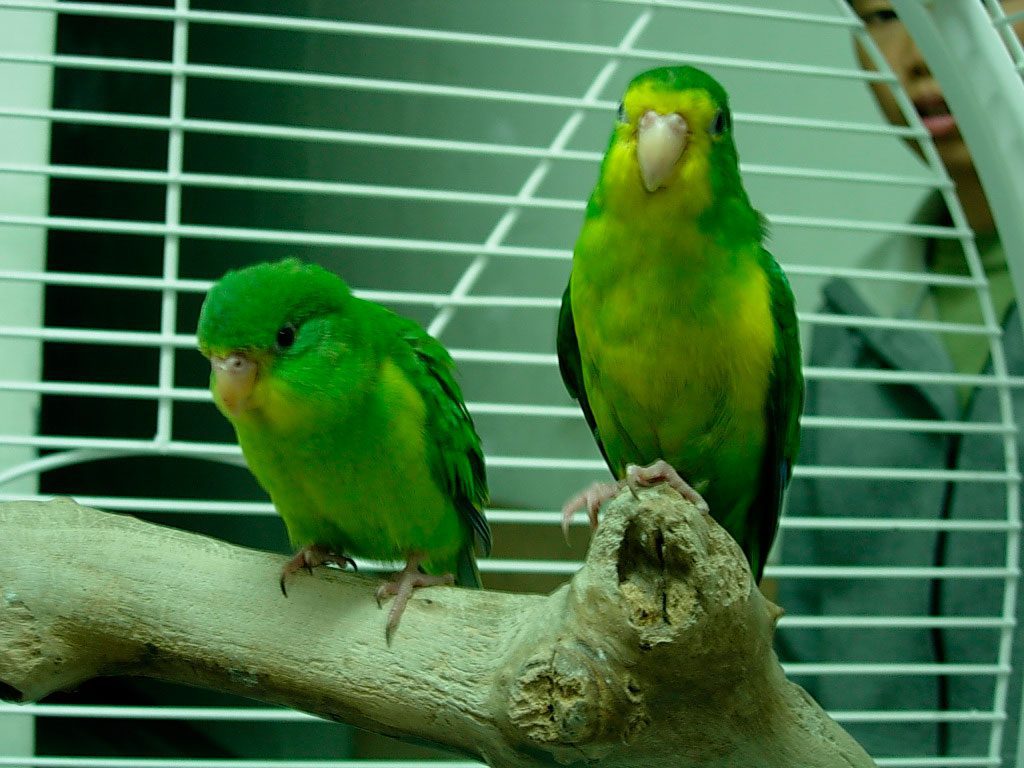
    (1) – Mountain Parakeet; two in a cage By TJ Lin (originally posted to Flickr as mountain oarakeet) [CC BY-SA 2.0], via Wikimedia Commons
    (2) – Two Mountain Parakeets seen between Uquia to Yavi, Salta, Argentina By Ron Knight from Seaford, East Sussex, United Kingdom (Mountain ParakeetUploaded by snowmanradio) [CC BY 2.0], via Wikimedia Commons
    – Sounds: (Xeno-canto)