โ–ท The world of Pets: Dogs, cats, birds, reptiles, amphibians

Petit Brabanรงon
Bรฉlgica FCI 82 . Petit Brabanรงon

Petit Brabanรงon

The Petit Brabanรงon It is the least known of the "Small Belgian Dogs".

Content

History

The Petit Brabanรงon has common origins with the Griffon Bruxellois and the Griffon belge. All three breeds are descended from a small wire-haired dog, the Smousje, originally from Brussels.

In the 19th century, crosses with him Cavalier King Charles spaniel (Ruby) and the Pug they brought the black and short fur and fixed the type.

These alert little dogs were bred to guard carriages and keep rodents out of stables..

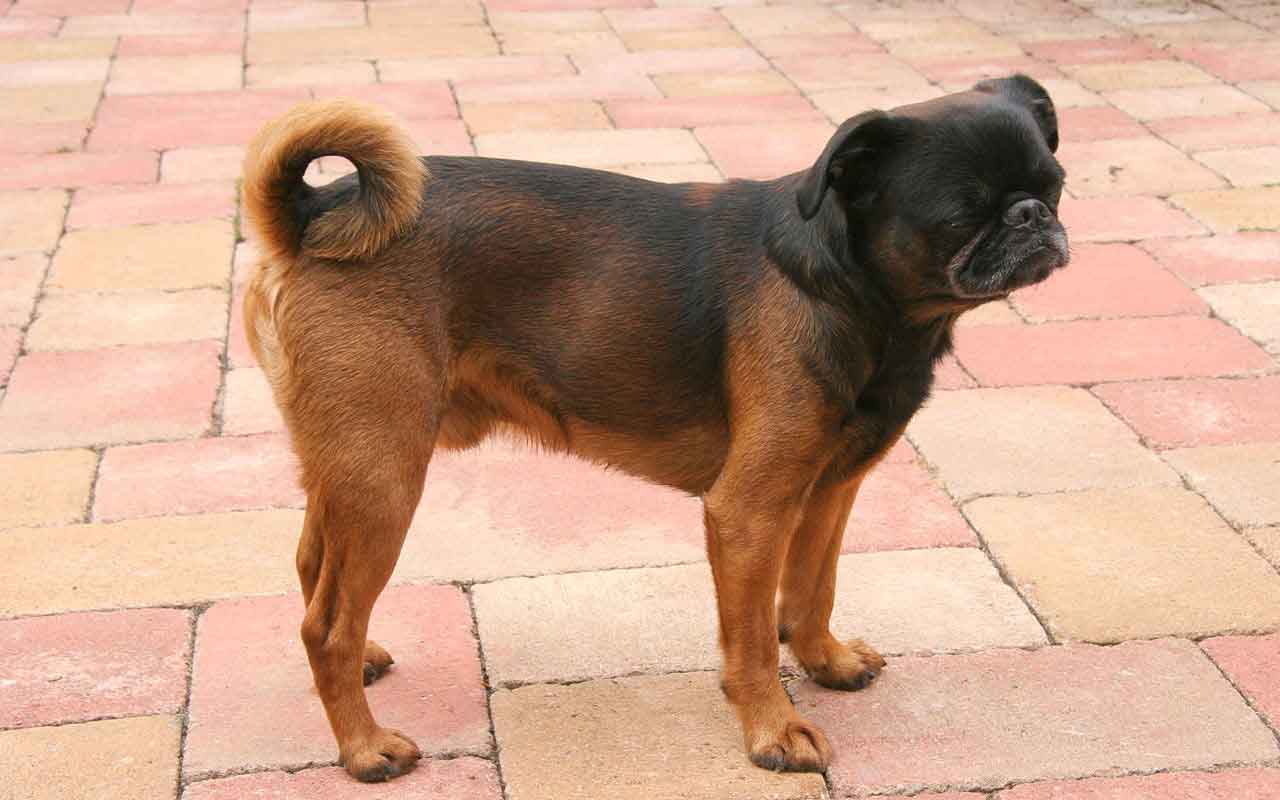
Photo: Petit Brabanรงon by Ger Dekker, CC BY-SA 2.0, via Wikimedia Commons

Physical characteristics

The Petit Brabanรงon is a small companion dog, Intelligent, balanced, alert, proud and robust, practically square in shape, with good bone, but also elegant in his gait and complexion, drawing attention with his almost human expression.

Shelter:

The Petit Brabanรงon has a short coat. The coat is rough, closed and bright, and does not exceed 2 cm..

The same colors as in the Griffon belge and Griffon Bruxellois (red, black, black and tan). Has a dark mask. The gray in the mask of older dogs will not be penalized.

Some white hair on the chest is tolerated in all three breeds, but it is not sought.

Weight:

of 3,5 to 6 kg.

Character and skills

The Petit Brabanรงon he is a balanced puppy, alert, proud, very attached to his master and very vigilant. neither shy nor aggressive.

Characteristics "Petit Brabanรงon"

Coexistence is important that you have with your new friend. Before considering the acquisition of a dog of the breed "Petit Brabanรงon" you know certain factors. Not all breeds of dogs are apt to live in an apartment, you must take into account his character, their need for exercise, their interaction with other pets, their care and if you have small children, their level of tolerance towards them.

Adaptation โ“˜

3,0 of 5 stars (based on 1 review)

friendly dog โ€‹โ€‹โ“˜

5,0 of 5 stars (based on 1 review)

hair loss โ“˜

1,0 of 5 stars (based on 1 review)

Affection level โ“˜

5,0 of 5 stars (based on 1 review)

Need for exercise โ“˜

2,0 of 5 stars (based on 1 review)

Social need โ“˜

4,0 of 5 stars (based on 1 review)

Home โ“˜

3,0 of 5 stars (based on 1 review)

Toilet โ“˜

2,0 of 5 stars (based on 1 review)

Friendly with strangers โ“˜

3,0 of 5 stars (based on 1 review)

barking โ“˜

3,0 of 5 stars (based on 1 review)

Health โ“˜

3,0 of 5 stars (based on 1 review)

Territorial โ“˜

4,0 of 5 stars (based on 1 review)

Cat friendly โ“˜

3,0 of 5 stars (based on 1 review)

Intelligence โ“˜

3,0 of 5 stars (based on 1 review)

Versatility โ“˜

3,0 of 5 stars (based on 1 review)

Child friendly โ“˜

1,0 of 5 stars (based on 1 review)

Surveillance โ“˜

3,0 of 5 stars (based on 1 review)

joy โ“˜

4,0 of 5 stars (based on 1 review)

Images "Petit Brabanรงon"

Photos:

1 – PePetit Brabanรงon: BEL, NED, GER, INT Champion ยซGaystock Le Pas De Toutยป. Photo: Hans Bleeker by Hans Bleeker, CC BY-SA 3.0, via Wikimedia Commons
2 – PETIT BRABANCON, Flor de Canelas Head Over Heals MyDOG, nordens stรถrsta hundevenemang by Svenska Mรคssan from Sweden, CC BY 2.0, via Wikimedia Commons
3 – Petit Brabancon; Robbins Uranos – Gucci by Maria Michaelsson, CC BY-SA 3.0, via Wikimedia Commons
4 – โ€œLittle Brabanzonโ€ by Ger Dekker
5 – โ€œLittle Brabanzonโ€ by Lusadi, CC BY 3.0, via Wikimedia Commons
6 – โ€œLittle Brabanzonโ€ by Pleple2000, CC BY-SA 3.0, via Wikimedia Commons

Videos "Petit Brabanรงon"

Beatrice and Hugo Petit Brabancon 2
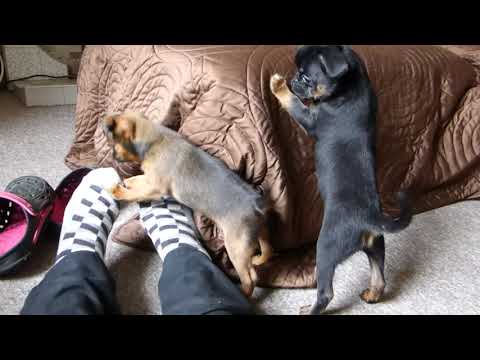
Sitting comfortably on the bedroom rug, a family of Petit Brabanรงon play together with great complicity.
Petit Brabanรงon:Flamby. 3 month

Petit Brabanรงon de 3 meses

Type and recognitions:

  • FCI CLASSIFICATION:
  • Group :
  • Section : . .

Federations:

  • FCI – Group 9: Section 3.2 Petit Brabanรงon โ“˜
  • AKCToy โ“˜
  • ANKC – Group 1 โ€“ (Toy) โ“˜
  • CKC – Group 5 โ€“ (Toy) โ“˜
  • โ€‹KC – Toy โ“˜
  • NZKCToy โ“˜
  • UKC – Group 8 – Companion dog โ“˜

FCI breed standard "Petit Brabanรงon"

Origin:
Belgium

Date of publication of the valid original standard:
25.03.2003

Use:

Small guard and companion dog


General appearance:

small pet dog ; Intelligent, balanced, alert, haughty, robust, nearly square bodied ; with a good bone constitution, but at the same time elegant in its movements and in its construction. It draws attention for its almost human expression.
The two Griffons have hard hair and differ in color., while the Petit Brabanรงon has short hair.


important proportions

The length of the body, from the tip of the shoulder to the tip of the buttock, should be as much as possible, equal to the height at the withers.


Behavior / temperament:

Balanced little dog, alert, haughty, well attached to his master, very vigilant. It is neither fearful, nor aggressive.

Head:

It is the most characteristic part of the body and the one that attracts the most attention.. The head is quite large compared to the body and has an almost human expression. At the Griffon the hair is hard, up and shaggy ; is longer over the eyes, over the nostril, cheeks and chin, thus forming the decoration of the head.

Cranial region:

Wide and round. The forehead is well bulging.

  • Depression links (Stop) : Well marked.

facial region:

  • Truffle : black. It is at the same level of the eyes. It's wide and the windows are wide open. The tip of the nose is raised back, which seen in profile places the chin, nose and forehead on the same margin.
  • Snout : The nasal canal, including truffle, it's very short ; will not exceed 1,5 cm long. In the Petit Brabanรงon a correct nasal passage appears longer, since there is no ornament. A nostril that is not upturned, as well as a truffle whose upper part is located below the lower eye line, give a bad impression and constitute serious misconduct.
  • Belfos : Upper and lower lips are in close contact and tight. The upper one does not form flews and does not cover the lower one. Too loose spoils the desired expression.
  • Jaws / Teeth : The lower jaw is well curved upwards, is wide, not pointed and extends beyond the upper jaw ; the breed has lower prognathism. The six incisors of each jaw are preferably planted evenly and in a straight line, those above and below are very parallel. The mouth should be tightly closed and not even the teeth should be visible, nor the tongue. The width and protrusion of the chin are very important. Care should be taken that incisors are not missing.
  • Eyes : They are well separated, they are big and round, never prominent. Brown in color, as dark as possible. They will be bordered with black and preferably should not show the white of the eyeball. A small or oval eye, or light color, constitutes a fault.
  • Ears : Small, they are high, far enough apart. The uncut ears are semi-erect and fall to the front. Very large ears are not desirable, as well as ears that hang over the side of the head. Cropped ears are pointed and erect. Cropped ears are both accepted, like the uncut ones.

Neck:

Medium length ; blends harmoniously with the shoulders.

Body:

The length of the body is almost equal to the height at the withers. From the set it is a small square and stout dog.

  • Cross : Slightly prominent. Back : Straight, short and strong.
  • Pork loin : Short and muscular, very little raised.
  • Rump : Wide, flat, or at most very slightly inclined.
  • Breast : Large, reaches up to the elbows. The tip of the sternum is marked, which seen in profile, imparts a slightly prominent sill. The ribs are very elastic, but not barrel-shaped, not too flat.
  • Lower margin : The belly is slightly raised ; the flanks are well marked.

Tail:

She is tall and the dog wears her high. The docked tail is trimmed 2/3 its length. The tail that has not been cut is presented raised, with the tip towards the back, although without touching it or being curled up. A naturally short or split tail, or curled up on the back, constitutes a serious offense.

Tips

Former members

Seen together they are parallel, with a good bone structure and sufficiently separated.

  • Shoulder : Angulation is normal.
  • Elbows : Well attached to the body.
  • Carpi : Strong.
  • Pies : Small, round, they do not deviate even inwards, nor out. Fingers are good together; fingers sticking together constitutes a fault. Plantar pads are thick and as dark as possible. Nails are preferably black, as pigmented as possible.
Later members

Seen as a whole they have a good bone structure and are well parallel. The angulations are in harmony with the forelimbs.

  • Babillas : Angled enough.
  • Hocks : well laid. Seen from the back, not closed, not open.
  • Pies : See previous members. Dewclaws are not a sought after characteristic.

Movement:

Powerful, parallel movement of the limbs, with a good boost from the posteriors.

Mantle

Fur

Hair quality : The Griffon Bruxellois and the Griffon Belge both have a hard coat and an undercoat. Hair is naturally hard, slightly wavy, not curly, but trimmed and arranged for display. It should be long enough to allow the structure to be appreciated. Too long hair spoils the silhouette and is not what you are looking for. Silky or woolly hair is a serious offense. The Petit Brabanรงon he has short hair. Hair is rough, smooth and shiny ; has at most 2 cm long.

  • Head ornament : At the griffon, the ornament (beard and mustache) It starts under the nose-eye line and runs from one ear to the other., covering well the muzzle and cheeks with a very abundant hair and longer than on the rest of the body. Above the eyes, the hair should be longer than on the rest of the skull and form the eyebrows.
Color
  • Griffon Bruxellois : Red, reddish ; a little black is tolerated on the headdress.
  • Griffon Belge : Negro, black and tan. Tan markings must be pure and uniform in color. They are presented, in the previous members, from foot to carpus, and in the hindquarters from the foot to the hock. These colors go up the inside of the limbs. They are also seen in the anterior part of the chest, cheeks, chin, on top of the eyes, on the inside of the ears, below the tail and around the anus. Black can be mixed with red-brown, which is accepted although pure black and black and tan are preferred.
  • Petit Brabanรงon : The same colors as the two Griffons. Has a dark mask. The gray in the mask of older dogs will not be penalized.

In all three breeds some white hairs on the front of the chest are accepted, although this feature is not sought.


Size and weight:

Weight: It varies between 3,5 to 6 kg.


Fouls:

Any deviation from the aforementioned criteria is considered as a fault and the severity of this is considered to the degree of the deviation to the standard and its consequences on the health and well-being of the dog..


disqualifying fouls:
  • Aggressiveness or extreme shyness.
  • Any dog โ€‹โ€‹showing clear signs of physical or behavioral abnormalities.
  • Nose depigmented or other than black.
  • Constantly visible tongue, being the mouth closed.
  • Twisting of the lower jaw.
  • Upper jaw that extends beyond the lower jaw.
  • Other colors other than those provided by the standard, such as gray, blue and fire, the brown and tan and the liver color (brown).
  • Any white stain.


N.B.:

Males should have two normal-appearing testicles fully descended into the scrotum..

Source: F.C.I - International Cynological Federation

Alternative names:

1. Petit Brabanรงon, Small Brabant Griffon (English).
2. Petit brabanรงon (French).
3. Petit brabanรงon (German).
4. (em francรชs: petit brabanรงon) (Portuguese).
5. Petit brabanรงon (espaรฑol).

โ–ท The world of Pets: Dogs, cats, birds, reptiles, amphibians

Sussex Spaniel
Inglaterra FCI 127 . Flushing Dogs

Sussex Spaniel

The Sussex Spaniel it is a meek and thoughtful dog when it is at rest.

Content

History

The Sussex Spaniel gets its name from the county of England where it was favored as a hunting dog. It comes from the farm of Rosehill Park, where it was developed in the 18th century, and it was already mentioned in 1803 in a magazine called Sportsmen’s Cabinet.

The Knights of Sussex created a dog adapted to its heavy clay soil, to the dense undergrowth and thick hedges, a dog that could spend all day barking with bell tones to alert hunters that they were on the right track. The dogs were exposed in the dog show of the Crystal Palace in 1862 and they were among the 10 first breeds admitted to the registry of the American Kennel Club in 1884.

Because they were primarily confined to the county of Sussex, the Sussex Spaniel they were necessarily inbred, with only an occasional brood with the Field Spaniel to bring new blood. With the passage of time, the hunters developed new interests and the Sussex stayed on the road. could have been lost to history, like so many other dogs, but the breeders Moses Woolland y Campbell Newington intervened to bring them off the brink of extinction and even improved. The breed again faced extinction during WWII, but it was saved thanks to the efforts of the breeder Joy Scholefield.

Today the Sussex still weird, but in no danger of disappearing. Occupies the position 155 between breeds registered by the AKC.

Physical characteristics

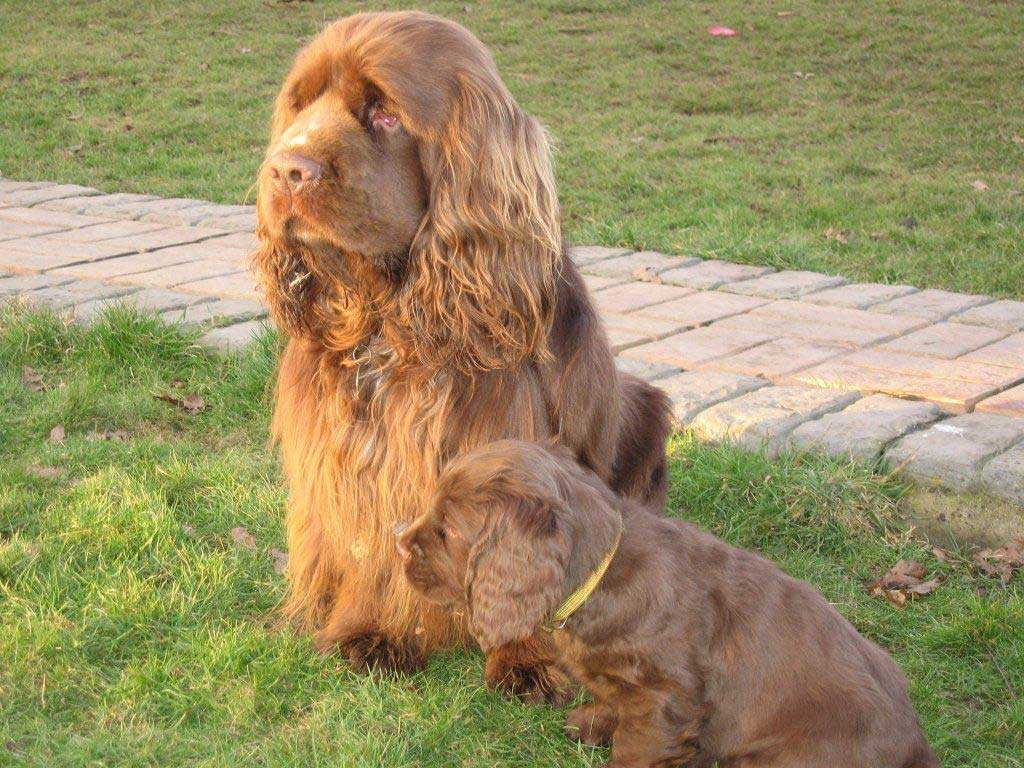
The Sussex Spaniel It is a short dog with a compact and rectangular body and a weight between 16 and 20 kg. It stands out for the color of its fur, a deep golden liver, and for his big sad hazel eyes, so typical of the spaniel family. Historically, However, there have also been examples of Sussex black, black and tan, and liver colored gold and white.

The fur is thick (sometimes with a slight wave), with fringes on the chest, legs and ears and consists of a weather-resistant underlay, the outside being silky.

The long, silky ears are lobe-shaped, typical of Spaniel, and are moderately low

In the countryside, it's slow but steady, making his way through the thick canopy to make the birds disappear and retrieve for a hunter on foot.

Character and skills

Appearances can be deceptive when it comes to the Sussex Spaniel. Under a gloomy and serious expression hides a friendly and cheerful dog with a placid character. Loves being around people and joins any activity with controlled enthusiasm. More than many Spaniels, the Sussex has a protective character, always keeping her big sad eyes on her family to make sure all is well. She loves the children, and his calm demeanor makes him an excellent therapy dog.

As a hunting dog, the Sussex moves at a slower pace than other sporting dogs, but that doesn't mean i'm lazy or i don't need a lot of exercise. Not much less. He loves to hunt and has a lot of energy and stamina. Thanks to its ability to avoid the thicket, it is an excellent companion for walks or excursions, wagging the tail all the time. If you are a bird watcher, will help you find your prey. With its great olfactory capacity, you might like to put a tracker title or two on it.

It is a very intelligent dog that is not always easy to train. Can be stubborn, but his soft Spaniel nature can make him cringe at any correction. Be firm but kind, rewarding the behavior you like with praise, games and goodies. Keep in mind that it matures slowly. You will not be instantly trained, and that includes home training. It is a breed that requires patience to get the best of itself, not to mention a sense of humor for the times when he makes fun of you or embarrasses you, that there will be.

Start training your puppy the day you bring him home. Even with 8 weeks of age, is able to absorb everything that can be taught. Don't wait until he is six months old to start training him, or you will have to deal with a bigger and stubborn dog. If possible, take him to a trainer when he has between 10 and 12 weeks, and socialize him.

Talk to the breeder, describe exactly what you are looking for in a dog and ask for help selecting a puppy. Breeders see puppies daily and can make incredibly accurate recommendations once they know something about their lifestyle and personality. Regardless of what you want from a Sussex, look for one whose parents have a pleasant personality and who has been well socialized since he was a puppy.

Education

He is very smart, but can be stubborn, so it is not always easy to train. Having said that, if the right motivation is found - how to take advantage of your great olfactory capacity- can be taught to Sussex to do almost anything. Train him with positive reinforcement techniques. He especially likes food rewards. Be patient in training. One Sussex, especially the females, it may take a long time to be reliable in this regard.

The Sussex walks at a slow pace and doesn't require the frantic levels of exercise some other sporting breeds need, but he's not a couch potato either, at least not when he's young. You will enjoy moderate or long walks or hikes, although not the companion of a runner or jogger. Its versatility and athleticism make it suitable for a number of dog sports, like hunting trials, freestyle, obedience, the rally and the crawl. The Sussex easily learn to recover, making it a great playmate for the kid who likes to play ball. Once it reaches maturity, his calm demeanor makes him a natural for therapy work.

When a Sussex Spaniel grows up with children, both usually go together like strawberries and cream. But, the puppies of Sussex can be too unruly for families with young children, and Sussex Spaniel adults unfamiliar with children may not feel comfortable with them.

like most dogs, the Sussex Spaniel get bored when left alone, and the damage they can do is considerable. Do not give them control of the house until they have reached trustworthy maturity.. Cubs Sussex tend to develop slowly, so they may not reach maturity until 2 or 3 years of age. And keep your Sussex busy with training experiences, play and socialization. One Sussex boring is a Sussex destructive.

Health

The Sussex Spaniels they are healthy in general, but some conditions can be worrisome, especially if you are not careful when buying. These include some heart problems, such as cardiomyopathy and pulmonary stenosis, as well as an exercise intolerance syndrome called pyruvate dehydrogenase deficiency (PDH). Hip dysplasia has also been reported, deafness and eye problems (such as entropion and retinal dysplasia). Females may have difficulty giving birth and often require cesarean sections.

PDH deficiency is present in the 20 percent of Sussex Spaniel, but there is a genetic test to identify normal dogs, carriers and affected. Ask the breeder to show proof that at least one of the puppy's parents is free of PDH deficiency.

Do not buy a puppy from a breeder who cannot provide you with written documentation that the parents are free of health problems that affect the breed.. Veterinary examination of dogs is not a substitute for genetic health tests.

Grooming

The Sussex has thick fur, smooth or slightly wavy, with fringes on the legs and tail and a nice curl under the neck. The coat can be cared for by brushing it at least once or twice a week to remove tangles or mats and distribute skin oils. Bathe him when necessary. The Sussex changes moderately, and daily brushing will reduce the amount of hair that falls on the floor, the furniture and clothes.

The rest is basic care. Trim nails when needed and keep hanging ears clean and dry. Good dental hygiene is also important. Brush teeth frequently with a vet-approved pet toothpaste for overall good health and fresh breath.

Characteristics "Sussex Spaniel"

Coexistence is important that you have with your new friend. Before considering the acquisition of a dog of the breed "Sussex Spaniel" you know certain factors. Not all breeds of dogs are apt to live in an apartment, you must take into account his character, their need for exercise, their interaction with other pets, their care and if you have small children, their level of tolerance towards them.

Adaptation โ“˜

5,0 of 5 stars (based on 1 review)

friendly dog โ€‹โ€‹โ“˜

5,0 of 5 stars (based on 1 review)

hair loss โ“˜

3,0 of 5 stars (based on 1 review)

Affection level โ“˜

5,0 of 5 stars (based on 1 review)

Need for exercise โ“˜

4,0 of 5 stars (based on 1 review)

Social need โ“˜

3,0 of 5 stars (based on 1 review)

Home โ“˜

4,0 of 5 stars (based on 1 review)

Toilet โ“˜

3,0 of 5 stars (based on 1 review)

Friendly with strangers โ“˜

3,0 of 5 stars (based on 1 review)

barking โ“˜

5,0 of 5 stars (based on 1 review)

Health โ“˜

4,0 of 5 stars (based on 30 reviews)

Territorial โ“˜

3,0 of 5 stars (based on 1 review)

Cat friendly โ“˜

3,0 of 5 stars (based on 1 review)

Intelligence โ“˜

3,0 of 5 stars (based on 1 review)

Versatility โ“˜

3,0 of 5 stars (based on 1 review)

Child friendly โ“˜

5,0 of 5 stars (based on 1 review)

Surveillance โ“˜

3,0 of 5 stars (based on 1 review)

joy โ“˜

3,0 of 5 stars (based on 1 review)

Images "Sussex Spaniel"

Sussex Spaniel
Sussex_spaniel at the World Dog Show in Poznan by Pleple2000, CC BY-SA 3.0, via Wikimedia Commons
Sussex Spaniel
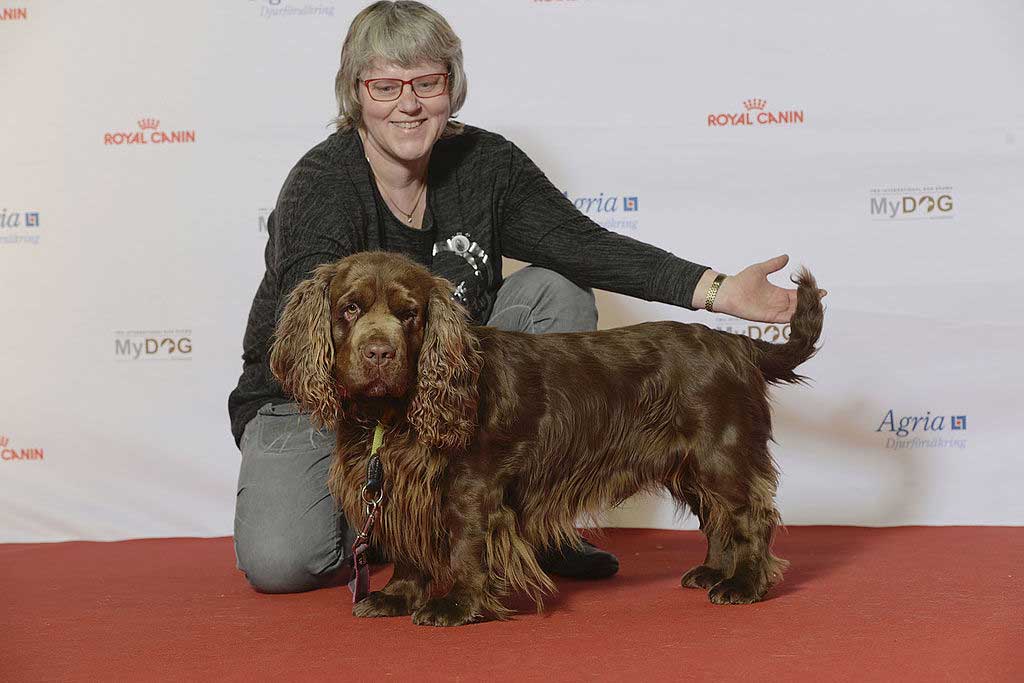
Group 8 SUSSEX SPANIEL, Marquell Replay MyDOG, The largest dog event in the Nordics: www.mydog.seby by Svenska Mรคssan from Sweden, CC BY 2.0, via Wikimedia Commons

Videos "Sussex Spaniel"

Sussex Spaniel / Dog breeds - Dog Breed
Sussex Spaniel / Dog breeds – Dog Breed
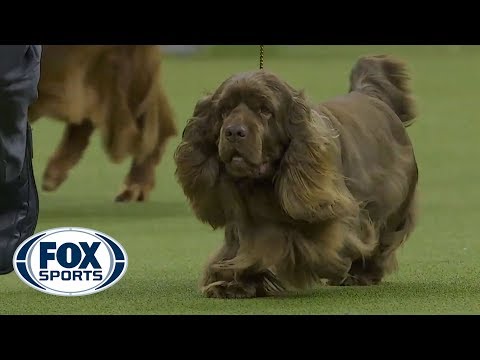
Bean the Sussex Spaniel wins the 2019 Westminster Kennel Club Dog Show Sporting Group | FOX SPORTS

Type and recognitions:

  • FCI CLASSIFICATION:
  • Group 8: Hunting Retriever Dogs. Hunting Lifting Dogs. Water dogs.
  • Section 2: Flushing Dogs. With working trial.

Federations:

  • FCI – Group 8: Retrievers - Flushing Dogs - Water Dogs – Section 2: Retrievers โ“˜
  • AKCSporting โ“˜
  • ANKC Group 3 (Gundogs) โ“˜
  • CKCSporting Dogs โ“˜
  • โ€‹KC – Gundog โ“˜
  • NZKCGundog โ“˜
  • UKCGun Dogs โ“˜

FCI breed standard "Sussex Spaniel"

Origin:
United Kingdom, England

Date of publication of the valid original standard:
26.03.2009

Use:

Hunting dog.


General appearance:

It is a dog with a strong and massive constitution., Active, energetic, whose characteristic movement is an unmistakable rocking that distinguishes it from any other Spaniel..


Behavior / temperament:

With a natural capacity for work, barks when working in areas with thick vegetation. He is a kind dog, aggressiveness is very undesirable.

Head:

Well balanced.

Cranial region:

Skull: Large, with a moderate curvature between the ears; It is neither flat nor round., with a middle groove. Well wrinkled eyebrows. Defined occipital bone, but without being pointed.

Depression links (Stop): Pronounced.

facial region:

▷ Truffle: liver colored; the windows are well developed.

▷ Jaws / Teeth: Strong JAWS, scissor bite, perfect, regular and complete, that is to say, that the inner face of the upper incisors is in close contact with the outer face of the lower incisors; teeth should be set at right angles in the jaws.

▷ Eyes: Hazelnut colored, quite large without being prominent and with a tender expression. They should not show too much of the ocular conjuncture.

▷ Ears: Thick, quite long and lobed; its insertion is moderately low, very little above eye level; they fall stuck to the skull.

Neck:

Long, strong and slightly arched, the dog does not carry its head very high above the level of its back. With a slight double chin, but yes a good fringe of hair.

Body:

The whole body is strong and level, without any sign of waist from the withers to the hips.

Back and kidney region: Well developed and muscular, both in width and depth.

Breast : Deep and well developed chest, neither too wide nor too round. The posterior ribs should be deep.

Tail:

Previously the custom was to amputate the tail.

amputee: Low insertion. Never carried above the level of the top line. With lively action. Usually amputated to a length of 13 -18 cms. (5 -7 ins.)

Without amputating: Low insertion, average length, never carried above the level of the top line. It gradually tapers towards the tip and has moderate fringe.


Tips

Former members: Rather short and robust limbs.
Shoulder: Oblique and mobile.

  • Arms: Muscular and well-boned.

    Carpi: big and strong.

  • Metacarpus: Short and strong boned.

Later members: They are short and vigorous with good bones. They should not appear shorter than the previous ones or be too angled.

  • Thighs: Muscular and well-boned.
  • Hocks: big and strong.

Pies: Round, well covered with hair between the fingers, strong foot pads.

Movement:

Its forward and backward movement is free, with a characteristic swing.

Mantle

Fur: The hair is abundant and flattened, without any tendency to be curly. It has a good undercoat that protects it from the elements.. The ears are provided with soft, wavy hair., but not very abundant. The forelimbs and hindlimbs should be moderately covered with hair in the form of fringes.. The tail must be well covered with hair, but not in the form of fringes.

Color: The hair is a bright golden liver color that turns golden at the tip., predominating the color gold. Dark liver or reddish brown are undesirable..


Size and weight:

Height to the cross: The ideal height to cross is between 38 and 41 cm. (15-16 inches).

Weight: It should be approximately 23 kg (50 English pounds).


Fouls:

Any deviation from the aforementioned criteria is considered a fault and its severity is considered to the degree of deviation from the standard and its consequences on the health and well-being of the dog and the dog's ability to perform its traditional task..


disqualifying fouls:
  • Aggressiveness or extreme shyness.
  • Any dog โ€‹โ€‹showing clear signs of physical or behavioral abnormalities.


  • N.B.:
    • Males should have two normal-appearing testicles completely descended into the scrotum..
    • Only functionally and clinically healthy dogs, with the typical conformation of the breed, should be used for parenting.

    The latest changes are in bold

    Source: F.C.I - International Cynological Federation

    Alternative names:

    1. Sussex (English).
    2. Sussex (French).
    3. Sussex (German).
    4. Spaniel de Sussex (Portuguese).
    5. Sussex (espaรฑol).

    โ–ท The world of Pets: Dogs, cats, birds, reptiles, amphibians

    Chesapeake Bay Retriever
    USA FCI 263 . Retrievers

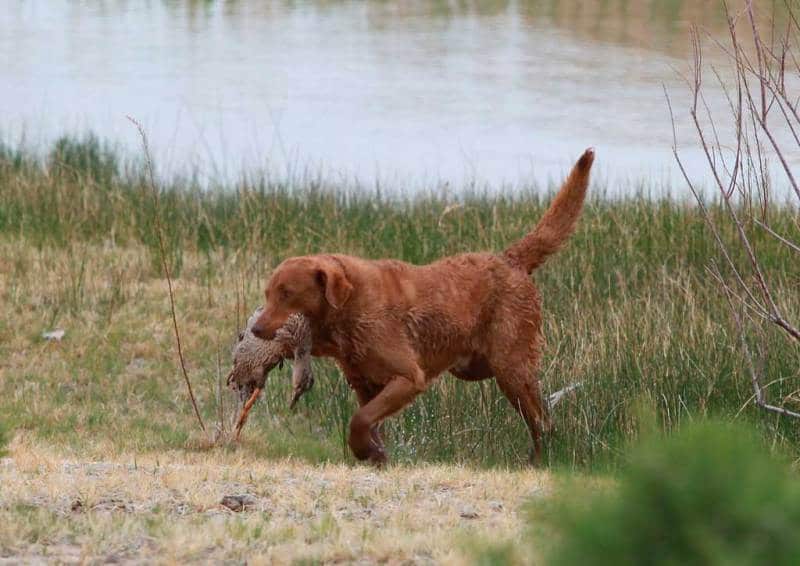
    The Chesapeake is a hunting dog, pure and simple.

    Chesapeake Bay Retriever

    Content

    Characteristics "Chesapeake Bay Retriever"

    Coexistence is important that you have with your new friend. Before considering the acquisition of a dog of the breed "Chesapeake Bay Retriever" you know certain factors. Not all breeds of dogs are apt to live in an apartment, you must take into account his character, their need for exercise, their interaction with other pets, their care and if you have small children, their level of tolerance towards them.

    Adaptation โ“˜

    3,0 of 5 stars (based on 1 review)

    friendly dog โ€‹โ€‹โ“˜

    2,0 of 5 stars (based on 1 review)

    hair loss โ“˜

    3,0 of 5 stars (based on 1 review)

    Affection level โ“˜

    3,0 of 5 stars (based on 1 review)

    Need for exercise โ“˜

    5,0 of 5 stars (based on 1 review)

    Social need โ“˜

    3,0 of 5 stars (based on 1 review)

    Home โ“˜

    1,0 of 5 stars (based on 1 review)

    Toilet โ“˜

    2,0 of 5 stars (based on 1 review)

    Friendly with strangers โ“˜

    2,0 of 5 stars (based on 1 review)

    barking โ“˜

    3,0 of 5 stars (based on 1 review)

    Health โ“˜

    3,0 of 5 stars (based on 1 review)

    Territorial โ“˜

    3,0 of 5 stars (based on 1 review)

    Cat friendly โ“˜

    3,0 of 5 stars (based on 1 review)

    Intelligence โ“˜

    5,0 of 5 stars (based on 1 review)

    Versatility โ“˜

    5,0 of 5 stars (based on 1 review)

    Child friendly โ“˜

    3,0 of 5 stars (based on 1 review)

    Surveillance โ“˜

    4,0 of 5 stars (based on 1 review)

    joy โ“˜

    3,0 of 5 stars (based on 1 review)

    History

    When a British brig was wrecked off the coast of Maryland in 1807, part of the cargo that was rescued included two Newfoundland dogs. Called Sailor and Canton, they were found to have excellent retrieval skills. The locals raised them with local dogs, and became the ancestors of the "Chesapeake Retriever". Other races that may have contributed to the composition of the Chesapeake were the ยซFlat-coated Retriever" and the "Curly-coated Retrieverยซ.

    The result was a hard Retriever that he was ready and willing to endure the harsh and icy Chesapeake Bay being able to recover from 100 to 200 ducks a day. The first dogs came only in dark brown, but now any shade of brown, sedge or dead grass is acceptable.

    The American Kennel Club registered your first Chessie, called Sunday, in 1878. The Chesapeake is ranked 48 breeds registered by the AKC, under the 41 a decade.

    Physical characteristics

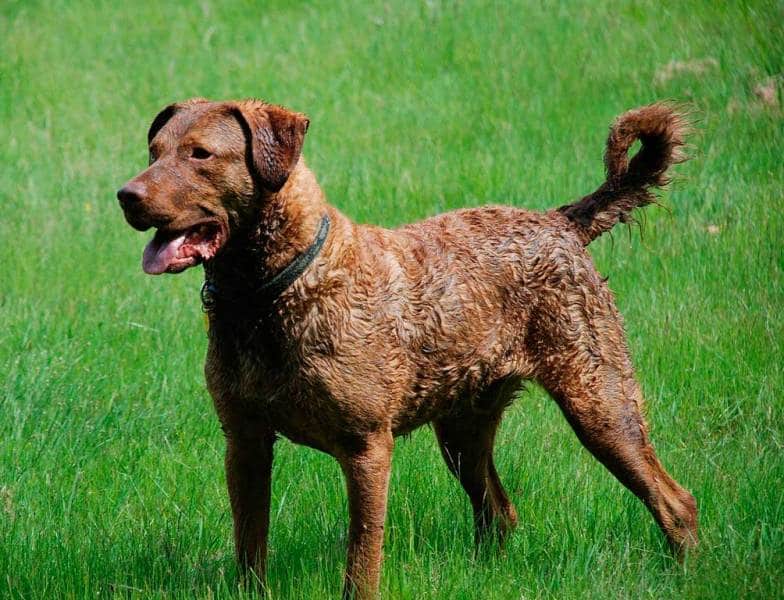
    Distinctive features include eyes very clear, yellow or amber, rear quarters as high or slightly higher than the shoulders, and a double layer which tends to wave on shoulders, the neck, back and loins.

    The Raincoats feels slightly oily and often is associated with a slight musky odor. three basic colors are usually seen on race: the brown, which it includes all shades from light brown to a deep dark brown; sedge, ranging from reddish yellow to bright red and brown tones; and dead grass in all shades, ranging from a faded tan to a muted straw color.

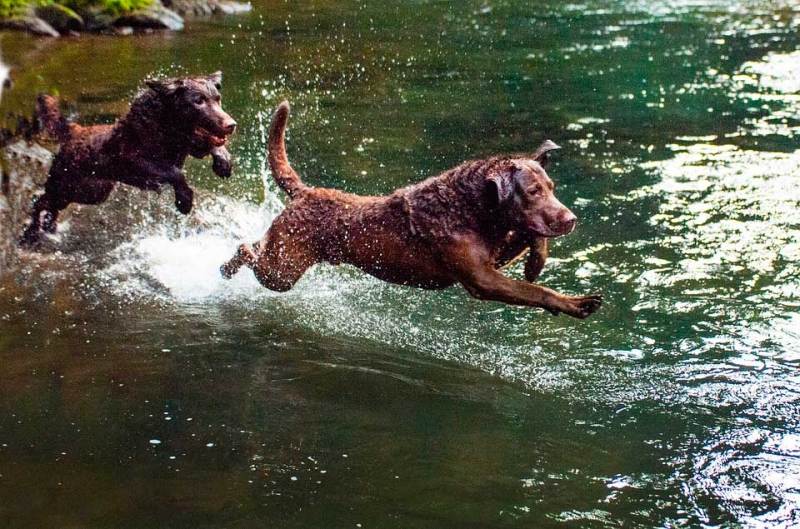
    The breed standard states that the target may also appear, but it should be limited to the chest, the belly, the toes or back of feet. The head is round and wide with an average stop and muzzle. The lips are thin, and ears are small and medium leather. The Forelegs should be straight with good bone. The hindquarters are especially strong and the toes webbed as excellent swimming ability is important to the Chesapeake.

    This breed is also known for its large and powerful chest, used to break ice when submerged in cold water while duck hunting.

    Character and skills

    The "Chesapeake Retriever" is highly appreciated for its alert and cheerful disposition., his intelligence, his calm demeanor and his affectionate nature and protective. The value, the willingness to work, vivacity, good sense of smell, the intelligence, The enjoyment of the water and especially the general quality and dispositions must take priority when selecting and breeding the "Chesapeake Retriever.". Extreme shyness or aggression are not desirable in this breed, whether the animal is used as a hunting dog or pet.

    In the countryside, the Chesapeake he is a serious worker and has even been called neurotic in his eagerness to find fallen birds. It's not out there to play. The Chesapeake They are known for their excellent vision and memories when it comes to seeing where birds fall and remembering where to go to collect them.. His favorite activity is hunting for ducks.

    When you train, respects their learning ability. Don't continue training him long after it's clear he knows what to do. The perfect Chesapeake is not prepared by the breeder. any dog, no matter how pleasant it, detestable levels can develop barking, excavation and other undesirable behavior if you are bored, untrained or unsupervised.

    Did you know??

    The Chessie not designed to be a companion, is a hunting dog, pure and simple. And not just any old hunting dog… He is a waterfowl dog and lives to get wet in pursuit of his feathered prey..

    The health of the Chesapeake Retriever

    According to a survey conducted in 2005 by the American Chesapeake Club, the most common health problems seen in the breed are hip dysplasia, progressive retinal atrophy and other eye problems, cancer, degenerative myelopathy and hypothyroidism. This breed can also be prone to a bleeding disorder called von Willebrand disease.

    Find a breeder who uses the newly available genetic test for degenerative myelopathy, a form of progressive weakness and paralysis of the limbs. Although DM is rare, It is incurable and crippling. Not all dogs that test positive in the test of DM develop the disease, but farmers who try their race for this condition are probably the most conscientious.

    The test can be used to determine whether a puppy's parents are clean, they are carriers or are at risk; a puppy whose parents are clean – neither carriers nor at risk – also will be. A puppy two carrier parents will be at risk, and a puppy parent with a carrier may be at risk. Even dogs tested for having two copies of the gene never show symptoms of the disease., but the status of the parents of your puppy, and his own dog, It can help you be aware of the early warning signs.

    Careful breeders test their breeding dogs for genetic diseases and only breed the healthiest and best looking dogs., but sometimes mother nature has other ideas and a puppy develops one of these diseases despite good husbandry practices. Advances in veterinary medicine mean that in most cases dogs can still live a good life. If you're going to have a puppy, ask the breeder about the ages of the dogs in their lines and what they died of.

    Remember that after hosting a new puppy home ut, has the power to protect you from one of the most common health problems: the obesity. Keeping a Chesapeake Retriever at an appropriate weight is one of the easiest ways to prolong its life.. Make the most of your preventative abilities to help ensure a healthier dog for life.

    Chesapeake Retriever Grooming

    The Chesapeake has a tough, oily outer coat over a dense undercoat, fine and wooly. The dirt and debris are easily removed with a rubber brush. The undercoat is very clear in spring, so be prepared to brush the dog more frequently during this time to prevent loose hair from collecting on clothing and furniture..

    Give the Chessie Fresh water rinse after it has been in salt water or has swum in the mud of a pond or lake, but to keep the resistance of the coat to water, avoid bathing unless absolutely necessary. That can be as little as twice a year.

    The rest is basic care. Keep your ears clean and dry so they don't get infected, and trim nails as needed, usually every two weeks. Brush your teeth for general good health and fresh breath.

    ยซChesapeake Retrieverยป Images

    credits:

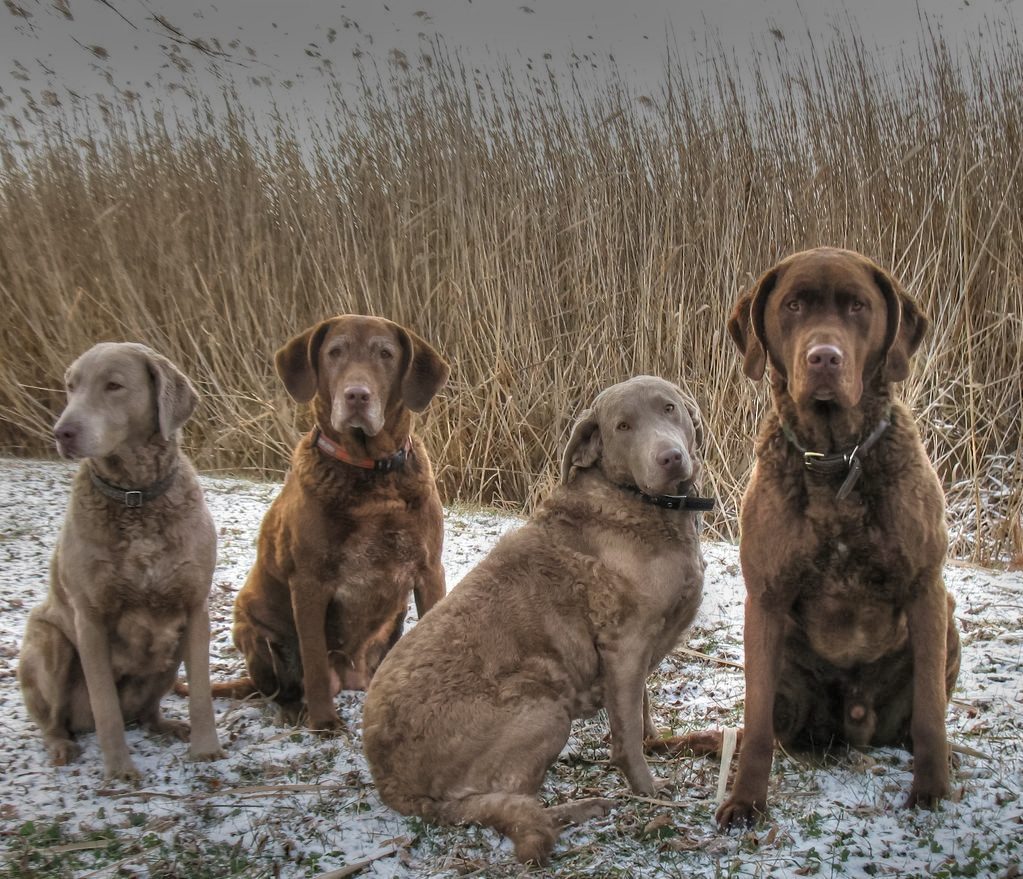
    1. A Chesapeake Bay Retriever by Keith Rousseau at en.wikipedia / CC BY-SA
    2. Chesapeaker Bay retriever by Nevilley / CC BY-SA
    3. Male, Chesapeake Bay Retriever competing in the conformation ring by George Makatura / Public domain
    4. Chesapeaker Bay retriever by https://pxhere.com/es/photo/1407301
    5. Chesapeaker Bay retriever by https://pixabay.com/es/photos/perros-mascotas-el-agua-1582148/
    6. Chesapeake Bay Retriever by Diane – HTTPS://flic.kr/p/6k1uFQ
    7. chesapeake bay retriever by https://www.peakpx.com/611264/chesapeake-bay-retriever
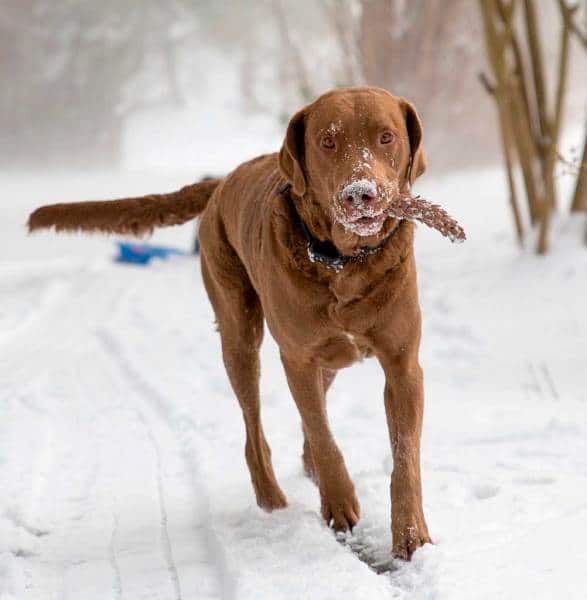
    8. Brown Chesapeake Bay Retriever in the snow, carrying a plant part in its snout by Will Thomas / CC BY

    Videos ยซChesapeake Retrieverยป

    Type and recognitions:

    • FCI CLASSIFICATION:
    • Group :
    • Section : . .

    Federations:

    FCI โ“˜, AKC โ“˜, ANKC โ“˜, CKC โ“˜, โ€‹KC โ“˜, NZKC โ“˜, UKC โ“˜

    FCI breed standard Chesapeake Bay Retriever

    FCIFCI - Chesapeake Bay Retriever
    Retriever

    Alternative names:

    1. Chessie, CBR, Chesapeake (English).
    2. Chesapeake Bay Retriever, Chesapeake (French).
    3. Chesapeake Bay Retriever (German).
    4. Chesapeake bay retriever (Portuguese).
    5. Chessie, CBR, Chesapeake (espaรฑol).

    โ–ท The world of Pets: Dogs, cats, birds, reptiles, amphibians

    Barbet (French Water Dog)
    Francia FCI 105 . Water Dogs

    The Barbet they prefer to be in the same room with the family at all times

    Barbet

    Content

    Characteristics "Barbet (French Water Dog)"

    Coexistence is important that you have with your new friend. Before considering the acquisition of a dog of the breed "Barbet (French Water Dog)" you know certain factors. Not all breeds of dogs are apt to live in an apartment, you must take into account his character, their need for exercise, their interaction with other pets, their care and if you have small children, their level of tolerance towards them.

    Adaptation โ“˜

    3,0 of 5 stars (based on 1 review)

    friendly dog โ€‹โ€‹โ“˜

    2,0 of 5 stars (based on 1 review)

    hair loss โ“˜

    3,0 of 5 stars (based on 1 review)

    Affection level โ“˜

    4,0 of 5 stars (based on 1 review)

    Need for exercise โ“˜

    4,0 of 5 stars (based on 1 review)

    Social need โ“˜

    3,0 of 5 stars (based on 1 review)

    Home โ“˜

    3,0 of 5 stars (based on 1 review)

    Toilet โ“˜

    2,0 of 5 stars (based on 1 review)

    Friendly with strangers โ“˜

    3,0 of 5 stars (based on 1 review)

    barking โ“˜

    3,0 of 5 stars (based on 1 review)

    Health โ“˜

    4,0 of 5 stars (based on 1 review)

    Territorial โ“˜

    3,0 of 5 stars (based on 1 review)

    Cat friendly โ“˜

    3,0 of 5 stars (based on 1 review)

    Intelligence โ“˜

    4,0 of 5 stars (based on 1 review)

    Versatility โ“˜

    3,0 of 5 stars (based on 1 review)

    Child friendly โ“˜

    4,0 of 5 stars (based on 1 review)

    Surveillance โ“˜

    3,0 of 5 stars (based on 1 review)

    joy โ“˜

    4,0 of 5 stars (based on 1 review)

    History

    The Barbet (French Water Dog) It is a French breed of dog of medium size water.

    This dog of waters is a rare species. Almost everyone has heard of breeds like the Poodle, Griffon and the Bichon Frise … Have you ever wondered where all these breeds come from?? Your answer is the following … all came from the Barbet, or as some known, the French Water Dog. Now, Where does he come from French Water Dog? Well, that is a question for which no one has a definite answer, but there are a lot of conjectures.

    Some people say that the dog of the Barbet is a descendant of the original Griffon, others say it came from the Bergamasco that were brought from Asia, When was Europe invaded, others say that the Barbet North African wine, travelling through Spain to install on France, people say that, but the french spaniel is not the origin of all Water Dogs, It is very likely that it was close to the original type.

    The reality is that Barbet has been in Europe for centuries, There are even writings about him, from the Elizabethan era describing the Barbet and the type of care necessary to keep your hair healthy.

    Physical characteristics

    compact and vigorous, with good muscles and bones in relation to the volume of your body. The eyes are round, living with an expression that denotes intelligence.

    Morphologically is classified as bracoide, head approaching the form primรกstica, with the wide snout at the same end than at the base and separated from the front by a depression or Groove very marked, gachas ears, long and hanging lips, with highlight of the higher above the level of the mandible.

    The standard of the race measured between 58 and 65 cm for the male; and 52 to 61 cm for the female and a weight of between 17 and 28 kg . The Barbet It is the prototype of a water dog with woolly hair, long, curly. The accepted colors by the FCI they are pure black, brown, cervato, clear and grey cervato.

    Character and skills

    The Barbet was used as a water dog (as its name implies) was a great dog collector for hunting in marshy areas.

    This dog has been used by farmers for grazing, but that's not all, This dog, the Barbet He also frequented port areas to be a friend and companion of sailors. A very versatile breed.

    • Personality Barbet It is accompanying, joyful, salty, obedient and intelligent. They are quick to learn and need training to obey. You are very kind with children, families and older people.

    The Barbet they prefer to be in the same room with the family at all times. They need daily exercise to keep your body and mental state in a healthy state.

    The average life of the Barbet is of 13 to 15 years, knowing some case that has come to live 19 years.

    Images "Barbet (French Water Dog)"

    Videos "Barbet (French Water Dog)"

    Type and recognitions:

    • FCI CLASSIFICATION:
    • Group 8: Retrievers, Hunting Lifting Dogs, Water Dogs.
    • Section 3: Water Dogs. .

    Federations:

    Recognized by the federations :

    • FCI โ“˜
    • UKC โ“˜
    • โ€‹CKC โ“˜
    • โ€‹


    FCI breed standard "Barbet (French Water Dog)"

    Origin:
    France

    Date of publication of the valid original standard:
    21.02.2006

    Use:

    Water dog, used for hunting wild birds. The Barbet, like all water dogs, is more than just a bill collector, he must search and make the game hidden in the aquatic vegetation leave the forest and raise it. Then he collects the piece knocked down by his master. It is not afraid of the cold and enters the water no matter what the weather is.


    General appearance:

    Medium size and lines. It is characterized by a dense, woolly coat that provides effective protection against cold and humidity.. The hair forms a beard on the chin, what has given the breed its name.


    important proportions:
    • Muzzle slightly shorter than skull.
    • The length of the body, measured from the tip of the shoulder, to the tip of the gluteus, is slightly higher than the height at the withers.


    Behavior / temperament:

    Balanced, very attached to their masters, very sociable, water lover, still very cold.

    Head:

    The hair of the skull must fall to the nasal canal. The beard is long and abundant; the mustache covers the entire nostril and is very abundant.

    Cranial region:
    • Skull : Rounded and wide.
    • Depression links : Marked.

    facial region:

    • Truffle : Wide, with the windows wide open. Its color is black or brown, according to coat color.
    • Snout : Well square. The muzzle is wide.
    • Lips : Thick, well pigmented, completely covered in long hairs. The edge of the lips is black or brown.
    • Jaws / Teeth : Jaws of uniform length. Scissor joint. Strong teeth. The incisors are well developed and well aligned.
    • Eyes : Round, preferably dark brown. The edge of the eyelids is black or brown.
    • Ears: Low insertion (at eye level or a little lower) long, plan, wide, with long hairs that form streaks. When brought to the front of the truffle, surpass it by a few 5 cm. (along with the hair). The cartilage of the ears extends beyond the corners of the lips..

    Neck:

    Short and powerful

    Body:

    • Back: Solid, the top margin is very firm.
    • Pork loin: Convex, short and strong.
    • Rump: Rounded profile, harmoniously prolonging the line of the spine.
    • Breast : Large, well developed, alto, descends to elbow level. The ribs are rounded, but not abarriladas.

    Tail:

    A little raised, exceeds the horizontal when the dog is in action. Low insertion, forming a slight hook on the limb.

    Tips

    Forelimbs:
    • Shoulder : Oblique. The scapulohumeral angle varies between 110 and 115 degrees.
    • Arm : Thick and muscular.
    • Forearm: Straight, for strong bones, well plumbed, completely covered in long hairs.
    Hind limbs:
    • Thighs : Slightly oblique, well formed.
    • Hock : Low, well angled.
    • Metatarsals : Well poised.
    • Pies: Round, widths, covered in hair.

    Movement:

    Agile steps, the limbs move in the axis of the body. Median extension of the forelimbs and good the hindlimbs.

    Mantle

    Skin: Relatively thick.

    Fur: Long, woolly, curly, can form wicks. Is abundant, covering the whole body in its natural state. This is an essential characteristic of the breed. The Barbet can be groomed in a specific way to facilitate its work and the maintenance of its coat..

    Color : Unicolor negro, grey, brown, leonado, sand, white or with some patches of different color. All shades of fawn and sand are accepted. Preferably, the shade should be the same over the whole body.


    Size and weight:

    Height to the cross :

    Males: 58 to 65 cm.
    females: 53 to 61 cm.

    With a tolerance of + from โ€“ 1 centimeter.


    Fouls:

    Any deviation from the aforementioned criteria is considered as a fault and its seriousness is considered to the degree of the deviation to the standard and its consequences on the health and well-being of the dog.

    โ— Thin and narrow head, thin and too long nostril, thin lips.

    โ— Superior or inferior prognathism. Deviated jaw.

    โ— Light eyes.

    โ— High set ears (taller than the eye), fine, short, narrow.

    โ— Thin neck.

    โ— Sunken top margin.

    โ— Long and loose loin.

    โ— Narrow croup.

    โ— Narrow chest.

    โ— High insertion queue, bent over the back, threaded, or stuck against the rump or back. No tail or very short abdomen.

    โ— Narrow shoulders.

    โ— Thin arms.

    โ— Fine-boned forearm, limbs with bangs.

    โ— Hind limbs: flat thigh, straight hock, limbs with bangs, presence of spurs. Thin and narrow feet, discovered.

    โ— Thin skin.

    โ— Short hair, rough, that is not woolly, nor curly.

    โ— Colors: Any other color other than those mentioned in the standard.

    ELIMINATING fAULTS

    โ€ข Aggressive or fearful dog.

    Any dog โ€‹โ€‹showing clear signs of physical or behavioral abnormalities must be disqualified..


    N.B.:

    Males should have two normal-appearing testicles fully descended into the scrotum..


    Via FCI

    Source: F.C.I - International Cynological Federation

    Alternative names

    1. Barbet, French water dog (English).
    2. Barbet, chien d’eau franรงais (French).
    3. Barbet, Franzรถsischer Wasserhund (German).
    4. Barbet, cรฃo d’รกgua francรชs (Portuguese).
    5. Barbet, Perro de aguas francรฉs (espaรฑol).

    โ–ท The world of Pets: Dogs, cats, birds, reptiles, amphibians

    Flat-coated Retriever
    Inglaterra FCI 121 . Retrievers

    Flat-coated Retriever

    The Flat-coated Retriever should be rediscovered as a companion dog and also for work, because it is still preferred to Labrador Retriever and to a lesser extent to Golden Retriever

    Content

    History

    The Flat-coated Retriever was born during the 19th century in Scotland. He is a member of the great family of the Retriever, with which it shares many physical and mental characteristics. So, is a close cousin of Labrador Retriever, the Golden Retriever, the Chesapeake Bay Retriever, the Curly-coated Retriever and the Nova Scotia Duck Tolling Retriever.

    Scottish game wardens developed the Flat-coated Retriever from crosses between the Irish Setter, st john's dogs (already extinct) and the Newfoundland. These last two races, originating from the island of Newfoundland, had been imported by Canadians a few decades earlier, in 1814. These marriages gave rise to Retriever-type canines that could easily evolve both on land and in water.. In particular, hunting guard J. Hull got two dogs named Old Bounce and Young Bounce (father and daughter, respectively), distinguished by their physical and mental abilities. They were used as models to establish the general traits of the breed, so they played a great role in its creation. Although the resulting dogs had wavy hair - they were called Wavy-Coated Retrievers-, the crossing with the Collie and the Labrador Retriever was softening the coat of this dog.

    The first representatives of the breed as we know it today were born in the decade of 1860, and many other breeders contributed to its development. We can mention in particular Sewallis E. Shirley, Ettington breeder and founder of The Kennel Club, the british canine club. In the Decade of 1880, established the physical traits of the breed and drafted its official standard. We can also mention a breeder named Braisfort who, in 1869 in Birmingham, was the first to exhibit a representative at a dog show.

    The Flat-coated Retriever was first used to help fishermen, retrieving fish or objects dropped in the water in their place. In the 19th century it was especially popular with cod fishermen. But, with the evolution of fishing techniques, professionals gradually began to dispense with their services, but then they were recovered by the hunters. The latter also appreciated his swimming skills, since it was able to bring back the birds that had fallen into the water after being shot by their owner.

    The Flat-coated Retriever it was a very popular hunting dog until the end of the First World War, especially for hunting, both on land and in the water. But, the Labrador Retriever and the Golden Retriever they came to dethrone him, causing a great decrease in the number of specimens of the breed in the interwar period and causing it to be in danger of extinction at the beginning of the decade of 1960. The work of the breed's enthusiasts was not enough to restore its reputation: at the end of the decade, was again present in large numbers in the country, though it never regained its former popularity. In fact, the number of breeders interested in it was still limited, even at that time, but this not only had disadvantages: some believe it helped them retain many of the historical qualities of the Flat-coated Retriever, starting with his great capacity for work, his intelligence and his gentle and calm character. Its official recognition by the Fรฉdรฉration Cynologique Internationale (FCI), that came a few years before (in 1954), also helped to regain its reputation.

    Worldwide, this dog is still relatively underrepresented. In United States, for example, although it is recognized by the American Kennel Club for more than a century (more specifically since 1915, when he was in decline in his home country) and by the United Kennel Club from 1984, it only ranks slightly higher than 100 in the ranking of breeds according to the number of annual registrations in the organization. His position there is quite stable, contrary to what is observed in France, where it is getting more and more popular. In fact, yes at the beginning of the years 80 less than 10 births per year in the Sociรฉtรฉ Centrale Canine, this figure suddenly increased to 35 in 1987 and then increased almost continuously to about 200 births per year in the early 1990s 2000 and overcome the 300 about fifteen years later.

    But, it is not surprising that their presence is greater in their country of origin, with an average of 1.200 births registered each year in The Kennel Club, the British organization of reference. The trend has remained stable in the last ten years.

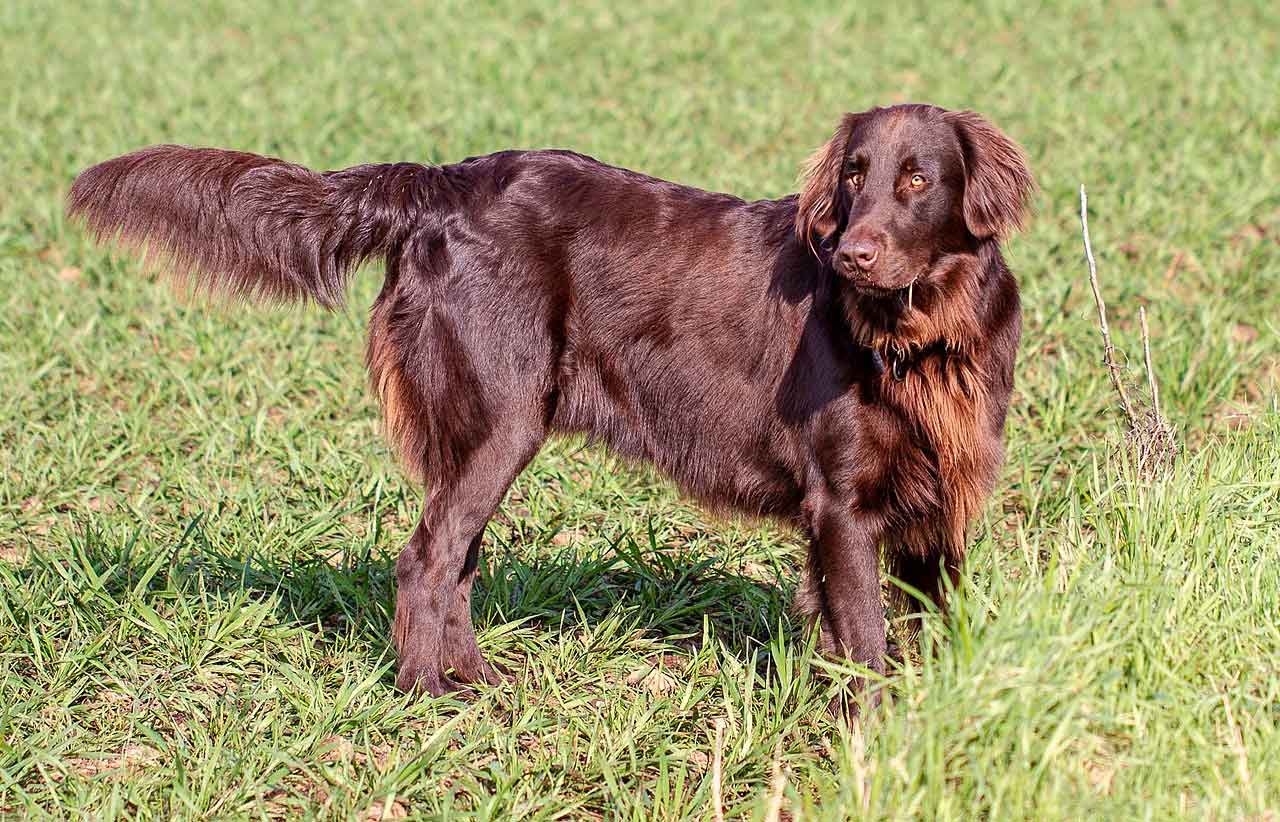
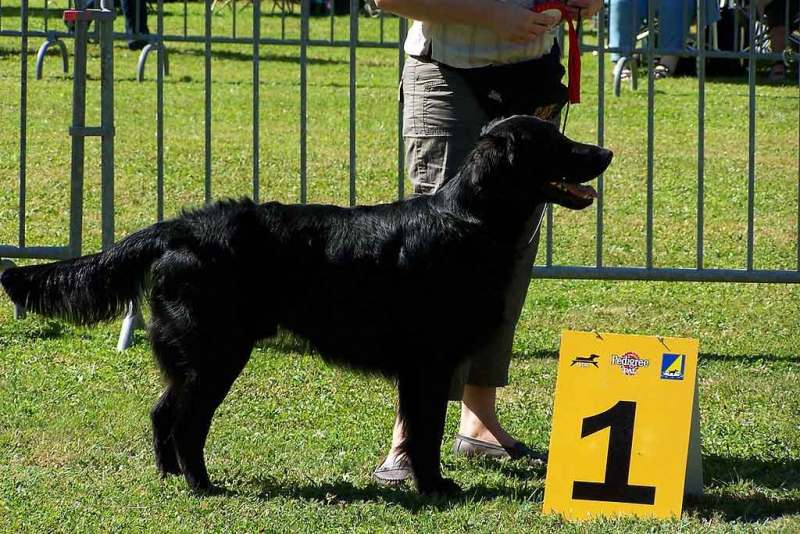
    Photo: A liver-colored โ€œSmooth-Coated Retrieverโ€ by Fesoj-wr, CC BY-SA 4.0, via Wikimedia Commons

    Physical characteristics

    At first sight, I might think that the Flat-coated Retriever it seems like a Golden Retriever black or brown. In fact, the two breeds are so similar that in the past the second was presented at dog shows as a variety of the first. In fact, they are two different races, but the Golden Retriever descends in part of the Flat-coated Retriever and, like this, developed as a hunter for land and water game.

    The Flat-coated Retriever they are medium sized dogs, harmonious and with a lively and intelligent expression. The male is usually more imposing than the female, measuring up to about 5 cm taller and weighing up to ten kilos more than the female.

    His body is harmonious and well proportioned. The chest is wide and deep, and the spine is short and quite square. The legs are muscular and of solid bones. They are straight when viewed from the front and lead to strong round legs with tight toes.

    The tail is quite short, straight and well placed. Always carries it high, but never over the back and hardly ever stops wiggling.

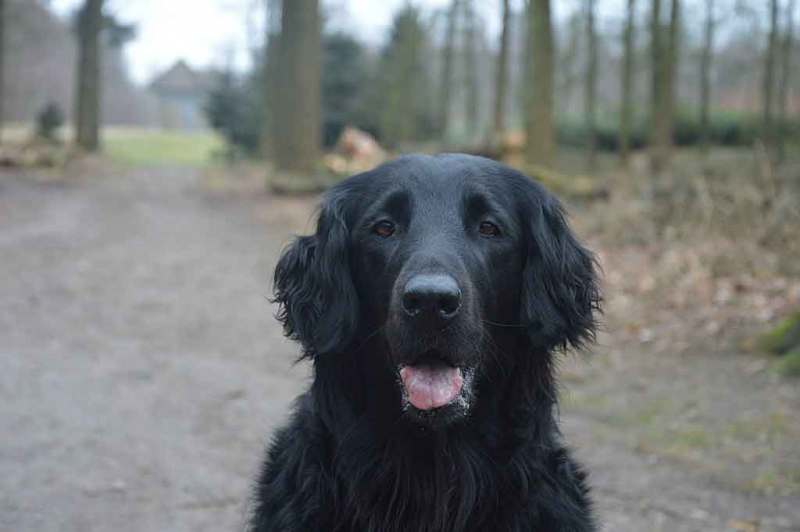
    The head is rather long and the skull is rather flat. Jaws are long and strong, capable of carrying medium-sized game animals, such as hares or pheasants. They are shaped like scissors and cover the teeth firmly implanted in the gums.. The ears are quite small, drooping and well placed on top of the head. The eyes are medium in size and hazel or dark brown..

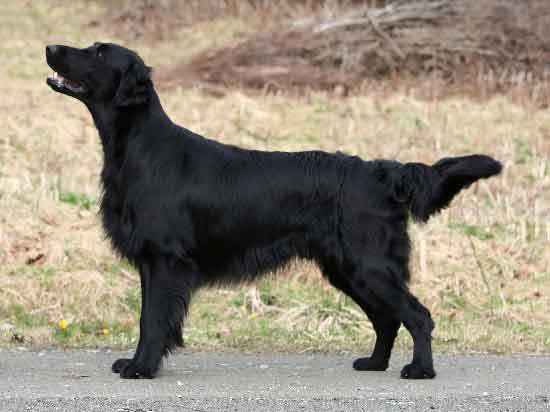
    As the name suggests, the fur of the Flat-coated Retriever It is smooth. Black or dark brown, it is also dense and of medium length. This protects the Flat-coated Retriever of all kinds of weather conditions, from water and dirt. His hair is longer in his ears, the chest, the belly, limbs and tail. Males also have longer and more abundant hair on their necks., that resembles a mane.

    Height and weight

      ▷ Male size: Of 58 to 61 cm.
      ▷ female size: Of 56 to 59 cm.
      ▷ Male weight: Of 27 to 36 kg
      ▷ female weight: Of 25 to 32 kg

    Character and skills

    The Flat-coated Retriever It is part of the large family of Retrievers and is particularly close to the Golden Retriever, both physically and in terms of temperament. But, one of the main differences is that they generally mature more slowly than other dogs and have a puppyish exuberance throughout their lives, which is why they are sometimes called the "Peter Pan of Retrievers". This great energy and vitality make it a wonderful and endearing companion., especially for children. On the other hand, It also implies that a certain amount of patience is necessary in their education.

    In fact, although he likes to please, the Flat-coated Retriever it can also be somewhat stubborn. This is partly because he loves to entertain himself., but sometimes this means ignoring or disobeying your master. Yes indeed, they are usually good students and are sensitive to reprimands. This sensitivity also means that overly strict and rigid training methods are often not in your best interest., as they can lead you in the wrong direction and make you even more stubborn. So, it is better to favor a dog training method based on positive reinforcement, that is to say, in the reward of good behavior; is the case of clicker training, for example. Food in particular can do wonders for this dog, since it represents an important motivation for him. The Flat-coated Retriever It is an extremely greedy dog, and you can also remember it outside of work sessions: at the slightest drop in attention from its owner, is capable of stealing any food you have on hand, wherever you are. So, it is advisable to be careful not to leave food lying around for this dog who seems to be always hungry.

    Tolerant and friendly, loves everyone, even the smallest. Combined with your enthusiasm, these traits even make it an ideal breed of dog for children. But, children must be a certain age: with young children, its exuberance and high energy could lead to unwanted jostling and tail slapping. His rather easy-going and very friendly personality also makes him a good companion for young retirees., as long as you can take him out for regular walks and meet his important exercise needs.

    In general, loves human company, has strong ties to his family and needs their attention. Loves to play for hours and especially thrives in a large family.

    His good understanding with humans extends to those he does not know. If he barks when a visitor arrives, is to inform his master, and not because he considers any stranger a threat. Very welcoming and friendly, he tends to quickly like any new person who meets him - especially if that person is nice to him- and enjoy the visits, it's made for anything but guard. On the other hand, its great closeness to humans and its great need for attention make it a dog that does not tolerate loneliness well. If he lives in a family too small for him, runs the risk of being unhappy and developing destructive behaviors.

    Living with other dogs does not usually pose problems. Can also get along very well with a cat, provided adequate socialization work has been done. On the other hand, it is better to avoid the idea of รขโ‚ฌโ€นรขโ‚ฌโ€นliving with birds or rodents, since his hunting instinct would lead him to chase them.

    It also, though it's pretty quiet inside, not really suitable for apartment living. He's a hunter at heart, who likes to exercise in spacious environments that give them the opportunity to run or swim. He is also one of the best swimmers and loves the water, never seems happier than when rolling around in puddles, jump in the fountains or just take long dips in the lakes, rivers and other bodies of water that it finds on its way. You need to spend at least an hour and a half each day to feel good in your paws and on your head. So, who thinks about adopting a Flat-coated Retriever you must ensure that it can provide you with living conditions that are compatible with your needs, because if you can't exercise enough, can quickly develop behavior problems, like stress or aggression.

    Education

    The Flat-coated Retriever learn very fast, but it is very sensitive: whatever happens, you must be careful not to punish your dog too often or too harshly, as it will remember and could become resistant to work sessions. On the other hand, the use of a dog training method based on positive reinforcement - and, Therefore, in the use of rewards- like clicker training, for example, it comes in handy. It must be said that for him food is an important source of motivation that it would be a shame not to use during work sessions..

    The fact that he is late to maturity sometimes complicates his education a bit.. So, it is advisable to just be patient and calm, and above all show great coherence, because this intelligent dog does not stop interpreting every movement and every word of his master. With everything, it is quite simple to train, and the time spent on short work sessions from an early age is a profitable and long-lasting investment in a compliant adult partner.

    It also, as with any dog รขโ‚ฌโ€นรขโ‚ฌโ€นof any breed, early socialization can only be beneficial in every way. The Flat-coated Retriever is spontaneously very sociable and open to changes in his environment, and quality socialization, through exposure to all kinds of people, animals, sounds and situations, reinforces these traits, making it even more balanced and perfectly suited to evolve in the midst of humans. In particular, can be especially helpful to avoid confusing cats, birds or rodents with the game.

    Health

    First of all, It should be noted that the Flat-coated Retriever takes some time to reach full physical maturity and, like all large dog breeds, is especially fragile during its growth period. Depending on the individual, the growth period lasts until 12 or 15 months. So, even if it is a breed with a great need for exercise, avoid any excessive exercise during this phase, at the risk of damaging your joints, often irreparably. In particular, stairs and activities that involve jumping should be avoided. You should also avoid excessively long walks: prior to the 3 months, are enough of 5 to 10 minutes, then it should not exceed half an hour until it has completed the 10 months.

    It also, black individuals are especially sensitive to high temperatures. It is advisable to watch out for any signs that suggest heatstroke during the hottest seasons., as the dog's body can quickly overheat.

    Having said that, the Flat-coated Retriever is generally in good health. But, like all races, may be subject to certain problems, some of which are hereditary: hip dysplasia. When adopting a Flat-coated Retriever of a breeder, it is advisable to find out about the tests carried out on breeders and their offspring, as this will help rule out certain diseases.

    Thus, sometimes have a patellar dislocation, that is to say, a knee slipping out of place, what causes lameness. Long-term, friction caused by this dislocation can also lead to arthritis problems in the dog. Depending on the severity of the dislocation, surgery may be necessary.

    like most big dogs, the Flat-coated Retriever you also have an increased risk of hip dysplasia: the femur does not fit perfectly into the pelvic socket of the hip joint. Some individuals may experience pain and lameness in one or two of the hind legs., but others show no symptoms. But, as the dog ages, osteoarthritis problems may appear. How this disease is hereditary, dogs that test positive for hip dysplasia are excluded from breeding. This is at least what every serious breeder of Flat-coated Retriever, and it is advisable to make sure of this when adopting a puppy from a breeder, asking parents' test results.

    Another problem to which the Flat-coated Retriever is the dilation-torsion of the stomach. This serious and life-threatening syndrome affects large dogs with deep chests. Air or gases build up in the dog's stomach, that twists and does not allow its evacuation. Even worse, compresses the surrounding veins, thereby interrupting blood flow. No immediate veterinary care, the animal dies very quickly.

    The different types of dog cancer also especially affect this breed.

    Osteosarcoma, for example, especially affects large dogs, and the Flat-coated Retriever is no exception. It is a fairly aggressive bone cancer, which initially causes lameness. This disease usually leads to amputation of the affected limb and heavy chemotherapy. Unfortunately, it is very rare for a dog to survive this disease, as the problem is often diagnosed too late. According to the case and once identified, those affected may live between 9 months and 2 years longer than if they had not been treated, thanks to adapted treatments.

    Another form of cancer to which this dog is more exposed is malignant histiocytosis. Although this form of cancer is rare, is the most commonly observed in this breed, and is usually contracted from 6 years of age. Appears as a localized mass, most often in the elbow or knee, and progresses very quickly once it appears. Can be treated with surgery and chemotherapy, but healing changes are usually small.

    The Flat-coated Retriever you can also get lymphosarcoma, one of the most common cancers seen in dogs of all breeds. It can appear in various parts of the body, like spleen, the gastrointestinal tract, lymph nodes, the liver and bone marrow.

    In this dog it is also more subject is hemangiosarcoma. This form of malignant cancer is found in the lining of blood vessels and in the spleen. Can be treated with surgery and chemotherapy, but also in this case the affected animal has little chance of recovery.

    Grooming

    Contrary to what her long dark hair might suggest, the Flat-coated Retriever it is an easy-care breed.

    His coat requires weekly brushing, or even a little more if you are regularly abroad. Some owners go so far as to brush it every day to prevent its long, fallen hair from falling throughout the house.. Longer hairs can also be cut, that is to say, those with the ears, the feet, belly and tail; this prevents dirt from accumulating on rides.

    The bath should not be prescribed too regularly, but it can be useful in case the dog with long enough hair gets too dirty, for example, as a result of an excursion in a muddy environment. Otherwise, bathe the dog in 2 to 3 times a year is more than enough to keep their coat in good condition, in addition to weekly brushing.

    If you come across a water point during one of your walks, the Flat-coated Retriever often tempted to take a dip. If this happens, it is advisable to rinse the Retriever once it has come out of the water, especially if the water is chlorinated, is salty or contains algae, in order to prevent any skin problems and keep it clean.

    Trimming your dog's nails once or twice a month can also help.. Contrary to what one might think with such an active dog, natural wear and tear is usually not enough, since its claws grow quite quickly.

    It also, as in the case of any dog โ€‹โ€‹with floppy ears, it is necessary to clean them weekly to avoid any risk of infection.

    The weekly grooming session should also be an opportunity to take care of your eyes, to make sure there are no problems (tearing, Red eyes…) and to clean the contours with clear water.

    It is also necessary to take advantage of this time to clean the teeth. Brushing your dog's teeth helps prevent tartar buildup and the problems that come with it, starting with strong breath.

    To avoid any uncomfortable reaction due to its size, it is advisable to get used to being handled as soon as possible, either by his master or by a third person. Learn to take care of the puppy, the noises, the smells and the manipulations involved, should be an integral part of your education.

    Use

    Used for over a century as a hunting dog, the Flat-coated Retriever continues to excel in this role today. They are suitable for all types of hunting, but they are especially good at tracking smaller animals. They are especially appreciated for their great ability to recover birds that have fallen into the water.

    It is also a perfect companion dog, especially for a sports master or family. Anyone who dreams of going for a run with their dog - or even taking long walks- you will find in him an ideal companion, and also stands out in canine sports that take advantage of their physical qualities, like agility, the cani-cross or the flyball.

    On the other hand, even if you are the first applicant and have a great need for exercise, It should not be forgotten that it takes time to reach full physical maturity and that, in the meantime, you have to save him. These may include, excessive exercise could cause deformities or alter the correct development of your joints, often with lifelong consequences.

    Price

    Although less common than some of its Retriever cousins, find a Flat-coated Retriever in Europe it does not present any special difficulties, Unlike, for example, of United States, where months of waiting may be necessary.

    The cost of adopting a puppy from Flat-coated Retriever of a quality breeder ranges from 900 and 1200 EUR. Obviously, depends more or less on the quality of your lineage and the reputation of the breeder, as well as their physical qualities. There are no price differences according to the sex of the puppy.

    Characteristics "Flat-coated Retriever"

    Coexistence is important that you have with your new friend. Before considering the acquisition of a dog of the breed "Flat-coated Retriever" you know certain factors. Not all breeds of dogs are apt to live in an apartment, you must take into account his character, their need for exercise, their interaction with other pets, their care and if you have small children, their level of tolerance towards them.

    Adaptation โ“˜

    2,0 of 5 stars (based on 1 review)

    friendly dog โ€‹โ€‹โ“˜

    4,0 of 5 stars (based on 1 review)

    hair loss โ“˜

    2,0 of 5 stars (based on 1 review)

    Affection level โ“˜

    5,0 of 5 stars (based on 1 review)

    Need for exercise โ“˜

    4,0 of 5 stars (based on 1 review)

    Social need โ“˜

    4,0 of 5 stars (based on 1 review)

    Home โ“˜

    3,0 of 5 stars (based on 1 review)

    Toilet โ“˜

    2,0 of 5 stars (based on 1 review)

    Friendly with strangers โ“˜

    3,0 of 5 stars (based on 1 review)

    barking โ“˜

    3,0 of 5 stars (based on 1 review)

    Health โ“˜

    4,0 of 5 stars (based on 1 review)

    Territorial โ“˜

    2,0 of 5 stars (based on 1 review)

    Cat friendly โ“˜

    3,0 of 5 stars (based on 1 review)

    Intelligence โ“˜

    4,0 of 5 stars (based on 1 review)

    Versatility โ“˜

    3,0 of 5 stars (based on 1 review)

    Child friendly โ“˜

    5,0 of 5 stars (based on 1 review)

    Surveillance โ“˜

    3,0 of 5 stars (based on 1 review)

    joy โ“˜

    5,0 of 5 stars (based on 1 review)

    Images "Flat-coated Retriever"

    Photos:

    1 – Flat Coated Retriever by I, Gunnandreassen, CC BY-SA 3.0, via Wikimedia Commons
    2 – ยซSmooth hair collectorยป by https://pixabay.com/photos/flatcoated-retriever-flat-coated-4219166/
    3 – ยซSmooth-coated snakeยป, 8 years by Pdusschooten, CC BY-SA 4.0, via Wikimedia Commons
    4 – โ€œSmooth-coated retrieverโ€ named Molly by Flickr users David and Lynne Slater, CC BY 2.0, via Wikimedia Commons
    5 – Flat-Coated Retriever black by Berthold Werner, CC BY-SA 3.0, via Wikimedia Commons
    6 – Yellow Flat Coated Retriever by Dancer9, CC BY-SA 4.0, via Wikimedia Commons

    Videos "Flat-coated Retriever"

    Type and recognitions:

    • FCI CLASSIFICATION:
    • Group :
    • Section : . .

    Federations:

    • FCI – Group 8: Retrievers - Flushing Dogs - Water Dogs – Section 1: Retrievers โ“˜
    • AKCSporting โ“˜
    • ANKC Group 3 (Gundogs) โ“˜
    • CKCSporting Dogs โ“˜
    • โ€‹KC – Gundog โ“˜
    • NZKCGundog โ“˜
    • UKCGun Dogs โ“˜

    FCI breed standard "Flat-coated Retriever"

    Origin:
    United Kingdom, Scotland

    Date of publication of the valid original standard:
    08.09.1988

    Use:

    Retriever hunting and shooting.


    General appearance:

    Smart and active dog, medium-sized, with a clever expression; it's strong without being heavy, as well as thin without being lacking in substance.


    Behavior / temperament:

    Endowed with the natural ability of a hunting dog, as well as optimism and friendliness that he demonstrates with the enthusiastic movement of his tail. Confident and caring.

    Head:

    Long and delicately molded.

    Cranial region:
    • Skull: Flattened and moderately wide.
    • Depression links (Stop): Light between the eyes, that should not be accentuated, in such a way that it does not give a drooping or concave appearance.

    facial region:

    • Truffle: Good size, with open nostrils.
    • Jaws / Teeth: Long and strong jaws, capable of holding a hare or a pheasant. Complete denture with scissor bite, that is to say that the inner face of the upper incisors is in contact with the outer face of the lower incisors and well placed in the maxillae. Healthy and strong teeth.

    Eyes: Medium-sized, brown or hazelnut, with a very clever expression (prominent round eyes are highly undesirable). Not laid obliquely.

    Ears: Small and well placed on the sides of the head.

    Neck:

    The head well placed on the neck that should be reasonably long and without dewlap, symmetrical and obliquely placed on the shoulders that descend well down the back allowing you to easily search the track.

    Body:

    • Pork loin: Short and square. Loin poorly coupled highly undesirable.
    • Breast : Deep and moderately wide chest, with a well-defined sill. Moderately flattened front ribs. They must be well developed backwards, have a gradual curvature and be more arched in the center, although this curvature should be less pronounced towards the hindquarters.

    Tail:

    Short, straight and well set, carried gaily but never much higher than the dorsal line.

    Tips

    PREVIOUS MEMBERS: They must be straight and of good bones in all its extension.

    • Elbows: They should move neatly and evenly across the chest.

    LATER MEMBERS: Muscular, without any deviation.

    • Knee: Moderate angulation.
    • Hocks: Moderate angulation, well descended. Highly undesirable cow hocks.

    FEET: Well round and strong, with fingers together and well arched, as well as thick and strong pads.

    Movement:

    Free and loose, Seen from the front and back it should be in a straight line without any deviation.

    Mantle

    HAIR: Denso, fine to medium textured and of good quality, as straight as possible. The limbs and tail must have sufficient fringes. The abundant fringes when the dog reaches maturity complete the elegance of a good specimen.

    COLOR: Only black or liver.


    Size and weight:

    Height at the desired withers:

    • Males: 59 โ€“ 61,5 cm. (23-24 inches).
    • females: 56,5 โ€“ 59 cm. (21-23 inches).

    Desired weight in good physical condition:

    • Males: 27 โ€“ 36 kg (60-80 English pounds).
    • females: 25 โ€“ 32 kg (55-70 English pounds).


    Fouls:

    Any deviation from the aforementioned criteria is considered as a fault and the severity of this is considered to the degree of the deviation to the standard and its consequences on the health and well-being of the dog., and the ability of the dog to carry out their traditional work.

    FALTAS DESCALIFICANTES:

    โ€ข Aggressiveness or extreme shyness.
    โ€ข Any dog โ€‹โ€‹showing clear signs of physical or behavioral abnormalities.


    N.B.:

    โ€ข Males must have two normal-appearing testicles fully descended into the scrotum..
    โ€ข Only functionally and clinically healthy dogs, with the typical conformation of the breed, should be used for parenting.

    Source: F.C.I - International Cynological Federation

    Alternative names:

    1. Flatcoat, Flattie, Flatte (Sweden), flatt (Sweden) (English).
    2. Flat-Coated Retriever (French).
    3. Flat Coated Retriever (German).
    4. Flat-coated retriever (Portuguese).
    5. Retriever de pelo liso, (en inglรฉs Flat-coated retriever) (espaรฑol).

    โ–ท The world of Pets: Dogs, cats, birds, reptiles, amphibians

    Golden Retriever
    Escocia FCI 111 . Retrievers

    Golden Retriever

    The development of Golden Retriever it's quite slow. He does not physically become an adult until 18 months of age.

    Content

    History

    The origin of the ยซGolden Retrieverยป, a specialized hunter in charge of returning the hunted game, it is quite discussed.

    It may have originated in the Caucasus Mountains, where he was raised from a group of dogs related to him Leonberger, and then brought to Britain in the 19th century, or that it descends from a couple of dogs bought in 1858 to a Russian circus for a future English lord, Sir Dudley Marjoribanks.

    Wavy Coated Terrier
    Wavy Coated Terrier (We)

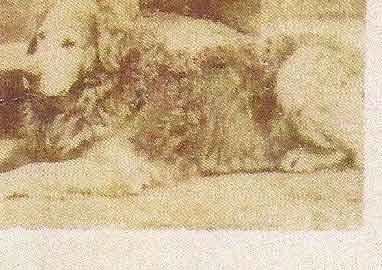
    Behind the myth, we know that this man, also known as Lord Tweedmouth, I raised dogs since 1835. It is said that he made a decisive crossing between two subjects destined to become the great ancestors of the Golden Retriever. In fact, had a Wavy Coated Terrier yellow, called Nous, as well as a female Tweed Water Spaniel, called belle. In a photograph in which Nous poses, we discovered a curly dog, whose size, bone structure and head appear powerful.

    In 1868, Lord Tweedmouth apareรณ a Nous y Belle. The historic litter is born. It is made up of a male, called crocus, and three females, There is, Primrose y Cowslip. The breeder then continues a patient work of inbreeding selection with two yellow females and another Tweed Water, a male named Tweed. In this lineage there are two black Retrievers, Sambo and Tracer, a Irish Setter, Sampson, as well as a Bloodhound sand-colored. This selection work was recorded in his breeding book, preserved today by the English Kennel Club.

    The Lord's goal was to create a race that met the requirements of a "gentleman farmerยซ, that is to say, a dog with an impeccable nose for hunting waterfowl, but also with excellent skills in fields as varied as rescue or assistance to people with disabilities. He had to be an intelligent and loyal companion, be patient with children and calm at home.

    In 1903, the English Kennel Club accepted the registration of the first Goldens, registered as Flat-coated Retriever variety Golden.

    English Winifired Charlesworth, which contributed greatly to the recognition of the Flat-coated Retriever like a different race, wrote the first standard for the breed Golden Retriever in 1910.

    In 1911 created the Golden Retriever Club of England and the English Kennel Club recognized the Golden Retriever as a race in its own right.

    In France, the Retrievers most common were Labradors, and only in the decade of 1930, through breeding, the first appeared Golden Retriever in the territory. A first French litter was officially registered with the English Kennel Club in 1934, produced by the Conde Jules de Bonvouloir (with the affix ยซof Saint-Jean-du-Boisยซ). The latter became president of the Retriever Club de France in the years 40.

    The popularity of the Golden Retriever grew dramatically from the end of the years 80, becoming one of the favorite dogs of the French for its friendly nature, franco, playful and helpful.

    Physical characteristics

    The Golden Retriever is similar in appearance to Labrador Retriever. It is a harmonious dog, powerful and robust, but with a soft expression. His head is wide, his nose is black and his eyes, very separate, are dark brown. His ears are medium in size and hanging, placed at eye level. The tail is carried over the back, does not curl and reaches the hock.

    The coat of the Golden it's thick and silky. Hair is straight or wavy, fringed. The undercoat is thick and the exudate (a kind of fat secreted by the skin) makes it very waterproof and protects it from the cold, so the Golden it can stay a long time in streams and rivers without any problem, even in winter.

    The webbed shape of its legs also makes it easy to retrieve waterfowl.

    The coat colors accepted by the standard are creamy white to dark gold. Snow white colors are not supported, Mahogany, chocolate or black.

    Size and weight

      ▷ Male size: Of 56 to 61 cm.
      ▷ female size: Of 51 to 56 cm.
      ▷ Male weight: Of 29 to 31 kg
      ▷ female weight: Of 25 to 27 kg

    Character and skills

    The Golden Retriever he is naturally meek, friendly and devoted to his caretaker. If as a puppy it can be exuberant, as an adult it is a calm and serene dog, who feels true passion for his family, of which he is considered a full member, to the point of overflowing with love for children. For its gentle character, suits young families and older people alike.

    He is a tireless playmate, a dog full of life, who cannot stand loneliness and needs a presence by his side. So, will be unhappy if separated too often from their masters. Sometimes it has a "sticky" side, he likes to please his master by bringing slippers or mail, for example. To put it plainly, pleasing his owner also pleases himself.

    The Golden Retriever do not have a natural guardian instinct and come into contact with strangers, both humans and animals, quite easily.

    The Golden Retriever it is one of the most intelligent dog breeds, since he understands everything that happens around him.

    Although they prefer the countryside, the Golden Retriever they also adapt very well to living in an apartment, provided they are given long walks several times a day. In fact, whether it rains or it is windy, you need to do exercise.

    Education

    Despite her soft mischievous eyes, the Golden Retriever needs a gentle and firm education at the same time. In effect, he is a real comedian, and before her charming eyes, one soon lets oneself be overwhelmed by a love that grows every day, but what can make one go blind.

    As the Golden Retriever he's a bit stubborn when he's young, their education must be done through encouragement and not coercion. Otherwise, his stubborn and somewhat independent character will resurface, making it difficult to re-establish trust between the owner and the dog.

    Last, the Golden Retriever usually have a very good relationship with others Golden Retriever, but it is important to socialize it as soon as possible.

    Health

    The development of Golden Retriever it's quite slow. He does not physically become an adult until 18 months of age, and your character will stabilize around the 4 years, or even more in some individuals. Its growth must be closely monitored, especially in the skeleton. As with all large dog breeds, it is preferable to avoid jumping and stairs while he is a puppy so as not to risk damaging the cartilage of his joints.

    The Golden Retriever is also predisposed:

    • Patella dislocation and torn cruciate ligaments;
    • certain diseases of the musculoskeletal system (Hip Dysplasia, elbow dysplasia);
    • Certain eye diseases (congenital and hereditary cataracts, progressive retinal atrophy…);
    • Certain skin diseases (atopia, dermatitis piotraumรกtica, ictiosis…);
    • Piometrio, a severe uterine infection affecting older, unspayed females.

    It also, the Golden Retriever is especially prone to Hip Dysplasia. It is advisable to ensure that the parents are free of these conditions when buying a puppy, requesting the creator of Golden Retriever x-rays and screening tests of the parents.

    Last, in regards to the atopia, there is a racial component and not only a family. So, this condition can be triggered even if the parents are free of it.

    Life expectancy

    Of 10 to 12 years

    Grooming

    The Golden Retriever have moderate hair loss, even during its annual molt.

    But, it is advisable to brush it weekly to detect possible parasites and spikelets, and even daily during the shedding period.

    On the other hand, it is preferable not to wash the dog too often, as there is a risk of damaging the natural protection formed by its rough undercoat and oozing.

    Last, like the ears of the Golden Retriever they are down, they are fragile. Thus, it is recommended to clean them regularly with suitable products to avoid ear infections.

    Use

    The Golden Retriever, a race created for this purpose, is primarily a hunting dog, who likes to return game pieces to his master, preferably dead, and often falls into the water. It also, naturally gifted for work, swimming is his favorite sport.

    But the Golden Retriever it is also one of the most popular companion dogs.

    It also, It is often used for its qualities as a support dog for patients, disabled assistance dog, guide dog for the blind, but also as a rubble dog, drug or bomb search.

    Last, the Golden Retriever they are also in high demand today as show dogs.

    Price

    The purchase price of a Golden Retriever ranges between โ‚ฌ500 and โ‚ฌ1000 and its maintenance ranges between 1400 and 1500 EUR.

    Characteristics "Golden Retriever"

    Coexistence is important that you have with your new friend. Before considering the acquisition of a dog of the breed "Golden Retriever" you know certain factors. Not all breeds of dogs are apt to live in an apartment, you must take into account his character, their need for exercise, their interaction with other pets, their care and if you have small children, their level of tolerance towards them.

    Adaptation โ“˜

    2,0 of 5 stars (based on 1 review)

    friendly dog โ€‹โ€‹โ“˜

    5,0 of 5 stars (based on 1 review)

    hair loss โ“˜

    3,0 of 5 stars (based on 1 review)

    Affection level โ“˜

    5,0 of 5 stars (based on 1 review)

    Need for exercise โ“˜

    3,0 of 5 stars (based on 1 review)

    Social need โ“˜

    5,0 of 5 stars (based on 1 review)

    Home โ“˜

    4,0 of 5 stars (based on 1 review)

    Toilet โ“˜

    3,0 of 5 stars (based on 1 review)

    Friendly with strangers โ“˜

    5,0 of 5 stars (based on 1 review)

    barking โ“˜

    3,0 of 5 stars (based on 1 review)

    Health โ“˜

    3,0 of 5 stars (based on 1 review)

    Territorial โ“˜

    2,0 of 5 stars (based on 1 review)

    Cat friendly โ“˜

    4,0 of 5 stars (based on 1 review)

    Intelligence โ“˜

    5,0 of 5 stars (based on 1 review)

    Versatility โ“˜

    4,0 of 5 stars (based on 1 review)

    Child friendly โ“˜

    5,0 of 5 stars (based on 1 review)

    Surveillance โ“˜

    2,0 of 5 stars (based on 1 review)

    joy โ“˜

    5,0 of 5 stars (based on 1 review)

    Images "Golden Retriever"

    Photos:

    1 – One Golden Retriever male with a tennis ball by Scott Beckner, CC BY 2.0, via Wikimedia Commons
    2 – Golden Retriever by https://commons.wikimedia.org/wiki/File:Golden_retriever.jpg
    3 – Golden Retriever by https://es.m.wikiquote.org/wiki/Archivo:Callie_the_golden_retriever_puppy.jpg
    4 – Golden Retriever by I, Willybu, CC BY-SA 3.0, via Wikimedia Commons
    5 – Puppy Golden Retriever / young dog in the North Sea (Scheveningen, Hague, Netherlands) by Dirk Vorderstrasse, CC BY 3.0, via Wikimedia Commons
    6 – Portrait of male Golden Retriever of 3 years by Johan Spaedtke, CC0, via Wikimedia Commons

    Videos "Golden Retriever"

    Type and recognitions:

    • FCI CLASSIFICATION:
    • Group :
    • Section : . .

    Federations:

    • FCI – Group 8: Retrievers - Flushing Dogs - Water Dogs – Section 1: Retrievers โ“˜
    • AKCSporting โ“˜
    • ANKC Group 3 (Gundogs) โ“˜
    • CKCSporting Dogs โ“˜
    • โ€‹KC – Gundog โ“˜
    • NZKCGundog โ“˜
    • UKCGun Dogs โ“˜

    FCI breed standard "Golden Retriever"

    Origin:
    United Kingdom, Scotland

    Date of publication of the valid original standard:
    24.06.1987

    Use:

    Retriever hunting and shooting.


    General appearance:

    Harmonious, provided, Active, powerful, with gathered movements; well built and with a caring expression.


    Behavior / temperament:

    Docile, intelligent and possessing an innate ability for work. Kind, friendly and confident.

    Head:

    Proportionate and well molded.

    Cranial region:
    • Skull: Spacious without being clumsy, well inserted into the neck.
    • Depression links (Stop): Well defined.

    facial region:

    • Truffle: Preferably black.
    • Snout: Powerful, wide and deep. The length of the muzzle should be approximately equal to the distance between the stop and the occipital bone.
    • Jaws / Teeth: Strong JAWS, with a perfect, regular and complete scissor bite, that is to say, that the internal face of the upper incisors is in contact with the external face of the lower incisors, the teeth being placed at right angles to the jaws.

    Eyes: Dark brown, well separated; The eye rims must be dark.

    Ears: Medium-sized, implanted approximately at eye level.

    Neck:

    Good length, net and muscular.

    Body:

    Balanced.

    • Back: Horizontal top line.
    • Pork loin: Strong and muscular, short.
    • Breast : Well descended in the sternal region. Deep well sprung ribs.

    Tail:

    Implanted and carried at the level of the back, reaching the Hock; without curling at the tip.

    Tips

    PREVIOUS MEMBERS:Straight and of good bones.

    Shoulder: Well oblique, with long scapulae.

    Arms: The same length as the scapulae, which makes the front limbs are well placed under the body.

    Elbows: Glued to the body.

    LATER MEMBERS:Strong and muscular.

    Knee: Well angulated femoro-tibio-patellar joint.

    Leg: Long.

    Hocks: Well descended; seen from behind they must appear parallel, not turned neither in nor out. Cow hocks are very undesirable.

    Movement:

    Powerful, with a lot of push. The fore and hind limbs move in planes parallel to the axis of the body. Long and free step, without any tendency to lift the above.

    Mantle

    HAIR: smooth or wavy, with good fringes and with a dense and waterproof undercoat.

    COLOR: Any shade of gold or cream, neither red nor mahogany. Only the presence of a few white hairs on the parapet is allowed..


    Size and weight:

    Height to the cross:

    • The males between 56 and 61 cm. (22-24 inches).
    • The females among 51 and 56 cm. (20-22 inches).


    Fouls:

    Any deviation from the aforementioned criteria is considered as a fault and the severity of this is considered to the degree of the deviation to the standard and its consequences on the health and well-being of the dog., and the ability of the dog to carry out their traditional work.

    FALTAS DESCALIFICANTES:

    โ€ข Aggressiveness or extreme shyness.
    โ€ข Any dog โ€‹โ€‹showing clear signs of physical or behavioral abnormalities.


    N.B.:

    โ€ข Males must have two normal-appearing testicles fully descended into the scrotum..
    โ€ข Only functionally and clinically healthy dogs, with the typical conformation of the breed, should be used for parenting.

    Source: F.C.I - International Cynological Federation

    Alternative names:

    1. Golden (English).
    2. Retriever Golden (French).
    3. Golden (German).
    4. Golden (Portuguese).
    5. Cobrador dorado (espaรฑol).

    โ–ท The world of Pets: Dogs, cats, birds, reptiles, amphibians

    German Spaniel
    Alemania FCI 104 . Flushing Dogs
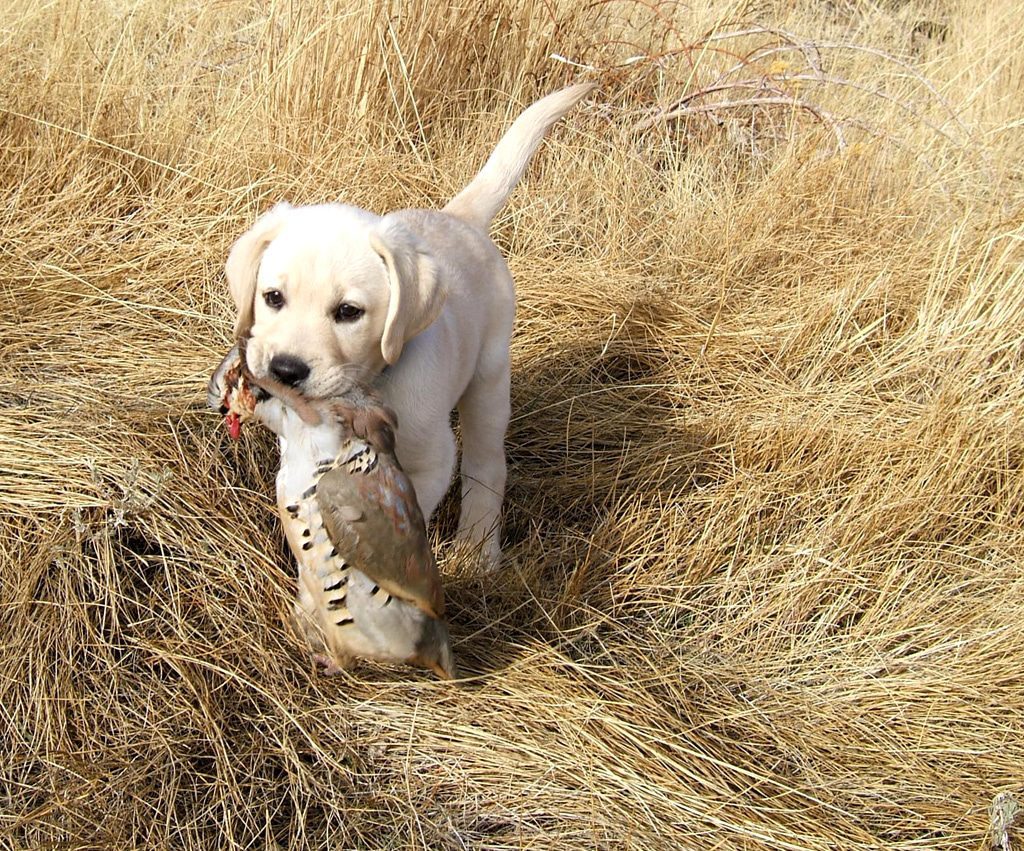
    German Spaniel

    The German Spaniel it is very appreciated especially for hunting.

    Content

    History

    The study of the history of hunting teaches us that centuries ago there were hunting dogs very similar to the current one. German Spaniel. At that time they were used to hunt.

    Breeding of the controlled breed in a studbook began in the early 20th century, with a few suitable bitches. The first representative of the German Spaniel was Mr. Augusta 1834 L, a Staufenberg dog in Upper Bavaria.

    At first there were only brown dogs with partial white markings and dogs with white markings.. The latter had small red spots on the head and limbs, called "fire marks". It was the bitch Baby auf de Schanze 1838 L the one that introduced the roan in the race. Rudolf Friess, a dog fancier who for decades had a major influence on the breeding of the German Spaniel, introduced separate breeding of brown and roan varieties.

    Despite the narrow initial breeding base, put in place an essential requirement to avoid damage due to inbreeding through selective mating. The separation of the two colors is also justified by a certain disparity in the natural qualities of the German Spaniel. Chestnut trees were easier to drive over short distances and more persistent on the track, while the roans had a highly developed penetration at long distances.

    These different natural gifts are no longer a reliable differential criterion today, since in the meantime, for many reasons, there have been repeated crosses between the two color varieties. But, in principle, the separation still maintains a certain reserve of unrelated blood within the race today.

    The German Spaniel it is and continues to be bred by hunters and for hunters as a hunting dog with great versatility.

    Photo: ยซGerman Retrieverยป by https://pixabay.com/de/photos/wachtelhund-jagdhund-stรถberhund-4604508/

    Physical characteristics

    The German Spaniel it is a medium sized hunting dog, longhair, very muscular, with a noble head and strong bones. In general, they are longer than they are tall, but they should never give the impression of being tall.

    Lively and very passionate about hunting, friendly and self-assured in their natural environment, very docile and very adaptable; neither shy nor aggressive.

    The German Spaniel in some points:

    – Has a well developed piercing,

    – follow the path of hunting big and small with will and perseverance,

    – give voice without hesitation,

    – has a fine nose,

    – he likes rapport and water,

    – has a bite for hunting and vermin,

    – Trained and properly managed, hunt without deviating from course over long distances; works as a Bloodhound and in the search for lost pieces; is a versatile hunting dog for tracking and hunting in ditches, heavily wooded areas and in the water. Since the beginning of the supervised breeding, the ability to stop has not been taken into account.

    The coat is strong, glued, mostly wavy, occasionally also curly (Astrakhan), or long, flat with thick undercoat; not too long, especially not fine or silky; on the nape, often curled on the ears and rump; well furnished hindquarters and tail; the presence of a frill around the neck is frequent; the belly is also well provided with hair; muzzle and cranial region have short but tight hair; the ears are covered with curls or tight, wavy hair that extends beyond the edge of the pinna; the interdigital spaces have a tight hair but not too long.

    The "German Retriever" is bred in two color varieties:

    – Solid brown, more rarely also red; often with white or mottled markings on the chest and toes.
    – Brown roan, more rarely also red roan; the background color consists of brown hairs, possibly red, intimately mixed with white hairs; often the head is brown, possibly red, with spots or also a mantle that extends all over the back ; this color variety includes variegated coats with a white background and large brown spots, possibly red, also the so-called "tiger" dogs, in which the white background is also mottled or mottled with small tufts of brown hair, possibly red; the latter can perfectly descend from monocolor parents.

    All shades and variations of red are included in this term (red fox, red deer, red deer).

    SIZE AND WEIGHT :

  • Males 48-54 cm.
  • females 45-52 cm.
  • Varies in relation to size, between some 18 and 25 kg.

    Character and skills

    Robust, brave, can work on all terrains, mainly forests and swamps. Active tracker, bush hunter, screaming on the road, he specializes in hunting small game but also in tracking foxes and large animals. He is a good collector, it is also a trail dog, able to search for wounded game. Loving, is appreciated as a companion. He is self-assured in his natural environment., while being endowed with a great capacity for adaptation.

    They are not shy or aggressive, but they need a strong education that starts soon.

    Education

    Kind, affectionate and docile, the German Spaniel has these wonderful predispositions by nature. But with one condition, and not the least. Because this dog needs a lot more exercise, education and activity from the beginning of what a family or active people can offer. Being on the go is not enough. The German Spaniel want more. It can and should do more than just be a family dog. Idleness goes against their nature. You need qualified training as a hunting dog that will challenge you mentally and physically. If you are successful, this passionate hunter will prove to be an obedient and loyal companion.

    Health

    The German Spaniel have a slight predisposition to hip dysplasia. Breeders are very careful not to breed animals with this predisposition. This will greatly reduce this deficiency.

    On the other hand, floppy ears predispose this dog to ear infections (and more for dogs used to getting into the water).

    Grooming

    The coat of the German Spaniel is perfectly adapted to your lifestyle. Dirt doesn't seem to stick to hair, even if he walks through the bushes for hours. A weekly brushing is enough. He usually decides when it's time to bathe. Showering in summer is a moment of well-being that you enjoy.

    Characteristics "German Spaniel"

    Coexistence is important that you have with your new friend. Before considering the acquisition of a dog of the breed "German Spaniel" you know certain factors. Not all breeds of dogs are apt to live in an apartment, you must take into account his character, their need for exercise, their interaction with other pets, their care and if you have small children, their level of tolerance towards them.

    Adaptation โ“˜

    4,0 of 5 stars (based on 1 review)

    friendly dog โ€‹โ€‹โ“˜

    3,0 of 5 stars (based on 1 review)

    hair loss โ“˜

    3,0 of 5 stars (based on 1 review)

    Affection level โ“˜

    4,0 of 5 stars (based on 1 review)

    Need for exercise โ“˜

    5,0 of 5 stars (based on 1 review)

    Social need โ“˜

    4,0 of 5 stars (based on 1 review)

    Home โ“˜

    3,0 of 5 stars (based on 1 review)

    Toilet โ“˜

    2,0 of 5 stars (based on 1 review)

    Friendly with strangers โ“˜

    3,0 of 5 stars (based on 1 review)

    barking โ“˜

    3,0 of 5 stars (based on 1 review)

    Health โ“˜

    4,0 of 5 stars (based on 1 review)

    Territorial โ“˜

    3,0 of 5 stars (based on 1 review)

    Cat friendly โ“˜

    3,0 of 5 stars (based on 1 review)

    Intelligence โ“˜

    4,0 of 5 stars (based on 1 review)

    Versatility โ“˜

    4,0 of 5 stars (based on 1 review)

    Child friendly โ“˜

    4,0 of 5 stars (based on 1 review)

    Surveillance โ“˜

    3,0 of 5 stars (based on 1 review)

    joy โ“˜

    3,0 of 5 stars (based on 1 review)

    Images "German Spaniel"

    Photos:

    1 – Deutscher Wachtel by Steffen Heinz (Caronna), CC BY-SA 2.5, via Wikimedia Commons
    2 – German Spaniel by https://pixabay.com/de/photos/deutscher-wachtelhund-jagdhund-4748569/
    3 – German Spaniel by https://commons.wikimedia.org/wiki/File:Deutscher_Wachtel.jpg
    4 – German Spaniel by https://pixabay.com/de/photos/deutscher-wachtelhund-hund-haustier-5753477/
    5 – German Spaniel by https://pixabay.com/de/photos/deutscher-wachtelhund-jagdhund-4763510/
    6 – German Spaniel by https://pixabay.com/de/photos/deutscher-wachtelhund-jagdhund-4905048/

    Videos "German Spaniel"

    German Spaniel (German Quail Dog)
    German Spaniel (Deutscher Wachtelhund)
    Training German Spaniel - Ayrin from Jiล™รญฤkรฝ luk
    Training German Spaniel

    Type and recognitions:

    • FCI CLASSIFICATION:
    • Group :
    • Section : . .

    Federations:

    • FCI – Group 8: Retrievers - Flushing Dogs - Water Dogs – Section 2: Retrievers โ“˜

    FCI breed standard "German Spaniel"

    Origin:
    Germany

    Date of publication of the valid original standard:
    24.07.1996

    Use:

    Hunting dog, versatile hunting dog.


    General appearance:

    The German Retriever is a medium-sized hunting dog., Longhair, very muscular, with noble head and strong bones. Overall it is longer than it is tall and in no way gives the impression of having long limbs..

    IMPORTANT PROPORTIONS :

    โ€ข Relationship between body length and height at withers = 1,2 : 1
    โ€ข Relationship between chest height and height at withers = 0,5 : 1
    โ€ข Relationship between the length of the snout and the length of the skull = 1 : 1


    Behavior / temperament:

    He is lively and very passionate about hunting.; He is friendly and safe in his environment; very docile and adaptable, is not fearful or aggressive.

    The German Retriever is:

    โ€ข Equipped with a strong will to search.
    โ€ข It is safe in search of traces or clues.
    โ€ข Reliably has a continuous bark.
    โ€ข Has a fine sense of smell.
    โ€ข Has a pronounced taste for charging and for water.
    โ€ข It is sharp for hunting wild and predatory animals..
    โ€ข In its corresponding initiation and direction, hunting independently, extensive and controlled. It is reliable when working as a bloodhound and to search for lost prey.; It is a versatile utility hunting dog for working in dense places., in the forest and in the water. The suitability for the sample was not considered from the beginning of the breeding of this breed..

    Head:

    ---

    Cranial region:
    • Skull : Flattened, moderately wide; the occipital protuberance is not noticeable.
    • Depression links (Stop) : Only slightly marked.

    facial region:

    • Truffle : big and dark, with wide open windows; depigmentation in small spots is considered a lack; the ram's nose beautifies the dog.
    • Snout : Strong, with wide nose shank along its entire length; slightly rounded downwards, never pointed, no shorter than the skull.
    • Lips : Straight, dry, rigorously adjusted, pigmented according to coat color.
    • Mandible / Teeth : Complete bite with 42 teeth in the following order (schematic seen from the front):Right M P C I I C P M Left Upper maxillary 2 4 1 3 3 1 4 2 Upper jawโ€”โ€”โ€”โ€”โ€”โ€”Lower jaw 3 4 1 3 3 1 4 3 Lower jaw(Explanation of the initials of the dental formula : I = incisors, C = fangs, P = premolars, M = Molars).The incisors of the upper jaw closely overlap those of the lower jaw, forming a scissor bite.; pincer bite is tolerated; teeth are well developed; strong bite.
    • Cheeks : Thin with close-fitting skin; non-protruding cheekbones.

    Eyes : Medium brown color, dark as possible, medium-sized, placed a little oblique, Neither prominent nor sunken; eyelids well adjusted to the eyeball; no visible nictitating membrane. The edge of the eyelids with eyebrows.

    Ears : High and wide insertion, flattened; without being twisted, They hang very close behind the eyes; they are not thick, neither fleshy nor limp; regularly developed hair covers protruding from the inner edge of the ears. The ear turned forward reaches up to the nose.

    Neck:

    Strong; especially well muscled neck; forms an obtuse angle in its transition towards the cross; begins with no visible loose skin and extends toward the chest without forming a double chin.

    Body:

    • top line : In each of the regions the upper line is straight and gradually connects them to each other; the rump is slightly descending; the tail is carried as an extension of the line of the back or slightly hanging.
    • Cross : Strong and marked.
    • Back : Short and firm, without sinking behind the cross.
    • Pork loin : Powerfully muscular, so it gives the impression of serancho.
    • Rump : Slightly descending, never higher than the cross, situated a little below the height of the cross.
    • Breast : Seen from the front it is oval and reaches below the elbow when viewed from the side. long thorax, well arched; It is neither barrel-shaped nor flattened..
    • Lbottom line and belly : From the last false rib back it is moderately retracted; Also in its lower part it is as much as possible completely covered with hair and dense undercoat..

    Tail:

    At rest, carries it as a continuation of the upper line in a straight or downward manner; in excitement or with lively movement lifts it slightly; To avoid injuries from friction, it should be cut in the first three days of life to at most a third of its length. (amputation). (In countries where amputation is prohibited, can remain natural).

    Tips

    PREVIOUS MEMBERS :

    • As a whole : Viewed from the front, they are straight and parallel; Seen from the side they are well plumb under the body, with good angles.
    • Shoulder : Powerfully muscular; scapulae oblique and directed backwards.
    • Arm : During movement it is stuck very close to the thorax.
    • Elbows : Very close to the body, no inward or outward deviation.
    • Forearm : Straight, the parts near the joints are not hypertrophied or rickety.
    • Articulation of the carpus : Strong.
    • Metacarpus : Slightly leaning forward.
    • Previous feet : Spoon-shaped, fingers close together; Cat's or hare's feet are undesirable; hard pads, strong and well pigmented; strong nails, well worn.

    LATER MEMBERS :

    • As a whole : Seen from the side, they present good angulation in the knee and tibiotarsal joints.; Seen from behind they are straight and parallel; They are not barrel-shaped or cow-shaped.; strong bones.
    • Thigh : Wide and very muscular; good angulation between the pelvis and thigh.
    • Knee : Strong, with good angulation between thigh and leg.
    • Leg : Long, muscular and tendon.
    • Warm-foot joint : Strong.
    • Metatarsus : Short, vertical.
    • Hind feet : Like the previous ones.

    Movement:

    Fluid and space-encompassing; the limbs slide straight and parallel closely to the body.

    Mantle

    SKIN : Resistant, well stuck; It does not form wrinkles or is pigmented.

    HAIR : Strong, densely packed; It is mostly wavy, although sometimes also curly (Astrachan) long straight hair, with dense undercoat; not very long, neither thin nor hardly silky; on the nape, ears and rump is frequently curly; on the back of the limbs and on the tail it has good feathers; frequently forms a ruff on the neck (with a goal); also the belly is well covered with hair; on the snout and on the skull, the hair is short, but dense; the ears are covered with curls or thick wavy hair, the inner edge also protrudes; the spaces between the fingers are covered with dense but not too long hair.

    COLOR :

    The German Retriever is bred in two color varieties:

    โ€ข Uniform brown color, rarely also red*; often with white marks or splattered on the chest and fingers.
    โ€ข Brown roan, also rarely red roan*; The basic color is made up of brown or red hairs densely mixed with white.; often with brown or red head*; like this with plates or a coat over the entire back. This color variety also includes spotted ones with a white basic color and large brown or red plates*, as well as colored dogs called โ€œtigerโ€ in which the basic white color is dotted or speckled in addition to brown or red streaks*, even if they come from parents of a single color. In both color varieties there are red marks* (fire)on the eyes, on the snout, on the extremities and around the anus.
    *) All varieties of red tones belong to these. (red fox, roe deer red, deer red).


    Size and weight:

    Height to the cross :

    • Males 48 โ€“ 54 cm..
    • females 45 โ€“ 52 cm..

    WEIGHT : Varies depending on size, approximately between 18 โ€“ 25 kg. (Females a little lighter than males).


    Fouls:

    Any deviation from the aforementioned criteria is considered a fault and the severity of it is considered to the extent of the deviation from the standard and its consequences on the health and well-being of the dog..

    โ€ข Stop marked.
    โ€ข Very deep lips, not closed.
    โ€ข Lack of a PM1 premolar.
    โ€ข Eyelids not tightly adjusted.
    โ€ข Too narrow ear canals (provision for ear diseases).
    โ€ข Barrel chest.
    โ€ข Wide or thin ends.
    โ€ข Thin hair, sparse or silky; belly little covered with hair; leather earflap (without hair).
    โ€ข Weight and size slightly more or less than indicated.

    SERIOUS FAULTS :

    โ€ข Skin diseases (dermatitis, atopy).
    โ€ข Missing teeth (except the lack of a PM1).

    MISS PLAYOFFS :

    โ€ข Aggressive or fearful.
    โ€ข Weakness of character, shyness of wild animals or gunshots.
    โ€ข Serious bite defects (prognatismo superior, lower, incisor arcade deviated).
    โ€ข Ectropion, entropion.
    โ€ข Black hair color.


    N.B.:

    โ€ข Males must have two normal-appearing testicles fully descended into the scrotum..
    โ€ข Only functionally and clinically healthy dogs, with the typical conformation of the breed, should be used for parenting.

    Source: F.C.I - International Cynological Federation

    Alternative names:

    1. Deutscher Wachtelhund (German quail dog) (English).
    2. Chien d’oysel (French).
    3. Deutscher Wachtel (German).
    4. (em alemรฃo: Deutscher Wachtelhund) (Portuguese).
    5. Spaniel alemรกn, (en alemรกn deutscher wachtelhund) (espaรฑol).

    โ–ท The world of Pets: Dogs, cats, birds, reptiles, amphibians

    Labrador Retriever
    Canadรก Reino Unido FCI 122 . Retrievers

    Labrador Retriever

    The Labrador Retriever It is the most popular breed in the world by number of registered copies.

    Content

    History

    The Labrador Retriever is a relatively recent breed and originated in Great Britain, where it was developed during the 19th century.

    His ancestor, St. John's dog, comes from canada. Contrary to popular belief, is originally from the island of Newfoundland, of that St. John's is the capital, and not from the province of Labrador.

    The exact origin of this ancestor is under debate, but the most accepted theory is that it descends from the Castro Laboreiro Dog, a dog that accompanied the Portuguese fishermen. another theory, supported by some experts, although not very plausible, is that the Labrador Retriever actually descended from the dogs used by Labradors Indians to pull sleds.

    The truth is that many writings dating back to the 16th century speak of small dogs, sometimes presented as little Newfoundlands, who help local fishermen find the fish that have fallen out of the trap.

    At the beginning of the 19th century, the qualities of this dog convinced the English visitors to the island, and then some specimens were imported to Great Britain. They caught the attention of the 2nd Earl of Malmesbury, who used these water dogs for hunting. He passed on his passion for these dogs to his son, who continued to develop the breed with the help of some local breeders. Was this son, the third Earl of Malmesbury, who gave name to the breed Labrador Retriever. But, no one knows if he did it as a tribute to the Labrador Sea, that borders the island of Newfoundland, or as a distortion of the Portuguese name Laboreiro.

    In 1885, Lord Malmesbury, the third of the name, gave birth to a black dog named Buccleuch Avon, which is considered the ancestor of all Labradores current.

    The Kennel Club britรกnico (KC) recognized the breed already in 1903, but it wasn't until 1916 when Countess Lorna Howe founded the first breed club, who wrote the first standard of the Labrador Retriever.

    It was also at the beginning of the 20th century when the breed was imported to the United States., to the point that the American Kennel Club (AKC) recognized the breed already in 1917.

    Over the years 20, the standards of the different organizations evolved to accept yellow copies, while all Labrador Retriever they were originally black.

    After World War II, the breed spread all over the world, earning recognition from the United Kennel Club (UKC) in 1947 y from the Fรฉdรฉration Cynologique Internationale (FCI) in 1954. Today it is accepted by all canine associations, including, for example, the Canadian Kennel Club (CKC).

    Diffusion

    The Labrador Retriever It, with difference, the most popular dog breed in the world. It is especially popular with Anglo-Saxons, for example, ranking first in Australia, Canada, Great Britain and United States. In this country, leads to head from 1991, with more than 100.000 annual registrations in the American Kennel Club (AKC). The same has happened in Canada since the end of the years 90.

    Although its popularity does not diminish, can fluctuate significantly from year to year. In Great Britain, for example, there were more than 44.000 annual records of Kennel Club in 2010, but "only" some 32.000 in 2015 and 35.000 in 2019.

    In France, the situation is different. Although it is one of the 10 Most popular dog breeds in France, is not present in the head trio, and is even surpassed by the Golden Retriever. The popularity of the Labrador in France it soared over the years 80-90, going from less than 2.500 births registered each year in the Livre des Origines Franรงais (LOF) at the beginning of the period about 10.000 at the end. Then, this figure decreased in the decade of 2000 (while the Golden ones shot up), until they are around 7.000. From 2013, rebounded, ending the year 2010 at around 8.000 births per year.

    Physical characteristics

    The Labrador it is a big animal, well built, but agile.

    His body is massive and muscular, but not at all corpulent. His chest is wide, and the bowed ribs should be palpable under the skin. The legs are solid boned and end in round legs. The tail, known as "otter tail", is a peculiarity of the breed and helps you swim. Very thick at the base, tapers towards the tip and is covered in short fringed hairs.

    The skull is broad, with a well defined stop and a powerful muzzle. The nose has wide nostrils and is the same color as the fur. The eyes are more or less dark brown and express intelligence and good character.. The ears, placed towards the back of the skull, fall along the cheeks.

    The coat of the Labrador Retriever consists of a dense, weather-resistant underlayer and a dense top layer, short and without ripples. To the touch, it is quite hard and rough. It is waterproof and dries quickly once out of the water.

    The coat of the Labrador must be uniform, except for a possible small white spot on the chest. The breed standard only accepts three colors: the black (the original color), the yellow (the most common today, that goes from cream to red) and the brown (the least common, and sometimes called liver or chocolate). Silver color (Silver) it's not allowed, since it is due to a cross with the Weimaraner.

    Last, the male is larger and more massive than the female, but this sexual dimorphism is not extremely marked either.

    Height and weight

      ▷ Male size: Of 56 to 57 cm.
      ▷ female size: Of 54 to 56 cm.
      ▷ Male weight: Of 30 to 35 kg
      ▷ female weight: Of 30 to 33 kg

    Varieties

    Although they are not strictly varieties, the Labrador Retriever of work lines have some differences with those of exposure line. In general, the former are more agile and athletic, while the seconds are more solid and calm.

    It also, the Labrador it is probably the most used breed for the creation of designer dogs. Among the many possible crosses, the most common are undoubtedly the Labradoodle (Labrador + Poodle), the Labsky (Labrador + Husky) and the Borador (Border Collie + Labrador).

    Character and skills

    The Labrador is loving, close to his family and incredibly sociable, to the point of being one of the races closest to humans. Love everyone: To his family, of course, but also to the neighbors, to the pizza delivery man, the stranger who is on a walk or the friendly thief who enters his territory and takes the time to caress him.

    It is also an ideal dog with children of all ages, showing legendary patience when a little one plays with his ears or tries to play wheelie with him. And surely this is the reason why so many accidents are recorded every year: the fact that it is so conciliatory should not do without teaching children how to behave with an animal and respect it, so as not to exceed the limits of what you can tolerate. In any case, regardless of race, a dog should never be left with a young child without adult supervision.

    The Labrador Retriever they not only enjoy the company of humans, they also love spending time with other dogs and get along wonderfully with cats and other small animals in the house. But, its size, his enthusiasm and his habit of putting everything between his jaws can be dangerous for small rodents, reptiles and birds, those who can accidentally hurt.

    During its first two years, this dog is a ball of energy with insatiable curiosity and limited listening skills. Run, he plays and bites everything he finds: toys, shoes, plants, phone… It is better not to leave anything that is valuable or that could harm you.. When he becomes an adult, calm down, but he is still a very active dog, that you need at least an hour of exercise a day. Games and walks are a great way to help you exercise., and even the most sporty owners appreciate finding a companion who is always happy to be away, even after several hours of effort. On the other hand, not suitable for an elderly or very sedentary person.

    In any case, although it does not tend to flee, his sociability and curiosity make him like to go see what happens everywhere and snoop. Thus, to avoid possible problems during walks, it is better to lead him on a leash so that he remains by his master's side.

    Smart and helpful, to the Labrador Retriever likes to be useful. They stand out as assistance dogs, but they can also be content with more routine tasks. The missions of great importance, like bringing slippers or helping dig a hole to plant a tree, give you a sense of accomplishment. But it is capable of much more, and he loves dog sports like flyball, agility and obedience, that allow you to show all your qualities, both athletic and intellectual.

    Water activities are another interesting way to spend your energy. Whether rolling in a puddle, jumping in the pool or swimming in the sea, to the Labrador Retriever She loves water. He is even an excellent swimmer, but he is not always lucid enough to estimate the strength of the current. Best kept on a leash near a dangerous area, such as a river with a strong current or an area of โ€‹โ€‹the ocean known for the speed of its currents.

    Due to its size and activity level, not particularly suitable for apartment living, although it can be accommodated as long as its owner takes care of taking it out several times a day and allows it to get enough exercise. But, the ideal is a house with a garden, so you can exercise at your leisure. Even though i'm not a fugitive, it is better that the limits of its territory are clear, so that you do not venture to discover the neighborhood, risking getting lost or being the victim of a traffic accident. So, a fence is highly recommended.

    The debate among specialists focuses on whether the Labrador is it an indoor or outdoor dog. It is clear that, because of its proximity to humans, the Labrador Retriever wants to spend as much time as possible with his family, and it's not a matter of keeping him away from her for days. But, it is undeniable that its origins, his physical characteristics and his energy make him happier outdoors. At the end, unless your family decides to live in a tent set up outside, there is no ideal solution, and both the master and the dog have to make concessions.

    Last, to the Labrador not heard often, but when he barks, Everybody knows: its bark can reach the 110 dB.

    Education

    The Labrador Retriever is naturally open to humans and other animals, but this does not at all mean that their socialization should be neglected. From the first weeks, the puppy should have the opportunity to meet several people on a regular basis, crossing paths with other animals and being exposed to different situations. It is these experiences that allow you to become a calm and balanced adult, sociable and not aggressive.

    In any case, the Labrador young is often difficult to manage for an inexperienced owner, especially if he has been constantly hearing praise about the character of the breed and expects everything to go smoothly. your excess energy, his propensity to bite everything he finds (shoes, furniture, phone…) and his inability to stay focused for more than a few seconds make some people wonder if his partner is having a problem.

    The help of a professional canine educator can be useful during the first year, especially to help control its tendency to destroy everything that passes between its jaws, as well as withdrawal orders.

    To the extent that Labrador Retriever it grows, becomes one of the easiest and most cooperative dog breeds to train, even for an inexperienced person. Their intelligence and desire to please make them quickly assimilate orders, and his passion for food makes the task even easier.

    Knowing this, It goes without saying that positive reinforcement is the method of choice when training a Labrador Retriever. Compliments and pampering are appreciated, but sweets are usually even more so. But, should be used sparingly, since there is a risk of gaining weight.

    As long as the owner is willing to spend time on their education and training, the possibilities of a Labrador they are immense, as demonstrated for decades by the thousands of representatives of this breed used as service dogs for the disabled or others. Dog shows, such as agility or obedience competitions, are another way to show the extent of your talents.

    Health

    The Labrador Retriever it is a robust breed with a remarkable life expectancy for its size, so much so that many specimens happily exceed the 15 years of age.

    Its dense and waterproof fur protects it very well from the cold and bad weather., but also from the heat. Like this, adapts perfectly to all types of climates, although it must be able to take shelter when temperatures are extremely low and remain quietly in the shade in the event of a heat wave.

    Despite his generally good health, the breed is still susceptible to various diseases. Most are common to all large dogs, but some are specific to him, and others are due to its popularity, which has led some breeders to privilege the quantity and not respect all the usual precautions. The most commons are :

    • Hip Dysplasia, elbow dysplasia and shoulder dysplasia (u osteocondrosis), joint deformities that prevent the dog from moving normally. They can have a hereditary dimension, but since the carrier subjects are excluded from reproduction, the main cause today is simply growing too fast;
    • Dilation-torsion of the stomach, a problem that is often caused by ingesting large amounts of food too quickly and often fatal without the prompt intervention of a veterinarian;
    • Progressive retinal atrophy, an incurable degeneration of the eye tissue leading to total loss of sight, first at night and then also during the day;
    • Centronuclear myopathy, an inherited disease that causes a loss of muscle mass;
    • The nasal paraqueratosis (or hyperkeratosis of the nose), a hereditary disease characteristic of the breed and responsible for the lesions in the nose, which then acquires a dry and rough appearance. It is treated with medicinal creams that soften the affected tissues and does not affect the quality of life of the dog;
    • Exercise-induced collapse, which causes the animal to collapse shortly after exertion. It is then necessary to adapt the dog's exercises to avoid those that are too intense., since this condition is incurable ;
    • The epilepsy, that causes seizures and has no cure. But, treatment can reduce the frequency and intensity of these seizures, so that most individuals manage to continue with a normal life;
    • The narcolepsy, causing a sudden loss of muscle tone and sudden drowsiness, sometimes in the middle of an action;
      ear infections (otitis, etc.), due to the drooping shape of the ears, that traps dirt and moisture more easily;
    • Eye problems: cataract, entropion, retinal dysplasia…

    Due to the immense popularity of the breed in recent decades, many diseases have been recorded in the Labrador, but they are still extremely rare. A study conducted in 2004 by the British Kennel Club and the British Small Animal Veterinary Association indicates that cancer and advanced age are the leading causes of death in this breed, since they account for more than half of all deaths. heart problems (heart attack, cardiomyopathy…) and cerebral vascular problems lag far behind, representing a running total of around 13% of the cases.

    In day to day, the most common health problem in Labrador It, with difference, the obesity. His large appetite and his ability to convince his family that he deserves some extra croquettes make many representatives of the breed eat more than they should and are overweight. Only his master can protect him, respecting the recommended daily rations and not giving in to their incessant demands. This is not to be taken lightly, since obesity can not only aggravate pre-existing pathologies, but also provoke new ones.

    Your appetite and your propensity to "eat" everything you find are also responsible for another risk to your health., especially during their first two or three years. Socks, toys and other small objects can cause a bowel obstruction when ingested and require surgical intervention. So, it is important not to leave anything lying around that can be swallowed, especially sharp objects.

    Adopt from a serious breeder of Labrador Retriever dramatically reduces the risk of getting a puppy in poor health, for example with a hereditary disease. The fact that it is a member of the breed club is a guarantee of quality. In any case, in addition to the results of the genetic tests carried out on both parents and the puppy, must be able to present a certificate of good health issued by a veterinarian, as well as details of the vaccinations administered to the puppy, registered in your health or vaccination card.

    Once the adoption is done, it is the owner's responsibility to keep their dog in good health throughout its life. As such, a routine visit to the vet is necessary at least once a year, although there are no problems on the horizon. Ensures that the animal is up to date with its vaccinations, but it also makes it possible to detect possible health problems in time that may not be noticeable at first glance. At the same time, the owner must make sure to regularly renew the antiparasitic treatments to his companion, so that it is permanently protected.

    Life expectancy

    13 years

    Grooming

    The maintenance of the coat of the Labrador Retriever is simple, since a weekly brushing is enough to remove dead hairs and dirt. If he Labrador Retriever molts throughout the year, the phenomenon is, of course, much more pronounced during its annual molt, in autumn and spring: it is then necessary to opt for a daily frequency to remove excess dead hair.

    Being generally quite clean, does not need to bathe too often, at the risk of damaging your sensitive hair. The sebum that covers it (and that disappears in part during the bath) allows it to be waterproof and protects it from external elements. So, two or three bathrooms a year is a maximum, and it is advisable to systematically use a mild shampoo designed specifically for dogs, since the pH of your skin is not the same as that of humans.
    If you've gotten dirty especially after a walk in the mud, it is advisable to simply rinse it with fresh water, without using shampoo. The same should be done after bathing in salt water or in a pool.

    After any kind of bath, even in fresh water, dry your ears with a clean towel to prevent moisture from building up. Their fallen shape makes them a breeding ground for all kinds of inflammations and infections. (otitis, etc.). For the same reason, should be cleaned weekly to remove dirt and moisture.

    The eyes should also be examined weekly and, if required, clean them with a damp cloth.

    The weekly maintenance session is also an opportunity to brush your dog's teeth., which helps prevent problems related to plaque formation (bad breath, diseases, etc.). Ideally, do it more often., even daily. In any case, a toothpaste specially designed for dogs should always be used.

    Last, wear and tear is usually enough to file your claws, but it is advisable to check once a month that it is so, and if รยฝรยตร‘โ€š, cut them manually. In effect, how long are they too long, that is to say, you can hear them rubbing against the ground when walking on hard surfaces, they can get in the way or even break and injure you.

    Whether the fur, the ears, the eyes, teeth or claws, It may be helpful the first time to learn from a veterinarian or professional groomer what is required to maintain a Labrador Retriever. It is also important to get used to Labrador from a young age to avoid any subsequent problems.

    Utility

    Is often forgotten, but the Labrador Retriever it's basically a hunting dog, made to recover the hunt. Their ancestors were used to retrieve fish that fell from the net in the icy waters of the North Atlantic. When it was developed in England, learned to recover all kinds of game, but his predilection for the aquatic environment made him a specialist in aquatic birds.

    Today he is still a waterfowl specialist, and his hunting dog skills continue to be appreciated around the world.

    But, seem to be overshadowed by the qualities that make them an ideal pet, and it is clearly in this role that he finds himself most often all over the world. Child friendly, playful and active, sociable and incredibly attached to his family, the Labrador Retriever It is the quintessential family dog.

    Its intelligence also makes it the most common breed among service dogs.. Whether used as a guide dog for the visually impaired, as a service dog for people with disabilities or as an emotional support dog (for example, for autistic people), rarely disappoints. Figures vary from country to country and association to association, but the proportion of Labrador retrievers among the dogs used in this context is generally between the 50 % and the 70 %.

    He has also made a name for himself among the security forces, since their smell helps detect drugs, weapons and other prohibited products. He is also well known in the search for victims and missing persons..

    as expected, the Labrador Retriever also shines in beauty pageants, to the point of being a regular on the catwalk at dog shows.

    It is also frequently found on the podiums of dog sports competitions, especially in agility tests, obedience and flyball.

    Last, there is only one role that he is absolutely incapable of playing: the guardian. Doesn't bark when a stranger approaches, and if you have the good idea to pet him or even give him some treat, then you are welcome home, be it good or bad intention…

    Price

    The price of a puppy Labrador Retriever round the 950 EUR, without great differences between males and females. But, this average hides great disparities, since the quantities requested range from 500 euros for specimens with characteristics far from the standard up to more than 2500 euros for puppies from exceptional lines and intended for dog shows.

    regardless of the country, price differences from one individual to another may be due to the reputation of the breed, to the more or less prestigious ancestry of the puppy, as well as its intrinsic characteristics, starting with its proximity to the standard. It also, This last point explains why price differences can be observed within the same litter..

    Characteristics "Labrador Retriever"

    Coexistence is important that you have with your new friend. Before considering the acquisition of a dog of the breed "Labrador Retriever" you know certain factors. Not all breeds of dogs are apt to live in an apartment, you must take into account his character, their need for exercise, their interaction with other pets, their care and if you have small children, their level of tolerance towards them.

    Adaptation โ“˜

    2,0 of 5 stars (based on 1 review)

    friendly dog โ€‹โ€‹โ“˜

    5,0 of 5 stars (based on 1 review)

    hair loss โ“˜

    3,0 of 5 stars (based on 1 review)

    Affection level โ“˜

    5,0 of 5 stars (based on 1 review)

    Need for exercise โ“˜

    5,0 of 5 stars (based on 1 review)

    Social need โ“˜

    5,0 of 5 stars (based on 1 review)

    Home โ“˜

    4,0 of 5 stars (based on 1 review)

    Toilet โ“˜

    2,0 of 5 stars (based on 1 review)

    Friendly with strangers โ“˜

    5,0 of 5 stars (based on 1 review)

    barking โ“˜

    3,0 of 5 stars (based on 1 review)

    Health โ“˜

    3,0 of 5 stars (based on 1 review)

    Territorial โ“˜

    2,0 of 5 stars (based on 1 review)

    Cat friendly โ“˜

    4,0 of 5 stars (based on 1 review)

    Intelligence โ“˜

    4,0 of 5 stars (based on 1 review)

    Versatility โ“˜

    4,0 of 5 stars (based on 1 review)

    Child friendly โ“˜

    5,0 of 5 stars (based on 1 review)

    Surveillance โ“˜

    1,0 of 5 stars (based on 1 review)

    joy โ“˜

    5,0 of 5 stars (based on 1 review)

    ยซLabrador Retrieverยป images

    Videos ยซLabrador Retrieverยป

    Type and recognitions:

    • FCI CLASSIFICATION:
    • Group :
    • Section : . .

    Federations:

    • FCI – Group 8: Retrievers - Flushing Dogs - Water Dogs – Section 1: Retrievers โ“˜
    • AKCSporting โ“˜
    • ANKC Group 3 (Gundogs) โ“˜
    • CKCSporting Dogs โ“˜
    • โ€‹KC – Gundog โ“˜
    • NZKCGundog โ“˜
    • UKCGun Dogs โ“˜

    FCI breed standard "Labrador Retriever"

    Origin:
    Canada, United Kingdom

    Date of publication of the valid original standard:
    13.10.2010

    Use:

    Hunting retriever.


    General appearance:

    Strongly built dog, short and very active kidney region; has a broad skull, broad and deep chest and ribs; the renal region and the hindlimbs are broad and strong.


    Behavior / temperament:

    Dog that has a good temperament and is very agile. Has an excellent sense of smell and charges delicately; he is very fond of water. It is an adaptable animal and a devoted companion. Intelligent, lively and docile, with a strong will to please. Affable character, without any signs of inappropriate aggressiveness or shyness.

    Head:

    ---

    Cranial region:
    • Skull: Large, sharp, without presenting fleshy cheekbones.
    • Depression links (Stop): Defined.

    facial region:

    • Truffle: Wide, with well developed nostrils.
    • Snout: Powerful, but not sharp.
    • Jaws/Teeth: Jaws of medium length; strong jaws and teeth with perfect, regular and complete scissor bite, that is to say that the inner side of the upper incisors is in close contact with the external surface of the lower incisors, and well positioned in the jaws.

    Eyes: Medium in size that express intelligence and good temperament; chestnut or hazelnut.

    Ears: Ears neither long nor thick; must hang close to the head and have an insert well back.

    Neck:

    crisp, robust, powerful, placed on well-placed shoulders.

    Body:

    • Back: Level.
    • Pork loin: Large, short and strong.
    • Breast : Good breadth and depth; ribs well sprung and stocked.

    Tail:

    The tail, a distinctive feature of the breed, is very thick at the base and gradually tapers towards the tip; medium size and no fringes, but it must be well covered completely with short hair, thick and dense, which gives it the ยซ round ยป appearance described as an ยซ Otter ยป tail. Can be happily carried, but not curled on the back.

    Tips

    Former members

    The forelimbs have good bone and, viewed from the front or side, should appear straight from the elbows to the ground.

    • Shoulder: Long sloping scapulae.

    Later members

    well developed, rump not inclined towards the root of the tail.

    • Femoro-tibio-patellar joints (knees): Well angulated.
    • Hocks: Well descended. Cow hocks are highly undesirable.

    Pies

    Round, compact, with well arched toes and well developed pads.

    Movement:

    Easy movement and enough ground cover; the front and rear extremities move in planes parallel to the axis of the body.

    Mantle

    Fur: The hair is a distinctive characteristic of the breed; and should be short and dense with no ripples or fringes; to the touch it should give the feeling of being quite hard. Has a waterproof undercoat layer.

    Color: Totally black, yellow or liver/chocolate. The yellow color varies from light cream to fox red. A small white spot on the chest is allowed.


    Size and weight:

    Ideal height at the withers

    • Males: 56-57 cm..
    • females: 54-56 cm..


    Fouls:

    Any deviation from the aforementioned criteria is considered as a fault and the severity of this is considered to the degree of the deviation to the standard and its consequences on the health and well-being of the dog., and the dog's ability to perform its traditional task.

    FALTAS DESCALIFICANTES:

    โ€ข Aggressiveness or extreme shyness.
    โ€ข Any dog โ€‹โ€‹showing clear signs of physical or behavioral abnormalities.


    N.B.:

    โ€ข Males must have two normal-appearing testicles fully descended into the scrotum..
    โ€ข Only functionally and clinically healthy dogs, with the typical conformation of the breed, should be used for parenting.

    Source: F.C.I - International Cynological Federation

    Alternative names:

    1. Lab, Labrador (English).
    2. Labrador retriever, Labrador (French).
    3. Labrador (German).
    4. Retriever do Labrador, Labrador, Lab (Portuguese).
    5. Lab, Cobrador de Labrador, Perdiguero de Labrador, Labrador (espaรฑol).