โ–ท The world of Pets: Dogs, cats, birds, reptiles, amphibians

Boston Terrier
Estados Unidos FCI 140 . Small Molossian type Dogs

Annie the Boston Terrier

The Boston Terrier they are ready and friendly, mainly used as companion dogs.

Content

History of the "Boston Terrier"

Unlike many ancient races, history Boston Terrier is well known and can be accurately tracked. In 19th century England, the popularity of bloodthirsty activities involving attack dogs led to the trend of crossing breeds Terrier and Bull to develop individuals who could excel in dogfighting and other rat bait contests (the activity consisting of placing rats in an enclosed area and betting on the time it takes for a dog to kill them all). At the end of the decade 1860, and Liverpool, a cross between a Bulldog and White English Terrier (an extinct breed of dog) spawned a strong, muscular dog named Judge.

The owner of Judge sold it to an American named William Oโ€™Brien, that brought him home to Boston. In 1870, O'Brien sold Judge to another bostonian, Robert C. Hooper. Judge, now known in the breed's pedigrees as "Hooperโ€™s Judgeยซ, became the patriarch of the race Boston Terrier and in the common ancestor of almost all its representatives.

Judge had a good build and good posture, and weighed about 14 kg. He had dark brown fur, a square, stocky head and a white stripe on the muzzle. Surprisingly, only raised once, with a white bitch of 9 kg called ยซBurnettโ€™s Gypยป (o Kate). Kate belonged to Edward Burnett, which was based in Southboro, Massachusetts. From this union was born a male cub named Wellโ€™s Eph. According to what they say, it was not particularly attractive, but had other features Hooper and his friends admired. This prompted them to start a breeding program with him at the center..

Wellโ€™s Eph he mated with a female named Tobinโ€™s Kate, that weighed only 6 kilos and had a rather short head. It was golden tabby in color and had a straight, three-quarters docked tail.. Their offspring are believed to have bred with one or more French Bulldogs to create the base of the Boston Terrier what we know today.

But, this name did not yet exist at that time. Thus, the many offspring of Eph they received different names, as Bullet Dogs, Bull-and-Terriers, American Terriers y Boston Bull Terriers.

In 1889, about thirty owners of these dogs formed the American Bull Terrier Club, deciding to use the term Bull Terrier to name your favorite dog, simply adding an adjective indicating its geographical origin. As expected, the lovers and owners of the Bull Terrier they strongly opposed this choice. Given the influence they had at the time with the American Kennel Club (AKC), enthusiasts Boston Bull Terrier they had no choice but to change the name of their association to Boston Terrier Club, in honor of the breed's birthplace.

Four years later, in 1893, the Boston Terrier became the first American-born dog breed to be recognized by the AKC. At the same time, was the first dog added by the organization to the group of non-sporting breeds.

In the early days, the color and markings of the dog's coat Boston Terrier they were not considered very important. The standard set by the club was very flexible regarding the appearance of the coats, so there was a wide variety of apparitions. After years of careful breeding to define a specific coat type, developed and standardized the Boston Terrier as we know it today. The characteristic marks, similar to the tuxedo, have become a hallmark of the breed, which has earned him the nickname "American Knight".

In the early 20th century, the Boston Terrier achieved great popularity in the United States: was officially recognized by the United Kennel Club (UKC) in 1914, and in 1915 it was the most popular dog breed in the country. It remained between 10 favorite dog breeds of Americans up to the decade of 1960. Today, although he has lost part of his pride, we keep finding it around the post 20 of the ranking established by the AKC based on the number of registrations in the organization.

Its international diffusion was greatly facilitated by its official recognition by the prestigious and influential Kennel Club. (KC) british in 1937 y por the Fรฉdรฉration Cynologique Internationale (FCI) in 1955. Today, is recognized by leading national organizations around the world, including, of course, the Canadian Kennel Club (CKC).

Did you know??

The Bill was exhibited at the Boston State Parliament and approved by the Assembly in 1979. The Boston Terrier was proclaimed mascot of the state by Edward King (the Governor, at that time that in his youth, had had a Boston Terrier).

Photo: Fickr – marada

Boston terrier physical characteristics

The Boston Terrier presents a certain diversity in terms of size. Without actually talking about varieties in their own right, organizations that recognize race generally distinguish between 3 weight categories:

โ–ท less than 6,80 kg ;
โ–ท of 6,80 kg less than 9 kg ;
โ–ท of 9 kg to 11,35 kg.

Whatever its size, they have a beautiful stature and a very proud appearance. In effect, is well proportioned and has a complexion muscular and robust, built around a broad chest and a short muscular back. The rump curved gives the body a boxy look without looking chunky. The tail it's short and short. Can be worn straight or with corkscrew.

The neck, slightly arched, it is elegant and leads to reasonably broad, sloping back shoulders. The Paws they are straight and muscular, with straight elbows. The hind legs they are solid and well muscled, ending in small and compact feet.

The head it is structured by a square skull and has a flat forehead. The facial skin It should be free of wrinkles. The ears they are big, pointed and erect. In the territories where it is allowed, they are sometimes surgically trimmed to help them stand upright or give them a defined shape. This practice, named otectomy, is prohibited in an increasing number of jurisdictions (for example, France, Belgium, Switzerland and Quebec), unless there are medical reasons for it.

The eyes they are dark, large, round and very expressive, which gives this dog a particularly intelligent and friendly look. Some dogs have light blue eyes, with a single blue eye, and others even have both blue eyes. But, this particularity is usually accompanied by one or more health problems: glaucoma, uveitis (inflammation of the uvea), deafness in one or both ears… Consequently, they are not recognized by the breed standard and are excluded from breeding.

The snout is short, square and wide, and ends in a flat black snout that dominates a toothless jaw. The Boston Terrier It is one of the so-called breeds of dogs brachycephalic. Like all other brachycephalic dogs, the lower jaw is proportional to the rest of the body, but the upper one is much shorter, which gives the head a sunken look.

The fur of the Boston Terrier is short, bright and smooth. It has no undercoat, which partly explains its low molt and its low resistance to extreme temperatures. The distinctive white markings on the muzzle, between the eyes and on the chest they form a pattern similar to that of the tuxedo, hence the nickname "American Gentleman". Although black and white fur is the best known and most common, the breed standards established by the most important organizations in the world also recognize the combination of brindle and white, as well as the seal and white (the seal is a color that looks black, but actually has a reddish glow visible only in sunlight or strong light). In addition to these official colors, specimens with smooth white fur can also be found, plain black, fawn and white, Blue and white, lilac and white, sand and white or brown and white.

Last, the sexual dimorphism not very pronounced in this breed, although females are usually slightly thinner than males.

Size and weight

โ–ท Male size: 25 – 40 cm.
โ–ท Female size: 25 – 40 cm.
โ–ท Male weight 7 – 11 Kg.
โ–ท Female weight 7 – 10 kg

Varieties

The question of the possible varieties of Boston Terrier it is still a topic that is sometimes highly debated. Some breeders insist that there are Boston Terriers "standard", on the one hand, and Boston Terriers "miniature" of less than 6 kg, the minimum weight recognized by world organizations, for another. Others go further and say that there are also Boston Terriers "dwarves".

But, most professionals, as well as the different reference organizations that recognize the breed, consider that there are no varieties within it. But, take into account the great diversity of the breed in terms of size, and classify their representatives in three weight categories:

โ–ท less than 6,80 kg ;
โ–ท of 6,80 kg less than 9 kg ;
โ–ท of 9 kg to 11,35 kg.

This does not prevent some breeders from intentionally crossing Boston Terriers smaller and smaller to get miniature or even tiny dogs. The latter are still purebred, but cannot be entered in a stud book and have a pedigree, because its size is smaller than that established by the breed standards. In fact, the Boston Terrier it's like any other race: dwarfism is synonymous with greater frailty and health problems.

Boston Terrier character and skills

The Boston Terrier combines the enthusiasm of their ancestors Terrier with the sweetness and good sense of their ancestors Bulldog. More of a rascal, has a certain sense of humor and likes to clown around. Loving, he likes to receive a lot of attention and be with his family, especially if that means being able to sit on your lap or share the bed or sofa. He gets very excited at first when he receives visitors, but he calms down quickly once he has been able to give them an enthusiastic welcome.

Has a special affinity with children, and their physical characteristics (small but robust) complete the image of a dog recommended for children. Having said that, just because you can let them play with him without fear of harm doesn't mean you should allow them to do anything and everything, especially since he may not stand being manipulated. So, you have to teach them as soon as possible to treat it with respect. On the other hand, he may also unintentionally push younger children, carried away by his enthusiasm. In any case, regardless of race, a dog should never be left alone with a small child.

Although it may bark when someone knocks on the door, the Boston not a good protector. In fact, they tend to be so kind to humans that they warmly greet anyone who enters the house, friends or strangers. In fact, although it is territorial, usually does not pose a problem with strangers; unless provoked, not aggressive at all.

It also, although some representatives of the breed are especially active, it is by no means the general case. In general, the Boston Terrier need moderate exercise: the medium length walks, possibly supplemented with some play sessions (for example, with a ball) and that represent a cumulative duration of one hour per day, are more suitable than long sessions of vigorous exercise. Its small size, your need for moderate activity, its adaptability and low propensity to bark make it perfectly suited to living in an apartment. On the other hand, if you live in a house with a garden, it is necessary that the latter is properly insured and fenced to prevent his curious nature from pushing him to become interested in other animals or sources of distraction located outside. This will also protect him from other animals or people with bad intentions towards him..

On the other hand, when i come out, It must be worn with a leash and harness and not with a collar around the neck, because wearing a collar increases the risk of respiratory problems that your flattened face already predisposes to.

These morphological peculiarities also make, in periods of high temperatures, feel free to shorten your walks, but above all to avoid giving them in hot hours. In effect, its short snout considerably limits its cooling capacity and, Therefore, makes it especially sensitive to heat. On the other hand, his short fur makes him bear less the cold. In other words, even if I live in a temperate climate, not made to spend most of the time outside: your place is at home, and this is all the more true since you need to be in contact with your family to be in a good head.

If you can have fun alone, especially if they leave him his favorite toys, he far prefers to do it with his family. In any case, a Boston Terrier well raised and socialized he is certainly sociable and is always willing to play if the opportunity presents itself, needing a family that appreciates and seeks your company, but that does not require excessive attention or time. Easily adapts to its owner's schedules, although this does not mean that he likes to be alone for many hours. In fact, if your family is out most of the day, having him share your home with another little playmate is a great way to keep him from feeling lonely and developing behavior problems.

This is all the more true since their sociability does not only extend to human beings, but also other animals, starting with their congeners and cats, especially if you have gotten used to seeing them from a very young age, as part of their socialization. But, can quickly regain its hunting instincts when faced with a small rodent such as a rat or mouse: a possible coexistence with an animal of this type would have a great chance of going wrong.

On the other hand, when he meets strange dogs, can be a lot less friendly, if not directly territorial and protective. The best way to avoid these types of problems is also to allow you to meet all kinds of colleagues from the first time you go out.

Last, It should be noted that the Boston Terrier it's quite noisy. In fact, his short snout makes him sniff, drooling and snoring loudly. Some adopters may find this endearing., but for others it is reason enough to change their race.

Education

The Boston Terrier it's pretty smart, but sometimes he's stubborn. Some specimens are very willing to please and are easily and quickly trained, which explains the popularity of the breed in certain dog sports. Other, However, they are a little more difficult and take a little longer to train. This is true as soon as the dog learns to be tamed., what can lead up to 6 months with some dogs. In this context, it is highly recommended to use the dog cage indoors.

In any case, his sensitive temperament means that he does not take well harsh tones of voice and punishments. Both can be counterproductive to your education., since they can lead you to withdraw into yourself. On the other hand, thrives on gentle and continuous training through positive reinforcement.

Thus, if you are stubborn and not really willing to pursue the education we are trying to give you, it is important to try to understand what can motivate you, enlisting the help of a dog trainer if necessary. Treats are usually the trick, But the use of praise and abuse or the use of a favorite toy can also be the trigger for the success of the training..

As with all dogs, socialization and education of the Boston Terrier must start at an early age. Meet lots of people (family, friends, neighbors, delivery man, veterinary…) and accustom him to crossing with all kinds of other dogs, as well as with representatives of other species, allows you to become a sociable and balanced adult. This reduces the risk of aggressive behavior or subsequent conflicts.

Health

Despite a life expectancy of about 13 years, the Boston Terrier is prone to many health problems, some of which are related to subrachycephaly, that is to say, with the fact that his mouth is crushed.

This morphological peculiarity also implies that it is much more sensitive to heat than many of its congeners., like any dog รขโ‚ฌโ€นรขโ‚ฌโ€นwith a short muzzle, is not able to inhale and exhale large volumes of air, limiting its ability to cool down when the mercury rises The dog's risk of heat stroke, among others, is particularly pronounced and, therefore, it is important to avoid excessively intense or prolonged efforts in these periods.

On the other hand, his short fur also makes him afraid of the cold.

Apart from this pronounced sensitivity to extreme temperatures, the main risks to your health are:

  • respiratory problems caused by the shape of their mouth. Some are mild, such as loud snoring or sobbing, but others can have serious consequences, and even fatal, such as airway obstruction or cardiac fatigue. Should also be kept on a leash using a harness and not a collar around the neck, because wearing a collar increases the risk of respiratory problems, due to the pressure exerted;
  • eye problems like cataracts,corneal ulcers and glaucoma, again due to its flat face.In the case of juvenile cataracts, a genetic test allows breeders to identify dogs that carry the gene and exclude them from breeding;
  • heart murmur, a symptom often associated with partial obstruction of the heart tubes or valves;
  • the mega esophagus, a defect of the esophagus that prompts the dog to regurgitate its food;
  • the patellar dislocation, a problem that may be congenital or occur later in life, and is common to many small dogs. In milder cases, can be replaced by itself or with the help of the vet, but the most serious cases require surgery;
  • skin allergies, including demodicosis (demodectic scabies), which can lead to hair loss with itchy or crusty lesions;
  • the deafness: 4 to 6% of the puppies Boston Terriers they are deaf in one ear from birth, and some are completely deaf. This particularly affects people with blue eyes and / or whose fur contains a lot of white It is important to discover this affection when the dog is as young as possible, because it affects the education and socialization that should be provided;
  • hemivertebra, what is a failure in the development of the bones of the spine, it is more common in dogs with corkscrew tails. Some dogs with hemivertebra remain asymptomatic throughout their lives, while in others the disease usually manifests itself as soon as they are small, for example, through impaired movement and lack of coordination in the hind legs. Sometimes, the disease progresses very quickly, to the point that the animal can become paralyzed in a few days, and surgery is often the only treatment;
  • reverse sneezing, which can occur when the dog is overly excited or swallows his food too quickly Corresponds to a strange noise, snarling and snoring, usually not dangerous for the dog, but if the attacks become frequent, can be a symptom of airway inflammation, presence of parasites in your nostrils or, more rarely, nasal polyps or a tumor.

It also, the birth of bitches is often problematic in the Boston Terrier.Puppies' broad heads sometimes get stuck in the mother's narrow pelvis: cesarean section is often necessary Litters have an average of 3 or 4 Puppies.

On a completely different note, you should know that this dog is particularly prone to excess gas, even if it depends a lot on your diet.

He is also very gluttonous, so its owner must be careful not only to choose the food he gives him and the size of his portions, but also to allow you to push yourself hard enough. Obesity is not a disease in itself, but it can cause the appearance or worsen various health problems, starting with joint problems or related to poor breathing capacity. Keeping your dog at a suitable weight is one of the best ways to provide good living conditions..

Life expectancy

13 years

Grooming

The short, soft coat of the Boston Terrier it is easy to care. Molts very little, so a weekly brushing is sufficient. But, when the fur sheds during the spring and fall seasons, the amount of dead hair is much higher, so you need to brush at least two more times.

On the other hand, its short fur does not get dirty and, Therefore, does not tend to emit bad odors. So, it is seldom necessary to bathe your dog: unless it's especially dirty, once or twice a year is more than enough. Unless your dog is especially dirty, once or twice a year is enough. Bathing your dog too often will only dry out his coat and skin, causing them to lose their protective properties and can cause itching and even injuries. In any case, it is essential to use a shampoo specially designed for dogs, as it can cause these problems.

On the other hand, their eyes need regular care, as their size and prominence make them especially fragile. It is best to check daily for any discharge and clean it if necessary, but also make sure there are no signs of redness or irritation.

It may also be the occasion to brush your teeth, to prevent tartar buildup and the problems it can cause (bad dog breath, diseases…). If it is difficult to maintain a daily frequency, two or three times a week is usually enough.

Regarding their ears, they must be checked every week to see if they are red or smell bad, what could be a sign of infection. You should take the opportunity to clean them to prevent infection.

In most cases, the nails should be cut once or twice a month, since natural wear and tear is usually not enough. The first time, do not hesitate to ask a veterinarian or a groomer for help to know how to do it right.

Last, it is important to take advantage of the grooming sessions to look for sores, rashes or signs of infection such as redness, tenderness or inflammation of the skin, in the nose, mouth and eyes, and on the feet. A thorough weekly review helps to identify potential health problems early. This is true of all dogs, but it is especially true for dogs like the Boston Terrier who are particularly prone to skin allergies.

Food

Since the Boston Terrier they can be gluttonous, it is especially important to be attentive when feeding them with products and quantities appropriate to their age, size and activity level.

Since you can be prone to excessive flatulence related to your diet, Choosing high-quality products and trying to identify how your body reacts to different foods can be especially helpful in avoiding or reducing this problem..

In all cases, do not hesitate to use the experience of a veterinarian to make the right decisions in order to feed him in the best way.

This does not exempt you from weighing him regularly to make sure he is not overweight.. If required, reviewing your rations and activity level often remedies the problem. If that is not the case, it is necessary to go to the vet to rule out a possible disease and develop a more appropriate diet.

As with most dogs, it is better to divide your daily ration into two meals.

Last, like all dogs, must have permanent access to fresh water.

Use

When the Boston Terrier, at the end of the 19th century, it was used mostly in rat bait competitions (which consist of placing rats in an enclosed space and betting on the time it takes a dog to kill them all), but he was also very popular in dogfighting.

As blood sports were gradually banned in most countries, was able to become and became smaller and much friendlier for decades. In fact, today it brings together many of the qualities of an ideal companion and house dog.

Thanks to their intelligence and strong desire to please their owners, they can also excel in certain dog sports, like agility, the flyball, obedience and rally-obedience.

Their friendly nature and desire to be close to people make them ideal therapy dogs..

How much can a cost "Boston Terrier"?

The price of a Boston Terrier puppy is between 1500 and 2000 EUR.

whatever the country, the price depends in particular on the lineage from which the dog descends (and the possible distinctions received by their ancestors), the prestige of the kennel and, above all, its intrinsic characteristics, that is to say, of its greater or lesser conformity with the standard, what it means, In addition, that within the same litter there may be quite significant price differences. On the other hand, there is no significant price difference between males and females.

Characteristics "Boston Terrier"

Coexistence is important that you have with your new friend. Before considering the acquisition of a dog of the breed "Boston Terrier" you know certain factors. Not all breeds of dogs are apt to live in an apartment, you must take into account his character, their need for exercise, their interaction with other pets, their care and if you have small children, their level of tolerance towards them.

Adaptation โ“˜

5,0 of 5 stars (based on 1 review)

friendly dog โ€‹โ€‹โ“˜

5,0 of 5 stars (based on 1 review)

hair loss โ“˜

2,0 of 5 stars (based on 1 review)

Affection level โ“˜

5,0 of 5 stars (based on 1 review)

Need for exercise โ“˜

3,0 of 5 stars (based on 1 review)

Social need โ“˜

4,0 of 5 stars (based on 1 review)

Home โ“˜

5,0 of 5 stars (based on 1 review)

Toilet โ“˜

1,0 of 5 stars (based on 1 review)

Friendly with strangers โ“˜

4,0 of 5 stars (based on 1 review)

barking โ“˜

2,0 of 5 stars (based on 1 review)

Health โ“˜

3,0 of 5 stars (based on 1 review)

Territorial โ“˜

3,0 of 5 stars (based on 1 review)

Cat friendly โ“˜

5,0 of 5 stars (based on 1 review)

Intelligence โ“˜

3,0 of 5 stars (based on 1 review)

Versatility โ“˜

3,0 of 5 stars (based on 1 review)

Child friendly โ“˜

5,0 of 5 stars (based on 1 review)

Surveillance โ“˜

3,0 of 5 stars (based on 1 review)

joy โ“˜

3,0 of 5 stars (based on 1 review)

Boston Terrier pictures

boston terrier videos

Type and recognitions:

  • FCI CLASSIFICATION:
  • Group :
  • Section : . .

Federations:

FCI โ“˜, AKC โ“˜, ANKC โ“˜, CKC โ“˜, โ€‹KC โ“˜, NZKC โ“˜, UKC โ“˜

FCI breed standard Boston Terrier

FCIFCI - Boston Terrier
Boston

Alternative names:

1. Boston Bull, Boston Bull Terrier, Boxwood, American Gentlemen (English).
2. Terrier de Boston, Boston Terrier (French).
3. Boston Terrier (German).
4. Boston Terrier (Portuguese).
5. Boston Bull Terrier (espaรฑol).

โ–ท The world of Pets: Dogs, cats, birds, reptiles, amphibians

Tibetan spaniel
Tรญbet FCI 231 . Tibetan breeds.

Tibetan spaniel

The Tibetan spaniel it is an awake and very active dog that is very close to its owner.

Content

History

The Tibetan spaniel is a breed native to the mountainous regions of Tibet, as the name reflects. The ancestors of the Tibetan Spaniel are believed to have appeared two millennia ago, along with the Lhasa Apso, the Shih Tzu and the Pekingese, among others. This dog has long accompanied Buddhist monks in their temples, warning their masters and their companions (mainly to Tibetan Mastiff – Do-Khy) from the slightest intrusion.

Even though it's called spaniel, has neither the qualities nor the heritage of a hunting dog. It has always been used as a companion and alert dog.. The first representatives of the breed to be brought to England arrived there at the end of the 19th century.. In United States, the Tibetan spaniel began to be adopted during the decade of 1960 and the national club dedicated to the breed was founded in 1971. 13 years later, earned recognition from the American Kennel Club. In the meantime, the 22 in August of 1961, the Fรฉdรฉration Cynologique Internationale (FCI) granted the breed its own ultimate status.

Photo: Tibetan spaniel by gomagotiFlickr

Physical characteristics

▷ Fur: silky, glued, smooth, average length, shorter on the face and in the front of the legs. The fringes are present on the back of the front legs. Hair and mane are less dense in females.
▷ Color: all colors are allowed, shades and combinations.
▷ Head: Small in relation to the body, proud port. The skull is slightly domed, medium width and length. The stop is light but it's marked.
▷ Ears: Medium-sized, high insertion, well feathered and hanging.
▷ Eyes: oval, dark brown, medium-sized, placed far apart, forward facing, showing an expressive and lively look.
▷ Body: rectangular, slightly longer than the height of the withers. The neck is moderately short, strong, covered with a mane (more pronounced in males than females). The loin is straight and the ribs are well sprung.
▷ The tail it is high insertion, happily held, forming a loop on the back when the dog is in action and provided with abundant hair.

Size and weight

▷ Male size: 25 – 26 cm.
▷ female size: 22 – 24 cm.
▷ Male weight: 4 – 7 kg
▷ female weight: 4 – 7 kg

Character and skills

The Tibetan spaniel is an alert and active little dog that shows great intelligence. Your education is very easy. Loyal to his family and close to his masters, it is a dog that nevertheless needs independence.

Accumulate many qualities such as affection, the softness, the sensibility. It is a dog very devoted to his family and that adapts as well to a family with children as to a single person or older. It is not an aggressive dog, but be wary of people you don't know, which makes him a very good alert and guard dog because he is full of security.

The Tibetan spaniel is an indoor dog that fits perfectly into an urban lifestyle, In an apartment. The possibility of enjoying a fenced garden also suits you, but you should always be able to benefit from a shelter from bad weather.

Education

The Tibetan spaniel it is a social race that needs regular contact with its humans. They do not respond well when left alone for long periods of time. Having been developed as a companion dog by Tibetan monks, are emotional and empathic with the needs of their owners.

It is important to socialize him Tibetan spaniel at a young age with a variety of people and situations. They are protectors of their family. Even after socializing, they tend to be distant with strangers. If you are scared or uncomfortable, a Tibetan spaniel will express mistrust with loud alarm barks.

Although it is not a particularly athletic dog, he needs daily walks for his physical balance, psychological and emotional.

Health

The Tibetan spaniel it is a strong and healthy dog. But, the breed is prone to a number of diseases, such as the risk of patella luxation, generalized retinal atrophy, urinary stones and persistent pupillary membrane.

Grooming

The Tibetan spaniel It is subject to 2 seasonal moults per year. During these, you are likely to lose hair extensively. Apart from the changes, its maintenance is still undemanding, but it should be done regularly.

It is recommended to brush the dog once a week outside the shedding periods and daily during them.. Special attention must be paid to the hygiene of the inside of their hanging ears to avoid possible infections. You can give it a bath every 3 or 4 months approximately, but it is not necessary to shear it.

Food

The Tibetan spaniel does not need a special diet. Not a very greedy dog. Like all dogs, a good quality diet is advised, adapted to his age, to your state of health and your physical exercise to keep you in good health.

Price of Tibetan spaniel

The price of a puppy Tibetan spaniel it will depend on the sex, the pedigree of the parents, compliance with breed standards, etc.

▷ Price of a Tibetan spaniel male: of 550 to 1200 EUR.
▷ Price of a female Tibetan spaniel : 600 to 1200 EUR.

breeders of the Tibetan spaniel

Characteristics "Tibetan spaniel"

Coexistence is important that you have with your new friend. Before considering the acquisition of a dog of the breed "Tibetan spaniel" you know certain factors. Not all breeds of dogs are apt to live in an apartment, you must take into account his character, their need for exercise, their interaction with other pets, their care and if you have small children, their level of tolerance towards them.

Adaptation โ“˜

2,0 of 5 stars (based on 1 review)

friendly dog โ€‹โ€‹โ“˜

4,0 of 5 stars (based on 1 review)

hair loss โ“˜

4,0 of 5 stars (based on 1 review)

Affection level โ“˜

3,0 of 5 stars (based on 1 review)

Need for exercise โ“˜

3,0 of 5 stars (based on 1 review)

Social need โ“˜

1,0 of 5 stars (based on 1 review)

Home โ“˜

3,0 of 5 stars (based on 1 review)

Toilet โ“˜

3,0 of 5 stars (based on 1 review)

Friendly with strangers โ“˜

2,0 of 5 stars (based on 1 review)

barking โ“˜

3,0 of 5 stars (based on 1 review)

Health โ“˜

3,0 of 5 stars (based on 1 review)

Territorial โ“˜

4,0 of 5 stars (based on 1 review)

Cat friendly โ“˜

4,0 of 5 stars (based on 1 review)

Intelligence โ“˜

4,0 of 5 stars (based on 1 review)

Versatility โ“˜

2,0 of 5 stars (based on 1 review)

Child friendly โ“˜

4,0 of 5 stars (based on 1 review)

Surveillance โ“˜

3,0 of 5 stars (based on 1 review)

joy โ“˜

3,0 of 5 stars (based on 1 review)

Images "Tibetan spaniel"

Photos:

1 – Tibetan spaniel by Angelica, CC BY 2.0, via Wikimedia Commons
2 – Close up view of a Tibetan spaniel by Docter Nick, CC BY-SA 4.0, via Wikimedia Commons
3 – Buddy, Tibetan spaniel particolor of two years by Ladykransteer, CC0, via Wikimedia Commons
4 – Tibetan spaniel by https://pixabay.com/es/photos/tibetano-spaniel-cachorro-perro-5214218/
5 – Tibetan spaniel by Daimen.Richards, CC BY 2.0, via Wikimedia Commons
6 – Tibetan spaniel relajado by DillyFan503, CC BY-SA 4.0, via Wikimedia Commons

Videos "Tibetan spaniel"

Type and recognitions:

  • FCI CLASSIFICATION:
  • Group :
  • Section : . .

Federations:

  • FCI – Group 9: Section 5: Tibetan breeds โ“˜
  • AKCToy โ“˜
  • ANKC – (Toy) โ“˜
  • CKC – Group 5 โ€“ (Toy) โ“˜
  • โ€‹KC – Toy โ“˜
  • NZKCToy โ“˜
  • UKC – Group 8 – Companion dog โ“˜

FCI breed standard "Tibetan spaniel"

Origin:
Tibet, China

Date of publication of the valid original standard:
18.03.2015

Use:

Companion dog


General appearance:

It is small, active and vigilant. Well balanced in its overall profile; the body is slightly longer than its height measured at the withers.


Behavior / temperament:

It is joyful, very intelligent and behaves with determination. It is reserved with strangers, vigilant, fair, but independent.

Head:

It is small in proportion to the body; wears it proudly. His expression is masculine, but without showing coarseness.

Cranial region:
  • Skull : It is slightly domed, of moderate length and width.
  • Stop : Slightly marked, but defined.

facial region:

  • Truffle : Preferably black.
  • Snout : Of average length, romo, padded, but without wrinkles. The chin shows some depth and width.
  • Jaws / Teeth : Shows a mild undershot. Regularly arranged teeth; and the lower jaw is wide between the canines. Full dentition is desirable. The teeth and tongue should not be visible while the mouth is closed.
  • Eyes : dark brown, oval, bright and expressive. Medium-sized, rather separated, but with the gaze directed towards the front. Black pigmented eyelid edges.
  • Ears : Medium-sized, pendants, with good pen in adults; quite high insertion. It is desirable that they are slightly separated from the head, but not floating. Large ears are atypical, heavy and low insertion.

Neck:

Medium short, strong and well set on the shoulders. Covered with a mane o "chal" (scarf) longer hair, which is more noticeable in males than in females.

Body:

Slightly longer from withers to root of tail, that the height measured up to the withers.

  • Back : Straight.
  • Ribs : Well arched.

Tail:

High insertion, covered with abundant hair in the shape of feathers and carried happily curled on the back during movement. (It should not be penalized if the tail hangs down while the dog is at rest.).

Tips

Former members

Medium structure bone. Slightly curved forelimbs, but firm on the shoulders.

  • Shoulder : Well oblique.

Later members

Strong and well formed.

  • Knee : Moderate angulation.
  • Hocks : Placed well down; viewed from behind should be straight.

Pies

Feet shape "hare". Small and well-formed with fringes of hair between the toes that often extend over the feet. Round feet are undesirable, like cat.

Movement:

Fast movement, straight, free and energetic.

Mantle

Fur

The outer layer is silky in texture, cuts on the face and on the front of the limbs, of moderate length on the body, rather tight and smooth. The undercoat is thin and dense. The ears and the back of the forelimbs have good stripes; the tail and thighs are well adorned with longer hair. The coat should not be overly developed. Females have less developed coat and mane than males.

Color

All colors and their combinations are admitted.


Size and weight:

Height to the cross

Approximate size of 25,4 cm. (10 inches).

Weight

Ideal weight of 4,1 to 6,8 kg (9 โ€“ 15 English pounds).


Fouls:

Any deviation from the aforementioned criteria is considered a fault and the severity of it is considered to the extent of the deviation from the standard and its consequences on the health and well-being of the dog..
Any dog โ€‹โ€‹showing clear signs of physical or behavioral abnormalities should be disqualified..

disqualifying fouls:

  • Aggressiveness or extreme shyness.
  • Any dog โ€‹โ€‹showing clear signs of physical or behavioral abnormalities.


N.B.:

Males should have two normal-appearing testicles fully descended into the scrotum..

Source: F.C.I - International Cynological Federation

Alternative names:

1. Tibbie (English).
2. Du Tibet, Epagneul du Tibet (French).
3. Tibetan Spaniel (German).
4. Tibbie (Portuguese).
5. Tibbie (espaรฑol).

โ–ท The world of Pets: Dogs, cats, birds, reptiles, amphibians

Cavalier King Charles spaniel
England FCI 136 . English Toy Spaniels

Cavalier King Charles Spaniel

The Cavalier King Charles spaniel it is small, loving and playful.

Content

History Cavalier King Charles Spaniel

Small "Spaniels" have been popular companion dogs for hundreds of years. They were found in royal courts and noble houses in Spain (where does the name of the Spaniel), France, England and Scotland, and they were often featured in portraits of their owners. A Scottish Stuarts were especially fond of dogs. Maria, Queen of Scots, she had a toy spaniel by her side when she was executed, to the same as their offspring, King Charles I of England. It was Carlos and his son Carlos II who lent their names to the dogs that eventually became known as the Cavalier King Charles Spaniel.

The popularity of the toy Spaniels began to decline after a new king, Guillermo, replace Jaime II (Stuart also) on the throne of England. William was the Netherlands, and favored the Pug. People began to cross the Pug and Spaniels, and eventually he changed his appearance, becoming flatter with a domed head. Dogs like those seen in old portraits practically disappeared, except for a few lines here and there, such as guarding the Churchill family at Blenheim Palace.

The dogs might have faded into the past except for one Roswell Eldridge, a wealthy American who offered a prize to anyone who could produce a dog like the ones he had seen in 17th and 18th century paintings.

New Spaniels

British breeders accepted the challenge and rebuilt race, working with him English Toy Spaniel long-nosed (called King Charles Spaniels in England). The first of the "new" Spaniels was exhibited in 1928 Crufts Dog Show in. Unfortunately, Eldridge did not live long enough to see, but his estate paid the prize. Since then, the Cavalier has evolved into what it is today: a robust and very popular companion, combining the curiosity of a hunting dog with the affection of a toy dog รขโ‚ฌโ€นรขโ‚ฌโ€นby people.

The Cavalier ranks 23rd among breeds registered by the American Kennel Club, vs. 54th for the year 2000. This is one of the biggest jumps in popularity in the last decade..

Physical characteristics

Various health issues affect this particular breed, especially the mitral valve disease, leading to heart failure. This will appear in most Cavalier King Charles spaniel at some point in their lives and is the most common cause of death. As well, a high number of specimens usually have a genetic condition called Syringomyelia, which causes the brain to grow in greater proportion than the skull of the dog, i.e. the brain remains tight inside the skull causing havoc neuronal causing severe pain to the animal and uncontrollable tremors.

The measures vary between the different canine federations of the world. But there is a certain consensus that allows us to get an idea of the standard.

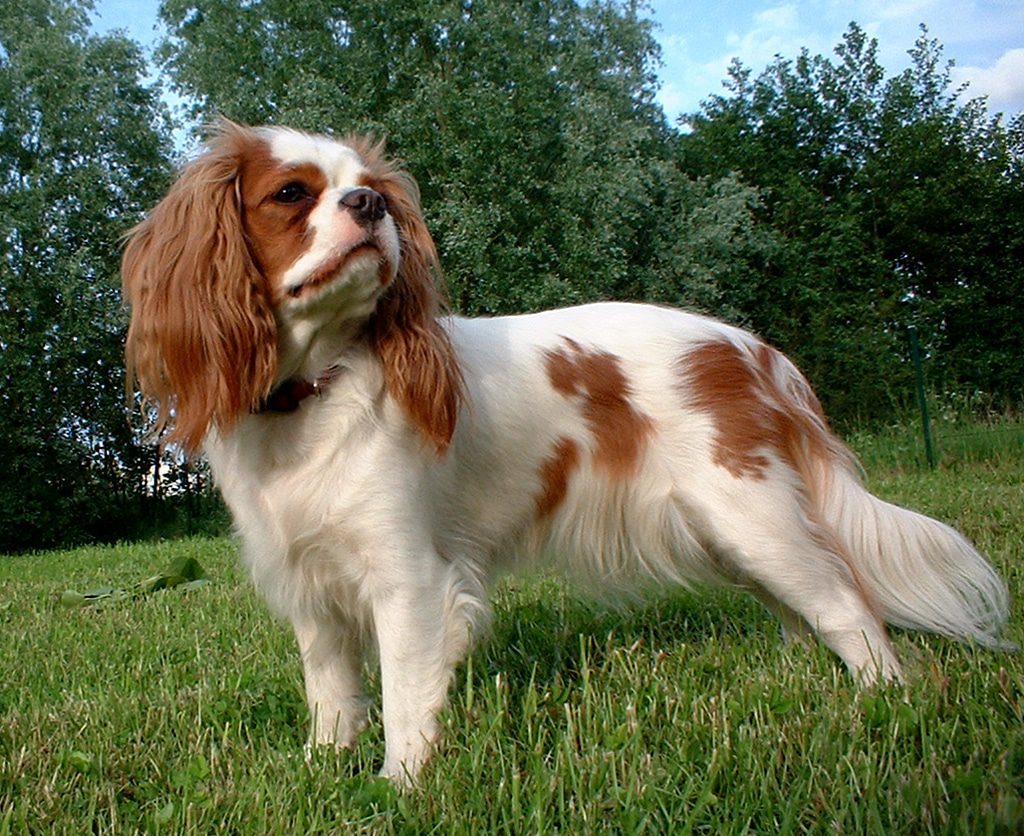
The eyes are large, round, well separated in the face. dark brown. The ears are placed high on the head, well separated, they are long with many fringes and moderately long hair (pen). Snout and bite: Slightly cropped. Length of the base of the stop to the tip of the nose must be of a 3,8 cm.. It prefers the Scissor bite. The tail has moderated with long fringe hair length (well defined pen). It keeps it behind the body, rarely higher than the back. It is always her moving when it is in action.

The height at the cross or the shoulders is of 30 to 33 cm and the weight of 4,5 to 8,2 kg.

The life expectancy of a Cavalier King Charles spaniel is of 11 to 12 years. Although there have been documented several cases that have managed to live until the 16 years.

The mantle is composed of soft hair, silky, of moderate length. It may be slightly hondeado. Should not cut you and has to be brushed frequently.

The colors of the mantle of this breed are basically four: Blenheim, Tricolor, ruby, Black and Brown.

  • Blenheim: base is White Pearl with well-defined chestnuts marks. The ears are the chestnut.
  • Tricolor: base is White Pearl with well defined black markings. The ears are black. On the eyes, cheeks, inside the ears and at the bottom of the tail is brown.
  • ruby: The solid reddish brown color is called a ruby.. Is considered a lack if you have white markings.
  • Black and Brown: is basic black with Brown markings above the eyes, cheeks, inside of the ears, on the chest, at the bottom of the tail and legs. Is considered a lack if you have white markings.

Character and skills

The Cavalier King Charles spaniel it is small, loving and playful. The typical Cavalier is always happy, confident and carefree, friend of everyone you know. Faithful to their heritage as โ€œprotection dogsโ€, to the Cavaliers they love to be on a lap.

The temperament of Cavalier goes from sweet and placid to tough and stubborn. Sweet and placid Cavaliers sometimes have the reputation of being fools, and stubborn for not being trainable, but in general, These dogs are intelligent and learn quickly. They respond well to positive reinforcement techniques, especially when they offered food rewards, but the harsh words will leave them or even try to hide. One Cavalier should never be shy or aggressive towards people or other dogs.

The Cavalier King Charles spaniel, ranks 44 on Stanley Coren's list of "The intelligence of dogsโ€.

The Cavaliers they live to be with their people. Dogs generally love children and do well in families with older children who throw them a ball, They teach them tricks or just hang out with them. But, due to its small size, the Cavaliers They should be protected from clumsy toddlers who may fall on them or "pet" them too hard..

Some things to know about Cavaliers:

They love to lick, love to chase moving objects (especially Feathered) and can be manipulative when they want food (those eyes!). It is difficult or impossible to stop these behaviors, so it is necessary to find a way to avoid, how to keep the dog always tied in the cities and be firm when the Cavaliers wants to share the fries.

The Cavaliers is not perfect. any dog, no matter how pleasant it, You may develop obnoxious barking levels, digging and other undesirable behavior if you are bored, untrained or unsupervised.

Training of the Cavalier King Charles Spaniel

Start training your puppy the day you bring him home. Even at eight weeks old, He is able to absorb everything that can be taught. Don't wait until you have 6 months to start training or have to deal with more stubborn dog. If possible, Take it to a trainer so that when it is between 10 and 12 weeks old is a sociable dog. But, Note that many kinds of training puppies require certain vaccinations (such as kennel cough) stay up to date, and many vets recommend limited exposure to other dogs and public places until puppy vaccinations have been completed (including rabies, distemper and parvovirus).

Instead of formal training, you can start training your puppy at home and socialize with family and friends until immunizations are completed for puppies.

Talk to the breeder, Describe exactly what you want in a dog and ask for help choosing a puppy. Breeders see the puppies daily and can make amazingly precise recommendations once they know something about their lifestyle and personality.

ยซCavalier King Charles Spanielยป images

โ€œCavalier King Charles Spanielโ€ Videos

Cavalier King Charles Spaniel Facts

CAVALIER KING CHARLES SPANIEL || DEPORTIVO Dog Race, affectionate and calm || History รฐยฉ

Dogs 101- Cavalier King Charles spaniel

FIRST DAY WITH NEW PUPPY | Cavalier King Charles spaniel

Ratings of the โ€œCavalier King Charles Spanielโ€

Coexistence is important that you have with your new friend. Before considering the acquisition of a dog of the breed "Cavalier King Charles spaniel" you know certain factors. Not all breeds of dogs are apt to live in an apartment, you must take into account his character, their need for exercise, their interaction with other pets, their care and if you have small children, their level of tolerance towards them.

Adaptation โ“˜

5,0 of 5 stars (based on 1 review)

friendly dog โ€‹โ€‹โ“˜

5,0 of 5 stars (based on 1 review)

hair loss โ“˜

3,0 of 5 stars (based on 1 review)

Affection level โ“˜

5,0 of 5 stars (based on 1 review)

Need for exercise โ“˜

3,0 of 5 stars (based on 1 review)

Social need โ“˜

5,0 of 5 stars (based on 1 review)

Home โ“˜

5,0 of 5 stars (based on 1 review)

Toilet โ“˜

3,0 of 5 stars (based on 1 review)

Friendly with strangers โ“˜

5,0 of 5 stars (based on 1 review)

barking โ“˜

3,0 of 5 stars (based on 1 review)

Health โ“˜

4,0 of 5 stars (based on 1 review)

Territorial โ“˜

2,0 of 5 stars (based on 1 review)

Cat friendly โ“˜

3,0 of 5 stars (based on 1 review)

Intelligence โ“˜

4,0 of 5 stars (based on 1 review)

Versatility โ“˜

4,0 of 5 stars (based on 1 review)

Child friendly โ“˜

3,0 of 5 stars (based on 1 review)

joy โ“˜

3,0 of 5 stars (based on 1 review)

Surveillance โ“˜

3,0 of 5 stars (based on 1 review)

Breeders of the breed "Cavalier King Charles spaniel"

  • Bel Ami Cavaliers – Official FCI breeders with number 119/2019
    Afijo: 23747 (Alicante)
    Web: www.belamicavaliers.com
    Telephone 600 724 537
    Email: info@belamicavaliers.com
  • Mar Salinero Jara – 28460 The mills (Madrid)
    Afijo: De Somosaguas nยบ 17726
    In Facebook add to group: ยซCavalier King Charles SPAINยป
  • Nicoleta OpreaCherish Me Cavaliers (FCI official breeders with afijo 22487) – El Boalo (Sierra de Guadarrama) Madrid.
    Tel. 643190977 – Contact

Type and recognitions:

  • FCI CLASSIFICATION:
  • Group :
  • Section : . .

Federations:

  • FCI – Group 9: Section 7: English Toy Spaniels โ“˜
  • AKCToy โ“˜
  • ANKC – Group 1 (Toy) โ“˜
  • CKC – Group 5 โ€“ (Toy) โ“˜
  • โ€‹KC – Toy โ“˜
  • NZKCToy โ“˜
  • UKC – Group 8 – Companion dog โ“˜

FCI breed standard "Cavalier King Charles spaniel"

Origin:
United Kingdom

Date of publication of the valid original standard:
04.11.2008

Use:

Companion dog.


General appearance:

active dog, graceful and well balanced, with a friendly expression.


Behavior / temperament:

It is a sporting dog, affectionate without any shyness. Happy, friendly, non-aggressive and without any hint of nervousness.

Head:


Cranial region:
  • Skull: Almost flat between the ears.
  • Fronto-nasal depression (Stop): shallow.

facial region:

  • Truffle : Well developed and black in color, without flesh marks.
  • Snout : The distance from the base of the fronto depression?nasal to the tip of the nose is 1 1/2 inches (3,8 cm.). The muzzle gradually decreases toward the tip. The face is well filled under the eyes. Any hint of undesirable snipiness.
  • Lips : well developed, but without hanging.
  • Jaws/Teeth : Strong JAWS, with perfect scissor bite, regular and complete, that is to say, that the inner face of the upper incisors is in close contact with the outer face of the lower incisors; teeth should be implanted at right angles in the jaws.
  • Eyes :  Large, dark, round but not protuberant, quite far apart.
  • Ears : long, set high and covered with plenty of feather.

Neck:

Moderately long and slightly arched.

Body:

  • Back : Level.
  • Pork loin:   Short.
  • Breast  : Moderately developed with well sprung ribs.

Tail:

The length of the tail should be in harmony with the body, well established, carried happily but never over the dorsal line. His amputationpreviously  optional when no more than a third should be amputated.

Tips

Former members

Straight limbs and moderately developed bones.
  • Shoulder : well laid.

Later members

Bones moderately developed.
  • Knees : Well angulated.
  • Hocks : They should not show any hint of being cow-shaped or sickle-shaped..


Pies : compacts, footpads with thick and well covered with long hair flecoso.

Movement:

Movement of moving and elegant with a lot of drive from hindlimbs. Seen from the front from behind, the forelimbs and later move in a plane parallel.

Mantle

Fur

Long, silky, and without curling. A slight undulation is allowed. With many fringe. Do not cut at all.

Color

The colors are recognized :
  • Black and Tan : glossy black with tan markings over eyes, cheeks, inside of the ears, on the chest, in the extremities and the lower part of the tail. Tan should be bright. The white spots are undesirable.
  • ruby : A uniform deep red color. The white spots are undesirable.
  • Blenhein : Bright brown spots well distributed on a white background. The spots should be divided equally over the head, leaving a space between the ears for a brand (lunar, lozenge mark)  much valued (a distinctive feature of the breed).
  • Tricolor : Black and white well spaced and distributed, blotchy fire on the eyes, cheeks, inside of the ears, on the inside of the lower limbs and tail.
 
Any other color or combination of colors is very undesirable.


Size and weight:

Among 12 and 18 English pounds (5,4 to 8 kg). a small well-balanced dog that is between these weights is desirable.


Fouls:

Any deviation from the aforementioned criteria should be considered as fault., and the seriousness of it is considered to the degree of deviation to the standard and its impact on health and welfare of the dog.

Any dog โ€‹โ€‹showing clear signs of physical or behavioral abnormalities must be disqualified..

disqualifying fouls:

  • Aggressiveness or extreme shyness.
  • Any dog โ€‹โ€‹showing clear signs of physical or behavioral abnormalities.


N.B.:
  • Males should have two normal-appearing testicles fully descended into the scrotum..
  • Only functionally and clinically healthy dogs, with the typical conformation of the breed, should be used for parenting.

The latest changes are in bold.

Source: F.C.I - International Cynological Federation

Alternative names:

1. Cavalier (English).
2. Cavalier (French).
3. Cavalier (German).
4. Cavalier (Portuguese).
5. Cavalier (espaรฑol).

Images:

-Image by Alexas_FotosenPixabay
Mario Simoes
– Kfiatek4300 [CC BY-SA 4.0], via Wikimedia Commons
– Bru-no(pixabay.com)

โ–ท The world of Pets: Dogs, cats, birds, reptiles, amphibians

Russkiy Toy
Rusia FCI 352 . Continental Toy Spaniel and others

Russkiy Toy

The Russkiy Toy he is incredibly loving and close to his family, with which you want to spend as much time as possible.

Content

History

The "Little Russian Dog" is a recent dog breed, but its history began in the 18th century, in Russia, with the importation of many English Toy Terrier. One of them was even adopted by Emperor Peter I the Great (1672-1725), during the last years of his life and his reign.

During the 18th and 19th centuries, the popularity of Toy Terrier rose among the Russian aristocracy. They became an essential element, and by the early 20th century they had clearly become a status symbol. Participating in cultural events and social gatherings with a well-behaved little dog became the norm of the good society of the time.

Although many of these dogs were imported from Great Britain, most were born in Russia, and a loose breeding program had already begun to gradually differentiate them from their ancestors. Present at Russian dog shows for some time, they began to officially call each other Russian toy terriers at an exhibition held in St. Petersburg in 1907, where they were exposed 11 specimens.

The revolution of 1917 I was going to change things: associated with the aristocracy, the Russian Toy Terrier experienced a sudden and brutal decline, that left him on the brink of extinction. A few breeders tried to preserve the breed, but they faced many difficulties at a time when dog breeding was run by the regime, which instead encouraged the development of dogs that could be used by the military.

The death of Josef Stalin in 1953 eased restrictions and some Moscow breeders, St. Petersburg, Svendlosk and Irkutsk were able to revive the breed. But after 40 years, there were no more specimens with perfectly known ancestry and pure characteristics, so they had to start from scratch, from individuals with characteristics similar to those previously known.

The year 1958 marked a turning point for the breed, when a guy named Chicky was born with long hair and fringed ears and tail. Until then, all representatives of the breed had a smooth and short coat. The breeder Yevghenina Zharova wanted to preserve these characteristics and crossed him with a female with a longer than average coat and started a specific breeding program.. His initiative was crowned with success: starting at 1966 and the creation of a specific standard, these dogs were considered as belonging to a breed other than the Russian Toy Terrier and they were called Moscow Longhaired Toy Terrier.

The year 1988 marked another turning point, because the Russian Cynological Federation (RKF), the reference organization in Russia, then decided to unify short hair and long hair again under the same standard, considering them as two varieties of the same breed.

In the following years, after the fall of the iron curtain in 1989, the first copies of Russian Toy Terrier They were able to go out to conquer Europe and the breed began to develop, in particular in Finland and in the Eastern countries.

But, the opening of the borders also brought about the entry of new breeds into Russia, who replaced local dogs in the hearts of dog lovers. As a result, in the decade of 1990, this dog was again on the brink of extinction in Russia. But, on the one hand, had already been imposed abroad and, for another, Russian breeders managed to maintain enough gene pool in their country to keep the breed healthy.

In the first decade of 2000, things sped up. In 2006, the Fรฉdรฉration Cynologique Internationale (FCI) recognized the breed provisionally and gave it the official name of Russkiy Toy, removing the name of Terrier. Two years later, in 2008, a breed club was founded in the United States (Russian Toy Club of America), and that same year the United Kennel Club (UKC) American also accepted the breed. El American Kennel Club (AKC) did the same in 2010 by including it in your Foundation Stock Service (FSS), a step prior to full recognition.

In 2017, the Russkiy Toy obtained the definitive recognition of the FCI, as well as the famous Kennel Club (KC) British. In fact, today it is recognized by most of the large national canine organizations – is the case, in particular, del Canadian Kennel Club (CKC), for example.

Today, the AKC is present in almost all of Europe, but it is still rare in the United States, which explains why the final recognition of the AKC is still pending.

In Great Britain, annual records around the KC have been around 50 since the acceptance of the breed in 2017.

This figure is higher in France, where they were registered between 100 and 150 births in the French Stud Book (LOF) in 2010, which shows that this dog, although it remains relatively discreet in the country, has managed to find its audience.

Photo: One Russkiy Toy of 20 meses by Skest at German Wikipedia, CC BY-SA 3.0, via Wikimedia Commons

Physical characteristics

The Russkiy Toy bears his name well, as it belongs to the smallest dog breeds in the world on the particular sides of the Chihuahua, of which it shares several characteristics.

Its square body with a raised belly is higher at the neck than the rump. The extremities, fine boned and lean muscled, they are quite long, giving the impression that they are high on the legs. The tail is relatively short, carried in the shape of a sickle or saber, and fringed in the case of long-haired dogs. In areas where tail docking is permitted, docked tail is accepted, as long as a stump is left with 2 to 4 vertebrae.

The head is small in proportion to the body, with a clearly marked stop. The muzzle is pointed and ends in a preferably black nose. The eyes are large, round and very expressive. your colour must be as darkest as possible. The ears, which are a distinctive feature of the breed, They are set high and sustained. Big and thin, they form two isosceles triangles in the skull. The long-haired variety is covered with long, thick hair that falls in a plume shape.

This dog has no undercoat. But, upper hair differs from dog to dog, to the point that there are two varieties of the breed: the one with straight hair is short, smooth and shiny, while the one with long hair has a medium length (of 3 to 5 cm.). The latter also have fringes on their ears and tail., that cover the entire outside of the ear when mature.

Multiple coat colors are allowed: black and tan, Brown and fire, Blue and fire, lilac and fire, and red with blue, brown or black. There are also some smooth dogs: his fur is red, leonado or cream. The most common color is black and tan.

Last, there is no real sexual dimorphism in this breed: males and females are roughly the same size and appearance.

Size and weight

Size: 20 – 28 cm.
Weight: 1 – 3 kg

Varieties

National and international canine associations usually distinguish between two varieties of Russkiy Toy: the of smooth hair, sometimes called shorthair, and the of Longhair. Although it is not usual, since the breeders of Russkiy Toy they usually specialize in one or the other, these varieties can be crossed: then mixed litters are obtained, composed of both short-haired and long-haired individuals.

The long-haired variety, with its specific fringes on the ears, is the most sought after by fans, and also the most common. It has a semi-long coat (between 3 and 5 cm.) in the body, while the tail and ears are covered with long, thick fur that forms characteristic fringes.

The straight hair variety, on the other hand, has a short smooth shiny looking top coat. Historically, the first representatives of the breed were all short-haired.

None of the varieties of Russkiy Toy has undercoat. In general, apart from its fur, are perfectly identical in character and physical characteristics.

Character and skills

The Russkiy Toy he is incredibly loving and close to his family, with which you want to spend as much time as possible. Your attachment can even turn into possessiveness and, if i wasn't well socialized, can be overtly threatening (insofar as your size allows) towards those who get too close to their master. He also tends to distrust strangers, at least at the beginning: if you see that they are invited to the house, quickly curious to know more about them.

If you are able to stay alone for a few hours, will quickly become anxious if absent for a long time (especially if this happens almost every day) and can then behave destructively. The presence of a small companion in the home can be a pertinent solution to help you not see time pass when your master is at work and reduce the risk of separation anxiety.. Usually, your pet will get along with other animals, already be partners, cats, rodents or reptiles, and this is usually the case even with those who do not live in your house. But, be careful not to be disturbed or scared by this barking and hyperactive puppy. And don't forget that a cat is usually much bigger, quick and better armed in case of discussion…

In any case, lives perfectly in an apartment, as long as your need for exercise is met. The latter is also relatively consistent due to its size., since it is necessary to travel it at least half an hour a day. In other words, carry you in a bag, in a dog stroller or even in the arms of its owner is not the best gift that can be given, since you need to stretch your legs. But, if you live in a house with a garden in the country, it can be dangerous to leave it alone in the garden, because its size makes it a potential prey for many wild animals: birds Raptors, foxes, weasels…

Like other miniature dog breeds, not really aware of the latter, so it is able to put itself in dangerous situations. No doubt, for example, to provoke a dog that weighs more than 20 times its weight, without worrying about the possible consequences. So, it is better to lead him on a leash when he goes out and teach him to curb his burning.

To the smart Russkiy Toy he likes to be stimulated intellectually. Dog games and puzzles can be a great way to keep him busy while his owners are out and about., and loves to learn new tricks. You can also participate in dog sports such as obedience and agility, but its small size makes it difficult to compete.

On the other hand, not recommended for families with young children. In effect, its small size and its fragility mean that it can be easily mistreated by the little ones, and the accident risks are very real – for the two protagonists, In addition. You can be seriously injured by a small car thrown at you in a moment of anger, just as he can respond by biting if his tail or ears are pulled. It also, a dog should never be left alone unsupervised with a young child, and that is valid whatever your race.

Last, the Russkiy Toy barks often. Its high-pitched voice is an excellent alarm in case of threat, but it is also likely to quickly anger the neighbors.

Education

Like all its fellow men, the Russkiy Toy needs to be socialized from the first weeks. This is all the more important as you tend to be cautious: only successful socialization can allow you to become a sociable and balanced adult. So, need to meet many people (family, friends…) but also other animals, be it dogs, cats or rodents.

The fact that he is intelligent and likes to be liked greatly facilitates his education. Learning to clean and remember orders is usually not a problem. If the family is patient and firm, it is possible to go much further, since they can also learn many tricks.

Positive reinforcement is the best method to reach and educate the best possible Russkiy Toy. The moods, caresses and treats are real motivations for him, and quickly learns to do everything possible to satisfy his Master.

In fact, the Russkiy Toy It is a breed of dog adapted for a beginner, but his master must never forget that a dog needs a leader to direct him. This leadership role, it is he who must exercise it. Your partner needs limits, which must be immutable, taxes from a very young age and consistent over time, as well as from one family member to another. If he is allowed to do what he wants when he is little, or if the rules are different depending on the day of the week or the person, you don't know what to expect and your behavior is affected.

This is the famous "small dog syndrome", common to all miniature breeds: little by little adopts unacceptable attitudes (do not leave space on the sofa, growl at his master, steal food…) but ignored by their master, who remains as if hypnotized by his small and "cute" companion. As nothing stops you, this laxity encourages him to push the limits further and further, to the point of gradually taking control of the house. The longer the owner waits to take control of the situation and allow bad habits to take root, the more difficult it will be for him to put his partner back in order. To avoid this, rules should be clear and instilled from the start, and then apply in all circumstances, without exception. In the same logic, it is not advisable to hold him in your arms too often, especially if it is about moving with him when he could just as well walk next to his master, because not only does it not help him to live his dog life and spend, but it can also provoke a tendency to dominate.

Health

The Russkiy Toy is particularly robust and poses little risk of disease.

But, it is sensitive to extreme temperatures and must be protected from both heat and cold. When the thermometer is rising, you should limit your activities to the coolest hours and not let it stay too long in the sun, while adog coatnot too much when you have to go out in cold weather. In any case, has no vocation to spend most of his time outdoors: its natural place is inside the house.

Among the conditions that can affect the breed, the most commons are:

  • impacted tooth, when a milk tooth does not fall out and therefore does not give way to a growing adult tooth. This is a fairly common problem, which is solved without great difficulty by a veterinarian;
  • the patellar dislocation, a kneecap problem: leaves its position and forces the dog to limp to move. This problem is relatively common in all small dogs and, sometimes, requires surgery;
  • the progressive retinal atrophy, degeneration of eye tissues leading to total blindness It is an inherited disease and carriers are normally excluded from reproduction, so it's still pretty rare;
  • the Legg-Calvรฉ-Perthes disease, which attacks the hip and causes necrosis that causes stiffness and pain., this disease is very rare and can be operated to relieve the pain caused.

But, the main risk to the health of the Russkiy Toy comes from its small size and fiery character, which can be the cause of many fractures. The fall of a book on its paws, A career that ends in a collision with a chair or an agitated argument with a larger fellow can end in the emergency room., your family must be constantly vigilant.

Another risk you are particularly exposed to is obesity, and once again only your master can help you.You need to monitor your weight regularly and act at the first signs of overweight, adjusting both your portion sizes and your activity level.

As with any race, the adoption of a creator of Russkiy Toy serious and responsible greatly increases the probability of obtaining a healthy puppy The professional must provide a certificate of good health issued by a veterinarian, Submit medical history or vaccination record, in which the vaccines administered to the animal are recorded, and make available the results of genetic tests performed to parents. a small one.

Of course, this does not guarantee that you will stay healthy for your entire life To maximize the chances of this being the case, prevention is essential: it is advisable to wear regularly (At least once a year) take your dog to the vet for a routine checkup.This not only identifies the beginning of a possible problem, it also ensures that you don't miss your shot reminders.

Life expectancy

12 to 13 years

Grooming

Either for the straight-haired variety or for the long-haired variety, the maintenance of the coat of the Russkiy Toy is simple. In effect, a weekly brushing is enough to avoid knots and remove possible dirt. Muda little, but it may be helpful to increase the frequency of brushing to 2 or 3 times a week when applicable, in spring and autumn.

How he tolerates the bathroom well, clean it every 1 or 2 months to rid it of all impurities and make sure it doesn't mess up the house is usually not a problem either. You just have to make sure you use a specific shampoo for dogs, and in no case a product made for humans.

The rest is a matter of course. These may include, their weekly grooming session should also be an opportunity to check and clean their eyes and ears with a damp cloth. This will prevent debris and dirt from accumulating, thereby reducing the risk of infection.

You should also take the opportunity to brush your dog's teeth with a special toothpaste for dogs, although twice a week (or even daily) it's even better. This will help prevent tartar buildup., that can cause bad breath, cavities and other problems.

Last, although it has gone out enough, their claws tend to grow faster than they wear out. Thus, it is necessary to trim them with a simple nail clipper when they have become too long, to prevent them from getting in the way or even breaking. A monthly cut is usually sufficient. The first time, you can learn how to do it with a vet or a groomer, to avoid doing it wrong.

Food

The Russkiy Toy perfectly fits commercially available industrial dog foods. You just have to be careful to choose a product adapted to dogs of this size, especially if you eat kibble. You also have to choose food of sufficient quality and establish an adapted daily ration to provide it with all the nutrients it needs., especially considering your activity level and your age.

In any case, cat food, although it certainly is the perfect size for its size, not at all adequate. Too rich, are likely to cause rapid and dangerous weight gain.

This is especially true since obesity is a very real problem for this breed whose needs are often much lower than their family thinks.. It is necessary to scrupulously follow the daily rations recommended by the manufacturers or the veterinarian, and regularly weigh your dog to quickly detect too large a variation. A weight gain of 200g is negligible for a human, but for a Russkiy Toy this is around the 10% of their normal weight.

In case of unjustified weight gain, it is advisable to react without delay, adjusting both the dog's daily ration and activity level. If this doesn't help, a visit to the vet is necessary to explore the possibility of a disease and to develop a more appropriate diet if this is not the problem.

Last, like all dogs, the Russkiy Toy you should always have access to a bowl of fresh water, so you can quench your thirst whenever you want.

Use

The Russkiy Toy is above all – and also always – a companion dog, made to spend most of his time with his family. Playful and affectionate, perfectly capable of apartment living, represents an ideal option for those who have little space to offer their dog, but on the other hand they may be available to dedicate time.

His affectionate character also makes him a very good therapy dog, able to spend hours by his master's side if he needs it, and to help you with your mere presence.

His natural distrust of the unknown and his propensity to bark make him an excellent alert dog., but its size prevents it from being a true watchdog, although his bravery is not questionable.

Last, it is common to find it at dog shows, where your success is not denied. They can also participate in dog sports competitions, like obedience, but its small size is definitely a disadvantage.

How much does a "Russkiy Toy"?

The price of a puppy Russkiy Toy is of some 1500 EUR, but this average hides great disparities. In effect, depending on the reputation of the kennel, of the prestige of their ancestors but also and above all of their intrinsic physical characteristics, can go from 800 euros for the copies with some small defects up to almost 4000 euros for those intended for breeding and/or exhibitions. On the other hand, there are no big price differences according to gender.

Characteristics "Russkiy Toy"

Coexistence is important that you have with your new friend. Before considering the acquisition of a dog of the breed "Russkiy Toy" you know certain factors. Not all breeds of dogs are apt to live in an apartment, you must take into account his character, their need for exercise, their interaction with other pets, their care and if you have small children, their level of tolerance towards them.

Adaptation โ“˜

2,0 of 5 stars (based on 1 review)

friendly dog โ€‹โ€‹โ“˜

5,0 of 5 stars (based on 1 review)

hair loss โ“˜

1,0 of 5 stars (based on 1 review)

Affection level โ“˜

5,0 of 5 stars (based on 1 review)

Need for exercise โ“˜

3,0 of 5 stars (based on 1 review)

Social need โ“˜

5,0 of 5 stars (based on 1 review)

Home โ“˜

3,0 of 5 stars (based on 1 review)

Toilet โ“˜

1,0 of 5 stars (based on 1 review)

Friendly with strangers โ“˜

3,0 of 5 stars (based on 1 review)

barking โ“˜

4,0 of 5 stars (based on 1 review)

Health โ“˜

4,0 of 5 stars (based on 1 review)

Territorial โ“˜

3,0 of 5 stars (based on 1 review)

Cat friendly โ“˜

3,0 of 5 stars (based on 1 review)

Intelligence โ“˜

4,0 of 5 stars (based on 1 review)

Versatility โ“˜

2,0 of 5 stars (based on 1 review)

Child friendly โ“˜

5,0 of 5 stars (based on 1 review)

Surveillance โ“˜

3,0 of 5 stars (based on 1 review)

joy โ“˜

4,0 of 5 stars (based on 1 review)

Images "Russkiy Toy"

Photos:

1 – ยซLittle Russian dogยป by Ernst Vikne, CC BY-SA 2.0, via Wikimedia Commons
2 – ยซLittle Russian dogยป puppy, 4 months old by Shamanofthistown, CC BY-SA 3.0, via Wikimedia Commons
3 – ยซLittle Russian dogยป short hair, smooth coat, brown and tan by NiaNike, CC BY-SA 4.0, via Wikimedia Commons
4 – A short haired ยซLittle Russian dogยป by Ernst Vikne, CC BY-SA 2.0, via Wikimedia Commons
5 – Two ยซLittle Russian Dogยป, one with short hair and one with long hair by Ernst Vikne, CC BY-SA 2.0, via Wikimedia Commons
6 – ยซLittle Russian dogยป Daniel, Rostov del Don by Sofiya357, CC BY-SA 3.0, via Wikimedia Commons

Videos "Russkiy Toy"

Type and recognitions:

  • FCI CLASSIFICATION:
  • Group :
  • Section : . .

Federations:

  • FCI – Group 9: Section 9: Continental Toy Spaniel and others โ“˜
  • AKCToy โ“˜
  • CKC – Group 5 โ€“ (Toy) โ“˜
  • โ€‹KC – Toy โ“˜
  • UKC – Group 8 – Companion dog โ“˜

FCI breed standard "Russkiy Toy"

Origin:
Russia

Date of publication of the valid original standard:
21.02.2006.

Use:

Toy dog.


General appearance:

A fancy little dog, lively, high legged, with thin bone and dry muscles. Only somewhat definite sexual dimorphism.

important proportions: Square construction. The height at the elbows is only slightly higher than half the height at the withers.. The chest is deep enough.


Behavior / temperament:

Active, very happy, neither cowardly nor aggressive. Behavior is significantly different between males and females.

Head:

Small compared to the body.

Cranial region:
  • Skull: Tall but not wide (the width at the level of the zygomatic arches does not exceed the depth of the skull).
  • Stop (Naso-frontal depression): Clearly pronounced.

facial region:

  • Nose: Small, black or according to the color of the coat.
  • Snout: Clean and sharp, slightly shorter than the skull.
  • Lips: Fine, dry, tight and dark or according to the color of the coat.
  • Jaws / Teeth: Small and white. Scissor bite. Lack of 2 incisors is allowed on each jaw.
  • Cheeks: Only somewhat pronounced.
  • Eyes: So big, round, slightly prominent, inserted well apart and facing straight forward. Dark eyelids or according to the color of the coat, tight.
  • Ears: Large, fine, high insertion, upright.

Neck:

Long, clean. Carried high, slightly arched.

Body:

  • top line: Gradual fall from withers to insertion of tail.
  • Cross: Slightly pronounced.
  • Back: Strong and straight.
  • Pork loin: Short and slightly arched.
  • Rump: The rump is somewhat rounded and slightly sloping..
  • Breast : The chest is oval and deep enough and not too wide.
  • Bottom line and abdomen: Retracted abdomen and stretched flanks, forming a curved line from the chest to the flanks.

Tail:

amputee: (only two or three vertebrae are left), carried high. In countries where tail docking is prohibited by law, it is left natural. Without amputating: sickle-shaped, It should not be lower than the top line level..

Tips

Fine, clean. Seen from the front the limbs are straight and parallel.

Former members

  • Blades: The scapulae are moderately long and not very sloping.
  • Humerus: Forms an angle of 105 degrees with the scapula. The length of the humerus is approximately the same as that of the scapula.
  • Elbow: In line with the body.
  • Forearm: Long and straight.
  • Carpo: Cleansed.
  • Metacarpus: Almost vertical.
  • Previous feet: Small, oval neither in nor out, fingers together and arched. Nails and pads black or according to the color of the coat.

Later members

Seen from behind the hindlimbs are straight and parallel, but a little more separated than the previous members. The knee and hock with sufficient angulation.

  • Thighs: Clean and developed muscles.
  • Leg: The femur and leg are the same length.
  • Hock: Sufficiently angled.
  • Metatarsus: Vertical.
  • Hind feet: Arched, a little narrower than the front feet. Nails and pads black or according to the color of the coat.

Movement:

Easy, straight ahead and fast. No change should be noticed in the top line when in motion.

Mantle

Fur

 Exist 2 guys for the breed, short hair and long hair.

  • Short hair: short, glued, bright, no under-hair or peeling patches.
  • Long hair: the body is covered with moderately long hair (3 โ€“ 5 cm.) straight or slightly wavy, glued, that does not hide the natural figure of the body. Hair on the head and front of the limbs is short and close together. Notable fringes on the back of the limbs. The feet have long hair, silky that completely hides the nails. The ears are covered with thick hair forming fringes. Dogs over 3 years present these fringes, with which they completely cover the edge and tip of the ears. Body hair should not look messy or be too short (less than 2 cm.).

Color

black and tan, Brown and fire, Blue and fire. Also red in any shade with or without black or brown carbon. Stronger hues are preferable for all colors.


Size and weight:

  • Height to the cross: Males and females: 20 โ€“ 28 cm. (tolerance +/-1 cm.)
  • Weight: Males and females: until 3 kg.


Fouls:

Any deviation from the aforementioned criteria is considered as a fault and the severity of this is considered to the degree of the deviation to the standard and its consequences on the health and well-being of the dog..

  • Shy behavior.
  • Pincer bite or incisors tilted forward.
  • Semi-erguidas ears. This condition in long-haired dogs with heavy fringes is allowed but not desired..
  • Low tail insert.
  • Presence of bald patches in short-haired dogs.
  • Too long or too short hair in long-haired dogs.
  • Small white spots on the chest or fingers.
  • Negro, solid brown or blue. Burnt marks too large or with dark shading.

disqualifying fouls:

  • Aggressiveness or extreme shyness.
  • Enognathism or pronounced prognathism. Absence of 1 canine; absence of more than 2 incisors on each jaw.
  • hanging ears.
  • Short members.
  • Many bald patches on short-haired dogs.
  • Long-haired dogs: absence of fringes on the ears and presence of curly hair.
  • White cloak, white spots on the head, abdomen and above the metacarpals; large white patches on the chest or throat, presence of brindle markings.
  • Size greater than 30 cm.. the smallest to 18 cm..
  • Weight less than 1 kg.

Any dog โ€‹โ€‹showing clear signs of physical or behavioral abnormalities must be disqualified..


N.B.:

Males should have two normal-appearing testicles fully descended into the scrotum..
Only functionally and clinically healthy dogs, with the typical conformation of the breed, should be used for parenting.

Source: F.C.I - International Cynological Federation

Alternative names:

1. Russian Toy Terrier, Russian Terrier, Moscow Toy Terrier, Moscovian Miniature Terrier, Toychik (English).
2. Toychik, Toy-chic (French).
3. Russischer Zwergspaniel, Moskauer Langhaariger Toy Terrier (ะผะพัะบะพะฒัะบะธะน ะดะปะธะฝะฝะพัˆะตั€ัั‚ะฝั‹ะน ั‚ะพะน-ั‚ะตั€ัŒะตั€) (German).
4. (em russo: ะ ัƒััะบะธะน ั‚ะพะน-ั‚ะตั€ัŒะตั€) (Portuguese).
5. Miniatura ruso, Toy Terrier ruso (espaรฑol).

โ–ท The world of Pets: Dogs, cats, birds, reptiles, amphibians

Poodle
Francia FCI 172 . Poodle

Caniche

The Poodle is a CF dog, joyful, Nice, curious and intelligent.

Content

History

The Poodle is a breed of dog, from the fifteenth century to the present day, It is considered to be of exclusive use for the luxury of the aristocrats and nobles. Known for its woolly and curly coat, There are four varieties: Grand, Medium-, Dwarf and Toy.

Until the Renaissance, This was a collector of water dog, they retrieved the already hunted prey that had fallen into the water, such as ducks and swans.

In each language, the poodle Gets a different name:

  • English: Poodle, French Poodle
  • French: Caniche, Chien Canard
  • German: Pudel
  • Italian: Barbone Nano, Barboncino
  • Spanish: Caniche

From France, the Poodle is a descendant of Barbet, original German swamp; and in the middle ages, He was assigned to tumble as duck or goose birds hunting, so it was selected for characteristics such as its adaptability to boggy terrain and its resistance to water, What makes this breed, along with others are called water dogs.

From the 16th century, the poodles began to be famous for her beauty and intelligence, especially in various circus performances and works of art by various authors as Albrecht Dรผrer and Francisco de Goya. In the times of Louis XVI of France, their presence in the French court was already very common..

By changes in taste in its appearance, during the 19th century the protection of the fur that was scorned, until then, had the function of protecting him from hypothermia, What stylists began to create various courts such as the British Montano and the Continental. For the poodle newborns, began the custom of amputate the tail.

The Franco-Prussian War began the dissemination of the race as such, intended for millionaires and aristocrats. In the 20th century, only dominated the giant variety, Therefore, later, with the approval of the Canine Associations โ€”such as the Kennel Clubโ€” the Standard varieties emerged. (low diffusion from 1792), Miniature (1911) and Toy (1957). In the final years of the 20th century the hybrid breed emerged ยซLabrapoodlesยป (combination of Poodleand with Labrador).

Did you know??

These canines curly hair are often considered the national dog of France, although the breed originated in Germany.

Physical characteristics


The four varieties of Poodle:

Poodle large:

Is believed to be the original variety of which emerged the other varieties, through crossings to reduce the size. The height at the withers varies from 45 to 60 cm., is supported 2 cm over, provided that the copy keep proportions. Y, they weigh around 30 kg.

Medium Poodle (or standard):

This type of poodle is perhaps, the less well known, and at the same time the more quiet. Measures of 36 to 44 Cross cm, and as in all sizes, just accept the plain colors in fur. The weight is commensurate with its size.

Miniature Poodle:

This variety has a height to the cross 28 to 35 cm.. You have to look like a medium-sized Caniche, but smaller and show no signs of dwarfism. As in the larger varieties, they are judged grouped by colors.

Toy Poodle:

The variety has a height of between 24 and 28 centimeters at the withers or height, provided that the proportions are maintained and that they do not present any symptoms of dwarfism. Are judged all together colors.

Depending on your health, a miniature poodle lives on average 14,8 years; one Toy 14,4 years; a medium Poodle also 14,4 years, and a Large Poodle live media 13,5 years. Although these data are quite accurate, It is not uncommon to see poodle small, of more than 18 years, or even of 20.

In the exhibitions held under the rules of the FCI, copies of black, White and Brown are judged in the same group to obtain the CACIB. The same applies to copies of grey, Apricot and Red; the best of each of these groups becomes a final judgment to determine the best copy of the variety.

For your care, Peel according to your style, requiring a dog hairdresser. Accepted the hair in the form of long-haired head, ears and neck, including legs. They do not loose too much hair and health must clean the eyes and ears. They should be washed with some frequency. The care of the fur is unconditional in this breed, so it is necessary to wash with exclusive dog shampoo and in no case with human shampoo, that damages the skin of the Caniche because it causes you to lose the natural oil that has in its hair and, in the long run, brings complications.

Their care has to be very guarded, because due to his long-haired Kale, thick and woolly, of a single type of hair, It can tangle with ease. They require cepillados every week (without going).

The baths should be monthly (It is not advisable or necessary to abuse these) with moisturizing shampoos and masks. It has to be dried with a dryer and never air. They are dogs that after the silent main hair puppy to adult not move almost hair and are nearly hypoallergenic.

There are many types of court, but students admitted for exhibition: Continental, Continental American, Scandinavian and Puppy Clip. The Court will be based on the structure of the dog and the taste of exhibitor or owner, the most widely used is the American Continental.
Apart from the common poodle, There is also the variety Cordelรฉ, taking this more curly hair and being able to display in the form of strings as the Puli.

Health Poodles

Not all of these diseases affect standard poodles, but the conditions that can generally occur in poodles include the following:

Addison's disease and Cushing's syndrome are two sides of the same coin. In dogs with Addison's disease, the adrenal glands produce insufficient amount of the hormone cortisol. Dogs become lethargic, intolerant and depressed stress, and may have digestive problems. Some dogs may have an acute crisis, requiring hospitalization. The lifelong treatment involves the administration of drugs.

In dogs with Cushing's syndrome, the adrenal glands produce too much cortisol. Symptoms include weight gain, gasps, excessive thirst and hunger, bladder infections and urinating in the house but the dog has been previously trained. Cushing's disease is usually controlled with medication for life, but sometimes surgery is necessary.

Another hormonal problem seen in poodles is hypothyroidism (An inappropriate thyroid hormone). Symptoms include weight gain, loss of hair, lack of resistance to disease, excessive hunger and heat seeking. Normally supplements prescribed thyroid hormone to control the condition.

Progressive retinal atrophy (ARP) is an eye disease that can eventually lead hereditary blindness. Standard other potential eye problems in poodles and toy are cataracts and glaucoma. Poodles can also be affected by von Willebrand's disease (a disorder of blood clotting).

Although all Poodles, regardless of size, They are of the same "breed", They not all have the same health problems. Poodles toy and miniature poodles share many common health problems for smaller breeds of dogs, as kneecaps that easily out of place (You dislocated kneecaps), breathing difficulties caused by a collapse of the trachea and dental problems due to the overcrowding of teeth within their small mouths.

The Toy Poodles can also suffer Legg-Calvรฉ-Perthes disease, which causes a reduction of the blood supply to the head of the bone of the thigh, causing degradation. The first sign of this disease is lameness, that usually appears when the puppy has to 4 to 6 months of age. Treatment is surgical, after which the puppy can lead a relatively normal life apart from a greater chance of developing arthritis.

Standard Poodles, like many large breeds deep chest, They have an increased risk of swelling, also known as gastric dilation volvulus, a life-threatening condition in which the stomach twists on itself, trapping air inside. Swell dogs require immediate veterinary care and, usually, surgery to correct the problem. Since most dogs that swell once swell again, The surgeon may also recommend a procedure known as a "stomach turn" or gastropexy., as a preventive measure.

A skin problem that can affect the toy poodles and standard is the sebaceous adenitis, an inflammation of the sebaceous glands that causes hair loss and skin problems. It can be diagnosed with a skin biopsy, but the effectiveness of treatment varies.

Hip dysplasia is an orthopedic problem beginning at puppyhood. Is a malformation and poor fit of the joint of the ball and socket hip. It may be a minor problem or life-altering disability. Treatment can range from something as simple as daily medication to major surgery., even a hip replacement.

Last, Standard Poodles have a higher incidence of certain cancers, including insulinoma and hemangiosarcoma, compared to some other breeds.

Not all of these conditions are detectable on a growing puppy, and it can be difficult to predict whether an animal will be free of these diseases, so it is necessary to find a reputable breeder who commit to raise healthier animals possible. Must be able to produce an independent certification that the parents of the dog (and grandparents, etc.) have been screened for these defects and considered healthy for breeding. That's where health records come in..

Careful breeders screen their breeding dogs for genetic diseases and breed only the healthiest and best looking dogs, but sometimes Mother Nature has other ideas and a puppy develops one of these diseases despite good husbandry practices. Advances in veterinary medicine mean that in most cases dogs can still live a good life.

Character and skills

Intelligent, loving, legal and naughty, those are the four words that the poodle enthusiasts describe the personality and character of this breed.

Despite his actual appearance, the poodle has a playful side, likes to interact with their owners, tends to be very friendly with people and always likes to please.

If we combine his legendary intelligence with its sociability gives as a result a dog highly entrenable.

A poodle, you have been taught canine manners, will have a quiet character, especially if you exercise regularly to burn off your natural energy.

The poodle is a protective dog that will not hesitate to use its bark when a stranger approaches its home., and although he is affectionate with the family, can take you some time socializing with other people.

An outstanding feature of the poodle is their intelligence (occupies the position No. 2 on classification of intelligence dog breeds by Stanley Coren).
It is often said that they have a human intelligence, an incredible cunning that amazes its owners. Of course, smart dogs can be tricky. They learn fast, both the bad and good habits

Basics of grooming poodles

The toilet is an important consideration in Poodles. Fine and curly coat that worked well when the Poodle spent his time in the water needs to be trimmed regularly, normally every 6 u 8 weeks, depending on the preferences of its owner. It easily fits and requires regular brushing at home, even with a professional grooming. If left untrimmed, coat will curl naturally strings, although some people prefer that aspect.

Dental care is important, particularly for Poodles Toys and Miniatures. Keep the much brushing her teeth with toothpaste approved by the vet pet and making a veterinarian make regular dental checkups.

Trim nails as needed, usually every week or two. They should not be so long that you can hear the click on the ground.

Characteristics "Poodle"

Coexistence is important that you have with your new friend. Before considering the acquisition of a dog of the breed "Poodle" you know certain factors. Not all breeds of dogs are apt to live in an apartment, you must take into account his character, their need for exercise, their interaction with other pets, their care and if you have small children, their level of tolerance towards them.

Adaptation โ“˜

5,0 of 5 stars (based on 1 review)

friendly dog โ€‹โ€‹โ“˜

4,0 of 5 stars (based on 1 review)

hair loss โ“˜

1,0 of 5 stars (based on 1 review)

Affection level โ“˜

5,0 of 5 stars (based on 1 review)

Need for exercise โ“˜

4,0 of 5 stars (based on 1 review)

Social need โ“˜

5,0 of 5 stars (based on 1 review)

Home โ“˜

5,0 of 5 stars (based on 1 review)

Toilet โ“˜

5,0 of 5 stars (based on 1 review)

Friendly with strangers โ“˜

4,0 of 5 stars (based on 1 review)

barking โ“˜

3,0 of 5 stars (based on 1 review)

Health โ“˜

3,0 of 5 stars (based on 1 review)

Territorial โ“˜

4,0 of 5 stars (based on 1 review)

Cat friendly โ“˜

4,0 of 5 stars (based on 1 review)

Intelligence โ“˜

5,0 of 5 stars (based on 1 review)

Versatility โ“˜

5,0 of 5 stars (based on 1 review)

Child friendly โ“˜

5,0 of 5 stars (based on 1 review)

Surveillance โ“˜

4,0 of 5 stars (based on 1 review)

joy โ“˜

4,0 of 5 stars (based on 1 review)

Breeders of the breed "Poodle"

  • Alderrabel Toy Poodles – Afijo 1670 of 1982 – FCI 0139/82 – Occasionally toy poodle puppies sons of champions for show or as a pet. Madrid.

  • Villacoral Cattery – We carry out responsible animal husbandry with veterinarians and a team of professionals, No dog is left over at Criadero Villacoral, being responsible for what sustainable breeding is.. – Jaรฉn (Spain) – Telephone 666450361

  • Jontari Poodles – Toy poodle kennel in white colors, black, grey, red, apricots and giant in white color. High selection, puppies for show and company. Our priority is to preserve and perfect the characteristics of this fabulous breed.
    Her/Vera de Bidasoa โ€“ Navarre (Spain)

Poodle images

Poodle Videos

Type and recognitions:

  • FCI CLASSIFICATION:
  • Group :
  • Section : . .

Federations:

  • FCI – Group 9 Section 2 "Poodle" โ“˜
  • AKC – Toy Group โ“˜
  • ANKC – Toy Group 7 (Non-Sporting) โ“˜
  • โ€‹KC – Toy Utility โ“˜
  • CKC – Group 5 – Toys โ“˜
  • NZKC – Non-sporting toy โ“˜
  • UKC – Company โ“˜

FCI breed standard "Poodle"

Origin:
France

Date of publication of the valid original standard:
03.11.2014.

Use:

Companion and Toy Dogs


General appearance:

Medium proportions dog, characteristically curly hair, Kinky or in the form of locks. It has the appearance of an intelligent animal, constantly alert, Active, harmoniously constituted, and that reflects elegance and nobility.

important proportions:
  • The length of the muzzle is approximately 9/10 the length of the skull.
  • Length (scapular-ischial) the body is slightly greater than the height at the withers.
  • The height of the cross to the ground is visibly equal to the height of the crest of the rump to the ground.
  • The elbow to the ground is equivalent to 5/9 the height at the withers.


Behavior / temperament:

This animal is distinguished by his loyalty and his aptitude to learn and to be trained, which makes him a particularly pleasant companion dog.

Head:

Distinguished consignment note, rectilinear, in proportion with the body. It must be well molded, without presenting a solid appearance, but at the same time without excessive delicacy.

Cranial region:
  • Skull: Its amplitude is less than half the length of the head. All of the skull, seen from above, oval shaped, and profile, is slightly convex. The axes of the skull and nasal channel are slightly divergent. The superciliary arches are moderately prominent and are covered with long hairs.
  • Front Groove: Width between the eyes and decrease in the direction of the occiput, It is well marked (in the dwarf poodles may be less marked).
  • Depression links: It is little marked.

facial region:

  • Truffle: Marked and developed, vertical profile; the Windows are wide open. The truffle is black in black dogs, White and gray, and Brown in brown dogs. In tawny Orange dogs (apricot) or Griffon Red truffle is black or brown.
  • Snout: The upper profile is very straight, its length corresponds to 9/10 the length of the skull. The ramifications of the lower jaw are nearly parallel. The snout is solid. The lower profile is marked by the jaw and not by the edge of the upper lip.
  • Lips: Slightly developed, rather thin, medium-thick; the upper lip rests on the lower, Although it is not hanging. They are black in black dogs, White and gray, and Brown in brown dogs. In tawny Orange dogs (apricot) or red Fawn, they are brown more or less dark or black. The corner should not be marked.
  • Jaws/teeth: The joint is in the form of scissors. The teeth are solid.
  • Cheeks: They are slightly protruding and are molded on the bones. The sub-orbital arches are chiseled and not very bulky. The zygomatic arches are some prominent.
  • Eyes: Are ardent expression. They are situated at the height of the depression sloping and slightly oblique. Almond shaped. Its color is dark brown or black. In the brown-colored dogs can be dark amber.
  • Eyelids: The edge is black in black dogs, white or gray; brown in brown dogs. In tawny Orange dogs (apricot) or red Fawn, are brown or black.
  • Ears: They are quite long and falling along the cheeks. They are implanted in the extension of a line that arises from the upper part of the nose and passes under the external corner of the eye.. They are flat, They enlarge behind implantation and are rounded at the tip. They are covered with very long wavy hair. The skin of the ear should reach the corner of the lips.

Neck:

It is strong and slightly arched behind the neck. Medium length, well proportioned. The dog is wearing highly raised head and nobility. The neck does not have double chin. Is oval cut; its length is slightly lower than the head.

Body:

Well proportioned. Its length is slightly greater than the height at the withers.

  • Cross: Moderately developed.
  • Back: Short. The upper margin is harmonious and very firm. The height from the floor to the cross must be clearly the same as the crest of the rump to the ground.
  • Pork loin: Strong and muscular.
  • Rump: Rounded, but not fall.
  • Sill: The tip of the sternum must be slightly prominent and is quite high.
  • Breast : Inclined to the elbow. Its width is equal to the 2/3 your height. In large poodles, chest circumference, measured behind the shoulders should be at least 10 cm greater than the height at the withers. The chest is oval and wide back.
  • Bottom line and belly: Raised, but not agalgados.


    Tail:

    Set quite high, at the height of the margin of the spine. You can retain its natural length or be cut by a third, as close as possible to the body, or half its natural length. When the dog is at rest the tail appears drooping. When is the dog in action, rises at an angle.

    Tips

    Former members

    They are perfectly straight and parallel, well muscled and strong bones. The height of the elbow to the ground is slightly greater than the height at the withers.

    • Shoulder: They are oblique and muscular. The shoulder blade and humerus form an angle of about 110ยฐ.
    • Arm: The length of the humerus corresponds to that of the shoulder blade.
    • Carpi: They continue the previous line of the forearm.
    • Metacarpus:  Solid, and almost straight, viewed profile.
    • Pies: They are rather small, firm, short oval shaped. Fingers are arched and well together. The pads are tough and thick. The nails are black in black and grey dogs; black or brown in brown dogs. In white dogs, the nails may present the range of colors of Horn, as much as the black. In tawny Orange dogs (apricot) tawny red and, they are brown or black.


    Later members

    Seen from the back, the hind limbs are parallel; the muscles are well developed and well visible. The Hock is well bent. The coxofemoral angles, tibio-femoral and warm-tarsal should be marked.

    • Thighs: They are well muscled and robust.
    • Metatarsals: Fairly short and vertical. The poodle must be born without spurs on the hind limbs.
    • Pies: See previous tips.


    Skin

    It is flexible, without laxity, Pigmented. Black poodles, brown, Gray and tawny orange or reddish Fawn, They must have a pigmentation according to the color of the fur. In white, the silver skin is valued.

    Movement:

    The poodle moves with small jumps fast and light.

    Mantle

    Fur

    • Poodle Kinky hair: abundant hair, texture fine, woolly, well curly; It is elastic and resistant to the pressure of the hand. You must be a dense, well plenty, of uniform length, forming regular loops.
    • Poodle hair in the form of locks: Abundant hair, texture fine, woolly and tight. It forms characteristic strings that must measure at least 20 cm..


    Color

    A single colored hair: black, white, brown, grey, leonado orange (apricot) tawny red and.

    • Brown:  It must be pure, quite dark, uniform and warm. Not even beige, or lighter derivatives.
    • Gris: It must be uniform, a pure tone, or blackish, or whitish.
    • Tawny Orange: It should be a uniform tone, without pulling the pale Griffon or color sand, or to the Red Fawn.
    • Griffon Red: It must be of a uniform tone in all the fur. In no case should you shoot the orange fawn.

    The eyelids, the truffle, the lips, the gums, the palate, natural holes, the scrotum and the pads are well Pigmented.


    Size and weight:

    • Poodle large: Above the 45 cm. up the 60 cm., with a tolerance of 2 cm.. The large poodle must be enlarged and developed the medium poodle reproduction, of which it has the same characteristics.
    • Poodle medium: Above the 35 cm. up the 45 cm..
    • Poodles dwarves: Above the 28 cm. up the 35 cm.. The poodle dwarf must have, altogether, the appearance of a small medium poodle, maintain the same proportions as much as possible and not present any appearance of โ€œdwarfismโ€.
    • Poodles Toys: Above the 24 cm. up to 28 cm. (the ideal type is that of the size of 25 cm.) and up 24 cm. (with a tolerance of less of 1 cm.). Toy poodle has, altogether, the appearance of the dwarf poodle, and saves the same general proportions that meet all the requirements of the standard. Any feature of โ€œdwarfismโ€ is excluded.. Only the occipital Crest may be less marked.


    Fouls:

    Any deviation from the aforementioned criteria is considered as a fault and the severity of this is considered to the degree of the deviation to the standard and its consequences on the health and well-being of the dog..

    • Eyes that are too large and too round or sunken, not dark enough.
    • Too short (not reaching the corner of the mouth).
    • Weak or pointed snout.
    • Muzzle with convex upper profile.
    • Upholstered or saddled top line.
    • Tail set too low.
    • fallen group.
    • Posterior angulation too straight or over-angled.
    • Fluent or extended step.
    • Sparse hair, soft or wire.
    • Undefined or not solid color.
    • Truffle partially nonpigmented.
    • Absence of 2 PM2.


    disqualifying fouls
    • Aggressiveness or extreme shyness.
    • Any dog โ€‹โ€‹showing clear signs of physical or behavioral abnormalities.
    • Lack of type, above all in the head, notably hinting at a cross with another breed.
    • Height at the withers exceeding 62 cm.. in the great and less than 23 cm.. in the Toys.
    • No tail or naturally short tail.
    • Dewclaws or trace of dewclaws on hindlimbs.
    • Any animal that presents traits of โ€œdwarfismโ€: globular skull, absence of occipital crest, very marked naso-frontal depression, prominent eyes, very short, downturned snout.
    • Medium practically non-existent Groove.
    • Very light bone in Toys.
    • Fully curled tail.
    • Cloak other than solid color (unicolor).
    • All white markings on the body and / or feet for all colors except white.
    • Completely depigmented nose.
    • Upper or lower prognathism.
    • Any tooth whose position could hurt the dog (for example inwardly grown canines touching the roof of the mouth).
    • Absence of an incisor, of a canine or a carcass tooth.
    • Absence of a PM3 or an PM4.
    • Absence of 3 or more PM (except PM1).


    N.B.:
    • Males should have two normal-appearing testicles fully descended into the scrotum..
    • Only functionally and clinically healthy dogs, with the typical conformation of the breed, should be used for parenting.


    Hair styling and haircut authorized at the exhibition

    โ€œLionโ€ arrangement and cut:  Whether the poodle have in the form of locks or Kinky hair, You must be sheared on the back room until the ribs.

    • They must also shear: the upper and lower part of the nose, starting from the lower eyelids; cheeks; anterior and posterior extremities, except for the cuffs and bangles and optional designs on the back room;
    • the tail, except a terminal Pompom round or oblong. All dogs must wear a mustache. โ€œPantsโ€ shaped hair on the forelimbs is acceptable..


    โ€œModernโ€ arrangement and cut:  Fur on all four extremities is permitted with the explicit condition that the following rules are respected: They will be shorn:

    to)  The lower part of the forelimbs, from the nail to the tip of the spur, and the bottom of the hind limbs to a height equivalent. The shear machine is accepted if this is limited only to the fingers.

    b)  The head and tail, according to the rules stipulated above. In this arrangement and cut be used exceptionally :

    • The presence, under the lower jaw, of a short lock that measures no more than a centimeter thick, and whose lower line must be trimmed parallel to the jaw. The so-called 'goat beard' will not be tolerated.".
    • Excision of the Pompom of tail.


    Hair shortened: On the body, to present on the dorsal line a view of more or less 1 centimeter long at least. Coat length will be increased progressively around the ribs in the upper part of the extremities.

    Regularized coat:

    to) Over the head, It presents a reasonable height helmet, as well as on the neck, falling behind to the cross, and front, without discontinuity, until the shaved part of the foot, according to a slightly oblique line that arises in the upper part of the pectoral region. At the top of the ears, and up to a third of its length as maximum, the coat can be shortened with scissors or fleeced in the direction of the hair. The bottom is covered with hair whose length increases progressively up down, for completion in bangs that can standardize.


    b) On the extremities: pants that mark a clear transition with the sheared part of feet. Hair length increases gradually upwards, to measure, over the shoulder, as well as on the thighs, of 4 to 7 cm when stretched hair. This measure should be proportional to the size of the dog, although the โ€œspongyโ€ appearance should be avoided. The rear pants must leave the characteristic angulation of the Poodle visible.. Any touch of whimsy that deviates from these rules is subject to removal. Whatever the standard silhouette obtained as a result of the settlement and the haircut, This not should influence all the classification in the exhibitions since all dogs of the same class must be judged and classified as a whole.


    Fix and corte ingles:  Add to the โ€œlionโ€ cut designs on the rear quarter, that is to say, bangles and cuffs.Top-knot above the head. The moustache is optional for this arrangement. Accepts an absence of demar- cation on the fur of the hind limbs. The top- knot is optional (You cannot use lacquer or any other product to secure this top-knot).


    โ€œDog cutโ€: Wear the shaved parts that characterize the Modern cut. In the head: a bun of reasonable height. The mantle on the previous train should form a ball, compared to an โ€œeggโ€ seen from the parapet towards the bun. The so-called โ€œpantsโ€ on the forelimbs remain, accentuating the typical angulation of the Poodle.
    The tail โ€“ except for a pompom โ€“ must have an oval or oblong shape. Must be cut longer than wide with rounded corners.


    โ€œScandinavian Terrier Cutโ€: The cut is similar to the Modern cut, being different in that the ears and tail can be shaved.

    • Whose settlement and Court do not correspond to the standard poodles may not (as long as they remain that way) be judged for awards in exhibitions and official presentations, not that this means that they do not qualify for playback.


    TRANSLATION : IRIS Carrillo (Puerto Rico Kennel Federation).

Source: F.C.I - International Cynological Federation

Alternative names:

1. Pudelhund, Caniche (English).
2. Caniche (French).
3. Caniche (German).
4. Caniche (Portuguese).
5. Poodle (espaรฑol).

โ–ท The world of Pets: Dogs, cats, birds, reptiles, amphibians

Chinese Crested Dog
China FCI 288 . Hairless Dogs

Perro crestado chino

The Chinese Crested Dog is a breed of small hairless companion dog native to China.

Content

History

The origin of the "Chinese created dog" is not very clear. Some specialists see in this breed a descendant of certain Egyptian dogs, but this theory is disputed.

In any case, the oldest traces of this dog date back to the Hans dynasty (226 a.C. to 220 d.C.). It was used as a utility dog (especially by sailors, who took him aboard their boats to hunt rats) and as a companion dog at the imperial court, to the point that the emperors themselves possessed one.

They were also used as currency in ports of call, what contributed to the spread of the breed.

Reports of Europeans who traveled to China in the 18th century mention dogs similar to the Chinese Crested Dog, but it was not until the second half of the 20th century that the first representatives of the breed as we know it today arrived in Europe, and more specifically to Great Britain. The first offspring was created in 1950 by Debora Wood. He founded the first breed club in 1959. The first dogs arrived in France in 1973.

The Chinese Crested Dog is recognized by the FCI since 1987, by the British Kennel Club since 1981 and by the American Kennel Club from 1991.

Physical characteristics

The Chinese Crested Dog is one of the most amazing looking dog breeds. This small dog with a slender silhouette is easily recognizable.

The naked variety, the best known, has a smooth and hairless body, except in the head, legs and tail.

There is another variety, the hairy, which is covered by a veil of long silky hair.

All coat colors are allowed. The ears are erect in the naked variety and drooping in the hairy variety..

Size and weight
    ▷ Male size: 28 – 33 cm.
    ▷ female size: 23 – 30 cm.
    ▷ Male weight: 3 – 4 kg
    ▷ female weight: 3 – 4 kg

Varieties

There are two different types of this breed:

  • Deer type lacking hair all over the body, except in the head, legs and tail, with light bones and lively character.
  • Cobby type long silky hair all over the body, with heavier bones.

Character and skills

The Chinese Crested Dog It is often known as an antidepressant dog due to its pleasant nature, besides her pretty crazy appearance. In fact, this little dog is affectionate, cheerful and playful. It is very endearing and it is never bad. So, it is a good companion for children. Quite suspicious of strangers, it won't take long to bark at the slightest visit.

With moderate needs in terms of physical activity, it is a breed of dog adapted to apartment life. But, what he needs the most Chinese Crested Dog is the company of his master. It can be very "dependent" with this. It also, you may suffer from separation anxiety from the dog. In effect, he is a very demanding partner, who will have a hard time withstanding loneliness.

If he Chinese Crested Dog has been well socialized, will tolerate other animals as well as other dogs without any problem.

Education

The education of Chinese Crested Dog must be firm but not violent, because it is sensitive. Otherwise, can adopt destructive behavior.

Use

The Chinese Crested Dog It is a companion and indoor dog.

People say that, thanks to its body heat, used as a living hot water bottle to treat rheumatism.

Health

The Chinese Crested Dog is prone to various skin diseases:

  • atopic dermatitis ;
  • Allergic dermatitis ;
  • solar dermatitis.

It also, the naked variety of Chinese Crested Dog is especially sensitive to cold and humidity. You should also take special care to protect your dog from the sun., because you could get burned.

Last, the genetic mutation that causes the absence of hair leads to teething problems: the dog usually loses all or part of its teeth at 2 years.

Grooming

In the case of the variety Deer type, without hair, you should bathe your dog frequently using a dog shampoo. No need to hydrate the skin or apply sunscreen.

In the case of the variety Cobby type, you should brush your dog every week, except during the dog's puberty period, when it should be brushed every day. It is advisable to give him a bath regularly. Do not forget to dry it with a hair dryer -low temperature- to prevent you from catching a cold.

Last, Since the Chinese Crested Dog often have dental problems, it is recommended to brush your dog's teeth every other day.

Characteristics "Chinese Crested Dog"

Coexistence is important that you have with your new friend. Before considering the acquisition of a dog of the breed "Chinese Crested Dog" you know certain factors. Not all breeds of dogs are apt to live in an apartment, you must take into account his character, their need for exercise, their interaction with other pets, their care and if you have small children, their level of tolerance towards them.

Adaptation โ“˜

3,0 of 5 stars (based on 1 review)

friendly dog โ€‹โ€‹โ“˜

5,0 of 5 stars (based on 1 review)

hair loss โ“˜

1,0 of 5 stars (based on 1 review)

Affection level โ“˜

5,0 of 5 stars (based on 1 review)

Need for exercise โ“˜

3,0 of 5 stars (based on 1 review)

Social need โ“˜

5,0 of 5 stars (based on 1 review)

Home โ“˜

3,0 of 5 stars (based on 1 review)

Toilet โ“˜

3,0 of 5 stars (based on 1 review)

Friendly with strangers โ“˜

5,0 of 5 stars (based on 1 review)

barking โ“˜

3,0 of 5 stars (based on 1 review)

Health โ“˜

3,0 of 5 stars (based on 1 review)

Territorial โ“˜

1,0 of 5 stars (based on 1 review)

Cat friendly โ“˜

4,0 of 5 stars (based on 1 review)

Intelligence โ“˜

4,0 of 5 stars (based on 1 review)

Versatility โ“˜

3,0 of 5 stars (based on 1 review)

Child friendly โ“˜

5,0 of 5 stars (based on 1 review)

Surveillance โ“˜

1,0 of 5 stars (based on 1 review)

joy โ“˜

4,0 of 5 stars (based on 1 review)

Images "Chinese Crested Dog"

Photos:

1 – "Chinese created dog" by https://pixabay.com/es/illustrations/perro-perro-crestado-chino-4882997/
2 – "Chinese created dog" by https://pixabay.com/es/photos/crestado-chino-cachorro-3799578/
3 – "Chinese created dog" by https://pixabay.com/es/photos/perro-crestado-chino-invierno-2501289/
4 – "Chinese created dog" by Sheri Lands, CC BY 2.0, via Wikimedia Commons
5 – ยซFemale of Perro crestado chino – Auriga Cassiopeia Maytays Minng – with her seven one-month-old puppies – four of them hairless, tres powderpuffยป by HTO, CC BY-SA 3.0, via Wikimedia Commons
6 – "Chinese created dog" by I, Jasmine2501, CC BY-SA 3.0, via Wikimedia Commons

Videos "Chinese Crested Dog"

Type and recognitions:

  • FCI CLASSIFICATION:
  • Group :
  • Section : . .

Federations:

Federations:

  • FCI – Group 9: Section: 3.2 Petit Brabanรงon โ“˜
  • AKCToy โ“˜
  • ANKC – (Toy) โ“˜
  • CKC – Group 5 โ€“ (Toy) โ“˜
  • โ€‹KC – Toy โ“˜
  • NZKCToy โ“˜
  • UKC – Group 8 – Companion dog โ“˜

FCI breed standard "Chinese Crested Dog"

Origin:
China

Date of publication of the valid original standard:
13.10.2010

Use:

Companion dog.


General appearance:

It is a small dog, active and funny; with medium to light bones; lack of hair on the body, showing only fine hair on feet, head and tail or covered with a veil of soft fur. There are two different types of this breed: The "deer type", of light bone and living character and the "cobby" of body and weavy bodies.


Behavior / temperament:

It is joyful, never aloof the malicious.

Head:

Flat without too many wrinkles. The distance between the occiput and the stop is equal to the distance between the stop and the tip of the nose. Presents a funny look, with an alert expression.

Cranial region:
  • Skull: Slightly rounded and elongated.
  • Depression links (Stop): Slightly pronounced but not excessively.

facial region:

  • Truffle: It celebrities, holding close together with the muzzle. Any pigmentation of the truffle is acceptable.
  • Snout: Thinning slightly, but never pointed, thin and without lips.
  • Lips: Thin and adherent.
  • Jaws/Teeth: Strong jaws with a regular and perfect scissor bite, that is to say, that the upper incisors closely overlap the lower ones and are implanted at right angles in the jaws.
  • Cheeks: Clearly outlined, thin and flat, thinning down to the muzzle.
  • Crest: In ideal form, the crest should start from the stop and continue decreasing to the lower part of the neck. It should preferably be long and abundant, but it is also acceptable that it is scarce.
  • Eyes: So dark they appear black. They should not show the conjunctiva or very little of it. Its size is medium and its implantation is very separated.
  • Ears: Low insertion: the highest point of the base of the ear is at the level of the outer corner of the eye. They are long, y lifted, with or without hair fringes, except in the Powder Puffs in whom the fallen ears are allowed.

Neck:

Cleansed, double chin free, long, gracefully leaning up to her insertion with shoulders that are strong. During the movement the dog wears its neck high and slightly arched.

Body:

From medium to elongated. Flexible.

  • Back: Horizontal.
  • Pork loin: companies.
  • Rump: Well rounded and muscular.
  • Breast : Rather deep; descends to the elbow, without presenting ribs. The sternum is not prominent.
  • bottom line: Moderately withdrawn.

Tail:

High insertion, wears it up straight or to the side during movement. It is long, gradually thinning to the tip; it's almost straight, Do not screw or bend anywhere; hangs naturally during rest. Has long, abundant feathers that are limited to the lower two-thirds of the tail. A meager feather is acceptable.

Tips

Former members

Long and thin, well poised under the body.

  • Shoulder: Well-delineated shoulder blades, narrow and well positioned to the rear.
  • Elbows: Glued to the body.
  • Metacarpus: Thin, strong, almost vertical.

Later members

They are well separated. The angulation of the hind limbs should be such that the back is horizontal.

  • Knee: Strong; the long leg slopes gently towards the tibia-tarsal joint.
  • Hock: Low.

Pies

Extremely shaped feet "Hare", narrow and very long, with a unique elongation in its kind of small bones between the joints, especially on the front feet, which almost give the appearance of having an additional connecting piece. Nails can be any color and are moderately long. The "socks" (hairy skin of the feet) should ideally be confined to the fingers and should not extend above the carpal joint. Feet and toes do not deviate outward or inward.

Movement:

It is long, fluid and elegant with good scope and much impulse.

Mantle

Fur

There should be no large areas covered with hair anywhere on the body. The skin should be delicately grainy and smooth, hot to the touch. In Powderpuffs the skin has an undercoat with a soft veil of long hair, The veil -shaped fur being characteristic.

Color

Any color or combination of colors is accepted.


Size and weight:

Height to the cross

  • Males: 28-33 cm..
  • females: 23-30 cm..

The weight varies considerably, but it must not be greater than 5 ยฝ kg.


Fouls:

Any deviation from the aforementioned criteria is considered a fault and its seriousness is considered to the degree of
the deviation to the stay and its consequences on the health and well -being of the dog.

Any dog โ€‹โ€‹showing clear signs of physical or behavioral abnormalities should be disqualified..

Note: Males should have two normal-appearing testicles fully descended into the scrotum..


disqualifying fouls:
  • Aggressiveness or extreme shyness.
  • Any dog โ€‹โ€‹showing clear signs of physical or behavioral abnormalities.


N.B.:

Males should have two normal-appearing testicles fully descended into the scrotum..

Source: F.C.I - International Cynological Federation

Alternative names:

1. Crested, Puff, Hairless Chinese Crested Dog (English).
2. Chien nu chinois (French).
3. Chinese Crested Dog (German).
4. (em chinรชs: ไธญๅ›ฝๅ† ๆฏ›็Šฌ) (Portuguese).
5. Crestado, Puff (espaรฑol).

โ–ท The world of Pets: Dogs, cats, birds, reptiles, amphibians

Griffon belge
Bรฉlgica FCI 81 . Griffons

Grifรณn Belga

The Griffon belge is almost identical to Griffon Bruxellois, from which differs only in color.

Content

History

Originally from Belgium, as the name reflects, the Griffon belge It is an original and easy-going companion dog.. Rational in origin, They are today friendly and lively companions who however struggle to find their audience as they remain one of the lesser known breeds in the group. 9.

The three races that make up the group 9 of the ICF have a similar morphology, but different coat quality and color varieties.

They share a common history and are descended from a small, wire-haired dog., he "smousjeยซ, present in the Brussels region for decades.

The three varieties were selected in the 19th century with blood from other small companion breeds such as the Pug and the Cavalier King Charles spaniel. The Yorkshire Terrier, the Miniature Schnauzer and the Affenpinscher they could also have been used in the cocktail that created the three races.

The first Griffon belge were entered in the Book of Origins of Saint-Hubert in 1883.

These dogs became very popular at the beginning of the 20th century thanks to the interest shown by Queen Marie Henriette of Belgium.. They became the favorites of high society ladies and elegant women.

The iconography that represents the breed is abundant and paintings with small wire-haired Griffons have been found since the 17th century..

The breed began to be exported abroad, especially to France in the middle of the 20th century.

Physical characteristics

This is a small dog a balanced, sturdy built, almost square body frame, fixed frame and elegant movements, the look awake and lively. Its almost human expression is especially striking.

The body weight is about 3,5 – 6 kg. The head is the most characteristic and striking part of the body. It must be quite large compared to the body and the hair of it is rough, erected, makes a rich mustache and beard. It also highlights the visual aspect of the "big head". The skull should be broad and rounded, properly arched eyebrows.

The nose from the front at the same level as the eyes should be black, wide, with the nostrils properly open. Its tip should be so far back when viewed from the side flush with chin and forehead.

The lips are black at the edges, tight, near the jaws and teeth. There is no overlap of the top and bottom. If they are too loose, interrupt the desired expression. The lower jaw is longer than the upper jaw (physiologically underprotected jaw), directed slightly upwards, wide at the top and cannot be pointed. Its width is very important since the chin protrudes. The incisors of both jaws should be regularly arranged in a row, in which the top and bottom are parallel. No incisors should be missing. If the mouth is closed, neither teeth nor tongue can be seen.

The eyes must be separated, be big and round, should never be prominent. The iris is brown, the more dark best. The edges of the eyelids should be black. The defect is considered small eyes, oval in shape and bright colors.

The back is straight, short and strong. The tail must be set high and carried. When amputated, should be reduced by 2/3 of its original length. If the animal protection law prohibits cuts, can remain uncut. When it unfolds, must be high, curved so that its tip bends towards the back, don't touch the back or can't squirm. Short tail, twisted or kinked is considered a serious offense.

The Griffon belge they have a rough coat with undercoat. The mantle is rough, slightly wavy, but not curly. The fur rules, but to be correctly evaluated its structure must be long enough. Too long hair obscures the typical silhouette and is therefore not acceptable. A silky or woolly coat is evaluated as a serious fault.

Character and skills

He is a nervous dog and can become a very barking dog if he feels lonely or bored. He has a strong personality and for this he needs a good education from a very young age. The Griffon belge she is also lively, attentive, brave and always act with determination. So, You have to be careful that he does not suffer because his courage and self-confidence often means that he does not see the danger.

Can usually live with children and other pets. A curious and loving dog of character Terrier, very active and always reacts to strange noises.

The Griffon belge needs to be accompanied all the time, cannot stand being alone and may develop negative behaviors to attract attention such as barking or causing damage. This "furry" has a tendency to become attached to a person, following her most of the time.

Tireless and always ready to play with everyone, he's kind most of the time, but you can also play a role of guardian of the property and your family.

Education

He is very intelligent and loves to learn. Your education is, Therefore, relatively easy, although it must be firm and adequate, as she tends to be slightly stubborn at times.

An early and well-adapted education will prevent him from growing up doing only what he wants.

Very sociable, has no problem with the inhabitants of the house, whether human or animal.

Although he is sociable by nature, sometimes he is shy with strangers, which makes him a good guardian. So, their socialization should be aimed at not exacerbating this natural shyness in front of strangers.

They can live anywhere and with any type of owner. Despite its small size, have a great need for exercise, but it is easy for him to do it anywhere, precisely because of its small size.

Health

The Griffon belge is generally in excellent health. They are not affected by any particular disease or pathology.

Some subjects may sometimes suffer from eye infections or dermatological problems, although these cases are still rare. Its longevity is very appreciable.

Grooming

Her pretty fur, quite complete, requires regular brushing to ensure a beautiful and healthy coat. No other particular maintenance is necessary.

Utility

They are great companions, besides being incredible guard and hunting dogs. They can easily raise the alarm when intruders invade their territory, as well as scare away small rodents from the area. It is also very noticeable in skill sports (agility).

Price

Purchase price of a puppy Griffon belge: between 700 โ‚ฌ y 900 โ‚ฌ.

Characteristics "Griffon belge"

Coexistence is important that you have with your new friend. Before considering the acquisition of a dog of the breed "Griffon belge" you know certain factors. Not all breeds of dogs are apt to live in an apartment, you must take into account his character, their need for exercise, their interaction with other pets, their care and if you have small children, their level of tolerance towards them.

Adaptation โ“˜

2,0 of 5 stars (based on 1 review)

friendly dog โ€‹โ€‹โ“˜

3,0 of 5 stars (based on 1 review)

hair loss โ“˜

1,0 of 5 stars (based on 1 review)

Affection level โ“˜

4,0 of 5 stars (based on 1 review)

Need for exercise โ“˜

3,0 of 5 stars (based on 1 review)

Social need โ“˜

3,0 of 5 stars (based on 1 review)

Home โ“˜

3,0 of 5 stars (based on 1 review)

Toilet โ“˜

3,0 of 5 stars (based on 1 review)

Friendly with strangers โ“˜

2,0 of 5 stars (based on 1 review)

barking โ“˜

3,0 of 5 stars (based on 1 review)

Health โ“˜

3,0 of 5 stars (based on 1 review)

Territorial โ“˜

4,0 of 5 stars (based on 1 review)

Cat friendly โ“˜

4,0 of 5 stars (based on 1 review)

Intelligence โ“˜

3,0 of 5 stars (based on 1 review)

Versatility โ“˜

3,0 of 5 stars (based on 1 review)

Child friendly โ“˜

2,0 of 5 stars (based on 1 review)

Surveillance โ“˜

2,0 of 5 stars (based on 1 review)

joy โ“˜

4,0 of 5 stars (based on 1 review)

Images "Griffon belge"

Photos:

1 – ยซGriffon belgaยป would Ger Dekker, CC BY-SA 2.0, via Wikimedia Commons
2 – ยซGriffon belgaยป would Ger Dekker, CC BY-SA 2.0, via Wikimedia Commons
3 – ยซGriffon belgaยป puppy by Ger Dekker, CC BY-SA 2.0, via Wikimedia Commons
4 – ยซGriffon belgaยป would Ger Dekker, CC BY-SA 2.0, via Wikimedia Commons
5 – ยซGriffon belgaยป would Ger Dekker
6 – ยซGriffon belgaยป would Ger Dekker

Videos "Griffon belge"

Type and recognitions:

  • FCI CLASSIFICATION:
  • Group :
  • Section : . .

Federations:

  • FCI – Groupo 9 – Section 3.1 ยซGrifonesยป โ“˜
  • UKC – Company โ“˜

FCI breed standard "Griffon belge"

Origin:
Belgium

Date of publication of the valid original standard:
25.03.2003

Use:

Small guard and companion dog.


General appearance:

small pet dog; Intelligent, balanced, alert, haughty, robust, nearly square bodied ; with a good bone constitution, but at the same time elegant in its movements and in its construction. It draws attention for its almost human expression.
The two Griffons have hard hair and differ in color., while the Petit Brabanรงon has short hair.


important proportions:

The length of the body, from the tip of the shoulder to the tip of the buttock, should be as much as possible, equal to the height at the withers.


Behavior / temperament:

Balanced little dog, alert, haughty, well attached to his master, very vigilant. It is neither fearful, nor aggressive.

Head:

It is the most characteristic part of the body and the one that attracts the most attention.. The head is quite large compared to the body and has an almost human expression. At the Griffon the hair is hard, up and shaggy; is longer over the eyes, over the nostril, cheeks and chin, thus forming the decoration of the head.

Cranial region:

Wide and round. The forehead is well bulging.

  • Depression links (Stop): Well marked.

facial region:

  • Truffle : black. It is at the same level of the eyes. It's wide and the windows are wide open. The tip of the nose is raised back, which seen in profile places the chin, nose and forehead on the same margin.
  • Snout : The nasal canal, including truffle, it's very short ; will not exceed 1,5 cm long. In the Petit Brabanรงon a correct nasal passage appears longer, since there is no ornament. A nostril that is not upturned, as well as a truffle whose upper part is located below the lower eye line, give a bad impression and constitute serious misconduct.
  • Belfos : Blacks. Upper and lower lips are in close contact and tight. The upper one does not form flews and does not cover the lower one. Too loose spoils the desired expression.
  • Jaws / Teeth : The lower jaw is well curved upwards, is wide, not pointed and extends beyond the upper jaw ; the breed has lower prognathism. The six incisors of each jaw are preferably planted evenly and in a straight line, those above and below are very parallel. The mouth should be tightly closed and not even the teeth should be visible, nor the tongue. The width and protrusion of the chin are very important. Care should be taken that incisors are not missing.
  • Eyes : They are well separated, they are big and round, never prominent. Brown in color, as dark as possible. They will be bordered with black and preferably should not show the white of the eyeball. A small or oval eye, or light color, constitutes a fault.
  • Ears : Small, they are high, far enough apart. The uncut ears are semi-erect and fall to the front. Very large ears are not desirable, as well as ears that hang over the side of the head. Cropped ears are pointed and erect. Cropped ears are both accepted, like the uncut ones.

Neck:

Medium length; blends harmoniously with the shoulders.

Body:

The length of the body is almost equal to the height at the withers. From the set it is a small square and stout dog.

  • Cross: Slightly prominent.
  • Back: Straight, short and strong.
  • Pork loin: Short and muscular, very little raised.
  • Rump: Wide, flat, or at most very slightly inclined.
  • Breast : Large, reaches up to the elbows. The tip of the sternum is marked, which it's, in profile, imparts a slightly prominent sill. The ribs are very elastic, but not barrel-shaped, not too flat.
  • bottom line: The belly is slightly raised; the flanks are well marked.

Tail:

She is tall and the dog wears her high. The docked tail is trimmed 2/3 its length. The tail that has not been cut is presented raised, with the tip towards the back, although without touching it or being curled up. A naturally short or split tail, or curled up on the back, constitutes a serious offense.

Tips

Former members :

Seen together they are parallel, with a good bone structure and sufficiently separated.

  • Shoulder : Angulation is normal.
  • Elbows : Well attached to the body.
  • Carpi : Strong.
  • Pies : Small, round, they do not deviate even inwards, nor out. Fingers are good together; fingers sticking together constitutes a fault. Plantar pads are thick and as dark as possible. Nails are preferably black, as pigmented as possible.
Later members :

Seen as a whole they have a good bone structure and are well parallel. The angulations are in harmony with the forelimbs.

  • Babillas : Angled enough.
  • Hocks : well laid. Seen from the back, not closed, not open.
  • Pies : See previous members. Dewclaws are not a sought after characteristic.

Movement:

Powerful, parallel movement of the limbs, with a good boost from the posteriors.

Mantle

Fur: Hair quality:

  • The Griffon Bruxellois and the Griffon Belge both have a hard coat and an undercoat.. Hair is naturally hard, slightly wavy, not curly, but trimmed and arranged for display. It should be long enough to allow the structure to be appreciated. Too long hair spoils the silhouette and is not what you are looking for. Silky or woolly hair is a serious offense.
  • The Petit Brabanรงon has short hair. Hair is rough, smooth and shiny; has at most 2 cm long.
  • Head ornament: At the griffon, the ornament (beard and mustache) It starts under the nose-eye line and runs from one ear to the other., covering well the muzzle and cheeks with a very abundant hair and longer than on the rest of the body. Above the eyes, the hair should be longer than on the rest of the skull and form the eyebrows.

Color: Griffon Bruxellois: Red, reddish; a little black is tolerated on the headdress.

  • Griffon Belge: Negro, black and tan. Tan markings must be pure and uniform in color. They are presented, in the previous members, from foot to carpus, and in the hindquarters from the foot to the hock. These colors go up the inside of the limbs. They are also seen in the anterior part of the chest, cheeks, chin, on top of the eyes, on the inside of the ears, below the tail and around the anus. Black can be mixed with red-brown, which is accepted although pure black and black and tan are preferred.
  • Petit Brabanรงon: The same colors as the two Griffons. Has a dark mask. The gray in the mask of older dogs will not be penalized. In all three breeds some white hairs on the front of the chest are accepted, although this feature is not sought.


Size and weight:

Weight: It varies between 3,5 to 6 kg.


Fouls:

Any deviation from the aforementioned criteria is considered as a fault and the severity of this is considered to the degree of the deviation to the standard and its consequences on the health and well-being of the dog..


ELIMINATING fAULTS:
  • Any sign of aggressiveness. Fearful dog.
  • Nose depigmented or other than black.
  • Constantly visible tongue, being the mouth closed.
  • Twisting of the lower jaw.
  • Upper jaw that extends beyond the lower jaw.
  • Other colors other than those provided by the standard, such as gray, blue and fire, the brown and tan and the liver color (brown).
  • Any white stain.

Any dog โ€‹โ€‹showing clear signs of physical or behavioral abnormalities should be disqualified..


N.B.:

Males should have two normal-appearing testicles fully descended into the scrotum..

Source: F.C.I - International Cynological Federation

Alternative names:

1. Belgium Griffon (English).
2. Griffon belge (French).
3. Griffon Belge (German).
4. Griffon belge (Portuguese).
5. Griffon belge (espaรฑol).

โ–ท The world of Pets: Dogs, cats, birds, reptiles, amphibians

Griffon Bruxellois
Bรฉlgica FCI 80 . Griffons

Grifรณn de Bruselas

The Griffon Bruxellois is known to have a big heart, and a strong desire to snuggle and spend long hours with their caregiver.

Content

History

The Griffon Bruxellois, semi-long hair variety, It is the oldest of the Belgian Griffons. It is said to descend from Smousje, a small rough-haired Brussels dog that was used to hunt rats.. Was before 1880 when the selection and improvement of this breed began in Brussels. Crosses were made between the Barbet, the Stable griffon, the Affenpinscher, el Yorkshire Terrier, the Pug and the Cavalier King Charles spaniel (ruby fur; solid red). Presented for the first time in Brussels at 1880, three years later a first standard of the Griffon Bruxellois, which was modified in 1904 to lead to the final version. A first breed club was then created in Great Britain in 1887, and then in the United States in 1945. The breed is recognized by the FCI since 1954.

Like all Grifones belgas, the Griffon Bruxellois was especially popular in the early 20th century, thanks above all to the interest shown by Queen Marie Henriette of Belgium. But, the two world wars brought the breed to the brink of extinction. It only owes its survival to the efforts of enthusiasts., especially the british. In fact, hardly any left Griffon Bruxellois in Belgium at the end of WWII.

Today, is a dog that is still relatively rare.

It is in Great Britain where Griffons are more widespread, while in the rest of Europe, the population is still very low.

The AKC registered its first Griffon Bruxellois in 1910. If not for the dedication of the American and British enthusiasts, the race might not have survived.

The Griffon Bruxellois gained millions of new fans in 1997, when a rogue Griffon Bruxellois named Jill upstaged Jack Nicholson in the hit movie ยซAs Good As It Getsยซ.

Physical characteristics

The Griffon Bruxellois is a small companion dog, Intelligent, balanced, alert, proud and robust, almost square in constitution, with good bone, but also elegant in his gait and complexion, drawing attention with his almost human expression.

Fur:

The Griffon Bruxellois has a hard coat with undercoat. The coat is naturally rough, slightly wavy, not curly, but yes skinny. The coat should be long enough to allow the structure to be seen. A coat that is too long damages the silhouette and is not sought after. A silky or woolly coat is a serious fault. The Petit Brabanรงon has a short coat. The coat is rough, closed and bright, and does not exceed 2 cm..

Color: Red, reddish; a little black is tolerated in head decoration.

In the three races (Griffon belge, Griffon Bruxellois and Petit Brabanรงon) some white hair is tolerated on the chest, but it is not sought.

Weight:

Of 3,5 to 6 kg.

Character and skills

The Griffon Bruxellois is balanced, alert and proud. With an assertive character and a certain ego, not necessarily suitable in the presence of very young children. In fact, will not appreciate being abused. On the other hand, it will be a very good companion for slightly older children. It also, gets along very well with other animals.

neither shy nor aggressive, the Griffon Bruxellois he is very vigilant and attached to his master. Above all, he needs to be close to his family, and is perfectly suited to apartment living. It also, have a moderate need for exercise: a daily walk is enough for him. This also makes him a suitable dog for an older person, if it is willing to provide the necessary maintenance. With more reason, by not supporting loneliness, will certainly prefer a very available master, with whom you can share games and emotions.

Last, it is a very funny and expressive animal, what will the happiness of home do. Some say that their mimicry is similar to that of a human or a monkey.

Education

In general, they seem to pick up tricks quickly and love to practice them when their attention is drawn to them. to him Griffon Bruxellois loves agility tests, in which they stand out. With his "mad king" look in his fur coat, they can be fun and upbeat if given enough love. As it is a breed that tends to become more attached to a single member of the family, he will have to be accustomed to meeting as many people as possible from a young age so that he does not become excessively protective.

They are not troublemakers, but problems can arise if they become too dependent. They do not like to be alone for a long time because they immediately miss their master. Your love of the game makes it easy to bond. They love to play fetch and seem to be inexhaustible when it comes to having fun.. Once they have tired, they snuggle in your lap and take a well-deserved nap. They need a short leash walk every day, or just the chance to frolic outside, but they don't need a lot of exercise. Recovery usually works very well.

Health

Although the Griffon Bruxellois it is a generally healthy dog, with an estimated life of fourteen years, is nevertheless predisposed to certain hereditary genetic diseases such as displasia coxofemoral, the medial patella dislocation and the respiratory obstruction syndrome. It is also subject to hydrocephalus, "aberrant cilia" (distichiasis and trichiasis) and skin allergies.

Grooming

For your maintenance, daily brushing is necessary. It is also advisable to groom him regularly and monitor the condition of his eyes and the folds of his face.

His tough fur must be plucked, that is to say, dead hairs must be removed by hand. It is advisable to entrust this removal to a dog groomer.


Breeders of the breed "Griffon Bruxellois"

  • Tajinastes Kennel | Zoo nucleus B2501363 | Affix Royal Canine Society of Spain 1968 y FCI 55/84 Since the year 1984 – Tajinastes is a hatchery, with the authorized zoological nucleus B2501363, which had its beginnings in the year 1984 in Tenerife and we are currently also in Barcelona where most of our specimens are found. It is born in a family way and because of the love we have always had for this species. We feel privileged to be able to dedicate ourselves to what we like and we cannot conceive of life without having a dog by our side.
  • PerrosDSalas – Canine kennel – Address: Urb. Miracampos no.. 1 20.160 Lasarte - Oria Guipuzcoa

Characteristics "Griffon Bruxellois"

Coexistence is important that you have with your new friend. Before considering the acquisition of a dog of the breed "Griffon Bruxellois" you know certain factors. Not all breeds of dogs are apt to live in an apartment, you must take into account his character, their need for exercise, their interaction with other pets, their care and if you have small children, their level of tolerance towards them.

Adaptation โ“˜

2,0 of 5 stars (based on 1 review)

friendly dog โ€‹โ€‹โ“˜

3,0 of 5 stars (based on 1 review)

hair loss โ“˜

1,0 of 5 stars (based on 1 review)

Affection level โ“˜

4,0 of 5 stars (based on 1 review)

Need for exercise โ“˜

2,0 of 5 stars (based on 1 review)

Social need โ“˜

2,0 of 5 stars (based on 1 review)

Home โ“˜

3,0 of 5 stars (based on 1 review)

Toilet โ“˜

2,0 of 5 stars (based on 1 review)

Friendly with strangers โ“˜

2,0 of 5 stars (based on 1 review)

barking โ“˜

3,0 of 5 stars (based on 1 review)

Health โ“˜

3,0 of 5 stars (based on 1 review)

Territorial โ“˜

4,0 of 5 stars (based on 1 review)

Cat friendly โ“˜

4,0 of 5 stars (based on 1 review)

Intelligence โ“˜

3,0 of 5 stars (based on 1 review)

Versatility โ“˜

3,0 of 5 stars (based on 1 review)

Child friendly โ“˜

1,0 of 5 stars (based on 1 review)

Surveillance โ“˜

3,0 of 5 stars (based on 1 review)

joy โ“˜

4,0 of 5 stars (based on 1 review)

Images "Griffon Bruxellois"

Photos:

1 – ยซGrifรณn de Bruselasยป by The original uploader was Dan9186 at English Wikipedia., CC BY-SA 3.0, via Wikimedia Commons
2 – "Griffon of Brussels" – Riga, Baltic Winner -2013, 9-10 Nov by Thomas, CC BY-SA 3.0, via Wikimedia Commons
3 – ยซGrifรณn de Bruselasยป by Canarian, CC BY-SA 4.0, via Wikimedia Commons
4 – ยซGrifรณn de Bruselasยป by Galawebdesign, CC BY-SA 3.0, via Wikimedia Commons
5 – One-year-old ยซBrussels Griffonยป by Galawebdesign, CC BY-SA 3.0, via Wikimedia Commons
6 – European Dog Champion ยซBrussels Griffonยป 2010 by Ger Dekker

Videos "Griffon Bruxellois"

Type and recognitions:

  • FCI CLASSIFICATION:
  • Group :
  • Section : . .

Federations:

  • FCI – Groupo 9 – Section 3.1 ยซGrifonesยป โ“˜
  • AKCSporting โ“˜

FCI breed standard "Griffon Bruxellois"

Origin:
Belgium

Date of publication of the valid original standard:
25.03.2003

Use:

Small guard and companion dog.


General appearance:

small pet dog; Intelligent, balanced, alert, haughty, robust, nearly square bodied; with a good bone constitution, but at the same time elegant in its movements and in its construction. It draws attention for its almost human expression.

The two Griffons have hard hair and differ in color., while the Petit Brabanรงon has short hair.


important proportions:

The length of the body, from the tip of the shoulder to the tip of the buttock, should be as much as possible, equal to the height at the withers.


Behavior / temperament:

Balanced little dog, alert, haughty, well attached to his master, very vigilant. It is neither fearful, nor aggressive.

Head:

It is the most characteristic part of the body and the one that draws the most attention. The head is quite large compared to the body and has an almost human expression. At the Griffon the hair is hard, up and shaggy ; is longer over the eyes, over the nostril, cheeks and chin, thus forming the decoration of the head.

Cranial region:

Wide and round. The forehead is well bulging.

  • Depression links (Stop) : Well marked.

facial region:

  • Truffle : black. It is at the same level of the eyes. It's wide and the windows are wide open. The tip of the nose is raised back, which seen in profile places the chin, nose and forehead on the same margin.
  • Snout : The nasal canal, including truffle, it's very short ; will not exceed 1,5 cm long. In the Petit Brabanรงon a correct nasal passage appears longer, since there is no ornament. A nostril that is not upturned, as well as a truffle whose upper part is located below the lower eye line, give a bad impression and constitute serious misconduct.
  • Belfos : Blacks. Upper and lower lips are in close contact and tight. The upper one does not form flews and does not cover the lower one. Too loose spoils the desired expression.
  • Jaws / Teeth : The lower jaw is well curved upwards, is wide, not pointed and extends beyond the upper jaw ; the breed has lower prognathism. The six incisors of each jaw are preferably planted evenly and in a straight line, those above and below are very parallel. The mouth should be tightly closed and not even the teeth should be visible, nor the tongue. The width and protrusion of the chin are very important. Care should be taken that incisors are not missing.
  • Eyes : They are well separated, they are big and round, never prominent. Brown in color, as dark as possible. They will be bordered with black and preferably should not show the white of the eyeball. A small or oval eye, or light color, constitutes a fault.
  • Ears : Small, they are high, far enough apart. The uncut ears are semi-erect and fall to the front. Very large ears are not desirable, as well as ears that hang over the side of the head. Cropped ears are pointed and erect. Cropped ears are both accepted, like the uncut ones.

Neck:

Medium length ; blends harmoniously with the shoulders.

Body:

The length of the body is almost equal to the height at the withers. From the set it is a small square and stout dog.

  • Cross : Slightly prominent.
  • Back : Straight, short and strong.
  • Pork loin : Short and muscular, very little raised.
  • Rump : Wide, flat, or at most very slightly inclined.
  • Breast : Large, reaches up to the elbows. The tip of the sternum is marked, which seen in profile, imparts a slightly prominent sill. The ribs are very elastic, but not barrel-shaped, not too flat.
  • Lower margin : The belly is slightly raised ; the flanks are well marked.

Tail:

She is tall and the dog wears her high. The docked tail is trimmed 2/3 its length. The tail that has not been cut is presented raised, with the tip towards the back, although without touching it or being curled up. A naturally short or split tail, or curled up on the back, constitutes a serious offense.

Tips

Former members

Seen together they are parallel, with a good bone structure and sufficiently separated.

  • Shoulder : Angulation is normal.
  • Elbows : Well attached to the body.
  • Carpi : Strong.
  • Pies : Small, round, they do not deviate even inwards, nor out. Fingers are good together; fingers sticking together constitutes a fault. Plantar pads are thick and as dark as possible. Nails are preferably black, as pigmented as possible.
Later members

Seen as a whole they have a good bone structure and are well parallel. The angulations are in harmony with the forelimbs.

  • Babillas : Angled enough.
  • Hocks : well laid. Seen from the back, not closed, not open.
  • Pies : See previous members. Dewclaws are not a sought after characteristic.

Movement:

Powerful, parallel movement of the limbs, with a good boost from the posteriors.

Mantle

Fur

Hair quality : The Griffon Bruxellois and the Griffon Belge both have a hard coat and an undercoat. Hair is naturally hard, slightly wavy, not curly, but trimmed and arranged for display. It should be long enough to allow the structure to be appreciated. Too long hair spoils the silhouette and is not what you are looking for. Silky or woolly hair is a serious offense. The Petit Brabanรงon he has short hair. Hair is rough, smooth and shiny ; has at most 2 cm long.

  • Head ornament : At the griffon, the ornament (beard and mustache) It starts under the nose-eye line and runs from one ear to the other., covering well the muzzle and cheeks with a very abundant hair and longer than on the rest of the body. Above the eyes, the hair should be longer than on the rest of the skull and form the eyebrows.
Color
  • Griffon Bruxellois : Red, reddish ; a little black is tolerated on the headdress.
  • Griffon Belge : Negro, black and tan. Tan markings must be pure and uniform in color. They are presented, in the previous members, from foot to carpus, and in the hindquarters from the foot to the hock. These colors go up the inside of the limbs. They are also seen in the anterior part of the chest, cheeks, chin, on top of the eyes, on the inside of the ears, below the tail and around the anus. Black can be mixed with red-brown, which is accepted although pure black and black and tan are preferred.
  • Petit Brabanรงon : The same colors as the two Griffons. Has a dark mask. The gray in the mask of older dogs will not be penalized.

In all three breeds some white hairs on the front of the chest are accepted, although this feature is not sought.


Size and weight:

Weight: It varies between 3,5 to 6 kg.


Fouls:

Any deviation from the aforementioned criteria is considered as a fault and the severity of this is considered to the degree of the deviation to the standard and its consequences on the health and well-being of the dog..


disqualifying fouls:
  • Aggressiveness or extreme shyness.
  • Any dog โ€‹โ€‹showing clear signs of physical or behavioral abnormalities.
  • Nose depigmented or other than black.
  • Constantly visible tongue, being the mouth closed.
  • Twisting of the lower jaw.
  • Upper jaw that extends beyond the lower jaw.
  • Other colors other than those provided by the standard, such as gray, blue and fire, the brown and tan and the liver color (brown).
  • Any white stain.


N.B.:

Males should have two normal-appearing testicles fully descended into the scrotum..

Source: F.C.I - International Cynological Federation

Alternative names:

1. Griffon, Griff, Bruss (English).
2. Griffon bruxellois (French).
3. Griffon bruxellois (German).
4. (Portuguese).
5. Griffon bruxellois (espaรฑol).

+ More