โ–ท The world of Pets: Dogs, cats, birds, reptiles, amphibians

Jack Russell Terrier
Gran Bretaรฑaa FCI 345 . Small sized Terriers.

Jack Russell Terrier

He has a bold and cheerful disposition and always appears full of self-confidence..

Content

History

The Jack Russel Terrier comes like most terrier breeds from England. It was first bred there more than 150 years by theologian John Russel. The future pastor had the nickname "Jack.", for which the dog breed was also named later. John Russel pursued the goal of creating a fox hunting terrier by crossing with other breeds. This should not only hunt foxes and other animals, but also chase them into their burrow and drive them out again.

Over the years, two types of Russel Terrier, a medium-sized variant, the Parson Russel Terrier, and another one of smaller size, the Jack Russel Terrier described here. The small-sized variant found its followers mainly in Australia, who used it mostly for hunting in rabbit holes. Due to crossbreeding with other breeds and exclusive breeding for hunting purposes, recognition as an independent race came relatively late.

So the dog was first listed by the Australian National Kennel Council in 1991 and in the year 2000 was recognized by the FCI.

Physical characteristics

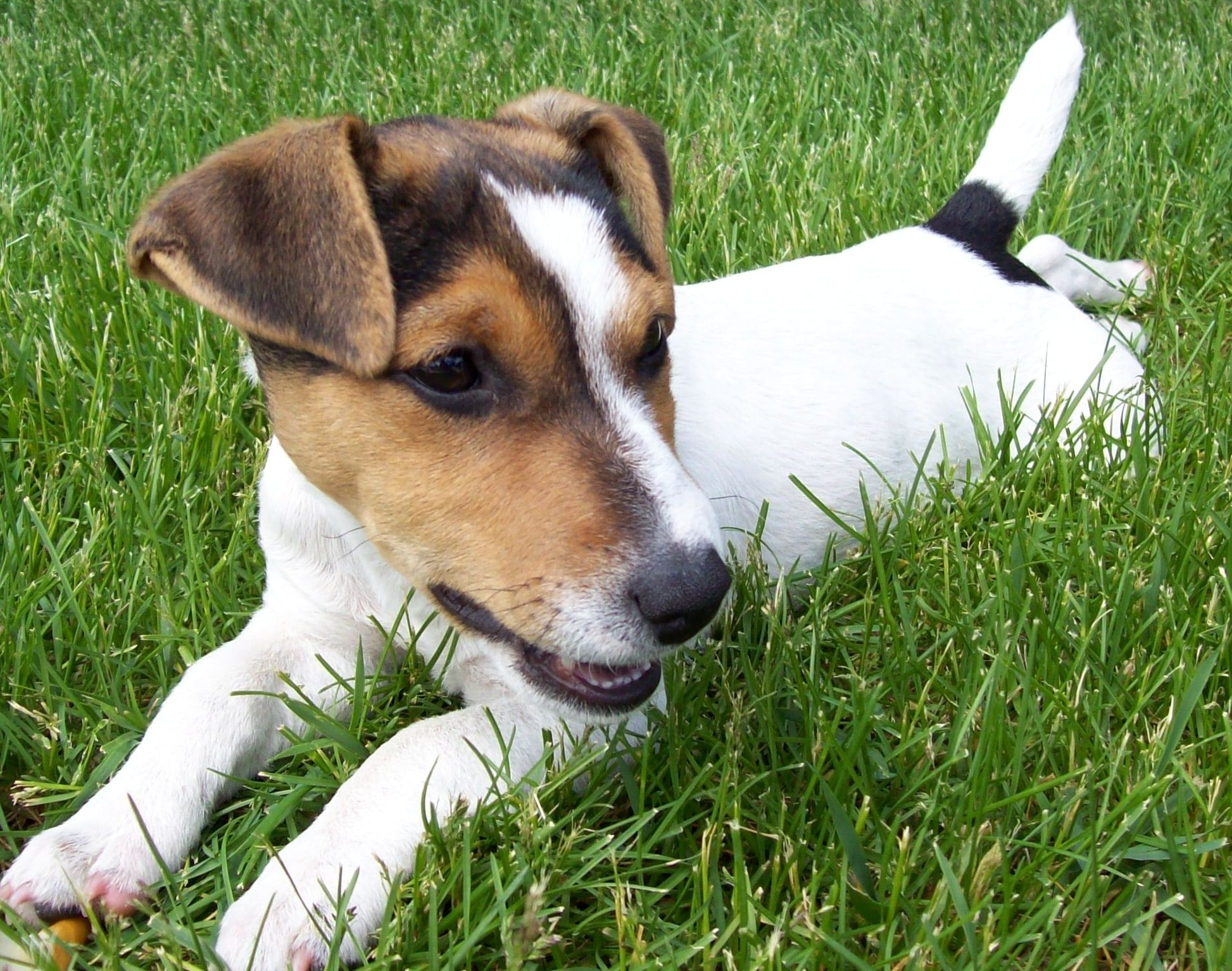
The appearance of the Jack Russel Terrier it is relatively easy to recognize. So he has a coat covered mostly in white, that bears black or brown markings. A completely white coat is also theoretically possible, but quite rare. The hairs are short and can be straight or coarse.

The Jack Russel Terrier it has an almost rectangular body shape and a height at the withers of up to 30 cm.. So, is on average 5 cm smaller than its direct relative, the Parson Russel Terrier. The weight of a Jack Russel Terrier can vary between 7 and 10 kg. The head of the Jack Russel it is quite thin and flat built. The dog's eyes are almond shaped and are normally surrounded by black eyelid edges.

Variedades ยซJack Russel Terrierยป

Jack Russell Terrier smooth hair
Jack Russell Terrier by the fence
Jack Russell Terrier through the fence
jack russell terrier hard hair
  • Straight hair variety
  • Wired hair variety
  • Wire hair variety

Character and skills

The Jack Russel Terrier he is an agile and lively dog รขโ‚ฌโ€นรขโ‚ฌโ€นwho loves to run in nature. He has a healthy self-confidence and is very brave.. Although her legs seem relatively short, loves to take long walks in nature. The dog is charged with energy and needs his run. In addition to sports activities, the dog also wants to be challenged on a mental level. One can make this possible thanks to sports modalities such as "Agility.". There he is with total commitment and tirelessly pursues his goal.

At the same time, the Jack Russel Terrier also very suitable as a family dog. In a calm and familiar environment, the dog is child friendly and has a social mindset.

Keeping and feeding a Jack Russel Terrier

Although the Jack Russel Terrier it's a smaller dog, there is a lot of power in him. The hunting instinct remains firmly anchored in it. You need to exercise a lot outdoors in nature. The Jack Russel it is a dog that needs to be encouraged and challenged by its owner. To push the dog to its limits, dog sports like agility are ideal.
Keeping the dog in an apartment is usually not a problem. But, it is practical to have a large garden in which the terrier can let off steam in between. The Jack Russel he is also a super family dog, that with the right training you will become a loving family member.

The Jack Russel Terrier usually has no special food preferences. It is important that the dog is fed a balanced diet. This means that the diet is based on a combination of a high meat content plus the addition of vegetables, fruits and cereals. The choice between dry or wet food is left to each owner. The food ration should be adapted to the size and workload of the dog.

Education and care of the Jack Russel Terrier

The Jack Russel Terriers they need a loving and consistent education. Already with the puppy you must define the rules and limits of coexistence. This is how the foundations of a common future are laid. Early neglect will regret later. The Jack Russel Terrier is an intelligent dog that wants to be challenged. So, it is important that you have the reins clearly in hand when dealing with the dog.

Due to its origin as a hunting dog, wants the guidance of its owner. Clear instructions and a system of positive rewards will be the best to encourage the dog in his development. With adequate training and if the dog is sufficiently exercised, adapts very well as a family dog รขโ‚ฌโ€นรขโ‚ฌโ€นand integrates into it in an exemplary way.

Caring for a Jack Russel Terrier it is not usually complicated. In the rough-haired or hard-haired variety, the coat should be trimmed occasionally. Otherwise, brushing regularly is highly recommended. The dog can be cleaned with a damp cloth. The shampoo should not normally be used as it attacks the natural protection of the coat and skin.. In case of strong odors and a high level of dirt, a mild dog shampoo should be used.

Typical health and illnesses

The small quadrupeds are, Unfortunately, often very susceptible to disease. So, You should have a vet examine your dog as often as possible and parents undergo an examination for possible inherited diseases before purchasing. The possible clinical pictures with the Jack Russel Terrier are: Ataxia and myelopathy, atopia, dermatophytosis, cataract and catarrh, as well as other hereditary diseases.

Jack Russel Terrier life expectancy

The life expectancy of Terriers Jack Russel is of some 15-18 years.

Buy the Jack Russel Terrier breed

The Jack Russel Terriers can be purchased from numerous breeders. But, before buying, must ensure that the breeder is officially recognized. The Jack Russel Terrier responsible parenting can be obtained from a price of about 500 EUR.

Characteristics "Jack Russell Terrier"

Coexistence is important that you have with your new friend. Before considering the acquisition of a dog of the breed "Jack Russell Terrier" you know certain factors. Not all breeds of dogs are apt to live in an apartment, you must take into account his character, their need for exercise, their interaction with other pets, their care and if you have small children, their level of tolerance towards them.

Adaptation โ“˜

5,0 of 5 stars (based on 1 review)

friendly dog โ€‹โ€‹โ“˜

1,0 of 5 stars (based on 1 review)

hair loss โ“˜

3,0 of 5 stars (based on 1 review)

Affection level โ“˜

5,0 of 5 stars (based on 1 review)

Need for exercise โ“˜

5,0 of 5 stars (based on 1 review)

Social need โ“˜

3,0 of 5 stars (based on 1 review)

Home โ“˜

1,0 of 5 stars (based on 1 review)

Toilet โ“˜

2,0 of 5 stars (based on 1 review)

Friendly with strangers โ“˜

3,0 of 5 stars (based on 1 review)

barking โ“˜

5,0 of 5 stars (based on 1 review)

Health โ“˜

3,0 of 5 stars (based on 1 review)

Territorial โ“˜

5,0 of 5 stars (based on 1 review)

Cat friendly โ“˜

1,0 of 5 stars (based on 1 review)

Intelligence โ“˜

5,0 of 5 stars (based on 1 review)

Versatility โ“˜

5,0 of 5 stars (based on 1 review)

Child friendly โ“˜

3,0 of 5 stars (based on 1 review)

Surveillance โ“˜

5,0 of 5 stars (based on 1 review)

joy โ“˜

5,0 of 5 stars (based on 1 review)

Images "Jack Russell Terrier"

Photos:

1 – Rough coat Jack Russell terrier by Sellys / CC BY-SA
2 . Jack Russell Terrier by Plank / CC BY
3 – Jack Russell Terrier by Steve-65 / CC BY-SA
4 – Portrait of Jack Russell Terrier in a park by Ria / CC BY-SA
5 – Jack Russell Terrier by DuncanMcC / Public domain
6 – Jack Russell Terrier by Plank / CC BY

Videos "Jack Russell Terrier"

Type and recognitions:

  • FCI CLASSIFICATION:
  • Group :
  • Section : . .

Federations:

  • FCI – Terriers 2 Small sized Terriers. โ“˜
  • AKC – Terriers โ“˜
  • ANKC – Terriers โ“˜
  • โ€‹KC – Terriers โ“˜
  • NZKC – Terriers โ“˜
  • UKC – Terriers โ“˜

FCI breed standard "Jack Russell Terrier"

Origin:
United Kingdom

Date of publication of the valid original standard:
08.10.2012

Use:

A good working Terrier with the ability to go down to earth. An excellent companion dog


General appearance:

A strong working terrier, Active, of great character, with flexible body, long Middle. His deft movement matches his keen expression. The tail cut is optional and the coat can be short, hard or brittle.

PROPIMPORTANT ORTIONS: The dog as a whole is longer than tall, that is rectangular.

The depth of the body from the cross to the chest should be equal to the length of the front leg from the elbow to the ground. The circumference behind the elbows should be 40 to 43 cm..


Behavior / temperament:

Terrier vivaz, alert and active, with a sharp and intelligent expression. Bold and intrepid, friendly but quietly safe.

Head:

---

Cranial region:
  • Craging: The skull should be flat and of moderate width., gradually decreasing its width towards the eyes and thinning towards a wide muzzle.
  • Dfronto-nasal depression (Stop): Well defined but not pronounced.

facial region:

  • Trufa: black.
  • Horcico: The length from the stop to the truffle should be slightly shorter than the stop to the occiput.
  • Labios: Tight and pigmented in black.
  • Jaws / Teeth: Very strong, deep wide and powerful. Strong teeth closing in scissors.
  • Ojors: Small dark and with sharp expression. MUST NOT be prominent and must have well-attached eyelids. The edge of the eyelids must be pigmented in black. Almond biscuits.
  • Obars: Ears that are semi-droopy or fall forward, covering the external auditory canal, good texture and great mobility.
  • Cheeks: Cheek muscles should be well developed.

Neck:

Strong and clean allowing the head to be carried with balance.

Body:

  • Lรญnand the top: Level. The length from the withers to the tail insert is somewhat greater than the height from the withers.
  • Itmor: Kidney region should be short, strong and very muscular.
  • Pecho: Chest deeper than wide, with good clarity from the floor, allowing the chest to be halfway down the cross to the ground. Ribs must be well arched from the spine, flattening to the sides so that the periphery behind the elbows can be held by two hands โ€“ approx.. 40 to 43 cm.. Point of the sternum clearly in front of the point of the shoulder.

Tail:

You can lower it at rest. In movement it must be erect and if it is cut the tip must be at the same level as the ears.

Tips

PREVIOUS MEMBERS:

  • Hormbros (Blades): Well sloped and not heavily muscled.
  • Brazos (Humerus): Long and angled enough to ensure that the elbows are positioned under the body.
  • Antarms: Straight bone from elbow to foot, seen from the front or side.
  • Pinis previous: Round, strong, padded, not big, moderately arched fingers, without turning in or out.

LATER MEMBERS:

  • ApGeneral arience: Strong and muscular, balanced in proportion to the scapulae.
  • Rodinllto: Well angled.
  • Corvejรณn: Close to the ground.
  • Metatarsals: Parallel when seen from behind and the specimen is standing freely.
  • Pinis later: Round, strong, padded, not big, moderately arched fingers, without turning in or out.

Movement:

Cash, free and elastic.

Mantle

Plink: Can be short, brittle or hard. Must be water resistant. The mantles must not be altered (ripped) to appear short or brittle.

Colorr: White must predominate, with black markingsand/orfire (tan). Fire markings can range from the palest to the strongest (Brown).


Size and weight:

Alturto ideal to the cross:

25 cm to 30 cm..

Pthat: The equivalent to 1 kg of weight per 5 height cm.

Example: a dog of 25 cm should weigh approx. 5 kg and a dog 30 cm must weigh 6 kg.


Fouls:

Any deviation from the aforementioned criteria is considered as a fault and the severity of this is considered to the degree of the deviation to the standard and its consequences on the health and well-being of the dog.and the dog's ability to perform its traditional task.

  • Lack of true Terrier characteristics
  • Lack of balance, example: over angle of any point
  • Heavy or shaky motion.
  • Defective denture.

FALTAS DISQUALIFYING:

  • Agextreme shyness.
  • Any dog โ€‹โ€‹showing clear signs of physical or behavioral abnormalities must be disqualified..


N.B.:
  • Males should have two normal-appearing testicles fully descended into the scrotum..
  • Only functionally and clinically healthy dogs, with the typical conformation of the breed, should be used for parenting.

Itlatest changes are in bold.

TRADUCCION: J.Nallem (KCU) Suptechnical supervision: M.A. Martรญnez (FCA)

Source: F.C.I - International Cynological Federation

Alternative names:

1. JRT, Jack (English).
2. Jack Russell (French).
3. Jack Russell (German).
4. Jack Russell (Portuguese).
5. JRT, Jack (espaรฑol).

โ–ท The world of Pets: Dogs, cats, birds, reptiles, amphibians

Bull Terrier
Gran Bretaรฑa FCI 11 . Bull type Terriers

Bull Terrier

The Bull Terrier they are generally friendly, rarely aggressive.

Content

History

The original ancestor of Bull Terrier was bred in the early 19th century from a cross between the English Bulldog and terriers. The dog served as a biter for bulls and badgers and was also used in dogfighting. Although its use as a fighting dog was already banned in 1835, the breed still struggles with its fighting dog image today. Completely contrary to the omnipresent opinion the Bull Terrier developed in the course of the 19th century as a popular family dog รขโ‚ฌโ€นรขโ‚ฌโ€นof the English middle class. The nervous and friendly Bull Terrier lived with families in large areas and served as a guard dog and to hunt vermin.

In 1850 the animal trader James Hinks ensured official recognition of the breed. At the end of the 19th century, the Bull Terrier white in color were for a time the status symbol of the English nobility. For a more elegant appearance and a less fizzy character, they crossed paths with Dalmatians and Pointer. Only after the end of World War 2 did the British return to breeding Bull Terrier of different colors. From the beginning the breed was bred in different sizes and today the Standard and the Bull Terrier Miniature are distinguished as independent breeds. Recognized by the Fรฉdรฉration Cynologique Internationale, the Bull Terrier Belongs to the group 3 FCI, of the Terrier. Here it is assigned to the section 3 as Bull type Terriers.

Physical characteristics

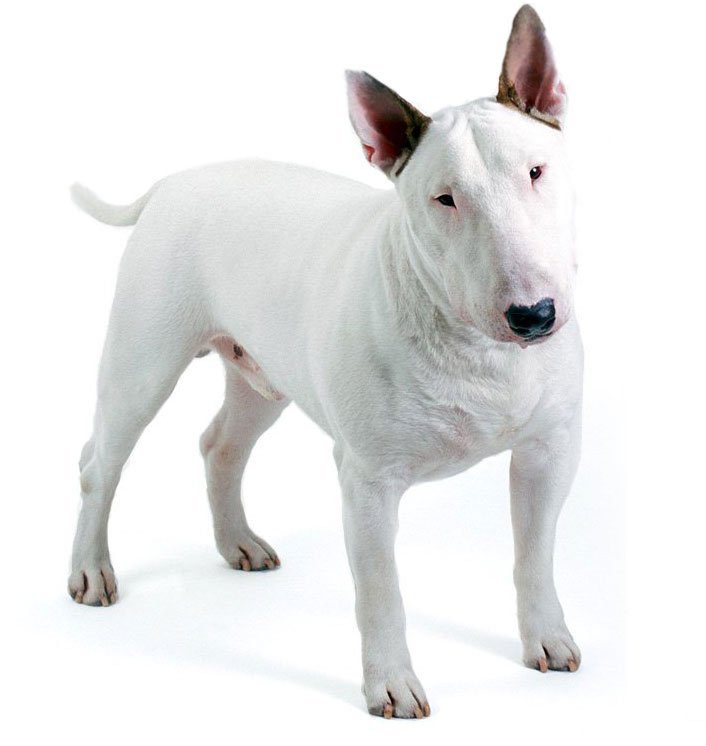
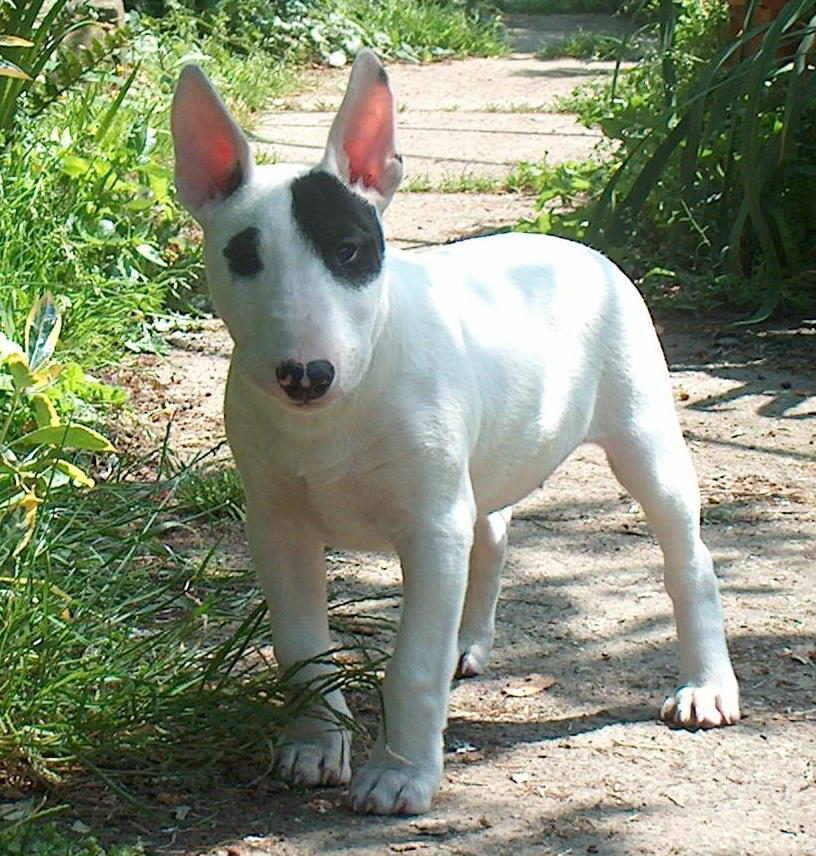
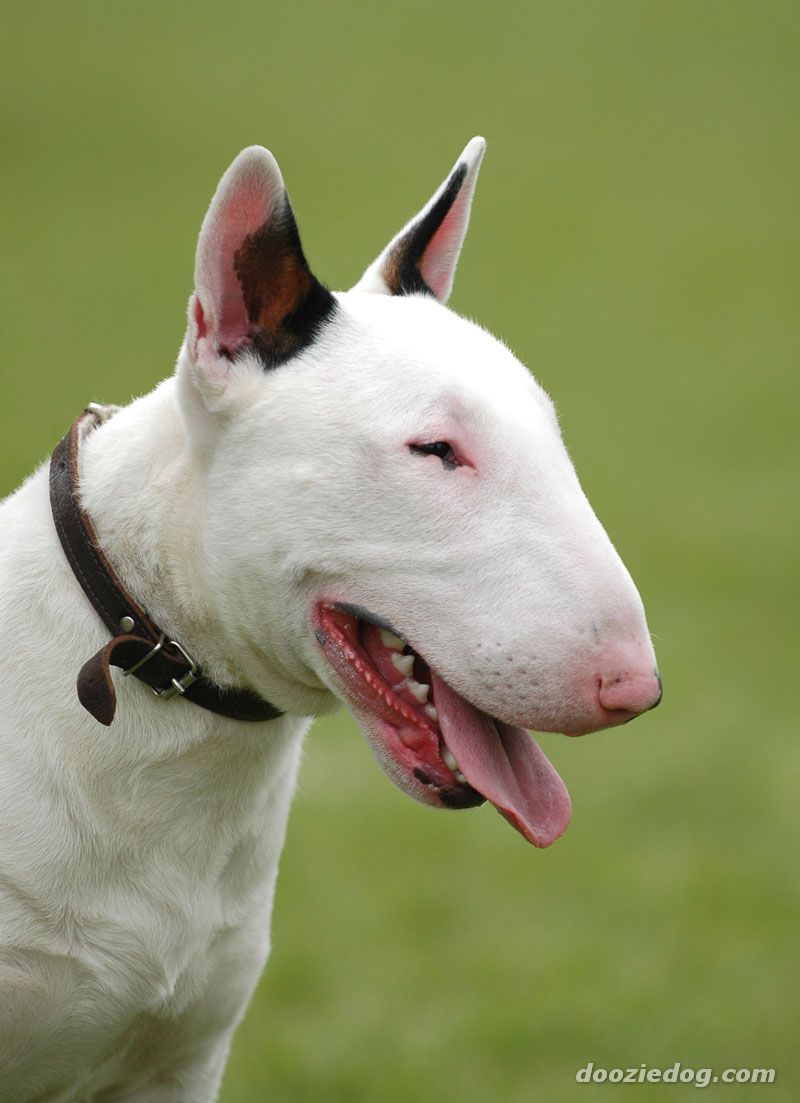
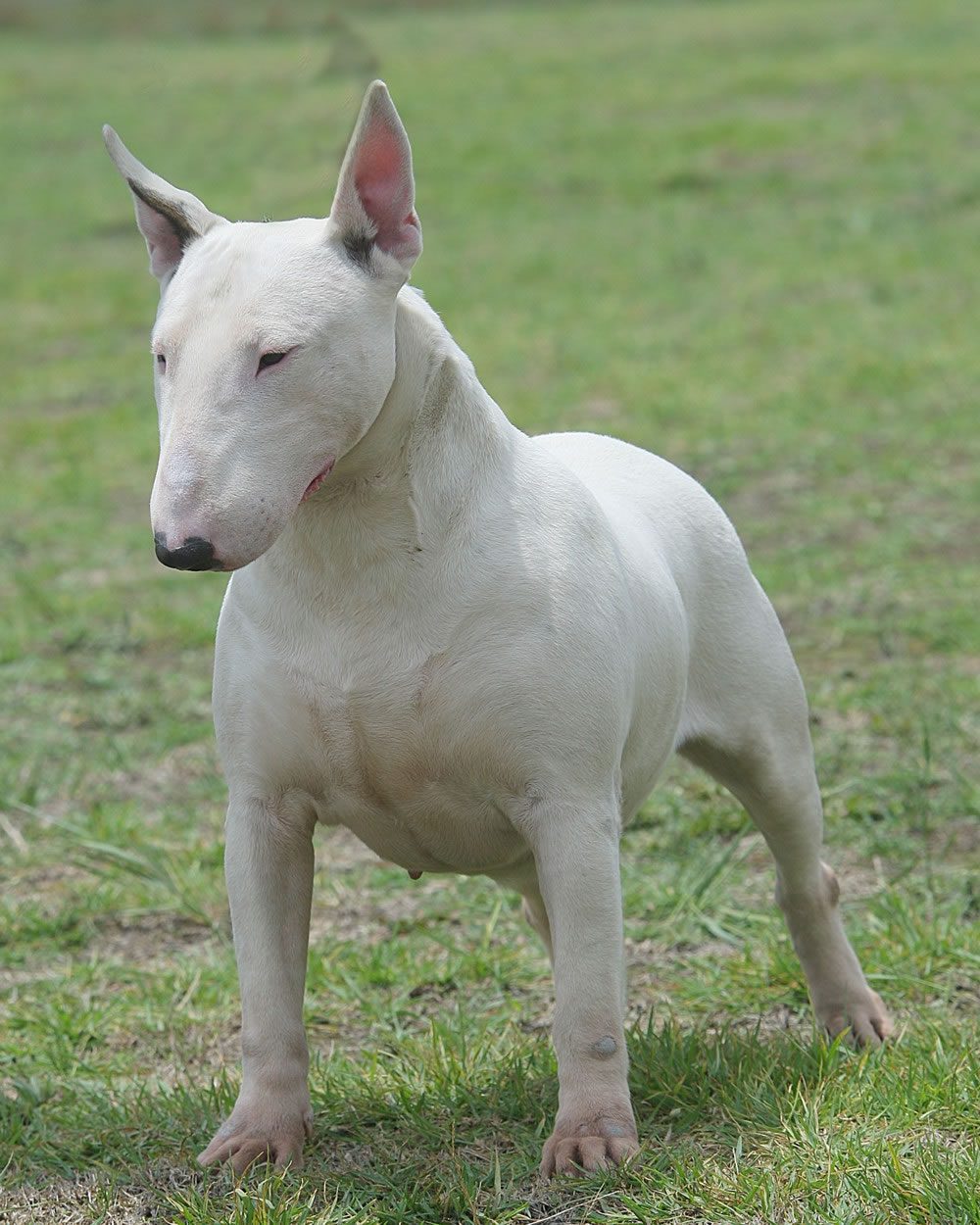
It is a dog strong, muscular and short hair. The accepted colors are white (spots on head only allowed, in other parts of the body they are penalized in exhibitions). The colors black, white, striped, red, Griffon and tricolor are accepted. Trademarks of pigmentation in the skin are not taken into account, When not involved hair. The colors, blue and liver are highly undesirable in competitions, according to breed standard.

The standard of the Bull Terrier Club in England, the ancient breed and originated from the same, It says that the striped is the desired color, given the importance of that color at the time these first specimens were included, that helped to correct problems of deafness and refresh the gene pool of the race, Therefore this recommendation maintains even included in the standard of the breed.

Typical features are the oval shape of its head, that profile will curve downwards from the top of the skull to the end of the snout. The forehead is flat from ear to ear, front head is shaped like an egg. These dogs lack the fronto-nasal depression. And the eyes are triangular in shape, in fact, it is the only recognized breed with triangular eyes. Y, Another curiosity of this small is that, It is one of the few breeds that likes to eat the nails when not cut them.

There are no weight or height limits, but the copy should give an impression of maximum solidity in relation to their distinctive traits and sex, but You can reach the 35 kg. There is one miniature variety where yes, criminalizes overcome some stature.

The hair is easy to maintain, which is why frequent brushing can have it in almost perfect conditions. It can also help add oil in your food.

Character and skills

The Bull Terrier are generally friendly, rarely aggressive. His physical strength is comparable to his intelligence, and both your body and your mind must remain active. They need time to run and exercise. They are not very suitable for beginners in dog breeding, that they require much time to be trained. Dogs are very affectionate and love company, so it is not a good idea to leave them alone for a long time, given that with their powerful jaws together with the stress they get to have in solitude they can lead them to cause a lot of damage to the house. It is an excellent companion and attack dog..

Did you know??

Because of its fun and mischievous personality, The Bull Terrier is sometimes called "the boy in the dog suit.".

Itร‚ยดs extremely strong by which should not be left unattended with one child of 8 years, post tend to skip, play and by their muscle mass can topple unintentionally to the child, for this reason it is advisable to make a gradual socialisation between the child and the dog, so in this way, the dog understands the limits and the child learns to interact with the dog, that is to say, striking a balance.

They need to do enough exercise at young age, but without excess, This can cause muscle problems. It also, the breed is known for being very gluttonous, so it should be dosed food and exercise. Son excellent guard dogs and they have very sharp ears. They may also experience obsessive-compulsive behaviors as chasing the tail hanging around, self-mutilation is, Skip, biting his thigh, eat their feces and licking the leg; these animals like to be in company, generally children.

Curiosities

The Bull Terrier, normally, they are free of genetic diseases. They tend to live in 10 to 12 years, Although they may live longer. The oldest known dog is an Australian named "Puppa Trout.", who lived up the 25 years. The Bull Terrier albinos may be deaf.

The Bull Terrier is one of the breeds used for the creation of the Dogo Argentino (Hunting dog).

Although the name might lead to confusion, the Bull Terrier are not directly related to American Pit Bull Terrier. But, both races have the same ancestry. There is a version in miniature of this race, officially called Bull Terrier miniature.

Education of a Bull Terrier

The Bull terrier needs a consistent upbringing from the start and is definitely not a suitable dog for beginners. If your owner indicates insecurity, he will take advantage of it and try to become a pack leader himself. So, a strong hand and a lot of assertiveness is required for the upbringing of this breed. Since it can react suspiciously and quickly to unfamiliar dogs, must be well socialized from an early age.

Bull Terrier health and care

The coat of the Bull Terrier does not need any special care. But, should be brushed regularly to remove dead hairs.

There are no breed-typical diseases in the Bull Terrier.. Occasionally, joint problems and especially in the knees and skin irritations can occur.

Nutrition / Food

The feeding of the Bull Terrier is not complicated, because he is quite undemanding when it comes to food. However, your food must be of high quality, low in fat and easily digestible.

The life expectancy of a Bull Terrier

It can reach an average age of 10-14 years.

Characteristics "Bull Terrier"

Coexistence is important that you have with your new friend. Before considering the acquisition of a dog of the breed "Bull Terrier" you know certain factors. Not all breeds of dogs are apt to live in an apartment, you must take into account his character, their need for exercise, their interaction with other pets, their care and if you have small children, their level of tolerance towards them.

Adaptation โ“˜

4,0 of 5 stars (based on 1 review)

friendly dog โ€‹โ€‹โ“˜

2,0 of 5 stars (based on 1 review)

hair loss โ“˜

3,0 of 5 stars (based on 1 review)

Affection level โ“˜

4,0 of 5 stars (based on 1 review)

Need for exercise โ“˜

4,0 of 5 stars (based on 1 review)

Social need โ“˜

5,0 of 5 stars (based on 1 review)

Home โ“˜

3,0 of 5 stars (based on 1 review)

Toilet โ“˜

1,0 of 5 stars (based on 1 review)

Friendly with strangers โ“˜

5,0 of 5 stars (based on 1 review)

barking โ“˜

4,0 of 5 stars (based on 1 review)

Health โ“˜

5,0 of 5 stars (based on 1 review)

Territorial โ“˜

5,0 of 5 stars (based on 1 review)

Cat friendly โ“˜

2,0 of 5 stars (based on 1 review)

Intelligence โ“˜

4,0 of 5 stars (based on 1 review)

Versatility โ“˜

2,0 of 5 stars (based on 1 review)

Child friendly โ“˜

3,0 of 5 stars (based on 1 review)

Surveillance โ“˜

5,0 of 5 stars (based on 1 review)

joy โ“˜

5,0 of 5 stars (based on 1 review)

Buying a Bull Terrier

What do I have to pay attention to when I buy?

Before taking a Bull Terrier at home, you should know that the conditions of conservation of this breed have been highly regulated throughout Europe since the years 90. Due to its bad reputation, it is on the list of dangerous dog breeds in some countries.. The Bull Terrier can provoke fearful reactions in peers and will not be greeted with joy by everyone. If you still want to have a Bull Terrier, you should try to improve the image of the breed through good education and proper maintenance. According to the studies, the breed is no more aggressive than other dog breeds and resolves conflict situations peacefully.

Bull Terrier pictures

Bull Terrier Videos

Type and recognitions:

  • FCI CLASSIFICATION:
  • Group :
  • Section : . .

Federations:

  • Federations: FCI โ“˜, AKC โ“˜, ANKC โ“˜, CKC โ“˜, โ€‹KC โ“˜, NZKC โ“˜, UKC โ“˜

  • FCI breed standard "Bull Terrier"

    Origin:
    England, United Kingdom

    Date of publication of the valid original standard:
    05.07.2011.

    Use:

    Terrier


    General appearance:

    It is a dog with a vigorous constitution, muscular, well proportioned and active and with a lively expression, decisive and intelligent. A unique characteristic is that its head lacks a fronto-nasal depression. (stop) and it is shaped like an egg.
    Regardless of size, males should look masculine and females should look feminine.


    Behavior / temperament:

    Brave, full of spirit with a loving and fun attitude. Balanced and obedient temperament. Although stubborn, is particularly friendly.

    Head:

    Long, strong and deep to the tip of the snout, but not tosca. Front view must be in the form of an egg and filled; its surface free of depressions or indentations. Profile view, is it bend gently down from the height of the skull to the tip of the nose.

    Cranial region:

    Skull : The top of the skull should be almost flat between the ears.

    facial region:

    • Truffle : It should be black and curved down at the tip. The Windows are well developed.
    • Lips : Well-defined and glued.
    • Bite / Teeth : Solid and vigorous lower jaw. Healthy teeth, strong, clean, good size, perfectly regular with a bite of perfectly regular complete scissor, That is, the inner face of the upper incisors is in close contact with the outer face of the lower incisors, the teeth being placed perpendicularly in the jaws..
    • Eyes : They should be narrow and triangular, placed obliquely, black or so Brown dark as possible, so that they appear almost black, and with a shiny look. The distance from the tip of the nose to the eyes must be greater than there is from the eyes to the back of the head. Blue or partially bluish color eyes are undesirable.
    • Ears : Small, thin and placed very close together. The dog must be able to keep them erect and tips directly upwards.

    Neck:

    Very muscular, long, arched, tapering from shoulders to head and free from loose skin.

    Body:

    Well rounded, with well arched ribs, and deep from the cross to the chest region, in such a way that the last one reaches closer to the ground than the abdomen.

    • Back : Short, strong; the dorsal line behind the withers is horizontal and arches slightly towards the back.
    • Pork loin : Broad and well muscled.
    • Breast : Seen from the front, the chest is wide.
    • Bottom line and belly : From the chest to the abdomen should form an elegant ascending curve.

    Tail:

    Short, low-set and carried horizontally. Thick at the base and slimming to a fine point.

    Tips

    PREVIOUS MEMBERS :

    • General appearance: The dog must be perfectly parallel and good limbs. In adults, the length of the fore limbs should be approximately equal to the depth of the chest.
    • Shoulder : Strong and muscular, but not heavy. Spacious scapulae, flat and very attached to the chest and oblique well maintained from the bottom to the top, at almost a right angle with the forearm.
    • Elbows : Straight and strong.
    • Arms : The forelimbs of round and strong bone.
    • Metacarpus : Perpendicular.
    • Previous feet : Round and compact with well arched toes.

    HINDQUARTERS :

    • General appearance: Seen from the rear hind limbs are parallel.
    • Thigh : Muscular.
    • Knee : With good angle.
    • Leg : Well developed.
    • The Hock joint: Well angled.
    • Metatarsus : Short and strong bones to feet.
    • Hind feet : Round and compact with well arched toes.

    Movement:

    With well coordinated movements, covering ground evenly with easy steps and with a typically jovial air. When jogging, the movement should be parallel to the front and back, only converges towards a central point at a faster speed. You forelegs out well and hindlegs moving smoothly at the hips, flexing them well in the knees and hocks with drive.

    Mantle

    Attached to the body.

    Fur : Short, tight, rough to the touch and with a fine Sheen. In winter you can grow you a layer of soft textured undercoat.

    COLOR : White copies : Pure white. The pigmentation of the skin and the spots on the head are not penalizables. Color copies: is the predominant colour; other equal, you prefer the Brindle. The colors black, striped, red, Fawn and tricolor are acceptable. Stains on white fur interspersed are undesirable. The colors blue and liver highly undesirable.


    Size and weight:

    There are no weight or height limits, but the copy should give the impression of maximum strength consistent with their distinctive traits and sex.


    Fouls:

    Any deviation from the aforementioned criteria is considered a fault and the severity of this is considered to the degree of the deviation from the standard and its consequences on the health and well-being of the dog..

    FALTAS DESCALIFICANTES :

    โ€ข Aggressive or fearful dog.
    โ€ข Any dog โ€‹โ€‹showing clear signs of physical or behavioral abnormalities should be disqualified..


    N.B.:

    Male specimens should have two normal-appearing testicles., fully descended into the scrotum.

    SPANISH TRANSLATION: Brรญgida Nestler / Original version : (IN)
    Technical supervision : Miguel Angel Martinez

    Source: F.C.I - International Cynological Federation

    Alternative names:

    1. English Bull Terrier, Bully, Wedge Head, Varkhond (English).
    2. Bull Terrier (French).
    3. Bull Terrier (German).
    4. Bull terrier inglรชs (Portuguese).
    5. Bull Terrier inglรฉs (espaรฑol).

    โ–ท The world of Pets: Dogs, cats, birds, reptiles, amphibians

    Kerry Blue Terrier
    Irlanda FCI 3 . Large and medium sized Terriers
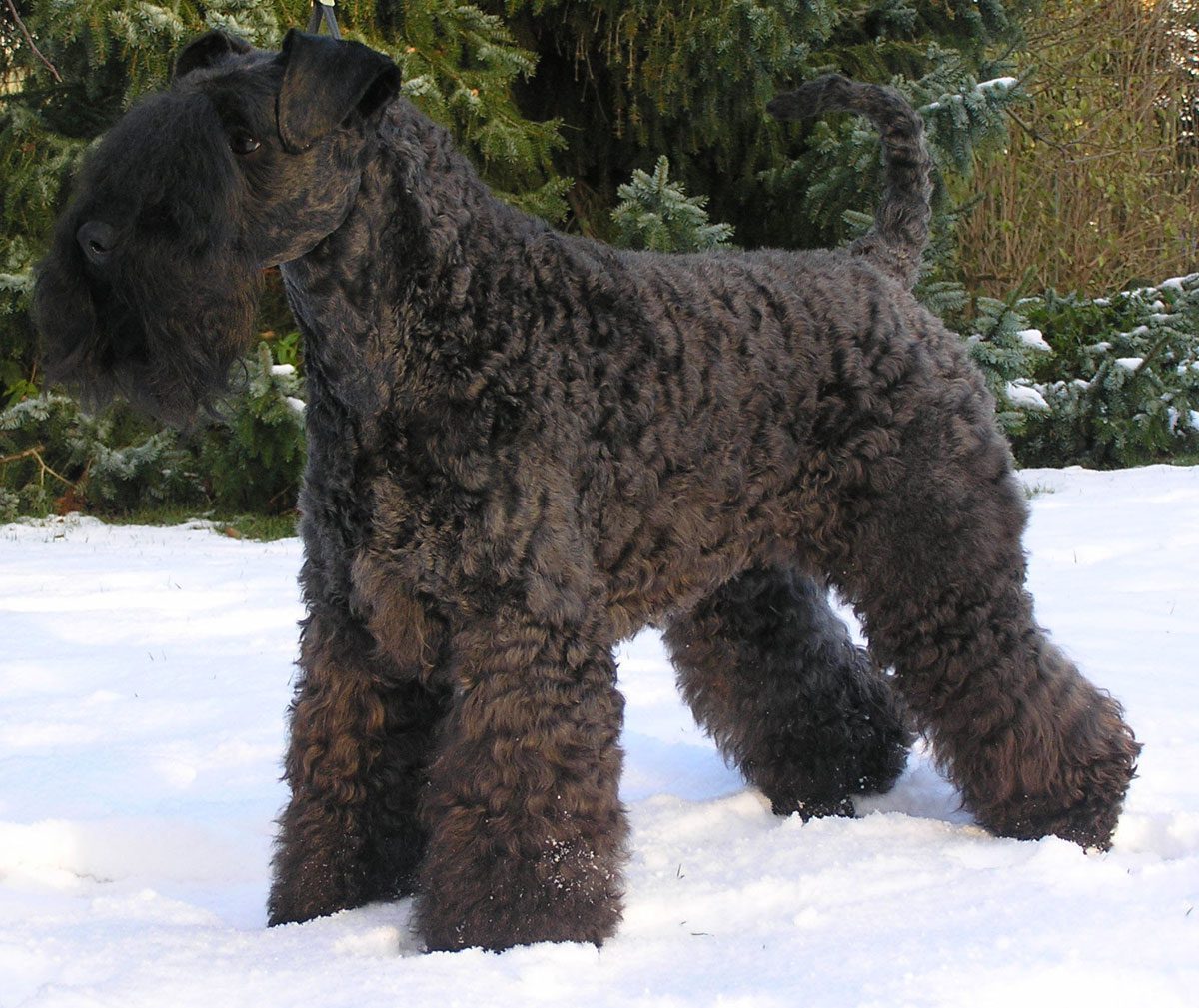
    Kerry Blue Terrier

    The Kerry Blue Terrier he is a thoroughbred terrier, brave, alert and with a penetrating expression.

    Content

    History

    The Kerry Blue Terrier it is one of the irish national dogs. Its existence is documented since the 18th century, but it is suspected that he was home in County Kerry long before that. Regarding the origin of the breed, Legend has it that this intelligent dog got its blue-black coloring by crossing bloodhounds with lines of Irish Terrier.

    In feudal times, Irish herdsmen and farmers were not allowed to hunt with wolfhounds. They solved the problem by crossbreeding which gave their terriers the characteristics of a Wolfdog..

    The Kerry Blue Terrier He was raised as a Pied Piper, guard dog and herding dog. An Irish proverb says that a Kerry Blue Terrier replaces four shepherds. The agile dog was also particularly useful for hunting otters and badgers..

    The appearance of the breed has undergone several changes over the centuries. Meanwhile in 1847 a Kerry Blue Terrier dark blue in color was still considered exemplary in 1847, Monochrome fur with dark markings was established in the 20th century. The FCI standard valid today dates from the year 2005.

    Physical characteristics

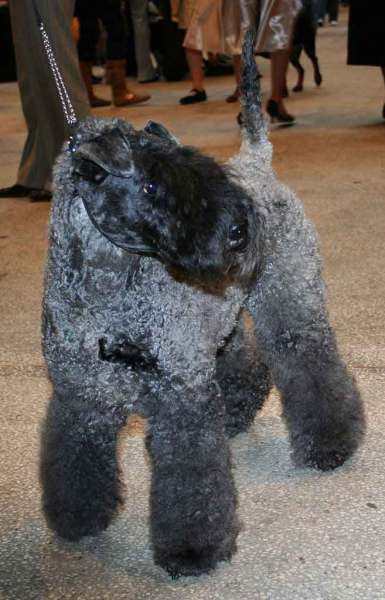
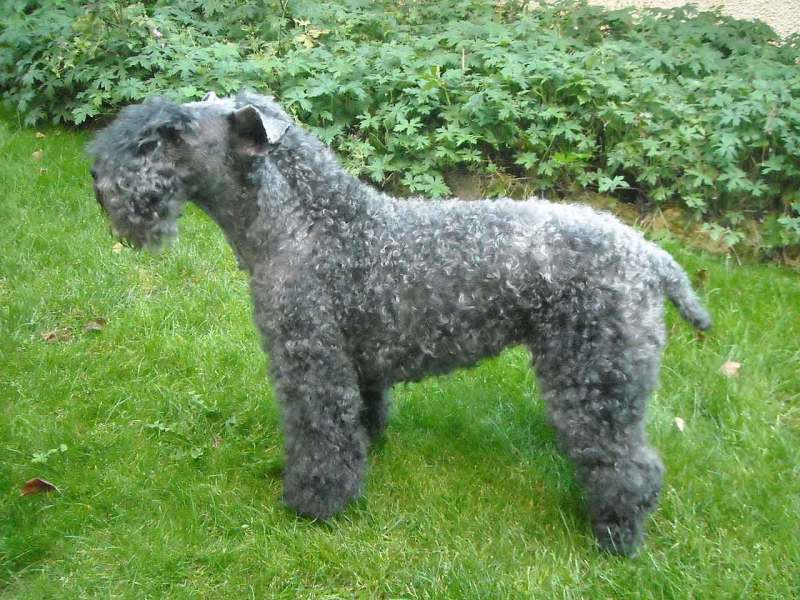
    The Kerry Blue Terrier has a majestic body, muscular and slightly elongated, that impresses with its balanced appearance. His back is even and fairly long, moderately broad and deep chest. With its soft, lush and curly fur, the Kerry Blue Terrier It is considered one of the most attractive terrier breeds.

    typical of the breed Kerry Blue Terrier it's his flat nose and long hair on his forehead and muzzle.

    Puppies are born with a black-brown or dark black coat. Only at the age of about three the Kerry Blue Terrier It has its typical coloration.. The coat has no undercoat. A blue coat color is allowed in any shade, black marks are allowed. Tan or pure black markings are only allowed until the age of 18 months.

    Other appearance features in the overview:

    • Head: Strong skull, rich fur, medium length front, black nose.
    • Ears: pointing forward or falling, underlining the typical terrier expression
    • Eyes: medium-sized, dark to brown with a piercing expression
    • neck: moderately long
    • lower limbs: straight with well-muscled thighs and strong hock
    • legs: compact with round pads and black claws

    Size and weight:

    Height to the cross:

    For males between 45,5 to 49,5 cm. (18 to 19,5 inches).
    For the females between 44,5 to 48 cm. (17,5 to 19 inches).

    Weight:

    For the males of 15 to 18 kg (33 to 40 English pounds).
    For females proportionally less.

    Character and skills

    The Kerry Blue Terrier he is a thoroughbred terrier, brave, alert and with a penetrating expression. The elegant looking animal does not tend to bark and is not brusque. The Kerry Blue Terrier They are happy, loyal, family and children.

    They are exceptionally open to strangers and need lots of petting at home. To the Kerry Blue Terrier loves to work. But, no need to keep the four-legged friend constantly busy at home.

    Animals are very intelligent and eager to learn, briosos, but in no way nervous or aggressive. Strong self-confidence and strong willpower are typical traits that characterize all terrier breeds and require constant firmness from the owner..

    Accommodation of the ยซKerry Blue Terrierยป

    Since the Kerry Blue Terrier builds a close relationship with the owner and his family, a kennel position is inappropriate. He likes to participate in domestic life and is a faithful family dog, watchful and child friendly.

    The four-legged friend is very active and needs two or three hours of exercise a day. Dog sports do justice to the momentum of the Kerry Blue Terrier to move and reinforce the bond with the owner.

    Obedience is also a great activity for this smart and particularly attentive breed of dog.. Obedience is the school of subordination, which is especially valuable in a terrier. In this dog sport it depends on the correct and fast execution of an exercise sequence. Perfect teamwork between dog and owner is required.

    The Kerry Blue Terrier they are wonderfully suited for difficult hunting tasks such as badger hunting or otter spearfishing. When objects are recovered from the water, most Kerry Blue Terriers they prove to be good swimmers and are in no way inferior to a Retriever.

    The four-legged friends of this breed reject the other dogs a bit and therefore should be better kept individually.. If you like peace and tranquility at home, you shouldn't have Kerry Blue Terrier along with a cat.

    Feeding the ยซKerry Blue Terrierยป

    Like any other breed of dog, the Kerry Blue Terrier you need a balanced diet appropriate for your species. Must consist of animal protein, remarkable muscle meat and vitamin-rich casings, carbohydrates, vitamins and minerals. Feeding fish occasionally provides the dog with essential omega fatty acids 3 and ensures that the coat stays shiny and smooth.

    The size of the daily ration depends on the age, condition and level of exercise of your four-legged friend and the quality of the food. It should be divided into two meals so as not to overload your stomach. It is better not to feed your dog before walks or canine sports. Then the food tastes much better.

    The choice of dry or wet food is at the discretion of the owner, but a mixture of both is highly recommended. Here's a decision aid.

    When high-quality dry food is given, the recommended daily amount for a Kerry Blue Terrier adult is on average 1,5 cups. It is important that the dog always has enough fresh water available. Once again, a small lazy dog รขโ‚ฌโ€นรขโ‚ฌโ€นneeds less food than an active animal.

    An especially appropriate form of feeding for the species, although somewhat more expensive, it's fresh food, in which the dog feeds on meat, raw fruit and vegetables. You can prepare food for your Kerry Blue Terrier yourself or you can use frozen prepared meals.

    Of course, Your quadruped doesn't just need chew products like bones made from cowhide, no wood root chips, for example of the coffee tree, horse tendons or cow ears for dental care. The popular pig ears are high in fat and therefore, they should only rarely come to the dog's table.

    Education and care of the ยซKerry Blue Terrierยป

    If you decide to buy one Kerry Blue Terrier, you must plan early enough to attend a dog school.

    After all, your new housemate is a true terrier with a very stubborn personality. But, is certified to be easier to handle and more compliant than representatives of other terrier breeds.

    Especially promising are training methods that don't punish, but they reward desirable behavior accordingly. A procedure that at the same time promotes the close relationship of your four-legged friend with you.

    One of these methods is the proven Clicker Training, which is described here in more detail.

    The training of a Kerry Blue Terrier includes intensive recovery training. After all, the four-legged friend has a clear hunting instinct and without consistent training will hunt down anything that comes his way.

    His stubborn willpower can only be achieved with uncompromising subordination.

    The very good intelligence of Kerry Blue Terrier requires variety in training. The constant repetitions quickly bore him and make the self-confident four-legged friend look for a more interesting occupation..

    Characteristics "Kerry Blue Terrier"

    Coexistence is important that you have with your new friend. Before considering the acquisition of a dog of the breed "Kerry Blue Terrier" you know certain factors. Not all breeds of dogs are apt to live in an apartment, you must take into account his character, their need for exercise, their interaction with other pets, their care and if you have small children, their level of tolerance towards them.

    Adaptation โ“˜

    5,0 of 5 stars (based on 1 review)

    friendly dog โ€‹โ€‹โ“˜

    2,0 of 5 stars (based on 1 review)

    hair loss โ“˜

    2,0 of 5 stars (based on 1 review)

    Affection level โ“˜

    4,0 of 5 stars (based on 1 review)

    Need for exercise โ“˜

    4,0 of 5 stars (based on 1 review)

    Social need โ“˜

    4,0 of 5 stars (based on 1 review)

    Home โ“˜

    5,0 of 5 stars (based on 1 review)

    Toilet โ“˜

    4,0 of 5 stars (based on 1 review)

    Friendly with strangers โ“˜

    3,0 of 5 stars (based on 1 review)

    barking โ“˜

    3,0 of 5 stars (based on 1 review)

    Health โ“˜

    3,0 of 5 stars (based on 1 review)

    Territorial โ“˜

    5,0 of 5 stars (based on 1 review)

    Cat friendly โ“˜

    2,0 of 5 stars (based on 1 review)

    Intelligence โ“˜

    4,0 of 5 stars (based on 1 review)

    Versatility โ“˜

    4,0 of 5 stars (based on 1 review)

    Child friendly โ“˜

    4,0 of 5 stars (based on 1 review)

    Surveillance โ“˜

    4,0 of 5 stars (based on 1 review)

    joy โ“˜

    5,0 of 5 stars (based on 1 review)

    Images "Kerry Blue Terrier"

    Photos:

    1 – Kerry Blue Terrier by https://commons.wikimedia.org/wiki/User:Alofok
    2 – Two Kerry Blue Terrier, the left one, named Ceallach Blue Ivanhoe is on this photo about 14 years old and light grey. She have made the full color change. On the right is a about one year old Kerry Blue Terrier, called Edbrios Highlander. In this age the breed is just starting with changing the color of the coat. by ยฉ Hilarmont (Kempten) / CC BY-SA 3.0 OF
    3 – Kerry Blue Terrier dog by Eponym / CC BY-SA
    4 – Kerry Blue Terrier by Svenska Mรคssan from Sweden / CC BY
    5 – Kerry Blue Terrier during dogs show in Katowice, Poland by Pleple2000 / CC BY-SA
    6 – Kerry Blue Terrier, exhibition in Spodek, Katowice by Pleple2000 / CC BY-SA

    Videos "Kerry Blue Terrier"

    Type and recognitions:

    • FCI CLASSIFICATION:
    • Group :
    • Section : . .

    Federations:

    • FCI – Terriers 1 Large and medium-sized terriers. โ“˜
    • AKC – Terriers โ“˜
    • ANKC – Terriers โ“˜
    • CKC – Terriers โ“˜
    • โ€‹KC – Terriers โ“˜
    • NZKC – Terriers โ“˜
    • UKC – Terriers โ“˜

    FCI breed standard "Kerry Blue Terrier"

    Origin:
    Ireland

    Date of publication of the valid original standard:
    19.04.2005.

    Use:

    It is used in the hard work of hunting otters in deep water, in fighting badgers underground and hunting vermin. Good guard dog and loyal companion.


    General appearance:

    The typical Kerry Blue Terrier should be an upright dog, compact and well proportioned, featuring a well-developed muscular body, with a well defined terrier style.


    Behavior / temperament:

    Terrier character in all its meaning. The most important factor, The expression, must be insightful and alert.

    Head:

    With a lot hair. Males should have a stronger head and be more muscular than females..

    Cranial region:
    • Skull: Strong and well proportioned.
    • Depression links (Stop): Light.

    facial region:

    • Truffle: black, the large and wide nostrils. Snout: Must be of medium length.
    • Jaws: Strong and muscular jaws (scary calls). Teeth: Large white teeth; scissor bite (accepting bite on clamp).
    • Mouth: Dark gums and palate.
    • Eyes: Dark or dark hazelnut, medium in size and well placed, with expression of liveliness.
    • Ears: Thin and not big, carried forward or along the sides of the head towards the front, again to show the vivacious and sharp expression of the terrier.

    Neck:

    Well proportioned, good insertion on the shoulders and moderately long.

    Body:

    • top line: Of average length, straight. Pork loin: Moderate long.
    • Breast : Deep and moderate width. Well arched ribs.

    Tail:

    Thin, good insertion, carried erectly and cheerfully.

    Tips

    PREVIOUS MEMBERS:

    • Blades: Lightweight, leaning back and well glued.
    • forearms: Seen from the front, straight and with good bones.

    LATER MEMBERS: They must be well placed under the dog.

    • Thighs: Muscular, well developed.
    • Hocks: Strong.
    • Pies: compacts, strong round pads, black nails.

    Movement:

    With good coordination, parallel members. Forelimbs with good reach and hindlimbs with good thrust. When the dog is moving the line must be kept at level and head and tail bring them up.

    Mantle

    • Fur: Soft, abundant and wavy.
    • Color: Any shade of blue with or without black spots. Allow the color black, as well as a reddish hue, only until the age of 18 months.


    Size and weight:

    Height to the cross:

    • For males between 45,5 to 49,5 cm. (18 to 19,5 inches).
    • For the females between 44,5 to 48 cm. (17,5 to 19 inches).

    Weight:

    • For the males of 15 to 18 kg (33 to 40 English pounds).
    • For females proportionally less.


    Fouls:

    Any deviation from the above mentioned criteria is considered to lack, and the gravity of this refers to the degree of deviation to the standard and its impact on the health and well-being of the dog.

    • Flesh-colored gums.
    • Yellow eyes, the clear.
    • Convex or concave back.
    • Narrow sill.
    • Elbows sticking out.
    • Upper or lower prognathism.
    • White or ivory nails.
    • Spurs on the hind limbs or signs that they have been removed.
    • Closed or affected hind limb movement, with hocks together (cow).
    • Dogs whose head or tail are held by exhibitors or presenters should be penalized
    • Wire-haired, wire or piggy.
    • Any color other than blue, except the exceptions indicated above.

    FALTAS DESCALIFICANTES:

    • Aggressiveness or extreme shyness.
    • Any dog โ€‹โ€‹showing clear signs of physical or behavioral abnormalities must be disqualified..


    N.B.:
    • Males should have two normal-appearing testicles fully descended into the scrotum..
    • Only functionally and clinically healthy dogs, with the typical conformation of the breed, should be used for parenting.

    The latest changes are in bold.

    TRADUCCION: Lic. O. Valverde, reviewed by Dr. F. del Valle and updated by J. Nallem, Uruguayan Kennel Club.

    Source: F.C.I - International Cynological Federation

    Alternative names:

    1. Irish Blue Terrier, Kerry (English).
    2. Terrier Kerry Blue (French).
    3. Kerry (German).
    4. Irish Blue terrier (Portuguese).
    5. Kerry (espaรฑol).

    โ–ท The world of Pets: Dogs, cats, birds, reptiles, amphibians

    Border Terrier
    Gran Bretaรฑa FCI 10 -Large and medium-sized Terrier

    Border Terrier

    The Border Terrier they are intelligent, loving, quite independent and.

    Content

    History

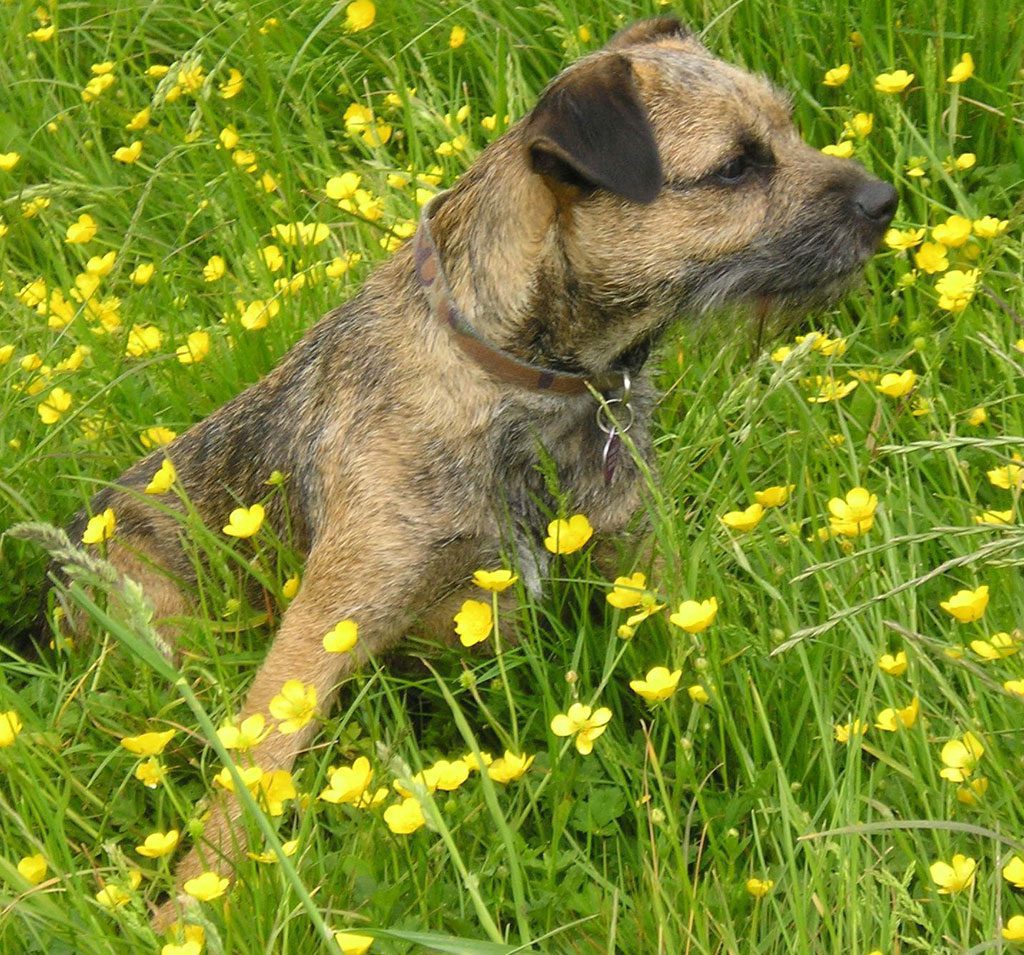
    Border Terrier It is a breed of dog of the Terrier that group, It takes its name from its place of origin, the Scottish borders. Shares ancestors with the Dandie Dinmont Terrier and Bedlington Terrier.

    Originally bred as a Hunter of foxes and small varmints, they were used to hunt otters and Badgers, as well.
    Although the breed is very old, the Border Terrier was officially recognized by the Kennel Club of Great Britain in 1920, and by the American Kennel Club (AKC) in 1930.

    In 2006, the Border Terrier ranked 81, in number of AKC registrations and rank 10 th in the UK (in the 2088, ranked number 8).

    Read more

    โ–ท The world of Pets: Dogs, cats, birds, reptiles, amphibians

    Lakeland Terrier
    Gran Bretaรฑaa FCI 70 - Large and medium sized Terriers

    Lakeland Terrier

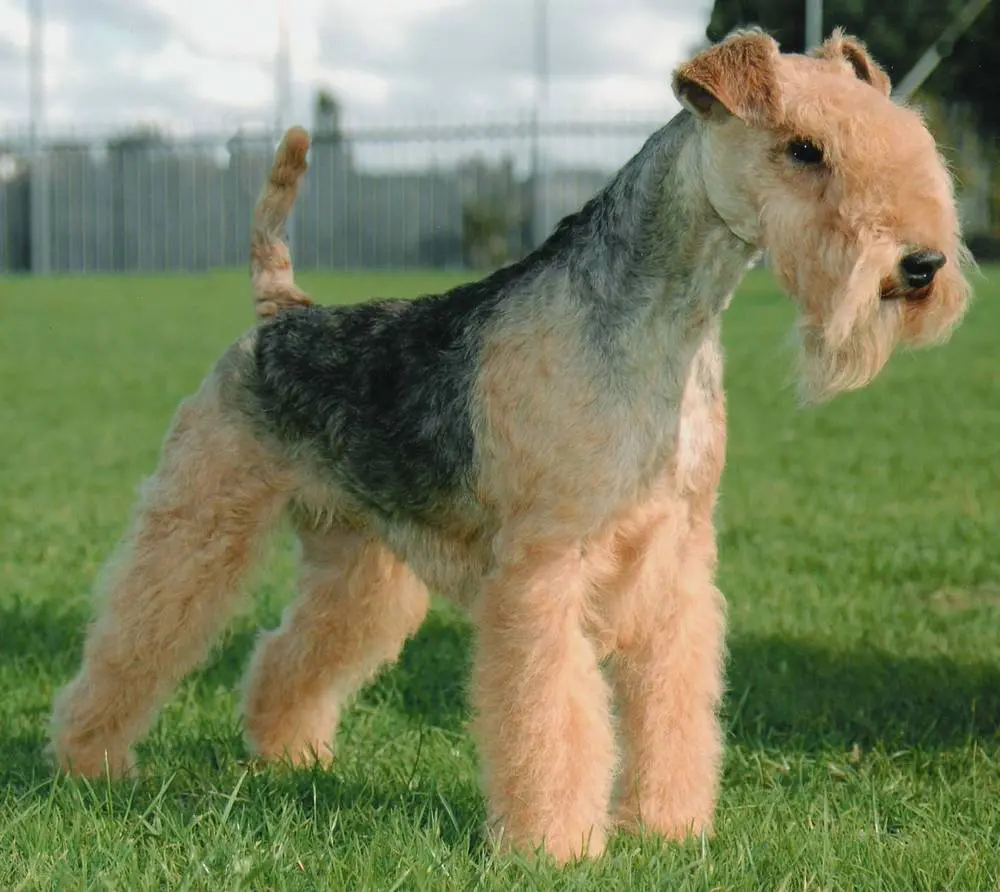
    The Lakeland Terrier he is a friendly dog รขโ‚ฌโ€นรขโ‚ฌโ€นwith his own, also with children if they respect, very self-confident

    Content

    History

    The Lakeland Terrier It is a breed of dog in the Terrier family, and within this section 1. The current Lakeland is a product of the crosses of different breeds of Terrier which include the Bedlington from whom he inherited his agility, the Border, of who retained the features of the fur, the Fox for its distinctive tail, and probably by its appearance the AIREDALE, These crosses resulted to the original Lakeland of the English region of Los Lagos.

    This dog was used by shepherds to protect sheep from attacks by foxes. The breed was officially recognized in the year 1928.

    Physical characteristics

    Within the Terriers we would place it on a medium scale, neither very big nor too small. Skull flat, well outlined, ears small and carried flat with the nose of black color except in the specimens of liver color, followed by a long neck and elegant forms, slightly arched; short back, broad chest, strong limbs and good muscular. The tail is often be amputated. Its height varies between the 35 and 37 cm and his weight between the 6,5 and 7,5 kg. As the mantle may be black and Tan, Blue and fire, red, wheat, grey red, liver, blue black; sometimes with white markings on chest and legs.

    Character and skills

    It is a friendly dog with its own, also with children if they respect, very self-confident, look cheerful and lively expression, very guardian and courageous by nature jacket.

    Lakeland Terrier, It is a dog that is well adapted to life in an apartment or a House. It is a dog that needs daily exercise (not excessive) and that also, like most terriers, She loves to hunt small vermin.

    Lakeland Terrier Health

    The Lakeland Terrier they are a very healthy breed, although they may have some genetic problems. These include eye problems like cataracts, glaucoma and lens dislocation, and a blood clotting disorder called vonWillebrand disease.

    Many breeds of small dogs, including the Lakeland Terrier, can develop Legg-Calvรฉ-Perthes disease (LCPD), a bone disorder that requires surgery. Dogs sometimes also have a condition called dysthichiasis, eyelashes that grow from the glands in the corner of the dog's eyes and cause irritation. Symptoms can be mild and easily manageable or severe and require surgery..

    Remember that after bringing a new puppy home, has the power to protect you from one of the most common health problems: the obesity. Keep a Lakeland with a proper weight is one of the easiest ways to prolong your life. Make the most of your preventive skills to help ensure a healthier dog for life.

    Lakeland Terrier care

    Lakeland has a double layer: hard and lean on the outside with a soft inner layer next to the skin. Hair is slightly wavy or straight. For display ring, the coat is stripped by hand to show the outline of the dog, giving it a neat and worked appearance. The ยปfillingยป – additional – on his face and legs they are abundant but neat with a clean texture.

    If you want your Lakeland to have the distinctive breed grooming, you will have to learn how to do it yourself or find a hairdresser who is familiar with the task, which can be challenging. Show coat is even harder to achieve. Most pet owners simply groom their dogs a couple of times a week and trim them every two months..

    The rest is basic care. Trim nails as needed, usually once every week or two. Brush your teeth frequently with a veterinarian-approved pet toothpaste for overall good health and fresh breath. Check ears weekly for dirt, redness or odor that may indicate an infection. If the ears look dirty, clean them with a cotton swab moistened with a gentle, pH-balanced ear cleaner recommended by your veterinarian. Introduce your Lakeland to the toilet early to accept it willingly and patiently.

    Buy a Lakeland Terrier

    The best way to buy your Lakeland Terrier puppy is to buy it locally from a breeder who is a member of the Terriesr Club or you can search the shelter for a Lakeland Terrier or similar terrier.. The costs are about 1200 EUR.

    Characteristics "Lakeland Terrier"

    Coexistence is important that you have with your new friend. Before considering the acquisition of a dog of the breed "Lakeland Terrier" you know certain factors. Not all breeds of dogs are apt to live in an apartment, you must take into account his character, their need for exercise, their interaction with other pets, their care and if you have small children, their level of tolerance towards them.

    Adaptation โ“˜

    3,0 of 5 stars (based on 1 review)

    friendly dog โ€‹โ€‹โ“˜

    1,0 of 5 stars (based on 1 review)

    hair loss โ“˜

    5,0 of 5 stars (based on 1 review)

    Affection level โ“˜

    4,0 of 5 stars (based on 1 review)

    Need for exercise โ“˜

    4,0 of 5 stars (based on 1 review)

    Social need โ“˜

    4,0 of 5 stars (based on 1 review)

    Home โ“˜

    4,0 of 5 stars (based on 1 review)

    Toilet โ“˜

    4,0 of 5 stars (based on 1 review)

    Friendly with strangers โ“˜

    3,0 of 5 stars (based on 1 review)

    barking โ“˜

    4,0 of 5 stars (based on 1 review)

    Health โ“˜

    2,0 of 5 stars (based on 1 review)

    Territorial โ“˜

    5,0 of 5 stars (based on 1 review)

    Cat friendly โ“˜

    1,0 of 5 stars (based on 1 review)

    Intelligence โ“˜

    4,0 of 5 stars (based on 1 review)

    Versatility โ“˜

    2,0 of 5 stars (based on 1 review)

    Child friendly โ“˜

    4,0 of 5 stars (based on 1 review)

    Surveillance โ“˜

    4,0 of 5 stars (based on 1 review)

    joy โ“˜

    5,0 of 5 stars (based on 1 review)

    Images "Lakeland Terrier"

    Photos:

    1 – Lakeland Terrier by https://pxhere.com/es/photo/1210535
    2 – Lakeland Terrier by https://www.pxfuel.com/es/free-photo-imoro
    3 – Lakeland Terrier by https://www.pexels.com/photo/adorable-animal-animal-portrait-blur-1029726/
    4 – Virginia Purebred – Hollybriar Natural High by Hoppyh / CC BY-SA
    5 – Grizzle and tan Lakeland Terrier by Inkforest / CC BY-SA
    6 – Tallinn, Estonia, CACIB duo 2013, August 17-18 by https://es.m.wikipedia.org/wiki/Archivo:Lakeland.JPG

    Videos "Lakeland Terrier"

    Type and recognitions:

    • FCI CLASSIFICATION:
    • Group :
    • Section : . .

    Federations:

    • FCI – Terriers 1 Large and medium-sized terriers. โ“˜
    • AKC – Terrier โ“˜
    • ANKC – Group 2 (Terriers) โ“˜
    • CKC – Group 4 (Terriers) โ“˜
    • โ€‹KC – Terriers โ“˜
    • NZKC – Terriers โ“˜
    • UKC – Terriers โ“˜

    FCI breed standard "Lakeland Terrier"

    Origin:
    England, United Kingdom

    Date of publication of the valid original standard:
    26.03.2009

    Use:

    Terrier


    General appearance:

    It's a live dog, fit for work, well balanced and compact.


    Behavior / temperament:

    Happy, brave behavior, vivacious expression, Fast movements, always wide awake. Intrepid, friendly and self-confident.

    Head:

    Well balanced. The length of the head from the frontal nasal depression (stop) to the tip of the nose must not exceed the length of the skull from the occipital to the frontal-nasal depression.

    Cranial region:

    Craging: Flat and well outlined.

    facial region:

    • Trufa: black, except in liver-colored specimens in which it must be that color.
    • Horcico: Width, but not too long.
    • Bite / Teeth: The jaws are powerful. Even teeth. Perfect and complete scissor bite, that is to say, that the internal face of the upper incisors is in close contact with the face of the lower incisors; teeth should be implanted at right angles in the jaws.
    • Ojors: Dark or hazelnut colored. Slanted eyes are undesirable.Ears: Moderately small, โ€œVโ€ shaped and carried in an alert position. They should not be placed too high or too low on the head.

    Neck:

    Long and elegant, slightly arched, without jowl.

    Body:

    • Espalda: Strong, moderately short.
    • Pork loin: Well coupled.
    • Pecho: Reasonably narrow.

    Tail:

    Previouslycustomwasamputate the tail.
    • amputee: Of good insertion and erect bearing, without curving over the back.
    • Sinn amputation: Of good insertion, erect bearing, without curling over the back or twisting. On balance sheet with the rest of the dog.


    Tips

    PREVIOUS MEMBERS: Straight members, provided with good bones.

    Hormbros: well laid.

    LATER MEMBERS: Strong and muscular.Thigh: Long and vigorous.

    • Rodinllto: Well angled.
    • Atibio-tarsal articulation: Well descended.Metatarsus: Straight.
    • PinIt: Small, compact, round and with solid foot pads.

    Movement:

    The forelimbs and hindlimbs should be carried in a straight line forward and parallel.. The shoulders move perpendicular to the body and without sticking to the sides. The femoro-tibio-patellar joints must not be turned inward or outward. Good thrust produced by well-angled hindlimbs.

    Mantle

    PlinkDenso, hard and weather resistant. Must have a good inner layer of hair.

    Colorr: black and tan, Blue and fire, red, wheat, grey red, liver, blue black. Some small white spots on the feet and chest are allowed, but they are not desirable. Mahogany or intense tan colors are not characteristic of the breed..


    Size and weight:

    Alturto the cross: It should not exceed 37 cm. (14 1/2 inches).

    Weight: Average: Males: 17 English pounds (7,7 kg).

    females: 15 English pounds (6,8 kg).


    Fouls:

    Any deviation from the aforementioned criteria is considered as a fault and the severity of this is considered to the degree of the deviation to the standard and its consequences on the health and well-being of the dog..

    FALTAS DISQUALIFYING:

    • Aggressiveness or extreme shyness.
    • Any dog โ€‹โ€‹showing clear signs of physical or behavioral abnormalities must be disqualified..


    N.B.:
    • Males should have two normal-appearing testicles fully descended into the scrotum..
    • Only functionally and clinically healthy dogs, with the typical conformation of the breed, should be used for parenting.

    Itlatest changes are in bold.

    TRANSLATION: Lic. Oscar Valverde Calvo (Costa Rica) and Jorge Nallem (Uruguay).

    Source: F.C.I - International Cynological Federation

    Alternative names:

    1. Lakeland (English).
    2. Lakeland (French).
    3. Lakeland (German).
    4. Lakeland (Portuguese).
    5. Lakeland (espaรฑol).

    โ–ท The world of Pets: Dogs, cats, birds, reptiles, amphibians

    Skye terrier
    Escocia FCI 75 .Small sized Terriers.

    Skye terrier

    The Skye is a typical terrier: tenacious hard with a propensity to bark and dig.

    Content

    History

    The Skye terrier it is one of the oldest Scottish breeds. The Skye was known as the Western Isles Terrier which comprised at Skye Terrier with a mixture of races like their ancestors, including prototypes of the Cairn Terrier.

    References to a terrier Scottish island of Skye back to long ago. In his 16th century book "Of English Dogs", Johannes Caius wrote that the Skye Terrier was "taken from the barbarian frontiers of the farthest countries to the north… what, because of the length of hair, "It doesn't show either the face or the body.". That certainly sounds like a description of profuse coat Skye.

    The dogs were bred to hunt and kill foxes, badgers and otters that threatened livestock farm or property damage caused. Their long coat and facial hair were meant to protect them from injury and the typical rainy weather of Scotland..

    Three centuries later, the Queen Victoria, dogs lover, he became interested in the race during one of his visits to Scotland, and dogs became fashionable pets noblewomen. It was said that even a duchess would be ashamed to show her face in the park without the company of a Skye.. A portrait of Queen Victoria with one of his Skyes, Rona II, was painted by William Nicholson, and other Sykes appeared in paintings Sir Edwin Landseer.

    Under threat of extinction

    There are concerns that the breed could disappear entirely., since during 2012 only 44 puppies were born in the UK. The particularly lowest period for this breed was in 2005, when they registered only 30 Puppies. โ€‹Today this is the most endangered dog breed within the classification of Vulnerable Native Breeds3โ€‹of the UK Kennel Club, and it is estimated that if it continues like this within 40 years the breed could become extinct.

    Did you know??

    One of the best known and loved Skye Terrier It was Greyfriars Bobby, who faithfully he watched the grave of his owner, John Grey, during 14 years after the death of man. A statue honoring the loyalty of the dog is visited Edinburgh for dog lovers around the world.

    Physical characteristics

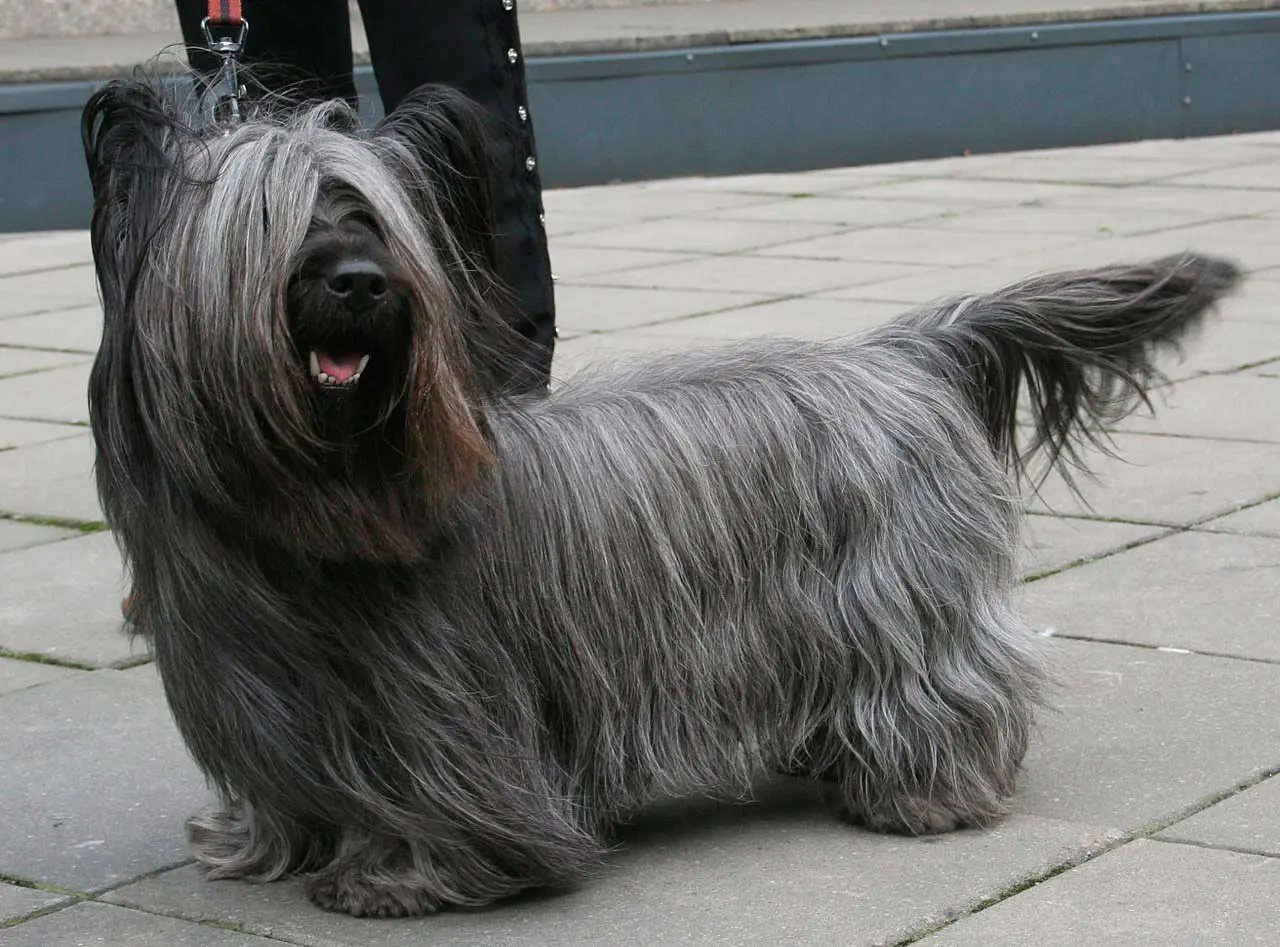
    The Skye terrier it's a long-bodied dog. Its length is twice its size with good length hair. It moves seemingly effortlessly. its members, body and jaws are strong. His head is long and powerful. It has a long body and under. The flat edges occur because the coat that falls straight.

    The mantle is double layer. The inner layer should consist of short hair, thick, soft and fleecy. The outer layer for reasonably long hair, hard, straight, flattened without curls that should never prevent movement. On the head the hair is shorter, softer and falls over his forehead eyes watching but not preventing vision. He meets the hair on the sides of the head, surrounding ears like a fringe allowing appreciate the way.

    Its color can be black, dark or light gray, leonado, cream, all with black markings.
    Its ideal height is 25 – 26 cm..
    Length from tip of nose to tip of tail: 105 cm.. Females are slightly smaller in the same proportions.

    Health

    The Skye Terriers They may be affected by various medical conditions, including eye problems (as glaucoma and dislocation of the lens), hipotiriodismo, of von Willebrand disease (a disorder of blood clotting), allergies and ulcerative colitis.

    "Skye's lameness" or "puppy lameness" sometimes occurs in puppies between 3 and 10 months of age. You can resolve without treatment, but some veterinarians suggest that activity is restricted. The Skye Terriers They can also undergo genetic forms of liver and kidney disease. The breeder of your puppy should be willing – in fact, anxious – review your dogs' health histories and discuss the prevalence of these and other health problems in your lines.

    Character and skills

    The Skye It is a classic Terrier: bold to, well, anything, friendly people who know, reserved and cautious with strangers. An old Scottish word, "cunning", It applies to him too. It is an intelligent dog and prudent people will consider carefully before deciding whether granted his affections. But, Once you are given, They are given lifetime.

    It may not seem like a great athlete at first sight, but Skye has resistance, strength and agility galore. You'll find it by participating in agility, obedience and tracking, but it is also a partner willing sofa. Two or three rides 15 minutes or games a day will meet your exercise needs, but he's up for more if you are. If your temperament permits, Skye can also be a therapy dog รขโ‚ฌโ€นรขโ‚ฌโ€นcheerful, visiting people in facilities such as nursing homes and children's hospitals.

    Like all terrier, the Skye has a mind of its own, but learns well. Train this sensitive dog with loving firmness and enjoy their trust and respect will win.

    Characteristics "Skye terrier"

    Coexistence is important that you have with your new friend. Before considering the acquisition of a dog of the breed "Skye terrier" you know certain factors. Not all breeds of dogs are apt to live in an apartment, you must take into account his character, their need for exercise, their interaction with other pets, their care and if you have small children, their level of tolerance towards them.

    Adaptation โ“˜

    5,0 of 5 stars (based on 1 review)

    friendly dog โ€‹โ€‹โ“˜

    2,0 of 5 stars (based on 1 review)

    hair loss โ“˜

    3,0 of 5 stars (based on 1 review)

    Affection level โ“˜

    4,0 of 5 stars (based on 1 review)

    Need for exercise โ“˜

    3,0 of 5 stars (based on 1 review)

    Social need โ“˜

    4,0 of 5 stars (based on 1 review)

    Home โ“˜

    5,0 of 5 stars (based on 1 review)

    Toilet โ“˜

    3,0 of 5 stars (based on 1 review)

    Friendly with strangers โ“˜

    2,0 of 5 stars (based on 1 review)

    barking โ“˜

    5,0 of 5 stars (based on 1 review)

    Health โ“˜

    4,0 of 5 stars (based on 1 review)

    Territorial โ“˜

    4,0 of 5 stars (based on 1 review)

    Cat friendly โ“˜

    2,0 of 5 stars (based on 1 review)

    Intelligence โ“˜

    3,0 of 5 stars (based on 1 review)

    Versatility โ“˜

    2,0 of 5 stars (based on 1 review)

    Child friendly โ“˜

    3,0 of 5 stars (based on 1 review)

    Surveillance โ“˜

    3,0 of 5 stars (based on 1 review)

    joy โ“˜

    5,0 of 5 stars (based on 1 review)

    Images "Skye terrier"/h2>

    Videos "Skye terrier"

    Type and recognitions:

    • FCI CLASSIFICATION:
    • Group :
    • Section : . .

    Federations:

    FCI โ“˜, AKC โ“˜, ANKC โ“˜, CKC โ“˜, โ€‹KC โ“˜, NZKC โ“˜, UKC โ“˜

    FCI breed standard Skye terrier

    FCIFCI - Skye terrier
    Skye

    Alternative names:

    1. Skye (English).
    2. Skye (French).
    3. Skye (German).
    4. Skye (Portuguese).
    5. Skye (espaรฑol).

    Photos:

    1 – Pleple2000 / CC BY-SA
    2 – Pleple2000 / CC BY-SA
    3 – A Skye terrier at the 2019 Kelso Dog Show ยฉ Copyright Walter Baxter and licensed for reuse under this Creative Commons Licence.
    4 – Skye Terrier, Gold Country Kennel Club Dog Show, Grass Valley by Larry Miller – Flicker

    โ–ท The world of Pets: Dogs, cats, birds, reptiles, amphibians

    Manchester Terrier
    Inglaterra FCI 71 . Large and medium sized Terriers
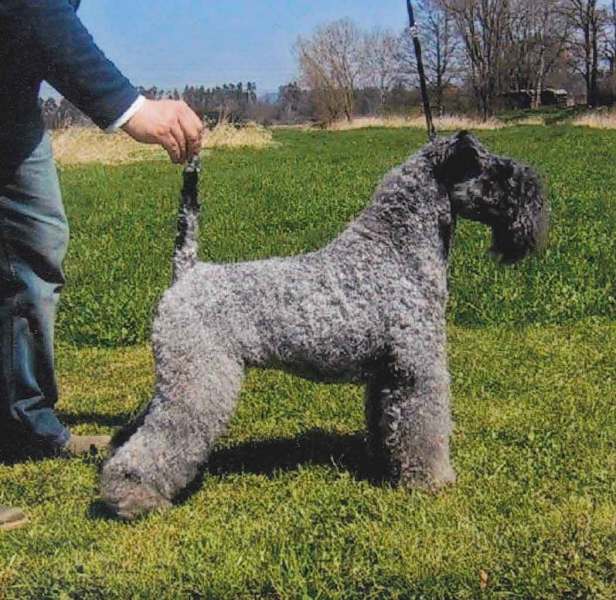
    Manchester Terrier

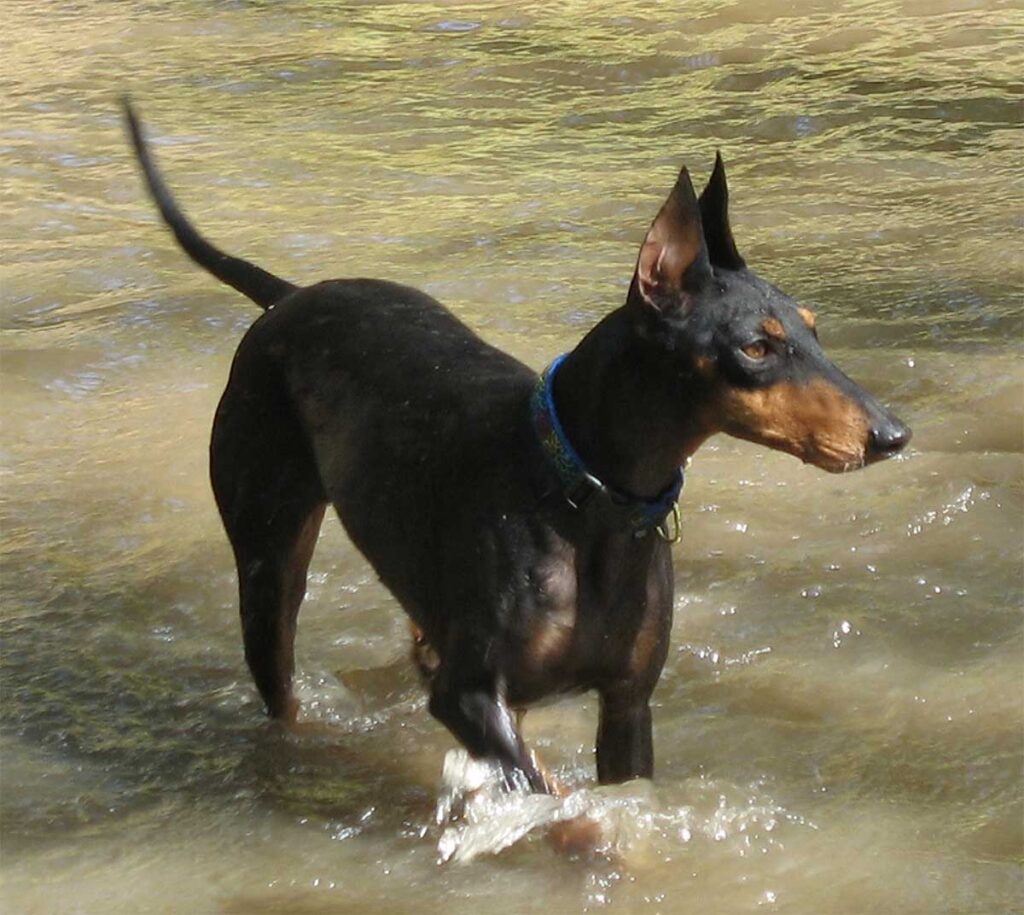
    The Manchester Terrier is a slender dog, light, athletic and with very refined lines.

    Content

    History

    The Manchester Terrier it is a dog of Scottish origin, seems a reduced form of the German Pinscher although I have no blood ties with this race.

    The Manchester Terrier could be defined as the modern version of a mouse-hunting dog called ‘Old Black and Tan Terrierโ€˜, It was very popular during the 19th century in the cities of the North-West of England, where - apparently- lived for several centuries.

    Other flows say it also has blood of the Whippet which gives it its aerodynamic appearance with clean lines and a lot of agility.

    In the beginning, the Manchester Terrier was a dog specializing in hunt for rats and rabbits in urban contests, but with the prohibition of these competitions, the Manchester Terrier went on to become a useful vermin controller for those who lived in the country and, later, in company pet.

    But Manchester Terrier since its inception has been townsman, not descended รขโ‚ฌโ€œ like other Terrier- field dogs, but that comes from urban dogs whose function was to put an end to the own city vermin: the rat.

    While his presence in the world of canine competitions is not the same as old, Now you can enjoy these dogs in certain competitions.

    Videos ยซManchester Terrierยป
    Manchester Terrier - Bling
    3 vs 1(Min Pin, Manchester, Rat Terrier)

    The Manchester Terrier began to be called as such in the year 1897 (20 years after its creation).

    It was created at the height of the contests that consisted of killing the largest number of rats, and the race became known as a champion in this discipline. With the prohibition of this practice, the Manchester Terrier suffers a first blow that lowers the number of copies and the popularity of the breed.

    Later he suffered another bump with the prohibition of amputate the ears of dogs (1898). A Manchester Terrier with its ears unclipped looked like, According to its owners, it was not consistent with its behavior and physical power.. This Manchester Terrier began to be increasingly less popularity.

    The third coup led in the World War II, during the race nearly extinct, leaving only 11 copies across England.

    The race begins to recover when a group of enthusiasts decided to form a club to promote the popularity of the Manchester Terrier, although it was only used in exhibitions or as a pet.

    Physical characteristics

    The Manchester Terrier it is a compact looking dog, elegant, solid and well structured.

    The height in the males is of approximately, 41 cm. and in the females of 38 cm.. The weight is proportional to the height.
    Its skull is long, flat and narrow, with a conical shape.

    It has oval-shaped eyes are very bright, small and dark. It has ears of high insertion, small and in the shape of a 'V' that has the tips raised and folded over the forehead.

    It has a short trunk and a compact back, rounded. The limbs are straight and proportionate to the size of the body.

    The tail is not very long, It is thick in the inclusion and is tuned toward the tip, must never exceed the dorsal line.

    It has a layer of shiny hair, glossy, well bushy, smooth, short and very soft to the touch. The color is solid black with bronze spots (Dark mahogany).

    Observations

    In the United States are maiming ears. This practice was common in England before the Decree of the Prince of Wales that, in the year 1898 banned all amputations.

    Due to the entry into force of this Decree, the race Manchester Terrier lost so much popularity that was on the verge of extinction.

    Unfortunately, despite all efforts of loving breeders of this breed, from then on, the recovery of the breed… was only partial.

    Character and skills

    By having an urban origin, the Manchester Terrier It is an ideal dog for life in a small flat in city. It is a very nice dog that adapts effortlessly to the home life, over all if leave you a hole in the bed or the couch.

    It will be fully happy, If in addition to the overstuffed couch take it to give rides to open field, because he will unleash his hunting instinct and go crazy with joy chasing mice, crickets, lizards…, and all small shabby crossing on their way.

    The Terrier, It is the most suitable to live in an apartment, does not lose hair practically, and by instinct is a clean dog. Learn fast, and in addition fond of children.

    ยซManchester Terrierยป Education

    Create one Manchester Terrier is not easy. His multifaceted nature requires a lot of dog mind and empathy. He is also very sensitive and does not easily forgive injustice and disproportionate punishment.. So, not easy to recommend as a beginner dog. But, if you manage to feel and think your way to your Manchester and thus build a close relationship of trust, a hidden treasure is at your disposal. Especially for its multifaceted nature combined with its intelligence and docility, you can easily master any challenge with it, what could be desired in a full cooperation between dog and man. You need a clear announcement and consequences based on a respectful and loving relationship with your master and lady. Yet Manchester Terrier likes to be raised and seeks cooperation with humans. So, especially with him, much more than with other dogs in general, command and drill are completely out of place and counterproductive.

    Manchester Terrier Health

    The Manchester Terriers They have some health conditions that may be of concern. They include an inherited bleeding disorder called von Willebrand disease, Hypothyroidism, patellar dislocation, Legg-Calve-Perthes disease (Toy Manchesters), and eye problems like glaucoma and cataracts.

    Do not buy a puppy from a breeder who cannot provide you with written documentation showing that the parents were exempted from health problems affecting the breed. Having dogs undergo a "vet check" is not a substitute for genetic health testing.

    Remember that after bringing a new puppy home, has the power to protect you from one of the most common health problems: the obesity. Keep a Manchester with a proper weight is one of the easiest ways to prolong your life. Make the most of your preventive skills to help ensure a healthier dog for life.

    ยซManchester Terrierยป Care

    When it comes to grooming, the Manchester Terrier he's an easy keeper. Although the breed is naturally clean with little dog smell, a bath every three months (or when it gets dirty) in a mild shampoo is a good idea. Brush your elegant coat with a natural bristle brush or glove. Use hair conditioner / polisher to brighten hair.

    The rest is basic care. Trim nails as needed, normally once every few weeks. Brush your teeth frequently with a veterinarian-approved pet toothpaste for overall good health and fresh breath. Check ears weekly for debris, redness or odor that may indicate an infection. If the ears look dirty, clean them with a cotton swab moistened with a gentle, pH-balanced ear cleaner recommended by your veterinarian. Enter the Manchester Terrier in the toilet when he is very young so that he learns to accept it, especially the nail cut, with patience.

    The life expectancy of ยซManchester Terriersยป

    as a rule, the Manchester Terriers they enjoy a long life as dogs, often more than 12, sometimes more than 15 years. But, a prerequisite is that they come from a healthy upbringing.

    Comprar ยซManchester Terrierยป

    You should take a closer look at the breed and visit a breeder well before you buy.. The best way to buy your Manchester Terrier puppy is to buy it from a breeder who is a member of an FCI terrier club or can look around shelters. Sometimes there are dogs that come near the Manchester Terrier in type and character. The costs are about 1.200 EUR.

    Characteristics "Manchester Terrier"

    Coexistence is important that you have with your new friend. Before considering the acquisition of a dog of the breed "Manchester Terrier" you know certain factors. Not all breeds of dogs are apt to live in an apartment, you must take into account his character, their need for exercise, their interaction with other pets, their care and if you have small children, their level of tolerance towards them.

    Adaptation โ“˜

    5,0 of 5 stars (based on 1 review)

    friendly dog โ€‹โ€‹โ“˜

    3,0 of 5 stars (based on 1 review)

    hair loss โ“˜

    3,0 of 5 stars (based on 1 review)

    Affection level โ“˜

    4,0 of 5 stars (based on 1 review)

    Need for exercise โ“˜

    4,0 of 5 stars (based on 1 review)

    Social need โ“˜

    5,0 of 5 stars (based on 1 review)

    Home โ“˜

    5,0 of 5 stars (based on 1 review)

    Toilet โ“˜

    1,0 of 5 stars (based on 1 review)

    Friendly with strangers โ“˜

    3,0 of 5 stars (based on 1 review)

    barking โ“˜

    4,0 of 5 stars (based on 1 review)

    Health โ“˜

    2,0 of 5 stars (based on 1 review)

    Territorial โ“˜

    5,0 of 5 stars (based on 1 review)

    Cat friendly โ“˜

    3,0 of 5 stars (based on 1 review)

    Intelligence โ“˜

    4,0 of 5 stars (based on 1 review)

    Versatility โ“˜

    3,0 of 5 stars (based on 1 review)

    Child friendly โ“˜

    3,0 of 5 stars (based on 1 review)

    Surveillance โ“˜

    4,0 of 5 stars (based on 1 review)

    joy โ“˜

    5,0 of 5 stars (based on 1 review)

    ยซManchester Terrierยป images

    Videos ยซManchester Terrierยป

    Type and recognitions:

    • FCI CLASSIFICATION:
    • Group :
    • Section : . .

    Federations:

    • FCI – Terriers 1 Large and medium-sized terriers. โ“˜
    • AKC – Terriers โ“˜
    • ANKC – Terriers โ“˜
    • CKC – Terriers โ“˜
    • NZKC – Terriers โ“˜
    • UKC – Terriers โ“˜

    FCI breed standard "Manchester Terrier"

    Origin:
    United Kingdom

    Date of publication of the valid original standard:
    13.10.2010

    Use:

    Terrier


    General appearance:

    It is a compact dog, elegant, robust and of good substance.


    Behavior / temperament:

    Lively, alert, happy and sporty. Insightful and faithful.

    Head:

    ---

    Cranial region:

    Craging: Long, flat and narrow, level and wedge-shaped, without the cheek muscles showing.

    facial region:

    • Trufa: Glossy black.
    • Horcico: Well filled under the eyes, tapers towards the tip.
    • Bite / Teeth: Symmetrical jaws, with perfect and complete bite, scissor, that is to say, that the inner face of the upper incisors is in close contact with the outer face of the lower incisors. Teeth should be implanted at right angles in the jaws.
    • Labios: Glued.


    • Ojors: relativelysmall, dark and shiny. Almond shaped and should not be prominent.
    • Obars: The ears are small and โ€œVโ€ shaped., implantation well above the skull and falling close to the head over the eyes.

    Neck:

    Fairly long and slim from shoulder base to head; slightly arched topline, without jowl.

    Body:

    Short.

    • Itmor: Slightly arched.
    • Breast : Well arched ribs.
    • Lรญnlower ea and belly: Pick up behind the ribs.

    Tail:

    Cut and inserted where the arch of the back ends; thick at the base and tapers to the tip. It should not be carried higher than the line of the back..

    Tips

    PREVIOUS MEMBERS:

    • Hormbros: Clean and well sloped.
    • Antarm: Well upright forelimbs, and well placed below the body. Of length proportional to the body.
    • Pinis previous: Small, hare's half-form, strong and with well arched fingers.

    LATER MEMBERS: Strong and muscular. Hindquarters must not have cow hocks or feet turned inward.

    • Rodinllto: Well angled.
    • Pinis later: Small, hare's half-form, strong and with well arched fingers.

    Movement:

    Straight, free and balanced. The forelimbs are carried forward freely and the hindquarters give it a great push.

    Mantle

    Plink: Tight, smooth, short and bright, hard textured.

    Colorr: Glossy black and lit mahogany fire stains distributed like this: on the head and from the snout to the nose they have fiery hues, the nose and the back of the muzzle are shiny black. A small fire stain on each cheek and above each eye, in the lower jaw and in the throat forming a well-defined โ€œVโ€. In the Member, the fire color from the knee down, except the fingers which have black striations and a distinctive black spot (like thumbprint) on the foot. On the hind limbs the fire marks on the inside, with a black split at the knees. A fire spot under the tail and around the anus very narrow, so that it covers it. A very faint fire stain on each side of the chest. External fire spots on the hind limbs, commonly called โ€œpantsโ€, they are undesirable. In all cases, black color should not mix with fire and vice versa, but there must be a well-defined division between colors.


    Size and weight:

    Ideal height at the withers:

    • Males: 41 cm..
    • females: 38 cm..


    Fouls:

    Any deviation from the aforementioned criteria is considered as a fault and the severity of this is considered to the degree of the deviation to the standard and its consequences on the health and well-being of the dog..

    FALTAS DISQUALIFYING:

    • Aggressiveness or extreme shyness.
    • Any dog โ€‹โ€‹showing clear signs of physical or behavioral abnormalities must be disqualified..


    N.B.:
    • Males should have two normal-appearing testicles fully descended into the scrotum..
    • Only functionally and clinically healthy dogs, with the typical conformation of the breed, should be used for parenting.

    Itlatest changes are in bold.

    TRANSLATION: Brรญgida Nestler / Original version: (IN)

    Technical supervision: Miguel Angel Martinez

    Source: F.C.I - International Cynological Federation

    Alternative names:

    1. Manchester Terrier (English).
    2. Manchester Terrier (French).
    3. Manchester Terrier (German).
    4. Manchester Terrier (Portuguese).
    5. Manchester Terrier (espaรฑol).

    โ–ท The world of Pets: Dogs, cats, birds, reptiles, amphibians

    Brazilian terrier
    Brasil FCI 341 - Large and medium-sized Terrier.
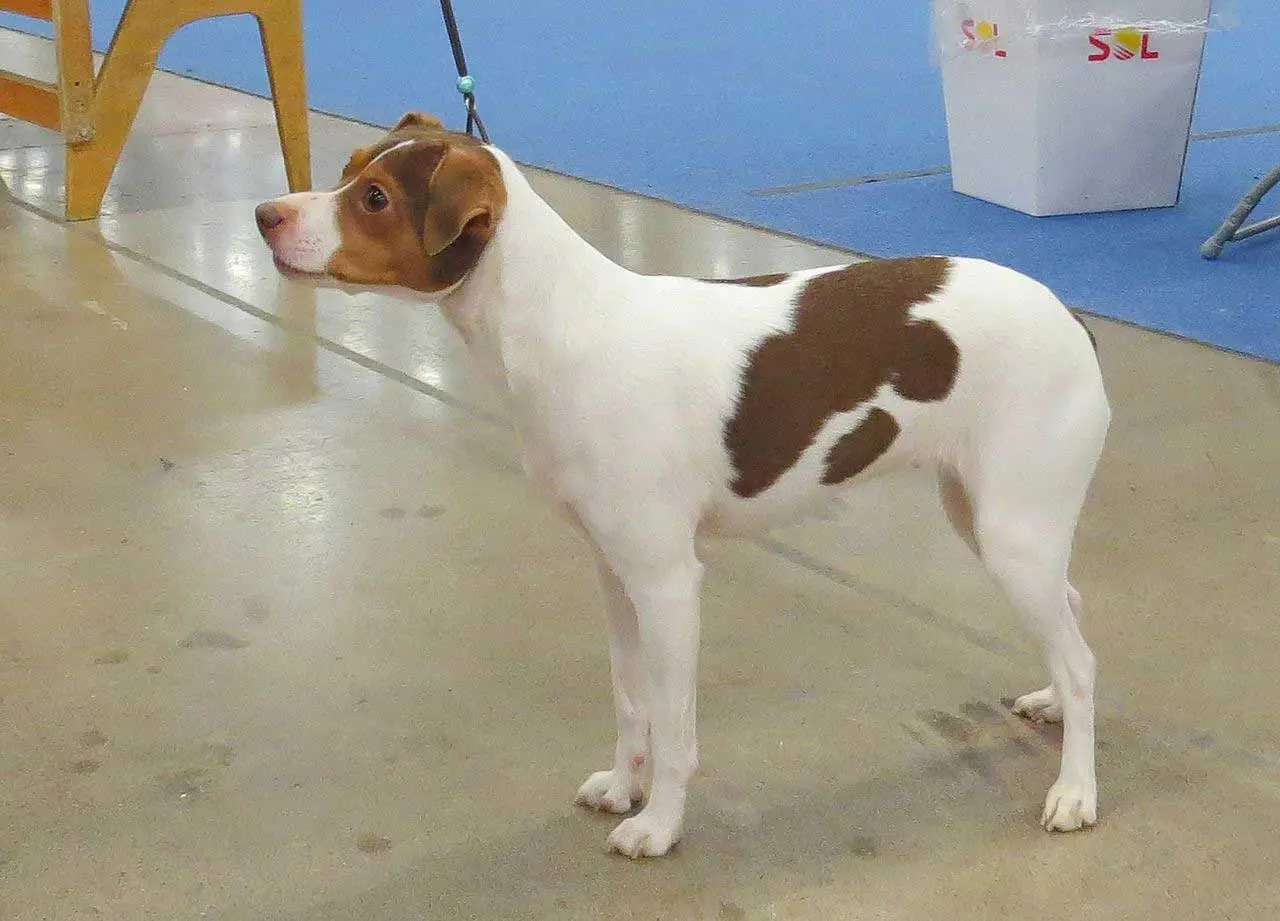
    Brazilian Terrier

    Due to his easy training and his physical gifts, the Brazilian terrier in Brazil it is used as a circus dog.

    Content

    History

    Although the Brazilian terrier was originally from Brazil, his ancestors did not come from South America, but mainly from Europe. In the late nineteenth and early twentieth centuries, many Brazilian youths studied at European universities, especially in England and France. It was not uncommon for them to come home married, and their wives sometimes brought small terrier-type dogs with them.. These were mixed with the native males and females, so a breed of dog developed, whose members looked different and literally strange.

    But in a few generations the phenotype of the Brazilian terrier. It is believed to be the result of crossing Pinscher, Chihuahua and Jack Russel Terrier.

    By the way, the Brazilian terrier became familiar with the different living conditions in Brazil: At first, families with their dogs lived in the countryside before being attracted to large urban centers., that gradually developed. The Brazilian terrier used to serve primarily as a rat catcher. In the meantime, However, its field of application has been expanded: they are excellent guard and family dogs.

    Selective breeding of this breed of dog, highly appreciated in Brazil but almost unknown in Europe, started around 1970. The Brazilian terrier was provisionally recognized by the FCI (International Cynological Federation) in 1995 and from 2007 is completely included as a breed in the catalog of the largest cynological organization in the world. It takes the standard number 341 and is in the group 3 (terriers), section 1 (Large and medium-sized terriers).

    Physical characteristics

    The Brazilian terrier is a dog's size medium, slim and harmonious construction. Its square body with rounded outer lines is firm but not too heavy.. The weight of an adult animal is a maximum of eight to ten kilograms. This applies to both males and females, although the height at the withers is different in both: While reaching 35 to 40 centimeters in males, it's just 33 to 38 centimeters in females.

    Interesting and unusual is that Brazilian terrier have different tail lengths from birth: From a rudimentary stump on a medium long tail to a full tail, you can find the most varied expressions. This typical characteristic of the breed gives the Brazilian terrier an individual appearance and does not detract from its charm, on the contrary.

    The dog also owes its special charisma to the small folded ears, as well as the large round blue eyes, green, brown, Bluish gray or reddish brown with an open and lively look. The head seems very expressive. It has a triangular shape and is wide at the base. The face narrows noticeably from the widely spaced ears to the tip of the nose. Due to the relatively distinctive groove on the forehead, seems thoughtful.

    The short coat, smooth, fine and tight dog feels very nice, a bit like the hair of a rat. No underwear. Especially soft areas are found on the head, the ears, the bottom of the neck and the inside of the front legs. As a rule, a Brazilian terrier it's tricolor. The basic color is always white. It is flanked by black marks, blue and / or brown red, they provide a distinctive pattern. Over and over you hear and read that the Brazilian terrier has strong similarities to Fox Terrier. This is undeniable, but there are visible differences: the Brazilian's muzzle is much shorter and the body contours appear more rounded, while the body of the Fox Terrier is more angular.

    Character and skills

    The character of Brazilian terrier can be described, justly, as little complicated. Their social behavior is once again much better than that of other types of terrier. These may include, the stubbornness of Russel and I shake it off Fox Terrier are much less present in South America. He is very friendly with the people he meets and in relation to contact with their owners, one can use terms like "affectionate" and "tender". Also with other dogs the Brazilian terrier usually gets along smoothly.

    Like your relatives in the terrier family, the Brazilian terrier it is extremely spirited, and therefore active and lively. you could also say: a real brazilian. Therefore, need plenty of exercise. He loves to accompany runners and hikers and frolic with children., but is content with fun adventures in the park without complaining. But please, pay attention to the variety: The dog finds both pleasure in ball games and recovery. It moves freely and elegantly. Typical are short, quick steps.

    The Brazilian terrier is considered a smart dog – but of course this requires a certain amount of activity, not just outside, but also inside the house or the apartment. Its high level of attention and the fact that it is initially reserved towards strangers, his above average barking often qualifies him as a watchdog. It is also worth mentioning the dog's ability to empathize in almost any situation..

    In short, It is an excellent dog for home and family or social, who can be easily trained with a successful mix of gentle and patient guidance. Canine sports enthusiast (agility, fly-ball). It also, gets along very well with horses, making it an excellent companion for horse owners. Thanks to his pleasant character, the Brazilian terrier also suitable as a beginner dog for people who have had little or no experience of active dog ownership to date.

    Considering its origin, the Brazilian terrier is naturally used to tropical temperatures. For this reason it is recommended to give up the breed if you live in very cold and rainy climates..

    Care and health of the Brazilian Terrier

    The maintenance of Brazilian terrier it's comparatively easy. This is mainly due to the short, smooth coat without undercoat. The dog hardly loses hair, so it is also suitable for allergy sufferers who have to do without the four-legged friends of other races for health reasons.

    Talking about health:

    Another positive aspect is that the Brazilian terrier they are particularly resistant to diseases and have a high life expectancy. On average, they live on 12 to 15 years. Only with respect to the ears is caution necessary: Dogs have what are known as slanted ears, which means that the ear canal is angled. This makes ventilation of the inner ear somewhat more difficult., which encourages the settling of bacteria and fungus and significantly increases the likelihood of a dangerous ear infection. For this reason, the ears of the Brazilian terrier must be cleaned regularly and thoroughly. As such, earlobes and special ear cleaners are used. These agents help loosen dirt and wax from the ear and, therefore, keep the quadruped healthy. Important: Never use cotton swabs. would have a counterproductive effect.

    Images "Brazilian terrier"

    Photos:

    1 – Brazilian terrier – Dog 2013 Helsinki 13-15/12/2013 by Thomas / CC BY-SA
    2 – Juliana Lopes / CC BY by Brazilian Terrier, uploaded from Flickr
    3 – Matt Hidalgo / CC BY-SA by Filomena and one more of their faces =) (Brazilian Terrier)
    4 – Terrier brasileรฑo by Sini Merikallio / CC BY-SA
    5 – The 4 genetically possible colours of Terrier Brasileiro. From left to right: Tricolor black, tricolor brown, tricolor blue, tricolor isabela by TerrierBrasileiroDaPedraFilosofal / CC BY-SA
    6 – Terrier brasileรฑo by https://brit-petfood.com/en/breed-catalog/terriers/brazilian-terrier
    7 – Terrier brasileรฑo by https://pxhere.com/en/photo/1188027

    Videos "Brazilian terrier"

    Type and recognitions:

    • FCI CLASSIFICATION:
    • Group :
    • Section : . .

    Federations:

    • FCI – Terriers. Section 1 Large and medium-sized terriers. โ“˜
    • CBKC โ“˜

    FCI breed standard "Brazilian terrier"

    Origin:
    Brazil

    Date of publication of the valid original standard:
    15.06.2018

    Use:

    Used for small game hunting, as a guard and companion dog.


    General appearance:

    Is medium sized, slender, well balanced, of firm structure, but nottooheavy. The body is ofappearancesquare, with curved lines.

    IMPORTANT PROPORTIONS: Square shaped dog: the length of your body, from the shoulder to the tip of the iliac crest, it is approximately the same as its height at the withers.


    Behavior / temperament:

    This is a dog always on the move, alert, active and shrewd. He is friendly and gentle with acquaintances, butdistrustful with strangers.

    Head:

    View from the top, It is triangular in shape, wide at the base; ears are wide apart. The head decreases noticeably from the eyes to the tip of the nose. Profile view, the upper line rises slightly from the tip of the nose to the naso-frontal depression, mainly between the eyes, and continues towards the occipital bone with a slight convexity.

    Cranial region:

    Craging: It is rounded with a moderately flat forehead. Views from above, lateral lines converge towards the eyes. The distance from the outer angle of the eye to the insertion of the ears is equal to the distance between the two outer angles of the eyes. The front groovemediumis well developed.

    Dnaso-frontal depression (Stop): Pronounced.

    facial region:

    • Trufa: Moderately developed. It is dark in color, in accordance with the coat color, with nostrils wide open.
    • Horcico: Seen from above, is shaped as an isosceles triangle from both outer corners of the eye to the tip of the nose. It is strong and well molded under the eyes, with an inclined base that accentuates the naso-frontal depression.
    • Labios: Dry andfirm. The upper lip joins the lower lip exactly, covering the teeth and allowing the mouth to be closed completely.
    • Cheeks: Droughts, well developed.
    • Jaws / Teeth: 42 teeth, regularly deployed, well developed. The bite is scissor-shaped.

    EYES: Equidistantesfromthe occipital protuberanceuntilthe tip of the nose. They appear well separated. The distance between the outer corners of the eyes is equal to the distance from the outer corner of the eye to the tip of the nose. Looking straight ahead, are somewhat prominent, large andeyebrowsare slightly accented. They have shaperoundedand they are wide open. His expression is alert and shrewd. Color should be as dark as possibleand in accordance with the color of the coat.

    Blue variety has bluish gray eyes, the variety of brown colorhasBrown eyes, green or blueand the varietyinsabela, in addition to the colors of the brown variety, may also have amber eyes, both clear andorsCร โ€บr.

    EARS: Deployed laterally, in line with the eyes, well separated from each other. They are triangular in shape and the tip is pointed. They appear semi-upright with the tip bent down towards the outer corner of the eye.

    Neck:

    It is of moderate length, balanced in relationwiththe head. Harmoniously joins the head and trunk.Well defined, clean and dry. The top line is slightly arched.

    Body:

    Well balanced. It is not too heavy and has a square shape, withcurve linesNot baddefined.

    • Lรญnand the top: It is firm and straight, rising slightly from the cross to the rump.
    • Cruz: Well pronounced, harmoniously joins the forelimbs.
    • Espalda: Relatively short and well muscled.
    • Itmo: Short and firm. Armoniosamente a la grupa.
    • Glikeness: Slightly inclined, tail implantation is low. Well developed and muscular.
    • Pecho: Long, deep, reaches to elbow level. Ribs well arched. The sternum is moderately curved. The sill is not very pronounced and is moderately wide, allowing free movement of the front limbs.
    • Lรญnlower ea and belly: Slightly curved, that rises back but not extremely retracted.

    Tail:

    Nnaturally short or long; on this last case, cannot exceed the hock. Strong and low set, happily held, forming a smooth curve when it's long, not coiled on the back.

    Tips

    PREVIOUS MEMBERS:

    • Apgeneral arience: Seen from the front, they are straight, moderately separated, in the same line as the hind limbs, which are also straight, although more separated.
    • Hormbros (Blades): They're long.
    • Brazos (Humerus): They are approximately the same length as the shoulder blade, forming with it an angle of approximately 110 ยฐ.
    • Elbows: They are well attached to the body, at the same level as the lower chest line.
    • Antarms: Straight, skinny, dry.
    • MetacarpusVery moderate, straight and slim, almost perpendicular to the ground.
    • Pinis previous: compacts. They don't even deviate inwards, nor out. The two middle fingers are longer than the others.

    LATER MEMBERS:

    • Apgeneral arience: Noticeably muscular, well developed thighs, more separated than the previous members.
    • Thigh (Femur): Well developed and muscular.KneeModerately angled.
    • PinScheme (tibia): It is proportionate to the size of the thigh.
    • CorvejรณnRelatively short and perpendicular to the ground when the dog is standing.
    • Metatarsus: Straight.
    • Pinis later: compacts; with fingers longer thanon the front feet.

    Movement:

    Elegant, loose, short and quick steps.

    Mantle

    Well adjusted, no slack. Dry.

    Plink: Is short, smooth, fine, but not soft. It is glued to the skin; you can't see the skin through it. It is finer on the head, the ears, below the neck, in the interior and bottom part of the forelimbs and behind the thighs.

    Colorr: Predominant white background color with markingsblack, blue, brown or isabela. The following characteristic marks must always be present: fire color over the eyes, on both sides of the muzzle, as well as inside the ears and on the edge of these. These marks may exist on other parts of the body at the edge of the marks.

    The head must always have marksblack, blue, browns or isabelaon the forehead and ears.Cana star and white marks appear preferably in the front groove and in the parts ltoteralesof the muzzle, distributed as harmoniously as possible.


    Size and weight:

    Alturto the cross:

    • Males: between 35 and 40 cm.,
    • females: between 33 and 38 cm..

    Weight: 10 kg approximately.


    Fouls:

    Any deviation from the aforementioned criteria is considered as a fault and the severity of this is considered to the degree of the deviation to the standard and its consequences on the health and well-being of the dog..

    • Scarce cloak that reveals the skin, across the board the atypical.
    • Faults in characteristic marks
    • Shoulders too heavy or loose
    • Wellrear arched ta
    • Falharmony, atypical complexion.

    FALTAS GRAVES:

    • Lรญnupper e descending from the cross to the rump.

    FALTAS DISQUALIFYING:

    • Aggressive or extreme timid
    • Any dog โ€‹โ€‹showing clear signs of physical or behavioral abnormalities.
    • Group plan.
    • Prognathism higher than the bottom
    • Ear fully erect.


    N.B.:
    • Males should have two normal-appearing testicles fully descended into the scrotum..
    • Only functionally and clinically healthy dogs, with the typical conformation of the breed, should be used for parenting.

    Itlatest changes are in bold.

    TRANSLATION: IRIS Carrillo; Skrivanek Translation Services. Official language: IN.

    Revision: SR. Jorge Nallem.

    Source: F.C.I - International Cynological Federation

    Alternative names:

    1. Fox Paulistinha (English).
    2. terrier brasileiro (French).
    3. Terrier Brasileiro (German).
    4. Fox paulistinha, Foquinho (Portuguese).
    5. Fox Paulistinha, Terrier Brasileiro (espaรฑol).