 FCI 96 - Molossoid . Mountain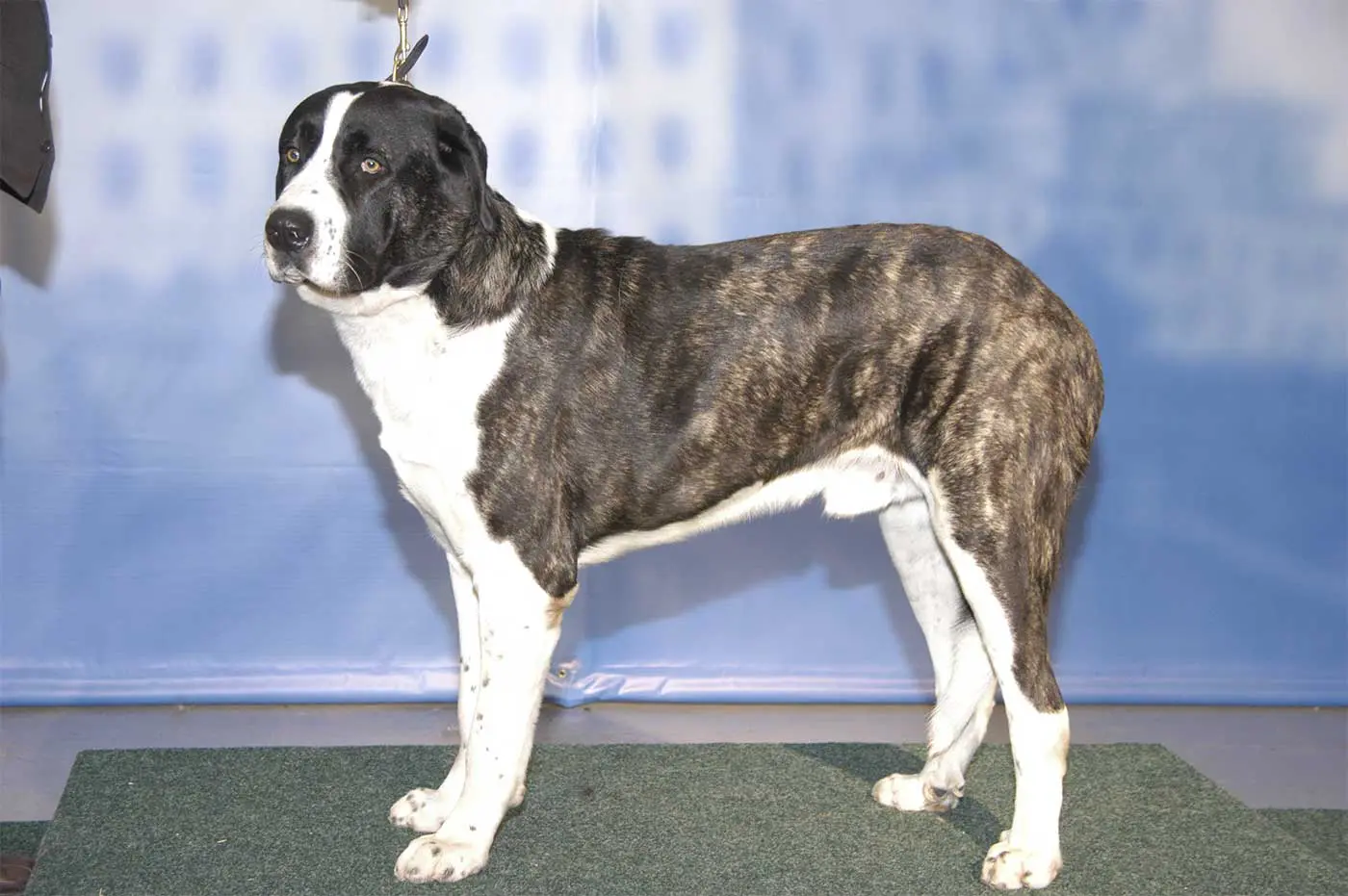
Content |
|---|
History
The Rafeiro of Alentejo (Alentejo Mastiff), as the name reflects, comes from the Portuguese region of Alentejo, extending south of the Tagus River to the Algarve. The pedigree dog, that within the FCI belongs to the Group 2 (Molossoid), Mountain Dogs subsection, has a long history as a herding dog. Although little is known about the exact origin of this rare breed, their parents are supposed to be found in the molossian dogs of the Middle East. The Estrela Mountain Dog (Star Mountain Dog), also from portugal, was probably also involved in its origin.
In the Alentejo lowlands, shepherds used the Rafeiro of Alentejo to herd and drive cattle. It also, the intrepid four-legged friend protected the flock entrusted to him by reliably avoiding attacks by wild animals or rustlers. Especially at night the Rafeiro of Alentejo defended his flock to the blood. The wealthy large landowners appreciated the imposing dog not only as a vigilant protector, but also as a status symbol of strength and power.
As industrialization advanced and the large latifundia decreased, the rafeiro it got weirder. In the early 20th century, dogs of this type were almost extinct. But, a small circle of enthusiasts ensured that the breed was preserved. In 1940 a first breed standard was established. 14 years later, the Fédération Cynologique Internationale (FCI) finally recognized the breed.
Physical characteristics
When the Rafeiro of Alentejo, cattle thieves and wild animals quickly flee: Who would want to mess with such a big and powerful dog?
With a height at the withers of up to 76 cm and a weight of approximately 50 kg, the Portuguese breed dog has a very striking appearance. His massive head and strong, muscular body give a defensive impression.. Look calmly at your opponent with small brown eyes, between which there is a slight groove, but nothing escapes your watchful eye.
Despite its bulky shape and somewhat heavy and slow gait, the body of the Rafeiro of Alentejo seems to be rather long than wide. The neck offers a good transition to the shoulder, the back is straight. The tail is well furnished and thickened at the base, rather low and forms a slight upward curve when excited. In rest position it reaches to the hock. Ears of the Rafeiro they are medium in size and fall to one side when folded.
The dense and smooth coat of the Portuguese Sheepdog is short to medium length and has abundant undercoat, giving you reliable protection in all weather conditions. The Rafeiro of Alentejo it is available in black, gray wolf, leonado or yellow with or without white spots. A white base color with yellow spots is also allowed., as well as brindle specimens according to the breed standard.
Character and skills
At night, the Rafeiro of Alentejo he is in his best moment: nothing escapes your watchful eye, his good sense of smell and his excellent ears. Anyone who dares to enter their territory is captured without notice and, if required, wholesale. Pastors who have a Rafeiro they no longer have to fear rustlers or poachers.
Like a purebred dog, whose sole task is to accompany and protect his family, the Portuguese breed dog is completely unsuitable. Although he is faithful and loyal to his family, his innate sharpness is difficult to control even with consistent upbringing. After all, the intelligent and self-confident Rafeiro of Alentejo has always been used to working and acting independently. But, the will to subordinate and obedience are not among its strong points.
Who wants to keep a Rafeiro of Alentejo You must be able to offer him a large territory in which his watchful and protective instinct can live according to his mood. This does not mean, of course, that one should just let this dog go. A responsible owner socializes and educates his dog from the beginning. Shows you clearly who holds the reins in your hand and where your limits are. At the same time, he also accepts that his four-legged friend needs his freedom. The Rafeiro will never become a "good lapdog".
Buy a “Rafeiro del Alentejo”
Those interested in a Rafeiro of Alentejo Purebreds sometimes have to go a long way to find a suitable breeder. But, people who want to buy this dog on a whim, should refrain from buying it. The Rafeiro it is and continues to be an excellent herd dog and should be kept in that context. Who wants to make it a suitable companion dog for the family, You are not doing yourself or the dog any favors..
Health and life expectancy of the “Rafeiro del Alentejo”
The typical diseases of the breed are hardly known due to the low propagation of the breed. The Rafeiro it is a very robust dog whose life expectancy is comparatively high, of 12 to 14 years. But, like all dogs of their size and format, You may also have joint problems such as hip joint dysplasia or elbow dysplasia.
The “Rafeiro del Alentejo” diet
In principle, this breed has no specific dietary needs. But, a balanced and healthy diet is, of course, also important for this dog – also or especially regarding possible joint problems. So, following the high energy puppy diet, a fairly low protein food should be given first to prevent the young dog from growing too quickly. In the adult dog, the energy value of the food can increase again. Now, fresh meat, through which the necessary amount of animal protein is absorbed, should mainly fill the feeding bowl. Fresh vegetables and rice are suitable as a healthy garnish. Fish can be given as an alternative to meat.
Characteristics "Rafeiro of Alentejo"
Coexistence is important that you have with your new friend. Before considering the acquisition of a dog of the breed "Rafeiro of Alentejo" you know certain factors. Not all breeds of dogs are apt to live in an apartment, you must take into account his character, their need for exercise, their interaction with other pets, their care and if you have small children, their level of tolerance towards them.
Adaptation ⓘ3,0 of 5 stars (based on 1 review)
|
friendly dog ⓘ2,0 of 5 stars (based on 1 review)
|
hair loss ⓘ3,0 of 5 stars (based on 1 review)
|
|---|---|---|
Affection level ⓘ4,0 of 5 stars (based on 1 review)
|
Need for exercise ⓘ3,0 of 5 stars (based on 1 review)
|
Social need ⓘ1,0 of 5 stars (based on 1 review)
|
Home ⓘ3,0 of 5 stars (based on 1 review)
|
Toilet ⓘ2,0 of 5 stars (based on 1 review)
|
Friendly with strangers ⓘ2,0 of 5 stars (based on 1 review)
|
barking ⓘ4,0 of 5 stars (based on 1 review)
|
Health ⓘ3,0 of 5 stars (based on 1 review)
|
Territorial ⓘ5,0 of 5 stars (based on 1 review)
|
Cat friendly ⓘ2,0 of 5 stars (based on 1 review)
|
Intelligence ⓘ4,0 of 5 stars (based on 1 review)
|
Versatility ⓘ1,0 of 5 stars (based on 1 review)
|
Child friendly ⓘ3,0 of 5 stars (based on 1 review)
|
Surveillance ⓘ5,0 of 5 stars (based on 1 review)
|
joy ⓘ1,0 of 5 stars (based on 1 review)
|
Type and recognitions:
- FCI CLASSIFICATION: 96
- Group 2: Pinscher and Schnauzer - Molossoid and Swiss Mountain and Cattledogs
- Section 2.2: Molossoid, mountain type. Without working trial..
Federations:
- – FCI – Pinscher and Schnauzer-Molossoid type dogs – Swiss Mountain Dogs and Cattledogs. Section 2.2 Molossoid, mountain type. ⓘ
- – AKC – FSS ⓘ
- – UKC – Watchdog ⓘ
FCI breed standard "Rafeiro of Alentejo"
Use:
It is an excellent watchdog on Alentejo farms, and is also a highly esteemed herding dog. It's me
General appearance:
It is a dog of large size, strong, rustic, sober. With a slightly convexilinear profile. It is sublongilinear (a little longer than wide).
- IMPORTANT PROPORTIONS: Rectangular (Sub- longilinear) with a height at the withers somewhat less than the length of his body.
- Width of the skull with respect to the length of the head must have a ratio of 1/ 2
- Muzzle length and skull must have a ratio of 2 / 3
- Chest depth should be slightly less than half the height at the withers.
An excellent farm dog and property watchdog. It is also very useful as a livestock protector., more vigilant during the night, being very serious when entrusted with any territory or property.
Her expression is calm and confident, never aggressive or shy.
Head:
Voluminous tending to be massive in proportion to the size of the dog, wide at the back of the skull, narrow and less convex in the antecara. The upper facial skull axis is moderately divergent.- Skull: Width; bulging on both axes. Superciliary arches are not prominent. The front groove is not very pronounced between and above the eyes. The occipital protuberance is hardly apparent. The interatrial space is of a regular and slight curvature.
- Depression links (Stop): It is little pronounced
facial region:
- Truffle: Oval and black in color. Its limb is slightly truncated from top to bottom and front to back.. Well open nasal Windows.
- Snout: Bulging cross section. The profile of the nose is straight. The length of the muzzle is less than that of the skull. It is of medium amplitude.
- Lips: Slightly stooped from the front, overlapping and well broken. They are thin, firm, with a slightly curved bottom profile.
- Jaws / Teeth: Strong, well developed and well opposed. Scissor bite, accepted in clamp.
- Cheeks: Slightly evident with the prominent masonic zone. Eyes: Small, almost shallow ellipticals. They are brown (preferably dark), horizontal, and little. The eyelids have a firm and adherent dark pigmentation to the eyes. With a calm expression.
Ears: Medium insertion. They are bent, hang over the sides and have little movement. When the animal is active, his ears are kept bent, upright at the base and more vertically flexed. They are triangular, small and narrow at the base; its width at the base is equal to the length of the pavilion's middle axis.
NECK: Well placed on the shoulders, straight, short, strong with a simple and uniform longitudinal jowl, proportioned to size.
Neck:
Well placed on the shoulders, straight, short, strong with a simple and uniform longitudinal jowl, proportioned to size.Body:
It is strong, good muscular, somewhat longer than its height at the withers, bulky.
- top line: Right, almost level, slight tilt from the rear is tolerated.
- Cross: Not prominent, well connected to the neck. Back: Slightly inclined, tending to horizontal.
- Pork loin: Straight and medium length. It is broad, well muscled and slightly bulky.
- Rump: Slightly inclined, long Middle, broad and muscular, in relation to the substance.
- Sill: Not very apparent, broad.
- Breast : Large, either lowered or slightly above elbow level.
- Ribs: Well arched, slightly leaning towards the rear.
- Belly and haunches: Almost horizontal sternum. It is not thin and extends the line of the sternum.
Tail:
It is long and thick, medium insertion following the line of the rump. It has a curve in its limb, but it's not bent. When the dog is at rest it falls under the hock; when it is active, it can become twisted.Tips
PREVIOUS MEMBERS: They're strong, separated; viewed from the front and side, they are well poised.
- Shoulder: Strong, long Middle, well-developed and muscular. Scapula – humerus angle approximately 105º.
- Arm: Strong, long Middle, leaning and muscular.
- Elbows: Stuck to the chest, without leaning in or out. Radius – humerus angle between 130º and 135º.
- Forearm: Is vertical, long, thick and well muscled.
- Carpo: Thick. With good articulation.
- Metacarpus: It is thick, medium length and slightly sloping. Previous feet: They are not crushed. Fingers are thick and long, they are well closed and not very hunched. The nails are strong and their color varies according to the hair.. The pads are thick and tough.
LATER MEMBERS: Strong, separated, and seen from behind and from the side they are well poised.
- Thigh: Long, width, inconspicuous muscles. Hip – femur angle approximately 105º.
- Knee joint: Strong articulation, in line with the body without leaning or outwards, Femur – tibia angle between 125º and 130º. Leg: Slightly sloping and of medium length. It is muscular. Hock: Medium tall. He is thin. Tibia – tarsus angle approximately 140º.
- Metatarsus: Thick, medium length, slightly tilted. Can have single or double dewclaws.
- Hind feet: They are not crushed. Fingers are thick and long, they are well closed, and they are not very hunched. The nails are strong and their color varies according to the hair.. The pads are strong and durable.
Movement:
Heavy, slow and undulating without exaggeration.Mantle
SKIN: The skin is thick and slightly loose. The mucosa is partially or totally pigmented in black.
- Fur: Should be short or preferably semi-long. It is thick, smooth and dense. It is distributed regularly on the body and extends to the interdigital spaces.
- Color: Black, wolf, leonado or yellow. White with these colors or these colors with white, spotted, striped or tabby.
Size and weight:
Height to the cross:
- Males: 66 to 74 cm..
- females: 64 to 70 cm..
Weight:
- Males: 45 to 60 kg.
- females: 35 to 50 kg.
Fouls:
Any deviation from the aforementioned criteria is considered as a fault and the severity of this is considered to the degree of the deviation to the standard and its consequences on the health and well-being of the dog..
- Behavior: Shyness.
- Apgeneral arience: General poor appearance, thinness, Obesity.
- Caña nasal: Long, close, somewhat curved in profile with a vertically truncated truffle.
- Línand Superior: barbed back the ensillado.
- Glikeness: Too much fall, long, close.
- Colto: With very high insertion, or very low.
- Formertremedies: Cow hock, very wide in the front, wrong angulations, lack of correct poise.
- PinIt: Disproportionate to body size, open foot or hare foot,
- Plink: Bad look of the coat Long hair, wavy the fence.
SERIOUS FAULTS:
- ApGeneral arience: Light or lymphatic structure.
- Cthey are not coming: Disproportionate to the size of the dog, lack of volume, stop pronounced, flat or narrow skull, parallel upper longitudinal facial skull axes
- Ojors: Light color, non-elliptical, inclined, poorly adherent eyelids to the eyeball.
- Obars: Large, rounded, not folded, not hanging, partially amputated
- CUit: Absence of double chin, too many folds or double chins.
- Pecho: Strait, flat ribs
- Colto: Curved when at rest, a hook on the tip, Amputee cuts.
- Mucous membranes: Absence of partial external pigmentation of the mouth, eyelids, lips and nose.
- Tby hand: Males: less than 66 cm.. or more than 75 cm.. females: less than 64 cm.. or more than 71 cm.
FALTAS DESCALIFICANTES:
- Aggressiveness or extreme shyness.
- Any dog showing clear signs of physical or behavioral abnormalities must be disqualified..
- Tinpincity: Atypical.
- ApGeneral arience: Extremely light or lymphatic structure.
- Cthey are not coming: Narrow and long.
- Caña nasal: Excessively long, the arched profile.
- Dinentities: Upper or lower prognathism.
- Ojors: clear, different color or dimensions, partly covered by the third eyelid.
- Obars: High or low implanted, rounded or large.
- Colto: Absence (anuria).
- Mucous: absence of black color in the truffle, the Windows, mouth and lips (albinism).
- Plink: Satin.
- Males should have two normal-appearing testicles fully descended into the scrotum..
- Only functionally and clinically healthy dogs, with the typical conformation of the breed, should be used for parenting.
TRANSLATION: Rafael Santiago (Puerto Rico).
Technical review: Miguel Angel Martinez (Federation Cynologique Argentina).
Source: F.C.I - International Cynological FederationAlternative names:
1. Rafeiro do Alentejo, Alentejo-Mastiff, alentejo mastiff (English).
2. mâtin de l’Alentejo, mastiff de l’Alentejo (French).
3. Rafeiro do Alentejo, Rafeiro, Alentejo-Mastiff (German).
4. Mastim Português, Mastim do Alentejo (Portuguese).
5. Mastín del Alentejo (español).
Photos:
1 – Rafeiro of Alentejo by https://brit-petfood.com/hr/node/8006