โ–ท The world of Pets: Dogs, cats, birds, reptiles, amphibians

Nicobar Parakeet
Psittacula caniceps


Cotorra de Nicobar

Content

Description:

Among 55 and 61 cm.. of length and a weight of 224 g..

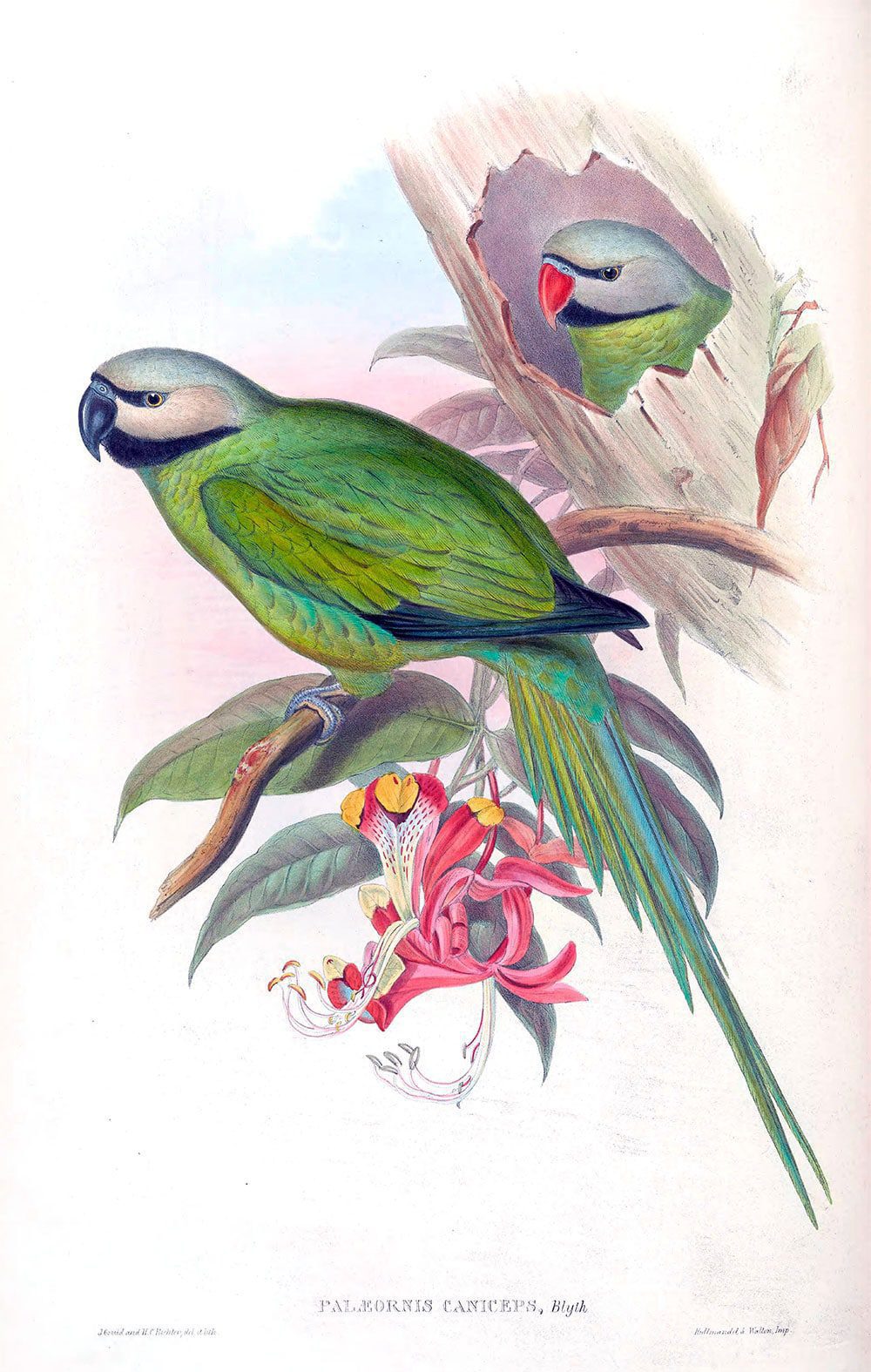
The Nicobar Parakeet (Psittacula caniceps) has the crown, upper cheeks and ear-coverts pale grey; stripe black in the region perioftalmica through the lores up to the forecrown; the lower cheeks and the chin are black. Nape and upper mantle pale gray bathed in blue; rest of the upper region green grass pale.

Upperwing-coverts green; primaries and secondaries Green with dark tips. Underwing-coverts green. Underparts green, slightly paler than upper parts. The elongated feathers central tail green with grey tinge, outer green.

upper jaw coral red, the lower black; cere dark grey; irises orange-red; legs dark gray.

The female has the bill black, the grey of the head and nape more strongly impregnated with blue, and tail slightly shorter.

The immature similar to females.

Habitat:

The Nicobar Parakeet it is difficult to locate visually among the dense foliage, Although its presence is revealed by their distinctive calls. Their flight is fast and direct.

They inhabit in the high rainforest. Generally held among the dense foliage on canopy, about everything when not fully.
They are perhaps most abundant in the coastal forests than inside.
Has also been recorded in areas with plants of Areca catechu and coconut plantations, which suggests a considerable tolerance of the species in habitats modified.
Usually, observed in pairs or in small groups.

Reproduction:

Unknown breeding habits.

Food:

Unknown diet except for the fruits of Pandanus, abundant in the inhabited islands of the Nicobar archipelago.

Distribution:

Size of the area of distribution (reproduction / resident): 1,100 km2

endemic to the Nicobar Islands, located in the Indian Ocean and belonging to the India. Registered since Great Nicobar, Montschall and Kondul. Resident. His status is unknown but they are potentially at risk due to habitat loss due to the expansion of rice cultivation; also affected its population because of the bird trade, Although there is little local use of these birds as pets and there are no known international traffic.

Conservation:

State of conservation โ“˜


Near-threatened Near Threatened โ“˜ (UICN)โ“˜

โ€ข Current Red List of UICN: Near threatened

โ€ข Population trend: Decreasing

The population of the Nicobar Parakeet It is suspected that It may be waning as a result of the destruction of habitat due to the tsunami of the 2004 (K. Sivakumar in litt. 2007), due to the development of the island, and because the capture for the wild bird trade. But, more research is needed to establish with precision the trends.

Probably between 10,000 – 15,000 specimens on freedom.

The main threats to the Nicobar Parakeet They come because of the large number of birds that are trapped for the cage bird trade.. On the other hand, the increase of settlements on the Islands It has led to increased pressure on natural resources and the planned development projects may seriously affect the habitat of this species. The tsunami of 2004 It destroyed large tracts of coastal forest that may have caused a further decline in the population. But, the data remains scarce, and the rate of regeneration of these forests is unknown (K. Sivakumar in litt., 2007).

Conservation Actions Proposed:

    – Determine the impact of the trade in the species.
    – Calculate the rates of forest loss.
    – Protect remaining habitat areas.
    – Assess the impact of the tsunami of 2004.

"Nicobar Parakeet" in captivity:

There is not much information available; probably brought for the London Zoo at the beginning of 20th century; kept as pets, at an unknown number, by the local population of the Nicobar Islands

Since the Nicobar Parakeet is a species so rare, It is not recommended to keep them captive, it is preferable to place them in a breeding program well managed by expert hands.

Alternative names:

Nicobar Parakeet, Blyth’s Parakeet (English).
Perruche des Nicobar, Perruche de Blyth (French).
Graukopfsittich (German).
Periquito-de-nicobar (Portuguese).
Cotorra de Nicobar (espaรฑol).


scientific classification:

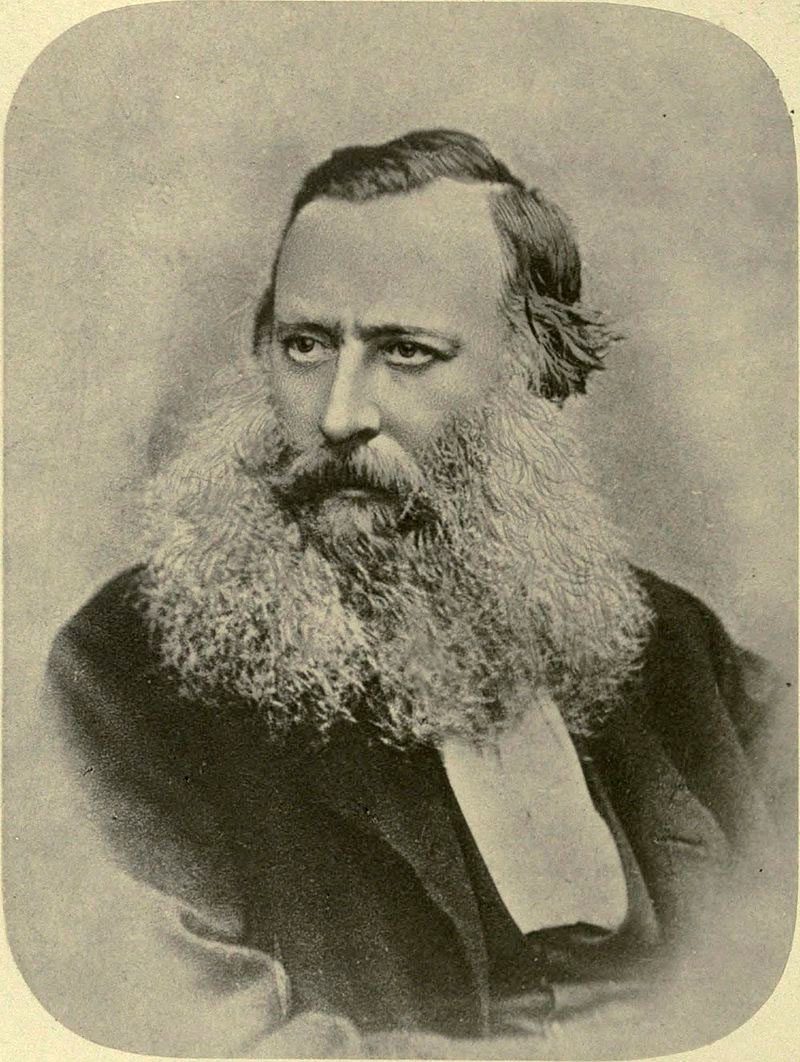
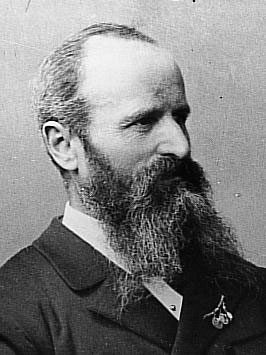
Edward Blyth
Edward Blyth

Order: Psittaciformes
Family: Psittaculidae
Genus: Psittacula
Scientific name: Psittacula caniceps
Citation: (Blyth, 1846)
Protonimo: Palaeornis caniceps

Images "Nicobar Parakeet"


Especies del gรฉnero Psittacula

Nicobar Parakeet (Psittacula caniceps)


Sources:

Avibase
– Parrots of the World โ€“ Forshaw Joseph M
– Parrots A Guide to the Parrots of the World – Tony Juniper & Mike Parr
– Birdlife

Photos:

(1) – John Gould [Public domain], via Wikimedia Commons
โ–ท The world of Pets: Dogs, cats, birds, reptiles, amphibians

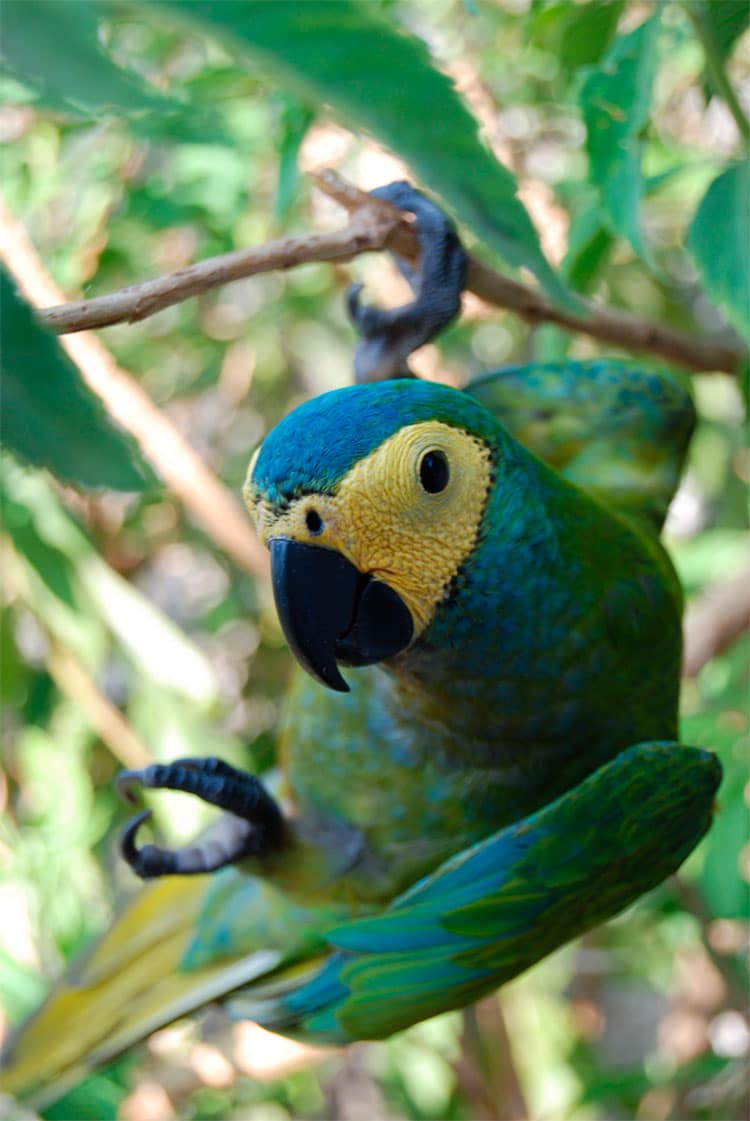
Red-bellied Macaw
Orthopsittaca manilatus


Guacamayo Ventrirrojo

Content

Description:

50 to 51 cm.. length and a weight between 292 and 390 g.

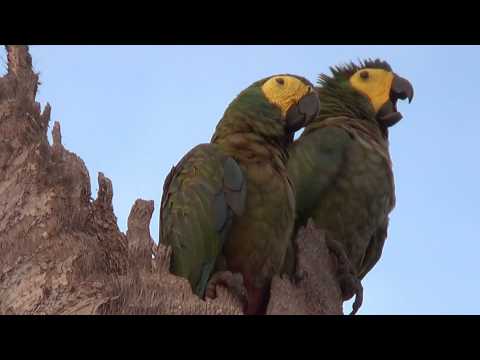
The Red-bellied Macaw (Orthopsittaca manilatus) is a medium-sized Macaw; has the forecrown and crown a bright blue, gradually faded to blue-green color in the area of the nape and on both sides of the neck. The the mantle and scapulars are green grass with impregnations color olive and yellow edges, producing, altogether, a flaky effect; the back and rump are green grass, with some feathers tipped pale bluish. The uppertail-coverts grass-green. The lesser and median coverts green grass impregnated with green olive with yellowish margins; alula and primary coverts green with vane outer blue; large inner coverts green.

The flight feather bordered with blue and green tips. Under, the wings with coverts yellowish-green and flight feather yellowish. The feathers of the throat and top of the chest are pale grey blue in the Center and yellowish-green in the margins; those of the lower area of the chest and top of the belly without tones pale in the Center, but with some feathers with margins off dark red; belly dark red; undertail-coverts bluish green. Upper, the tail green color in the Center with yellowish margins; upor down yellow.

Bill black; nude part of lores and cheeks yellowish white; irises dark brown; legs dark gray.

Sexes similar
, the males, possibly, bigger.

Immature clear tip in the bill and smaller patch of dark red color of the belly.

Habitat:

Lives in Savanna and flooded forest, where there are Palm trees, in altitudes close to the 500 m. Very dependent from the Palma de moriche or aguaje (Mauritia flexuosa), which feeds, staying almost invisible due to its Green plumage.

Occasionally wander in by cultivated areas and have been in the mangroves.

gregarious, flocks of more of 100 observed birds. Usually, they rest in the branches of the Mauritia Palms, where they remain hidden among the foliage of leaves.

Reproduction:

They nest in holes of las palmas dead found near or surrounded by water, often use the nests of the Orange-winged Parrot (Amazona amazonica), of Trinidad and Tobago.

The breeding season is from February to September in Trinidad and Tobago; from February to may in Colombia; from February to June in Guyana. The size of the put is of 2 to 6 eggs with a period of incubation of approximately 27 days. The young begin to feather already in the eleventh week. Take an average of 2 to 3 years to mature, remaining during that period very close to their parents.

Food:

Usually feeds on the fruits of the Palm tree Mauritia flexuosa they are present during the season dry when other fruits are scarce, as well as other palm trees such as Roystonea oleracea and Euterpe.

The Red-bellied Macaw communicate with each other with calls when there is a localized food source.

They roost in Palm trees full of fruit and used its beak to peel hard fruits to expose the pulp. Son, unlike most parrots, seed predators, but partially, since they eat the fruit, leaving intact the endocarpio (Darnell and Bergstrom 2002; Janzen 1981; Kristosh and Marcondes Machado-2001).

Some lick attempt to fly with the seed at its peak, and unintentionally may fall between two palm trees. Seed drop and feeding behavior, in order to avoid damaging the seed, It makes these macaws and other psittacidas agents of seed dispersal.

Distribution:

Size of the area of distribution (reproduction / resident): 7.150.000 km2

The Red-bellied Macaw is distributed to the North of South America to the East of the Andes.

In Colombia its range is from Goal and West of Vaupรฉs until Putumayo and amazon, spreading northeast of Venezuela until Trinidad and Tobago and Guianas, where apparently, they are restricted to coastal areas.

Are distributed to the East of Ecuador, Northeast of Peru, North of Bolivia and much of the Brazilian Amazon, to the East of For and from the West of Bay and Goiรกs until Mato Grosso. Apparently absent most of Venezuela and North of the Amazon basin of Brazil, in the basin of the Black river.

A small population reported in the North of Sรฃo Paulo, Brazil.

Probably residents in some areas, although migratory in others, for example, in the Northwest of Bolivia, where been observed have to these macaws in the months of September to November, being absent from November to January.

Share on a local scale; the distribution is closely related to the palms of Mauritia. Probably stable population. But, in the northeast of Brazil fruit Mauritia It is used in the manufacture of confectionery products and the trunks of the palms for some construction purposes..

Rare in captivity.

Conservation:


minor concern

โ€ข Red List category of the UICN current: Least concern.

โ€ข Population trend: Stable.

Global population size has not been quantified, but this species is described as quite common.

The populations of the Red-bellied Macaw they depend of the Palms Mauritia for food and nesting. These trees are widely used for construction, and that is why you can have bad consequences for the future of the species.

These birds are threatened by the felling of these Palm trees and capture for the pet trade. But, This species tends to be common in most of their habitats, with the exception of Colombia, Guyana and Venezuela, where it is threatened by Habitat loss.

"Red-bellied Macaw" in captivity:

Rare bird cage.

It is extremely difficult to keep these birds alive in captivity., because, mainly, to your excitable personality, and its diet low in fat and high in carbohydrates.

The export and import for the pet trade often brings with it a mortality of the 100%; captive-bred chicks have a very low survival rate. A high percentage die at an early age kidney disease. Its acquisition as a pet is very questionable.

The only country that exports these birds in recent years is Guyana.

Due to the lack of commercial availability of nuts of moriche Palm, peeled unsalted peanuts have been used as a staple in the diet of these birds in captive. They should not be fed with the typical commercial seed, especially fat seeds such as of the Sunflower.

A nutritional analysis of the natural diet of the Red-bellied Macaw He revealed that this was made up of high levels of beta carotene, of carbohydrates and zero fat. This explains its propensity to obesity in captivity. Almost all parrots usual diets are too high in fat content, with what the Vitamin A supplements in the form of beta carotene they are essential.

Deficiencies of Vitamin A are usually made to notice very quickly, giving rise to many serious diseases, being able to get to many of them deadly.

The beta carotene is the only way Vitamin A that do not require fat to be absorbed. The successful reproduction This species only has been able to achieve by adjusting your diet.

The pups fed by hand are much quieter than adults and are able to metabolize fat more efficiently than adults. Once weaned, they remain in need of a very low fat diet.

There are no data of your longevity in captivity, Although in nature, possibly, they can live around the 40 years.

Is not a bird to keep in captive. A responsible attitude should be to place these beautiful birds in breeding programs so that future generations can enjoy them..

More information –>

Alternative names:

Red-bellied Macaw, Red bellied Macaw, Small Red-bellied Macaw (English).
Ara macavouanne, Ara ร  ventre rouge (French).
(German).
Maracanรฃ-do-buriti, arararana, ararinha, maracanรฃ-de-cara-amarela (Portuguese).
Guacamaya Buchirroja, Guacamayo Ventrirrojo, Maracanรก de Vientre Rojo (espaรฑol).
Guacamayita morichalera, Guacamaya Buchirroja (Colombia).
Guacamayo barriga roja, Perico morichalero (Venezuela).
Guacamayo ventrirrojo (Ecuador).
Maracanรก ventrirroja, Parabachi de palmar (Bolivia).
Evaรญ (Chimani).
Ararinha (tupi).
Quequeto (Guahibo).
Ectoa (Barasana).

Pieter Boddaert
Pieter Boddaert

scientific classification:


Order: Psittaciformes
Family: Psittacidae
Genus: Orthopsittaca
Scientific name: Orthopsittaca manilatus
Citation: (Boddaert, 1783)
Protonimo: Psittacus manilatus


Images Red-bellied Macaw:

Videos "Red-bellied Macaw"

MARACANรƒ-DO-BURITI: Canto! (ORTHOPSITTACA MANILATA), RED-BELLIED MACAW, Yellow-faced Maracanรฃ,


ยซVentrirrojo Guacamayoยป (Orthopsittaca manilatus)


Sources:

  • Avibase
  • Parrots of the World โ€“ Forshaw Joseph M
  • Parrots A Guide to the Parrots of the World – Tony Juniper & Mike Parr
  • Birdlife
  • Wikipedia

Photos:

(1) – Red-bellied Macaw Orthopsittaca manilata in Goiรขnia, Brazil By A C Moraes (originally posted to Flickr as Tocci) [CC BY 2.0], via Wikimedia Commons
(2) – Two Red-bellied Macaws flying near the Amerindian Reservation of Santa Mission, Guyana By Feroze Omardeen [CC BY 2.0], via Wikimedia Commons
(3) – A little girl in San Martin, Peru with a pet juvenile Red-bellied Macaw on her right shoulder By Michael Nickel (originally posted to Flickr as girl with lorito) [CC BY 2.0], via Wikimedia Commons
(4) – Buchirroja Guacamaya ( Orthopsittaca manilatus) by Marcello Magnussen – wiki_aves_colombia
(5) – Buriti maracana chicks in the nest, Orthopsittaca manilatus by Osvaldo Scalabrini

โ–ท The world of Pets: Dogs, cats, birds, reptiles, amphibians

Mitred Parakeet
Psittacara mitratus

Mitred Parakeet

Content

Description:


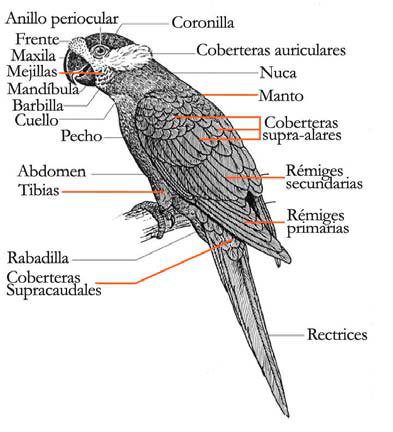
Anatomy-parrots

Of 31 to 38 cm.. length and a weight between 219 and 275 g.

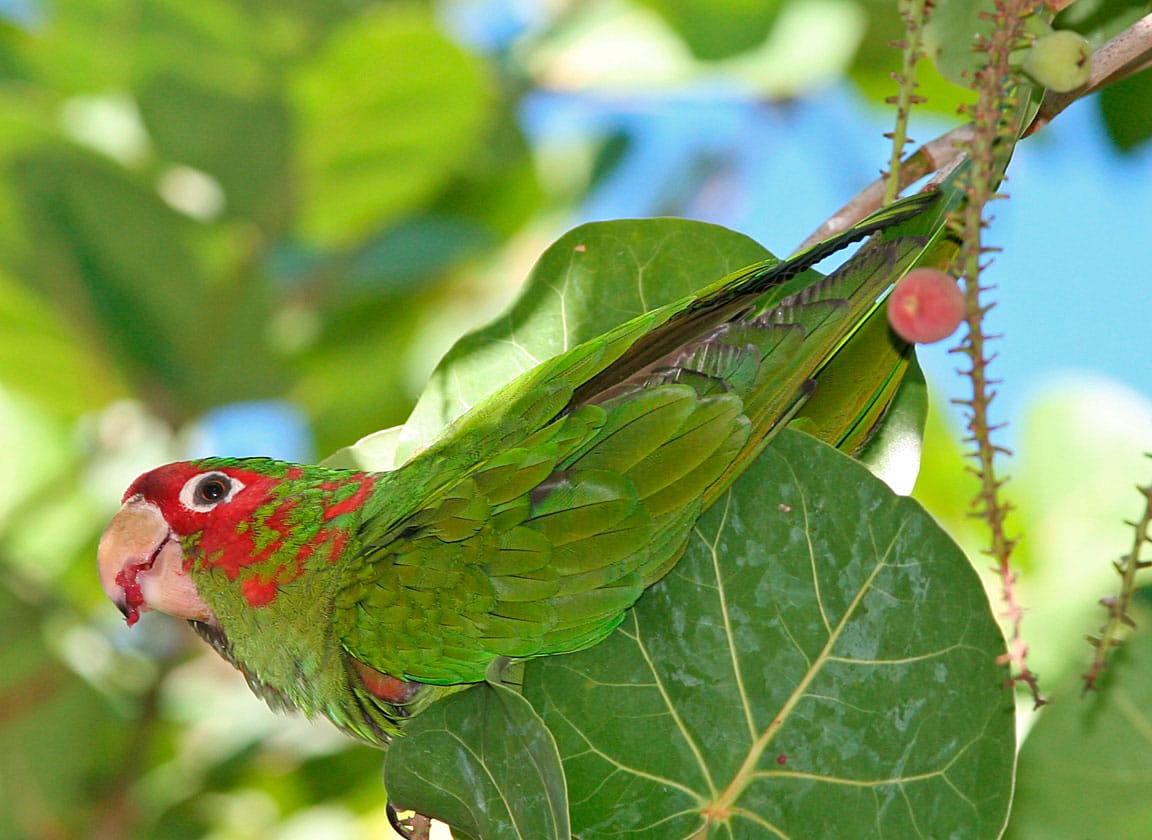
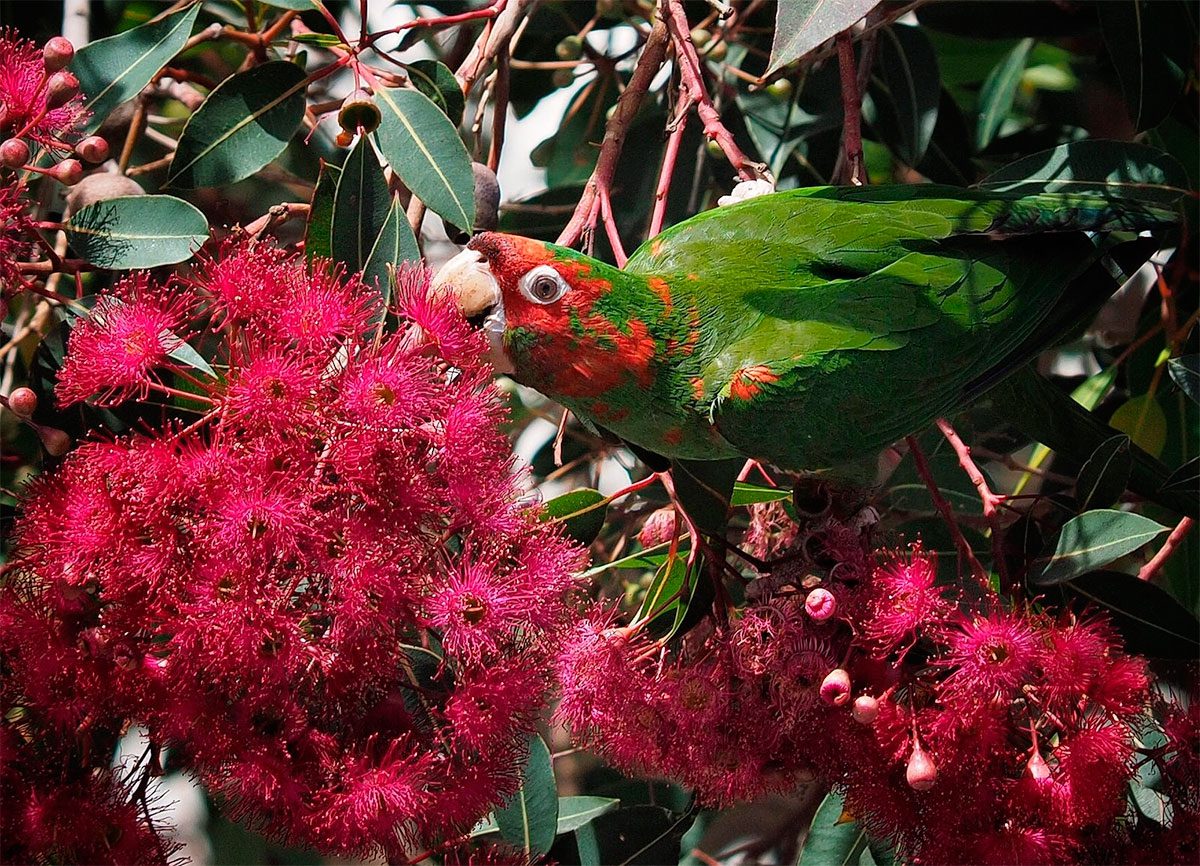
The Mitred Parakeet (Psittacara mitratus) It has a reddish-brown forehead with a bright red fusion on the front of the crown; the lores and cheeks to the rear of the eyes, bright red; the sides of neck dark green with scattered red feathers. The upperparts from the back of the crown up to the uppertail-coverts, dark green with some scattered red feathers (especially in the nape).

Upperwing-coverts and flight feather, at the top, green, sometimes with one or two dark red feathers on the bend of wing; flight feather color marron-oliva below. Underwing-coverts opaque green. The underparts, dull, Green pale with dye olive, usually with scattered red marks, especially in the the thighs. Upper, the tail dark green with Brown tips; Brown down.

The bill off-white; bare periophthalmic creamy white; irises beige color; legs distant.

Both sexes similar.

The Immature with fewer red feathers on the head, in special, in the cheeks and Brown, not Orange, the irises.

Subspecies description:

  • Psittacara mitratus chlorogenys

    (Arndt, 2006) – Front band Red that extends to the lores and Strait, e incomplete bare periophthalmic; upper zone of the cheeks and ear-coverts, green.


  • Psittacara mitratus mitratus

    (Tschudi, 1844) – The subspecies nominal.


  • Psittacara mitratus tucumanus

    (Arndt, 2006) – The front of the crown, the lores up to the cheeks and ear-coverts red.

Habitat:

Video – "Mitred Parakeet" (Psittacara mitratus)

Calancate cara roja (Psittacara mitratus) (II).

They usually inhabit in areas of dry subtropical vegetation, There are also records in temperate zones: montane deciduous forest, cloud forests drier, cultivated areas, hills covered with tall grass, areas populated with scattered trees and fields, as well as sheets of legumes dry grasslands with patches of forests of Prosopis.

Often can be seen near high and steep rock walls. Usually, at altitudes of 1.000 to 2.500 Metros in Argentina, Although there are records to 4.000 metres in the Peru. Rarely, or never, descends to the lowlands. Commonly seen in groups of 2 to 3 birds, but until 100 individuals outside the breeding period.

Reproduction:

They nest in cliffs or hollow trees. There has been a egg laying in Oran, Argentina. Probably the clutch is between 2 and 3 eggs.

Food:

It usually feeds in areas of Virgin forest, but also full of grain crops in populated areas. This and other parrots migrate to the Lerma Valley in the Northwest of Argentina for feeding of the berries in maturity during the month of October.

Distribution:

The Mitred Parakeet are distributed in the southwest of South America, from the South of Peru through the Center-West of Bolivia, to the North of Argentina. Observed in the great valleys of the center of the Peru, from Huanuco until Cuzco. Disintegrated in the valleys of the Eastern Andes in the Centre-West of Bolivia, where there are records in Peace, Santa Cruz, Cochabamba, Oruro, Padilla and South of Sucre, to the Northwest of Argentina in Jujuy, Salta, Tucumรกn and South of Catamarca, until La Rioja and Cรณrdoba.

In general residents, Although some with seasonal movements in the North of Argentina and Bolivia.

Locally distributed within its range, Although most widespread in the South of Cochabamba, Bolivia. In Argentina, generally common, abundant in some locations (apparently more numerous in Catamarca and Salta), but perhaps decreasing.

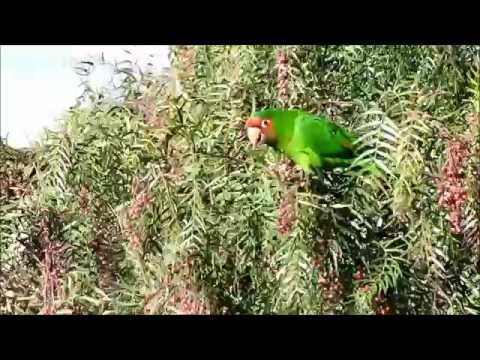
Colonies in coastal areas of the southwest of the United States, from Malibu to Long Beach and northwest coast of Orange County, also in the basin of Los Angeles and the San Gabriel Valley; small amounts from San Francisco to the southern region of the San Francisco Bay, and sightings also in San Diego and areas of Sacramento (Garrett 1997).

Maintained in captivity and sold in large quantities at the international level (mainly from Bolivia) at the end of 1980.

Subspecies distribution:

Conservation:

โ€ข Red List category of the UICN current: Least concern

โ€ข Population trend: Stable

The size of the world population Mitred Parakeet It has not been quantified, but this species is described as ยซcommonยป but of irregular distribution (Stotz et to the., 1996).

The population suspected to be stable in the absence of evidence of any reduction or substantial threats, Although it has been the subject of intense trade: from 1981 When it was included in the Appendix II, 158,149 individuals were captured in the wild and reported in the international trade (UNEP-WCMC trade database CITES, January 2005).

"Mitred Parakeet" in captivity:

This bird is usually available in pet stores or breeders.

They are known to be very attached to their owners. Very playful, they can also become good conversadoras and are considered the more strong and lively group of Aratinga parrots. The Mitred Parakeet It is good for owners who want a large bird and is easy to care for and handle. Can entertain herself if you give it a lot of toys, but they also enjoy interacting and playing with his human flock.

Alternative names:

Mitred Parakeet, Mitred Conure, Mitred Parakeet (Mitred) (English).
Conure mitrรฉe (French).
Rotmaskensittich (German).
Aratinga mitrata (Portuguese).
Aratinga Mitrada, Perico mitrata (espaรฑol).
Calacante cara roja (Argentina).
Buhito menor (Honduras).
Tiakeru (Quechua).

Tschudi-Johann Jakob of

scientific classification:


Order: Psittaciformes
Family: Psittacidae
Genus: Psittacara
Scientific name: Psittacara mitratus
Citation: (Tschudi, 1844)
Protonimo: Conurus mitratus


Images Mitred Parakeet:


Species of the genus Psittacara

Sources:

  • Avibase
  • Parrots of the World โ€“ Forshaw Joseph M
  • Parrots A Guide to the Parrots of the World – Tony Juniper & Mike Parr
  • Birdlife

  • Photos:

(1) – A feral Mitred Parakeet in Fort Lauderdale, Florida By http://www.birdphotos.com (Own work) [CC BY 3.0], via Wikimedia Commons
(2) – Mitred Parakeet (Aratinga mitrata), Inka Trail to Machu Picchu, Peru By D. Gordon E. Robertson (Own work) [CC BY-SA 3.0 or GFDL], via Wikimedia Commons
(3) – Mitred Parakeet by vil.sandiFlickr
(4) – Mitred Parakeet (Psittacara mitrata) by Gregory "Slobirdr" SmithFlickr
(5) – Member of an escaped flock roughly 35-50 strong in Sunnyvale, CA By Shravans14 (Own work) [CC BY-SA 4.0], via Wikimedia Commons
(6) – A pair of parakeets in the escaped flock in Sunnyvale, AU. This flock has been around for at least 20 years By Shravans14 (Own work) [CC BY-SA 4.0], via Wikimedia Commons
(7) – Wild parrot (Mitred Parakeet) in Redondo Beach. (Aratinga mitrata) by Ingrid Taylar – Flickr
(8) – A pet Mitred Parakeet (also known as the Mitred Conure) By Lee (originally posted to Flickr as Gaspar4) [CC BY-SA 2.0], via Wikimedia Commons
(9) – A wild SoCal parrot (Mitred Parakeet) eating Bottlebrush in Redondo Beach. This bird is part of a local flock that frequents the neighborhood by Ingrid TaylarFlickr

โ–ท The world of Pets: Dogs, cats, birds, reptiles, amphibians

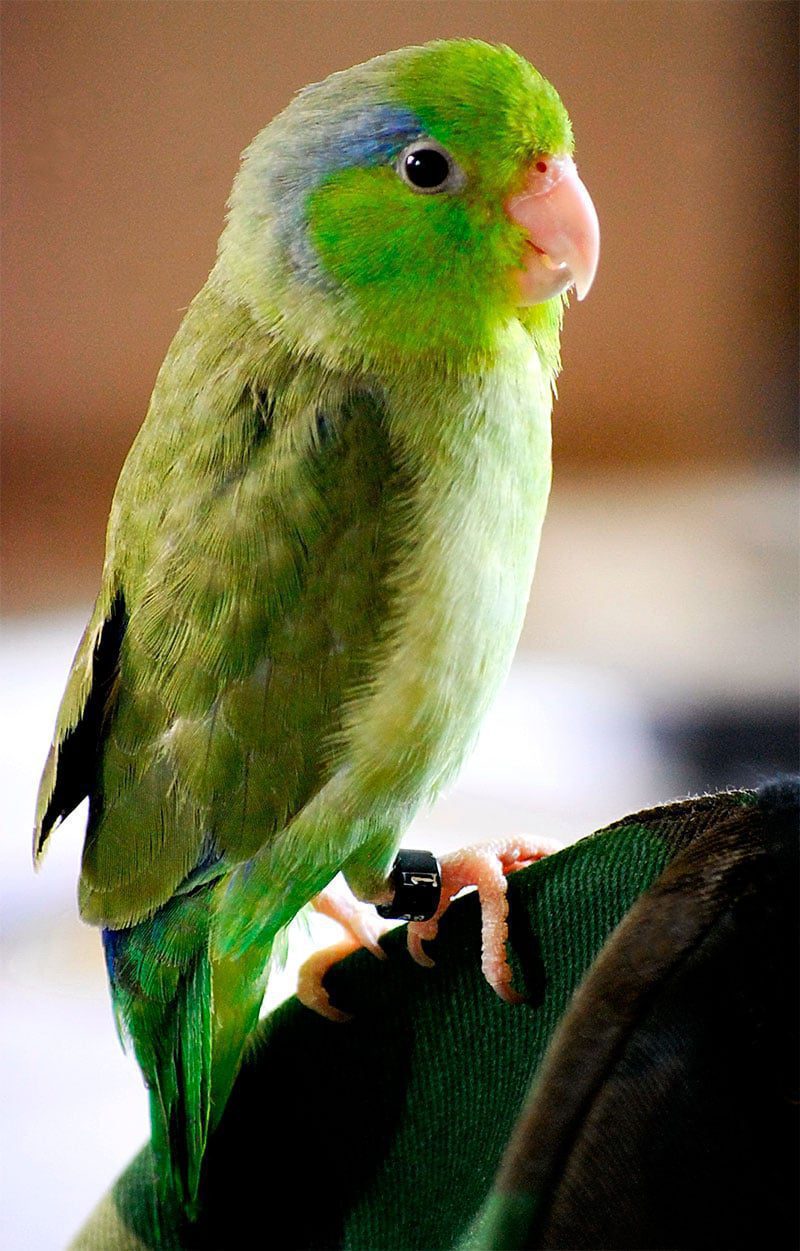
Pacific Parrotlet
Forpus coelestis


Pacific Parrotlet

Content

Description:


Anatomy-parrots

12-13 cm.. height.

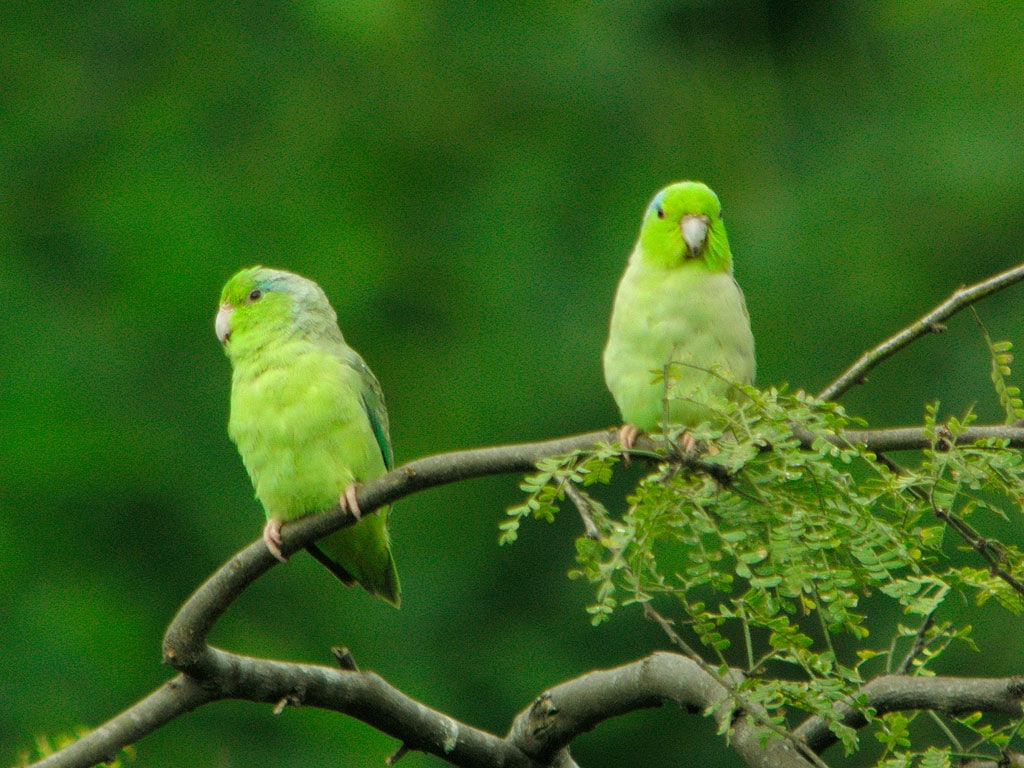
The Pacific Parrotlet (Forpus coelestis) It is a small bird, chubby with a tail short and finished in tip. Distinguishable in flight by the blue and Brown on the inside of the wings. It has blue behind the eye and in the middle of the wing at the top. The female does blue stain on the top of the wing and the blue behind the eye is paler. The Immature males they are similar to the adult male, but more pale and with back brownish.

Habitat:

The Pacific Parrotlet frequent most dry woodland habitats, such as scrub thorny, bosque deciduous, dense thickets of Captus with balsa trees, plantations of banana and mango, riparian zone, irrigated fields in Savannah and gardens, although their preferred areas are those of humid tropical vegetation such as the coastal mangales.

Older records of this species are from below sea level of 1.000 m, but are to 2.150 meters on the West side of the Andes in Huancabamba, is of Piura, Peru, and a 1.370-1.650 meters in the South of Loja, Ecuador.

Usually gregarious; they form large flocks where abundant food.

Reproduction:

It nests in the cavity of trees, in cactus, fence posts, pipes or the nests of the Pale-legged Hornero (Furnarius leucopus), of the Tie Neck Pijuรญ (Synallaxis stictothorax) or Fasciated Wren (Campylorhynchus fasciatus).

The breeding season includes the months of January to may. Sometimes, they breed a second time throughout the year. The laying of eggs 4-6.

Food:

The diet of the Pacific Parrotlet includes seeds grass, berries, fruit (example, of Tamarindus, Amaranthus spinosus) and cactus fruits. It forages among the vegetation and land.

Distribution:

Size of the area of distribution (reproduction / resident): 147.000 km2

This species is found in the West of Ecuador, in Manabi Since the latitude of the Valley of the Chone River to the South across the South of Pichincha, The rivers and Guayas (including the Isla Puna), until Gold and Loja, entering the Northwest of Peru, in Tumbes, Piura, Lambayeque and South of Cajamarca, until Freedom and Trujillo.

irregularly common, sometimes abundant; most numerous in arid areas. The population has apparently not yet been severely affected by the trade in live birds or the conversion of natural and semi-natural habitats for the Agriculture. The species is probably Forpus most numerous in captivity.

Conservation:

State of conservation โ“˜


minor concern Minor Concern โ“˜ (UICN)โ“˜

โ€ข Current category of the Red List of the UICN: Least concern.

โ€ข Population trend: Stable.

Justification of the population

The size of the world population It has not been quantified, but this species is described as ยซcommonยป (Stotz et to the., 1996).

Justification of trend

Suspected that the population is stable in absence of evidence of any decline or threatens substantial.

"Pacific Parrotlet" in captivity:

Colorful, charming and intelligent. These small birds have become in very popular pets in recent years. Its small size and quiet nature make of the Pacific Parrotlet an ideal choice for people living in apartments. Nicknamed โ€œpocket parrotsโ€ in the pet trade, These parakeets are actually the smallest of the family of parrots, and they are as smart as many larger species. Some learn to speak quite well, Although the species is not particularly known for the ability to speak.
An interesting fact upon the Pacific Parrotlet is that its closest relative is the Amazon parrot. Although the two species differ greatly in size, owners often report striking similarities between them. Despite being small birds, they are by no means โ€œlow maintenance birdsโ€. While it is true that they are, course, easy to clean, in comparison with the larger birds, However require your daily care to keep them docile, socialization at an early age is the key to be in a future good behavior.
They have tendency to obesity. They must be able to get out of their cages, spread your wings, and exercise your muscles to maintain your physical and mental health.

Their metabolism is very high, and they should have food available at all times. They are known for their appetite voracious, and occur in one diet varied that consists in fruits and vegetables fresh, small seeds such as millet, the high-quality commercial pellets, and protein sources from hard boiled egg.

There are many mutations.

Alternative names:

Pacific Parrotlet, Western Parrotlet (English).
Toui cรฉleste, Perruche-moineau cรฉleste (French).
Himmelsperlingspapagei, Himmelspapagei (German).
Tuim-peruano (Portuguese).
Catita Enana Amarilla, Cotorrita de Piura, Cotorrita Celestial (espaรฑol).
Periquito Esmeralda (Peru).

scientific classification:

Renรฉ Primevรจre Lesson

Order: Psittaciformes
Family: Psittacidae
Genus: Forpus
Scientific name: Forpus coelestis
Citation: (Lesson, 1847)
Protonimo: agapornis heavenly

Pacific Parrotlet images:

Videos of the "Pacific Parrotlet"

Pacific Parrotlet (Forpus coelestis)


Species of the genus Forpus

Sources:

  • Avibase
  • Parrots of the World โ€“ Forshaw Joseph M
  • Parrots A Guide to the Parrots of the World – Tony Juniper & Mike Parr
  • Birdlife
  • Parrot Book, Parrots and macaws.

Photos:

(1) – Male Green Pacific Parrotlet, named Jackson By Susan C. Griffin (Own work) [CC BY-SA 3.0], via Wikimedia Commons
(2) – Pacific Parrotlets (also known as Lessonโ€™s Parrotlet and Celestial Parrotlet) at Wilhelma Zoo, Stuttgart, Germany By Undertable [CC BY 2.0], via Wikimedia Commons
(3) – A pet Pacific Parrotlet – yellow colour mutation By Becky Wetherington (originally posted to Flickr as 82/365 – Good bird.) [CC BY 2.0], via Wikimedia Commons
(4) – A pet male Pacific Parrotlet (also known as Lessonโ€™s Parrotlet and Celestial Parrotlet) By Erin Purcell (originally posted to Flickr as [1]) [CC BY 2.0], via Wikimedia Commons
(5) – Pacific Parrotlet (also known as Lessonโ€™s Parrotlet and Celestial Parrotlet) in El Empalme, El Oro Province, coastal SW Ecuador By markaharper1 [CC BY-SA 2.0], via Wikimedia Commons

Sounds: (Xeno-canto)

โ–ท The world of Pets: Dogs, cats, birds, reptiles, amphibians

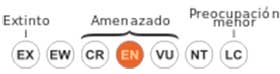
Diademed Parrot
Amazona Diadema

amazona autumnalis

Content

Description:

31โ€“35 cm. length and 450-550 g. of weight.

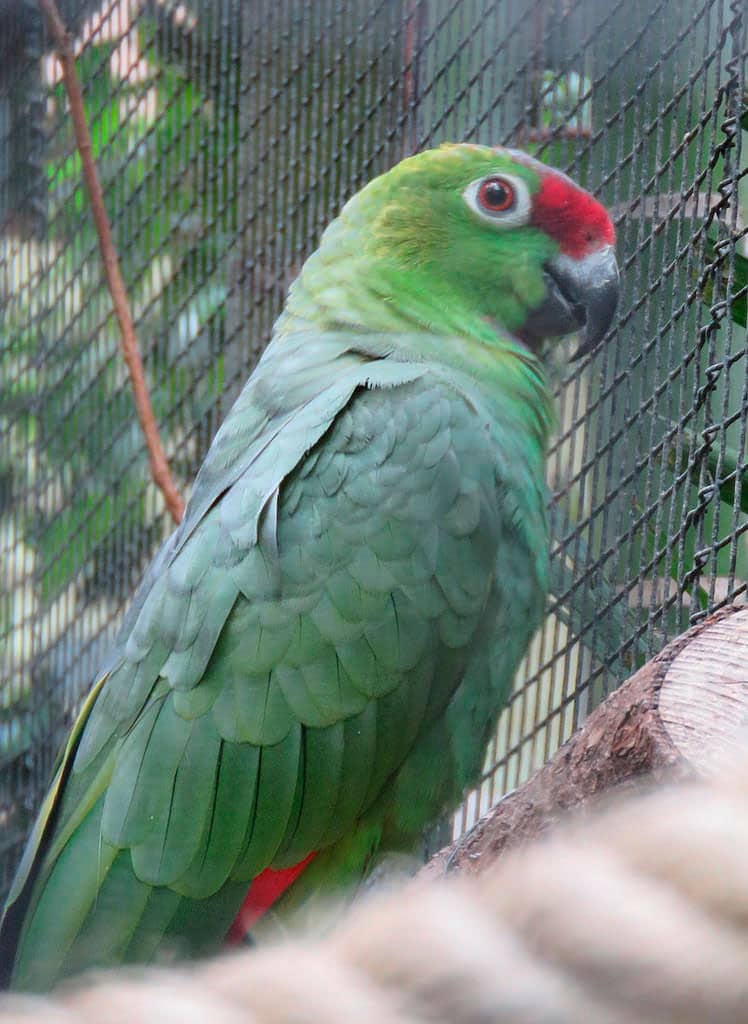
The Diademed Parrot (Amazona Diadema) It is generally green, with black edges to feathers crown, to the mantle and the chest; crown green to nape; the back of the green neck, mauve margin; feathers of the cere and forecrown, red; yellow-green, less yellow in upper cheeks, up to the ear-coverts; secondaries red on the bases, the green rest; tail green; eye ring pale yellow; eyes oranges; bill dark grey.


Note:

Previously treated as conspecific with the Red-lored Amazon (Amazona autumnalis), It is very similar to the subspecies Amazona autumnalis salvini

  • Sound of the Diademed Parrot.

Habitat:


Anatomy-parrots

It is likely to frequent a variety of habitats from lowland forest species, including edges evergreen forest, as well as modified areas containing scattered trees or plantations (Del Hoyo et al., 1997, pit et to the., 2016).

They are in loose flocks or pairs, are gregarious When feed.

Reproduction:

The laying is of 2-3 eggs. Breeding season, It is supposed to be in early: January-March.

Food:

It feeds mainly from fruits and seeds, even some cultivated species (Del Hoyo et al., 1997), although there are no published data (Del Hoyo et al., 2016).

Distribution:

Size of its range (breeding/resident): 71.800 km2

Endemic low Black river and the northern margin of Amazon River, in the states of amazon and Northwest of For, in Brazil.

Conservation Amazona diadema:

State of conservation โ“˜


Endangered Endangered โ“˜ (UICN)โ“˜

โ€ข Current category of the Red List of the UICN: In danger of extinction.

โ€ข Population trend: Decreasing.

Rationale for the Red List category

    Based on a model of future deforestation on amazon basin and susceptibility to this new species capture, it is suspected that its population will suffer a very fast along three generations descent from 2002, so it is in danger of extinction.

Justification of trend

    This species is expected to lose between 49 and 55% suitable habitat within its distribution throughout three generations (37 years) starting at 2002, based on a model of Amazon deforestation (Soares-Filho et to the). Given its susceptibility to capture, It is suspected that species decline by 50-79% during this time.
Threats

โ€ข The main threat to this species is the accelerating deforestation in the Amazon Basin as land is cleared for ranching and soy production, provided by the expansion of the road network, together with his susceptibility to capture (Soares-Filho et to the. 2011).

โ€ข The species is assumed to experience some pressure catch, probably mainly for internal trade, since this species is rare in aviculture (Del Hoyo et al ., 1997, pit et to the ., 2016).

โ€ข Proposed changes to the Brazilian Forest Code reduce the percentage of land to a private owner is legally obliged to keep as forest (including, critically, a reduction in the width of forest buffers with perennial vapors) and include an amnesty for owners who deforested before July 2008 (That they would later be absolved of the need to reforest illegally vacated land) (Bird et to the., 2011).

Conservation Actions Underway

โ€ข No specific conservation actions are known for this species, although part of their habitat is protected.

โ€ข It is distributed in the Jau National Park where it is rare or uncommon (Borges et al ., 2001, Borges & Almeida 2011).

Conservation Actions Proposed

โ€ข Carry out surveys to estimate the size of the population.

โ€ข Monitor deforestation rates in the range using remote sensing techniques.

โ€ข Study the level of Trapping threat.

โ€ข Increase the area of โ€‹โ€‹suitable habitat that receives protection effective.

โ€ข Boost changes in laws related to deforestation and forest protection.

The Diademed Parrot in captivity:

Rare in aviculture.

Each captive specimen of this species which is capable of reproducing, It is placed in a well managed captive breeding program and not be sold as a pet, in order to ensure its long-term survival.

Alternative names:

Diademed Amazon, Diademed Parrot, Red-lored Parrot (Diademed) (English).
Amazone ร  diadรจme, Amazone diadรจme, Amazone du Brรฉsil (French).
Diademamazone (German).
Papagaio-diadema (Portuguese).
Amazona diadema (espaรฑol).


Scientific classification Diademed amazon:

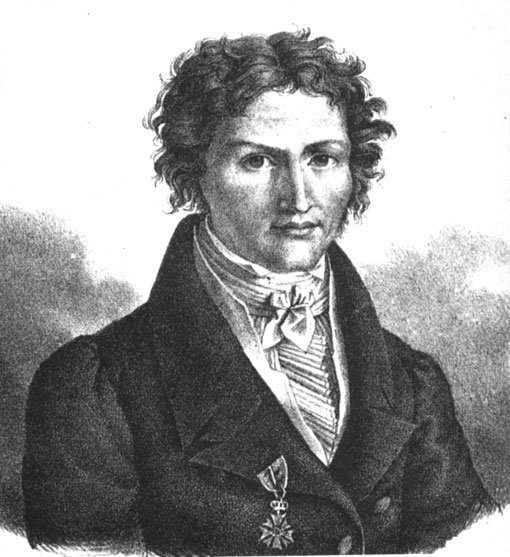
Johann Baptist von Spix

Order: Psittaciformes
Family: Psittacidae
Genus: Amazona
Scientific name: Diademed Parrot
Citation: (von Spix, 1824)
Protonimo: Psittams diadema


Diademed Parrot images.:


Species of the genus Amazona


Sources:

Photos:

(1) – diadem parrot. Red lored parrot. 11 November 2015, Tikal, Guatemala by ze_da_binha
(2) – Diademed Parrot – amazon with tiara – Diademed amazon – amazon tiara By Florin Feneru from Orpington, UK (Diademed Parrot) [CC BY 2.0], via Wikimedia Commons
(3) – A Red-lored Amazon at Loro Parque, Cross port, Tenerife, Spain. This subspecies is also called the Diademed Amazon By Carlos Urdiales [CC BY-SA 2.0], via Wikimedia Commons
(4) – A Red-lored Amazon at Xcaret Eco Park, Riviera Maya, Mexico. Photographed as it started to rain By Tomasz Wagner from Burnaby, BC, Canada (Parrot – Amazona autumnalis) [CC BY-SA 2.0], via Wikimedia Commons
(5) – Diademed amazon (Diademed Parrot) Loro Parque, Tenerife by Florin FeneruFlickr
(6) – PL. XXXI I Chrysolis diadema (รฎ^wl By Blanchard, Emile; Bonaparte, Charles Lucian; Bourjot Saint-Hilaire, Alexandre; Le Vaillant, Franรงois; Souancรฉ, Charles de. [CC BY 2.0 or Public domain], via Wikimedia Commons
Sounds: GABRIEL MILK, XC119110. accessible www.xeno-canto.org/119110

โ–ท The world of Pets: Dogs, cats, birds, reptiles, amphibians

Reischek's Parakeet
Cyanoramphus hochstetteri

Reischek's Parakeet

Content


Anatomy-parrots

Description:

28 cms. length and 140 g. of weight.

The Reischek's Parakeet (Cyanoramphus hochstetteri). They are named after the Austrian ornithologist and taxidermist ยซAndreas Reischekยซ, the first scientist to visit the Antipodes Islands. He was a passenger of Stella and reached the Antipodes Islands in February 1888.

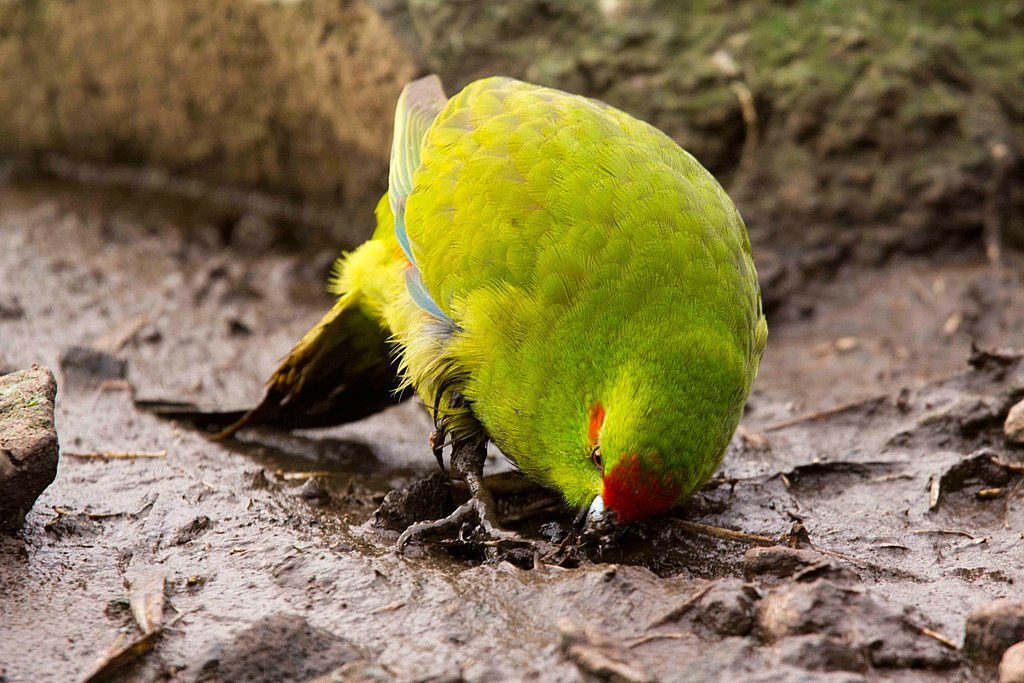
It is one of two species of parakeets Cyanoramphus who live in remote Antipodes Islands. It is a medium-sized green parrot, brightly colored, the outer flight feathers are light blue with a crown red, which looks a lot like other parakeets of "red crown" (for example, Cyanoramphus novaezelandiae). But appearances are deceptive. Genetic studies reveal that crown color may not be a good indicator of parakeet taxonomy, and the tiny Malherbe's parakeet (Cyanoramphus malherbi) It may be the closest relative of Reischek's Parakeet. It is common in all Antipodes Islands, particularly in more open areas and along shorelines close to penguin colonies.

Habitat:

The Reischek's Parakeet They are more abundant than Antipodes parakeet (Cyanoramphus unicolor) in most habitats. Significant differences were observed in diet between the two species of parakeets. are also evident strong seasonal and annual differences in diet related food availability. The Reischek's Parakeet They are strong fliers and have been observed flying between islands within the Antipodes group.

Social behavior is similar to other species of parakeets Cyanoramphus, but have been observed to spend considerable periods basking and preening in sheltered areas. Like other species Cyanoramphus, are strongly territorial around nests, and they call loudly and chase intruders from nearby.

They are usually found in pairs or, more commonly, in small groups that feed on or near the ground. You can often see them in meetings springs and wells isolated. Occasionally they flock fly to neighboring islands in search of food.

Reproduction:

We know relatively little about the breeding of the Reischek's Parakeet. Apparently nest from October to March inside tunnels modified or built inside the bases of groups of tussocks or ferns. The nest is lined with small pieces of wood, feathers, moss, herbs and other dry materials. They can reuse nests each year.

clutch size is unknown in nature. Its ecology and reproductive behavior are likely to be similar to those of other parrots. Cyanoramphus.

Food:

It has been recorded feeding on leaves, flowers, berries and seeds 14 plant species. Invertebrates are a minor component of the diet. The Reischek's Parakeet occasionally feed carcasses petreles and albatrosses, but not as often as Antipodes parakeet (Cyanoramphus unicolor). They feed on the floor often, including mud and feces accumulated within colonies antipodean penguin (Eudyptes sclateri) unoccupied, when penguins are away on their winter migration.

Distribution:

The Reischek's Parakeet is endemic of the Antipodes Islands. It is common in all the Antipodes Islands, particularly in more open areas and along shorelines close to penguin colonies.

Conservation:


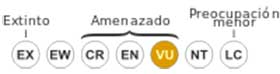
Vulnerable

โ€ข According to the New Zealand Threat Classification System of 2008: Vulnerable.

โ€ข Population trend: Stable.

โ€ข Population size : 4000-6000 individuals.

The Reischek's Parakeet apparently they have a stable population, and are common within their distribution area of 2,000 has. They are protected by the isolated situation of the islands and their status Natural reserve strict. The greatest threat to long-term survival Reischek's Parakeet is the arrival of mammalian predators. In the winter of 2016 we attempted to eradicate the mice Antipodes Islands.

The species is also affected negatively by forestry operations: logging and burning have drastically reduced the available habitat, and selective logging can reduce the number of trees with suitable nesting holes and foraging opportunities..

It was hunted by Maori to feed, and previously it was persecuted because birds were damaging crops and orchards.

"Reischek's Parakeet" in captivity:

Son confident from the beginning and not at all shy. Usually they are ready to breed in captivity. Although they are ripe (about five months), It is best not to allow them to play in the first year.

Alternative names:

Antipodes Island Parakeet, Antipodes Red-crowned (English).
Perruche de Reischek, Perruche des Antipodes (French).
Antipoden-Ziegensittich (German).
Periquito de Reischek (Portuguese).
Perico de Reischek, Perico Frentirrojo de las Antรญpodas (espaรฑol).

scientific classification:

Andreas Reischek
Andreas Reischek

Order: Psittaciformes
Family: Psittaculidae
Gender: Cyanoramphus
Scientific name: Cyanoramphus hochstetteri
Subpoena: (Reischek, 1889)
Protonimo: Platycercus hochstetteri

Images:

New Zealand Birds Online – Photos

Sources:

โ€ข Avibase
โ€ข Parrots of the World โ€“ Forshaw Joseph M
โ€ข Parrots A Guide to the Parrots of the World – Tony Juniper & Mike Parr
โ€ข Greene, T.C. 2013 [updated 2017]. Reischek's parakeet. In Miskelly, C.M. (ed.) New Zealand Birds Online. www.nzbirdsonline.org.nz

Photos:

(1) – Cyanoramphus hochstetteri by Auckland Museum [CC BY 4.0]

Sounds: Captive birds calling, Mount Bruce National Wildlife Centre, April 1973, 1215, Les McPherson, McPherson Natural History Unit Sound Archive, www.archivebirdsnz.com

โ–ท The world of Pets: Dogs, cats, birds, reptiles, amphibians

White-necked Parakeet
Pyrrhura albipectus

Cotorra cuelliblanca

Content

Description:

White-necked Parakeet

24 to 25,5 cm.. height.

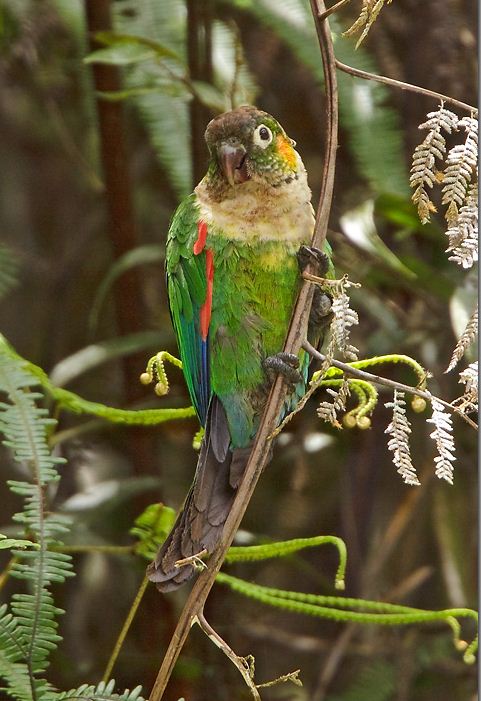
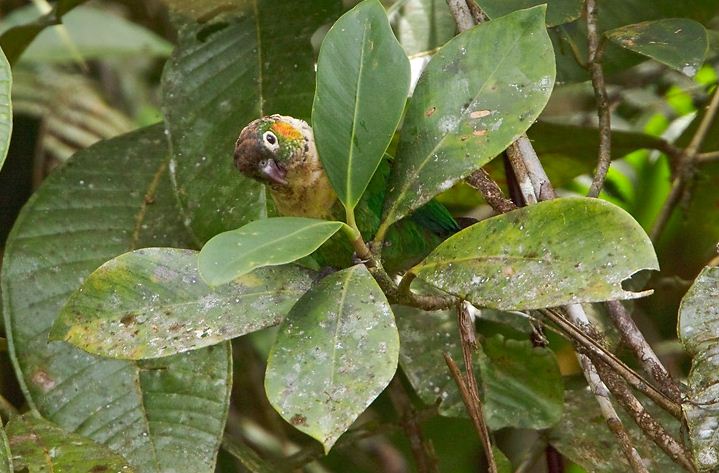
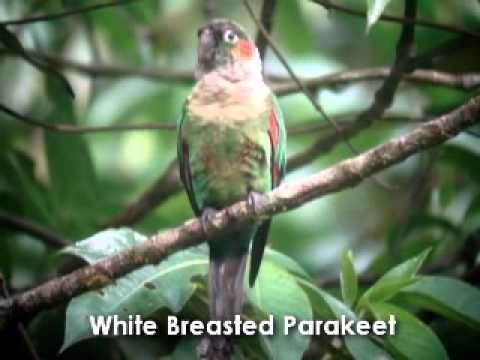
The most notorious of the White-necked Parakeet (Pyrrhura albipectus) It is the yellowish-white or white that goes from the cheeks to chest.

Crown dark stripes pale gray on the back; frontal band reddish thin; cheeks escalations of yellow and green and ear-coverts Orange; collar full white and chest yellow; belly and remaining upperparts green. Wings Greens with primary coverts red and carpal area, and primaries Bluish; tail long and pointy green, red opaque at the bottom.

The immature lacks the frontal band and has paler the ear-coverts.

Habitat:

Lives mainly in humid primary forest, foraging on fruit trees, preferably along rivers, Although he tolerates areas open and intercepted, from 900 to 2000 m (usually between 1400 and 1800 m).
Make altitudinal movements following the fruiting. Flies in flocks of 12 to 50 individuals. It bathes in pools or between rocks covered with MOSS.

Reproduction:

There is little evidence about its reproduction, possibly from May to July. A young clerk was seen in September (Snyder et to the., 2000).

Food:

The diet includes fruit, seeds and flowers Vine, mainly taken in the canopy.

Distribution:

Size of its range (reproduction / resident): 19.600 km2

Confined to three areas in southeast Ecuador and recently also it has been found in northern Peru.

In Ecuador It is known from the Podocarpus national park, the Cordillera de Cutucรบ and Cordillera del Condor. Although their numbers seem relatively low, possibly with a total population of only a few thousand individuals, is apparently common in the Podocarpus national park. There are also confirmed records as far south as the Pangui in Zamora-Chinchipe. Also recently it observed in adjacent parts of the Cordillera del Condor, Peru, with a sighting released from Condor Mirador on Morona-Santiago Province (Navarrete 2003). These range extensions suggest that it is not as severely threatened as previously feared. (Balchin y Toyne 1998).

Conservation:

State of conservation โ“˜


Vulnerable Vulnerable โ“˜ (UICN)โ“˜

โ€ข Current category of the Red List of the UICN: Vulnerable.

โ€ข Population trend: Decreasing.

Rationale for the Red List category

This species is classified as Vulnerable because it dwells in a few places and has a small range in which the habitat (and presumably the population) it is decreasing.

Justification of the population

The total population it may be only a few thousand birds, by what is placed in the band 2.500-9.999 individuals. This is equivalent to 1.667-6.666 mature individuals, rounded here to 1.500-7.000 mature individuals.

Justification of trend

It is suspected that the species is falling slowly, on the basis of continuous habitat destruction.

Conservation Actions Underway

โ€ข CITES Appendix II.
โ€ข The Podocarpus national park It is an important site for the conservation of the species. A revised management plan has been designed for the area and a public awareness campaign highlights the importance of the park (Snyder et to the. 2000).
โ€ข The White-necked Parakeet It is also found in the reserve Tapichalaca of 3.500 acres of the Fundaciรณn Jocotoco, where they are used successfully artificial nesting boxes (Waugh 2009).
โ€ข It is also located in the Ichigkat Muja- Condor Range National Park (F. Angulo 2012 a bit.).

Conservation Actions Proposed

โ€ข Conduct surveys to assess species distribution and total population size.
โ€ข Monitor rates of habitat loss and degradation within its range.
โ€ข Manage the Podocarpus national park so that endangered species are better protected.

"White-necked Parakeet" in captivity:

It is not easy to find it in captivity.

Alternative names:

White-necked Parakeet, White necked Parakeet, White-breasted Conure, White-breasted Parakeet, White-necked Conure (English).
Conure ร  col blanc, Perriche ร  col blanc, Perruche ร  col blanc (French).
WeiรŸhalssittich, Weisshals-Sittich (German).
Tiriba-do-pescoรงo-branco (Portuguese).
Cotorra Cuelliblanca, Perico de Pecho Blanco (espaรฑol).
Perico de Cuello Blanco (Peru).


scientific classification:

Frank Chapman
Frank Chapman

Order: Psittaciformes
Family: Psittacidae
Genus: Pyrrhura
Scientific name: Pyrrhura albipectus
Citation: Chapman, 1914
Protonimo: Pyrrhura albipectus


Images White-necked Parakeet:

Videos "White-necked Parakeet"

White Breasted Parakeet

White-necked Parakeet (Pyrrhura albipectus)


Especies del gรฉnero Pyrrhura

Sources:

Avibase
– Parrots of the World โ€“ Forshaw Joseph M
– Parrots A Guide to the Parrots of the World – Tony Juniper & Mike Parr
Birdlife
– Parrot Book, Parrots and macaws Neotropical

Photos:

(1) – Ingrid Grunwald, IBC943789. Photo of White-necked Parakeet Pyrrhura albipectus at Zamora-Chinchipe Province, Ecuador. Accessible at hbw.com/ibc/943789.

Sounds: (Xeno-canto)

โ–ท The world of Pets: Dogs, cats, birds, reptiles, amphibians

White-bellied Parrot
Pionites leucogaster

Lorito Rubio

Content

White-bellied Parrot

Description:

23 cm.. height.

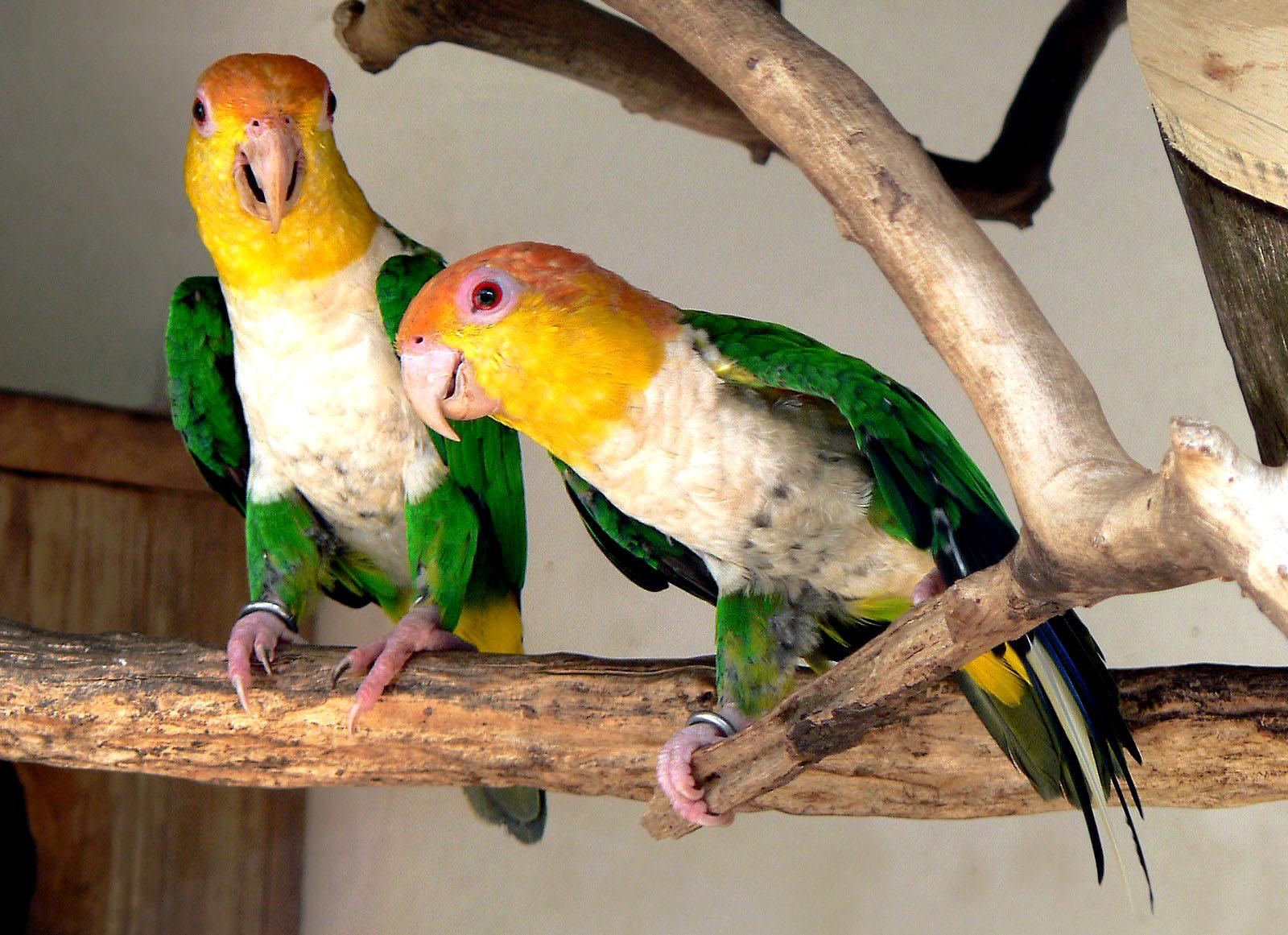
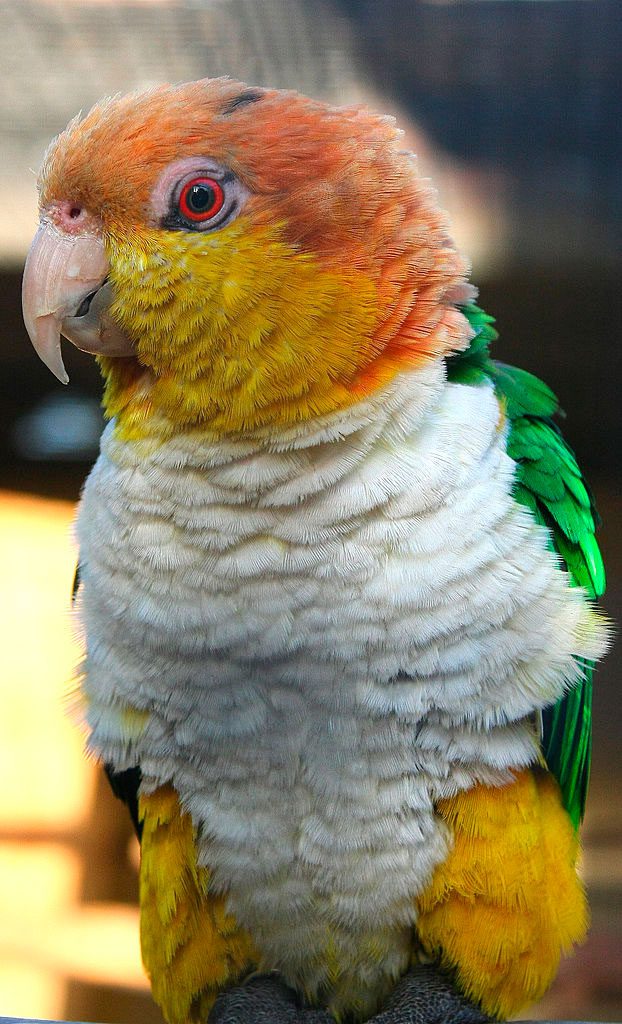
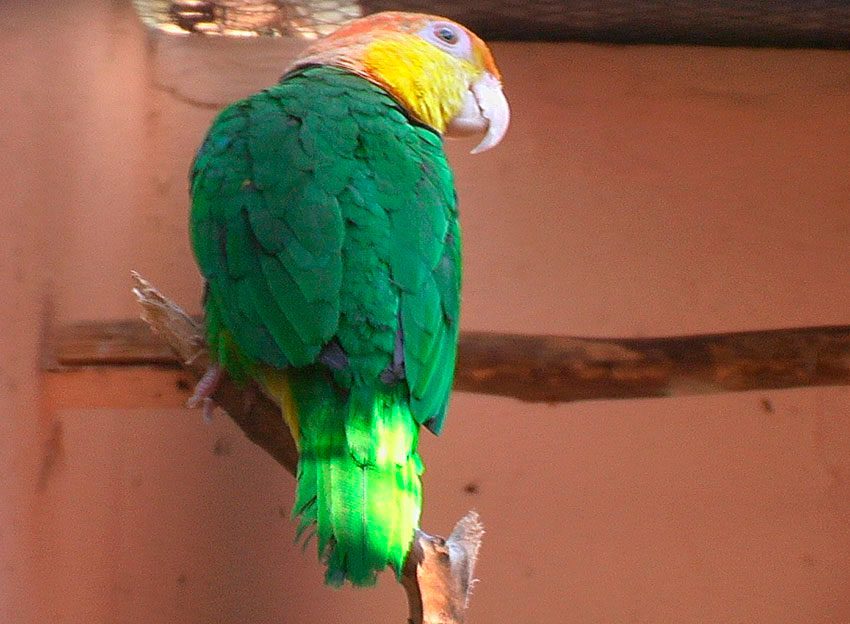
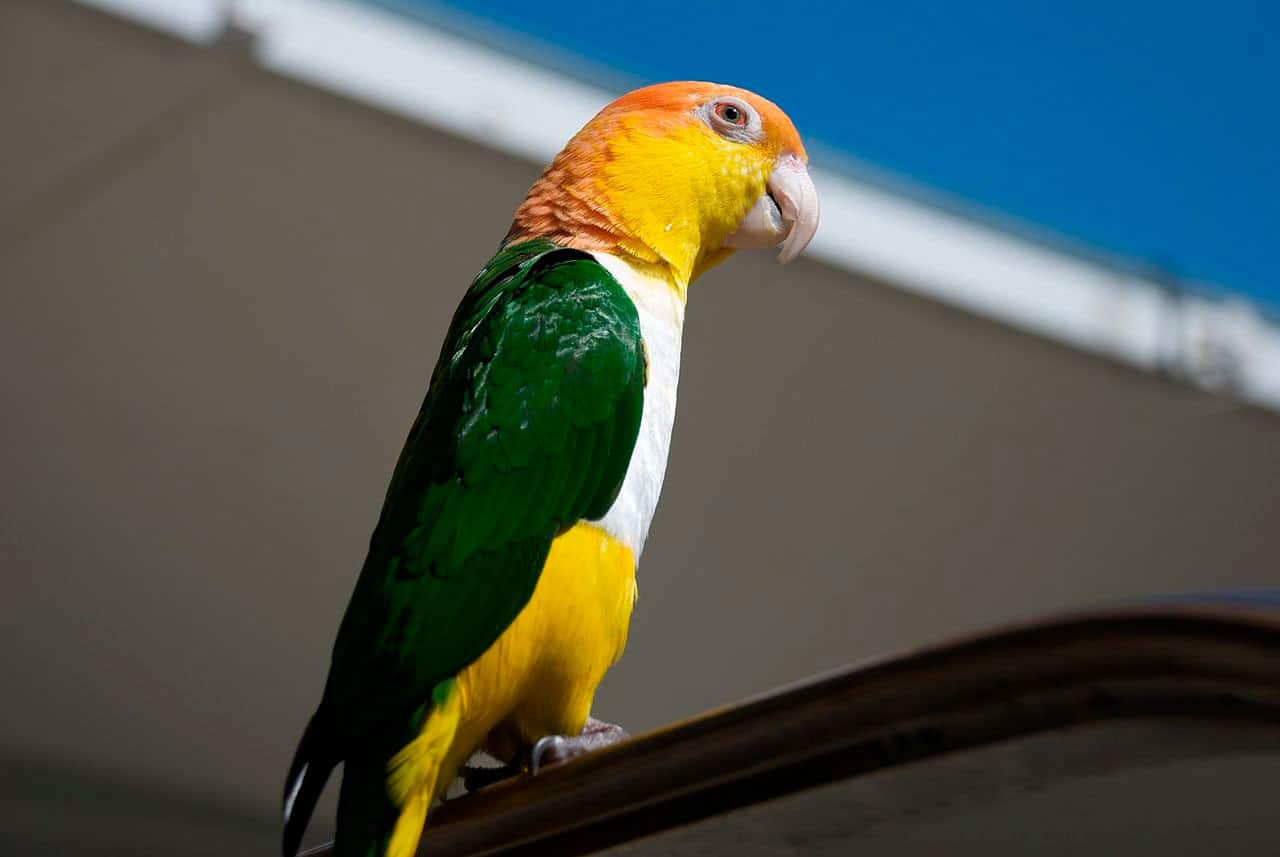
the unmistakable White-bellied Parrot (Pionites leucogaster) has the lores, cheeks and throat, bright yellow lemon; "ear coverts", forecrown and crown, bright orange red; sides and rear of the neck, orange, but paler.

Upperparts green. Primary coverts blue; other coverts green. Primaries blue with green margins in outerweb. Underwing-coverts green. Breast and center belly, white; undersides of belly and feathers the thighs, green; undertail-coverts Yellow. Upper, the tail green; undertail, pale grayish brown. Bill, color pale horn; cere Pink; irises reddish brown; legs pink.

Both sexes are similar.

Immature paler, especially the yellow color face.

  • Sound of the White-bellied Parrot.

Description 3 subspecies:

  • Pionites leucogaster leucogaster

    (Kuhl, 1820) – Nominal.


  • Pionites leucogaster xanthomerius

    (Sclater,PL, 1858) – As the nominal species but with the thighs and flanks bright yellow lemon (no verde); tail green.


  • Pionites leucogaster xanthurus

    (Todd, 1925) – As the nominal species, but with the thighs yellow; flanks and tail, yellow and green the uppertail-coverts.

Habitat:

Prefers low humid forests, areas of land and vรกrzea with probable preference for the latter and for clearings in the forests. Also observed in the drier forests (where it is less common) in the South of its range. Gregarious; Observed in the company of Blue-headed Parrot (Pionus menstruus) on Eastern Amazonia. Seen in small groups or couples.

Since they have very heavy body and very short wings, the White-bellied Parrot You can not fly long distances.

Reproduction:

With plays in January and nests in hollow trees; a nest 30m found in the cavity of a tree in the east of its range. Clutch Normal probably 2-4 eggs.

Food:

Very similar in habits Lorito Chirlecrรฉs (Pionites melanocephalus) but no specific information about their diet; probably seeds, fruit and berries.

Distribution:

The size of its distribution area (reproduction / resident): 2.140.000 km2

The White-bellied Parrot It extends through southern amazon in Brazil, from northwest maranhรฃo and around Bethlehem in the State of For, west on Mato Grosso to the North of Bolivia and Southeast of Peru, to the top of Ucayali, where it approaches the range of Lorito Chirlecrรฉs (Pionites melanocephalus). Reports in eastern Ecuador (well within the limits of the latter) still not substantiated.

Distribution 3 subspecies:

Conservation:


Endangered


โ€ข Current category of the Red List of the UICN: In danger of extinction.

โ€ข Population trend: Decreasing.

Usually common but perhaps more scarce in drier forests on the southern fringes of the range. It is not at serious risk, but decreases locally (for example, the Eastern Amazonia) due to deforestation, and possibly extinct now Santa Cruz, Bolivia, due to the loss of habitat. Trapped for Local international trade (at least years), but apparently not yet having a serious impact on wild populations.

Conservation Actions Underway

โ€ข No specific conservation actions are known for this species.

Conservation Actions Proposed

โ€ข Expand the network of protected areas to effectively protect the IBA.
โ€ข Effectively treat resources and manage existing and new protected areas., using the emerging opportunities for funding the management of protected areas with the overall goal of reducing carbon emissions and maximize the conservation of biodiversity.
โ€ข Conservation on private land is also essential, through the expansion of market pressures for rational land management and prevention of logging on land not suitable for agriculture (Soares-Filho et to the., 2006).
โ€ข Campaign against proposed changes to the Brazilian Forest Code that would lead to a decrease in the width of protected riparian forest areas such as Permanent Preservation Areas (APPs), that function as vital corridors in fragmented landscapes.

"White-bellied Parrot" in captivity:

Do not have the capacity to speak of his larger parrots cousins, but they are very assets and can be very good pets, Despite not being very common to see them in captivity.

Alternative names:

White-bellied Parrot, White bellied Parrot, White-bellied Caique (English).
Maรฏpouri ร  ventre blanc, Caรฏque ร  ventre blanc (French).
Rostkappenpapagei, Rostkappen-Papagei (German).
Marianinha-de-cabeรงa-amarela, maipurรฉ, marianinha, mariquita, periquito-d’anta, periquito-de-anta, periquito-de-cabeรงa-preta Pionopsitta barrabandi (Portuguese).
Lorito Gordo de Cabeza Rojiza, Lorito Rubio (espaรฑol).
Loro de Vientre Blanco (Peru).


scientific classification:

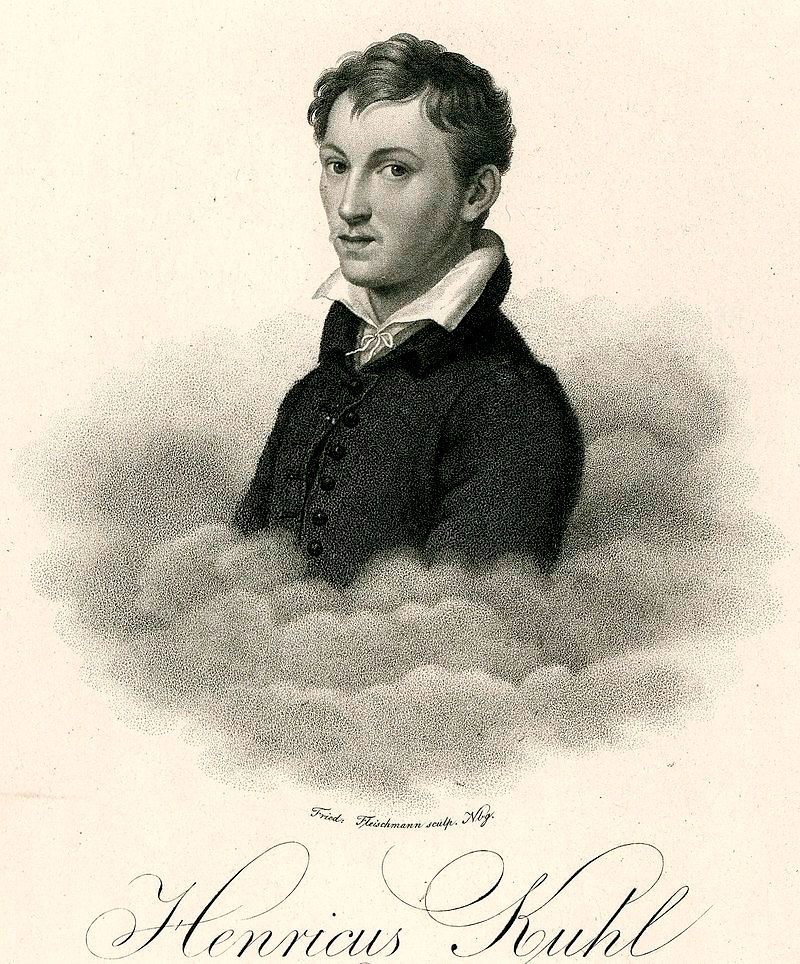
Kuhl, Heinrich
Heinrich Kuhl

Order: Psittaciformes
Family: Psittacidae
Genus: Pionites
Scientific name: Pionites leucogaster
Citation: (Kuhl, 1820)
Protonimo: Psittacus leucogaster


Images "Lorito Rubio":

Videos "White-bellied Parrot"


ยซBlond Parrotยป (Pionites leucogaster)


Sources:

  • Avibase
  • Parrots of the World โ€“ Forshaw Joseph M
  • Parrots A Guide to the Parrots of the World – Tony Juniper & Mike Parr
  • Birdlife

  • Photos:

(1) – Pionites leucogaster xanthomeria By Mirjam (Picasa Web Albums) [CC BY-SA 3.0], via Wikimedia Commons
(2) – Pionites leucogaster leucogaster White-bellied Parrot (this subspecies is also know as the Green-thighed Parrot). Two in a cage with a nestbox By TJ Lin (originally posted to Flickr as 140) [CC BY-SA 2.0], via Wikimedia Commons
(3) – Pionites leucogaster xanthomerius A pet adult male White-bellied Caique perching by a row of books By pionetes (Own work (self-portrait)) [CC BY-SA 3.0], via Wikimedia Commons
(4) – Five White-bellied Parrots (also known as White-bellied Caique) at Bird Park, Foz do Iguaรงu, Brazil. This subspecies is also known as the Green-thighed Caique (Pionites leucogaster leucogaster) By Chad Bordes (Picasa Web Albums) [CC BY 3.0], via Wikimedia Commons
(5) – White-bellied Parrot by Peter TanFlickr
(6) – White-bellied Parrot in captivity at Iguaรงu Bird Park, Foz do Iguaรงu, Brazil. Photographed on 23 April 2003 By Arthur Chapman [CC BY 2.0], via Wikimedia Commons
(7) – White-bellied Parrot (Pionites leucogaster) often referred to as the White-bellied Caique in captivity by whiskymac (Flickr) [CC BY 2.0], via Wikimedia Commons
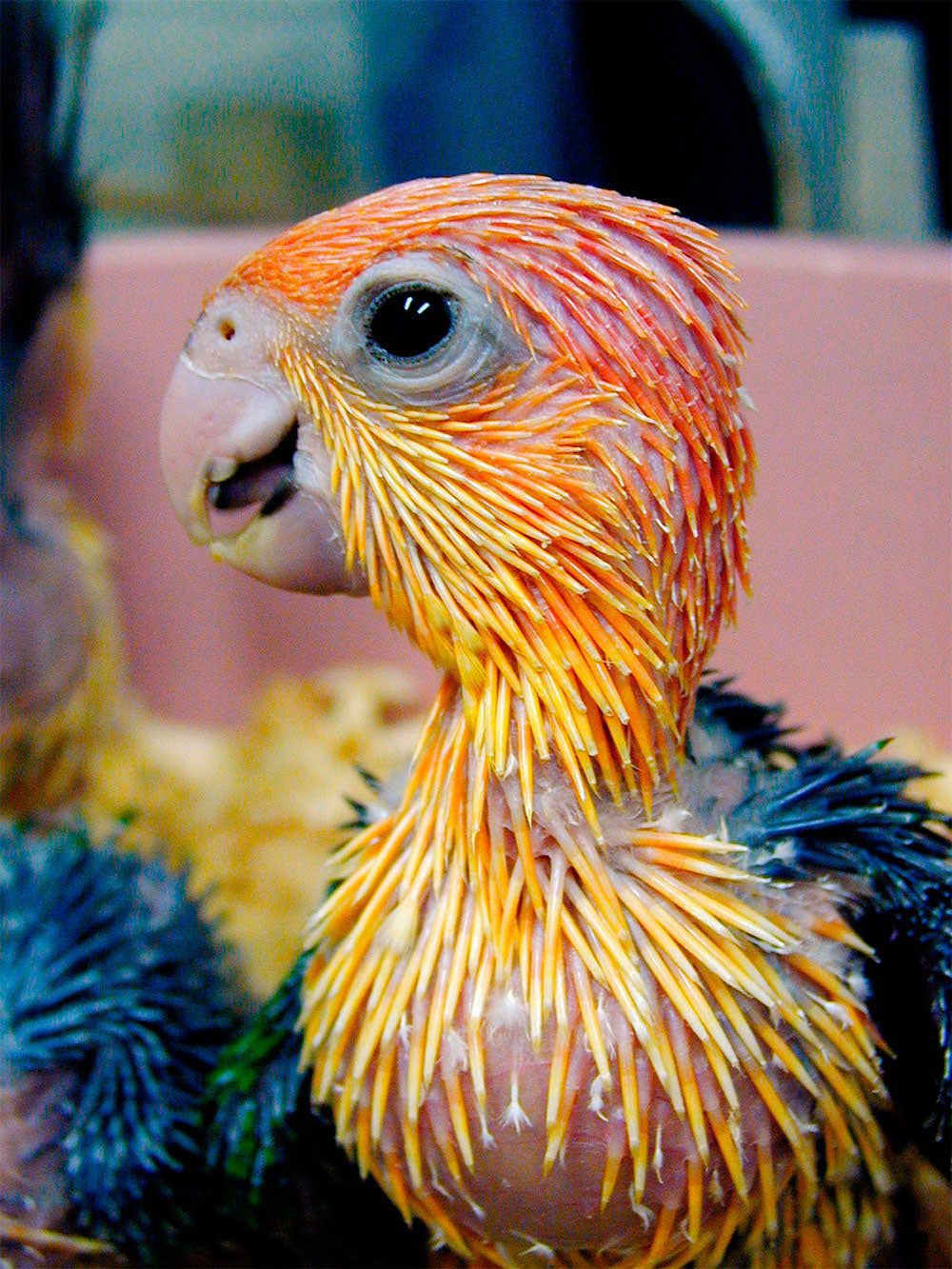
(8) – White-bellied Parrot (often referred to as the White-bellied Caique); a chick. Its feathers have not opened yet By Ruth Rogers (originally posted to Flickr as Caique) [CC BY 2.0], via Wikimedia Commons
(9) – A painting of a White-bellied Parrot (originally captioned ยซPsittacus badiceps. Bay-headed Parrotยป) by Edward Lear (1812-1888) Edward Lear [Public domain], via Wikimedia Commons