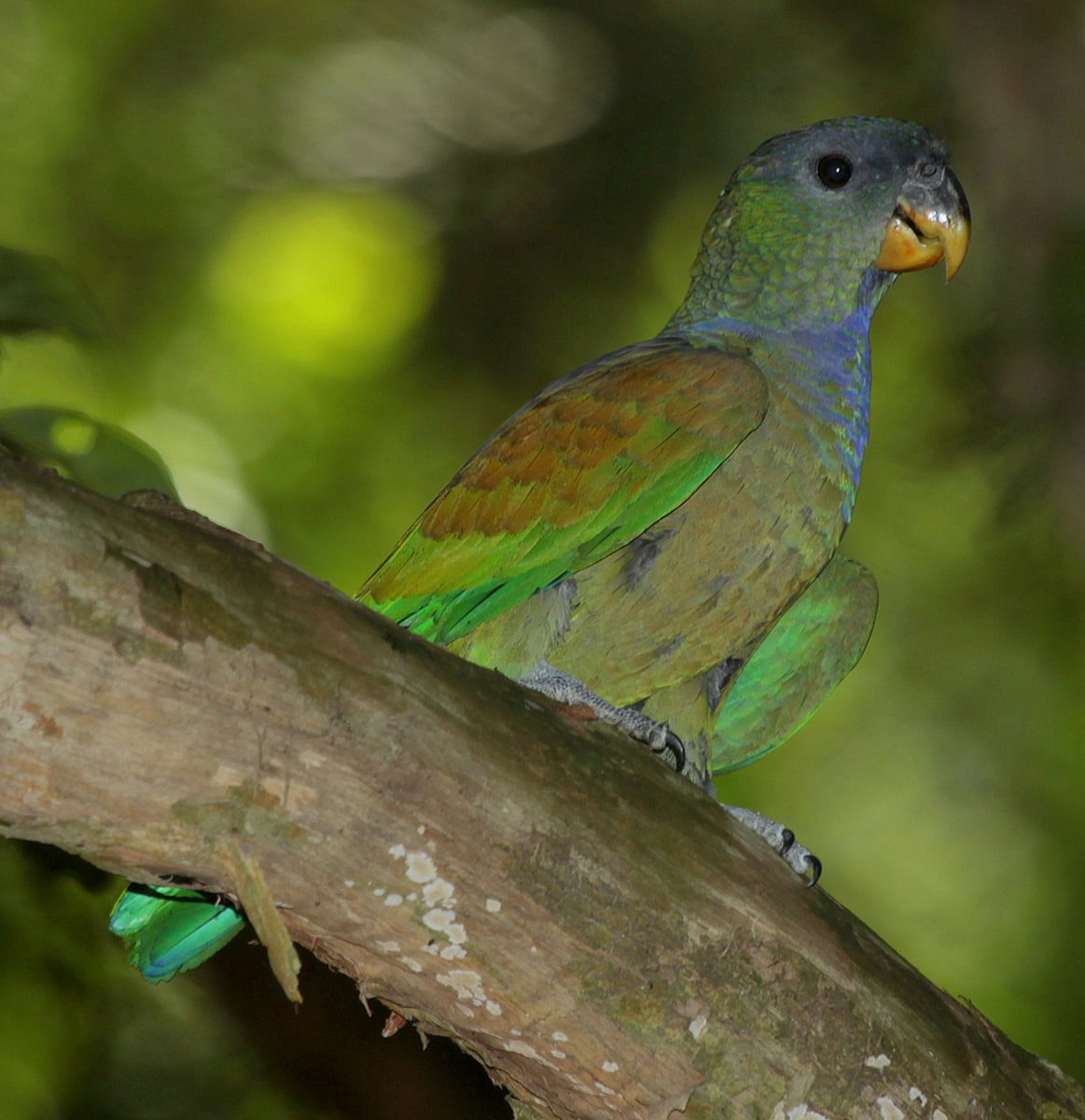
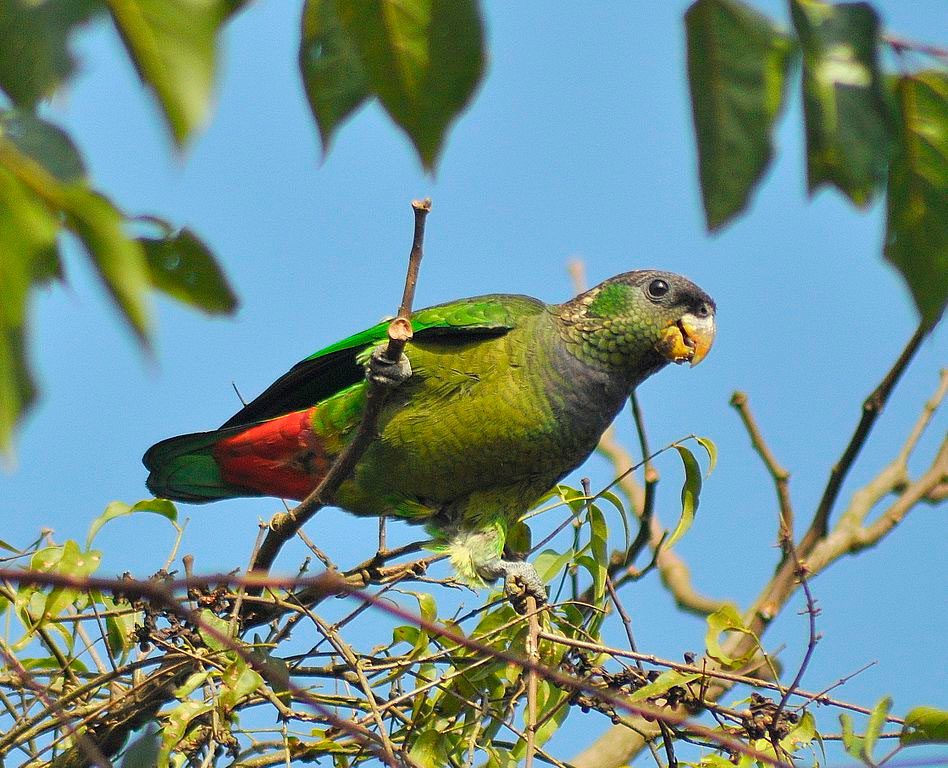
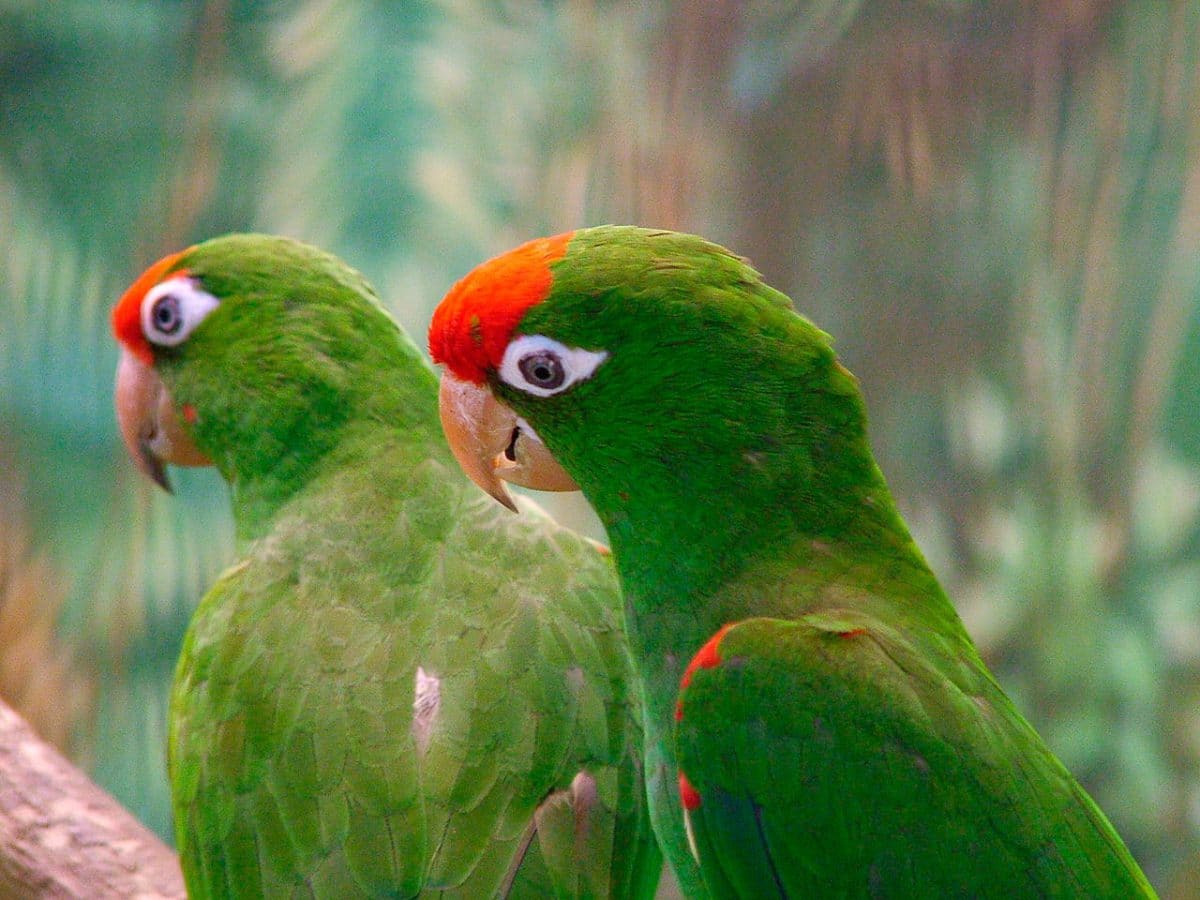
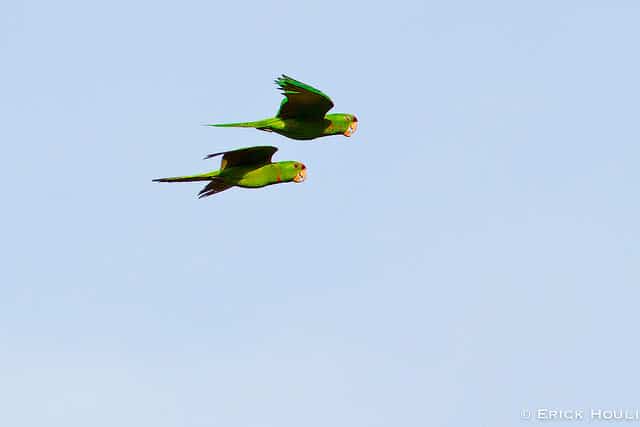
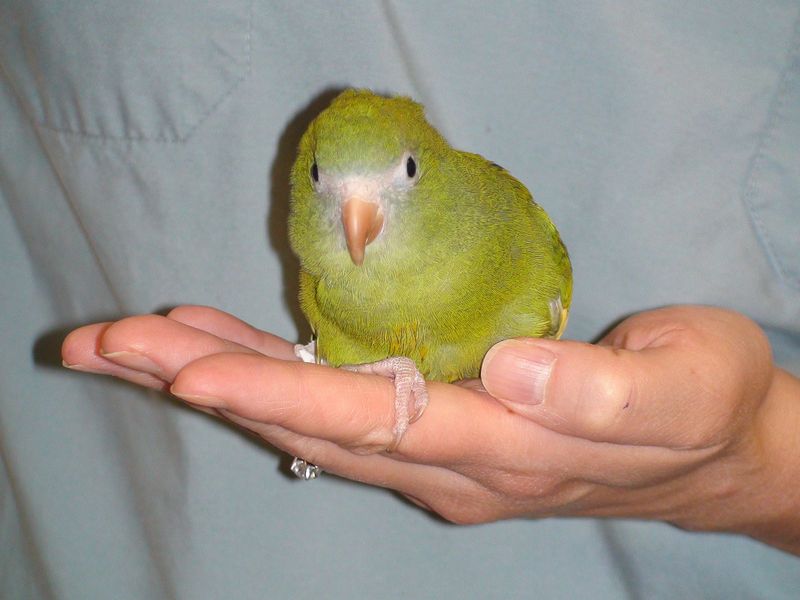
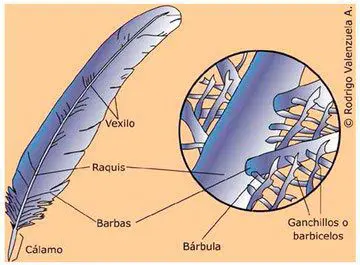
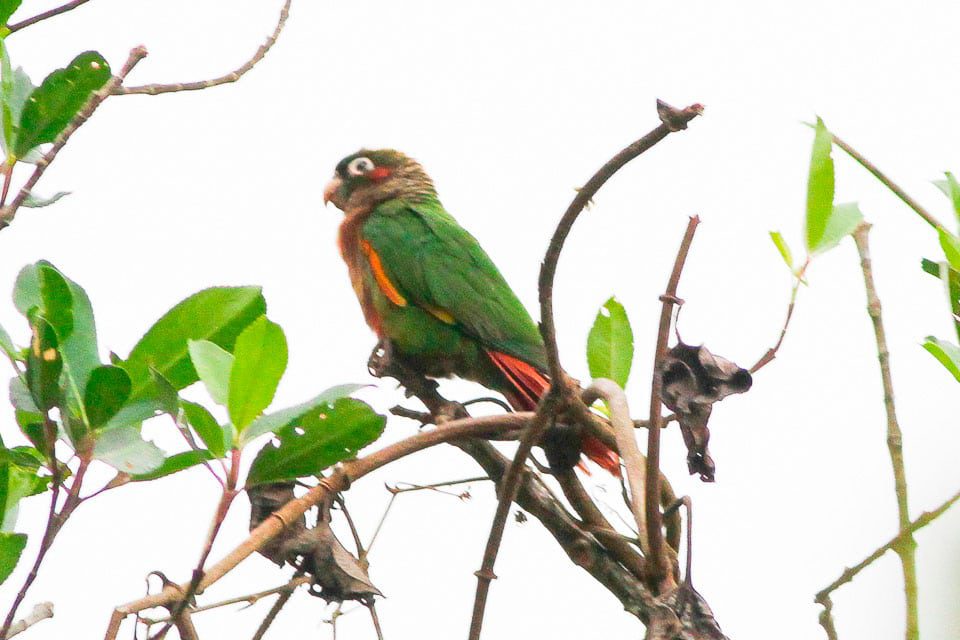
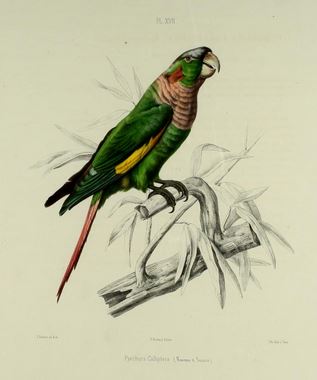
The Brown-breasted Parakeet(Pyrrhura calliptera) is easily recognized by the Wing mirror yellow in flight. In general it is green, with a red spot on the ear; chest brown reddish and sides of the neck characteristic dark brown.
Shoulder mostly yellow up to half of the wing
and the end of the same pardo-olivaceo.
The primary feathers are blue and their covert wing external and internal yellow, usually with orange blend.
The tail reddish brown. Its bill pale yellowish; irises yellow; eye ring white.
It inhabits in Misty jungles Andean and sub-andinas with canopy 15 to 25 m, secondary forests and Paramo, from 1700 to 3400 m. They fly at dawn and at dusk flocks, usually small of 6 to 12 individuals on the canopy of the forest.
Reproduction:
It nests in, generally, in cavities of trees located in wooded pastures or pasture surrounded by secondary forest fragments, bedrooms for both nests. breeding conditions they have been observed in August and October, as well as between November and January in Fusagasugá, Farallon de Medina and Soatá (Cortes-Herrera et to the., 2007) and from September to February in the Chingaza National Park (Arenas-Mosquera 2011).
The size average of the laying is of 5-6 eggs of color whitish. The chicks take of 60 to 70 days to complete its development.
Food:
Diet Brown-breasted Parakeet consists in fruit (including plants of the Ericaceae, Lauraceae, Melastomataceae and Clusiaceae (Cortes-Herrera et to the., 2007), seeds and cultivated corn, Although flocks larger were observed in areas open to eating leaves and seeds (O. Courteous in litt., 2012).
Distribution:
Size distribution (reproduction / resident): 1,000 km2
The population total has been estimated at 5.000-10.000 individuals.
Conservation:
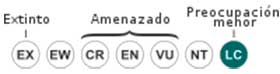
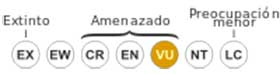
State of conservation ⓘ
Vulnerable ⓘ(UICN)ⓘ
• Current category of the Red List of the UICN: Vulnerable.
• Population trend: Decreasing.
This species has a range very small and a small population, known in less than ten places in what is rapidly declining due to the loss of habitat and persecution as as plague by including cultivated corn in their diet.
These declines in population range are expected to continue.. So, qualified as vulnerable.
It is estimated that its population amounts to between 5.000 and 10.000 individuals, equivalent approximately to 3.300-6.700 mature individuals.
– Avibase
– Parrots of the World – Forshaw Joseph M
– Parrots A Guide to the Parrots of the World – Tony Juniper & Mike Parr
– Birdlife
– Wiki Aves de Colombia
– Photos:
(1) – Flame-winged Parakeet (Pyrrhura calliptera) By Ron Knight from Seaford, East Sussex, United Kingdom (Flame-winged Parakeet (Pyrrhura calliptera)) [CC BY 2.0], via Wikimedia Commons
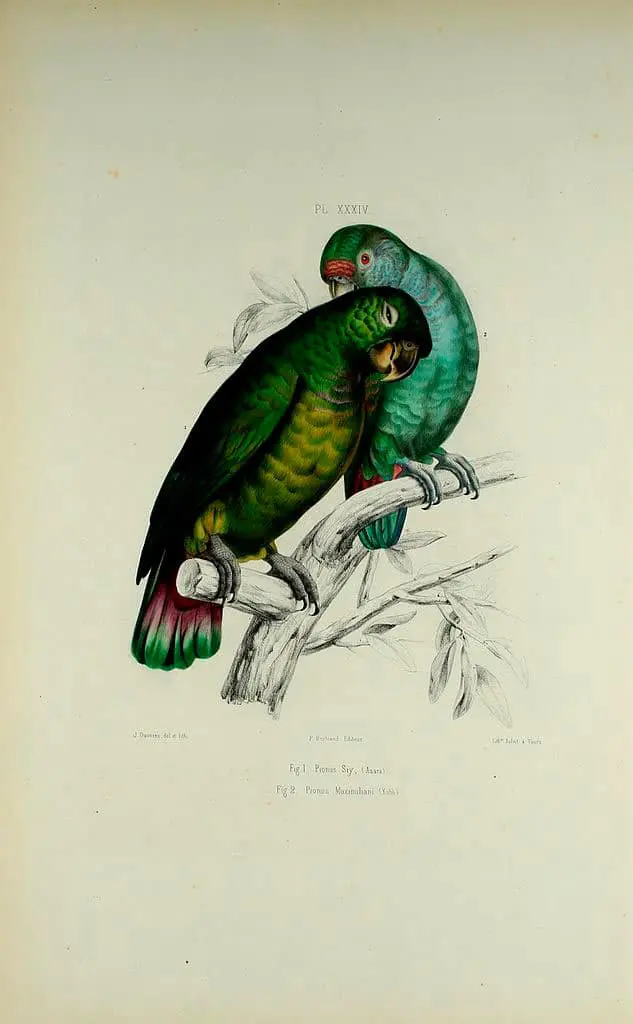
(2) – Pyrrhura calliptera By J. Davernes (biodiversitylibrary.org) [Public domain], via Wikimedia Commons
27 to 29 cm.. height and between 233 and 293 g. of weight.
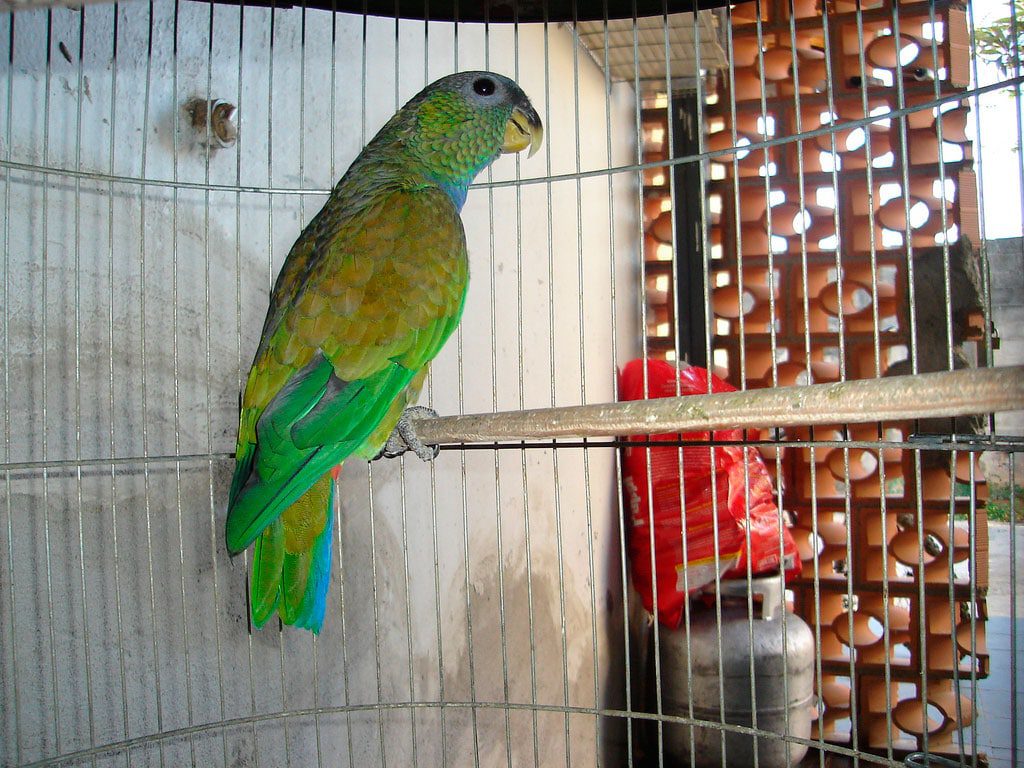
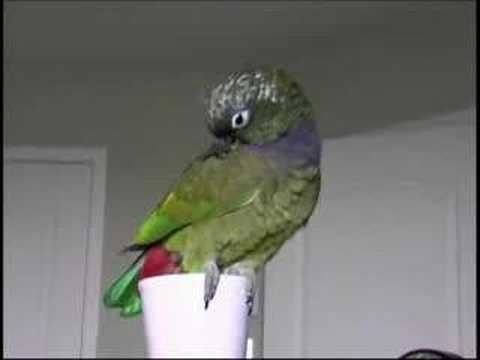
The Scaly-headed Parrot(Pionus maximiliani) It is medium in size and tail very short; has the lores, the forecrown and the eye area opaque dark bronze; the feathers on crown, the cheeks, the chin and the sides of the neck, basal green with wide enough margins bronze that give the appearance of flake; ear-coverts with dark green margins but brighter than other pens head.
The back of the neck and green the mantle become more brown and olive green upper lower parts, where some feathers have quite indistinct darker tips. Coverts smaller and medium-sized green olive brown with indistinct dark tips; alula, primary and greater coverts and flight feathers, brighter green, contrasting with the upperparts brown, duller.
Under the wings, opaque green. The throat and the top chest blue violet off that fade in brownish olive green in the bottom of the chest and most of the belly, but they are become brighter and greener in flanks and the thighs; undertail-coverts crimson. Upper, the tail green in the center, outer feathers mainly blue and red at the base; undertail, the tail, bluish green duller. Bill black with yellow edges on the upper jaw and the bottom tip; orbital skin pale grey; irises dark brown; legs grey. Both sexes are similar. Immature It has less intense the blue throat; feathers head more green with less distinct margins.
(Ribeiro, 1920) – Blue darker in throat and darker above. Larger.
Pionus maximiliani siy
(Souance , 1856) – Much like the nominal species but darker below, more purple and less blue in the chest, yellower in back and Blue throat lighter.
Habitat:
It inhabits in a wide range of forested habitats, but mostly in dry forests lowland ranging from caatinga very dry, inside the northeast of Brazil, through the savannas Cerrado seasonal, to chaco; also in wetter forests, including gallery forests and forests of araucarias, especially in southeast Brazil. They can also be seen in subtropical forests in Eastern Andean slopes some 2.000 meters in the Northwest of Argentina and some 1.500 meters in the mountains of the South of Brazil.
Tolerant to human alteration of forest habitats and sometimes cultivated areas. Usually gregarious, arriving to form flocks numerous in places in where the food is abundant probably is hiding in small groups in them cups of them trees.
Reproduction:
They nest in tree hollows. Birds in terms of breeding in the month of October in Paraguay; November in São Paulo; laying 3-5 eggs.
Mainly resident, although it may not grow in the drier parts of the Argentine Chaco. Apparently more numerous in the center of its area of distribution, where its abundance is only surpassed by the Maroon-bellied Parakeet(Pyrrhura frontalis); progressively more scarce toward the periphery.
Locally quite common the common in Bolivia and locally common in the North of Argentina, where it is most abundant in the South of Salta, Tucumán and areas adjacent in Catamarca. Moderately common in Rio Grande do Sul and common in the pantanal; densities Brazilian more high in São Paulo.
The decrease apparent, in some parts of the range, (for example, North of the Argentina) is attributable to the trade, but in other places (for example, the southeast of Brazil) is undoubtedly its decline due to the loss of forests.
(Ribeiro, 1920) – It is from Paraguay, Brazil and northeast of Argentina (Missions)
Pionus maximiliani siy
(Souance , 1856) – Southeast of Bolivia until Paraguay, West of Brazil (Mato Grosso), North of Argentina.
Conservation:
• Current category of the Red List of the UICN: Least concern.
• Population trend: Decreasing.
Justification of the population
The size of the world population It has not been quantified, but this species is described as «quite common» (Stotz et to the., 1996).
Justification of trend
It is suspected that the population is in decline due to the continuous habitat destruction and to levels of exploitation unsustainable.
Threats
The species has been object of strong exchanges: from 1981, When is included in the Appendix II of the CITES, they have been 93.234 individuals captured in the wild in the international trade (database CITES from the UNEP-WCMC, January 2005).
"Scaly-headed Parrot" in captivity:
Curious, very intelligent and social. Quiet and relatively little aggressive. Prone to obesity. You can learn to imitate.
Pretty common in captivity. Life expectancy: 20 years.
Housing: Enclosure suspended at least 2 metres in height.
Diet: fruit as: Apple, pear, orange, banana, granada, cactus fruits, they form approximately the 30 percent of the diet; vegetables as: Carrot, celery, green beans, pea in the pod; corn fresh; green leaves such as: chard, lettuce, dandelion, Aviary grass; millet; mix of seeds small e.g.: millet, and small amounts of buckwheat, oats, safflower and hemp; soaked and sprouted from seeds of sunflower; beans, cooked legumes and boiled corn.
It needs regular exercise it is necessary to provide you with an Aviary as large as possible. Provide shallow bowls of water for bathing. Also provide stairs, swings, strings, different sizes of hooks and assorted toys.
Alternative names:
– Scaly-headed Parrot, Maximilian’s Parrot, Scaly headed Parrot (English).
– Pione de Maximilien, Pionus de Maximilien (French).
– Maximilianpapagei (German).
– Maitaca, baitaca, maitaca-bronzeada, maitaca-de-Maximiliano, maitaca-suia, maitaca-verde, suia, umaitá (Portuguese).
– Loro Bronceado, Loro choclero, Loro maitaca (español).
(1) – IBC.lynxeds.com
(2) – A Scaly-headed Parrot (also called a Scaly-headed Pionus, Maximilian’s Pionus, amd Maximilian’s Parrot) in a cage By Alex Knowles [CC BY 2.0], via Wikimedia Commons
(3) – A pet male Scaly-headed Parrot (also called Maximilian Pionus, Maximilian Parrot, Maximilian’s Pionus, or Maximilian’s Parrot) By Snowmanradio (Own work) [CC BY-SA 3.0 or GFDL], via Wikimedia Commons
(4) – Scaly-headed Pionus (also called Maximilian Pionus, Maximilian Parrot, Maximilian’s Pionus, or Maximilian’s Parrot) at Zoológico de Americana, Sao Paulo, Brazil By Moe Oliveira [CC BY 2.0], via Wikimedia Commons
(5) – Loro Choclero By Danbrazil (Own work) [CC BY-SA 4.0], via Wikimedia Commons
(6) – Iconographie des perroquets : non figurés dans les publications de Levaillant et de M. Bourjot Saint-Hilaire By Blanchard, Emile; Bonaparte, Charles Lucian; Bourjot Saint-Hilaire, Alexandre; Le Vaillant, François; Souancé, Charles de. [CC BY 2.0 or Public domain], via Wikimedia Commons
35 to 41 cm.. length. The weight of 500 to 600 g..
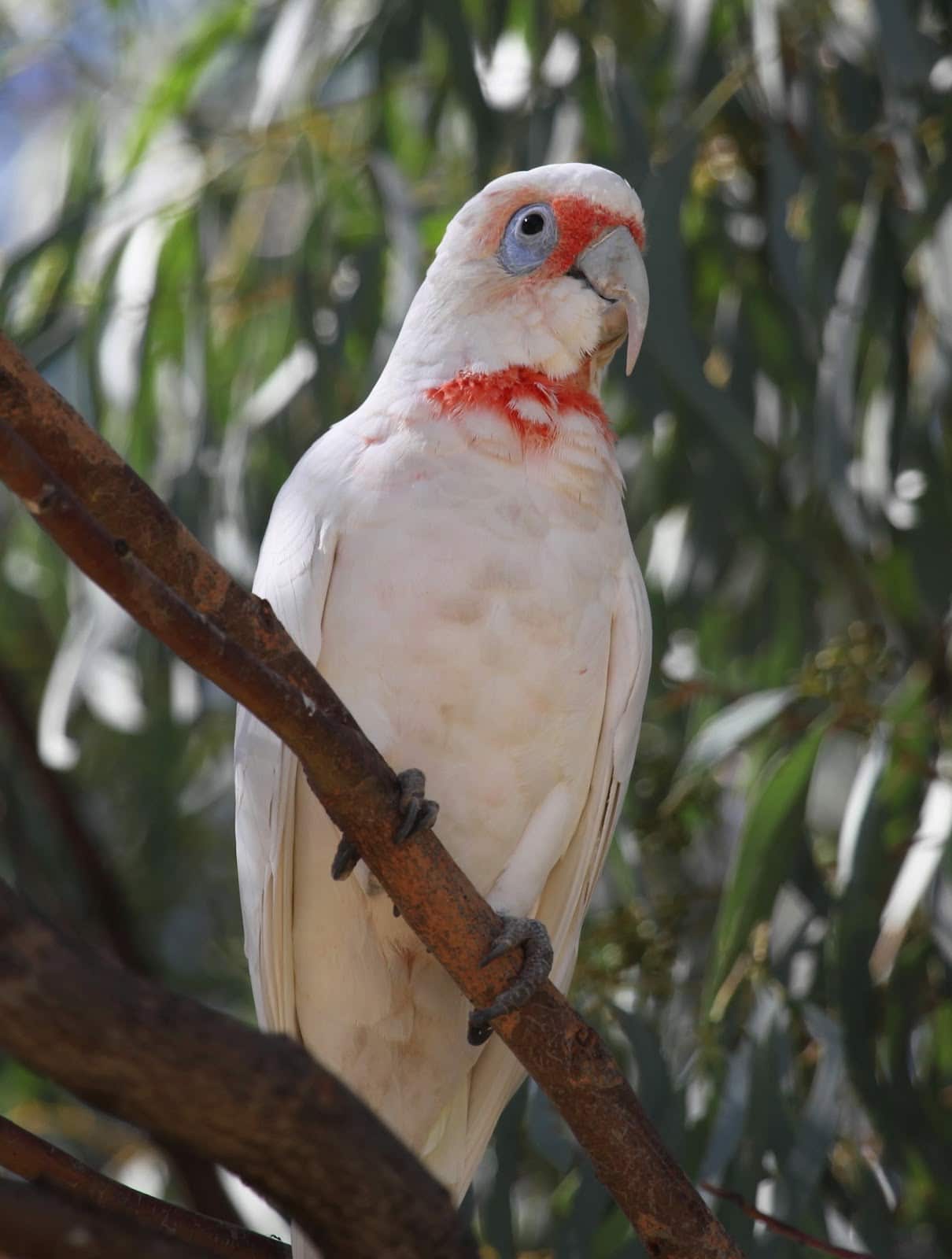
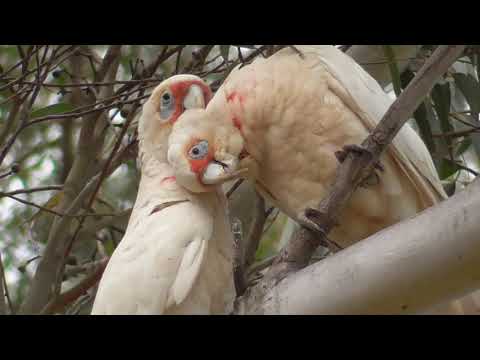
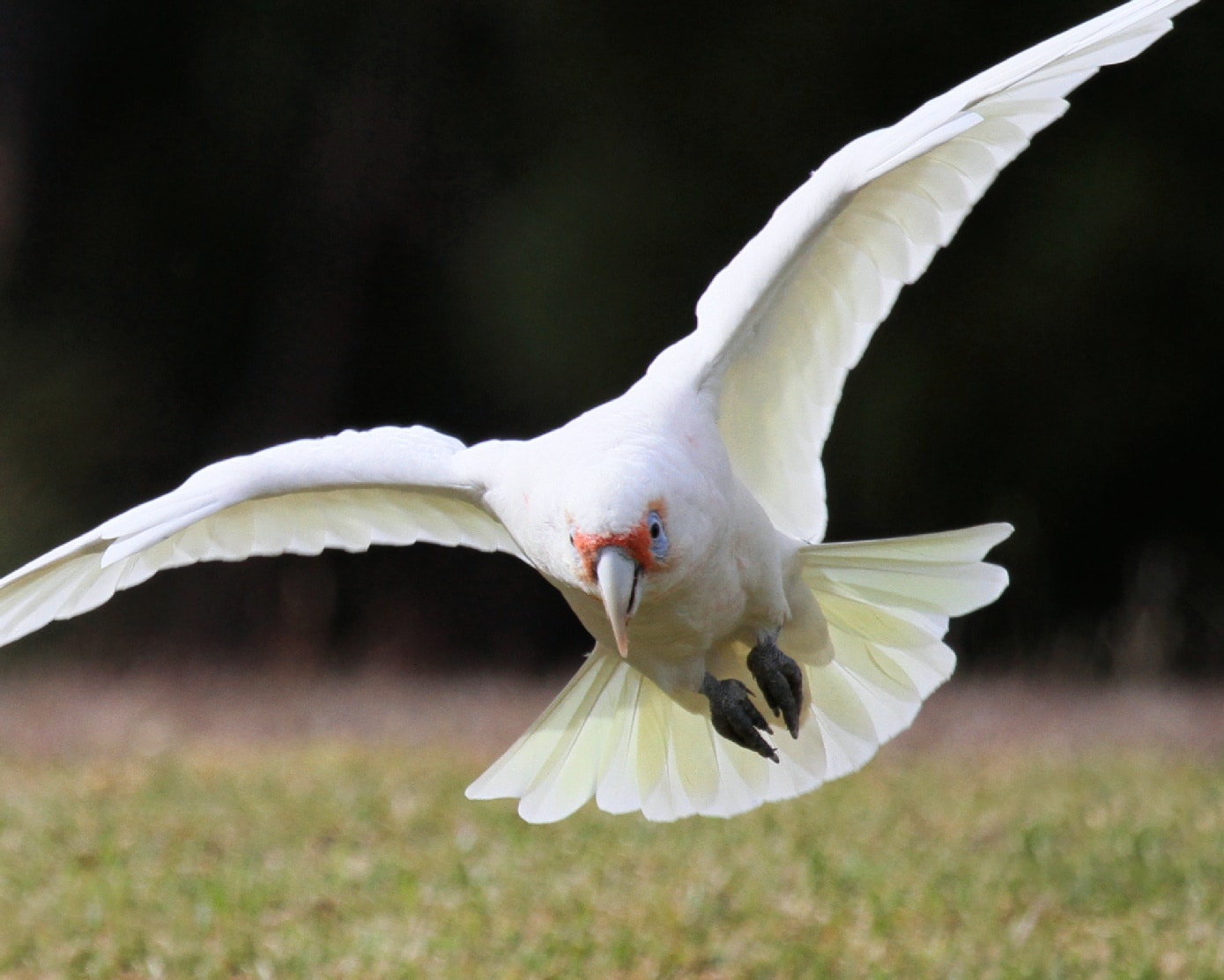
The Long-billed corella(Cacatua tenuirostris) has white plumage. The undertail coverts and the parts below from the wings they are bathed in pale yellow, very visible in flight. It has red coloration in the throat and the chest, with a Red Crescent ranked in the upper breast.
The Head shows a small crest white, Red front and a wide, nude and fleshy eye ring blue-grey around the eyes dark browns. The bill is white with blue base. upper jaw is long and hooked. The legs and feet are dark gray.
The female is similar to the male, with the upper jaw more short and less red.
There are two similar species:
– Cacatua sanguinea. Lack of forecrown Red and the red color in the neck. The upper jaw is shorter.
– Cacatua galerita. Similar in flight, has crest yellow and lacks of colour red. The bill is black.
Common in forests and remnant trees on farmland. It nests in Eucalyptus camaldulensis in the flooded Plains or close to streams. Wild populations living on farms and parks in urban areas.
Behavior:
It´s resident in their area of distribution, some local movements. Outside of breeding season, You can see in large flocks of up to 2.000 birds or more. Son noisy and visible, pronouncing discordant calls.
Pose in large eucalyptus near water. They leave the roost in the morning to drink, and then, go to the feeding areas. Again when the darkness comes to sleep, but not before excited participate in games and stunts .
They move on the floor with stunning movement jump. They do not have the other species waddling gait cockatoo. It causes damage to crops of cereals and tree fruit, considered as one pest for farmers.
Nest colonies. They can create their nests with other species of Corella, and sometimes they hybridize. Populations feral in Sydney and Perth, from the release of unwanted birds, they may hybridize with endangered species such as the Cacatua pastinator
Reproduction:
Held from July to November. Forman couples monogamous. The male and female prepared the nest in the Hollows of large old eucalypts. If you do not find a suitable tree, You can make a burrow in soft soil Bank. They fill the nest of wood chips and often reuse it for several years.
They nest in large colonies, with several nests in the same tree.
The female lays 2-4 eggs White. The incubation lasts a few 24 days, shared by both parents. The young leave the nest 55 days after hatching, being fed by the parents for three weeks more.
Food:
Feeds mainly on what obtained from soil, seeds, estate and bulbs that unearths with its upper jaw. They feed in the coolest hours of the day. Also consumes insects.
Distribution:
Size of the area of distribution (reproduction / resident): 382.000 km2
Is located in the southeast of Australia. Introduced in urban centers of Australia and Tasmania.
Conservation:
State of conservation ⓘ
Minor Concern ⓘ(UICN)ⓘ
• Current IUCN Red List category: Least concern.
• Population trend growing
Populations may be declining due to loss of breeding grounds in its original distribution area.
But, the Long-billed corella It common in its range.
Is created that in the world there are more than 250 thousand individuals.
"Long-billed corella" in captivity:
It is very popular as a pet for the most part of Australia, and has been classified as the best «talkative" of the australian cockatoos for its ability to mimic words almost to perfection.
Has a personality playful and active.
Out of its area of distribution is rare in poultry farming.
Of 50 cm.. length and an average weight of 480 g..
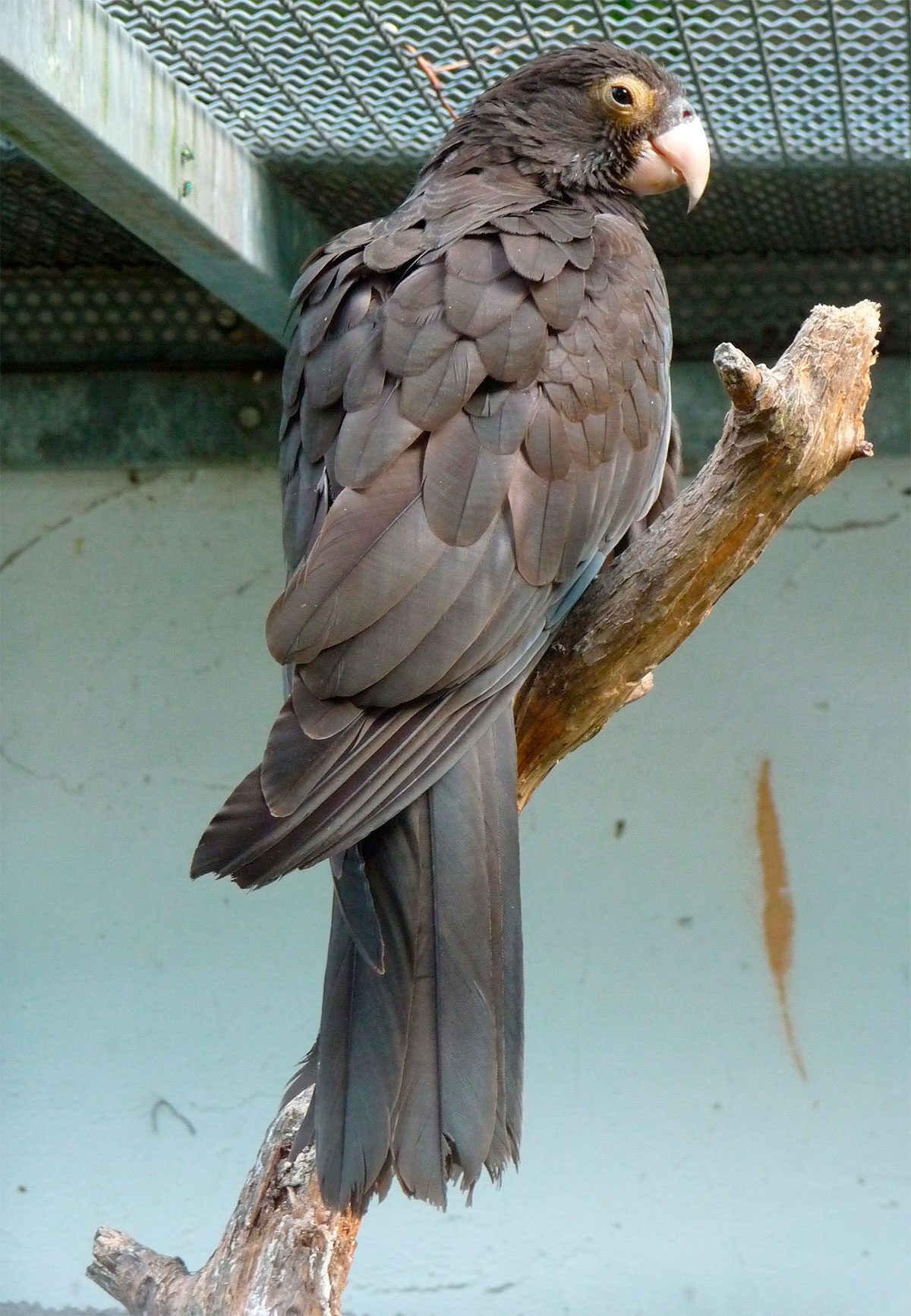
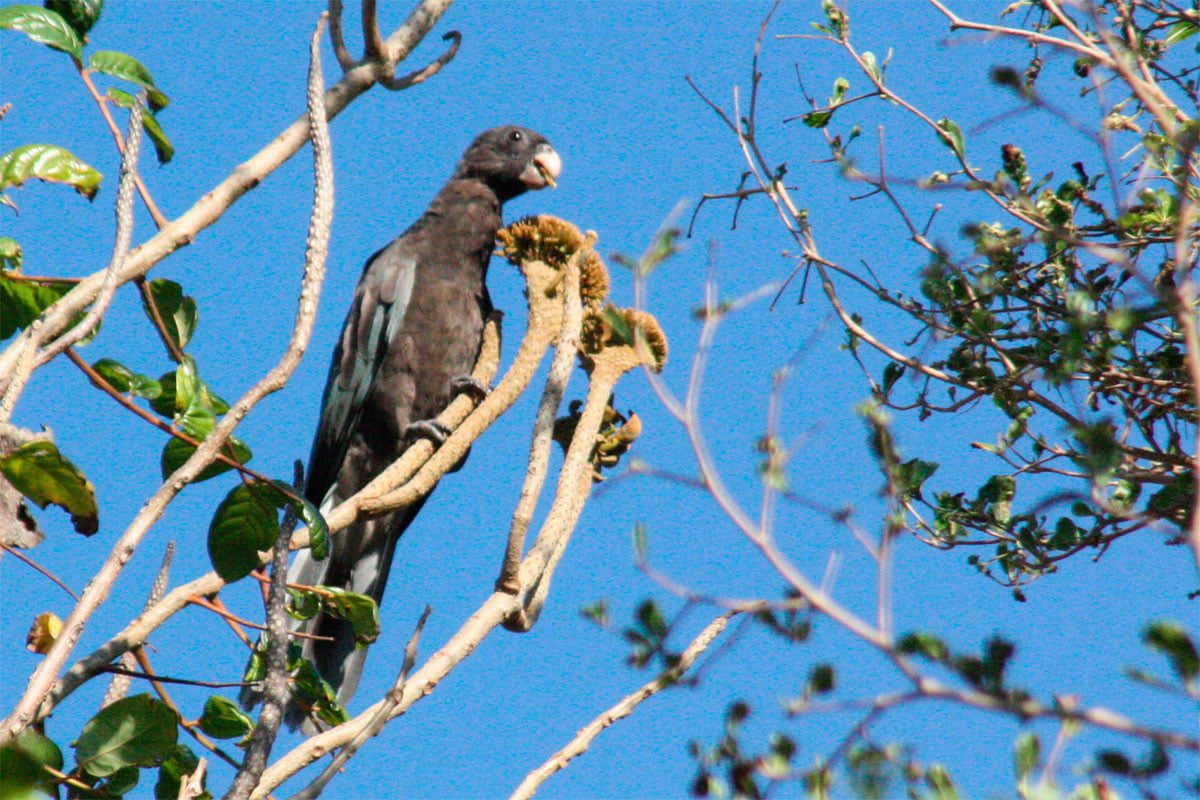
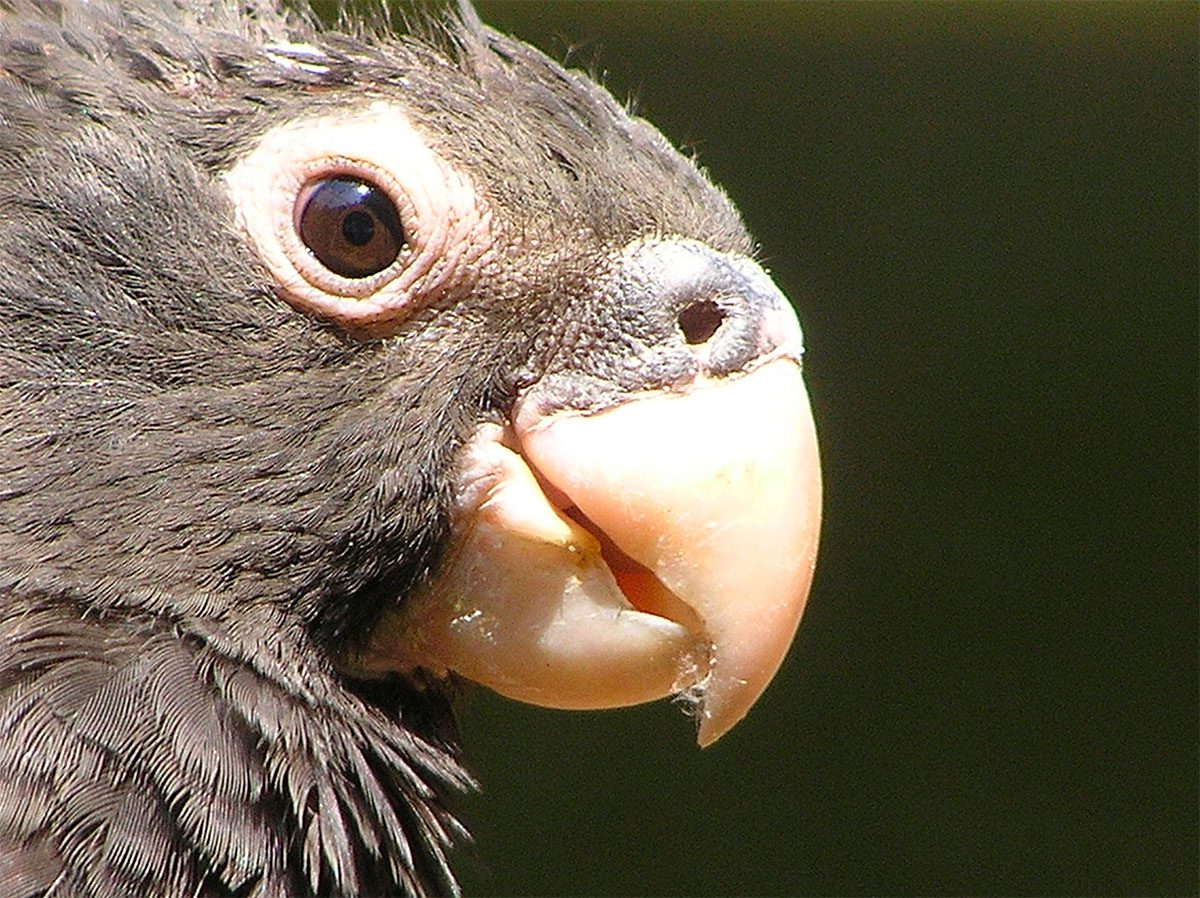
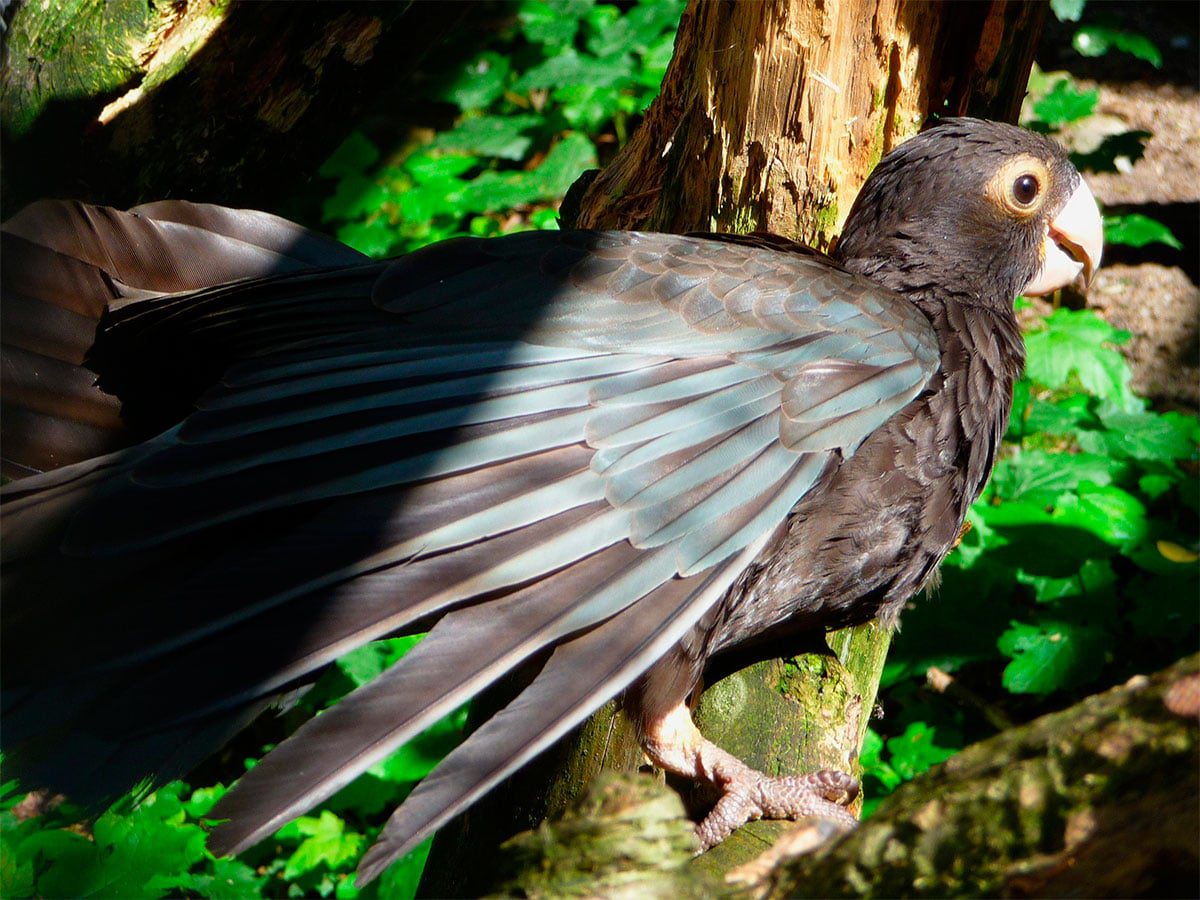
The Vasa Parrot (Coracopsis vasa) It has a few shades between black and Brown, big enough, grim looking, with the rounded tail and a powerful bill pinkish.
They can be difficult to spot when they combine their dark plumage with shadows under the forest canopy..
To a large extent, sympatric with the very similar Black Parrot (Coracopsis nigra), but the Vasa Parrot It is larger and somewhat paler, greyish Brown rather than dark brown
They can fly at high altitude when they travel to or from the sites of communal rest. It can be very Meek and accessible When feeds below the forest canopy.
In general, the plumage of the Vasa Parrot is brown-black color with a slight greyish tinge clear at the top, in special wings and top of the tail. Primaries with narrow gray margin in vane outer. bottom of the flight feather pale grey. Subcaudales coverts Gray with variable black stripes on the shafts of feathers. Tail with faint dark subterminal band; undertail, the tail pale grey. Bill usually pink but grey color after molting; irises brown; naked periophthalmic patch (that extends to the peak) pale grey; legs greyish Brown clear
Without sexual dimorphism in plumage. Reproductive females can become bald on the head, around the eyes and throat , with the exposed skin of mustard yellow or orange.
Immature with plumage more greyish Brown lighter and paler skin around the eyes. Skin patch naked eye more smaller than in adults or absent.
(Peters,W, 1854) – Smaller, of 45 cm., and paler than the nominal species, Unlike the subspecies drouhardi by having underparts dyed color chocolate instead of gray, and undertail-coverts Brown instead of gray or whitish.
Coracopsis vasa drouhardi
(Lavauden, 1929) – It´s smaller, of 45 cm., and paler than the nominal species. The underparts they are more gray with undertail-coverts more whitish, upperparts They show a bluish grey tinge clear. Dark subterminal band on the tail.
The Vasa Parrot they are distributed among a wide variety of habitats, from the dense and humid forests, Brambles open forests, until Medemia Palms in the savannas.
It attends the habitats modified by human activity; sometimes visits farmland.
Move, mainly, by lowlands, from sea level to the 1.000 meters above sea level.
In Comoros, the Vasa Parrot, generally, are associated with humid forests, always green, above the 300 m, but visit more open fields to feed.
Within its forest habitat, they are usually seen in the treetops, Although they descend to the ground to feed.
Usually found in small noisy groups, although they congregate in larger flocks when feeding or roosting.
The Vasa Parrot They perch on the top of large trees with at least one individual awake to warn of the danger; It is said that they are most active in the full moon nights.
Reproduction:
The breeding season, probably, of the months from October to December.
The nest It is built in a tree cavity or a trunk. In the western area of Madagascar, the baobabs trees (Adansonia) they are often used, sometimes with several nests in the same tree. These birds (especially the males) they can show cloacal protuberances while breeding.
Food:
Seeds, nuts, berries and fruits are part of their diet. Visit rice fields, millet and corn, causing, sometimes, extensive damage to crops. Apparently less frugivorous than the Black Parrot.
Distribution:
Size of its range (reproduction / resident): 928.000 km2
The species is partly common, in some places abundant, but its distribution in Madagascar possibly contracted due to large-scale deforestation in the center of the island.
Officially treated as harmful species, the Vasa Parrot they are persecuted because of predation on crops (especially rice) and captured for the trade in live birds at national and international level. They are also hunted as food.
It is distributed in several protected areas and although his pursuit and capture is intense in some areas, apparently, the species still is not at risk.
As they are seen as crop pests, is legal to hunt at the Vasa Parrot in Madagascar, and high levels of hunting contributes to a rapid decline in its population.
Like many species of Madagascar, the loss of their forest habitat is also a threat.
The size of the world's population has not been quantified, but the species, according to sources, It quite common in many areas
"Vasa Parrot" in captivity:
Very rare in captivity, difficult to find in aviaries, perhaps because of its initial lack of spectacularity compared to the more striking colors of any other species of parrot.
Although Vasa Parrot they are not very common as pets, comments from owners praise its virtues as a companion animal.
It is an extremely Intelligent and cunning.
Its beak is not strong enough to destroy the hard wood.
During the breeding season, they are very assets and quite noisy.
The female is the dominant, It is recommended as well that the eclectus that for an optimal result in reproduction, two males and one female are used in small aviaries or a greater number of males than females in breeding by means of colonies.
By the time they enter zeal both the male and the female, drop you the feathers of the head practically bald and both players.
The skin of the female head becomes yellow and white male. They tend to put in 2 to 3 eggs that incubate for space of 17 days.
The pups they are born completely devoid of markers, their legs are too long to be parrots and another feature that makes them unique is that they have both sides of their beaks at the corners, some bumps with characteristics similar to some exotic
Tienen facilidad para imitar la voz humana.
In terms of their longevity, according to sources, a specimen lived 53,9 years in captivity.
Alternative names:
– Vasa Parrot, Greater Vasa Parrot, Greater Vasa-Parrot (English).
– Grand Vaza, Grand Perroquet vasa, Grand Vasa, Perroquet vaza (French).
– Vasapapagei, Großer Vasa, Vasa (German).
– Papagaio-vasa (Portuguese).
– Loro Vasa (español).
– Avibase
– Parrots of the World – Forshaw Joseph M
– Parrots A Guide to the Parrots of the World – Tony Juniper & Mike Parr
– Birdlife
– ornitoloxia
– Photos:
(1) – Coracopsis vasa By 4028mdk09 (Own work) [CC BY-SA 3.0], via Wikimedia Commons
(2) – Greater Vasa Parrot in Madagascar By AEM (Picasa Web Albums) [CC BY-SA 3.0], via Wikimedia Commons
(3) – Coracopsis vasa By 4028mdk09 (Own work) [Public domain], via Wikimedia Commons
(4) – Greater Vasa Parrot (caracopsis vasa) in a Antwerp zoo By frank wouters from antwerpen, belgium , Belgium , Belgique (grote vasapapegaai) [CC BY 2.0], via Wikimedia Commons
(5) – Lesser vasa parrot (coracopsis nigra) in Anjajavy Forest, Madagascar By Charlesjsharp (Own work) [CC BY-SA 3.0], via Wikimedia Commons
(6) – Parrots of the World, by Joseph Forshaw (illustrated by William T. Cooper)
Origin: Malaysia, Brunei, India, Indonesian, Thailand
Character: active, Shy
Life expectancy: ---
Height: Of 40 to 48 cm..
Content
Description:
Of 40 to 48 cm.. length and 168 to 196 g. of weight.
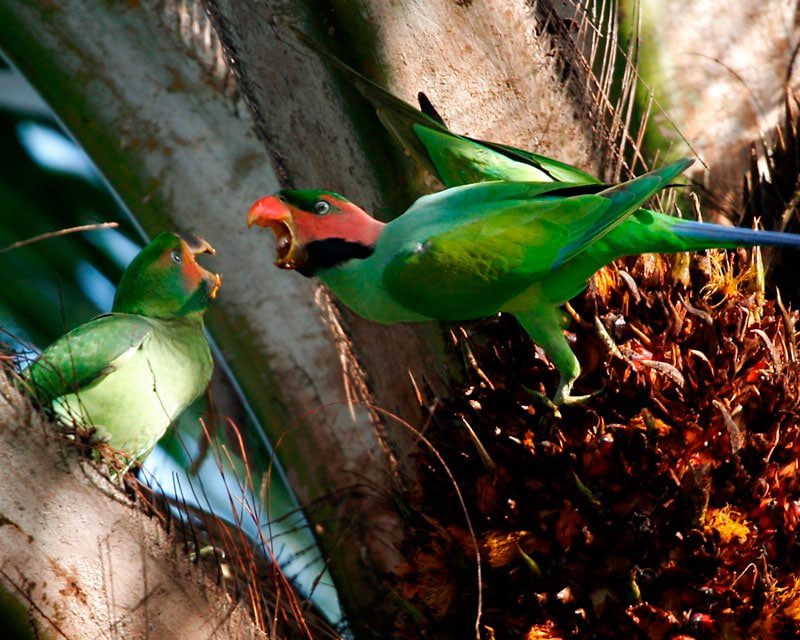
The Long-tailed Parakeet(Psittacula longicauda) has the plumage, in general, green. The throat, the chest and the abdomen are greenish-yellow; and lores (the regions between the eyes and the beak, on both sides of the head) are bluish-black. The crown is a green dark, and the sides of the head and nape are pinkish Red. They have a black stripe in the cheeks.
The upperparts is yellowish wash of blue-grey. The lower part of the back is pale-blue. The upperwing-coverts are yellowish. The supracaudales-coverts and infracaudales, as well as the the thighs are pale green. The central feathers of the tail are blue with pale tips and outer feathers are green.
The bill top is red and the lower beak is brown-black color. The irises they are amarillos-blanquecinos, and legs are grey.
The females they have the nape green. The band to their cheeks is dark green, and cheeks superiors are an orange-red live. Their feathers of the tail they are much shorter, and the bill top and bottom are brown-black color.
The young birds they have the head variable green interspersed with orange-red. The feathers of the tail they are shorter, and both the bill top and bottom are brown.
The young male they have a tint blue in the lower part of the back and some birds can have a reddish tint in the bill top.
Immature birds reach your adult plumage When they are near the 30 months of age.
The lutino and other colorations, It is believed that they are mutations observed both in the wild and in captivity.
(Chasen, 1935) – Of an average length of 42 cm.. As the species nominal but but the pinkish red from the sides of the head It is deep orange-red-streaked.
(Fraser, 1845) – Of 48 cm.. Plumage as of the species nominal, but the crown It has a reddish-brown core and a green at the end of feather edging, becoming pink on the back of the head and nape, thus causing in the crown more Brown than green appears in many birds . The black stripe in the lores is more clearly defined, continuing in some birds to form a narrow band in the forecrown. The upper cheeks they have a deep pinkish-Red, orange-red stripes.
Psittacula longicauda nicobarica
(Gould, 1857) – Of 48 cm.. As the species nominal, but the back of the head, the nape and back are greenish-yellow and slightly washed with pale blue. The ear-coverts and cheeks are deep red. The lower part of the back is green.
Psittacula longicauda tytleri
(Hume, 1874) – Of 44 cm.. length. As the species nominal but the back of the head, the nape and back are yellowish green washed with grisaceo-malva. The throat, the chest and the top chest they have a pale bluish tint. The lower part of the back is green.
Habitat:
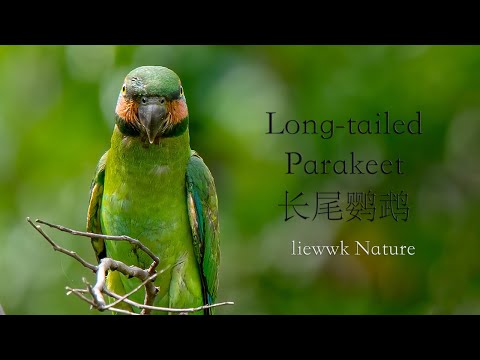
Video – "Long-tailed Parakeet" (Psittacula longicauda)
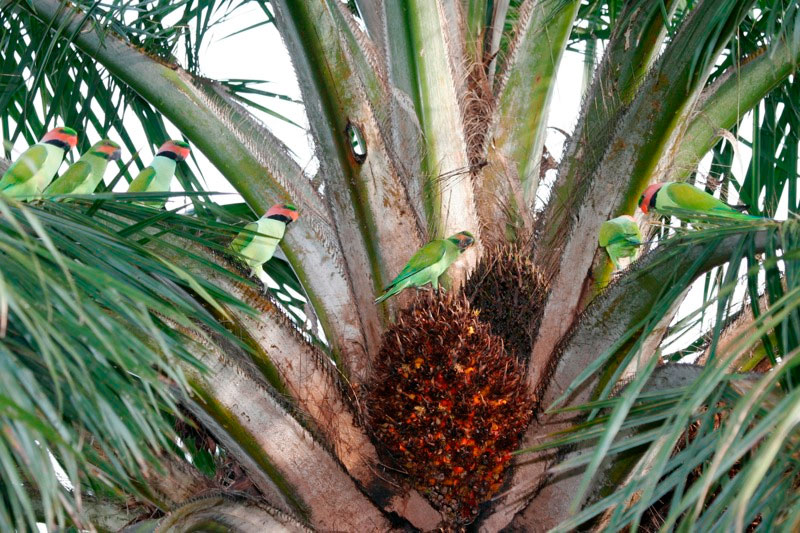
The Long-tailed Parakeet distributed over all types of lowland (below 300 metres in Sumatra), Evergreen from mangrove forests, swamps, tropical forests, to plantations of oil palm plantations (Elaeis) and coconut trees. It prefers the edges of high forest, especially with large dead trees, including close cultivated areas.
Flocks of thousands of birds reported in the Islands Andaman and Borneo but smaller groups (minor's 20) they are typically, especially during breeding. They form mixed flocks with the Blue-rumped Parrot (Psittinus cyanurus) in Kalimantan.
The Long-tailed Parakeet It is a restless bird that are constantly in motion. They fly quickly around branches, moving quickly from a tree to another. Although they are usually well camouflaged in green foliage, its continuous chirp betrays its position. They tend to feed shortly after sunrise and resume foraging around sunset..
Reproduction:
The Long-tailed Parakeet nests in tree cavities, usually dead, often to a considerable height (for example, reported nest in a tree of the species Koompassia in Sumatra to 45 meters above sea level); in the andaman islands commonly nest in trees of the species Pterocarpus marsupium; in the Nicobar Islands sometimes in Pandanus, some 4 meters above ground and in larger trees to 10 metres in height.
Breeds in colonies.
The nest It is full of pieces of bark and chewed wood. In the natural habitat, the average clutch consists of 2 to 3 eggs, each one measures 30,6 x 24,7 mm.
During the courtship, the male bows before the female, by spitting up, circular motions with his head and gently touching its beak.
The breeding It is between the months of December-February, Although pigeons have been observed in July in the Malacca Peninsula; Feb-Mar in the Nicobar Islands and Andaman. Reports of eggs in July sunsets in Sumatra.
Food:
The nominal species diet includes plants from Borneo camphor (Dryobalanops sumatrensis) and fruit of the Dillenia; the subspecies nicobarica largely feeds on fruits as the papaya (Carica papaya) and Pandanus; occasionally feed on the outer cover of the betel nuts (Areca catechu). On the other hand, They assail orchards and fruit plantations to feed, for example, of the oil palm plantationsElaeis, grains and seeds, and they can have an important impact in the fields of ripening rice (for example in the Islas Andaman) and fruit of the oil palm plantations (for example in the Malay Peninsula).
Insects and their larvae can also be part of your daily diet; If these parrots seek them actively unknown, but they may be ingested ,probably, While they feed on fruits and flowers.
Distribution:
Size of the area of distribution (reproduction / resident): 877.000 km2
The size of the world population Long-tailed Parakeet It has not been quantified, but the species is described as very common and widespread in southern Borneo, locally common in Sumatra and Peninsular Malaysia and common in Brunei, the andaman islands and Nicobar Islands (pit et to the. 1997).
The destruction of forests in the lowlands of Sundaland in Indonesian, as well as in Thailand and Malaysia It has been wide (Kalimantan almost lost the 25% its perennial forest during 1985 to 1.997, and Sumatra almost lost the 30% your coverage 1985), still, the species is still numerous in a number of areas, due to its ability to forage away from forested areas and nest communally. So, the decrease is estimated to have been of the order of 20 to 30% in the last ten years.
Conservation Actions Underway:
– CITES Appendix II.
Conservation Actions Proposed:
– Monitor the species in trade.
– Monitor habitat trends and rates of deforestation in the lowlands of Sundaland using satellite imagery and remote sensing.
– The investigation of the ecology of the species to improve the understanding of the movements it makes.
– Effectively protect significant areas of habitat at key sites, both in strictly protected areas and in multiple use areas.
"Long-tailed Parakeet" in captivity:
Rare in captivity, their mortality is high and breeding successes are rare.
It is a bird very noisy. It is a principle very shy and slow to get your confidence. They don't bathe often, Although they occasionally sit in the rain. They enjoy gnawing fresh branches. The main problems for captive breeding are the difficulty of matching compatible pairs; the Long-tailed Parakeet they usually do not accept a mate that they have not chosen themselves and even if they are breeding pairs, it is very difficult to keep the chicks alive. Sudden deaths no apparent cause they have been reported – possibly as a result of stress.
Some birds may refuse to eat. Have been observed Occasional attacks of females to males, coming to Peck them on the penis, causing them serious injury. It also, these delicate parrots are difficult to acclimatize. Newly imported birds are susceptible to cold, wet conditions. During the acclimatization period, should not be exposed to temperatures below to 24 °C and at no time below 10 ° C.
Given that these parrots are so rare, experts prefer well managed breeding programs the possibility of keeping them captive in private hands.
The size of the clutch average consists of 2 – 4 eggs laid at daily intervals, with an incubation which lasts approximately 23 days. The young leave the nest 7 weeks after hatching and are independent 2 weeks later.
The Long-tailed Parakeet, in any case, you will need a large aviary which is a very active bird and will need plenty of room to move.
It is important to place the bird in a quiet and protected, as well as provide a rest box (22 x 22 x 60 cm.) at all times.
Alternative names:
– Long-tailed Parakeet, Long tailed Parakeet, Malaccan Red-cheeked Parakeet, Malayan Red-cheeked Parakeet, Pink-cheeked Parakeet, Red-cheeked Parakeet (English).
– Perruche à longs brins, Perruche de Malacca (French).
– Langschwanzsittich (German).
– Periquito-mustache-cauda-longa (Portuguese).
– Cotorra Colilarga, Cotorra de Cola Larga (español).
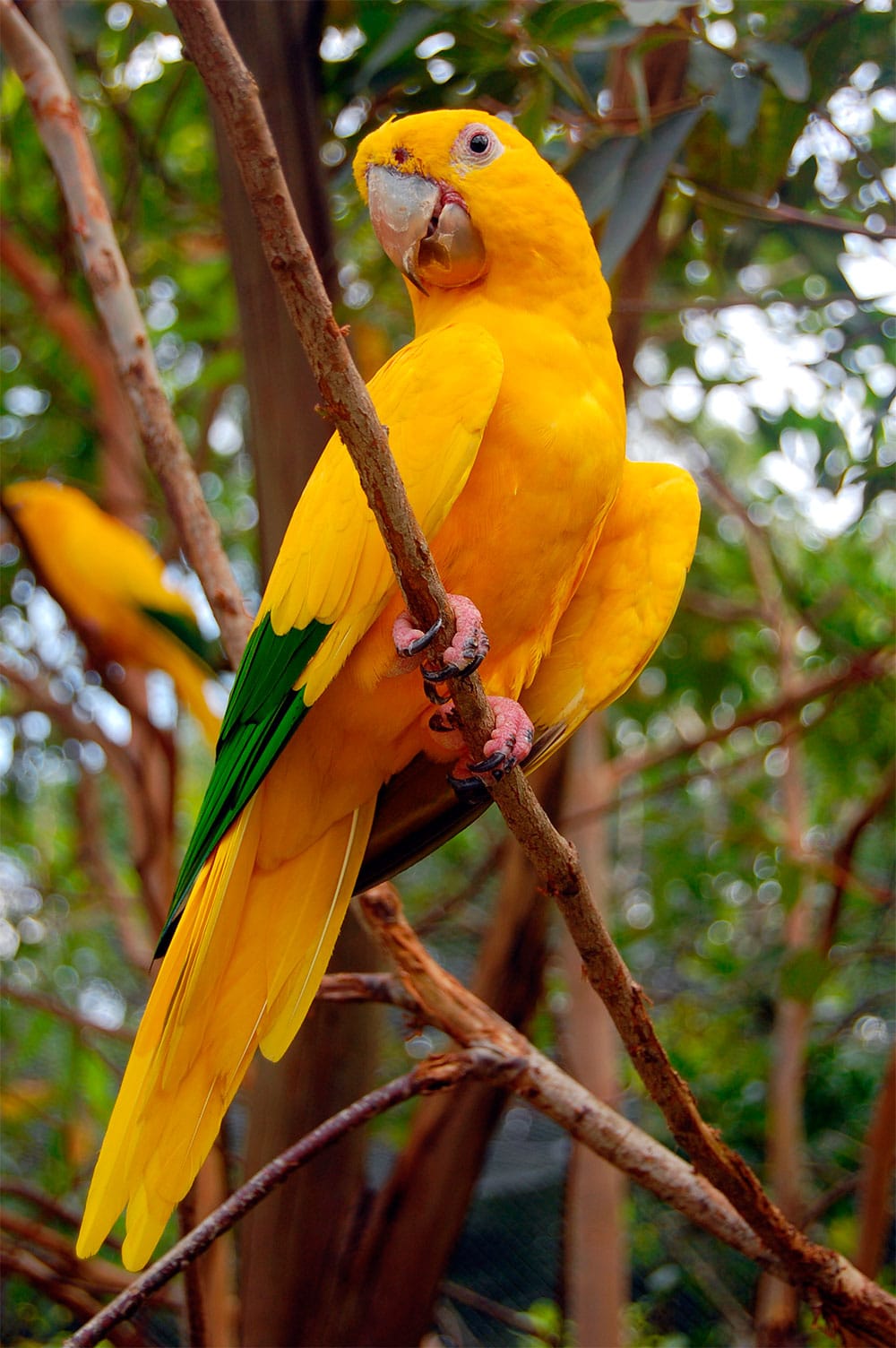
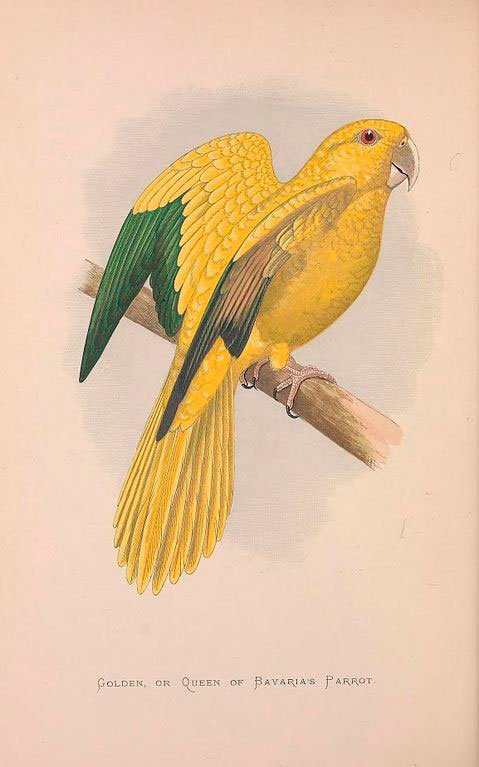
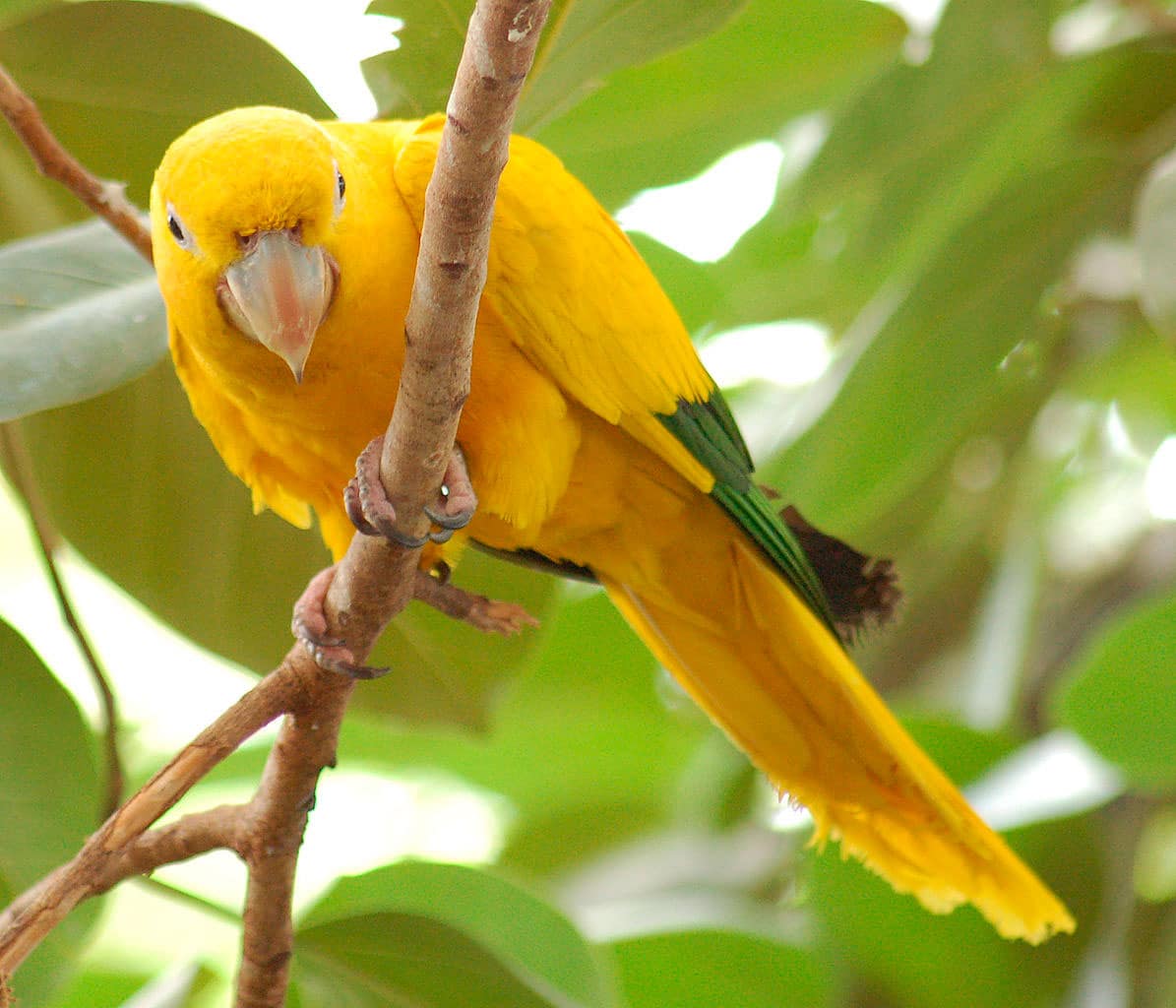
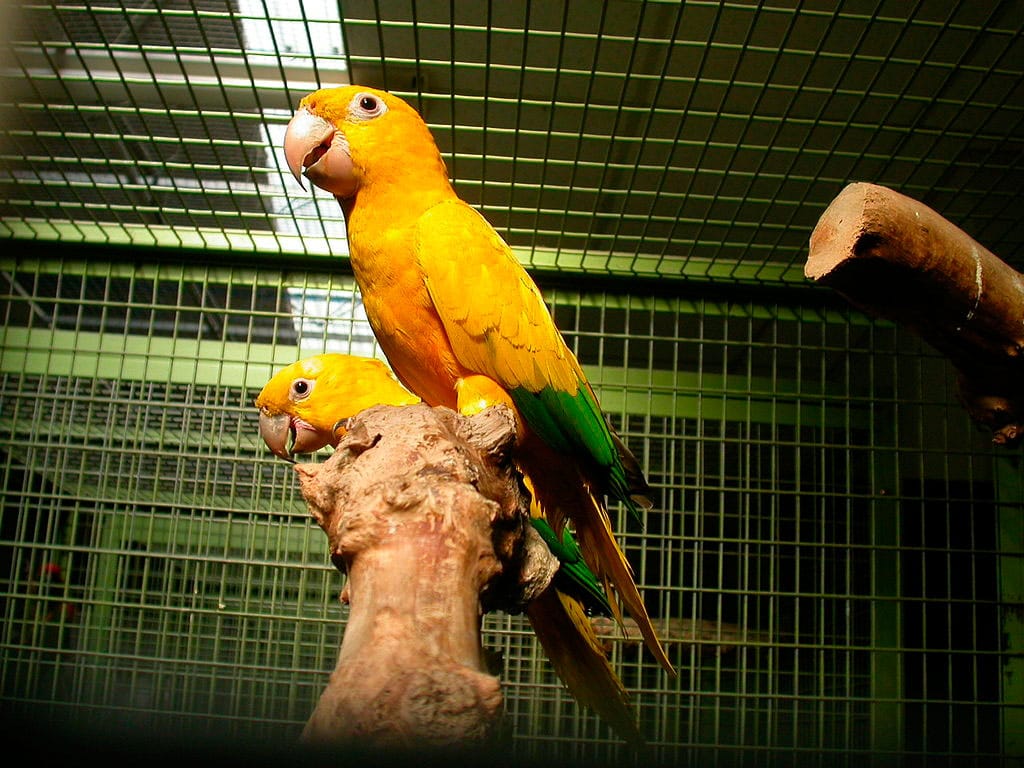
The Golden Parakeet(Guaruba guarouba) has all the head, upperparts, lower andtail , a bright yellow. The greater coverts, primaries and secondaries are dark green (one or two feathers yellow in some birds flying). Underwing-coverts yellow, the bottom of the flight feather dark yellow. Feather shafts of the tail are white.
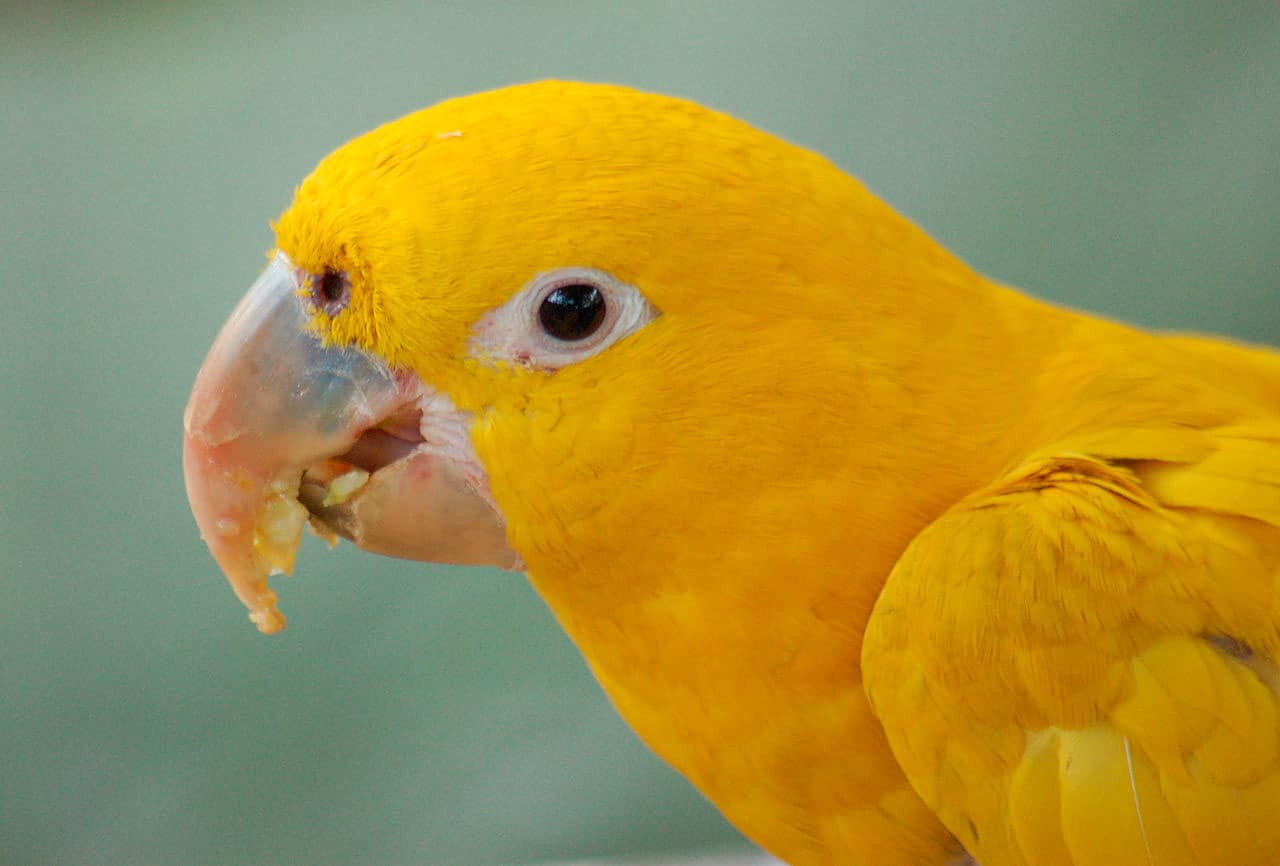
The bill pale pink, more Brown on the basis of the upper jaw; bare periophthalmic naked whitish; Iris Orange to brownish Orange; legs Rosaceae.
Both sexes similar.
Immature colour olive brown opaque dark green streak. In the transition to adulthood, the head, top of the tail and back They are the last to acquire the bright yellow color of the adult plumage.
inhabits the humid tropical forests, avoiding the forests and marshes (seasonally flooded), Although in the immediate breeding period, You can wander through these habitats from the adjacent dry forests.
When is the breeding season, the Golden Parakeet they occupy the forests next to the clear. Gregarious in all the seasons of the year. Observed in flocks of 3 to 30 birds, Although on a regular basis in groups between 6 and 10.
Forman communal roosts in tree cavities during the non-breeding season, using the holes in the area, alternately in successive nights. The usual and regular use of resting and feeding areas, is suspected to be due to the predictable daily routines. Sometimes seen feeding with other species of parrots.
Reproduction:
Nest at the top of the trunk or main branch of a hollow tree, a height between 15 and 30 m. Nesting tree is usually isolated, but near virgin forests. The old nest of other species It can be used by the Golden Parakeet, expanding its cavity as necessary.
The sexual behavior This species is unusual, and this is one of the most interesting aspects of their biology. With reproduce communally, with several females contributing to the work of the clutch, Although there are also reports of individual couples. Young people at different stages of development sometimes share a same nest.
On the other hand, at breeding sites during the reproductive period, the Golden Parakeet they react defensively to the presence of flocks of the same species, other species of parrots, especially the Scarlet Macaw (Ara macao), and before the approach of birds of prey.
The normal clutch female is of 2 to 4 eggs (perhaps up to six); 14 reported in a single nest chicks in captive, where the six adults helped in the breeding work. The breeding season, usually, takes place from December to April, and it corresponds to the rainy season
endemic to the Amazonia, to the South of amazon in Brazil, from the west shore of the Tapajos River, to the East through the basins of the Xingu River and North of Tocantins to 5 ° N, For, and up to the eastern shore of the Turiacu River in West Maranhão.
Are not observed in the Marajó island and prevents the forests and marshes (for example, immediately to the South of the Amazonia).
Recent records in Rondà´nia and Mato Grosso, far from their known range, They suggest a little-known distribution. Apparently, they are distributed in large areas, but it is not known whether the movements are predictable or related with, for example, the seasonal availability of food.
Rare range-wide and no doubt in decline due to the very wide, fast and continuous deforestation and fragmentation of forests, both in the Amazonia occidental as in the Eastern.
The capture illegal for national and international live bird markets and the hunting for food and sport they pose a serious additional pressures. Protected areas in the range are insufficient and are being violated regularly, for example, with the illegal logging of Mahogany Swietenia macrophylla.
Listed in Appendix 1. In danger of extinction.
Conservation:
• Red List category of the UICN current: Vulnerable
• Population trend: Decreasing
The threat most obvious for the survival of the Golden Parakeet is deforestation? The construction of the tucuruí dam, which was completed in 1984, displaced 35.000 settlers from their House to adjoining territories and brought rapid deforestation. Prior to the dam construcicón, Wildlife in the lower basin of Tocantins It was considered among the richest and most diverse in the world. It is estimated that you a 117 species of mammals and 294 species of birds were displaced. So what 120 species of amphibians and reptiles were affected.
The population of the Golden Parakeet was initially in a range between 1,000-2,499 individuals, based on an assessment of the known records, descriptions of the abundance and range size. But, recent information suggests that the population may be greater. The species has been recorded in several additional places. (Laranjeiras and Cohn-Haft 2009), and a recent survey along of the Tapajos River by Laranjeiras (2011) indicated that it was as common in the study area as other Psittacidae, not threatened.
On the basis of this information, the population is placed on the band's 10,000-19,999 individuals, that means include c.6,600-13,400 mature individuals.
– CITES Appendix I and II, managed under the Association of Zoos and Aquariums Parrot Taxon Advisory Group and protected by the Brazilian legislation (being proposal as the national bird of Brazil).
– A campaign attacking trade of birds in Bolivia It can help to reduce international trade (AB Hennessey in litt., 2009).
– A population is relatively well protected in the Tapajos National Park, and a remnant population can survive in the Gurupi biological reserve.
– Floresta Nacional do Jamari It is poorly protected and suffer the constant pressure of illegal occupants, loggers and poachers (F. Olmos in litt., 1999).
– The conservation of this species in the reserves is problematic because of its apparent nomadism.
Conservation Actions Proposed:
– Conduct studies to find the populations so far unknown, especially in the South and West of its range.
– Maintain the integrity of the Tapajos National Park.
– Protect and manage the land between the existing protected areas to facilitate the movements of nomadic.
– To enforce the legal restrictions on trade, especially in domestic markets.
– Further develop the program captive breeding.
"Golden Parakeet" in captivity:
Date back to the first reproductive outcomes of this kind of 1939 in Sri Lanka.
The Golden Parakeet It is probably the most coveted among all the parrots, being the prices demanded by her extremely high. It is very rare and endangered in its natural habitat, and are therefore protected from import.
Birds reserved for breeding are happier in the presence of members of their species. This is due to the nature of the Golden Parakeet, sociable and cheerful, with an intense need for interaction with their peers.
With regard to its longevity, according to sources, a specimen lived 23,2 years in captivity. It has been reported that these animals can live up to the 60,9 years in captivity, but this has not been verified; the same study reported that these animals can reproduced from the 3 years age in captivity.
(1) – Avibase
(2) – Parrots of the World – Forshaw Joseph M
(3) – Parrots A Guide to the Parrots of the World – Tony Juniper & Mike Parr
(4) – Birdlife
(5) – WAZA
Photos:
(1) – Golden Parakeet (also known or Golden Conure) at Gramado Zoo, in south Brazil By Ironman br (Own work) [CC BY-SA 3.0], via Wikimedia Commons
(2) – Golden Parakeet or the Queen of Bavaria Conure in Burgers Zoo, Arnhem By frank wouters (originally posted to Flickr as goudparkiet) [CC BY 2.0], via Wikimedia Commons
(3) – Two Golden Parakeets at Gramado Zoo, Rio Grande do Sul, Brazil By diegodobelo (Zoo de GramadoUploaded by Snowmanradio) [CC BY-SA 2.0], via Wikimedia Commons
(4) – Golden Parakeet or the Queen of Bavaria Conure). Two captive By TJ Lin (originally posted to Flickr as Golden Conure) [CC BY-SA 2.0], via Wikimedia Commons
(5) – Photo taken at the National Aviary By Photo by and (C)2007 Derek Ramsey (Ram-Man) (Self-photographed) [GFDL 1.2 or CC BY-SA 2.5], via Wikimedia Commons
(6) – Photo taken at the National Aviary By Photo by and (C)2007 Derek Ramsey (Ram-Man) (Self-photographed) [GFDL 1.2 or CC BY-SA 2.5], via Wikimedia Commons
(7) – Golden Conure at the Parque das Aves, Foz do Iguaçu, Brazil By Bruno Girin from London, United Kingdom (06680018Uploaded by Snowmanradio) [CC BY-SA 2.0], via Wikimedia Commons
(8) – Photo taken at the National Aviary By Photo by and (C)2007 Derek Ramsey (Ram-Man) (Self-photographed) [GFDL 1.2 or CC BY-SA 2.5], via Wikimedia Commons
(9) – Golden Conure by Jean – Flickr
(10) – Illustration Guaruba guarouba By Dutton, F. G.; Fawcett, Benjamin; Greene, W. T.; Lydon, A. F.; Lydon, A. F. [CC BY 2.0 or Public domain], via Wikimedia Commons
Origin: Venezuela, Colombia, Trinidad and Tobago, Ecuador, Peru
Character: shy.
Life expectancy: 30 years.
Height: 34 to 36 cm..
Content
Description:
34 to 36 cm.. of length and a weight of 162 to 217 g..
The Scarlet-fronted Parakeet(Psittacara wagleri) He has the crown and forecrown bright red; lores and cheeks dark green with red feathers scattered in some birds. Of the nape even up to the uppertail-coverts dark green. Upperwing-coverts dark green; flight feather green, dyed Emerald above and olivaceous at the bottom. The greater underwing-coverts, also of color olivaceous, the remaining underwing-coverts, green. The underparts brighter yellowish green, sometimes with scattered red feathers on the throat and in the the thighs. Upper, the tail dark green; by down olive green.
The bill color pale horn; bare periophthalmic grey; irises yellow; legs distant.
Both sexes similar.
The immature with a reduction (or even absence) Red Feather in the head.
(Cabanis, 1846) – Red of the head vaster than the species nominal, extending to the rear of the eyes. Red in the the thighs and bend of wing in most birds. Larger than the species nominal (40 cm.).
Psittacara wagleri minor
(Carriker, 1933) – Similar to the subspecies Frontata but smaller (38 cm.) and more green with pale red in the wings. Some specimens with yellow on the bend of wing.
Psittacara wagleri transilis
(Peters,JL, 1927) – darker than kind nominal, with less extensive red on the rear of the crown. Smaller that the species nominal (34 cm.).
They inhabit in humid forests, deciduous, from gallery, cloudy and second-growth forests with acacias, Prosopis and Ochroma, mainly in the lower subtropical and upper tropical zones, Although they can also penetrate in sub-templadas areas.
In Peru, observed in cloud forests semi-arid.
Reported at lower elevations in humid plantations, cornfields and cactus thickets. Key requirement in their habitat are the cliffs, in which it breeds and rests.
In general, observed the altitudes of 2.000 m, above the 3.000 metres in Peru. Gregaria, usually in close flocks to the 20 individuals, sometimes up to 300 birds.
Communal hangers on the cliffs with diurnal movements towards the areas of power.
Reproduction:
Nest communally in Rocky steep, between December and June in the North of Colombia and between April and June in Venezuela. Average of the laying of 3 to 4 eggs and the incubation is of 23 or 24 days. The pups they leave the nest after 50 days, with a plumage green.
Food:
Its diet includes a variety of fruits, nuts and seeds; You can include cereal crops and fruit plantations. Usually they feed in the canopy.
Distribution:
Size of the area of distribution (reproduction / resident): 866.000 km2
The Scarlet-fronted Parakeet It is distributed discontinuously in the northwest and west of South America, in the area of the Andes, from Venezuela until Peru.
In Venezuela stretching from West of the Paria Peninsula in the foothills of the Andes (between 500 and 2,000m, more altitude farther south), up to the Serrania del Perija and in the North of Colombia, including the Department of Magdalena and the West and center of the mountain range of the Andes Although apparently absent in the southwestern tip of Colombia.
Their status in the eastern slope of the Andes in Colombia is uncertain. Found around the skirts of the Andes in the South of Ecuador and South of Peru until Tacna at latitudes of I8° S.
Apparently, observed in the Western Andean slopes in the Peru with some reports from the South of the Valley of the Maranon River until Ayacucho and apurimac, in the central andes.
Usually residents Although seasonal visitors in some areas. Irregularly-common, often abundant, Although scarce or non-existent in many areas; more scarce in the South. Decrease in its population in some areas (for example, Colombia), due to loss of habitat.
Trapped for the trade in live birds, with 16.644 specimens exported from Peru in 1982.
The large number of birds escaped from her cage makes it considered them are introduced in Spain, Florida, Hawaii and California.
Subspecies Psittacara distribution wagleri
Subspecies
Psittacara wagleri frontatus
(Cabanis, 1846) – West of Ecuador and South of Peru, approximately 18° S
(Peters,JL, 1927) – The northeastern coastal mountains of Venezuela up to the Paria Peninsula, Sucre. Possibly records in Bethlehem, Caquetá, on the eastern slope of the East of the Of the Andes in Colombia. Unclear relationship with the species nominal.
• Red List category of the UICN current: Near-threatened
• Population trend: Decreasing
The population trend of the Scarlet-fronted Parakeet apparently it has not quantified, but you suspect that your decline It moderately fast due to the persecution and change of land use (pit et to the., 1997).
The species has been the subject of a intense trade and individuals captured in nature have been recorded in international trade (UNEP-WCMC trade database CITES).
One high internal trade This species has been observed in Venezuela (pit et to the., 1997).
Pursued, due to its status as a crop pest, It can also be contributing to their decline.
Current levels of hunting pressure and persecution are not known, but it is assumed that it is producing a negative trend in their population.
Although this species shows a flexible use of the habitat and makes use of the crops, It is suspected that the the land use change It is contributing to a population decline of the species, and habitat clearance is presumed that it has led to the decline of this species in Colombia (pit et to the. 1997).
Conservation Actions Underway:
• The species is listed in Appendix II.
Conservation Actions Proposed:
• Carry out surveys to assess the population size of the species and the trend.
• Quantify the current impact of entrapment.
• Monitor trade levels.
• Carry out awareness activities to reduce the activities of capture and trade of Psittacidas..
• Increase the area of suitable natural habitat that receives effective protection..
"Scarlet-fronted Parakeet" in captivity:
The poultry farming of the Scarlet-fronted Parakeet rarely achieved as this species is difficult to obtain and difficult to maintain. This Parrot will only spawn several years kept in captivity.
It is a bird animated, although, initially shy, that is because you provide a environment of Cologne, even in the breeding season. It´s resistant Once you have moved. Pretty noisy, something that must be taken into account if the neighbors are close.
Chomping hard, in need of a steady supply of fresh branches to meet the great need to chew. Enjoy the daily bath.
Alternative names:
– Scarlet-fronted Parakeet, Red-fronted Conure, Red-fronted Parakeet, Scarlet fronted Parakeet, Scarlet-fronted Conure (English).
– Conure de Wagler, Conure à front rouge, Perruche de Wagler (French).
– Columbiasittich (German).
– Periquito-de-cara-vermelha (Portuguese).
– Aratinga de Wagler, Perico Frentirrojo, Periquito de Frente Roja (español).
– Loro frentirrojo, Perico Frentirrojo, Perico Chocolero (Colombia).
– Cotorra de Frente Escarlata (Peru).
– Chacaraco (Venezuela).
– Perico frentiescarlata (Ecuador).
– Avibase
– Parrots of the World – Forshaw Joseph M
– Parrots A Guide to the Parrots of the World – Tony Juniper & Mike Parr
– Birdlife
– Photos:
(1) – Scarlet-fronted Parakeet (Aratinga wagleri) at Jurong BirdPark, Singapore By Michael Gwyther-Jones (originally posted to Flickr as Singapore 2006 249) [CC BY 2.0], via Wikimedia Commons
(6) – Illustration By Gray, George Robert; Hullmandel & Walton; Hullmandel, Charles Joseph; Mitchell, D. W. [CC BY 2.0 or Public domain], via Wikimedia Commons
The Tepui Parrotlet(Nannopsittaca panychlora) measured between 14 and 15,7 cm.. height. Small size, with wings sharp and tail cut and wedge.
The head It is green with yellow tinge oliváceo; the eye area is yellow, color extending below and behind the eyes. The upperparts they are green (brighter and less than oliváceo head). Upperwing-coverts green. Flight feathers blackish green tipped primary, brownish opaque below; INFRACA-wing coverts green. The underparts yellowish green turn yellow-green in the undertail-coverts. Upper, the tail is green; undertail, yellower. Bill grey; cere grey; Bello to singr dark gray; irises brown; legs Rosaceae.
Both sexes are similar; the female has the forecrown Off-white to yellowish.
They inhabit moist montane forests. in tropical and subtropical highlands, sometimes in the rainforest of the lowlands around tepuyes, generally 750-1,850 m (Gran Sabana), although they observed at the top of Auyantepui to 2,200 meters and near the summit Monte Roraima A 2,200 m; to 750-950 metres in Sucre.
Can reproduce in subtropical and tropical zone descend to feed. Recent records in the view of birds in the lowlands suggest at least seasonal aparienciones at lower altitudes. Fly very high, fast and straight, in compact flocks of 6 to 150 individuals. It´s resident but it shows seasonal migrations.
Reproduction:
Sleeps and nests in Tepuis. Not much more information about the reproduction of this species in the wild.
Food:
In their natural habitats, the Tepui Parrotlet normally eat fruits, seeds and small insects.
Distribution:
Size of the area of distribution (reproduction / resident): 486.000 km2
Mainly montana, It is distributed in several scattered populations in eastern Venezuela and the adjacent area of ​​western Guyana; concentrated in Gran Sabana from the east of Bolívar in Venezuela (for example, Montes Roraima and Auyantepui); It is also present around the meseta del Duida and the lowlands of Ventauri River, amazon, and in the West of Guyana from the area Camaran River; a more distant population occupies the Paria Peninsula (for example, the Monte Papelón), Sucre, to the northeast of Venezuela. Probably you can be observed at the north end of Roraima, Brazil.
Apparently locally common and stable, but perhaps it diminished in Paria peninsula due to large-scale deforestation. Much of the range is included in Canaima National Park.
Conservation:
State of conservation ⓘ
Minor Concern ⓘ(UICN)ⓘ
• Current category of the Red List of the UICN: Least concern.
• Population trend: Stable.
Justification of the population
The size of the world population It has not been quantified, but this species is described as «quite common, but unevenly distributed» (Stotz et to the., 1996).
Justification of trend
It is suspected that this species has lost 6,9-11,6% of habitat within its distribution over three generations (15 years) starting from a model of deforestation Amazon (Soares-Filho et to the., 2006, Bird et to the., 2011). Given the susceptibility of the species to hunting and / or capture, It is suspected that its population decline by <25% during three generations.
"Tepui Parrotlet" in captivity:
Breeding in captivity outside of South America. It is intelligent, quiet and very sociable.
Can normally live about 20 years.
 Vulnerable ⓘ (UICN)ⓘ