โ–ท The world of Pets: Dogs, cats, birds, reptiles, amphibians

Blue-throated Parakeet
Pyrrhura cruentata

Blue-throated Parakeet

Content

Description:

Blue-throated Parakeet
30 cm.. length and 90 g. of weight.

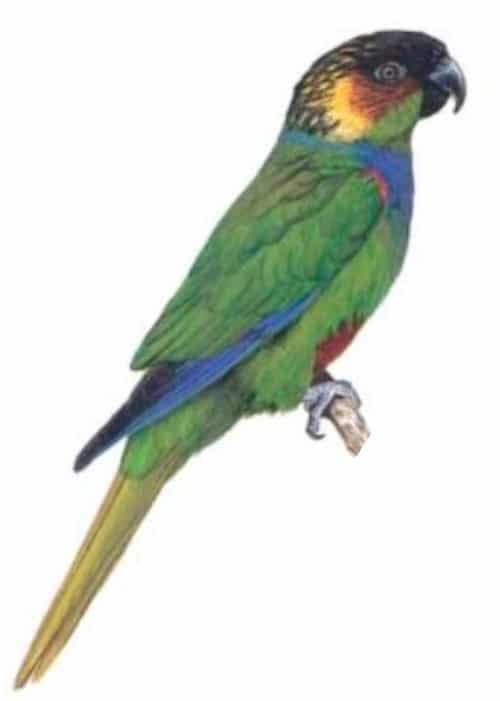
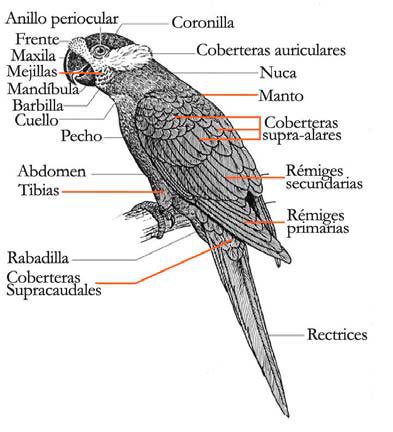
The Blue-throated Parakeet (Pyrrhura cruentata) It is a very colorful bird; has the forecrown, crown and rear of the neck, dark brown with pale orange sides and with some feathers (especially posteriorly) giving speckled appearance; lores, cheeks top, supercilii area and ear-coverts, dull red, merging on sides of neck with yellowish patch bordered behind by blue band running across nape; bottom of the cheeks, green.

Mantle, back and scapulars, green; broad crimson patch on lower back and rump; uppertail-coverts green. Bend of wing bright red; upperwing-coverts green. Outerwebs of the primaries, blue, green on the innerwebs; secondaries green on outerweb, Gray on innerwebs; flight feather with dark tips; infra-wing coverts minor, olive green, the gray greater coverts; underside of flight feather, olive gray wash. Chin green; the throat and the top chest, blue with some dark tips; underparts green with a patch of variable size of crimson color on the belly. Upper, the tail It is golden in color with green tint; brown below. Bill grey; bare periophthalmic grey; irises yellow orange; legs grey.

Both sexes similar, but the irises perhaps brighter in the male. Immature more off, with less red at bend of wing.

  • Sound of the Blue-throated Parakeet.

Habitat:

The Blue-throated Parakeet inhabit, mainly, in primary forests of the Atlantic forest or on the edges of forests and, sometimes, in slightly modified natural forests, penetrate into agricultural areas where tall forest trees shade cocoa crops. Unknown seasonal and dry forests. (Usually in lowlands below 400 m, but 960 metres in Minas Gerais, Brazil, usually in flocks of 6-20 birds(mainly 8-12), at least where they are locally common.

Reproduction:

Nests in tree hollows. The breeding, apparently, It occurs in the austral spring, from June to October. Clutch 2-4.

Food:

The diet of the Blue-throated Parakeet includes plants of Talisia esculenta, Alchornea iricurana, Mabea fistulifera, Trema micrantha and Cecropia. The fruits of Miconia hypoleuca can be important in times of scarcity. Birds feeding in the canopy and the lower edge vegetation, never out of the woods; Once he observed feeding on the Golden-capped Parakeet (Aratinga auricapillus).

Distribution and status:

Size of its range (breeding/resident): 281.000 km2

endemic to eastern Brazil, from Bahia until Rio de Janeiro. They were formerly known from Jequiรฉ and islanders, Bay, but the latest reports are North Jequitinhonha River, south of which, reports come from remaining patches of forest (including the Monte Pascoal National Park) to the border Holy Spirit.

The birds continue in the few wooded areas of eastern Minas Gerais, Brazil as the Rio Doce State Park, the Book Caratinga (about Raรบl Soares) and about Mantena and several locations in northern Espirito Santo, including Biological reserves Great stream and Sooretama and neighboring Linhares Sooretama reserve. It is apparently absent from the southern state but survives near Desengano State Park in the State of Rio de Janeiro, the southernmost site which have been observed recently.

Resident. Common and widespread at the end of the 19th century, but decreased dramatically with massive deforestation within its range due to agriculture, speak, mining, roads and urban development. The final bastion (the only place where birds remain common) It is complex reserve Sooretama / Linhares; much smaller numbers exist in other forest remnants (protected but widely separated). Habitat loss continues in Bay with some sites (for example Monte Pascoal) under intense pressure.

Rare in captivity, but trapping for illegal trade is an additional threat. Listed in Appendix I of the CITES and protected by Brazilian law.

Conservation:

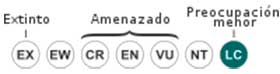
State of conservation โ“˜


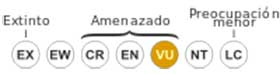
Vulnerable Vulnerable โ“˜ (UICN)โ“˜

โ€ข Current category of the Red List of the UICN: Vulnerable.

โ€ข Population trend: Decreasing.

โ€ข Population size : 2500-9999 individuals.

Rationale for the Red List category

This species survives in scattered fragments of Atlantic Forest, where the extent of suitable habitat continues to decline rapidly. The remaining populations are small, severely fragmented into isolated reserves, where protection is largely inadequate and are suspected to be declining rapidly. So, qualifies as Vulnerable.

Justification of the population

The population is calculated in the number 2.500-9.999 mature individuals based on an evaluation of known records, descriptions of abundance and size range. This is consistent with estimates of population density recorded for congeners or close relatives with similar body size, and the fact that only a proportion of its distribution area is occupied. This estimate is equivalent to 3.750-14.999 individuals, rounded here to 3.500-15.000 individuals.

Justification of trend

continued rapid population decline is suspected because rates loss of habitat.

Threats

The extensive and continuous clearing of the forest You are responsible for its current fragmented distribution. Their apparent tolerance to shade cocoa plantations provides little hope because shading techniques since the early 1980 They have involved the use of banana trees and Erythrina, rather than stand, and unstable prices have led to conversion to pasture. Many remaining populations are affected by site-specific threats, as conflicts between habitat conservation and the rights of local communities in the Monte Pascoal National Park. The capture for the cage bird trade It is a relatively new phenomenon, Although the species is rare in domestic and international markets.

Conservation Actions Underway

CITES Appendix I. It is considered nationally Vulnerable in Brazil (Silveira y Straube 2008, MMA 2014), and is protected by Brazilian law. It is in the National Parks of Chapada da Diamantina and Monte Pascoal, on Experimental Station Barrolรขndia, on Linhares Forest Reserve, on Book Caratinga, in sweet River and probably in the Desengano State Parks, and in the Biological Reserves Great Stream, Deer Stream and Sooretama (Wege and Long 1995).

Conservation Actions Proposed

Survey to locate additional populations and protect undetected (Snyder et to the., 2000), especially in southern Bay and northeast of Minas Gerais, Brazil. Ensure protection de facto key reserves, especially Sooretama, Linhares and Vera Cruz Station. Confiscation of birds of trade and well-planned release of these birds in areas of the previous range of species to improve recovery and connectivity of disjunct populations (J. Gilardi in little).

"Blue-throated Parakeet" in captivity:

Protected by CITES Appendix I.

Rara in national and international markets. Each captive specimen of this species which is capable of reproducing, must be placed in a well-managed captive breeding program and not sold as a pet, in order to ensure its long-term survival.

Alternative names:

– Black-tailed Parakeet, Blue throated Conure, Blue throated Parakeet, Blue-chested Parakeet, Blue-throated Conure, Blue-throated Parakeet, Ochre Marked Conure, Ochre-marked Parakeet, Red-eared Parakeet, Red-rumped Parakeet (English).
– Conure tiriba, Perriche tiriba, Perruche tiriba (French).
– Blaulatzsittich, Blaulatz-Sittich (German).
– cara-suja, fura-mato, tiriba, tiriba-fura-mato, Tiriba-grande, tiriva (Portuguese).
– Cotorra Tiriba, Perico Grande (espaรฑol).


scientific classification:

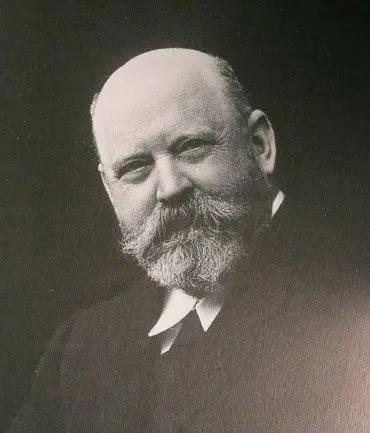
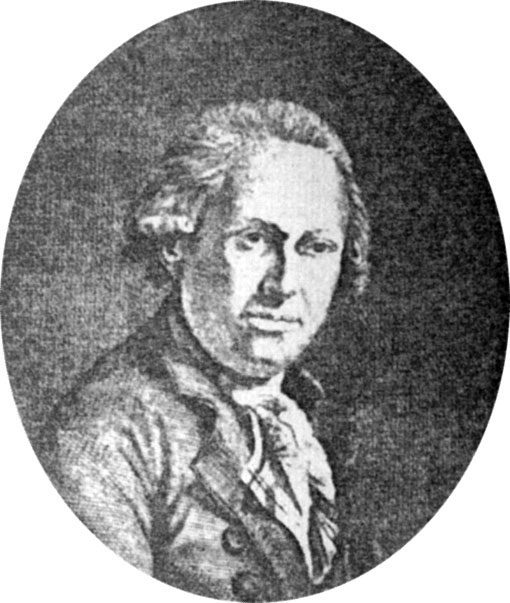
Prince Maximilian of Wied-Neuwied

– Order: Psittaciformes
– Family: Psittacidae
– Genus: Pyrrhura
– Scientific name: Pyrrhura cruentata
– Citation: (Wied-Neuwied, 1820)
– Protonimo: bloody parrot


Images Blue-throated Parakeet:


Especies del gรฉnero Pyrrhura

Blue-throated Parakeet (Pyrrhura cruentata)


Sources:

– Avibase
– Parrots of the World โ€“ Forshaw Joseph M
– Parrots A Guide to the Parrots of the World – Tony Juniper & Mike Parr
– Birdlife

– Photos:

(1) – Ochre-marked Parakeet (also known as Blue-chested Parakeet, Blue-throated Parakeet, or Blue-throated Conure) at Palmitos Park, Gran Canaria, one of the Canary islands, Spain By ipfreaks (originally posted to Flickr as Papagei) [CC BY-SA 2.0], via Wikimedia Commons
(2) – Blue-chested Parakeet, (Pyrrhura cruentata) also known as Blue-throated Parakeet or Blue-throated Conure. Pet parrot By โžจ Redvers (originally posted to Flickr as Hector and toy 8) [CC BY 2.0], via Wikimedia Commons
(3) – Blue-chested Parakeet (Pyrrhura cruentata) also known as Blue-throated Parakeet or Blue-throated Conure at Central Park Zoo, New York, USA By Claire Houck [CC BY-SA 2.0], via Wikimedia Commons
(4) – Blue-chested Parakeet (Pyrrhura cruentata) also known as Blue-throated Parakeet or Blue-throated Conure. Pet with yellow toy By โžจ Redvers (originally posted to Flickr as Hector and toy 4) [CC BY 2.0], via Wikimedia Commons
(5) – Blue-chested Parakeet (also known as Blue-throated Parakeet or Blue-throated Conure); two on a perch By TJ Lin [CC BY-SA 2.0], via Wikimedia Commons
(6) – Parrots A Guide to the Parrots of the World – Tony Juniper & Mike Parr

– Sounds: Jeremy Recall, XC85365. accessible www.xeno-canto.org/85365
โ–ท The world of Pets: Dogs, cats, birds, reptiles, amphibians

Sulphur-breasted parakeet
Aratinga maculata

Sulphur-breasted parakeet

Content

Description:


Anatomy-parrots

30 cm. length and 110 g. of weight.
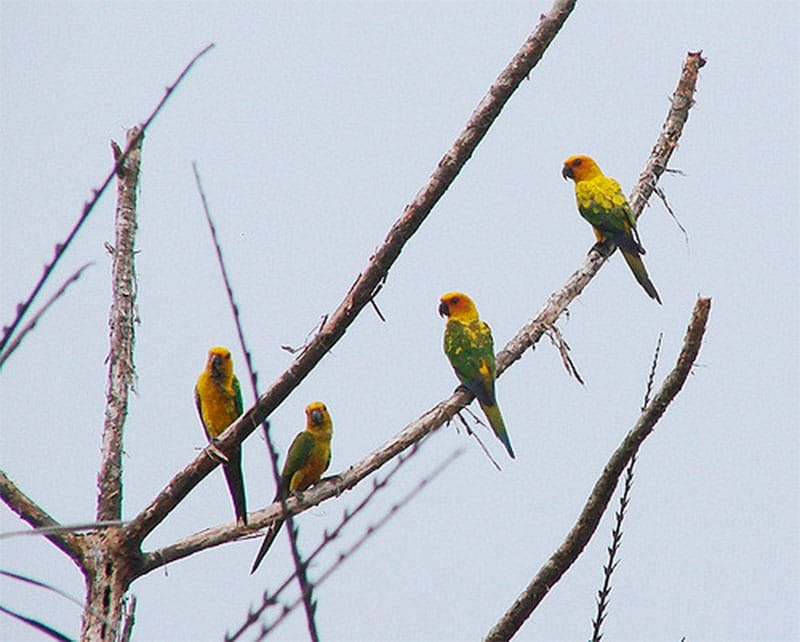
The Sulphur-breasted parakeet (Aratinga maculata) is pale orange, with the head and back of the neck pale yellow

. The throat and the chest are pale yellow, the the thighs are greenish; flanks pale orange, undertail-coverts greenish, the mantle pale greenish yellow; rump pale yellow orange, tail blue-green, wings green-yellow, underwing-coverts pale yellow. Close orange stripe on the front of the crown, in the lores and around eyes. Orbital ring pale grey. Iris dark gray / brown. Bill almost black.

The immature presumably as of adults, but with cheeks and top of the chest Yellow olive. (Observed one specimen).

  • Sound of the Sulphur-breasted parakeet.

taxonomy:

described in 2005 under the name of Aratinga pintoi, but later it was shown that the current name, It considered invalid for a long time, indeed it applies to this form, and therefore takes precedence; of holotype of Aratinga pintoi It has now been designated as neotype of Psittacus maculatus, which formally stabilizes synonymity. The species was misidentified as a juvenile of the Sun Parakeet (Aratinga solstitialis) or a hybrid between the latter and the Jandaya Parakeet (Aratinga jandaya); now generally recognized as a separate taxon, differing greatly reduced due to the orange-red in the face (where it forms an irregular mask), Breast and belly.
Habitat and behavior:

The species inhabits areas with large tracts of forest and Savannah adjacent (O’ Shea 2005, Mittermeier et to the. 2010). performs movements nomads.

It is similar in behavior and general ecology to the species of the group of the Aratinga solstitialis. Are in groups of 2-10 birds and they are relatively Meek, feeding along roads and orchards.

Reproduction:

Not much is known about their breeding habits. One nest observed with an egg of unknown size.

Breeding season: August October

Food:

Feeds of fruit and seeds of Guateria sp., Dalechampia sp., Byrsonima sp. and Myrcia sp.

Distribution:

Extending its range (breeding/resident): 159.000 km2

The Sulphur-breasted parakeet (Aratinga maculata) (formerly pintoi; see Nemรฉsio y Rasmussen 2009) It has a fragmented range in For and Amapรก in Brazil, and at the southern end of Suriname (p. e.g.. Silveira et al. 2005, Mittermeier et to the. 2010, Vieira da Costa et al. 2011). After a three-day survey conducted in 2003, Silveira et al. (2005) They claim that Sulphur-breasted parakeet was quite common in Monte Alegre, For. in addition, in Suriname the species has been characterized as uncommon to fairly common (O’ Shea 2005, Mittermeier et to the. 2010).

Conservation:

โ€ข Current category of the Red List of the UICN: Least concern.

โ€ข Population trend: Growing.

โ€ข Population size : unknown.

Rationale for the Red List category

The trend of the population It seems to be increase, and therefore the species does not approach the thresholds for Vulnerable under the criteria of population trend (> 30% decrease in ten years or three generations). The population size has not been quantified, but it is not believed to approach the thresholds for Vulnerable under the criterion of population size (<10.000 individuos maduros con un descenso continuo estimado en >10% in ten years or three generations, or with a specific population structure). For these reasons, the species is evaluated as Least concern

Threats

The distribution area this species is affected by the deforestation, mainly driven by the expansion of agriculture as they build new roads; However, deforestation Brazil You may be benefiting this species and facilitating their spread to new areas (Vieira da Costa et al. 2011). Long-term, deforestation may become so rapid and extensive that the balance of extensive forest tracts and savannas required by the species will be exceeded and the species may begin to decline. Silveira et al. (2005) They claim that Monte Alegre, For, no obvious signs of a strong pressure entrapment. in addition, Mittermeier et to the. (2010) state that no hunting or capture of the species by Amerindians in the savannah was reported Sipaliwini of Suriname meridional.

"Sulphur-breasted parakeet" in captivity:

virtually unknown; maintained by local people and zoos Brazil. It can live up 30 years in captivity.

Alternative names:

– Sulfur-breasted Parakeet, Sulphur-breasted Parakeet (English).
– Conure de Pinto, Conure ร  poitrine soufrรฉe (French).
– Schwefelbrustsittich (German).
– cacauรฉ (Portuguese).
– Aratinga Pechisulfรบrea (espaรฑol).

scientific classification:

– Order: Psittaciformes
– Family: Psittacidae
– Genus: Aratinga
– Scientific name: Aratinga maculata
– Citation: (Statius Mรผller, 1776)

Images Sulfur-breasted Aratinga:


Species of the genus Aratinga

Sources:

– Avibase
– Parrots of the World โ€“ Forshaw Joseph M
– Parrots A Guide to the Parrots of the World – Tony Juniper & Mike Parr
– Birdlife
– World Parrot Trust

– Photos:

(1) – Aratinga maculata by Sidnei Dantas – Flickr
(2) – alexanderlees, IBC1058449. Accessible at hbw.com/ibc/1058449

– Sounds: Thiago V. V. Costa, XC57522. accessible www.xeno-canto.org/57522

โ–ท The world of Pets: Dogs, cats, birds, reptiles, amphibians

Chatham Parakeet
Cyanoramphus forbesi

Chatham Parakeet

Content


Anatomy-parrots

Description:

23 cm. length and 95 g. of weight.

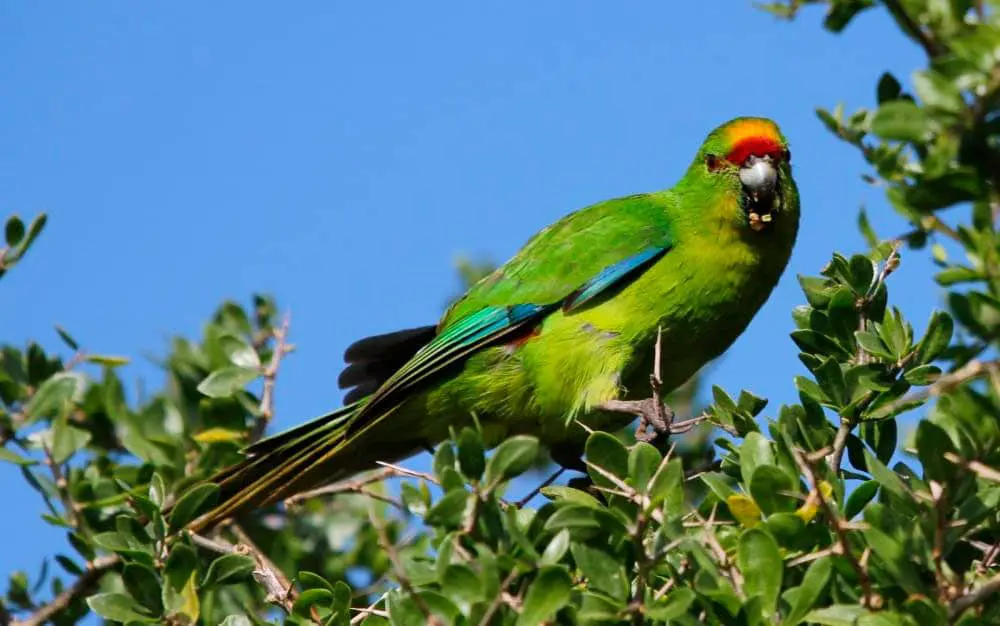
The Chatham Parakeet (Cyanoramphus forbesi) They are one of the two medium bright green parrots of Chatham Islands. Although they look very similar to those Yellow-crowned parakeet (Cyanoramphus auriceps) of New Zealand continental, the color of the crown is not a reliable indicator of taxonomic relationships.

It believes that the Chatham Parakeet descended from an ancient lineage of parrots who reached the Chatham Islands before the division Yellow-crowned parakeet and Red-crowned parakeet happened in New Zealand continental, after which the Red-crowned parakeet (Cyanoramphus novaezelandiae) also they colonized Chatham Islands.

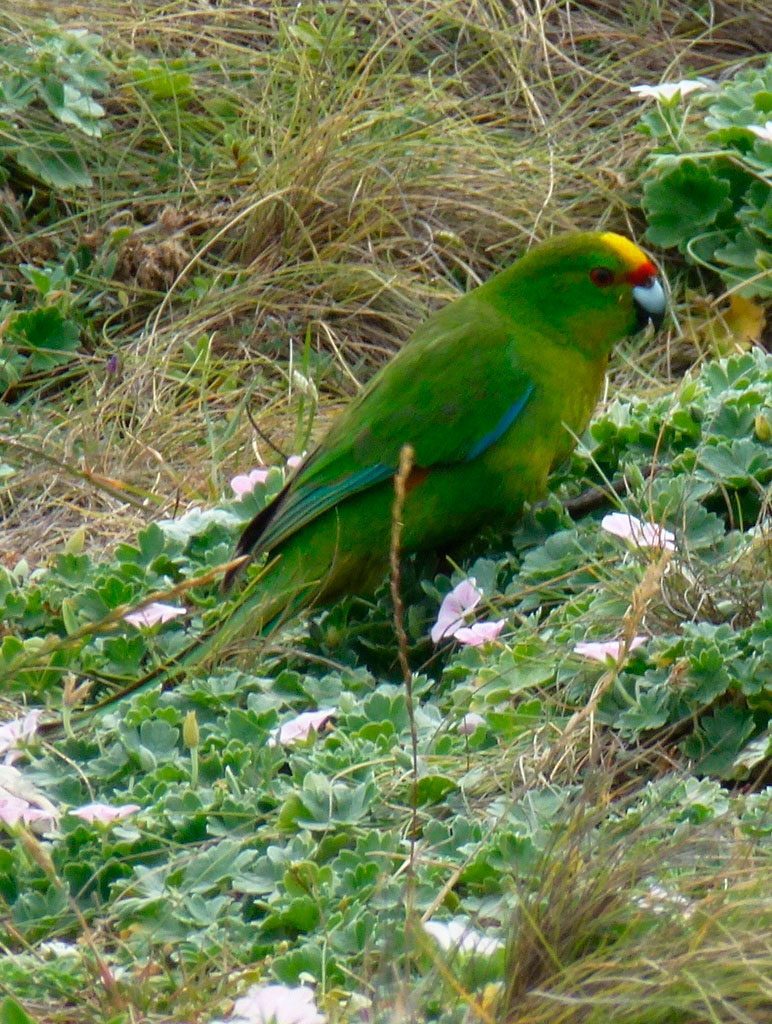
The Chatham Parakeet They are medium-sized parrots, of tail long, with wings wide and rounded and plumage predominantly emerald. have a crown bright yellow front and a crimson front band that does not reach to the eyes, unlike in the Red-crowned parakeet. Males are larger than the females.

taxonomy:

Since 1930 is commonly treated as a subspecies of the Yellow-crowned parakeet (Cyanoramphus auriceps), and clearly the two are closely related; the species differ, However, in size considerably, It is larger species Cyanoramphus forbesi. Currently considered Monotypic.

Habitat:

The Chatham Parakeet They are at higher densities in forests and dense vegetation regenerating areas than in open grassland. Despite its rather erratic flight, They fly hard and move easily between islas Mangere and little Mangere. Occasionally they have been observed Chatham Parakeet individual in the forests of southern Chatham Island (> 20 km from the Mangere Island) and nearby islands Pitt and owner. Their social behavior is similar to other species of parakeets Cyanoramphus. They are strongly territorial around nests, calling loudly and chasing intruders from nearby.

Reproduction:

The Chatham Parakeet have a long breeding season, with eggs laid between October and March. Son nesters cavity, preferring tree holes but also using rock crevices and under dense vegetation. The size medium of laying is of 5 eggs. Like all the other parakeets Cyanoramphus, females are responsible for preparing the nest, incubation, rearing and feeding the chicks until the 10-14 days old. During this period all your food is provided by your partner.. From then on, male and female parrots feed the chicks in the nest until they leave the nest.

The incubation usually begins after the start of the second egg, resulting in chicks within a clutch that vary greatly in age and size. The last chicks to hatch are usually born at a younger age and are less developed than their older brothers.. More than one brood may be attempted if the initial nest fails or if the food supply allows..

Food:

The foods consumed by Chatham Parakeet They are affected by seasonal availability, and include seeds, flowers and leaves of various plants, It is the most important invertebrates in spring. They feed extensively in soil in open areas.

Distribution and status:

Sw extension of its distribution area (reproduction / resident): 3 km2

The Chatham Parakeet It is restricted to of Tapuaenuku ISLA ISLA Pequeรฑa Mangere and Mangere in the Group of chatham islands, New Zealand. In 1930 He quenched in Mangere Island, but in 1973 had recolonized and numbered 40 birds and a small number of hybrids with the subspecies Cyanoramphus novaezelandiae chathamensis (of which there were 12 on the island) (Higgins 1999).

In 1996, two estimates indicated that the population of the Mangere Island It was from 50 to 120 Purebred birds. The population on the small island of little Mangere It is little known because the few visits made (H. Aikman a slightly. 1999). In 1999, it was estimated that the total population was about 120 birds (Aikman et al. 2001), but studies 2003 estimated 900 individuals on Isla Mangere (Aikman y Miskelly 2004, D. Houston y C. Miskelly a slightly. 2008).

A recent study estimated that more than 50% of the population of parakeets in Isla Mangere consisted of individuals hybrids (Chan et al. 2006), but this is expected to decrease due to mating positive range (T. Greene a slightly. 2012); the number of phenotypes forbes It is approaching the threshold management 10% (D. Houston a slightly. 2012) (that is to say, the number above which culling can be resumed as a management tool). There have been birds visiting South isla Chatham, the Pitt island and ISLA ISLA Chief of Sudeste (Taylor 1998, D. Houston y C. Miskelly a slightly. 2008, T. Greene a slightly. 2012).

Conservation:


Vulnerable


โ€ข Current category of the Red List of the UICN: Vulnerable.

โ€ข Population trend: Stable.

โ€ข Population size : 250-999 individuals.
Rationale for the Red List category

This species may still have a small purebred adult population.. Possible removal by hybridization has been avoided thanks to three decades of conservation efforts, which they have seen increasing population size. It is restricted to one place (given the proximity of the small islands that lives and mobility), and its small population size means it still deserves to be listed in a threatened category, but it is likely that their population size has been more than 250 mature for more than 5 years, so it has been transferred to the category of Vulnerable.

Justification of the population

The population of phenotypes similar to those of Forbes It has increased dramatically in the Mangere Island, with the best estimates placing the population between 800 and 1.000 individuals. A survey in 2011 It assessed that the phenotypes of interest are in the 10%, the trigger level for management action (D. Houston a slightly. 2012). It is likely that populations have exceeded 250 mature for more than 5 years, so now it is in the range of 250-999 mature individuals.

Justification trend

The population has shown minor fluctuations in recent years, since the species recolonized the Mangere Island over the years 70 and it has benefited from habitat restoration, while hybridization has also suffered. In general, It is estimated that the population has remained stable for the last ten years, and It is probably increasing (T. Greene a slightly. 2012).

Threats

โ€ข Disappeared from Mangere Island due to a combination of deforestation for grazing, decades of burning, the effects of introduced grazing mammals and predation by feral cats (Higgins 1999).

โ€ข The greatest current threat is the hybridization with the Cyanoramphus novaezelandiae chathamensis, subspecies Red-crowned parakeet (Cyanoramphus novaezelandiae) What, despite the sacrifice, still it is settling in Mangere Island (J. Kearvell a slightly. 1999).

โ€ข It is believed that the rate of hybridization High above is the result of the then low population sizes of the two species (D. Houston y C. Miskelly a slightly. 2008).

โ€ข The levels of hybridization They have remained below 10% of the total population of parakeets Mangere Island over the last decade, so no management intervention was not necessary.

Conservation Actions Underway

โ€ข Appendix I and II of CITES. The Mangere Island It has been substantially replanted (Aikman et al. 2001, D. Houston y C. Miskelly a slightly. 2008).

โ€ข An ecological and genetic research program has investigated population dynamics, the hybridization and selection of partners (H. Aikman a slightly. 1999, Chan et al. 2006).

โ€ข During 1976-1999, hybrid birds and individuals of the subspecies Cyanoramphus novaezelandiae chathamensis They were sacrificed population (Nixon 1994).

โ€ข In 1998, 40 hybrids And six Cyanoramphus novaezelandiae chathamensis were killed, leaving 10 copies between hybrids and Cyanoramphus novaezelandiae chathamensis after the operation (H. Aikman a slightly. 1999).

โ€ข Surveys of the relative proportion of hybrids regarding type phenotypes Forbes They are held every two years (D. Houston a slightly. 2012).

โ€ข The translocation a fenced area predator proof in Chatham Island It is planned for 2017 (D. Houston a slightly. 2012).

Conservation Actions Proposed

โ€ข Complete the investigation ecological, biological and genetic, including analysis and dissemination of results.

โ€ข Monitor trends in the extent and quality of forest habitats on the island of Mangere.

โ€ข Restore forest habitats Mangere Island to increase the number and reduce the hybridization.

โ€ข Work for the establishment of one or more populations in the Chatham Island (H. Aikman a slightly. 1999).

"Chatham Parakeet" in captivity:

There are no data from Chatham Parakeet in captivity.

In the wild, its lonjevidad is probably similar to that of Yellow-crowned parakeet (Cyanoramphus auriceps): 10 years.

Alternative names:

– Chatham Island Yellow-crowned Parakeet, Chatham Islands Parakeet, Chatham Parakeet, Forbes’s Parakeet (English).
– Kakariki de Forbes, Kakariki des รฎles Chatham, Perruche des Chatham, Perruche des รฎles Chatham (French).
– Chathamsittich (German).
– Periquito-de-peito-amarelo-da-Ilha-chatham (Portuguese).
– Perico de las Chatham (espaรฑol).

scientific classification:

Lionel Walter Rothschild

– Order: Psittaciformes
– Family: Psittaculidae
– Gender: Cyanoramphus
– Scientific name: Cyanoramphus forbesi
– Subpoena: Rothschild, 1893
– Protonimo: Cyanorhamphus [sic] forbes

"Perico de las Chatham" images:

Perico-de-las-Chatham

Sources:

โ€ข Avibase
โ€ข Parrots of the World โ€“ Forshaw Joseph M
โ€ข Parrots A Guide to the Parrots of the World – Tony Juniper & Mike Parr
โ€ข Birdlife
โ€ข Greene, T.C. 2013 [updated 2017]. Forbesโ€™ parakeet. In Miskelly, C.M. (ed.) New Zealand Birds Online. www.nzbirdsonline.org.nz

Photos:

(1) – Chatham Islands Parakeet on Mangere Island by Markanderson72 [CC BY-SA 4.0], from Wikimedia Commons
(2) – Andrew Sutherland, IBC1065693. Photo of Chatham Parakeet Cyanoramphus forbesi at Chatham Islands, New Zealand. Accessible at hbw.com/ibc/1065693.

โ–ท The world of Pets: Dogs, cats, birds, reptiles, amphibians

White-cheeked turaco
Turaco leucotis

Tauraco leucotis
Photo: fotosricardo-h

Content

Characteristics

This striking bird is native to Africa (area of Ethiopia) and reaches a size of 42 to 43 cm..

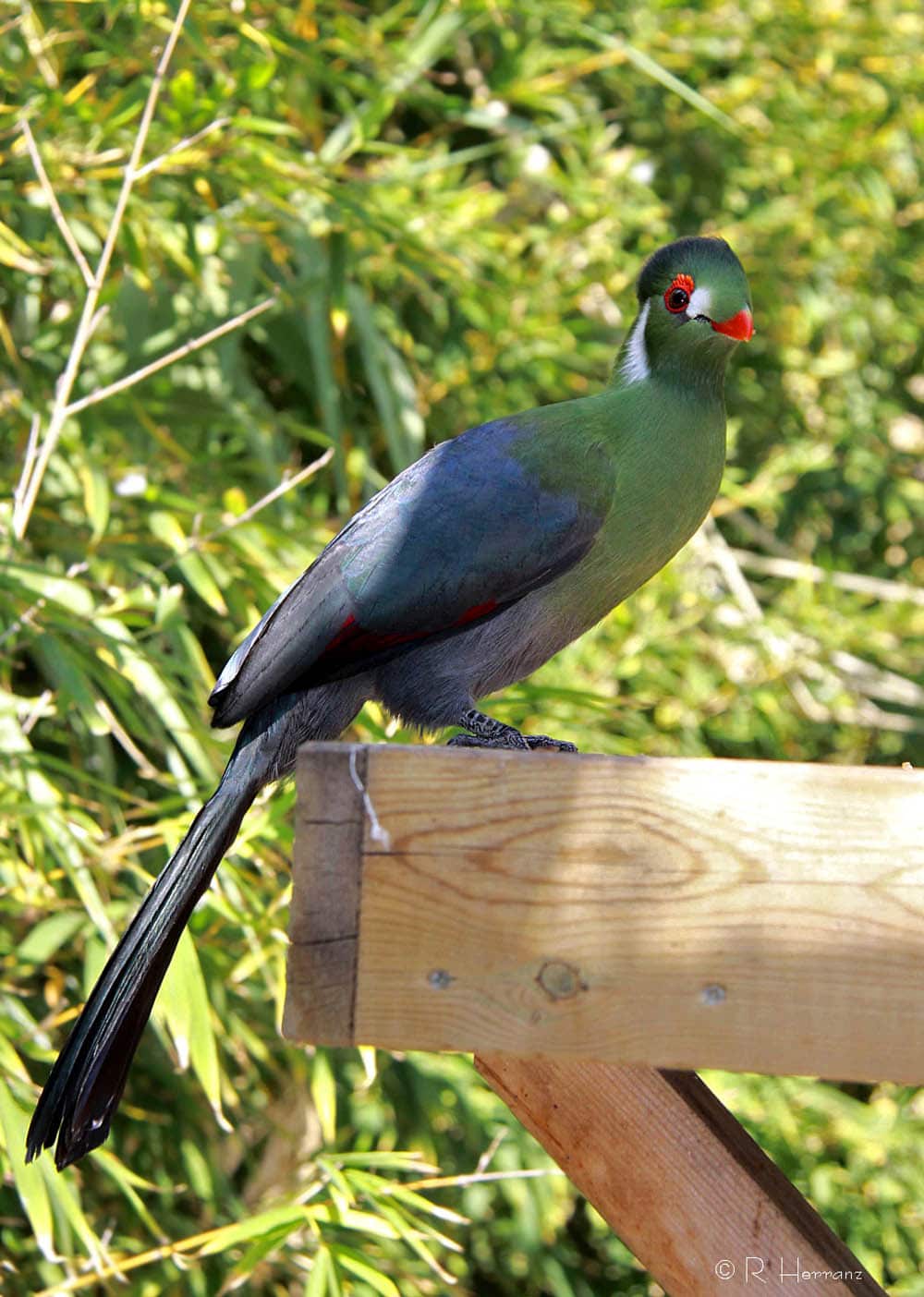
It has bright green feathers, with a dark crest on the head, may stands at will, the Underwing coverts are blue like the tail, While the primaries are intense red, and in general only be appreciated with the bird in flight. The beak is orange-red, like the ring around the eyes. In front of the eye they have "white cheeks" and two oblique white marks on the neck..

Has several other anatomical features of interest. First of all, they have strong feet and you can turn your fourth finger of the foot forward or backwards to get a better grip on its perch. In second place, the chickens of this species have claws on their wings, a strange and evocative anatomical feature for a bird that almost seems to be reminiscent of its ancient cousin, the Archaeopteryx. The chicks emerging from these claws at the time of leaving the nest.

Most of these birds have green plumage and is the result of a combination of structural coloration and pigments.. They are unique since only the Turacos, among all the birds, they produce a Green pigment, turacoverdin, It is the color of their feathers.

Character and skills

This beautiful and energetic African bird is a very popular bird in the United States and the United Kingdom., they can even be hand fed by what you become very mansas pets.

Another curiosity, and one of the things by which this bird strikes is by singing, which, It resembles the squeal of a wild monkey.

Images "White-cheeked turaco"

Videos "White-cheeked turaco"

โ–ท The world of Pets: Dogs, cats, birds, reptiles, amphibians

Spectacled Parrotlet
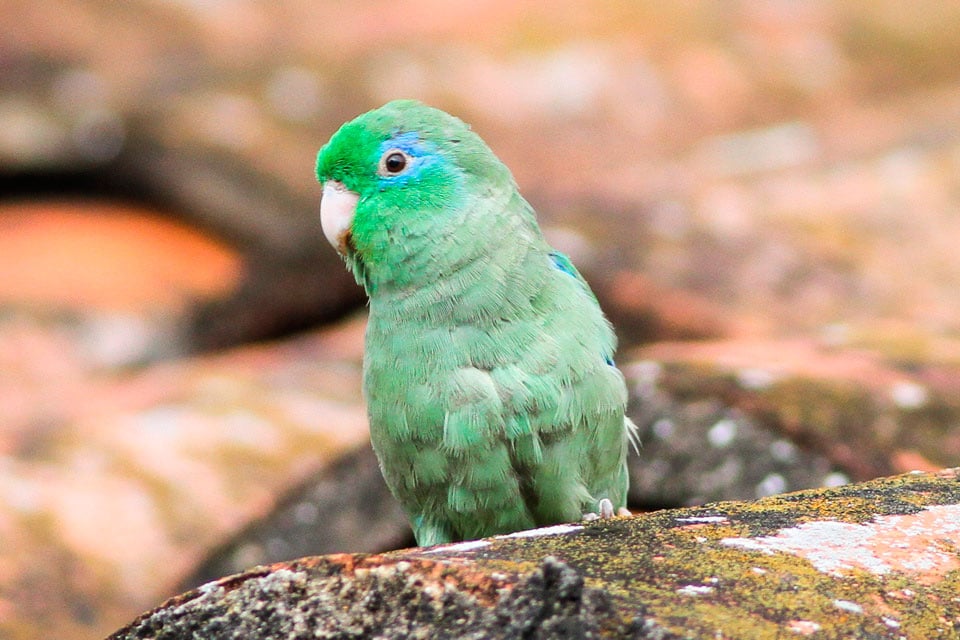
Forpus conspicillatus

Spectacled Parrotlet

Content

Description:

Spectacled Parrotlet

12,7 to 13,9 cm.. height.

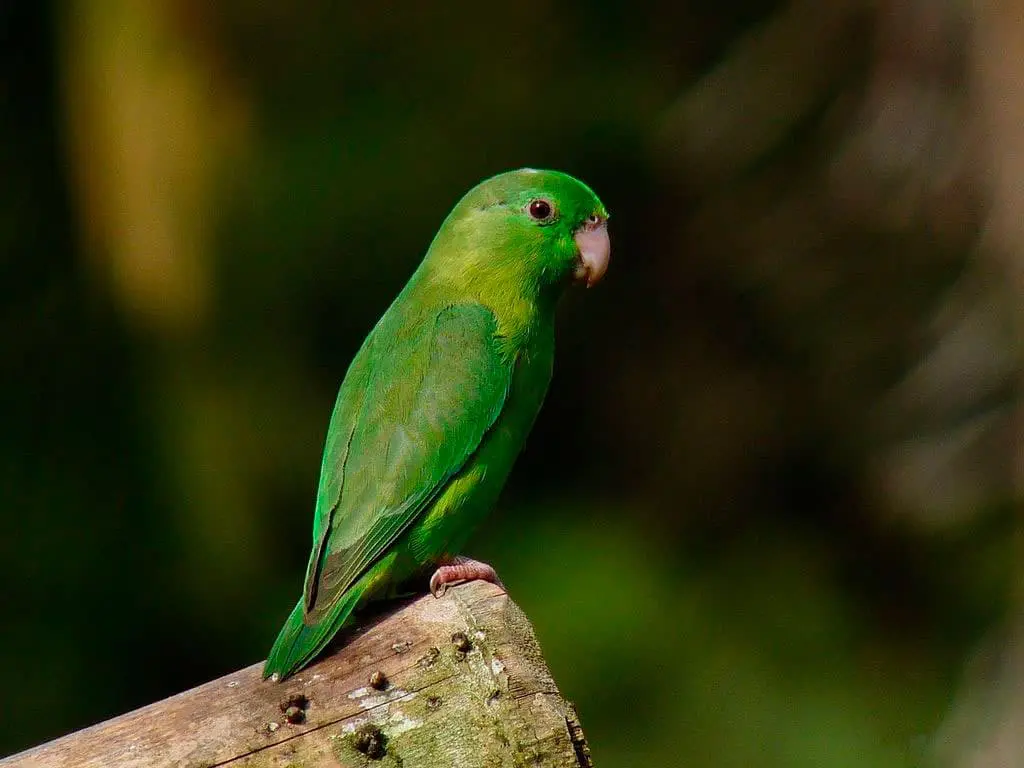
The male of the Spectacled Parrotlet (Forpus conspicillatus) has a yellowish green forehead extending the cheeks and to the throat.

The underparts They are slightly off in colouration, with a bluish gray suffusion in chest. The area surrounding the eyes It is cobalt blue. The wings and upperparts is dark green, with the back and rump blue-violet color, with a darker shade on own rear.

The bill Pink is white. The legs They are pink. The irises is dark brown.

the colors of the female they are duller in terms of the general coloring. Their upperparts They are brighter, with the area around the eyes, emerald green. The underparts They are more yellowish green.

Description 3 subspecies:

  • Forpus conspicillatus caucae

    (Chapman, 1915) – It is paler and blue around the eyes is lighter and is just behind these.


  • Forpus conspicillatus conspicillatus

    (Lafresnaye, 1848) – Nominal.


  • Forpus conspicillatus metae

    (Borrero & Hernandez-Camacho, 1961) – Blue around eyes It is very small.

Habitat:

It is very common. It is found in varied ecosystems, patches of forest, clear with scattered trees, cultivated areas, from 200 m to 1800 m (migrate attitudinally up 2600 metres in Bogotรก). They are noisy flocks of more of 120 individuals.

Reproduction:

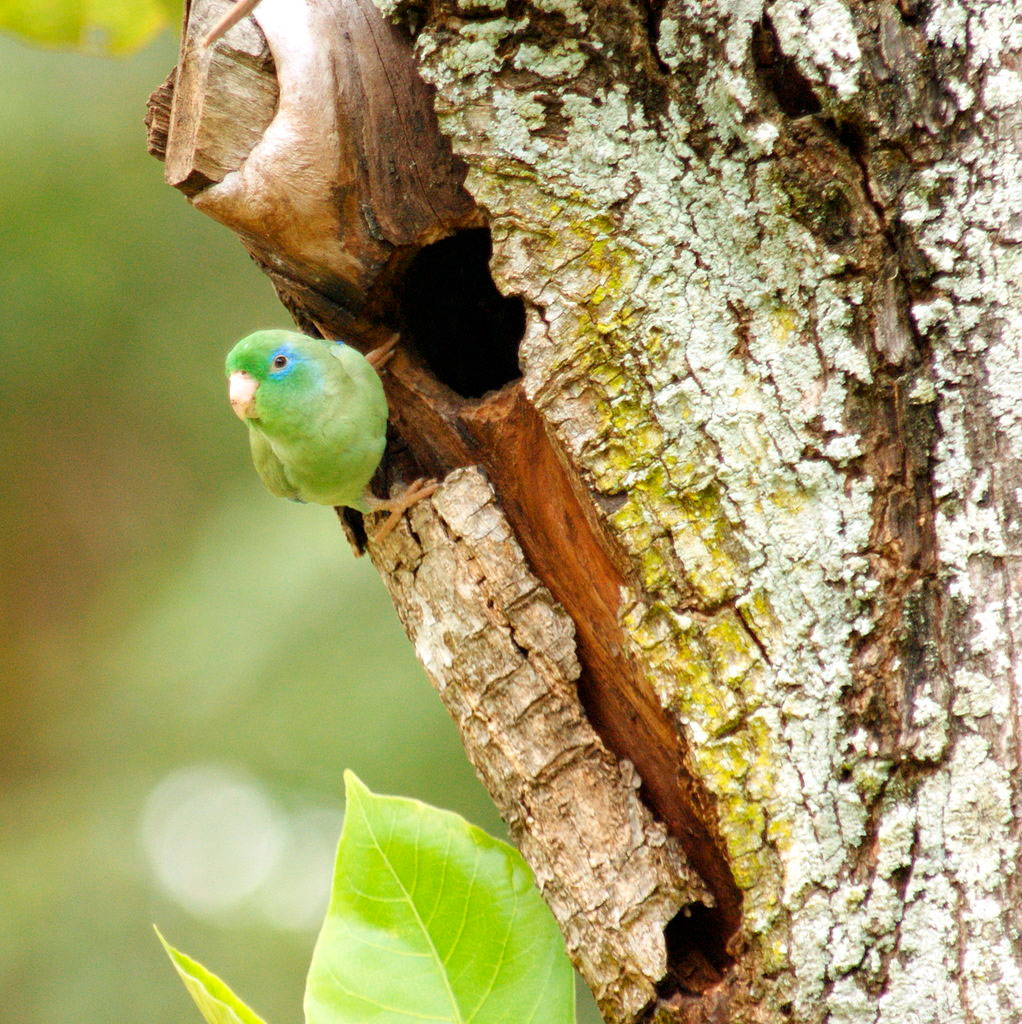
Nest in postholes and termiteros.

Food:

Feeds on grass and weed seeds, fruit, berries, flowers and buds.

Distribution:

Size of the area of distribution (reproduction / resident): 822.000 km2

Patchy and discontinuous distribution. east of Panama, Colombia and West of Venezuela.

Distribution 3 subspecies:

  • Forpus conspicillatus caucae

    (Chapman, 1915) – Southwest of Colombia, to the West of the Andes (Cauca and Nariรฑo); possibly west of Ecuador.


  • Forpus conspicillatus conspicillatus

    (Lafresnaye, 1848) – Nominal. From the tropical eastern Panama north central Colombia.


  • Forpus conspicillatus metae

    (Borrero & Hernandez-Camacho, 1961) – Slope of the Andes of Colombia to the west end of Venezuela.

Conservation:

State of conservation โ“˜


minor concern Minor Concern โ“˜ (UICN)โ“˜

โ€ข Current category of the Red List of the UICN: Least concern.

โ€ข Population trend: In increased.

Justification of the population

The size of the world population It has not been quantified, but this species is described as ยซcommonยป (Stotz et to the., 1996).

Justification of trend

It is suspected that the population is increasing as habitat degradation is creating new areas of suitable habitat.

"Spectacled Parrotlet" in captivity:

In captivity is common in some European countries, rare elsewhere. It is a bird lively, Intelligent and with attitude. They are highly valued for being quiet; they can learn many words and whistle very well. Son loving and they love spending time with their owners, However, they are happy and independent enough to happily play with their toys while the owner is absent. Need much space as it is a bird very active, as well as different toys.

Alternative names:

– Spectacled Parrotlet (English).
– Toui ร  lunettes, Perruche-moineau ร  lunettes (French).
– Brillensperlingspapagei, Augenring-Sperlingspapagei, Brillenpapagei (German).
– Tuim-da-colรดmbia (Portuguese).
– Catita Enana Pรกlida, Cotorrita de Anteojos, Periquito de Anteojos (espaรฑol).
– Periquito Ojiazul (Venezuela).

scientific classification:

– Order: Psittaciformes
– Family: Psittacidae
– Genus: Forpus
– Scientific name: Forpus conspicillatus
– Citation: (Lafresnaye, 1848)
– Protonimo: Psittacula conspicillata

Images Spectacled Parrotlet:

Videos of the "Spectacled Parrotlet"


Species of the genus Forpus

Spectacled Parrotlet (Forpus conspicillatus)


    Sources:

    – Avibase
    – Parrots of the World โ€“ Forshaw Joseph M
    – Parrots A Guide to the Parrots of the World – Tony Juniper & Mike Parr
    – Birdlife
    – parrots book, parrots and macaws Neotropical.

    – Photos:

    (1) – A female Spectacled Parrotlet in Manizales, Caldas, By Julian Londono from Colombia Manizales, Colombia [CC BY-SA 2.0], via Wikimedia Commons
    (2) – A male Spectacled Parrotlet in Manizales, Caldas, By Julian Londono from Colombia Manizales, Colombia [CC BY-SA 2.0], via Wikimedia Commons
    (3) – A pair of Spectacled Parrotlets in Manizales, Caldas, By Julian Londono from Colombia Manizales, Colombia [CC BY-SA 2.0], via Wikimedia Commons
    (4) – A male Spectacled Parrotlet in Colombia just outside the entrance of its nest By Rogier Klappe [CC BY 2.0], via Wikimedia Commons
    (5) – Spectacled Parrotlet (Forpus conspicillatus) by Ron Knight – Flickr
    (6) – PSITTACULA CONSPICILLATA By Internet Archive Book Images [No restrictions], via Wikimedia Commons

    – Sounds:

โ–ท The world of Pets: Dogs, cats, birds, reptiles, amphibians

White-bellied Parrot
Pionites leucogaster

Lorito Rubio

Content

White-bellied Parrot

Description:

23 cm.. height.

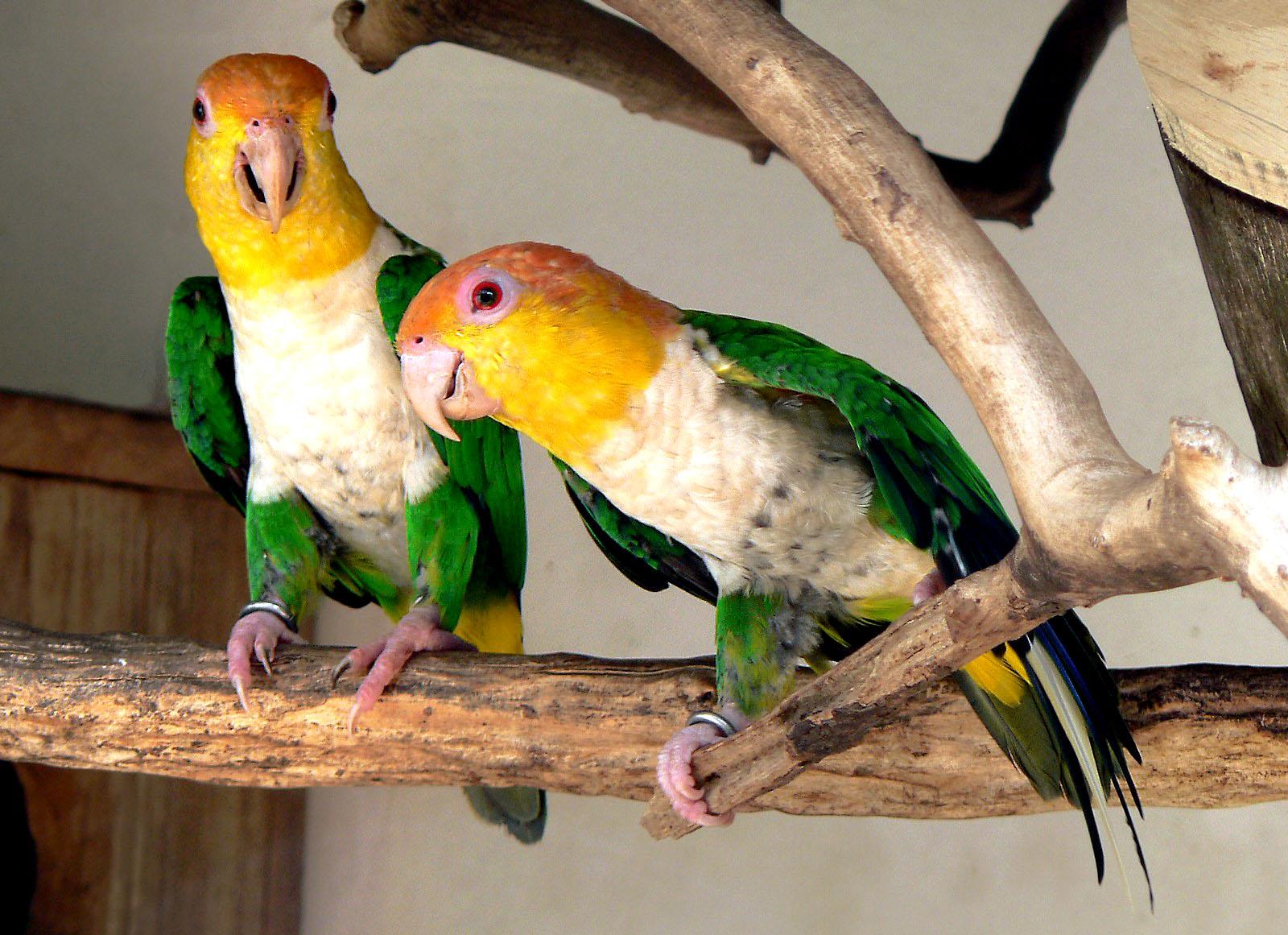
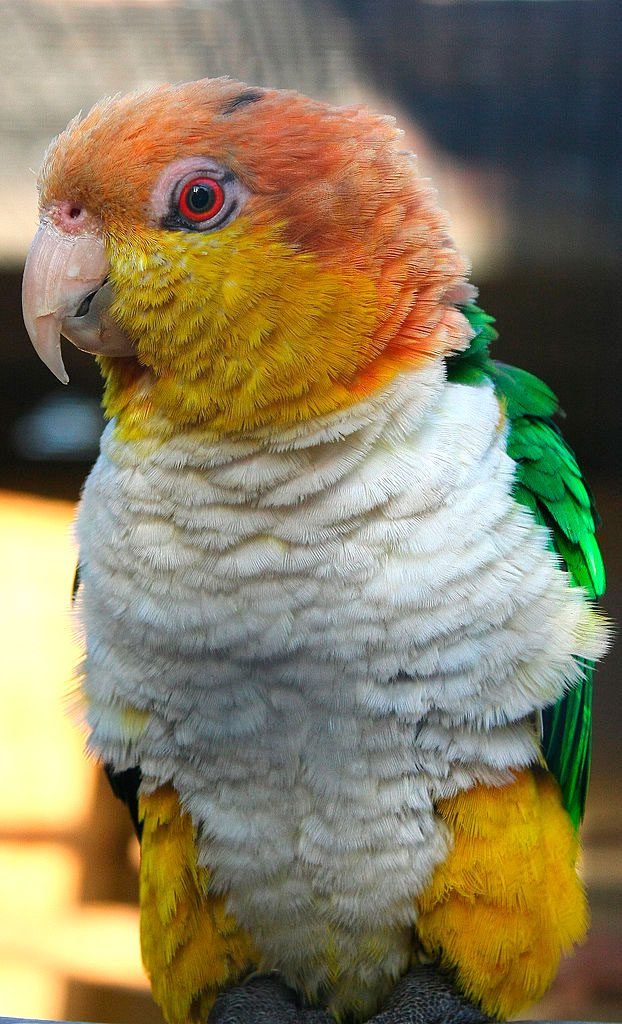
the unmistakable White-bellied Parrot (Pionites leucogaster) has the lores, cheeks and throat, bright yellow lemon; "ear coverts", forecrown and crown, bright orange red; sides and rear of the neck, orange, but paler.

Upperparts green. Primary coverts blue; other coverts green. Primaries blue with green margins in outerweb. Underwing-coverts green. Breast and center belly, white; undersides of belly and feathers the thighs, green; undertail-coverts Yellow. Upper, the tail green; undertail, pale grayish brown. Bill, color pale horn; cere Pink; irises reddish brown; legs pink.

Both sexes are similar.

Immature paler, especially the yellow color face.

  • Sound of the White-bellied Parrot.

Description 3 subspecies:

  • Pionites leucogaster leucogaster

    (Kuhl, 1820) – Nominal.


  • Pionites leucogaster xanthomerius

    (Sclater,PL, 1858) – As the nominal species but with the thighs and flanks bright yellow lemon (no verde); tail green.


  • Pionites leucogaster xanthurus

    (Todd, 1925) – As the nominal species, but with the thighs yellow; flanks and tail, yellow and green the uppertail-coverts.

Habitat:

Prefers low humid forests, areas of land and vรกrzea with probable preference for the latter and for clearings in the forests. Also observed in the drier forests (where it is less common) in the South of its range. Gregarious; Observed in the company of Blue-headed Parrot (Pionus menstruus) on Eastern Amazonia. Seen in small groups or couples.

Since they have very heavy body and very short wings, the White-bellied Parrot You can not fly long distances.

Reproduction:

With plays in January and nests in hollow trees; a nest 30m found in the cavity of a tree in the east of its range. Clutch Normal probably 2-4 eggs.

Food:

Very similar in habits Lorito Chirlecrรฉs (Pionites melanocephalus) but no specific information about their diet; probably seeds, fruit and berries.

Distribution:

The size of its distribution area (reproduction / resident): 2.140.000 km2

The White-bellied Parrot It extends through southern amazon in Brazil, from northwest maranhรฃo and around Bethlehem in the State of For, west on Mato Grosso to the North of Bolivia and Southeast of Peru, to the top of Ucayali, where it approaches the range of Lorito Chirlecrรฉs (Pionites melanocephalus). Reports in eastern Ecuador (well within the limits of the latter) still not substantiated.

Distribution 3 subspecies:

Conservation:


Endangered


โ€ข Current category of the Red List of the UICN: In danger of extinction.

โ€ข Population trend: Decreasing.

Usually common but perhaps more scarce in drier forests on the southern fringes of the range. It is not at serious risk, but decreases locally (for example, the Eastern Amazonia) due to deforestation, and possibly extinct now Santa Cruz, Bolivia, due to the loss of habitat. Trapped for Local international trade (at least years), but apparently not yet having a serious impact on wild populations.

Conservation Actions Underway

โ€ข No specific conservation actions are known for this species.

Conservation Actions Proposed

โ€ข Expand the network of protected areas to effectively protect the IBA.
โ€ข Effectively treat resources and manage existing and new protected areas., using the emerging opportunities for funding the management of protected areas with the overall goal of reducing carbon emissions and maximize the conservation of biodiversity.
โ€ข Conservation on private land is also essential, through the expansion of market pressures for rational land management and prevention of logging on land not suitable for agriculture (Soares-Filho et to the., 2006).
โ€ข Campaign against proposed changes to the Brazilian Forest Code that would lead to a decrease in the width of protected riparian forest areas such as Permanent Preservation Areas (APPs), that function as vital corridors in fragmented landscapes.

"White-bellied Parrot" in captivity:

Do not have the capacity to speak of his larger parrots cousins, but they are very assets and can be very good pets, Despite not being very common to see them in captivity.

Alternative names:

– White-bellied Parrot, White bellied Parrot, White-bellied Caique (English).
– Maรฏpouri ร  ventre blanc, Caรฏque ร  ventre blanc (French).
– Rostkappenpapagei, Rostkappen-Papagei (German).
– Marianinha-de-cabeรงa-amarela, maipurรฉ, marianinha, mariquita, periquito-d’anta, periquito-de-anta, periquito-de-cabeรงa-preta Pionopsitta barrabandi (Portuguese).
– Lorito Gordo de Cabeza Rojiza, Lorito Rubio (espaรฑol).
– Loro de Vientre Blanco (Peru).


scientific classification:

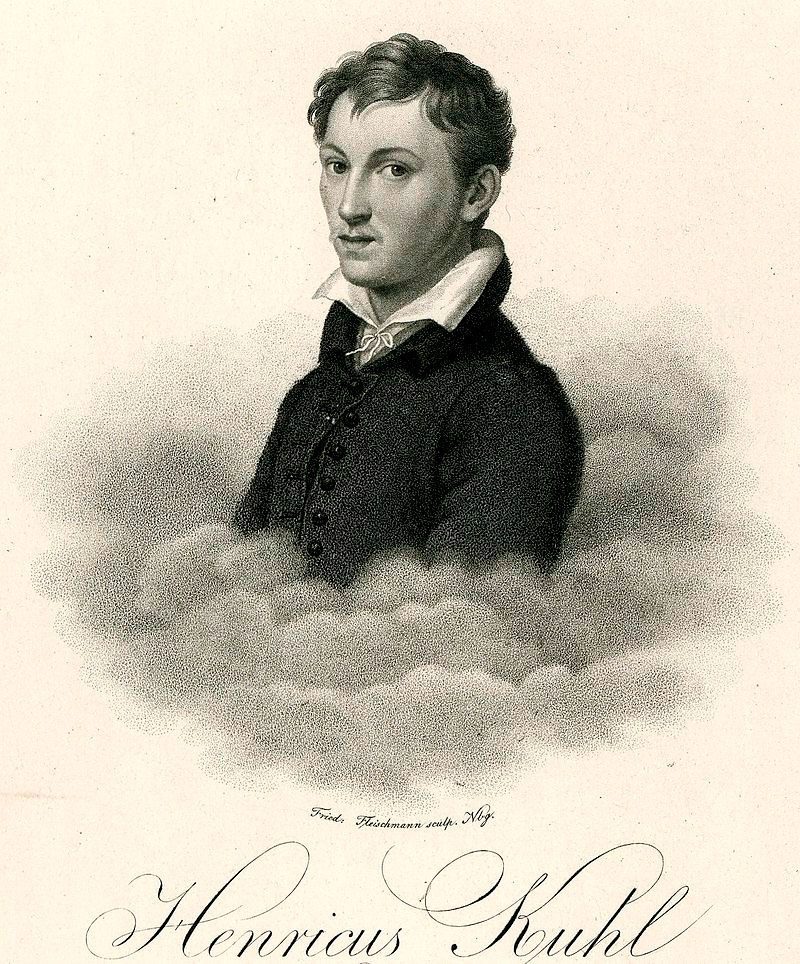
Kuhl, Heinrich
Heinrich Kuhl

– Order: Psittaciformes
– Family: Psittacidae
– Genus: Pionites
– Scientific name: Pionites leucogaster
– Citation: (Kuhl, 1820)
– Protonimo: Psittacus leucogaster


Images "Lorito Rubio":

Videos "White-bellied Parrot"


ยซBlond Parrotยป (Pionites leucogaster)


Sources:

  • Avibase
  • Parrots of the World โ€“ Forshaw Joseph M
  • Parrots A Guide to the Parrots of the World – Tony Juniper & Mike Parr
  • Birdlife

  • Photos:

(1) – Pionites leucogaster xanthomeria By Mirjam (Picasa Web Albums) [CC BY-SA 3.0], via Wikimedia Commons
(2) – Pionites leucogaster leucogaster White-bellied Parrot (this subspecies is also know as the Green-thighed Parrot). Two in a cage with a nestbox By TJ Lin (originally posted to Flickr as 140) [CC BY-SA 2.0], via Wikimedia Commons
(3) – Pionites leucogaster xanthomerius A pet adult male White-bellied Caique perching by a row of books By pionetes (Own work (self-portrait)) [CC BY-SA 3.0], via Wikimedia Commons
(4) – Five White-bellied Parrots (also known as White-bellied Caique) at Bird Park, Foz do Iguaรงu, Brazil. This subspecies is also known as the Green-thighed Caique (Pionites leucogaster leucogaster) By Chad Bordes (Picasa Web Albums) [CC BY 3.0], via Wikimedia Commons
(5) – White-bellied Parrot by Peter Tan – Flickr
(6) – White-bellied Parrot in captivity at Iguaรงu Bird Park, Foz do Iguaรงu, Brazil. Photographed on 23 April 2003 By Arthur Chapman [CC BY 2.0], via Wikimedia Commons
(7) – White-bellied Parrot (Pionites leucogaster) often referred to as the White-bellied Caique in captivity by whiskymac (Flickr) [CC BY 2.0], via Wikimedia Commons
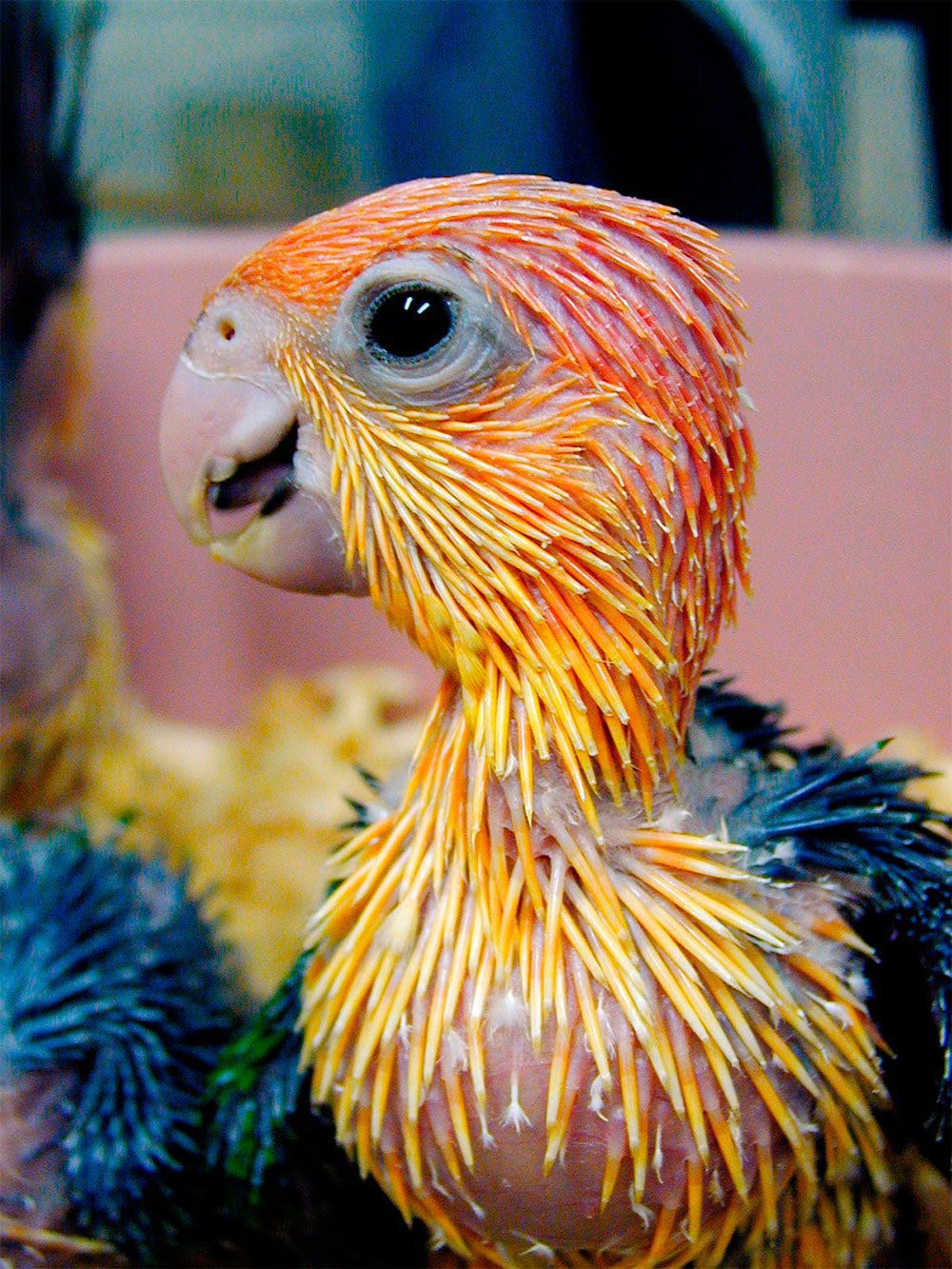
(8) – White-bellied Parrot (often referred to as the White-bellied Caique); a chick. Its feathers have not opened yet By Ruth Rogers (originally posted to Flickr as Caique) [CC BY 2.0], via Wikimedia Commons
(9) – A painting of a White-bellied Parrot (originally captioned ยซPsittacus badiceps. Bay-headed Parrotยป) by Edward Lear (1812-1888) Edward Lear [Public domain], via Wikimedia Commons

โ–ท The world of Pets: Dogs, cats, birds, reptiles, amphibians

Yellow-crowned Parrot
Amazona ochrocephala

Yellow-crowned Parrot

Content

Description

35 to 41 cm.. height and between 380 and 500 g. of weight.

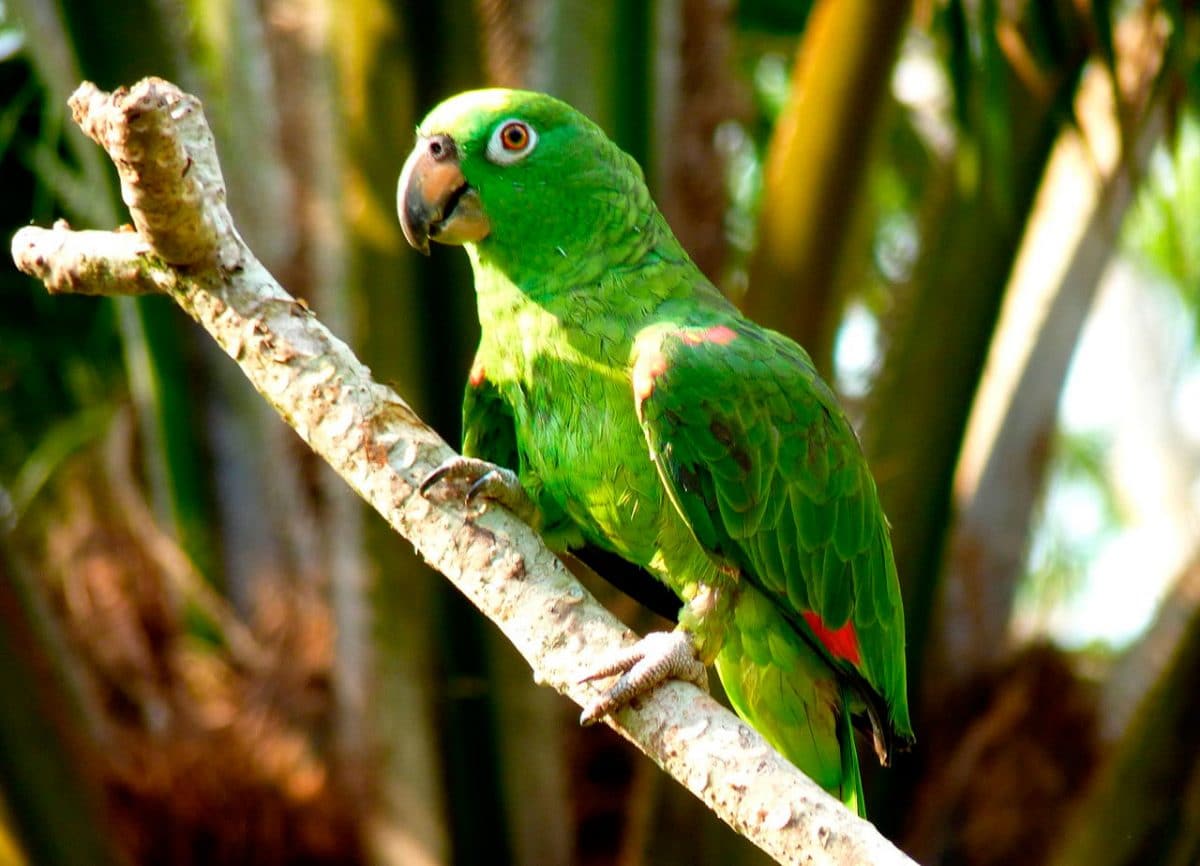
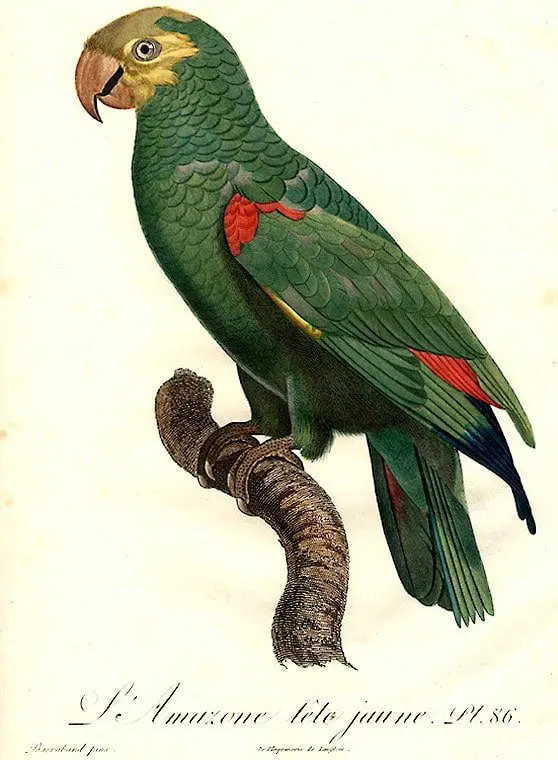
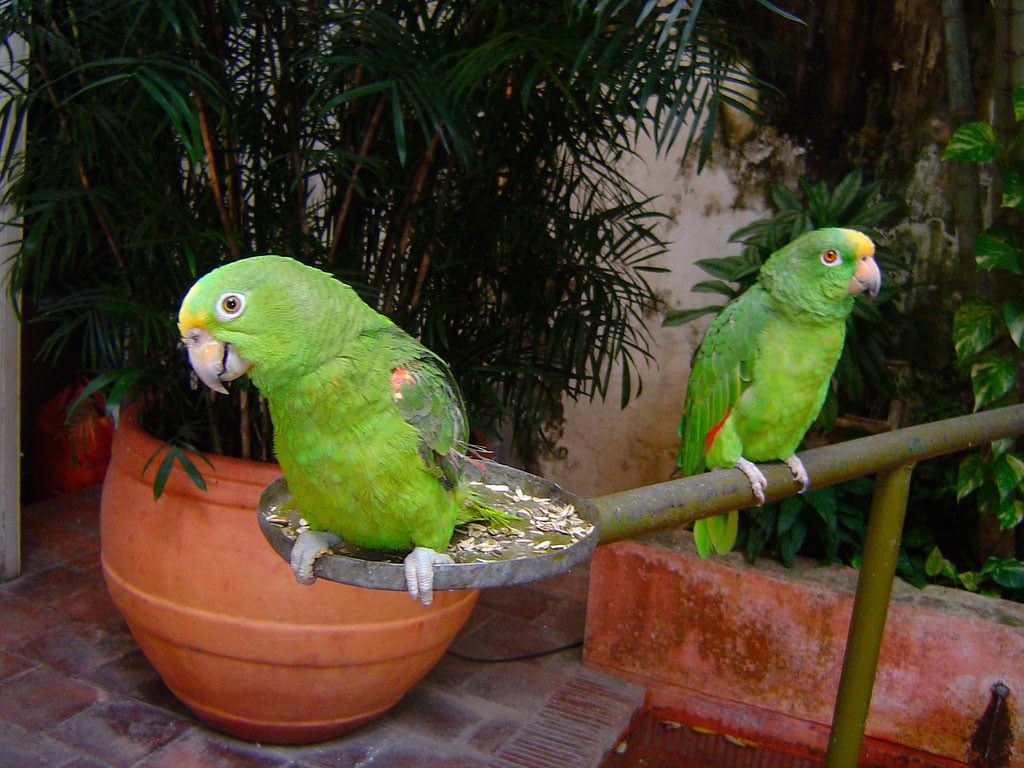
The Yellow-crowned Parrot (Amazona ochrocephala) has the forecrown and front area crown, bright yellow; lores, cheeks and supercilii area, green in most birds, but sometimes with yellow extending over lores and around eyes, and some birds with red bases hidden by yellow feathers crown; sides and back of the neck, nape and the mantle, green with dark margins, giving scalloped effect.


Anatomy-parrots

Upperparts green. coverts lower red, other coverts green; edge front of the wing yellowish; five o'clock outer secondaries They are green with bright red to outerweb forming speculum; flight feather green with blue tips to secondaries and primary outerweb, dark to black in points. Underwing-coverts, dull green with blackish tips. Underparts green with plenty of blue in the chest; yellow feathers on the the thighs (often few and discrete).

Yellow-crowned Parrot

Upper, the tail It is green with yellow stripes; below green with wide yellow ends; both with outer feathers basically red and a bluish puckered in outerweb.

Dark gray Bill, reddish at base of upper jaw; iris orange; legs grey.

Both sexes they are similar. The immature It has a narrower yellow patch on the head, stripes orange-red to yellow feathers crown; less red at the base of feathers tail; feathers of the tail more pointed and irises brown.

Description 4 subspecies
  • Amazona ochrocephala nattereri

    (Finsch, 1865) – Less yellow in the head that the nominal species, with frontal band green. Cheeks, supercilii area and lores with blue tint. Red curve wing often mixed with yellow feathers.

  • Amazona ochrocephala ochrocephala

    (Gmelin, 1788) – Nominal.

  • Amazona ochrocephala panamensis

    (Cabanis, 1874) – Bill horn-colored pink, yellow feathers restricted as V in forecrown and front of the crown. Possibly average smaller than the nominal species.

  • Amazona ochrocephala xantholaema

    (Berlepsch, 1913) – More extensive yellow in the head which extends to the back of the neck, around the eyes, to cheeks and to the ear-coverts. Often with frontal band narrow green. bluish tint in the chest.

Habitat:

Video – "Yellow-crowned Parrot"

They Real (Amazonas Ochrocephala)

They inhabit in open forests, moist forest edges, gallery forests, deciduous forest, open savannas and wetlands in lowland rain forests, also cultivated and suburban areas in some localities, and often near rivers.

The gallery forest It is your preferred Panama where Yellow-crowned Parrot avoid continuous humid forest, being replaced, possibly, there and in many areas of South America, by the Orange-winged Parrot (Amazona amazonica).

Usually observed in the lowlands; reported to 500 metres in Colombia and Venezuela and a 750 metres in Honduras. Usually in pairs or small flocks of 10-30 birds, with occasional gatherings up 300. Birds gather in common trees.

Reproduction:

Son Monogamie, couples joined in for life.

His time of reproduction It is from December to May. During this time, they lay clutches of 2 to 4 eggs, only Por those Nidada Tempordaa. Nest palm trunks and termite mounds.

It takes about 25 days for the eggs to hatch and near 56 days to become fledglings. The young become independent 2 months after hatching. Both male and female Yellow crowned Parrot reach sexual maturity around the 3 years.

Food:

Foods reported in the diet include fruit Immature American Curatella, Pereskia guamacho and other Cactus. Mainly feeds on treetop.
It is considered a plague in some localities for their love of eating bananas (Mussa paradisea), handles and Corn crops.

This species is considered a pest in some areas by his fondness for the consumption of bananas (Mussa paradisea), mangoes and corn crops.

Distribution:

Size of its range (reproduction / resident): 8.010.000 km2

The Yellow-crowned Parrot are in Panama, in Central America and in South America, from south to east Brazil and to the North of Bolivia.

They are present in Panama, mainly on the slope of the peaceful, from Chiriqui, to the West of Darien, but also in the shed Caribbean (for example, in the eastern San Blas Islands); also along the Pearl Islands and Coiba National Park.

They are also distributed in northern Colombia, from the North of the Chocรณ and lower basin of Atrato River, as well as along the Caribbean coast and tropical zone of the Magdalena River Valley, to the base southeast Sierra Nevada de Santa Marta and western part of the Serrania del Perija.

Observed in the eastern foothills of the Andes and adjacent lowlands Colombia; eastward across the tropical zone Venezuela and south, from the coastal mountains through Bolรญvar (where apparently it is not known from south) and amazon, until Guyanas and Trinidad (where their status is uncertain due to the captive birds introduced).

Present in the basin Amazonas Brazil, to the south, to the Northwest of Mato Grosso and west, in the lowlands of eastern Ecuador and through the Peruvian Amazon, to the North of Bolivia.

Apparently residents throughout its distribution area. very small numbers in Panama, although locally fairly common, especially in those areas more dry; it is the most common parrot (at least once) in the San Blas Islands. generally common (even locally abundant) in South America, but the numbers are reduced in the more accessible areas due to trade.

Distribution 4 subspecies
  • Amazona ochrocephala nattereri

    (Finsch, 1865) – South of Colombia in Caqueta, is of Ecuador, is of Peru, West of Brazil and North of Bolivia. Possibly integrated with nominal species in border areas Goal and Caquetรก in Colombia.

  • Amazona ochrocephala ochrocephala

    (Gmelin, 1788) – Nominal. It is from Colombia, Venezuela, Trinidad, Guianas and North of Brazil south to the tributaries of the lower margin right amazon in amazon and For.

  • Amazona ochrocephala panamensis

    (Cabanis, 1874) – North of Colombia, north and west of the Andes to western Panama, including Pearl Islands and Coiba National Park.

  • Amazona ochrocephala xantholaema

    (Berlepsch, 1913) – Isla Marajรณ at the mouth of amazon.

Conservation:

State of conservation โ“˜


minor concern Minor Concern โ“˜ (UICN)โ“˜

โ€ข Current category of the Red List of the UICN: Least concern.

โ€ข Population trend: Decreasing.

This species is considered at present as minor concern BirdLife International, and, as a result, also by UICN.
Even though the populations it is believed that are in decline, still do not approach the threshold specified by BirdLife International to evaluate the species as Near-threatened.

It is listed in the Appendix II of the CITES.

The Yellow-crowned Parrot in captivity:

Known for his pranks and excellent skills imitate the human voice. Having said that, the ability to mimic will vary between birds and although many of them are excellent conversadoras, Some will never come to talk. These Amazons are generally affectionate. Its friendly and playful nature make them excellent pets.

Son easily domesticable and easy to train. Known to be very active, What makes them more suited to an environment that enables them to fly.

Son known for their voices. It is said that it is the strongest of all Amazon parrots. People who are not tolerant to noise, they will do well to live with this Parrot.

like most parrots, this horsewoman it can be very destructive. We must "personalize their environment" by providing them with objects to chew such as different toys and branches.

Its longevity should also be a consideration. These parrots They can live between 60 and 80 years.

Alternative names:

– Yellow crowned Parrot, Yellow-crowned Amazon, Yellow-headed Amazon, Yellow-headed Parrot (English).
– Amazone ร  front jaune, Amazone ร  tรชte jaune, Amazone verte de Colombie (French).
– Gelbscheitalamazone, Gelbscheitelamazone, Panama Amazone, Surinamamazone (German).
– papagaio-campeiro, ajurรบ-apara, papagaio-de-Suriname (Portuguese).
– Amazona Real, Cotorra Cabeciamarilla, Lora Cabeciamarilla, Lora coroniamarilla, Lora Real (espaรฑol).


scientific classification:

Gmelin Johann Friedrich

– Order: Psittaciformes
– Family: Psittacidae
– Genus: Amazona
– Scientific name: Amazona ochrocephala
– Citation: (Gmelin, JF, 1788)
– Protonimo: Psittacus ochrocephalus


Images Yellow-crowned Parrot:


Species of the genus Amazona


Sources:

avibase
Parrots of the World โ€“ Forshaw Joseph M
Parrots A Guide to the Parrots of the World – Tony Juniper & Mike Parr
Birdlife
Parrot Book, Parrots and macaws Neotropical

Photos:

(1) – A pet Yellow-crowned Amazon in Puerto Maldonado, Peru By Kate from UK (Lola) [CC BY-SA 2.0], via Wikimedia Commons
(2) – A pet Yellow-crowned Amazon By Freegiampi (From Giuseppe's farm) [CC BY-SA 2.5], via Wikimedia Commons
(3) – Yellow-crowned Amazon or Yellow-crowned Parrot (Amazona ochrocephala) in captivity By Stephen Joyce from barcelona, Spain (Parrot) [CC BY-SA 2.0], via Wikimedia Commons
(4) – Yellow-crowned Amazon or Yellow-crowned Parrot (Amazona ochrocephala) in captivity in the Parrotโ€™s Garden (Jardim dos Louros), in the Botanical Garden of Funchal, Madeira island, Portugal By jmaximo [CC BY 2.0], via Wikimedia Commons
(5) – A Yellow-crowned Amazon in Gatorland, Florida, USA By greyloch from Washington, DC, area, U.S.A. (green parrot preening) [CC BY-SA 2.0], via Wikimedia Commons
(6) – Amazona ochrocephala panamensis, Panama Amazon (also known as the Panama Yellow-headed Amazon); two in captivity By TJ Lin (originally posted to Flickr as DSCN1005) [CC BY-SA 2.0], via Wikimedia Commons
(7) – A Yellow-headed Amazon (or Parrot) near the Brazil-Peru-Colombia triple junction By Dick Culbert from Gibsons, B.C., Canada (Amazona ochrocephala) [CC BY 2.0], via Wikimedia Commons
(8) – A Yellow-crowned Amazon at Bloedel Floral Conservatory, Vancouver, Canada By Karen Neoh (Parrot) [CC BY 2.0], via Wikimedia Commons
(9) – Yellow-crowned Amazon or Yellow-crowned Parrot (Amazona ochrocephala) in a tree in Venezuela By Rufino (originally posted to Flickr as camouflage) [CC BY-SA 2.0], via Wikimedia Commons
(10) – Amazona ochrocephala From Natural History of Parrots (by Francois Levaillant, 1801-1805) – Wikimedia

Sounds: Edson Guilherme

โ–ท The world of Pets: Dogs, cats, birds, reptiles, amphibians

White cockatoo
Cacatua alba

Cacatรบa Blanca

Content

Description White Cockatoo


Anatomy-parrots

40 to 50 cm.. length and a weight of approximately 550 gr.
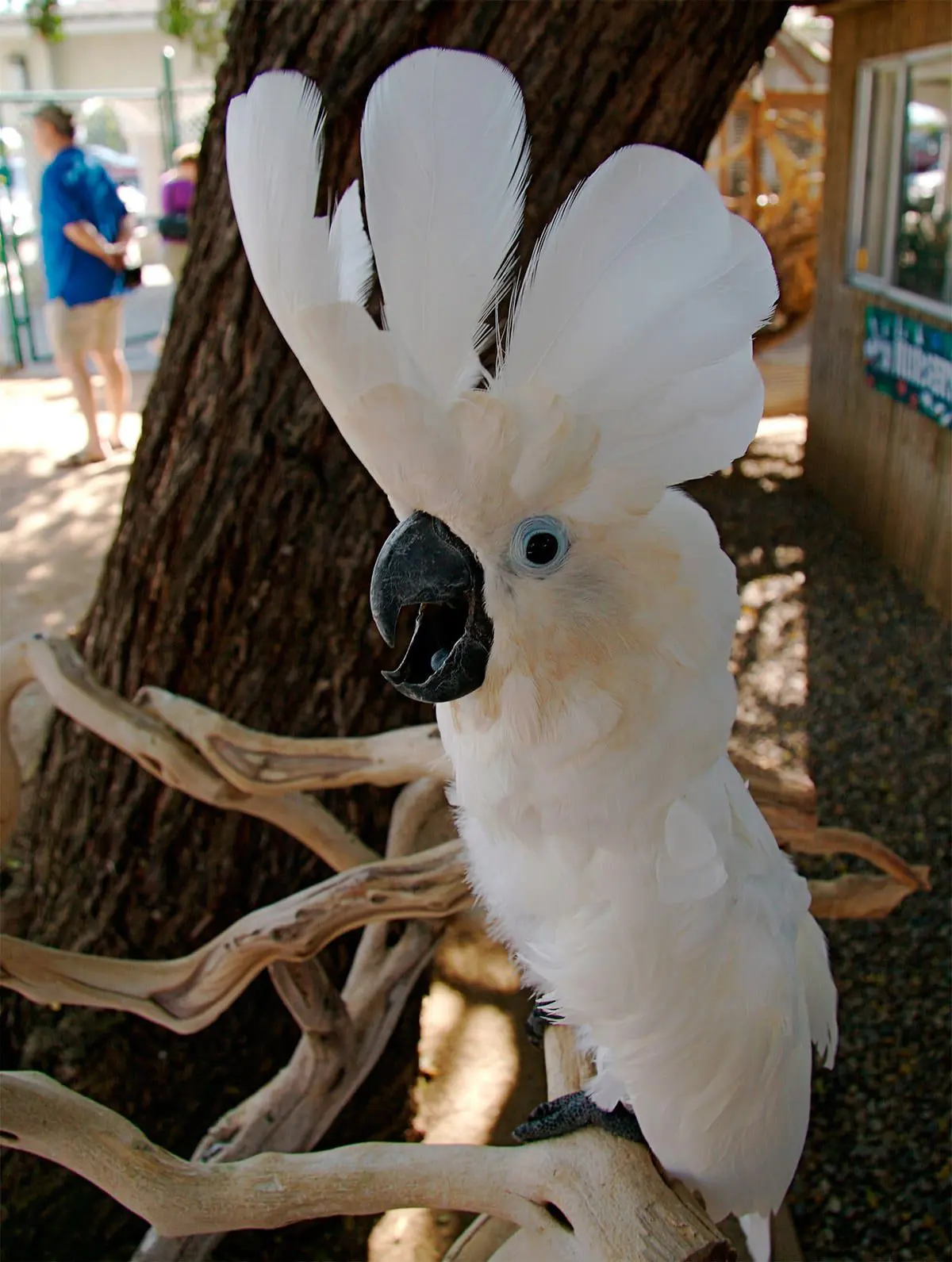
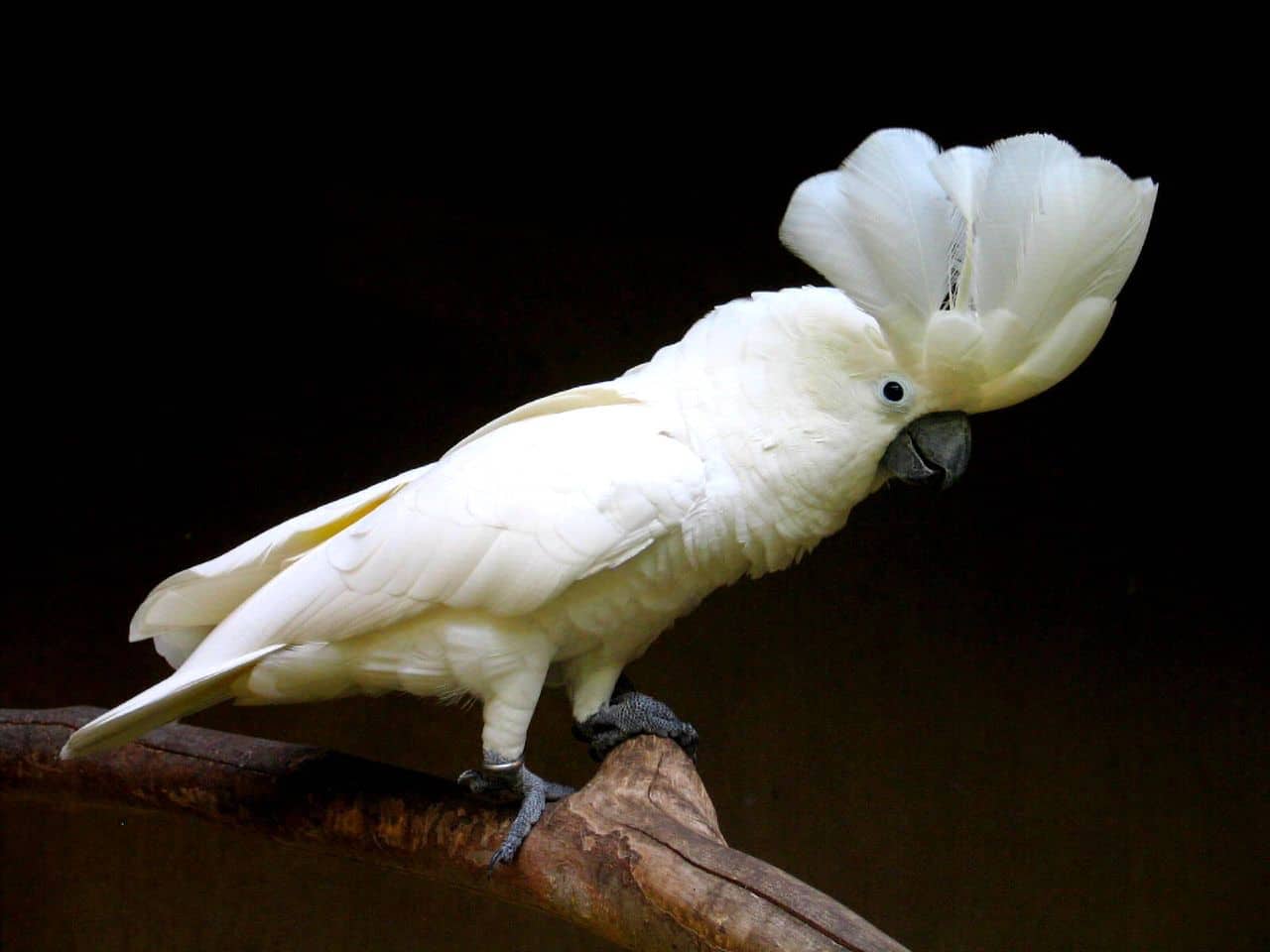
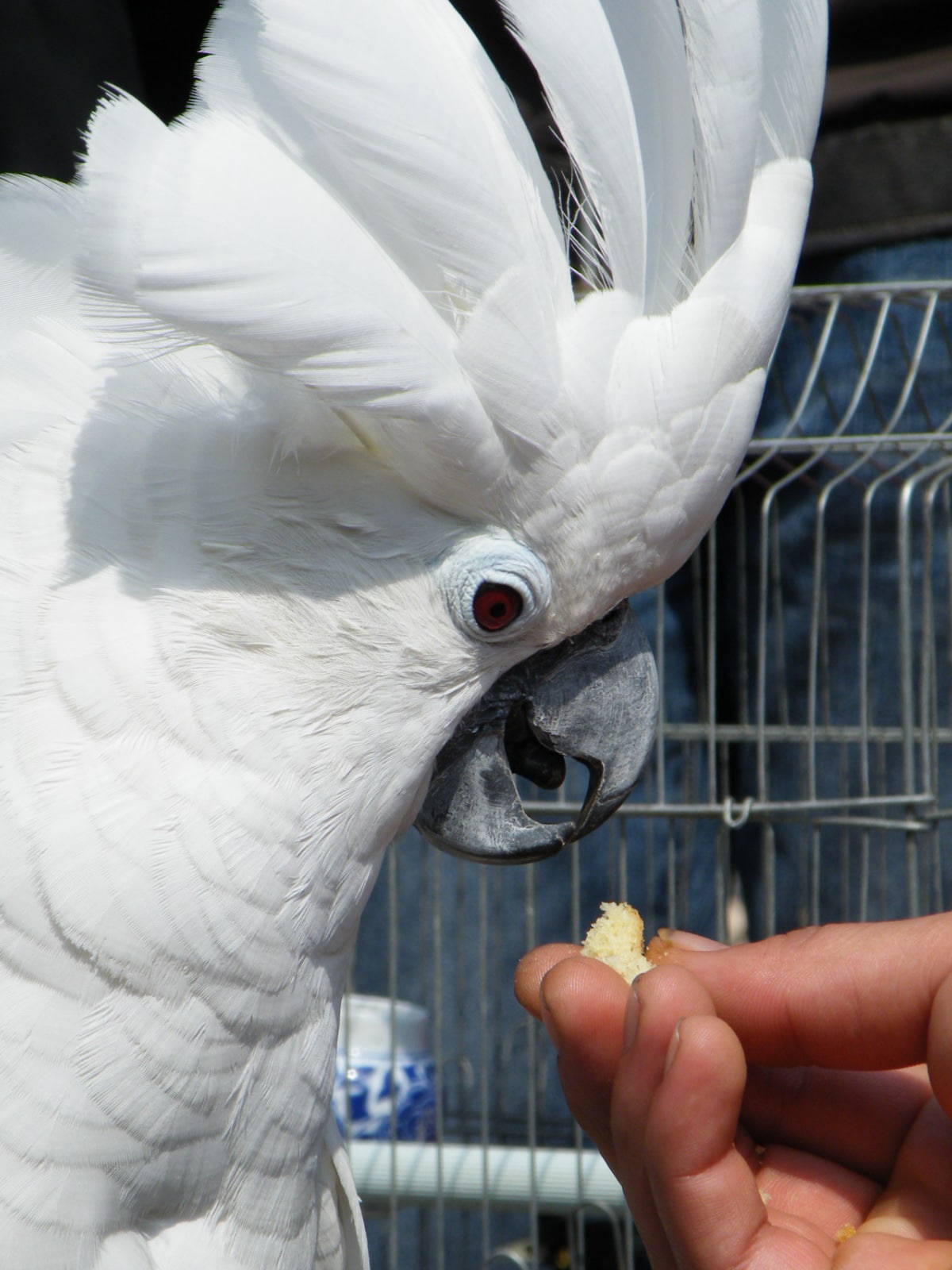
The White cockatoo (Cacatua alba) is completely white, with yellowing below wings, bill black and legs dark gray.

The eye ring is blue.
It has a crest exuberant, that is elevated or low, Depending on your state of mind. The wings They are tapered or rounded.

If he irises is brown, then it is male, if reddish, it is female. The females has bill smaller.

The juveniles only they differ by color irises.

White Cockatoo Behavior:

They usually fly solo, in pairs, small groups, or in flocks of up to fifteen birds. In the afternoon, they gather in groups of up to fifty birds. even though they are social, with the exception of mating pairs, usually, they do not form close ties with others. As a result, There is no firmly defined order of dominant position in the community. Son day and they tend to be sedentary, Although some can be nomadic and wander in search of food.

The white cockatoos they are very bright and curious birds. They have the ability to use tools, as the use of a branch to scratch your back. They are monogamous, with couple bonds lasting lifetime. They can fall into a deep depression if you lose your partner.

Habitat White Cockatoo:

Video – "White cockatoo" (Cacatua alba)

Presentation of the cockatoo alba

They live in lowland forests below 900 m, as well as in mangrove forests, plantations and agricultural land.
they are particularly common around the edge of clearings and rivers. They spend most of their time in the tops of the trees. The secondary vegetation high is its preferred habitat.

White Cockatoo Reproduction:

It nests in the hollows of trees. They lay two eggs and two birds hatch for a few 28 days. The larger hatchling tends to take dominance over the smaller hatchling, which will not be able to survive.. The chicks leave the nest to the 84 days old and are independent around 15-18 weeks. These birds reach sexual maturity at the age of 3-4 years.

White Cockatoo feeding:

In nature it feeds mainly on Tree fruits. They are often seen feeding on papaya, Durian, complexioned and rambutan. It has also seen them will eat crickets and lizards. They often feed on corn that grows in the fields, sometimes doing considerable damage.

Distribution:

Size of its range (reproduction / resident): 51.400 km2

The white cockatoo It found in rainforests on the islands of Halmahera, Bacan, Ternate, Ternate, Kasiruta and Mandioli in the north of the Moluccas of Indonesian.

Conservation:

Appears as vulnerable by the IUCN and placed in Appendix II in 1981.

In their natural environment, the white cockatoo is a species vulnerable Due to the decrease in number due to habitat loss natural, as well as for the capture for the illegal bird trade. There are restrictions on the number of birds that can be exported, but BirdLife International He says that this is being exceeded by up to 18 times the agreed number in some areas.

It can cause substantial damage to Corn crops.

World population: 43,000 – 183,000 individuals.

The White Cockatoo in captivity:

The White cockatoo You can live more than 60 years. It is very common in poultry farming and it is perhaps one of the most frequent pet cockatoos.

They are sympathetic, calm, beautiful, sweets and easy to domesticate. Bred to porridge they are usually wonderful pets, You can play some words but are not good talkers. These birds in captivity require mental stimulation almost constant. They are in constant motion, up and doing gymnastics. When lack of mental stimulation, often they are become neurotic, booting the feathers to the point of causing areas of baldness.

They are known for being very affectionate with their human companions, acting more like a dog than a bird in this regard as.

In the absence of a partner, captive white cockatoos will bond with their keeper as if that person were their mate.

Alternative names:

– White cackatoo, Great White Cockatoo, White Cockatoo, White-crested Cockatoo (ingles).
– Cacatoรจs blanc, Grand Cacatoรจs blanc (French).
– WeiรŸhaubenkakadu (German).
– Catatua-branca (Portuguese).
– Cacatรบa Alba, Cacatรบa Blanca, Cacatรบa Copete Blanco, Cacatรบa de Goffin (espaรฑol).

scientific classification:

– Order: Psittaciformes
– Family: Cacatuidae
– Genus: Cockatoo
– Scientific name: Cacatua alba
– Citation: (Statius Mรผller, 1776)
– Protonimo: Psittacus albus

White Cockatoo Images:


Species of the genus Cacatua

Sources:

– Avibase
– Parrots of the World โ€“ Forshaw Joseph M
– Parrots A Guide to the Parrots of the World – Tony Juniper & Mike Parr
– Birdlife
– avimarparrots.es

– Photos:

(1) – commons.wikimedia.org
(2) – Adam Lysican

– Sounds: Mike Nelson (Xeno-canto)