▷ The world of Pets: Dogs, cats, birds, reptiles, amphibians

Jack Russell Terrier
Gran Bretañaa FCI 345 . Small sized Terriers.

Jack Russell Terrier

He has a bold and cheerful disposition and always appears full of self-confidence..

Content

History

The Jack Russel Terrier comes like most terrier breeds from England. It was first bred there more than 150 years by theologian John Russel. The future pastor had the nickname "Jack.", for which the dog breed was also named later. John Russel pursued the goal of creating a fox hunting terrier by crossing with other breeds. This should not only hunt foxes and other animals, but also chase them into their burrow and drive them out again.

Over the years, two types of Russel Terrier, a medium-sized variant, the Parson Russel Terrier, and another one of smaller size, the Jack Russel Terrier described here. The small-sized variant found its followers mainly in Australia, who used it mostly for hunting in rabbit holes. Due to crossbreeding with other breeds and exclusive breeding for hunting purposes, recognition as an independent race came relatively late.

So the dog was first listed by the Australian National Kennel Council in 1991 and in the year 2000 was recognized by the FCI.

Physical characteristics

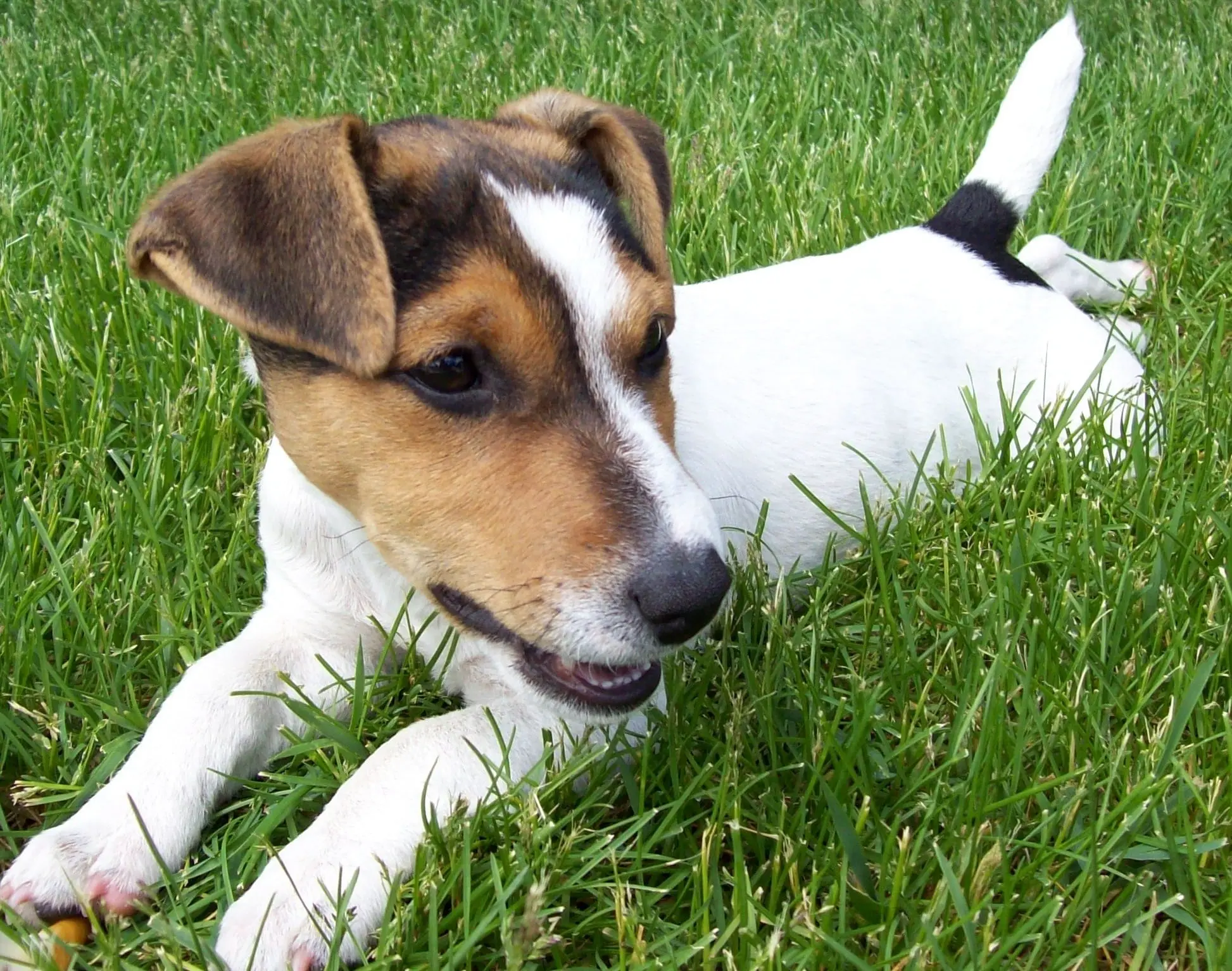
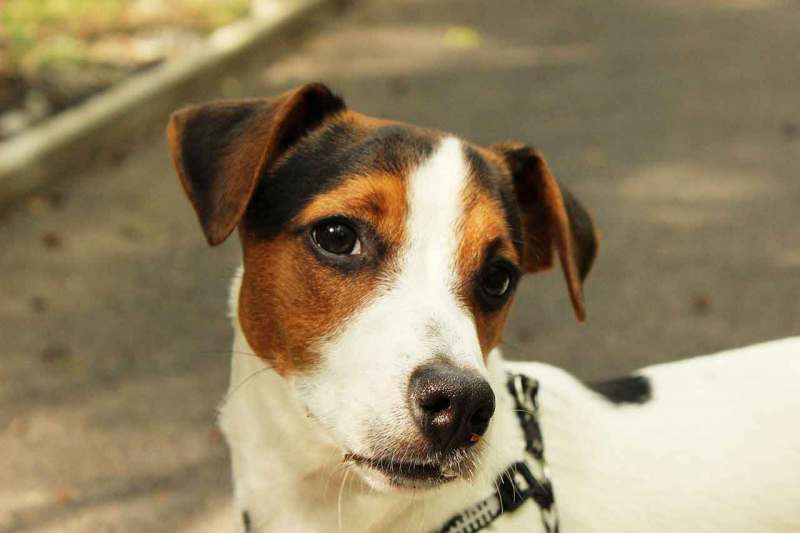
The appearance of the Jack Russel Terrier it is relatively easy to recognize. So he has a coat covered mostly in white, that bears black or brown markings. A completely white coat is also theoretically possible, but quite rare. The hairs are short and can be straight or coarse.

The Jack Russel Terrier it has an almost rectangular body shape and a height at the withers of up to 30 cm.. So, is on average 5 cm smaller than its direct relative, the Parson Russel Terrier. The weight of a Jack Russel Terrier can vary between 7 and 10 kg. The head of the Jack Russel it is quite thin and flat built. The dog's eyes are almond shaped and are normally surrounded by black eyelid edges.

Variedades «Jack Russel Terrier»
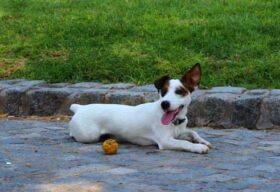
Jack Russell Terrier smooth hair
Jack Russell Terrier by the fence
Jack Russell Terrier through the fence
jack russell terrier hard hair
  • Straight hair variety
  • Wired hair variety
  • Wire hair variety

Character and skills

The Jack Russel Terrier he is an agile and lively dog ​​who loves to run in nature. He has a healthy self-confidence and is very brave.. Although her legs seem relatively short, loves to take long walks in nature. The dog is charged with energy and needs his run. In addition to sports activities, the dog also wants to be challenged on a mental level. One can make this possible thanks to sports modalities such as "Agility.". There he is with total commitment and tirelessly pursues his goal.

At the same time, the Jack Russel Terrier also very suitable as a family dog. In a calm and familiar environment, the dog is child friendly and has a social mindset.

Keeping and feeding a Jack Russel Terrier

Although the Jack Russel Terrier it's a smaller dog, there is a lot of power in him. The hunting instinct remains firmly anchored in it. You need to exercise a lot outdoors in nature. The Jack Russel it is a dog that needs to be encouraged and challenged by its owner. To push the dog to its limits, dog sports like agility are ideal.
Keeping the dog in an apartment is usually not a problem. But, it is practical to have a large garden in which the terrier can let off steam in between. The Jack Russel he is also a super family dog, that with the right training you will become a loving family member.

The Jack Russel Terrier usually has no special food preferences. It is important that the dog is fed a balanced diet. This means that the diet is based on a combination of a high meat content plus the addition of vegetables, fruits and cereals. The choice between dry or wet food is left to each owner. The food ration should be adapted to the size and workload of the dog.

Education and care of the Jack Russel Terrier

The Jack Russel Terriers they need a loving and consistent education. Already with the puppy you must define the rules and limits of coexistence. This is how the foundations of a common future are laid. Early neglect will regret later. The Jack Russel Terrier is an intelligent dog that wants to be challenged. So, it is important that you have the reins clearly in hand when dealing with the dog.

Due to its origin as a hunting dog, wants the guidance of its owner. Clear instructions and a system of positive rewards will be the best to encourage the dog in his development. With adequate training and if the dog is sufficiently exercised, adapts very well as a family dog ​​and integrates into it in an exemplary way.

Caring for a Jack Russel Terrier it is not usually complicated. In the rough-haired or hard-haired variety, the coat should be trimmed occasionally. Otherwise, brushing regularly is highly recommended. The dog can be cleaned with a damp cloth. The shampoo should not normally be used as it attacks the natural protection of the coat and skin.. In case of strong odors and a high level of dirt, a mild dog shampoo should be used.

Typical health and illnesses

The small quadrupeds are, Unfortunately, often very susceptible to disease. So, You should have a vet examine your dog as often as possible and parents undergo an examination for possible inherited diseases before purchasing. The possible clinical pictures with the Jack Russel Terrier are: Ataxia and myelopathy, atopia, dermatophytosis, cataract and catarrh, as well as other hereditary diseases.

Jack Russel Terrier life expectancy

The life expectancy of Terriers Jack Russel is of some 15-18 years.

Buy the Jack Russel Terrier breed

The Jack Russel Terriers can be purchased from numerous breeders. But, before buying, must ensure that the breeder is officially recognized. The Jack Russel Terrier responsible parenting can be obtained from a price of about 500 EUR.

Characteristics "Jack Russell Terrier"

Coexistence is important that you have with your new friend. Before considering the acquisition of a dog of the breed "Jack Russell Terrier" you know certain factors. Not all breeds of dogs are apt to live in an apartment, you must take into account his character, their need for exercise, their interaction with other pets, their care and if you have small children, their level of tolerance towards them.

Adaptation ⓘ

5,0 of 5 stars (based on 1 review)

friendly dog ​​ⓘ

1,0 of 5 stars (based on 1 review)

hair loss ⓘ

3,0 of 5 stars (based on 1 review)

Affection level ⓘ

5,0 of 5 stars (based on 1 review)

Need for exercise ⓘ

5,0 of 5 stars (based on 1 review)

Social need ⓘ

3,0 of 5 stars (based on 1 review)

Home ⓘ

1,0 of 5 stars (based on 1 review)

Toilet ⓘ

2,0 of 5 stars (based on 1 review)

Friendly with strangers ⓘ

3,0 of 5 stars (based on 1 review)

barking ⓘ

5,0 of 5 stars (based on 1 review)

Health ⓘ

3,0 of 5 stars (based on 1 review)

Territorial ⓘ

5,0 of 5 stars (based on 1 review)

Cat friendly ⓘ

1,0 of 5 stars (based on 1 review)

Intelligence ⓘ

5,0 of 5 stars (based on 1 review)

Versatility ⓘ

5,0 of 5 stars (based on 1 review)

Child friendly ⓘ

3,0 of 5 stars (based on 1 review)

Surveillance ⓘ

5,0 of 5 stars (based on 1 review)

joy ⓘ

5,0 of 5 stars (based on 1 review)

Images "Jack Russell Terrier"

Photos:

1 – Rough coat Jack Russell terrier by Sellys / CC BY-SA
2 . Jack Russell Terrier by Plank / CC BY
3 – Jack Russell Terrier by Steve-65 / CC BY-SA
4 – Portrait of Jack Russell Terrier in a park by Ria / CC BY-SA
5 – Jack Russell Terrier by DuncanMcC / Public domain
6 – Jack Russell Terrier by Plank / CC BY

Videos "Jack Russell Terrier"

Type and recognitions:

  • FCI CLASSIFICATION:
  • Group :
  • Section : . .

Federations:

  • – FCI – Terriers 2 Small sized Terriers. ⓘ
  • – AKC – Terriers ⓘ
  • – ANKC – Terriers ⓘ
  • – ​KC – Terriers ⓘ
  • – NZKC – Terriers ⓘ
  • – UKC – Terriers ⓘ

FCI breed standard "Jack Russell Terrier"

Origin:
United Kingdom

Date of publication of the valid original standard:
08.10.2012

Use:

A good working Terrier with the ability to go down to earth. An excellent companion dog


General appearance:

A strong working terrier, Active, of great character, with flexible body, long Middle. His deft movement matches his keen expression. The tail cut is optional and the coat can be short, hard or brittle.

PROPIMPORTANT ORTIONS: The dog as a whole is longer than tall, that is rectangular.

The depth of the body from the cross to the chest should be equal to the length of the front leg from the elbow to the ground. The circumference behind the elbows should be 40 to 43 cm..


Behavior / temperament:

Terrier vivaz, alert and active, with a sharp and intelligent expression. Bold and intrepid, friendly but quietly safe.

Head:

---

Cranial region:
  • Craging: The skull should be flat and of moderate width., gradually decreasing its width towards the eyes and thinning towards a wide muzzle.
  • Dfronto-nasal depression (Stop): Well defined but not pronounced.

facial region:

  • Trufa: black.
  • Horcico: The length from the stop to the truffle should be slightly shorter than the stop to the occiput.
  • Labios: Tight and pigmented in black.
  • Jaws / Teeth: Very strong, deep wide and powerful. Strong teeth closing in scissors.
  • Ojors: Small dark and with sharp expression. MUST NOT be prominent and must have well-attached eyelids. The edge of the eyelids must be pigmented in black. Almond biscuits.
  • Obars: Ears that are semi-droopy or fall forward, covering the external auditory canal, good texture and great mobility.
  • Cheeks: Cheek muscles should be well developed.

Neck:

Strong and clean allowing the head to be carried with balance.

Body:

  • Línand the top: Level. The length from the withers to the tail insert is somewhat greater than the height from the withers.
  • Itmor: Kidney region should be short, strong and very muscular.
  • Pecho: Chest deeper than wide, with good clarity from the floor, allowing the chest to be halfway down the cross to the ground. Ribs must be well arched from the spine, flattening to the sides so that the periphery behind the elbows can be held by two hands – approx.. 40 to 43 cm.. Point of the sternum clearly in front of the point of the shoulder.

Tail:

You can lower it at rest. In movement it must be erect and if it is cut the tip must be at the same level as the ears.

Tips

PREVIOUS MEMBERS:

  • Hormbros (Blades): Well sloped and not heavily muscled.
  • Brazos (Humerus): Long and angled enough to ensure that the elbows are positioned under the body.
  • Antarms: Straight bone from elbow to foot, seen from the front or side.
  • Pinis previous: Round, strong, padded, not big, moderately arched fingers, without turning in or out.

LATER MEMBERS:

  • ApGeneral arience: Strong and muscular, balanced in proportion to the scapulae.
  • Rodinllto: Well angled.
  • Corvejón: Close to the ground.
  • Metatarsals: Parallel when seen from behind and the specimen is standing freely.
  • Pinis later: Round, strong, padded, not big, moderately arched fingers, without turning in or out.

Movement:

Cash, free and elastic.

Mantle

Plink: Can be short, brittle or hard. Must be water resistant. The mantles must not be altered (ripped) to appear short or brittle.

Colorr: White must predominate, with black markingsand/orfire (tan). Fire markings can range from the palest to the strongest (Brown).


Size and weight:

Alturto ideal to the cross:

25 cm to 30 cm..

Pthat: The equivalent to 1 kg of weight per 5 height cm.

Example: a dog of 25 cm should weigh approx. 5 kg and a dog 30 cm must weigh 6 kg.


Fouls:

Any deviation from the aforementioned criteria is considered as a fault and the severity of this is considered to the degree of the deviation to the standard and its consequences on the health and well-being of the dog.and the dog's ability to perform its traditional task.

  • Lack of true Terrier characteristics
  • Lack of balance, example: over angle of any point
  • Heavy or shaky motion.
  • Defective denture.

FALTAS DISQUALIFYING:

  • Agextreme shyness.
  • Any dog ​​showing clear signs of physical or behavioral abnormalities must be disqualified..


N.B.:
  • Males should have two normal-appearing testicles fully descended into the scrotum..
  • Only functionally and clinically healthy dogs, with the typical conformation of the breed, should be used for parenting.

Itlatest changes are in bold.

TRADUCCION: J.Nallem (KCU) Suptechnical supervision: M.A. Martínez (FCA)

Source: F.C.I - International Cynological Federation

Alternative names:

1. JRT, Jack (English).
2. Jack Russell (French).
3. Jack Russell (German).
4. Jack Russell (Portuguese).
5. JRT, Jack (español).

▷ The world of Pets: Dogs, cats, birds, reptiles, amphibians

Fox Terrier (wire)
Gran Bretañaa FCI 169 - Large and medium sized Terriers

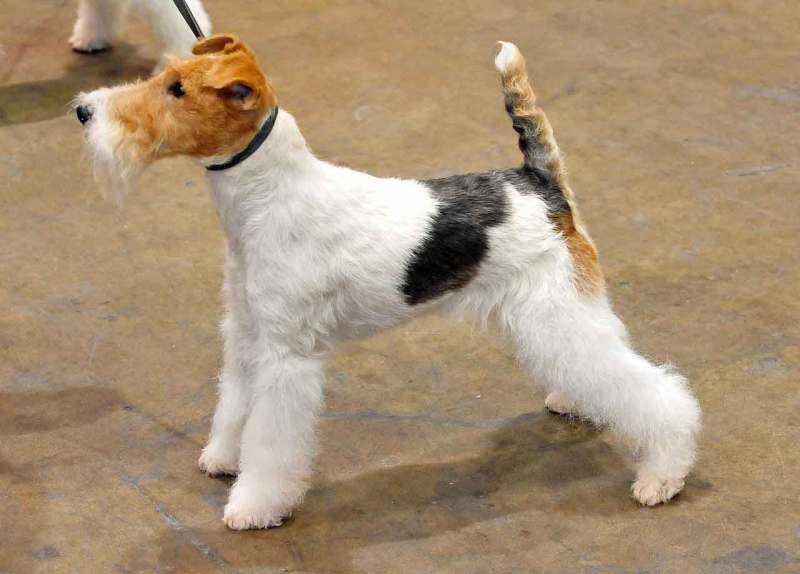
The Fox Terrier (wire) he is an active and happy dog, of small volume in which bones of good substance and great physical strength are combined, never heavy or rough.

Fox Terrier pelo de alambre

Content

Characteristics "Fox Terrier (wire)"

Coexistence is important that you have with your new friend. Before considering the acquisition of a dog of the breed "Fox Terrier (wire)" you know certain factors. Not all breeds of dogs are apt to live in an apartment, you must take into account his character, their need for exercise, their interaction with other pets, their care and if you have small children, their level of tolerance towards them.

Adaptation ⓘ

5,0 of 5 stars (based on 1 review)

friendly dog ​​ⓘ

2,0 of 5 stars (based on 1 review)

hair loss ⓘ

3,0 of 5 stars (based on 1 review)

Affection level ⓘ

5,0 of 5 stars (based on 1 review)

Need for exercise ⓘ

5,0 of 5 stars (based on 1 review)

Social need ⓘ

3,0 of 5 stars (based on 1 review)

Home ⓘ

3,0 of 5 stars (based on 1 review)

Toilet ⓘ

2,0 of 5 stars (based on 1 review)

Friendly with strangers ⓘ

2,0 of 5 stars (based on 1 review)

barking ⓘ

5,0 of 5 stars (based on 1 review)

Health ⓘ

3,0 of 5 stars (based on 1 review)

Territorial ⓘ

5,0 of 5 stars (based on 1 review)

Cat friendly ⓘ

1,0 of 5 stars (based on 1 review)

Intelligence ⓘ

5,0 of 5 stars (based on 1 review)

Versatility ⓘ

3,0 of 5 stars (based on 1 review)

Child friendly ⓘ

5,0 of 5 stars (based on 1 review)

Surveillance ⓘ

5,0 of 5 stars (based on 1 review)

joy ⓘ

5,0 of 5 stars (based on 1 review)

History

Terriers form a large group of dogs. Its name is derived from the Latin "Terra" for earth. So they were dogs for work on the land. The first evidence is given by the ancient Romans. Already in the Middle Ages terriers are described in detail. His homeland is in the British Isles. Terriers existed throughout the country. In the stables they kept the little vermin. Even the big rats were not a problem for them. The hens, pigeons and rabbits protected them from martens and foxes. To keep chasing foxes, the terriers were sent to the trench. They were supposed to get the fox out of the hole. All these tasks required an enthusiastic commitment, special courage, independent thinking and so-called predatory acuity. Terriers were the world champions in the then "sport" of rat biting. They were fearless and with every fiber of their being they strove to do their job to the best of their ability..

We can still experience all of these qualities in our terriers today.. They make the special charm of these dogs. Terriers come in all sizes, but they are mostly quite small dogs up to the Yorkshire Terrier of today. But they were all once very busy working dogs. Most small terriers like Yorkie, the Westie or the Scottish they made their home in the cramped working-class settlements of emerging industry in England or Scotland. Despite her sometimes quite dainty appearance today, they are still whole dogs, yet. They are concise reps with their own heads and bold temperament. Great terriers like him Airedale Terrier they belong to the first service dogs, who worked for the police, customs or army worldwide. Small and medium terriers are still in high demand as hunting dogs, as the Parson Russel Terrier, el Fox Terrier o el German Hunting Terrier.

In times past all terriers formed a large group of dogs, that were especially suited to the tasks mentioned here. Depending on the special field of application or the surface of the earth, formed different regional lines, that nevertheless remained connected to each other. Only modern pedigree dog breeding created dog breeds genetically separate from this, as we know them today. Like this, no less than 34 races, mostly native to England, Ireland, Scotland or Wales. Just the German Hunting Terrier comes from Germany.

Physical characteristics

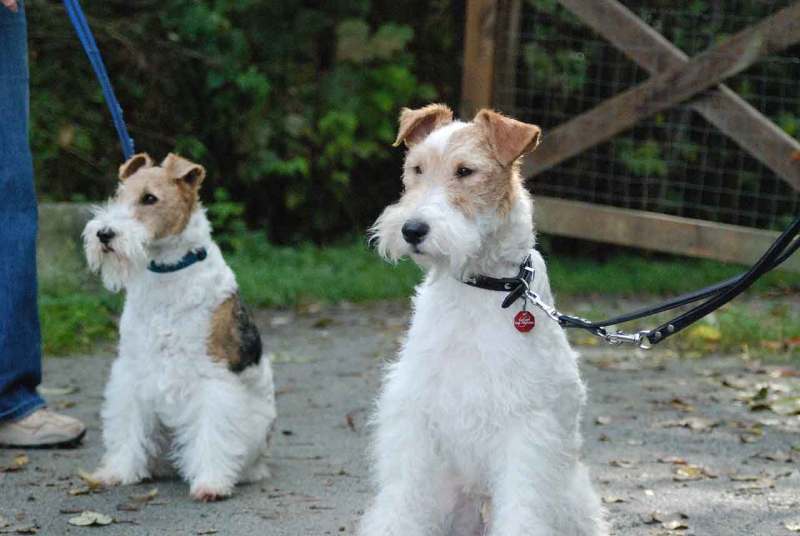
The Fox Terrier (wire) he is an active and happy dog, of small volume in which bones of good substance and great physical strength are combined, never heavy or rough. Its structure presents a perfect balance, particularly with regard to the proportions between the skull and the muzzle, and in the same way between the height at the cross region and the length of the body from the point of the shoulder to the point of the buttock, they look roughly the same. It stands tall like a hunting horse that has a short back and is able to cover a lot of ground.

SIZE AND WEIGHT:

Height to the cross region: It should not exceed 39 cm in males; females are slightly smaller.
The ideal weight of a developed specimen is 8,25 for males; for females it is slightly lower.

Character and skills

Terriers have a concise nature, that distinguishes them all – with a certain restriction also toroidal terriers. They are extraordinarily temperamental dogs that never say no to any adventure.. They are lively, bright, concise. They don't avoid fights. Little ones especially tend to start fights with other dogs of any size due to their chronic overconfidence.. In general, especially the little ones tend to call themselves emperor. This is a challenge for the teacher or caregiver. As construction hunting dogs they are able to make their own decisions, which means they like to be stubborn and stubborn. Terriers can quickly become overbearing if their humans haven't made it clear who determines the house rules.

Videos "Fox Terrier (wire)"

Polin (Fox terrier de pelo duro)
O belo Fox Terrier pêlo duro. The amazing Wirehair Fox Terrier.

They are extremely cooperative and docile. It is a great pleasure to work with them. Terriers are faithful to their humans and are very suitable as family dogs, if your strong personality is not only respected, but also appreciated and acted. Hunting terriers especially are characterized by their intelligence and extraordinary courage. They are even able to search for a draft boar, lower it and then bark without hurting yourself. Of course they still go to the dens of the fox and the badger. Even if the Yorkies are carried on the arm with bows – and they are happy to bear it – even the smallest terrier is essentially a daredevil and not a lapdog. They are bundles of energy that love and need a physical and mental challenge..

Fitness

Keeping a terrier has no problems. They have no demands regarding the size of the apartment. Only grooming is mandatory. The biggest challenge is his temperament. They need physical and mental challenges. Many are very successful hunters. As a companion dog they are suitable for a wide spectrum. Almost all terriers are great for various canine sports. As a running partner, of a cyclist. Your high level of fitness, their often vigorous health and willingness to work mean both a challenge and an obligation to their masters and mistresses.

Like most terriers they have a strong hunting instinct., must be kept on a leash in nature. Terriers are very suitable as playmates for children, They are designed for any kind of fun and are robust enough to play with children.. But, the house rules must be correct and the terrier must know his role in the family. Even the smallest terriers shouldn't have room to live out their overconfidence and become the children's school teacher..

Fox Terrier (wire) Education

Typical terriers can be trained and educated very well.. The clear announcement and the consequence are the miracle words here based on a respectful and loving relationship with the master or caretaker.. Especially with little terriers, education is an often underestimated chapter.. Although they are cute and delicate, they are still a real terrier. They need a consistent education from the puppy's age. Most terriers can be trained on the basis of a good education for the most different tasks..

Fox Terrier (wire) care and health

Terriers are usually very easy to care for. Apart from those with short hair, most terriers need a regular haircut. But they lose comparatively little hair.

Most terriers are in robust health. Exceptions to this rule are temporarily fashionable or outward-facing breeds such as Yorkie, the Westi or the Bedlington Terrier, in whose population copper toxicosis has spread excessively, a disease that attacks the liver. The tendency to dwarf with copies of less than 3 kg, which is particularly notable in the Yorkie, leads to damage that can be described as nurturing torture.

Nutrition / Food

Nutrition is not problematic. But, breeds that are oriented towards outward appearances tend to suffer from allergies, what can make a food diet necessary.

Wire terrier Fox Terrier life expectancy

Life expectancy depends on the size of the dogs. The smallest dogs, but not too small, have a longer life expectancy. as a rule, terriers enjoy a long life as a dog, often over 15 years. Lines bred over generations for "beauty" and especially extremely small specimens, so-called minis dogs, Toy- o Teacup, they usually die much earlier.

Buy a Terrier

It is best to buy your puppy locally from a breeder affiliated with one of the terrier breeding clubs or you can look around the shelters.. Among 1.000 and 1.500 euros must be planned as costs.

Images "Fox Terrier (wire)"

Photos:

1 – Fox Terrier pelo de alambre Uploaded from http://flickr.com/photo/40567541@N08/8504670637
2 – A Wire Fox Terrier. by Pharaoh Hound / CC BY-SA
3 – Photograph of a Wire Fox Terrier sitting down by Walker Whited / CC BY-SA
4 – wo Wire haired Fox Terriers. Listed on Flickr as «Daisy and Gatsby» by Alicia Nijdam / CC BY
5 – Wire Fox Terrier by https://www.flickr.com/photos/paulaloe/140805906/
6 – Fox Terrier Wire dog show Racibórz by I, Lilly M / CC BY-SA

Videos "Fox Terrier (wire)"

Type and recognitions:

  • FCI CLASSIFICATION:
  • Group :
  • Section : . .

Federations:

  • – FCI – Terriers 1 Large and medium-sized terriers. ⓘ
  • – AKC – Dogs working ⓘ
  • – ANKC – Group 6 (utility dogs) ⓘ
  • – CKC – Miscellaneous list ⓘ
  • – ​KC – Working dogs ⓘ
  • – NZKC – Utility dog ⓘ
  • – UKC – Watchdog ⓘ

FCI breed standard "Fox Terrier (wire)"

Origin:
United Kingdom

Date of publication of the valid original standard:
26.03.2009

Use:

Terrier


General appearance:

Alert dog, fast-moving, vivacious expression, always in the expectation of any provocation. Friendly, outgoing and fearless.


Behavior / temperament:

Active and happy dog, of small volume in which bones of good substance and great physical strength are combined, never heavy or rough. Its structure presents a perfect balance, particularly with regard to the proportions between the skull and the muzzle, and in the same way between the height at the cross region and the length of the body from the point of the shoulder to the point of the buttock, they look roughly the same. It stands tall like a hunting horse that has a short back and is able to cover a lot of ground.

Head:

---

Cranial region:
  • Craging: The upper part of the skull is almost flat, slightly sloping and its width gradually decreases towards the eyes.
  • Dnaso-frontal depression (stop): Light.

facial region:

  • Trufa: It must be black.
  • Horcico: There is almost no difference between the length of the skull and the muzzle. If the muzzle is noticeably shorter, the head looks weak and undefined. The muzzle gradually tapers from the eyes to the nose and sinks slightly at its junction with the forehead., but without cupping or abruptly leaning under the eyes where it should be full and well modeled. Puffy, round cheeks are undesirable.
  • Jaws / Teeth: Strong jaws with perfect, regular and complete scissor bite, that is to say, that the internal face of the upper incisors is in close contact with the external face of the lower incisors and the teeth placed perpendicular to the maxilla. Excessive bone or muscle development of the jaws is undesirable and makes it look unpleasant.
  • Ojors: dark, which denote vivacity and intelligence, moderately small and should not be protruding, but as round as possible. Placed not too far apart, not too high in the skull or too close to the ears. The clear color eyes are very undesirable.
  • Obars: Small, “V” shaped, of a moderate thickness, elegantly bent and falling forward near the cheeks. The fold of the ears well above the level of the skull. Ears erect, tulip or rose shaped are very undesirable.

Neck:

crisp, muscular, of moderate length, without jowl; widens towards the shoulders, presenting an elegant curvature when viewed from the side.

Body:

  • Dorrso: Short, straight and strong, no sign of weakness.
  • Itmor: Powerful and slightly arched. The kidney region must be very short.
  • Pecho: Deep, the anterior ribs moderately arched, the posterior ones deep and well arched.

Tail:

Previously the custom was to amputate the tail.

Tips

PREVIOUS MEMBERS: Seen from the front, shoulders lean sharply from their neck junction towards shoulder tips which should be fine; seen from side, they should be long and well inclined obliquely back. The region of the cross always well defined. Deep chest, not wide. Seen from anywhere, members should be straight, with good bone structure in all its extension. Elbows must be perpendicular to the body, not hinder movement and carried straight when the dog is on the move.

LATER MEMBERS: Strong, muscular, without too much angulation. The combination short leg with straight knee is highly undesirable.

  • Thighs: Long and powerful.
  • Rodinllto: Good angulation in the femoral or patellar patellar joints, they should not be turned in or out.
  • Corvejones: Well descended.
  • Metatarsals: Viewed from behind they look straight and parallel.
  • PinIt: Round, compact, with small foot pads, strong and thick; moderately arched fingers; without turning in or out.

Movement:

The fore and hind limbs carried straight forward and parallel. The elbows move perpendicular to the body without interfering with movement. The femoro-tibio-patellar joints (knees) they should not be turned in or out. It has good propulsion power coming from well-angled rear members.

Mantle

Plink: Denso, rough texture, Its length varies from 3/4 inch (2 cm.) on the shoulders to 1 1/2 inch (4 cm.) in the region of the cross; the back, ribs and hind limbs should have a softer, shorter undercoat. The hair on the back and hind limbs is harder than that on the flanks. The hair of the jaws should be curly and long enough to give the snout a strong appearance.. Members' hair must be thick and frizzy.

Colorr: White with black spots should predominate, black and leonado or leonado. Brindle color spots, red, liver or slate blue are undesirable.


Size and weight:

Alturto the region of the cross:

It should not exceed 39 cm. (15 1/2 inches) in males; females are slightly smaller.

The ideal weight of a developed specimen is 8,25 kg (18 English pounds) for males; for females it is slightly lower.


Fouls:

Any deviation from the aforementioned criteria is considered as a fault and the severity of this is considered to the degree of the deviation to the standard and its consequences on the health and well-being of the dog..

FALTAS DISQUALIFYING:

  • Aggressiveness or extreme shyness.
  • Any dog ​​showing clear signs of physical or behavioral abnormalities must be disqualified..


N.B.:
    • Males should have two normal-appearing testicles fully descended into the scrotum..
    • Only functionally and clinically healthy dogs, with the typical conformation of the breed, should be used for parenting.

TRANSLATION: Lic. O. Valverde Calvo (Costa Rica) and Jorge Nallem (Uruguay).

Source: F.C.I - International Cynological Federation

Alternative names:

1. Wire hair fox terrier, Wirehaired terrier, Fox terrier, Wire, WFT (English).
2. Fox-terrier à poil dur (French).
3. Wirehaired terrier (German).
4. Fox terrier de pelo duro (Portuguese).
5. Wire hair fox terrier, Wirehaired terrier, Fox terrier (español).

▷ The world of Pets: Dogs, cats, birds, reptiles, amphibians

Fox Terrier Smooth
Gran Bretañaa FCI 12 - Large and medium sized Terriers

Non-hunters who want to keep Fox Terrier as a pure companion dog, they must divert their innate hunting instincts with the sports and games of dogs

Content

History

The first fox terrier, which were first presented at an English dog show in the mid-19th century, they were almost white dogs, especially suitable for fox hunting. Due to his courage, their endurance and ability to track and reach the foxes hidden in their burrow, little terriers soon found a large following among England's hunting and dog lovers. thanks to his physique, the intrepid dogs were able to get into the tubes Fuchsbau narrower. The purpose of breeding for fox hunting was also always the main focus when selecting suitable breeding dogs and ultimately gave the dogs their breed name Fox Terrier. (Fox = Zorro, terre = Earth).

In 1876 the newly founded Fox Terrier Club introduced the first breed standard for the Fox Terrier. Today the FCI distinguishes two variants of the Fox Terrier: the Fox Terrier Smooth and the Fox Terrier (wire). Although both types of dogs only differ in the structure of their coat, are kept separately.

At the beginning, the straight hair variant of the fox terrier was much more popular than the Fox Terrier (wire). But, this changed in the decade of 1920, when a real boom developed around the Fox Terrier (wire) and the “practical” little dog became the new “fashion dog” for fine ladies. Unfortunately, often forgot that the Fox Terrier was originally bred as a hunting dog and that the animals still possessed a lot of courage, hunting instinct and a certain sharpness.

Lack of education and inappropriate attitude gave dogs, who liked to dig gardens and seldom avoided a fight with other dogs, the reputation of being scathing and aggressive. In the middle of the last century, the number of entries in the breeding book, especially from Fox Terrier (wire), noticeably decreased. Today, twice as many are born Fox Terrier Smooth that the Fox Terrier (wire). Today, the traditional english dog in both variants belongs to the rather rare dog breeds.

Physical characteristics

The body of a Fox Terrier Smooth is compact and muscular, built for speed and agility. The dog has a short body but a long, elegant face with ears that bend toward the cheeks.. The height of this breed should not exceed 39 cm in males; slightly less in females and its weight ranges from seven to eight kilograms.

The coat of a Fox Terrier Smooth is short, flat against the body and dense. Normally, the hair covers the belly and the inner thighs too. Coat color is predominantly white with black and tan markings.

Character and skills

In agility, the Fox Terrier straight hair is in its element. The vivacious little terrier loves to move around and use his cute head. No wonder he never tires of dog sports like agility, obedience and flyball. Lying on the couch and lounging is definitely a thing of the past for smooth-haired Fox Terrier owners..

Daily exercise and recovery games, jogging together or hiking boots, wheels or horse, during which the persevering four-legged friend can accompany you, should definitely be on the show with a Fox Terrier Smooth.

The Fox Terrier usually gets along very well with children, after all they share their need to play and exercise. Active families who like to be outdoors will find a lively playmate and a loyal companion in the English Terrier.

A valuable companion for hunters and non-hunters

Though, like most dog breeds, Today it is kept primarily as a family and companion dog., the Fox Terrier still has a good figure when hunting. The versatile hunting dog can be used to build and rummage, to recover, to search or even to work in the water. His desire to work, his courage and vigilance make him an invaluable hunting companion. Non-hunters who wish to keep the Fox Terrier as a pure companion dog, they must divert his innate hunting instinct with dog sports and games and thus offer him a suitable alternative occupation.

Fox Terrier Smooth education

The Terrier have a reputation for having a mind of their own – the Fox Terrier Smooth is no exception. In case of lack of orientation and carelessness on the part of humans, smart four-legged friend likes to take command, normally not to the delight of his two-legged roommates. A consistent and early education is essential for a harmonious coexistence with the fox terrier. But, if you take your time, knows the most important basic rules of dog training while giving your dog enough mental and physical exercise, you'll have little trouble with this little bundle of power. The Fox Terrier not only is he smart, but also very docile and people-oriented.

Fox Terrier smooth hair health and care

Basically, the Fox Terriers they are considered very robust and healthy dogs. Ocular diseases occasionally occur. There is also a certain predisposition to neurological diseases such as ataxia and myelopathy, which can lead to destruction of the spinal cord. With responsible upbringing, a healthy diet, lots of exercise and proper care for each species, the risks of possible illness can, fortunately, reduce.

The Fox Terrier Smooth they have a clear advantage over their relatives, the Fox Terrier (wire). While the Fox Terriers wire hair need a professional cut, regular brushing is enough to preserve the beautiful coat of the Fox Terrier Smooth. But, How fox terriers don't like to "stay still", you should get your dog used to brushing as early as puppyhood.

Nutrition as needed and careful care play an important role in maintaining the health of dogs. Needs-based means that the diet must be age-adapted, dog's weight and range of motion. The Fox terrier They are extremely sporty and active dogs and generally need a high energy diet with lots of high quality meat and vegetables..

Buy Fox Terrier Smooth

If you are interested in a Fox Terrier Smooth, you must first inform yourself thoroughly about the characteristics of this breed. The Fox Terrier Smooth they are extremely temperamental and demanding dogs, who need consistent handling. A reputable breeder will ask you about your ideas and goals for dog breeding and, if required, will advise you not to buy a fox terrier. In this case, don't look for the next best seller, but carefully reconsider your reasons for buying a fox terrier.

A purebred puppy should only be purchased from a reputable breeder whose dogs have been tested for possible hereditary diseases and other criteria of suitability for breeding before use. Puppies go on sale at the earliest between the eighth and tenth week of life. The price of the puppy varies between 850 and 1.500 euros and depends on the sporting aptitude and the breeding value of the parents.

It is important that you know the exact needs of your dog and that you are familiar with the nutritional value of different foods.; both a deficiency and an oversupply of certain substances can cause serious health problems. Alternatively, you can feed your fox terrier with high-quality wet or dry food. Convince yourself of the quality of the processed ingredients and make sure that unhealthy additives such as sugar or artificial flavor enhancers have been avoided. You should also avoid too high a grain content in the food.

Characteristics "Fox Terrier Smooth"

Coexistence is important that you have with your new friend. Before considering the acquisition of a dog of the breed "Fox Terrier Smooth" you know certain factors. Not all breeds of dogs are apt to live in an apartment, you must take into account his character, their need for exercise, their interaction with other pets, their care and if you have small children, their level of tolerance towards them.

Adaptation ⓘ

5,0 of 5 stars (based on 1 review)

friendly dog ​​ⓘ

2,0 of 5 stars (based on 1 review)

hair loss ⓘ

3,0 of 5 stars (based on 1 review)

Affection level ⓘ

5,0 of 5 stars (based on 1 review)

Need for exercise ⓘ

5,0 of 5 stars (based on 1 review)

Social need ⓘ

3,0 of 5 stars (based on 1 review)

Home ⓘ

2,0 of 5 stars (based on 1 review)

Toilet ⓘ

2,0 of 5 stars (based on 1 review)

Friendly with strangers ⓘ

2,0 of 5 stars (based on 1 review)

barking ⓘ

5,0 of 5 stars (based on 1 review)

Health ⓘ

3,0 of 5 stars (based on 1 review)

Territorial ⓘ

5,0 of 5 stars (based on 1 review)

Cat friendly ⓘ

1,0 of 5 stars (based on 1 review)

Intelligence ⓘ

5,0 of 5 stars (based on 1 review)

Versatility ⓘ

3,0 of 5 stars (based on 1 review)

Child friendly ⓘ

5,0 of 5 stars (based on 1 review)

Surveillance ⓘ

5,0 of 5 stars (based on 1 review)

joy ⓘ

5,0 of 5 stars (based on 1 review)

Images "Fox Terrier Smooth"

Photos:

1 – Smooth Fox Terrier by publicdomainpictures.net
2 – Fox Terrier pelo liso by needpix.com
3 – Fox Terrier pelo liso by https://pxhere.com/es/photo/738534
4 – Vos Spits (born in March 2006) in action by Piet ter Beek / Public domain
5 – Fox Terrier pelo liso by https://pxhere.com/es/photo/1617503
6 – Smooth Fox Terrier from «Czeczuga» Poland by Piotr Pietryka / CC BY-SA

Videos "Fox Terrier Smooth"

Type and recognitions:

  • FCI CLASSIFICATION:
  • Group :
  • Section : . .

Federations:

  • – FCI – Terriers 1 Large and medium-sized terriers. ⓘ
  • – ​KC – Working dogs ⓘ

  • FCI breed standard "Fox Terrier Smooth"

    Origin:
    United Kingdom

    Date of publication of the valid original standard:
    30.10.2016.

    Use:

    Terrier


    General appearance:

    Active and happy dog, where bones of good substance and great physical strength are combined in a compact package, never heavy or rough. It should not be leggy or very short of limbs, and should stand up like a hunting horse with a short back and able to cover a lot of ground.


    Behavior / temperament:

    Active, fast-moving, vivacious expression, always on the lookout. Friendly, extrovert and fearless. Friendly, extrovert and fearless.

    Head:

    ---

    Cranial region:
    • Skull: Flat and moderately narrow, wide which gradually decreases towards the eyes.
    • Depression links (Stop): Small apparent stop.

    facial region:

    • Truffle: black.
    • Snout: Jaws, Superior and inferior, they are strong and muscular, leaning slightly below the eye This part of the anterior face should be moderately molded, so that it does not descend in a straight line like a wedge.
    • Jaws/Teeth: Strong jaws with perfect, regular and complete scissor bite, that is to say, that the internal face of the upper incisors is in close contact with the external face of the lower incisors and with the teeth placed perpendicular to the maxilla.
    • Cheeks: They should not be outgoing.
    • Eyes: dark, moderately small, as round as possible but not prominent. Of alert and intelligent expression.
    • Ears: Small and “V” shaped, falling forward close to the cheeks and never on the sides of the head. The fold of the ear should be above the level of the skull. Ears should be of moderate thickness.

    Neck:

    crisp, muscular and without dewlap. Of moderate length and gradually widening towards the scapulae.

    Body:

    • Dorrso: Short, straight and firm with no hint of weakness.
    • Kidney region: Powerful, very slightly arched.
    • Chest: Deep without being wide.

    Tail:

    Previously the custom was to amputate the tail.
    • Amcouldtthere is: Rather high insertion, erect, without curving on the back or curled. Of good power.
    • Sinn amputation: Rather high insertion, erect, without curving on the back or curled. As straight as possible. Tail of moderate length to maintain a good balance with the rest of the dog.


    Tips

    PREVIOUS MEMBERS:

    • Shoulder: Long and well sloped back, fine at their ends and well defined in the region of the cross.
    • Arm: Limbs should appear straight when viewed from any angle with little or no ankle pointing forward. Strong bones..
    • Previous feet: Small, round and compact, with firm and hard pads, and with moderately arched fingers, without turning in or out.

    LATER MEMBERS:

    • General appearance: Strong and muscular, without too much angulation.
    • Thighs: Long and powerful.
    • Knees: good angulation.
    • Metatarsus: Hocks well lowered
    • Hind feet: Small, round and compact, with firm and hard pads, and with moderately arched fingers, without turning in or out.

    Movement:

    The fore and hind limbs carried straight forward and parallel. The elbows move perpendicular to the body without interfering with movement, the femoro-tibio-patellar joints should not be turned in or out and the hocks should not be joined. Good propulsion power coming from very flexible rear members.

    Mantle

    Fur: Smooth, flattened, short, hard, dense and abundant. The belly and inner thighs must be covered with hair.

    Colorr: White predominates: the total white, white with tan spots, black and tan or black spots. Tabby spots, red or liver colored are highly undesirable.


    Size and weight:

    Height to the cross: Not exceeding 39 cm in males; slightly less in females.

    Weight:

    • Males: 7,5 – 8 kg.
    • females: 7 – 7,5 kg.


    Fouls:

    Any deviation from the aforementioned criteria is considered as a fault and the severity of this is considered to the degree of the deviation to the standard and its consequences on the health and well-being of the dog..

    FALTAS DISQUALIFYING:

    • Aggressiveness or extreme shyness.
    • Any dog ​​showing clear signs of physical or behavioral abnormalities must be disqualified..


    N.B.:
    • Males should have two normal-appearing testicles fully descended into the scrotum..
    • Only functionally and clinically healthy dogs, with the typical conformation of the breed, should be used for parenting.

    Itlatest changes are in bold.

    TRANSLATION: Brígida Nestler / Original version: (IN)

    Technical supervision: Miguel Angel Martinez.

    Last revision: Jorge Nallem.

    Source: F.C.I - International Cynological Federation

    Alternative names:

    1. Fox Terrier, Smooth Fox Terrier, Foxie, SFT (English).
    2. Fox-terrier à poil lisse (French).
    3. Glatthaar-Foxterrier, Foxterrier (Glatthaar) (German).
    4. Fox terrier de pelo liso (Portuguese).
    5. Fox terrier ratonero (español).

▷ The world of Pets: Dogs, cats, birds, reptiles, amphibians

Cesky Terrier
República Checa FCI 246 . Small sized Terriers

The lively «Cesky Terrier» He is small and like any terrier, loves to dig.

Terrier Checo

Content

Characteristics "Cesky Terrier"

Coexistence is important that you have with your new friend. Before considering the acquisition of a dog of the breed "Cesky Terrier" you know certain factors. Not all breeds of dogs are apt to live in an apartment, you must take into account his character, their need for exercise, their interaction with other pets, their care and if you have small children, their level of tolerance towards them.

Adaptation ⓘ

3,0 of 5 stars (based on 1 review)

friendly dog ​​ⓘ

1,0 of 5 stars (based on 1 review)

hair loss ⓘ

2,0 of 5 stars (based on 1 review)

Affection level ⓘ

4,0 of 5 stars (based on 1 review)

Need for exercise ⓘ

3,0 of 5 stars (based on 1 review)

Social need ⓘ

3,0 of 5 stars (based on 1 review)

Home ⓘ

3,0 of 5 stars (based on 1 review)

Toilet ⓘ

4,0 of 5 stars (based on 1 review)

Friendly with strangers ⓘ

2,0 of 5 stars (based on 1 review)

barking ⓘ

3,0 of 5 stars (based on 1 review)

Health ⓘ

2,0 of 5 stars (based on 1 review)

Territorial ⓘ

5,0 of 5 stars (based on 1 review)

Cat friendly ⓘ

3,0 of 5 stars (based on 1 review)

Intelligence ⓘ

4,0 of 5 stars (based on 1 review)

Versatility ⓘ

2,0 of 5 stars (based on 1 review)

Child friendly ⓘ

3,0 of 5 stars (based on 1 review)

Surveillance ⓘ

3,0 of 5 stars (based on 1 review)

joy ⓘ

5,0 of 5 stars (based on 1 review)

History

The Cesky Terrier is a small dog characterized by a long head, dull, wedge-shaped with a face bearded, floppy ears, a body and a long coat, silky gray.

In 1949, The breeder Scottish Terrier And avid fontisik hunter Horak of what is now the Czech Republic crossed its Scottish with the «Sealyham terrier»To create what would become the" Czech Terrier ", an elegant pack hunting terrier with a long coat, soft and silky.

Horak loved hunting skills of their Scottish Terriers and personality of the Sealyham Terrier, but not the white coat Sealyham. He believed that breeding the two would produce a dog that would get along while hunting in packs..

Horak dogs were crossed for the first time a Scottish terrier bitch named Donka Lovuzdar, which it was both a hunting dog as a dog conformation show, and Sealyham called Buganier Urquelle, who belonged to a Sealyhams hunting pack. In selecting the features he wanted (a dog that could go hunting on a Friday and that could be easily washed and brushed and he was ready to compete in exhibitions recognition on Saturday and Sunday), the Cruze was a dog with excellent olfactory abilities and a fur gray soft. He designed a haircut with scissors that showed the muscle and the soft fur of the "Czech Terrier" and gave it a thin appearance.

Horak's documentation of the dogs' pedigrees and the crosses he made make him one of the rare breeds that can be traced back to its founders..

Physical characteristics

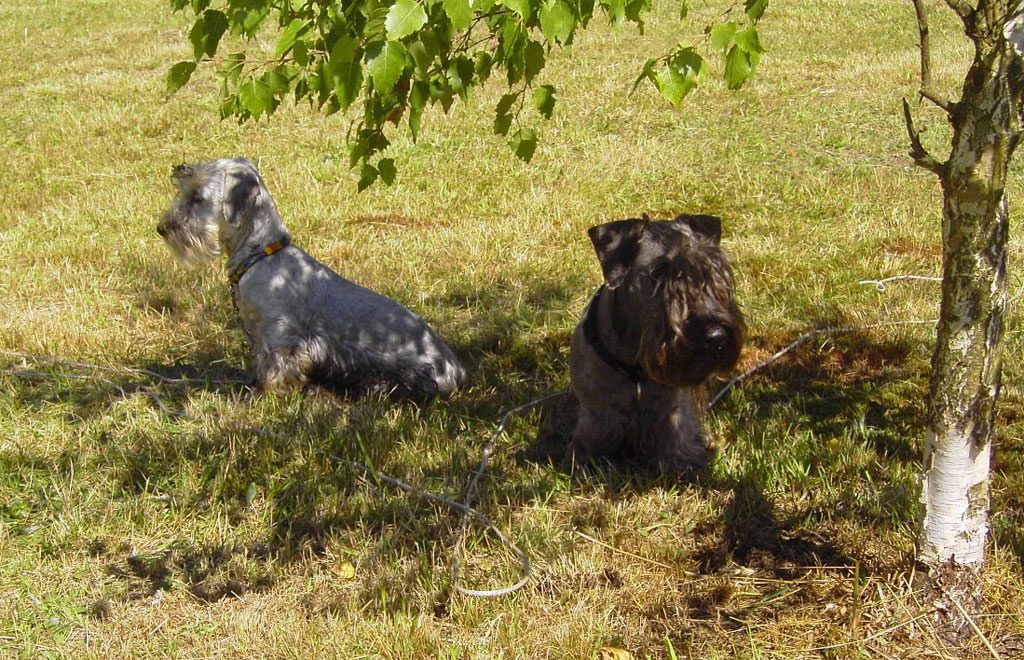
The "Czech Terrier" is a very muscular hunter terrier, short-legged, well pigmented, rectangular format. It has floppy ears and sports long fur., thin but solid, slightly wavy, with a silky sheen, not too filling.

The coat comes in two color varieties: grey blue (to the puppies are born black) and light brown (to the puppies are born dark brown, chocolate). In both color varieties yellow markings allowed, gray or white.

The "Czech Terrier" is longer than high with a upper line that rises slightly backwards.

They are relatively similar to those of Sealyham terrier and the Scottish Terrier.

The height to the cross is of 25 to 32 cm. (ideal 29 cm for males, 27 cm for females).
The weight must be between 7 and 10 kg.

Character and skills

Like all races, The "Czech Terrier" is not suitable for everyone. It may be quieter than some breeds of Terrier, but still a Terrier. A "Czech Terrier" puppy is a very difficult dog to drive, with lots of energy. These small Terrie likes to hunt and dig them, and they need daily exercise in a safe playground. He will chase a ball and recover, and likes to go for a walk. They do not like to be left alone for long periods and can become annoying barkers if they do not have regular activity and company to channel their energy.. The "Czech Terrier" enjoys and stands out in agility and tracking.

Dog nature always on alert, their wariness of strangers and deep and loud barking it an excellent watchdog. He is loyal to his owner, but lack of socialization during puppyhood can do more reserved or even fearful of strangers. Your new puppy needs daily walks and trips to places suitable for dogs so you can meet people and see, smell and hear new things.

Like most terriers, The "Czech Terrier" can be stubborn. That does not mean it is intelligent, but will have to use patience and guile to train. Make training sessions are short and fun. Use lots of praise and rewards as games and goodies when you do something you like. Always I am firm and consistent in what you ask for that not to be confused with what you want or think you can get away with it. But, is sensible, so avoid harsh corrections. You must be able to convey his displeasure through the expression and tone of voice, never screaming or hitting.

Start training your puppy the day you bring him home. Even at eight weeks old, He is able to absorb everything you can teach. Don't wait until you have 6 months to start training him or you'll have to deal with a more stubborn dog. If possible, Take it to a trainer for puppies when you have between 10 and 12 weeks to socialize. But, Note that many kinds of training puppies require certain vaccinations (such as kennel cough) stay up to date, and many veterinarians recommend limited exposure to other dogs and public places until puppy vaccinations (including rabies, distemper and parvovirus) They are completed. Instead of formal training, You can start training your puppy to socialize at home and among family and friends until their complete vaccination.

Talk to the breeder, It describes exactly what you are looking for a dog and asks for help to select a puppy. Breeders see puppies daily and can make incredibly accurate recommendations once they know a little about your lifestyle and personality.. Regardless of what you want from a "Czech terrier", look for one whose parents have pleasant personalities and has been well socialized from the first stage of the puppy.

Did you know??

The "Czech Terrier" is one of those races developed to work a certain type of land: in your case, the forests of Bohemia. Prey ranging from duck and pheasant to the fox, the rabbit and the boar.

Health of the "Czech Terrier"

All dogs have the potential to develop genetic health problems, just as all people have the potential to inherit diseases. Avoid any breeder who does not offer a health guarantee on puppies., to tell you that race has no known problems, or whose puppies are isolated from the main part of the home for health reasons. A reputable breeder will be honest and open about breed health problems and how often they occur in their lines..

Having said that, The "Czech Terrier" is a healthy race. One of his races base, el Sealyham Terrier, it may have an eye condition called dislocation of the lens, so it is recommended that your eyes are examined annually Terrier.

Some "Czech Terrier" can develop a hereditary condition called Scottie Cramp, occasionally it affects the gait of the dog. Usually it is not serious.

Remember that after bringing a new puppy home, You have the power to protect one of the most common health problems: the obesity. Keeping a "Czech terrier" with adequate weight is one of the easiest ways to prolong their life. Take advantage of the full potential of prevention to help ensure a healthier dog for life.

"Czech Terrier" images

credits:

1. Cesky terrier Terrier checo by ceskyfreund36 / CC0
2. Cesky terrier by https://pxhere.com/es/photo/1039221
3. English-Terrier – bitche during the international dogs show in Katowice, Poland by Pleple2000 / CC BY-SA
4. Cesky terrier by https://pxhere.com/es/photo/1391429
5. Cesky terrier on a stone forest by trees ceskyfreund36 / CC0
6. Cesky Terrier during dogs show in Katowice, Poland by Lilly M / CC BY-SA
7. English-Terrier – bitche during the international dogs show in Katowice, Poland by Pleple2000 / CC BY-SA

"Czech Terrier" videos

Type and recognitions:

  • FCI CLASSIFICATION:
  • Group :
  • Section : . .

Federations:

FCI ⓘ, AKC ⓘ, ANKC ⓘ, CKC ⓘ, ​KC ⓘ, NZKC ⓘ, UKC ⓘ

FCI breed standard Cesky Terrier

FCIFCI - Cesky Terrier
Terrier

Alternative names:

1. Bohemian Terrier, Český Teriér (English).
2. Cesky Terrier (French).
3. Böhmischer Terrier, Český Teriér(German).
4. Ceský Teriér (Portuguese).
5. Cesky Terrier (español).

▷ The world of Pets: Dogs, cats, birds, reptiles, amphibians

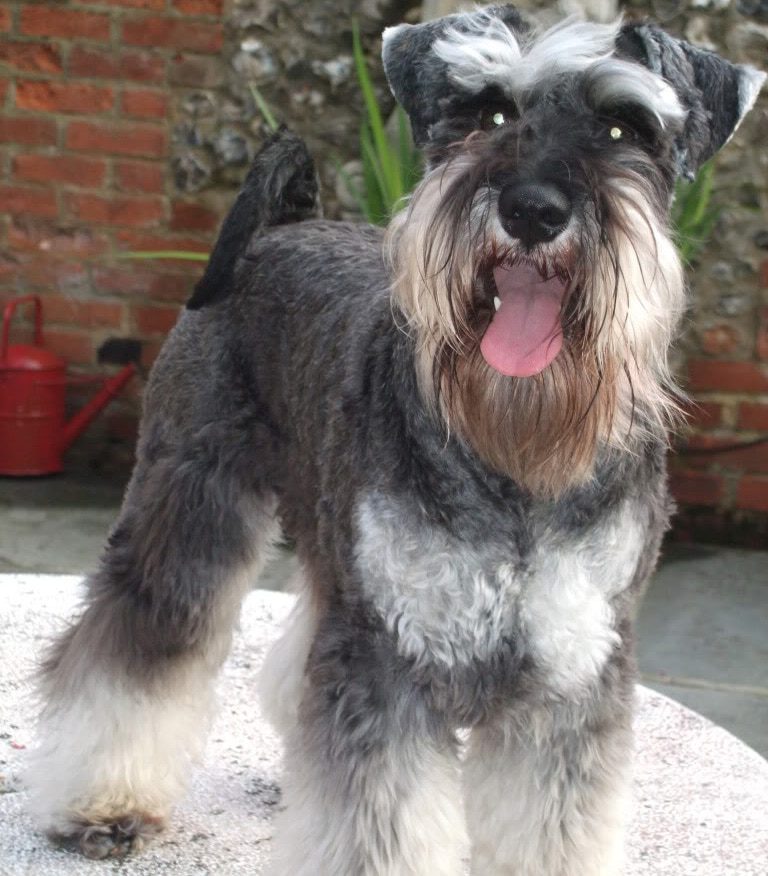
Standard Schnauzer
Alemania FCI 182 . Pinscher and Schnauzer type

Schnauzer Mediano

Starting at the Standard Schnauzer the other two varieties were developed (Giant and Enano)

Content

History

The Standard Schnauzer (standard) It is the original race of the three Schnauzer breeds, and despite his fur and aspect in general, This is not related to the English Terrier. This is one of the oldest breeds in Europe. This race is beautiful, robust, square build and medium-sized with a similar aristocratic, This was the favorite breed of Albrecht Dürer and Rembrandt.

In his country of origin he is known as Mittelschnauzer (Standard Schnauzer) to distinguish it from the giant form and the form miniature.

Regardless of the origin of the breed, It should be noted that the racial standard of the Schnauzer was set for the first time in the year 1880, and in the year 1885 the first breed club was established in Germany. He had to wait 40 more years, to be made in United States (1925).

The name of Schnauzer is given to the breed for its first appearance in public in a show contest.. This contest (Hannover 1879) won it a dog presented as wire-haired Pinscher. The winner can be called Schnauzer («bigotudo») and thereafter, all the wire-haired Pinscher have received the name of Schnauzer.

The classification of the Schnauzer has always brought controversy, because that is what you don't want to classify as Terrier, likely as not being a race that cace as dog's burrow. The controversy is that dogs as the Manchester Terrier they are classified as Terrier and are, as it is the case of the above-mentioned, the prototype of the dog buzzard without being trained for hunting dog's burrow.

Physical characteristics

The Standard Schnauzer has a rough coat, with colors ranging from 'salt and pepper' to solid black.

The hair on the face is extended to form a beard and eyebrows. The race is robust, and must be "heavy" for its height with lots of muscle and bone.

The ideal ranges of the weight and of the height vary, considerably, from a standard race which is as follows: The males range between 45 and 50 cm of high cross and usually weigh between 15.5 and 22.5 kg. The females measure between 42.5 and 47.5 High Cross and usually weigh between 13.5 and 20.2 kg).

In United States, most dogs have cropped ears and tails.

Traditionally, the ears they are cut and the tail as well. But, in many European countries and in Australia, ear and tail docking is prohibited and dogs show off their natural ears and tails.

Character and skills

It's a race that, similar to the German Pinscher, It was created for the extermination of vermin on farms, Although he didn't mention in other tasks, becoming a multi-purpose dog. They included the roles played by the Schnauzer, driving cattle.

It´s jealous, It loving and a good former. All varieties of Schnauzer have a character that is described as impetuous, strong but very balanced.

Love your family, they are safe and affable with children and rather distrustful with strangers.

Schnauzer Health

All dogs have the potential to develop genetic health problems, just as all people have the potential to inherit a particular disease. Run, do not walk, from any breeder that does not offer a health guarantee on puppies, to tell you that the breed is 100 percent healthy and has no known problems, or tell you that your puppies are isolated from the main part of the home for health reasons. A reputable breeder will be honest and open about the breed's health problems and the incidence with which they occur in their lines..

Some of the conditions that affect standard Schnauzers include hip dysplasia; eye problems (including cataracts and retinal dysplasia); a heart condition known as pulmonary stenosis; hipotiriodismo; Hemophilia (a bleeding disorder); and bladder stones.

Not all of these conditions are detectable on a growing puppy, and it can be difficult to predict whether an animal will be free of these diseases, so a reputable breeder must be found who is committed to raising the healthiest animals possible. Must be able to produce an independent certification that the parents of the dog (and grandparents, etc.) have been screened for these defects and considered healthy for breeding. That's where health records come in..

Remember that after bringing a new puppy home, has the power to protect you from one of the most common health problems: the obesity. Maintaining a standard Schnauzer at the right weight is one of the easiest ways to extend your life.. Make the most of your preventive skills to help ensure a healthier dog for life.

Characteristics "Standard Schnauzer"

Coexistence is important that you have with your new friend. Before considering the acquisition of a dog of the breed "Standard Schnauzer" you know certain factors. Not all breeds of dogs are apt to live in an apartment, you must take into account his character, their need for exercise, their interaction with other pets, their care and if you have small children, their level of tolerance towards them.

Adaptation ⓘ

3,0 of 5 stars (based on 1 review)

friendly dog ​​ⓘ

4,0 of 5 stars (based on 1 review)

hair loss ⓘ

2,0 of 5 stars (based on 1 review)

Affection level ⓘ

4,0 of 5 stars (based on 1 review)

Need for exercise ⓘ

4,0 of 5 stars (based on 1 review)

Social need ⓘ

4,0 of 5 stars (based on 1 review)

Home ⓘ

3,0 of 5 stars (based on 1 review)

Toilet ⓘ

4,0 of 5 stars (based on 1 review)

Friendly with strangers ⓘ

2,0 of 5 stars (based on 1 review)

barking ⓘ

5,0 of 5 stars (based on 1 review)

Health ⓘ

1,0 of 5 stars (based on 1 review)

Territorial ⓘ

5,0 of 5 stars (based on 1 review)

Cat friendly ⓘ

4,0 of 5 stars (based on 1 review)

Intelligence ⓘ

5,0 of 5 stars (based on 1 review)

Versatility ⓘ

5,0 of 5 stars (based on 1 review)

Child friendly ⓘ

4,0 of 5 stars (based on 1 review)

Surveillance ⓘ

5,0 of 5 stars (based on 1 review)

joy ⓘ

5,0 of 5 stars (based on 1 review)

Images Standard Schnauzer

Standard Schnauzer Videos

Photo: davolvoreta

Type and recognitions:

  • FCI CLASSIFICATION:
  • Group :
  • Section : . .

Federations:

  • – FCI – Pinscher and Schanuezer dogs. Molossian type Dogs and Swiss Mountain and Cattle Dogs. , Section 1: Pinscher and Schnauzer. ⓘ
  • – AKC – Dogs working ⓘ
  • – ANKC – Group 6 (utility dogs) ⓘ
  • – CKC – Group 3 – Working dogs ⓘ
  • – ​KC – Working dogs ⓘ
  • – NZKC – Utility dog ⓘ
  • – UKC – Watchdog ⓘ

FCI breed standard "Standard Schnauzer"

Origin:
Germany

Date of publication of the valid original standard:
06.03.2007

Use:

Guard and company


General appearance:

Medium size, vigorous, more compact than thin, rough-haired.


IMPORTANT PROPORTIONS<

  • Square construction, where the height at the withers corresponds more or less to the length of the body.
  • The length of the head (from the tip of the truffle to the occipital protuberance) is related to the length of the body (measured from withers to insertion of tail) approximately in a proportion of 1:2.


Behavior / temperament:

His typical traits are his confident temperament and his circumspect tranquility.. Especially notable is his good character., his joy for games and his proverbial attachment to his master. He loves children very much, it is unbribable guardian, although not noisy. Highly developed sense organs, prudence, great ability to be polite, fearlessness, perseverance and great power of rapid recovery against illnesses and climate changes, They give the Schnauzer all the assumptions that a utility dog ​​must have to be a great family dog., company and utility.

Head:

---

Cranial region:
  • Skull: Strong and elongated, with the back of the little marked head. The head must correspond to the overall strength of the dog. The forehead is flat and paralelaa the nasal helm, without wrinkles.
  • Depression links (stop): Well differentiated between the eyebrows

facial region:

  • Truffle: Well developed with wide open windows. It is always black.
  • Snout: It ends in the shape of a truncated wedge. The nasal cannula is straight.
  • Lips: Blacks, rest firm and plans on the jaws; the corner of the mouth is closed.
  • Jaws/Teeth: Powerful upper jaw and lower. The bite is scissors, strong and full (42 clean, white teeth according to tooth formula of the dog).  It should close well. The chewing muscles are strongly developed without this, exaggerated cheeks spoil the rectilinear appearance of the head (with beard).
  • Eyes: Medium-sized, oval, directed forward, dark, with lively expression. Adherent eyelids.
  • Ears: Bent and falls, high insertion, “V” shaped; the inner edges of the ears rest on the cheeks. The bearing of the ears is symmetrical. They are directed forward towards the temple. The parallel fold should not exceed the top line of the skull.

Neck:

The neck is strong, muscular and maintained arched. The neck slides harmonically to the cross. Strongly inserted, is narrow, noble postage, contributing to the vibrant and elegant appearance. The skin of the throat is adherent and without dewlap.

Body:

  • top line: Slightly descending from the cross back.
  • Cross: It is the highest point of the top line.
  • Back: Strong, short, firm.
  • Pork loin: Short, strong, deep. The distance from the last rib to the hip is short so that the dog appears compact.
  • Rump: Slightly rounded, going unnoticed by the insertion of the tail.
  • Breast : Moderately wide, oval cut, deep up to elbows. The apron is especially marked by the tip of the sternum.
  • bottom line: Flanks not excessively gathered so as to provide a nice wavy line along the lower part of the thorax..

Tail:

Natural, the goal being to make it Sabre or sickle-shaped.

Tips

PREVIOUS MEMBERS: The forelimbs are, seen from the front, vigorous, straight and placed not too close together. Seen side forearms are straight.

  • Shoulder: The scapula is firmly resting on the chest. Well muscled on both sides of the spine of the bone, It protrudes above the vertebrae of the spine in its thoracic section. Tilted as much as possible and leaned back, makes an angle of 50º with the horizontal.
  • Arm: Well on the body, strong and muscular; forms an angle of more or less 95º to 105º with the scapula.
  • Elbows: Tight, not rotated or outward or inward.
  • Forearm: Straight seen from either side, strongly developed and well muscled.
  • Carpo: Strong and stable. Its structure barely stands out from the forearm.
  • Metacarpus: Straight seen from the front; profile slightly oblique to the floor, strong and slightly elastic.
  • Front feet: Short and round; fingers pinched each others and arched (cat feet); nails short and dark colour and strong pads.

LATER MEMBERS: Views of oblique profile; from the back, they are parallel and not too close together.

  • Thigh: Moderately long, width and heavily muscled.
  • Knee: Must not be turned neither inward nor outward.
  • Leg: Long and strong, sinewy, continuing in a powerful Hock.
  • Hock: Well angled, strong, firm, not turned neither inward nor outward.
  • Metatarsus: Short and perpendicular in relation to the floor.
  • Rear feet: Short fingers, arched and tightened a few others ; nails short, black.

Movement:

Elastic, elegant, agile, free and with good coverage of land. The forelimbs are stretched forward as much as possible and the hindlimbs – with good elastic reach- they give the necessary propulsion. The front side and back on the other side simultaneously moving forward. Back, ligaments and joints are firm.

Mantle

  • SKIN: Tight throughout the body
  • HAIR: The hair should be hard, wiring and bushy. It is composed by a dense internal NAP and an outer layer (that it can never be too short) hard and well glued hair all over the body. The hair of the outer layer is rough, of sufficient length, to be able to test its texture, Neither ogres nor wavy.
  • The hair on the limbs tends not to be as coarse. On the forehead and ears it is short. Typical features are, on the snout, the beard, that should not be too soft and bushy eyebrows that make eye shadow.

COLORS

  •  Pure black with black interior NAP
  • Salt and pepper

For salt and pepper, the breeding objective is to obtain a medium tone with equal distribution of well-pigmented pepper color with gray undercoat.. Shades ranging from dark steel gray to silver gray are accepted. All colors must have a dark mask that underlines the expression and is in harmony with the color of the respective hue. White spots on the head, in the chest or the members are unwanted.


Size and weight:

HEIGHT AT THE WITHERS

  •  Males and females: 45 until 50 cm..

WEIGHT

  •  Males and females: 14 until 20 kg.


Fouls:

Any deviation from the aforementioned criteria is considered a fault and the severity of this is considered to the degree of the deviation from the standard and its consequences on the health and well-being of the dog. In particular:

  • Too small or too short head as a whole.
  • Heavy or round skull.
  • Wrinkles on the forehead.
  • Short snout, pointed or narrow.
  • Bite in clamp.
  • light eyes, too large or round.
  • Inclusion of low or very long ears, ears carried different from each other.
  • Cheeks or too marked cheeks bones.
  • The throat loose skin, Spada.
  • Narrow neck.
  • Too long back, collected or soft.
  • Encarpado back.
  • fallen group.
  • Inclusion of tail rotated toward the head.
  • Long feet.
  • Amble step.
  • Too short hair, too long, soft, wavy, with locks, silky, white or spotted or with mixing colors.
  • Brown undercoat. In the salt and pepper: black line of eel on the back or black saddle.
  • 1 cm in the height up or down.

SERIOUS FAULTS

  •  Heavy or light appearance, petizo or patilargo.
  • Reversed sexual characters (for example male female).
  • Elbows rotated out.
  • Stiff or barrel hindlimbs.
  • Hocks rotated inwards.
  • More than 1 cm.. and less than 3 cm.. in the limit measurements up and down.

MISS PLAYOFFS

  • Shyness, aggressiveness, evil, exaggerated suspicion, nervous behavior.
  • Any deformity.
  • Lack of racial characteristics.
  • Faults in the bite as upper or lower prognathism, incisor arcade deviated.
  • Miss runner in each region as construction defects, hair and color.
  • More than 3 cm.. in the limit measurements up and down.
  • Any dog ​​showing clear signs of physical or behavioral abnormalities must be disqualified..


N.B.:

Males should have two normal-appearing testicles fully descended into the scrotum..

TRADUCCIà“N: Lucas Rodriguez Bazzurro.

Source: F.C.I - International Cynological Federation

Alternative names:

1. Mittelschnauzer, Schnauzer, Wire-Haired Pinscher (English).
2. Schnauzer (French).
3. Schnauzer (German).
4. Schnauzer (Portuguese).
5. Schnauzer estándar, Schnauzer-Pinscher (español).

▷ The world of Pets: Dogs, cats, birds, reptiles, amphibians

Tosa
Japón FCI 260 - Molossoid - Dogo

Tosa Inu

The Tosa is quiet, serene, dignified and extraordinarily peaceful.

Content

History

The Tosa It is a breed of dog originating in Japan. Molosser imposing aspect, It is one of the favorite breeds for the lovers of dogs large size around the world. The breed emerged in the mid-19th century, When crossing various European breeds of large size (Great Dane, Mastiff, St. Bernard, Bulldog, German Shorthaired) with the indigenous Shikoku.

In Spain is regarded as a potentially dangerous breed of dogs by Royal Decree, by which to his possession must obtain the licence for possession of dangerous dogs and register it in the corresponding Municipal registry of potentially dangerous animals. One of the things that are required for this license is insurance of civil liability to third parties.

The Tosa varies considerably in size. Japan-bred specimens tend to have half the size of the specimens bred in the rest of the world. Japanese copies are usually weigh between 35 and 55 kg, While exemplary foreigners have a weight which varies between the 60 and 100 kg. The mantle is characterized by short and smooth appearance and is often red, striped or brown clear. The maintenance of its fur is minimal.

This breed originated in the second half of the 19th century. The race started from the natives – Shikoku, an indigenous dog. It weighs some 25 kg and stand about 55 inches tall, that it resembles the European Spitz. These dogs were crossed with dogs of European races, as the Old English Bulldog in 1872, Mastiff, in 1874, St. Bernard, German pointer in 1876, Great Dane, in 1924, and the Bull Terrier. The goal was to raise a bigger dog, more powerful.

Read more

▷ The world of Pets: Dogs, cats, birds, reptiles, amphibians

Giant Schnauzer
Alemania FCI 181 . Pinscher and Schnauzer type
Schnauzer Gigante

The Giant Schnauzer is a balanced dog, sweet with children and distrustful with strangers.

Content

History

The Giant Schnauzer It is a large and compact dog breed, a native of Germany. Oldest, lover of water and active, It is one of the three varieties of Schnauzer.

The Schnauzer breed in its three varieties, It has very ancient and common origins to those of the Terrier. (of those who descend).

Y, Although the aires were very Terrier, then the breeding and selection of the Schnauzer breed focused especially on guarding and defense.

Read more

▷ The world of Pets: Dogs, cats, birds, reptiles, amphibians

Newfoundland
Canadá FCI 50 - Molossoid - Mountain

Terranova

The Newfoundland radiates majestic serenity.

Content

History

The Newfoundland was born on the east coast of Canada. The great island of Newfoundland, which is in front of Canada, gave him his name. The fact that it descends from the dogs of the Vikings of pre-Columbian times or from the dogs of the Indians is a legend that has not been proven until now.. Its relationship with the molossi can be seen but also proved in the genetic map of the Heidi G dog breeds. Parker.

Probably the ancestors of the Newfoundlands came with the first settlers as molossi from Europe. It proved to be an aid to fishermen and sealers and was occasionally useful when hunting bear and big game on land.. It transported loads and served as a draft dog for the sleds with the dead game.. Working with fishermen in the rough North Atlantic was extremely demanding. The Newfoundland had to think, had to do heavy work on the networks. The Newfoundland saved the lives of the castaways over and over again. In this way, he developed the peculiarities of his character and physique that allowed him to face the harsh weather conditions on land and the dangers of the sea as a water and rescue dog..

With the cod ships he came to England over and over again as early as the 18th century. Here he became famous early on due to his impressive achievements. Was not up 1886 that the Club of Newfoundland in England, and soon after, in 1893, The club of Newfoundland for the Continent, now called the "German Club of Newfoundland«. Even today, Newfoundland keep working as a water rescue dog.

Did you know??

One Newfoundland named Rigel sank with the Titanic and swam alongside a lifeboat for three hours in the icy water, apparently looking for its owner, that had gone down with the ship. The people in the lifeboat were nearly run over by the steamer Carpathia because the crew could not hear their faint cries., but Rigel's bark was noticed and the people and the dog were saved.

Physical characteristics

The Newfoundland is a big dog. According to the standard, adult males must weigh an average of 68 kg and females 54 kg. It is a very strong dog, very muscular and with long dense hair. Her coat is water repellent. It has a strong and soft undercoat, which makes it look even bulkier. This shouldn't tempt you to raise him like a teddy bear.. Because the real Newfoundland combines enormous power with agility, sportiness and impressive skills in the water. Its exterior does not deceive its interior. Master challenges with a committed calm. The hair on your head, muzzle and ears is short and thin. The front and rear legs are covered in fur. The tail is completely covered in long thick hair. The black, brown and black and white are allowed as coat colors.

Character and skills

Even the mere appearance of Newfoundland has a relaxing and calming effect, at least for people who are not usually afraid of dogs. The Newfoundland radiates majestic serenity. Its character is as stable as it appears on the outside. It has a friendly and kind nature. But that must not be misleading: He knows very well how to distinguish between friend and enemy, which you can unequivocally underline by your calm but more determined appearance. If required, defends his family with all his might without hesitation. Barking is not necessary to be heard.

He is extremely friendly with his friends. The Newfoundland he is very close to his family and loves children more than anything. He wants education and he absolutely needs it. Because like a powerful big dog it is always stronger than the other end of the leash.. Sometimes he has a hard head, but after a friendly request from his master or caretaker he does everything, as long as it's well connected. The Newfoundland impresses by the unity of two apparently irreconcilable poles: on the one hand it radiates calm and tranquility, on the other hand it can save people from drowning in a short time in the most difficult conditions. Usually, the Newfoundlands are real water rats. They are excellent swimmers, which they are happy to proudly demonstrate.

The Newfoundland not a dog for the city or a flat. He likes long walks, but water is the best for him. Due to its strength and the high technical demands of its maintenance, not suitable for beginners, although it can be trained and managed well. It is a great family dog. But he also likes to sleep outside, even with wind and rain. What you don't need is running or doing activities in the heat.

The Newfoundland It is a natural lifeguard and can be a good helper for parents who have a pool or enjoy taking children to the lake or ocean, although you should never be solely responsible for your safety.

Newfoundland Education

The Newfoundland can be educated very well. It is intelligent, interested and quickly understand what you are allowed to do and what you are not. Sometimes it's a little slow, but a little motivated, he is very cooperative and strives to make his master and lady happy. The puppy should already show itself clearly and without exception where the hammer hangs. There should be no doubt about the orientation of your humans, as well as about the intimate relationship and respect for him.

It must always be kept in mind that this dog is the physically strongest and that leadership only works through unquestioning recognition of the human leadership role.. With praise and results, basically you can achieve everything with it. On the basis of a good education you can train him very well Newfoundland. Many terranovas they are successfully used as guide dogs for the blind and especially as water rescue dogs, but also on land. For this you can do work tests with water in the clubs.

Caring for a Newfoundland

Maintain and care for the Newfoundland it is very expensive. The dense, weather-resistant coat must be brushed every day with a special brush.. Should not be sheared or trimmed. Due to its constitution and dense coat, do not tolerate heat well.

Nutrition / Food

Like all large dogs, Newfoundland need a lot of food. Especially in the growth phase you need professional nutritional planning.

Newfoundland life expectancy

Life expectancy is between 8 and 12 years. That depends a lot on the upbringing. Thin and light dogs tend to age more than heavy, plump dogs.

Newfoundland Health

as could be predicted, given its large size, the Newfoundland can suffer a series of joint and structural problems. It is important that young and growing dogs are kept lean and are not allowed to exercise too hard or eat too much, since this will cause injuries and problems that can be paralyzing in the future. In fact, all the Newfoundland they need to stay slim, since obesity increases the chances of them developing structural problems and makes them more painful when they occur.

One such structural problem is genetic hip deformation known as hip dysplasia.. The head of the femur does not fit well into the hip socket; with the time, the cartilage in the joint wears away and the underlying bone is damaged. Serious arthritis occurs that usually affects very young dogs. In some cases, expensive surgery required, including total hip replacement surgery. If not treated, the dog will suffer pain and a poor quality of life. Elbow dysplasia is another inherited joint problem, resulting from abnormal elbow formation.

The possibility that a Newfoundland develop dysplasia of the hip or elbow just because the parents are free of the disease, although it reduces the possibilities. And while a puppy's bones keep growing, it can sometimes be difficult to confirm a diagnosis, depending on the tests performed and the severity of the condition.

To each Newfoundland X-rays of your dog's hips and elbows should be taken by two years of age, regardless of whether or not he shows symptoms of lameness or stiffness. For dogs that show lameness before that age (that is to say, during the puppy stage), diagnostic tests should be performed promptly.

The Newfoundlands are at risk of heart disease, including dilated cardiomyopathy and subaortic stenosis (SAS). There is currently no genetic test for SAS, who has a complex inheritance, making it difficult to develop a test. Breeders must not breed Newfoundland with no signs of SAS and puppies should be examined by a certified veterinary cardiologist.

Cystinuria is a genetic kidney defect that leads to the formation of bladder stones that are very difficult to manage with diet or medication and often requires surgery both to remove the bladder stones and to repair urinary obstructions.. There may be no early signs that the dog is forming cystine stones, which can create a life-threatening emergency if they cause an obstruction. Fortunately, there is a genetic test for cystinuria. Given the availability of the genetic test, no need for a breeder to produce a dog with the disorder

Not all of these conditions are detectable on a growing puppy, and it can be difficult to predict whether an animal will be free of these diseases, so a reputable breeder must be found who is committed to raising the healthiest animals possible. Must be able to produce an independent certification that the parents of the dog (and grandparents, etc.) have been screened for these defects and considered healthy for breeding. That's where health records come in..

Not all visits by Newfoundland to the vet they are due to a genetic problem. It is known that the Newfoundland experience cruciate ligament rupture. They are also among the deep-breasted breeds predisposed to bloating., a condition in which the stomach is distended by gas and may twist in on itself (called gastric torsion), cutting off blood flow. Swelling and torsion appear very suddenly, and a dog that was fine a minute can die a few hours later. Watch for symptoms such as restlessness and pacing, la baba, the paleness of the gums, lip licking, unsuccessful attempt to vomit and signs of pain. Swelling requires immediate veterinary intervention, and surgery is necessary in many cases. Unfortunately, dogs that have swollen can do it again, So most veterinarians offer a procedure known as gastropexy or "stomach turning.", which anchors the stomach to the body wall to help prevent future twisting. This procedure can also be done as a preventive measure.

Buy a Newfoundland

You should only buy a puppy locally from a breeder who is affiliated with the FCI. should come from a baby, where dogs are rather sporty, thin and not too fat and «beary». A puppy in the kennel is usually sold at a price between 1500 and 2000 EUR.

Valuations "Newfoundland"

Coexistence is important that you have with your new friend. Before considering the acquisition of a dog of the breed "Newfoundland" you know certain factors. Not all breeds of dogs are apt to live in an apartment, you must take into account his character, their need for exercise, their interaction with other pets, their care and if you have small children, their level of tolerance towards them.

Adaptation ⓘ

5,0 of 5 stars (based on 1 review)

friendly dog ​​ⓘ

4,0 of 5 stars (based on 1 review)

hair loss ⓘ

5,0 of 5 stars (based on 1 review)

Affection level ⓘ

4,0 of 5 stars (based on 1 review)

Need for exercise ⓘ

3,0 of 5 stars (based on 1 review)

Social need ⓘ

4,0 of 5 stars (based on 1 review)

Home ⓘ

3,0 of 5 stars (based on 1 review)

Toilet ⓘ

5,0 of 5 stars (based on 1 review)

Friendly with strangers ⓘ

4,0 of 5 stars (based on 1 review)

barking ⓘ

3,0 of 5 stars (based on 1 review)

Health ⓘ

5,0 of 5 stars (based on 1 review)

Territorial ⓘ

5,0 of 5 stars (based on 1 review)

Cat friendly ⓘ

5,0 of 5 stars (based on 1 review)

Intelligence ⓘ

4,0 of 5 stars (based on 1 review)

Versatility ⓘ

3,0 of 5 stars (based on 1 review)

Child friendly ⓘ

5,0 of 5 stars (based on 1 review)

Surveillance ⓘ

3,0 of 5 stars (based on 1 review)

joy ⓘ

5,0 of 5 stars (based on 1 review)

Images "Newfoundland"

Photos:

1 – Terranova by Maria Amaro Jimenez / CC BY-SA
2 – Terranova by https://pixabay.com/es/photos/terranova-perro-negro-609531/
3 – Terranova by https://pxhere.com/es/photo/112392
4 – Terranova by https://www.publicdomainpictures.net/es/view-image.php?image=197196&picture=newfoundland-cute-puppy-dog
5 – Terranova by https://www.pxfuel.com/es/free-photo-obraa
6 – Terranova by https://www.pxfuel.com/es/free-photo-jttkx

Videos "Newfoundland"

Type and recognitions:

  • FCI CLASSIFICATION:
  • Group :
  • Section : . .

Federations:

  • – FCI – Pinscher and Schnauzer-Molossoid type dogs – Swiss Mountain Dogs and Cattledogs. Section 2.2 Molossoid, mountain type. ⓘ
  • – AKC – Dogs working ⓘ
  • – ANKC – Group 6 (utility dogs) ⓘ
  • – CKC – Group 3 ⓘ
  • – ​KC – Working dogs ⓘ
  • – NZKC – Utility dog ⓘ
  • – UKC – Watchdog ⓘ

FCI breed standard "Newfoundland"

Origin:
Canada

Date of publication of the valid original standard:
29.10.1996.

Use:

Sled dog for heavy loads, water dog.


General appearance:

The Newfoundland has a powerful body, solid, muscular. Their movements are well coordinated.

IMPORTANT PROPORTIONS: The length of the body, measured from the scapulo-humeral joint to the tip of the ischium, is greater than the distance from the cross to the ground (height to the cross). The body is compact. The female's body may be slightly longer and less massive than the male's. From the withers to the lower chest the distance is slightly greater than from the lower chest to the ground.


Behavior / temperament:

The expression of the Newfoundland reflects kindness and sweetness. Worthy, happy and creative, is characterized by its genuine gentleness and serenity.

Head:

Solid. The female's head has the same general configuration as the male's, but it is less massive.

Cranial region:
  • Skull: It is wide; the apex is slightly arched and the occipital bone is well developed.
  • Depression links (Stop): It is well observable, but never abrupt.

facial region:

  • Truffle: Wide and well pigmented. Windows are well developed. In black dogs and black and white, It is black; it is brown in dogs of this same color.
  • Snout: Definitely square, deep and moderately short. It is covered by short fine hair and has no wrinkles. The corners of the lips are apparent, but not too pronounced.
  • Belfos: soft.
  • Jaws / Teeth: The bite is uniform or scissor-shaped.

Eyes: Moderately sunken and relatively small. They are well separated and there is no presence of a third eyelid.. They are dark brown in black and black and white dogs. Lighter shades are allowed in brown dogs.

Ears: They are relatively small, triangular and rounded edges. They sit back on both sides of the head and are very heavy.. When the adult dog's ear is extended forward, it reaches the inner corner of the eye on the same side of the head.

Neck:

It is strong, muscular and well-seated on the shoulders. It is long enough to allow a distinguished bearing of the head. The double chin should not be excessive.

Body:

The bone structure is everywhere solid. In profile, the body is deep and vigorous.

  • top line: It is horizontal and firm from the cross to the rump.
  • Back: Wide.
  • Pork loin: Strong and well muscled.
  • Rump: Wide. Tilts at a 30° angle.
  • Breast : Width, deep and spacious; the ribs are well arched.
  • bottom line: Almost uniform and never raised.

Tail:

While the Newfoundland is swimming, the tail serves as rudder; therefore, It must be strong and wide at the root. When the dog is at rest, the tail is down, perhaps forming a small curve at the tip; reaches the hock or a little lower. When the dog is moving or animated, the tail is carried straight with a slight upward curve, but it never comes rolled up on the back, nor curved between the hind limbs.

Tips

PREVIOUS MEMBERS: They are straight and parallel also when the dog walks or jogs slowly.

  • Shoulder: They are well muscled and oblique.
  • Elbows: stuck to the chest.
  • Metacarpus: They are slightly inclined.
  • Previous feet: Large and in proportion to the body. They are rounded and compact, with also compact and firm fingers. The fingers have an interdigital membrane.

LATER MEMBERS: Since the urge to drag heavy loads, swimming and covering a lot of ground efficiently depends largely on the hindquarters, in Newfoundland their structure is very important. The pelvis must be strong, wide and long.

  • Thigh: He is broad and muscular.
  • Knee: It is well angled, but not enough to give the impression that the dog is crouched.
  • Leg: It is strong and quite long.
  • Hocks: They are relatively short and are well lowered and separated, parallel to each other. They don't even deviate inwards, nor out.
  • Hind feet: Firm and compact. In case of dewclaws, these must have been removed.

Movement:

The Newfoundland's forelimbs have good range and their hindlimbs give a strong boost, which denotes ease and strength. A slight rocking of the back is considered natural. As speed increases, the top line remains uniform.

Mantle

  • Fur: The Newfoundland has a double layer of waterproof hair. The outer layer is moderately long and straight hair without curls; a slight wave is allowed. The inner layer is soft and dense. It is denser in winter than in summer, but still it is always existing in the rump and chest. The hair of the head, the muzzle and ears are short and thin. Front and rear limbs have bangs. The tail is completely covered with long, dense hair, but it has no flag shape. Any haircut or grooming should not be encouraged.
  • Color: Negro, black and white and chestnut.
    • Negro: This is the traditional color. It should be as uniform as possible, but a slight tan tone is allowed. White markings on chest are also allowed, fingers and tip of tail, the both.
    • black and white: This variety has historical significance for the breed. The preferred marking pattern is: black head, preferably with a white list that extends to the muzzle, black saddle with uniform markings and black upper back and tail. Other parts of the body should be white with minimal mottling.
    • Chestnut: This color ranges from chocolate to bronze. White markings on chest allowed, fingers and tip of tail, the both. Black and white and brown dogs must be shown in the same class as blacks.


Size and weight:

Height to the cross: The average height at withers in adult males is 71 cm and of 66 cm in adult females. The average weight is approximately 68 kg in males and 54 kg in females.

A large animal is valued, but this should not be more important than the general state of health, symmetry, strong structure and correct movement.


Fouls:

Any deviation from the aforementioned criteria is considered as a fault and the severity of this is considered to the degree of the deviation to the standard and its consequences on the health and well-being of the dog..

  • General appearance: very long limbs, lack of substance.
  • General structure of the bones: flojedad, fine bones.
  • Character: aggressiveness or shyness.
  • Narrow head.
  • Long or pointed snout.
  • Pronounced noses.
  • Round eyes, saltones, yellow, or with a pronounced third eyelid.
  • Convex back, float or concave.
  • Forelimbs: sunken metacarpus, crushed feet, fingers that turn inward or outward, absence of membrane between fingers.
  • Hind limbs: knee joint very straight, cow hocks, crowded limbs, feet twisted inward.
  • Short tail, long, doubled or bent.
  • Take short, quick steps, dragging the feet, obliquely displaced like a crab; tight and knitting motion, crossing the front limbs, with deviated feet in or out; high movement (hockney action); amble step.
  • Sparse hair; absence of inner layer of hair

FALTAS DESCALIFICANTES:

  • Aggressiveness or extreme shyness.
  • Any dog ​​showing clear signs of physical or behavioral abnormalities must be disqualified..
  • Upper or lower prognathism, arch of deviated incisors.
  • Short straight hair.
  • Marks of a color other than white on black or brown dogs.
  • Any color other than black or black and white or brown.


N.B.:
  • Males should have two normal-appearing testicles fully descended into the scrotum..
  • Only functionally and clinically healthy dogs, with the typical conformation of the breed, should be used for parenting.

TRANSLATION: IRIS Carrillo (Puerto Rico Kennel Federation).

Source: F.C.I - International Cynological Federation

Alternative names:

1. Newfs, Newfies (English).
2. Retriever de Terre-Neuve, Chien de Terre-neuve (French).
3. Newfoundland (German).
4. Cão terra-nova (Portuguese).
5. Perro de Terranova (español).