โ–ท The world of Pets: Dogs, cats, birds, reptiles, amphibians

Yellow-chevroned parakeet
Brotogeris chiriri

Yellow-chevroned parakeet

Content

Description:

20-25 cm.. length and 72 g. of weight.
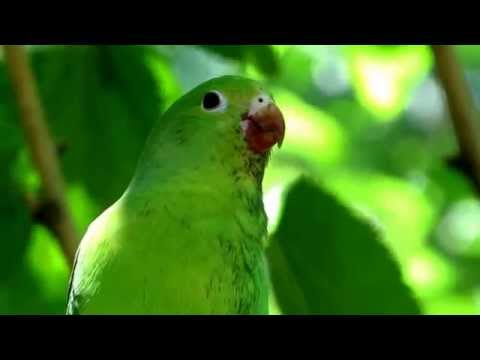
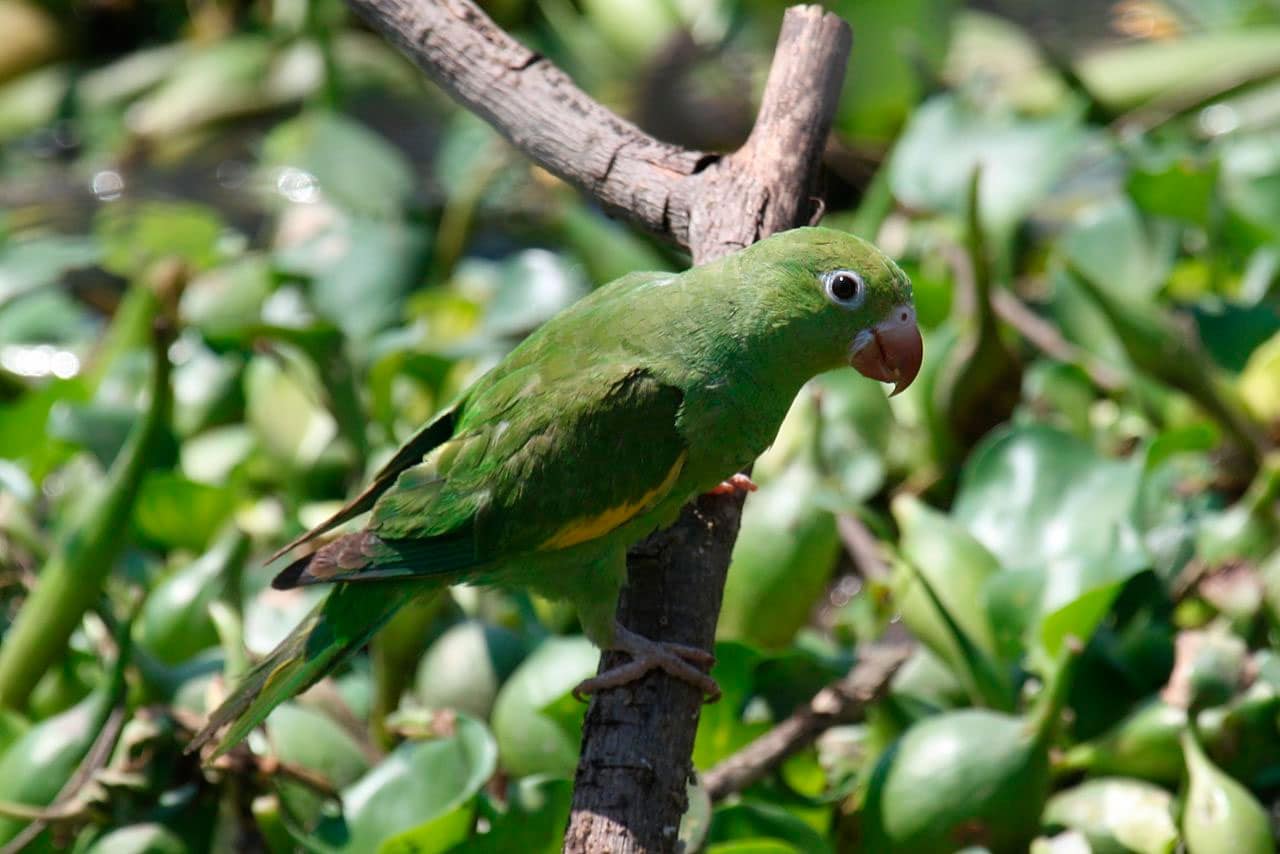
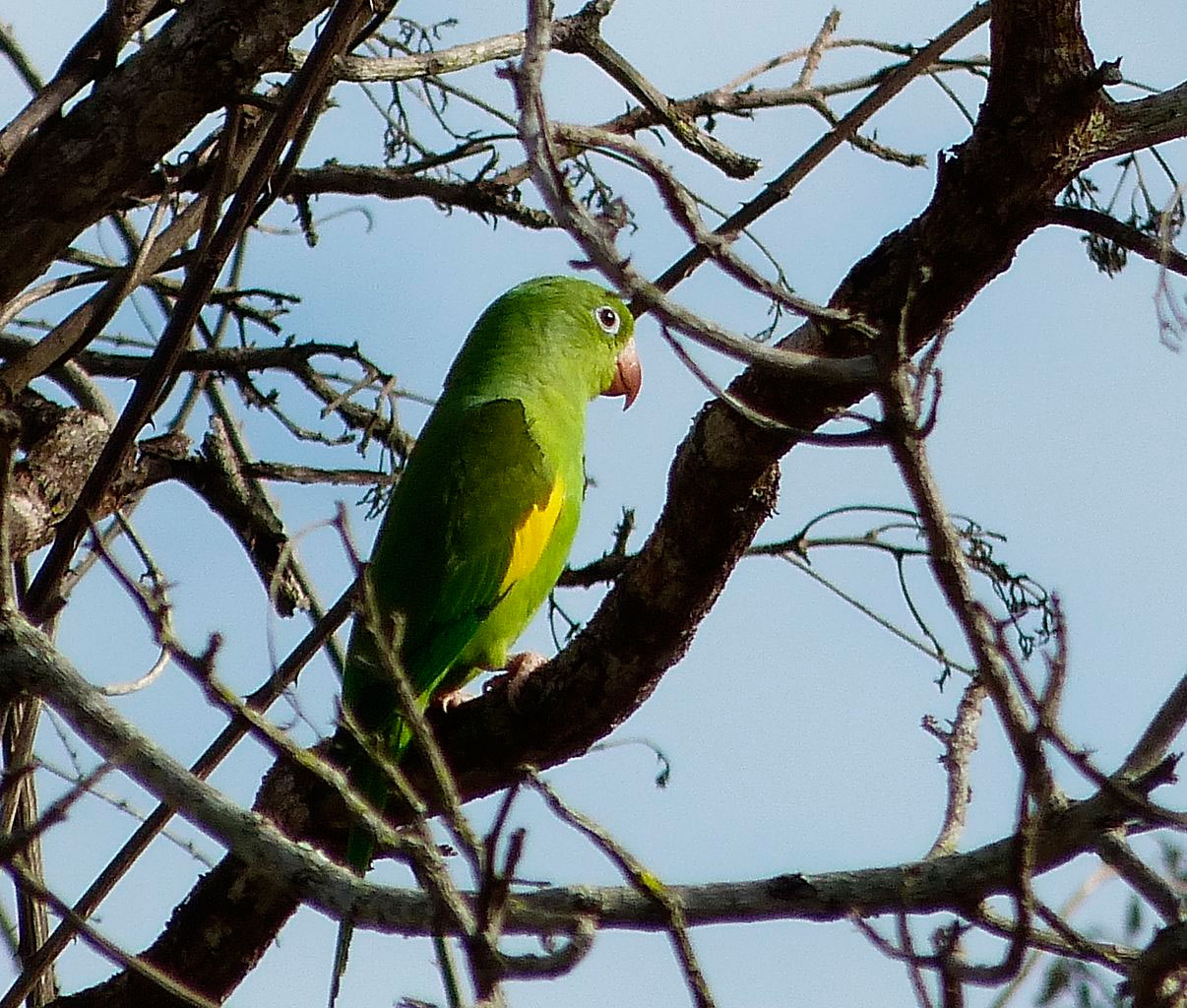
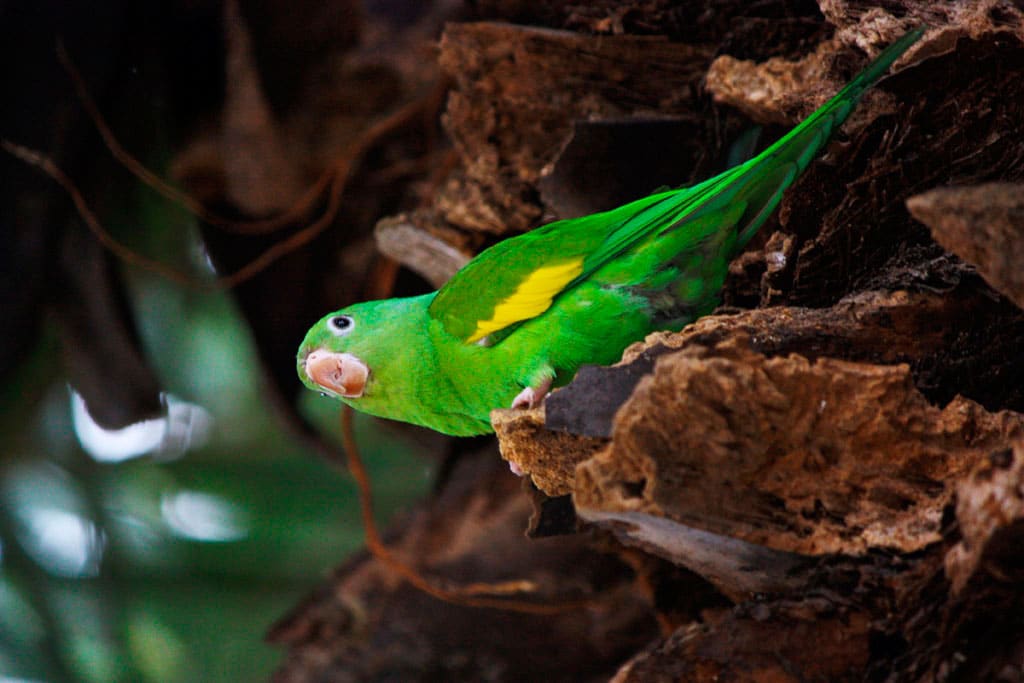
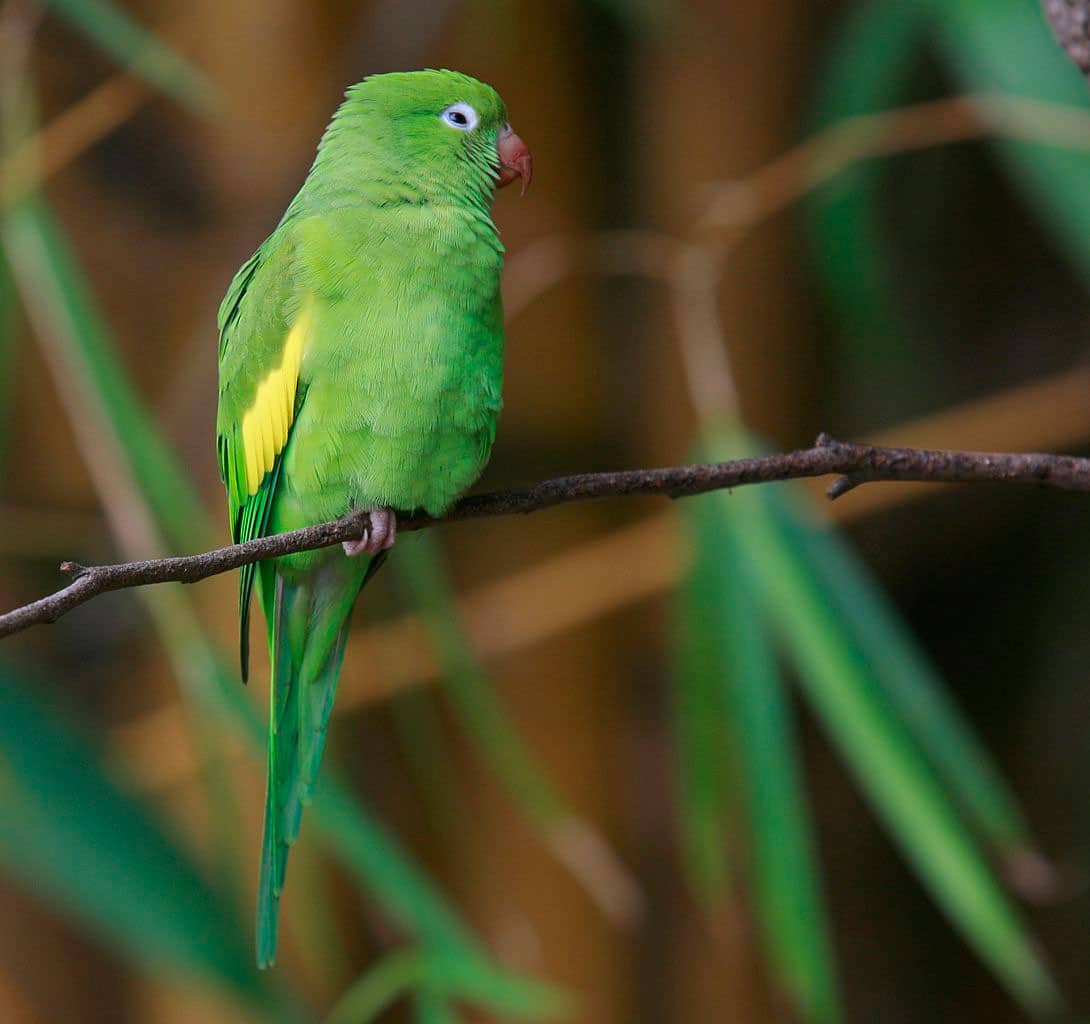
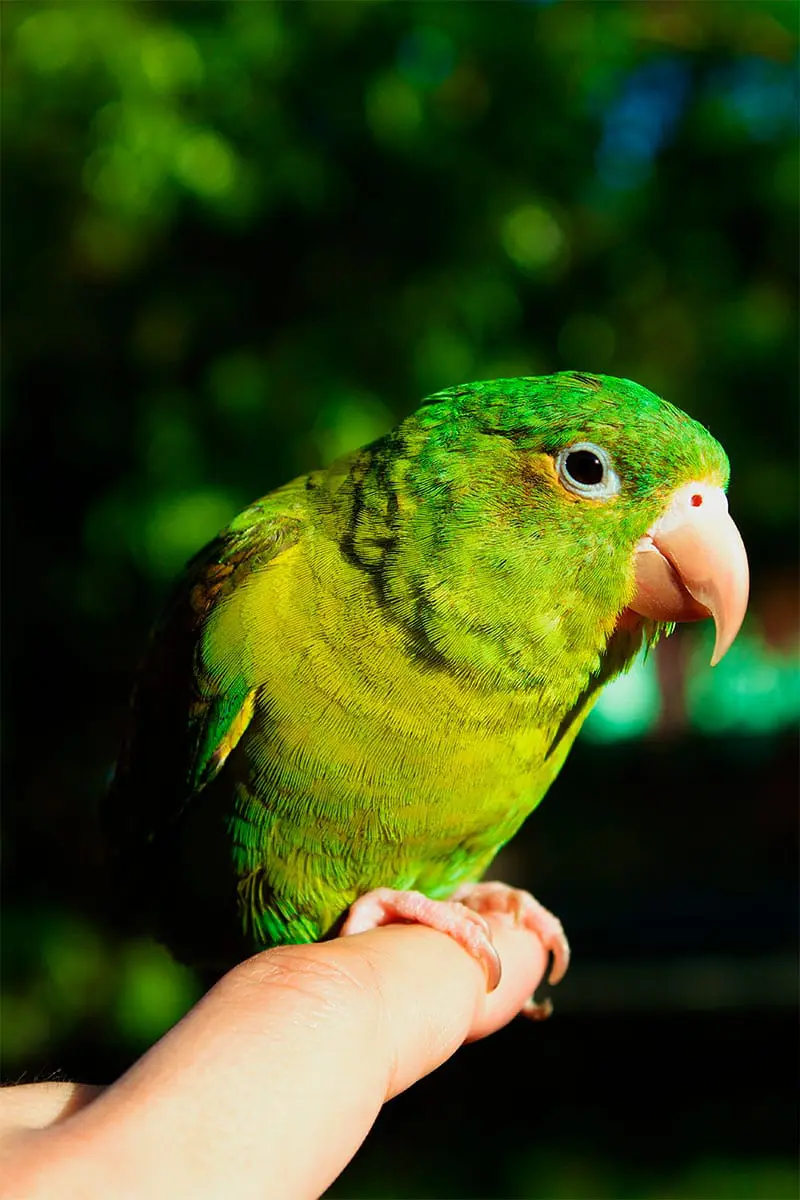
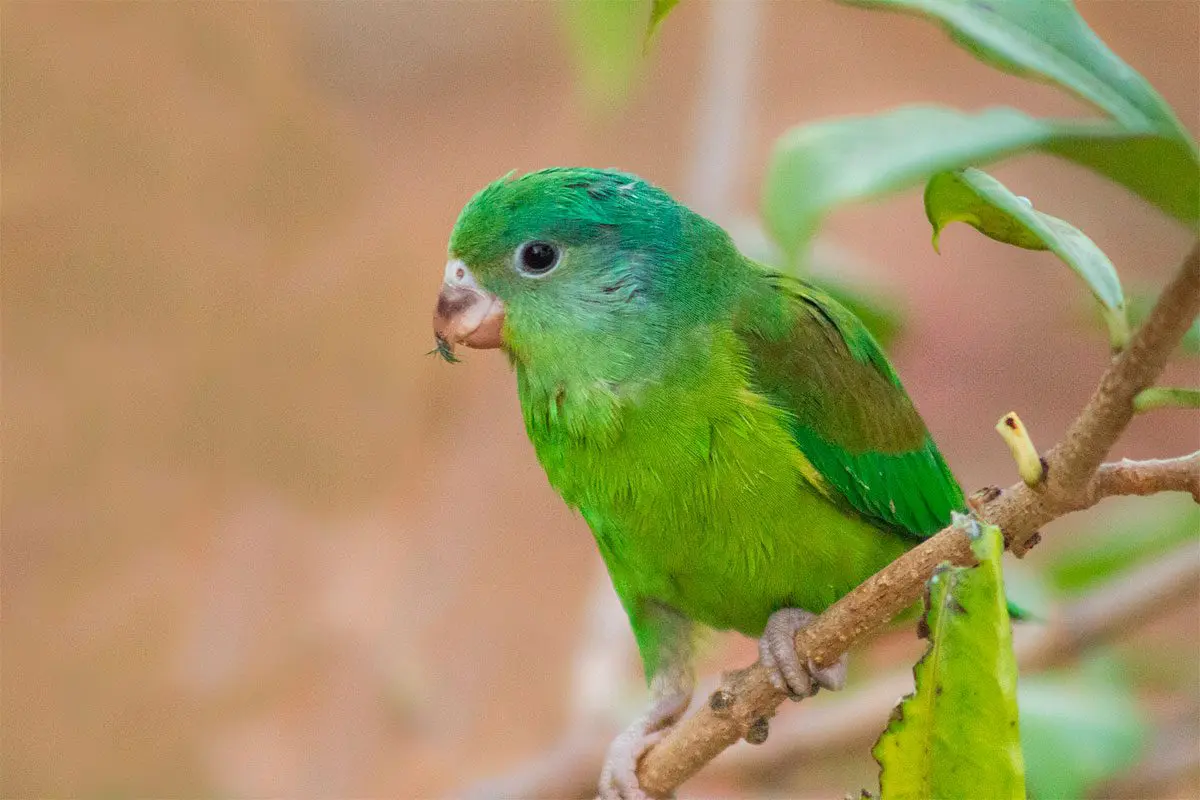
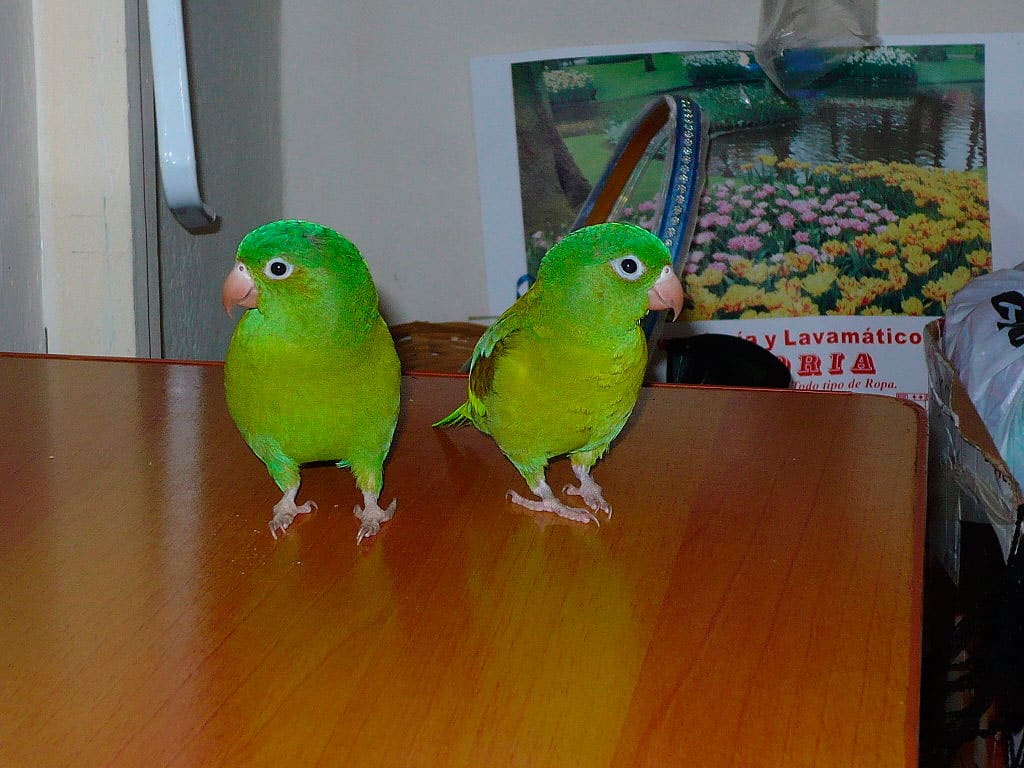
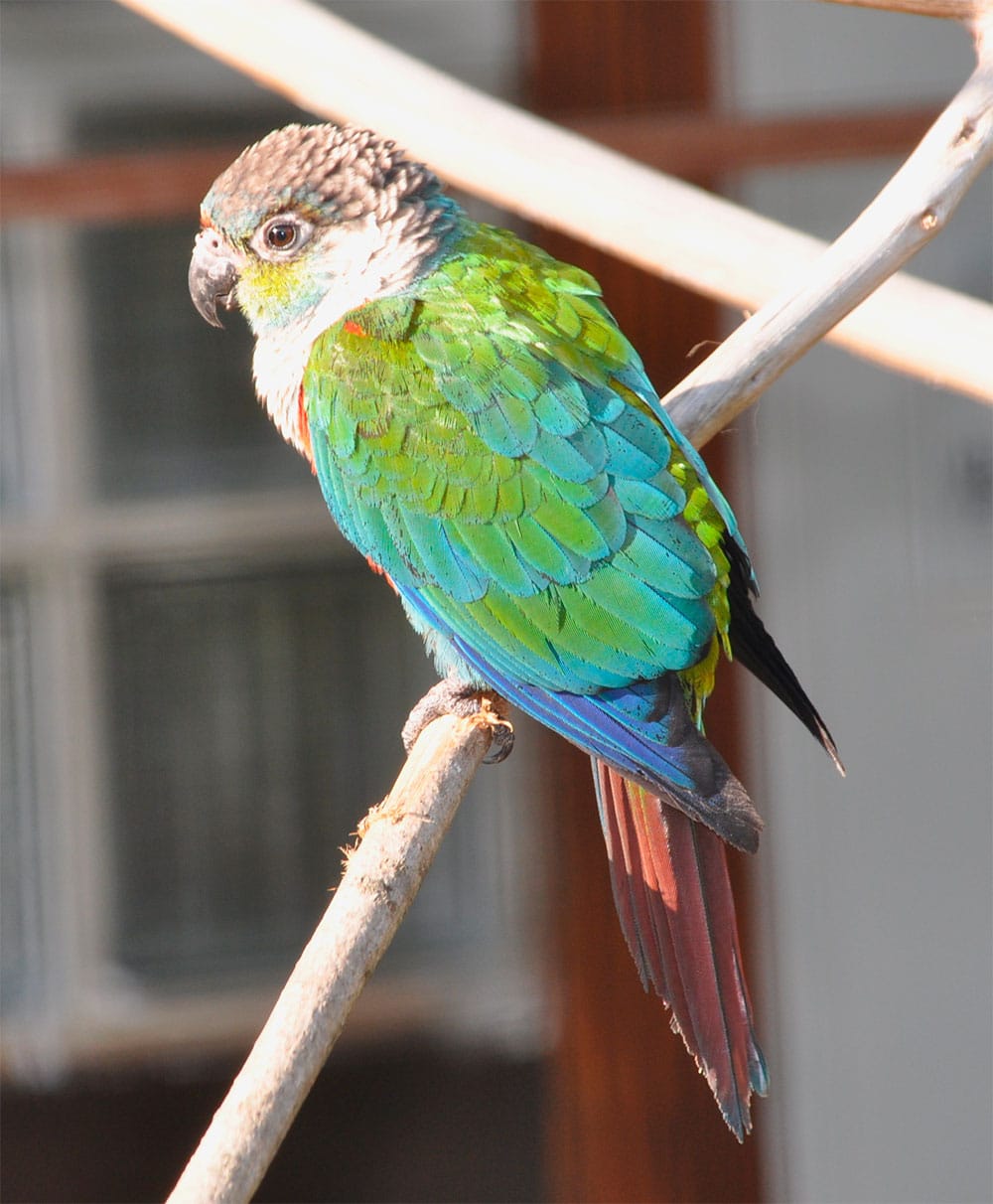
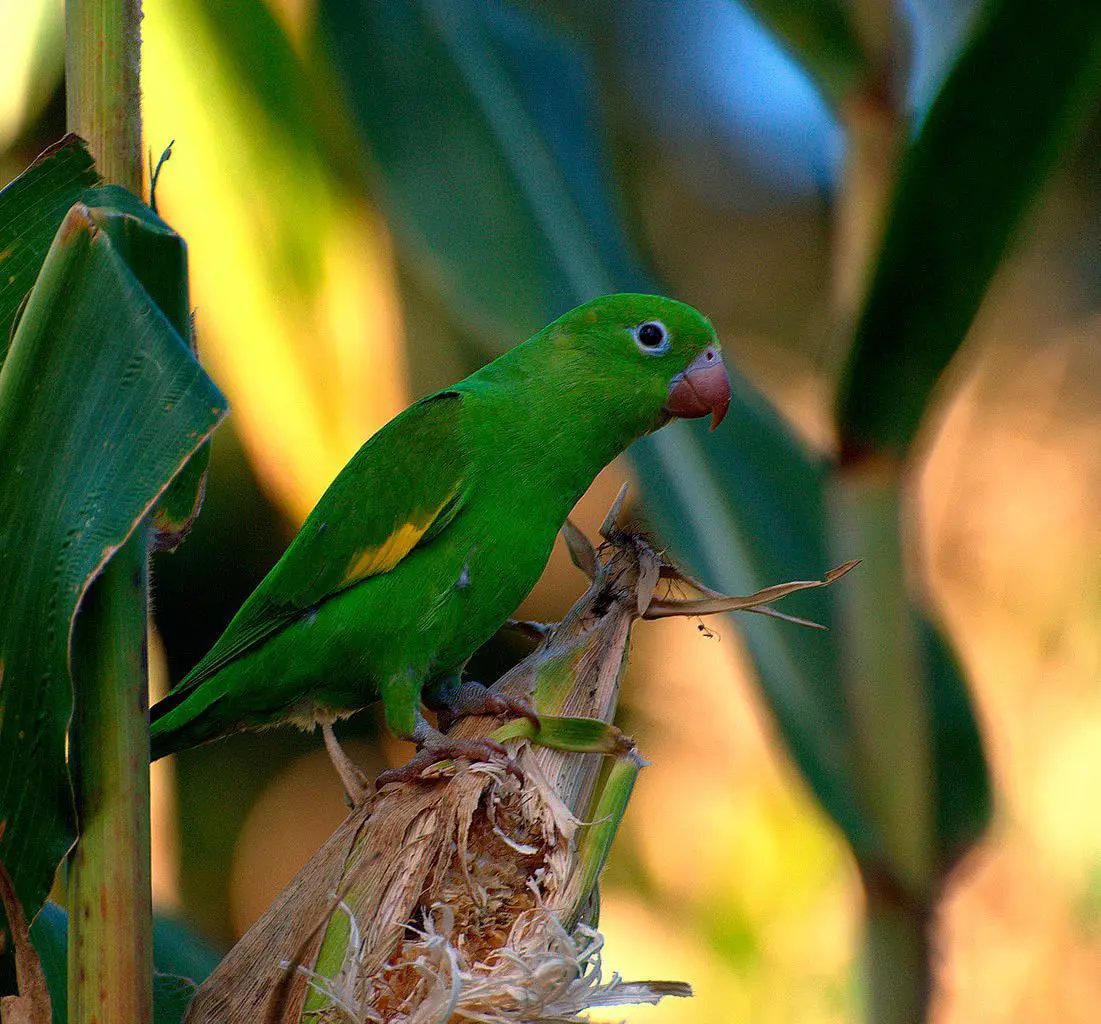
The Yellow-chevroned parakeet (Brotogeris chiriri) has a plumage, in general, bright green; the underparts They are of a paler green and lower coverts are yellowish-green.

The wings They are of a slightly darker green, with the yellow border, visible when wings remain bent or when the bird is in flight. Their bill, hook-shaped, is orange-brown and legs and feet, pinkish gray. The eye rings They are creamy white and eyes dark browns.
It is intimately related to the Canary-winged Parakeet (Brotogeris versicolurus). In fact, it was considered conspรฉcifica (owned or belonging to the same species) until 1997.

The females sexually dimorphic and are not to be sexed, either surgically or by DNA.

The immature are similar to adults but have the tail shorter and the bill It is a darker brown.

Taxonomic note:

      Until 1997, some taxonomists considered the Canary-winged Parakeet and Yellow-chevroned parakeet belonging to the same species. Even though the Yellow-chevroned parakeet It has the same secondary covert yellow feathers that can be seen in the Canary-winged Parakeet – no white in the primary wing feathers.

Description 2 subspecies:

  • Brotogeris chiriri behni

    (Neumann, 1931) – Similar to the nominal species, except that they are slightly larger; the body green lacks the yellow dye.


  • Brotogeris chiriri chiriri

    (Vieillot, 1818) – Nominal.

Habitat:

Video – "Yellow-chevroned parakeet" (Brotogeris chiriri)

Catita is still alive ( Brotogeris chiriri) : food and voice.

They are mainly below 1000 m, locally up 2500 meters in a variety of habitats including humid forests, seasonal and coastal, Pantanal, savannah and city parks. reported to 2500 meters in arid areas.

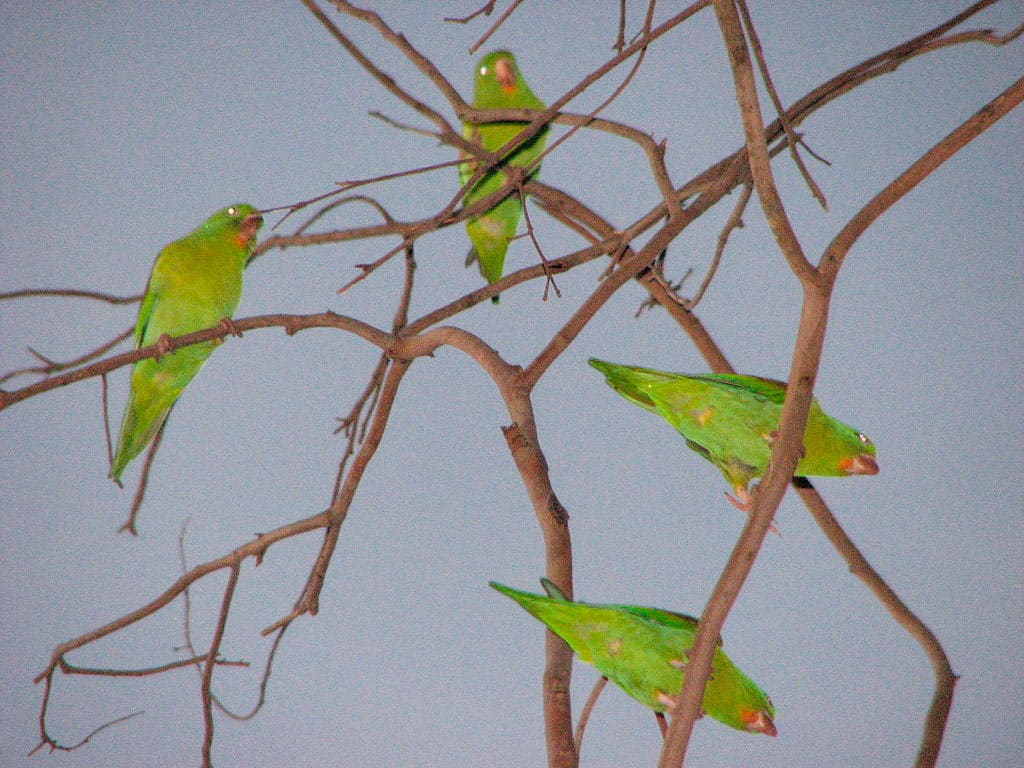
Usually, traveling in flocks; in such small groups as 2 to 4 birds, but they have been observed to 20. They are described as small parrots assets, entertaining to watch.

Reproduction:

Nest usually in the cavities of trees or in tree termite nests. They also form nesting tunnels in dead palm fronds..

Once a nest It has been located and correctly "prepared" by the couple, It is performed the laying, between 4 and 5 eggs. after breeding, the Yellow-chevroned parakeet they form large communal huts until the next breeding season.

Food:

In their natural habitats, feed of seeds (including outbreaks), fruit as berries and figs and flowers. Also consume nectar, insects and their larvae. Often they are seen visiting barreiros (areas where there is soil rich in minerals) and the banks of the rivers to feed on the soil.

Distribution:

Size of its range (breeding/resident ): 5,670,000 km2

Distributed inside East Brazil to the East of Bolivia, Paraguay and North of Argentina, in Formosa, Chaco, Missions and North of Currents. Introduced populations in Miami, Florida and California.

Distribution 2 subspecies:

  • Brotogeris chiriri behni

    (Neumann, 1931) – Center of Bolivia to the Northwest of Argentina, in Salta.


  • Brotogeris chiriri chiriri

    (Vieillot, 1818) – Nominal.

Conservation:

State of conservation โ“˜


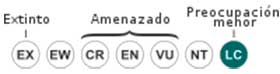
minor concern Minor Concern โ“˜ (UICN)โ“˜

โ€ข Current category of the Red List of the UICN: Least concern.

โ€ข Population trend: Stable.

Rationale for the Red List category

This species has a extremely large range and, therefore, it does not approach the thresholds of vulnerability under the criteria of size range (Extension <20,000 km2 combinada con un tamaรฑo de rango decreciente o fluctuante, extensiรณn / calidad de hรกbitat o tamaรฑo de poblaciรณn y un pequeรฑo nรบmero De lugares o fragmentaciรณn severa). La demographic trend appears to be stable and, therefore, the species does not approach the thresholds Vulnerable under the criteria of population trend (> 30% decline over ten years or three generations). The population size has not been quantified, but it is not believed to be close to the thresholds for Vulnerable under the criterion of population size (<10.000 individuos maduros con un descenso continuo estimado> 10% in ten years or three generations or a population structure). For these reasons the species is evaluated as the least concern.

Justification of the population

The size of the world's population has not been quantified, but this species is described as ยซquite commonยป (Stotz et to the., 1996).

Justification of trend

They suspected that the population is stable in absence of evidence of any decline or threatens substantial.

"Yellow-chevroned parakeet" in captivity:

Today is Rare.

Since the late sixties to mid-seventies, more than 260.000 these were parakeets imported from South America for the pet trade. At that moment, the Yellow-chevroned parakeet It was the most imported parrot. They settled in California (Los Angeles, San Francisco) self-sustaining populations Yellow-chevroned parakeet released or escapes; populations also in Florida (Miami), as well as Connecticut and New York City.

The Chirirรญ Kitten appears to be better suited to its adopted habitat than its closely related cousin., the the Canary-winged Parakeet (Brotogeris versicolurus).

The Canary-winged Parakeet It has declined considerably since the early 80, while the Yellow-chevroned parakeet It has established itself in different habitats.

In 2002, the population of Yellow-chevroned parakeet in the area of Los Angeles, California It was estimated at 400 individuals. In the Florida, They have prospered more than any other place in the United States – there have been huge flocks, several hundred of them. The species is also quite established in the city center Rio de Janeiro, Brazil, which he was also introduced.

Alternative names:

– Yellow-chevroned Parakeet, Chiriri Parakeet, Yellow chevroned Parakeet (English).
– Toui ร  ailes jaunes, Conure ร  ailes jaunes, Perruche ou, Toui ร  miroir jaune, Toui chiriri (French).
– Gelbflรผgelsittich, Kanarienflรผgelsittich (German).
– periquito-de-encontro-amarelo, periquio-de-encontro-amarelo, periquito-de-asa-amarela, tuรญ-chiriri (Portuguese).
– Catita chiriri, Catita Chirirรญ, Catita chรญriri (espaรฑol).
– Catita chirirรญ (Argentina).
– Catita chiriri, Catita chรญriri (Paraguay).
– Tu’รฎ Chyryry (Guarani).

scientific classification:

– Order: Psittaciformes
– Family: Psittacidae
– Genus: Brotogeris
– Scientific name: Brotogeris chiriri
– Citation: (Vieillot, 1818)
– Protonimo: Psittacus chiriri

Images Catita Chiriri:


Species of the genus Brotogeris

Sources:

– Avibase
– Parrots of the World โ€“ Forshaw Joseph M
– Parrots A Guide to the Parrots of the World – Tony Juniper & Mike Parr
– Birdlife

– Photos:

(1) – A Yellow-chevroned Parakeet in Sarutaiรก, Sao Paulo, Brazil By Dario Sanches [CC BY-SA 2.0], via Wikimedia Commons
(2) – A pet Yellow-chevroned Parakeet By Wagner Machado Carlos Lemes from Goiรขnia, Brazil [CC BY 2.0], via Wikimedia Commons
(3) – A Yellow-chevroned Parakeet perching in a tree By Paulo Barradas (Brotogeris chiririUploaded by Sno whom You nradio) [CC BY 2.0], via Wikimedia Commons
(4) – A Yellow-chevroned Parakeet in Goiรขnia, Goiรกs, Brazil By Delcio Gonรงalves from Goiรขnia, Brazil (A corn diferenteUploaded by Snowmanradio) [CC BY 2.0], via Wikimedia Commons
(5) – Parakeet yellow meeting. Photo taken in the hinterlands of the Sucuriรบ River By Deusdedith de Souza Alves Filho DehAlves (Own work) [CC BY-SA 4.0], via Wikimedia Commons
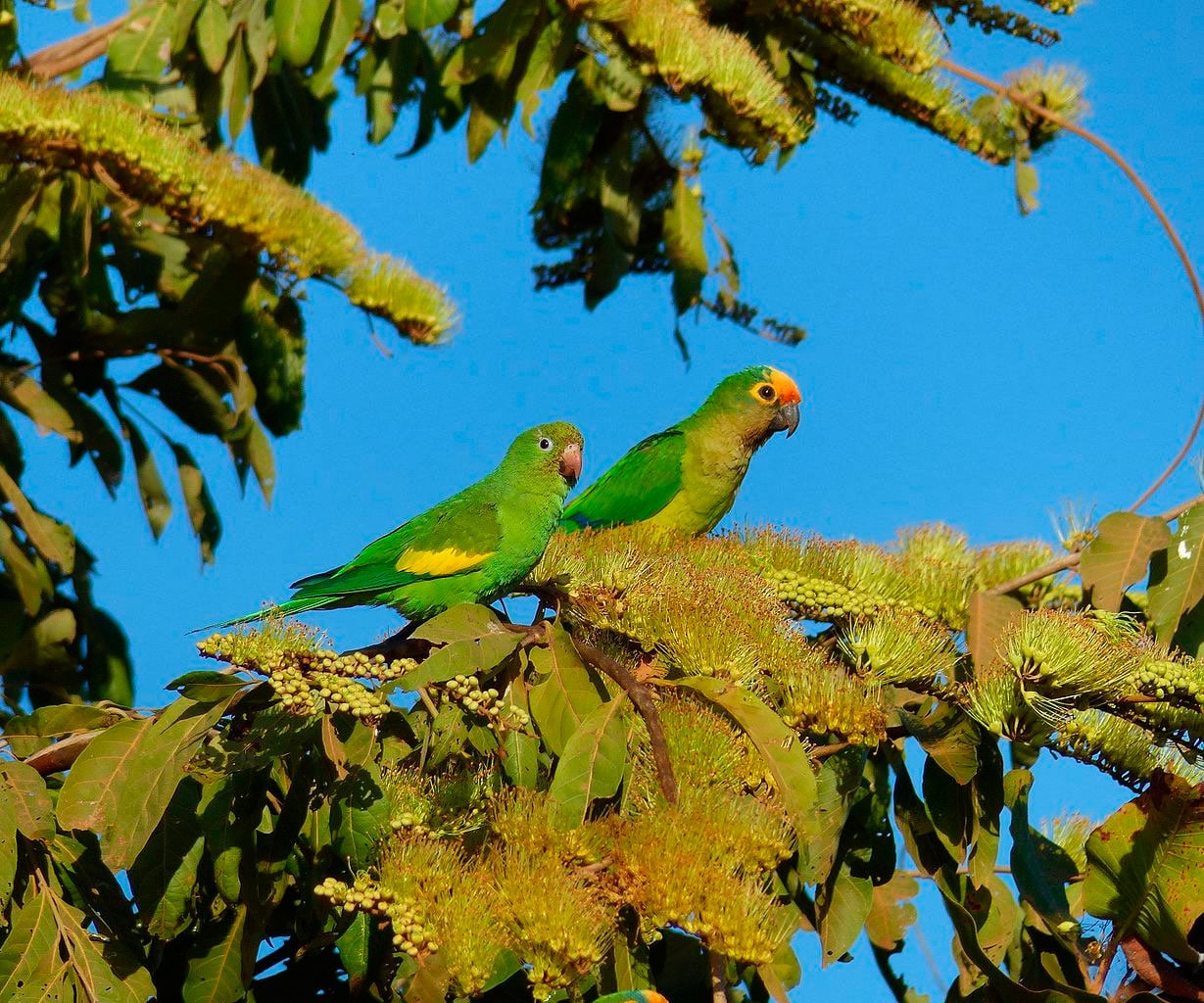
(6) – Yellow-chevroned Parakeet (Brotogeris chiriri)(Left) and Peach-fronted Parakeet (Aratinga aurea)(Right) on Combretum flowers By Bernard DUPONT from FRANCE [CC BY-SA 2.0], via Wikimedia Commons
(7) – A Yellow-chevroned Parakeet in Brazil By Alastair Rae (Flickr: Yellow-chevroned Parakeet) [CC BY-SA 2.0], via Wikimedia Commons
(8) – A Yellow-chevroned Parakeet in Bonito, Mato Grosso do Sul, Brazil. It is perching on the stem of a mango, which it has been eating By Alexandre Pereira [CC BY-SA 2.0], via Wikimedia Commons
(9) – A Yellow-chevroned Parakeet on Erythrina velutina By Derek Keats from Johannesburg, South Africa (… on Erythrina velutina) [CC BY 2.0], via Wikimedia Commons

– Sounds: Fernando Igor de Godoy (Xeno-canto)

โ–ท The world of Pets: Dogs, cats, birds, reptiles, amphibians

Seychelles parakeet โ€ 
Psittacula wardi

Seychelles Parakeet

Content

Description:


Anatomy-parrots

The Seychelles Parakeet (Psittacula wardi) It was a medium-sized parrot with a length of about 41 cm and a weight between 100 and 125 g..

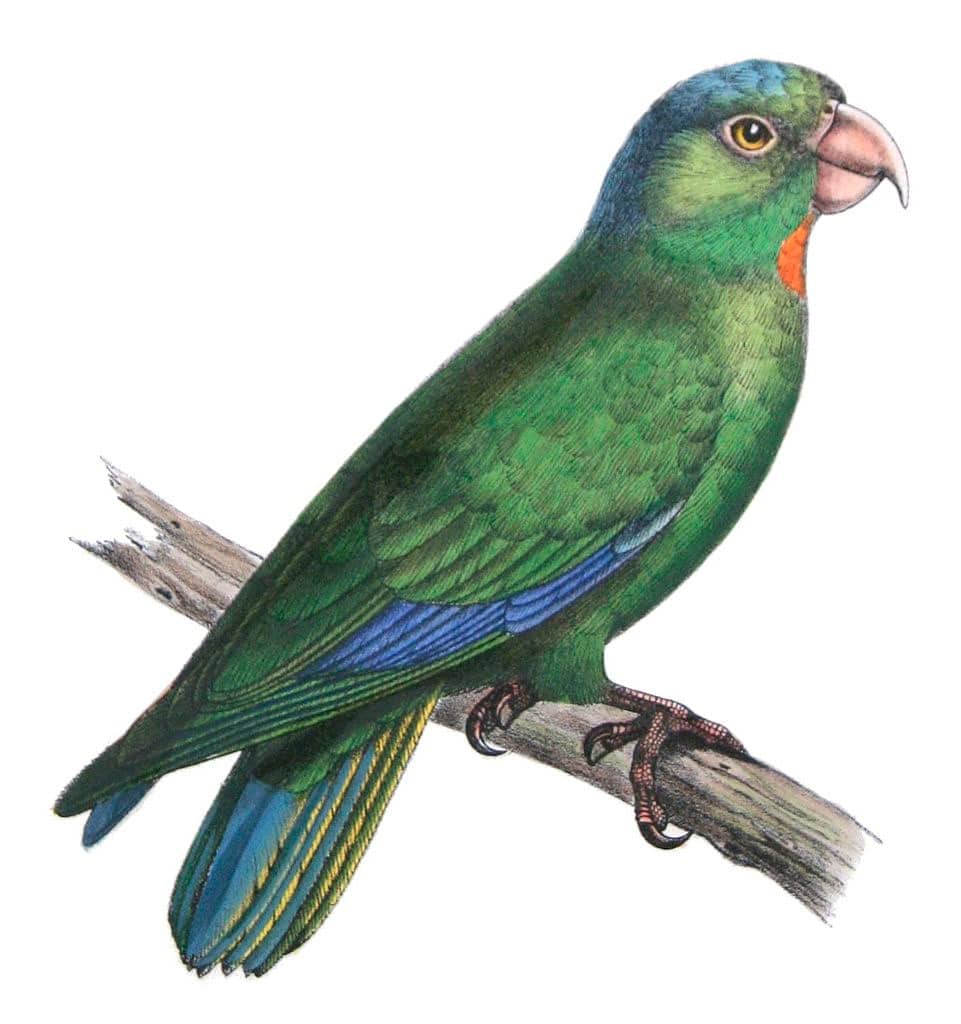
It was green with a large bill red with yellow tips, a red stain on the shoulders and a long tail. The male had a narrow black band on the cheek and neck black that the female and juvenile lacked. blueness in nape and eyes yellow. the legs They were greyish

taxonomy:

Phylogenetic studies suggest that this species away from the Alexandrine Parakeet (Psittacula eupatria).

Habitat:

In a report they were seen over the forest along a field corn.

They were probably in small groups or flocks, making striking flights. It was reported that the birds were cautious, presumably due to its constant pursuit.

Reproduction:

No data.

Food:

It was a forest species, which probably it fed on fruit and seeds.

Distribution:

The Seychelles Parakeet It was endemic to Mahe and Silhouette, Seychelles, with a visual record of Praslin. A considerable number were found in 1811, But it was rare in 1867 and the last specimen was shot at Mahe by Abbott in 1893. It may have survived until the twentieth century (Skerrett y Disley 2011), although apparently he was already extinguished when Nicoll He visited the island 1906 (Lionnet 1984).

Conservation:

โ€ข Current category of the Red List of the UICN: Extinct.
โ€ข Population trend: The last known individuals were shot dead in 1893.

Clearing forests for plantations and coconut hunting and capture (in particular, to protect corn crops) were the main causes of the disappearance of the species (Forshaw and Cooper 1989).

In captivity:

The last captive records of these birds date back to the year 1883.

There are currently two specimens in the museums of Liverpool and New York City.

Alternative names:

– Green Parakeet, Seychelles Alexandrine Parrot, Seychelles Parakeet, Seychelles Parrot (inglรฉs).
– Perruche des Seychelles (francรฉs).
– Seychellen-Edelsittich, Seychellensittich, Seychellen-Sittich (alemรกn).
– Periquito-das-seychelles (portuguรฉs).
– Cotorra de las Seychelles, Cotorra de los Seychelles, Cotorra de Seychelles (espaรฑol).


scientific classification:

Newton Edward
Newton Edward

– Order: Psittaciformes
– Family: Psittaculidae
– Genus: Psittacula
– Scientific name: Psittacula wardi
– Citation: (Newton, E, 1867)
– Protonimo: Palaeornis wardi


Especies del gรฉnero Psittacula

Seychelles Parakeet (Psittacula wardi)


Sources:

Avibase
Parrots of the World โ€“ Forshaw Joseph M
Parrots A Guide to the Parrots of the World – Tony Juniper & Mike Parr
Birdlife

Photos:

(1) – Seychelles Parakeet (Psittacula wardi), depiction by John Gerrard Keulemans from โ€˜Extinct Birds’ by Lionel Walter Rothschild from the year 1907 by John Gerrard Keulemans [Public domain], via Wikimedia Commons

โ–ท The world of Pets: Dogs, cats, birds, reptiles, amphibians

White-necked Parakeet
Pyrrhura albipectus

Cotorra cuelliblanca

Content

Description:

White-necked Parakeet

24 to 25,5 cm.. height.

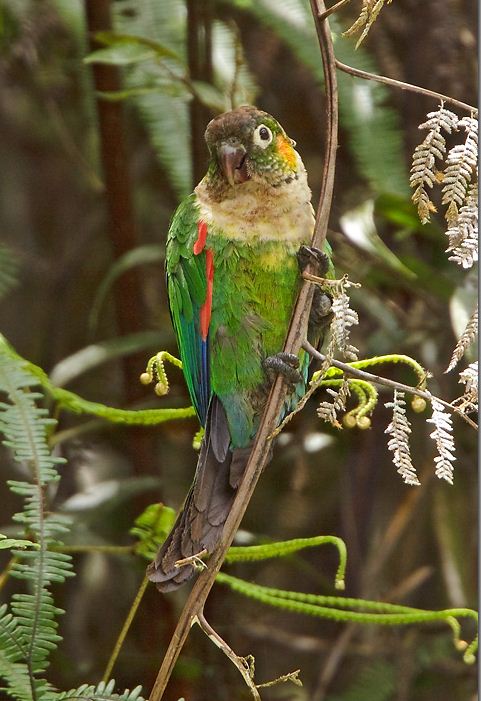
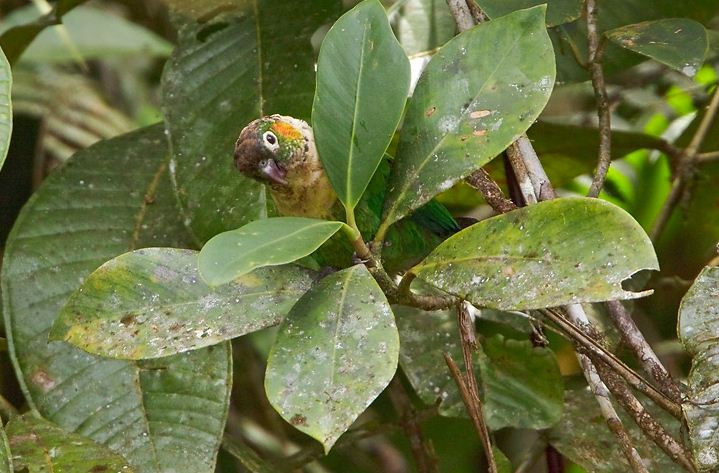
The most notorious of the White-necked Parakeet (Pyrrhura albipectus) It is the yellowish-white or white that goes from the cheeks to chest.

Crown dark stripes pale gray on the back; frontal band reddish thin; cheeks escalations of yellow and green and ear-coverts Orange; collar full white and chest yellow; belly and remaining upperparts green. Wings Greens with primary coverts red and carpal area, and primaries Bluish; tail long and pointy green, red opaque at the bottom.

The immature lacks the frontal band and has paler the ear-coverts.

Habitat:

Lives mainly in humid primary forest, foraging on fruit trees, preferably along rivers, Although he tolerates areas open and intercepted, from 900 to 2000 m (usually between 1400 and 1800 m).
Make altitudinal movements following the fruiting. Flies in flocks of 12 to 50 individuals. It bathes in pools or between rocks covered with MOSS.

Reproduction:

There is little evidence about its reproduction, possibly from May to July. A young clerk was seen in September (Snyder et to the., 2000).

Food:

The diet includes fruit, seeds and flowers Vine, mainly taken in the canopy.

Distribution:

Size of its range (reproduction / resident): 19.600 km2

Confined to three areas in southeast Ecuador and recently also it has been found in northern Peru.

In Ecuador It is known from the Podocarpus national park, the Cordillera de Cutucรบ and Cordillera del Condor. Although their numbers seem relatively low, possibly with a total population of only a few thousand individuals, is apparently common in the Podocarpus national park. There are also confirmed records as far south as the Pangui in Zamora-Chinchipe. Also recently it observed in adjacent parts of the Cordillera del Condor, Peru, with a sighting released from Condor Mirador on Morona-Santiago Province (Navarrete 2003). These range extensions suggest that it is not as severely threatened as previously feared. (Balchin y Toyne 1998).

Conservation:

State of conservation โ“˜


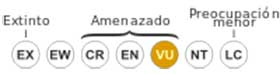
Vulnerable Vulnerable โ“˜ (UICN)โ“˜

โ€ข Current category of the Red List of the UICN: Vulnerable.

โ€ข Population trend: Decreasing.

Rationale for the Red List category

This species is classified as Vulnerable because it dwells in a few places and has a small range in which the habitat (and presumably the population) it is decreasing.

Justification of the population

The total population it may be only a few thousand birds, by what is placed in the band 2.500-9.999 individuals. This is equivalent to 1.667-6.666 mature individuals, rounded here to 1.500-7.000 mature individuals.

Justification of trend

It is suspected that the species is falling slowly, on the basis of continuous habitat destruction.

Conservation Actions Underway

โ€ข CITES Appendix II.
โ€ข The Podocarpus national park It is an important site for the conservation of the species. A revised management plan has been designed for the area and a public awareness campaign highlights the importance of the park (Snyder et to the. 2000).
โ€ข The White-necked Parakeet It is also found in the reserve Tapichalaca of 3.500 acres of the Fundaciรณn Jocotoco, where they are used successfully artificial nesting boxes (Waugh 2009).
โ€ข It is also located in the Ichigkat Muja- Condor Range National Park (F. Angulo 2012 a bit.).

Conservation Actions Proposed

โ€ข Conduct surveys to assess species distribution and total population size.
โ€ข Monitor rates of habitat loss and degradation within its range.
โ€ข Manage the Podocarpus national park so that endangered species are better protected.

"White-necked Parakeet" in captivity:

It is not easy to find it in captivity.

Alternative names:

– White-necked Parakeet, White necked Parakeet, White-breasted Conure, White-breasted Parakeet, White-necked Conure (English).
– Conure ร  col blanc, Perriche ร  col blanc, Perruche ร  col blanc (French).
– WeiรŸhalssittich, Weisshals-Sittich (German).
– Tiriba-do-pescoรงo-branco (Portuguese).
– Cotorra Cuelliblanca, Perico de Pecho Blanco (espaรฑol).
– Perico de Cuello Blanco (Peru).


scientific classification:

Frank Chapman
Frank Chapman

– Order: Psittaciformes
– Family: Psittacidae
– Genus: Pyrrhura
– Scientific name: Pyrrhura albipectus
– Citation: Chapman, 1914
– Protonimo: Pyrrhura albipectus


Images White-necked Parakeet:

Videos "White-necked Parakeet"

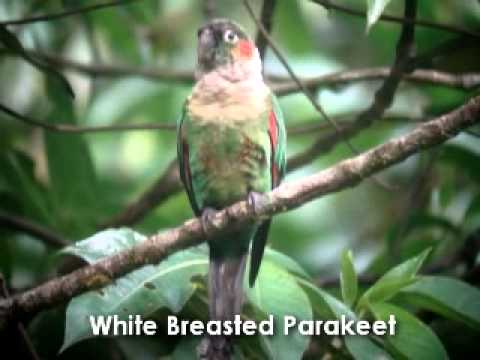
White Breasted Parakeet

White-necked Parakeet (Pyrrhura albipectus)


Especies del gรฉnero Pyrrhura

Sources:

– Avibase
– Parrots of the World โ€“ Forshaw Joseph M
– Parrots A Guide to the Parrots of the World – Tony Juniper & Mike Parr
– Birdlife
– Parrot Book, Parrots and macaws Neotropical

– Photos:

(1) – Ingrid Grunwald, IBC943789. Photo of White-necked Parakeet Pyrrhura albipectus at Zamora-Chinchipe Province, Ecuador. Accessible at hbw.com/ibc/943789.

– Sounds: (Xeno-canto)

โ–ท The world of Pets: Dogs, cats, birds, reptiles, amphibians

Orange-chinned Parakeet
Brotogeris jugularis

Orange-chinned Parakeet

Content

Description:

catita-churica-7

17 to 20 cm.. height.
The Orange-chinned Parakeet (Brotogeris jugularis) has the forecrown, crown, back of the neck and upper cheeks, bright green with blue tinge; lores and lower cheeks, duller green with olive tinge. feathers in the the mantle and the top of the back, olive-green with more green tips; Scapulars Green tipped bronce-marrones; lower back and rump, bluish green. Lesser coverts and median, foliage color, with a patch large in the shoulder; Primary coverts blue, greater coverts green. Flight feathers greenish blue above, Blue-Green below with less yellow in the underwing-coverts.
Bright orange stain in the throat, which flying becomes very evident. Underparts brighter yellowish green, more blue from the belly up to the undertail-coverts. Upper, the tail bluish green; by below more pale and yellowish.

Bill color pale horn; bare periophthalmic whitish; irises dark brown; legs pink.

The plumage of both sexes are similar.

Description 2 subspecies:

  • Brotogeris jugularis exsul

    (Todd, 1917) – Has the back and rump olive, and dorsally the wing darker, In addition the stain in the neck smaller.

  • Brotogeris jugularis exsul
    Brotogeris jugularis exsul

  • Brotogeris jugularis jugularis

    (Statius Mรผller, 1776) – Nominal.

Habitat:

The Orange-chinned Parakeet prefer, generally, forests or partially wooded habitats with bushes, deciduous forest, dry and wet, plantations, edge of light and areas cultivated or grasslands with trees large. It tolerates human presence and it attends the parks and gardens in cities. Most numerous in partially deforested areas, mainly in tropical zone, Although it amounts to subtropical vegetation zones in (for example, the Cordillera de Guanacaste, Costa Rica. Observed at altitudes of 500 m (Guatemala), 900 m (Honduras), 1.360 m (El Salvador), 1.200 m (Costa Rica), 1.000 m (Venezuela). Usually, in pairs or small groups, with large gatherings where abundant food. More gregarious outside of breeding season. Rest communally on rubbers (Ficus sp.) or palms.

Son very good flying, in nature there have been flights of up to 45 kilometres per hour.

Reproduction:

Nest from May to July in tree hollows (including old Woodpecker nests) and termite mounds. A laying, usually, compose of four to six white eggs, What hatch after a few 26 days of incubation. The chicks leave the nest about 42 days after birth.

Sometimes colonial. Reproduction reported in March in Mexico; January in El Salvador; February-April in Panama; January-March in Colombia.

Food:

Feeds of seeds and fruits trees of Bombax, Ficus, Muntingia, Byrsonima, Cecropia, Ceiba, flowers and nectar of Erythrina, raft and guava. It feeds mainly in the canopy. They can be destructive crops (for example, Mango).

Distribution:

Size of the area of distribution (reproduction / resident): 781.000 km2

This parakeet occupies the lowlands of the southern Pacific slope of Mexico, in Oaxaca and Chiapas (reports of Warrior dubious) and areas adjacent to Guatemala and El Salvador, lowlands of the Honduran Pacific, and slopes of the Pacific and Caribbean Nicaragua.

In Costa Rica is mainly a bird of your side of the peaceful, but comes into the lowlands of the Caribbean adjacent, to the South of the Lake Cocibolca, spreading through the Pacific lowlands and the Caribbean from Panama, including the Islands Coiba and Cebaco.

Are also distributed to the West of the Andes in Colombia, to the south, to Atrato River and in the Caribbean lowlands of the region of Santa Marta and Serrania del Perija and further South, to the top of the Magdalena River Valley and lowlands of Norte de Santander and Arauca.

In Venezuela It extends from the North of the Orinoco in Zulia, Tรกchira North, Merida Western, the coastal mountains Yaracuy and Carabobo and in the lowlands of Portuguese, Cojedes, barinas, Apure and Guarico.

The Orange-chinned Parakeet are, mainly, residents although they roam locally in some areas (for example, in El Salvador after breeding season).

Usually of common to abundant though apparently uncommon at the local level (for example, Oaxaca).

Captured for the trade and common in captivity in countries of the range.

Distribution 2 subspecies:

Conservation:

State of conservation โ“˜


minor concern Minor Concern โ“˜ (UICN)โ“˜

โ€ข Current category of the Red List of the UICN: Least concern.

โ€ข Population trend: Stable.

Justification of the population

Partners in Flight estimate your total population in 500,000-4,999,999 individuals (A. Panjabi in litt., 2008).

Justification of trend

They suspected that the population is stable in absence of evidence of any decline or threatens substantial.

"Orange-chinned Parakeet" in captivity:

Very common in captivity does time. It is a bird very shy and easily alarmable but with the passage of time creates a good emotional relationship with his owner. It can be aggressive with other smaller parrots.

Alternative names:

– Orange-chinned Parakeet, Bee Bee Parakeet, Brown-shouldered Parakeet, Mexican Parakeet, Orange chinned Parakeet, Tovi Parakeet (English).
– Toui ร  menton d’or, Perruche ร  front orange, Perruche tovi, Toui ร  menton jaune (French).
– Tovisittich, Goldkinnsittich (German).
– Periquito-de-queixo-laranja (Portuguese).
– Catita Churica, Chocoyo Barbinaranja, Perico Ala Amarilla, perico ala-amarilla, perico barbinaranja, Periquito Barbinaranja, Periquito Bronceado, Periquito de Alas Doradas (espaรฑol).
– Periquito Bronceado (Colombia).
– Periquito barbinaranja (Costa Rica).
– perico barbinaranja (Honduras).
– perico ala amarilla, perico ala-amarilla, Periquito Barbinaranja (Mexico).
– Chocoyo Barbinaranja (Nicaragua).
– Perico Ala Marrรณn (Venezuela).

scientific classification:

– Order: Psittaciformes
– Family: Psittacidae
– Genus: Brotogeris
– Scientific name: Brotogeris jugularis
– Citation: (Statius Mรผller, 1776)
– Protonimo: Psittacus jugularis

Images Orange-chinned Parakeet:


Species of the genus Brotogeris

Sources:

– Avibase
– Parrots of the World โ€“ Forshaw Joseph M
– Parrots A Guide to the Parrots of the World – Tony Juniper & Mike Parr
– Birdlife

– Photos:

(1) – A pet Orange-chinned Parakeet in Panama By Nelson de Witt from USA (IMG_2058Uploaded by Snowmanradio) [CC BY-SA 2.0], via Wikimedia Commons
(2) – An Orange-chinned Parakeet feeding in Panama By Brian Gratwicke (Flickr: Orange-chinned Parakeet) [CC BY 2.0], via Wikimedia Commons
(3) – Orange-chinned parakeets in Panama City, Rep. of Panama. Aproximadamente tres o cuatro meses de edad By Ricaurte Puga (Own work) [GFDL or CC BY-SA 4.0-3.0-2.5-2.0-1.0], via Wikimedia Commons
(4) – Brotogeris jugularis en El Salvador tomando Coca Cola By Kevinmenendez (Own work) [GFDL or CC BY 3.0], via Wikimedia Commons
(5) – This is the smallest parakeet in El Salvador know as Catalnica, Perico de Lesson, Orange-chinned Parakeet (Brotogeris Jugularis) By ceasol (Flickr) [CC BY-SA 2.0], via Wikimedia Commons
(6) – Orange-chinned Parakeet | Brown wing parakeet (Brotogeris jugularis exsul) by Fernando Flores – Flickr
(7) – Conurus jugularis Dev. & Cast. = Brotogeris jugularis (Mรผller, 1776) by Francis de Laporte de Castelnau [Public domain], via Wikimedia Commons

– Sounds: (Xeno-Canto)

โ–ท The world of Pets: Dogs, cats, birds, reptiles, amphibians

Galah
Eolophus roseicapilla


Cacatรบa Galah

Content

Description

Measured around 35 centimeters and between 240 and 330 g. weight.
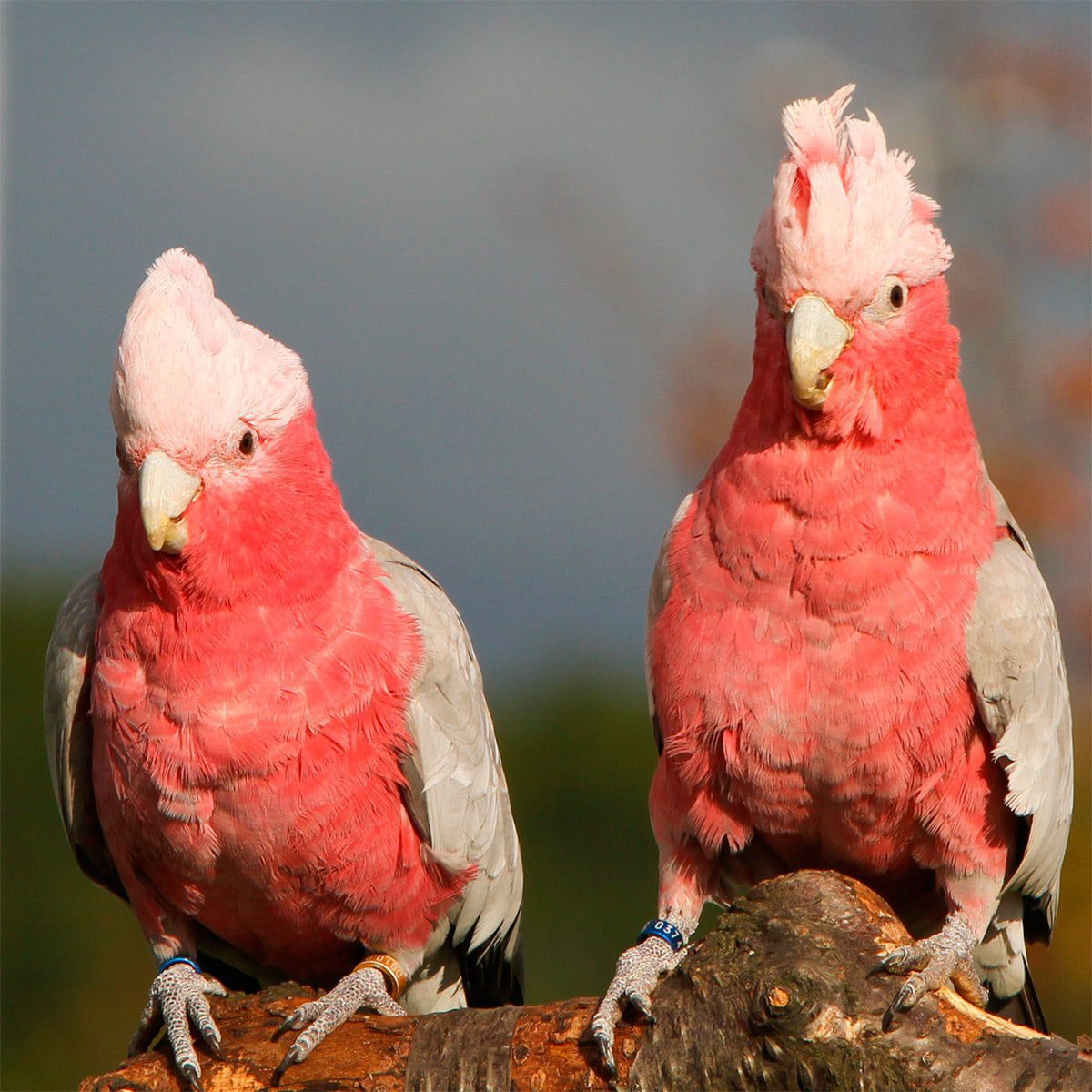
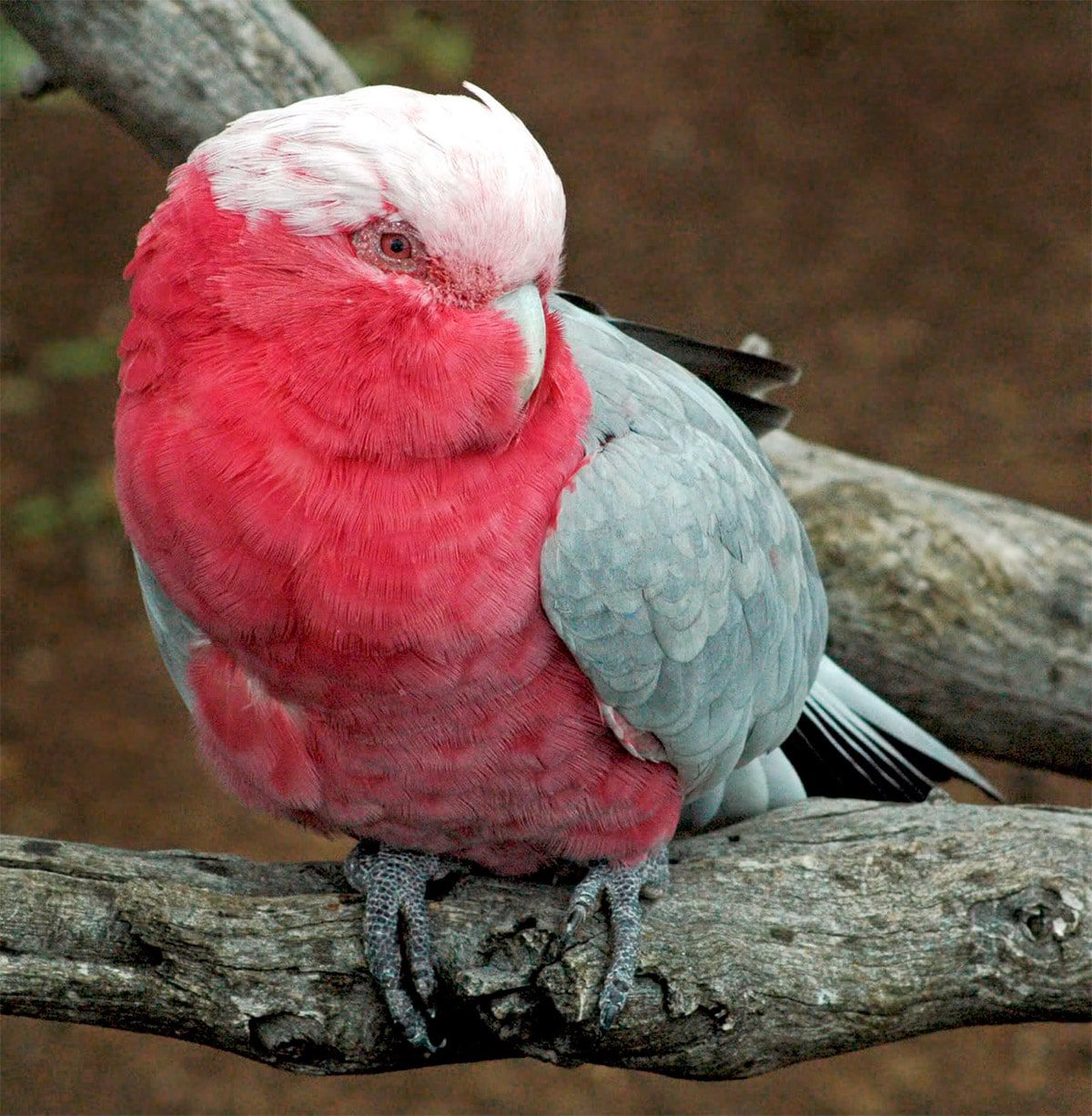
In the Galah (Eolophus roseicapilla) adult, the front, the hoopoe and the cap they form a joint undercover pale pink in white which contrasts slightly with the back of the neck darker. The face, neck and underparts they are deep pink.
The bottom of the flanks, the the thighs and mantas subcaudales are grey clear. The upperparts They show a grey pigeon which is slightly paler on the rump and in their flow rates. Tertiary they are grey and dark grey and medium the flight feather.
The upper part of the tail It is pale grey with a darker terminal tips. The bottom of the tail is uniformly Brown.

The bill is horn. The bare periophthalmic is greyish Red. The irises shows a dark brown hue. The legs are grey.

The female is similar to fellow, outside of the irises red.

The youth can distinguish is from the adults by their underparts grey infiltrated.

Subspecies description

  • Eolophus roseicapilla roseicapilla:

    The species nominal


  • Eolophus roseicapilla albiceps:

    Differs from the nominal by their larger size, the crest whitish instead of pink, and eye ring Red instead of greyish white.


  • Eolophus roseicapilla kuhli:

    It has a plumage paler and a crest shorter.

Habitat:

Video – "Galah" (Eolophus roseicapilla)

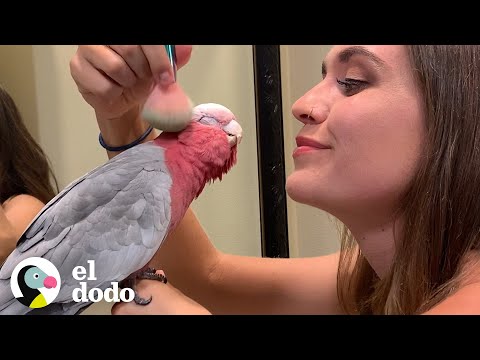
Ave wants to do everything her human mom does I Soul Mates | the dodo

In the North of its distribution area, the Galah frequent mountain forests, While much further South, most tend to live in the temperate forests of the lowlands.
During the summer season, It is more common in high altitude forested areas., staying mainly in small cool and shady ravines, always near a river.

In Winter, He moved to arid forests in more moderate altitudes. At this time of the year, also visit the parks and urban gardens.

The Galah It is a bird of open areas, always avoiding the dense forests.

During the nesting season they live in pairs or in small family groups, but the rest of the year, gather in large flocks where food resources are important. Sometimes can gather up to 1.000 birds in the pastures where they feed.

They are sentinels responsible to give the alarm in case of danger.
The power stations are separated by many miles of the rest areas.
In the evening devoted to drinking and perform aerial stunts before joining the residence. Occasionally it can be active and noisy at night.

Reproduction:

In the North, the reproduction has place between February and June.

During the courtship, the male Struts before his partner making bows, shaking his head, producing low notes and showing a repertoire of stunts.

Most of the time, the nest is a natural cavity in a eucalyptus, between 2 and 20 meters above the ground.
The cacatรบa Galah You strum the bark of the trunk around the hole which is the entrance of the nest. This practice is sometimes so excessive that they cause the death of the tree. Cliffs can also be used as a place of nesting.

The same couples usually are mate during all their life and are loyal to the same nesting sites for several consecutive years.

The spawning includes 2-6 eggs. The female lays an egg every one or two days and the incubation period is about 25 days. Both parents incubate at the same time, and they provide assistance to young people. They feed their young every 3 hours, sounding his beak to regurgitate the food. The young remain in the nest during 7 u 8 weeks.

While they are able to fly quickly when they come out of the nest, their survival rate is small. The first days after the flight, they return to the nest for the night. Shortly after, large nurseries are formed in which the parents continue to feed their young.

From time to time, the Galah It has a second litter in a season.

Food:

Consume a wide variety of plants, such as oats or wheat seed or the other many herbaceous plants. In addition to that, They also eat insects and their larvae, berries, outbreaks, flowers and seeds of eucalyptus.

They feed almost exclusively on Earth.

Distribution:

Size distribution (reproduction / resident): 14400000 km2

endemic to Australia where it occupies the entire continent. Most of its population lives in the south-east of New Welsh of the South and in the State of Victoria. In other places, is less abundant.

Subspecies distribution:

  • Eolophus roseicapilla roseicapilla:

    (Western Australia, South of the great desert of sand and probably in the Simpson Desert in the southern part of the territory of the North)


  • Eolophus roseicapilla albiceps:

    (Tasmania and Southeast of Australia, heading north to the 20 degrees latitude South and East)


  • Eolophus roseicapilla kuhli:

    (to the North of the of Australia, from the District of Kimberley to the cape york peninsula)

Conservation:

State of conservation โ“˜


minor concern Minor Concern โ“˜ (UICN)โ“˜

โ€ข Current category of the Red List of the UICN: Least concern.

โ€ข Population trend: In increased.

Although it has a beneficial action stopping the spread of some weeds, the Galah have a considerable potential of destruction and is considered a pest in most of Australia.

Crops, especially cereals, they suffer great losses each year. They often cause the destruction of the trees where they nest or establish their residences. The world population It is estimated in more than 5 millions of individuals and the number is constantly growing.

This remarkable species not is protected in all the regions and can be killed if it causes too much agricultural loss.

"Galah" in captivity:

Itร‚ยดs very common in poultry around the world, for being one of the easiest cockatoos both to raise and to care for and for being highly demanded as a pet both for its physical appearance and for its more manageable character than that of other cockatoos. Her offspring should take into account the different subspecies, Therefore we will avoid possible hybridization between them.

Son parrots extroverts, friendly, playful and affectionate. However, they are still cacatuidos, They therefore require more attention than other psittacine species to be happy animals. Its speaking ability is fairly high within the group of cockatoos, with males that better mimic. It is considered that it might also noisy, especially if you are bored or if it has been poorly educated or poorly maid, so you will have to always buy weaned and well socialized specimens. When they are young and still take porridge his voice is very unpleasant.

They possess a behavior that is similar to the of the small Cockatiel. Males are more talkers and possess a strong character. The females., on the other hand, they are silent and less dominant. They are most appropriate, Therefore, to be adopted as pets.

The males they may become aggressive in mating season.

They have a high tendency to obesity, thing very significantly decreases their hope and quality of life, by what control seriously its diet, providing low number of fats and allowing to do much exercise.

Its life expectancy formerly was around the 15-18 years, probably due to a bad diet popular ignorance of your requirements. Today there is talk of animals up to 40 years of life.

If we opt for a cockatoo for the home, a pink may be the best alternative: less demanding than her sisters, slightly less noisy and, If we chose a female, We have the gentleness and docility secured.

Its price market round the 1.000 โ‚ฌ.

Alternative names:

– Galah, Rose Cockatoo, Roseate Cockatoo, Rose-breasted Cockatoo, Willock (ingles).
– Cacatoรจs rosalbin, Galah (French).
– Rosakakadu (German).
– Cacatua-galah (Portuguese).
– Cacatรบa Galah, Cacatรบa Rosa (espaรฑol).

scientific classification:

– Order: Psittaciformes
– Family: Cacatuidae
– Scientific name: Eolophus roseicapilla
– Genus: Eolophus
– Citation: (Vieillot, 1817)
– Protonimo: cockatoo roseicapilla

Images Galah Cockatoo:


Sources:
– Avibase
– Oiseaux
– kktwas
– faunatura

– Photos: de.wikipedia.org , commons.wikimedia.org, David Cook Wildlife Photography (kookr), Richard.fisher

– Sounds: nick talbot (Xeno-canto)

โ–ท The world of Pets: Dogs, cats, birds, reptiles, amphibians

Malabar Parakeet
Psittacula columboides


Cotorra de Malabar

Content

Description:

Ilustraciรณn Cotorra de Malabar

Of 36 to 38 cm.. length.

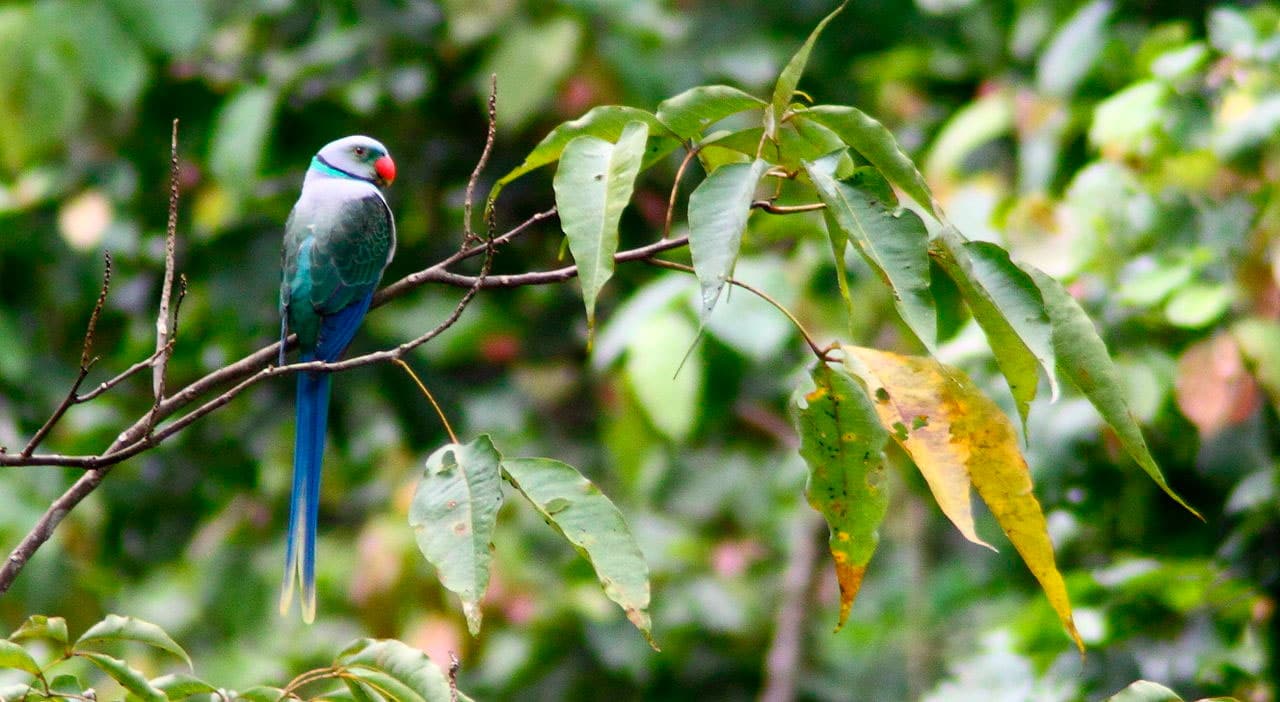
The Malabar Parakeet (Psittacula columboides) has the lores and upper cheeks of green grass, blue tinge on the edges and in the dark pearl gray crown, the lower cheeks, the sides and rear of the neck; with wide black bands at the mustache that attenuate to form a collar black, then bordered with a band of bright blue-green, which extends around the throat.

Mantle dove-grey fading to greyish-green on back and scapulars; rump and uppertail-coverts pale bluish green, sides rump yellowish.

Lesser coverts dark green, subterminally tipped dark grey edged buffish; inner median coverts green with pale buffish margins; alula and greater coverts blue. The primaries and secondaries blue, darker in the vane inner. Underwing-coverts bluish green. Throat bright blue green; yellowish blue discoloration in the rest of the underparts; dove-grey in the chest; blue tinge on the thighs. Uppertail centrally bright blue, tipped yellow, lateral feathers greenish-blue on vane outer, in bright yellow inner; undertail-coverts bright golden-yellow centrally, otherwise brown with yellow tip.

upper jaw bright red with yellow tip, the lower brown, turning orange in the chin; irises light yellow; legs greenish-grey.

The female smaller, with little or no green in face and with both brown jaws. Underparts greyish-yellow. Less grey in the the mantle and tail shorter.

The immature shows grayish green in place of grey-plumage of adults. Collar black and green absent band neck.

Habitat:

To a large degree, the Malabar Parakeet It is confined in forests (primary and secondary) evergreen upland, although according to sources, also observed in other formations, including deciduous forest adjacent to bamboo and especially in plantations coffee and rubber abandoned, and often close to small areas of crops.

Partly inhabit between 450-1.000 m, but exceptionally above 1.600 m, and up to about 60 m.

Usually, observed in family groups or small flocks.

At lower altitudes it is associated with Plum-headed Parakeet (Psittacula cyanocephala), completely replacing it at higher altitudes and in humid forests.

Reproduction:

Escavan their nests on branches or trunks, at a height between 6 and 30 m, sometimes they take advantage of the holes made by woodpeckers or Barbs, expanding the cavity. Los Ceylon ironwood (Mesua iron) are his favorite trees.

Usual clutch 4 eggs.

The breeding season It is between the months of January to March

Food:

Diet Malabar Parakeet It includes seeds and fruits, especially wild figs; regularly eat sprouts, flowers and nectar Erythrina and Grevillea.

They can be very destructive in crops of sorghum and fruit.

Distribution:

The Malabar Parakeet It is distributed by Ghats occidentales, India, on a narrow strip parallel to the west coast, from Pune (19 ยฐ N), Maharashtra, through Karnataka, until Kerala and Tamil Nadu at 8ยฐ 27'N in the south.

Usually residents, but some nomadic movements They occur in response to the availability of food.

Conservation:

State of conservation โ“˜


minor concern Minor Concern โ“˜ (UICN)โ“˜

โ€ข Current Red List of UICN: Least concern

โ€ข Population trend: Stable

The size of the world's population has not been quantified, but the species, according to information, It common throughout the core of its range (pit et to the. 1997).

The population is suspected to be stable in the absence of evidence of any reduction or substantial threats.

The bird trade and loss of habitat have caused, apparently, a decrease in its population, However, It is not sufficient to place this species at risk.

"Malabar Parakeet" in captivity:

The Malabar Parakeet it is rare in the pet trade.

This species was the subject of extensive trade, but now it is illegal in India. He was known in the pet trade as "Loro nonsenseยป and acquired a misleading reputation as a superior talker.

It is a parrot medium-noisy, occasionally noisy; initially shy; It becomes slowly confianda; newly imported birds are very likely; Care must be acclimatised; only it becomes active in a wide aviary; a common aviary with other species of Psittacula only possible outside the breeding season; little bathing but enjoys flying light rain outside; He likes to chop fresh branches; times aggressive during courtship; sensitive to cold and wet conditions.

Pet food variety, including aerosols millet, fruit, vegetables, Sunflower seed mixtures, oats and millet.

Rarely achieved the captive breeding; clutch 3 to 4 eggs; 23 incubation days; incipient period 6 weeks; young independent after 21 days; the calf sometimes aggressive with its mother.

In terms of their longevity, It is known that a Malabar Parakeet lived during 11,2 years in captivity.Given the longevity of similar species, This longevity is probably underestimated for these birds.

Alternative names:

– Malabar Parakeet, Blue-winged Parakeet (English).
– Perruche de Malabar (French).
– Taubensittich (German).
– Periquito-de-malabar (Portuguese).
– Cotorra de Malabar (espaรฑol).

scientific classification:

– Order: Psittaciformes
– Family: Psittaculidae
– Genus: Psittacula
– Scientific name: Psittacula columboides
– Citation: (Vigors, 1830)
– Protonimo: Palaeornis columboides

Malabar Parakeet Images:

Videos "Malabar Parakeet"


Especies del gรฉnero Psittacula

Malabar Parakeet (Psittacula columboides)


Sources:

– Avibase
– Parrots of the World โ€“ Forshaw Joseph M
– Parrots A Guide to the Parrots of the World – Tony Juniper & Mike Parr
– Birdlife

– Photos:

(1) – Blue-winged Parakeet or Malabar Parakeet (Psittacula columboides) pair N. A. Naseer / www.nilgirimarten.com / naseerart@gmail.com [CC BY-SA 2.5 in], via Wikimedia Commons
(2) – Malabar Parakeet (Psittacula columboides). A male at Thattekad, Kerala, India By Lip Kee Yap [CC BY-SA 2.0], via Wikimedia Commons
(3) – Malabar Parakeet – Endemic to the Western Ghats By Suriyakumars (Own work) [CC BY-SA 3.0], via Wikimedia Commons
(4) – The Blue-winged Parakeet By Mailamal (Own work) [CC BY-SA 3.0], via Wikimedia Commons
(5) – Malabar Parakeet or Blue-winged Parakeet (Psittacula columboides) By Joseph Lazer (Personal Collection) [CC BY-SA 2.5 in], via Wikimedia Commons
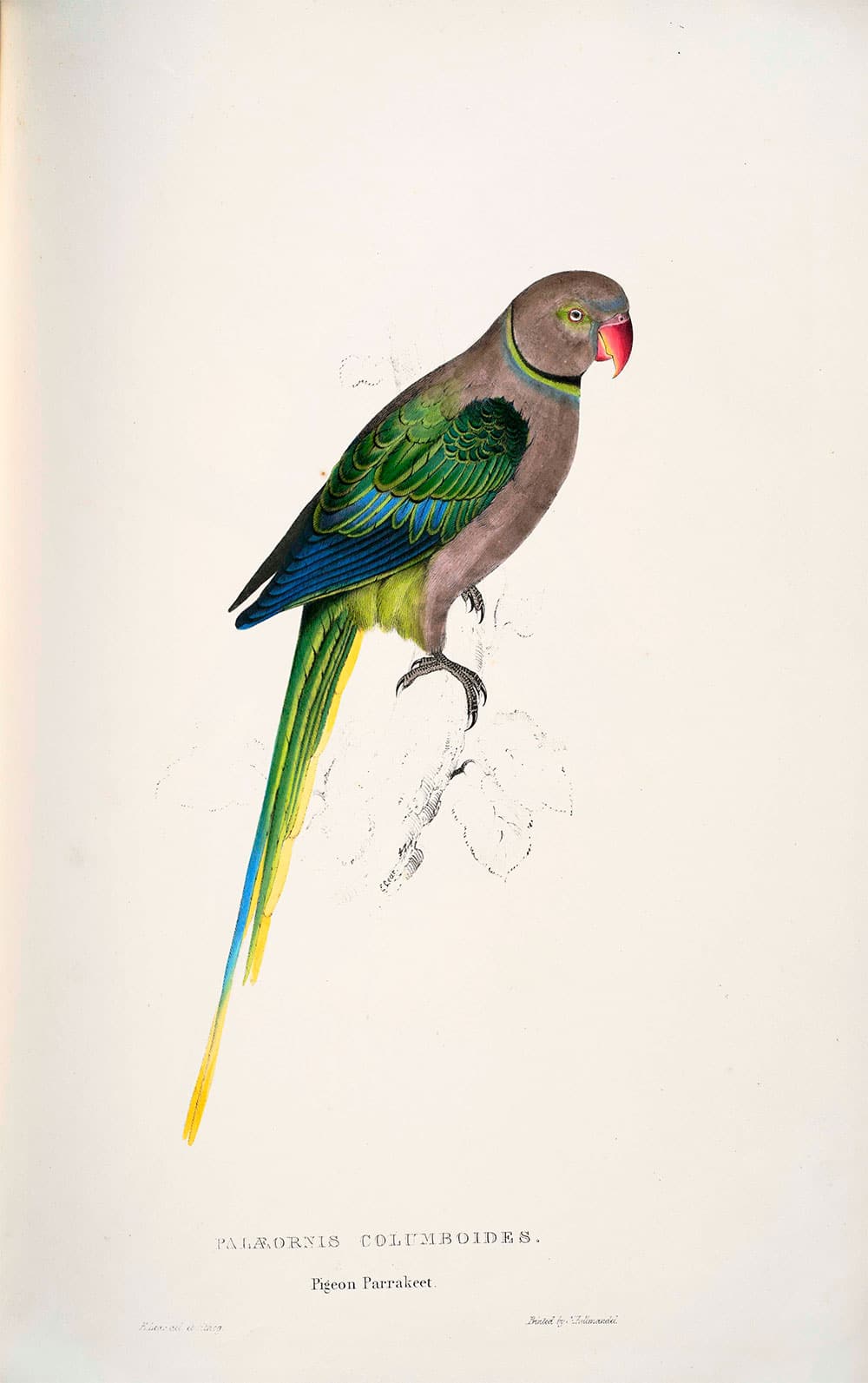
(6) – A painting of a Malabar Parakeet, also known as the Blue-winged Parakeet, (originally captioned ยซPalaeornis columboides. Pigeon Parrakeet.ยป) by Edward Lear 1812-1888 [Public domain], via Wikimedia Commons

– Sounds: Sudipto Roy (Xeno-canto)
โ–ท The world of Pets: Dogs, cats, birds, reptiles, amphibians

Crimson-bellied Parakeet
Pyrrhura perlata

Crimson-bellied Parakeet

Content

Description:

Crimson-bellied Parakeet

24-25 cm. of length and weight 85-94 g

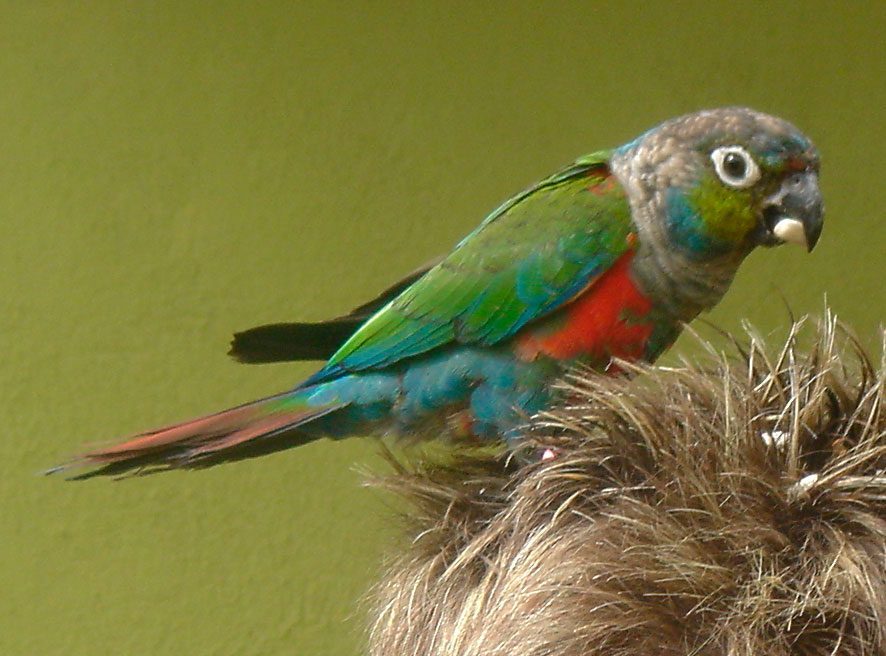
The Crimson-bellied Parakeet (Pyrrhura perlata) has the lores and cheeks of color yellowish-olive with dye Brown; The forecrown, the crown and back neck Dark Slate with velvety probes, giving a mottled appearance, especially in parts where increases the blue at the bases of the feathers.

The upper mantle is blue; robe bottom up to the uppertail-coverts green. Scapulars green at the base, blue down; the lesser wing coverts, olive green; the medium-sized and large coverts, with a predominance of the color blue. The flight feather, blue top, secondaries with green in the outerweb; slate grey dark below.

Underwing-coverts bright red. Sides of the neck, the throat and the top of the chest, with a predominance of brown color, with some brands blue and tips velvety, giving a scaly appearance; The under chest and most of the belly bright crimson; Flanks, the thighs and undertail-coverts, Blue with greenish tint. Upper, the tail, with predominance of color Brown, shades of green and some blue feathers; below, the tail, dark gray.

The bill brown-black color; eye ring whitish grey; Iris dark brown; legs black slate.

Both sexes similar.

Immature they lack the bright crimson color on the underparts; Sometimes with dark margins in the scapulars.

The Pyrrhura perlata was formerly known as Pyrrhura rhodogaster.

Habitat:

They generally inhabit humid forests on dry land., clear forest, secondary and probably drier formations in the North of Mato Grosso and have been registered also dominated by fig trees in eastern forests of Bolivia.

Usually views in small flocks and, sometimes in mixed groups with the Golden-winged Parakeet and Painted Parakeet. Larger family groups have been reported previously. They have often been seen descending into rivers and streams to bathe and drink..

Reproduction:

With reproduce between August and November, probably in April and June, They nest in tree cavities. Incubation period: 24-25 days.

The put in captivity is of 3-9 eggs, being 5 the average.

Food:

Reported foods include catkins Cecropia, small fruits of Trema micrantha, fruits of the ficus, Eugenia and Zanthoxylum, and flowers of Bertholletia excelsa and Dioclea glabra.

Distribution:

They can be found in Brazil, in the area of the great South-Central amazon basin, in West For and in the western area of amazon, in the river basins Madeira and South of the Tapajรณs, to the extreme north of Mato Grosso, Rivers Roosevelt and Aripuanรฃ.

Observed in adjacent parts of Bolivia and probably widely distributed east of Rio Mamorรฉ in hand me and Santa Cruz.

In general common, but perhaps decreasing due to the loss of forests in some parts of its area of distribution (for example, along the river JI-Paranรก in Rondร ยดnia, Brazil).

Conservation:

State of conservation โ“˜


Vulnerable Vulnerable โ“˜ (UICN)โ“˜

โ€ข Current category of the Red List of the UICN: Vulnerable

โ€ข Population trend: Stable

Justification of the population:

The size of the world's population has not been quantified, but this species is described as "quite commonยป (Stotz et to the., 1996).

Justification of trend:

It is suspected that this species has lost 23-30.3% of habitat within its distribution area for three generations (18 years), based on a model of Amazon deforestation (Soares-Filho et to the., 2006, Bird et to the., 2011). Given the susceptibility of species the hunting and capture, they suspected that the population of Crimson-bellied Parakeet will decrease by โ‰ฅ 30% during three generations.

"Crimson-bellied Parakeet" in captivity:

Not very common in captivity. Its diet ideal would be based on fruits such as: apples, Pears, oranges, bananas, grenades, cactus fruits , which form the 30 percent of their food, vegetables, such as: carrots, celery, green beans, pea in the pod, fresh corn, green leaves, such as: chard, lettuce, dandelion, chickweed, healer, millet; a mixture of seeds as such: Canary Islands, small amounts of wheat and millet, oats, safflower and hemp, Sunflower, cooked beans and legumes and cooked corn.

Es una ave muy playful a la que le encanta baรฑarse, so toys and a shallow bowl of water should be provided.
Moderate voice, but when are they excited can be somewhat noisy. It is not aggressive with other species.
Price per couple: 500-600 EUR

Alternative names:

– Crimson-bellied Parakeet, Crimson bellied Parakeet, Crimson-bellied Conure, Pearly Conure, Pearly Parakeet, Rose-bellied Conure, Rose-breasted Conure, Rose-breasted Parakeet (English).
– Conure ร  ventre rouge, Conure perlรฉe, Perriche ร  ventre rouge, Perruche ร  poitrine cramoise, Perruche ร  ventre rouge (French).
– Rotbauchsittich, BlausteiรŸsittich, Blausteiss-Sittich, Rotbauch-Sittich (German).
– Tiriba-de-barriga-vermelha (Portuguese).
– Catita cola granate, Cotorra Ventirroja, Cotorra Ventrirroja, Perico de Pecho Rojo, Perico Perla (espaรฑol).
– Catita cola granate (Paraguay).


scientific classification:

Johann Baptist von Spix

– Order: Psittaciformes
– Family: Psittacidae
– Genus: Pyrrhura
– Scientific name: Pyrrhura perlata
– Citation: (von Spix, 1824)
– Protonimo: Aratinga reported


Crimson-bellied Parakeet images:

Videos of the "Crimson-bellied Parakeet"


Especies del gรฉnero Pyrrhura

Crimson-bellied Parakeet (Pyrrhura perlata)


Sources:

– Avibase
– Parrots of the World โ€“ Forshaw Joseph M
– Parrots A Guide to the Parrots of the World – Tony Juniper & Mike Parr
– Birdlife

– Photos:

(1) – Crimson-bellied Parakeet (Pyrrhura perlata) also called the Crimson-Bellied Conure By derivative work: Snowmanradio (talk)Juan_Caparrรณs_cabeza. JPG: Juan Caparrรณs [CC BY-SA 3.0 or GFDL], via Wikimedia Commons
(2) – A Crimson-bellied Parakeet (also known as the Crimson-bellied Conure) captive by Pyrrhura_perlata_-captive-8a.jpg: Nori Almeidaderivative work: Snowmanradio [CC BY 2.0], via Wikimedia Commons
(3) – Crimson-bellied Conure in the Walsrode Bird Park, Germany By Quartl (Own work) [CC BY-SA 3.0], via Wikimedia Commons
(4) – Parrot by pixabay Crimson
(5) – Pyrrhura perlata by Florin Feneru – Flickr
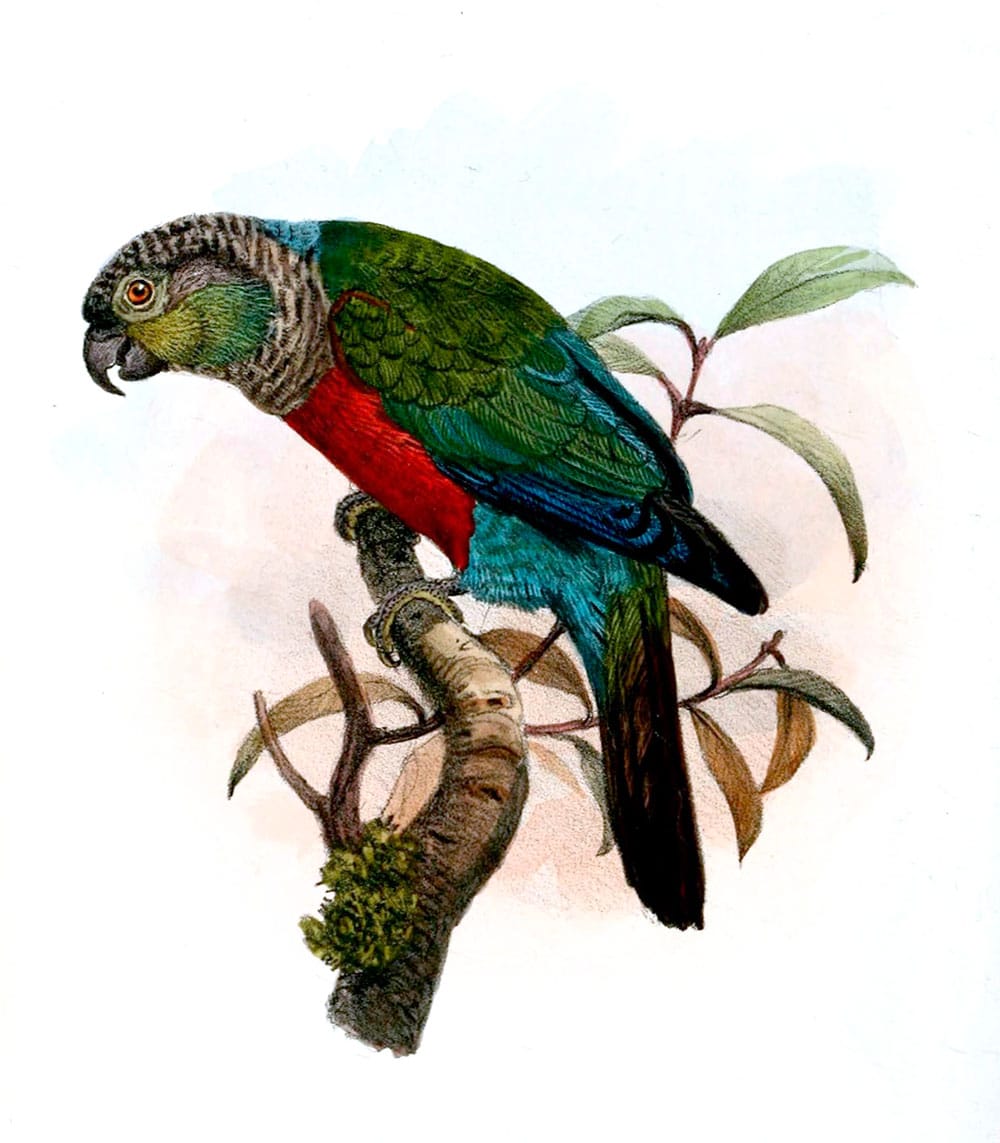
(6) – Conurus rhodogaster=Pyrrhura perlata by Joseph Wolf [Public domain], via Wikimedia Commons

– Sounds: Xeno-canto

โ–ท The world of Pets: Dogs, cats, birds, reptiles, amphibians

Mexican Parrotlet
Forpus cyanopygius

Mexican Parrotlet

Content

Description:

Mexican Parrotlet

13โ€“14 cm. in length and 30โ€“37 grams in weight.

The Mexican Parrotlet (Forpus cyanopygius) has lores, cheeks, forecrown and headphones coverts, brighter yellowish green.

The average area crown to the top of the back, green; lower back, rump and uppertail-coverts, turquoise. big blankets turquoise, other coverts, green. Primaries green, secondaries dark turquoise blue color with narrow edges outerweb. Under the wings turquoise blue and green, the flight feather dark blue-green. Underparts green tinged with yellow. Upper, the tail is green; undertail, duller. Bill and cere pale grayish; bare periophthalmic grey; irises dark brown; legs pink.

Female all green. Immature as female, with some blue feathers on the rump and in the wing-coverts, in the case of young male.

hybrids:

Forpus [conspicillatus x cyanopygius] (hybrid)
Forpus [heaven x cyanopygius] (hybrid)
Forpus [cyanopygius x passerinus] (hybrid)

  • Sound of the Mexican Parrotlet.

Description 2 subspecies:

Two subspecies. But, some authorities regarded the northern birds range as a third subspecies (Forpus cyanopygius pallidus), doubtfully distinct from the nominees. See also Note on Blue-winged Parrotlet (Forpus xanthopterygius).

Habitat:

The habitat of the Mexican Parrotlet They are gallery forests and deciduous forests, plantations, scrub, semiarid open field and trees cultivated areas; mainly observed in lowlands and foothills with the highest number of records in the south of Sonora to 360-455 m; at higher altitudes in western Durango and Zacatecas, with upper limit to 1.320 m.

Birds in breeding abilities have been observed above the 900 meters indicating possible breeding at higher altitudes. Gregaria, forming flocks 4-30 or more, sometimes in the company of Orange-fronted Parakeet (Eupsittula canicularis).

Reproduction:

breeding season may July. Clutch three eggs in captivity.

Food:

Little information about diet or creation: birds observed taking fruits the Ficus, berries and grass seed soil.

Distribution and status:

Size of its range (breeding/resident): 177.000 km2

Endemic West Mexico from Alamos in the South of Sonora to the South by Sinaloa, Nayarit (including the Islands Three Marias) and Jalisco until Colima, with the southernmost record in the Manzanillo Bay (19 ยฐ 03โ€™N).

Its range extends eastward Durango and Zacatecas. irregular population with widely fluctuating local abundance, perhaps in relation to the availability of local foods. There has been a large-scale modification of habitats within range but the species remain common (at least locally). The birds in the Tres Marias Island Perhaps they are in risk of extinction.

Distribution 2 subspecies:

Conservation:

State of conservation โ“˜


Near-threatened Near Threatened โ“˜ (UICN)โ“˜

โ€ข Current category of the Red List of the UICN: Near-threatened.
โ€ข Population trend: In decline.

Rationale for the Red List category

The species has risen to near threatened because its population has probably been reduced to a rate close to 30% during three generations (12 years), depending on the estimated operating levels and reducing the area of รขโ‚ฌโ€นรขโ‚ฌโ€นoccupancy and extent of occurrence; almost meet the listing requirements as threatened under the criteria A2cd + 3cd + 4cd. If the declinations are found to exceed the 30% then the species would qualify to lift to Vulnerable. If there is evidence suggesting that the global population of this species is <10.000 mature individuals, And it is suffering a continuous decrease of> 10% in three generations (until 100 years in the future), would also qualify to lift Vulnerable.

Justification of the population

Partners in Flight estimated that the population in number of less than 50.000 individuals (A. Punjabi in some. 2008), so it is placed in the band 20.000 to 49.999 copies here.

Justification of trend

It is suspected that the population is declining rapidly due to moderately heavy pressure from his capture by illegal trade (Cantu et al ., 2007, Marรญn-Togo et al ., 2012). According to reports, the population of the island Three Marias It has decreased (Collar y Bushman 2014).

Threats

The capture for trade in wild birds It poses a serious threat to a 8.000 individuals illegally caught per year (Cantu et al ., 2007). The range of the species is within one of the main routes for the illegal trade of parrots in Mexico and it is thought that the heavy exploitation of the species is an important factor in their apparent absence of suitable habitat areas.

Conservation actions and research in progress

CITES Appendix II.

Conservation and research actions proposed

Implement legislation to prevent illegal trade. Raise awareness of the species.

"Mexican Parrotlet" in captivity:

Quite frequently seen in aviculture.

Capture for trade in wild birds represents a serious threat to a 8.000 individuals illegally caught per year.

In captivity is not a very long-lived bird; according to sources a specimen lived 10,5 years in captivity.

Each captive specimen of this species which is capable of reproducing, should be placed in a well-managed captive breeding program and not be sold as a pet, in order to ensure its long-term survival.

Alternative names:

– Blue-rumped Parrotlet, Mexican Parrotlet (English).
– Perruche-moineau ร  croupion bleu, Perruche-moineau turquoise, Toui du Mexique (French).
– Blaubรผrzel-Sperlingspapagei (German).
– Tuim-mexicano (Portuguese).
– Catita Enana Mejicana, Cotorrita Mexicana, Perico Catarina, Periquito Mexicano (espaรฑol).

scientific classification:

Order: Psittaciformes
Family: Psittacidae
Genus: Forpus
Scientific name: Forpus cyanopygius
Citation: (Souancรฉ, 1856)
Protonimo: Psittacula cyanopygia

Images Mexican Parrotlet:

Video of the "Mexican Parrotlet"

"Mexican Parrot" (Forpus cyanopygius)


Species of the genus Forpus