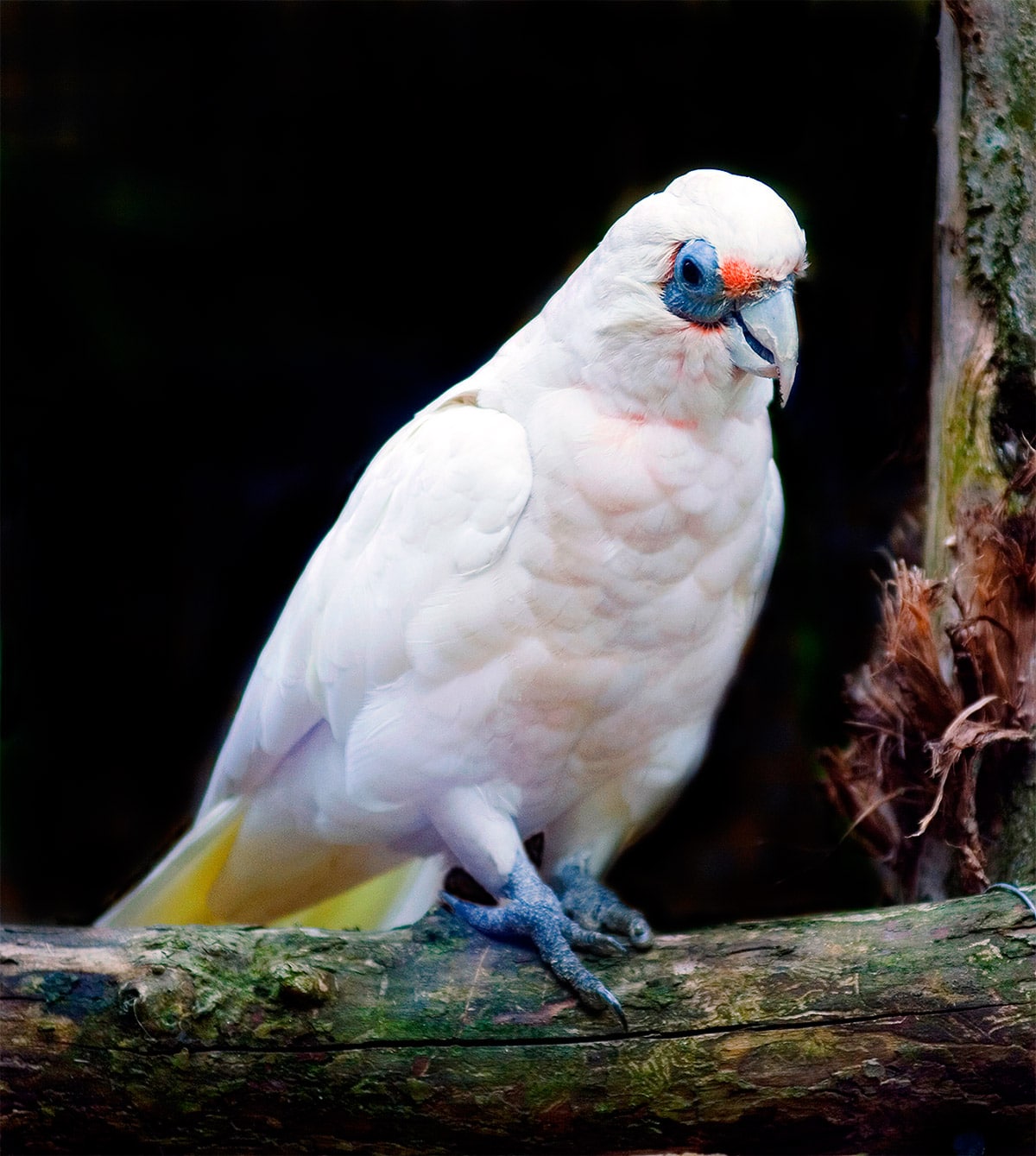
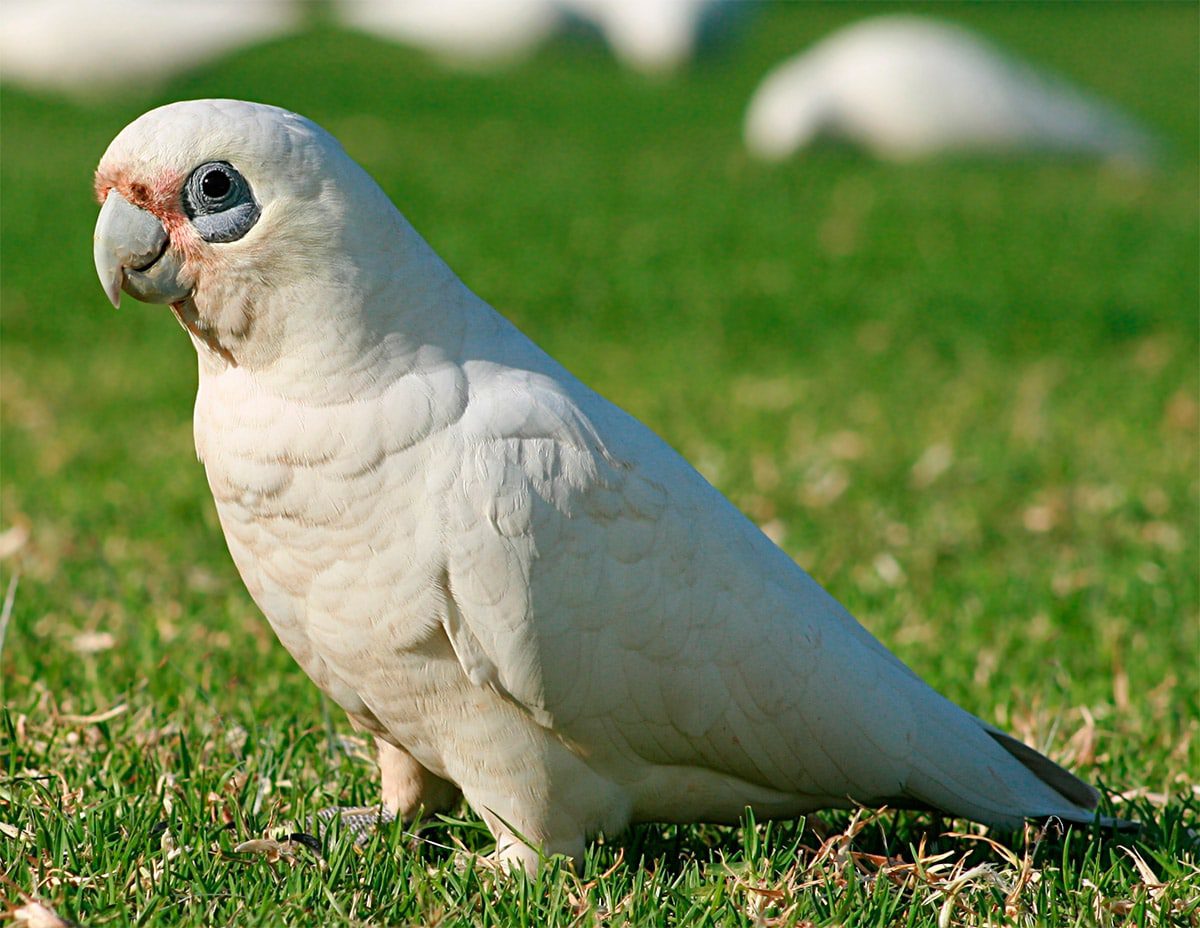
The Western corella(Cacatua pastinator) is a cockatoo of medium size and quite stocky; 43-48 cm.. in length and a weight ranging from 560 and 815 gr.
Mostly white with a wash of red orange color in prominent lores, a strong washing yellow at the bottom of the wings and tail, orbital ring blue-gray; bill pale grey, and legs and feet grey.
It also, the feathers of the head, the neck and the chest have bases red orange that, Although normally hidden, they may be exposed during the Act of grooming or stands by the wind.
The male and female look the same.
The immature They are very similar to adult birds, but they can be distinguished when viewed up close; the texture Nonsquamous bill, washing pale yellow in ear-coverts, the upper jaw shorter and pale and bare periophthalmic less pronounced.
The habitat of the Western corella seems very fragmented. Much of the original habitat has been lost due to logging, the dieback of the field due to processes as soil salinization and degradation.
the Western corella It is now confined to small remnants of their former habitat, including trees isolated in areas cleared of native vegetation. It has been able to persist in small remnants of habitat in agricultural regions because these regions provide permanent water and an abundant food source., but many of these areas are now being converted into plantations Eucalytpus globulus or vegetable crops, which are not suitable for this species.
Reproduction:
The breeding season, generally, It covers the months from September to November.
It lays its eggs in rotten wood or at the base of a hollow wood dust, or hole in a dead tree trunk, especially eucalyptus (Corymbia calophylla and Eucalyptus marginata).
Pairs may use a different tree hollow for breeding each year or may use the same hollow for up to three consecutive seasons.
The clutches They consist of a four white eggs are incubated for a period of 26 to 29 days.
The role of parents in the incubation of the eggs and the care of young people has not been registered, but it is likely that both parents hatch the eggs and feed the young.
The incipient period and the period of independence It is not registered, but it is likely that the young remain in the nest during 53 to 67 days and become independent three months after leaving the nest.
The survival rates adult and immature birds are unknown, but the younger, they probably die until they are able to reproduce.
Food:
It feeds mainly from seeds but also takes insect larvae, bulbs, tubers, fruits and possibly nectar.
There is little information available about seasonal variation in the diet, but the seeds of cereal grasses are important in summer and early autumn, and seeds and bulbs R. rosea, that they are common in the diet throughout the year, they are probably the main source of food from late autumn to spring.
It´s gregarious. use your upper jaw long to unearth the underground parts of various native plants growing in the forest. Also pulls bulbs when soil is moist, and unearths the cereals in germination.
Distribution:
Size of its range (reproduction / resident): 258.000 km2
Currently is recognized two separate populations, both confined in southwest Western Australia.
You can find up to 400 meters above sea level.
(Gould, 1841) – Nominal. It is found in most southwest Australia, to the South of Perth from the rivers Swan and Avon in the North, to Augusta in the west and Broome in the East.
Conservation:
• Current IUCN Red List category: Least concern.
• Population trend: Growing
The total world population not known, It is estimated in 3000 individuals, but it is believed that it may be expanding due to the increase in agricultural areas and with it a greater availability of food. The legal protection by the legislation also plays an important role for the survival of these species.
The decrease in the population of the south is attributed to persecution by farmers who regard the species as a pest for crops.
It keeps in captivity in the Perth Zoo and by licensed poultry farmers as part of a captive breeding program initiated by the Department of Conservation and Land Management WA en 1995.
The Burrowing Cockatoo in captivity:
Very rare in captivity.
It can be loud and aggressive with other birds. Has the ability to imitate and creates strong bonds with their caregivers.
In captivity it can live more than 50 years.
Alternative names:
– Western Corella, Bare-eyed Long-billed Corella, Corella, Eastern Long-billed Corella, Western Long-billed Cockatoo, Western Long-billed Corella (ingles).
– Cacatoès laboureur, Cacatoès à nez rose, Cacatoès à oeil nu, Cacatoès à oil nu (French).
– Wühlerkakadu (German).
– Cacatua-pastinator (Portuguese).
– Cacatúa Cavadora (español).
Among 55 and 61 cm.. of length and a weight of 224 g..
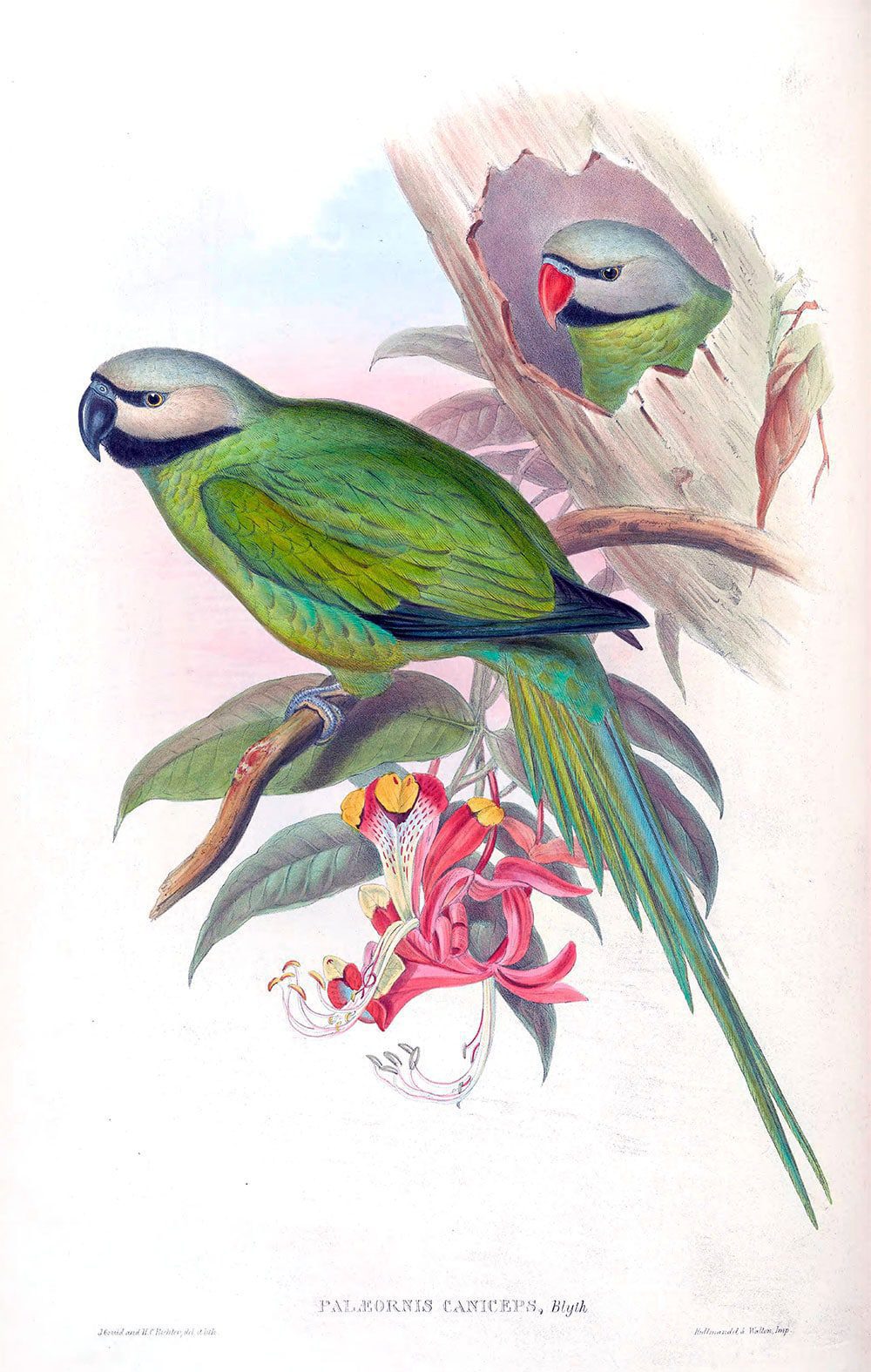
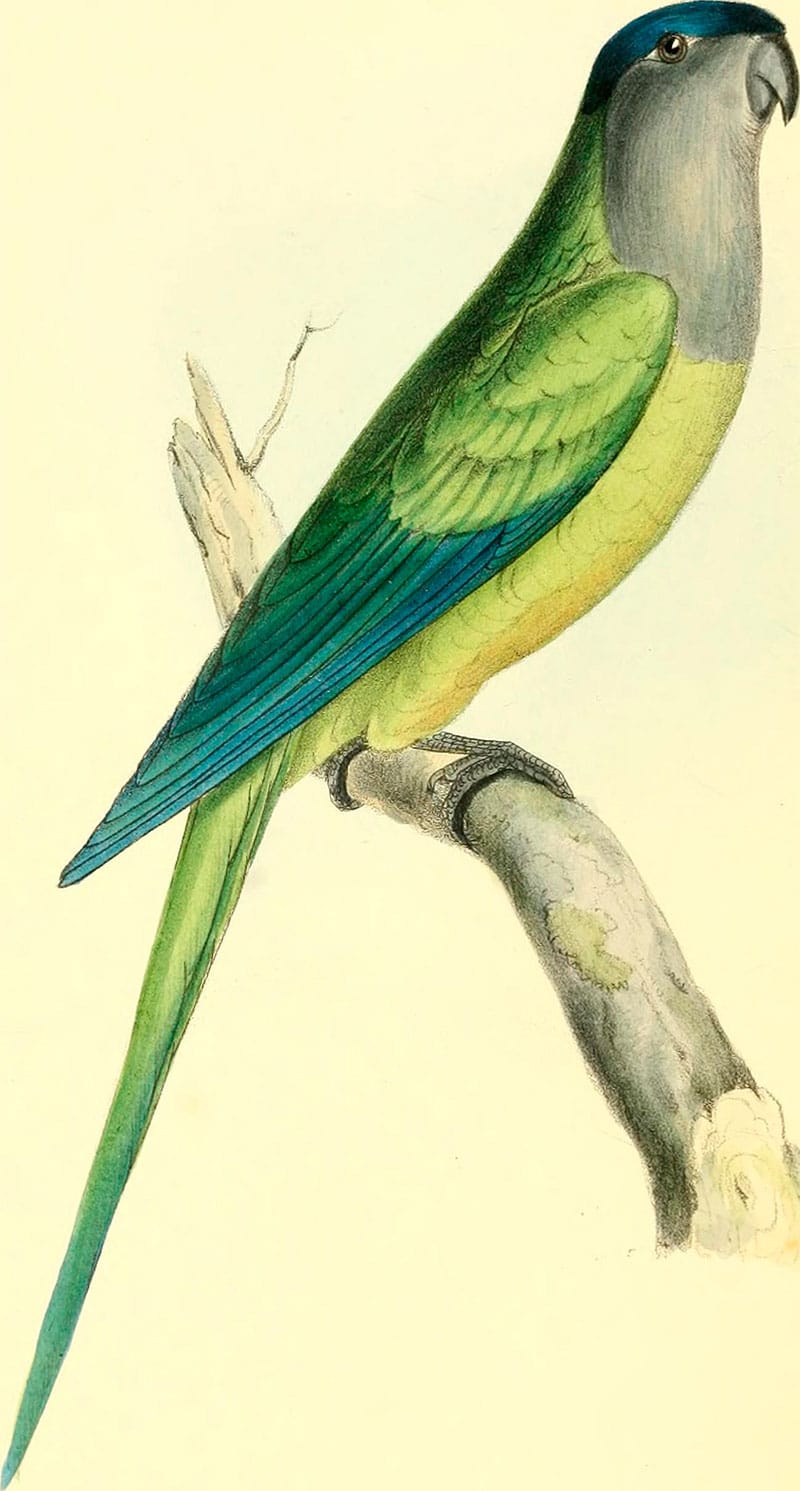
The Nicobar Parakeet(Psittacula caniceps) has the crown, upper cheeks and ear-coverts pale grey; stripe black in the region perioftalmica through the lores up to the forecrown; the lower cheeks and the chin are black. Nape and upper mantle pale gray bathed in blue; rest of the upper region green grass pale.
Upperwing-coverts green; primaries and secondaries Green with dark tips. Underwing-coverts green. Underparts green, slightly paler than upper parts. The elongated feathers central tail green with grey tinge, outer green.
upper jaw coral red, the lower black; cere dark grey; irises orange-red; legs dark gray.
The female has the bill black, the grey of the head and nape more strongly impregnated with blue, and tail slightly shorter.
The immature similar to females.
Habitat:
The Nicobar Parakeet it is difficult to locate visually among the dense foliage, Although its presence is revealed by their distinctive calls. Their flight is fast and direct.
They inhabit in the high rainforest. Generally held among the dense foliage on canopy, about everything when not fully.
They are perhaps most abundant in the coastal forests than inside.
Has also been recorded in areas with plants of Areca catechu and coconut plantations, which suggests a considerable tolerance of the species in habitats modified.
Usually, observed in pairs or in small groups.
Reproduction:
Unknown breeding habits.
Food:
Unknown diet except for the fruits of Pandanus, abundant in the inhabited islands of the Nicobar archipelago.
Distribution:
Size of the area of distribution (reproduction / resident): 1,100 km2
endemic to the Nicobar Islands, located in the Indian Ocean and belonging to the India. Registered since Great Nicobar, Montschall and Kondul. Resident. His status is unknown but they are potentially at risk due to habitat loss due to the expansion of rice cultivation; also affected its population because of the bird trade, Although there is little local use of these birds as pets and there are no known international traffic.
The population of the Nicobar Parakeet It is suspected that It may be waning as a result of the destruction of habitat due to the tsunami of the 2004 (K. Sivakumar in litt. 2007), due to the development of the island, and because the capture for the wild bird trade. But, more research is needed to establish with precision the trends.
Probably between 10,000 – 15,000 specimens on freedom.
The main threats to the Nicobar Parakeet They come because of the large number of birds that are trapped for the cage bird trade.. On the other hand, the increase of settlements on the Islands It has led to increased pressure on natural resources and the planned development projects may seriously affect the habitat of this species. The tsunami of 2004 It destroyed large tracts of coastal forest that may have caused a further decline in the population. But, the data remains scarce, and the rate of regeneration of these forests is unknown (K. Sivakumar in litt., 2007).
Conservation Actions Proposed:
– Determine the impact of the trade in the species.
– Calculate the rates of forest loss.
– Protect remaining habitat areas.
– Assess the impact of the tsunami of 2004.
"Nicobar Parakeet" in captivity:
There is not much information available; probably brought for the London Zoo at the beginning of 20th century; kept as pets, at an unknown number, by the local population of the Nicobar Islands
Since the Nicobar Parakeet is a species so rare, It is not recommended to keep them captive, it is preferable to place them in a breeding program well managed by expert hands.
Alternative names:
– Nicobar Parakeet, Blyth’s Parakeet (English).
– Perruche des Nicobar, Perruche de Blyth (French).
– Graukopfsittich (German).
– Periquito-de-nicobar (Portuguese).
– Cotorra de Nicobar (español).
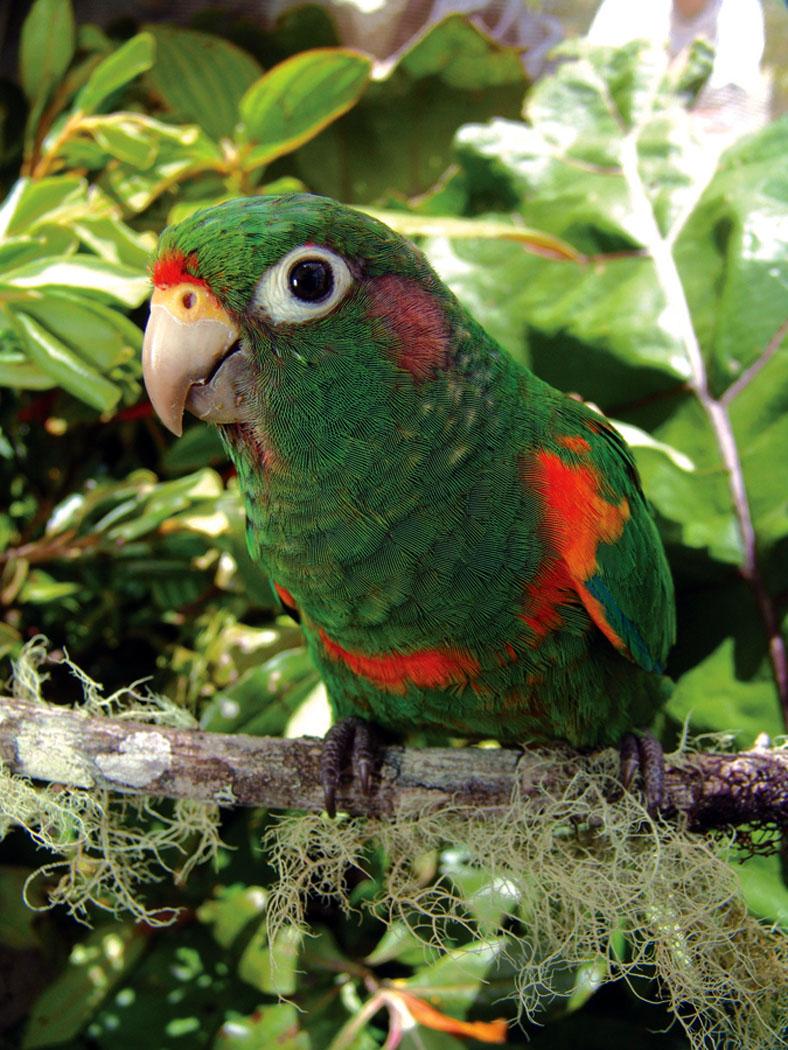
The Santa Marta Parakeet(Pyrrhura viridicata) It, in general, green, with a characteristic red stripe in the middle of the chest which continues until shoulder and armpit. The scales of the chest is less evident; the flight feathers blue. Band front narrow red in the forecrown and behind the eye with red and yellow dye. Tail over green and below red opaque.
Bill color bone; brown iris; pale black legs. It has no sexual dimorphism.
It inhabits in humid mountain forest, clouded forest, pastures and edges, from 1900 to 2800 m. They fly at dawn and at dusk in compact and numerous flocks on the canopy of the forest. Is les has observed flying over them clear adjacent and each time more visiting them mulberry plantations.
The species rests and nests in couples and in lesser proportion in groups of three individuals in cavities of Palms of bouquetCeroxylon ceriferum (Arecaceae).
Reproduction:
The period reproductive is starts in December and lasts until June, the cavities are visited on average 4 to 5 times a day. There is a sexual dimorphism and a low reproductive success can be associated with displacement or predation by the Aratinga wagleri wagleri (Scarlet-fronted Parakeet) or the Santa Marta Toucanet (Aulacorhynchus lautus prassinus) – Ramphastidae.
Food:
Twelve plant species are incorporated into the diet so far known to the Santa Marta Parakeet, It consists mainly of flowers and fruits, the inflorescence of the Croton bogotanus (Euphorbiaceae) is their main source of food. It forages in groups of size variable, presenting an integration and disintegration of subgroups throughout the day. A sentinel system was observed.
Distribution:
Size of the area of distribution (reproduction / resident): 1,600 km2
Endemic species of Sierra Nevada de Santa Marta, to the northeast of Colombia. The towns registered include The Summit, is of Taquiña on the basis of the Páramo of Mamarongo in the Guajira, and Cerro Quemado in the mountains of San Lorenzo.
Will produce some movements altitudinal seasonal. Almost all the habitat forest subtropical is designated as reserve forest or Park national, but the clearing for plantations of marijuana has been extensive, similar to the use of herbicides to combat it. So it only remains for the 15% the original forest (especially in the hillsides North), including only 200 the preferred height of the species km2. Fairly common within this very restricted range, but the population probably below of the 5.000 birds.
Conservation:
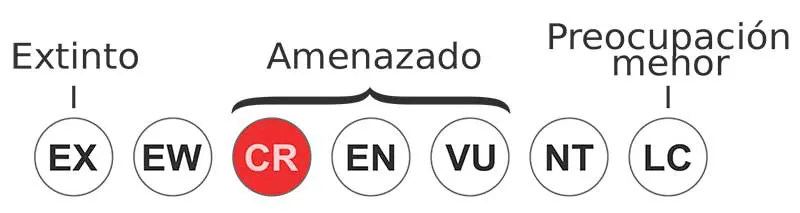
State of conservation ⓘ
Endangered ⓘ(UICN)ⓘ
• Current category of the Red List of the UICN: In danger of extinction.
• Population trend: Decreasing.
Rationale for the Red List category
The range of this species and its small population are probably decreasing as a result of habitat loss. So, qualifies as in danger.
Justification of the population
The population It has been estimated for a long time between 5.000 and 10.000 individuals, equivalent approximately to 3.300-6.700 mature individuals. The density of population is of 1 Ave per km2 (Botero-Delgadillo et to the. 2012). Assuming that the 680 km2 of habitat are fully occupied, the population total is calculated that is 2,900-4,800 birds, which is equivalent to 1,933-3,200 mature individuals; But, with occupation part is likely to remain less than 2.500 birds (Botero-Delgadillo et to the. 2012).
Justification of trend
Se sospecha una decrease moderate and continuous of the population on the basis of the rates of habitat loss.
Threats
only one left 15% the original vegetation of the Sierra Nevada de Santa Marta, to a large extent on the slope North, where this species is found (LM Renjifo, Com. 1993, 2000).
The main current threat is the expansion of plantations of non-native trees, such as the of Pine and eucalyptus, in addition to the clearing of land for livestock (C. Olaciregui in litt. 2012).
· Historically, the conversion of forests in plantations of marijuana and coca was also a major threat (LG Olarte in litt., 1993, com LM Renjifo. Comm., 1993, J. Fjeldså verbally they 2000, pers LM Renjifo. Comm., 2000, C. Olaciregui in litt. 2012), that is compounded by the Government with application of herbicides in the sierra (LG Olarte in litt., 1993, com LM Renjifo. Comm., 1993, 2000).
Other threats that followed the human migration to the area Since the Decade of 1950 hereafter include slash & burn (Dinerstein et to the., 1995, Snyder et to the. 2000, Salazar and Strewe undated, PGW Salaman in litt. 1999).
· It is known to be hunted in the cold river valley, and in the San Pedro district individuals in mulberry plantations have skyrocketed. The species not found in the local bird trade (Strewe 2005).
"Santa Marta Parakeet" in captivity:
Not marketed for captive.
Alternative names:
– Santa Marta Parakeet, Santa Marta Conure (English).
– Conure des Santa Marta, Perriche de Santa Marta, Perruche de Santa Marta (French).
– Santa-Marta-Sittich, Santa Marta Sittich, Sittich (German).
– Santa Marta Parakeet (Portuguese).
– Cotorra de Santa Marta, Perico Oliva, Periquito de Santa Marta (español).
Avibase
Parrots of the World – Forshaw Joseph M
Parrots A Guide to the Parrots of the World – Tony Juniper & Mike Parr Birdlife
Oliveros rooms, H.. 2005. Population and ecological evaluation of the Santa Marta parakeet Parrot parakeet in the sector of San Lorenzo, Sierra Nevada de Santa Marta, Colombia. (ProAves.org)
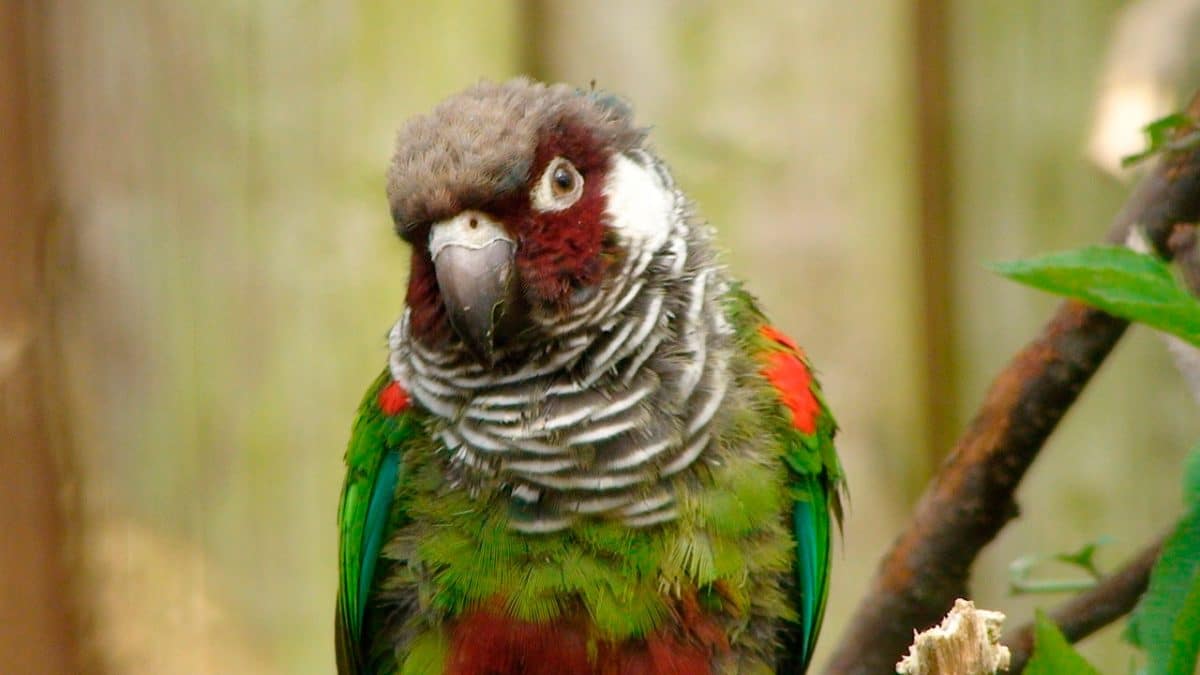
The Grey-breasted parakeet(Pyrrhura griseipectus) is a bird marked by a mask in reddish face, interrupted by a surrounding white coloration in the regions orbitals and ear-coverts.
The feathers of the neck to the upper region chest They have a gray coloration with light streaks interspersed, giving the region a striped appearance or escamado. The species has a characteristic patch reddish in belly, highlighting green coloration, its predominant body. The region forecrown up to the nape, It is dark brown with white or lighter brown spots that vary from bird to bird.. rear area neck green blue border with a width. They have a patch reddish brown in the bottom of the back which leads to the crown. The tail It is long and maroon. Bill gray-black; eye ring white gray; irises brown-orange.
It has no sexual dimorphism. The immature they are more muted than adults; You have scattered green feathers in the abdomen; the cere and the bare periophthalmic is white, less gray tone.
Taxonomic status:
This species is considered to be a subspecies of Pyrrhura [leucotis, emma or griseipectus] by some authors
Sound of the Grey-breasted parakeet.
Habitat:
It is in the rainforests, often located in Serranas regions, where orographic rains favor the occurrence of enclaves Atlantic Forest and Mata dry amid caatinga.
Reproduction:
The breeding season It occurs during the rainy season. The laying It is five to eight eggs in holes dug by woodpeckers since they are not able to dig their own nests; They use these holes to sleep.
When the pups are born, the couple divides the task of feeding. Sometimes they have help from even a third member of the flock to successfully raise all the young..
Food:
Probably it feeds on fruits, flowers, seeds and algae.
Distribution and status:
Size of its range (players / residents): 830 km2
This species was formerly known in 15 Locations (. Anon 2014) within Brazil. At present it is in only three areas in the state of Ceará, the Serra de Baturité and Quixadá(C. Albano in a little . 2006, Waugh et al 2010.) and most recently observed in a rocky mountain Ceará, where five birds were recorded in March 2014 (Anon. 2014).
In Serra do Baturité appears to be very rare and seems to have been extinct from several areas, but recent records of groups in the Environmental Protection Area mountains Baturité; surveys 2007 half of the remaining habitat in this site revealed near 80 individuals (C. Albano in a little. 2007, 2008) and the population here is now estimated to be about 250 birds(Waugh et al . 2010).
Forests of Baturite mountains They have been greatly reduced to make way for coffee plantations and only 13% of the jungle remained in 1996. The discovery in 2010 a population of about 50 birds in Quixadá(Waugh et al ., 2010) It raises the known world population of this species in about 300 birds.
The Grey-breasted parakeet It was previously known two other areas: the eastern slope of the Saw Ibiapaba in Ceará, and small Serra Negra, in Pernambuco, where it was very common in 1974, with flocks of 4-6 individuals regularly seen in the early 1980, although there are no recent records. There are also unconfirmed reports 1991 in organic station Murici Alagoas in which possibly it refers to individuals released; Recent fieldwork was unable to locate the species.
Its known range is very small, and the species has declined dramatically in the past, a trend that may be permanent.
Conservation:
Justification of the Red List of the Category
Recent surveys indicate that this species has a extremely small population, which continues to decline after dramatic historical declines. For these reasons it qualifies as Critically Endangered.
Justification of the population
State of conservation ⓘ
critically endangered ⓘ(UICN)ⓘ
• Current category of the Red List of the UICN: critically endangered.
• Population trend: Decreasing.
• Population size : 200 individuals.
The population in the Area of Baturité Mountains Environmental Protection It is estimated at about 250 birds, and discovery in 2010 a population of about 50 birds in Quixadá raises the known world population of about 300 birds(Waugh et al ., 2010). This equates to approximately 200 mature individuals.
Justification trend
This species is suspected to be decreasing quickly because of their capture and habitat loss in progress within its range.
Threats
The habitat destruction He has played a role in the decline of the species with the original forest cover now reduced to only 13%.
The coffee plantations (especially where coffee is grown in the sun instead of shade coffee) They are impacting the habitat of the species.
The main threat, However, It is believed to come from the capture illegal underway for local and national trade (C. Albano a slightly 2006, Anon 2009..) and captive breeding (Fernandes-Ferreira et al 2012.); the Grey-breasted parakeet They can be easily purchased through Internet (Girão and Albano 2008).
It is easily found in the international trade in bird cage.
The lack of natural nesting sites also it believed to are limiting reproductive success of the species (Campos et al . 2014).
Conservation Actions Underway
Appendix II of CITES.
In Brazil, It was considered above in critical hazard(Silveira y Straube 2008), but it has now been legally designated as endangered national(MMA 2014), and protected Brazilian law.
Dwelleth within Baturité Mountains Environmental Protection Area, but this area has been designated for sustainable use and traditionally has not been achieved for conservation.
Management of land by a private owner in the area has led to an increase in a small town known (C. Albano a slightly . 2006).
Since 2007, NGO AQUASIS Brazil has been conducting two research projects: one sponsored by the Brazilian Foundation O Boticário for the Protection of Nature, the topography of the Baturite mountains to monitor their condition and research their biology; and another sponsored Fundación Loro Parque, for additional populations (C. Albano in a little. 2007, 2008).
The surveys carried out in the historical sites and areas of potential habitat in the period 2007-2008 They have not been able to locate members of this species, although there are strong indications of individuals that may still be inhabiting the degraded Serra do Estevão, municipality Jaw, state Ceará(C. Albano in a little. 2007 2008, Anon 2007), where it was actually rediscovered in the 2010 (Waugh et al ., 2010).
A team of AQUASIS, funded by an award Leadership Program for Conservation in 2012, conducted searches for the species on an isolated mountain in Ceará and he found a small population of five individuals in March 2014(Anon. 2014).
You can also persist in Serra Negra Biological Reserve, state Pernambuco, although a combination of marijuana crops and hostile local culture makes research work in this latter area difficult (C. Albano in a little. 2007, 2008).
At least 11 private reserves (RPPN) They are in the process of being created in the Serra de Baturité(C. Albano in a little. 2007, 2008) and AQUASIS They are now engaged in the process of developing a nature reserve in the Baturite mountains(Campos et al . 2014).
AQUASIS has strengthened ties with government agencies in order to influence policy decisions (Campos et al . 2014).
Scheme nest box sponsored by Loro Parque It has been carried out with nest boxes installed in different places with the consent of the landowners. (Anon, 2009).
AQUASIS also they provided nest boxes Insecticide treated to reduce infestations of bee and wasp (Campos et al . 2014). These measures have proved effective, with 16 boxes occupied in 2012 give place to 97 eggs and 71 chicks hatched successfully.
A education and awareness campaign large scale was carried out in the Serra de Baturité in 2008 (C. Albano in a little. 2007, 2008) and continues today, with many schools currently participating in education programs AQUASIS(Campos et al . 2014).
A main objective of AQUASIS is to promote the Cotorra pechigris as a flagship species, the work being supported by commercial NGOs and ecotourism WATER Trails of the Park(Anonymous 2009).
AQUASIS also it aims to develop the ability to bird watching and a development process of consciousness creating alternative livelihoods (Anonymous 2009). A visitor center has recently been established (Campos et al . 2014).
It breeds well in captivity and stocks are held in Brazil and abroad. Always captive breeding is well managed and coordinated, could be used for reintroduction into the wild.
They are being conducted studies on factors influencing the survival rate of chicks, population's genetics (in future DNA techniques can be used as a deterrent against illegal collection of wild birds); both adults and juveniles have been banded (Campos et al . 2014).
Conservation Actions Proposed
Conduct more studies in areas similar to the mountains Baturité in the northeast of Brazil, such as Sierras de Aratanha, Maranguape and Machado, by the presence of additional existing populations.
improve conservation management practiced in the Guaramiranga Ecological Park.
Provide incentives for landowners to increase the network of private reserves Baturite mountains.
Monitor and control trade locally, National and international.
Investigate the feasibility of using giant bamboo(Dendrocalamus giganteus) as sites for constructing artificial nests (Campos et al . 2014).
continue making awareness campaigns to promote the Grey-breasted parakeet as a symbol for the conservation of humid forests and associated biodiversity in the Baturite mountains.
Investigate in situ conservation measures.
"Grey-breasted parakeet" in captivity:
Its continuous capture, both for domestic and international trade, They have taken this beautiful bird to a critical situation, there are only 200 specimens in the nature. There are probably more animals captivity in its natural habitat
Protected by the Appendix II of CITES, each captive specimen of this species that is capable of reproducing, must be placed in a well-managed captive breeding program and not sold as a pet, in order to ensure long term survival.
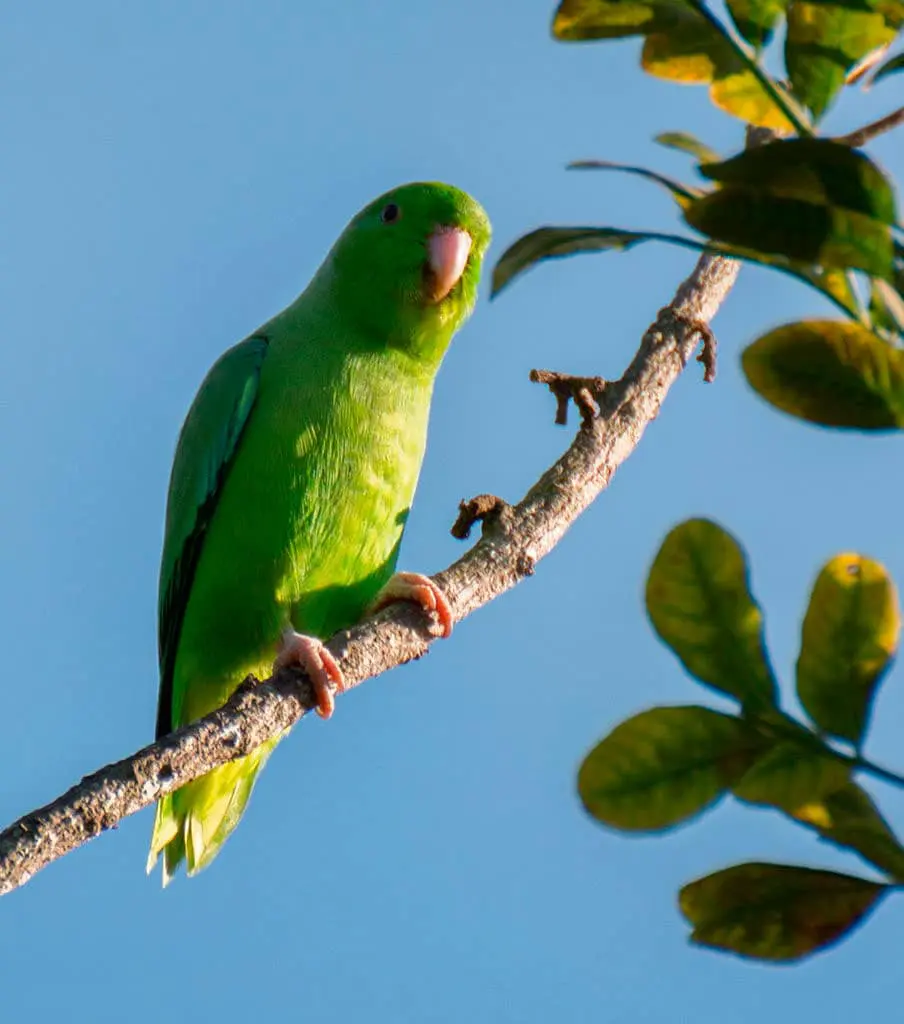
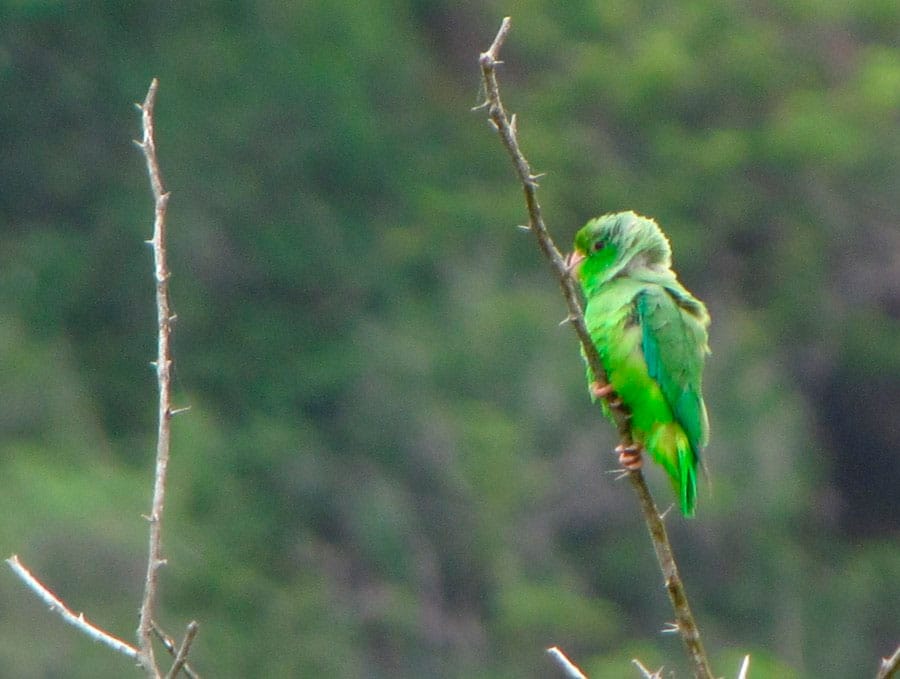
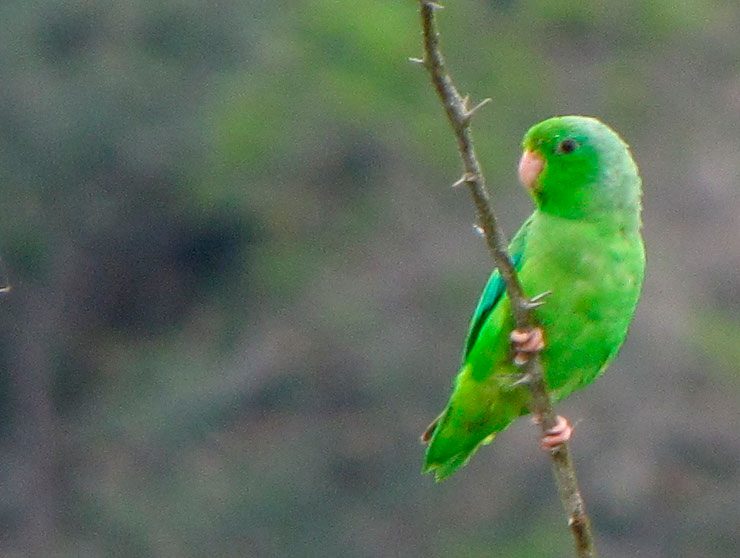
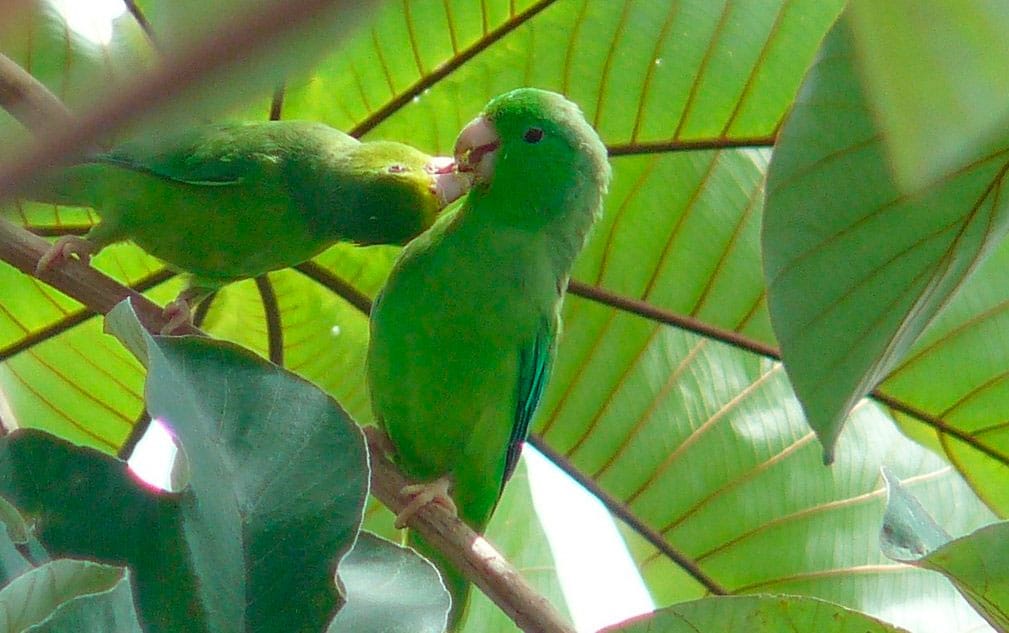
The Green-rumped Parrotlet(Forpus passerinus) is the psittacine smaller that can be found on the American continent. It is distinguished by being green, with a brighter green in the front, cheeks, lower part of the body and behind the neck; the rump bright green in the two sexes, wing
with one Strip Turquoise Blue followed by another greenish-blue in males; belly lighter than the back, tail with yellow border.
Female with rump greenish-yellow and wings without blue. It is possible to have dyes more yellowish forehead.
(Schlegel, 1864) – Also known as Parrotlet Schlegel. Similar to the subspecies Forpus passerinus passerinus, but the feathers of the tail of the female they are more green in the bottom. Also it has more yellow along the forecrown .
Forpus passerinus cyanophanes
(Todd, 1915) – Show more blue with the wing
closed in the other subspecies.
Forpus passerinus deliciosus
(Ridgway, 1888) – The male has the rear area Emerald green with blue and pale blue tint at the edge of the the greater wing coverts. Female has more yellow in all the facial area.
(Lafresnaye, 1848) – Also known as Venezuela green parakeet. The plumage is green in males; in females varies considerably according to the region they inhabit.
Habitat:
It is found in dry forest, semi-open areas, crops, among others, until the 500 m. In flocks of more of 100 individuals. You can perform altitudinal migrations.
Reproduction:
It nests in abandoned nests of woodpeckers or in other holes, from May to November.
Food:
They feed on seeds, including the of the grasses.
Distribution:
Size of the area of distribution (reproduction / resident): 1.060.000 km2
This is a very widespread and common. They are distributed in the northeast of Colombia, North of Venezuela, Guyanas to the northeast of Brazil, also in Curacao, Trinidad and the West Indies.
(Todd, 1915) – Are found in the areas around the North of Colombia.
Forpus passerinus deliciosus
(Ridgway, 1888) – Is located in the lower basin of the amazon, in Brazil.
Forpus passerinus passerinus
(Linnaeus, 1758) – The nominal. Found in the Guianas.
Forpus passerinus viridissimus
(Lafresnaye, 1848) – Found in the North of Venezuela, Trindad and Tobago.
Conservation:
State of conservation ⓘ
Minor Concern ⓘ(UICN)ⓘ
• Current category of the Red List of the UICN: Least concern.
• Population trend: Decreasing.
Justification of the population
The size of the world population It has not been quantified, but this species is described as «common» (Stotz et to the., 1996).
Justification of trend
It is suspected that this species has lost 19,2-21% of habitat within its distribution in three generations (12 years) based on a model of Amazon deforestation (Soares-Filho et to the., 2006, Bird et to the., 2011). Given the susceptibility of the species to hunt or capture, It is suspected that it will fall in <25% durante tres generaciones.
"Green-rumped Parrotlet" in captivity:
It´s common bird cage. In captivity they are sweet and playful. It might be possessive with toys and people.
– Avibase
– Parrots of the World – Forshaw Joseph M
– Parrots A Guide to the Parrots of the World – Tony Juniper & Mike Parr
– Birdlife
– Parrot Book, Parrots and macaws Neotropical
– Photos:
(1) – Forpus passerinus in Trinidad 2014, Caribbean By Jam.mohd (Own work) [CC BY-SA 4.0], via Wikimedia Commons
(2) – Photograph of pet Green-rumped Parrotlet (Forpus passerinus) By self (Own work) [Public domain], via Wikimedia Commons
(3) – Green-rumped Parrotlet, (Forpus passerinus), a pair, male (right) and female (left), in Venezuela By kulyka on flickr (Flickr) [CC BY 2.0], via Wikimedia Commons
(4) – Periquito mastrantero [Green-rumped Parrotlet] (Forpus passerinus viridissimus) by Cristóbal Alvarado Minic – Flickr
(5) – Periquito mastrantero [Green-rumped Parrotlet] (Forpus passerinus viridissimus) by Cristóbal Alvarado Minic – Flickr
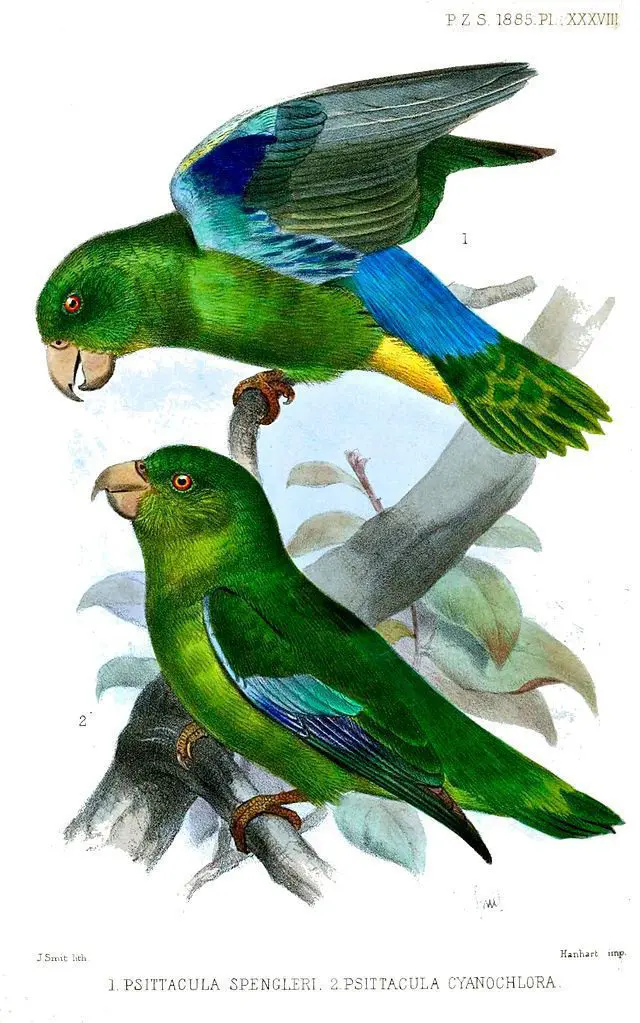
(6) – Blue-winged Parrotlet, adult male (above); Green-rumped Parrotlet, young(?) male (below) Joseph Smit [Public domain], via Wikimedia Commons
Origin: Peru, Guyana, Brazil, Venezuela, Colombia, Ecuador, Bolivia
Character: Divertida.
Life expectancy: 30 to 40 years
Height: 21 to 23 cm..
Content
Description:
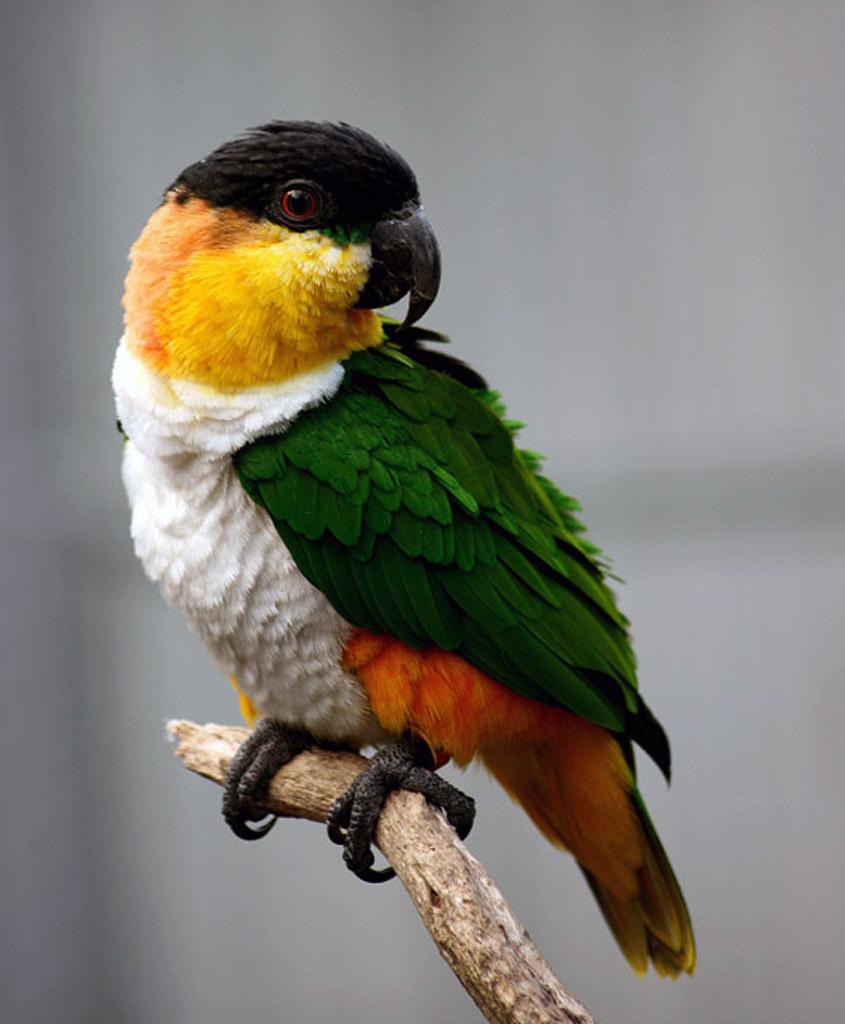
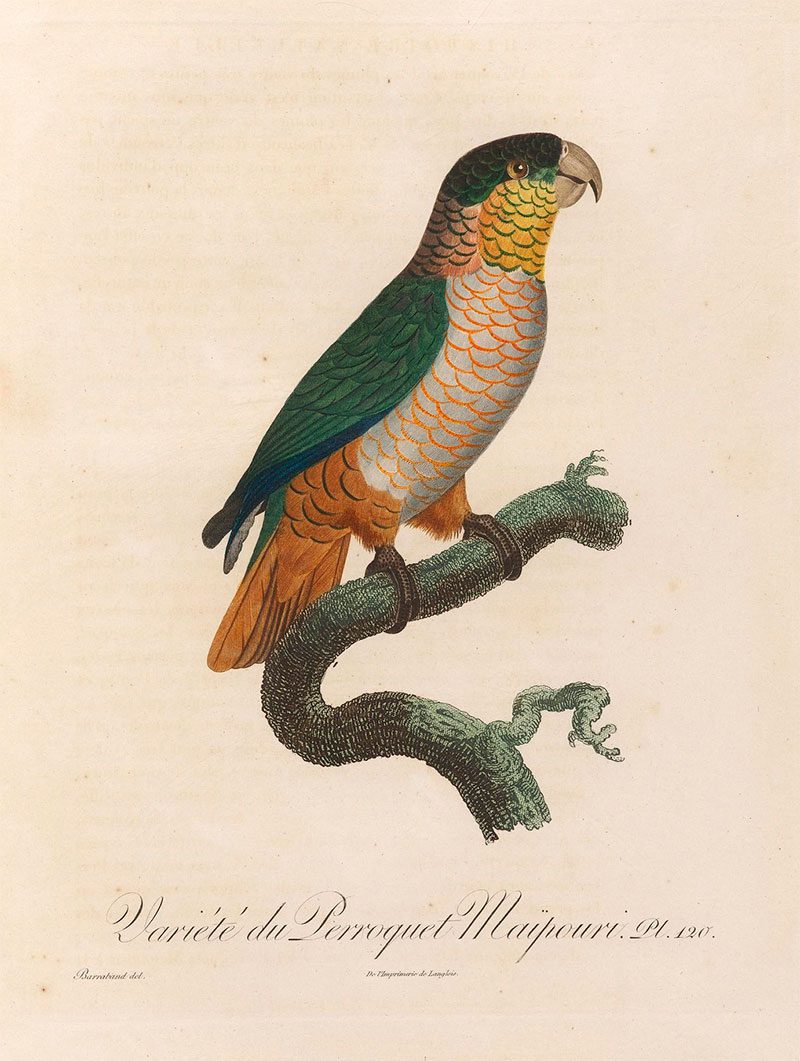
The Black-headed Parrot(Pionites melanocephalus) measures of 21 to 23 cm.. height.
Unmistakable by crown black, chest and belly white, the latter with yellow sides (very visible on the fly). Breast
bright yellow, nape orange acanelada, back and rump green. Tip pens of wings They are blue and dark go the closer they get to the body.
Legs and bill dark gray.
The youth They have bluish green spots on the nape, with chest and belly yellowish.
There is no sexual dimorphism in this species. The identification of genus must be performed by DNA testing or a surgical probe.
(Berlepsch, 1890) – It has bright yellow in the throat, the thighs and tail.
Habitat:
It inhabits humid jungles, semi-wet, swampy, gallery woods, stubble and crop to the 1000 m. Walks in small flocks between 3 to 10 individuals, feed in the canopy, very rare in stratum low forest.
Reproduction:
Its laying is of 2 to 4 eggs and the breeding season It is from December to February in French Guiana, april in Venezuela, April to May Colombia, October to November Suriname.
Food:
Feeds of seeds several species of plants cellulose, plants, flowers and leaves. There is also evidence of some insects in your diet.
Distribution:
She can be seen in the wild along the Amazonia, from the North of the Amazon River, bordering south to northeastern Peru, also in the Guyanas.
(Berlepsch, 1890) – South of Colombia to the East of Ecuador and northeast of Peru.
Conservation:
State of conservation ⓘ
Minor Concern ⓘ(UICN)ⓘ
Although not in danger of extinction Its population has declined significantly. The illegal marketing is the main theory against its appearance and adaptation in an environment foreign to its natural environment. Poaching of pigeons and felling of trees are common in the south of the country.
"Black-headed Parrot" in captivity:
Popular poultry farming. They adapt easily to the bird or Aviary cages. You need a degree quite high commitment and attention by the owner. The like to interact with other birds and people. The love to play with toys and can be quite noisy. An interesting feature of the Black-headed Parrot It is their habit of rolling on his back and play with toys help of their paws.
He manages to replace their jungle habitats in parks or green areas of large cities.
Its price is quite high compared to other species due to its striking plumage and friendliness..
Alternative names:
– Black headed Parrot, Black-crowned Parrot, Black-headed Caique, Black-headed Parrot(English)
– Cotorra pechiblanca, Loro cacique o Loro mocho (Colombia)
– Perico calzoncito (Venezuela)
– Loro coroninegro (Ecuador)
– Chirricles cabeza negra (Peru)
– Grünzügelpapagei, Grünzügel-Papagei (Germany)
– Lorito Chirlecrés, Lorito Chirlicrés, Lorito Gordo de Cabeza Negra (Spain)
– Caïque à tête noire, Caïque maïpouri (France)
– cabeça-preta, maipuré, marianinha-da-cabeça-preta, Marianinha-de-cabeça-preta (Brazil)
It measures 35-40 cm.. and weighs approximately 500 g..
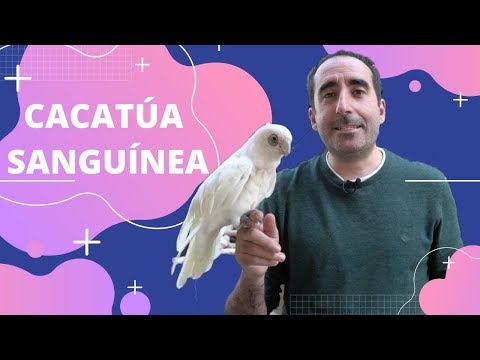
In the Little corella(Cacatua sanguinea), the head and crest (that most of the time stays low) are white. The pink base of the feathers are almost completely hidden and yet barely visible small flakes in the cheeks.
Dissemination of salmon-rosa color to the area around the eyes. The upperparts and coverts of the wing are white. There is a remarkable spread of yellow color on the bottom of the flight feather and of the tail.
The bill is grayish white. The skin nude around the eyes is blue grey. The irises is dark brown, the legs grey.
Both sexes are identical in all aspects, including the color of the irises.
The immature have a look more white and the skin of the periphery eyepiece less prominent.
(Sclater,PL, 1871) – Features with more naranja-rosa around them eyes and in the bases of the feathers of the head, neck and top of the chest. Its orbital skin is darker.
(Mees, 1982) – Displays below the wings and tail infiltrations slightly yellow pulling a Brown.
Cacatua sanguinea westralensis
(Mathews, 1917) – It has bright orange-red colors around the eyes and the bases of feathers, also in the the mantle and in the part inferior of the abdomen.
Habitat:
Video – "Little corella" (Cacatua sanguinea)
The spectacular BLOODED COCKATOO - BIRD VETERINARY
It nests in riparian forests bordering permanent pasture and cropland. In the breeding season, they can be found in a wide variety of habitats, including areas of acacias and eucalyptus bushes of short grass or pasture with groups of scattered trees. During this time, they are also present in the rice fields, cane extensions, areas of shrubs, at the edges of mangrove areas, in the pastures for horses, on roads and gardens on the outskirts of cities.
Behavior:
The Bloody Cockatoos they often form large gatherings in crops and pastures.
Out of it breeding season, It is not uncommon to see flocks of up to 70.000 birds.
At night they fly to their bedrooms, located near the water.
Early in the morning, they drink before heading to the feeding sites often many kilometres from the bedroom.
During the hottest hours of the day, they seek shelter in the shade of the leaves..
Reproduction:
In Australia they can be played back in any month of the year, When are conditions good. But, the nesting seems to be further developed early in the North (from May to October) and in the Southeast (August-December).
In Queensland, the implementation is carried out mainly from December to April and from July to October. Reproduction is strongly influenced by climate, usually begins 2 or 3 months after the end of the rainy season in northern districts.
There may be two or three broods per season. Couple ties are very strong and seem to last for life. They are loyal to the same nesting sites year after year. The nest is usually placed in a eucalyptus (Eucalyptus camaldulensis) between 3 and 10 meters above the ground.
The cavity is approximately one meter in depth. It is fairly easy to detect since crust is often removed around inlet. They also nest on cliffs or termite mounds..
They put 2-4 eggs in a bed made from chips of wood that is replaced each year.
In general, two chicks manage to break the shell after 25 days. They remain in the nest for nine weeks, After this take off.
Food:
It has a diet mainly vegetarian. They feed on seeds you are in the trees of the genus EMEX, green areas or fields of melon (cucumber myriocarpus). They also eat nuts, fruit, berries, flowers, estate, bulbs, shoots as well as insects and larvae.
Distribution:
Size of the area of distribution (reproduction / resident): 5.300.000 km2
The Little corella lives in New Guinea and Australia. In Australia, We found in the Northwest, on the plateau of Kimberley and Arnhem in the this of the Cape York Peninsula. They are absent from the east coast and the entire southwestern part of the country..
Subspecies distribution
Cacatua sanguinea gymnopis
(Sclater,PL, 1871) – Within the Centre and it's Australia.
Its population is estimated at more than 1 million of birds and it believes that is in constant increase, especially in the South of Australia.
Its growth and expansion depends on the development of agriculture and the availability of artificial reservoirs. It is a Bird protected, except in the the Australia South. In this last area, the landowners are allowed to kill birds to prevent the formation of large destructive meetings for crops.
"Little corella" in captivity:
The Australian poultry to the blood cockatoo is it considered common.
They are very docile and Welcome to as pets, but you must pay them attention.
Alternative names:
– Little Corella, Bare-eyed Cockatoo, Bare-eyed Corella, Blood-stained Cockatoo, Blue-eyed Cockatoo, Corella, Dampier’s Corella, Little Cockatoo, Short-billed Cockatoo, Short-billed Corella (ingles).
– Cacatoès corella, Cacatoès à oeil nu (French).
– Nacktaugenkakadu (German).
– Cacatua-corella-pequena (Portuguese).
– Cacatúa Sanguínea (español).
Origin: Bangladesh, Bhutan, Cambodia, China, India, Indonesian, Laos, Myanmar (Burma), Nepal, Thailand, Viet Nam
Character: Sociable
Life expectancy: 15 to 20 years.
Height: Of 33 to 38 cm..
Content
Description:
33 to 38 cm.. length between 133 and 168 g. of weight.
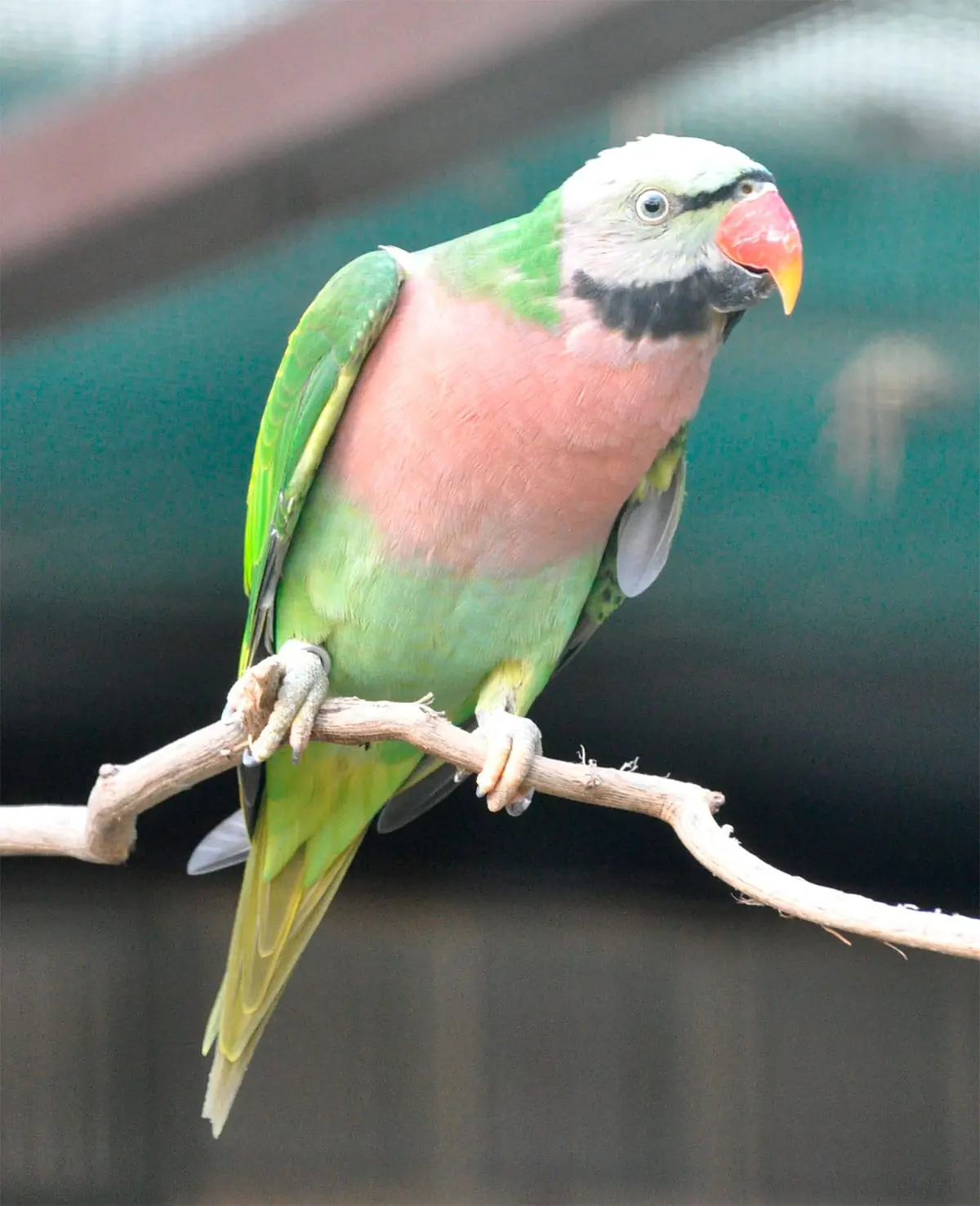
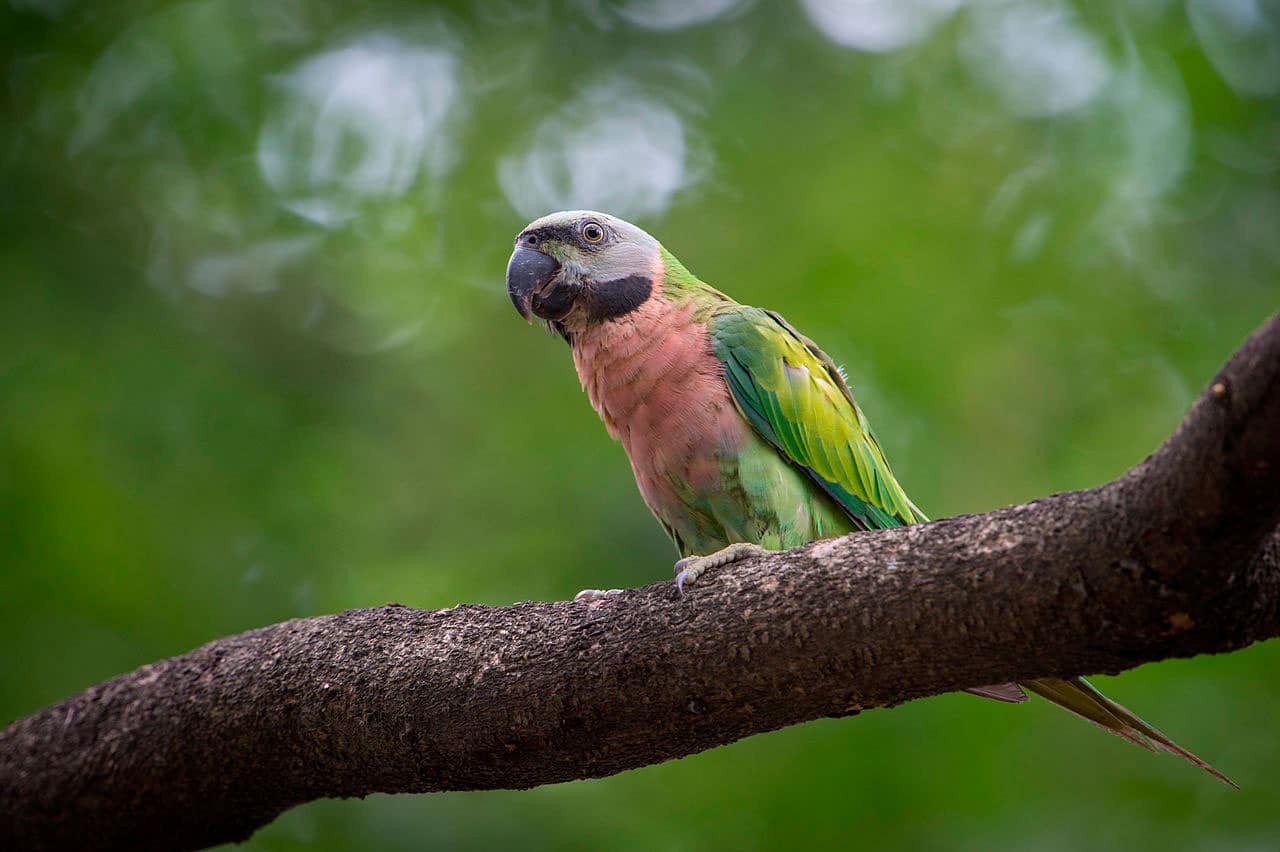
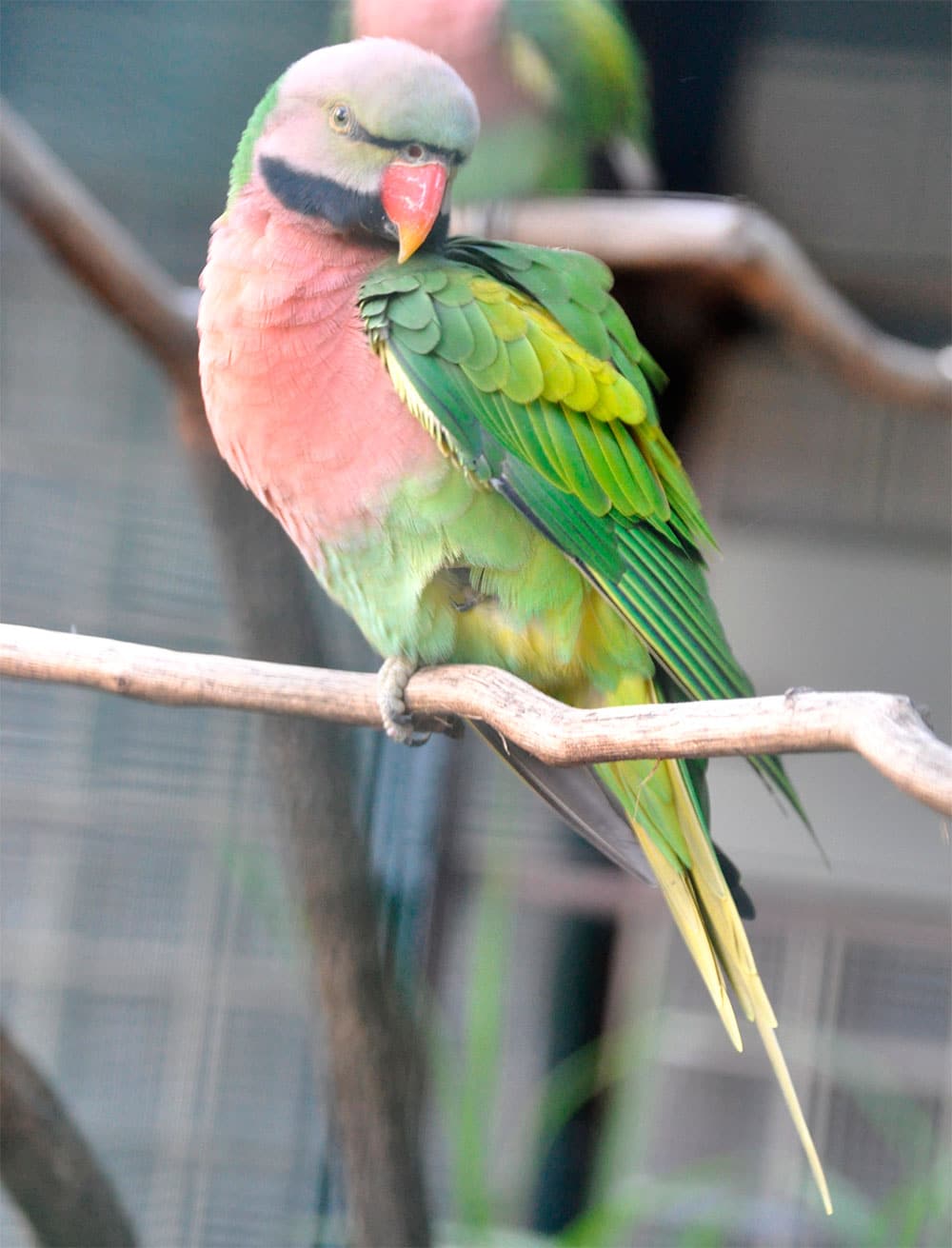
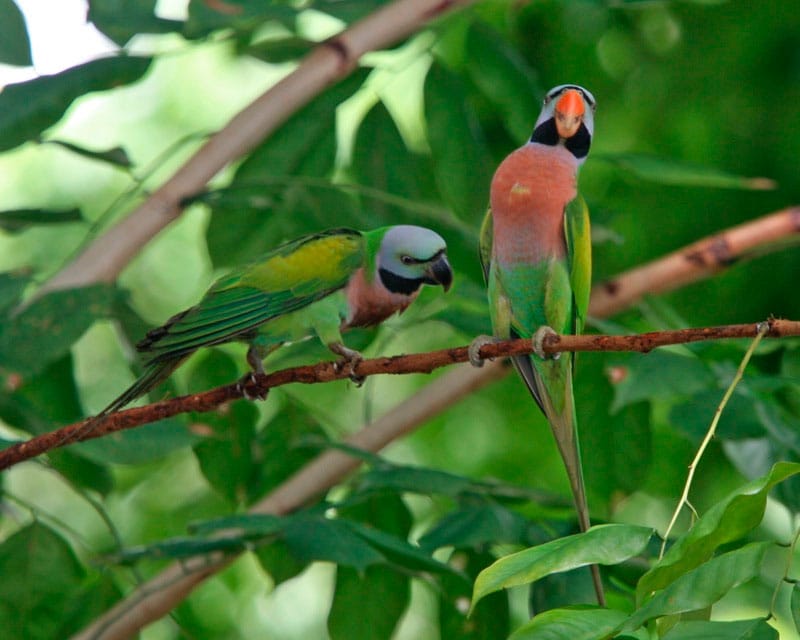
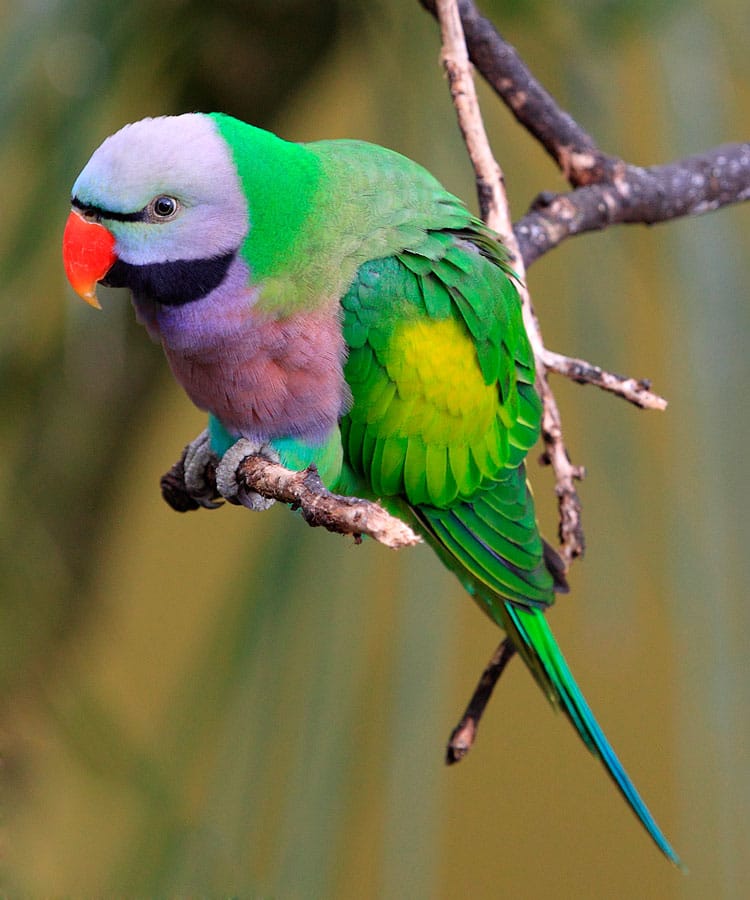
The Red-breasted Parakeet(Psittacula alexandri) is a bird with a form attractive, thin, and with a long and narrow tail. Its plumage is green, the overall tone of the head is grey, the bill red, and with brands distinctive in the head and face. The area around the eyes is greenish, with a pretty bluish tint. It has a fine line along its forecrown and wide stripes in their cheeks. Plumage in the chest, the throat and the top abdomen is salmon-pink color, extending halfway from the vent.
The female It has a shade bluish through the region of the face. In general, they have a pink color more off above the chest and the feather half of its tail they are shorter than the of the male.
The immature birds they have the tail shorter, the bill Pink, and incomplete rays of the cheek they are easily distinguished.
Between the young birds hard identification between males and females, However, breeders have managed to identify them correctly. The head of the female bows in a more uniform manner from the cere to the rear of the head. The young males they tend to be flatter in the forecrown. The females They seem to have a face darker than blue.
(Oberholser,1919) – Length: 36 cm.. Similar to the Psittacula alexandri fasciata (including sexual dimorphism in staining of the bill) but larger and paler.
(Oberholser, 1912) – Length: 36 cm.. As the Psittacula alexandri fasciata but with the belly blue (especially in males), the upper part of the abdomen darker and the lores, forecrown and bottom of the abdomen strongly impregnated with the pale blue.
Psittacula alexandri dammermani
(Chasen & Kloss, 1932) – Length: 36 cm.. Perhaps, on average, larger that the Psittacula alexandri fasciata. The pink color of the chest It is darker than the species nominal. In the female, the pink color extends from the throat at the sides of the neck. The bill larger than that of the species nominal. Both jaws Red in both sexes.
Psittacula alexandri fasciata
(Statius Müller, 1776) – Length: 33 cm.. Upper chest and abdomen is dark pink with violet tone, the head is bluish-grey way more uniform. The areas of the eyes and forehead with greenish hue. The females, part of the difference of the bill, nor have the violet tonality in the pink of the chest.
Psittacula alexandri kangeanensis
(Hoogerwerf, 1962) – Length: 33 cm.. More grey the head (less blue). Bill larger than that of the species nominal and both jaws Red in both sexes.
Psittacula alexandri major
(Richmond, 1902) – It is more large, of 38 cm.. length. Similar to the Psittacula Alexandri Fasciata but something more pale and the head is without bluish tone gray.
Psittacula alexandri perionca
(Oberholser, 1912) – Length: 37 cm.. As the Psittacula alexandri fasciata (including sexual dimorphism in the coloration of the bill) but paler and larger, without the Green tint around the eyes.
Habitat:
Usually, they live below 2.000 m (rarely above 345 metres in Nepal) all types or forest and wooded areas, including dry forest, secondary-humid deciduous forest, mangroves, coconut and mango groves , areas planted with trees (including hills of shifting cultivation), parks and urban areas. In the region of the Himalaya avoids the dense green forests.
Gregaria, usually in flocks of 6-10 birds, less frequently in groups of 50 and very exceptionally in thousands, larger flocks during garbage collection (for example, the mango or rice), sometimes mixed with the Slaty-headed Parakeet wave Gray-headed Parakeet. They form communal roosts in the tall trees, bamboo or sugarcane scrub areas.
Reproduction:
The Red-breasted Parakeet nests in natural cavities or old hole made by woodpeckers or barbets, usually at a height between 3 and 10 m, often in loose colonies. The hole is filled with wood shavings.
The laying is of 2 to 4 eggs.
The breeding season is between December and April, Depending on the location and the altitude; in Java, breeding has been recorded in every month, except for April.
Food:
Diet Red-breasted Parakeet includes wild figs and other fruits, fruit trees and wild, flowers and nectar (especially, for example, of the Parkia speciosa and Erythrina variegata), dried fruits (for example, chestnuts Castanea), fruit (for example, Mango), berries, seeds (for example Albizia), leaves and cereals such as rice and corn, by causing serious damage to crops, especially for rice.
Distribution:
Size of the area of distribution (reproduction / resident): 2.570.000 km2
The Red-breasted Parakeet are distributed from the central area of the Himalaya until Indochina, China and West of Indonesian. From the lowlands of the Himalaya in the North of India, approximately to the East of Dehradun, through Nepal, Sikkim and North of Bhutan in the southwest of Yunnan, China; to the South by Assam, Manipur and Nagaland, India, until Bangladesh and to the East by Burma (including Mergui archipelago), Indochina, Malacca Peninsula, around 9°N (a record of 1889 in the Kelantan River at approximately 5°N suggests a contraction in its distribution) of Guangxi and Provinces of Canton and Hainan Island, to the South of China.
They are also distributed in Islas Andaman and Indonesian in Java, Bali, Karimun Java, Kangean, Borneo South (where it was probably introduced from Java) and Simeulue, Nias and Banyak, West of Sumatra.
Getaways captive birds eggs were found in Singapore and a single record (presumably an escape) in Hong Kong.
Resident but with some local movements dependent on food supply.
It is the most common parrot in some parts of its range., but with a substantial decrease in Thailand and Laos in recent years and local extinctions (for example, Java and Bali), because of the live poultry trade; the nominal subspecies may be at risk as a result of his capture. A small number in captivity out of range (mainly the nominal species and fasciata).
(Statius Müller, 1776) – Continental Asia from the North of India through the Himalaya lower, Burma including the Mergui archipelago, Thailand and Indochina to the South of China, including Hainan
The population of the Red-breasted Parakeet It is suspected in a moderate to fast global decline, due to the unsustainable levels of exploitation and the destruction of their habitat. This suspicion is supported by widespread anecdotal evidence that in many parts of its range decreases.
Threats:
– The declines and local extinctions in recent decades in the population of the Red-breasted Parakeet have been attributed in large part to his capture to the trade in live birds (Juniper and Parr 1998).
– The hunt they are considered the main threats to the species in Nepal, where it is also threatened by the loss of forests (C. Inskipp and HS Baral in litt. 2011).
– His nasal voice makes the species a popular in Nepal cage bird, and their vocal habits during the breeding season, together with the tendency to form large flocks when not raising, they make susceptible to trappers. These factors lead to illegal hunting and his capture in protected areas; they are also persecuted by farmers due to their raids on crops (C. Inskipp and HS Baral in litt. 2013).
– Similarly, in Bangladesh, the species is captured for the cage bird trade It is also likely that they are affected by the removal of large trees (P. Thompson in litt. 2012).
– Almost the total disappearance of the species from the North of Laos, It is believed that it is mainly due to the loss of habitat through conversion to agriculture (JW Duckworth in litt. 2011).
– Loss and fragmentation of forests is likely to accelerate in Cambodia in the near future, given that many of the large agro-industrial concessions have been awarded recently (H. Rainey in some. 2011).
Conservation Actions:
– The species is listed in the Appendix II of CITES.
The Red-breasted Parakeet is a bird Smart and outgoing that is gaining increasing worldwide popularity. These parrots are sociable and playful, and if they are properly socialized, they can be a few excellent pets. They can be a bit aggressive and authoritarian, If it is not properly discipline. They need a good cage for a large size, with a lot of toys to avoid boredom.
Although this bird is linked with the Rose-ringed Parakeet, they are very different in personality. The Red-breasted Parakeet It is softer and not so noisy, although she has been described as "feisty". It is usually more quiet than other Psittacula. Also are great eaters and you accept easily new foods other birds may be thrown away.
You can get to imitate some sounds, even words, Although not as clear as the some of the larger parrots, example the Grey Parrot. But, according to some sources, they can speak more clearly than the Rose-ringed Parakeet.
Regular handling is important at an early age, since they can become aggressive, If not are well socialized and manipulated.
If you want a small Parrot with personality, the Red-breasted Parakeet It can be the ideal ave. But, It is still a "stubborn" and "stubborn" bird.. It is not surprising considering his intelligence. Obedience training is recommended. On the other hand it is one voracious chomping and should it be should provide plenty of toys to chew.
Like other parrots, need company, and if they will not be in an Aviary with other birds, We must be able and willing to spend large amounts of time with them.
In nature, this bird is often seen in flocks of 10 to 50 individuals. These flocks, often, they are heard before to be seen. This is a fact that must be taken into account before deciding to buy one Red-breasted Parakeet. Breeding females can be put in 3 to 4 eggs in each clutch, with an incubation approximately 22 days.
With regard to its longevity, according to sources, We need to know that a specimen lived 23,3 years in captivity.
Captive breeding:
The Red-breasted Parakeet commonly bred in captivity. They reach maturity between 2 and 3 years of age. The birds must be matched at a young age. The female can sometimes dominate males. The procession begins at the end of winter and the females can be seen calling males for food. In the wild they breed between the months of December and April, Although this is variable, Depending on the climate and altitude.
A thick-walled hollow trunk, It can be used as nest. If not available, any commercially available nesting box should suffice.
They require long aviaries, more than wide, due to its long tail and its type of flight (powerful, linear). Also like a protected breeding area. The entrance door to the Aviary must be on the opposite end. We must place leaves of Palm on the bird front and leafy branches on the back to protect the young fledged when they hit the walls of the Aviary and fall on your floor. If this is not done, many of the young people will die from injuries in the head or severely damage their hair. Young hatchlings do not have great control when they start to fly; they can be left with the parents during 9 months, but then you must be separated.
Diet during breeding It is very important. We can use sunflower seeds germinated, soaked chickpeas, Apple diced, celery, raw or boiled corn and green feed. Supplementation with multiple vitamins and liquid calcium is especially important prior to egg laying..
Alternative names:
– Red-breasted Parakeet, Banded Parakeet, Bearded Parakeet, Indian Red-breasted Parakeet, Moustached Parakeet, Pink-breasted Parakeet, Red breasted Parakeet, Rose-breasted Parakeet (English).
– Perruche à moustaches (French).
– Bartsittich, Rosenbrustsittich (German).
– Periquito-de-bigode (Portuguese).
– Cotorra de Pecho Rosado, Cotorra Pechirroja (español).
– Avibase
– Parrots of the World – Forshaw Joseph M
– Parrots A Guide to the Parrots of the World – Tony Juniper & Mike Parr
– Birdlife
– Photos:
(1) – Moustached Parakeet in the Walsrode Bird Park, Germany By Quartl (Own work) [CC BY-SA 3.0], via Wikimedia Commons
(2) – Red-breasted Parakeet at Brooklands Zoo, New Plymouth, New Zealand By Dave Young (originally posted to Flickr as bird) [CC BY 2.0], via Wikimedia Commons
(3) – Red-breasted Parakeet (Psittacula alexandri fasciata). Coutrtship – male on right. Changi Village, Singapore. 2 January 2006 By Lip Kee Yap [CC BY-SA 2.0], via Wikimedia Commons
(4) – Moustached Parakeet in the Walsrode Bird Park, Germany By Quartl (Own work) [CC BY-SA 3.0], via Wikimedia Commons
(5) – Female of Red-Breasted Parakeet (Psittacula alexandri) at Bangkok, Thailand By Jason Thompson (Flickr: Red-Breasted Parakeet (Female)) [CC BY 2.0], via Wikimedia Commons
(6) – Plate from Zoological illustrations, Volume 1, 2nd series By William Swainson [Public domain], via Wikimedia Commons