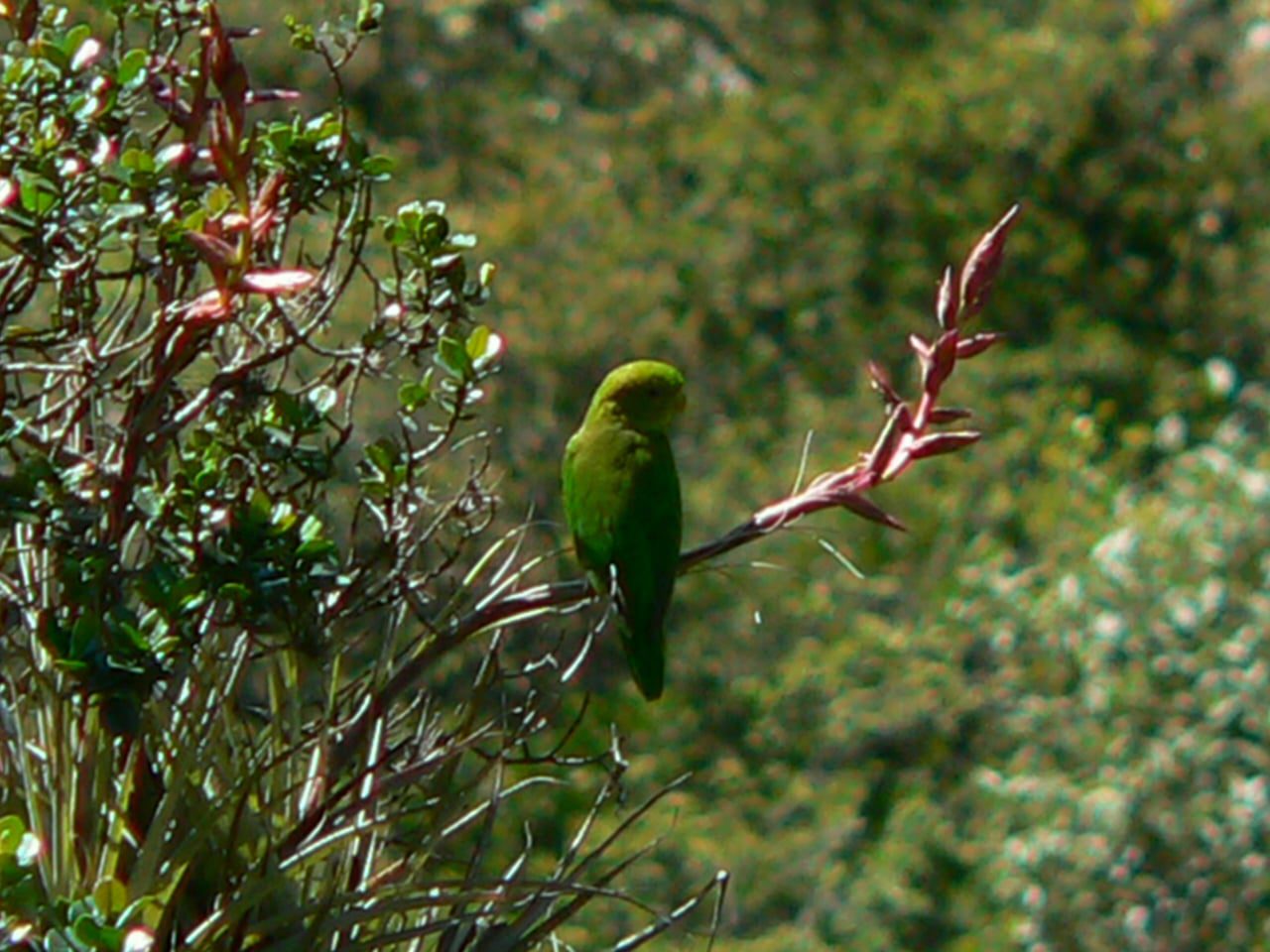
16 cm.. height.
The Andean parakeet (Bolborhynchus orbygnesius) is usually dark green, with blue wing patch (visible in flight), clear peak, tail broad at the base and finished at tip of yellowish color with bluish tinge in the interior.
Video – "Andean parakeet" (Bolborhynchus orbygnesius)
It is usually found in deserts and semi-arid areas, between 3000 to 4000 m (It has been reported to the 1500 and to the 6000 m).
Possibly perform altitudinal migration, descending to mountainous valleys after reproduction. You can also visit rural areas and agricultural land.
Reproduction:
Walks in couple or flocks of more or less 300 individuals. They breed in caves dug into ravines.
Food:
The diet consists of seeds, buds and fruits.
Conservation:
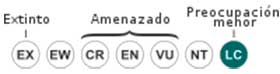
State of conservation ⓘ
Minor Concern ⓘ(UICN)ⓘ
This species has a very large distribution area and, therefore, does not approach thresholds for Vulnerable based on range size criteria (presence extension <20 000 km2 combinada con un tamaño de distribución decreciente o fluctuante, extensión>30 % decrease in ten years or three generations). Population size has not been quantified., but not believed to approach the thresholds for Vulnerable based on population size criteria (<10 000 individuos maduros con una disminución continua estimada en>10 % in ten years or three generations, or with a population structure).
Population size: unknown
The population trend: Stable
presence extension (breeding/resident): 655 000 km 2
Distribution:
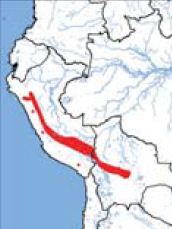
It is found in northwestern Peru to Bolivia and west of the Andes in Peru..
"Andean parakeet" in captivity
They are shy and quiet birds, very sensitive to cold, stress and infections. Birds may die without apparent reason. They are rare in captivity.
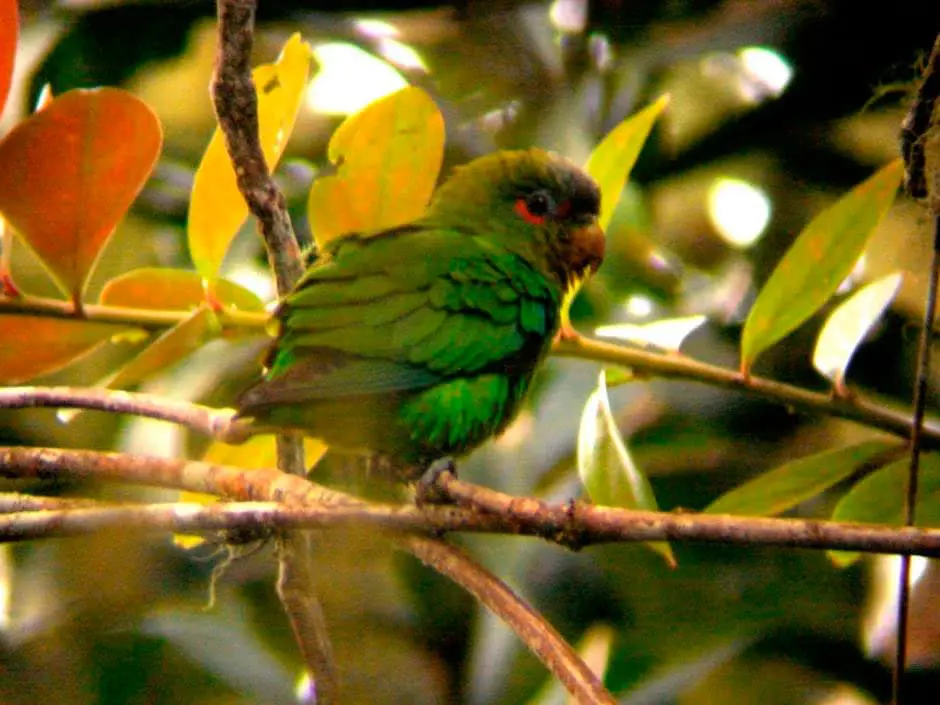
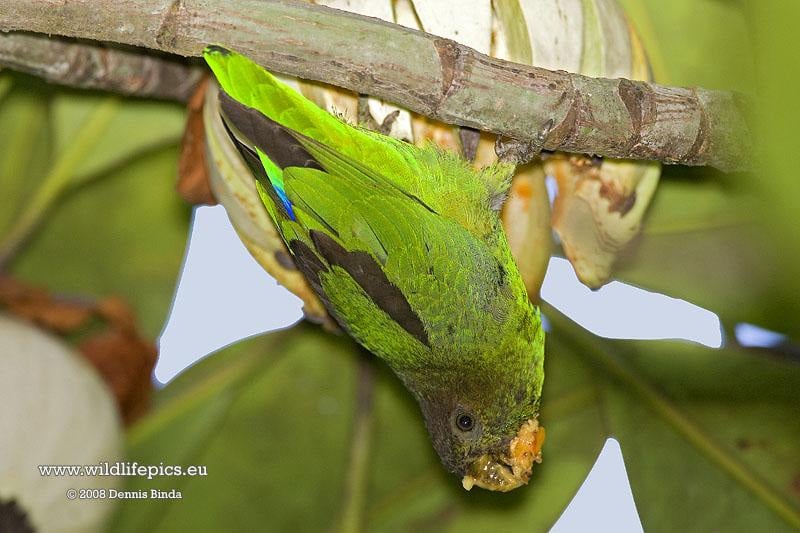
The height of the Blue-fronted Parrotlet(Touit dilectissimus) varies between the 15 and 18 cm.. It is differentiated by the red line that goes from the bill towards the back of the eye and below the eye ring white, and blue bordering the red line from the forecrown up to the back side of. Wings with the part inside red and yellow, evident on the fly, shoulder and external margin of the wings red, crown and nape green.
Tail with black border, Yellow ends and green central part.
The female have the Red of the shoulder reduced or absent.
Uncommon and surly. It lives in humid forest that is often cloudy and has tall stubble., between 700 and 1700 meters above sea level (apparently with migration to the 3000 m). ANDA in pairs or groups of 15 or more, lie quietly in the canopy.
In-flight calls are based on mild or sharp notes repeated several times between pauses. Calls are stronger during the flight.
Reproduction:
It nests in termite mounds on tree.
Food:
It feeds on small seeds, fruits and flowers.
Distribution:
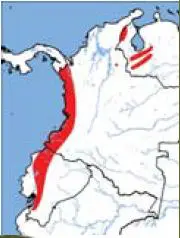
Can be seen in freedom from Panama, Colombian Pacific to the Northwest of Ecuador, and in the northeast of Colombia and Northwest of Venezuela.
Conservation:
State of conservation ⓘ
Minor Concern ⓘ(UICN)ⓘ
Appreciated a decrease of the species due to deforestation at the local level (in particular in Colombia).
The population size World has not been quantified, but this species is described as «rare» (Stotz et to the. 1996).
The population is suspected to be stable in the absence of evidence of any reduction or substantial threats.
"Blue-fronted Parrotlet" in captivity:
These birds are rare to see them in captivity. Any person possessing one has to know that it can not be put into freedom, It must be part of a well-managed maintenance program to ensure the continued existence of this species.
Alternative names:
– Blue-fronted Parrotlet, Blue fronted Parrotlet, Red-winged Parrotlet (ingles).
– Toui à front bleu (French).
– Kronenpapagei, Kronen-Papagei (German).
– Touit dilectissimus (Portuguese).
– Cotorrita Cariazul, Lorito de Alas Amarillas (español).
– Periquito Alirrojo (Colombia).
– Churiquita (Venezuela).
– Periquito frentiazul (Ecuador).
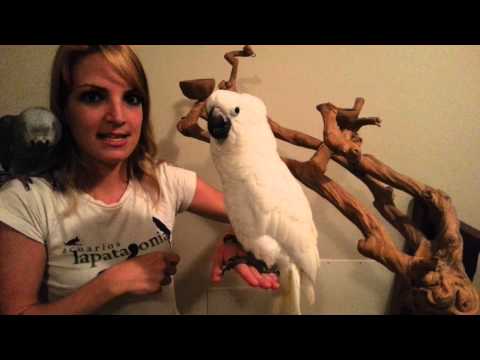
40 to 50 cm.. length and a weight of approximately 550 gr.
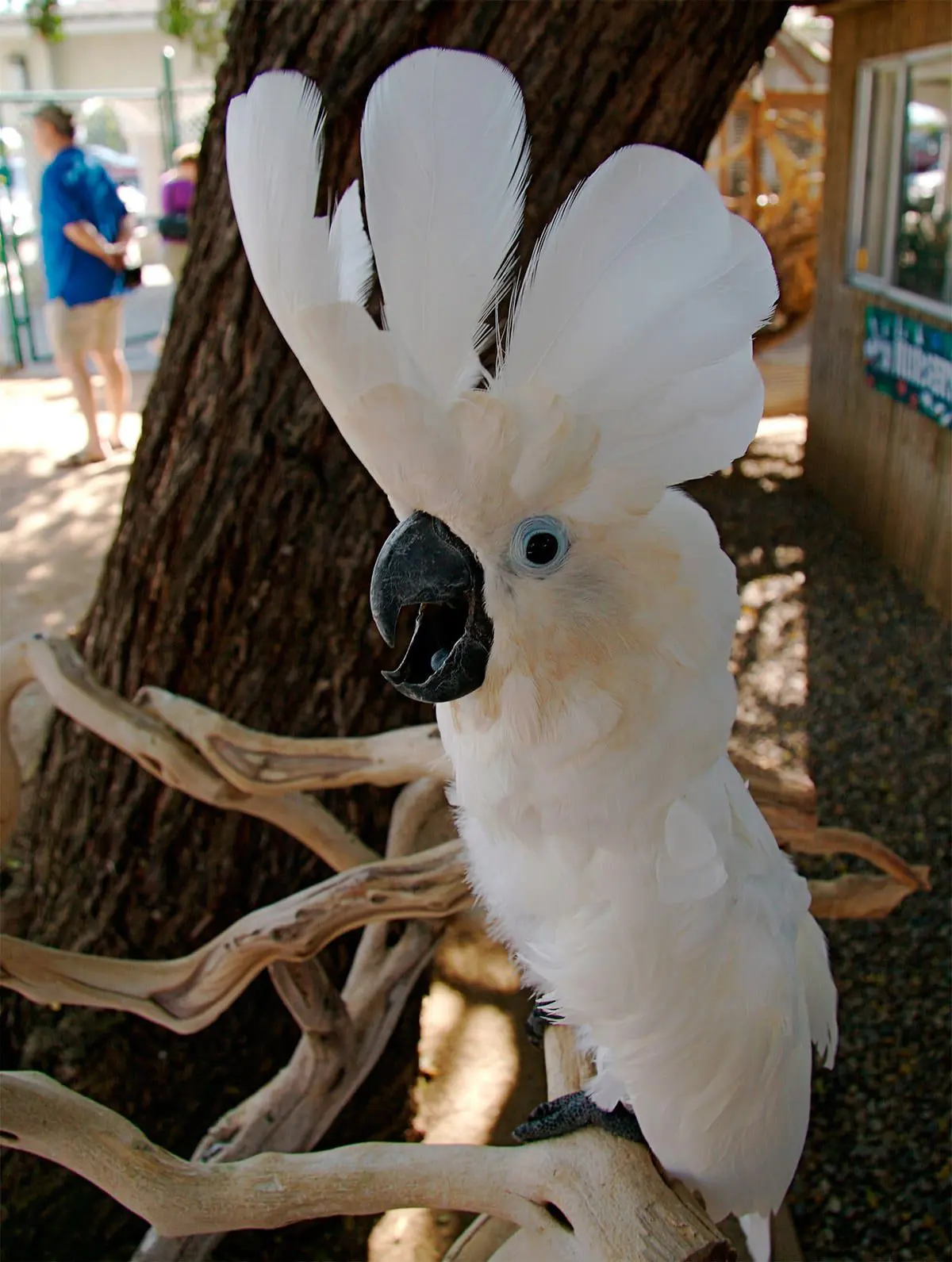
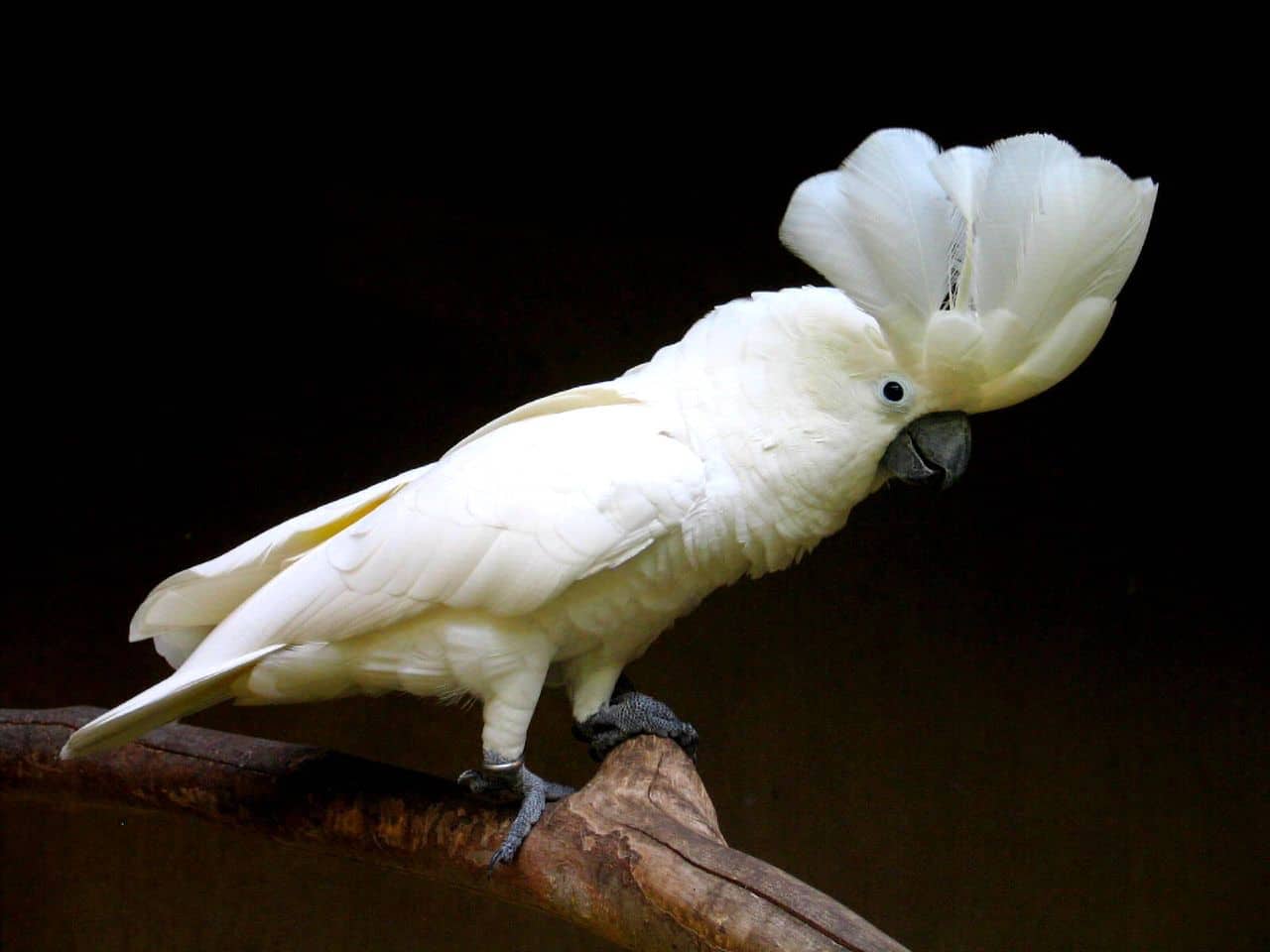
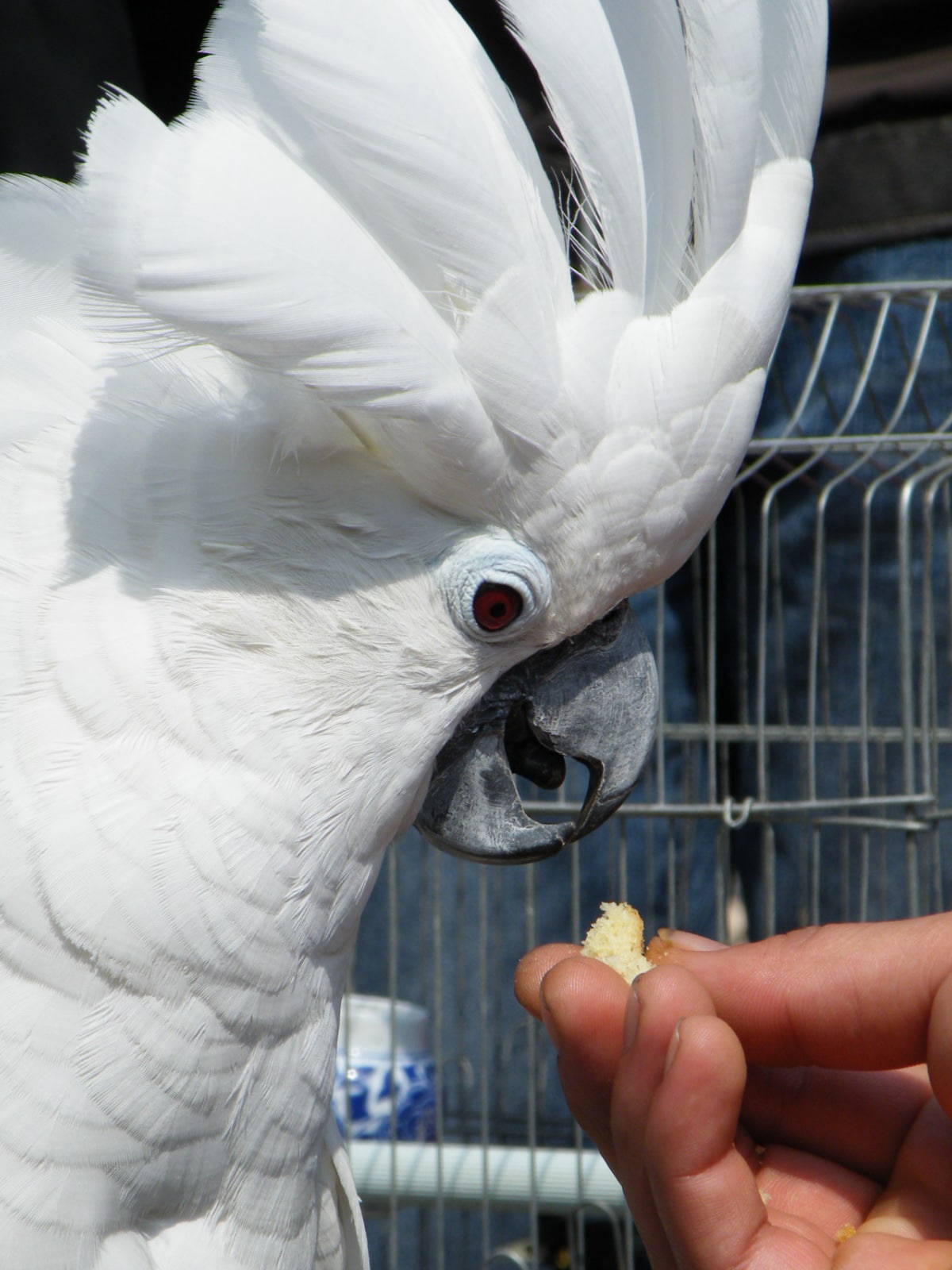
The White cockatoo(Cacatua alba) is completely white, with yellowing below wings, bill black and legs dark gray.
The eye ring is blue.
It has a crest exuberant, that is elevated or low, Depending on your state of mind. The wings They are tapered or rounded.
If he irises is brown, then it is male, if reddish, it is female. The females has bill smaller.
They usually fly solo, in pairs, small groups, or in flocks of up to fifteen birds. In the afternoon, they gather in groups of up to fifty birds. even though they are social, with the exception of mating pairs, usually, they do not form close ties with others. As a result, There is no firmly defined order of dominant position in the community. Son day and they tend to be sedentary, Although some can be nomadic and wander in search of food.
The white cockatoos they are very bright and curious birds. They have the ability to use tools, as the use of a branch to scratch your back. They are monogamous, with couple bonds lasting lifetime. They can fall into a deep depression if you lose your partner.
They live in lowland forests below 900 m, as well as in mangrove forests, plantations and agricultural land.
they are particularly common around the edge of clearings and rivers. They spend most of their time in the tops of the trees. The secondary vegetation high is its preferred habitat.
White Cockatoo Reproduction:
It nests in the hollows of trees. They lay two eggs and two birds hatch for a few 28 days. The larger hatchling tends to take dominance over the smaller hatchling, which will not be able to survive.. The chicks leave the nest to the 84 days old and are independent around 15-18 weeks. These birds reach sexual maturity at the age of 3-4 years.
White Cockatoo feeding:
In nature it feeds mainly on Tree fruits. They are often seen feeding on papaya, Durian, complexioned and rambutan. It has also seen them will eat crickets and lizards. They often feed on corn that grows in the fields, sometimes doing considerable damage.
Distribution:
Size of its range (reproduction / resident): 51.400 km2
Appears as vulnerable by the IUCN and placed in Appendix II in 1981.
In their natural environment, the white cockatoo is a species vulnerable Due to the decrease in number due to habitat loss natural, as well as for the capture for the illegal bird trade. There are restrictions on the number of birds that can be exported, but BirdLife International He says that this is being exceeded by up to 18 times the agreed number in some areas.
It can cause substantial damage to Corn crops.
World population: 43,000 – 183,000 individuals.
The White Cockatoo in captivity:
The White cockatoo You can live more than 60 years. It is very common in poultry farming and it is perhaps one of the most frequent pet cockatoos.
They are sympathetic, calm, beautiful, sweets and easy to domesticate. Bred to porridge they are usually wonderful pets, You can play some words but are not good talkers. These birds in captivity require mental stimulation almost constant. They are in constant motion, up and doing gymnastics. When lack of mental stimulation, often they are become neurotic, booting the feathers to the point of causing areas of baldness.
They are known for being very affectionate with their human companions, acting more like a dog than a bird in this regard as.
In the absence of a partner, captive white cockatoos will bond with their keeper as if that person were their mate.
Alternative names:
– White cackatoo, Great White Cockatoo, White Cockatoo, White-crested Cockatoo (ingles).
– Cacatoès blanc, Grand Cacatoès blanc (French).
– Weißhaubenkakadu (German).
– Catatua-branca (Portuguese).
– Cacatúa Alba, Cacatúa Blanca, Cacatúa Copete Blanco, Cacatúa de Goffin (español).
– Avibase
– Parrots of the World – Forshaw Joseph M
– Parrots A Guide to the Parrots of the World – Tony Juniper & Mike Parr
– Birdlife
– avimarparrots.es
Origin: India, Bangladesh, China, Myanmar (Burma), Thailand
Character: shy
Life expectancy: ---
Height: Of 36 to 40 cm..
Content
Description:
Of 36 to 40 cm.. length and 120 g. of weight.
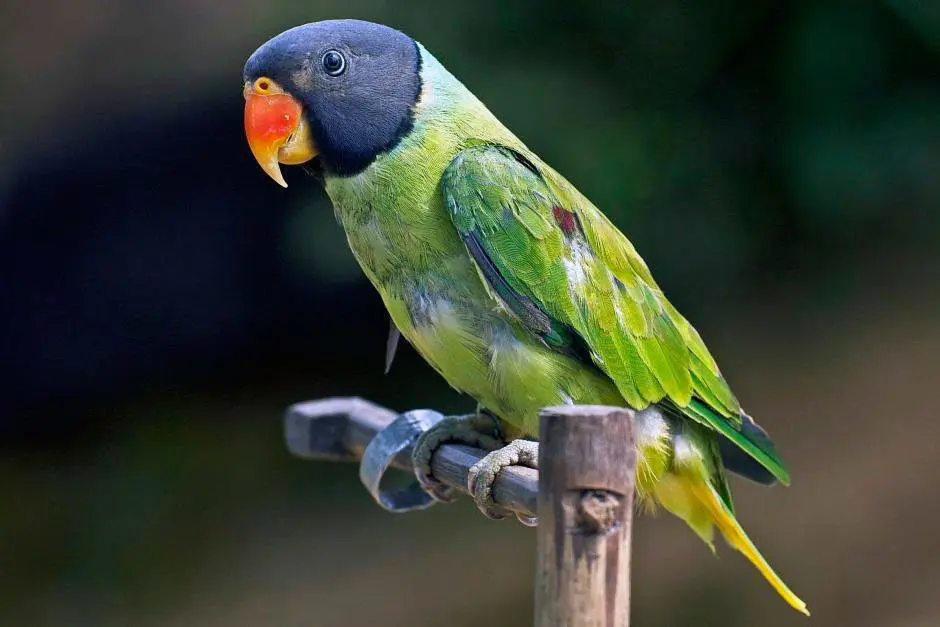
The Gray-headed Parakeet(Psittacula finschii) It is very similar to Slaty-headed Parakeet but smaller, with feathers tail longer, the head slightly paler, upperparts and more yellowish underwing-coverts darker blue-green.
The Gray-headed Parakeet(Psittacula finschii) has the forecrown, crown, lores and ear-coverts Grey Slate-blue; the chin and the lower part of the cheeks, black, It forming a narrow collar which marks a clear boundary between the head dark and a bright ring greenish blue on the back of the neck.
Nape brighter yellowish green, duller green fading in the rest of the upper region.
Upperwing-coverts green except for the brown of the inner coverts, that makes the effect of a distinctive patch on the shoulder; primaries Green with a narrow yellow margin on the vane outer; secondaries green.
Underwing-coverts dark bluish green. Underparts bright pale green. Uppertail lilac blue with pale yellow tips, outer feathers Greens with vane internal and yellow tips; undertail-coverts ochre-coloured.
upper jaw coral red to vermilion with yellow tip, lower jaw yellow; cere whitish; irises creamy white to yellow; legs greenish.
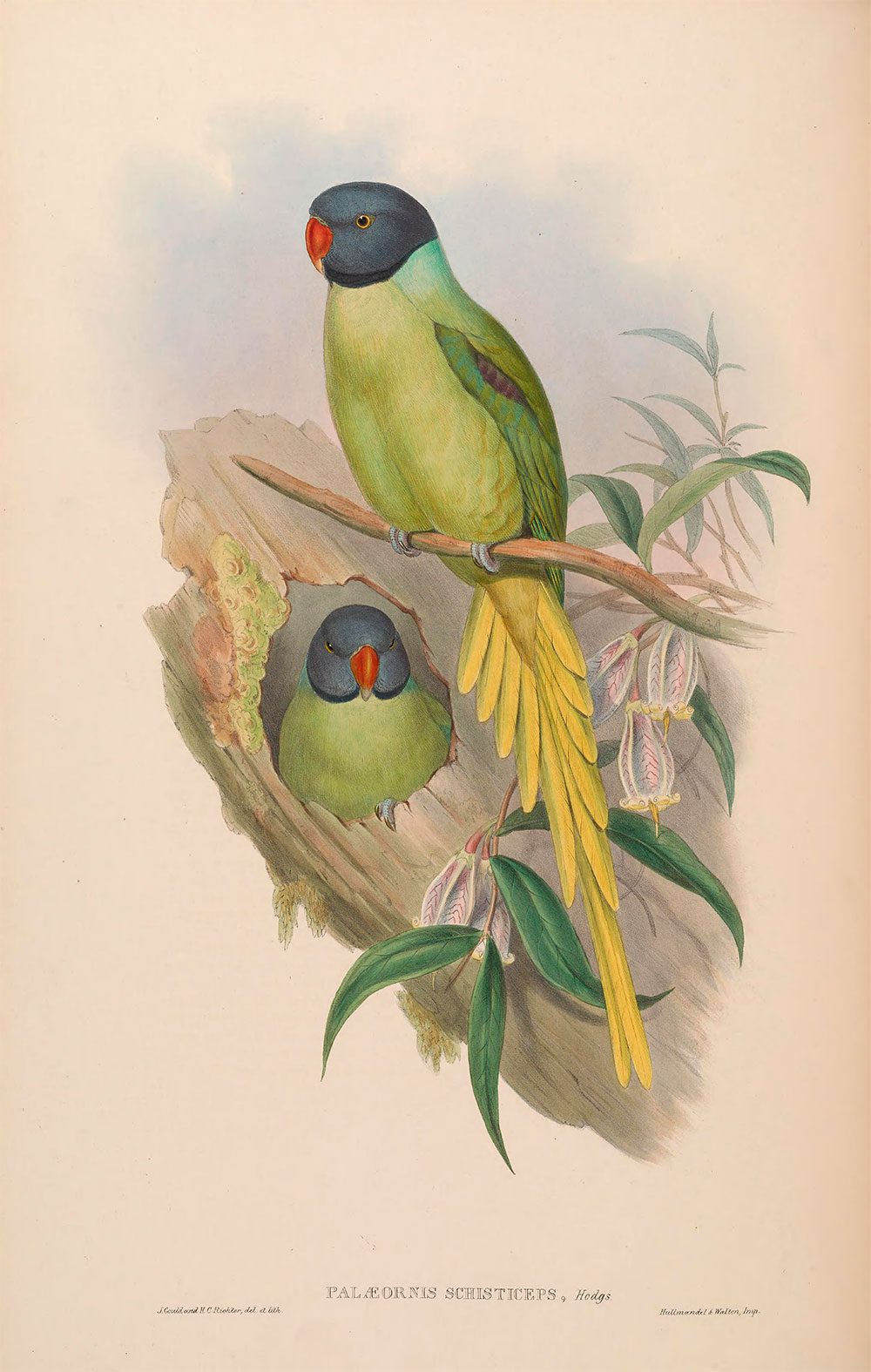
Sometimes considered the same species as the Slaty-headed Parakeet, but the lack of intergradation in a possible area of overlap in Bhutan and the northeast of the India (Arunachal Pradesh) suggests appropriate treatment as allospecies.
Similar to the Slaty-headed Parakeet. Frequents forests of oak, teak, cedar and pine, wooded hills and open farmland with tall trees. Move altitude between 650 and 3.800 m (in Yunnan, China), rarely drop below 250 m, usually at or near the mountainous terrain.
Mainly distributed in the forest Viet Nam, but, according to sources, laz away from growing areas and tolerant of lower and more open habitats.
In general, obsevadas in flocks or or small family groups, but also it is seen in larger numbers than in Burma.
Reproduction:
The breeding season in the central and southern Burma It covers the months January, February and March.
One nest four eggs was observed 12 meter high tree species Xylio dolabiformis.
The Gray-headed Parakeet It is distributed in the east of the Himalayas towards Indochina. They range from east to Bhutan towards Arunachal Pradesh and south through Nagaland, Assam (to the South of the rio Brahmaputra). Manipur, Mizoram and Bangladesh oriental (Sylhet and area of Chittagong). Through Burma (South of Tenasserim), al sur-oeste de China (center Sichuan and North of Yunnan), the mountainous districts of northern and southwestern Thailand, South of Laos, Kampuchea and Viet Nam, especially the western slopes of the central mountains.
Usually common and resident (in some places very common), but lacking in some areas and subject to local fluctuations and irregular appearances.
Recent decline in Thailand, where it is now rare in more accessible areas. Uncommon in China. Some seasonal altitudinal movements in some parts of the range. Very popular cage bird in some parts of the home territory.
The size of the world population Gray-headed Parakeet It has not been quantified, but the species, according to sources, is rare in China, Variable and elsewhere (pit et to the. 1997).
The population is suspected rapid decline because of continued habitat loss and trapping. Observations of local trends in some parts, within its range, support this suspicion, for example in Cambodia, at least since the early 1990 (F. Goes in some. 2013, T. Gray in litt. 2013, RJ Timmins in litt. 2013).
The Gray-headed Parakeet is being widely taken for the cage bird trade and is kept locally as a companion animal, for example, in Laos and China (JW Duckworth in litt. 2013, M. Zhang in some. 2013).
In China, poaching and illegal trade in this species continues: it was reported that in one village, each family has an individual of this species as a pet (M. Zhang in some. 2013).
The pressure at which it is subjected for his capture may also be contributing to the observed decrease in Cambodia (F. Goes in some. 2013).
Lowland forests Indochina They are under intense pressure, above all in Cambodia, because of the authorization for large-scale industrial agriculture. This particularly affects areas with evergreen or semi-evergreen forest, rather than forest deciduous, because the best conditions for growing (S. Mahood in some. 2013).
This species is dependent areas and forests with evergreens, whereby the effects of logging can seriously affect, especially since it is likely to depend on large trees for nesting. Habitats where large trees are scarce, as forests and hill areas with mixed forest deciduous, patches of evergreen forest and semi-evergreen forest, They are under particular pressure from logging, even for local use (S. Mahood in some. 2013).
It is expected that the loss of habitat Cambodia bring a devastating impact on this species over the next decade, although there may be a delay before the actual effects were observed in the population (H. Rainey in some. 2013).
Conservation Actions Underway:
The species is known to occur in some protected areas across its range, as in the Mondulkiri Protected Forest, Cambodia (T. Gray in litt. 2013).
"Gray-headed Parakeet" in captivity:
– Uncommon in captivity outside its range.
It is unclear how much spread among breeders, as often it was considered a subspecies of the more common Slaty-headed Parakeet. It is a very mountain bird resistant, at low temperatures is not a problem for them, However, must be protected facilities available to avoid sudden changes in temperature and drafts.
How other Psittacula, the Gray-headed Parakeet You need to nibble fresh branches, although it is not a destructive bird that could demolish a wooden aviary.
– Avibase
– Parrots of the World – Forshaw Joseph M
– Parrots A Guide to the Parrots of the World – Tony Juniper & Mike Parr
– Birdlife
– Photos:
(1) – Bird perched on a home made perch. Part of the tail appears to be missing by Vijay Anand Ismavel – Lynx
(2) – Gould, John, 1804-1881; Sharpe, Richard Bowdler, 1847-1909: Birds of Asia by John Gould [Public domain], via Wikimedia Commons
(3) – Finsch’s Parakeet Psittacula finschii by Raju Kasambe. Photo taken in Imphal Zoo, Manipur, India By Dr. Raju Kasambe (Own work) [CC BY-SA 4.0], via Wikimedia Commons
19-20 cm.. height.
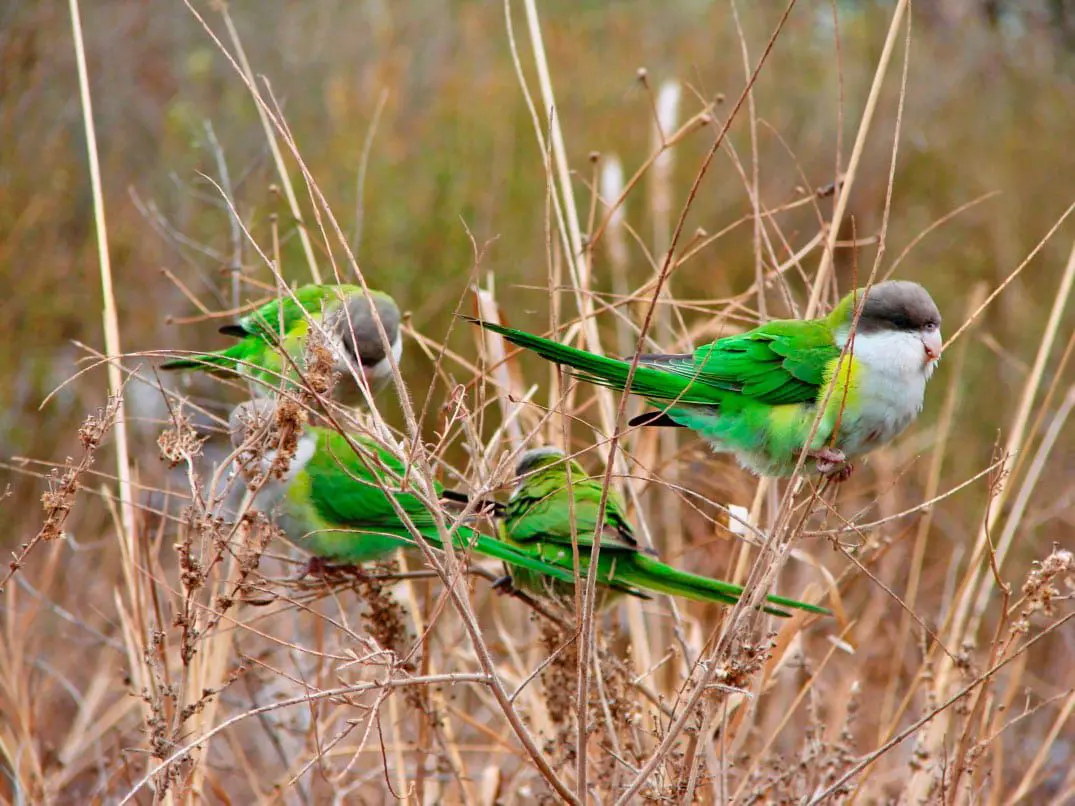
The Grey-hooded Parakeet(Psilopsiagon aymara) has the body mostly green, elongated and with a very long and pointed tail; the forecrown and lores, until the area back from the neck (including the ear-coverts), grayish brown, forming a kind of CAP that comes, slightly, to below the eyes. Mantle green, lightly olive dyeing; Back and scapulars green; rump and uppertail-coverts, green, slightly brighter; upperwing-coverts green; flight feather green with blackish tips; underwing-coverts of color greenish-yellow. Chin and throat pale-whitish grey; chest grey silver pale, sometimes with dye bluish on the feathers on both sides of the chest; flanks of color yellow pale greenish; the belly and undertail-coverts, green, with faint bluish tint.
Upper, the tail green; undertail, gray. The bill pale flesh-colored; irises dark brown; legs grey-brown.
Both sexes similar, though the male may have brighter grey in the chest.
Immature they have the tail shorter.
NOTE This species was treated as Bolborhynchus aymara.
You prefer arid habitats shrubs or Woody hills and ravines, dense scrub and trees around settlements and in agricultural areas, also distributed in high Andean steppes and sometimes in the Highlands, at altitudes of 1.800 to 3.400 m, sometimes more low (1,200 m in winter) and supposedly until the 4.000 m in Tucumán, Argentina.
The Grey-hooded Parakeet is a bird gregarious, usually seen in small flocks, at least outside the breeding season; large gatherings near areas with water.
Reproduction:
Nest sometimes in colonies, in holes dug in sand banks or in hollows and cactus in desert area. Egg laying in the month of November in Tucumán. Clutch 4-5 eggs. Up to seven in captivity.
Food:
The Grey-hooded Parakeet they tend to consume berries and other fruit, In addition to seeds herbaceous and grasses (by example Viguera and other compounds); they usually descend to the ground to collect fallen fruits and seeds from the grass.
Distribution:
Size of the area of distribution (reproduction / resident): 383.000 km2
Is it can be found in the Andes from the South of Bolivia until Argentina and possibly North of Chile.
In West Bolivia It is known from Peace and Cochabamba to the South of Tarija and potosi, and in the Northwest of Argentina on the slopes Andean of Jujuy to the South of Mendoza and to the hills of the South East of Córdoba. In the North of Chile (for example, Tarapacá) is reported as resident, visitor or absent.
Some movements at altitude seasonal; the Grey-hooded Parakeet move higher in summer. Usually common and apparently without pressure; Small numbers are caught and exported as cage birds.
Conservation:
State of conservation ⓘ
Minor Concern ⓘ(UICN)ⓘ
• Current category of the Red List of the UICN: Least concern.
• Population trend: Stable.
Justification of the population
The size of the world population It has not been quantified, but this species is described as «quite common» (Stotz et to the., 1996).
Justification of trend
It is suspected that the population is stable in absence of evidence of any decline or threatens substantial, Although it is exported as bird cage in small quantities.
– Avibase
– Parrots of the World – Forshaw Joseph M
– Parrots A Guide to the Parrots of the World – Tony Juniper & Mike Parr
– Birdlife
– Parrot Book, Parrots and macaws Neotropical
– Photos:
(1) – Grey-hooded Parakeets (also known as the Aymara Parakeet and the Sierra Parakeet) in Capilla del Monte, Córdoba, Argentina By Nes (originally posted to Flickr as Periquitos) [CC BY 2.0], via Wikimedia Commons
(2) -Psilopsiagon aymara by John Gerrard Keulemans [Public domain], via Wikimedia Commons
22 to 23 cm.. length and an approximate weight of 80 g..
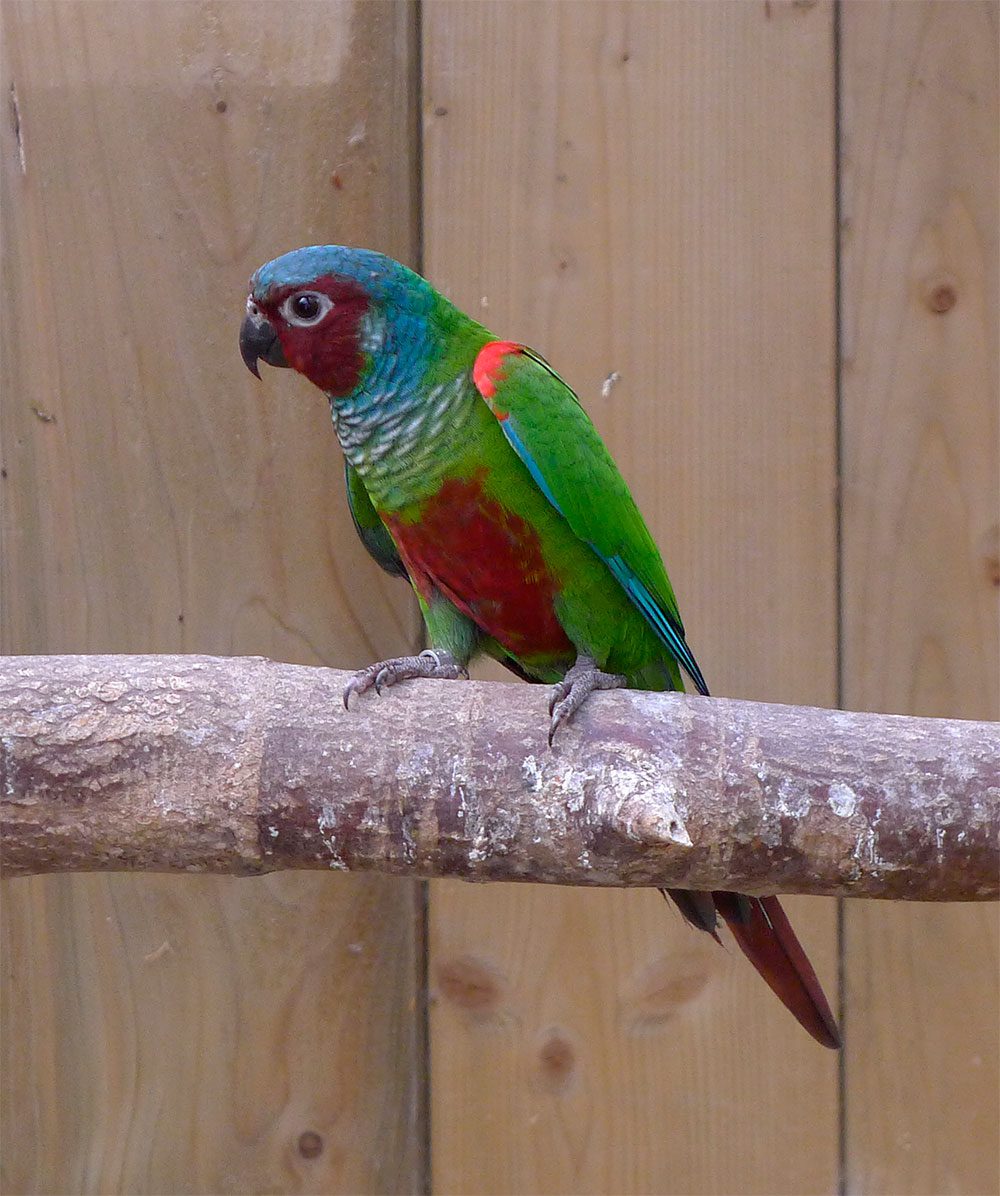
The Pfrimer's Parakeet(Pyrrhura pfrimeri) is a small psittacine of tail Long endemic Brazil very similar to Maroon-faced Parakeet(Pyrrhura leucotis), of which has recently been separated.
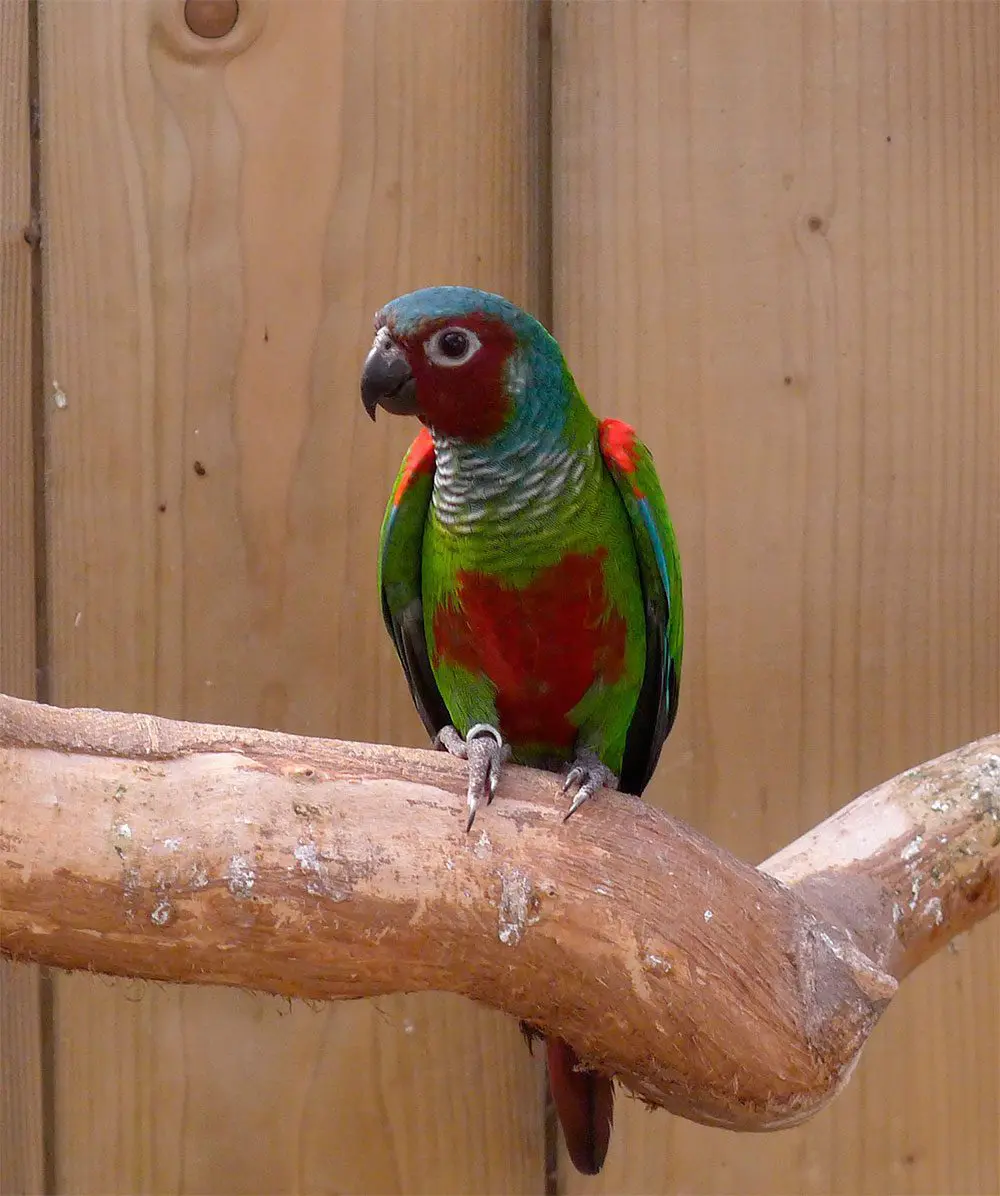
Its main color is green with bluish hues in primary rémiges and reddish tones in the back, the belly and retrizes penas. The bend of wing They are reddish.
The neck It has clear blue feathers with lighter edges, giving the whole a scaled aspect. The sides of the face They are red while the crown and nape They are bluish. The bill It is black and tail red-blue color at the tips
It has no sexual dimorphism.
Taxonomic status:
It has often been considered a subspecies of the Maroon-faced Parakeet(Pyrrhura leucotis) – Pyrrhura leucotis pfrimeri. The separation was made based on their distribution and the differences in habitat and plumage, I was the only member of the complex P. leucotis in which the light spot on ear-coverts It was very small. Recent mitochondrial DNA studies have confirmed this separate species status.
Sound of the Pfrimer's Parakeet.
Habitat:
Its distribution is restricted to the forests dry deciduous or semi-evergreen growing on limestone outcrops in the calcareous. This habitat type caatinga is an isolated island within the surrounding savannah closed. The forest caatinga typically has a closed canopy and dense understory with lianas and some cacti, particularly in disturbed areas. The species has been seen recently fragmented woodlots (Olmos et al., 1998), but according to reports they do not live far from the edge of the forest.
Social, usually they are seen in flocks of up 10 birds. Noisy and conspicuous when they fly above the canopy. Difficult to see while feeding or resting in foliage.
Reproduction:
We know very little about their reproductive habits.
Food:
They fly in flocks in search of fruits, seeds, flowers and larvae insects (wasps Family Agaonidae).
Distribution and status:
Size of its range (Widgets / Resident): 20.300 km2
• Current category of the Red List of the UICN: In danger of extinction.
• Population trend: Decreasing.
• Population: 20,000-50,000.
Justification of the Red List of the Category
This species has a range very small highly fragmented and where habitat loss and degradation continue. For these reasons, It is classified as endangered.
Justification of the population
The total population is estimated to lie within the band 20,000-49,999 individuals (CA Bianchi in a little. 2006, 2007). The population density of the species has been estimated 11,7 individuals / km2 .
Justification trend
Given the rapid pace of deforestation within restricted range species, and its strong dependence on forest habitats suspected its population is declining rapidly (F. Olmos in some ., 2004).
Threats:
The main threat to this species is the deforestation driven selective logging, fires and conversion of habitat to pasture (Olmos et al . 1998). Dry wood Goiás He declined to be covering 15,8% of the region 1990 only the 5,8% in 1999, and less than 1% of the remaining fragments they were larger than 100 has (F. Olmos a slightly. 2007). There has been a reduction 66% habitat available in the last 31 years, with a current annual deforestation rate 2,1% (Bianchi 2010). Rapid deforestation is occurring within the range of the species to create pastures with widespread burning to improve poor pastures destroying the habitat of dry forest. It is mainly directed to logging forests durable normally used to make fence posts, and cement are starting to target areas of limestone outcroppings (CA Bianchi in a little . 2006, 2007). The species is rare while they recorded in the trade waves collections of exotic birds; This poses a potential threat (Olmos et al ., 1998). Population pressures increase as their range is close to the capital, Brasilia (Olmos et al ., 1998).
Conservation Actions Underway
In Brazil, previously considered vulnerable(Silveira y Straube 2008), but now legally designated as endangered national(MMA 2014) and protected by the Brazilian legislation. They are distributed within the proposal Terra Ronca State Park, but this has not yet been fully implemented. (CA Bianchi in a little . 2006, 2007). Downs Terra Ronca State Park now they appear to have been deforested, leaving only forest fragments outcrops of limestone karst (Willis in a little .). Other parts of the range are not protected. The species appears in the Brazil Red List as vulnerable and the IBAMA (Federal Environment Agency Brazil) is about to create a conservation group Small parrots understand all the Pyrrhura spp, and establishes conservation efforts. Brasilia zoological garden started a program of captive breeding in 2001 with 10 individuals, but none survived after six years (CA Bianchi in a little . 2006, 2007). There are very few known private poultry farmers who maintain the species in captivity (CA Bianchi in a little . 2006, 2007).
Conservation Actions Proposed
Determine the extent of habitat and current rates of deforestation remaining. Closely monitor the species in trade if demand increases.
"Pfrimer's Parakeet" in captivity:
Very rare.
It's a bird in danger of extinction; each captive specimen of this species that is capable of reproducing, must be placed in a well-managed captive breeding program and not sold as a pet, in order to ensure its long-term survival.
Alternative names:
– Goias Parakeet, Pfrimer’s Conure, Pfrimer’s Parakeet (English).
– Conure de Pfrimer (French).
– Goiasittich, Pfrimers Sittich (German).
– tiriba de Pfrimer, Tiriba-de-pfrimer, Tiriba-do-paranã , ciganinha, barreirinha, chiriri e periquito-do-morro (Portuguese).
– Cotorra de Goiás (español).
scientific classification:
Alipio Ribeiro de Miranda, brazilian natural scientist
(1) – Pyrrhura pfrimeri by Lander Van Nieuwenhuyse – Flickr
(2) – Pyrrhura pfrimeri by Lander Van Nieuwenhuyse – Flickr
(3) – Pyrrhura pfrimeri by Lander Van Nieuwenhuyse – Flickr
(4) – Pyrrhura pfrimeri by pyaf.net
(5) – Tiriba-de-Pfrimer, «Pyrrhura pfrimeri» – Pfrimer's Parakeet by Cláudia Brasileiro Martins
Brazilian Claudia Martins
(6) – Photo of Alipio de Miranda Ribeiro, brazilian natural scientist By File created by Flávio de Miranda Ribeiro (Picture taken by family) [CC BY-SA 3.0 or GFDL], via Wikimedia Commons
(7) – Parrots A Guide to the Parrots of the World – Tony Juniper & Mike Parr
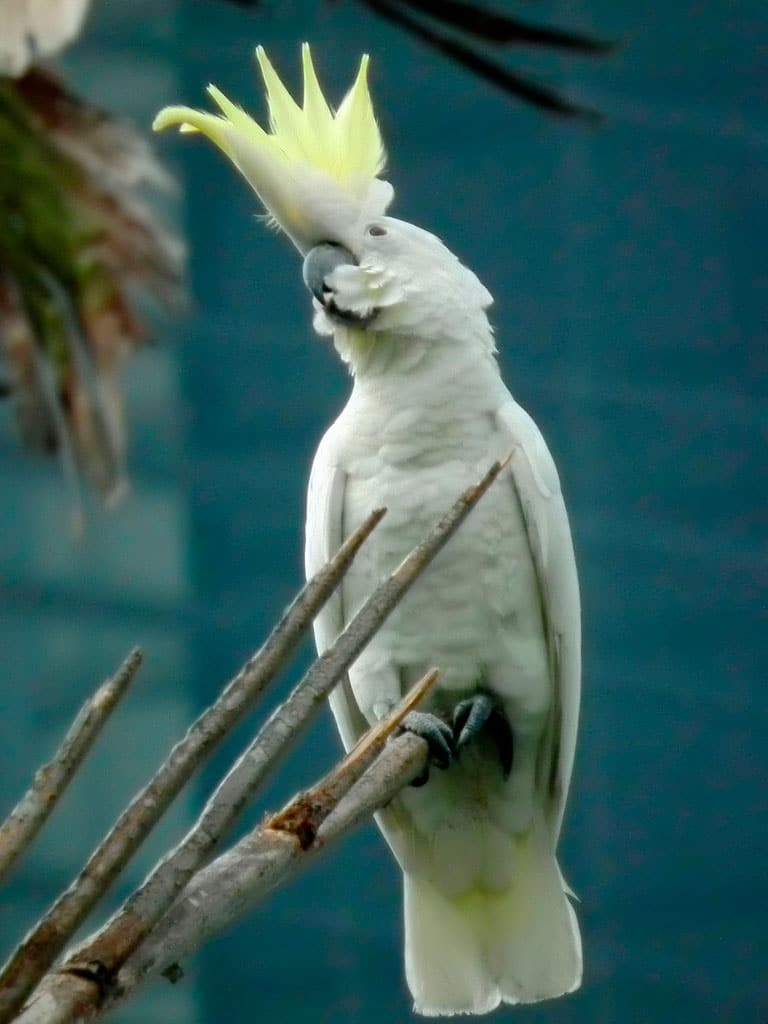
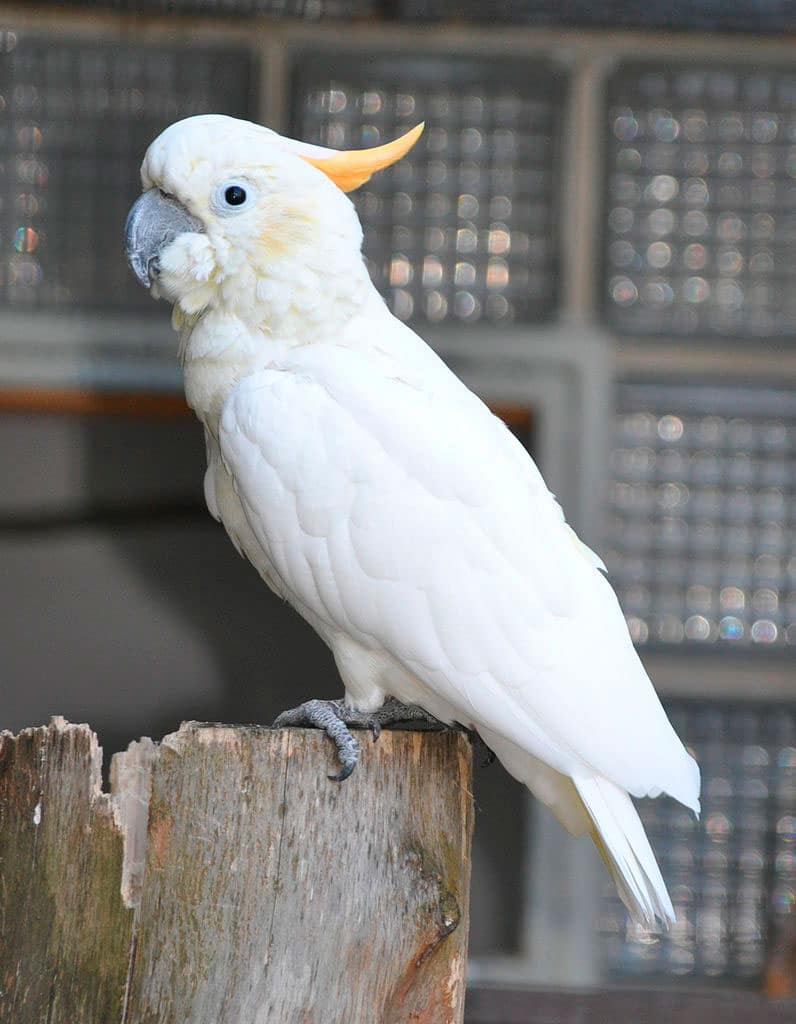
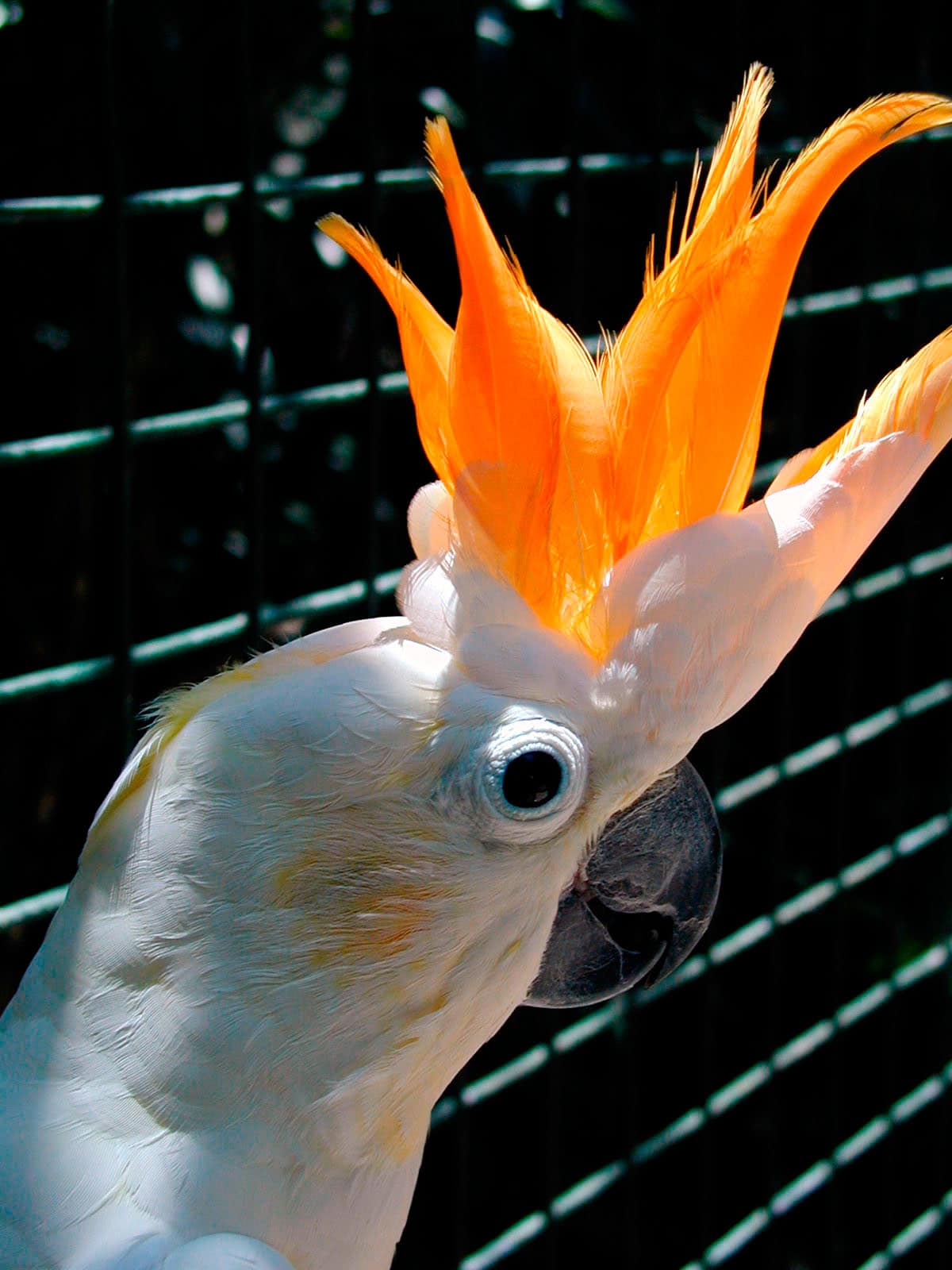
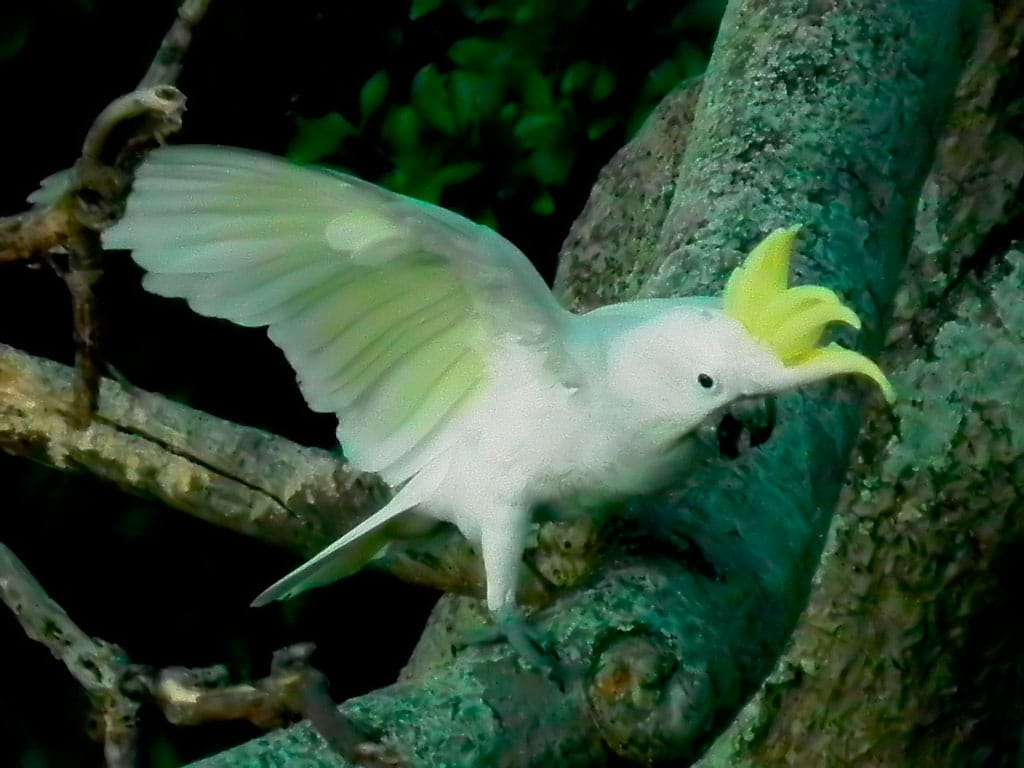
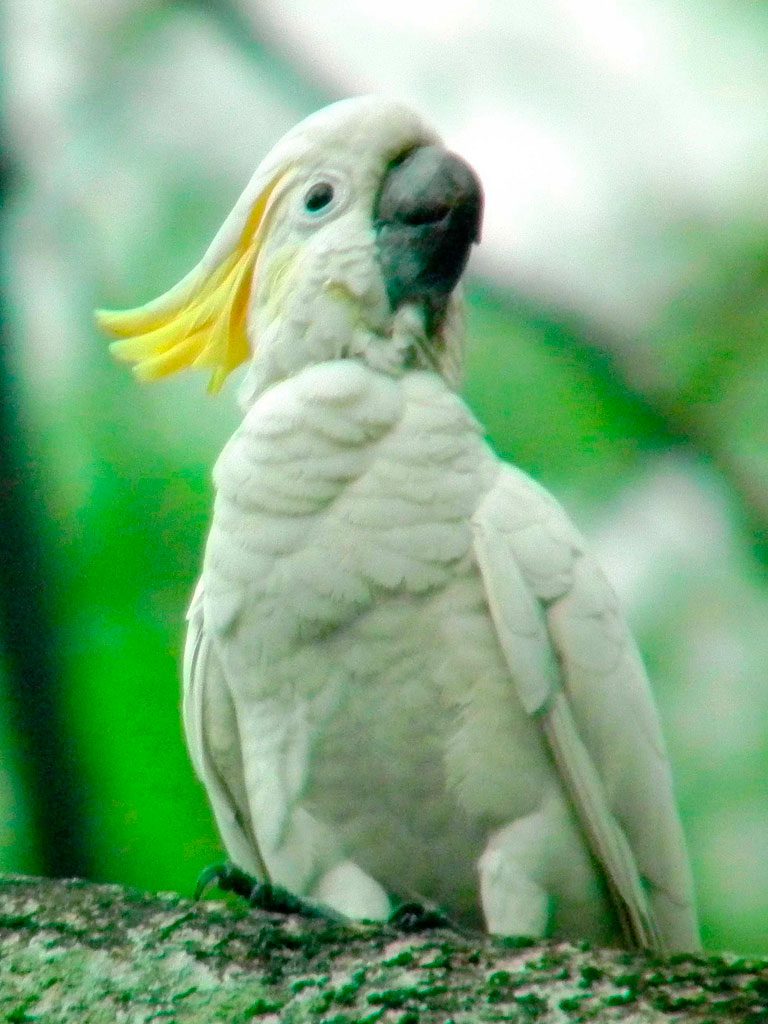
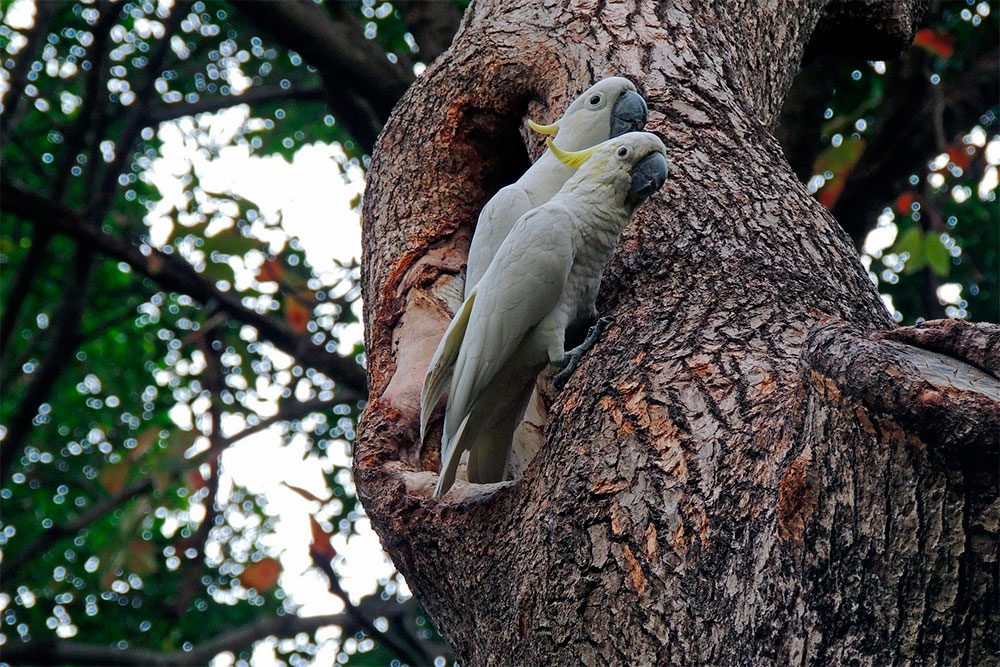
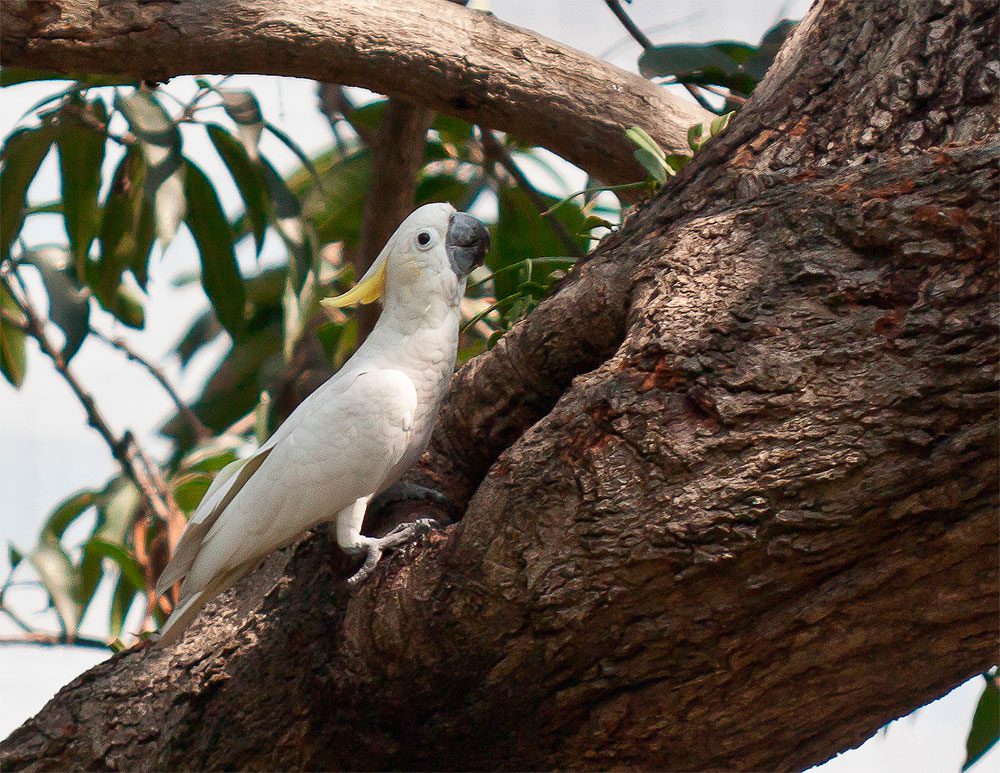
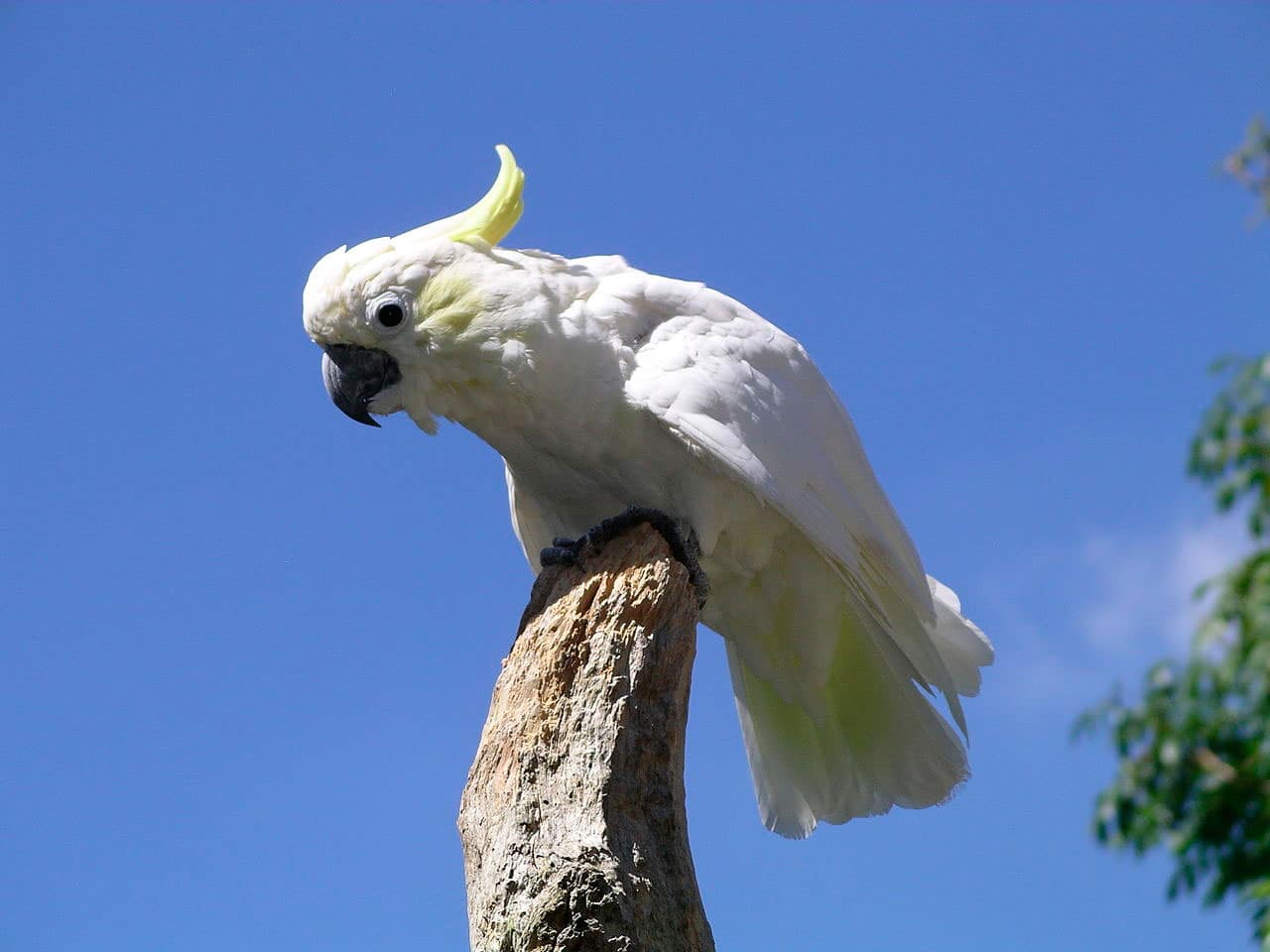
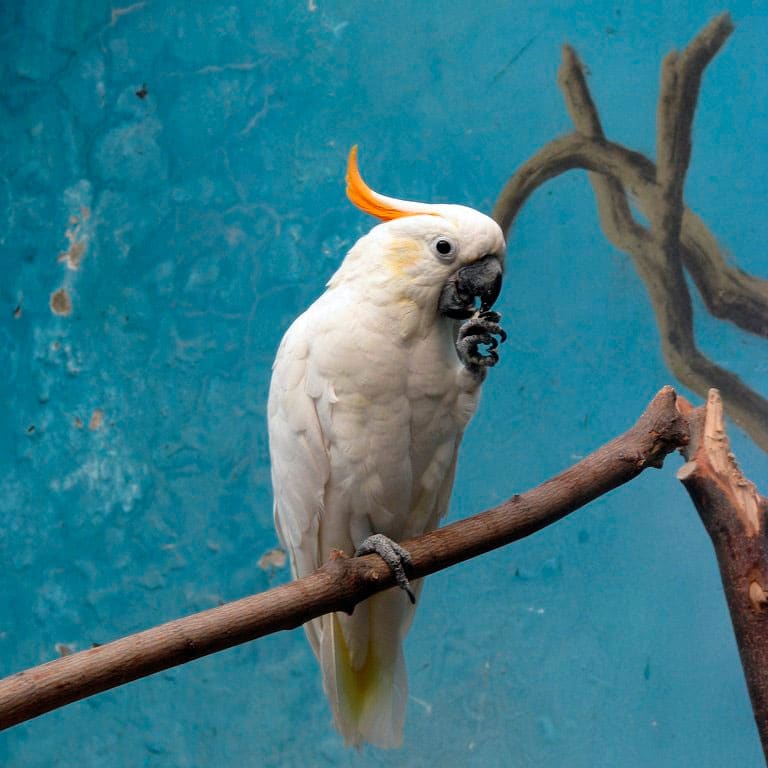
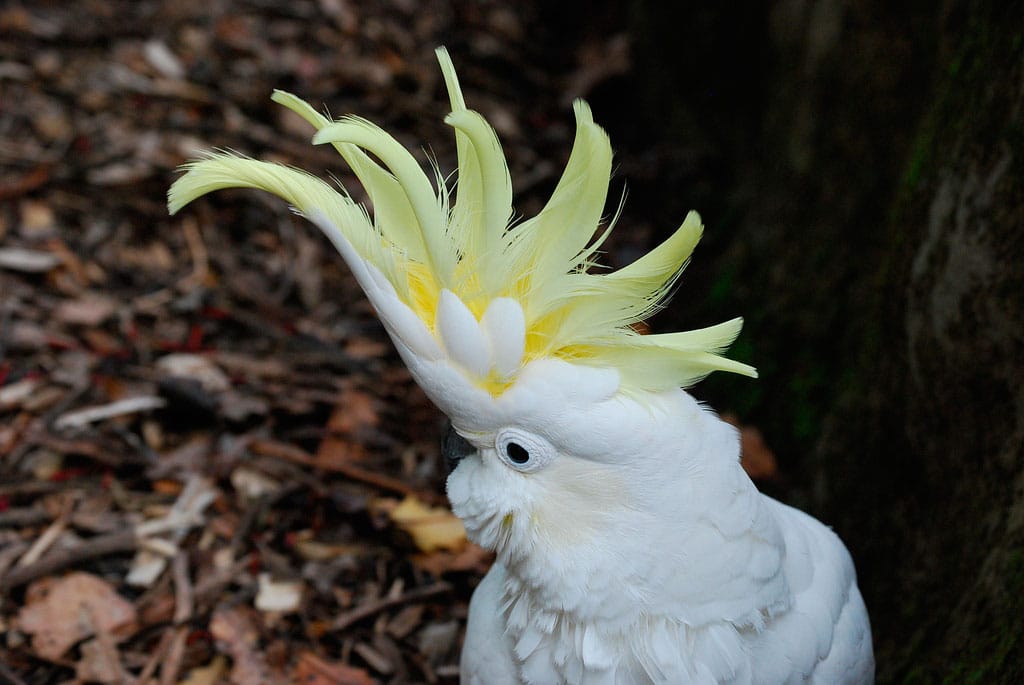
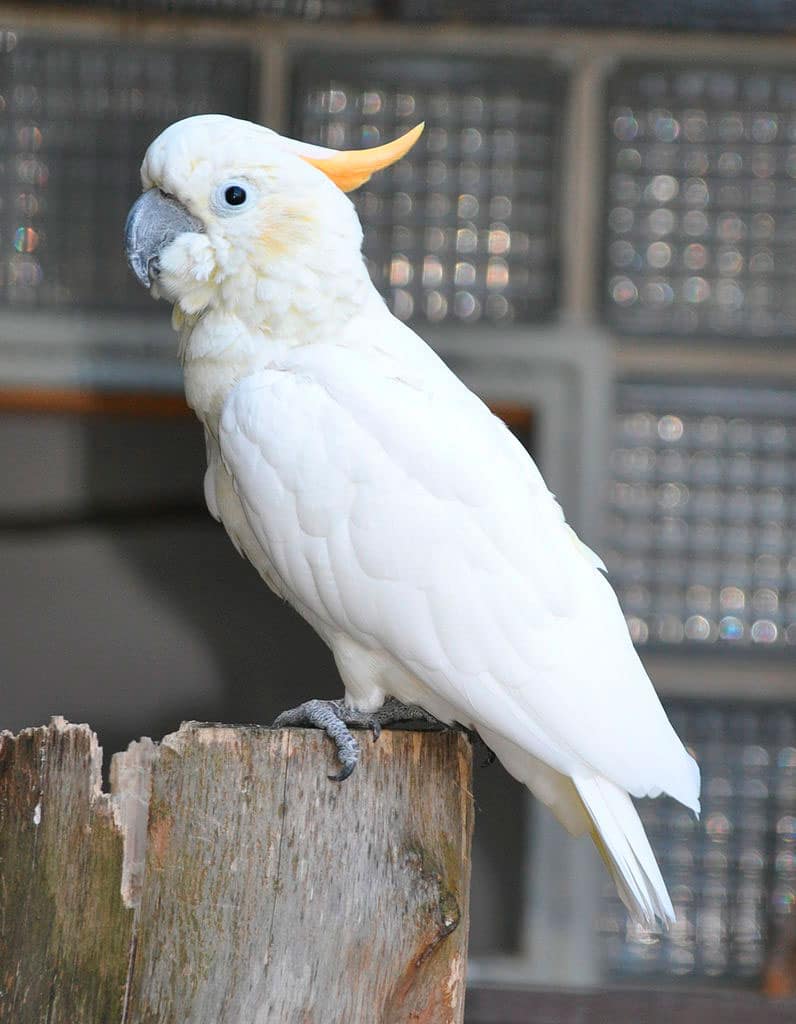
The Yellow-crested cockatoo(Cacatua sulphurea) It is distinguished by its long, thin yellow erectile crest, that curves forward, and extending upward, above the nape, when it folded. The front of his crown and main feathers crest, are white. The rest of your plumage It is also white, except in yellow suffusion ear-coverts, under the wings and in the innerwebs of the undertail-coverts. The bases of the hackles and underparts, They are yellowed; some birds show a slight yellow tone, particularly on chest and the belly. The bill It is black; eye ring pale bluish; irises dark brown; legs grey. The female is similar to the male but with the irises reddish and slightly smaller.
The young birds They show both sexes irises dark taupe, although females They begin to acquire the red coloration in the first year. The bill and legs immature are also lighter.
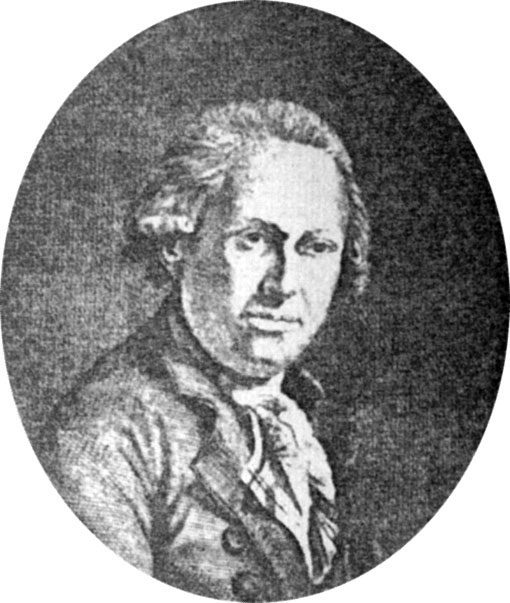
(Oberholser, 1917) – Similar to the parvula, but largest.
Cacatua sulphurea citrinocristata
Cacatua sulphurea citrinocristata
(Fraser, 1844) – Slightly larger than the nominal, with one crest orange & ear-coverts orange yellow. Additional research may provide a basis for improving this subspecies to a specific status..
Cacatua sulphurea parvula
(Bonaparte, 1850) – Similar to the nominal species, but with the ear-coverts paler and less yellow on yellow feathers underparts. the size of the bill in this subspecies it increases clinically towards the west.
They inhabit at the edges of the forest, wooded areas, farmland, cocoteros, semi-arid areas and forests until the 800 m (locally 1.200 m).
The Yellow-crested cockatoo usually they found in pairs or small groups of up to ten individuals, although they may meet in larger flocks to feed on fruit trees. They can form flocks with Eclectus Parrot(Eclectus roratus).
They tend to be noisy and visible, but can be difficult to spot when moving silently in the canopy, and they are more often in flight. The groups who leave their resting places in the montane forest areas frequently displace forage at lower altitudes including cultivated fields. Pairs may hover conspicuously above the forest canopy searching for fruitful trees, allowing a reasonably close approach when resting on a branch.
The crest It is generally stands when landing, or when an individual is making calls from a perch. Like most of the Cockatoos They enjoy a bath in the rain.
Reproduction:
Specimens of Yellow-crested cockatoo on the island of button in State reproductive during the months of September and October, although Nusa Tenggara the breeding It occurs in the months of April and May. The female It lays two or three white eggs in the hollow of a tree, and incubation lasts around 28 days with both parents participating. Chicks they leave the nest to 10 weeks and are dependent parent for about two months.
Food:
They feed in trees and soil. Its diet It includes seeds, corn (Zea mays) of cultivated fields, fruit, berries, egg yolks, flowers and nuts (including large coconuts (cocos nucifera)).
Distribution and status:
Size of its range (breeding/resident ): 1.360.000 km2
The Yellow-crested cockatoo They are confined Indonesian, where they can be seen in the lowlands Isla Celebes (virtually extinct in the north), islands in the Flores sea, in Nusa Tenggara and isolated islands Masalembu in the Java Sea.
introduced in Singapore and Hong Kong. The species is found in both wooded areas and cultivated and is scarce throughout its range. It is estimated that the world population total is less than 40.000 birds and is decreasing. Although populations of the nominal subspecies and of the subspecies parvula may still be close to 10.000 specimens, the citrinocristata subspecies It has an estimated population between 800 and 7.200 only individuals, having declined by 80% between the years 1986 and 1989, while the distinctive subspecies abbotti It is now represented by only nine individuals in nature.
Although habitat loss is clearly a factor in Sumba, where distribution appears to be linked to the extent of primary forest (is only about 15% the original forest), trade is the main threat to the species as a whole. Trade data show that exported almost 100.000 birds in years 1980-1992. The export citrinocristata subspecies It was banned in 1992 by local authorities, and 26 birds were confiscated in September of that year. There are probably at least 50 individuals of each subspecies in public collections and more than 2.000 in private aviculture, although the numbers for the subspecies abbotti They are unknown.
(Fraser, 1844) – Sumba, where it can be seen in the remaining forest around left, or east of the island, where it may still be locally common; an expedition of the Manchester Metropolitan University found it common in the remaining forest areas in 1990, with the greatest discovery of birds, a group of five birds, found in primary forest near Tabundung
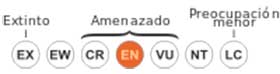
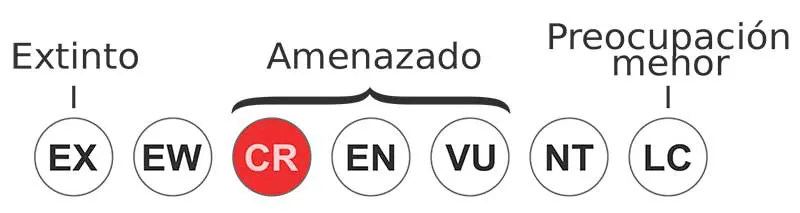
• Current category of the Red List of the UICN: critically endangered.
• Population trend: Decreasing.
Its crashing fall It is almost entirely attributable to the unsustainable exploitation for domestic and international trade. Logging to the conversion of forests for agriculture as well as the use of pesticides for land and large-scale.
Justification of the population
Based on recent surveys in various parts of the range of the species, C. Trainor in some (2007) It has been estimated the world population in less than 7.000 individuals: 3.200-5.000 en Sumba (though perhaps only 562 in 2012, Burung Indonesia en preparación), 500 en Komodo, 200-300 en Timor Leste, 200-300 en Sulawesi, 20-50 in West Timor, 40-70 Flores, 50-100 en Sumbawa, 100 in Rinca and other 700 birds in total. The best data is located in the band 2.500-9.999 individuals, equivalent to 1.667-6.666 mature individuals, rounded here to 1.500-7.000 mature individuals.
Conservation actions and research in progress
CITES Appendix I (2005). It has developed and adopted a recovery plan cooperative and has prepared an update 2012 (D. Mulyawati in some. 2012). The populations are found in various protected areas, It is the most important Rawa Aopa Watumohai (55 copies in 2011 [Waugh 2013]) and National Parks Caraente (en Sulawesi), supporting up 100 individuals (transgressed 2006) , Reserva Natural de Wildlife en Pulau Moyo, Komodo National Park and two national parks in Sumba: Manupeu-Tanadaru y Laiwangi-Wanggameti. Nini Konis Santana National Park declared in Timor has a 100 estimated birds (Trainor et al., Without date) . In Rawa Aopa Watumohai nests they have been protected from predators by removing vegetation pendant necklaces and installation of plastic around the tree trunks nesting (Waugh 2013). Moratoriums on international trade are in effect, although it is likely that a large proportion of trade is a national. Several subpopulations of Sulphur-crested Cockatoo have increased in Sumba between 1992 and 2002, due to conservation efforts (including local education, ecotourism and law enforcement), although densities remained below those typical for other cockatoo species (Cahill et al ., 2006) . Capture for trade has declined dramatically in Sumba through a variety of awareness and protection measures of the community (D. Mulyawati in some. 2012).
Following the surveys of 2008 and 2009, the Indonesia Parrot Project and Konservasi Kakatua Indonesia have started meetings with community leaders and villagers in Masakambing and Masalembu, as well as with the military and local police, to raise awareness and gain support for Sulphur-crested Cockatoo conservation (Metz et al. Al., 2009) . A conservation program-awareness-pride has also begun to involve adults and school Archipelago Masalembu (Metz et al. , 2009, Translating et al., 2009) And in Southeast Sulawesi (Anon., 2012). A "village regulation" was written to catch, possess or transport the species and initiate measures to reduce habitat destruction and employ a former village chief to guard and protect nests and study Sulphur-crested Cockatoos (Translating et al., 2009) . Moronone community in Rawa Aopa Watumohai NP, where four members of the village have been hired as Forest Wardens (Anon., 2012), have established similar community-based regulations. The guards protect the species against poachers and perform monitoring activities (Waugh 2013). The pest status of the species can be addressed by planting crops to compensate for losses and to act as a "sacrifice culture", for example, sunflower fields are used to attract the species out of other crops (Waugh 2013). Mangrove restoration is also being used to increase nesting habitat available (Waugh 2013). a repeat of the population census is planned abbotti , together with studies on its biological history and ecology (Metz et al., 2009) .
Proposed Research and Conservation Actions
Carry out further studies (including Roti, but also more studies on Alor and Pantar) to identify the most appropriate action for conservation areas and to periodically monitor key population surveys repeating ago 8-10 years. Provide relevant support for protected areas and conservation initiatives within its range and protect nests when possible. Strengthen the protection of forest Poronumbu, Sumba, declaring Nature Reserve (Translating y Agustina 2012). Strengthen control, the enforcement and monitoring of trade and establishing greater management of captive populations. Improve law enforcement in designated protected areas and other key areas for trade, including ports, markets, etc. Promote widespread community conservation initiatives. These may include, en la isla de Pasoso, Sulawesi Central, work to protect the Sulphur-crested Cockatoo should involve all five families living on the island and introduce community involvement programs for children and adults on several other islands where the species occurs (Translating y Agustina 2012). The recommendations formulated specifically for the protection of the species in the Komodo National Park consisted of carrying out an annual monitoring, maintain regular patrols, sensitize local communities and studying human activities and impacts within the park (Imansyah et al ., 2005, Benstead 2006) . Conduct ecological research to clarify options for management and conservation. Other objectives should be to study the abundance and distribution of nest holes and water sources.. The provision of artificial sources of water near the nesting sites, that is to say, water ponds, It is essential for the species on the island of Komodo and may also be necessary to protect the nests of young Komodo dragons in Komodo (Translating y Agustina, 2012).
"Yellow-crested cockatoo" in captivity:
The male Yellow-crested cockatoo It is especially aggressive with the female, sometimes to kill her. This phenomenon is known in many cockatoo species..
among the white cockatoos, this is somewhat difficult to breed in captivity. As a pet can be a formidable partner provided it has been raised for that purpose and to provide much attention.
It is very difficult for them to disconnect in the presence of their owners and entertain themselves without seeking continuous interaction.
Great ability to imitate human sound within the world of cockatoos.
Note: Because of its status, CRITICALLY ENDANGERED, only controlled captive breeding is recommended in an attempt to recover this species in the wild.
– Avibase
– Parrots of the World – Forshaw Joseph M
– Parrots A Guide to the Parrots of the World – Tony Juniper & Mike Parr
– Birdlife
– Photos:
(1) – Cacatua sulphurea by Charles Lam – Flickr
(2) – Citron-crested Cockatoo(Cacatua sulphurea citrinocristata) in the Walsrode Bird Park, Germany By Quartl (Own work) [CC BY-SA 3.0], via Wikimedia Commons
(3) – A Yellow-crested Cockatoo at Auckland Zoo, New Zealand By Ashleigh Thompson (originally posted to Flickr as Captain) [CC BY 2.0], via Wikimedia Commons
(4) – Cacatua sulphurea citrinocristata, Citron-crested Cockatoo. Photograph of upper body and crest By Ruth Rogers (originally posted to Flickr as Citron Cockatoo) [CC BY 2.0], via Wikimedia Commons
(5) – Citron-crested Cockatoo (Cacatua sulphurea citrinocristata). The glass between the camera and this parrot makes the picture just a little bit blurry By Alexander Tundakov (originally posted to Flickr as White Parrot) [CC BY 2.0], via Wikimedia Commons
(6) – Photo of Lesser Sulphur-crested Cockatoo (wings clipped) By Snowmanradio, with permission from Tropical Birdland, Leicestershire, England. (Own work) [GFDL or CC BY-SA 3.0], via Wikimedia Commons
(7) – Yellow-crested Cockatoo (Cacatua sulphurea) at the KOBE Oji Zoo by opencage.info
(8) – Lesser Sulphur-crested Cockatoo (wings clipped) By Snowmanradio, with permission from Tropical Birdland, Leicestershire, England. (Own work) [GFDL or CC BY-SA 3.0], via Wikimedia Commons
(9) – Yellow-crested Cockatoo (Cacatua sulphurea) by Darren – Flickr
(10) – Yellow-Crested Cockatoo, Cacatua sulphurea by Sek Keung Lo – Flickr
(11) – Cacatua sulphurea by Charles Lam – Flickr
(12) – Cacatua sulphurea by Charles Lam – Flickr
(13) – Cacatua sulphurea by Pichon Charles Lam – Flickr
(14) – A painting of a Yellow-crested Cockatoo, also known as the Lesser Sulphur-crested Cockatoo, (originally captioned «Plyctolophus sulphureus. Lesser Sulphur-crested Cockatoo») by Edward Lear 1812-1888. [Public domain], via Wikimedia Commons
The Sapphire-rumped Parrotlet(Touit purpuratus) has the forecrown, crown, ear-coverts and sides neck, color marron-oliva; lores and cheeks green; rear area of the neck of color green pale with broadcasting brownish. Mantle and top of the back, green; scapulars and tertiary, dark brown; rump blue; uppertail-coverts green.
Feather blue in it bend of wing; primary coverts brown-black, rest of the coverts green. The flight feather Brown by up in innerwebs and tips, Yes no green; pale green blue for below. Underwing-coverts green. The underparts pale, of color green emerald slightly yellowish, with a layer of ochre in the sides of the belly. The tail Le da an appearance unmistakable, with black edge, green in the center and dark crimson on the sides, with black margins to outerwebs.
Bill off-white color pale Horn-tipped up to the upper jaw; irises black; legs grey.
The female has the tail (except central feathers) with the subterminal band green. Immature more yellowish below; the black color in the tail confined to the tips; Green olive from the forecrown up to the nape and ear-coverts lower.
(Chapman, 1929) – As the nominal species but with the forecrown, crown and back neck, green; flanks with less yellowish green and feathery external of the tail showing a purple glow.
Habitat:
Species Rare and hard to see. It inhabits, mainly, in the humid lowland canopy and forests and marshes, also observed in savanna in Suriname. In lower and more open to high altitude forests in Venezuela and in isolated areas cleared forests. Reports in altitudes of 400 metres in Colombia, and 1.200 metres in Mount Duida, Venezuela. gregarious, usually in groups of 12-40 birds.
Reproduction:
Observed the female digging a hole in a tree of forests and marshes in the month of November in Colombia; Birds in a nest in termitario tree in the month of April in Suriname, and males in breeding condition in the month of March in Venezuela. The laying tends to be of 3-5 eggs.
Comes to be local in Suriname and French Guiana. Discrete, often difficult to observe and apparently sparsely populated in most parts of its range. Perhaps more numerous in those sections more low of it amazon basin.
Distribution 2 subspecies:
Touit purpuratus purpuratus
(Gmelin, 1788) – Nominal. Southeast of amazon in Venezuela, up to the Guianas and this from the Basin of the Amazon in Brazil.
Touit purpuratus viridiceps
(Chapman, 1929) – Black river, the Northwestern basin of Brazil, Venezuela West from Mount Duida until Colombia, Ecuador and Peru.
Conservation:
State of conservation ⓘ
Minor Concern ⓘ(UICN)ⓘ
• Current category of the Red List of the UICN: Least concern.
• Population trend: Stable.
Justification of the population
The size of the world's population has not been quantified, but this species is described as «Rare» (Stotz et to the., 1996).
Justification of trend
It is suspected that this species has lost 12,8-15,2% of habitat within its distribution over three generations (15 years) starting from a model of deforestation Amazon (Soares-Filho et to the., 2006, Bird et to the., 2011). Given the susceptibility of the species to hunting and / or capture, It is suspected that it will fall in <25% during three generations.
Of 18 cm.. tall Inconfundible by the ends of the tail, which are dorsally and ventrally purple-red with black border.
Overall green body with Brown Crown and nape, wing with both opaque Brown ends and violet blue rump.
Female with paler brown head and green-streaked tail.
The subspecies T. p. viridiceps has a totally green head.
Uncommon and difficult to observe species.
Lives in humid forests, semi-humid and swampy, until the 400 m. It forms small groups and they are silent when they feed. It nests in hollows of trees or arboreal termiteros at low altitude. The implementation is of 3-5 eggs and breeding season: from November to April
It is found in the wild in the Amazon, South-East of Colombia to the Guyanas, southern Venezuela to northeastern Peru and northern Brazil.
It feeds on fruits, and figs.
Video: Video 1
Deforestation and loss of Habitat is a threat for this species.
Alternative names:Sapphire-rumped Parrotlet (English), Periquito zafiro (Colombia), Periquito lomizafiro (Ecuador), Purpurschwanz, Purpurschwanzpapagei (Germany), Lorito de Lomo Purpúreo (Spain), Periquito Rabadilla Púrpura (Venezuela), Toui à queue pourprée (France), apuim-de-costa-azul (Brazil)
 Minor Concern ⓘ
(UICN)ⓘ