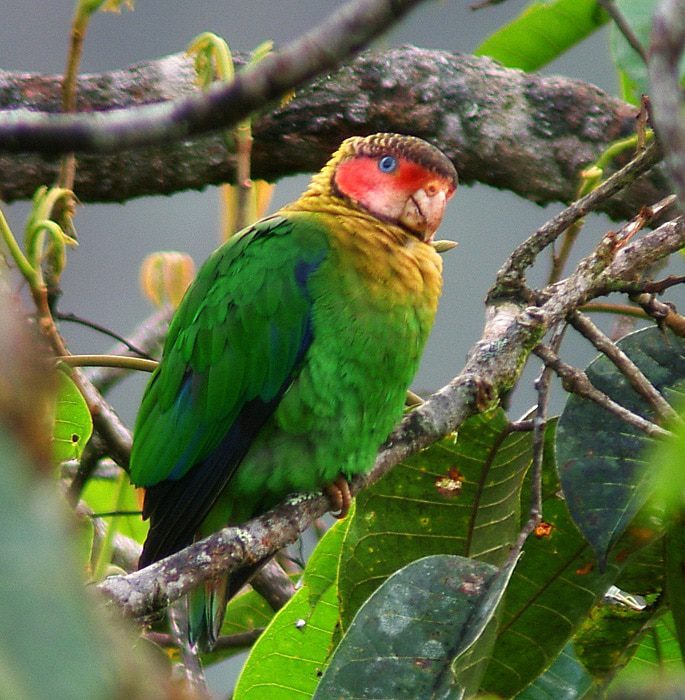
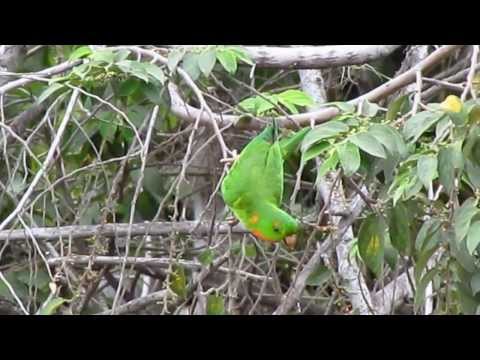
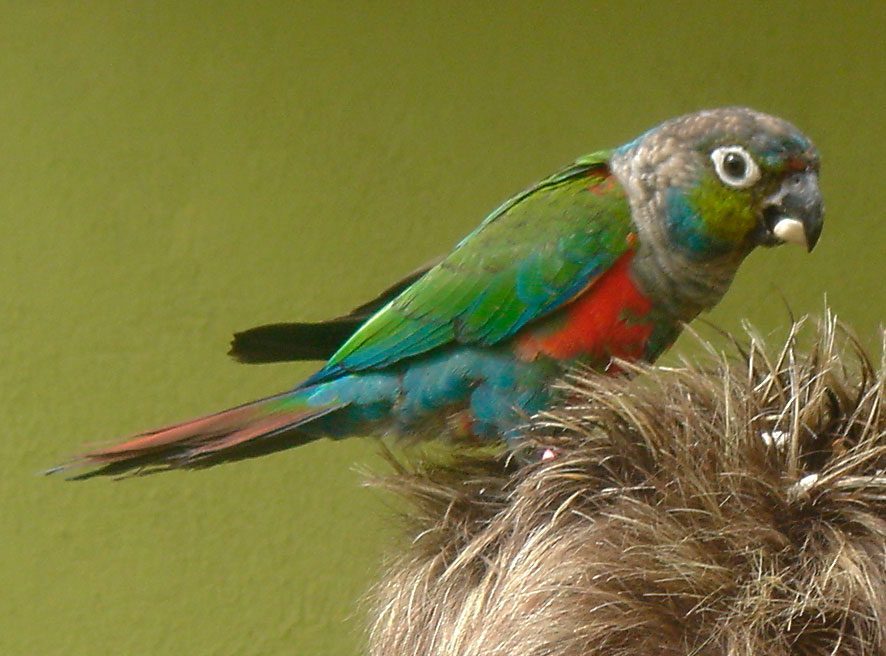
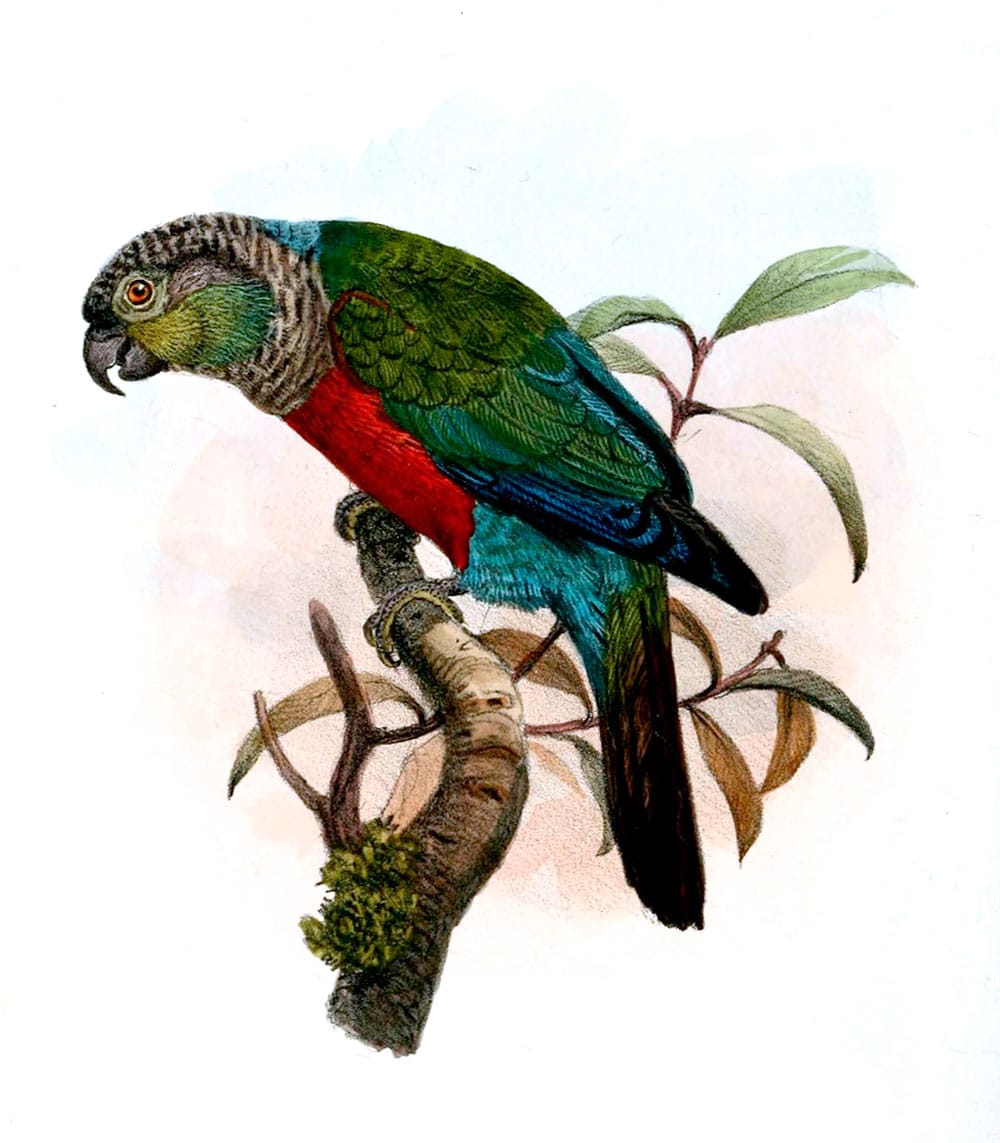
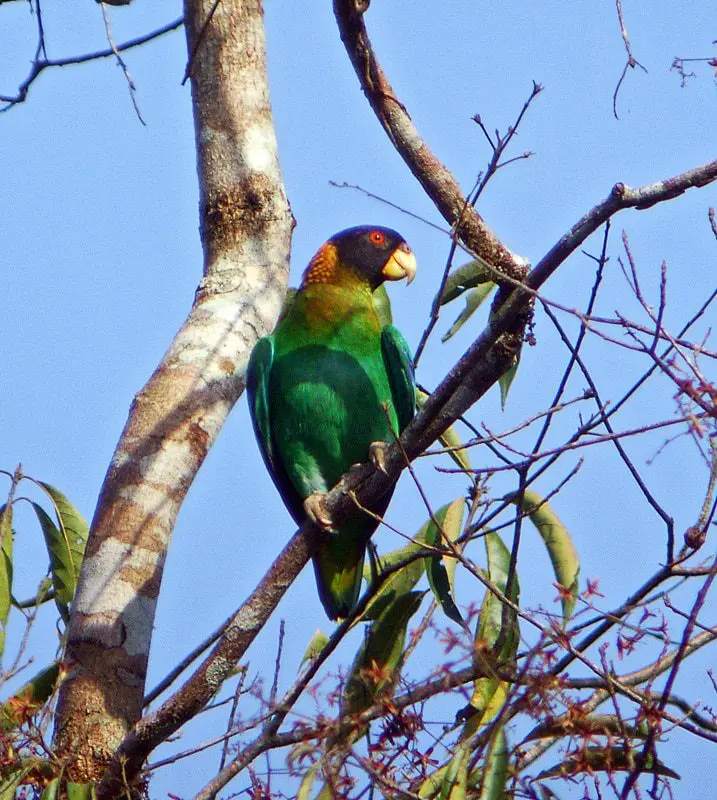
The Rose-faced Parrot(Pyrilia pulchra) be distinguished easily by your face and both sides of neck purple-red with black margin; crown and throat grayish coffee. General green olive in the back and beige in the belly. Wings with the part superior mixed with yellow or red orange and the rest green blue.
Stubby-looking and tail short. The immature they have only have a red line on the eye and the ear While their cheeks are coffee Green.
The Rose-faced Parrot is a parrot little known, which is commonly found between 1,200 and 2,100 m above sea level, Although has been observed at altitudes as low as 200 m. Inhabits humid and semi-deciduous forests of lowlands and temperate. According to the information available, is known that this Parrot is often feed is on the canopy of forests, Although visit disturbed areas and crops. Flying in pairs or groups of size variable up to of 25 or more.
Reproduction:
The data on reproduction are scarce. But, they have observed individuals with gonads developed between November and February in the Chocó, in Colombia and Ecuador.
Food:
Its diet It is little known, but some observations indicate that includes in its feeding fruits of Oenocarpus bataua (Arecaceae) and other fruits from species wild and plants cultivated as banana and corn.
Distribution:
Size of the area of distribution (reproduction / resident): 195.000 km2
Are you can observe in freedom from the West of Colombia to the West of Ecuador.
Conservation:
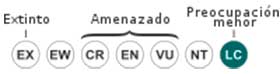
• Current category of the Red List of the UICN: Least concern.
• Population trend: Stable.
Justification of the population
The population size World has not been quantified, but this species is described as "uncommon and irregularly distributed" (Stotz et to the., 1996).
Justification of trend
It is suspected that the population is stable in absence of evidence of any decline or threatens substantial.
"Rose-faced Parrot" in captivity:
Not usually seen in aviculture. Extremely sensitive, has ever survived more than one couple of months in captivity.
Alternative names:
– Rose-faced Parrot, Beautiful Parrot, Rose faced Parrot (English).
– Caïque à joues roses (French).
– Rosenwangenpapagei, Rosenwangen-Papagei (German).
– Rose-faced Parrot (Portuguese).
– Cotorra Carirrosada, Lorito Carirrosado, Lorito de Cara Rosada (español).
40 to 50 cm.. length and a weight of approximately 550 gr.
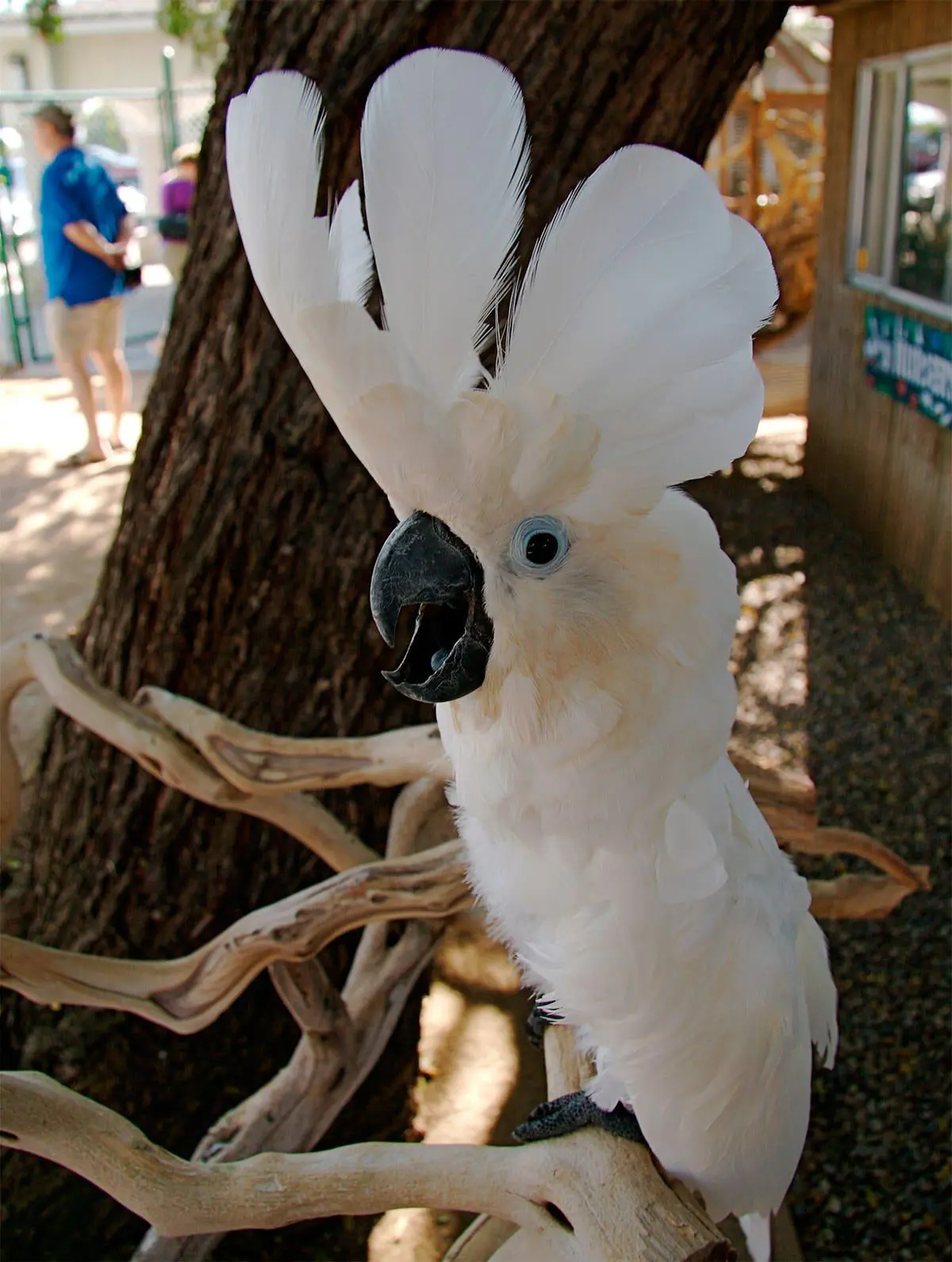
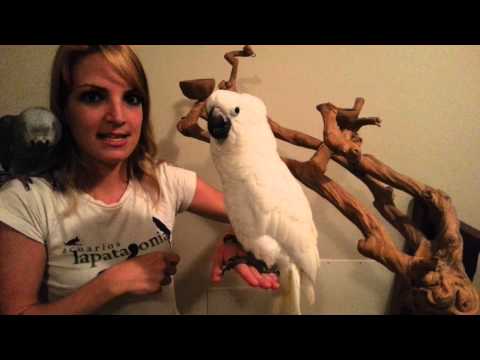
The White cockatoo(Cacatua alba) is completely white, with yellowing below wings, bill black and legs dark gray.
The eye ring is blue.
It has a crest exuberant, that is elevated or low, Depending on your state of mind. The wings They are tapered or rounded.
If he irises is brown, then it is male, if reddish, it is female. The females has bill smaller.
They usually fly solo, in pairs, small groups, or in flocks of up to fifteen birds. In the afternoon, they gather in groups of up to fifty birds. even though they are social, with the exception of mating pairs, usually, they do not form close ties with others. As a result, There is no firmly defined order of dominant position in the community. Son day and they tend to be sedentary, Although some can be nomadic and wander in search of food.
The white cockatoos they are very bright and curious birds. They have the ability to use tools, as the use of a branch to scratch your back. They are monogamous, with couple bonds lasting lifetime. They can fall into a deep depression if you lose your partner.
They live in lowland forests below 900 m, as well as in mangrove forests, plantations and agricultural land.
they are particularly common around the edge of clearings and rivers. They spend most of their time in the tops of the trees. The secondary vegetation high is its preferred habitat.
White Cockatoo Reproduction:
It nests in the hollows of trees. They lay two eggs and two birds hatch for a few 28 days. The larger hatchling tends to take dominance over the smaller hatchling, which will not be able to survive.. The chicks leave the nest to the 84 days old and are independent around 15-18 weeks. These birds reach sexual maturity at the age of 3-4 years.
White Cockatoo feeding:
In nature it feeds mainly on Tree fruits. They are often seen feeding on papaya, Durian, complexioned and rambutan. It has also seen them will eat crickets and lizards. They often feed on corn that grows in the fields, sometimes doing considerable damage.
Distribution:
Size of its range (reproduction / resident): 51.400 km2
Appears as vulnerable by the IUCN and placed in Appendix II in 1981.
In their natural environment, the white cockatoo is a species vulnerable Due to the decrease in number due to habitat loss natural, as well as for the capture for the illegal bird trade. There are restrictions on the number of birds that can be exported, but BirdLife International He says that this is being exceeded by up to 18 times the agreed number in some areas.
It can cause substantial damage to Corn crops.
World population: 43,000 – 183,000 individuals.
The White Cockatoo in captivity:
The White cockatoo You can live more than 60 years. It is very common in poultry farming and it is perhaps one of the most frequent pet cockatoos.
They are sympathetic, calm, beautiful, sweets and easy to domesticate. Bred to porridge they are usually wonderful pets, You can play some words but are not good talkers. These birds in captivity require mental stimulation almost constant. They are in constant motion, up and doing gymnastics. When lack of mental stimulation, often they are become neurotic, booting the feathers to the point of causing areas of baldness.
They are known for being very affectionate with their human companions, acting more like a dog than a bird in this regard as.
In the absence of a partner, captive white cockatoos will bond with their keeper as if that person were their mate.
Alternative names:
– White cackatoo, Great White Cockatoo, White Cockatoo, White-crested Cockatoo (ingles).
– Cacatoès blanc, Grand Cacatoès blanc (French).
– Weißhaubenkakadu (German).
– Catatua-branca (Portuguese).
– Cacatúa Alba, Cacatúa Blanca, Cacatúa Copete Blanco, Cacatúa de Goffin (español).
– Avibase
– Parrots of the World – Forshaw Joseph M
– Parrots A Guide to the Parrots of the World – Tony Juniper & Mike Parr
– Birdlife
– avimarparrots.es
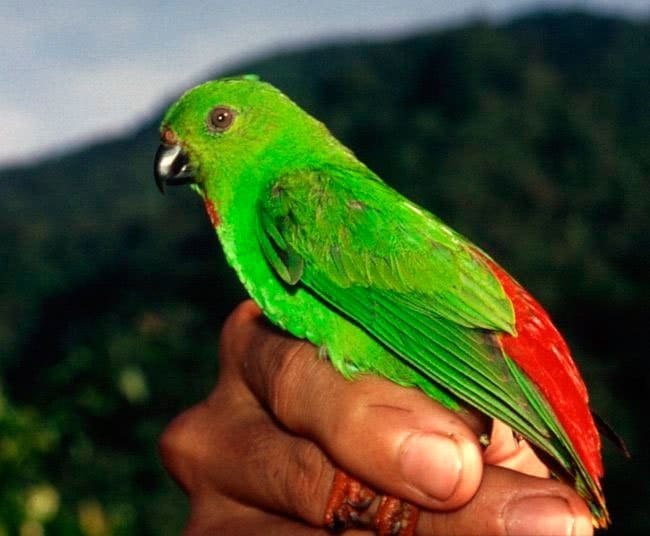
The Sangihe hanging parrot(Loriculus catamene) has the head Green with the front of the crown and the bib red. Upperparts Green with light wash of color orange in the the mantle; rump and long tail coverts red. Wings green, slightly dark; carpal edge brighter yellowish green. The flight feather blue with green coverts.
The underparts Green with the belly Beige and tail coverts of color red marked in green. Upper, the tail of color green with lips Red; Blue below. The bill black; irises brown; legs orange.
The female not have the Red of the crown; the Red of the bib reduced to a few points, and green the coverts infracaudales.
The immature with carpal edge yellow, lack of crown red, But if the bib red.
Found in pairs or in small groups on them flowers of coconut and shrub in flower, and groups of up to four birds found with greater frequency in plantations mixed. The species is has adapted to habitats side and their main source of food seems to be the nectar of coconut. One roost of 17 birds is the largest group reported.
Reproduction:
One nest with two eggs is noted in 1985, little more is known of the habits reproductive of this species.
Food:
Their main source of food is the nectar of coconut.
Distribution:
Size of the area of distribution (reproduction / resident): 700 km2
endemic to the Sangir Islands. Most of the original vegetation in Sangir, It has now been replaced by plantations of coconut and nutmeg, and secondary vegetation of the abandoned gardens. Observations during mid of 1980 showed that it is quite common in coconut forests, and two pairs were observed in the steep volcanic slopes covered with trees in 1986. In 1995, the species was recorded of all forest habitats on the island from sea level up to around the 900 m (also be meeting around Tahuna). The birds are observed more frequently in fragments of forest and coconut plantations.
Conservation:
• Current IUCN Red List category: Near threatened
• Population trend: Decreasing
There are few data on recent trends, but not there is evidence of a continuous decrease and given your apparent tolerance to different secondary habitats, the declines in their population may have been insignificant.
The population of the Sangihe hanging parrot It is estimated between 10.000 and 46.000 specimens.
The original forest in Sangihe It has been almost completely replaced by the crop, but the species appears to be tolerant to degraded habitats and cultivated areas and there is no evidence of a continuous decrease. Other potential threats include the widespread settlement of large trees in the Decade of 1980, the escaped parrots-borne disease and the volcanic activity in the future (Riley 2002).
"Sangihe hanging parrot" in captivity:
Is not usual.
Alternative names:
– Sangihe Hanging-Parrot, Sangihe Hanging Parrot, Sangir Hanging Parrot (ingles).
– Coryllis des Sangi, Coryllis de Sangihe (francés).
– Rotsteisspapageichen (alemán).
– Loriculus catamene (portugués).
– Lorículo de la Sangihe, Lorículo de Sangihe (español).
Origin: Guatemala, Honduras, El Salvador, Nicaragua
Character: shy
Life expectancy: 35 to 40 years.
Height: 28 cm..
Content
Description:
28 cm.. length and 130 g. of weight.
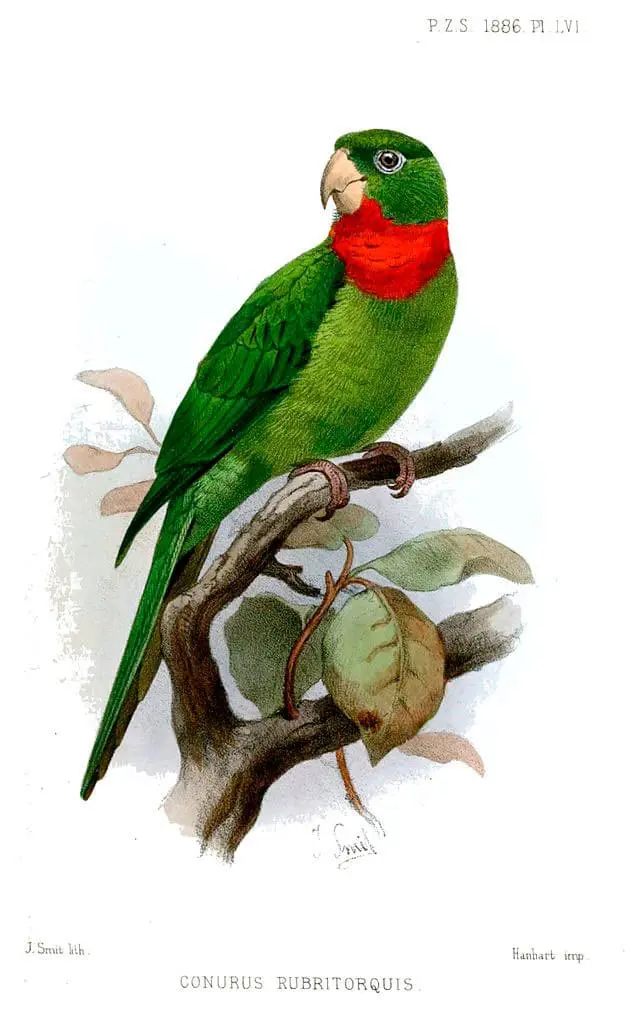
The Red-throated Parakeet(Psittacara rubritorquis) they have a plumage, in general, green, with yellow tones in the underparts; orange-red in the throat and on the front of the neck, with yellow-orange feathers scattered; variety of pens of color red orange scattered in the part low of them cheeks and both sides of the neck; blue tint on primary coverts and vane outer of the flight feather; underwing-coverts brighter yellowish green; below, the flight feather yellow color without brightness.
The bill color horn. Bare area of the eye ring grayish brown. The irises orange.
The male and female are similar.
The immature with the throat red, absent in the cheeks and both sides of the neck. The irises brown.
The Red-throated Parakeet is located in altitudes that range between the 600 and 1.800 m, in a variety of wooded areas, Save the rainforest.
They can be observed in humid forests, Open with weeds and growing areas areas in Guatemala; forests of Pinus sp in Nicaragua.
Is in flocks outside the breeding season, and couples during courtship and nesting season. Larger congregations are produced when food is abundant.
Reproduction:
The nesting takes place in tree cavities, cracks in rocks, holes from woodpeckers, holes in buildings or in tree termite mounds.
The breeding season is between the months of January and August and the laying tends to be of 3-4 eggs.
Food:
With feeds seed, nuts, berries and fruits. It can also feed on cultivated seeds and corn..
Sometimes, considered a pest to crops.
Distribution:
Size of the area of distribution (reproduction / resident): 139.000 km2
Distributed by the Eastern Highlands of Guatemala and El Salvador (apparently only a record) to the South by Honduras to the North of Nicaragua.
Conservation:
State of conservation ⓘ
Minor Concern ⓘ(UICN)ⓘ
• Red List category of the UICN current: Least concern
• Population trend: Stable
The size of the world population It has not been quantified, but this species is described as «quite common» (Stotz et to the. 1996).
The population of Red-throated Parakeet suspected to be stable in the absence of evidence of any reduction or substantial threats.
– Avibase
– Parrots of the World – Forshaw Joseph M
– Parrots A Guide to the Parrots of the World – Tony Juniper & Mike Parr
– Birdlife
– Photos:
(1) – Red-throated Parakeet (Aratinga rubritorquis) also called Red-throated Conure at Macaw Mountain Bird Park and Nature Reserve, Copan, Honduras By Lauri Väin [CC BY 2.0], via Wikimedia Commons
(2) – A Red-throated Parakeet (also called Red-throated Conure) at Macaw Mountain Bird Park, Copan Ruinas, Honduras By Sarah and Jason (originally posted to Flickr as IMG_6987) [CC BY-SA 2.0], via Wikimedia Commons
(3) – Two Red-throated Parakeets at Kakegawa Kacho-en, Kakegawa, Shizuoka, Japan By Takashi Hososhima from Tokyo, Japan (Green with envyUploaded by snowmanradio) [CC BY-SA 2.0], via Wikimedia Commons
(4) – Psittacara rubritorquis by Psittaciformes .NL – pinterest
(5) – Psittacara rubritorquis by Bellas Aves de El Salvador
(6) – Conurus rubritorquis by Joseph Smit [Public domain], via Wikimedia Commons
The Crimson-bellied Parakeet(Pyrrhura perlata) has the lores and cheeks of color yellowish-olive with dye Brown; The forecrown, the crown and back neck Dark Slate with velvety probes, giving a mottled appearance, especially in parts where increases the blue at the bases of the feathers.
The upper mantle is blue; robe bottom up to the uppertail-coverts green. Scapulars green at the base, blue down; the lesser wing coverts, olive green; the medium-sized and large coverts, with a predominance of the color blue. The flight feather, blue top, secondaries with green in the outerweb; slate grey dark below.
Underwing-coverts bright red. Sides of the neck, the throat and the top of the chest, with a predominance of brown color, with some brands blue and tips velvety, giving a scaly appearance; The under chest and most of the belly bright crimson; Flanks, the thighs and undertail-coverts, Blue with greenish tint. Upper, the tail, with predominance of color Brown, shades of green and some blue feathers; below, the tail, dark gray.
The bill brown-black color; eye ring whitish grey; Iris dark brown; legs black slate.
Both sexes similar.
Immature they lack the bright crimson color on the underparts; Sometimes with dark margins in the scapulars.
The Pyrrhura perlata was formerly known as Pyrrhura rhodogaster.
They generally inhabit humid forests on dry land., clear forest, secondary and probably drier formations in the North of Mato Grosso and have been registered also dominated by fig trees in eastern forests of Bolivia.
Usually views in small flocks and, sometimes in mixed groups with the Golden-winged Parakeet and Painted Parakeet. Larger family groups have been reported previously. They have often been seen descending into rivers and streams to bathe and drink..
Reproduction:
With reproduce between August and November, probably in April and June, They nest in tree cavities. Incubation period: 24-25 days.
The put in captivity is of 3-9 eggs, being 5 the average.
They can be found in Brazil, in the area of the great South-Central amazon basin, in West For and in the western area of amazon, in the river basins Madeira and South of the Tapajós, to the extreme north of Mato Grosso, Rivers Roosevelt and Aripuanã.
Observed in adjacent parts of Bolivia and probably widely distributed east of Rio Mamoré in hand me and Santa Cruz.
In general common, but perhaps decreasing due to the loss of forests in some parts of its area of distribution (for example, along the river JI-Paraná in Rondà´nia, Brazil).
Conservation:
State of conservation ⓘ
Vulnerable ⓘ(UICN)ⓘ
• Current category of the Red List of the UICN: Vulnerable
• Population trend: Stable
Justification of the population:
The size of the world's population has not been quantified, but this species is described as "quite common» (Stotz et to the., 1996).
Justification of trend:
It is suspected that this species has lost 23-30.3% of habitat within its distribution area for three generations (18 years), based on a model of Amazon deforestation (Soares-Filho et to the., 2006, Bird et to the., 2011). Given the susceptibility of species the hunting and capture, they suspected that the population of Crimson-bellied Parakeet will decrease by ≥ 30% during three generations.
"Crimson-bellied Parakeet" in captivity:
Not very common in captivity. Its diet ideal would be based on fruits such as: apples, Pears, oranges, bananas, grenades, cactus fruits , which form the 30 percent of their food, vegetables, such as: carrots, celery, green beans, pea in the pod, fresh corn, green leaves, such as: chard, lettuce, dandelion, chickweed, healer, millet; a mixture of seeds as such: Canary Islands, small amounts of wheat and millet, oats, safflower and hemp, Sunflower, cooked beans and legumes and cooked corn.
Es una ave muy playful a la que le encanta bañarse, so toys and a shallow bowl of water should be provided. Moderate voice, but when are they excited can be somewhat noisy. It is not aggressive with other species.
Price per couple: 500-600 EUR
Alternative names:
– Crimson-bellied Parakeet, Crimson bellied Parakeet, Crimson-bellied Conure, Pearly Conure, Pearly Parakeet, Rose-bellied Conure, Rose-breasted Conure, Rose-breasted Parakeet (English).
– Conure à ventre rouge, Conure perlée, Perriche à ventre rouge, Perruche à poitrine cramoise, Perruche à ventre rouge (French).
– Rotbauchsittich, Blausteißsittich, Blausteiss-Sittich, Rotbauch-Sittich (German).
– Tiriba-de-barriga-vermelha (Portuguese).
– Catita cola granate, Cotorra Ventirroja, Cotorra Ventrirroja, Perico de Pecho Rojo, Perico Perla (español).
– Catita cola granate (Paraguay).
– Avibase
– Parrots of the World – Forshaw Joseph M
– Parrots A Guide to the Parrots of the World – Tony Juniper & Mike Parr
– Birdlife
– Photos:
(1) – Crimson-bellied Parakeet (Pyrrhura perlata) also called the Crimson-Bellied Conure By derivative work: Snowmanradio (talk)Juan_Caparrós_cabeza. JPG: Juan Caparrós [CC BY-SA 3.0 or GFDL], via Wikimedia Commons
(2) – A Crimson-bellied Parakeet (also known as the Crimson-bellied Conure) captive by Pyrrhura_perlata_-captive-8a.jpg: Nori Almeidaderivative work: Snowmanradio [CC BY 2.0], via Wikimedia Commons
(3) – Crimson-bellied Conure in the Walsrode Bird Park, Germany By Quartl (Own work) [CC BY-SA 3.0], via Wikimedia Commons
(4) – Parrot by pixabay Crimson
(5) – Pyrrhura perlata by Florin Feneru – Flickr
(6) – Conurus rhodogaster=Pyrrhura perlata by Joseph Wolf [Public domain], via Wikimedia Commons
Origin: Mexico, Guatemala, Honduras, El Salvador, Nicaragua, Costa Rica
Character: Social
Life expectancy: 30 years.
Height: 20,5 cm..
Content
Description:
20,5 cm. length and 80 g. of weight
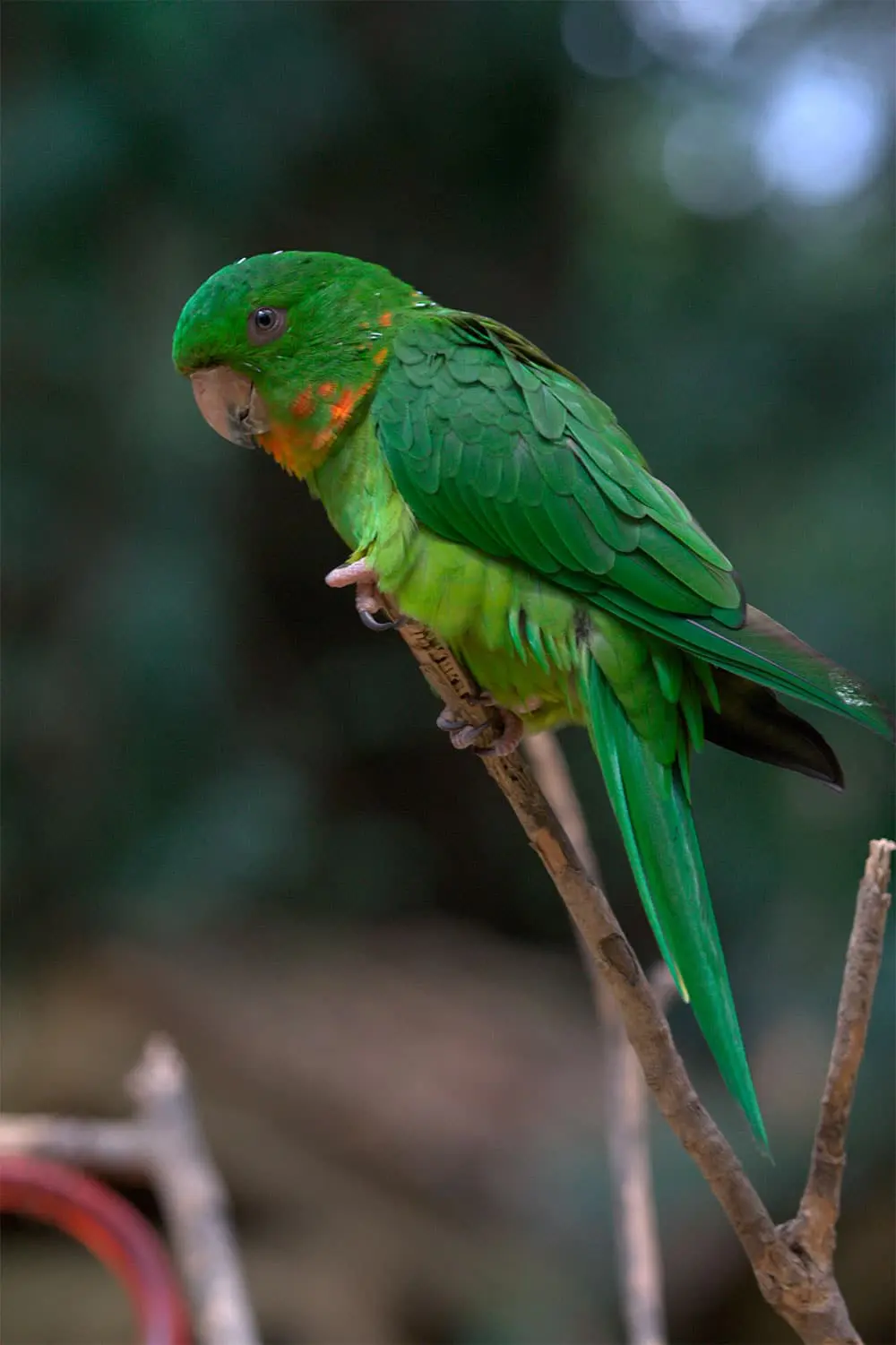
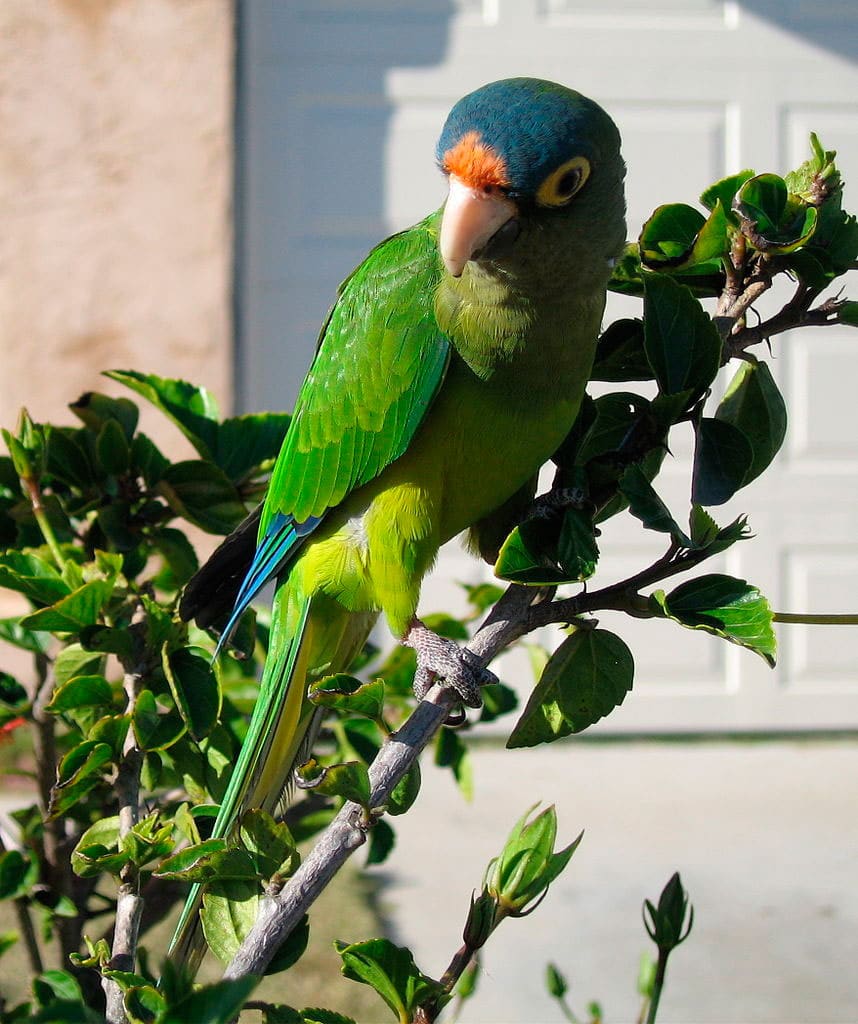
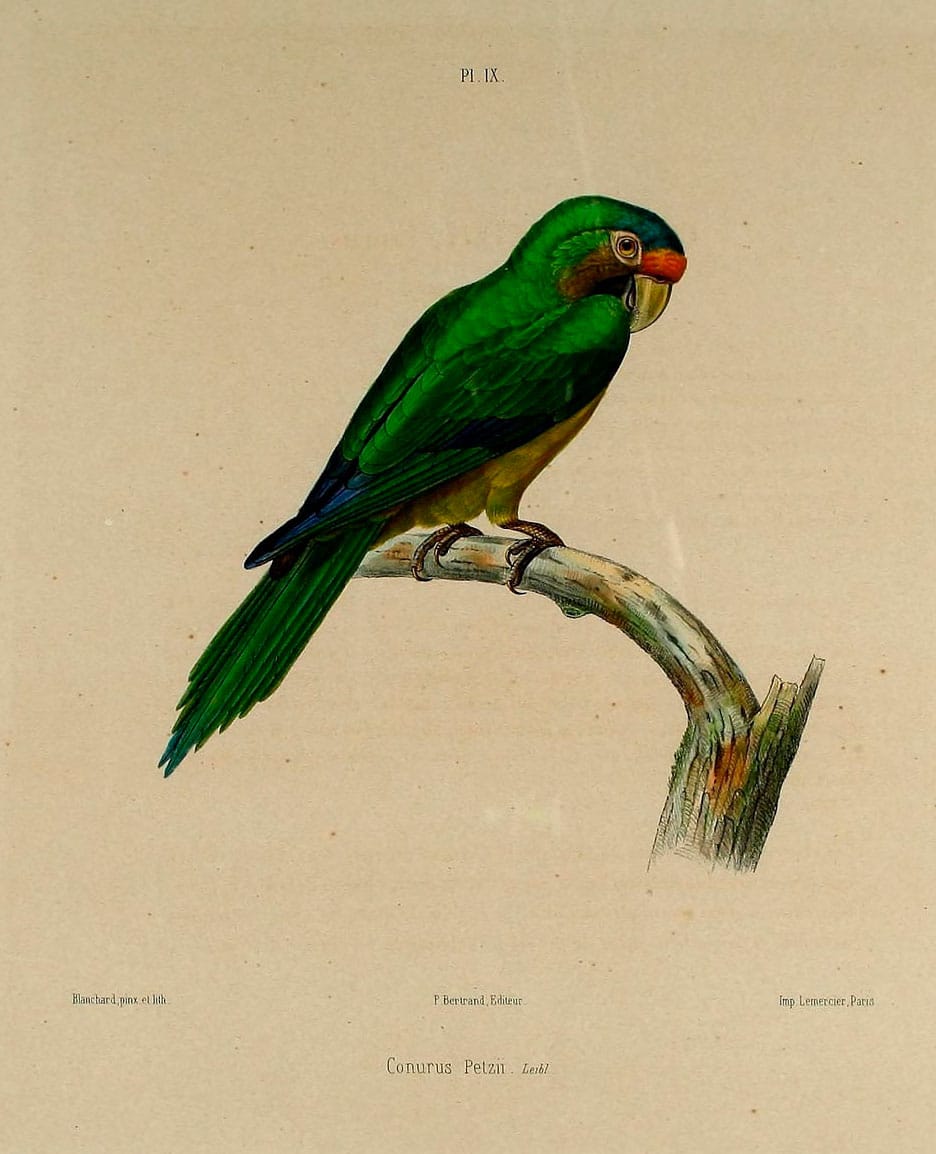
The Orange-fronted Parakeet(Eupsittula canicularis) It has in forecrown a wide band orange-red which extends over the lores and the part front of it crown; the rest of the crown is blue, fading from nape up to the upperparts in a shade of green grass.
Upperwing-coverts green. Flight feathers, at the top, blue on the outerweb; spiked green and black borders innerwebs; undertail, grey. Underwing-coverts brighter yellowish green. Throat, the sides of neck and the chest a shading pale yellow and pale olive oliváceo in belly and in the undertail-coverts. Upper, the tail green with blue tip; undertail, pale yellow olive.
Bill color pale horn; cere whitish; bare periophthalmic whitish: irises pale yellow; legs grey-brown. Both sexes are similar. The immature has a front patch Orange much smaller and irises brown.
They inhabit in fields slightly woody or open areas with scattered trees lowland ASAL, including thorny deciduous forests and tropical forests; the Orange-fronted Parakeet They are more abundant below 600 m, even they reach 1.500 meters in the high arid lands of central Honduras after breeding, forming flocks near the 50 birds, sometimes many more.
The Orange-fronted Parakeet They are well adapted to partially clear habitats, reposing in plantations Palma and handle, often near cities. Communal roosts have been observed in the company of the White-fronted Parrot (Amazona albifrons) in riparian forests Guatemala. Usually arboreal.
Reproduction:
An active termitero, usually Nasutitermes nigriceps, It is the preferred place to nest construction of Orange-fronted Parakeet; Several couples sometimes dig holes next few other; also they use tree cavities (for example, hole made by woodpeckers).
Reproduction March to May in Oaxaca, Mexico; January-may in El Salvador; during the dry season in Costa Rica.
The laying is of 3 to 5 eggs). Only the female incubates. The incubation lasts around 30 days. The chicks leave the nest to 6 weeks.
Food:
In its natural habitat the the diet of the Orange-fronted Parakeet includes seeds of Ceiba and Inga, fruits of Ficus, Bursera and Brosimum, and flowers of Gliricidia and Combretum. Sometimes they invade causing farmland damage in maturation corn and the banana.
Distribution and status:
Size of its range (reproduction / resident): 1.490.000 km2
They live in the shed peaceful of Central America, from northwest Mexico to the Northwest of Costa Rica. The Frentinaranja Aratinga can be seen from Sinaloa and West Durango, south along the lowlands of Mexican Pacific until Chiapas and Guatemala, El Salvador, Honduras and Nicaragua, until Costa Rica, lthough there is a recent contraction of their distribution in the northwest.
Habitat in the mountains of Caribbean It is limited to Comayagua Valley in the Honduran central highlands. Resident very common; Partially nomadic after breeding when birds can move to higher altitudes.
What introduced species They are located around the city of Miami (Florida), around town New York City and in the South of Texas, around town Santa Ana (United States).
They can also be seen in City of Mexico.
The capture for trade in live birds apparently led to a decrease in their number, as well as the contraction of the scope of its population in Costa Rica and possibly elsewhere; however the volume for international trade bird cage is small.
Distribution 3 subspecies:
Eupsittula canicularis canicularis
(Linnaeus, 1758) – Subspecies nominal. shed peaceful Southwestern Mexico, from the Tehuantepec isthmus and Chiapas through the west region Central America to the Northwest of Costa Rica.
(Lesson,PA, 1842) – lowlands peaceful South of Mexico, from the east Michoacán until Oaxaca. The range in relation to the Eupsittula canicularis canicularis, is uncertain
Conservation:
State of conservation ⓘ
Minor Concern ⓘ(UICN)ⓘ
• Current category of the Red List of the UICN: Least concern.
• Population trend: Stable.
Justification of the Red List of the Category
This species has a very large range, and therefore does not approach the thresholds for Vulnerable under the range size criterion (extent of occurrence <20.000 kilómetros2 combinado con un tamaño gama disminución o fluctuante, hábitat medida / calidad, o tamaño de la población y un pequeño número de localidades o fragmentación severa). The trend of the population appears to be stable, and therefore the species does not approach the thresholds for Vulnerable according to the population trend criterion. (> 30% decrease of more than ten years or three generations). The size of the population is very large, and therefore does not approach the thresholds for Vulnerable under the criterion of population size (<10.000 individuos maduros con una disminución continua estimada en> 10% in ten years or three generations, or a specified population structure). For these reasons, the species is evaluated as Least concern.
Justification population
Partners in Flight estimate the total population in 500,000-4,999,999 individuals (A. they Panjabi in a little. 2008).
Justification trend
The population is suspected to be stable in the absence of evidence of any reduction or substantial threats.
"Orange-fronted Parakeet" in captivity:
Becoming less common. Its population has declined in many areas because of its capture for the illegal pet trade.
Protected by the Appendix II of CITES.
Alternative names:
– Half-Moon Conure, Half-Moon Parakeet, Orange fronted Parakeet, Orange-fronted Conure, Orange-fronted Parakeet, Petz’s Conure (English).
– Conure à front orange, Conure à front rouge, Conure de Petz , Perriche à front rouge, Perruche à front orange, Perruche à front rouge, Perruche de Petz (French).
– Elfenbeinsittich (German).
– Periquito-de-testa-laranja (Portuguese).
– Aratinga Frentinaranja, Conuro Frente Anaranjada, Perico de Frente Anaranjada, Perico Frente Naranja, perico frente-naranja, Perico Frentinaranja, Periquito Centroamericano, Periquito naranjera (español).
– Perico frentinaranja (Costa Rica).
– Periquito naranjera (Honduras).
– perico frente naranja, perico frente-naranja, Perico Frentinaranja (Mexico).
– Perico Frentinaranja (Nicaragua).
– Avibase
– Parrots of the World – Forshaw Joseph M
– Parrots A Guide to the Parrots of the World – Tony Juniper & Mike Parr
– Birdlife
– Photos:
(1) – Orange-fronted Parakeet or Orange-fronted Conure (Aratinga canicularis) also known as the Half-moon Conure. Photo taken in a front garden, San Diego, USA By derivative work: Snowmanradio (talk)Aratinga_canicularis_-pet-4.jpg: awnisALAN [CC BY 2.0], via Wikimedia Commons
(2) – A wild Orange-fronted parakeet (Aratinga canicularis) along the beach of the Gulf of Papagayo (Papagallo), Costa Rica. The parakeet was seen in a group of 3 birds feeding on seeds of this tree By Cwood1 Charlene Wood (Own work) [CC BY-SA 3.0], via Wikimedia Commons
(3) – Orange-fronted Parakeet or Orange-fronted Conure (Aratinga canicularis) also known as the Half-moon Conure. Photo taken in a front garden, San Diego, USA By awnisALAN (originally posted to Flickr as [1]) [CC BY 2.0], via Wikimedia Commons
(4) – Two Orange-fronted Parakeets in Costa Rica By Don Faulkner (Orange-fronted ParakeetUploaded by snowmanradio) [CC BY-SA 2.0], via Wikimedia Commons
(5) – A pair of Orange-fronted Parakeets in Rincón de la Vieja Volcano National Park, Costa Rica By Brian Ralphs from Berkhamsted, Hertfordshire, UK (Orange-fronted ParakeetsUploaded by snowmanradio) [CC BY 2.0], via Wikimedia Commons
(6) – Iconographie des perroquets :.Paris :P. Bertrand,1857.. by Biodiversity Heritage Library – Flickr
30 cm. length and 110 g. of weight.
The Sulphur-breasted parakeet(Aratinga maculata) is pale orange, with the head and back of the neck pale yellow
. The throat and the chest are pale yellow, the the thighs are greenish; flanks pale orange, undertail-coverts greenish, the mantle pale greenish yellow; rump pale yellow orange, tail blue-green, wings green-yellow, underwing-coverts pale yellow. Close orange stripe on the front of the crown, in the lores and around eyes. Orbital ring pale grey. Iris dark gray / brown. Bill almost black.
The immature presumably as of adults, but with cheeks and top of the chest Yellow olive. (Observed one specimen).
Sound of the Sulphur-breasted parakeet.
taxonomy:
described in 2005 under the name of Aratinga pintoi, but later it was shown that the current name, It considered invalid for a long time, indeed it applies to this form, and therefore takes precedence; of holotype of Aratinga pintoi It has now been designated as neotype of Psittacus maculatus, which formally stabilizes synonymity. The species was misidentified as a juvenile of the Sun Parakeet(Aratinga solstitialis) or a hybrid between the latter and the Jandaya Parakeet(Aratinga jandaya); now generally recognized as a separate taxon, differing greatly reduced due to the orange-red in the face (where it forms an irregular mask), Breast and belly.
Habitat and behavior:
The species inhabits areas with large tracts of forest and Savannah adjacent (O’ Shea 2005, Mittermeier et to the. 2010). performs movements nomads.
It is similar in behavior and general ecology to the species of the group of the Aratinga solstitialis. Are in groups of 2-10 birds and they are relatively Meek, feeding along roads and orchards.
Reproduction:
Not much is known about their breeding habits. One nest observed with an egg of unknown size.
Extending its range (breeding/resident): 159.000 km2
The Sulphur-breasted parakeet (Aratinga maculata) (formerly pintoi; see Nemésio y Rasmussen 2009) It has a fragmented range in For and Amapá in Brazil, and at the southern end of Suriname(p. e.g.. Silveira et al. 2005, Mittermeier et to the. 2010, Vieira da Costa et al. 2011). After a three-day survey conducted in 2003, Silveira et al. (2005) They claim that Sulphur-breasted parakeet was quite common in Monte Alegre, For. in addition, in Suriname the species has been characterized as uncommon to fairly common (O’ Shea 2005, Mittermeier et to the. 2010).
Conservation:
• Current category of the Red List of the UICN: Least concern.
• Population trend: Growing.
• Population size : unknown.
Rationale for the Red List category
The trend of the population It seems to be increase, and therefore the species does not approach the thresholds for Vulnerable under the criteria of population trend (> 30% decrease in ten years or three generations). The population size has not been quantified, but it is not believed to approach the thresholds for Vulnerable under the criterion of population size (<10.000 individuos maduros con un descenso continuo estimado en >10% in ten years or three generations, or with a specific population structure). For these reasons, the species is evaluated as Least concern
Threats
The distribution area this species is affected by the deforestation, mainly driven by the expansion of agriculture as they build new roads; However, deforestation Brazil You may be benefiting this species and facilitating their spread to new areas (Vieira da Costa et al. 2011). Long-term, deforestation may become so rapid and extensive that the balance of extensive forest tracts and savannas required by the species will be exceeded and the species may begin to decline. Silveira et al. (2005) They claim that Monte Alegre, For, no obvious signs of a strong pressure entrapment. in addition, Mittermeier et to the. (2010) state that no hunting or capture of the species by Amerindians in the savannah was reported Sipaliwini of Suriname meridional.
"Sulphur-breasted parakeet" in captivity:
virtually unknown; maintained by local people and zoos Brazil. It can live up 30 years in captivity.
– Avibase
– Parrots of the World – Forshaw Joseph M
– Parrots A Guide to the Parrots of the World – Tony Juniper & Mike Parr
– Birdlife
– World Parrot Trust
The head of the Caica Parrot(Pyrilia caica) totally black is it more distinguishable from this species, together with a collar Golden cafesoso that extends up to the chest.
The rest of the body usually Green, more clear in the belly and the inside of the tail; wing
with blue stain and dark ends, Tip of the tail black.
Bill color bone; ring eyepiece bare of color grey pale; Orange irises.
The youth with crown green, face Dark greenish yellow, and collar not very notorious gold in neck and almost absent in chest.
Sound of the Caica Parrot.
Habitat:
Inhabits little disturbed humid forests, firm ground, in Tepuis, from the 50 to the 1100 m. gregarious, They walk in small groups. They feed in the canopy of the forest.
Reproduction:
Currently with little information about the reproduction.
Food:
In the wild, It believes that its diet consists mainly of eucalyptus flowers, fruit, nectar and pollen.
Distribution:
Can be observed in the South-East of Venezuela, Guyanas and northeast of the brazilian amazon.
Conservation:
• Red List category of the UICN current: Near-threatened
• Population trend: Stable
Justification of the population:
The size of the world population Caica Parrot It has not been quantified, although this species is described as 'rare’ (Stotz et to the., 1996).
Justification trend :
This species is suspected that it may lose 13,6-17,2% of habitat within its distribution over three generations (21 years) based on a model of deforestation of the Amazonia (Soares-Filho et to the., 2006, Bird et to the. 2011).
Given the susceptibility of this species to the hunting and/or entrapment, It is suspected that its population will decrease at a rate close to the 30% in three generations.
"Caica Parrot" in captivity:
They adult acclimatised quite easily to a new environment and are very resistant … Conversational skills (in comparison with other species).
They are very quiet in an Aviary, with a personality friendly and Gentile. They are very sociable and it should be with a partner or in a group environment. In any way, It is not easy to see to the Caica Parrot in captivity.