โ–ท The world of Pets: Dogs, cats, birds, reptiles, amphibians

St. Bernard
Suiza FCI 61 - Molossoid . Mountain
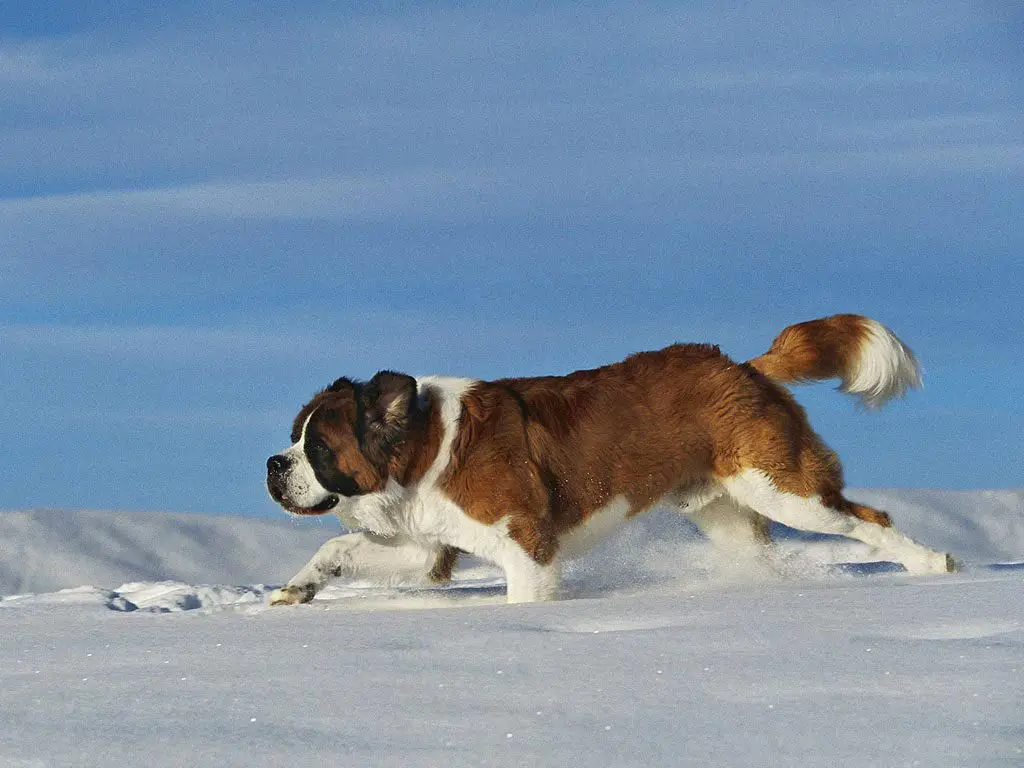
San Bernardo

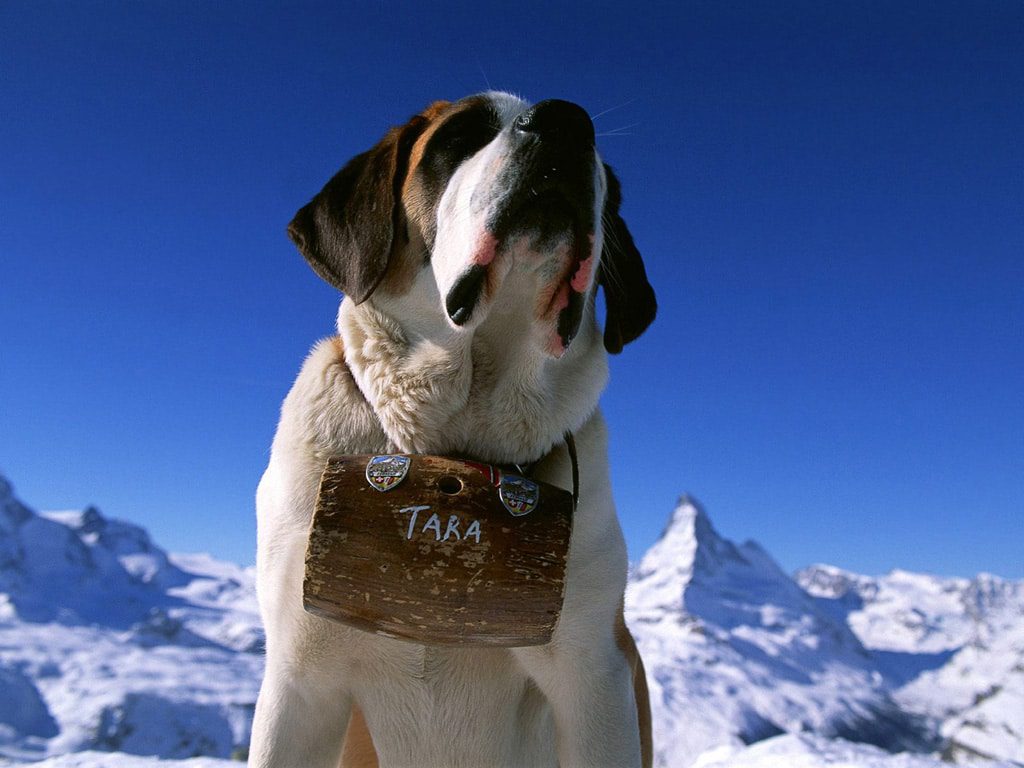
The St. Bernard It is very affectionate and has an innate sense of relief especially in the snow.

Content

History

The St. Bernard It is a breed of dog whose name in other languages: St. Very, Bernhardiner, Chien du Saint-Bernard, Saint Bernard Dog.

According to breed historians, the St. Bernard, descended from the ancient molossians Asian, whose ancestral form was and is represented by the Tibetan Mastiff.

A team of researchers from the University of Manchester, directed by Chris Klingenberg of the Faculty of biological sciences, reviewed 47 skulls of St. Bernard donated by Swiss breeders to the Natural History Museum in Bern covering a period of 120 years, from modern copies until those old dogs of the time that was initially defined the standard of the breed. It was found that the traits stipulated in the breed standard of the St. Bernard have become more exaggerated over time, as breeders selected dogs that had the desired physical attributes.

Compared to their ancestors, the St. Bernard modern has the widest skull, the angle between the nose and the forehead more pronounced, and also a more significant bump over the eyes. These changes are described exactly as desired in the breed standards. Clearly, not due to other factors such as overall growth, since they do not provide the animal with any physical advantage, so we can be sure of have evolved only by selective breeders considerations.

This research shows how the selection, either natural or in this case artificially influenced by the man, It is the fundamental driving force behind the evolution of life on the planet.

In the year 923 born Bernard of Menthon in Menton, region of Savoy (France), which he became Archdeacon of Aosta, in the Italian Alps, dedicated to spreading the Christian faith among the inhabitants of the Alps. In one of these Alpine passes was founded in the year 1049 the Hospice of the Gran San Bernardo, to help, help and shelter to hikers who were the step. The Holy, Catholic scholar and theologian, He was part of the Cistercian order or better known as Trappist, as fellow (the Trappist monks) in Switzerland they had a dog of this breed as a companion around the 16th century.

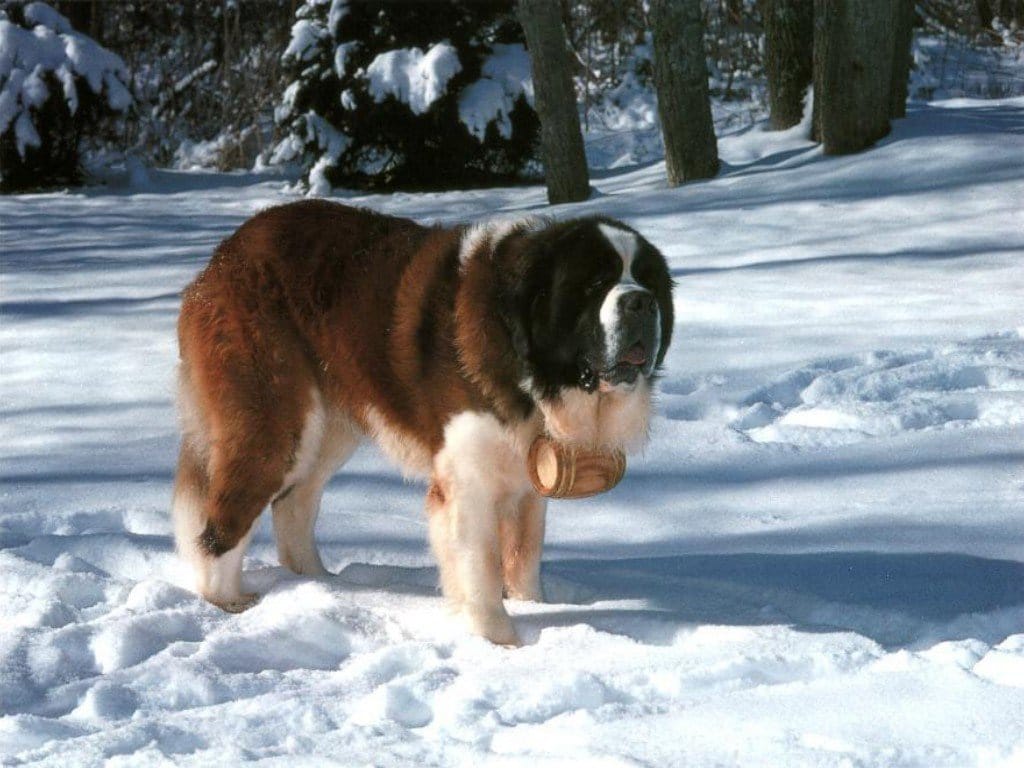
In the great Mount St mountain pass. Bernhard, to 2.469 meters above the sea level, monks founded in the 11th century, a hospice for travellers and pilgrims. there they were raised, Since the mid-17TH century, big mountain dogs for guard and surveillance. The existence of those dogs is documented graphically from 1695 written in a chronicle of the Hospice from the year 1707.

These dogs were soon used as guard dogs and, especially, as rescue dogs for travellers lost in the fog and snow.

There are chronicles published in many languages โ€‹โ€‹about the numerous lives that were saved by these dogs from the "white death" and stories of soldiers who crossed the mountain pass with Napoleon Bonaparte towards 1800, in the 19th century, they spread the dog's fame for St. Bernard all over Europe.

Already called at that time ยซBarry Hundยซ, And the legendary ยซBarryยปIt became the symbol of the rescue dog. The direct ancestors of the dog of St. Bernard were the very widespread oversized dogs, peasants of the region. These large dogs became only a few generations, an ideal pattern, in the current race.

As a result of an international cynological congress held on 2 in June of 1887, the dog of St. Bernard was officially recognized as a Swiss breed and the breed standard became mandatory. Since then the San Bernardo dog became the "Swiss national dog".

Heinrich Schumacher Holligen, was the first, in 1867 creating genealogical documents for their dogs. In February of 1884 The ยซSchweizerische Hundestammbuchโ€ (Swiss races book, SHSB). The first entry was that of St. Bernard ยซLeรณnยป, followed by other 28 annotations also of dogs of St. Bernard. The 15 in March of 1884 The ยซSchweizerische St. Bernhardsclubยป (Swiss Dog Club St. Bernard) in Basel.

Physical characteristics

The Saint Bernard, is classified in the Group 2: Dog type Pinscher and Schnauzer, Molosoides and mountain dogs and Swiss Cattle Dogs, and other races; section 2; Molossoid, 2.2 Type mountain (without working trial). Of the FCI (Federation Cynologique Internationale).

There are two varieties of the dog St. Bernard:

  • The variety of short hair (double hair, Stockhaar).
  • The long-haired variety.

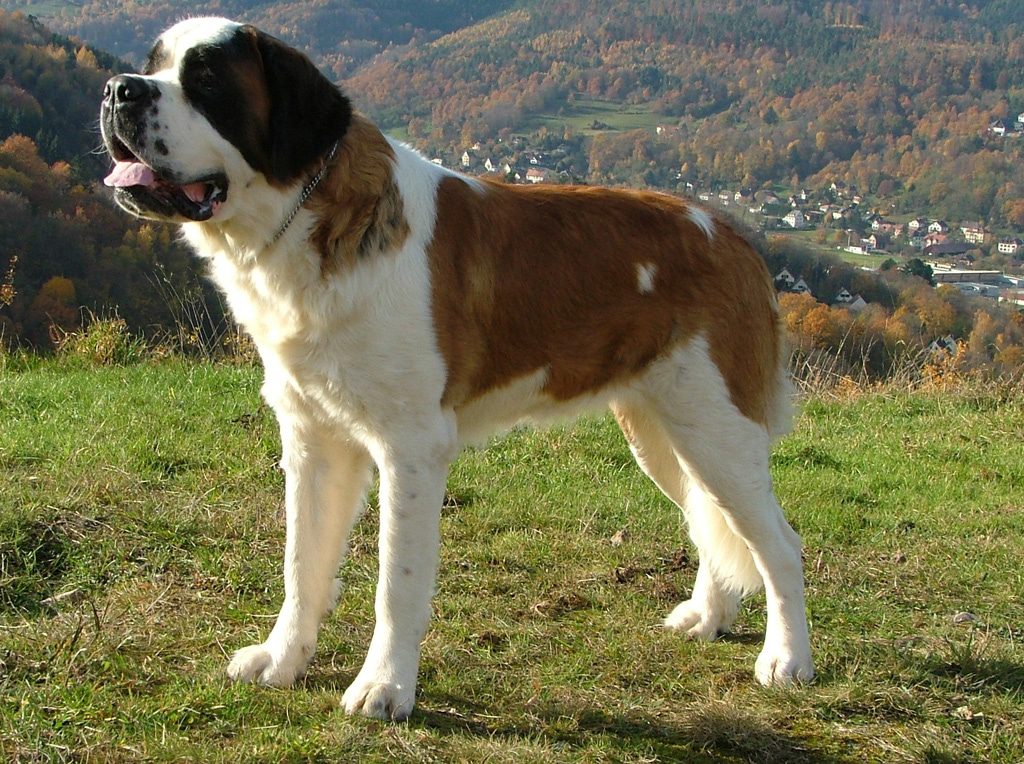
Two varieties are of great stature and of a noble general appearance; they have a vigorous body, robust, harmonic and muscular, as well as an imposing head with an expression of attention on the face.

The cross appeal is, minimum of 70 cm for males and 65 cm for females. The FCI standard sets a maximum of 90 cm for males and 80 cm for females (dogs exceeding the maximum height is not devaluarรกn if its general aspect is harmonic and its proper motion).

In general the size is defined as:

  • ยซVery largeยซ, to be optimal in San Bernardo, When exceeds the 86 cm in males and the 80 cm in females.
  • ยซGrandยปWhen it goes from 82 to 86 cm in males and 75 to 80 cm in females.
  • ยซMediaยปWhen it goes from 78 to 82 cm in males and 70 to 75 cm in females.
  • ยซSmallยปWhen it goes from 70 to 78 cm in males and 65 to 70 cm in females.

In it "golden period of St. Bernardโ€ (1920-1940) were very rarely seen in exposures lower males to 80 Switzerland cm, of Germany, in the Netherlands and the subjects were not so rare above the 90 cm..

Also currently a good San Bernardo to access the championship would never have to be -with some exceptions- below the 80-82 cm and abundantly exceed such limit to reach above if possible the maximum of the German Mastiff and of the Irish Wolfhound but with greater volume, greater length of the trunk and heavier, course.

Character and skills

The dog's St. Bernard radiates calm and tranquility. He is balanced and self-confident.. Despite its imposing size, it is sensitive and has a gentle nature. His "stubbornness" is typical of this race, not only in appearance. The St. Bernard is trustworthy and kind, even with strangers. There is hardly a dog that has such a tolerant and balanced nature. Quietly he lets himself be caressed and understood by children he does not know. There is hardly a dog as fond of children as the St. Bernard. Nothing seems to bother him.

But, has an alert protective instinct. Defends his family and territory inflexible and extremely effective. One St. Bernard healthy and well socialized never loses control. It is not a barking dog and will stop any intruder quietly and abruptly. How do you like to live outside, still suitable as a guard and protection dog – but it is not in any way a dog to be in a kennel. The basis of this is the close connection with your human family, who should be the center of attention. Because he is affectionate and needs a lot of contact with humans as well as with other dogs.. After all, the close connection with his master is the decisive basis of his education.

Due to its size and strength, a St. Bernard a dog is not for beginners. It also, its maintenance is – as with all big dogs – very complex. If you want to buy a dog from St. Bernard, You must first be clear about some basic things:

The extreme dimensions bring with them quite practical problems. This starts with the car. And what if the adult giant is sick or cannot walk for a while due to age?? The St. Bernard not a dog for an apartment. The floor of the house should not be slippery. The dog should not have to climb the stairs frequently. To the St. Bernard he likes to travel; not an athlete, and take it easy. In the interest of your fitness, one should ensure that he exercises outdoors every day. Ideally, a St. Bernard stay in the field.

St. Bernard Education

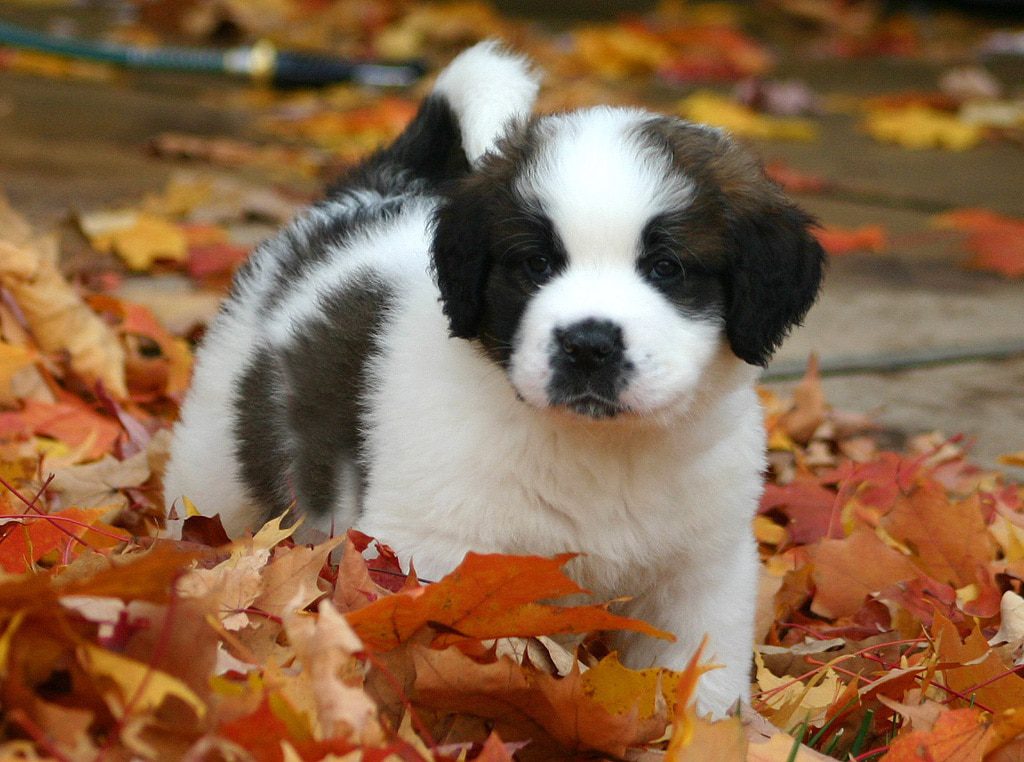
To have fun with your dog St. Bernard, consistent education from the puppy's age is a basic requirement. 60 and more kilos of stubbornness, reluctantly following instructions, it's not a fun thing. Also keep in mind that the St. Bernard It, in case of doubt, much stronger than any well-trained man.

A deep and intimate bond with your caregiver is the basis of education, never difficulties or coercion. As puppies it must be carried with a stoic consistency. In his youth, the St. Bernard they are usually very lively and challenge the leadership of their humans. But, the dog of St. Bernard can be well educated. His calm and kind nature even forgives this or that mistake. But a solid education foundation with clear rules for daily life is an absolute prerequisite for your future attitude..

St. Bernard health and care

Coat care is simple. Regular brushing is enough. During the change of coat, twice a year, everything is a little more complex.

The main health problem of St. Bernard is the extreme breeding, breeding for gigantism. Puppies and young dogs of such breeding already grow too fast. So, it's about body coordination problems. Epilepsy and other diseases accompany the giant that is becoming. Life expectancy decreases dramatically. The enormous growth and associated rapid weight gain is an extreme challenge for the entire body.. The dog's fingerprint is not designed for such giants. the heads, however "typical" they seem, they have also been raised to be unhealthy and powerful, which can cause problems at birth.

One should pay attention to the eyes: Droopy eye or droopy eyelid is a widespread problem, especially with particularly powerful heads, that requires lifelong care and can seriously damage the eyes. Professor Distl of the Hannover University of Veterinary Medicine considers the St. Bernard as one of the breeds in which epilepsy is more common. Various types of cancer such as osteosarcoma also appear to be common in St. Bernard. The breed is strongly affected by dysplasia of the hip joint, as well as other skeletal diseases.

Nutrition / Food

Puppies and young dogs, they grow very fast, require expert guidance for proper nutrition. At the same time, attention should be paid to controlled exercise, neither too much nor too little. In the adult Saint Bernard there is a risk of stomach torsion. Otherwise, as with any big dog, the same applies to food: good and hearty.

The life expectancy of a St. Bernard

The legendary Barry I had 14 years, 10 of which he spent them on active rescue service in the Gran San Bernardo. Today is different, made by the man. Today, the St. Bernard is one of the dogs with the lowest life expectancy. The colossi of today reach only 6 to 8 years. Only very rarely does he reach an age of 10 years or more. On the other hand, a St. Bernard raised healthy with a weight lower than 70 kg is a robust dog and, despite its size, very frugal, without problems can live 10 years.

Buy a St. Bernard dog

Before buying a St. Bernard, you should check very carefully if you really have all the requirements to be able to spend many wonderful years with this giant. Only when all this clears up, a breeder must be found and contacted long before purchase. Special importance must be given to the fact that the breeder avoids exaggeration. Dogs in your kennel should not be large or too heavy. Also the heads should not be too powerful. It also, make sure that no epilepsy occurred in the ancestors. In any case, it should be clear that a puppy is only bought directly from a serious breeder. Better pay a few hundred euros more for a puppy from a serious breeder. These euros have a good opportunity to become the best investment of your life. Coming from a serious upbringing, a puppy of St. Bernard costs between 1.500 and 2.000 EUR.

Characteristics "St. Bernard"

Coexistence is important that you have with your new friend. Before considering the acquisition of a dog of the breed "St. Bernard" you know certain factors. Not all breeds of dogs are apt to live in an apartment, you must take into account his character, their need for exercise, their interaction with other pets, their care and if you have small children, their level of tolerance towards them.

Adaptation โ“˜

4,0 of 5 stars (based on 1 review)

friendly dog โ€‹โ€‹โ“˜

5,0 of 5 stars (based on 1 review)

hair loss โ“˜

3,0 of 5 stars (based on 1 review)

Affection level โ“˜

5,0 of 5 stars (based on 1 review)

Need for exercise โ“˜

2,0 of 5 stars (based on 1 review)

Social need โ“˜

4,0 of 5 stars (based on 1 review)

Home โ“˜

3,0 of 5 stars (based on 1 review)

Toilet โ“˜

4,0 of 5 stars (based on 1 review)

Friendly with strangers โ“˜

3,0 of 5 stars (based on 1 review)

barking โ“˜

3,0 of 5 stars (based on 1 review)

Health โ“˜

5,0 of 5 stars (based on 1 review)

Territorial โ“˜

5,0 of 5 stars (based on 1 review)

Cat friendly โ“˜

5,0 of 5 stars (based on 1 review)

Intelligence โ“˜

3,0 of 5 stars (based on 1 review)

Versatility โ“˜

3,0 of 5 stars (based on 1 review)

Child friendly โ“˜

5,0 of 5 stars (based on 1 review)

Surveillance โ“˜

2,0 of 5 stars (based on 1 review)

joy โ“˜

5,0 of 5 stars (based on 1 review)

St. Bernard Images

St. Bernard Videos

Type and recognitions:

  • FCI CLASSIFICATION:
  • Group :
  • Section : . .

Federations:

  • – FCI – Pinscher and Schnauzer-Molossoid type dogs – Swiss Mountain Dogs and Cattledogs. Section 2.2 Molossoid, mountain type. โ“˜
  • – AKC – Workgroup โ“˜
  • – ANKC – Group 6 (utility dogs) โ“˜
  • – CKC – Workgroup โ“˜
  • – โ€‹KC – Workgroup โ“˜
  • – NZKC – Utility dog โ“˜
  • – UKC – Watchdog โ“˜

FCI breed standard "St. Bernard"

Origin:
Switzerland

Date of publication of the valid original standard:
04.04.2016.

Use:

Company, Guard and Farm Dog.


General appearance:

There are two varieties of San Bernardo:

  • Variety of short hair (double mantle, "Stockhaar")
  • Long hair variety.

The two varieties are considerable size and an impressive general appearance. They have a balanced body, powerful, Strong and muscular with an impressive head and a facial expression alert.

IMPORTANT PROPORTIONS

  • The desired proportion between the height of the cross and the length of the body (measured from the tip of the shoulder to the tip of the buttock) is of 9 : 10.
  • The desired proportion between the height to the cross and the depth of the chest is reflected in the sketch of the beginning.
  • The total length of the head is slightly larger than a third of the height of the cross.
  • The proportion between the depth of the snout (measured at its root) And its length is approximately 2 : 1.
  • The length of the snout is slightly larger than the third part of the length of the head.


Behavior / temperament:

Friendly by nature. Quiet temperament to cheerful; vigilant.

Head:

Powerful, imposing and very expressive.

Cranial region:
  • Skull: Strong and wide. Seen from the front and profile the top part of the skull is slightly domed. When is the dog at attention, The insertion of the ears forms a straight line with the upper part of the skull which laterally has a soft curvature towards high and strongly developed cheeks. The inclination from forehead to well steep snout. The occipital Protuberance should shortly be accented. The orbitals above arches strongly developed. Clearly marked front Groove starts on the forehead and extends to the top of the head. Skin from the forehead over the eyes forms slight folds that converge toward the central sulcus. When is the dog at attention, they are usually almost imperceptible.
  • Depression links (Stop): Strongly pronounced.

facial region:

  • Truffle: Wide and square with well marked angles, well open nostrils. The truffles must be black.
  • Snout: Uniformly wide. Nasal helm straight with a slight furrow in the Center.
  • Belfos: Pigmented edges of black. The Belfos of the upper jaw must be highly developed, shoulder straps, but not too pendants; they form a wide arc towards the nose. The corners must be visible.
  • Jaws/Teeth: Upper and lower jaws strong, wide and the same length.
  • Bitescissors or well developed clamp, regular and complete. It allows light lower prognathism, provided that the incisors do not lose contact. The absence of the PM1 is tolerated (premolars 1) and the M3.
  • Eyes: Medium-sized, they can be dark brown to hazelnut; moderately sunken. friendly expression. The edges of the eyelids are completely Pigmented.
  • A full closure is desirable, natural. Is allowed a small fold on the bottom with little visible conjunctival eyelid and a small crease on the upper eyelid.
  • Ears: Medium-sized, high and wide insertion. Highly developed Pavilion. Lobes soft triangle with rounded tip. The back edge is slightly separated from the head, While the above should be set to the cheeks.

Neck:

Strong and good long. The double chin neck and throat, moderately developed.

Body:

  • As a whole: The general impression should be, harmonica, well muscled and imposing.
  • Cross: Well developed.
  • Back: Wide, powerful and strong. The upper line is straight and level to the lumbar region.
  • Rump: Long, slightly descending with a harmonious transition to the insertion of the tail.
  • Breast : Moderately deep chest with well sprung ribs, but not abarriladas. You must not get below the elbows.
  • Abdomen and lower line: Slight upward backward.

Tail:

Of wide and strong base, It should be long and heavy.
  • The last vertebra must reach at least the corvejรณn joint. At rest you must hang straight or slightly curved up in the last third. In State care may be higher.


Tips

Former members:

  • As a whole: Seen from the front, rather wide position. Members must be straight and parallel.
  • Shoulder: Inclined scapula, muscular and firmly attached to the body.
  • Arm: As long as the scapula. The angle between the scapula and the arm must not be too open.
  • Elbow: Attached to the body.
  • Forearm: Straight, strong bone and muscles dry.
  • Metacarpus: Seen from the front must be vertical in its extension to the forearm. Viewed laterally must be slightly oblique.
  • Front feet: Widths, with strong fingers, together robust and highly arched.

Later members:

  • As a whole: Moderately angled rear limbs and muscled. Seen from the rear must be parallel and not together.
  • Thigh: Robust, muscular and wide.
  • Knee: Well angled and not turn inward or outward.
  • Leg: Fairly long and oblique.
  • Hocks: Moderately angled and strong.
  • Metatarsals: Seen from the back as straight and parallel.
  • Hind feet: Widths, with strong fingers, together robust and highly arched. The Spurs are tolerated if not they interfere with normal movement.

Movement:

Harmonic, long steps. Good push from the hind limbs. The back remains firm and stable. The previous and subsequent members must advance in a straight line when walking.

Mantle

  • Short hair (double hair): Dense outer layer, smooth and stuck to the body. Internal NAP thick. Thighs with fringes of not very notable hairs. Tail with thick hair.
  • Long hair: Outer layer of hairs of medium length, smooth. Abundant internal NAP. On the hip and rump, the hair can be somewhat wavy. Thighs with fringes of abundant hair and forelimbs with flags. Face and ears with short hair. Tail with abundant bushy hair.

COLOR: The basic color is white with reddish brown spots smaller or larger (spotted dogs), to form a continuous blanket of uninterrupted reddish brown on the back and flanks (dogs with mantle). This mantle interrupted by white veins have the same value. The reddish brown tabby is allowed. The yellowish-brown is tolerated. The dark brown on the head is much appreciated. Will tolerate some light traces of black color on the body.

  • Major brands: Sill, feet, the tail, nose cane, headband and nape.
  • Desirable markings: White collar.
  • dark mask symmetrical.


Size and weight:

Minimum height:

  • Males: 70 cm..
  • females: 65 cm..

Maximum height:

  • Males: 90 cm..
  • females: 80 cm..
  • Dogs exceeding the maximum height is not devaluarรกn in its judging if their general appearance is harmonious and correct movement.


Fouls:

Any deviation from the above mentioned criteria is considered as missing and the gravity of this is considered in proportion to the degree of deviation to the standard and its consequences on the health and well-being of the dog.

  • Characteristics of sex not sufficiently developed.
  • Non-harmonic overall appearance.
  • Very short relative to the height of the cross member.
  • Excess of folds in head and neck.
  • Muzzle too long or too short.
  • Belfos of lower jaw hanging and turned out.
  • Lack of teeth (except the PM1 and the M3) ; small teeth (especially the incisors).
  • Slight lower prognathism.
  • light eyes.
  • Eyelids too loose.
  • Back saddle or in tent.
  • Rump too high or too falling.
  • Tail coiled on top of the back.
  • Absence of white markings deemed important.
  • Curved or very returned former members out.
  • Later in the form of Coop members, de โ€œXโ€, or too straight.
  • Faulty movement.
  • Curly hair.
  • Incomplete or lack of it in the truffle pigmentation, belfos, eyelids and around the nose.
  • Wrong basic color, small splashes or spots of wetwood color on white.

MISS PLAYOFFS

  • Fearful dogs, aggressiveness.
  • Upper prognathism, marked lower prognathism.
  • Blue eyes.
  • Entropion, ectropion.
  • Completely white or completely brown reddish coat (absence of the basic color).
  • Coat of a different color.
  • Dogs that do not reach the minimum height.
  • Any dog โ€‹โ€‹showing clear signs of physical or behavioral abnormalities must be disqualified..


N.B.:

Males should have two normal-appearing testicles., fully descended into the scrotum.

  • This revised standard shall be applicable from April 2004.

TRANSLATION: Brรญgida Nestler.

Source: F.C.I - International Cynological Federation

Alternative names:

1. St. Bernhardog, Bernhardinner, Alpine Mastiff (archaic), Saint, Saint Bernard (English).
2. Grand-Saint-Bernard (French).
3. St. Bernhardshund, Chien du Saint-Bernard, Saint Bernard Dog, Perro San Bernardo (German).
4. Cรฃo de Sรฃo Bernardo (Portuguese).
5. Gran San Bernardo (espaรฑol).

โ–ท The world of Pets: Dogs, cats, birds, reptiles, amphibians

Dogo Canario
Espaรฑa FCI 346 - Molossoid . Dogo

Dogo Canario

The aggressiveness of Dogo Canario should not be overly stimulated. It is an optimal guardian and defender without the need for training.

Content

History

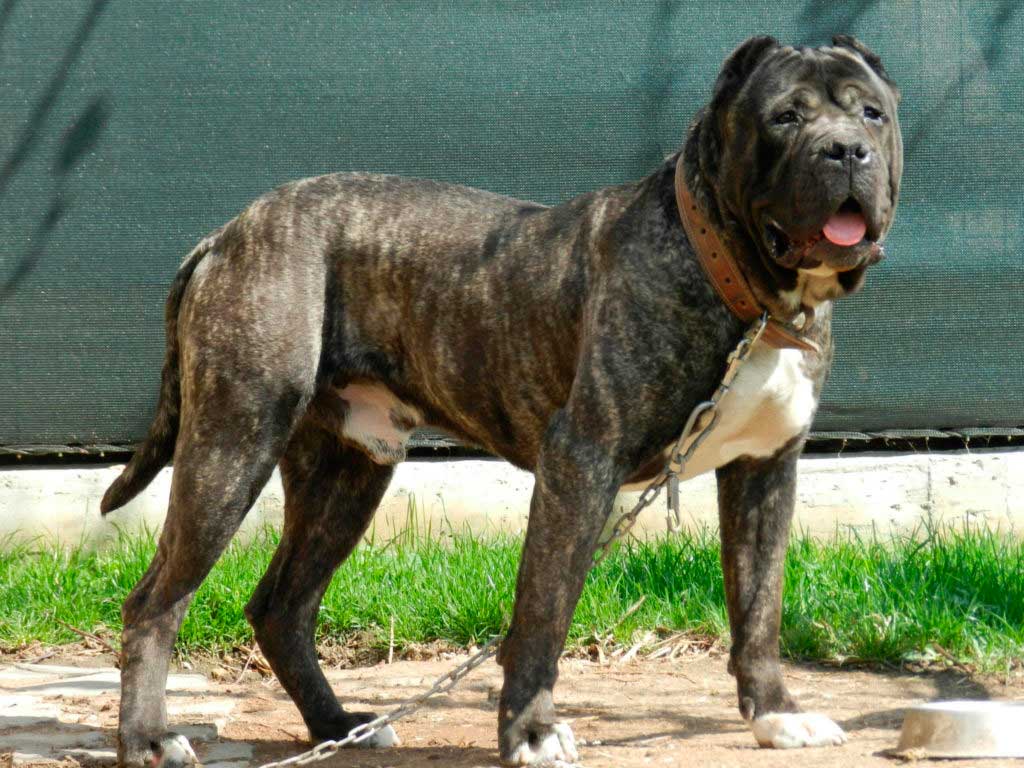
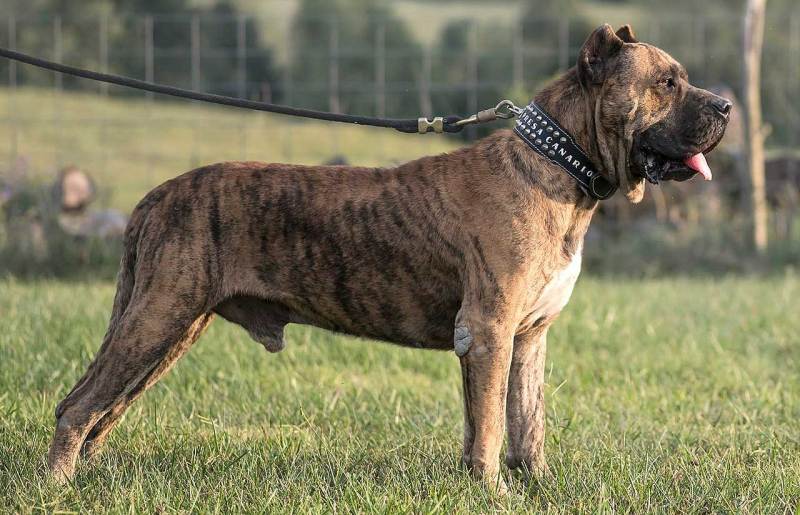
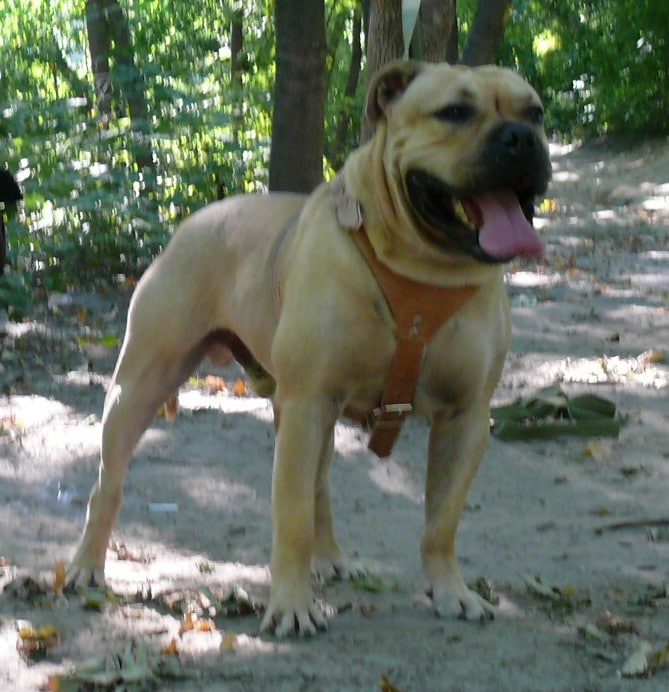
The Dogo Canario It is a classic moloso. It is the offspring of an ancient and in this ancient form is only rarely found in Central Europe today.. It has many names: Presa Canario, Perro de Presa, Perro de Toro, Alano o Presa Canario. Dogs of the current type Dogo Canario they existed still ago 200 years everywhere. They were the old saupackers, bear teethers, guard dogs, butcher dogs, the ancestors of the current great danes, bulldogs, boxers and mastiffs. They are extremely strong and bulky dogs, that even today are summarized as molossers. They were already bred in ancient times and have always been highly appreciated. They were used on large farms, with livestock herds or for example on merchant ships such as guard and protection dogs, served as herding dogs and as hunting dogs for wild boar or bear. They served rulers like Hammurabi as war dogs, they had them carved in stone in full recognition does 3700 years.

Due to its strength, courage and determination, have been used as fighting dogs in the arenas of animal fighting since Roman times. Molossians have a commanding head with a rather short snout and long lips.. The ears are usually worn hanging. According to the traditions of antiquity in words and images, the main characteristics of the molossian have remained essentially the same for thousands of years, but in recent centuries and especially due to modern dog breeding, the classic type of molosser has been lost to some extent. In extreme cases strange shapes have been bred with many extremely short folds or snouts such as bulldogs or giants like him Great Dane or the Mastiff. The Dog is still raised in his homeland only for his performance at work.

So, chances are that the Dogo Canario still personify the type Molosoide as was common in the old days. It is clearly recognized as trotting, but does not suffer from cultivated exaggerations of any bodily characteristics or traits. Can only hope it stays that way. Unfortunately, breeders are very much at odds with Dogo Canario. They haven't even managed to agree on a name and a registry office. Since 1991 It has been officially considered as "The Canarian Presa Dog" among the natural symbols of the Canary Islands.. Meanwhile in 2001 the Spanish Ministry of Agriculture recognized these dogs as a national breed also under the name of Dogo Canario, the same dogs were then provisionally recognized as Dogo Canario by the world federation FCI in 2001 and finally in 2011. Other names are Perro de Presa y Alano. Alano It is an old word that means Great Dane.

Physical characteristics

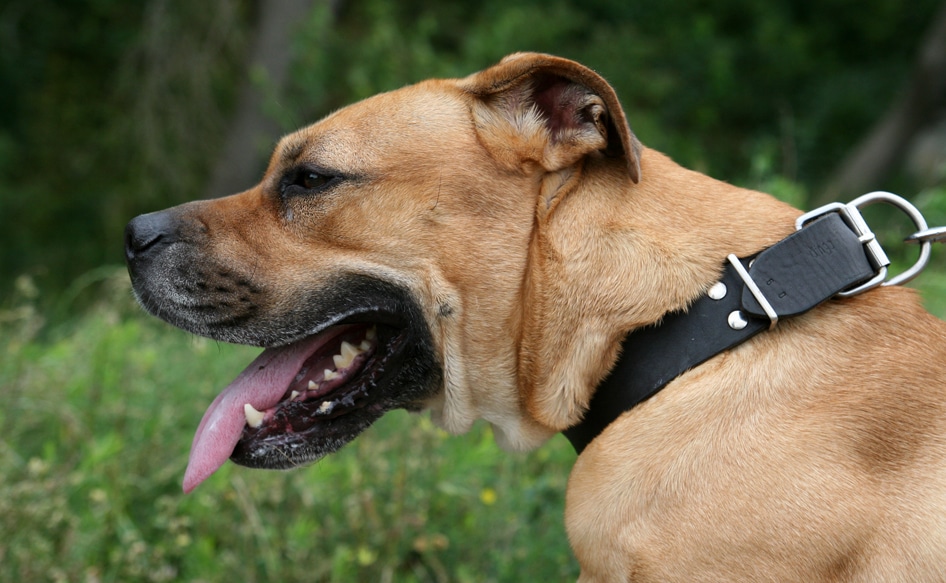
The Dogo Canario, Perro de Presa, Perro de Toro, Alano o Presa Canario – all designations for the same four-legged friend – he is an elegant dog that radiates athletic power. He is an athletic, muscular, elongated but nevertheless typical molosser.

The skull-muzzle ratio is approximately 6:4. The upper lip rests a little flaccidly on the lower one. The eyes, medium-sized, they are oval and hazelnut, the ears, high, they are separated from each other and are shaped like a button; they are only amputated to remember their original function as a combat dog. The neck, long and muscular, shows a slight dewlap. The tail is implanted high: thick at the base, is tuned to the extreme. the belly is retracted, but the last ribs stand out only slightly, giving a harmonious harp shape. Limbs are sturdy, muscular and perfectly plumb; angulation of the hind limbs is not very marked.

The difference between male and female bulldogs desired by the FCI standard is therefore unnaturally large. In any case, desires of this standard for outward appearance should not be taken so seriously.

Because fortunately this originally preserved dog breed, robust and healthy has set its standard โ€œfor itselfโ€, more exactly for their performance at work, and has kept it in the practice of life until today. People, who now wants to put him in a standard of modern pedigreed dog breeding, don't even agree to the principle, as we can see in its history of the breed. Modern pedigreed dog breeding has done no breed of dog any good, both in terms of health and character. In old times, the Bulldog fitted with pleasure to the ears, so that they protruded upwards. This is now prohibited. Today they show large down-hanging ears..

  • Fur: short, without Undercoat, pretty hard.
  • Color: leonado or atigrado. The tabby specimens have a wide range of colors, from very dark to a light gray with a rather cold tone.
  • Size: males, of 61 to 66 cm.; females, of 57 to 62 cm..

Character

The Dogo Canario is a quiet dog, balanced and self-assured. He is a powerful and defensive athlete who can show his performance at any time. Like all molossi, he is extremely kind, has strong nerves and a high stimulus threshold. But, he is more eager to move and not as lethargic as most molossers today bred only as companions. One Dogo Canario well socialized is friendly to people who know and like children. It is very sociable. Towards strangers is at first a little distant without fear. He is an incorruptible guardian, fearless and protective of his family without being aggressive himself. The FCI standard describes the character desired by the breed:

Calm appearance; alert look. It is especially suitable as a watchdog… His temperament is even-tempered and he is very self-confident.. Deep barking. He is docile and kind to his family members and with strong ties to his master, but you may suspect strangers. Self-assured demeanor, elegant and somewhat distant. When you are alert, his attitude is confident and alert.

It must be added that the Dogo Canario rarely barks. But if it barks once, it's pretty awesome.

Fitness

The Dogo Canario is undemanding in terms of external conditions. Of course: a small apartment in the big city would not be optimal for your attitude. But other than that it's easy to maintain. It is also a working dog, a guard, a driver, a hunting dog for hunting wild boar. The Dogo Canario it is suitable as a family dog รขโ‚ฌโ€นรขโ‚ฌโ€นonly on the condition that it is well socialized, well educated and physically fit. You also have to take into account a fact: It is considered a "dangerous dog" in many countries.

Dogo Canario Education

The Dogo Canario can be trained well, but still not a beginner dog. It is intelligent, very sociable and eager to work. But at the same time he is very powerful and assertive. In case of doubt, always the strongest end of the strap. So, his master or caretaker should not leave doubts about his role as leader and this on the basis of natural authority. So this dog will gladly leave the leading role to his bipeds without reservation.. But it must be filled. The Dogo Canario it is even suitable for demanding tasks such as training as an assistance or protection dog. The basic requirement is that it comes from a serious breeder and that it has already been socialized there..

Dogo Canario health and care

The Dogo Canario has no special demands on your care.

Typical diseases

Breed-specific diseases are not known.. Due to his still short career as an official pedigree dog, it can be assumed that the population of the Dogo Canario, Presa Dog or Presa Canario – Whatever this ancient breed of dog is called – enjoys robust health.

Nutrition / Food

The Dogo Canario has no special demands on their diet.

Life expectancy Dogo Canario

There are no reliable figures on life expectancy. Seriously raised, the Dogo Canario should be able to live off 10 to 12 years.

Buy Dogo Canario

Before making a purchase, be aware that the restrictive attitude of the State can cause many problems in daily life and additional financial burdens. The Dogo Canario it is a large and powerful dog that belongs to the hands of an experienced teacher or lover. The cost of a Dogo Canario is of some 1200 EUR.

Characteristics "Dogo Canario"

Coexistence is important that you have with your new friend. Before considering the acquisition of a dog of the breed "Dogo Canario" you know certain factors. Not all breeds of dogs are apt to live in an apartment, you must take into account his character, their need for exercise, their interaction with other pets, their care and if you have small children, their level of tolerance towards them.

Adaptation โ“˜

4,0 of 5 stars (based on 1 review)

friendly dog โ€‹โ€‹โ“˜

1,0 of 5 stars (based on 1 review)

hair loss โ“˜

3,0 of 5 stars (based on 1 review)

Affection level โ“˜

4,0 of 5 stars (based on 1 review)

Need for exercise โ“˜

4,0 of 5 stars (based on 1 review)

Social need โ“˜

1,0 of 5 stars (based on 1 review)

Home โ“˜

3,0 of 5 stars (based on 1 review)

Toilet โ“˜

2,0 of 5 stars (based on 1 review)

Friendly with strangers โ“˜

2,0 of 5 stars (based on 1 review)

barking โ“˜

3,0 of 5 stars (based on 1 review)

Health โ“˜

4,0 of 5 stars (based on 1 review)

Territorial โ“˜

5,0 of 5 stars (based on 1 review)

Cat friendly โ“˜

2,0 of 5 stars (based on 1 review)

Intelligence โ“˜

4,0 of 5 stars (based on 1 review)

Versatility โ“˜

2,0 of 5 stars (based on 1 review)

Child friendly โ“˜

2,0 of 5 stars (based on 1 review)

Surveillance โ“˜

5,0 of 5 stars (based on 1 review)

joy โ“˜

3,0 of 5 stars (based on 1 review)

Images "Dogo Canario"

Photos:

1 – Canarian Presa Dog – Canary Dog by Kamen Rider Snipe / CC BY-SA
2 – Presa Canario dog – Dogo Canario by Basil Dragon / CC BY-SA
3 – Presa Canario by https://pxhere.com/es/photo/732874
4 – Canary bulldog, edited by Canecorsodog (en.Wikipedia) edited by Caronna 12:25, 6 February 2008 (UTC) / CC BY-SA
5 – Zai-Kan de Irema Curtรณ. Canary prey perro byManuel Curtรณ Jr. / CC BY-SA
6 – Presa Canario by Wikipedia
7 – Presa canario dog by https://pxhere.com/es/photo/75916

Videos "Dogo Canario"

Type and recognitions:

  • FCI CLASSIFICATION:
  • Group :
  • Section : . .

Federations:

  • – FCI – Pinscher and Schnauzer-Molossoid type dogs – Swiss Mountain Dogs and Cattledogs. Section 2.1 Molossoid, mastiff type. โ“˜
  • – AKC – FSS โ“˜
  • – UKC – Watchdog โ“˜

FCI breed standard "Dogo Canario"

Origin:
Spain

Date of publication of the valid original standard:
26.11.2018

Use:

Guard dog and caring for cattle.


General appearance:

Large Medium-sized Molossoid Dog, straight profile and black mask. Robust and well proportioned.

IMPORTANT PROPORTIONS: The body is longer than its height at the withers. This characteristic is more pronounced in females..

The ratio of the skull to the antecara is 60-40 %. The width of the skull is 3/5 the total length of the head. The distance from the elbow to the ground must be 50 % height at withers in males and somewhat less in females.


Behavior / temperament:

calm look, attentive expression. Especially suitable as a guard dog and traditionally used to care for livestock. Balanced temperament and very self-confident. Low and deep bark. Obedient and docile with family members, very devoted to his master but can be reserved with strangers. Confident fitness, noble and somewhat distant. When he is alert his posture is firm with an alert attitude.

Head:

Solid, brachycephalic and compact in appearance covered in thick skin. Its shape tends towards a slightly elongated cube. The skull lines- facials are parallel or slightly convergent.

Cranial region:
  • Skull: Somewhat convex in anteroposterior and transverse direction. The frontal bone tends to be flat. The width is almost identical to its length.
    Pronounced zygomatic arches with well-developed but not prominent cheek and jaw muscles, covered in loose fur. Occipital bump only slightly marked.
  • Stop: The stop is pronounced but not abrupt. The fold between the frontal lobes is well defined and approximately two thirds the size of the skull.

facial region:

  • Truffle: Wide, heavily pigmented black. In the same line of the muzzle. Large nostrils to facilitate breathing.
  • Snout: Shorter than the skull, usually about the 40 % of the total length of the head. Width is 2/3 the width of the skull. Its base is very wide, slightly tapering towards the nose. Flat, straight nose without grooves.
  • Lips: The upper lip is hanging but not excessively. Seen from the front, the upper and lower lip join forming an inverted V. The edges are slightly divergent. The inside of the lips is dark.
  • Jaws / Teeth: Scissor bite or slightly prognathic bite, max. 2 mm. Tweezer bite is accepted but not desired due to tooth wear. The canines have a wide transverse distance. Teeth are wide with strong implantation base. Large molars, small incisors and well-developed canines.

EYES: Slightly oval, medium to large. Placed well apart but never sagging or protruding. Tight black eyelids, never fallen. Color varies from dark to medium brown depending on coat color. They should never be clear.

EARS: Medium size, set well apart with short fine hair. Naturally fall on both sides of the head. If they are folded they are shaped like a rose. Its insertion is slightly above the level of the eyes. Ears with a very high insertion or close together are considered unusual. In countries where amputation is permitted, they must be erect..

Neck:

Shorter than the length of the head. Skin on the lower part loose forming a slight dewlap. Solid and straight, tends to be cylindrical and muscular.

Body:

Long, wide and deep.

  • top line: Straight, without deformations supported by well-developed but poorly visible muscles. Rising slightly from the cross to the rump. The height at the rump is 1 โ€“ 2 cm greater than the height at the withers.
  • Rump: Average length, wide and rounded. It should not be long because it would limit your movement.. Females are usually wider.
  • Breast : High capacity and well-defined pectoral muscles. Seen both from the front and in profile, it must be lowered, at least down to elbow level. Chest circumference is generally equal to the height at the withers plus 45 %. Well arched ribs.
  • Bottom line and belly: Slightly collected and never lowered. The flanks only slightly pronounced.

Tail:

Thick at the base tapering towards the tip, reaching no further than the height of the hock. Middle insertion. During movement it lifts it in the shape of a saber but without stooping or leaning on the back. At rest it hangs right with a slight curve towards the end.

Tips

PREVIOUS MEMBERS:

  • Shoulder: With good inclination.
  • Arms: Well angled, oblique.
  • Forearm: Well balanced, straight. Strong bones and good musculature.
  • Elbows: They must not be glued to the ribs or open outwards. Metacarpus: Very solid and slightly inclined.
  • Previous feet: Cat foot with rounded toes, not very close.
    The foot pads are highly developed and black. Nails are dark. White nails should be avoided although it can happen according to the coat color.

LATER MEMBERS:

  • General appearance: Seen from behind strong and parallel without deviations.
  • Thighs: Long and very muscular.
  • Knee: Angulation is not very pronounced but should not be insufficient.
  • Metatarsals: Always well descended.
  • Hind feet: Slightly longer than the front ones and with similar characteristics.

Movement:

During movement, the Presa Canario is agile and elastic, covering the terrain well. Long step. The tail is brought down and the head is only slightly raised above the level of the back. When you are alert, the tail and the head are carried high.

Mantle

SKIN: Thick and elastic. Looser over and around the neck. When alert, the skin over the head forms symmetrical folds that form from the fold between the frontal lobes..

  • Fur: Short, rough, smooth without undercoat (may appear on the neck and on the back of the thigh). Rather rough to the touch. Very short and thin on the ears, slightly longer on the withers and on the back of the thighs.
  • Color: All shades from fawn to sand, from dark brown to light gray or blonde. All shades from tabby to sand. White marks are accepted on the chest, at the base of the neck or throat, front feet and back toes but this should be minimal. The mask is always black and should not be spread above eye level.


Size and weight:

Height at the withers:

  • Males: 60 to 66 cm..
  • females: 56 to 62 cm..

In the case of very typical specimens, 2 cm tolerance above or below limits.

Minimum weight:

  • Males: 50 Kg.
  • females: 40 kg.

Maximum weight:

  • Males: 65 kg.
  • females: 55 kg.


Fouls:

Any deviation from the aforementioned criteria is considered as a fault and the severity of this is considered to the degree of the deviation to the standard and its consequences on the health and well-being of the dog..

Bite in clamp

SEVERE FAULTS:

Any fault is considered severe when it affects the expression and limits the type of dog..
Incorrect head proportions
Extremely convergent craniofacial lines (stop too steep)
Loin and cross at the same height
Incorrect limb position
Square profile.
Triangular head, close (not cube)
Fine tail, threaded. High insertion.
Sunken or soggy back.
light eyes (yellow), very close to each other or oblique, sunken or bulging
Excessively prognathic bite.
Insufficient mask.
Absence of teeth (Except P 1)

FALTAS DESCALIFICANTES:

Aggressiveness or extreme shyness.
Any dog โ€‹โ€‹showing clear signs of physical or behavioral abnormalities.
Totally nonpigmented nose.
White marks not accepted.
Bite: enognรกtica.
Croup lower than the cross. Sloped top line.
Blue eyes or with tonal difference.
amputated tail.


N.B.:
  • Males should have two normal-appearing testicles fully descended into the scrotum..
  • Only functionally and clinically healthy dogs, with the typical conformation of the breed, should be used for parenting.

    TRANSLATION: Brรญgida Nestler

Technical supervision: SR. Miguel Angel Martinez

Source: F.C.I - International Cynological Federation

Alternative names:

1. Canary Mastiff, Canary Catch Dog, Canarian Dogo, Presa Canario.Dogo Canario, Presa (English).
2. dogo Canario (French).
3. Presa Canario, Kanarische Dogge (German).
4. Perro de presa canรกrio, Dogo canรกrio (Portuguese).
5. Perro de presa canario (espaรฑol).

โ–ท The world of Pets: Dogs, cats, birds, reptiles, amphibians

Newfoundland
Canadรก FCI 50 - Molossoid - Mountain

Terranova

The Newfoundland radiates majestic serenity.

Content

History

The Newfoundland was born on the east coast of Canada. The great island of Newfoundland, which is in front of Canada, gave him his name. The fact that it descends from the dogs of the Vikings of pre-Columbian times or from the dogs of the Indians is a legend that has not been proven until now.. Its relationship with the molossi can be seen but also proved in the genetic map of the Heidi G dog breeds. Parker.

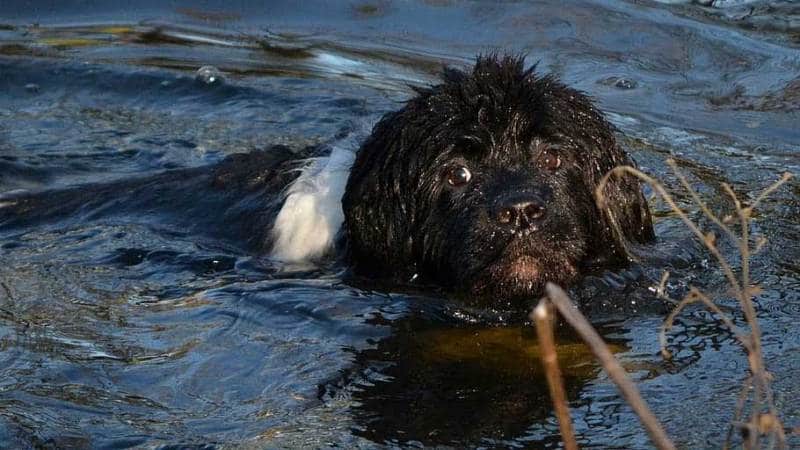
Probably the ancestors of the Newfoundlands came with the first settlers as molossi from Europe. It proved to be an aid to fishermen and sealers and was occasionally useful when hunting bear and big game on land.. It transported loads and served as a draft dog for the sleds with the dead game.. Working with fishermen in the rough North Atlantic was extremely demanding. The Newfoundland had to think, had to do heavy work on the networks. The Newfoundland saved the lives of the castaways over and over again. In this way, he developed the peculiarities of his character and physique that allowed him to face the harsh weather conditions on land and the dangers of the sea as a water and rescue dog..

With the cod ships he came to England over and over again as early as the 18th century. Here he became famous early on due to his impressive achievements. Was not up 1886 that the Club of Newfoundland in England, and soon after, in 1893, The club of Newfoundland for the Continent, now called the "German Club of Newfoundlandยซ. Even today, Newfoundland keep working as a water rescue dog.

Did you know??

One Newfoundland named Rigel sank with the Titanic and swam alongside a lifeboat for three hours in the icy water, apparently looking for its owner, that had gone down with the ship. The people in the lifeboat were nearly run over by the steamer Carpathia because the crew could not hear their faint cries., but Rigel's bark was noticed and the people and the dog were saved.

Physical characteristics

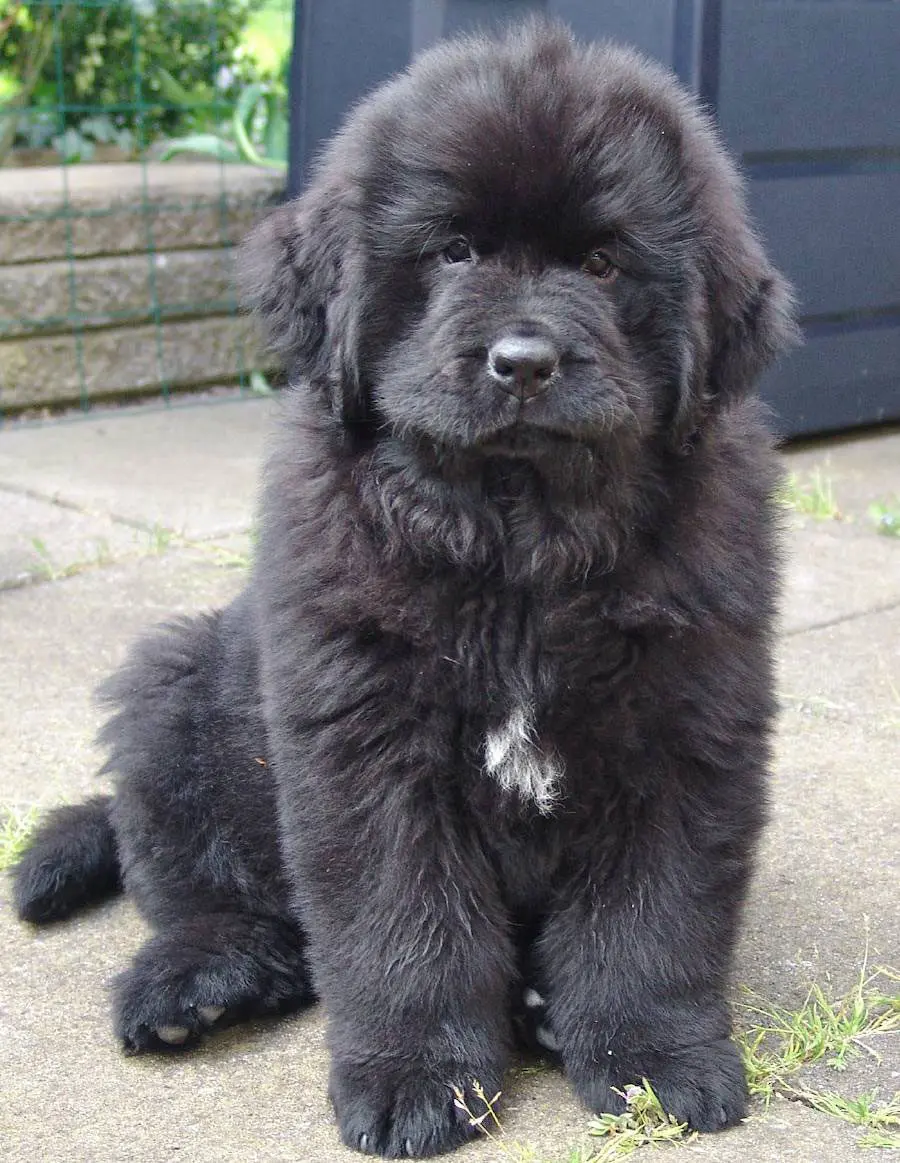
The Newfoundland is a big dog. According to the standard, adult males must weigh an average of 68 kg and females 54 kg. It is a very strong dog, very muscular and with long dense hair. Her coat is water repellent. It has a strong and soft undercoat, which makes it look even bulkier. This shouldn't tempt you to raise him like a teddy bear.. Because the real Newfoundland combines enormous power with agility, sportiness and impressive skills in the water. Its exterior does not deceive its interior. Master challenges with a committed calm. The hair on your head, muzzle and ears is short and thin. The front and rear legs are covered in fur. The tail is completely covered in long thick hair. The black, brown and black and white are allowed as coat colors.

Character and skills

Even the mere appearance of Newfoundland has a relaxing and calming effect, at least for people who are not usually afraid of dogs. The Newfoundland radiates majestic serenity. Its character is as stable as it appears on the outside. It has a friendly and kind nature. But that must not be misleading: He knows very well how to distinguish between friend and enemy, which you can unequivocally underline by your calm but more determined appearance. If required, defends his family with all his might without hesitation. Barking is not necessary to be heard.

He is extremely friendly with his friends. The Newfoundland he is very close to his family and loves children more than anything. He wants education and he absolutely needs it. Because like a powerful big dog it is always stronger than the other end of the leash.. Sometimes he has a hard head, but after a friendly request from his master or caretaker he does everything, as long as it's well connected. The Newfoundland impresses by the unity of two apparently irreconcilable poles: on the one hand it radiates calm and tranquility, on the other hand it can save people from drowning in a short time in the most difficult conditions. Usually, the Newfoundlands are real water rats. They are excellent swimmers, which they are happy to proudly demonstrate.

The Newfoundland not a dog for the city or a flat. He likes long walks, but water is the best for him. Due to its strength and the high technical demands of its maintenance, not suitable for beginners, although it can be trained and managed well. It is a great family dog. But he also likes to sleep outside, even with wind and rain. What you don't need is running or doing activities in the heat.

The Newfoundland It is a natural lifeguard and can be a good helper for parents who have a pool or enjoy taking children to the lake or ocean, although you should never be solely responsible for your safety.

Newfoundland Education

The Newfoundland can be educated very well. It is intelligent, interested and quickly understand what you are allowed to do and what you are not. Sometimes it's a little slow, but a little motivated, he is very cooperative and strives to make his master and lady happy. The puppy should already show itself clearly and without exception where the hammer hangs. There should be no doubt about the orientation of your humans, as well as about the intimate relationship and respect for him.

It must always be kept in mind that this dog is the physically strongest and that leadership only works through unquestioning recognition of the human leadership role.. With praise and results, basically you can achieve everything with it. On the basis of a good education you can train him very well Newfoundland. Many terranovas they are successfully used as guide dogs for the blind and especially as water rescue dogs, but also on land. For this you can do work tests with water in the clubs.

Caring for a Newfoundland

Maintain and care for the Newfoundland it is very expensive. The dense, weather-resistant coat must be brushed every day with a special brush.. Should not be sheared or trimmed. Due to its constitution and dense coat, do not tolerate heat well.

Nutrition / Food

Like all large dogs, Newfoundland need a lot of food. Especially in the growth phase you need professional nutritional planning.

Newfoundland life expectancy

Life expectancy is between 8 and 12 years. That depends a lot on the upbringing. Thin and light dogs tend to age more than heavy, plump dogs.

Newfoundland Health

as could be predicted, given its large size, the Newfoundland can suffer a series of joint and structural problems. It is important that young and growing dogs are kept lean and are not allowed to exercise too hard or eat too much, since this will cause injuries and problems that can be paralyzing in the future. In fact, all the Newfoundland they need to stay slim, since obesity increases the chances of them developing structural problems and makes them more painful when they occur.

One such structural problem is genetic hip deformation known as hip dysplasia.. The head of the femur does not fit well into the hip socket; with the time, the cartilage in the joint wears away and the underlying bone is damaged. Serious arthritis occurs that usually affects very young dogs. In some cases, expensive surgery required, including total hip replacement surgery. If not treated, the dog will suffer pain and a poor quality of life. Elbow dysplasia is another inherited joint problem, resulting from abnormal elbow formation.

The possibility that a Newfoundland develop dysplasia of the hip or elbow just because the parents are free of the disease, although it reduces the possibilities. And while a puppy's bones keep growing, it can sometimes be difficult to confirm a diagnosis, depending on the tests performed and the severity of the condition.

To each Newfoundland X-rays of your dog's hips and elbows should be taken by two years of age, regardless of whether or not he shows symptoms of lameness or stiffness. For dogs that show lameness before that age (that is to say, during the puppy stage), diagnostic tests should be performed promptly.

The Newfoundlands are at risk of heart disease, including dilated cardiomyopathy and subaortic stenosis (SAS). There is currently no genetic test for SAS, who has a complex inheritance, making it difficult to develop a test. Breeders must not breed Newfoundland with no signs of SAS and puppies should be examined by a certified veterinary cardiologist.

Cystinuria is a genetic kidney defect that leads to the formation of bladder stones that are very difficult to manage with diet or medication and often requires surgery both to remove the bladder stones and to repair urinary obstructions.. There may be no early signs that the dog is forming cystine stones, which can create a life-threatening emergency if they cause an obstruction. Fortunately, there is a genetic test for cystinuria. Given the availability of the genetic test, no need for a breeder to produce a dog with the disorder

Not all of these conditions are detectable on a growing puppy, and it can be difficult to predict whether an animal will be free of these diseases, so a reputable breeder must be found who is committed to raising the healthiest animals possible. Must be able to produce an independent certification that the parents of the dog (and grandparents, etc.) have been screened for these defects and considered healthy for breeding. That's where health records come in..

Not all visits by Newfoundland to the vet they are due to a genetic problem. It is known that the Newfoundland experience cruciate ligament rupture. They are also among the deep-breasted breeds predisposed to bloating., a condition in which the stomach is distended by gas and may twist in on itself (called gastric torsion), cutting off blood flow. Swelling and torsion appear very suddenly, and a dog that was fine a minute can die a few hours later. Watch for symptoms such as restlessness and pacing, la baba, the paleness of the gums, lip licking, unsuccessful attempt to vomit and signs of pain. Swelling requires immediate veterinary intervention, and surgery is necessary in many cases. Unfortunately, dogs that have swollen can do it again, So most veterinarians offer a procedure known as gastropexy or "stomach turning.", which anchors the stomach to the body wall to help prevent future twisting. This procedure can also be done as a preventive measure.

Buy a Newfoundland

You should only buy a puppy locally from a breeder who is affiliated with the FCI. should come from a baby, where dogs are rather sporty, thin and not too fat and ยซbearyยป. A puppy in the kennel is usually sold at a price between 1500 and 2000 EUR.

Valuations "Newfoundland"

Coexistence is important that you have with your new friend. Before considering the acquisition of a dog of the breed "Newfoundland" you know certain factors. Not all breeds of dogs are apt to live in an apartment, you must take into account his character, their need for exercise, their interaction with other pets, their care and if you have small children, their level of tolerance towards them.

Adaptation โ“˜

5,0 of 5 stars (based on 1 review)

friendly dog โ€‹โ€‹โ“˜

4,0 of 5 stars (based on 1 review)

hair loss โ“˜

5,0 of 5 stars (based on 1 review)

Affection level โ“˜

4,0 of 5 stars (based on 1 review)

Need for exercise โ“˜

3,0 of 5 stars (based on 1 review)

Social need โ“˜

4,0 of 5 stars (based on 1 review)

Home โ“˜

3,0 of 5 stars (based on 1 review)

Toilet โ“˜

5,0 of 5 stars (based on 1 review)

Friendly with strangers โ“˜

4,0 of 5 stars (based on 1 review)

barking โ“˜

3,0 of 5 stars (based on 1 review)

Health โ“˜

5,0 of 5 stars (based on 1 review)

Territorial โ“˜

5,0 of 5 stars (based on 1 review)

Cat friendly โ“˜

5,0 of 5 stars (based on 1 review)

Intelligence โ“˜

4,0 of 5 stars (based on 1 review)

Versatility โ“˜

3,0 of 5 stars (based on 1 review)

Child friendly โ“˜

5,0 of 5 stars (based on 1 review)

Surveillance โ“˜

3,0 of 5 stars (based on 1 review)

joy โ“˜

5,0 of 5 stars (based on 1 review)

Images "Newfoundland"

Photos:

1 – Terranova by Maria Amaro Jimenez / CC BY-SA
2 – Terranova by https://pixabay.com/es/photos/terranova-perro-negro-609531/
3 – Terranova by https://pxhere.com/es/photo/112392
4 – Terranova by https://www.publicdomainpictures.net/es/view-image.php?image=197196&picture=newfoundland-cute-puppy-dog
5 – Terranova by https://www.pxfuel.com/es/free-photo-obraa
6 – Terranova by https://www.pxfuel.com/es/free-photo-jttkx

Videos "Newfoundland"

Type and recognitions:

  • FCI CLASSIFICATION:
  • Group :
  • Section : . .

Federations:

  • – FCI – Pinscher and Schnauzer-Molossoid type dogs – Swiss Mountain Dogs and Cattledogs. Section 2.2 Molossoid, mountain type. โ“˜
  • – AKC – Dogs working โ“˜
  • – ANKC – Group 6 (utility dogs) โ“˜
  • – CKC – Group 3 โ“˜
  • – โ€‹KC – Working dogs โ“˜
  • – NZKC – Utility dog โ“˜
  • – UKC – Watchdog โ“˜

FCI breed standard "Newfoundland"

Origin:
Canada

Date of publication of the valid original standard:
29.10.1996.

Use:

Sled dog for heavy loads, water dog.


General appearance:

The Newfoundland has a powerful body, solid, muscular. Their movements are well coordinated.

IMPORTANT PROPORTIONS: The length of the body, measured from the scapulo-humeral joint to the tip of the ischium, is greater than the distance from the cross to the ground (height to the cross). The body is compact. The female's body may be slightly longer and less massive than the male's. From the withers to the lower chest the distance is slightly greater than from the lower chest to the ground.


Behavior / temperament:

The expression of the Newfoundland reflects kindness and sweetness. Worthy, happy and creative, is characterized by its genuine gentleness and serenity.

Head:

Solid. The female's head has the same general configuration as the male's, but it is less massive.

Cranial region:
  • Skull: It is wide; the apex is slightly arched and the occipital bone is well developed.
  • Depression links (Stop): It is well observable, but never abrupt.

facial region:

  • Truffle: Wide and well pigmented. Windows are well developed. In black dogs and black and white, It is black; it is brown in dogs of this same color.
  • Snout: Definitely square, deep and moderately short. It is covered by short fine hair and has no wrinkles. The corners of the lips are apparent, but not too pronounced.
  • Belfos: soft.
  • Jaws / Teeth: The bite is uniform or scissor-shaped.

Eyes: Moderately sunken and relatively small. They are well separated and there is no presence of a third eyelid.. They are dark brown in black and black and white dogs. Lighter shades are allowed in brown dogs.

Ears: They are relatively small, triangular and rounded edges. They sit back on both sides of the head and are very heavy.. When the adult dog's ear is extended forward, it reaches the inner corner of the eye on the same side of the head.

Neck:

It is strong, muscular and well-seated on the shoulders. It is long enough to allow a distinguished bearing of the head. The double chin should not be excessive.

Body:

The bone structure is everywhere solid. In profile, the body is deep and vigorous.

  • top line: It is horizontal and firm from the cross to the rump.
  • Back: Wide.
  • Pork loin: Strong and well muscled.
  • Rump: Wide. Tilts at a 30ยฐ angle.
  • Breast : Width, deep and spacious; the ribs are well arched.
  • bottom line: Almost uniform and never raised.

Tail:

While the Newfoundland is swimming, the tail serves as rudder; therefore, It must be strong and wide at the root. When the dog is at rest, the tail is down, perhaps forming a small curve at the tip; reaches the hock or a little lower. When the dog is moving or animated, the tail is carried straight with a slight upward curve, but it never comes rolled up on the back, nor curved between the hind limbs.

Tips

PREVIOUS MEMBERS: They are straight and parallel also when the dog walks or jogs slowly.

  • Shoulder: They are well muscled and oblique.
  • Elbows: stuck to the chest.
  • Metacarpus: They are slightly inclined.
  • Previous feet: Large and in proportion to the body. They are rounded and compact, with also compact and firm fingers. The fingers have an interdigital membrane.

LATER MEMBERS: Since the urge to drag heavy loads, swimming and covering a lot of ground efficiently depends largely on the hindquarters, in Newfoundland their structure is very important. The pelvis must be strong, wide and long.

  • Thigh: He is broad and muscular.
  • Knee: It is well angled, but not enough to give the impression that the dog is crouched.
  • Leg: It is strong and quite long.
  • Hocks: They are relatively short and are well lowered and separated, parallel to each other. They don't even deviate inwards, nor out.
  • Hind feet: Firm and compact. In case of dewclaws, these must have been removed.

Movement:

The Newfoundland's forelimbs have good range and their hindlimbs give a strong boost, which denotes ease and strength. A slight rocking of the back is considered natural. As speed increases, the top line remains uniform.

Mantle

  • Fur: The Newfoundland has a double layer of waterproof hair. The outer layer is moderately long and straight hair without curls; a slight wave is allowed. The inner layer is soft and dense. It is denser in winter than in summer, but still it is always existing in the rump and chest. The hair of the head, the muzzle and ears are short and thin. Front and rear limbs have bangs. The tail is completely covered with long, dense hair, but it has no flag shape. Any haircut or grooming should not be encouraged.
  • Color: Negro, black and white and chestnut.
    • Negro: This is the traditional color. It should be as uniform as possible, but a slight tan tone is allowed. White markings on chest are also allowed, fingers and tip of tail, the both.
    • black and white: This variety has historical significance for the breed. The preferred marking pattern is: black head, preferably with a white list that extends to the muzzle, black saddle with uniform markings and black upper back and tail. Other parts of the body should be white with minimal mottling.
    • Chestnut: This color ranges from chocolate to bronze. White markings on chest allowed, fingers and tip of tail, the both. Black and white and brown dogs must be shown in the same class as blacks.


Size and weight:

Height to the cross: The average height at withers in adult males is 71 cm and of 66 cm in adult females. The average weight is approximately 68 kg in males and 54 kg in females.

A large animal is valued, but this should not be more important than the general state of health, symmetry, strong structure and correct movement.


Fouls:

Any deviation from the aforementioned criteria is considered as a fault and the severity of this is considered to the degree of the deviation to the standard and its consequences on the health and well-being of the dog..

  • General appearance: very long limbs, lack of substance.
  • General structure of the bones: flojedad, fine bones.
  • Character: aggressiveness or shyness.
  • Narrow head.
  • Long or pointed snout.
  • Pronounced noses.
  • Round eyes, saltones, yellow, or with a pronounced third eyelid.
  • Convex back, float or concave.
  • Forelimbs: sunken metacarpus, crushed feet, fingers that turn inward or outward, absence of membrane between fingers.
  • Hind limbs: knee joint very straight, cow hocks, crowded limbs, feet twisted inward.
  • Short tail, long, doubled or bent.
  • Take short, quick steps, dragging the feet, obliquely displaced like a crab; tight and knitting motion, crossing the front limbs, with deviated feet in or out; high movement (hockney action); amble step.
  • Sparse hair; absence of inner layer of hair

FALTAS DESCALIFICANTES:

  • Aggressiveness or extreme shyness.
  • Any dog โ€‹โ€‹showing clear signs of physical or behavioral abnormalities must be disqualified..
  • Upper or lower prognathism, arch of deviated incisors.
  • Short straight hair.
  • Marks of a color other than white on black or brown dogs.
  • Any color other than black or black and white or brown.


N.B.:
  • Males should have two normal-appearing testicles fully descended into the scrotum..
  • Only functionally and clinically healthy dogs, with the typical conformation of the breed, should be used for parenting.

TRANSLATION: IRIS Carrillo (Puerto Rico Kennel Federation).

Source: F.C.I - International Cynological Federation

Alternative names:

1. Newfs, Newfies (English).
2. Retriever de Terre-Neuve, Chien de Terre-neuve (French).
3. Newfoundland (German).
4. Cรฃo terra-nova (Portuguese).
5. Perro de Terranova (espaรฑol).

โ–ท The world of Pets: Dogs, cats, birds, reptiles, amphibians

Leonberger
Alemania FCI 145 - Molossoid . Mountain
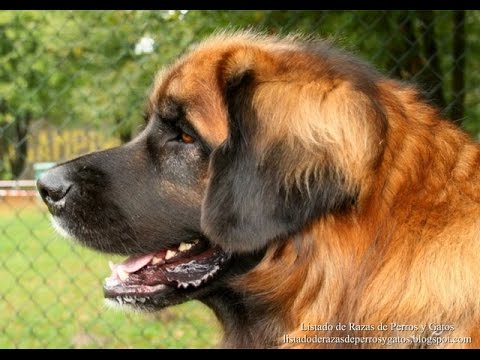
Leonberger

Once you get to know Leonberger dogs better, you will be enchanted by them forever.

Content

History

The Leonberger it is a very big and beautiful dog. In his head and in his charisma he remembers a St. Bernard and a lion at the same time. And this is not a coincidence, because the St. Bernard is one of the ancestors of Leonberger. The Leo, as his friends call it, It is a young and at the same time old breed of dog. This breed is ancient, because it has been specifically bred to the standard since 1846. The Leo It, therefore, one of the oldest dog breeds in modern breeding. At the same time it is a breed of young dog; because it was only created at that time. Most other pedigree dogs have a long history and originated from ancient working dog breeds..

The Leonberger, However, has a different and unique story. Among 1820 and 1850 San Bernardo became fashionable throughout Europe. The heroic exploits of the legendary St. Bernard Barry at the Great St. Bernard Pass in the Alps had a great effect. Barry has been shown to save more than 40 people of death by snow. Everywhere people wanted these big dogs and they were (and they are) really big dogs.

Breeders and traders were unable to meet the high demand. At the same time high prices were paid for a puppy of St. Bernard. So quite a few dog dealers from southwestern Germany helped out without further ado.. They mated St. Bernard with very big bitches from the region. The pups that looked like a St. Bernard they were sold as such, but for the others there were at most a few potatoes from a farmer. The dog trade was – as it still is today – a lucrative business and some sold hundreds of puppies a year and became rich.

Like Leonberg City Hall and dog vendor Heinrich Essig. An intelligent idea occurred to him and turned need into virtue. He created a brand out of the puppies that he could not market as St. Bernard. Instead of giving them away, sold the puppies for good money. Thus was born the Leonberger. Inspired by the lion from the coat of arms of his hometown, this new breed of dog has the appearance of a lion. His dogs were nicknamed Leonhardiner in the envious competition. Also in the official world of dogs these hybrids went unnoticed for a long time. Like this, el cinรณlogo Ludwig Beckmann, universally recognized at that time, He does not even mention the Leonhardiner in his work in two volumes "Die Rassen des sinks" (dog breeds) of 1895. From the point of view of health, such a genetically heterogeneous offspring is an advantage.

The Leonberger should be a success in all respects. Today it belongs to the primitive rocks of the world of purebred dogs., that no dog lover wants to miss. In 1895 The ยซInternational Dog Club was founded Leonbergerยซ, which quickly achieved official recognition of the Leonberger like race. In 1948 He was followed by the ยซGerman Dog Club LeonbergerยปBased in Leonberg, who still represents the Leonberger at VDH and around the world. The Leonberger has a unique charisma, imposing and at the same time friendly, quiet and just sovereign. Its appearance is reminiscent of a lion and its character is also majestic, peaceful and totally suitable for families.

Physical characteristics

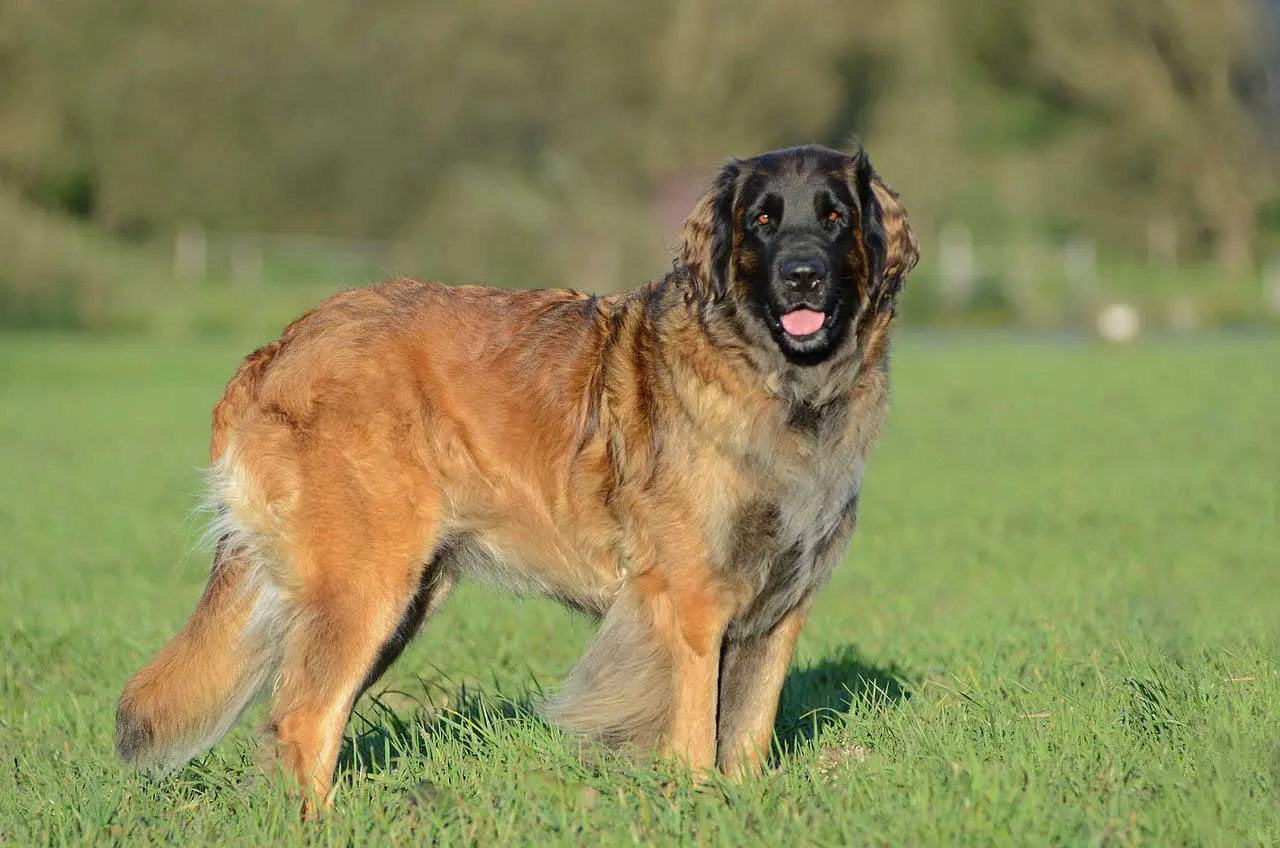
The Leonberger It is an impressive large dog with a height at the withers in males between 72 and 80 cm and in females between 65 and 75 cm.. No weight given. But, will be some 80 kg. The standard describes its appearance as:

ยซAccording to its original purpose, the Leonberger it's a very big dog, strong, muscular and elegant at the same time. It is characterized by a harmonious build and a self-assured calm with a lively temperament.. Especially the male dog is powerful and powerful. "

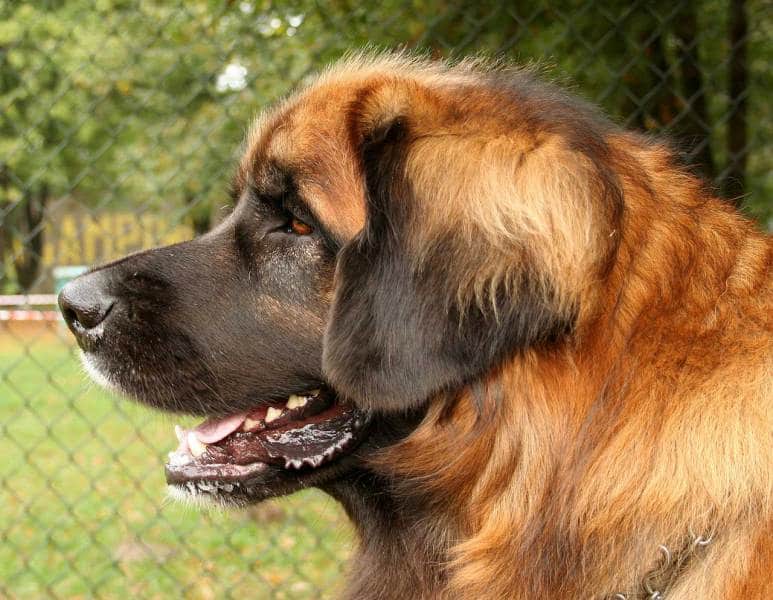
Its coat should be medium soft to thick, broadly long, well lying. The Leo has a strong inner layer. The shapes of your physique should be recognizable. On the neck and chest, the fur, especially in males, must form a mane. The coat will be lion yellow, red, reddish brown and all the combinations between them, but always with a black mask. In favor of this lion gaze, hereditary factors related to health and longevity have been neglected.

A study published by the University of Vienna evaluated 7582 layers of Leonberger between 1932 and 2009. ยซIt was determined that the average death age of the Leonberger It was from 7,55 years". During the study period, life expectancy had even decreased in 1,5 years in the last three decades. With a healthy upbringing, 10 or 12 years would be normal. The breed has recognized these warning signs and is now focusing more on the health and extension of the life expectancy of these large dogs..

Character and skills

The mind of a Leonberger is pious as a lamb. Being with him is pure slowdown for man. The essence is described in the standard:

as family dog, the Leonberger is a pleasant companion in current living conditions, that can be carried everywhere without any difficulty and is characterized by a pronounced kindness towards children. He is neither shy nor aggressive. As a companion dog it is a pleasant companion., obedient and fearless in all life situations.

The strength of character required includes above all: self confidence, sovereign calm, average temperament (including game instinct), willingness to subordinate, good learning and memorizing ability and noise tolerance. The character of Leonberger impresses all dog lovers.

Once you get to know dogs better Leonberger, you will be enchanted by them forever. There is almost nothing that can disturb this giant. His very high stimulus threshold as well as his stoic composure are the necessary counterpart to his enormous strength.. These two poles thus characterize the nature of Leonberger. Here and there is something stubborn. Only good persuasion and pleading will help., then he will do everything for his master or lady. But as a family member he is very kind. Seeks proximity to its humans. It is a reliable protector for them. The Leonberger he is a great guy, a fascinating dog!

Fitness

The Leonberger not an easy dog รขโ‚ฌโ€นรขโ‚ฌโ€นto keep due to its size. By its nature, has very few demands. A daily walk, brushed once a week, that was all. You don't need a big garden, but a garden is already useful. He likes to take possession of it. So, a small apartment on the nth floor would not be for him. Does not fit in all cars. One must consider: You're mine, the whole car will get wet. Leo can bear the heat, but it should not be challenged. prefers the cold. The Leonberger he is a great friend and not an object for acting addicts.

It should also be borne in mind that in our current society, large dogs are often rejected. Some people just fear a giant like Leo, even if he behaves – as is normal for him – exemplary. This is one of the reasons why it is not advisable to keep it in the big city..

One must have a sufficient budget to be able to pay a lot of good food and, in case of doubt, also the vet. It also, should have considered before buying what to do if the dog is sick and may need to bring 80 kg or more. Last, but not less important, there are many practical things that have a profound influence on everyday life. Here one must take real responsibility and honestly look in the mirror if all the conditions for a happy coexistence with dogs are met. Leonberger. Who can claim this, is in an enviable situation of dog owner. The Leonberger worth a sin.

Leonberger's Education

It must be remembered that in a Leo adult, the leash is just a symbol of control. The Leonberger has the power to control the other end of the strap. But he doesn't want. The Leonberger it's basically easy to train. Only his stubbornness has to be broken here and there with consistent smoothness.. He wants to follow his lord and master and he does it very reliably. It is an elementary duty of the owner of a Leonberger to pay attention to a consistent education already in the puppy. Because only this and not the leash makes wonderful walks in nature possible, that together with this great four-legged friend become a balm for the soul of agitated people. The great dog should never be "educated" by bumps or barracks methods. Because that would cause the exact opposite of education and end in disaster..

Leonberger care

Caring for a healthy Leo is not a problem. Brushing the coat once a week is enough.

Nutrition / Food

You need a lot of high quality food. A raised bowl is useful to counteract the risk of stomach twisting. Always pay attention to the weight.

Leonberger Health

As in most large dogs, we see hip or elbow dysplasia. Osteosarcoma, the most common bone tumor in dogs, It is also very common in Leonberger.

Leonberge life expectancy

Before the life expectancy of a Leonberger It was from 12 years, today is from 7 to 9 years. The breeding is working to recover the possible natural life of a healthy dog. He is accompanied here by a research project of the University of Veterinary Medicine Hannover.

Buy a Leonberger

The purchase of a Leo it should be long-term and well thought out. You should carefully check if you have all the requirements to be able to spend many wonderful years with this giant.. If you are looking for a puppy, you should make sure above all that the dogs are not bred too much. Ask about ancestors, their illnesses, his age reached. You should see an FCI affiliated breeder Leonberger. Really, a Leonberger it costs about 2.000 EUR.

Images "Leonberger"

Photos:

1 – Leonberger bitch by The animal photography at de.wikipedia / CC BY-SA
2 – Leonberger by https://pxhere.com/es/photo/1394923
3 – Leonberger, head photographed in 2004 at a dog show in Dresden by Karina Leo-Steffen, uploaded here from –Caronna 13:43, 15 Apr 2005 (UTC) / CC BY-SA
4 – Leonberger by https://www.pexels.com/es-es/foto/75295/
5 – Leonberger by https://pxhere.com/es/photo/1434187
6 – Leonberger by Pleple2000 / CC BY-SA
7 – Leonberger by https://www.needpix.com/photo/1100946/dog-leonberger-giant-pedigree-purebred-animal-canine

Videos "Leonberger"

Leonberger - Breed of dog

Type and recognitions:

  • FCI CLASSIFICATION:
  • Group :
  • Section : . .

Federations:

  • – FCI – Pinscher and Schnauzer-Molossoid type dogs – Swiss Mountain Dogs and Cattledogs. Section 2.2 Molossoid, mountain type. โ“˜
  • – AKC – Working dogs โ“˜
  • – ANKC – Group 6 (utility dogs) โ“˜
  • – CKC – Working dogs โ“˜
  • – โ€‹KC – Working dogs โ“˜
  • – NZKC – Utility dog โ“˜
  • – UKC – Watchdog โ“˜

FCI breed standard "Leonberger"

Origin:
Germany

Date of publication of the valid original standard:
04.01.1996

Use:

Watchdog, Company and family.


General appearance:

Complying with the original use purposes, the Leonberger is a big dog, strong, muscular and elegant at the same time. It is characterized by its harmonious body structure and poised tranquility, aware of his own worth with a lively temperament. The male is especially powerful and robust.


PROPIMPORTANT ORTIONS: Relationship of the height of the cross with the length of the body = 9:10; the depth of the chest corresponds almost to 50% the height of the cross.


Behavior / temperament:

As a family dog, the Leonberger adapts to modern living and room conditions and turns out to be a pleasant companion that can be taken anywhere without causing problems. It also, It is very friendly with children and is not shy or aggressive. As a companion dog it is a pleasant companion., obedient and fearless in all situations that arise. To achieve his nature and strength, he mainly needs:

  • Self -confidence and sovereign
  • Medium balanced temperament (urge to judge).
  • Willingness to submit.
  • Good learning ability and attention.
  • Be insensitive to noise.

Head:

In its entirety it is deeper than broad and seems longer than plump; the relationship between the muzzle and the cranial region is approximately 1:1. The skin is adherent on all parts and does not form frontal folds.

Cranial region:
  • Craging: Seen in profile and from the front it is slightly arched; is strong corresponding to the body and limbs, but it doesn't look heavy. The posterior region is not much wider than the region where the eyes are located.
  • Ston: It is clearly noticeable and moderately marked.

facial region:

  • Nariz: Black.
  • Horcico: It is long, but it never ends on end. The nose is in broad correspondence, never sunk, but rather slightly arched (ram's nose).
  • Labios: Adherents, black, with closed corners.Jaws / Teeth: Powerful jaws with a full scissor bite, regular and perfect with good adaptation of the upper incisors over the lower ones without leaving space. The teeth are implanted vertically in the maxilla, showing 42 healthy teeth according to dental formula (lack of M3 is tolerated). Caliper bite allowed; in the lower jaw there should be no narrowness next to the fangs.
  • Cheeks: Poorly developed.
  • Ojors: Light brown to as dark as possible, medium-sized, oval, or sunk or bulging, neither very together nor very separate from each other. Adherent eyelids, they don't show the conjunctiva. The whites of the eyes (visible part of the dermis) does not show redness.
  • Obars: High insertion and placed not far behind, pendants, medium-sized, stuck and fleshy.

Neck:

Forms a light curve that continues without interruption to the cross. It is longer than it is wide; has no loose or double chin.

Body:

  • Cruz: Pronounced, especially in the male.Back: Robust, straight, wide.
  • Itmors: Widths, powerful, well muscled.
  • Glikeness: Wide, relatively long, gently rounded, in the form of progressive transition to the root of the tail, never higher than the back.
  • Pecho: Large, deep, reaches at least to elbow height; not barrel-shaped but rather oval.
  • Lรญnand the bottom: Only slightly retracted.

Tail:

With lots of hair. When it is standing it carries it hung in a straight line; Also during the movement it folds only slightly without exceeding the back line.

Tips

PREVIOUS MEMBERS: Straight, parallel, not closed.

  • Shoulder / Arms: Long, obliquely placed; Among them form an angle not too obtuse. They have good muscles.
  • Elbows: Glued to the body.
  • Metacarpus: Strong, firm, viewed from the front they are straight and viewed from the side almost vertical.
  • Pinis previous: Straight (no deviations outwards or inwards), rounded, compact; well arched fingers; black pads.

LATER MEMBERS: Viewed from behind they are not placed too tightly; they are parallel; lukewarm joints- tarsians and feet do not deviate inward or outward.

  • Cadhere: In oblique position.
  • Thigh: Rather long; placed obliquely, has strong muscles. The thigh and leg form a fairly sharp angle.
  • Atibio-tarsal articulation: Powerful, with a marked angle between the leg and the metatarsal.
  • Pinis later: Straight, just a little long; arched toes; black pads.

Movement:

Cover the ground, it is balanced in all walks; good momentum and breakthrough; both during walking and jogging, observed front and back, conducts limbs in a straight line.

Mantle

  • Fur: Hair should be a little soft to hard, quite long, stuck and never form a streak; Despite having a lot of internal fleece, you can recognize the shapes of your body structure. The hair is smooth, although it is allowed to be slightly wavy; on the neck and chest (especially in the male) a mane is formed; There are visible feathers in the anterior members and "pants" marked in the posterior members.
  • Color: Yellow (lion color), red, reddish brown, also sand color (pale yellow, cream-coloured) and all its combinations, although with a black mask. Hair is allowed to have black tips; However, black should not be the basic hair color. The paleness of the basic color in the lower part of the tail, on the necklace, In the feathers of the previous members and in the "pants" of the posterior. A small white spot or a thin white streak is tolerated on the chest and white hairs on the fingers.


Size and weight:

Height to the cross:

  • Males: 72 โ€“ 80 cm., ideal measure 76 cm.,
  • females: 65 โ€“ 75 cm., ideal measure 70 cm..


Fouls:

Any deviation from the aforementioned criteria is considered as a fault and the severity of this is considered to the degree of the deviation to the standard and its consequences on the health and well-being of the dog..


FALTAS DESCALIFICANTES:

    • Aggressiveness or extreme shyness.
    • Any dog โ€‹โ€‹showing clear signs of physical or behavioral abnormalities must be disqualified..
    • Severe anatomical failures (p. e.g.. notable cow members, carp back marked, badly beaten back, exaggerated outward deviation in the forefoot, absolutely insufficient angulation in the shoulder joints, elbow, knee and tibial-tarsian).
  • brown truffle.
  • Excessive depigmentation on the lips
  • Lack of teeth (except the M3), superior and inferior prognathism; other faults in the bite.
  • Eyes without brown color.
  • Ectropiรณn, ectropion.
  • Tail too curled or carried too high and curled.
  • Brown pads.
  • Curly or frizzy hair.
  • Lack of color (brown with brown truffle and brown pads; Black with fire; silver black; deer color).
  • Total lack of mask
  • Too much white color (that reaches from the fingers to the carpus, stain on the chest larger than a hand, white color elsewhere).


N.B.:
  • Males should have two normal-appearing testicles fully descended into the scrotum..
  • Only functionally and clinically healthy dogs, with the typical conformation of the breed, should be used for parenting.


TRANSLATION: Federation Canรณfila Mexicana a.c..

Source: F.C.I - International Cynological Federation

Alternative names:

1. Leo, Gentle Lion, Gentle Giant (English).
2. Chien Leonberg (French).
3. Leo (German).
4. Leo (Portuguese).
5. Leo (espaรฑol).

โ–ท The world of Pets: Dogs, cats, birds, reptiles, amphibians

Majorca Mastiff (Majorcan mastiff dog)
Espaรฑa FCI 249 - Molossoid - Dogo

The Majorca Mastiff is a gentle dog, extremely affectionate with their owners, faithful to his master

Ca de Bou

Content

Characteristics "Majorca Mastiff (Majorcan mastiff dog)"

Coexistence is important that you have with your new friend. Before considering the acquisition of a dog of the breed "Majorca Mastiff (Majorcan mastiff dog)" you know certain factors. Not all breeds of dogs are apt to live in an apartment, you must take into account his character, their need for exercise, their interaction with other pets, their care and if you have small children, their level of tolerance towards them.

Adaptation โ“˜

5,0 of 5 stars (based on 1 review)

friendly dog โ€‹โ€‹โ“˜

2,0 of 5 stars (based on 1 review)

hair loss โ“˜

3,0 of 5 stars (based on 1 review)

Affection level โ“˜

2,0 of 5 stars (based on 1 review)

Need for exercise โ“˜

4,0 of 5 stars (based on 1 review)

Social need โ“˜

2,0 of 5 stars (based on 1 review)

Home โ“˜

3,0 of 5 stars (based on 1 review)

Toilet โ“˜

2,0 of 5 stars (based on 1 review)

Friendly with strangers โ“˜

3,0 of 5 stars (based on 1 review)

barking โ“˜

3,0 of 5 stars (based on 1 review)

Health โ“˜

3,0 of 5 stars (based on 1 review)

Territorial โ“˜

5,0 of 5 stars (based on 1 review)

Cat friendly โ“˜

2,0 of 5 stars (based on 1 review)

Intelligence โ“˜

4,0 of 5 stars (based on 1 review)

Versatility โ“˜

3,0 of 5 stars (based on 1 review)

Child friendly โ“˜

4,0 of 5 stars (based on 1 review)

Surveillance โ“˜

5,0 of 5 stars (based on 1 review)

joy โ“˜

4,0 of 5 stars (based on 1 review)

History

The Majorcan mastiff dog, also known as Majorca Mastiff in Catalan or Perro de presa mallorquรญn in Spanish, is a fairly old dog whose history remains unclear.

It is believed to have originated from a number of races, especially the Spanish Mastiff and the Alano, that crossed over the centuries.

The result of these crosses came to Mallorca in the thirteenth century, specifically in 1229, during the conquest of the island by King James I of Aragon. Some of these dogs remained there and were bred with local dogs.. The resulting individuals turned out to be much less sensitive to heat and adapted very well to local conditions. They began to be used by the local population to monitor houses and livestock.

It was also in the thirteenth century when the butchers of the island found in the dog an assistant for his ability to control livestock, especially bulls, before and during their sacrifice. In fact, his powerful jaw made him able to keep them immobile by holding them firmly by the nose.

At the same time, it was also used by the Knights of Malta in battle and to guard the camps. It also, he was unrivaled in his ability to breach enemy camps, which greatly facilitated the assaults.

In 1713 the Treaties of Utrecht are ratified, which put the island of Mallorca under British rule. The English then introduced their own guard and fighting dogs in the Balearic Islands. Mallorcan dogs were bred with the Bulldog, and the result of these crossings was called "Ca de Bou", which is a translation of the English word ยซBulldogยป ("bull" means bull) in Catalan. This name reflects the main use given to it. In fact, at the beginning of the 18th century, the bull-baiting, show in which a pack of dogs had to kill a bull, it was widespread and very popular in England, and the English did not stop importing it to Mallorca.

The Majorca Mastiff they also began to hunt wild boar and deer. It was also used for many years as a watchdog on ships, especially in case of pirate attacks, and sometimes you ate when there was nothing to eat.

Following the ban on bull hunting in 1835, was limited to two main functions: watchdog and hunter.

An eventful twentieth century

In the early 20th century, the Majorcan mastiff dog became better known. The first written record of the breed dates from 1907.

In 1923, the first representative of the breed was inscribed in the Spanish studbook. One year later, in Barcelona, made his first appearance at a dog show.

But, its development was greatly hampered by the famines of the decades of 1920 and 1930. Then, like many other breeds, was affected by World War II. Its population declined considerably throughout the period.

However, in 1946 a breed standard was developed, but it was not recognized by the International Cynological Federation (FCI) until about twenty years later, in 1963. But, by then there were probably no more left Majorca Mastiff pure. It also, the interest of breeders and individuals had largely shifted to other breeds that were expanding rapidly at the time, as the Great Dane, the German Shepherd and the Rottweiler.

In the Decade of 1980, the Majorca Mastiff, as it was known after the war, actually ceased to exist, especially due to the numerous crosses with Mallorcan sheepdogs (Ca de Bestiar). The latter came from the same region as the Majorca Mastiff and they brought their brindle coat. But, these unions substantially modified the characteristics of the Majorca Mastiff, so that it gradually moved away from the description given in the official standard.

But, passionate and determined breeders tried to save the breed and ensure that it kept the characteristics as close as possible to the registered standard. They set out to find individuals as close as possible to their ancestors. Two specimens called Tito and Anastasia (father and daughter, respectively), who were the first individuals considered sufficiently similar to the Majorca Mastiff of yesteryear. Its union and crossing with other crossed dogs on the island helped to resurrect the breed from a solid base. But, the number of breeders is still very low and the breed remains confidential. The specimens obtained did not leave the island and were reserved for the national market., where they were highly coveted for dogfighting.

In 1992 dogfighting was banned in the Balearic Islands, and it was then that the breed began to be exported slowly. The opening to the international market also allowed the introduction of new breeders in the lines, in order to expand the genetic heritage of the breed; they were both subjects of unknown origin with physical traits similar to the race, as hybrids of Majorcan mastiff dog.

These exports gave rise to numerous hatcheries in a wide variety of countries., where the Majorca Mastiff It is used both as a companion dog and as a guard dog.. In fact, it can be said that it was the export of the breed that almost saved it, since in Mallorca itself it is now only present in very limited numbers.

The recognition and popularity of the โ€œMajorcan Bulldog Dogโ€

In the last decades, the reputation of the Majorcan mastiff dog has increased and their number has grown in many countries, but there is still a long way to go. In fact, its recognition by the main canine organizations in the world is still very partial, which obviously limits its visibility and dissemination.

In France, in the first decade of the twenty-first century, went from a handful of records a year to about fifty, and then the number skyrocketed in a few years, until exceeding 200 annual births in 2014. Since then, has hovered around this value.

Further east, countries such as Poland and Russia have welcomed a good number of representatives of the breed since the beginning of its international spread. Some even claim that over the years 90 there were more than 2.000 Majorca Mastiff only in the city of Moscow. This is likely to be unfounded, but the fact is that it was quickly appreciated there, and still appreciated.

It is also especially popular in Puerto Rico, where there is a prestigious locally developed lineage, which was created from the Spanish champion Chimo and other quality specimens that were sent there.

There are also several representatives of the breed in Holland, Denmark, Finland and Sweden. But, this is still quite embryonic, as evidenced by the low number of breedings in these countries.

In United States, the Majorcan mastiff dog It was recognized in 2006 by the United Kennel Club (UKC). But, the other reference organization in the country, the American Kennel Club (AKC), has not yet taken the step. Further north, the Canadian Kennel Club (CKC) he doesn't recognize it either. In fact, in North America, both the reputation of the breed and its diffusion are still very low.

In the United Kingdom, where it was introduced in 2001, it is also not recognized by the prestigious Kennel Club (KC).

In Spain, not only on the island of Mallorca the Majorca Mastiff is discreet. In fact, the Royal Canine Society of Spain (RSCE), the main canine organization in the country, received less than 50 enrollment requests per year to mid-year 2010, figure that was even reduced to less than 20 at the end of the decade.

Physical characteristics

He has a bulky head, solid and the skull is wide. The eyes are oval and somewhat oblique; in the color, the more dark best. The ears are short and played backwards. The body is a massif with included belly. The forelimbs are strong and the tail reaches to the Hock. The coat is short and rough.

The favorite colors in your order are: the striped, the Fawn and black. In the striped prefer the dark tones in the leonados the intense nuances. The white spots are admitted in the previous members, chest and tolerated up to a maximum of 30 % the surface of the body. The black mask is also supported.

The Ca de Bou or Majorcan Dogo, It is a dog reserved and suspicious with strangers. It has an extraordinary adaptation, but it is not a dog to place in any hand. Their education and socialization should be initiated as soon as possible because the breed is naturally dominant.

The care of the fur is a simple weekly brushing and a regular cleaning of the ears and eyes. It is a rustic dog that adapts well to changes in temperature and withstands inclement weather well..

Character and skills

Although the Majorca Mastiff it has been used in its history for quite violent tasks, like bull hunting, the slaughter of bulls or the fighting of dogs, he is surprisingly very affectionate and has an excellent temperament. In fact, tends to create a very strong bond with his family.

They will do anything to protect their family and are very good watchdogs.. In fact, has a strong protective instinct and is very suspicious of strangers. But, although it can be impressive and dissuasive when needed, he only shows aggression when he feels his family is in danger. On the other hand, when dealing with people you don't know, he is always cautious, but he refers to his teacher to determine whether or not they are to be trusted. If the landlord invites someone you don't know to the house, will normally keep distance, but will not intervene in an untimely or even aggressive way. However, good socialization is necessary from an early age to avoid excessive distrust of all strangers.

Fits well with children, with whom he is patient and kind. He is even-tempered and likes spending time playing with them as much as being quiet on the couch. But, as with any dog รขโ‚ฌโ€นรขโ‚ฌโ€นof any breed, should never be left alone with a young child without adult supervision. This is especially true because it is relatively heavy and can easily push or knock over a young child..

On the other hand, the Majorca Mastiff tends to get along very well with other dogs, both with those who share their home and with those who are on a walk. But, if the dog is a male and is in the presence of another male with a dominant temperament, a rivalry relationship may develop. So, it is better to avoid this type of coexistence and to take precautions to avoid any fight when you meet other dogs, in particular doing gradual introductions.

As they don't have a strong hunting instinct, his relationships with small animals, as cats, rodents or birds, they are usually quiet. If you have to live with them on a daily basis, the ideal is to present them as soon as possible, but his great sociability makes it possible to integrate newcomers into his house even if he has always been the only animal.

Perhaps because it has been used to being used in so many ways and in so many different environments throughout its history., the Majorcan mastiff dog is generally very adaptable, so much so that it is possible that he lives in a flat. But, for your well-being, it is better that I live in a house with a garden, since he likes to run and exercise a lot. To feel good on its legs and on its head, usually needs an hour of activity a day, which can consist of walks or games in the garden. In any case, long daily outings are essential if you don't have access to a garden. They are always happy to accompany their owners on walks, and are well suited to active and sporty families. An elderly or very sedentary person, on the other hand, may not satisfy your need for activity and would be better off with another breed.

In addition to participating in the activities of their owners, can, of course, distinguish yourself in various dog sports such as agility, el cane-cross, The tracking, the RCI or the ring. It can even be made to pull a light trolley that the children sit in..

In any case, considering his past as a working dog, to the Majorca Mastiff he likes to be assigned tasks. These may include, takes his role as guardian very seriously: although it is not necessarily obvious at first glance, always watch out for the slightest noise or movement, and shows great reactivity. In general, Giving him chores to do and keeping him busy is the best way to ensure he thrives..

Once you are in your right mind, the Majorcan mastiff dog it is quiet and very quiet. He is not one of those who annoys the neighbors, he just barks in his role as guardian, that is to say, when a stranger enters your territory and tries to show you that you better leave.

Nor is he one of those who let themselves be heard when their owners are not: although he especially likes to be in contact with them, knows how to stay alone without suffering separation anxiety.

In summary, as long as he is well socialized and educated, and as long as you have enough opportunities to exercise, the Majorcan mastiff dog it is a fairly easy dog รขโ‚ฌโ€นรขโ‚ฌโ€นto carry. It is even an ideal breed choice for those who wish to acquire their first Molossian type dog., since it does not constitute a danger for his family and he is also very sociable with other animals in general.

But, this is only possible if the dog's place in the family hierarchy is perfectly clear and, Therefore, if he has a master who knows from the beginning how to position himself as a leader and how to be strict when necessary. Although the Majorca Mastiff it is quite easy to train and handle compared to other similar breeds, still a giant, so it is better that it is in the hands of a person who already has some experience in dog training.

Education

The Majorcan mastiff dog is an independent and determined thinker. So, can be very overbearing if not confronted by an experienced dog training person, who knows how to show both firmness and consistency to behave as a leader and make his dog understand who is the master.

So, your education should start at an early age, when it is still more impressionable, to lay the foundations on which the coexistence will be based throughout his life. As such, you have to be firm, but also soft, at the risk of antagonizing him or damaging the quality of his relationship with his owners.

The latter must also show some coherence: the rules should not only be fixed in time, but also from one person to another, that is to say, everyone should be in phase on what the dog is or is not entitled to do. The dog did not understand why one person allowed him to get on the sofa when another had strictly prohibited it the previous time.

As long as these conditions are met throughout the education of the Majorcan mastiff dog, things are going well; it is easy to carry and learns quickly.

This is even more true if your teacher is in charge of organizing small training sessions and asking you to do various things.. In this way, stays focused all the time, instead of boring you and losing your attention with long and repetitive sessions.

Learning is also easier and more enjoyable for everyone when the owner opts for methods based on positive reinforcement., that is to say, rewarding (with a word of encouragement, a caress, a treat…) good behavior and ignoring bad. In fact, punishment-based techniques quickly frustrate the dog, and an operation based on the constraint, although it may work in the short term, usually limits the prospects for evolution, or even counterproductive - or even dangerous- long-term. The Majorca Mastiff he is not one of those who turn against his master, but if he is brutal with him and uses bad methods, You may end up responding to what you perceive as assault with an equally violent reaction.

Last, all dogs benefit from being socialized as soon as possible, but this is especially true for the Majorcan mastiff dog. In fact, his developed instinct for protection generally leads him to distrust strangers and, Therefore, to be especially reserved with them. Not the type to get unnecessarily aggressive towards them, but it is preferable to ensure that you do not show an excessive reserve every time a visitor arrives at your house. As such, nothing like making him meet a wide range of people in all kinds of situations from his first months, so that little by little you will better accept the confrontation with strangers. The same goes for exposure to other dogs and animals of all kinds, as well as to all kinds of environments and stimuli (noises, smells, etc.). The sooner and more intensely a dog is socialized, the easier it will be for you to move around in the human world, whatever the circumstances.

Health

The Majorcan mastiff dog generally in very good health and predisposed to few problems., it is a very resistant dog in general.

This also applies to temperatures., used to the quite hot climate of the island of Mallorca, it is very resistant to high temperatures., not very sensitive to cold either, although this is really not a common thing in his homeland.

Among the diseases to which you are particularly predisposed, we can mention: brachycephalic syndrome, which affects dog breeds with flattened nose and short nose. In effect, This anatomical peculiarity notably translates into narrow nostrils and an excessively narrow nasal cavity, which implies respiratory failure, manifested especially during physical exertion and / or in case of strong heat. It can also be the cause of various digestive problems (vomiting, etc.). If the most serious cases must be treated by means of a surgical act to increase the respiratory capacity of the animal, most of those affected live in a more or less normal way as soon as their owner saves them from too intense physical effort (above all, especially when it's hot or humid) and carefully monitor your diet to avoid being overweight (a problem the breed is not particularly prone to).French Bulldog or the Pug;

  • The Hip Dysplasia, joint malformation in which the femur is not correctly positioned in the pelvic cavity of the hip joint, causing pain and lameness, as well as osteoarthritis as we age. Is problem, whose appearance is often favored by a hereditary predisposition, can be treated or alleviated by surgical intervention;
  • The dilation-torsion of the stomach, a problem that particularly affects medium-large dogs. It can happen especially when the animal ingests large amounts of food too quickly. It consists of sudden and excessive swelling of the stomach, that folds on itself;this blocks the evacuation of gases and interrupts blood circulation. Without prompt medical intervention, dog death occurs quickly;
  • The entropion, where the lid of one eye turns inward in contact with the eyeball. This problem can be inherited and causes severe irritation to the eye.. It is quite possible to remedy this by surgery;
  • The ectropion, corresponding to a curl defect of the lower eyelid. Then, the eye is no longer adequately protected, causing more or less severe irritation and conjunctivitis. Once again, this condition can be inherited and can be cured with surgery.

Although the breed is not predisposed to a large number of diseases, it is important to go to a breeder of Majorcan mastiff dog serious and competent. In effect, this allows the adopted puppy to have benefited from a good living environment and good socialization from its first weeks, but also and above all to maximize the chances that you enjoy good health and the rest. In fact, a serious breeder avoids breeding a dog with a hereditary defect such as Hip Dysplasia., because there would be a significant risk of transmission to young people. If you do not present them spontaneously, as should be the case, you should be asked for the results of the corresponding tests carried out on the parents or the puppy.

You must also always be able to provide a certificate of good health of the puppy prepared by a veterinarian, as well as a health or vaccination record, that proves that the child has received all the necessary vaccines. Once the animal has returned to its new home, should never be forgotten, during the following months, that is still growing and, therefore, particularly fragile. Thus, until I am about a year and a half, it is important to avoid any physical exercise that is too intense or too long, otherwise your joints or bones could suffer seriously. Or even end up presenting developmental defects that can incapacitate him throughout his life. This is all the more true as Majorca Mastiff is predisposed to Hip Dysplasia.

Last, even once this growth period has passed and the animal has become an adult, it is important to always pay attention to your health. As such, nothing substitutes for a complete check-up at a vet at least once a year, to ensure that no problem appears that cannot be detected by an inexperienced person. These regular appointments also offer the opportunity to be reminded of your vaccinations., so you never stop being protected. It should also be used against internal and external parasites, so it is up to your teacher to renew your antiparasitic treatments whenever necessary, throughout the year.

Life expectancy

11 years

Grooming

The Majorca Mastiff it is an easy breed to care for, and this is especially true for their fur. A weekly brushing is more than enough to keep it in good condition. But, not so during moulting periods, in spring and autumn: much more must be done each day, to allow good removal of dead hairs.

It also, as it is not dirty or smells bad, rarely need a bath. Unless it was especially dirty during an outing or in contact with toxic material, do it 2 or 3 times a year is more than enough. It may also be wise to do this at the same time as your seasonal shedding to save time during these periods., since it removes a good amount of dead hair. In any case, always use a shampoo specially developed for dogs, since the pH of your skin is different from that of human skin.

It also, although their ears are not especially prone to infection, they should be checked and cleaned once a week to prevent dirt or moisture from accumulating that could cause infection.
Your eyes are also not immune to infection, so you also have to check and clean them weekly to prevent dirt from accumulating.

Brushing your dog's teeth is also a good habit that should be established at least once a week, making sure to use a dog-specific toothpaste each time. This helps prevent plaque formation., which can cause serious health problems when it turns into tartar. If possible, it is advisable to opt for an even higher frequency, even daily.

As for the claws, this adaptable dog wears them down to a greater or lesser extent, according to the activity level of your family and your living environment. A dog that walks and spends a lot of time a day does not need to have its nails trimmed manually, since they file themselves, especially if it is on a hard surface like asphalt. But, if the dog lives in a flat and is not very active, it needs to be trimmed regularly. Too long claws can be very annoying for the dog, especially when traveling. It also, if they break, they can hurt the dog. In fact, as soon as the friction with the hard ground is heard, they have become too long and have to be cut.

Whether the fur, the ears, the eyes, teeth or claws, grooming your dog requires a minimum of precision and vigilance. If you don't, not only can you fail in grooming your dog, but it can hurt you, or even injure it. So, the first time it is best to seek the advice of a veterinarian or professional dog groomer, and learn from him how to take care of his Majorca Mastiff.

The sooner you train your dog, the better it will be for the rest of your life.

Food

Feeding a Majorcan mastiff dog it is not an arduous task: is perfectly fine with a balanced, quality industrial diet. Homemade rations are another perfectly adequate option, as long as they are well composed and, Therefore, are able to meet your nutritional needs. As such, should consist mainly of meat, but they can also contain large bones, remains, vegetables and rice.

In any case, the amount given must be consistent with his age, your health and the amount of physical exercise you get on a daily basis.

It also, the fact that it is prone to dilation-torsion of the stomach means that some precautionary rules should be observed when feeding the Majorcan mastiff dog. So, it is essential to divide your daily ration into at least two meals, and that these be taken in stride. It also, should not be preceded or followed by any intense or prolonged activity for an hour.

Although this breed is not very prone to obesity, it is important to regularly monitor the dog's weight. In fact, no one is immune to sudden and significant weight gain, especially after sterilization. Weighing your dog about once a month will allow you to quickly spot any unexplained deviations, so that you can take your dog to the vet if the deviation is confirmed or even increased during the following measurements. In fact, only a health professional can make a reliable diagnosis and indicate how to remedy the problem, because diet and lack of activity are not the only possible causes of being overweight: it can also be caused by illness or a reaction to treatment.

Last, like all dogs, the Majorca Mastiff a bowl of clean, fresh water should always be available to you.

Price

The Majorcan mastiff dog can be found at various prices. In all cases, the latter depend, in particular, of the reputation of the kennel, from the line the pup came from, but also of its intrinsic qualities, in particular of their physical qualities, especially of its greater or lesser conformity and its color.

In fact, the brindle color is the most sought after in this breed, what can explain the price differences, sometimes substantial, even within the same litter.

In Spain, the average price of a companion puppy is around 700 EUR. Obviously, like in other places, can be much higher for the best subjects. Those sold with a confirmation guarantee, whose attributes will allow them to be exhibited in dog shows or used as breeders, can reach much higher sums, up to several thousand euros.

Majorca Mastiff Images

Videos Ca de Bou

Type and recognitions:

  • FCI CLASSIFICATION:
  • Group :
  • Section : . .

Federations:

FCI โ“˜, UKC โ“˜

FCI breed standard "Majorca Mastiff (Majorcan mastiff dog)"

Origin:
Spain

Date of publication of the valid original standard:
11.12.1996

Use:

Guard and defense dog


General appearance:

Race typically molosoid, slightly elongated, strong and powerful. Medium rise, with marked sexual differentiation in cranial volume, higher in the male than in the female.


Behavior / temperament:

Quiet nature, that demonstrates bravery and courage, being sociable to the humane treatment and faithful and grateful to its owner. In the work of guard and defense, acts as an unbeatable guardian. At rest he appears confident and self-assured.; being alert, his gaze is penetrating.

Head:

Strong, solid

Cranial region:
  • Skull: Grand, width, tending towards the square, with a larger perimeter than the size at the withers, essentially in males. Wide front and flat, with well-marked front Groove; front, skull shape belies the occipital. The upper line of the skull and the supranasal line are almost parallel, with slight convergence.
  • Depression links (Stop): Profile, well marked and outstanding. Head on, perceptible only by the superciliary arches that delimit a clear frontal furrow.

facial region:

Very strong and prominent jaw muscles, developed up to the average level of eyes, and although it has some wrinkles on the sides of the masseter, It can be said that, in general, of the head do not skin wrinkles.

  • Truffle: Black and wide. Between the Windows you have well defined filter.
  • Snout: Born from the inner corner of the eyes, wide, tapered, Recalling a truncated cone of base profile broadband; with straight and slightly ascending supranasal line. The length of the muzzle must be in relationship 1/3 with respect to the head.
  • Lips: Upper lips are superimposed on the lower half of the snout, where it appears the labial commissure. The top is rather picked, While the lower retracting at its Center, and no they highlight is the lips when the mouth is closed. Oral cavity with marked striae and black gum edges, the rest of your mouth Red.
  • Jaws / Teeth: Powerful JAWS with well aligned incisors, Canine something separate, White complete teeth and strong with bite prognata; without being excessive this lower prognathism, It should be a maximum of one centimeter. They shall never see teeth with mouth closed.
  • Eyes: Large, oval, with opening wide, steep and somewhat oblique, color as dark as possible relative to the layer, without let see the conjunctiva; seen from the front can't see white ; situated low and far apart.
  • Ears: High and lateral deployment, rather small and pitches back and curved, showing the ear ; the guy named rosa. At rest the end of the ear lies at a level below the eye.

Neck:

Strong, thickness and provided, at his birth he has a similar to the diameter of the head width ; well linked with the cross. Something loose skin, being a thin dewlap permitted.

Body:

  • Kidneys and flanks: Short, relatively narrow and forming an arch pronounced to the rump.
  • Rump: Approximately from 1 to 2 cm taller than the cross, inclined at about 30ยฐ from the horizontal, somewhat narrower than the thorax.
  • Chest: Rib something cylindrical, deep up to the height of the elbows, width to the height of the cross, due to the separation of the shoulder blades.
  • Lower profile: Parallel to the ground chest, Belly gently up and collected, never agalgado.

Tail:

Implemented low, thick at its root, it thins to its end that reaches the hock, and finished in tip; during rest falls naturally, while in action it arches slightly and is arranged at the level of the dorsal line.

Tips

PREVIOUS MEMBERS:

  • Shoulder: Moderately short, some prominent and slightly oblique.
  • Arms: Straight, plumb and separated from each other.
  • Elbows: Separated due to the breadth of chest, but never open.
  • forearms: Well muscled, straight and thick bones.
  • Previous feet: Strong, with fat fingers, slightly round and well United; lightly pigmented pads.

LATER MEMBERS: Muscled, longer than the previous ones.

  • Thighs: Long ; natural joints.
  • Hocks: Short, straight and strong. Undesirable Spurs.
  • Hind feet: Strong, with fat fingers longer than the previous toes, presenting its oval shaped joint; preferably pigmented pads.

Movement:

The typical gait of the breed is the trot.

Mantle

Rather thick, firmly attached to the body, except in the neck, It can form slight double chin.


COAT

  • HAIR: Short and rough to the touch.
  • COLOR: Striped, black & Fawn, desirable in this order. For the atigrados dark tones are preferable; tawny in intense colors.

white spots are allowed in forefeet, chest and muzzle, up to a maximum total of a 30%. Also supports the black mask.


Size and weight:

Height to the cross:

  • Males of 55 to 58 cm.
  • females of 52 to 55 cm..

Weight:

  • In males ranges from the 35 to 38 kg
  • In females ranges from the 30 to 34 kg.


Fouls:

Any deviation from the aforementioned criteria is considered as a fault and the severity of this is considered to the degree of the deviation to the standard and its consequences on the health and well-being of the dog..


SERIOUS FAULTS

  • Individuals whose height at the withers is higher than the rump.
  • Inferior prognathism that is greater than one centimeter.
  • Scissor bite, or clip.
  • Lack of two premolars.
  • Individuals who do not have ears in pink, This is glued together and flat ears to the face ; and with ears erect on its base, still being in pink in its final third.
  • Queue type bulldog.
  • Any other fault that its gravity apart from the standard.

MISS PLAYOFFS

  • Aggressive or fearful dog.
  • Upper prognathism.
  • Eyes clear and yellow.
  • Amputated ears or tail.
  • White color more of 30% in parts of the body that are not above feet, chest and muzzle.
  • Any other colouring stains.

INDICATIVE MEASUREMENTS IN A STANDARD DOG

  • Weight 36 kg
  • Height at Croup 58 cm.
  • Height in cross 56 cm.
  • Chest perimeter 78 cm.
  • Head circumference 59,5 cm.
  • Distance occipital to the birth of the tail 73 cm.
  • Distance of the occipital to snout 22 cm.
  • Distance from the muzzle to the frontal trough 8 cm.

Any dog โ€‹โ€‹showing clear signs of physical or behavioral abnormalities must be disqualified..


N.B.:

Males should have two normal-appearing testicles fully descended into the scrotum..

Source: F.C.I - International Cynological Federation

Alternative names:

1. Mallorquin Mastiff, Mallorquin Bulldog, Silverback (English).
2. Dogue de Majorque (French).
3. Ca de Bou (German).
4. Ca de bou, Dogo maiorquino (Portuguese).
5. Dogo mallorquรญn, perro de presa mallorquรญn, Presa mallorquรญn (espaรฑol).

โ–ท The world of Pets: Dogs, cats, birds, reptiles, amphibians

Tosa
Japรณn FCI 260 - Molossoid - Dogo

Tosa Inu

The Tosa is quiet, serene, dignified and extraordinarily peaceful.

Content

History

The Tosa It is a breed of dog originating in Japan. Molosser imposing aspect, It is one of the favorite breeds for the lovers of dogs large size around the world. The breed emerged in the mid-19th century, When crossing various European breeds of large size (Great Dane, Mastiff, St. Bernard, Bulldog, German Shorthaired) with the indigenous Shikoku.

In Spain is regarded as a potentially dangerous breed of dogs by Royal Decree, by which to his possession must obtain the licence for possession of dangerous dogs and register it in the corresponding Municipal registry of potentially dangerous animals. One of the things that are required for this license is insurance of civil liability to third parties.

The Tosa varies considerably in size. Japan-bred specimens tend to have half the size of the specimens bred in the rest of the world. Japanese copies are usually weigh between 35 and 55 kg, While exemplary foreigners have a weight which varies between the 60 and 100 kg. The mantle is characterized by short and smooth appearance and is often red, striped or brown clear. The maintenance of its fur is minimal.

This breed originated in the second half of the 19th century. The race started from the natives – Shikoku, an indigenous dog. It weighs some 25 kg and stand about 55 inches tall, that it resembles the European Spitz. These dogs were crossed with dogs of European races, as the Old English Bulldog in 1872, Mastiff, in 1874, St. Bernard, German pointer in 1876, Great Dane, in 1924, and the Bull Terrier. The goal was to raise a bigger dog, more powerful.

Read more

โ–ท The world of Pets: Dogs, cats, birds, reptiles, amphibians

Pyrenean Mountain Dog
Francia Espaรฑa FCI 137 - Molossoid . Mountain

Pyrenean Mountain Dog

The Pyrenean Mountain Dog is a guardian and protector with territorial claims.

Content

History

The Pyrenean Mountain Dog is an ancient watchdog of the mountainous world of the Pyrenees. There it is officially called Chien de Montagne des Pyrรฉnรฉes. The people of the Pyrenees call him the cute little one Patou. The pyrenees, like a vast, deserted and rugged, previously inaccessible mountain range, form the natural border between France and Spain. Here there were and there are wolves and bears, with the consequent problem for ranchers. It also, sheep used to be one of the few livelihoods of the people here. While in Germany and other Central European countries people lament the return of the wolf and complain about the damage caused to game and sheep herds, in the Pyrenees dogs such as the Patou from time immemorial. And there are no complaints. Guard dogs are an integral part of every flock of sheep in the Pyrenees mountains.

On the French side, they are officially called Chien de Montagne des Pyrรฉnรฉes or Pyrenรคenberghund, on the Spanish side Perro de montaรฑa de los Pirineos or Gran Pirineo. In addition to protecting herds against thieves, wolves and bears, also protected large estates. His powerful figure, his determination and ability to attack in an emergency were not without effect. The impression must have been so lasting that his work was already documented in writings from antiquity and the Middle Ages.. It is reported that the dogs would have recognized people from afar by their clothes. In 1391 it is said that the Count of Foix did a test. If he came disguised as a tramp, the dogs attacked him from afar without hesitation. If he came dressed as a count, he wasn't bothered.

The Patou was not a uniform race in the past. In very remote valleys there were often local breeds, genetically isolated, optimized for your job task naturally, but in the end the same dogs came out with a very similar appearance and character, though they might have been genetically separated for generations. Extremely harsh living conditions obviously outweighed the disadvantages of inbreeding. Modern pedigree dog breeding took an interest in these impressive dogs very early on. Already at the first dog show in France, in 1863, a separate class was established for the Pyrenean Mountain Dog.

An attempt was made to establish the Patou also outside the Pyrenees as a watchdog and protection. In 1907 the first standard was established in France. But, due to the two world wars and the associated famine period, the population of Patou outside the mountains suffered serious setbacks. In 1955 obtained the official recognition of the FCI – International Cynological Federation.

Physical characteristics

The Pyrenean Mountain Dog is a big dog, imposing, powerful and at the same time athletic and agile. Doesn't seem clumsy or massive, but rather elegant piecework. It has a medium length coat, very dense and flexible, which can be slightly wavy. The bottom layer is also very dense. To the colors that the official standard says:

White or white with gray spots (badger gray or wolf gray), pale yellow or orange (rusty) in the head, ears and base of tail, sometimes also in the body.

The Pyrenean Mountain Dog it has a majestic height at the withers 70 and 80 centimeters in males and 65 to 75 in females. The weight must be between 60 and 70 kg. The measurements are quite similar to those taken by the Conde de Bylandt when he first described the breed in 1897, when he simply called the dogs "Chien des Pyrรฉneรฉsยซ. The head of the Patou remember the contours of a molosser. Shows a very alert and attentive facial expression. It is a dog that rests in itself, who first of all observes everything, seemingly listless. This is underlined by his eyes, they're supposed to be sweet and dreamy, with its dark amber color.

Character and skills

The Pyrenean Mountain Dog is a guardian and protector with territorial claims. He looks cute and calm looking, sublime and imposing almost like a blank teddy bear, but you must not be wrong. It has a strong character combined with a very own but clear idea of รขโ‚ฌโ€นรขโ‚ฌโ€นhow it should behave – and the others in their domain. This idea is naturally shaped by its use throughout the centuries, where he had to defend his flock to life or death as a guard without the presence of the shepherd and, therefore, had to make decisions independently. The official standard classifies his character qualities as follows:

Since the dog was used exclusively to protect herds against attacks by predators, its selection for breeding was based on its suitability as a guardian, their respectable appearance and also their relationship with the herd. The resulting characteristics are strength and agility., as well as the sweetness and attachment to his protรฉgรฉs. This watchdog has a tendency to independence and initiative, which requires some authority from his master.

One Pyrenean Mountain Dog should only be held by an experienced and mentally strong person. First of all, not a family dog. But, it can become so if it has extremely competent guidance from its master or caretaker and if the external conditions are right. Only then can he be a good family dog รขโ‚ฌโ€นรขโ‚ฌโ€นand lovingly protect all members of the family., including other four-legged friends. It also, is a good guardian and extremely reliable protector of the house and all those who, in your opinion -which should be clarified-, belong to it. Towards strangers he is suspicious.

Fitness

The Pyrenean Mountain Dog it is extremely undemanding in its maintenance – if one ignores the aforementioned restrictions due to its nature as a watchdog. It is undemanding in its nutrition as well as in its accommodation. You can spend the whole year outside without problems – As long as you have a suitable and "adequate" hiding place, it does not mean either a kennel or a chain., because he must be able to move in his territory. This large, self-confident dog is quite sensitive and places great importance on a close emotional bond with his human family.. You need a trusting relationship with your master or caregiver.

Thanks to modern pedigree dog breeding, the Patou is better prepared for a big city life than other herd protection dog breeds like the Kangal or the Central Asian Shepherd Dog. So if you have a large, well-fenced property in the country, if you have joy, fun, experience and the possibility of getting involved with these dogs, you can experience a particularly impressive and beautiful facet of the human-dog association.

Pyrenean Mountain Dog Education

The education of Pyrenean Mountain Dog belongs to the hands of a teacher or lover with deep experience and canine knowledge. Like any other race, Pyrenean mountain dogs must be well socialized and educated since they are puppies. It would be irresponsible to want to keep such a dog as a beginner.

Care and health of the Pyrenean Mountain Dog

Absolutely easy to care for and undemanding. The Pyrenean Mountain Dog generally enjoys very robust health. Some health problems may include hip dysplasia; heart problems such as tricuspid valve dysplasia; cancers like osteosarcoma (bone cancer); eye problems such as persistent pupil membranes, progressive retinal atrophy and cataracts; dissecting osteochondritis (an orthopedic problem), patellar dislocation (dislocation of the patella) and swelling.

Nutrition / Food

The Pyrenean Mountain Dog he has no problem with his diet.

Life expectancy of the Pyrenean Mountain Dog

The Pyrenean Mountain Dog have a very high life expectancy of 12 and sometimes more years relative to its size.

Characteristics "Pyrenean Mountain Dog"

Coexistence is important that you have with your new friend. Before considering the acquisition of a dog of the breed"Pyrenean Mountain Dog" you know certain factors. Not all breeds of dogs are apt to live in an apartment, you must take into account his character, their need for exercise, their interaction with other pets, their care and if you have small children, their level of tolerance towards them.

Adaptation โ“˜

4,0 of 5 stars (based on 1 review)

friendly dog โ€‹โ€‹โ“˜

3,0 of 5 stars (based on 1 review)

hair loss โ“˜

5,0 of 5 stars (based on 1 review)

Affection level โ“˜

3,0 of 5 stars (based on 1 review)

Need for exercise โ“˜

2,0 of 5 stars (based on 1 review)

Social need โ“˜

4,0 of 5 stars (based on 1 review)

Home โ“˜

2,0 of 5 stars (based on 1 review)

Toilet โ“˜

3,0 of 5 stars (based on 1 review)

Friendly with strangers โ“˜

2,0 of 5 stars (based on 1 review)

barking โ“˜

4,0 of 5 stars (based on 1 review)

Health โ“˜

5,0 of 5 stars (based on 1 review)

Territorial โ“˜

2,0 of 5 stars (based on 1 review)

Cat friendly โ“˜

4,0 of 5 stars (based on 1 review)

Intelligence โ“˜

4,0 of 5 stars (based on 1 review)

Versatility โ“˜

2,0 of 5 stars (based on 1 review)

Child friendly โ“˜

4,0 of 5 stars (based on 1 review)

Surveillance โ“˜

2,0 of 5 stars (based on 1 review)

joy โ“˜

5,0 of 5 stars (based on 1 review)

Images "Pyrenean Mountain Dog"

Photos:

1 – Pyrenean Mountain Dog by https://pxhere.com/es/photo/774692
2 – Pyrenees Mountain Dog, XI International Dog Show in Krakรณw by I, Lilly M / CC BY-SA
3 – Great Pyrenees Mountain Dog by HeartSpoon / CC BY-SA
4 – Pyrenees mountain dog by Arnaud 25 / CC BY-SA
5 – Pasture of Anterne, Sixt-Fer-a-Cheval, Pyrenean Mountain Dog among the sheeps by Jerome Bon from Paris, France / CC BY
6 – Pyrenean Mountain Dog by Emma.Martinet / CC0
7 – Pyrenees mountain dog by I, Beninho / CC BY-SA

Videos "Pyrenean Mountain Dog"

Type and recognitions:

  • FCI CLASSIFICATION:
  • Group :
  • Section : . .

Federations:

  • – FCI – Pinscher and Schnauzer-Molossoid type dogs – Swiss Mountain Dogs and Cattledogs. Section 2.2 Molossoid, mountain type. โ“˜
  • – AKC – Working dogs โ“˜
  • – ANKC – Group 6 (utility dogs) โ“˜
  • – CKC – Group 3 – Working dogs โ“˜
  • – โ€‹KC – Sheepdogs โ“˜
  • – NZKC – Utility dog โ“˜
  • – UKC – Watchdog โ“˜

  • FCI breed standard "Pyrenean Mountain Dog"

    Origin:
    Spain, France

    Date of publication of the valid original standard:
    13.03.2001

    Use:

    Herd guard dog in mountain.


    General appearance:

    This is a large dog, imposing and very well proportioned, although without lacking a certain elegance.

    PROPIMPORTANT ORTIONS:

    • The maximum width of the skull is equal to its length.
    • The muzzle is slightly shorter than the skull.
    • The length of the body, from the tip of the shoulder, to the tip of the gluteus, is slightly higher than the height at the withers.
    • Chest height is equal to half the height at the withers or slightly less


    Behavior / temperament:

    Used to protect flocks alone from predator attacks, his selection was based on both his vigilance and deterrence skills, as in their attachment to the flock. As a result of this, its main qualities are strength and agility, as well as the sweetness and devotion towards those who protect him. This watchdog has a propensity for independence and a sense of initiative that require some authority from its master..

    Head:

    Is not very big, compared to the size of the dog. The side faces are quite flat.

    Cranial region:
    • Skull: The maximum width of the skull is equal to its length. It is slightly arched, because the sagittal crest is noticeable to the touch. Since the occipital protuberance is apparent, the cranium, on its back, It has an ogival shape. Superciliary arches are not marked, the middle groove is barely perceptible to the touch between the eyes.
    • Depression links (Stop): It has a slight inclination.

    facial region:

    • Truffle: It is completely black.
    • Snout: It is wide; somewhat shorter than the skull and progressively decreases towards its extremity. Seen from above, is V-shaped with a truncated tip. It is very solid under the eyes.
    • Lips: They are slightly hanging and cover just the lower jaw. Are black or well marked black, as well as the palate.
    • Jaws / Teeth: The denture must be complete and the teeth must be white and healthy. The joint is in the form of scissors (the upper incisors cover the lower ones without loss of contact). Articulation in the form of pliers is supported, as well as the two lower clips that fall towards the front.

    Eyes: They are rather small, almendrada form, slightly oblique, of intelligent and contemplative expression. Its color is amber brown. The eyelids are never loose and are lined with black. The look is sweet and dreamy.

    Ears: Present at eye level. They are quite small, triangular in shape and rounded at the extremity. They fall close to the head and appear a little higher when the dog is in action.

    Neck:

    It is strong, pretty short; the double chin is poorly developed.

    Body:

    The length of the body, from the tip of the shoulder, to the tip of the gluteus, is slightly higher than the height at the withers. The height of the sternum to the ground is almost equal to half the height at the withers, but never inferior.

    • top line: It is very firm.
    • Cross: It is wide.
    • Back: Good length, solid.
    • Pork loin: Medium length.
    • Rump: Slightly oblique; the haunches are quite outgoing.
    • Flank: It is little inclined.
    • Breast : It is not very inclined, but wide and deep. Descends to elbow level, no further down. Its altitude is equal to or slightly less than the height at the withers. Ribs are slightly rounded.

    Tail:

    Descend at least to the tip of the hock. It is bushy and forms a pompadour. Low, during rest, preferably with the hooked end. When is the dog in action, it rises on the back taking a well-rounded shape and only the limb touches the back (The mountain people call it the "arroundera" wheel.).

    Tips

    PREVIOUS MEMBERS: They are strong and plumb.

    • Shoulder: They are fairly oblique.
    • Arms: Muscular, medium length.
    • forearms: Straight, strong and well covered with fringe hairs.
    • Carpi: The wrist is in the extension of the forearm.
    • Metacarpus: Slightly oblique.
    • Previous feet: They are not very long and compact, with slightly arched fingers.

    LATER MEMBERS: They have hairs that form longer and busier fringes than the forelimbs. Seen from behind, are perpendicular to the ground.

    • Thighs: They are well muscled, not very long and fairly oblique; ยซwell trainedยป.
    • Knees: They are moderately angled and lie on the axis of the body.
    • Legs: Strong, medium length.
    • Hock: Width, thin and medium layered.
    • Pies: They are little elongated, compact, with slightly arched fingers.
    • Spurs: The hindquarters have double, well-formed spurs. The forelimbs sometimes have single or double dewclaws.

    Movement:

    The movement of the Pyrenean Mountain Dog is powerful and loose, never weighed; it is broader than fast and it does not lack a certain elasticity and elegance. This dog's angulations allow for a steady gait.

    Mantle

    SKIN: Thick and flexible. Often shows pigmentation spots all over the body.

    Fur: It is very bushy, smooth, quite long and loose, pretty rough on the shoulders and back. Longer at the tail and around the neck, where it can be slightly wavy. Trouser hair, finer and woolier, it's very bushy. The inner face of hairs is also thick.

    Color: White or white with gray appearance spots (badger hair or dark bay), pale yellow or orange, in the head, the ears and the tail. Badger hair spots are the most appreciated.


    Size and weight:

    Height to the cross:

    • Males: 70 to 80 cm.,
    • females: 65 to 75 cm..

    A tolerance of 2 cm in of the set size, in copies that correspond perfectly to the type.


    Fouls:

    Any deviation from the aforementioned criteria is considered as a fault and the severity of this is considered to the degree of the deviation to the standard and its consequences on the health and well-being of the dog..

    General aspect: General appearance that gives the impression of heaviness, aspect without distinction. Thick dog, not very energetic, lymphatic.

    Head:

    • Too heavy, rectangular
    • Very wide skull, forehead bulge
    • Very marked or non-existent naso-frontal depression
    • Very drooping lips that form belfo
    • Insufficient truffle pigmentation, the edge of the eyelids and lips

    Eyes: Round, sunken or bulging. Too big or too small, close together or far apart. Third visible eyelid. Hard expression.

    Ears: Wide, long, bent, forming folds. They come back; set high.

    Neck: Delgado, a little long or otherwise very short, giving the impression that the head is sunk on the shoulders. Chin very pronounced.

    Body: Sunken or convex top line, inclined, swollen or sagging belly.

    Breast : Very broad or narrow front part of the chest. Flat ribs, or on the contrary, barrel shape.

    Tail: With little hair or incorrect implantation. Very short or very long, without pompadour, does not take the form of a wheel when in action or does it continuously, even during rest.

    Former members:

    • They deviate inward or outward.
    • Very open scapulo-humeral angle.

    Later members:

    • They deviate inward or outward.
    • Straight or excessively angled hock.
    • Pies: Long, plans.
    • Fur: Short or curled, silky, soft. Absence of an inner layer of hairs.

    FALTAS DESCALIFICANTES:

    • Aggressiveness or extreme shyness.
    • Any dog โ€‹โ€‹showing clear signs of physical or behavioral abnormalities must be disqualified..
    • Color: Colors other than those indicated in the standard.
    • Truffle: In another color that is not absolutely black.
    • Jaws: Upper or lower prognathism, or any malformation of the jaws.
    • Eyes: Different colored spots on the eyelids, raptor eyes.
    • Spurs: Absence of dewclaws, single or double spur atrophy in hindquarters.
    • Size: Outside the limits of the standard.


    N.B.:

    โ€ข Males must have two normal-appearing testicles fully descended into the scrotum..
    โ€ข Only functionally and clinically healthy dogs, with the typical conformation of the breed, should be used for parenting.

    Source: F.C.I - International Cynological Federation

    Alternative names:

    1. Great Pyrenees, Patou, Montaรฑรฉs del Pirineo, Perro de Montaรฑa de los Pirineos, Can de Montaรฑa de os Perinรฉs, Chien des Pyrรฉnรฉes, Chien de Montagne des Pyrรฉnรฉes, Pyr, GP, PMD, Gentle Giant (English).
    2. montagne des Pyrรฉnรฉes, pastou, patou (French).
    3. Chien de Montagne des Pyrรฉnรฉes, Patou (German).
    4. Chien de Montagne des Pirรฉnรฉes (Portuguese).
    5. Gran Pirineo, Chien des Pyrรฉnรฉes, Chien de Montagne des Pyrรฉnรฉes, Gigante de los Pirineos, Gran Pirineu, Muntanya dels Pirineus, Patou (espaรฑol).

    โ–ท The world of Pets: Dogs, cats, birds, reptiles, amphibians

    Fila Brasileiro
    Brazil FCI 225 - Molossoid - Dogo

    The Fila Brasileiro it is a rare dog in Europe, which implies that it is difficult to find a good puppy.

    Fila Brasileiro

    Content

    Characteristics "Fila Brasileiro"

    Coexistence is important that you have with your new friend. Before considering the acquisition of a dog of the breed "Fila Brasileiro" you know certain factors. Not all breeds of dogs are apt to live in an apartment, you must take into account his character, their need for exercise, their interaction with other pets, their care and if you have small children, their level of tolerance towards them.

    Adaptation โ“˜

    3,0 of 5 stars (based on 1 review)

    friendly dog โ€‹โ€‹โ“˜

    1,0 of 5 stars (based on 1 review)

    hair loss โ“˜

    3,0 of 5 stars (based on 1 review)

    Affection level โ“˜

    4,0 of 5 stars (based on 1 review)

    Need for exercise โ“˜

    4,0 of 5 stars (based on 1 review)

    Social need โ“˜

    3,0 of 5 stars (based on 1 review)

    Home โ“˜

    1,0 of 5 stars (based on 1 review)

    Toilet โ“˜

    1,0 of 5 stars (based on 1 review)

    Friendly with strangers โ“˜

    1,0 of 5 stars (based on 1 review)

    barking โ“˜

    2,0 of 5 stars (based on 1 review)

    Health โ“˜

    2,0 of 5 stars (based on 1 review)

    Territorial โ“˜

    5,0 of 5 stars (based on 1 review)

    Cat friendly โ“˜

    1,0 of 5 stars (based on 1 review)

    Intelligence โ“˜

    3,0 of 5 stars (based on 1 review)

    Versatility โ“˜

    2,0 of 5 stars (based on 1 review)

    Child friendly โ“˜

    2,0 of 5 stars (based on 1 review)

    Surveillance โ“˜

    3,0 of 5 stars (based on 1 review)

    joy โ“˜

    5,0 of 5 stars (based on 1 review)

    History

    The Fila Brasileiro its history is linked to both genetic mixing and Brazilian colonization. There is no consensus on its origin, but probably the Brazilian line is the result of a mixture of dogs whose specialty was hunting and herding animals in the field. The mastiff, the Bulldog, the Terceira line (a portuguese breed) and the Scent hound are just a few examples of possible breeds that have contributed to tracing the DNA of the Brazilian line. Some say that indigenous dogs (Aracambรฉ) and even the savages, like the guarbo wolf, they may also have participated in the miscegenation.

    In some 19th century carvings, the breed was already known to assist in catching oxen, cows, sheep and even big cats, like jaguars, for example. This shows that the Brazilian line was not just a dog to keep at the door, taking a nap in the late afternoon: I was really going to fight! And maybe that's where his keen sense of protection comes from., always putting strangers in their place once they get home.

    In 1946 the first effort was made to set the breed standard. In 1976, the second standard was recognized and approved during the 1st Symposium of the Brazilian Fila Race. In 1984 the third rule was defined, which is still valid today.

    Physical characteristics

    It is a trotting large but very agile. It has a powerful skeleton and a rectangular structure, compact and proportionate. The head is big, heavy and solid, although it is always proportionate to the body. The craniofacial relationship is almost 1:1, with the nose slightly shorter than the skull. The occipital ridge is very prominent, especially in the puppy. The stop is low and inclined, so it should not be seen when looking at the animal from the front. The eyes are medium or large, in the form of almond, quite sunken and colored according to the mantle (yellow to dark brown). Ears are wide and thick, dangling and "V" shaped. The limbs are parallel and straight, with strong bones. A characteristic of the breed is the way of moving in amble. The tail is very broad at the root and tapers rapidly when it reaches the hock..

    • Fur: short.
    • Color: all solid colors are supported, except white, the rat gray and the mottled or stained coat, liable to disqualification. Solid color layers may have stripes of less intense or very dark color. Black mask is optional.
    • Size: in males, of 63 to 75 cm., with a minimum weight of 50 kg; in females, of 60 to 70 cm., with a minimum weight of 40 kg.

    Character and skills

    The Brazilian Fila is very determined, brave and can be very fierce. They can be docile and very obedient to their owners and family and are very tolerant of children.. It is a dog that loves the company of its owner and always tries to be with him.. One of the most striking points of the Fila Brasileiro is the aversion to strangers. So they are excellent guard dogs..

    The Fila Brasileiro are the protectors of the pack (that is to say, the family that raises him) and therefore they need to be educated from an early age. At the age of 7 months already begin to show surveillance potential. As they are very large and very strong dogs, it's important for owners to have a firm wrist and show leadership from an early age, so that the dog becomes obedient and respects the owners.

    They are very smart and tend to easily learn the owners' teachings. Be careful not to be too rigid in your corrections when the Fila Brasileiro does something wrong, because they can be a bit stubborn and make training difficult.

    This dog's aggressive instinct should not be stimulated (and less with bloody methods), because it could become a dangerous animal, given its great bulk. Without a doubt, this is a breed for experts.

    Care of the ยซFila Brasileiroยป

    Videos "Fila Brasileiro"

    Brazilian Fila VideosFila brasileiro

    Fila brasileiro puppies week 7

    The maintenance of a โ€œFila Brasileiroโ€ is not laborious, not too different from other large, short-haired dogs. The frequency of the bath can vary according to the type and intensity of the activities carried out by each dog..

    – Grooming: The "Fila Brasileiro" does not need more than weekly brushing, because its coat is short and the breed doesn't get too dirty. Ideally, you should bathe monthly in summer and, in winter, Every two months.

    – Nails and ears: you always have to check them. The nail cannot grow too long and the ear cannot accumulate wax and dirt. Remember that the โ€œFila Brasileiroโ€ is prone to developing otitis and keeping it clean makes it easier to notice any problem..

    – Eyes: if there is any spot near the eyes or accumulation of discharge, clean them with saline solution.

    – Sol: sunbaths are welcome: stimulate the body to produce vitamin D, essential for strong teeth and bones. The ideal time for this is the same as for humans, avoid the hottest times of the day, between the 10 am and 4 pm.

    Health of the ยซFila Brasileiroยป

    The Fila Brasileiro it is a healthy breed of dog. Maintaining the basic care routine and controlling your physical condition, the chances of you having a happy life are great! See some problems that may affect you:

    – Obesity: common cause of health problems that can affect not only the Fila Brasileiro, but to all overweight dogs. As the Fila Brasileiro have a tendency to gain weight, watch for changes in the general shape of the dog, avoid giving treats and respect the recommended amounts of food for the breed.

    – Otitis is an infection that can affect the hearing of the Fila Brasileiro and it can be caused by age or even poor hygiene.

    Dog's level of exercise

    The Fila Brasileiro need plenty of exercise, what requires available space – even if you walk on walks. Must exercise for one hour daily. And how is a smart dog, seeks to diversify its activities. A simple change in the route of the walk offers new stimulation and keeps you happy.

    Images "Fila Brasileiro"

    Photos:

    1 – PETRA VESELร has published this image ยซFila Brasileiroยป under public domain license.
    2 – Original bitch Fila Brasileiro – branca to AJorgeSC / CC BY-SA
    3 – Fila Brasileiro (ALMODOVAR Rio Grande – from RIO GRANDE kennel) by Pleple2000 / CC BY-SA
    4 – Puppy OFB at 4 months old by AJorgeSC / CC BY-SA
    5 – row brazilian-colombia hatchery – 223 | Julio Cesar Hoyos A | Flickr
    6 – row brazilian-colombia hatchery – 086 – Flickr

    Type and recognitions:

    • FCI CLASSIFICATION:
    • Group :
    • Section : . .

    Federations:

    • – FCI – Pinscher and Schnauzer-Molossoid type dogs – Swiss Mountain Dogs and Cattledogs. Section 2.1 Molossoid, mastiff type. โ“˜
    • – CKC – Miscellaneous list โ“˜
    • – NZKC – Utility dog โ“˜
    • – UKC – Watchdog โ“˜

    FCI breed standard "Fila Brasileiro"

    Origin:
    Brazil

    Date of publication of the valid original standard:
    29.09.2016

    Use:

    Watchdog


    General appearance:

    Race typically molosoid.

    Powerful bone structure, rectangular and compact set, Although harmonious and well-proportioned. It presents, along with his body mass, highly concentrated and easily noticeable agility.Sexual dimorphism must be very well defined and obvious (female females, male males).

    PROPIMPORTANT ORTIONS:

    • Muzzle slightly shorter than skull.
    • The length of the body, measured from the tip of the sternum to the tip of the buttock, exceeds height at withers by15%.


    Behavior / temperament:

    Has courage, remarkable determination and verve. With their masters and the family is docile, obedient and extremely tolerant towards children. Their loyalty is notorious, because he insistently seeks the company of his masters. One of his characteristics is to be distrustful of strangers..

    Is quiet in nature, which reveals a security and self-confidence very typical of his character.. Adapt perfectly well to new environments and strange noises. It is a special guardian of properties, and it is, by instinct, a pasture for cattle dog, as well as a large game hunter.While one of its characteristics is a natural withdrawal towards strangers, especially in their own territory, must be susceptible to controlled manipulation, especially in the ring.

    During rest, he is calm, noble and self-confident.

    Never show a gaze lost or boredom. When is attentive, your expression must show determination, which results in a fixed and penetrating gaze.

    Head:

    Grand, heavy, solid, but always well proportioned to the body. View from the top, looks like a trapezoid into which the pear-shaped head has been inserted.

    Cranial region:
    • Craging: Its profile presents a smooth curve, that extends from the naso-frontal depression to the occipital protuberance, which is marked and outgoing, especially in puppies. Head on, it's wide, with a curved top line. Its lateral lines descend in shallow curves, almost vertically, and decrease towards the snout in a continuous line.
    • Dnaso-frontal depression (Stop): Seen from the front, is practically non-existent. The middle groove gently rises almost to the middle of the skull. Profile view, it is little marked, inclined and almost formed thanks to the superciliary arches, which are well developed.

    facial region:

    • Trufa: Nostrils, wide, well developed, although without occupying the entire width of the maxilla. Its color is black.
    • Horcico: Strong, width, celebrities, always in proportion to the skull. Of good prominence at the base, without being higher than long. Seen from above, it is well filled under the eyes and thinning very slightly to half, then widening slightly to the previous curve. In profile, the nasal passage has a straight or slightly arched upper line, but never ascending. The anterior line is almost perpendicular to the nasal passage., with a slight depression just below the nose.
    • Labios: The upper lip is thick and hanging and covers the bottom in a perfect curve: the lower line of the muzzle is thus almost parallel to the upper one. The lower lip is well applied to the region of the fangs; from there it's loose all the way back, with ยซtoothedยป edges, and ends with the always apparent corner. The edge of the lips forms a deep inverted U.
    • Jaws / Teeth: Teeth are characterized by being wider than they are long. They are strong and white. The upper incisors are wide at the roots and sharp at the edges.. The fangs are strong, are well positioned in the maxilla and are separated. The jointindit is scissor shaped.
    • Ojors: Medium to large, macaroons, well separated and placed medium to deep. Its color ranges from brown to yellow, always in harmony with the color of the coat.However a darker color is preferred.Because the skin is loose, many specimens have hanging eyelids, detail that should not be considered as a fault, since this accentuates the sad aspect of the look, typical of the breed.
    • Obars: Pendants, thick, large, V-shaped. Wide at the root, decrease in extremities, which are rounded. Inserted into the back of the skull, They occur at the level of the midline of the eyes, when the dog is at rest, and they rise above the primitive ligament when it is alert. The ears are tilted at the ligament, since the front edge is higher than the back. Hanging to one side or folded back, so that its interior is visible(Pink).

    Neck:

    Extraordinarily strong and muscular, seems short. The upper edge is slightly convex, well separated from the skull. Chin presence.

    Body:

    Strong trunk, wide and tall, covered by thick and loose skin. The thorax is longer than the abdomen.

    • Lรญnand the top: Height at withers is slightly lower than rump, downline; is wide, due to the separation of the shoulder blades. In the place where the cross ends, the top line changes direction, gently rising to the front of the rump, without any sign of a bulging or arched back (carpal back).
    • Itmo and flank: Less long and wide than the thorax. They are clearly separated. In the female, flank edge is more developed. Seen from above, the loin should be less broad and full than the thorax and rump, but without showing signs of tightness.
    • Glikeness: Wide, long, its obliqueness approaches the 30 degrees above the horizontal and ends in a smooth curve. It is a little higher than the cross. รยก back view, it should be wide, almost equal in width to the chest, and can be even wider in females.
    • Breast : Well arched ribs, although without affecting the position of the shoulders. The chest is broad and well sloped, reaches to the tip of the elbows; the pecs are very prominent.
    • Lรญnlower ea and belly: The chest is long and is parallel to the ground in all its extension. The belly rises gently and is never puffy.

    Tail:

    With wide roots and medium insertion. Quickly gets thinner to finish at hock level. When the dog is excited, the tail is raised, thus accentuating the curvature of the limb. The tail must not fall on the back, nor curl up.

    Tips

    PREVIOUS MEMBERS:

    • Apgeneral arience: Forelimb height, from elbow to floor, It must be equal to the height from the elbow to the withers.
    • Shoulder: The shoulder and arm must be made up of two bones of the same length, shoulder blade and humerus. The shoulder blade forms an angle of 45ยฐ with the horizontal, and the humerus approximately 90ยฐ with the shoulder blade. The scapulo-humeral joint forms the tip of the shoulder, which must be at the level of the tip of the sternum, a little behind this one. In the ideal case, the shoulder and arm must be located in the space that goes from the cross to the sternum, and the end of the shoulder should be in the middle of this path. An imaginary perpendicular descending from the withers should pass through the elbow and reach the foot.
    • Antarm: Members must be parallel. The bones are strong and straight.
    • CArpos: Strong and apparent.
    • Metacarpus: Short, slightly inclined.
    • Pinis previous: They are formed by strong and well arched fingers, although not too close. Support is carried out on thick fingers and wide bearings, long and thick. In the correct position, fingers should be facing forward. The nails are strong, dark, and they can be white when the corresponding finger is also white.

    LATER MEMBERS:

    • Apgeneral arience: The bones are not as thick as those of the forelimbs, however as a whole, they should never look thin. The hind limbs are parallel.
    • Thighs: Widths, with arched edges, since they are formed by the muscles that descend from the ilium and ischium. These shape the curve of the gluteus, hence it is necessary to require a good sized ischium.
    • Ttorsos: they are strong.
    • Metatarsals: Slightly sloping, longer than metacarpus; angulation of the stifle and hock is moderate.
    • Pinis later: A little more oval than the previous ones and similar to these in everything else. There should be no dewclaws.

    Movement:

    Long and elastic step, like that of cats. Its main characteristic is the displacement of the two members on the same side, and then move to the two on the other side, ยซ camel step ยป. This produces a waddle, with lateral rocking of the thorax and haunches, accentuated by the tail when raised. When the dog walks, its head remains below the dorsal line.. Jogging is easy, harmonious, loose, with wide and powerful strides that cover the terrain well. The gallop is powerful and with it the dog reaches an unsuspected speed in such a large and heavy animal. Its movement is always influenced by the typical joints of the molossoid., they not only give the impression, but they actually allow sudden and rapid changes of direction.

    Mantle

    PIEL: One of the most important characteristics of the breed is that the skin must be thick and loose over the entire trunk., mainly on the neck, where it forms pronounced jowls, which in many cases, reach the chest and abdomen. Some dogs have a fold on the sides of the head and another that descends from the cross to the shoulder. During rest, the head should not show folds; when the dog is alert, contraction of the skull skin, which is formed when the dog lifts its ears, makes small longitudinal folds appear on the skull between these.

    • Plink: Short, dense, soft and well stretched over the body.
    • Colorr: Striped, black & Fawn. A black mask may or may not be present. In all allowed colors there may be white marks on the feet, the chest and the tip of the tail.White markings on other parts of the mantle are considered missing.


    Size and weight:

    Alturto the cross:

    • Males: 65 to 75 cm.
    • females: 60 to 70 cm.

    Weight:

    • Minimum, 40 kg for females.
    • Minimum, 50 kg for males.


    Fouls:

    Any deviation from the aforementioned criteria is considered as a fault and the severity of this is considered to the degree of the deviation to the standard and its consequences on the health and well-being of the dog..

    • Bite level.
    • Short snout.
    • Small ears
    • Ears that come up high
    • Overly clear eyes
    • Presence of folds while the dog is at rest.
    • Lower prognathism
    • Double chin (fold in the skin in front of the double chin)
    • Backless
    • Very narrow croup
    • Tail that appears curled on the back
    • Slightly sloping chest.
    • Markedly deviated metatarsals and metacarpus.
    • Highly angled posteriors
    • Short steps

    FALTAS GRAVES:

    • Apathy and shyness.
    • Square silhouette
    • Small head
    • Pronounced naso-frontal depression, front view
    • Short upper lip.
    • Round eyes round eyes. Poor pigmentation of the eyelids.
    • Absence of 2 teeth, except PM1 (premolars 1) or the first premolars
    • Absence of papad
    • Arched back Horizontal top line.
    • Excessively raised bottom line
    • Light bones Lack of substance.
    • V hocks
    • Absence of angulation in the hind limbs (ยซpig's footยป).
    • White marks covering more than a quarter of the body.
    • Size above the maximum required.

    FALTAS DISQUALIFYING:

    • Aggressiveness or extreme shyness.

    Any dog โ€‹โ€‹showing clear signs of physical or behavioral abnormalities must be disqualified..

    • Pink truffle.
    • Prognatismo superio
    • Inferior prognathism that leaves teeth visible even if the muzzle is closed.
    • Missing tusk or one of a molar except M3).
    • blue eyes (different colored eyes).
    • Ears or tail cut off
    • Croup lower than the cross.
    • Dog that doesn't show ambulation.
    • Absence of loose and elastic skin
    • All white dogs, mouse gray color, mottled, black and tan, and blue
    • Males less than 65 cm and females less than 60 cm in height at the shoulder.
    • Cryptorchidism or monorchidism, use of devices, albino specimens, absence of typical characteristics


    N.B.:
    • Males should have two normal-appearing testicles fully descended into the scrotum..
    • Only functionally and clinically healthy dogs, with the typical conformation of the breed, should be used for parenting.

    TRANSLATION: Federation Canรณfila Mexicana, A.C. (Original version: IN).
    Revision: Mrs. Brรญgida Nestler.
    Technical supervision: SR. Miguel Angel Martinez.

    Source: F.C.I - International Cynological Federation

    Alternative names:

    1. Brazilian Mastiff, Onceiro (Jaguar Hound), Cabeรงudo (Big-headed), Black Mouth (English).
    2. chien de Fila (French).
    3. Brasilianischer Mastiff (German).
    4. Brazilian mastiff, Mastiff brasileiro, Boca Negra, Onceiro, Cabeรงudo, Boiadeiro das Minas Gerais, Cรฃo de Fila brasileiro (Portuguese).
    5. Cabeรงudo boiadeiro, Fila brasileรฑo (espaรฑol).