โ–ท The world of Pets: Dogs, cats, birds, reptiles, amphibians

Finnish Lapphund
Finlandia FCI 189 - Nordic Watchdogs and Herders.
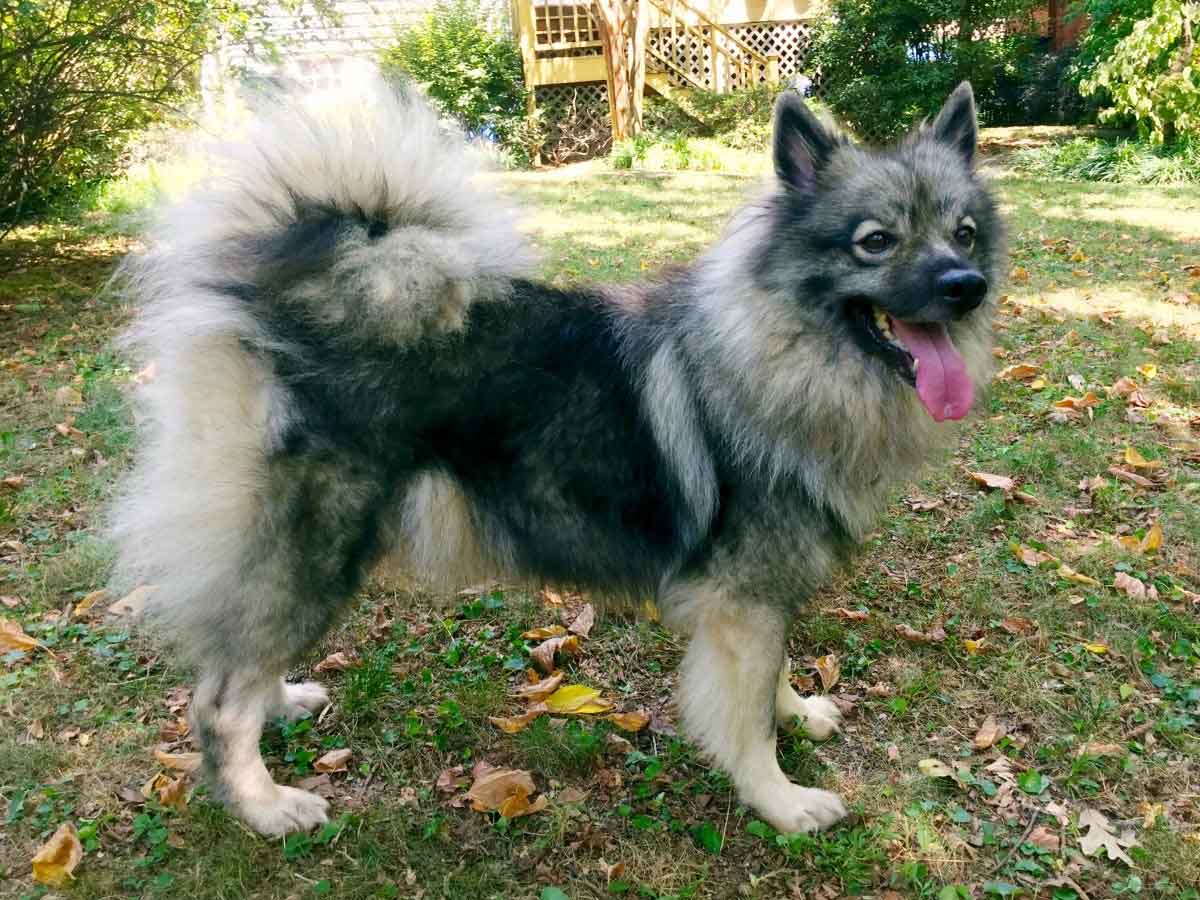
Finnish Lapponian Dog

In southern Europe it has been known for very recently, and is likely to succeed when its qualities are discovered.

Content

History

The Finnish Lapphund is a robust archetype of dog. In his native Finland he is called Suomenlapinkoira, which is also his official name. In Germany his friends call him Lappi To abreviate. He originally comes from the herding dogs for the reindeer herds of the samis, Laponia, the settlement area of รขโ‚ฌโ€นรขโ‚ฌโ€นthe Sami, extends over large parts of the northern Scandinavian peninsula. Herding the fast and agile reindeer in the rugged landscapes around the Arctic Circle is no easy task. Like this, over many centuries, an extremely robust and reliable working dog was created. Apart from grazing, the Finnish Lapphund accompanied humans during the hunt. In the fields he guarded and protected the families of the samis, who had lived as nomads for a long time. In the shops he warmed his people at night.

This dog, that we hardly know today, it is one of the oldest dog breeds described in literature. Already the great Swedish natural scientist Carl von Linnรฉ described the Lapp dog about 1750 with the highest recognition, to mention just one example. About 1900 the Finnish Lapphund was discovered by local Finnish and Swedish dog lovers as a companion dog. It had already become very rare then. First there was the problem of finding the right dogs to create a kennel according to the ideas of modern pedigree dog breeding.. Because the Finnish Lapphund it was a little different in each tribe sami and as in all ancient races, was quite diverse in itself.

A first definition of race was made in 1945 by the Finnish Kennel Club. There he was still called the lappish herding dog. In 1955 was officially recognized by the fCI (International Cynological Federation). In 1967 the name was changed to Lapphund. In 1993 received its current name from Finnish Lapphund. Like the name, also changed the determination of this original and ancient type of dog. Of the herding and hunting dog, modern breed dog breeding made a companion. The appearance was unified and her coat was made considerably longer. But, has remained the herding dog, since he has lived for thousands of years as a companion of samis.

This rustic and very exciting dog is enjoying, with good reason and luck, growing in popularity in recent years.

Physical characteristics

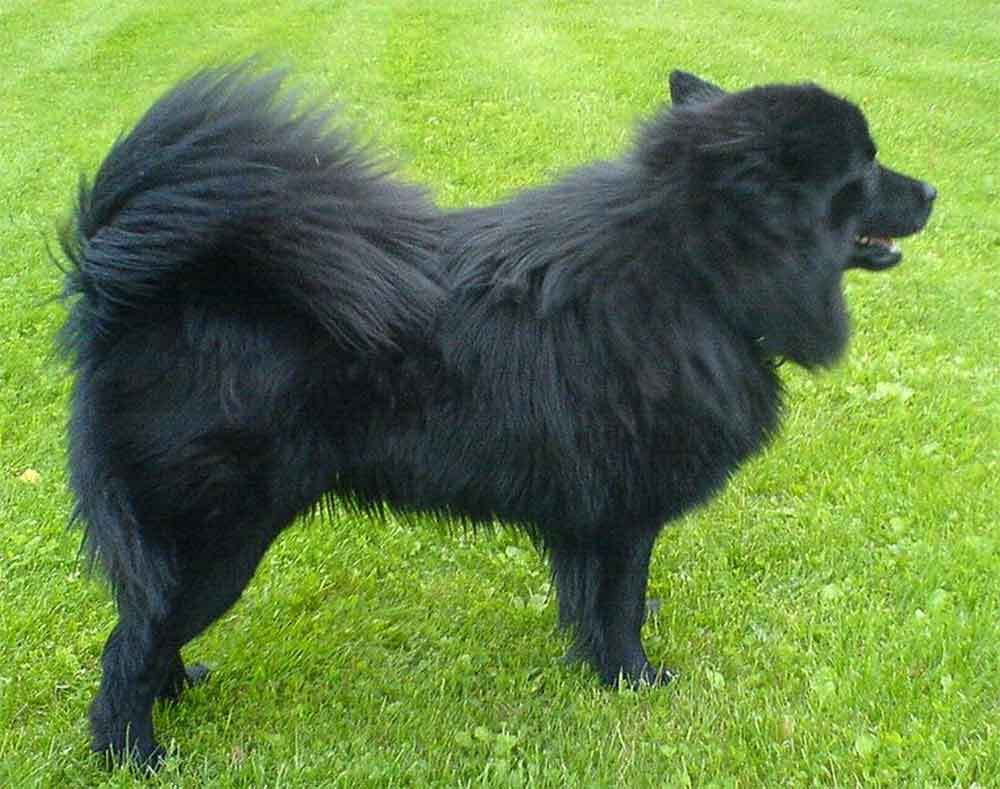
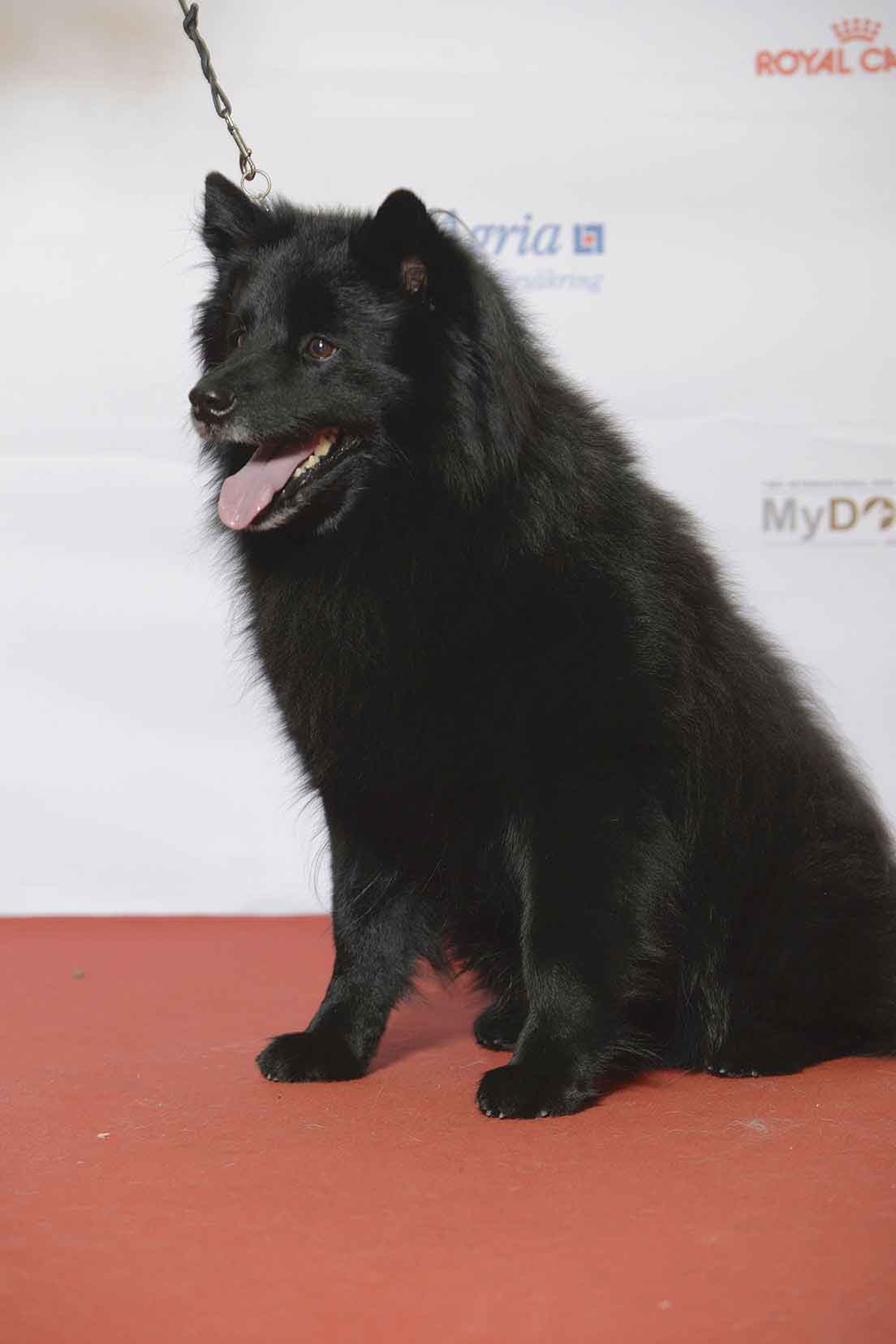
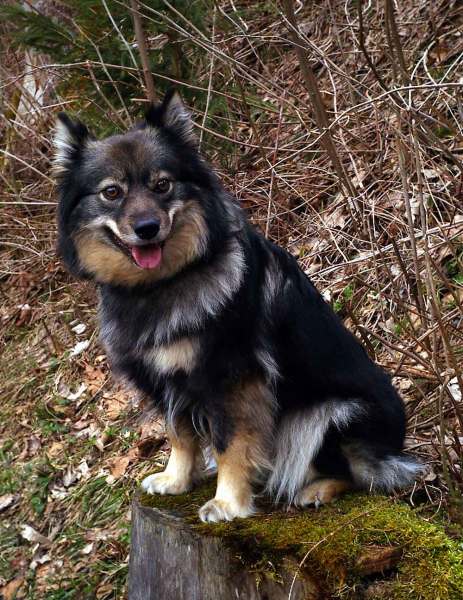
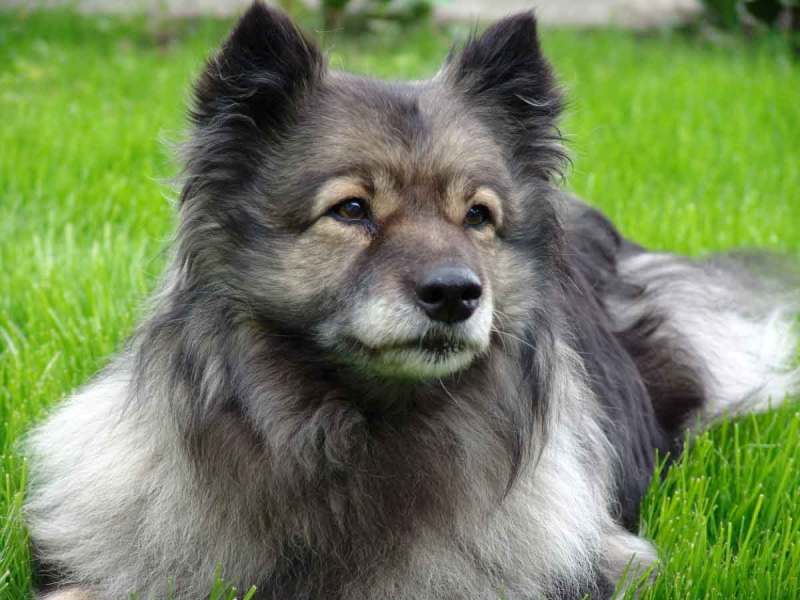
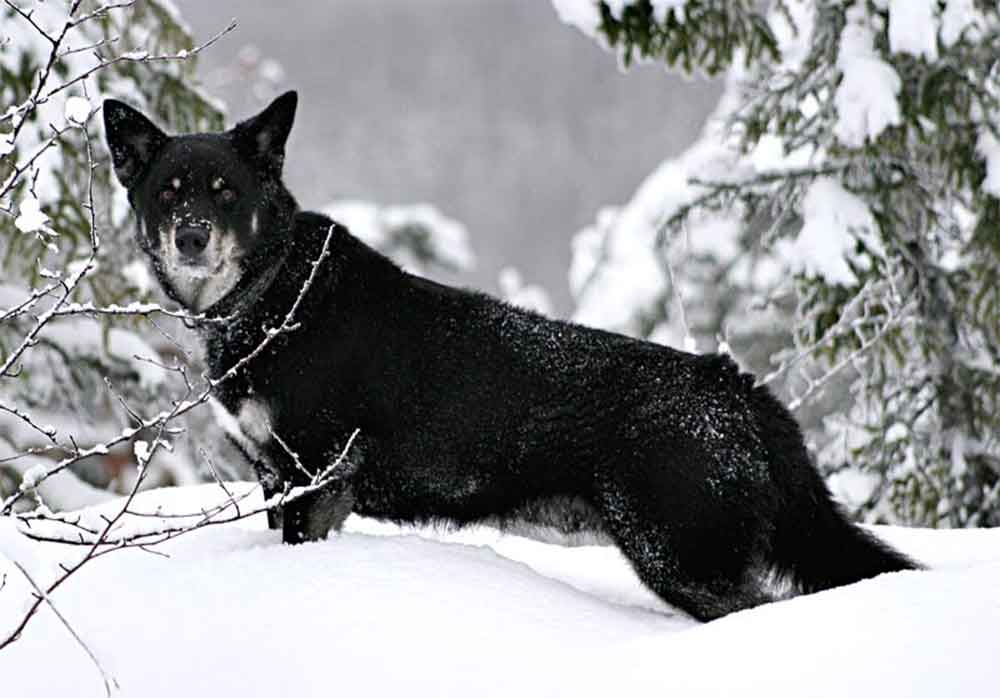
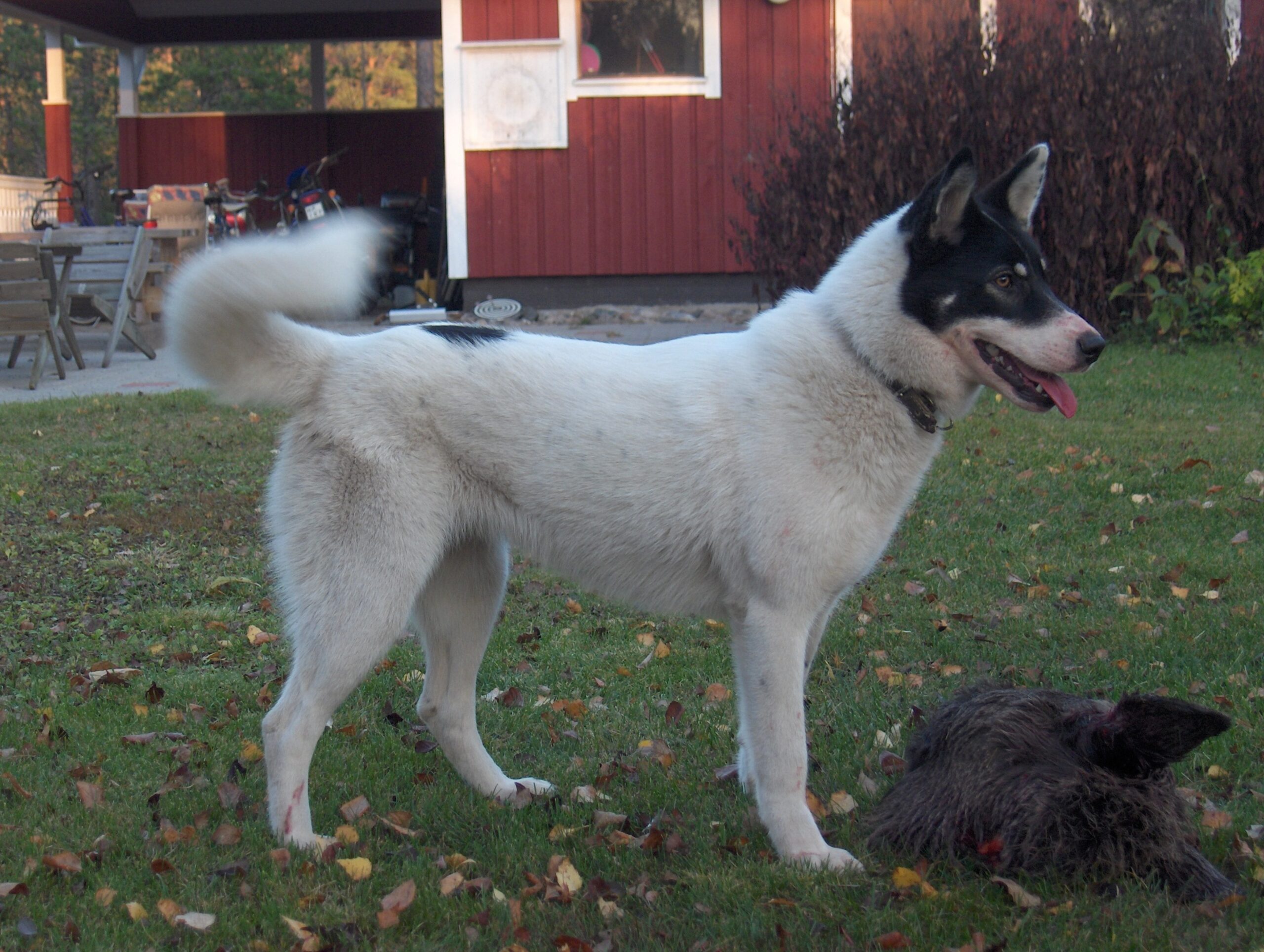
The Finnish Lapphund is a medium-sized representative of the original type dogs. It is a classic Nordic dog, which still shows its former role as a herding dog for herds of reindeer, hunting dog and guard dog. His charisma is breathtakingly sovereign. The Finnish Lapphund currently has a long and robust coat, insensitive to weather. It is a double coat with a rough top coat. It should not be curly. Males also have abundant mane. All coat colors are allowed, but a basic color must be clearly recognizable.

The Finnish Lapphund It has a height at the withers of about 49 centimeters in males and 44 centimeters in females. It is valid that the type is more important than the size. Weight is not prescribed by the standard. Their ears are usually upright. The tail is of medium length and abundantly provided with long hair.. In movement the tail should be curved over the back or to one side, at rest it can be carried hanging. The official standard describes the current Finnish Lapp in this way:

A little smaller than the average size dog, of strong constitution in relation to its size, whose body length slightly exceeds the height at the withers.

Character and skills

The Finnish Lapphund has remained a typical northern dog in its nature. He combines originality and familiarity with his humans in a special way. The loop is not a "one -man dog", Although initially reserved with strangers. Usually announced with loud barks . It is a friendly member of the whole family. Has the qualities of a working dog and a family dog รขโ‚ฌโ€นรขโ‚ฌโ€นat the same time. But, this requires certain storage conditions (see below). The Finnish Lapphund it still has the features that have made it indispensable as a versatile village helper sami for thousands of years. So it can be understood that this original dog finds its way in the modern world without any problem and is even used successfully as an assistance or therapy dog..

The Finnish Lapphund he is a great companion, simple and docile that radiates a fresh character, rustic and sovereign. it's very peaceful. In general, there is still a lot of hunting instinct alive in Lapps. But, this is pronounced individually very differently. In any case, should generally be easy to control with a bit of common sense. The official standard briefly describes its nature as:

"Bright, brave, calm and eager to learn. Pacific and reliable ยป. The Lapp is a great friend who deserves a much more important role in the world of dogs. The Finnish Lapphund caresses the soul of his master and caretaker.

Fitness

The Finnish Lapphund easy to train and manage. He is very willing and sometimes forgives mistakes. So it is suitable like hardly any other Nordic dog also for a committed beginner.. The Finnish dog it is not a dog for a flat. The ideal would be a house with a garden. Because at Lapp he likes to stay out, where you want to spend the night or in winter you like to roll up and have it snow. A great experience. The garden should not be thought of as an ornamental garden. To the Lapps they like to dig and dig a little cave.

The Finnish Lapphund they still have the qualities of a herding dog and can still do this job today. But, unlike many other ancient herding dog breeds, is undemanding and does not need constant employment. But, likes to accept challenges, also in the different disciplines of sport for dogs. To the Lapps they do very well as tracking dogs. The lush fur of the Finnish Lapphund requires intensive grooming, especially during the change of coat in spring and summer. Then, especially your house, his car and his clothes will be full of his long hair, even if you brush it every day. The Lapps they are very family oriented and very child friendly. They are excellent companions and at the same time bring a piece of wild nature into our lives..

Education

The Finnish Lapphund is very eager to learn and to learn and turns to us humans. So that I can be well trained. But, you have to accept the challenge, even love him, to mentally engage with this original dog, self-confident, to empathize with his character. Not only will you accept your caregiver, it will also be dedicated to him. You have to get fully involved in the experience with this confident breed, typically Nordic herding and guard dogs.

Through a loving but consistent upbringing, you Lappi must be aware of his position in the family from puppyhood. It is ideal if you are active with your Lapp dog in dog sports or follow-up work. In this way, you can experience this wonderful experience of an intimate bond between man and dog, especially when you have a close and intimate relationship with your dog.

Care and health

The lush, double coat of the Finnish Lapphund requires intensive care, especially during the change of coat in spring and summer.

Typical diseases

The Finnish Lapphund it is a robust breed of dog. Due to the very small breeding base, be aware of consanguinity and the results of predisposition tests for inherited diseases. Serious breeders will be happy to provide this data.

Nutrition / Food

The Finnish Lapp he has no problems in his nutrition.

The life expectancy of a Finnish Lapland Dog

The breed has a life expectancy of more than 12 years according to the Kennel Club.

Buying a Finnish Lapland Dog

If you are interested in a Finnish Lapphund, you should get information from a local breeder affiliated with a Nordic Dog club. You should plan here long term, because puppies from serious kennels – and only the ones you should buy – they are hard to get. A puppy of this breed costs around 1.200 EUR.

Characteristics "Finnish Lapphund"

Coexistence is important that you have with your new friend. Before considering the acquisition of a dog of the breed "Finnish Lapphund" you know certain factors. Not all breeds of dogs are apt to live in an apartment, you must take into account his character, their need for exercise, their interaction with other pets, their care and if you have small children, their level of tolerance towards them.

Training ?

4,0 of 5 stars (based on 1 review)

Suitability of the apartment ?

2,0 of 5 stars (based on 1 review)

Can be alone all day ?

1,0 of 5 stars (based on 1 review)

Suitable as a first dog ?

3,0 of 5 stars (based on 1 review)

Weight gain ?

3,0 of 5 stars (based on 1 review)

Health ?

4,0 of 5 stars (based on 1 review)

Intelligence ?

4,0 of 5 stars (based on 1 review)

Kindness with child ?

5,0 of 5 stars (based on 1 review)

Tendency to bite ?

1,0 of 5 stars (based on 1 review)

Tendency to bark ?

4,0 of 5 stars (based on 1 review)

Tendency to flee ?

2,0 of 5 stars (based on 1 review)

hair loss strength ?

3,0 of 5 stars (based on 1 review)

Suitable as a guard dog ?

4,0 of 5 stars (based on 1 review)

Joy ?

4,0 of 5 stars (based on 1 review)

Cat friendliness ?

4,0 of 5 stars (based on 1 review)

Power level ?

4,0 of 5 stars (based on 1 review)

Images "Finnish Lapphund"

Photos:

1 – Finnish Lapland Dog by https://pxhere.com/en/photo/721341
2 – Finnish Lapland Dog by https://pxhere.com/en/photo/676715
3 – Finnish Lapland Dog by https://pxhere.com/en/photo/1136704
4 – Finnish Lapland Dog by https://flic.kr/p/cuPwW
5 – Finnish Lapland Dog by https://pixabay.com/es/photos/perro-perro-de-pastoreo-frontera-1806039/
6 – Finnish Lapland Dog by https://pixabay.com/es/photos/frontera-perro-pastor-britรกnico-1913373/

Videos "Finnish Lapphund"

Type and recognitions:

  • FCI CLASSIFICATION:
  • Group :
  • Section : . .

Federations:

  • FCI – Group 5 – Section 3 Nordic Watchdogs and Herders.. โ“˜

FCI breed standard "Finnish Lapphund"

Origin:
Finland

Date of publication of the valid original standard:
30.09.2016

Use:

Originally a shepherd and guard dog, used in the reindeer shelter. Today it is also a popular breed as a company dog.


General appearance:

Smaller than medium, conformation is strong in relation to size; is slightly longer than the height at the withers.

Long, thick fur with erect ears

PROPIMPORTANT ORTIONS: The depth of the body is slightly less than half the height at the withers. The muzzle is slightly shorter than the skull. The skull is slightly longer than it is wide; its depth corresponds to its width.


Behavior / temperament:

Awake, courageous, calm and eager to learn. Friendly and loyal.

Head:

Strong in its outline, rather wide.

Cranial region:
  • Skull: Width, slightly convex. The forehead is slightly domed The frontal furrow is clearly defined.
  • Depression links (Stop): Clearly defined.

facial region:

  • Trufablack or brownharmonizing with the coat color.
  • Horcico: Strong, wide and straight; seen from above and in profile, thins evenly, but only slightly towards the tip.
  • Belves: Tight.
  • Jaws / Teeth: The jaws are strong. Scissor bite.
  • Cheeks: The zygomatic arches are clearly marked.
  • OjorsDark brown oval shapeharmonizing with the coat color. The expression is soft and friendly.
  • Obars: Medium-sized, carried erect or semi-erect, implanted rather separate, rather wide at the base, Triangularly and very mobile.The interior covered in hair. Itร‚ยดs equally acceptable for one ear to be erect and the other semi- erecta.

Neck:

Medium long, strong and covered with great abundance of hair.

Body:

  • Cross: Muscular and wide, onlyslightly marked
  • Back: Strong and straight.
  • Pork loin: Short and muscular.
  • Rump: Of a medium length, well developed, only slightly oblique
  • Breast : Deep, rather long, almost reaching up to the elbows,
  • not very wide. The ribs are slightly arched; the sill is clearly visible, not very strong
  • Bottom line and belly: Slightly retracted.

Tail:

Rather high implantation, average length, covered with a lot of long hair. The tip of the tail can have a hook in the form of "J". In movement the tail is bent over the back or to the side; in idle can hang.

Tips

PREVIOUS MEMBERS:

  • General appearance: Powerful with strong bones Seen from the front they are straight and parallel.
  • Shoulder: Slightly oblique
  • Arm: As long as the scapula The angle between the arm and the shoulder is rather open.
  • ElbowsApproximately levelof the lower border of the rib cage, pointing straight back.
  • Forearm: Rather strong, vertical.
  • Carpo: Flexible
  • Metacarpus: Of average length, slightly oblique.
  • Previous feet: Well arched, rather oval than round, covered with abundant hair. The pads are elastic with the sides covered with abundant hair.

LATER MEMBERS:

  • General appearance: Strong bones, powerful, seen from behind they are straight and parallel Angulations are markedwithout exaggeration.
  • Thigh: Of more wide medium length with well developed muscles.
  • Knee: Pointed forward; angulation is clearly marked.
  • Leg: Relatively long and with strong tendons.
  • Hock: Moderately low implantation, angulation is clearly marked, but not too much.
  • Metatarsus: Rather short, strong and vertical.
  • Hind feetSame as previous.

Movement:

Effortless. Gallop's jogging easily. The limbs move parallel. When he works he is agile and fast.

Mantle

SKIN: Tight, over the whole body, without wrinkles.

Fur: Abundant; especially males have an abundant mane. The outer layer of hair is long, straight and rough. On the head and on the front of the limbs, the coat is shorter. Must have a soft and dense undercoat of hair.

Color: All colors are allowed. The basic color must be dominant. Other colors different from the basic one can be presented on the head, neck, chest, lower body, limbs and tail.


Size and weight:

Alturto the cross:

  • Ideal height for males: 49 cm.,
  • Ideal height for females: 45 cm.. With a tolerance of +/- 3 cm..

Type is more important than size.


Fouls:

Any deviation from the aforementioned criteria is considered as a fault and the severity of this is considered to the degree of the deviation to the standard and its consequences on the health and well-being of the dog..

  • Non-male males, non-female females.
  • Light head.
  • Insufficient fronto-nasal depression.
  • Fallen ears
  • Tail carried continuously below the level of the back.
  • Back angle too angled or too straight.
  • Lack of fur inner layer
  • Short-haired fur.
  • Outer layer of curly hairs.
  • Undefined basic color.

FALTAS DISQUALIFYING:

  • Aggressiveness or extreme shyness.
  • Any dog โ€‹โ€‹showing clear signs of physical or behavioral abnormalities must be disqualified..
  • Upper or lower prognathism.
  • Broken tail.
  • Completely fallen ears


N.B.:
  • Males should have two normal-appearing testicles fully descended into the scrotum..
  • Only functionally and clinically healthy dogs, with the typical conformation of the breed, should be used for parenting.

Itlatest changes are in bold.

Source: F.C.I - International Cynological Federation

Alternative names:

1. Finnish Lapphund, Lapinkoira, Suomenlapinkoira (English).
2. Suomenlapinkoira (French).
3. Suomenlapinkoira, Lapinkoira (German).
4. Suomenlapinkoira (Portuguese).
5. (espaรฑol).

โ–ท The world of Pets: Dogs, cats, birds, reptiles, amphibians

Kishu
Japรณn FCI 318 - Asian Spitz and related breeds
Kishu

The Kishu of Japanese hunting are characterized by their resistance, intelligence, great courage and, usually, a strong hunting instinct.

Content

History

The Kishu It has its origins several thousand years ago in the mountains of the ยซKii Peninsulaยซ, a region of Japan that extends over present-day Mie prefectures, Wakayama y Nara. In the past, the dogs did not have a uniform name, but were differentiated and named according to individual sections of the mountainous region of the "Kii Peninsula": Kumano Inu (kumano dog), Taji Inu (taji dog), Ouchiyama Inu (Ouchiyama dog).

From Hidaka to Arita the Kishus they were white and their names were Hidaka-Ken. In 1934 all these dogs were grouped under the name of the region and were called Kishu. Due to the remoteness of the mountainous regions, there were no crosses with other races or other race-changing phenomena in the Kishu Ken. For this reason, the Kishu it is one of the most original breeds of Japan, and one of the oldest dog breeds in the world.

In 1934 the breed was declared a natural monument of Japan and is therefore under state protection. Until the seventies it was forbidden to sell Kishu of Japan. Dogs could only be passed as gifts.

Although at the beginning of the breeding around the 70 percent of Kishus they weren't white, this is today the most common color within the breed. This is partly due to the fact that white dogs are easier to recognize when hunting.. Outside of Japan the breed has barely spread. There are a handful of breeders in the US.. and only a few dozen in Europe. The Kishu has some similarities with the Shikoku, the Kai Ken and especially with the Hokkaido, that are also not outside of Japan.

Physical characteristics of the Kishu

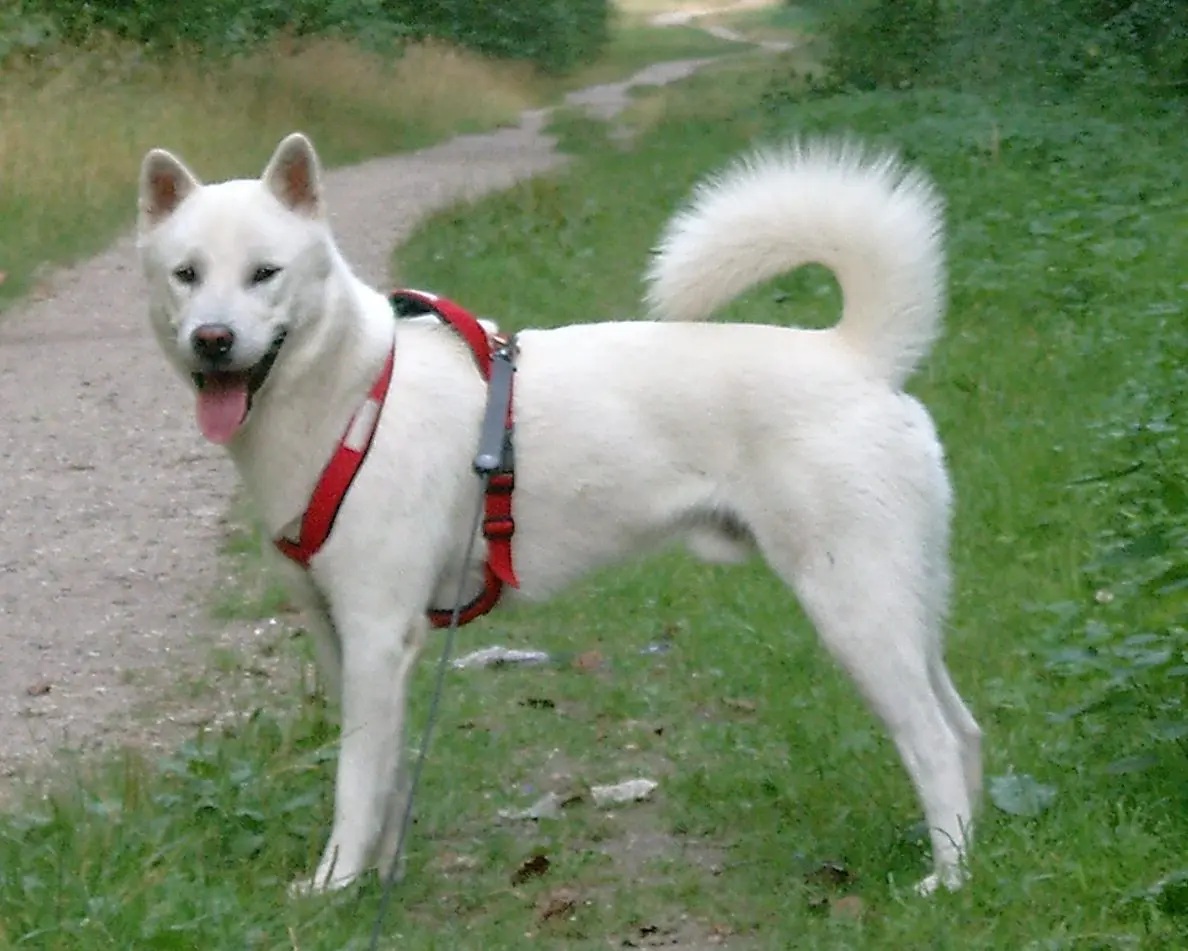
The Kishu measures approximately 46 centimeters tall, and weighs around 28 kg, is a medium-sized dog. The fur color is generally white. The fur is short, straight and thick with a layer of thickness. The ears are inclined forward and are rather small. This breed is strong, flexible and user-friendly.

Kishu's character and abilities

The Kishu is a hunting dog. In the Kishu region, dogs were used to hunt wild boar., deer, bears, hares and birds. according to the game, there were three directions of Kishus: deer, hare and boar / bear. The Kishu roe deer and hares hunter had a slightly lighter complexion that favored them on the hunt. Due to the non-optimal suitability of the breed, especially for hunting hares and small prey, this category did not prevail. Today almost all Kishu Kens historically they originate from hunting wild boar (and secondarily also) of bears. These Kishu Kens have a stronger physique, more pronounced musculature and a wild to sharp disposition.

In the old way of hunting, the hunter stayed in a place with only one dog and waited for the prey. Later hunting methods prefer game to be brought in by the Kishu Ken. The dog follows the game independently and silently. Like most Nordic hunting dogs, the Kishu only reports when you have placed the game. The dog's task is to "keep the game under control" until the hunter can shoot from a short distance.. Especially German hunters are often skeptical or incredulous about the abilities of the Kishu Ken to hunt the physically superior boar. In Japan, However, the skills of Kishu Ken they are highly valued. His ferocity and indomitable attitude make him so popular for boar hunting in Japan.. In Japan there has been an expression for decades that illustrates the special suitability of the Kishus as hunters:
ยซichiju – ikkuยป – "a weapon – a dog".

Character:

Representatives of this Japanese hunting breed are characterized by their resistance, intelligence, great courage and, usually, a strong hunting instinct. They are considered as one-person dogs, who form a strong bond with their two-legged companion and behave loyally. The kishus tend to dominate behavior, which can lead to problems with congeners, especially among males. His dominance is sometimes displayed on his own four walls, where they often want to have everything in sight. The Kishus they are not submissive to their owners and always keep their own head. This leads to the fact that they normally only perform tasks when they see meaning in them.. Towards strangers they behave aloof to shy. They are conditionally suitable as watchdogs.

Kishu education

It takes a lot of knowledge and patience to educate a Kishu, because intelligent animals tend to be stubborn and domineering. But, if you are consistent and have the necessary calm, the Kishu they will recognize you. Toughness is out of place in education. Don't expect submissive behavior from this proud four-legged friend. Pay attention to the control and management of hunting behavior, sometimes very distinctive. But, It must be taken into account that it will be difficult to let a Kishu without a leash, because even optimally trained representatives of the breed are often not available when they watch the hunt.

Work to confidently keep it at bay when you encounter the game. It also, the four-legged friend's social compatibility should be the center of attention during parenting. Puppy play classes and dog schools in general offer a good opportunity, because here the young Kishu You can already come into contact with conspecifics of different sizes and thus strengthen your social skills. Please, note that the Kishu you must be physically and mentally exhausted if you don't want to engage in an unpleasant alternative activity – for example, destroying home furnishings or poaching.

Kishu Health

Some kishus have a tendency to hypothyroidism, that is to say, an insufficient supply of thyroid hormones, usually due to limited thyroid function. Symptoms include fatigue and reduced performance. The owners of a Kishu they should have their thyroid gland examined by a vet if these symptoms occur. This disease is not life threatening and can usually be treated well with administration, mostly daily, of an appropriate medication. Because of the shape of your eyes, the breed also has a greater genetic disposition for eyelid malpositions, what can, However, be corrected by surgery. Dogs Kishu they also have a tendency to food and environmental allergies. Otherwise, This Japanese breed is considered robust and has an average life expectancy of 13 years.

The Diet of Kishu

The best health precaution, in addition to buying from a responsible breeder, It is a high quality and appropriate nutrition for this breed. This specifically means that you should choose a dog food in which meat is the main component and is listed accordingly at the top of the claim. The grain should not be included – not just a bottom fill, it can also trigger allergies in some Kishus. If fed high-quality feed from the beginning, the risk of food intolerances is reduced. Even with previously unseen representatives of the breed, no sudden food changes should be made, but offer a new food slowly. Mix increasing amounts of the unfamiliar food with the familiar one and watch for your dog to show intolerance reactions. Of course, fresh drinking water should always be available for your Kishu.

If it is suspected that you Kishu have a food allergy, a unique diet makes sense to find out what your companion animal is sensitive to. For this you must be patient and consult your veterinarian, because you should only give a certain food during a predetermined period of time. If the complaints improve with feeding, you can try another feeding. If the symptoms worsen, contact your veterinarian to clarify the subsequent procedure. This way you can find out which ingredients you are allergic to. Kishu. Attention: No treatments should be given during this time if possible.

Kishu care

Brushing once a week is usually enough to keep this breed's coat in optimal condition.. But, during the coat change twice a year, you should use the brush more often to remove dead hairs. This also has the positive side effect of the quadruped losing less fur on the ground.. Dirt can be brushed off as soon as it has dried, or washed with a damp cloth. Compared to other breeds, the Kishus they are considered very clean dogs. When you groom your dog at least once a week, take a look at their ears to clean them with a dog ear cleaner, if required, and check its claws. The latter should be shortened if they become too long. This is usually only the case for Kishus older that move less, or dogs that walk mainly on very soft ground.

Where can I find my desired Kishu?

The breed is very rarely found outside of Japan. But, there may be a dog breeder living in your region who has dedicated their work to this breed. In addition to a handful of breeders in the US. and russia, there are a few in europe, especially in the czech republic, the Netherlands, Poland, Finland and Lithuania. In Germany no official litters of Kishu in recent years. So be prepared for long journeys, if you have decided to adopt a Kishu – and learn more about adopting a puppy abroad before. Be sure to avoid advertisers who claim to sell you a pup from Kishu – they are usually only interested in making a quick profit and you will hardly get a Kishu in this way.

It is unlikely that a Kishu adult outside of Japan, you should be very lucky if you are looking for a purebred dog. But, even if you have fallen in love with a Kishu, it might make sense to look for similar breeds of the Spitz type or corresponding hybrids at animal shelters – this also applies to puppies, of course. The chance of success is much higher and you've also given a homeless four-legged friend a new home. Find out in advance about the known history and character of the potential new family member – often, as in the case of their own Kishu, some experience with dogs is important here to allow a successful coexistence and avoid communication problems between the animal and the human.

Characteristics "Kishu"

Coexistence is important that you have with your new friend. Before considering the acquisition of a dog of the breed "Kishu" you know certain factors. Not all breeds of dogs are apt to live in an apartment, you must take into account his character, their need for exercise, their interaction with other pets, their care and if you have small children, their level of tolerance towards them.

Training ?

2,0 of 5 stars (based on 1 review)

Suitability of the apartment ?

2,0 of 5 stars (based on 1 review)

Can be alone all day ?

2,0 of 5 stars (based on 1 review)

Suitable as a first dog ?

1,0 of 5 stars (based on 1 review)

Weight gain ?

1,0 of 5 stars (based on 1 review)

Health ?

4,0 of 5 stars (based on 1 review)

Intelligence ?

4,0 of 5 stars (based on 1 review)

Kindness with child ?

2,0 of 5 stars (based on 1 review)

Tendency to bite ?

3,0 of 5 stars (based on 1 review)

Tendency to bark ?

3,0 of 5 stars (based on 1 review)

Tendency to flee ?

5,0 of 5 stars (based on 1 review)

hair loss strength ?

4,0 of 5 stars (based on 1 review)

Suitable as a guard dog ?

3,0 of 5 stars (based on 1 review)

Joy ?

3,0 of 5 stars (based on 1 review)

Cat friendliness ?

2,0 of 5 stars (based on 1 review)

Power level ?

3,0 of 5 stars (based on 1 review)

Videos "Kishu"

HTTPS://youtube.com/watch?v=e7jivgljnps
Kishu (Kishu Inu) / Breed of dog
HTTPS://youtube.com/watch?v=B8TL4HWQGRw
Kishu Ken (Kishu Inu)

Type and recognitions:

  • FCI CLASSIFICATION:
  • Group :
  • Section : . .

Federations:

  • FCI – Group 5: Spitz-type dogs and primitive type – Section 5: Asian Spitz and related breeds. โ“˜

FCI breed standard "Kishu"

Origin:
Japan

Date of publication of the valid original standard:
20.12.1994

Use:

Hunting dog and company.


General appearance:

medium size dog, well proportioned with developed muscles. Its ears are erect and its tail is curled or sickle-shaped.. Its constitution is robust and compact with strong bones..

IMPORTANT PROPORTION : The relationship between the height of the withers and the length of the body is 10 : 11.


Behavior / temperament:

Remarkably durable, with a spontaneous character, but noble and worthy. His temperament is faithful, docile and very awake.

Head:

---

Cranial region:
  • Skull : Wide forehead.
  • Depression links (Stop) : Rather marked, with inconspicuous frontal furrow.

facial region:

  • Truffle : Black; in white-coated dogs, liver-colored truffle is allowed. Straight nose cane.
  • Snout : very thick, cuneiform, gradually tapering towards the tip.
  • Lips : Very adherent.
  • Jaws / Teeth : Powerful scissor bite.
  • Cheeks : Relatively well developed.
  • Eyes : Proportionately small, almost triangular, well separated, dark brown.
  • Ears : Small, triangular, slightly directed forward and carried vigorously erect.

Neck:

Strong and muscular.

Body:

  • Cross : High.
  • Back : Straight and short.
  • Pork loin : Wide and muscular.
  • Breast : Deep, moderately arched ribs.
  • Belly : Well withdrawn.

Tail:

High insertion, thick, He carries it vigorously curled or in the shape of a sickle on his back. The tip of the tail should reach approximately to the hocks..

Tips

PREVIOUS MEMBERS :

  • Shoulder : Moderately obliques covered with well-developed muscles. The scapulohumeral joint presents a moderate angulation.
  • Elbows : Well adhered to the body.
  • Forearm : Straight.
  • Metacarpus : Slightly inclined.

LATER MEMBERS :

  • Thigh : Long.
  • Leg : Short.
  • Warm-foot joint : Strong and resistant.

FEET : Well arched and compact fingers; thick, elastic pads. Hard nails and preferably dark in color.

Movement:

Light and elastic.

Mantle

HAIR : The hair of the outer coat is hard and straight, the undercoat is soft and dense. The hair on the cheeks and tail is relatively long..

COLOR : White, rojo o sesame (red-fawn hair with black tips).


Size and weight:

Height to the cross :

  • In males : 52 cm.,
  • In females : 46 cm..

A variation of +/- 3 cm..


Fouls:

Any deviation from the aforementioned criteria is considered as a fault and the severity of this is considered to the degree of the deviation to the standard and its consequences on the health and well-being of the dog..

โ€ข Inverted sexual characteristics.
โ€ข Wide.

MISS PLAYOFFS

โ€ข Aggressive or fearful dog.
โ€ข Pronounced upper or lower prognathism.
โ€ข Short tail, hanging tail.
โ€ข Shyness.

Any dog โ€‹โ€‹showing clear signs of physical or behavioral abnormalities must be disqualified..


N.B.:

Males should have two normal-appearing testicles fully descended into the scrotum..

Source: F.C.I - International Cynological Federation

Alternative names:

1. Kishu-Ken, Kishu-Inu (English).
2. Kishu-Ken, Kishu-Inu (French).
3. ็ด€ๅทž็Šฌ, Kishลซ-Inu, Kishu-Ken (German).
4. Kishu-Ken, Kishu-Inu (Portuguese).
5. Kishu-Ken, Kishu-Inu (espaรฑol).

โ–ท The world of Pets: Dogs, cats, birds, reptiles, amphibians

Pharaoh Hound
Malta FCI 248 . Primitive type

Pharaoh Hound

The Pharaoh Hound in family is smart, friendly, affectionate and playful.

Content

History

The Pharaoh Hound it is a hunting dog like those of hunting dog breeds, formerly at home in many areas of the Mediterranean. It is also called Kelb-tal-Fenek. ยซKelb-tal-Fenekยป is Maltese and means ยซRabbit dogยป.

Like all Warren hound, is the specialist in rabbit hunting. But, does not go to the burrow like the Dachshund or the terriers. Because the Pharaoh Hound and Warren hound they hunt on land when they see them. They are agile like a hunting dog and can launch attacks fast as lightning. As a group, surround their prey. In this way, knock down dozens, even hundreds of rabbits in a short time. The Pharaoh Hound they often work completely independently without guidance from the hunter. In Malta they also help with herding the goats and are useful as all-rounders for all tasks around the home and on the farm..

The Pharaoh Hound was created in Great Britain in the decade of 1960 as an independent breed of dog. It is an offshoot of the population of these dogs, that have existed for thousands of years in the northern and eastern Mediterranean. Besides of Pharaoh Hound, the Warren hound are other descendants of these dogs, each of which is now an independent race. Its roots go deep into the past.. But, its exact origin is not clear. Its resemblance to the ancient Egyptian hunting dog Tesem, one of the oldest documented dog breeds, it's amazing. But, It is neither proven nor probable that they are "pure" descendants of Tesem. This type of dog probably existed everywhere, since it already served the people of the ancient world in its current role.

With the time, regional strains were developed that, However, repeatedly mated with each other. The World Canine Federation, Fรฉdรฉration Cynologique Internationale, took this into account when establishing a collection standard for Mediterranean breeds up to 1977. Great Britain then created the breed of dogs Pharaoh Hound and later handed over the patronage to Malta. There it was even declared a national dog in 1974. In 1991 was officially recognized by the Fรฉdรฉration Cynologique Internationale as an independent race.

(See study on canine genome).

Physical characteristics

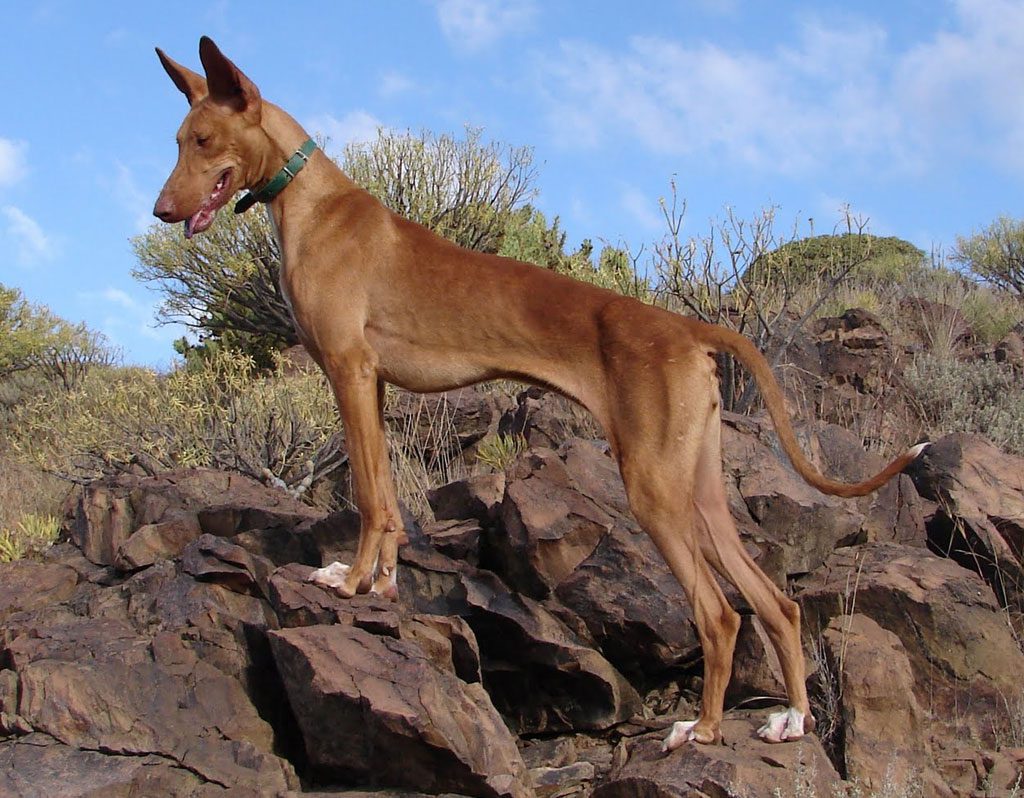
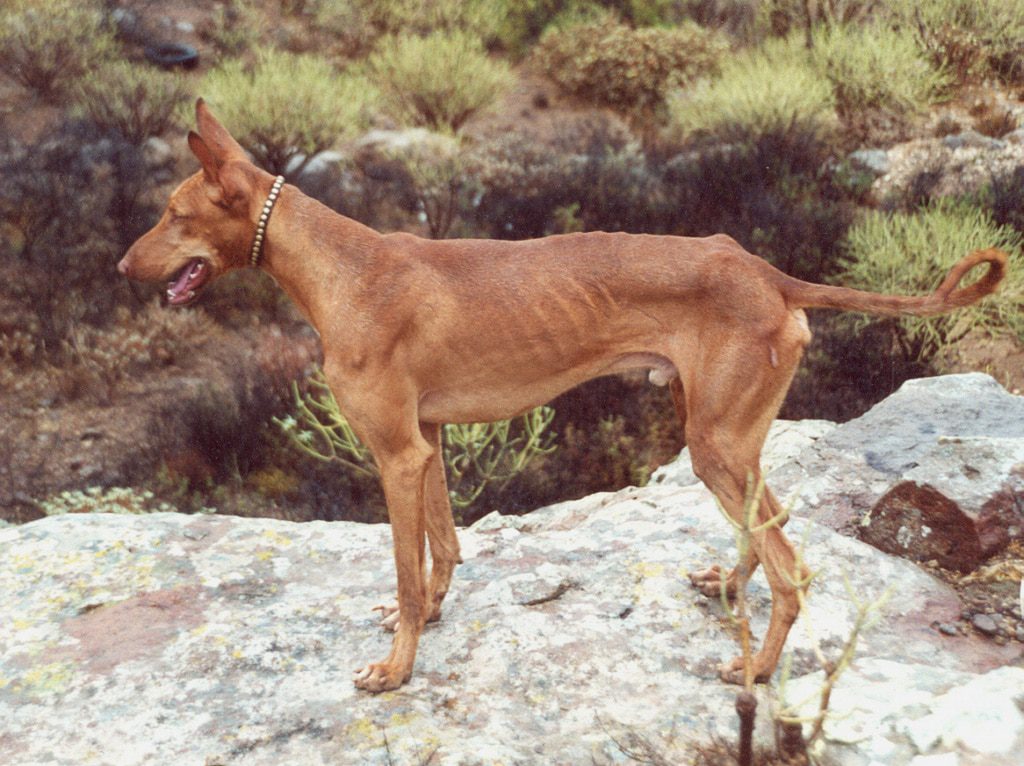
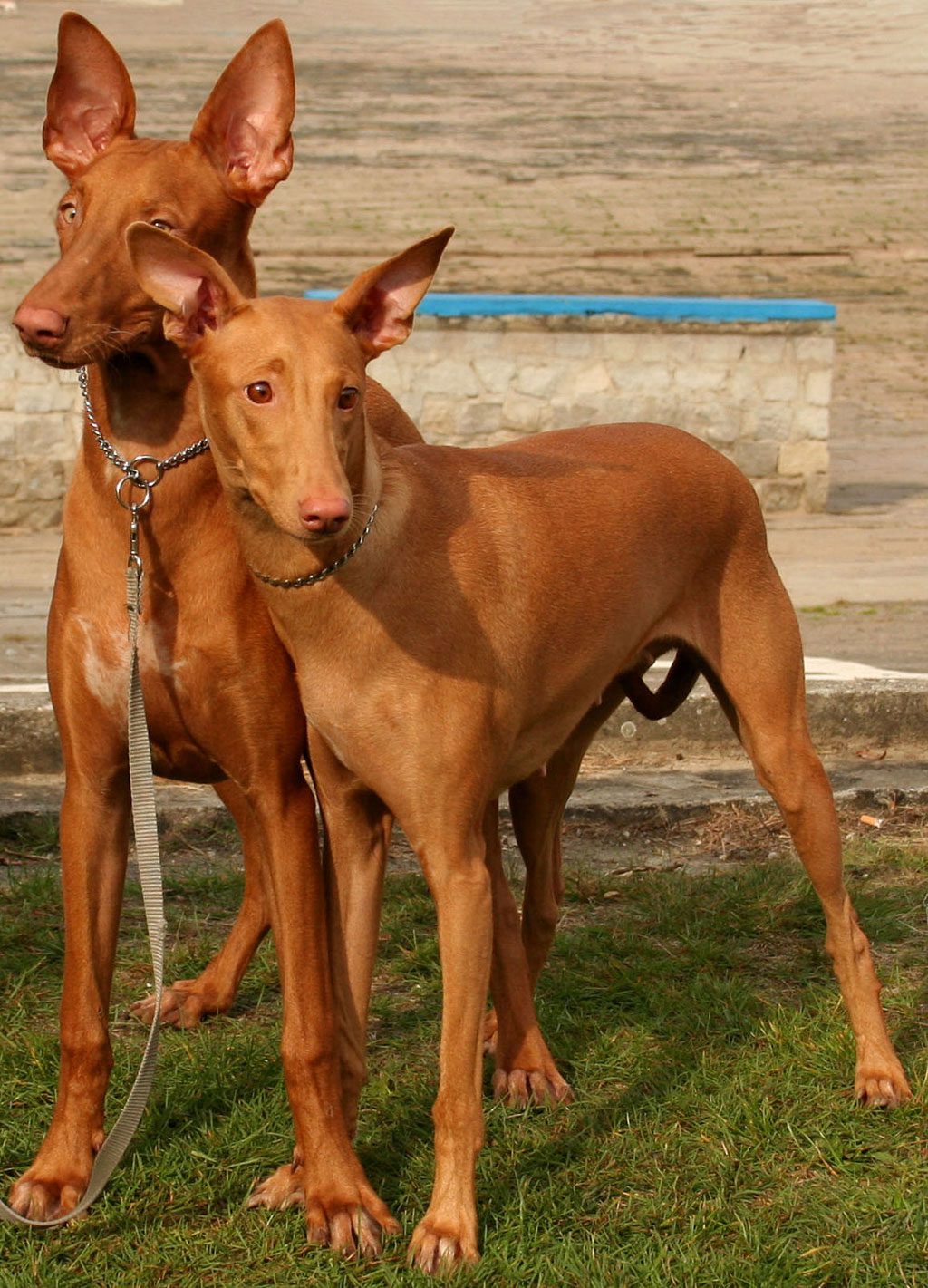
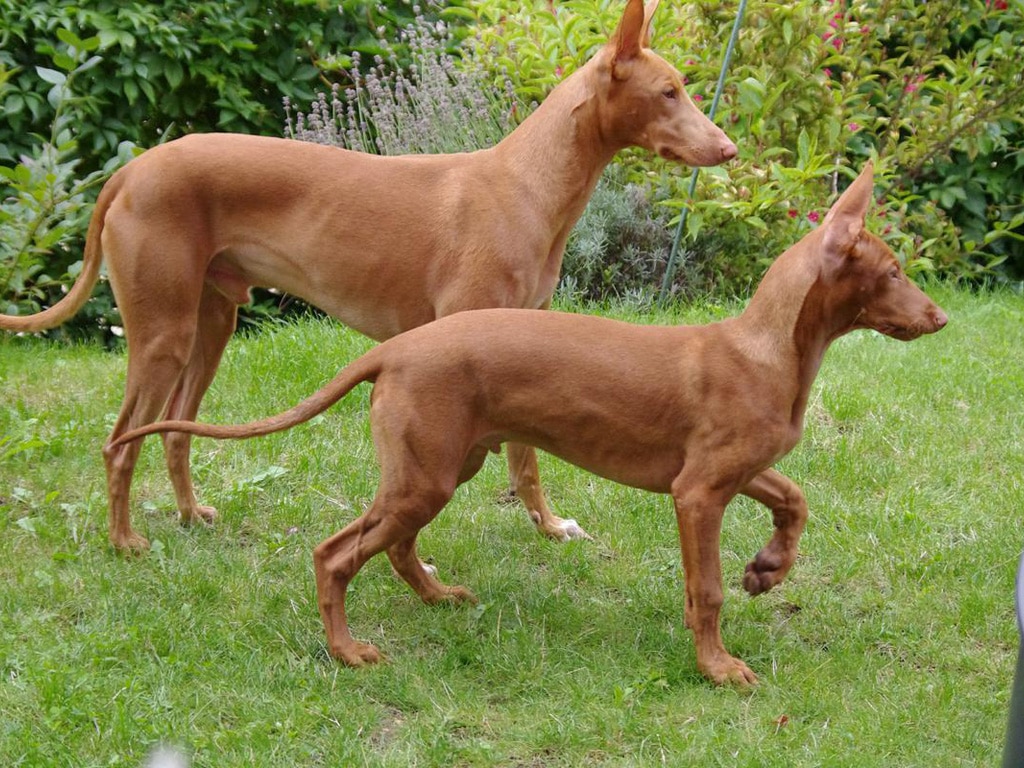
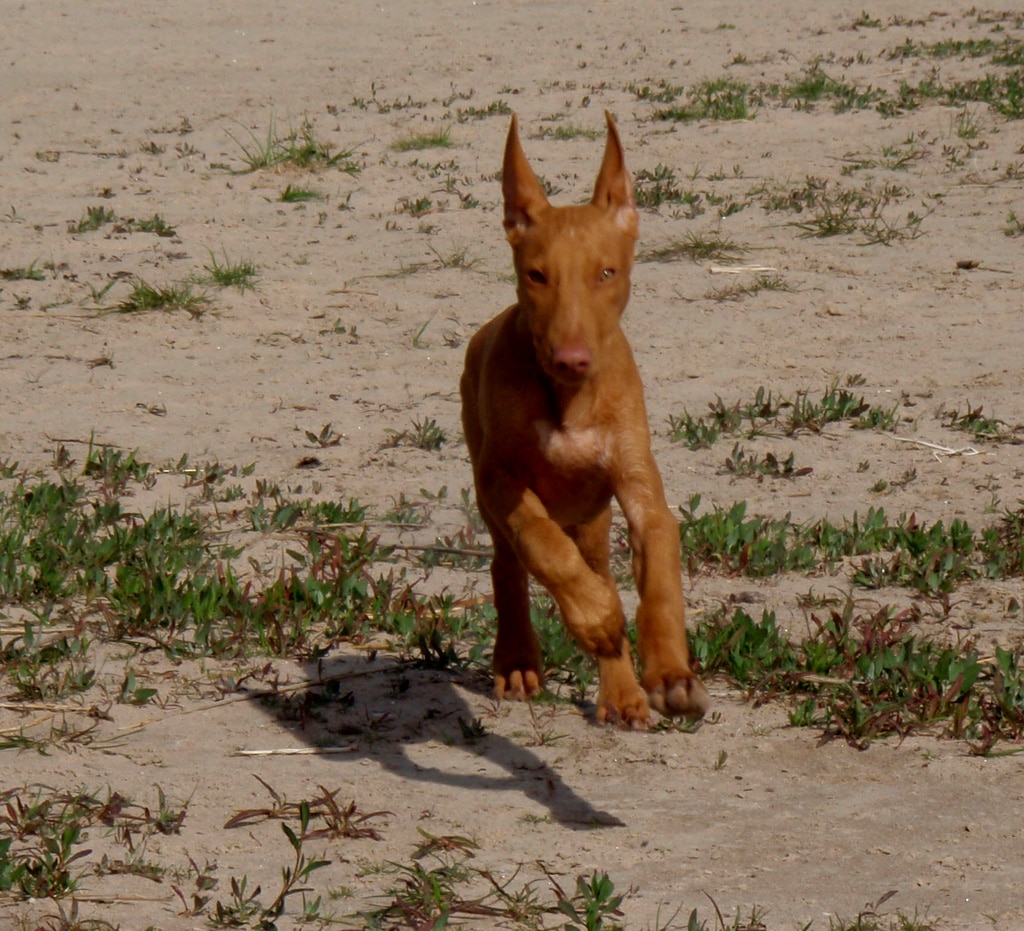
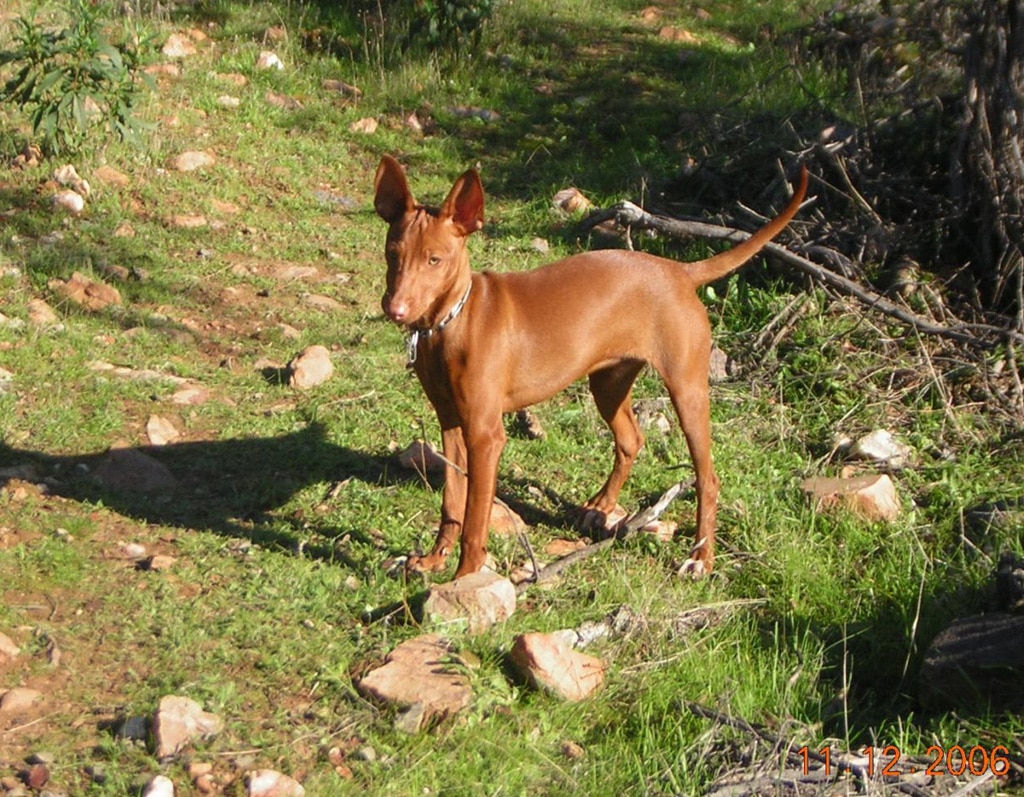
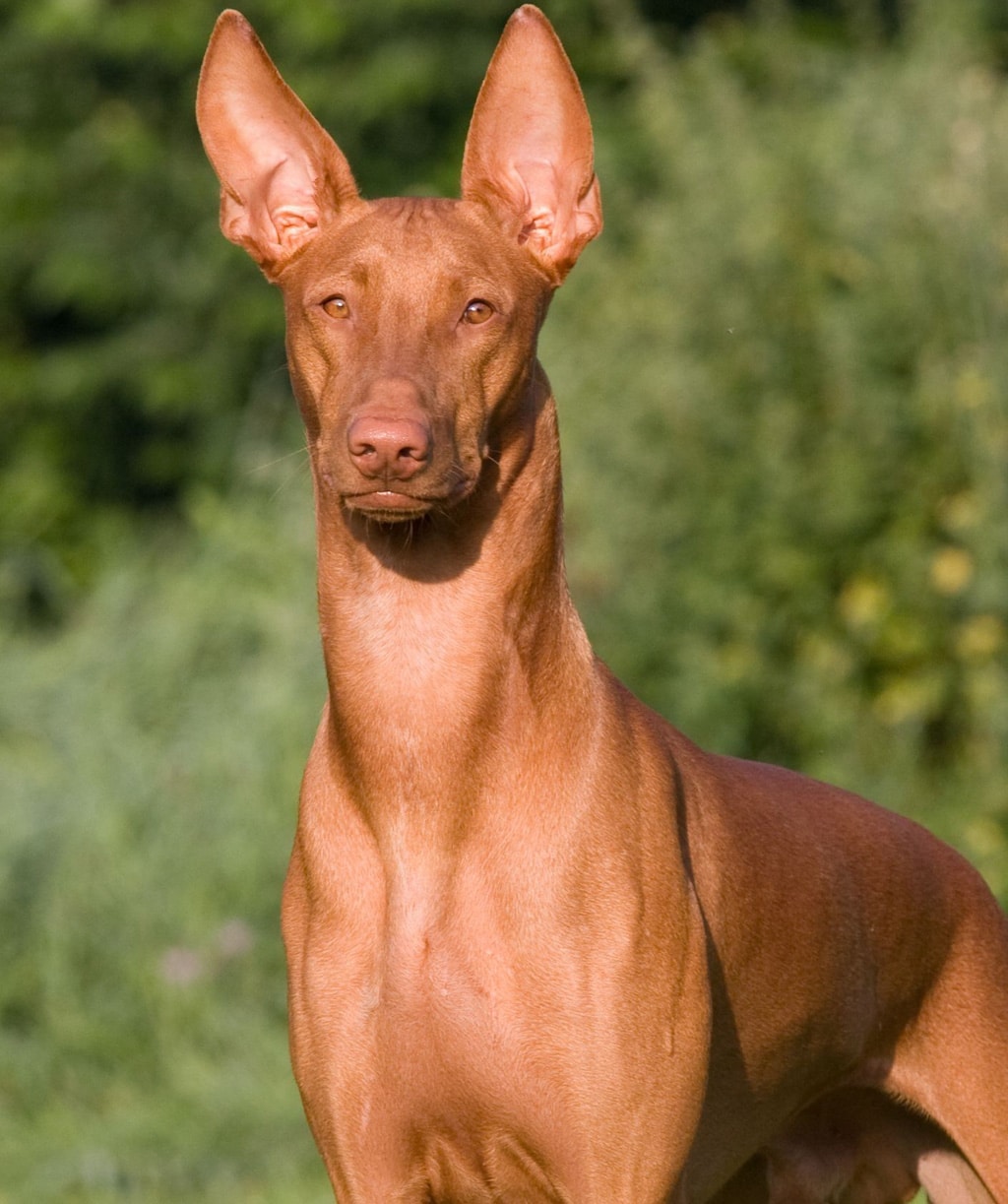
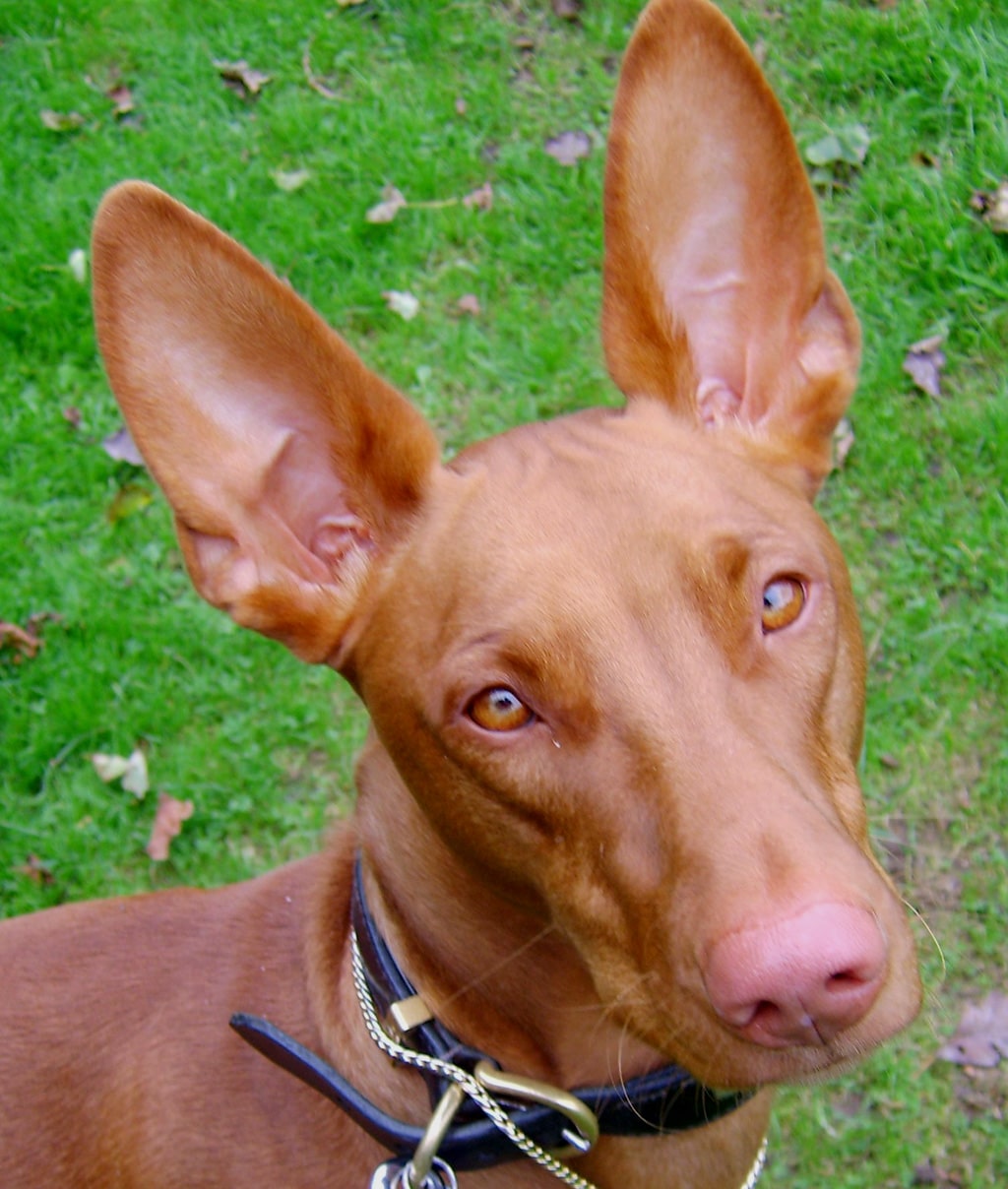
Haughty and delgado, the Pharaoh Hound is a dog from size medium with very defined lines, elegant and noble porte.

The height in the males is of 55 to 63 cm., and weigh in 10 to 12 kg; the females measure of 52 to 61 cm to the cross, and weigh in 8 to 10 kg. If born with a tail does not lack that ampute you.

The belly is fine and the back straight and strong. The body is made up of long muscles, of dry lines.

Has the head triangular, almost without stop, the eyes Amber blend with the mantle, they are oval and slightly sunken. The ears they are inserted to half-height, Reprint alert to carry them, they are wide at its base and thin and long.

The tail is curved and carries low, but when he is happy he has been in high.

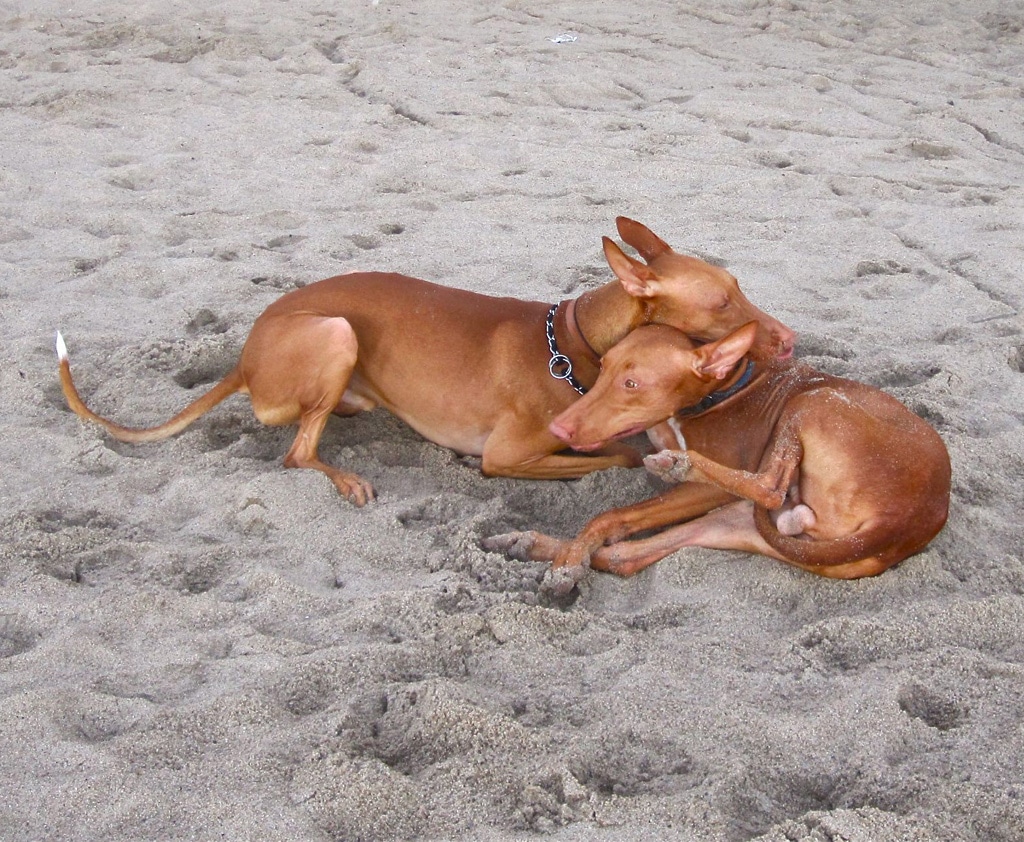
Its fur is fine, short and glossy. In some cases it may be a little rough to the touch. The color fur is reddish brown clear to reddish brown dark with white markings. According to the standard, the white tail is highly desirable.

As well, is supported in the standard to submit a white mark on the chest and white fingertips, including a white stripe down the center line of the face.

Character and skills

The Pharaoh Hound he is a hunting dog and a hound at the same time. They are sometimes used in their homeland as watchdogs or herding dogs for goats.. Before genetic separation from the total population, many dogs had to struggle for scraps of human food and often suffered from hunger. These original living conditions still determine its nature today.. They are very agile and alert. Almost nothing escapes your keen senses. Especially like young dogs who crave exercise and experiences, ideally hunting and first of all the option of free running. As they tend to have a strong hunting instinct, this deep-rooted need of dogs in our latitudes can only be satisfied on rare occasions.

It is an experience to see him Pharaoh Hound running freely. Because they can sprint fast and especially capture prey in extremely courteous races. the Pharaoh Hound hunt with all three senses: Odor, view, ear. The standard describes its nature in this way:

Vigilant and passionate hunter who uses both sight and smell. When working short distance, he also uses his ears in a remarkable way.

The Pharaoh Hound they are very intelligent and docile. They quickly learn what is allowed and what is taboo. They are friendly and open-minded with people. Towards humans there is no aggression; towards other dogs, However, this may be different, particularly with males. The Pharaoh Hound they have a kind and playful nature. They seek intimate connection with their masters and are loyal to them.. Even in spite of its thinness, they are very hard and resistant.

Observations

The Pharaoh Hound is very similar to the Cirneco dell'Etna Italian.

Fitness

Basically the Pharaoh Hound it's good to keep it. It is very suitable as a family dog รขโ‚ฌโ€นรขโ‚ฌโ€นand friend of children and wants to be seen as a member of their family. But, generally not suitable for a flat in the big city. You need long daily walks in nature, better several times a day. Here your senses are at their highest level. He is a dedicated and alert hunting dog. You need at least here and there the possibility of being able to exhaust yourself while running free.

One Pharaoh Hound maintained in a species appropriate manner is calm and gentle in the home. Then you can rest relaxed in your basket or on the sofa. It also, is very playful. Some specimens are extremely alert and like to bark.. Also in another way barking is used very happily for communication and to express their feelings. It should also be noted that the Pharaoh Hound It does not have an undercoat and by nature it has little insulating fat and is therefore sensitive to cold..

Education

One Pharaoh Hound well socialized can be trained very well. Your senses alert, his intelligence and friendly affection make it easy for him to understand humans. He also wants to please us and live in harmony. Of course it always requires a just consequence. He realizes his master's lack of care immediately and uses him mercilessly. So he'll use every inattention to steal an unprotected gift.. For proper occupation and physical workload for dogs, the greyhound association offers the possibility of participating with Pharaoh Hound in Greyhound racing or hunting dogs. Other dog sports such as agility are also suitable. Due to his strong hunting motivation, training requires patience and empathy.

Care and health

The Pharaoh Hound he is very frugal. Brushing the coat from time to time is enough.

Typical diseases

There are no exact data on the typical diseases of this rare breed of dogs.. One problem could be inbreeding.

Nutrition

The Pharaoh Hound he is usually very gluttonous. you have to be careful here. Otherwise, They are very austere breeds in terms of the type of food..

The life expectancy of โ€œPharaohโ€™s Dogโ€

There are no figures on the life expectancy of Pharaoh Hound. But, should be around 12 years.

Buy a "Pharaoh's Dog"

If you want to spend your life with a Pharaoh Hound, you should first check if you can guarantee all the conditions for it, especially if you have the possibility to let it run regularly. Otherwise, you should look for very similar dogs in animal shelters, in serious animal protection organizations.

Characteristics "Pharaoh Hound"

Coexistence is important that you have with your new friend. Before considering the acquisition of a dog of the breed "Pharaoh Hound" you know certain factors. Not all breeds of dogs are apt to live in an apartment, you must take into account his character, their need for exercise, their interaction with other pets, their care and if you have small children, their level of tolerance towards them.

Training ?

2,0 of 5 stars (based on 1 review)

Suitability of the apartment ?

2,0 of 5 stars (based on 1 review)

Can be alone all day ?

2,0 of 5 stars (based on 1 review)

Suitable as a first dog ?

1,0 of 5 stars (based on 1 review)

Weight gain ?

4,0 of 5 stars (based on 1 review)

Health ?

4,0 of 5 stars (based on 1 review)

Intelligence ?

4,0 of 5 stars (based on 1 review)

Kindness with child ?

3,0 of 5 stars (based on 1 review)

Tendency to bite ?

2,0 of 5 stars (based on 1 review)

Tendency to bark ?

4,0 of 5 stars (based on 1 review)

Tendency to flee ?

5,0 of 5 stars (based on 1 review)

hair loss strength ?

3,0 of 5 stars (based on 1 review)

Suitable as a guard dog ?

4,0 of 5 stars (based on 1 review)

Joy ?

4,0 of 5 stars (based on 1 review)

Cat friendliness ?

1,0 of 5 stars (based on 1 review)

Power level ?

5,0 of 5 stars (based on 1 review)

Images ยซPharaoh's Dogยป

ยซPharaoh's Dogยป Videos

Type and recognitions:

  • FCI CLASSIFICATION:
  • Group :
  • Section : . .

Federations:

  • FCI – Group 5: Spitz-type dogs and primitive type – Section 6: Primitive type. โ“˜

FCI breed standard "Pharaoh Hound"

Origin:
Malta

Date of publication of the valid original standard:
09.08.1999

Use:

He is an alert and enthusiastic hunter, that hunts for smell and sight, using your hearing to a significant degree when working near prey.


General appearance:

Medium-sized, noble bearing and well-defined lines. Funny, although also powerful. Very fast with free and easy movements. Alert expression.


Behavior / temperament:

Is alert, Intelligent, friendly, affectionate and playful.

Head:

The muzzle is slightly longer than the skull. The top line of the skull is parallel to the facial region; the entire head represents a blunt wedge when viewed in profile and from above.

Cranial region:
  • Skull : Long, close-knit and well chiseled.
  • Stop : Light.

facial region:

  • Truffle : Only flesh colored, similar to coat color.
  • Jaws / Teeth : Powerful jaws with strong teeth. Scissor bite, that is to say, that the upper incisors closely overlap the lower incisors and are implanted vertically in the jaws.

Eyes : amber in color, harmoniously similar to coat color; oval, set moderately deep, with an intelligent and applied expression.

Ears : Medium high set, carried upright when the dog is alert, but very mobile; they are wide at their base, thin and long.

Neck:

Long, delgado, muscular and slightly arched. Throat line is well joined.

Body:

The length of the body from the point of the shoulder to the point of the buttock is slightly greater than the height at the withers. Flexible, with an almost straight top line.

  • Rump : Slightly inclined tail root.
  • Breast : Deep extending down to the tip of the elbow. Well arched ribs.
  • Abdomen : Moderately withdrawn.

Tail:

Middle insert, quite thick at the base and tapering towards the tip (similar to a whip); at rest it reaches just below the hock. When the dog is active, takes it high and curved. The tail must not be carried between the hind limbs. Corkscrew tail is undesirable.

Tips

PREVIOUS MEMBERS : Straight and parallel.

  • Shoulder : Strong, long and well directed back.
  • Elbow : Well tucked.
  • Metacarpus : Strong.

LATER MEMBERS : Seen from the back, rear limbs are parallel; strong and muscular.

  • Knee : Moderate angulation.
  • Leg : Well developed.

FEET : Strong, well arched and firm, without drifting out or in. Hard pads. Spurs can be removed.

Movement:

Free and fluid; the head is carried high enough and the wide movement of the dog should cover the ground well without apparent effort. The limbs and feet should move in line with the body; any tendency to turn the feet to the side or action in high steps (๏‚ฒhackney action ๏‚ฒ) it's very undesirable.

Mantle

HAIR : Short and shiny, varies from being fine and close to a little rough; no feathers.

COLOR : Reddish brown to dark reddish brown with white markings allowed in the following regions : the white tail is highly desirable. White on the chest (called ๏‚ฒstar๏‚ฒ). White on fingers. A narrow white spot is allowed (list) on the center line of the face. Mottled or white color in regions other than those mentioned are undesirable.


Size and weight:

  • Height in males : ideal 56 cm. (from 56 until 63,5 cm = 22 โ€“ 25 inches).
  • Height in females : ideal 53 cm. (from 53 until 61 cm =21 โ€“ 24 inches).


Fouls:

Any deviation from the above criteria is considered missing and the seriousness is considered to the extent of the deviation to the standard, and its consequences on the health and well-being of the dog.

FALTAS DESCALIFICANTES:

โ€ข Aggressiveness or extreme shyness.
โ€ข Any dog โ€‹โ€‹showing clear signs of physical or behavioral abnormalities.


N.B.:

โ€ข Males must have two normal-appearing testicles fully descended into the scrotum..
โ€ข Only functionally and clinically healthy dogs, with the typical conformation of the breed, should be used for parenting.

Source: F.C.I - International Cynological Federation

Alternative names:

1. Kelb tal-Fenek (English).
2. Lรฉvrier du pharaon (French).
3. Pharaoh Hound, Kelb tal-Fenek (German).
4. Cรฃo de coelho, Kelb-tal fenek (Portuguese).
5. Podenco faraรณnico, Pharaoh hound (espaรฑol).

โ–ท The world of Pets: Dogs, cats, birds, reptiles, amphibians

Lapponian Herder
Finlandia FCI 284 - Nordic Watchdogs and Herders.

Lapponian Herder

It barks a lot, especially when he is working.

Content

History

The similarities of Lapponian Herder with the Finnish Lapphund they are big: The ancestors of both races served the Sami, which were also called "lamps" in honor of their hometown in past times, like hunters and watchdogs.

As reindeer herding was particularly important to many Sami, this breed next to this town and with the increasing domestication of reindeer, developed more and more in herding dogs. The agile and intelligent ancestors of the Lapponian Herder they mastered this task brilliantly. In the not yet coordinated brood, it wasn't so much appearance that mattered, but rather the character and herding abilities of the dogs. As a result, there was no uniform appearance for a long time. In the middle of the 20th century the first standards were developed. But at that moment, the Lapponian Herder and the Finnish Lapphund they were still considered as one race.

Only in december 1966 the Lapponian Herder was recognized as an independent breed. But, its importance as a reindeer herding dog diminished more and more with time and with the advent of snowmobiles. Today the breed is largely unknown outside of Scandinavia.. In his homeland., However, there are some friends of these dogs, who appreciate this breed as a member of the family. These dogs are mostly kept as companion dogs., but some of them still perform faithful shepherding services.

Physical characteristics

ยซAs a mixture of Border collie and German Shepherdยป – this is the appearance of a Lapponian Herder. But, the trained eye recognizes above all the similarity with other Nordic races such as the Alaskan Malamute.

The Lapponian Herder is a slim and athletic dog of the type Spitz with a height of about 51 cm at the withers in males and about 46 cm in females. It weighs some 25 kg, the weight is not fixed in the standard. This breed is rather long than tall, which means that the length of the body exceeds the height at the withers by one 10 per cent. The Finnish Shepherd of Lapland wears his ears pricked, the long hairy tail hanging at rest, slightly curved when moving. Coat color varies from black to various shades of gray and brown. White markings on the neck are allowed, chest and legs. The breed's coat consists of two layers: a dense, fine undercoat and a stiffer, longer outer coat.

Character and skills

The Lapponian Herder they are great for heavy work like herding dogs. They unerringly track lost cattle and have repeatedly proven themselves to be perfect assistants to herders and cattle breeders.. Animals are considered to be very eager to learn, they are smart and they bark. Due to their pronounced attention they are also excellent watchdogs.. In addition to the courage attributed to him, these dogs are also agile and strong. They are considered good dressage dogs and can also be kept in families. It should be noted, However, that the Lapponian Herder requires a high degree of exercise and effort.

Health of the Lapponian Herder

This parent breed is considered robust and hardy and almost never causes inherited diseases.. If you are looking for such a dog, You should definitely support the efforts of serious breeders and only buy a puppy from one of them.. Because responsible breeders place importance on caring for the health of parents, as well as the type and character. Because the coat is adapted to the Nordic climate, the dog should never be asked to perform at its best in temperatures above 15 degrees. Basically, in summer it is advisable to change the longest exercise units to the morning and afternoon hours. Representatives of this breed reach an age of twelve to fourteen years.

Nutrition of the Lapponian Herder

The Lapponian Herder it is a muscular animal that likes to move. So adjust the amount of food to your constitution and your actual load. The information on the packaging can only be a guide.. Keep an eye on the slim waist so that you can take measurements in time if you Finnish shepherd start eating bacon. Give the pup up to four servings per day. One Lapponian Herder adult can get by on two meals.

Important:

Give your dog a break after his ration, so always feed him after exercising. It's not just the amount that counts: Be sure to use a high-quality dog โ€‹โ€‹food where meat is the main ingredient.. You can recognize this by the fact that meat is at the top of your diet and cheap fillers like grain have been avoided.. This applies to both dry and wet foods..

To meet your dog's chewing needs, can offer you regular dry dog รขโ‚ฌโ€นรขโ‚ฌโ€นchews, like cow's ears. Like candy or other snacks, remember to include them in your dog's daily ration to avoid overweight. When it comes to snacks, opt for sugar-free treats like jerky servings or rewards with added benefits like dental care snacks. Your pet should always have access to cool drinks.

Lapponian Herder care

The Lapponian Herder has many thick hairs, that it shares relatively generously with its surroundings, that is to say: misses. But, the more often you use a brush, less hair will end up on your four walls. During the change of coat twice a year she loses a lot of hair, But brushing shortens the "furry period". Better to comb dirt from the coat when it is dry. You should only bathe your reindeer dog when absolutely necessary. So use a mild dog shampoo.. Regularly check the length of eye hairs, the ears and the length of the claws and, if required, use eye and ear cleaners or dog claw scissors. Especially dogs that walk a lot on soft ground can tend to have long claws, which can cause them to get painfully stuck.

Activities with the Lapponian Herder

Of course: all dogs love being in nature. The Lapponian Herder it's a true all-rounder in this sense. When you have grown up and have had proper training, makes a wonderful jogging companion, cycling or horse riding – and of course on long and extensive walks. Dog sports in a club can also be a lot of fun with the Lapponian Herder: agility, obedience, olfactory work or use as a rescue dog often suits him well. Try what you and your Lapponian Herder enjoy more. Of course, the breed is also predestined for the tasks of herding dogs. It is important to accustom your four-legged friend to regular rest periods., despite proper use of the species, so you don't try too hard and stay balanced.

Where can I buy my Finnish Lapland Shepherd?

Are you decided that one will move with you? Lapponian Herder and you can offer him everything he needs for a happy and complete dog life? Cheers! But, you may still have a hurdle to overcome, because: The Lapponian Herder are very rare outside of Finland and Scandinavia. Find out more about potential breeders of a Nordic dog club to make your first contacts. If only overseas breeders are considered, first read the basics of adopting a puppy from abroad and the entry conditions. Although it may be a long way, you should definitely choose a dog from a reputable breeder to support healthy and responsible breeding of the breed. If the search for a puppy of this breed seems too complicated for you, you should also look for other breeds or dogs in animal shelters. Similar to the Lapponian Herder It, of course, the Finnish Lapphund, which is also not common outside Scandinavia, but at least not as rare as its close relative.

Characteristics "Lapponian Herder"

Coexistence is important that you have with your new friend. Before considering the acquisition of a dog of the breed "Lapponian Herder" you know certain factors. Not all breeds of dogs are apt to live in an apartment, you must take into account his character, their need for exercise, their interaction with other pets, their care and if you have small children, their level of tolerance towards them.

Training ?

4,0 of 5 stars (based on 1 review)

Suitability of the apartment ?

2,0 of 5 stars (based on 1 review)

Can be alone all day ?

1,0 of 5 stars (based on 1 review)

Suitable as a first dog ?

3,0 of 5 stars (based on 1 review)

Weight gain ?

3,0 of 5 stars (based on 1 review)

Health ?

5,0 of 5 stars (based on 1 review)

Intelligence ?

4,0 of 5 stars (based on 1 review)

Kindness with child ?

5,0 of 5 stars (based on 1 review)

Tendency to bite ?

1,0 of 5 stars (based on 1 review)

Tendency to bark ?

4,0 of 5 stars (based on 1 review)

Tendency to flee ?

2,0 of 5 stars (based on 1 review)

hair loss strength ?

4,0 of 5 stars (based on 1 review)

Suitable as a guard dog ?

4,0 of 5 stars (based on 1 review)

Joy ?

3,0 of 5 stars (based on 1 review)

Cat friendliness ?

4,0 of 5 stars (based on 1 review)

Power level ?

4,0 of 5 stars (based on 1 review)

Type and recognitions:

  • FCI CLASSIFICATION:
  • Group :
  • Section : . .

Federations:

  • FCI – Group 5 – Section 3 Nordic Watchdogs and Herders.. โ“˜

FCI breed standard "Lapponian Herder"

Origin:
Finland

Date of publication of the valid original standard:
12.03.1999

Use:

Reindeer herder.


General appearance:

A herding Spitz, medium-sized, clearly longer than the height at the withers. Osamanta and muscles are strong. The dog is muscular, but it should not give the impression of being heavy. Sex must be clearly defined. The coat must be well adapted to arctic climates.

IMPORTANT PROPORTIONS : Body length is approximately 10% longer than the height at the withers. The depth of the body measures about half the height at the withers.


Behavior / temperament:

Docile, calm, friendly, energetic and eager to serve. He barks with pleasure when he is working.

Head:

Elongada; the muzzle is slightly shorter than the skull.

Cranial region:
  • Skull : Only slightly convex. The frontal sulcus is marked and the superciliary arches are clearly defined.
  • Depression links (Stop) : In the form of a gentle slope.

facial region:

  • Truffle : Preferably black, but harmonizing with the color of the coat.
  • Snout : The nasal helm is straight. Viewed from above and in profile the muzzle tapers evenly towards the nose.
  • Belfos : Tight.
  • Jaws / Teeth : Jaws and teeth are strong. Scissor bite. Normal teeth.
  • Cheeks : The zygomatic arches are clearly marked.

Eyes : Preferably dark in color, but harmonizing with the color of the coat. Alive and rather of separate implantation. Oval in shape. Intelligent expression, in females it is also devoted.

Ears : erected, average length, preferably separate implantation, rather wide at insertion. The inside of the ears is covered with abundant hair, particularly at the base.

Neck:

Strong and medium length; smooth implantation on the shoulders. No double chin.

Body:

  • Cross : Marked.
  • Back : Strong and muscular.
  • Pork loin : Short and muscular.
  • Rump : Rather long and slightly oblique.
  • Breast : Deep, long and spacious, not very wide. The ribs are clearly arched.
  • bottom line : Slightly collected.

Tail:

Medium in length, set low and covered with abundant hair. At rest the tail hangs; in motion is carried in the form of a loose curve, but it should not be raised on the back. The tail movement can also be circular.

Tips

PREVIOUS MEMBERS :

  • As a whole : Powerful, United to the body with strong muscles, but free in their movements. Muscular and well angled. Viewed from the front they are straight and parallel.
  • Shoulder : Oblique and muscular.
  • Elbows : Turned neither in nor out, close to the body. Pointing back.
  • Forearm : Vertical.
  • Carpi : Flexible and tendinous.
  • Metacarpus : Seen in profile they are slightly oblique, thus allowing a flexible movement.
  • Previous feet : Rather oval on all sides, even below; covered with abundant hair. The fingers are well arched, the pads are elastic and thick.

LATER MEMBERS :

  • As a whole : Well angled. Viewed from behind they are straight and parallel.
  • Thigh : Rather long and wide with well developed muscles.
  • Knee : Pointing to the front, angulation is clearly marked.
  • Hock : Rather low, angulation is clearly marked.
  • Metatarsus : Rather short, vertical and parallel.
  • Hind feet : Same as previous. Preferably without dewclaws.

Movement:

PREVIOUS MEMBERS :
  • As a whole : Powerful, United to the body with strong muscles, but free in their movements. Muscular and well angled. Viewed from the front they are straight and parallel.
  • Shoulder : Oblique and muscular.
  • Elbows : Turned neither in nor out, close to the body. Pointing back.
  • Forearm : Vertical.
  • Carpi : Flexible and tendinous.
  • Metacarpus : Seen in profile they are slightly oblique, thus allowing a flexible movement.
  • Previous feet : Rather oval on all sides, even below; covered with abundant hair. The fingers are well arched, the pads are elastic and thick.
LATER MEMBERS :
  • As a whole : Well angled. Viewed from behind they are straight and parallel.
  • Thigh : Rather long and wide with well developed muscles.
  • Knee : Pointing to the front, angulation is clearly marked.
  • Hock : Rather low, angulation is clearly marked.
  • Metatarsus : Rather short, vertical and parallel.
  • Hind feet : Same as previous. Preferably without dewclaws.


Mantle

SKIN : Tight over the entire body and without wrinkles.

HAIR : The outer coat is long or medium long, straight, rather separate and rough. The undercoat of hair is fine and dense. Hair is generally thicker and longer on the neck, chest and back of thighs.

COLOR : Black in different shades, even greyish or dark brown with a lighter hue than the basic color; grayish or brownish markings usually on the head, the lower parts of the body and limbs. White markings on the neck, chest and limbs are allowed. The undercoat of hairs must be black, grayish or brownish.


Size and weight:

Height to the cross :

Ideal size :

  • Males : 51 cm.
  • females : 46 cm..

With a tolerance of +/- 3 cm..


Fouls:

Any deviation from the aforementioned criteria is considered as a fault and the severity of this is considered to the degree of the deviation to the standard and its consequences on the health and well-being of the dog..

โ€ข Non -masculine males, female females.
โ€ข Very clear eyes in black dogs.
โ€ข Ears with fallen tips (semi-erected).
โ€ข curved or curved tail on the back.
โ€ข Soft fur, wavy or smooth.
โ€ข Lack of internal hair cover.

MISS PLAYOFFS

โ€ข Aggressive or fearful dog.
โ€ข Superior or inferior progantism.
โ€ข Fallen ears.

Any dog โ€‹โ€‹showing clear signs of physical or behavioral abnormalities must be disqualified..


N.B.:

Males should have two normal-appearing testicles fully descended into the scrotum..

Source: F.C.I - International Cynological Federation

Alternative names:

1. Lapland Reindeer-Dog, Reindeer Herder, lapinporokoira (Finnish), lapsk vallhund (Swedish) (English).
2. Lapinporokoira (French).
3. Finnischer Lapplandhirtenhund, Lapinporokoira (German).
4. Lapinporokoรฏra, Pastor de renas da Lapรดnia (Portuguese).
5. Lapland, Perro pastor finlandรฉs, Pastor lapรณn (espaรฑol).

โ–ท The world of Pets: Dogs, cats, birds, reptiles, amphibians

East Siberian Laika
Rusia FCI 305 - Nordic Hunting Dogs

Laika de Siberia Oriental

The East Siberian Laika it is popular in its native Russia not only as a hunting dog, but also as a draft and sled dog.

Content

History

The home of this impressive and robust pedigree dog is -as its name implies- in the forested area of รขโ‚ฌโ€นรขโ‚ฌโ€นEastern Siberia, more precisely in the vast area between Yenisei and peninsula de Kamchatka.

The East Siberian Laika was first mentioned by name in 1947, when the Cynology Congress of Alliances in the former Soviet Union established four breed standards for different Laikis (plural of Laรฏka). Besides him East Siberian Laika, these other races like the West Siberian Laika and the Russo-European Laika, have been somewhat better known, just like him Yakutian Laika and the Siberian Husky, so this breed was not yet recognized by the FCI.

Ancestors of the East Siberian Laika:

Hunting and sled dogs of the high arctic

It is assumed that the history of the ancestors of the Laรฏka goes way back. The origin of the Laika rousso dates back to the sleds and hunting dogs of the high arctic. The East Siberian Laika, as described in today's breed standard, was created by crossing Ewenkish, Lamutsker, Amur and other races of Laรฏka. The main focus of the breeding efforts was training their hunting skills. A natural hunting instinct, courage and a lively temperament, as well as excellent sensory perceptions, a particularly good sense of smell and orientation should characterize the offspring.

In his native Russia, the East Siberian Laika mainly used for squirrel hunting, martens and feather hunting. But it is also appreciated as a draft and sled dog. By the way, "He is not related to the dog."Laรฏkaยซ, who became world famous as the first dog in space. This bitch was probably a mix of Husky and Terrier.

Physical characteristics

With a height at the cross of 53 to 65 cm el East Siberian Laika belongs to the medium and large breeds. His muscular body and strong physique quickly give an impression of the stocky build of this wolfhound.. From the harsh climate of its native Siberia, the hard hairs on its coat and the dense and soft undercoat protect. On the neck and shoulders the abundant coat forms the typical collar of the Laรฏka. Males, where the fur at the withers is even more abundant, They also stand out for a kind of mane.

Many color variations

Regarding its fur, many different variations possible. So black tones are possible, White, grey, reddish, colored fox and colored wolf. Variations of pied or spotted according to the Russian standard and the FCI.

Other distinctive features of the East Siberian Laika are the ears standing, placed laterally and the tail rolled.

Character and skills

The Russian word ยซlajatjยป (layat), from which the racial name is derivedLaikaยซ, means "bark". And in fact, loud barking is a fundamental characteristic of this Russian hunting dog. Like a so-called poking dog, finds its prey on its own and keeps it in control with its distinctive barks until the hunter arrives and is able to kill the prey. He is very self-confident and courageous and proves to be an independent worker., robust and persevering while hunting. Unlike other breeds of hunting dogs, as the Gray Norwegian Elkhound, the East Siberian Laika never strays too far from its controller. Each 20 or 30 minutes he looks for contact with him and makes sure he continues his search.

Independent hunter and trusted companion

In combination with your intelligence, his lively temperament and physical strength, This close โ€œleader bondโ€ allows it to be used in many different ways.. Like this, the East Siberian Laika it is popular in its native Russia not only as a hunting dog, but also as a draft and sled dog, as a companion dog and guard dog. Despite its independence, the East Siberian Laika shows himself within his family as a balanced and confident companion, that enjoys the most of the caresses of its humans. In contact with children the proud Laรฏka is playful and considerate. Due to its original behavior, However, children should only be allowed to play with the strong dog under supervision.

Not a beginner dog

Despite his balanced nature and basically friendly nature, the East Siberian Laika a dog is not for beginners. Your innate hunting instinct, its great independence as well as its pronounced need for movement would quickly overwhelm inexperienced owners. So, the keeping of this breed should be reserved to specialists who have experience in dealing with similar breeds and who know how to educate and train such an original dog.

Health and typical diseases of the East Siberian Laika

The owners of a East Siberian Laika they don't have to fear high bills for veterinary expenses. The breed is considered extremely robust and healthy. The typical diseases of the breed are hardly known. But, as with all big dogs, breeders and owners should pay attention to healthy hip development. Later diseases of hip or elbow dysplasia (HD o ED), that are often hereditary, but which are also the result of improper maintenance and feeding.

Nutrition of the East Siberian Laika

As in humans, nutrition plays a decisive role in the healthy development of the dog. Although the East Siberian Laika it is considered very robust and healthy by nature, for this to continue, you need a balanced diet that provides you with all the essential nutrients in the right composition. As a descendant of the wolf, the Laรฏka also needs mostly meat. But just like the wolf, that also eats all the prey including the stomach contents, hair and bones, the dog must also get vegetables, rice, fruit (and bones) additional.

It depends on the proper ratio

When preparing food, attention should be paid to the correct ratio of food and the respective nutrients. An excess of certain vitamins and minerals can be just as harmful as a deficiency. If you want to be sure of exactly what your dog needs, you can ask the vet for a detailed diet plan. This plan takes into account not only age, the weight and sex of the breed, but also activity levels, the accommodation conditions and the health status of each dog.

Caring for the East Siberian Laika

The East Siberian Laika is not very demanding not only in terms of food but also in terms of attention. Coarse and soft hair repels dirt well and only needs a brush two to three times a week. During this process, dead hair is removed and coarse dirt is brushed. The East Siberian Laika rarely need a bath – and only if the dirt cannot be combed in another way. Dog shampoo should also be used sparingly to prevent stretching of the skin's natural protective layer..
Fitness to have with an East Siberian Laika

Like all races of Laรฏka, the East Siberian Laika was bred primarily as a working and utility dog. Since its origin, it is used to working hard and independently and to moving freely in nature.. An attitude as a house and companion dog would contradict his nature and certainly would not do justice to this demanding dog.. Who wants to keep him Laรฏka in the city despite everything, you have to make sure you don't just exercise a lot, but also a suitable occupation that challenges and satisfies you not only physically but also mentally.

Is the Laika suitable for dog sport?

For dog sports, This Laรฏka is suitable only conditionally. Like a hunting dog, you still attach great importance to your independence. Although proximity to his humans is important to him, maintains its independence. One should not expect blind obedience or a pronounced "willingness to please" from a true Laรฏka, like the one brought by many other breeds of domestic dogs. But, with his strong body and agile movements, naturally brings good conditions for use in the dog sports field.

Closeness and trust from the beginning

Whether hunting dog, sledge dog, dog shooting, watchdog or companion dog only: the East Siberian Laika is a demanding four-legged friend, requiring a lot of exercise and activity. But, do not forget that he also likes to be close to his humans. A pure kennel attitude does not do this breed justice. One Laรฏka must be firmly integrated into the family from the beginning and experience a lot of contact with their humans and other animals. If you build a close relationship of trust and socialize your Laรฏka comprehensively already in the puppy stage, will experience the original pedigree dog, despite its roots, as a very balanced and loving partner, for whom extensive fondling is almost as important as independent work.

Buying an East Siberian Laika

If you are interested in a purchase of a East Siberian Laika outside russia, you will probably have a hard time finding a breeder near you. But, When in doubt it is worth the long drive to Russia to meet and understand this Laรฏka in its natural environment. After all, the East Siberian Laika It is not a dog that you should buy as a companion dog "just like that". Plus plenty of time and space to get out, its maintenance and education requires a lot of knowledge, patience and assertiveness. Compared to other dog breeds, This Laรฏka has a hard time asserting himself as an apartment dog. But, who is convinced that a East Siberian Laika is the right dog and whoever is looking for a purebred dog, you have to accept long roads and long waiting periods for a puppy. The costs, just for the purchase of the puppy, they are with this breed some 1.300 to 1.500 EUR.

Characteristics "East Siberian Laika"

Coexistence is important that you have with your new friend. Before considering the acquisition of a dog of the breed "East Siberian Laika" you know certain factors. Not all breeds of dogs are apt to live in an apartment, you must take into account his character, their need for exercise, their interaction with other pets, their care and if you have small children, their level of tolerance towards them.

Adaptation โ“˜

2,0 of 5 stars (based on 1 review)

friendly dog โ€‹โ€‹โ“˜

3,0 of 5 stars (based on 1 review)

hair loss โ“˜

4,0 of 5 stars (based on 1 review)

Affection level โ“˜

4,0 of 5 stars (based on 1 review)

Need for exercise โ“˜

5,0 of 5 stars (based on 1 review)

Social need โ“˜

4,0 of 5 stars (based on 1 review)

Home โ“˜

5,0 of 5 stars (based on 1 review)

Toilet โ“˜

3,0 of 5 stars (based on 1 review)

Friendly with strangers โ“˜

4,0 of 5 stars (based on 1 review)

barking โ“˜

5,0 of 5 stars (based on 1 review)

Health โ“˜

2,0 of 5 stars (based on 1 review)

Territorial โ“˜

5,0 of 5 stars (based on 1 review)

Cat friendly โ“˜

2,0 of 5 stars (based on 1 review)

Intelligence โ“˜

3,0 of 5 stars (based on 1 review)

Versatility โ“˜

3,0 of 5 stars (based on 1 review)

Child friendly โ“˜

3,0 of 5 stars (based on 1 review)

Surveillance โ“˜

4,0 of 5 stars (based on 1 review)

joy โ“˜

5,0 of 5 stars (based on 1 review)

Images "East Siberian Laika"

Photos:

1 – East Siberian Laika, young dog. The picture was taken by PrzemekL during World Dog Show 2006 in Poznan. by No machine-readable author provided. PrzemekL assumed (based on copyright claims). / Public domain
2 – East siberian laika by Myrtle / CC BY-SA
3 – East Siberian Laika, bitch. The picture was taken by PrzemekL during World Dog Show 2006 in Poznaล„ by No machine-readable author provided. PrzemekL assumed (based on copyright claims). / Public domain
4 – East Siberian Laika agouti by Canarian / CC BY-SA
5 – East Siberian Laika fawn & white by Canarian / CC BY-SA
6 – East Siberian Laika Sable & white, head profile by Canarian / CC BY-SA

Videos "East Siberian Laika"

Type and recognitions:

  • FCI CLASSIFICATION:
  • Group :
  • Section : . .

Federations:

  • FCI – Group 5 – Section 2 Nordic Hunting Dogs. โ“˜

FCI breed standard "East Siberian Laika"

Origin:
Russia

Date of publication of the valid original standard:
13.10.2010.

Use:

Hunting dog for multiple uses.


General appearance:

Medium-sized dog with a strong and compact build. The length of the body, from the sill to the ischium is slightly higher than its height at the withers. The head is rather big and strong.

Well developed muscles. Strong bone structure, more powerful in males than in females. Clearly pronounced sexual dimorphism.

IMPORTANT PROPORTIONS:

  • Males usually rectangular to rectangular, somewhat longer females.
  • Format index (height / long)
  • Males: 100/104-109
  • females: 100/106-111
  • Height at withers exceeds height at withers by 1-2 cm. (males) either equals or exceeds the height at the croup in 1 cm. (females). The length of the muzzle is slightly less than half the length of the head.
  • The height from the floor to the elbow is equal to half the height at the withers.


Behavior / temperament:

Lively, balanced temperament. A vigorous dog with a well-developed sense of smell for detecting prey and a pronounced passion for hunting., especially large prey. Very independent while hunting. Friendly, kind and trusting towards people.

Head:

Strong, rather large in proportion to the body, wedge shape, forming an equilateral triangle viewed from above. The cranial region is relatively wide, especially in males.

Cranial region:
  • Skull: The length of the skull is slightly greater than its width. Superciliary arches only slightly developed, sagittal crest and occiput well pronounced.
  • Depression links (Stop): Gradual and moderately pronounced.

facial region:

  • Nose: Medium size black. In white and fawn dogs a brown nose is tolerated.
  • Snout: The length of the muzzle is slightly less than the length of the skull. Viewed from the side the muzzle is wedge-shaped, moderately blunt.
  • Lips: Moderately tight but not pendulous.
  • Jaws / Teeth: White teeth, large, strong, well developed and evenly positioned. Full dentition (42 teeth) according to the dental formula, scissor bite.
  • Cheeks: Pronounced but not exaggerated cheek bones.
  • Eyes: Medium size, Oval shaped, inclined, never sunken or protruding with a truthful and friendly expression. The eyes are dark brown or in shades of brown according to the color of the hair.
  • Ears: erect, Mobile, โ€œVโ€ shape with pointed or slightly rounded edges. Well spaced placement at eye level. Slightly developed pavilion. Inside of the ears well covered with hair.

Neck:

Muscular, dry, round or slightly oval across. The length is equal to that of the head or a little less. The neck is inserted at an angle of approximately 40ยฐ to 50ยฐ from the horizontal.

Body:

  • top line: Firm and straight leaning from the withers towards the insertion of the tail.
  • Cross: Well developed, pronounced, especially in males, rising above the top line in 1 โ€“ 2 cm., moderately developed in females.
  • Back: Right, strong, well muscled, moderately wide.
  • Pork loin: Short, moderately wide, well muscled and slightly prominent,
  • Rump: Wide, slightly tilted, relatively long.
  • Breast : Width, deep (chest reaches the tips of the elbows or 1-2 cm below, especially in males), long, oval transversely.
  • Bottom line and belly: Withdrawn, the lower line from the chest to the abdominal cavity is slightly raised.

Tail:

Coiled or sickle-shaped with bearing on the back. A sickle-shaped tail is acceptable without touching the back or semi-erect. When fully stretched it reaches the hock joint or 1-2 shorter cm.

Tips

PREVIOUS MEMBERS: Slender and muscular limbs, seen from the front are straight, moderately separated and parallel. Its height from elbow to floor is equal to half the height at the withers.

  • Shoulder: The scapulae are long, muscular and moderately inclined.
  • Forearm: Long, moderately oblique, muscle. The angle between the scapula and the forearm is well pronounced.
  • Elbows: Well on the body; well-developed elbow tips positioned parallel to the axis of the body.
  • Arm: Straight, dry, muscle, round, viewed from the front moderately separated and parallel.
  • Metacarpus: Not long, slightly inclined viewed from the side.
  • Previous feet: Round or slightly oval, arched with fingers close together.

LATER MEMBERS:

  • General appearance: Muscular with well defined angulations of all joints. Seen from behind the limbs are straight and parallel.
  • Thigh: Moderately long, placed slightly oblique.
  • Knee: Well angled.
  • Leg: Long, laid oblique, no shorter than thigh.
  • Metatarsus: Placed almost vertical. Seen on side, a perpendicular line from the back of the thigh to the floor falls tightly together in front of the hock, the slightly separated from this.
  • Hind feet: Round or slightly oval, fingers arched and tight together. The hind foot is slightly smaller than the fore foot.

Movement:

Free movement. The typical movement is a long range trot, alternating with a gallop or walking step.

Mantle

SKIN: Sufficiently thick and elastic, no folds or subcutaneous tissue.

  • Fur: Hard and straight outer hair. Well developed undercoat, soft, thick and woolly. Hair on head and ears is bushy, short and bright. The hair on the shoulders and neck is longer than on the body forming a collar. On the cheekbones it forms lateral whiskers. In males the hair on the withers is longer.
    • The limbs are covered with short hair, hard and bushy that is only slightly longer on the back of the forelegs. The hair on the back of the hind legs forms pants without having feathers.
    • There is a protective brush-like hair growth between the fingers. The tail is profusely covered with straight, hard hair that is somewhat longer at the bottom without forming feathers..
  • Color: The most typical colors are black and tan, black, black and white, white and white with spots. Slight staining in the base color tones are allowed on the extremities.


Size and weight:

  • Males: 57 โ€“ 64 cm..
  • females: 53 โ€“ 60 cm..


Fouls:

Any deviation from the aforementioned criteria is considered a fault and its severity is considered to the degree of deviation from the standard and its consequences on the health and well-being of the dog and the dog's ability to perform its traditional task..

  • Deviations of sexual characteristics.
  • Prominent foreface or pointed snout.
  • Partial absence of pigmentation on the nose, lips and eyelids.
  • Pale pigmented nose.
  • Absence of no more than 4 premolars PM1 โ€“ PM 2.
  • Pincer bite after 6 years of age.
  • Small teeth set apart.
  • Light or amber eyes in dogs with a completely black coat.
  • big ears, low insertion, weak bearing, insufficient hair inside.
  • Neck too oval.
  • Weak or hooded back.
  • Long loin, straight, arched back.
  • horizontal or upright group.
  • Chest with flat ribs, Strait, absence of sill, shallow.
  • Right shoulders, curved forelimbs, elbows turned in or out.
  • Right or weak pasterns.
  • East-west feet, feet with dove toes.
  • Hind limbs slightly lacking correct angulation, cow hock.
  • Spread or weak feet, insufficient hair development between the fingers.
  • Spurs on hind limbs
  • Restricted movement.
  • Color spots in the same hue as the base color on the body and head

SERIOUS FAULTS:

  • Obvious deviations from sexual characteristics.
  • Slight intolerance towards people.
  • Obese or thin.
  • Rough head.
  • Short snout, pointed.
  • Stop very deep or difficult to see
  • Absence of more than 4 premolars, including PM 1 & PM 2.
  • Round, bulging eyes.
  • Ears with round tips, overdeveloped pavilion.
  • Square body.
  • Over built.
  • Light bones.
  • Hind limbs over angled or right.
  • Narrow back, knees or hocks turned outward.
  • Heavy movement, irregular or pasuqueo.
  • Wrinkled skin, loose.
  • Long hair on the back of the forelimbs and pronounced feathers on the back of the thigh and tail.
  • Wavy Cloak, curly or too long, hair parted in the middle of the back and withers during the molt.
  • Splashed on the body that does not have the hue of the base color.
  • Size deviation by plus or minus 2 cm..

FALTAS DESCALIFICANTES:

  • Aggressiveness or extreme shyness.
  • Any dog โ€‹โ€‹showing clear signs of physical or behavioral abnormalities must be disqualified..
  • Wrong bite.
  • Twisted mouth.
  • Absence of 4 or any more teeth, including PM 1, PM 2 o M 3, excess incisor.
  • Eyes gazeos, spotted eyes.
  • Broken or semi-broken ears.
  • Stump tail.
  • Hair too short or too long, absence of undercoat.
  • Coat color that is genetic brown, blue genetic, tabby or albino.


N.B.:
  • Males should have two normal-appearing testicles fully descended into the scrotum..
  • Only functionally and clinically healthy dogs, with the typical conformation of the breed, should be used for parenting.

Source: F.C.I - International Cynological Federation

Alternative names:

1. Vostotchno-Sibirskaia Laika (English).
2. Vostotchno-Sibirskaia Laika (French).
3. Vostotchno-Sibirskaia Laika (German).
4. (em russo: ะ’ะพัั‚ะพั‡ะฝะพัะธะฑะธั€ัะบะฐั ะปะฐะนะบะฐ) (Portuguese).
5. Vostotchno-Sibirskaia Laika (espaรฑol).

โ–ท The world of Pets: Dogs, cats, birds, reptiles, amphibians

Canaan Dog
Israel FCI 273 - Primitive type

Canaan Dog

The Canaan Dog He is suspicious of strangers and very affectionate with his clan members

Content

History

The Canaan Dog They belong to the group of "pariah dogs", found throughout the Afro-Asian region. They live near human settlements, tolerated by humans, but they are not encouraged or fed. For primitive peoples they are useful as a destroyer of all organic residues.. Even today, the Canaan Dog they live in herds in the desert. If Bedouins need a guard dog for their camp or a herding dog for their sheep, they look for a wild female who raises her cubs in a cave, they throw a piece of bread at him every now and then until they have chosen the strongest male cub that will guard their camp in the future.

Cynologically, los ยซpariah dogยป belong to the Spitz family, the oldest family of dogs in the world. Cave paintings thousands of years old show these dogs as hunting helpers. With the time, the original type of Spitz adapted to the situation of its environment. The Canaan Dog is the most developed form of the type Spitz in israel today. The canaan dog still possess strong survival instincts, what makes them smart, independent and also very cautious dogs.

The Canaan breed has been domesticated by outcast wild dogs, namely, by Rudolphina Menzel, a canine behaviorist and cynologist who emigrated from Vienna to Palestine in the 1930. He took some of them home and was amazed at how easily they were tamed and trained. They were lively and loving. The teacher Menzel I call them canaan dogs in honor of the Biblical land of Canaan and campaigned for them to be recognized as a race.

Physical characteristics ยซCanaan Dogยป

The height at the withers of these square animals, strong and medium in size is about 50 to 60 cm., while males are usually much larger than females. In general, the sex characteristics between female and male dogs are very pronounced. These may include, the rather broad skull of the Canaan Dog, that narrows at a point towards the front, is clearly visible, especially in males. The head is always well proportioned. Standing ears, slightly laterally arranged, triangular and wide, as well as his almond-shaped and dark eyes, give you a very alert and intelligent expression. In fact, nothing escapes the watchman Canaan Dog, even when asleep.

HAIR:
Thick layer, rough and straight, short to medium length. The inner layer is very close and abundant.

COLOR:
Sandy to reddish brown, white, black or mottled, with or without mask. If there is a mask, must be symmetrical. A black mask and white markings are allowed for all colors. A pattern such as the Boston Terrier. Gray colors are not allowed, striped, black and tan or tricolor. The characteristic colors of the desert – sandy, dorado, Red and cream – are particularly typical of the breed.

Character and aptitudes ยซCanaan Dogยป

The Canaan Dog is lively, sensitive, distrustful of strangers, defensive, but not aggressive by nature. Watcher not only of humans, but also other animals. He is faithful and devoted to his family. The relationship with its owner means for him a partnership, both sides taking and giving. The Canaan Dog you don't have to follow your owner everywhere and submissively read every wish in his eyes. There are times when he shows his love and wants to be caressed. But other times he minds his own business and only belongs to himself.. If one responds to his character, a deep understanding develops between man and animal, which is even more attractive, since one must acquire their trust and affection. This special bond makes it difficult to place the Canaan Dog adults in new settings.

Protects their owner's children and shows a lot of tolerance towards the little ones. But, parents should ensure the dog has a chance to withdraw.

The Canaan Dog they are good watchdogs, but they are not attackers by nature. Only when a Canaan Dog you have the impression that he or his family is seriously threatened, will attack. The Canaan Dog barks as a warning, gives a dangerous appearance, and that is usually enough.

The Canaan Dog can react aggressively to other dogs who dare to pass by his property. Aggression between dogs of the same sex is not uncommon among Canaanites. Each Canaan is different. You have to watch it closely to know what collisions – with other dogs on walks – it is better to avoid.

โ€œCanaan Dogโ€ Education

One Canaan Dog he would never do anything that could harm himself. Nor would it comply with its owner's commands without first questioning their meaning.. You can't demand obedience from this dog. But, once he has gained trust in his human and recognizes him as "leader of the pack", is very cooperative and obedient. Loyalty to his master and his quick understanding make him, despite its independence, an easy-to-handle dog, who can learn the necessary basic obedience without restrictions. But, during training its primitive nature must be taken into account, so it certainly takes some compromises and tricks to convince the Canaan Dog that obedience is worth it. For inexperienced beginners, this self-assured breed is not suitable.

Where can I get "Canaan Dog"?

Today, not only in his homeland Israel, but also in the US. and in several European countries, like germany, Finland, England, Italy or Switzerland, there are breeders who have dedicated themselves to this special and still very rare breed. The addresses of the breeders can be found in the national kennel clubs or, of course, on the Internet. If you are considering buying a Canaan, enough time should be taken to consider your purchase decision thoroughly. This is true of all dogs, but especially for him Canaan Dog, because this original and independent four-legged friend is no ordinary family dog.

โ€œCanaan Dogโ€ Care

The rough coat naturally repels dirt and only needs to be brushed once or twice a week. Only in the phase of the biannual coat change should it come into contact with a brush or comb daily to remove dead hairs from the dense undercoat and reduce the tuft of carpet hairs, the sofa or the blanket.

Nutrition of the โ€œCanaan Dogโ€

While the Canaan, as a "pariah dog" in freedom, forages for its own food and feeds on whatever organic waste humans leave behind, as a domestic dog it depends on the support of its owner. But what do you give such an original wild dog? In general: Dogs are carnivores by nature., regardless of whether they are shepherd dogs, Sausage dog or even Canaan. This means that the food must be largely meat. (around the 70 per cent). Meat is the most important source of protein for the dog. Its entire masticatory and digestive system is oriented to the processing of meat: the strong teeth, strong chewing muscles, the relatively short intestinal tract and digestive juices that are quite aggressive in contrast to humans.

Health ยซDog of Canaanยป

The race Canaan Dog It is very healthy, it does not have typical diseases and it is considered very clean..

Characteristics "Canaan Dog"

Coexistence is important that you have with your new friend. Before considering the acquisition of a dog of the breed "Canaan Dog" you know certain factors. Not all breeds of dogs are apt to live in an apartment, you must take into account his character, their need for exercise, their interaction with other pets, their care and if you have small children, their level of tolerance towards them.

Training ?

4,0 of 5 stars (based on 1 review)

Suitability of the apartment ?

4,0 of 5 stars (based on 1 review)

Can be alone all day ?

3,0 of 5 stars (based on 1 review)

Suitable as a first dog ?

2,0 of 5 stars (based on 1 review)

Weight gain ?

2,0 of 5 stars (based on 1 review)

Health ?

5,0 of 5 stars (based on 1 review)

Intelligence ?

5,0 of 5 stars (based on 1 review)

Kindness with child ?

3,0 of 5 stars (based on 1 review)

Tendency to bite ?

3,0 of 5 stars (based on 1 review)

Tendency to bark ?

4,0 of 5 stars (based on 1 review)

Tendency to flee ?

3,0 of 5 stars (based on 1 review)

hair loss strength ?

4,0 of 5 stars (based on 1 review)

Suitable as a guard dog ?

5,0 of 5 stars (based on 1 review)

Joy ?

3,0 of 5 stars (based on 1 review)

Cat friendliness ?

4,0 of 5 stars (based on 1 review)

Power level ?

4,0 of 5 stars (based on 1 review)

Images "Canaan Dog"

Photos:

1 – Canaan dog by Giora Sluzky, CC BY-SA 3.0, via Wikimedia Commons
2 – Canaan dog by Canaan Dog, Kennel Samorodok Hanaanahttp://www.ruscanaan.ru, CC BY-SA 3.0, via Wikimedia Commons
3 – Canaan dog by Giora Sluzky, CC BY-SA 3.0, via Wikimedia Commons
4 – Canaan dog by SamorodokhanaanaCanaan Dogs from "Samorodok" http://www.ruscanaan.ru, CC BY-SA 3.0, via Wikimedia Commons
5 – Canaan dog by https://pxhere.com/en/photo/1503483
6 – Canaan dog by Samorodokhanaanahttp://www.ruscanaan.ru, CC BY-SA 3.0, via Wikimedia Commons
7 – Canaan dog by Arikk, CC BY-SA 3.0, via Wikimedia Commons

Videos "Canaan Dog"

Canaan - Top 10 Facts
Canaan – Top 10 Facts
Canaan Dogs | Breed Judging 2020

Type and recognitions:

  • FCI CLASSIFICATION:
  • Group :
  • Section : . .

Federations:

  • FCI – Group 5: Spitz-type dogs and primitive type – Section 6: Primitive type. โ“˜
  • AKCHerding โ“˜
  • ANKC – Group 7 (Nonsporting) โ“˜
  • CKC – Group 7 (Nonsporting) โ“˜
  • โ€‹KCUtility โ“˜
  • NZKCNonsporting โ“˜
  • UKC – sighthounds and pariah โ“˜

FCI breed standard "Canaan Dog"

Origin:
Israel

Date of publication of the valid original standard:
26.03.1998

Use:

Guard and protection dog.


General appearance:

Medium-sized, square body, well balanced, strong, similar to the type of wild dog. There is a marked difference between both sexes.


Behavior / temperament:

You are always alert and react quickly. Distrustful of strangers, his character is strongly defensive, but not aggressive by nature. Is vigilant, not only with humans, but also with all the animals. It is very faithful and easy to train.

Head:

Is well proportioned, medium length, in the form of an obtuse wedge. It appears even wider because the ears are set low.

Cranial region:
  • Skull : Is something flat. Head may be wider in powerful males.
  • Depression links (Stop) : shallow, although well defined.

facial region:

  • Truffle : black.
  • Snout : Vigorous, of moderate length and width.
  • Lips : Tight.
  • Jaws / Teeth : Jaws must be strong. Teething is complete with a uniform scissor bite.

Eyes : Dark brown in color, slightly oblique and almond-shaped. Dark eye rim is essential.

Ears : erected, relatively short and wide. They are slightly rounded at the tip and are set low.

Neck:

Muscular and of medium length.

Body:

Square.

  • Cross : Well developed.
  • Back : Uniform.
  • Pork loin : Muscular.
  • Breast : Deep and moderately wide. Well arched ribs.
  • Belly : Well up.

Tail:

Set high it is worn curled over the back. The hair is abundant and dense.

Tips

PREVIOUS MEMBERS : Perfectly straight.

  • Shoulder : Oblique and muscular.
  • Elbows : Well attached to the body.

LATER MEMBERS : Powerful.

  • Buttocks : Strong and covered with a slight fringe of hair.
  • Knees : Well angulated.
  • Hocks : Well descended.

FEET : Jack's foot. They're strong, round and the pads are hard.

Movement:

The trot is fast, light and vigorous. The animal must show great agility and resistance. Correct movements are of essential importance.

Mantle

HAIR : The hairs on the outer coat are dense, hard, straight and short or of medium length. The hairs of the undercoat are abundant and well glued.

COLOR : Ranges from sand to reddish-brown, white, black or mottled, with or without mask. If there is a mask, this must be symmetrical. Black mascara and white markings are allowed in all colors. Brands like the Boston Terrier are common. Gray colors are not accepted, striped, Black with fire, nor tricolor. The most typical colors of the breed are the colors of the desert, sand, oro, Red and cream.


Size and weight:

Height to the cross : It is of 50 to 60 cm.. Males can be considerably larger than females.

Weight : It is of 18 to 25 kg.


Fouls:

Any deviation from the aforementioned criteria is considered as a fault and the severity of this is considered to the degree of the deviation to the standard and its consequences on the health and well-being of the dog..

Any dog โ€‹โ€‹showing clear signs of physical or behavioral abnormalities must be disqualified..


N.B.:

โ€ข Males must have two normal-appearing testicles fully descended into the scrotum..
โ€ข Only functionally and clinically healthy dogs, with the typical conformation of the breed, should be used for parenting.

Source: F.C.I - International Cynological Federation

Alternative names:

1. Bedouin Sheepdog, Palestinian Pariah Dog (English).
2. Canaan dog (French).
3. Canaan Dog, Israel-Spitz (German).
4. Cรฃo de canaรฃ (Portuguese).
5. Perro de Canaรกn, Kelev Kna’anรญ, kunean alkalb (espaรฑol).

โ–ท The world of Pets: Dogs, cats, birds, reptiles, amphibians

German Spitz
Alemania FCI 97 - European Spitz

German Spitz

The hair German Spitz requires certain care, especially for exhibitions.

Content

History

The Spitz it is one of the oldest German domestic dog breeds, although its origins are not entirely clear. There is evidence that dogs Spitz lived together with humans ago 4.000 years. Due to its wide diffusion as a watchdog on farms and in the homes of the petty bourgeoisie, it also found its way into literature and painting..

Especially in rural areas, a German Spitz was ubiquitous in the old days as a house and garden dog. Smaller Spitz were popular as lap dogs with ladies.

The popularity of the Spitz decreased so much in the recent past that it was declared an endangered breed of pet in 2003.

Physical characteristics

All the German Spitz, regardless of size or color, they form a family and should have similar features and a typical lace look.

The Spitz impresses with his beautiful coat. The abundant undercoat and long top coat, straight and outstanding give them their unmistakable appearance. Particularly striking is the strongly mane-like collar around the neck and the bushy, furry tail., that is carried boldly on the back. The fox-like head with quick eyes and small, narrow, pointy ears give the Spitz its characteristic disturbing expression.. The body of the Spitz is square.

Measurements:

to) Wolfspitz / Keeshond : 49 cm ยฑ 6 cm..
b) Grossespitz (Giant or Large Spitz) : 46 cm ยฑ 4 cm..
c) Mittelspitz (Standard or Medium Spitz) : 34 cm ยฑ 4 cm..
d) Kleinspitz (Miniature or Small Spitz) : 26 cm ยฑ 3 cm..
and) Zwergspitz (Toy or Dwarf Spitz) / Pomeranian : 20 cm ยฑ 2 cm..
(are undesirable specimens measuring less than 18 cm.).

Weight

Any variation in the size of the German Spitz should have a corresponding variation in weight.

Character and skills

One German Spitz has a reputation for being a chatterbox. In fact, the dogs bark a lot; for a guard dog, making a sound is a desirable characteristic, that today cannot be reconciled with all the neighbors.

A natural distrust, along with incorruptibility and loyalty, is inherent to German Spitz. This makes it predestined to be a watchdog that patrols its territory and reports suspicious incidents.. One German Spitz reliably defends the things entrusted to him. When not on guard, a is a very friendly and affectionate dog, sometimes a little possessive, who follows his humans closely and enjoys being petted. One German Spitz is generally regarded as a child.

The education and attitude of the German Spitz

With cheerful romp and docility, a German Spitzn is a dog that absolutely needs a task. Find your place as a working watchdog, but also as a companion and family dog. With lots of positive encouragement and loving consistency, breeding is not problematic and can also be managed if you have little experience with dogs.

for a German Spitz be respectful of animals, must be weather resistant: The Spitz it just feels really comfortable outdoors, either with sun, rain or snow. It is an ideal companion for runners, riders and cyclists. He is also an agility sports enthusiast. As the Spitz only has a weakly developed hunting instinct, does not tend to go its own way when outdoors and is easy to recover. It is less suitable for intensive accommodation, especially because he likes to bark a lot. Similar to the Poodle, the spitz is available in different sizes, from the Zwergspitz (Toy or Dwarf Spitz) / Pomeranian to Wolfspitz / Keeshond. The best known variant is the Mittelspitz (Standard or Medium Spitz) with a shoulder height of 34-38 cm and weighing up to 10 kg. Apart from its format, the types do not differ visually.

Caring for the German Spitz

Surprisingly, the fluffy coat of the Spitz does not require much grooming. The hair is dirt repellent, so an occasional brushing is enough. It also, a German Spitz it is very clean and cleans itself. Also in terms of health, the Spitz they are quite robust dogs.

Type and recognitions:

  • FCI CLASSIFICATION:
  • Group :
  • Section : . .

Federations:

  • FCI – Group 5 – Section 4 European Spitz. โ“˜

FCI breed standard "German Spitz"

Origin:
Germany

Date of publication of the valid original standard:
04.09.2019.

Use:

Guard and companion dog.


General appearance:

TheSpitzThey attract attention for their beautiful separated fur with the presence of a very dense undercoat.. The neck surrounded by an abundant mane and the tail covered with long hair is striking., turned up and spread boldly on the back. The head is similar to that of the fox with diligent eyes and small pointed ears. The ears, placed very close to each other, confer toSpitzhis characteristic relaxed appearance.

important proportions

Proportion of 1:1 between the height at the withers and the length of the dog.


Behavior / temperament:

TheGerman Spitz is constantly attentive, is active and exceptionally dependent on his master. Learn quickly and can be trained easily. His distrust of strangers and his lack of interest in hunting allow him to be considered the ideal watchman for the house and farm.. Its most notable characteristics are its resistance to weathering., its robustness and longevity.

Head:

---

Cranial region:
  • Skull: The skull ofSpitzis medium-sized; viewed from above seems to swell back becoming more narrow wedge shaped to the tip of the nose.
  • Depression links (Stop): Little steep until marked, but never abrupt.

facial region:

  • Truffle: Round, small, black; in all theSpitzbrown in color is dark brown in color.
  • Snout: Not very long, Neither coarse nor pointed; It presents a good proportion in relation to the skull (in the Spitz type Keeshond/Wolf, in the large Spitz and medium Spitz the ratio snout/skull is approximately 2/3, in the small Spitz and in theSpitz enano/Pomerania is approximately 2/4).
  • Lips: They are not hanging; they are well bonded and do not form folds in the corners. They are black in all colours, in theSpitzbrown in color are brown in color.
  • Jaws/Teeth: The jaws are normally developed and show a complete scissors bite with 42 teeth, That is, the upper incisors fall closely in front of the lower incisors., teeth being implanted perpendicular to the jaws. InSmall and dwarf spitz/Pomeranian the loss of a few promolars is tolerable. A pincer bite is allowed in all varieties ofSpitz.
  • Cheeks: The cheeks are slightly round and are not prominent.
  • Eyes: The eyes are medium-sized, elongated, a little oblique, dark colored. The eyelids have black pigmentation in all color varieties and are only dark brown in theSpitzof brown variety.
  • Ears: The pointed ears in the shape of a pointed triangle are small and rather closely placed together.. Its inclusion is high. They always remain erect with a rigid tip.

Neck:

The neck is moderately long and presents a broad inclusion with shoulders; the neck is slightly convex, without dewlap and covered with a mane shaped collar.

Body:

  • top line: The top line begins at the tip of the erect ears and passes in a gentle arc over the short, straight back.. The deployed and with abundant fur tail partially covers the back and rounded silhouette.
  • Cross/Back: The high cross falls imperceptibly on the short back, straight and strong.
  • Pork loin: Short, wide and strong.
  • Rump: The rump is short and wide, unexpired.
  • Breast : Deep chest, well arched; the apron is well developed.
  • Bottom line and belly: The chest is expanded as much as possible back; the abdomen is moderately retracted.

Tail:

The tail has a high insertion and a medium length; bends upward from the root and rolls over the back, spreading firmly. Well covered with thick hair. A double loop in the tip of the tail is acceptable.

Tips

Former members

  • As a whole: Straight, large on the front.
  • Shoulder: The scapula is long, placed backwards at an angle. The arm, showing almost the same length, with the scapula forms an angle of approximately 90 degrees. Shoulders with good musculature are closely linked with the chest.
  • Arm: Medium length, robust and fully straight on the trunk, covered with long hair in the form of pen in the posterior region.
  • Elbows: The elbow joint is strong, close to the chest without bending inward or outward.
  • Metacarpus: The Metacarpus strong and medium length, forms an angle of approximately 20ยฐ in relation to the perpendicular line.
  • Front feet: The front feet are as small as possible, round, compact, as cat with well arched toes feet. Pads and nails are black in all varieties of Spitz, and they are only dark brown on brown dogs.

Later members

  • As a whole: The hindquarters are very muscular, covered with very long hair up to the Hock joint. The hind limbs are straight and parallel to each other..
  • Thigh and leg: They have approximately the same length.
  • Knee: The knee joint is strong, slightly angled and, during the movement, It does not twist outward or inward.
  • Metatarsus: Medium length, very strong, maintains a position perpendicular to the ground.
  • Rear feet: The hind feet are as small as possible, round, with toes well arched and together, as cat feet. Pads are hard. The color of nails, pads is much darker.

Movement:

TheSpitzmoves with enough coordination, with a good push and almost floating in light trot.

Mantle

Skin

The skin should be well attached to the body, without kinking.

Fur

TheSpitzThey have a double coat covered with hair: the outer layer is long-haired, straight and separate and the inner layer is short-haired, dense and woolly. The head, ears, anterior surface of the forelimbs and hindlimbs and feet are covered by short, dense hair (velvety). The rest of the body is long and abundant hair. The hair should not be wavy, chino, or form hair, You must not present a stripe on the back. A thick mane covers the neck and shoulders. The rear face of the forelimbs has hair in the form of feathers. The hindquarters should be covered with long hair from the rump to the Hock joint. The queue must be covered with hair is long and abundant.

Color

  • Wolf Spitz/Keeshond: Grayish.
  • Grossespitz (Giant or Large Spitz) Negro, brown, white.
  • Mittelspitz (Standard or Medium Spitz): Negro, brown, white, orange, grey, other colors.
  • Kleinspitz (Miniature or Small Spitz): Negro, brown, White Orange, grey, other colors.
  • Spitz enano/Pomerania: Negro, brown, white, orange, grey, other colors.
  • Black Spitz: The fur of the black Spitz should be dark in the skin as well as internal NAP and the color of the outer layer should be jet black color without any white spot.
  • Brown Spitz: The Brown Spitz should have a uniform dark brown color.
  • White Spitz: The hair should be pure white, no yellowish tones that can often occur in the ears.
  • Spitz anaranjando: The Orange Spitz should have a single uniform colour in the average range of the RAL (Registration International of the color scale).
  • Greyish Spitz/Keeshond: Gray is understood as grey silver with black hair tips. Snout and ears are dark. Around the eyes there is a drawing in the shape of glasses consisting of a delicate black line. (It extends from the outer corner of the eye to the lower part of the inclusion of the ear) or in broken lines and shading that draw short eyebrows, but expressive. Mane and ring shoulders are a tone clear. The anterior and posterior members are grey silver unmarked black below the elbows and knees, except delicate stripes on your fingers (pencilling). The tip of the tail is black. The lower part of the tail and the buttocks are grey Silver clear.
  • Spitz other colours: Under this description all tones are included as: cream-coloured, cream-saber, anaranjado-Sable, black with tan and stained. The spotted must have a white background color. Black stains, brown, gray or orange should be distributed throughout the body.


Size and weight:

Height to the cross

  • Wolf Spitz/Keeshond: 49 cm ยฑ 6 cm..
  • Grossespitz (Giant or Large Spitz) : 46 cm ยฑ 4 cm..
  • Mittelspitz (Standard or Medium Spitz): 34 cm ยฑ 4 cm..
  • Kleinspitz (Miniature or Small Spitz): 26 cm ยฑ 3 cm..
  • Spitz enano/Pomerania: 20 cm ยฑ 2 cm. (are undesirable specimens measuring less than 18 cm.).

Weight

Any variation in the size of theGerman Spitz must have a corresponding variation in its weight.


Fouls:

Any deviation from the above criteria is considered missing and the seriousness is considered to the extent of the deviation to the standard.

Serious misconduct

  • Defects in the Constitution.
  • Head too flat or sharp Apple-shaped.
  • Truffle, eyelids and lips of flesh-colored.
  • Defects in the premolars in Wolf Spitz/Keeshond, Medium and large Spitz.
  • Eyes too big or clear or very outgoing.
  • Defects in the movement.
  • Absence of classic drawing of the face inSpitzgrey.

ELIMINATING fAULTS

  • Aggressive or fearful dog.
  • Open fontanel.
  • Upper or lower prognathism.
  • Entropion or ectropion.
  • Floppy ears.
  • White spots visible on allSpitznon white.

Any dog โ€‹โ€‹showing clear signs of physical or behavioral abnormalities should be disqualified..


N.B.:

Males should have two normal-appearing testicles fully descended into the scrotum..

Source: F.C.I - International Cynological Federation

Alternative names:

1. Deutscher Spitz (English).
2. Spitz allemand (French).
3. Deutsche Spitze (German).
4. Deutsche Spitze (Portuguese).
5. Spitz alemรกn (espaรฑol).

Photos

1- Szpic_miniatura at the national show in Rybnik – Stone to Pleple2000 / CC BY-SA

German Spitz varieties

to) Wolfspitz / Keeshond.
b) Grossespitz (Giant or Large Spitz) .
c) Mittelspitz (Standard or Medium Spitz).
d) Kleinspitz (Miniature or Small Spitz).
and) Zwergspitz (Toy or Dwarf Spitz) / Pomeranian.

European Spitz

1 Keeshond

Keeshond

Even today the Keeshond is a breed known for its faithfulness and loyalty.

Are ยซWolfsspitzยป and ยซKeeshondยป identical?

This question repeatedly leads to confusion among experts and laymen alike.. Although the

... Read more

2 Pomeranian

Pomeranian

The Pomeranian very active, independent, Intelligent, brave and loyal.

The Pomeranian (Deutscher Spitz;, Pomeranian Lulu or Deutscher Zwergspitz) It is a dog of the Spitz family, named for the ... Read more

3 Grossespitz (Giant or Large Spitz)

Grossespitz (Giant or Large Spitz)

Although I do not necessarily suspect it at first glance, the Grossespitz (Giant or Large Spitz) it is also extremely robust and weather resistant.

While the small and medium varieties of the German Spitz (Pomeranian,

... Read more

4 Mittelspitz (Standard or Medium Spitz)

Mittelspitz (Standard or Medium Spitz)

The Mittelspitz (Standard or Medium Spitz) is by nature a bit like the old guard dog.

The Spitz, officially called ยซGerman Spitzยซ, It is a classic breed of dog in Germany and Central Europe.

... Read more

5 Kleinspitz (Miniature or Small Spitz)

Kleinspitz (Miniature or Small Spitz)

The Kleinspitz (Miniature or Small Spitz) he is a loving and attentive dog, that is very people-oriented.

The little Spitz (Kleinspitz) is a variety of German Spitz, which today is

... Read more

โ–ท The world of Pets: Dogs, cats, birds, reptiles, amphibians

West Siberian Laika
Rusia FCI 306 - Nordic Hunting Dogs

Laika de Siberia Occidental

in your country of origin, Russia, the West Siberian Laika has been bred as a hunting dog for centuries.

Content

History

The "West Siberian Laika" (Zapadno-Sibirskaรฏa Laรฏka), is the product of crossbreeding between the closely related species of Laรฏka de Chanteisk and Mansijak with Russian hunting dogs from the north of the Urals and Western Siberia. Outside its area of origin in areas mainly populated by hunters, This race has widely spread to central areas of Russia; This type of dog that abounds on these sites, they are reared in large installations. In different hunting regions there are special kennels for raising the West Siberian Laika.

Recognition by the FCI

Since 1980 the Russo-European Laika just like him East Siberian Laika have been recognized as independent breeds by the FCI in addition to the West Siberian Laika. But, the Yakutian Laika, as well as other types of Laรฏka, as the Jezdoraja Laika, the Nenezker Weather or the Karelo-Finnish Laika, are not internationally recognized until now. Within the FCI the three breeds of Laรฏka are classified in the group 5, Together with the Gray Norwegian Elkhound and the Karelian Bear Dog, form the Section 2 "Nordic Hunting Dogs" within this group.

Physical characteristics

It is a hunting dog of variable utility, but also shooting or for sledge. Is medium-sized, Slim and strong Constitution. Her bone structure is well developed, is not mass or rough. Muscle is strong and well developed. It has a strongly coiled tail, He takes her on the back or the back.

Its fur is hard, short, with developed internal fluff. The outer layer is thick and straight. The internal fluff is abundant and dense hair's outer layer which gives a distant and leafy appearance. In the head, You ears and part of limb hair is short. On the cross, neck and back of legs the hair is longer than forming a collar in the region of the neck and a beard in the cheek area; the rear extremities presents some feathers.

Is white, salt and pepper, Red or gray in all colors. Allow the color black, also spotted or with the same color plates.

Strong similarity to the wolf

With the often hairier males, it even produces a kind of mane. This feature is reminiscent of a wolf, with which the Laรฏka not only share the pointed and high ears, narrow wedge-shaped head and small oblique eyes, but also strong teeth and coat color, often similar to wolf.

Assorted coat colors and a typical striped tail

But, the colors of him West Siberian laika they are very diverse according to the wide area of โ€‹โ€‹distribution of the breed and the large number of local traits, ranging from pure white to black, pepper and salt, the color of the wolf, reddish brown, grey, the pied or the spotted. characteristic of all races Russian Laika is the striking striped tail, worn both on the side and on the back.

Character and skills

Independent hunter and close ally.

Like most hunting dogs, the West Siberian Laika also has some independence. Not only in hunting, but also as a watchdog, companion dog or sled dog, sometimes acts independently and autonomously. But, this does not mean that it cannot adapt to its humans. On the contrary: the Laรฏka feels closely connected to her reference person and always seeks their proximity. Even when hunting, never strays too far from his guide and makes sure each 20 or 30 minutes of hunter following.

The intense relationship with humans allows him Laรฏka – despite its original roots – be used as a herding dog, protection, guard or shooting.

Life in the family

Once an owner has earned the trust of his Laรฏka, even the most demanding training goals can be achieved. It is important that the West Siberian Laika has a firm place in his "pack" from the beginning and is allowed to participate closely in the life of his people. In doing so, bonds closely with its "pack leader", but also shows himself as a patient and loving companion when dealing with other family members, especially with the children. If you socialize early and comprehensively, living with other dogs and pets usually works without problems.

Activities ยซLaika of Western Siberiaยป

Despite these characteristics, the West Siberian Laika is and remains primarily a working dog, for whom his โ€œjobโ€ is as important as his people. A life as a pure domestic and family dog รขโ‚ฌโ€นรขโ‚ฌโ€นcertainly does not do justice to its nature.. Only if you can sufficiently demonstrate your stamina, agility, speed and intelligence, will present himself at home as a calm and balanced companion.

The West Siberian Laika wants to be "needed" and, therefore, you should definitely be given a task that challenges you both physically and mentally. Owners who don't run their Laรฏka like the hunter he is, they must provide for sufficient substitute employment, for example, in sport form (Agility), training dog sport, runway and nose work or training as a rescue dog.

Health ยซWest Siberian Laikaยป

Unlike many other dog breeds, which often developed rather by coincidence, Russian dogs already had very early exact ideas about the useful characteristics of this breed. The baby of him West Siberian Laika was soon put under strict controls and took place in central state approved breeding stations. In order to preserve the excellent qualities of hunting, officially organized tests were introduced. Dogs that did not meet the high usage requirements were systematically excluded from breeding..

Healthy and robust working dogs

Strict breeding requirements and tough selection led to the good hunting dog qualities and excellent sensory perceptions of dogs being preserved to this day. At the same time, high concentration on utility ensured that outward appearances became less of an affair. A breeding of pure beauty, that as the examples of other dog breeds show, often led to health problems, was avoided in the West Siberian Laika. Hereditary diseases typical of the breed, with which fashionable dogs often fight, are not known in this original breed. Even generalized joint diseases, such as dysplasia of the hip joint (HD), rarely occur in this Laรฏka.

Nutrition ยซLaika de Siberia Occidentalยป

Dog owners shouldn't change their diet too often either.. Although the West Siberian Laika is not very picky about his diet, the constant changes in the food plate could overload even his robust stomach. As a descendant of the wolf, dogs don't need many different foods to stay healthy. Unlike us humans, that we should have a diet as varied as possible and whose menu includes meat, fish and vegetables, as well as potatoes, noodles and other cereal products, dogs need meat above all. Both their teeth and their digestion are oriented to the processing of foods based on meat. Different types of meat and changing tastes are, by the way, desirable with respect to this main ingredient.

Discover our selection of dog food.

Pay attention to your dog's nutritional needs. Whether you feed your dog moist meat, dry, raw (BARF) or cooked, it is important that the quantity and content of the food meets the specific nutritional needs of your dog. These requirements depend on very individual criteria such as race, size, age, activity level and health status and may vary accordingly. If the composition is correct, a Laรฏka adult can get by on one or two meals a day. after feeding, the feeding bowl should be cleaned and should only be available again the next day or for the next meal. It is better to avoid snacking between meals or the constant administration of treats. But, fresh drinking water should always be available for your dog.

Buying a West Siberian Laika

With his healthy nature, robust and original, the West Siberian Laika satisfies many dog โ€‹โ€‹lovers' desire for something "wild" in our modern, civilized everyday lives. And finally, but not less important, the wolf appearance of this breed fascinates people. This natural beauty, coupled with excellent hunting performance, made of him West Siberian laika one of the most popular dog breeds of the former Soviet Union already in 1960.

How much does a โ€œWest Siberian Laikaโ€ puppy cost??

In Europe, the Time to fall still rarely seen. So it is extremely difficult outside of Russia to get a purebred Laika from a proven breeding line.. Long, arduous roads and a comparatively high puppy price between 1.300 and 1.500 EUR are the rule. Even if you have found a suitable breeder after a long search, you may be advised not to buy a Laรฏka. Don't be surprised if during the first meeting you are asked very personal questions about your profession., their living conditions, your future plans and marital status. For committed and serious breeders, the welfare of dogs is, as a last resort, more important than financial benefit. After all, keeping such a demanding animal takes a long time, experience and space.

People who are mainly attracted by the appearance and originality of this Laรฏka they must therefore carefully consider whether their living conditions and character really fit this breed. If in the end you are still convinced that the West Siberian Laika is the correct breed, You must prepare well for the purchase of the new "family member". Not only are you doing yourself a favor, but above all the dog, because this Laรฏka He demands all the attention of his handler and does not tolerate a change of owner very well..

Care for the ยซWest Siberian Laikaยป

Although the West Siberian Laika he is a very robust dog, you need not only a healthy diet but also proper care to stay healthy and vital. Its hard and soft top layer repels dirt and water well, but you still need to brush regularly (about twice a week). During the change of coat, you Laรฏka should be brushed daily to remove dead hair and strands. In general, owners of this dog breed should not be bothered by dog โ€‹โ€‹hair in the house, because although the West Siberian Laika he is basically a very clean dog, lose a lot of hair, that spreads across the sofa, the carpet and the floor. In addition to the toilet, the claws should be regularly shortened and the ears, teeth and feet should be checked and cleaned.

Keeping

Regarding the attention, the time required can be manageable, but the use of a Laรฏka alone takes a lot of time (free). Who chooses a West Siberian Laika should therefore not have to work full time. This human-oriented working dog is not cut out for long periods of solitude. As an original hunting dog needs a lot of career, an appropriate task and lots of contact with your reference person. A hatchery in a small town flat is, therefore, as unsuitable as a kennel. The Siberian breed dog feels more comfortable in a house with a large fenced garden, where you can be close to your humans at all times.

No dog for beginners

Also for the education of this Laรฏka a close relationship between dog and human is a basic requirement. If your dog trusts you, can trust your competence and sovereignty as โ€œpack leaderโ€ and is assured of your closeness and love, will follow you willingly – despite its original roots as an independent hunting dog. But in order to reliably fulfill the role of a competent leader of the pack, technical knowledge is required, consistency and strength of character. The West Siberian Laika certainly not a beginner dog.

Characteristics "West Siberian Laika"

Coexistence is important that you have with your new friend. Before considering the acquisition of a dog of the breed "West Siberian Laika" you know certain factors. Not all breeds of dogs are apt to live in an apartment, you must take into account his character, their need for exercise, their interaction with other pets, their care and if you have small children, their level of tolerance towards them.

Adaptation โ“˜

2,0 of 5 stars (based on 1 review)

friendly dog โ€‹โ€‹โ“˜

3,0 of 5 stars (based on 1 review)

hair loss โ“˜

5,0 of 5 stars (based on 1 review)

Affection level โ“˜

4,0 of 5 stars (based on 1 review)

Need for exercise โ“˜

5,0 of 5 stars (based on 1 review)

Social need โ“˜

4,0 of 5 stars (based on 1 review)

Home โ“˜

5,0 of 5 stars (based on 1 review)

Toilet โ“˜

3,0 of 5 stars (based on 1 review)

Friendly with strangers โ“˜

3,0 of 5 stars (based on 1 review)

barking โ“˜

5,0 of 5 stars (based on 1 review)

Health โ“˜

2,0 of 5 stars (based on 1 review)

Territorial โ“˜

4,0 of 5 stars (based on 1 review)

Cat friendly โ“˜

3,0 of 5 stars (based on 1 review)

Intelligence โ“˜

3,0 of 5 stars (based on 1 review)

Versatility โ“˜

4,0 of 5 stars (based on 1 review)

Child friendly โ“˜

3,0 of 5 stars (based on 1 review)

Surveillance โ“˜

4,0 of 5 stars (based on 1 review)

joy โ“˜

4,0 of 5 stars (based on 1 review)

Images "West Siberian Laika"

Photos:

1 – ยซLaika de Siberia Occidentalยป by https://commons.wikimedia.org/wiki/File:West_Siberian_Laika.jpg
2 – ยซLaika de Siberia Occidentalยป by ecured
3 – Riga, Baltic Winner -2013, 9-10 Nov by Thomas / CC BY-SA
4 – Riga, Baltic Winner -2013, 9-10 Nov by Thomas / CC BY-SA
5 – First-generation (F1) wolf-dog hybrid from Wildlife Park Kadzidlowo, Poland (photos: A. Krzywinski) by Maris Hindrikson et al / CC BY
6 – This is a 4 month old West Siberian Laika female pup. It is at this stage when a WSL pups unique natural hunting instincts become evident by Meribelles at English Wikipedia / CC BY-SA

Videos "West Siberian Laika"

Type and recognitions:

  • FCI CLASSIFICATION:
  • Group :
  • Section : . .

Federations:

  • FCI – Group 5 – Section 2 Nordic Hunting Dogs. โ“˜

FCI breed standard "West Siberian Laika"

Origin:
Russia

Date of publication of the valid original standard:
13.10.2010.

Use:

Variable Utility Hunting Dog.


General appearance:

Medium to medium large dog, substantial with a strong and defined structure. The length of the body, measured from the sill to the buttock is slightly higher than the height measured from the withers to the floor. higher than the height measured from the withers to the floor.

Clearly pronounced sexual dimorphism. Males are larger than females and clearly male. Well-developed muscles and strong bones.

PROPIMPORTANT ORTIONS:

The length of the body exceeds its height at the withers by 100 to 103-107%, in males and in 100 to 104-108% in females.

Height at withers exceeds height at croup by 1-2 cm. (males) and is equal to or exceeds the height at the croup in 1 cm. (females). The length of the head considerably exceeds its width.

The length of the muzzle is equal to or slightly less than half the length of the head.

The length of the extremities from floor to elbow slightly exceeds half the height at the withers.


Behavior / temperament:

Lively, balanced temperament. A vigorous dog with a well-developed sense of smell to detect prey. A pronounced passion for hunting, alert, sensitive. He is just as enthusiastic about hunting birds as he is hunting wild animals. Confident and alert to strangers.

Head:

Thin, wedge shape, proportionate to the size of the dog. Its shape is similar to that of an equilateral triangle, view from above. The cranial region is moderately wide, lower in females than in males.

Cranial region:
  • Craging: Elongate, obviously longer than wide. Seen from the front flat or slightly rounded. The nasal bridge is parallel to the top line of the skull. Sagittal crest and occiput well pronounced. The occipital area of รขโ‚ฌโ€นรขโ‚ฌโ€นthe skull is rounded. Superciliary arches slightly developed.
  • Dnaso-frontal depression (Stop): Slightly pronounced.

facial region:

  • Trufa: Medium size, black. In white dogs a lighter color (Brown) of the truffle is tolerated.
  • Horcico: Moderately pointed widening in the mouth area. The length of the muzzle is half or slightly shorter than the
  • head length. Seen on side, muzzle is moderately wedge-shaped.
  • Labios: Tight.
  • Jaws / Teeth: Whites, large, strong, well developed, evenly placed without being overcrowded. Complete dentition according to dental formula (42 teeth), scissor bite.
  • Cheeks: Sharp cheek bones.
  • Ojors: Not big, Oval shaped, inclined, insert somewhat sunken (more than in the other Laika) with a determined and intelligent expression. The color of the eyes is dark brown or brown according to the color of the hair.
  • Obars: erect, high insertion, โ€œVโ€ shape with pointed edges, Mobile. Slightly developed pavilion.

Neck:

Muscular, dry and long. The length is equal to the length of the head. Oval. Neck insertion is approximately 45ยฐ โ€“ 55ยฐ from the horizontal line.

Body:

  • Lรญnand the top: Firm and solid, slight inclination from the withers to the insertion of the tail.
  • Cruz: Well pronounced, especially in males.Back: Strong, straight, well muscled, moderately wide.
  • Itmor: Short, moderately wide, well muscled with a slight arch.
  • Glikeness: Wide, moderately long, slight incline.
  • Pecho: Moderately deep, width (chest reaches elbow level), long, oval-shaped.
  • Lรญnand the bottom / belly: Withdrawn; the lower line rises slightly from the chest to the abdominal cavity.

Tail:

Tightly coiled; carried on the back or hip. If it is fully stretched, it reaches the hock joint or it may be 1 โ€“ 2 shorter cm.

Tips

PREVIOUS MEMBERS:

  • ApGeneral arience: Seen straight ahead, placement moderately apart and parallel. Its height from the elbow to the floor is slightly higher than the height at the withers.
  • Hormbros: Long and well sloped.
  • Antarm: Long, placed obliquely, muscle. Good angulation between the scapula and the forearm.
  • Elbows: Well on the body, well developed elbow tips set back, parallel to the body axis.
  • Brazo: Long, straight, not rough, muscle, oval.
  • Metacarpus: Not long, slightly sloping viewed from the side. Dewclaws are unwanted.
  • Pinis previous: Oval, arched, fingers well together. Somewhat longer middle fingers.

LATER MEMBERS: Muscular, strong with well defined angulations of all joints. Seen from behind the limbs are straight and parallel.

  • Thigh: Moderately long, oblique placement.
  • Knee: Well inclined.
  • PinScheme: Moderately long, oblique placement, no shorter than thigh.
  • Metatarsus: Vertical placement. Seen from the side a perpendicular line from the back of the thigh to the floor should fall just in front of the metatarsus. Dewclaws are unwanted.
  • Pinis later: Somewhat smaller than the previous ones. Oval, arched with fingers close together. Somewhat longer middle fingers.

Movement:

Libre, energetic. The typical movement is a short trot alternating with a gallop..

Mantle

PIEL: Thick and elastic with no folds or little subcutaneous tissue.

  • Plink: Bushy outer hair, hard and straight. Well developed undercoat, soft, thick and woolly. The hair on the head and ears is short and bushy.

The hair on the shoulders and neck is longer than on the body forming a necklace. On the cheekbones it forms lateral whiskers. In males the hair on the withers is longer.

Limbs covered with short hair, hard and bushy that is somewhat longer in the back of the forelimbs. The hair on the back of the hind legs forms pants without having feathers.

There is a protective brush-like hair growth between the fingers. The tail is profusely covered with straight, hard hair that is somewhat longer at the bottom without forming feathers..

  • Colorr: Gray with reddish brown, red with reddish brown, grey, red, fawn and reddish brown in all shades. Pure white or particolor, that is to say, white with patches of any of the aforementioned colors similar to the base color.


Size and weight:

Alturto the cross:

  • Males: 55 โ€“ 62 cm..
  • females: 51 โ€“ 58 cm..


Fouls:

Any deviation from the aforementioned criteria is considered a fault and its severity is considered to the degree of deviation from the standard and its consequences on the health and well-being of the dog and the dog's ability to perform its traditional task..

  • Deviations of sexual dimorphism.
  • Slightly nervous or lack of confidence towards strangers
  • Absence of pronounced sagittal crest or occiput, roman nose
  • Light colored eyes.
  • Pale pigmentation of the truffle, lips or eyelid
  • Absence of teeth: absence of no more than 4 premolares considering PM1 & PM 2.
  • Pincer bite after 6 years of age.
  • Low ear insert, soft with a weak bearing, still
  • Horizontal Croup, levemente wolves
  • Right shoulders, elbows turned in or out
  • Chest with flat ribs, slightly sunken chest.
  • Flatfoot, open foot.
  • Stained (roano) in the same shade as the base color on the head and limb
  • Absence of undercoat, absence of collar and side whiskers (except for a natural change)
  • Restricted movement.
  • Exceeding the maximum height in + 2 cm in females, 2 cm below the minimum in males

FALTAS GRAVES:

  • Obvious deviations of sexual dimorphism.
  • High excitability.
  • Males of female type, male type females.
  • Obesity or thinness.
  • Abrupt stop, snout with upturned nose, short snout, loose lips.
  • Lack of pigmentation in the nose, lips, eyelids.
  • Round eyes, horizontal placement, protruding, yellow eyes, loose eyelids
  • Absence of teeth, small, separate placement
  • Ears spread to the sides of the head, round tips, too big, overdeveloped pavilion.
  • Sunken back, back encarpado.
  • Long loin, Strait, sunken or arched, over built.
  • Sunken chest.
  • Tail that is too long or too short or does not touch the back or hips
  • Obvious feet this- West, pigeon foot or arched forehead. Low hocks
  • Posterior over angled or right, knees turned out, cow hock or narrow on the back.
  • Heavy movement, restricted, forced or prim.
  • Too long hair on the back of the forelegs, pronounced feather on thigh and tail.
  • Wavy, curly, soft or too long, hair parted on the back and on the cross.
  • Excessive staining (roano) in the same shade as the base color on the head and limbs.
  • Staining of a different color than the base color.
  • Black or black and white color.
  • Size deviation by more than +/- 2 cm.; height at withers less than height at croup.

FALTAS DISQUALIFYING:

  • Aggressiveness or extreme shyness.
  • Any dog โ€‹โ€‹showing clear signs of physical or behavioral abnormalities must be disqualified..
  • Wrong bite.
  • Twisted mouth.
  • Absence of 4 or more teeth, including PM 1 o M3. Incisor excess
  • Eyes gazeos, stained eyes.
  • Drooping or semi-dropping ears.
  • Feathered tail, otter tail, saber-shaped tail, muรฑรณn.
  • Hair too short or too long.
  • Brown genetic hair color, blue genetic, striped, albino.


N.B.:
  • Males should have two normal-appearing testicles fully descended into the scrotum..
  • Only functionally and clinically healthy dogs, with the typical conformation of the breed, should be used for parenting.

Source: F.C.I - International Cynological Federation

Alternative names:

1. WSL, Zapadno-Sibirskaรฏa Laรฏka (English).
2. Zapadno-Sibirskaรฏa Laรฏka (French).
3. Zapadno-Sibirskaรฏa Laรฏka (German).
4. Zapadno-Sibirskaรฏa Laรฏka (Portuguese).
5. Zapadno-Sibirskaรฏa Laรฏka (espaรฑol).