โ–ท The world of Pets: Dogs, cats, birds, reptiles, amphibians

Majorca Mastiff (Majorcan mastiff dog)
Espaรฑa FCI 249 - Molossoid - Dogo

The Majorca Mastiff is a gentle dog, extremely affectionate with their owners, faithful to his master

Ca de Bou

Content

Characteristics "Majorca Mastiff (Majorcan mastiff dog)"

Coexistence is important that you have with your new friend. Before considering the acquisition of a dog of the breed "Majorca Mastiff (Majorcan mastiff dog)" you know certain factors. Not all breeds of dogs are apt to live in an apartment, you must take into account his character, their need for exercise, their interaction with other pets, their care and if you have small children, their level of tolerance towards them.

Adaptation โ“˜

5,0 of 5 stars (based on 1 review)

friendly dog โ€‹โ€‹โ“˜

2,0 of 5 stars (based on 1 review)

hair loss โ“˜

3,0 of 5 stars (based on 1 review)

Affection level โ“˜

2,0 of 5 stars (based on 1 review)

Need for exercise โ“˜

4,0 of 5 stars (based on 1 review)

Social need โ“˜

2,0 of 5 stars (based on 1 review)

Home โ“˜

3,0 of 5 stars (based on 1 review)

Toilet โ“˜

2,0 of 5 stars (based on 1 review)

Friendly with strangers โ“˜

3,0 of 5 stars (based on 1 review)

barking โ“˜

3,0 of 5 stars (based on 1 review)

Health โ“˜

3,0 of 5 stars (based on 1 review)

Territorial โ“˜

5,0 of 5 stars (based on 1 review)

Cat friendly โ“˜

2,0 of 5 stars (based on 1 review)

Intelligence โ“˜

4,0 of 5 stars (based on 1 review)

Versatility โ“˜

3,0 of 5 stars (based on 1 review)

Child friendly โ“˜

4,0 of 5 stars (based on 1 review)

Surveillance โ“˜

5,0 of 5 stars (based on 1 review)

joy โ“˜

4,0 of 5 stars (based on 1 review)

History

The Majorcan mastiff dog, also known as Majorca Mastiff in Catalan or Perro de presa mallorquรญn in Spanish, is a fairly old dog whose history remains unclear.

It is believed to have originated from a number of races, especially the Spanish Mastiff and the Alano, that crossed over the centuries.

The result of these crosses came to Mallorca in the thirteenth century, specifically in 1229, during the conquest of the island by King James I of Aragon. Some of these dogs remained there and were bred with local dogs.. The resulting individuals turned out to be much less sensitive to heat and adapted very well to local conditions. They began to be used by the local population to monitor houses and livestock.

It was also in the thirteenth century when the butchers of the island found in the dog an assistant for his ability to control livestock, especially bulls, before and during their sacrifice. In fact, his powerful jaw made him able to keep them immobile by holding them firmly by the nose.

At the same time, it was also used by the Knights of Malta in battle and to guard the camps. It also, he was unrivaled in his ability to breach enemy camps, which greatly facilitated the assaults.

In 1713 the Treaties of Utrecht are ratified, which put the island of Mallorca under British rule. The English then introduced their own guard and fighting dogs in the Balearic Islands. Mallorcan dogs were bred with the Bulldog, and the result of these crossings was called "Ca de Bou", which is a translation of the English word ยซBulldogยป ("bull" means bull) in Catalan. This name reflects the main use given to it. In fact, at the beginning of the 18th century, the bull-baiting, show in which a pack of dogs had to kill a bull, it was widespread and very popular in England, and the English did not stop importing it to Mallorca.

The Majorca Mastiff they also began to hunt wild boar and deer. It was also used for many years as a watchdog on ships, especially in case of pirate attacks, and sometimes you ate when there was nothing to eat.

Following the ban on bull hunting in 1835, was limited to two main functions: watchdog and hunter.

An eventful twentieth century

In the early 20th century, the Majorcan mastiff dog became better known. The first written record of the breed dates from 1907.

In 1923, the first representative of the breed was inscribed in the Spanish studbook. One year later, in Barcelona, made his first appearance at a dog show.

But, its development was greatly hampered by the famines of the decades of 1920 and 1930. Then, like many other breeds, was affected by World War II. Its population declined considerably throughout the period.

However, in 1946 a breed standard was developed, but it was not recognized by the International Cynological Federation (FCI) until about twenty years later, in 1963. But, by then there were probably no more left Majorca Mastiff pure. It also, the interest of breeders and individuals had largely shifted to other breeds that were expanding rapidly at the time, as the Great Dane, the German Shepherd and the Rottweiler.

In the Decade of 1980, the Majorca Mastiff, as it was known after the war, actually ceased to exist, especially due to the numerous crosses with Mallorcan sheepdogs (Ca de Bestiar). The latter came from the same region as the Majorca Mastiff and they brought their brindle coat. But, these unions substantially modified the characteristics of the Majorca Mastiff, so that it gradually moved away from the description given in the official standard.

But, passionate and determined breeders tried to save the breed and ensure that it kept the characteristics as close as possible to the registered standard. They set out to find individuals as close as possible to their ancestors. Two specimens called Tito and Anastasia (father and daughter, respectively), who were the first individuals considered sufficiently similar to the Majorca Mastiff of yesteryear. Its union and crossing with other crossed dogs on the island helped to resurrect the breed from a solid base. But, the number of breeders is still very low and the breed remains confidential. The specimens obtained did not leave the island and were reserved for the national market., where they were highly coveted for dogfighting.

In 1992 dogfighting was banned in the Balearic Islands, and it was then that the breed began to be exported slowly. The opening to the international market also allowed the introduction of new breeders in the lines, in order to expand the genetic heritage of the breed; they were both subjects of unknown origin with physical traits similar to the race, as hybrids of Majorcan mastiff dog.

These exports gave rise to numerous hatcheries in a wide variety of countries., where the Majorca Mastiff It is used both as a companion dog and as a guard dog.. In fact, it can be said that it was the export of the breed that almost saved it, since in Mallorca itself it is now only present in very limited numbers.

The recognition and popularity of the โ€œMajorcan Bulldog Dogโ€

In the last decades, the reputation of the Majorcan mastiff dog has increased and their number has grown in many countries, but there is still a long way to go. In fact, its recognition by the main canine organizations in the world is still very partial, which obviously limits its visibility and dissemination.

In France, in the first decade of the twenty-first century, went from a handful of records a year to about fifty, and then the number skyrocketed in a few years, until exceeding 200 annual births in 2014. Since then, has hovered around this value.

Further east, countries such as Poland and Russia have welcomed a good number of representatives of the breed since the beginning of its international spread. Some even claim that over the years 90 there were more than 2.000 Majorca Mastiff only in the city of Moscow. This is likely to be unfounded, but the fact is that it was quickly appreciated there, and still appreciated.

It is also especially popular in Puerto Rico, where there is a prestigious locally developed lineage, which was created from the Spanish champion Chimo and other quality specimens that were sent there.

There are also several representatives of the breed in Holland, Denmark, Finland and Sweden. But, this is still quite embryonic, as evidenced by the low number of breedings in these countries.

In United States, the Majorcan mastiff dog It was recognized in 2006 by the United Kennel Club (UKC). But, the other reference organization in the country, the American Kennel Club (AKC), has not yet taken the step. Further north, the Canadian Kennel Club (CKC) he doesn't recognize it either. In fact, in North America, both the reputation of the breed and its diffusion are still very low.

In the United Kingdom, where it was introduced in 2001, it is also not recognized by the prestigious Kennel Club (KC).

In Spain, not only on the island of Mallorca the Majorca Mastiff is discreet. In fact, the Royal Canine Society of Spain (RSCE), the main canine organization in the country, received less than 50 enrollment requests per year to mid-year 2010, figure that was even reduced to less than 20 at the end of the decade.

Physical characteristics

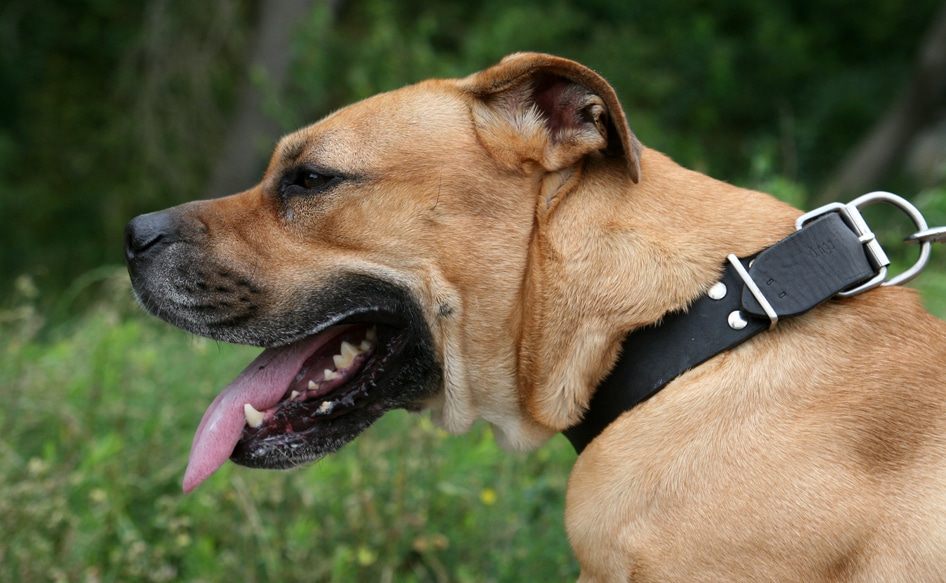
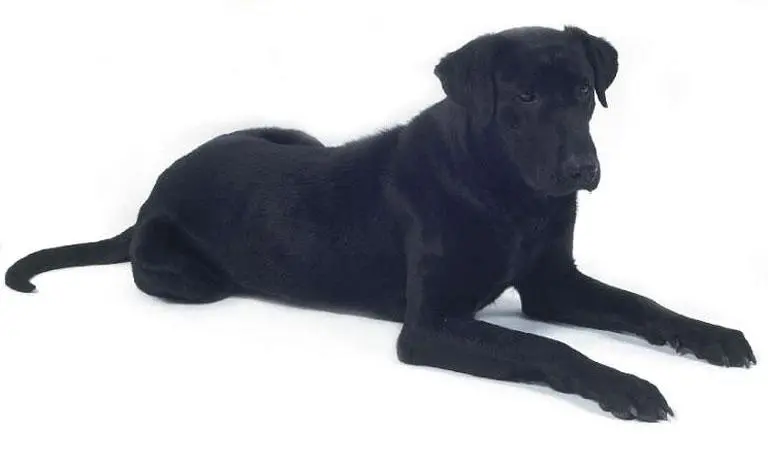
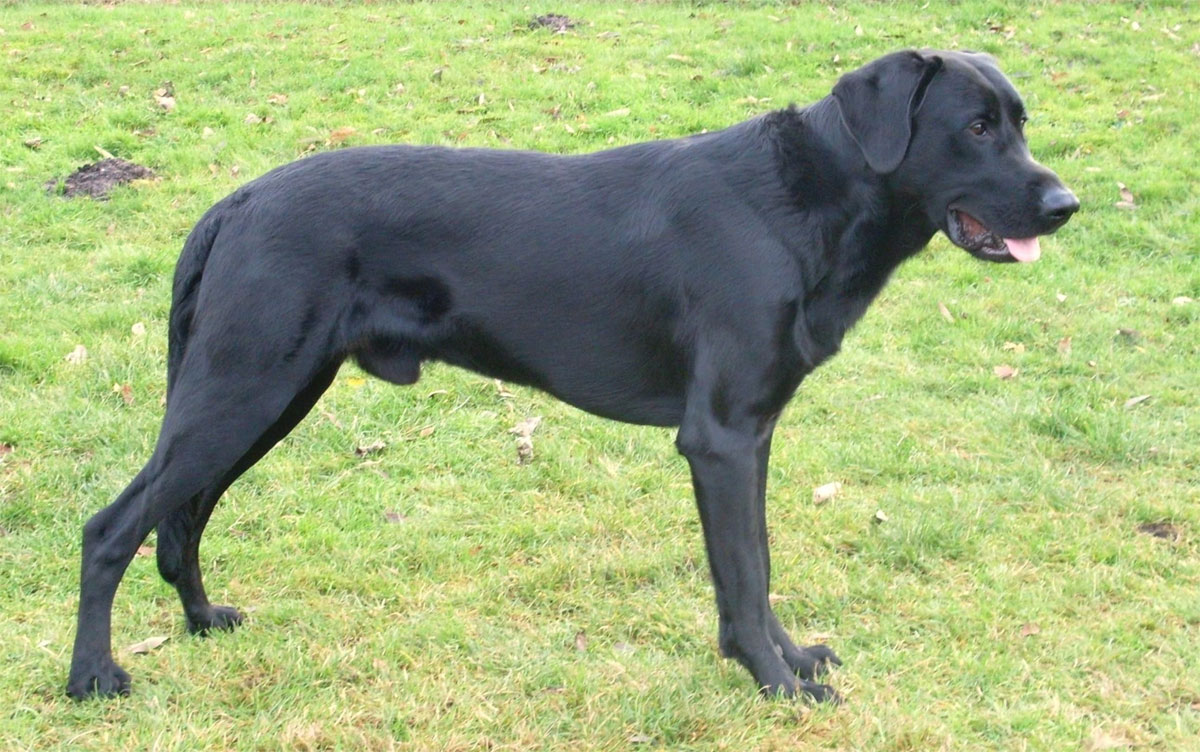
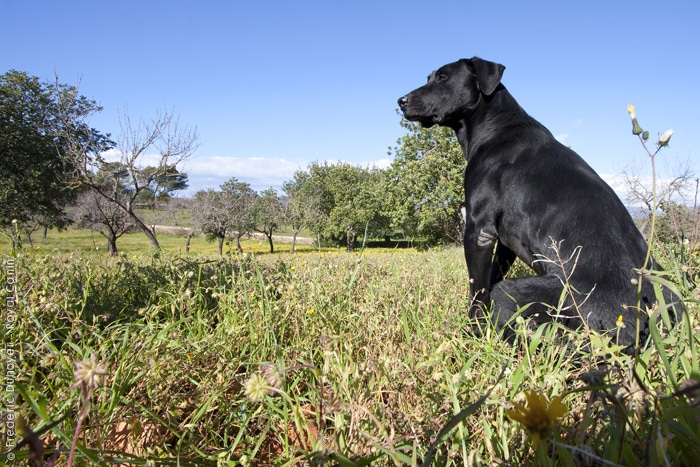
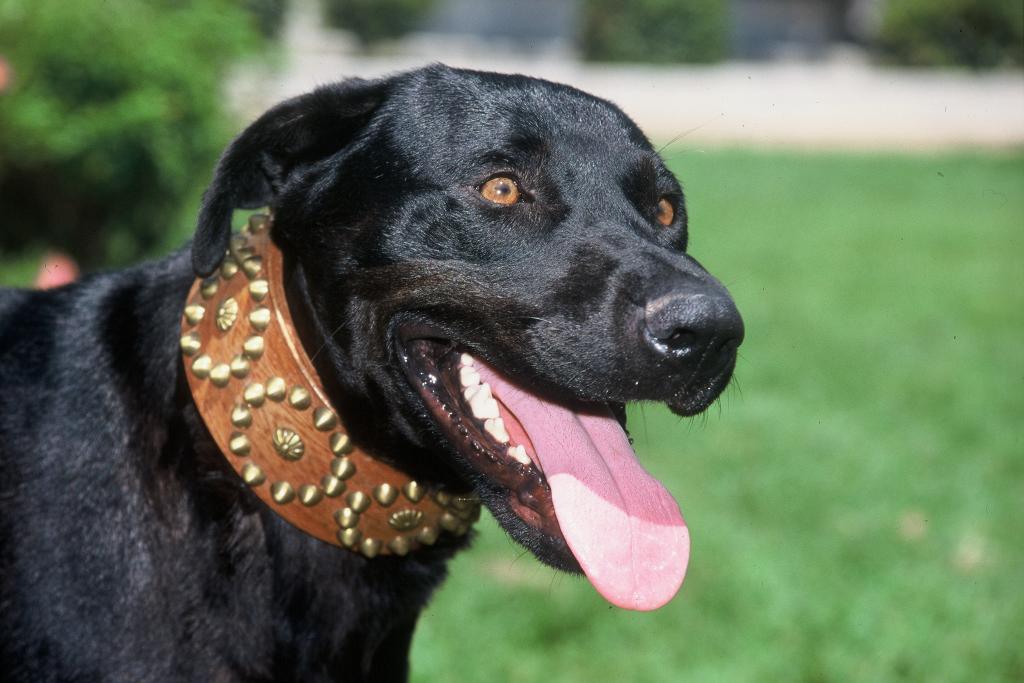
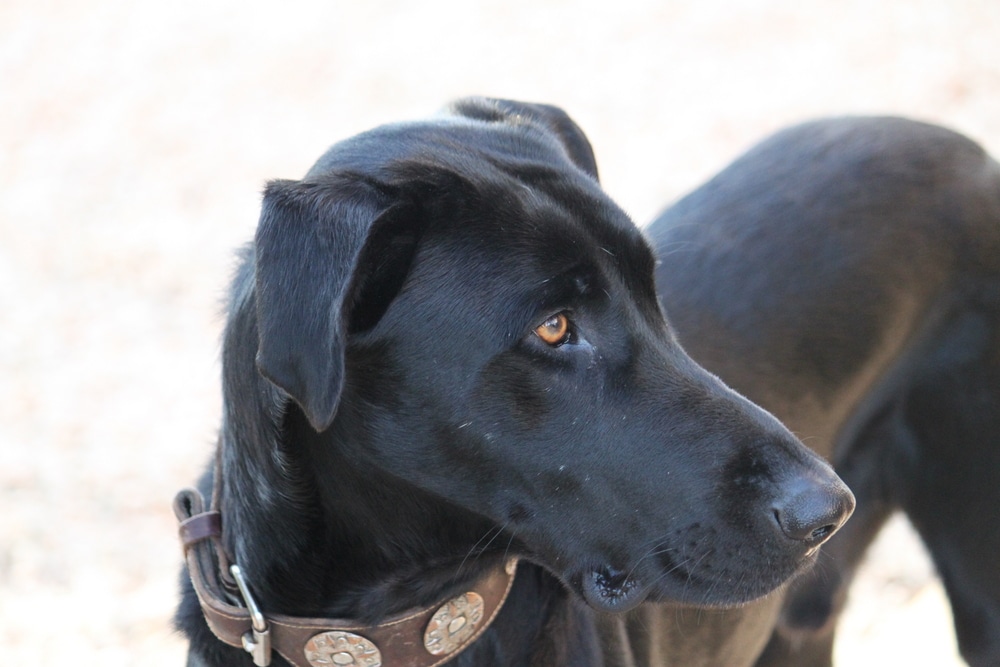
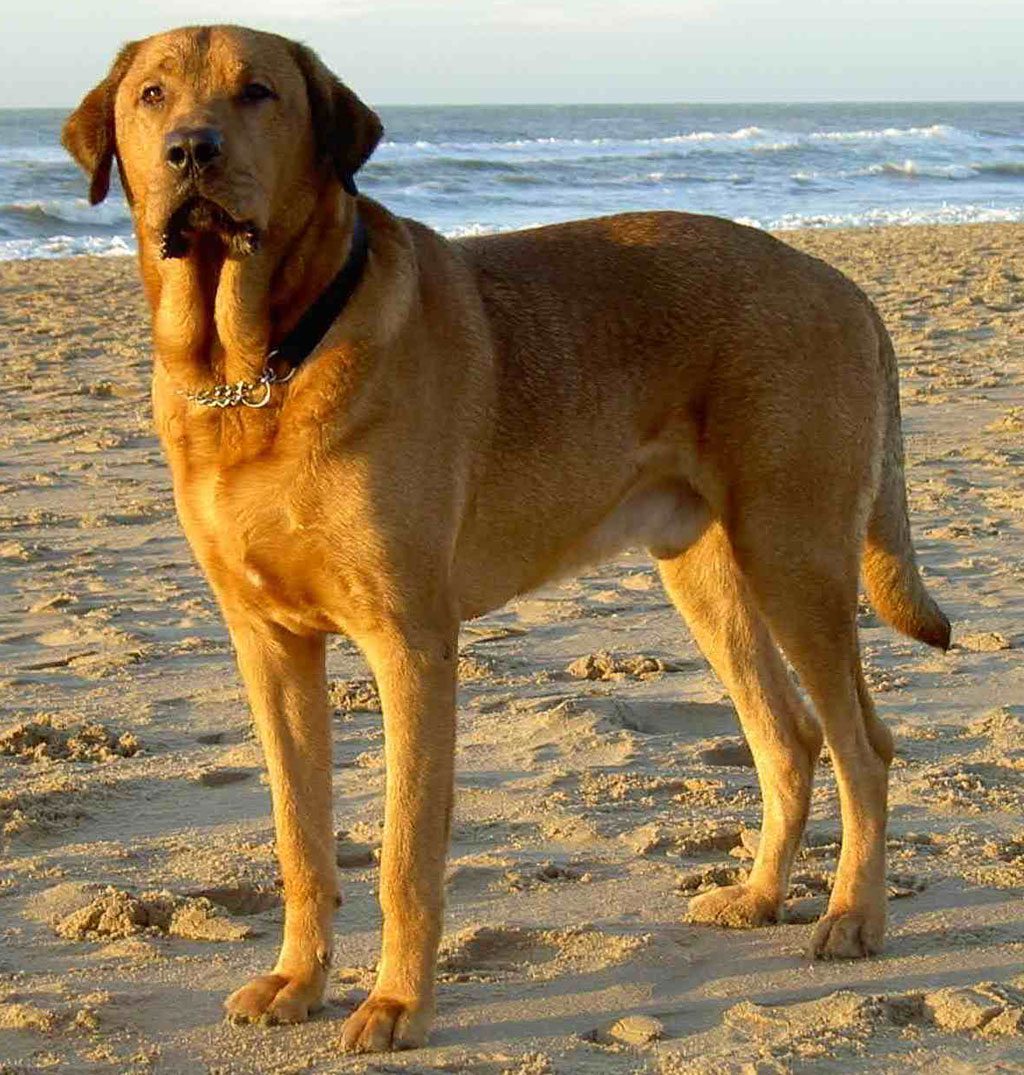
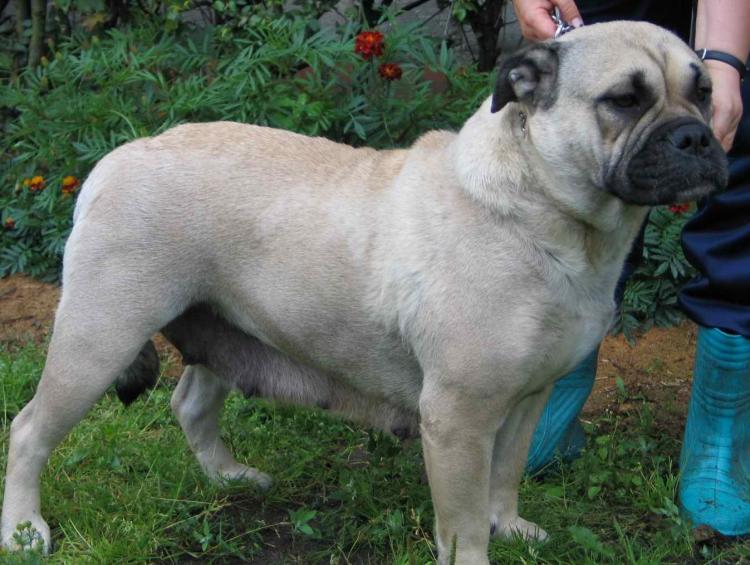
He has a bulky head, solid and the skull is wide. The eyes are oval and somewhat oblique; in the color, the more dark best. The ears are short and played backwards. The body is a massif with included belly. The forelimbs are strong and the tail reaches to the Hock. The coat is short and rough.

The favorite colors in your order are: the striped, the Fawn and black. In the striped prefer the dark tones in the leonados the intense nuances. The white spots are admitted in the previous members, chest and tolerated up to a maximum of 30 % the surface of the body. The black mask is also supported.

The Ca de Bou or Majorcan Dogo, It is a dog reserved and suspicious with strangers. It has an extraordinary adaptation, but it is not a dog to place in any hand. Their education and socialization should be initiated as soon as possible because the breed is naturally dominant.

The care of the fur is a simple weekly brushing and a regular cleaning of the ears and eyes. It is a rustic dog that adapts well to changes in temperature and withstands inclement weather well..

Character and skills

Although the Majorca Mastiff it has been used in its history for quite violent tasks, like bull hunting, the slaughter of bulls or the fighting of dogs, he is surprisingly very affectionate and has an excellent temperament. In fact, tends to create a very strong bond with his family.

They will do anything to protect their family and are very good watchdogs.. In fact, has a strong protective instinct and is very suspicious of strangers. But, although it can be impressive and dissuasive when needed, he only shows aggression when he feels his family is in danger. On the other hand, when dealing with people you don't know, he is always cautious, but he refers to his teacher to determine whether or not they are to be trusted. If the landlord invites someone you don't know to the house, will normally keep distance, but will not intervene in an untimely or even aggressive way. However, good socialization is necessary from an early age to avoid excessive distrust of all strangers.

Fits well with children, with whom he is patient and kind. He is even-tempered and likes spending time playing with them as much as being quiet on the couch. But, as with any dog รขโ‚ฌโ€นรขโ‚ฌโ€นof any breed, should never be left alone with a young child without adult supervision. This is especially true because it is relatively heavy and can easily push or knock over a young child..

On the other hand, the Majorca Mastiff tends to get along very well with other dogs, both with those who share their home and with those who are on a walk. But, if the dog is a male and is in the presence of another male with a dominant temperament, a rivalry relationship may develop. So, it is better to avoid this type of coexistence and to take precautions to avoid any fight when you meet other dogs, in particular doing gradual introductions.

As they don't have a strong hunting instinct, his relationships with small animals, as cats, rodents or birds, they are usually quiet. If you have to live with them on a daily basis, the ideal is to present them as soon as possible, but his great sociability makes it possible to integrate newcomers into his house even if he has always been the only animal.

Perhaps because it has been used to being used in so many ways and in so many different environments throughout its history., the Majorcan mastiff dog is generally very adaptable, so much so that it is possible that he lives in a flat. But, for your well-being, it is better that I live in a house with a garden, since he likes to run and exercise a lot. To feel good on its legs and on its head, usually needs an hour of activity a day, which can consist of walks or games in the garden. In any case, long daily outings are essential if you don't have access to a garden. They are always happy to accompany their owners on walks, and are well suited to active and sporty families. An elderly or very sedentary person, on the other hand, may not satisfy your need for activity and would be better off with another breed.

In addition to participating in the activities of their owners, can, of course, distinguish yourself in various dog sports such as agility, el cane-cross, The tracking, the RCI or the ring. It can even be made to pull a light trolley that the children sit in..

In any case, considering his past as a working dog, to the Majorca Mastiff he likes to be assigned tasks. These may include, takes his role as guardian very seriously: although it is not necessarily obvious at first glance, always watch out for the slightest noise or movement, and shows great reactivity. In general, Giving him chores to do and keeping him busy is the best way to ensure he thrives..

Once you are in your right mind, the Majorcan mastiff dog it is quiet and very quiet. He is not one of those who annoys the neighbors, he just barks in his role as guardian, that is to say, when a stranger enters your territory and tries to show you that you better leave.

Nor is he one of those who let themselves be heard when their owners are not: although he especially likes to be in contact with them, knows how to stay alone without suffering separation anxiety.

In summary, as long as he is well socialized and educated, and as long as you have enough opportunities to exercise, the Majorcan mastiff dog it is a fairly easy dog รขโ‚ฌโ€นรขโ‚ฌโ€นto carry. It is even an ideal breed choice for those who wish to acquire their first Molossian type dog., since it does not constitute a danger for his family and he is also very sociable with other animals in general.

But, this is only possible if the dog's place in the family hierarchy is perfectly clear and, Therefore, if he has a master who knows from the beginning how to position himself as a leader and how to be strict when necessary. Although the Majorca Mastiff it is quite easy to train and handle compared to other similar breeds, still a giant, so it is better that it is in the hands of a person who already has some experience in dog training.

Education

The Majorcan mastiff dog is an independent and determined thinker. So, can be very overbearing if not confronted by an experienced dog training person, who knows how to show both firmness and consistency to behave as a leader and make his dog understand who is the master.

So, your education should start at an early age, when it is still more impressionable, to lay the foundations on which the coexistence will be based throughout his life. As such, you have to be firm, but also soft, at the risk of antagonizing him or damaging the quality of his relationship with his owners.

The latter must also show some coherence: the rules should not only be fixed in time, but also from one person to another, that is to say, everyone should be in phase on what the dog is or is not entitled to do. The dog did not understand why one person allowed him to get on the sofa when another had strictly prohibited it the previous time.

As long as these conditions are met throughout the education of the Majorcan mastiff dog, things are going well; it is easy to carry and learns quickly.

This is even more true if your teacher is in charge of organizing small training sessions and asking you to do various things.. In this way, stays focused all the time, instead of boring you and losing your attention with long and repetitive sessions.

Learning is also easier and more enjoyable for everyone when the owner opts for methods based on positive reinforcement., that is to say, rewarding (with a word of encouragement, a caress, a treat…) good behavior and ignoring bad. In fact, punishment-based techniques quickly frustrate the dog, and an operation based on the constraint, although it may work in the short term, usually limits the prospects for evolution, or even counterproductive - or even dangerous- long-term. The Majorca Mastiff he is not one of those who turn against his master, but if he is brutal with him and uses bad methods, You may end up responding to what you perceive as assault with an equally violent reaction.

Last, all dogs benefit from being socialized as soon as possible, but this is especially true for the Majorcan mastiff dog. In fact, his developed instinct for protection generally leads him to distrust strangers and, Therefore, to be especially reserved with them. Not the type to get unnecessarily aggressive towards them, but it is preferable to ensure that you do not show an excessive reserve every time a visitor arrives at your house. As such, nothing like making him meet a wide range of people in all kinds of situations from his first months, so that little by little you will better accept the confrontation with strangers. The same goes for exposure to other dogs and animals of all kinds, as well as to all kinds of environments and stimuli (noises, smells, etc.). The sooner and more intensely a dog is socialized, the easier it will be for you to move around in the human world, whatever the circumstances.

Health

The Majorcan mastiff dog generally in very good health and predisposed to few problems., it is a very resistant dog in general.

This also applies to temperatures., used to the quite hot climate of the island of Mallorca, it is very resistant to high temperatures., not very sensitive to cold either, although this is really not a common thing in his homeland.

Among the diseases to which you are particularly predisposed, we can mention: brachycephalic syndrome, which affects dog breeds with flattened nose and short nose. In effect, This anatomical peculiarity notably translates into narrow nostrils and an excessively narrow nasal cavity, which implies respiratory failure, manifested especially during physical exertion and / or in case of strong heat. It can also be the cause of various digestive problems (vomiting, etc.). If the most serious cases must be treated by means of a surgical act to increase the respiratory capacity of the animal, most of those affected live in a more or less normal way as soon as their owner saves them from too intense physical effort (above all, especially when it's hot or humid) and carefully monitor your diet to avoid being overweight (a problem the breed is not particularly prone to).French Bulldog or the Pug;

  • The Hip Dysplasia, joint malformation in which the femur is not correctly positioned in the pelvic cavity of the hip joint, causing pain and lameness, as well as osteoarthritis as we age. Is problem, whose appearance is often favored by a hereditary predisposition, can be treated or alleviated by surgical intervention;
  • The dilation-torsion of the stomach, a problem that particularly affects medium-large dogs. It can happen especially when the animal ingests large amounts of food too quickly. It consists of sudden and excessive swelling of the stomach, that folds on itself;this blocks the evacuation of gases and interrupts blood circulation. Without prompt medical intervention, dog death occurs quickly;
  • The entropion, where the lid of one eye turns inward in contact with the eyeball. This problem can be inherited and causes severe irritation to the eye.. It is quite possible to remedy this by surgery;
  • The ectropion, corresponding to a curl defect of the lower eyelid. Then, the eye is no longer adequately protected, causing more or less severe irritation and conjunctivitis. Once again, this condition can be inherited and can be cured with surgery.

Although the breed is not predisposed to a large number of diseases, it is important to go to a breeder of Majorcan mastiff dog serious and competent. In effect, this allows the adopted puppy to have benefited from a good living environment and good socialization from its first weeks, but also and above all to maximize the chances that you enjoy good health and the rest. In fact, a serious breeder avoids breeding a dog with a hereditary defect such as Hip Dysplasia., because there would be a significant risk of transmission to young people. If you do not present them spontaneously, as should be the case, you should be asked for the results of the corresponding tests carried out on the parents or the puppy.

You must also always be able to provide a certificate of good health of the puppy prepared by a veterinarian, as well as a health or vaccination record, that proves that the child has received all the necessary vaccines. Once the animal has returned to its new home, should never be forgotten, during the following months, that is still growing and, therefore, particularly fragile. Thus, until I am about a year and a half, it is important to avoid any physical exercise that is too intense or too long, otherwise your joints or bones could suffer seriously. Or even end up presenting developmental defects that can incapacitate him throughout his life. This is all the more true as Majorca Mastiff is predisposed to Hip Dysplasia.

Last, even once this growth period has passed and the animal has become an adult, it is important to always pay attention to your health. As such, nothing substitutes for a complete check-up at a vet at least once a year, to ensure that no problem appears that cannot be detected by an inexperienced person. These regular appointments also offer the opportunity to be reminded of your vaccinations., so you never stop being protected. It should also be used against internal and external parasites, so it is up to your teacher to renew your antiparasitic treatments whenever necessary, throughout the year.

Life expectancy

11 years

Grooming

The Majorca Mastiff it is an easy breed to care for, and this is especially true for their fur. A weekly brushing is more than enough to keep it in good condition. But, not so during moulting periods, in spring and autumn: much more must be done each day, to allow good removal of dead hairs.

It also, as it is not dirty or smells bad, rarely need a bath. Unless it was especially dirty during an outing or in contact with toxic material, do it 2 or 3 times a year is more than enough. It may also be wise to do this at the same time as your seasonal shedding to save time during these periods., since it removes a good amount of dead hair. In any case, always use a shampoo specially developed for dogs, since the pH of your skin is different from that of human skin.

It also, although their ears are not especially prone to infection, they should be checked and cleaned once a week to prevent dirt or moisture from accumulating that could cause infection.
Your eyes are also not immune to infection, so you also have to check and clean them weekly to prevent dirt from accumulating.

Brushing your dog's teeth is also a good habit that should be established at least once a week, making sure to use a dog-specific toothpaste each time. This helps prevent plaque formation., which can cause serious health problems when it turns into tartar. If possible, it is advisable to opt for an even higher frequency, even daily.

As for the claws, this adaptable dog wears them down to a greater or lesser extent, according to the activity level of your family and your living environment. A dog that walks and spends a lot of time a day does not need to have its nails trimmed manually, since they file themselves, especially if it is on a hard surface like asphalt. But, if the dog lives in a flat and is not very active, it needs to be trimmed regularly. Too long claws can be very annoying for the dog, especially when traveling. It also, if they break, they can hurt the dog. In fact, as soon as the friction with the hard ground is heard, they have become too long and have to be cut.

Whether the fur, the ears, the eyes, teeth or claws, grooming your dog requires a minimum of precision and vigilance. If you don't, not only can you fail in grooming your dog, but it can hurt you, or even injure it. So, the first time it is best to seek the advice of a veterinarian or professional dog groomer, and learn from him how to take care of his Majorca Mastiff.

The sooner you train your dog, the better it will be for the rest of your life.

Food

Feeding a Majorcan mastiff dog it is not an arduous task: is perfectly fine with a balanced, quality industrial diet. Homemade rations are another perfectly adequate option, as long as they are well composed and, Therefore, are able to meet your nutritional needs. As such, should consist mainly of meat, but they can also contain large bones, remains, vegetables and rice.

In any case, the amount given must be consistent with his age, your health and the amount of physical exercise you get on a daily basis.

It also, the fact that it is prone to dilation-torsion of the stomach means that some precautionary rules should be observed when feeding the Majorcan mastiff dog. So, it is essential to divide your daily ration into at least two meals, and that these be taken in stride. It also, should not be preceded or followed by any intense or prolonged activity for an hour.

Although this breed is not very prone to obesity, it is important to regularly monitor the dog's weight. In fact, no one is immune to sudden and significant weight gain, especially after sterilization. Weighing your dog about once a month will allow you to quickly spot any unexplained deviations, so that you can take your dog to the vet if the deviation is confirmed or even increased during the following measurements. In fact, only a health professional can make a reliable diagnosis and indicate how to remedy the problem, because diet and lack of activity are not the only possible causes of being overweight: it can also be caused by illness or a reaction to treatment.

Last, like all dogs, the Majorca Mastiff a bowl of clean, fresh water should always be available to you.

Price

The Majorcan mastiff dog can be found at various prices. In all cases, the latter depend, in particular, of the reputation of the kennel, from the line the pup came from, but also of its intrinsic qualities, in particular of their physical qualities, especially of its greater or lesser conformity and its color.

In fact, the brindle color is the most sought after in this breed, what can explain the price differences, sometimes substantial, even within the same litter.

In Spain, the average price of a companion puppy is around 700 EUR. Obviously, like in other places, can be much higher for the best subjects. Those sold with a confirmation guarantee, whose attributes will allow them to be exhibited in dog shows or used as breeders, can reach much higher sums, up to several thousand euros.

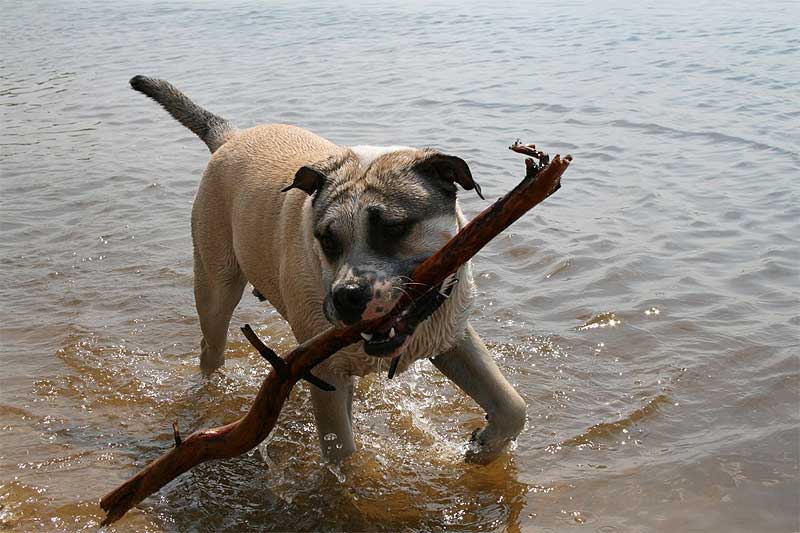
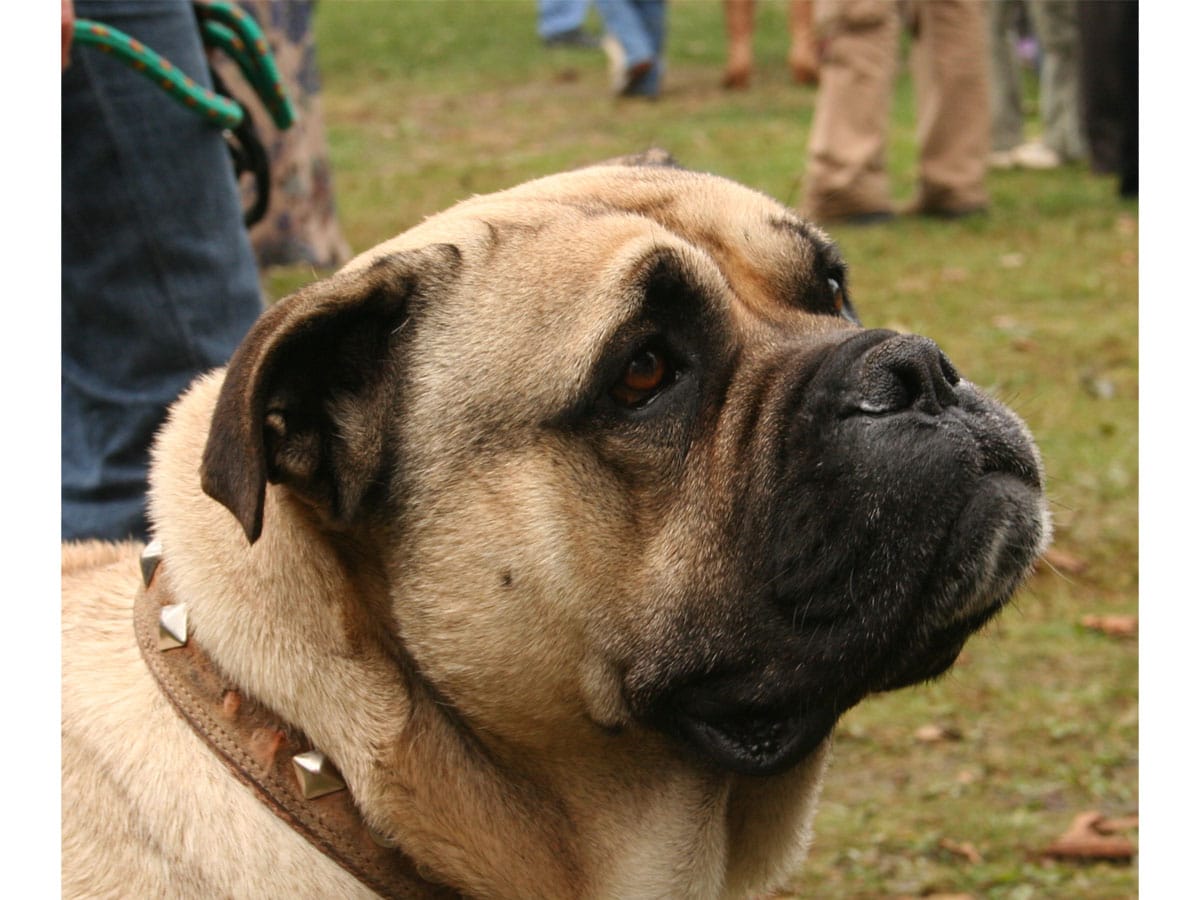
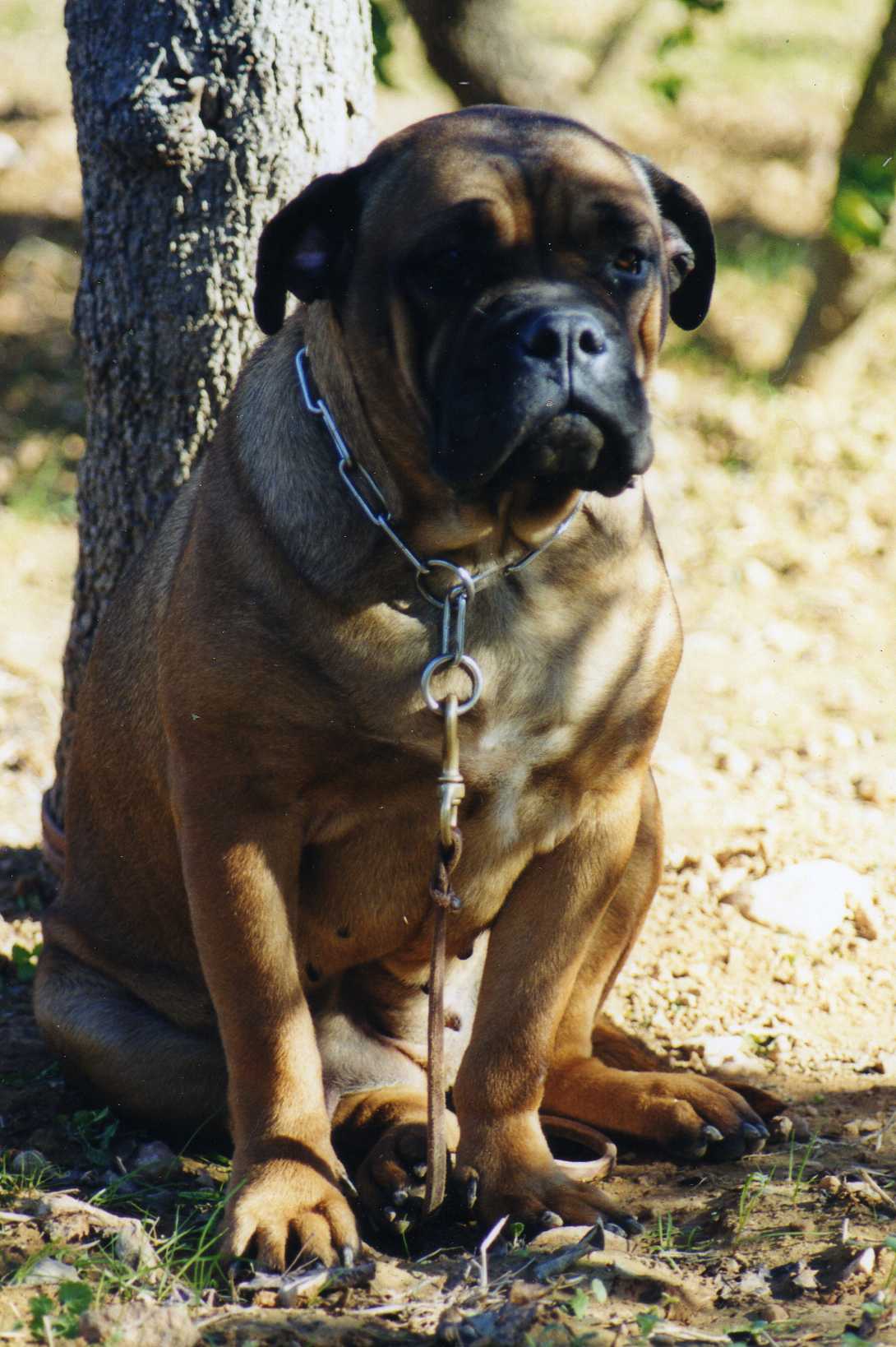
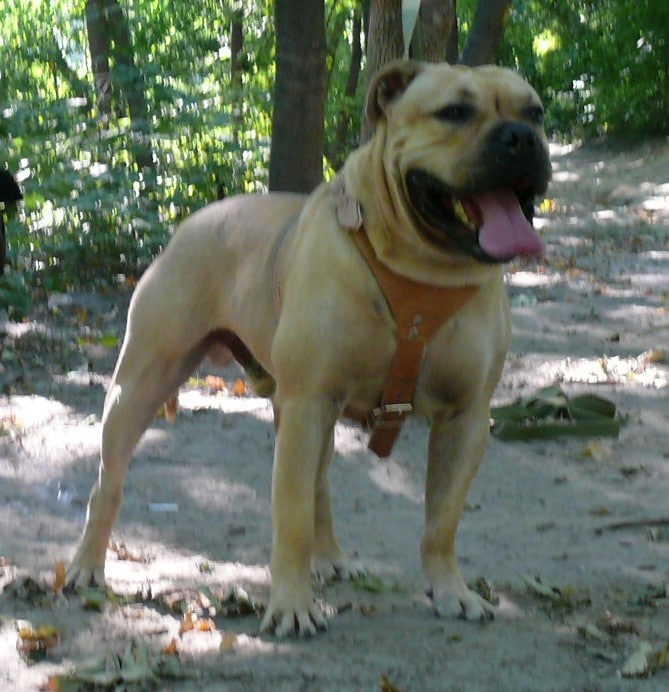
Majorca Mastiff Images
Videos Ca de Bou

Type and recognitions:

  • FCI CLASSIFICATION:
  • Group :
  • Section : . .

Federations:

FCI โ“˜, UKC โ“˜

FCI breed standard "Majorca Mastiff (Majorcan mastiff dog)"

Origin:
Spain

Date of publication of the valid original standard:
11.12.1996

Use:

Guard and defense dog


General appearance:

Race typically molosoid, slightly elongated, strong and powerful. Medium rise, with marked sexual differentiation in cranial volume, higher in the male than in the female.


Behavior / temperament:

Quiet nature, that demonstrates bravery and courage, being sociable to the humane treatment and faithful and grateful to its owner. In the work of guard and defense, acts as an unbeatable guardian. At rest he appears confident and self-assured.; being alert, his gaze is penetrating.

Head:

Strong, solid

Cranial region:
  • Skull: Grand, width, tending towards the square, with a larger perimeter than the size at the withers, essentially in males. Wide front and flat, with well-marked front Groove; front, skull shape belies the occipital. The upper line of the skull and the supranasal line are almost parallel, with slight convergence.
  • Depression links (Stop): Profile, well marked and outstanding. Head on, perceptible only by the superciliary arches that delimit a clear frontal furrow.

facial region:

Very strong and prominent jaw muscles, developed up to the average level of eyes, and although it has some wrinkles on the sides of the masseter, It can be said that, in general, of the head do not skin wrinkles.

  • Truffle: Black and wide. Between the Windows you have well defined filter.
  • Snout: Born from the inner corner of the eyes, wide, tapered, Recalling a truncated cone of base profile broadband; with straight and slightly ascending supranasal line. The length of the muzzle must be in relationship 1/3 with respect to the head.
  • Lips: Upper lips are superimposed on the lower half of the snout, where it appears the labial commissure. The top is rather picked, While the lower retracting at its Center, and no they highlight is the lips when the mouth is closed. Oral cavity with marked striae and black gum edges, the rest of your mouth Red.
  • Jaws / Teeth: Powerful JAWS with well aligned incisors, Canine something separate, White complete teeth and strong with bite prognata; without being excessive this lower prognathism, It should be a maximum of one centimeter. They shall never see teeth with mouth closed.
  • Eyes: Large, oval, with opening wide, steep and somewhat oblique, color as dark as possible relative to the layer, without let see the conjunctiva; seen from the front can't see white ; situated low and far apart.
  • Ears: High and lateral deployment, rather small and pitches back and curved, showing the ear ; the guy named rosa. At rest the end of the ear lies at a level below the eye.

Neck:

Strong, thickness and provided, at his birth he has a similar to the diameter of the head width ; well linked with the cross. Something loose skin, being a thin dewlap permitted.

Body:

  • Kidneys and flanks: Short, relatively narrow and forming an arch pronounced to the rump.
  • Rump: Approximately from 1 to 2 cm taller than the cross, inclined at about 30ยฐ from the horizontal, somewhat narrower than the thorax.
  • Chest: Rib something cylindrical, deep up to the height of the elbows, width to the height of the cross, due to the separation of the shoulder blades.
  • Lower profile: Parallel to the ground chest, Belly gently up and collected, never agalgado.

Tail:

Implemented low, thick at its root, it thins to its end that reaches the hock, and finished in tip; during rest falls naturally, while in action it arches slightly and is arranged at the level of the dorsal line.

Tips

PREVIOUS MEMBERS:

  • Shoulder: Moderately short, some prominent and slightly oblique.
  • Arms: Straight, plumb and separated from each other.
  • Elbows: Separated due to the breadth of chest, but never open.
  • forearms: Well muscled, straight and thick bones.
  • Previous feet: Strong, with fat fingers, slightly round and well United; lightly pigmented pads.

LATER MEMBERS: Muscled, longer than the previous ones.

  • Thighs: Long ; natural joints.
  • Hocks: Short, straight and strong. Undesirable Spurs.
  • Hind feet: Strong, with fat fingers longer than the previous toes, presenting its oval shaped joint; preferably pigmented pads.

Movement:

The typical gait of the breed is the trot.

Mantle

Rather thick, firmly attached to the body, except in the neck, It can form slight double chin.


COAT

  • HAIR: Short and rough to the touch.
  • COLOR: Striped, black & Fawn, desirable in this order. For the atigrados dark tones are preferable; tawny in intense colors.

white spots are allowed in forefeet, chest and muzzle, up to a maximum total of a 30%. Also supports the black mask.


Size and weight:

Height to the cross:

  • Males of 55 to 58 cm.
  • females of 52 to 55 cm..

Weight:

  • In males ranges from the 35 to 38 kg
  • In females ranges from the 30 to 34 kg.


Fouls:

Any deviation from the aforementioned criteria is considered as a fault and the severity of this is considered to the degree of the deviation to the standard and its consequences on the health and well-being of the dog..


SERIOUS FAULTS

  • Individuals whose height at the withers is higher than the rump.
  • Inferior prognathism that is greater than one centimeter.
  • Scissor bite, or clip.
  • Lack of two premolars.
  • Individuals who do not have ears in pink, This is glued together and flat ears to the face ; and with ears erect on its base, still being in pink in its final third.
  • Queue type bulldog.
  • Any other fault that its gravity apart from the standard.

MISS PLAYOFFS

  • Aggressive or fearful dog.
  • Upper prognathism.
  • Eyes clear and yellow.
  • Amputated ears or tail.
  • White color more of 30% in parts of the body that are not above feet, chest and muzzle.
  • Any other colouring stains.

INDICATIVE MEASUREMENTS IN A STANDARD DOG

  • Weight 36 kg
  • Height at Croup 58 cm.
  • Height in cross 56 cm.
  • Chest perimeter 78 cm.
  • Head circumference 59,5 cm.
  • Distance occipital to the birth of the tail 73 cm.
  • Distance of the occipital to snout 22 cm.
  • Distance from the muzzle to the frontal trough 8 cm.

Any dog โ€‹โ€‹showing clear signs of physical or behavioral abnormalities must be disqualified..


N.B.:

Males should have two normal-appearing testicles fully descended into the scrotum..

Source: F.C.I - International Cynological Federation

Alternative names:

1. Mallorquin Mastiff, Mallorquin Bulldog, Silverback (English).
2. Dogue de Majorque (French).
3. Ca de Bou (German).
4. Ca de bou, Dogo maiorquino (Portuguese).
5. Dogo mallorquรญn, perro de presa mallorquรญn, Presa mallorquรญn (espaรฑol).

โ–ท The world of Pets: Dogs, cats, birds, reptiles, amphibians

Mudi
Hungrรญa FCI 238 - Sheepdogs

Mudi

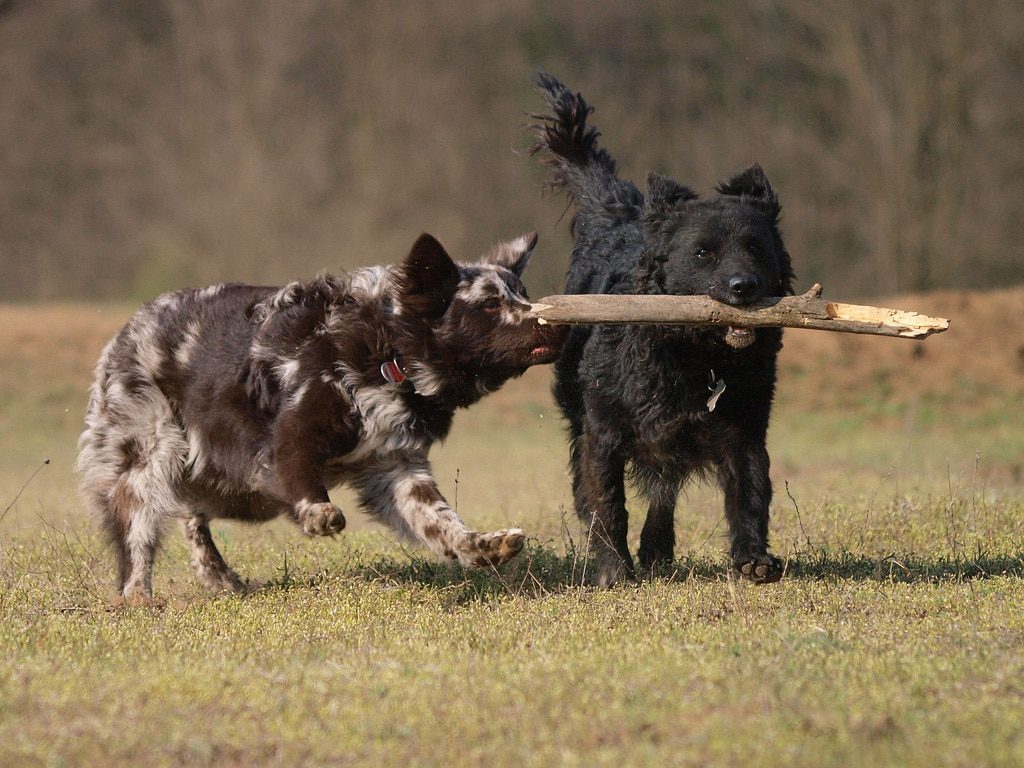
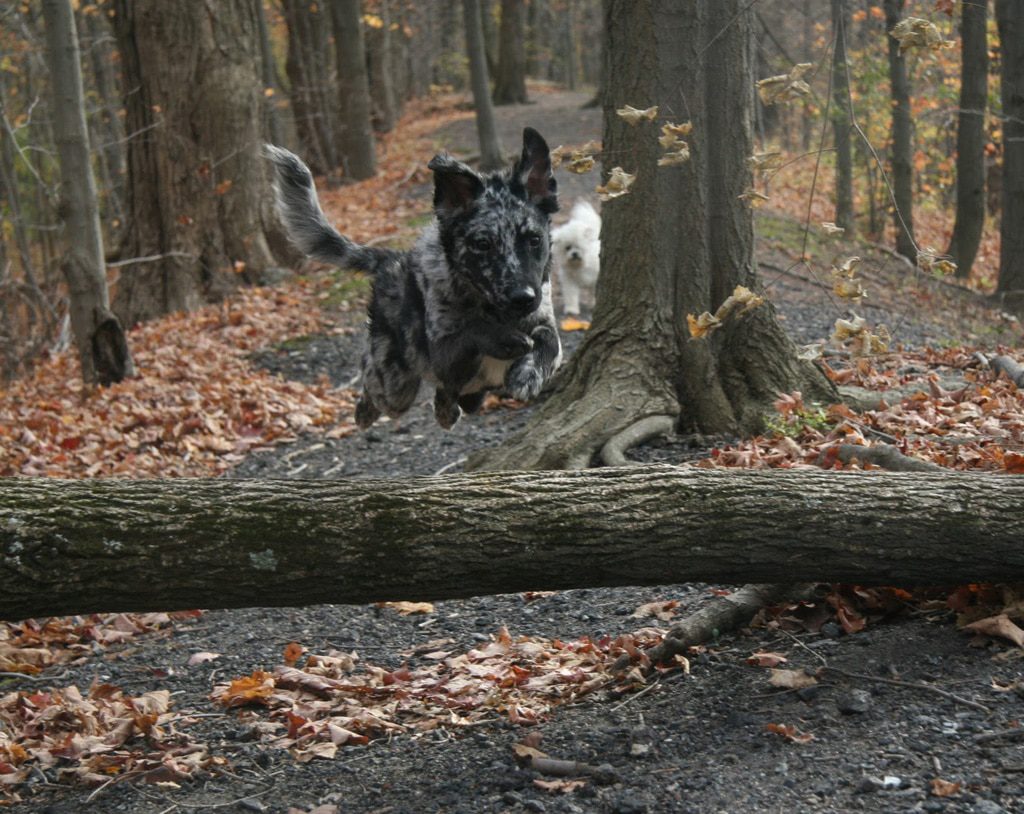
The Mudi is a single master dog, and a rare breed outside its native Hungary.

Content

History

The Mudi is the name of a canine breed of herding dog rare, originally from Hungary.

According to existing documentation, some currents maintain that the Mudi was formed in Hungary spontaneously, between the 19th and 20th centuries.

Others reply that the Pumi, the Puli and the Croatian Sheepdog, are close relatives of Mudi.

Are what, they are their ancestor and the form in which it existed, What is known for sure is that the Mudi, has survived this time thanks to the appreciation of the shepherds who praise his innate ability in which protection of livestock with regard.

In the year 1936 wrote the first breed standard, naming it Mudi.

The herd book is still open, that means that more and more dogs of this type, they live in their homeland, incorporated into breeding records.

The Mudi, is currently a "rare breedโ€ there are few specimens in their native country, and outside of Hungary if there isโ€ฆ, very few inches.

In Hungary they have been fighting for years to keep the breed alive. As it has been the case with many breeds of dogs pastors, their copies have declined to the rhythm of the socio-cultural advancement.

Before, herds of cattle were numerous and sheepdogsโ€ฆ, essential, This situation has changed a lot from time to time and along the way we have lost many canine breeds specialized in working with cattle..

Physical characteristics

Usually weigh between 8 and 13 kg and measure between 38 and 48 centimeters to the cross.

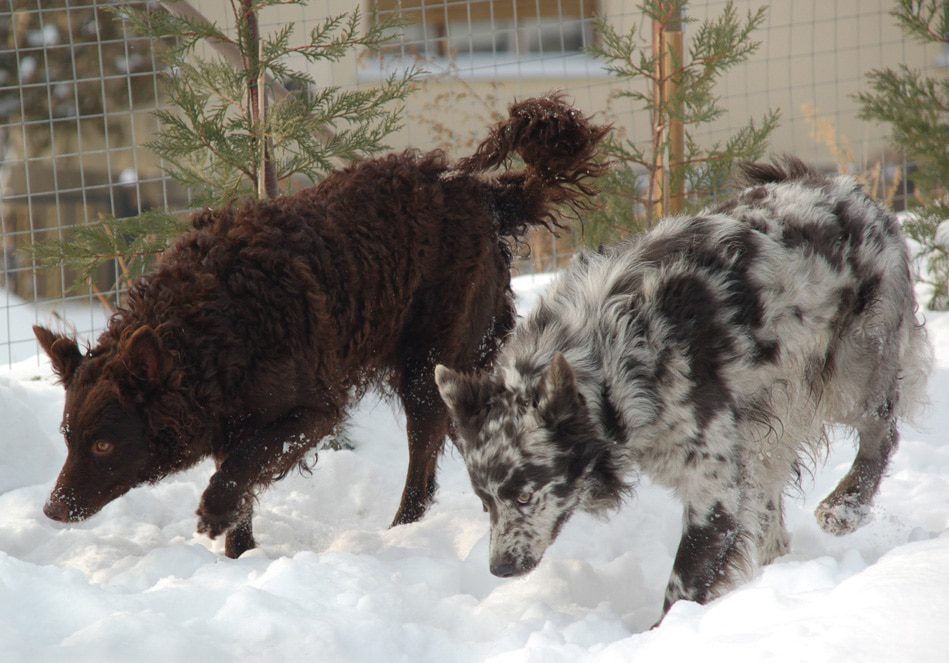
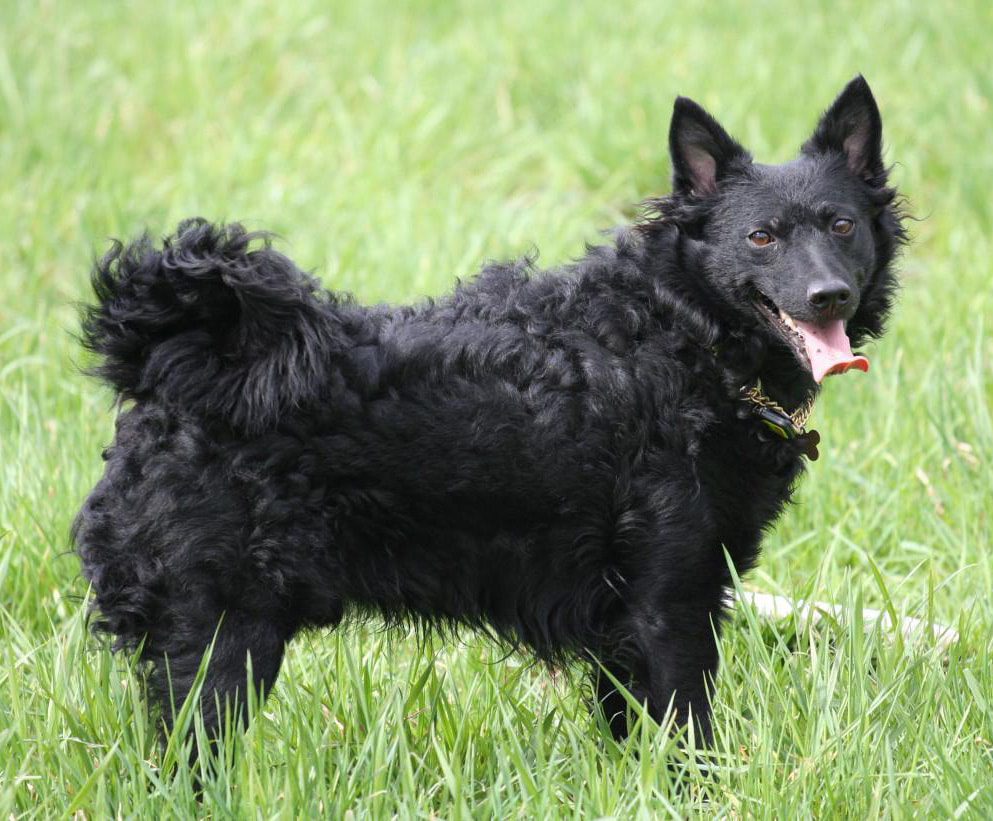
The mantle is medium wavy or curly, with short hair on the face and legs. The colors accepted are black, Ash, brown, white, Fawn and merle.

The Mudi can have the tail short birth or birth with them long and cut them.

It is a very versatile dog, You can be on a farm, You can hunt, exterminate rodents, make guardian, dog herds and as dog boyero.

Although it is a much less popular breed than the Puli and the Komondor in your country of origin, owners always recognize his superiority due to his versatile talent and always friendly and working arrangement.

  • Fur: varies by region. The head and limbs are covered in short hair, straight and smooth. On other parts of the body there is hair of a length between and cm, dense, undulating and shiny. the undercoat is arranged in spirals and stripes.
  • Color: glossy black or white, but there are also white mantles with black stripes or black ones with white stripes, with medium-sized spots and uniform distribution.
  • Size: 35 to 47 cm..

The hair of the Mudi, Unlike other dog breeds, has much pigment. Surfaces devoid of hair, They must be totally black, However, the pads and nails are slate grey.

Character and skills

The Mudi is a very active race. If you live in the city, you need to take a brisk walk every day, or run.

It also, it would be beneficial for his health if he had an outdoor area where he can run to his heart's content, they need a lot of exercise to stay healthyโ€ฆ and happy.

To the Mudi She loves to play and Excel in all kinds of sports Canine as the Frisbee, for example.

Can also compete in the agility, obedience, Rally obedience, Schutzhund, show, flyball, and tracking. It has strong instinct and grazing capacity, with appropriate training, could also compete in grazing trials.

A Mudi can live in a house doing enough exercise, but always they need ample space to run and play. They are active and they can live, perfectly, in the open air.

Their life expectancy is around the 14 years.

Mudi Health

The Mudi is a generally healthy breed with a life expectancy of 12 to 14 years.

Health problems seen in the Mudi include epilepsy, Hip Dysplasia, cataract, elbow dysplasia and patellar dislocation.

If a breeder tells you they don't need to do those tests because they've never had any problems in their lines or because their dogs have been checked out by a vet or if they give any other excuse to skimp on genetic testing of their dogs, leave immediately.

Careful breeders screen their breeding dogs for genetic diseases and breed only the healthiest and best looking dogs, but sometimes Mother Nature has other ideas and a puppy develops one of these diseases despite good husbandry practices. Advances in veterinary medicine mean that in many cases dogs can still live a good life. If you are going to have a puppy, ask the breeder about the ages of the dogs in their lines and what their cause of death was.

Remember that after you have welcomed a new puppy into your home, has the power to protect you from one of the most common canine health problems: the obesity. Keeping a Mudi at the right weight is one of the easiest ways to extend his life..

Kuvasz grooming

The coat of the Mudi loose the dirt (and the hair, of course) and does not require frequent bathing. A weekly brushing is usually all that is needed and the coat does not need to be trimmed.

If your Mudi is like most, you will enjoy swimming in a pool, a lake or the ocean. Thereafter, rinsed with fresh water to remove chlorine, algae or salt and restore shine to your coat.

The Mudi sheds her coat in the spring and doesn't get it back fully until late summer.

The rest is basic care. Trim nails every few weeks or as needed. brush your teeth often – with a vet-approved pet toothpaste – for good general health and fresh breath.

Characteristics "Mudi"

Coexistence is important that you have with your new friend. Before considering the acquisition of a dog of the breed "Mudi" you know certain factors. Not all breeds of dogs are apt to live in an apartment, you must take into account his character, their need for exercise, their interaction with other pets, their care and if you have small children, their level of tolerance towards them.

Adaptation โ“˜

5,0 of 5 stars (based on 1 review)

friendly dog โ€‹โ€‹โ“˜

3,0 of 5 stars (based on 1 review)

hair loss โ“˜

2,0 of 5 stars (based on 1 review)

Affection level โ“˜

5,0 of 5 stars (based on 1 review)

Need for exercise โ“˜

4,0 of 5 stars (based on 1 review)

Social need โ“˜

5,0 of 5 stars (based on 1 review)

Home โ“˜

3,0 of 5 stars (based on 1 review)

Toilet โ“˜

2,0 of 5 stars (based on 1 review)

Friendly with strangers โ“˜

3,0 of 5 stars (based on 1 review)

barking โ“˜

4,0 of 5 stars (based on 1 review)

Health โ“˜

3,0 of 5 stars (based on 1 review)

Territorial โ“˜

3,0 of 5 stars (based on 1 review)

Cat friendly โ“˜

3,0 of 5 stars (based on 1 review)

Intelligence โ“˜

5,0 of 5 stars (based on 1 review)

Versatility โ“˜

5,0 of 5 stars (based on 1 review)

Child friendly โ“˜

3,0 of 5 stars (based on 1 review)

Surveillance โ“˜

5,0 of 5 stars (based on 1 review)

joy โ“˜

5,0 of 5 stars (based on 1 review)

Mudi Images

Videos "Mudi"

Type and recognitions:

  • FCI CLASSIFICATION:Group 1 –> Pastor and Boyeros dogs (except Swiss Cattle Dogs)
    / Section 1 –> Pastor dogs. Without working trial.
  • FCI 238
  • Federations:
    • FCI – Group 1 Herding dogs, Section 1 Sheepdogs โ“˜
    • AKC – PASTORAGE โ“˜
    • FSSโ“˜
    • CKC – Group 7 – Herding dogs โ“˜
    • UKC – Herding dogs โ“˜

    FCI breed standard Mudi

    FCIFCI - Mudi
    Mudi

    Alternative names:

    1. Hungarian Mudi, Canis Ovilis Fenyesi (English).
    2. Mudi (French).
    3. Mudi (German).
    4. Mudi (Portuguese).
    5. Mudi hรบngaro (espaรฑol).

    โ–ท The world of Pets: Dogs, cats, birds, reptiles, amphibians

    Maremma and the Abruzzes Sheepdog
    Italia FCI 201 . Sheepdogs

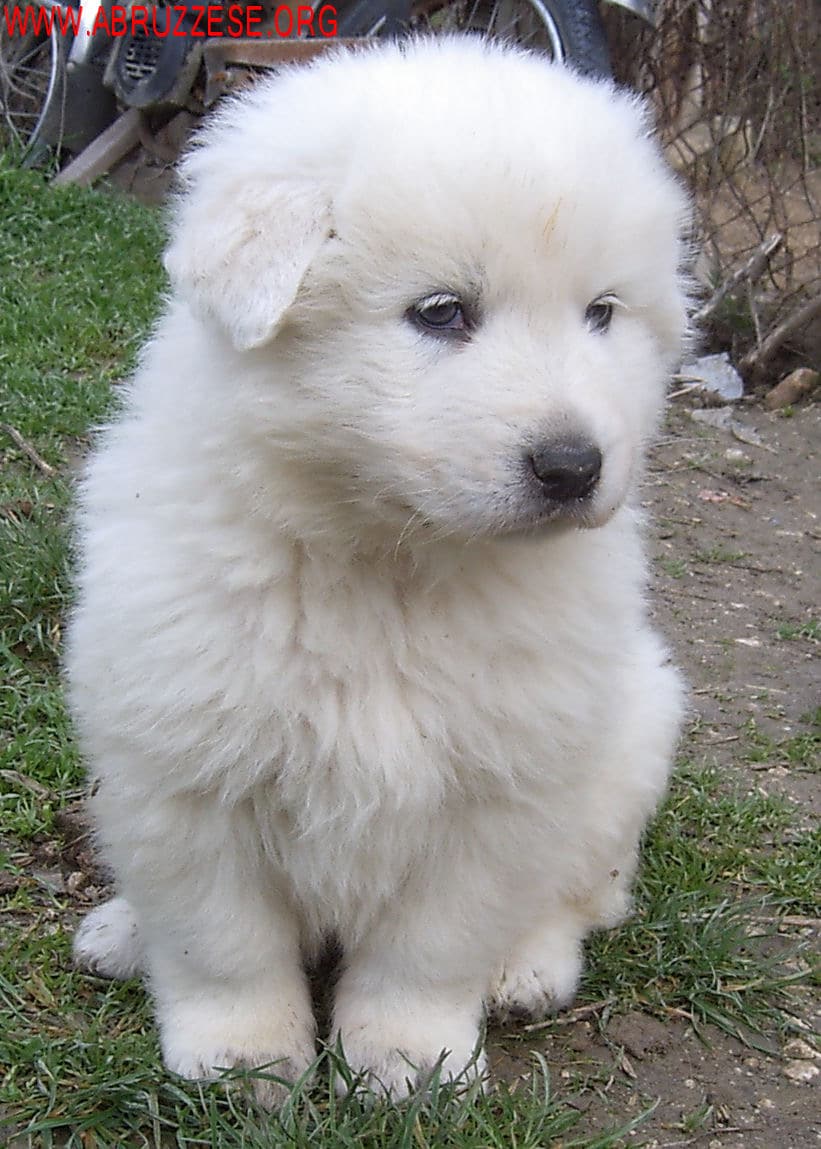
    The Maremma and the Abruzzes Sheepdog he will be really happy sleeping with the cattle rather than on the sofa in your home.

    Pastor Maremmano-Abruzzese

    Content

    Characteristics "Maremma and the Abruzzes Sheepdog"

    Coexistence is important that you have with your new friend. Before considering the acquisition of a dog of the breed "Maremma and the Abruzzes Sheepdog" you know certain factors. Not all breeds of dogs are apt to live in an apartment, you must take into account his character, their need for exercise, their interaction with other pets, their care and if you have small children, their level of tolerance towards them.

    Adaptation โ“˜

    4,0 of 5 stars (based on 1 review)

    friendly dog โ€‹โ€‹โ“˜

    3,0 of 5 stars (based on 1 review)

    hair loss โ“˜

    3,0 of 5 stars (based on 1 review)

    Affection level โ“˜

    4,0 of 5 stars (based on 1 review)

    Need for exercise โ“˜

    5,0 of 5 stars (based on 1 review)

    Social need โ“˜

    3,0 of 5 stars (based on 1 review)

    Home โ“˜

    3,0 of 5 stars (based on 1 review)

    Toilet โ“˜

    2,0 of 5 stars (based on 1 review)

    Friendly with strangers โ“˜

    3,0 of 5 stars (based on 1 review)

    barking โ“˜

    2,0 of 5 stars (based on 1 review)

    Health โ“˜

    4,0 of 5 stars (based on 1 review)

    Territorial โ“˜

    5,0 of 5 stars (based on 1 review)

    Cat friendly โ“˜

    3,0 of 5 stars (based on 1 review)

    Intelligence โ“˜

    3,0 of 5 stars (based on 1 review)

    Versatility โ“˜

    2,0 of 5 stars (based on 1 review)

    Child friendly โ“˜

    4,0 of 5 stars (based on 1 review)

    Surveillance โ“˜

    4,0 of 5 stars (based on 1 review)

    joy โ“˜

    4,0 of 5 stars (based on 1 review)

    History

    The Maremma and the Abruzzes Sheepdog (Maremmano-Abruzzese or Cane da pastore Maremmano-Abruzzese), It is a breed of sheepdog native to central Italy and used for centuries by shepherds to defend their flocks from wolves.

    The breed is still used today, widely, in the region of the Abruzzo where flocks of sheep vitalize the rural economy and wolves are protected predators (of the few areas of the planet, Regrettablyโ€ฆ).

    The race is similar to the Pyrenean Mountain Dog, to the Kuvasz from Hungary and to Akbash from Turkey (This, that more!).

    It also descends from the shepherd dogs that once existed in the Maremma Tuscany region and in the Lazio region.. Since 1860, the transhumance of herds from one region to another has favoured the development of a natural mixture of these two primitive races.

    Several descriptions of dogs defending vulnerable white sheep are found in the literature of ancient Rome, in works such as the Columella, Varro and Palladius. Dogs similar to Maremma and the Abruzzes Sheepdog they are represented in numerous sculptures and paintings from Roman times to the present day.

    Until year 1958, the Maremma Sheepdog and the Maremmano-Abruzzese they were considered as separate races. The first Canine society of the Maremma Sheepdog was established in the year in 1950, and three years later (1953) the First Canine Society of the Maremma Sheepdog.

    But owing to transhumance of herds of sheep from one region to another, especially after the unification of Italy, there was a โ€œnatural fusionโ€ between the two races. For which reason, the 1 in January of 1958, the races were unified by the ENCI (Ente Nazionale della Cinophilia Italian, or national association Cynologique Italiana).

    Today, It is not so encouraging and sympathetic as the history of this beautiful can, although they are still widely used by Italian sheep farmers in areas where predation is common, as the central Apennines of Italy and the open countryside of the land of national parks in Abruzzo.

    But, Ironically, of the Maremma and the Abruzzes Sheepdog, in the area of the Maremma of Tuscany, the memory can only, they are now a rarity just in the area which saw them to be born, you are right, even if you don't like to hear it, the hand of man and progress... have resulted in a more sinister: sheep farming has declined and the wolf is nearly extinct.

    Curiosities

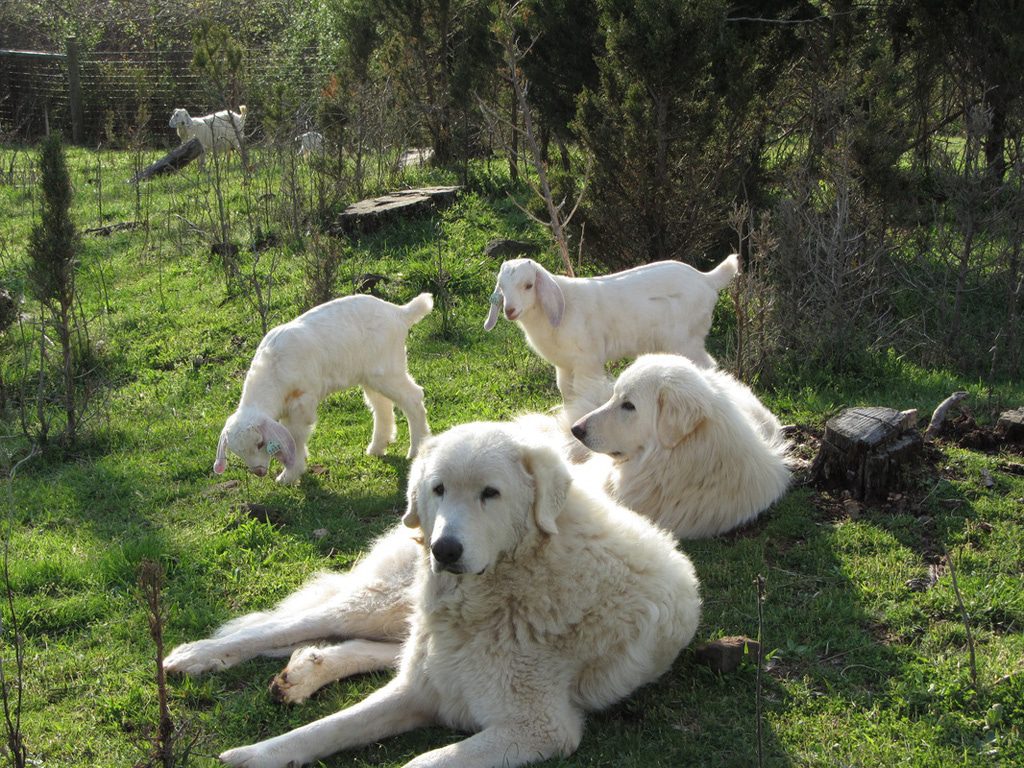
    Although it is easier for him Maremma and the Abruzzes Sheepdog, develop their relationship with sheep and goats, farmers have found that, as well, are able to develop a protective bond with cows, and in many places of United States, It also used for the purpose. As well, they are good defending corrales, chickens or ducks from the threats of land caused by coyotes, dogs and foxes, and air threats caused by birds of prey (Hawks, Eagles, owls, etc.).

    In Australia, a lot has been invested in it Maremma and the Abruzzes Sheepdog. Specifically in the city of Warrnambool that has great natural beauties, and in one of them the Maremma and the Abruzzes Sheepdog It is today a key piece for the survival of other species.

    Within the natural beauties that talked, the beach of Logan located on the East side of the city is a great example, recognized as a southern whale breeding site. Every year between May and August reach coasts copies of adult female whales to give birth to their calves, and at the end of September are often long trip offshore, sometimes with a little bit of human help, so the whales are not left stranded on the beach.

    In addition to the whale southern franco, the coast is also visited by sea lions of Australia, penguins and common dolphin. Albatrosses can spot during the winter and early spring.

    There is also another natural beauty which is the protagonist of this post can… Middle Island had a large colony of penguins. But the uncontrolled presence of foxes led to a significant reduction in the number of members of the colony.. In 2005, there are only four penguins left in the colony.

    It was then when the Warrnambool City Council introduced an innovative and ecological program, first in the world with these characteristics, introduced to Middle Island several copies of Maremma and the Abruzzes Sheepdog to protect the penguins. This highly original and innovative program has been the cornerstone of the re-establishment of the penguin colony that in the year 2009 already had more of 100 Members.

    While the use of Maremma and the Abruzzes Sheepdog to protect an endangered species was a rare thing at first, Thanks to the effort and commitment of the Warrnambool City Council, it has been proven that the Maremma and the Abruzzes Sheepdog along with other breeds of livestock guardian dogs, they make it possible that the cattle and other species, like penguins, they can live with their natural predators in danger of extinction, as well, as wolves and coyotes. Program predation was reduced a 70% u 80% or more, and the survival of Wolf and different foxes, or coyotes, is not endangered, at least in the area.

    In other countries like Italy, United States and Canada, the use of dogs has also been promoted Maremma and the Abruzzes Sheepdog, as well as other types of herding dogs, to minimize the conflict between the species of predators in danger of extinction and farmers, achieving success several but without destroying the ecosystem.

    Physical characteristics

    The Maremma and the Abruzzes Sheepdog is a dog from large size, powerful, aspect rustic and at the same time Majestic and well accused type. Its general appearance of medium proportions is a heavy dog, whose body is longer than the height at the cross. It also keeps harmony in terms of its format (normal correlation between size and different parts of the body) and profiles (concordance between the profiles of the head and body).

    The head altogether, is large and flat, conical and similar to the White bear form.

    The skull in profile is convex. The eyes are ochre or brown. It has ears triangular and small relative to the size of the dog, are high insertion and hang.

    The limb well well-angled, giving sense of lead and firmness. The tail hangs surpassing the Hock, and when the dog is alert it rises to the line of the back.

    The hair is long, abundant and rough to the touch. The only one supported color is the white solid. Although they tend to admit light reflections of color ivory, pale orange or lemon.

    Height to the cross in the males is of 65 to 73 cm and females is of 60 to 68 cm.. The weight of 35 to 45 kg in males and 30 to 40 kg in females.

    Character and skills

    Despite its large size, the Maremma and the Abruzzes Sheepdog It can be a good companion dog in homes that have open spaces, appropriate to your needs.

    Centuries of breeding Maremma and the Abruzzes Sheepdog, assigning to be friendly and protective with their lambs, their flocks, they have forged the character of the race, Nowadays, an animal that adapts very well to home life is very attached to its family, whom it protects as if it were a herd., always showing a quiet character, balanced and intelligent.

    In many areas this beautiful dog has earned a reputation for being aggressive, very nervous and even bite, but this is not true. The issue is that, When one decides to take this breed of dog it must be understood that it needs large spaces, freedom and independence. Not reach you with daily routine down to walk to do their physiological needs, This routine can generate stress and boost develop destructive behaviors.

    Can be rather distrustful with strangers, due to his desire to protector, and despite the fact that it adapts well to home life, for its size and need for open spaces, and it is not advisable to raise him in urban areas, because it won't be a happy dog. A rural House, away from neighbor's property lines and wheeled traffic, it would be an ideal place for this beautiful shepherd. In this environment, Maremma and the Abruzzes Sheepdog, to be on the couch in the House before going to prefer sleeping with livestock, there is really happy.

    In addition to its extensive use in Italy, the Maremma and the Abruzzes Sheepdog lives happily performing its livestock protection duties in Australia, United States and Canada.

    The Maremma and the Abruzzes Sheepdog, is a very versatile dog, and capable of generating a very, but very strong with the animals who must take care. To develop this protective instinct in the blood, they are introduced in the flocks of sheep when they are puppies, in some cases with 3 or 4 weeks of life, but the most common is that they are introduced with 7 u 8 weeks, they are once with his flock, quickly they implemented their skills, still puppies, with a little bit of help, Of course, but only at the beginning.

    What more can we say of the character of the Maremma and the Abruzzes Sheepdog? I think the words..., sobran.

    Photos ยซSheepdog of the Maremma and Abruzzoยป

    Videos ยซSheepdog of the Maremma and Abruzzoยป

    Type and recognitions:

    • FCI CLASSIFICATION:
    • Group :
    • Section : . .

    Federations:

    • FCI – Group 1 Herding dogs, Section 1 Sheepdogs โ“˜
    • ANKC – Group 5 (working dogs) โ“˜
    • โ€‹KC – Pastoral โ“˜
    • NZKC – Working dog โ“˜
    • UKC – Herding dogs โ“˜

    FCI breed standard Maremma and the Abruzzes Sheepdog

    FCIFCI - Maremma and the Abruzzes Sheepdog
    Dog

    Alternative names:

    1. Cane da Pastore Maremmano-Abruzzese, Maremmano, Pastore Abruzzese, Pastore Maremmano, Abruzzese Mastiff, Mastino Abruzzese, Abruzzo Sheepdog, Abruzzese Sheepdog (English).
    2. cane da pastore Maremmano-Abruzzese (French).
    3. Maremmen-Abruzzen-Schรคferhund (German).
    4. Cane da Pastore Maremmano-Abruzzese (Portuguese).
    5. Maremmano-Abrucense, Pastor de Maremma (espaรฑol).

    โ–ท The world of Pets: Dogs, cats, birds, reptiles, amphibians

    Miniature American Shepherd
    Estados Unidos FCI 270 . Sheepdogs

    Miniature American Shepherd

    With his alert expression, attentive and intelligent, the Miniature American Shepherd has all the qualities of Sheepdogs

    Content

    History

    In forty years, Americans have managed to fix the characteristics of this new breed, from the strains of small Australian Shepherds. Recently, the American Kennel Club (AKC) agreed to integrate and, therefore, recognize the Miniature American Shepherd as a race in its own right, integrating it into the Herding Group โ€œShepherd Dogsโ€ … next to his ancestor, the Australian Shepherd.

    In the decade of 1960, the little ones Australian Shepherd who worked on the United States rodeo circuit were selectively bred to further reduce their size. The new breed was originally called the Miniature โ€œAustralian Shepherdโ€. "They became especially popular with riders who traveled to horse shows, since his intelligence, "loyalty and size made them an excellent travel companion.", say the experts of the Club del Miniature American Shepherd from the USA. "In this way its popularity spread throughout the country."

    Currently, the breed is recognized by the FCI (International Cynological Federation), in view of the number of breeders that are embarking on the selection of this breed of dog in Europe.

    Photo: Buddyยป Miniature American Shepherd โ€“ Lost Island’s Roy ‘Arsenal’ Harper โ€“ bred by: Julia Bettendorf, Lost River Miniature American ShepherdsJugabe3b, CC BY-SA 4.0, via Wikimedia Commons

    Physical characteristics

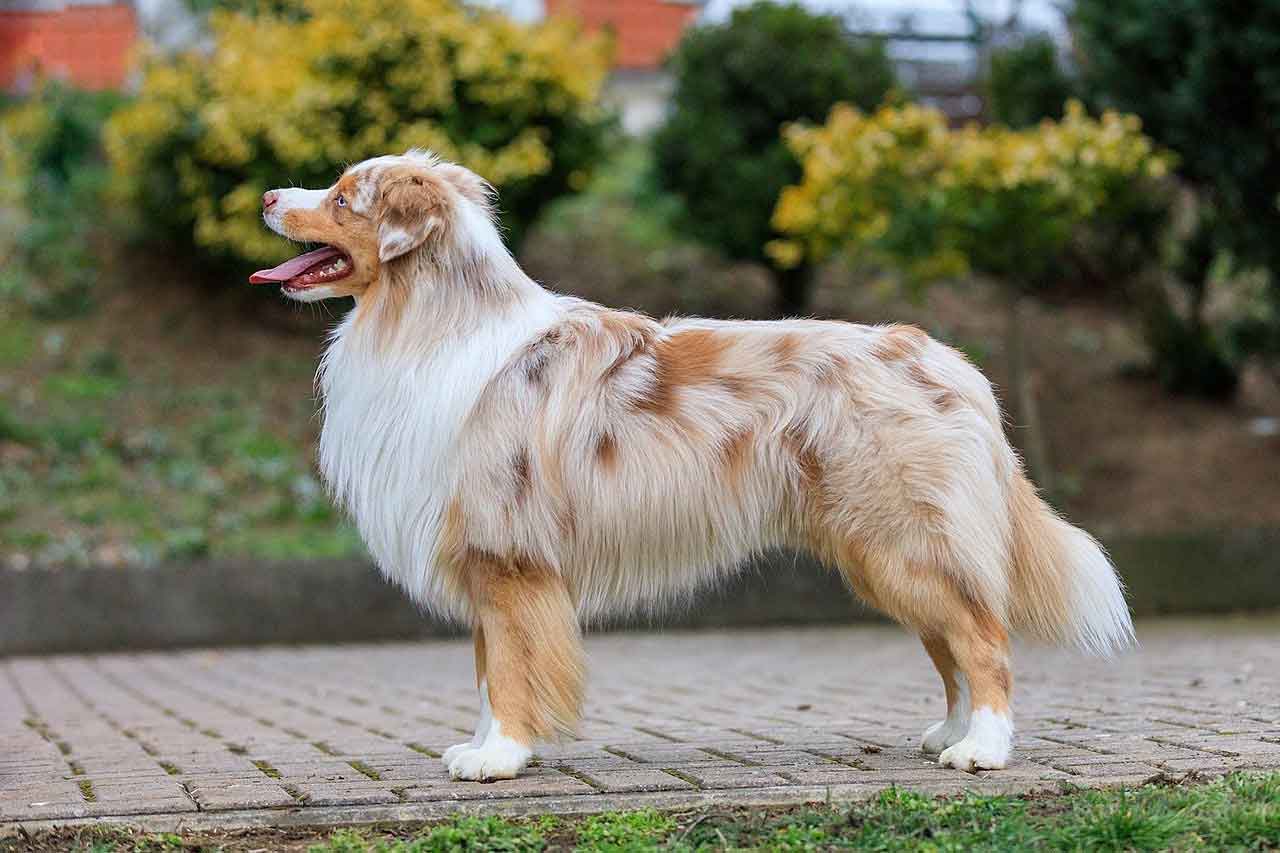
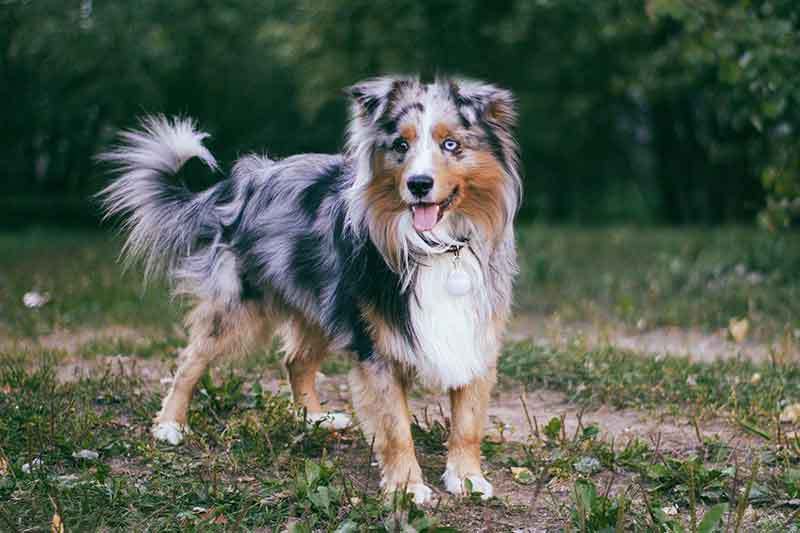
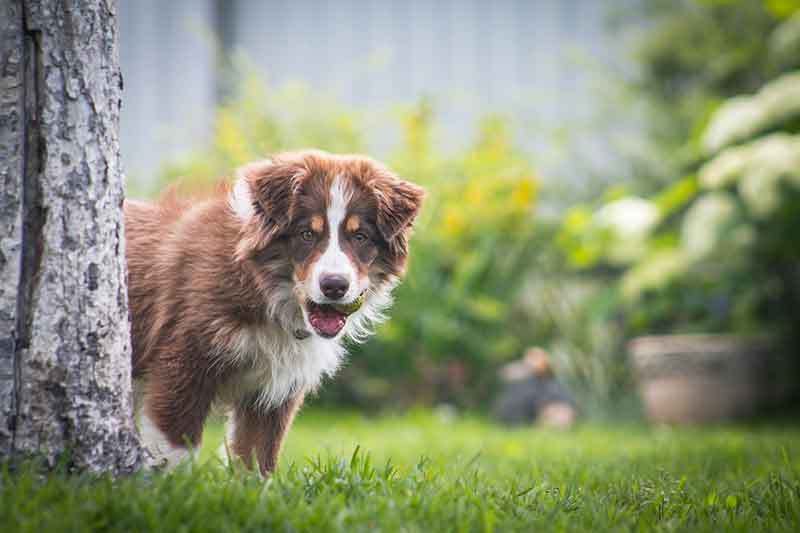
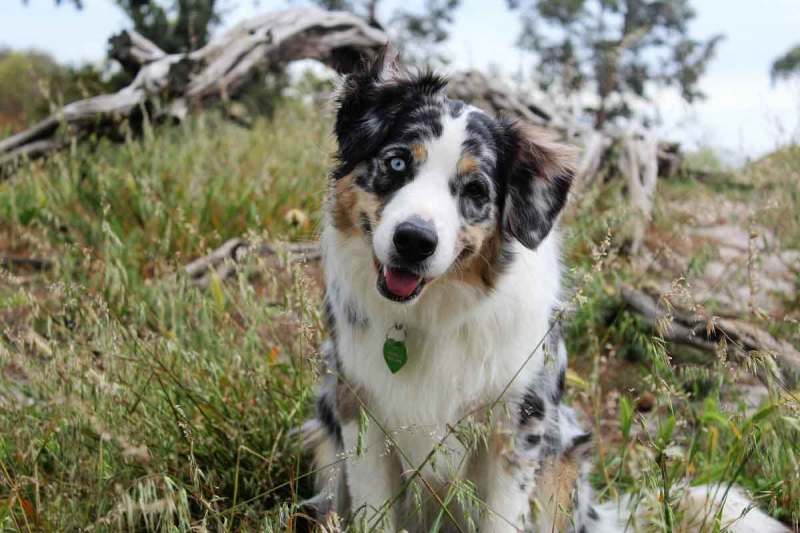
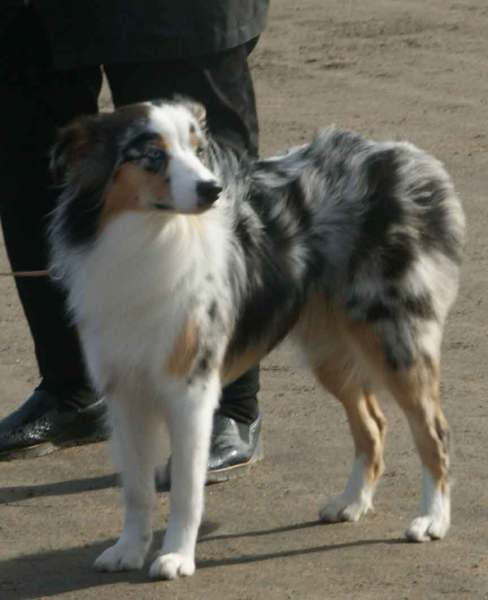
    The Miniature American Shepherd shares many physical traits with its predecessor the Australian Shepherd, only on a smaller scale. The females measure between 33 – 43 cm at shoulder; the males between 35,5 – 46 cm.. Despite its size, they are every inch a real herding dog: energetic, versatile, robust and extremely bright. Striking fur comes in black, blue merle, red and red merle. (Merle exhibits any amount of marbling, spots or mottling.) The Miniature American Shepherd they move with the smooth, agile stride of a dog built for hard work on rough terrain.

    Character and skills

    With his alert expression, attentive and intelligent, dogs Miniature American Shepherd they have all the qualities of a little Shepherd dog, with a pronounced instinct to lead and watch over the herds. Easy to train, able to respond to a variety of demands that allow them to evolve in different sports disciplines. the Miniature American Shepherd However, they are reserved for people who are not familiar to them.. But once you "know" them, becomes a wild playmate, and capable of real feats, thanks to its agility and small size.
    Like all working dogs, especially those able to work in their original profession, when in a situation with a herd of animals, their behavior changes and they become attentive and tireless helpers.

    Its small size, your cleanliness reduced to a minimum, their adaptability and listening skills, greatly facilitate your life and your education in the city. But, like all shepherds, you need to spend and "empty" your overflowing energy. Beautiful walks and runs in the forest are essential to maintain your tone, his physical form and his playful character.

    Health and nutrition

    This solid and sturdy dog, just like their ancestors, does not pose any particular problem in feeding. His health is that of a dog from generations of working dogs, although many buyers take the step of having a companion dog that is easy to live with. Never forget where it comes from, as you deserve regular physical activity to maintain your figure and strength.

    The Miniature American Shepherd is generally a healthy dog, and responsible breeders test their breed for health conditions, communicating with other breeders dedicated to working together for the health of the breed and the preservation of the unique qualities of the breed.

    Although the Miniature American Shepherd it is a relatively healthy breed, the following complications have been observed:

  • Juvenile cataracts
  • PRA (progressive retinal atrophy)
  • Iris Colobomas
  • PPM (persistent pupillary membrane)
  • Regular visits to the vet for checkups and parasite control help ensure a long and healthy life for the dog.

    Grooming

    The Miniature American Shepherd has a double coat, with a longer outer coat and a wool underlayer. The breed shows a good amount, even more so during shedding season, which can happen once or twice a year. Weekly brushing, daily during molting season, will help remove dirt and loose hair and keep the dog looking its best. Balls or tangles can be resolved with a finer brush or metal comb. As in all races, nails must be trimmed regularly, too long nails can cause discomfort to the dog.

    Training

    As in all races, early socialization and training classes for puppies are recommended, which help to ensure that the dog becomes a well-adjusted and well-behaved companion. Smart and willing to please, the Miniature American Shepherd is highly trainable and will reach its best potential as a partner when taught at least basic obedience.

    Physical exercises

    The Miniature American Shepherd he is active and athletic, and requires a moderate amount of exercise but is also very adaptable to your family's way of life. They do well as city dogs as long as their owners provide them with enough exercise.. They enjoy outings with their people that will occupy both their mind and their body. They enjoy and excel at many dog รขโ‚ฌโ€นรขโ‚ฌโ€นevents, including obedience, agility and tracking.

    Characteristics "Miniature American Shepherd"

    Coexistence is important that you have with your new friend. Before considering the acquisition of a dog of the breed "Miniature American Shepherd" you know certain factors. Not all breeds of dogs are apt to live in an apartment, you must take into account his character, their need for exercise, their interaction with other pets, their care and if you have small children, their level of tolerance towards them.

    Adaptation โ“˜

    3,0 of 5 stars (based on 1 review)

    friendly dog โ€‹โ€‹โ“˜

    4,0 of 5 stars (based on 1 review)

    hair loss โ“˜

    3,0 of 5 stars (based on 1 review)

    Affection level โ“˜

    5,0 of 5 stars (based on 1 review)

    Need for exercise โ“˜

    4,0 of 5 stars (based on 1 review)

    Social need โ“˜

    4,0 of 5 stars (based on 1 review)

    Home โ“˜

    3,0 of 5 stars (based on 1 review)

    Toilet โ“˜

    2,0 of 5 stars (based on 1 review)

    Friendly with strangers โ“˜

    4,0 of 5 stars (based on 1 review)

    barking โ“˜

    3,0 of 5 stars (based on 1 review)

    Health โ“˜

    4,0 of 5 stars (based on 1 review)

    Territorial โ“˜

    4,0 of 5 stars (based on 1 review)

    Cat friendly โ“˜

    3,0 of 5 stars (based on 1 review)

    Intelligence โ“˜

    5,0 of 5 stars (based on 1 review)

    Versatility โ“˜

    5,0 of 5 stars (based on 1 review)

    Child friendly โ“˜

    4,0 of 5 stars (based on 1 review)

    Surveillance โ“˜

    3,0 of 5 stars (based on 1 review)

    joy โ“˜

    4,0 of 5 stars (based on 1 review)

    Images "Miniature American Shepherd"

    Photos:

    1 – Blue Merle Miniature American Shepherd by Lextergrace, CC BY-SA 4.0, via Wikimedia Commons
    2 – Miniature American Shepherd with Frisbee by Mullinspw, CC0, via Wikimedia Commons
    3 – Miniature american shepherd puppy by TanSinVic, CC BY-SA 4.0, via Wikimedia Commons
    4 – Miniature american shepherd by TanSinVic, CC BY-SA 4.0, via Wikimedia Commons
    5 – Miniature American Shepherd, blue merle, female by Canarian, CC BY-SA 4.0, via Wikimedia Commons
    6 – American miniature shepherd by https://pxhere.com/en/photo/1029669

    Videos "Miniature American Shepherd"

    Type and recognitions:

    • FCI CLASSIFICATION:
    • Group :
    • Section : . .

    Federations:

    • FCI โ“˜
    • AKC โ“˜

    FCI breed standard "Miniature American Shepherd"

    Origin:
    United States

    Date of publication of the valid original standard:
    04/09/2019

    Use:

    Utilization

    As the name suggests, is a herding dog. Can work in herds of farm animals (sheep, cows, horses).


    General appearance:

    The Miniature American Shepherd is a small sheepdog of the United States of America. It is slightly longer than it is tall with a moderate bone structure in proportion to its body size and weight without extremes.. His movements are fluid, easy and balanced. His exceptional agility combined with strength and ​​resistance allows you to work on a wide variety of terrain. This very versatile and energetic dog is an excellent athlete with great intelligence and a willingness to please those to whom he is present. dedicated. He is a faithful companion and a hard worker. His expression is attentive. Fur hairs, medium length and texture, can be solid in color or mixed with or without whiteness, with or without fires. Traditionally has no tail, shortened or natural short tail.
    A solid build with a mid-frame in relation to its size and weight. The structure of the dog reflects masculinity without being too rough for males.. Females appear feminine without being too light. Overall structure gives an impression of strength without being over the top.

    important proportions

    Length, measured from the tip of the sternum to the tip of the buttock, is slightly higher than the height, measured from the top of the cross to the ground.


    Behavior / temperament:
    The Miniature American Shepherd is an intelligent working dog. Has a pronounced instinct for behavior and keeping herds. He is an exceptional companion, versatile and very easy to educate. Although reserved with strangers, He is not shy. He is an energetic and long-lasting worker who adjusts his behavior and shows the right emotion for the task at hand. With his family he is protective, devoted and faithful.

    Head:

    ---

    Cranial region:

    Head

    The head must be clearly drawn and in proportion to the dog's body. The expression is alert, attentive and intelligent. The dog may express a reserved look and / or vigilant towards foreigners.

    Skull

    The skull is flat or slightly domed and may show a slight occipital protrusion. The width and length of the skull are equal.

    Depression links (stop)

    It is moderate but defined.

    facial region:

    Truffle

    The truffle is liver pigmentation for red or red merle and black subjects for black or blue merle subjects. Fully pigmented truffle is preferred.

    Snout

    Fades a bit of the truffle base and rounds out at the end. The length of the muzzle is equal to that of the skull in the profile. The top line of the skull and the chamfer line are slightly oblique to each other, and the top line of the skull forms a slight downward angle.

    Jaws / Teeth

    The teeth must be complete and in scissors. Dogs with broken teeth, missing or accidentally discolored will not be penalized.

    Eyes

    The eyes are obliquely set, in the form of almond, without projection or sunken and in proportion to the head. Whatever the color of the dress, all eye colors are allowed. Eyes are allowed, specks and specks. The edge of the eyelid has liver pigmentation for red or red merle subjects and black pigmentation for black or blue merle subjects.

    Ears

    The ears are triangular, medium-sized, attached to the top of the head. When is the dog attentive, fold back or to the side, ru รย รยพรยทรยฐ.

    Neck:

    The neck is solid and in proportion to the body, is of medium length and slightly curved. Neck fits well between shoulders.


    Body:

    Generality

    The body is firm and well muscled but without exaggeration.

    Back

    Firm and straight in static as well as in motion.

    Pork loin

    Strong and wide seen from above.

    Rump

    Moderately inclined.

    Breast

    The chest is full and deep. Reaches elbow with well-curved ribs.

    bottom line

    Moderately elevated.

    Tail:

    Traditionally has no tail, shortened or natural short tail. The long, uncut tail can form a slight curve when the dog is around. Resting. When the dog is moving, can be used with a slightly steeper curve.


    Tips

    Former members

    Generality

    The front legs are well muscled and balanced with the hindquarters.

    Shoulder

    Shoulders are long, plans, quite close to the withers and well inclined.

    Arm

    The humerus should be the same length as the scapula and form a right angle with it.

    Elbow

    The elbow joint is equidistant from the floor and the tourniquet. The elbows should be close to the ribs.

    Forearm

    They are straight and strong. The bone is oval instead of round.

    Metacarpus

    Metacarpals are short, thick and strong but still flexible, showing a slight angle seen from the side.

    Front feet

    The feet are oval, compact, with tight fingers. The toes are well arched. The pads are thick and elastic. Nails are short and hard. Lugs can be removed in countries that allow the practice.

    Later members

    Generality

    The width of the hindquarters is equal to that of the front hand at the shoulders. รยญรยปร‘ล’ angle, roughly right, formed by the scapula and humerus corresponds to that formed by the pelvis and thigh.

    Knee

    Hot flashes are clearly drawn.

    Hock

    The hocks are short, perpendicular to the ground and parallel to each other as seen from behind.

    Rear feet

    The feet are oval, compact, with tight fingers. The toes are well arched. The pads are thick and elastic. Nails are short and hard. Lugs can be removed in countries that allow the practice.

    Movement:

    The steps are fluid, clear and easy. The American Mini Shepherd shows great ease in his movements with well covered strides. The forelimb and hindlimb move in planes parallel to the median axis. As speed increases, front and hind legs converge toward the median plane, while the top remains firm and horizontal. The Miniature American Shepherd must be agile and able to change course and pace instantly.


    Mantle

    Fur

    The hair is of medium and long texture, straight to wavy. The inner layer varies according to the seasons. Hair is short and straight on the head and the front of the front legs. The back of the front legs and the panties are moderately provided. The mane and culture are more marked in males than in females. The ears, the feet, the back of the hocks and tail can be fixed. The dog must be presented with natural hair.

    Color

    The colors are varied and unique. In no order of preference, recognized colors are black, red, merle blue and merle red. The blackbird will be exposed with any number of stains, spots or stains. Undercoat may be slightly lighter than undercoat hair. Asymmetric markings are not a defect.
    No fire marks required (Sun tanning). When they are present, are allowed in the following locations: around the eyes, in feet, in the legs, below the neck, in the face, at the bottom of the ear, under the base of the tail, and panties can also emphasize the end result. The tone of the marks "fire" can range from creamy beige to black red, no preference.
    White markings are not mandatory and must not be invasive. They are limited to the mouth, cheeks, skull, neck, with a partial or full collar, chest, belly, forelimbs and hindquarters to the end of the hock. The tip of the tail may be white. The eyes must be completely surrounded by color. Rolling eyes are forbidden. The ears should preferably be completely covered with colored hair. If there is white in the ear, should not be more than 25% in one ear.


    Size and weight:

    Size and weight

    Height to the cross

    The size for males should be between 35,5 cm and 45,5 cm to the cross.
    The size for females should be between 33 cm and 43 cm to the cross.


    Fouls:

    Any deviation from the above mentioned criteria is considered to lack, and the severity of this is considered the degree of deviation from the standard and its consequences on the health and well-being of the dog and the dog's ability to perform its traditional task.

    Serious misconduct

    ▷Ears hanging or fully erect.
    ▷25 to 50% unpigmented truffle.
    ▷Atypical hair.
    ▷White markings covering more than 25% from the surface of the ears.
    ▷The hair roots of a white necklace protruding from the cross.

    disqualifying fouls:

    ▷Aggressive or shy dog.
    ▷Lack of type.
    ▷Size at the withers outside the limits of the standard: less than 35,5 cm and more than 45,5 for males, less than 33 cm and more than 43 cm for females.
    ▷More than 50% unpigmented truffle.
    ▷Color no compatible, different from those allowed by the standard.
    ▷The color of the mucous membranes does not match the dress.
    ▷Non-pigmented hairs.
    ▷Eyes not completely colored.
    ▷White tasks in another place that is not specified in the standard.
    ▷The lowest or highest prognathism.
    ▷Cryptorchid or perro monorchid.


    N.B.:
    NB:
    • Any dog โ€‹โ€‹showing clear signs of physical or behavioral abnormalities must be disqualified..
    • The aforementioned fouls that are more pronounced or more marked are eliminatory..
    • Males should have two normal-appearing testicles fully descended into the scrotum..
    • Only functionally and clinically healthy dogs, with the typical conformation of the breed, should be used for parenting.

    Source: F.C.I - International Cynological Federation

    Alternative names:

    1. Miniature Australian Shepherd, MAS (English).
    2. Miniature Australian Shepherd (French).
    3. Miniature Australian Shepherd, Mini-Aussie (German).
    4. Miniature Australian Shepherd (Portuguese).
    5. Miniature Australian Shepherd (espaรฑol).

    โ–ท The world of Pets: Dogs, cats, birds, reptiles, amphibians

    Majorca Shepherd Dog
    Espaรฑa FCI 321 . Sheepdogs

    Ca de Bestiar

    The Majorca Shepherd Dog or "Cattle", It is a breed of dog originating in Mallorca.

    Content

    History

    Also known as โ€œCa de Bestiarโ€, this breed is believed to have existed since ancient times. Through the years, this dog would have been bred with a variety of local Mallorcan dogs, as well as with other European Shepherd dogs, and it was not until 1970 which he puts any restrictions on their upbringing. In fact, its breed standard was written as recently as 1980. It was in 2006 the UKC โ“˜ recognized the breed within his Group of Sheepdogs.

    Appreciated through the centuries by the Spaniards for their ability to be a versatile farm dog, the Majorca Shepherd Dog It was used both to herd flocks and to monitor property and animals. It has also been reported that the Majorca Shepherd Dog was widely used in dogfighting, a practice that is now illegal. Although it is still used on farms today, and is also often kept as a companion animal, this rare breed once seen internationally and is considered a rare breed.

    Physical characteristics

    The Majorca Shepherd Dog is a large size dog, average weight, well proportioned, rustic, strong and large muscles, flexible and robust.

    There are two varieties: long hair and most widespread short-haired. The head is well modeled, large and provided with the body, but not so much as to look like a molosser. Craniofacial shafts are slightly convergent; the relationship between the skull and the muzzle is of 1:1.

    The color eyes goes from amber to dark brown, and his expression is intelligent and enigmatic.

    The ears, small in relation to the head, they are triangular, inserted at the top and are normally bent, with dropped tips.

    The tail Start horizontally, is horizontal section, It has thick base and it tapers towards the tip.

    Fur: the short hair variety has quite thin Undercoat. In the variety of long hair, hair coverage can reach a length of 7 cm and it is slightly wavy. In both varieties should be soft and fine.

    Color: the only one admitted is black, optionally with white spots on chest and feet.

    Size: males, of 66 to 73 cm.; females, of 62 to 68 cm.. The weight is usually of 40 kg approximately.

    Character and skills

    He is a shepherd dog with skills for the job of guard and defense. Itร‚ยดs Intelligent, docile and affectionate, although as a puppy he is usually shy and reserved. For this reason it is important to socialize it to the maximum to avoid that it closes in on itself.

    The adult is very suspicious of strangers and he is united by a very strong bond with his master. Her enigmatic gaze not glimpse of his thoughts. It has an extraordinary courage and willing to everything in order to defend their loved. It's a little known breed outside the Balearic Islands, so to acquire a good puppy should address to breeders of the Islands.

    Images ยซMajorcan shepherd dogยป

    โ€œMajorcan Shepherd Dogโ€ videos

    Type and recognitions:

    • FCI CLASSIFICATION:
    • Group :
    • Section : . .

    Federations:

    • – FCI โ“˜

    FCI breed standard "Majorca Shepherd Dog"

    Origin:
    Spain

    Date of publication of the valid original standard:
    26.05.1982

    Use:

    Herding dog, guardian and defense


    General appearance:

    Sub-convex profile dog, large without being exaggerated and medium-weight size. It is totally black or black with white spot on chest, well proportioned, rustic, strong, muscular, robust and agile. There are two varieties of hair:

    • Short hair, the most common variety.
    • Long hair.

    IMPORTANT PROPORTIONS:

    Dog subhipermetrico, midline and subconvex.

    • The female accepts a longitudinal diameter of up to a 3% greater than the height of the cross.
    • Length of the muzzle is equal to the length of the skull.
    • The length of the head must be equal to the length of the neck.
    • In adult males the thoracic perimeter, taken together the cross behind the elbows, It is about a cms rather than its height at the withers.


    Behavior / temperament:

    Dog of great nobility, only an owner that accepts loads of strangers with difficulty.
    Intelligent, docile, loving, shy on end and reserved in his youth ; his sentimentality comes to unsuspected. Faithful to his master until death. If we explore in his eyes it will give us the feeling thinks. It is courageous and quarrelsome.

    Head:

    Slightly triangular profile; view dorsally is wider at the top than at the bottom; solid, but not heavy; large enough to accommodate a good intelligence; well molded and proportionate to the body; It must be rather large, but never a trotting type. The supranasal line is parallel to the cranial line. Slightly divergent skull-facial axes.

    Cranial region:
    • Skull: Sub-convex profile. The width of the head, taken between the storms, It should be slightly higher ( approximately 1,2 %) to the length between the supraorbital line and the occipital crest. A slight groove can be seen in the first third of the frontal midline. Marked occipital Crest.
    • Depression links (Stop): Marked, but never sudden, in mild decline.

    facial region:

    • Truffle: Wet, fresh, black, large, with broad nostrils; No split. It despuntuarรก significantly if you have stains of barks or lighter.
    • Snout: Width, rather strong ; It should not be in tip, but its height and width should be accentuated as it approaches the orbits. In the variety ยซ Ca cabrer ยป (Longhair) more pointed. The dorsal profile of the nasal helm is sub-convex. The profile of the branches of the lower jaw is straight. Black color palate.
    • Lips: Black ; the high not seen to the bottom while your mouth closed ; the labial commissure is little noticeable and they go unnoticed because they are well proportioned to the head.
    • Jaws / Teeth: Very white teeth, well developed and well placed, closed scissors, making the incisors true upper ends prey with the lower canines. The molars developed.
    • Eyes: Rather small, slightly almond ; are not prominent nor sunken in orbits ; not far apart from each other, centered, slightly oblique, lively. Color between the Rosemary honey (something clear) and of the honey, carob (dark). Enigmatic expression, with look smart and sad at the same time, where denotes even distrust. The eyelids are thin, black and oblique, close to the eye.
    • Ears: Broken, small size in relation to the head, triangular, reaching the tear in the eye of its corresponding side tip, or is approximately equal to the length of your skull. Without amputating, slightly thick, high insertion, separating your tip slightly skull, with a longitudinal fold and another cross around the first third.
    • Position of the ears: usually bent and dropped, something separate from the muzzle. Played back in standby ; in State care by the transverse fold levantadolas, separating them from the snout than usual.

    Neck:

    Massif, muscular, strong and proportionate to the head and body. Thick, with very little double chin, cylindrical, its diameter accentuating more at the base. The skin is tough and elastic, or fine or thick, firmly attached to the neck at its top and sides, more detached on the bottom.

    Body:

    • As a whole: Robust, very well proportioned, giving the impression of strength and agility while.
    • Cross: Marked and at least at the same height as the top of the rump ; the large area between the scapulae and strong.
    • Dorso-lumbar line: Straight, horizontal, never built.
    • Pork loin: Wide and powerful.
    • Rump: Medium, slightly rounded, wide, powerful and muscular; never prominent or fallen. The top should be at the same height as the cross. Its interiliac width must be equal to the iliac-ischial length .
    • Breast : Wide and high, maximum reaching the elbow; a width approximately equal to the length of the neck; quite deep, not prominent, with slightly pronounced sternum. Arched ribs (non-flat or in barrel).
    • Belly and flanks: Fairly bulky flanks. Slightly gathered belly, never agalgado, nor descended to be confused with continued chest. Something stylish, You must give the impression of agility.

    Tail:

    Horizontal insertion and circular section, rather thick at its birth. Some 8 cm base flattens slightly at its lower profile, in a few 10 length cm, to continue then the tapered circular to its end. Without amputating. Of a length that must reach at least the hock, without touching the ground. No tuft or fringe, Although it is authorised, If this is light, copies of older. In the variety of long hair you must have abundant and long fringe. Size of the queue : at rest naturally drooping or slightly curved outward, slightly touching the hocks, default is considered serious if your tip should touch the ground. Undulating and raised more than the horizontal sickle-shaped, without screwing it, When in action.

    Tips

    PREVIOUS MEMBERS:

    • As a whole: Strong Member ; correct limbs ; seen from the front and in profile parallel to each other and perpendicular to the ground.
    • Shoulder: Oblique and strong.
    • Scapulo-humeral angle: 115ยฐ.
    • Arms: Of equal length to the scapula.
    • Elbows: Without deviations, glued to the chest. Radial-humerus angle : 130ยฐ.
    • Forearm: Strong, well angled, perpendicular. Vertical bones, strong, long and right.
    • Metacarpus: Short and slightly tilted.
    • Previous feet: Almost of Hare (something shorter and wider than they), finger semialtos, semiarqueados, together, and with the very hard and black pad. Without acute interdigital membrane.

    LATER MEMBERS:

    • As a whole: Muscular, strong ; correct limbs. Dimmed and hard muscle relief.
    • Coxo-femoral angle: 115ยฐ, peer-to-scapulo-humeral.
    • Thigh: Strong and muscular.
    • Stifle-tibial angle: 130ยฐ, same as the humerus-radial
    • Leg: Long and powerful.
    • Hock: Little pronounced, very open 135ยฐ angulation. The height of the Hock is about somewhat lower than the one-third of its height at the withers.
    • Metatarsus: Well marked.
    • Hind feet: Almost of Hare, crushed, with fingers together and semiarqueados. Pad hard and black. Arched nails, black and hard. Without acute interdigital membrane. May be born with or without Spurs, in the first case they must amputate.

    Movement:

    His way of walking must be firm and elegant. The trot on diagonal bipeds, Tip slightly posterior third, respect to the previous. The Gallop will be franco, fast rustic, the rear legs wide apart at its base with soil, placing them outside of the hands, as if it were jumping. The preferred step and the work is the Gallop.

    Mantle

    SKIN: Elastic, without folds, hard and light grey.

    • HAIR: Short and glued to the skin, its length ranging about 1,5 cm to 3 cm on the spine ; very fine Undercoat, low thickness and very attached to the skin. In the long-haired variety may be slightly wavy on the spine, approximate length of more of 7 cm according to the time of year, with the largest winter. Well distributed and thin Undercoat, grow hair in their normal length in the fringe of the queue, Tip of the ears and back of the limbs. In both varieties should be smooth, hard and quite thin.
    • COLOR: The only color supported is black, varieties of Jet, regular and peceno. The target is supported only in the chest, in the form of thin tie under neck and anterior and posterior foot, highlighting according to its easy visibility on nails and tips of the toes. The Jet Black landmark is the most appreciated, nature of the ordinary black and the peceno.


    Size and weight:

    • Height to the cross: Among 66 and 73 cm for males. Among 62 and 68 cm for females.
      Specimens with heights of one cm or so are allowed at the limits indicated ; in this case you must subtract score.
    • Weight: Environment to 40 kg.


    Fouls:

    Any deviation from the aforementioned criteria is considered as a fault and the severity of this is considered to the degree of the deviation to the standard and its consequences on the health and well-being of the dog..

    SERIOUS FAULTS

    •  Dogs that drool-worthy.
    •  Cut fangs.
    •  Very raised ears rest, very large very separated from the face or completely glued to it.
    •  Very collected belly (whippety).
    •  Threaded queue; white tail tip.
    •  White spot of chest of more of 1 dmยฒ.
    •  All fingers of a foot white.

    MISS PLAYOFFS

    •  Aggressive or fearful dog.
    •  Mastiff head, very wide and heavy or Hound, long and narrow with just pronounced stop.
    • Truffle pink or white.
    •  Upper or lower prognathism more of 3 mm.
    • โ€ข Eyes of different colors from each other ; eye that is not of the color that goes from the Rosemary honey (something clear) the carob-honey (dark) ; very clear eye.
    • Amputated ears, stiff in action or almost stiff at rest.
    •  Double chin neck, more thickly along the skull than at its base, longer that a 10% length ranging from truffles to the occipital Crest.
    •  Body too long or too short ; height of the top of the rump in a 3% greater than the height at the cross.
    •  Very thick tail, or of equal thickness at the base and tip ; excessively long to touch the ground ; amputated or missing you each 2 cm to reach the Hock ; with abundant fringe in the variety of short hair, with or without bangs in long hair variety.
    •  Other color than black, or, in dogs being black, an anterior or posterior foot white or another color ; members shod in white on any number of limbs ; not totally black body (with the exception of the chest, very few hairs on the belly, perpucio or tip of the tail), stains, without disqualify, they notably despuntuarรกn. They despuntuarรกn not consequential white hairs of bites, trauma or other similar injuries, or the white hairs from the face own age. White fingers not disqualify, unless the animal is more than six, despuntuando notably each ; a single finger white or another color in the previous feet disqualifies the dog.
    •  Height of the cross over of 74 cm in males and more of 70 cm in females. The cross of less height of 66 cm in males and less of 60 cm in females.
    •  Under weight of 30 kg and over 50 kg in males, under weight 25 kg and over 45 kg in females ; even being within the aforementioned limits, very skinny dogs, visibly obese or very saddled (having tolerance in pregnant females).

    SCALE OF POINTS

    • General appearance and temperament โ€“ 21 points
    • Presentation (cleaning and porte) โ€“ 4 points
    • Fur (length and hardness) โ€“ 4 points
    • Layer (color and brightness, 7+2) โ€“ 9 points
    • Temperament/Behavior โ€“ 4 points
    • Head โ€“ 21 points
    • Skull and stop โ€“ 4 points
    • Snout, nose and lips โ€“ 5 points
    • Teeth and palate (2+1) โ€“ 3 points
    • Eyes โ€“ 5 points
    • Color โ€“ 2 points
    • Form, size and separation โ€“ 2 points
    • Eyelids โ€“ 1 point
    • Ears (form, thickness, inclusion, size) โ€“ 4 points
    • Neck โ€“ 4 points
    • Trunk โ€“ 21 points
    • Cross โ€“ 1 point
    • Back and back โ€“ 5 points
    • Rump โ€“ 3 points
    • Belly โ€“ 2 points
    • Breast , chest, Ribeye, size โ€“ 10 points
    • Tail (form, length and fringes) โ€“ 2 points
    • Limbs โ€“ 19 points
    • Previous aplombs โ€“ 6 points
    • Later aplombs โ€“ 8 points
    • Feet ant. and post., fingers, nails hardness of the pads โ€“ 5 points
    • Movement โ€“ 12 points
    • Ear bearing โ€“ 3 points
    • Tail bearing โ€“ 3 points
    • Jogging โ€“ 2 points
    • Gallop โ€“ 4 points

    Total : 100 points


    Proportional measurements (ideal for the male)

    • Weight โ€“ 41 kg
    • Height at the withers โ€“ 71 cm.
    • Height to the rump โ€“ 71 cm.
    • Chest height โ€“ 39 cm.
    • Longitudinal diameter โ€“ 71 cm.

    Head

    • Muzzle length โ€“ 13 cm.
    • Skull length โ€“ 13 cm.
    • Total head length โ€“ 26 cm.
    • Neck length โ€“ 26 cm.
    • Ear Longiud โ€“ 13 cm.
    • Tail length โ€“ 52 cm.
    • Raised to hock โ€“ 23 cm.

    Length of the hair on the back

    • Short hair variety โ€“ 2 cm.
    • Long hair variety (between seasons) โ€“ 7 cm.
    • Head width โ€“ 15 cm.
    • Thoracic perimeter โ€“ 81/83 cm.
    • Chest width โ€“ 26 cm.
    • Neck circumference โ€“ 49 cm.

    Any dog โ€‹โ€‹showing clear signs of physical or behavioral abnormalities must be disqualified..


    N.B.:

    Males should have two normal-appearing testicles fully descended into the scrotum..

    Source: F.C.I - International Cynological Federation

    Alternative names:

    1. Majorca Shepherd Dog, Ca de bestia, Pastor mallorquรญn (English).
    2. Berger de Majorque (French).
    3. Ca de Bestiar (German).
    4. Ca de Bestiar (Portuguese).
    5. Pastor-maiorquino, Ca de Bestiar, Pastor mallorquรญn (espaรฑol).

    โ–ท The world of Pets: Dogs, cats, birds, reptiles, amphibians

    Malinois
    Bรฉlgica FCI 15 . Sheepdogs

    Malinois

    The Malinois is vigilant, always active and alert. He has an innate aptitude as a flock guardian…

    Content

    History

    The Malinois is one of the 4 belgian shepherd varieties, its name comes from the Belgian city of Mechelen (Mechelen Dutch, French Malines), town that saw it born.

    The first standard of this variety was written by Professor Reul, of the Club du Chien de Berger Belge, to be adopted in 1892. The appearance, skills and most of the physical characteristics outlined in this standard, they are almost identical to the current. Its origins are the same as those of wire-haired dogs.

    This variety, little known, of Belgian Shepherd is a breed of utility par excellence and is very appreciated by trainers of dogs work and people who participate in various tests of competition as Schutzhund.

    In addition to his civilian facet as a competitive "athlete", It is also frequently used by the armed forces, for example the Mexican army who used it to attack.

    They are very popular in Belgium, France and America, the first Malinois they arrived in United States in 1907, to be used by the police, due to its temperamental characteristics.

    Currently the Malinois It has been a better option for the election of the army and police, unlike the German Shepherd, Although does not have the same force as the German Shepherd, the Malinois surpasses this in resistance and availability to work, Moreover the level of intelligence is similar, even many creators who have worked with both races, They claim that it is superior.

    Its development is closely linked to sport, in particular the French Ring and their dissemination at the global level. In fact, in 1900 organized the first tests with jump of obstacles, obedience and a program of bite and 1909 in Paris, is the first World Championship in Ring, from which, is carried out each year.

    Physical characteristics

    The Malinois shared standard with each other 3 varieties of Belgian Shepherd, differentiating these only in the length, type and hair color. His hair is short on the body, without fringes in limb or tail, the color is carborane Brown and presents dark mask on the face.

    Its robust constitution allows it to easily adapt to life outdoors and withstand the environmental conditions of climates as difficult as that of Belgium..

    For more than four decades, the lines of beauty and work have not mixed with each other. The Malinois It is above all a breed of utility and if there is something that it is becoming known around the world for, it is for its good attributes for work while still seeing that it is not a dog that resists all terrain, in strength is surpassed by the German Shepherd and some Bull type dogs, but it is still an exemplary dog.

    So, It is not a variety whose upbringing go primarily oriented to the official type that sets the standard, that is to say: the beauty.

    This explains that his standard has a fairly broad margin compared with other races classified by the FCI, that is why it should not surprise found with copies that differ in size and height.

    Character and skills

    He is a guard dog, always active and alert. He has an innate aptitude as a flock guardian, and it is a tenacious and ardent supporter of his master, bringing together all the qualities needed to be a sheep dog, guardian, of Defense and service.

    Despite their heterogeneity of characters these examples stand out for their vitality, loyalty, vivacity, vehemence, innate aptitude of guardian and his obsession with instinctive to cash in and bite objects. And as often have an intuitive nature towards things for his excellent sense of olfactory sensory perception and is a good Hound, and here the dogs exceeding probably is the German Shorthaired.

    Images of the ยซMalinoisยป

    Videos of the ยซMalinoisยป


    FCI breed standard Malinois

    FCIFCI - Malinois
    Malinois

    Otros nombres:

    Belgian Malinois / Berger Belge Malinois / Mechelaar / Mechelse Herder / Mechelse Scheper / Pastor Belga Malinois

    โ–ท The world of Pets: Dogs, cats, birds, reptiles, amphibians

    Mucuchi
    Venezuela Not recognized by the FCI

    The Mucuchi is a large size dog, robust Constitution.

    Mucuchรญes

    Content

    History

    The Mucuchi, It is a breed of dog originally from Venezuela.

    The origin of the Mucuchi comes from the invention of veterinarian doctor Wilender Ferrari, Although it is believed that they descended from dogs brought by the Spanish conquistadors at the end of the 16th century as watchdogs and herders. As possible ancestors are brought to the spanish mastiff, the Pyrenean Mastiff and the Algerian Mastiff, as well as the Atlas Sheepdog or Aรฏdi and the Great Pyrenees. Over the years these breeds of dogs were crossing creating a powerful dog and very versatile worker at the end.

    Its importance in Venezuelan history arose after the hero Simรณn Bolรญvar arrived in the town of Mucuchรญes, in the Venezuelan Andes, during their fight for Venezuelan independence and adopt a dog of this breed. For 1926-27 the Mucuchรญes was found throughout Venezuela. After the wide distribution of the race, its purity and quality was in a serious decline during the first part of the 20th century. There is a famous painting of Simรณn Bolรญvar on his horse with the Mucuchรญes dog that was given to him while he was crossing Venezuela to Caracas..

    In 1961 a club was created in order to preserve the breed and to 1964 It was declared the national dog of Venezuela. Still the club disappeared, putting in an uncertain future to this dog.

    Read more

    โ–ท The world of Pets: Dogs, cats, birds, reptiles, amphibians

    Mastiff danรฉs
    Dinamarca FCI 315 - Molossoid - Dogo

    Mastรญn Danรฉs

    The Mastiff danรฉs is calm, with good temperament and friendly.

    The Mastiff danรฉs (or Broholmer) It is a breed of molosser type dog, originally from Denmark.

    It is a dog of Doge of large size type, rectangular and strong Constitution; its motion is regular and energetic. His appearance is dominated by the powerful forelimbs.

    The head is broad and solid; strong neck with some loose skin, and the chest wide and deep.

    Otros nombres: Danish mastiff / Broholmer.

    Crupo 2 / Section 2 – molosoids and mountain dogs.

    Dogs breeds: Mastiff danรฉs

    Read all about the race by clicking on: Broholmer.