โ–ท The world of Pets: Dogs, cats, birds, reptiles, amphibians

English mastiff
Inglaterra FCI 264 - Molosoids โ€“ Doge

Mastรญn Inglรฉs

The English mastiff He is extremely loyal and faithful to his family.

Content

History

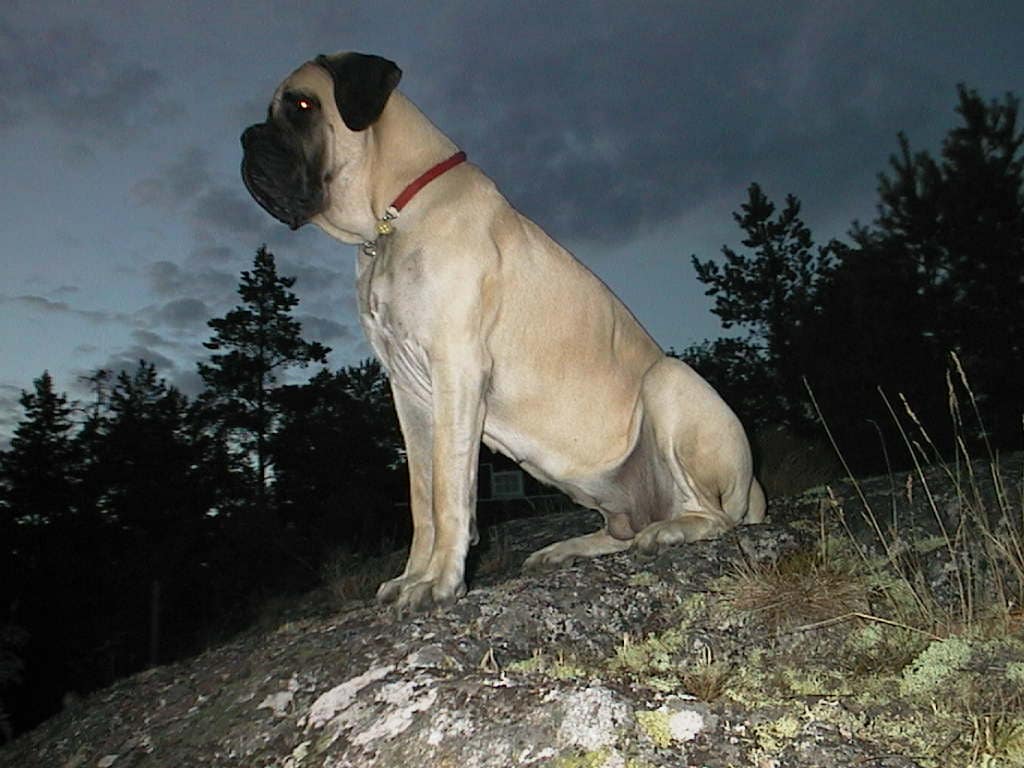
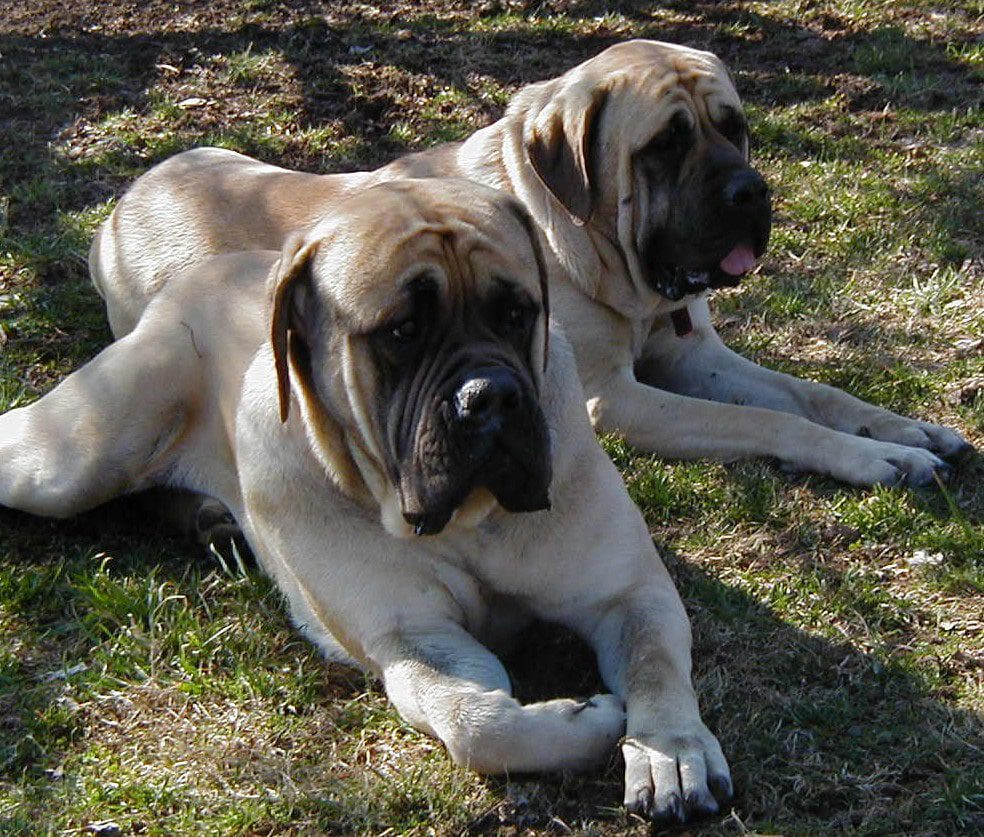
The English mastiff It is a breed of dog of large size type trotting and English origin.

The history of this dog goes back to the year 55 to. c., time when the legions invaded Great Britain and to his surprise had to face an enemy that had two curious assistants, two dogs with striking characteristics.

One of them was strong and robust both body and members, with a large head and a short but powerful jaw.

That dog is possibly the ancestor of the Bulldog, and part of the current Bullmastiff.

The other dog had dimensions that were scary, looked more like a lion than a dog. This specimen was a direct descendant of the Mastiffs 'Asiriobabilonians' who had traveled to England by the Phoenicians five centuries before the Roman invasion.

Before this beanpole, the 'molossians of Epirus' which the Romans brought with them as their war dogs, they looked like Chihuahuas...

So once conquered 'Britain', the Romans, they expanded his army with several copies of those giant and fearful dogs who called "Pugnaces Britannici" and they used them, mainly in typical shows of the time...

They faced these dogs with huge wild beasts in the arenas of circuses, there they participated in bloody fights against bulls, bears and other dogs. As well, they were used as guardians of herds, bodyguard, protectors and companions.

The English Mastiff or Mastiff, is descended directly from those dogs.

A Mastiff arrived in America aboard the Mayflower, name of the ship that transported the so-called "Pilgrims" from England (United Kingdom), to the coast of what is today the United States of America, in the year 1620.

They were the first settlers, in settling on the coast of Massachusetts, forming the Plymouth Colony, and with them the English Mastiff.

There is documentary evidence that the English Mastiff first arrived in America on the Mayflower., but the standardization of the breed in United States did not occur until the end of the 19th century.

By the end of the second world war, the mastiffs were almost extinct in England. But, with the flow of imports of United States and Canada, the breed resurfaced and today its existence is not in any danger in England and has gained much popularity in North America..

Physical characteristics

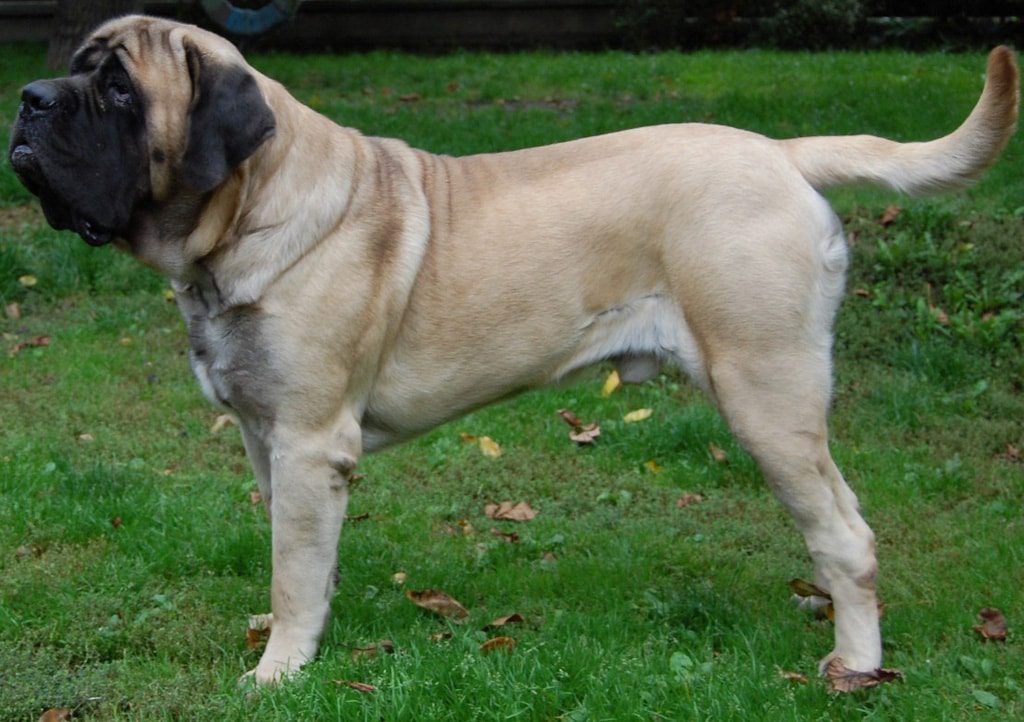
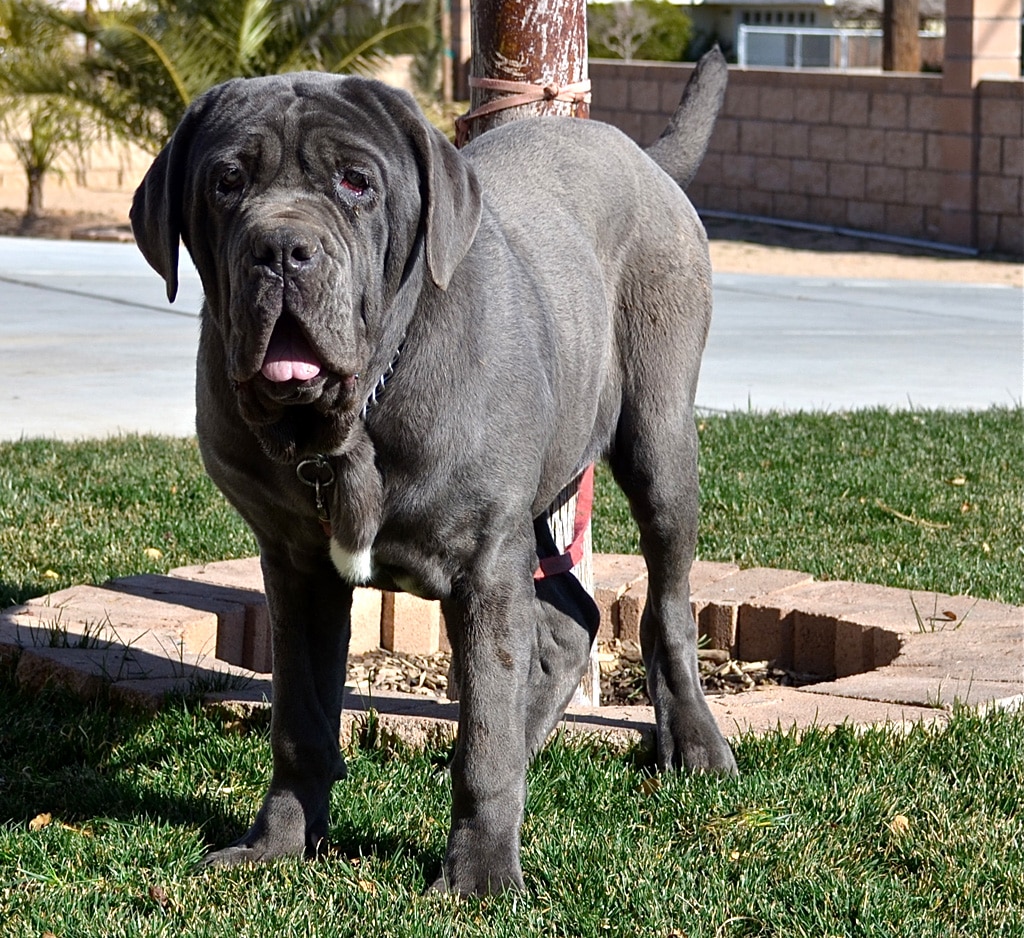
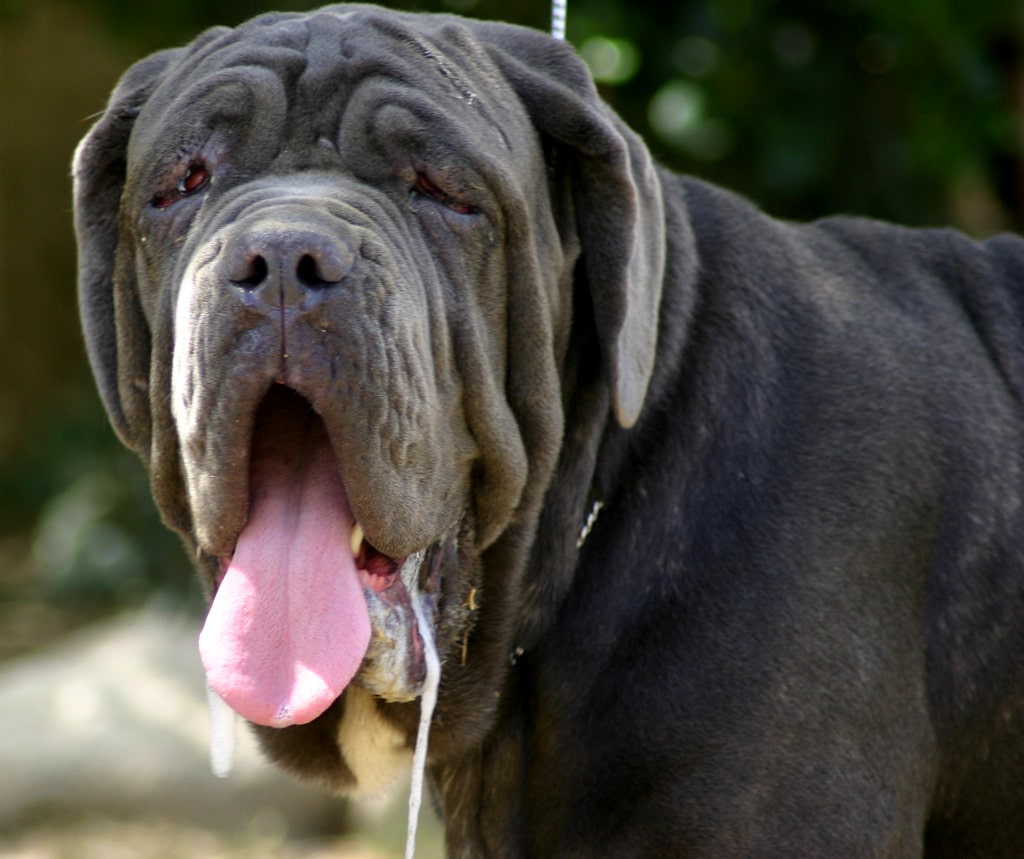
This is a race of powerful composition, burly, wide skull and the head usually has a square appearance.

Of size It must be very large and give the impression of power and strength, viewed from any angle. The body must be massive with great width and depth, especially between the Forelegs, cause these are well separated. While no height or weight have been specified for this race, the approximate height of 70 to 80 cm and the weight of 80 kg to 90 kg.

His hair is short and glued to the body and color may vary, while its snout, ears and nose, around the eyes is always black.

This is a particularly large dog that requires a correct diet and exercise. Normally live in 10 to 12 years.

Different colors are possible, for example, sand color, striped, brown or gray. Unfortunately the human tends to extremes and the mastiff was not spared from this.. So it has been raised bigger and heavier in recent decades.. His head has become increasingly massive and many folds have also been made. Giants could no longer reproduce naturally, they could no longer walk properly, his life expectancy was dramatically reduced.

Character and skills

Videos of the English Mastiff
Handsome English Mastiff
English Mastiff Samson Snaps Tree Branch!Lightbox for Video by VideoLightBox.com v1.11
The Mastiff breed is a combination of greatness, dignity, and bravery; calm and affectionate towards his owner, but capable of protecting.

He is a well-mannered dog but you need enough field to stretch his long body. It is an extremely loyal breed and, Although it shows no excessively, It is true to his family and is very good with children.

But, It can be very jealous for the protection of owners and should be handled sensibly, as it is exceptionally powerful and can be difficult to control.

Seeks proximity to its humans. It is a reliable protector for them. In case of acute threat to your humans, will try to keep danger away from them by facing the attacker with his body, but it won't attack him anymore. His calm and serene temperament makes him a loyal and child-friendly companion, who forgives everything. It gets along very well with other pets.

English Mastiff Education

Keep in mind that in an adult mastiff the leash is only symbolically a control. The mastiff easily has the power to maneuver the other end of the line at will.. But you don't want to do it, at least if you have enjoyed the basics of a good education. The Mastiff is very easy to train. Only their stubbornness has to be broken here and here a consistent softness is needed.. He wants to follow his master and caretaker and he does it very reliably. It is an elementary duty of the owner of a Mastiff to pay attention to a consequent education already in the puppy. This alone and not the strap makes wonderful walks in nature possible, that together with this four-legged friend become a balm for the soul of agitated people.

Care and health English Mastiff

Caring for a healthy mastiff is not problematic. Brushing the coat once a week is enough.

Typical diseases

Gigantism with copies of more than 90 kg, sometimes up to 120 kg, unbalances the entire natural dog building plan. Serious gait damage is just one consequence, and life expectancy is also greatly reduced. Bad habit of strong folding of the head and body often leads to chronic inflammations. As in most large dogs, we see hip or elbow dysplasia. Eye and heart disease can occur more frequently with mastiffs – the rule is always: the more serious, the greater the risk.

Nutrition / Food

You need a lot of high quality food. Especially in the growth phase you need a professional nutrition plan. It is helpful to have a feeding bowl in a high position to counteract the risk of stomach twisting. You should always pay close attention to their weight.

Characteristics "English mastiff"

Coexistence is important that you have with your new friend. Before considering the acquisition of a dog of the breed "English mastiff" you know certain factors. Not all breeds of dogs are apt to live in an apartment, you must take into account his character, their need for exercise, their interaction with other pets, their care and if you have small children, their level of tolerance towards them.

The life expectancy of the English Mastiff

Breeding errors, especially the tendency to gigantism, they have cost this dog, once extremely robust, many years of his life expectancy. Before they were 12, Today are 7 – 9 years.

Buy an English Mastiff

Buying a mastiff should be long-term and well-considered. You should carefully check if you have all the requirements to be able to spend many wonderful years with this giant.. If you are looking for a puppy, you must pay special attention that the dogs are not too massive. One should wonder about ancestors, its appearance, their illnesses, your age. Also to get a Mastiff with a stable character, you should just look directly at a serious breeder. For animal welfare reasons one should refrain from buying puppies from parents of more than 90 kg. Very occasionally there is also a mastiff in the animal shelter. Puppies raised in serious conditions cost around 2000 EUR.

Characteristics "English mastiff"

Adaptation โ“˜

5,0 of 5 stars (based on 1 review)

friendly dog โ€‹โ€‹โ“˜

3,0 of 5 stars (based on 1 review)

hair loss โ“˜

3,0 of 5 stars (based on 1 review)

Affection level โ“˜

5,0 of 5 stars (based on 1 review)

Need for exercise โ“˜

2,0 of 5 stars (based on 1 review)

Social need โ“˜

3,0 of 5 stars (based on 1 review)

Home โ“˜

3,0 of 5 stars (based on 1 review)

Toilet โ“˜

2,0 of 5 stars (based on 1 review)

Friendly with strangers โ“˜

3,0 of 5 stars (based on 1 review)

barking โ“˜

1,0 of 5 stars (based on 1 review)

Health โ“˜

4,0 of 5 stars (based on 1 review)

Territorial โ“˜

5,0 of 5 stars (based on 1 review)

Cat friendly โ“˜

5,0 of 5 stars (based on 1 review)

Intelligence โ“˜

3,0 of 5 stars (based on 1 review)

Versatility โ“˜

3,0 of 5 stars (based on 1 review)

Child friendly โ“˜

5,0 of 5 stars (based on 1 review)

Surveillance โ“˜

2,0 of 5 stars (based on 1 review)

joy โ“˜

5,0 of 5 stars (based on 1 review)

Images ยซEnglish Mastiffยป

ยซEnglish Mastiffยป Videos

Type and recognitions:

  • FCI CLASSIFICATION:
  • Group :
  • Section : . .

Federations:

  • – FCI – Pinscher and Schnauzer-Molossoid type dogs – Swiss Mountain Dogs and Cattledogs. Section 2.1 Molossoid, mastiff type. โ“˜
  • – AKC – Dogs working โ“˜
  • – ANKC – Group 6 (utility dogs) โ“˜
  • – CKC – Group 3 – Working dogs โ“˜
  • – โ€‹KC – Working dogs โ“˜
  • – NZKC – Utility dog โ“˜
  • – UKC – Watchdog โ“˜

FCI breed standard "English mastiff"

Origin:
United Kingdom

Date of publication of the valid original standard:
13.10.2010

Use:

Defense and guard dog.


General appearance:

View from any angle, the head, in its outline it appears well square. Width is a sought after characteristic and the width of the skull is equal to two thirds of the total length of the head.

The body, width, alto, long and strong build. The limbs are well apart and in aplomb. The musculature is clearly drawn.

The size ishighly desired, but onlyif it is on par with the build qualityand the correction is not maintained at all. Height and substance are two important points if they are correctly combined. Grand, powerful, well built.

IMPORTANT PROPORTIONS: The length of the body from the tip of the shoulders to the tip of the ischium is greater than its height at the withers.


Behavior / temperament:

Combination of nobility and courage. Take it easy, affectionate with their owners, but good guardian.Usually indifferent to strangers, shyness is unacceptable.

Head:

---

Cranial region:
  • Skull: The skull is wide between the ears. The forehead is smooth but wrinkles when the dog is attentive.. Eyebrows (supra-orbital arches) are slightly raised. The temporalis and masseter muscles are well developed. The cross section of the skull describes an arch. From the middle area between the eyes, a depression can be traced through the center of the forehead and extends to the middle of the skull., following the sagittal axis.
  • Depression links (Stop): Stop between the eyes well marked but not abrupt.

facial region:

  • Truffle: black. The nose, seen from the front, it is wide offering wide open nostrils and a profile view, it's flat (It is neither pointed nor retracted.).
  • Snout: The snout is short, width between the eyes, remaining this wide to the end of the nose.

The muzzle is truncated, that is to say, cut into square, Its anterior surface forms a right angle with the upper line of the snout., having a great width from the upper anterior border to the lower jaw. The length of the muzzle is equal to one third of the total length of the head. Muzzle circumference, measured at the midpoint between the eyes and the nose, represents three fifths of the head, measured in front of the ears.When is at rest, any exaggeration of folds or excess skin is unacceptable in adult dogs.

  • Lips: The lips are divergent, forming an obtuse angle in relation to the nasal septum (Septum). They are slightly hanging to offer a square profile.
  • Jaws / Teeth: The lower jaw is wide to the end. Healthy canines, powerful and well separated.Level incisors (bite clamp, edge to edge) or lower projection in front of the upper ones (reverse scissor bite) but never so much that they are visible with the mouth closed.
  • Cheeks: Well-developed temporal masseter and cheek muscles.

Eyes: Moderate size, well separated. Hazel eyes, as dark as possible. The conjunctiva not visible.Highly undesirable are the loose eyelids. Free from obvious eye problems.

Ears: Small, fine to the touch, well separated from each other.

High on the sides of the skull, in the form of prolonging the transverse upper profile. At rest, are placed flat adjacent to the cheeks.

Neck:

Slightly arched profile, medium length, very muscular. Its circumference is less around2,5 to 5 cm.of the head, measure in front of the ears.

Body:

  • top line: Level.
  • Back: Wide and muscular.
  • Pork loin: Wide and muscular, flat and very wide in females, slightly arched in males.
  • Breast : Chest width, deep and well descended in the sternal region. Ribs well arched and well rounded. False ribs are long and well developed towards the back of the chest.
  • Bottom line and belly: Flanks heavily lowered.

Tail:

High implanted, descending to the hocks or a little lower. Wide at birth and tapering to the extreme. Hangs right at rest, but in action it forms a curve, the end straightens; but it is never carried on the back.

Tips

PREVIOUS MEMBERS:

  • General appearance: Balanced and in harmony with the hind limbs.
  • Shoulder: They are slightly oblique, powerful and very muscular.
  • Arm: Slightly inclined, heavy and muscular. Elbows: Elbows are on the axis of the body.
  • Forearm: Strong Member, rights placed well apart, big bones.
  • Metacarpus: They are poised.
  • Previous feet: Large, roundand tight. Well arched fingers. black nails.

LATER MEMBERS:

  • General appearance: Very wide and muscular.Strength in the hind limbs is of utmost importance, cow hock in adult dogs is unacceptable.
  • Legs: Well developed.
  • Metatarsals: Angled hocks, well separated and always in aplomb both in season and on the move.
  • Hind feet: Large, roundand tight. Well arched fingers. black nails.

Movement:

Powerful with easy limb extension. Push from the rear, fluid, Right, steps covering the surface. Top line stays level during movement. The tendency to pasuqueo is undesirable. Absolute correction is essential.

Mantle

Fur: Short and flat on the body.But rough on the neck and shoulders.

Color: Tawny, apricot, or striped. In all cases the muzzle, ears and nose should be blackand the eyes are surrounded by blackextending upward.Excessive white color on the body is unacceptable, chest or feet.


Size and weight:

----


Fouls:

Any deviation from the aforementioned criteria is considered as a fault and the severity of this is considered to the degree of the deviation to the standard and its consequences on the health and well-being of the dog..

FALTAS DESCALIFICANTES:

  • Aggressiveness or extreme shyness.
  • Any dog โ€‹โ€‹showing clear signs of physical or behavioral abnormalities must be disqualified..


N.B.:
  • Males should have two normal-appearing testicles fully descended into the scrotum..
  • Only functionally and clinically healthy dogs, with the typical conformation of the breed, should be used for parenting.

The latest changes are in bold.

TRANSLATION: Brรญgida Nestler / Original version: (IN).

Technical supervision: Miguel Angel Martinez

Source: F.C.I - International Cynological Federation

Alternative names:

1. Mastiff, Old English Mastiff (English).
2. Old English Mastiff (French).
3. Old English Mastiff (German).
4. Mastiff inglรชs, Mastim inglรชs, Canis molossus, ะก. mastivus gladiator, Mastife inglรชs (Portuguese).
5. Old English Mastiff (espaรฑol).

โ–ท The world of Pets: Dogs, cats, birds, reptiles, amphibians

Neapolitan mastiff
Italia FCI 197 - Molosoids โ€“ Doge

Mastรญn Napolitano

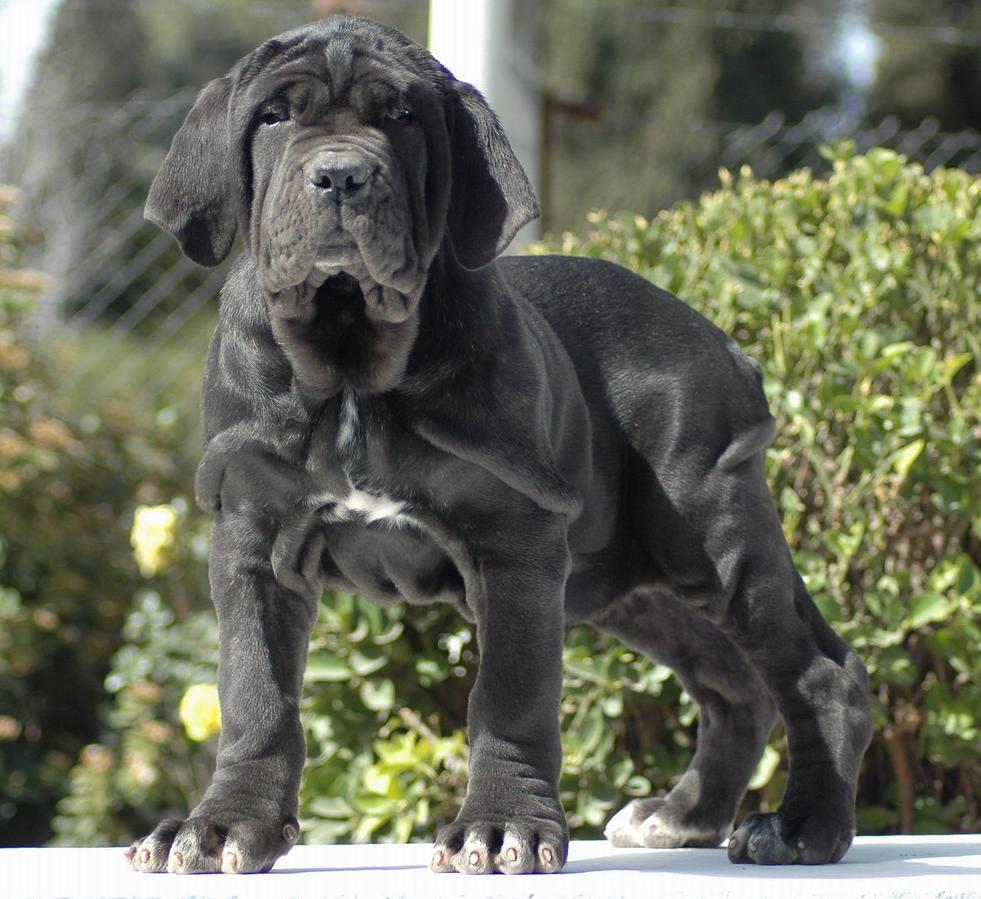
Despite his fierce appearance, the Neapolitan mastiff It is a balanced dog and friend of children.

Content

History ยซMastin Napolitanoยป

The Neapolitan mastiff, like all broadcast, most likely descends from the molossus Tibetan. According to historical data, Italy has been inhabited since very remote times, which could date back to the second millennium before Christ..

This shows that this architect of Campania (South Italy region, on the coast of the Tyrrhenian Sea, whose capital is Naples) brings lot of history under its belt.

All European mastiffs descend from the Tibetan Mastiff, the oldest representative of dog breeds.
Probably the first Asian mastiffs were carried in the India Greece by Alexander the great, around the year 300 a.C.

Some historians argue that it was the Greeks who were known to the Romans these dogs so spectacular, to see them is struck and (for a change) they used them in their famous circuses like fighting dogs. The Neapolitan mastiff fought with Lions, bears, Tigers, He was also a dog bred for war.

According to the English cinofilia, on the other hand, the mastiff was taken to Britannia (term designated to the island of Great Britain before that occurred the Germanic invasions) by the Phoenicians in the year 500 to. C. from that moment the spread throughout Europe would have begun.

Beyond disagreements as to the diffusion of the breed you can ensure, years. At that time, that the "Neapolitan Mastiff" has lived in Campania for at least two thousand years, Although its first official appearance in the cinophilia data of 1946 and its official standard was approved in the year 1949.

During the course of World War II, the race was on the verge of extinction but was recovered by a writer and called cinรณlogo Piero Scanziani that between 1941 and 1980 published a dozen volumes of fiction and nonfiction, including various Cynology treatises. He was responsible for the reconstruction of the Neapolitan mastiff during the postwar period, and he did so on the basis of the few copies remaining.

Physical characteristics

ยซNeapolitan Mastiffยป Videos

Neapolitan Mastin ALACRAN
Neapolitan Mastin bruce dello stradone (Leonardo lopez)Lightbox for Video by VideoLightBox.com v1.11
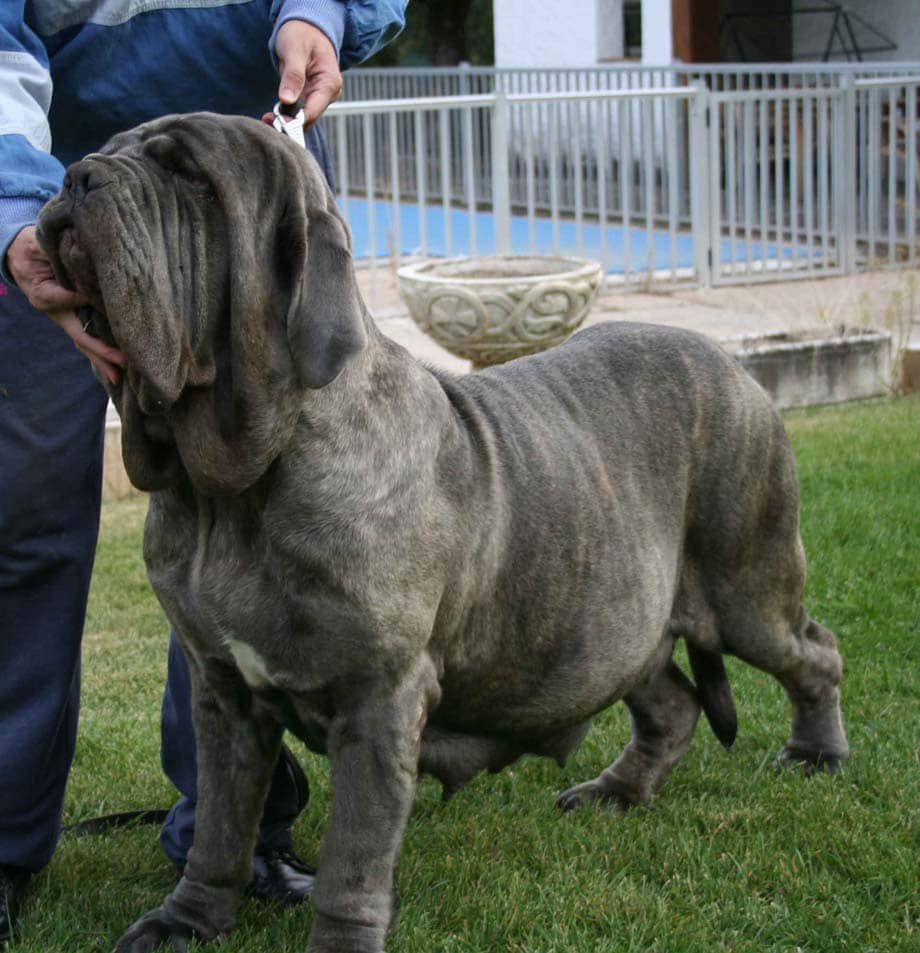
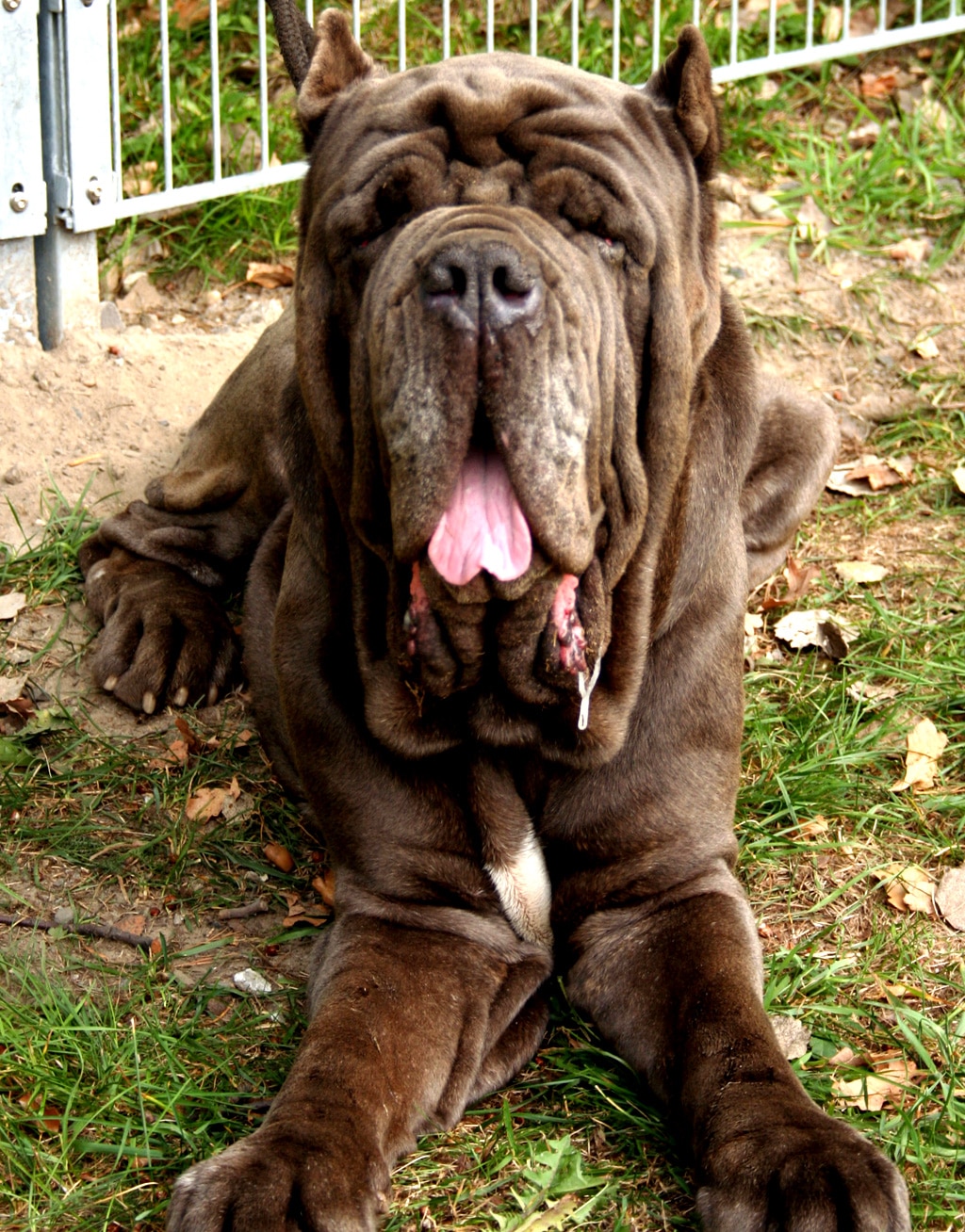
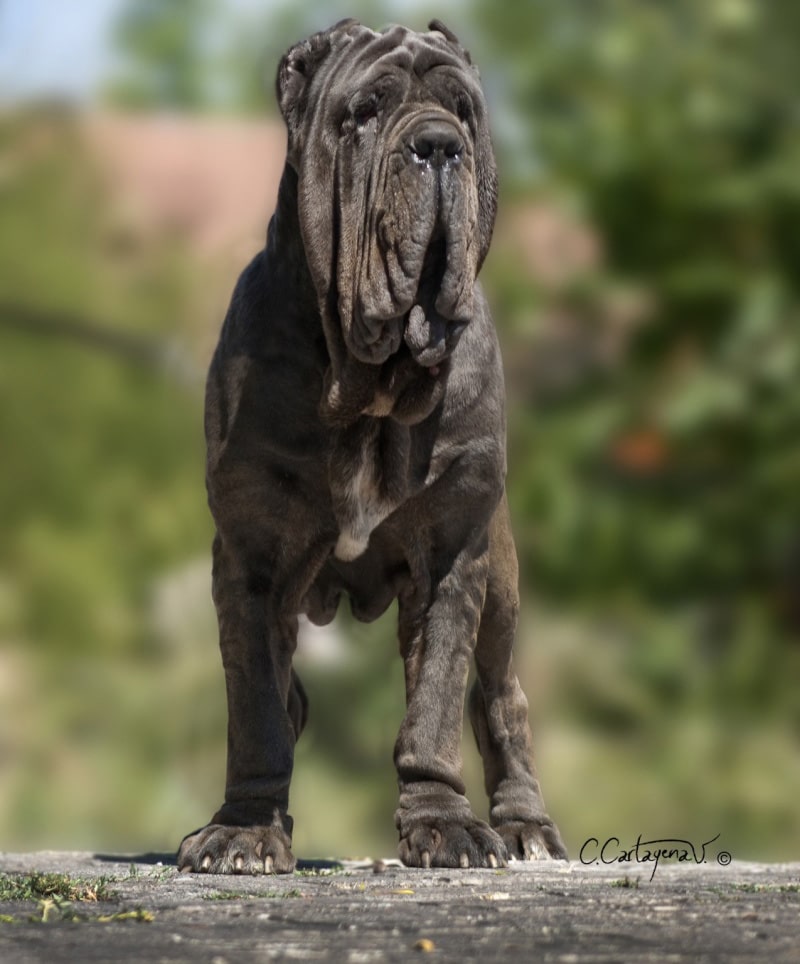
The Mastino Napoletano impresses even from a distance with its impressive physique. Especially the huge head stands out. It is a typical molossoid head, but he has particularly pronounced full lips. His facial expression is cool and relaxed, his overall impression is impressive. Its coat is short and smooth.

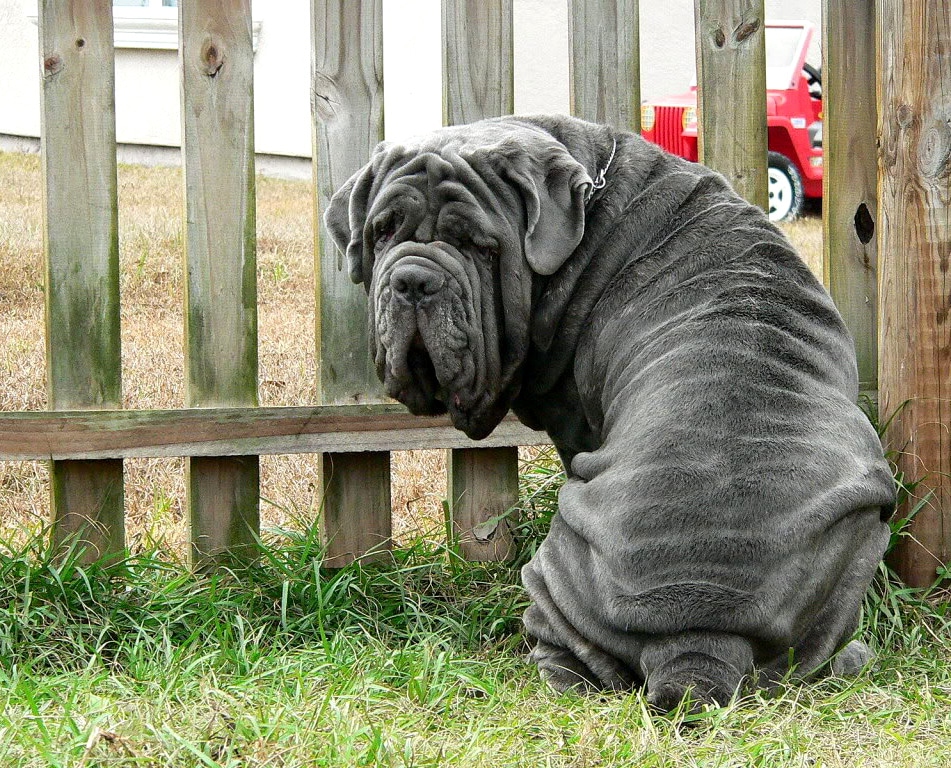
Modern breeding has given the Mastino Napoletano an excess of loose skin, that borders on the torture of the brood. For animal welfare reasons only, one must make sure that the skin is taut and there are not too many wrinkles and folds. Only slight wrinkles should be allowed in the neck area and on the dewlap.. Especially the head has grown an overabundance of skin and wrinkles in recent decades, partly so extreme that dogs can barely see due to all the wrinkles. It also, severe wrinkles are a treasure for infections and itchiness.

According to him standard official of the breed the males of Neapolitan mastiff They must be measured of 66 to 72 cm in the cross and his weight is of 70 kg, males can easily reach up 90 kg, females should be measured in 60 to 68 cm.. The weight of the males due of 60 to 70 Kg and females of 50 to 60 kg.

The head is huge and short, the rounded and flattened skull between the ears. It has the straight snout, a great truffle and fat lips it fall heavily.

It has the eyes well separated and the accumulation of skin seems they were oval shaped but in reality are round. The ears are triangular, medium and high insertion.

The body, in general, It is longer than high with the neck well massif and the Pope and grupa broad. The tail is amputated two-thirds of its length.

The favorite colors they are the lead, the grey and black (sometimes with small white markings on the chest and the tip of the fingers), the fawn, the mahogany, the Fawn and stag.

All cloaks can be atigrados, but the possibility that a Neapolitan mastiff come out color "tabby" is one in a million.

Observations

Despite its large size, no need for large spaces to be happy, because it moves shortly. although yes, It is important to establish a relaxed routine of daily walks that help keep your muscles toned.

Another issue to highlight is that they significantly drool-worthy.

Character and skills

Despite his surly and even fierce aspect, the Neapolitan mastiff he is a peaceful dog, balanced, sweet, fell, very affectionate with the master and friend of children.

Never behaves aggressively without a real reason, But if he were to have the answer, could be terrible.

Its temperament is peaceful, but it may become aggressive if its owner is not able to educate him with wisdom and responsibility.

Due to its structure it solid, its movement is heavy and clumsy, but appearance because it is aware of its size and enough to see him interact with children to confirm (disarms in delicacy).

Has been dog of war, combat in the circus, police assistant, dog sledge drag, companion and self-defense dog. Currently it is trained as a guardian of houses and farms and is increasingly appreciated as a companion dog..

In fact, it is more a guard dog than a companion or exhibition dog. Of the molossians foster, It is the quietest character.

One Neapolitan mastiff serious upbringing is, therefore, educated, an extremely simple dog. Here and there the fat man is a bit stubborn. Only if it is good to persuade and ask for help, then it will do everything for its owner or caretaker. As a family member, is extremely adorable. He seeks the proximity of his humans and is a reliable protector.

In case of acute threat to your humans, will try to keep danger away from them by facing the attacker with his body, but it won't attack him anymore. Does all of this quietly. Barks very rarely. His calm and serene temperament makes him a loyal and child-friendly companion, who forgives everything. Towards strangers, However, is initially waiting and watching. The Neapolitan mastiff he's a cool guy and a fascinating dog.

Not an easy dog รขโ‚ฌโ€นรขโ‚ฌโ€นto keep just because of his strength. By its nature it has very few demands. A daily walk, sometimes brushing the coat, that is all. Only the food is a certain challenge in terms of quantity and quality. You don't need a big garden, but a garden is already useful. A small apartment on the nth floor would not be suitable. The Neapolitan mastiff he's a great partner, but it is not a companion for runners, dog athletes or performance junkies.

Education

It must be remembered that in a Neapolitan mastiff adult, the line is just a symbolic control. Large dog easily has the power to maneuver the other end of the leash at will. But he doesn't want, at least if you have enjoyed the basics of a good education. The Neapolitan mastiff it is very easy to train. Only his stubbornness has to be broken here and there with consistent smoothness.. He wants to follow his master and mistress and he does it very reliably. It is an elementary duty of an owner of Neapolitan mastiff pay attention to a consistent education already in the puppy. Because only education and not the leash makes wonderful walks in nature possible, that together with this calm four-legged friend they become a balm for the soul of agitated people.

Care and health ยซNeapolitan Mastiffยป

Caring for a Neapolitan mastiff healthy breed is not problematic. Brushing the coat here and there is enough.

Bad habit of extremely strong folding of the head and body often leads to chronic inflammation. They are usually a source of constant itching for dogs.. Sometimes it even makes vision difficult. Such dogs need expensive time and care.

Nutrition ยซMastรญn Neapolitanยป

You need a lot of high quality food. It is helpful to have an elevated feeding bowl to counteract the risk of stomach churning. Weight must always be carefully considered.

Life expectancy ยซNeapolitan Mastiffยป

Breeding mistakes have cost this dog, formerly robust, many years of his life expectancy. Before they were 12, today they are more likely to be 6 to 9 years. But, exact data not available.

Buy a "Neapolitan Mastiff"

The purchase of a Neapolitan mastiff it must be long-term and well considered. You should check carefully if you have all the requirements in order to spend many wonderful years together with this strong friend.. Also financially the attitude is a challenge. If you are looking for a puppy, you must make sure that the dogs are not too massive and wrinkled. You must ask about the ancestors, its appearance, their illnesses, your age. To get a Neapolitan mastiff solid character, you should just look directly at a serious breeder. For animal welfare reasons you should refrain from buying puppies from parents with severe wrinkles. A puppy Neapolitan mastiff from a good breeder costs about 2.500 EUR.

Characteristics "Neapolitan mastiff"

Coexistence is important that you have with your new friend. Before considering the acquisition of a dog of the breed "Neapolitan mastiff" you know certain factors. Not all breeds of dogs are apt to live in an apartment, you must take into account his character, their need for exercise, their interaction with other pets, their care and if you have small children, their level of tolerance towards them.

Adaptation โ“˜

2,0 of 5 stars (based on 1 review)

friendly dog โ€‹โ€‹โ“˜

1,0 of 5 stars (based on 1 review)

hair loss โ“˜

3,0 of 5 stars (based on 1 review)

Affection level โ“˜

3,0 of 5 stars (based on 1 review)

Need for exercise โ“˜

2,0 of 5 stars (based on 1 review)

Social need โ“˜

3,0 of 5 stars (based on 1 review)

Home โ“˜

2,0 of 5 stars (based on 1 review)

Toilet โ“˜

3,0 of 5 stars (based on 1 review)

Friendly with strangers โ“˜

1,0 of 5 stars (based on 1 review)

barking โ“˜

2,0 of 5 stars (based on 1 review)

Health โ“˜

5,0 of 5 stars (based on 1 review)

Territorial โ“˜

5,0 of 5 stars (based on 1 review)

Cat friendly โ“˜

3,0 of 5 stars (based on 1 review)

Intelligence โ“˜

3,0 of 5 stars (based on 1 review)

Versatility โ“˜

3,0 of 5 stars (based on 1 review)

Child friendly โ“˜

3,0 of 5 stars (based on 1 review)

Surveillance โ“˜

2,0 of 5 stars (based on 1 review)

joy โ“˜

5,0 of 5 stars (based on 1 review)

Images ยซNeapolitan Mastiffยป

ยซNeapolitan Mastiffยป Videos

Type and recognitions:

  • FCI CLASSIFICATION:
  • Group :
  • Section : . .

Federations:

  • – FCI – Pinscher and Schnauzer-Molossoid type dogs – Swiss Mountain Dogs and Cattledogs. Section 2.1 Molossoid, mastiff type. โ“˜
  • – AKC – Dogs working โ“˜
  • – ANKC – Group 6 (utility dogs) โ“˜
  • – CKC – Working dogs โ“˜
  • – โ€‹KC – Working dogs โ“˜
  • – NZKC – Utility dog โ“˜
  • – UKC – Watchdog โ“˜

FCI breed standard "Neapolitan mastiff"

Origin:
Italy

Date of publication of the valid original standard:
13.11.2015

Use:

Protection and watchdog.


General appearance:

Big dog, heavy and solid with high volume appearance. The length of the trunk exceeds its height at the withers.

IMPORTANT PROPORTIONS: Body length is a 15% more than the height at the withers.

  • The skull-snout ratio is 2 to 1.
  • The length of the head is approximately 3,8 / 10 the height at the withers.
  • Neck is rather short.
  • Chest circumference is wide.


  • Behavior / temperament:

    Steady and loyal, is not aggressive. Guard dog of the property and its inhabitants, always vigilant, Intelligent, noble and majestic.

    Head:

    Short and massive, with the skull wide at the level of the zygomatic arches. The skin is abundant and has wrinkles and folds, of which the most accentuated and characteristic part of the external palpebral angle to descend to the labial angle. The superior longitudinal axes of the skull and muzzle are parallel.

    Cranial region:
    • Skull: The skull is wide and flat, particularly between the ears, seen from the front, it is slightly convex at the front. The zygomatic arches are very prominent, but with flat muscles. The protrusions of the frontal bones are well developed; the front groove is marked; occipital ridge is barely visible.
    • Stop: Well defined.

    facial region:

    • Truffle: Located in the prolongation of the nasal cavity, should not protrude from the anterior vertical line of the lips; it should be bulky and the large nostrils should be wide open. The color is according to the color of the fur: black for black specimens, dark gray in dogs of other colors, and the chestnut for brown dogs.
    • Snout: Very broad and deep; its width is approximately equal to the length. The length should be equal to one third of the length of the head. The sides are parallel so that, seen from the front, the shape of the muzzle is practically square. The depth of the muzzle is approximately twice its length.
    • Lips: fleshy, thick and full. The upper lip, seen from the front, forms an inverted "V" at its junction point. The lower lateral profile of the muzzle is determined by the upper lips, its lower part is the corner of the lips, with visible mucosa, located vertically from the outer corner of the eye.
    • Jaws / Teeth: Powerful with strong jaws and dental arches that fit together perfectly. The lower jaw should be well developed in width. Well developed white teeth, regularly aligned and complete in number. Scissor bite, that is, the upper incisors overlap the lower incisors in close contact, implanted in the vertical of the jaws; or pincer bite, that is, the upper incisors are joined edge to edge with the lower incisors. The outer edge of the upper incisors should be in close contact with the inner edge of the lower incisors.. An inverted scissor bite is tolerated.

    EYES: well separated on the same front level; rather round shape, but never protruding or too deep. Iris color is generally darker than coat color, except in shades of diluted shades where the color of the eyes is lighter. The skin never folds to interfere with the eyes.

    EARS: Small, in relation to the size of the dog, form triangular, located above the zygomatic arch, flat and glued to the cheeks. Ears are natural.

    Neck:

    The upper profile is slightly convex. Trunk rather short and conical, good muscular. The lower neck profile is well covered in loose fur that forms a well-separated double dewlap, but not exaggerated. Double chin begins at the level of the lower jaw and does not reach below the middle of the neck.

    Body:

    The length of the trunk exceeds by 15% the height at the withers.

    • top line: The upper line of the back is straight. Cross: It is wide, long and not very prominent.
    • Back: Width and length approximately 1/3 the height at the withers. The muscular and well developed lumbar region in its width should be harmoniously connected with the back.
    • Pork loin: Width, strong and muscular. The hip bones are prominent as they reach the upper lumbar line.. Breast : Large, with well-developed pectoral muscles. The rib cage is wide, with long, well-arched ribs. Chest circumference is wide. The tip of the sternum is at the level of the tip of the shoulder.

    Tail:

    It is wide and thick at the root; strong, slightly tapering towards the tip. Its length reaches the hock joint. At rest it carries it hanging and curved in the shape of a saber, in action raised horizontally or only slightly above the top line.

    Tips

    PREVIOUS MEMBERS:

    • General appearance: Previous members, from the floor to the tip of the elbow, seen in profile and from the front, they are vertical with a strong bone structure in proportion to the size of the dog.
    • Shoulder: Long and well sloped, muscles are well developed, long and well defined.
    • Arms: Well angled to the shoulder blade and with significant musculature.
    • Elbows: They must be parallel to the median plane of the body, that is to say, neither turn inward nor outward.
    • Forearm: Its length is almost equal to the length of the arm. Placed in a perfect upright position. Strong bone structure with lean, well-developed muscles.
    • Carpo: Width, slim and knotless, follows the vertical line of the forearm.
    • Metacarpus: Continue the vertical line of the forearm. Angulation and moderate length.
    • Previous feet: Round shape, large, fingers well arched and well joined. The pads are hard and well pigmented. The nails are strong, curved and dark colored.

    LATER MEMBERS:

    • General appearance: They must be powerful and robust, in proportion to the size of the dog and capable of giving the required propulsion during movement.
    • Thigh: Its length is 1/3 from the height to the cross and its obliqueness is about 60 ยฐ. Broad with thick muscles, prominent and clearly marked. Thigh bone and hip bone (femur and coxal) they form an angle of 90 ยฐ.
    • Knee: The femoro-tibial angle is about 110 ยฐ -115 ยฐ.
    • Leg: The length is slightly less than that of the thigh and of an obliqueness of 50 ยฐ -55 ยฐ, with a strong bone structure and well visible muscles.
    • Hock: The tibio-tarsal joint forms an angle of 140 ยฐ โ€“ 145 ยฐ.
    • Metatarsus: Strong and slim, almost cylindrical in shape, perfectly straight and parallel and quite low.
    • Hind feet: Smaller than the previous ones, round with well-joined fingers. Dry pads, hard and pigmented. The nails are strong, curved and dark colored.

    Movement:

    It is a typical characteristic of the breed. Movement is feline type, like the steps of a lion. It is slow and also resembles that of a bear. The jog is characterized by a strong push from the rear and a good extension of the front. The dog rarely gallops; the usual gait is walking and jogging. Ambition is tolerated.

    Mantle

    SKIN: Thick, abundant and loose throughout the body, especially on the head, where it forms numerous folds and wrinkles, and at the bottom of the neck where it forms a double dewlap. Never in abundance to interfere with the health and well-being of dogs.

    Fur: short, hard and bushy, the same length everywhere. Uniform length of 1,5 maximum cm. Must not show any trace of long hair.

    Color: Gray colors are preferred, leaden gray and black, although also brown, reddish and reddish rose, that sometimes have small white spots on the sill and on the fingertips. All colors can be brindle. Hazelnut tones accepted, soft gray and isabella.


    Size and weight:

    Height to the cross:

    • Males: 65-75 cm..
    • females: 60-68 cm..

    Weight:

    • Males: 60-70 kg.
    • females: 50-60 kg.


    Fouls:

    Any deviation from the aforementioned criteria is considered as a fault and the severity of this is considered to the degree of the deviation to the standard and its consequences on the health and well-being of the dog..

    SERIOUS FAULTS:

  • Pronounced undershot.
  • Tail size too high.
  • Size greater or less than the allowed limits.
  • FALTAS DESCALIFICANTES:

  • Aggressiveness or extreme shyness.
  • Any dog โ€‹โ€‹showing clear signs of physical or behavioral abnormalities.
  • Accentuated convergence or divergence of the cranial-facial axes.
  • Upper line of the snout concave or convex or very aquiline (roman nose).
  • Total depigmentation of the trua.
  • Upper prognathism.
  • Entropion / ectropion.
  • Eyes gazeos, total depigmentation of both edges of the eyelids; strabismus.
  • Absence of wrinkles, creases and double chin.
  • Absence of congenital or artificial glue.
  • Extensive white spots; white marks on the head.


  • N.B.:
  • Males should have two normal-appearing testicles fully descended into the scrotum..
  • Only functionally and clinically healthy dogs, with the typical conformation of the breed, should be used for breeding
  • TRANSLATION: Mrs. Brรญgida Nestler. Official language: IN.

    Technical direction: SR. Miguel Angel Martinez.

    Source: F.C.I - International Cynological Federation

    Alternative names:

    1. Mastino Napoletano Italian (English).
    2. Mรขtin de Naples, Napolitain (French).
    3. Neapolitanischer Mastiff (German).
    4. Mastino napoletano, Neapolitan mastiff (Portuguese).
    5. Mastรญn napolitano (espaรฑol).

    โ–ท The world of Pets: Dogs, cats, birds, reptiles, amphibians

    Central Asian Shepherd Dog
    Rusia FCI 335 - Molossoid . Mountain
    Pastor de Asia Central

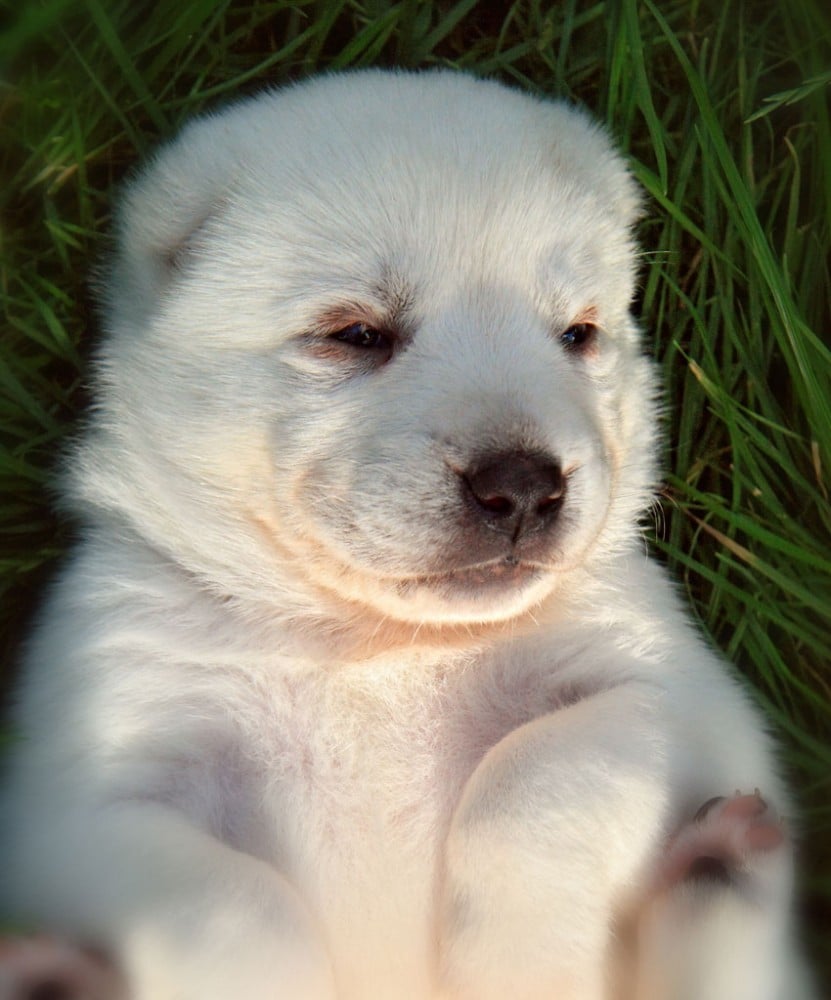
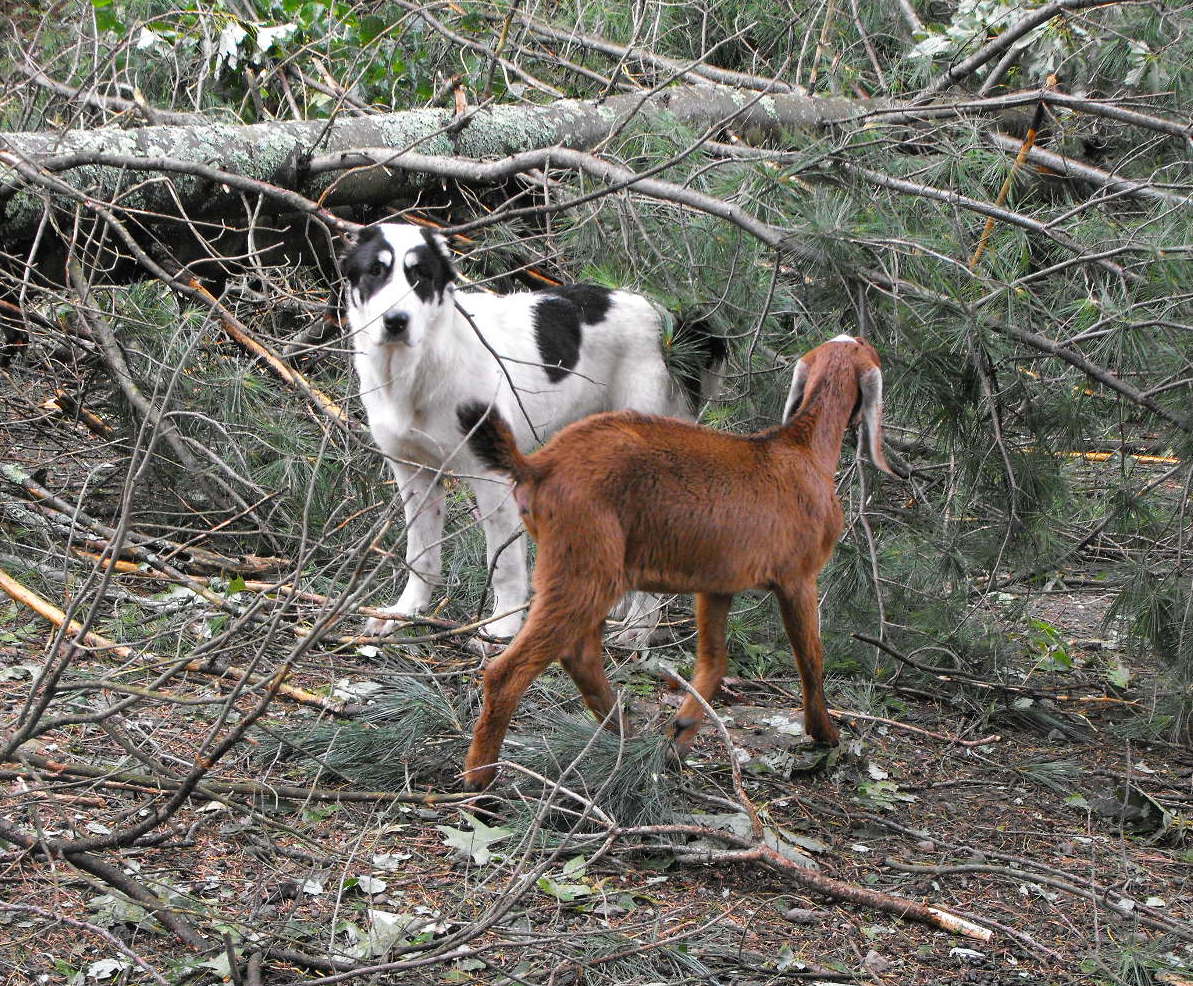
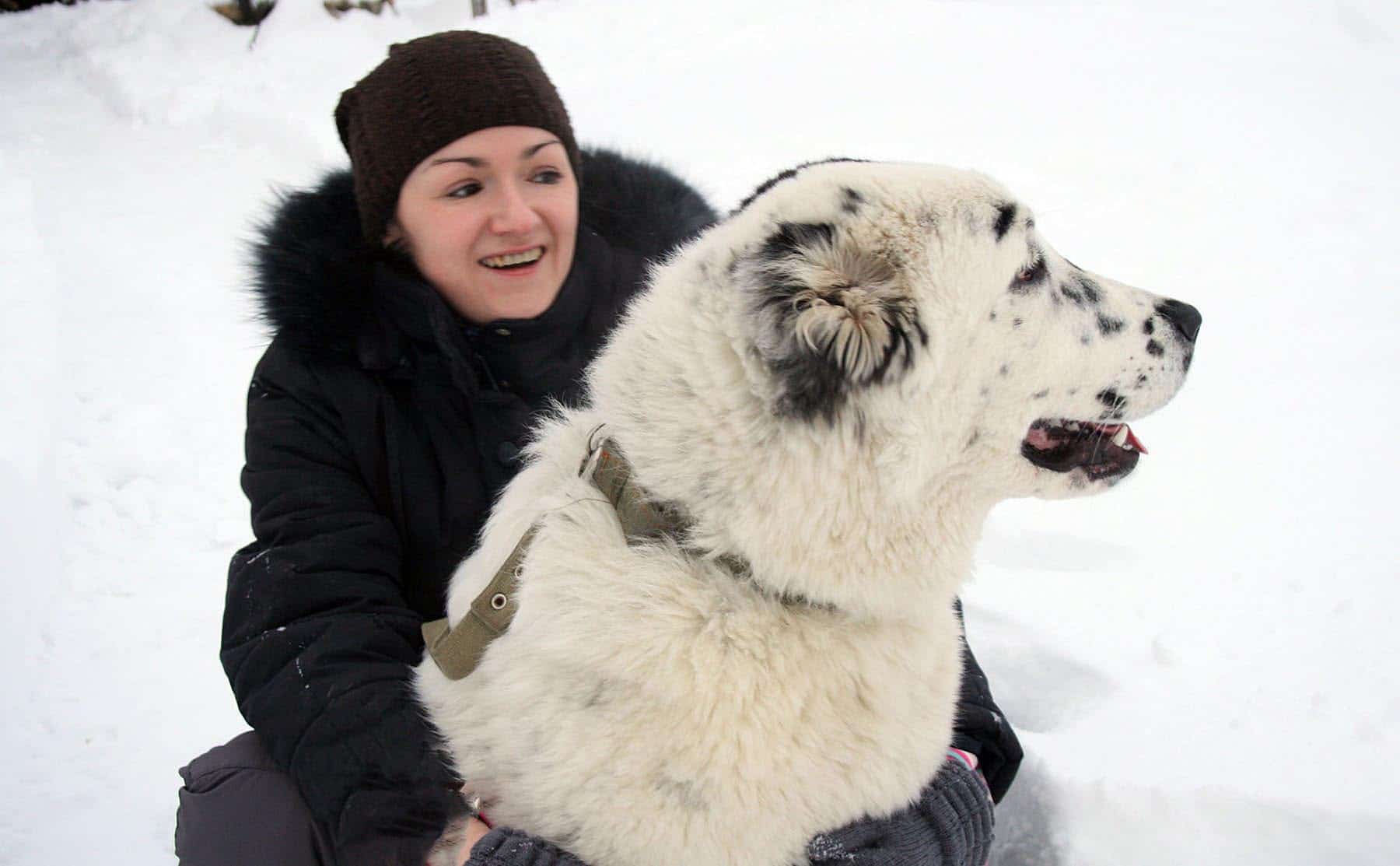
    The Central Asian Shepherd Dog It is a cat with dog skin, sensitive and partner.

    Content

    History

    The dog Central Asian Shepherd Dog (ัั€ะตะดะฝะตะฐะทะธะฐั‚ัะบะฐั ะพะฒั‡ะฐั€ะบะฐ or Sredneaziatskaya Ovtcharka, also known as, Volkodav or The Crusher Wolf) is recognized by the FCI, as a breed of molosser dog Russia, where most of the copies.

    Russian cynological clubs agree that this is one of the most popular breeds in the country, on many occasions, considering it the number 1 in the ranking of Russian dog breeds.

    The Central Asian Shepherd Dog It probably originated in a geographical area between the Urals, the Caspian Sea, Asia minor, and the Northwest of the border of China. The Central Asian Shepherd Dog, as well as mixtures with other breeds, yet, can be found in their countries of origin, as Kyrgyzstan, Tajikistan, Turkmenistan, Kazakhstan, Afghanistan, Uzbekistan and neighboring countries.

    Some serve as guardians of livestock, some protect their owners, and some are used for dog fighting, which is a national tradition in many countries of the region. Russian scientists and biologists have studied the local dog population since the 18th century., so far.

    After the Communist revolution, the Soviet Government focused on the working dog breeds for the Red Army, and imported the best representatives of the race to Russia accordance with the requirements of the army and guard dogs. For decades, This practice has harmed the local population. In addition to a large number of casualties, the introduction of new breeds to the region led to crossbreeding. With the time, purebred dogs were only left with some pastors and race enthusiasts, but in other places there was an excess of crosses.

    But, and despite all, today the population of purebred dogs Central Asian Shepherd Dog remains stable, in general, and the reproduction of some true quality dogs that do honor to his capacity for work has been, regardless of country of origin.

    In Europe, the Central Asian Shepherd Dog is relatively unknown, but in the countries of Central Asia it is still used as a working dog and accompanies shepherds on their walks through the steppes.

    Physical characteristics

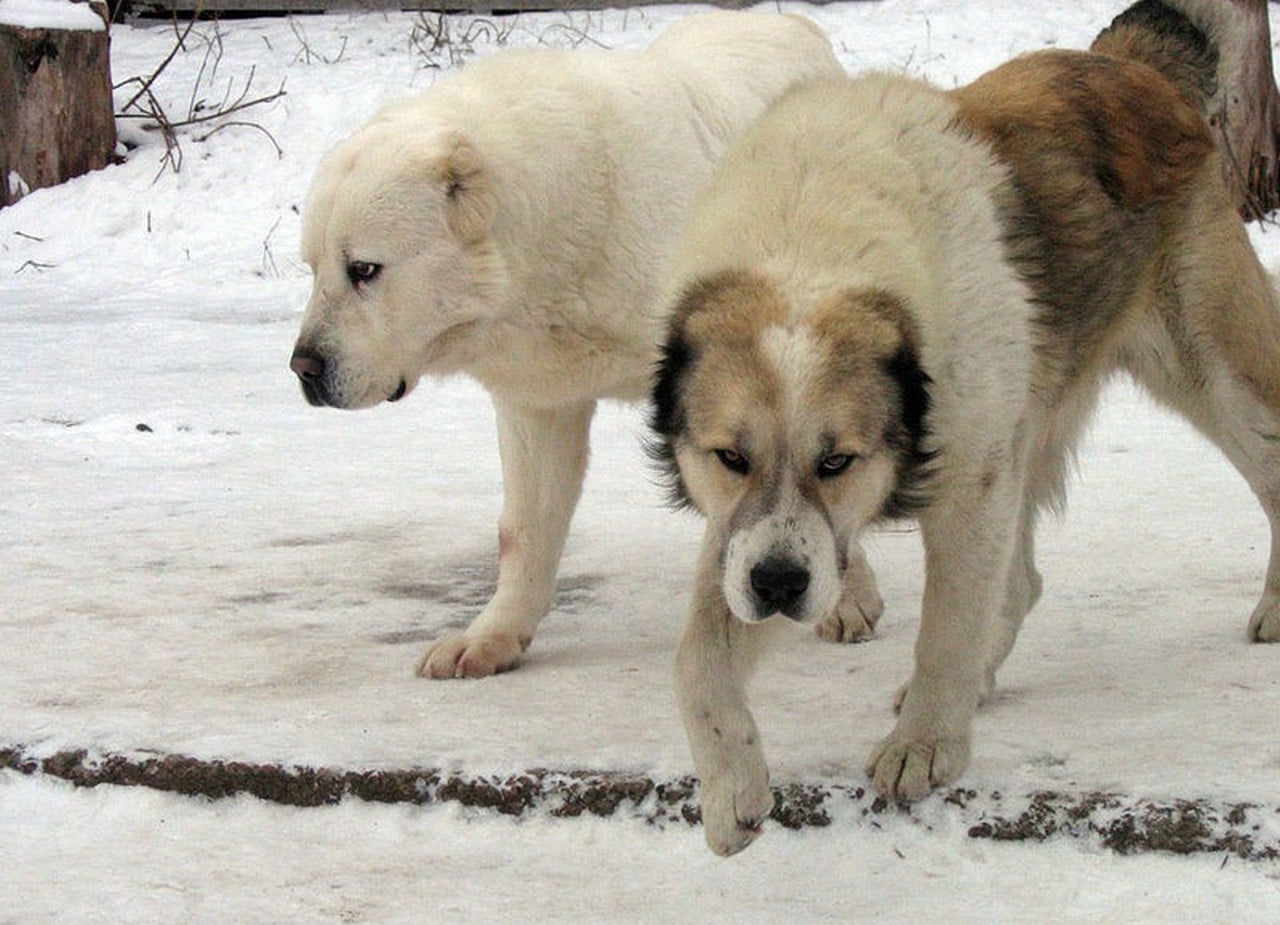
    This breed has many varieties that differ in the size, the color, head types, and the types of fur. For these reasons it is very difficult to establish an official standard of the breed.

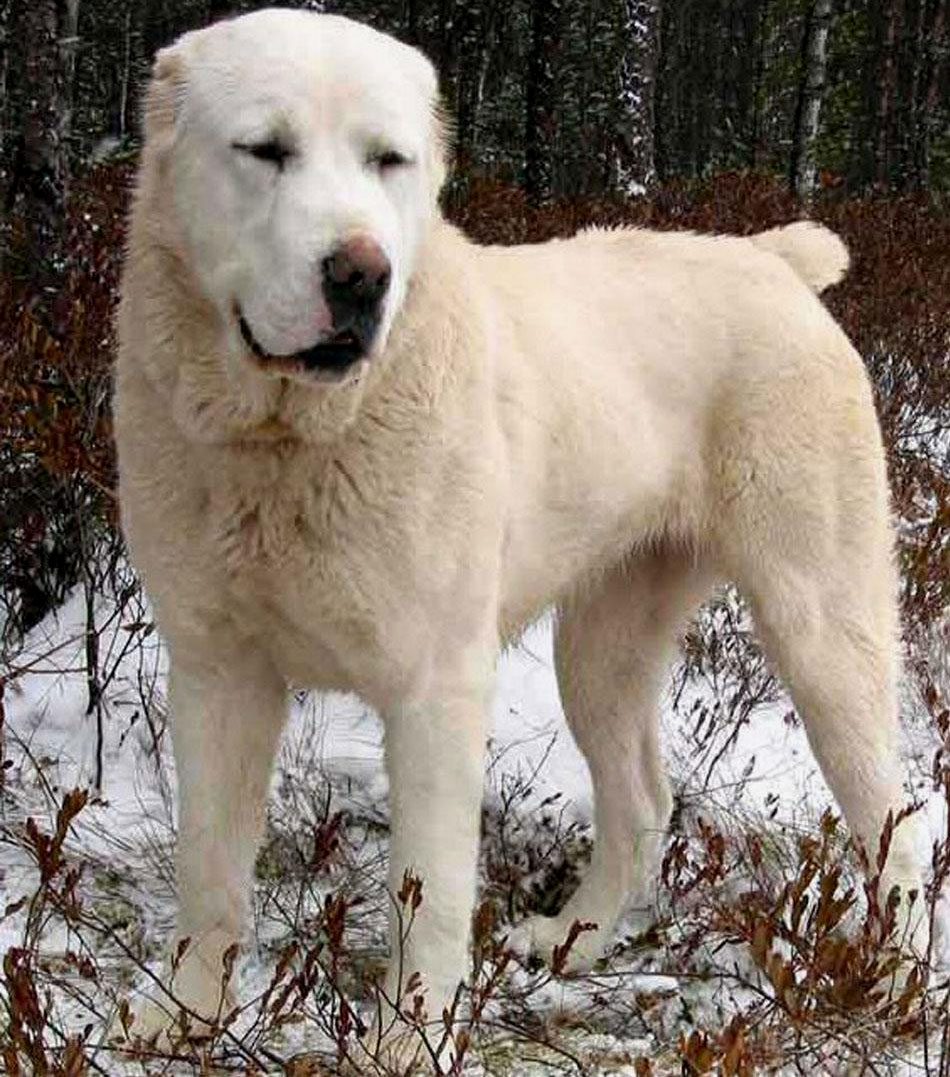
    The Central Asian Shepherd Dog it is a dog of large or medium size, of rough constitution and strong musculature. Its coat is composed of the hard and smooth top layer and the abundant and dense inner layer. The top layer can be short (3 – 5 cm.) or slightly longer (7 – 10 cm.). With a longer top layer forms a distinctive mane around the neck. Due to a well developed undercoat and different lengths of the top coat, dogs adapt well to different weather conditions.

    The coat color of the Central Asian Shepherd Dog it's very diverse: it comes in the colors white, black, grey, red fox, Brown grey, straw yellow, mackerel, spotted and mottled.

    The ears are triangular, low-set and pendulous. The tail is thick at the base and set quite high. The natural tail is long and is carried like a sickle tail. Tail and ear docking is still practiced in the countries of origin.

    Although there are unique characteristics of the purebred breed of dog Central Asian Shepherd Dog, such as being extremely flexible, This is very notable in their joints, have false ribs, the very strong neck and a large Chin.

    Some have a black mask. The head is very solid, the neck is of low insertion, short, with double chin. The body is quite broad and proportionate with very flat muscles.. The ribcage appears very long, because they have their famous false ribs. The legs are straight, typical movement is a gallop.

    He has expressive eyes, almost human, revealing his inimitable intelligence.

    According to the qualities of work required by the owners, the modern Pastor of Central Asia has been raised in different directions, trying to highlight specific skills. Within the traditional area of origin of these canes, the dog fights were always, but they were never so cruel and destructive as the fights of type Pit Bull Terrier.

    Every year the shepherds of the area would gather to organize dog fights Central Asian Shepherd, but unlike the bloody and ruthless fights of which we are used to hearing news, in this case they were fighting for the guardianship of a herd, and the winner was the dog that eventually, it was done with the control of it. It was about 'domination' instead of destroying each other's own kind.

    Dogs rarely hurt each other, minor scratches were caused in most cases. only true leaders, In fact, you measured through a real fight, but that was not the most common. The primary task of these dogs has always been the defence of the flock to the attacks of various predators and venomous snakes.

    The Pastor of Central Asia, It is one of the most powerful group of livestock guardian dogs dogs, after the Caucasian Shepherd Dog, the Kangal, Akbash, for example.

    The height at the cross 60 to 65 cm.. And weigh in 37 to 50 kg.

    Character and skills

    In the news, rural people continue to demand and use the Central Asian Shepherd Dog like cattle watchdog, Although not as well as old.

    These dogs, to varying degrees, are protectors against human intruders, they are very territorial, excellent with children, shall ensure them as if were his flock were. Love and respect for older people are some of its characteristics, to protect all small animals from predators, they are very kind and attached with the members of the family.

    They do not need any complicated training to learn the basic rules of the house but they are quite stubborn and very independent dogs., the Central Asian Shepherd Dog It must be able to work as a team to protect sheep against predators, therefore, If the animal has an overly aggressive character, both other dogs as with people outside the family, they cannot be members of a Pack, and it would not pass the simple test for the fulfillment of the object origin of the race.

    The Central Asian Shepherd Dog can come from build lines which print a very different character: of work, combat, and livestock guardian, and act accordingly, regardless of the country of origin.

    According to the different kennel clubs, the classification within the groups varies, The Russian Kennel Club classifies the Central Asian Shepherd Dog like a working dog, that is reflected in the exceptional results in obedience, protection and training relating to the army.

    Modern reproduction of the main Canine Clubs of Russia requirements, require to register copies of Central Asian Shepherd Dog a mandatory temperament test and an accredited training certificate, Besides show rating. In these tests the ability of the dog stands for fit and adapt to dog guardians shepherds of other flocks, not be cause for conflict between dogs. The FCI classifies Central Asian Shepherd Dog in the group of dogs Molossoid.

    While it is a good dog to live, We must not forget that the Pastor of Central Asia is a livestock protection dog, people and possessions, He was raised to solve single problems, is independent-minded, strong, brave and responsible.

    It is a large but agile dog, sometimes described as a cat with dog skin, for that reason, and taking into account his strong instinct for protection and territoriality, It may not be a recommended breed for a novice owner.

    Sensitive and Intelligent, the Central Asian Shepherd Dog You will respond better to someone who can inspire loyalty in you as well as strong leadership..

    Heavy-handed training will be counterproductive with this breed, but respectful training, reflexive will result in a dedicated and inseparable companion.

    The Central Asian Shepherd Dog he spent a considerable amount of time moving around in his homeland, and this kind of slow but steady exercise is what he likes more.

    With a work to be done and a piece of property to protect, is the highest point of happiness and will always keep an eye on everything that happens.

    Central Asian Shepherd Dog Health

    the breed is still considered very healthy and extremely robust. Owners should not fear the typical diseases of the breed. But, from time to time, like in all big dogs, joint problems occur, especially on the knees.

    Central Asian Shepherd Nutrition

    Although many joint diseases are inherited, symptoms can often be prevented or at least relieved with the help of proper diet and posture. Particularly in the growth phase of dogs, care must be taken that animals do not shoot too fast. Too rapid growth due to excessive protein intake in the growing months is considered one of the most common causes of later joint diseases. In addition to a fairly low protein food, given in small amounts about three or four times a day, young dogs should also be physically preserved during this phase. Stairs or long walks should be avoided..

    Meat as the main component of food

    When the Central Asian Shepherd Dog is fully developed, the protein content of the feed can be increased again. The main component of dog food should be – like in all dogs – high quality meat. It can be cooked or raw or, if industrially produced food mixtures are used, can be dry or wet. Regardless of the feeding method preferred by the respective owner, it is important that the content and composition of the food is adapted to the needs of the dog. According to age, sex, size, activity level and living environment, the composition of the necessary nutrients can vary considerably. There is no correct food for Central Asian Shepherd Dog.

    How much food does he need? Central Asian Shepherd Dog?

    Nor can the question of the amount of food for all dogs of this breed be answered in general. If the composition of the food is correct, the Central Asian Shepherd Dog can cope with surprisingly small portions. So, two meals a day are usually enough for an adult dog, which should be given at fixed times if possible. Portions too large, too many "snacks" between meals and not resting after feeding can increase the risk of stomach torsion.

    Central Asian Shepherd Dog care

    Like nomadic dog, the Central Asian Shepherd Dog it's quite undemanding, this applies not only to the size of your food portions, but also in your care. Short to medium length coat proves to be very resistant and requires little grooming. But, should be brushed regularly to remove dirt and maintain healthy hair structure. The claws should also be trimmed to avoid injury and teeth, ears and eyes should be checked and cleaned regularly.

    Central Asian Shepherd Dog Education

    The purchase of a Central Asian Shepherd Dog must be well considered – although this applies to all breeds of dogs, it is especially true for this breed from Central Asia. It is not a family dog รขโ‚ฌโ€นรขโ‚ฌโ€นin the classical sense nor is it suitable for a city life. This freedom-loving and independent dog finds it difficult to cope with living conditions in European industrial nations.

    Who is this breed suitable for?

    In the hands of livestock keepers and keepers who live in remote and isolated places, this protective dog of the pack is still in the best hands. Also people who live far from the city, own a large lot and wish to have a capable watchdog, can be considered as owners of this Central Asian Shepherd Dog. But, experience and some knowledge in dog training should be prerequisites to keep this breed. It also, an owner needs above all time and patience, because the socialization and education of this self-confident four-legged friend, who doesn't think much about blind obedience, It is hard work. How Central Asian dogs tend to dominate, they need a trainer who constantly sets limits for them and who shows them with the necessary empathy (not to be confused with willingness to compromise) that it is worth trusting and following your human.

    Can a harmonious coexistence succeed?

    The Central Asian Shepherd Dog certainly not a family dog รขโ‚ฌโ€นรขโ‚ฌโ€นin the classical sense, so its maintenance as a pure house and companion dog is absolutely inadvisable. This does not mean that a Owtscharka can't live together with humans. In a family that appreciates its natural instinct for vigilance and protection and gives it its original task of guarding the house, the yard and the cattle, the Central Asian Shepherd Dog is quite adaptable and human-oriented. A basic socialization, that is to say, early contact with other people and animals, is as important to harmonious coexistence as sufficient opportunities for running and consistent parenting.

    Central Asian Shepherd Dog Pictures

    Central Asian Shepherd Dog Videos

    Type and recognitions:

    • FCI CLASSIFICATION:
    • Group :
    • Section : . .

    Federations:

    • – FCI – Pinscher and Schnauzer-Molossoid type dogs – Swiss Mountain Dogs and Cattledogs. Section 2.2 Molossoid, mountain type. โ“˜
    • – AKC – FSS โ“˜
    • – ANKC – Group 6 (utility dogs) โ“˜
    • – NZKC – Utility dog โ“˜
    • – UKC – Watchdog โ“˜

    FCI breed standard "Central Asian Shepherd Dog"

    Origin:
    Russia

    Date of publication of the valid original standard:
    13.10.2010

    Use:

    Guard and surveillance dog.


    General appearance:

    The Central Asian Shepherd Dog is of a harmonious build and great stature, moderately long (never with a long or short body). Robust and muscular body, bulky but not with visible muscles.

    Clearly defined sexual dimorphism. Males are thicker and more courageous than females with a more pronounced cross and a larger head.. Full maturity is reached at the age of three.

    IMPORTANT PROPORTIONS: The length of the body only slightly exceeds its height at the withers. Increased height is desired but proportional structure must remain. Length of forelimbs to elbows is 50 โ€“ 52% the height at the withers.

    The length of the snout is less than ยฝ the length of the head but more than 1/3.


    Behavior / temperament:

    Self-confidence, silent, balanced, proud and independent. Dogs have great courage and high capacity for work, resistance and a natural instinct for territoriality. Courage in the face of large predators is one of its characteristics

    Head:

    Solid and well balanced with the overall appearance. The shape of the head is rectangular, top and side view.

    Cranial region:
    • Skull: deep. The antecara is flat and the skull area is flat and long. Occiput well defined but hardly visible due to well-developed musculature. Supraorbital arch moderately defined.
    • Depression links (Stop): Moderately defined.

    facial region:

    • Truffle: Grand, well developed but not exceeding the general outline of the muzzle. The color is black but in white and beige dogs the truffle may be somewhat lighter.
    • Snout: The muzzle is blunt and of moderate length., it is rectangular seen from above and the sides tapering slightly towards the nose. The muzzle is bulky, deep and well filled under the eyes. Wide nasal bridge, straight and sometimes slightly sunken. Well developed chin.
    • Lips: Thick. Upper lip tight, covering the bottom when the mouth is closed. Full black pigmentation preferred.
    • Jaws / Teeth: The jaws are strong and wide. Teeth are big, white and next to each other, 42 in total. Incisors positioned aligned. Scissor bite accepted, reverse clip and scissors. Canines positioned well apart. An injury to a tooth that does not affect the use of the bite is of no consequence.
    • Cheeks: Cheek bones are long and well developed, without interfering with the straight rectangular shape of the head.
    • Eyes: Medium size, oval-shaped, placed well apart, looking well ahead. Moderately sunken placement. Eye color from dark brown to hazel. Darker color is preferred. The eyelids are thick and preferably with the lower eyelid not too loose. The third eyelid should not be visible. The edge of the eyelids is preferred fully pigmented. Whatever the hair color, the eyelids must be black. His expression is confident and dignified.
    • Ears: Medium size, Triangular shape, thick, low insert and pendants. Your lower level or slightly below your eyes. Traditionally amputated ears as illustrated on the first page, which is practiced in the country of origin and in countries where it is not prohibited by law.

    Neck:

    Neck is medium length, very strong, oval transversely, well muscled and low set. The dewlap is a characteristic of the breed.

    Body:

    • top line: Well proportioned and well sustained. In the posture you must maintain the typical upper line.
    • Cross: Well defined, especially in males, muscle, long and tall with a well defined transition to the back.
    • Back: Straight, width, good muscular; the length is ยฝ of the length of the withers to the insertion of the tail.
    • Pork loin: Short, width, muscle, slightly arched.
    • Rump: Moderately long, wide, well muscled, slightly inclined towards the tail insert. Height at withers exceeds height above hip in 1 โ€“ 2 cm..
    • Breast : Deep, long, width, well developed, rib cage widening to the posterior. False long rib. Lower chest at elbow level or slightly below. The forechest extends slightly in front of the humerus/scapula joint.
    • Bottom line and belly: Moderately retracted abdomen.

    Tail:

    Thick at the base and somewhat high insertion. The natural tail is carried curved in the shape of a sickle or curved in a loose ring that begins in its last third.. When alert, the tail rises to the level of the back or slightly higher. Traditionally the tail is docked in the illustrated manner which is practiced in the country of origin or in countries where it is not prohibited by law.. Natural glue is valued the same as amputated.

    Tips

    PREVIOUS MEMBERS:

    • General appearance: Right members of strong bones, viewed from the front parallel and not very close to each other. Seen on side, the forearm is straight.
    • Shoulder: Long scapula, well inclined, forming an angle with the forearm of approximately 100ยฐ. Well muscled.
    • Forearm: Oblique, long and strong.
    • Elbows: Tight fitting without turning in or out. Arm: Straight, very strong bone, long, oval transversely.
    • Metacarpus: Moderately long, width, strong, rights.
    • Previous feet: Large, rounded, arched toes, bulky and thick pads; nails can be any color.

    LATER MEMBERS:

    • General appearance: Viewed from behind straight and parallel, placed somewhat more apart than the previous ones.
    • Thigh: Width, moderately long and with strong musculature.
    • Knee: Without turning neither inwards nor outwards. Its angulation is moderate.
    • Leg: Always the same length as the thigh.
    • The Hock joint: Moderately angled.
    • Metatarsals: Very strong and of moderate length, perpendicular. Without spurs.
    • Hind feet: Large, round, arched toes, bulky and thick pads; nails can be any color.

    Movement:

    Well balanced and elastic. Jog with free reach of the forelimbs and strong push from the rear. Top line remains firm during movement. All joints tilt effortlessly. The angulations of the posterior are more defined during the movement than during the stop..

    Mantle

    SKIN: Thick, loose enough to prevent injury during combat against predators.

    • Fur: Abundant, smooth, thick with well-developed inner hair. The hair on the head and on the front of the limbs is short and thick.. The hair on the cross is sometimes longer. Outer hair may be short or slightly longer. Depending on the length of the outer hair there may be shorter hair (3 โ€“ 5 cm.), covering the entire body or longer hair (7-10 cm.) forming a mane on the neck, feathers behind the ears and on the back of the limbs and on the tail.
    • Color: All except genetic blue or genetic brown in any combination and black cloak on fire.


    Size and weight:

    Height to the cross:

    • Males: Minimum 70 cm..
    • females: Minimum 65 cm..

    The largest size is desired but the proportional structure remains.

    Weight:

    • Males: Minimum 50 Kg.
    • females: Minimum 40 Kg


    Fouls:

    Any deviation from the aforementioned criteria is considered as a fault and the severity of this is considered to the degree of the deviation to the standard and its consequences on the health and well-being of the dog..

    • Slight deviation from the typicality of the breed.
    • Females with male type tendencies.
    • Rounded skull, narrow snout, narrow lower jaw, small nose.
    • Oblique eye placement or eyes close together, loose eyelids.
    • High insertion of the ears.
    • Thin or hanging lips.
    • Height above rump. Slightly short rump.
    • Narrow forehead.
    • Exaggerated angulations of the posterior.
    • Open foot and long toes.
    • Hackney movement, slightly unbalanced movement.
    • Too short hair.

    SERIOUS FAULTS:

    • Too nervous.
    • Significant deviations from the type and structure required.
    • Long-limbed appearance, Lightweight bones, soft muscles.
    • Very light eyes or protruding eyes.
    • Top line descended.
    • Croup much higher than the cross.
    • Narrow rump, short and steep.
    • Naturally short tail, broken tail.
    • Very high metacarpus, low.
    • Hindquarters placed too far apart under the body.
    • Height to the cross 2 cm less than the minimum required in the standard.

    FALTAS DESCALIFICANTES:

    • Aggressiveness or extreme shyness.
    • Any dog โ€‹โ€‹showing clear signs of physical or behavioral abnormalities must be disqualified..
    • Shy or overexcited.
    • Male female type.
    • Prognathic or clearly enognathic bite.
    • Different colored eyes, blue or green eyes, bizco.
    • Loose joints.
    • Hair of any combination of genetic brown or genetic blue.
    • Fire color with a black cloak.
    • Cloak the soft or smooth.
    • Unbalanced movement.


    N.B.:

    Males should have two normal-appearing testicles fully descended into the scrotum..

    Only functionally and clinically healthy dogs, with the typical conformation of the breed, should be used for parenting.

    Source: F.C.I - International Cynological Federation

    Alternative names:

    1. Alabai, Central Asian Ovtcharka, CAO Aziat (English).
    2. Chien de berger d’Asie centrale (French).
    3. Zentralasiatischer Owtscharka (German).
    4. Tรผrkmen Alabaรฝ, mastim-da-รกsia-central (Portuguese).
    5. Perro Pastor de Asia Central (espaรฑol).

    โ–ท The world of Pets: Dogs, cats, birds, reptiles, amphibians

    Miniature American Shepherd
    Estados Unidos FCI 270 . Sheepdogs

    Miniature American Shepherd

    With his alert expression, attentive and intelligent, the Miniature American Shepherd has all the qualities of Sheepdogs

    Content

    History

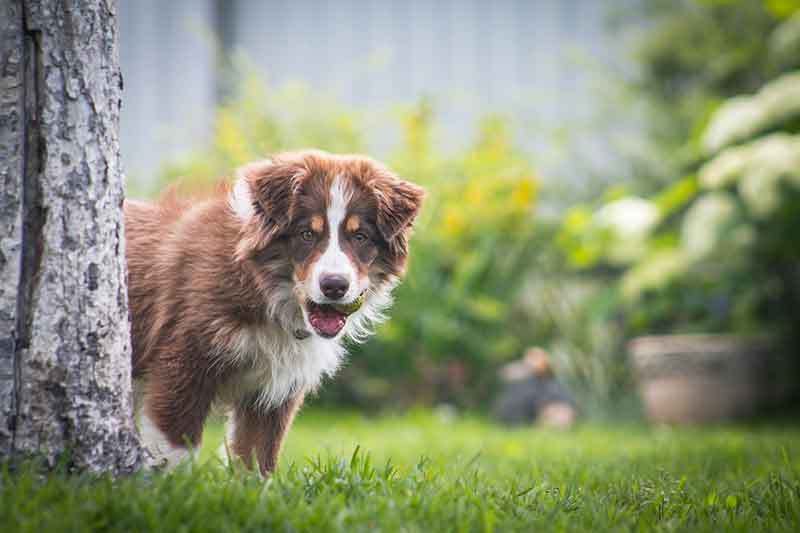
    In forty years, Americans have managed to fix the characteristics of this new breed, from the strains of small Australian Shepherds. Recently, the American Kennel Club (AKC) agreed to integrate and, therefore, recognize the Miniature American Shepherd as a race in its own right, integrating it into the Herding Group โ€œShepherd Dogsโ€ … next to his ancestor, the Australian Shepherd.

    In the decade of 1960, the little ones Australian Shepherd who worked on the United States rodeo circuit were selectively bred to further reduce their size. The new breed was originally called the Miniature โ€œAustralian Shepherdโ€. "They became especially popular with riders who traveled to horse shows, since his intelligence, "loyalty and size made them an excellent travel companion.", say the experts of the Club del Miniature American Shepherd from the USA. "In this way its popularity spread throughout the country."

    Currently, the breed is recognized by the FCI (International Cynological Federation), in view of the number of breeders that are embarking on the selection of this breed of dog in Europe.

    Photo: Buddyยป Miniature American Shepherd โ€“ Lost Island’s Roy ‘Arsenal’ Harper โ€“ bred by: Julia Bettendorf, Lost River Miniature American Shepherds – Jugabe3b, CC BY-SA 4.0, via Wikimedia Commons

    Physical characteristics

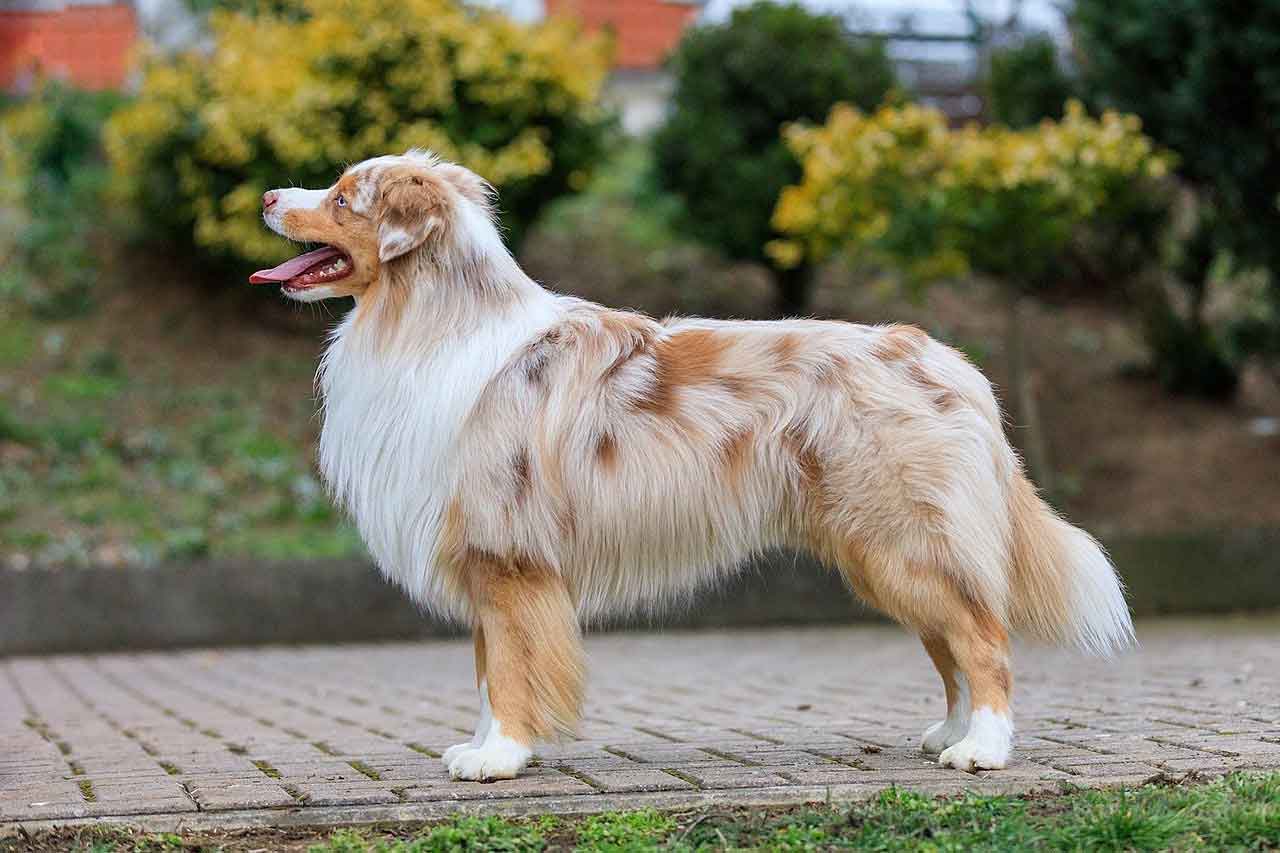
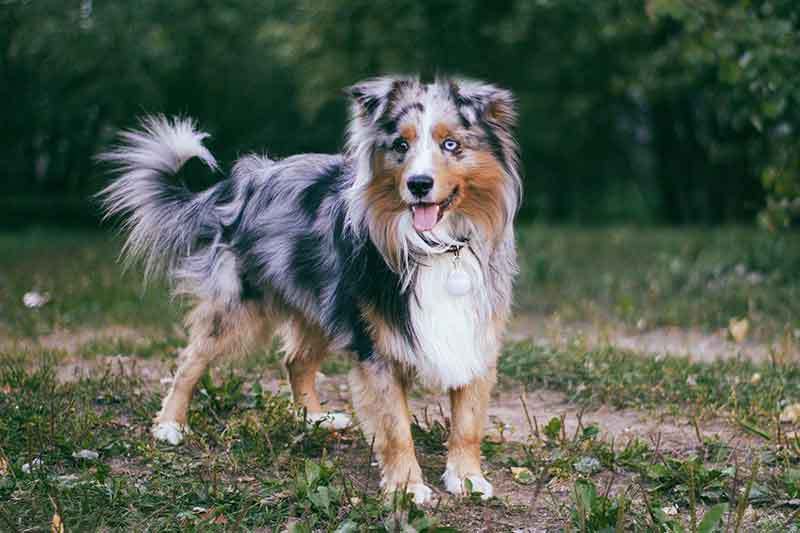
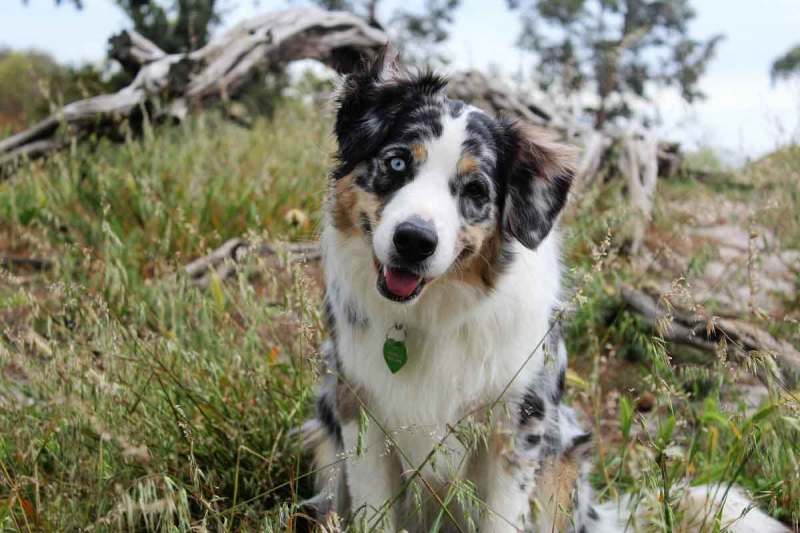
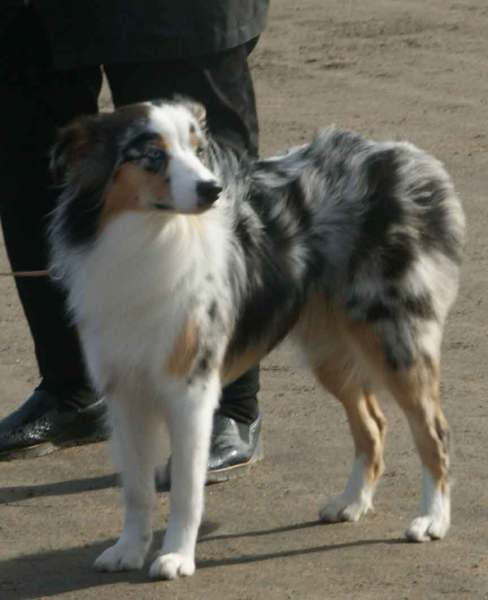
    The Miniature American Shepherd shares many physical traits with its predecessor the Australian Shepherd, only on a smaller scale. The females measure between 33 – 43 cm at shoulder; the males between 35,5 – 46 cm.. Despite its size, they are every inch a real herding dog: energetic, versatile, robust and extremely bright. Striking fur comes in black, blue merle, red and red merle. (Merle exhibits any amount of marbling, spots or mottling.) The Miniature American Shepherd they move with the smooth, agile stride of a dog built for hard work on rough terrain.

    Character and skills

    With his alert expression, attentive and intelligent, dogs Miniature American Shepherd they have all the qualities of a little Shepherd dog, with a pronounced instinct to lead and watch over the herds. Easy to train, able to respond to a variety of demands that allow them to evolve in different sports disciplines. the Miniature American Shepherd However, they are reserved for people who are not familiar to them.. But once you "know" them, becomes a wild playmate, and capable of real feats, thanks to its agility and small size.
    Like all working dogs, especially those able to work in their original profession, when in a situation with a herd of animals, their behavior changes and they become attentive and tireless helpers.

    Its small size, your cleanliness reduced to a minimum, their adaptability and listening skills, greatly facilitate your life and your education in the city. But, like all shepherds, you need to spend and "empty" your overflowing energy. Beautiful walks and runs in the forest are essential to maintain your tone, his physical form and his playful character.

    Health and nutrition

    This solid and sturdy dog, just like their ancestors, does not pose any particular problem in feeding. His health is that of a dog from generations of working dogs, although many buyers take the step of having a companion dog that is easy to live with. Never forget where it comes from, as you deserve regular physical activity to maintain your figure and strength.

    The Miniature American Shepherd is generally a healthy dog, and responsible breeders test their breed for health conditions, communicating with other breeders dedicated to working together for the health of the breed and the preservation of the unique qualities of the breed.

    Although the Miniature American Shepherd it is a relatively healthy breed, the following complications have been observed:

  • Juvenile cataracts
  • PRA (progressive retinal atrophy)
  • Iris Colobomas
  • PPM (persistent pupillary membrane)
  • Regular visits to the vet for checkups and parasite control help ensure a long and healthy life for the dog.

    Grooming

    The Miniature American Shepherd has a double coat, with a longer outer coat and a wool underlayer. The breed shows a good amount, even more so during shedding season, which can happen once or twice a year. Weekly brushing, daily during molting season, will help remove dirt and loose hair and keep the dog looking its best. Balls or tangles can be resolved with a finer brush or metal comb. As in all races, nails must be trimmed regularly, too long nails can cause discomfort to the dog.

    Training

    As in all races, early socialization and training classes for puppies are recommended, which help to ensure that the dog becomes a well-adjusted and well-behaved companion. Smart and willing to please, the Miniature American Shepherd is highly trainable and will reach its best potential as a partner when taught at least basic obedience.

    Physical exercises

    The Miniature American Shepherd he is active and athletic, and requires a moderate amount of exercise but is also very adaptable to your family's way of life. They do well as city dogs as long as their owners provide them with enough exercise.. They enjoy outings with their people that will occupy both their mind and their body. They enjoy and excel at many dog รขโ‚ฌโ€นรขโ‚ฌโ€นevents, including obedience, agility and tracking.

    Characteristics "Miniature American Shepherd"

    Coexistence is important that you have with your new friend. Before considering the acquisition of a dog of the breed "Miniature American Shepherd" you know certain factors. Not all breeds of dogs are apt to live in an apartment, you must take into account his character, their need for exercise, their interaction with other pets, their care and if you have small children, their level of tolerance towards them.

    Adaptation โ“˜

    3,0 of 5 stars (based on 1 review)

    friendly dog โ€‹โ€‹โ“˜

    4,0 of 5 stars (based on 1 review)

    hair loss โ“˜

    3,0 of 5 stars (based on 1 review)

    Affection level โ“˜

    5,0 of 5 stars (based on 1 review)

    Need for exercise โ“˜

    4,0 of 5 stars (based on 1 review)

    Social need โ“˜

    4,0 of 5 stars (based on 1 review)

    Home โ“˜

    3,0 of 5 stars (based on 1 review)

    Toilet โ“˜

    2,0 of 5 stars (based on 1 review)

    Friendly with strangers โ“˜

    4,0 of 5 stars (based on 1 review)

    barking โ“˜

    3,0 of 5 stars (based on 1 review)

    Health โ“˜

    4,0 of 5 stars (based on 1 review)

    Territorial โ“˜

    4,0 of 5 stars (based on 1 review)

    Cat friendly โ“˜

    3,0 of 5 stars (based on 1 review)

    Intelligence โ“˜

    5,0 of 5 stars (based on 1 review)

    Versatility โ“˜

    5,0 of 5 stars (based on 1 review)

    Child friendly โ“˜

    4,0 of 5 stars (based on 1 review)

    Surveillance โ“˜

    3,0 of 5 stars (based on 1 review)

    joy โ“˜

    4,0 of 5 stars (based on 1 review)

    Images "Miniature American Shepherd"

    Photos:

    1 – Blue Merle Miniature American Shepherd by Lextergrace, CC BY-SA 4.0, via Wikimedia Commons
    2 – Miniature American Shepherd with Frisbee by Mullinspw, CC0, via Wikimedia Commons
    3 – Miniature american shepherd puppy by TanSinVic, CC BY-SA 4.0, via Wikimedia Commons
    4 – Miniature american shepherd by TanSinVic, CC BY-SA 4.0, via Wikimedia Commons
    5 – Miniature American Shepherd, blue merle, female by Canarian, CC BY-SA 4.0, via Wikimedia Commons
    6 – American miniature shepherd by https://pxhere.com/en/photo/1029669

    Videos "Miniature American Shepherd"

    Type and recognitions:

    • FCI CLASSIFICATION:
    • Group :
    • Section : . .

    Federations:

    • FCI โ“˜
    • AKC โ“˜

    FCI breed standard "Miniature American Shepherd"

    Origin:
    United States

    Date of publication of the valid original standard:
    04/09/2019

    Use:

    Utilization

    As the name suggests, is a herding dog. Can work in herds of farm animals (sheep, cows, horses).


    General appearance:

    The Miniature American Shepherd is a small sheepdog of the United States of America. It is slightly longer than it is tall with a moderate bone structure in proportion to its body size and weight without extremes.. His movements are fluid, easy and balanced. His exceptional agility combined with strength and ​​resistance allows you to work on a wide variety of terrain. This very versatile and energetic dog is an excellent athlete with great intelligence and a willingness to please those to whom he is present. dedicated. He is a faithful companion and a hard worker. His expression is attentive. Fur hairs, medium length and texture, can be solid in color or mixed with or without whiteness, with or without fires. Traditionally has no tail, shortened or natural short tail.
    A solid build with a mid-frame in relation to its size and weight. The structure of the dog reflects masculinity without being too rough for males.. Females appear feminine without being too light. Overall structure gives an impression of strength without being over the top.

    important proportions

    Length, measured from the tip of the sternum to the tip of the buttock, is slightly higher than the height, measured from the top of the cross to the ground.


    Behavior / temperament:
    The Miniature American Shepherd is an intelligent working dog. Has a pronounced instinct for behavior and keeping herds. He is an exceptional companion, versatile and very easy to educate. Although reserved with strangers, He is not shy. He is an energetic and long-lasting worker who adjusts his behavior and shows the right emotion for the task at hand. With his family he is protective, devoted and faithful.

    Head:

    ---

    Cranial region:

    Head

    The head must be clearly drawn and in proportion to the dog's body. The expression is alert, attentive and intelligent. The dog may express a reserved look and / or vigilant towards foreigners.

    Skull

    The skull is flat or slightly domed and may show a slight occipital protrusion. The width and length of the skull are equal.

    Depression links (stop)

    It is moderate but defined.

    facial region:

    Truffle

    The truffle is liver pigmentation for red or red merle and black subjects for black or blue merle subjects. Fully pigmented truffle is preferred.

    Snout

    Fades a bit of the truffle base and rounds out at the end. The length of the muzzle is equal to that of the skull in the profile. The top line of the skull and the chamfer line are slightly oblique to each other, and the top line of the skull forms a slight downward angle.

    Jaws / Teeth

    The teeth must be complete and in scissors. Dogs with broken teeth, missing or accidentally discolored will not be penalized.

    Eyes

    The eyes are obliquely set, in the form of almond, without projection or sunken and in proportion to the head. Whatever the color of the dress, all eye colors are allowed. Eyes are allowed, specks and specks. The edge of the eyelid has liver pigmentation for red or red merle subjects and black pigmentation for black or blue merle subjects.

    Ears

    The ears are triangular, medium-sized, attached to the top of the head. When is the dog attentive, fold back or to the side, ru รย รยพรยทรยฐ.

    Neck:

    The neck is solid and in proportion to the body, is of medium length and slightly curved. Neck fits well between shoulders.


    Body:

    Generality

    The body is firm and well muscled but without exaggeration.

    Back

    Firm and straight in static as well as in motion.

    Pork loin

    Strong and wide seen from above.

    Rump

    Moderately inclined.

    Breast

    The chest is full and deep. Reaches elbow with well-curved ribs.

    bottom line

    Moderately elevated.

    Tail:

    Traditionally has no tail, shortened or natural short tail. The long, uncut tail can form a slight curve when the dog is around. Resting. When the dog is moving, can be used with a slightly steeper curve.


    Tips

    Former members

    Generality

    The front legs are well muscled and balanced with the hindquarters.

    Shoulder

    Shoulders are long, plans, quite close to the withers and well inclined.

    Arm

    The humerus should be the same length as the scapula and form a right angle with it.

    Elbow

    The elbow joint is equidistant from the floor and the tourniquet. The elbows should be close to the ribs.

    Forearm

    They are straight and strong. The bone is oval instead of round.

    Metacarpus

    Metacarpals are short, thick and strong but still flexible, showing a slight angle seen from the side.

    Front feet

    The feet are oval, compact, with tight fingers. The toes are well arched. The pads are thick and elastic. Nails are short and hard. Lugs can be removed in countries that allow the practice.

    Later members

    Generality

    The width of the hindquarters is equal to that of the front hand at the shoulders. รยญรยปร‘ล’ angle, roughly right, formed by the scapula and humerus corresponds to that formed by the pelvis and thigh.

    Knee

    Hot flashes are clearly drawn.

    Hock

    The hocks are short, perpendicular to the ground and parallel to each other as seen from behind.

    Rear feet

    The feet are oval, compact, with tight fingers. The toes are well arched. The pads are thick and elastic. Nails are short and hard. Lugs can be removed in countries that allow the practice.

    Movement:

    The steps are fluid, clear and easy. The American Mini Shepherd shows great ease in his movements with well covered strides. The forelimb and hindlimb move in planes parallel to the median axis. As speed increases, front and hind legs converge toward the median plane, while the top remains firm and horizontal. The Miniature American Shepherd must be agile and able to change course and pace instantly.


    Mantle

    Fur

    The hair is of medium and long texture, straight to wavy. The inner layer varies according to the seasons. Hair is short and straight on the head and the front of the front legs. The back of the front legs and the panties are moderately provided. The mane and culture are more marked in males than in females. The ears, the feet, the back of the hocks and tail can be fixed. The dog must be presented with natural hair.

    Color

    The colors are varied and unique. In no order of preference, recognized colors are black, red, merle blue and merle red. The blackbird will be exposed with any number of stains, spots or stains. Undercoat may be slightly lighter than undercoat hair. Asymmetric markings are not a defect.
    No fire marks required (Sun tanning). When they are present, are allowed in the following locations: around the eyes, in feet, in the legs, below the neck, in the face, at the bottom of the ear, under the base of the tail, and panties can also emphasize the end result. The tone of the marks "fire" can range from creamy beige to black red, no preference.
    White markings are not mandatory and must not be invasive. They are limited to the mouth, cheeks, skull, neck, with a partial or full collar, chest, belly, forelimbs and hindquarters to the end of the hock. The tip of the tail may be white. The eyes must be completely surrounded by color. Rolling eyes are forbidden. The ears should preferably be completely covered with colored hair. If there is white in the ear, should not be more than 25% in one ear.


    Size and weight:

    Size and weight

    Height to the cross

    The size for males should be between 35,5 cm and 45,5 cm to the cross.
    The size for females should be between 33 cm and 43 cm to the cross.


    Fouls:

    Any deviation from the above mentioned criteria is considered to lack, and the severity of this is considered the degree of deviation from the standard and its consequences on the health and well-being of the dog and the dog's ability to perform its traditional task.

    Serious misconduct

    ▷Ears hanging or fully erect.
    ▷25 to 50% unpigmented truffle.
    ▷Atypical hair.
    ▷White markings covering more than 25% from the surface of the ears.
    ▷The hair roots of a white necklace protruding from the cross.

    disqualifying fouls:

    ▷Aggressive or shy dog.
    ▷Lack of type.
    ▷Size at the withers outside the limits of the standard: less than 35,5 cm and more than 45,5 for males, less than 33 cm and more than 43 cm for females.
    ▷More than 50% unpigmented truffle.
    ▷Color no compatible, different from those allowed by the standard.
    ▷The color of the mucous membranes does not match the dress.
    ▷Non-pigmented hairs.
    ▷Eyes not completely colored.
    ▷White tasks in another place that is not specified in the standard.
    ▷The lowest or highest prognathism.
    ▷Cryptorchid or perro monorchid.


    N.B.:
    NB:
    • Any dog โ€‹โ€‹showing clear signs of physical or behavioral abnormalities must be disqualified..
    • The aforementioned fouls that are more pronounced or more marked are eliminatory..
    • Males should have two normal-appearing testicles fully descended into the scrotum..
    • Only functionally and clinically healthy dogs, with the typical conformation of the breed, should be used for parenting.

    Source: F.C.I - International Cynological Federation

    Alternative names:

    1. Miniature Australian Shepherd, MAS (English).
    2. Miniature Australian Shepherd (French).
    3. Miniature Australian Shepherd, Mini-Aussie (German).
    4. Miniature Australian Shepherd (Portuguese).
    5. Miniature Australian Shepherd (espaรฑol).

    โ–ท The world of Pets: Dogs, cats, birds, reptiles, amphibians

    Mudi
    Hungrรญa FCI 238 - Sheepdogs

    Mudi

    The Mudi is a single master dog, and a rare breed outside its native Hungary.

    Content

    History

    The Mudi is the name of a canine breed of herding dog rare, originally from Hungary.

    According to existing documentation, some currents maintain that the Mudi was formed in Hungary spontaneously, between the 19th and 20th centuries.

    Others reply that the Pumi, the Puli and the Croatian Sheepdog, are close relatives of Mudi.

    Are what, they are their ancestor and the form in which it existed, What is known for sure is that the Mudi, has survived this time thanks to the appreciation of the shepherds who praise his innate ability in which protection of livestock with regard.

    In the year 1936 wrote the first breed standard, naming it Mudi.

    The herd book is still open, that means that more and more dogs of this type, they live in their homeland, incorporated into breeding records.

    The Mudi, is currently a "rare breedโ€ there are few specimens in their native country, and outside of Hungary if there isโ€ฆ, very few inches.

    In Hungary they have been fighting for years to keep the breed alive. As it has been the case with many breeds of dogs pastors, their copies have declined to the rhythm of the socio-cultural advancement.

    Before, herds of cattle were numerous and sheepdogsโ€ฆ, essential, This situation has changed a lot from time to time and along the way we have lost many canine breeds specialized in working with cattle..

    Physical characteristics

    Usually weigh between 8 and 13 kg and measure between 38 and 48 centimeters to the cross.

    The mantle is medium wavy or curly, with short hair on the face and legs. The colors accepted are black, Ash, brown, white, Fawn and merle.

    The Mudi can have the tail short birth or birth with them long and cut them.

    It is a very versatile dog, You can be on a farm, You can hunt, exterminate rodents, make guardian, dog herds and as dog boyero.

    Although it is a much less popular breed than the Puli and the Komondor in your country of origin, owners always recognize his superiority due to his versatile talent and always friendly and working arrangement.

    • Fur: varies by region. The head and limbs are covered in short hair, straight and smooth. On other parts of the body there is hair of a length between and cm, dense, undulating and shiny. the undercoat is arranged in spirals and stripes.
    • Color: glossy black or white, but there are also white mantles with black stripes or black ones with white stripes, with medium-sized spots and uniform distribution.
    • Size: 35 to 47 cm..

    The hair of the Mudi, Unlike other dog breeds, has much pigment. Surfaces devoid of hair, They must be totally black, However, the pads and nails are slate grey.

    Character and skills

    The Mudi is a very active race. If you live in the city, you need to take a brisk walk every day, or run.

    It also, it would be beneficial for his health if he had an outdoor area where he can run to his heart's content, they need a lot of exercise to stay healthyโ€ฆ and happy.

    To the Mudi She loves to play and Excel in all kinds of sports Canine as the Frisbee, for example.

    Can also compete in the agility, obedience, Rally obedience, Schutzhund, show, flyball, and tracking. It has strong instinct and grazing capacity, with appropriate training, could also compete in grazing trials.

    A Mudi can live in a house doing enough exercise, but always they need ample space to run and play. They are active and they can live, perfectly, in the open air.

    Their life expectancy is around the 14 years.

    Mudi Health

    The Mudi is a generally healthy breed with a life expectancy of 12 to 14 years.

    Health problems seen in the Mudi include epilepsy, Hip Dysplasia, cataract, elbow dysplasia and patellar dislocation.

    If a breeder tells you they don't need to do those tests because they've never had any problems in their lines or because their dogs have been checked out by a vet or if they give any other excuse to skimp on genetic testing of their dogs, leave immediately.

    Careful breeders screen their breeding dogs for genetic diseases and breed only the healthiest and best looking dogs, but sometimes Mother Nature has other ideas and a puppy develops one of these diseases despite good husbandry practices. Advances in veterinary medicine mean that in many cases dogs can still live a good life. If you are going to have a puppy, ask the breeder about the ages of the dogs in their lines and what their cause of death was.

    Remember that after you have welcomed a new puppy into your home, has the power to protect you from one of the most common canine health problems: the obesity. Keeping a Mudi at the right weight is one of the easiest ways to extend his life..

    Kuvasz grooming

    The coat of the Mudi loose the dirt (and the hair, of course) and does not require frequent bathing. A weekly brushing is usually all that is needed and the coat does not need to be trimmed.

    If your Mudi is like most, you will enjoy swimming in a pool, a lake or the ocean. Thereafter, rinsed with fresh water to remove chlorine, algae or salt and restore shine to your coat.

    The Mudi sheds her coat in the spring and doesn't get it back fully until late summer.

    The rest is basic care. Trim nails every few weeks or as needed. brush your teeth often – with a vet-approved pet toothpaste – for good general health and fresh breath.

    Characteristics "Mudi"

    Coexistence is important that you have with your new friend. Before considering the acquisition of a dog of the breed "Mudi" you know certain factors. Not all breeds of dogs are apt to live in an apartment, you must take into account his character, their need for exercise, their interaction with other pets, their care and if you have small children, their level of tolerance towards them.

    Adaptation โ“˜

    5,0 of 5 stars (based on 1 review)

    friendly dog โ€‹โ€‹โ“˜

    3,0 of 5 stars (based on 1 review)

    hair loss โ“˜

    2,0 of 5 stars (based on 1 review)

    Affection level โ“˜

    5,0 of 5 stars (based on 1 review)

    Need for exercise โ“˜

    4,0 of 5 stars (based on 1 review)

    Social need โ“˜

    5,0 of 5 stars (based on 1 review)

    Home โ“˜

    3,0 of 5 stars (based on 1 review)

    Toilet โ“˜

    2,0 of 5 stars (based on 1 review)

    Friendly with strangers โ“˜

    3,0 of 5 stars (based on 1 review)

    barking โ“˜

    4,0 of 5 stars (based on 1 review)

    Health โ“˜

    3,0 of 5 stars (based on 1 review)

    Territorial โ“˜

    3,0 of 5 stars (based on 1 review)

    Cat friendly โ“˜

    3,0 of 5 stars (based on 1 review)

    Intelligence โ“˜

    5,0 of 5 stars (based on 1 review)

    Versatility โ“˜

    5,0 of 5 stars (based on 1 review)

    Child friendly โ“˜

    3,0 of 5 stars (based on 1 review)

    Surveillance โ“˜

    5,0 of 5 stars (based on 1 review)

    joy โ“˜

    5,0 of 5 stars (based on 1 review)

    Mudi Images

    Videos "Mudi"

    Type and recognitions:

    • FCI CLASSIFICATION:Group 1 –> Pastor and Boyeros dogs (except Swiss Cattle Dogs)
      / Section 1 –> Pastor dogs. Without working trial.
    • FCI 238
  • Federations:
    • – FCI – Group 1 Herding dogs, Section 1 Sheepdogs โ“˜
    • – AKC – PASTORAGE โ“˜
    • – FSS – โ“˜
    • – CKC – Group 7 – Herding dogs โ“˜
    • – UKC – Herding dogs โ“˜

    FCI breed standard Mudi

    FCIFCI - Mudi
    Mudi

    Alternative names:

    1. Hungarian Mudi, Canis Ovilis Fenyesi (English).
    2. Mudi (French).
    3. Mudi (German).
    4. Mudi (Portuguese).
    5. Mudi hรบngaro (espaรฑol).

    โ–ท The world of Pets: Dogs, cats, birds, reptiles, amphibians

    Maremma and the Abruzzes Sheepdog
    Italia FCI 201 . Sheepdogs

    The Maremma and the Abruzzes Sheepdog he will be really happy sleeping with the cattle rather than on the sofa in your home.

    Pastor Maremmano-Abruzzese

    Content

    Characteristics "Maremma and the Abruzzes Sheepdog"

    Coexistence is important that you have with your new friend. Before considering the acquisition of a dog of the breed "Maremma and the Abruzzes Sheepdog" you know certain factors. Not all breeds of dogs are apt to live in an apartment, you must take into account his character, their need for exercise, their interaction with other pets, their care and if you have small children, their level of tolerance towards them.

    Adaptation โ“˜

    4,0 of 5 stars (based on 1 review)

    friendly dog โ€‹โ€‹โ“˜

    3,0 of 5 stars (based on 1 review)

    hair loss โ“˜

    3,0 of 5 stars (based on 1 review)

    Affection level โ“˜

    4,0 of 5 stars (based on 1 review)

    Need for exercise โ“˜

    5,0 of 5 stars (based on 1 review)

    Social need โ“˜

    3,0 of 5 stars (based on 1 review)

    Home โ“˜

    3,0 of 5 stars (based on 1 review)

    Toilet โ“˜

    2,0 of 5 stars (based on 1 review)

    Friendly with strangers โ“˜

    3,0 of 5 stars (based on 1 review)

    barking โ“˜

    2,0 of 5 stars (based on 1 review)

    Health โ“˜

    4,0 of 5 stars (based on 1 review)

    Territorial โ“˜

    5,0 of 5 stars (based on 1 review)

    Cat friendly โ“˜

    3,0 of 5 stars (based on 1 review)

    Intelligence โ“˜

    3,0 of 5 stars (based on 1 review)

    Versatility โ“˜

    2,0 of 5 stars (based on 1 review)

    Child friendly โ“˜

    4,0 of 5 stars (based on 1 review)

    Surveillance โ“˜

    4,0 of 5 stars (based on 1 review)

    joy โ“˜

    4,0 of 5 stars (based on 1 review)

    History

    The Maremma and the Abruzzes Sheepdog (Maremmano-Abruzzese or Cane da pastore Maremmano-Abruzzese), It is a breed of sheepdog native to central Italy and used for centuries by shepherds to defend their flocks from wolves.

    The breed is still used today, widely, in the region of the Abruzzo where flocks of sheep vitalize the rural economy and wolves are protected predators (of the few areas of the planet, Regrettablyโ€ฆ).

    The race is similar to the Pyrenean Mountain Dog, to the Kuvasz from Hungary and to Akbash from Turkey (This, that more!).

    It also descends from the shepherd dogs that once existed in the Maremma Tuscany region and in the Lazio region.. Since 1860, the transhumance of herds from one region to another has favoured the development of a natural mixture of these two primitive races.

    Several descriptions of dogs defending vulnerable white sheep are found in the literature of ancient Rome, in works such as the Columella, Varro and Palladius. Dogs similar to Maremma and the Abruzzes Sheepdog they are represented in numerous sculptures and paintings from Roman times to the present day.

    Until year 1958, the Maremma Sheepdog and the Maremmano-Abruzzese they were considered as separate races. The first Canine society of the Maremma Sheepdog was established in the year in 1950, and three years later (1953) the First Canine Society of the Maremma Sheepdog.

    But owing to transhumance of herds of sheep from one region to another, especially after the unification of Italy, there was a โ€œnatural fusionโ€ between the two races. For which reason, the 1 in January of 1958, the races were unified by the ENCI (Ente Nazionale della Cinophilia Italian, or national association Cynologique Italiana).

    Today, It is not so encouraging and sympathetic as the history of this beautiful can, although they are still widely used by Italian sheep farmers in areas where predation is common, as the central Apennines of Italy and the open countryside of the land of national parks in Abruzzo.

    But, Ironically, of the Maremma and the Abruzzes Sheepdog, in the area of the Maremma of Tuscany, the memory can only, they are now a rarity just in the area which saw them to be born, you are right, even if you don't like to hear it, the hand of man and progress... have resulted in a more sinister: sheep farming has declined and the wolf is nearly extinct.

    Curiosities

    Although it is easier for him Maremma and the Abruzzes Sheepdog, develop their relationship with sheep and goats, farmers have found that, as well, are able to develop a protective bond with cows, and in many places of United States, It also used for the purpose. As well, they are good defending corrales, chickens or ducks from the threats of land caused by coyotes, dogs and foxes, and air threats caused by birds of prey (Hawks, Eagles, owls, etc.).

    In Australia, a lot has been invested in it Maremma and the Abruzzes Sheepdog. Specifically in the city of Warrnambool that has great natural beauties, and in one of them the Maremma and the Abruzzes Sheepdog It is today a key piece for the survival of other species.

    Within the natural beauties that talked, the beach of Logan located on the East side of the city is a great example, recognized as a southern whale breeding site. Every year between May and August reach coasts copies of adult female whales to give birth to their calves, and at the end of September are often long trip offshore, sometimes with a little bit of human help, so the whales are not left stranded on the beach.

    In addition to the whale southern franco, the coast is also visited by sea lions of Australia, penguins and common dolphin. Albatrosses can spot during the winter and early spring.

    There is also another natural beauty which is the protagonist of this post can… Middle Island had a large colony of penguins. But the uncontrolled presence of foxes led to a significant reduction in the number of members of the colony.. In 2005, there are only four penguins left in the colony.

    It was then when the Warrnambool City Council introduced an innovative and ecological program, first in the world with these characteristics, introduced to Middle Island several copies of Maremma and the Abruzzes Sheepdog to protect the penguins. This highly original and innovative program has been the cornerstone of the re-establishment of the penguin colony that in the year 2009 already had more of 100 Members.

    While the use of Maremma and the Abruzzes Sheepdog to protect an endangered species was a rare thing at first, Thanks to the effort and commitment of the Warrnambool City Council, it has been proven that the Maremma and the Abruzzes Sheepdog along with other breeds of livestock guardian dogs, they make it possible that the cattle and other species, like penguins, they can live with their natural predators in danger of extinction, as well, as wolves and coyotes. Program predation was reduced a 70% u 80% or more, and the survival of Wolf and different foxes, or coyotes, is not endangered, at least in the area.

    In other countries like Italy, United States and Canada, the use of dogs has also been promoted Maremma and the Abruzzes Sheepdog, as well as other types of herding dogs, to minimize the conflict between the species of predators in danger of extinction and farmers, achieving success several but without destroying the ecosystem.

    Physical characteristics

    The Maremma and the Abruzzes Sheepdog is a dog from large size, powerful, aspect rustic and at the same time Majestic and well accused type. Its general appearance of medium proportions is a heavy dog, whose body is longer than the height at the cross. It also keeps harmony in terms of its format (normal correlation between size and different parts of the body) and profiles (concordance between the profiles of the head and body).

    The head altogether, is large and flat, conical and similar to the White bear form.

    The skull in profile is convex. The eyes are ochre or brown. It has ears triangular and small relative to the size of the dog, are high insertion and hang.

    The limb well well-angled, giving sense of lead and firmness. The tail hangs surpassing the Hock, and when the dog is alert it rises to the line of the back.

    The hair is long, abundant and rough to the touch. The only one supported color is the white solid. Although they tend to admit light reflections of color ivory, pale orange or lemon.

    Height to the cross in the males is of 65 to 73 cm and females is of 60 to 68 cm.. The weight of 35 to 45 kg in males and 30 to 40 kg in females.

    Character and skills

    Despite its large size, the Maremma and the Abruzzes Sheepdog It can be a good companion dog in homes that have open spaces, appropriate to your needs.

    Centuries of breeding Maremma and the Abruzzes Sheepdog, assigning to be friendly and protective with their lambs, their flocks, they have forged the character of the race, Nowadays, an animal that adapts very well to home life is very attached to its family, whom it protects as if it were a herd., always showing a quiet character, balanced and intelligent.

    In many areas this beautiful dog has earned a reputation for being aggressive, very nervous and even bite, but this is not true. The issue is that, When one decides to take this breed of dog it must be understood that it needs large spaces, freedom and independence. Not reach you with daily routine down to walk to do their physiological needs, This routine can generate stress and boost develop destructive behaviors.

    Can be rather distrustful with strangers, due to his desire to protector, and despite the fact that it adapts well to home life, for its size and need for open spaces, and it is not advisable to raise him in urban areas, because it won't be a happy dog. A rural House, away from neighbor's property lines and wheeled traffic, it would be an ideal place for this beautiful shepherd. In this environment, Maremma and the Abruzzes Sheepdog, to be on the couch in the House before going to prefer sleeping with livestock, there is really happy.

    In addition to its extensive use in Italy, the Maremma and the Abruzzes Sheepdog lives happily performing its livestock protection duties in Australia, United States and Canada.

    The Maremma and the Abruzzes Sheepdog, is a very versatile dog, and capable of generating a very, but very strong with the animals who must take care. To develop this protective instinct in the blood, they are introduced in the flocks of sheep when they are puppies, in some cases with 3 or 4 weeks of life, but the most common is that they are introduced with 7 u 8 weeks, they are once with his flock, quickly they implemented their skills, still puppies, with a little bit of help, Of course, but only at the beginning.

    What more can we say of the character of the Maremma and the Abruzzes Sheepdog? I think the words..., sobran.

    Photos ยซSheepdog of the Maremma and Abruzzoยป

    Videos ยซSheepdog of the Maremma and Abruzzoยป

    Type and recognitions:

    • FCI CLASSIFICATION:
    • Group :
    • Section : . .

    Federations:

    • – FCI – Group 1 Herding dogs, Section 1 Sheepdogs โ“˜
    • – ANKC – Group 5 (working dogs) โ“˜
    • – โ€‹KC – Pastoral โ“˜
    • – NZKC – Working dog โ“˜
    • – UKC – Herding dogs โ“˜

    FCI breed standard Maremma and the Abruzzes Sheepdog

    FCIFCI - Maremma and the Abruzzes Sheepdog
    Dog

    Alternative names:

    1. Cane da Pastore Maremmano-Abruzzese, Maremmano, Pastore Abruzzese, Pastore Maremmano, Abruzzese Mastiff, Mastino Abruzzese, Abruzzo Sheepdog, Abruzzese Sheepdog (English).
    2. cane da pastore Maremmano-Abruzzese (French).
    3. Maremmen-Abruzzen-Schรคferhund (German).
    4. Cane da Pastore Maremmano-Abruzzese (Portuguese).
    5. Maremmano-Abrucense, Pastor de Maremma (espaรฑol).

    โ–ท The world of Pets: Dogs, cats, birds, reptiles, amphibians

    Malinois
    Bรฉlgica FCI 15 . Sheepdogs

    Malinois

    The Malinois is vigilant, always active and alert. He has an innate aptitude as a flock guardian…

    Content

    History

    The Malinois is one of the 4 belgian shepherd varieties, its name comes from the Belgian city of Mechelen (Mechelen Dutch, French Malines), town that saw it born.

    The first standard of this variety was written by Professor Reul, of the Club du Chien de Berger Belge, to be adopted in 1892. The appearance, skills and most of the physical characteristics outlined in this standard, they are almost identical to the current. Its origins are the same as those of wire-haired dogs.

    This variety, little known, of Belgian Shepherd is a breed of utility par excellence and is very appreciated by trainers of dogs work and people who participate in various tests of competition as Schutzhund.

    In addition to his civilian facet as a competitive "athlete", It is also frequently used by the armed forces, for example the Mexican army who used it to attack.

    They are very popular in Belgium, France and America, the first Malinois they arrived in United States in 1907, to be used by the police, due to its temperamental characteristics.

    Currently the Malinois It has been a better option for the election of the army and police, unlike the German Shepherd, Although does not have the same force as the German Shepherd, the Malinois surpasses this in resistance and availability to work, Moreover the level of intelligence is similar, even many creators who have worked with both races, They claim that it is superior.

    Its development is closely linked to sport, in particular the French Ring and their dissemination at the global level. In fact, in 1900 organized the first tests with jump of obstacles, obedience and a program of bite and 1909 in Paris, is the first World Championship in Ring, from which, is carried out each year.

    Physical characteristics

    The Malinois shared standard with each other 3 varieties of Belgian Shepherd, differentiating these only in the length, type and hair color. His hair is short on the body, without fringes in limb or tail, the color is carborane Brown and presents dark mask on the face.

    Its robust constitution allows it to easily adapt to life outdoors and withstand the environmental conditions of climates as difficult as that of Belgium..

    For more than four decades, the lines of beauty and work have not mixed with each other. The Malinois It is above all a breed of utility and if there is something that it is becoming known around the world for, it is for its good attributes for work while still seeing that it is not a dog that resists all terrain, in strength is surpassed by the German Shepherd and some Bull type dogs, but it is still an exemplary dog.

    So, It is not a variety whose upbringing go primarily oriented to the official type that sets the standard, that is to say: the beauty.

    This explains that his standard has a fairly broad margin compared with other races classified by the FCI, that is why it should not surprise found with copies that differ in size and height.

    Character and skills

    He is a guard dog, always active and alert. He has an innate aptitude as a flock guardian, and it is a tenacious and ardent supporter of his master, bringing together all the qualities needed to be a sheep dog, guardian, of Defense and service.

    Despite their heterogeneity of characters these examples stand out for their vitality, loyalty, vivacity, vehemence, innate aptitude of guardian and his obsession with instinctive to cash in and bite objects. And as often have an intuitive nature towards things for his excellent sense of olfactory sensory perception and is a good Hound, and here the dogs exceeding probably is the German Shorthaired.

    Images of the ยซMalinoisยป

    Videos of the ยซMalinoisยป


    FCI breed standard Malinois

    FCIFCI - Malinois
    Malinois

    Otros nombres:

    Belgian Malinois / Berger Belge Malinois / Mechelaar / Mechelse Herder / Mechelse Scheper / Pastor Belga Malinois

    โ–ท The world of Pets: Dogs, cats, birds, reptiles, amphibians

    Mucuchi
    Venezuela Not recognized by the FCI

    The Mucuchi is a large size dog, robust Constitution.

    Mucuchรญes

    Content

    History

    The Mucuchi, It is a breed of dog originally from Venezuela.

    The origin of the Mucuchi comes from the invention of veterinarian doctor Wilender Ferrari, Although it is believed that they descended from dogs brought by the Spanish conquistadors at the end of the 16th century as watchdogs and herders. As possible ancestors are brought to the spanish mastiff, the Pyrenean Mastiff and the Algerian Mastiff, as well as the Atlas Sheepdog or Aรฏdi and the Great Pyrenees. Over the years these breeds of dogs were crossing creating a powerful dog and very versatile worker at the end.

    Its importance in Venezuelan history arose after the hero Simรณn Bolรญvar arrived in the town of Mucuchรญes, in the Venezuelan Andes, during their fight for Venezuelan independence and adopt a dog of this breed. For 1926-27 the Mucuchรญes was found throughout Venezuela. After the wide distribution of the race, its purity and quality was in a serious decline during the first part of the 20th century. There is a famous painting of Simรณn Bolรญvar on his horse with the Mucuchรญes dog that was given to him while he was crossing Venezuela to Caracas..

    In 1961 a club was created in order to preserve the breed and to 1964 It was declared the national dog of Venezuela. Still the club disappeared, putting in an uncertain future to this dog.

    Read more