โ–ท The world of Pets: Dogs, cats, birds, reptiles, amphibians

American Cocker Spaniel
USA FCI 167 . Flushing Dogs

Cocker Spaniel Americano

The American Cocker Spaniel will go is easy to train, friendly and playful, and loves to splash around in the water.

Content

History

The references to the ยซSpanyellsยป date from the 14th century. Different types of spaniels They evolved over the centuries, some working on collecting land and other water birds. the Cocker, hunting and hunting under the command retrieves, It derives its name from his skill in hunting woodcock, a type of wader.

The spaniels they used to be sorted by size, and different types of spaniels could be born in the same litter. Eventually, The different types of spanieles They became individual races, and so it was with him Cocker. For 1946 the size and appearance of the Cocker and what is now the English Cocker Spaniel they had changed enough for the two to split into separate races.

The popularity of the Cocker spiked after the release of the classic Disney film โ€œLady and the Trampโ€ in 1955. The immense popularity fueled an increase in bad parenting that resulted in some bad temperaments, but the breeders American Cocker Spaniel They have worked hard to correct the situation. But, It's still important today to find a responsible breeder who maintains the breed's hallmark cheerful disposition rather than continuing to bring out the fearful, gruff dogs that nearly ruined the breed..

Until 1990, the American Cocker Spaniel It was the most popular breed registered by the American Kennel Club. Today it is ranked 25, but you will always have a place among people who appreciate its moderate size, sweet nature and intelligence.

Physical characteristics

The American Cocker Spaniel It is the smallest member of the sporting dogs hunting. His body is strong, compact, delicately modeled head and refined. As a whole, It is a dog well balanced and ideal size. Well shoulders upright on a straight forelegs, its topline slopes slightly towards strong hindquarters, muscled and moderately angulated. A dog is able to develop a considerable speed, combined with a lot of resistance. Above all, It must be a brash and cheerful dog, healthy and well balanced in all its parts; vehement action shows inclination towards work. A well-balanced dog in all its parts is more desirable than a dog with strong contrasting good features and flaws..

The females weigh on average 9 to 12 kg and have a size of 34 to 36 cm., While males weigh in 10 to 13 kg and measure of 37 to 39 cm..

Character and skills

Cheerful and lively, the American Cocker Spaniel It's also smart and confident. Although it still retains a strong hunting instinct, It is often a housemate. With her family is loving and docile. It may be a bit reserved at the beginning with strangers, but soon makes friends. Cockers can be good companions for children. when they grow up together, They can make friends with other pets, including cats, but birds can be an irresistible lure – and not in a good way.

The Cocker It is highly trainable, but it has a sensitive soul. Early socialization is critical, and even with it some Cockers submissively urinate when your people get home or when they meet new people or dogs or go to new places. Focused training with positive reinforcement methods, especially praise and food rewards.

The Cocker It can be good in the field tests and as a hunting dog, although for years he was thought of as "just" a companion. One Cocker It is versatile and can do much more than walk around the house, but he is happy to do it because you love being with you.

any dog, no matter how pleasant it, detestable levels can develop barking, excavations and other undesirable behavior if you are bored, He is not trained or are unsupervised. And any dog รขโ‚ฌโ€นรขโ‚ฌโ€นcan be a test that live during adolescence. In the case of the Cocker, The "adolescence" years begin at six months and continue until the dog is one year old. Barking can be a problem unless the frenes.

Start training your puppy the day you bring him home. Even at eight weeks old, He is able to absorb everything you can teach. Don't wait until you have 6 months to start training him or you'll have to deal with a more stubborn dog. If possible, take him to puppy kindergarten class when he's between 10 and 12 weeks, y socialize, socialize, socialize.

But, Note that many kinds of training puppies require certain vaccinations (such as kennel cough) stay up to date, and many veterinarians recommend limited exposure to other dogs and public places until puppy vaccinations (including rabies, distemper and parvovirus) They are completed. Instead of formal training, You can start training your puppy to socialize at home and among family and friends until immunizations are completed in the puppy.

Talk to the breeder, It describes exactly what you are looking for a dog and asks for help to select a puppy. Breeders see puppies daily and can make incredibly accurate recommendations once they know something about their lifestyle and personality.

The American Cocker Spaniel Perfect not fully formed out of the whelping box. It is a product of his background and upbringing. Cockers are bred too much in the past, sometimes resulting in a fearful dog, slightly scary in no way represents a good breeding Cocker. Look for one whose parents have good personalities and has been well socialized from an early age puppy.

ยซAmerican Cocker Spanielยป Grooming

Beautiful silky coat Cocker seen in dogs in the exhibition circuit does not occur by chance. It takes a lot of work to keep it shiny and tangle. For good reason, most people keep their pets in a trim everywhere, known as cut puppy. Even that requires some maintenance. Dogs with cuts puppy should be bathed, brushed and cut approximately every two weeks.

If you want long flowing coat, You must be more careful and time, and usually the bathroom, brushing and trimming are done once a week. Most people choose to wear their Cocker a professional groomer, but you can learn to do it yourself. The cost of the equipment amounts to only a few grooming sessions, you will not have to ask for appointments and you will discover that you increase your bond with your Cocker. But, the toilet is not for everyone, so if you don't want to do it, find a hairdresser you like because it is an absolute requirement for a Cocker.

Like the ears of Cocker They are prone to infections, check them weekly to make sure the inside is a healthy, deep pink color and free of a bad odor. If that is not the case, get to the vet quickly before the ear infection becomes a major problem. Take special care when checking a puppy's ears as there is a significant buildup of wax as the ear canal develops. Clean the ears with a solution recommended by the veterinarian.

The rest is basic care. Cut toenails every few weeks. Should never last long enough to drown out the noise from the floor. Long nails can make uncomfortable walking in the Cocker, and they can get caught on things and tear. That is so painful, and bleed much. Brush your teeth often for good dental health and fresh breath.

Health ยซAmerican Cocker Spanielยป

All dogs have the potential to develop genetic health problems, just as all people have the potential to inherit a particular disease. Run, not walk, from any breeder that does not offer a health guarantee on puppies, tell you that race is 100 percent healthy and has no known problems, or to tell you that their puppies are isolated from the main part of the home for health reasons. A reputable breeder will be honest and open about the breed's health problems and the incidence with which they occur in their lines.. Here is a brief summary of what you should know about the health of the Cocker.

The American Cocker Spaniel are susceptible to a number of health problems that are, at least in part, genetic. These include many different eye disorders, including cataracts and glaucoma, as well as painful defects of the hips and knees.

Disc disease can cause the movement is painful for the American Cocker Spaniel, which it is by nature an active dog who loves to run and play. Heart diseases, liver, epilepsy… the Cocker It is at risk of all.

The variety of eye problems that can afflict the Cocker Spaniel ranging from the aesthetic – a condition called "cherry eye" that can be corrected through surgery – and sight-threatening, including cataracts and glaucoma. While many Cocker completely lose vision in old age, some may already losing two years of age due to progressive retinal atrophy. The Cockers They are also prone to keratoconjunctivitis sicca, a condition known as dry eye, a deficiency of tears that can lead to corneal problems.

Make sure your pet's eyes are examined by a board-certified veterinary ophthalmologist. Cocker Spaniel once a year and seeking veterinary attention immediately for any signs of vision loss, cloudiness, redness, eye irritation or if the dog squints or bumble.

The Cockers They may also have hypothyroidism, It is underproduction of thyroid hormone. This can cause weight gain, lethargy, loss of hair, chills and skin infections. a blood test whenever a suspected thyroid disease should be. Skin problems also may indicate allergies, which they are common in the breed, As to the skin masses, which may be benign or cancerous.

Some Cocker Spaniels They seem to be prone to congenital deafness, associated with white hair and blue eyes. At the age of three or four weeks, in some of these dogs the blood supply to the inner ear is degenerated. It can occur in one or both ears and is permanent.

those long ears spaniel tend to trap warm, moist air inside the ear canals, creating the perfect environment for the growth of bacteria and yeast, that lead to ear infections. Ear infections can be chronic in some dogs with long ears, so it is necessary to be aware of the care of the ears and clean them religiously. Repeated infections can cause so much damage to the ear canal that the dog will lose their hearing. Severely affected ears may require surgery. Follow-up care is especially important for the ear to prevent new flare-ups of old problems..

Many Cocker Spaniels are prone to autoimmune hemolytic anemia (AIHA), in which the immune system attacks the dog its own red blood cells to the point that the dog becomes anemic. Although there is treatment, the mortality rate is high.

Not all of these conditions are detectable on a growing puppy, and it is impossible to predict if an animal will be free of these diseases, so you need to find a reputable breeder who commit to raise healthier animals possible. They should be able to provide an independent certification that the parents of the dog (and grandparents, etc.) have been examined for common defects and considered healthy for breeding. That's where health records come in..

Careful breeders screen their breeding dogs for genetic diseases and breed only the healthiest, best-looking specimens., but sometimes mother nature has other ideas and a puppy develops one of these diseases despite good husbandry practices. Advances in veterinary medicine mean that in most cases dogs can still live a good life. If you're going to have a puppy, ask the breeder about the ages of the dogs in their lines and what they died of.

Remember that after getting a new puppy at home, You have the power to protect one of the most common health problems: the obesity. Keep a Cocker Spaniel with a proper weight is one of the easiest ways to prolong your life. Make the most of your preventive skills to help ensure a healthier dog for life.

Characteristics "American Cocker Spaniel"

Coexistence is important that you have with your new friend. Before considering the acquisition of a dog of the breed "American Cocker Spaniel" you know certain factors. Not all breeds of dogs are apt to live in an apartment, you must take into account his character, their need for exercise, their interaction with other pets, their care and if you have small children, their level of tolerance towards them.

Adaptation โ“˜

5,0 of 5 stars (based on 1 review)

friendly dog โ€‹โ€‹โ“˜

4,0 of 5 stars (based on 1 review)

hair loss โ“˜

3,0 of 5 stars (based on 1 review)

Affection level โ“˜

5,0 of 5 stars (based on 1 review)

Need for exercise โ“˜

4,0 of 5 stars (based on 1 review)

Social need โ“˜

5,0 of 5 stars (based on 1 review)

Home โ“˜

5,0 of 5 stars (based on 1 review)

Toilet โ“˜

5,0 of 5 stars (based on 1 review)

Friendly with strangers โ“˜

5,0 of 5 stars (based on 1 review)

barking โ“˜

4,0 of 5 stars (based on 1 review)

Health โ“˜

4,0 of 5 stars (based on 1 review)

Territorial โ“˜

3,0 of 5 stars (based on 1 review)

Cat friendly โ“˜

3,0 of 5 stars (based on 1 review)

Intelligence โ“˜

5,0 of 5 stars (based on 1 review)

Versatility โ“˜

5,0 of 5 stars (based on 1 review)

Child friendly โ“˜

5,0 of 5 stars (based on 1 review)

Surveillance โ“˜

4,0 of 5 stars (based on 1 review)

joy โ“˜

3,0 of 5 stars (based on 1 review)

Images "American Cocker Spaniel"

credits:

1. golden-american-cocker-spaniel by www.localpuppybreeders.com
2. American Cocker Spaniel at the Cloisters City Park in Morro Bay, California by "Mike" Michael L. Baird / CC BY
3. Golden American Cocker SpanielRyan Johnson / CC BY-SA
4. American Cocker in Tallinn duo CACIB, 17-18 Aug 2013 by Thomas / CC BY-SA
5. AMERICAN COCKER SPANIEL PUPPY 7 WEEKS – https://commons.wikimedia.org/wiki/File:AMERICAN_COCKER_SPANIEL_PUPPY_7_WEEKS.jpg
6. A black American Cocker Spaniel. By Yoko / CC BY-SA

Videos "American Cocker Spaniel"

Type and recognitions:

  • FCI CLASSIFICATION:
  • Group :
  • Section : . .

Federations:

FCI โ“˜, AKC โ“˜, ANKC โ“˜, CKC โ“˜, โ€‹KC โ“˜, NZKC โ“˜, UKC โ“˜

FCI breed standard American Cocker Spaniel

FCIFCI - American Cocker Spaniel
Cocker

Alternative names:

1. Cocker Spaniel, Cocker, Merry Cocker (English).
2. Cocker (French).
3. American Cocker Spaniel, Cocker (German).
4. American Cocker Spaniel, Cocker (Portuguese).
5. Cocker americano, Cocker spaniel, Cocker (espaรฑol).

โ–ท The world of Pets: Dogs, cats, birds, reptiles, amphibians

Flat-coated Retriever
Inglaterra FCI 121 . Retrievers

Flat-coated Retriever

The Flat-coated Retriever should be rediscovered as a companion dog and also for work, because it is still preferred to Labrador Retriever and to a lesser extent to Golden Retriever

Content

History

The Flat-coated Retriever was born during the 19th century in Scotland. He is a member of the great family of the Retriever, with which it shares many physical and mental characteristics. So, is a close cousin of Labrador Retriever, the Golden Retriever, the Chesapeake Bay Retriever, the Curly-coated Retriever and the Nova Scotia Duck Tolling Retriever.

Scottish game wardens developed the Flat-coated Retriever from crosses between the Irish Setter, st john's dogs (already extinct) and the Newfoundland. These last two races, originating from the island of Newfoundland, had been imported by Canadians a few decades earlier, in 1814. These marriages gave rise to Retriever-type canines that could easily evolve both on land and in water.. In particular, hunting guard J. Hull got two dogs named Old Bounce and Young Bounce (father and daughter, respectively), distinguished by their physical and mental abilities. They were used as models to establish the general traits of the breed, so they played a great role in its creation. Although the resulting dogs had wavy hair - they were called Wavy-Coated Retrievers-, the crossing with the Collie and the Labrador Retriever was softening the coat of this dog.

The first representatives of the breed as we know it today were born in the decade of 1860, and many other breeders contributed to its development. We can mention in particular Sewallis E. Shirley, Ettington breeder and founder of The Kennel Club, the british canine club. In the Decade of 1880, established the physical traits of the breed and drafted its official standard. We can also mention a breeder named Braisfort who, in 1869 in Birmingham, was the first to exhibit a representative at a dog show.

The Flat-coated Retriever was first used to help fishermen, retrieving fish or objects dropped in the water in their place. In the 19th century it was especially popular with cod fishermen. But, with the evolution of fishing techniques, professionals gradually began to dispense with their services, but then they were recovered by the hunters. The latter also appreciated his swimming skills, since it was able to bring back the birds that had fallen into the water after being shot by their owner.

The Flat-coated Retriever it was a very popular hunting dog until the end of the First World War, especially for hunting, both on land and in the water. But, the Labrador Retriever and the Golden Retriever they came to dethrone him, causing a great decrease in the number of specimens of the breed in the interwar period and causing it to be in danger of extinction at the beginning of the decade of 1960. The work of the breed's enthusiasts was not enough to restore its reputation: at the end of the decade, was again present in large numbers in the country, though it never regained its former popularity. In fact, the number of breeders interested in it was still limited, even at that time, but this not only had disadvantages: some believe it helped them retain many of the historical qualities of the Flat-coated Retriever, starting with his great capacity for work, his intelligence and his gentle and calm character. Its official recognition by the Fรฉdรฉration Cynologique Internationale (FCI), that came a few years before (in 1954), also helped to regain its reputation.

Worldwide, this dog is still relatively underrepresented. In United States, for example, although it is recognized by the American Kennel Club for more than a century (more specifically since 1915, when he was in decline in his home country) and by the United Kennel Club from 1984, it only ranks slightly higher than 100 in the ranking of breeds according to the number of annual registrations in the organization. His position there is quite stable, contrary to what is observed in France, where it is getting more and more popular. In fact, yes at the beginning of the years 80 less than 10 births per year in the Sociรฉtรฉ Centrale Canine, this figure suddenly increased to 35 in 1987 and then increased almost continuously to about 200 births per year in the early 1990s 2000 and overcome the 300 about fifteen years later.

But, it is not surprising that their presence is greater in their country of origin, with an average of 1.200 births registered each year in The Kennel Club, the British organization of reference. The trend has remained stable in the last ten years.

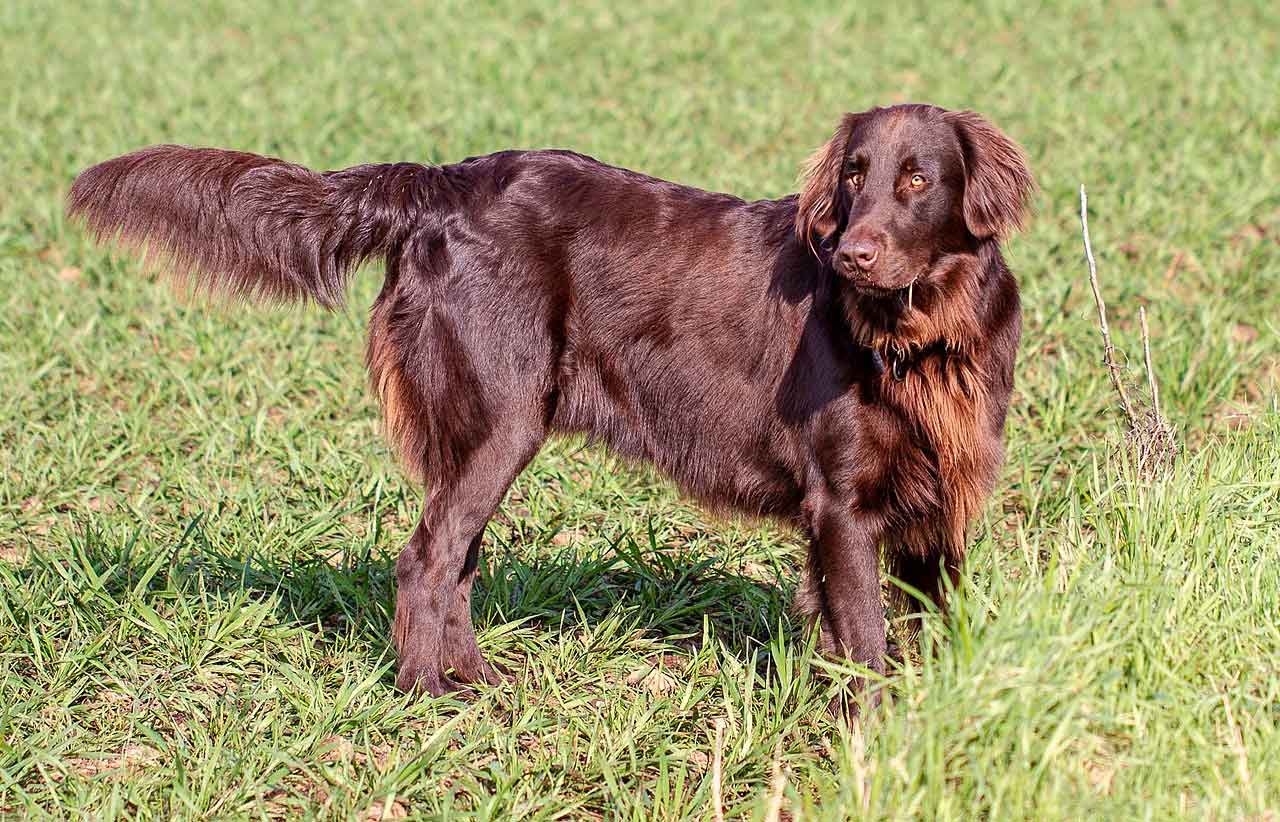
Photo: A liver-colored โ€œSmooth-Coated Retrieverโ€ by Fesoj-wr, CC BY-SA 4.0, via Wikimedia Commons

Physical characteristics

At first sight, I might think that the Flat-coated Retriever it seems like a Golden Retriever black or brown. In fact, the two breeds are so similar that in the past the second was presented at dog shows as a variety of the first. In fact, they are two different races, but the Golden Retriever descends in part of the Flat-coated Retriever and, like this, developed as a hunter for land and water game.

The Flat-coated Retriever they are medium sized dogs, harmonious and with a lively and intelligent expression. The male is usually more imposing than the female, measuring up to about 5 cm taller and weighing up to ten kilos more than the female.

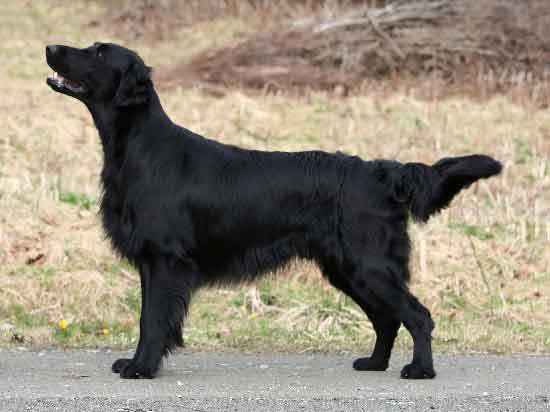
His body is harmonious and well proportioned. The chest is wide and deep, and the spine is short and quite square. The legs are muscular and of solid bones. They are straight when viewed from the front and lead to strong round legs with tight toes.

The tail is quite short, straight and well placed. Always carries it high, but never over the back and hardly ever stops wiggling.

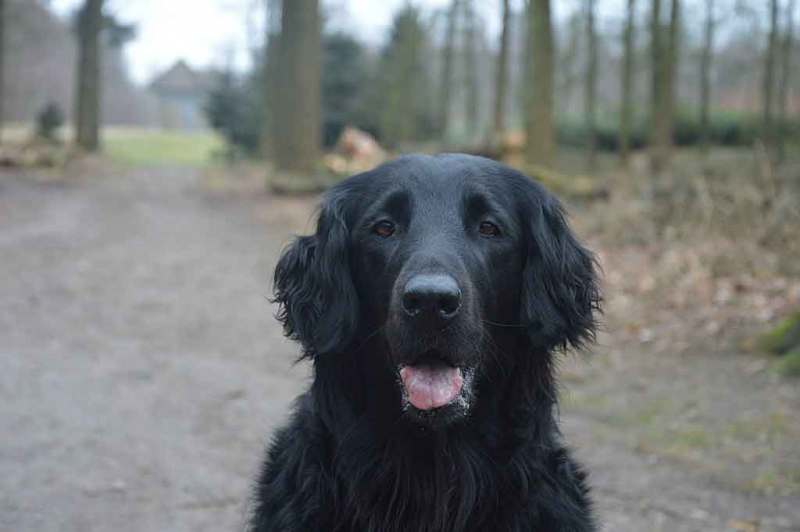
The head is rather long and the skull is rather flat. Jaws are long and strong, capable of carrying medium-sized game animals, such as hares or pheasants. They are shaped like scissors and cover the teeth firmly implanted in the gums.. The ears are quite small, drooping and well placed on top of the head. The eyes are medium in size and hazel or dark brown..

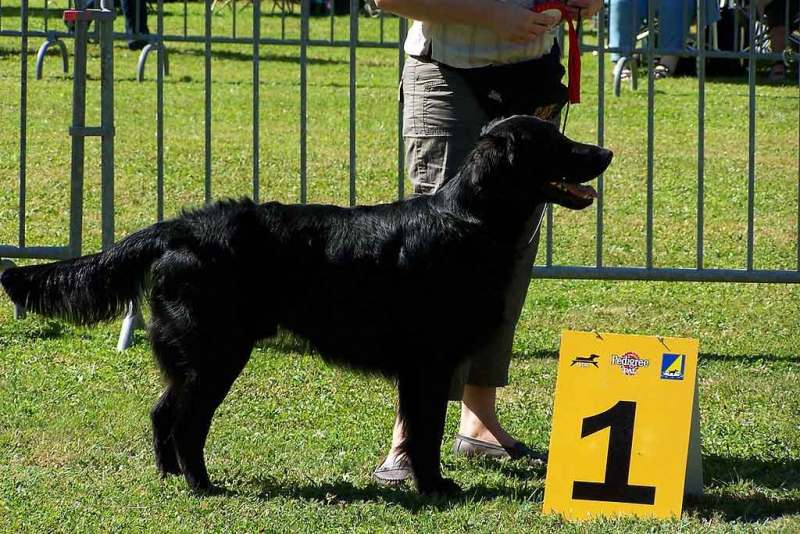
As the name suggests, the fur of the Flat-coated Retriever It is smooth. Black or dark brown, it is also dense and of medium length. This protects the Flat-coated Retriever of all kinds of weather conditions, from water and dirt. His hair is longer in his ears, the chest, the belly, limbs and tail. Males also have longer and more abundant hair on their necks., that resembles a mane.

Height and weight

    ▷ Male size: Of 58 to 61 cm.
    ▷ female size: Of 56 to 59 cm.
    ▷ Male weight: Of 27 to 36 kg
    ▷ female weight: Of 25 to 32 kg

Character and skills

The Flat-coated Retriever It is part of the large family of Retrievers and is particularly close to the Golden Retriever, both physically and in terms of temperament. But, one of the main differences is that they generally mature more slowly than other dogs and have a puppyish exuberance throughout their lives, which is why they are sometimes called the "Peter Pan of Retrievers". This great energy and vitality make it a wonderful and endearing companion., especially for children. On the other hand, It also implies that a certain amount of patience is necessary in their education.

In fact, although he likes to please, the Flat-coated Retriever it can also be somewhat stubborn. This is partly because he loves to entertain himself., but sometimes this means ignoring or disobeying your master. Yes indeed, they are usually good students and are sensitive to reprimands. This sensitivity also means that overly strict and rigid training methods are often not in your best interest., as they can lead you in the wrong direction and make you even more stubborn. So, it is better to favor a dog training method based on positive reinforcement, that is to say, in the reward of good behavior; is the case of clicker training, for example. Food in particular can do wonders for this dog, since it represents an important motivation for him. The Flat-coated Retriever It is an extremely greedy dog, and you can also remember it outside of work sessions: at the slightest drop in attention from its owner, is capable of stealing any food you have on hand, wherever you are. So, it is advisable to be careful not to leave food lying around for this dog who seems to be always hungry.

Tolerant and friendly, loves everyone, even the smallest. Combined with your enthusiasm, these traits even make it an ideal breed of dog for children. But, children must be a certain age: with young children, its exuberance and high energy could lead to unwanted jostling and tail slapping. His rather easy-going and very friendly personality also makes him a good companion for young retirees., as long as you can take him out for regular walks and meet his important exercise needs.

In general, loves human company, has strong ties to his family and needs their attention. Loves to play for hours and especially thrives in a large family.

His good understanding with humans extends to those he does not know. If he barks when a visitor arrives, is to inform his master, and not because he considers any stranger a threat. Very welcoming and friendly, he tends to quickly like any new person who meets him - especially if that person is nice to him- and enjoy the visits, it's made for anything but guard. On the other hand, its great closeness to humans and its great need for attention make it a dog that does not tolerate loneliness well. If he lives in a family too small for him, runs the risk of being unhappy and developing destructive behaviors.

Living with other dogs does not usually pose problems. Can also get along very well with a cat, provided adequate socialization work has been done. On the other hand, it is better to avoid the idea of รขโ‚ฌโ€นรขโ‚ฌโ€นliving with birds or rodents, since his hunting instinct would lead him to chase them.

It also, though it's pretty quiet inside, not really suitable for apartment living. He's a hunter at heart, who likes to exercise in spacious environments that give them the opportunity to run or swim. He is also one of the best swimmers and loves the water, never seems happier than when rolling around in puddles, jump in the fountains or just take long dips in the lakes, rivers and other bodies of water that it finds on its way. You need to spend at least an hour and a half each day to feel good in your paws and on your head. So, who thinks about adopting a Flat-coated Retriever you must ensure that it can provide you with living conditions that are compatible with your needs, because if you can't exercise enough, can quickly develop behavior problems, like stress or aggression.

Education

The Flat-coated Retriever learn very fast, but it is very sensitive: whatever happens, you must be careful not to punish your dog too often or too harshly, as it will remember and could become resistant to work sessions. On the other hand, the use of a dog training method based on positive reinforcement - and, Therefore, in the use of rewards- like clicker training, for example, it comes in handy. It must be said that for him food is an important source of motivation that it would be a shame not to use during work sessions..

The fact that he is late to maturity sometimes complicates his education a bit.. So, it is advisable to just be patient and calm, and above all show great coherence, because this intelligent dog does not stop interpreting every movement and every word of his master. With everything, it is quite simple to train, and the time spent on short work sessions from an early age is a profitable and long-lasting investment in a compliant adult partner.

It also, as with any dog รขโ‚ฌโ€นรขโ‚ฌโ€นof any breed, early socialization can only be beneficial in every way. The Flat-coated Retriever is spontaneously very sociable and open to changes in his environment, and quality socialization, through exposure to all kinds of people, animals, sounds and situations, reinforces these traits, making it even more balanced and perfectly suited to evolve in the midst of humans. In particular, can be especially helpful to avoid confusing cats, birds or rodents with the game.

Health

First of all, It should be noted that the Flat-coated Retriever takes some time to reach full physical maturity and, like all large dog breeds, is especially fragile during its growth period. Depending on the individual, the growth period lasts until 12 or 15 months. So, even if it is a breed with a great need for exercise, avoid any excessive exercise during this phase, at the risk of damaging your joints, often irreparably. In particular, stairs and activities that involve jumping should be avoided. You should also avoid excessively long walks: prior to the 3 months, are enough of 5 to 10 minutes, then it should not exceed half an hour until it has completed the 10 months.

It also, black individuals are especially sensitive to high temperatures. It is advisable to watch out for any signs that suggest heatstroke during the hottest seasons., as the dog's body can quickly overheat.

Having said that, the Flat-coated Retriever is generally in good health. But, like all races, may be subject to certain problems, some of which are hereditary: hip dysplasia. When adopting a Flat-coated Retriever of a breeder, it is advisable to find out about the tests carried out on breeders and their offspring, as this will help rule out certain diseases.

Thus, sometimes have a patellar dislocation, that is to say, a knee slipping out of place, what causes lameness. Long-term, friction caused by this dislocation can also lead to arthritis problems in the dog. Depending on the severity of the dislocation, surgery may be necessary.

like most big dogs, the Flat-coated Retriever you also have an increased risk of hip dysplasia: the femur does not fit perfectly into the pelvic socket of the hip joint. Some individuals may experience pain and lameness in one or two of the hind legs., but others show no symptoms. But, as the dog ages, osteoarthritis problems may appear. How this disease is hereditary, dogs that test positive for hip dysplasia are excluded from breeding. This is at least what every serious breeder of Flat-coated Retriever, and it is advisable to make sure of this when adopting a puppy from a breeder, asking parents' test results.

Another problem to which the Flat-coated Retriever is the dilation-torsion of the stomach. This serious and life-threatening syndrome affects large dogs with deep chests. Air or gases build up in the dog's stomach, that twists and does not allow its evacuation. Even worse, compresses the surrounding veins, thereby interrupting blood flow. No immediate veterinary care, the animal dies very quickly.

The different types of dog cancer also especially affect this breed.

Osteosarcoma, for example, especially affects large dogs, and the Flat-coated Retriever is no exception. It is a fairly aggressive bone cancer, which initially causes lameness. This disease usually leads to amputation of the affected limb and heavy chemotherapy. Unfortunately, it is very rare for a dog to survive this disease, as the problem is often diagnosed too late. According to the case and once identified, those affected may live between 9 months and 2 years longer than if they had not been treated, thanks to adapted treatments.

Another form of cancer to which this dog is more exposed is malignant histiocytosis. Although this form of cancer is rare, is the most commonly observed in this breed, and is usually contracted from 6 years of age. Appears as a localized mass, most often in the elbow or knee, and progresses very quickly once it appears. Can be treated with surgery and chemotherapy, but healing changes are usually small.

The Flat-coated Retriever you can also get lymphosarcoma, one of the most common cancers seen in dogs of all breeds. It can appear in various parts of the body, like spleen, the gastrointestinal tract, lymph nodes, the liver and bone marrow.

In this dog it is also more subject is hemangiosarcoma. This form of malignant cancer is found in the lining of blood vessels and in the spleen. Can be treated with surgery and chemotherapy, but also in this case the affected animal has little chance of recovery.

Grooming

Contrary to what her long dark hair might suggest, the Flat-coated Retriever it is an easy-care breed.

His coat requires weekly brushing, or even a little more if you are regularly abroad. Some owners go so far as to brush it every day to prevent its long, fallen hair from falling throughout the house.. Longer hairs can also be cut, that is to say, those with the ears, the feet, belly and tail; this prevents dirt from accumulating on rides.

The bath should not be prescribed too regularly, but it can be useful in case the dog with long enough hair gets too dirty, for example, as a result of an excursion in a muddy environment. Otherwise, bathe the dog in 2 to 3 times a year is more than enough to keep their coat in good condition, in addition to weekly brushing.

If you come across a water point during one of your walks, the Flat-coated Retriever often tempted to take a dip. If this happens, it is advisable to rinse the Retriever once it has come out of the water, especially if the water is chlorinated, is salty or contains algae, in order to prevent any skin problems and keep it clean.

Trimming your dog's nails once or twice a month can also help.. Contrary to what one might think with such an active dog, natural wear and tear is usually not enough, since its claws grow quite quickly.

It also, as in the case of any dog โ€‹โ€‹with floppy ears, it is necessary to clean them weekly to avoid any risk of infection.

The weekly grooming session should also be an opportunity to take care of your eyes, to make sure there are no problems (tearing, Red eyes…) and to clean the contours with clear water.

It is also necessary to take advantage of this time to clean the teeth. Brushing your dog's teeth helps prevent tartar buildup and the problems that come with it, starting with strong breath.

To avoid any uncomfortable reaction due to its size, it is advisable to get used to being handled as soon as possible, either by his master or by a third person. Learn to take care of the puppy, the noises, the smells and the manipulations involved, should be an integral part of your education.

Use

Used for over a century as a hunting dog, the Flat-coated Retriever continues to excel in this role today. They are suitable for all types of hunting, but they are especially good at tracking smaller animals. They are especially appreciated for their great ability to recover birds that have fallen into the water.

It is also a perfect companion dog, especially for a sports master or family. Anyone who dreams of going for a run with their dog - or even taking long walks- you will find in him an ideal companion, and also stands out in canine sports that take advantage of their physical qualities, like agility, the cani-cross or the flyball.

On the other hand, even if you are the first applicant and have a great need for exercise, It should not be forgotten that it takes time to reach full physical maturity and that, in the meantime, you have to save him. These may include, excessive exercise could cause deformities or alter the correct development of your joints, often with lifelong consequences.

Price

Although less common than some of its Retriever cousins, find a Flat-coated Retriever in Europe it does not present any special difficulties, Unlike, for example, of United States, where months of waiting may be necessary.

The cost of adopting a puppy from Flat-coated Retriever of a quality breeder ranges from 900 and 1200 EUR. Obviously, depends more or less on the quality of your lineage and the reputation of the breeder, as well as their physical qualities. There are no price differences according to the sex of the puppy.

Characteristics "Flat-coated Retriever"

Coexistence is important that you have with your new friend. Before considering the acquisition of a dog of the breed "Flat-coated Retriever" you know certain factors. Not all breeds of dogs are apt to live in an apartment, you must take into account his character, their need for exercise, their interaction with other pets, their care and if you have small children, their level of tolerance towards them.

Adaptation โ“˜

2,0 of 5 stars (based on 1 review)

friendly dog โ€‹โ€‹โ“˜

4,0 of 5 stars (based on 1 review)

hair loss โ“˜

2,0 of 5 stars (based on 1 review)

Affection level โ“˜

5,0 of 5 stars (based on 1 review)

Need for exercise โ“˜

4,0 of 5 stars (based on 1 review)

Social need โ“˜

4,0 of 5 stars (based on 1 review)

Home โ“˜

3,0 of 5 stars (based on 1 review)

Toilet โ“˜

2,0 of 5 stars (based on 1 review)

Friendly with strangers โ“˜

3,0 of 5 stars (based on 1 review)

barking โ“˜

3,0 of 5 stars (based on 1 review)

Health โ“˜

4,0 of 5 stars (based on 1 review)

Territorial โ“˜

2,0 of 5 stars (based on 1 review)

Cat friendly โ“˜

3,0 of 5 stars (based on 1 review)

Intelligence โ“˜

4,0 of 5 stars (based on 1 review)

Versatility โ“˜

3,0 of 5 stars (based on 1 review)

Child friendly โ“˜

5,0 of 5 stars (based on 1 review)

Surveillance โ“˜

3,0 of 5 stars (based on 1 review)

joy โ“˜

5,0 of 5 stars (based on 1 review)

Images "Flat-coated Retriever"

Photos:

1 – Flat Coated Retriever by I, Gunnandreassen, CC BY-SA 3.0, via Wikimedia Commons
2 – ยซSmooth hair collectorยป by https://pixabay.com/photos/flatcoated-retriever-flat-coated-4219166/
3 – ยซSmooth-coated snakeยป, 8 years by Pdusschooten, CC BY-SA 4.0, via Wikimedia Commons
4 – โ€œSmooth-coated retrieverโ€ named Molly by Flickr users David and Lynne Slater, CC BY 2.0, via Wikimedia Commons
5 – Flat-Coated Retriever black by Berthold Werner, CC BY-SA 3.0, via Wikimedia Commons
6 – Yellow Flat Coated Retriever by Dancer9, CC BY-SA 4.0, via Wikimedia Commons

Videos "Flat-coated Retriever"

Type and recognitions:

  • FCI CLASSIFICATION:
  • Group :
  • Section : . .

Federations:

  • FCI – Group 8: Retrievers - Flushing Dogs - Water Dogs – Section 1: Retrievers โ“˜
  • AKCSporting โ“˜
  • ANKC Group 3 (Gundogs) โ“˜
  • CKCSporting Dogs โ“˜
  • โ€‹KC – Gundog โ“˜
  • NZKCGundog โ“˜
  • UKCGun Dogs โ“˜

FCI breed standard "Flat-coated Retriever"

Origin:
United Kingdom, Scotland

Date of publication of the valid original standard:
08.09.1988

Use:

Retriever hunting and shooting.


General appearance:

Smart and active dog, medium-sized, with a clever expression; it's strong without being heavy, as well as thin without being lacking in substance.


Behavior / temperament:

Endowed with the natural ability of a hunting dog, as well as optimism and friendliness that he demonstrates with the enthusiastic movement of his tail. Confident and caring.

Head:

Long and delicately molded.

Cranial region:
  • Skull: Flattened and moderately wide.
  • Depression links (Stop): Light between the eyes, that should not be accentuated, in such a way that it does not give a drooping or concave appearance.

facial region:

  • Truffle: Good size, with open nostrils.
  • Jaws / Teeth: Long and strong jaws, capable of holding a hare or a pheasant. Complete denture with scissor bite, that is to say that the inner face of the upper incisors is in contact with the outer face of the lower incisors and well placed in the maxillae. Healthy and strong teeth.

Eyes: Medium-sized, brown or hazelnut, with a very clever expression (prominent round eyes are highly undesirable). Not laid obliquely.

Ears: Small and well placed on the sides of the head.

Neck:

The head well placed on the neck that should be reasonably long and without dewlap, symmetrical and obliquely placed on the shoulders that descend well down the back allowing you to easily search the track.

Body:

  • Pork loin: Short and square. Loin poorly coupled highly undesirable.
  • Breast : Deep and moderately wide chest, with a well-defined sill. Moderately flattened front ribs. They must be well developed backwards, have a gradual curvature and be more arched in the center, although this curvature should be less pronounced towards the hindquarters.

Tail:

Short, straight and well set, carried gaily but never much higher than the dorsal line.

Tips

PREVIOUS MEMBERS: They must be straight and of good bones in all its extension.

  • Elbows: They should move neatly and evenly across the chest.

LATER MEMBERS: Muscular, without any deviation.

  • Knee: Moderate angulation.
  • Hocks: Moderate angulation, well descended. Highly undesirable cow hocks.

FEET: Well round and strong, with fingers together and well arched, as well as thick and strong pads.

Movement:

Free and loose, Seen from the front and back it should be in a straight line without any deviation.

Mantle

HAIR: Denso, fine to medium textured and of good quality, as straight as possible. The limbs and tail must have sufficient fringes. The abundant fringes when the dog reaches maturity complete the elegance of a good specimen.

COLOR: Only black or liver.


Size and weight:

Height at the desired withers:

  • Males: 59 โ€“ 61,5 cm. (23-24 inches).
  • females: 56,5 โ€“ 59 cm. (21-23 inches).

Desired weight in good physical condition:

  • Males: 27 โ€“ 36 kg (60-80 English pounds).
  • females: 25 โ€“ 32 kg (55-70 English pounds).


Fouls:

Any deviation from the aforementioned criteria is considered as a fault and the severity of this is considered to the degree of the deviation to the standard and its consequences on the health and well-being of the dog., and the ability of the dog to carry out their traditional work.

FALTAS DESCALIFICANTES:

โ€ข Aggressiveness or extreme shyness.
โ€ข Any dog โ€‹โ€‹showing clear signs of physical or behavioral abnormalities.


N.B.:

โ€ข Males must have two normal-appearing testicles fully descended into the scrotum..
โ€ข Only functionally and clinically healthy dogs, with the typical conformation of the breed, should be used for parenting.

Source: F.C.I - International Cynological Federation

Alternative names:

1. Flatcoat, Flattie, Flatte (Sweden), flatt (Sweden) (English).
2. Flat-Coated Retriever (French).
3. Flat Coated Retriever (German).
4. Flat-coated retriever (Portuguese).
5. Retriever de pelo liso, (en inglรฉs Flat-coated retriever) (espaรฑol).

โ–ท The world of Pets: Dogs, cats, birds, reptiles, amphibians

Gray Norwegian Elkhound
Noruega FCI 242 - Nordic Hunting Dogs

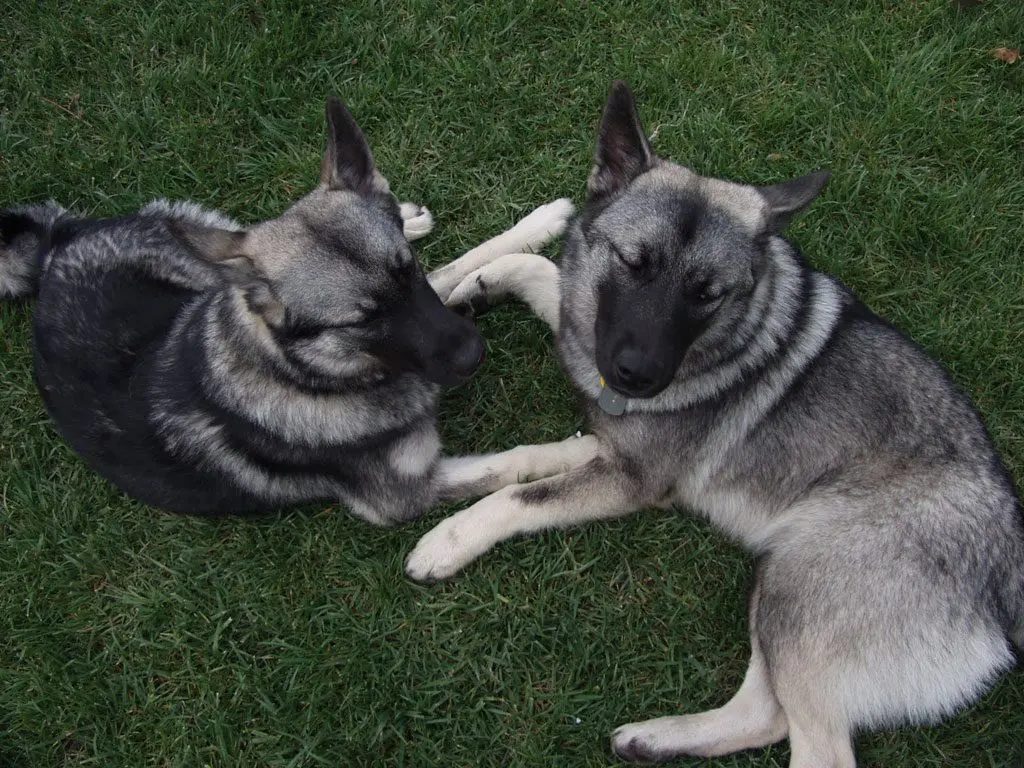
An advantage of Gray Norwegian Elkhound is that it is a friendly and social dog does not tend to dominate or attack.

Cazador de Alces Noruego

Content

Characteristics "Gray Norwegian Elkhound"

Coexistence is important that you have with your new friend. Before considering the acquisition of a dog of the breed "Gray Norwegian Elkhound" you know certain factors. Not all breeds of dogs are apt to live in an apartment, you must take into account his character, their need for exercise, their interaction with other pets, their care and if you have small children, their level of tolerance towards them.

Adaptation โ“˜

5,0 of 5 stars (based on 1 review)

friendly dog โ€‹โ€‹โ“˜

3,0 of 5 stars (based on 1 review)

hair loss โ“˜

5,0 of 5 stars (based on 1 review)

Affection level โ“˜

5,0 of 5 stars (based on 1 review)

Need for exercise โ“˜

4,0 of 5 stars (based on 1 review)

Social need โ“˜

3,0 of 5 stars (based on 1 review)

Home โ“˜

3,0 of 5 stars (based on 1 review)

Toilet โ“˜

5,0 of 5 stars (based on 1 review)

Friendly with strangers โ“˜

3,0 of 5 stars (based on 1 review)

barking โ“˜

5,0 of 5 stars (based on 1 review)

Health โ“˜

3,0 of 5 stars (based on 1 review)

Territorial โ“˜

3,0 of 5 stars (based on 1 review)

Cat friendly โ“˜

3,0 of 5 stars (based on 1 review)

Intelligence โ“˜

5,0 of 5 stars (based on 1 review)

Versatility โ“˜

3,0 of 5 stars (based on 1 review)

Child friendly โ“˜

5,0 of 5 stars (based on 1 review)

Surveillance โ“˜

3,0 of 5 stars (based on 1 review)

joy โ“˜

5,0 of 5 stars (based on 1 review)

History

National dog of Norway

The roots of this Norwegian national dog go back a long way.: already Stone Age finds give evidence of a very similar quadruped. Some cynologists suspect that the current appearance of the breed is very close to that of the first western European domestic dogs. In scandinavia, the Gray Norwegian Elkhound they were used mainly to hunt elk, but also bears, hence its name.

For a long time the breed was mainly bred in Sweden, where he was called "gray dog". But since 1981 Norway has had the sponsorship: The breed got its current name, The "gray dog" was formally eliminated as a breed in this context.

In total there are three Moose Hunter dogs: Besides of Gray Norwegian Elkhound, are the Black Norwegian Elkhound and the Jรคmthund Sueco. The Norwegian gray is the most common: Although rarely seen outside of Scandinavia, he is very popular in his home country and is considered the national dog there.

Physical characteristics

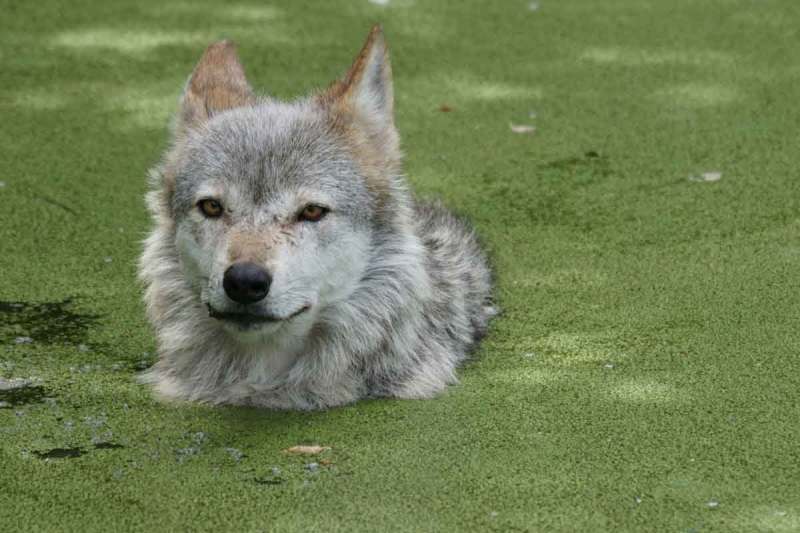
The dog Gray Norwegian Elkhound has a very classic look, similar to the first dogs domesticated by humans in Western Europe. The waterproof coat in typical shades of gray, black and white already gives an indication of the Nordic origin of this dog Moose Hunter. But it also has the effect that some laymen at first glance consider it a mixed race with parts of the Huskys. With a maximum height of 52 cm at the withers and a body weight of about 24 kg with compact structure, the Gray Norwegian Elkhound belongs to the medium-sized breeds and is larger than the Black Norwegian Elkhound. The pointy ears are erect and the tail is ideally rolled slightly over the back..

Character and skills

The Gray Norwegian Elkhound they are intelligent animal companions with their own personalities. So if you are looking for a four-legged friend who is willing to subordinate, you are wrong with this proud fellow. The breed is considered brave, smart and friendly. To the Gray Norwegian Elkhound they usually like to bark, make sure to control it from when they are puppies. Many Gray Norwegian Elkhound they are therefore very suitable as watchdogs, because they are alerted by strangers – However, it is quite possible that this human-friendly breed will be caressed by a stranger. In an emergency, However, loyal four-legged friends are always ready to defend their loved ones. The Gray Norwegian Elkhound can be well kept as a family dog – whenever I exercise a lot outside. He gets along very well with children and shows his playful side, especially when interacting with them.

Gray Norwegian Elkhound Training

Although this breed does not have a submissive nature, is considered easy to create. An advantage is that this friendly and social dog does not tend to dominate or attack. In any case, it is important to have a sufficient workload, because a boring Gray Norwegian Elkhound seek their occupation independently, and this is usually not to the liking of their owners. It also, make sure that from the age of the puppy you work for a good recovery of the hunting dog. You should also take into account the joy of barking when training. Attending a dog training school can support you and your four-legged friend in learning together and also reinforces their social streak in handling conspecifics.

Gray Norwegian Elkhound Health

These Norwegian hunters they are considered very robust and hardly prone to genetic diseases. There is a slight predisposition to the eye disease Progressive Retinal Atrophy (ARP) and hip dysplasia – before buying a puppy, Please, talk to the breeder in question, who will be happy to inform you about the health precautions for your farm animals. Exercising and eating a balanced diet is the best way to keep your puppy's joints in shape during old age.. Make sure this dog always has a cool place to stay in the summer – the breed tolerates the cold well, but is considered to be heat sensitive. The Gray Norwegian Elkhound can reach an age of up to 16 years, some even more.

Gray Norwegian Elkhound Nutrition

Like every dog, the Gray Norwegian Elkhound you need a balanced diet that is high in meat. So make sure you give a food where meat is at the top of their intake., regardless of whether you choose wet or dry food. The Gray Norwegian Elkhound tend to gain weight quickly, so you should always watch your daily ration and include treats. The manufacturer's instructions are only a rough guide., as metabolism and exercise change your dog's energy needs. So check your partner's weight regularly so you can counter if he gains or loses weight. If you want to reward your dog, use high-quality snacks without sugar or grains. Chunks of freeze-dried meat for dogs are a good example. Dry chews meet your partner's chewing needs. Make sure your four-legged friend always has plenty of drinking water available.

Gray Norwegian Elkhound Care

This dog's coat consists of a longer top coat and a dense undercoat.. It is very weather resistant and easy to brush. But, the Gray Norwegian Elkhound you also lose a relatively large amount of hair, especially during coat change twice a year. During this time, you should brush him daily to stop the flood of hair in your home and rid the dog of dead hair. Especially with older animals or if your dog walks mainly on the soft forest floor, you may need to trim the claws regularly. This will prevent your Gray Norwegian Elkhound get hurt if you get stuck with them. If you are not sure, ask your vet to show you how to trim them during checkups – you can usually do the pedicure yourself with special pliers. When brushing your dog's ears, also check that they are not dirty and use a special ear cleaner for dogs if necessary. You can effectively prevent tartar and its consequences by brushing your dog's teeth every day together with a dog toothbrush and an animal-friendly toothpaste.. If you are considering this, you should get your pup used to the ritual around his shiny little teeth.

Is a Norwegian Elkhound right for me??

The Gray Norwegian Elkhound still suits hunters well, but he can also be a happy family dog รขโ‚ฌโ€นรขโ‚ฌโ€นif he has enough outdoor activity. Not a dog for the city. A fenced garden would be an ideal addition to your home.. This breed is not made for living in a small apartment.. Should already have experience with dogs, because although the Gray Norwegian Elkhound be smart and like to learn, will not accept instructions that seem crazy. Here you need the right mix of knowledge and sensitivity. Can get along with cats, but you should have already known them as potential mates at puppy age.

Like any other four legged friend, keeping this dog requires a not inconsiderable amount of time: Are you prepared to spend a few hours outside with your partner every day, whatever the weather?? It also, estimate costs in advance: In addition to the purchase price and, if required, the basic equipment, there are regular expenses for vet visits, high quality food, as well as the dog's tax and insurance.

Where can I buy a Norwegian Elkhound?

If you are looking for a Gray Norwegian Elkhound outside scandinavia, you must have a little patience. So it makes sense to contact the Nordic dog clubs directly., that can help you, for example, to make contacts abroad. Because especially in the far north there are naturally more specimens. In scandinavia, a few 2.000 puppies of the breed see the light of day every year.

The probability of finding a Gray Norwegian Elkhound adult in animal shelters is extremely low outside of Scandinavia. So, even if you prefer to give an old animal a new home, contact the nordic dog clubs in your country. Possibly the hybrids of the protectors are also questioned, that they will rejoice in a common coexistence with you.

We wish you a lot of joy with your friendly companion from the far north!

Images "Gray Norwegian Elkhound"

Photos:

1 – Norwegian Elk Hunter gray by https://pxhere.com/en/photo/706371
2 – Norwegian Elk Hunter gray by https://pxhere.com/en/photo/869691
3 – Norwegian Elk Hunter gray by https://pxhere.com/en/photo/1336997
4 – Norvin Son of Storm owned by Nichola Herron. Photo by sannse at the City of Birmingham Championship Dog Show, 29th August 2003 by True / CC BY-SA
5 – Norwegian Elk Hunter gray by https://pxhere.com/no/photo/1233791
6 – Gray Norwegian Elk Hunter by https://pixabay.com/es/photos/cรฉsped-mamรญfero-animales-naturaleza-3259673/

Videos "Gray Norwegian Elkhound"

Type and recognitions:

  • FCI CLASSIFICATION:
  • Group :
  • Section : . .

Federations:

  • FCI – Group 5 – Section 2 Nordic Hunting Dogs. โ“˜
  • AKC – Nordic Hunting Dogs โ“˜
  • ANKC – Nordic Hunting Dogs โ“˜
  • CKC – Nordic Hunting Dogs โ“˜
  • โ€‹KC – Nordic Hunting Dogs โ“˜
  • NZKC – Nordic Hunting Dogs โ“˜
  • UKC – Nordic Hunting Dogs โ“˜

FCI breed standard "Gray Norwegian Elkhound"

Origin:
Norway

Date of publication of the valid original standard:
09.08.1999

Use:

Hunting dog for moose.


General appearance:

It's a typical Spitz, compact body, short and square. Elastic and well-set collar. erect ears. The coat is dense and abundant, but not bristly or long. The tail is tightly curled over the back.

PROPIMPORTANT ORTIONS: Square shaped. The length of the skull corresponds to that of the muzzle.


Behavior / temperament:

Without fear, energetic, brave.

Head:

Wedge shaped, relatively wide at the level of the ears. Thin.

Cranial region:
  • Craging: Slightly arched.
  • Dnaso-frontal depression (Stop): Well marked, but not too much.

facial region:

  • Trufa: black.
  • Horcico: Whether viewed from above or in profile gradually decreases. The nasal helm is straight.
  • Labios: Tight.
  • Jaws/Teeth: Scissor bite. Complete denture.
  • Ojors: They are not prominent and should be dark brown..
  • Obars: High insertion, firm and erect, relatively small. Its length slightly exceeds its width at the base; they are pointed and well mobile.

Neck:

Medium length, firm, well upright. Abundant golilla, no loose skin.

Body:

Strong, short loin.

  • Lรญnand the top: Straight from the withers to the insertion of the tail.
  • Cruz: Well developed.
  • Espalda: companies, muscular and straight.
  • Itmor: Well developed.
  • Glikeness: Strong and wide.
  • Pecho: Broad and deep; ribs tight.
  • Lรญnlower ea and belly: Almost straight.

Tail:

High insertion, strong, relatively short. Dense hair, but without fringes. Tightly curled over the back, but not carried to the side. The tip of the tail cannot be stretched out in adult dogs.

Tips

PREVIOUS MEMBERS:

  • Apgeneral arience: Strong and firm, straight.
  • Hormbros: Inclined.
  • Brazo: Moderately inclined.
  • Elbows: Well glued, turned neither in nor out.
  • Antarm: Straight, be seen from the front or from the side.
  • Metacarpus: Straight seen from the front, moderately inclined viewed from the side.
  • Pinis previous: Rather small, compact; fingers are directed forward.

LATER MEMBERS:

  • Apgeneral arience: Strong, skinny, muscular. Parallels seen from behind. Moderately angled.
  • Thigh: Muscled and wide.
  • Rodinllto: Moderately angled.Leg: Medium long.
  • Corvejรณn: Moderately angled.
  • Metatarsus: On the dog in a standing position, the metatarsal should not be located further back than the insertion of the tail.
  • Pinis later: Relatively small, oval, compact. Fingers are directed forward.

Movement:

Light, effortless. Parallel, be seen from the front or the back.

Mantle

PIEL: companies, no wrinkles on the head.

  • Plink: Medium long; dense outer coat of hair, rough, abundant, without curls. On the head and in the front of the limbs it is short and smooth. It's the longest on the neck, thigh, on the back of the limbs and on the tail. Soft inner fur cover.
  • Colorr: Various shades of gray. The black tips of the hairs on the outer layer determine the hue of the color. Gray is lighter on the chest, the belly, the extremities, at the bottom of the tail, below the tail insertion and on the "harness-like markings". The harness marking is a stripe width of 5 cm that extends from the withers to the elbows and in which the hairs of the outer layer do not have black tips. The ears and the front of the muzzle are dark in color (dark mask). The dark line from the eye to the ear insert limits the mask. The undercoat of hairs is light gray.


Size and weight:

Alturto the cross:

  • In males: ideal height: 52 cm..
  • In females: ideal height: 49 cm..


Fouls:

Any deviation from the aforementioned criteria is considered as a fault and the severity of this is considered to the degree of the deviation to the standard and its consequences on the health and well-being of the dog..

  • Round or domed skull.
  • Pointed or short snout.
  • Pinz bite Irregular bite.
  • light eyes.
  • Ears that are too big or wide.
  • Tail too short, not tightly screwed, deviated to one side.
  • flattened feet.
  • Too long or too short undercoat.
  • Brownish or yellowish color. Dark undercoat. Sooty color.
  • White on the tip of the tail; white on chest.
  • Weak or nervous temperament.

FALTAS DISQUALIFYING:

  • Aggressiveness or extreme shyness.
  • Any dog โ€‹โ€‹showing clear signs of physical or behavioral abnormalities must be disqualified..
  • Upper or lower prognathism.
  • Yellow or blue eyes.
  • Not erect ears.
  • Short tail from birth.
  • Spurs on the hind limbs.
  • Any color variation other than gray.
  • Height to the cross 3 cm minus 4 cm more than the ideal height mentioned in the standard.


N.B.:
  • Males should have two normal-appearing testicles descended into the scrotum..
  • Only functionally and clinically healthy dogs, with the typical conformation of the breed, should be used for parenting.

Source: F.C.I - International Cynological Federation

Alternative names:

1. Norsk elghund, Grรฅ norsk elghund, Gray Norwegian Elkhound, Small, Grey Elk Dog, Norwegian Moose Dog, Harmaa norjanhirvikoira (English).
2. Norwegian Elkhound (French).
3. Norwegischer Elchhund grau (German).
4. Elkhound, Norueguรชs cinza (Portuguese).
5. Norsk elghund, Norsk elghund grรฅ, Cazador de alces noruego gris, Gray Norwegian elkhound, Small grey elk dog, Norwegian moose dog (espaรฑol).

โ–ท The world of Pets: Dogs, cats, birds, reptiles, amphibians

Chow Chow
FCI 205 - Asian Spitz and related breeds
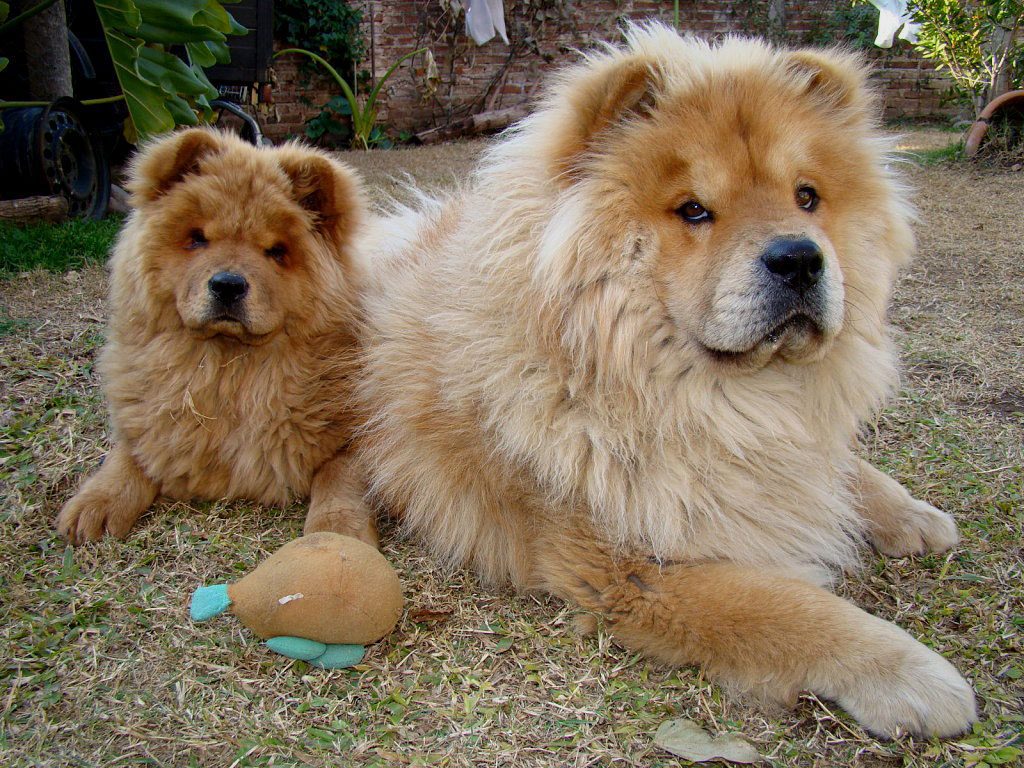
Chow Chow

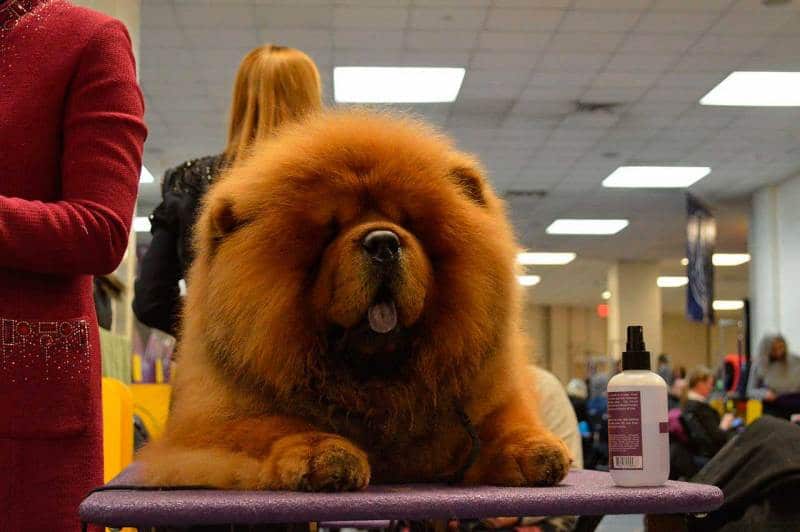
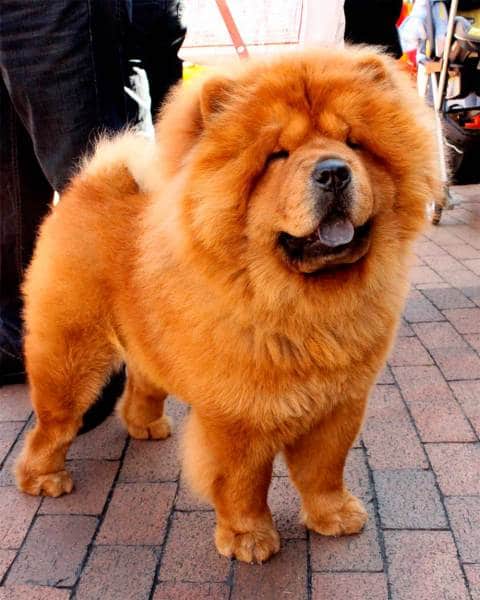
The Chow Chow are distinguished by their unusual blue-black tongue

Content

History

The Chow Chow has been known for more than 2500 years in China, where it is represented in bas-reliefs of the time. Dog of mysterious origin, belongs to the Spitz family. Some believe it is a cross between a Tibetan Mastiff and a Samoyed., while others think it is more of an original dog, that is to say, that comes from the Nordic dogs (internal temperature above average, particular shape of the bony structure of your skull…). In any case, stories about the origins of Chow Chow they are usually just hypotheses.

In Manchuria and Mongolia it was used as a war dog, to watch over herds or rushes and as a draft animal. The Chow Chow they were also found in Tibetan monasteries: his function was to defend the monks. Occasionally it was a hunting dog, it was eaten in some parts of china, and his skin was also traded.

It was introduced in Europe in 1865, when Queen Victoria of England received one as a gift and started raising it. It was officially recognized by the Kennel Club English little less than 30 years later, in 1894. Today, only used as a pet.

The term ยซChow Chowยซ has appeared recently. In fact, during the interwar period, the Chow-Chow It was known in the West as the "Hong Kong dog".

Despite some other blood additions over the years 50, the Chow Chow is a breed that has remained pure.

Physical characteristics

The Chow Chow It is a dog with a robust body that goes hand in hand with its wide skull and its small triangular ears slightly rounded at the tip and it carries them apart with the tip slightly inclined forward which are always erect. His eyes are dark, from Brown to black always small, almendrada form. The nose is completely black and wide except in color Chow cream and white, which supports the color pink. The mouth is wide and strong. They have a characteristic "stilt" movement, due to the peculiar conformation of their hind legs, which lack angle, and it makes it look like walking on stilts.

It is a dog of agile and balanced movement. By joining the legs in parallel to two in the movement. This breed has a very dense fur that can be rough or soft, which it accumulates more around his neck, giving it its distinctive frill or horsehair. Its fur can be red, black, Blue and cream. Those who have spotted or multi-coloured fur are considered outside the standards of the breed.

The Chow Chow They are distinguished by their unusual bluish-black or purple tongue and strong legs.. The gene for the bluish-black or purple tongue is usually dominant in this breed, and so it also tends to be in from mixed races of a Chow Chow.

A legend that says, When the gods placed the stars in the firmament, pieces of the sky fell that the Chow Chow licked and since that day he has had a blue tongue..

Character and skills

Today, the Chow Chow is commonly a companion dog. His strong sense of ownership of their homes with their - sometimes- intriguing approach to strangers may be misinterpreted by those who do not belong to his family. But, signs of shyness and aggression are not characteristic of this breed. Copies of the sex opposite usually coexist with less tension than with those of the same sex, but it is not uncommon to see Chow Chow of different sexes living together peacefully.

They are extremely loyal to their family and it costs change masters. Affection usually shown only to people you know, so visitors should not push them physically as they will not immediately accept strangers as quickly as they do with their family members.

They are not a very active breed. Life in an apartment suits them, if they are given the opportunity to get enough physical activity daily. The owners must take daily walks with their Chow Chow, so be it in a small place, to maintain their physical and mental abilities in a healthy way.

Although this breed shows low energy most of the time, needs a routine to be able to explore their environment and thus maintain a loving nature. Its typical behavior resembles that of a domestic cat more than that of a dog., for cleaning and its enigmatic nature.

Grooming

Grooming requirements depend on the type of fur. A Chow straight hair needs to be brushed weekly only. One with a rough coat should be brushed every other day. Both varieties molt twice a year, during which the coat will abundantly. Rarely need a bath, although a hot bath followed by a thorough drying can help remove the coat you're missing.

The rest is basic care. Trim nails as needed, usually once a month. Brush your teeth frequently for general good health and fresh breath. Check ears weekly for dirt, redness or odor that may indicate an infection. If the ears look dirty, clean them with a damp cotton ball and a mild ear cleaner recommended by your vet.

Health

The Chow Chow is the breed of dog most affected by Dysplasia elbow. It is also vulnerable to hip dysplasia, dislocation of patella, thyroid disease, Pemphigus Foliaceus and ocular disorders such as entropion and ectropion. The risk of these disorders increases exponentially when they are purchased at pet stores unscrupulous caregivers who do not test their dogs to see if there is existence of genetic disorders. Like this, a potential buyer of this breed should ask about the health status of the pet to buy. Animal caretakers must provide the client with a guarantee of the dog's health. But despite his delicate health, It is an excellent companion dog for humans..

Characteristics "Chow Chow"

Coexistence is important that you have with your new friend. Before considering the acquisition of a dog of the breed "Chow Chow" you know certain factors. Not all breeds of dogs are apt to live in an apartment, you must take into account his character, their need for exercise, their interaction with other pets, their care and if you have small children, their level of tolerance towards them.

Adaptation โ“˜

2,0 of 5 stars (based on 1 review)

friendly dog โ€‹โ€‹โ“˜

1,0 of 5 stars (based on 1 review)

hair loss โ“˜

5,0 of 5 stars (based on 1 review)

Affection level โ“˜

2,0 of 5 stars (based on 1 review)

Need for exercise โ“˜

2,0 of 5 stars (based on 1 review)

Social need โ“˜

2,0 of 5 stars (based on 1 review)

Home โ“˜

3,0 of 5 stars (based on 1 review)

Toilet โ“˜

5,0 of 5 stars (based on 1 review)

Friendly with strangers โ“˜

1,0 of 5 stars (based on 1 review)

barking โ“˜

5,0 of 5 stars (based on 1 review)

Health โ“˜

4,0 of 5 stars (based on 1 review)

Territorial โ“˜

3,0 of 5 stars (based on 1 review)

Cat friendly โ“˜

2,0 of 5 stars (based on 1 review)

Intelligence โ“˜

2,0 of 5 stars (based on 1 review)

Versatility โ“˜

2,0 of 5 stars (based on 1 review)

Child friendly โ“˜

2,0 of 5 stars (based on 1 review)

Surveillance โ“˜

2,0 of 5 stars (based on 1 review)

joy โ“˜

3,0 of 5 stars (based on 1 review)

Images "Chow Chow"

credits:

1 – Flickr: Chowdren
2 – International Dog Show, Szczecin 2007 by Remigiusz Jรณzefowicz
3 – Pets Adviser from Brooklyn, USA / CC BYwww.petsadviser.com
4 – by https://pxhere.com/es/photo/234926
5 – Flickr: Bokeh the Chow by Luigi Borromeo
6 – Flickr: Chowdren (chow chow) by Seongbin Im
7 – by https://www.needpix.com/photo/371158/chow-chow-dog-snow-canine-domestic-pet-portrait-looking-attentive
8 – Russian: photo from the exhibition by Vladimir gubanov

Videos "Chow Chow"

Type and recognitions:

  • FCI CLASSIFICATION:
  • Group :
  • Section : . .

Federations:

  • Federations: FCI โ“˜, AKC โ“˜, ANKC โ“˜, CKC โ“˜, โ€‹KC โ“˜, NZKC โ“˜, UKC โ“˜

  • FCI breed standard Chow Chow

    FCIFCI - Chow Chow
    CHOW

    Alternative names:

    1. Chow (English).
    2. Chow (French).
    3. Chow (German).
    4. Chow (Portuguese).
    5. Chow (espaรฑol).

    โ–ท The world of Pets: Dogs, cats, birds, reptiles, amphibians

    Cirneco dell'Etna
    Italia FCI 199 . Primitive type - Hunting Dogs
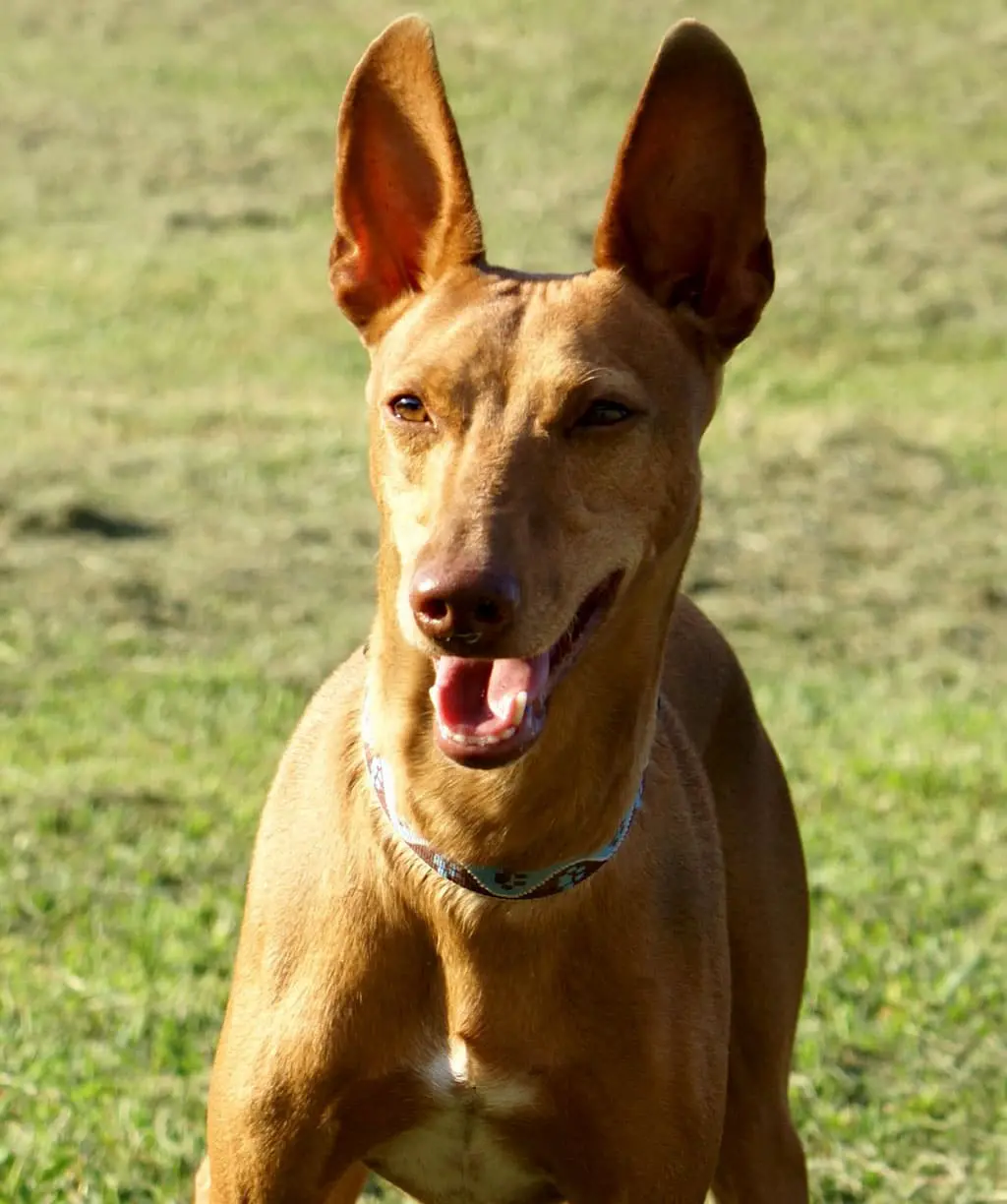
    Cirneco del Etna

    This lively and friendly Sicilian Greyhound makes an excellent companion and keeper requiring regular exercise – 20 to 30 minutes a day –

    Content

    History

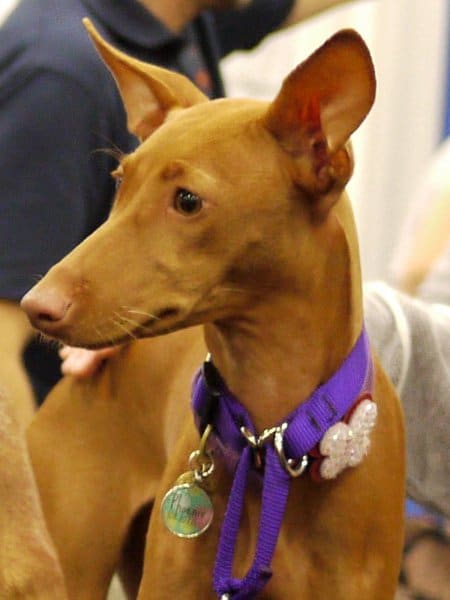
    He "Cirneco dell'Etnaยซ, also it is known as the Sicilian Greyhound, it can resemble a small Pharaoh Hound, but it is a different breed of Italian origin, with its own color markings, shaped tail and ears in a triangle. Named after Mount Etna, on the Italian island of Sicily, where their ancestors hunted rabbits and hares. Lurks silently, So you can even sneak up on birds.

    A Mediterranean dog of ancient origin probably descended from hunting dogs that existed at the time of the pharaohs in ancient Egypt and were introduced to the Mediterranean basin by the Phoenicians, Sicily as the region chosen for adoption. Evidence of the presence of the Cirneco on the island is given by its representation in currencies, engravings and mosaics that date back many centuries BC and was always considered the oldest hunting dog, select and highly respected.

    Today, This rare breed is predominantly a family companion.

    Physical characteristics

    It is primitive and elegant shapes and graceful. Their size is medium and compact body, robust with a thin layer of hair and ears pricked, always alert. Its structure is sub longilinear.

    Thanks to his innate athletic ability, It has a natural agility and ability to run after a complaint. The Cirneco It has a reputation for being easier to train than others hounds, provided that the training sessions are short.

    SIZE AND WEIGHT:

    Height to the cross: Males: 46 โ€“ 50 cm.. females: 44 โ€“ 48 cm.. tolerance 2 cm below the minimum and above the maximum height. Weight: Males: 10 โ€“ 13 kg. females: 8 โ€“ 11 kg.

    Character and skills

    The breed standard requires that the Cirneco be alert and be gentle, with an independent temperament. In this curious and playful greyhound loves to be with people. It's also smart and trainable, especially if positive reinforcement techniques are used as praise, games and goodies. Although small, the Cirneco is a hunter by nature. Always keep a tight leash, If you see a hare, the chase. But, a stern tone of voice should be enough to bring him back.

    Start training your puppy the day you bring him home. Even at eight weeks old, He is able to absorb everything you can teach him. Don't wait until you have 6 months to start training him or you'll have to deal with a more stubborn dog. If possible, take it to school for puppies when you 10 or 12 weeks of age, y socialize, socialize, socialize. But, Note that many kinds of training puppies require certain vaccinations (such as kennel cough) stay up to date, and many veterinarians recommend limited exposure to other dogs and public places until puppy vaccinations (including rabies, distemper and parvovirus) They are completed. Instead of formal training, you can start training your puppy to socialize at home and among family and friends until immunizations are completed in the puppy.

    Health

    As there are so few of these dogs, Little is known about the health of Cirnechi. In general, They seem to be a tough race, but they can suffer muscle injuries and the toes to the running. A reputable breeder will show potential health problems, including any conditions you have noticed on your own lines.

    Careful breeders their dogs examined for genetic diseases, and they only breed the best looking specimens, but sometimes Mother Nature has other ideas and a puppy can develop a genetic condition. In most cases, can still live a good life, thanks to advances in veterinary medicine. And remember that you have the power to protect your Cirneco one of the most common health problems: the obesity. It keep a proper weight is a simple way to extend the life of its Cirneco.

    Grooming

    The Cirneco has a bright coat, brown to brown, it is easy to care: Brush it weekly using a dog mitt or rubber hair brush. If you constantly brush, shouldn't need a bath very often.

    The rest are taken care routine: Often brush their teeth with a toothpaste pet approved by the veterinarian for general good health and fresh breath, and cut nails every week or two.

    Characteristics "Cirneco dell'Etna"

    Coexistence is important that you have with your new friend. Before considering the acquisition of a dog of the breed "Cirneco dell'Etna" you know certain factors. Not all breeds of dogs are apt to live in an apartment, you must take into account his character, their need for exercise, their interaction with other pets, their care and if you have small children, their level of tolerance towards them.

    Adaptation โ“˜

    5,0 of 5 stars (based on 1 review)

    friendly dog โ€‹โ€‹โ“˜

    5,0 of 5 stars (based on 1 review)

    hair loss โ“˜

    3,0 of 5 stars (based on 1 review)

    Affection level โ“˜

    5,0 of 5 stars (based on 1 review)

    Need for exercise โ“˜

    4,0 of 5 stars (based on 1 review)

    Social need โ“˜

    3,0 of 5 stars (based on 1 review)

    Home โ“˜

    5,0 of 5 stars (based on 1 review)

    Toilet โ“˜

    2,0 of 5 stars (based on 1 review)

    Friendly with strangers โ“˜

    3,0 of 5 stars (based on 1 review)

    barking โ“˜

    3,0 of 5 stars (based on 1 review)

    Health โ“˜

    1,0 of 5 stars (based on 1 review)

    Territorial โ“˜

    2,0 of 5 stars (based on 1 review)

    Cat friendly โ“˜

    3,0 of 5 stars (based on 1 review)

    Intelligence โ“˜

    3,0 of 5 stars (based on 1 review)

    Versatility โ“˜

    3,0 of 5 stars (based on 1 review)

    Child friendly โ“˜

    3,0 of 5 stars (based on 1 review)

    Surveillance โ“˜

    3,0 of 5 stars (based on 1 review)

    joy โ“˜

    3,0 of 5 stars (based on 1 review)

    Images "Cirneco dell'Etna"

    1. Cirneco dellโ€™Etna during International show of dogs in Katowice – Saucer, Poland by Pleple2000 / CC BY-SA
    2. Cirneco Dell Etna by Jan Eduard
    3. Cirneco dellโ€™Etna during International show of dogs in Katowice – Saucer, Poland by Pleple2000 / CC BY-SA
    4. Cirneco dellโ€™Etna during dogs show in Katowice, Poland by Pleple2000 / CC BY-SA
    5. Cirneco dell'Etna by Night-thing (Flickr)
    6. Cirneco by Oknolaz / CC BY-SA

    Videos "Cirneco dell'Etna"

    Type and recognitions:

    • FCI CLASSIFICATION:
    • Group :
    • Section : . .

    Federations:

  • FCI โ“˜, AKC โ“˜, ANKC โ“˜, โ€‹KC โ“˜, UKC โ“˜

  • FCI breed standard Cirneco dell'Etna

    FCIFCI - Cirneco dell'Etna
    Cirneco

    Alternative names:

    1. Cirneco (English).
    2. Cirneco (French).
    3. Cirneco (German).
    4. Cirneco (Portuguese).
    5. Cirneco (espaรฑol).

    โ–ท The world of Pets: Dogs, cats, birds, reptiles, amphibians

    Black Norwegian Elkhound
    Noruega FCI 268 - Nordic Hunting Dogs

    Black Norwegian Elkhound

    The Black Norwegian Elkhound joins closely with his people and is very loyal

    .

    Content

    History

    Among the three moose hunters of the North (Black Norwegian Elkhound, Gray Norwegian Elkhound and Jรคmthund), the Black Norwegian is probably the one receiving the least attention. But the agile and friendly hunter is an attractive breed to many dog รขโ‚ฌโ€นรขโ‚ฌโ€นowners..

    Its origins go back far back along with those of the Gray Norwegian Elkhound: These self-assured four-legged friends of the Spitz type belong to the time-honoured breeds, because a similar dog look can be tried up to the stone age in Scandinavia.

    The Black Norwegian Elkhound is a modern variant of Gray Norwegian Elkhound and has been officially recognized as an independent breed since 1877. An advantage of him Black Norwegian Elkhound during hunting is that it is clearly visible in the white snow. But, These clever four-legged friends have always been used as guard dogs or pack protection dogs.

    Physical characteristics

    Despite the similarity of name, the Black Norwegian Elkhound it's a separate breed, but closely related to the Gray Norwegian Elkhound. But, the Black Norwegian Elkhound it is much less common.

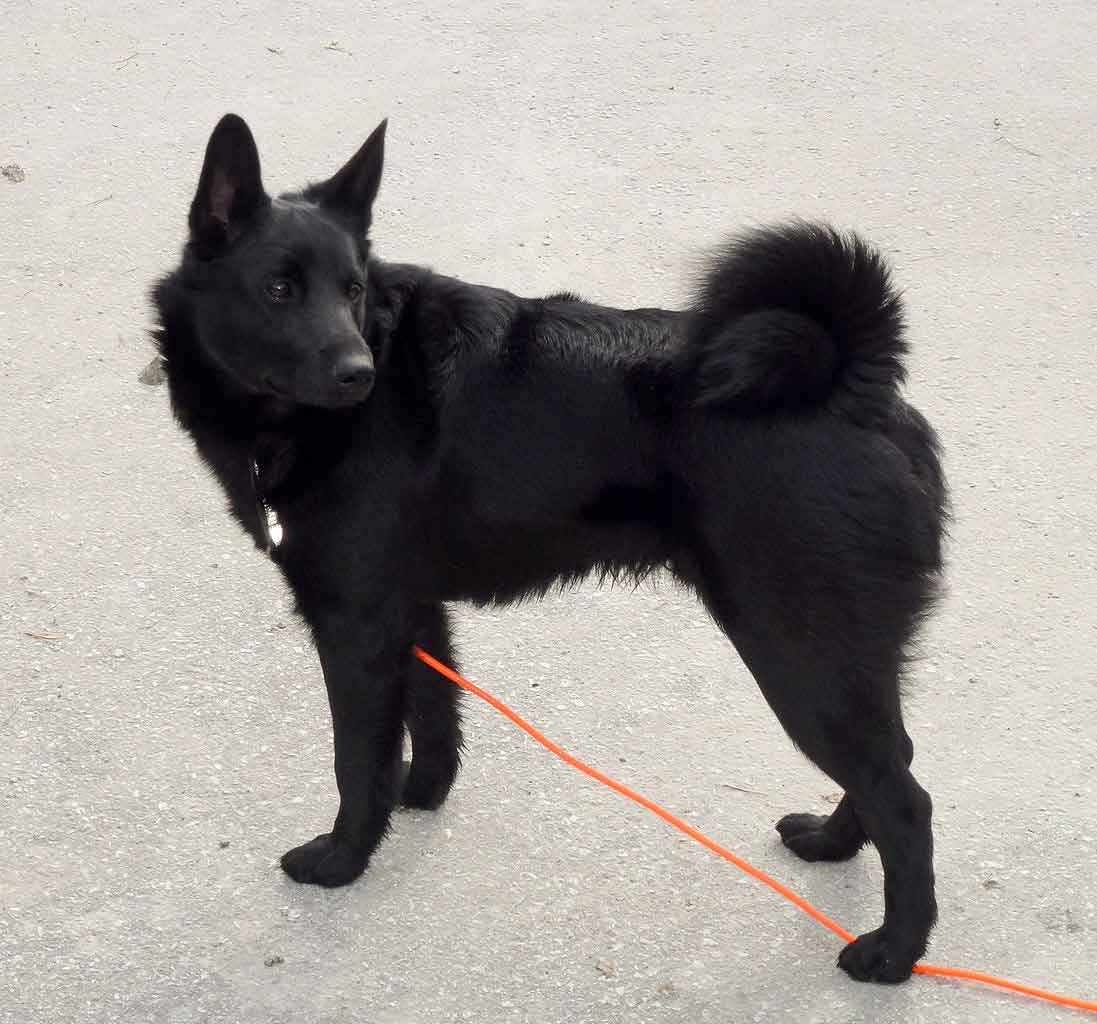
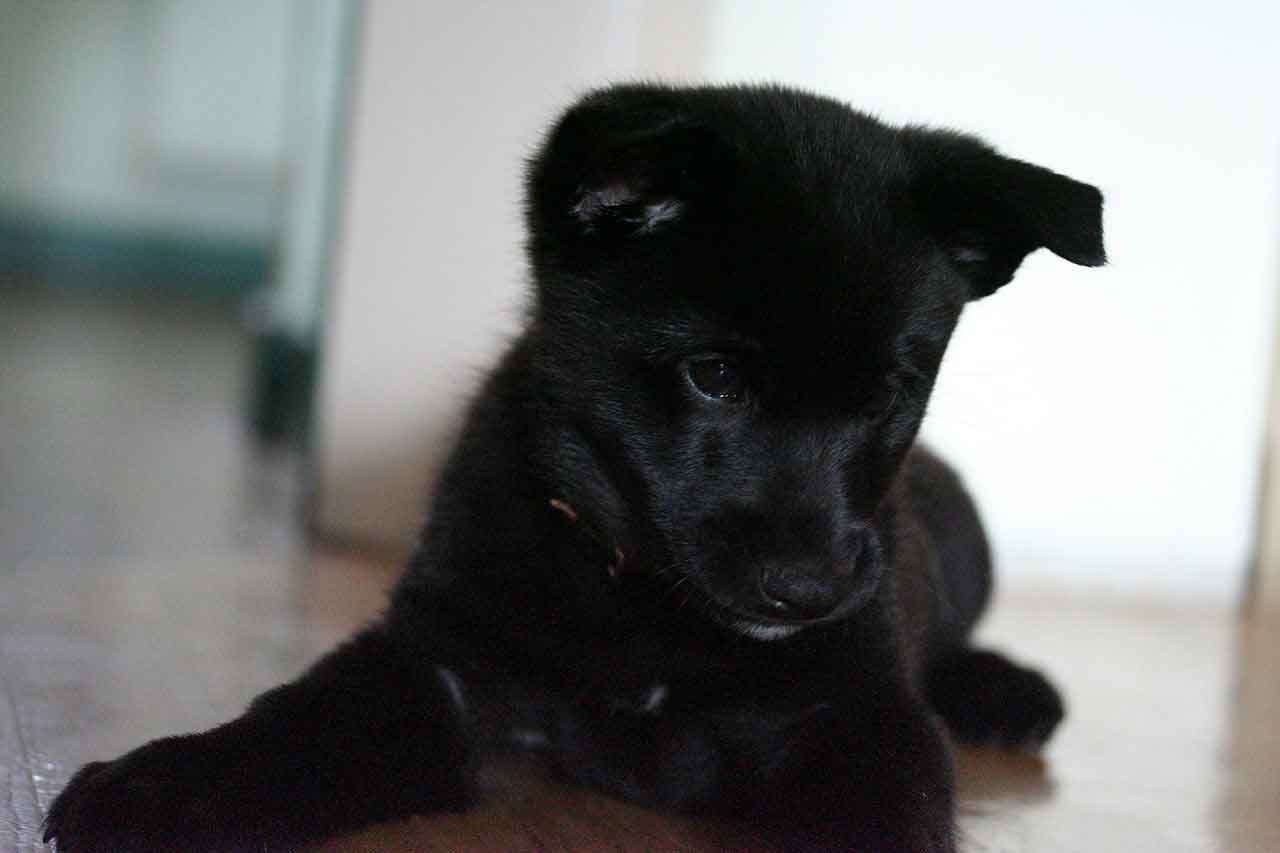
    The Black Norwegian Elkhound it is optically a typical Spitz and has a compact, square build with upright ears. He wears his tail rolled up on his back like other dogs Moose hunter from adulthood. It is smaller and more agile than the Gray Norwegian Elkhound and weighs around 18 kg with a height of 47 cm to the cross. As the name already indicates, this dog's short coat is black, but white spots on legs and chest are allowed as per standard. Also the eyes are dark. The pelage is dense, very sticky and consists of a rough top coat with a soft bottom coat.

    Character and skills

    Multifaceted character

    The Black Norwegian Elkhound he is very loyal to his people. This does not mean that this independent partner is subordinate. Abroad, these dogs are lively, curious and open to all common adventures. But, the busy Black Norwegian Elkhound they also enjoy cozy hugs on a quiet afternoon.

    They are playful, brave and very smart. Like many Nordic dogs, They are good "alarm systems", but only limited good watchdogs: They indicate to strangers – loudly and persistently – but it may happen that they then run towards a potential intruder with a wagging tail. These proud four-legged friends don't always get along with other dogs of the same species.. Proper conditioning and socialization is important

    Educating the Black Norwegian Elkhound

    Easily educated with knowledge

    His intelligence and humanity contribute to the education of this Black Norwegian Elkhound don't present big obstacles.

    He likes to work with "his" people and does what they say, as long as you find it useful too. Because you always have to take into account the small stubbornness of this independent hunter when training him. Be consistent and pay special attention to recoverability and bark control. Strength and toughness are absolutely out of place in the upbringing of this sensitive four-legged friend.

    Usually reacts very quickly and strongly to harsh words and reproaches, so use them sparingly. The Black Norwegian Elkhound can be better motivated by the principle of positive reinforcement – clicker training can also be of great help here. A visit to the puppy school helps improve this companion's social streak, which is sometimes a bit belligerent compared to other dogs. It can also be very useful to attend training classes at the dog school. – it is better to choose a suitable dog school where you and your companion feel comfortable before the puppy arrives.

    Health ยซBlack Norwegian Elk Hunterยป

    In general, the breed is considered to be quite robust and, as long as it is raised responsibly, is largely free of genetic diseases. Representatives of the breed can reach the 13 years old in good health. This energetic four-legged friend needs a species-appropriate diet, which should consist mainly of meat: So, you must choose a food in which meat is the first element of the declaration and preferably cereals are not included. Your dog's energy needs depend on his constitution and how much he consumes through exercise, so keep an eye on your slim waist and adjust daily servings as needed.

    Important: Just like us humans, small snacks move quickly to the hips too – plan your dog's snacks in the general ration. Healthy snacks include dry dog โ€‹โ€‹chews or sugar-free dental care snacks and freeze-dried meat snacks. Water must always be freely available.

    โ€œBlack Norwegian Elk Hunterโ€ Care

    The coat of the Black Norwegian Elkhound it is very important to the furry four legged friend, because it performs an outstanding protective function in the harsh northern climate and protects it from extensive autumn rains as well as icy winds. Help your companion keep his coat in a tidy condition by brushing every few days to remove any dead hairs.. You can also brush daily during the coat change, so your roommate loses less hair in the apartment. Coat dirt can be brushed off as soon as it has dried.

    You should only bathe your roommate if it can't be helped, use a mild dog shampoo for this purpose. When brushing, routinely check ears and clean with a mild shampoo if necessary. Some dog owners have chosen to brush their roommates' teeth with a dog toothbrush and toothpaste.. It is a good way to prevent tartar and its secondary diseases until the dog is old enough. But, you should already accustom your puppy to the ritual. Also check the claws of older dogs from time to time – if they no longer wear enough, you need to shorten them accordingly with a pair of dog claw pliers.

    Activities ยซBlack Norwegian Elk Hunterยป

    Although his original task was to accompany the hunter when hunting moose and bears, but also smaller animals like foxes, the Black Norwegian Elkhound it is a versatile all-rounder: Loves outdoor exercise and is considered very persistent. This is why you can easily take your four-legged adult friend with you to training sessions. jogging.

    Outdoor activities can be relaxed, especially if you have trained your Black Norwegian Elkhound so it doesn't run away with every rabbit. Apart from recovery exercises – that only very few moose hunters enjoy – the docile and energetic dog can get excited about many things: These may include, you can find great fun in agility sports and fetch games. It also, It is suitable for the work of rescue dogs. Some owners of moose hunters they also report on beautiful experiences with their partner, trained as a visiting dog, with whom they visit, for example, retirement or nursing homes and give the residents of those places an animal joy. Try together what you like, the possibilities are great!

    Is a โ€œBlack Norwegian Elk Hunterโ€ best for me??ยป

    The Black Norwegian Elkhound suits athletes who like to be outside and keep their dog busy. If you can make this possible for your dog, it is also possible to keep it in an apartment, as long as the apartment offers enough space. Training can be mastered by beginners if they are willing to deal with the hunting characteristics of the breed and adjust training accordingly..

    The Black Norwegian Elkhound it can be a wonderful companion for children. This original hunter can live normally with cats, sometimes even in a friendly way, if you have already gotten used to them as a puppy. Otherwise there could be problems, because the dog sees the cat as prey. Small animals like rabbits are not ideal companions, since they can always trigger prey drive.

    One Black Norwegian Elkhound can also sleep outside, what can be a sensible alternative for these heat sensitive animals in summer. But, needs close family connections and does not like to be alone. Before the dog moves, clarify not only the one-time and ongoing expenses you will have to pay, but also if you are willing to spend several hours a day actively with your new partner for years to come. You should also take care of your dog in case of illness or during the holidays – many destinations nowadays also offer holidays with a dog.

    Where can I find my desired ยซBlack Norwegian Elk Hunter?ยป

    It doesn't matter which of the two Norwegian Elkhound has won your heart: Outside Scandinavia, big game hunters from the far north are rarely seen. This is even more difficult with the black Norwegian than with the gray. So, if you are interested in this animal rarity, please contact the Nordic breed clubs in your country. If required, they can contact breeders at home and abroad. But, you will usually have to take into account waiting times and long distances to travel to the desired puppy. in his native country, Norway, only a few are born 120 puppies every year.

    Consequently, it becomes difficult or impossible if you are looking for a Black Norwegian Elkhound outside scandinavia, that is already grown. It is very unlikely that you will find a four-legged dog of this type in the animal protection organizations of your country.; However, a visit there may be helpful if you are open to other breeds.

    Characteristics "Black Norwegian Elkhound"

    Coexistence is important that you have with your new friend. Before considering the acquisition of a dog of the breed "Black Norwegian Elkhound" you know certain factors. Not all breeds of dogs are apt to live in an apartment, you must take into account his character, their need for exercise, their interaction with other pets, their care and if you have small children, their level of tolerance towards them.

    Adaptation โ“˜

    2,0 of 5 stars (based on 1 review)

    friendly dog โ€‹โ€‹โ“˜

    3,0 of 5 stars (based on 1 review)

    hair loss โ“˜

    4,0 of 5 stars (based on 1 review)

    Affection level โ“˜

    4,0 of 5 stars (based on 1 review)

    Need for exercise โ“˜

    3,0 of 5 stars (based on 1 review)

    Social need โ“˜

    4,0 of 5 stars (based on 1 review)

    Home โ“˜

    4,0 of 5 stars (based on 1 review)

    Toilet โ“˜

    3,0 of 5 stars (based on 1 review)

    Friendly with strangers โ“˜

    4,0 of 5 stars (based on 1 review)

    barking โ“˜

    4,0 of 5 stars (based on 1 review)

    Health โ“˜

    4,0 of 5 stars (based on 1 review)

    Territorial โ“˜

    4,0 of 5 stars (based on 1 review)

    Cat friendly โ“˜

    2,0 of 5 stars (based on 1 review)

    Intelligence โ“˜

    3,0 of 5 stars (based on 1 review)

    Versatility โ“˜

    3,0 of 5 stars (based on 1 review)

    Child friendly โ“˜

    4,0 of 5 stars (based on 1 review)

    Surveillance โ“˜

    4,0 of 5 stars (based on 1 review)

    joy โ“˜

    3,0 of 5 stars (based on 1 review)

    Images "Black Norwegian Elkhound"

    โ€œBlack Norwegian Elk Hunterโ€ cub by Eirik Newth / CC BY

    ยซBlack Norwegian elk hunterยป running through the snow by https://pxhere.com/en/photo/1602973

    Videos "Black Norwegian Elkhound"/h2>

    Type and recognitions:

    • FCI CLASSIFICATION:
    • Group :
    • Section : . .

    Federations:

    • FCI – Group 5 – Section 2 Nordic Hunting Dogs. โ“˜

    FCI breed standard "Black Norwegian Elkhound"

    Origin:
    Norway

    Date of publication of the valid original standard:
    09.08.1999

    Use:

    Hunting dog for moose.


    General appearance:

    It is a typical Spitz with a square construction.; black hair is rather close to the body; pointed ears pricked; tail curled over the back. Muscular and athletic neck, from a noble door.
     
    IMPORTANT PROPORTIONS: The height at the withers corresponds to the length of the body. Muzzle and skull are the same length.


    Behavior / temperament:

    Without fear, energetic, brave.

    Head:

    It is wedge shaped and tapers towards the truffle. Thin and rather light, relatively wide at the level of the ears.

    Cranial region:
    • Skull: Almost flat.
    • Depression links (Stop): Notable, but not abrupt.

    facial region:

    • Truffle: black.
    • Snout: Straight nose cane.
    • Lips: Glued.
    • Jaws/Teeth: Scissor bite; complete denture.
    • Eyes: They are not prominent; preferably dark brown.
    • Ears: High insertion, upright, a little longer than wide at the root, pointy.

    Neck:

    Medium long, firm, no loose skin.

    Body:

    • top line: Straight from the withers to the rump.
    • Cross: Well developed.
    • Back: Straight and strong.
    • Pork loin: Well developed, wide and straight.
    • Rump: Wide, well muscled.
    • Breast : Proportionally deep; ribs tight.
    • Belly: slightly retracted.

    Tail:

    High insertion; short, thick, covered with a layer of hairs sparse and well attached, but without feathers. Tightly curled over the back, without being diverted to the side.

    Tips

    PREVIOUS MEMBERS
     
    • As a whole: Firms, tendinosos, strong, but not heavy.
    • Shoulder: Oblique.
    • Arm: Moderately oblique.
    • Elbow: Good paste, turned neither out nor in.
    • Forearm: Straight.
    • Metacarpus: Viewed from the side moderately inclined.
    • Front feet: Rather small, slightly oval, compact and not turned out.
     
    LATER MEMBERS
     
    • As a whole: Knee and hock moderately angled. Parallels seen from behind. Undesirable spurs.
    • Thigh: Muscular and broad.
    • Knee: Moderately angled.
    • Leg: Medium long.
    • Hock: Moderately angled.
    • Metatarsus: Viewed from the side moderately inclined; seen from behind parallel.
    • Rear feet: Rather small, slightly oval, compact.

    Movement:

    Light, effortless. Parallel seen from the front or from behind.

    Mantle

    HAIR: Dense and rough, but well attached to the body; short and smooth on the head and on the front of the extremities; longer on the chest, the neck, on the back of the limbs and on the bottom of the tail. The coat consists of a rather long, rough outer coat of hair and a soft undercoat, shaggy and black.
     
    COLOR: Glossy black. A little white on the chest and feet can be tolerated.


    Size and weight:

    Height to the cross:
    • For males : 46 โ€“ 49 cm., ideal height 47 cm..
    • For females : 43 โ€“ 46 cm., ideal height 44 cm..


    Fouls:

    Any deviation from the aforementioned criteria is considered as a fault and the severity of this is considered to the degree of the deviation to the standard and its consequences on the health and well-being of the dog..
    • Bitefork clamp; irregular teeth.
    • Absence of undercoat of hairs.
    • White hairs, white in the queue.
    • White ยซ tights ยป.
    • Agitated temperament, nervous; barking dog.
    SERIOUS LACK
    • Short tail from birth.
    MISS PLAYOFFS
    • Aggressive or fearful dog.
    • Upper or lower prognathism.
    • Height to the cross 3 cm minus 4 cm more than the ideal height mentioned in the standard.
    Any dog โ€‹โ€‹showing clear signs of physical or behavioral abnormalities must be disqualified..


    N.B.:

    Males should have two normal-appearing testicles fully descended into the scrotum..

    Source: F.C.I - International Cynological Federation

    Alternative names:

    1. Norsk Elghund Svart, Norsk Elghund Black, Black Elkhound, Norwegian Moose Dog (black) (English).
    2. Chien d’รฉlan norvรฉgien noir (French).
    3. Norsk Elghund Sort (German).
    4. Norsk elghund sort (Portuguese).
    5. Elkhound noruego negro (espaรฑol).

    Photos:

    1 – Black Norwegian Elkhound About 1 years old by Rvenes / CC BY-SA

    โ–ท The world of Pets: Dogs, cats, birds, reptiles, amphibians

    Cairn Terrier
    Gran Bretaรฑa FCI 4 . Small sized Terrier
    Cairn Terrier

    The Cairn Terrier It was originally bred as a hunting dog, to kill rats, Badgers, foxes

    Content

    History

    The Cairn Terrier It is one of the oldest breeds of Terrier, originating in Scotland and recognized as one of the first Scottish working dogs. It was created for hunting and the prey's burrow. The Cairn Terrier are buzzards. In Scotland they hunted rats and other rodents.

    In our country house, will do the job of a cat, often hunting mice, rabbits and squirrels.

    Cairn Terrier belongs to the family of the Scottish Terrier. They are five:

    History

    The characteristics of the current breed are carefully modeled on their ancestor, the Terrier of the Isle of Skye 17th century. It is believed that this dog was the basis for developing races such as the lion and the Scottish.

    The history of the Cairn Terrier is reinforced by the fact that the modern Cairn is an attempt to preserve the typical form of the Terrier of the old days., a dog of work of the Isle of Skye. Known in his native Scotland for more than 500 years, It is believed that it is the oldest of the Terrier.
    Cairn Terrier was originally bred as a hunting dog, to kill rats, Badgers, foxes, weasels, and other small insects. He hails from the Isle of Skye, but to avoid confusion with the current Skye Terrier, He was appointed Cairn Terrier, in honor of the rock piles and where he used to look for his prey in his Scottish lands.

    Did you know??

    The most famous Cairn of all? That would be Toto in "The Wizard of Oz".

    Physical characteristics

    These dogs of short legs have a countenance of stooped appearance. Its thick cloak of hair is usually greyish in colour, light brown or sand, Although they are allowed all colors other than white.

    A notable feature of the Cairns Terrier is the change in coat color throughout its life.. Is not uncommon to its striped pass to be increasingly more grey or silver, as you age. The fur has two layers, a soft, dense stuck to the skin, and other hard and rough, external. It is the smallest of the Terrier (the largest is the Scottish), its weight is of 6 to 7,5 kg. And its appeal is in 28 to 31 cm..

    Many times, The Cairn Terrier is defined as a ยซbig dog trapped in the body of a small dogโ€, is an ex-officio adventurer, Intelligent, strong, loyal and hard, It is not at all a delicate and lap dog.

    Character and skills

    They are usually active, resistant, they are always on alert and cheerful, they are appreciated as pets as they are relatively easy to train and adapt well to small homes or apartments as they require no more than one brisk walk per day.

    Like most Terriers, they love to dig looking for real or imagined prey. So, If you want to keep your lawn in conditions, It is not advisable to leave it many hours only.

    Usually, they mix well with other dogs, But if there is possibility of confrontation they will defend their territory, they can't go back and face whatever lack. With the family they are very protectors and they usually get along with children, although they can't stand any rough game, as pulling of ears, shareโ€ฆ

    Walking is an excellent exercise for Cairns and their owners. It is advisable to give long daily walks.

    The life expectancy of these dogs is of 12-14 years, they tend to have the fairly delicate skin (and as they grow older, even more).

    Characteristics "Cairn Terrier"

    Coexistence is important that you have with your new friend. Before considering the acquisition of a dog of the breed "Cairn Terrier" you know certain factors. Not all breeds of dogs are apt to live in an apartment, you must take into account his character, their need for exercise, their interaction with other pets, their care and if you have small children, their level of tolerance towards them.

    Adaptation โ“˜

    3,0 of 5 stars (based on 1 review)

    friendly dog โ€‹โ€‹โ“˜

    3,0 of 5 stars (based on 1 review)

    hair loss โ“˜

    3,0 of 5 stars (based on 1 review)

    Affection level โ“˜

    5,0 of 5 stars (based on 1 review)

    Need for exercise โ“˜

    4,0 of 5 stars (based on 1 review)

    Social need โ“˜

    5,0 of 5 stars (based on 1 review)

    Home โ“˜

    3,0 of 5 stars (based on 1 review)

    Toilet โ“˜

    2,0 of 5 stars (based on 1 review)

    Friendly with strangers โ“˜

    3,0 of 5 stars (based on 1 review)

    barking โ“˜

    5,0 of 5 stars (based on 1 review)

    Health โ“˜

    3,0 of 5 stars (based on 1 review)

    Territorial โ“˜

    3,0 of 5 stars (based on 1 review)

    Cat friendly โ“˜

    3,0 of 5 stars (based on 1 review)

    Intelligence โ“˜

    4,0 of 5 stars (based on 1 review)

    Versatility โ“˜

    3,0 of 5 stars (based on 1 review)

    Child friendly โ“˜

    4,0 of 5 stars (based on 1 review)

    Surveillance โ“˜

    4,0 of 5 stars (based on 1 review)

    joy โ“˜

    5,0 of 5 stars (based on 1 review)

    Cairn Terrier Images

    Cairn Terrier Videos

    Type and recognitions:

    • FCI CLASSIFICATION:
    • Group :
    • Section : . .

    Federations:

    FCI โ“˜, AKC โ“˜, ANKC โ“˜, CKC โ“˜, โ€‹KC โ“˜, NZKC โ“˜, UKC โ“˜

    FCI breed standard "Cairn Terrier"

    Origin:
    United Kingdom, Scotland

    Date of publication of the valid original standard:
    24.06.1987

    Use:

    Terriers


    General appearance:

    Agile, alert, enterprising natural looking. Strong limbs, with good poise in the forelimbs and free movements. deep chest. Weather resistant coat.


    Behavior / temperament:

    It impresses with its activity, firmness and boldness. With a brave and cheerful character; self-confident, but not aggressive.

    Head:

    Small but proportionate to the body. Well covered head hair.

    Cranial region:
    • Skull:  Width, with a well-marked indentation between the eyes.
    • Depression links (Stop):  Well defined.

    facial region:

    • Truffle: black.
    • Snout:  Powerful.
    • Jaws/Teeth: Big teeth. Strong JAWS, but never long or large, with regular scissor bite, perfect and complete, that is to say that the internal face of the maxillary incisors is in close contact with the outer side of the lower incisors and placed at right angles to the jaws.
    • Eyes: Placed well apart, medium-sized, dark brown, slightly sunken and abundant eyebrows.
    • Ears: Small and finished in tip, well erect, not very long hair covers or gaskets.

    Neck:

    With good implementation in the backs and not very short.

    Body:

    • Back: Straight and medium-long.
    • Pork loin: Strong and elastic.
    • Breast : Ribs well arched and deep.

    Tail:

    Short, provided, well covered with hair but not forming fringes. Its implementation should not be high or low, It must be carried happily but never stooped toward the back.

    Tips

    FORMER MEMBERS: Cutlery to wire-haired. Medium length and good bone but not very heavy.

    • Back: Face.
    • Elbows: Never returned outward or inward.

    HINDQUARTERS:

    • Thighs: Very strong and muscular.
    • Knees: Buena,  but not excessive angulation.
    • Hocks:  Well descended, seen from the rear never inclined outward or inward.

    FEET : The previous larger than the later ones, and may be slightly deviated outward. The pads should be thick and strong. Small feet, Straits, extended separate fingers with long nails is a defect.

    Movement:

    Walking should be easy and free movements. Front members should have a good breadth forward. Subsequent members must provide a strong driving power. Hocks should not be close together or far apart.

    Mantle

    HAIR: The texture of the hair is very important. You must withstand the weather and have a double layer: The outer layer is formed by hair, hard but not rough, the subhair should be short, smooth and dense. The hollow hair is a defect. Allowed a slight ripple.

    COLOR: Cream, yellow, red, gray or nearly black. Accepted the Brindle in all these colors, but not solid black, white or black and fire. Dark spots on the ears and muzzle are very typical..


    Size and weight:

    About 28 โ€“ 31 cm. (11-12 inches) at the height of the cross, but in proportion to the weight, being the ideal weight between 6 and 7,5 kg (14-16 English pounds).


    Fouls:

    Any deviation from the above criteria is considered missing and the seriousness is considered to the extent of the deviation to the standardand its consequences on the health and well-being of the dog.

    Any dog โ€‹โ€‹showing clear signs of physical or behavioral abnormalities should be disqualified..

    FALTAS DESCALIFICANTES:

    • Aggressiveness or extreme shyness.
    • Any dog โ€‹โ€‹showing clear signs of physical or behavioral abnormalities must be disqualified..


    N.B.:
    • Males should have two normal-appearing testicles fully descended into the scrotum..
    • Only functionally and clinically healthy dogs, with the typical conformation of the breed, should be used for parenting.

    The latest changes are in bold.

    TRANSLATION: SR. Lic. Oscar Valverde Calvo (Costa Rica) and Dr. Federico del Valle

    Source: F.C.I - International Cynological Federation

    Alternative names:

    1. Cairn Terrier (English).
    2. Cairn Terrier (French).
    3. Cairn Terrier (German).
    4. Cairn Terrier (Portuguese).
    5. Cairn (espaรฑol).

    โ–ท The world of Pets: Dogs, cats, birds, reptiles, amphibians

    Cimarrรณn uruguayo
    Uruguay FCI 353 - Molossoid - Dogo

    Cimarrรณn

    The Cimarrรณn uruguayo also called Cimarrรณn dog or Creole cimarrรณn is the only breed developed entirely in Uruguayan territory.

    Content

    History

    The Cimarrรณn uruguayo Bulldog is a dog type molosoide, medium-sized, compact and strong, the fur can be striped or also bayo (cream-coloured) and snout black. His temperament is docile, cunning and guardian, ideal for guard, company or big game. It is recognized as a race in Uruguay from 1989 and internationally by the Federation Cynologique Internationale – FCI, from the 21 in February of 2006.

    Etymologically Cimarron is a term applied in America (originally on the island of Hispaniola) to everything that having been domestic or civilized returned to the wild or wild state, by referring in this case to their refuge in the heights (Indeed in the mountains and valleys hidden) Sierras, with which cimarrรณn would be "he who lives on the peaks or hides in them".

    The original specimens of the wild dog descended from the dogs introduced by the Spanish and Portuguese conquerors..
    The natural crosses that were taking place in the wild is that it evolved in the course of two centuries a native variety perfectly adapted to the environment of the Uruguayan Plains.

    ยซTell your master that when I lack men to fight his henchmen, I have to fight them with Maroon dogsยป: Josรฉ Gervasio Artigas to the Gral. Carlos Federico Lecor.

    The dog breed called Cimarrรณn dog or Criollo cimarrรณn is the only breed developed entirely in Uruguayan territory.

    Non-domestic dogs in the world, Whether original species or breeds produced by the feralization of domestic breeds that returned to the natural environment and managed to readapt to it, they show a physical development that is totally different from this one., so it is highly arguable that this breed produced in the Uruguay as a supposed model maroons dogs mentioned in ancient chronicles and documents reflect the natural demeanor of those. All wild dogs of the world, Because of what is known as "convergence" at an evolutionary level, they have long legs, erect ears, slender body, exceptions that occur in extreme climates (enormous ears of certain dogs of African deserts or small ears of Arctic foxes).

    There are detailed chronicles of attacks by packs of these dogs on caravans and people, that led to the authorities of the time (end of the 18th century) they already have and encourage major massacres, reaching count by tens of thousands dead dogs.

    Each dead animal was paid by the authorities of the time, requiring proof of death presented the jaw or the pair of ears of the animal. From this practice would derive the characteristic ear cut that is performed on many newborn pups., in the shape of a "cougar ear".

    Despite these massacres, ยซโ€ฆa good number of mothers with their offspring conquered the mountains of Olimar and especially in the Sierra de Otazo and in the Cerros Largosยป, in what is now known as departments of Cerro Largo and Treinta y Tres, where many ranchers and landowners in this place, they took advantage of the virtues of this breed for working with cattle and defense of his property, beginning to raise it, preserving the mixing.

    Modern traces of the breed begin to become more public in the early 1990s. 1980, When numerous breeders of Montevideo, attracted by the remarkable characteristics some specimens, they begin to develop their parenting and standardization.

    It is in 1989 When this work begins to pay its fruits, to being the Cimarrรณn Uruguayo officially recognized by the Association of the Rural Uruguay (A.R.U.) and the Kennel Club Uruguayo (K.C.U.), 20 years after the first exposure of a specimen of the breed in the K.C.U.
    Thus, the Association of Uruguayan Cimarrones Breeders was created and together with the K.C.U.. It prepares the official roll of the race, selecting the base dogs of the same and registering their pups, being tattooed for the first time with this registration number.

    Today the character attributes of this breed called Cimarrรณn They make it increasingly popular in Uruguay and region, being employed as a companion dog, Guard and hunting, especially the wild boar.

    Physical characteristics

    The Cimarrรณn Bulldog is a dog of medium size type, balanced, strong, compact, with good osatura, muscular, shrewd and great courage. The size and weight of the males is of 58 to 61 cm. of height and 38 to 45 weight kg. And of 55 to 58 cm. of height and 33 to 40 weight kg, in females.

    Character and skills

    It is excellent to work with cattle dog, hunting and guard. Predominant livestock activity of these lands and the consequent abundance of food without great competition with other natural predators, the bighorn reproduced in large numbers becoming – according to historical documents – in a true plague and scourge for the inhabitants of the countryside and the livestock.

    This race since its standardization has attracted a growing interest both within the Uruguay border, having copies of this dog in various countries of America, from United States to Argentina, counting this last country with several breeders of Cimarrรณn Uruguayo.
    Another of the steps achieved for the genetic improvement of the breed called Cimarrรณn Uruguayo is the signing of an agreement between the University of the Oriental Republic of Uruguay, through its Faculty of veterinary medicine with the Maroons breeders society for the study of the zootechnical status and consanguinity of the exemplary enrolled in their rolls.

    This long process of standardization was crowned the 21 in February of 2006 When the International Bureau of the Federation Cynologique Internationale (FCI) gives international recognition to the Uruguayan Cimarron.

    The breed standard states that the dog must have great courage. Like all large dogs, Cimarron Uruguayo should be well socialized when very young if you want to be kept as a companion. It is a very friendly dog รขโ‚ฌโ€นรขโ‚ฌโ€นwith children and other animals.

    Cimarron Uruguayo is sometimes used for surveillance, hunting and all dog sports in his native Uruguay. Being a very intelligent dog has been used for all kinds of jobs, as rescue or grazing.

    A dog is fairly quiet and stable, rarely bark unless the threat is real.

    The primitive Cimarrรณn dog, by its roots in the Uruguayan territory, It has been from the very beginning of the national identity of this town a symbol of the independence struggle, faithfully reflected in the letter sent by General Josรฉ Gervasio Artigas in response to General Carlos Federico Lecor, Count of la Laguna and Governor of the Provincia Cisplatina (current Uruguay) in which Artigas expressed that if it was left without soldiers to fight, I would do it with the Cimarron dog.

    It is because of this tradition that this breed is currently a symbol and mascot of the National Army of Uruguay., having a preferential place in the annual military parades of the 18 July. On this occasion, a soldier of the battalion of Blandengues (the company that Artigas himself knew how to lead at the time) He rides leading the parade carried a Moorish Steed without along rider which is a sheep dog by the flange.

    Images "Cimarrรณn uruguayo"

    credits:

    1. Cimarron Uruguayo – Kennel La Bonfire by Leonardo Botiรฃo Fonseca / CC BY-SA
    2. Cimarron Uruguayo by brindle / CC BY-SA
    3. The Finnish Winner Show, Helsinki, 2015. By Thomas / CC BY-SA
    4. Nbistolfi / CC BY-SA

    Videos "Cimarrรณn uruguayo"

    Type and recognitions:

    • FCI CLASSIFICATION:
    • Group :
    • Section : . .

    Federations:

    FCI โ“˜, UKC โ“˜

    FCI breed standard Cimarrรณn uruguayo

    FCIFCI - Cimarrรณn uruguayo
    Cimarrรณn

    Alternative names:

    1. Cimarron, Uruguayan Cimarron, Cimarron Creole, Maroon Dog, Cerro Largo Dog, Perro Cimarron, Cimarron Dog (English).
    2. Cimarrรณn uruguayo (French).
    3. Cimarrรณn Uruguayo (German).
    4. Cimarron uruguaio (Portuguese).
    5. Perro Gaucho, Perro criollo, Cimarrรณn (espaรฑol).