โ–ท The world of Pets: Dogs, cats, birds, reptiles, amphibians

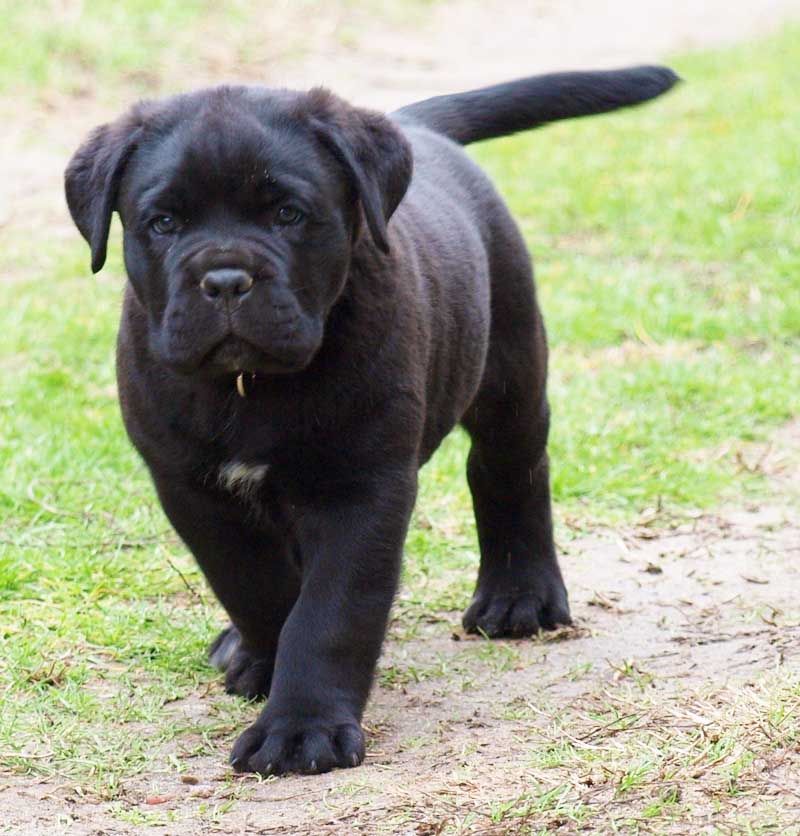
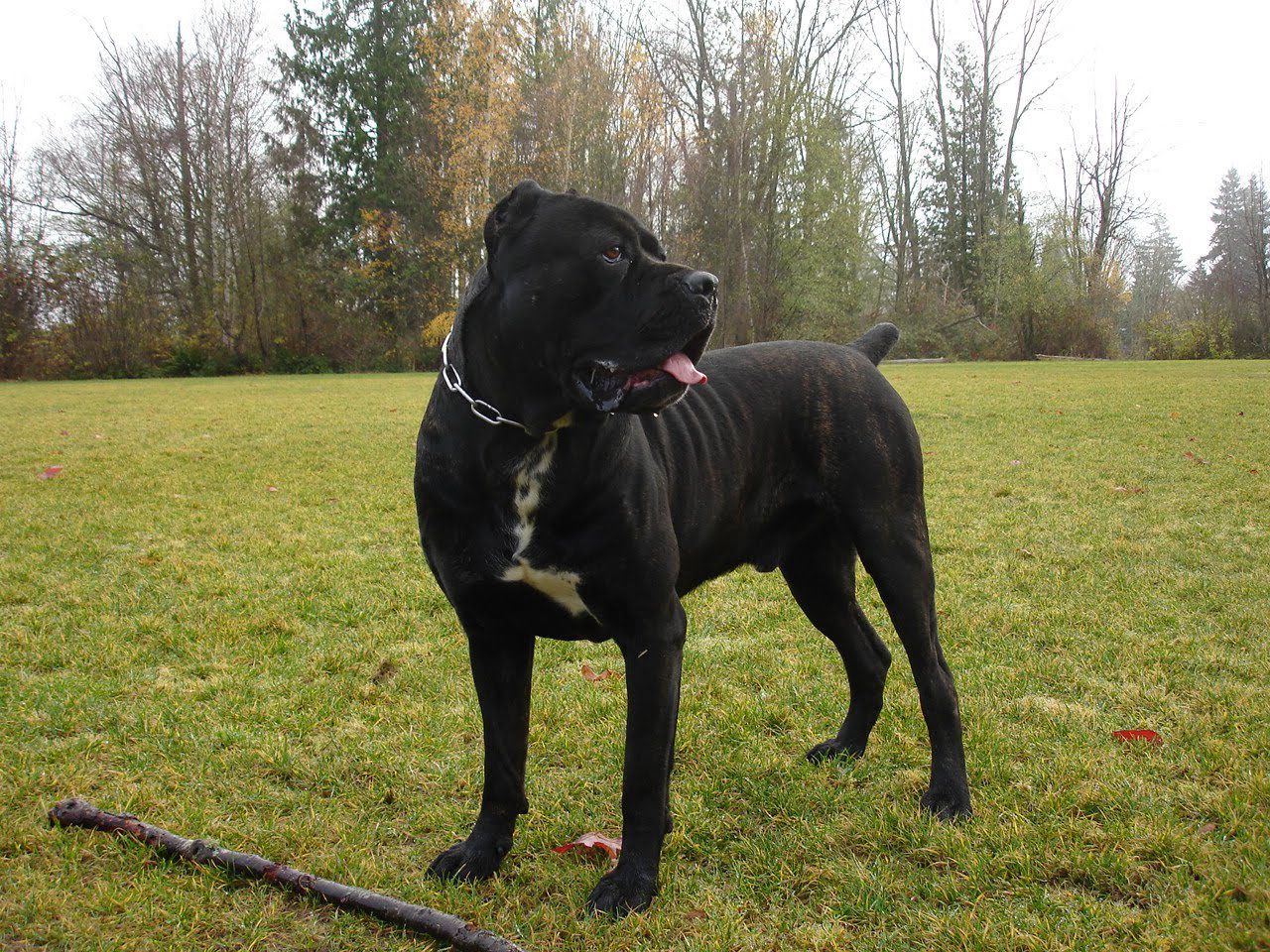
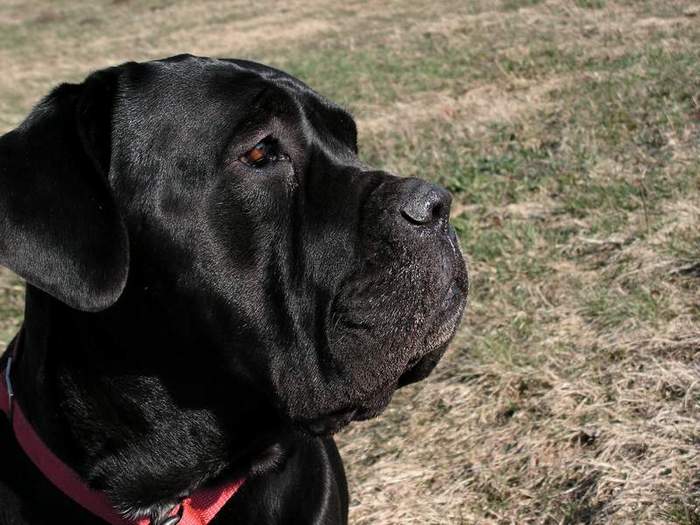
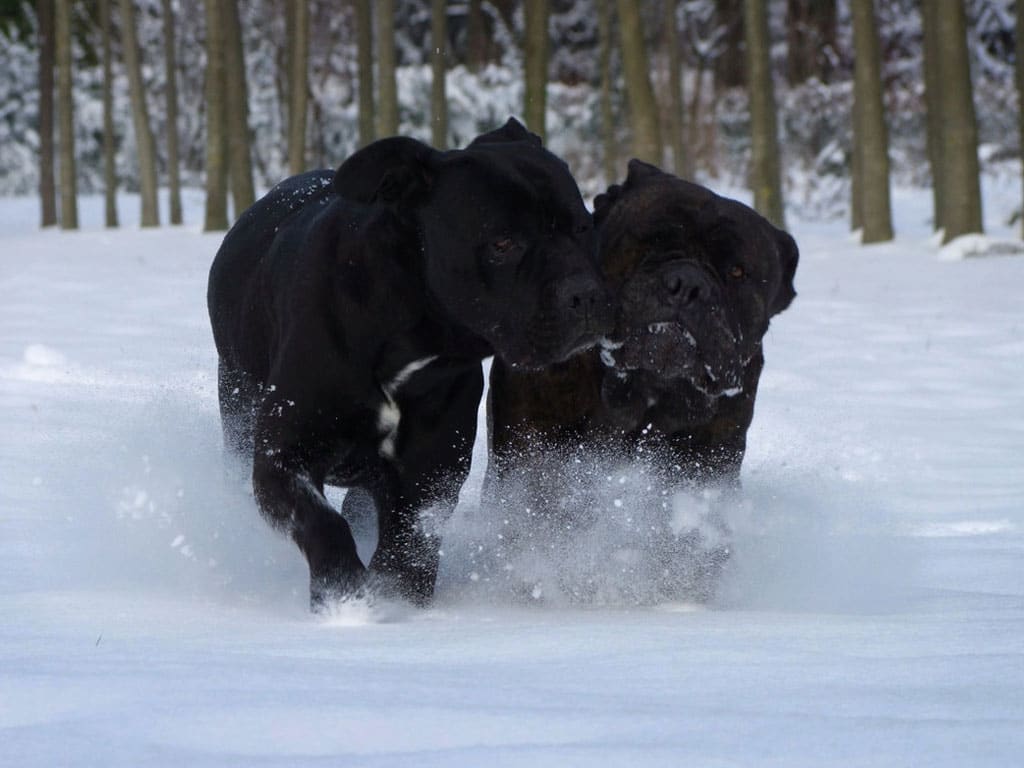
Cane Corso
Italia FCI 343 - Molossoid - Dogo

The Cane Corso It is a versatile and balanced dog that can adapt to all.

Cane Corso

Content

Characteristics "Cane Corso"

Coexistence is important that you have with your new friend. Before considering the acquisition of a dog of the breed "Cane Corso" you know certain factors. Not all breeds of dogs are apt to live in an apartment, you must take into account his character, their need for exercise, their interaction with other pets, their care and if you have small children, their level of tolerance towards them.

Adaptation โ“˜

2,0 of 5 stars (based on 1 review)

friendly dog โ€‹โ€‹โ“˜

3,0 of 5 stars (based on 1 review)

hair loss โ“˜

1,0 of 5 stars (based on 1 review)

Affection level โ“˜

3,0 of 5 stars (based on 1 review)

Need for exercise โ“˜

3,0 of 5 stars (based on 1 review)

Social need โ“˜

4,0 of 5 stars (based on 1 review)

Home โ“˜

2,0 of 5 stars (based on 1 review)

Toilet โ“˜

1,0 of 5 stars (based on 1 review)

Friendly with strangers โ“˜

1,0 of 5 stars (based on 1 review)

barking โ“˜

2,0 of 5 stars (based on 1 review)

Health โ“˜

4,0 of 5 stars (based on 1 review)

Territorial โ“˜

5,0 of 5 stars (based on 1 review)

Cat friendly โ“˜

1,0 of 5 stars (based on 1 review)

Intelligence โ“˜

5,0 of 5 stars (based on 1 review)

Versatility โ“˜

3,0 of 5 stars (based on 1 review)

Child friendly โ“˜

4,0 of 5 stars (based on 1 review)

Surveillance โ“˜

3,0 of 5 stars (based on 1 review)

joy โ“˜

5,0 of 5 stars (based on 1 review)

History

Something small and elegant that the Neapolitan mastiff, the Cane Corso (or Italian mastiff) It was used in the past not only as Cattle dog but also in wild boar hunting, and as dog escort on long journeys of traders and, even, as a grip of Bull Dog. It was widespread throughout the southern Italian region and even more so in Calabria, Lucannia, Pugglia, and Sannia, until end interrelating so with history, the tradition, and local legends that, in the Royal Lottery game, the Corsican was assigned the number 22.

Both fierce and determined appearance, as its imposing structure of all the molossians, They seem to be on the agenda of its name, therefore means powerful Corso, robust, strong, and these are, without a doubt, its main characteristics.

Others attribute the etymological origin of the word to the Latin "cohors" or senior guardian of the body or to the Greek "kortos.", referring to the fact that he kept and watch people and animals during periods of transhumance. Finally, others see the name associated with the island of Corsica. The truth is that outside of Italy very little is known about the Cane Corso and that even in its country of origin, for years, the race has remained forgotten and ignored. He took that in 1973 Professor Giovanni Bonatti referred to the presence in the province of Puglia of a "short-haired Molosser dog, different from the Neapolitan mastiff, similar to the Bullmastiff and similar to the dog's Mallorquin Damยป so that a group of enthusiasts got to work and tried to recover it and make it known inside and outside the country.

In fact its official recognition from the ENCI (Ente Nazionale di Cinophilia Italian) has only taken place in January of 1994, Once the table of work of the societร ย  Amatoria Cane Corso (SACC) provide sufficient documentation, photos, data and a large group of typical specimens to defend its existence and ancient origin.

It is almost always difficult to make History of the history of a dog breed, but in the case of the Cane Corso there was enough documentation that revealed its presence since ancient times in the southern part of what is now Italy. Certainly had to be traced back to many centuries ago, Learn about the legends of the inhabitants of the Mezzogiorno, investigate its folklore and more ingrained traditions, Learn about its history, the superstitions of an entire people, but, finally, After many years of intense and arduous research, Professor Fernando Casolino, of the SACC, He managed to gather enough data to this impressive animal because they have been many, many written and pictorial references that have been found about this dog. It should be noted some dating as far back as the 15th and 16th centuries, such is the case of the burlesque poems written in Italian mixed with Latin by the Benedictine friar Folengo or the quotes in the ยซOf Quadrupelibusยซ, the renowned physician and naturalist Gessner, known as the "German Pliny", without forgetting the very detailed description of the illustrious Valvassone, which evidenced his power and the strength of his jaws in the "Poem of the Head".

In the 18th century, the count of Leclerc, Georges Buffon, He mentioned him in his "Natural History" as did Oronzio Costa in his treatise on "The fauna of the Kingdom of Naples.", published in 1839. Thirty years later Palumbo also wrote about our protagonist in his "Catalog of Sicilian Mammals".

Quotations continued to be frequent and already in 1900 Spalikowski mentioned him in his work ยซEvolution of the dog in the human societyยซ, of essential reading for all lovers of dogs; much closer in time are the articles and works published by Fiorenzo Fiorone, Danilo Mainardi, Bonatti Mizzoli and how does not, my good friend Mario Perricone, who in the "Great Encyclopedia of the Dog" published by Agostino in 1987, He wrote widely on race, in which the most important monographic article on the Cane Corso is considered. Recently De Prisco and Johnson also mention him in the "Canine Lexicon" referring to him as "a recreation of the ancient Cane of Marcellaio.", under the heading of โ€œSicilian Branchieroโ€, explaining that it existed exclusively in Sicily and that it was known for its particular way of moving in front of the herd, so according to the authors it could even be related to the German bullenbeiser and that "on the island it functioned as a butcher's dog and a herd driver with unique abilities" that, At one time "he was able to participate in bullfights just as other butcher dogs did on the Continent".

Priscus and Johson they also claim that in the eighties they arrived to the United States.UU. the first puppies imported by a Sicilian farmer who died soon after and which constitute the scant breeding base in that country.

They have been missing many years of work and staff of a few efforts to again talk of Italian Corso Dog, race so ancient and so deeply linked to the traditions and the history of the South of Italy and properly recover virtually from scratch. There was, in fact, There were many contradictions about which dog truly resembled and contained the very essence of the Cane Corso and it took many debates and many discussions to finally agree on which specimen the foundations of the new breeding lines should be based on..

They all ended up agreeing on a male named "Dauno" who summarized the very essence of the race and who outlined the path that those who should follow should follow., with a passion beyond doubt wore years looking for precisely this path. It was decided to locate up to three closely related subjects in order to establish the characteristics of the breed., just as the Ballota professors had described it, Bonatti and Casolina.

After exhaustive research studies and, at the end, not without major sacrifices, the recovery programme was gradually bearing fruit. In 1988, the ENCI Board of Directors decided that the time had come to gather as many copies as possible, produced by people not linked to that society both the scope of the SACC, and carry out a pilot trial in order to check homogeneity of type, of construction and character and its similarity with the characteristics described in the draft standard that the SACC had presented to them. In three exhibitions-Bari, Florence and Milan- the judges Morsiani, Perricone and Vandoni examined fifty copies; then, in the autumn of that same year the SACC presented the ENCI the outcome of the first census carried out by the Lords Bruno and Indiveri which is didn't data out of a total of 57 perfectly typical and rustic specimens already registered.

Did you know??

The Cane Corso is also known as Dogo di Puglia, which means "dog of Puglia".

As a result of all this effort, the ENCI promulgated the opening of an "Open Book" in which all adult specimens that had been duly tattooed could be registered., and therefore recognized as conforming with the standard project and in just four years became part of the same over 500 dogs, so it was clear that the recovery program had been successful.

Such results finally gave rise to the official recognition of the race in January of 1994.

Modernity and the decline of the work for which it was intended, have not prevented this race from maintaining its characteristic gifts. He continues to be a dog with a tenacious temperament but does not bite for anything. It is one of the best races of property protection. If you are very fond with the owner can be very sensitive to your mood.

Physical characteristics

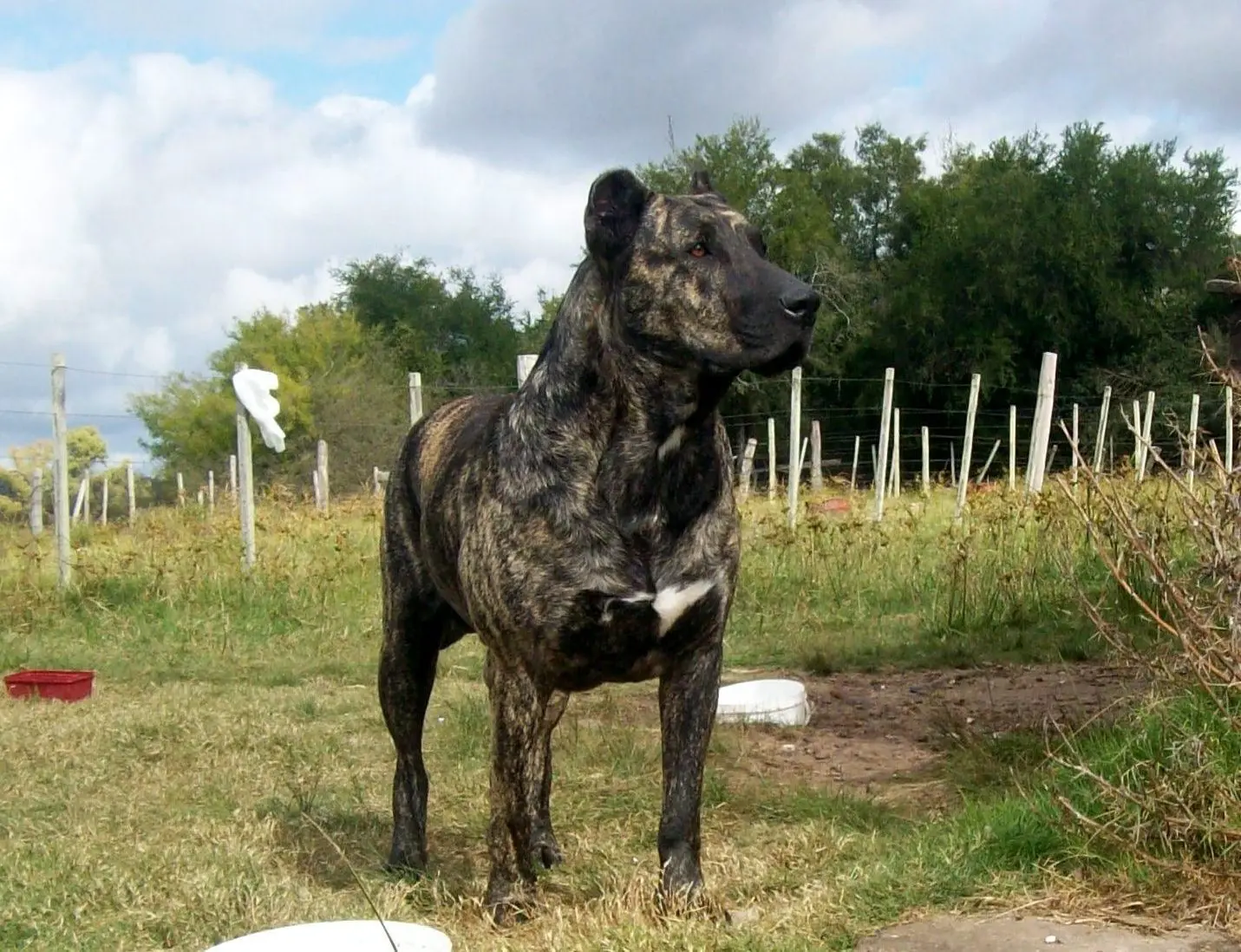
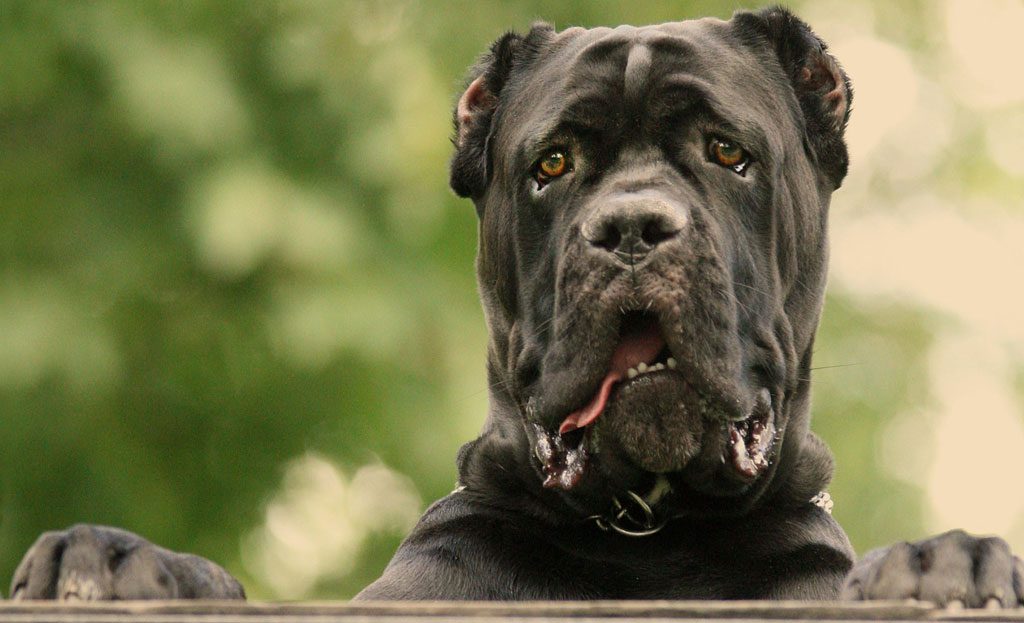
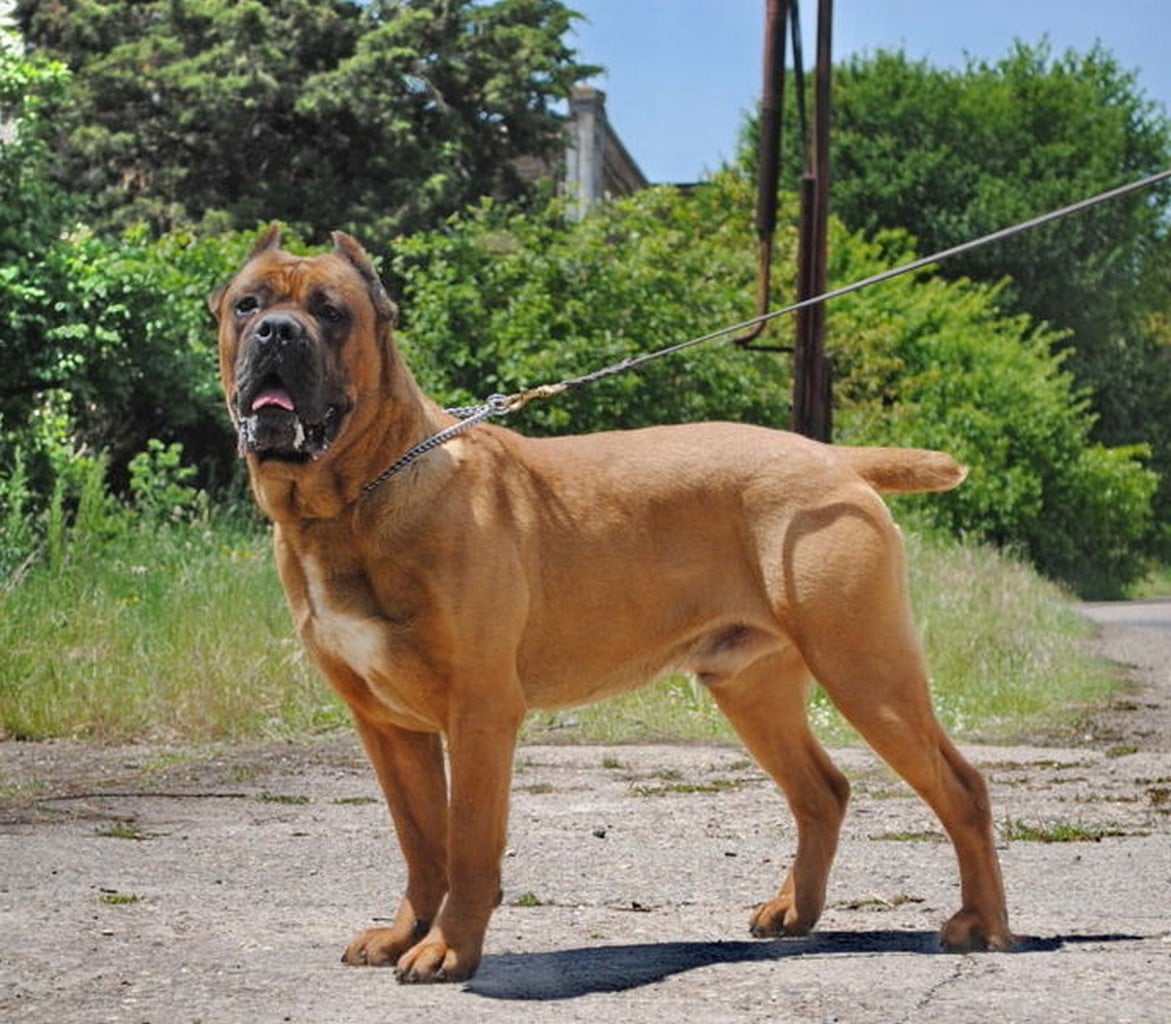
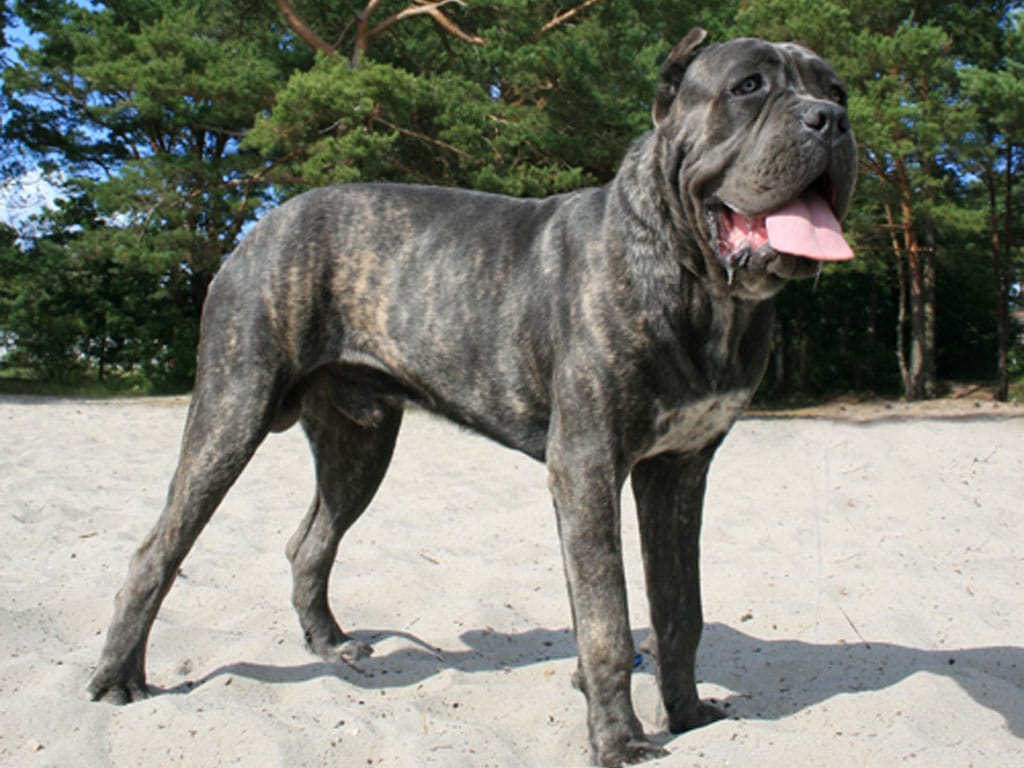
Its skin is thick enough, with tissue limited connective and therefore virtually glued to the subcutaneous tissues of each region. The neck does not present practically double chin. The head does not have to submit wrinkles. The pigment of the mucous and the esclerosas has to be black. The pigment of the soles and nails must be dark.
The coat is short but not satin, glassy in texture, gleaming, bright, adherent, serious, very dense, with a light layer of undercoat that is accentuated in winter, without that never reaches to emerge on the hair of coverage. His medium-length is 2/2′ 5 cm.. On the cross, the rump, and the subsequent edges of the thigh and on tail reaches the 3 cm., without ever giving rise to fringes. On the nose hair is private, smooth, adherent and not more than 1/1′ 5 cm..

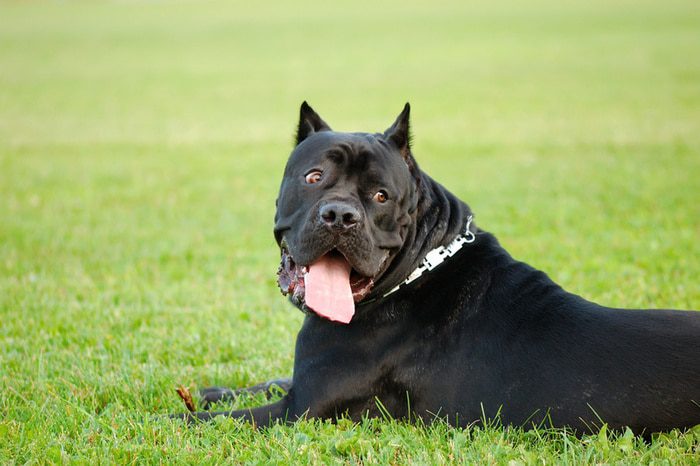
It may be black, grey lead, Slate gray, light grey, Griffon clear, Red cervato, Dark tawny and striped (stripes against a background of Griffon or grey colour of various shades). In fawn and brindle subjects, a black or gray mask is present whose extension should not exceed the line of the eyes. Admitted a small white patch on the chest, at the tip of toes and on the nasal helm.

The height the cross in the males is of 64 to 68 cm., in the females of 60 to 64 cm.. With tolerance of 2 cm more or less. The weight in the males is of 45 to 50 kg (ratio weight /talla 0,71 kg per cm). And in the females of 40 to 45 kg (ratio weight /talla 0,68 kg/cm).

Salud de Cane Corso

Some of the health conditions that have been in the Cane Corso are the Hip Dysplasia, eye problems such as Entropion or ectropion, demodectic mange and the tendency to bloat.

Remember that after bringing a new puppy home, has the power to protect you from one of the most common health problems: the obesity. Cane Corso maintain an adequate weight is one of the easiest ways to prolong life. Make the most of your preventive skills to help ensure a healthier dog for life.

Character and skills

His character affable and faithful with their own. His psychological balance and extreme functional versatility that allows you to adapt to everything, He is doing to gain more followers and indeed again used you in grazing and foster as old tasks, and also in the hunt, although little by little it is gaining a preferential position as a companion animal and in what has been called therapy with domestic animals (ยซpet therapyยป).

But, for its size and extraordinary force Cane Corso owner should be able to educate from the first moment to always have it under control, in such a way that never conflicts surprises or, It must learn from puppy what is right and what not, What is prohibited and what is allowed, so that later there will be no setbacks, recommending further vocational training of certain circumstances, provided that the dog has acquired a certain degree of maturity, Therefore we must not forget that, in the case of molossians, their psychological development is always slower than the physical.

Aware of its size and appearance, corso usually does not express nervousness and willingly accepts to any person that his own master will accept either. When he is assigned the custody of a property his balanced temperament allows her always from a background, with great discretion, and only in the case of real necessity, act and attack. Thus we can conclude that the Cane Corso is an impressive animal, balanced and effective in any task requiring him. There is a legend made reality.

Cane Corso's Education

With patience and sensitivity
The Cane Corso is not a beginner dog and only belongs to responsible hands. Learn quickly and with pleasure if you treat it with patience and sensitivity during training. If it is to be kept as a family dog, Cane Corso's protective instincts should not be encouraged during training. Early and comprehensive socialization is especially important, so that the dog gets used to other people and animals and reacts calmly in all situations.

Care of Cane Corso

Cane Corso's coat is shiny, smooth and short, and does not require extensive cleaning. Cane Corso has a thin undercoat that can protect it from the cold at times. A massage sponge or soft brush should be used regularly to stimulate blood circulation. – this ensures a healthy and shiny coat.

Nutriciรณn Cane Corso

Only with high meat content
With prepared food, pay attention to a high meat content, low grain content and high quality. An adult dog needs enough fresh meat and vegetables for a healthy diet.. Young dogs, on the other hand, should not be fed too much protein. Foods that are too high in protein can promote growth too quickly and encourage skeletal diseases. Food should be divided into two meals a day. One of them must be given directly after the daily walk. In this way the dog gets his reward after the "work done".

The life expectancy of the Cane Corso

Cane Corso can reach a relatively high age, what is really unusual for such large dogs. A healthy and active dog will easily reach the age of 10 to 14 years, as long as you exercise a lot and have a balanced diet. This robustness and long life expectancy compared to other larger dog breeds are due to the strong bone structure and robust construction.

Buy Cane Corso

Serious breeders offer not only a pedigree with a complete record of the dog's ancestors, but also a complete advice that goes beyond the purchase. Before buying or reserving a puppy, exhaustive information must be obtained from the local authority to know what conservation regulations exist.

Images Cane Corso

Vรญdeos Cane Corso

Type and recognitions:

  • FCI CLASSIFICATION:
  • Group :
  • Section : . .

Federations:

FCI โ“˜, AKC โ“˜, ANKC โ“˜, CKC โ“˜, UKC โ“˜

FCI breed standard "Cane Corso"

Origin:
Italy

Date of publication of the valid original standard:
13.11.2015

Use:

Utility dog, multipurpose


General appearance:

Medium to large size. Robust and strong dog, However, with some elegance. Lean and powerful muscles.


IMPORTANT PROPORTIONS: The dog is rectangular in outline and slightly longer than it is tall. (The length of the dog is 11% greater than your height). The length of the head reaches the 36% from his height to the cross.


Behavior / temperament:

Guardian of property, family and cattle; extremely agile and responsive. In the past, It has been used to herd cattle and for hunting larger game..

Head:

Wide, typically molossoid. The superior longitudinal axes of the skull and the nasal cannula are slightly convergent with each other..

Cranial region:
  • Skull: Width; in the zygomatic arch, its width is equal to or greater than its length. Slightly convex in the front, the skull becomes significantly more plane behind the front to the back of the head. The medio-frontal furrow is visible.
  • Depression links (Stop) :  Marked.

facial region:

  • Truffle: Black and bulky, with large and open Windows. It is placed in the same line as the nasal cannula.
  • Snout: Significantly shorter than the skull (relationship skull : I muzzle approximately 1:2). Strong, square, as long as width; the front of the snout is flat; the lateral sides of the muzzle are parallel. Profile view, the nasal helm is straight.
  • Lips: The upper lips are moderately pendulous and cover the jaw., in such a way that the lower profile of the muzzle is formed by the lips.
  • Jaws / Teeth: Very wide jaws, thick and curved. Light lower prognathism; the clip joint is tolerated, but not desirable.
  • Eyes: Medium-sized, egg shape, slightly protruding; the gaze is directed forward. The eyelids are well glued. The iris color is as dark as possible depending on the coat color. Expression : lively and vigilant.
  • Ears: Triangular, pendants; its inclusion, located well above the zygomatic arch, is wide; to often amputated short in the form of an equilateral triangle.

Neck:

Strong, muscular, as long as the head.

Body:

The body is slightly longer than the height at the withers. Of strong Constitution, but not Dumpy.

  • Cross: Pronounced, exceeds the level of the rump.
  • Back: Rectilinear, very muscular and stiff.
  • Pork loin: Short and solid.
  • Rump: Long and wide, slightly tilted.
  • Breast : Chest well developed in three dimensions, descends to the elbow.

Tail:

Rather high insertion, very thick at the root. It amputated at the fourth vertebra. In action, rises, but never erect or curled up Rather high set, very thick at the root. It amputated at the fourth vertebra. In action, rises, but never an upright or threaded.

Tips

PREVIOUS MEMBERS:

  • Shoulder : Long, oblique, very muscular.
  • Arm: Powerful.
  • Forearm: Straight, very strong.
  • Carpus and Metacarpus:  Elastic.
  • Front feet: Cat feet.

LATER MEMBERS:

  • Thigh: Long, width, convex removed.
  • Leg: Strong, not fleshy.
  • Hock: Moderately angled.
  • Rear feet: A little less compact than the previous.

Movement:

Long step, lengthened trot; the trot is the preferred motion.

Mantle

  • SKIN : Slightly thick, more firmly attached to the subcutaneous tissues.
  • HAIR: Short, bright, very dense, with thin inner layer of hairs.
  • COLOR: Negro, Gris-Plomo, Gris-pizarra, light grey, Griffon clear; Red cervato, Dark Fawn; striped (stripes on a background of gray or tawny color several shades). Black and brindle dogs have a black or gray mask on the muzzle that should not extend beyond the eye line.. A small white spot on the chest,  in the tips of the toes and on the nasal helm is admitted.


Size and weight:

Height to the cross:

  • Males of 64 to 68 cm..
  • females of 60 to 64 cm..

Tolerance of more or less 2 cm..

Weight:

  • Males of 45 to 50 kg
  • Females from 40 to 45 kg.


Fouls:

Any deviation from the aforementioned criteria is considered as a fault and the severity of this is considered to the degree of the deviation to the standard and its consequences on the health and well-being of the dog..

SERIOUS FAULTS :

  • Parallelism or the upper axes of the skull and the muzzle very marked convergence. Sides of the muzzle converging.
  • Partial depigmentation of the nose.
  • Scissor bite; marked lower prognathism.
  • Threaded queue; led tail straight.
  • Permanent amble on the trot.
  • Weight that exceeds or does not reach the size indicated in the standard.

MISS PLAYOFFS

  • Cowardice, aggression toward owner.
  • Divergence of the upper axes of the skull and the muzzle.
  • Complete depigmentation of the nose.
  • Very convex or concave nose cane.
  • Upper prognathism.
  • Complete or partial depigmentation of the eyelids. Eyes gazeos; strabismus.
  • Absence of tail; short tail (cut or not).
  • Semi-long hair, very short or forming fringes.
  • All colours not indicated in the standard, long white spots.

Any dog โ€‹โ€‹showing clear signs of physical or behavioral abnormalities should be disqualified..


N.B.:

Males should have two normal-appearing testicles fully descended into the scrotum..


TRANSLATION : ENCI, Dr. I.. Small and the Sr. Ermanno way.

Source: F.C.I - International Cynological Federation

Alternative names:

1. Italian Mastiff, Italian Corso Dog, Cane Corso Italiano (English).
2. Cane Corso Italiano, Chien de Cour Italien (French).
3. Cane Corso, ITALIENISCHER CORSO-HUND (German).
4. Mastim Italiano (Portuguese).
5. Mastรญn italiano (espaรฑol).

โ–ท The world of Pets: Dogs, cats, birds, reptiles, amphibians

Majorca Mastiff (Majorcan mastiff dog)
Espaรฑa FCI 249 - Molossoid - Dogo

The Majorca Mastiff is a gentle dog, extremely affectionate with their owners, faithful to his master

Ca de Bou

Content

Characteristics "Majorca Mastiff (Majorcan mastiff dog)"

Coexistence is important that you have with your new friend. Before considering the acquisition of a dog of the breed "Majorca Mastiff (Majorcan mastiff dog)" you know certain factors. Not all breeds of dogs are apt to live in an apartment, you must take into account his character, their need for exercise, their interaction with other pets, their care and if you have small children, their level of tolerance towards them.

Adaptation โ“˜

5,0 of 5 stars (based on 1 review)

friendly dog โ€‹โ€‹โ“˜

2,0 of 5 stars (based on 1 review)

hair loss โ“˜

3,0 of 5 stars (based on 1 review)

Affection level โ“˜

2,0 of 5 stars (based on 1 review)

Need for exercise โ“˜

4,0 of 5 stars (based on 1 review)

Social need โ“˜

2,0 of 5 stars (based on 1 review)

Home โ“˜

3,0 of 5 stars (based on 1 review)

Toilet โ“˜

2,0 of 5 stars (based on 1 review)

Friendly with strangers โ“˜

3,0 of 5 stars (based on 1 review)

barking โ“˜

3,0 of 5 stars (based on 1 review)

Health โ“˜

3,0 of 5 stars (based on 1 review)

Territorial โ“˜

5,0 of 5 stars (based on 1 review)

Cat friendly โ“˜

2,0 of 5 stars (based on 1 review)

Intelligence โ“˜

4,0 of 5 stars (based on 1 review)

Versatility โ“˜

3,0 of 5 stars (based on 1 review)

Child friendly โ“˜

4,0 of 5 stars (based on 1 review)

Surveillance โ“˜

5,0 of 5 stars (based on 1 review)

joy โ“˜

4,0 of 5 stars (based on 1 review)

History

The Majorcan mastiff dog, also known as Majorca Mastiff in Catalan or Perro de presa mallorquรญn in Spanish, is a fairly old dog whose history remains unclear.

It is believed to have originated from a number of races, especially the Spanish Mastiff and the Alano, that crossed over the centuries.

The result of these crosses came to Mallorca in the thirteenth century, specifically in 1229, during the conquest of the island by King James I of Aragon. Some of these dogs remained there and were bred with local dogs.. The resulting individuals turned out to be much less sensitive to heat and adapted very well to local conditions. They began to be used by the local population to monitor houses and livestock.

It was also in the thirteenth century when the butchers of the island found in the dog an assistant for his ability to control livestock, especially bulls, before and during their sacrifice. In fact, his powerful jaw made him able to keep them immobile by holding them firmly by the nose.

At the same time, it was also used by the Knights of Malta in battle and to guard the camps. It also, he was unrivaled in his ability to breach enemy camps, which greatly facilitated the assaults.

In 1713 the Treaties of Utrecht are ratified, which put the island of Mallorca under British rule. The English then introduced their own guard and fighting dogs in the Balearic Islands. Mallorcan dogs were bred with the Bulldog, and the result of these crossings was called "Ca de Bou", which is a translation of the English word ยซBulldogยป ("bull" means bull) in Catalan. This name reflects the main use given to it. In fact, at the beginning of the 18th century, the bull-baiting, show in which a pack of dogs had to kill a bull, it was widespread and very popular in England, and the English did not stop importing it to Mallorca.

The Majorca Mastiff they also began to hunt wild boar and deer. It was also used for many years as a watchdog on ships, especially in case of pirate attacks, and sometimes you ate when there was nothing to eat.

Following the ban on bull hunting in 1835, was limited to two main functions: watchdog and hunter.

An eventful twentieth century

In the early 20th century, the Majorcan mastiff dog became better known. The first written record of the breed dates from 1907.

In 1923, the first representative of the breed was inscribed in the Spanish studbook. One year later, in Barcelona, made his first appearance at a dog show.

But, its development was greatly hampered by the famines of the decades of 1920 and 1930. Then, like many other breeds, was affected by World War II. Its population declined considerably throughout the period.

However, in 1946 a breed standard was developed, but it was not recognized by the International Cynological Federation (FCI) until about twenty years later, in 1963. But, by then there were probably no more left Majorca Mastiff pure. It also, the interest of breeders and individuals had largely shifted to other breeds that were expanding rapidly at the time, as the Great Dane, the German Shepherd and the Rottweiler.

In the Decade of 1980, the Majorca Mastiff, as it was known after the war, actually ceased to exist, especially due to the numerous crosses with Mallorcan sheepdogs (Ca de Bestiar). The latter came from the same region as the Majorca Mastiff and they brought their brindle coat. But, these unions substantially modified the characteristics of the Majorca Mastiff, so that it gradually moved away from the description given in the official standard.

But, passionate and determined breeders tried to save the breed and ensure that it kept the characteristics as close as possible to the registered standard. They set out to find individuals as close as possible to their ancestors. Two specimens called Tito and Anastasia (father and daughter, respectively), who were the first individuals considered sufficiently similar to the Majorca Mastiff of yesteryear. Its union and crossing with other crossed dogs on the island helped to resurrect the breed from a solid base. But, the number of breeders is still very low and the breed remains confidential. The specimens obtained did not leave the island and were reserved for the national market., where they were highly coveted for dogfighting.

In 1992 dogfighting was banned in the Balearic Islands, and it was then that the breed began to be exported slowly. The opening to the international market also allowed the introduction of new breeders in the lines, in order to expand the genetic heritage of the breed; they were both subjects of unknown origin with physical traits similar to the race, as hybrids of Majorcan mastiff dog.

These exports gave rise to numerous hatcheries in a wide variety of countries., where the Majorca Mastiff It is used both as a companion dog and as a guard dog.. In fact, it can be said that it was the export of the breed that almost saved it, since in Mallorca itself it is now only present in very limited numbers.

The recognition and popularity of the โ€œMajorcan Bulldog Dogโ€

In the last decades, the reputation of the Majorcan mastiff dog has increased and their number has grown in many countries, but there is still a long way to go. In fact, its recognition by the main canine organizations in the world is still very partial, which obviously limits its visibility and dissemination.

In France, in the first decade of the twenty-first century, went from a handful of records a year to about fifty, and then the number skyrocketed in a few years, until exceeding 200 annual births in 2014. Since then, has hovered around this value.

Further east, countries such as Poland and Russia have welcomed a good number of representatives of the breed since the beginning of its international spread. Some even claim that over the years 90 there were more than 2.000 Majorca Mastiff only in the city of Moscow. This is likely to be unfounded, but the fact is that it was quickly appreciated there, and still appreciated.

It is also especially popular in Puerto Rico, where there is a prestigious locally developed lineage, which was created from the Spanish champion Chimo and other quality specimens that were sent there.

There are also several representatives of the breed in Holland, Denmark, Finland and Sweden. But, this is still quite embryonic, as evidenced by the low number of breedings in these countries.

In United States, the Majorcan mastiff dog It was recognized in 2006 by the United Kennel Club (UKC). But, the other reference organization in the country, the American Kennel Club (AKC), has not yet taken the step. Further north, the Canadian Kennel Club (CKC) he doesn't recognize it either. In fact, in North America, both the reputation of the breed and its diffusion are still very low.

In the United Kingdom, where it was introduced in 2001, it is also not recognized by the prestigious Kennel Club (KC).

In Spain, not only on the island of Mallorca the Majorca Mastiff is discreet. In fact, the Royal Canine Society of Spain (RSCE), the main canine organization in the country, received less than 50 enrollment requests per year to mid-year 2010, figure that was even reduced to less than 20 at the end of the decade.

Physical characteristics

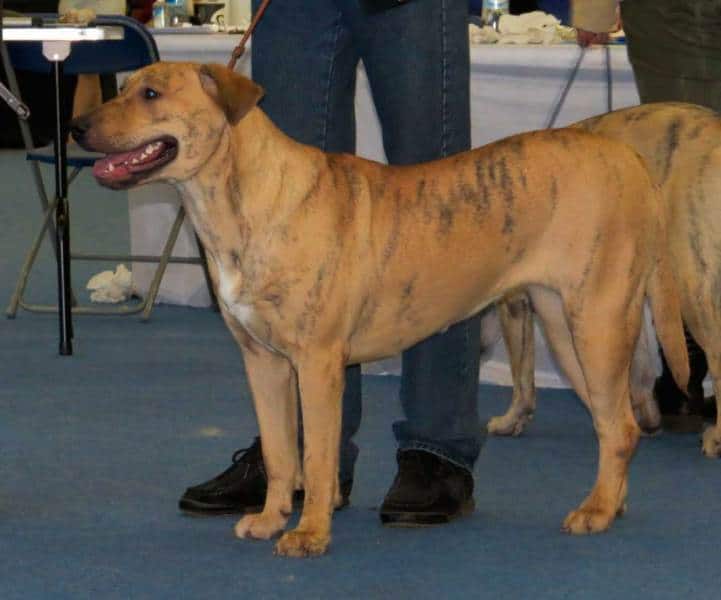
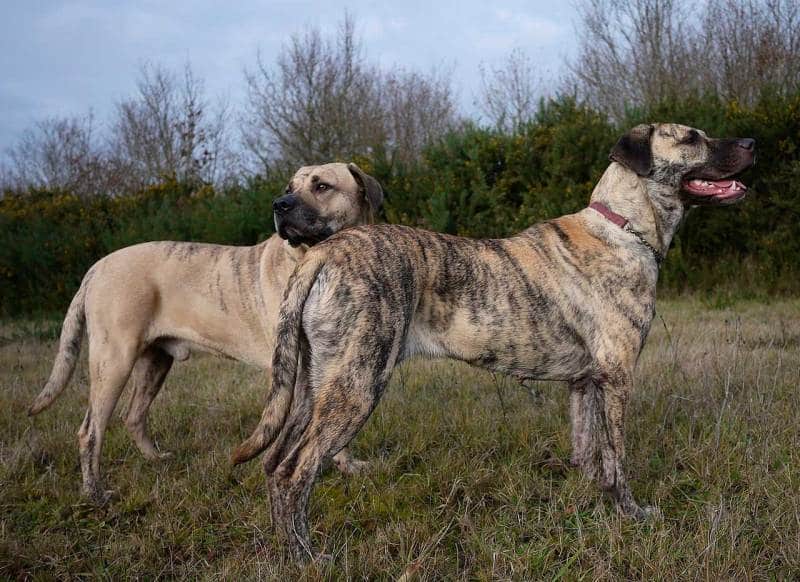
He has a bulky head, solid and the skull is wide. The eyes are oval and somewhat oblique; in the color, the more dark best. The ears are short and played backwards. The body is a massif with included belly. The forelimbs are strong and the tail reaches to the Hock. The coat is short and rough.

The favorite colors in your order are: the striped, the Fawn and black. In the striped prefer the dark tones in the leonados the intense nuances. The white spots are admitted in the previous members, chest and tolerated up to a maximum of 30 % the surface of the body. The black mask is also supported.

The Ca de Bou or Majorcan Dogo, It is a dog reserved and suspicious with strangers. It has an extraordinary adaptation, but it is not a dog to place in any hand. Their education and socialization should be initiated as soon as possible because the breed is naturally dominant.

The care of the fur is a simple weekly brushing and a regular cleaning of the ears and eyes. It is a rustic dog that adapts well to changes in temperature and withstands inclement weather well..

Character and skills

Although the Majorca Mastiff it has been used in its history for quite violent tasks, like bull hunting, the slaughter of bulls or the fighting of dogs, he is surprisingly very affectionate and has an excellent temperament. In fact, tends to create a very strong bond with his family.

They will do anything to protect their family and are very good watchdogs.. In fact, has a strong protective instinct and is very suspicious of strangers. But, although it can be impressive and dissuasive when needed, he only shows aggression when he feels his family is in danger. On the other hand, when dealing with people you don't know, he is always cautious, but he refers to his teacher to determine whether or not they are to be trusted. If the landlord invites someone you don't know to the house, will normally keep distance, but will not intervene in an untimely or even aggressive way. However, good socialization is necessary from an early age to avoid excessive distrust of all strangers.

Fits well with children, with whom he is patient and kind. He is even-tempered and likes spending time playing with them as much as being quiet on the couch. But, as with any dog รขโ‚ฌโ€นรขโ‚ฌโ€นof any breed, should never be left alone with a young child without adult supervision. This is especially true because it is relatively heavy and can easily push or knock over a young child..

On the other hand, the Majorca Mastiff tends to get along very well with other dogs, both with those who share their home and with those who are on a walk. But, if the dog is a male and is in the presence of another male with a dominant temperament, a rivalry relationship may develop. So, it is better to avoid this type of coexistence and to take precautions to avoid any fight when you meet other dogs, in particular doing gradual introductions.

As they don't have a strong hunting instinct, his relationships with small animals, as cats, rodents or birds, they are usually quiet. If you have to live with them on a daily basis, the ideal is to present them as soon as possible, but his great sociability makes it possible to integrate newcomers into his house even if he has always been the only animal.

Perhaps because it has been used to being used in so many ways and in so many different environments throughout its history., the Majorcan mastiff dog is generally very adaptable, so much so that it is possible that he lives in a flat. But, for your well-being, it is better that I live in a house with a garden, since he likes to run and exercise a lot. To feel good on its legs and on its head, usually needs an hour of activity a day, which can consist of walks or games in the garden. In any case, long daily outings are essential if you don't have access to a garden. They are always happy to accompany their owners on walks, and are well suited to active and sporty families. An elderly or very sedentary person, on the other hand, may not satisfy your need for activity and would be better off with another breed.

In addition to participating in the activities of their owners, can, of course, distinguish yourself in various dog sports such as agility, el cane-cross, The tracking, the RCI or the ring. It can even be made to pull a light trolley that the children sit in..

In any case, considering his past as a working dog, to the Majorca Mastiff he likes to be assigned tasks. These may include, takes his role as guardian very seriously: although it is not necessarily obvious at first glance, always watch out for the slightest noise or movement, and shows great reactivity. In general, Giving him chores to do and keeping him busy is the best way to ensure he thrives..

Once you are in your right mind, the Majorcan mastiff dog it is quiet and very quiet. He is not one of those who annoys the neighbors, he just barks in his role as guardian, that is to say, when a stranger enters your territory and tries to show you that you better leave.

Nor is he one of those who let themselves be heard when their owners are not: although he especially likes to be in contact with them, knows how to stay alone without suffering separation anxiety.

In summary, as long as he is well socialized and educated, and as long as you have enough opportunities to exercise, the Majorcan mastiff dog it is a fairly easy dog รขโ‚ฌโ€นรขโ‚ฌโ€นto carry. It is even an ideal breed choice for those who wish to acquire their first Molossian type dog., since it does not constitute a danger for his family and he is also very sociable with other animals in general.

But, this is only possible if the dog's place in the family hierarchy is perfectly clear and, Therefore, if he has a master who knows from the beginning how to position himself as a leader and how to be strict when necessary. Although the Majorca Mastiff it is quite easy to train and handle compared to other similar breeds, still a giant, so it is better that it is in the hands of a person who already has some experience in dog training.

Education

The Majorcan mastiff dog is an independent and determined thinker. So, can be very overbearing if not confronted by an experienced dog training person, who knows how to show both firmness and consistency to behave as a leader and make his dog understand who is the master.

So, your education should start at an early age, when it is still more impressionable, to lay the foundations on which the coexistence will be based throughout his life. As such, you have to be firm, but also soft, at the risk of antagonizing him or damaging the quality of his relationship with his owners.

The latter must also show some coherence: the rules should not only be fixed in time, but also from one person to another, that is to say, everyone should be in phase on what the dog is or is not entitled to do. The dog did not understand why one person allowed him to get on the sofa when another had strictly prohibited it the previous time.

As long as these conditions are met throughout the education of the Majorcan mastiff dog, things are going well; it is easy to carry and learns quickly.

This is even more true if your teacher is in charge of organizing small training sessions and asking you to do various things.. In this way, stays focused all the time, instead of boring you and losing your attention with long and repetitive sessions.

Learning is also easier and more enjoyable for everyone when the owner opts for methods based on positive reinforcement., that is to say, rewarding (with a word of encouragement, a caress, a treat…) good behavior and ignoring bad. In fact, punishment-based techniques quickly frustrate the dog, and an operation based on the constraint, although it may work in the short term, usually limits the prospects for evolution, or even counterproductive - or even dangerous- long-term. The Majorca Mastiff he is not one of those who turn against his master, but if he is brutal with him and uses bad methods, You may end up responding to what you perceive as assault with an equally violent reaction.

Last, all dogs benefit from being socialized as soon as possible, but this is especially true for the Majorcan mastiff dog. In fact, his developed instinct for protection generally leads him to distrust strangers and, Therefore, to be especially reserved with them. Not the type to get unnecessarily aggressive towards them, but it is preferable to ensure that you do not show an excessive reserve every time a visitor arrives at your house. As such, nothing like making him meet a wide range of people in all kinds of situations from his first months, so that little by little you will better accept the confrontation with strangers. The same goes for exposure to other dogs and animals of all kinds, as well as to all kinds of environments and stimuli (noises, smells, etc.). The sooner and more intensely a dog is socialized, the easier it will be for you to move around in the human world, whatever the circumstances.

Health

The Majorcan mastiff dog generally in very good health and predisposed to few problems., it is a very resistant dog in general.

This also applies to temperatures., used to the quite hot climate of the island of Mallorca, it is very resistant to high temperatures., not very sensitive to cold either, although this is really not a common thing in his homeland.

Among the diseases to which you are particularly predisposed, we can mention: brachycephalic syndrome, which affects dog breeds with flattened nose and short nose. In effect, This anatomical peculiarity notably translates into narrow nostrils and an excessively narrow nasal cavity, which implies respiratory failure, manifested especially during physical exertion and / or in case of strong heat. It can also be the cause of various digestive problems (vomiting, etc.). If the most serious cases must be treated by means of a surgical act to increase the respiratory capacity of the animal, most of those affected live in a more or less normal way as soon as their owner saves them from too intense physical effort (above all, especially when it's hot or humid) and carefully monitor your diet to avoid being overweight (a problem the breed is not particularly prone to).French Bulldog or the Pug;

  • The Hip Dysplasia, joint malformation in which the femur is not correctly positioned in the pelvic cavity of the hip joint, causing pain and lameness, as well as osteoarthritis as we age. Is problem, whose appearance is often favored by a hereditary predisposition, can be treated or alleviated by surgical intervention;
  • The dilation-torsion of the stomach, a problem that particularly affects medium-large dogs. It can happen especially when the animal ingests large amounts of food too quickly. It consists of sudden and excessive swelling of the stomach, that folds on itself;this blocks the evacuation of gases and interrupts blood circulation. Without prompt medical intervention, dog death occurs quickly;
  • The entropion, where the lid of one eye turns inward in contact with the eyeball. This problem can be inherited and causes severe irritation to the eye.. It is quite possible to remedy this by surgery;
  • The ectropion, corresponding to a curl defect of the lower eyelid. Then, the eye is no longer adequately protected, causing more or less severe irritation and conjunctivitis. Once again, this condition can be inherited and can be cured with surgery.

Although the breed is not predisposed to a large number of diseases, it is important to go to a breeder of Majorcan mastiff dog serious and competent. In effect, this allows the adopted puppy to have benefited from a good living environment and good socialization from its first weeks, but also and above all to maximize the chances that you enjoy good health and the rest. In fact, a serious breeder avoids breeding a dog with a hereditary defect such as Hip Dysplasia., because there would be a significant risk of transmission to young people. If you do not present them spontaneously, as should be the case, you should be asked for the results of the corresponding tests carried out on the parents or the puppy.

You must also always be able to provide a certificate of good health of the puppy prepared by a veterinarian, as well as a health or vaccination record, that proves that the child has received all the necessary vaccines. Once the animal has returned to its new home, should never be forgotten, during the following months, that is still growing and, therefore, particularly fragile. Thus, until I am about a year and a half, it is important to avoid any physical exercise that is too intense or too long, otherwise your joints or bones could suffer seriously. Or even end up presenting developmental defects that can incapacitate him throughout his life. This is all the more true as Majorca Mastiff is predisposed to Hip Dysplasia.

Last, even once this growth period has passed and the animal has become an adult, it is important to always pay attention to your health. As such, nothing substitutes for a complete check-up at a vet at least once a year, to ensure that no problem appears that cannot be detected by an inexperienced person. These regular appointments also offer the opportunity to be reminded of your vaccinations., so you never stop being protected. It should also be used against internal and external parasites, so it is up to your teacher to renew your antiparasitic treatments whenever necessary, throughout the year.

Life expectancy

11 years

Grooming

The Majorca Mastiff it is an easy breed to care for, and this is especially true for their fur. A weekly brushing is more than enough to keep it in good condition. But, not so during moulting periods, in spring and autumn: much more must be done each day, to allow good removal of dead hairs.

It also, as it is not dirty or smells bad, rarely need a bath. Unless it was especially dirty during an outing or in contact with toxic material, do it 2 or 3 times a year is more than enough. It may also be wise to do this at the same time as your seasonal shedding to save time during these periods., since it removes a good amount of dead hair. In any case, always use a shampoo specially developed for dogs, since the pH of your skin is different from that of human skin.

It also, although their ears are not especially prone to infection, they should be checked and cleaned once a week to prevent dirt or moisture from accumulating that could cause infection.
Your eyes are also not immune to infection, so you also have to check and clean them weekly to prevent dirt from accumulating.

Brushing your dog's teeth is also a good habit that should be established at least once a week, making sure to use a dog-specific toothpaste each time. This helps prevent plaque formation., which can cause serious health problems when it turns into tartar. If possible, it is advisable to opt for an even higher frequency, even daily.

As for the claws, this adaptable dog wears them down to a greater or lesser extent, according to the activity level of your family and your living environment. A dog that walks and spends a lot of time a day does not need to have its nails trimmed manually, since they file themselves, especially if it is on a hard surface like asphalt. But, if the dog lives in a flat and is not very active, it needs to be trimmed regularly. Too long claws can be very annoying for the dog, especially when traveling. It also, if they break, they can hurt the dog. In fact, as soon as the friction with the hard ground is heard, they have become too long and have to be cut.

Whether the fur, the ears, the eyes, teeth or claws, grooming your dog requires a minimum of precision and vigilance. If you don't, not only can you fail in grooming your dog, but it can hurt you, or even injure it. So, the first time it is best to seek the advice of a veterinarian or professional dog groomer, and learn from him how to take care of his Majorca Mastiff.

The sooner you train your dog, the better it will be for the rest of your life.

Food

Feeding a Majorcan mastiff dog it is not an arduous task: is perfectly fine with a balanced, quality industrial diet. Homemade rations are another perfectly adequate option, as long as they are well composed and, Therefore, are able to meet your nutritional needs. As such, should consist mainly of meat, but they can also contain large bones, remains, vegetables and rice.

In any case, the amount given must be consistent with his age, your health and the amount of physical exercise you get on a daily basis.

It also, the fact that it is prone to dilation-torsion of the stomach means that some precautionary rules should be observed when feeding the Majorcan mastiff dog. So, it is essential to divide your daily ration into at least two meals, and that these be taken in stride. It also, should not be preceded or followed by any intense or prolonged activity for an hour.

Although this breed is not very prone to obesity, it is important to regularly monitor the dog's weight. In fact, no one is immune to sudden and significant weight gain, especially after sterilization. Weighing your dog about once a month will allow you to quickly spot any unexplained deviations, so that you can take your dog to the vet if the deviation is confirmed or even increased during the following measurements. In fact, only a health professional can make a reliable diagnosis and indicate how to remedy the problem, because diet and lack of activity are not the only possible causes of being overweight: it can also be caused by illness or a reaction to treatment.

Last, like all dogs, the Majorca Mastiff a bowl of clean, fresh water should always be available to you.

Price

The Majorcan mastiff dog can be found at various prices. In all cases, the latter depend, in particular, of the reputation of the kennel, from the line the pup came from, but also of its intrinsic qualities, in particular of their physical qualities, especially of its greater or lesser conformity and its color.

In fact, the brindle color is the most sought after in this breed, what can explain the price differences, sometimes substantial, even within the same litter.

In Spain, the average price of a companion puppy is around 700 EUR. Obviously, like in other places, can be much higher for the best subjects. Those sold with a confirmation guarantee, whose attributes will allow them to be exhibited in dog shows or used as breeders, can reach much higher sums, up to several thousand euros.

Majorca Mastiff Images

Videos Ca de Bou

Type and recognitions:

  • FCI CLASSIFICATION:
  • Group :
  • Section : . .

Federations:

FCI โ“˜, UKC โ“˜

FCI breed standard "Majorca Mastiff (Majorcan mastiff dog)"

Origin:
Spain

Date of publication of the valid original standard:
11.12.1996

Use:

Guard and defense dog


General appearance:

Race typically molosoid, slightly elongated, strong and powerful. Medium rise, with marked sexual differentiation in cranial volume, higher in the male than in the female.


Behavior / temperament:

Quiet nature, that demonstrates bravery and courage, being sociable to the humane treatment and faithful and grateful to its owner. In the work of guard and defense, acts as an unbeatable guardian. At rest he appears confident and self-assured.; being alert, his gaze is penetrating.

Head:

Strong, solid

Cranial region:
  • Skull: Grand, width, tending towards the square, with a larger perimeter than the size at the withers, essentially in males. Wide front and flat, with well-marked front Groove; front, skull shape belies the occipital. The upper line of the skull and the supranasal line are almost parallel, with slight convergence.
  • Depression links (Stop): Profile, well marked and outstanding. Head on, perceptible only by the superciliary arches that delimit a clear frontal furrow.

facial region:

Very strong and prominent jaw muscles, developed up to the average level of eyes, and although it has some wrinkles on the sides of the masseter, It can be said that, in general, of the head do not skin wrinkles.

  • Truffle: Black and wide. Between the Windows you have well defined filter.
  • Snout: Born from the inner corner of the eyes, wide, tapered, Recalling a truncated cone of base profile broadband; with straight and slightly ascending supranasal line. The length of the muzzle must be in relationship 1/3 with respect to the head.
  • Lips: Upper lips are superimposed on the lower half of the snout, where it appears the labial commissure. The top is rather picked, While the lower retracting at its Center, and no they highlight is the lips when the mouth is closed. Oral cavity with marked striae and black gum edges, the rest of your mouth Red.
  • Jaws / Teeth: Powerful JAWS with well aligned incisors, Canine something separate, White complete teeth and strong with bite prognata; without being excessive this lower prognathism, It should be a maximum of one centimeter. They shall never see teeth with mouth closed.
  • Eyes: Large, oval, with opening wide, steep and somewhat oblique, color as dark as possible relative to the layer, without let see the conjunctiva; seen from the front can't see white ; situated low and far apart.
  • Ears: High and lateral deployment, rather small and pitches back and curved, showing the ear ; the guy named rosa. At rest the end of the ear lies at a level below the eye.

Neck:

Strong, thickness and provided, at his birth he has a similar to the diameter of the head width ; well linked with the cross. Something loose skin, being a thin dewlap permitted.

Body:

  • Kidneys and flanks: Short, relatively narrow and forming an arch pronounced to the rump.
  • Rump: Approximately from 1 to 2 cm taller than the cross, inclined at about 30ยฐ from the horizontal, somewhat narrower than the thorax.
  • Chest: Rib something cylindrical, deep up to the height of the elbows, width to the height of the cross, due to the separation of the shoulder blades.
  • Lower profile: Parallel to the ground chest, Belly gently up and collected, never agalgado.

Tail:

Implemented low, thick at its root, it thins to its end that reaches the hock, and finished in tip; during rest falls naturally, while in action it arches slightly and is arranged at the level of the dorsal line.

Tips

PREVIOUS MEMBERS:

  • Shoulder: Moderately short, some prominent and slightly oblique.
  • Arms: Straight, plumb and separated from each other.
  • Elbows: Separated due to the breadth of chest, but never open.
  • forearms: Well muscled, straight and thick bones.
  • Previous feet: Strong, with fat fingers, slightly round and well United; lightly pigmented pads.

LATER MEMBERS: Muscled, longer than the previous ones.

  • Thighs: Long ; natural joints.
  • Hocks: Short, straight and strong. Undesirable Spurs.
  • Hind feet: Strong, with fat fingers longer than the previous toes, presenting its oval shaped joint; preferably pigmented pads.

Movement:

The typical gait of the breed is the trot.

Mantle

Rather thick, firmly attached to the body, except in the neck, It can form slight double chin.


COAT

  • HAIR: Short and rough to the touch.
  • COLOR: Striped, black & Fawn, desirable in this order. For the atigrados dark tones are preferable; tawny in intense colors.

white spots are allowed in forefeet, chest and muzzle, up to a maximum total of a 30%. Also supports the black mask.


Size and weight:

Height to the cross:

  • Males of 55 to 58 cm.
  • females of 52 to 55 cm..

Weight:

  • In males ranges from the 35 to 38 kg
  • In females ranges from the 30 to 34 kg.


Fouls:

Any deviation from the aforementioned criteria is considered as a fault and the severity of this is considered to the degree of the deviation to the standard and its consequences on the health and well-being of the dog..


SERIOUS FAULTS

  • Individuals whose height at the withers is higher than the rump.
  • Inferior prognathism that is greater than one centimeter.
  • Scissor bite, or clip.
  • Lack of two premolars.
  • Individuals who do not have ears in pink, This is glued together and flat ears to the face ; and with ears erect on its base, still being in pink in its final third.
  • Queue type bulldog.
  • Any other fault that its gravity apart from the standard.

MISS PLAYOFFS

  • Aggressive or fearful dog.
  • Upper prognathism.
  • Eyes clear and yellow.
  • Amputated ears or tail.
  • White color more of 30% in parts of the body that are not above feet, chest and muzzle.
  • Any other colouring stains.

INDICATIVE MEASUREMENTS IN A STANDARD DOG

  • Weight 36 kg
  • Height at Croup 58 cm.
  • Height in cross 56 cm.
  • Chest perimeter 78 cm.
  • Head circumference 59,5 cm.
  • Distance occipital to the birth of the tail 73 cm.
  • Distance of the occipital to snout 22 cm.
  • Distance from the muzzle to the frontal trough 8 cm.

Any dog โ€‹โ€‹showing clear signs of physical or behavioral abnormalities must be disqualified..


N.B.:

Males should have two normal-appearing testicles fully descended into the scrotum..

Source: F.C.I - International Cynological Federation

Alternative names:

1. Mallorquin Mastiff, Mallorquin Bulldog, Silverback (English).
2. Dogue de Majorque (French).
3. Ca de Bou (German).
4. Ca de bou, Dogo maiorquino (Portuguese).
5. Dogo mallorquรญn, perro de presa mallorquรญn, Presa mallorquรญn (espaรฑol).

โ–ท The world of Pets: Dogs, cats, birds, reptiles, amphibians

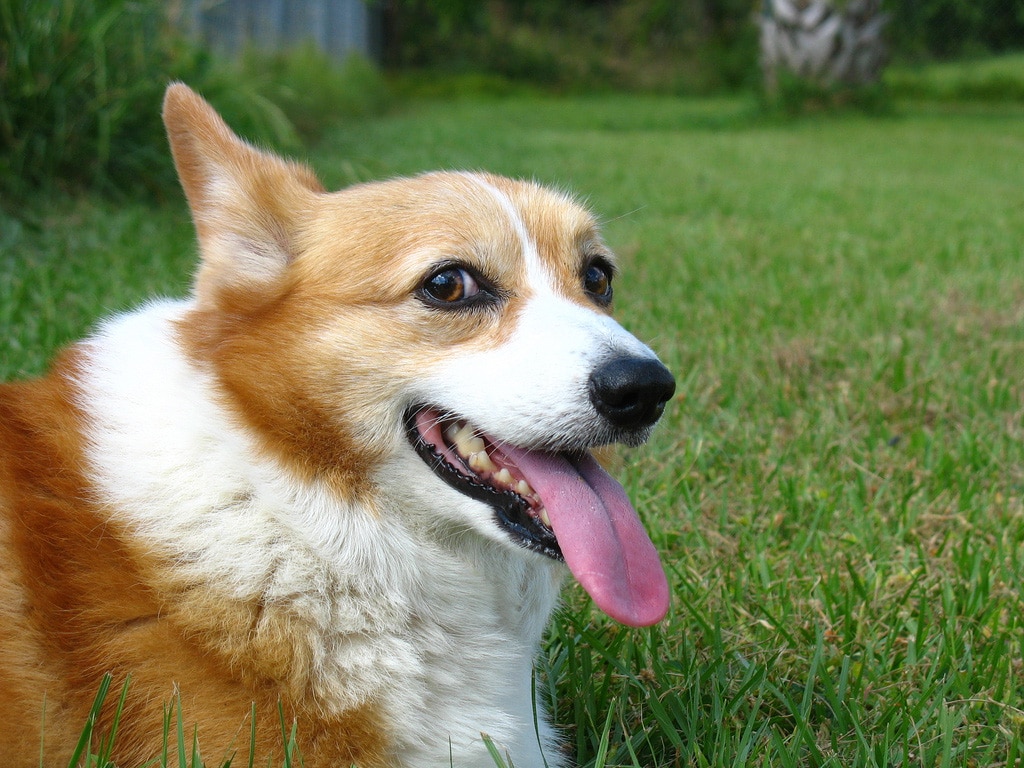
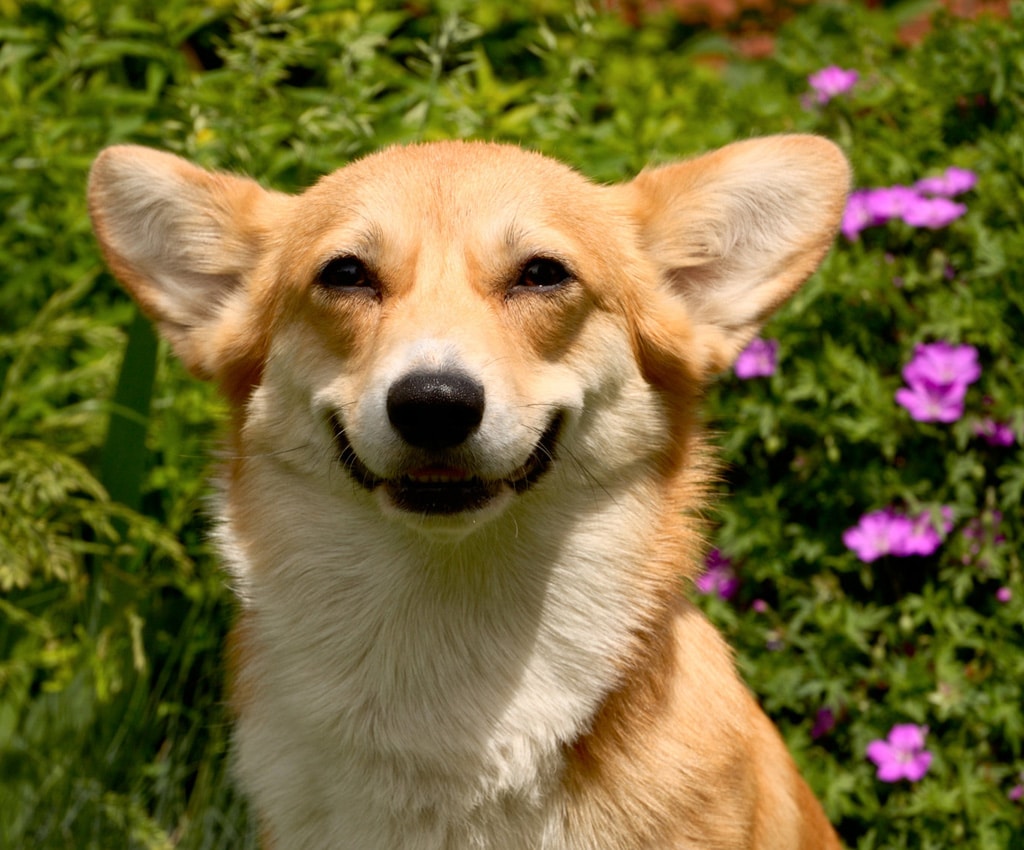
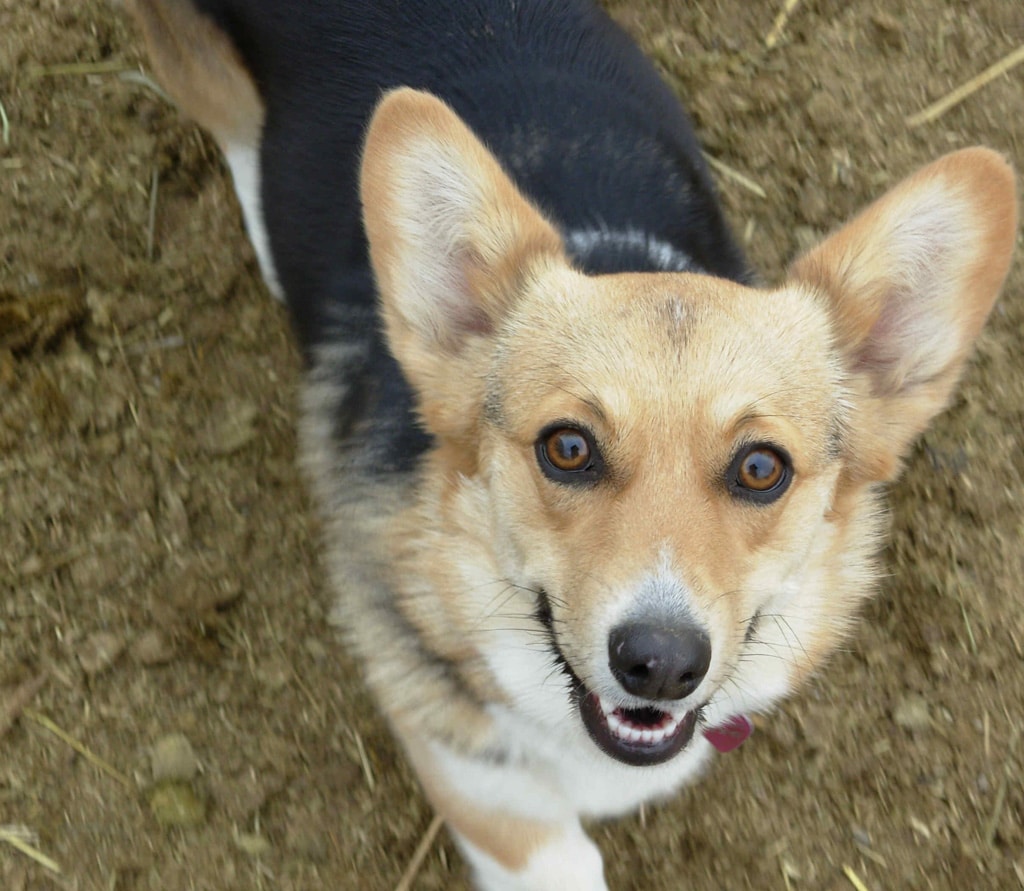
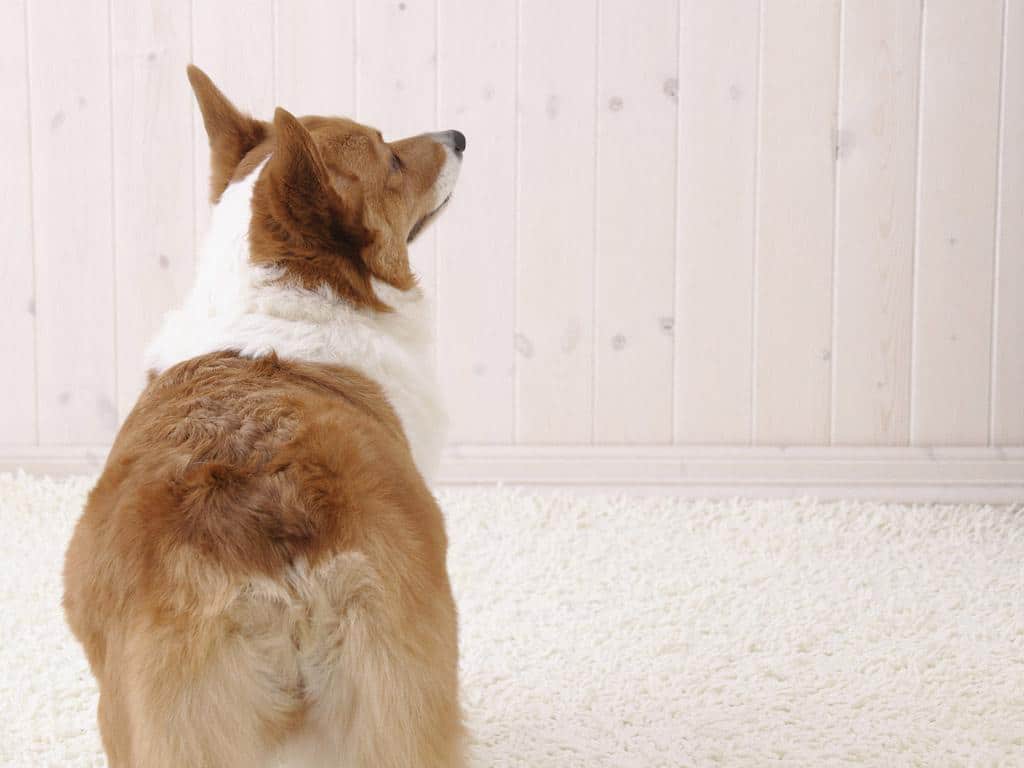
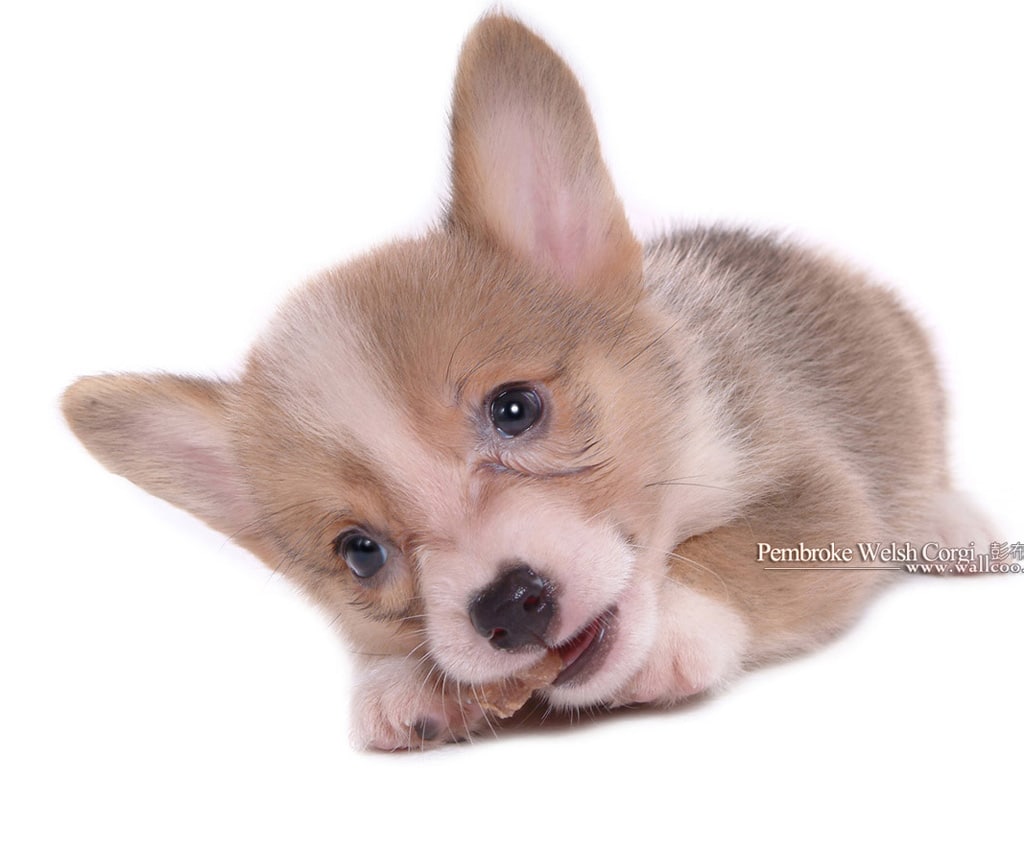
Pembroke Welsh Corgi
Gran Bretaรฑaa Gales- FCI 39 . Sheepdogs

The Pembroke Welsh Corgi is extremely intelligent, affectionate and possesses a great personality.

Corgi Galรฉs de Pembroke

Content

Characteristics "Pembroke Welsh Corgi"

Coexistence is important that you have with your new friend. Before considering the acquisition of a dog of the breed"Pembroke Welsh Corgi" you know certain factors. Not all breeds of dogs are apt to live in an apartment, you must take into account his character, their need for exercise, their interaction with other pets, their care and if you have small children, their level of tolerance towards them.

Adaptation โ“˜

5,0 of 5 stars (based on 1 review)

friendly dog โ€‹โ€‹โ“˜

3,0 of 5 stars (based on 1 review)

hair loss โ“˜

5,0 of 5 stars (based on 1 review)

Affection level โ“˜

5,0 of 5 stars (based on 1 review)

Need for exercise โ“˜

4,0 of 5 stars (based on 1 review)

Social need โ“˜

4,0 of 5 stars (based on 1 review)

Home โ“˜

5,0 of 5 stars (based on 1 review)

Toilet โ“˜

3,0 of 5 stars (based on 1 review)

Friendly with strangers โ“˜

3,0 of 5 stars (based on 1 review)

barking โ“˜

5,0 of 5 stars (based on 1 review)

Health โ“˜

3,0 of 5 stars (based on 1 review)

Territorial โ“˜

5,0 of 5 stars (based on 1 review)

Cat friendly โ“˜

5,0 of 5 stars (based on 1 review)

Intelligence โ“˜

5,0 of 5 stars (based on 1 review)

Versatility โ“˜

5,0 of 5 stars (based on 1 review)

Child friendly โ“˜

5,0 of 5 stars (based on 1 review)

Surveillance โ“˜

4,0 of 5 stars (based on 1 review)

joy โ“˜

5,0 of 5 stars (based on 1 review)

History

The Pembroke Welsh Corgi (Corgi) It is a small dog native of Great Britain. He has served for centuries as a shepherd, still considered one of the oldest dogs of Great Britain. There is another Welsh race, the Cardigan Welsh Corgi of very similar characteristics, Although of larger size and long tail.

There are different theories about the origins of the Pembroke Welsh Corgi. It is believed that the two varieties Corgi they are descended from the dog of the Visigoths who introduced the Vikings in Wales to 9th century. Or the Cardigan may be the oldest variety, introduced the Celts into Wales around the year 1200 (name Corgi comes from the Celtic word "corgi" which means "dog").

According to other sources, the Pembroke variety was brought to Wales by Flemish weavers in the 12th century. Independently, What was the origin of the breed, the Pembroke Welsh Corgi was developed in Pembrokeshire) and it was used to guide cattle mordisqueando its paw and barking. The varieties Pembroke and Cardigan They interbred freely until the 1970s. 30. From then on, breeders attempted to emphasize their differences.

Another theory posits that the two varieties of Corgi have a common origin which is the cross between a Shetland Sheepdog and Sealyham terrier.

This race was used for grazing. The poor peasants of the time were allowed to pasture in the open fields of the Crown, this absence of fences put the cattle at risk of getting lost or dispersing and made a fast dog necessary, clever and who could move smoothly between the livestock. The Pembroke is this kind of dog, that pushes the cattle by the heels. His short height allowed him to run under cattle without being kicked.. It has evolved as a domestic animal, and it is the favorite breed of the English Royal family. It is a constant companion and an excellent guardian.

Physical characteristics

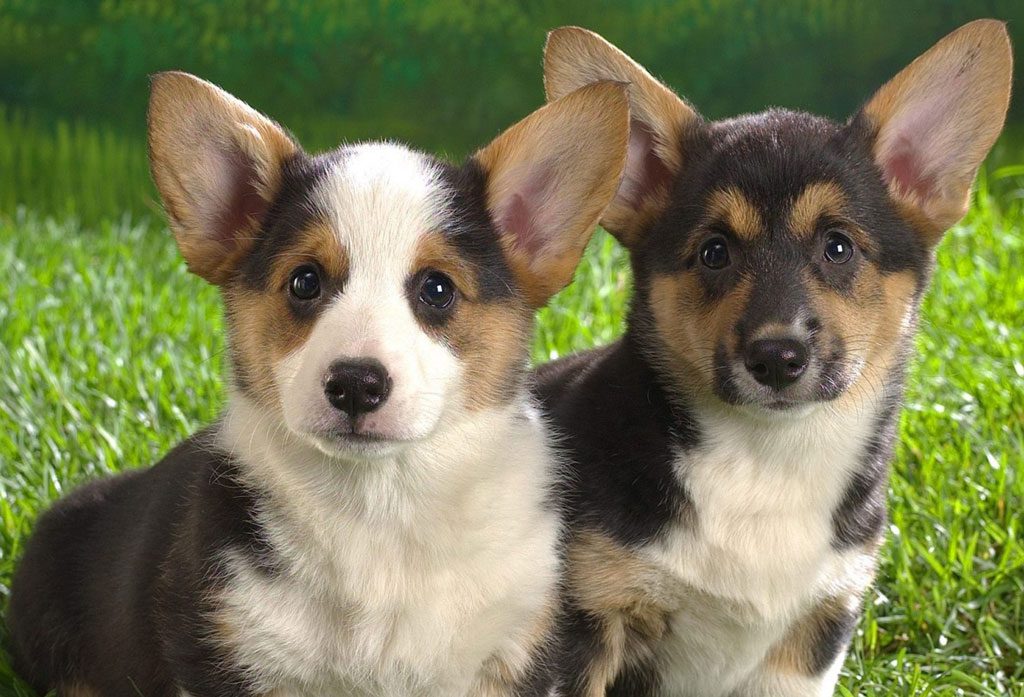
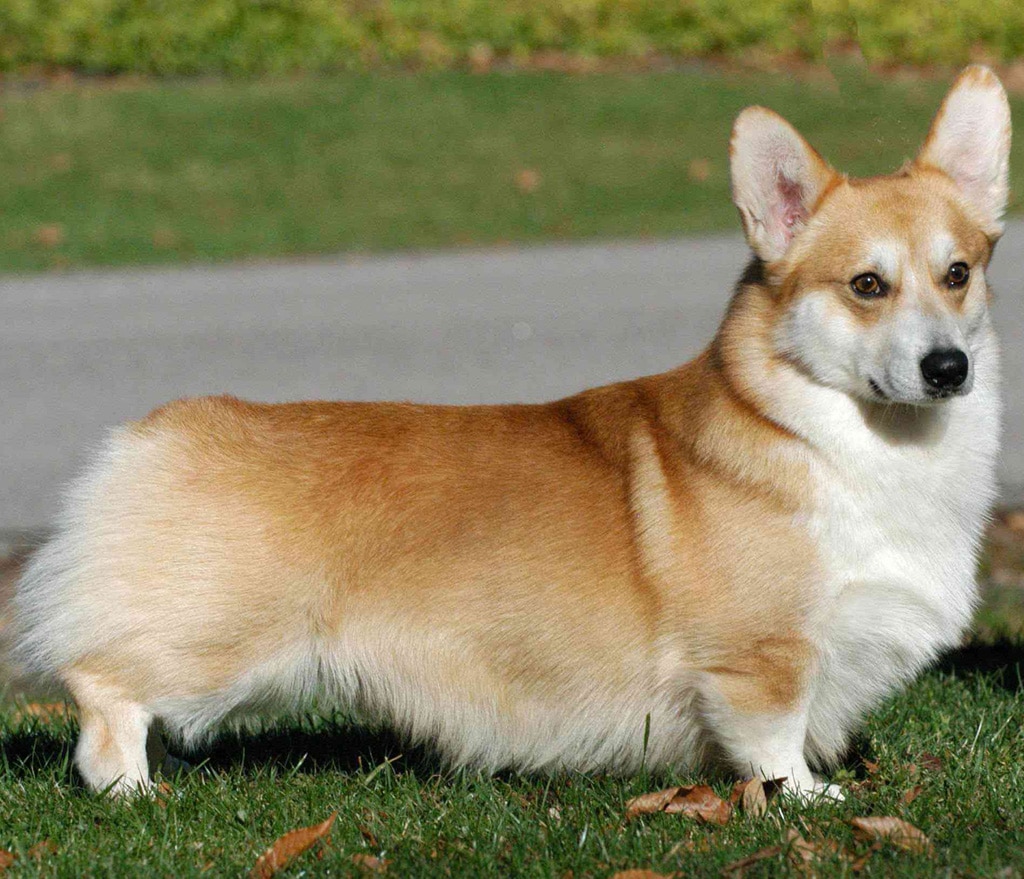
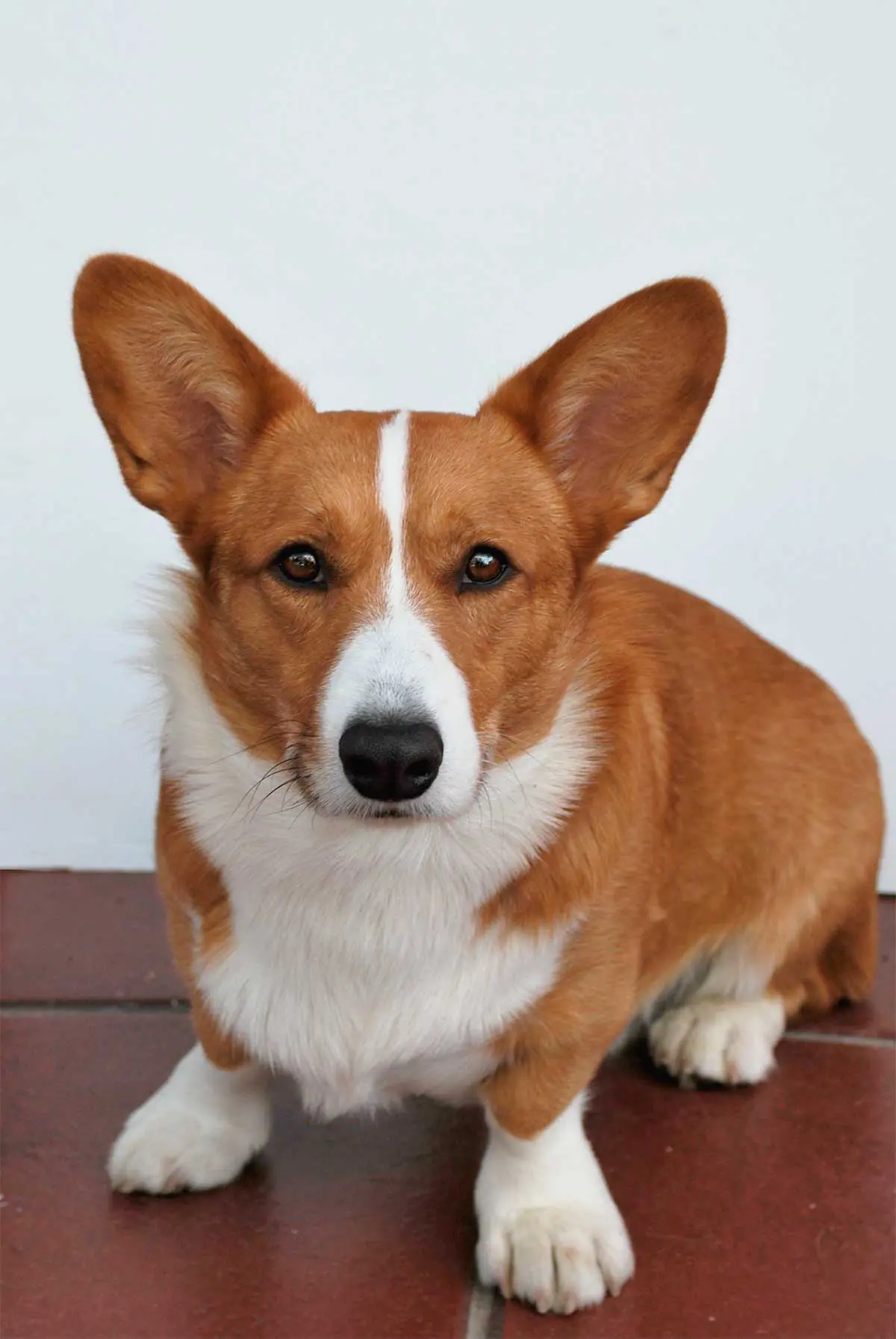
Although Cardigan Welsh Corgi and Pembroke they are relatives, his description of race is completely different. The Pembroke It is small in size, strong, robust Constitution, alert and active, It gives the impression of strength and stamina in a small body.

Head recalls by the shape and appearance to the Fox, with an expression alert and intelligent. The tail is short, preferably natural, When the puppies are not born rabones tail amputates almost completely.

The hair is fairly long and smooth, in various colors such as red, Jet, beige or black and Tan, usually with white spots, is a truly beautiful dog.

The Pembroke Welsh Corgi average has a height of 25 to 30 cm., unato length of 30 to 38 cm and a weight of 11 to 14 kg. Their life expectancy is of 12 to 14 years.

Observations

In England the Corgi de Pembroke is much more popular than Cardigan Welsh Corgi. Perhaps the most obvious reason for that popularity is that Pembroke is the favorite of the royal family, in particular of Queen Elizabeth II. Outside of England the Cardigan is still less known than the Corgi.

Character and skills

It is a very active dog, but the tendency to have them as pets in small homes reduces its activity. If this excesses are added in their food taken quickly to obesity.

The Pembroke Welsh Corgi is extremely intelligent and loving, with a great personality, very active and worker. Very adaptable to the farms and also, It is a perfect companion dog for children if it is treated properly and barks only occasionally..

Food

An average dog requires of 150 to 300 grams of balanced commercial feed per day. A fairly common feature of Corgi is their voracity, leading you to overeat which makes you feel like you are never full; You must limit your intake.

Health

By the length of the spine are particularly sensitive to overweight which can produce osteoarthritis that reduces your life expectancy and the quality of the same.

This race also has a tendency to hip dysplasia (polygenetic origin), the falls, retinal dysplasia, von Willebrand disease and degenerative myelopathy.

Images "Pembroke Welsh Corgi"

Videos ยซCORGI JUGS DE PEMBROKEยป

Type and recognitions:

  • FCI CLASSIFICATION:
  • Group :
  • Section : . .

Federations:

  • FCI – Group 1 Herding dogs, Section 1 Sheepdogs โ“˜
  • AKC – PASTORAGE โ“˜
  • ANKC – Group 5 (working dogs) โ“˜
  • CKC – Group 7 – Herding dogs โ“˜
  • โ€‹KC – Pastoral โ“˜
  • NZKC – Working dog โ“˜
  • UKC – Herding dogs โ“˜

FCI breed standard "Pembroke Welsh Corgi"

Origin:
United Kingdom, Wales

Date of publication of the valid original standard:
4.11.2010

Use:

Shepherd dog.


General appearance:

It is a small dog, strong, robust Constitution, alert and active, It gives the impression of strength and stamina in a small body.

important proportions:

The length of the muzzle should be 3/5 the length of the skull.


Behavior / temperament:

Sociable and friendly, never nervous or aggressive.

Head:

The head resembles that of the fox due to its shape and appearance, with an expression alert and intelligent.

Cranial region:
  • Skull: The skull is quite wide and flattened between the ears.
  • Depression links (Stop): Slightly marked.

facial region:

  • Truffle: black.
  • Snout: Narrowing slightly.
  • Jaws / Teeth: Must have strong jaws, with healthy teeth, complete and scissor bite, that is to say, that the internal face of the upper incisors is in contact with the external face of the lower incisors, and well positioned in the jaws.
  • Eyes: Well-placed, round, medium in size and brown in color that harmonizes with the mantle.
  • Ears: Medium-sized, upright and slightly rounded. If a straight line is drawn from the tip of the nose passing through the eyes and continues, I should cross the tip of the ears or be tangent to it.

Neck:

Moderately long.

Body:

The body is medium long, well sprung ribs, the lumbar region should not be short. Slightly tapered when viewed from above. Horizontal top line, the chest is broad and deep and well descended between the extremities.

Tail:

Short, naturally preferable.
  • amputee: Short.
  • Without amputating: Inserted at the same level as the upper line, carried low, not curled on the back. Carried along the same line as the back in motion, low at rest. Too high or too low insertion is undesirable.


Tips

Former members
  • Shoulder: Well bent backs, forming an angle of 90 ยฐ with the arms
  • Arms: Arms conform to the shape of the chest.
  • Elbows: The elbows close to the body, neither loose nor too tight.
  • forearms: Short forearms and as straight as possible. Strong skeleton in all its extension to the feet.
  • Previous feet: Oval; with strong fingers, well arched and together. The middle fingers slightly exceed the sides; the pads should be strong and well-rounded. Nails must be short.
Former members
  • General appearance: Strong and flexible. Short hindquarters with good bones all the way to the feet..
  • Knees: Well angulated.
  • Hocks: Seen from behind they should be parallel.
  • Hind feet: Oval; with strong fingers, well arched and together. The middle fingers slightly exceed the sides; the pads should be strong and well-rounded. The
    nails must be short.

Movement:

Your movement must be lively and lively, elbows neither loose nor too close together. The forelimbs should be directed forward, without lifting them much, in harmony with the propeller action of the posterior limbs.

Mantle

  • Fur :Medium long, smooth and with a dense undercoat. It should never be smooth, wavy or very hard (wire).
  • Color : Uniform colours: Red, carbonated leonado, black and tan, with or without white spots on the limbs, chest and neck. Small white spots are allowed on the head and forehead.


Size and weight:

Height to the cross:

Approximately between 25,4 and 30,5 cm..

Weight

  • Males: Among 10 and 12 kg.
  • females: Among 10 and 11 kg.


Fouls:

Any deviation from the aforementioned criteria is considered as a fault and its severity is considered with respect to the degree of the deviation to the standard and its consequences on the health and well-being of the dog., and the dog's ability to perform its traditional task.

disqualifying fouls:

  • Aggressiveness or extreme shyness.
  • Any dog โ€‹โ€‹showing clear signs of physical or behavioral abnormalities.


N.B.:
  • Males should have two normal-appearing testicles fully descended into the scrotum.
  • Only functionally and clinically healthy dogs, with the typical conformation of the breed, should be used for breeding.

The latest changes are in bold.

Source: F.C.I - International Cynological Federation

Alternative names:

1. Pembroke, PWC, Pem, Corgi, Welsh Corgi (English).
2. Welsh Corgi Pembroke (French).
3. Welsh Corgi Pembroke (German).
4. Welsh Corgi Pembroke (Portuguese).
5. Welsh Corgi Pembroke (espaรฑol).

โ–ท The world of Pets: Dogs, cats, birds, reptiles, amphibians

Bearded collie
Escocia FCI 271 . Sheepdogs

Collie Barbudo

The Bearded collie It is an energetic dog. They need exercise and homework to do, How to care for children.

Content

History

The Bearded collie It is a breed of dog of medium size and long coat, It was originally used in tasks of grazing by Scottish shepherds. He is originally from Scotland, and their closest ancestors are a race of imported Polish shepherds in 1514.

The story of the Collie โ€“as we have said in another post of race– is a mixture of reality and legend. One story recounts that Kazimierz Grabski, a Polish merchant, went to Scotland in 1514 in order to negotiate a shipment of grain for sheep in several pastors, apparently brought six copies of pastoral dogs (Poles) it performed tasks of grazing in his native Poland, and at the destination they would help him move the cattle. A Scottish Shepherd, He was so impressed with the ability of herding dogs of Kazimierz Grabski, which changed several sheep by some of those six dogs. Y, was that, those Polish sheepdogs were bred with the local dogs of Scotland and from there the beautiful Bearded Collie was born. This is one of the theories..

another theory, raises that Mrs G. Oliva Willison founded the breed Bearded collie modern with her brown bitch, Jeannie of Bothkennar. Jeannie, was-supposedly- a dog Shetland Sheepdog, at least that breed was the one I had ordered, but Mrs. Willison got a bitch much like the current one Bearded collie by accident. Despite knowing that it was not the dog that was looking for, She was fascinated with the copy received and her only objective, Thereafter it was to begin to raise the dogs of your bitch Jeannie, so he began to look for a dog suitable for the characteristics of his specimen.

An afternoon, While walking along the beach, met a man who had emigrated from Scotland with his gray dog, David, who became in a very short time the "Bailie of Bothkennar", the boyfriend of Jeannie. Then, This story tells that Bailie and Jeannie de Bothkennar are the founders of the modern race of Bearded collie.

But the stories don't end there, If we escarbamos a bit we find name that have been very important for the development and prosperity of the race, for exampleโ€ฆ, Nicolas Broadbridge and Betty Foster…

The breed became very popular during the last half of the 20th century., thanks to a Bearded collie, that turned out to be the best winner in the Crufts event in 1989. The Crufts is an annual International Championship of canine exhibition organised by the Kennel Club of the United Kingdom, currently held every month in March at the National Exhibition Centre (NEC) the Birmingham, England. It is the largest annual canine exhibition that exists in the world, as stated by the Guinness World Records Guide (Guinness World Records), the event lasts four days.

Today it is still a beloved breed in many countries., in United States, for example, Bearded Collie ranks 104 of 155 in the annual ranking of popularity of the American Kennel Club breeds.

Bearded Collie is now mostly a great pet companion of many families, but originally it was used to drive sheep and cattle. Itร‚ยดs, essentially, a working dog, raised to be durable and reliable., able to cope with harsh and difficult conditions, like driving a herd of rebel sheep but successfully.

The Bearded collie has become less common in recent decades and may have become extinct, were it not for the dedication and efforts of some pastors as Tom Muirhead and Peter Wood (and breeders like Brian Plummer), that they have dedicated themselves to keep active the most ancient part of the race. From his eagerness of these gentlemen, specimens of Bearded collie (of work) to Australia and the United States, It was where more support found among those who sought an independent and intelligent dog. They founded the "Working Bearded Collie Society's" (Society of Bearded collie of work).

The mission of the "Working Bearded Collie Societyโ€™s is to preserve the work capacities of these" bearded "dogs as their ancestors had. They have a website called "Shepherds with Beardies" (Shepherds with Beardies) with a lot of valuable information for lovers of the โ€“today- small population Bearded collie of work.

Registration of dogs Bearded collie It has decreased significantly in Wales, Scotland and other countries due to lack of community interest in working dog breeding, lately the raw aesthetic, and breeders tend to develop lines of specimens with excessive coats, for example. But, in some countries (as Sweden and United States) have developed programs focused on grazing for the race. Several organizations have also been created in different countries that encourage, actively, breeders to stress other qualities besides appearance.

Physical characteristics

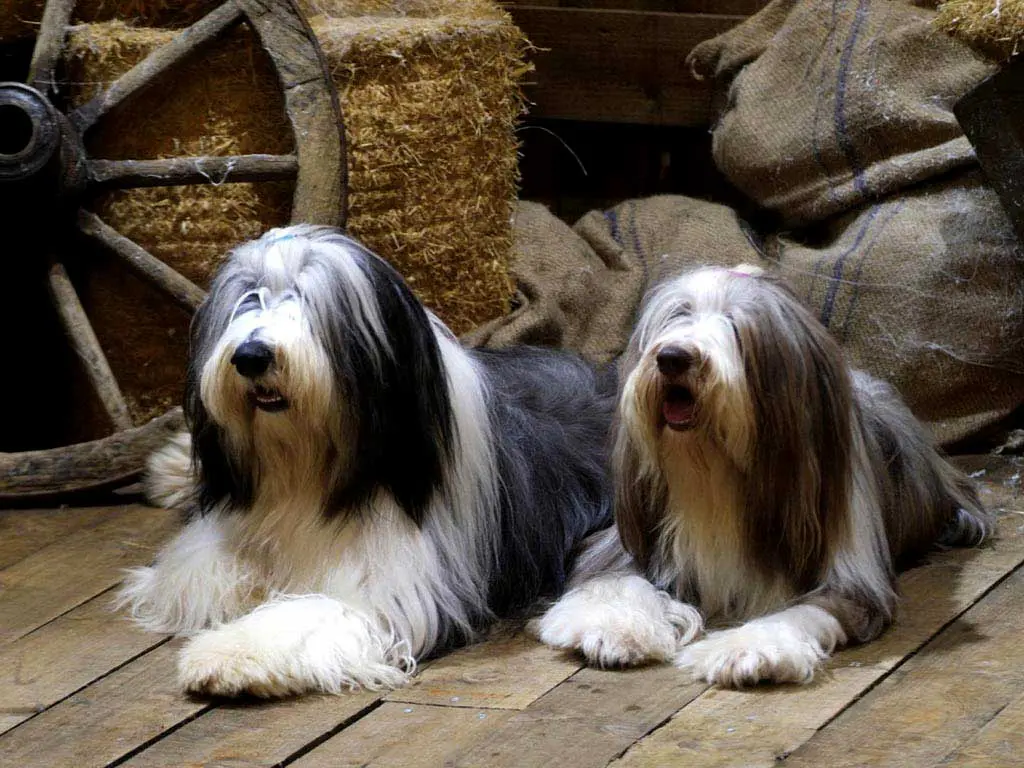
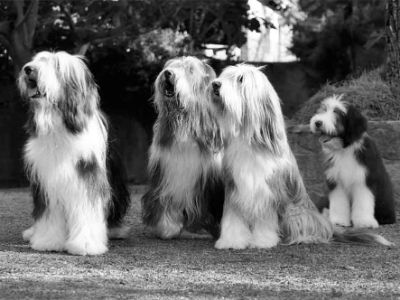
The Bearded collie, as we said at the beginning, is a medium-sized dog, they have an average weight of 18 to 27 kg. The males measure approximately 53 to 56 cm in height to the cross, While the females are somewhat smaller, measuring of 51 to 53 height cm.
They have a mantle of double layer, the hair is long, smooth (or slightly wavy) and soft to the touch. Several colors are supported, It may be black, blue, Brown or beige with white markings or Tan.

Did you know??

Cubs Bearded collie born dark, and it is not always clear what color will be when they grow up. The coat lightens when ripe and then begins to darken again when having 12 to 18 months of age. The coat can not reach its final color until the dog is four years or more.

Character and skills

The Bearded collie it is an excellent pet for those who are willing to adapt to its high energy level and the care of its long manesโ€ฆ Weekly brushing is mandatory to keep its long hair healthy and without knots.

The Bearded collie It is an energetic dog, let's not forget that it was designed -originally- to work in the Scottish Highlands raising sheepโ€ฆ They need exercise and chores to do, How to care for children, Yes, will be an excellent Kangaroo!

It is a faithful and family dog. The females., often, they are more expressive and stubborn than males. In training, males are more likely to follow the instructions and the females are more independent.

Observations and tips

    This breed is not very widespread outside its country of origin., but hatcheries produce high quality specimens. If you want a puppy, a reservation is necessary. It is a breed that needs to work and feel useful, reason why the training is advisable. It is not a difficult animal, but it can be quite stubborn if you are not convinced of the usefulness of what is required.

Health "Barbudo Collie"

Bearded Collies are some health conditions that may be of concern. They include hip dysplasia, elbow dysplasia, diseases of the eyes, autoimmune thyroiditis, skin condition called pemphigus foliaceus and Addison's disease. Not all bearded collies suffer all or even any of these conditions, but knowing them beforehand will help you in your search for a breeder.

Do not buy a puppy from a breeder who can not provide written documentation that parents were exempted from health problems affecting race. Getting dogs "vet checked" is not a substitute for genetic health testing.

Remember that after bringing a new puppy to your home, You have the power to protect one of the most common health problems: the obesity. Keeping a puppy with an appropriate weight is one of the easiest ways to prolong life. Make the most of your preventive abilities to help ensure a healthier dog for life

Aseo ยซBearded Collieยป

The glory of Bearded collie it's his coat. The hardest part of taking care of a Barbudo is also his coat. Wait half an hour to one hour a week to fix it. Brushing and combing him with a bristle brush or slicker brush and a stainless steel comb will keep his double coat tangle free.. Spray the coat with water or anti-tangle spray before brushing so as not to damage the hair. Is a good idea that the breeder show you how to brush the hair of an adult dog. Bathe your Bearded collie every six to eight weeks or more often, especially if (or when) their rooms are hairy rear with feces.

In addition to the time spent caring for fur, Prepare for dirt, mud and debris that accumulate in the hairy legs of the dog. A light trimming can reduce the clutter a bit and gives the legs a clean look.

If you regularly Aseas, the Bearded collie shouldn't change much, but passes through a heavier coat every year that lasts two to four weeks. He also loses a lot over a two to three month period when the puppy coat is coming out and the adult coat is coming in.. Grooming a puppy takes very little time, but it is advisable to start early to get used to stand still while you work on your coat.

The rest is basic care. Trim nails as needed, usually once a month. Brush your teeth frequently for general good health and fresh breath. Check ears weekly for debris, redness or odor that may indicate an infection. If the ears look dirty, clean them with a cotton swab moistened with a gentle ear cleaner recommended by your veterinarian.

Breeders list "Bearded collie"

REGISTER KENNEL

Bearded Collie or Bearded Collie Breeders

Offer your puppies for free. Sign up here.

  • This field is a validation field and should be left unchanged.

Characteristics "Bearded collie"

Coexistence is important that you have with your new friend. Before considering the acquisition of a dog of the breed "Bearded collie" you know certain factors. Not all breeds of dogs are apt to live in an apartment, you must take into account his character, their need for exercise, their interaction with other pets, their care and if you have small children, their level of tolerance towards them.

Adaptation โ“˜

5,0 of 5 stars (based on 1 review)

friendly dog โ€‹โ€‹โ“˜

4,0 of 5 stars (based on 1 review)

hair loss โ“˜

4,0 of 5 stars (based on 1 review)

Affection level โ“˜

5,0 of 5 stars (based on 1 review)

Need for exercise โ“˜

3,0 of 5 stars (based on 1 review)

Social need โ“˜

4,0 of 5 stars (based on 1 review)

Home โ“˜

3,0 of 5 stars (based on 1 review)

Toilet โ“˜

4,0 of 5 stars (based on 1 review)

Friendly with strangers โ“˜

4,0 of 5 stars (based on 1 review)

barking โ“˜

4,0 of 5 stars (based on 1 review)

Health โ“˜

3,0 of 5 stars (based on 1 review)

Territorial โ“˜

5,0 of 5 stars (based on 1 review)

Cat friendly โ“˜

4,0 of 5 stars (based on 1 review)

Intelligence โ“˜

5,0 of 5 stars (based on 1 review)

Versatility โ“˜

5,0 of 5 stars (based on 1 review)

Child friendly โ“˜

4,0 of 5 stars (based on 1 review)

Surveillance โ“˜

5,0 of 5 stars (based on 1 review)

joy โ“˜

5,0 of 5 stars (based on 1 review)

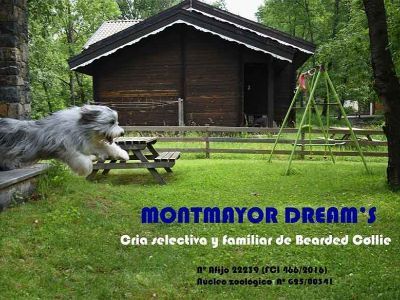
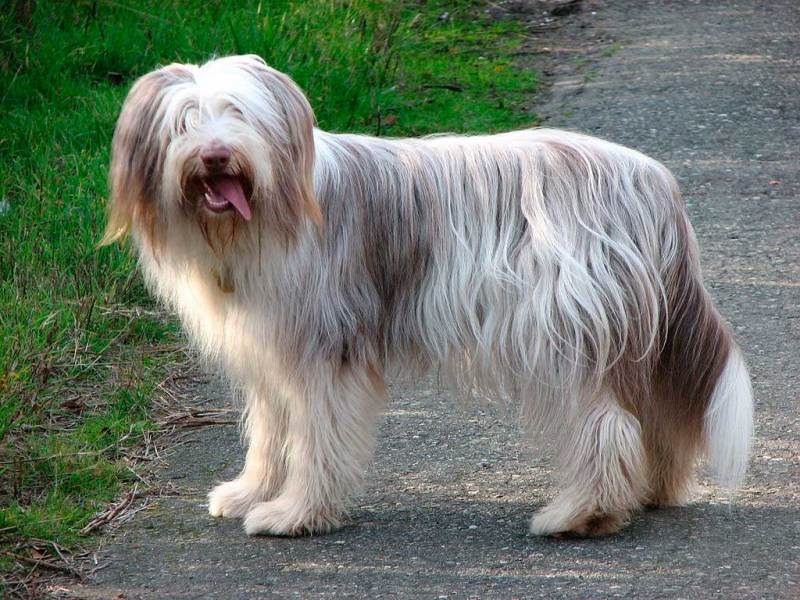
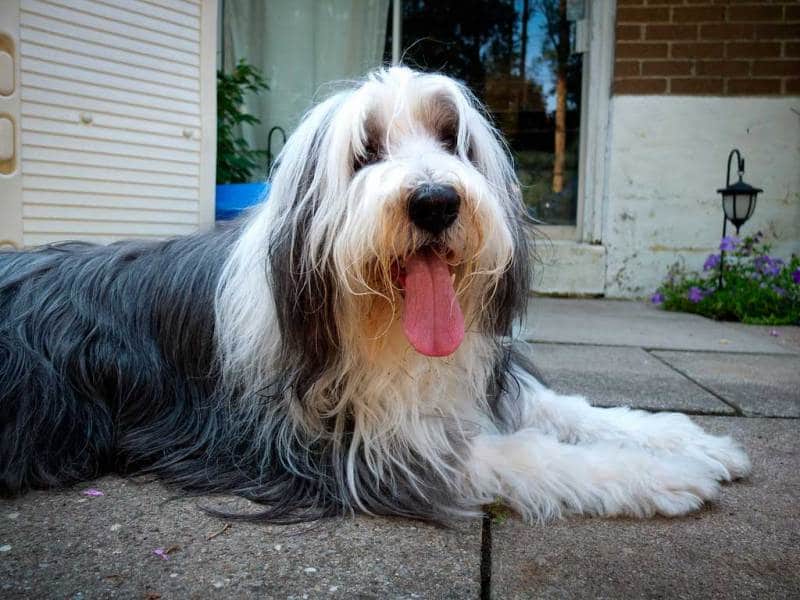
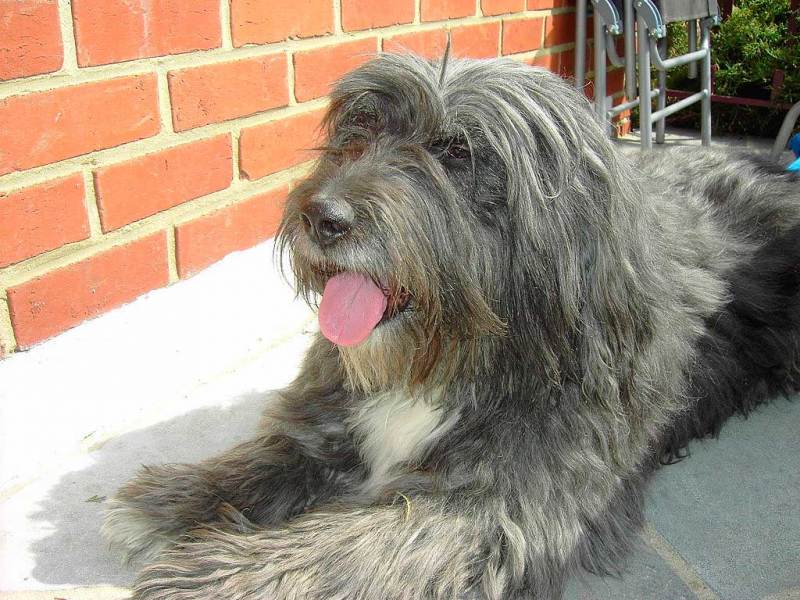
Images "Bearded collie"

credits:

1 – Bearded collie after playing with a rope – https://es.m.wikipedia.org/wiki/Archivo:Bearded_collie_and_a_rope.jpg
2 – Bearded Collie by marbla123 / CC BY
3 – Flickr Beardie by https://images.app.goo.gl/FCaHKwsfkokCZVBU9
4 – Bearded collie laying down on balcony by Trudh / CC BY-SA

Videos "Bearded collie"

Type and recognitions:

  • FCI CLASSIFICATION:Group 1 –> Pastor and Boyeros dogs (except Swiss Cattle Dogs ) / Section 1 –> Pastor dogs. Without working trial.
  • FCI 271
  • Federations: FCI โ“˜, AKC โ“˜, ANKC โ“˜, CKC โ“˜, โ€‹KC โ“˜, NZKC โ“˜, UKC โ“˜

  • FCI breed standard "Bearded collie"

    Origin:
    United Kingdom

    Date of publication of the valid original standard:
    24.06.1987

    Use:

    Shepherd and companion dog.


    General appearance:

    Delgado. active dog. Despite being heavily built, should show plenty of light under the body and should not look too heavy. Sparkly, the inquisitive expression is a distinctive feature.

    important proportions:

    Longer than tall by about a ratio of 5 to 4 measured from tip of chest to tip of ischium.

    Females may be slightly longer.

    The distance between the stop (naso-frontal depression) and the occiput must be the same as the distance between the holes of the ears.


    Behavior / temperament:

    Alert, lively, self-confident and active. Stable, smart working dog, without any signs of nervousness or aggressiveness.

    Head:

    In proportion to its size. The overall effect is that of a dog with muzzle power and plenty of brain space.

    Cranial region:
    • Skull: Width, flat and square.
    • Stop: Moderate.

    facial region:

    • Truffle: Big and square, usually black but usually according to coat color in blue and brown dogs. The nose must be solid in color, no specks or patches.
    • Snout: Strong and of the same length as the distance between the stop and the occiput.
    • Lips: Solid color with no specks or patches. Pigmentation is consistent with that of the nose.
    • Jaws / teeth: Large white teeth. Strong jaws with perfect, regular and full scissor bite is preferred, that is, the upper incisors closely overlap the lower incisors and are positioned vertically in the maxillae.

    Pincer bite tolerated but undesirable.

    • Eyes: In tune with the color of the coat, set well apart and large, soft and affectionate, not prominent. The pigmentation of the eyelids is consistent with that of the nose. Eyebrows arched up and forward but not so long as to hide the eyes.
    • Ears: Medium in size and falling.  On alert, ears are raised at their base, level but not above the top of the skull, increasing the width of the skull in appearance.

    Neck:

    Moderate long, muscular and slightly arched.

    Body:

    The length of the body is due to the length of the rib cage and not the area of รขโ‚ฌโ€นรขโ‚ฌโ€นthe kidneys.

    • top line: To level.
    • Pork loin: Strong.
    • Breast : Deep, giving plenty of room for the heart and lungs. Well sprung but not crowded ribs.

    Tail:

    Low insertion, no knots or kinks and long enough for the last vertebra to reach the tibial-tarsal joint. It is carried low with an upward curve when the dog is at rest or in action., in speed can be extended. It is never carried on the back. Covered with abundant hair.

    Tips

    Former members

    Straight and vertical limbs with good bones, covered with shaggy hair all around.

    • Blades: Leaning well back.
    • Metacarpus: flexible, without weakness.
    • Front feet: Oval; thick footpads, strong and healthy; fingers arched and together; well covered with hair even between the pads.
    Former members

    Very muscular.

    • Knees: Well angulated.
    • Tibia: Buena.
    • Hocks: Low.
    • Metatarsals: The lower part of the leg falls at a right angle to the ground and in a normal position, are just behind a vertical line below the ischium.
    • Hind feet: Oval, thick footpads, strong and healthy; fingers arched and together; well covered with hair even between the pads.  

    Movement:

    Flexible, smooth and long range, covering ground with minimal effort.

    Mantle

    • Fur: Double with soft and tight woolly under-hair. The outer coat is smooth, hard, strong and hirsute, free of wool and curlers, although slight waves are allowed. The length and density of the hair sufficient to provide a protective coat and highlight the silhouette of the dog, but not so much as to hide the lines of the body. Hair must not be groomed in any way.

    The muzzle is sparsely covered with hair somewhat longer on the sides to cover the lips.. From the cheeks, lower lip and lower jaw, the hair increases its length towards the chest, forming a typical beard.

    • Color: Slate gray, reddish bay, black, blue, all shades of gray, brown and sand with or without white markings. When there is white it appears on the muzzle, like a star in the skull, at the tip of the tail, on the chest, members and if it appears as a necklace,  white hair roots should not extend behind the shoulders. The target should not appear above the warm-tarsal joints (hocks)  on the outside of the hind limbs. Slight fire marks are acceptable on the eyebrows, inside of the ears, cheeks, below the tail insert and on the limbs where the white meets the main color.


    Size and weight:

    Ideal height:

    • Males:   53 ? 56 cm.
    • females: 51 ? 53 cm.

    Overall quality and proportions should be considered before size, but excessive variations from the ideal height should be discouraged.


    Fouls:

    Any deviation from the aforementioned criteria is considered a fault and its severity is considered to the degree of deviation from the standard and its consequences on the health and well-being of the dog and the dog's ability to perform its traditional task..

    disqualifying fouls:
    • Aggressiveness or extreme shyness
    • Any dog โ€‹โ€‹showing clear physical or behavioral abnormalities must be disqualified..


    N.B.:

    Males should have two normal-appearing testicles fully descended into the scrotum..

    Source: F.C.I - International Cynological Federation

    Alternative names:

    1. Highland Collie, Mountain Collie, Hairy Mou’ed Collie, Beardie (English).
    2. Bearded collie (French).
    3. Bearded collie (German).
    4. Bearded collie (Portuguese).
    5. Collie de las Tierras Altas, Collie de Montaรฑa (espaรฑol).


    Breeders of the breed "Bearded collie"

    Where can we find out...

    Collie Club of Spain

    Email: infocollieclub@gmail.com

    Recommended and recognized by the Club Spain Collie Collie Barbudo or Bearded Collie breeders:

    Other Breedersโ€ฆ

โ–ท The world of Pets: Dogs, cats, birds, reptiles, amphibians

Smooth Collie
Escocia FCI 296 . Sheepdogs

The Smooth Collie, today it is considered a variety of Border Collie in countries such as the United States and Canada

Content

The Shorthair Collie is a breed of dog originally developed for grazing. It is a variety of the Border Collie. Some canine organizations, to the copies of Longhair and shorthair, classified them as variations of the same race.

History

The early history of Smooth Collie, like many breeds of dogs, It is largely a matter of speculation. The most common opinion of the breed is that they are descended from a population of sheepdogs brought to Scotland by the Romans in the 5th century. (See more information about the breed ยปCollieโ€).

The modern history of both Collie, the Smooth Collie and the Rough Collie, It began in the reign of Queen Victoria, He turned his attention in the dogs of the shepherds and ordered that they bring to their balmoral castle in Scotland, some specimens. In 1860 years. At that time, the interest of the Queen, made the breed fashionable Smooth Collie. Thus began the transformation of the farm dog breed, similar to modern Border Collie, Pet highlighting its aesthetics and preparation for dog competitions, sample, for example.

The Smooth Collie, today it is considered a variety of Border Collie in countries like the United States and Canada, which means that they can be crossed and in the statistical registers, are registered as โ€œCollieโ€ without specifying if it is a Rough Collie or a Smooth Collie.

In other countries, such as United Kingdom and Australia, they are classified as separate breeds, but for a very short time, the UK Kennel Club allowed the two varieties to be crossed until 1993.

Physical characteristics

The Smooth Collie it is a medium-sized dog pulling a large, the females measure of 56 to 61 cm. to the cross and the males of 61 to 66 cm.. Y, they weigh in 20 to 34 kg. Standard breed size varies by country, is the far larger in the range United States and Canada, and the smallest elsewhere.

The Collie's short hair is slightly longer than high, with a straight back and a deep chest. The characteristics of the head, especially "sweet", are considered very important in the ring. The breed has long snout, the flat skull and semi-erectas ears.

The layer is two-fold, one is soft and dense stuck to the body, and the outer layer is smooth and hard for a length of 2,54 centimeters, with the most dense hair around the neck forming a collar, and in the back of the thighs. The coat requires a weekly brushing. Unlike other Collie, It presents non bangs…, the hair is short.

The coat of the Smooth Collie it can be of the following colors:

  • Sand: the colour of the famous Lassie, that it goes golden light to dark mahogany. With white areas on the chest, neck, feet, legs, and the tail.
  • Tricolor: black, with spots of color fire and white. With white areas on the chest, neck, feet, legs, and the tail.
  • blackbird blue: that color is a gray marble silver black with spots of color fire. With white areas on the chest, neck, feet, legs, and the tail.

Character and skills

The Smooth Collie is generally a sociable dog, easy to train family. Although it is not an aggressive breed, It is always alert and barking when he noticed something unusual, It is therefore a great watchdog.

Dogs Collie -usually- they are agile dogs, assets and need regular exercise. It is easy to train, due to their high intelligence and eagerness to please their owners. The formation of this breed requires exclusive dedication and patience, they are sensitive to correction and hide if they feel badly treated or it sobre required.

They get along well with children, they tend to harmonize well with other animals that live in the House, they usually mix well with other dogs.

The Smooth Collie is-mainly- a family pet, You can compete in obedience, agility, grazing trials, and other canine sports. Some are still used as herding working dogs. (but less and less). They are also very useful as assistance dogs for people with disabilities..

It has a life expectancy of 12 to 14 years.

Type and recognitions:

  • FCI CLASSIFICATION:Group 1 –> / Sheepdogs and Cattle Dogs (except Swiss Cattle Dogs). Section 1 –> Pastor dogs. Without working trial.
  • FCI 296
  • Federations:
    • FCI – Group 1 Herding dogs, Section 1 Sheepdogs โ“˜
    • AKC – PASTORAGE โ“˜
    • ANKC – Group 5 (working dogs) โ“˜
    • CKC – Group 7 – Herding dogs โ“˜
    • โ€‹KC – Pastoral โ“˜
    • NZKC – Working dog โ“˜
    • UKC – Herding dogs โ“˜

FCI breed standard "Smooth Collie"

Origin:
Scotland, United Kingdom

Date of publication of the valid original standard:
24.06.1987.

Use:

Shepherd dog.


General appearance:

The short-haired Collie is a dog endowed with intelligence, vivacity and activity. He behaves with dignity as a result of his perfect anatomical structure, in which each part is in proportion to the whole. Its physical structure must show strength and activity, no signs of heaviness or coarseness. The expression is very important. When making a relative assessment, the balance and perfect combination of the skull and muzzle should be considered, size, form, eye color and location, and the correct position and bearing of the ears.


Behavior / temperament:

Cheerful and friendly, never nervous or aggressive.

Head:

The characteristics of the head are very important and should be considered in proportion to the size of the dog. The head, front or side view, has a well-drawn wedge shape, clearly truncated and smooth outline. The midpoint between the inner angle of the eyes constitutes the balance point of the length of the head.

Cranial region:
  • Skull: The skull is flattened. The sides taper gradually and smoothly from the ears to the tip of the nose.. Height
    Skull measure of supraorbital arcade to the submaxillary region should never be excessive (altogether not very deep).
  • Depression links (Stop): Light but noticeable. The midpoint between the inner angles of the eyes is the midpoint of a well-placed stop or depression.

facial region:

  • Truffle: Must always be black.
  • Snout: The smooth, well-rounded end of the muzzle is truncated, but never square or pointed.
  • Jaws/teeth: The lower jaw is strong and well delineated. The teeth are of a good size.
    Must have strong jaws, with healthy and complete teeth with scissor bite, that is to say that the inner face of the incisors
    superiors is in narrow contact with the outer face of the lower incisors and placed at right angles with the maxillas.
  • Cheeks: Not prominent.
  • Eyes: They are a very important characteristic that confer a sweet expression. Are medium-sized (never very small), placed is somewhat oblique position, almond-shaped and dark brown in color, except in those blue merle specimens in which the eyes (one or both eyes, or part of one or both) are blue or mottled blue. They have an expression full of intelligence, with a sharp and alert look when the dog is attentive.
  • Ears: Ears are moderately large, wider at the base and set not too close together or too far apart at the sides of the head. When the dog is at rest, they are thrown back, but when he is attentive, brings them forward and carries them erect, that is, approximately the first two thirds of the ear is erect and the upper third falls naturally forward, below horizontal.

Neck:

Muscular, strong, of good length and well arched.

Body:

  • Back: Straight and firm.
  • Pork loin: Slightly arched.
  • Breast : Relatively wide behind the shoulders. Well arched ribs.

Tail:

The tail is long, The last vertebra reaching at least the corvejones. When the dog is at rest, Tails the tail low but twists it slightly upward at the tip; when he is excited he can carry it happily but never on the back.

Tips

Former members

Previous members, straight and muscular, they must have moderate bones.

  • Shoulder: Oblique and well angulated.
  • Elbows: Neither close to the body nor protruding.
  • Forearm: The muscles have a certain thickness.
  • Metacarpus: Flexible, but not weak.
  • Previous feet: Oval, strong pads. Fingers should be arched and close together.
Former members

Well defined and wiry.

  • Thigh: Muscular
  • Knee: With good angle.
  • Hocks: The hocks must be well lowered and powerful.
  • Hind feet: Oval, strong pads. Fingers should be arched and close together.

Movement:

Movement is a distinctive characteristic of this race. A dog with good movements should never have his elbows turned outwards., however when it moves, your front feet stay relatively close together. Walking across the limbs is highly undesirable. longitudinally or laterally and swinging the body. Seen from behind, hindlimbs from hocks to ground should move parallel but not too close together; seen from the side, the movement is gathered. The hind limbs are powerful and give a lot of drive. A reasonably long stride is desirable, it should be light and effortless..

Mantle

  • Fur: The hair is short and smooth. The outer coat of hair is rough in texture; the inner layer is very dense. Should not be groomed or trimmed.
  • Color: Three colors are recognized: sable and white, tricolor and blue merle.
    โ€ข Cebellina: Any shade from light gold to dark mahogany or nuanced sable. The colors pale straw and cream
    They are highly undesirable.

    โ€ข Tricolor: Black color predominates with intense tan spots on the extremities and head. A reddish reflex
    About the fur is highly undesirable.

    โ€ข Blue merle: Light silver blue predominates, splashed and marbled with black. Deep tan markings are preferred, although its absence should not be penalized. Large black spots, slaty color or reddish reflections on the outer or inner layer are highly undesirable.

The specimens of all the colors mentioned must have the typical white marks of Collie in a greater or lower degree. The following brands are desirable: the total or partial white collar, the white bib, Member, white feet and tip of tail. A whitelist on the muzzle or head is allowed, or both. A completely white coat or in which white predominates is highly undesirable.


Size and weight:

Height to the cross:

  • Males between 56 and 61 cm..
  • Females between 51 and 56 cm..

Weight:

  • Males between 20,5 and 29,5 kg.
  • Females between 18,0 and 25,0 kg.


Fouls:

Any deviation from the aforementioned criteria is considered as a fault and the severity of this is considered to the degree of the deviation to the standard and its consequences on the health and well-being of the dog., and the dog's ability to perform its traditional task.

disqualifying fouls:
  • Aggressiveness or extreme shyness.
  • Any dog โ€‹โ€‹showing clear physical or behavioral abnormalities.


N.B.:
  • Males should have two normal-appearing testicles fully descended into the scrotum..
  • Only functionally and clinically healthy dogs, with the typical conformation of the breed, should be used for parenting.

The latest changes are in bold.

Source: F.C.I - International Cynological Federation

Alternative names:

1. Collie, Smooth Coat (English).
2. Colley (French).
3. Smooth Collie, KURZHAARIGER SCHOTTISCHER SCHAFERHUND (German).
4. Collie de pelo curto, Smooth collie (Portuguese).
5. Pastor escocรฉs de pelo corto (espaรฑol).


Breeders of the breed "Smooth Collie"

Where can we find out...

Collie Club of Spain

Email: infocollieclub@gmail.com

List of Breeders Smooth Collie recommended and recognized by the Collie Club of Spain:

Currently, There are no breeders of Smooth Collie in Spain. We called the Collie Club of Spain, to contrast the information.

They have also told us that in Spain there is no copies of the race even, several years ago there was a breeder of Collie breeds located in Madrid had two specimens, but they will already be old folks.

If a specimen is seen, it may be with English or French tourists… It is not a dog that has had much fame in our country, However in England or France, for example, they tend to be quite often.

If a reader is determined to have a Smooth Collie We leave you the websites and emails of breeders from France and England:

โ–ท The world of Pets: Dogs, cats, birds, reptiles, amphibians

Rough Collie
Gran Bretaรฑaa FCI 156 . Sheepdogs

The Rough Collie he is a very sweet and affectionate dog, maybe a little shy.

Content

History

The Rough Collie is one of the Collie breeds medium-sized and long-haired who was born in Scotland in the early 1800.

As he Rough Collie as the Smooth Collie , they are descended from a variety of grazing dogs from Scotland and Wales.

  • The variety of Scotland, It is characterized for being a strong dog, large, aggressive, raised to care for flocks of sheep in the Highlands, an all terrainโ€ฆ
  • The variety of Wales, However, was a small dog, agile, home and cuddlier, and also pastor of goats.

From the crossing of these two varieties of shepherd dogs are born the precious Collie who we call today Rough Collie and Smooth Collie.

After the industrial revolution, owning a dog became fashionable, people began to acquire copies and began to expand and cross with other breeds. Y, there is a theory that says that those first Collie, were crossed with a Borzoi (Russian Hunting Sighthound) in order to obtain a more โ€œnobleโ€ head (finest), what is today one of the true characteristics of the Rough Collie. But in reality, is not known conclusively if it crosses with the Borzoi It took place on the main stream of the race.

But fashions change as the wind blows... Like for example, When the Queen Victoria acquired a Border Collie, After seeing one in the Balmoral Castle, the Collie they became something like a fashion item.

The issue is that, the Collie they were distributed around the map and continuous reproduction in order to improve the breed for exhibitions, He carried that drastically changed the appearance of the dogs, in the decade of 1960, the Collie was much higher than today.

At the first dawn of the breed the dogs were more robust and resistant, they could travel great distances throughout the day and conserve energyโ€ฆ

Although many theories try to explain them, Unfortunately, the exact origins of the Collie are veiled in darkness. The race has been the subject of much research and speculation. The origin of the word "Collie" is as uncertain as information about the origin of the breed. In the century 18, the natural home of Rough Collie I was in the Highlands of Scotland lands, where it had been used for centuries as a herding dog. Dogs were bred with great care in order to assist their masters in grazing and the monitoring of their flocks.

In the UK the Rough Collie no longer used for cattle grazing, After having been replaced by the Border Collie. Although in the United States and several European countries, there has been a revival in the use of Collie like a working and performance dog, already not are seen as old.

The Club Collie of America was founded the 26 in August of 1886, What makes it one of the oldest clubs in the race. The original club's goal was "the furtherance and improvement of the breed of Border Collie.". From there the first official standard of the breed was drawn up Collie. The celebration of the centenary of the club took place in 1986. Y, Although a lot of time has passed and many things have changed... the objective of the Club remains the same. The Collie Club in England dates of 1881 (Although officially, The American club is oldest...).

The Rough Collie was exhibited for the first time in 1860 in the Birmingham, England, at the dog show ยซScotch Shee-pdogยซ. In 1879 the first Rough Collie it was imported to England. And from there are the pillars of the race.

With the turn of the century, this breed was already in a state of continuous development. This dog continued to flourish in England. As a result of imports, the race progressed rapidly between the years 1900 to 1920. These dogs built the foundation on which the Rough Collie of today and paved the way for the rise of the great and famous American dog kennels in the years 1920 and 1930.

One of them and perhaps the one that catapulted the Rough Collie, He was the author Albert Payson Terhune devoted almost all his life to these dogs. Albert Payson Terhune (21 december 1872 until 18 february 1942) was an American author, Collie dog breeder, and journalist. The public knows him so much for his novels related to the adventures of his beloved Collie, as for its famous hatcheries "Sunnybankโ€, from which the bloodlines of specimens of Rough Collie who live among us today.

Physical characteristics

One of the characteristic features of the Long-Haired Collie is its delicately pointed head and snout.. It resembles a wedge decline gently from the ears until the black nose. The snout is rounded and never square. The eyes are of medium size and Pacific way. The ears are supposed to be semi erect, folded in the upper third. In appearance they are very similar to the dog Shetland Sheepdog, but larger.

Regarding the coat of hair of the Rough Collie, the admitted colors are:

  • Sable color: Where sable or grey goes from Pale to mahogany.
  • Blackbird: the blue Merle, It is a mottled grey.
  • Tricolor: It is mainly Tan.

All have white areas, in the neck, the back of the legs, and usually the tip of the tail. Some may have white fringes on the face. The American Kennel Club supports white, where is the dog predominantly white with spots of the sable color, Tricolor and blue Merle, in the head and patches in the body as a.

It has dual layer, the woolly, dense subpelo, It is covered by a layer of hair is long and rough exterior with a remarkable necklace around the neck, feathers on the legs, a skirt in the abdomen, and a steering wheel in the rear quarters.

The outer layer needs brushing frequent, careful to keep it free from spikes and thorns, he has long hair and it looks like Velcroโ€ฆ Shearing it is very damaging to the skin and some do not grow back a significant amount of hair after being shaved.

The desired size and weight vary between the breed standards of the different kennel clubs., but trying to balance the measures... a Rough Collie male measures 55,8 to 66 cm in height to the cross, females tend to be a 5 shorter centimeters. Males weigh in 20 to 34 Kg and females are generally lighter (of 2 to 5 fewer kilos).

Character and skills

The Rough Collie it is a dog that never shows nervousness or aggression, and they are generally good with children and other animals. But, They must be well socialized to prevent shyness. Although they are medium-sized to large dogs, It adapts very well to life in small apartments, because of his quiet nature.

Like many dogs grazing, the Rough Collie can be very vocal (robberโ€ฆ), and in some cases it is difficult to correct them. They are very loyal and excellent with children, provided have been well socialized and trained. They are always eager to learn and respond better to a gentle hand. They enjoy human company and the warmth of home.

To rememberโ€ฆ The character of โ€œLassieโ€ created by the British author Eric Knight was a Rough Collie, It is probably the most famous dog in the world, fictional character who participated in various films, TV series and books for years.

That character inspired screenwriter Hugo Butler in the movie โ€œLassie Come Homeโ€, under the direction of Fred M. Wilcox, in the year 1943. Film that definitively launched the beautiful Rough Collie.

Health ยซLong-Haired Collieยป

All dogs have the potential to develop genetic health problems, just as all people have the potential to inherit a particular disease. Run, do not walk, from any breeder that does not offer a health guarantee on puppies, to tell you that the breed is 100 percent healthy and has no known problems, or tell you that your puppies are isolated from the main part of the home for health reasons. A reputable breeder will be honest and open about the breed's health problems and the incidence with which they occur in their lines.. The Collie you are prone to a host of health problems. Here is a brief summary of what you should know.

Collies can be affected by a number of genetic health problems, including multiple drug sensitivities due to a mutation in the multidrug resistance gene (MDR1). Dogs with this mutation can have serious or fatal reactions to a number of common drugs., such as preventive ivermectin against heartworm and loperamide, a human antidiarrheal agent that is sometimes used in dogs. Detecting these diseases not only in the parents of your puppy, but also in your dog, it's a life-saving need. The test is simple and only requires a cheek smear.; information on how to test your dog can be found here.

Eye problems are also a serious concern in the breed. One of the most intractable is progressive retinal atrophy (ARP), but luckily the gene for detection was recently identified and a genetic screening test will be available as soon as this year, after which all breeders should have ARP clearances on all their breeding dogs.

The eye abnormality Collie is a group of mild to severe eye disorders. They are present at birth, and can be detected in puppies between five and eight weeks of age. Your puppy's breeder should examine the eyes of all dogs in the litter before selling them.. Have a Certified Veterinary Ophthalmologist regularly examine your Collie's eyes. Reputable Collie breeders don't just check their breeders' eyes, but also those of all puppies offered for sale. Do not buy a Collie from a breeder who has not examined puppies' eyes or does not offer a certificate of their eye status.

Unfortunately, the Rough Collie they can also be affected by a number of health conditions for which there are no screening tests. These include epilepsy, as well as a condition called bloating, in which the stomach expands with air. This can become the most serious condition, gastric torsion, if the stomach twists on itself, cutting off blood flow. Gastric torsion suddenly hits, and a dog that was fine a minute can die a few hours later. Watch for symptoms such as restlessness and gait, babeo, pale gums and lip licking, try to vomit but without bringing out anything, and signs of pain. Gastric torsion requires immediate veterinary surgery, and most dogs that have bloated once will bloat again. That means it's wise to opt for the procedure known as "gastric torsion.", which will prevent the stomach from twisting in the future.

Not all of these conditions are detectable on a growing puppy, and it is impossible to predict if an animal will be free of these diseases, so you need to find a reputable breeder who commit to raise healthier animals possible. Must be able to produce independent certification that the dog's parents (and grandparents, etc.) have been examined for common defects and considered healthy for breeding. That's where health records come in..

Careful breeders screen their breeding dogs for genetic diseases and breed only the healthiest and best looking dogs, but sometimes mother nature has other ideas and a puppy develops one of these diseases despite good husbandry practices. Advances in veterinary medicine mean that in most cases dogs can still live a good life. If you are going to have a puppy, ask the breeder about the ages of the dogs in their lines and what they died of.

Remember that after you have welcomed a new puppy into your home, has the power to protect you from one of the most common health problems: the obesity. Keeping a Collie at the right weight is one of the easiest ways to extend its life.. Make the most of your preventive skills to help ensure a healthier dog for life.

Grooming ยซLong-Haired Collieยป

Both varieties of Collie have double layer, which means they have a thicker, softer inner layer and a thinner, flatter outer layer. The Rough Collie has a beautiful, voluminous coat that seems to need a lot of grooming, but it's not like that. Thorough brushing every one to two weeks will keep the coat healthy and tangle free. The coat of the Smooth Collie it's a piece of cake. Brush it weekly with a rubber brush or soft brush to remove dead hair. Your Collie should not need a bath more than once a month..

The Rough Collie they go through a heavy shedding twice a year, floating dumb call. During this time, brush daily to keep all hair down under control. The Smooth Collie doesn`t blow his coat, but throughout the year he loses more hair than he Rough Collie.

The rest is basic care. Trim nails as needed, usually every few weeks. It shouldn't take so long that you can hear the click on the floor.. Brush your teeth daily to improve general health and breath.

Characteristics "Rough Collie"

Coexistence is important that you have with your new friend. Before considering the acquisition of a dog of the breed "Rough Collie" you know certain factors. Not all breeds of dogs are apt to live in an apartment, you must take into account his character, their need for exercise, their interaction with other pets, their care and if you have small children, their level of tolerance towards them.

Adaptation โ“˜

4,0 of 5 stars (based on 1 review)

friendly dog โ€‹โ€‹โ“˜

5,0 of 5 stars (based on 1 review)

hair loss โ“˜

5,0 of 5 stars (based on 1 review)

Affection level โ“˜

4,0 of 5 stars (based on 1 review)

Need for exercise โ“˜

5,0 of 5 stars (based on 1 review)

Social need โ“˜

5,0 of 5 stars (based on 1 review)

Home โ“˜

1,0 of 5 stars (based on 1 review)

Toilet โ“˜

3,0 of 5 stars (based on 1 review)

Friendly with strangers โ“˜

3,0 of 5 stars (based on 1 review)

barking โ“˜

5,0 of 5 stars (based on 1 review)

Health โ“˜

4,0 of 5 stars (based on 1 review)

Territorial โ“˜

5,0 of 5 stars (based on 1 review)

Cat friendly โ“˜

5,0 of 5 stars (based on 1 review)

Intelligence โ“˜

4,0 of 5 stars (based on 1 review)

Versatility โ“˜

5,0 of 5 stars (based on 1 review)

Child friendly โ“˜

5,0 of 5 stars (based on 1 review)

Surveillance โ“˜

3,0 of 5 stars (based on 1 review)

joy โ“˜

5,0 of 5 stars (based on 1 review)

Type and recognitions:

  • FCI CLASSIFICATION:
  • Group :
  • Section : . .

Federations:

  • FCI โ“˜, AKC โ“˜, ANKC โ“˜, CKC โ“˜, โ€‹KC โ“˜, NZKC โ“˜, UKC โ“˜

  • FCI breed standard "Rough Collie"

    Origin:
    Scotland, United Kingdom

    Date of publication of the valid original standard:
    08.10.2012

    Use:

    Shepherd dog.


    General appearance:

    Appears as a dog of great beauty, standing with impassive dignity with no part out of the proportions of the whole. The physical structure with lines of strength and activity, without being rough or with coarse features.

    Your expression is the most important. This is obtained by a perfect balance and combination of the skull and the muzzle., size, shape color and placement of the eyes, correct position and bearing of the ears.


    Behavior / temperament:

    Friendly disposition without traces of nervousness or aggressiveness. A great companion dog, friendly, happy and active. Good with children and other dogs.

    Head:

    The properties of the head are of great importance and must be considered in proportion to the size of the dog. Seen from the front or in profile the head resembles a well-chiseled blunt wedge with smooth exterior lines.. The sides taper gradually and smoothly from the ears to the end of the black nose.. Profile view, The top of the skull and the top of the snout form two right parallel lines of equal length divided by the stop. A midpoint between the inner corner of the eyes (which is the center of a correctly placed stop) is the center of balance in the length of the head. The depth of the skull from the eyebrow to the bottom of the jaw should never be excessive. (Total depth).

    Cranial region:
    • Skull: Plano.
    • Depression links (Stop): Slight but noticeable.

    facial region:

    • Truffle: always black
    • Snout: Smooth termination, blunt snout well rounded, never square. Not pointed.
    • Jaws/Teeth: Strong jaws, well-defined lower jaw. Good size teeth. A perfect, full and regular scissor bite, that is to say, incisors
      The upper ones cover the lower ones in close contact and are set squarely in relation to the jaws..
    • Cheeks: Cheek bones not prominent.
    • Eyes: Very important feature giving a smooth expression. Medium-sized (never too small), placed somewhat obliquely, almond-shaped and dark brown in color, except in the cases of the blue blackbird where the eyes frequently (one or both or part of one or both) are blue or stained blue.
      Smart expression with a quick and alert gaze when attentive.
    • Ears: Small, not too close together at the top of the skull, not too far apart. At rest the bearing is backwards but when alert it carries them forward with a semi-erect bearing, This is, about two-thirds of the ear erect and the upper third forward naturally, below horizontal.

    Neck:

    Muscular, strong, long Middle, well arched.

    Body:

    • Back: companies.
    • Pork loin: Slight elevation.
    • Breast : Deep, somewhat wide behind the shoulders, well arched ribs

    Tail:

    Long reaching at least to the hock joint. Low carriage when at rest but with a slight upward curve at the end. Can be worn happily when excited but never on the back.

    Tips

    PREVIOUS MEMBERS:

    • Shoulder: Leaning and well angulated.
    • Elbows: Never turned in or out.
    • Forearm: Straight and muscular forelimbs with moderate round bone structure.
    • Previous feet: Oval, well padded ear cushions. Toes arched and close together.

    LATER MEMBERS:

    • Thigh: Muscular.
    • Knee: Well angled.
    • Leg: Clear and sinewy.
    • The Hock joint: Very low and strong.
    • Hind feet: Oval, well padded ear cushions. Toes arched and close together. Somewhat less arched than the previous ones.

    Movement:

    Distinctive feature of the breed. A correct dog never turns his elbows out, moves with feet earlier comparatively closer together. Braid, crossing or rolling is highly undesirable. Hindquarters from the hock joint to the floor, seen from behind they should be parallel and not too tight, Seen on side, the movement is smooth. Powerful hind limbs with full thrust. You want a reasonable long stride and should be light and appear effortless. Absolute correctness is essential.

    Mantle

    Fur: Mark the outer line of the body, very profuse. The outer hair is straight and hard to the touch, soft inner hair, plush and very tight usually covering the skin. Very abundant mane and necklace, mask and smooth face, ears smooth to the tip but with a little more hair towards the base. Forelimbs well covered with long hair, hindlimbs on hocks profusely covered with hair but smooth below hock joint. Very abundant hair on the tail.

    • Color: Cebellina, sable and white, tricolor and blue blackbird.
    • Cebellina: and shaded from light gold to dark mahogany or nuanced sable. Highly undesirable is a light straw or cream color.
    • Tricolor: Predominantly black with deep tan markings on limbs and head. An oxide dye on the outer hair is highly undesirable.
    • blackbird blue: Predominantly clear, silver blue, splashed or marbled with black. Intense fire marks are preferred but their absence should not be penalized. Big black markings, Slate color or rust tones on both the exterior and interior hair are highly unwanted.

    All should have the typical white Collie markings to a greater or lesser degree..

    The following brands are preferable: White collar, in whole or in part, white bib, limbs and feet, white tail tip. A white list on the muzzle or skull or both.

    Tpredominant white or white ear is highly undesirable.


    Size and weight:

    Height to the cross:

    • Males: 56 - 61 cm..
    • females: 51 - 56 cm..


    Fouls:

    Any deviation from the aforementioned criteria should be considered as a fault and the severity of this is considered to the degree of the deviation to the standard and its consequences on the health and well-being of the dog and the ability of the dog to perform its traditional task.

      FALTAS DESCALIFICANTES:

      โ€ข Aggressiveness or extreme shyness.
      โ€ข Any dog โ€‹โ€‹showing clear signs of physical or behavioral abnormalities.


    N.B.:

    โ€ข Males must have two normal-appearing testicles fully descended into the scrotum..
    โ€ข Only functionally and clinically healthy dogs, with the typical conformation of the breed, should be used for parenting.

    The latest changes are in bold.

    Source: F.C.I - International Cynological Federation

    Alternative names:

    1. Collie, Scottish Collie, Long-Haired Collie, English Collie, ยซLassieยป dog (English).
    2. Colley ร  poil long, berger รฉcossais (French).
    3. Rough Collie, LANGHAARIGER SCHOTTISCHER SCHAFERHUND (German).
    4. Rough collie (Portuguese).
    5. Pastor escocรฉs de pelo largo (espaรฑol).

    creators of Rough Collie in Spain


    See list of creators 🔎

    Breeders of the breed "Rough Collie"
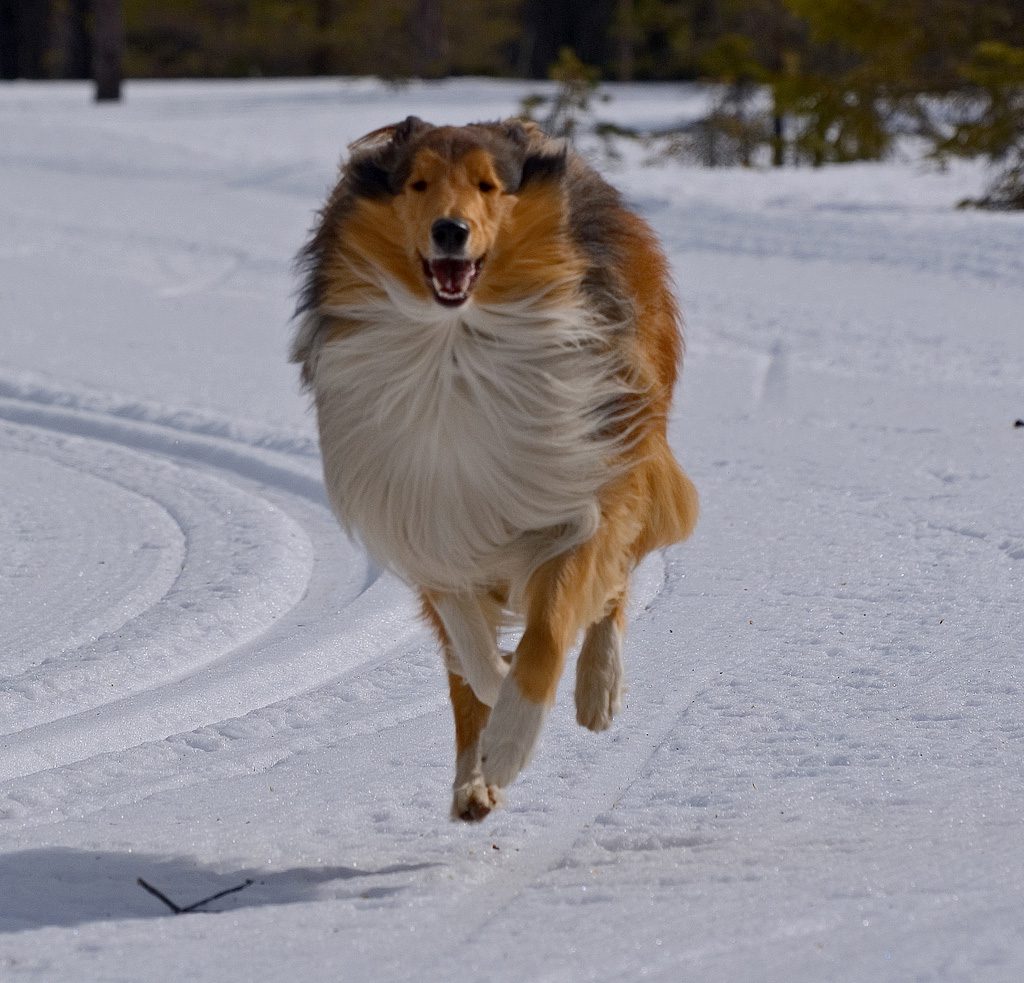
    Criadores de Collie de Pelo Largo o Rough Collie en Espaรฑa

    Where can we find out...

    Collie Club of Spain

    Email: infocollieclub@gmail.com

    Collie breeders list of hair long or Rough Collie recommended and recognized by the Collie Club of Spain:

    Other breeders…

    • Rough Collie Canary (Tenerife). Tel: 697799449.

    Photo: ourworldofdogs.com

    โ–ท The world of Pets: Dogs, cats, birds, reptiles, amphibians

    Cardigan Welsh Corgi
    Gales FCI 38 - Sheepdogs

    Corgi-Cardigan Welsh-de-

    Affectionately called the "garden dog" in his native Wales, the Cardigan Welsh Corgi is active, fun and very affectionate.

    Content

    History

    It is believed that the Cardigan Welsh Corgi It is the oldest of the two races Corgi. Although nobody knows for sure, their ancestors may have come to Wales with the ancient Celts who migrated from Central Europe. The dog we know today comes from the hills of Cardiganshire, that were once full of farms and valleys that were perfect for raising cattle. His predecessors had cattle to market, their heels for cattle moved, and they deviated from the path if cattle drew back.

    Industrialization ended the usefulness of the Corgi on the farm, and people began to cross with other dogs herding breeds, including Collies and the first Pomeranian, which they were much larger than the current standard of Pomeranian. The crossing with Collie You may have thrown the blue merle color to the genetic background of the Cardigan.

    For a while, it seemed that the Cardigan he would go the way of the dinosaurs because he was less popular than his cousin, the Pembroke Welsh Corgi. At any given time, both they were considered the same race, but the Kennel Club separated in 1934, giving the cardigans better chance of surviving on their own.

    Physical characteristics

    The Cardigan Welsh Corgi It is best described as a Pembroke tailed, but it stands out from his cousin, the Pembroke Welsh Corgi, in other respects. The Cardigan has larger, rounder ears and comes in a variety of colors, including tricolor (black and white, with tans or brindle points), blue merle, striped, marten and red. Most Cardis also have white markings on their necks., the chest, paws and tail tip. They weigh between 11 and 17 Kg, which makes them a little larger than Pembroke.

    Although Cardigan and Pembroke Welsh Corgi were developed in Wales, They have different ancestors: twin sons of different mothers, it could be said. The Cardigan, nicknamed the garden dog in his home county of Cardigan, shares ancestors with another long race, the Sausage dog.

    Character and skills

    The fun Cardigan Welsh Corgi it's a classic herding dog: even, loyal and loving. His real goal in life is to spend time and please his people. Its moderate size and activity level make it adaptable to any type of home or family, and it is robust and tolerant of children and other pets. In fact, the company of another dog or cat is a great benefit to him.

    Cardigans may not seem athletes, but they are agile. You will be surprised how fast you can run a Corgi when chasing a ball or compete in agility trials. If you can deviate from the path of mad cow, certainly you can browse frames, tunnels, jumps and other obstacles. Cardi has a lot of resistance, You can even walk the trails, but also it conforms with a short walk or play on the playground.

    Start training your puppy the day you bring him home. Even at eight weeks old, He is able to absorb everything you can teach you. Don't wait until you have 6 months to start train or have to deal with more stubborn dog. If possible, take him to puppy kindergarten class when he's between 10 and 12 weeks, and socializes, socialice, socialice. But, Note that many kinds of training puppies require certain vaccinations (such as kennel cough) stay up to date, and many veterinarians recommend limited exposure to other dogs and public places until puppy vaccinations (including rabies, distemper and parvovirus) They are completed. Instead of formal training, You can start training your puppy to socialize at home and among family and friends until immunizations are completed in the puppy.

    Of course, the Cardigan Welsh Corgi be wary of strangers, thanks to its heritage grazing, so early socialization is important. To counter this trend, invite people to your house, to be used to receive regular visits.

    Health of the "Cardigan Welsh Corgi"

    The Cardigan Welsh Corgi they are a generally healthy breed, but they are susceptible to some health conditions, including intervertebral disc disease and eye problems such as progressive retinal atrophy (PRA) and cataracts.

    Veterinarians can not predict whether an animal will be free from these diseases, so it is important to find a reputable breeder and insist on seeing an independent certification that the parents of the dog have been examined for defects and considered healthy.

    Careful breeders their dogs examined for genetic diseases, and they only breed the best looking specimens, but sometimes Mother Nature has other ideas and a puppy can develop one of these diseases. In most cases, can still live a good life, thanks to advances in veterinary medicine. And remember that you have the power to protect his Cardigan one of the most common health problems: the obesity. It keep a proper weight is a simple way to extend the life of its Cardi.

    Characteristics "Cardigan Welsh Corgi"

    Coexistence is important that you have with your new friend. Before considering the acquisition of a dog of the breed "Cardigan Welsh Corgi" you know certain factors. Not all breeds of dogs are apt to live in an apartment, you must take into account his character, their need for exercise, their interaction with other pets, their care and if you have small children, their level of tolerance towards them.

    Adaptation โ“˜

    5,0 of 5 stars (based on 1 review)

    friendly dog โ€‹โ€‹โ“˜

    3,0 of 5 stars (based on 1 review)

    hair loss โ“˜

    5,0 of 5 stars (based on 1 review)

    Affection level โ“˜

    5,0 of 5 stars (based on 1 review)

    Need for exercise โ“˜

    4,0 of 5 stars (based on 1 review)

    Social need โ“˜

    3,0 of 5 stars (based on 1 review)

    Home โ“˜

    5,0 of 5 stars (based on 1 review)

    Toilet โ“˜

    3,0 of 5 stars (based on 1 review)

    Friendly with strangers โ“˜

    3,0 of 5 stars (based on 1 review)

    barking โ“˜

    3,0 of 5 stars (based on 1 review)

    Health โ“˜

    2,0 of 5 stars (based on 1 review)

    Territorial โ“˜

    3,0 of 5 stars (based on 1 review)

    Cat friendly โ“˜

    5,0 of 5 stars (based on 1 review)

    Intelligence โ“˜

    5,0 of 5 stars (based on 1 review)

    Versatility โ“˜

    5,0 of 5 stars (based on 1 review)

    Child friendly โ“˜

    5,0 of 5 stars (based on 1 review)

    Surveillance โ“˜

    4,0 of 5 stars (based on 1 review)

    joy โ“˜

    5,0 of 5 stars (based on 1 review)

    Images "Cardigan Welsh Corgi"

    credits:

    1 – FatFairfax / CC BY-SA
    2 – Wikimaster97commons / CC BY-SA
    3 – RdRnnr / CC BY-SA
    4 – Blue Merle Cardigan Welsh Corgi by WJ van den Eijkhof

    Videos "Cardigan Welsh Corgi"

    Type and recognitions:

    • FCI CLASSIFICATION:Group 1 –> Pastor and Boyeros dogs (except Swiss Cattle Dogs ) / Section 1 –> Pastor dogs. With working trial.
    • FCI 38
    • Federations: FCI โ“˜, AKC โ“˜, ANKC โ“˜, CKC โ“˜, โ€‹KC โ“˜, NZKC โ“˜, UKC โ“˜

    • FCI breed standard "Cardigan Welsh Corgi"

      Origin:
      Wales

      Date of publication of the valid original standard:
      24.06.1987

      Use:

      Shepherd and companion dog.


      General appearance:

      Robust, rustic, restless, able to resist. Length in proportion to height, ending in a fox tail in appearance, inserted in the body line.

      important proportions:

      The length of the muzzle in proportion to the head 3 to 5.


      Behavior / temperament:

      Alert, active and intelligent. Stable neither shy nor aggressive.

      Head:

      With the appearance and shape of a fox head

      Cranial region:
      • Skull: Wide and flat between the ears; thinning towards the eyes above which is slightly domed.
      • Stop: Moderate.

      facial region:

      • Truffle: black, projects slightly, in no way sharp.
      • Snout: Moderately thinning towards the nose.
      • Jaws/teeth: Strong teeth with scissor bite, that is, the upper incisors closely overlap the lower incisors and are positioned vertically in the maxillae.
        The lower jaw has a clean cut. Strong but without prominence.
      • Eyes: Medium-sized, clean, giving a gentle expression, alert but vigilant. Rather separate set with clearly defined angles. Preferably dark, or according to the color of the coat, dark eyelid edge. One or both pale blue eyes, blue or speckled blue are allowed only on blue merles.
      • Ears: erected, in proportion rather large for the size of the dog. The tips slightly rounded, moderately wide at the base and inserted approximately at 8 cm. (3,5 inches) One of another.
        Carried in such a way that the tips are slightly outside in a straight line drawn from the tip of the nose, through the center of the eyes, and inserted well back so that they can rest flat along the neck.

      Neck:

      Muscular, well developed in proportion to the build of the dog, inserting into well-sloped scapulae.

      Body:

      Quite long and strong.

      • top line: To level.
      • Pork loin: Clearly defined waist.
      • Breast : Moderately wide with prominent sternum. deep chest. Well arched ribs.

      Tail:

      Like a fox tail, inserted in line with the body and moderately long (to touch the ground or close to the ground). Carried low at rest but can be raised slightly over the body in motion, not curved over the back.

      Tips

      Of strong bones. Short limbs but the body must be clearly off the ground.

      Former members
      • Blades: Leaning well back, angled approximately in 90 ยฐ With the humerus, muscular.
      • Elbows: Glued to the sides.
      • Forearm: Slightly arched molding to rounded chest.
      • Front feet: Round, tight, rather large and with good foot pads. Slightly turned out.
      Former members

      Strong, well angulated and aligned with muscular thigh and tibia; strong bones to the ground. Short members.

      • Metatarsals: Vertical when the dog is at rest, viewed from the side and from behind.
      • Hind feet: Round, tight, rather large and with good foot pads.

      Movement:

      Free and active, elbows fit close to the sides of the body, neither loose nor tight. Forelimbs reaching well forward without lifting too much, In unison with the thrust action of the posterior train.

      Mantle

      • Fur: Short or medium, hard textured. Weather resistant, with good under-hair. Preferably straight.
      • Color: Any color, With or without white marks but white
        It should not predominate.


      Size and weight:

      Ideal height at the withers: 30 cm.
      The weight is in size proportion, taking into account primarily the balance sheet.


      Fouls:

      Any deviation from the aforementioned criteria is considered a fault and its severity is considered to the degree of deviation from the standard and its consequences on the health and well-being of the dog and the dog's ability to perform its traditional task..

      disqualifying fouls:

      • Aggressiveness or extreme shyness
      • Any dog โ€‹โ€‹showing clear physical or behavioral abnormalities must be disqualified..


      N.B.:

      Males should have two normal-appearing testicles fully descended into the scrotum..

      Source: F.C.I - International Cynological Federation

      Alternative names:

      1. Cardigan, CWC, Cardi (English).
      2. Cardigan (French).
      3. Cardigan (German).
      4. Cardigan Welsh Corgi (Portuguese).
      5. Cardigan Welsh corgi, Cardi, Corgi (espaรฑol).

    โ–ท The world of Pets: Dogs, cats, birds, reptiles, amphibians

    The Collie and its different lines

    El Collie y sus diferentes lรญneas

    Content

    Meaning of the term Collie

    The term Collie It refers to many dog breeds that have originated in Scotland and Northern England. The exact origin of the name is unknown. It is possible that it comes from:

    • The term 'Colโ€™ o โ€˜Collโ€™ from Old Scots meaning โ€˜blackโ€™.
    • Or from English'coalโ€™: 'Coal'.
    • As well, It is possible that it is a deformation of the word Colley It was as they called the sheep (face and Black-legged), These dogs pastoreaban.
    • The Anglo-Saxon regional term collie, which means '[thing] usefulโ€™.
    • So it has been called in several ways: Coll, colly, collie, Colley, Pastor of Scotland

    The Shetland Sheepdog, for example, It is erroneously called Collie miniature, While aesthetically (with the exception of the size) they are identical, they are two different races… Though, We should not forget that, the most direct ancestor of the Shetland Sheepdog or โ€œSheltieโ€ as they are often nicknamed, is the Border Collie.

    Collie breed history

    The high mountains of Scotland are the natural home of this breed. It is not known if you run Roman blood in his veins, but we do know that the Romans conquered Scotland in the sixth century BC.. C. Then, the Collie was known for his great abilities of grazing, capable of driving up 500 sheep at a time. Unlike the current Collie, I didn't have such long and beautiful hair. The Collie was crossed with Setter Irish and with the Borzoi, and from there he was obtaining the characteristics of the Collie of today. William Shakespeare wrote about this dog, calling it Collied Ski. The first illustration of this breed dates back to the year 1790.

    While collies have used this dog for a long time and since the beginning of the race, as ovejero dog, the different forms varieties were developed in England at the end of the 1800.

    The ancient race Collie was referred to as Scottish Collie in the nineteenth century and beginning of the twentieth century. Scottish Collie were heavier than the current. Their modern ancestors were exhibited for the first time Scotch Sheepdogs (foresee Scots) in 1860, in Birmingham (England), in a dogshow.

    In the 19th century, this breed was not well known yet, but with the first dog shows, its popularity began to grow to their highest point. Today remains one of the breeds of dogs most popular. South Africa still used as pastor, but in this case, large flocks of ostriches, his sense of monitoring is very developed.

    Lassie, the character of the television that popularized this race, is a Rough Collie.

    Collie dog has two varieties. The first is the Rough Collie, more easily recognizable due to its extensive use in movies and television (e.g.: Lassie). This variety has pretty hair in neck, tail and legs. It has a double cover, with small hairs lining the body. The second variety is the Smooth Collie, It has two coatings but the outer coat is short and smooth.

    Collie breed characteristics

    Collie dog has long body in relation to height. Its height of cross is of 56 to 61 cm. the male and 51 to 56 cm. females. They weigh in 18 to 29 kg. He has Brown eyes, almendrada and slightly oblique way. Their ears are small and are played back, or forward when the dog is alert. The snout is long and flat, with black truffle. Its tail is long and abundant hair, and the fur is dense, hard to the touch, soft and bright if it is taken care of very well. It can be color caramel and white, tricolor or blue dark. This dog's life expectancy is of 12 years.

    Collie dog character

    Healthy by nature, It is also known that he has very few known congenital problems. The most delicate part of the body tends to be your eyes, they should be frequently cleaned through a piece of absorbent cotton impregnated simply with warm clean water.

    Known to be sweet and protective. They are easy to train due to her intelligence and innate please desire. They develop a very strong bond with their masters.. They are excellent foresee dogs, good company for family and other dogs. They are very loyal and faithful, although they are wary of strangers if they don't like them. They are also very playful and love to children. She loves to charge monitor children. It is sweet, good very attentive and vigilant: a suitable dog to leave a child in his charge. With babies is treated as a stuffed animal, and a baby can learn to walk if he grabs her hair. This dog will be careful to avoid it to fall. It also, It will avoid that the baby will go with strangers.

    On the beach, It will be devoted to monitoring the smallest, and if something happens, They cry or fall, do not hesitate to act. He does not fear nothing. It is not a fearful or timid dog. In case of danger, defends the family. And it is able to stay a whole night warning, to pounce to lower noise. Every time that the members of the family discuss, It stands always because he hates disputes.

    Before a rebuke sometimes it can be susceptible, and away to a corner to grumbling. But if the owner gets to look for him there is nothing spiteful: jump to your arms. It is active and disciplined. You must be educated with affection and without resorting to force.

    Collie breeds ancestry

    There are many breeds of dog with Collie ancestry, as for example, to get an idea…:

    • Australian dog: used in Australia for cattle raising. Dogs of this type are also known as Queensland Heeler, Blue Heeler and Red Heeler. Heeler, means "heel".
    • Collie de Australia or ยซBordaussieยป: It is not really a recognized breed, but a cross between two popular breeds: Australian Shepherd and Border Collie.
    • Australian Kelpie: Developed in Australia from Collie dogs brought over from Scotland and the North of England. prick ears, shorthair, usually black, black and brown or red and Brown and white feet.
    • Australian Shepherd: Developed in United States, with crossing of British dogs, German and Spanish, but they are in other parts of the world (including Australia).
    • Stumpy Tail: Used in Australia for cattle raising. erect ears, shorthair, mottled grey or red without white. With a very short tail or no tail.
    • Bearded Collie: Now largely animal home and exhibition, but are still used as working dogs on farms. Long and silky hair (included in the face and legs), color negro, grey or beige, and white on the shoulders.
    • Blue Lacy: Gris, shorthair, floppy ears. Derived in part from English Pastor, with other races that descend from the Collie but aren't Collie.
    • Border Collie: The most famous race for grazing sheep around the world. Originally developed in Scotland and Northern England. According to the classification made by Stanley Coren after analyzing the responses of more than 200 work of the AKC judges ("The Intelligence of Dogs", Stanley city, Ediciones B, 1995), the Border Collie is the No. 1 from the list.
    • Cumberland Sheepdog: An extinct breed similar to the Border Collie and, possibly, absorbed by this race. An ancestor of the Australian Shepherd. Ears erect or semi-erectas, dense fur, Black with white only on the face and chest.
    • English Shepherd: Developed in United States from a farm Collie originating in Great Britain. It should not be confused with the old English Pastor.
    • Farm Collie or farm Collie: It was any dog grazing is encuontraba for farming in Britain or United States (descendants of British dogs), and perhaps in other places.
    • German Collie: Developed in Australia, probably from British Collie dogs, but they may have included Germany and Spain dogs. The name "German Collie" is also applied to a cross between a German Shepherd and Border Collie).
    • Huntaway: New Zealand developed from a mixture of races, probably including some Collie – but it is not a breed of the Collie type. It is larger and more stout than most Collies..
    • Warren hound: It is not a race, but a Collie cross (or other grazing or Terrier dog) with a hound or Greyhound. Obtained in a traditional way for poaching, with the speed of a hound, but more obedient and less visible.
    • McNab Shepherd: Developed in United States from British Collie dogs. Ears of variable size, upright or semi-erectas, shorthair, black or red, usually with some white on the face and chest.
    • Old English Pastor: Derivative of the ancestors of the Collie Barbudo. They are bigger than most Collies, with a lack of tail, hair is long and silky (included in the face), usually grey and white. It should not be confused with the English Shepherd.
    • Scottish Collie, in its two varieties, Rough Collie and Smooth Collie: They were created by crossing dogs working with other races Collie (especially dogs Borzoi).
    • Shetland Sheepdog: comes from the Shetland Islands (Scotland, United Kingdom), intentionally was raised in small size. At first sight, It seems to be a copy of miniaturized hair long Collie, However, are 2 different races with a similar look.
    • Smithfield: a breed of British dog that has been terminated, It was like a great Collie, strong, white or black and white color that is used to guide cattle in South East England, especially the Smithfield market (an area of the city of London).
    • Welsh Sheepdog: a native of Wales. Ears erect or semi-erectas, short or silky hair, red, black, black and fire or Blackbird, usually with white over shoulders.

    Collie dog breed lines

    According to the type of coat, the different lines of Collie have been born., among them are:

    1 Border Collie

    Border Collie

    The Border Collie is regarded as the breed of smarter dogs que existe

    The Border Collie takes its name from the region of Borders, the border region between Scotland and England,

    ... Read more

    2 Bearded collie

    Breeders of bearded Collie or Bearded Collie in Spain

    The Bearded collie It is an energetic dog. They need exercise and homework to do, How to care for children.

    The Bearded collie It is a breed of dog of medium size and long coat, que originalmente fue

    ... Read more

    3 Smooth Collie

    Smooth Collie

    The Smooth Collie, today it is considered a variety of Border Collie in countries such as the United States and Canada

    The Shorthair Collie is a breed of dog originally developed for grazing. With

    ... Read more

    4 Rough Collie

    Rough Collie

    The Rough Collie he is a very sweet and affectionate dog, maybe a little shy.

    The Rough Collie is one of the Collie breeds de tamaรฑo medio y pelo

    ... Read more