Content |
|---|
Characteristics "Mandalay Cat"
Coexistence is important that you have with your new friend. Before considering the acquisition of a cat of the breed "Mandalay Cat" you know certain factors. You must take into account their character, their need for exercise, their interaction with other pets, their care and if you have small children, their level of tolerance towards them.
Joy5,0 of 5 stars (based on 1 review)
|
Activity level5,0 of 5 stars (based on 1 review)
|
Friendliness to other pets4,0 of 5 stars (based on 1 review)
|
|---|---|---|
Friendliness to children4,0 of 5 stars (based on 1 review)
|
Grooming requirements2,0 of 5 stars (based on 1 review)
|
Vocality2,0 of 5 stars (based on 1 review)
|
Need for attention4,0 of 5 stars (based on 1 review)
|
Affection towards its owners5,0 of 5 stars (based on 1 review)
|
Docility4,0 of 5 stars (based on 1 review)
|
Intelligence4,0 of 5 stars (based on 1 review)
|
Independence4,0 of 5 stars (based on 1 review)
|
Hardiness4,0 of 5 stars (based on 1 review)
|
History
The Mandalay originated in the decade of 1980 in New Zealand.
A cream-colored female from the hatchery of American Burmese cat of Dorothy Horton and Pat Hogan, in the south of the country, crossed paths with a red shorthair cat. The kittens she gave birth were a beautiful deep red color with very shiny fur.
At the same time, in the north of the country, a female American Burmese from another breeder named Jan Parson crossed paths with a black cat. The kittens that were born were jet black with shiny fur.
The three breeders realized that the kittens they got from each other had very dark and deep colors that made them beautiful.. They were so fascinated that they decided to try to create a specific breeding program together..
They kept crossing American Burmese with brightly colored street cats, and they began to call the kittens obtained darker in color and totally solid, Mandalays, and raise them together. On the other hand, those that had a less intense color and whose external face (back, head, flanks and outer part of the legs) it was darker than the inside face (belly and inside of the legs) they kept calling each other burmese. So, a litter could contain both kittens Mandalay as burmese.
The breeding program accelerated when other breeders joined Jan Parson, Pat Hogan and Dorothy Horton. Dorothy Horton wrote the first rule of Mandalay. Since then, enthusiasts fought for the breed to be recognized by the New Zealand Cat Fancy (NZCF), the official feline organization of the country. His efforts were eventually successful in 1990. As a result, from that year, kittens with strong, solid color were recorded as Mandalays on the NZCF Pedigree Cat Register.
Breeders also tried to expand the color palette, which was initially limited to solid colors (black ebony, bronze blue, dark brown chocolate, cinnamon, leonado, red, cream, caramel and apricot). They also developed the brindle pattern. These advancements were later updated in the standard.
But, for many years, New Zealand was the only country that bred the Mandalay. Was not up 2013 when Australia joined the ranks of breeders, where a breeding program was also created. In the absence of imports from New Zealand, the program began with the breeding of Burmese and British Shorthairs. Next, breeders crossed the Mandalay obtained from the first matings with Burmeses.
Just two years later, in 2015, the Mandalay was recognized by the Australian Cat Federation (ACF) and the Australian Cat Control Council (CCCCA).
At the same time, in New Zealand, the gene pool of Mandalay had been depleted due to the low number of offspring since the creation of the breed. Jan Parson, Pat Hogan, Dorothy Horton and the other breeders who had been responsible for the development of the breed decided to create an experimental program, NZCF approved, to reintroduce matings similar to those that had given rise to the breed, that is to say, Burmese cat matings with dark, intense, short-haired stray cats. But, in the second generation, a large number of individuals had a problem with congenital hypothyroidism. This fiasco led to the decision to sterilize all the cats participating in the program., thus putting an end to it.
But, the problem persisted: they had to find a solution to expand the gene pool of the breed. In 2018, asked the NZCF for permission to import a Mandalay from australia. The NZCF granted the permit and the following year Bahati Outrageous Fortune, A male Mandalay ebony, was brought from Australia to help develop the breed in New Zealand. As the gene pool of the Mandalay in Australia it was also extremely limited, only one individual could be imported.
Recognition of the «Mandalay»
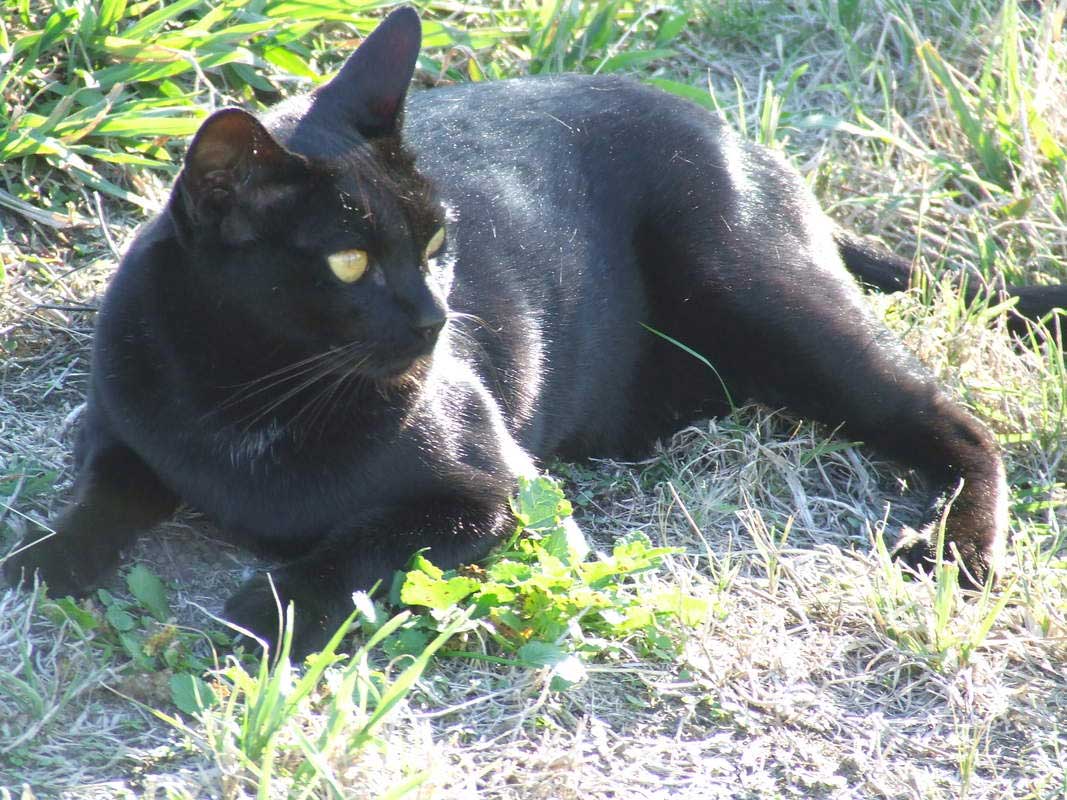
The Mandalay it is a very rare and very unknown breed of cat. Its breeding began in New Zealand at the end of the 20th century., and developed in Australia some twenty years later. But, remains limited to these two countries and has not spread beyond.
This explains that, outside these two countries, the breed is not recognized by the different national or international organizations. These may include, not even Fédération Internationale Féline (FIFé), not even International Cat Association (TICA), not even American Cat Fanciers’ Association (CFA), neither him British Governing Council of the Cat Fancy (GCCF), neither him Livre Officiel des Origines Félines (LOOF) French recognize the Mandalay.
There is little chance that this will change in the future. In effect, on the one hand, the breed's population is still very limited, And on the other hand, is competed by the Bombay cat: this cat that also descends from American Burmese cat is extremely close to Mandalay, and it is already accepted by these organizations. It is not very plausible that the latter recognize two races so similar, as this could lead to confusion.
But, the Mandalay is recognized by the reference organizations of its two countries of origin: the New Zealand Cat Fancy (NZCF) from 1990, the Australian Cat Federation (ACF) and the Co-Ordinating Cat Control Council of Australia (CCCCA) from 2015.
Popularity of «Mandalay»
The development of Mandalay has been limited to New Zealand and Australia.
Even in these countries, its dissemination remains confidential. There are no statistics that give an idea of the population size of the breed, but it is very limited, just like your gene pool, which obviously also hampers any significant and rapid progress. In any case, in each of these countries there are less than a dozen breeders of Mandalay.
Regarding the geographical distance of these two countries with respect to Europe and North America in particular, obviously does not facilitate the development of the breed in the rest of the world, both then and now. The Bombay cat, developed by American breeders and also a descendant of the American Burmese cat, then i would be on my way. The Bombay is very close to Mandalay, although the two races are not strictly identical: the Bombay has a totally black coat and a slightly longer body.
So, the development of Mandalay outside of Oceania is not easy, especially since his future is uncertain even in his homeland. In fact, if New Zealand breeders cannot find a solution to expand the breed's gene pool, This can end up being affected by numerous health problems caused by excessive inbreeding.
Physical characteristics
"Mandalay Cat" |
||
|---|---|---|
 | ||
The lines Mandalay New Zealand and Australian are quite different, since until 2019 the first specimen was not exported from one country to another. But, its appearance is quite similar, except for the brindle pattern of the coat.
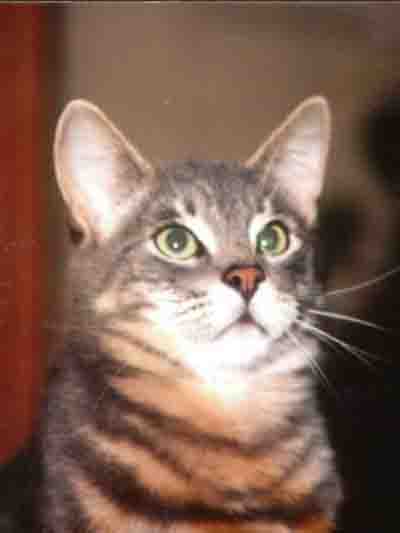
On the other hand, whatever the country of origin, the Mandalay looks the same as his ancestor the American Burmese cat, except for the fur and the color of the eyes. The coat is darker than that of the American Burmese and completely solid, while the eyes go only from golden yellow to amber and should be intense.
On both sides of the Tasman Sea, it is a semi-linear cat of medium length and height. Its body is built around a strong, rounded chest, but its elegance is due in part to the fact that its strong muscles remain harmonized. But, the latter implies that it is heavier than it seems.
The back is flat between the shoulders and the rump, then continue with a straight tail of moderate length, that tapers and ends in a rounded tip.
The legs they are muscular, slim and well proportioned to the rest of the body. Hind legs are slightly longer than front legs. Both end in well defined oval feet.
The head rests on a neck moderately strong muscular. Profile, presents a concave curve between its upper part and the lower jaw. The skull is slightly rounded, then there is a clear break between the slightly rounded forehead and the straight nose.
The ears, well spaced on top of skull, are medium in size and slope slightly downward when viewed in profile. They are wide at the base, with rounded tips. Some kittens are born with oversized ears, but this disproportion disappears as they grow.
The eyes they are far apart, they are big and bright. His topline is straight and slopes towards the nose, while its bottom line is rounded. Its color ranges from golden yellow to amber, the latter being the most sought after.
The cheekbones they are wide and end in a wedge in the muzzle. In men, can become prominent with age. But, the jaw is strong and the chin is firm.
The Mandalay has hardly any undercoat, but has a short thin top coat, distinguished by its silky texture and very shiny appearance. This sheen is a sign of good health and is the most prominent feature of the breed., that gives it both grace and beauty.
The the fur color is solid: may be black ebony, bronze blue, dark chocolate brown, cinnamon, leonado, red, cream or even caramel with its apricot hue. In all cases, some rare and scattered white hairs tolerated.
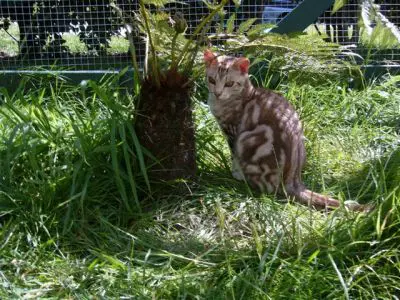
The coat can also have a tortoiseshell color (a mixture of red and black) and a brindle pattern. But, the latter is only accepted in New Zealand, not in australia.
Size and weight
- Male weight: Of 3 to 6 kg
- female weight: Of 3 to 6 kg
“Mandalay” varieties
"Mandalay Cat" |
||
|---|---|---|
 | ||
Since the beginning of the decade 1950, approximately 30 years before breeders in New Zealand and Australia developed the Mandalay, others based in the United States and Canada developed the Bombay cat.
The Bombay is a cross between the American Burmese cat and the American shorthair cat and is recognized by the Cat Fanciers’ Association américaine (CFA) and the Canadian Cat Association (CCA). Like the latter, his temperament is similar to that of American Burmese, and their physical characteristics are also very similar. The only differences are the smooth, darker coat and the intense color of the eyes, ranging from golden yellow to amber.
But, there are some differences between the Bombay cat and the Mandalay. In particular, the Bombay it has a slightly longer body and its fur is only black.
It has spread much further than its Oceanian cousin, and is especially known in Europe. This explains that it is recognized, among others, by the influencer Governing Council of the Cat Fancy (GCCF) British. But, the GCCF does not consider it a breed in its own right, but simply a variety of Asian cat, which in turn is the result of matings between the European Burmes cat and the Persian cat. It also, the organization only accepts black ebony cats.
In France, the Livre Officiel des Origines Félines (LOOF) combine the Bombay cat and the American Burmese cat in the same standard. The organization distinguishes between the latter and the European Burmes cat, also known as Burmese English. The differences are physical: the American has a rounder head and a slightly more robust body.
In any case, organizations such as the CFA are unlikely, the AFC, and GCCF, the LOOF and all other organizations that recognize the Bombay cat do not end up also recognizing the Mandalay as a race in its own right, since these two cats are very similar. Recognizing them both and considering them as two different races would probably lead to confusion.
Character and skills
The Mandalay has inherited the temperament of his ancestor the American Burmese cat.
So, it is an ideal cat for a family, since he especially appreciates the presence of humans around him. He is usually very kind and affectionate with them.
They especially like to play with children, and they are excellent playmates, enthusiastic and energetic; the reverse is also usually true. He is very tolerant of them, but that does not mean that there are no risks on both sides. So, just like any other cat, should never be left alone with a young child: their interactions should always take place under the supervision of an adult.
To the Mandalay loves to be petted and has a great need for recognition, so it requires a lot of attention. It can even be a slightly clingy cat, who does not hesitate to follow their masters wherever they go and sit: in the kitchen, in front of the tv… You can also chat with them and be chatty, but their meows are soft and not loud, unless you want to reproach a lack of attention.
"Mandalay Cat" |
||
|---|---|---|
 | ||
In other words, it's perfect for anyone who wants maximum interaction with their little friend. On the other hand, it is much less suitable for people who are away from home often or for long periods. They find it very difficult to tolerate being away from their family, especially if it is for long periods. They soon become anxious and develop behavior problems such as excessive licking, meows or even aggressiveness. Leaving several games at his disposal at those times helps to alleviate his discomfort., but the ideal is that you even share your home with another animal, either a companion or a cat-friendly dog. In fact, this ensures that you are never alone.
This coexistence is all the more feasible since this little feline is not aggressive for a penny. So, usually maintain peaceful relationships with their alter egos, as well as with dogs, at least, of course, those who can tolerate the presence of a cat. Things go better if the two partners are used to living together from an early age. If that is not the case, it is better to introduce them little by little, so that they get used to it and find their place.
In any case, that he lives under the same roof as a small rodent or a bird is a completely different story. In fact, his well-developed hunting instinct could turn the experiment upside down at any moment. If you come into contact with such a small animal, it is better to keep it in a cage or in a separate room to limit the risk of accidents.
Regarding the unknown humans entering their domain, not the type to be very suspicious of them. On the other hand, if you feel comfortable with them, it is very likely that you will approach them and ask for their attention. Having said that, even if it's not fearful, it is still essential that you have a cat tree to lean on to observe your little world, or just to rest.
Grooming and caring for the "Mandalay Cat"
"Mandalay Cat" |
||
|---|---|---|
 | ||
The beautiful silky and satin coat of the Mandalay does not require complicated maintenance, especially since it has practically no undercoat. Brushing once a week is enough to remove dead hairs and give it a new shine.. But, during its annual molting period, it is better to brush it two or three times a week.
You should also check his ears once a week. Cleaning them with a damp cloth will remove impurities and reduce the risk of infection..
The weekly maintenance session is also an opportunity to check the eyes. If they are dirty, cleaning them with a damp cloth will also reduce the chance of an infection.
Brushing your cat's teeth is important to all breeds, but even more so for him Mandalay due to its predisposition to gingivitis. Do it at least once a week (and ideally every day) helps prevent plaque build-up, which can cause all kinds of more or less serious diseases by turning into tartar. It is necessary to systematically use a toothpaste designed specifically for cats.
Last, Once a month, you need to check the length of your claws, especially if you live indoors. In fact, if they get too long, they can break, annoy or harm you: Trimming them manually when necessary helps avoid these types of problems. Even for a person with access to the outside, this check is necessary, as natural wear and tear may not be enough. It also, these cares do not exempt you from providing your cat with a scratching post.
coat care, the ears, the eyes, the teeth and claws of his Mandalay does not require any special skills. But, to adopt the correct gestures and avoid injuring or traumatizing your cat, it is best to ask a veterinarian or professional cat groomer for advice the first time. In any case, It is essential to accustom your pet to these grooming sessions from a young age, so they are part of your routine and don't get recalcitrant.
In fact, once the owner has learned to carry out the different treatments, these moments can even become privileged moments of caresses and pampering. In fact, the Mandalay is always delighted to receive attention and affection, and does not hesitate to show it with small meows.
Indoor or outdoor cat?
Ideally, you should live in a house with a garden that you can access at any time through a cat flap when you feel like running. Curious, he loves to frolic, climb and hunt. They do not hesitate to leave their domain to follow a prey, but then they return quite naturally to their cozy nest.
If the outside is too dangerous to let you run free, you can walk him on a leash: generally does well if you get used to it from a young age, and thus it is avoided that it is enclosed between four walls.
How much activity does he need? "Mandalay Cat"?
Playing with their masters is also an activity that they love, In addition to stimulating you physically and mentally. His intelligence makes him an ideal candidate for anyone who wants to teach their cat tricks.. You can also test yourself through various interactive games that allow you to develop your skills.
In any case, whether your living environment is confined indoors or you have access to the outdoors, the Mandalay you need to have a scratching post at your disposal, like any of his classmates. Scratch is a compelling urge that cannot be denied. If there are no facilities for it, will not hesitate to turn to furniture.
Health and nutrition

The Mandalay has robust general health.
It also, is able to adapt to all climates. But, the lack of undercoat makes me afraid of drafts. Thus, in winter it is necessary to protect it from drafts to prevent it from catching a cold.
It also, like any breed of cat, are more likely to suffer from certain health problems. In this case, is the same one that his ancestor is predisposed to American Burmese cat:
- Congenital endocardial fibroelastosis, characterized by thickening of the muscular walls of the heart leading to heart failure. The affected individual is easily out of breath, tires quickly and sometimes coughs. If it is not possible to solve the root problem, at least it is possible to improve the comfort of the animal with a lifelong medication that limits the symptoms;
- The Hypertrophic cardiomyopathy, which is the result of an enlarged heart that causes a decrease in the volume of blood circulating through the body. This causes the typical symptoms of heart failure: intense fatigue, weightloss, breathing difficulties, loss of appetite, etc. Several causes are possible (hereditary origin, nutritional deficiency, etc.), and the prognosis is usually bad. But, various pharmacological treatments allow the affected animal to gain a few months - or even years- of life;
- The Mellitus diabetes, an endocrine disease caused by insufficient insulin secretion, leading to high blood sugar levels. Then the cat begins to eat and drink more and lose weight.. The only effective treatment is regular insulin injections throughout the cat's life;
- hypokalemic myopathy, that usually appears between the second and the tenth month of age. It is caused by low potassium levels in the blood and manifests as general weakness, muscle pain and motor difficulties. Treatment with potassium supplements and diet adjustment is enough to solve the problem.. However, a risk of recurrence cannot be excluded;
- The peripheral vestibular syndrome, a congenital abnormality of the inner ear. In this case, the kitten keeps its head bowed, have problems with motor coordination and involuntary eye movements and, in some cases, he's even deaf. The problem usually resolves itself when the animal grows;
- The flat rib syndrome in kittens it is a hereditary disease in which the rib cage is deformed. The rib cage is flattened from birth, and is even hollowed out in the most severe cases. This causes both shortness of breath and hyperventilation., which causes reduced blood flow and can lead to syncope. This deformation can be fatal, but individuals who reach adulthood are saved and manage to live with it;
- Bent tail, congenital and hereditary malformation that causes the tail to twist in the cartilage. But, it is not dangerous or incapacitating for the animal: the only consequence is aesthetic;
- The elbow osteoarthritis, a degenerative disease, progressive and irreversible. It corresponds to a progressive destruction of the cartilage of the joint., that loses its role as a buffer. This causes pain that leads the cat to restrict its movements to avoid suffering, or even lethargy. But, it is possible to improve the cat's quality of life with analgesic and anti-inflammatory treatments that slow down the progression of the disease;
- The orofacial pain syndrome, a very rare disease that can be inherited. Causes the animal to lick and chew excessively. Sometimes it is even very painful to feed. No treatment, but it is possible to stop the symptoms with analgesics or antiepileptics. It is also advisable to put a collar on the cat to prevent it from licking;
- Lipemia of the aqueous humor of the eye, which only affects kittens and is characterized by the milky appearance of the eye. It is only temporary and resolves itself;
- Dermoide corneal, congenital and hereditary malformation, characterized by the presence of cutaneous tissue in the conjunctiva and cornea. This irritates the conjunctiva and weakens the cornea.. This can be remedied with surgical intervention.;
- The gingivitis, which is an inflammation of the oral mucosa caused by the accumulation of tartar on the teeth. The cat has bad breath, suffers, has difficulty eating and can no longer wash. Next, scraping and polishing required (always under general anesthesia), which may be accompanied by a treatment with antibiotics or anti-inflammatories;
- Allergic reactions to products used during anesthesia. So, if it is necessary to carry out an operation of this type, it is always advisable to make sure that the professional is aware of this particularity.
In addition to these various conditions, the Mandalay also has a tendency to overweight, yes no to obesity. Obviously, the risk is especially pronounced for people who live exclusively indoors and are not very active. Not a problem to be taken lightly, as it can aggravate existing diseases or cause new ones.
Taking into account the high number of hereditary diseases to which the breed is predisposed, the interest in adopting a Mandalay from a serious breeder who carefully selects his breeders. In effect, Systematically excluding from breeding individuals with a disease that can be transmitted to their offspring significantly reduces the risk of obtaining kittens carrying these diseases.
It also, a good breeder ensures that kittens are well socialized from an early age and that they grow up in a suitable environment, so that they are not only healthy, but have a good head and legs. It also, must be able to present a certificate of good health issued by a veterinarian and a vaccination or health record that contains the vaccines administered to the animal.
From the moment the pet is adopted, the new owner is responsible for his health throughout his life. In particular, the new owner must take the animal to the vet at least once a year (and even more often as the animal ages) for a complete health check. This allows any health problems to be detected as soon as possible and, if required, treat it in the right conditions. This appointment is also an opportunity to carry out any necessary booster shots..
Last, the owner must take care to protect his cat from parasites by repeating his antiparasitic treatments as many times as necessary, throughout the year. This is especially important for a cat that spends most of its time outside., but it is also necessary for a cat that lives indoors, since it is not completely safe from the risks.
Life expectancy
10 to 17 years
Food
Like all its fellow men, the Mandalay requires a diet that meets your nutritional needs, both qualitatively and quantitatively. Must suit your age, your level of physical activity and your health status.
His propensity to overweight, or even obesity, forces a certain vigilance. In effect, his greed makes it difficult for him to regulate himself: contrary to what is possible - and even desirable- with many other cats, it is better to avoid giving him free access to his food. So, it is advisable to opt for meals given at fixed times, and show some rigor in determining your daily ration.
Industrial cat food is perfectly suitable for your needs, but human food rarely is, unless carefully selected for that purpose. Of course, to the Mandalay loves attention and won't hesitate to ask for a bite during the meal to join the feast. But, attention and food are two different things: it does you no favors to respond to this type of request, Nor does letting him finish the table scraps or rummage through the trash. This is especially true because some foods that humans enjoy are toxic to little felines..
The trend of Mandalay obesity makes it essential to control your weight at least once a month. If a slippage is evident - or even worse- during several successive weighings, it is necessary to visit the vet. Only a healthcare professional can diagnose the cause of the problem: improper diet, disease, side effect of a medication, etc. Once the cause is identified, can indicate how to remedy it.
It also, like all his peers, the Mandalay you must have fresh water at all times, regularly renewed.
For sale "Mandalay Cat"
Despite having a very limited gene pool, the breeding of Mandalay is trying to develop in New Zealand and Australia, but the breed is completely unknown abroad.
In New Zealand, your country of origin, there are just under a dozen breeders across the country. They sell their kittens for between 800 and 1800 New Zealand dollars (between 450 and 1000 EUR).
In Australia, the number of breeders is of the same order of magnitude. Adopt a kitten Mandalay costs between 700 and 1600 Australian dollars (between 400 and 1000 EUR).
whatever the country, there are big price differences between one and the other. Can be explained by the reputation of the farm, the line from which the animal is descended or its intrinsic characteristics, especially in terms of his physique. This last point is the one that explains why prices can vary even within the same litter..
In any case, the small number of breeders makes the choice relatively limited and it is necessary to wait several months before being able to adopt a representative of the breed.
If the breed is to be repatriated to a country other than the country of origin, It must be taken into account that transport costs and administrative costs will be added to the purchase price. It also, it is essential to know the legislation regarding the importation of animals in the country in which you reside and, of course, respect her, to avoid unpleasant surprises.
Videos "Mandalay Cat"
|
|
httpv://www.YouTube.com/watch?v=HeULycaE–c |
|---|

 Not recognized by the FCI