โ–ท The world of Pets: Dogs, cats, birds, reptiles, amphibians

Bull Terrier
Gran Bretaรฑa FCI 11 . Bull type Terriers

Bull Terrier

The Bull Terrier they are generally friendly, rarely aggressive.

Content

History

The original ancestor of Bull Terrier was bred in the early 19th century from a cross between the English Bulldog and terriers. The dog served as a biter for bulls and badgers and was also used in dogfighting. Although its use as a fighting dog was already banned in 1835, the breed still struggles with its fighting dog image today. Completely contrary to the omnipresent opinion the Bull Terrier developed in the course of the 19th century as a popular family dog รขโ‚ฌโ€นรขโ‚ฌโ€นof the English middle class. The nervous and friendly Bull Terrier lived with families in large areas and served as a guard dog and to hunt vermin.

In 1850 the animal trader James Hinks ensured official recognition of the breed. At the end of the 19th century, the Bull Terrier white in color were for a time the status symbol of the English nobility. For a more elegant appearance and a less fizzy character, they crossed paths with Dalmatians and Pointer. Only after the end of World War 2 did the British return to breeding Bull Terrier of different colors. From the beginning the breed was bred in different sizes and today the Standard and the Bull Terrier Miniature are distinguished as independent breeds. Recognized by the Fรฉdรฉration Cynologique Internationale, the Bull Terrier Belongs to the group 3 FCI, of the Terrier. Here it is assigned to the section 3 as Bull type Terriers.

Physical characteristics

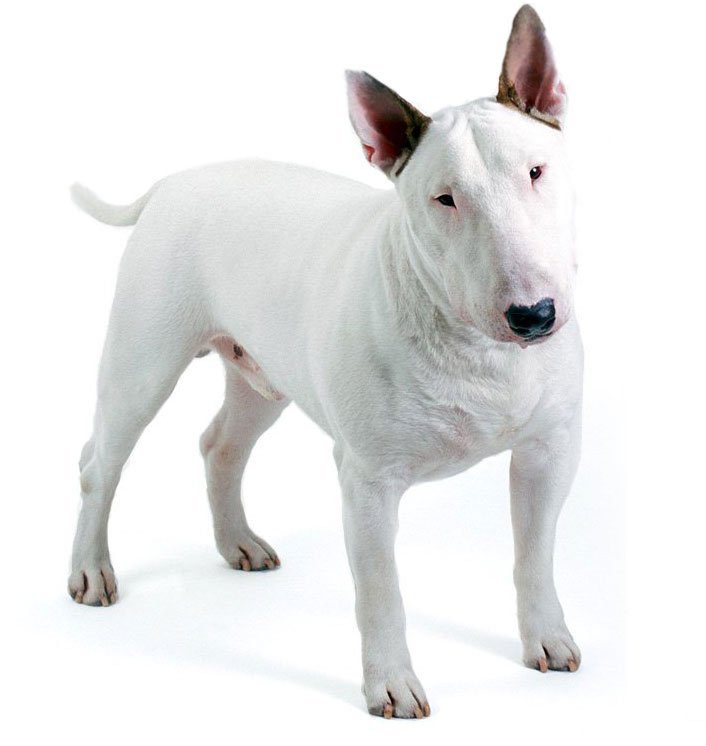
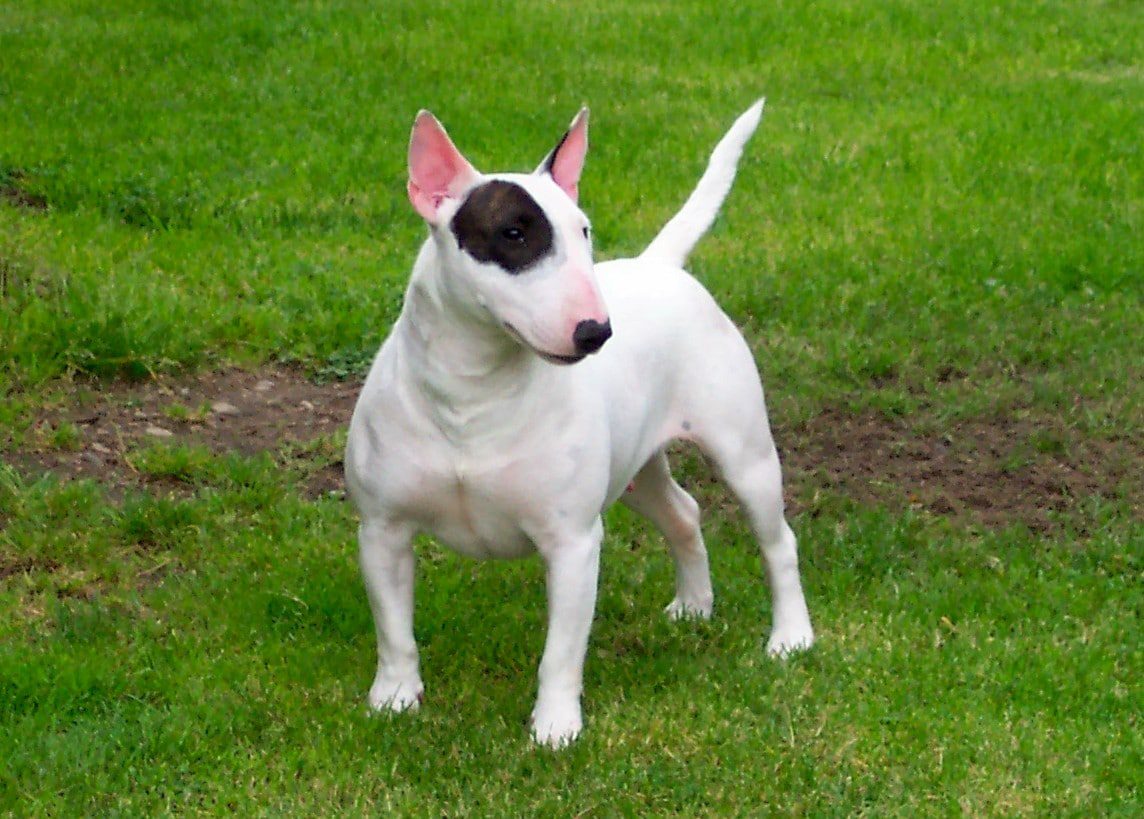
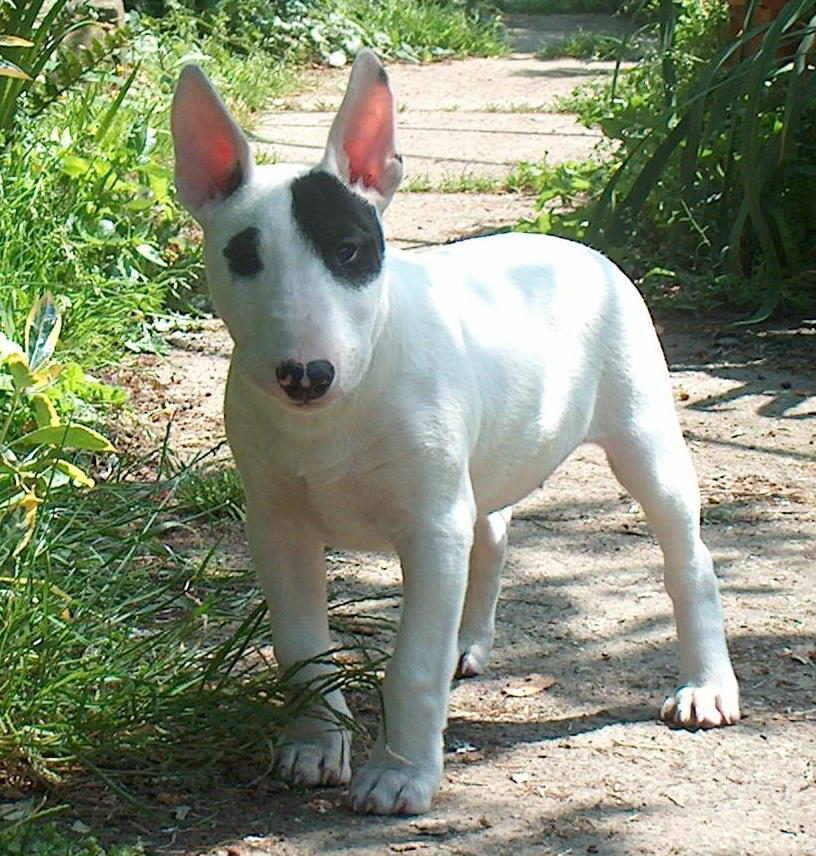
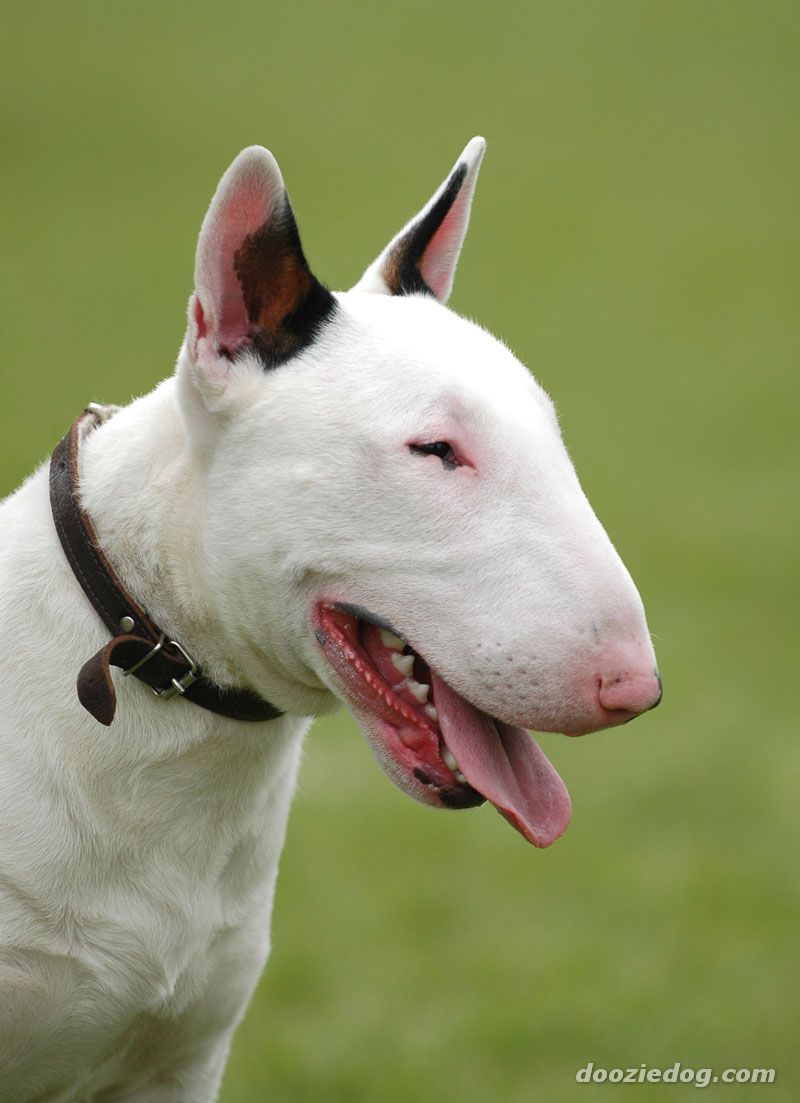
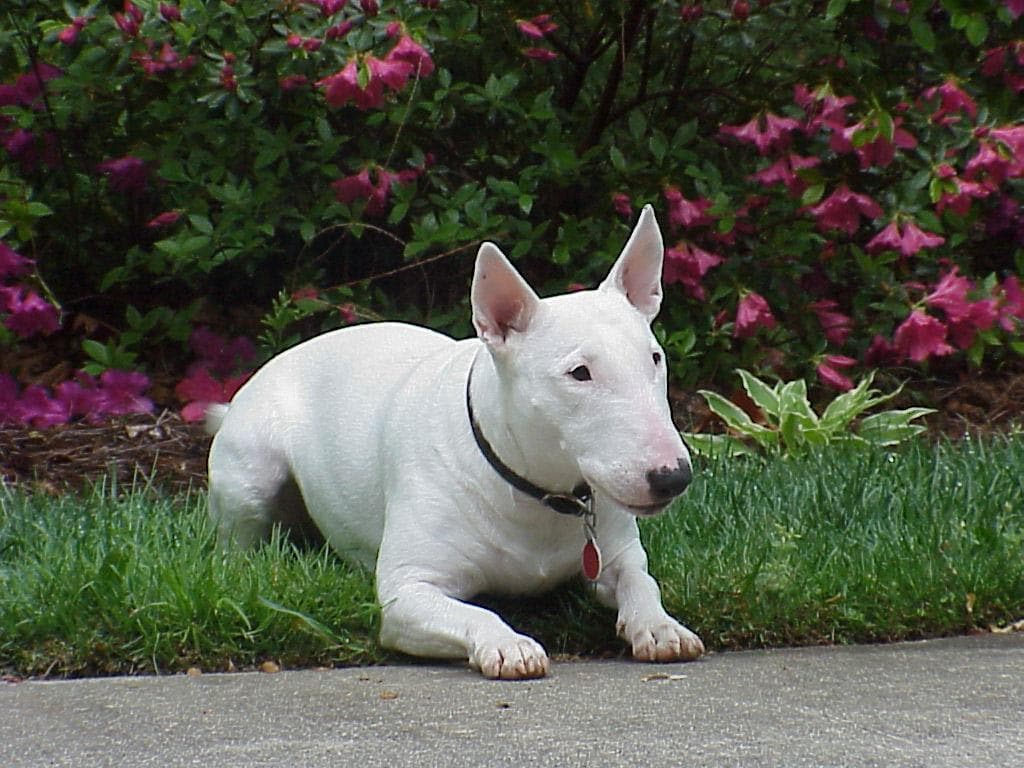
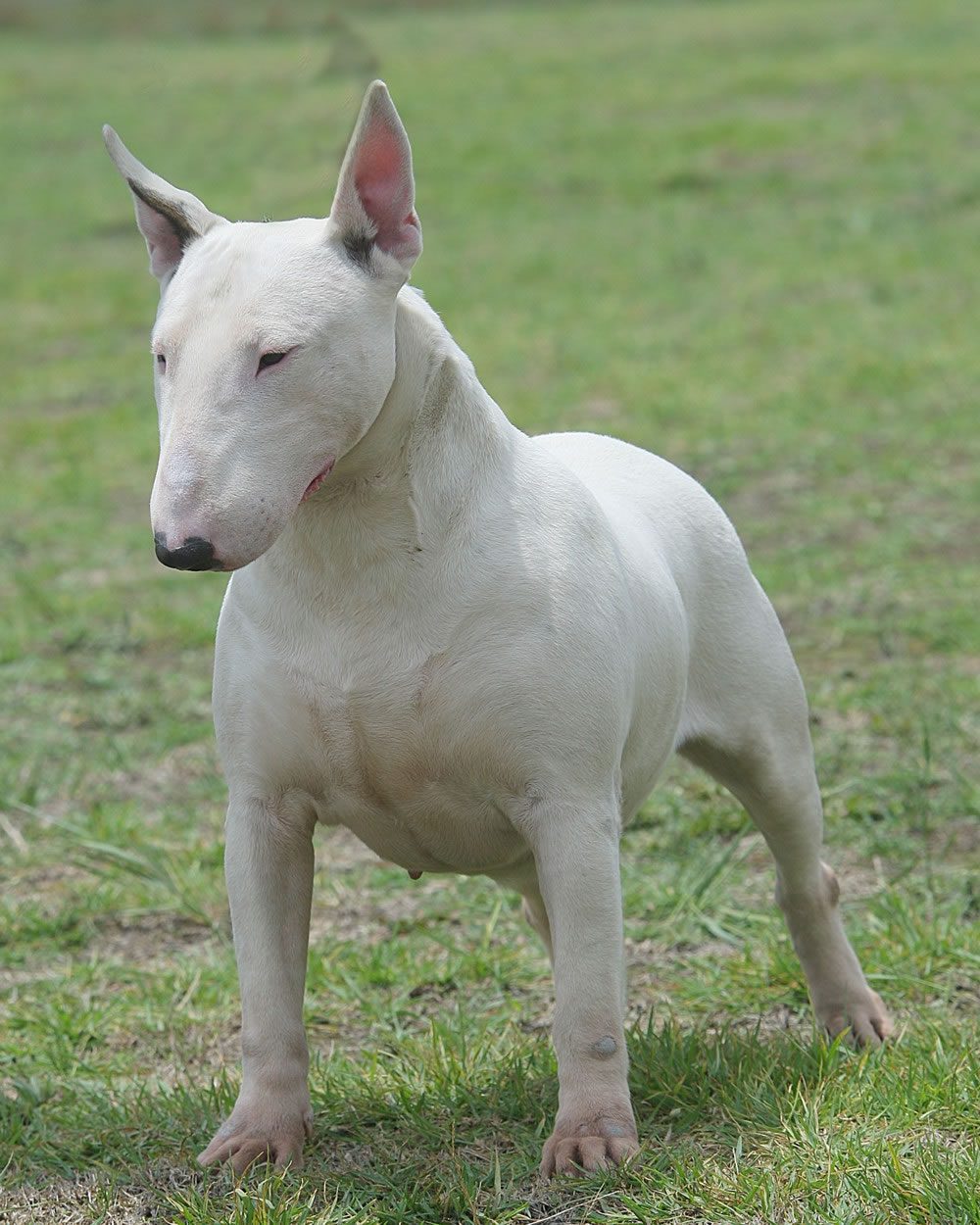
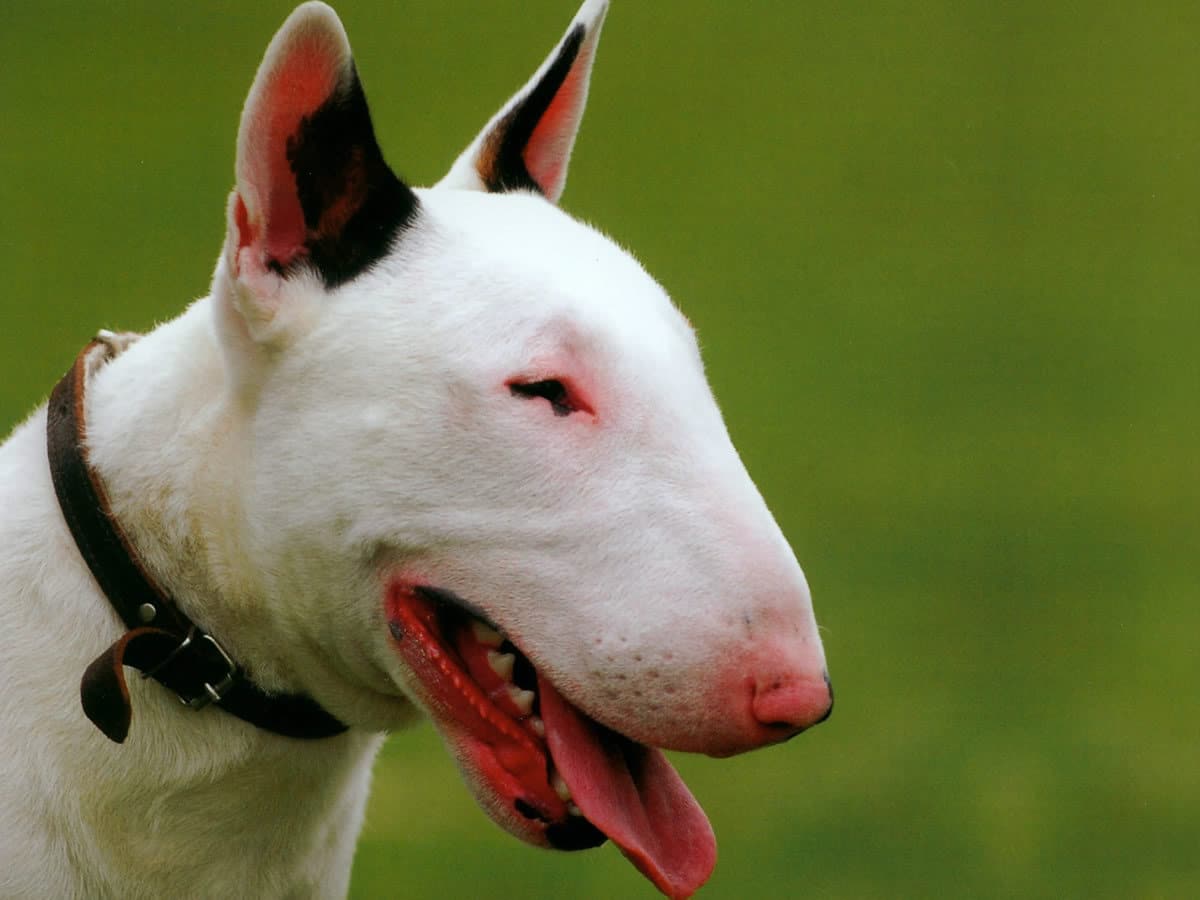
It is a dog strong, muscular and short hair. The accepted colors are white (spots on head only allowed, in other parts of the body they are penalized in exhibitions). The colors black, white, striped, red, Griffon and tricolor are accepted. Trademarks of pigmentation in the skin are not taken into account, When not involved hair. The colors, blue and liver are highly undesirable in competitions, according to breed standard.

The standard of the Bull Terrier Club in England, the ancient breed and originated from the same, It says that the striped is the desired color, given the importance of that color at the time these first specimens were included, that helped to correct problems of deafness and refresh the gene pool of the race, Therefore this recommendation maintains even included in the standard of the breed.

Typical features are the oval shape of its head, that profile will curve downwards from the top of the skull to the end of the snout. The forehead is flat from ear to ear, front head is shaped like an egg. These dogs lack the fronto-nasal depression. And the eyes are triangular in shape, in fact, it is the only recognized breed with triangular eyes. Y, Another curiosity of this small is that, It is one of the few breeds that likes to eat the nails when not cut them.

There are no weight or height limits, but the copy should give an impression of maximum solidity in relation to their distinctive traits and sex, but You can reach the 35 kg. There is one miniature variety where yes, criminalizes overcome some stature.

The hair is easy to maintain, which is why frequent brushing can have it in almost perfect conditions. It can also help add oil in your food.

Character and skills

The Bull Terrier are generally friendly, rarely aggressive. His physical strength is comparable to his intelligence, and both your body and your mind must remain active. They need time to run and exercise. They are not very suitable for beginners in dog breeding, that they require much time to be trained. Dogs are very affectionate and love company, so it is not a good idea to leave them alone for a long time, given that with their powerful jaws together with the stress they get to have in solitude they can lead them to cause a lot of damage to the house. It is an excellent companion and attack dog..

Did you know??

Because of its fun and mischievous personality, The Bull Terrier is sometimes called "the boy in the dog suit.".

Itร‚ยดs extremely strong by which should not be left unattended with one child of 8 years, post tend to skip, play and by their muscle mass can topple unintentionally to the child, for this reason it is advisable to make a gradual socialisation between the child and the dog, so in this way, the dog understands the limits and the child learns to interact with the dog, that is to say, striking a balance.

They need to do enough exercise at young age, but without excess, This can cause muscle problems. It also, the breed is known for being very gluttonous, so it should be dosed food and exercise. Son excellent guard dogs and they have very sharp ears. They may also experience obsessive-compulsive behaviors as chasing the tail hanging around, self-mutilation is, Skip, biting his thigh, eat their feces and licking the leg; these animals like to be in company, generally children.

Curiosities

The Bull Terrier, normally, they are free of genetic diseases. They tend to live in 10 to 12 years, Although they may live longer. The oldest known dog is an Australian named "Puppa Trout.", who lived up the 25 years. The Bull Terrier albinos may be deaf.

The Bull Terrier is one of the breeds used for the creation of the Dogo Argentino (Hunting dog).

Although the name might lead to confusion, the Bull Terrier are not directly related to American Pit Bull Terrier. But, both races have the same ancestry. There is a version in miniature of this race, officially called Bull Terrier miniature.

Education of a Bull Terrier

The Bull terrier needs a consistent upbringing from the start and is definitely not a suitable dog for beginners. If your owner indicates insecurity, he will take advantage of it and try to become a pack leader himself. So, a strong hand and a lot of assertiveness is required for the upbringing of this breed. Since it can react suspiciously and quickly to unfamiliar dogs, must be well socialized from an early age.

Bull Terrier health and care

The coat of the Bull Terrier does not need any special care. But, should be brushed regularly to remove dead hairs.

There are no breed-typical diseases in the Bull Terrier.. Occasionally, joint problems and especially in the knees and skin irritations can occur.

Nutrition / Food

The feeding of the Bull Terrier is not complicated, because he is quite undemanding when it comes to food. However, your food must be of high quality, low in fat and easily digestible.

The life expectancy of a Bull Terrier

It can reach an average age of 10-14 years.

Characteristics "Bull Terrier"

Coexistence is important that you have with your new friend. Before considering the acquisition of a dog of the breed "Bull Terrier" you know certain factors. Not all breeds of dogs are apt to live in an apartment, you must take into account his character, their need for exercise, their interaction with other pets, their care and if you have small children, their level of tolerance towards them.

Adaptation โ“˜

4,0 of 5 stars (based on 1 review)

friendly dog โ€‹โ€‹โ“˜

2,0 of 5 stars (based on 1 review)

hair loss โ“˜

3,0 of 5 stars (based on 1 review)

Affection level โ“˜

4,0 of 5 stars (based on 1 review)

Need for exercise โ“˜

4,0 of 5 stars (based on 1 review)

Social need โ“˜

5,0 of 5 stars (based on 1 review)

Home โ“˜

3,0 of 5 stars (based on 1 review)

Toilet โ“˜

1,0 of 5 stars (based on 1 review)

Friendly with strangers โ“˜

5,0 of 5 stars (based on 1 review)

barking โ“˜

4,0 of 5 stars (based on 1 review)

Health โ“˜

5,0 of 5 stars (based on 1 review)

Territorial โ“˜

5,0 of 5 stars (based on 1 review)

Cat friendly โ“˜

2,0 of 5 stars (based on 1 review)

Intelligence โ“˜

4,0 of 5 stars (based on 1 review)

Versatility โ“˜

2,0 of 5 stars (based on 1 review)

Child friendly โ“˜

3,0 of 5 stars (based on 1 review)

Surveillance โ“˜

5,0 of 5 stars (based on 1 review)

joy โ“˜

5,0 of 5 stars (based on 1 review)

Buying a Bull Terrier

What do I have to pay attention to when I buy?

Before taking a Bull Terrier at home, you should know that the conditions of conservation of this breed have been highly regulated throughout Europe since the years 90. Due to its bad reputation, it is on the list of dangerous dog breeds in some countries.. The Bull Terrier can provoke fearful reactions in peers and will not be greeted with joy by everyone. If you still want to have a Bull Terrier, you should try to improve the image of the breed through good education and proper maintenance. According to the studies, the breed is no more aggressive than other dog breeds and resolves conflict situations peacefully.

Bull Terrier pictures

Bull Terrier Videos

Type and recognitions:

  • FCI CLASSIFICATION:
  • Group :
  • Section : . .

Federations:

  • Federations: FCI โ“˜, AKC โ“˜, ANKC โ“˜, CKC โ“˜, โ€‹KC โ“˜, NZKC โ“˜, UKC โ“˜

  • FCI breed standard "Bull Terrier"

    Origin:
    England, United Kingdom

    Date of publication of the valid original standard:
    05.07.2011.

    Use:

    Terrier


    General appearance:

    It is a dog with a vigorous constitution, muscular, well proportioned and active and with a lively expression, decisive and intelligent. A unique characteristic is that its head lacks a fronto-nasal depression. (stop) and it is shaped like an egg.
    Regardless of size, males should look masculine and females should look feminine.


    Behavior / temperament:

    Brave, full of spirit with a loving and fun attitude. Balanced and obedient temperament. Although stubborn, is particularly friendly.

    Head:

    Long, strong and deep to the tip of the snout, but not tosca. Front view must be in the form of an egg and filled; its surface free of depressions or indentations. Profile view, is it bend gently down from the height of the skull to the tip of the nose.

    Cranial region:

    Skull : The top of the skull should be almost flat between the ears.

    facial region:

    • Truffle : It should be black and curved down at the tip. The Windows are well developed.
    • Lips : Well-defined and glued.
    • Bite / Teeth : Solid and vigorous lower jaw. Healthy teeth, strong, clean, good size, perfectly regular with a bite of perfectly regular complete scissor, That is, the inner face of the upper incisors is in close contact with the outer face of the lower incisors, the teeth being placed perpendicularly in the jaws..
    • Eyes : They should be narrow and triangular, placed obliquely, black or so Brown dark as possible, so that they appear almost black, and with a shiny look. The distance from the tip of the nose to the eyes must be greater than there is from the eyes to the back of the head. Blue or partially bluish color eyes are undesirable.
    • Ears : Small, thin and placed very close together. The dog must be able to keep them erect and tips directly upwards.

    Neck:

    Very muscular, long, arched, tapering from shoulders to head and free from loose skin.

    Body:

    Well rounded, with well arched ribs, and deep from the cross to the chest region, in such a way that the last one reaches closer to the ground than the abdomen.

    • Back : Short, strong; the dorsal line behind the withers is horizontal and arches slightly towards the back.
    • Pork loin : Broad and well muscled.
    • Breast : Seen from the front, the chest is wide.
    • Bottom line and belly : From the chest to the abdomen should form an elegant ascending curve.

    Tail:

    Short, low-set and carried horizontally. Thick at the base and slimming to a fine point.

    Tips

    PREVIOUS MEMBERS :

    • General appearance: The dog must be perfectly parallel and good limbs. In adults, the length of the fore limbs should be approximately equal to the depth of the chest.
    • Shoulder : Strong and muscular, but not heavy. Spacious scapulae, flat and very attached to the chest and oblique well maintained from the bottom to the top, at almost a right angle with the forearm.
    • Elbows : Straight and strong.
    • Arms : The forelimbs of round and strong bone.
    • Metacarpus : Perpendicular.
    • Previous feet : Round and compact with well arched toes.

    HINDQUARTERS :

    • General appearance: Seen from the rear hind limbs are parallel.
    • Thigh : Muscular.
    • Knee : With good angle.
    • Leg : Well developed.
    • The Hock joint: Well angled.
    • Metatarsus : Short and strong bones to feet.
    • Hind feet : Round and compact with well arched toes.

    Movement:

    With well coordinated movements, covering ground evenly with easy steps and with a typically jovial air. When jogging, the movement should be parallel to the front and back, only converges towards a central point at a faster speed. You forelegs out well and hindlegs moving smoothly at the hips, flexing them well in the knees and hocks with drive.

    Mantle

    Attached to the body.

    Fur : Short, tight, rough to the touch and with a fine Sheen. In winter you can grow you a layer of soft textured undercoat.

    COLOR : White copies : Pure white. The pigmentation of the skin and the spots on the head are not penalizables. Color copies: is the predominant colour; other equal, you prefer the Brindle. The colors black, striped, red, Fawn and tricolor are acceptable. Stains on white fur interspersed are undesirable. The colors blue and liver highly undesirable.


    Size and weight:

    There are no weight or height limits, but the copy should give the impression of maximum strength consistent with their distinctive traits and sex.


    Fouls:

    Any deviation from the aforementioned criteria is considered a fault and the severity of this is considered to the degree of the deviation from the standard and its consequences on the health and well-being of the dog..

    FALTAS DESCALIFICANTES :

    โ€ข Aggressive or fearful dog.
    โ€ข Any dog โ€‹โ€‹showing clear signs of physical or behavioral abnormalities should be disqualified..


    N.B.:

    Male specimens should have two normal-appearing testicles., fully descended into the scrotum.

    SPANISH TRANSLATION: Brรญgida Nestler / Original version : (IN)
    Technical supervision : Miguel Angel Martinez

    Source: F.C.I - International Cynological Federation

    Alternative names:

    1. English Bull Terrier, Bully, Wedge Head, Varkhond (English).
    2. Bull Terrier (French).
    3. Bull Terrier (German).
    4. Bull terrier inglรชs (Portuguese).
    5. Bull Terrier inglรฉs (espaรฑol).

    โ–ท The world of Pets: Dogs, cats, birds, reptiles, amphibians

    German Hunting Terrier
    Alemania FCI 103 - Large and medium sized Terriers

    Jagdterrier

    The German Hunting Terrier is in no way suitable exclusively as a companion or family dog.

    Content

    History

    The German Hunting Terrier he is a high performance terrier. There are two varieties of it, the of wire hair and the of smooth hair. He is essentially a descendant of Fox Terrier. After World War I, some active hunters broke away from the Club de Fox Terrier to create a breed that would be oriented exclusively to hunting performance. This was successful and thus the German Hunting Terrier Club in 1926. Under the leadership of Dr. Herbert Lackner the new race, the German Hunting Terrier, was established systematically and finally very successfully.

    After a separation from the brood of almost 100 years, you can certainly talk about a new breed today. It also, you can clearly see it in its appearance and also in the nature of this professional hunting dog. But, remained a terrier. One German Hunting Terrier you must be very brave, fearless and defensive. Must be able to work boar hunting without problems, which is one of the most difficult and dangerous tasks a hunting dog can master. Even today the German Hunting Terrier is still a highly prized hunting dog. Has become a versatile hunting assistant. Among other things, It is used very successfully in wild boar hunts., where it excels with amazing performances. His tireless work eagerness and leadership are especially appreciated while hunting..

    The German Hunting Terrier he is fearless and with every fiber of his being he strives to do his job as well as possible. The German Hunting Terrier has been conceived as a breed from birth by hunters for hunters. Therefore, given exclusively to hunters. It is still successfully served today by the "Deutscher Jagdterrier-Club" in the VDH (German Canine Federation). It is exclusively cared for by breeders affiliated with this club. The breed is highly valued and popular with German hunters.

    Physical characteristics

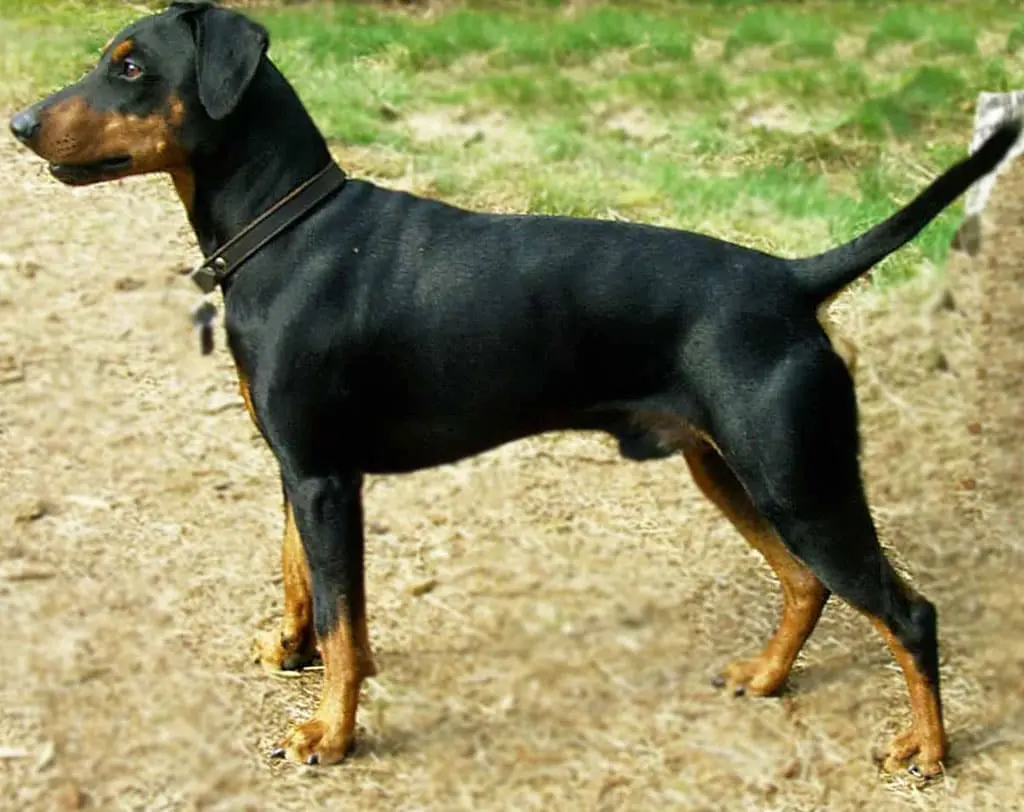
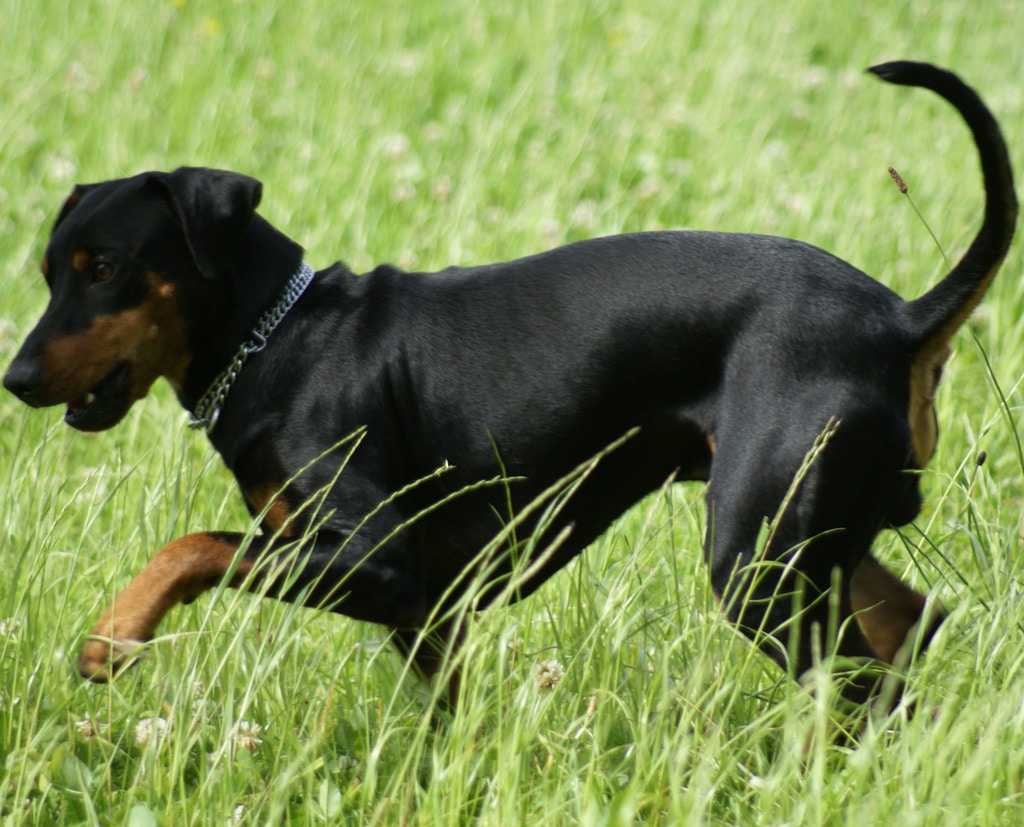
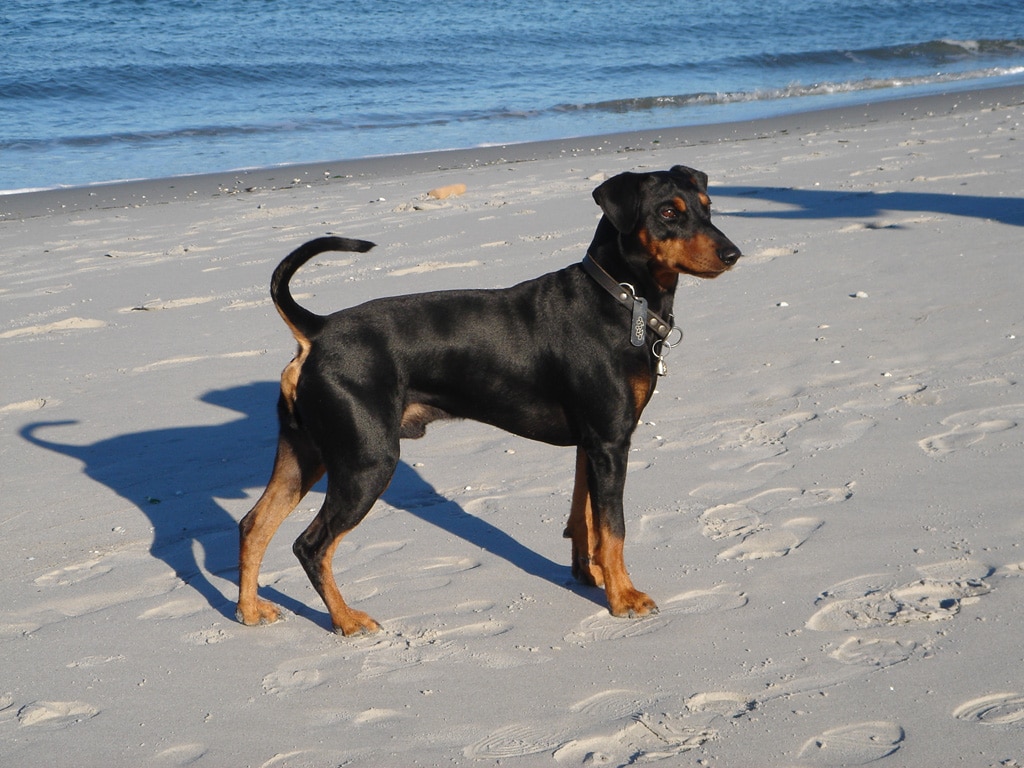
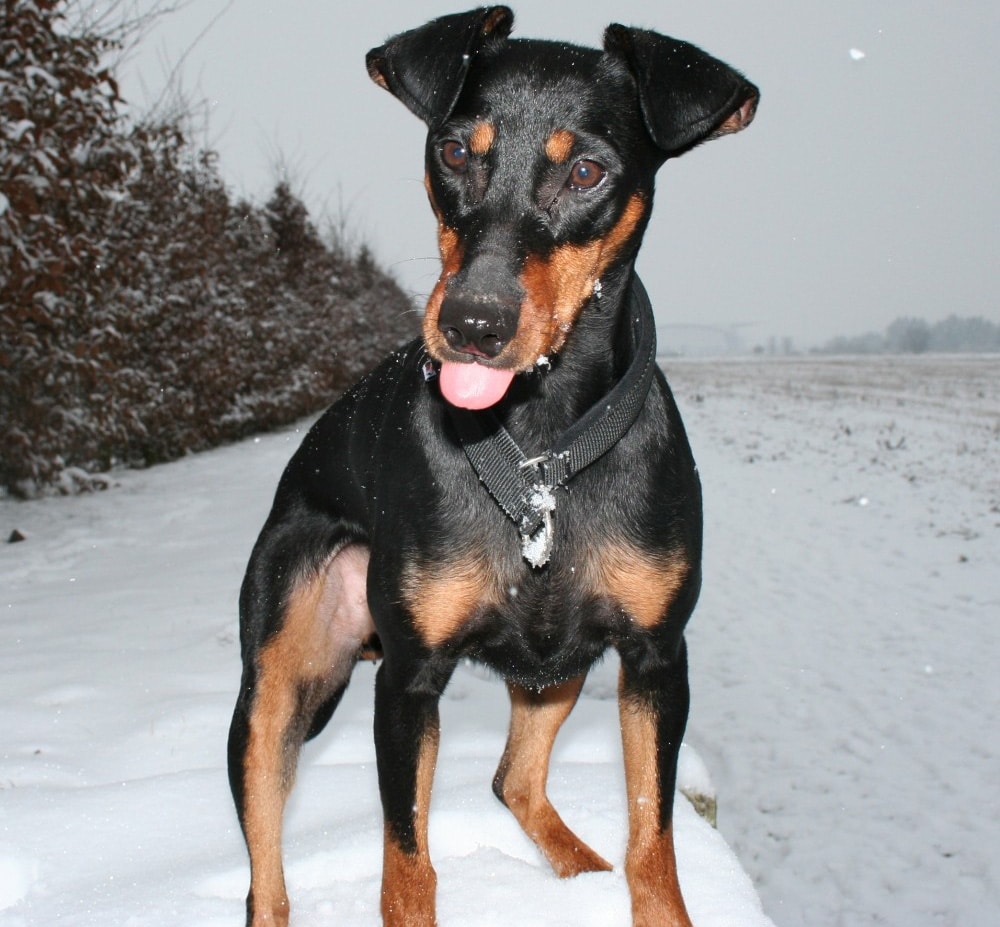
    The German Hunting Terrier it is a small to medium sized dog with a distinctive appearance. He is a high speed terrier. Has an awake expression, well trained and full of tension, which leaves no doubt that you are always ready for an adventure. This is underlined by its wedge-shaped but not pointy skull, his deep and determined eyes and his ears leaned forward.

    The standard briefly describes it:

    The German Hunting Terrier is a small, generally black and red, compact and shapely hunting utility dog.

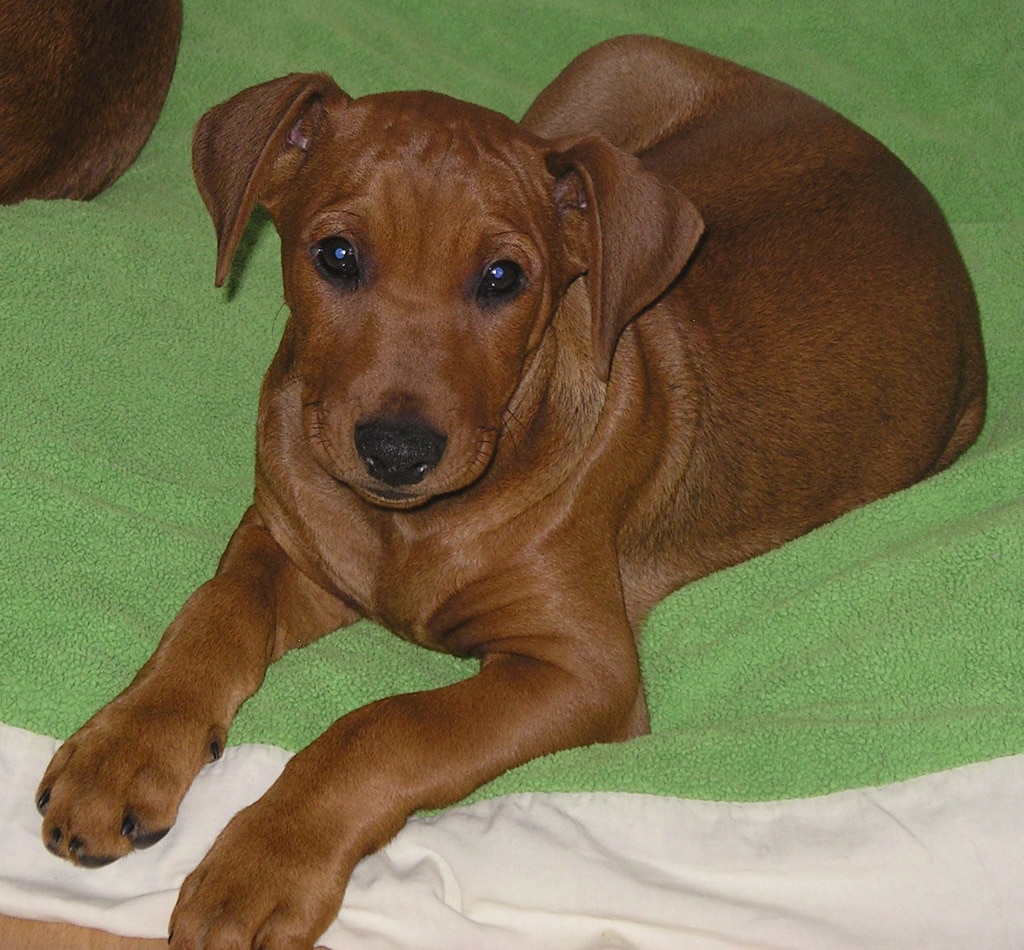
    The small dog has a height at the cross of 33 to 40 centimeters in both male and female dogs. But, bitches should be a little bit lighter. In males, the weight, is of some 9 to 10 kg, in females 7,5 to 8,5. In the standard it says briefly, according to the proportions, neither too light nor too heavy. The German Hunting Terrierhas always been available in two types of fur: smooth hair, dense, hard and rough or thick straight hair. Its color is black, dark brown or black-gray mottled with red-yellow spots, very well defined clean marks.

    Character and skills

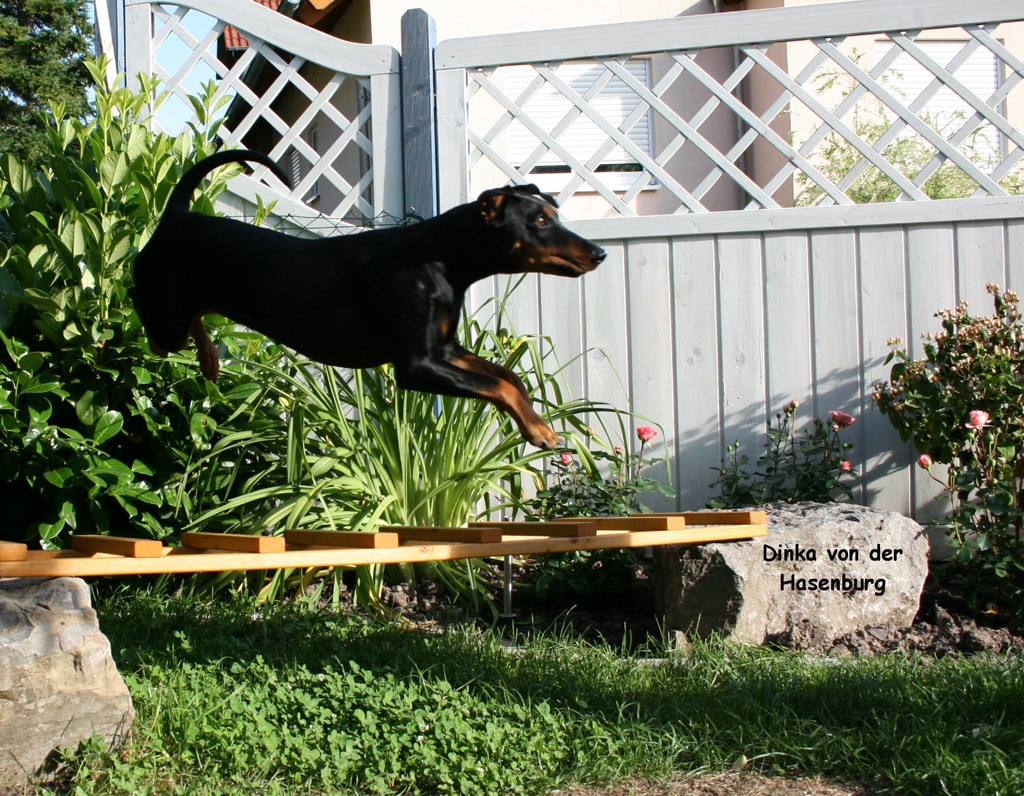
    The German Hunting Terrier is a thoroughbred hunting dog for the practicing hunter. The Hunter Terrier it's a power pack. It's not for people who imagine a potato-trainer. It is by no means exclusively suitable as a companion or family dog.. His history and highly developed hunting skills should also be on the mind of the non-hunter, when you think about keeping German Hunting Terrier as a companion dog. Can be a charming companion and family dog โ€‹โ€‹fond of children, but only on the basis of its species-appropriate use as a hunting dog. Here he is shown as a First Class Hunting Helper, who convinces again and again for his performance.

    The German Hunting Terrier it's hard and persistent, easy to handle and calm and especially for a Terrier quite compatible with other dogs. The official FCI standard describes its character in this way:

    The German Hunting Terrier is brave and tough, eager to work and persevere, vital and energetic, reliable, sociable and manageable, neither shy nor aggressive.

    The breed attaches great importance to suitability for hunting, firmness of character, hunting intelligence, fearlessness and low sensitivity. Must be a versatile dog, hard, noisy and water-loving with a pronounced hunting instinct and excellent training ability. Your determination, vitality, high intelligence and close relationship with his master and caretaker make him a very interesting companion, but also demanding.

    Education German Hunting Terrier

    This breed of dog can be very well educated and trained.. The clear announcement and the consequence are the miracle words here based on a respectful and loving relationship with the master or caretaker.. This terrier has been bred for many generations for its performance and good training ability. Only dogs that perform excellently here are used for breeding. For you, as your caregiver, this is both an opportunity and an obligation. With experience, consistency and a clear statement based on a trusting and emotionally positive bond, you can achieve everything with it.

    German Hunting Terrier health and care

    These German hunting terriers are extremely easy to care for. Brushing here and there is enough. His health is very robust.

    Nutrition / Food

    Feeding a German Hunter Terrier has no problems.

    The life expectancy of the German Hunting Terrier

    as a rule, the German Hunting Terrier enjoys a long and vital canine life, often over 12 years.

    Buy German Hunting Terrier

    If you are looking for a German Hunter Terrier, must contact a hunter, Ranger or breeder who is a member of the Club German Hunting Terrier long before I plan to buy one. Dogs are normally only given to hunters. Here and there it can happen that a dog looks for another place. But then you should be able and willing to give him species-appropriate living conditions.. A puppy of this breed of dog costs around 1.000 EUR.

    Images "German Hunting Terrier"

    Photos:

    1 – Jagdterrier by No machine-readable author provided. Richard Huber assumed (based on copyright claims). / Public domain
    2 – German Jagdterrier by Tux-Man / CC BY-SA
    3 – Jagdterrier during dogs show in Katowice, Poland by Lilly M / CC BY-SA
    4 – German Hunting Terrier during dogs show in Katowice, Poland by Pleple2000 / CC BY-SA
    5 – Jagdterrier during dogs show in Katowice, Poland by Lilly M / CC BY-SA
    6 – Jagdterrier by Pleple2000 / CC BY-SA

    Videos "German Hunting Terrier"

    Type and recognitions:

    • FCI CLASSIFICATION:
    • Group :
    • Section : . .

    Federations:

    • – FCI – Terriers 1 Large and medium-sized terriers. โ“˜
    • – UKC โ“˜

    FCI breed standard "German Hunting Terrier"

    Origin:
    Germany

    Date of publication of the valid original standard:
    19.03.2015.

    Use:

    Variable utility hunting dog, especially for hunting in burrows or for raising game.


    General appearance:

    It is a useful dog for hunting., small, reddish black, compact and well proportioned.

    IMPORTANT PROPORTIONS:

    • Ratio between chest circumference / height of the cross: chest circumference is 10 to 12 cm greater than the height of the cross.
    • Body length / cross height: the body is a little longer than the height of the cross.
    • Chest depth / cross height: is approximately the 55-60% the height of the cross.


    Behavior / temperament:

    It is spirited and strong, likes work and is constant, full of vitality and temperament, reliable, docile and affable, He is not shy or aggressive.

    Head:

    Elongated, a little wedge-shaped, but not pointy. Muzzle a little shorter than the skull from the occipital protuberance to the frontal-nasal depression.

    Cranial region:
    • Craging: Flat, broad skull between the ears. A little narrower between the eyes.
    • Ston: Poorly developed.

    facial region:

    • Trufa: In relation to the muzzle it should not be too narrow nor too small; should not be divided; always black; if the primary coat color is brown, the truffle can also be that color.
    • Horcico: Powerful, well developed cheeks, deep and strong lower jaw, well delineated chin.
    • Labios: Well adherent and with good pigmentation.
    • Jaw/Bite/Teeth: Teeth are big. The jaw is powerful and has a perfect scissor bite, regular and complete, in which the upper incisors overlap the lower incisors without leaving space, and the teeth are upright in the maxilla. Should have 42 teeth according to the dental formula.
    • Ojors: dark, small, oval, sunken; with attached eyelids and determined expression.
    • Obars: Semi-upright so that the tips adhere lightly to the head, high insertion, not very small, โ€œVโ€ shaped.

    Neck:

    Strong, not too long, right next to the body; widens toward insertion with shoulders.

    Body:

    • Lรญnand the top: Straight.
    • Cruz: Marked.
    • Espalda: Strong, straight, not too short.
    • Pork loin: He has strong musculature.Rump: Very muscular, flat.
    • Torrax: Deep, well arched ribs, not very wide; long sternum; the ribs, well bowed, directed back.
    • Lรญnand the bottom: Forms an elegant backward arch, short and firm flanks, slightly retracted belly.

    Tail:

    With good insertion in the long rump, shortened by about a third of its length. Can be carried slightly less upright than vertically straight, must not be leaning on the back. (In countries where laws prohibit tail docking, it can remain natural and in that case it must be carried horizontally or in the form of a saber).

    Tips

    PREVIOUS MEMBERS

    • Apgeneral arience: The forelimbs, front views, straight and parallel are observed; from the sides they look plumb under the body. The distance from the floor to the elbow is almost the same as from the elbow to the withers.
    • Hormbros: Long scapula, well oblique and directed backwards; muscular shoulders. Good angulation between the scapula and the arm.
    • Brazo: It is as long as possible, slim with good muscles.Elbows: Glued to the body, no deviations outwards or inwards. Good angulation between the arm and forearm.
    • Antarm: Delgado, vertical, with robust bones.
    • Articulation of the carpus: Strong.
    • Metacarpus: Slightly leaning forward, skeleton rather robust than fragile.
    • Pinis previous: Frequently wider than later ones, with fingers close together, and thick enough pads, hard, strong and well pigmented. Feet are placed on the floor in parallel; no deviations outwards or inwards both when standing and during movement.

    LATER MEMBERS:

    • Apgeneral arience: Viewed from behind they are straight and parallel. They have good angulations between the thigh and the leg, as well as between the leg and the metatarsus. Strong bones.
    • Thigh: Long, wide and muscular.
    • Rodinllto: Strong, with good angulation between the thigh and the leg.Leg: Long, muscular and tendon.
    • Atibio-tarsal articulation: Strong and deep.
    • Metatarsus: Short and vertical.
    • Pinis later: Oval, almost round, with fingers close together and pads thick enough, hard, strong and well pigmented. They step in parallel both standing and in motion and do not show deviations towards the inside or outside.

    Movement:

    It covers the ground, with good progress and momentum; is fluid; fore and hind limbs are kept straight and parallel, no strides.

    Mantle

    PIEL: Thick, very attached, without forming folds.

    MANTLE

    Plink: Rough fur, hard, dense and straight or straight and straight hair.

    Colorr: Color is black, dark brown or grayish black mixed with clean markings, well outlined reddish yellow over the eyes (eyebrows), snout, chest, limbs and around the anus. A light or dark mask is also allowed; a small white mark is tolerated on the chest and on the fingers.


    Size and weight:

    Height of the cross:

    • Males: 33 to 40 cm.
    • females: 33 to 40 cm.

    Weight: Acorresponds to the relation with the height, not too light and not too heavy.


    Fouls:

    Any deviation from the aforementioned criteria is considered as a fault and the severity of this is considered to the degree of the deviation to the standard and its consequences on the health and well-being of the dog.and the dog's ability to perform its traditional task.

    FALTAS GRAVES:

    • Narrow skull; narrow or pointed snout.
    • Fleeing Jaw, close.
    • Weak teeth, any irregular position of the incisor
    • light eyes, too big or prominent.
    • erect ears, floating, too thick, insertion too low
    • Steep anterior limb
    • Overdue or carp back, too short.
    • Short sternum.
    • Sill seen from the front too narrow or wide.
    • Steep hind limb, too high.
    • Elbows strongly turned in or out.
    • Fingers too close together or apart; cow hocks, in the shape of an โ€œOโ€ or in a narrow position, both standing and moving.
    • crushed feet, cat feet, hare foot.
    • Tail tilted forward, insertion too low, hanging tail.
    • Short hair, woolly, fine, not adhered to the skin.
    • Hairless belly and inner thighs

    FALTAS DISQUALIFYING:

    • Aggressiveness or extreme shyness.
    • Any dog โ€‹โ€‹showing clear signs of physical or behavioral abnormalities must be disqualified..
    • Atypical dogs
    • Upper or lower prognathism, deflected bite, partial or complete clamp bite, crossbite, irregularly placed teethon the top and/or bottom line, absence of teeth except M3.
    • Lack of pigmentation.
    • Entropion, ectropion, different colored eyes (anisochromia), blue or splattered eyes
    • Unauthorized coat colors
    • Height at the withers less than 33 cm and greater than 40 cm..


    N.B.:
    • Males should have two normal-appearing testicles fully descended into the scrotum..
    • Only functionally and clinically healthy dogs, with the typical conformation of the breed, should be used for parenting.
    • Itlatest changes are in bold.

    TRANSLATION: Brรญgida Nestler.
    Technical supervision: SR. Miguel A. Martรญnez.

    Source: F.C.I - International Cynological Federation

    Alternative names:

    1. Deutscher Jagdterrier, German Jagdterrier, German Hunting Terrier, German Hunt Terrier, Jagdterrier (English).
    2. Jagdterrier (French).
    3. Jagdterrier (German).
    4. Jagdterrier (Portuguese).
    5. Terrier alemรกn de caza, Terrier alemรกn (espaรฑol).

    โ–ท The world of Pets: Dogs, cats, birds, reptiles, amphibians

    Irish Glenn of Imaal Terrier
    Irlanda FCI 302 . Large and medium sized Terriers

    It is generally believed that Irish Glenn of Imaal Terrier is less excitable than other Terriers, although it takes action immediately when prompted.

    Glen of Imaal Terrier

    Content

    History

    The Irish Glenn of Imaal Terrier originates from the Irish east coast, in county wicklow, which is in the ravine (=Valle) the Imaal. From this rough and wild valley this very old breed got its name. It was first mentioned around 1575.

    Like old farm dog, the Irish Glenn of Imaal Terrier he had a very busy life and worked hard for his master. His job was to catch rats and mice on farms and operate smaller work machines like churns and work grinders., where I had to run on leather straps. He also accompanied his master on the fox hunt, the Badger and Otter. He worked in silence and if necessary he fought to the death. Before it was banned in Ireland, the Irish Glenn of Imaal Terrier also used in questionable dogfights. Of course, he was also the most loyal friend and guarded the house and the yard, never shied away from facing a much bigger and stronger opponent.

    For its owner, the Irish Glenn of Imaal Terrier it was as important as his daily bread, although undemanding, frugal and tough enough to share the barren life of farmers. This harsh life brought with it a ruthless selection. Only the toughest and most frugal Terriers survived, what characterizes the breed until today.

    The pedigree of Irish Glenn of Imaal Terrier it's an irish secret to this day. In Ireland itself, this Terrier has never been numerous and did not leave his ancestral home until 1980, when the owners preserved him as a true child of nature, marked by great courage, skill and endurance. In 1933 the breed was officially recognized by the Irish Kennel Club ( I.K.C.). The international recognition of the F.C.I. continued on 1981.

    Physical characteristics

    The Irish Glenn of Imaal Terrier it is small but strong and robust and weighs up to 16 kilograms with a maximum height at the withers of 36 centimeters. Its relatively small forward leaning ears are notable.. Its coat is medium length and consists of a rough top layer and a smooth bottom layer. It can be wheat colored, tabby blue or in different shades of red and gold. In the case of a dark-colored coat, a black-blue mask is common., which can also show as stripes over the ears, along the back and tail, so these marks become clearly clearer with increasing age.

    Character and skills

    Today the Irish Glenn of Imaal Terrier it is a gentle and docile family dog. Its balanced and faithful nature, as well as his average temperament make life with him very pleasant. The Irish Glenn of Imaal Terrier is very affectionate, always cheerful and in a good mood and preferably "in the middle". Enjoy all the attention and care, but without demanding anything. Rather, follows her around with her alert gaze and once she has gained attention, shows his joy about it with strong tail swipes. If the joy is particularly great, his temperament can also run away with him.

    Children are welcome as playmates, if they show him the respect that he shows. Pets are accepted by him without problems when they get used to each other. The Irish Glenn of Imaal Terrier she is always friendly with strangers, and with his contagious joy, His charm and his irresistible look quickly have all the sympathies on his side.. After all, it is a terrier that radiates a lot of personality. He is open-minded and not afraid to learn new things. He likes to be everywhere with his nose. In general, everything that is new – Weird people, new environments, an object that has not been there before – it is very interesting and has to be examined very carefully. The Irish Glen of Imaal Terrier is a particularly attentive observer. Along with her charming nature and her desire to do everything right, is very adaptable and develops a very close relationship with his family. He likes to accompany them whenever possible. Like a very people-oriented terrier, I would defend them in an emergency, even to death. Feel more comfortable in your proximity.

    What characterizes him Irish Glenn of Imaal Terrier is his great courage, his self-confidence and intelligence above average. Sufficient workload and intellectual work are important to the intelligent four-legged friend. Enjoy almost all activities, be it sports with dogs, search games or learning tricks – is available for all kinds of fun.

    Despite its short legs, it is very agile, due to his muscular physique, a small power. Its special characteristics are its slightly curved front legs with the legs turned outward., his big head and his pronounced chest. The Irish Glenn of Imaal Terrier it is a very balanced dog, that radiates great calm on the one hand, but on the other hand you are immediately ready for action and, if required, vigorously watches over and defends your home and family.

    The Irish Glenn of Imaal Terrier – the little irish with a big heart

    Like a silent working terrier it hardly barks. It is also less excitable than other terriers. Sometimes you can see the Irish stubbornness, but the Irish Glenn of Imaal Terrier not resentful. Due to its origin it does not tolerate heat very well, he likes harsh weather and when the wind blows around his nose. But if the chemistry ain't right, or if the other dog brazenly approaches him, you will receive the message – "Glen doesn't like your attitude.". So, it is important to socialize with other dogs from the beginning and to have contact with many dogs of different ages.

    โ€œIrish Imaal Glen Terrierโ€ Care

    Because the Irish Glenn of Imaal Terrier still very original and not over-bred, still a very healthy and robust breed. Its coat has a rough top coat with a smooth undercoat that needs to be trimmed. Otherwise, his self-cleaning coat is very easy to care for. Coat color is wheat or Brindle (Blue striped).

    A consistent but loving upbringing makes the Irish Glenn of Imaal Terrier a faithful companion, nice and gentle, which is easy to handle.

    Life expectancy ยซIrish Imaal Glen Terrierยป

    The Irish Glenn of Imaal Terrier is considered an original dog breed, which is in good health and robustness due to the absence of hereditary diseases caused by breeding. If maintained in a species-appropriate manner, will live an average of twelve years.

    Images "Irish Glenn of Imaal Terrier"

    Photos:

    1 – Irish Glen of Imaal Terrier during International show of dogs in Katowice – Saucer, Poland. Breeder – Piotr Kuznik, http://www.irishglen.pl/ by Pleple2000 / CC BY-SA
    2 – Irish Glen of Imaal Terrier during International show of dogs in Katowice – Saucer, Poland. Breeder – Piotr Kuznik, http://www.irishglen.pl/ by Pleple2000 / CC BY-SA
    3 – Adult w:Glen of Imaal Terrier by photo by Scoo / CC BY-SA
    4 – Irish Glen of Imaal Terrier during International show of dogs in Katowice – Saucer, Poland. Breeder – Piotr Kuznik, http://www.irishglen.pl/ by Pleple2000 / CC BY-SA
    5 – Irish Glen of Imaal Terrier during International show of dogs in Katowice – Saucer, Poland. Breeder – Piotr Kuznik, http://www.irishglen.pl/ by Pleple2000 / CC BY-SA
    6 – Glen of Imaalinterrieri by Sami Kronqvist / CC BY-SA

    Videos "Irish Glenn of Imaal Terrier"

    Type and recognitions:

    • FCI CLASSIFICATION:
    • Group :
    • Section : . .

    Federations:

    • – FCI – Terriers 1 Large and medium-sized terriers. โ“˜
    • – AKC – Terriers โ“˜
    • – ANKC – Terriers โ“˜
    • – CKC – Terriers โ“˜
    • – โ€‹KC – Terriers โ“˜
    • – NZKC – Terriers โ“˜
    • – UKC – Terriers โ“˜

    FCI breed standard "Irish Glenn of Imaal Terrier"

    Origin:
    Ireland

    Date of publication of the valid original standard:
    27.01.2001

    Use:

    Like all other terriers, this stubborn little breed had to hunt badgers and foxes, as well as keeping the rat population to a minimum. In the news, he is a family dog, docile and sweet.


    General appearance:

    It is a medium-sized dog, with a medium length coat, very strong and gives the impression of maximum substance for its size.

    IMPORTANT PROPORTIONS:

    The body is longer than it is tall, close to the ground.


    Behavior / temperament:

    It is an active dog, agile and quiet when working. Courageous and gifted with courage when you need it, otherwise it is kind and docile, from which personality flows, his loyal and affective nature, makes him a very acceptable dog for the home and company. Irish Glen de Imaal is said to be less easily excitable than other terriers, although he is always ready to react if asked.

    Head:

    ---

    Cranial region:
    • Skull: Good width and reasonable length.
    • Depression links (Stop): Pronounced.

    facial region:

    • Truffle: black.
    • Snout: Giving the impression of strength; narrowing towards the truffle.
    • Jaws: Strong.
    • Teeth: Healthy teeth, regular, strong and good size. Scissor bite.

    Eyes: Brown, medium-sized, round and placed well apart. Light colored eyes should be penalized.

    Ears: Small, When the dog is alert, it should be pink or semi-upright; when at rest they are carried backwards. Completely drooping or erect ears are undesirable..

    Neck:

    Very muscular and of moderate length.

    Body:

    Deep and long, longer than high.

    • top line: To level.
    • Pork loin: Strong.
    • Breast : Wide and strong, well sprung ribs.

    Tail:

    Cut. Firm at the root, well established and carried happily. Puppies' tails should be cut in half. A natural glue (not cut) It is allowed for countries where cutting them is prohibited by law.

    Tips

    PREVIOUS MEMBERS: Short, curved and with good bones.

    • Blades: Spacious, muscular and well leaning.
    • Anterior legs: Short, arching and good bone.
    • Pies: Compact and strong, with round foot pads. The front feet are slightly rotated out from the metacarpus.

    LATER MEMBERS: Strong and well muscled.

    • Thighs: Well muscled.
    • Knee: Well angled.
    • Hocks: Without turning in or out.
    • Pies: Compact and strong with round foot pads.

    Movement:

    Free and without lifting the forelimbs too much. Effortlessly cover ground with good boost from hindquarters.

    Mantle

    Fur: Hair is medium in length and coarse in texture, with a soft undercoat. Hair can be groomed to make your figure look neat.

    Color:

    • Blue tabby without the hue turning to black.
    • Wheat, from light wheat to a golden reddish hue
    • Puppies can be born blue, Wheat or Reddish Lighter-colored puppies generally have a bluish-colored mask, may have a blue stripe along the back, in the tail and in the ears. Darker marks will lighten with age.


    Size and weight:

    Height to the cross:

    • Males: 35,5 cm. (14 inches) is the maximum.
    • females: proportionally less.

    Weight:

    • Males : 16 kg (35 English pounds).
    • females : proportionally less.


    Fouls:

    Any deviation from the aforementioned criteria is considered as a fault and the severity of this is considered to the degree of the deviation to the standard and its consequences on the health and well-being of the dog..

    • Hound ears.
    • With inferior or superior prognathism.
    • Body too short.
    • Straight front.

    FALTAS DESCALIFICANTES:

    • Aggressiveness or extreme shyness.
    • Any dog โ€‹โ€‹showing clear signs of physical or behavioral abnormalities must be disqualified..
    • Black and fire color.
    • Narrow snout.


    N.B.:

    Males should have two normal-appearing testicles completely descended into the scrotum. Only functionally and clinically healthy dogs, with the typical conformation of the breed, should be used for parenting.

    TRANSLATION: Lic. O. Valverde, reviewed by Dr. F. del Valle and updated by J. Nallem, Uruguayan Kennel Club.

    Source: F.C.I - International Cynological Federation

    Alternative names:

    1. Irish Glenn of Imaal Terrier, Wicklow Terrier, Glen, Glennie (English).
    2. Irish Glen of Imaal Terrier (French).
    3. Irish Glen of Imaal Terrier (German).
    4. Glen of imaal terrier (Portuguese).
    5. Glen, Wicklow Terrier, Glen of Imaal Terrier, Irish Glen of Imaal Terrier (espaรฑol).

    โ–ท The world of Pets: Dogs, cats, birds, reptiles, amphibians

    Standard Schnauzer
    Alemania FCI 182 . Pinscher and Schnauzer type

    Schnauzer Mediano

    Starting at the Standard Schnauzer the other two varieties were developed (Giant and Enano)

    Content

    History

    The Standard Schnauzer (standard) It is the original race of the three Schnauzer breeds, and despite his fur and aspect in general, This is not related to the English Terrier. This is one of the oldest breeds in Europe. This race is beautiful, robust, square build and medium-sized with a similar aristocratic, This was the favorite breed of Albrecht Dรผrer and Rembrandt.

    In his country of origin he is known as Mittelschnauzer (Standard Schnauzer) to distinguish it from the giant form and the form miniature.

    Regardless of the origin of the breed, It should be noted that the racial standard of the Schnauzer was set for the first time in the year 1880, and in the year 1885 the first breed club was established in Germany. He had to wait 40 more years, to be made in United States (1925).

    The name of Schnauzer is given to the breed for its first appearance in public in a show contest.. This contest (Hannover 1879) won it a dog presented as wire-haired Pinscher. The winner can be called Schnauzer (ยซbigotudoยป) and thereafter, all the wire-haired Pinscher have received the name of Schnauzer.

    The classification of the Schnauzer has always brought controversy, because that is what you don't want to classify as Terrier, likely as not being a race that cace as dog's burrow. The controversy is that dogs as the Manchester Terrier they are classified as Terrier and are, as it is the case of the above-mentioned, the prototype of the dog buzzard without being trained for hunting dog's burrow.

    Physical characteristics

    The Standard Schnauzer has a rough coat, with colors ranging from 'salt and pepper' to solid black.

    The hair on the face is extended to form a beard and eyebrows. The race is robust, and must be "heavy" for its height with lots of muscle and bone.

    The ideal ranges of the weight and of the height vary, considerably, from a standard race which is as follows: The males range between 45 and 50 cm of high cross and usually weigh between 15.5 and 22.5 kg. The females measure between 42.5 and 47.5 High Cross and usually weigh between 13.5 and 20.2 kg).

    In United States, most dogs have cropped ears and tails.

    Traditionally, the ears they are cut and the tail as well. But, in many European countries and in Australia, ear and tail docking is prohibited and dogs show off their natural ears and tails.

    Character and skills

    It's a race that, similar to the German Pinscher, It was created for the extermination of vermin on farms, Although he didn't mention in other tasks, becoming a multi-purpose dog. They included the roles played by the Schnauzer, driving cattle.

    Itร‚ยดs jealous, It loving and a good former. All varieties of Schnauzer have a character that is described as impetuous, strong but very balanced.

    Love your family, they are safe and affable with children and rather distrustful with strangers.

    Schnauzer Health

    All dogs have the potential to develop genetic health problems, just as all people have the potential to inherit a particular disease. Run, do not walk, from any breeder that does not offer a health guarantee on puppies, to tell you that the breed is 100 percent healthy and has no known problems, or tell you that your puppies are isolated from the main part of the home for health reasons. A reputable breeder will be honest and open about the breed's health problems and the incidence with which they occur in their lines..

    Some of the conditions that affect standard Schnauzers include hip dysplasia; eye problems (including cataracts and retinal dysplasia); a heart condition known as pulmonary stenosis; hipotiriodismo; Hemophilia (a bleeding disorder); and bladder stones.

    Not all of these conditions are detectable on a growing puppy, and it can be difficult to predict whether an animal will be free of these diseases, so a reputable breeder must be found who is committed to raising the healthiest animals possible. Must be able to produce an independent certification that the parents of the dog (and grandparents, etc.) have been screened for these defects and considered healthy for breeding. That's where health records come in..

    Remember that after bringing a new puppy home, has the power to protect you from one of the most common health problems: the obesity. Maintaining a standard Schnauzer at the right weight is one of the easiest ways to extend your life.. Make the most of your preventive skills to help ensure a healthier dog for life.

    Characteristics "Standard Schnauzer"

    Coexistence is important that you have with your new friend. Before considering the acquisition of a dog of the breed "Standard Schnauzer" you know certain factors. Not all breeds of dogs are apt to live in an apartment, you must take into account his character, their need for exercise, their interaction with other pets, their care and if you have small children, their level of tolerance towards them.

    Adaptation โ“˜

    3,0 of 5 stars (based on 1 review)

    friendly dog โ€‹โ€‹โ“˜

    4,0 of 5 stars (based on 1 review)

    hair loss โ“˜

    2,0 of 5 stars (based on 1 review)

    Affection level โ“˜

    4,0 of 5 stars (based on 1 review)

    Need for exercise โ“˜

    4,0 of 5 stars (based on 1 review)

    Social need โ“˜

    4,0 of 5 stars (based on 1 review)

    Home โ“˜

    3,0 of 5 stars (based on 1 review)

    Toilet โ“˜

    4,0 of 5 stars (based on 1 review)

    Friendly with strangers โ“˜

    2,0 of 5 stars (based on 1 review)

    barking โ“˜

    5,0 of 5 stars (based on 1 review)

    Health โ“˜

    1,0 of 5 stars (based on 1 review)

    Territorial โ“˜

    5,0 of 5 stars (based on 1 review)

    Cat friendly โ“˜

    4,0 of 5 stars (based on 1 review)

    Intelligence โ“˜

    5,0 of 5 stars (based on 1 review)

    Versatility โ“˜

    5,0 of 5 stars (based on 1 review)

    Child friendly โ“˜

    4,0 of 5 stars (based on 1 review)

    Surveillance โ“˜

    5,0 of 5 stars (based on 1 review)

    joy โ“˜

    5,0 of 5 stars (based on 1 review)

    Images Standard Schnauzer

    Standard Schnauzer Videos

    Photo: davolvoreta

    Type and recognitions:

    • FCI CLASSIFICATION:
    • Group :
    • Section : . .

    Federations:

    • – FCI – Pinscher and Schanuezer dogs. Molossian type Dogs and Swiss Mountain and Cattle Dogs. , Section 1: Pinscher and Schnauzer. โ“˜
    • – AKC – Dogs working โ“˜
    • – ANKC – Group 6 (utility dogs) โ“˜
    • – CKC – Group 3 – Working dogs โ“˜
    • – โ€‹KC – Working dogs โ“˜
    • – NZKC – Utility dog โ“˜
    • – UKC – Watchdog โ“˜

    FCI breed standard "Standard Schnauzer"

    Origin:
    Germany

    Date of publication of the valid original standard:
    06.03.2007

    Use:

    Guard and company


    General appearance:

    Medium size, vigorous, more compact than thin, rough-haired.


    IMPORTANT PROPORTIONS<

    • Square construction, where the height at the withers corresponds more or less to the length of the body.
    • The length of the head (from the tip of the truffle to the occipital protuberance) is related to the length of the body (measured from withers to insertion of tail) approximately in a proportion of 1:2.


    Behavior / temperament:

    His typical traits are his confident temperament and his circumspect tranquility.. Especially notable is his good character., his joy for games and his proverbial attachment to his master. He loves children very much, it is unbribable guardian, although not noisy. Highly developed sense organs, prudence, great ability to be polite, fearlessness, perseverance and great power of rapid recovery against illnesses and climate changes, They give the Schnauzer all the assumptions that a utility dog โ€‹โ€‹must have to be a great family dog., company and utility.

    Head:

    ---

    Cranial region:
    • Skull: Strong and elongated, with the back of the little marked head. The head must correspond to the overall strength of the dog. The forehead is flat and paralelaa the nasal helm, without wrinkles.
    • Depression links (stop): Well differentiated between the eyebrows

    facial region:

    • Truffle: Well developed with wide open windows. It is always black.
    • Snout: It ends in the shape of a truncated wedge. The nasal cannula is straight.
    • Lips: Blacks, rest firm and plans on the jaws; the corner of the mouth is closed.
    • Jaws/Teeth: Powerful upper jaw and lower. The bite is scissors, strong and full (42 clean, white teeth according to tooth formula of the dog).  It should close well. The chewing muscles are strongly developed without this, exaggerated cheeks spoil the rectilinear appearance of the head (with beard).
    • Eyes: Medium-sized, oval, directed forward, dark, with lively expression. Adherent eyelids.
    • Ears: Bent and falls, high insertion, โ€œVโ€ shaped; the inner edges of the ears rest on the cheeks. The bearing of the ears is symmetrical. They are directed forward towards the temple. The parallel fold should not exceed the top line of the skull.

    Neck:

    The neck is strong, muscular and maintained arched. The neck slides harmonically to the cross. Strongly inserted, is narrow, noble postage, contributing to the vibrant and elegant appearance. The skin of the throat is adherent and without dewlap.

    Body:

    • top line: Slightly descending from the cross back.
    • Cross: It is the highest point of the top line.
    • Back: Strong, short, firm.
    • Pork loin: Short, strong, deep. The distance from the last rib to the hip is short so that the dog appears compact.
    • Rump: Slightly rounded, going unnoticed by the insertion of the tail.
    • Breast : Moderately wide, oval cut, deep up to elbows. The apron is especially marked by the tip of the sternum.
    • bottom line: Flanks not excessively gathered so as to provide a nice wavy line along the lower part of the thorax..

    Tail:

    Natural, the goal being to make it Sabre or sickle-shaped.

    Tips

    PREVIOUS MEMBERS: The forelimbs are, seen from the front, vigorous, straight and placed not too close together. Seen side forearms are straight.

    • Shoulder: The scapula is firmly resting on the chest. Well muscled on both sides of the spine of the bone, It protrudes above the vertebrae of the spine in its thoracic section. Tilted as much as possible and leaned back, makes an angle of 50ยบ with the horizontal.
    • Arm: Well on the body, strong and muscular; forms an angle of more or less 95ยบ to 105ยบ with the scapula.
    • Elbows: Tight, not rotated or outward or inward.
    • Forearm: Straight seen from either side, strongly developed and well muscled.
    • Carpo: Strong and stable. Its structure barely stands out from the forearm.
    • Metacarpus: Straight seen from the front; profile slightly oblique to the floor, strong and slightly elastic.
    • Front feet: Short and round; fingers pinched each others and arched (cat feet); nails short and dark colour and strong pads.

    LATER MEMBERS: Views of oblique profile; from the back, they are parallel and not too close together.

    • Thigh: Moderately long, width and heavily muscled.
    • Knee: Must not be turned neither inward nor outward.
    • Leg: Long and strong, sinewy, continuing in a powerful Hock.
    • Hock: Well angled, strong, firm, not turned neither inward nor outward.
    • Metatarsus: Short and perpendicular in relation to the floor.
    • Rear feet: Short fingers, arched and tightened a few others ; nails short, black.

    Movement:

    Elastic, elegant, agile, free and with good coverage of land. The forelimbs are stretched forward as much as possible and the hindlimbs โ€“ with good elastic reach- they give the necessary propulsion. The front side and back on the other side simultaneously moving forward. Back, ligaments and joints are firm.

    Mantle

    • SKIN: Tight throughout the body
    • HAIR: The hair should be hard, wiring and bushy. It is composed by a dense internal NAP and an outer layer (that it can never be too short) hard and well glued hair all over the body. The hair of the outer layer is rough, of sufficient length, to be able to test its texture, Neither ogres nor wavy.
    • The hair on the limbs tends not to be as coarse. On the forehead and ears it is short. Typical features are, on the snout, the beard, that should not be too soft and bushy eyebrows that make eye shadow.

    COLORS

    •  Pure black with black interior NAP
    • Salt and pepper

    For salt and pepper, the breeding objective is to obtain a medium tone with equal distribution of well-pigmented pepper color with gray undercoat.. Shades ranging from dark steel gray to silver gray are accepted. All colors must have a dark mask that underlines the expression and is in harmony with the color of the respective hue. White spots on the head, in the chest or the members are unwanted.


    Size and weight:

    HEIGHT AT THE WITHERS

    •  Males and females: 45 until 50 cm..

    WEIGHT

    •  Males and females: 14 until 20 kg.


    Fouls:

    Any deviation from the aforementioned criteria is considered a fault and the severity of this is considered to the degree of the deviation from the standard and its consequences on the health and well-being of the dog. In particular:

    • Too small or too short head as a whole.
    • Heavy or round skull.
    • Wrinkles on the forehead.
    • Short snout, pointed or narrow.
    • Bite in clamp.
    • light eyes, too large or round.
    • Inclusion of low or very long ears, ears carried different from each other.
    • Cheeks or too marked cheeks bones.
    • The throat loose skin, Spada.
    • Narrow neck.
    • Too long back, collected or soft.
    • Encarpado back.
    • fallen group.
    • Inclusion of tail rotated toward the head.
    • Long feet.
    • Amble step.
    • Too short hair, too long, soft, wavy, with locks, silky, white or spotted or with mixing colors.
    • Brown undercoat. In the salt and pepper: black line of eel on the back or black saddle.
    • 1 cm in the height up or down.

    SERIOUS FAULTS

    •  Heavy or light appearance, petizo or patilargo.
    • Reversed sexual characters (for example male female).
    • Elbows rotated out.
    • Stiff or barrel hindlimbs.
    • Hocks rotated inwards.
    • More than 1 cm.. and less than 3 cm.. in the limit measurements up and down.

    MISS PLAYOFFS

    • Shyness, aggressiveness, evil, exaggerated suspicion, nervous behavior.
    • Any deformity.
    • Lack of racial characteristics.
    • Faults in the bite as upper or lower prognathism, incisor arcade deviated.
    • Miss runner in each region as construction defects, hair and color.
    • More than 3 cm.. in the limit measurements up and down.
    • Any dog โ€‹โ€‹showing clear signs of physical or behavioral abnormalities must be disqualified..


    N.B.:

    Males should have two normal-appearing testicles fully descended into the scrotum..

    TRADUCCIร โ€œN: Lucas Rodriguez Bazzurro.

    Source: F.C.I - International Cynological Federation

    Alternative names:

    1. Mittelschnauzer, Schnauzer, Wire-Haired Pinscher (English).
    2. Schnauzer (French).
    3. Schnauzer (German).
    4. Schnauzer (Portuguese).
    5. Schnauzer estรกndar, Schnauzer-Pinscher (espaรฑol).

    โ–ท The world of Pets: Dogs, cats, birds, reptiles, amphibians

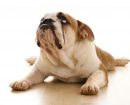
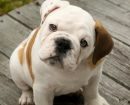
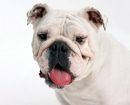
    Bulldog
    Gran Bretaรฑa FCI 149 - Molossoid - Dogo

    Bulldog

    The Bulldog Currently he is a dog known for having a good humor.

    Content

    History

    The race Bulldog or English Bulldog, It was initially used for betting in dog fights, during the 17TH century (in 1835 This practice was banned in England). In the news, this dog is one of the symbols of England.

    Its origin is in the "ancient Greek dog", Kelb Thal Bulldog, or bulls Maltese dog: an imported breed to England, with ancient mastiffs crossed gave rise to the Old English Bulldog.

    The Bulldog of yesteryear was lighter and similar to the Boxer than the chubby current Bulldog; was a purely sporting animal. It was used in the creation of other races as: Bullmastiff, Boxer, Bull Terrier, and some hounds like him Beagle old type. As a fighting dog, it was an animal that only accepted the challenge of larger animals such as bears., bulls and even Lions.

    The origin of the name is due to the fact of being a dog butchers, that is to say, its function was to run the bulls, for believing that his meat was softer that way. Although it is probably a deformation of the name Band Dog or "Hardened Dog".
    It must be borne in mind that the old Bulldog have nothing to do with the current, they were only modified with crosses with other races like the Pug or Dutch bulldog; race of which Bulldog inherited its flattened snout as well as its plump muscles.

    Former Bulldogs were dogs of varied appearance, sometimes dogs elongated snout and all colors. It has to be taken into account that the former Bulldog was a working animal by which attached great importance to the character.

    Physical characteristics

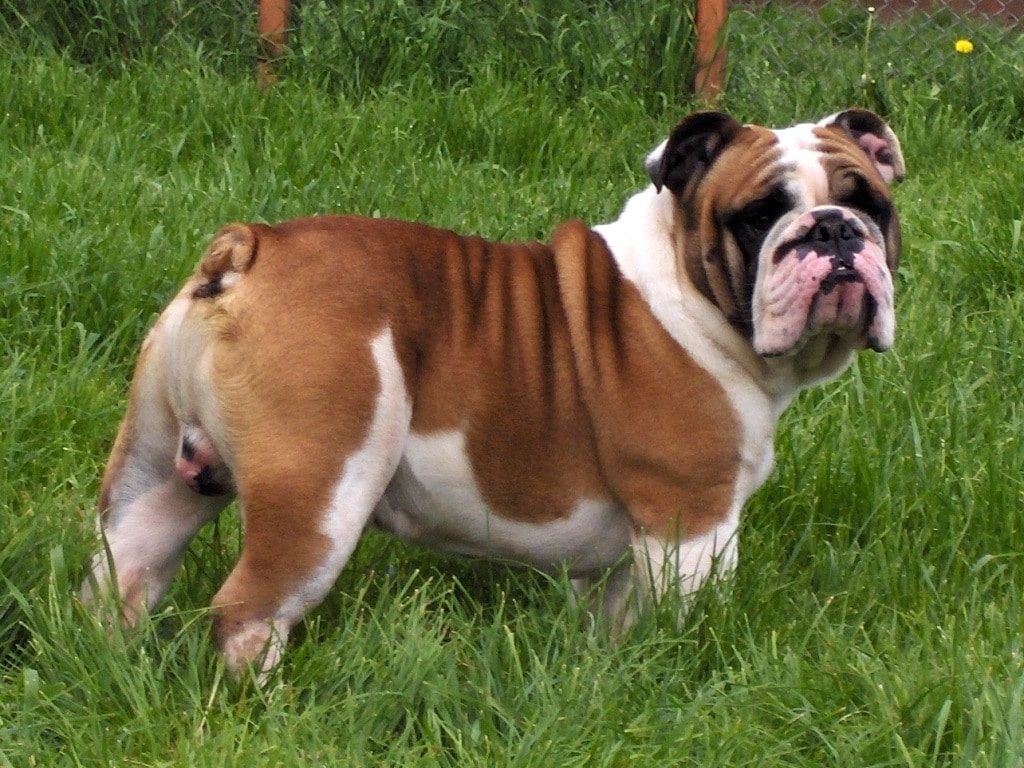
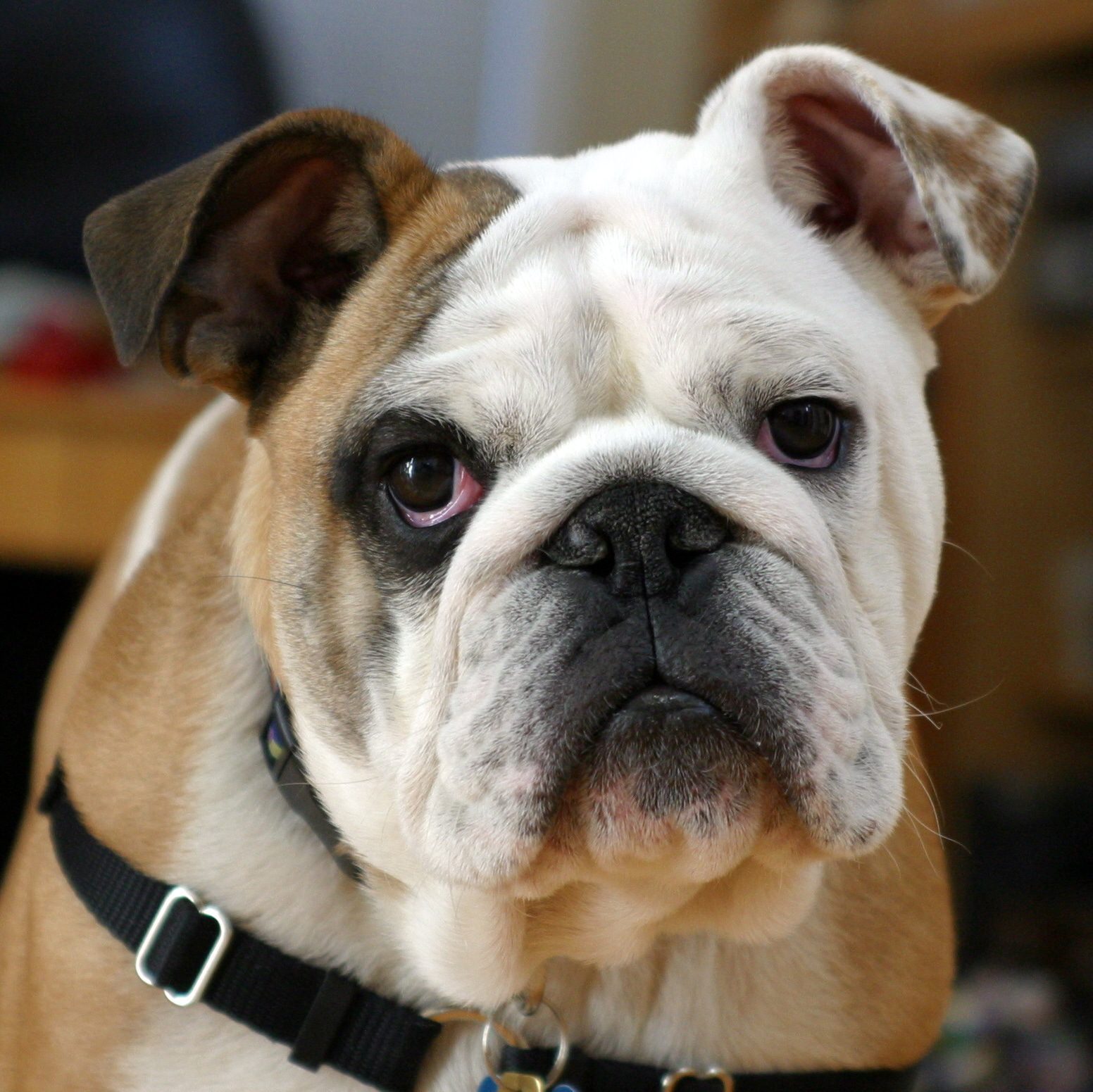
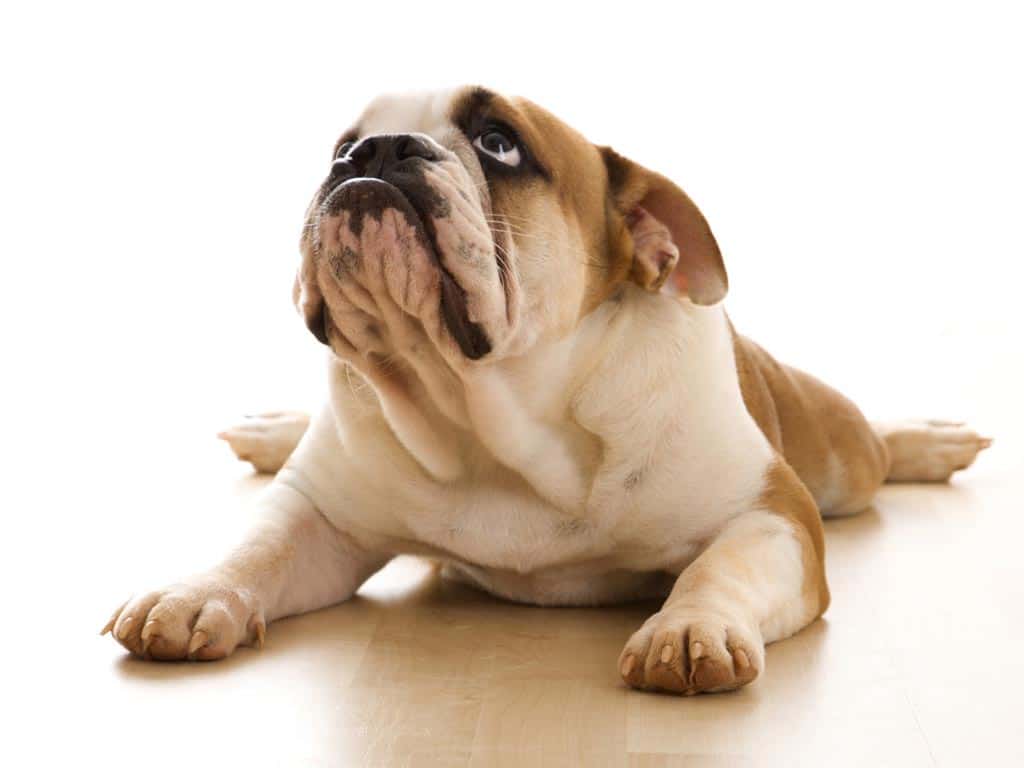
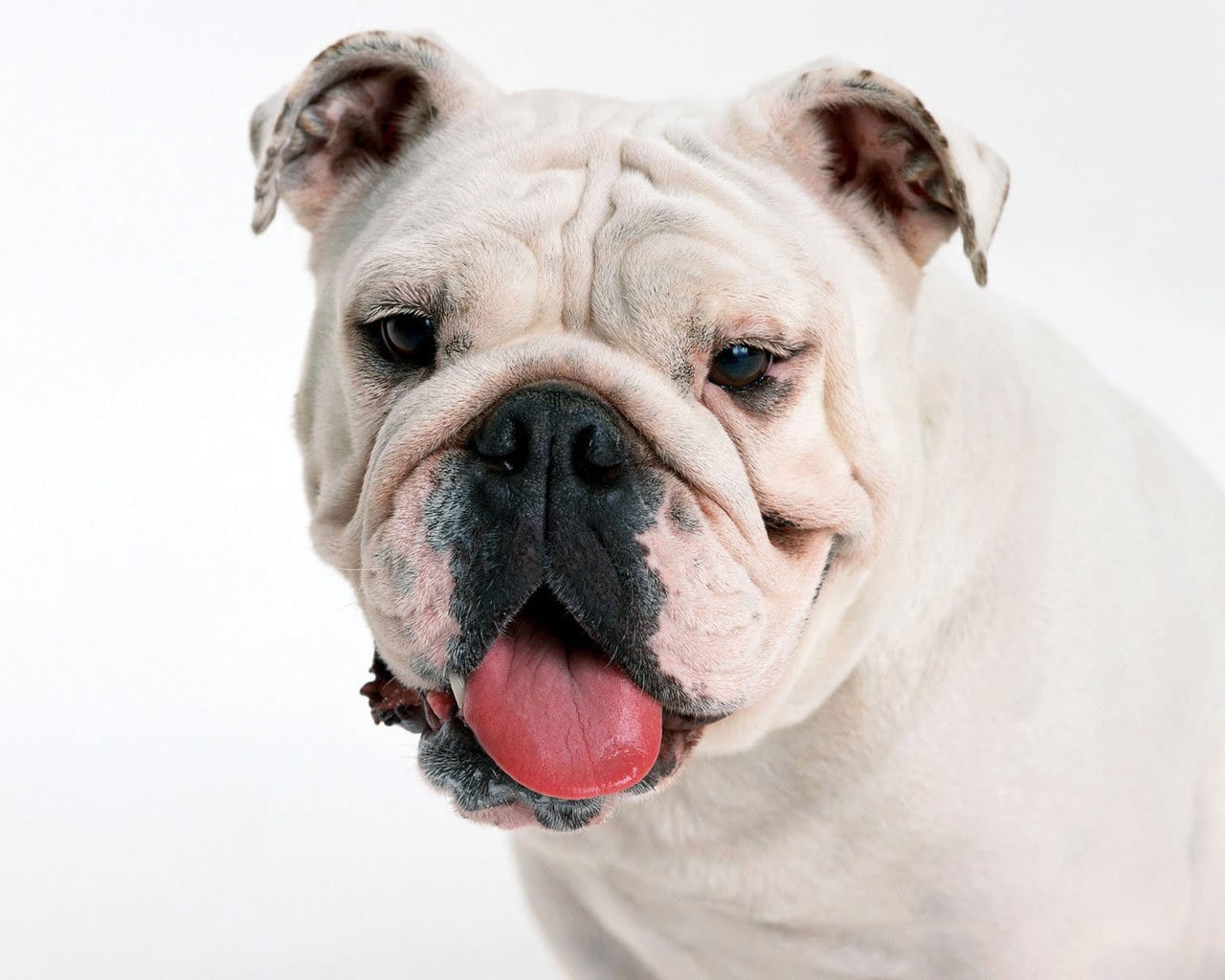
    The Bulldog is a breed that is characterized by thick shoulders and a head large in proportion to their body. Generally thick folds of skin on his forehead, followed by a few black, large, round eyes. It has a short snout with folds above the nose, with a pendant Chin under neck, along with sagging lips and pointed teeth. The big legs give an idea, how strong is the dog that you have to deal with. Even a well-trained bulldog with an ideal weight seems to the uninitiated observer that it is a dog with excess pounds. He's really loaded with muscle and shouldn't have any fat on his ribs. All this translates into a very powerful and imposing appearance.

    Its pelage is short, smooth and elegant red color, beige, white, striped (color mixing, sometimes in irregular stripes) and various colors of these.

    Weight and height standard varies by country, but in general terms and averages, These dogs are usually measured in 30 to 40 cm. and weigh in 18 to 25 Kg. Some dog breeds need them they cut off the tail or her call after birth, the bulldogs are the few races that have naturally short and curly tail. A long, upright tail it is flaw in a Bulldog.

    Character and skills

    The Bulldog is friendly and courteous. There is hardly a quadruped that is so wholeheartedly devoted to humans. He greets his family and all the people he has held close to his heart at some point in his life with exuberant warmth.. Itร‚ยดs, mostly, a cool guy who can't be bothered by anything so quickly, not by a barking dog or by the vacuum cleaner running through its muzzle. But it can literally explode in an instant when it seems necessary. Then shoot like a rocket towards the front door and pile up with a dark bass in front of the alleged troublemaker.. In this situation, literally goes through the wall. The direct path is then his creed.

    But do not worry, the Bulldog can be controlled and bite accidents are practically impossible. When you realize you've scared a friend, almost embarrassed. Once the "danger" has been avoided, he lies down comfortably on his couch again seconds later and growls like nothing happened. At these extremes his mental heritage comes out once again. The Bulldog has a sovereign character, making it the ideal companion even in hectic big cities and a balm for our often stressed psyche.

    โ€œBulldogโ€ care

    The Bulldog has no special demands on your posture. It is a frugal and low maintenance companion, as long as you are healthy. The most important thing is that you feel the love of your humans. It can be easily kept in a small apartment as long as it has its place on the sofa with a cushion. This is sacred to him. But there shouldn't be too many stairs to climb. He loves his daily walks, you also need to stay fit, and is a smooth companion when traveling or in the restaurant. The Bulldog behaves perfectly and can also be left in the room for a few hours.

    But, when is hot, you have to let her rest. You have to be careful that you are neither physically nor mentally stressed. You should avoid long car trips even with air conditioning. Otherwise, it is perfectly suitable for traveling. to most of the Bulldogs they love to travel by car. Since he doesn't have a strong hunting instinct, you can walk with him relaxedly through the landscape, what he also likes Bulldog. You have to control yourself with food. Most of the Bulldogs they are voracious eaters, who empty their bowl in no time and then look at us with an innocent expression: "That, Thats not all, I'm supposed to starve here?ยป Being overweight is bad for your health, even in the Bulldogs.

    No special coat care necessary; occasional brushing is good for fur and psyche.
    Regular cleaning is necessary in case of exaggerated wrinkles.

    Nutrition / Food

    The Bulldog he's a greedy dog. He hurriedly empties the bowl and then asks with a disapproving look if that was it.. In the interest of your health and your tendency to be overweight, must keep short and always watch the total ration of sweets included. It is advisable to feed the English Bulldog with high quality food with a high meat content.

    Life expectancy

    Due to over-exploitation and exaggeration in its appearance, the Bulldog has a life expectancy of only 6,3 years according to the standard leading Kennel Club static. A typical Bulldog of serious breeding without exaggeration can easily reach the 10-12 years.

    Health "Bulldog"

    There is probably no dog, nor any animal, that was so deeply shaped and unfortunately deformed by us humans. This caused considerable health problems. In 2009 the Kennel Club of London, who is responsible for him, revised the standard of Bulldog in the sense of a healthier upbringing. Among other things, nose wrinkles are expressly prohibited. Unfortunately, these regulations are ignored in much of the breeding. Natural births are a rarity and mating is increasingly being replaced by artificial insemination by the vet. The Bulldog healthy is very easy to care.

    Many Bulldogs suffer from a deformation of the respiratory tract, it doesn't allow them to breathe freely. As a result, the heart is occasionally overloaded. It also, inflamed wrinkles, entropion (eyelid turned inward) and narrow ear canals are common clinical pictures of the Bulldog. It also tends to cause allergies..

    Education

    The basis of your education is a relationship of love and trust with your master and caregiver. Humans must take their stubbornness and occasional stubbornness with humor.. Otherwise, we have a problem. Not a receiver of orders. But, needs clear boundaries and rules that must be strictly adhered to. Because when you want something, can be very stubborn. The Bulldog wants to please his people, but check the meaning of each order. If you don't want something, there is no way to enter. The only way to get in is by asking.. But then he will do what he is asked. A relationship of trust, a good understanding of your individual personality and respect for him can be the basis of an extremely harmonious team, where the Bulldog follows its caregiver with only facial expressions and eye movements.

    Ideal family dogs

    The Bulldogs they are ideal family dogs. Social integration in the human family and participation in his life is the greatest for him. Also for us, the humans, your warm affection is always a cause for joy, smile and good mood. Does not have an innate behavior, like the herding or protective instinct, that could turn into trouble. It is an ideal playmate for children. Although at first glance it seems a bit awkward, he is surprisingly kind even to young children. He also gets along well with other pets..

    Buy a "Bulldog"

    Find a Bulldog healthy is not easy
    Buy a puppy from Bulldog it's not easy. Although there is a wide range of offers on the relevant Internet portals, these are mostly doubtful. Many of the Bulldogs offered there come from Eastern European or even German multipliers. Breeding dogs lead a miserable life and puppies often show their illnesses days after purchase. This can become a very expensive matter, not to mention suffering. The Bulldog seriously bred is an expensive dog to buy, precisely because their upbringing requires a lot of effort. Please, buy your Bulldog only from the local breeder from long ago, preferably breeders with all certifications. Take a close look at the breeder: Serious breeders like to show you their breeding dogs and document the health and age of their ancestors. But it is also recommended to take a look at the refuge – there may be an opportunity to offer a Bulldog a new home. The puppies of a serious breeder cost from 2500 EUR. No special maintenance costs are necessary, but the Bulldog has a high risk of disease and therefore a high risk of cost.

    Characteristics "Bulldog"

    Coexistence is important that you have with your new friend. Before considering the acquisition of a dog of the breed "Bulldog" you know certain factors. Not all breeds of dogs are apt to live in an apartment, you must take into account his character, their need for exercise, their interaction with other pets, their care and if you have small children, their level of tolerance towards them.

    Adaptation โ“˜

    5,0 of 5 stars (based on 1 review)

    friendly dog โ€‹โ€‹โ“˜

    5,0 of 5 stars (based on 1 review)

    hair loss โ“˜

    3,0 of 5 stars (based on 1 review)

    Affection level โ“˜

    5,0 of 5 stars (based on 1 review)

    Need for exercise โ“˜

    1,0 of 5 stars (based on 1 review)

    Social need โ“˜

    4,0 of 5 stars (based on 1 review)

    Home โ“˜

    5,0 of 5 stars (based on 1 review)

    Toilet โ“˜

    3,0 of 5 stars (based on 1 review)

    Friendly with strangers โ“˜

    5,0 of 5 stars (based on 1 review)

    barking โ“˜

    1,0 of 5 stars (based on 1 review)

    Health โ“˜

    5,0 of 5 stars (based on 1 review)

    Territorial โ“˜

    2,0 of 5 stars (based on 1 review)

    Cat friendly โ“˜

    5,0 of 5 stars (based on 1 review)

    Intelligence โ“˜

    3,0 of 5 stars (based on 1 review)

    Versatility โ“˜

    3,0 of 5 stars (based on 1 review)

    Child friendly โ“˜

    5,0 of 5 stars (based on 1 review)

    Surveillance โ“˜

    1,0 of 5 stars (based on 1 review)

    joy โ“˜

    5,0 of 5 stars (based on 1 review)

    ยซBulldogยป images

    ยซBulldogยป Videos

    Type and recognitions:

    • FCI CLASSIFICATION:
    • Group :
    • Section : . .

    Federations:

    FCI โ“˜, AKC โ“˜, ANKC โ“˜, CKC โ“˜, โ€‹KC โ“˜, NZKC โ“˜, UKC โ“˜

    FCI breed standard "Bulldog"

    Origin:
    England, United Kingdom

    Date of publication of the valid original standard:
    13.10.2010

    Use:

    Companion and deterrent dog.


    General appearance:

    It is a short haired dog, somethingheavy, rather short in stature, width, powerful and compact. Rather large head in proportion to its size, but no part of your body should be excessively large in relation to the others., thus breaking the general symmetry, making the dog look deformed or interfering with its ability to move. Cararelativelyshort, wide snout, blunt and inclined slightly upward, although not very excessive. Dogs showing respiratory problems are highly undesirable. Bodysomething short, of good structure. Strong Member, well muscled and robustno tendency to obesity. Tall and strong rear. females not so developed as males.


    Behavior / temperament:

    You must give the impression of determination, strength and activity. Alert, brave, fair, dependent, courageous, fierce in appearance, but holder of an emotional nature.

    Head:

    Side view, the head is very high and moderately cuts from the back up to the tip of the nose. Flat front with skin on and around the head, slightly loose and subtly wrinkledwithout excess never prominent or protruding from the face. The face, from cheek to nose bones, relatively short, with skinIt may be slightly  wrinkled. The distance from the interior of the eye angle (or the center of the depression slightly between the eyes) at the end of the tip of the nose, notshould be less than the distance the tip of the nose at the edge of the lower lip.

    Cranial region:
    • Skull: Skullrelatively large in circumference. Seen from the front it appears high from the angle of the lower jaw to the top of the skull, also wide and square. From the stop, a Groove extends to the middle of the skull, may continued his stroke to the vertex.
    • Depression links (Stop) : Defined.

    facial region:

    Seen from the front, several properties of the face,  must be equally balanced to both sides of an imaginary center line.

    Nose: Nose and large nostrils, wide, black, under no circumstances liver colored, Red or brown. Large nostrils wide and open, with a well defined line, vertical and straight in between I.

    Snout:  Short snout, width, downturned, deep from the corner of the eye to corner of mouth.

    The wrinkle on the nose, If it is present, full or broken, It should never negatively affect or obscure the eyes or nose.

    Narrow nostrils and heavy wrinkles over the nose are unacceptable and should be severely penalized.

    • Lips: Thick belfos, large, and deep, covering the sides of the lower jaw, but joining the lower lip in front. Teethnon-visible.
    • jaws and teeth: Wide jaws, strong, square, lower jaw projectingslightly towards front topwith a moderate slope upward. Wide, square jaws with six small front teeth between the canines, in an even row. Canines well separated from each other, large, strong teeth that should not be seen when the mouth is closed. When seen from the front, the lower jaw is seen exactly below the upper jaw and parallel to it..
    • Cheeks: Well rounded cheeks and extends laterally beyond the eyes.
    • Eyes: Seen from the front, located low in the skull, well separated from the ears. The eyes and the naso-frontal depression are in the same straight line, at right angles to the front furrow. Separate, however the external angles within the outer line of the cheeks. Round, moderate size, or sunk or prominent, very dark, almost black, not showing the white when they look directly in front. Free of obvious problems of eyes.
    • Ears: High insertion, that is the front edge of each ear (seen from the front) touch the edge of the skull in its top margin, so that they are as far apart as possible from each other, separated from the eyes as possible and high. Small, thin โ€œrose-shaped earsโ€ is correct, It is said that internal wrinkles fall back, the top edge, front internal, curving outward and backward, showing part of the inside of the ear canal.

    Neck:

    Moderate long, very thick, deep and strong. Well arched at the top, with somethingloose skin, thick and wrinkled around the throat forming one mild dewlap on each side.

    Body:

    • top line: It falls slightly to the back behind the tip of the blades (This is the lowest part) where thorn goes to the back (higher than the cross point) curving again more suddenly towards the tail, forming amild  bow a distinctive feature of the breed.
    • Back: Short back, strong, wide at the height of the scapulae. Chest: Chest width, prominent and deep. Body with well-defined ribs backwards. Chest deep and rounded. Well lowered between the front legs.Ribs not being flat at the sides, well rounded
    • Bottom line and belly: Abdomen retracted and not hanging.

    Tail:

    Low insertion, rather right out and then turning down. Rounded, smooth and devoid of fringe or wire-haired. Moderate long, short rather than long, thick at the base, fine tuning quickly towards a tip. You must take it down (without a clear upward curve at the tip) and never carried above the level of the top line. Absence of tail, reversed or too tight queue are undesirable.

    Tips

    FRONT MEMBER:

    • General appearance: Short front legs in proportion to the rear, but not so short as to make the back look like long or as to hinder the activity of the dog.
    • Shoulder: Wide shoulders with steep and deep scapulae, very powerful and muscular giving the appearance of being glued to the body.
    • Elbows: Elbows low and well away from the ribs.
    • Arm: Very Beefy front legs and strong, well developed, inserted separate good, thick, muscular and straight, the bones of the legs are large and straight, not bent or curved.
    • Metacarpus: Short metacarpals, straight and strong.
    • Previous feet: Straight and returned very slightly outward, moderately rounded and medium sized. Compact and thick fingers, well separated up, making knuckles prominent and high.

    LATER MEMBERS:

    • General appearance: Great legs and Forelegs, in proportionslightly longer than the front ones. Long legs and Forelegs from the spine to the Hock.
    • Knees: Knee wrapsvery slightly away from the body.
    • Metatarsus: Slightly sloping and well descended metatarsals.
    • Hind feet: Round and compact. Compact and thick fingers, well separated up, making knuckles prominent and high.

    Movement:

    Walking with short, quick steps on the tip of your fingers, the rear feet not lifted high, resembling the floor rozan, running with one or another shoulder relatively moving. The strength of the movement is of the utmost importance.

    Mantle

    • Fur: Texture fine, short, pasted and smooth (hard only small and paste, rather than wire)
    • COLOR : Solid or sooty, (is a single color with black mask or muzzle). Unicolores (It must be bright and pure of his type) how striped, Red in its various shades, trode, Griffon etc., White and parties (is the combination of white with any of the above colors) Flesh-colored, black and black and Tan are highly undesirable.


    Size and weight:

    • Males: 25  kgs.
    • females: 23  kgs


    Fouls:

    Any deviation from the above mentioned points should be considered as missing and the seriousness with which this is to be taken must be in exact proportion to its degree and its effect on the health and welfare of the dog.


    FALTAS DESCALIFICANTES :

    • Aggressive or fearful dog.
    • Any dog โ€‹โ€‹showing physical or behavioral abnormalities must be disqualified..


    N.B.:

    Males should have two apparently normal testicles, fully descended into the scrotum.


    TRANSLATION : Brรญgida Nestler / Original version : (IN)
    Technical supervision : Miguel Angel Martinez

    Source: F.C.I - International Cynological Federation

    Alternative names:

    1. British Bulldog, English Bulldog (English).
    2. Bulldog (French).
    3. Bulldog (German).
    4. Bulldog-inglรชs (Portuguese).
    5. Bulldog inglรฉs (espaรฑol).

    โ–ท The world of Pets: Dogs, cats, birds, reptiles, amphibians

    Austrian Pinscher
    Austria FCI 64 . Pinscher and schnauzer type

    Austrian Pinscher 1

    Self-confidence, lively, attentive, playful, especially attached

    Content

    History

    The Austrian Pinscher descends from old Austrian Landpinscher, which was still widespread in the second half of the 19th century as a frugal and versatile farm dog. In 1921 a pure breeding plan was started. Against him german pinscher, seems wider, more robust and more primitive. Emil Hauck became familiar with this type of dog during his travels at the beginning of the 20th century and worked for the recognition of the breed by the ร–KV and the FCI.. The 16 in October of 1928, this breed was recognized as Austrian Shorthaired Pinscher por la ร–KV. In the year 2000 the breed name was changed to Austrian Pinscher.

    But, according to the breeders association, the number of dogs decreased in the decade of 1970 so much so that only one stud dog remained, Diocles of Angers. Starting from this, the breed was preserved using โ€œLandpinschersโ€. The โ€œLandpinschersโ€ are still used in breeding. The โ€œLandpinschersโ€ are dogs that correspond to the Austrian Pinscher in terms of phenotype and are relatively stable in terms of breeding, without being specifically bred as pedigree dogs in the sense of modern dog breeding.

    Physical characteristics

    It is a medium to small size dog. The eyes are large, with the dark iris. The ears are usually "V" shaped., but there are also buttons, semi-straight or straight. Breeders try to set as far as possible a ยซVยป shaped ear that, otherwise, is already the most common. The tail is implanted high, the dog the coiled cam, frequently on the back, and it's short and thick. Can also be shortened.

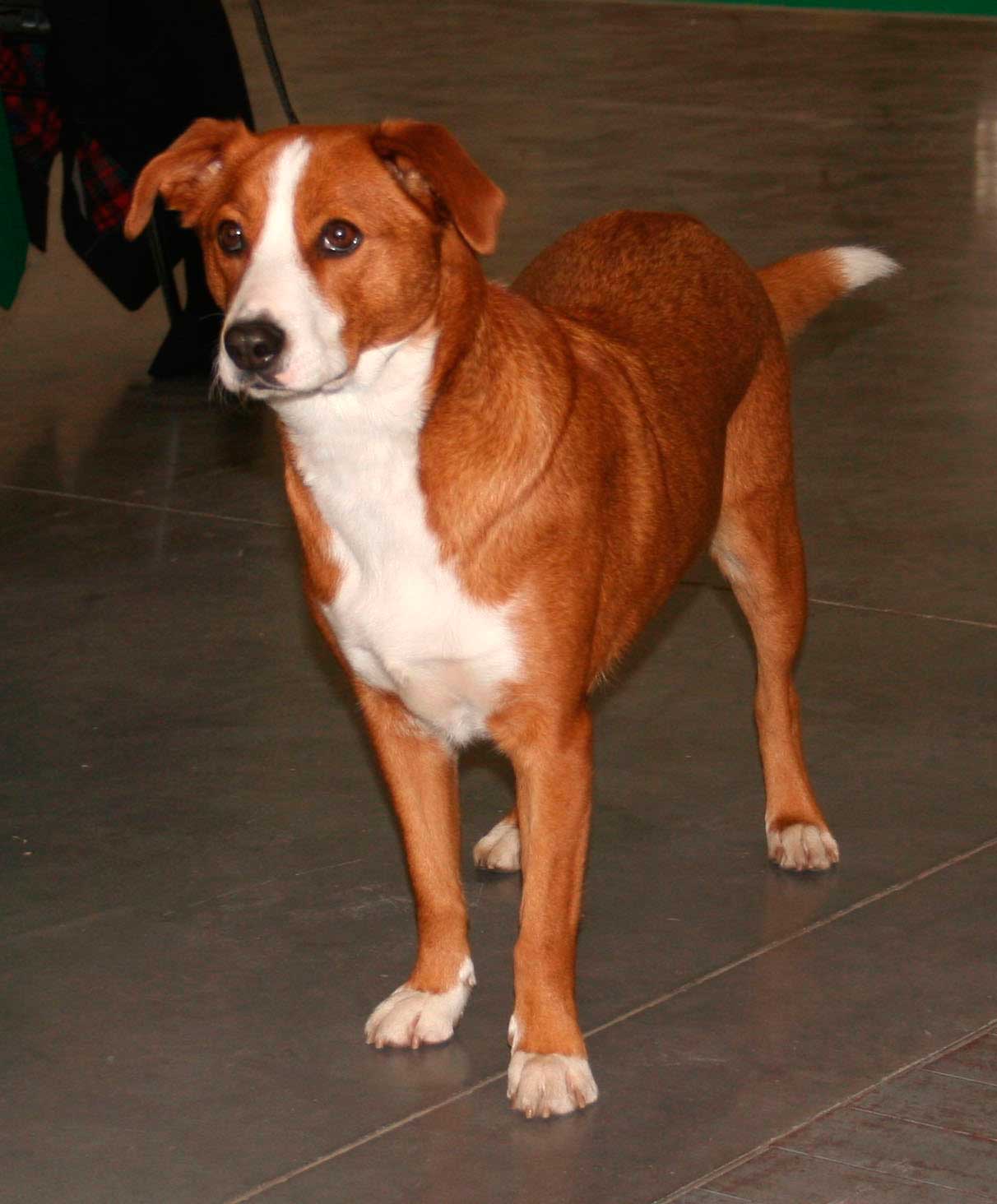
    • Fur: short, straight and with undercoat. Remember the smooth-haired fox terrier.
    • Color: the most frequent are wheat yellow, brown yellow, leonado, fawn red and black with fiery spots. Almost always with large white spots on the chest, snout, throat, neck, nape, extremities and tip of tail. The specimens with the mottled coat, completely black or white and fire are not desirable.
    • Size: 35 to 50 cm., more frequently in tone to the 40 cm..

    Character and skills

    It is a vigorous little dog, bold, temperamental and very resistant. It is a great surveillance dog; on the other hand, it is not spread as a companion dog, among other things because it is very barking. But, medium-small dogs do not meet the demands of someone who wants a dog for the apartment (always as small as possible), nor those who want a watchdog (preferably medium-large size), and for this reason the spread of the breed is very limited.

    Observations

    He has good hunting attitudes.

    Characteristics "Austrian Pinscher"

    Coexistence is important that you have with your new friend. Before considering the acquisition of a dog of the breed "Austrian Pinscher" you know certain factors. Not all breeds of dogs are apt to live in an apartment, you must take into account his character, their need for exercise, their interaction with other pets, their care and if you have small children, their level of tolerance towards them.

    Adaptation โ“˜

    3,0 of 5 stars (based on 1 review)

    friendly dog โ€‹โ€‹โ“˜

    2,0 of 5 stars (based on 1 review)

    hair loss โ“˜

    5,0 of 5 stars (based on 1 review)

    Affection level โ“˜

    4,0 of 5 stars (based on 1 review)

    Need for exercise โ“˜

    4,0 of 5 stars (based on 1 review)

    Social need โ“˜

    2,0 of 5 stars (based on 1 review)

    Home โ“˜

    3,0 of 5 stars (based on 1 review)

    Toilet โ“˜

    2,0 of 5 stars (based on 1 review)

    Friendly with strangers โ“˜

    2,0 of 5 stars (based on 1 review)

    barking โ“˜

    2,0 of 5 stars (based on 1 review)

    Health โ“˜

    3,0 of 5 stars (based on 1 review)

    Territorial โ“˜

    5,0 of 5 stars (based on 1 review)

    Cat friendly โ“˜

    2,0 of 5 stars (based on 1 review)

    Intelligence โ“˜

    4,0 of 5 stars (based on 1 review)

    Versatility โ“˜

    4,0 of 5 stars (based on 1 review)

    Child friendly โ“˜

    4,0 of 5 stars (based on 1 review)

    Surveillance โ“˜

    4,0 of 5 stars (based on 1 review)

    joy โ“˜

    4,0 of 5 stars (based on 1 review)

    Images "Austrian Pinscher"

    Type and recognitions:

    • FCI CLASSIFICATION:
    • Group :
    • Section : . .

    Federations:

    • – FCI – Pinscher and Schanuezer dogs. Molossian type Dogs and Swiss Mountain and Cattle Dogs. . Section 1.1 Pinscher type. โ“˜
    • – UKC – Terriers โ“˜

    FCI breed standard Austrian Pinscher

    FCIFCI - Austrian Pinscher
    Pinscher

    Alternative names:

    1. Austrian Shorthaired Pinscher (English).
    2. Oesterreichisher Kurzhaariger Pinscher (French).
    3. ร–sterreichischer Pinscher (German).
    4. ร–sterreichischer Pinscher (Portuguese).
    5. Pinscher austriaco de pelo corto (espaรฑol).

    Photos:

    1 – Pinczer_Austrian at the World Dog Show in Poznaล„ by chained / CC BY-SA
    2 – Austrian Pinscher at the World Dog Show in Poznaล„ by chained / CC BY-SA
    3 – Pinscher austriaco by https://pxhere.com/es/photo/1603530
    4 – Pinscher austriaco by https://pxhere.com/es/photo/1593828
    5 – Austrian Pinscher at the World Dog Show in Poznaล„ by chained / CC BY-SA

    โ–ท The world of Pets: Dogs, cats, birds, reptiles, amphibians

    Shar Pei
    China FCI 309 - Molossoid - Dogo

    Shar Pei

    The Shar Pei he is affectionate with his owner; he is quite reserved with strangers.

    Content

    History

    Dogs like breed Shar Pei have existed in southern China for centuries, perhaps from the Han dynasty around 200 A.C. Archaeologists have found statues from that period showing a dog similar to the Shar-Pei.. Later evidence includes a 13th century document referring to a wrinkled dog.

    The first Shar-Pei they were farm and working dogs. They watched over property and livestock, they hunted and herded flocks. The Shar-Pei was a guardian of the house otherwise, as well. His purple tongue, shared with another race, the Chow Chow, and their wrinkled skin was believed to ward off evil spirits. In addition to being working dogs, the Shar Pei fighting dogs were also popular. Their loose fur and rough fur made it difficult for the other dog to hold on to them..

    Life has always been hard in China, but for the Shar Pei became very dangerous after the communist takeover in the early 20th century. In the People's Republic of China, Dogs were a symbol of a decadent past and were virtually eliminated in the 1990s. 1950. Only a few remained in rural areas, as well as in Hong Kong (still under British rule at the time) and in Taiwan, plus a few that had been exported to the United States in 1966.

    In 1973, a Hong Kong breeder named Matgo Law appealed to Western dog aficionados to help save the breed, it was on the verge of extinction. The unusual wrinkled dogs sparked enthusiastic interest among Americans and quickly became "the" dog to have.. The Shar Pei were fully recognized by the American Kennel Club in 1992. After that first burst of popularity, have achieved a moderate level of interest, they are currently in the position 50, below the post 37 a decade.

    Physical characteristics

    It is a robust dog, solid, compact, shorthair. The head is large in proportion to the body. The skull is wide and flat, and the โ“˜stop, very little pronounced. The forehead and the orbital region are covered with abundant and fine wrinkles that extend downwards forming ; eyes are small, sunken, black or brown color in beige specimens. Ears are very small, equilateral triangle, and high insertion and facing forward, above the eyes. The skin forms folds throughout the body, which is a peculiarity of the breed. The tail is inserted high and its carriage in the shape of a trunk above the back is characteristic., without touching it.

    • Fur: thick, very short and straight, with a very visible hardness.
    • Color: black, brown, leonado, beige and cream.
    • Size: 40 – 51 cm..

    The Chinese line presents fewer wrinkles than the American one. Females are smaller in size than males.

    Character and skills

    The Shar Pei he's a little snobby. He's naturally reserved with people he doesn't know and stays aloof once they're introduced. Extensive socialization at a young age is necessary to prevent it from becoming too territorial or aggressive. Only family members receive the overwhelming devotion of this independent dog., alert and intelligent that watches the world go by in a calm and dignified way.

    One Shar Pei it's quiet in the house. It is a remarkable watchdog and rarely barks unless it is playing. If they hear it, you should go and see what has caught your attention. A short, quick walk meets your exercise needs.

    It is a strong and confident dog that learns fast, so don't put off training. The Shar Pei is independent and strong-willed. Be firm but never harsh or physical with him.. Teach him from the beginning to accept grooming procedures like trimming nails, clean ears and brush teeth. You never want you Shar Pei learn that you can be physically intimidated into stopping these procedures.

    like most dogs, to the Shar Pei He doesn't like to have his feet touched and he doesn't like to have his nails cut. That also applies to other procedures..

    The Shar Pei is a watchdog that has hunted and fought with other dogs. to most of the Shar Pei They do not like the company of other dogs., and are easily excited by aggression. A securely fenced yard will prevent you from conflict with other dogs or trying to expand your territory to include the entire block..

    Start training your puppy the day you bring him home. Even at eight weeks old, He is able to absorb everything you can teach him. Don't wait until you have 6 months to start train or have to deal with more stubborn dog. If possible, Take it to a trainer when you have between 10 and 12 weeks, and socializes, socialice, socialice. But, Note that many kinds of training puppies require certain vaccinations (such as kennel cough) stay up to date, and many veterinarians recommend limited exposure to other dogs and public places until puppy vaccinations (including rabies, distemper and parvovirus) They are completed. Instead of formal training, You can start training your puppy to socialize at home and among family and friends until immunizations are completed in the puppy.

    Talk to the breeder, Describe exactly what you want in a dog and ask for help choosing a puppy. Breeders see puppies daily and can make incredibly accurate recommendations once they know something about their lifestyle and personality. Whatever you want from a Shar Pei, look for one whose parents have nice personalities and who has been well socialized since the puppy's young age.

    Health of the ยซShar Peiยป

    All dogs have the potential to develop genetic health problems, just as all people have the potential to inherit a particular disease. Run, do not walk, from any breeder that does not offer a health guarantee on puppies, to tell you that the breed is 100 percent healthy and has no known problems, or tell you that your puppies are isolated from the main part of the home for health reasons. A reputable breeder will be honest and open about the breed's health problems and the incidence with which they occur in their lines..

    The Shar Pei have many health problems, and their owners can develop a close relationship with their vet. Concerns include hip and elbow dysplasia; patella dislocation; Hypothyroidism; eye problems such as entropy, retinal dysplasia and glaucoma, allergies and infections of the skin folds.

    A unique problem is a disease called c fever, a condition in which the dog experiences periodic fevers and its hock joints swell. Accompanying signs may include lethargy, vomiting, diarrhea and shallow breathing.

    Not all of these conditions are detectable on a growing puppy, and it is impossible to predict if an animal will be free of these diseases, so you must find a reputable breeder who is committed to raising the healthiest animals possible.. Must be able to produce independent certification that the dog's parents (and grandparents, etc.) have been examined for common defects and considered healthy for breeding. That's where health records come in..

    Careful breeders screen their breeding dogs for genetic diseases and breed only the healthiest, best-looking specimens., but sometimes mother nature has other ideas and a puppy develops one of these diseases despite good husbandry practices. Advances in veterinary medicine mean that in most cases dogs can still live a good life. If you are going to have a puppy, ask the breeder about the ages of the dogs in their lines and what they died of.

    Remember that after you have welcomed a new puppy into your home, has the power to protect you from one of the most common health problems: the obesity. Keep a Shar Pei with proper weight is one of the easiest ways to extend your life. Make the most of your preventive skills to help ensure a healthier dog for life.

    Care of the ยซShar Peiยป

    Grooming requirements depend on each Shar Pei. Weekly brushing can meet the needs of both the "short-haired" variety and the "brushed" type. (slightly longer), but some Shar Pei of either type can be prone to skin problems. Dogs with skin problems may need a weekly bath and daily brushing.

    All the Shar Pei need regular wrinkle care. Wrinkles should be cleaned with a damp cloth and then dried completely to prevent infection.. Do not oil the skin.

    The Shar Pei they have small ears, tight and triangular that predispose them to chronic ear problems because there is not enough air circulating in the narrow ear canal. Although it is not so easy to clean the ears of a Shar Pei as it is for most races, regular cleaning should be done to help prevent recurrent yeast or bacterial infections.

    Bathe your dog as you like or only when it gets dirty. With the gentle dog shampoos available now, can bathe a Shar Peiweekly if you wish without damaging your coat.

    The rest is basic care. Trim nails as needed, usually every few weeks. Brush your teeth for general good health and fresh breath.

    Characteristics "Shar Pei"

    Coexistence is important that you have with your new friend. Before considering the acquisition of a dog of the breed "Shar Pei" you know certain factors. Not all breeds of dogs are apt to live in an apartment, you must take into account his character, their need for exercise, their interaction with other pets, their care and if you have small children, their level of tolerance towards them.

    Adaptation โ“˜

    3,0 of 5 stars (based on 1 review)

    friendly dog โ€‹โ€‹โ“˜

    2,0 of 5 stars (based on 1 review)

    hair loss โ“˜

    2,0 of 5 stars (based on 1 review)

    Affection level โ“˜

    5,0 of 5 stars (based on 1 review)

    Need for exercise โ“˜

    2,0 of 5 stars (based on 1 review)

    Social need โ“˜

    3,0 of 5 stars (based on 1 review)

    Home โ“˜

    4,0 of 5 stars (based on 1 review)

    Toilet โ“˜

    3,0 of 5 stars (based on 1 review)

    Friendly with strangers โ“˜

    1,0 of 5 stars (based on 1 review)

    barking โ“˜

    1,0 of 5 stars (based on 1 review)

    Health โ“˜

    5,0 of 5 stars (based on 1 review)

    Territorial โ“˜

    3,0 of 5 stars (based on 1 review)

    Cat friendly โ“˜

    3,0 of 5 stars (based on 1 review)

    Intelligence โ“˜

    5,0 of 5 stars (based on 1 review)

    Versatility โ“˜

    3,0 of 5 stars (based on 1 review)

    Child friendly โ“˜

    1,0 of 5 stars (based on 1 review)

    Surveillance โ“˜

    3,0 of 5 stars (based on 1 review)

    joy โ“˜

    3,0 of 5 stars (based on 1 review)

    Images "Shar Pei"

    Photos:

    1 – This is a typical photo of a bone mouth traditional Shar-Pei. CH Dali Pinky, Hong Kong Kennel Club Champion by No machine-readable author provided. Inuyasya1106 assumed (based on copyright claims). / Public domain
    2 – Shar_Pei_female_of_7_months._Chinese_line by Mcarrillo / CC BY-SA
    3 – Shar Pei by https://pxhere.com/es/photo/1267570
    4 – Shar Pei by https://pxhere.com/es/photo/1169173

    Videos "Shar Pei"

    Type and recognitions:

    • FCI CLASSIFICATION:
    • Group :
    • Section : . .

    Federations:

    • – FCI – Pinscher and Schnauzer-Molossoid type dogs – Swiss Mountain Dogs and Cattledogs. Section 2.1 Molossoid, mastiff type. โ“˜
    • – AKC – Non-Sporting โ“˜
    • – ANKC – Group 7 (Non-Sporting) โ“˜
    • – CKC – Group 6 – Non-Sporting โ“˜
    • – โ€‹KC – Utility dog โ“˜
    • – NZKC – Non-Sporting โ“˜
    • – UKC – Northern Breed โ“˜

    FCI breed standard "Shar Pei"

    Origin:
    China

    Date of publication of the valid original standard:
    14.04.1999

    Use:

    Hunting and guard dog.


    General appearance:

    This is a medium-sized dog, Active, compact, square, short loin. Wrinkles of the skull and cross, Its small ears and hippo-like snout give it a unique appearance.. Males are more robust than females.

    IMPORTANT PROPORTIONS: HeightShar Pei, from the cross to the ground, is approximately equal to the length of the body, from the tip of the shoulder to the tip of the buttock, especially in males.

    The length of the nose to the naso-frontal depression is approximately equal to that of the naso-frontal depression to the occiput.


    Behavior / temperament:

    This is a calm animal, independent, loyal and affectionate with his family.

    Head:

    It's rather big, in proportion with the body. Wrinkles that form on the forehead and cheeks extend downward to form the double chin.

    Cranial region:
    • Skull: Flat and spacious.
    • Depression links (Stop): Moderate.

    facial region:

    • Truffle: It is great, wide, preferably black, but any other color that harmonizes with the coat color is allowed. The nostrils are wide open.
    • Snout: It is characteristic of the breed. Width, from the root to the tip of the nose, no sign of decline. The lips and the upper part of the muzzle are very full. The presence of a bulge in the nose is allowed.
    • Mouth: Language, the palate, the gums and lips are preferably bluish black. Pink spotted tongue allowed. Solid pink tongue is considered highly inappropriate. In dogs with diluted colored fur, the tongue is solid lavender.
    • Jaws / Teeth: The jaws are strong, with a perfect scissor joint (The upper incisors overlap the lower incisors in close contact and are at right angles to the jaws.). The fleshiness of the lower lip should not be so excessive as to interfere with the function of the jaws..

    EYES: Are dark, almond shaped and frowning look. Lighter color is allowed in dogs with diluted coat. Nor the skin around the eyes, nor the folds, nor the hair, must impede normal function of the eyeball or eyelid. Any indication of irritation of the eyeball, the conjunctiva or the eyelids is considered highly undesirable. There must be no presence of entropion.

    EARS: Very small, rather thick, equilateral triangular shape. The tips are slightly rounded. High implementation, with the tips pointed towards the eyes. Present well forward over the eyes; they are well separated and well attached to the skull. Erect ears are highly undesirable.

    Neck:

    Medium length, strong, well implanted in the shoulders. Loose skin under the neck should not be excessive.

    Body:

    The presence of body skin folds in adult dogs is considered highly undesirable, except at the cross and at the tail, where the folds must be moderate.

    • top line: Descend slightly behind the cross, then he stands up a little on his back.
    • Back: Short and strong.
    • Pork loin: Short, width, slightly arched.
    • Rump: Rather flat.
    • Breast : Broad and deep; the sternum region reaches the elbow. bottom line: Rises slightly below the back.

    Tail:

    Thick and round at the base; gradually thin to a fine point. Well established, a distinctive feature of the breed. Can be tall and hunched, carried in a closed curl, hunched over or falling to one side or the other of the back. The absence of tail or the cut tail are highly undesirable.

    Tips

    PREVIOUS MEMBERS: Straight, of moderate length, for strong bones. There is no presence of wrinkles in the forelimbs.

    • Shoulder: Muscular, well established and inclined.
    • Metacarpus: Slightly sloping, strong, รโ€œรหœรโ€˜รลกรหœรโ€ข.
    • Previous feet: Moderate in size, compact; they are not crushed.
      Fingers have strong joints. There is no presence of spurs on the hind feet.

    LATER MEMBERS: They are muscular, strong, moderately angulated. Seen from the back, They are perpendicular to the ground and parallel to each other.. The presence of wrinkles on the thighs, the legs, the metatarsals, as well as thick skin on the hocks are undesirable.

    • Hocks: Very low.
    • Hind feet: Moderate in size, compact; they are not crushed. Fingers have strong joints. There is no presence of spurs on the hind feet.

    Movement:

    Jogging is the favorite movement. It's free, agile, balanced, with good range in the forelimbs and strong momentum of the hindlimbs. When the dog increases speed, feet tend to converge on a center line. Walking on stilts is undesirable.

    Mantle

    • Fur: It is a distinctive characteristic of the breed: shorthair, tough and piggy. On the trunk, the coat is straight and separated, but in the extremities it is more stuck. There is no presence of an internal layer of hairs. Hair length can vary between 1 to 2,5 cm.. It should never be trimmed.
    • Color: All solid colors, except for the White, are accepted. The tail and back of the thighs are often lighter in color. Darker shading is allowed along the back and on the ears.


    Size and weight:

    • Height to the cross: 44 to 51 cm. (17,5 to 20 inches).


    Fouls:

    Any deviation from the aforementioned criteria is considered as a fault and the severity of this is considered to the degree of the deviation to the standard and its consequences on the health and well-being of the dog..

    SERIOUS FAULTS:

    • Joint not presented in the form of scissors (as a transitional measure, very light upper prognathism is allowed).
    • Pointed snout.
    • Spots on the tongue (except pink spots).
    • big ears.
    • Low set tail.
    • Coat over 2,5 cm..

    FALTAS DESCALIFICANTES:

    • Aggressiveness or extreme shyness.
    • Any dog โ€‹โ€‹showing clear signs of physical or behavioral abnormalities.
    • Flat head front, with pronounced higher prognathism; lower prognathism.
    • Solid pink tongue.
    • Inner bent lower lip, preventing the bite.
    • Round and bulging eyes; entropion or ectropion.
    • Skin, folds or hair that impede normal eye function.
    • erect ears.
    • Absence of tail or tail short of birth.
    • Presence of thick folds of skin on the trunk and extremities (except at the cross and the tail).
    • Non-solid color (albino, striped, with patches, with stains, black and fire color, chair-shaped coloring).

    WARNING: Any artificial physical alteration made to theShar Pei (especially on the lips and eyelids) eliminate the dog from competition.


    N.B.:
    • Males should have two normal-appearing testicles fully descended into the scrotum..
    • Only functionally and clinically healthy dogs, with the typical conformation of the breed, should be used for parenting.

      TRANSLATION: IRIS Carrillo (Federation of Puerto Rico). Official language: IN.
      Revision: SR. Jorge Nallem.

    Source: F.C.I - International Cynological Federation

    Alternative names:

    1. Cantonese Shar-Pei (English).
    2. Shar-peรฏ, sharpeรฏ (French).
    3. Shar-Pei (German).
    4. Shar-pei (Portuguese).
    5. Sharpei (espaรฑol).

    โ–ท The world of Pets: Dogs, cats, birds, reptiles, amphibians

    German Pinscher
    Alemania FCI 184 . Pinscher and Schnauzer type

    Pinscher Alemรกn

    The German Pinscher is a dog, extremely, active and lively, alert and vigilant.

    Content

    History

    The German Pinscher (from the German pinscher "biter") It is a breed of dog that belongs to the family of Pinscher.

    This race, whose origins date back to the 15th century and which is also related to the Schnauzer, It was originally a dog used by the farmers of Germany to control rodent pests. It is believed that he is descended from crosses between old German dogs and some black Terrier used to hunt rodents.

    It is also the breed that arose the Dobermann and the so-called Miniature Pinscher. In Germany, due to the fame that were acquiring the dog shows in the rest of Europe and America, a standard of the breed was established in the year 1879, year in which it was also recognized as a race.

    Currently, the Pinscher It is considered more of a companion and guard dog than a hunting dog or vermin controller. As a companion dog it is ideal, its size enables live perfectly in a flat in city, although, like any other dog, you need to do exercise.

    In its role as a guard dog, of course, is not as imposing as his descendant the Dobermann, but their functions.

    The use of Pinscher as a watchdog it is very satisfying, It is a dog that defends well property without falling (insofar as it is well educated) in the territoriality to his master, staying true to this at all times.

    Although it has always been considered that the Pinscher it is a very attractive breed of dog, It has never exceeded the popularity of his descendants: the Pinscher the Dobermann and miniature. In fact, according to a study conducted by the Kennel Club, the Pinscher miniature is almost 8 some times larger than the Pinscher and the Doberman 138 times more popular than this.

    Physical characteristics

    The Pinscher is a dog of size medium, between 45 and 50 cm., proud bearing and strong muscles, with a weight around the 18 kg (14 to 20 kg).

    It has a head thin and snout elongated, ears median, slightly bent at birth, they hang from the head of the dog and they are generally cut.

    Neck of average length, wide and strong, trunk slim and elegant lines. Regard to the tail, like the ears, also tends to be amputated.

    The fur, It is short and rough, it comes in shades of red, brown or black, and fire in the belly and chest.

    Their fur is short and smooth, does not require much care, just brushing regularly to remove dead hair.

    Character and skills

    Because of its vitality require quite some exercise outdoors, You can fix left him free in an open field so that it can run and romp.

    As well, related to the latter, It is a suitable dog to accompany people who practice physical exercise, such as running or cycling.

    It is a dog, extremely, active and lively, alert and vigilant. It is often wary of strangers.

    It would also be necessary, given his character slightly dominant, teach him to respect rules and who is charge at home.

    We need to socialize from very small, because the dominant character leads him to not tolerate the presence of other dogs too. Then, If he is raised with another dog from a young age, they will have a duo of inseparable barkers at home.

    German Pinscher Health

    All purebred dogs have the potential to develop genetic health problems, just as all people have the potential to inherit a particular disease. Run, do not walk, from any breeder that does not offer a health guarantee on puppies, to tell you that the breed is 100 percent healthy and has no known problems, or tell you that your puppies are isolated from the main part of the home for health reasons. A reputable breeder will be honest and open about the breed's health problems and the incidence with which they occur in their lines..

    Having said that, the German pinschers they are quite healthy, and breeders want to keep them that way.

    Do not buy a puppy from a breeder who cannot provide you with written documentation that the parents have been cleared of health issues affecting the breed. Getting dogs "vet checked" is not a substitute for genetic health testing.

    Remember that after bringing a new puppy home, has the power to protect you from one of the most common health problems: the obesity. Keep a german pinscher with a proper weight is one of the easiest ways to prolong your life. Make the most of your preventive skills to help ensure a healthier dog for life.

    German Pinscher Grooming

    The short and smooth coat of the German Pinscher makes it easy to style. One bath every three months (or when it gets dirty) with a mild shampoo is all you need, in addition to brushing once a week with a natural bristle brush or glove. Use hair conditioner / polisher to brighten hair.

    The rest is basic care. Trim nails as needed, usually once a month. Brush your teeth frequently for general good health and fresh breath. Check ears weekly for dirt, redness or odor that may indicate an infection. If the ears look dirty, clean them with a cotton ball moistened with a mild, pH-balanced ear cleaner. Enter the toilet of the German Pinscher when I'm too young to learn to accept it, especially the nail cut, with patience.

    Characteristics "German Pinscher"

    Coexistence is important that you have with your new friend. Before considering the acquisition of a dog of the breed "German Pinscher" you know certain factors. Not all breeds of dogs are apt to live in an apartment, you must take into account his character, their need for exercise, their interaction with other pets, their care and if you have small children, their level of tolerance towards them.

    Adaptation โ“˜

    3,0 of 5 stars (based on 1 review)

    friendly dog โ€‹โ€‹โ“˜

    3,0 of 5 stars (based on 1 review)

    hair loss โ“˜

    3,0 of 5 stars (based on 1 review)

    Affection level โ“˜

    4,0 of 5 stars (based on 1 review)

    Need for exercise โ“˜

    4,0 of 5 stars (based on 1 review)

    Social need โ“˜

    3,0 of 5 stars (based on 1 review)

    Home โ“˜

    3,0 of 5 stars (based on 1 review)

    Toilet โ“˜

    2,0 of 5 stars (based on 1 review)

    Friendly with strangers โ“˜

    3,0 of 5 stars (based on 1 review)

    barking โ“˜

    3,0 of 5 stars (based on 1 review)

    Health โ“˜

    4,0 of 5 stars (based on 1 review)

    Territorial โ“˜

    5,0 of 5 stars (based on 1 review)

    Cat friendly โ“˜

    3,0 of 5 stars (based on 1 review)

    Intelligence โ“˜

    4,0 of 5 stars (based on 1 review)

    Versatility โ“˜

    4,0 of 5 stars (based on 1 review)

    Child friendly โ“˜

    3,0 of 5 stars (based on 1 review)

    Surveillance โ“˜

    4,0 of 5 stars (based on 1 review)

    joy โ“˜

    5,0 of 5 stars (based on 1 review)

    German Pinscher Images

    German Pinscher videos

    Type and recognitions:

    • FCI CLASSIFICATION:
    • Group :
    • Section : . .

    Federations:

    • – FCI – Pinscher and Schanuezer dogs. Molossian type Dogs and Swiss Mountain and Cattle Dogs. , Section 1: Pinscher and Schnauzer. โ“˜
    • – AKC – Dogs working โ“˜
    • – ANKC – Group 6 (utility dogs) โ“˜
    • – CKC – Group 6 – Non-Sporting โ“˜
    • – โ€‹KC – Working dogs โ“˜
    • – NZKC – Utility dog โ“˜
    • – UKC – Terrier โ“˜

    FCI breed standard "German Pinscher"

    Origin:
    Germany

    Date of publication of the valid original standard:
    06.03.2007

    Use:

    Guard and company.


    General appearance:

    The German Pinscher is short-haired and straight, medium-sized, of proud presence, contour of flowing lines, elegant and square construction. He is strong like the Schnauzer and his well developed musculature is clearly evident during the movement given his short and smooth coat.


    IMPORTANT PROPORTIONS:

    • The construction should as much as possible appear square in relation to body length and the height to the cross.
    • The total length of the head (from the tip of the truffle to the occipital protuberance) you must keep a relationship of 1:2 with body length (from the cross to the tail insert).


    Behavior / temperament:

    With a lot of temperament, liveliness, self-assurance, mental balance and intelligent prudence coupled with perseverance make him an excellent family dog, guard and company.

    Head:

    ---

    Cranial region:
    • Skull: Strong and elongated, with the back of the little marked head. The occiput should not be too marked; the forehead is flat and parallel with the nasal cannula.
    • Depression links (stop): Soft, although clearly marked.

    facial region:

    • Truffle: Well developed and always black.
    • Snout: It ends in a truncated crib. The nasal cannula is straight.Belfos: Blacks, rest firm and plans on the jaws; the corner of the lips is closed.
    • Jaws / Teeth: Powerful upper jaw and lower. The bite is scissors, strong and full (42 clean teeth and white according to the dental formula of dogs). They should close well. The chewing musculature is strongly developed without forming bothering cheeks.


    • EYES: dark, oval and with adherent and pigmented black eyelids.
    • EARS: Bent and falls, high insertion, โ€œVโ€ shaped; the inside edges of the ears rest on cheeks. The ears are directed forward in the direction of the temple. The parallel fold should not exceed the top line of the skull.

    Neck:

    Of aristocratic porte, not too short; without interruption, must flow harmoniously towards the cross; dry, without dewlap and loose in the throat skin. The skin of the throat is firm, without wrinkles.

    Body:

    • top line: Descending slightly from the withers backwards.Cross: It is the highest point of the top line.
    • Back: Strong, short, firm.
    • Pork loin: Short, strong, deep. The distance from the last rib to the hip is short so that the dog appears compact.Rump: Slightly rounded, imperceptibly towards the tail insert.
    • Breast : Moderately wide, oval cut, deep up to elbows. The parapet is especially marked by the tip of the breastbone.
    • bottom line: Flanks not excessively gathered so as to provide a nice wavy line along the lower part of the thorax..

    Tail:

    Natural, the goal being to make it Sabre or sickle-shaped.

    Tips

    PREVIOUS MEMBERS: The forelimbs are, seen from the front, vigorous, straight and placed not too close together. Seen side forearms are straight.

    • Shoulder: The scapula is firmly resting on the chest. Well muscled on both sides of the spine of the bone, stands out for above the vertebrae of the spine in its thoracic section. As much as possible and lean back, forms an angle of 50ยบ with the horizontal.
    • Arm: Well on the body, strong and muscular; forms an angle of approximately 95ยบ to 105ยบ with the scapula.
    • Elbows: Tight, not rotated or outward or inwardForearm: Straight seen from front and profile; strongly developed and well muscled.Carpo: Strong and stable.
    • Metacarpus: Strong and slightly elastic, seen from the front straight, of slightly oblique profile in relation to the ground.
    • Previous feet: Short and round, fingers pinched each others and arched (cat feet), strong pads, short nails, black and strong.

    LATER MEMBERS: Views of oblique profile, from the back, they are parallel and not too close together.

    • Thigh: Moderately long, width, and strongly muscled.Knee: Must not be turned neither inward nor outward.
    • Leg: Long and strong, sinewy, continuing in a powerful Tarsus.
    • Hock: Well angled, strong, firm, not turned neither inward nor outward.
    • Metatarsus: Perpendicular in relation to the ground.
    • Hind feet: A little longer than the previous ones. Fingers tightened one another well arched; nails short, black.

    Movement:

    The German Pinscher is a jogger. During the movement the back remains firm and relatively quiet. The beginning of the movement is harmonious, insurance, full of strength, free and good range. It is typical for trotters to have great ground coverage with clean, fluid movement., with a powerful drive and a wide front extension.

    Mantle

    • SKIN: Firm throughout the body.

    MANTLE

    • Fur: Short and bushy, shiny and tight to the body, without bald regions.

    Color:

    • Unicolor: Red Deer, red-brown to dark red-brown.black and tan: black hair lacquer with fiery red to brown markings. It is desirable that the trade marks are possible dark, saturated and well-defined. Fire marks are located: on the eyes, on the underside of the neck, in the Metacarpus, in feet, on the inner faces of the hind and the perineum. In the sill, two triangles of equal size clearly separated one from the other.


    Size and weight:

    Height to the cross: Males and females: 45 until 50 cm.. Weight: Males and females: 14 until 20 kg.


    Fouls:

    Any deviation from the aforementioned criteria is considered as a fault and the severity of this is considered to the degree of the deviation to the standard and its consequences on the health and well-being of the dog..


    In particular:

    • Heavy or light appearance, petizo or patilargo.
    • Heavy or round skull.
    • Wrinkles on the forehead.
    • Short snout, pointed or narrow.
    • Bite in clamp.
    • light eyes, too small or too big.
    • Inclusion of low or very long ears, ears carried different from each other.
    • Strongly prominent cheek bones.
    • The throat loose skin.
    • Too long back, collected or soft.
    • Encarpado back.
    • fallen group.
    • Long feet.
    • Amble step.
    • High way.
    • Fine animal hair.
    • eel line, Dark saddle, mantle clear.
    • 1 cm.. above the upper limit of height or 1 cm.. below the lower height limit.

    SERIOUS FAULTS:

    • Lack of type in the expression of sex (for example, male female).
    • Lightweight aspect.
    • Lack of parallelism skull/snout.
    • Amanzanado skull.
    • Elbows rotated out.
    • After not quite angled or barrel.
    • Hocks rotated inwards.
    • Deviation between 1 and 3 cm above the upper limit or lower limit of height.

    FALTAS DESCALIFICANTES:

    • Aggressiveness or extreme shyness.
    • Any dog โ€‹โ€‹showing clear signs of physical or behavioral abnormalities.
    • Evil, exaggerated suspicion, nervous behavior.
    • Any deformity.
    • Markedly inverted sexual characteristics.
    • Lacking bite, upper or lower prognathism, incisor arcade deviated.
    • Miss runner in each region as construction defects, hair and color.
    • Diversion of more than 3 cm.. of the upper and lower height limits.


    N.B.:
    • Males should have two normal-appearing testicles fully descended into the scrotum..
    • Only functionally and clinically healthy dogs, with the typical conformation of the breed, should be used for parenting.

    The latest changes are in bold.

    Source: F.C.I - International Cynological Federation

    Alternative names:

    1. Deutscher Pinscher (English).
    2. Deutscher Pinscher (French).
    3. Deutscher Pinscher (German).
    4. (em alemรฃo: Deutscher Pinscher) (Portuguese).
    5. Pinscher Mediano, Pinscher Estรกndar, Pinscher de pelo รกspero, Mordedor alemรกn (espaรฑol).