โ–ท The world of Pets: Dogs, cats, birds, reptiles, amphibians

Brazilian terrier
Brasil FCI 341 - Large and medium-sized Terrier.

Brazilian Terrier

Due to his easy training and his physical gifts, the Brazilian terrier in Brazil it is used as a circus dog.

Content

History

Although the Brazilian terrier was originally from Brazil, his ancestors did not come from South America, but mainly from Europe. In the late nineteenth and early twentieth centuries, many Brazilian youths studied at European universities, especially in England and France. It was not uncommon for them to come home married, and their wives sometimes brought small terrier-type dogs with them.. These were mixed with the native males and females, so a breed of dog developed, whose members looked different and literally strange.

But in a few generations the phenotype of the Brazilian terrier. It is believed to be the result of crossing Pinscher, Chihuahua and Jack Russel Terrier.

By the way, the Brazilian terrier became familiar with the different living conditions in Brazil: At first, families with their dogs lived in the countryside before being attracted to large urban centers., that gradually developed. The Brazilian terrier used to serve primarily as a rat catcher. In the meantime, However, its field of application has been expanded: they are excellent guard and family dogs.

Selective breeding of this breed of dog, highly appreciated in Brazil but almost unknown in Europe, started around 1970. The Brazilian terrier was provisionally recognized by the FCI (International Cynological Federation) in 1995 and from 2007 is completely included as a breed in the catalog of the largest cynological organization in the world. It takes the standard number 341 and is in the group 3 (terriers), section 1 (Large and medium-sized terriers).

Physical characteristics

The Brazilian terrier is a dog's size medium, slim and harmonious construction. Its square body with rounded outer lines is firm but not too heavy.. The weight of an adult animal is a maximum of eight to ten kilograms. This applies to both males and females, although the height at the withers is different in both: While reaching 35 to 40 centimeters in males, it's just 33 to 38 centimeters in females.

Interesting and unusual is that Brazilian terrier have different tail lengths from birth: From a rudimentary stump on a medium long tail to a full tail, you can find the most varied expressions. This typical characteristic of the breed gives the Brazilian terrier an individual appearance and does not detract from its charm, on the contrary.

The dog also owes its special charisma to the small folded ears, as well as the large round blue eyes, green, brown, Bluish gray or reddish brown with an open and lively look. The head seems very expressive. It has a triangular shape and is wide at the base. The face narrows noticeably from the widely spaced ears to the tip of the nose. Due to the relatively distinctive groove on the forehead, seems thoughtful.

The short coat, smooth, fine and tight dog feels very nice, a bit like the hair of a rat. No underwear. Especially soft areas are found on the head, the ears, the bottom of the neck and the inside of the front legs. As a rule, a Brazilian terrier it's tricolor. The basic color is always white. It is flanked by black marks, blue and / or brown red, they provide a distinctive pattern. Over and over you hear and read that the Brazilian terrier has strong similarities to Fox Terrier. This is undeniable, but there are visible differences: the Brazilian's muzzle is much shorter and the body contours appear more rounded, while the body of the Fox Terrier is more angular.

Character and skills

The character of Brazilian terrier can be described, justly, as little complicated. Their social behavior is once again much better than that of other types of terrier. These may include, the stubbornness of Russel and I shake it off Fox Terrier are much less present in South America. He is very friendly with the people he meets and in relation to contact with their owners, one can use terms like "affectionate" and "tender". Also with other dogs the Brazilian terrier usually gets along smoothly.

Like your relatives in the terrier family, the Brazilian terrier it is extremely spirited, and therefore active and lively. you could also say: a real brazilian. Therefore, need plenty of exercise. He loves to accompany runners and hikers and frolic with children., but is content with fun adventures in the park without complaining. But please, pay attention to the variety: The dog finds both pleasure in ball games and recovery. It moves freely and elegantly. Typical are short, quick steps.

The Brazilian terrier is considered a smart dog – but of course this requires a certain amount of activity, not just outside, but also inside the house or the apartment. Its high level of attention and the fact that it is initially reserved towards strangers, his above average barking often qualifies him as a watchdog. It is also worth mentioning the dog's ability to empathize in almost any situation..

In short, It is an excellent dog for home and family or social, who can be easily trained with a successful mix of gentle and patient guidance. Canine sports enthusiast (agility, fly-ball). It also, gets along very well with horses, making it an excellent companion for horse owners. Thanks to his pleasant character, the Brazilian terrier also suitable as a beginner dog for people who have had little or no experience of active dog ownership to date.

Considering its origin, the Brazilian terrier is naturally used to tropical temperatures. For this reason it is recommended to give up the breed if you live in very cold and rainy climates..

Care and health of the Brazilian Terrier

The maintenance of Brazilian terrier it's comparatively easy. This is mainly due to the short, smooth coat without undercoat. The dog hardly loses hair, so it is also suitable for allergy sufferers who have to do without the four-legged friends of other races for health reasons.

Talking about health:

Another positive aspect is that the Brazilian terrier they are particularly resistant to diseases and have a high life expectancy. On average, they live on 12 to 15 years. Only with respect to the ears is caution necessary: Dogs have what are known as slanted ears, which means that the ear canal is angled. This makes ventilation of the inner ear somewhat more difficult., which encourages the settling of bacteria and fungus and significantly increases the likelihood of a dangerous ear infection. For this reason, the ears of the Brazilian terrier must be cleaned regularly and thoroughly. As such, earlobes and special ear cleaners are used. These agents help loosen dirt and wax from the ear and, therefore, keep the quadruped healthy. Important: Never use cotton swabs. would have a counterproductive effect.

Images "Brazilian terrier"

Photos:

1 – Brazilian terrier – Dog 2013 Helsinki 13-15/12/2013 by Thomas / CC BY-SA
2 – Juliana Lopes / CC BY by Brazilian Terrier, uploaded from Flickr
3 – Matt Hidalgo / CC BY-SA by Filomena and one more of their faces =) (Brazilian Terrier)
4 – Terrier brasileรฑo by Sini Merikallio / CC BY-SA
5 – The 4 genetically possible colours of Terrier Brasileiro. From left to right: Tricolor black, tricolor brown, tricolor blue, tricolor isabela by TerrierBrasileiroDaPedraFilosofal / CC BY-SA
6 – Terrier brasileรฑo by https://brit-petfood.com/en/breed-catalog/terriers/brazilian-terrier
7 – Terrier brasileรฑo by https://pxhere.com/en/photo/1188027

Videos "Brazilian terrier"

Type and recognitions:

  • FCI CLASSIFICATION:
  • Group :
  • Section : . .

Federations:

  • FCI – Terriers. Section 1 Large and medium-sized terriers. โ“˜
  • CBKC โ“˜

FCI breed standard "Brazilian terrier"

Origin:
Brazil

Date of publication of the valid original standard:
15.06.2018

Use:

Used for small game hunting, as a guard and companion dog.


General appearance:

Is medium sized, slender, well balanced, of firm structure, but nottooheavy. The body is ofappearancesquare, with curved lines.

IMPORTANT PROPORTIONS: Square shaped dog: the length of your body, from the shoulder to the tip of the iliac crest, it is approximately the same as its height at the withers.


Behavior / temperament:

This is a dog always on the move, alert, active and shrewd. He is friendly and gentle with acquaintances, butdistrustful with strangers.

Head:

View from the top, It is triangular in shape, wide at the base; ears are wide apart. The head decreases noticeably from the eyes to the tip of the nose. Profile view, the upper line rises slightly from the tip of the nose to the naso-frontal depression, mainly between the eyes, and continues towards the occipital bone with a slight convexity.

Cranial region:

Craging: It is rounded with a moderately flat forehead. Views from above, lateral lines converge towards the eyes. The distance from the outer angle of the eye to the insertion of the ears is equal to the distance between the two outer angles of the eyes. The front groovemediumis well developed.

Dnaso-frontal depression (Stop): Pronounced.

facial region:

  • Trufa: Moderately developed. It is dark in color, in accordance with the coat color, with nostrils wide open.
  • Horcico: Seen from above, is shaped as an isosceles triangle from both outer corners of the eye to the tip of the nose. It is strong and well molded under the eyes, with an inclined base that accentuates the naso-frontal depression.
  • Labios: Dry andfirm. The upper lip joins the lower lip exactly, covering the teeth and allowing the mouth to be closed completely.
  • Cheeks: Droughts, well developed.
  • Jaws / Teeth: 42 teeth, regularly deployed, well developed. The bite is scissor-shaped.

EYES: Equidistantesfromthe occipital protuberanceuntilthe tip of the nose. They appear well separated. The distance between the outer corners of the eyes is equal to the distance from the outer corner of the eye to the tip of the nose. Looking straight ahead, are somewhat prominent, large andeyebrowsare slightly accented. They have shaperoundedand they are wide open. His expression is alert and shrewd. Color should be as dark as possibleand in accordance with the color of the coat.

Blue variety has bluish gray eyes, the variety of brown colorhasBrown eyes, green or blueand the varietyinsabela, in addition to the colors of the brown variety, may also have amber eyes, both clear andorsCร โ€บr.

EARS: Deployed laterally, in line with the eyes, well separated from each other. They are triangular in shape and the tip is pointed. They appear semi-upright with the tip bent down towards the outer corner of the eye.

Neck:

It is of moderate length, balanced in relationwiththe head. Harmoniously joins the head and trunk.Well defined, clean and dry. The top line is slightly arched.

Body:

Well balanced. It is not too heavy and has a square shape, withcurve linesNot baddefined.

  • Lรญnand the top: It is firm and straight, rising slightly from the cross to the rump.
  • Cruz: Well pronounced, harmoniously joins the forelimbs.
  • Espalda: Relatively short and well muscled.
  • Itmo: Short and firm. Armoniosamente a la grupa.
  • Glikeness: Slightly inclined, tail implantation is low. Well developed and muscular.
  • Pecho: Long, deep, reaches to elbow level. Ribs well arched. The sternum is moderately curved. The sill is not very pronounced and is moderately wide, allowing free movement of the front limbs.
  • Lรญnlower ea and belly: Slightly curved, that rises back but not extremely retracted.

Tail:

Nnaturally short or long; on this last case, cannot exceed the hock. Strong and low set, happily held, forming a smooth curve when it's long, not coiled on the back.

Tips

PREVIOUS MEMBERS:

  • Apgeneral arience: Seen from the front, they are straight, moderately separated, in the same line as the hind limbs, which are also straight, although more separated.
  • Hormbros (Blades): They're long.
  • Brazos (Humerus): They are approximately the same length as the shoulder blade, forming with it an angle of approximately 110 ยฐ.
  • Elbows: They are well attached to the body, at the same level as the lower chest line.
  • Antarms: Straight, skinny, dry.
  • MetacarpusVery moderate, straight and slim, almost perpendicular to the ground.
  • Pinis previous: compacts. They don't even deviate inwards, nor out. The two middle fingers are longer than the others.

LATER MEMBERS:

  • Apgeneral arience: Noticeably muscular, well developed thighs, more separated than the previous members.
  • Thigh (Femur): Well developed and muscular.KneeModerately angled.
  • PinScheme (tibia): It is proportionate to the size of the thigh.
  • CorvejรณnRelatively short and perpendicular to the ground when the dog is standing.
  • Metatarsus: Straight.
  • Pinis later: compacts; with fingers longer thanon the front feet.

Movement:

Elegant, loose, short and quick steps.

Mantle

Well adjusted, no slack. Dry.

Plink: Is short, smooth, fine, but not soft. It is glued to the skin; you can't see the skin through it. It is finer on the head, the ears, below the neck, in the interior and bottom part of the forelimbs and behind the thighs.

Colorr: Predominant white background color with markingsblack, blue, brown or isabela. The following characteristic marks must always be present: fire color over the eyes, on both sides of the muzzle, as well as inside the ears and on the edge of these. These marks may exist on other parts of the body at the edge of the marks.

The head must always have marksblack, blue, browns or isabelaon the forehead and ears.Cana star and white marks appear preferably in the front groove and in the parts ltoteralesof the muzzle, distributed as harmoniously as possible.


Size and weight:

Alturto the cross:

  • Males: between 35 and 40 cm.,
  • females: between 33 and 38 cm..

Weight: 10 kg approximately.


Fouls:

Any deviation from the aforementioned criteria is considered as a fault and the severity of this is considered to the degree of the deviation to the standard and its consequences on the health and well-being of the dog..

  • Scarce cloak that reveals the skin, across the board the atypical.
  • Faults in characteristic marks
  • Shoulders too heavy or loose
  • Wellrear arched ta
  • Falharmony, atypical complexion.

FALTAS GRAVES:

  • Lรญnupper e descending from the cross to the rump.

FALTAS DISQUALIFYING:

  • Aggressive or extreme timid
  • Any dog โ€‹โ€‹showing clear signs of physical or behavioral abnormalities.
  • Group plan.
  • Prognathism higher than the bottom
  • Ear fully erect.


N.B.:
  • Males should have two normal-appearing testicles fully descended into the scrotum..
  • Only functionally and clinically healthy dogs, with the typical conformation of the breed, should be used for parenting.

Itlatest changes are in bold.

TRANSLATION: IRIS Carrillo; Skrivanek Translation Services. Official language: IN.

Revision: SR. Jorge Nallem.

Source: F.C.I - International Cynological Federation

Alternative names:

1. Fox Paulistinha (English).
2. terrier brasileiro (French).
3. Terrier Brasileiro (German).
4. Fox paulistinha, Foquinho (Portuguese).
5. Fox Paulistinha, Terrier Brasileiro (espaรฑol).

โ–ท The world of Pets: Dogs, cats, birds, reptiles, amphibians

Irish Glenn of Imaal Terrier
Irlanda FCI 302 . Large and medium sized Terriers

It is generally believed that Irish Glenn of Imaal Terrier is less excitable than other Terriers, although it takes action immediately when prompted.

Glen of Imaal Terrier

Content

History

The Irish Glenn of Imaal Terrier originates from the Irish east coast, in county wicklow, which is in the ravine (=Valle) the Imaal. From this rough and wild valley this very old breed got its name. It was first mentioned around 1575.

Like old farm dog, the Irish Glenn of Imaal Terrier he had a very busy life and worked hard for his master. His job was to catch rats and mice on farms and operate smaller work machines like churns and work grinders., where I had to run on leather straps. He also accompanied his master on the fox hunt, the Badger and Otter. He worked in silence and if necessary he fought to the death. Before it was banned in Ireland, the Irish Glenn of Imaal Terrier also used in questionable dogfights. Of course, he was also the most loyal friend and guarded the house and the yard, never shied away from facing a much bigger and stronger opponent.

For its owner, the Irish Glenn of Imaal Terrier it was as important as his daily bread, although undemanding, frugal and tough enough to share the barren life of farmers. This harsh life brought with it a ruthless selection. Only the toughest and most frugal Terriers survived, what characterizes the breed until today.

The pedigree of Irish Glenn of Imaal Terrier it's an irish secret to this day. In Ireland itself, this Terrier has never been numerous and did not leave his ancestral home until 1980, when the owners preserved him as a true child of nature, marked by great courage, skill and endurance. In 1933 the breed was officially recognized by the Irish Kennel Club ( I.K.C.). The international recognition of the F.C.I. continued on 1981.

Physical characteristics

The Irish Glenn of Imaal Terrier it is small but strong and robust and weighs up to 16 kilograms with a maximum height at the withers of 36 centimeters. Its relatively small forward leaning ears are notable.. Its coat is medium length and consists of a rough top layer and a smooth bottom layer. It can be wheat colored, tabby blue or in different shades of red and gold. In the case of a dark-colored coat, a black-blue mask is common., which can also show as stripes over the ears, along the back and tail, so these marks become clearly clearer with increasing age.

Character and skills

Today the Irish Glenn of Imaal Terrier it is a gentle and docile family dog. Its balanced and faithful nature, as well as his average temperament make life with him very pleasant. The Irish Glenn of Imaal Terrier is very affectionate, always cheerful and in a good mood and preferably "in the middle". Enjoy all the attention and care, but without demanding anything. Rather, follows her around with her alert gaze and once she has gained attention, shows his joy about it with strong tail swipes. If the joy is particularly great, his temperament can also run away with him.

Children are welcome as playmates, if they show him the respect that he shows. Pets are accepted by him without problems when they get used to each other. The Irish Glenn of Imaal Terrier she is always friendly with strangers, and with his contagious joy, His charm and his irresistible look quickly have all the sympathies on his side.. After all, it is a terrier that radiates a lot of personality. He is open-minded and not afraid to learn new things. He likes to be everywhere with his nose. In general, everything that is new – Weird people, new environments, an object that has not been there before – it is very interesting and has to be examined very carefully. The Irish Glen of Imaal Terrier is a particularly attentive observer. Along with her charming nature and her desire to do everything right, is very adaptable and develops a very close relationship with his family. He likes to accompany them whenever possible. Like a very people-oriented terrier, I would defend them in an emergency, even to death. Feel more comfortable in your proximity.

What characterizes him Irish Glenn of Imaal Terrier is his great courage, his self-confidence and intelligence above average. Sufficient workload and intellectual work are important to the intelligent four-legged friend. Enjoy almost all activities, be it sports with dogs, search games or learning tricks – is available for all kinds of fun.

Despite its short legs, it is very agile, due to his muscular physique, a small power. Its special characteristics are its slightly curved front legs with the legs turned outward., his big head and his pronounced chest. The Irish Glenn of Imaal Terrier it is a very balanced dog, that radiates great calm on the one hand, but on the other hand you are immediately ready for action and, if required, vigorously watches over and defends your home and family.

The Irish Glenn of Imaal Terrier – the little irish with a big heart

Like a silent working terrier it hardly barks. It is also less excitable than other terriers. Sometimes you can see the Irish stubbornness, but the Irish Glenn of Imaal Terrier not resentful. Due to its origin it does not tolerate heat very well, he likes harsh weather and when the wind blows around his nose. But if the chemistry ain't right, or if the other dog brazenly approaches him, you will receive the message – "Glen doesn't like your attitude.". So, it is important to socialize with other dogs from the beginning and to have contact with many dogs of different ages.

โ€œIrish Imaal Glen Terrierโ€ Care

Because the Irish Glenn of Imaal Terrier still very original and not over-bred, still a very healthy and robust breed. Its coat has a rough top coat with a smooth undercoat that needs to be trimmed. Otherwise, his self-cleaning coat is very easy to care for. Coat color is wheat or Brindle (Blue striped).

A consistent but loving upbringing makes the Irish Glenn of Imaal Terrier a faithful companion, nice and gentle, which is easy to handle.

Life expectancy ยซIrish Imaal Glen Terrierยป

The Irish Glenn of Imaal Terrier is considered an original dog breed, which is in good health and robustness due to the absence of hereditary diseases caused by breeding. If maintained in a species-appropriate manner, will live an average of twelve years.

Images "Irish Glenn of Imaal Terrier"

Photos:

1 – Irish Glen of Imaal Terrier during International show of dogs in Katowice – Saucer, Poland. Breeder – Piotr Kuznik, http://www.irishglen.pl/ by Pleple2000 / CC BY-SA
2 – Irish Glen of Imaal Terrier during International show of dogs in Katowice – Saucer, Poland. Breeder – Piotr Kuznik, http://www.irishglen.pl/ by Pleple2000 / CC BY-SA
3 – Adult w:Glen of Imaal Terrier by photo by Scoo / CC BY-SA
4 – Irish Glen of Imaal Terrier during International show of dogs in Katowice – Saucer, Poland. Breeder – Piotr Kuznik, http://www.irishglen.pl/ by Pleple2000 / CC BY-SA
5 – Irish Glen of Imaal Terrier during International show of dogs in Katowice – Saucer, Poland. Breeder – Piotr Kuznik, http://www.irishglen.pl/ by Pleple2000 / CC BY-SA
6 – Glen of Imaalinterrieri by Sami Kronqvist / CC BY-SA

Videos "Irish Glenn of Imaal Terrier"

Type and recognitions:

  • FCI CLASSIFICATION:
  • Group :
  • Section : . .

Federations:

  • FCI – Terriers 1 Large and medium-sized terriers. โ“˜
  • AKC – Terriers โ“˜
  • ANKC – Terriers โ“˜
  • CKC – Terriers โ“˜
  • โ€‹KC – Terriers โ“˜
  • NZKC – Terriers โ“˜
  • UKC – Terriers โ“˜

FCI breed standard "Irish Glenn of Imaal Terrier"

Origin:
Ireland

Date of publication of the valid original standard:
27.01.2001

Use:

Like all other terriers, this stubborn little breed had to hunt badgers and foxes, as well as keeping the rat population to a minimum. In the news, he is a family dog, docile and sweet.


General appearance:

It is a medium-sized dog, with a medium length coat, very strong and gives the impression of maximum substance for its size.

IMPORTANT PROPORTIONS:

The body is longer than it is tall, close to the ground.


Behavior / temperament:

It is an active dog, agile and quiet when working. Courageous and gifted with courage when you need it, otherwise it is kind and docile, from which personality flows, his loyal and affective nature, makes him a very acceptable dog for the home and company. Irish Glen de Imaal is said to be less easily excitable than other terriers, although he is always ready to react if asked.

Head:

---

Cranial region:
  • Skull: Good width and reasonable length.
  • Depression links (Stop): Pronounced.

facial region:

  • Truffle: black.
  • Snout: Giving the impression of strength; narrowing towards the truffle.
  • Jaws: Strong.
  • Teeth: Healthy teeth, regular, strong and good size. Scissor bite.

Eyes: Brown, medium-sized, round and placed well apart. Light colored eyes should be penalized.

Ears: Small, When the dog is alert, it should be pink or semi-upright; when at rest they are carried backwards. Completely drooping or erect ears are undesirable..

Neck:

Very muscular and of moderate length.

Body:

Deep and long, longer than high.

  • top line: To level.
  • Pork loin: Strong.
  • Breast : Wide and strong, well sprung ribs.

Tail:

Cut. Firm at the root, well established and carried happily. Puppies' tails should be cut in half. A natural glue (not cut) It is allowed for countries where cutting them is prohibited by law.

Tips

PREVIOUS MEMBERS: Short, curved and with good bones.

  • Blades: Spacious, muscular and well leaning.
  • Anterior legs: Short, arching and good bone.
  • Pies: Compact and strong, with round foot pads. The front feet are slightly rotated out from the metacarpus.

LATER MEMBERS: Strong and well muscled.

  • Thighs: Well muscled.
  • Knee: Well angled.
  • Hocks: Without turning in or out.
  • Pies: Compact and strong with round foot pads.

Movement:

Free and without lifting the forelimbs too much. Effortlessly cover ground with good boost from hindquarters.

Mantle

Fur: Hair is medium in length and coarse in texture, with a soft undercoat. Hair can be groomed to make your figure look neat.

Color:

  • Blue tabby without the hue turning to black.
  • Wheat, from light wheat to a golden reddish hue
  • Puppies can be born blue, Wheat or Reddish Lighter-colored puppies generally have a bluish-colored mask, may have a blue stripe along the back, in the tail and in the ears. Darker marks will lighten with age.


Size and weight:

Height to the cross:

  • Males: 35,5 cm. (14 inches) is the maximum.
  • females: proportionally less.

Weight:

  • Males : 16 kg (35 English pounds).
  • females : proportionally less.


Fouls:

Any deviation from the aforementioned criteria is considered as a fault and the severity of this is considered to the degree of the deviation to the standard and its consequences on the health and well-being of the dog..

  • Hound ears.
  • With inferior or superior prognathism.
  • Body too short.
  • Straight front.

FALTAS DESCALIFICANTES:

  • Aggressiveness or extreme shyness.
  • Any dog โ€‹โ€‹showing clear signs of physical or behavioral abnormalities must be disqualified..
  • Black and fire color.
  • Narrow snout.


N.B.:

Males should have two normal-appearing testicles completely descended into the scrotum. Only functionally and clinically healthy dogs, with the typical conformation of the breed, should be used for parenting.

TRANSLATION: Lic. O. Valverde, reviewed by Dr. F. del Valle and updated by J. Nallem, Uruguayan Kennel Club.

Source: F.C.I - International Cynological Federation

Alternative names:

1. Irish Glenn of Imaal Terrier, Wicklow Terrier, Glen, Glennie (English).
2. Irish Glen of Imaal Terrier (French).
3. Irish Glen of Imaal Terrier (German).
4. Glen of imaal terrier (Portuguese).
5. Glen, Wicklow Terrier, Glen of Imaal Terrier, Irish Glen of Imaal Terrier (espaรฑol).

โ–ท The world of Pets: Dogs, cats, birds, reptiles, amphibians

Japanese Terrier
Japรณn FCI 259 . Small sized Terriers.

Japanese Terrier

The Japanese Terrier it hardly enjoys diffusion and is practically to discover.

Content

History

In the middle of the Edo era, about 1700, a small dog appeared in Japan that looked very much like the type of terrier. It was the result of a cross between small Japanese dogs with English Fox Terrier Smooth, which was brought to the port of Nagasaki by Dutch sailors. At that time the port of Nagasaki was the only port open to Western countries., especially the dutch. After several generations, some descendants of these dogs were bred as a type of Italian Greyhound.

About 1900, al final de la era Meiji, Some of the best of the mentioned dogs were seen in the Kobe district and called "Kobe Terriers". His type was something between modern Fox Terrier Smooth and the modern Japanese Terrier. They were the first terriers to be bred in Japan. This "Kobe Terrier" and some of its ancestors were also called "Oyuki Terrier" and "Mikado Terrier" and are said to be carefully cared for by the premises and also by foreigners.

About 1916 an ancestor of the Japanese Terrier in the Nada district, near Kobe, A dog called "Kuro" (born in 1913 in Kobe), which means "black" in Japanese. This dog was a cross between a English toy terrier and Bull Terrier miniature, both imported from western countries. These pups were bred with bitches of the aforementioned Kobe Terrier. The result was a very short haired dog, thin and small of the Terrier type and was called Japanese Terrier (NIHON) since then. in those days, major breeders in Osaka county engaged in inbreeding and line breeding to cement appearance. Thanks to your efforts, the breed was firmly established in 1930.

In 1932 NIHON TERIA CLUB was founded under the presidency of Tamara KIKUJIRO. The Japanese Terrier it was ideal for city dog รขโ‚ฌโ€นรขโ‚ฌโ€นbreeders and became fashionable.

In 1940, where cities were built everywhere and with these cities grew the demand for a smaller and more active dog than the large guard dogs, the Japanese Terrier became very popular. But, in all its history, this breed was twice threatened with extinction. The first time, during WWII and again, about 1948, due to loss of popularity among the Japanese, since other western races were more fashionable.

Although the Japanese Terrier was recognized by the F.C.I. (Federation Cynologique Internationale) in 1964, this breed was practically unknown outside of Japan.

According to the documents, three basic lines of Japanese Terrier: ยซLANDMARKยป (by Mr.. Nobuaki Shigematsu, Yamaguchi Prefecture), ยซTAIKOยป (by Mr.. Sumiko Amano, Hamamatsu City) and "Tama Takahara" (by Mr.. Jun Takahara, Such).

About 1985, there was less than 50 bitches available for breeding throughout Japan. After the great efforts of some volunteers, who were aware of the need for immediate protection of the race, the number of dogs had reached about 400 breeding dogs after seven years.

So, special mention must be made of the efforts of Mr.. Jun TAKAHARA, whose commitment made the Japanese Terrier was known beyond the borders of Japan.

The breed was not seen in European countries until 1991, when a couple of Japanese Terriers arrived in France at the request of Mrs.. Luisa Gonzรกlez de Castejรณn. Their dog names were "Kuroyuri Maru from Tama Takahara" (male) Y ยซKeshinome Brains De Tama Takaharaยป (female).

Another European breeder had also joined this adventure in the years 90: The Sr. Roberto Verde from Naples (Italy) he also owned three beautiful Japanese Terriers.

Time and time again there have been and still are some breeders who care for this breed, but unfortunately it was not possible to establish a stable population in Europe.

After 2 years of establishing contact with the Japanese breeder Mr.. Thoshihide OZAKI was able to import the FIRST Japanese Terrier the 4.11.2014 to AUSTRIA. ยซYodogimi de Ozaki Farm JPยป born 28.06.2014. This dog was registered with the Austrian Kennel Club (ร–HZB) con JAPT 1.

In order to create a breeding base, more dogs have been imported from Japan in recent years. In total 4 females were brought to Austria and two males (Ozaki Farm JPโ€™s HIBIKI Swiss / 2017 & Ozaki Farm JPโ€™s SHIN / 2018) were transferred to Switzerland. In 2017 the first Japanese Terrier.

Physical characteristics

It is a small dog, elegant in appearance, and a defined and compact configuration.

Shoulder height: 30 cm. – 33 cm.; Weight: a few 5 kg

Fur: Short (2mm) smooth, dense and glossy; the coat does not need any additional care;

Color: Head: Tricolor (fire and white); Body: Basic color white with small black or tan spots.

The breeders of the Japanese Terrier they are very demanding in terms of appearance and color markings, that are sometimes considered more important than your sports skills. The ideal colors and markings in a Japanese Terrier are the black, chocolate brown and beige: The head, ears and nose bone should be dark in color, black or chocolate brown. The muzzle to the nose and on each cheek and above each eye should be light brown. The lower jaw will be white. A clear "V" is visible in the neck. Occasionally there are also dark gray heads with light brown markings. But, this is considered to be the worst of the color variations. This is different with the deep black heads. This black color is allowed, because it reminds one of the old kobe dogs.

Character and skills

The Japanese Terrier not only is he a very intelligent puppy, but also mischievous and full of terrier temperament. Knowing him means loving him for his great sensitivity. He has a cheerful character and will participate in games with pleasure and joy.. It is a one-man dog whose devotion flatters its owner. As an attentive house dog will warn of the approach of a stranger but without being aggressive. It is very easy to train and can learn all kinds of tricks. His greatest effort is to please his owner. As a sports partner he has great skills and innate instincts. Has an excellent sense of smell and good eyesight, but still has no hunting ambitions. It's never quarrelsome, She gets along well with other dogs, especially with his own race.

It is an independent puppy, whose characteristics make it a pleasant "partner". It is suitable for young people, for both athletes and the young at heart. And one thing is especially important for the little terrier: snuggling with its owner.

Fitness: The Japanese Terrier it's a small dog, but still needs enough activity. It is the ideal companion for active people. Likes to learn and is therefore also suitable for mind games or dog sports that are suitable for small breeds.

It is a "skirt dog" in the positive sense. But that's only if you are tired of the many races!!

With the kids:

The Japanese Terrier is very attached to his owners and enjoys a good snuggle. But, he is not a babysitter dog. As in all small dog breeds, small body size has advantages when traveling, but it becomes a disadvantage with – and I say it with affection – the clumsy hands of children. This means that when they have children, make sure children handle the dog with care. Offer the dog an area where he can retreat if he becomes too heavy for him. If this is observed, nothing stands in the way of positive cooperation.

Correct nutrition Japanese Terrier

Proper nutrition is extremely important to avoid diet-related diseases. It is important to have a balanced diet that suits your beloved. Due to its active nature, the Japanese Terrier has its own nutritional requirements. It is very agile, so you should pay attention to a sufficient power supply.

High-quality whole foods are precisely tailored to your dog's nutritional needs. This ensures a supply of all the nutrients your dog needs.. High-quality prepared foods have the advantage that no feed additives are needed.

Terriers are often susceptible to allergies based on gluten-containing grains. In this case, you must ensure that the food contains other sources of carbohydrates. Rice or potatoes are a good alternative here. Food intolerance can lead to skin rashes, inflammation and digestive problems.

It is recommended to feed your terrier several times a day in small portions.. After each feeding, a pause in digestion must be ensured. You should refrain from eating before planned sports activities.

Care Japanese Terrier

The coat of his Japanese Terrier it is extremely easy to care, since it only measures about 2 cm long. Don't lose much, but you will enjoy removing loose hairs with a silicone glove. Even dandruff can be removed and the blood circulation of the skin is stimulated.

Your terrier's hair doesn't grow too thick. So, it is recommended to wear a coat during the cold months. If you stay outdoors for a longer period of time, protect your stomach and nose with sun milk.

When caring for your terrier's teeth, you should make sure that you do not feed him any food that contains sugar. These damage teeth, which in turn can lead to serious digestive problems.

The Japanese Terrier has a highly developed musculature, but its bone structure is quite fine. So, the use of a dog harness is recommended instead of a collar. If you stay home alone for a while, chewing bones of an appropriate size can be used as a toy.

Characteristics "Japanese Terrier"

Coexistence is important that you have with your new friend. Before considering the acquisition of a dog of the breed "Japanese Terrier" you know certain factors. Not all breeds of dogs are apt to live in an apartment, you must take into account his character, their need for exercise, their interaction with other pets, their care and if you have small children, their level of tolerance towards them.

Adaptation โ“˜

2,0 of 5 stars (based on 1 review)

friendly dog โ€‹โ€‹โ“˜

3,0 of 5 stars (based on 1 review)

hair loss โ“˜

3,0 of 5 stars (based on 1 review)

Affection level โ“˜

5,0 of 5 stars (based on 1 review)

Need for exercise โ“˜

1,0 of 5 stars (based on 1 review)

Social need โ“˜

4,0 of 5 stars (based on 1 review)

Home โ“˜

3,0 of 5 stars (based on 1 review)

Toilet โ“˜

1,0 of 5 stars (based on 1 review)

Friendly with strangers โ“˜

3,0 of 5 stars (based on 1 review)

barking โ“˜

4,0 of 5 stars (based on 1 review)

Health โ“˜

4,0 of 5 stars (based on 1 review)

Territorial โ“˜

4,0 of 5 stars (based on 1 review)

Cat friendly โ“˜

3,0 of 5 stars (based on 1 review)

Intelligence โ“˜

4,0 of 5 stars (based on 1 review)

Versatility โ“˜

4,0 of 5 stars (based on 1 review)

Child friendly โ“˜

4,0 of 5 stars (based on 1 review)

Surveillance โ“˜

3,0 of 5 stars (based on 1 review)

joy โ“˜

5,0 of 5 stars (based on 1 review)

Images "Japanese Terrier"

Photos:

1 – At photo Amakakeru-Meiji White Oleander – Japanese Terrier on dogs show in Konopiska, Poland. The owner is Paweล‚ Gฤ…siorski by https://commons.wikimedia.org/wiki/User:Pleple2000
2 – At photo Amakakeru-Meiji White Oleander – Japanese Terrier on dogs show in Konopiska, Poland. The owner is Paweล‚ Gฤ…siorsk by Pleple2000 / CC BY-SA
3 – At photo Amakakeru-Meiji White Oleander – Japanese Terrier on dogs show in Konopiska, Poland. The owner is Paweล‚ Gฤ…siorski by Pleple2000 / CC BY-SA
4 – At photo Amakakeru-Meiji White Oleander – Japanese Terrier on dogs show in Konopiska, Poland. The owner is Paweล‚ Gฤ…siorski. by Pleple2000 / CC BY-SA
5 – A Japanese Terrier by Canarian / CC BY-SA
6 – Bernie Lindsey, my dog by Bernielindsey44 at en.wikipedia / Public domain
7 – At photo Amakakeru-Meiji White Oleander – Japanese Terrier. by Paweล‚ Gฤ…siorski / CC BY-SA

Videos "Japanese Terrier"

Type and recognitions:

  • FCI CLASSIFICATION:
  • Group :
  • Section : . .

Federations:

  • FCI – Terriers 2 Small sized Terriers. โ“˜
  • Japan Kennel Club – Terriers โ“˜

  • FCI breed standard "Japanese Terrier"

    Origin:
    Japan

    Date of publication of the valid original standard:
    04.04.2016.

    Use:

    Companion dog


    General appearance:

    It is a small dog, elegant in appearance, and a defined and compact configuration. Hair measuring approximately 2 mm is very short.

    PROPIMPORTANT ORTIONS: The ratio of the height at the withers to the length of the body is 1: 1. The muzzle and the skull are the same length.


    Behavior / temperament:

    The Japanese Terrier is agile and with a lively temperament.

    Head:

    ---

    Cranial region:
    • Craging: Flat and moderately narrow.
    • Dnaso-frontal depression (stop): Not very defined.

    facial region:

    • Nariz: Black. The nasal helm is straight.
    • Labios: They are thin and tight.
    • JawsTeeth: Strong white teeth. The joint is in the form of scissors.
    • Cheeks: Thin, not bulky.
    • Ojors: Medium-sized, oval shape and dark in color.
    • Obars: High implementation. They are rather small, thin, V-shaped, and fall forward. But, bent and raised on both sides of the skull are allowed.

    Neck:

    It is of moderate length, strong, and gradually widens towards the dewlap-free shoulder region.

    Body:

    • Cruz: High.
    • Dorrso: Short and firm.
    • Itmor: Slightly arched.
    • Glikeness: Powerful.
    • Pecho: Deep, although the pectoral region is not too wide. The ribs are well sprung.
    • Lรญnlower ea and bellyBellywell collected.

    Tail:

    Moderately thin; Traditionally, amputated in thecountry of origin. En the countries where the cut of tail is prohibited, the natural tail is slightly curved and tapers towards the tip. In motion it is moderately high.

    Tips

    PREVIOUS MEMBERS:

    • Hormbros: Slightly inclined.
    • Antarms: They are straight; the bones are not heavy.
    • Pinis previous: They are good together. The foot pads are elastic; nails are hard and preferably dark in color.

    LATER MEMBERS:

    • Thighs: Long.
    • Rodinllto: Moderately angled.
    • Ahock joint: Moderately angled.
    • Metatarsus: Vertical.
    • Pinis later: They are good together. The foot pads are elastic; nails are hard and preferably dark in color.

    Movement:

    It is light and agile.

    Mantle

    Plink: Short, smooth, dense and lustrous.

    Colorr: Tricolor, with a black head, fire and white. White with black spots, black marks or tan marks on the body.


    Size and weight:

    So much for males, as for females, height is about 30 to 33 cm..


    Fouls:

    Any deviation from the aforementioned criteria is considered as a fault and the severity of this is considered to the degree of the deviation to the standard and its consequences on the health and well-being of the dog..

    FALTAS DISQUALIFYING:

    • Aggressiveness or extreme shyness.
    • Any dog โ€‹โ€‹showing clear signs of physical or behavioral abnormalities must be disqualified..
    • Long hair.
    • Pronounced upper or lower prognathism.


    N.B.:
    • Males should have two normal-appearing testicles fully descended into the scrotum..
    • Only functionally and clinically healthy dogs, with the typical conformation of the breed, should be used for breeding

    Itlatest changes are in bold.

    TRaduCCiรณNMrs. Brรญgida Nestler.

    ItsPETechnical review: SR. Miguel Angel Martinez.

    Source: F.C.I - International Cynological Federation

    Alternative names:

    1. Nippon Terrier, Nihon Teria, Nihon Terrier, Kobe Terrier, Mikado Terrier, Oyuki (snowy) Terrier (English).
    2. Nihon teria (French).
    3. Nippon-Terrier, Nishon-Terrier (German).
    4. nihon, nippon terrier (Portuguese).
    5. Nihon teria, Terrier Nipรณn, Terrier Japonรฉs (espaรฑol).

โ–ท The world of Pets: Dogs, cats, birds, reptiles, amphibians

Irish Terrier
Irlanda FCI 139 . Large and medium sized Terriers
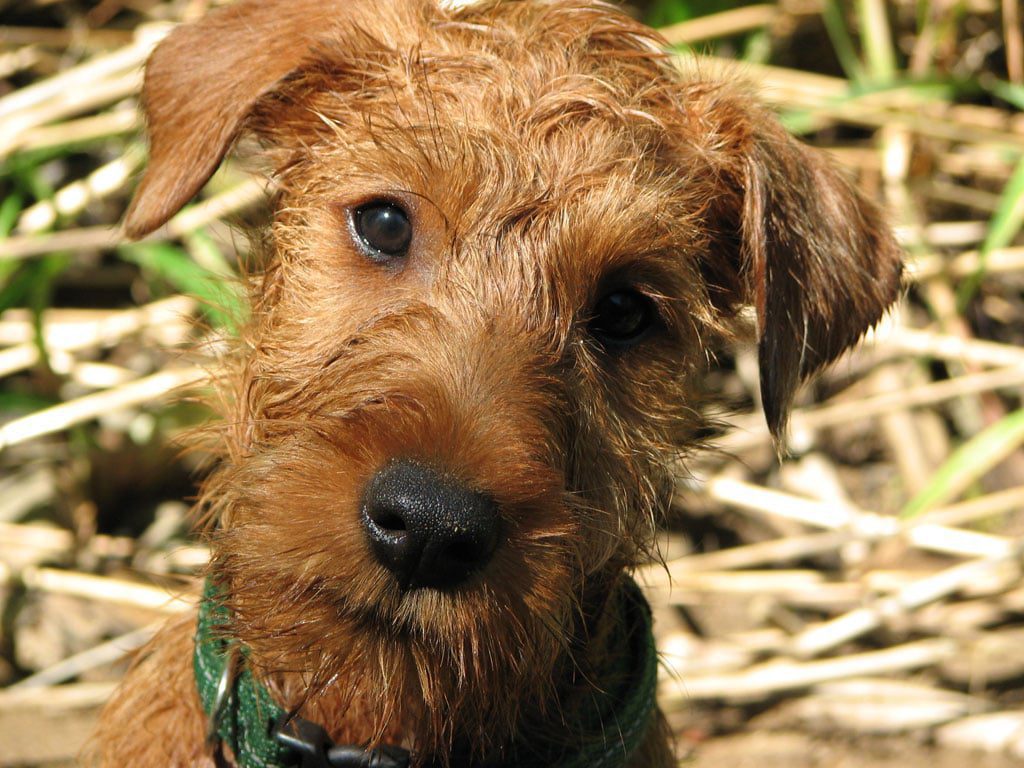
Terrier Irlandรฉs

The Irish Terrier it is a dog of pleasant appearance and endowed with an exceptional character.

Content

History

Where did the "Irish Terrier" originally come from??

The "Irish Terrier", he is a high-ranking terrier. It is often called the "Red Irishman" for its distinctive reddish coat.. Its roots are, as in all terriers, a little on the ground. The name Terrier is derived from the Latin ยซTerraยป for the earth. So they were dogs for movement on land and underground.

High-ranking terriers were supposed to run with the pack on fox hunts. When a fox took refuge in its burrow, the terriers had to chase him underground and get him out of the burrow, as it is called in the language of the hunters. One can imagine that the fox, after all a well fortified predator, does not voluntarily abandon its burrow. so a Irish Terrier I had to be very brave, fearless and defensive. Even today the "Red Irish" are hunting dogs in their hearts. They are not afraid and with every fiber they strive to do their job as well as possible. We can still experience all these qualities in the Irish Terrier as a companion dog.

They have a special charm but also the challenge of their ancestors.. But red Irish was also used in many different ways at home and on the farm.. He had to keep the yard free of mice and rats., protect chickens, pigeons and rabbits for the night of the martens and foxes. Finally, had to watch the farm and its inhabitants and, if necessary, protect them.

Ludwig Beckmann reported in 1895, in his two-volume work on the "Breeds of the Dog", that already in 1847 in Ireland they had begun to breed an independent terrier, the ancestor of the current Irish Terrier. At least that's what the Irish claimed, while the English for a long time dismissed this dog as a variety.

Until 1880 the color of the Irish Terrier was, in fact, still quite uneven. Only little by little did Irish breeders mark their dog with the red coat color as something special. But then it became very popular, even in England and especially in the US, where many Irish had emigrated. The first special breed club for Irish Terriers was founded very soon, the 31 in March of 1879 in Dublin. It was then the first race of Irish Terrier in being officially recognized by the British Kennel Club with Ireland as country of origin.

Physical characteristics

What is an "Irish Terrier" like??

The Irish Terrier it's a medium sized terrier, high-ranking and distinctive in appearance. This starts with their reddish fur. It is built almost square. The legs lower vertically, the long tail stands tall, the neck stretches up. The head, eyes and ears underline their alert appearance. You can feel that every fiber of his muscular body is under tension. The standard tells us…

…seem active, lively, agile and energetic and have a lot of substance without showing any clumsiness, because speed and endurance as well as strength are essential to the race. The Irish Terrier should not appear clumsy or amorphous; the contour of his body and figure must demonstrate speed, grace and fleetingness.

Their coat should be thick and lean in texture. Must be, according to technical jargon, broken or broken, that is to say, it should look tough and tough and, However, be extended. The head is also hairy, giving the impression of a beard. The "red Irish" must be uniformly red, wheat-red or yellow-red. Apart from color, the Irish Terrier reminds a bit of a small and elegant Airedale Terrier, which is also quite similar to him in character.

How tall is an "Irish Terrier"?

One Irish Terrier It has a height at the withers of about 45 centimeters with a weight of about 12 kg. Males are slightly larger and heavier than females.

How long does an "Irish Terrier" have??

as a rule, the Irish Terriers they enjoy a long canine life of more than 12 years in top physical condition.

Character and skills

The Irish Terrier it's a power pack. It is lively, alert, concise. Always attentive, vigilant, non-aggressive, but without fear and in an emergency you are also ready to fight. It is said that the Irish Terrier he is very hard on himself and would face dangers and even his own injuries with extreme contempt. It is still used as a working dog in its country of origin.. There he does a good job as a yard dog, guard and hunting. In today's hunting it is mainly used for post-shot work.. The official standard describes its character very accurately:

The Irish Terrier, although determined and able to face other dogs, is remarkably loyal, kind and affectionate with people; However, when he is attacked, show the courage of a lion and fight to the bitter end. It is wrongly said that the Irish Terrier he gets into fights with other dogs easily, sometimes even in the exhibition ring. Although it does not avoid any dispute when circumstances require it, the Irish Terrier it is easy to train and it is a sociable domestic dog; still embodies the qualities that, according to previous descriptions, They had made him the "guardian of the poor", "Friend of farmers and beloved of distinguished gentlemen.".

The Irish Terrier he is essentially a reckless and not a lapdog. But, nowadays it is doing very well as a companion and family dog. He is a faithful companion, vigilant, warm and loving for young and old, as long as one allows oneself and him the movement. It has a big character, self-confident and never submissive, that one should respect and appreciate. In his book about the Irishman "Jerry the Islander", the great writer Jack London expresses his respect for this great character in the following words: ยซJerry, you are gold, pure gold, inside and outside, and no dog in the whole world can compete with you. You have a heart of gold, golden dog; be good to me and love me, and I will be good to you and I will love you now and always.".

Care and health ยซIrish Terrierยป

The Irish Terriers they are very easy to care for. But, your coat should be professionally trimmed and should never be sheared. During clipping, three to four times a year, dead hair is professionally plucked.

Most Irish Terriers are in robust health. Here and there skin diseases occur (hiperqueratosis) or metabolic diseases (cistinuria). Sometimes inbreeding is a problem.

What food is best for an "Irish Terrier"?

The Irish Terrier has no special dietary needs. High quality food is of course good for your health. like most dogs, sometimes he likes a meaty beef bone.

Where can you buy an "Irish terrier"?

The best way to buy your puppy Irish Terrier is to buy it locally from a breeder registered with the FCI. You must have tested your dogs for the special risks of inherited diseases. There should also be no inbreeding, that can be estimated from the pedigree, if no name appears there twice. The breeder must have his litter well documented by photo. You should be able to see the litter along with the mother bitch, after the fix, in the place. Please, don't buy one Irish Terrier by Internet, because there is a high risk that the puppy will come from a dog vendor or breeder, normally well camouflaged.

Education and maintenance ยซIrish Terrierยป

Keep a Irish Terrier It is not a problem. It has no demands regarding the size of the apartment. The biggest challenge is his temperament. The Irish Terriers they need challenges of a physical and mental nature.

As a companion dog they are suitable for a wide range of tasks.. They are very suitable for various dog sports. The Irish Terriers are well positioned as joggers or in moderation, companions of a cyclist. Their aptitude and willingness to work means both a challenge and an obligation to their masters and mistresses., and that in any weather.

They must be used to other pets from birth, otherwise they will be seen as prey. The Irish Terriers they are very suitable as playmates for children, since they are prepared for any adventure and are robust enough to play with children. But, the house rules must be correct and the terrier must know his role in the family. On the street he tends to fight with other dogs. Due to its moderate size, his low weight and his good obedience – properly trained – is a companion without problems in all life situations.

Can be carried very well in the transport box, if you've gotten used to it from a young age. The typical Irish Terrier can be trained and educated very well. The clear announcement and the consequence are the magic words here based on a respectful and loving relationship with the master or mistress. Its undoubted leadership role must always be present, otherwise the irishman thinks he has to handle things himself.

Characteristics "Irish Terrier"

Coexistence is important that you have with your new friend. Before considering the acquisition of a dog of the breed "Irish Terrier" you know certain factors. Not all breeds of dogs are apt to live in an apartment, you must take into account his character, their need for exercise, their interaction with other pets, their care and if you have small children, their level of tolerance towards them.

Adaptation โ“˜

5,0 of 5 stars (based on 1 review)

friendly dog โ€‹โ€‹โ“˜

2,0 of 5 stars (based on 1 review)

hair loss โ“˜

2,0 of 5 stars (based on 1 review)

Affection level โ“˜

5,0 of 5 stars (based on 1 review)

Need for exercise โ“˜

4,0 of 5 stars (based on 1 review)

Social need โ“˜

4,0 of 5 stars (based on 1 review)

Home โ“˜

3,0 of 5 stars (based on 1 review)

Toilet โ“˜

3,0 of 5 stars (based on 1 review)

Friendly with strangers โ“˜

2,0 of 5 stars (based on 1 review)

barking โ“˜

4,0 of 5 stars (based on 1 review)

Health โ“˜

4,0 of 5 stars (based on 1 review)

Territorial โ“˜

5,0 of 5 stars (based on 1 review)

Cat friendly โ“˜

2,0 of 5 stars (based on 1 review)

Intelligence โ“˜

4,0 of 5 stars (based on 1 review)

Versatility โ“˜

2,0 of 5 stars (based on 1 review)

Child friendly โ“˜

4,0 of 5 stars (based on 1 review)

Surveillance โ“˜

4,0 of 5 stars (based on 1 review)

joy โ“˜

5,0 of 5 stars (based on 1 review)

Images "Irish Terrier"

Photos:

1 – Irish Red Terrier during dogโ€™s show in Racibรณrz, Poland by https://commons.wikimedia.org/wiki/User:Pleple2000
2 – Irish Terrier by Batman1000 / CC BY-SA
3 – Irish Terrier by Anne Sollerud / CC BY
4 – Irish Terrier puppy by https://www.flickr.com/people/24649496@N00
5 – Irish Red Terrier during dogโ€™s show in Racibรณrz, Poland by https://commons.wikimedia.org/wiki/User:Pleple2000
6 – Irish Red Terrier during dogโ€™s show in Racibรณrz, Poland by Pleple2000 / CC BY-SA

Videos "Irish Terrier"
Type and recognitions:

  • FCI CLASSIFICATION:
  • Group :
  • Section : . .

Federations:

  • FCI – Terriers 1 Large and medium-sized terriers. โ“˜
  • AKC – Terrier โ“˜
  • ANKC – Terrier โ“˜
  • CKC – Terrier โ“˜
  • โ€‹KC – Terrier โ“˜
  • NZKC – Terrier โ“˜
  • UKC – Terrier โ“˜

FCI breed standard "Irish Terrier"

Origin:
Ireland

Date of publication of the valid original standard:
13.03.2001

Use:

It's a farm dog, family pet, guard dog very susceptible to danger or injury, hunter and dog for work after shooting.


General appearance:

The dog must have an active appearance, lively, agile and wiry, a lot of substance, and at the same time free from clumsiness, since speed and endurance as well as strength are very essential. It should not be thick or robust, but to be well built within lines that denote speed and present an elegant racer appearance.


Behavior / temperament:

The Irish Terrier, although it is a hunting dog and capable of facing other dogs, is extremely loyal, of good temperament and loving with the man, but when attacked he has the courage of a lion and will fight to the end. His reputation for fooling around with other dogs, sometimes even on the show floor, does not deserve it. While it's true that you can be fierce when circumstances warrant, the Irish Terrier can be easily trained and is a delicate pet, staying true to his old description of being "the sentinel of the needy man", the farmer's friend and the gentleman's favorite ยป.

Head:

Long, wrinkle free.

Cranial region:
  • Craging: Flattened and fairly narrow between the ears; narrows slightly towards the eyes.
  • Dnaso-frontal depression (Stop): Hardly visible except in profile.

facial region:

  • Trufa: It must be black.
  • Labios: They must be very adherent, and on the outside they should be almost black.
  • Jaws: They must be strong, muscular, of good length and fearsome.
  • Dinentities: They must be strong, leveled, no cavities, the upper incisors slightly overlapping the lower incisors.
  • Cheeks: Not very prominent. They should have a slight decline under the eye, such that they do not present a Greyhound appearance.
  • Ojors: They must be dark in color, small, not prominent and full of life, fire and intelligence. Light or yellow colored eyes are very objectionable.
  • Obars: Small and V-shaped, of moderate thickness, well implanted in the skull and fall forward next to the cheeks. The upper line of the ear fold should be well above the level of the skull. Ears hanging to the side of the skull, like those of a hound, They are not a characteristic of the terrier, while semi-erect ears are even more undesirable. Ear hair should be shorter and darker in color than body hair.

Neck:

Of moderate length and gradually widens towards the scapulae, with good bearing and without dewlap. Generally has a small swirl of hair, visible on each side of the neck, which goes almost to the angle of the ear.

Body:

It must be symmetrical, neither too long nor too short.

  • Espalda: It must be strong and straight, without any appearance of slack behind the shoulders.
  • Itmor: Muscular and slightly arched; the back of the females may be slightly longer than that of the males.
  • Pecho: Deep and muscular, without being prominent or wide. Ribs should be quite arched, deep and carried well back.

Tail:

Very high insertion, happily held, but not on the back or curled; good firmness and substance and good length. By custom a third of its original length is amputated; must be well covered with coarse hair, hard, and must not be fringed or feather-shaped. Natural glue (without amputation) It is only allowed in countries where amputations are prohibited by law.

Tips

PREVIOUS MEMBERS:

  • Hormbros: They must be clear, long and well sloped back.
  • Elbows: They must move freely without any obstacles to the sides.
  • Antarms: Moderately long, perfectly straight with good bone and muscle.
  • Metacarpus: Short and straight, barely noticeable.

LATER MEMBERS: They must be strong and muscular.

  • Thighs: Powerful.
  • Rodinllas: Moderately angled.
  • Corvejones: Well descended.
  • PinIt: Feet should be strong, moderately round and moderately small; the arched toes, without turning in or out; black nails are very desirable. Healthy pads without corneal cracks or excressions.

Movement:

The fore and hind limbs should be brought straight forward and parallel; the elbows move parallel to the axis of the body, without any obstacles on the sides; the femoro-tibio-patellar joints (knees) they should not be turned in or out.

Mantle

  • Plink: Hair must be dense and wire-like in texture, and present a brittle appearance, tough but still flat. The hair grows so close and dense that when you separate it with your fingers you can't see the skin; should not be smooth or silky, not so long that it hides the figure of the body, particularly in the hind limbs, and should not have loops or curls. The hair on the face should have the same texture as that on the body, but it must be short (0,75 cms long), almost smooth and squashed; a sparse beard is the only long hair (and it is only long compared to the rest of the hair), which is a characteristic. A "goat" beard suggests the existence of bad, silky hair in general throughout the coat..
  • Members: They must not have fringes and must be covered, just like the head, hair with a hard texture like the one that covers the body, but not so long.
  • Colorr: Must be of a uniform color, bright red is more preferred, leonado rojizo, or reddish yellow. The white color sometimes appears on the chest, a small amount of white is frequently seen in those single-color breeds.


Size and weight:

Alturto the cross: About 45,5 cm. (18 inches).

Pthat: Males 12,25 kg (27 English pounds, The females. 11,4 kg (25 English pounds).


Fouls:

Any deviation from the above mentioned criteria is considered to lack, and the gravity of this refers to the degree of deviation to the standard and its impact on the health and well-being of the dog.

FALTAS DISQUALIFYING:

  • Aggressiveness or extreme shyness.
  • Any dog โ€‹โ€‹showing clear signs of physical or behavioral abnormalities must be disqualified..
  • Trufa: Any color other than black.
  • Jaw: Obvious overshot or overshot.
  • Colorr: Any color other than red, reddish yellow or reddish fawn. A small white spot on the chest is allowed, as in other breeds of uniform color.
  • PinIt: Corneal growths or cracks in the pads.


N.B.:
  • Males should have two normal-appearing testicles fully descended into the scrotum..
  • Only functionally and clinically healthy dogs, with the typical conformation of the breed, should be used for parenting.

TRANSLATION: Lic. Oscar Valverde (Costa Rica). Updated by J. Nallem (Uruguayan Kennel Club).

Source: F.C.I - International Cynological Federation

Alternative names:

1. Irish Red Terrier (English).
2. Irish Terrier (French).
3. Irischer Terrier (German).
4. Brocaire rua, rish red terrier, Irish terrier (Portuguese).
5. Irish Red Terrier, Irish terrier (espaรฑol).

โ–ท The world of Pets: Dogs, cats, birds, reptiles, amphibians

English Toy Terrier (black and tan)
Gran Bretaรฑaa FCI 13 . Toy Terriers

English Toy Terrier

In Great Britain they are increasingly rare and in the rest of Europe they are disappearing.

Content

History

The English Toy Terrier (black and tan) is closely related to the Manchester Terrier. It was originally called Black and Tan Terrier and was usually even larger than current specimens. They deliberately mated with him Italian Sighthound and only the smallest dogs were used for breeding.

They were originally kept in London as rat catchers. Due to its size, they were often put in a purse or coat pocket, where they should protect themselves from pickpockets. In the time of Queen Victoria it was very popular as a lap dog.

Physical characteristics

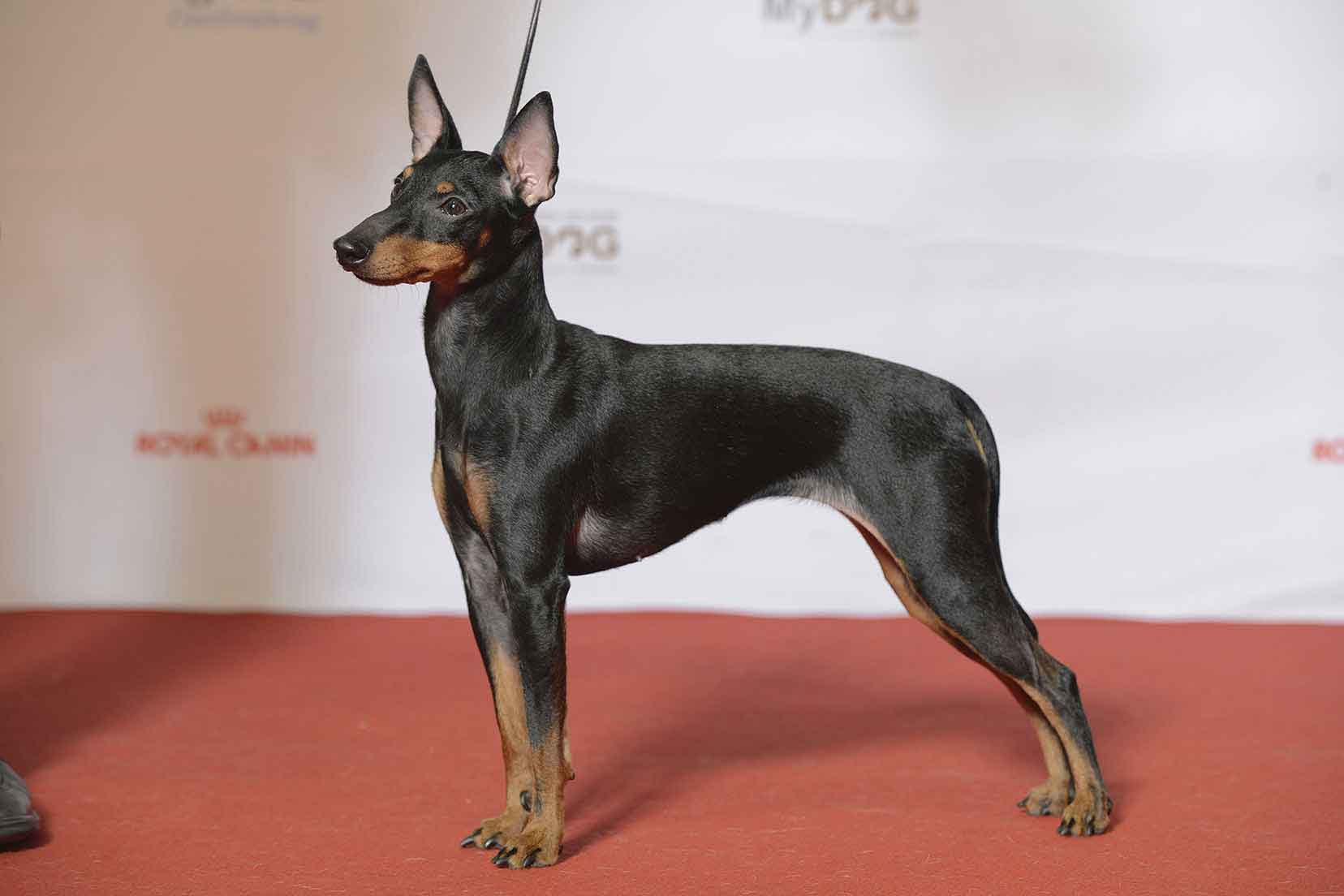
The English Toy Terrier (black and tan) he is a well balanced dog, elegant, compact, neat and clean construction.

Has a body weight of about 3,6 kg. The height of his body is about 30 cm.. With this size, the English toy terrier It is one of the smallest representatives of the group of terriers. So, falls in section 4 "Dwarf Terriers".

This breed is characterized by a slim body. All four legs are straight and very delicate. But, at the same time, the representatives of these Terriers are sporty and muscular, so they can easily accompany you on long walks.

At first sight, the little dog's large, upright ears stick out. The dog's muzzle is long and reminiscent of larger terriers. The eyes of the English toy terrier they are alert and awake. All the Toy Terriers ingleses They have the hair pattern "black and fire", what does black and tan mean. Most of the coat is black, but there are tan marks on some parts of the body. So the dog always has tan markings on his face and chest.. The coat of a English toy terrier it's short and smooth.

Character and skills

Today the English Toy Terrier (black and tan) belongs to the rare breeds and there are only a few breeders. And that, although this little terrier can be kept well even in city apartments. He is very close to his family and continues to be a good guardian, but tends to bark a little. He usually gets along well with children and is a tireless playmate. The little terrier also gets along with other dogs.

To the English Toy Terrier (black and tan) loves long walks and ball games. It can even be a good companion for shorter and not too fast jogging rounds.

The English Toy Terrier (black and tan) they still show typical terrier features. They are brave, testy, lively, alert and cheerful. They learn quickly, but they also need some consistency up front. They still have a hunting instinct, so from the beginning you must work to direct this instinct in an acceptable way.

Health and life expectancy

The English Toy Terrier (black and tan) tend to be a bit nervous, but otherwise they are quite healthy dogs. They can come to live off 13 to 15 years.

Similar breeds and relatives

The English Toy Terrier (black and tan) es similar al Manchester Terrier, the Italian Sighthound, the German Pinscher and the Doberman.

English Toy Terrier Care

This little terrier has an easy-care coat that never really needs to be washed. Once your English Toy Terrier has been lying, you can wash it with clean water. You should only use a dog shampoo if it is very dirty. Too frequent use of shampoos destroys the natural protective layer of the coat, what can cause skin diseases.

Its English toy terrier he is a robust dog that does not normally need a jacket. In very low temperatures it may be useful to protect your dog with a well-fitting jacket. Especially very small dogs get hypothermia when they are in the snow for a long period of time.. The jacket should fit well and not get in the way of your dog when he runs and plays.

Check your teeth English Toy Terrier regularly. Tartar can form here, which in the long run can lead to painful inflammation of the teeth. Care, a soft dog toothbrush can be used for brushing. A toothpaste for dogs is harmless and usually tastes quite good to animals.. Make sure to slowly and gently get your English Toy Terrier used to brushing their teeth..

The correct nutrition of the English Toy Terrier

The English toy terrier it is a very robust breed that gets along well with most foods. Due to its small body size it is important to provide the English toy terrier of enough energy. As such, for example, you can choose a type of food specially developed for small breeds. Small dogs have a greater renewal of energy than large ones. Another way of feeding is to give the dog fresh food or homemade food. Here too care must be taken to ensure sufficient calorie intake.

feed your English toy terrier several times a day, since the small dog can only absorb small amounts. Although healthy dogs usually have good teeth, the food components should not be too large.

Because the English toy terrier he is an adorable dog, many people tend to pamper him. But, many human foods are not suitable for dogs. So, their English toy terrier should only be fed with leftover food if it does not contain sugar or spices.

Suitable accessories for the English Toy Terrier

You don't need many accessories for your English toy terrier for everyday use. For food and water your dog needs at least two bowls. The water bowl should always be full and accessible to your dog.

Like the Toy Terriers ingleses they are very delicate animals, you should buy a well fitted harness. It is also important to use a light lead line. Pull lines are less suitable if your dog has not yet learned not to pull on the leash. A good alternative is to use a lightweight traction strap, that gives your dog freedom of movement.

To the playful English toy terrier loves to learn. So you can do a lot of sports with it which is also suitable for very small dogs. Dummies and other retrieval toys are good for training. It also, you English toy terrier will have a lot of fun with chew toys, that also support dental health.

Last, but no less important, should provide your English toy terrier a comfortable dog bed. There are several dog beds, almost all of them suitable. Whether your terrier is allowed on the couch or in bed, you can also give him a dog blanket there.

It is very important that you secure your English toy terrier in the car. An adapter for the belt buckles can be attached to the harness. This prevents skipping while driving and reduces the risk to your dog in the event of an accident. An alternative is to accustom your dog to a transport box. You can also take him on the train in a transport box if he is used to it.

Images "English Toy Terrier (black and tan)"

Photos:

1 – ENGLISH TOY TERRIER, NO JV-14 NO UCH X-Pected Dine Mites X-Factor by Svenska Mรคssan from Sweden / CC BY
2 – English Toy Terrier (Black & So) by AkselHelp / CC BY-SA
3 – English Toy Terrier by Lil Shepherd / CC BY
4 – English Toy Terrier by Lil Shepherd / CC BY
5 – English Toy Terrier by Lil Shepherd / CC BY
6 – Dog 2013 Helsinki 13-15/12/2013 by Thomas / CC BY-SA
6 – English toy terrier by https://pxhere.com/en/photo/883104

Videos "English Toy Terrier (black and tan)"

Type and recognitions:

  • FCI CLASSIFICATION:
  • Group :
  • Section : . .

Federations:

  • FCI – Group 3 – Section 4 Toy Terriers. โ“˜
  • โ€‹KC – Toy Group โ“˜

FCI breed standard "English Toy Terrier (black and tan)"

Origin:
United Kingdom

Date of publication of the valid original standard:
26.03.2009

Use:

Terrier


General appearance:

Well balanced, elegant, compact, neat and clean construction.


Behavior / temperament:

Toy dog (Toy), With the characteristics of the terriers. Alert, Remember that historically this dog could cruelly drive in the rats holes. Never overly nervous.

Head:

It is long, close, wedgeless without giving much emphasis to the cheese muscles; under the eyes is very full.

Cranial region:
  • Craging: Plano.
  • Stop: Little noticeable.

facial region:

  • Trufa: black.
  • Horcico: The muzzle gradually tapers to give the wedged shape, profile view very similar to looking from the front. Although it may give an impression of prognathism, it is not desirable to have a pointy appearance.
  • Labios: Well compressed.
  • Jaws / Teeth: Upper and lower jaw form a perfect and tight closure. Strong JAWS, with a perfect scissor bite, regular and complete, that is, the inner face of the upper incisors is in close contact with the outer face of the lower incisors and the teeth are placed perpendicularly in the maxillae. Uniform and strong teeth.
  • Cheeks: No emphasis of the muscles.
  • Ojors: Dark to black, without having light shadows on the iris. Of sizerelativelysmall, almond shape and oblique position, they are bright andnot prominent.
  • Obars: In the shape of a candle flame, slightly pointed, positioned very high and at the back of the skull, proportionally very close. A good reference point for size can be obtained by bending the ear forward, should not reach the eye. From nine months of age, ears must be erect. The entire pinna of the ear should point towards the front. The leather of the ear is thin.

Neck:

Long, with grace, slightly arched. The neck line descends on the shoulders in an elegant decline. Double chin is undesirable.

Body:

Compact, with head and limbs provided, producing a perfect balance.

  • Espalda: Little arched from behind the shoulders to the loins, The upper line later falling on the root of the tail.
  • Itmor: Well up.
  • Pecho: Narrow and deep with well sprung ribs.

Tail:

Thick at the root, tapering towards the tip. Low-set, without reaching below the hocks. Tail carried high excessively is undesirable.

Tips

PREVIOUS MEMBERS: Forelimbs fall straight from the shoulders, with the elbows close to the chest, making the front straight. Very desirable fine bone structure

  • Hormbros: Well positioned back.
  • Elbows: Well glued.

LATER MEMBERS: Well rounded loins and slightly rounded buttocks lead to good knee angulation. It is undesirable that the front extremities appear stuck under the body.

  • Corvejones: Positioned low, without twisting outward or inward.
  • PinIt: Refined, compact, with fingers wide apart, well arched with jet black nails; the middle fingers of the forelimbs are longer than the others; hind feet have the appearance of cat's feet. Hare's foot is undesirable.

Movement:

The ideal movement is similar to an extended trot. You don't want the "Hackney" step. Dragging is also undesirable. Agile hindlimb action, combining ease and precision with a good push, should be fluid to indicate firmness.

Mantle

Fur: Thick, closed and glossy. High density of short hair is required.

Color: black and tan. The black must have the coloration of ebony, and the fire must remember the firm chestnut color. The colors neither spill nor fade but meet abruptly, forming clear and defined lines in the division of colors.

The forelimbs are tan colored up to the carpal joint in front, following the inside and back of the forelimb down to the elbows; small black lines (brush strokes) on each finger, and a definite black mark (thumb mark) in the center of each metacarpus, also under the chin. The hind limbs are tan in front and inside, with a black bar that divides the tan color in the center of the legs. Much tan color on the outside of the hind limbs (breeching the falda) is undesirable. The muzzle is tan. The truffle is black, continuing the black color on the nasal bridge, forming a curve under the eyes to the base of the throat. Has a fire mark over each eye, and a small one on each cheek. The lower jaw and throat are also tan colored; The line of the lips is black. The hair inside the ears is fire. Tan behind the ears is undesirable. Each side of the chest has a little tan coloring, as well as the perineum and under the root of the tail. White patches are totally undesirable anywhere.


Size and weight:

The ideal weight is 2,7 to 3,6 kg (6 to 8 English pounds).

The ideal height at the withers is 25 to 30 cm. (10 to 12 inches).


Fouls:

Any deviation from the aforementioned criteria is considered as a fault and the severity of this is considered to the degree of the deviation to the standard and its consequences on the health and well-being of the dog..

FALTAS DISQUALIFYING:

  • Aggressiveness or extreme shyness.
  • Any dog โ€‹โ€‹showing clear signs of physical or behavioral abnormalities must be disqualified..


N.B.:
  • Males should have two normal-appearing testicles fully descended into the scrotum..
  • Only functionally and clinically healthy dogs, with the typical conformation of the breed, should be used for parenting.

Itlatest changes are in bold.

TRADUCCION: Federation Canรณfila Mexicana, A.C.

Source: F.C.I - International Cynological Federation

Alternative names:

1. ETT, English toy terrier (English).
2. Toy terrier anglais noir et feu (French).
3. English Toy Terrier (German).
4. English Toy Terrier (Portuguese).
5. Terrier miniatura negro y fuego, English toy terrier, Toy Terrier inglรฉs, TERRIER INGLร‰S DE JUGUETE NEGRO Y FUEGO (espaรฑol).

โ–ท The world of Pets: Dogs, cats, birds, reptiles, amphibians

Scottish Terrier
Gran Bretaรฑa Escocia FCI 73 . Small sized Terriers.

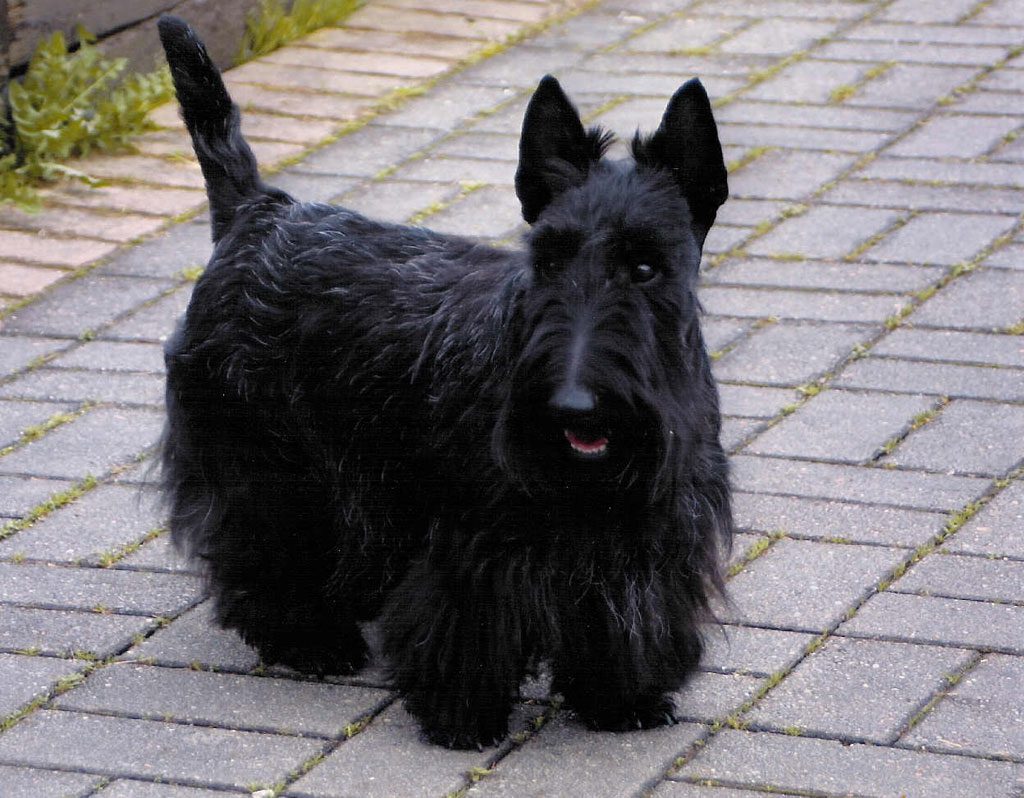
The Scottish Terrier is independent, self-confident, joyful, intelligent and stubborn bastabte.

Content

History

The Scottish Terrier, also known as the Aberdeen Terrier, and popularly as "Scottie", It is one of the high Terrier breeds that were grouped under the name of Skye Terrier, It is one of the five breeds of Terrier that originated in Scotland, the other four are the modern Skye Terrier, Cairn Terrier, Dandie Dinmont Terrier, and West Highland White Terrier.

The real origin of a race as old as Scottish Terrier it's dark and undocumented. The first written records about a dog with a similar description to those of the Scottish Terrier was in 1436, When Don Leslie described them in his book the history of Scotland 1436-1561.

Two hundred years later, Sir Joshua Reynolds painted a portrait of a young woman stroking a dog similar in appearance to the Scottish Terrier of today. King James VI of Scotland was an important historical figure accompanying the history of the Scottish Terrier. In the century 17, When King James VI became James I of England, sent six Terrier – believes that the precursors of the Scottish Terrier- a French monarch as a gift. His love and adoration for the race, It is said that you increased its popularity around the world.

In the century 19, in the Highlands of Scotland, including the Isle of Skye, the Terrier were abundant, originally known by the generic term "short-haired" or " Skye Terrierยซ. Towards the end of the century 19, it was decided to separate these Scottish Terriers and develop pure blood lines and specific breeds.

Originally, the breeds were separated into two categories – Dandie Dinmont Terriers and Skye Terrier (Noel Skye Terrier that is known today, but a generic name for a large group of the Terrier with different all features, who came from the isle of skye).

The written history and initial development of the race began at the end of 1870 with the development of dog shows. The exhibition of dogs required compared to a standard of the race and therefore the appearance and temperament of the Scottie was written for the first time.

Finally, The Skye Terrier were divided into what is known today as the Scottish Terrier, Skye Terrier, West Highland White Terrier and the Cairn Terrier.

Captain Gordon Murray and Shirley were responsible for establishing the type in 1879. Shortly after, in 1879, the Scottie were first exposed at Alexander Palace in England, while the following year they began to be classified in much the same way as they are today. The first written breed standard was written by JB Morrison and DJ Thomson gray and appeared in Vero Shows illustrated book of The Dog, published in 1880. The standard describes the color of the breed as "gray, grayish Brindle ยซ.

In 1881, he "Scottish Terrier England Club" was founded, being the first club dedicated to the race.

The Scottie It is the only breed of dog that has lived in the White House more than three times..

In May of 2007, Carnegie Mellon University, used the image of a Scottish Terrier as your official pet.

It is a small Terrier breed with a distinctive shape and it has had many roles in popular culture.

They have been owned by a variety of celebrities, including the president number 32 of the United States, Franklin Delano Roosevelt, whose Scottie โ€œFalaโ€ is included with Franklin Delano Roosevelt in a statue in Washington, DC, just like him 43 ยบ President of the United States George W.. Bush . They are also well known for being a piece to play in the Board game Monopoly.

Described as a territorial dog, wrestler, they can be a good guard dog and tend to be very loyal to his family.
Scottish Terrier may be more prone to clotting disorders, joint disorders, autoimmune diseases, allergies and cancer than other breeds of dog and not a disease is the name of the race called Scotty cramp. Is also a most successful breeds of dogs at the Westminster Kennel Club show of dog with a better show in 2010.

Physical characteristics

The Scottish Terrier It small but resistant, they have short legs, It Chunky and robust complexion, with one long head in proportion to its size. The Scottish Terrier must have large legs adapted for digging.

Their ears they are erect and the tail is one of the outstanding characteristics of the breed. Their eyes they are small, bright and dark brown or almost black and almond-shaped.

The height at the withers for both sexes should be approximately 25 cm., and the length of the back from the cross until the queue is of approximately 28 cm.. In general, is a well balanced dog, It must weigh 8.5 to 10 kg and a female 8 to 9,5 kg.

Scottish Terrier often has a hard mantle, rough, long, the inclement weather-resistant, an outer layer and a soft, dense layer attached to the skin. Combined, with a long beard in layer, the eyebrows, the legs and lower part of the body. The head, the ears, the tail and back are traditionally short, are the parts included in the haircut of the Scottish Terrier.

The the Layer palette It ranges from dark gray to Jet Black, o ยป Brindle ยซ(a mixture of black and Brown).

"Wheat" color may appear (straw to nearly white), but it should not be confused with the Cairn Terrier or West Highland White Terrier .

Character and skills

The breed is known for being independent and self-assured., joyful, intelligent and has been nicknamed the "Tough ass". They are described as very affectionate, they have also described as stubborn. It is sometimes described as a distant race, Although it has been observed that they tend to be very loyal and affectionate to its family.

The Fourth Earl of Dumbarton nicknamed the breed ยซthe uncompromisingยซ. The modern race said that it was able to trace their lineage to a single female, call splinter II.

It has been suggested that the Scottish Terrier can be a good watchdog, due to their tendency to bark only when necessary and that it tends to be reserved with strangers. The Scottish Terrier they were bred to hunt and fight badgers.

So, the Scottie is prone to digging, as well as chasing small vermin, as the squirrels, rats and mice.

The Scottie are territorial, they are always warning, they are fast and energetic in their movements, perhaps even more than other Terrier breeds.

With regard to health, the Scottish Terrier have a higher chance of developing some types of cancer, compared to other 'purebloods'.

Characteristics "Scottish Terrier"

Coexistence is important that you have with your new friend. Before considering the acquisition of a dog of the breed "Scottish Terrier" you know certain factors. Not all breeds of dogs are apt to live in an apartment, you must take into account his character, their need for exercise, their interaction with other pets, their care and if you have small children, their level of tolerance towards them.

Adaptation โ“˜

3,0 of 5 stars (based on 1 review)

friendly dog โ€‹โ€‹โ“˜

2,0 of 5 stars (based on 1 review)

hair loss โ“˜

2,0 of 5 stars (based on 1 review)

Affection level โ“˜

4,0 of 5 stars (based on 1 review)

Need for exercise โ“˜

3,0 of 5 stars (based on 1 review)

Social need โ“˜

4,0 of 5 stars (based on 1 review)

Home โ“˜

5,0 of 5 stars (based on 1 review)

Toilet โ“˜

4,0 of 5 stars (based on 1 review)

Friendly with strangers โ“˜

3,0 of 5 stars (based on 1 review)

barking โ“˜

2,0 of 5 stars (based on 1 review)

Health โ“˜

4,0 of 5 stars (based on 1 review)

Territorial โ“˜

5,0 of 5 stars (based on 1 review)

Cat friendly โ“˜

3,0 of 5 stars (based on 1 review)

Intelligence โ“˜

5,0 of 5 stars (based on 1 review)

Versatility โ“˜

2,0 of 5 stars (based on 1 review)

Child friendly โ“˜

3,0 of 5 stars (based on 1 review)

Surveillance โ“˜

3,0 of 5 stars (based on 1 review)

joy โ“˜

5,0 of 5 stars (based on 1 review)

ยซScottish Terrierยป images

Videos ยซScottish Terrierยป

Type and recognitions:

  • FCI CLASSIFICATION:
  • Group :
  • Section : . .

Federations:

  • FCI – Terriers 2 Small sized Terriers. โ“˜
  • AKC – Terriers โ“˜
  • ANKC – Terriers โ“˜
  • CKC – Terriers โ“˜
  • โ€‹KC – Terriers โ“˜
  • NZKC – Terriers โ“˜
  • UKC – Terriers โ“˜

FCI breed standard "Scottish Terrier"

Origin:
United Kingdom

Date of publication of the valid original standard:
13.10.2010.

Use:

Terrier


General appearance:

It is a compact dog, Properly sized for underground huntingwho should exclude overweight dogs. Its members are short; alert, presents an image of great power and activity in a reduced volume. The head gives the impression of being long compared to the size of the dog. It is very agile and active despite its short limbs.

IMPORTANT PROPORTIONS: The skull and muzzle have the same length.


Behavior / temperament:

It is a faithful dog, fair, noble, independent and reserved, but brave and very smart. Bold, but never aggressive.

Head:

Long but proportional to the size of the dog.Carry on a muscular neck of moderate length, showing quality.

Cranial region:
  • Skull: The length of the skull should allow enough width, although maintaining the appearance of being narrow. The skull should be almost flat.
  • Fronto-nasal depression (Stop): Light, but visible, between skull and muzzle, right at eye level.

facial region:

  • Truffle: Negra.Long; in profile the line that runs from the nose to the chin appears to descend backwards.
  • Snout: It must be strong and deep to its full extent.
  • Jaws / Teeth: Big teeth, with perfect and complete scissor bite, That is, the inner face of the upper incisors is in close contact with the outer face of the lower incisors and the teeth must be implanted at right angles in the jaws..
  • Cheeks: They should not be prominent.
  • Eyes: Almond-shaped, dark brown, placed quite far apart from each other andNot badunder the eyebrows with a sharp and intelligent expression.
  • Ears: clean, texture fine, pointy, erect and implanted above the skull, but not too close together. Big, wide ears at the base are very undesirable.

Neck:

Muscular and of moderate lengthshowing quality.

Body:

The upper body line is straight and level. top line: Proportionally short and very muscular. Pork loin: Muscular and deep.

  • Chest: Somewhat wide suspended between forelimbs. Well rounded ribs placed well back flattening to give depth to the chest. The thorax vigorously attached to the hind limbs.

Tail:

It should be of moderate length, giving the dog general harmony.. Thick in its implantation and thinning towards the tip, carried vertically or with a slight curvature.

Tips

PREVIOUS MEMBERS:

  • General appearance: The thorax is well placed in front of the forelimbs
  • Shoulder: Wide and sloping.
  • Elbow: It should not be turned outwards or placed under the body.
  • Forearm: Right with good bones.
  • Metacarpus: Straight.
  • Previous feet: Good size, with good foot pads, fingers well arched and together. The front feet are slightly larger than the hind feet.

LATER MEMBERS:

  • General appearance: Remarkably powerful for dog size. Thick and wide buttocks.
  • Thigh: Deep.
  • Knee: Well angled.
  • Metatarsus: Hocksshort, strong, without turning inward or outward.

Hind feet: Good size, with good foot pads, fingers well arched and together. The hind feet areslightly smaller than the previous ones.

Movement:

Uniform and easy going, right both back and forth with a push from behind taking a regular stride.

Mantle

  • Fur: Attached to the body; double layer: short inner layer, dense and smooth; hard outer layer, dense and textured wire; the two layers protect it from the elements.
  • Color: Negro, wheat or any brindle color.


Size and weight:

  • Height to the cross: 25 โ€“ 28 cm.
  • Weight: 8,โ€“ 10,kg.


Fouls:

Any deviation from the aforementioned criteria is considered as a fault and the severity of this is considered to the degree of the deviation to the standard and its consequences on the health and well-being of the dog..

FALTAS DESCALIFICANTES:

  1. Aggressiveness or extreme shyness.
  2. Any dog โ€‹โ€‹showing clear signs of physical or behavioral abnormalities must be disqualified..


N.B.:
  1. Males should have two normal-appearing testicles fully descended into the scrotum..
  2. Only functionally and clinically healthy dogs, with the typical conformation of the breed, should be used for parenting.

The latest changes are in bold

TRANSLATION: Brรญgida Nestler / Original version: (IN) Technical supervision: Miguel Angel Martinez

Source: F.C.I - International Cynological Federation

Alternative names:

1. Scottie, Aberdeenie (English).
2. Scottish terrier (French).
3. Scottish (German).
4. Scottish Terrier (Portuguese).
5. Scottie, Aberdeen terrier, Terrier escocรฉs (espaรฑol).

โ–ท The world of Pets: Dogs, cats, birds, reptiles, amphibians

Black Russian Terrier
Rusia FCI 327 . Pinscher and Schnauzer type

Terrier Ruso Negro

The Black Russian Terrier, need plenty of exercise, and it can be hyperactive and destructive

Content

History

The Black Russian Terrier, (in Russian: ะงั‘ั€ะฝั‹ะน ั‚ะตั€ัŒะตั€), abbreviated as BRT, known, also as dog of Stalin (Sobaka Stalina), It is a breed of dog developed to serve as a guard dog and police dog..

The breed was recognized as such in July of 2004, by the American Kennel Club.

despite its name, the Black Russian Terrier, is not a pure Terrier: It is believed that they were used around twenty races in its development, including (among others) to the Airedale Terrier, the Giant Schnauzer, the Rottweiler, the Newfoundland, the Kavkazskaรฏa Ovtcharka and the Moscow Water Dog, now extinct.

Physical characteristics

The Russian black terrier much more resemble a Schnauzer that to a Terrier. The head is long, with flat front. The strong muzzle. The eyes are small and dark. The trunk is solid. The limbs are straight and muscular.

The Black Russian Terrier, gives the impression of great strength, agility and value. It is a robust dog, rustic in appearance (but not fat), and it must not appear as if his hair was sculpted or trimmed, must see bright in nature, and slightly curly.

The coat is hard and dense, is not very smooth to the touch, It is as curly and the length of the hair will be of 4 to 10 cm.. The longest hair found in the beard and eyebrows, with a mane (not very dense but longer than the rest of the body) What, extends, slightly, the cross and the neck, more pronounced feature in males. The coat is low detachment and the color is black with some gray hair.

According to the FCI standard (1983), the male must have a height of 66 to 72 cm to the cross and the female of 64 to 70 cm., with a tolerance of +/- 2 cm.. They must weigh between 35-70 kg.

Did you know??

Although the word Terrier on their behalf, the Black Russian Terrier is a member of the American Kennel Club Task Force.

Character and skills

ยซBlack Russian Terrierยป Videos
Black Russian TerriersBlack Russian Terriers
Dogs 101 - Black Russian TerrierDogs 101 – Black Russian Terrier

The Black Russian Terrier, is a safe dog, quiet, very intelligent, brave and loyal. you should never be shy. It may seem distant, or perhaps independent, but in their basic needs, is the human company and the love of his family.

It is a healthy dog in general and their life expectancy is around the 14 years.

Because of his upbringing as a working dog, has a very strong instinct worker ("work ethic"), and that is why it is good to provide the animal some games to understand work roles, so you will be happy.

Initial training is a necessity, that you will take advantage of any owner who has not been able to establish a domain course. They are very sensitive to education and often Excel at obedience competitions. As well, they are very good in various dog sports, such as agility.

The Black Russian Terrier, need plenty of exercise, and can be hyperactive and destructive if not given the opportunity to burn off his energy.

Characteristics "Black Russian Terrier"

Coexistence is important that you have with your new friend. Before considering the acquisition of a dog of the breed "Black Russian Terrier" you know certain factors. Not all breeds of dogs are apt to live in an apartment, you must take into account his character, their need for exercise, their interaction with other pets, their care and if you have small children, their level of tolerance towards them.

Adaptation โ“˜

3,0 of 5 stars (based on 1 review)

friendly dog โ€‹โ€‹โ“˜

3,0 of 5 stars (based on 1 review)

hair loss โ“˜

3,0 of 5 stars (based on 1 review)

Affection level โ“˜

4,0 of 5 stars (based on 1 review)

Need for exercise โ“˜

4,0 of 5 stars (based on 1 review)

Social need โ“˜

3,0 of 5 stars (based on 1 review)

Home โ“˜

3,0 of 5 stars (based on 1 review)

Toilet โ“˜

4,0 of 5 stars (based on 1 review)

Friendly with strangers โ“˜

1,0 of 5 stars (based on 1 review)

barking โ“˜

4,0 of 5 stars (based on 1 review)

Health โ“˜

3,0 of 5 stars (based on 1 review)

Territorial โ“˜

5,0 of 5 stars (based on 1 review)

Cat friendly โ“˜

3,0 of 5 stars (based on 1 review)

Intelligence โ“˜

4,0 of 5 stars (based on 1 review)

Versatility โ“˜

4,0 of 5 stars (based on 1 review)

Child friendly โ“˜

3,0 of 5 stars (based on 1 review)

Surveillance โ“˜

3,0 of 5 stars (based on 1 review)

joy โ“˜

5,0 of 5 stars (based on 1 review)

Images ยซBlack Russian Terrierยป

ยซBlack Russian Terrierยป Videos

Type and recognitions:

  • FCI CLASSIFICATION:
  • Group :
  • Section : . .

Federations:

FCI โ“˜, AKC โ“˜, ANKC โ“˜, CKC โ“˜, โ€‹KC โ“˜, NZKC โ“˜, UKC โ“˜

FCI breed standard Black Russian Terrier

FCIFCI - Black Russian Terrier
Terrier

Alternative names:

1. Chornyi, Russian Bear Schnauzer, Russian Black Terrier, Chornyi Terrier (English).
2. Terrier noir russe, errier noir (French).
3. Russischer Schwarzer Terrier, Russischer Schwarzer Terrier (German).
4. Terrier preto da Rรบssia, Cรฃo de Stalin, chiorny Terrier (Portuguese).
5. Perro de Stalin (espaรฑol).

โ–ท The world of Pets: Dogs, cats, birds, reptiles, amphibians

Newfoundland
Canadรก FCI 50 - Molossoid - Mountain

Terranova

The Newfoundland radiates majestic serenity.

Content

History

The Newfoundland was born on the east coast of Canada. The great island of Newfoundland, which is in front of Canada, gave him his name. The fact that it descends from the dogs of the Vikings of pre-Columbian times or from the dogs of the Indians is a legend that has not been proven until now.. Its relationship with the molossi can be seen but also proved in the genetic map of the Heidi G dog breeds. Parker.

Probably the ancestors of the Newfoundlands came with the first settlers as molossi from Europe. It proved to be an aid to fishermen and sealers and was occasionally useful when hunting bear and big game on land.. It transported loads and served as a draft dog for the sleds with the dead game.. Working with fishermen in the rough North Atlantic was extremely demanding. The Newfoundland had to think, had to do heavy work on the networks. The Newfoundland saved the lives of the castaways over and over again. In this way, he developed the peculiarities of his character and physique that allowed him to face the harsh weather conditions on land and the dangers of the sea as a water and rescue dog..

With the cod ships he came to England over and over again as early as the 18th century. Here he became famous early on due to his impressive achievements. Was not up 1886 that the Club of Newfoundland in England, and soon after, in 1893, The club of Newfoundland for the Continent, now called the "German Club of Newfoundlandยซ. Even today, Newfoundland keep working as a water rescue dog.

Did you know??

One Newfoundland named Rigel sank with the Titanic and swam alongside a lifeboat for three hours in the icy water, apparently looking for its owner, that had gone down with the ship. The people in the lifeboat were nearly run over by the steamer Carpathia because the crew could not hear their faint cries., but Rigel's bark was noticed and the people and the dog were saved.

Physical characteristics

The Newfoundland is a big dog. According to the standard, adult males must weigh an average of 68 kg and females 54 kg. It is a very strong dog, very muscular and with long dense hair. Her coat is water repellent. It has a strong and soft undercoat, which makes it look even bulkier. This shouldn't tempt you to raise him like a teddy bear.. Because the real Newfoundland combines enormous power with agility, sportiness and impressive skills in the water. Its exterior does not deceive its interior. Master challenges with a committed calm. The hair on your head, muzzle and ears is short and thin. The front and rear legs are covered in fur. The tail is completely covered in long thick hair. The black, brown and black and white are allowed as coat colors.

Character and skills

Even the mere appearance of Newfoundland has a relaxing and calming effect, at least for people who are not usually afraid of dogs. The Newfoundland radiates majestic serenity. Its character is as stable as it appears on the outside. It has a friendly and kind nature. But that must not be misleading: He knows very well how to distinguish between friend and enemy, which you can unequivocally underline by your calm but more determined appearance. If required, defends his family with all his might without hesitation. Barking is not necessary to be heard.

He is extremely friendly with his friends. The Newfoundland he is very close to his family and loves children more than anything. He wants education and he absolutely needs it. Because like a powerful big dog it is always stronger than the other end of the leash.. Sometimes he has a hard head, but after a friendly request from his master or caretaker he does everything, as long as it's well connected. The Newfoundland impresses by the unity of two apparently irreconcilable poles: on the one hand it radiates calm and tranquility, on the other hand it can save people from drowning in a short time in the most difficult conditions. Usually, the Newfoundlands are real water rats. They are excellent swimmers, which they are happy to proudly demonstrate.

The Newfoundland not a dog for the city or a flat. He likes long walks, but water is the best for him. Due to its strength and the high technical demands of its maintenance, not suitable for beginners, although it can be trained and managed well. It is a great family dog. But he also likes to sleep outside, even with wind and rain. What you don't need is running or doing activities in the heat.

The Newfoundland It is a natural lifeguard and can be a good helper for parents who have a pool or enjoy taking children to the lake or ocean, although you should never be solely responsible for your safety.

Newfoundland Education

The Newfoundland can be educated very well. It is intelligent, interested and quickly understand what you are allowed to do and what you are not. Sometimes it's a little slow, but a little motivated, he is very cooperative and strives to make his master and lady happy. The puppy should already show itself clearly and without exception where the hammer hangs. There should be no doubt about the orientation of your humans, as well as about the intimate relationship and respect for him.

It must always be kept in mind that this dog is the physically strongest and that leadership only works through unquestioning recognition of the human leadership role.. With praise and results, basically you can achieve everything with it. On the basis of a good education you can train him very well Newfoundland. Many terranovas they are successfully used as guide dogs for the blind and especially as water rescue dogs, but also on land. For this you can do work tests with water in the clubs.

Caring for a Newfoundland

Maintain and care for the Newfoundland it is very expensive. The dense, weather-resistant coat must be brushed every day with a special brush.. Should not be sheared or trimmed. Due to its constitution and dense coat, do not tolerate heat well.

Nutrition / Food

Like all large dogs, Newfoundland need a lot of food. Especially in the growth phase you need professional nutritional planning.

Newfoundland life expectancy

Life expectancy is between 8 and 12 years. That depends a lot on the upbringing. Thin and light dogs tend to age more than heavy, plump dogs.

Newfoundland Health

as could be predicted, given its large size, the Newfoundland can suffer a series of joint and structural problems. It is important that young and growing dogs are kept lean and are not allowed to exercise too hard or eat too much, since this will cause injuries and problems that can be paralyzing in the future. In fact, all the Newfoundland they need to stay slim, since obesity increases the chances of them developing structural problems and makes them more painful when they occur.

One such structural problem is genetic hip deformation known as hip dysplasia.. The head of the femur does not fit well into the hip socket; with the time, the cartilage in the joint wears away and the underlying bone is damaged. Serious arthritis occurs that usually affects very young dogs. In some cases, expensive surgery required, including total hip replacement surgery. If not treated, the dog will suffer pain and a poor quality of life. Elbow dysplasia is another inherited joint problem, resulting from abnormal elbow formation.

The possibility that a Newfoundland develop dysplasia of the hip or elbow just because the parents are free of the disease, although it reduces the possibilities. And while a puppy's bones keep growing, it can sometimes be difficult to confirm a diagnosis, depending on the tests performed and the severity of the condition.

To each Newfoundland X-rays of your dog's hips and elbows should be taken by two years of age, regardless of whether or not he shows symptoms of lameness or stiffness. For dogs that show lameness before that age (that is to say, during the puppy stage), diagnostic tests should be performed promptly.

The Newfoundlands are at risk of heart disease, including dilated cardiomyopathy and subaortic stenosis (SAS). There is currently no genetic test for SAS, who has a complex inheritance, making it difficult to develop a test. Breeders must not breed Newfoundland with no signs of SAS and puppies should be examined by a certified veterinary cardiologist.

Cystinuria is a genetic kidney defect that leads to the formation of bladder stones that are very difficult to manage with diet or medication and often requires surgery both to remove the bladder stones and to repair urinary obstructions.. There may be no early signs that the dog is forming cystine stones, which can create a life-threatening emergency if they cause an obstruction. Fortunately, there is a genetic test for cystinuria. Given the availability of the genetic test, no need for a breeder to produce a dog with the disorder

Not all of these conditions are detectable on a growing puppy, and it can be difficult to predict whether an animal will be free of these diseases, so a reputable breeder must be found who is committed to raising the healthiest animals possible. Must be able to produce an independent certification that the parents of the dog (and grandparents, etc.) have been screened for these defects and considered healthy for breeding. That's where health records come in..

Not all visits by Newfoundland to the vet they are due to a genetic problem. It is known that the Newfoundland experience cruciate ligament rupture. They are also among the deep-breasted breeds predisposed to bloating., a condition in which the stomach is distended by gas and may twist in on itself (called gastric torsion), cutting off blood flow. Swelling and torsion appear very suddenly, and a dog that was fine a minute can die a few hours later. Watch for symptoms such as restlessness and pacing, la baba, the paleness of the gums, lip licking, unsuccessful attempt to vomit and signs of pain. Swelling requires immediate veterinary intervention, and surgery is necessary in many cases. Unfortunately, dogs that have swollen can do it again, So most veterinarians offer a procedure known as gastropexy or "stomach turning.", which anchors the stomach to the body wall to help prevent future twisting. This procedure can also be done as a preventive measure.

Buy a Newfoundland

You should only buy a puppy locally from a breeder who is affiliated with the FCI. should come from a baby, where dogs are rather sporty, thin and not too fat and ยซbearyยป. A puppy in the kennel is usually sold at a price between 1500 and 2000 EUR.

Valuations "Newfoundland"

Coexistence is important that you have with your new friend. Before considering the acquisition of a dog of the breed "Newfoundland" you know certain factors. Not all breeds of dogs are apt to live in an apartment, you must take into account his character, their need for exercise, their interaction with other pets, their care and if you have small children, their level of tolerance towards them.

Adaptation โ“˜

5,0 of 5 stars (based on 1 review)

friendly dog โ€‹โ€‹โ“˜

4,0 of 5 stars (based on 1 review)

hair loss โ“˜

5,0 of 5 stars (based on 1 review)

Affection level โ“˜

4,0 of 5 stars (based on 1 review)

Need for exercise โ“˜

3,0 of 5 stars (based on 1 review)

Social need โ“˜

4,0 of 5 stars (based on 1 review)

Home โ“˜

3,0 of 5 stars (based on 1 review)

Toilet โ“˜

5,0 of 5 stars (based on 1 review)

Friendly with strangers โ“˜

4,0 of 5 stars (based on 1 review)

barking โ“˜

3,0 of 5 stars (based on 1 review)

Health โ“˜

5,0 of 5 stars (based on 1 review)

Territorial โ“˜

5,0 of 5 stars (based on 1 review)

Cat friendly โ“˜

5,0 of 5 stars (based on 1 review)

Intelligence โ“˜

4,0 of 5 stars (based on 1 review)

Versatility โ“˜

3,0 of 5 stars (based on 1 review)

Child friendly โ“˜

5,0 of 5 stars (based on 1 review)

Surveillance โ“˜

3,0 of 5 stars (based on 1 review)

joy โ“˜

5,0 of 5 stars (based on 1 review)

Images "Newfoundland"

Photos:

1 – Terranova by Maria Amaro Jimenez / CC BY-SA
2 – Terranova by https://pixabay.com/es/photos/terranova-perro-negro-609531/
3 – Terranova by https://pxhere.com/es/photo/112392
4 – Terranova by https://www.publicdomainpictures.net/es/view-image.php?image=197196&picture=newfoundland-cute-puppy-dog
5 – Terranova by https://www.pxfuel.com/es/free-photo-obraa
6 – Terranova by https://www.pxfuel.com/es/free-photo-jttkx

Videos "Newfoundland"

Type and recognitions:

  • FCI CLASSIFICATION:
  • Group :
  • Section : . .

Federations:

  • FCI – Pinscher and Schnauzer-Molossoid type dogs – Swiss Mountain Dogs and Cattledogs. Section 2.2 Molossoid, mountain type. โ“˜
  • AKC – Dogs working โ“˜
  • ANKC – Group 6 (utility dogs) โ“˜
  • CKC – Group 3 โ“˜
  • โ€‹KC – Working dogs โ“˜
  • NZKC – Utility dog โ“˜
  • UKC – Watchdog โ“˜

FCI breed standard "Newfoundland"

Origin:
Canada

Date of publication of the valid original standard:
29.10.1996.

Use:

Sled dog for heavy loads, water dog.


General appearance:

The Newfoundland has a powerful body, solid, muscular. Their movements are well coordinated.

IMPORTANT PROPORTIONS: The length of the body, measured from the scapulo-humeral joint to the tip of the ischium, is greater than the distance from the cross to the ground (height to the cross). The body is compact. The female's body may be slightly longer and less massive than the male's. From the withers to the lower chest the distance is slightly greater than from the lower chest to the ground.


Behavior / temperament:

The expression of the Newfoundland reflects kindness and sweetness. Worthy, happy and creative, is characterized by its genuine gentleness and serenity.

Head:

Solid. The female's head has the same general configuration as the male's, but it is less massive.

Cranial region:
  • Skull: It is wide; the apex is slightly arched and the occipital bone is well developed.
  • Depression links (Stop): It is well observable, but never abrupt.

facial region:

  • Truffle: Wide and well pigmented. Windows are well developed. In black dogs and black and white, It is black; it is brown in dogs of this same color.
  • Snout: Definitely square, deep and moderately short. It is covered by short fine hair and has no wrinkles. The corners of the lips are apparent, but not too pronounced.
  • Belfos: soft.
  • Jaws / Teeth: The bite is uniform or scissor-shaped.

Eyes: Moderately sunken and relatively small. They are well separated and there is no presence of a third eyelid.. They are dark brown in black and black and white dogs. Lighter shades are allowed in brown dogs.

Ears: They are relatively small, triangular and rounded edges. They sit back on both sides of the head and are very heavy.. When the adult dog's ear is extended forward, it reaches the inner corner of the eye on the same side of the head.

Neck:

It is strong, muscular and well-seated on the shoulders. It is long enough to allow a distinguished bearing of the head. The double chin should not be excessive.

Body:

The bone structure is everywhere solid. In profile, the body is deep and vigorous.

  • top line: It is horizontal and firm from the cross to the rump.
  • Back: Wide.
  • Pork loin: Strong and well muscled.
  • Rump: Wide. Tilts at a 30ยฐ angle.
  • Breast : Width, deep and spacious; the ribs are well arched.
  • bottom line: Almost uniform and never raised.

Tail:

While the Newfoundland is swimming, the tail serves as rudder; therefore, It must be strong and wide at the root. When the dog is at rest, the tail is down, perhaps forming a small curve at the tip; reaches the hock or a little lower. When the dog is moving or animated, the tail is carried straight with a slight upward curve, but it never comes rolled up on the back, nor curved between the hind limbs.

Tips

PREVIOUS MEMBERS: They are straight and parallel also when the dog walks or jogs slowly.

  • Shoulder: They are well muscled and oblique.
  • Elbows: stuck to the chest.
  • Metacarpus: They are slightly inclined.
  • Previous feet: Large and in proportion to the body. They are rounded and compact, with also compact and firm fingers. The fingers have an interdigital membrane.

LATER MEMBERS: Since the urge to drag heavy loads, swimming and covering a lot of ground efficiently depends largely on the hindquarters, in Newfoundland their structure is very important. The pelvis must be strong, wide and long.

  • Thigh: He is broad and muscular.
  • Knee: It is well angled, but not enough to give the impression that the dog is crouched.
  • Leg: It is strong and quite long.
  • Hocks: They are relatively short and are well lowered and separated, parallel to each other. They don't even deviate inwards, nor out.
  • Hind feet: Firm and compact. In case of dewclaws, these must have been removed.

Movement:

The Newfoundland's forelimbs have good range and their hindlimbs give a strong boost, which denotes ease and strength. A slight rocking of the back is considered natural. As speed increases, the top line remains uniform.

Mantle

  • Fur: The Newfoundland has a double layer of waterproof hair. The outer layer is moderately long and straight hair without curls; a slight wave is allowed. The inner layer is soft and dense. It is denser in winter than in summer, but still it is always existing in the rump and chest. The hair of the head, the muzzle and ears are short and thin. Front and rear limbs have bangs. The tail is completely covered with long, dense hair, but it has no flag shape. Any haircut or grooming should not be encouraged.
  • Color: Negro, black and white and chestnut.
    • Negro: This is the traditional color. It should be as uniform as possible, but a slight tan tone is allowed. White markings on chest are also allowed, fingers and tip of tail, the both.
    • black and white: This variety has historical significance for the breed. The preferred marking pattern is: black head, preferably with a white list that extends to the muzzle, black saddle with uniform markings and black upper back and tail. Other parts of the body should be white with minimal mottling.
    • Chestnut: This color ranges from chocolate to bronze. White markings on chest allowed, fingers and tip of tail, the both. Black and white and brown dogs must be shown in the same class as blacks.


Size and weight:

Height to the cross: The average height at withers in adult males is 71 cm and of 66 cm in adult females. The average weight is approximately 68 kg in males and 54 kg in females.

A large animal is valued, but this should not be more important than the general state of health, symmetry, strong structure and correct movement.


Fouls:

Any deviation from the aforementioned criteria is considered as a fault and the severity of this is considered to the degree of the deviation to the standard and its consequences on the health and well-being of the dog..

  • General appearance: very long limbs, lack of substance.
  • General structure of the bones: flojedad, fine bones.
  • Character: aggressiveness or shyness.
  • Narrow head.
  • Long or pointed snout.
  • Pronounced noses.
  • Round eyes, saltones, yellow, or with a pronounced third eyelid.
  • Convex back, float or concave.
  • Forelimbs: sunken metacarpus, crushed feet, fingers that turn inward or outward, absence of membrane between fingers.
  • Hind limbs: knee joint very straight, cow hocks, crowded limbs, feet twisted inward.
  • Short tail, long, doubled or bent.
  • Take short, quick steps, dragging the feet, obliquely displaced like a crab; tight and knitting motion, crossing the front limbs, with deviated feet in or out; high movement (hockney action); amble step.
  • Sparse hair; absence of inner layer of hair

FALTAS DESCALIFICANTES:

  • Aggressiveness or extreme shyness.
  • Any dog โ€‹โ€‹showing clear signs of physical or behavioral abnormalities must be disqualified..
  • Upper or lower prognathism, arch of deviated incisors.
  • Short straight hair.
  • Marks of a color other than white on black or brown dogs.
  • Any color other than black or black and white or brown.


N.B.:
  • Males should have two normal-appearing testicles fully descended into the scrotum..
  • Only functionally and clinically healthy dogs, with the typical conformation of the breed, should be used for parenting.

TRANSLATION: IRIS Carrillo (Puerto Rico Kennel Federation).

Source: F.C.I - International Cynological Federation

Alternative names:

1. Newfs, Newfies (English).
2. Retriever de Terre-Neuve, Chien de Terre-neuve (French).
3. Newfoundland (German).
4. Cรฃo terra-nova (Portuguese).
5. Perro de Terranova (espaรฑol).