โ–ท The world of Pets: Dogs, cats, birds, reptiles, amphibians

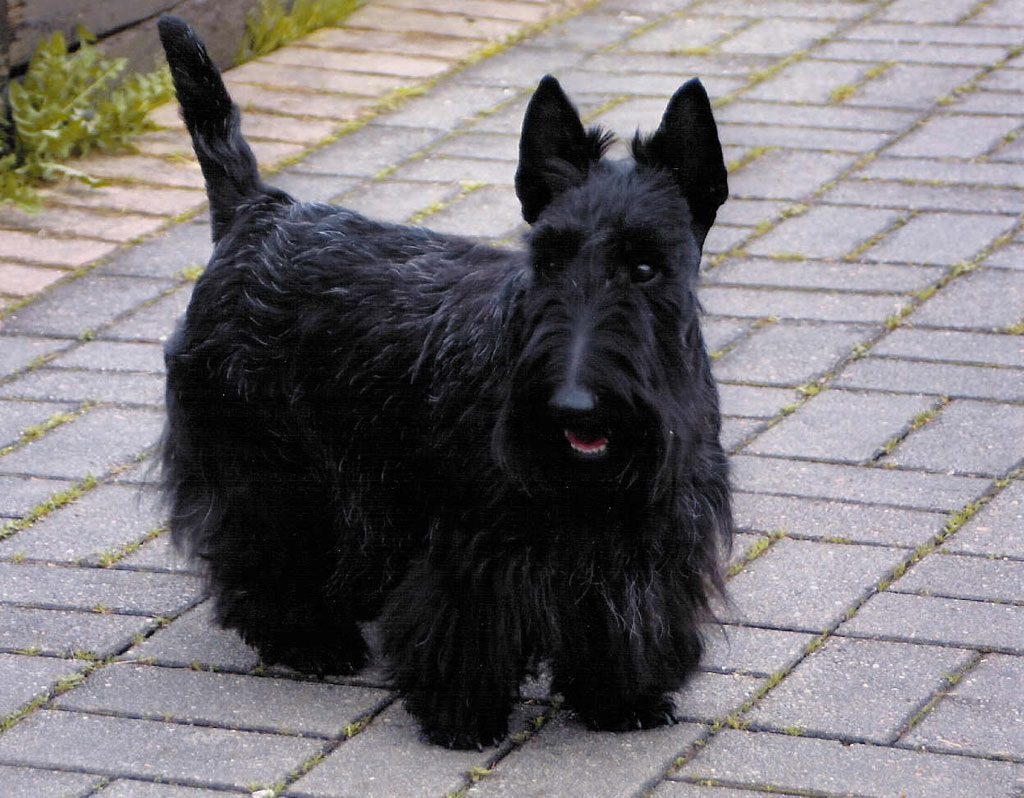
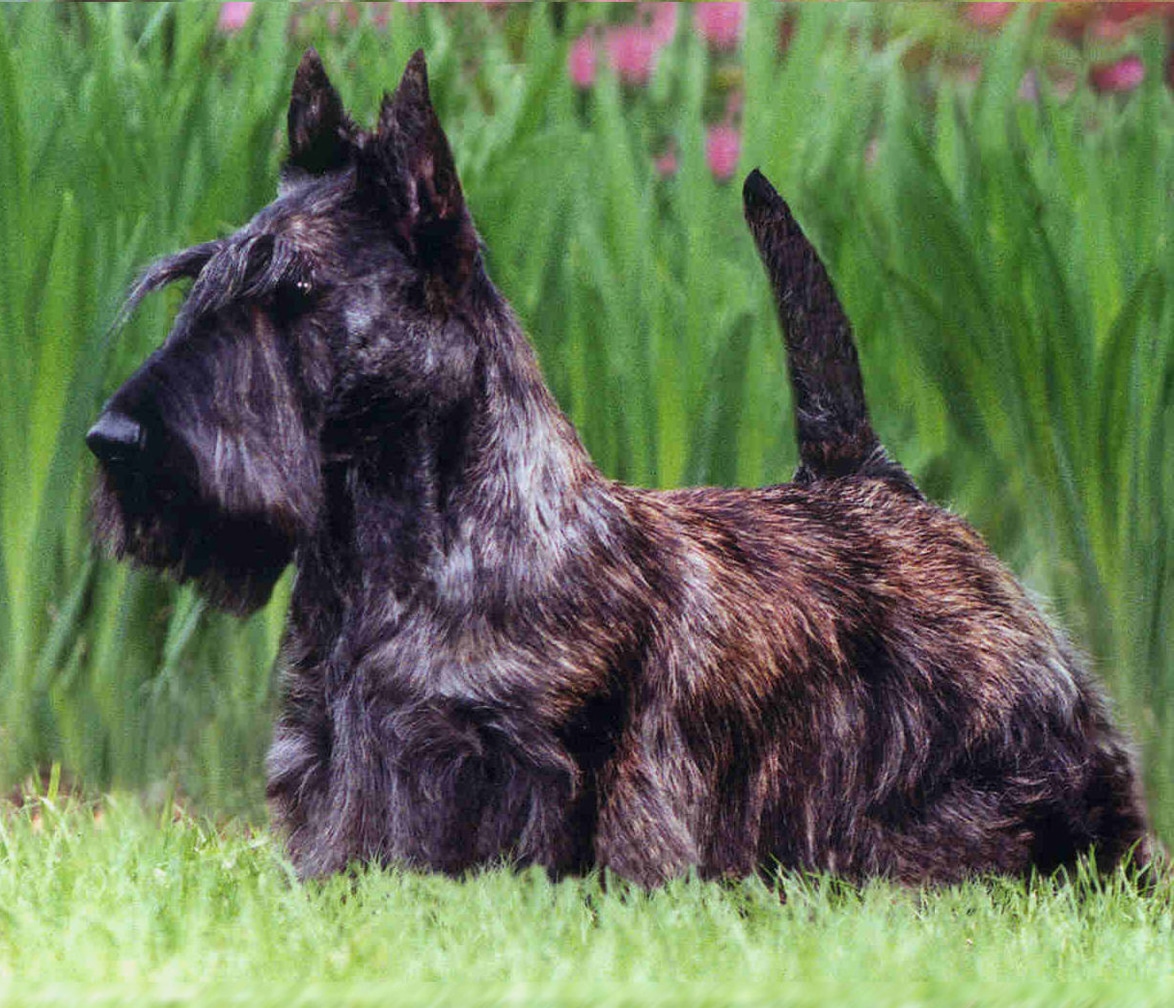
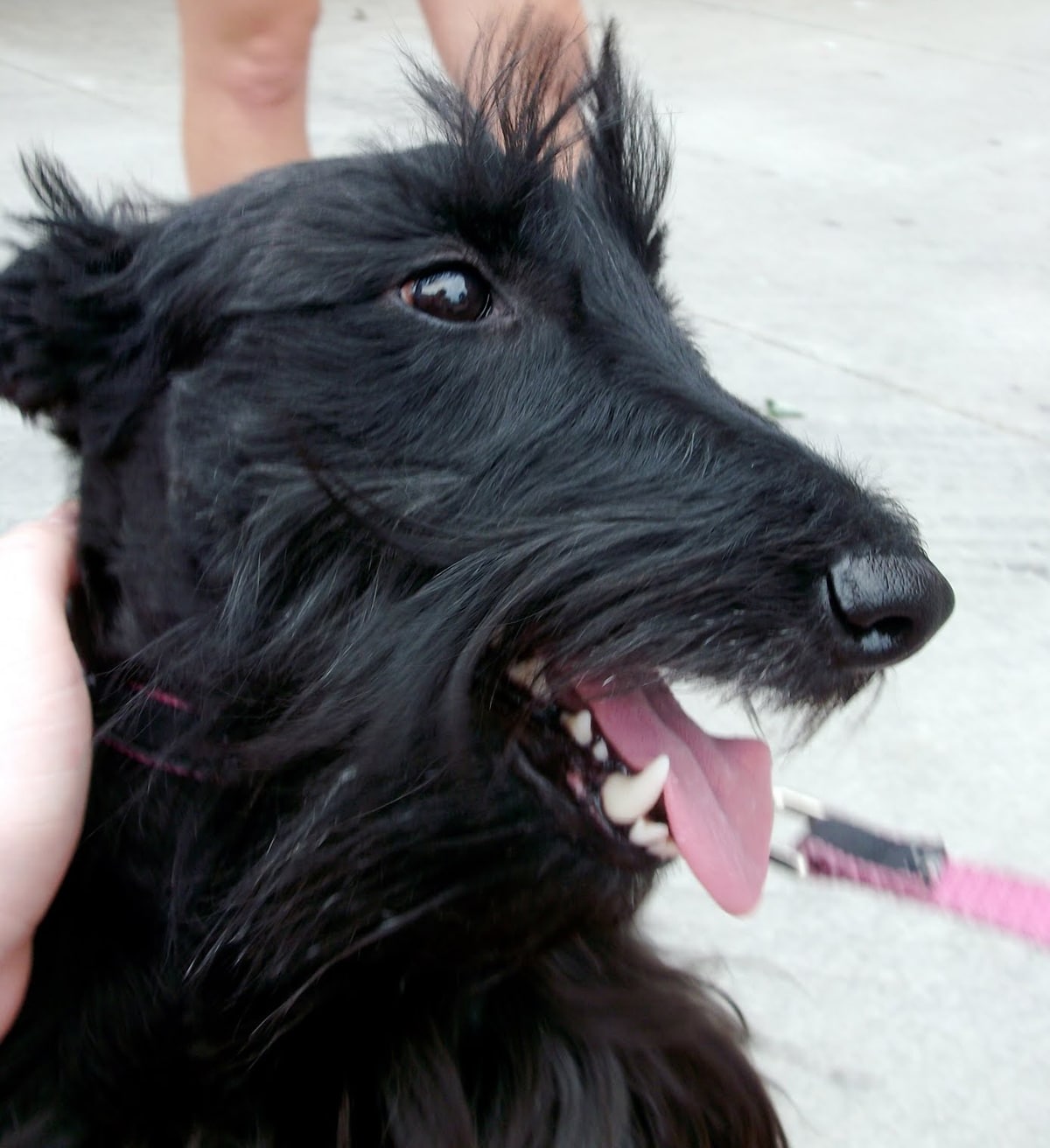
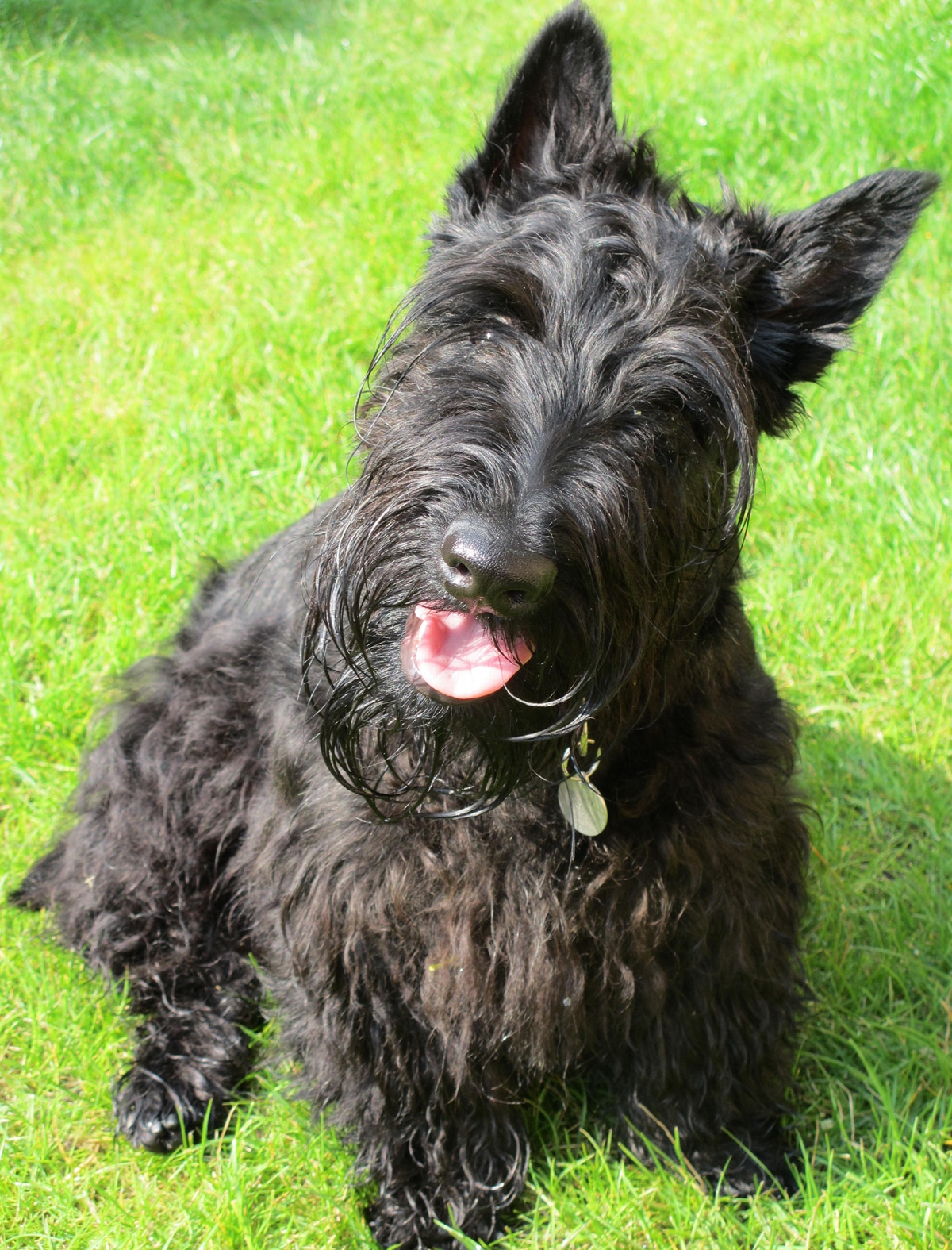
Scottish Terrier
Gran Bretaรฑa Escocia FCI 73 . Small sized Terriers.

The Scottish Terrier is independent, self-confident, joyful, intelligent and stubborn bastabte.

Content

History

The Scottish Terrier, also known as the Aberdeen Terrier, and popularly as "Scottie", It is one of the high Terrier breeds that were grouped under the name of Skye Terrier, It is one of the five breeds of Terrier that originated in Scotland, the other four are the modern Skye Terrier, Cairn Terrier, Dandie Dinmont Terrier, and West Highland White Terrier.

The real origin of a race as old as Scottish Terrier it's dark and undocumented. The first written records about a dog with a similar description to those of the Scottish Terrier was in 1436, When Don Leslie described them in his book the history of Scotland 1436-1561.

Two hundred years later, Sir Joshua Reynolds painted a portrait of a young woman stroking a dog similar in appearance to the Scottish Terrier of today. King James VI of Scotland was an important historical figure accompanying the history of the Scottish Terrier. In the century 17, When King James VI became James I of England, sent six Terrier – believes that the precursors of the Scottish Terrier- a French monarch as a gift. His love and adoration for the race, It is said that you increased its popularity around the world.

In the century 19, in the Highlands of Scotland, including the Isle of Skye, the Terrier were abundant, originally known by the generic term "short-haired" or " Skye Terrierยซ. Towards the end of the century 19, it was decided to separate these Scottish Terriers and develop pure blood lines and specific breeds.

Originally, the breeds were separated into two categories – Dandie Dinmont Terriers and Skye Terrier (Noel Skye Terrier that is known today, but a generic name for a large group of the Terrier with different all features, who came from the isle of skye).

The written history and initial development of the race began at the end of 1870 with the development of dog shows. The exhibition of dogs required compared to a standard of the race and therefore the appearance and temperament of the Scottie was written for the first time.

Finally, The Skye Terrier were divided into what is known today as the Scottish Terrier, Skye Terrier, West Highland White Terrier and the Cairn Terrier.

Captain Gordon Murray and Shirley were responsible for establishing the type in 1879. Shortly after, in 1879, the Scottie were first exposed at Alexander Palace in England, while the following year they began to be classified in much the same way as they are today. The first written breed standard was written by JB Morrison and DJ Thomson gray and appeared in Vero Shows illustrated book of The Dog, published in 1880. The standard describes the color of the breed as "gray, grayish Brindle ยซ.

In 1881, he "Scottish Terrier England Club" was founded, being the first club dedicated to the race.

The Scottie It is the only breed of dog that has lived in the White House more than three times..

In May of 2007, Carnegie Mellon University, used the image of a Scottish Terrier as your official pet.

It is a small Terrier breed with a distinctive shape and it has had many roles in popular culture.

They have been owned by a variety of celebrities, including the president number 32 of the United States, Franklin Delano Roosevelt, whose Scottie โ€œFalaโ€ is included with Franklin Delano Roosevelt in a statue in Washington, DC, just like him 43 ยบ President of the United States George W.. Bush . They are also well known for being a piece to play in the Board game Monopoly.

Described as a territorial dog, wrestler, they can be a good guard dog and tend to be very loyal to his family.
Scottish Terrier may be more prone to clotting disorders, joint disorders, autoimmune diseases, allergies and cancer than other breeds of dog and not a disease is the name of the race called Scotty cramp. Is also a most successful breeds of dogs at the Westminster Kennel Club show of dog with a better show in 2010.

Physical characteristics

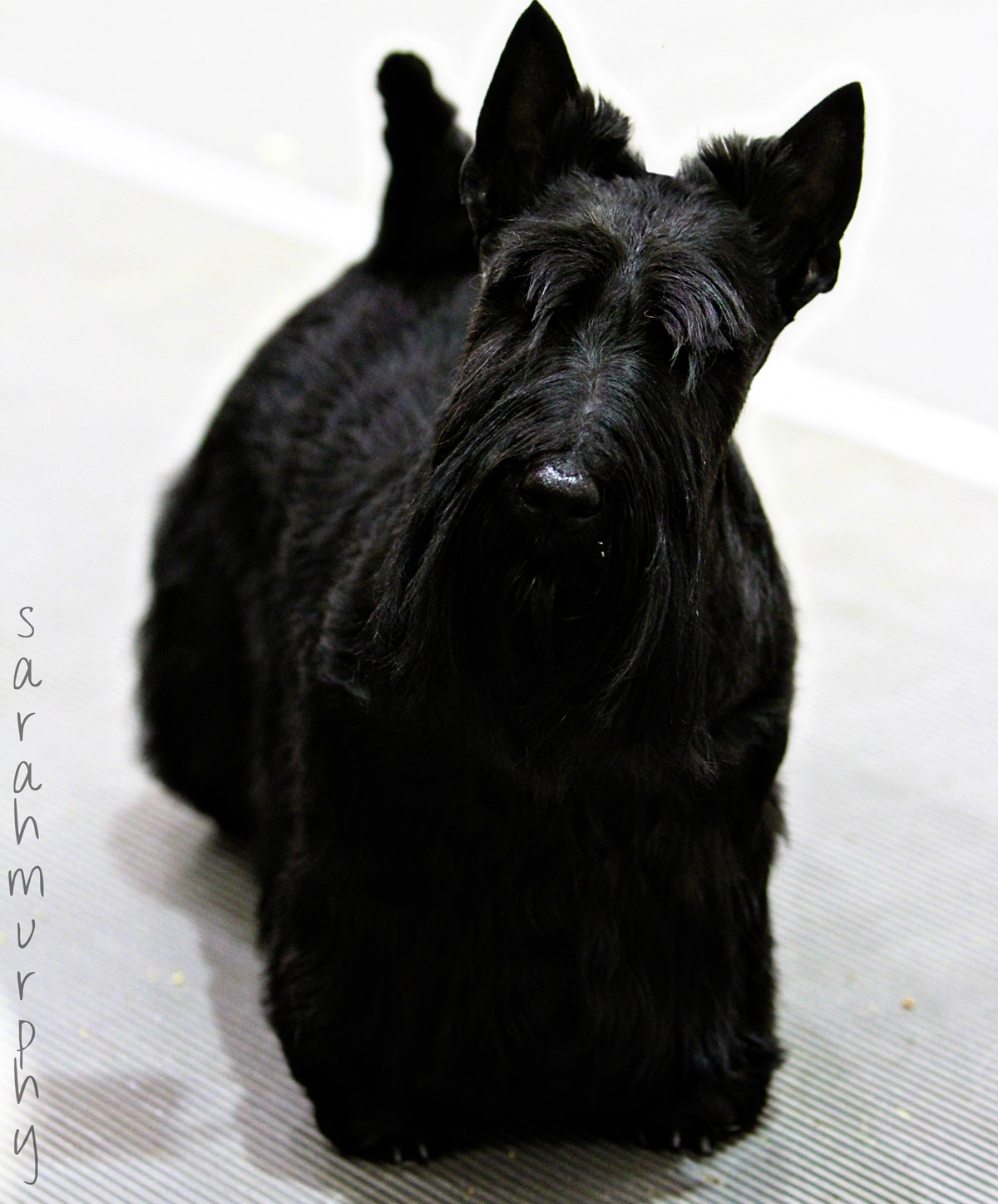
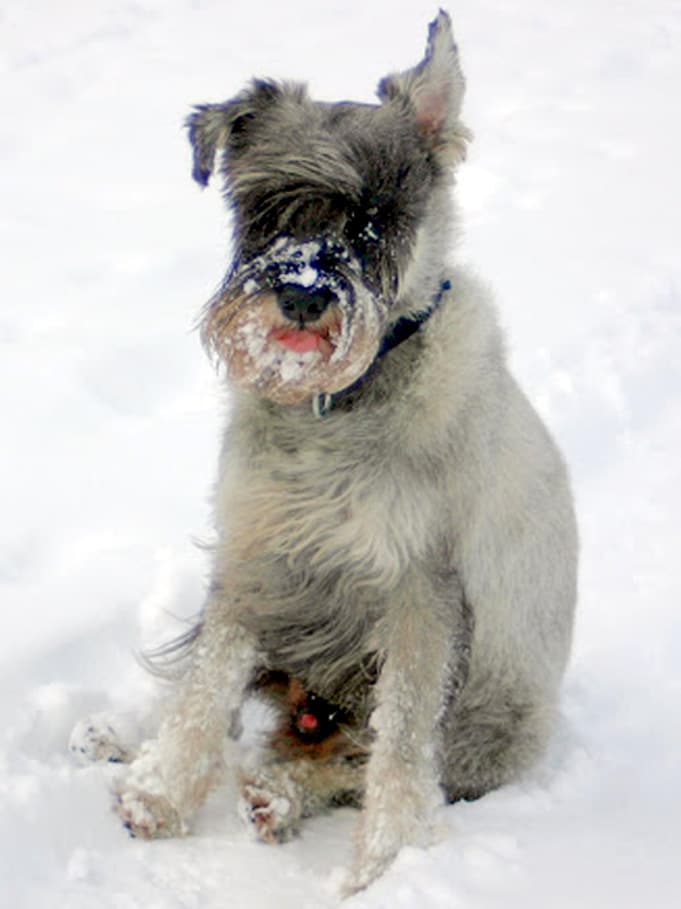
The Scottish Terrier It small but resistant, they have short legs, It Chunky and robust complexion, with one long head in proportion to its size. The Scottish Terrier must have large legs adapted for digging.

Their ears they are erect and the tail is one of the outstanding characteristics of the breed. Their eyes they are small, bright and dark brown or almost black and almond-shaped.

The height at the withers for both sexes should be approximately 25 cm., and the length of the back from the cross until the queue is of approximately 28 cm.. In general, is a well balanced dog, It must weigh 8.5 to 10 kg and a female 8 to 9,5 kg.

Scottish Terrier often has a hard mantle, rough, long, the inclement weather-resistant, an outer layer and a soft, dense layer attached to the skin. Combined, with a long beard in layer, the eyebrows, the legs and lower part of the body. The head, the ears, the tail and back are traditionally short, are the parts included in the haircut of the Scottish Terrier.

The the Layer palette It ranges from dark gray to Jet Black, o ยป Brindle ยซ(a mixture of black and Brown).

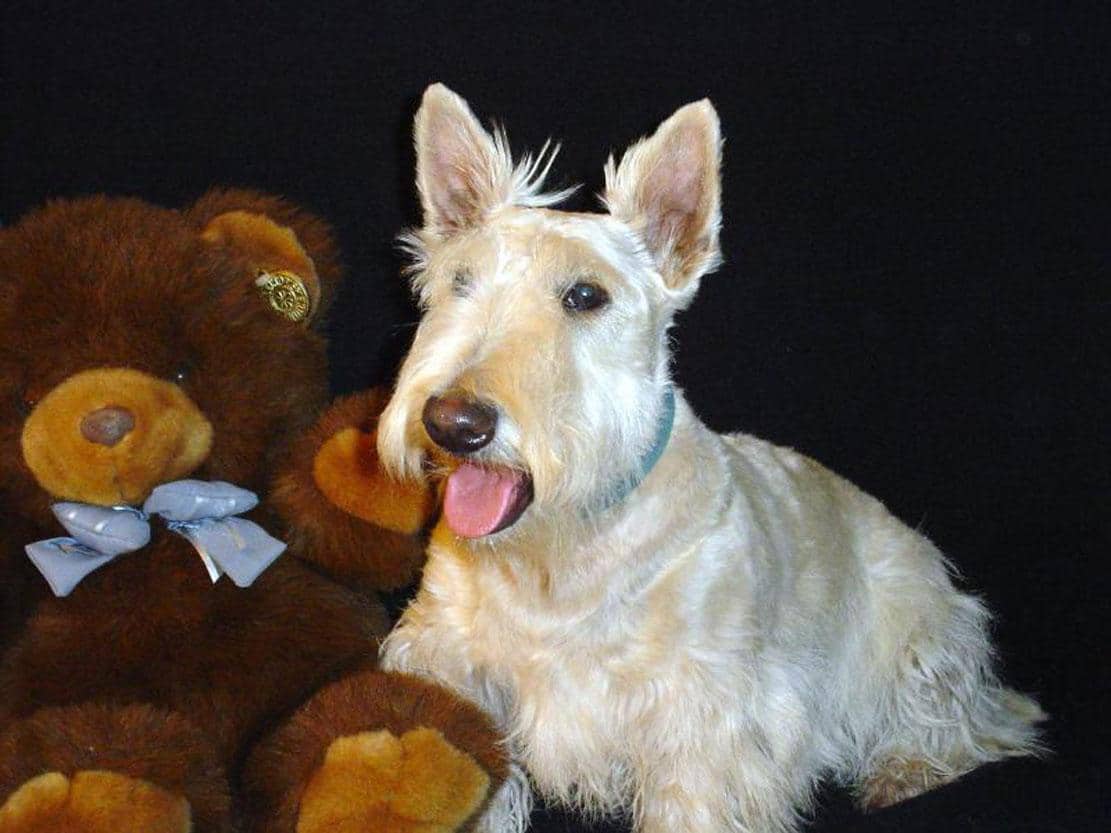
"Wheat" color may appear (straw to nearly white), but it should not be confused with the Cairn Terrier or West Highland White Terrier .

Character and skills

The breed is known for being independent and self-assured., joyful, intelligent and has been nicknamed the "Tough ass". They are described as very affectionate, they have also described as stubborn. It is sometimes described as a distant race, Although it has been observed that they tend to be very loyal and affectionate to its family.

The Fourth Earl of Dumbarton nicknamed the breed ยซthe uncompromisingยซ. The modern race said that it was able to trace their lineage to a single female, call splinter II.

It has been suggested that the Scottish Terrier can be a good watchdog, due to their tendency to bark only when necessary and that it tends to be reserved with strangers. The Scottish Terrier they were bred to hunt and fight badgers.

So, the Scottie is prone to digging, as well as chasing small vermin, as the squirrels, rats and mice.

The Scottie are territorial, they are always warning, they are fast and energetic in their movements, perhaps even more than other Terrier breeds.

With regard to health, the Scottish Terrier have a higher chance of developing some types of cancer, compared to other 'purebloods'.

Characteristics "Scottish Terrier"

Coexistence is important that you have with your new friend. Before considering the acquisition of a dog of the breed "Scottish Terrier" you know certain factors. Not all breeds of dogs are apt to live in an apartment, you must take into account his character, their need for exercise, their interaction with other pets, their care and if you have small children, their level of tolerance towards them.

Adaptation โ“˜

3,0 of 5 stars (based on 1 review)

friendly dog โ€‹โ€‹โ“˜

2,0 of 5 stars (based on 1 review)

hair loss โ“˜

2,0 of 5 stars (based on 1 review)

Affection level โ“˜

4,0 of 5 stars (based on 1 review)

Need for exercise โ“˜

3,0 of 5 stars (based on 1 review)

Social need โ“˜

4,0 of 5 stars (based on 1 review)

Home โ“˜

5,0 of 5 stars (based on 1 review)

Toilet โ“˜

4,0 of 5 stars (based on 1 review)

Friendly with strangers โ“˜

3,0 of 5 stars (based on 1 review)

barking โ“˜

2,0 of 5 stars (based on 1 review)

Health โ“˜

4,0 of 5 stars (based on 1 review)

Territorial โ“˜

5,0 of 5 stars (based on 1 review)

Cat friendly โ“˜

3,0 of 5 stars (based on 1 review)

Intelligence โ“˜

5,0 of 5 stars (based on 1 review)

Versatility โ“˜

2,0 of 5 stars (based on 1 review)

Child friendly โ“˜

3,0 of 5 stars (based on 1 review)

Surveillance โ“˜

3,0 of 5 stars (based on 1 review)

joy โ“˜

5,0 of 5 stars (based on 1 review)

ยซScottish Terrierยป images

Videos ยซScottish Terrierยป

Type and recognitions:

  • FCI CLASSIFICATION:
  • Group :
  • Section : . .

Federations:

  • – FCI – Terriers 2 Small sized Terriers. โ“˜
  • – AKC – Terriers โ“˜
  • – ANKC – Terriers โ“˜
  • – CKC – Terriers โ“˜
  • – โ€‹KC – Terriers โ“˜
  • – NZKC – Terriers โ“˜
  • – UKC – Terriers โ“˜

FCI breed standard "Scottish Terrier"

Origin:
United Kingdom

Date of publication of the valid original standard:
13.10.2010.

Use:

Terrier


General appearance:

It is a compact dog, Properly sized for underground huntingwho should exclude overweight dogs. Its members are short; alert, presents an image of great power and activity in a reduced volume. The head gives the impression of being long compared to the size of the dog. It is very agile and active despite its short limbs.

IMPORTANT PROPORTIONS: The skull and muzzle have the same length.


Behavior / temperament:

It is a faithful dog, fair, noble, independent and reserved, but brave and very smart. Bold, but never aggressive.

Head:

Long but proportional to the size of the dog.Carry on a muscular neck of moderate length, showing quality.

Cranial region:
  • Skull: The length of the skull should allow enough width, although maintaining the appearance of being narrow. The skull should be almost flat.
  • Fronto-nasal depression (Stop): Light, but visible, between skull and muzzle, right at eye level.

facial region:

  • Truffle: Negra.Long; in profile the line that runs from the nose to the chin appears to descend backwards.
  • Snout: It must be strong and deep to its full extent.
  • Jaws / Teeth: Big teeth, with perfect and complete scissor bite, That is, the inner face of the upper incisors is in close contact with the outer face of the lower incisors and the teeth must be implanted at right angles in the jaws..
  • Cheeks: They should not be prominent.
  • Eyes: Almond-shaped, dark brown, placed quite far apart from each other andNot badunder the eyebrows with a sharp and intelligent expression.
  • Ears: clean, texture fine, pointy, erect and implanted above the skull, but not too close together. Big, wide ears at the base are very undesirable.

Neck:

Muscular and of moderate lengthshowing quality.

Body:

The upper body line is straight and level. top line: Proportionally short and very muscular. Pork loin: Muscular and deep.

  • Chest: Somewhat wide suspended between forelimbs. Well rounded ribs placed well back flattening to give depth to the chest. The thorax vigorously attached to the hind limbs.

Tail:

It should be of moderate length, giving the dog general harmony.. Thick in its implantation and thinning towards the tip, carried vertically or with a slight curvature.

Tips

PREVIOUS MEMBERS:

  • General appearance: The thorax is well placed in front of the forelimbs
  • Shoulder: Wide and sloping.
  • Elbow: It should not be turned outwards or placed under the body.
  • Forearm: Right with good bones.
  • Metacarpus: Straight.
  • Previous feet: Good size, with good foot pads, fingers well arched and together. The front feet are slightly larger than the hind feet.

LATER MEMBERS:

  • General appearance: Remarkably powerful for dog size. Thick and wide buttocks.
  • Thigh: Deep.
  • Knee: Well angled.
  • Metatarsus: Hocksshort, strong, without turning inward or outward.

Hind feet: Good size, with good foot pads, fingers well arched and together. The hind feet areslightly smaller than the previous ones.

Movement:

Uniform and easy going, right both back and forth with a push from behind taking a regular stride.

Mantle

  • Fur: Attached to the body; double layer: short inner layer, dense and smooth; hard outer layer, dense and textured wire; the two layers protect it from the elements.
  • Color: Negro, wheat or any brindle color.


Size and weight:

  • Height to the cross: 25 โ€“ 28 cm.
  • Weight: 8,5 โ€“ 10,5 kg.


Fouls:

Any deviation from the aforementioned criteria is considered as a fault and the severity of this is considered to the degree of the deviation to the standard and its consequences on the health and well-being of the dog..

FALTAS DESCALIFICANTES:

  1. Aggressiveness or extreme shyness.
  2. Any dog โ€‹โ€‹showing clear signs of physical or behavioral abnormalities must be disqualified..


N.B.:
  1. Males should have two normal-appearing testicles fully descended into the scrotum..
  2. Only functionally and clinically healthy dogs, with the typical conformation of the breed, should be used for parenting.

The latest changes are in bold

TRANSLATION: Brรญgida Nestler / Original version: (IN) Technical supervision: Miguel Angel Martinez

Source: F.C.I - International Cynological Federation

Alternative names:

1. Scottie, Aberdeenie (English).
2. Scottish terrier (French).
3. Scottish (German).
4. Scottish Terrier (Portuguese).
5. Scottie, Aberdeen terrier, Terrier escocรฉs (espaรฑol).

โ–ท The world of Pets: Dogs, cats, birds, reptiles, amphibians

Saint Miguel Cattle Dog
Portugal FCI 340 - Molossoid - Dogo

The dog's Saint Miguel Cattle Dog It is a breed of dog Portugal, specifically the Azores Islands.

Fila de San Miguel

Content

History

With the settlement of the Azores archipelago and the beginning of the exploration of the optimal conditions of the islands for raising cattle, the need for dogs on the islands to help drive and defend livestock soon became apparent, dating from the sixteenth century the first reference to its presence, in particular on the island of Sรฃo Miguel. These animals are recognized as the precursors of Saint Miguel Cattle Dog.

Although the existence of Saint Miguel Cattle Dog, as an individual race, has been recorded since the early 19th century, only in 1982 began to be registered by Antรณnio Josรฉ Amaral with the collaboration of Maria de Fรกtima Machado Mendes Cabral, veterinarian, in order to create a census of your herds. The first officially registered dog of the breed was the ยซCoriscaยป, a perfect representative of your breed.

It is also on the initiative of these same two people that, in 1984, two years after the beginning of the registration of persons the first official standard is published. In 1995 was proposed to the FCI (International Cynological Federation) and the breed was finally recognized in 2008.

Origin:

The breed known today as Saint Miguel Cattle Dog descended from mastiffs and alano initially brought to the islands of the Azores by the first settlers on the continent. Later, and through contact with other people who came and settled in the Azores, the genetic heritage of the breed was enriched by crosses made with English mastiffs, bulldogs and Dogue de Bordeaux, until the culmination of the appearance of the new race, with fully defined morphological and temperamental characteristics.

In addition to those mentioned, other races may form part of the Fila de San Miguel ancestry, as the St. Humberto's Dog, also known as Bloodhound, and the Dogo Canario, a Spanish breed from the Canary Islands, but the real link – yes there is – between these races and the Sao Miguel queue not yet proven.

Video "Saint Miguel Cattle Dog"

Playing around 1

Physical characteristics

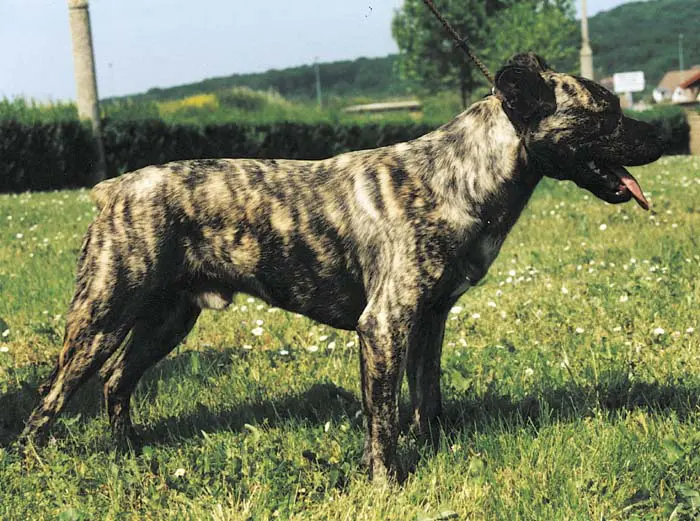
The Saint Miguel Cattle Dog it is characterized by being an animal of size and rustic features and characteristically longer than tall. The breed is medium in size, muscular, but without the heavy appearance of others.

The muzzle is well proportioned, apparently short, but it hides a wide mouth, with a full denture, capable of a powerful bite. The head has a solid appearance, wide and with the ears well placed on top, implanted in a strong neck that starts from a solid trunk, with a wide and deep chest. The legs are proportional to the body, being the front, as a rule, slightly separated.

The coat is strong, smooth and dense, and always striped, and it can be tawny, gray or yellow, with white mesh on the chest. Legs can also be white. The tail is implanted high, it's thick, medium length and slightly curved. It is amputated at the height of the second or third vertebra, or is it naturally short.

  • Fur: short, smooth, dense, with hard textured hair.
  • Color: gray hair, carbonated sand (grey), yellow with all fades from light to fawn; always striated. May show white spot on forehead or from chin to chest, and white spots on the forefoot, in the later or in all four.
  • Size: males, of 50 to 60 cm.; females, of 48 to 58 cm..

Character and skills

Race of a lively and sharp intelligence, with great ease of learning, the strength of character of the Saint Miguel Cattle Dog, coupled with a distrust of the strange instincts of all guardians by vocation, can easily be mistaken for aggressiveness, but it hides a gentle nature towards those with whom it deals closely, while remaining a tenacious and courageous guardian of those who treat him. His loyalty to his human family is extreme.

With even greater emphasis, given the dominant nature of the breed, the education and sociability of puppies must be done from birth, gradually exposing the animals to new situations and stimuli, in order to improve the development of balanced individuals capable of living with humans and other animals.

Not a suitable breed for beginners, given its dominant nature, further enhanced by his physical strength and his strongly independent and autonomous character.

Even as a pet, a Saint Miguel Cattle Dog must have the opportunity to have a task to perform. Thorough training is always a simple and effective means of strengthening the relationship between the human family and the animal, while providing the physical and mental exercise necessary for the training and development of a well-balanced animal.

But, given the intrinsic characteristics of the breed, training a copy of the Saint Miguel Cattle Dog it is a task that can be quite difficult for someone who has little experience with dogs. Being a very intelligent and dominant breed, will not respond well to the use of force. Full socialization recommended.

The sheepdog for tradition and excellence, their natural fitness for livestock can, with the right training, can be channeled into the care of horses and other small ruminants such as sheep and goats. When not channeled to grazing, the Saint Miguel Cattle Dog has already demonstrated its aptitude for big game hunting, like the boar and the deer.

Its strong and protective temperament is also valued as a self-defense dog..

Health ยซSt. Michael's Rowยป

Being a rustic breed, is in robust health and there are no records to date to suggest that there is any pathology to which the breed is specifically prone to for genetic reasons. The average life expectancy of this breed is calculated in 12 years.

St. Michael's Row Toilet

The same hardiness that gives vigor to the breed also makes it a poorly maintained breed in a strict sense. Short, hard hair can be brushed occasionally and baths will be sporadic.. Adequate and balanced feeding will give developing puppies what they need to become healthy adults, and the same regimen will suffice to ensure adult health..

Images "Saint Miguel Cattle Dog"

Type and recognitions:

  • FCI CLASSIFICATION:
  • Group :
  • Section : . .

Federations:

  • – FCI – Group 2: Pinscher and Schnauzer - Molossoid and Swiss Mountain and Cattledogs. Section 2: Molossoid. 2.1 Dogue type. โ“˜

FCI breed standard "Saint Miguel Cattle Dog"

Origin:
Portugal

Date of publication of the valid original standard:
21.05.2007

Use:

cattle dog


General appearance:

Robust and resistant.


IMPORTANT PROPORTIONS:

  • Slightly longer than high.


Behavior / temperament:

Cattle dog par excellence, it is equally a good guard dog of property and people. He has a very determined character with strangers but docile with his owner.
Very clever and very responsive. In the exercise of his duties, lead dairy herds, he bites low so as not to damage the udders of the cows.. But, when it comes to stray cattle it can bite higher

Head:

Strong, square-looking. Cranio-facial superior longitudinal parallel axes.

Cranial region:
  • Skull: Large, slightly bulky, little apparent occipital protuberance.
  • Nasal bevel (Stop): Is pronounced.

facial region:

  • Truffle: Wide and black.
  • Snout: Straight, slightly curved, slightly shorter than the length of the skull.
  • Lips: Well pigmented, overlapping, torn, firm, slightly curved on the lower profile.
  • Jaws: Very strong, well developed. With good opposition.
  • The teeth: Complete dentition with scissors or tweezers.
  • Eyes: Oval, expressive, slightly sunken, dark brown, horizontal, medium-sized.
  • Ears: Above average insertion. When not cut they are medium triangular and pendulous but slightly separated from the face. Normally cut in the round.

Neck:

With good connection, straight, strong and medium length. There is no double chin.

Body:

  • Trunk: Strong, muscular, with a broad chest.
  • Breast : Wide and lowered.
  • Back: Straight.
  • Pork loin: Of average length, wide and well muscled.
  • Rump: Of medium length in relation to the body, slightly predominant in relation to the cross.
  • bottom line: Bottom-up profile, ventricles and flanks proportional to the body.

Tail:

High insertion, thick.

Tips

Former members: Strong.

  • Shoulder: Scapulo-umeral angle slightly open.
  • Arms: Strong of medium length, good muscular.
  • Forearm: Thick and well muscled.
  • Carpo: Thick.
  • Metacarpus (Pastern): Thick, average length.
  • Hands: Oval, with strong fingers and nails.

Later members: Strong, moderately separated.

  • Thighs: Long, muscular, with an open lame / femoral angle.
  • Legs: Of average length, muscular.
  • Metatarsus: Of average length. May have presumptions.
  • Pies: Of average length: Oval, with strong fingers not very curled. Strong nails.

Movement:

Easy and loose. On the move, the back wobbles slightly.

Mantle

  • Skin: Thick and pigmented.
  • Shelter: Short, smooth, dense, with a strong texture, slightly bordered on the tail, the anal and posterior region.
  • Colorations: Fawn, charred and gray sand, in light and dark tones and should always be tiger. The presence of a white male is allowed in the frontal region and the menthol chest, as well as the white coloring on the hands (white male), the feet (pedal) or on all legs simultaneously (white square).


Size and weight:

Males

  • Height to the cross: 50 to 60 cm.
  • Weight: 25 to 35 kg

females

  • Height to the cross: 48 to 58 cm.
  • Weight: 20 to 30 kg


Fouls:

Any deviation from the above points must be considered a fault and the seriousness with which the fault should be considered must be in exact proportion to its degree and its effect on the health and well-being of the dog..


SERIOUS FAULTS:

  • Head: converging axes of skull and muzzle.
  • Jaws: Mouth slightly above or below.

MISS PLAYOFFS

  • Aggressive or too shy.
  • Any dog โ€‹โ€‹that clearly shows physical or behavioral abnormalities.
  • Divergent axes of skull and muzzle.
  • Severely over or under the mouth.


N.B.:
  • Males should have two normal-appearing testicles fully descended into the scrotum..
  • Only functionally and clinically healthy dogs should be used for breeding., with the typical conformation of the breed.

Source: F.C.I - International Cynological Federation

Alternative names:

1. Cรฃo de fila de Sรฃo Miguel, Sรฃo Miguel cattle dog, Sรฃo Miguel catch dog, Azores cattle dog, Azores cow dog (English).
2. fila de Saint Miguel (French).
3. Cรฃo Fila de Sรฃo Miguel (German).
4. Fila de Sรฃo Miguel, Cรฃo das Vacas (Portuguese).
5. (espaรฑol).

Source:

Wikipedia

Photos:

1 – Fila de Sรฃo Miguel during International dog show in Rzeszรณw, Poland by Pleple2000 / CC BY-SA
2 – Fila de Sรฃo Miguel during International dog show in Rzeszรณw, Poland. by Pleple2000 / CC BY-SA
3 – At the Burnt Peak of Ribeira Grande, Son and Mother by TheLife / CC BY-SA
4 – Helsinki, el Finnish Winner Show 2015. by Thomas / CC BY-SA

โ–ท The world of Pets: Dogs, cats, birds, reptiles, amphibians

Spanish Mastiff
Espaรฑa FCI 91 - Molossoid . Mountain
Spanish Mastiff

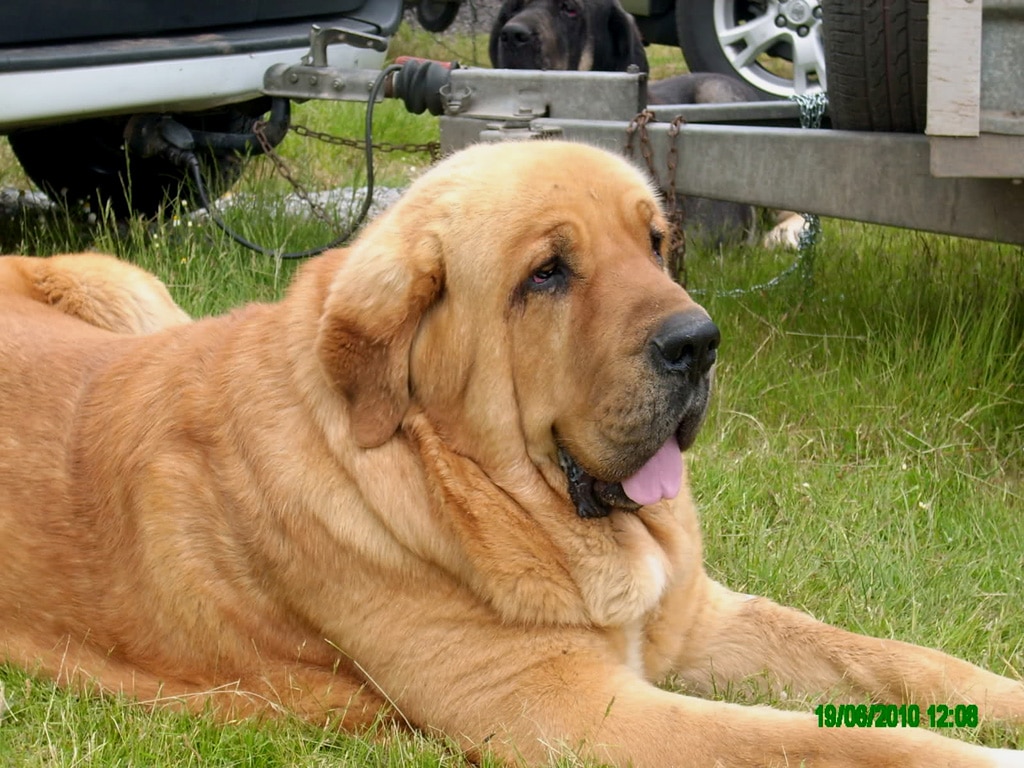
The Spanish Mastiff, He is regarded as the oldest Spanish race.

Content

History

The Spanish Mastiff (also called Leonese Mastiff) is a breed of dog trotting type of large size, originally from Spain where it was abundant in almost the entire country and today is in a particular way in Leรณn, Zamora, Asturias and Cantabria. One of its varieties is the Pyrenean Mastiff.

This is a very old dog and like the other broadcast, descends from the molosser of Tibet (Tibetan Mastiff) He came to Europe via Asia minor.

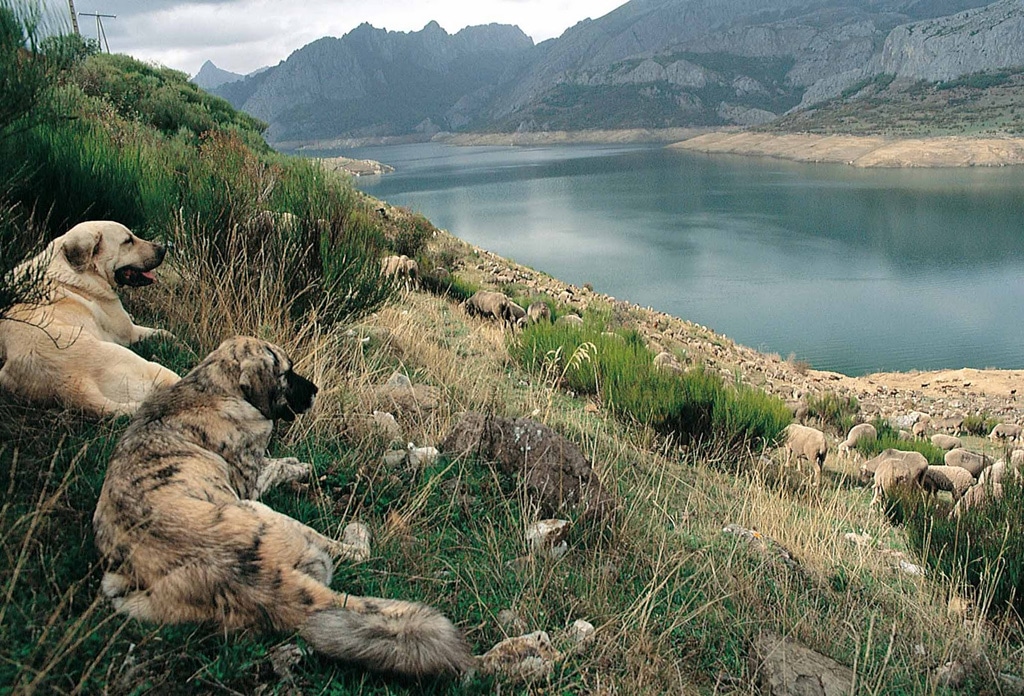
Theories about the breed maintain that at least four thousand years ago the shepherds who inhabited the peninsula already used them as livestock guard dogs..

The natural resources and climate of the Iberian Peninsula gave rise to transhumance, for which reason, for many centuries the Spanish Mastiff has played the role of protector of flocks, especially from herds of 'merino sheep' whose history is closely linked to that of this dog breed. In some places it is known as the 'merinero dog' because it accompanies the Merino sheep..

The Spanish Mastiff, He is regarded as the oldest Spanish race.

The transhumant wandered through the royal canyons of Leรณn, crossing the Iberian Peninsula from North to South., and the Spanish Mastiff went with them defending the cattle from the attack of the wolf, the dog in addition to with its imposing nature, He had the protection of his abundant jowls as well as carlancas or carranclas, they are a species of thick metal with spiky necklaces.

Videos of the Spanish Mastiff
SPANISH MASTIFF. A NOBLE RACE.
Mastin Spanish /Spanish mastiff puppies in kennel Tornado Erben

At the end of the 19th century with the gradual disappearance of the grazing and transhumance, the Spanish Mastiff became 'unnecessary', if we add to that the Spanish Civil War and its consequent period of scarcity and -also- the sharp decline in the number of wolves, as a result we have that this breed of dog was on the verge of extinction.

During that time many specimens of Spanish Mastiff were sacrificed, Some were emasculated and other so many purchased by enthusiasts that breeders, guided more by love of the race than by knowledge, start you a totally disorganized parenting.

After the debacle, fortunately, the recovery of the breed has been achieved though with great difficulty.

The first standard of the Spanish Mastiff was approved by the International Cinological Federation in the year 1946, based on the characteristics of three specimens from central Spain, These specimens were a light type, that still remained in the cattle farms and that were also used for hunting big game, they were of good size, with long legs and her weight was around the 50 kg.

In 1981 a new standard was approved whose main objective was to recover the much larger Mastiff that was used in transhumance livestock.

That same year (1981) was founded the Spanish Association of the Spanish Mastiff Dog (AEPME) as official club of the breed.

Physical characteristics

It is a dog of large size, braquicรฉfalo and mesomorfo. Well proportioned, very powerful and muscular. Big and heavy, with skeleton compact.

There are no exact size limits., but they must be harmonious, in the males expected a height that not is lower to 77 cm. the cross and in the females, not less to 72 cm.. Those are the bare minimum., but always expected greater height.

The head is significantly large, has a crรกneo-hocico relationship of 6:4. If we look at the skull from the top is a square and uniform.

It has eyes small, almond-shaped and hazelnut or chestnut colour.

It has the ears triangular, median, flat and pendants. The legs are long, straight and fitted with good musculature.

The tail, inserted at medium altitude is very thick, flexible and wears it down, arriving at the height of the Hock.

Its the mantle This thick a thick hair hard, semilargo and smooth. The colors the most prized hair are uniforms (or solids), they may be dirty white, leonado, reddish, black, gray wolf, brown. Are also supported in the standard the atigrados, or white spotted robes.

Observations

As it's a race in recovery process, is very difficult to find perfect copies (that is to say, adjusted completely to the standard).

It is not a dog suitable for beginners, but it could be a very rewarding challenge for some enthusiast with the desire to breed a dog with a long history and gigantic potential like the Spanish Mastiff..

Character and skills

The Spanish Mastiff is a rustic dog, loving, tame, noble, very firm and self-confident.

It is generally quiet and affectionate, He is very loyal and devoted to their masters. It is-especially- suitable for children, for those who feel special attraction. As well, usually get along well with other dogs.

Essentially, is a calm and balanced guardian, but it can be very scary if they perceived danger to its owner and properties.

These dogs are very happy living in the open air, and especially given the opportunity for long and quiet walks, that will be necessary if we want our Mastiff to be happy and balanced.

Observations

As we mentioned in the โ€œHistoryโ€ section, the vicissitudes of the recovery of the race has led to chaos at the beginning of it..., and all that lack of control in the breeding, It has had a direct effect on the character of dog, it is for this reason that today we can find too aggressive specimens, and other, maybe more shy.

Fortunately, the great work which is carrying out the Spanish Association of the Spanish Mastiff Dog, focused on selection in breeding is very hopeful since good results are being obtained, and over time the problem will be eliminated.

Images of the Spanish Mastiff

Videos of the Spanish Mastiff

Type and recognitions:

  • FCI CLASSIFICATION:
  • Group :
  • Section : . .

Federations:

  • – FCI – Pinscher and Schnauzer-Molossoid type dogs – Swiss Mountain Dogs and Cattledogs. Section 2.2 Molossoid, mountain type. โ“˜
  • – AKC – FSS โ“˜
  • – UKC – Watchdog โ“˜

FCI breed standard "Spanish Mastiff"

Origin:
Spain

Date of publication of the valid original standard:
26.05.1982

Use:

Nursery and defense. This breed is closely linked to transhumance and especially to merino cattle., whom he accompanied already in times of the Mesta, defending you from the wolf and other predators throughout all your movements and places, grass shelves in different seasons and location zones. Currently accompanies numerous herds, both shelves and transhumants, performing its ancestral function. It also performs the function of guard and defense of farms, people and properties in general.


General appearance:

It is a dog of large size, hypermetric and of medium proportions. Sublongilinear structure. Well proportioned, very powerful and muscular. compact skeleton. Large head and body with semi-long hair. Proportionality and functional harmony must be sought, both static and moving. His bark is hoarse, serious and deep, of great intensity, perceiving yourself at a considerable distance.

IMPORTANT PROPORTIONS: Body length greater than the height at the withers. The ratio of the length of the skull to that of the muzzle should be 3/2


Behavior / temperament:

It is a very intelligent dog, not devoid of beauty; his expression shows both qualities.

Rustic, loving, meek and noble, turns out to be a very firm dog against vermin and strangers, especially when he is defending farms or cattle. In its behavior you can see that it is a self-confident dog., metering of his forces for being aware of his enormous power.

Head:

As a whole: Grand, strong and broad-stem pyramidal. The skull-muzzle set, seen from above, must be square and uniform, and without a very marked diminution between the base of the snout and the temples. Moderately divergent craniofacial lines.

Cranial region:
  • Skull : Width, strong, sub-convex profile. The width of the skull must be equal to or greater than its length. Accentuated frontal sinuses. Marked occipital Crest.
  • Depression links (Stop): Soft, little sharp.

facial region:

  • Truffle: black, wet, big and wide.
  • Snout: Straight profile. Seen from above it appears moderately rectangular, gradually decreasing towards the truffle, maintaining a conspicuous width. In no case pointed.
  • Lips: The upper one should widely cover the lower one ; the lower one with detached mucosa forms a very loose lip corner. The mucous membranes must be black.
  • Jaws / Teeth: Scissor bite. White teeth, strong and healthy. Big fangs, sharp and forming good prey. Strong and powerful molars. Rather small incisors. All premolars exist. Black palate, with very marked ridges.
  • Eyes: Small in relation to the skull, preferably dark, Hazelnut coloured, watchful eye, noble, sweet and smart, of great severity before a stranger. Thick-skinned eyelids, Pigmented in black. The lower eyelid reveals part of the conjunctiva.
  • Ears: Mediums and falls, form triangular, plan, inserted above the eye line. At rest they droop and stick to the cheeks, without being too attached to the skull. At attention separated from the face and partially erect in its superior-posterior third. They should not be amputated.

Neck:

Truncated cone, width, strong, muscled, flexible. Thick and detached skin. Widely developed double chin.

Body:

  • As a whole: Rectangular. Strong and robust, denoting great power, but flexible and agile.
  • top line: Straight, horizontal, even on the move. Cross: Well marked.
  • Back: Powerful, musculada.
  • Pork loin: Long, wide and powerful, narrows as it reaches the ijar.
  • Rump: Wide and strong. Its inclination is about 45ยฐ in relation to the horizontal.. Elevation to the rump equal to the elevation to the cross.
  • Breast : Width, deep, muscular and powerful. The tip of the sternum marked. Ribs with wide intercostal spaces and rounded, not flat. The ratio of height at the withers/minimum thoracic perimeter should be approximately 1/3.
  • Belly and flanks: Very moderately tucked up belly; the flanks lowered and the flanks very wide.

Tail:

  • As a whole: Rectangular. Strong and robust, denoting great power, but flexible and agile.
  • top line: Straight, horizontal, even on the move. Cross: Well marked.
  • Back: Powerful, musculada.
  • Pork loin: Long, wide and powerful, narrows as it reaches the ijar.
  • Rump: Wide and strong. Its inclination is about 45ยฐ in relation to the horizontal.. Elevation to the rump equal to the elevation to the cross.
  • Breast : Width, deep, muscular and powerful. The tip of the sternum marked. Ribs with wide intercostal spaces and rounded, not flat. The ratio of height at the withers/minimum thoracic perimeter should be approximately 1/3.
  • Belly and flanks: Very moderately tucked up belly; the flanks lowered and the flanks very wide.


Tips

PREVIOUS MEMBERS:

  • As a whole: Perfectly Plumb, straight and parallel viewed from the front. The length of the forearm should be three times that of the metacarpus. Strong bones with powerful pasterns.
  • Back: Oblique, very muscular. Longer than the forearm. Scapulo-humeral angle close to 100ยฐ.
  • Arm: Strong, similar in length to the scapula.
  • Elbow: Well attached to the chest. Humero-radial angle close to 125ยฐ.
  • Forearm: Strong, perpendicular bone.
  • Metacarpus: Seen from the side with little inclination. It is practically in continuation of the forearm; bone fort.
  • Previous feet: Of cat. Tight toes. Strong phalanges, high and well arched. Robust and hard nails and pads. Moderate interdigital membrane with hair.

LATER MEMBERS:

  • As a whole: Powerful, muscular. Seen from the side suitable angulations in the form of wide articular angles. Correct poise, seen from behind and in profile. Hocks without deviations. They must be able to easily propel the dog, strength and elegance.
  • Thigh: Strong and muscular. Coxo-femoral angle close to 100ยฐ.
  • Knee: Femoro-tibial angle close to 120ยฐ Leg: Long, muscular and strong bone. Hock: Open angle, close to 130ยฐ.
  • Metatarsus: Well marked, with clear appreciation of the tendon. Presence or not of spurs that can be single or double, admitting your amputation.
  • Hind feet: Of cat. Slightly oval.

Movement:

The preferred way is the trot, it must be harmonious, powerful with no tendency to laterality. Without ambience.

Mantle

  • SKIN: Elastic, thick, abundant and pinkish, with darker pigmentations. All mucous membranes must be black.
  • Fur: Bushy, thick, semilargo, smooth, scattered throughout the body to interdigital spaces.

Two types of hair are distinguished, one of coverage on the back and another of protection on the ribs and flanks. Shorter on the limbs and longer and silkier on the tail.

  • Color: Indeterminate, uniform colors are most appreciated, yellow, leonados, red, blacks, cubs and fawns. Combined colors are also appreciated, p. e.g.. atigrados, peaks and ties.


Size and weight:

There are no maximum size limits, being appreciated within harmonious proportions, the largest specimens.

Height to the cross: Minimum limits:

  • Male 77cm
  • females 72 cm..

These lifts of wishes are largely overcome, being convenient to pass the males 80 cm and females 75 cm..


Fouls:

  • Males should have two normal-appearing testicles fully descended into the scrotum..
  • Only functionally and clinically healthy dogs, with the typical conformation of the breed, should be used for parenting.

Any deviation from the aforementioned criteria is considered as a fault and the severity of this is considered to the degree of the deviation to the standard and its consequences on the health and well-being of the dog..

MINOR FAULTS

  • Carried muzzle profiles, without excess.
  • Bite in clamp; absence of any premolar.
  • Weak dorso-lumbar line, distorted and undulating during the march.
  • Metacarpus, metatarsals and weak feet, not in excess.
  • Shyness, not overly accented.

SERIOUS FAULTS:

  • Exaggerated fragile or lymphatic appearance.
  • Pointed snout.
  • Moderate upper prognathism.
  • Absence of several premolars or canines if not due to trauma.
  • Excessive entropy or ectropion.
  • Ear amputation.
  • Tail resting on the rump.
  • Saddled dorso-lumbar line.
  • Height at the rump significantly higher than the height at the withers.
  • Tail docking.
  • Wrong limbs: weak or deviant.
  • Cow hocks, during the march or in station.
  • Lateral braceos during operation.
  • Wavy hair, curly or excessively long.
  • Unbalanced character, excessive shyness, cowardice or exaggerated aggressiveness.

FALTAS DESCALIFICANTES:

  • Aggressiveness or extreme shyness.
  • Any dog โ€‹โ€‹showing clear signs of physical or behavioral abnormalities must be disqualified..
  • Aggressive or fearful dog.
  • Light eyes accompanied by truffle or depigmented mucosa.
  • Split nose.
  • Any degree of lower prognathism; excessive upper prognathism.
  • light eyes.


N.B.:
  • Males should have two normal-appearing testicles fully descended into the scrotum..
  • Only functionally and clinically healthy dogs, with the typical conformation of the breed, should be used for parenting.

Source: F.C.I - International Cynological Federation

Alternative names:

1. Spanish mastiff, Mastรญn espaรฑol de campo y trabajo, Mastรญn ganadero, Mastรญn Leonรฉs, Mastรญn Extremeรฑo (English).
2. Mastin Leones (French).
3. Spanischer Mastiff, Mastรญn aus Leรณn (mastรญn leonรฉs), Mastรญn der Extremadura (mastรญn extremeรฑo), Mastรญn der Mancha (mastรญn manchego) (German).
4. Mastรญn espaรฑol (Portuguese).
5. Mastรญn Leonรฉs, mastรญn espaรฑol de campo y trabajo, mastรญn ganadero (espaรฑol).

โ–ท The world of Pets: Dogs, cats, birds, reptiles, amphibians

Shar Pei
China FCI 309 - Molossoid - Dogo

Shar Pei

The Shar Pei he is affectionate with his owner; he is quite reserved with strangers.

Content

History

Dogs like breed Shar Pei have existed in southern China for centuries, perhaps from the Han dynasty around 200 A.C. Archaeologists have found statues from that period showing a dog similar to the Shar-Pei.. Later evidence includes a 13th century document referring to a wrinkled dog.

The first Shar-Pei they were farm and working dogs. They watched over property and livestock, they hunted and herded flocks. The Shar-Pei was a guardian of the house otherwise, as well. His purple tongue, shared with another race, the Chow Chow, and their wrinkled skin was believed to ward off evil spirits. In addition to being working dogs, the Shar Pei fighting dogs were also popular. Their loose fur and rough fur made it difficult for the other dog to hold on to them..

Life has always been hard in China, but for the Shar Pei became very dangerous after the communist takeover in the early 20th century. In the People's Republic of China, Dogs were a symbol of a decadent past and were virtually eliminated in the 1990s. 1950. Only a few remained in rural areas, as well as in Hong Kong (still under British rule at the time) and in Taiwan, plus a few that had been exported to the United States in 1966.

In 1973, a Hong Kong breeder named Matgo Law appealed to Western dog aficionados to help save the breed, it was on the verge of extinction. The unusual wrinkled dogs sparked enthusiastic interest among Americans and quickly became "the" dog to have.. The Shar Pei were fully recognized by the American Kennel Club in 1992. After that first burst of popularity, have achieved a moderate level of interest, they are currently in the position 50, below the post 37 a decade.

Physical characteristics

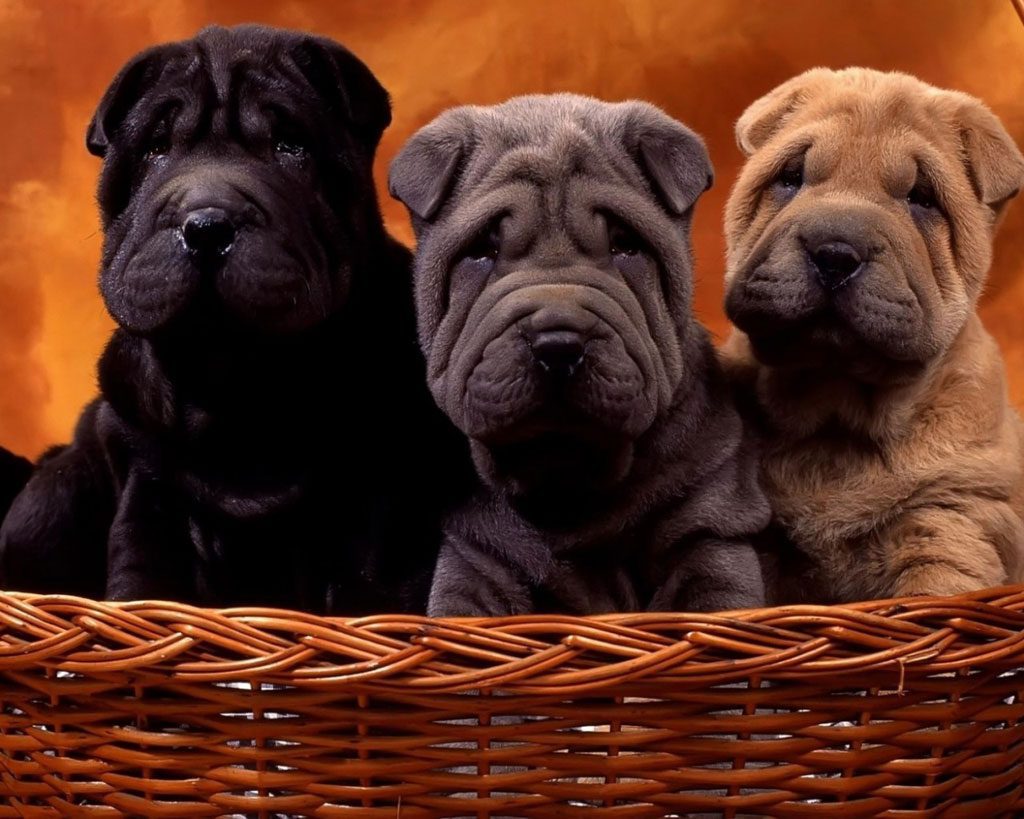
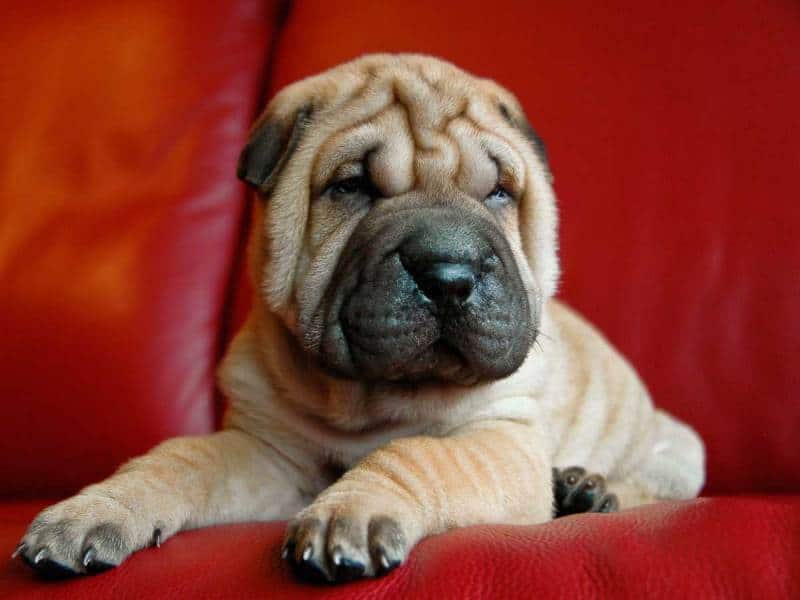
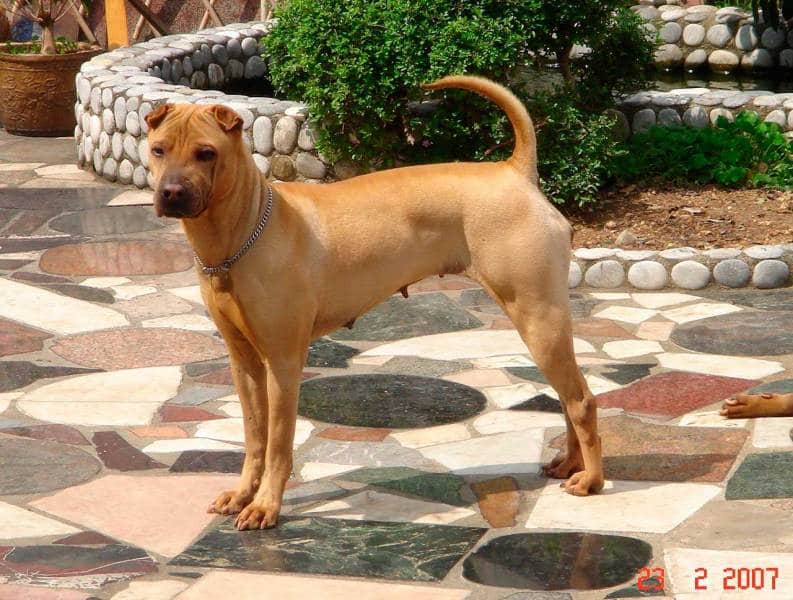
It is a robust dog, solid, compact, shorthair. The head is large in proportion to the body. The skull is wide and flat, and the โ“˜stop, very little pronounced. The forehead and the orbital region are covered with abundant and fine wrinkles that extend downwards forming ; eyes are small, sunken, black or brown color in beige specimens. Ears are very small, equilateral triangle, and high insertion and facing forward, above the eyes. The skin forms folds throughout the body, which is a peculiarity of the breed. The tail is inserted high and its carriage in the shape of a trunk above the back is characteristic., without touching it.

  • Fur: thick, very short and straight, with a very visible hardness.
  • Color: black, brown, leonado, beige and cream.
  • Size: 40 – 51 cm..

The Chinese line presents fewer wrinkles than the American one. Females are smaller in size than males.

Character and skills

The Shar Pei he's a little snobby. He's naturally reserved with people he doesn't know and stays aloof once they're introduced. Extensive socialization at a young age is necessary to prevent it from becoming too territorial or aggressive. Only family members receive the overwhelming devotion of this independent dog., alert and intelligent that watches the world go by in a calm and dignified way.

One Shar Pei it's quiet in the house. It is a remarkable watchdog and rarely barks unless it is playing. If they hear it, you should go and see what has caught your attention. A short, quick walk meets your exercise needs.

It is a strong and confident dog that learns fast, so don't put off training. The Shar Pei is independent and strong-willed. Be firm but never harsh or physical with him.. Teach him from the beginning to accept grooming procedures like trimming nails, clean ears and brush teeth. You never want you Shar Pei learn that you can be physically intimidated into stopping these procedures.

like most dogs, to the Shar Pei He doesn't like to have his feet touched and he doesn't like to have his nails cut. That also applies to other procedures..

The Shar Pei is a watchdog that has hunted and fought with other dogs. to most of the Shar Pei They do not like the company of other dogs., and are easily excited by aggression. A securely fenced yard will prevent you from conflict with other dogs or trying to expand your territory to include the entire block..

Start training your puppy the day you bring him home. Even at eight weeks old, He is able to absorb everything you can teach him. Don't wait until you have 6 months to start train or have to deal with more stubborn dog. If possible, Take it to a trainer when you have between 10 and 12 weeks, and socializes, socialice, socialice. But, Note that many kinds of training puppies require certain vaccinations (such as kennel cough) stay up to date, and many veterinarians recommend limited exposure to other dogs and public places until puppy vaccinations (including rabies, distemper and parvovirus) They are completed. Instead of formal training, You can start training your puppy to socialize at home and among family and friends until immunizations are completed in the puppy.

Talk to the breeder, Describe exactly what you want in a dog and ask for help choosing a puppy. Breeders see puppies daily and can make incredibly accurate recommendations once they know something about their lifestyle and personality. Whatever you want from a Shar Pei, look for one whose parents have nice personalities and who has been well socialized since the puppy's young age.

Health of the ยซShar Peiยป

All dogs have the potential to develop genetic health problems, just as all people have the potential to inherit a particular disease. Run, do not walk, from any breeder that does not offer a health guarantee on puppies, to tell you that the breed is 100 percent healthy and has no known problems, or tell you that your puppies are isolated from the main part of the home for health reasons. A reputable breeder will be honest and open about the breed's health problems and the incidence with which they occur in their lines..

The Shar Pei have many health problems, and their owners can develop a close relationship with their vet. Concerns include hip and elbow dysplasia; patella dislocation; Hypothyroidism; eye problems such as entropy, retinal dysplasia and glaucoma, allergies and infections of the skin folds.

A unique problem is a disease called c fever, a condition in which the dog experiences periodic fevers and its hock joints swell. Accompanying signs may include lethargy, vomiting, diarrhea and shallow breathing.

Not all of these conditions are detectable on a growing puppy, and it is impossible to predict if an animal will be free of these diseases, so you must find a reputable breeder who is committed to raising the healthiest animals possible.. Must be able to produce independent certification that the dog's parents (and grandparents, etc.) have been examined for common defects and considered healthy for breeding. That's where health records come in..

Careful breeders screen their breeding dogs for genetic diseases and breed only the healthiest, best-looking specimens., but sometimes mother nature has other ideas and a puppy develops one of these diseases despite good husbandry practices. Advances in veterinary medicine mean that in most cases dogs can still live a good life. If you are going to have a puppy, ask the breeder about the ages of the dogs in their lines and what they died of.

Remember that after you have welcomed a new puppy into your home, has the power to protect you from one of the most common health problems: the obesity. Keep a Shar Pei with proper weight is one of the easiest ways to extend your life. Make the most of your preventive skills to help ensure a healthier dog for life.

Care of the ยซShar Peiยป

Grooming requirements depend on each Shar Pei. Weekly brushing can meet the needs of both the "short-haired" variety and the "brushed" type. (slightly longer), but some Shar Pei of either type can be prone to skin problems. Dogs with skin problems may need a weekly bath and daily brushing.

All the Shar Pei need regular wrinkle care. Wrinkles should be cleaned with a damp cloth and then dried completely to prevent infection.. Do not oil the skin.

The Shar Pei they have small ears, tight and triangular that predispose them to chronic ear problems because there is not enough air circulating in the narrow ear canal. Although it is not so easy to clean the ears of a Shar Pei as it is for most races, regular cleaning should be done to help prevent recurrent yeast or bacterial infections.

Bathe your dog as you like or only when it gets dirty. With the gentle dog shampoos available now, can bathe a Shar Peiweekly if you wish without damaging your coat.

The rest is basic care. Trim nails as needed, usually every few weeks. Brush your teeth for general good health and fresh breath.

Characteristics "Shar Pei"

Coexistence is important that you have with your new friend. Before considering the acquisition of a dog of the breed "Shar Pei" you know certain factors. Not all breeds of dogs are apt to live in an apartment, you must take into account his character, their need for exercise, their interaction with other pets, their care and if you have small children, their level of tolerance towards them.

Adaptation โ“˜

3,0 of 5 stars (based on 1 review)

friendly dog โ€‹โ€‹โ“˜

2,0 of 5 stars (based on 1 review)

hair loss โ“˜

2,0 of 5 stars (based on 1 review)

Affection level โ“˜

5,0 of 5 stars (based on 1 review)

Need for exercise โ“˜

2,0 of 5 stars (based on 1 review)

Social need โ“˜

3,0 of 5 stars (based on 1 review)

Home โ“˜

4,0 of 5 stars (based on 1 review)

Toilet โ“˜

3,0 of 5 stars (based on 1 review)

Friendly with strangers โ“˜

1,0 of 5 stars (based on 1 review)

barking โ“˜

1,0 of 5 stars (based on 1 review)

Health โ“˜

5,0 of 5 stars (based on 1 review)

Territorial โ“˜

3,0 of 5 stars (based on 1 review)

Cat friendly โ“˜

3,0 of 5 stars (based on 1 review)

Intelligence โ“˜

5,0 of 5 stars (based on 1 review)

Versatility โ“˜

3,0 of 5 stars (based on 1 review)

Child friendly โ“˜

1,0 of 5 stars (based on 1 review)

Surveillance โ“˜

3,0 of 5 stars (based on 1 review)

joy โ“˜

3,0 of 5 stars (based on 1 review)

Images "Shar Pei"

Photos:

1 – This is a typical photo of a bone mouth traditional Shar-Pei. CH Dali Pinky, Hong Kong Kennel Club Champion by No machine-readable author provided. Inuyasya1106 assumed (based on copyright claims). / Public domain
2 – Shar_Pei_female_of_7_months._Chinese_line by Mcarrillo / CC BY-SA
3 – Shar Pei by https://pxhere.com/es/photo/1267570
4 – Shar Pei by https://pxhere.com/es/photo/1169173

Videos "Shar Pei"

Type and recognitions:

  • FCI CLASSIFICATION:
  • Group :
  • Section : . .

Federations:

  • – FCI – Pinscher and Schnauzer-Molossoid type dogs – Swiss Mountain Dogs and Cattledogs. Section 2.1 Molossoid, mastiff type. โ“˜
  • – AKC – Non-Sporting โ“˜
  • – ANKC – Group 7 (Non-Sporting) โ“˜
  • – CKC – Group 6 – Non-Sporting โ“˜
  • – โ€‹KC – Utility dog โ“˜
  • – NZKC – Non-Sporting โ“˜
  • – UKC – Northern Breed โ“˜

FCI breed standard "Shar Pei"

Origin:
China

Date of publication of the valid original standard:
14.04.1999

Use:

Hunting and guard dog.


General appearance:

This is a medium-sized dog, Active, compact, square, short loin. Wrinkles of the skull and cross, Its small ears and hippo-like snout give it a unique appearance.. Males are more robust than females.

IMPORTANT PROPORTIONS: HeightShar Pei, from the cross to the ground, is approximately equal to the length of the body, from the tip of the shoulder to the tip of the buttock, especially in males.

The length of the nose to the naso-frontal depression is approximately equal to that of the naso-frontal depression to the occiput.


Behavior / temperament:

This is a calm animal, independent, loyal and affectionate with his family.

Head:

It's rather big, in proportion with the body. Wrinkles that form on the forehead and cheeks extend downward to form the double chin.

Cranial region:
  • Skull: Flat and spacious.
  • Depression links (Stop): Moderate.

facial region:

  • Truffle: It is great, wide, preferably black, but any other color that harmonizes with the coat color is allowed. The nostrils are wide open.
  • Snout: It is characteristic of the breed. Width, from the root to the tip of the nose, no sign of decline. The lips and the upper part of the muzzle are very full. The presence of a bulge in the nose is allowed.
  • Mouth: Language, the palate, the gums and lips are preferably bluish black. Pink spotted tongue allowed. Solid pink tongue is considered highly inappropriate. In dogs with diluted colored fur, the tongue is solid lavender.
  • Jaws / Teeth: The jaws are strong, with a perfect scissor joint (The upper incisors overlap the lower incisors in close contact and are at right angles to the jaws.). The fleshiness of the lower lip should not be so excessive as to interfere with the function of the jaws..

EYES: Are dark, almond shaped and frowning look. Lighter color is allowed in dogs with diluted coat. Nor the skin around the eyes, nor the folds, nor the hair, must impede normal function of the eyeball or eyelid. Any indication of irritation of the eyeball, the conjunctiva or the eyelids is considered highly undesirable. There must be no presence of entropion.

EARS: Very small, rather thick, equilateral triangular shape. The tips are slightly rounded. High implementation, with the tips pointed towards the eyes. Present well forward over the eyes; they are well separated and well attached to the skull. Erect ears are highly undesirable.

Neck:

Medium length, strong, well implanted in the shoulders. Loose skin under the neck should not be excessive.

Body:

The presence of body skin folds in adult dogs is considered highly undesirable, except at the cross and at the tail, where the folds must be moderate.

  • top line: Descend slightly behind the cross, then he stands up a little on his back.
  • Back: Short and strong.
  • Pork loin: Short, width, slightly arched.
  • Rump: Rather flat.
  • Breast : Broad and deep; the sternum region reaches the elbow. bottom line: Rises slightly below the back.

Tail:

Thick and round at the base; gradually thin to a fine point. Well established, a distinctive feature of the breed. Can be tall and hunched, carried in a closed curl, hunched over or falling to one side or the other of the back. The absence of tail or the cut tail are highly undesirable.

Tips

PREVIOUS MEMBERS: Straight, of moderate length, for strong bones. There is no presence of wrinkles in the forelimbs.

  • Shoulder: Muscular, well established and inclined.
  • Metacarpus: Slightly sloping, strong, รโ€œรหœรโ€˜รลกรหœรโ€ข.
  • Previous feet: Moderate in size, compact; they are not crushed.
    Fingers have strong joints. There is no presence of spurs on the hind feet.

LATER MEMBERS: They are muscular, strong, moderately angulated. Seen from the back, They are perpendicular to the ground and parallel to each other.. The presence of wrinkles on the thighs, the legs, the metatarsals, as well as thick skin on the hocks are undesirable.

  • Hocks: Very low.
  • Hind feet: Moderate in size, compact; they are not crushed. Fingers have strong joints. There is no presence of spurs on the hind feet.

Movement:

Jogging is the favorite movement. It's free, agile, balanced, with good range in the forelimbs and strong momentum of the hindlimbs. When the dog increases speed, feet tend to converge on a center line. Walking on stilts is undesirable.

Mantle

  • Fur: It is a distinctive characteristic of the breed: shorthair, tough and piggy. On the trunk, the coat is straight and separated, but in the extremities it is more stuck. There is no presence of an internal layer of hairs. Hair length can vary between 1 to 2,5 cm.. It should never be trimmed.
  • Color: All solid colors, except for the White, are accepted. The tail and back of the thighs are often lighter in color. Darker shading is allowed along the back and on the ears.


Size and weight:

  • Height to the cross: 44 to 51 cm. (17,5 to 20 inches).


Fouls:

Any deviation from the aforementioned criteria is considered as a fault and the severity of this is considered to the degree of the deviation to the standard and its consequences on the health and well-being of the dog..

SERIOUS FAULTS:

  • Joint not presented in the form of scissors (as a transitional measure, very light upper prognathism is allowed).
  • Pointed snout.
  • Spots on the tongue (except pink spots).
  • big ears.
  • Low set tail.
  • Coat over 2,5 cm..

FALTAS DESCALIFICANTES:

  • Aggressiveness or extreme shyness.
  • Any dog โ€‹โ€‹showing clear signs of physical or behavioral abnormalities.
  • Flat head front, with pronounced higher prognathism; lower prognathism.
  • Solid pink tongue.
  • Inner bent lower lip, preventing the bite.
  • Round and bulging eyes; entropion or ectropion.
  • Skin, folds or hair that impede normal eye function.
  • erect ears.
  • Absence of tail or tail short of birth.
  • Presence of thick folds of skin on the trunk and extremities (except at the cross and the tail).
  • Non-solid color (albino, striped, with patches, with stains, black and fire color, chair-shaped coloring).

WARNING: Any artificial physical alteration made to theShar Pei (especially on the lips and eyelids) eliminate the dog from competition.


N.B.:
  • Males should have two normal-appearing testicles fully descended into the scrotum..
  • Only functionally and clinically healthy dogs, with the typical conformation of the breed, should be used for parenting.

    TRANSLATION: IRIS Carrillo (Federation of Puerto Rico). Official language: IN.
    Revision: SR. Jorge Nallem.

Source: F.C.I - International Cynological Federation

Alternative names:

1. Cantonese Shar-Pei (English).
2. Shar-peรฏ, sharpeรฏ (French).
3. Shar-Pei (German).
4. Shar-pei (Portuguese).
5. Sharpei (espaรฑol).

โ–ท The world of Pets: Dogs, cats, birds, reptiles, amphibians

St. Bernard
Suiza FCI 61 - Molossoid . Mountain

San Bernardo

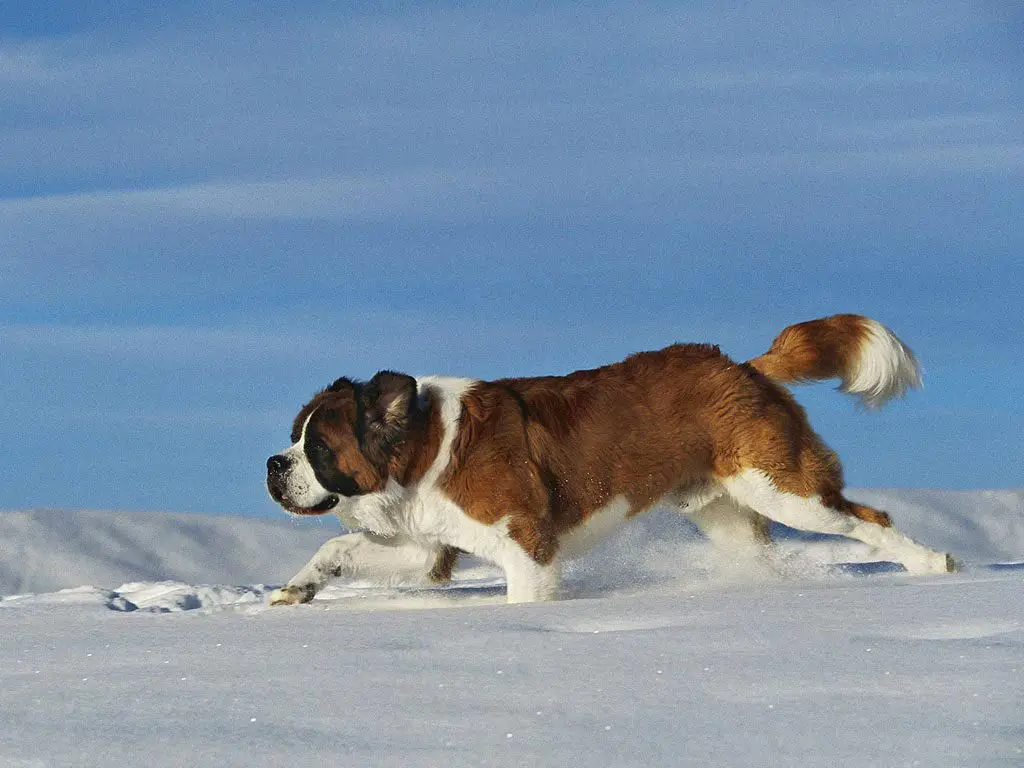
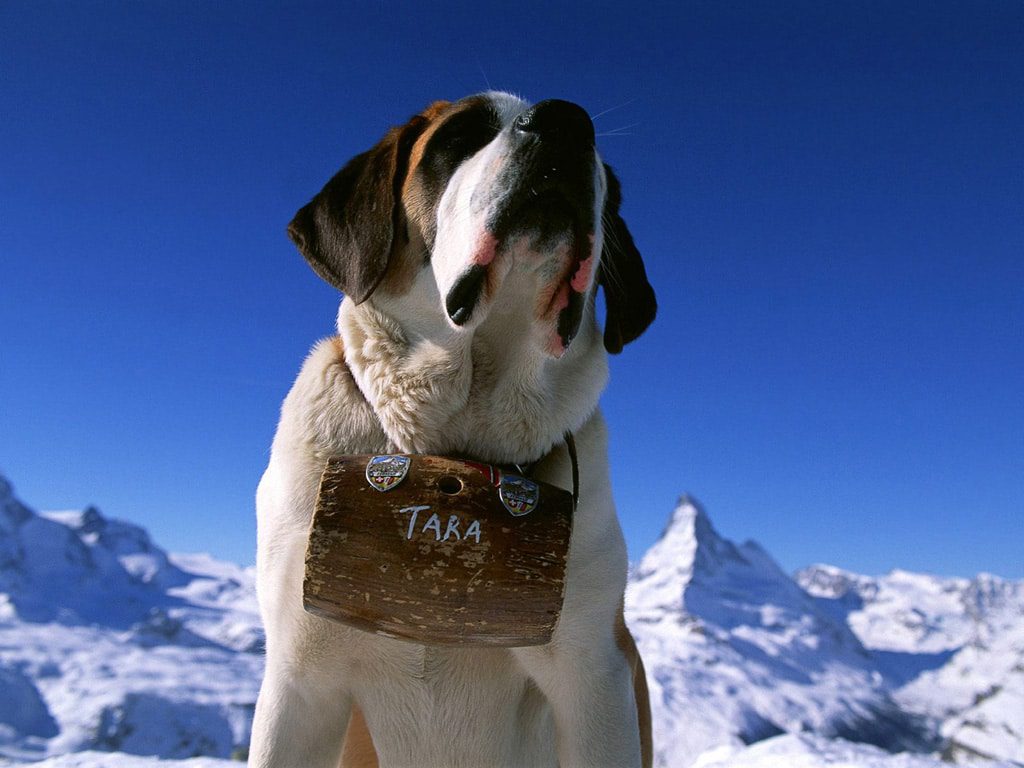
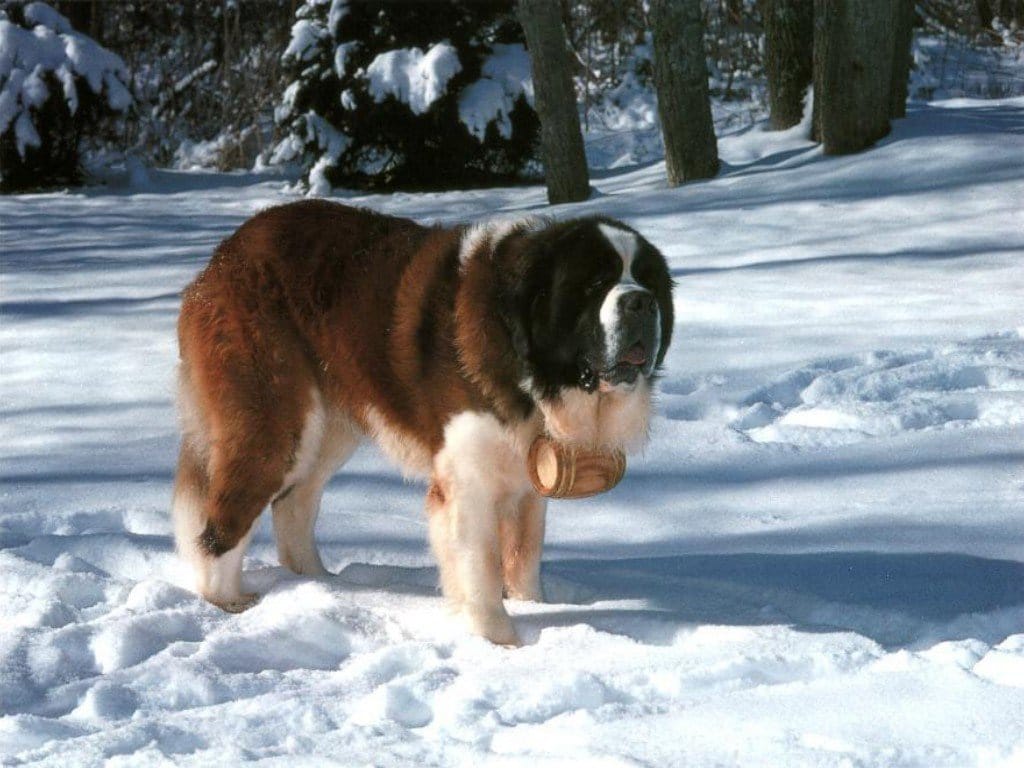
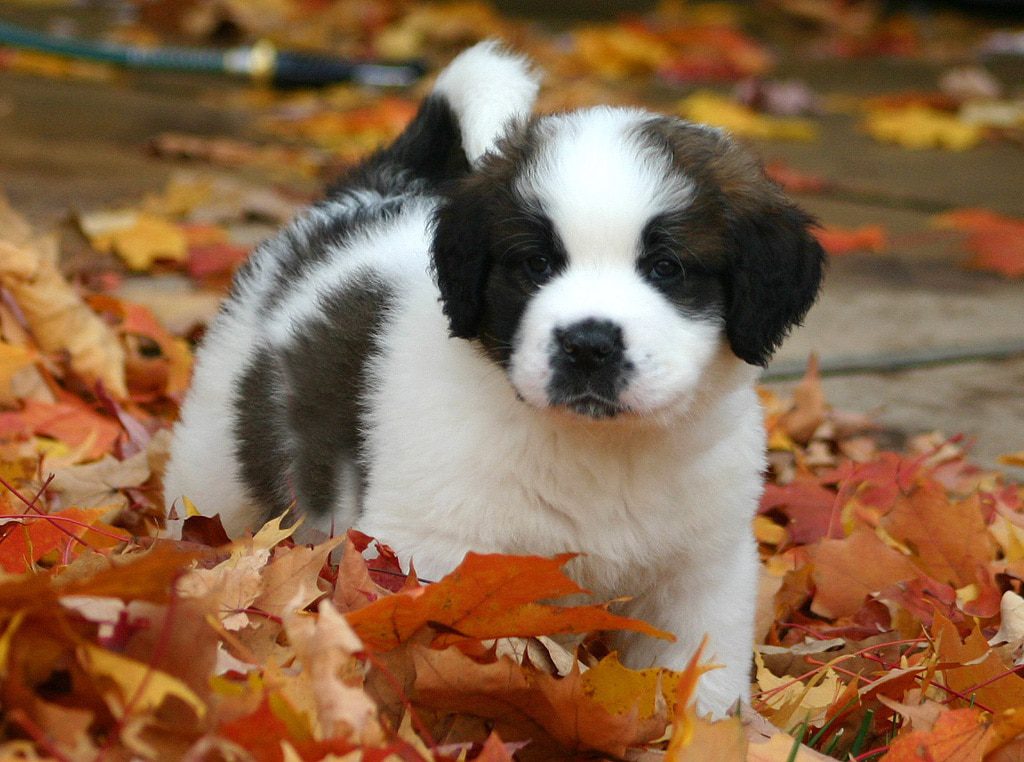
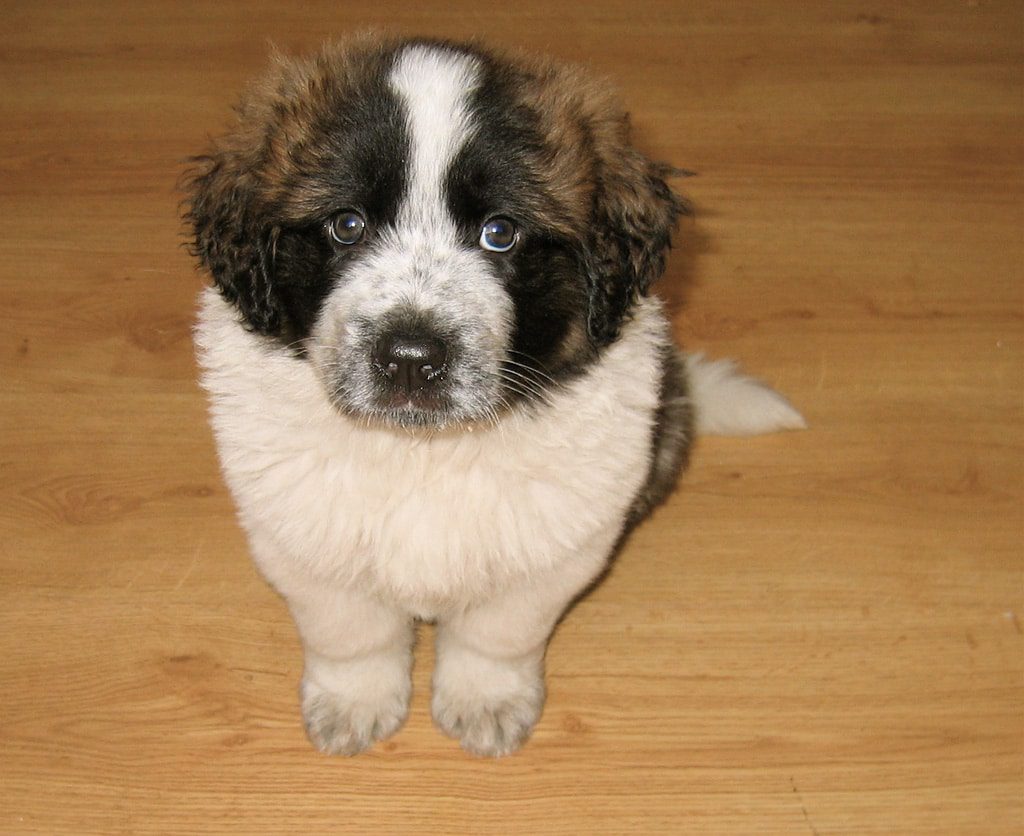
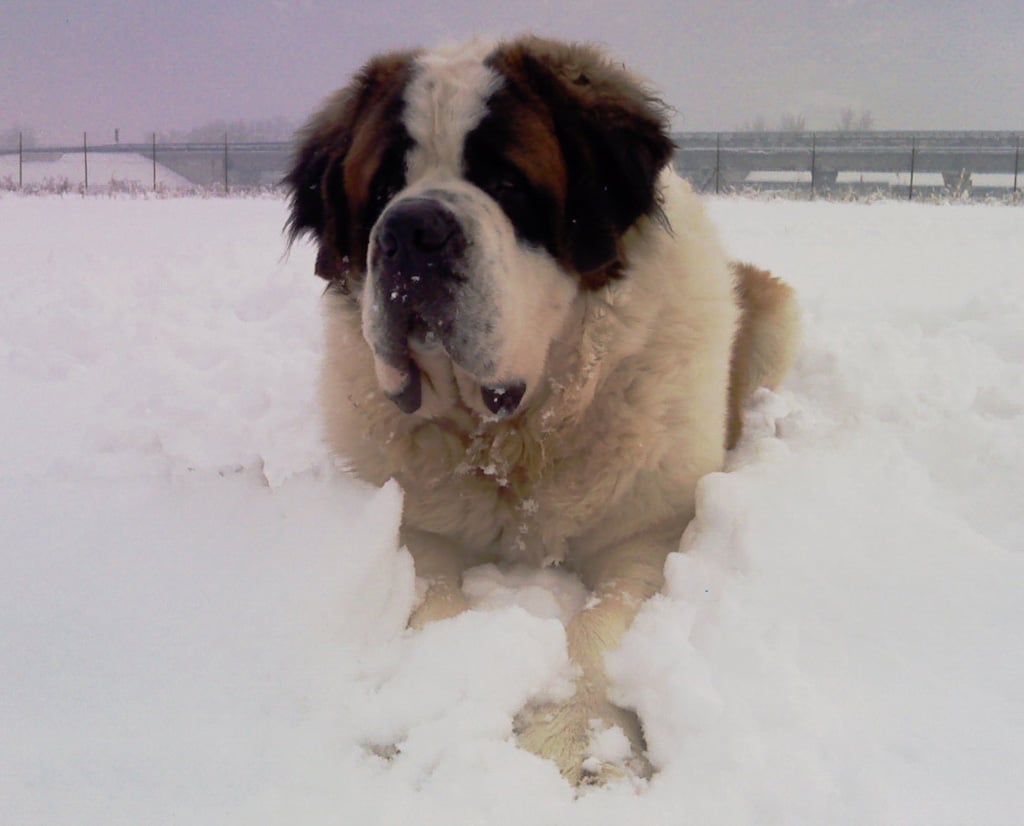
The St. Bernard It is very affectionate and has an innate sense of relief especially in the snow.

Content

History

The St. Bernard It is a breed of dog whose name in other languages: St. Very, Bernhardiner, Chien du Saint-Bernard, Saint Bernard Dog.

According to breed historians, the St. Bernard, descended from the ancient molossians Asian, whose ancestral form was and is represented by the Tibetan Mastiff.

A team of researchers from the University of Manchester, directed by Chris Klingenberg of the Faculty of biological sciences, reviewed 47 skulls of St. Bernard donated by Swiss breeders to the Natural History Museum in Bern covering a period of 120 years, from modern copies until those old dogs of the time that was initially defined the standard of the breed. It was found that the traits stipulated in the breed standard of the St. Bernard have become more exaggerated over time, as breeders selected dogs that had the desired physical attributes.

Compared to their ancestors, the St. Bernard modern has the widest skull, the angle between the nose and the forehead more pronounced, and also a more significant bump over the eyes. These changes are described exactly as desired in the breed standards. Clearly, not due to other factors such as overall growth, since they do not provide the animal with any physical advantage, so we can be sure of have evolved only by selective breeders considerations.

This research shows how the selection, either natural or in this case artificially influenced by the man, It is the fundamental driving force behind the evolution of life on the planet.

In the year 923 born Bernard of Menthon in Menton, region of Savoy (France), which he became Archdeacon of Aosta, in the Italian Alps, dedicated to spreading the Christian faith among the inhabitants of the Alps. In one of these Alpine passes was founded in the year 1049 the Hospice of the Gran San Bernardo, to help, help and shelter to hikers who were the step. The Holy, Catholic scholar and theologian, He was part of the Cistercian order or better known as Trappist, as fellow (the Trappist monks) in Switzerland they had a dog of this breed as a companion around the 16th century.

In the great Mount St mountain pass. Bernhard, to 2.469 meters above the sea level, monks founded in the 11th century, a hospice for travellers and pilgrims. there they were raised, Since the mid-17TH century, big mountain dogs for guard and surveillance. The existence of those dogs is documented graphically from 1695 written in a chronicle of the Hospice from the year 1707.

These dogs were soon used as guard dogs and, especially, as rescue dogs for travellers lost in the fog and snow.

There are chronicles published in many languages โ€‹โ€‹about the numerous lives that were saved by these dogs from the "white death" and stories of soldiers who crossed the mountain pass with Napoleon Bonaparte towards 1800, in the 19th century, they spread the dog's fame for St. Bernard all over Europe.

Already called at that time ยซBarry Hundยซ, And the legendary ยซBarryยปIt became the symbol of the rescue dog. The direct ancestors of the dog of St. Bernard were the very widespread oversized dogs, peasants of the region. These large dogs became only a few generations, an ideal pattern, in the current race.

As a result of an international cynological congress held on 2 in June of 1887, the dog of St. Bernard was officially recognized as a Swiss breed and the breed standard became mandatory. Since then the San Bernardo dog became the "Swiss national dog".

Heinrich Schumacher Holligen, was the first, in 1867 creating genealogical documents for their dogs. In February of 1884 The ยซSchweizerische Hundestammbuchโ€ (Swiss races book, SHSB). The first entry was that of St. Bernard ยซLeรณnยป, followed by other 28 annotations also of dogs of St. Bernard. The 15 in March of 1884 The ยซSchweizerische St. Bernhardsclubยป (Swiss Dog Club St. Bernard) in Basel.

Physical characteristics

The Saint Bernard, is classified in the Group 2: Dog type Pinscher and Schnauzer, Molosoides and mountain dogs and Swiss Cattle Dogs, and other races; section 2; Molossoid, 2.2 Type mountain (without working trial). Of the FCI (Federation Cynologique Internationale).

There are two varieties of the dog St. Bernard:

  • The variety of short hair (double hair, Stockhaar).
  • The long-haired variety.

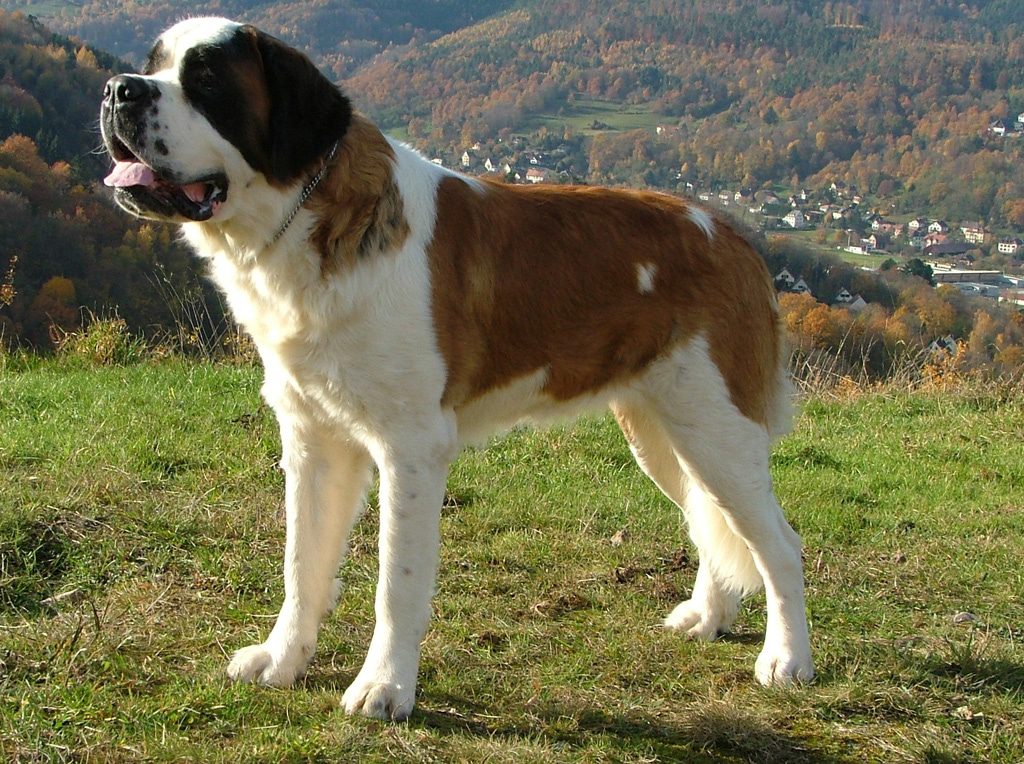
Two varieties are of great stature and of a noble general appearance; they have a vigorous body, robust, harmonic and muscular, as well as an imposing head with an expression of attention on the face.

The cross appeal is, minimum of 70 cm for males and 65 cm for females. The FCI standard sets a maximum of 90 cm for males and 80 cm for females (dogs exceeding the maximum height is not devaluarรกn if its general aspect is harmonic and its proper motion).

In general the size is defined as:

  • ยซVery largeยซ, to be optimal in San Bernardo, When exceeds the 86 cm in males and the 80 cm in females.
  • ยซGrandยปWhen it goes from 82 to 86 cm in males and 75 to 80 cm in females.
  • ยซMediaยปWhen it goes from 78 to 82 cm in males and 70 to 75 cm in females.
  • ยซSmallยปWhen it goes from 70 to 78 cm in males and 65 to 70 cm in females.

In it "golden period of St. Bernardโ€ (1920-1940) were very rarely seen in exposures lower males to 80 Switzerland cm, of Germany, in the Netherlands and the subjects were not so rare above the 90 cm..

Also currently a good San Bernardo to access the championship would never have to be -with some exceptions- below the 80-82 cm and abundantly exceed such limit to reach above if possible the maximum of the German Mastiff and of the Irish Wolfhound but with greater volume, greater length of the trunk and heavier, course.

Character and skills

The dog's St. Bernard radiates calm and tranquility. He is balanced and self-confident.. Despite its imposing size, it is sensitive and has a gentle nature. His "stubbornness" is typical of this race, not only in appearance. The St. Bernard is trustworthy and kind, even with strangers. There is hardly a dog that has such a tolerant and balanced nature. Quietly he lets himself be caressed and understood by children he does not know. There is hardly a dog as fond of children as the St. Bernard. Nothing seems to bother him.

But, has an alert protective instinct. Defends his family and territory inflexible and extremely effective. One St. Bernard healthy and well socialized never loses control. It is not a barking dog and will stop any intruder quietly and abruptly. How do you like to live outside, still suitable as a guard and protection dog – but it is not in any way a dog to be in a kennel. The basis of this is the close connection with your human family, who should be the center of attention. Because he is affectionate and needs a lot of contact with humans as well as with other dogs.. After all, the close connection with his master is the decisive basis of his education.

Due to its size and strength, a St. Bernard a dog is not for beginners. It also, its maintenance is – as with all big dogs – very complex. If you want to buy a dog from St. Bernard, You must first be clear about some basic things:

The extreme dimensions bring with them quite practical problems. This starts with the car. And what if the adult giant is sick or cannot walk for a while due to age?? The St. Bernard not a dog for an apartment. The floor of the house should not be slippery. The dog should not have to climb the stairs frequently. To the St. Bernard he likes to travel; not an athlete, and take it easy. In the interest of your fitness, one should ensure that he exercises outdoors every day. Ideally, a St. Bernard stay in the field.

St. Bernard Education

To have fun with your dog St. Bernard, consistent education from the puppy's age is a basic requirement. 60 and more kilos of stubbornness, reluctantly following instructions, it's not a fun thing. Also keep in mind that the St. Bernard It, in case of doubt, much stronger than any well-trained man.

A deep and intimate bond with your caregiver is the basis of education, never difficulties or coercion. As puppies it must be carried with a stoic consistency. In his youth, the St. Bernard they are usually very lively and challenge the leadership of their humans. But, the dog of St. Bernard can be well educated. His calm and kind nature even forgives this or that mistake. But a solid education foundation with clear rules for daily life is an absolute prerequisite for your future attitude..

St. Bernard health and care

Coat care is simple. Regular brushing is enough. During the change of coat, twice a year, everything is a little more complex.

The main health problem of St. Bernard is the extreme breeding, breeding for gigantism. Puppies and young dogs of such breeding already grow too fast. So, it's about body coordination problems. Epilepsy and other diseases accompany the giant that is becoming. Life expectancy decreases dramatically. The enormous growth and associated rapid weight gain is an extreme challenge for the entire body.. The dog's fingerprint is not designed for such giants. the heads, however "typical" they seem, they have also been raised to be unhealthy and powerful, which can cause problems at birth.

One should pay attention to the eyes: Droopy eye or droopy eyelid is a widespread problem, especially with particularly powerful heads, that requires lifelong care and can seriously damage the eyes. Professor Distl of the Hannover University of Veterinary Medicine considers the St. Bernard as one of the breeds in which epilepsy is more common. Various types of cancer such as osteosarcoma also appear to be common in St. Bernard. The breed is strongly affected by dysplasia of the hip joint, as well as other skeletal diseases.

Nutrition / Food

Puppies and young dogs, they grow very fast, require expert guidance for proper nutrition. At the same time, attention should be paid to controlled exercise, neither too much nor too little. In the adult Saint Bernard there is a risk of stomach torsion. Otherwise, as with any big dog, the same applies to food: good and hearty.

The life expectancy of a St. Bernard

The legendary Barry I had 14 years, 10 of which he spent them on active rescue service in the Gran San Bernardo. Today is different, made by the man. Today, the St. Bernard is one of the dogs with the lowest life expectancy. The colossi of today reach only 6 to 8 years. Only very rarely does he reach an age of 10 years or more. On the other hand, a St. Bernard raised healthy with a weight lower than 70 kg is a robust dog and, despite its size, very frugal, without problems can live 10 years.

Buy a St. Bernard dog

Before buying a St. Bernard, you should check very carefully if you really have all the requirements to be able to spend many wonderful years with this giant. Only when all this clears up, a breeder must be found and contacted long before purchase. Special importance must be given to the fact that the breeder avoids exaggeration. Dogs in your kennel should not be large or too heavy. Also the heads should not be too powerful. It also, make sure that no epilepsy occurred in the ancestors. In any case, it should be clear that a puppy is only bought directly from a serious breeder. Better pay a few hundred euros more for a puppy from a serious breeder. These euros have a good opportunity to become the best investment of your life. Coming from a serious upbringing, a puppy of St. Bernard costs between 1.500 and 2.000 EUR.

Characteristics "St. Bernard"

Coexistence is important that you have with your new friend. Before considering the acquisition of a dog of the breed "St. Bernard" you know certain factors. Not all breeds of dogs are apt to live in an apartment, you must take into account his character, their need for exercise, their interaction with other pets, their care and if you have small children, their level of tolerance towards them.

Adaptation โ“˜

4,0 of 5 stars (based on 1 review)

friendly dog โ€‹โ€‹โ“˜

5,0 of 5 stars (based on 1 review)

hair loss โ“˜

3,0 of 5 stars (based on 1 review)

Affection level โ“˜

5,0 of 5 stars (based on 1 review)

Need for exercise โ“˜

2,0 of 5 stars (based on 1 review)

Social need โ“˜

4,0 of 5 stars (based on 1 review)

Home โ“˜

3,0 of 5 stars (based on 1 review)

Toilet โ“˜

4,0 of 5 stars (based on 1 review)

Friendly with strangers โ“˜

3,0 of 5 stars (based on 1 review)

barking โ“˜

3,0 of 5 stars (based on 1 review)

Health โ“˜

5,0 of 5 stars (based on 1 review)

Territorial โ“˜

5,0 of 5 stars (based on 1 review)

Cat friendly โ“˜

5,0 of 5 stars (based on 1 review)

Intelligence โ“˜

3,0 of 5 stars (based on 1 review)

Versatility โ“˜

3,0 of 5 stars (based on 1 review)

Child friendly โ“˜

5,0 of 5 stars (based on 1 review)

Surveillance โ“˜

2,0 of 5 stars (based on 1 review)

joy โ“˜

5,0 of 5 stars (based on 1 review)

St. Bernard Images

St. Bernard Videos

Type and recognitions:

  • FCI CLASSIFICATION:
  • Group :
  • Section : . .

Federations:

  • – FCI – Pinscher and Schnauzer-Molossoid type dogs – Swiss Mountain Dogs and Cattledogs. Section 2.2 Molossoid, mountain type. โ“˜
  • – AKC – Workgroup โ“˜
  • – ANKC – Group 6 (utility dogs) โ“˜
  • – CKC – Workgroup โ“˜
  • – โ€‹KC – Workgroup โ“˜
  • – NZKC – Utility dog โ“˜
  • – UKC – Watchdog โ“˜

FCI breed standard "St. Bernard"

Origin:
Switzerland

Date of publication of the valid original standard:
04.04.2016.

Use:

Company, Guard and Farm Dog.


General appearance:

There are two varieties of San Bernardo:

  • Variety of short hair (double mantle, "Stockhaar")
  • Long hair variety.

The two varieties are considerable size and an impressive general appearance. They have a balanced body, powerful, Strong and muscular with an impressive head and a facial expression alert.

IMPORTANT PROPORTIONS

  • The desired proportion between the height of the cross and the length of the body (measured from the tip of the shoulder to the tip of the buttock) is of 9 : 10.
  • The desired proportion between the height to the cross and the depth of the chest is reflected in the sketch of the beginning.
  • The total length of the head is slightly larger than a third of the height of the cross.
  • The proportion between the depth of the snout (measured at its root) And its length is approximately 2 : 1.
  • The length of the snout is slightly larger than the third part of the length of the head.


Behavior / temperament:

Friendly by nature. Quiet temperament to cheerful; vigilant.

Head:

Powerful, imposing and very expressive.

Cranial region:
  • Skull: Strong and wide. Seen from the front and profile the top part of the skull is slightly domed. When is the dog at attention, The insertion of the ears forms a straight line with the upper part of the skull which laterally has a soft curvature towards high and strongly developed cheeks. The inclination from forehead to well steep snout. The occipital Protuberance should shortly be accented. The orbitals above arches strongly developed. Clearly marked front Groove starts on the forehead and extends to the top of the head. Skin from the forehead over the eyes forms slight folds that converge toward the central sulcus. When is the dog at attention, they are usually almost imperceptible.
  • Depression links (Stop): Strongly pronounced.

facial region:

  • Truffle: Wide and square with well marked angles, well open nostrils. The truffles must be black.
  • Snout: Uniformly wide. Nasal helm straight with a slight furrow in the Center.
  • Belfos: Pigmented edges of black. The Belfos of the upper jaw must be highly developed, shoulder straps, but not too pendants; they form a wide arc towards the nose. The corners must be visible.
  • Jaws/Teeth: Upper and lower jaws strong, wide and the same length.
  • Bitescissors or well developed clamp, regular and complete. It allows light lower prognathism, provided that the incisors do not lose contact. The absence of the PM1 is tolerated (premolars 1) and the M3.
  • Eyes: Medium-sized, they can be dark brown to hazelnut; moderately sunken. friendly expression. The edges of the eyelids are completely Pigmented.
  • A full closure is desirable, natural. Is allowed a small fold on the bottom with little visible conjunctival eyelid and a small crease on the upper eyelid.
  • Ears: Medium-sized, high and wide insertion. Highly developed Pavilion. Lobes soft triangle with rounded tip. The back edge is slightly separated from the head, While the above should be set to the cheeks.

Neck:

Strong and good long. The double chin neck and throat, moderately developed.

Body:

  • As a whole: The general impression should be, harmonica, well muscled and imposing.
  • Cross: Well developed.
  • Back: Wide, powerful and strong. The upper line is straight and level to the lumbar region.
  • Rump: Long, slightly descending with a harmonious transition to the insertion of the tail.
  • Breast : Moderately deep chest with well sprung ribs, but not abarriladas. You must not get below the elbows.
  • Abdomen and lower line: Slight upward backward.

Tail:

Of wide and strong base, It should be long and heavy.
  • The last vertebra must reach at least the corvejรณn joint. At rest you must hang straight or slightly curved up in the last third. In State care may be higher.


Tips

Former members:

  • As a whole: Seen from the front, rather wide position. Members must be straight and parallel.
  • Shoulder: Inclined scapula, muscular and firmly attached to the body.
  • Arm: As long as the scapula. The angle between the scapula and the arm must not be too open.
  • Elbow: Attached to the body.
  • Forearm: Straight, strong bone and muscles dry.
  • Metacarpus: Seen from the front must be vertical in its extension to the forearm. Viewed laterally must be slightly oblique.
  • Front feet: Widths, with strong fingers, together robust and highly arched.

Later members:

  • As a whole: Moderately angled rear limbs and muscled. Seen from the rear must be parallel and not together.
  • Thigh: Robust, muscular and wide.
  • Knee: Well angled and not turn inward or outward.
  • Leg: Fairly long and oblique.
  • Hocks: Moderately angled and strong.
  • Metatarsals: Seen from the back as straight and parallel.
  • Hind feet: Widths, with strong fingers, together robust and highly arched. The Spurs are tolerated if not they interfere with normal movement.

Movement:

Harmonic, long steps. Good push from the hind limbs. The back remains firm and stable. The previous and subsequent members must advance in a straight line when walking.

Mantle

  • Short hair (double hair): Dense outer layer, smooth and stuck to the body. Internal NAP thick. Thighs with fringes of not very notable hairs. Tail with thick hair.
  • Long hair: Outer layer of hairs of medium length, smooth. Abundant internal NAP. On the hip and rump, the hair can be somewhat wavy. Thighs with fringes of abundant hair and forelimbs with flags. Face and ears with short hair. Tail with abundant bushy hair.

COLOR: The basic color is white with reddish brown spots smaller or larger (spotted dogs), to form a continuous blanket of uninterrupted reddish brown on the back and flanks (dogs with mantle). This mantle interrupted by white veins have the same value. The reddish brown tabby is allowed. The yellowish-brown is tolerated. The dark brown on the head is much appreciated. Will tolerate some light traces of black color on the body.

  • Major brands: Sill, feet, the tail, nose cane, headband and nape.
  • Desirable markings: White collar.
  • dark mask symmetrical.


Size and weight:

Minimum height:

  • Males: 70 cm..
  • females: 65 cm..

Maximum height:

  • Males: 90 cm..
  • females: 80 cm..
  • Dogs exceeding the maximum height is not devaluarรกn in its judging if their general appearance is harmonious and correct movement.


Fouls:

Any deviation from the above mentioned criteria is considered as missing and the gravity of this is considered in proportion to the degree of deviation to the standard and its consequences on the health and well-being of the dog.

  • Characteristics of sex not sufficiently developed.
  • Non-harmonic overall appearance.
  • Very short relative to the height of the cross member.
  • Excess of folds in head and neck.
  • Muzzle too long or too short.
  • Belfos of lower jaw hanging and turned out.
  • Lack of teeth (except the PM1 and the M3) ; small teeth (especially the incisors).
  • Slight lower prognathism.
  • light eyes.
  • Eyelids too loose.
  • Back saddle or in tent.
  • Rump too high or too falling.
  • Tail coiled on top of the back.
  • Absence of white markings deemed important.
  • Curved or very returned former members out.
  • Later in the form of Coop members, de โ€œXโ€, or too straight.
  • Faulty movement.
  • Curly hair.
  • Incomplete or lack of it in the truffle pigmentation, belfos, eyelids and around the nose.
  • Wrong basic color, small splashes or spots of wetwood color on white.

MISS PLAYOFFS

  • Fearful dogs, aggressiveness.
  • Upper prognathism, marked lower prognathism.
  • Blue eyes.
  • Entropion, ectropion.
  • Completely white or completely brown reddish coat (absence of the basic color).
  • Coat of a different color.
  • Dogs that do not reach the minimum height.
  • Any dog โ€‹โ€‹showing clear signs of physical or behavioral abnormalities must be disqualified..


N.B.:

Males should have two normal-appearing testicles., fully descended into the scrotum.

  • This revised standard shall be applicable from April 2004.

TRANSLATION: Brรญgida Nestler.

Source: F.C.I - International Cynological Federation

Alternative names:

1. St. Bernhardog, Bernhardinner, Alpine Mastiff (archaic), Saint, Saint Bernard (English).
2. Grand-Saint-Bernard (French).
3. St. Bernhardshund, Chien du Saint-Bernard, Saint Bernard Dog, Perro San Bernardo (German).
4. Cรฃo de Sรฃo Bernardo (Portuguese).
5. Gran San Bernardo (espaรฑol).

โ–ท The world of Pets: Dogs, cats, birds, reptiles, amphibians

Standard Schnauzer
Alemania FCI 182 . Pinscher and Schnauzer type
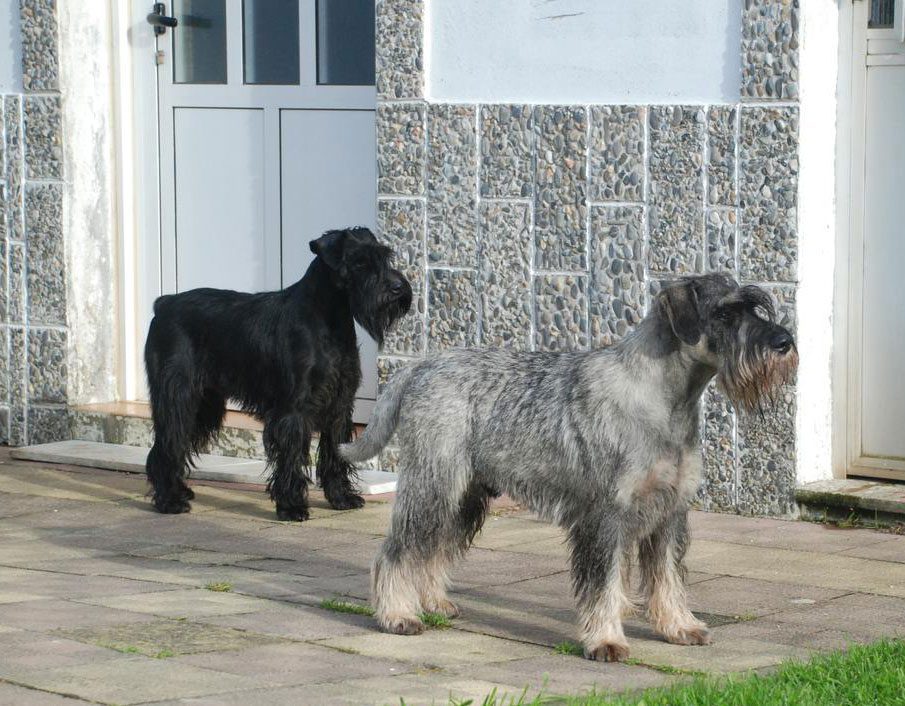
Schnauzer Mediano

Starting at the Standard Schnauzer the other two varieties were developed (Giant and Enano)

Content

History

The Standard Schnauzer (standard) It is the original race of the three Schnauzer breeds, and despite his fur and aspect in general, This is not related to the English Terrier. This is one of the oldest breeds in Europe. This race is beautiful, robust, square build and medium-sized with a similar aristocratic, This was the favorite breed of Albrecht Dรผrer and Rembrandt.

In his country of origin he is known as Mittelschnauzer (Standard Schnauzer) to distinguish it from the giant form and the form miniature.

Regardless of the origin of the breed, It should be noted that the racial standard of the Schnauzer was set for the first time in the year 1880, and in the year 1885 the first breed club was established in Germany. He had to wait 40 more years, to be made in United States (1925).

The name of Schnauzer is given to the breed for its first appearance in public in a show contest.. This contest (Hannover 1879) won it a dog presented as wire-haired Pinscher. The winner can be called Schnauzer (ยซbigotudoยป) and thereafter, all the wire-haired Pinscher have received the name of Schnauzer.

The classification of the Schnauzer has always brought controversy, because that is what you don't want to classify as Terrier, likely as not being a race that cace as dog's burrow. The controversy is that dogs as the Manchester Terrier they are classified as Terrier and are, as it is the case of the above-mentioned, the prototype of the dog buzzard without being trained for hunting dog's burrow.

Physical characteristics

The Standard Schnauzer has a rough coat, with colors ranging from 'salt and pepper' to solid black.

The hair on the face is extended to form a beard and eyebrows. The race is robust, and must be "heavy" for its height with lots of muscle and bone.

The ideal ranges of the weight and of the height vary, considerably, from a standard race which is as follows: The males range between 45 and 50 cm of high cross and usually weigh between 15.5 and 22.5 kg. The females measure between 42.5 and 47.5 High Cross and usually weigh between 13.5 and 20.2 kg).

In United States, most dogs have cropped ears and tails.

Traditionally, the ears they are cut and the tail as well. But, in many European countries and in Australia, ear and tail docking is prohibited and dogs show off their natural ears and tails.

Character and skills

It's a race that, similar to the German Pinscher, It was created for the extermination of vermin on farms, Although he didn't mention in other tasks, becoming a multi-purpose dog. They included the roles played by the Schnauzer, driving cattle.

Itร‚ยดs jealous, It loving and a good former. All varieties of Schnauzer have a character that is described as impetuous, strong but very balanced.

Love your family, they are safe and affable with children and rather distrustful with strangers.

Schnauzer Health

All dogs have the potential to develop genetic health problems, just as all people have the potential to inherit a particular disease. Run, do not walk, from any breeder that does not offer a health guarantee on puppies, to tell you that the breed is 100 percent healthy and has no known problems, or tell you that your puppies are isolated from the main part of the home for health reasons. A reputable breeder will be honest and open about the breed's health problems and the incidence with which they occur in their lines..

Some of the conditions that affect standard Schnauzers include hip dysplasia; eye problems (including cataracts and retinal dysplasia); a heart condition known as pulmonary stenosis; hipotiriodismo; Hemophilia (a bleeding disorder); and bladder stones.

Not all of these conditions are detectable on a growing puppy, and it can be difficult to predict whether an animal will be free of these diseases, so a reputable breeder must be found who is committed to raising the healthiest animals possible. Must be able to produce an independent certification that the parents of the dog (and grandparents, etc.) have been screened for these defects and considered healthy for breeding. That's where health records come in..

Remember that after bringing a new puppy home, has the power to protect you from one of the most common health problems: the obesity. Maintaining a standard Schnauzer at the right weight is one of the easiest ways to extend your life.. Make the most of your preventive skills to help ensure a healthier dog for life.

Characteristics "Standard Schnauzer"

Coexistence is important that you have with your new friend. Before considering the acquisition of a dog of the breed "Standard Schnauzer" you know certain factors. Not all breeds of dogs are apt to live in an apartment, you must take into account his character, their need for exercise, their interaction with other pets, their care and if you have small children, their level of tolerance towards them.

Adaptation โ“˜

3,0 of 5 stars (based on 1 review)

friendly dog โ€‹โ€‹โ“˜

4,0 of 5 stars (based on 1 review)

hair loss โ“˜

2,0 of 5 stars (based on 1 review)

Affection level โ“˜

4,0 of 5 stars (based on 1 review)

Need for exercise โ“˜

4,0 of 5 stars (based on 1 review)

Social need โ“˜

4,0 of 5 stars (based on 1 review)

Home โ“˜

3,0 of 5 stars (based on 1 review)

Toilet โ“˜

4,0 of 5 stars (based on 1 review)

Friendly with strangers โ“˜

2,0 of 5 stars (based on 1 review)

barking โ“˜

5,0 of 5 stars (based on 1 review)

Health โ“˜

1,0 of 5 stars (based on 1 review)

Territorial โ“˜

5,0 of 5 stars (based on 1 review)

Cat friendly โ“˜

4,0 of 5 stars (based on 1 review)

Intelligence โ“˜

5,0 of 5 stars (based on 1 review)

Versatility โ“˜

5,0 of 5 stars (based on 1 review)

Child friendly โ“˜

4,0 of 5 stars (based on 1 review)

Surveillance โ“˜

5,0 of 5 stars (based on 1 review)

joy โ“˜

5,0 of 5 stars (based on 1 review)

Images Standard Schnauzer

Standard Schnauzer Videos

Photo: davolvoreta

Type and recognitions:

  • FCI CLASSIFICATION:
  • Group :
  • Section : . .

Federations:

  • – FCI – Pinscher and Schanuezer dogs. Molossian type Dogs and Swiss Mountain and Cattle Dogs. , Section 1: Pinscher and Schnauzer. โ“˜
  • – AKC – Dogs working โ“˜
  • – ANKC – Group 6 (utility dogs) โ“˜
  • – CKC – Group 3 – Working dogs โ“˜
  • – โ€‹KC – Working dogs โ“˜
  • – NZKC – Utility dog โ“˜
  • – UKC – Watchdog โ“˜

FCI breed standard "Standard Schnauzer"

Origin:
Germany

Date of publication of the valid original standard:
06.03.2007

Use:

Guard and company


General appearance:

Medium size, vigorous, more compact than thin, rough-haired.


IMPORTANT PROPORTIONS<

  • Square construction, where the height at the withers corresponds more or less to the length of the body.
  • The length of the head (from the tip of the truffle to the occipital protuberance) is related to the length of the body (measured from withers to insertion of tail) approximately in a proportion of 1:2.


Behavior / temperament:

His typical traits are his confident temperament and his circumspect tranquility.. Especially notable is his good character., his joy for games and his proverbial attachment to his master. He loves children very much, it is unbribable guardian, although not noisy. Highly developed sense organs, prudence, great ability to be polite, fearlessness, perseverance and great power of rapid recovery against illnesses and climate changes, They give the Schnauzer all the assumptions that a utility dog โ€‹โ€‹must have to be a great family dog., company and utility.

Head:

---

Cranial region:
  • Skull: Strong and elongated, with the back of the little marked head. The head must correspond to the overall strength of the dog. The forehead is flat and paralelaa the nasal helm, without wrinkles.
  • Depression links (stop): Well differentiated between the eyebrows

facial region:

  • Truffle: Well developed with wide open windows. It is always black.
  • Snout: It ends in the shape of a truncated wedge. The nasal cannula is straight.
  • Lips: Blacks, rest firm and plans on the jaws; the corner of the mouth is closed.
  • Jaws/Teeth: Powerful upper jaw and lower. The bite is scissors, strong and full (42 clean, white teeth according to tooth formula of the dog).  It should close well. The chewing muscles are strongly developed without this, exaggerated cheeks spoil the rectilinear appearance of the head (with beard).
  • Eyes: Medium-sized, oval, directed forward, dark, with lively expression. Adherent eyelids.
  • Ears: Bent and falls, high insertion, โ€œVโ€ shaped; the inner edges of the ears rest on the cheeks. The bearing of the ears is symmetrical. They are directed forward towards the temple. The parallel fold should not exceed the top line of the skull.

Neck:

The neck is strong, muscular and maintained arched. The neck slides harmonically to the cross. Strongly inserted, is narrow, noble postage, contributing to the vibrant and elegant appearance. The skin of the throat is adherent and without dewlap.

Body:

  • top line: Slightly descending from the cross back.
  • Cross: It is the highest point of the top line.
  • Back: Strong, short, firm.
  • Pork loin: Short, strong, deep. The distance from the last rib to the hip is short so that the dog appears compact.
  • Rump: Slightly rounded, going unnoticed by the insertion of the tail.
  • Breast : Moderately wide, oval cut, deep up to elbows. The apron is especially marked by the tip of the sternum.
  • bottom line: Flanks not excessively gathered so as to provide a nice wavy line along the lower part of the thorax..

Tail:

Natural, the goal being to make it Sabre or sickle-shaped.

Tips

PREVIOUS MEMBERS: The forelimbs are, seen from the front, vigorous, straight and placed not too close together. Seen side forearms are straight.

  • Shoulder: The scapula is firmly resting on the chest. Well muscled on both sides of the spine of the bone, It protrudes above the vertebrae of the spine in its thoracic section. Tilted as much as possible and leaned back, makes an angle of 50ยบ with the horizontal.
  • Arm: Well on the body, strong and muscular; forms an angle of more or less 95ยบ to 105ยบ with the scapula.
  • Elbows: Tight, not rotated or outward or inward.
  • Forearm: Straight seen from either side, strongly developed and well muscled.
  • Carpo: Strong and stable. Its structure barely stands out from the forearm.
  • Metacarpus: Straight seen from the front; profile slightly oblique to the floor, strong and slightly elastic.
  • Front feet: Short and round; fingers pinched each others and arched (cat feet); nails short and dark colour and strong pads.

LATER MEMBERS: Views of oblique profile; from the back, they are parallel and not too close together.

  • Thigh: Moderately long, width and heavily muscled.
  • Knee: Must not be turned neither inward nor outward.
  • Leg: Long and strong, sinewy, continuing in a powerful Hock.
  • Hock: Well angled, strong, firm, not turned neither inward nor outward.
  • Metatarsus: Short and perpendicular in relation to the floor.
  • Rear feet: Short fingers, arched and tightened a few others ; nails short, black.

Movement:

Elastic, elegant, agile, free and with good coverage of land. The forelimbs are stretched forward as much as possible and the hindlimbs โ€“ with good elastic reach- they give the necessary propulsion. The front side and back on the other side simultaneously moving forward. Back, ligaments and joints are firm.

Mantle

  • SKIN: Tight throughout the body
  • HAIR: The hair should be hard, wiring and bushy. It is composed by a dense internal NAP and an outer layer (that it can never be too short) hard and well glued hair all over the body. The hair of the outer layer is rough, of sufficient length, to be able to test its texture, Neither ogres nor wavy.
  • The hair on the limbs tends not to be as coarse. On the forehead and ears it is short. Typical features are, on the snout, the beard, that should not be too soft and bushy eyebrows that make eye shadow.

COLORS

  •  Pure black with black interior NAP
  • Salt and pepper

For salt and pepper, the breeding objective is to obtain a medium tone with equal distribution of well-pigmented pepper color with gray undercoat.. Shades ranging from dark steel gray to silver gray are accepted. All colors must have a dark mask that underlines the expression and is in harmony with the color of the respective hue. White spots on the head, in the chest or the members are unwanted.


Size and weight:

HEIGHT AT THE WITHERS

  •  Males and females: 45 until 50 cm..

WEIGHT

  •  Males and females: 14 until 20 kg.


Fouls:

Any deviation from the aforementioned criteria is considered a fault and the severity of this is considered to the degree of the deviation from the standard and its consequences on the health and well-being of the dog. In particular:

  • Too small or too short head as a whole.
  • Heavy or round skull.
  • Wrinkles on the forehead.
  • Short snout, pointed or narrow.
  • Bite in clamp.
  • light eyes, too large or round.
  • Inclusion of low or very long ears, ears carried different from each other.
  • Cheeks or too marked cheeks bones.
  • The throat loose skin, Spada.
  • Narrow neck.
  • Too long back, collected or soft.
  • Encarpado back.
  • fallen group.
  • Inclusion of tail rotated toward the head.
  • Long feet.
  • Amble step.
  • Too short hair, too long, soft, wavy, with locks, silky, white or spotted or with mixing colors.
  • Brown undercoat. In the salt and pepper: black line of eel on the back or black saddle.
  • 1 cm in the height up or down.

SERIOUS FAULTS

  •  Heavy or light appearance, petizo or patilargo.
  • Reversed sexual characters (for example male female).
  • Elbows rotated out.
  • Stiff or barrel hindlimbs.
  • Hocks rotated inwards.
  • More than 1 cm.. and less than 3 cm.. in the limit measurements up and down.

MISS PLAYOFFS

  • Shyness, aggressiveness, evil, exaggerated suspicion, nervous behavior.
  • Any deformity.
  • Lack of racial characteristics.
  • Faults in the bite as upper or lower prognathism, incisor arcade deviated.
  • Miss runner in each region as construction defects, hair and color.
  • More than 3 cm.. in the limit measurements up and down.
  • Any dog โ€‹โ€‹showing clear signs of physical or behavioral abnormalities must be disqualified..


N.B.:

Males should have two normal-appearing testicles fully descended into the scrotum..

TRADUCCIร โ€œN: Lucas Rodriguez Bazzurro.

Source: F.C.I - International Cynological Federation

Alternative names:

1. Mittelschnauzer, Schnauzer, Wire-Haired Pinscher (English).
2. Schnauzer (French).
3. Schnauzer (German).
4. Schnauzer (Portuguese).
5. Schnauzer estรกndar, Schnauzer-Pinscher (espaรฑol).

โ–ท The world of Pets: Dogs, cats, birds, reptiles, amphibians

Shetland Sheepdog
Escocia FCI 88 . Sheepdogs.

Shetland Sheepdog

The Shetland Sheepdog it's really friendly, lovely with children, intelligent and loyal.

Content

History

In the 19th century, in the North Shetland Islands of Scotland, the ancestors of Shetland Sheepdog, often called Sheltie, they helped the flocks of sheep and sounded the alarm when strangers approached their farm.

But, the exact origins of this dog are as obscure as the mist that covers its homeland. Its resemblance to him Rough Collie supports the theory that it descends from these dogs, believed to have been imported from Scotland. But, Colleys breeders and various specialists refute this claim.

For them, the Sheltie would have developed in isolation on these islands, and would be the result of different crosses. The races most frequently cited as contributors to its creation are the Icelandic Sheepdog, the Yakki de Groenlandia (an extinct race), the Cavalier King Charles spaniel, the Pomeranian and the Border Collie.

In any case, at the beginning of the 20th century it was often crossed Rough Collie, which reinforced the resemblance between the two races.

What is certain is that its small size was the result of the most rational selection work. Like the "Shetland pony", known for its miniature size, locals gave preference to animals that needed little food, a rare commodity in this difficult region.

Although the Shetland Sheepdog it was especially appreciated in its native islands for its qualities of a sheepdog and alert, it was mainly her appearance that got her out of there. Visitors to England in the late 19th century were delighted with the small size and texture of the dog's coat. Shetland Sheepdog, and soon they wanted to take something home, which they did. Soon, some locals decided to start breeding for export, selecting breeders for height and coat. More and more individuals set out to conquer Britain and then the rest of the world. But, there were neither breed standards nor consultations between the different breeders, so the race developed in directions sometimes very distant from each other.

Things changed after the official recognition in 1909 by the Kennel Club, the leading organization in Great Britain. The name chosen was simply the name by which the dog had been known until then., the Shetland Sheepdog. This recognition helped to stabilize the breed by establishing a well-defined framework in which the different breeders had to work..

But, the chosen name was not to the liking of the colleys breeders, who pressured them and won their case in 1914: then it was officially renamed as Shetland Sheepdog.

In the meantime, the first specimens had reached the United States and, already in 1911, the American Kennel Club (AKC) also accepted it. Was not up 1948 that the United Kennel Club (UKC), the other reference organization in the United States, he did the same. It was followed by the Fรฉdรฉration Cynologique Internationale (FCI) in 1954, as well as by all other important institutions, including the Canadian Kennel Club (CCC).

Although the Shetland Sheepdog is now common worldwide, paradoxically it has become rare on its home island, where it has been replaced by the Border Collie for grazing.

This decline can also be seen in the rest of Britain. These may include, Annual Kennel Club enrollments have dropped from more than 1300 less than 800 in less than a decade.

The phenomenon is also occurring in the United States, where he now occupies the position 25 (of a little less than 200) on the AKC popularity rankings, based on the annual number of people registered in the organization. In other words, has lost a lot of ground compared to the decades of 1980 and 1990, in which he was almost constantly among the 10 first, reaching a maximum of 40.000 records in 1993. The fall is slow but steady, since at the beginning of 2010, was still in the 20 first positions.

The "father" race Shetland Sheepdog o โ€œSheltieโ€ as they are often nicknamed, they are the Border Collie.

Physical characteristics

The Sheltie they have a double mantle, What makes this breed peleche much more than other dogs. Long hair covering the thick and soft layer base, is repellent to water, while the base layer provides relief from hot and cold.

There are three main colors: Sable, It ranges from the Golden to mahogany; Tri-color, formed by the black, White and Tan, and blue mirlo, composite grayscale, white, black and Tan.

black and white: it is less common but still acceptable.

Sand: the best-known color, dominates over other colors. The shadow Sabre, or mahogany can sometimes be confused with the Sheltie tricolor because of the large amount of dark shading in their coats. Another name for him Sheltie "shading", is trifactorado sable and white. This name comes from the mixture of a tricolor and a sable and white. Another acceptable but less common color is the Sable Blackbird., that it can sometimes be difficult to distinguish between the regular sable after puppyhood. The Sable merle has patches of dark brown on a light brown background compared to the black and grey blue Merle.

There are other two colors that are a bit rare, which are unacceptable in the ring. The White Color-headed (majority of white with the head "normally" marked), It is the product of two dogs crossed white facotrados. Double Merle, the product of the crossing of two Sheltie blue merle, they can be crossed but have a high incidence of deafness or blindness than other colors.

The ideal height at the cross, in males 37,5 cm.. The females. 35,5 cm.. One greater diversion of 2,5 cm above or below these measures is regarded as highly undesirable.

Character and skills

It is an excellent companion dog, highly loyal. It is joyful, intelligent and always ready to obey. The Sheltie is love, loyal and affectionate with the family and of course, on the sidelines, with strangers; for this reason the Sheltie must be socialized. Some may be very reserved. This breed gets along very well with children if they are raised with them from a young age.; However, its small size makes it easy for a child to accidentally harm them, This monitoring is necessary. Well consider bringing an adult Sheltie for a House with young children, they may not be compatible.

Some Sheltie tend to show a similar to a Terrier personality that tends to be hyperactive, and always ready, However this temperament is not sanctioned in the breed standard. Some may be shy, but this temperament is specifically discouraged by the standard. The trend towards shyness, It can be reduced with proper socialization. The average Sheltie is an excellent watch dog, giving alarm barks when a person is at the door or pass a car on the street.

The herding instinct is strong in many Sheltie. Love to chase and pasture including, squirrels, ducks, pigeons and children. The Sheltie love run in large open areas.

They normally love to play. They are better with a sensitive owner, but firm. The Sheltie is, first and foremost, a smart pastor and love to keep them busy, Although his level of activity, usually, It coincides with the level of its owner. As they are very intelligent, they are highly trainable. Lack of exercise and intellectual stimulation, It can lead to undesirable behaviors, including excessive barking, phobias and nervousness. Fortunately the annoying behaviors may decrease largely by an hour of exercise to make the dog with its owner.

in your category, the breed dominates Dog Agility competition. They also look at obedience competition, Flyball, Grazing, Tracking and proof of talent.

It is a very intelligent dog, according to Dr.. Stanley city, expert on animal intelligence. The Sheltie is one of the brightest dogs occupying the position number 6 in the Ranking of 132 evaluated races. His research determined that an average Sheltie could understand a new command in less than 5 repetitions and would obey the command the first time the 95% of the times or more.

Health

Similar to the Rough Collie, There is a tendency to inherit malformations and diseases in the eye. Each puppy should have his eyes examined by a qualified eye veterinarian. Some lines may be susceptible to hypothyroidism, epilepsy, Hip Dysplasia, or skin allergies. The life expectancy of the Sheltie is between 10 and 15 years, Although some in some it may be more, and in others may be less.

Von Willebrand disease is an inherited bleeding disorder. The Sheltie breed, affected dogs, as a general rule, they do not live long. The Sheltie carry type III Von Willebrand, which, It is the most severe of the three levels. There are DNA tests that were developed to find the disease in dogs Sheltie. It can be done at any age and will showcase one of the following results: affected, carrier or affected not. The Sheltie may also suffer from hypothyroidism, It is the low functioning of the thyroid gland. Clinical symptoms include, loss of hair, on low weight and faintness.

Although small breed dogs are unlikely to be affected by hip dysplasia, It has been identified in some specimens of Sheltie. Occurs when the head of the femur and the acetabulum do not fit correctly, This causes pain and/or lameness. Hip Dysplasia is thought to be genetic; Many breeders sent to test their dogs to certify that they are free from this.

Characteristics "Shetland Sheepdog"

Coexistence is important that you have with your new friend. Before considering the acquisition of a dog of the breed "Shetland Sheepdog" you know certain factors. Not all breeds of dogs are apt to live in an apartment, you must take into account his character, their need for exercise, their interaction with other pets, their care and if you have small children, their level of tolerance towards them.

Adaptation โ“˜

4,0 of 5 stars (based on 1 review)

friendly dog โ€‹โ€‹โ“˜

3,0 of 5 stars (based on 1 review)

hair loss โ“˜

4,0 of 5 stars (based on 1 review)

Affection level โ“˜

4,0 of 5 stars (based on 1 review)

Need for exercise โ“˜

4,0 of 5 stars (based on 1 review)

Social need โ“˜

4,0 of 5 stars (based on 1 review)

Home โ“˜

3,0 of 5 stars (based on 1 review)

Toilet โ“˜

3,0 of 5 stars (based on 1 review)

Friendly with strangers โ“˜

3,0 of 5 stars (based on 1 review)

barking โ“˜

5,0 of 5 stars (based on 1 review)

Health โ“˜

5,0 of 5 stars (based on 1 review)

Territorial โ“˜

3,0 of 5 stars (based on 1 review)

Cat friendly โ“˜

3,0 of 5 stars (based on 1 review)

Intelligence โ“˜

5,0 of 5 stars (based on 1 review)

Versatility โ“˜

4,0 of 5 stars (based on 1 review)

Child friendly โ“˜

5,0 of 5 stars (based on 1 review)

Surveillance โ“˜

2,0 of 5 stars (based on 1 review)

joy โ“˜

4,0 of 5 stars (based on 1 review)

Type and recognitions:

  • FCI CLASSIFICATION:
  • Group :
  • Section : . .

Federations:

  • – FCI – Group 1 Herding dogs, Section 1 Sheepdogs โ“˜
  • – AKC – PASTORAGE โ“˜
  • – ANKC – Group 5 (Working dogs) โ“˜
  • – CKC – Group 5 (Pastoral) โ“˜
  • – โ€‹KC – Pastoral โ“˜
  • – NZKC – Work โ“˜
  • – UKC – Scenthounds โ“˜

FCI breed standard "Shetland Sheepdog"

Origin:
Scotland, United Kingdom

Date of publication of the valid original standard:
19.08.2013

Use:

Shepherd dog


General appearance:

The Shetland Sheepdog is a small-sized, long-haired working dog, Of great beauty, no signs of heaviness or coarseness, free and graceful action. Its structure must be symmetrical so that no part of its body appears disproportionate.
The fur, very abundant mane and bib, the beauty of the head and the sweetness of the expression combine to present the ideal specimen.

IMPORTANT PROPORTIONS;
The skull and muzzle must be the same length, the balance point being the internal angle of the eye.
Slightly longer from point of shoulder to point of croup than height at withers.


Behavior / temperament:

It is an alert dog, delicate, Intelligent, strong and active. Affectionate and loyal to his master, reserved with strangers, but never nervous.

Head:

The head should be refined and elegant without exaggeration; viewed from above or from the side should be in the shape of a long truncated wedge, that is refined from the ears to the truffle. Width and depth of the skull must be proportionate to its length and the length of the muzzle. It should be considered in conjunction with the size of the dog.

Cranial region:
  • Skull : Flattened, moderately wide between the ears, without showing any occipital protuberance. The upper line of the skull is parallel to - the upper line of the snout.
  • Depression links ( Stop) : Light, but defined.

facial region:

The characteristic expression is obtained from the perfect harmony and combination of the skull and snout, of the form, the color and placement of your eyes and the correct position and bearing of your ears.

  • Truffle : black.
  • Snout : Well rounded.
  • Lips : Blacks, firm.
  • Jaws / teeth : Jaws of equal length, net and strong, well developed lower jaw. Healthy teeth with perfect scissor bite, regular and complete, that is to say that the internal face of the maxillary incisors is in close contact with the outer side of the lower incisors and placed at right angles to the jaws. It is highly desirable that the denture contains 42 properly placed teeth.
  • Cheeks : Flat, bind gently with the muzzle.
  • Eyes : Are medium-sized, almond shaped and placed in an oblique position. Color should be dark brown, except in the case of merle specimens, in which one or both eyes may be blue or streaked blue. The rims of the eyes should be black.
  • Ears : Small, moderately wide at the base, placed fairly close to each other at the top of the skull. When the dog is at rest, they are thrown back; When it is attentive it brings them forward and carries them semi -erect with the fallen tips forward.

Neck:

Muscular and well arched, long enough to wear your head proudly.

Body:

  • Back : Straight, with a delicate curvature.
  • Rump : Gradually descends towards the hind limbs.
  • Breast : Deep, descends to the elbows. The ribs are well sprung, but taper in the lower half to allow free movement of the forelimbs and shoulders.

Tail:

Has a low implantation, vertebrae gradually decrease in size towards the tip, which reaches at least the hocks. It is provided with abundant hair and has a slight upward curvature. When the dog is moving it can be carried slightly raised, but never on the back and curled.

Tips

FORELIMBS

Forelimbs appear straight when viewed from the front; they are muscular and well proportioned with strong but not heavy bone.

  • Shoulder : The shoulder blades should be tilted, separated in the cross region only by the vertebrae, and should slope outward to allow for the desired bowing of the ribs. The shoulder joint must be well angulated.
  • Arm : Arm and scapula should be approximately the same length.
  • Elbows : The humerus-radio-cubital joint (elbow) is equidistant from the ground to the region of the cross.
  • Metacarpus : Strong and flexible.

HINDQUARTERS

  • Thigh : Wide and muscular; the femur should join the pelvis at a right angle.
  • Knee : The femoro-tibio-patellar joint must have a marked angulation.
  • Hock : crisp, angled, well descended. With strong bones. Viewed from behind they should be straight.
  • Pies : Oval, with strong pads. Fingers arched and together.

Movement:

Of agile movement, reunited and funny; with a driving due to the posterior members that cover the maximum extension with the minimum effort. Ambling movement is highly undesirable, march across the limbs, swinging the body, as well as the rigid and important vertical displacement.

Mantle

HAIR:

  • The coat is double: the outer coat is long hair, rough and smooth. The undercoat is short haired, smooth and dense. The mane and chest have abundant hair. The forelimbs have abundant fringes. Hind limbs, on the hocks, they are covered with very abundant hair, while below them, the hair is shorter. The coat should accommodate the body and not dominate or change the shape of the dog. The hair on the face is short. Short-haired specimens are highly undesirable.

COLOR:

  • Cebellina : Light or dark. All shades are admitted, from pale gold to dark mahogany; but those tones must be of an intense tone. Wolf and gray colors are undesirable.
  • Tricolor : Intense black color on the body, and in them bright fire colored spots are preferred.
  • Blue Merle : Light silver blue, splashed or mottled with black. Deep tan stains are preferred, although its absence should not be penalized. Large black markings and slate or rust-colored markings on the outer or inner coat of hair are highly undesirable. The overall appearance should be blue.
  • Black and white and black and tan : They are also recognized colors.
    White spots may exist (except in the black and tan specimens) on the forehead, the collar and the sill, the chest, the limbs and the tip of the tail. All or some white spots are preferable (except in the black and tan specimens), but its absence should not be penalized. White spots on the body are highly undesirable.


Size and weight:

Ideal height at the withers :

  • Males : 37 cm.
  • females : 35,5 cm.

    One greater diversion of 2,5 cm above or below these measurements is considered highly undesirable.


Fouls:

Any deviation from the aforementioned criteria is considered a fault, and the severity of this is considered in proportion to the degree of the deviation to the standard and its consequences on the health and well-being of the dog.


FALTAS DESCALIFICANTES

  • Aggressive or fearful dog.

Any dog โ€‹โ€‹showing clear signs of physical or behavioral abnormalities must be disqualified..


N.B.:

Males should have two normal-appearing testicles fully descended into the scrotum..
Only functionally and clinically healthy dogs, with the typical conformation of the breed, They should be used for parenting.

DATE OF PUBLICATION OF THE ORIGINAL VALID STANDARD: 19.08.2013.
TRANSLATION: Lic. Valverde Calvo (Costa Rica) and Jorge Nallem (Uruguay).
Information obtained fromhttps://www.fci.be/es/nomenclature/PERRO-PASTOR-DE-SHETLAND-88.html

Source: F.C.I - International Cynological Federation

Alternative names:

1. Shetland Collie, Dwarf Scotch Shepherd, Sheltie (English).
2. Shetland, Sheltie (French).
3. Sheltie (German).
4. Sheltie (Portuguese).
5. Miniature Collie, Sheltie (espaรฑol).

โ–ท The world of Pets: Dogs, cats, birds, reptiles, amphibians

Saarloos wolfdog
Holanda FCI 311 - Sheepdogs.

Saarloos wolfdog

The Dutch Society of Saarloos wolfdog, is the only organism that can supply the puppies.

Content

History

The Sr. Leendert Saarloos (1884-1969) loved nature and also dogs. He realized that the dogs had become too humanized and he intended to, as a lover of the German Shepherd, of recovering the natural qualities of this breed to produce a better working dog. For this reason he crossed a male German Shepherd, Gerard van der Fransenum, a dog of the classic Prussian style, with Flowers, a female wolf that originated from the Siberian branch of the European type (1932). Breeding based on the father gave him a basic population of animals with a quarter of wolf blood. During the course of the next experimental phase with strict selection, a new race, the โ€ณEuropean Wolfdogโ€ณ had evolved. Selected animals of this breed provided good service as guide dogs., and at first they were believed to be adequate for this task.

Due to the increase in the proportion of wolf blood, usable skill, inherited from the original predecessor, Gerard, it was gradually lost and it became obvious that the breed was not suitable for use as a working or guide dog. Leendert Saarloos Legacy, not a working dog, but a dog with attributes more attached to nature, was recognized as a breed in 1975. at that time, the breed was named โ€ณSaarloos wolfdogโ€ณ in honor of its founder: Honor for whom honor deserves.

Physical characteristics

It is a dog type lupoid with powerful but light skeleton, with long limbs. The eyes, medium-sized, macaroons, are slightly oblique and preferably yellow in color. The expression is attentive and reserved time, but without a trace of fear. The ears, medium-sized, they have a fairly wide insertion and are pointed, fleshy and hairy. The tail is implanted quite low and at rest it takes the form of a saber, not too mobile. Can carry it high when active or intimidating.

Differences in secondary sex characteristics are pronounced between males and females.

  • Fur: hard and straight.
  • Color: from black with light blends to dark black (gray wolf), from brown with light blends to dark brown and from very light cream to white.
  • Size: males, of 65 to 75 cm.; females of 60 to 70 cm..

Character and skills

Strongly hierarchical, He is very attached to his owner and is wary of strangers.. It is a dog to enjoy and study (better as a couple or in a group) especially for fans of ethology, but it is not recommended to use it for guard and defense, because he tends to run away from man. Your reservation and your way of avoiding unknown situations, just like a wolf, are typical features of Saarloos wolfdog.

Images "Saarloos wolfdog"

Videos "Saarloos wolfdog"

Type and recognitions:

  • FCI CLASSIFICATION:
  • Group :
  • Section : . .

Federations:

  • – FCI – Group 1 Herding dogs, Section 1 Sheepdogs โ“˜
  • – UKC – Herding dogs โ“˜

FCI breed standard Saarloos wolfdog

FCIFCI - Saarloos wolfdog
Dog

Alternative names:

1. Saarloos wolfhond (English).
2. Saarloos (French).
3. Saarlooswolfhond (German).
4. Saarlooswolfhond (Portuguese).
5. Perro lobo Holandรฉs (espaรฑol).

Photos:

1 – Saarloos wolfdog from the Czech region by @Hippie_Saarloos / CC BY-SA
2 – Saarloos by Wolfdog by https://pxhere.com/es/photo/1389361
3 – Saarloos Wolfhond – Merlin v.d. Schattenwaldwoelfen by Boot Juliaan / CC BY-SA
4 – Saarloos Wolfhound by Corinne Benavides
5 – Saarloos Wolfhound by https://pxhere.com/es/photo/1127277