โ–ท The world of Pets: Dogs, cats, birds, reptiles, amphibians

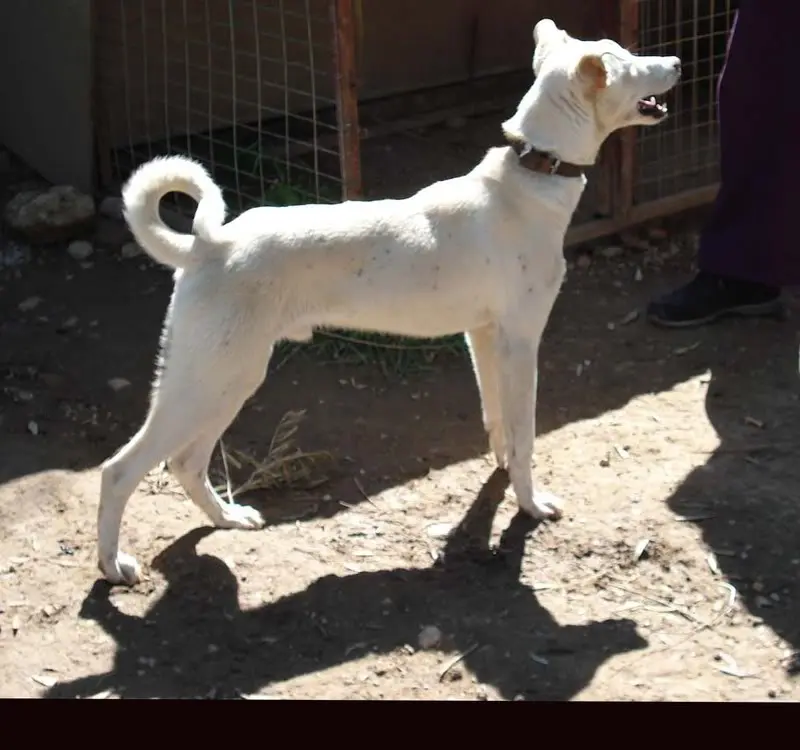
Cretan Hound
Grecia Not recognized by the FCI

Kritikos Lagonikos

Content

History

The Cretan Hound (Kritikos Lagonikos), belongs to a primitive hunting breed, its existence on the Greek island of Crete is documented in writings for at least 3.500 years. Minoan civilization, which at its peak dominated most of the Aegean, the Cyclades islands and the eastern Peloponnese, bred and used it extensively.

Like a hunting and hunting hound, was always used to hunt down and capture wild hares and rabbits on the harsh terrain of his home island. The classical authors praised the cretan hounds (Kressai Kynes) as the best hare hunters known to man and in ancient times they were exported to the Greek colonies and other European countries, reaching Spain and the British Isles, to mix and improve local hounds.

These dogs have many peculiar traits and it is clear that they are a truly ancient species, probably the oldest breed of dog in Europe. Your ancestors may have come from Africa., but later they adapted to this unique habitat of Crete, an island remote enough to be home to other unique species of animals as well, as a unique subspecies of wild goat, the lynx and others.

Isolated there for millennia, these dogs were trained by function to perform a particular and challenging task and remain pure and unaltered to this day.

Due to a long history of fighting external enemies, the Cretans they are a freedom loving race, proud, independent, somewhat suspicious and even tested. They do not like to give their dogs to outsiders and even to this day the best specimens are kept hidden from public view..

Breeding practices are ruthless and the limited means of the past taught the locals to castrate all males, except the best, and to destroy the dogs that were not good for hunting. This resulted in an especially strong and healthy breed., but also very few in number. For years they were kept a secret and even now they rarely leave Crete, except on the occasions when they participate in international dog shows held in Athens, where visitors have the opportunity to meet a true living legend.

Physical characteristics

The Cretan Hound (Kritikos Lagonikos) is a slender dog, of body intermediate between a hound and a greyhound, especially light feet (that are oval instead of feline) and strong loin, specially adopted for fast reflexes and high speed on dangerous and rocky terrain.

The head wedge shaped, it is elongated and dry, with pointy, highly mobile ears that fold back like a greyhound's during the chase. (There are specimens with semi-standing or drooping ears, and the latter tend to be more similar to a sighthound; there is also a smaller variety, something like a Whippet, of which little is known).

The skin it is thin and tense all over the body, and of many colors. The tail is a very important characteristic of the breed, long and curved up, forming a loose or tight ring and covered with a longer hair brush underneath.

The Cretan Hound is slightly longer than tall, with medium angulations, legs slim and well muscled; the rib cage is spacious but neither too wide nor too rounded and does not reach the tip of the elbow. The back he's slim but powerful and there's a nice tuck, with the tips of the hipbones slightly prominent.

There must be a balance between speed and endurance characteristics, being the conformation a commitment that produces great agility. Flaccid individuals are not tolerated, clumsy and heavy.

Colors: pure white, cream, sand, leonado, grey, striped or black, bicolor or tricolor.

Size

  • Height: females: 50+ cm. (19+ inches) Males: 60+ cm. (27+ inches)
  • Weight: 20-30 kg (44-66 pounds)

Character and skills

The Cretan Hound uses both sight and smell in hunting and has a particular tendency to savor air or ground odor, to the point of sucking it off the pebbles and stones. When it perceives the prey, the tail moves in a circular motion and the hound stiffens moments before starting the chase.

Manso, affectionate, aristocratic, but deadly in pursuit, is a polite hound that comes to life in the presence of prey; clean, soft, elegant in form and movement, it is never vulgar or overwhelming in gestures.

Slightly reserved with strangers, is naturally inquisitive and tolerant.

The Kritikos Lagonikos lives happily with other domestic animals, but it will mercilessly chase the neighbor's cat.

It's excellent, friendly and very affectionate with children. He rarely barks but will alert strangers to his home; on the farm he will kill mice and rats and is not indifferent to feather hunting, but the latter use will make the breed lazy and disorderly in hunting; your constitution needs the challenge of true persecution.

Make sure you are the calm leader, but firm and sure of this dog, providing enough leadership and exercise to produce a well-balanced canine companion. Proper communication between the dog and the man is essential.

โ–ท The world of Pets: Dogs, cats, birds, reptiles, amphibians

Cordoba Fighting Dog
Argentina Extinct

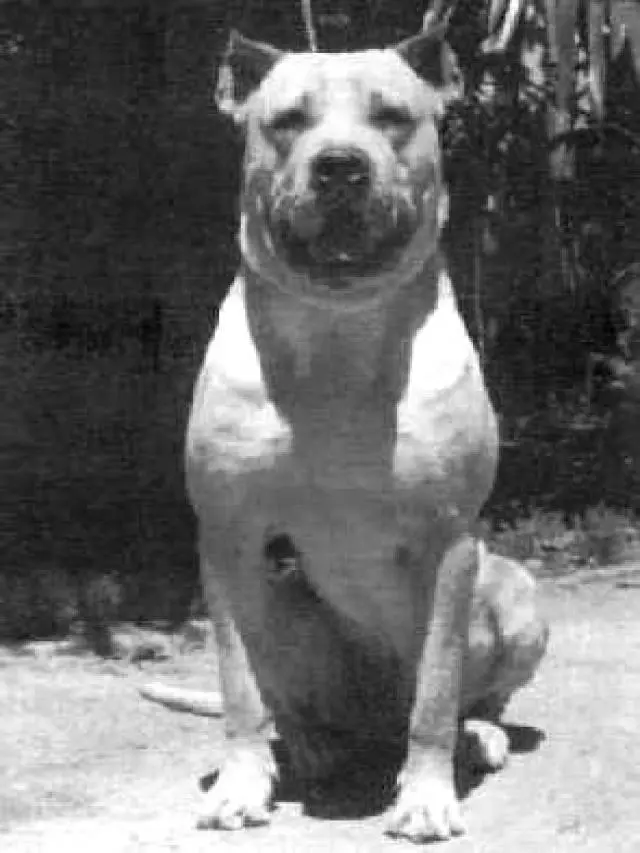
The Cordoba Fighting Dog was combative, tremendous control value and resistance.

Perro de Pelea Cordobรฉs

Content

History

The Cordoba Fighting Dog (Cordobese Dog) is an extinct breed of dog, Argentine-born.

The Cordoba Fighting Dog it was a cross of Mastiff, Bull Terrier, Boxer, and the Old English Bulldog.

The old Cordoba Fighting Dog (PPC) originated in Cรณrdoba (Argentina) in the last century. It was a special animal for combat, tremendous control value and resistance; they died fighting, they never shied away from the encounter. But they lacked smell and speed, In addition, their ferocity towards their peers made them useless for hunting..

This, added to the number of specimens that died in dog fights, led to its extinction. The Cordoba Fighting Dog was able to hunt in small groups of males and females, otherwise they would turn against their hunting companions.

The race was so aggressive towards other dogs, that males and females would rather fight each other than mate.

But this primitive race had in itself two essential qualities. An excellent ancestral heritage and great functional gymnastics, Since the rough fighting to which they were subjected from generation to generation, they were increasing more and more their original bravery.

This dog, It was almost always white and some with spots barcinas, were given in various streams of blood, to avoid inbreeding, the contribution of the different races that would result in the Dogo Argentino.

Physical characteristics

The official canine club of Argentina describes the Cordoba Fighting Dog like a "very strong and muscular dog", with powerful jaws and large teethยป. It had short white fur., sometimes with markings around the eyes, and could reach 70 height cm.

  • Otros nombres: Cรณrdoba Fighting Dog / Cordobese Dog / PPC.

โ–ท The world of Pets: Dogs, cats, birds, reptiles, amphibians

Spanish dogo
Espaรฑa Molosoide

Dogo Espaรฑol

The Spanish dogo He has the instinct of guard and defense still preserving the hunting instinct and dam;

Content

History ยซSpanish Dogeยป

Presa dogs entered the Iberian Peninsula accompanying barbarian tribes back in the 4th century; Swabians, Vandals and Alans they were guarding their livestock and transhumant with this type of dog camps.

Throughout history these animals have been used in different functions with a common denominator; his instinct for hunting and dam as a tool at the service of hunting; management of livestock; guardianship and custody of properties; dog of war; etc.

Kings, feudal lords, mercenaries, butchers, livestock, and even bullfighting, make these lineages a very important reference in the history of our country, reaching its peak during the period called "Spanish romanticism". The historical references are so numerous as diverse. Depending on their morphological characteristics, they would be used for some purposes or others.; the lightest and most runner type dogs were used for hunting big game, and the most corpulent and big-headed were used in tasks that required more power or stopping force than resistance. Where, how and when it begins to be systematically selected towards one or another trend and under one or another name is something difficult to decipher. Then there was talk of "types" -the concept of race is much more modern in canine matters-; and under that concept of "type" different morphologies coexisted with certain common features. The most generic denominations of this "type" have been "Alanos"; "dams";โ€œdogosโ€; โ€œbull dogsโ€; โ€œalan butchersโ€; โ€œboringโ€; etc.

Sometimes referring to specific differential features called them in one way or another, and other times of generically under the same concept to different varieties. A current "taxonomic" classification of these dogs according to historical references, it would be an anachronism of difficult zootechnical solution.
We find centuries-old descriptions โ€“such as the one in the โ€œLibro de la Monterรญaโ€- that under the same concept of "Alano" puts the light type for hunting, mentioning another heavier variety for grabbing cattle.

Videos "Spanish dogo"

But we also find arguments and references that support morphological and functional differences between these "dams"; see the description of "Dogo" by the Royal Academy of the language Edition of the 20th century; The distinction by the Royal Canine society of Spain in 1911 between โ€œpresa espaรฑolโ€ in its facet of guard and utility and the โ€œAlanoโ€ in the group of trail and monterรญa; the medal with the inscription โ€œDogo de Burgosโ€ of the year 1625 ; documented deliveries of indigenous British Bulldogs and Italians, etc.

So, far from scrutinizing on etymological or linguistic issues that are not exempt from ambiguities on occasions, We focus on the constructive process, that is none other that history with all its variability of types reconciled, with the present reality of the concept โ€œraceโ€, which requires adjustment to more defined patterns.

Under this purpose is born the project for the recovery of the Spanish dogo; which would encompass the heaviest and most corpulent type of Alano or prey on our peninsula.

Why unify under the name of "Dogoโ€? It was to use a name that meet a series of requirements:

    1. Having historic endorsement in number and significance of reference
    2. Generic name and identifiable with these morphologies
    3. Avoid controversial connotations related to endangerment
    4. Avoid localisms or allusion to obsolete or too restrictive functions

The result of all this is the denomination of โ€œDogoโ€ is the one that best encompasses the concept of โ€œmolosser Iberianโ€.

We have the definition ofDogoโ€ by the Royal Academy of the language; our Dogos influenced directly or indirectly the rest of related breeds; There are manifests from the Crown of Aragon for sending Spanish Dogos to Naples; The Governor of Cuba refers to the delivery of "Spanish prisoners" to the British Army for the control of maroons; they exported extensively to England; in Germany they recreated the extinct "bullesbeizer" through the Boxer by crossing a bulldog with a female prey named "Flora" of clear Hispanic descent; It is enough to look at the first Boxers from the end of the 19th century to see the resemblance between the German breed of that period and our native rustic flatbacks..
The number of references is countless.

  • 2. Origins of the recovery process of the Spanish dogo

In the Decade of the 80, With the beginning of the recovery of the Alano, the existence of different typologies and trends is already contemplated.. Then the terms "type" were used, livestock line or trendโ€ Vs โ€œhunter typeโ€ as a differential label.

The merger of "Alans or dams" with dogs "villainsโ€ of the land, -light herding dogs and lupoid cut โ€“ gave a versatile hybrid that retained the atavism of the gripping dogs, but with the spark and resistance of the shepherds. Hence the "Villain of the Encartacionesโ€, a derivative of the Alano in its lightest version.

The Spanish Alano standardizes by orienting its selection towards an intermediate type. The process concludes with the official recognition of the breed in the year 2003 on the part of the Royal Canine Society of Spain.

In short the basic trends on a bipolar scale we find the following picture:

    1ยบ/ On the one hand light morphology of more running and unloaded structures;

    2ยบ/ At the opposite pole, the most corpulent and brachycephalic types;

    3ยบ/ And between both extremes, a majority and consolidated intermediate type.

The types "corridorโ€ e โ€œintermediateโ€ would be represented by โ€œVillainsโ€ y โ€œAlansโ€ respectively; leaving uncovered the most molosser niche of the scale.

It was fair to detach for the first time since the beginning of the last century our "most corpulent prey" from their alan matrix, and do it not under the constraint that prints a "trend", But reconciling the idiosyncrasies of this type with the concept of current race. Any trend that takes body and prominence is likely to empower low-status of race; It is just a matter that under the right circumstances: having genetic material; references historical; and above all with a coordinated group willing to redirect selection facilitate this work.

With the recovery of the Alano the tribute that the extreme types would pay was foreseeable; marginalized to a purely testimonial presence in directly proportional relationship to the fixing of the intermediate alano. Under this panorama our last redoubts of โ€œDogosโ€ would be doomed to extinction as a potential breed or in the best of cases relegated to trend within the moderation imposed by the Alano standard.

Fortunately, individuals of this type continued to be born in the litters of Alans. We have continued to use some breeders as players occasionally, and if only it were looking for complementarity, those genes are still there. Other breeders โ€“special mention to Francisco Rincon– they have had the courage not only to continue using Alans in this trend, but do so looking for fix this type rather than complement it. Thanks to this, the recovery project of the โ€œSpanish dogoโ€ based on the genetic base of the โ€œAlano" is a reality.

Physical characteristics

One of the most controversial issues in mapping out the path and targets in selection, It is to be clear where it started and where we are going; define that niche is covered with this project, and do it with its own identity, trying to converge as little as possible with the rest of related breeds. Our Dogo would fall between the molossians of arenas and the molosoides group.

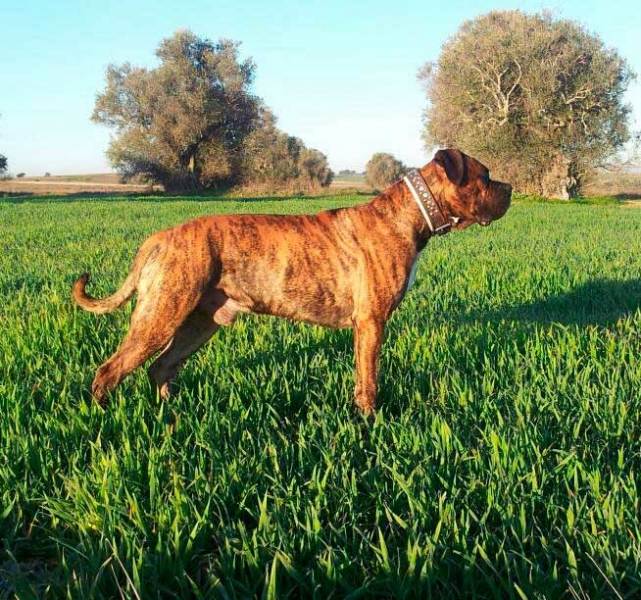
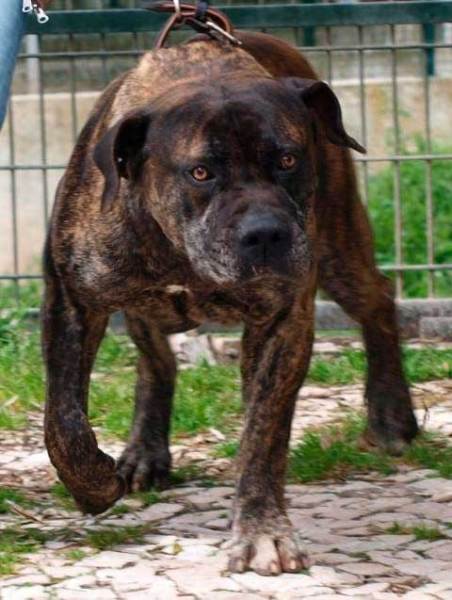
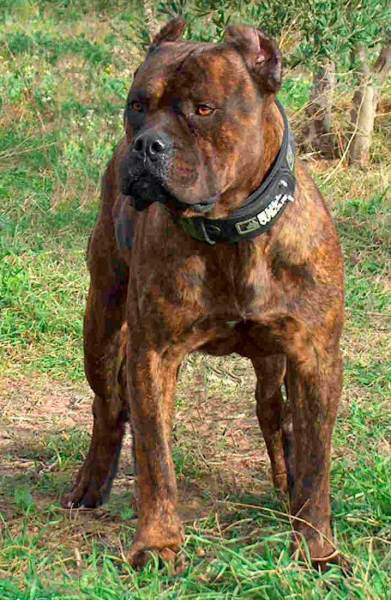
More related with our races Spanish dogo indigenous, both by type and by junction, they would be the Dogo Canario; the Alan Spanish; the Majorca Mastiff; the Dogue de Bordeaux; the Cane Corso; and the Bullmasfiff.

Based on a thorough differential analysis of our standard project, We have our niche secured connection all them. Of echo, There is greater overlap between many terriers; bracoides; shepherds and Nordics โ€“ to name a few families- to enter our Spanish dogo and the rest of related.

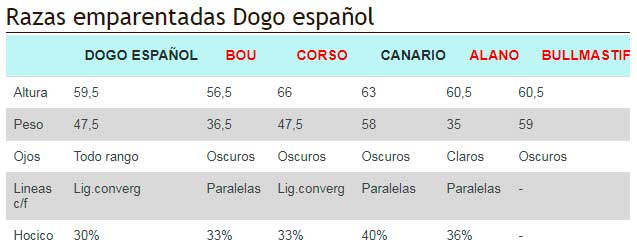
To see clearly where lie these differences, -others such as expression and typicity are more difficult to quantify- We took the average values of each racial pattern and vein results with our Spanish dogo. We will look at an example, that where could have some overlap in weight, There will be no size, or where any size won't be it in proportions; not to mention in expression and typicity although not easily described values.

To this end we present the attached table offering average in those easier to obtain parameters values: adding maximum and minimum thresholds and dividing by two we get average weights and sizes of each standard. We do so only in males by simplifying data and observe such differences at a glance quickly.

Related breeds Spanish Mastiff

Delving into these differences, other variables โ€“such as craniofacial lines; body perimeters such as head and chest; proportion of muzzle to skull; eye color; etc.,- They come to make our niche even clearer and they do so without entering into a conflict of competence with respect to the rest of the related breeds..

Breed standard
SPANISH DOGO RACIAL PATTERN

Racial pattern

HISTORICAL REVIEWS:

During the period between the end of the s. IV and the 5th century, the alano village will occupy large areas of southern Europe, among others the Iberian Peninsula. This town is made accompanied by their dogs of prey, which are mixed with the powerful dogs brought to the peninsula by Phoenicians and Romans, mainly.

Crossbreeding that gives rise to what would later be called Dogo, Dam or flat Spanish among other synonyms. His name is mainly due to their excellent qualities in the management and control of the cattle of bravo and semi-bravo type, native of the Iberian Peninsula.
Later, the emergence of bullfighting, would make these play a prominent role in the same, in the so-called luck of dogs, until the beginning of the 20th century.

As well, for its excellent qualities for the defence and guard, would be used as a war dog, being very appreciated by soldiers of other Nations, especially for the control of rebels in the Americas.

GENERAL APPEARANCE:

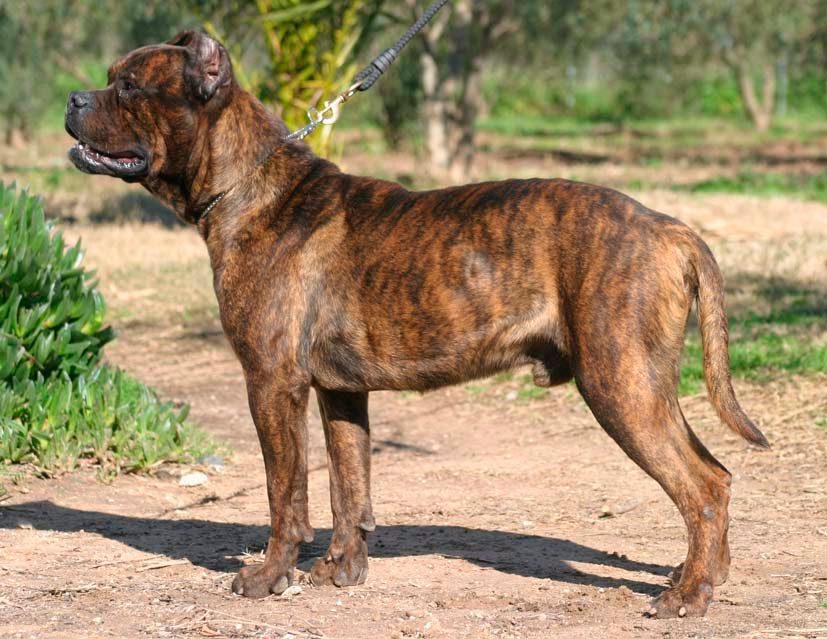
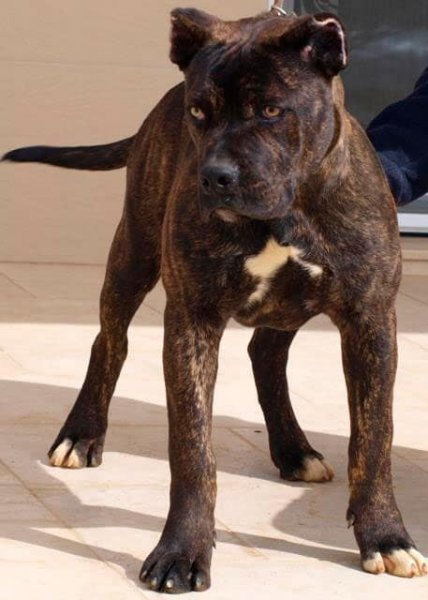
Molosser type, moderately brevilineo, very strong, rustic and endowed with tremendous power.
Back straight and compact. It presents a notable sexual dimorphism, males showing a cranial region more developed and a stronger type. Medium to large-sized, brachycephalic, It has a robust structure as a whole, Compact and powerful.

TEMPERAMENT:

Sweet and affable character with the family. Tireless worker and multifaceted.
Very attentive and especially gifted for the guardian, Defense, management and control of cattle. Easy management and education. He seems very sure of himself.

HEAD:

Brachycephalic, head strong and powerful.

REGION CRANEAL:

Slightly convex skull, square, wide and very strong. of medium width, always in harmony with the rest of the body. Slightly converging skull-facial lines. Well pointed front Groove. highly developed temporal muscles. The zygomatic arches, superciliary, as well as the temporal bones, They show a high development. The skin is smooth, without wrinkles. Very marked stop.

FACIAL REGION (FACE):

    – Truffle: Pigmented black and complete. Large and wide holes.
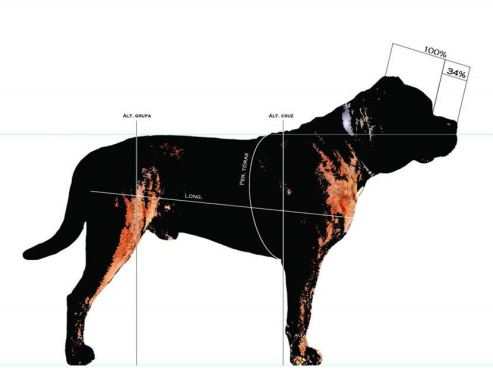
    Snout: It is a square, strong, occupying the 34% the total length of the skull, admitting a deviation of the 2%. Light folds are supported.
    – Lips: thick and well Pigmented; desirable that they do not hang up too.
    – jaws and teeth: they must be very powerful. The wide enough to permit a correct insertion of dental. Preferably complete (42 parts). The teeth are not visible with the mouth closed. Canine blunt, short, wide and well separated. Is supported as the Scissor bite, Clip, reverse scissor, as well as a slight prognathism that does not exceed 0.5cm. Well developed JAWS.
    – Eyes: medium-sized, almond and separate. From dark Hazel to amber and yellow. Adhered, well pigmented eyelid. Frank gaze and front. With no apparent conjunctiva and little white.
    – Ears: medium-high insertion. Preferably folded over the face and slightly rounded at the bottom. Medium to small size.

NECK:

Well muscled, slightly arched and of medium length. Allowed light folds in the jowl area. Crushing it slightly from the shoulders to the head.

BODY:

    – Cross: well marked, average implementation and descended toward the back.
    – Back: medium, flat and well developed.
    – Pork loin: short, broad, strong and convex.
    – Rump: slightly downed. It is short, wide and well developed.
    – Breast : width, deep, very strong and developed. Slightly cylindrical ribs. Profile down to the elbow. chest circumference, at its widest part must exceed at least one 25% the height at the withers.
    – Abdomen: moderately withdrawn.
    – Tail: average insertion. Great thick at its base is tuned toward aims it, not to exceed the Hock. It is not wound on the tip.

FORELIMBS:

    – Shoulder: strong, with prominent muscles. Slightly oblique.
    – Arms: good muscular, Plumb and separate.
    – Elbows: neither returned to the outside or very attached to the chest.
    – forearms: good muscular, straight and with good bone.
    – Previous feet: rounded, made of strong fingers that reinforce the appearance of big cats.

HINDQUARTERS:

Strong and properly angled.

    – Thighs: apparent and very developed.
    – Hocks: short, vigorous and moderate-angle. RAM does not present.
    – Hind feet: rounded, slightly longer than the previous ones and fat fingers.

MOVEMENT:

The typical gait of the breed is the trot.. This is shown effortlessly, fluid and agile.
The back is at the same level, parallel to the direction of motion. The head tends to be low. Explosive Gallop.

SKIN:

Thick and attached except in the neck, It is somewhat more lax.

COAT:

    – Fur: moderately short (never satin), dense, acrid, There may be a light Undercoat. The hair should reinforce the rustic appearance of the individual.
    – Color: Griffon and barcinos or Brindle in all its varieties; alobados; carbonates or Chair; black and Brindle; black and fawn and peeps. With or without mask.

SIZE AND WEIGHT:

    – Height at the withers: males from 61cm to 66cm, females of 58cm to 63 cm.. Supported a tolerance of 2cm at the top.
    – Weight: males between 45 and 53 kgr, females between 40 and 47 kgr. Supported a tolerance of 3 kgr.
    – Weight and height must go in harmony:
    – IPT (average weight height index) in males = 49 kgs / 63,5 cms = 0โ€™77
    – Females average IPT = 43,5 kgs / 60,5 cms = 0โ€™72
    – racial mean IPT = 0.745
    – ILA (height/length ratio) mean in males = height/length = 0.92 (a 8% longer than high).

FAULTS:

Any deviation from the above criteria should be considered absence and severity of this is considered to the degree of deviation to the standard.

SERIOUS FAULTS:

    – Shyness.
    – Unjustified aggression.
    – Muzzle too short or too long.
    – Overload.
    – descending dorsal line.
    – Lack of two premolars.

MISS PLAYOFFS:

    – Deafness.
    – albinism, lack of pigmentation.
    – Cryptorchidism or monorquidismo.
    – Lack of four premolars.
    – Mandibular torque.
    – Long hair.
    – amputated tail.

Character and abilities of the ยซSpanish Dogoยป

The historical evidence make it clear that we have a purely functional breed. We have already referred to some of the work that played these dogs; in bullfighting for the luck of โ€œdogs the bullโ€; for management of livestock and hunting; as dog's force to the dam or grip of cattle; also as a dog guard or defense accompanied the armies. They had great prominence in America during the colonial period for the control of Maroons and the birth of much of the functional races of that continent: Cimarrรณn Uruguayo; Fila Brasileiro; cordovan fighting dog and rear dogo argentine; antique American Bulldogss; dams of the Caribbean; etc.

While it is true that society evolves and the times are changing, It is not less true that the potential of this group can bring much as working dog. We want that the Spanish dogo still a dog's working to the extent of their possibilities; obviously not to compete with pastors in agility or mondioring not with villains in a half marathon; the limitations will be marked by their own morphological characteristics. But some minimal tests aimed at evaluating parameters related to power can be outlined.; arrojo and safety; meet minimum requirements in terms of physical potential; everything is a matter of to agree according to the reality of the project.

Obviously if demand parameters that agility and resistance prevail, we would fall into the error of converging towards lighter typologies, hence how complicated it is sometimes to draw guidelines in this regard. It is not comparing ourselves to other breeds, fate of squeezing the maximum potential of our. If we have something clear who decided to give shape to this project, is that we do not want that our Spanish dogodo not become a mere pretty โ€œshowcaseโ€ just to recreate the reminiscences of the old bulldogs. These dogs must continue to be able to meet certain requirements and do so with the solvency appropriate to their morphology..

I have always defended the individual initiative of each owner, each breeder; the selection and therefore evolution or a breed standardization, It does not necessarily imply a collective effort of all and each of the owners and breeders; It is enough to encourage those who wish to engage one degree more do so and facilitate the improvement of the rest. It is not so much a question of obligation and requirement, but to motivate those who want to use their energies in the improvement of the breed through its functional aspect.

With a small group of fans "motivated" in this sense and working good dogs for the benefit of the community, there must be tangible results in the medium-long term that allow us to differentiate ourselves from other groups of a similar nature, but which have become mere exaggerated showcases of what they were. To minimize the danger of this "deterioration" -understood as such the reduction of its ancestral benefits in favor of spectacularity without more-, the breed Club can play an important role in this regard.

It is possible to negotiate at the club level with veterinary clinics that allow significant discounts to members in the management of health control parameters (plates of hips and elbows dysplasia; hemivertebrae; heart tests; etc.); even subsidize club as part of these costs; establish ranking of specimens recommended by the club for breeding; designing tests of work; etc. It's all about go mapping objectives and study feasibility of each.

ยซSpanish Dogeยป images

โ€œSpanish Bulldogโ€ videos

Alternative names of the ยซSpanish Dogoยป:

  • span class =ยปno_translatelateยป>PRESA, BORING, BULLS DOG, ALANO LIVESTOCK
  • Among the Group of the molossians arenas and molosoides.

Sources:

  • Dogo-espanol national Club
  • www.lostarantos.net
  • www.lostercios.org
  • dogoespanol.blogspot.com.es/

Images:

  • (1),(2),(3),(4),(5),(7),(8),(9),(10) – Spanish Doge ยซLos Terciosยป (Photos)
  • (6) – ROMERO DE LOS TARANTOS – Los Tarantos
  • (11),(12),(13) – Spanish Mastiff national Club (Photos)

โ–ท The world of Pets: Dogs, cats, birds, reptiles, amphibians

Alapaha Blue Blood Bulldog
Estados Unidos Not recognized by the FCI

Despite its similarity, they should not be confused with the race American bulldog

Alapaha Blue Blood Bulldog

Content

History Alapaha Blue Blood Bulldog

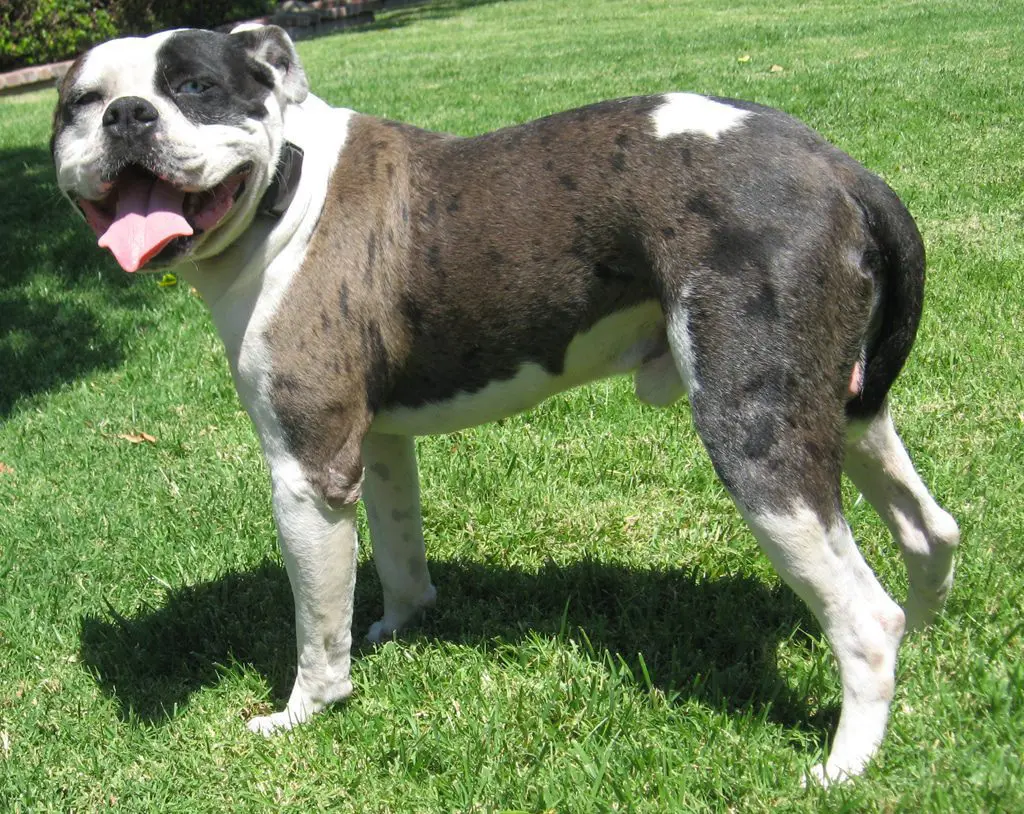
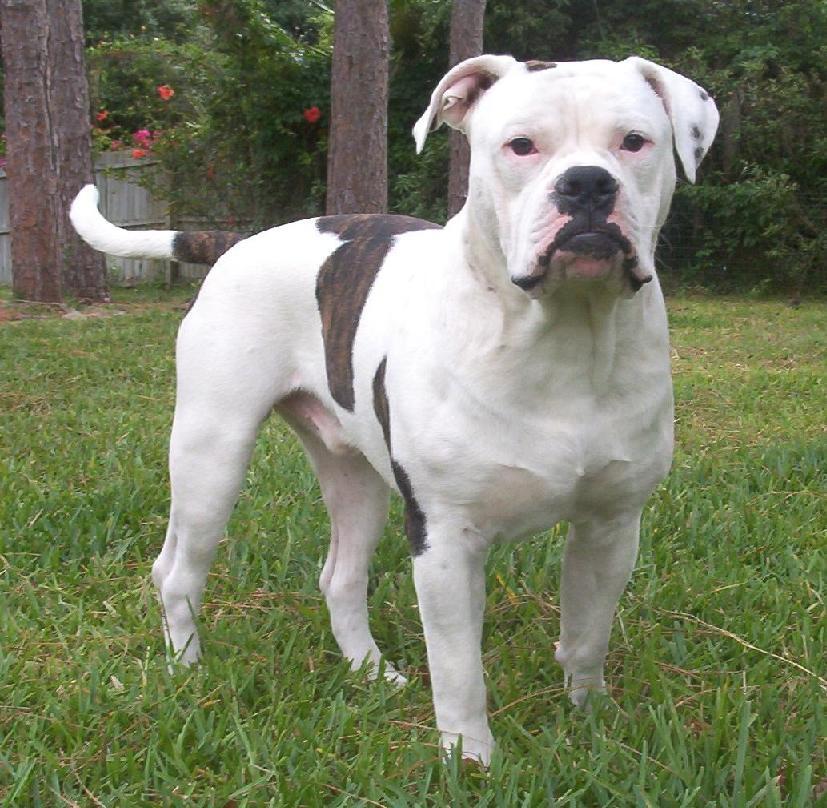
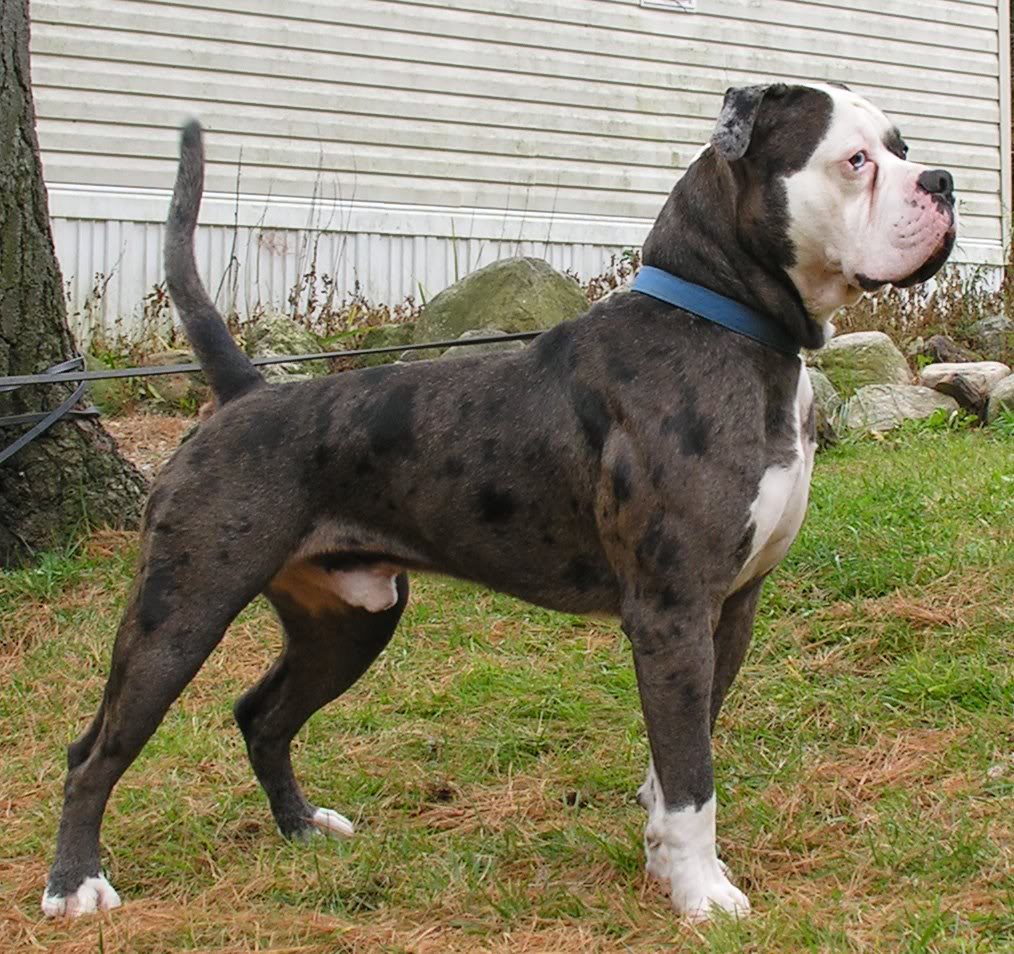
Also Known As Otto Bulldog. It is a breed of dog of American origin, considered rare due to the few existing copies. According to available information, They have been developed in the area Alapaha River in the southern region Georgia. They are renowned for their great sense of obedience, their agility and your protective character.

The race Alapaha blood Blue was developed by crossing Old English Bulldog white (known as, White English Bulldogs), a Catahoula Bulldog and a reduced number of copies of Colby Pit Bull Terrier. The origins of the breed remain fuzzy, and this has caused much confusion…

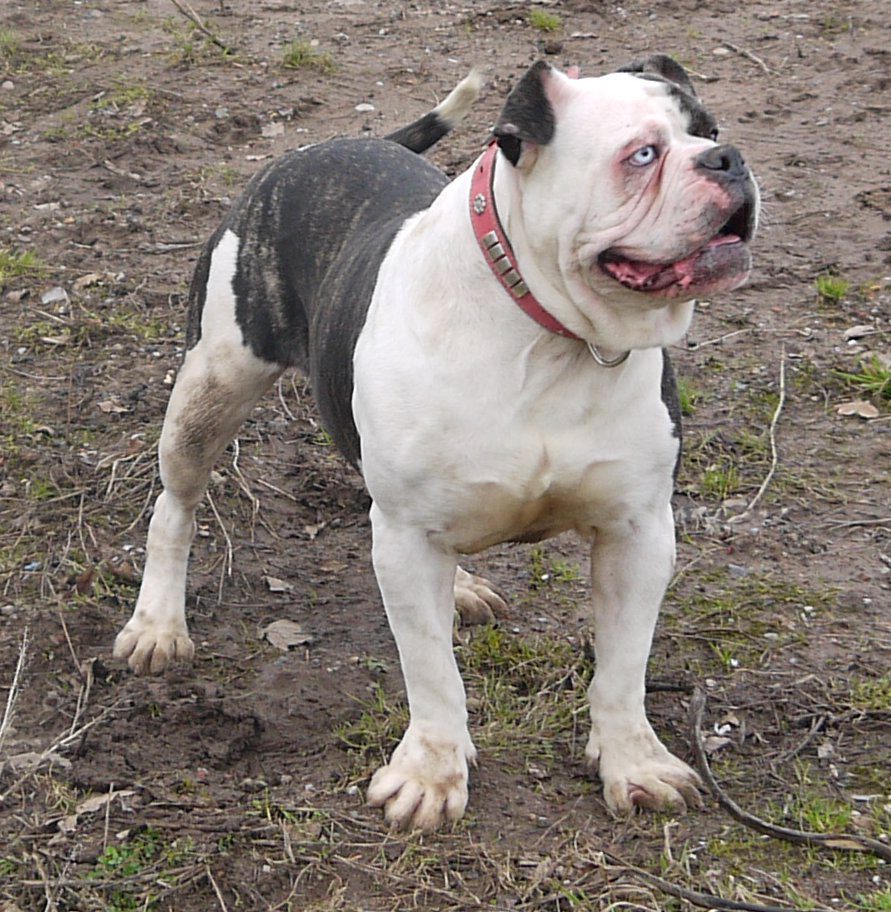
While at first glance it is a Bulldog type. It is a stronger dog and a well-developed musculature (remarkable characteristic of the breed, compared to other varieties Bulldog).

Despite its similarity, not to be confused with American bulldog. This similarity resulted in actions pre-register many Alapaha Blue Blood Bulldog They were included in the ancestry of American bulldog.

Videos "Alapaha Blue Blood Bulldog"

While Alapaha Blue Blood Bulldog Association It has declared that it was founded in 1979, the earliest evidence of the existence of this club record dates of 1989 in California. That discrepancy has triggered multiple discussions.

The race was in danger of extinction until a small group of Southern, in 1979, in an attempt to rescue the Bulldog de Old Tymey Plantation del Sur, He founded the ABBA (Alapaha Blue Blood Bulldog Association), giving the aforementioned name and dedicated to the preservation of this unique type of dog.

Claims made by the Mrs. Lana Lane, nurturer and follower of the race, they dealt with the existence of records. But, little evidence exists to support his claim because in family lines described in the World Atlas of Dog Breeds as the founders of the breed.

The current records of this breed They include the following organisms:

The ACA (American Canine Association) who registered the first champion Under the title of Alapaha. ABBA (Alapaha Blue Blood Bulldog Association), CCR (National Kennel Club), (ABBBR) Alapaha Blue Blood Bulldog registry, CKC (Continental Kennel Club), WWKC (World Wide Kennel Club), UWABC (Kingdom of work Alapaha Bulldog Club & Registration), UCA (United Canine Association), and IOEBA (International Olde English Bulldogge Association), among them there is great variation in the type and standard.

Physical characteristics

Descriptions of their size vary greatly depending on the organism., but trying to reach an average consensus we would place the males in a weight ranging from 32 to 41 kg, and height the cross of 51 to 63 cm.. Females - slightly smaller, they weigh in 25 to 34 kg and measure of 45.7 to 55.9 cm in height to the cross.

The ears and tail They are left natural, without any cutout.

The colors of the Alapaha Blue Blood Bulldog They are varied, preferably, You must have at least the 50% white body with spots. They can be, predominantly, solid color with white, or dry white. Patches or markings are generally color merle, striped, blue, black, chocolate, red, beige, or tricolor. Currently the most common are the tricolor mantle (both white, Merle, red, as well as beige, Merle, chocolate).

The eye color can vary from Brown to blue, and they usually see with one eye of each color copies or a finger eye colors.

Its pelage is short, hard and bright by nature, which is why, coat care requirements are minimal.

Character and skills

The Alapaha Blue Blood Bulldog It described as a dog easy to train, obedient and responsible, with impressive capabilities as guardian Family and property. They have a strong instinct for protection and it's love at home.

Puppy must be socialized and trained using humane methods, since cruelty could stimulate the aggressiveness of the animal. Intelligent and quick learning, with assertive methods.

The Alapaha Blue Blood Bulldogand blue is very energetic and athletic. Even so, They can be adapted perfectly to life in an apartment if sufficiently exercised and daily. While within the home displays inactive, quiet, It will be more happy with - at least- a medium size yard.

They were formerly used to work with livestock, especially in the capture of errant pigs. For that reason his muscles are long and powerful, this physical characteristic reminds us that for the dog to have optimal health it needs to be exercised regularly. They often enjoy long walks, run and play.

Life expectancy Alapaha Blue Blood Bulldog is located from 12 to 15 years.

Pictures Alapaha Blue Blood Bulldog

Videos Alapaha Blue Blood Bulldog

Type and recognitions:

  • Race is not recognized by the FCI
  • BBC = Backwoods Bulldog
  • ClubDRA = Dog Registry of America, Inc.

Alternative names

1. Alapaha Blue Blood Bulldog, Otto Bulldog (English).
2. Alapaha Blue Blood Bulldog (French).
3. Buldogue Alapaha de sangue azul, Alapaha Blue Blood Bulldog (Portuguese).
4. Alapaha Blue Blood Bulldog (German).
5. Bulldog Alapaha de sangre azul, Alapaha Blue Blood Bulldog (espaรฑol).

โ–ท The world of Pets: Dogs, cats, birds, reptiles, amphibians

Mucuchi
Venezuela Not recognized by the FCI

The Mucuchi is a large size dog, robust Constitution.

Mucuchรญes

Content

History

The Mucuchi, It is a breed of dog originally from Venezuela.

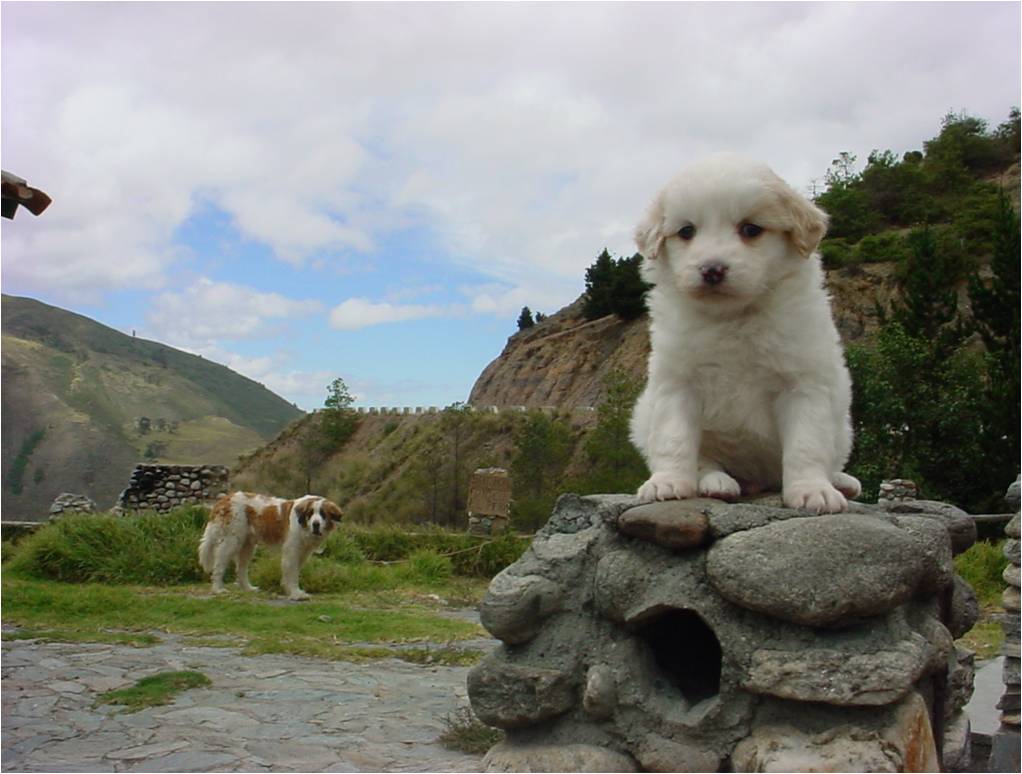
The origin of the Mucuchi comes from the invention of veterinarian doctor Wilender Ferrari, Although it is believed that they descended from dogs brought by the Spanish conquistadors at the end of the 16th century as watchdogs and herders. As possible ancestors are brought to the spanish mastiff, the Pyrenean Mastiff and the Algerian Mastiff, as well as the Atlas Sheepdog or Aรฏdi and the Great Pyrenees. Over the years these breeds of dogs were crossing creating a powerful dog and very versatile worker at the end.

Its importance in Venezuelan history arose after the hero Simรณn Bolรญvar arrived in the town of Mucuchรญes, in the Venezuelan Andes, during their fight for Venezuelan independence and adopt a dog of this breed. For 1926-27 the Mucuchรญes was found throughout Venezuela. After the wide distribution of the race, its purity and quality was in a serious decline during the first part of the 20th century. There is a famous painting of Simรณn Bolรญvar on his horse with the Mucuchรญes dog that was given to him while he was crossing Venezuela to Caracas..

In 1961 a club was created in order to preserve the breed and to 1964 It was declared the national dog of Venezuela. Still the club disappeared, putting in an uncertain future to this dog.

Read more

โ–ท The world of Pets: Dogs, cats, birds, reptiles, amphibians

Longdog
Irlanda Not recognized by the FCI

Longdog

Content

History

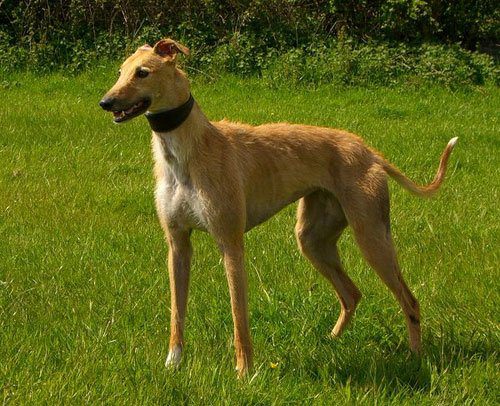
The Longdog It is a breed of dog of the sighthound type with origin in Ireland whose name literally means "long dogโ€referring to the elongated shape of its limbs.

Authors like the colonel Ted Walsh define it as a cross between two hunting dogs, What distinguishes it from the call Lurcher, race created from crosses between sighthound dogs and working dogs.

Currently no distinction is considered between the Lurcher and the Longdog and both are included within the Lurcher.

Physical characteristics

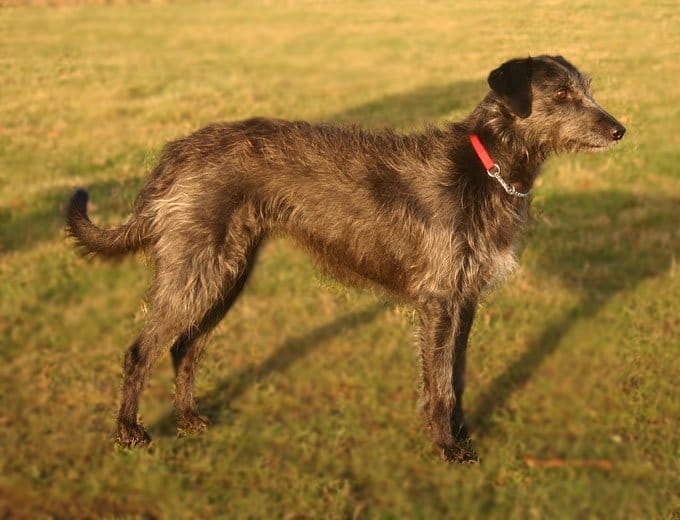
Because of that are the product of different crosses, the Longdog varies in appearance depending on the breeds that were used in the cross. They can be so light as a Greyhound or as robust as a Wolf dog. Their coats can also vary depending on the playback. Some have short fur, Some have long fur and some have hard coat.

Common crosses of Longdog usually: Saluki with English Greyhound, Scottish Deerhound with Greyhound (English Greyhound), and Whippet with Greyhound (English Greyhound). These dogs tend to be raised to (some of the) same purposes as the Lurcher, but they generally have a higher speed compared to general endurance and a higher training capacity than the Lurcher.

Each of these crosses carries distinctive characteristics...

  • Saluki crossed with Greyhound: It is especially appreciated as a Hunter dog of hares in the United Kingdom and, for short time, in United States. The best copies shared resistance to high temperatures which possesses the Saluki and the capacity for acceleration and strength of the Greyhound.
  • Deerhound crossed with Greyhound: specialist in hunting foxes and deer in United Kingdom, It has great body resistance and the ability to adapt without problems to different climatic characteristics., You can live outdoors. In United States, the blood of this can, He has contributed to the development of the American Hound (specialists in the pursuit of coyotes).
  • Whippet crossed with Greyhound: highly appreciated by its balance is, Acceleration, agility, tenacity, heat resistance and, especially, by his rapid recovery. Depending on each dog, It can be used successfully in all kinds of hunting, but in the United Kingdom, stand out, especially in hunting rabbits.

The Lurcher (first cousins รขโ‚ฌโ€นรขโ‚ฌโ€นof the Longdog) they were initially raised to catch rabbits when they were expelled from their burrows, but in the Decade of 1950, myxomatosis killed off most of the rabbits.

The myxomatosis, It is an infectious disease of rabbits, swellings on the skin and membranes of these animals, particularly in head and genitals. It is then often evolve into acute conjunctivitis, and sometimes blindness. The rabbit becomes listless, lost appetite and develops fever. In typical cases where the animal does not have resistance, death happens on average in 13 days.

Video "Longdog"

Queen, dont stop me now, mix coursing longdogs

It was discovered in Uruguay at the end of the 19th century, in rabbits imported from the genus Sylvilagus. It was subsequently extended by the South American populations of wild rabbits. This was however a less virulent strain than introduced in Australia in 1950, that he slashed the population (of 600 to 100 million in two years).

For decades Britain's scientists, Germany and France sought a remedy against the plague that rabbits had become, but it was the French physician Armand Delille which believed the solution. It was introduced artificially in France in 1952 a few rabbits inoculated with the virus producer the myxomatosis and quickly spread to the European continent in a natural way, through arthropod blood sucking and decimated the French population in 2 years (90% mortality). The myxomatosis, together with viral hemorrhagic pneumonia, is the cause of the decline of the rabbit in the Iberian Peninsula, What has caused the decline of the iconic animals to the point that in the Spanish imperial Eagle were lost the 70 % nests and the Iberian lynx is found without their basic livelihood.

The mode of transmission is the flea and other sucking arthropods of blood in Europe, Although for example, in Australia is transmitted through mosquito.

There is a viral vector vaccine for domestic rabbits, While in wild specimens Europe have developed immunity and gradually extend.

As we said above, in the decade of 1950, myxomatosis killed off most of the rabbits, but the disease did not affect the hares.

Y, This led to the need to develop the race to achieve faster dogs to be able to catch hares. A Hare can run at speeds of up 72 km/h.

The need for, he is born Longdog, developed to get a dog appropriate to the preferred style of hunting and the need of the moment.

Y, Although they are not a pure breed, you cross them with him Greyhound (English Greyhound) purebred, has led them to be highly valued within the "elite" of canine sport.

Because the Longdog it is not a purebred are not recognized by any dog รขโ‚ฌโ€นรขโ‚ฌโ€นclub. But, North America has recently created the โ€œLurcher and Longdog Associationโ€ to serve as a registration body for dogs Lurcher and Longdog in the United States and Canada.

Character and skills

Similar to the Lurcher, beyond the different objectives of the crossing, What is certain is that the Longdog It is an excellent companion dog that adapts very well to home life., and is very grateful for the care received, She loves to be with people but it needs vigorous walks outdoors, like all dog. Y, above all, very large spaces to savor the aftertaste of freedom.

โ–ท The world of Pets: Dogs, cats, birds, reptiles, amphibians

Lurcher
Inglaterra Irlanda Not recognized by the FCI

Content

History

The Lurcher is a Podenco type dog of English origin whose name derives from ยซlurยป what does thief mean in gypsy language. Always it has been acknowledged as the dog of the poachers so occasionally is called Poacher’s Dog (dog of fugitive).

As a result of its appearance (hairy and scruffy) It is not admitted in competitions but for many it is a dog to enhance. In general, it can be said that the Lurcher is a cross between a Sighthound and working dog, What gives rise to many opportunities: English Greyhound and Golden Retriever; Whippet and Border Collie.

Physical characteristics

The Lurcher It is a hybrid dog similar to a Greyhound with short fur, medium long or long or straight hair in all colors.

The type of layer will be variable and will depend on the crosses made. Then, the types of fur can be: short and smooth like the Sighthounds, a bit long and thick as of the Boxer, or rough and hard as the of the Border Terrier, for example.

Character and skills

In case you want a Lurcher with more features than Sighthound what of working dog it is usually crossed for the second time with a dog Greyhound type. With this you get a dog faster than a working dog, but with the strength of this. The character of Lurcher is derived from the best of its parents and, some, They define it as quiet and affectionate.

The temperament, also variable, It will depend on the influence of ancestors, but as with all dogs, temperament will be modified by the socialization of the puppy and received education.

In general, the objective of the different crossing was to create a hound with more intelligence, an animal cunning and appropriate for the original purpose of the hound: hunting poaching rabbits, hares and birds. With the time, have gone underway several crossing, always pursuing the objective of improving the speed and intelligence.

The Lurcher he is a versatile dog, It has various uses that depend on the different crossing to which have been subjected, but they are usually used as hunting dogs with different styles. most of Lurcher today it is used for general pest control, Rabbit, hares and foxes, although some of the larger types have been successfully used for hunting large game such as wild boar and deer.

Insisting on the use of the can has much to do with the objective of the Hunter and the cross from which is derived, It is good to take this post to remind you that unfortunately, some breeders - no ethical- in the search for the "perfect dog" they usually kill or abandon everything Lurcher that does not fit your needs, because he is not a good hunter or has a physical or behavioral problem.

The Lurcher, It has also proved to be very good in canine sports, such as obedience and agility, where they are becoming increasingly popular due to its speed and willingness to please.

Because the Lurcher is not a pure breed they are not recognized by any canine club. But, North America has recently created the โ€œLurcher and Longdog Associationโ€ to serve as a registration body for dogs Lurcher and Longdog in the United States and Canada.

Beyond the different objectives of the crossing, What is certain is that the Lurcher It is an excellent companion dog that adapts very well to home life., and it is very grateful to received love, She loves to be with people but it needs vigorous walks outdoors, like all dog.

โ–ท The world of Pets: Dogs, cats, birds, reptiles, amphibians

Boykin Spaniel
USA Not recognized by the FCI

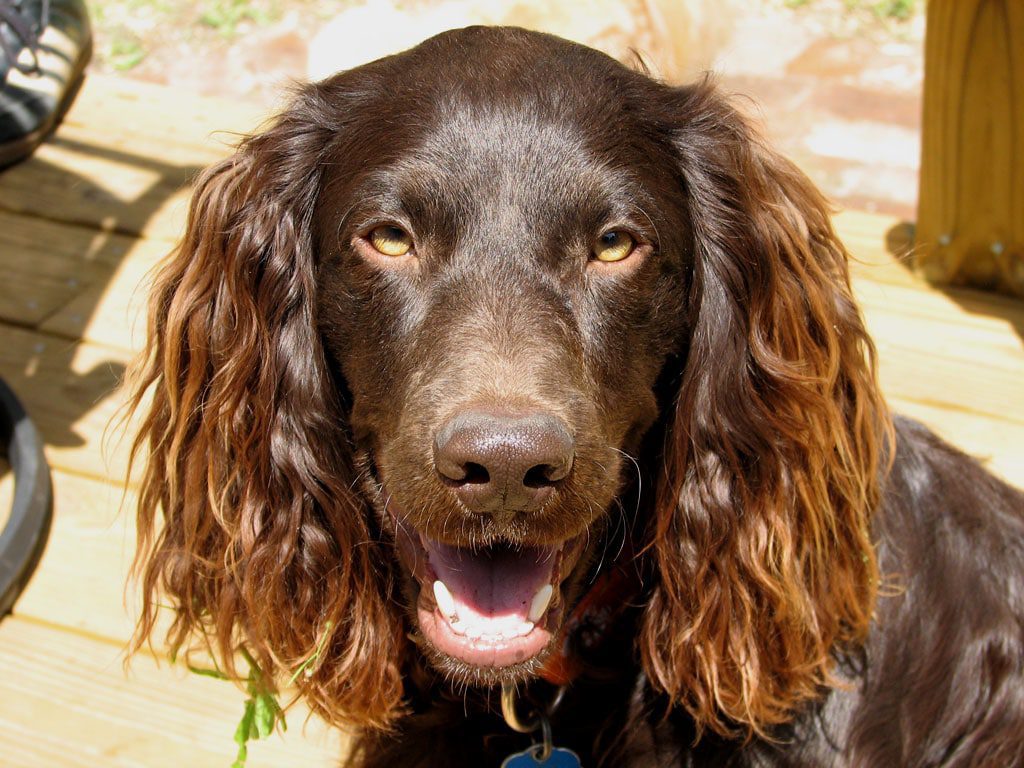
The Boykin Spaniel It is easy to train and has always wanted to work
Boykin Spaniel

Content

Characteristics "Boykin Spaniel"

Coexistence is important that you have with your new friend. Before considering the acquisition of a dog of the breed "Boykin Spaniel" you know certain factors. Not all breeds of dogs are apt to live in an apartment, you must take into account his character, their need for exercise, their interaction with other pets, their care and if you have small children, their level of tolerance towards them.

Adaptation โ“˜

5,0 of 5 stars (based on 1 review)

friendly dog โ€‹โ€‹โ“˜

3,0 of 5 stars (based on 1 review)

hair loss โ“˜

3,0 of 5 stars (based on 1 review)

Affection level โ“˜

5,0 of 5 stars (based on 1 review)

Need for exercise โ“˜

5,0 of 5 stars (based on 1 review)

Social need โ“˜

3,0 of 5 stars (based on 1 review)

Home โ“˜

5,0 of 5 stars (based on 1 review)

Toilet โ“˜

4,0 of 5 stars (based on 1 review)

Friendly with strangers โ“˜

3,0 of 5 stars (based on 1 review)

barking โ“˜

3,0 of 5 stars (based on 1 review)

Health โ“˜

3,0 of 5 stars (based on 1 review)

Territorial โ“˜

3,0 of 5 stars (based on 1 review)

Cat friendly โ“˜

3,0 of 5 stars (based on 1 review)

Intelligence โ“˜

3,0 of 5 stars (based on 1 review)

Versatility โ“˜

4,0 of 5 stars (based on 1 review)

Child friendly โ“˜

3,0 of 5 stars (based on 1 review)

Surveillance โ“˜

3,0 of 5 stars (based on 1 review)

joy โ“˜

3,0 of 5 stars (based on 1 review)

History

The Boykin Spaniel (Caniche de Pantano or Little Brown Dog) It is a breed of dog of medium size, which was bred as a spaniel for hunting wild turkeys in the swamp of the Wateree River in South Carolina, United States. It is the official dog of the State of South Carolina.

The Boykin Spaniel descends from hunting dogs bred in the century 20 in South Carolina, EE.UU. The dogs had to be small enough to ride in the small boats used by hunters in the swamps., was that, L. Whitaker Boykin (1861-1932) experimented with different crosses races, and the dog resulting was the Boykin Spaniel, It is named.
Legend has it that Boykin began his breeding program with a dog named "Dumpy", a friend of Boykin was found in the streets and in the development of the race it is presumed that they were used for the Chesapeake Bay Retriever, Springer Spaniel, the Cocker Spaniel, and the American Water Spaniel.

The area in which L. Whitaker Boykin had his kennel was around Camden, South Carolina, a tourist area, This led to his race was observed by tourists who began to buy copies and little by little the Boykin Spaniel breed was divided by United States.

The Society of Boykin Spaniel (BSS) was created in 1977 and began to keep a genealogical record in 1979. The el Spaniel was recognized by the United Kennel Club in 1985.

In the year 1990 a group of fans formed the Club of Boykin Spaniel and the Boykin Spaniel Breeders Association of America in order to achieve breed recognition by the AKC and to gain access to spaniel hunting trials. That was the first Boykin Spaniel organization to form and maintain a โ€œCode of Ethicsโ€. In 2007, Headquarters of the Association of breeders of Boykin Spaniel in the United States it was recognized by the AKC as the official Canine Club of the breed. In December of 2009 the Boykin Spaniel officially became an AKC registered breed.

The society Boykin Spaniel has a Code of Ethics for breeders, and sponsor events of trials of field and copies of this breed rescue. In addition to the AKC is also recognized by many Canine Clubs of minor or canine records companies, and in all entities it is promoted as a rare species of pet. But at the present time, the Boykin Spaniel is becoming one of the breeds Spaniel most common in the United States.

Did you know??

The fame of Boykin Spaniel is that it is the official dog of the state of South Carolina, a title conferred on him 1984.

Physical characteristics

The Boykin Spaniel It, slightly, largest that the English Cocker Spaniel, and much heavier due to his wide body. The height at the cross for the males is of 39,4 to 45,7 cm and weigh in 13,6 to 18,2 kg. Females are smaller than, measuring of 35,6 to 40,6 cm. to the cross and weigh in 11,4 to 15,9 kg. Although against the original form and function of the breed, some breeders have carried out trials in order to increase their size so that they are more competitive against other breeds Retriever. Buyers should be aware of the magnitude and the weight in the pedigree of the puppies before choosing a breeder if the size is a factor in the choice of your dog.

Videos "Boykin Spaniel"

Traditionally, his tail was cut three days after birth, leaving 1/3 its length, but these practices are already prohibited in many countries.

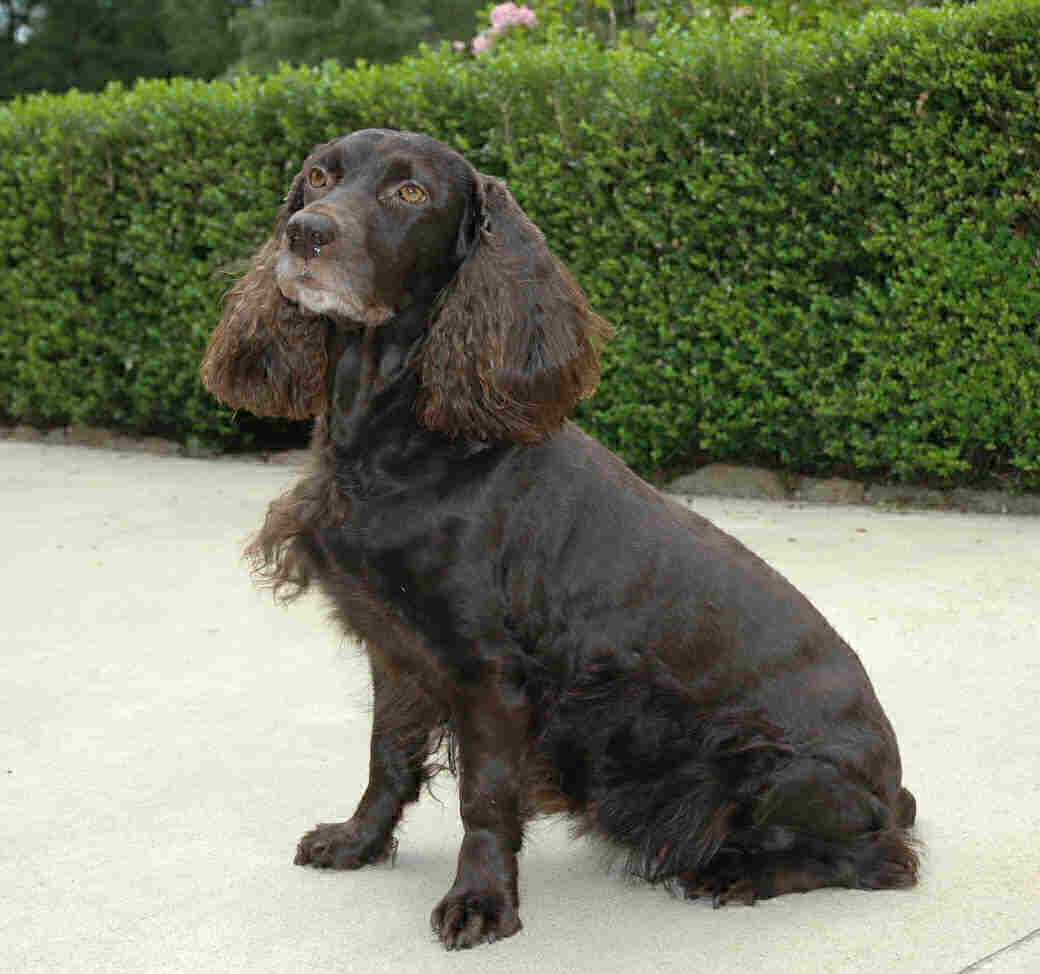
The eyes are bright and attractive. Color varies from bright gold to a dark amber color. The puppies are born with bluish eyes and little by little they take on the characteristic amber color of the breed..

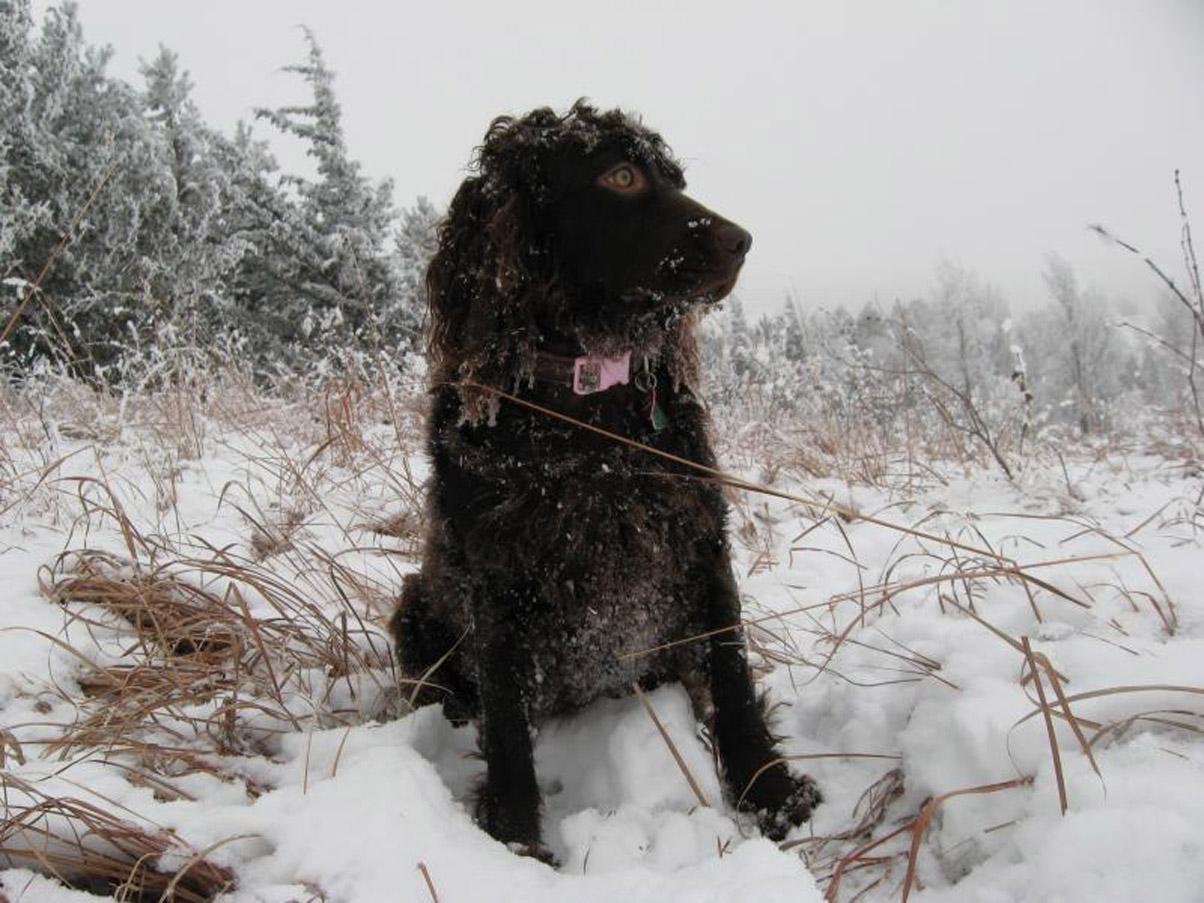
The color of the layer is formed by different shades of Brown, which can range from liver color to chocolate. Within this range, any color is admitted.

The Boykin Spaniel, It is a dog of water which was raised to adapt to the moderate climate of Southeast United States, but his layer varies quite a bit due to the number of ancestors he has… Coat length and density varies widely due to the variety of breeds that make up the Boykin Spaniel's history., for that reason, any type of layer is acceptable, still some of them is very curly as the American Water Spaniel and others with very smooth fur as the Field Spaniel. The length is usually of 2.5 to 5.8 cm around the body. In addition all have fringes in the ears, chest and hind legs, where the density and hair length can vary. While the color of the layer is composed of various shades of Brown, It is possible that the dog a colorless Golden tone for the Red Sun above all in the ears and should not be penalized, If stands for competitions.

The maintenance of the mantle Boykin Spaniel is minimal, you just need brushing it often, and there are few and isolated hair cuts, light shaping around the head and topline is enough. Some people let their ear hair grow quite long and that gives the feeling that they are wearing a bun like the Setter Llewellin. To the Boykin Spaniel that are used for hunting or that live in the field, often cropped them hair in the area of the belly and a little the skirt and should not be penalized, provided the proper length is maintained to protect the skin. Shave that area is somewhat improper because it can cause some layers of growth with excessive bleaching, discoloration or grayscale. Y, it could also damage the dog's skin, post your protection.

The Boykin Spaniel he is a versatile hunter, working like a dog water and as a Hunter of mountain which can be hunted birds in flight, although that is not the style of hunting Boykin. They can be used in driving deer or in tracking and monitoring of dams of wounds. Its small size makes them easy to carry in a canoe or a small boat, often described as "the dog that doesn't rock the boat". The Boykin Sleepingl is recognized by the AKC.

Observations

While the Boykin Spaniel he is a dog in good health, There are common conditions with all breeds of water dogs and Retriever, they can suffer.

The Boykin Spaniel has a probability of 37% born with hip dysplasia, according to the statistics of 2006. The disease is usually detected in the from 2 years of age. All breeders of dogs Boykin Spaniel must receive an evaluation and certification from the Orthopedic Foundation for Animals (OFA), one of the steps of the assessment is done through x-ray only to the 4 months of age the puppy.

The breed also has a high incidence of eye problems and dislocation of patella. Skin and hair problems exist and may be associated with disorders of the thyroid or endocrine. The Cushing's disease and the Hypothyroidism are known in the breed.

The Exercise-Induced Collapse (EIC) is a neuromuscular disease, that applies to the Labrador Retriever and closely related breeds, como ser el Chesapeake Bay Retriever y Curly Coated Retriever. In the year 2010 a research group led by Professor James Mickelson, Minnesota has been found responsible for mutation in the gene DNM1. In the same year, the research team in collaboration with the American Kennel Club Canine Health Foundation, identified in the breed Boykin Spaniel due to the presence of Exercise-Induced Collapse is several of its specimens that, they were recorded in the OFA database.

At such news, members of the Canine Club Boykin Spaniel, They claimed a serious study of the race which resulted to 56% of the copies of Boykin Sleepingl studied had one or two copies of the gene that causes EIC. It was a devastating result because found is surprisingly high, the highest of all the races in which is currently studying for the disease.

The first symptoms of Exercise-Induced Collapse (EIC) they are alterations in the March of the animal, rigidity in the limbs and tumbler screening walk. Sick animals show muscle weakness, and collapse to the 5-15 minutes after exercise. It is a disease which can go unnoticed stay for years if the animal is not subject to strong efforts or high stress.

A DNA test allows for the direct detection of the mutation responsible for. DNA analysis is independent of age of the animal and can be in puppies. Not only is it possible to differentiate between animals that have or not the mutation, but those healthy animals carriers may also be detected, what is of great importance for breeding.

According to the Code of Ethics of the Club of Boykin Spaniel and the Breeders Association Boykin Spaniel In America, all breeders of race must be subjected to their litter to tests that detect possible problems of hips, hereditary eye disease, of heart, as well as for other diseases that may have a genetic component, such as allergies, elbow dysplasia, dislocation of patella, and the presence of the gene responsible for the EIC.

The OFA and the AKC have an extensive database called CHIC (Canine Health Information Center). To obtain a CHIC number, dogs must undergo an annual โ€œCERFโ€ test that screens their eyes, problems of patellar dislocation, and proof of hip dysplasia. The owners of the dogs must be in accordance with the publication of the results in the CERF in the OFA databases.

There are also optional heart and blood tests. elbow dysplasia. A CHIC certification does not mean that the dog has passed their evaluations and does not have any disease, but it is simply an indication that the owner checks the health problems that his Boykin Spaniel, or race that is.

Testing and responsible husbandry can reduce the incidence of these problems, and purchasers of puppies, for added security, they should request these test results.

The Orthopedic Foundation for animals has been evaluated to 157 dog breeds between January of 1974 until December of 2009. The Boykin Spaniel is the thirteenth race worse rated for hip dysplasia by presenting a 34,8% of the affected copiess.

Character and skills

The Boykin Spaniel he is a friendly and sociable dog that thrives happily in a family environment with lots of outdoor activities. It is easy to train and has always wanted to work. Is very stable and loving children and other dogs. Can sometimes be described as very energetic and with great stamina that lasts all day. They are highly adaptable to different environments, as long as they enjoy social interaction and plenty of time to burn off excess energy. This dog is very good with children, and with other dogs, they did not get angry easily and tend to be eager to please and love to their owners.

As with all dogs, the "Boykin Spaniel" they require daily exercise and regular care. As we said above, the cut of the layer on a regular basis is recommended especially if the dog is in the field, as the fur is soft it picks up Fox tails, Brambles and whole skewer it finds in its path. Y, Remember brushing it often to avoid the entanglements in long hair.

ยซBoykin Spanielยป Images

โ€œBoykin Spanielโ€ Videos

Type and recognitions:

  • Not recognized by the FCI โ“˜
  • Federations: AKC โ“˜, ANKC โ“˜, UKC โ“˜

Alternative names:

1. Boykin, Swamp Poodle, LBD (Little Brown Dog) (English).
2. Boykin Spaniel (French).
3. Boykin Spaniel (German).
4. Boykin spaniel (Portuguese).
5. Boykin Spaniel (espaรฑol).