Presa dogs entered the Iberian Peninsula accompanying barbarian tribes back in the 4th century; Swabians, Vandals and Alans they were guarding their livestock and transhumant with this type of dog camps.
Throughout history these animals have been used in different functions with a common denominator; his instinct for hunting and dam as a tool at the service of hunting; management of livestock; guardianship and custody of properties; dog of war; etc.
Kings, feudal lords, mercenaries, butchers, livestock, and even bullfighting, make these lineages a very important reference in the history of our country, reaching its peak during the period called "Spanish romanticism". The historical references are so numerous as diverse. Depending on their morphological characteristics, they would be used for some purposes or others.; the lightest and most runner type dogs were used for hunting big game, and the most corpulent and big-headed were used in tasks that required more power or stopping force than resistance. Where, how and when it begins to be systematically selected towards one or another trend and under one or another name is something difficult to decipher. Then there was talk of "types" -the concept of race is much more modern in canine matters-; and under that concept of "type" different morphologies coexisted with certain common features. The most generic denominations of this "type" have been "Alanos"; "dams";“dogos”; “bull dogs”; “alan butchers”; “boring”; etc.
Sometimes referring to specific differential features called them in one way or another, and other times of generically under the same concept to different varieties. A current "taxonomic" classification of these dogs according to historical references, it would be an anachronism of difficult zootechnical solution.
We find centuries-old descriptions –such as the one in the “Libro de la Montería”- that under the same concept of "Alano" puts the light type for hunting, mentioning another heavier variety for grabbing cattle.
But we also find arguments and references that support morphological and functional differences between these "dams"; see the description of "Dogo" by the Royal Academy of the language Edition of the 20th century; The distinction by the Royal Canine society of Spain in 1911 between “presa español” in its facet of guard and utility and the “Alano” in the group of trail and montería; the medal with the inscription “Dogo de Burgos” of the year 1625 ; documented deliveries of indigenous British Bulldogs and Italians, etc.
So, far from scrutinizing on etymological or linguistic issues that are not exempt from ambiguities on occasions, We focus on the constructive process, that is none other that history with all its variability of types reconciled, with the present reality of the concept “race”, which requires adjustment to more defined patterns.
Under this purpose is born the project for the recovery of the Spanish dogo; which would encompass the heaviest and most corpulent type of Alano or prey on our peninsula.
Why unify under the name of "Dogo”? It was to use a name that meet a series of requirements:
1. Having historic endorsement in number and significance of reference
2. Generic name and identifiable with these morphologies
3. Avoid controversial connotations related to endangerment
4. Avoid localisms or allusion to obsolete or too restrictive functions
The result of all this is the denomination of “Dogo” is the one that best encompasses the concept of “molosser Iberian”.
We have the definition ofDogo” by the Royal Academy of the language; our Dogos influenced directly or indirectly the rest of related breeds; There are manifests from the Crown of Aragon for sending Spanish Dogos to Naples; The Governor of Cuba refers to the delivery of "Spanish prisoners" to the British Army for the control of maroons; they exported extensively to England; in Germany they recreated the extinct "bullesbeizer" through the Boxer by crossing a bulldog with a female prey named "Flora" of clear Hispanic descent; It is enough to look at the first Boxers from the end of the 19th century to see the resemblance between the German breed of that period and our native rustic flatbacks..
The number of references is countless.
- 2. Origins of the recovery process of the Spanish dogo
In the Decade of the 80, With the beginning of the recovery of the Alano, the existence of different typologies and trends is already contemplated.. Then the terms "type" were used, livestock line or trend” Vs “hunter type” as a differential label.
The merger of "Alans or dams" with dogs "villains” of the land, -light herding dogs and lupoid cut – gave a versatile hybrid that retained the atavism of the gripping dogs, but with the spark and resistance of the shepherds. Hence the "Villain of the Encartaciones”, a derivative of the Alano in its lightest version.
The Spanish Alano standardizes by orienting its selection towards an intermediate type. The process concludes with the official recognition of the breed in the year 2003 on the part of the Royal Canine Society of Spain.
In short the basic trends on a bipolar scale we find the following picture:
1º/ On the one hand light morphology of more running and unloaded structures;
2º/ At the opposite pole, the most corpulent and brachycephalic types;
3º/ And between both extremes, a majority and consolidated intermediate type.
The types "corridor” e “intermediate” would be represented by “Villains” y “Alans” respectively; leaving uncovered the most molosser niche of the scale.
It was fair to detach for the first time since the beginning of the last century our "most corpulent prey" from their alan matrix, and do it not under the constraint that prints a "trend", But reconciling the idiosyncrasies of this type with the concept of current race. Any trend that takes body and prominence is likely to empower low-status of race; It is just a matter that under the right circumstances: having genetic material; references historical; and above all with a coordinated group willing to redirect selection facilitate this work.
With the recovery of the Alano the tribute that the extreme types would pay was foreseeable; marginalized to a purely testimonial presence in directly proportional relationship to the fixing of the intermediate alano. Under this panorama our last redoubts of “Dogos” would be doomed to extinction as a potential breed or in the best of cases relegated to trend within the moderation imposed by the Alano standard.
Fortunately, individuals of this type continued to be born in the litters of Alans. We have continued to use some breeders as players occasionally, and if only it were looking for complementarity, those genes are still there. Other breeders –special mention to Francisco Rincon– they have had the courage not only to continue using Alans in this trend, but do so looking for fix this type rather than complement it. Thanks to this, the recovery project of the “Spanish dogo” based on the genetic base of the “Alano" is a reality.
One of the most controversial issues in mapping out the path and targets in selection, It is to be clear where it started and where we are going; define that niche is covered with this project, and do it with its own identity, trying to converge as little as possible with the rest of related breeds. Our Dogo would fall between the molossians of arenas and the molosoides group.
More related with our races Spanish dogo indigenous, both by type and by junction, they would be the Dogo Canario; the Alan Spanish; the Majorca Mastiff; the Dogue de Bordeaux; the Cane Corso; and the Bullmasfiff.
Based on a thorough differential analysis of our standard project, We have our niche secured connection all them. Of echo, There is greater overlap between many terriers; bracoides; shepherds and Nordics – to name a few families- to enter our Spanish dogo and the rest of related.
To see clearly where lie these differences, -others such as expression and typicity are more difficult to quantify- We took the average values of each racial pattern and vein results with our Spanish dogo. We will look at an example, that where could have some overlap in weight, There will be no size, or where any size won't be it in proportions; not to mention in expression and typicity although not easily described values.
To this end we present the attached table offering average in those easier to obtain parameters values: adding maximum and minimum thresholds and dividing by two we get average weights and sizes of each standard. We do so only in males by simplifying data and observe such differences at a glance quickly.
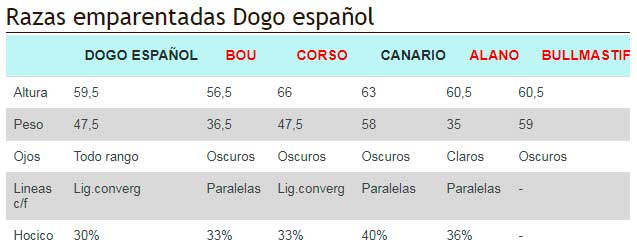
Delving into these differences, other variables –such as craniofacial lines; body perimeters such as head and chest; proportion of muzzle to skull; eye color; etc.,- They come to make our niche even clearer and they do so without entering into a conflict of competence with respect to the rest of the related breeds..
Breed standard
SPANISH DOGO RACIAL PATTERN
During the period between the end of the s. IV and the 5th century, the alano village will occupy large areas of southern Europe, among others the Iberian Peninsula. This town is made accompanied by their dogs of prey, which are mixed with the powerful dogs brought to the peninsula by Phoenicians and Romans, mainly.
Crossbreeding that gives rise to what would later be called Dogo, Dam or flat Spanish among other synonyms. His name is mainly due to their excellent qualities in the management and control of the cattle of bravo and semi-bravo type, native of the Iberian Peninsula.
Later, the emergence of bullfighting, would make these play a prominent role in the same, in the so-called luck of dogs, until the beginning of the 20th century.
As well, for its excellent qualities for the defence and guard, would be used as a war dog, being very appreciated by soldiers of other Nations, especially for the control of rebels in the Americas.
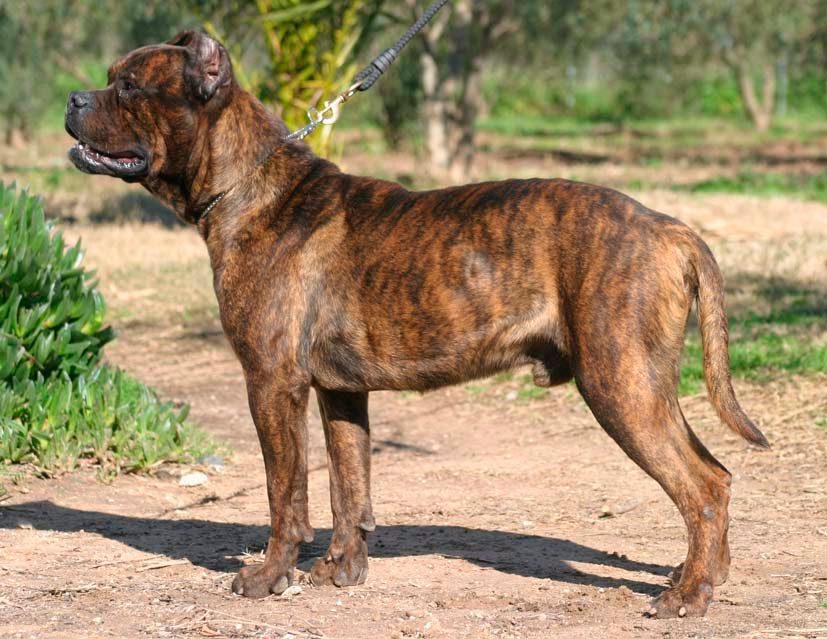
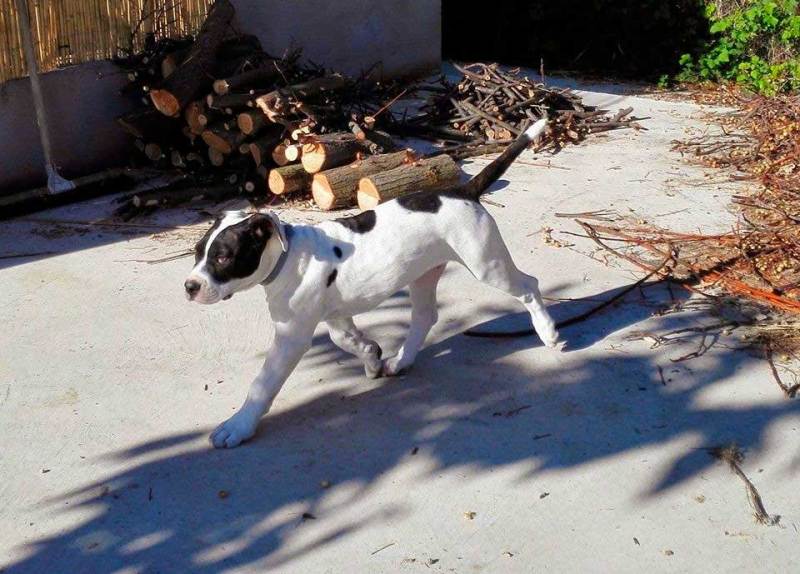
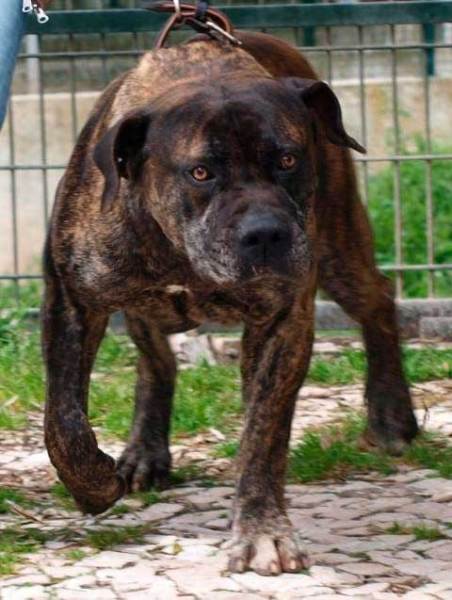
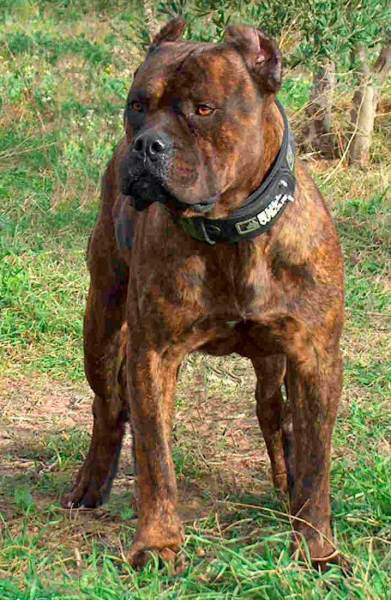
Molosser type, moderately brevilineo, very strong, rustic and endowed with tremendous power.
Back straight and compact. It presents a notable sexual dimorphism, males showing a cranial region more developed and a stronger type. Medium to large-sized, brachycephalic, It has a robust structure as a whole, Compact and powerful.
Sweet and affable character with the family. Tireless worker and multifaceted.
Very attentive and especially gifted for the guardian, Defense, management and control of cattle. Easy management and education. He seems very sure of himself.
Brachycephalic, head strong and powerful.
Slightly convex skull, square, wide and very strong. of medium width, always in harmony with the rest of the body. Slightly converging skull-facial lines. Well pointed front Groove. highly developed temporal muscles. The zygomatic arches, superciliary, as well as the temporal bones, They show a high development. The skin is smooth, without wrinkles. Very marked stop.
– Truffle: Pigmented black and complete. Large and wide holes.
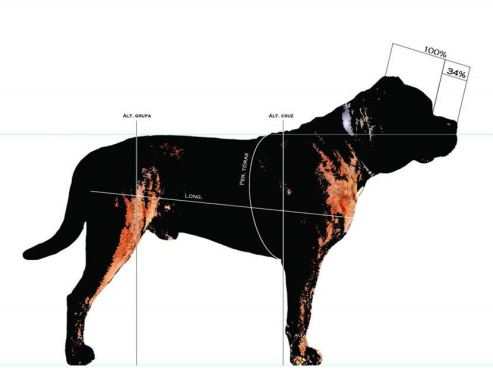
Snout: It is a square, strong, occupying the 34% the total length of the skull, admitting a deviation of the 2%. Light folds are supported.
– Lips: thick and well Pigmented; desirable that they do not hang up too.
– jaws and teeth: they must be very powerful. The wide enough to permit a correct insertion of dental. Preferably complete (42 parts). The teeth are not visible with the mouth closed. Canine blunt, short, wide and well separated. Is supported as the Scissor bite, Clip, reverse scissor, as well as a slight prognathism that does not exceed 0.5cm. Well developed JAWS.
– Eyes: medium-sized, almond and separate. From dark Hazel to amber and yellow. Adhered, well pigmented eyelid. Frank gaze and front. With no apparent conjunctiva and little white.
– Ears: medium-high insertion. Preferably folded over the face and slightly rounded at the bottom. Medium to small size.
Well muscled, slightly arched and of medium length. Allowed light folds in the jowl area. Crushing it slightly from the shoulders to the head.
– Cross: well marked, average implementation and descended toward the back.
– Back: medium, flat and well developed.
– Pork loin: short, broad, strong and convex.
– Rump: slightly downed. It is short, wide and well developed.
– Breast
: width, deep, very strong and developed. Slightly cylindrical ribs. Profile down to the elbow. chest circumference, at its widest part must exceed at least one 25% the height at the withers.
– Abdomen: moderately withdrawn.
– Tail: average insertion. Great thick at its base is tuned toward aims it, not to exceed the Hock. It is not wound on the tip.
– Shoulder: strong, with prominent muscles. Slightly oblique.
– Arms: good muscular, Plumb and separate.
– Elbows: neither returned to the outside or very attached to the chest.
– forearms: good muscular, straight and with good bone.
– Previous feet: rounded, made of strong fingers that reinforce the appearance of big cats.
Strong and properly angled.
– Thighs: apparent and very developed.
– Hocks: short, vigorous and moderate-angle. RAM does not present.
– Hind feet: rounded, slightly longer than the previous ones and fat fingers.
The typical gait of the breed is the trot.. This is shown effortlessly, fluid and agile.
The back is at the same level, parallel to the direction of motion. The head tends to be low. Explosive Gallop.
Thick and attached except in the neck, It is somewhat more lax.
– Fur: moderately short (never satin), dense, acrid, There may be a light Undercoat. The hair should reinforce the rustic appearance of the individual.
– Color: Griffon and barcinos or Brindle in all its varieties; alobados; carbonates or Chair; black and Brindle; black and fawn and peeps. With or without mask.
– Height at the withers: males from 61cm to 66cm, females of 58cm to 63 cm.. Supported a tolerance of 2cm at the top.
– Weight: males between 45 and 53 kgr, females between 40 and 47 kgr. Supported a tolerance of 3 kgr.
– Weight and height must go in harmony:
– IPT (average weight height index) in males = 49 kgs / 63,5 cms = 0’77
– Females average IPT = 43,5 kgs / 60,5 cms = 0’72
– racial mean IPT = 0.745
– ILA (height/length ratio) mean in males = height/length = 0.92 (a 8% longer than high).
Any deviation from the above criteria should be considered absence and severity of this is considered to the degree of deviation to the standard.
– Shyness.
– Unjustified aggression.
– Muzzle too short or too long.
– Overload.
– descending dorsal line.
– Lack of two premolars.
– Deafness.
– albinism, lack of pigmentation.
– Cryptorchidism or monorquidismo.
– Lack of four premolars.
– Mandibular torque.
– Long hair.
– amputated tail.
Character and abilities of the «Spanish Dogo»
The historical evidence make it clear that we have a purely functional breed. We have already referred to some of the work that played these dogs; in bullfighting for the luck of “dogs the bull”; for management of livestock and hunting; as dog's force to the dam or grip of cattle; also as a dog guard or defense accompanied the armies. They had great prominence in America during the colonial period for the control of Maroons and the birth of much of the functional races of that continent: Cimarrón Uruguayo; Fila Brasileiro; cordovan fighting dog and rear dogo argentine; antique American Bulldogss; dams of the Caribbean; etc.
While it is true that society evolves and the times are changing, It is not less true that the potential of this group can bring much as working dog. We want that the Spanish dogo still a dog's working to the extent of their possibilities; obviously not to compete with pastors in agility or mondioring not with villains in a half marathon; the limitations will be marked by their own morphological characteristics. But some minimal tests aimed at evaluating parameters related to power can be outlined.; arrojo and safety; meet minimum requirements in terms of physical potential; everything is a matter of to agree according to the reality of the project.
Obviously if demand parameters that agility and resistance prevail, we would fall into the error of converging towards lighter typologies, hence how complicated it is sometimes to draw guidelines in this regard. It is not comparing ourselves to other breeds, fate of squeezing the maximum potential of our. If we have something clear who decided to give shape to this project, is that we do not want that our Spanish dogodo not become a mere pretty “showcase” just to recreate the reminiscences of the old bulldogs. These dogs must continue to be able to meet certain requirements and do so with the solvency appropriate to their morphology..
I have always defended the individual initiative of each owner, each breeder; the selection and therefore evolution or a breed standardization, It does not necessarily imply a collective effort of all and each of the owners and breeders; It is enough to encourage those who wish to engage one degree more do so and facilitate the improvement of the rest. It is not so much a question of obligation and requirement, but to motivate those who want to use their energies in the improvement of the breed through its functional aspect.
With a small group of fans "motivated" in this sense and working good dogs for the benefit of the community, there must be tangible results in the medium-long term that allow us to differentiate ourselves from other groups of a similar nature, but which have become mere exaggerated showcases of what they were. To minimize the danger of this "deterioration" -understood as such the reduction of its ancestral benefits in favor of spectacularity without more-, the breed Club can play an important role in this regard.
It is possible to negotiate at the club level with veterinary clinics that allow significant discounts to members in the management of health control parameters (plates of hips and elbows dysplasia; hemivertebrae; heart tests; etc.); even subsidize club as part of these costs; establish ranking of specimens recommended by the club for breeding; designing tests of work; etc. It's all about go mapping objectives and study feasibility of each.
Alternative names of the «Spanish Dogo»:
- span class =»no_translatelate»>PRESA, BORING, BULLS DOG, ALANO LIVESTOCK
- Among the Group of the molossians arenas and molosoides.
Sources:
Images:
- (1),(2),(3),(4),(5),(7),(8),(9),(10) – Spanish Doge «Los Tercios» (Photos)
- (6) – ROMERO DE LOS TARANTOS – Los Tarantos
- (11),(12),(13) – Spanish Mastiff national Club (Photos)
 FCI 225 - Molossoid - Dogo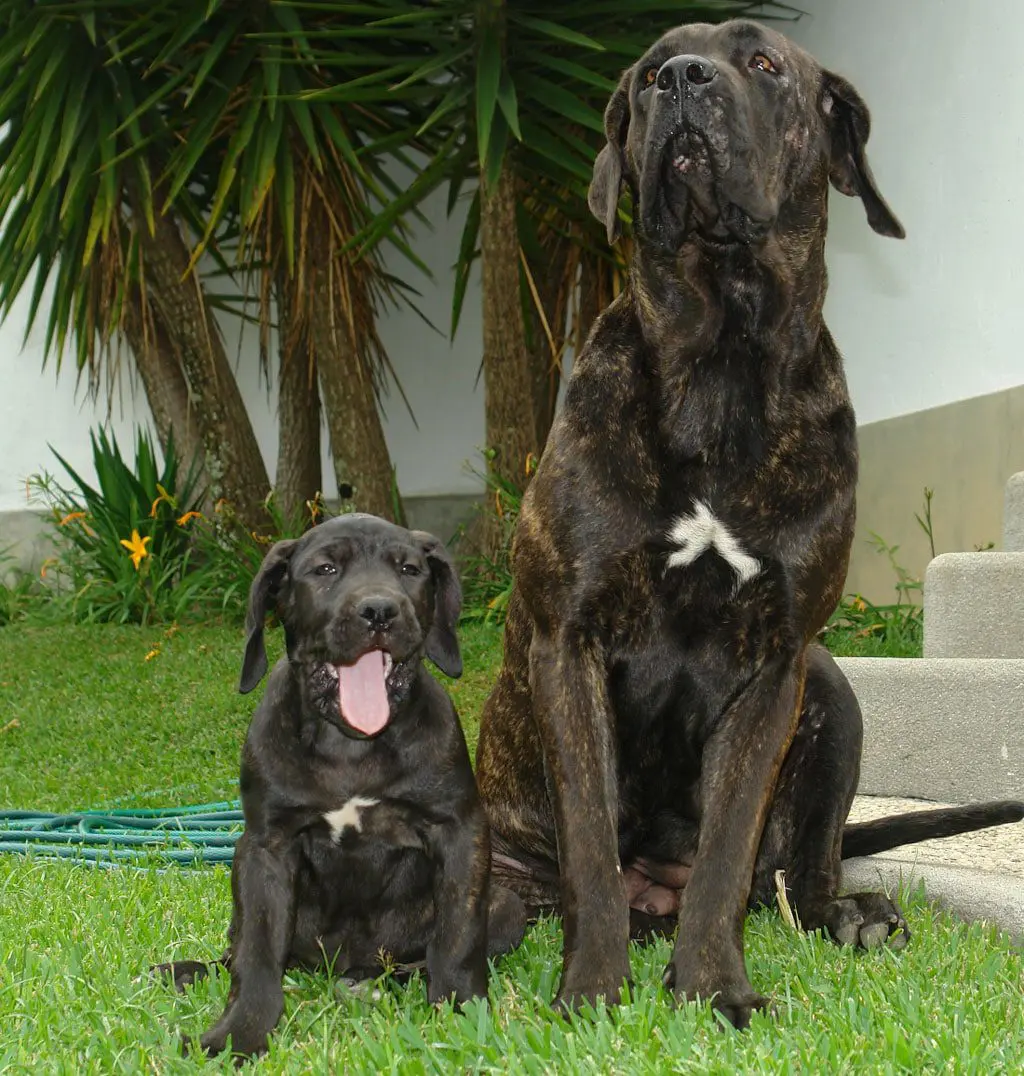
 Not recognized by the FCI

 FCI 206 . Japan Chin and Pekingese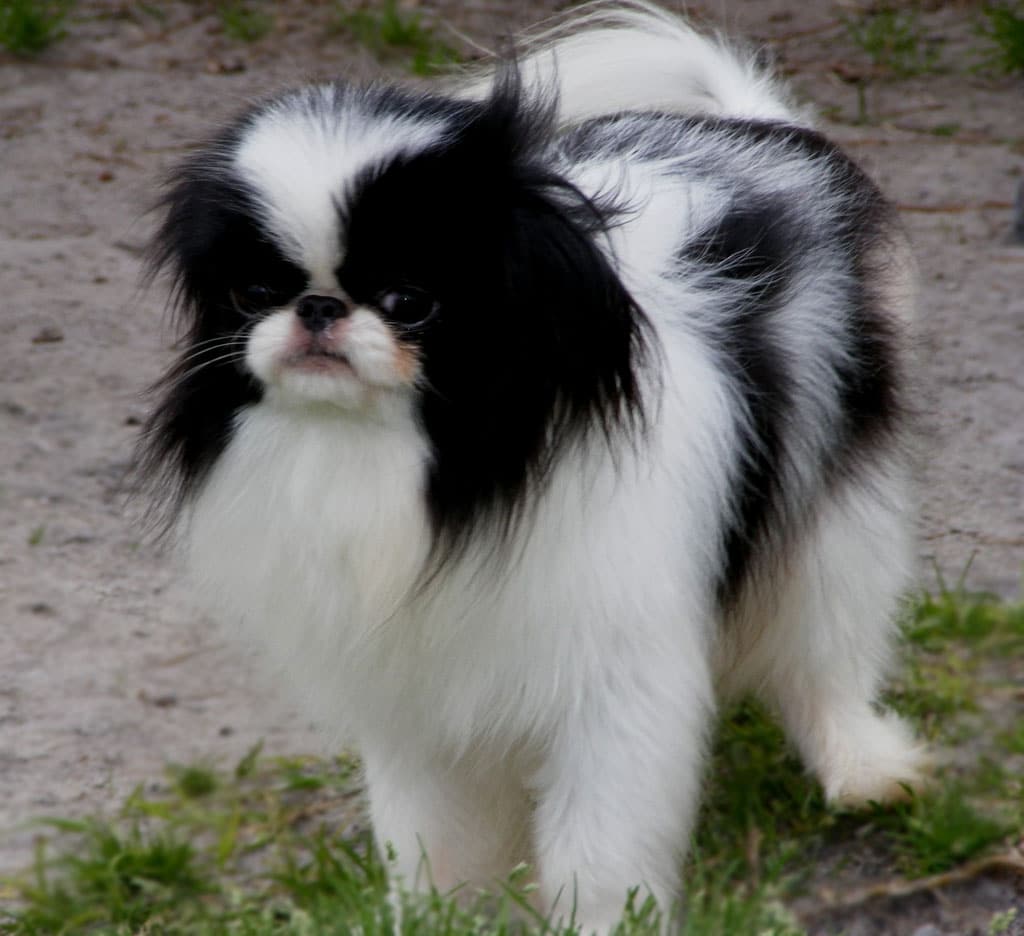
 Molosoide
 The Dogo-espanol
 Dogo- Spanish King the thirds Granada
 Dogo-Spanish King the Tercios Granada
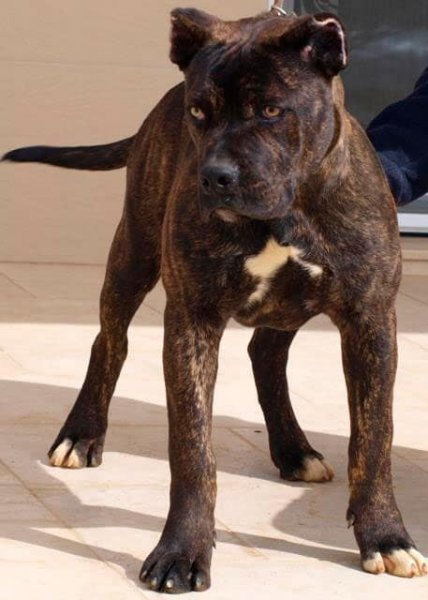

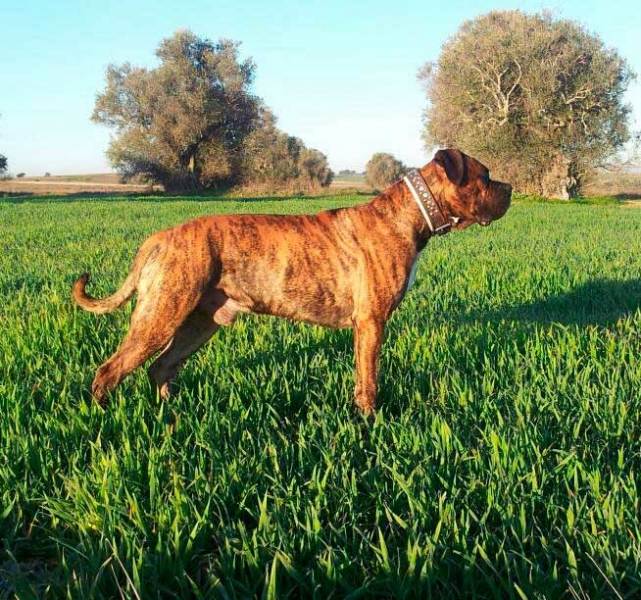




 SPANISH DOGO INITIATION TRAINING 1
 FCI 164 . Rough-haired Sighthounds
 FCI 245 . Griffon type